Are you a Quiet Speculation member?
If not, now is a perfect time to join up! Our powerful tools, breaking-news analysis, and exclusive Discord channel will make sure you stay up to date and ahead of the curve.
Modern convulsed in September. Having a Pro Tour will do that to a format. The broad strokes of Modern remain the same as in August, but all the details have changed.
Whether this is a permanent shift will be determined by the Regional Championships. If the trends started by players testing for the Pro Tour are sustained through them, then you should start seeing them at your LGS very soon.
However, the real test is whether they're reflected in the November and December data. One month is a data point, several is a trend.
Odd Month for Outliers
There's only one outlier in September, which was very surprising given what the data looked like. I thought there'd be three outliers on Magic Online (MTGO), but all the outlier tests only returned Boros Energy. I thought I was getting good at spotting outliers in the data, but apparently not.
Meanwhile, paper has between zero and three outliers. All the tests came to different conclusions. This means that paper's data is right on every test's borderline, which then means that whether anything is an outlier comes down entirely to definition, unlike with MTGO where Energy was very clearly over every line for every test. Therefore, I didn't remove any decks as outliers. Not that it mattered. Even had I removed the top result for being an outlier, the same decks would have made the Tier List.
As always, outliers are reported in their correct position on the Tier List but are removed from the data analysis.
September Population Metagame
To make the tier list, a given deck has to beat the overall average population for the month. The average is my estimate for how many results a given deck "should" produce in a given month. To be considered a tiered deck, it must perform better than "good enough". Every deck that posts at least the average number of results is "good enough" and makes the tier list.
Then we go one standard deviation (STdev) above average to set the limit of Tier 3 and the cutoff for Tier 2. This mathematically defines Tier 3 as those decks clustered near the average. Tier 2 goes from the cutoff to the next standard deviation. These are decks that perform well above average. Tier 1 consists of those decks at least two standard deviations above the mean result, encompassing the truly exceptional performing decks.
The MTGO data nearly exclusively comes from official Preliminary, Qualifiers, and Challenge results. Leagues are excluded, as they add analytically useless bulk data to both the population and power tiers. The paper data comes from any source I can find, with all reported events being counted.
While the MTGO events report predictable numbers, paper events can report anything from only the winner to all the results. In the latter case, if match results aren't included, I'll take as much of the Top 32 as possible. If match results are reported, I'll take winning record up to Top 32, and then any additional decks tied with 32nd place, as tiebreakers are a magic most foul and black.
The MTGO Population Data
September's adjusted average population for MTGO is 14.09. I always round down if the decimal is less than .20. Tier 3, therefore, begins with decks posting 14 results. The adjusted STdev was 26.40, so add 27 and that means Tier 3 runs to 41 results. Again, it's the starting point to the cutoff, then the next whole number for the next Tier. Therefore Tier 2 starts with 42 results and runs to 69. Subsequently, to make Tier 1, 70 decks are required.
The sample population fell from 1828 in August to 1536. There was a Showcase Challenge, but no LCQs or other special events. Unique decks rose slightly, 92 to 94. This means that the deck ratio rose from .050 to .061, which is better but still below July's .062, which was still on the low side for MTGO. 26 decks made the tier list, finally breaking the streak of 25 Tiered decks after three months.
| Deck Name | Total # | Total % |
|---|---|---|
| Tier 1 | ||
| Boros Energy | 226 | 14.71 |
| Tameshi Belcher | 136 | 8.85 |
| Colorless Etron | 136 | 8.85 |
| Goryo Blink | 95 | 6.18 |
| Domain Zoo | 75 | 4.88 |
| Esper Blink | 71 | 4.62 |
| Tier 2 | ||
| Affinity | 66 | 4.30 |
| Izzet Prowess | 61 | 3.97 |
| Green-Based Eldrazi | 54 | 3.52 |
| Amulet Titan | 52 | 3.38 |
| Ruby Storm | 50 | 3.25 |
| Tier 3 | ||
| Neobrand | 38 | 2.47 |
| UW Control | 36 | 2.34 |
| Grixis Reanimator | 35 | 2.28 |
| Weapons Affinity | 33 | 2.15 |
| Frogtide | 25 | 1.63 |
| Broodscale Combo | 24 | 1.56 |
| Living End | 22 | 1.43 |
| Kappa | 21 | 1.37 |
| Mill | 20 | 1.30 |
| Mono-Black Saga | 18 | 1.17 |
| Dimir Tempo | 16 | 1.04 |
| UW Blink | 16 | 1.04 |
| Sam Ritual | 15 | 0.98 |
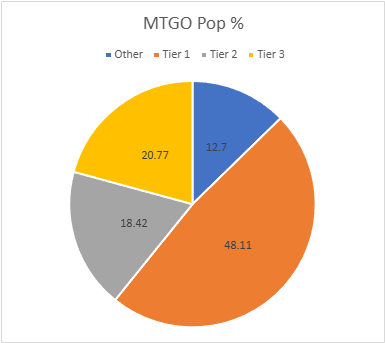
While Energy has maintained its position, the rest of the Tier List has been heavily shuffled. The most notable movement has been Esper Blink's collapse, but I'll take about that more in the Analysis section. What surprised me most watching the data accumulate was Colorless Etron's meteoric rise, then sudden drop-off. Until mid-September, Etron was level with Boros. It was actually ahead at a few points.
Then it just stopped appearing and never recovered.
Also notable was the sudden explosion of Affinity decks running Weapons Manufacturing. It seemed to work out well online, though not so much in paper.
The Likely Answer
It's been a weird few months for Eldrazi decks in general, but this was a particularly inexplicable rise and plateau, which looks like it's becoming a decline. Eldrazi has long been believed to have a strong matchup against Energy, but its fortunes have dipped and surged seemingly independent of what Energy (or the metagame as a whole) is doing.
As such, having one version surge to the top of the metagame isn't unexpected, but for it to happen to this extent is really unusual.
At a guess, I suspect that the rise of Grixis Reanimator is behind Colorless Etron's surge. Kozilek's Command has a lot of modes, and it's easy to forget that one of them is exiling cards in graveyards. Couple this with additional hate available via Karn, the Great Creator and Etron was well positioned to stop any shenanigans. Even if shenanigans did happen, Ugin, Eye of the Storms quite cleanly cleans up. That Reanimator fell off hard as Etron rose is compelling.
I'm not sure why Colorless Etron specifically did so much better than the other versions. I don't know why Sowing Mycospawn has severely fallen out of favor. I'd guess it's too slow. However, I'm surpised that like losing access to green sideboard cards would have hurt more than it appears to.
The Paper Population Data
The Pro Tour an associated events pushed up paper's population from 466 to 543. Since the Pro Tour has a draft component, I only took those decks with 6 or more wins in Modern. I recorded 80 unique decks for a ratio of .147, which is down from August's .163. This isn't too surprising as a big chunk of this data comes from the Pro Tour, and it didn't have a particularly diverse starting metagame.
25 decks made the tier list, which is roughly average for paper. The average population is 6.79, so 7 results make the list. The adjusted STDev is 11.05, so the increment is 11. Therefore, Tier 3 runs from 7 to 18, Tier 2 is 19 to 30 and Tier 1 is 31 and over.
| Deck Name | Total # | Total % |
|---|---|---|
| Tier 1 | ||
| Goryo Blink | 56 | 10.31 |
| Boros Energy | 47 | 8.653 |
| Esper Blink | 45 | 8.29 |
| Colorless Etron | 31 | 5.71 |
| Tameshi Belcher | 30 | 5.52 |
| Tier 2 | ||
| Izzet Prowess | 27 | 4.97 |
| Amulet Titan | 27 | 4.97 |
| Domain Zoo | 26 | 4.79 |
| Tier 3 | ||
| Affinity | 18 | 3.31 |
| UW Control | 16 | 2.95 |
| Green-Based Eldrazi | 14 | 2.58 |
| Grixis Reanimator | 12 | 2.21 |
| Frogtide | 11 | 2.03 |
| Mono-Green Etron | 10 | 1.84 |
| Broodscale Combo | 9 | 1.66 |
| Ruby Storm | 8 | 1.47 |
| Neoform | 8 | 1.47 |
| Simic Ritual | 8 | 1.47 |
| Jeskai Wizards | 7 | 1.29 |
| BW Blink | 7 | 1.29 |
| Sam Ritual | 7 | 1.29 |
| Kappa | 7 | 1.29 |
| Abhorrent Frogtide | 7 | 1.29 |
| Mill | 7 | 1.29 |
| Weapons Affinity | 7 | 1.29 |
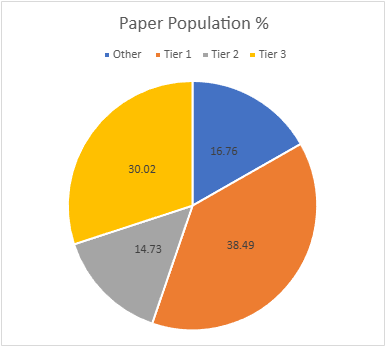
Energy has been knocked off its perch by the most popular deck from the Pro Tour! Well done Goryo Blink, and you didn't even need the Pro Tour boost to do it. Goryo and Esper Blink jumped into the lead very early on while Boros was completely missing, to the point I'm a little surprised that Boros finally made it to second place.
However, Esper began falling off while Goryo maintained its pace. I know why, but it's likely to cause the deck to suffer going forward.
Goryo's Out to Gotcha!
Goryo's a deck that spikes really high. While I don't play the deck, I play against it a lot and the pilots all tell me that the high they get from surveilling Atraxa into the graveyard turn one to reanimate her on turn two will keep you playing for months. However, I haven't dropped a match to it in months playing Jeskai Wizards. Goryo's is a classic Gotcha! deck masquerading as a midrange combo deck.
It has a number of strategies that look like midrange grinding engines like Psychic Frog or Ephemerate/Goryo's shenanigans but they're all just ways to "get" opponents. When the deck runs into decks with sufficient answers, it falls apart. It's worth reminding everyone that the Goryo player who Top 8'd, Jonny Guttman, is not on the list of players with 6 or more constructed wins. I suspect that with the deck getting more attention, it will fall off as players seize on its weaknesses.
September Power Metagame
Tracking the metagame in terms of population is standard practice. But how do results actually factor in? Better decks should also have better results. In an effort to measure this, I use a power ranking system in addition to the prevalence list. By doing so, I measure the relative strengths of each deck within the metagame so that a deck that just squeaks into Top 32 isn't valued the same as one that Top 8's. This better reflects metagame potential.
For the MTGO data, points are awarded based on the population of the event. Preliminaries and similar events award points based on record (1 for 3 wins, 2 for 4 wins, 3 for 5), and Challenges are scored 3 points for the Top 8, 2 for Top 16, and 1 for Top 32. If I can find them, non-Wizards events will be awarded points the same as Challenges or Preliminaries depending on what the event in question reports/behaves like. Super Qualifiers and similar higher-level events get an extra point and so do other events if they’re over 200 players, with a fifth point for going over 400 players.
Due to paper reporting being inconsistent and frequently full of data gaps compared to MTGO, its points work differently. I award points based on the size of the tournament rather than placement. For events with no reported starting population or up to 32 players, one point is awarded to every deck. Events with 33 players up to 128 players get two points. From 129 players up to 512 players get three. Above 512 is four points, and five points is reserved for Modern Pro Tours. When paper reports more than the Top 8, which is rare, I take all the decks with a winning record or tied for Top 32, whichever is pertinent.
The MTGO Power Tiers
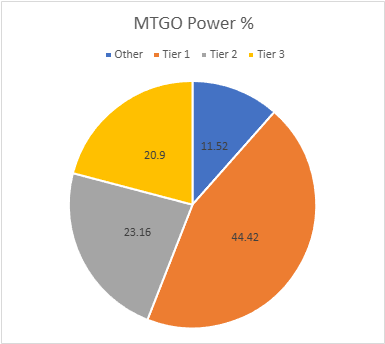
As with the population numbers, total points are down from 3273 to 2751. The adjusted average points were 25.26, therefore 26 points made Tier 3. The adjusted STDev was 48.38 so add 49 to the starting point, and Tier 3 runs to 75 points. Tier 2 starts with 76 points and runs to 125. Tier 1 requires at least 126 points. There's a lot of shuffling inside each tier and Esper Blink fell from Tier 1. UW Blink didn't make the Power Tier, but Mono-Green Etron did.
| Deck Name | Total Points | Total % |
|---|---|---|
| Tier 1 | ||
| Boros Energy | 402 | 14.61 |
| Tameshi Belcher | 262 | 9.52 |
| Colorless Etron | 246 | 8.94 |
| Goryo Blink | 169 | 6.14 |
| Domain Zoo | 143 | 5.20 |
| Tier 2 | ||
| Esper Blink | 122 | 4.43 |
| Affinity | 122 | 4.43 |
| Izzet Prowess | 112 | 4.07 |
| Amulet Titan | 95 | 3.45 |
| Ruby Storm | 94 | 3.42 |
| Green-Based Eldrazi | 92 | 3.34 |
| Tier 3 | ||
| UW Control | 70 | 2.54 |
| Neobrand | 68 | 2.47 |
| Weapons Affinity | 67 | 2.43 |
| Grixis Reanimator | 61 | 2.22 |
| Frogtide | 48 | 1.74 |
| Kappa | 40 | 1.45 |
| Broodscale Combo | 38 | 1.38 |
| Mill | 37 | 1.34 |
| Living End | 34 | 1.24 |
| Dimir Tempo | 31 | 1.13 |
| Sam Ritual | 28 | 1.02 |
| Mono-Green Etron | 27 | 0.98 |
| Mono-Black Saga | 26 | 0.94 |
The Paper Power Tiers
Paper's total points are up from 819 to 937. The average points were 11.71, setting the cutoff at 12 points. The STDev was 21.08, so add 21 to the starting point and Tier 3 runs to 33 points. Tier 2 starts with 34 points and runs to 55. Tier 1 requires at least 56 points.
There is a lot of movement inside and between the tiers. A lot of decks also fell off the list because they only showed up for small local events. The Pro Tour had a very big impact on how the Power Tier shook out. You didn't have to do well at the PT to do well on the Power Tier, but it really helped.
| Deck Name | Total Points | Total % |
|---|---|---|
| Tier 1 | ||
| Goryo Blink | 109 | 11.63 |
| Boros Energy | 91 | 9.71 |
| Tameshi Belcher | 73 | 7.79 |
| Esper Blink | 64 | 6.83 |
| Colorless Etron | 59 | 6.30 |
| Amulet Titan | 59 | 6.30 |
| Tier 2 | ||
| Izzet Prowess | 45 | 4.80 |
| Domain Zoo | 38 | 4.05 |
| Affinity | 36 | 3.84 |
| UW Control | 35 | 3.73 |
| Tier 3 | ||
| Green-Based Eldrazi | 26 | 2.77 |
| Broodscale Combo | 21 | 2.24 |
| Grixis Reanimator | 16 | 1.71 |
| Ruby Storm | 16 | 1.71 |
| Weapons Affinity | 16 | 1.71 |
| Neoform | 14 | 1.49 |
| Simic Ritual | 14 | 1.49 |
| Frogtide | 13 | 1.39 |
| Sam Ritual | 13 | 1.39 |
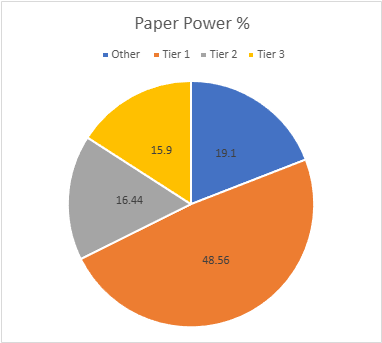
Composite Metagame
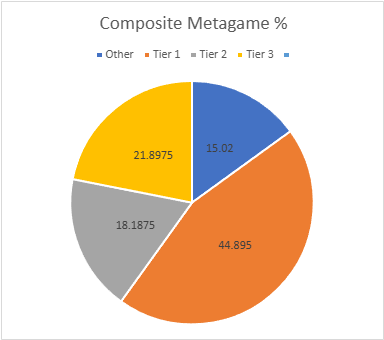
That's a lot of data, but what does it all mean? When Modern Nexus was first started, we had a statistical method to combine the MTGO and paper data, but the math of that system doesn't work without big paper events. I tried. Instead, I'm using an averaging system to combine the data. I take the MTGO results and average the tier, then separately average the paper results, then average the paper and MTGO results together for final tier placement.
This generates a lot of partial Tiers. That's not a bug, but a feature. The nuance separates the solidly Tiered decks from the more flexible ones and shows the true relative power differences between the decks. Every deck in the paper and MTGO results is on the table, and when they don't appear in a given category, they're marked N/A. This is treated as a 4 for averaging purposes.
| Deck Name | MTGO Pop Tier | MTGO Power Tier | MTGO Average Tier | Paper Pop Tier | Paper Power Tier | Paper Average Tier | Composite Tier |
|---|---|---|---|---|---|---|---|
| Boros Energy | 1 | 1 | 1 | 1 | 1 | 1 | 1.00 |
| Tameshi Belcher | 1 | 1 | 1 | 1 | 1 | 1 | 1.00 |
| Colorless Etron | 1 | 1 | 1 | 1 | 1 | 1 | 1.00 |
| Goryo Blink | 1 | 1 | 1 | 1 | 1 | 1 | 1.00 |
| Esper Blink | 1 | 2 | 1.5 | 1 | 1 | 1 | 1.25 |
| Domain Zoo | 1 | 1 | 1 | 2 | 2 | 2 | 1.50 |
| Amulet Titan | 2 | 2 | 2 | 2 | 1 | 1.5 | 1.75 |
| Izzet Prowess | 2 | 2 | 2 | 2 | 2 | 2 | 2.00 |
| Affinity | 2 | 2 | 2 | 3 | 2 | 2.5 | 2.25 |
| Green-Based Eldrazi | 2 | 2 | 2 | 3 | 3 | 3 | 2.50 |
| Ruby Storm | 2 | 2 | 2 | 3 | 3 | 3 | 2.50 |
| UW Control | 3 | 3 | 3 | 3 | 2 | 2.5 | 2.75 |
| Neobrand | 3 | 3 | 3 | 3 | 3 | 3 | 3.00 |
| Grixis Reanimator | 3 | 3 | 3 | 3 | 3 | 3 | 3.00 |
| Weapons Affinity | 3 | 3 | 3 | 3 | 3 | 3 | 3.00 |
| Frogtide | 3 | 3 | 3 | 3 | 3 | 3 | 3.00 |
| Broodscale Combo | 3 | 3 | 3 | 3 | 3 | 3 | 3.00 |
| Sam Ritual | 3 | 3 | 3 | 3 | 3 | 3 | 3.00 |
| Kappa | 3 | 3 | 3 | 3 | N/A | 3.5 | 3.25 |
| Mill | 3 | 3 | 3 | 3 | N/A | 3.5 | 3.25 |
| Living End | 3 | 3 | 3 | N/A | N/A | N/A | 3.50 |
| Mono-Black Saga | 3 | 3 | 3 | N/A | N/A | N/A | 3.50 |
| Dimir Tempo | 3 | 3 | 3 | N/A | N/A | N/A | 3.50 |
| Mono-Green Etron | N/A | 3 | 3.5 | 3 | N/A | 3.5 | 3.50 |
| Simic Ritual | N/A | N/A | N/A | 3 | 3 | 3 | 3.50 |
| UW Blink | 3 | N/A | 3.5 | N/A | N/A | N/A | 3.75 |
| Jeskai Wizards | N/A | N/A | N/A | 3 | N/A | 3.5 | 3.75 |
| BW Blink | N/A | N/A | N/A | 3 | N/A | 3.5 | 3.75 |
| Abhorrent Frogtide | N/A | N/A | N/A | 3 | N/A | 3.5 | 3.75 |
Average Power Rankings
Finally, we come to the average power rankings. These are found by taking the total points earned and dividing them by total decks, to measure points per deck. I use this to measure strength vs. popularity. Measuring deck strength is hard. While you can make a Wins-Above-Replacement-esq metric for the Magic cards in an individual deck, there's no way to make one that lets you compare decks. The game is too complex, and even then, power is very contextual.
Using the power rankings helps to show how justified a deck’s popularity is. However, more popular decks will still necessarily earn a lot of points. Therefore, the top tier doesn't move much between population and power and obscures whether its decks really earned their position.
This is where the averaging comes in. Decks that earn a lot of points because they get a lot of results will do worse than decks that win more events, indicating which deck actually performs better.
A higher average indicates lots of high finishes, whereas low averages result from mediocre performances and a high population. Lower-tier decks typically do very well here, likely due to their pilots being enthusiasts. Bear this in mind and be careful about reading too much into these results. However, as a general rule, decks that place above the baseline average are over-performing, and vice versa.
How far above or below that average a deck sits justifies its position on the power tiers. Decks well above baseline are undervalued, while decks well below baseline are very popular, but aren't necessarily good.
The Real Story
When considering the average points, the key is looking at how far off a deck is from the Baseline stat (the overall average of points/population). The closer a deck’s performance to the Baseline, the more likely it is to be performing close to its "true" potential.
A deck that is exactly average would therefore perform exactly as well as expected. The greater the deviation from the average, the more a deck under or over-performs. On the low end, a deck’s placing was mainly due to population rather than power, which suggests it’s overrated. A high-scoring deck is the opposite of this.
We'll start with MTGO's averages:
| Deck Name | Average Points | Power Tier |
|---|---|---|
| Mono-Green Etron | 2.08 | 3 |
| Weapons Affinity | 2.03 | 3 |
| UW Control | 1.94 | 3 |
| Dimir Tempo | 1.94 | 3 |
| Tameshi Belcher | 1.93 | 1 |
| Frogtide | 1.92 | 3 |
| Domain Zoo | 1.91 | 1 |
| Kappa | 1.90 | 3 |
| Ruby Storm | 1.88 | 2 |
| Sam Ritual | 1.87 | 3 |
| Affinity | 1.85 | 2 |
| Mill | 1.85 | 3 |
| Izzet Prowess | 1.84 | 2 |
| Amulet Titan | 1.83 | 2 |
| Colorless Etron | 1.81 | 1 |
| Neobrand | 1.79 | 3 |
| Boros Energy | 1.78 | 1 |
| Goryo Blink | 1.78 | 1 |
| Grixis Reanimator | 1.74 | 3 |
| Esper Blink | 1.72 | 2 |
| Green-Based Eldrazi | 1.70 | 2 |
| Baseline | 1.68 | |
| Broodscale Combo | 1.58 | 3 |
| Living End | 1.54 | 3 |
| UW Blink | 1.50 | N/A |
| Mono-Black Saga | 1.44 | 3 |
Tameshi Belcher wins MTGO Deck of September. You don't hear it discussed much, but the deck really is a beast.
Now the paper averages:
| Deck Name | Average Points | Power Tier |
|---|---|---|
| Tameshi Belcher | 2.43 | 1 |
| Broodscale Combo | 2.33 | 3 |
| Weapons Affinity | 2.29 | 3 |
| UW Control | 2.19 | 2 |
| Amulet Titan | 2.18 | 1 |
| Affinity | 2.00 | 2 |
| Ruby Storm | 2.00 | 3 |
| Goryo Blink | 1.95 | 1 |
| Boros Energy | 1.94 | 1 |
| Colorless Etron | 1.90 | 1 |
| Green-Based Eldrazi | 1.86 | 3 |
| Sam Ritual | 1.86 | 3 |
| Neoform | 1.75 | 3 |
| Simic Ritual | 1.75 | 3 |
| Izzet Prowess | 1.67 | 2 |
| Tier 1 | 1.50 | |
| Domain Zoo | 1.46 | 2 |
| Jeskai Wizards | 1.43 | N/A |
| Esper Blink | 1.42 | 1 |
| Grixis Reanimator | 1.33 | 3 |
| Kappa | 1.29 | N/A |
| Abhorrent Frogtide | 1.29 | N/A |
| Frogtide | 1.18 | 3 |
| BW Blink | 1.14 | N/A |
| Mono-Green Etron | 1.10 | N/A |
| Mill | 1.00 | N/A |
Et Tu, paper? Belcher also wins your Deck of September. Appropriate for a Pro Tour winning deck, I suppose.
Analysis
With the Pro Tour finished and the Regional Championships coming into view, I think we need to face reality about where Modern is heading. The evidence is clearly showing that the format is defined by combo decks vs Energy, and Tameshi Belcher is the best combo deck. It's the hardest to hate out, hardest to interact with, and favorably interacts with the other combo decks. I'd expect to see it a lot at your RC.
Hard control is doing decently, but as always it struggles in open metagames. Plus, Boros Energy is a hard matchup thanks to all of its reach. The other Energy variants aren't nearly as difficult for control, but Energy can just kill in response to a board wipe. Which gives it a chilling effect on the entire aggro space and is why it's actually driving the Modern metagame.
The Energy Issue
I've struggled to concisely put my thoughts on Boros Energy together for some time. It is by far the strongest aggro deck in the format, despite Mardu, Jeskai, or UW Energy being better decks on paper. Boros consistently outperforms other options and only really drops off when players seemingly get bored of it, but they always come back to Boros.
Someone suggested off-handedly to me that this is what Jund used to be, and I completely agree. Boros Energy is pre-2017 Jund for a new age.
In early Modern, you could play any midrange deck you wanted, but it would always be worse than Jund. It didn't matter what you did, Jund's answers and creatures were more efficient. You could fight Jund in both the midrange and control spaces, but those decks had worse Tron matchups than Jund.
As such, Jund pushed almost everything else out of the metagame. Decks like Junk or Jeskai still saw play as anti-Jund decks, but they never really threatened Jund's dominance until Jund was pushed out by Death's Shadow.
The same thing is happening with Boros Energy. You can play many different aggro decks, but they're all worse than Boros Energy. The three best 1-drops are Guide of Souls, Ocelot Pride, and Ragavan, Nimble Pilferer. You want more energy cards to support Guide so you play Galvanic Discharge. The best aggressive planeswalker is Ajani, Nacatl Avenger, and the best way to trigger his transformation is Goblin Bombardment.
You can't make a more synergistic aggro deck at the moment, and no deck can match Boros' rollout. It's why Domain decks are moving increasingly midrange and getting weird. You can't compete in the aggro space against Boros Energy.
Esper Blink's Decline
After exploding to the top of Modern in August, Esper Blink is really struggling. While it remains popular, it fell out of MTGO's Power Tier 1 and had poor average points in both online and paper play. Its Pro Tour numbers weren't good for such a popular deck, and its recent MTGO numbers have been very poor. I don't think it will make Tier 1 in October without a massive turnaround.
The fact that Esper players are playing increasingly divergent and weird versions of the deck lends credence to my belief that the deck is suffering.
I suspect that a lot of the problem is Quantum Riddler. I've previously stated that the card was good, but it was $30 worth of good. I expected the price to settle under $25, but in early October it spiked past $40, and while down from peak is still in flux. I underestimated just how excited players were about the card, but falling supply actually drove the spike.
Supplies of Edge of Eternities were depleted virtually everywhere shortly after I wrote that article. My LGS ran out of loose boosters and boxes in late August and is still waiting for more. Every draft night of EOE had numerous pods, while they've not fired a single one for Spider-Man.
The most vaunted card from a popular and hard-to-find set is going to see price spikes, and that in turn will lead players to contort their decks into strange shapes to justify the price they paid for the card. Which should sound familiar, this is exactly what happened with Ketramose, the New Dawn. Rather than refine existing decks, players are jamming Riddler into everything, and it's mostly not working.
Adding Riddler works for Goryo Blink as it adds to the Gotcha! and midrangey plans, but everyone else is putting way more energy into making Riddler work than it deserves. I expect this to work itself out in a few weeks.
Financial Implications
Marvel's Spider-Man isn't doing well. The LGS' in my area have a lot of surplus stock, and the individual card prices are similarly weak. I know Wizards insists that Universes Beyond sells like gangbusters, but for every Final Fantasy there's been Assassin's Creed and Spider-Man.
I'm not sure what to think about all this, especially with the online Through the Omenpaths debacle.
The upcoming return to Lowyn looks promising, but it's coming out at the end of an exhausting year in a poor economic climate. I doubt that speculative pressure will be strong for this one, so I'd look to conserve inventory until we've got a better picture of what to expect.