

Are you a Quiet Speculation member?
If not, now is a perfect time to join up! Our powerful tools, breaking-news analysis, and exclusive Discord channel will make sure you stay up to date and ahead of the curve.
As the year winds down, focus switches from the constant grind of Magic Online to paper's big events. Players have been preparing for the Regional Championships for a while, and the metagame data reflects the conclusions they've drawn. Whether or not they made the correct calls is a matter for the data.
The most conclusive result is that the differences between the paper and online metagames are more stark than usual. Never forget that all the MTGO data is generated by a couple hundred players while paper comes from thousands.
No October Outliers
I'm surprised to report that there are no outliers in October. It's been a long time since that's been the case. I certainly thought there'd be outliers just looking at the spread, but no. It's all on curve. Just barely in the case of paper's data, but close enough is close enough. Enjoy it while it lasts.
October Population Metagame
To make the tier list, a given deck has to beat the overall average population for the month. The average is my estimate for how many results a given deck "should" produce in a given month. To be considered a tiered deck, it must perform better than "good enough". Every deck that posts at least the average number of results is "good enough" and makes the tier list.
Then we go one standard deviation (STdev) above average to set the limit of Tier 3 and the cutoff for Tier 2. This mathematically defines Tier 3 as those decks clustered near the average. Tier 2 goes from the cutoff to the next standard deviation. These are decks that perform well above average. Tier 1 consists of those decks at least two standard deviations above the mean result, encompassing the truly exceptional performing decks.
The MTGO data nearly exclusively comes from official Preliminary, Qualifiers, and Challenge results. Leagues are excluded, as they add analytically useless bulk data to both the population and power tiers. The paper data comes from any source I can find, with all reported events being counted.
While the MTGO events report predictable numbers, paper events can report anything from only the winner to all the results. In the latter case, if match results aren't included, I'll take as much of the Top 32 as possible. If match results are reported, I'll take winning record up to Top 32, and then any additional decks tied with 32nd place, as tiebreakers are a magic most foul and black.
The MTGO Population Data
October's unadjusted average population for MTGO is 21.04. I always round down if the decimal is less than .20. Tier 3, therefore, begins with decks posting 21 results. The unadjusted STdev was 36.02, so add 36 and that means Tier 3 runs to 57 results. Again, it's the starting point to the cutoff, then the next whole number for the next Tier. Therefore Tier 2 starts with 58 results and runs to 94. Subsequently, to make Tier 1, 95 decks are required.
The sample population is unchanged from September at 1536. That's never happened before. It couldn't happen back when Preliminary data was posted, and the number of Challenges which actually fire each month has always been variable. To have the exact same number of Challenges fire in September and October is unexpected and unprecedented.
However, unique decks fell severely, from 94 to 73, yielding an abysmal unique deck ratio of .047. The metagame appears to be settling, which may not be a good thing. Only 17 decks made the Tier List, which is probably more to do with the lack of outliers than the low diversity.
| Deck Name | Total # | Total % |
|---|---|---|
| Tier 1 | ||
| Boros Energy | 158 | 10.29 |
| Izzet Prowess | 135 | 8.79 |
| Domain Zoo | 126 | 8.20 |
| Jeskai Blink | 108 | 7.03 |
| Weapons Affinity | 99 | 6.44 |
| Goryo Blink | 95 | 6.18 |
| Tier 2 | ||
| Amulet Titan | 83 | 5.40 |
| Broodscale Combo | 76 | 4.95 |
| Colorless Etron | 74 | 4.82 |
| UW Control | 58 | 3.78 |
| Tier 3 | ||
| Esper Blink | 57 | 3.71 |
| Ruby Storm | 53 | 3.45 |
| Affinity | 48 | 3.12 |
| UW Blink | 37 | 2.41 |
| Tameshi Belcher | 35 | 2.28 |
| Green-Based Eldrazi | 33 | 2.15 |
| Neobrand | 24 | 1.56 |
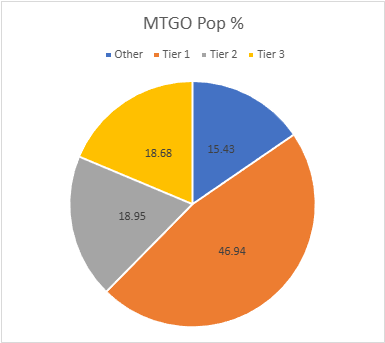
Boros Energy continues its reign atop Tier 1, but its throne is not as secure as it once was. Izzet Prowess and Domain Zoo have surged up the rankings to challenge Energy. However, the big story is the sudden ascension of Jeskai Blink. The deck was a complete non-factor until winning the Houston RC, after which MTGO wholeheartedly jumped on the deck.
This is typical for MTGO: something new emerges, there's mass adoption, then it falls off. Sometimes the decline is permanent as it was just The Joy of New Things and FOMO propping it up. Sometimes, it's something real. It's too early to know which Jeskai's rise is.
Belcher's Decline
Meanwhile, Tameshi Belcher crashed. This is unexpected, considering it was the best performing deck in September. However, this is the metagame at work. Belcher's success has always been about its great matchup against Energy. It was quite literally the first anti-Energy deck back in 2023, and that hasn't changed. With its main prey declining, Belcher would naturally fall.
However, this precipitous of a decline is indicative of a metagame shift. Belcher is a very consistent combo deck, but it's not quick. It can't kill before turn 4, though it has many ways to ensure a turn 4 kill. This has always made it vulnerable to fast and/or disruptive aggro, but until recently Energy pushed out all the other aggro decks. Cori-Steel Cutter brought Izzet Prowess back from the dead, and it can race Belcher. Prowess doing well means that Belcher is suffering.
The Paper Population Data
Thanks to multiple RCs and their numerous side events reporting data, October's paper population doubled from 543 to 1020. I think this is the highest paper population I've ever recorded. The 85 unique decks and ratio of .083 are a lot better than MTGO's numbers, but that ratio is abysmal by paper standards. I'm not too surprised by the low ratio, as a lot of players played the same deck in multiple events because that's how grinding side events works.
16 decks made the tier list, which is below average for paper, but is also explainable by the lack of outliers. No outliers=fewer decks make the Tier List. The average population is exactly 12 so that's where the Lis starts. The STDev is 22.48, so the increment is 23. Therefore, Tier 3 runs from 12 to 35, Tier 2 is 36 to 59 and Tier 1 is 60 and over.
| Deck Name | Total # | Total % |
|---|---|---|
| Tier 1 | ||
| Amulet Titan | 116 | 11.37 |
| Goryo Blink | 96 | 9.41 |
| Izzet Prowess | 82 | 8.04 |
| Boros Energy | 65 | 6.37 |
| Domain Zoo | 62 | 6.08 |
| Tier 2 | ||
| Colorless Etron | 57 | 5.59 |
| Weapons Affinity | 54 | 5.29 |
| Broodscale Combo | 44 | 4.31 |
| Esper Blink | 42 | 4.12 |
| Jeskai Blink | 36 | 3.53 |
| Tier 3 | ||
| Tameshi Belcher | 34 | 3.33 |
| Affinity | 33 | 3.23 |
| Green-Based Eldrazi | 31 | 3.04 |
| UW Blink | 29 | 2.84 |
| UW Control | 27 | 2.65 |
| Simic Ritual | 17 | 1.67 |
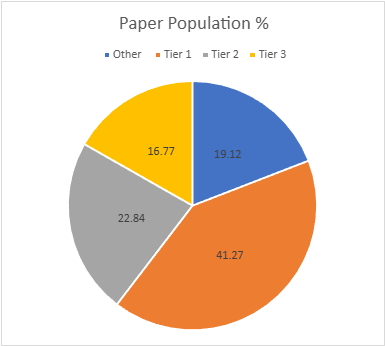
Energy continues to suffer in paper, though that's a bit deceptive. You'll see why when we get to the Average Power section. Amulet is proudly on top of the paper metagame, though that really shouldn't be surprising. SCG Houston is a major component of the data, and Amulet has always done better at SCG events that elsewhere. I've never known why, but if you go back through old results, the SCG bias towards Amulet is very clear. We'll see if that keeps up in November.
October Power Metagame
Tracking the metagame in terms of population is standard practice. But how do results actually factor in? Better decks should also have better results. In an effort to measure this, I use a power ranking system in addition to the prevalence list. By doing so, I measure the relative strengths of each deck within the metagame so that a deck that just squeaks into Top 32 isn't valued the same as one that Top 8's. This better reflects metagame potential.
For the MTGO data, points are awarded based on the population of the event. Preliminaries and similar events award points based on record (1 for 3 wins, 2 for 4 wins, 3 for 5), and Challenges are scored 3 points for the Top 8, 2 for Top 16, and 1 for Top 32. If I can find them, non-Wizards events will be awarded points the same as Challenges or Preliminaries depending on what the event in question reports/behaves like. Super Qualifiers and similar higher-level events get an extra point and so do other events if they’re over 200 players, with a fifth point for going over 400 players.
Due to paper reporting being inconsistent and frequently full of data gaps compared to MTGO, its points work differently. I award points based on the size of the tournament rather than placement. For events with no reported starting population or up to 32 players, one point is awarded to every deck. Events with 33 players up to 128 players get two points. From 129 players up to 512 players get three. Above 512 is four points, and five points is reserved for Modern Pro Tours. When paper reports more than the Top 8, which is rare, I take all the decks with a winning record or tied for Top 32, whichever is pertinent.
The MTGO Power Tiers
As with the population numbers, total points the same as September at 2751. The average points were 37.68, therefore 38 points made Tier 3. The STDev was 65.22 so add 66 to the starting point, and Tier 3 runs to 104 points. Tier 2 starts with 105 points and runs to 171. Tier 1 requires at least 172 points. There's a lot of shuffling inside each tier and a lot of movement between tiers, but nothing fell off nor joined on points.
| Deck Name | Total Points | Total % |
|---|---|---|
| Tier 1 | ||
| Boros Energy | 286 | 10.40 |
| Izzet Prowess | 257 | 9.34 |
| Domain Zoo | 218 | 7.92 |
| Jeskai Blink | 194 | 7.05 |
| Tier 2 | ||
| Goryo Blink | 171 | 6.22 |
| Weapons Affinity | 167 | 6.07 |
| Amulet Titan | 164 | 5.96 |
| Broodscale Combo | 130 | 4.72 |
| Colorless Etron | 128 | 4.65 |
| Esper Blink | 107 | 3.89 |
| Tier 3 | ||
| Ruby Storm | 103 | 3.74 |
| UW Control | 102 | 3.71 |
| Affinity | 81 | 2.94 |
| UW Blink | 75 | 2.73 |
| Tameshi Belcher | 59 | 2.14 |
| Green-Based Eldrazi | 57 | 2.07 |
| Neobrand | 39 | 1.42 |
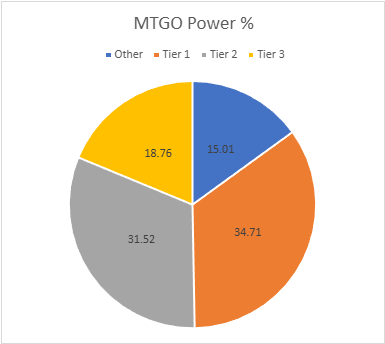
The really high point threshold has mercilessly shifted many decks downwards, but it also rose up Esper Blink from Tier 3 to Tier 2. This makes me think that the Blink Wars aren't finished, but have instead entered a new stage. Jeskai is the new hotness, but sometimes the old stars are still better. This is one to keep watching.
The Paper Power Tiers
Paper's total points are also massively up from 937 to 2024. Lots of big events does that. The average points were 23.81, setting the cutoff at 24 points. The STDev was 46.69, so add 47 to the starting point and Tier 3 runs to 71 points. Tier 2 starts with 72 points and runs to 119. Tier 1 requires at least 120 points. There is a lot of movement inside the tiers, but none between the tiers. Nothing joined or fell off either. As I said earlier, there's strong signs of metagame settling in October.
| Deck Name | Total Points | Total % |
|---|---|---|
| Tier 1 | ||
| Amulet Titan | 249 | 12.30 |
| Goryo Blink | 197 | 9.73 |
| Izzet Prowess | 153 | 7.56 |
| Boros Energy | 148 | 7.31 |
| Domain Zoo | 132 | 6.52 |
| Tier 2 | ||
| Colorless Etron | 107 | 5.29 |
| Weapons Affinity | 103 | 5.09 |
| Broodscale Combo | 92 | 4.54 |
| Jeskai Blink | 85 | 4.20 |
| Esper Blink | 84 | 4.15 |
| Tier 3 | ||
| Affinity | 68 | 3.36 |
| Tameshi Belcher | 66 | 3.26 |
| UW Control | 64 | 3.16 |
| Green-Based Eldrazi | 55 | 2.72 |
| UW Blink | 50 | 2.47 |
| Simic Ritual | 34 | 1.68 |
Composite Metagame
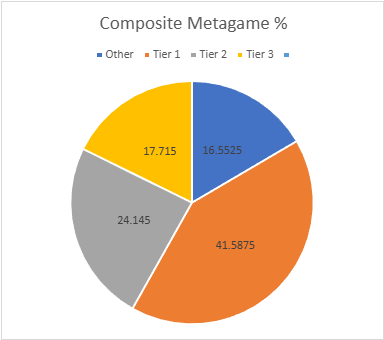
That's a lot of data, but what does it all mean? When Modern Nexus was first started, we had a statistical method to combine the MTGO and paper data, but the math of that system doesn't work without big paper events. I tried. Instead, I'm using an averaging system to combine the data. I take the MTGO results and average the tier, then separately average the paper results, then average the paper and MTGO results together for final tier placement.
This generates a lot of partial Tiers. That's not a bug, but a feature. The nuance separates the solidly Tiered decks from the more flexible ones and shows the true relative power differences between the decks. Every deck in the paper and MTGO results is on the table, and when they don't appear in a given category, they're marked N/A. This is treated as a 4 for averaging purposes.
| Deck Name | MTGO Pop Tier | MTGO Power Tier | MTGO Average Tier | Paper Pop Tier | Paper Power Tier | Paper Average Tier | Composite Tier |
|---|---|---|---|---|---|---|---|
| Boros Energy | 1 | 1 | 1 | 1 | 1 | 1 | 1.00 |
| Izzet Prowess | 1 | 1 | 1 | 1 | 1 | 1 | 1.00 |
| Domain Zoo | 1 | 1 | 1 | 1 | 1 | 1 | 1.00 |
| Goryo Blink | 1 | 2 | 1.5 | 1 | 1 | 1 | 1.25 |
| Jeskai Blink | 1 | 1 | 1 | 2 | 2 | 2 | 1.50 |
| Amulet Titan | 2 | 2 | 2 | 1 | 1 | 1 | 1.50 |
| Weapons Affinity | 1 | 2 | 1.5 | 2 | 2 | 2 | 1.75 |
| Broodscale Combo | 2 | 2 | 2 | 2 | 2 | 2 | 2.00 |
| Colorless Etron | 2 | 2 | 2 | 2 | 2 | 2 | 2.00 |
| Esper Blink | 3 | 2 | 2.5 | 2 | 2 | 2 | 2.25 |
| UW Control | 2 | 3 | 2.5 | 3 | 3 | 3 | 2.75 |
| Affinity | 3 | 3 | 3 | 3 | 3 | 3 | 3.00 |
| UW Blink | 3 | 3 | 3 | 3 | 3 | 3 | 3.00 |
| Tameshi Belcher | 3 | 3 | 3 | 3 | 3 | 3 | 3.00 |
| Green-Based Eldrazi | 3 | 3 | 3 | 3 | 3 | 3 | 3.00 |
| Ruby Storm | 3 | 3 | 3 | N/A | N/A | N/A | 3.50 |
| Neobrand | 3 | 3 | 3 | N/A | N/A | N/A | 3.50 |
| Simic Ritual | N/A | N/A | N/A | 3 | 3 | 3 | 3.50 |
Average Power Rankings
Finally, we come to the average power rankings. These are found by taking the total points earned and dividing them by total decks, to measure points per deck. I use this to measure strength vs. popularity. Measuring deck strength is hard. While you can make a Wins-Above-Replacement-esq metric for the Magic cards in an individual deck, there's no way to make one that lets you compare decks. The game is too complex, and even then, power is very contextual.
Using the power rankings helps to show how justified a deck’s popularity is. However, more popular decks will still necessarily earn a lot of points. Therefore, the top tier doesn't move much between population and power and obscures whether its decks really earned their position.
This is where the averaging comes in. Decks that earn a lot of points because they get a lot of results will do worse than decks that win more events, indicating which deck actually performs better.
A higher average indicates lots of high finishes, whereas low averages result from mediocre performances and a high population. Lower-tier decks typically do very well here, likely due to their pilots being enthusiasts. Bear this in mind and be careful about reading too much into these results. However, as a general rule, decks that place above the baseline average are over-performing, and vice versa.
How far above or below that average a deck sits justifies its position on the power tiers. Decks well above baseline are undervalued, while decks well below baseline are very popular, but aren't necessarily good.
The Real Story
When considering the average points, the key is looking at how far off a deck is from the Baseline stat (the overall average of points/population). The closer a deck’s performance to the Baseline, the more likely it is to be performing close to its "true" potential.
A deck that is exactly average would therefore perform exactly as well as expected. The greater the deviation from the average, the more a deck under or over-performs. On the low end, a deck’s placing was mainly due to population rather than power, which suggests it’s overrated. A high-scoring deck is the opposite of this.
We'll start with MTGO's averages:
| Deck Name | Average Points | Power Tier |
|---|---|---|
| UW Blink | 2.03 | 3 |
| Amulet Titan | 1.98 | 2 |
| Ruby Storm | 1.94 | 3 |
| Izzet Prowess | 1.90 | 1 |
| Esper Blink | 1.88 | 2 |
| Boros Energy | 1.81 | 1 |
| Jeskai Blink | 1.80 | 1 |
| Goryo Blink | 1.80 | 2 |
| UW Control | 1.76 | 3 |
| Colorless Etron | 1.73 | 2 |
| Green-Based Eldrazi | 1.73 | 3 |
| Domain Zoo | 1.73 | 1 |
| Broodscale Combo | 1.71 | 2 |
| Baseline | 1.70 | |
| Weapons Affinity | 1.69 | 2 |
| Affinity | 1.69 | 3 |
| Tameshi Belcher | 1.69 | 3 |
| Neobrand | 1.62 | 3 |
As the top performing Tier 1 deck, Izzet Prowess wins MTGO Deck of October. Welcome back.
Now for paper:
| Deck Name | Average Points | Power Tier |
|---|---|---|
| UW Blink | 2.37 | 3 |
| Esper Blink | 2.36 | 2 |
| Boros Energy | 2.28 | 1 |
| Amulet Titan | 2.15 | 1 |
| Domain Zoo | 2.13 | 1 |
| Broodscale Combo | 2.09 | 2 |
| Tameshi Belcher | 2.06 | 3 |
| Goryo Blink | 2.05 | 1 |
| Jeskai Blink | 2.00 | 2 |
| Simic Ritual | 2.00 | 3 |
| Affinity | 1.94 | 3 |
| Weapons Affinity | 1.91 | 2 |
| Colorless Etron | 1.88 | 2 |
| Izzet Prowess | 1.87 | 1 |
| UW Control | 1.77 | 3 |
| Baseline | 1.75 | |
| Green-Based Eldrazi | 1.72 | 3 |
Meanwhile, Boros Energy wins Paper Deck of October. I told you this deck wasn't declining as much as it appears.
Analysis
Low diversity coupled with the tiers being consistent between paper and population indicates that the metagame is settling. Players know which decks are good and have the matchups figured out. The rise of Jeskai Blink might look like a shakeup, but it's mostly replacing the other Blink versions and appears to have a similar matchup spread.
The metagame has undeniably shifted from September, but it looks like an inter-metagame adjustment rather than an actual shakeup.
In the former, the metagame is reacting to itself while in the later has something entirely new enter. There's nothing from any recent set making new waves, nor has anything truly novel emerged from the existing cardpool.
Therefore, this isn't a shakeup. Energy has driven out any true aggro deck that doesn't run Guide of Souls and Ocelot Pride while having a strong matchup vs control thanks to Phlage and Goblin Bombardment. To compete, previously more aggro decks like Zoo have moved toward midrange and lots of combo decks emerged. The combo metagame is pushing players back towards disruptive decks that are weak to Energy.
It's a stable metagame cycle. We haven't had one of those in a while.
Banning Day Comes and Goes
The latest Banned and Restricted Announcement had nothing for Modern. I'm not remotely surprised. Wizards has historically shied away from taking action in every format simultaneously. The fact that Modern is also having a healthy metagame cycle obviates any banning pressure. Finally, we're in the middle of the Modern RCs.
Wizards' favorite excuse for doing nothing has been an unwillingness to disrupt players' testing for events/causing churn in the middle of a qualifier season. They weren't going to touch Modern, and I don't know why anyone rationally thought otherwise.
As for the actual changes, Wizards all but confirmed that Vivi Ornitier was gone a while ago. I thought that if it took anything with it, Agatha's Soul Cauldron would go but instead its Proft's Eidetic Memory. While I understand their argument for Memory, just ignoring Cauldron seems risky. I'd keep watching that card to break Standard again.
If Wizards is going to keep pushing this new super-Standard, they'd better get better at designing for and managing it, and soon. Legacy Reanimator has finally been kneecapped, but Wizards still won't deal with Oops. It was never about winrate with that deck, it's about the toxic gameplay, why don't they get it? Finally, they've given players a reason to experiment in Pioneer by banning Hearthfire Hero, but there are still no Pioneer events, so I don't think anyone will care.
Looking Ahead
However, there are two decks the Modern community needs to start scrutinizing for future bans. The first is Amulet Titan, specifically the Aftermath Analyst loop. Amulet has been around forever but has always been kept from becoming a truly dominant force or power-level problem because it's an intricate deck that doesn't work at all under Blood Moon. A lot of players see the deck's success, pick the deck up, and quickly put it back down after realizing how much time and effort they have to put in to play it adequately. This hasn't changed.
However, the infinite Analyst loop requires scrutiny, and Wizards called it out in the B&R Announcement. RC Houston ran many hours late thanks to how long the loop takes to execute. If this has happened elsewhere, nobody was complaining where I could see it. This smacks of Miracles-era Legacy, and tournament logistics issues do often lead to bans.
A single tournament having issues isn't enough to draw a ban. If the Las Vegas RC has the same problem, and Amulet continues to be the reason then Modern needs to seriously consider a ban. I don't think Analyst is the correct target as it's more replaceable than Shifting Woodland.
Blink also requires scrutiny. While it's nice that Ephemerate is finally receiving the play that everyone expected back when Modern Horizons was first spoiled, its potential issues are also becoming clear.
If Wizards is going to keep making alternative costs like evoke and warp, the value of Ephemerate is just going to keep rising.
Phelia is in a similar position. There's no problem right now, but Blink variants could easily push out every other fair deck. Why do anything other than accrue value and draw cards? None of the Blink decks are individually dangerous, but as a strategy it could get too prevalent.
Financial Implications
From everything I've seen and heard from both shop owners and the community at large, Spider-Man is a solid flop. This is not surprising given that the similar Assassin's Creed set also failed.
Wizards is paying a very steep price for March of the Machines: Aftermath. Maybe the Hasbro suits that oversee all decision making will start respecting the players. Probably not, but I like the thought. The upcoming Avatar: the Last Airbender set looks promising, but it's too early to really speculate.
However, if the past several good Standard sets are anything to go by, sealed product will be hard to come by and will demand a premium.
My LGS has been out of Edge of Eternities since August and still can't get any. This supply shortage is why the price of so many EoE cards is through the roof. Quantum Riddler is a good card, but it's not $50+ good. However, demand is up and supply can't rise to match, price has to precipitously rise.
Thus, the best financial opportunity in the foreseeable future is buying sealed product and sitting on it like it's 2015 again.