

Are you a Quiet Speculation member?
If not, now is a perfect time to join up! Our powerful tools, breaking-news analysis, and exclusive Discord channel will make sure you stay up to date and ahead of the curve.
I thought this article would be out before April. My data strongly indicated that Modern was going to see bans on March 23rd, but that didn't happen. It was a fairly weird announcement too, not entirely unexpected just... weirdly came off as out-of-touch or at least tone deaf.
Pointing to Greasefang doing well in Pioneer is fair, but using the Arena data is... I'll be diplomatic and say questionable. Arena Pioneer is neither paper nor MTGO Pioneer, so citing the outlier is odd.
Meanwhile, they didn't even mention the Blink decks in the Modern section. Instead, it was all about Living End. Yes, it did evolve with Lorwyn Eclipsed, but that should have come as no surprise. Wizards made more evokable elementals, with the good ones in Living End colors. It'd be more notable if they didn't make it.
A single line mentioning online Boros Energy and that they're kicking the can on Amulet Titan is all the actual substance we got. It felt really rushed and incomplete. And that's even without getting into them still refusing to do anything about Oops, All Spells in Legacy.
The Outliers and a Near Tier 0 Deck
Speaking of which, yes Boros Energy is an outlier in both play mediums. That wasn't in doubt from the start. Boros jumped into a massive lead with the first data collection, and it stayed massively ahead. The impressive thing is that Jeskai Blink is also an online outlier. It had been running in third for most of March, then surged after Teenage Mutant Ninja Turtles released, but more on that later.
As always, outliers are removed from the data analysis but are reported in their correct position on the Tier Lists.
However, the really interesting and alarming thing is that Energy was very nearly a Tier 0 deck in paper.
To remind everyone, the definition of Tier 0 came from Nadu's performance. A Tier 0 deck must be an outlier, be substantially above the rest of Tier 1 in both population and points and have average points well above the rest of Tier 1. Energy meets the first two criteria handily but hasn't been doing that well on average points. However, Energy was blowing every other Tier 1 deck away on average points until the results from the Laughing Dragon Experience in Tacoma. Amulet Titan did well enough to sufficiently, though not completely, close the gap to keep me from declaring Energy Tier 0.
March Population Metagame
To make the tier list, a given deck has to beat the overall average population for the month. The average is my estimate for how many results a given deck "should" produce in a given month. To be considered a tiered deck, it must perform better than "good enough". Every deck that posts at least the average number of results is "good enough" and makes the tier list.
Then we go one standard deviation (STdev) above average to set the limit of Tier 3 and the cutoff for Tier 2. This mathematically defines Tier 3 as those decks clustered near the average. Tier 2 goes from the cutoff to the next standard deviation. These are decks that perform well above average. Tier 1 consists of those decks at least two standard deviations above the mean result, encompassing the truly exceptional performing decks.
The Magic Online data nearly exclusively comes from official Preliminary, Qualifiers, and Challenge results. Leagues are excluded, as they add analytically useless bulk data to both the population and power tiers. The paper data comes from any source I can find, with all reported events being counted.
While the MTGO events report predictable numbers, paper events can report anything from only the winner to all the results. In the latter case, if match results aren't included, I'll take as much of the Top 32 as possible. If match results are reported, I'll take winning record up to Top 32, and then any additional decks tied with 32nd place, as tiebreakers are a magic most foul and black.
The MTGO Population Data
March's adjusted average population for MTGO is 11.19. I always round down if the decimal is less than .20. Tier 3, therefore, begins with decks posting 11 results. The adjusted STdev was 20.95, so add 21 and that means Tier 3 runs to 32 results. Again, it's the starting point to the cutoff, then the next whole number for the next Tier. Therefore Tier 2 starts with 33 results and runs to 54. Subsequently, to make Tier 1, 55 decks are required.
The sample population is substantially up from February's 1376 to 1782. There were several Showcase events, plus all the Last Chances which drove up the numbers. However, while unique decks rose from 102 to 110, the unique deck ratio fell from .0741 to .0617. The number itself is slightly below average for MTGO, but how much higher the population is from February makes it much worse. The online metagame appears to have consolidated to the top few decks, and that's concerning. 26 decks made the Tier List, which is the same as February.
| Deck Name | Total # | Total % |
|---|---|---|
| Tier 1 | ||
| Boros Energy | 388 | 21.77 |
| Jeskai Blink | 186 | 10.44 |
| Ruby Storm | 112 | 6.28 |
| Colorless Etron | 100 | 5.61 |
| Izzet Prowess | 82 | 4.60 |
| Amulet Titan | 68 | 3.82 |
| Goryo Blink | 64 | 3.59 |
| Weapons Affinity | 62 | 3.48 |
| Neobrand | 61 | 3.42 |
| Tier 2 | ||
| Living End | 48 | 2.69 |
| Kappa's Cannons | 41 | 2.30 |
| Domain Zoo | 38 | 2.13 |
| Esper Blink | 37 | 2.08 |
| Tameshi Belcher | 36 | 2.02 |
| Tier 3 | ||
| Dimir Tempo | 31 | 1.74 |
| Simic Ritual | 29 | 1.63 |
| Dimir Control | 25 | 1.40 |
| Broodscale Combo | 25 | 1.40 |
| Green-Based Eldrazi | 24 | 1.35 |
| Grixis Reanimator | 24 | 1.35 |
| Izzet Cutter | 21 | 1.18 |
| UW Control | 21 | 1.18 |
| Mono-Green Etron | 17 | 0.95 |
| Yawgmoth | 15 | 0.84 |
| Jeskai Control | 11 | 0.62 |
| Rakdos Reanimator | 11 | 0.62 |
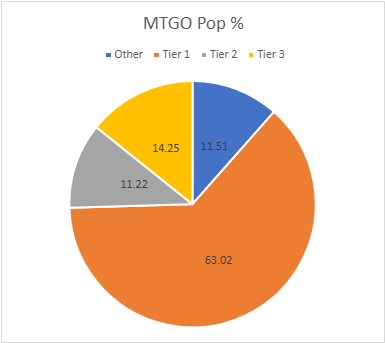
I'd like to take this opportunity to remind everyone that Nadu Breakfast's population percentage topped out at 15.75% prior to it being banned in August 2024. It hit 20.58% in paper. I just think that's an interesting comparison to what Boros Energy is doing. My prediction that Energy was going to increase its dominance in February was spot on, for the record.
Meanwhile, Jeskai Blink had a very strange month. On average through the first 3 weeks of March, it put one deck into Top 8 and another into Top 16 every other Challenge, and that was it. This meant it was in third place population wise but had average points above 2.5, which is absurd for a Tier 1 deck. Then TNMT came out and a Blink surge began.
At first, it was just a surge for no apparent reason. Then they all started adopting Casey Jones, Vigilante and really took off. I'm not sure this will continue, but that's for the Analysis section.
The Paper Population Data
March is a major upswing in paper and the largest population sample so far this year. The total population rose from 391 to 658, which is on the larger side for a non-RCQ month. That said, it's a fraction of the total events that happened in March. Tournament organizers need to get better about posting results. Unique decks rose from 70 to 80 for a ratio of .121, which is significantly down from February's .179 and is generally on the low end for paper. This is not a great sign.
It can be easily explained by March being the month before RCQ season starts and players are locking in their decks, but that suggests that April will see much lower diversity. We'll see.
24 decks made the tier list, also up from February. The adjusted average population is 7.02 so the List starts at 7. The STDev is 9.68, so the increment is 10. Therefore, Tier 3 runs from 7 to 17, Tier 2 is 18 to 28 and Tier 1 is 29 and over. This is the highest starting point and largest STDev this year, which doesn't mean anything but is interesting to track.
| Deck Name | Total # | Total % |
|---|---|---|
| Tier 1 | ||
| Boros Energy | 103 | 15.65 |
| Jeskai Blink | 46 | 6.99 |
| Amulet Titan | 41 | 6.23 |
| Weapons Affinity | 39 | 5.93 |
| Tier 2 | ||
| Domain Zoo | 26 | 3.95 |
| Goryo Blink | 26 | 3.95 |
| Colorless Etron | 22 | 3.34 |
| Kappa's Cannons | 22 | 3.34 |
| Izzet Prowess | 21 | 3.19 |
| Simic Ritual | 19 | 2.89 |
| Living End | 19 | 2.89 |
| Ruby Storm | 19 | 2.89 |
| Tameshi Belcher | 18 | 2.73 |
| Tier 3 | ||
| Yawgmoth | 16 | 2.43 |
| Green-Based Eldrazi | 15 | 2.28 |
| Dimir Tempo | 13 | 1.98 |
| Neobrand | 12 | 1.82 |
| Broodscale | 10 | 1.52 |
| Izzet Cutter | 10 | 1.52 |
| UW Control | 10 | 1.52 |
| Dimir Control | 9 | 1.37 |
| Esper Blink | 9 | 1.37 |
| Jeskai Control | 7 | 1.06 |
| BW Blink | 7 | 1.06 |
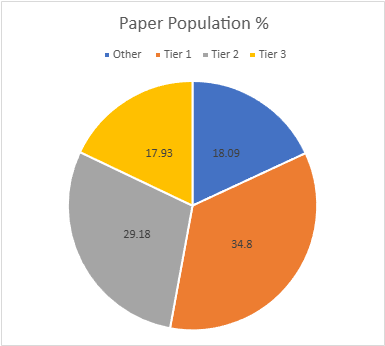
Again, the fact that Boros Energy has more than double the population of its nearest competitor in both paper and online play is very concerning. Jeskai was always in second place in paper, and but was hovering at just under half Energy's numbers until falling off late.
March Power Metagame
Tracking the metagame in terms of population is standard practice. But how do results actually factor in? Better decks should also have better results. In an effort to measure this, I use a power ranking system in addition to the prevalence list. By doing so, I measure the relative strengths of each deck within the metagame so that a deck that just squeaks into Top 32 isn't valued the same as one that Top 8's. This better reflects metagame potential.
For the MTGO data, points are awarded based on the population of the event. Preliminaries and similar events award points based on record (1 for 3 wins, 2 for 4 wins, 3 for 5), and Challenges are scored 3 points for the Top 8, 2 for Top 16, and 1 for Top 32. If I can find them, non-Wizards events will be awarded points the same as Challenges or Preliminaries depending on what the event in question reports/behaves like. Super Qualifiers and similar higher-level events get an extra point and so do other events if they’re over 200 players, with a fifth point for going over 400 players.
Due to paper reporting being inconsistent and frequently full of data gaps compared to MTGO, its points work differently. I award points based on the size of the tournament rather than placement. For events with no reported starting population or up to 32 players, one point is awarded to every deck. Events with 33 players up to 128 players get two points. From 129 players up to 512 players get three. Above 512 is four points, and five points is reserved for Modern Pro Tours. When paper reports more than the Top 8, which is rare, I take all the decks with a winning record or tied for Top 32, whichever is pertinent.
The MTGO Power Tiers
As with the population numbers, total points rose from 2438 to 3206. The adjusted average points were 19.85 therefore 20 points made Tier 3. The adjusted STDev was 38.01 so add 38 to the starting point, and Tier 3 runs to 58 points. Tier 2 starts with 59 points and runs to 97. Tier 1 requires at least 98 points. Movement within and between the tiers is minimal, except for the bottom end. Both Jeskai Control and Rakdos Reanimator fell off and were replaced by Izzet Wizards and Hollowvine.
| Deck Name | Total Points | Total % |
|---|---|---|
| Tier 1 | ||
| Boros Energy | 692 | 21.58 |
| Jeskai Blink | 370 | 11.54 |
| Ruby Storm | 196 | 6.11 |
| Colorless Etron | 170 | 5.30 |
| Izzet Prowess | 161 | 5.02 |
| Amulet Titan | 135 | 4.21 |
| Weapons Affinity | 120 | 3.74 |
| Goryo Blink | 110 | 3.43 |
| Neobrand | 109 | 3.40 |
| Tier 2 | ||
| Living End | 85 | 2.65 |
| Kappa's Cannons | 79 | 2.46 |
| Tameshi Belcher | 70 | 2.18 |
| Domain Zoo | 66 | 2.06 |
| Dimir Tempo | 60 | 1.87 |
| Tier 3 | ||
| Esper Blink | 56 | 1.75 |
| Simic Ritual | 55 | 1.71 |
| Dimir Control | 44 | 1.37 |
| Broodscale Combo | 44 | 1.37 |
| Grixis Reanimator | 41 | 1.28 |
| Green-Based Eldrazi | 40 | 1.25 |
| UW Control | 40 | 1.25 |
| Izzet Cutter | 37 | 1.15 |
| Yawgmoth | 28 | 0.87 |
| Mono-Green Etron | 25 | 0.78 |
| Izzet Wizards | 20 | 0.62 |
| Hollowvine | 20 | 0.62 |
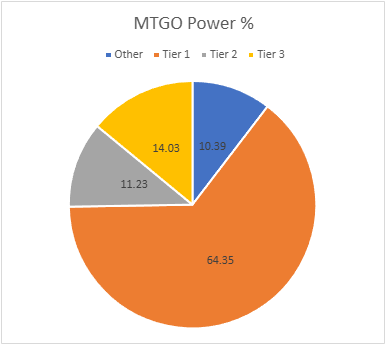
March's most interesting deck competition was between Dimir Control and Dimir Tempo. As noted back in February, Dimir Control showed up out of nowhere and quickly became the ultimate Modern sweaty deck. Every win with that deck feels like work, which makes it the ur-test to prove control mastery. I was skeptical that it would keep its position, and I was vindicated. The deck's difficulty has led to it massively falling off into the bowels of Tier 3.
Meanwhile, Dimir Tempo is surging back into relevance. Psychic Frog can forgive a lot of your own mistakes while severely punishing opposing ones. Dimir players are returning to Frog mostly to save their sanity. However, I suspect this isn't over. Wan Shi Tong, Librarian has a hold on so many players psyches that they're not going to give up on the only deck that consistently plays him. He just. Looks. So. Good.
Please ignore any data to the contrary. Many of Tong's adherents suffered in vain for Ketramose. They're not in the right headspace to go through that again.
The Paper Power Tiers
Paper's total points rose from 684 to 997. The higher population was fueled more by small events than large ones. The adjusted average points were 10.44, setting the cutoff at 11 points. The STDev was 14.67, so add 15 to the starting point and Tier 3 runs to 26 points. Tier 2 starts with 27 points and runs to 42. Tier 1 requires at least 43 points. Again, the movement both within and between the tiers is minimal, but unlike online, there were no dropouts.
| Deck Name | Total Points | Total % |
|---|---|---|
| Tier 1 | ||
| Boros Energy | 172 | 17.25 |
| Amulet Titan | 67 | 6.72 |
| Jeskai Blink | 60 | 6.02 |
| Weapons Affinity | 58 | 5.82 |
| Domain Zoo | 43 | 4.31 |
| Tier 2 | ||
| Goryo Blink | 41 | 4.11 |
| Kappa's Cannons | 36 | 3.61 |
| Colorless Etron | 32 | 3.21 |
| Ruby Storm | 32 | 3.21 |
| Izzet Prowess | 31 | 3.11 |
| Living End | 30 | 3.01 |
| Simic Ritual | 27 | 2.71 |
| Tier 3 | ||
| Tameshi Belcher | 25 | 2.51 |
| Yawgmoth | 25 | 2.51 |
| Dimir Tempo | 21 | 2.11 |
| Green-Based Eldrazi | 19 | 1.91 |
| Neobrand | 17 | 1.70 |
| Broodscale | 17 | 1.70 |
| Izzet Cutter | 16 | 1.60 |
| UW Control | 16 | 1.60 |
| Dimir Control | 15 | 1.50 |
| Esper Blink | 13 | 1.30 |
| Jeskai Control | 12 | 1.20 |
| BW Blink | 12 | 1.20 |
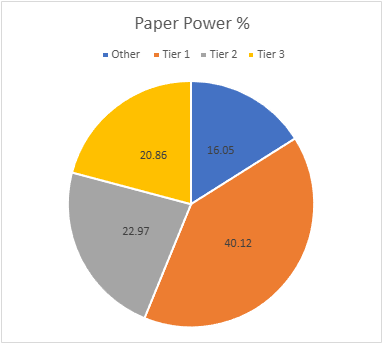
Domain Zoo moving from Tier 2 in population to Tier 1 in power is notable mostly because it would not have affected whether or not Energy is Tier 0. Domain Zoo is Tier 1.5, not a full Tier 1 because the determination is based on overall standings, not just power. Again, lower-population-tier decks frequently do better on average points than the Tier 1 because that's how averaging works with large numbers.
Meanwhile, Tameshi Belcher falling off into Tier 3 is quite instructive. Having one of the only good matchups against Energy just doesn't make up for its poor matchups against decks with counterspells. Actual counterspells, not just Consign to Memory. Belcher has plenty of ways to play around that card.
Composite Metagame
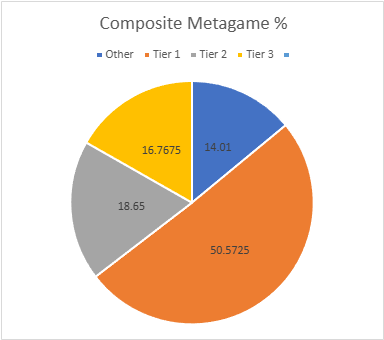
That's a lot of data, but what does it all mean? When Modern Nexus was first started, we had a statistical method to combine the MTGO and paper data, but the math of that system doesn't work without big paper events. I tried. Instead, I'm using an averaging system to combine the data. I take the MTGO results and average the tier, then separately average the paper results, then average the paper and MTGO results together for final tier placement.
This generates a lot of partial Tiers. That's not a bug, but a feature. The nuance separates the solidly Tiered decks from the more flexible ones and shows the true relative power differences between the decks. Every deck in the paper and MTGO results is on the table, and when they don't appear in a given category, they're marked N/A. This is treated as a 4 for averaging purposes.
| Deck Name | MTGO Pop Tier | MTGO Power Tier | MTGO Average Tier | Paper Pop Tier | Paper Power Tier | Paper Average Tier | Composite Tier |
|---|---|---|---|---|---|---|---|
| Boros Energy | 1 | 1 | 1 | 1 | 1 | 1 | 1.00 |
| Jeskai Blink | 1 | 1 | 1 | 1 | 1 | 1 | 1.00 |
| Amulet Titan | 1 | 1 | 1 | 1 | 1 | 1 | 1.00 |
| Weapons Affinity | 1 | 1 | 1 | 1 | 1 | 1 | 1.00 |
| Ruby Storm | 1 | 1 | 1 | 2 | 2 | 2 | 1.50 |
| Colorless Etron | 1 | 1 | 1 | 2 | 2 | 2 | 1.50 |
| Izzet Prowess | 1 | 1 | 1 | 2 | 2 | 2 | 1.50 |
| Goryo Blink | 1 | 1 | 1 | 2 | 2 | 2 | 1.50 |
| Domain Zoo | 2 | 2 | 2 | 2 | 1 | 1.5 | 1.75 |
| Neobrand | 1 | 1 | 1 | 3 | 3 | 3 | 2.00 |
| Living End | 2 | 2 | 2 | 2 | 2 | 2 | 2.00 |
| Kappa's Cannons | 2 | 2 | 2 | 2 | 2 | 2 | 2.00 |
| Tameshi Belcher | 2 | 2 | 2 | 2 | 3 | 2.5 | 2.25 |
| Simic Ritual | 3 | 3 | 3 | 2 | 2 | 2 | 2.50 |
| Esper Blink | 2 | 3 | 2.5 | 3 | 3 | 3 | 2.75 |
| Dimir Tempo | 3 | 2 | 2.5 | 3 | 3 | 3 | 2.75 |
| Dimir Control | 3 | 3 | 3 | 3 | 3 | 3 | 3.00 |
| Broodscale Combo | 3 | 3 | 3 | 3 | 3 | 3 | 3.00 |
| Green-Based Eldrazi | 3 | 3 | 3 | 3 | 3 | 3 | 3.00 |
| Izzet Cutter | 3 | 3 | 3 | 3 | 3 | 3 | 3.00 |
| UW Control | 3 | 3 | 3 | 3 | 3 | 3 | 3.00 |
| Yawgmoth | 3 | 3 | 3 | 3 | 3 | 3 | 3.00 |
| Jeskai Control | 3 | N/A | 3.5 | 3 | 3 | 3 | 3.25 |
| Grixis Reanimator | 3 | 3 | 3 | N/A | N/A | N/A | 3.50 |
| Mono-Green Etron | 3 | 3 | 3 | N/A | N/A | N/A | 3.50 |
| BW Blink | N/A | N/A | N/A | 3 | 3 | 3 | 3.50 |
| Rakdos Reanimator | 3 | N/A | 3.5 | N/A | N/A | N/A | 3.75 |
| Izzet Wizards | N/A | 3 | 3.5 | N/A | N/A | N/A | 3.75 |
| Hollowvine | N/A | 3 | 3.5 | N/A | N/A | N/A | 3.75 |
Average Power Rankings
Finally, we come to the average power rankings. These are found by taking the total points earned and dividing them by total decks, to measure points per deck. I use this to measure strength vs. popularity. Measuring deck strength is hard. While you can make a Wins-Above-Replacement-esq metric for the Magic cards in an individual deck, there's no way to make one that lets you compare decks. The game is too complex, and even then, power is very contextual.
Using the power rankings helps to show how justified a deck’s popularity is. However, more popular decks will still necessarily earn a lot of points. Therefore, the top tier doesn't move much between population and power and obscures whether its decks really earned their position.
This is where the averaging comes in. Decks that earn a lot of points because they get a lot of results will do worse than decks that win more events, indicating which deck actually performs better.
A higher average indicates lots of high finishes, whereas low averages result from mediocre performances and a high population. Lower-tier decks typically do very well here, likely due to their pilots being enthusiasts. Bear this in mind and be careful about reading too much into these results. However, as a general rule, decks that place above the baseline average are over-performing, and vice versa.
How far above or below that average a deck sits justifies its position on the power tiers. Decks well above baseline are undervalued, while decks well below baseline are very popular, but aren't necessarily good.
The Real Story
When considering the average points, the key is looking at how far off a deck is from the Baseline stat (the overall average of points/population). The closer a deck’s performance to the Baseline, the more likely it is to be performing close to its "true" potential.
A deck that is exactly average would therefore perform exactly as well as expected. The greater the deviation from the average, the more a deck under or over-performs. On the low end, a deck’s placing was mainly due to population rather than power, which suggests it’s overrated. A high-scoring deck is the opposite of this.
We'll start with MTGO's averages:
| Deck Name | Average Points | Power Tier |
|---|---|---|
| Izzet Wizards | 2.00 | 3 |
| Hollowvine | 2.00 | 3 |
| Jeskai Blink | 1.99 | 1 |
| Amulet Titan | 1.98 | 1 |
| Izzet Prowess | 1.96 | 1 |
| Kappa's Cannons | 1.94 | 2 |
| Tameshi Belcher | 1.94 | 2 |
| Weapons Affinity | 1.93 | 1 |
| Dimir Tempo | 1.93 | 2 |
| Simic Ritual | 1.90 | 3 |
| UW Control | 1.90 | 3 |
| Yawgmoth | 1.87 | 3 |
| Neobrand | 1.79 | 1 |
| Boros Energy | 1.78 | 1 |
| Living End | 1.77 | 2 |
| Dimir Control | 1.76 | 3 |
| Broodscale Combo | 1.76 | 3 |
| Izzet Cutter | 1.76 | 3 |
| Ruby Storm | 1.75 | 1 |
| Domain Zoo | 1.74 | 2 |
| Monthly Baseline | 1.72 | |
| Goryo Blink | 1.72 | 1 |
| Grixis Reanimator | 1.71 | 3 |
| Colorless Etron | 1.70 | 1 |
| Green-Based Eldrazi | 1.67 | 3 |
| Esper Blink | 1.51 | 3 |
| Mono-Green Etron | 1.47 | 3 |
| Jeskai Control | 1.45 | N/A |
| Rakdos Reanimator | 1.00 | N/A |
As the top averaging Tier 1 deck, Jeskai Blink just barely beats out both Amulet Titan and Izzet Prowess to win MTGO Deck of March. That said, it was winning convincingly until the last two weeks of March, which is suggestive.
And now for the paper averages:
| Deck Name | Average Points | Power Tier |
|---|---|---|
| Jeskai Control | 1.71 | 3 |
| BW Blink | 1.71 | 3 |
| Broodscale | 1.70 | 3 |
| Ruby Storm | 1.68 | 2 |
| Boros Energy | 1.67 | 1 |
| Dimir Control | 1.67 | 3 |
| Domain Zoo | 1.65 | 1 |
| Kappa's Cannons | 1.64 | 2 |
| Amulet Titan | 1.63 | 1 |
| Dimir Tempo | 1.61 | 3 |
| Izzet Cutter | 1.60 | 3 |
| UW Control | 1.60 | 3 |
| Living End | 1.58 | 2 |
| Goryo Blink | 1.58 | 2 |
| Yawgmoth | 1.56 | 3 |
| Weapons Affinity | 1.49 | 1 |
| Izzet Prowess | 1.48 | 2 |
| Monthly Baseline | 1.46 | |
| Colorless Etron | 1.45 | 2 |
| Esper Blink | 1.44 | 3 |
| Simic Ritual | 1.42 | 2 |
| Neobrand | 1.42 | 3 |
| Tameshi Belcher | 1.39 | 3 |
| Jeskai Blink | 1.30 | 1 |
| Green-Based Eldrazi | 1.27 | 3 |
As mentioned at the start, Boros wins paper Deck of March by not enough to be Tier 0. It'll be interesting to see if it can get that separation in April. I'd also like to point out that Jeskai Blink had one of the worst showings for a Tier 1 deck I've ever seen.
Analysis
There's a lot to get through, so I'll start with the easy part. TNMT had minimal impact on the Modern metagame, though that wasn't for lack of trying. Sewer-veillance Cam combos with Grinding Station and Emry, Lurker of the Loch to make some reminiscent of [card]Underworld Breach[/card.
This naturally got a certain type of player excited, and I recorded about a half-dozen different attempts to make it work before it disappeared entirely. The combo is far more fragile and easily disrupted, so it was a valiant but doomed effort.
Similarly, Leonardo, Cutting Edge goes infinite with Agatha's Soul Cauldron exiling Walking Ballista for cheaper than could already be done with Aerith Gainsborough.
There have also been a number of attempts to make that combo work and AspiringSpike is a fan, which has led players to play it. It's not going any better than the Cam combo players. The fundamental problem for that deck since the original combo with Heliod, Sun-Crowned is that there's nothing that tutors for all parts simultaneously, making it unreliable and ultimately not a meta deck.
The Great Blink Mystery
Of course, minimal isn't zero, and as mentioned above Casey Jones had an interesting two weeks. While he was instrumental in propelling Jeskai Blink to second place, I'm not sure if he'll be a long-term addition. I'm not sure because actual Jeskai players have told me they're not sure if he's actually good or not. This begs the unanswerable question of whether Blink is doing well because of or in spite of him.
While Casey seems to have been accepted by the online community as a whole, they don't agree on numbers. Even now I'm seeing Casey be a 1-of to a 3-of pretty consistently, and while 4-ofs are quite rare they're not unheard of. That said, the online chatter appears to be all over the place, but the paper players have put it very succinctly.
The Jeskai players at a Modern 1K I attended uniformly told me that Casey is the ultimate run-good card. When you're running well, Casey is going to smother the opponent in cards with absolutely no drawback because you emptied your hand immediately. When you're running bad, you're just discarding your hand on your upkeep in a deck that doesn't really need more Phlage fodder.
While I know that being able to Consign to Memory Casey's upkeep trigger is treated as a positive, the players I've heard from think that's a trap. Consigning Casey's trigger makes him a 2-for-3 rather than a 1-for-3 in a deck where Consign is already severely overstretched. Playing Casey expecting to Consign the trigger appears to be a last resort.
As such, they weren't sure how long they'd be playing him, so his days might be numbered.
The RCQ Metagame
Since Wizards didn't ban anything, this is the metagame for the RCQ season. Boros is by far the best deck in Modern, and there's nothing going on to make me think otherwise. Jeskai Blink is running online at deck #2 levels, but in paper its average points were atrocious, signaling that it was severely overplayed. Blink is undeniably an effective deck, but it's actual metagame position is quite questionable. Then there's always Amulet Titan.
However, the deck that isn't getting much attention that definitely should is Weapons Affinity. A lot of this comes down to there being so many different varieties plus Kappa's Cannons (which runs fewer sacrifice effects) that trying to discuss it usually requires a definitions fight. Weapons Manufacturing has turned an aggro deck into an almost-fully combo deck and turned traditional anti-Affinity cards like Meltdown into liabilities.
However, it manages to avoid the spotlight, and I'm not sure why. It's well-known that the deck is all about its opening hand and sometimes just clunks out, but its overall performance is pretty impressive anyway. Boros may get the headlines, but I think Affinity is the actual deck to watch.
Financial Implications
With the Modern RCQ season in full swing, the demand for Modern staples should be down as players have already bought their decks.
The in-season market is defined by the search for tech, especially if something truly novel emerges. This is the time to move into sideboard pieces and remain flexible. If something does emerge, you'll not have long to respond before the opportunity to profit is lost.
We'll also be seeing a new set in April. Secrets of Strixhaven appears interesting and should revitalize Standard. However, there's nothing currently spoiled that looks like it will shake up Modern. Even the Secret Archive looks weaker than the previous one. I'd advise treating it as an opportunity for Standard speculation but avoid going too deep. The set looks well designed but not especially flashy.