
Are you a Quiet Speculation member?
If not, now is a perfect time to join up! Our powerful tools, breaking-news analysis, and exclusive Discord channel will make sure you stay up to date and ahead of the curve.
Welcome to 2026! Ignore the fact that it's now February, it's not a new year until the Metagame Update's year ticks over.
Unfortunately, you won't be able to tell that anything changed looking at the metagame data. Unless something happens on February 9th, I'd expect the 2025 metagame to continue through the upcoming RCQ season.
Outlier Town
Magic Online's metagame is heavily skewed and as a result it produced four clear outliers. For any stats junkies, the online data's kurtosis is 26.07 and the skewness is 4.55. Metagame data is always going to be heavily skewed to the top end, but this is the most extreme it's been in months. Consequently, the four top decks were removed from the actual analysis as outliers but remain in their correct positions on the Tier List.
Meanwhile, it was very, very, obvious that Boros Energy was paper's only outlier. You'll see why when you look at the data table. I always test because I believe in due diligence, but I really didn't need to.
January Population Metagame
To make the tier list, a given deck has to beat the overall average population for the month. The average is my estimate for how many results a given deck "should" produce in a given month. To be considered a tiered deck, it must perform better than "good enough". Every deck that posts at least the average number of results is "good enough" and makes the tier list.
Then we go one standard deviation (STdev) above average to set the limit of Tier 3 and the cutoff for Tier 2. This mathematically defines Tier 3 as those decks clustered near the average. Tier 2 goes from the cutoff to the next standard deviation. These are decks that perform well above average. Tier 1 consists of those decks at least two standard deviations above the mean result, encompassing the truly exceptional performing decks.
The MTGO data nearly exclusively comes from official Preliminary, Qualifiers, and Challenge results. Leagues are excluded, as they add analytically useless bulk data to both the population and power tiers. The paper data comes from any source I can find, with all reported events being counted.
While the MTGO events report predictable numbers, paper events can report anything from only the winner to all the results. In the latter case, if match results aren't included, I'll take as much of the Top 32 as possible. If match results are reported, I'll take winning record up to Top 32, and then any additional decks tied with 32nd place, as tiebreakers are a magic most foul and black.
The MTGO Population Data
January's adjusted average population for MTGO is 10.14. I always round down if the decimal is less than .20. Tier 3, therefore, begins with decks posting 10 results. The adjusted STdev was 15.25, so add 16 and that means Tier 3 runs to 26 results. Again, it's the starting point to the cutoff, then the next whole number for the next Tier. Therefore Tier 2 starts with 27 results and runs to 43. Subsequently, to make Tier 1, 44 decks are required.
The sample population is slightly up from December 1510 to 1536. It's that's the same as October, which is almost surprising, but it also isn't. Since I started doing this article series in 2021, January has always produced one of if not the largest batches of data. I have no idea why, but it has always been the case. The really surprising thing is that October 2025 was so large. Numbers usually rise in late fall, but October was well above average.
However, unique decks actually fell from 101 to 96, yielding a unique deck ratio of .0625, which on the low end of average for MTGO. 30 decks made the Tier List, which is above average for 2025, but we'll see where it stands for 2026.
| Deck Name | Total # | Total % |
|---|---|---|
| Tier 1 | ||
| Boros Energy | 255 | 16.60 |
| Ruby Storm | 140 | 9.11 |
| Jeskai Blink | 117 | 7.62 |
| Colorless Etron | 91 | 5.92 |
| Weapons Affinity | 73 | 4.75 |
| Domain Zoo | 57 | 3.71 |
| Neobrand | 56 | 3.65 |
| Amulet Titan | 52 | 3.38 |
| Tier 2 | ||
| Living End | 42 | 2.73 |
| Tameshi Belcher | 41 | 2.67 |
| Mono-Green Etron | 41 | 2.67 |
| Green-Based Eldrazi | 38 | 2.47 |
| Grixis Reanimator | 36 | 2.34 |
| Goryo Blink | 29 | 1.89 |
| Izzet Cutter | 29 | 1.89 |
| Jeskai Control | 29 | 1.89 |
| Izzet Prowess | 28 | 1.82 |
| Tier 3 | ||
| Kappa's Cannons | 24 | 1.56 |
| Yawgmoth | 24 | 1.56 |
| Simic Ritual | 23 | 1.50 |
| Dimir Tempo | 23 | 1.50 |
| Mono-Black Saga | 21 | 1.37 |
| Esper Blink | 19 | 1.24 |
| Dimir Control | 19 | 1.24 |
| Mill | 17 | 1.11 |
| Broodscale Combo | 16 | 1.04 |
| UW Control | 14 | 0.91 |
| Hammer Time | 12 | 0.78 |
| 4-C Ritual | 11 | 0.72 |
| Miracles | 11 | 0.72 |
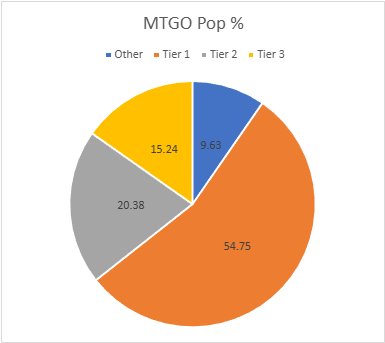
For the second month in a row, Jeskai Blink takes third place for MTGO. However, as before this comes with a big asterisk. Jeskai Blink can never evenly accumulate data. In December, a late surge coupled with a number of other decks unexpectedly falling off propelled it out of the middle of the pack. This month it was solidly in third the entire month but barely showed up for the last two weeks. I'd estimate that 3/4 of Blink's results came before January 20th.
The control decks had an interesting month. Miracles splintered off from UW Control, and some of the Jeskai Control decks shifted to be standard UW decks with Galvanic Discharge and sometimes Phlage. I assume that this is in response to Blink and Eldrazi decks. Threats with more than 3 toughness or mana value greater than 3 were a problem for UW and Jeskai respectively. Dropping more of the red cards for while helps Jeskai's problem and adding Discharge helped UW's and Terminus covers every threat. However, this still wasn't enough to break out of Tier 3.
The Paper Population Data
January is usually a better month for paper, but it remains slow. Back in the day, the restarting of Grand Prix season would kickstart paper revivals, and since there's nothing like that anymore paper is slow. Still, the population is up from 352 to 403, which is a good sign for an off-competitive season format. Unique decks rose significantly from 56 to 75 with a ratio of .186, well above average for 2025. I hope this keeps for the rest of 2026.
23 decks made the tier list, which is about average by 2025 standards. The adjusted average population is 4.77 so the List starts at 5. The STDev is 6.10, so the increment is 6. Therefore, Tier 3 runs from 5 to 11, Tier 2 is 12 to 18 and Tier 1 is 19 and over.
| Deck Name | Total # | Total % |
|---|---|---|
| Tier 1 | ||
| Boros Energy | 50 | 12.41 |
| Izzet Prowess | 26 | 6.45 |
| Jeskai Blink | 26 | 6.45 |
| Weapons Affinity | 20 | 4.96 |
| Tier 2 | ||
| Yawgmoth | 18 | 4.47 |
| Domain Zoo | 18 | 4.47 |
| Goryo Blink | 17 | 4.22 |
| Ruby Storm | 16 | 3.97 |
| Amulet Titan | 15 | 3.72 |
| Esper Blink | 15 | 3.72 |
| MG Etron | 12 | 2.98 |
| Colorless Etron | 12 | 2.98 |
| Tier 3 | ||
| Grixis Reanimator | 10 | 2.48 |
| UW Control | 9 | 2.23 |
| Kappa's Cannons | 9 | 2.23 |
| Izzet Cutter | 8 | 1.98 |
| Green-Based Eldrazi | 8 | 1.98 |
| Tameshi Belcher | 6 | 1.49 |
| Burn | 6 | 1.49 |
| Neobrand | 5 | 1.24 |
| Tribal Eldrazi | 5 | 1.24 |
| 4-C Ritual | 5 | 1.24 |
| Broodscale combo | 5 | 1.24 |
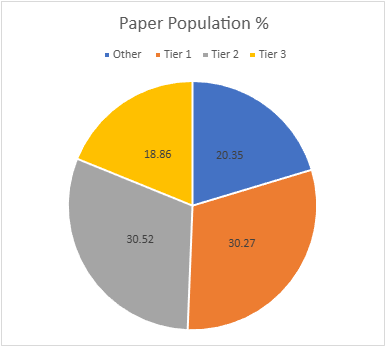
So, yeah. While Boros Energy is on top of both play mediums by a lot, the margin for paper is much higher. It shows up in everything. Large paper events often have a bias against Energy which has kept the gap closer, but there weren't any really big events to do that in January. Thus, the high general prevalence won out.
The return of Burn to the Tier List is unexpected. The combination of Guide of Souls, Ocelot Pride, and Phlage killed it off in 2024. This is unfortunate, as Burn historically had very good matchups against non-Amulet Ramp decks and durdly midrange. With Eldrazi and Blink decks everywhere, you'd think Burn would have thrived, but Energy is just too widespread. However, in some local metagames Energy appears to be falling away and Burn's showing up to feast on Blink. The only reason I can think for that to be happening is players just getting bored of Energy. It's still clearly the best deck.
January Power Metagame
Tracking the metagame in terms of population is standard practice. But how do results actually factor in? Better decks should also have better results. In an effort to measure this, I use a power ranking system in addition to the prevalence list. By doing so, I measure the relative strengths of each deck within the metagame so that a deck that just squeaks into Top 32 isn't valued the same as one that Top 8's. This better reflects metagame potential.
For the MTGO data, points are awarded based on the population of the event. Preliminaries and similar events award points based on record (1 for 3 wins, 2 for 4 wins, 3 for 5), and Challenges are scored 3 points for the Top 8, 2 for Top 16, and 1 for Top 32. If I can find them, non-Wizards events will be awarded points the same as Challenges or Preliminaries depending on what the event in question reports/behaves like. Super Qualifiers and similar higher-level events get an extra point and so do other events if they’re over 200 players, with a fifth point for going over 400 players.
Due to paper reporting being inconsistent and frequently full of data gaps compared to MTGO, its points work differently. I award points based on the size of the tournament rather than placement. For events with no reported starting population or up to 32 players, one point is awarded to every deck. Events with 33 players up to 128 players get two points. From 129 players up to 512 players get three. Above 512 is four points, and five points is reserved for Modern Pro Tours. When paper reports more than the Top 8, which is rare, I take all the decks with a winning record or tied for Top 32, whichever is pertinent.
The MTGO Power Tiers
As with the population numbers, total points rose slightly to 2752. The adjusted average points were 17.97 therefore 18 points made Tier 3. The adjusted STDev was 27.56 so add 28 to the starting point, and Tier 3 runs to 46 points. Tier 2 starts with 47 points and runs to 75. Tier 1 requires at least 76 points. There's a lot of movement inside each tier and between tiers, and Hammer Time fell off without a replacement.
| Deck Name | Total Points | Total % |
|---|---|---|
| Tier 1 | ||
| Boros Energy | 455 | 16.53 |
| Ruby Storm | 255 | 9.27 |
| Jeskai Blink | 228 | 8.28 |
| Colorless Etron | 161 | 5.85 |
| Weapons Affinity | 129 | 4.69 |
| Neobrand | 108 | 3.92 |
| Domain Zoo | 97 | 3.52 |
| Amulet Titan | 89 | 3.23 |
| Green-Based Eldrazi | 79 | 2.87 |
| Tier 2 | ||
| Tameshi Belcher | 75 | 2.72 |
| Living End | 70 | 2.54 |
| MG Etron | 69 | 2.51 |
| Grixis Reanimator | 66 | 2.40 |
| Goryo Blink | 55 | 2.00 |
| Izzet Prowess | 54 | 1.96 |
| Jeskai Control | 50 | 1.82 |
| Izzet Cutter | 49 | 1.78 |
| Kappa's Cannons | 49 | 1.78 |
| Yawgmoth | 49 | 1.78 |
| Tier 3 | ||
| Simic Ritual | 39 | 1.42 |
| MB Saga | 39 | 1.42 |
| Dimir Tempo | 38 | 1.38 |
| Dimir Control | 36 | 1.31 |
| Mill | 31 | 1.13 |
| Broodscale Combo | 31 | 1.13 |
| Esper Blink | 29 | 1.05 |
| Miracles | 22 | 0.80 |
| UW Control | 21 | 0.76 |
| 4-C Ritual | 19 | 0.69 |
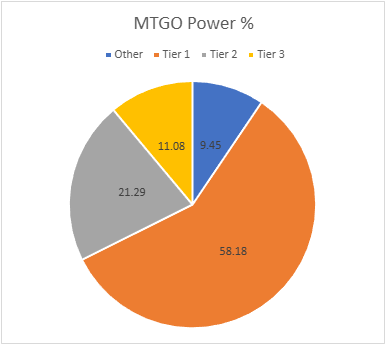
The big story is Green-Based Eldrazi ramp shooting up from mid-Tier 2 on population to Tier 1. You'd think with maindeck Consign to Memory being quite common this would be impossible. However, that's missing context. The main deck maindecking Consign is Jeskai Blink, and Consign is being severely overstretched in that deck. Blink can Consign opposing triggers, but it doesn't want to. It wants to Consign its own negative triggers.
As a result, Consign's frequently unavailable to stop Eldrazi. I just now realized that this just Modern's equivalent to Legacy and Premodern Stiflenaught, and that makes me angry. I'm not sure if I'm angry it too me this long to make the connection, or it's because I'm so bored of Stiflenaught and it's in Modern too.
The Paper Power Tiers
Paper's total points also rose to 615. The adjusted average points were 7.22, setting the cutoff at 8 points. The STDev was 9.29, so add 10 to the starting point and Tier 3 runs to 18 points. Tier 2 starts with 19 points and runs to 29. Tier 1 requires at least 30 points. Again, there's a lot of movement between the population and power tiers. Broodscale Combo disappeared and wasn't replaced, cementing its rather precipitous decline. There's only room for one creature combo deck at a time, it seems, and Yawgmoth has new tech.
| Deck Name | Total Points | Total % |
|---|---|---|
| Tier 1 | ||
| Boros Energy | 81 | 13.17 |
| Jeskai Blink | 40 | 6.50 |
| Izzet Prowess | 39 | 6.34 |
| Tier 2 | ||
| Yawgmoth | 29 | 4.71 |
| Domain Zoo | 28 | 4.55 |
| Amulet Titan | 28 | 4.55 |
| Weapons Affinity | 27 | 4.39 |
| Ruby Storm | 27 | 4.39 |
| Goryo Blink | 23 | 3.74 |
| Tier 3 | ||
| Esper Blink | 18 | 2.93 |
| MG Etron | 18 | 2.93 |
| Colorless Etron | 18 | 2.93 |
| Grixis Reanimator | 15 | 2.44 |
| UW Control | 13 | 2.11 |
| Izzet Cutter | 12 | 1.95 |
| Kappa's Cannons | 11 | 1.79 |
| Green-Based Eldrazi | 11 | 1.79 |
| Tameshi Belcher | 11 | 1.79 |
| Burn | 10 | 1.63 |
| Neobrand | 10 | 1.63 |
| Tribal Eldrazi | 9 | 1.46 |
| 4-C Ritual | 8 | 1.30 |
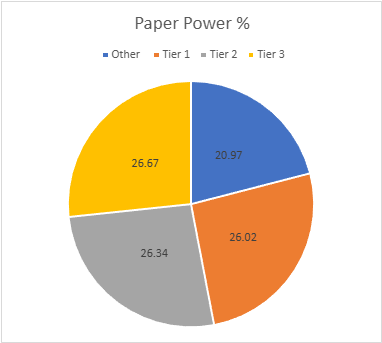
Don't be blinded by the even distribution of points through the Tiers. Boros Energy had (slightly) over twice the points of its nearest competitor. This is Energy's metagame and everybody else is along for the ride.
Composite Metagame
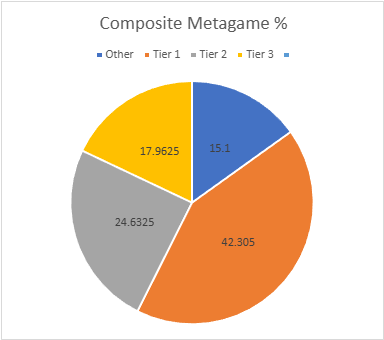
That's a lot of data, but what does it all mean? When Modern Nexus was first started, we had a statistical method to combine the MTGO and paper data, but the math of that system doesn't work without big paper events. I tried. Instead, I'm using an averaging system to combine the data. I take the MTGO results and average the tier, then separately average the paper results, then average the paper and MTGO results together for final tier placement.
This generates a lot of partial Tiers. That's not a bug, but a feature. The nuance separates the solidly Tiered decks from the more flexible ones and shows the true relative power differences between the decks. Every deck in the paper and MTGO results is on the table, and when they don't appear in a given category, they're marked N/A. This is treated as a 4 for averaging purposes.
| Deck Name | MTGO Population Tier | MTGO Power Tier | MTGO Average Tier | Paper Pop Tier | Paper Power Tier | Paper Average Tier | Composite Tier |
|---|---|---|---|---|---|---|---|
| Boros Energy | 1 | 1 | 1 | 1 | 1 | 1 | 1.00 |
| Jeskai Blink | 1 | 1 | 1 | 1 | 1 | 1 | 1.00 |
| Weapons Affinity | 1 | 1 | 1 | 1 | 2 | 1.5 | 1.25 |
| Ruby Storm | 1 | 1 | 1 | 2 | 2 | 2 | 1.50 |
| Domain Zoo | 1 | 1 | 1 | 2 | 2 | 2 | 1.50 |
| Amulet Titan | 1 | 1 | 1 | 2 | 2 | 2 | 1.50 |
| Izzet Prowess | 2 | 2 | 2 | 1 | 1 | 1 | 1.50 |
| Colorless Etron | 1 | 1 | 1 | 2 | 3 | 2.5 | 1.75 |
| Neobrand | 1 | 1 | 1 | 3 | 3 | 3 | 2.00 |
| Mono-Green Etron | 2 | 1 | 1.5 | 2 | 3 | 2.5 | 2.00 |
| Goryo Blink | 2 | 2 | 2 | 2 | 2 | 2 | 2.00 |
| Yawgmoth | 3 | 2 | 2.5 | 2 | 2 | 2 | 2.25 |
| Tameshi Belcher | 2 | 2 | 2 | 3 | 3 | 3 | 2.50 |
| Green-Based Eldrazi | 2 | 2 | 2 | 3 | 3 | 3 | 2.50 |
| Grixis Reanimator | 2 | 2 | 2 | 3 | 3 | 3 | 2.50 |
| Izzet Cutter | 2 | 2 | 2 | 3 | 3 | 3 | 2.50 |
| Kappa's Cannons | 3 | 2 | 2.5 | 3 | 3 | 3 | 2.75 |
| Esper Blink | 3 | 3 | 3 | 2 | 3 | 2.5 | 2.75 |
| Living End | 2 | 2 | 2 | N/A | N/A | N/A | 3.00 |
| Jeskai Control | 2 | 2 | 2 | N/A | N/A | N/A | 3.00 |
| Dimir Control | 3 | 3 | 3 | N/A | N/A | N/A | 3.00 |
| Mill | 3 | 3 | 3 | N/A | N/A | N/A | 3.00 |
| UW Control | 3 | 3 | 3 | 3 | 3 | 3 | 3.00 |
| 4-C Ritual | 3 | 3 | 3 | 3 | 3 | 3 | 3.00 |
| Broodscale Combo | 3 | 3 | 3 | 3 | N/A | 3.5 | 3.25 |
| Simic Ritual | 3 | 3 | 3 | N/A | N/A | N/A | 3.50 |
| Dimir Tempo | 3 | 3 | 3 | N/A | N/A | N/A | 3.50 |
| Mono-Black Saga | 3 | 3 | 3 | N/A | N/A | N/A | 3.50 |
| Miracles | 3 | 3 | 3 | N/A | N/A | N/A | 3.50 |
| Burn | N/A | N/A | N/A | 3 | 3 | 3 | 3.50 |
| Tribal Eldrazi | N/A | N/A | N/A | 3 | 3 | 3 | 3.50 |
| Hammer Time | 3 | N/A | 3.5 | N/A | N/A | N/A | 3.75 |
Average Power Rankings
Finally, we come to the average power rankings. These are found by taking the total points earned and dividing them by total decks, to measure points per deck. I use this to measure strength vs. popularity. Measuring deck strength is hard. While you can make a Wins-Above-Replacement-esq metric for the Magic cards in an individual deck, there's no way to make one that lets you compare decks. The game is too complex, and even then, power is very contextual.
Using the power rankings helps to show how justified a deck’s popularity is. However, more popular decks will still necessarily earn a lot of points. Therefore, the top tier doesn't move much between population and power and obscures whether its decks really earned their position.
This is where the averaging comes in. Decks that earn a lot of points because they get a lot of results will do worse than decks that win more events, indicating which deck actually performs better.
A higher average indicates lots of high finishes, whereas low averages result from mediocre performances and a high population. Lower-tier decks typically do very well here, likely due to their pilots being enthusiasts. Bear this in mind and be careful about reading too much into these results. However, as a general rule, decks that place above the baseline average are over-performing, and vice versa.
How far above or below that average a deck sits justifies its position on the power tiers. Decks well above baseline are undervalued, while decks well below baseline are very popular, but aren't necessarily good.
The Real Story
When considering the average points, the key is looking at how far off a deck is from the Baseline stat (the overall average of points/population). The closer a deck’s performance to the Baseline, the more likely it is to be performing close to its "true" potential.
A deck that is exactly average would therefore perform exactly as well as expected. The greater the deviation from the average, the more a deck under or over-performs. On the low end, a deck’s placing was mainly due to population rather than power, which suggests it’s overrated. A high-scoring deck is the opposite of this.
We'll start with MTGO's averages:
| Deck Name | Average Points | Power Tier |
|---|---|---|
| Green-Based Eldrazi | 2.08 | 1 |
| Kappa's Cannons | 2.04 | 2 |
| Yawgmoth | 2.04 | 2 |
| Miracles | 2.00 | 3 |
| Jeskai Blink | 1.95 | 1 |
| Broodscale Combo | 1.94 | 3 |
| Neobrand | 1.93 | 1 |
| Izzet Prowess | 1.93 | 2 |
| Goryo Blink | 1.90 | 2 |
| Dimir Control | 1.89 | 3 |
| MB Saga | 1.86 | 3 |
| Tameshi Belcher | 1.83 | 2 |
| Grixis Reanimator | 1.83 | 2 |
| Ruby Storm | 1.82 | 1 |
| Mill | 1.82 | 3 |
| Boros Energy | 1.78 | 1 |
| Colorless Etron | 1.77 | 1 |
| Weapons Affinity | 1.77 | 1 |
| 4-C Ritual | 1.73 | 3 |
| Jeskai Control | 1.72 | 2 |
| Amulet Titan | 1.71 | 1 |
| Domain Zoo | 1.70 | 1 |
| Izzet Cutter | 1.69 | 2 |
| Simic Ritual | 1.69 | 3 |
| Baseline | 1.68 | |
| MG Etron | 1.68 | 2 |
| Living End | 1.67 | 2 |
| Dimir Tempo | 1.65 | 3 |
| Esper Blink | 1.53 | 3 |
| UW Control | 1.50 | 3 |
| Hammer Time | 1.42 | N/A |
Thanks to its rise from Tier 2 to 1, Green-Based Eldrazi wins MTGO Deck of January.
| Deck Name | Average Points | Power Tier |
|---|---|---|
| Neobrand | 2.00 | 3 |
| Amulet Titan | 1.87 | 2 |
| Tameshi Belcher | 1.83 | 3 |
| Tribal Eldrazi | 1.80 | 3 |
| Ruby Storm | 1.69 | 2 |
| Burn | 1.67 | 3 |
| Boros Energy | 1.62 | 1 |
| Yawgmoth | 1.61 | 2 |
| 4-C Ritual | 1.60 | 3 |
| Domain Zoo | 1.56 | 2 |
| Jeskai Blink | 1.54 | 1 |
| Baseline | 1.51 | |
| Izzet Prowess | 1.50 | 1 |
| MG Etron | 1.50 | 3 |
| Colorless Etron | 1.50 | 3 |
| Grixis Reanimator | 1.50 | 3 |
| Izzet Cutter | 1.50 | 3 |
| UW Control | 1.44 | 3 |
| Broodscale combo | 1.40 | N/A |
| Green-Based Eldrazi | 1.37 | 3 |
| Weapons Affinity | 1.35 | 2 |
| Goryo Blink | 1.35 | 2 |
| Kappa's Cannons | 1.22 | 3 |
| Esper Blink | 1.20 | 3 |
Meanwhile, Boros Energy wins Paper Deck of December. It didn't have much competition, true, but the next deck from the Power Tier that could have challenged Energy was mid-Tier 2 Amulet Titan.
Analysis
The metagame continues to struggle against itself. Throughout January, players attempted to break Energy's hold on Modern and they all failed. There's been innovation and even entirely new (to the metagame, anyway) decks appearing, but none have made much of a mark. In the end, the best thing you can do remains play Energy.
Hammer Time made the Tier List, making it the most successful of these newish challengers. Cori-Steel Cutter is quite the card. The most interesting one was this deck, the latest take on Devoted Druid combo. Not sure what to call it yet. Leyline of Abundance and Badgermole Cub make absurd amounts of mana on their own, making me question how necessary the Druid combo actually is, but an infinite Walking Ballista will always be an infinite Walking Ballista.
It had a decent showing at the end of January but missed the Tier List minimum. This looks like a deck that just loses hard to Clarion Conqueror, which makes me apprehensive about its future. Conqueror hasn't been seeing much play recently, but that could quickly change. I'll be watching it for February.
The Big Ban Question
That said, what really matters is the Monday after this article goes live. The next scheduled ban is on February 9th and based on what Wizards said back in November Modern could see at least one ban. From what I'm told, Amulet still causes tournament logistics problems, so we're looking at the loop getting banned. I don't know which card should go, but it will be from among Aftermath Analyst, Shifting Woodland, and Lotus Field. There are good arguments for each to just weaken the loop and a compelling one to ban several to kill it outright.
Since Amulet is probably getting nerfed, Wizards will likely look at the wider format. I don't know if there'll be another ban window before Modern RCQ season starts in April, but I'd guess not based on the last couple being spread 3-4 months apart. Therefore, if Wizards sees a problem or just wants to make the RCQ season more interesting, they have to act now.
Obviously, Energy would be the first deck to look at. It's been Modern best non-Nadu deck since MH3 dropped, and that's just not going to change. It's the best aggro deck and the best midrange deck with its only weakness being glass-cannon combo. That's a very strong position. Wizards may be looking at a power-level ban. After observing the deck for a long time, I think the biggest single problem is Ocelot Pride. Making so many game objects for free is really broken, so that's what I'd ban. Guide is significantly weaker without Pride, and Pride's still overpowered on its own. The alternative is banning multiple cards to break Energy's reach advantage.
The Blink Question
Blink in all its forms gets a lot of hate and is in the discussion. Part of it is players bitter at Ephemerate and Solitude, some is the generalized anger at Jeskai being another "good stuff" deck (those always draw hatred), and some is legitimate concern for its power level. I think that most of that is overblown. Counterspelling the engine cards and sweeping the board is quite devastating against Blink. Nobody does that for metagame reasons, but the deck is more answerable than its detractors think.
I'm sympathetic to arguments of it being too prevalent. If you add up all the Blink variants, it's Modern's #2 deck in all play mediums though it's nowhere close to actually challenging Energy. We thought that Ephemerate would be a bigger player when it was first spoiled back in Horizons 1, but that didn't happen for six years. Now that it has, I understand that the card is frustrating, but I don't think we're at the point where it's really a prevalence problem. Just because part of the community finds it boring isn't enough to get a card banned.
Could Blink dangerously take over if Energy and Amulet get banned? Again, I don't think so. My experience against Blink is playing Jeskai Wizards with 8 maindeck counterspells and just crushing both Jeskai and Esper Blink. If they can't resolve Quantum Riddler or Overlord of the Balemurk, the deck just collapses. I think Blink is on the watchlist, but I wouldn't pull the trigger yet.
Financial Implications
Everything is going to be determined by what happens on Monday.
If there are no bans, then Modern will continue along as before.
In that case the best move is to accumulate inventory and be ready to sell once demand begins to rise ahead of RCQ season. If there are bans, then Modern will be in the Wild West for the next month or so.
My advice is to be flexible.