menu

Reader Survey: Your Ideal MtG Store!

Are you a Quiet Speculation member?

If not, now is a perfect time to join up! Our powerful tools, breaking-news analysis, and exclusive Discord channel will make sure you stay up to date and ahead of the curve.

Dear readers,

It seems that so many of us in the Magic community have great local shops to play at, where the owners and management understand and cater to Magic players.  To those so fortunate, congratulations.  There are others out there that have local shops that do not cater well to Magic players.  Many do not stock singles, or if they do, their stock is thin and outdated and poorly cataloged and sorted.  Their tournaments do not match up with the desires of their players, and the loyal customers who come in for tournaments are hustled out as soon as the last match draws to a close.

If you are one of the lucky individuals who have a great game store in town that makes playing Magic fun and welcoming, I'm putting out the call to hear why your store is so great.  Feel free to shout them out by name if you'd like.  What features keep you coming back?  What products, events, etc?

On the flip side of the coin, there are many who play at sub-par stores who take their MTG players for granted, don't cater to them despite the money they spend, and generally disrespect their players.  The staff are usually more concerned with getting out of there early than they are with keeping the players happy.  If you're in this unfortunate category in some regard, or just have minor gripes with your location, please let me know what those are.

The end goal of these questions is to develop a model of an "ideal" game store.  The store would begin life being focused on selling Magic the Gathering sealed product and a robust inventory of single cards, as well as holding events and giving gamers a space to truly call their own.  Your experience as a gamer is invaluable to me in this endeavor.  No matter your geographic location, age, employment status, I want to hear from you.  Leave a comment below with the things that would draw you to a game store, the things that might drive you away, and any other information you'd like to share about your ideal shop.  Please include some information about yourself, like a general age and location, and maybe a bit about what you do (ie, Student, Unemployed Hobo, Professional, etc).  I want to cater to all players regardless of demographic, but each group has its own specific needs.

With infinite thanks,

Kelly B Reid,  Editor

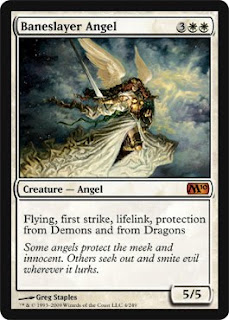
Baneslayer Angel – What Now?

Are you a Quiet Speculation member?

If not, now is a perfect time to join up! Our powerful tools, breaking-news analysis, and exclusive Discord channel will make sure you stay up to date and ahead of the curve.

After my article on ManaNation a few weeks back about Standard's "It Girl", there have been a few questions about what could happen to Baneslayer Angel next year when Magic 2011 is released.  We have no way to know the future of Standard's queen bee, but we can try to cover all of our bases and hopefully lay to rest the question of "What Now?"

There are a few potential scenarios that can occur.  Remember, Standard is not the be-all and end-all of a card's value.  Tarmogoyf's value took a dip when it rotated out of Standard, but it's breaking new highs these days.  Don't make the mistake of relegating the queen of the skies to the bargain bin when she rotates from Standard.  Why all the talk of rotation?  No, there's no inside information you're being kept unaware of!  The truth is, we have no idea if Baneslayer Angel is going to be in M11.  Most people think that if she does rotate, she'll take a big hit in price.

Well, let's assume for a moment that Wizards isn't totally heartless and they realize, despite the fact that they cannot address the secondary market, just how pissed off we'd be if she disappeared.   That means around August 2010, we'll see a whole new crop of booster packs with the white menace inside.  If you recall, the short supply of M10 was a big part of Baneslayer Angel's ridiculous price.  Reprinting in M11 will solve this problem, but to what extent?  It's safe to assume that WotC will fix the product availability concerns by that time.  After all, M11 hasn't even been finalized as a set yet.  That gives them ample time to print ample product.  Barring any major world-changing shifts in the game, the card will still be a powerhouse in Standard and Extended, but the influx of cards will help to drive down the price to a more managable level.  There's still the psychological factor to consider - people are used to Baneslayer Angel being $50+ so there will be initial resistance in the card's downward price trends.

Let's look at it from the other side now.  What if WotC decides to flip Standard players the royal bird and axe our beautiful queen from the core set?  Most people think that she'll tank in value, but it's more likely the opposite will be true.  Remember how availability was a major factor in Baneslayer Angel's price?  Well, what happens when she's never printed again? As time goes on, she'll just get more rare.  M10 was criminally under-printed, so trying to acquire a mythic rare from a set drafted briefly during the late summer of 2009 could become quite an onerous task.   She'll still be played until M10 rotates with "Lights" in late 2010, so we still have almost a full year with our secret girlfriend.  After that, it all depends on what post-rotation Extended looks like.  We're losing a lot of powerful cards from Mirrodin block, which could mean an even more favorable environment for the Angel.  It's entirely too early to conjecture what the game will look like at that point - there are 600+ brand new cards we haven't seen yet that'll be releaesd, but it's safe to assume that Baneslayer Angel will be a factor.

If she does leave the Core set and isn't reprinted in an expansion, her price will probably take a similar path as Tarmogoyf's did.  Dipping to 30 or even 20 dollars might be possible as the market over-reacts to a temporary lapse in demand.  This is all speculation (imagine that!) for the moment, but it's important to realize that Baneslayer Angel is not untouchable on her 50 dollar pedestal.  When she dips down in price, that's the time to buy.  No matter whether she gets reprinted or not, she'll probably take a price hit towards the end of 2010.  It may seem counter-intuitive at first, but Baneslayer Angel's value will eventually rise if she gets pulled from Standard.

Kelly Reid

Founder & Product Manager

View More By Kelly Reid

Posted in Uncategorized11 Comments on Baneslayer Angel – What Now?

Have you joined the Quiet Speculation Discord?

If you haven't, you're leaving value on the table! Join our community of experts, enthusiasts, entertainers, and educators and enjoy exclusive podcasts, questions asked and answered, trades, sales, and everything else Discord has to offer.

Want to create content with Quiet Speculation?

All you need to succeed is a passion for Magic: The Gathering, and the ability to write coherently. Share your knowledge of MTG and how you leverage it to win games, get value from your cards – or even turn a profit.

Boot Camp – St. Louis 5K Open Analysis by David Campano

Are you a Quiet Speculation member?

If not, now is a perfect time to join up! Our powerful tools, breaking-news analysis, and exclusive Discord channel will make sure you stay up to date and ahead of the curve.

Last week, the Star City Games Open Series started off with a bang in St. Louis. With over 300 players in attendance, it was a good day to play magic. After a long day of cardslinging, a winner was finally declaired! Richard "Aaron" Wayne took Red Deck Wins deck all the way to the top, showing the world that Jund, while still the best deck in the format, has a few weaknesses.


Taking a look at the Top 8 from the St. Louis 5K, the first thing to notice is the two red-based aggro decks that played for the final prize. In a metagame filled with Jund and decks made to beat Jund, it is easy to see why such a fast, resilient archetype was able to make its way to the top tables. Jund is essentially a midrange deck. It can take two distinct forms: a blazing fast aggro deck with Leech, Blightning, and Bloodbraid Elf, or a pseudo-control deck that slowly takes over the board on the back of Maelstrom Pulse, Bituminous Blast, and the always powerful Broodmate Dragon. No matter which route Jund takes, Red Deck Wins can out-race and out-burn it. Hellspark Elemental, Hell's Thunder, and the rest of RDW's creatures make Jund's removal look silly and can drop Jund into burn range before any relevant threats can hit the board. With its lightning fast starts and the unearth mechanic to recur threats, Red Deck Wins will likely see an increased amount of play in standard and will almost definitely make its way to the top tables if Jund continues to comprise almost half of the metagame.


The other red aggro deck that showed up in the finals was Barely Boros. This deck is essentially a mirror of the RDW list with a splash of white for Ajani Vengent in the main deck and Path to Exile in the sideboard. This deck can match RDW in both speed and power, but has the ability to deal with more threats thanks the white splash. In a vacuum, Barely Boros is probably a stronger deck than RDW, but its strength comes at a cost. Boros is not as consistently fast as RDW, which is arguably the fastest deck in the format. Even a deck that can match its speed can't match its ability to consistently end games in the first few turns.

Recently, blue has been criticized as being underpowered and unplayable but the two identical Grixis Control decks that showed up in the St. Louis Top 8 proved that blue is back on its way to the top. With the increase in aggro decks, it is no surprise that more and more players are switching over to control as a possible answer. This list works a lot like the Wafo-Tapa Cruel Control list that showed up at Worlds '09. Your early game consists of keeping the board under control with counterspells and removal and drawing plenty of cards with Divination and Courier's Capsule. Your ultimate goal is tosurvive long enough to cast the game ending Cruel Ultimatum. To help survive long enough to cast Cruel, you have the insanely powerful Sphinx of Jwar Isle to either play defense or even go on the ranpage to end the game in 4 quick swings. Shroud is absurd in this format and makes the 5/5 Sphinx even more powerful, as it can't be destroyed with traditional removal. Grixis Control has potential to be a foil to the aggro filled metagame, and will almost definitely see an increase in play thanks to its Top 8 appearance.


Overall the metagame will stay relatively unchanged. Jund will still be the deck to beat. It will still make up about 40% of the field, and will continue to make Top 8 appearances. However, as the St. Louis 5K has shown us, there are plenty of decks out there that can give Jund a run for its money. The lightning fast red decks (RDW and Barley Boros) and the tried and true control lists (Grixis Control) will both increase in play and could be a temporary answer to Jund until Worldwake can come along and potentially bring powerful anti-Jund cards into the format.

For the financial side of Magic, here are a few cards that you would be recommended to grab before their prices increase:

Sedraxis Specter: Originally only played in the "Dredge 2.0" a.k.a. "Crypt Crab" combo decks, the Grixis colored Hypnotic Specter with unearth has recently seen play in many Jund lists as well. Sedraxis Specter is essentially another Blightning, as it takes one card to kill it, then it can be unearthed, attack for 3, and force another card out of your opponent's hand. It also applies early game pressure and hand disruption against decks that are removal light or slower on the draw.


RDW and Barely Boros Rares:
With the rise in RDW and other heavy red aggro decks in the format, expect Hell's Thunder to rise in price along with Goblin Guide, Ball Lightning, and possibly even Earthquake (as Earthquake has also seen play in most variants of the increasingly popular Grixis Control decks).


Felidar Sovereign: When spoiled, Sovereign was immediately speculated to only see play in casual decks. However, this dollar rare mythic has seen play in many mono white decks, usually alongside Baneslayer Angel and Wall of Reverence. His ability of winning by reaching 40 life is much more relevant when you have such powerful lifegain. Expect this card to rise in price if Mono White Control starts seeing more play.


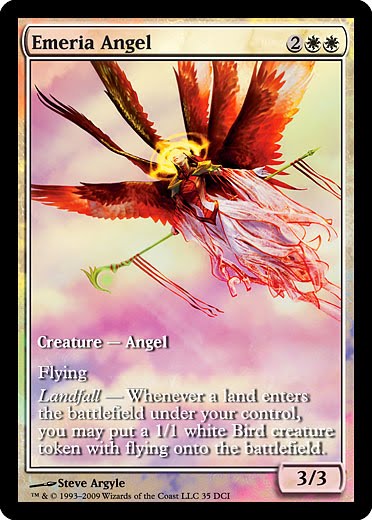
Emeria Angel:
Another archetype that showed its strength at the St. Louis 5K was G/W(/x)  Tokens. With a G/W/b list making it to the Top 8, expect Emeria and other staple cards from the deck to rise in price.


Thanks for reading,

David Campano

For additional information about the St. Louis 5K results and the Top 16 decklists, be sure to check out http://www.starcitygames.com


Most-Used Extended Cards

Are you a Quiet Speculation member?

If not, now is a perfect time to join up! Our powerful tools, breaking-news analysis, and exclusive Discord channel will make sure you stay up to date and ahead of the curve.

After this weekend's Standard and Legacy 5ks in St Louis, the next major tournament on everyone's mind will be the Extended PTQs coming up after the turn of the year.  It is safe to assume most PTQers will be parroting the top decks from Rome this year.  If that is the case, players planning to play in these events should already have their cards socked away.

It seems, however, that card availability is becoming an even bigger problem.  Some extended decks call for four copies of both Baneslayer Angel and Tarmogoyf - an insurmountable barrier to entry that many players simply cannot fathom.  Looking at the non-Zoo decks, there are a few cards that seem to preside over the format.

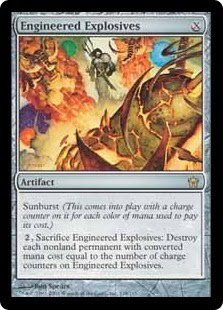
Engineered Explosives
, which lists at $15 on most major dealer sites, is selling for about the same on Ebay.  Unfortunately, Explosives are so important to the format, you cannot afford to skip a playset.  Since the Ebay and Dealer prices are so close together, it could see a small rise in price, especially if the Tezzeret deck posts high finishes at the first few PTQs.  This is not an investment-grade opportunity, make no mistake, but if you haven't gotten your EEs yet, there won't be a better time.  The best time was in the Fall, but most people can't afford to blow out their Standard stuff for Extended when they have FNMs to go to.


Chrome Mox is in a similar spot to EE.  While not as widely used, it is crucial to the Tezzeret decks that have taken the format by storm, as well as things like All-In Red that some people claim to be playable.  It's the least fair mana accelerant in the format, and it's selling for $20 by the dealers.  The Ebay disparity is wide here.  Playsets which sell for $80 are closing between $50 and $60 on Ebay.  Like EE, you'll almost assuredly need these for 1x and getting them at a discount is the way to go.  You won't double up unless something truly remarkable happens, but you could potentially play half a season and then make 50% if you decided to sell out.

Chalice of the Void is also an artifact.  And it's also expensive.  Blame Tezzeret and his Mirrodin buddies.  It's the most reasaonably costed of the big three right now, dealering and ebaying for $10.  Chalice isn't quite as important as Engineered Explosives, but almost every deck packs 3 sideboard or main deck.  They can see a top end of $15 mid-season, so prioritize the other cards accordingly.  If you're the type that hates borrowing cards, you're buying at the right time.

Meddling Mage is relevant again!  A full 12 of the 5-1 decks from Worlds' Extended portion ran 3 or more Mages in their 75.  You'd think someone would have noticed.  Playsets sell for $24 from Dealers, but on Ebay, sets can be had for $10-12.  That's what I'm talking about!  Let's see, staple Extended card, third set, former chase rare...that adds up quite nicely.  Get a set to play and a set to trade, ship the extra set at a PTQ, and play for free.  That's how we do it here.

Cryptic Command, my how the mighty have fallen!  I remember hunting down my playset after getting back into Magic and how much of a pain it was.  $20 felt cheap.  Now, playsets can be had for a touch above 20.  There's a phenomenon that can happen from time to time - cards that used to be expensive can get expensive much faster than normal cards.  These "anointed ones" are like former top prospects in Baseball.  A few good games has all the media buzzing again, wondering if Cryptic Command is "back".  You'll need a set for some versions of the Tezzeret deck, where it is very good indeed.  It's so ludicrously inexpensive right now, you'd do well to get a set socked away, if not more.  Remember your target demographic here - people who didn't plan ahead and are scrambling to get 4 rares from a set that hasn't been drafted since late Summer 2008.  You can make money here.  Expecting them to outright double is a bit much, but steady gains over the course of the next month and throughout the PTQ season are reasonable to expect.  The ebay disparity is massive right now, since they dealer for $10.

Hallowed Fountain has been the most-used Ravnica land, next to Stomping Ground.  The demand for Fountains has already surged on Ebay, but you might still find some discounts.  Try to trade for those and get as many as you can find.  They'll be as good as cash on PTQ day.  Vendilion Clique has made an appearance too, but dealers don't seem to have adjusted.  They can be had for $4-5 at the dealers, and Ebay is about the same.  A lack of an Ebay disparity can be a strong indicator of card strength going into a season.  Clique is really a stand-out card and has an outside chance of hitting $10, but it's unlikely.  It's a card to hold for the long-term if you can get a stash of 'em cheaply.  It's only going to get more rare, since it's effectively from a third set due to the structure of LRW-SHM block.

Good luck this season!

Kelly Reid

Founder & Product Manager

View More By Kelly Reid

Posted in Uncategorized4 Comments on Most-Used Extended Cards

Have you joined the Quiet Speculation Discord?

If you haven't, you're leaving value on the table! Join our community of experts, enthusiasts, entertainers, and educators and enjoy exclusive podcasts, questions asked and answered, trades, sales, and everything else Discord has to offer.

Want to create content with Quiet Speculation?

All you need to succeed is a passion for Magic: The Gathering, and the ability to write coherently. Share your knowledge of MTG and how you leverage it to win games, get value from your cards – or even turn a profit.

Some States T8 Lists

Are you a Quiet Speculation member?

If not, now is a perfect time to join up! Our powerful tools, breaking-news analysis, and exclusive Discord channel will make sure you stay up to date and ahead of the curve.

Let's see how Standard is shaping up these days!

W. Virginia Top 8

Indiana Top 8 (GO JAKE!)

Illinois Top 8

Virginia Top 8

Michigan Top 8

Ohio Top 8

Pennsylvania Top 8

Connecticut Top 8

Kelly Reid

Founder & Product Manager

View More By Kelly Reid

Posted in Uncategorized2 Comments on Some States T8 Lists

Have you joined the Quiet Speculation Discord?

If you haven't, you're leaving value on the table! Join our community of experts, enthusiasts, entertainers, and educators and enjoy exclusive podcasts, questions asked and answered, trades, sales, and everything else Discord has to offer.

Want to create content with Quiet Speculation?

All you need to succeed is a passion for Magic: The Gathering, and the ability to write coherently. Share your knowledge of MTG and how you leverage it to win games, get value from your cards – or even turn a profit.

The Traveling Trader – Tournament Prep for Traders

Are you a Quiet Speculation member?

If not, now is a perfect time to join up! Our powerful tools, breaking-news analysis, and exclusive Discord channel will make sure you stay up to date and ahead of the curve.

by Blaine Rybacki

After a surprising conclusion to Worlds, the topic on the minds of many magic players is what to play at the upcoming State Championships. Many players are going with the current top dog - Jund, while some are going with the new hotness, Naya Lightsaber. Others have just thrown their hands up in the air and refused to decide on a deck. However, for the players more focused on the trading aspect of upcoming major competitions, the question is what to do while waiting for the big day.

Do Your Homework

One of the first steps that traders should take when getting prepared for trading at major competitions is to take the time to check up on the current dominant deck lists. Not only to get familiarized with what they may see at the competition itself, but what people will most likely be looking for. Take the time to look over both the big finishers and the odd little decks that did somewhat well. My personal advice when looking over these lists is to take note of cards that seem to be played in more than one deck (Fetchlands, Baneslayer, Maelstrom Pulse, Day of Judgment, etc.). Those cards will be easier to trade off and are usually valued higher. Next, try to take note of what cards seem to be critical niche cards that are quintessential to the function of certain popular decks (Jace, Eldrazi Monument, Nissa, Lotus Cobra). Additionally you should check to see if there are any cards that are currently valued low but seem to be rising quickly (Monument circa 3 weeks ago, Emeria Angel, etc.) These kind of cards are what should become your main acquisition goal if they are not already.

This kind of activity should be come habitual to most serious traders. At least twice a week if not nightly you should spend a few minutes updating your prices and checking relevant tournament results to keep yourself in the loop. Now that you've taken the time to compile a list of desirable cards, start actively trying to pick them up at your local tournaments. Although this sounds obvious, I've seen many traders waste their time picking up cards that have some sort of value but are relatively unplayed in the current competitive metagame (Silence, Liliana Vess, Darksteel Colossus, etc.). Now, while these cards may be valuable, they are usually harder to trade at larger events due to the fact that most of the players present are looking for tournament staples. Cards like Silence and Liliana may be played in either casual formats or older formats but are largely unwanted by the "Spike" crowd. Those are the kind of cards you can pick up cheaper from competitive players and bring back to your local store to trade for a profit. There've been many instances where, other than making a good amount of money selling to the dealers, my biggest profit from a large tourney was the massive stack of casual candy I've brought back home. To give an example - at the October Seattle PTQ I traded for six Chandra Nalaars from a Spike player for roughly $2 each. I later traded all of them off at my local stores for around $6-8 due to the desirability of Planeswalkers in my area. In preparation for a large event, don't waste your time picking up casual cards or less-played cards. Instead concentrate on tournament staples that you can trade off for a higher margin at a large event where they will be in huge demand and usually more difficult to find.

Next, check up on what dealer will be present at the event you are attending. This information can be easily attained either from a judge in the area, local forum, or by contacting the tournament organizer. After finding out who the dealer will be, check their buy lists to see what you could potentially sell to the store for easy cash. Usually at these events the dealers will buy cards at higher margins in order to restock quickly in preparation for the next tournament. The dealer at my local tournaments told me bluntly that at these events they rarely sell all that many cards, they are mostly there to buy cards to restock for their online site. Although the buy prices may be different in person (from my personal experience they are usually higher) print off a copy of the list to keep on you while trading at your local stores. Other than tournament staples and other high in demand cards there are usually some cards the dealer is looking for that should be relatively easy and cheap for you to acquire that he will buy for a surprising amount. Don't forget to check over any uncommons the dealer may be buying as well. During the last Standard PTQ season I sold my extra Vivids (I drafted a lot and had around sixty assorted extras) for a dollar a piece to the dealer.

Get That Binder In Order

Everyone has a personal preference for how they organize their binders. Some like to have separate binders for different formats. Some like to have binders for each color. Some like to have one big binder divided into colors and formats. Others seem to just throw cards in their binder half haphazardly. Some don't even use a binder, but have a loose stack of cards in either a deck box or a cardboard box. For the people who are not using a binder, get one! Binders are convenient to carry, easy to organize, and give the firm impression that you are a seasoned hand at trading. A big box of cards, unless spotted with carefully sleeved Tarmogoyfs and Force of Wills, only communicates to the person you are trading with that you either don't care about your collection or are unaware of the value of your cards. When using stacks of cards to trade, you are putting yourself at a massive risk. Stacks of cards are ridiculously easy to steal from, since they are usually in random order and one missing card is hardly ever noticeable. In short, if you haven't already got one, go get a binder and protect those cards.

On the topic of binders, from what I've experienced, having separate binders can be convenient and easy to handle but just as equally easy to lose if you start taking too many out of the backpack at a time. Additionally, big binders can become cumbersome and boring to look through for someone that is just looking for one card. Either system is fine, and I will go into more detail about the positives and negative of using these two systems in my next article. No matter what system you use, before you go to that tournament take the time to re-organize the binder and make it easy to look through. This will expedite trades and please the people you are trading with. Nothing is more frustrating than searching through a three inch binder that is not organized by color, rarity, set, or format for one stupid card. Additionally, much like the random stacks of cards, if your binder is unorganized it makes it harder for you to keep track of your cards to see what you have traded or if anything has been stolen. At the Portland PTQ this last weekend I re
ceived several compliments on well organized and easy to look through my binder was, and several commented that they had on occasion refused to trade with people who had unsorted collections.

Don't Stress, Get Sleep

Lastly, this may sound simple, but get some good rest and eat well before a competition. Even if you are only going to trade it's vital that you are refreshed and alert for the event. Both to get the most out of your trades and so you present a good image to the people your trading with. If you stay up the night before agonizing about your deck, doing last minute organizing, or just plain old partying you will most likely regret it the next day. The days that I have gone to a major event with only a few hours of sleep are almost always the days that I don't get as much accomplished trading and I drop out of the tourney early due to simple stupid play mistakes.

Oh, and for the love of god, please take a shower and wear some clean clothes. We all know how funky it can get inside an enclosed tournament room after a few hours and it's only made worse by poor hygiene. Not to mention that people are way less likely to stick around to trade with you if your breath reeks of Cheetos and Mountain Dew.

Hall of Fame: Magic Inferno’s Winning Customer Service

Are you a Quiet Speculation member?

If not, now is a perfect time to join up! Our powerful tools, breaking-news analysis, and exclusive Discord channel will make sure you stay up to date and ahead of the curve.

It seems that the Hall of Shame is quite popular. It is very important that resellers are held accountable for their actions, and while the resellers who are receiving harsh criticism from their clients may not enjoy the attention, the community at a whole will become stronger as a result. To the resellers who are unhappy with the words of their customers - if a customer is driven to take time out of their day to lodge a complaint against your business, you have likely done something to earn their ire. Rather than threatening the customer or their forum for free expression, it would behoove the effected business owners to turn their gaze inward and reconsider their business practices. There is no difference between what the author of the previous testimonial has done and what millions of users on a site like Yelp do. A consumer has the right to author a review or testimonial of a product or service, and as long as that consumer is simply recounting their experience with the business in question, their actions are justifiable, legal, and commendable.

I must reiterate that any seller who feels unfairly targeted is encouraged to contact me with a written account of the situation in question and address any points that he or she feels to be unfair, inaccurate, or outright untrue. If the truth is inconvenient, then it is your responsibility as a business owner to address the concerns of your customers.

----

It seems that poor service is almost expected these days. While most of us are perfectly happy to simply receive our merchandise in a timely manner, every so often a business goes above and beyond the call of duty. It is very important to show these people that their efforts are not going unrewarded!

Magic Inferno, based out of Altamonte Springs, Florida, is such a business. I placed an order very soon before I was leaving for US Nationals this past summer, and was very keen on having the cards delivered promptly. US Mail would likely have delivered the package on time if it had gone out the same day, and it was reasonably early in the afternoon for such a possibility. I picked up the phone and called them directly. They answered. That's a big bonus point. Some sellers won't even respond to emails in a timely manner, but being able to speak with a human being was a welcome change of pace.

I explained to them that I would be going to Nationals, and that if they could kindly ship my parcel out on the same day, I would be extremely grateful. The gentleman I spoke with, whose name has unfortunately escaped me, was very understanding and accommodating. He actually told me that he'd make sure to express it to me instead so that I got it for the big tournament! I asked him how much extra he'd like for that and said that simple word-of-mouth would be payment enough. I asked him if there was anything else I could do to repay him for what amounted to incredible kindness and generosity, and his only request was that if I wouldn't mind, could he send along a T-Shirt with their logo on it to wear at Nats? I would have been more than happy to oblige, but I was to be working for Star City Games that weekend. He fully understood and was still happy to fulfill his promise of expedited shipping.

The cards arrived without incident, and I was left in utter amazement at the personal attention I got. They are on the short list of stores that I will be glad to order from again, and I wholeheartedly recommend considering them next time you need singles!

Reviewing the Zendikar Review

Are you a Quiet Speculation member?

If not, now is a perfect time to join up! Our powerful tools, breaking-news analysis, and exclusive Discord channel will make sure you stay up to date and ahead of the curve.

It's that time again, dear readers. It's been almost 2 months since the Zendikar pre-release, and since that time we've had two 5Ks, a Pro Tour LCQ, and a World Championship. It's about time we hop in the not-so-way-back machine and take another look at the Zendikar set review. Some of the premonitions are almost prophetic in nature, while others fell sharply off the mark.

Oran-Rief, the Vastwood

What We Said: "There are some mighty fine green creatures, but Green doesn't want to sacrifice its mana development for what will amount to a minor boost. It's got potential, but in most cases, Green decks can't afford the ETB tapped penalty alongside the fact that it can't add counters and make mana in the same turn. Low-end."

Whiff! Starting it off with a stinker, Oran-Rief's bonus is not minor, nor is the tapped penalty really something that makes decks like Jund too unhappy. Oran-Rief is a power card whose potential is shining across multiple formats.

Lotus Cobra

What We Said: "Let's call Lotus Cobra what it really is - a pseudo-bear that accelerates your mana a little. Making it Mythic was a cruel joke, and 30 dollars is entirely too much for our serpentine sidekick. He's more of a 15-20 dollar card. If a combo deck that can abuse the Cobra is found in some form or another, it could justify its current price tag. Unless that happens, the Cobra is supremely over-hyped."

Bingo. Cobra sits at $20 right now, which is about where it belongs. If you bought at 30, shame on you.

Nissa Revane

What We Said: "At worst, she's a 2/3 for 2GG if she dies to say, a Bolt or Pulse. That alone will keep her viable. The fact that she can pump out non-token creatures that live through fallout is very cool, and her second ability can get out of hand quickly. It's unlikely that an Elf Planeswalker will ever be worth less than 10 dollars, and that's where Nissa belongs. She could go as high as 20 but it would take inclusion in a tier 1 Standard deck for that to happen. Planeswalkers are usually predictable and stable in value so use them as currency to get the sleepers you NEED.

If you traded her any time before the last 2 weeks, you probably got a good deal. If you picked her up when you heard the rumblings of the Elf deck on Magic Online, you probably got a GREAT deal. Could have been more specific, but the dollar amounts are spot-on here.

Goblin Guide

What We Said: "We discussed this earlier, but it bears repeating. This card is the stone cold NUTS. A 2/2 haste for 2 is always "good enough", and the card is designed in such a way as to ensure that the opponent is likely dead before the drawback matters. Path to Exile put the land INTO PLAY and it's good enough. This card is probably one of the best in the set, if not one of the best in the format, and it should be worth WELL over the 5 dollars for which it's pre-selling."

Goblin Guide is in fact the nuts. If you ordered Guides at first mention, they would have cost you about $3.25 each. That's pretty good. The drawback, however hard to measure, is irrelevant when your deck's only goal is to vomit out 20 damage. Bingo again.

Hellkite Charger

What We Said: "Simply fantastic flavor, and we predict that the art is going to be mouth-wateringly awesome too. Sadly, he's the Ron to Broodmate Dragon's Fred and George Weasley, so he won't see competitive play. Feel free to Live the Dream in casual or EDH though."

Always striving to make one "art" call each review, this one missed its mark. The art does not really seem to fit a "hellkite" or a "charger". Chillax Drake might have been more appropriate.

Bloodchief Ascension

What We Said: "Oh. Baby. Anyone who doesn't think this card is at least "very good" doesn't understand the concept of incremental advantage. Combining this card with Goblin Guide, Volcanic Fallout, Sign in Blood, Blightning, Lightning Bolt, and the other all-stars of the Jund shard leads to a punishingly aggressive deck with serious staying power. The truth of this card is that if they do not deal with it, they lose to it. It's status as a 1-drop means that your opponent will likely spend an entire turn casting something like Maelstrom Pulse while you continue to beat down. The bottom line is, Bloodchief Ascension has the power to be a format-defining card and they're criminally underpriced just about everywhere. Get on board sooner rather than later."

Ouch. Now, we're only one set into Bloodchief Ascension's tour of Standard so it's far too early to call it a "former prospect", but the call here missed the mark worse than any other. The card is a low-end rare at the moment, but it still has potential. Unfortunately, potential doesn't win games.

Bloodghast

What We Said: "The fact that it can't block makes it a totally different card than something like Nether Spirit. It just might not be "good enough" in the current Standard format, where 2/2s with Haste cost a single red mana, but it has the potential to be strong. Keep a close eye out to see if decks start using these, and acquire your playset at the first sign."

Missed that it would see use in older formats. Major oversight. Not a blown call but should have been a much more decisive "get them while they're cheap" card.

Mindbreak Trap

What We Said: "It stops Banefire, Fallout, and Enlisted Ultimatum. It can stop storm combo in all formats. It's sometimes even free in Standard. This card is important, and will unfortunately clock in around 15-20 dollars. This should NOT have been Mythic. That was a major mistake. Be that as it may, get a set and sit on them, and mortgage your house for a foil copy. Vintage players might be interested in such an item."

Yuck. Had the rancid state of control been apparent at time of writing, this would not have seen press. Mindbreak Trap is down to $8, and not seeing any play in Standard. Another blown call.

Emeria Angel

What We Said: "Now here's a constructed-worthy card. If she survives a few turns, she can start to take over the board. The fact that she doesn't take a dirt nap when Fallout shows up is very important, and a 3/3 flier for 4 is never "bad". Should start at 5, and has the chance to head higher if a G/W landfall deck with Knight of the Reliquary comes to be."

Don't cry, baby. We believed in you before Worlds too! Cheap token generators are rarely bad, especially those with evasion. She's making a surge right now on the back of multiple white-based decks using a few copies and has already made a torrid run on MTGO.

Iona, Shield of Emeria

What We Said: "Overrated like crazy. It's a heck of an ability against a mono color deck, but with mana bases being so good, why play mono? It seems like a nice reanimation target until you realize how little reanimation there is these days. It's a legendary angel, so it'll probably hover between 8 and 10 dollars even if no one plays it. Remember Jenara, Asura of War? Same deal."

Nailed the price, but the Standard-centric nature of the site once again rears its ugly head. Perhaps this site needs a dedicated Extended and Legacy Consultant. She's busting skulls in dredge decks everywhere but Standard but the bottom line is, if you expected $8-10, you would have been right regardless.

That's a few more poor calls than normal, but the majority of calls were accurate. Ensuring that bulk rares are properly identified is very important, and calling out overhype is equally so. In that regard, the Zendikar review was a success. Calling a tournament staple "bulk" is much more dangerous than calling a tournament staple a $5 playable. Bloodchief Ascension stands as the worst call of the set, but has almost 2 years to redeem itself as a card (our pride, however, has been sucked dry). Goblin Guide and Lotus Cobra were probably the two best, as Guide was an easy opportunity to do
uble or triple up and Lotus Cobra saved you 10 dollars a piece if you followed the guide. Overall, it could have been a bit better but since the majority of the important calls were accurate, it can be pronounced a successful review.

Kelly Reid

Founder & Product Manager

View More By Kelly Reid

Posted in Uncategorized3 Comments on Reviewing the Zendikar Review

Have you joined the Quiet Speculation Discord?

If you haven't, you're leaving value on the table! Join our community of experts, enthusiasts, entertainers, and educators and enjoy exclusive podcasts, questions asked and answered, trades, sales, and everything else Discord has to offer.

Want to create content with Quiet Speculation?

All you need to succeed is a passion for Magic: The Gathering, and the ability to write coherently. Share your knowledge of MTG and how you leverage it to win games, get value from your cards – or even turn a profit.

Emeria Angel and Aven Mimeomancer

Are you a Quiet Speculation member?

If not, now is a perfect time to join up! Our powerful tools, breaking-news analysis, and exclusive Discord channel will make sure you stay up to date and ahead of the curve.

It seems that a good number of decks are using Emeria Angel at Worlds this year, with one even using Aven Mimeomancer to make the bird tokens 3/1. Zendikar's bird maiden has already sold out everywhere on MTGO and has surged in price, but paper cards haven't seen the same reaction. Yet. Go grab as many as you can from sites selling them for a dollar right now.

It would also pay to pick up some Aven Mimeomancers on MTGO as they are cheaper than fresh dirt.

The Traveling Trader – Trading with People, Not Cards

Are you a Quiet Speculation member?

If not, now is a perfect time to join up! Our powerful tools, breaking-news analysis, and exclusive Discord channel will make sure you stay up to date and ahead of the curve.

by Blaine Rybacki

Blaine "Top Hat" Rybacki is a Magic player from the Pacific Northwest. He's a masterful trader and shares his insights on trading, buying, and the finer points of crafting a deal every Monday on Quiet Speculation. Leave a comment below to let our newest writer know how he's doing!


Your trade binder is ready. You tore apart your old deck, and you're eagerly looking for cards for the new 75 you've been playtesting. After a night of looking through binders you finally find it; the centerpiece cards you've been searching for. You pull them out, line up the cards, and start talking about values with the guy, but it doesn't seem to be going right. He seems displeased, annoyed, and you can feel the trade slipping away. Even though the cards seem to be evenly matched for values, he doesn't seem that interested. After a long aggravating bout of haggling the other player scoops up his cards and walks off, leaving you wondering what went wrong. Maybe you really were undervaluing his cards. Maybe he was just having a bad night. Or maybe it was something else entirely that few traders consciously think about when going to trade - body language and tone of voice.


Let's look at that scenario again, but this time taking into account the other players body language and surrounding elements. You see him sitting at the table, angrily tapping his fingers and staring at his deck box. He's at the bottom tables and his opponent is quietly picking up his play mat and avoiding eye contact. By noticing these simple elements you can easily determine that he has most likely just lost his match and is pretty upset about the outcome. More than likely his deck didn't function very well, or his opponent won in a manner that he feels he could have prevented or was heavily based on luck . Noticing those elements and accurately deciphering his mood and state of mind puts you one step closer to possibly completing that otherwise impossible trade.

Analyze


The first step of any trade is analysis. Rather than walking up to random players and eagerly thrusting your binder into their hands, pause a moment to size them up. The reason this is important is because most people, when in a bad mood, don't particularly want to be around some happy go lucky person who is bubbling with enthusiasm. Alternatively, a player who is in a good mood doesn't really want to be around someone who is living under a rain cloud. With this in mind, analyzing the individual before approaching them is quintessential to being prepared to get the most out of the trade. If the shop you are at has numbered tables according to standings, check and see if that player is near the top or bottom tables. This is of course a huge indicating factor for most magic players as to what kind of night they are having. God knows, most of us are pretty poor losers and completely obsessed with winning. Look to see if the player has any friends or associates hanging around that he is conversing with. Their body language and facial expression when holding a conversation is another indication of their state of mind. Lastly, and this is not always a relevant factor, take into account the physical appearance of the individual. If they are wearing the t-shirt of a band, television show, or other pop culture subject that you are familiar with it may become a common identifying factor that could serve as a conversation piece. Other elements to look out for are technological products the individual has, age, and any signs that may point out what profession they may be employed in. All of these elements, when properly employed, will help set you up for the next step of getting the most out of your trade.


Approach


Now that you have taken the time to notice these factors, which as time progresses will become a reflex action, you are prepared to approach the individual. When setting up for the trade, adapt your body language to mimic that of the person you are getting ready to trade with. If the person is in a good mood, approach with a smile on your face. If the person is in a bad mood, approach with a somber expression. What this says to the individual is I know how you're feeling and I'm in the same boat no matter how good or bad that boat is. By mimicking their behavior it helps the player to instantaneously identify with you. This puts the player at ease, and makes them more welcome to your presence because you are in the same state of emotion that they are in. When an individual feels a sense of connection with another person this not only opens up the channel for communication but helps the individual to feel better about commencing a trade with you.

Application, Part 1: Body Language


After you've mimicked the individuals mood and successfully put them at ease there are a few more methods you can employ that will help the trade run smoothly. The first is overall body language. Try to adapt a posture that is nonthreatening and places yourself at a height lower than theirs. Letting them sit higher than you do subconsciously puts them in a position of power in the trade, which helps them to feel more confident about their actions. Building this confidence is crucial to properly maneuvering the trade in your favor. When an individual feels good or powerful they are more likely to agree to trades and less likely to bicker over small differences. Adopting a nonthreatening pose also helps the individual to feel calm and at ease. By nonthreatening I mean little things such as rolling up the sleeves on your jacket, leaning back in the chair slightly rather than aggressively leaning forwards, and removing a hat if you happen to be wearing one and setting it next to you. All of these little actions communicate subconsciously to the other individual that you are not a threat and are not attempting to intimidate them in any way. Intimidation is a technique that some traders employ but more often than not this will most likely set the other player on edge and make them second guess the trade because they feel threatened.


Also, make sure to maintain eye contact with the individual in most cases, the only exception is when the individual is actively seeking to avoid eye contact themselves. Maintaining eye contact tells the other individual that you are being honest and open, that there is nothing to hide. This reinforces the nonthreatening image you have been cultivating through body language.


Make sure to observe their body language throughout the trade as well. If you hover your finger over a certain card and see that they frown or hunch over as you do that is a pretty good indication that they are not willing to trade that particular card. Also, after the cards are on the table, pay attention to which card on either side of the table they seem to focus their attention on. If they are staring at one card in particular out of your collection it's a pretty good bet that they really want that card. However, if they are staring at a card out of their collection it's an indication that card may present a problem in the trade. Take these factors into account and either emphasize the value and playability of the card of yours that they want. Alternatively, if they are focused on a card of theirs and are unwilling to trade it, put it off to the side. This lets them know that you are taking into account their feelings towards the trade and are just trying to make both of you happy. Throughout this exchange make sure to maintain a nonthreatening body posture, this keeps the other player from second guessing their decision to trade for or trade off that high value card.


Part Two: Tone of Voice


This one is very simple but also very effective. After you begin talking with the other player, notice the pitch and tone of their voice. Also try to pick up on the overall pace of their speech; if they are talking fast and excitedly, slow and calmly, brash and loud, etc. What you should be doing here is slowly adapting your voice to their tone and pace. Copying their vocal patterns helps them to feel a connection to you and be put at ease. This part is much like the Approach, where you are trying to show the other player that you understand them and share a common ground. A disclaimer here is not to try and imitate accent or peculiar forms of speech. An unsuccessful attempt could result in the other individual feeling irritated and annoyed, whether because they feel you are trying to make fun of them or because you are not respecting where they are from or how they talk.

Part Three: Conversation


This part is a little more common sense than the other parts but is equally important. A good starter topic is to ask how the individuals last round went. If the player had a good last round, and is more than likely in a good mood, ask about the decisive plays and how the deck has been performing lately. Setting up this topic of conversation will more than likely cause the other player to become excited and eager to continue conversing with you, which helps the trade run it's full course and encourages the individual to seek you out if the trade is interrupted and needs to be continued later on. Alternatively, if the individual is in a bad mood, ask about what went wrong and if they seem depressed try to swap stories about epic losses and irritating defeats. Other topics to discuss can possibly derived from the appearance of the individual as I wrote about earlier. If the individual is wearing a t-shirt with a popular bands logo on it or the characters of a te
levision show ask them about that topic. If you happen to be familiar with the band or show discuss how their last album or episode was. Once again, these may seem to be simple tips, but keeping the interest and good will of the other trader is critical to cultivating a good trade. In any case, when conversing with the person you are trading with try to make sure that it revolves around them and is something they can find interesting so they are more at east and inclined to continue trading with you.


There are many great reasons for holding a good conversation with the individual you are trading with. First and foremost, it shows them you are not just there to take their cards and leave. People are more enthused to trade with individuals they feel they can converse with. They are obviously less inclined to trade with people who walk up, name prices, talk about nothing that interests them, and leaves. Most importantly, it's a great way to make those social connections I wrote about in my last article. Making connections helps increase your reputation in the area in a constructive manner and more than likely will open up more avenues for good trades and playtesting groups. Besides, you may even make a new friend while employing these "methods"!

The purpose of these techniques is not to put people at ease so you can shark out their best cards and leave them with nothing. If you want to learn how to convince people to trade their Tarmogoyfs for a stack of crap rares, then I have no advice for you. The purpose of this article is to help people open up trading avenues that are otherwise difficult if not impossible to open. If all of these techniques are properly applied then you should find yourself able to trade with people on a much more pleasant basis than you were able to before. Additionally, these people will more than likely remember you as someone they enjoyed trading with and approach you again the next time they see you. These techniques often make the other individual feel better about trading with you, and you could even end up making a bad day a little better by providing some much-needed human contact.

A small disclaimer is to make sure you don't just jump into using these techniques, people will become confused if you switch moods suddenly or rip off your hat and quickly lean back in your chair when you sit down to trade. A gradual transition makes it seem more natural and more than likely will not be noticed by the individual except on a subconscious level which is what you are shooting for. Have a good week guys, trade wisely!

Editorial: The Future of Magic Online

Are you a Quiet Speculation member?

If not, now is a perfect time to join up! Our powerful tools, breaking-news analysis, and exclusive Discord channel will make sure you stay up to date and ahead of the curve.

In a short deviation from the usual financial news, today's topic is one near and dear to my heart - Magic Online. Many of you who follow me on Twitter or read my ManaNation articles know that I started up on MTGO a little while ago, and it's been a hell of a lot of fun. I've been playing Pauper decks like mad, and just finished building Boros Bushwhacker in Standard. While learning the ins and outs of the market, a number of things about the game interface have come up. It seems that Wizards understands how valuable MTGO really is - both to them and the players. To them, it's an amazing revenue stream that likely scales better than paper magic (although I haven't got raw data to back it up). To us, it's a way to play our favorite game 24/7/365 with near-perfect rules enforcement, instant access to cards, and a diverse metagame.

Given the value of this tool, it stands to reason that its interface should be top-notch. No disrespect to the folks who designed the current incarnation of MTGO, but the UI is really horrible and ugly. I've never seen a modern program with such serious text display issues. Regardless, none of the gripes with MTGO are new anymore, and I'm sure that the new designer WotC has brought on board will do wonderful things with the software. To that end, here are a handful of things that would make MTGO truly "Next Level". The overarching concept behind most of these ideas - to make MTGO as unobtrusive as possible. Magic is already complex enough. The last thing any player needs is a layer of abstraction between their thought processes and in-game execution. It should go without saying that these ideas are being published with the express consent for the designers of MTGO to use them in any upcoming versions without any form of compensation whatsoever. Just in case 🙂

Deck Collaboration

This one's really easy. Much the same way you can challenge a player to a match or initiate a trade, why not have a way for up 4 players or more collaborate on a deck? The person who initiates the deck can, while in the deck building window, invite people from their contacts list to view the deck they're building. Integrate this with the chat system such that a small button toggles the user's editing rights. Clearly, this would be disabled for deck building within tournaments. It would take very little coding to implement, but would make deck building with a clan or team or even just a friend very easy. Having trouble building a new Standard deck? Open up a collaboration with your Spikey McWinnerson friend and have him brew with you. Just like you would in real life magic.

Fix the Marketplace

This was the idea that sparked the editorial. I'm a finance guy. I trade, buy and sell cards more than I play these days. There's no nice way to say this. The Marketplace makes me want to cut out my own eyes. The gaudy bot ads, the ridiculous symbols and colors, the fact that I have to search someone's advertising copy instead of their inventory, and the fact that stores need to use an absurd credit system instead of being able to transact in cash all amount to a hideously inefficient dinosaur of a system that's a nightmare to learn and navigate.

The issue of transacting cash or cash equivalents is a very sensitive one. Once cash starts being transacted, tax issues arise. Once prizes can be given a cash value without multiple layers of abstraction, gambling laws start to apply. I'd sooner trust a chimpanzee with handling legal issues than myself, but it seems like the next big thing for WotC to do to Magic Online is figure out a legal and elegant way to make buying cards online similar to doing so in real life.

The Dominarian Credit

World of Warcraft has Gold. Second Life has Linden Dollars. Why not give MTGO its own currency? That way, we can stop dicking around with having 5 cents of credit on 20 different bots. It's awesome for sellers because when they pocket 5 cents on the dollar hundreds of times a day, they make an absurd amount of money. That's pretty awful for us. Perhaps some research into how Second Life handles the legal implications of their currency having an exchange rate, but this seems like a very important change for Magic Online.

The Demise of Bots

God, I hate bots. Haggling with a robot running on a computer somewhere in Siberia, barking at me in broken English, hoping that no one else is trading with them while scanning gaudy overly-colorful advertisements hoping to save 10 cents on a chase rare is not my idea of a good friggin' time. Don't get me wrong - I love the idea of automating the buying and selling of cards on Magic Online. I love it so much, in fact, that I'd probably pay WotC a monthly or yearly fee to set up a web shop integrated with MTGO. People want MTGO stores. That's why bots are wildly popular. Why not just legitimize them and integrate them into the game? Give players a "Free" option, which allows them to trade with one person at a time and basic automation options, then give online stores like ABU, MtgMintCard and MTGO Traders the option to pay a fee to run a fully automated shop. They can set card prices within the software, and also set up rules for how to handle unpriced cards based on rarity, stock, and average market price. Personally, I'd consider paying a nominal fee to WotC to set up a bot just to buy and sell stuff and I'm not anywhere near the size of some of these sellers. Since we'll be using DC (Dominarian Credits) instead of event tickets Wizards can still sell credits but let the stores, who are paying eRent to WotC, sell the booster packs. Imagine the paper distribution chain without the big distributors. WotC sets up a structure with which to sell large quantities of online booster packs to the dealers, who in turn sell them for market price. Instead of MSRP of 3.99, which is arbitrary, let the market figure out what's best. If a set is hot, it might go OVER the MSRP. If it's not being drafted much, it'll drop under. Either way, WotC gets its money for boosters on top of having the stores paying rent.

Crunch Those Numbers

From a financial standpoint, once you legitimize online dealers and integrate buying and selling into more of a storefront style operation, you can really start harvesting data. It might not be popular with some dealers, but knowing that the average asking price of Baneslayer Angel is 55 dollars, but the average Baneslayer only really sells for around 49 is superb information. Seeing volume information can be good for R&D;, as they can see what cards are truly popular. For tournament players, they can analyze that an uptick in the volume of Eldrazi Monuments means that they should start sideboarding artifact hate and wishing for Engineered Plague reprints. For speculators such as myself, seeing that only a handful of stores are selling Nissa Revane tells me that supply and demand are not meshing and the price is about to go through the roof. Again, this is dangerous turf - all the information NEEDS to be anonymous. It's OK to say that 50 Baneslayers sold in the last 24 hours. It's not OK to tell people that kbreid@mtgonline.com just bought 4 from ABUGames@mtgonline.com at 12:23:34AM for 49.99 each. Anonymous statistics let the game evolve to a truly magnificent level - a bunch of math and stat nerds of all people should see the amazing potential in that.

The Mailbox

Scenario - I'm on now. You'll be on later, while I'm at FNM. You need to borrow some stuff for a premiere event. I pop open the in-game email client, punch in your username, and attach some cards. When you log on, you receive the cards. If I'm
worried about you sitting on my email and me never seeing my cards again, I can set a "return" time between 5 minutes and 2 days. If not opened by that time, it bounces back to me. Email within the game also makes sense for teams and clans who build decks. Maybe not everyone's online to collab on the latest sick brew for the next PTQ, but you can just link to your awesome deck that you saved online and have your teammates make suggestions. Just like in real life.

Aliases

This one's really simple. My username on MTGO is "kbreid" (feel free to say hi and play some Standard or Pauper, by the way!). Some people have usernames like XxSephirothxX. I won't judge those rare wayward souls, but I WILL forget who they are after they've been on my list a while. The days of the "handle" on the internet are numbered. More and more, people are correlating the internet with their real-life personas, rather than using it as an escape. Thus, I really don't care if your username is BabyGurl6969. I'm going to right click, hit Information, and under "Alias" I'm going to enter "Louis Scott-Vargas".

Notes Notes Notes

I hear they're adding a note pad. Thank the lord. That's a really great feature that needs to happen. That needs to go a step further. Think about some combination of hash-tags from Twitter, pic tagging from Facebook, and post-it notes on your desk. They should be sortable, searchable, and fully customizable. For example, my buddy list right now has a ton of random bots on it, in addition to people I actually know. I have to remember why each stupid bot is there. Rather than commit it all to memory or keep a cumbersome spreadsheet, why not just let me "tag" that user name with as many adjectives I want? There's a bot named Mr Creosot who trades 6 of your commons for 5 of his, which is godly for filling out Pauper decks. So, I'll tag him #pauper. Then I find a bot that sells crap rares really cheaply, and tag it #craprare. The tags you make up are your own. Now, when I'm going through my list looking to buy every bot on MTGO out of what I think will be the new hot rare that's still 10 cents a piece, I can just filter #craprare and save about an hour of random clicking. It's the online equivalent of standing up and yelling "WHO'S GOT CRYPT OF AGADEEM FOR TRADE!?" And we all know how well that move works. 😉

Along with notes should be a history log kept for every user you've interacted with. A text log of every chat, trade, sale, purchase and game played with that user will serve to jog your memory in case you didn't make good notes last time you interacted. This will also let the financially savvy among us keep great track of our dealings. If I can simply open up my transaction log and see every purchase I've made over the last year, I can figure out if I'm making money or losing money!

I'll leave it to the UI designers to figure out how to design the chat interface, but the abortion that is the right side of the screen is assuredly going away. Mousing over a card should be sufficient to display an oversized version, the online equivalent of picking it up to read it. In general, the UI should mimic paper Magic, and give only the information that's relevant to the game AT THE TIME. Floating mana symbols representing floating mana? Perfect! Red Zone opening up for Combat? Also perfect. The new way to visualize targeting is brilliant and elegant as well. Avatars are cute, but frankly are totally unnecessary to the game. I'd like the life totals displayed front and center, in a small status bar between the two fields of play. On that status bar should be the life totals of both players, cards in hand, graveyard, library, and any other relevant information to the game state like poison counters, storm count, etc. You can enable or disable showing these items in a preferences screen, or use an intelligent display. Let MTGO scan your deck list for cards with Storm and display the counter for the duration of the game. Same with poison counters! How hard can that be? This just serves to duplicate real-life functionality. I don't keep track of poison or storm counters every game I play, but if I play a deck with those abilities, I make damn sure I'm keeping track very closely.

Gatherer

When I'm building a deck, I often want to find a specific card for a specific job. Maybe I need to know what my life-gain options are in Standard, or maybe I want to find the best 2-power 1 drop in Extended. Magic's a complex game and all, but those are both easy queries to run on a database. Give deck builders access to powerful queries! Why can't I search the rules text of all cards in Standard with "*gain*life*"? Yes that might return some cards like "gains Trample until end of turn . You gain 2 life.", but you'll still get every card in Standard that's capable of gaining you life along with minimal "false positives". We're smart enough as a community to figure out how to use a basic wild card query. Give us powerful sorting and querying options so we can spend the time being creative, not digging through pages upon pages of cards.

Sounds and Alerts

Most people who have played MTGO for a while probably forget there are sounds. MTGO should be an almost transparent vessel that enables the playing of Magic online, not a game unto itself like Duel of the Planeswalkers. It should mimic real cardboard magic as closely as possible, and I cannot for the life of me remember the last time I heard a god damned trumpet sound when I declared attackers. Don't even make me think about having to turn them off. Just kill 'em. The only time MTGO should ever speak, squeak, beep, buzz or even flash is when the game requires action to be taken or a new message arrives. I'd love to know when my friend IMs me to say hi. I'd also like to know that I should alt-tab back into MTGO from eBay or mtg.com now that my opponent is done comboing off for the turn. That's when it's okay to do an AIM-style flashing icon and an inconspicuous beep. That's the ONLY time. The "Microsoft" style of throwing pop-up messages for every little thing and beeping constantly is no longer in vogue, so why should it happen on MTGO?

I've not said much about game play because I've been very happy with that aspect so far. It's a little cumbersome at first, but once I got my stops set correctly, I didn't have to do all that much extra clicking. One thing they need to add - more visibility to the "shortcuts". Pressing F2 for "OK" and F4 for "I'm done unless you got anything" and F6 for "I got nothing" is useful, but I'd really like a UI element that adds that functionality as well. It'd be nice to see a little green button that just says "GO" on it. That'd be the shortcut for "I'm done unless you got anything". Even though most times we say "go" and won't respond if they have an effect EOT, the game can't know the difference. Better to just ask for one more confirmation after an opponent plays a spell. When your hand is empty and nothing in play has an ability you can use, you can just press the "Got Nothin" button to save time.

Still Got These

One of the problems with the "I still had all these" issue is that players say it when it's not appropriate. Easy fix - if a player clicks the "reveal hand" button, enable the I Still Had All These Button. Only once a player has decided to show his hand in order to prove that ONE MORE SWAMP would have won him the game will you be allowed to show him "all these". This is far and away the most important change MTGO could implement, and if any one point is taken away from this editorial, it should be the preceeding point.

Wrapping up, it seems like WotC is taking MTGO seriously and realizes its potential. If they can make MTGO unobtrusive, give it the social ne
tworking features it needs, and give dealers and individual traders alike a good interface for transacting business, it will gain ground quickly. If they can then find a way to let people trade in real cards for online cards, thus eliminating the "I don't want to have to get these on MTGO too!" argument, it will take off in a big way and make the company a LOT of money. When WotC makes money, they can hire more and better staff to dedicate to Magic development and everyone wins. Not every idea set forth herein is a great one, and there are surely challenges to be met before any of these ideas can be realized, but each and every one of them would be a boon to the online game. I encourage any readers who support these ideas to pass the link to the article around to ensure that the people who develop Magic Online at least have the opportunity to read and consider them. MTGO's a wonderful tool for Magic players new and old, and I look forward to growing with the MTGO community for years to come!


Week in Review on The Starkington Post

Are you a Quiet Speculation member?

If not, now is a perfect time to join up! Our powerful tools, breaking-news analysis, and exclusive Discord channel will make sure you stay up to date and ahead of the curve.

Hello again and welcome to Quiet Speculation’s Week in Review on TheStarkingtonPost.com! Fresh off the presses, the StarCityGames $5k Nashville top 16 deck lists are in. Jund’s presence came as no surprise, but instead of decks like Boros Bushwhacker and Monored joining Jund in the Top 8, a new monster has reared its ugly head. Her name? Nissa Revane, and she’s bringing friends. Read the rest at The Starkington Post!

The Traveling Trader

Are you a Quiet Speculation member?

If not, now is a perfect time to join up! Our powerful tools, breaking-news analysis, and exclusive Discord channel will make sure you stay up to date and ahead of the curve.

by Blaine Rybacki

Editor's Note: Quiet Speculation is pleased to announce Blaine Rybacki, the newest addition to our lineup. Blaine will be covering a variety of MtG Finance topics every Monday night so be sure to tune in!

It's Friday night again. That wonderful night when magic players stream into gaming stores across the country to trade, play, and earn bragging rights. When considering what deck to bring, what to sideboard, or if you should finally listen to your friend's advice about main-decking those White Knights, you should also be considering something else; trying out a new store. For most players, there are a plethora of stores that offer FNM, drafts, and constructed events most nights of the week, yet week in and week out, many players end up just going to the same store. The next time you start packing up your stuff to go to a tourney, consider the following points first before heading to your regular store.

New Store, New Card Stock

One of the main benefits to traveling to a new store is the wide array of fresh trade binders available. When attending the same store week after week, trades become stale and options become limited. The same guy wants the same cards as last week and unless someone decided to randomly buy a box or two, everyone's trade collections are pretty much unchanged. However, when venturing to a new location, a multitude of new deals become available. To the regulars at at this new shop, you're the foreigner resplendent with a binder full of riches. To you, they are a new world filled with unexplored treasures. Additionally, if this new store sells singles, you may finally be able to find the cards you've spent weeks if not months looking for.

Different Meta, Different Values

Before I sat down to put the finishing touches on this article I decided to take my own advice and traveled about fifty miles to a store I had never been to before. Upon entering the shop, I was greeted by a whole host of unfamiliar faces and a strange new metagame. Down in my area, the demand for Planeswalkers had pretty much come and gone with the exception of Sorin Markov, that little devil. In the new shop I played at, Planeswalkers were still very much in demand. While at this store, I managed to trade away a whole slew of Garruks, Ajani Goldmanes, and Elspeths that had been pathetically rotting away in my binder for weeks. In addition to being in high demand, the denizens of this store also valued them significantly higher than what I could have traded them for in my local store.

Each shop has its own metagame, and thus its own trading metagame. Some closely resemble the most recent major top 8 deck lists, but many have a good amount of casual or creative players that are interested in cards that are untradable at your local shop. These same players may not value tournament staples nearly as high as players back home. At this new store I managed to pick up some M10 duals which had become hard to find in my area, Nissa-Monument pieces (Thanks Kelly!) , and a whole slew of other cards that I knew players back home had been looking for.

Additionally, and off the topic of trading, new shops give you the advantage of being an unknown factor. If you happen to play a home-brew deck or a tier 1 deck that this meta has had little contact with, you may just have the edge necessary to win. At your local store people have started sideboarding for your pet deck and know how to beat it easily. Getting some nifty new cards with store credit never hurt anyone right?

You Guys Play That?

During my travels to different stores I've learned that each store has it's own set of events. Some stores just have Standard and Draft events, while shops in other areas have events for Legacy, Extended, and even EDH. Phone ahead to see what events this new store offers and use that knowledge to your advantage! Don't forget to include as many cards as you can comfortably carry for every format, even if it's not one you may be intimately familiar with. Although you may be primarily concerned with whatever format is currently in season, that's not necessarily the case with the store you are visiting. There has been several occasions that I have managed to complete some very advantageous trades due in part to the massive amount of “EDH” cards I carry with me. [EDH cards can be a goldmine! -KBR] The best way to make the most out of your journey is to try to have all your bases covered in trade stock. That way you won't walk out of the store shaking your head for not bringing that foil Horde of Notions some kid would have traded his fetchlands for.

Some Helpful Tips

One of the main things to remember while traveling to new shops is to be social, friendly, and respectful. There are so many chances to make new connections and even friendships if you have the right attitude and demeanor. These connections can have a huge impact on not only your trades but your reputation in the area. Your reputation can either become your best friend or your worst enemy. A good reputation will help you gain access to more trade binders, insightful tips into new archetypes, and possibly even test groups. A bad reputation will cause binders to snap shut as you walk past.

Also, while talking to the regulars of this new shop don't forget to ask them if there is a problem with theft and if there is anyone to be wary of. While you may know everyone at your old store, this is a new area, and as such could hold new dangers. Regulars are usually more than ready to warn newcomers of problems with theft, sharks, or just generally unpleasant people it's good to steer clear of. This approach could not only save you time but possibly even help prevent your prized collection from being stolen.

Another tip is to make sure you call the store ahead of time to become familiar with tournament start times, formats played in the store, and other important store policies. While some stores sell singles and restrict players from selling cards, others do not have this policy and will allow players to sell cards. If the latter is the case, don't pass up any opportunity to sell or buy cards. While some players may be unwilling to trade that Maelstrom Pulse for anything less than twenty points they may be very happy to sell it for a little over ten bucks. Also, you may find players willing to open their wallets for the cards they need rather than having you pick over their small trade collection.

Finally, don't be scared to take down contact information for the people you meet. When doing this make it a point to ask them if there are any cards they have been looking for but have been unable to find. On many occasions I have taken down a players number just to call them the next day when I managed to get a card for them that they had been hunting for. Not only is this one more trade to help your collection but it also can help boost your reputation in the area. If you develop a reputation as a trader who actively tries to find cards, players will be more than eager to open their trade binders to you.

That wraps it up for this week so remember traders, don't be scared to take that leap and m
ake the journey. You never know what amazing trades and people you could discover!

Blaine "Top Hat" Rybacki lives in Puyallup, Washington and is currently in school working his way towards becoming an English teacher. A fanatic trader, he never leaves home without his trade stock on hand. He regularly crosses state lines to complete, play and trade, and manages the collections of many of his friends in the area.

Kelly Reid

Founder & Product Manager

View More By Kelly Reid

Posted in Uncategorized4 Comments on The Traveling Trader

Have you joined the Quiet Speculation Discord?

If you haven't, you're leaving value on the table! Join our community of experts, enthusiasts, entertainers, and educators and enjoy exclusive podcasts, questions asked and answered, trades, sales, and everything else Discord has to offer.

Want to create content with Quiet Speculation?

All you need to succeed is a passion for Magic: The Gathering, and the ability to write coherently. Share your knowledge of MTG and how you leverage it to win games, get value from your cards – or even turn a profit.

Want Prices?

Browse thousands of prices with the first and most comprehensive MTG Finance tool around.


Trader Tools lists both buylist and retail prices for every MTG card, going back a decade.

Quiet Speculation