

Are you a Quiet Speculation member?
If not, now is a perfect time to join up! Our powerful tools, breaking-news analysis, and exclusive Discord channel will make sure you stay up to date and ahead of the curve.
Whinston’s Whisdom is back for yet another week of Magic finance analysis and tips for those who want to make Magic not only a hobby, but a living as well. This week I’m diverging a bit from MTGO to talk about getting started in dealing (a topic of I’ve been looking into as of late) and some specific trades I made at FNM, which help to illustrate the advantage of “trading down”. For those digital readers out there, no worries, I’ll be back with more online tips and tricks next week.
But for now, let’s start with my journey of discovery into the deep jungle of the unknown world of “dealing”. Before we can begin the transfer of information though, we need to get some definitions straight. What is dealing? To me, I break down the average magic player into 3 types of traders:
The Casual Trader: trades only for what he needs for a deck. Even if he’s offered a good deal, he wont necessarily accept it unless the cards he gains are able to go right into his deck for a given tournament. He’s less concerned about trading for cards simply to retrade them.
The Speculator: I think this is the area under which most readers of QS would fall. These guys don’t have the budget or time to commit themselves to a small business, so they use trading not as their main source of income, but simply as a way to pick up a few bucks here and there. Because of their relatively low budget, speculator will focus on just a few cards that have the possibility to see a dramatic rise in price, which they then will resell.
The Dealer: the don of Magic trading, the dealer is the guy that trades, buys, and sells cards as his primary source of income. These are the people that set up booths at events like PTQs and Prereleases. They are always buying cards. And they have a big enough budget to have multiple playsets of every card in the current format. The top spot on the trading ladder.
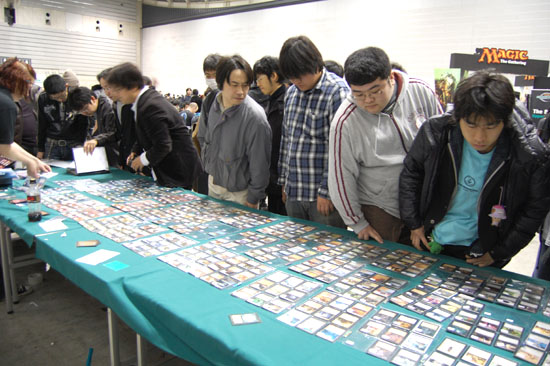
So, from my perspective, a dealer is someone who makes their living from buying and selling Magic cards. And this is my goal. Thankfully, at the moment, all of income is disposable. I don’t have any bills to pay or a family to feed, so starting up a dealership now would allow me to use the money later on in life, when I will need it for those things. And also, it’s just a great thing to do. I can imagine almost nothing better than to make a living off of this amazing game. So I wanted to be a dealer, but I didn’t know the first thing about, so I started asking around.
After talking to many people I respect, including QS’ own Kelly Reid, the owners of Pastimes and MTG Chicago, as well as some business minded friends, I made a few discoveries.
First, while the estimates varied from contact to contact, the average recommended initial investment was $10,000. As Jon Medina was nice enough to break it down for me: 4,000 for buying initial cardstock, 4,000 to buy cards at events, and 2,000 for a website, renting booth space, and other costs (while Jon recommended $12,000 as a start up investment, I modified his numbers due to his guess being slightly higher than average).
Well, to be honest, this was a bit much for me. So I had to go looking for a partner, someone who was either willing to enter into this new world with me, or at least invest in this startup. Luckily for me, I found the perfect man for the job. Greg Ivey has been one of my best Magic friends for a few years now, and he expressed interest in joining me in this venture. As if this wasn’t already good enough, Greg is very experienced as a business consultant, and really knows his stuff. I’ll try to paraphrase his advice to make it slightly more understandable:
“Essentially what we want to be doing is to find a store that wants someone to supply them with singles and deal at their events, and enter into an LLC (limited liability company). This will provide the first source of earnings and then give us the capital to rent booths at events run by larger organizers, like PTQs.”
Greg’s proposal of an LLC boils down to us and another store becoming partial business partners. From what I can divine from Wikipedia, an LLC will give the two companies the benefits of acting as a single company, but without either company being responsible of the debts or failures of the other.
That’s where we are at the moment. Greg and I have gone a little way into figuring out how we’re going to set this thing in motion, so now we’re just waiting for the final shove. I’m very excited about this project, and I’ll keep you updated as it progresses.

Now, I want to illustrate a principal that anyone looking to trade for profit should be able to use effectively: trading down. Trading down swaps an item of large value for multiple items of smaller value. Why is this useful? Let’s look at that Baneslayer that’s been sitting in your binder for weeks. While it’s price may have fluctuated a few dollars, that’s still not very much. But let’s assume you trade that Baneslayer for thirty $1 rares (taking a loss of $5 from Starcity pricing). Because of the greater quantity of these cheaper rares, if there is any price increase, the amount of profit margin you get is increased thirtyfold. This opens up the opportunity for a higher reward, however with an admittedly higher risk. Still, trading down is an important tool in a trader’s arsenal. So let’s take a look at my trades at FNM:
(For the purposes of keeping everything constant, we’ll use Starcity pricing for all cards)
My:
1 Baneslayer Angel (35)
His:
1 Verdant Catacombs (12)
2 Eye of Ugin (8)
1 Pyromancer Ascension (out of stock at 2.50, estimated 3)
1 Summoning Trap (2)
1 bloodghast (6)
Net loss of $4
At face value, this trade is horrible for me. I’m losing Baneslayer Angel, a flagship of the modern constructed formats as well as one of the best creatures ever printed, and I’m not getting much of anything. But let’s look closer. We’ll see that all of the cards I’m trading should be seeing competitive play after Alara block rotates. Eye of Ugin could easily make a massive price jump if Conrad Kolos’ Mono-Green Eldrazi Ramp from US Nationals catches on post Alara, as does Summing Trap and Bloodghast will be huge if Dredgevine is able to survive. Verdant Catacombs, while less likely to jump, is still of constant value. Pyromancer Ascension might be the odd one out, but it’s not impossible to build a viable Pyromancer Ascension deck without the infinite Time Warp engine. I hear triple Lightning Bolt is still pretty good.
My:
1 Grave Titan (30)
His:
6 Valakut (12)
4 Pyromancer Ascension (out of stock at 2.50 each, estimated at 3 each=12)
6 Armament master (4.5)
2 Bloodghast (12)
Net gain of $10.5
This was a trade I was VERY happy with. Once again, I’m trading off what I see as a stagnant front runner in Grave Titan, for several cheaper cards that definitely possess the ability to jump. I’ve already explained Bloodghast and Ascension, but it only gets better from there. Valakut is looking to be huge with the massive popularity of R/G Valakut, especially after the rotation of Alara, and the deck could easily be the deck to beat. Armament Master will work well with all the new equipment in Shards of Mirrodin, especially the Sword of Body and Mind, as well as current favorite Basilisk Collar.
And the final trade of the night.
My:
1 Baneslayer Angel (35)
1 Obstinate Baloth (8)
1 Marsh Flats (12)
His:
1 Stoneforge Mystic (5)
1 Eldrazi Temple (4)
1 Eye of Ugin (4)
2 Cryptic Command (24)
3 Bloodghast (18)
Broke even +0
Wow! I don’t think it can get any better than this when looking for an example of trading down. First off, I didn’t incur any losses with this trade. Though I picked up 6 of his cards for 3 of mine, I didn’t have to sacrifice a dollar here or there to do it. Also, the cards I traded off are either stagnant (Baneslayer and Marsh Flats) or set to lose value (Obstinate Baloth is pretty poor with no Blightning in the format). In return for these, I got some blockbuster cards. Stoneforge Mystic pairs well with Armament Master, as well as the new swords. Eldrazi Temple is also a key player in the Mono-Green Eldrazi Ramp deck, and Cryptic Command will shoot up as high as $15-18 once the Extended PTQ season rolls around. I’d say that this trade, despite breaking even at the moment, will easily get me $20+ of profit in the long run.
So, from these examples I hope you’ve seen how important trading down is when trying to get your collection earning again. I’ll just round things off for now with my
Tip of the Week: Stoneforge Mystic and FTV: Relics
Stoneforge Mystic was initially regarded as a crap rare, but then shot up after its successful inclusion in Tom Ross’ and LSV’s Boss Naya deck from PT San Diego, and has seen constant competitive play ever since. At the moment, I’m looking to Scars of Mirrodin to provide the Mystic with some killer equipment to fetch up. We’ve already seen the Sword of Body and Mind, which I think is more than capable of tournament play, and we’re still awaiting a possible B/G Sword as well. Even if the U/G Sword stands on its own, Mystic will still be a fantastic tool in the new Standard environment and well worth picking up while still hovering at or around $5.
My recommendation for FTV: Relics is much simpler: buy at $85 or less. I can’t see these babies going anywhere but up. I managed to pick up 4 copies for $65 each from my local store, and I already have the option to make a quick $150 by selling them for $100 each on Ebay. Despite the potential for quick profit, my recommendation is to hold onto them for a while. As supply goes down, their price will shoot up, making it well worth the wait.
That’s all for this article, and don’t forget to click back next week for more of Whinston’s Whisdom.
Don’t be afraid to trade down,
--Noah Whinston


I just looked on Ebay and I can buy several for around the $75-$80 range as of 2am est on september 6th. How are you able to sell them for $100 already?
they were preselling for 100 each, which is the route i took. shoul be back up to 100 as the supply goes down
Last comment refers to the FtV:R, of course.
Good information and good read. I'm very excited to hear how your venture into the dealership goes, so please make sure to keep us updated on that!
Would you consider Jace TMS for 2 Cobras and 4 Fetches a good trade down?
yes, i like that trade a lot. it is a little risky as jace has potential to go up once pulse and other cheap planeswalker removal rotate out, but cobras and fetches should see a jump with a new format as well
I currently have 2 From the Vault Relics unopened. I really need 4 Jace 2.0 to finish my U/W Control deck for next season. Think there is a chance for a trade like this happening???
while that would be a trade i would do an instant, as you're picking up at least 20-40 dollars in value, i'm not sure if anyone would be willing to do that. if you can find someone to do this trade with, that would be great
You are a little off in your understanding in what a LLC is. A LLC limits the liability of owners of the business entity. It makes the business responsible for the business, and it keeps the owner's assets protected from the business if it were to go under. It doesn't really have anything to do with one of the owners of the LLC going under or not because the LLC is it's own entity away from the any of the owners other businesses.
Also, with that $10k in start-up, what do you hope to accomplish with that? I would never want to show up at a GP or event with less than $5-$8k to buy cards, $4k is only some random collection you can get off of a message board. For cardstock, I would want at least 4x of each Type 2 single as well as 4x of most extended singles. (If you want more help on this topic, just get my contact info from Kelly, I have done all aspects of the trade business and know most of the numbers)
Noah, with UW control being an expected contender in next standard season, do you expect the value of Gideon Jura increasing?
No, i don't Jarrett. Gideon was never the best in U/W and i think he will actually reduce in price, especially with the printing of superior 5 cc 'walkers from Scars
Thanks for the reply Noah. Really appreciatte it. Yeah it seems that it will be hard to get that trade. Heck ill even do it for 3 Jaces and a Bane Slayer or 2 lol. The hardest part is that i live in Puerto Rico and the fisical market for a Jace is extremly limited. I do ship worldwide, so i was thinking on focusing on a european market since they are limited for them. Any thoughts on how should i approach this collectors from foreign countries?
Again thanks for the reply and hope you have a nice day.
i agree this could lead to a difficult situation. one of the problems with European markets is shipping, which can be expensive, as well as buyers who will want an English language card vs. one in their native language. re: the FTV R trade, i think my limit for it would be 3 Jaces and a Baneslayer for the 2 FTVs. that would break about even on value at the moment, but with a much higher potential for an increase in value in the long run, both because you are diversifying your portfolio, as well as trading 2 "cards" for 4
While I understand and agree with your reasons for wanting to trade down for cards you're speculating on, from my experience, most people view trading down as a nuisance (due to less liquidity) and are willing to give a bit more to the person who's trading down for this reason. I think you could probably push this angle and gain a bit more value on a lot of your trades.
I can definitely see some of the recommendations you make, and I am a huge speculative trader. I've always been a budget player in that I basically never have money to spend on cards, but I've always managed to trade for anything I've needed allowing me to hold a lot of the same playsets and match games evenly with the big spenders. The #1 method and #1 time for a speculative trader is always rotation. Right before rotation you get to dump off everything you have that's rotating to the bigger spenders and strictly tournament traders for a diverse portfolio of cards you expect to be good post rotation. Then when rotation day hits, you get to trade back to the same people!!! trading the cards you picked up for 2-5 times what you had into them, getting the cards from the format you expect to regain value at half of what you traded them away for. At the end of the day you even end up with enough left over value to pick up the cards you'll need for the new set. If you're a great speculator you can even catch the cards other people haven't caught on to yet (I picked up Avenger of Zendikar as a $1 card, remember before people caught on that he was good… So do I)… Figuring these out can make a HUGE impact on the portfolio. And with the general laziness when it comes to deckbuilding anymore plus the short memories of major tournament players, you can count on there being some real gems to be found this way.
The affiliated singles dealer model where you run one aspect of the game store semi-indepentant of the store itself is a pure win-win from a store owners perspective.
1) Little to no skin in the game for them. They have to cough up some unproductive rack/counter space and work you into thier PoS. You don't want that store to be part of your LLC. You want a contractual arrangement with your LLC. It changes your nature from "some random guy who comes into my shop to sell singles" to "Whinstons Mad Singles LLC is our affiliate partner."
2) He gets discounts on his purchases due to the amount of product you need to buy. At the same time you can't get discounted presale product w/out him. Watch out for store owners trying to gib you on this, although most people would still do healthy business being able to buy boxes for $5 over wholesale you don't really want to pay for the priviledge of selling cards in his shop.
3) This increases the owners floor traffic. People that buy singles buy packs to draft, or have friends that do. They want tournament space. I advise you to get set up as a T.O.
With all that said, this article mildly undermines your credability. It would have been better if Kelly had tag-teamed with you and written about what it takes to get started, or what it took to get him started highlighting the things he did well, and things he would do over.
@the_cardfather: I am going to have to 100% disagree with you that it is a win-win for a store owner to have some one set up in their store to sell singles. This takes away sales from him and the increase in floor traffic might get him a few more sleeve sells, but would take away a ton of money from him in pack sells.
I have worked as a consultant for 3 different stores for ways to increase attendance or as their buyer, and having an entity that doesn't directly put money into the store is the worst way to grow business, the store owner should just take out a loan and start singles for himself, no reason to let some one else make the money when they could be.
@stu55 – What store owners should do and what many are willing to do are very different. There are many stores that want nothing to do with a singles market. They don't want to take the risk, the overhead in a product they don't understand and thier sales suffer for it. These are the same stores that never seem to be open past 5-6 pm.
Players gravitate to shops that have good singles because it shows the management is involved with the game. They have a place to sell the cards they get playing limited so they can play next week and open more packs.
Should the owner do it, or hire more staff? Yes. Maybe his time or credit is tapped out. Is getting a 3rd party to basically merchandise for you just as good or better since they actually have skin in the game? Yes. Most do take a % of sales or a kickback on boxes you crack. That's part of business. Just don't let it get out of control or you're in the company store. Nothing wrong with giving them 10-15% considering thier credit card machine is taking 4-5% off the top and you'd spend that much selling on eBay. If you are moving 10k in singles through thier store a month that's 1k extra in thier pocket for doing.. nada. Not only that, by working with you they keep you from opening a store 3 streets over and flushing them.
Grocery stores, convenience stores, mall stores et et all have 3rd party merchandisers. It's a business model that works. So while I agree that the store owners should do it, the piles of stores with $10 crap rares from 3 seasons ago tells me they aren't.
A Limited Liability Company ("LLC") is a non-corporate limited liability entity organized and existing as a separate "person" under state law (this is a general discussion but it is largely based on Delaware law. It's not legal advice. I am probably not licensed in your state, in any event).
So, what does that mean? First, it's non-corporate. Unless you elect otherwise (and unless you consult an accountant or lawyer, you should not elect otherwise), an LLC in which there are multiple members will be taxed under Subchapter K of the Internal Revenue Code, which means all tax items are passed through the LLC to the members of the LLC. As a consequence, the gain, loss, deductions and credits are allocated to those members and nothing (or almost nothing) is taxed at the entity level (contrast this to corporations where there is a tax at the corporate level before the stockholders can draw any money out of the corporation).
Second, it's limited liability. That means that if someone does business with the LLC, the members of the LLC are not responsible for the LLC's debts and obligations (unless there is a personal guarantee involved). This doesn't protect you from your OWN liability (if you sign something in a personal capacity, you are liable, not the LLC. If you injure someone, it's your responsibility, but it might ALSO be the LLC's responsibility if the injury is in the course of your work.
One interesting attribute of the LLC is that the limited liability works in BOTH directions in a sense. If someone wins a judgment against you, the judgment creditor cannot take your LLC interest (stock could be taken normally, subject to a stockholders' agreement). Instead, the creditor gets something called a charging order, which requires that distributions with respect to the LLC interest must be paid over to the judgment creditor. This is more protection for the other members than it is protection for you, but it's a nice feature versus partnership interests or stock.
Third, it is a legal person. It can sign contracts, sue, be sued, and do almost anything a natural person could do (except as limited by statute), including owning real or personal property.
In the scenario you describe, I would expect to see an LLC of which you and your financial parter are members, with an Operating Agreement providing for an unbalanced payout until he gets all his money back, plus some kind of interest premium (otherwise he loses money). That's your business. One of the keys is to make sure that there are no mandatory capital contributions under the agreement, otherwise you can get squeezed out by a big money partner and those liabilities are enforceable against you personally.
You might choose to form a second LLC, of which the first LLC and some store (probably an S corporation or LLC) are members, which will have an Operating Agreement with similar no mandatory contribution provisions and set forth the exact terms of your deal. This creates a second level of liability protection, but might be too much formality (including annual accounting expenses) when some kind of simple agreement might do the job better.
If you are serious, see a lawyer and an accountant to get you set up right initially. It is VASTLY cheaper than having those same people unscrew it later.
[NB: regarding liability. You must keep LLC assets separate from your own assets if you want to claim limited liability protection, and follow all the formalities required by the LLC Act under which you form the company and your Operating Agreement. If you don't, it's possible for a creditor to "pierce the veil" of limited liability and get at your personal assets.]
So are you saying pickup Bloodghasts? I don't think their value will increase much. I'm not a professional at this but I can do the math of my own experience with the card. Every draft of Zendikar I did when it was 3x Zen, I would open a Bloodghast. There would also usually be one more at the table *seating eight people at a table* The card was so high in supply stores couldn't give them away. So maybe there is something to this card. I think it's just be better to grab vengvines since they are the actual key to the deck. unless you want to be the guy controlling every bloodghast so you can monopolize the price.
Good article though, was a good read.
Interesting read. I've actually been trying to 'trade-down' with most of my trades up to this point, though I don't think I was doing it as intentionally as I probably will be from this point, as up till now it's been an almost unconscious thing as I ry to build a trade binder.
One thing I'm extremely interested in hearing more about is your journey into becoming a dealer. My wife and I plan on opening our own game shop sometime next year (in fact, this is the whole reason I've started playing Magic again, just so I can learn the lay of the land for what essentially will be our primary product) While it sounds like you're planning on being a dealer at events, while I intend to open up a local shop, I'm sure a lot of it is a similar process. Definitely looking forward to hearing more.
Lastly, I know Corbin is from Oklahoma, as meeting him at FNM was how I first really heard about the site, but are you perhaps from Oklahoma? I just knew a guy named Greg Ivey back in High School (in Wilburton, Oklahoma), who used to play MTG. Would be a small world if it was the same guy.
Anyway, looking forward to reading more.
that is in fact the same Greg Ivey 😀
No freakin' way. In a million years, I never expected that. Tell him Russ Henderson said hi!
you are really a good webmaster. The web site loading
pace is amazing. It sort of feels that you’re doing any unique trick.
Also, The contents are masterwork. you have done a magnificent
process on this subject!