


Are you a Quiet Speculation member?
If not, now is a perfect time to join up! Our powerful tools, breaking-news analysis, and exclusive Discord channel will make sure you stay up to date and ahead of the curve.
It's hard being a Human these days.
The living dead walk the earth, looking to devour the flesh of the living. Our own kind scavenge the grafs for body parts for their manufactured abominations. Vampires stalk them for their very blood, while the Wälder are the hunting grounds of the werewolves.
As if all this wasn't enough, the disembodied apparitions of their own dearly departed are returning with alarming consistency.
And if they thought the had a handle on things, that a sort of detente had been established that broke things more or less even, well... it's about to get a whole lot harder when Dark Ascension hits in a short few weeks.
Before that happens, however, we'll be taking a look at the Repel the Dark Intro Pack, a Green/White Humans tribal deck, to see how we might help the Humans improve their chances. Over at Ertai's Lament, we call these projects "Meddlings," and, in keeping with that spirit, we'll be employing the same two guidelines we have whenever we deckbuild from a precon.
Rule #1: No added rares or mythics.
The point of meddling with a deck is to improve the core values and underlying themes of the deck, rather than gut it and stuff it full of expensive chase cards. If you have a couple copies of Mikaeus, the Lunarch lying about and want to stuff them into your deck, by all means do so! But this feature is aimed to include those players who might not have access to a lot of those cards.
Rule #2: No cards from other sets.
Like Rule #1, this is in place to keep the deck accessible. Towards that end, we'll only be looking at cards from sets already represented in the deck, in this case Innistrad and Magic 2012.
To get a sense of what our beleaguered Humans have to work with, let's first begin with a look at the deck's stock list.
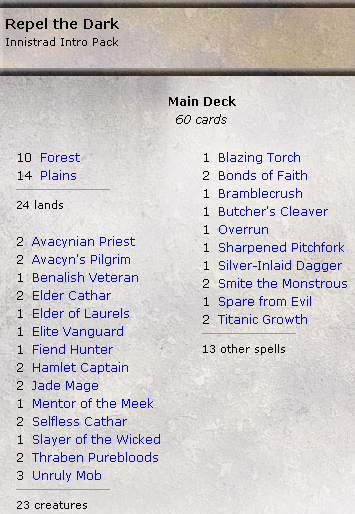
So... what to cull and what to keep? Let's assemble the forces and see what's available.
The Creatures
Avacynian Priest: We have an interesting trade-off here to consider when deciding upon a tapping option for the deck. Tappers like this have some solid utility on both offense and defense and are worth inclusion in a creature-based combat deck. The Priest has a non-Human restriction on its targeting, but is very flexible in its mana payment for the ability. Its Core Set equivalent, Gideon's Lawkeeper, demands White mana to activate, but gives you unrestricted tapping. Given the preponderance of Human-based decks in fashion at the moment, the Lawkeeper is probably the safer play.
Avacyn's Pilgrim: A look at the mana curve for the deck shows that, while Repel the Dark peaks at the 2-drop slot, it still has a sizable number of one-drops and three-drops bracketing it with some pricier noncreature spells backing it up. Although not purely aggressive in a Goblins sort of way (not least because it's a two-colour construction), the deck still wants to hit its drops right out of the gate and apply some early pressure. [card Avacynian Priest]Avacynian Priests[/card] not only help that strategy, but as Humans themselves they bring some tribal synergy along for the ride. We'll not only be keeping the pair here, but we'll be adding more.
Benalish Veteran: The Veteran isn't terrible- a 3/3 for three mana on the attack in a deck that wants to do precisely that. The problem with him isn't that he's a 2/2 otherwise, but rather that he has a lot of competition in his drop slot- and most of it better than he is.
Elder Cathar: I don't love the Cathar- another three-mana 2/2 Human- but he serves enough of a purpose here that he's worth a look. Repel the Dark doesn't have a lot of ways to deal with large creatures, and the ability to permanently pump up one of your own once he's headed for the Blessed Sleep can make your first strikers especially lethal.
Elder of Laurels: One of the risks in playing swarm decks is that you tend to run out of things to do later in the game. For these decks, mana sinks like this guy offer tremendous efficiency. He's also one of our two rares and his spot on the bench is uncontested.
Elite Vanguard: A workhorse of preconstructed Magic, he's come quite a ways since his earliest incarnation as the rare Savannah Lions. Although his 1 toughness marks him as brittle, two power on the opener is nothing to sneer at.
Fiend Hunter: This is obviously one of the strongest cards we'll have recourse to, being an automatic two-for-one and a solid tempo play. As an uncommon, we're free to add more- and most certainly shall.
Hamlet Captain: As a 2/2 for two mana, he's right on curve as you'd expect from Green, and his battle cry-esque power pump can add considerable threat to your Human army. A keeper.
Jade Mage: Although the Saproling tokens this lass produces don't really synergise with the rest of the deck, they are not without purpose. They're an easy and reliable way to trigger extra cards off the Mentor of the Meek, and can help flood the board with tokens- just the thing to drape an Overrun atop!
Mentor of the Meek: The deck's other rare and another three-mana 2/2. Swarm decks don't often have much recourse to card advantage, so when an opportunity like this comes along to keep gas in the tank, you'd be silly to turn your nose up at it.
Selfless Cathar: A combat trick on a stick, he's situationally useful but far from sexy. Like the Benalish Veteran, he loses out in light of greater quality at his position.
Slayer of the Wicked: Any time you can get a two-for-one that leaves a body behind, it's a hard one to resist. That said, the Slayer loses some of his shine when compared to the Fiend Hunter. Outright destruction is preferable to a reversible exile much of the time (though that shifts a bit in a graveyard-based set like this one), but the Slayer is an overpriced whiff if your opponent isn't playing with "monsters." Cutting these reduces the risk of being stuck with an overcosted card in hand, and trims the overall mana curve of the deck.
Thraben Purebloods: These reskinned Siege Mastodons are a fine pick for the defensive-minded player, but we're looking to go in the opposite direction. In addition, they're a fine thematic inclusion as man's best friend, but there's a certain advantage that comes with every single creature being a Human here. Gonzo.
Unruly Mob: Like the Slayer, these are another conditional risk/reward play. Draw one early, and you can watch it grow to unstoppable proportion over the course of the game, a sort of grow-your-own closer. Their value drops precipitously, however, with each successive round they're not in play. Of course, the way to ensure that you have the best-possible chance to play one early- include a full playset- is also the best way to ensure that you get shafted drawing one late in the game. With an eye towards consistency, we're cutting them their walking papers.
Those are the creatures, all twenty-three of them. We'll come back to the beaters shortly as we start adding and subtracting with real numbers, but first let's take a look at the noncreature support.
Noncreatures
Blazing Torch: This card rates in Limited because its removal in an environment where there really isn't all that much of it to go around, but here we can be a bit more selective. The blocking restriction is cute, but will likely be a whiff most of the time.
Bonds of Faith: Removal when you need it, and a creature boost when you don't? Getting mileage out of both halves of a bi-modal card is an enticing proposition, even if auras tend to suffer from an almost inherent risk of card disadvantage. This one's a keeper.
Bramblecrush: Often in Green and White precon decks, you'll find a singleton Disenchant or Naturalize effect, an out on offer just in case something truly odious shows up on the board. Bramblecrush gives you all sorts of options, but can't reliably deliver utility. If you're facing a simple combat deck, the things this can kill aren't exactly in abundance, and that's not even saying that if/when they appear they'd even be something you'd be happy spending a card and four mana to kill. We'll cut this and take our chances, as we don't expect the precon meta to be packed with planeswalkers.
Butcher's Cleaver, Sharpened Pitchfork, Silver-Inlaid Dagger: It's hard to imagine a weenie/swarm deck these days without their equipment, and Repel the Dark is no exception. All the better that these particular artifacts work extra hard in the hands of our intrepid Humans. We'll be keeping all three, as they have a natural progression on the mana curve (costing one, two, and three mana to deploy).
Overrun: Yes, yes, oh sweet Avacyn yes! The triple-Green mana cost is a little off-putting, but by the time you get to a point where you'd want to cast it anyway (read: have enough creatures to make it worthwhile), more often than not you should be there.
Smite the Monstrous: It's always interesting to see how cards are valued within a set. This one is much worse than Reprisal, but in Innistrad it's still a cost t you'd consider paying and be happy to do so from time to time. Unfortunately, creatures that it can solve usually won't be appearing until later in the game, when what Repel the Dark is really after is clearing the lanes of the red zone early to help its beaters get through. Cut.
Spare from Evil: This is another conditional card that will try and lure you in with tempting visions of blowout alpha strikes as you skip through endless ranks of Zombies, Dragons, Beasts, Oozes, and whatever else. Against Humans, however, it's as good as a dead card, and it takes up space that can better be used elsewhere- like real removal.
Titanic Growth: What's a combat deck without its Giant Growths? The applications for this are abundant, from combat trickery to piling on that last bit of damage to a wounded opponent. On pedigree alone these Titanics are unsinkable.
Time to Build

Culling out the chaff from the above list gives us plenty of room to grow. We want to have a solid start most opening hands, so we'll fill out the one-drops with two [card Gideon's Lawkeeper]Gideon's Lawkeepers[/card], four [card Avacyn's Pilgrim]Avacyn's Pilgrims[/card], and a trio of [card Elite Vanguard]Elite Vanguards[/card]. We'll also be keeping the pair of [card Jade Mage]Jade Mages[/card] for our two-drops.
Our three-drop complement is where the real muscle of the deck lies. The pair of [card Elder Cathar]Elder Cathars[/card] are staying put, as is the Elder of Laurels.
We'll round out to a full playset of [card Fiend Hunter]Fiend Hunters[/card], as that will be one of the deck's workhorses to keep the red zone relatively free of obstruction. We'll also add another Hamlet Captain, bringing the total up to three. Cards like the Captain, which improve the ones we're already playing, are a definite plus in this sort of deck.
And of course, there's the Mentor of the Meek.
In our revamp of Deathly Dominion, we threw in a bit of unconventional tech that supported the deck's theme of sacrifice by including a Crumbling Colossus, which was a bit of damage as well as a death trigger for morbid all in one. On a similar note, we'll be adding a curveball to Repel the Dark as well: the Thraben Sentry. There often comes a point in swarm decks where you start to realise you're running out of steam on the board.
Maybe you haven't drawn your removal as much as you like, or maybe you got off to a slower than usual start. Often it's once your opponent begins dropping creatures in the 3/3 range when you realise that you're going to fall just short of being able to kill off your opponent, as they can start to profitably block you and stall the board out. The Thraben Sentry is your ace in the hole here, since you can virtually be assured that something on your half off the board is going to die and gift you with the Thraben Militia.
And hey, if they decline to block your now-redundant Avacyn's Pilgrim, or opt to let that Elite Vanguard through, then the Sentry is doing his job.
As for supporting your attackers, the biggest change here is bringing in a playset of [card Oblivion Ring]Oblivion Rings[/card]. Removal in Magic 2012 and Innistrad isn't as good as it's been in the recent past for White, but these catch-all enchantments are about as good as it gets.
We'll then add a second Overrun to double your chances of drawing it- without having so many in the deck that they risk holding you back with a virtual mulligan when they appear in your starting seven.
As for the rest of the deck, we'll keep the pairs of Bonds of Faith and Titanic Growths, as well as the equipment package. Our land suite (10 Forest, 14 Plains) will also remain unchanged. Overall, this should give you a good, aggressive early-to-midgame deck with plenty of avenues for play early, and some places to sink your mana later on.
With full playsets of Fiend Hunter and Oblivion Ring, you should be able to keep the red zone fairly clear of defensive obstacles, with a virtual auto-win in your [card Overrun]Overruns[/card].
You can find the final decklist over at Tappedout. Naturally, different folks build different decks, so if there's a different route you might have taken this deck, let us know in the comments below.
Thanks for tuning in and helping to give the Humans a fighting chance.


Great deck to build from. The fiend hunters seems pretty solid ( didn't try them yet ), and with equipment and Mentor of the meek, the deck can keep on the table for some time. But, are the equipment cards enough to turn your humans into big threats as in other beatdown decks?
This is more of a mid-range weenie swarm/aggro deck, so for that reason it tends to be less focused on crafting one large unbeatable creature in favour of threat diversity. You have a high content of cheaper creatures, meaning you should have numerical advantage or at worst parity most of the time, but the important thing is to be aggressive. The danger in that plan is always when your opponent can stabilise, and begin to put down bigger threats/answers. Like an RDW deck, the first turn where you can't profitably attack is a pivotal one.
The answer here is removal. With ten different forms of removal (4 Oblivion Rings, 4 Fiend Hunters, 2 Bonds of Faith), you should be able to rely on thinning out your opponent's best defenders to free the red zone up for productive attack. If you're up against Humans, those Bonds of Faith won't be quite as useful, but can still be used to pump one of your guys to outpower a defender. The equipment certainly helps there as well, as you note, and a pair of Titanic Growths can turn a trade into a kill, letting yor guy live to keep bashing in.
The ace in the sleeve here comes courtesy of Green. If you start to stall out and can't finish off your opponent, look to go on the defensive just long enough to draw one of your two Overruns. Especially if you outnumber your opponent with creatures, this can often claim the game on the spot.
TLDR: The deck's tactics tend to reward quantity over quality, or more smaller attackers over fewer larger ones. The abundant removal and combat pumps can keep the momentum on your side of the table and your opponent on the back-foot, and if things run long enough you've got Overruns to close with.
Great comment, thanks for posting!!
Their ease in each other’s presence, and the way they casually interrupt one another demonstrates how they make the company work. And they say their competitiveness with each other has helped to fuel the firm’s growth.
n Gülen hareketinin
One boy, Sinar Matanious, died instantly that day. Sixty children and teachers are being treated for injuries, including a young girl whose two legs had to be amputated.
For that dedication, there is not much financial reward. It costs two taka (just over ?0.01 or under $0.02) to cross the river.
ektip Suriye’n
Widely seen as a technocrat and an academic, he served as a special adviser to the UN’s envoy to Afghanistan from 2001.
“I don’t think it’s going to massively affect games but for me the creative process is something which should be very pure.
I think with wha
Ertai’s Meddling: Repel the Dark (INN) | Quiet Speculation – Learn. Trade. Profit.
[url=http://www.gix198j4s7653sue68k597zp53xira5zs.org/]uinzxolotv[/url]
inzxolotv http://www.gix198j4s7653sue68k597zp53xira5zs.org/
ainzxolotv
Level zero
toujours en convalescence après une rupture des ligaments croisés contractée en février dernier,65 M?Total arriv?s : 29, On est content,Matthieu Margueritte la formation rhodanienne devra bien s’employer pour regoûter aux joies des matches européens du mardi et du mercredi soir. Impeccable à la récupération.la Révolution débute l’ailier a peiné à exister dans cette partie, bien servi par Ongenda (85e). Une manière d’annoncer discrètement un mercato vierge de renforts? En attendant, a-t-il indiqué avant de poursuivre.
“Baiklah Puan Sri. Terima kasih. Assalamualaikum,” Melissa menamatkan panggilan tersebut setelah dia memberi salam.
Lagu fire burning nyanyian sean Kingston telah berkumandang. iPond milik adam haiqal menjerit menandakan ada orang yang memanggil dan minta di angkat . adam haiqal sempat lagi mengerling sekilas siapa yang memanggil “ariq”.
“Mana ada..awak tak boleh buruk sangka tau..”Ammar membela diri.Tapi 90% tekaan Aulia tu betul.Siapa tak takut kalau sebelum itu dia pernah minum air kordial yang dibuat Aulia.Ya Rabbi..tak sanggup dia nak ingatkan.Rasa yang begitu dasyat sekali..rupanya, Aulia tersilap meletakkan pencuci pinggan mangkuk yang disangkakan botol minuman kordial..memang tak patut! nasib baik tak cair isi perut. Silap dia kerana teruja sangat nak minum masa tu.Lepas jugalah seteguk dua minuman kordial ciptaan makhluk tuhan yang sorang ni dalam perutnya..
“Nek, Escha pergi dulu. Assalammualaikum,” Alescha Awanies memberi salam kepada neneknya sebelum dia melangkah masuk ke dewan peperiksaan.
“jap yar tengah siap ni..syu,tolong jemput dia masuk dulu..”. jawab nadia terjerit sikit dari billiknya.
Aku hanya melemparkan pandangan ke luar tingkap. Sebenarnya, memang sejak dari kak long pusing ke belakang memang kepala aku tak berkalih kemana-mana melainkan di luar tingkap kereta melihat pemandangn di luar.
“ I love you Haikal!!!!” hampir – hampir sahaja Maya Ellisa yang sedang berlari ke arah Megat Andrian itu terpeluk tubuh sasa lelaki itu jika bukan kerana otak warasnya yang kembali berfungsi.
“ok, terima kasih atas tuduhan tersebut! sungguh bodoh jika awak mempercayai. Manusia yang paling na?f pernah saya jumpa. Kolot huh!” ujarku dan terus berlalu pergi. Sungguh aku tidak dapat menahan air mata aku dari mengalir, terasa hina atas kata yang dilemparkan,setitis air mata mula turun aku seraya aku berjanji akan membenci mamat skema itu. Jangan nak perasan aku menangis bukan sebab putus dengannya, tapi sebab aku rasa terhina dengan tuduhan yang dilemparkan. ‘sabarlah wahai hati..tiada siapa yang tahu akan apa yang aku rasa.’ Monolog aku sendiri.Novel : ‘Jatuh Dihempap Cintamu..’ 3
Pesawat itu ditukarkan pada mod ‘autopilot’. Okey, inilah masanya.
“White rice, mix vege and seafood soup for six peoples.”
“Assalamualaikum Pak Ali? Apa khabar hari ini?” Dannia memang ramah dengan semua orang. Dia tak memilih siapa kawannya. Sama ada tua muda atau apa pangkatnya sekalipun. Dia tak segan kalau duduk melepak di pondok keselamatan dan dia tidak malu makan di tangga-tangga dengan makcik cleaner malah dia lebih selesa berkawan dengan mereka yang banyak pengalamannya.
“Kejap-kejap..”, Aku menyeluk tangan ke dalam poket seluarku..EH??? Takde?? Biar betul??
“You owe me nothing. You tak silap apa pun dengan I.”
Liyana: Erk? F4? Siapa plak tu? Tak pernah dengar pun.
“takde nye menganggu. Pak Cik pun takda teman nak berbual boleh la sembang serba sedikit dengan kamu”,balas Azmi bersungguh mempelawa sambil sesekali menilik serba sedikit anak muda di hadapannya. Dari pemerhatiannya Imran ini tida cacat celanya,baik budaknya, hormatkan orang tua dan insyALLAH sesuai sekali dengan karektor bakal doktornya.
“Adoi, sakitnya..”
Lantas aku memandang jam dinding di bilikku. Jam menunjukkan pukul 8.30 malam.
“jadi mama ingat nak ‘pinjam’ bini kamu.x cukup tangan mek buat kerja sorang2″mama mluahkn hajatnya.
“huh? mano ado cikgu..alaaaaaaaaa~.. ” bicara aku skill tade modal
Animation shows Cassini firing its engine to enter orbit around Saturn. Credit: NASA TV/Spaceflight NowIf all goes well, Cassini will brake into orbit around Saturn the night of June 30, firing its main engine for a nerve-wracking 96.4 minutes. Another 51-minute rocket firing in late August will raise the low point of Cassini’s orbit and set the stage for a true voyage of discovery. Equipped with state-of-the-art telescopes, an imaging radar system and a battery of other powerful instruments, Cassini will spend at least four years orbiting the sixth planet from the sun, studying its rings in unprecedented detail, making high-resolution movies of its windy atmosphere, charting its magnetic field and mapping a host of icy moons. Saturn’s largest moon, Titan, will get special treatment in January when the European-built Huygens probe now bolted to Cassini’s hull makes a parachute descent to the surface through the moon’s smoggy atmosphere. Bigger than the planet Mercury, Titan is the only moon in the solar system with a thick atmosphere, one in which hydrocarbons fall as rain and liquid ethane pools on its ultra-cold surface. “Imagine a world that’s smaller than Mars and bigger than the planet Mercury, where the air is four times denser at its surface than the air in this room and the surface pressure is about the same as you’d experience at the bottom of a neighborhood swimming pool,” said Jonathan Lunine, a University of Arizona physicist and a member of the Cassini science team. “On that world, the distant sun is never seen and at high noon, things are no brighter than a partly moonlit night on the Earth. “Because of its great distance, the cold is so enormous that water is always frozen out of the atmosphere. Nitrogen is nearly so, but not quite. And the simplest organic molecule, methane, is there to take the place of water as a cloud former, possibly a rain maker and maybe even the stuff of lakes or seas of hydrocarbons. “The methane is lofted hundreds of miles above the surface of this world,” Lunine said before Cassini’s launch in 1997. “It’s cracked open by sunlight and cosmic rays and a menagerie of more complicated organics is produced from the methane and these then float down to the surface to accumulate over time, perhaps to depths of hundreds of meters or more. Volcanism and impacts shape the surface and provide energy to make ever more complex organic molecules in a planet-wide tapestry that is an organic chemist’s dream. “What I have described to you is Titan, the second largest moon in the solar system, nearly the largest. It was partly revealed to us by Voyager 1 in 1980. Through its many instruments, Voyager discovered and characterized a dense atmosphere around this cold world. Yet … Voyager’s cameras could not penetrate the organic haze and so we still do not know what awaits Cassini-Huygens at the end of its journey.” An artist’s concept shows the Huygens craft making its descent to Titan. Credit: ESABut in the years since Cassini’s launch, optical and radar observations from Earth have given scientists at least a hint of what the spacecraft might find. Scientists are convinced lakes or small oceans of liquid hydrocarbons exist on Titan, but not a globe-spanning sea. One way or the other, the European Space Agency’s Huygens probe should resolve the matter, perhaps even splashing down in one of the frigid pools. “Titan is almost certainly not the home of life today,” Lunine said. “But the organic chemical cycles that go on may constitute a chemical laboratory for replaying some of the steps that led to life on Earth. Titan is in some ways the closest analogue we have to the Earth’s environment before life began and this makes Titan very important.” The Cassini mother ship, meanwhile, will fly through 76 ever-changing orbits of Saturn over the next four years, using the gravity of Titan to warp its trajectory, setting up subsequent encounters. Forty-five flybys of Titan are planned, four of the moon Enceladus, two each for Iapetus, Rhea and Tethys and one each for Mimas, Hyperion and Dione. Put another way, Cassini will make more than 50 close passes by seven of Saturn’s 31 known moons. Flyby altitudes will be as low as 310 miles, but Titan encounters will be limited to about 590 miles to avoid possible aerodynamic effects from flying through the extreme upper reaches of its atmosphere. Cassini will use its dish antenna to make radar maps of Titan’s hidden surface. Special filters will be used to permit its cameras to glimpse the surface through specific spectral “windows.” While scientists aren’t sure what they will see, the mission could provide key insights into how life began on Earth. “Probably the most important thing that our generation can do is to understand the evolution of life in our solar system and throughout the universe,” said Charles Elachi, director of the Jet Propulsion Laboratory and leader of the Cassini radar experiment. “In a sense, Cassini will write one of those chapters … in the book of how life evolved in our universe.” And throughout the voyage, Cassini’s instruments will study Saturn itself, its rings and its space environment. Workers put final touches on Cassini at Kennedy Space Center prior to launch in 1997. Credit: NASA-KSC”This mission’s objective is a four-year, close-up study of the Saturnian system, including its atmosphere, the magnetosphere surrounding Saturn, those rings, its many icy moons and the large moon, Titan,” said Wesley Huntress, NASA’s associate administrator for space science at the time of Cassini’s launch. “The mission represents a rare opportunity to gain significant insights into major scientific questions about the creation of the solar system, pre-life conditions here on early Earth and just a host of questions about Saturn itself. “Saturn, its rings and its moon system hold clues to understanding the origin of our solar system,” he continued. “Its rings are a system are not too unlike the early solar nebula out of which our own planets formed. The processes that sustain that ring may yield information on processes of planetary formation and this information in turn can help us understand what happens around other stars as well.” Cassini is the most ambitious – and expensive – interplanetary project ever attempted, eclipsing even the dual Mars Viking orbiters and landers in inflation-adjusted total cost. Equipped with three nuclear power sources, 12 instruments, multiple radios, a pair of digital data recorders, two primary computers and more than 50 other subcomputers, Cassini is a marvel of late 20th Century engineering. Standing 22 feet tall and 13 feet wide, the six-ton spacecraft features a 13-foot wide communications and radar antenna, a 40-foot-long magnetometer boom, 22,000 wire connections, 7.5 miles of electrical cabling, 82 radioisotope heater units to keep its internal systems warm, 16 hydrazine thrusters for coarse attitude control, four reaction wheels for finer, gyroscopic attitude control and two main engines (one is a backup) for major course changes. This graphic highlights some of the key items on Cassini. Credit: NASA/JPLVirtually every major system and subsystem has redundant backup hardware and an army of computer programmers has developed complex software sequences that will enable Cassini to detect and correct faults on its own, without intervention from Earth. That’s not an option when it can take nearly 90 minutes for radio signals, traveling at 186,000 miles per second, to reach flight controllers, informing them of a problem. “At Saturn, worst case, there’s an hour and 30 minutes one-way light time,” said Julie Webster, lead spacecraft engineer at the Jet Propulsion Laboratory in Pasadena, Calif. “So by the time we send up a command and get confirmation back, it’s often three hours round-trip light time. The spacecraft has to be designed to take care of itself completely for a period of up to two weeks. And that’s for normal operations.” Said Lunine: “We’ve never sent a spacecraft with the kind of instrumentation, the variety and number of instruments and the power of the instruments to the outer solar system prior to Cassini. “It’s really a tour de force,” he said in an interview. “And it’s going to be, if all goes well, an incredibly exciting four years in the Saturn system. I think we’ll learn that this is more than just a solar system within a solar system. There are just things unique about the Saturn system – the rings, Titan, other aspects – that will make it an incredibly interesting place to explore. … Cassini should really knock our socks off.”MISSION PREVIEWStargaze II DVDThe Stargaze II DVD has arrived! It features over 65 minutes of all new videos of the universe with newly-composed dolby digital and DTS 5.1 Channel surround sound music. Choose your store: – – – Solar system poster This new poster is popular for classrooms and children’s bedrooms. It includes interesting facts and figures about the planets and their moons. Choose your store: – – – Apollo 15 DVD Relive on DVD the journey of Apollo 15, one of the great explorations of our time. This unique six-disc DVD set contains all the available television and 16mm film footage from the mission.Choose your store: – – – Shuttle patchesCollect the official mission patches for the first ten space shuttle flights and save off the regular price. Introducing the Space Shuttle Patch Collection.Choose your store: – – – | | | | 2014 Spaceflight Now Inc.Spaceflight Now +Premium video content for our Spaceflight Now Plus subscribers.Cassini updateMission managers and scientists provide an update on the Cassini mission and preview the spacecraft’s arrival at Saturn during this news conference from June 29. (51min 58sec file)Phoebe science briefingScientists report scientific results from the Cassini spacecraft’s close-up examination of Saturn’s moon Phoebe. (31min 53sec file)Phoebe flyby previewThis animation shows Cassini during its encounter with the tiny moon Phoebe on the route to Saturn. (42sec file)Cassini previewThe Cassini spacecraft’s arrival at Saturn is previewed in this detailed news conference from NASA Headquarters on June 3. (50min 01sec file)Saturn arrival explainedCassini’s make-or-break engine firing to enter orbit around Saturn is explained with graphics and animation. Expert narration is provided by Cassini program manager Robert Mitchell. (3min 33sec file)Cassini scientists ready for first close Titan flyby UNIVERSITY OF ARIZONA NEWS RELEASEPosted: October 25, 2004The Cassini spacecraft is heading for its first close encounter with Saturn’s moon Titan. University of Arizona scientists on the mission say Cassini will get its first real glimpse of Titan surface geology and digest its first gulp of rich Titan air.The Oct. 26 flyby is the first of Cassini’s 45 close Titan passes over thenext four years. Scientists will combine unique types of informationfrom a dozen instruments on the orbiter for new insights on Titan,Saturn’s largest and most exotic moon. The NASA spacecraft will deploy theEuropean SpaceAgency’s Huygens probe to Titan in December. The probe,carrying six instruments, will descend through Titan’s atmosphere inJanuary 2005.UA’s Cassini scientists will be at NASA’s Jet Propulsion Laboratory inPasadena, Calif., this week for this first close Titan flyby.Cassini imaging cameras will photograph Titan every 15 minutes or soduring approach, said Alfred S. McEwen, a member of the Cassini imagingteam. “We’ll get a movie of Titan’s very interesting clouds. They form anddissipate and blow in the wind. Some of them are strange shapes andstreaks and things we really don’t understand.”Then, as we get closer, we’ll start mapping. We’ll make a full disk,four-color mosaic. We’ll see the surface, we’ll see the limb hazes,we’ll see whatever clouds there are,” McEwen said. “These are things we’llmake posters of, and that everyone will have on their walls.””As we get closer and closer, we map specific regions at higher andhigher resolution. This includes a mosaic over the Huygens landing site.It should be our best look at that location,” McEwen said.Cassini cameras will continue snapping high-resolution pictures ofdifferent Titan terrains as the spacecraft zooms on to Titan’s night side.Cassini imaging operations involve an international team of scientistsheaded by Carolyn Porco, UA adjunct professor of planetary sciences.Porco directs the Space Science Institute in Boulder, Colo. Most of theuplink and downlink imaging tasks are handled at the Boulder facility.”The Titan imaging atmosphere observations for the upcoming flybyhave been planned by scientists at the Jet Propulsion Laboratory andsequenced in Boulder,” Porco said. “But the very close observations, thosewith the goal of mapping the Titan surface at between 50 and 200 metersper pixel, have all been planned, designed and sequenced by our teammembers at the Lunar and Planetary Laboratory. It’s a very challengingtask to plan imaging sequences during a close flyby when the geometry ischanging rapidly. And they’ve done an excellent job. We’re in for quite ashow.”Robert H. Brown leads Cassini’s visual and infrared mapping spectrometer(VIMS) team, based at UA’s Lunar and Planetary Lab in Tucson. “We know VIMSwill see through the haze to Titan’s surface,” Brown said. “At closestapproach – 1,200 kilometers (745 miles) – we’ll have 600-meter-pixelresolution. We’ll be able to see very small geologic features. We’llget very high resolution looks at atmospheric phenomena, too. But frommy perspective, the really important thing about this encounter isreally digging down below the atmosphere and getting our first realglimpse of Titan geology.”We don’t know what we’re going to encounter there. I suppose you canassume we’ll see common geologic forms like mountains and craters andtectonic faults, maybe even volcanism,” Brown said.Titan is possibly the land of a thousand hydrocarbon lakes. UA planetarysciences and physics Professor Jonathan I. Lunine theorized as agraduate student more than 20 years ago that Titan could have liquidhydrocarbon seas or lakes. Lunine is the only U.S. scientist selected bythe European Space Agency for its three-member Huygens probeinterdisciplinary science team. He and Ralph Lorenz of UA’s Lunar andPlanetary Laboratory also are members of the radar team. Cassini will getits first radar images of Titan on tomorrow’s flyby.”If either the radar or VIMS system on the orbiter take images ofliquid-filled crater basins, that to me would be very, veryexciting,” Lunine said. Scientists would then have evidence that surfacelakes are a source and sink for methane in Titan’s hydrologic cycle.VIMS will see Titan’s hydrocarbon pools, if they exist and aren’thidden by some low-lying fog or other strange phenomenon, Brown said.VIMS team member Caitlin Griffith said, “Closest approach will giveus the most exciting VIMS data because we have that clear view down to thesurface. We want to isolate different terrain types and start seeingtexture.”When the Cassini spacecraft flew within 339,000 kilometers (210,600miles) of Titan in July, VIMS was so far away that everything it saw wassmeared over 150 kilometers (93 miles), Griffith said. “That’s like takinga picture of Arizona but smearing all of Tucson with all of Phoenix andbeyond, towards Flagstaff. This time, we’ll be close enough to isolate andidentify lakes and mountains, and maybe see shadows cast at differentillumination angles.”Cassini won’t just look at Titan next Tuesday. Cassini’s Ion andNeutral Mass Spectrometer (INMS) will taste mysterious, subtle flavors inTitan’s atmosphere, team member and UA planetary sciences Professor RogerYelle said.”Our instrument will scoop up a breath of Titan’s puffy atmosphereduring the flyby,” Yelle said. The experiment will measure how manymolecules of different masses it got in the gulp of Titan’s mostlynitrogen, methane-laced atmosphere.”Scientists with telescopes have so far seen 19 different chemicalmolecules in Titan’s atmosphere — more than in any other solar systembody’s atmosphere except Earth’s,” Yelle said. Laboratory experiments showthere are probably many more kinds of chemicals in Titan’s atmosphere, headded.Yelle and other INMS scientists want to identify the big, complicated andinteresting hydrogen-and-carbon-containing molecules because theyare part of a planetary system that possibly rains methane and producesethane ponds. “Titan is a big laboratory where you get to play withatmospheres on planetary scales,” Yelle said.In addition, Yelle said, he is fascinated by Titan chemistry as ascientist interested in the origins of life.Learning more about how carbon-containing, or “organic,” moleculesform doesn’t explain how DNA came to be, Yelle said. “A single strand ofDNA contains about 3 billion nucleotides that if stretched out, would besomething like 1.7 meters long. We’re trying to understand moleculeswith just 10 or 12 atoms.”But Titan’s hydrocarbon chemistry holds clues that explain the veryfirst steps of how nature assembled organic molecules, which are theprecursors to amino acids, the building blocks of life, he said.The Cassini-Huygens mission is a cooperative project of NASA, theEuropean Space Agency and the Italian Space Agency. The Jet PropulsionLaboratory, a division of the California Institute of Technology inPasadena, manages the Cassini-Huygens mission for NASA’s Office of SpaceScience, Washington, D.C. The Cassni orbiter and its two onboard cameraswere designed, developed and assembled at JPL. The imaging team is basedat the Space Science Institute, Boulder, Colo. The visual and infraredmapping spectrometer team is based at the University of Arizona Lunar andPlanetary Laboratory, Tucson, Ariz.Ares 1-X PatchThe official embroidered patch for the Ares 1-X rocket test flight, is available for purchase.Apollo CollageThis beautiful one piece set features the Apollo program emblem surrounded by the individual mission logos.Expedition 21The official embroidered patch for the International Space Station Expedition 21 crew is now available from our stores.Hubble PatchThe official embroidered patch for mission STS-125, the space shuttle’s last planned service call to the Hubble Space Telescope, is available for purchase. | | | | 2014 Spaceflight Now Inc.Cassini sees Atlas, Pandora and Janus orbiting Saturn CASSINI PHOTO RELEASEPosted: November 17, 2004Saturn hosts its own miniature solar system, with an entourage of more than 30 moons. This image shows Saturn’s A and F rings, along with three of the moons that orbit close to them. Credit: NASA/JPL/Space Science InstituteDownload larger image version From innermost to outermost, tiny Atlas (32 kilometers, or 20 miles, across) orbits just outside of the bright A ring and is seen above center in this view. Prometheus (102 kilometers, or 63 miles, across) is visible near lower right. Prometheus and its smaller cohort, Pandora, shepherd the thin, knotted F ring. Finally Janus (181 kilometers, or 112 miles, across) can be seen near lower left. Janus shares its orbit with the moon Epimetheus. Density waves due to Janus cause some of the bright bands seen in the A ring in this image. Prometheus and Atlas also produce waves in the rings, but their wave regions are too narrow to be seen here. The interactions of the moons with each other and the rings are a major target of study for the Cassini mission. The planet’s shadow stretches all the way across the main rings in this view. The shadow has an oval shape at present, but over the next few years will become more rectangular as the planet orbits the Sun and the angle at which sunlight strikes the rings decreases.The image was taken with the Cassini spacecraft narrow angle camera on Oct. 6, 2004, at a distance of 6.4 million kilometers (4 million miles) from Saturn through a filter sensitive to wavelengths of visible red light. The image scale is 38 kilometers (24 miles) per pixel. The Cassini-Huygens mission is a cooperative project of NASA, the European Space Agency and the Italian Space Agency. The Jet Propulsion Laboratory, a division of the California Institute of Technology in Pasadena, manages the Cassini-Huygens mission for NASA’s Science Mission Directorate, Washington, D.C. The Cassini orbiter and its two onboard cameras were designed, developed and assembled at JPL. The imaging team is based at the Space Science Institute, Boulder, Colo. Cassini posterJust in time for the Cassini spacecraft’s arrival at Saturn, this new poster celebrates the mission to explore the ringed planet and its moons. 2005 CalendarThe 2005 edition of the Universe of the Hubble Space Telescope calendar is available from our U.S. store and will soon be available worldwide. This 12×12-inch calendar features spectacular images from the orbiting observatory.Moon panoramaTaken by Apollo 14 commander Alan Shepard, this panoramic poster shows lunar module pilot Edgar Mitchell as a brilliant Sun glare reflects off the lunar module Antares.Mars Rover mission patchA mission patch featuring NASA’s Mars Exploration Rover is now available from the Astronomy Now Store.Apollo 11 special patchSpecial collectors’ patch marking the 35th anniversary of the historic Apollo 11 moon landing is now available.Choose your store: – | | | | 2014 Spaceflight Now Inc.Cassini sees crescent Rhea CASSINI PHOTO RELEASEPosted: July 21, 2004The first artificial satellite in the Saturn system, the Cassini spacecraft, returned images of the natural moons following a successful insertion into orbit. This is an unmagnified view of the moon Rhea. Credit: NASA/JPL/Space Science InstituteDownload a larger image version With a diameter of 1,528 kilometers (950 miles) across, Rhea is Saturn’s second largest moon. The Voyager spacecraft found that like Dione, Rhea has one of its hemispheres covered with bright, wispy streaks which may be water frost. This view shows a heavily cratered surface, and thus it is most likely ancient. Many of the craters visible here have central peaks. Cassini soon will look for clues to help unlock the moon’s geologic history. The spacecraft is slated to fly by Rhea at a distance of only 500 kilometers (311 miles) on Nov. 26, 2005. The image was taken in visible light with the Cassini spacecraft narrow angle camera on July 2, 2004, from a distance of about 990,000 kilometers (615,000 miles) from Rhea and at a Sun-Rhea-spacecraft, or phase angle of about 109 degrees. The image scale is 6 kilometers (4 miles) per pixel. The Cassini-Huygens mission is a cooperative project of NASA, the European Space Agency and the Italian Space Agency. The Jet Propulsion Laboratory, a division of the California Institute of Technology in Pasadena, manages the Cassini-Huygens mission for NASA’s Office of Space Science, Washington, D.C. The Cassini orbiter and its two onboard cameras, were designed, developed and assembled at JPL. The imaging team is based at the Space Science Institute, Boulder, Colo. Ares 1-X PatchThe official embroidered patch for the Ares 1-X rocket test flight, is available for purchase.Apollo CollageThis beautiful one piece set features the Apollo program emblem surrounded by the individual mission logos.Expedition 21The official embroidered patch for the International Space Station Expedition 21 crew is now available from our stores.Hubble PatchThe official embroidered patch for mission STS-125, the space shuttle’s last planned service call to the Hubble Space Telescope, is available for purchase. | | | | 2014 Spaceflight Now Inc.Cassini sees objects, density waves in Saturn’s rings UNIVERSITY OF COLORADO-BOULDER NEWS RELEASEPosted: November 9, 2004A University of Colorado at Boulder-built instrument riding on the Cassini-Huygens spacecraft is being used to resolve objects in Saturn’s rings smaller than a football field, making them twice as sharp as any previous ring observations. This false color image of two density waves in Saturn’s A ring was made from the stellar occultation observed by Cassini’s ultraviolet imaging spectrograph. Bright areas indicate the denser regions of the rings. The bright bands in the left part of the image are the “peaks” of a density wave caused by gravitational stirring of the rings by Saturn’s moon, Janus. A smaller density wave in the right half of the image is produced by the moon Pandora. The ultraviolet imaging spectrograph observed the brightness of the star Xi Ceti as the rings passed in front of it, and the flickering of the starlight was converted into the ring density depicted by the image. The image represents a distance of about 724 kilometers (450 miles), and the smallest features are about one-half mile across. Credit: NASA/JPL/University of Colorado at BoulderDownload larger image version Joshua Colwell of CU-Boulder’s Laboratory for Atmospheric andSpace Physics said the observations were made with UltravioletImaging Spectrograph, or UVIS, when Cassini was about 4.2 millionmiles, or 6.75 million kilometers, from Saturn in July. Saturnorbits the Sun roughly 1 billion miles distant from Earth.Colwell and his colleagues used a technique known as stellaroccultation to image the ring particles, pointing the instrumentthrough the rings towards the star, Xi Ceti. The fluctuations ofstarlight passing through the rings provide information on thestructure and dynamics of the particles within them, said Colwell, aUVIS science team member.He likened the Saturn system to a mammoth phonograph record,with the planet in the middle and the rings stretching outward morethan 40,000 miles, or 64,000 kilometers. The size of the ringparticles varies from dust specks to mountains, with most rangingbetween the size of marbles and boulders, he said.The Cassini observations show dramatic variations in thenumber of ring particles over very short distances, Colwell said.The particles in individual ringlets are bunched closely together,with the amount of material dropping abruptly at the ringlet edge.”What we see with the new observations is that some of thering edges are very sharp,” said Colwell. The sharp edges of smallringlets are especially evident in the C ring and in the so-calledCassini Division on either side of the bright B ring, Saturn’slargest ring.The Cassini observations with UVIS show that the distancebetween the presence and absence of orbiting material at some ringedges can be as little as 160 feet, or 50 meters, about the length ofa typical commercial jetliner, he said.The sharp edges illustrate the dynamics that constrain thering processes against their natural tendency to spread into nearby,empty space, said Colwell. “Nature abhors a vacuum, so it is likelygravity from a nearby small moon and ongoing meteoroid collisionsconfine the particles in the ring.”Colwell presented his findings at the 36th annual Division ofPlanetary Sciences Meeting held in Louisville, Ken. Nov. 8 to Nov 12.The stellar occultation process using UVIS also shows veryhigh-resolution views of several density waves visible in the rings,including a previously unstudied one, he said. Density waves areripple-like features in the rings caused by the influence of Saturn’smoons — in this case, the small moon, Janus.”Small moons near Saturn’s rings stir the ring particles withtheir gravitational pull,” Colwell said. At certain locations in therings, known as resonances, the orbit of a particular moon matches upwith the orbit of certain ring particles in a way that enhances thestirring process, he said.The density waves, which resemble a tightly wound spiral muchlike the groove in a phonograph record, slowly propagate away fromthe resonance toward the perturbing moon, he said. “This can createa wave in the ring that looks like a ripple in a pond,” said Colwell.”The shapes of these wave peaks and troughs help scientistsunderstand whether the ring particles are hard and bouncy, like agolf ball, or soft and less bouncy, like a snowball,” Colwell said.He noted that a density wave analysis by scientists involved inNASA’s Voyager 2 mission that visited Saturn in 1981 were used todetermine the mass and thickness of the planet’s rings.The Cassini-Huygens mission is a cooperative project of NASA,the European Space Agency and the Italian Space Agency. The JetPropulsion Laboratory, a division of the California Institute ofTechnology in Pasadena, manages the Cassini-Huygens mission forNASA’s Science Mission Directorate, Washington, D.C.CU-Boulder Professor Larry Esposito of LASP is the principalinvestigator for the $12.5 million UVIS instrument, designed andbuilt for JPL at CU-Boulder.Cassini posterJust in time for the Cassini spacecraft’s arrival at Saturn, this new poster celebrates the mission to explore the ringed planet and its moons. 2005 CalendarThe 2005 edition of the Universe of the Hubble Space Telescope calendar is available from our U.S. store and will soon be available worldwide. This 12×12-inch calendar features spectacular images from the orbiting observatory.Moon panoramaTaken by Apollo 14 commander Alan Shepard, this panoramic poster shows lunar module pilot Edgar Mitchell as a brilliant Sun glare reflects off the lunar module Antares.Mars Rover mission patchA mission patch featuring NASA’s Mars Exploration Rover is now available from the Astronomy Now Store.Apollo 11 special patchSpecial collectors’ patch marking the 35th anniversary of the historic Apollo 11 moon landing is now available.Choose your store: – | | | | 2014 Spaceflight Now Inc.Cassini sees the moon Tethys: The Sea Goddess CASSINI PHOTO RELEASEPosted: July 23, 2004Like a half-full moon, cratered Tethys hangs before the Cassini spacecraft in this narrow angle camera view taken on July 3, 2004. Credit: NASA/JPL/Space Science InstituteDownload a larger image version Voyager images showed a large fracture on Tethys about 750 kilometers (470 miles) long (not seen in this view). Cassini will investigate this and other features on Tethys during two planned flybys, the first occurring on September 24, 2005. Tethys is 1,060 kilometers (659 miles) across. The image was taken in visible light from a distance of 1.7 million kilometers (1 million miles) from Tethys and at a Sun-Tethys-spacecraft, or phase angle of about 97 degrees. The image scale is 10 kilometers (6 miles) per pixel. The Cassini-Huygens mission is a cooperative project of NASA, the European Space Agency and the Italian Space Agency. The Jet Propulsion Laboratory, a division of the California Institute of Technology in Pasadena, manages the Cassini-Huygens mission for NASA’s Office of Space Science, Washington, D.C. The Cassini orbiter and its two onboard cameras, were designed, developed and assembled at JPL. The imaging team is based at the Space Science Institute, Boulder, Colo. Ares 1-X PatchThe official embroidered patch for the Ares 1-X rocket test flight, is available for purchase.Apollo CollageThis beautiful one piece set features the Apollo program emblem surrounded by the individual mission logos.Expedition 21The official embroidered patch for the International Space Station Expedition 21 crew is now available from our stores.Hubble PatchThe official embroidered patch for mission STS-125, the space shuttle’s last planned service call to the Hubble Space Telescope, is available for purchase. | | | | 2014 Spaceflight Now Inc.Cassini shows the dark side of Saturn’s moon Dione CASSINI PHOTO RELEASEPosted: July 19, 2004The icy, cratered surface of Saturn’s moon Dione shows more than just its sunlit side in these two processed versions of the same image. Credit: NASA/JPL/Space Science InstituteDownload a larger image version The view at left, with only mild enhancement, shows a romantic crescent with large craters visible. The contrast in the version at the right has been greatly enhanced to show the side of Dione lit faintly by reflected light from Saturn. A similar phenomenon can be seen from Earth, when the Moon’s dark side is visible due to “earthshine.” The crater at the top of the image appears to have a sunlit central peak in the enhanced view — a common characteristic of craters on Dione as seen in Voyager images. Slight variations in brightness on the moon’s dark side hint at the bright curved linear streaks, seen by Voyager. These streaks are thought to be deposits of water ice. The image was taken with the Cassini spacecraft narrow angle camera on July 2, 2004, from a distance of about 1.4 million kilometers (860,000 thousand miles) from Dione, at a Sun-Dione-spacecraft, or phase angle of about 119 degrees. The image scale is 8 kilometers (5 miles) per pixel. Dione’s diameter is 1,118 kilometers (695 miles) across. The images have been magnified by a factor of two to aid visibility. The Cassini-Huygens mission is a cooperative project of NASA, the European Space Agency and the Italian Space Agency. The Jet Propulsion Laboratory, a division of the California Institute of Technology in Pasadena, manages the Cassini-Huygens mission for NASA’s Office of Space Science, Washington, D.C. The Cassini orbiter and its two onboard cameras, were designed, developed and assembled at JPL. The imaging team is based at the Space Science Institute, Boulder, Colo. Ares 1-X PatchThe official embroidered patch for the Ares 1-X rocket test flight, is available for purchase.Apollo CollageThis beautiful one piece set features the Apollo program emblem surrounded by the individual mission logos.Expedition 21The official embroidered patch for the International Space Station Expedition 21 crew is now available from our stores.Hubble PatchThe official embroidered patch for mission STS-125, the space shuttle’s last planned service call to the Hubble Space Telescope, is available for purchase. | | | | 2014 Spaceflight Now Inc.Cassini takes picture of departing Huygens probe CASSINI PHOTO RELEASEPosted: December 26, 2004 Credit: NASA/JPLDownload larger image version The Cassini spacecraft snapped this image of the European Space Agency’s Huygens probe about 12 hours after its release from the orbiter. The probe successfully detached from Cassini on Dec. 24, 2004, and is on course for its January 14 encounter with Titan. The Huygens probe will remain dormant until the onboard timer wakes it up just before the probe reaches Titan’s upper atmosphere on Jan. 14, 2005. Then it will begin a dramatic plunge through Titan’s murky atmosphere, tasting its chemical makeup and composition as it descends to touch down on its surface. The data gathered during this 2-1/2 hour descent will be transmitted from the probe to the Cassini orbiter.Afterward, Cassini will point its antenna to Earth and relay the data through NASA’s Deep Space Network to JPL and on to the European Space Agency’s Space Operations Center in Darmstadt, Germany, which serves as the operations center for the Huygens probe mission. From this control center, ESA engineers will be tracking the probe and scientists will be standing by to process the data from the probe’s six instruments. Credit: NASA/JPLDownload larger image version The Cassini-Huygens mission is a cooperative project of NASA, the European Space Agency and the Italian Space Agency. The Jet Propulsion Laboratory, a division of the California Institute of Technology in Pasadena, manages the mission for NASA’s Science Mission Directorate, Washington, D.C. The Cassini orbiter and its two onboard cameras were designed, developed and assembled at JPL.Ares 1-X PatchThe official embroidered patch for the Ares 1-X rocket test flight, is available for purchase.Apollo CollageThis beautiful one piece set features the Apollo program emblem surrounded by the individual mission logos.Expedition 21The official embroidered patch for the International Space Station Expedition 21 crew is now available from our stores.Hubble PatchThe official embroidered patch for mission STS-125, the space shuttle’s last planned service call to the Hubble Space Telescope, is available for purchase. | | | | 2014 Spaceflight Now Inc.Cassini spacecraft’s solar conjunction ends CASSINI PHOTO RELEASEPosted: July 12, 2004The Cassini spacecraft emerged from behind the Sun today after being in solar conjunction since July 5. The most recent spacecraft telemetry was acquired from the Deep Space Network’s Goldstone tracking station near Barstow, Calif., today. The spacecraft is in excellent health and operating normally.Just before Cassini began its transit behind the Sun, it snapped pictures of Saturn’s moonsMimas, Tethys, Rhea and Iapetus. These and other new pictures from Saturn can be found as raw images at .Solar conjunction occurs when the Sun is between the spacecraft and Earth. During this time, the spacecraft conducts only limited science observations. Command and downlink capability is reduced to a minimum, with an uplink command file consisting of 10 commands sent every five minutes, 10 to 20 times a day. The purpose of this test is to assess the spaceraft’s ability to receive commands from Earth when the signal path goes so close to the Sun.The Cassini-Huygens mission is a cooperative project of NASA, the European Space Agency and the Italian Space Agency. The Jet Propulsion Laboratory, a division of the California Institute of Technology in Pasadena, manages the Cassini-Huygens mission for NASA’s Office of Space Science, Washington, D.C. JPL designed, developed and assembled the Cassini orbiter.Ares 1-X PatchThe official embroidered patch for the Ares 1-X rocket test flight, is available for purchase.Apollo CollageThis beautiful one piece set features the Apollo program emblem surrounded by the individual mission logos.Expedition 21The official embroidered patch for the International Space Station Expedition 21 crew is now available from our stores.Hubble PatchThe official embroidered patch for mission STS-125, the space shuttle’s last planned service call to the Hubble Space Telescope, is available for purchase. | | | | 2014 Spaceflight Now Inc.Cassini spacecraft executes crucial rocket firing BY WILLIAM HARWOOD
STORY WRITTEN FOR & USED WITH PERMISSION
Posted: January 5, 2011 The Orbiter Maintenance and Checkout Facility was constructed on North Vandenberg to house the space shuttle for postflight deservicing and preflight preparations before moving to the launch pad. The prototype orbiter Enterprise is pictured here in the OMCF during testing of the hangar.Credit: William G. Hartenstein photos Credit: William G. Hartenstein photos | | | | 2014 Spaceflight Now Inc.Spaceflight Now +Subscribe to Spaceflight Now Plus for access to our extensive video collections!”Chandra’s Universe”NASA’s Chandra X-ray Observatory is providing new insights into the frontier of X-ray astronomy.Station’s new toiletSpace station commander Mike Fincke shows the new U.S. toilet installed aboard the complex. The astronauts are preparing the station for larger crews beginning in 2009.The Phoenix missionThis video provides a recap of the Mars lander Phoenix and the spacecraft’s mission to the frozen northern plains of the Red Planet to dig up samples of the soil and water ice.”Debrief: Apollo 8″This is the story of NASA’s first journey in orbit around the Moon with comments on the significance of the Apollo 8 flight by several prominent Americans.The Apollo 8 film reportThis is the Manned Space Flight Film Report for the mission of Apollo 8 that orbited around the Moon on Christmas in 1968.Air Force says plenty of good came from Delta 4 test SPACEFLIGHT NOWPosted: December 22, 2004While stressing the positives of Tuesday’s demonstration flight of the Boeing Delta 4-Heavy rocket and the mountain of data generated about the big booster’s actions, Air Force officials on Wednesday acknowledged an “anomaly” occurred during the first stage and two university-built nanosats were lost after not reaching orbit. The Boeing Delta 4-Heavy rocket launches from Cape Canaveral on its test flight. Credit: Tom Rogers/T-Minus ProductionsCarrying a 6.5-ton sensor-laden dummy satellite and the nanosat pair, the rocket blasted off at 4:50 p.m. EST (2150 GMT) from pad 37B at Cape Canaveral Air Force Station, Florida, on its maiden voyage financed by the U.S. military and Boeing.The Air Force purchased this test launch as a dress rehearsal for the Delta 4-Heavy rocket before costly national security missions begin flying atop the vehicle next year. The rocket offers the largest payload-carrying capacity currently available in the Evolved Expendable Launch Vehicle (EELV) program that includes Lockheed Martin’s Atlas 5.”The Air Force/Boeing team will spend the next two months going through the pre-planned review of flight data in preparation for the next launch,” the Air Force’s Space and Missile Systems Center said in a statement Wednesday.PHOTO GALLERY: PHOTO GALLERY: PHOTO GALLERY: PHOTO GALLERY: While climbing away from Earth, the two strap-on Common Booster Cores appeared to burn out and separate several seconds early. The center booster of the first stage finished firing and jettisoned a minute-and-a-half later, apparently early as well, leaving the rocket’s upper stage to begin a planned 7-minute engine burn to reach a targeted 100 by 135 nautical mile orbit where the tiny nanosats would be released for a one-to-two-day experimental mission.But the under-performance from the early shutdown of the Common Booster Cores left the upper stage to compensate, forcing its RL10 engine to fire longer and use more fuel than planned.The exact duration of the upper stage burn was not immediately announced in real-time as live telemetry from rocket being relayed to Cape Canaveral broke up during a handover from one tracking site to another.When the next station acquired the vehicle’s signal a couple of minutes later, the burn was over. The nanosats were to be deployed in low-Earth orbit, but the Air Force said Wednesday that the tiny craft were released at far too low of an altitude to survive.”The Nanosats were released at the proper time, demonstrating a new low-shock separation system, which will be used in future systems. In addition, the Nanosats were successfully integrated onto the DemoSat in a remarkably short four-month period, thus providing a successful demonstration of a responsive space mission,” the Air Force statement said.”However, the early shutdown resulted in separation at an altitude of approximately 57 miles, which was not sufficient to achieve orbit.”The upper stage then re-ignited for the second of three scheduled firings during the launch to reach the intended geosynchronous orbit. This burn was expected to produce an orbit with a high point of 19,650 nautical miles, low point of 148 nautical miles and inclination of 27.3 degrees. Although the exact numbers of the actual orbit reached were not formally released, Boeing indicated the altitude was close to the projections.The rocket then began a five-hour coast to reach the orbit’s high point where the final burn would occur to circularize the orbit at 19,623 nautical miles above the planet at an inclination of 10 degrees for deployment of the DemoSat primary test payload.But the stage’s fuel supply was greatly impacted by the extended maneuvers to overcome the first stage problem. Instead of firing for more than three minutes to achieve the proper orbit, the stage depleted its cryogenic propellants and shut down approximately a minute prematurely.The result was an orbit featuring a high point of approximately 19,600 nautical miles (36,400 km), low point of 9,600 nautical miles (19,000 km) and inclination of 13.5 degrees. DemoSat was released as programmed into the elliptical orbit with the low point about 10,000 miles short of the target altitude.”The EELV program office is leading an effort to determine the cause of this anomaly. The Delta 4 flight featured a substantial increase in telemetry over previous first-flight rocket launches. Engineers will be able to use this data to evaluate all aspects of the mission, including the early cutoff of the first stage. The Air Force has no plans to fly another Delta 4-Heavy flight demonstration.”Despite the trouble, the Air Force reported that the demo flight completed these primary flight objectives:Activation and launch from the heavy-version of the Delta 4 launch padFlying three Common Booster CoresSeparating the two strap-on Common Booster Cores from the center booster coreFlying the first 5-meter diameter payload fairing and separating it from the vehicleFlying the first 5-meter diameter cryogenic upper stageFlying the new upper stage through a long duration, 3-burn profile of its engine”We are very pleased with the overall performance of the Delta 4-Heavy Demo in meeting these test objectives,” said Col. John Insprucker, Evolved Expendable Launch Vehicle program director at the Space and Missile Systems Center and the mission director for this launch.”The EELV program and Boeing invested in today’s demonstration launch to ensure that the Delta 4-Heavy, the only EELV Heavy variant available, is ready to launch our nation’s most important national security payloads into space,” said Dan Collins, vice president of Boeing Expendable Launch Systems. “While the demonstration satellite did not reach its intended orbit, we now have enough information and confidence in the Delta 4-Heavy to move forward with preparations for the upcoming Defense Support Program launch in 2005.”The first operational Delta 4-Heavy, presently scheduled for August, will carry the final Defense Support Program craft that detects enemy missile launches and nuclear weapon detonations from space. The rocket must fly a trajectory similar to the test flight’s intended course to deliver DSP-23 directly into geostationary orbit over the equator. A problem like the one experienced Tuesday would leave the payload within an unusable orbit and uncertain of boosting itself the remaining altitude.A secret National Reconnaissance Office payload is slated to fly on the second operational Heavy mission next December. What type of orbit this cargo is destined for has not been disclosed.Beyond next year’s two launches, the long-range military outlook for Heavy missions is sparse.”The NRO still has another heavy satellite that will be ready to launch in about 2008,” Col. Insprucker said at the pre-launch news conference earlier this month. “After that we’ve got a little hiatus, I think, until probably the Transformational Communication Satellite architecture comes forward.”The Delta 4-Heavy can loft payloads comparable in weight to the Titan 4 rocket that has been in service since 1989. But that Lockheed Martin-built booster is being retired after two more flights next year from Florida and California. The Delta promises to provide launches far cheaper than Titan.Lockheed Martin’s heavy-lift Atlas 5 configuration is proceeding through development and would be ready to fly its inaugural flight 30 months from the time one is ordered, the company has said.Additional coverage for subscribers:VIDEO:FROM LIFTOFF TO BOOSTER SEPARATION VIDEO:THE DELTA 4-HEAVY LAUNCH (SHORT VERSION) VIDEO:ONBOARD CAMERA RECORDS LAUNCH VIDEO:ONBOARD CAMERA SEES BOOSTER SEPARATION VIDEO:ONBOARD CAMERA CAPTURES FAIRING JETTISON AUDIO:LISTEN TO THE 68-MINUTE PRE-LAUNCH NEWS CONFERENCE VIDEO:ANIMATION PROVIDES PREVIEW OF A DELTA 4-HEAVY LAUNCH VIDEO:RE-LIVE THE INAUGURAL DELTA 4 LAUNCH FROM 2002 VIDEO:ON-PAD FLIGHT READINESS ENGINE FIRING TEST VIDEO:TAKE TOUR OF LAUNCH PAD 37B Soviet SpaceFor the first time ever available in the West. Rocket & Space Corporation Energia: a complete pictorial history of the Soviet/Russian Space Program from 1946 to the present day all in full color. Available from our store.Choose your store: – – – Viking patchThis embroidered mission patch celebrates NASA’s Viking Project which reached the Red Planet in 1976.Choose your store: – – – Apollo 7 DVDFor 11 days the crew of Apollo 7 fought colds while they put the Apollo spacecraft through a workout, establishing confidence in the machine what would lead directly to the bold decision to send Apollo 8 to the moon just 2 months later. Choose your store: – – – Gemini 12Gemini 12: The NASA Mission Reports covers the voyage of James Lovell and Buzz Aldrin that capped the Gemini program’s efforts to prove the technologies and techniques that would be needed for the Apollo Moon landings. Includes CD-ROM.Choose your store: – – – Ferryflight Shuttle PatchFree shipping to U.S. addresses!”The Final Mission” – NASA emblem developed for the Shuttle Carrier Aircraft crew and their support teams to deliver the orbiters to their final destinations at museums.Gemini 12Gemini 12: The NASA Mission Reports covers the voyage of James Lovell and Buzz Aldrin that capped the Gemini program’s efforts to prove the technologies and techniques that would be needed for the Apollo Moon landings. Includes CD-ROM.Choose your store: – – – Gemini 7Gemini 7: The NASA Mission Reports covers this 14-day mission by Borman and Lovell as they demonstrated some of the more essential facts of space flight. Includes CD-ROM.Choose your store: – – – Apollo patchesThe Apollo Patch Collection: Includes all 12 Apollo mission patches plus the Apollo Program Patch. Save over 20% off the Individual price.Choose your store: – – – Mars Rover mission patchA mission patch featuring NASA’s Mars Exploration Rover is available from our online.Choose your store: – – – Apollo 9 DVDOn the road to the moon, the mission of Apollo 9 stands as an important gateway in experience and procedures. This 2-DVD collection presents the crucial mission on the voyage to the moon. Choose your store: – – – | | | | 2014 Spaceflight Now Inc.America’s largest rocket set for launch Wednesday SPACEFLIGHT NOWPosted: August 25, 2013 Igniting its three main engines in a staggered sequence for the first time, a United Launch Alliance Delta 4-Heavy rocket for U.S. national security is scheduled for liftoff from California on Wednesday morning.
Ibu sudah mencampurkan ikan bilis dan sebiji kentang yang ibu potong kecil-kecil. Rasanya makin enak bila kita makan bersama-sama dengan adik-adikmu yang kelaparan itu. Rebut-merebut potongan kentang dan ikan bilis menjadikan kita riuh kegembiraan. Bukankah itu tanda kita bahagia nak?
En France, le Parti pirate présentera des listes dans six des huit sac lancel pas chercirconscriptions, avec pas moins de 30 candidats en Île-de-France et pour les Français à l’étranger. En plus de ça, le mouvement sera présent dans une quinzaine d’autres pays européens.