
Are you a Quiet Speculation member?
If not, now is a perfect time to join up! Our powerful tools, breaking-news analysis, and exclusive Discord channel will make sure you stay up to date and ahead of the curve.
Happy early metagame update!
This is extremely unexpected. Wizards had been so adamant about not doing mid-season bans that I completely wrote off the May 18 window.
And then this happened. I have no explanation beyond there must have been some massive internal shakeup at Wizards. They adamantly refuse to ban Nadu midseason, only to go hard now? I don't get it. I'm not complaining, but I don't get it.
In any case, I've acquired all this pre-ban data, so we might as well see what Wizards was looking at to make their decision.
The Outlier Annoucement
As everyone should be expecting, Boros Energy was still an outlier during the first 18 days of May. As I predicted, Energy's overall metagame share fell, but not by enough to stop being an outlier. In fact, if I wasn't lumping all the Weapons Manufacturing decks together now, it'd still be on top by an only-slightly-smaller proportion to previous months. Deck's strong, what else is there to say?
Speaking of Weapons Manufacturing, it's also an outlier on Magic Online. In fairness, it'd have been an outlier before now If I'd combined Weapons Affinity and Kappa's Cannons' results from the start, so this isn't much of a change. I could have removed it for paper too, but the outlier tests returned between 1 and 4 outliers and no two agreed beyond Energy being an outlier. Per standing policy, I need agreement to remove a result, so Weapons wasn't removed in paper. There was no question it was an outlier on MTGO.
As always, outliers are removed from the statistical analysis but are reported in their correct position on the Tier List.
May Population Metagame
To make the tier list, a given deck has to beat the overall average population for the month. The average is my estimate for how many results a given deck "should" produce in a given month. To be considered a tiered deck, it must perform better than "good enough". Every deck that posts at least the average number of results is "good enough" and makes the tier list.
Then we go one standard deviation (STdev) above average to set the limit of Tier 3 and the cutoff for Tier 2. This mathematically defines Tier 3 as those decks clustered near the average. Tier 2 goes from the cutoff to the next standard deviation. These are decks that perform well above average. Tier 1 consists of those decks at least two standard deviations above the mean result, encompassing the truly exceptional performing decks.
The Magic Online data nearly exclusively comes from official Preliminary, Qualifiers, and Challenge results. Leagues are excluded, as they add analytically useless bulk data to both the population and power tiers. The paper data comes from any source I can find, with all reported events being counted.
While the MTGO events report predictable numbers, paper events can report anything from only the winner to all the results. In the latter case, if match results aren't included, I'll take as much of the Top 32 as possible. If match results are reported, I'll take winning record up to Top 32, and then any additional decks tied with 32nd place, as tiebreakers are a magic most foul and black.
The MTGO Population Data
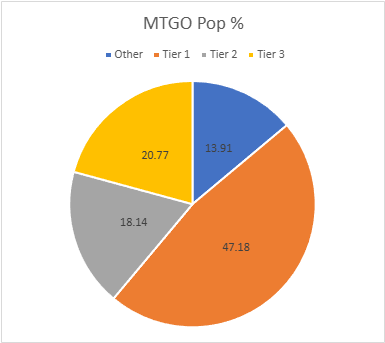
May's adjusted average population for MTGO is 9.34. I always round down if the decimal is less than .20. Tier 3, therefore, begins with decks posting 10 results. The adjusted STdev was 12.64, so add 13 and that means Tier 3 runs to 23 results. Again, it's the starting point to the cutoff, then the next whole number for the next Tier. Therefore Tier 2 starts with 24 results and runs to 37. Subsequently, to make Tier 1 requires 38 decks.
Because this is a truncated month, population is down from April's 1408 to 992. This shouldn't be a surprise. Concurrently, unique decks fell from 86 to 79, so the unique deck ratio rose from .0611 to .0796. That's really good for MTGO but doesn't mean anything due to the extenuating circumstances. 27 decks made the Tier List, up from 25 in April.
| Deck Name | Total # | Total % |
|---|---|---|
| Tier 1 | ||
| Boros Energy | 170 | 17.14 |
| Weapons Manufacturing | 103 | 10.38 |
| Izzet Prowess | 58 | 5.85 |
| Ruby Storm | 54 | 5.44 |
| RW Ponza | 42 | 4.23 |
| Goryo Blink | 41 | 4.13 |
| Tier 2 | ||
| Domain Zoo | 36 | 3.63 |
| Amulet Titan | 35 | 3.53 |
| Living End | 33 | 3.33 |
| Neoform | 26 | 2.62 |
| Green-Based Eldrazi | 26 | 2.62 |
| Tameshi Belcher | 24 | 2.42 |
| Tier 3 | ||
| Jeskai Midrange | 23 | 2.32 |
| Red Belcher | 19 | 1.91 |
| Colorless Etron | 17 | 1.71 |
| Grixis Reanimator | 16 | 1.61 |
| Jeskai Blink | 14 | 1.41 |
| Dimir Tempo | 14 | 1.41 |
| Necro | 14 | 1.41 |
| Simic Ritual | 13 | 1.31 |
| Sam Ritual | 11 | 1.11 |
| Esper Blink | 11 | 1.11 |
| Jeskai Control | 11 | 1.11 |
| Yawgmoth | 11 | 1.11 |
| Phoenix Dredge | 11 | 1.11 |
| Mono-Black Learnbox | 11 | 1.11 |
| Broodscale Combo | 10 | 1.01 |
Jeskai Blink continued to absolutely crater, and I'd guess it's just dead post-ban. Probably Jeskai Midrange too, I can't see how either survive without Phlage. Great news for Esper Blink, I guess? Meanwhile, I'd advise keeping a very close eye on Weapons Manufacturing. If it was putting up numbers like this in the pre-ban metagame, I imagine it will do far better now.
The Paper Population Data
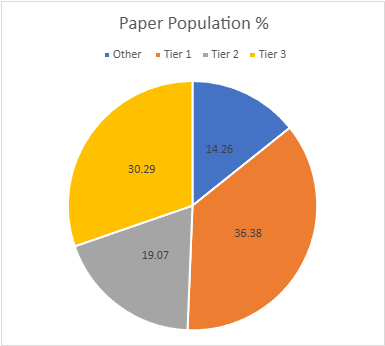
Paper was on trend to set a new record for the paper population sample. April saw 724 decks while in 18 days May got 624. Imagine how good we'd be doing if every TO actually reported their results. Unique decks only fell slightly from 77 to 75 with a ratio of .120. Again, this doesn't mean much because it's not a full month, but on its own it's still a very solid result.
26 decks made the Tier List this month, which is up from April. The adjusted average population is 7.19 so the List starts at 7. The STDev is 10.66, so the increment is 11. Therefore, Tier 3 runs from 7 to 18, Tier 2 is 19 to 30 and Tier 1 is 31 and over.
| Deck Name | Total # | Total % |
|---|---|---|
| Tier 1 | ||
| Boros Energy | 92 | 14.74 |
| Weapons Manufacturing | 67 | 10.74 |
| Amulet Titan | 37 | 5.93 |
| Izzet Prowess | 31 | 4.97 |
| Tier 2 | ||
| Jeskai Blink | 28 | 4.49 |
| Domain Zoo | 27 | 4.33 |
| Goryo Blink | 25 | 4.01 |
| Tameshi Belcher | 20 | 3.20 |
| Ruby Storm | 19 | 3.04 |
| Tier 3 | ||
| Green-Based Eldrazi | 15 | 2.40 |
| Living End | 14 | 2.24 |
| Colorless Etron | 14 | 2.24 |
| Esper Blink | 13 | 2.08 |
| Izzet Cutter | 12 | 1.92 |
| Broodscale Combo | 12 | 1.92 |
| Jeskai Midrange | 12 | 1.92 |
| Simic Ritual | 11 | 1.76 |
| Dimir Tempo | 11 | 1.76 |
| RW Ponza | 11 | 1.76 |
| Neobrand | 11 | 1.76 |
| Yawgmoth | 10 | 1.60 |
| Mono-Green Etron | 9 | 1.44 |
| Jeskai Control | 9 | 1.44 |
| Mill | 9 | 1.44 |
| Sam's Ritual | 8 | 1.28 |
| Grixis Reanimator | 8 | 1.28 |
In April, Boros Energy represented 21.16% of the MTGO metagame and 15.75% of the paper metagame. In the first 18 days of May, Boros Energy represented 17.14% of the MTGO metagame and 14.74% of the paper metagame.
As always, online shows the effect more dramatically than paper does, but both confirm that Boros was having a midseason slump, just like last year and just as predicted. The same time in April Boros was about 22% of the online metagame and 16% in paper. I expected Boros to start rising again in June, but with the bans, I have no clue what will happen.
May Power Metagame
Tracking the metagame in terms of population is standard practice. But how do results actually factor in? Better decks should also have better results. In an effort to measure this, I use a power ranking system in addition to the prevalence list. By doing so, I measure the relative strengths of each deck within the metagame so that a deck that just squeaks into Top 32 isn't valued the same as one that Top 8's. This better reflects metagame potential.
For the MTGO data, points are awarded based on the population of the event. Preliminaries and similar events award points based on record (1 for 3 wins, 2 for 4 wins, 3 for 5), and Challenges are scored 3 points for the Top 8, 2 for Top 16, and 1 for Top 32. If I can find them, non-Wizards events will be awarded points the same as Challenges or Preliminaries depending on what the event in question reports/behaves like. Super Qualifiers and similar higher-level events get an extra point and so do other events if they’re over 200 players, with a fifth point for going over 400 players.
Due to paper reporting being inconsistent and frequently full of data gaps compared to MTGO, its points work differently. I award points based on the size of the tournament rather than placement. For events with no reported starting population or up to 32 players, one point is awarded to every deck. Events with 33 players up to 128 players get two points. From 129 players up to 512 players get three. Above 512 is four points, and five points is reserved for Modern Pro Tours. When paper reports more than the Top 8, which is rare, I take all the decks with a winning record or tied for Top 32, whichever is pertinent.
The MTGO Power Tiers
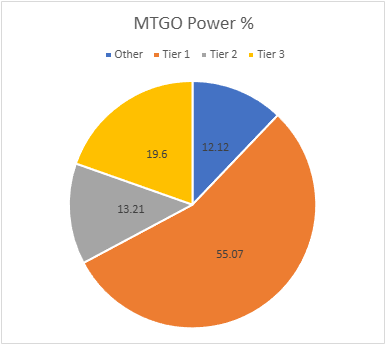
Again, because May's a truncated month its total points are down from 2464 to 1832. The adjusted average points were 17.08 therefore 17 points made Tier 3. The adjusted STDev was 23.42 so add 24 to the starting point, and Tier 3 runs to 41 points. Tier 2 starts with 42 points and runs to 66. Tier 1 requires at least 67 points. There's a decent amount of shuffling between the tiers and some action at the bottom of Tier 3 where Izzet Cutter snuck onto the List. Nothing fell off.
| Deck Name | Total Points | Total % |
|---|---|---|
| Tier 1 | ||
| Boros Energy | 314 | 17.14 |
| Weapons Manufacturing | 203 | 11.08 |
| Izzet Prowess | 110 | 6.00 |
| Ruby Storm | 94 | 5.13 |
| Goryo Blink | 76 | 4.15 |
| RW Ponza | 73 | 3.98 |
| Amulet Titan | 72 | 3.93 |
| Domain Zoo | 67 | 3.66 |
| Tier 2 | ||
| Living End | 63 | 3.44 |
| Neoform | 46 | 2.51 |
| Jeskai Midrange | 45 | 2.46 |
| Green-Based Eldrazi | 44 | 2.40 |
| Tameshi Belcher | 44 | 2.40 |
| Tier 3 | ||
| Red Belcher | 29 | 1.58 |
| Grixis Reanimator | 29 | 1.58 |
| Jeskai Blink | 29 | 1.58 |
| Colorless Etron | 28 | 1.53 |
| Simic Ritual | 27 | 1.47 |
| Necro | 26 | 1.42 |
| Broodscale Combo | 26 | 1.42 |
| Sam Ritual | 24 | 1.31 |
| Dimir Tempo | 22 | 1.20 |
| Yawgmoth | 22 | 1.20 |
| Mono-Black Learnbox | 21 | 1.15 |
| Jeskai Control | 20 | 1.09 |
| Phoenix Dredge | 20 | 1.09 |
| Izzet Cutter | 19 | 1.04 |
| Esper Blink | 17 | 0.93 |
The Paper Power Tiers
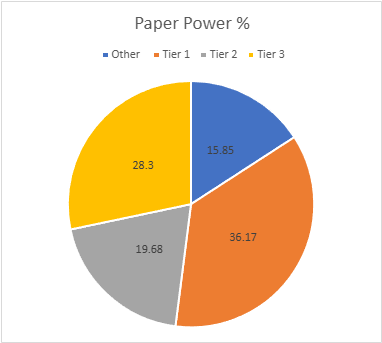
Paper's total points fell from 1007 to 940. Most of the events only awarded 1-point until SCGCon Cincinnati provided a massive boost of points at the end. The adjusted average points were 10.69, setting the cutoff at 11 points. The STDev was 15.39, so add 16 to the starting point and Tier 3 runs to 27 points. Tier 2 starts with 28 points and runs to 44. Tier 1 requires at least 45 points. There was minimal movement within the Tiers, and nothing between them, but the bottom of Tier 3 was pretty dynamic. Mill and Grixis Reanimator fell off the List, replaced by Red Belcher.
| Deck Name | Total Points | Total % |
|---|---|---|
| Tier 1 | ||
| Boros Energy | 149 | 15.85 |
| Weapons Manufacturing | 92 | 9.79 |
| Amulet Titan | 51 | 5.42 |
| Izzet Prowess | 48 | 5.11 |
| Tier 2 | ||
| Goryo Blink | 44 | 4.68 |
| Jeskai Blink | 40 | 4.25 |
| Domain Zoo | 39 | 4.15 |
| Tameshi Belcher | 37 | 3.94 |
| Ruby Storm | 25 | 2.66 |
| Tier 3 | ||
| Green-Based Eldrazi | 21 | 2.23 |
| Living End | 21 | 2.23 |
| Colorless Etron | 21 | 2.23 |
| Izzet Cutter | 20 | 2.13 |
| Esper Blink | 19 | 2.02 |
| Broodscale Combo | 18 | 1.91 |
| Jeskai Midrange | 18 | 1.91 |
| Yawgmoth | 17 | 1.81 |
| Simic Ritual | 16 | 1.70 |
| Dimir Tempo | 15 | 1.60 |
| RW Ponza | 15 | 1.60 |
| Mono-Green Etron | 15 | 1.60 |
| Sam's Ritual | 15 | 1.60 |
| Jeskai Control | 13 | 1.38 |
| Neobrand | 11 | 1.17 |
| Red Belcher | 11 | 1.17 |
Composite Metagame
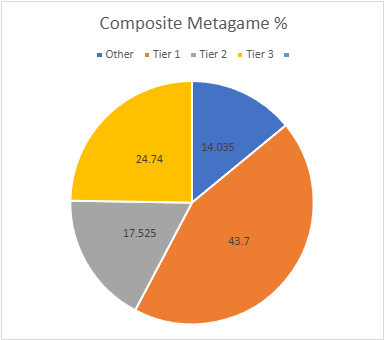
That's a lot of data, but what does it all mean? When Modern Nexus was first started, we had a statistical method to combine the MTGO and paper data, but the math of that system doesn't work without big paper events. I tried. Instead, I'm using an averaging system to combine the data. I take the MTGO results and average the tier, then separately average the paper results, then average the paper and MTGO results together for final tier placement.
This generates a lot of partial Tiers. That's not a bug, but a feature. The nuance separates the solidly Tiered decks from the more flexible ones and shows the true relative power differences between the decks. Every deck in the paper and MTGO results is on the table, and when they don't appear in a given category, they're marked N/A. This is treated as a 4 for averaging purposes.
| Deck Name | MTGO Pop Tier | MTGO Power Tier | MTGO Average Tier | Paper Pop Tier | Paper Power Tier | Paper Average Tier | Composite Tier |
|---|---|---|---|---|---|---|---|
| Boros Energy | 1 | 1 | 1 | 1 | 1 | 1 | 1.00 |
| Weapons Manufacturing | 1 | 1 | 1 | 1 | 1 | 1 | 1.00 |
| Izzet Prowess | 1 | 1 | 1 | 1 | 1 | 1 | 1.00 |
| Amulet Titan | 2 | 1 | 1.5 | 1 | 1 | 1 | 1.25 |
| Ruby Storm | 1 | 1 | 1 | 2 | 2 | 2 | 1.50 |
| Goryo Blink | 1 | 1 | 1 | 2 | 2 | 2 | 1.50 |
| Domain Zoo | 2 | 1 | 1.5 | 2 | 2 | 2 | 1.75 |
| RW Ponza | 1 | 1 | 1 | 3 | 3 | 3 | 2.00 |
| Tameshi Belcher | 2 | 2 | 2 | 2 | 2 | 2 | 2.00 |
| Living End | 2 | 2 | 2 | 3 | 3 | 3 | 2.50 |
| Neobrand | 2 | 2 | 2 | 3 | 3 | 3 | 2.50 |
| Green-Based Eldrazi | 2 | 2 | 2 | 3 | 3 | 3 | 2.50 |
| Jeskai Blink | 3 | 3 | 3 | 2 | 2 | 2 | 2.50 |
| Jeskai Midrange | 3 | 2 | 2.5 | 3 | 3 | 3 | 2.75 |
| Colorless Etron | 3 | 3 | 3 | 3 | 3 | 3 | 3.00 |
| Dimir Tempo | 3 | 3 | 3 | 3 | 3 | 3 | 3.00 |
| Simic Ritual | 3 | 3 | 3 | 3 | 3 | 3 | 3.00 |
| Sam Ritual | 3 | 3 | 3 | 3 | 3 | 3 | 3.00 |
| Esper Blink | 3 | 3 | 3 | 3 | 3 | 3 | 3.00 |
| Jeskai Control | 3 | 3 | 3 | 3 | 3 | 3 | 3.00 |
| Yawgmoth | 3 | 3 | 3 | 3 | 3 | 3 | 3.00 |
| Broodscale Combo | 3 | 3 | 3 | 3 | 3 | 3 | 3.00 |
| Red Belcher | 3 | 3 | 3 | N/A | 3 | 3.5 | 3.25 |
| Grixis Reanimator | 3 | 3 | 3 | 3 | N/A | 3.5 | 3.25 |
| Izzet Cutter | N/A | 3 | 3.5 | 3 | 3 | 3 | 3.25 |
| Necro | 3 | 3 | 3 | N/A | N/A | N/A | 3.50 |
| Phoenix Dredge | 3 | 3 | 3 | N/A | N/A | N/A | 3.50 |
| Mono-Black Learnbox | 3 | 3 | 3 | N/A | N/A | N/A | 3.50 |
| Mono-Green Etron | N/A | N/A | N/A | 3 | 3 | 3 | 3.50 |
| Mill | N/A | N/A | N/A | 3 | N/A | 3.5 | 3.75 |
Average Power Rankings
Finally we come to the average power rankings. These are found by taking the total points earned and dividing them by total decks, to measure points per deck. I use this to measure strength vs. popularity. Measuring deck strength is hard. While you can make a Wins-Above-Replacement-esq metric for the Magic cards in an individual deck, there's no way to make one that lets you compare decks. The game is too complex, and even then, power is very contextual.
Using the power rankings helps to show how justified a deck’s popularity is. However, more popular decks will still necessarily earn a lot of points. Therefore, the top tier doesn't move much between population and power and obscures whether its decks really earned their position.
This is where the averaging comes in. Decks that earn a lot of points because they get a lot of results will do worse than decks that win more events, indicating which deck actually performs better.
A higher average indicates lots of high finishes, whereas low averages result from mediocre performances and a high population. Lower-tier decks typically do very well here, likely due to their pilots being enthusiasts. Bear this in mind and be careful about reading too much into these results. However, as a general rule, decks that place above the baseline average are over-performing, and vice versa.
How far above or below that average a deck sits justifies its position on the power tiers. Decks well above baseline are undervalued, while decks well below baseline are very popular, but aren't necessarily good.
The Real Story
When considering the average points, the key is looking at how far off a deck is from the Baseline stat (the overall average of points/population). The closer a deck’s performance to the Baseline, the more likely it is to be performing close to its "true" potential.
A deck that is exactly average would therefore perform exactly as well as expected. The greater the deviation from the average, the more a deck under or over-performs. On the low end, a deck’s placing was mainly due to population rather than power, which suggests it’s overrated. A high-scoring deck is the opposite of this.
We'll start with MTGO's averages:
| Deck Name | Average Points | Power Tier |
|---|---|---|
| Broodscale Combo | 2.60 | 3 |
| Sam Ritual | 2.18 | 3 |
| Izzet Cutter | 2.11 | 3 |
| Simic Ritual | 2.08 | 3 |
| Jeskai Blink | 2.07 | 3 |
| Amulet Titan | 2.06 | 1 |
| Yawgmoth | 2.00 | 3 |
| Weapons Manufacturing | 1.97 | 1 |
| Jeskai Midrange | 1.96 | 2 |
| Living End | 1.91 | 2 |
| Mono-Black Learnbox | 1.91 | 3 |
| Izzet Prowess | 1.90 | 1 |
| Domain Zoo | 1.86 | 1 |
| Necro | 1.86 | 3 |
| Boros Energy | 1.85 | 1 |
| Goryo Blink | 1.85 | 1 |
| Tameshi Belcher | 1.83 | 2 |
| Jeskai Control | 1.82 | 3 |
| Phoenix Dredge | 1.82 | 3 |
| Grixis Reanimator | 1.81 | 3 |
| Neoform | 1.77 | 2 |
| Baseline | 1.75 | |
| Ruby Storm | 1.74 | 1 |
| RW Ponza | 1.74 | 1 |
| Green-Based Eldrazi | 1.69 | 2 |
| Colorless Etron | 1.65 | 3 |
| Dimir Tempo | 1.57 | 3 |
| Esper Blink | 1.54 | 3 |
| Red Belcher | 1.53 | 3 |
The winner of MTGO Deck of May is Amulet Titan. I realize that it wasn't actually a ban target for power-level reasons, but I'm pretty sure Amulet has more Deck of the Month awards than anyone else. By a lot.
Now the paper averages:
| Deck Name | Average Points | Power Tier |
|---|---|---|
| Sam's Ritual | 1.87 | 3 |
| Tameshi Belcher | 1.85 | 2 |
| Red Belcher | 1.83 | 3 |
| Goryo Blink | 1.76 | 2 |
| Yawgmoth | 1.70 | 3 |
| Izzet Cutter | 1.67 | 3 |
| Mono-Green Etron | 1.67 | 3 |
| Boros Energy | 1.62 | 1 |
| Izzet Prowess | 1.55 | 1 |
| Baseline | 1.52 | |
| Living End | 1.50 | 3 |
| Colorless Etron | 1.50 | 3 |
| Broodscale Combo | 1.50 | 3 |
| Jeskai Midrange | 1.50 | 3 |
| Esper Blink | 1.46 | 3 |
| Simic Ritual | 1.45 | 3 |
| Domain Zoo | 1.44 | 2 |
| Jeskai Control | 1.44 | 3 |
| Jeskai Blink | 1.43 | 2 |
| Green-Based Eldrazi | 1.40 | 3 |
| Amulet Titan | 1.38 | 1 |
| Weapons Manufacturing | 1.37 | 1 |
| Dimir Tempo | 1.36 | 3 |
| RW Ponza | 1.36 | 3 |
| Ruby Storm | 1.32 | 2 |
| Grixis Reanimator | 1.25 | N/A |
| Mill | 1.11 | N/A |
| Neobrand | 1.00 | 3 |
Meanwhile, Boros Energy is the paper Deck of May. Rather fitting that it gets this right as it's banned isn't it?
Analysis
So, that is the metagame that Wizards was looking at when they decided to ban Phlage, Titan of Fire's Fury and Lotus Field. I've been saying for a while that something had to be done about Energy, and Wizards has been saying for a while that the Aftermath Analyst is logistically problematic.
I'm not unhappy that they finally acted on both problems, it's just really weird for them to do so mid-RCQ season. I'm still not over them refusing to ban Nadu midseason, so I'm just flabbergasted that this metagame got them to change course.
Banning Lotus Field was the correct move.
I initially thought that Analyst had to go, but actual Amulet players told me that they could still do it with Lumra, Bellow of the Woods, although it was more convoluted. Killing Lotus doesn't kill the loop, but it does removal all reasonable paths to it.
This should end its actual viability without killing Amulet. Remember, Amulet was Amulet before it got Analyst, though it ran Lotus' for value back then. Consequently, I'm reliably informed that Amulet will be minimally played until it retools. At least Lotus is still playable in Pioneer. If you can find Pioneer events, that is.
The Phlage Effect
Meanwhile, it's understandable but odd that Wizards banned Phlage. Wizards' explanation says that they thought that Energy was consolidating around Phlage plus Arena of Glory, and that this specific combination was getting too widespread. Thus, the ban was meant to open up the creature space by removing what Wizards' thinks was the less interesting half of the combo. I understand their thinking, but it feels really weird to me.
Whether you think Phlage is uninteresting aside, it was the weaker half of the combo. The only reason Phlage is remotely comparable to Uro, Titan of Nature's Wrath is Arena of Glory. From experience, Phlage without Arena is merely good. Uro drew cards and ramped, the two most powerful mechanics in Magic, with an additional lifegain cookie that made it format defining in Modern and Legacy. All without having help from a land clearly designed to power it up, specifically. It's never wrong to play Uro on turn 3. It's frequently wrong to play Phlage on turn 3, which is why feels weird. I think this will get revisited down the line.
Energy will be fine. Guide of Souls, Ocelot Pride, and Goblin Bombardment are the deck's core and since they're still intact Energy will continue to dominate the aggro space though maybe not the midrange. Losing Phlage's flexibility and reach is a big blow, but I don't think it's going to knock Energy out of Tier 1 by itself. Off the top perch probably, but that's likely going to be more on Weapons Manufacturing than anything else. A more immediate impact I'm expecting is control decks that used Phlage as their win condition will cut red and go more prison.
Jitte Unbanned
Along with these bans, Wizards also unbanned Umezawa's Jitte and Violent Outburst.
Jitte will see little play in the immediate future, but it shouldn't be forgotten. It's not going to do much the current metagame because creatures aren't smashing into each other. However, Jitte still takes over creature-on-creature matchups better than any other single card. If there comes a time where decks have to break through clogged boards, Jitte will shine. Until then, it won't do much.
But, Why?
However, Wizards just what were you thinking unbanning Outburst? I mean what you were actually thinking, not what you wrote in the announcement, because that makes no sense.
You originally banned it because Outburst let cascade decks combo in their opponent's upkeep, protect their combo with Subtlety and Force of Negation, use up all the opponent's mana fighting, then combo again on their turn. They can still do that.
We had Flusterstorm and Chalice of the Void back then, and cascade was still taking over. Yes, there's now Consign to Memory and Vexing Bauble, but you've also printed Mistrise Village and Wistfulness to answer the hate cards (particularly Bauble and Chalice) since then. In fact, you made a big deal about Wistfulness and Deceit seeing play in Living End in your March announcement.
Which, again, was really weird of you to do, made weirder that you're now saying that you're unbanning Outburst to show Living End, specifically, some love. Did you forget? Are you completely unaware that Living End has been doing well for a while without Outburst? I'll never get a definitive answer, but seriously Wizards, is Living End someone's pet deck?
This whole thing feels severely off. In any case, I think Outburst is going to wear out its welcome again, so Rhinos players should enjoy it while they can. They're the really big winners in the short run, but only Living End will survive Outburst getting rebanned.
Financial Implications
These bans and unbans have thrown the Modern metagame into turmoil, and everyone is scrambling to adjust before their next RCQ.
The unbanned cards have spiked significantly, but the Jitte spike is unlikely to be sustained and may be crashing by the time this article is live. If you bought stock, sell it quickly.
As for the overall picture, there's going to be some turmoil but the metagame will remain stable. I'd look to speculative opportunities around Weapons Manufacturing. That deck might get unleashed by Boros faltering.