
Are you a Quiet Speculation member?
If not, now is a perfect time to join up! Our powerful tools, breaking-news analysis, and exclusive Discord channel will make sure you stay up to date and ahead of the curve.
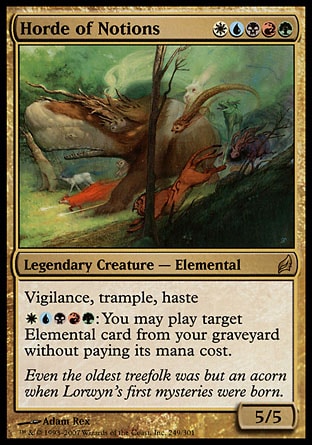
I could only go so long without making a quirky five-color deck, right?
I've been playtesting for the Modern PTQ season a ton recently and have been playing a couple of brews that abuse the pseudo-random nature the Cascade mechanic to always Cascade into specific spells. That particular strategy is something that's been going on since people initially figured out you could play gigantic monsters and Cascade into Hypergenesis to cheat them into play.
There's three problems with porting a Hypergenesis-style Cascade list directly from old Extended to Commander.
The first is that you only get one copy of Hypergenesis. If someone sweeps the board or counters your spell, you're on the plan of hardcasting fatties and midrange spells. The second problem is that you only have twelve Cascade spells in 99 cards, rather than no less than eight in 60. The last problem is that it puts strange conditions on what costs you can play and means that you really can't play many early game spells without disrupting your cascade chains.
Let's start by taking a look at the available Cascade spells and what kind of things you might want to Cascade into.
The Cascade Lottery
Unfortunately, there are only twelve cards with Cascade in existence at the moment which is an obstacle that needs to be overcome.
There's a thirteenth cascade card that will be incredible for this style of deck, Maelstrom Wanderer, but that's not coming out until the summer.
Notice the spread of casting costs of the Cascade spells. More than half of them cost four or less, which means that we will want to avoid playing cards that cost less than two or three unless they are the cards we want to be cascading into.
Cascade Spells
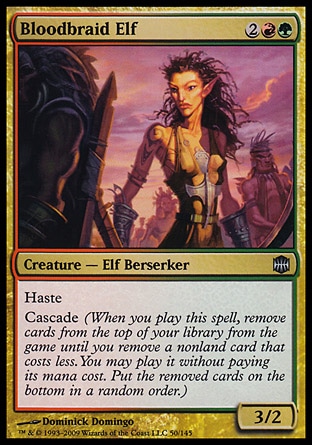
- Ardent Plea
- Bituminous Blast
- Bloodbraid Elf
- Captured Sunlight
- Demonic Dread
- Deny Reality
- Enigma Sphinx
- Enlisted Wurm
- Kathari Remnant
- Maelstrom Nexus
- Stormcaller's Boon
- Violent Outburst
Besides Bloodbraid Elf being the end-all of Standard for a season, people haven't done very much with Cascade besides finding cards from the Ancestral Vision cycle. I'm sure there's a ton of other sweet things you can do, but I don't really see a reason to change. The difference here is that I want to run all of them, just to complete the theme.
Bloodbraid Into...
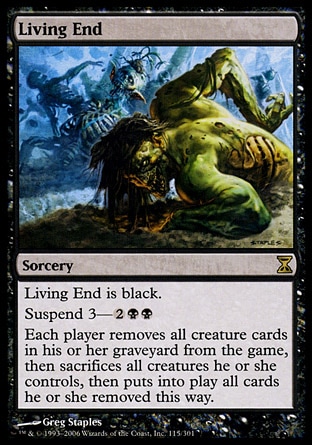
- Hypergenesis
- Living End
- Wheel of Fate
- Restore Balance
- Ancestral Vision
The interesting thing here is that these cards actually all do similar things and interact reasonably well.
Living End and Restore Balance are both sweepers if you need them to be. Living End also serves as a second Hypergenesis if you build your deck around it. Both Ancestral Vision and Wheel of Fate dig you into more Cascade spells, and Wheel of Fate even sets up your Living Ends!
Anyone who's familiar with Living End decks from old Extended knows that Cycling creatures are the crux of any Living End strategy. They set up for gigantic Living Ends while digging for Cascade spells or lands, all while giving you a back-up plan of just hardcasting fatties.
To be honest, I actually want a bulk of the deck to be Cycling creatures in order to increase the consistency of the deck and because with Land-cycling you can run fewer lands and increase your threat-density.
There are a few things worth noting when choosing your cycling creatures. First, that you want to overemphasize creatures with colorless cycling costs since this is a five-color deck. Second, you want to use mostly creatures costing four or more so that they stay out of the way of most of your Cascade spells. Last, we want to overemphasize creatures that are Black or White, for reasons revealed later. Here's the suite of cyclers I chose:
Where's My Fluctuator
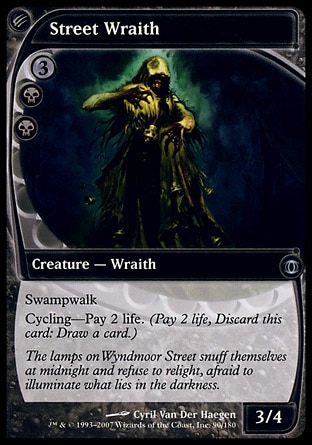
- Architects of Will
- Bant Sojourners
- Barkhide Mauler
- Deadshot Minotaur
- Drifting Djinn
- Esper Sojourners
- Grixis Sojourners
- Hundroog
- Jungle Weaver
- Monstrous Carabid
- Primoc Escapee
- Ridge Rannet
- Sanctum Plowbeast
- Scion of Darkness
- Street Wraith
- Undead Gladiator
- Yoked Plowbeast
- Valley Rannet
- Wirewood Guardian
- Shoreline Ranger
- Twisted Abomination
- Noble Templar
- Pale Recluse
- Krosan Tusker
- Igneous Pouncer
- Jhessian Zombies
- Elvish Aberration
- Eternal Dragon
- Chartooth Cougar
There are a few interesting effects attached to these cycling cards and a few interesting choices to make.
The Sojourner cycle from Alara Reborn has a number of interesting effects which could be reasonable choices, depending on what you're trying to accomplish. Of those, I'm only running the Bant, Esper, and Grixis Sojourner.
Grixis Sojourners is awesome, since it's graveyard hate to make your Living End more one-sided. Bant Sojourners creates White permanents, which will end up being very important. Esper Sojourners seems like a techy card I'd be glad to have on occasion. Being able to untap a blocker or tap a Cabal Coffers on someone's upkeep seems like enough of a high end that I'm willing to give it a shot.
The real question is this: what does the deck do besides cast Living End? You've only got one of them and have, at best, a one-in-five chance of Cascading into it. The goal here is to find other effects that play well with the kind of set up that Living End demands, but ones which don't mess up the Cascade chains at lower converted mana costs.
The Back-Up Plan
- Living Death
- Twilight's Cal
- Pyrrhic Reviva
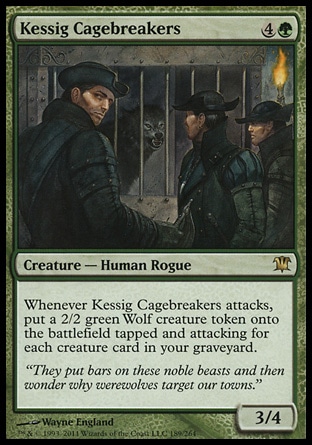
- Kessig Cagebreakers
- Nature's Resurgence
- Death or Glory
- Grimoire of the Dead
- Necromancer's Covenant
- Spider Spawning
- Tombstone Stairwell
- Balthor, the Defiled
- Liliana Vess
- Flame-Kin Zealot
- Madrush Cyclops
It's not much, but it'll do. I think.
Spider Spawning may just be a result of me playing a little too much Innistrad limited, but I think it's fine. I wanted some number of spells that your opponent doesn't gain value off of, since so many of your win conditions reanimate their stuff as well.
The weakest card here is Necromancer's Covenant, but I think that it's pretty necessary. If you run into another Graveyard deck, then you get to hate on them pretty hard. It's also a way to make your Living End more one-sided.
The haste cards are also pretty important, since they give you ways to just kill people in the late game. It's also important to note which haste-enablers were chosen. I picked creatures that are Black or White, and which cost four or more so that they interact favorably with cards like Balthor the Defiled and don't interrupt your Cascades.
Choose Your Character!
At this point, the deck is 58 cards, which means I want ten or so more cards before I start adding lands, since all of our cyclers will enable us to hit land drops.
The important thing to decide now is who the Commander is going to be, so that the remaining slots can be dedicated to maximizing your Commander's potential.
It's actually an interesting question: Horde of Notions and Child of Alara are the two best options available to you, but which contributes more? Let's take a look at the different cards we could run for each Commander:
Horde of Notions
- Horde of Notions (Commander)
- Mulldrifter
- Shriekmaw
- Ingot Chewer
- Skullmulcher
- Tar Fiend
- Crib Swap
- Spitebellows
- Mournwhelk
- Slithermuse
There are a few cool things here. The first is that your Cascade spells help you find Crib Swap, which is one of the most powerful things that you can do with Horde of Notions.
Second, the Evoke elementals interact pretty nicely with the Living End plan and give you a sort of back-up plan to attrition people out.
Last, the Devour elementals can be gamebreaking and can set up larger and larger mass reanimation spells all while making sure it's even harder for people to continue to disrupt you.
Child of Alara
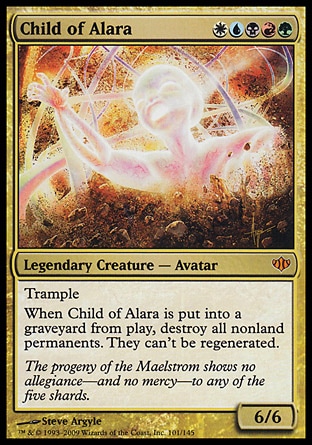
- Child of Alara (Commander)
- Unburial Rites
- Rise from the Grave
- Beacon of Unrest
- Momentous Fall
- Reap and Sow
- Genesis
- Miren, the Moaning Well
- High Market
- Phyrexian Tower
You need the extra lands here since you're playing a more controlling game. Because they don't add colored mana, they're more like spells than lands and don't necessarily add to your land count.
Besides that, Child of Alara does two things. It does give you a great mechanism of controlling the board while you cycle into Cascade spells, but it also makes Living End pretty awkward, since you probably won't want to cast it with Child of Alara in play.
As much as I love a Child of Alara deck, I just think that Horde of Notions interacts better with the rest of the deck.
The Manabase
Let me tell you, this is not a fun deck to build a manabase for! Depending on the hand you draw, you could have all colorless cyclers and be fine with any lands or all one-cost cyclers that want a color you don't have. You can't play cheap fixing because it messes up your Cascades, and I wanted the deck to be pretty budgety since number of the manabases I've built recently have cost an arm and a leg. Here's what I settled on:
Utility Lands

- Mistveil Plains
- Tolaria West
- Petrified Field
- Kjeldoran Outpost
- Springjack Pasture
- Moorland Haunt
- Bojuka Bog
- Vesuva
- Crypt of Agadeem
This entire section is built around one card which is supposed to give you longevity and resiliency in the late-game: Mistveil Plains.
How important is this card? Well, the deck runs the token-lands just to make sure you can hit two White permanents more consistently. Tolaria West and Petrified Field are there just to make sure you can find and protect your Mistveil Plains. The deck wants to run as many White-based fetchlands as possible to make sure that you can easily find Mistveil Plains.
The ability to recycle specific Cascade targets is incredibly powerful and means that you can be more aggressive with your Cascade spells since you will get to rebuy them at some point.
Mana Sources
- Terramorphic Expanse
- Evolving Wilds
- Terminal Moraine
- Grasslands
- Flood Plain
- Krosan Verge
- Command Tower
- Rupture Spire
- Shimmering Grotto
- Halimar Depths
- 3 Swamp
- 3 Forest
- 3 Plains
- 2 Mountain
- 2 Island
Like I said, the deck wants to run as many ways to fetch Plains as it can. In this case, the only Mirage fetches it has is Krosan Verge, since this is a more budgety deck, but that should be okay.
Besides that, the only interesting card is Halimar Depths. Honestly, Halimar Depths is a card you could cut if you wanted to. It's there for the potential to set up Cascades or to know that you want to use one of your land cyclers to shuffle away the top three cards. I'm not sure whether or not that effect is worth a slot, but the effect is basically free, so it's worth trying.
With that, let's take a look at the finished list:
[deckbox did="a141" size="small" width="560"]
While the deck is a little linear, I'm pretty happy with how it turned out.
I like the psuedo-randomness of Cascade and the consistency that you get when roughly a third of your deck cycles. There are enough cards that you can't really break the symmetry of, like Tombstone Stairwell and Hypergenesis, that I don't think the deck is too unfair for most playgroups. And it's conveniently something that's pretty easy to hate out with any kind of graveyard hate or countermagic.
Because of the nature of Cascade, the deck will get to do some incredibly stupid things sometimes, like casting Enlisted Wurm and cascading Bituminous Blast into Bloodbraid Elf into Ancestral Vision. These are the kinds of swingy, high variance plays that the format is all about and is a huge part of why I'm so excited about playing more with this deck!
As always, if you've got any comments or suggestions about this deck, I'd be glad to hear them. This is one I'm planning to tinker with for awhile, so if you think there's something I've overlooked, I'm certainly interested.
For the next few weeks I'm planning on taking a look at some Artifact decks, since that's something I don't generally do because of the stigma attached to mana rocks and giant artifacts. I'm hoping there's a way to build these decks so that they're powerful but not overbearing or overly reliant on busted mana acceleration.
But first we'll look at building a Mono-Red deck next week.
Carlos Gutierrez
cag5383@gmail.com
@cag5383 on Twitter