menu

A Few Odd Spikes

Are you a Quiet Speculation member?

If not, now is a perfect time to join up! Our powerful tools, breaking-news analysis, and exclusive Discord channel will make sure you stay up to date and ahead of the curve.

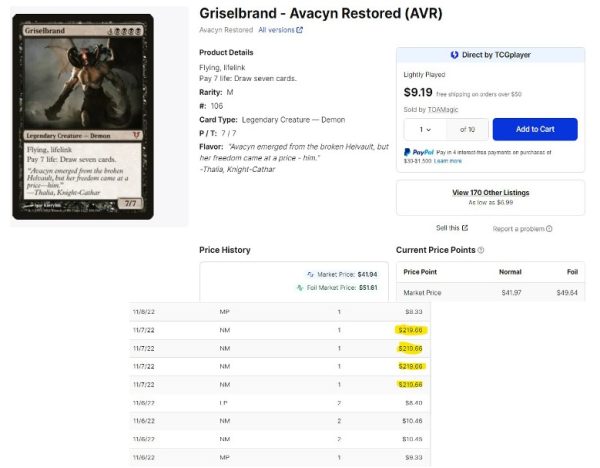
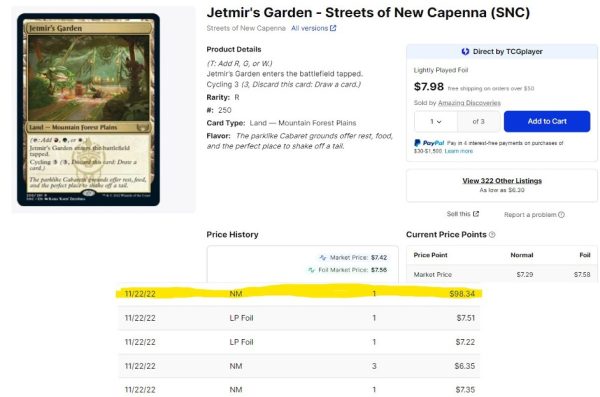
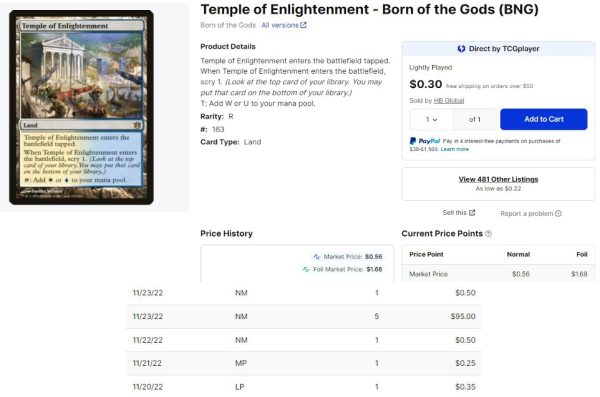
What do Grislbrand, Jetmir's Garden, and Temple of Enlightenment all have in common? They have all recently had an odd overpriced purchase recently. I began noticing this trend while doing my daily review of MTGStocks interests.

The first one was Griselbrand. When I saw its market price jump, I got very excited, as I have quite a few copies. Then I looked into it and found that there were numerous copies below that price listed on TCGPlayer. TCGPlayer now allows you to see recent purchase history, which is fantastic information for the Magic finance community given TCGPlayer's dominance of the secondary card sales community here in the US. I noticed that there were a few sales of Griselbrand all on the same day at the same exorbitant price.

It is important to note that when I look up Temple of Enlightenment, the $95.00 sale shown above is no longer listed in the recent sales for the card on TCGPlayer; however, the Jetmir's Garden and the Griselbrand sales are still listed.

What is especially interesting about this particular sample set is that we have three different results:

  • Griselbrand still has a TCGPlayer market price well above the actual going rate of the cards. This is almost assuredly due to the small number of transactions including copies of the card since the odd purchase.
  • Jetmir's Garden's TCGPlayer market price has essentially crashed back down to what it normally would have been due in large part to the higher transaction volume as it averages back down to reality when the sample size is large.
  • Temple of Enlightenment has also seen its TCGPlayer market price return to normal likely due to the retraction of the sale.

This is not the first time these inflated market prices have been shown on MTGStocks because of such a transaction on TCGPlayer. That makes it valuable to us to understand why those transactions occur at all. So, why would someone pay 10x the going rate on a card when there were plenty of cheaper options?

Possible Explanations

Accidental Purchase

It is possible that the buyer had placed cards in their cart a while ago, and the seller for whatever reason massively increased the price of the card. Or maybe the buyer wasn't 100% in their right mind at the time of the purchase.

Software Issues

Perhaps, for some reason, the cart optimizer failed to operate properly, if the buyer happened to use it. It also seems possible, though unlikely, that someone ordered a card on TCGPlayer Direct, and the original buyer didn't have the card and was forced to purchase the next best option, though this seems like an extremely unlikely occurrence.

Confusing Foil vs. Non-Foil

Originally I thought that perhaps the Griselbrand order was for foil copies that were mislabeled via the TCGPlayer software, or possibly they were picture sales and the buyer could see they were foils. However, that explanation doesn't account for the other cards included in this sample.

Purposeful Market Manipulation

I will emphasize that Quiet Speculation strongly condemns any form of market manipulation and has banned people for pushing attempts. It should also be pointed out that many attempts to corner the market on a given card have often ended very poorly for the manipulator. All that said, I do believe this to be the most likely hypothesis. While I could understand accidental purchases on a very rare occurrence, the fact that we saw these massive jumps in a few weeks' time implies more nefarious intentions.

There was an error retrieving a chart for Mass Manipulation

It is important to keep in mind that I do not know TCGPlayer's market price algorithm, so I do not know if it adjusts back when an order is canceled. The fact stands that the Temple of Enlightenment purchase has been removed, and the TCGPlayer market price now appears to be back in line with what one would expect given the current listed inventory and recent sales history.

Which brings us to why someone would want to manipulate the TCGPlayer market price of a card. Currently, I can only think of a few possible explanations. One obvious, if disheartening, use is to abuse another person's lack of knowledge regarding TCGPlayer and take advantage of them. Many players trade at TCGPlayer market price, as most trading apps use that price by default. I could see a situation in which someone overprices cards on a store, buys the cards to spike the price, and then trades off the cards to unsuspecting people. The flaw in this theory is that typically it takes time for the TCGPlayer market price to adjust, so this would have to be done in advance. There is also difficulty in knowing which cards the unsuspecting person needs unless the trades are taking place in the future.

Another possible but less likely situation: someone claiming damages to an insurance company and manipulating the price to inflate the damage claim value. While plausible, the fact that this only occurred with just a few random cards over multiple weeks would tend to imply that this is not very likely.

I fear the most likely scenario is someone taking advantage of a buylist that they know adjusts to TCGPlayer market pricing. The reason I see this one being the most plausible is that it would make some sense to spread out the spikes over time, so as not to alert suspicion of the buylist manager.

There was an error retrieving a chart for Feasting Troll King

Of course, these spikes could have been done as someone simply trolling the MTG finance community.

Protecting from Manipulators

While I don't know the person responsible for these purchases, I do get the feeling that these were done with purpose and ill intentions. To close things out, I'll offer some advice for anyone hoping to beat these market bullies.

I would suggest that anyone who automates their buylist to TCGPlayer market price be cautious and diligent when reviewing buylist submissions, and flag cards whose value seems significantly out of place. I would also recommend that anyone who does a lot of trading using the apps that reference TCGPlayer market price review the sales history when something looks out of sorts. Knowledge is power, and TCGPlayer offers us plenty of it if we can be bothered to look!

Adam Plays Magic: Gladiator Esper Reanimator

Are you a Quiet Speculation member?

If not, now is a perfect time to join up! Our powerful tools, breaking-news analysis, and exclusive Discord channel will make sure you stay up to date and ahead of the curve.

You read that right! This week, in celebration of Gladiator coming back to Arena as part of an all-access special event, we're doing a spotlight on the format with Esper Reanimator. Now you may be asking yourself...

What is Gladiator?

Gladiator is a 100-card singleton, best-of-three format with no sideboard that utilizes the entirety of the Magic Arena card pool. If it's in the client and isn't part of a very small ban list of Oko, Thief of Crowns, Teferi, Time Raveler, Nexus of Fate, Field of the Dead, or Natural Order, it's fair game. That means the digital-only Alchemy cards are also in the format. For rebalanced cards, only the true-to-paper version is legal.

Back to that entire Arena card pool bit—in addition to all Standard-legal expansions since Ixalan, cards added through Jumpstart, Historic and Explorer Anthology expansions, and any other special sets are available. Even though New Phyrexia isn't on Arena, we still get access to splashy bombs like Elesh Norn, Grand Cenobite. Cards like Faithless Looting and Channel that are banned in other formats are fully available to abuse too.

For those interested in playing outside of the all-access event, pickup games and tournaments are organized through the official Gladiator Discord server.

Why is Gladiator?

As I mentioned above, the format is singleton, so no more than one copy of any non-basic land card unless otherwise specified such as Rat Colony. Just like with Commander, this gives a lot of self-expression in deckbuilding, but has a more competitive lean and doesn't start with free extra cards. It's you, me, and a seven-card starting hand the way Richard Garfield intended.

Due to the inherent randomness of a 100-card format, players often have to get creative and dig deeper to find a critical mass of certain effects, allowing for a more novel gameplay experience. For example, a BW deck would of course first go for Godless Shrine, followed by Concealed Courtyard, Isolated Chapel, and Shattered Sanctum for its mana base. In Pioneer, a few copies of each of these and a few basics would be plenty. For Gladiator, we're digging deeper with options like Thriving Heath and Thriving Moor.

This extends to spells as well. For a Mono-Black aggro deck, expect to see Tenacious Underdog, but also Skyclave Shade, Razorlash Transmogrant, Scrapheap Scrounger, all the way down to the sixth or seventh best version of that particular effect so that the deck achieves the necessary density to make its game plan work. Restriction breeds creativity, and letting obscure cards take the spotlight is a refreshing take on the game. Notably, it also keeps overpowered cards from being too prevalent, allowing the ban list to stay relatively small.

Who is Gladiator?

(I'm really stretching this bit to make these subheaders work.) There are tons of viable archetypes in the Gladiator format and plenty of room to brew. From aggro, to combo, to control, the world is your oyster.

This time around, I'm playing Esper Reanimator, a deck that I've been enjoying for a few years and that keeps getting some nice upgrades. Cards like Tainted Indulgence, The Cruelty of Gix, and Phyrexian Fleshgorger keep adding consistency and flexibility while contributing to a necessary critical mass of payoffs and enablers.

There was an error retrieving a chart for Phyrexian Fleshgorger

In addition to the A+B game plan of reanimating a big creature from the graveyard, much of the rest of the deck is dedicated to interaction. Thoughtseize, Swords to Plowshares, and Counterspell are all multi-format all-stars that are available in the format and have a home in this deck. They're accompanied by board wipes like Extinction Event and midrange threats such as Junji, the Midnight Sky that can bridge the gap between stopping the opponent and hard-casting reanimator targets when the combo doesn't quite line up.

I'm a big fan of this archetype marrying a control-style deck answering anything and everything the opponent tries to do with its own proactive combo. It threads the needle between sitting back behind countermagic and closing out games in short order, giving the opponent little recourse and determining the pace of the game.

I do want to emphasize that the format isn't a bunch of control slugfests. Archetypes like Red Deck Wins, Death and Taxes, Bant Blink, and the Thassa's Oracle-Tainted Pact combo are all alive and well, as are a plethora of other options. Find what resonates most with you and play it!

The Deck

Gladiator Esper Reanimator

Artifacts

1 The Celestus
1 Key to the Archive
1 Portable Hole

Creatures

1 Citystalker Connoisseur
1 The Scarab God
1 Ulamog, the Ceaseless Hunger
1 Jin-Gitaxias, Core Augur
1 Agent of Treachery
1 Waker of Waves
1 Elesh Norn, Grand Cenobite
1 Scholar of the Lost Trove
1 Massacre Wurm
1 Champion of Wits
1 Koma, Cosmos Serpent
1 Murderous Rider
1 Young Necromancer
1 Golos, Tireless Pilgrim
1 Dream Eater
1 Jin-Gitaxias, Progress Tyrant
1 Priest of Fell Rites
1 Diviner of Fates
1 Avacyn, Angel of Hope
1 Phyrexian Fleshgorger
1 Junji, the Midnight Sky

Planeswalkers

1 Liliana, Death's Majesty
1 Kaito Shizuki
1 Liliana of the Veil

Spells

1 Dark Ritual
1 Rona's Vortex
1 Thoughtseize
1 Inquisition of Kozilek
1 Swords to Plowshares
1 Faithful Mending
1 Unburial Rites
1 Bone Shards
1 Chart a Course
1 Thirst for Discovery
1 Counterspell
1 Disdainful Stroke
1 Demonic Tutor
1 Fatal Push
1 Power Word Kill
1 Infernal Grasp
1 Heartless Act
1 Late to Dinner
1 Doom Blade
1 Chemister's Insight
1 Radical Idea
1 Languish
1 Extinction Event
1 Edgar's Awakening
1 Tainted Indulgence
1 Assemble from Parts
1 Consider
1 Undercity Plunder
1 Duress
1 Demonic Bargain
1 Grim Tutor
1 Graveyard Shift
1 Bind to Secrecy
1 Go for the Throat
1 Legions to Ashes

/Enchantments

1 The Cruelty of Gix

Lands

1 Castle Locthwain
1 Plains
1 Raffine's Tower
5 Island
3 Swamp
1 Castle Vantress
1 Thriving Moor
1 Thriving Isle
1 Hallowed Fountain
1 Deserted Beach
1 Glacial Fortress
1 Hengegate Pathway
1 Temple of Enlightenment
1 Brightclimb Pathway
1 Concealed Courtyard
1 Godless Shrine
1 Isolated Chapel
1 Shattered Sanctum
1 Clearwater Pathway
1 Drowned Catacomb
1 Fetid Pools
1 Port of Karfell
1 Shipwreck Marsh
1 Temple of Deceit
1 Watery Grave
1 Hall of Storm Giants
1 The World Tree
1 Otawara, Soaring City
1 Takenuma, Abandoned Mire
1 Forsaken Crossroads
1 Underground River

End Step

I cannot understate my love for the Gladiator format. I hope this all-access event introduces more people to the format. Getting a permanent queue on Arena would be a very welcome alternative to traditional tournament Constructed formats and Historic Brawl, which hasn't been my favorite as of late. Let me know your new Gladiator brews on Twitter at @AdamECohen or on Hive at @AdamCohen. As always, leave a comment and suggest a new deck for me to play. It might just end up on the next Adam Plays Magic. Catch you next time!

Natural Results: Regional Championship Analysis

Are you a Quiet Speculation member?

If not, now is a perfect time to join up! Our powerful tools, breaking-news analysis, and exclusive Discord channel will make sure you stay up to date and ahead of the curve.

It's been... wow, almost three years since last I analyzed the results from a major Magic weekend. The entire environment of tournament Magic has changed in that time. Where I used to report on Star City Tours, Grands Prix, and the occasional Pro Tour, I'm now limited to Regional Championships (RCs). The pandemic has done a number on everything. That said, Regional Championships are currently ongoing, so let's dive in and see where Pioneer is headed.

Note that at the time of writing, the results I have to work with are the Atlanta, Sao Paulo, and Sofia Championships. Results for the weekend's Pacific region championships were not readily available. There's nothing about them on the official Wizards site, and Google gave me info sheets, but not tournament coverage. I know a few snippets from Twitter, but that's all. I'm going to skip over that partial information and focus on the more complete data.

Disclaimer #1: Avoid Reading Too Much

As long as I'm doing disclaimers, here's a big one: don't read into these results too much. This goes for the results I'm covering today as well as the rest of the Regional Championships. It isn't that I don't trust the results or that the events aren't useful. The problem is that the data isn't truly random, and therefore isn't fully valid.

There was an error retrieving a chart for Nykthos, Shrine to Nyx

Full validity requires a large sample size and data representative of the total population. The first condition is not a problem. The Atlanta Championship alone had 923 players. That's more than a lot of Grand Prix in 2019.

However, this isn't truly representative data. The problem is that the RCs aren't open events; they're invitationals. An open event is an opportunity for any player to be represented, and is therefore more representative of every player. These RCs are only representative of the spikiest of players who won their invites. Therefore, the data I'm working with is representative not of the overall population, but of tournament grinders specifically.

Disclaimer #2: There Was Metagaming

The other thing to keep in mind is that there were a lot of strongly held beliefs about Pioneer's metagame going into these events which definitely affected player choices. In addition to a crescendo of the usual "Pioneer Sucks" vs. "Pioneer Rocks" activity, there was a ton of chatter on decks being utterly unplayable vs. hopelessly broken.

While I cannot say how all this chatter affected player choices, it certainly did, because players were constantly tweeting about changing their minds as the perceived metagame shifted. I can't quantify this effect, but it does warrant mentioning.

There was an error retrieving a chart for Arclight Phoenix

Also, remember that all this data came from a single weekend. It represents what the players of several regions thought about Pioneer at the time and for the purpose of a single, large tournament. That isn't necessarily indicative of what is currently happening ahead of other RCs or of what happened this past weekend.

Comprehensive Data

Alright, enough disclaimers, and on to the actual data! I had intended to gather all the data myself, but as it turned out I didn't need to. Frank Karsten already did everything I was going to do and a whole lot more for Wizards. I assume that he's got actual programs helping him count up the match wins for his winrate calculations, because I can't fathom doing that otherwise. Well done sir and thank you. I'll go through the population data first, then the win rates.

The Big Green Elephant

First things first: Mono-Green Devotion was almost 21% of the field. That is both unsurprising and very surprising. Unsurprising because Devotion has been the assumed default best deck in Pioneer for some time now. Less so because according to the social media chatter, it should have been higher. I recall some claiming that Devotion should be 50% of the field and all the Top 8. While obviously hyperbolic, it does show how big a shadow Devotion casts over the format, both in reality and in players' minds.

There was an error retrieving a chart for Cavalier of Thorns

What is more interesting is that Devotion's metagame share in these three RCs is significantly higher than its actual share. At the time of writing, Mono-Green Devotion is 16.3% of Pioneer according to MTGGoldfish and 12% on MTGTop8. Which looks suspiciously like all the predictions of Mono-Green's domination were accurate. Again, this is an invitational event for spikes, so it does make sense for many to be on the presumed best deck.

There was an error retrieving a chart for Karn, the Great Creator

However, that may be deceptive. Many might have chosen Devotion for that reason, but it may also have been the deck that got them there and the only one they were comfortable with. This is an invitational that players had to win an invite to, after all, and if the deck was good enough to get there it's probably good enough to run. Trying to audible to an unknown deck is usually a bad idea, after all. Thus, Devotion's specific metagame share isn't all that meaningful.

An Indicative Metagame

However, it does fit into the overall picture of this RC metagame quite nicely. According to Frank's data, the Top 5 Pioneer decks at the RCs were Devotion, Rakdos Rock, Izzet Phoenix, Mono-White Humans, and UW Control. Both Goldfish and Top8 have these the exact same decks as the Top 5 too, though Top8 has Rakdos above Devotion for the top slot. Additionally, ignoring differences in specific metagame share, the overall metagame from each source looks similar. This strongly suggests that thanks to the high population of the three events, they were ultimately able to accurately model the metagame.

There was an error retrieving a chart for Bloodtithe Harvester

However, that is a bit deceptive. There were huge differences in results between each tournament. It is only thanks to aggregation that it ended up looking similar to the "real" metagames from the websites. For example, Devotion was 21.9% of the Atlanta RC but only 15.8% in Sao Paulo. I don't know what it did in Sofia, but it had to have been around 25% for the overall field to produce a total metagame share of 21%.

Thus there were enormous, but compensating, regional biases present in the data. If the Pacific RCs' data were available, it would throw off the metagame picture. I don't know how severe the shift would be, but it would be a very different look.

Metagame By Win Rate

What is more interesting is that Frank has provided the numbers on each deck's win rate. I don't do win rates because 1) the starting field data is usually unavailable, so I only know that Top 32 deck's win rates, which doesn't model anything about the overall field; and 2) many events only report standings, not records, making win rate calculations impossible. Frank had all the data from all the events (and a math PhD), so he could and did do them. And the results are unexpected.

Lotus Field Triumphant

The headline result is that Lotus Field combo had the best overall win rate of these RCs. This is surprising for a number of reasons. The first is that Field did so well despite not winning any event. In fact, it put exactly one deck into the Top 8 of Atlanta and nowhere else. A high overall win rate doesn't translate into an event win.

There was an error retrieving a chart for Lotus Field

The second is that Field showed up at all. Back when the new qualification system was announced, Field was considered a major player in Pioneer. However, it has been declining steadily since then. I know that back in June there were at least three Field players in my local Pioneer metagame and now there are none. The deck is an awkward and slow combo to pull off and punishes mistakes. This leaves it as a fairly niche deck.

There was an error retrieving a chart for Archon of Emeria

However, that second point was critical to Field's success at the RCs. Field's combo is easily hated out, but players didn't expect it. Damping Sphere hits all aspects of the combo and can be played in any deck, but is also the most easily answered. Tomik, Distinguished Advokist and Archon of Emeria are more effective, but didn't see much if any play. As the only prominent pure combo deck in Pioneer, Field thrives mostly when players are unprepared. Now that players are aware that Field is still a deck, they'll have the hate in the future, and Field should decline.

Leading from the Bottom

Looking at the standings overall, what might be surprising to many is that none of the Top 5 decks from the population have exceptional win rates. Phoenix did the best at 53.3% and is in 7th place. The rest are in the middle of the pack with rates around 50%. Which isn't spectacular.

There was an error retrieving a chart for Resplendent Angel

In fact, all the best decks by win rate are mid-Tier 2 at best. Field was only 1.8% of the field while runner-up Selesnya Auras was a measly 0.5%. This shouldn't be surprising to regular readers of my Modern metagame articles. The top of the average power charts is always filled with Tier 3 decks, frequently low-placing Tier 3 decks to boot. Low-population decks tend to be run by enthusiasts and so their win rates are less likely to be dragged down by inexperienced players misplaying the deck, which is what kills the performance metrics of Tier 1 decks. Thus, an unexpected low-tier deck like Lotus Field Combo should do much better than the expected decks.

What Does It Mean?

Consequently, the win rate data doesn't actually measure what deck is best in Pioneer, just which decks performed best at the RCs. This is what I was alluding to above in the population data. Players were prepared for Mono-Green, and there are tons of anti-Devotion cards in players' sideboards. This fact, plus the high population, dragged down Devotion's win rate. The fact that Devotion did so well in a very hostile field is impressive.

There was an error retrieving a chart for Aether Gust

Ultimately, there is a reason that top-tier decks are top-tier. They have the power to fight through hate and players being otherwise prepared. Mono-Green did exactly that. Lower-tier decks face greater struggles, but can do well against an unprepared field. This is how Lotus Field performed so well yet didn't convert an RC. Win rates should never be read as hard indictors of which deck is best. What they are is indicative of what the field expected and prepared for.

There was an error retrieving a chart for Thoughtseize

On that note, it's also important to look beyond the overall win percentage to the specific matchups. Frank didn't include them in his article, but did tweet them out. This is where the disparity between overall metagame place and specific event win rates starts to make sense. Devotion's worst matchups were all from relatively low-population decks, while its matchups against the more popular ones were average at worst. Devotion was such a large proportion of the field that it couldn't avoid terrible matchups, and so its win rate tanked despite good placings overall.

Is Pioneer Healthy?

The big question after any large event is what it says about the format. Given all the buzz about Devotion prior to the start of these RCs, there's a decidedly mixed message. Devotion was a huge percentage of the metagame, but it didn't take up too many slots at the high tables (if the Atlanta data is indicative of all the events). There is a wide range of viable decks and the cost is low relative to Modern. Whether the gameplay is good is a matter of opinion, but the same is true of any format. Thus, overall, the data indicates that Pioneer is healthy.

There was an error retrieving a chart for Elvish Mystic

However, there is a problem that the data can't reveal. While I've never noticed it myself, there has been a chorus of complaints about Pioneer matchups being determined more by who wins the play or draw than by matchups. Even Pioneer's defenders are acknowledging the problem, which is present in all formats but seems particularly pronounced in Pioneer. I don't have much of an opinion on this myself, as I've never personally noticed it and nobody's provided data one way or another. However, if this known problem is uniquely bad in Pioneer, then that indicated that there is a deeper problem with the format that the metagame can't fix. I'll keep an eye on this issue.

Proceeding as Expected

Ultimately, I don't think the data coming from the RCs will change anyone's mind about Pioneer, nor will it greatly shake up the metagame. However, it is comforting to know that Pioneer's metagame does appear able to keep even its best decks in check. Hopefully, the first set of RCs is indicative of how the rest will go, and Pioneer is as healthy as it looks.

Getting the Best of Blue in The Brothers’ War

Are you a Quiet Speculation member?

If not, now is a perfect time to join up! Our powerful tools, breaking-news analysis, and exclusive Discord channel will make sure you stay up to date and ahead of the curve.

It's not easy being blue.

The Brothers' War (BRO) is a format that can be hostile to slow decks as well as decks without removal. Blue comes up short in both departments. The color is not particularly aggressive, and the interaction leaves a lot to be desired.

You call these Answers?

Blue was nearly unplayable in some recent sets, namely Adventures in the Forgotten Realm (AFR) and Alchemy Horizons: Baldur's Gate (HBG). However, the color has far more to offer than it did in those limited environments. In BRO, blue is a support color, and while we shouldn't actively seek it out, when it is open for our seats, we need to know how to draft it.

This week, we'll be going through 17Lands recent trophy decks and analyzing how blue contributed to seven-win runs.

The Ugly Truth

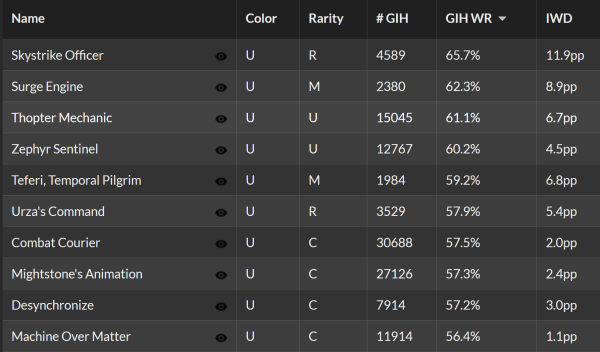
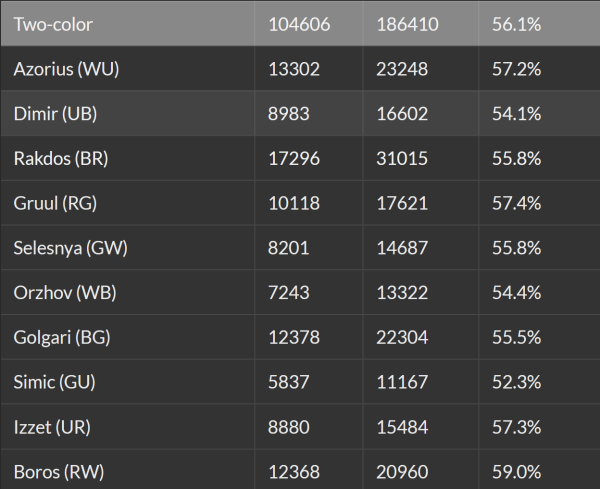
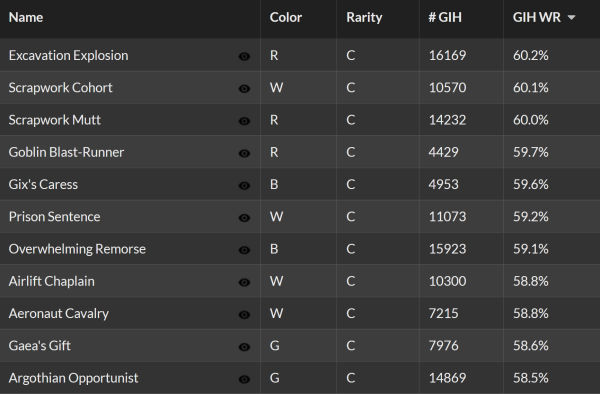
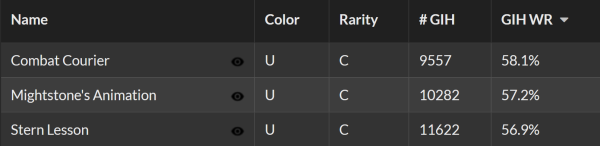
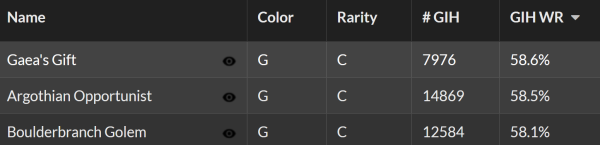
One of the best reasons to get into a color is opening a singularly powerful card. Often times this occupies the rare slot, but this sometimes refers to high-powered uncommons. Unfortunately for blue, this color has only four total cards with a GIH WR greater than 60%.

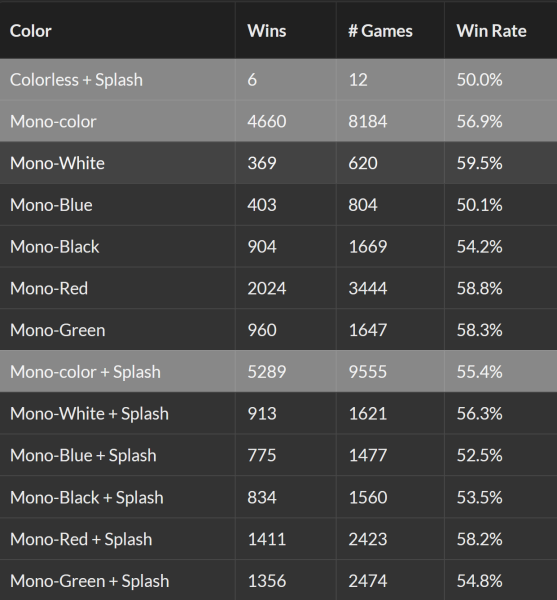
These cards just do not get it done. The fact that Desynchronize and Machine over Matter are outperforming all but four rares and mythics is concerning. Additionally blue is the worst-performing color as a mono-color deck, with or without splashes.

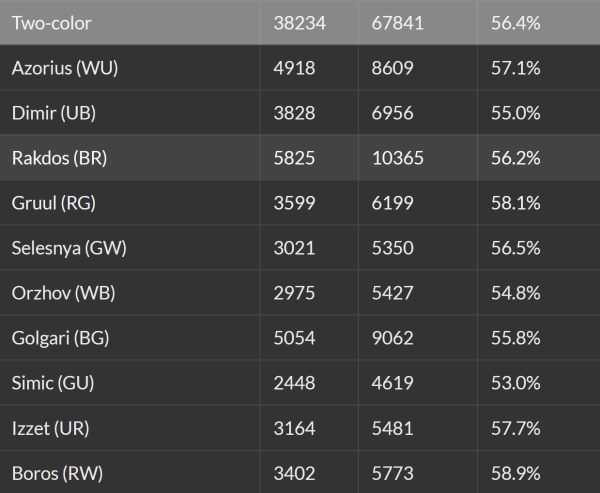
Finally, as we look at the more traditional archetypes in the format, blue is a partner in two of the lowest performers. Of note, UR Spells and UW soldiers are performing at a reasonable rate. UB and UG are decks we should try and avoid.

While blue isn't particularly strong in this format, we're going to analyze what the best decks are doing to optimize the blue cards they see in the draft. For this exercise, 17Lands provides a running list of the most recent trophy decks. We'll only be looking at decks that began their run in Platinum ranks or higher. While it may not be necessary to note, know that it takes more than a good deck to win seven games. The pilot matters.

Splashing for Bombs

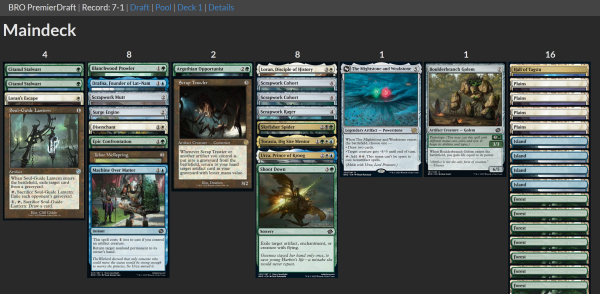
The first deck that we're looking at, is dipping into blue for more than just a slate of playable commons. The draw into the color is coming from some of those high-powered cards we discussed earlier.

Bant Rare-Fueled Grindathon

Creatures

2 Citanul Stalwart
1 Blanchwood Prowler
1 Drafna, Founder of Lat-Nam
1 Scrapwork Mutt
1 Surge Engine
1 Argothian Opportunist
1 Scrap Trawler
1 Loran, Disciple of History
2 Scrapwork Cohort
1 Scrapwork Rager
1 Tocasia, Dig Site Mentor
1 Skyfisher Spider
1 Urza, Prince of Kroog
1 Boulderbranch Golem

Instants and Sorceries

1 Loran's Escape
1 Disenchant
1 Epic Confrontation
1 Machine Over Matter
1 Shoot Down

Artifacts

1 Soul-Guide Lantern
1 Ichor Wellspring
1 The Mightstone and Weakstone

Land

1 Hall of Tagsin
4 Plains
4 Island
7 Forest

This deck looks like a real treat to pilot. Generating value off of Drafna, Founder of Lat-Nam, Scrap Trawler, and Loran, Disciple of History is a powerful engine if we can stabilize. The double-Citanul Stalwart plan seems a little dubious, but this deck clearly got there and was able to take advantage of its high-powered endgame.

This deck introduces a common theme that we will see as we view the rest of the decks listed today. We don't want to get into blue for the commons. The card quality is not deep and if we're not seeing the top-end cards, blue won't be able to carry our deck.

Blue the Support Color

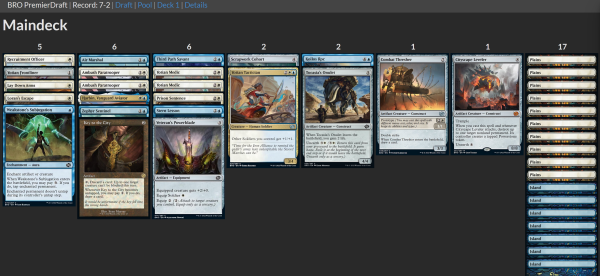
In these three decks, blue does what it does best in the format. It supports the plans of the other colors.

WU Soldiers and Powerstones

Creatures

1 Recruitment Officer
1 Yotian Frontliner
1 Air Marshal
2 Ambush Paratrooper
1 Harbin, Vanguard Aviator
1 Zephyr Sentinel
1 Third Path Savant
2 Yotian Medic
1 Scrapwork Cohort
1 Yotian Tactician
1 Koilos Roc
1 Tocasia's Onulet
1 Combat Thresher
1 Cityscape Leveler

Instants and Sorceries

1 Lay Down Arms
1 Loran's Escape
1 Stern Lesson

Artifacts

1 Key to the City
1 Veteran's Powerblade

Enchantments

1 Weakstone's Subjugation
1 Prison Sentence

Lands

10 Plains
7 Island

Blue adds some well-needed power to this aggressive white deck, capitalizing on soldier synergies. We see Yotian Tactician and Harbin, Vanguard Aviator supporting the go-wide Soldier theme. While the deck is almost all white cards, blue helps to provide the power boost at uncommon and rare to ensure this deck has the staying power to push lethal.

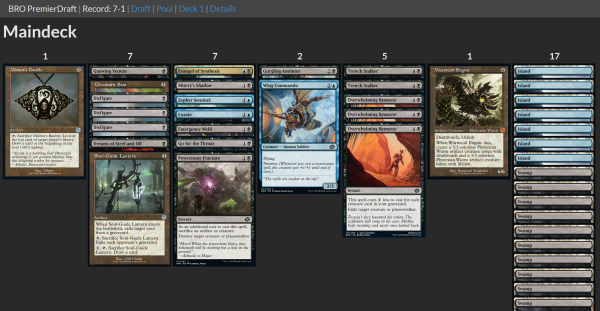
Bu Wurmcoil Control

Creatures

1 Gnawing Vermin
1 Evangel of Synthesis
1 Misery's Shadow
1 Zephyr Sentinel
1 Gurgling Anointer
1 Wing Commando
2 Trench Stalker
1 Wurmcoil Engine

Instants and Sorceries

3 Dismember
1 Dreams of Steel and Oil
1 Curate
1 Go for the Throat
1 Emergency Weld
1 Powerstone Fracture
3 Overwhelming Remorse

Artifacts

1 Mishra's Bauble
1 Chromatic Star
1 Soul-Guide Lantern

Land

10 Swamp
7 Island

This nearly mono-black deck looks to play a controlling role, ending the game with Wurmcoil Engine and double Trench Stalkers. These lifelinking threats are great for turning the corner for slower decks, however, having access to blue for Curate and Evangel of Synthesis helps to activate the lifelink on those creatures more consistently. When we're deep in one color, we don't need a lot of support from a second color. In instances like this, dipping into an underdrafted color for a few cards can be a huge opportunity.

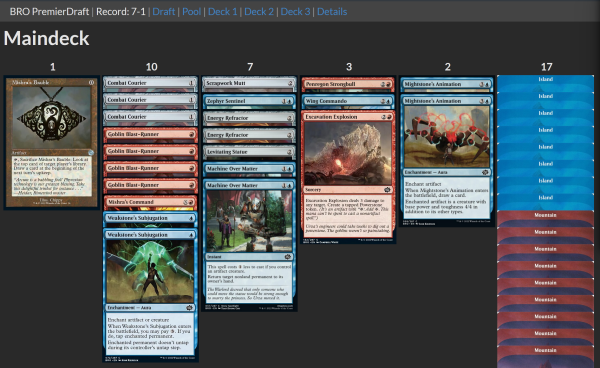
UR Blast-Runner Aggro

Creatures

3 Combat Courier
4 Goblin Blast-Runner
1 Scrapwork Mutt
1 Zephyr Sentinel
1 Penregon Strongbull
1 Wing Commando

Instants and Sorceries

1 Mishra's Command
2 Machine over Matter
1 Excavation Explosion

Artifacts

1 Mishra's Bauble
2 Energy Refractor
1 Levitating Statue

Enchantments

2 Weakstone's Subjugation
2 Mightstone's Animation

Land

8 Island
9 Mountain

To the untrained eye, this might appear as a UR Spells deck. However, it boasts four copies of Goblin Blast-Runner. This one-drop has been a catalyst for many of the most aggressive decks in the format. Last week, we spent a lot of time discussing blue's top common, Combat Courier. The two one-drops play nicely and it's blue, not black, that is activating the extra power and menace on the goblin in this deck. This aggressive approach is supported by some of blue's cheap interaction and a couple of Mightstone's Animation at the top of the curve.

The Best Blue Decks - UR Spells and UW Soldiers

The seeded archetypes that blue should be proudest of are UR Spells and UW Soldiers. But as we identified in our preview guide, these archetypes really live at uncommon and rare. We can't turbo-charge these archetypes unless we open the few cards specifically worth building around. Fortunately for these players, that wasn't a problem.

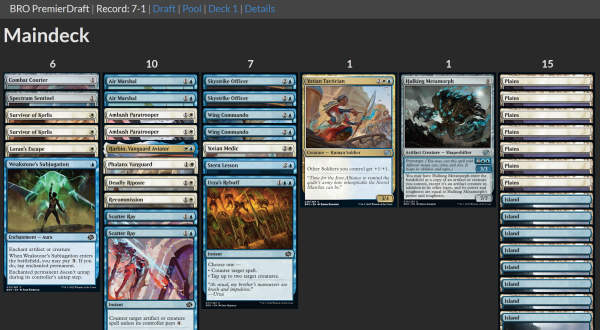
UW Soldiers

Creatures

1 Combat Courier
1 Spectrum Sentinel
2 Survivor of Korlis
2 Air Marshal
2 Ambush Paratrooper
1 Harbin, Vanguard Aviator
1 Phalanx Vanguard
2 Skystrike Officer
2 Wing Commando
1 Yotian Medic
1 Yotian Tactician
1 Hulking Metamorph

Instants and Sorceries

1 Loran's Escape
1 Recommission
1 Deadly Riposte
2 Scatter Ray
1 Stern Lesson
1 Urza's Rebuff

Enchantments

1 Weakstone's Subjugation

Lands

7 Plains
8 Island

Double Skystrike Officer, Harbin, Vanguard Aviator, and a Yotian Tactician are signs that UW Soldiers was wide open. We don't need an excuse to get into these archetypes and when they're open we should treat them like realistic options even without the embarrassment of riches we see in this pool. This deck leverages its lords with a number of one drops to be as aggressive as possible. As a support color, blue doesn't offer many aggressive creatures, but in this deck, it borrows nicely from white to build an aggressive game plan.

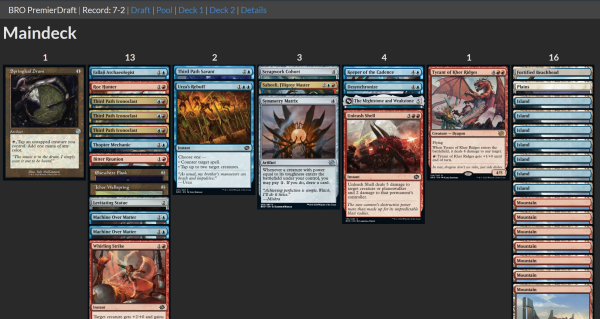
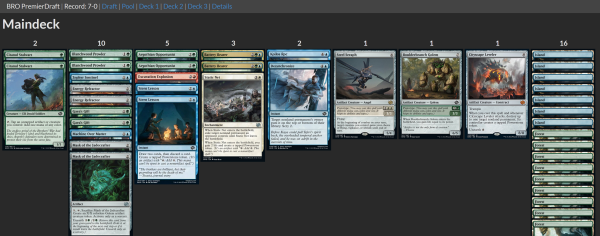
Triple Iconoclast UR Spells

Creatures

1 Fallaji Archaeologist
1 Roc Hunter
3 Third Path Iconoclast
1 Thopter Mechanic
1 Third Path Savant
1 Scrapwork Cohort
1 Keeper of the Cadence
1 Tyrant of Kher Ridges

Instants and Sorceries

2 Machine Over Matter
1 Whirling Strike
1 Urza's Rebuff
1 Desynchronize
1 Unleash Shell

Artifacts

1 Springleaf Drum
1 Elsewhere Flask
1 Ichor Wellspring
1 Levitating Statue
1 Symmetry Matrix
1 The Mightstone and Weakstone

Enchantments

1 Bitter Reunion

Planeswalker

1 Saheeli, Filigree Master

Land

1 Fortified Beachhead
1 Plains
7 Island
7 Mountain

The headline here is triple Third Path Iconoclast. Both that uncommon and the colorless Levitating Statue are great reasons to be in this archetype.

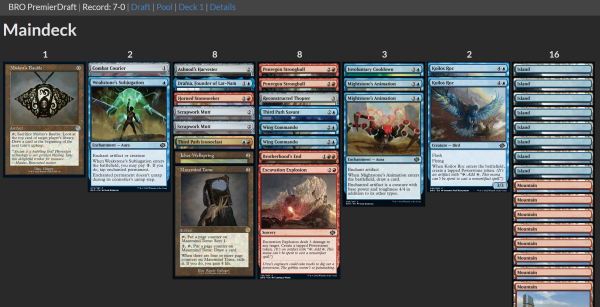
UR Spells

Creatures

1 Combat Courier
1 Ashnod's Harvester
1 Drafna, Founder of Lat-Nam
1 Horned Stoneseeker
2 Scrapwork Mutt
1 Third Path Iconoclast
2 Penregon Strongbull
1 Reconstructed Thopter
1 Third Path Savant
2 Wing Commando
2 Koilos Roc

Instants and Sorceries

1 Brotherhood's End
1 Excavation Explosion
1 Involuntary Cooldown

Artifacts

1 Mishra's Bauble
1 Ichor Wellspring
1 Mazemind Tome

Enchantments

1 Weakstone's Subjugation
2 Mightstone's Animation

Land

8 Island
8 Mountain

This UR Spells deck goes a little bit bigger. It takes advantage of Koilos Roc and Mightstone's Animation to close out games. While this deck doesn't have the triple Third Path Iconoclast or double Skystrike Officer, the high card quality and powerful card advantage engines for the end game can close out games while presenting threats at lower rarities.

In these decks, we see more of the blue commons. While they're not the most powerful individual cards, they help us to round out powerful decks. If we're relying on blue as the main color, we need to anticipate that some of our cards will be a little bit weaker. We need to ensure that those cards help to facilitate our plan, because they certainly don't make for stand-alone all-stars.

Battery Bearer Proof of Concept

UG Ramp is the least productive archetype thus far in BRO. We need the ramp, the payoffs, and a way to survive into the late game. Once there, we need to make sure we have the card advantage to win. These two decks have all of those pieces while using the signpost uncommon to live the UG Ramp dream.

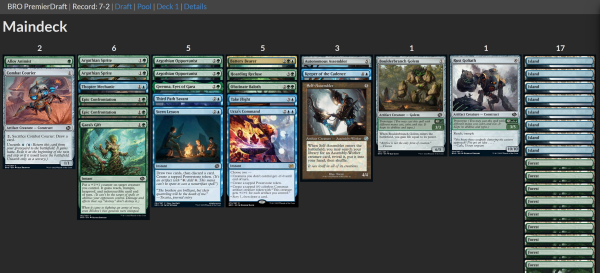
UG Ramp - Midrange

Creatures

1 Alloy Animist
1 Combat Courier
2 Argothian Sprite
1 Thopter Mechanic
2 Argothian Opportunist
1 Gwenna, Eyes of Gaea
1 Third Path Savant
1 Battery Bearer
1 Hoarding Recluse
1 Obstinate Baloth
1 Autonomous Assembler
1 Self-Assembler
1 Keeper of the Cadence
1 Boulderbranch Golem
1 Rust Goliath

Instants and Sorceries

2 Epic Confrontation
1 Gaea's Gift
1 Stern Lesson
1 Urza's Command

Enchantments

1 Take Flight

Land

8 Island
9 Forest

UG Ramp - Control

Creatures

2 Citanul Stalwart
2 Blanchwood Prowler
1 Zephyr Sentinel
2 Argothian Opportunist
2 Battery Bearer
1 Koilos Roc
1 Steel Seraph
1 Boulderbranch Golem
1 Cityscape Leveler

Instants and Sorceries

2 Gaea's Gift
1 Machine Over Matter
1 Excavation Explosion
2 Stern Lesson
1 Desynchronize

Artifacts

2 Mask of the Jadecrafter
2 Energy Refractor

Enchantments

1 Static Net

Land

7 Island
9 Forest

These decks have top-end threats to maximize the mana boost we get from Battery Bearer. They also get a lot of value off of Stern Lesson, as both decks need more than one top-end threat to win the game. The first deck is more midrange and threatens the opponent with powerful three and four-drop plays. The second deck is a little more all-in on the ramp strategy. The double Citanul Stalwart plan backs up the two Battery Bearers to race to the mythic threats waiting at the top of the curve, and it uses more removal to get there.

Going Blue for the Right Reasons

Looking at those decks, the following principles materialized as a road map for working toward a blue deck.

  1. Do not go into blue for commons. Some of the cards are individually fine, and investing in an open color may yield dividends late, but we really want to see rares and uncommons before we jump into blue as a central color.
  2. ...but it does not need to be the central color. If we find that a color is really open then cherry-picking premium blue cards is a good way to round out a strong deck.
  3. UR Spells and UW Soldiers are just good decks. While I'm still wary about committing to blue, if these decks look open, we can speculate on blue cards. The red spells pivot into other colors better than the white aggressive creatures (which only really pivot into red).
  4. UG Ramp is an archetype you can build, but Battery Bearer is not the sign we're waiting for. If we see premium green commons, expensive bombs, and blue cards of enticing power level, go for it. However, the data is concerning, and for good reason.
  5. In Dominaria United, we identified black and red as support colors. However, those colors added similar elements to most of the decks they touched. Essentially, red made the deck more aggressive and black made the deck more controlling. In BRO, blue's impact is more varied. It can help with card advantage and situation interaction. It has some tempo cards or can help boost our spell count for decks that care about that. Blue unlocks archetypes like draw-two or soldiers. In short, blue can do a lot of different things, it just isn't great at any of them.
  6. Of all the blue cards in the format, it's a small group of cards that show up in these decks. While this is only a snapshot of what blue can do in the format, there are only a couple of commons that show up consistently. Most are relegated to their niche archetypes.

Shine a Little Light

To close out our article today we're going to look at an unexpected uncommon. This card doesn't boast an impressive GIH WR (52.5%) and it has gotten more attention for what it does in Constructed than Limited. Still, I think the format has a spot for this oft-overlooked discard spell.

There was an error retrieving a chart for Dreams of Steel and Oil

Duress style effects don't typically thrive in Booster Drafts. Limited decks are less dependent on individual cards, and trading one for one, when we're paying the mana, isn't great. However, this card seems like a valuable tool in this format.

While it will inevitably be a horrible top deck at some point in the game, I still like its upside. Discard is typically a liability against aggressive decks, but because of how important the card advantage from unearthing is to those aggressive decks, we may find a window for this to be a meaningful two-for-one. Additionally, this can help snag a prototype monster or rare creature from our opponent's hand and exile matters.

Black struggles in this format because it can't keep up with the early aggression. While trading cards at a mana disadvantage won't help that issue, snagging an early play can disrupt our opponent's curve. Furthermore, black doesn't use its mana efficiently on early turns, making it less of a cost. This card may have a spot in the grindier black decks in the format, like UB Control, or even some versions of BR Sacrifice.

Magic 30: The Networking Aspect

Are you a Quiet Speculation member?

If not, now is a perfect time to join up! Our powerful tools, breaking-news analysis, and exclusive Discord channel will make sure you stay up to date and ahead of the curve.

Thus far, I’ve covered the Magic finance (buying, selling, vendors) experience at Magic 30 in Las Vegas and my personal tournament reports. They were my top two priorities for the weekend, and both were highly fulfilling.

That said, I did have another objective for the event: to meet and play fun games with as many of the people I’ve been networking with on Twitter and Discord over the years as I could. This extended to other finance folks, Limited experts, cosplayers, Magic personalities, Wizards employees, and anyone I recognized from the interwebs.

While I consider my selling endeavors and my tournament play highly successful (in that I had fun and achieved baseline goals), my socialization goals at this event were met only by pure chance. Allow me to explain.

Meeting Some Longtime Friends

For those who may not know, I’m fairly active on Magic social media platforms—particularly on Twitter and Discord. I’ve used both these platforms over the years to meet some really cool people and make long-lasting friendships both domestically and overseas.

I rarely attend large Magic events, so when I do it’s really important I try and meet face-to-face with some of the friends I’ve met online over the years. This time around, I had the opportunity to meet @lockheed and his wife, two friends I’ve talked with numerous times on Discord but whom I had never met in person. I try to keep my Discord channels to a maintainable minimum, but Lockheed’s group is a bunch of genuinely nice people who enjoy Magic and all things nerdy. Truly a crowd I feel at home in, even though I had never met the people in person before.

That changed at last! Lockheed and his wife were both extremely friendly and I am so happy to have finally met them in person. It’s fantastic to know that if I ever end up in their neck of the woods on the West Coast, I’ll have some friends in town to hang out with.

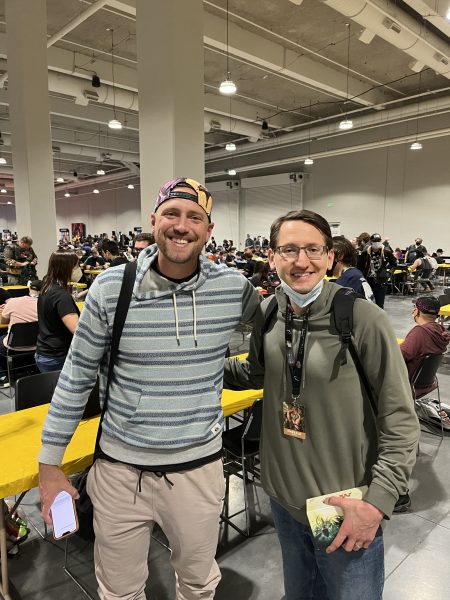
In addition to these connections, I also met with one or two other people I knew from Twitter but could finally say hi to in person. Honestly, though, things were so hectic that I really fell short in the networking department.

There was an error retrieving a chart for Natural Connection

Meeting Some Awesome Magic Personalities

Over the late October weekend, thousands of players converged in Las Vegas to enjoy this 30-year-old game. Among this group were a handful of Magic personalities I was particularly excited to meet.

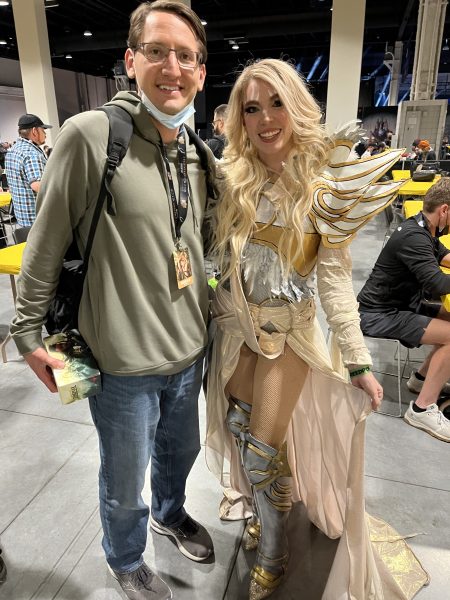
For example, while walking through the convention hall I stumbled upon Zenaide Beckham (@ZBexx), a well-loved and respected Magic personality and cosplayer. She is my personal favorite and was the one cosplayer I really wanted to meet in person at the event. It was fortunate that she was dressed up as Serra the Benevolent so it was easy to spot her in the crowd!

ZBexx is such a positive force in the community, sharing her hard work in creating beautiful, realistic costumes that celebrate Magic. I like the vibe she gives off, and that rang even truer when we met in person. I thanked her for all she did, and she humbly turned the “thank you” around back to me, sharing how much she appreciated that I enjoyed her work! The Magic Twitterverse can often become a toxic environment, but ZBexx does a great job combatting that with her positivity.

Coincidentally, as I was walking up to ZBexx to say hi, I overheard someone talking to a guy nearby. As they stepped away, they called him Hunter Pence. Well, there’s only one Hunter Pence I know in the Magic community, the retired all-star baseball player. Sure enough, it was the same guy! I had to get my picture taken with him.

Hunter was so friendly it blew me away! You never know what you’re going to get when you walk up to a celebrity of sorts and ask to have your picture taken with them. He didn’t blink an eye, and was happy to oblige with a smile on his face! Talk about being in the right place at the right time – I’m a fairly big baseball fan (it ebbs and flows) so meeting a World Series winner and four-time all-star was really exciting. I only wish I had the courage (and time) to challenge him to a game of Commander.

Meeting MaRo

As the event was winding down Saturday evening, my final day on site, I received a notification on my phone from the Magic 30 app. The alert said that I had just an hour or so left to meet Mark Rosewater in person for a signing! Well, I didn’t even know he was doing this!

There was an error retrieving a chart for Maro

It turns out the Mark Rosewater meet-and-greet wasn’t in the main convention hall. This notification informed us that the location was on some terrace on the umpteenth floor of another building. My co-worker (whom I hung out with a good bit Saturday) asked around and we managed to find the location. We had to exit the building, walk across a paved courtyard to another building, and head up to the right floor in order to find Mark.

While there, we found numerous people playing casual games of Magic over some snacks and drinks. I remember thinking to myself, “If I didn’t have to focus so much on selling cards at this event, I would have loved to have hung out here myself.” Alas, there was no time.

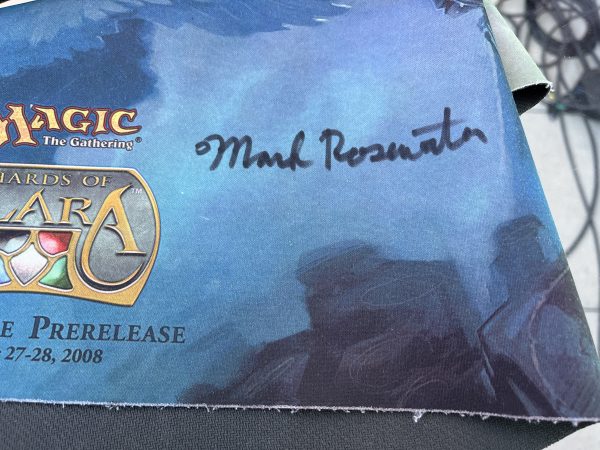
I promptly walked over to the terrace and there was MaRo! I suspect many people didn’t even know this meet-and-greet opportunity was taking place (I certainly didn’t know) because there was basically no line! I walked right up, shook hands with Mark, and gave him my playmat to sign!

As a long-time player and dedicated fan of Magic, it was truly an honor to meet the man behind many of the sets and cards I’ve come to love over the years. I am a fan of Un-sets, particularly, and I get the sense that MaRo and I enjoy Magic in some similar ways. He asked me how long I had been playing, and when I told him since 1997 he sounded impressed.

“Wow, that’s a long time,” he commented.

“Not as long as you have, though,” I replied.

If the game came out in 1993, though, then the difference in our years with the game can’t be that large. He was kind to point that out.

The Missed Opportunities

There were so many other people I had hoped to meet and play Magic with whom I did not get the chance to find at this event. In general, Magic 30 was not conducive to spontaneous meet-ups. The shortage of tables was a real barrier the entire time I was there. Sure, it was easy to tell someone a table I was playing at during an event when I had a specific table number—but then I was in the middle of a tournament, so I couldn’t exactly socialize.

There was an error retrieving a chart for Opportunity

When not playing in tournaments, seating for fun games of Magic with friends was at a major premium. There were also so many activities going on at one time that meeting someone nearby was often pure luck. What if I was trying to meet someone while they were simultaneously near the main stage watching the latest presentation? We would never know, and would completely miss each other. I’m sure this happened on more than one occasion.

Even though I was able to hang out with Lockheed and his wife Saturday morning before the doors opened, I had a feeling it would be difficult to reconnect at the event once we parted ways. Sure enough, I walked towards the vendors while Lockheed went elsewhere to start the event and we didn’t see each other again despite numerous communication attempts. Unless two people happen to be doing something similar at the same time, it was just really difficult to coordinate spontaneous meetings. This is my largest critique of the event.

Wrapping It Up

I’m glad I had the opportunity to meet some cool, friendly people in the Magic community. From long-time friends to well-known cosplayers and all-star baseball players, I had the chance to talk with an impressive group of individuals who make this game special.

My only regret was that I was so caught up in my vendor grind—both covering for Quiet Speculation and selling cards for myself—that I couldn’t take full advantage of the social aspect of this event. With over 10,000 converging in Las Vegas to celebrate Magic, I would have loved to have met more than the handful I did. Because I didn’t deliberately prioritize the social aspects of the event, however, I do feel I missed out.

This is one of the only regrets I have from the weekend. It’s something I’ll dwell on some more as I think ahead to the next one. My next piece will be the final installment of my Magic 30 coverage series. I’ll focus on the biggest takeaways and how I would do things differently next time around! After all, the best way to ensure the next event is better than the last one is to grow and learn from our experiences.

Avatar photo

Sigmund Ausfresser

Sigmund first started playing Magic when Visions was the newest set, back in 1997. Things were simpler back then. After playing casual Magic for about ten years, he tried his hand at competitive play. It took about two years before Sigmund starting taking down drafts. Since then, he moved his focus towards Legacy and MTG finance. Now that he's married and works full-time, Sigmund enjoys the game by reading up on trends and using this knowledge in buying/selling cards.

View More By Sigmund Ausfresser

Posted in Community, Cosplay, Finance, Magic 30Tagged , , , 1 Comment on Magic 30: The Networking Aspect

Have you joined the Quiet Speculation Discord?

If you haven't, you're leaving value on the table! Join our community of experts, enthusiasts, entertainers, and educators and enjoy exclusive podcasts, questions asked and answered, trades, sales, and everything else Discord has to offer.

Want to create content with Quiet Speculation?

All you need to succeed is a passion for Magic: The Gathering, and the ability to write coherently. Share your knowledge of MTG and how you leverage it to win games, get value from your cards – or even turn a profit.

Generational Magic: Brothers’ War Roundtable

Are you a Quiet Speculation member?

If not, now is a perfect time to join up! Our powerful tools, breaking-news analysis, and exclusive Discord channel will make sure you stay up to date and ahead of the curve.

If you've been around Magic in any capacity, you've almost assuredly heard of Urza and Mishra, two brothers whose conflicted relationship changed their world and universe for eons. Through the game, these in-universe characters have carried over into many facets of our lives. One example is my friend, Benji, who was able to join his love for both huskies and Magic by naming his first pup Urza!

Urza the Huskie

Urza has since shuffled off this mortal coil, but as Benji's family increased, so did his pups'. Below, we have Urza's brother, Mishra, and more recently Avacyn and Kaya. Fortunately, this furry crew gets along much better than the brothers from the story.

Mishra, Avacyn, and Kaya

In honor of Benji's Magic-al and furry friends, I'd like to formally welcome you to:

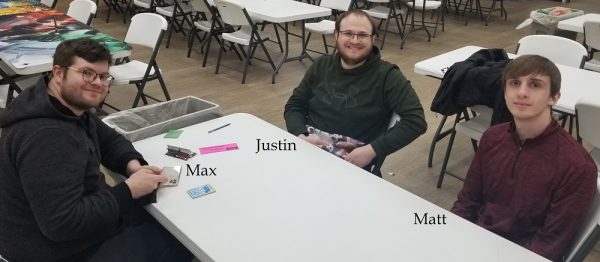
I was able to meet with a few Magic veterans at HQ last week and share the scars of war. Specifically, Brothers' War. We discussed expectations from the set and how we each believe it will affect Magic in general. What do our battle-hardened players say this set will bring?

The troops after a hard-fought night of Magic

Introduce Yourselves!

Max: I've been playing for about fifteen years, and my all-time favorite card is Dragonlord Silumgar.

Justin: I've been playing for about ten years and my favorite card is Raging River. (I had actually touched base with Justin during my round four in the Dominaria United prerelease).

Matt: I've been playing for fourteen years, am an LGS employee, and my favorite and first card is Chub Toad.

What has stood out to you the most about Brothers' War so far?

Max: I've actually been surprised by the graveyard synergies. The flavor fits in well with the theme of apocalyptic war. Very World War I, where everyone's dying left and right with little regard. Troops and materials are being reprocessed and re-used to win the war.

Justin: I like how dynamic the creatures are. They seem more flexible and interactive with one another compared to other recent sets.

Max: I agree; it doesn't feel like either strategy overpowers the other. Going wide with the little guys or focusing on the big beaters are both viable options.

Matt: I've noticed many people seeing this set as a new Throne of Eldraine. My biggest issue with Throne of Eldraine was all the bans. Cards banned in every single format; the balance and design was all over the place.

With Brothers' War being an artifact heavy set I was worried, since artifacts have a greater potential for abuse. However, looking at the power level, I'm very pleased with the designs and don't foresee any bans coming down. The playability and gameplay also looks to be very enjoyable.

Is the Brothers' War winning or failing on the flavor scale?

Max: I feel it's winning. I started right after the Brothers' War storyline ended, so I wasn't that involved with it. Still, as I've played the game, and specifically this set, I started getting into it more. In essence, you have two hyper-geniuses that level a planet over a macguffin. The three meld cards are flavor home-runs. God-like iconic characters.

Justin: I don't think I can say it better. I'm not a huge flavor person and I don't delve too far into the storylines, but from everything I've seen, they did a good job honoring the original story.

Matt: I also don't get too into the storylines, but this being the most iconic storyline in Magic, I definitely was more involved with it. Working at the store I've seen people be more excited about the set, since I hear more people talking about it. It brings more people into the game because they remember playing with these characters 20-plus years ago.

How familiar are you with the original stories that we know from the Antiquities set, novels, and comics?

Max: I'm very into Magic lore, but this story is probably the one I know the least. Neither brother is what you'd call a "good guy," but one is less evil than the other. I think that sort of gray area piques my interest to learn more.

Justin: Again, I'm really not into Magic lore. The closest I got to reading up on Magic stories was during the Gatewatch era.

Matt: I'm generally familiar with the storyline, but just on a surface level. It does help to have a working knowledge when interacting with customers, though. For me it was the Weatherlight saga that captured most of my interest, so when a set like Brothers' War harkens back to that, I'll pay more attention.

Prediction: which cards will prove the most format-defining?

Max: I believe No One Left Behind could be a contender, possibly in Pioneer and Modern as well. Being able to grab a cheap combo piece for a reduced cost could be something.

Justin: If I had to guess, I'd pick Cityscape Leveler and Portal to Phyrexia. A lot of big mana decks will like those; Mono-Green Devotion in Pioneer, for example.

The Cityscape Leveler would be good to clean up any permanents that are causing problems. I do hope that these wouldn't become just more Karn, the Great Creator targets though. Some of the cards are solid, like Misery's Shadow. It's a really nice two-drop.

Matt: I'm not a Standard player myself, but I can see Misery's Shadow being good for the current Mono-Black deck that runs Sheoldred, the Apocalypse. I'd love to see Urza, Planeswalker become something in the format.

I actually see Haywire Mite being playable against Urza's Saga in Modern. Its also an easy answer for various artifacts and enchantments in Legacy.

My personal hope is to see Kayla's Reconstruction for Mono-White Devotion in Pioneer. In an aggressive Solider deck, even if you only get three to four hits, that's pretty good value. I'd like to start seeing Nykthos, Shrine to Nyx played in the other colors and see Kayla's Reconstruction as a possibility to shake things up.

The set's best and worst mechanics?

Max: I've talked with a few others, and we all agree the best is prototype. Either option is almost never bad. For example, Combat Thresher. It always replaces itself and is beneficial in both small and large modes.

The worst for me is probably unearth. It's not a bad mechanic, but it's never resonated with me.

Justin: I agree with Max on Prototype. You can play it early if you need to, and yeah, doing so may not offer the best result, but it's still relevant. Casting a Blitz Automaton for its prototype cost is still worthwhile.

I actually don't like that meld was brought back. Not so much meld itself, but the fact that there are only three mythics that provide you a chance to use it.

Matt: Yea, in limited formats it's a real bummer when you open up half a meld card and won't be able to enjoy the fusion. Back in Eldritch Moon, you had multiple rarities that provided the opportunity, like Chittering Host. You can't get the same satisfaction here.

If you're ever able to Meld two cards together, and slam them onto the table as one huge card, it's the best feeling. You know you're having a good time when you're working just to fit it onto your playmat!

Justin: I do like meld, but I wish its execution would've been better. Giving people a chance to "do the thing."

Max: I agree on meld where now, we want to see more of it. Stop sprinkling it in and dedicate some space to it as a mechanic.

Matt: Think back to Unstable, with the host/augment mechanic. Currently meld is two specific cards. Maybe develop it to where you could mix and match with other cards to meld them together. Maybe where the top half could be the augment card, and the lower half would be the host card. Not sure exactly how it would work, but it would give players more options.

Matt: Making it unanimous, I'll agree; prototype is the best from the set. It's a fairly tame mechanic, but nothing in the set is too flashy. It does pair up well with one of my favorite things to do in Magic, Flickering. I've always enjoyed flickering morph cards and prototype cards fit right into that strategy.

What's your opinion of the Retro Artifacts in the set?

Max: Conceptually, I enjoy them. Very cool, and I appreciate the schematic artwork, like Mishra's Bauble. My only concern is that a couple of them are insanely strong in the limited format, Wurmcoil Engine being the largest offender. If your opponent plays that, they become heavily favored, and you get some feel bads.

If we look back to Strixhaven, the Mystical Archive cards all were good, but not overpowered. I would hope they lean more toward that in the future.

Justin: I've enjoyed them. Yes, there are a few offenders, but the majority of them are great. Mox Amber is a well-deserved reprint. It's not abusive and can be used if you have a lot of legends. There are, what, 50 or so Retros?

Max: There are 62, and I only know that because I'm trying to collect them (laughs from everyone).

Justin: Yea, there are 40 or so quality reprints, a few bombs, and a couple not-so-great ones.

Like, Mishra's Bauble for limited play?

Justin: Mishra's Bauble is actually an interesting limited card since there's a "draw two" theme in the set. I wasn't expecting it to be good, but there's potential for its inclusion depending on your deck.

Max: I was slightly surprised that Urza's Bauble wasn't in the set. I would've been cool to have both of them, since the set is about both brothers, right?

Matt: Yea, Mishra's Bauble has been reprinted, like five times, and only once for Urza's Bauble. It would've been a flavor win.

Matt: I do enjoy the Retro Artifacts, but my biggest criticism is that opening cards has lost its luster. I remember opening up a Garruk, Primal Hunter from Magic 2012, and even though it wasn't and isn't worth a lot, I was excited about it. Now, with Wizards printing so many sets with all of the special editions and treatments, they don't feel as cool. Borderless, Showcase, Gilded, Shattered, and the rest actually take away from the excitement of opening a pack. So much special, it's not special anymore.

Max: They could've printed them in a simliar fashion to the Transformers cards, where you get one in every ten boosters or something like that.

Matt: One thing I do want to applaud them on are the schematic numbered cards.

These feel special when you open one. Similar to the Masterpieces from Kaladesh. You get that awesome feeling in pulling something truly rare, and you will remember it. Getting something less often isn't always a bad thing.

How does Brothers' War stack up against other artifact-themed sets, like Mirrodin and Kaladesh?

Max: Mirrodin was the first set I ever drafted, so everything afterwards has a hard bar to reach for me. I do believe Brothers' War stacks up well overall. I didn't enjoy the Kaladesh block in general, because I felt there wasn't a lot of cohesiveness with the artifacts.

With Brothers' War, you have an artifact-based set, but the non-artifacts weren't pushed out. They were still important and you're not being drowned in the artifact theme.

Justin: There are more colorless cards in the set, but they stretch into the set better. I didn't get to play much with the other sets, a little with Aether Revolt, and it did seem heavily slanted to artifacts. You also don't have as much artifact removal, so Brothers' War feels much more balanced.

Matt: I would agree with that. I do feel that in comparison, this set is much more balanced. To go back to this topic, each of the other artifact sets, you have various banned and ultra-powerful cards. Blightsteel Colossus for example.

There was an error retrieving a chart for Blightsteel Colossus

I'm kind of biased on Brothers' War and the other recent sets. With the previous artifact sets like Mirrodin and Kaladesh, I was more involved and excited for them. For the Brothers' War prerelease, I wasn't ready for it. I was still enjoying the previous set, and with sets coming out so quickly, it's very hard to get amped up for it. I still played and had fun, but it was less exciting.

Prereleases have always been a special event for me and this prerelease was the first one where it wasn't. The past couple of years with COVID-19, Arena being popular, and other things have been factors, no doubt. Still, even with today being Brothers' War release day and the first chance to draft in-store, we only fired three drafts. Back during Kaladesh, we had seventeen on release night! I feel we've lost some of that magic that makes Magic awesome and need to get it back.

Which card are you most excited to play with?

Max: Mishra, Lost to Phyrexia. In my Two-Headed Giant event, we opened both halves. We were almost able to meld him, but our opponents stopped us. They even apologized for not giving us the chance to meld, but we understood since it would have brought about their demise.
Justin: Titania, Voice of Gaea. The meld part is awesome, and of course you have to go for that, but the card itself is very good. Her stats are great and I really enjoy playing a lands-focused deck.

Now Matt, if you say "Urza..."

Matt: Haha... no, no. My favorite card that I want to play in Brothers' War limited is Goblin Charbelcher. It's hilarious and so much fun, whether I'm pinging creatures or going to the face. I absolutely love it!

(Matt's co-worker Luke is beside me, giving a thumbs down sign.)

Luke: I was playing it in a limited event, activated it, and whiffed five times in a row. I was done!

Justin: Yea, I played it in a Two-Headed Giant match and we whiffed four times ourselves!

Matt: As you can tell, Luke's not a true believer in the Belcher. Outside of limited, I'd say the Young Pyromancer 2.0: Third Path Iconoclast. Pair them both together and you're going to town, especially with something like Mishra's Bauble.

Last question: Team Urza or Team Mishra?

Max: Team Urza! Only way to not be devoured by Phyrexia.

Justin: Absolutely, Team Urza.

Matt: Oooh, good question. I'm feeling Team Mishra!

Luke: I'd have to say Urza.

Epilogue

I want to thank the guys for providing us with their plans, directives, and excitement with Brothers' War. I hope you can join in on the glorious battle as well. Do you have any thoughts on what the battle between brothers may bring? Feel free to let us know either in the comments below or on Twitter.

Grateful, in Retrospect: Reviewing My Year with QS

Are you a Quiet Speculation member?

If not, now is a perfect time to join up! Our powerful tools, breaking-news analysis, and exclusive Discord channel will make sure you stay up to date and ahead of the curve.

Hello to all you Magic and, especially, Commander fans. It is I, Joe aka "Beardy," and it's that time of year when the U.S. celebrates giving thanks. It's fitting, then, that this date also marks my first year of writing with the QS team. So today, I'd like to talk about some cards, articles, and Commander topics I greatly enjoyed this year, and maybe some of my least favorites, too. But first, a special thanks to my team...

Without the help of my editors, I would be rambling even more than usual, and I would have a few significantly less inspired headlines. What can I say; I'm just not a titles kind of guy! Paul and Jordan have been nothing but helpful.

There was an error retrieving a chart for Frazzled Editor

To my fellow writers, I have enjoyed your content and learned something every day. I only dip into other formats a little here and there. I've been able to help others with their non-Commander format questions by cheating and simply getting great data from Adam, Robert and David.

Sometimes, even I run out of MTG fuel. Thankfully, Anthony always has an article to reinvigorate my love of the game and hobby. Finally, both David and Sig have offered numerous tips that have personally helped me as I've purchased collections, sought out speculative singles and vended at events. To the entire QS team, thank you!

The Heart of Commander

The article where it all began. Re-reading it a year later, has anything changed? Well, pack prices and power creep certainly have. Still, after many hundreds of Commander games, I can safely say that when players bring theme decks with heavy interaction, you get a very fulfilling gameplay experience. It's fun to show off your cards and get into crazy game states.

There was an error retrieving a chart for Jinxed Choker

One card I will highlight here is Jinxed Choker. It was a turn-two play one game and quickly circled around the table, accumulated a ton of counters, and dealt an astronomical amount of aggregate damage for just three colorless mana. Eventually it was I who "interacted" it away with a Blast-Furnace Hellkite. As a "thank you," I almost got to smash the donating Choker player for 20 damage, but then someone else removed my Hellkite! It's such interactions that keep Commander games lively, unexpected, and worth playing.

What I find most interesting about the situation is that The Brothers' War has a card that might recreate this sort of interaction all by itself: Slicer, Hired Muscle. Giving the gift of Slicer to an opponent is almost always going to be pure upside, and they cannot sacrifice him. We have finally found a Commander worthy of Flailing Soldier, and I believe I will make it a mercenary-themed deck with favorites like Soldier of Fortune to force someone to shuffle their deck... after they just shuffled. Yes, I am that kind of Magic player. This would be a mono-red deck that I could play casually, unlike my current Norin The Wary with too much land destruction.

But what if you could shortcut all that? What if, for three mana, you just skip the interaction, the game play, and simply end the game?

NOT the Heart of Commander

These two cards are responsible for ending more of my Commander games than any others this year, both competitive and casual. If Thoracle had a line of text that said "...if Thassa's Oracle is still on the battlefield, you win the game," then this card would be, I dare say, fair. You know, like Laboratory Maniac but for one less mana? Please, for the love of Pete, Commander Rules Committee, just ban Thoracle already! At least Consultation has the hefty drawback of potentially losing you the game.

However I noticed that in virtually every other non-Thoracle game, if a player had a Disenchant ready, most games would not end on the spot. That's good, and I agree with the Rules Committee when they say:

As far as cards are concerned, nothing has crossed the line into being dangerous enough across the broad spectrum of the format to warrant a ban. We’ll continue to keep our eye on hot-button cards, like Dockside Extortionist. If it or any other card creeps out of the corners of the format to have a large-scale negative impact, we’ll take action.

NOVEMBER 2022 QUARTERLY UPDATE

I still think that Dockside Extortionist is too good for Commander, but at least it itself does not end the game on the spot like Thoracle. The RC said they played at Magic 30. I wonder how many of those decks included Thoracle? Compared to other cards like Flash and Tinker, cards that need to stay banned, Thoracle is only a tiny bit worse.

A Year in Deckbuilding

I'm busy working on 32 decks. So far this year I have fully built, sleeved, shuffled, and played only seven of those 32. What happened?

There was an error retrieving a chart for Stoic Builder

Well, I built a Hamza, Guardian of Arashin and Kibo, Uktabi Prince deck for other people. I got a chance to play the Warhammer 40k pre-cons as well as the Brothers' War pre-cons. I purchased a couple of Magic collections and played some of their Commander decks, because why not? Finally, I purchased a Commander deck off eBay for around $12 and another from Offerup for $10 to test my hand at ultimate budget Commander. The result? A lot of fun for virtually no dollars.

Part of my goal with creating so many new decks was to make sure I was not just playing the same deck over and over again. In that regard, I succeeded beyond my expectations by bringing a new Commander deck every single week. This has greatly increased my appreciation of the format, because Commander has the most variety, the most spice, of every Magic format. However, that's only if you let it. Obviously competitive decks seek to be consistent and that idea is simply at odds with the idea of the format.

More than anything else I want to mention that the single biggest factor to enjoying my Commander games this year was showing up in person and playing! Yes, I know, difficult to imagine. Many weeks I agonized over card inclusions that turned out to be pointless. Showing up with literally any card provided both fun and data, which made refining a deck much easier. TLDR: Contaminated Aquifer is Underground Sea.

Cheers to Wizards!

I'm a Transformers fan and I couldn't be happier (well, I could have opened a foil shattered glass card, but didn't) with their representation in BRO. It's good to get to experience product that brings me joy. And even though they say "convert" instead of "transform" or "roll out" I still think the mechanic is spot on and well done.

Finally! A great counterspell with an awesomely thematic name everyone at the table loves to quote, even the person getting countered. An Offer You Can't Refuse is the kind of permission spell that is fair and needs to be replicated in the future. I've seen this card win games. I've seen this card lose games. Just a very cool card, all in all.

Food always bugged me as a "ho hum" mechanic. It seemed lazy and boring then, over-costed too. Enter the Monkey! Now your table can literally "go Bananas" with tokens that make sense and mana! This ties into the history of Magic with so many different Apes and Monkies over the years.

But here's the cheers part. Wizards has finally started to figure out the secret: bring synergistic, thematic, historical tribes together! There are now several examples of this over the years and it is a good sign for the many tribal players out there. Additionally, this allows me to make my friend who loves all things simian a completely functional Ape deck. Thanks Wizards! But it's not all good news....

Jeers to Wizards!

Unfortunately, Wizards has continued to leave a lot to be desired recently, and this year is no exception. I can remember quite clearly when they made the decision to have Kytheon, Hero of Akros not have keyword battalion ability for seemingly no reason. Alright, a weird design choice, but whatever. Then they followed it up with Tireless Tracker and decided a wall of text was more elegant than "Landfall—investigate." Wizards enjoys overly wordy cards, as Lagrella, the Magpie could just say "up to one other creature per player" instead of the nonsense printed on it.

But wait, what's that? Jodah, the Unifier could just say "legendary cascade" but instead has a wall of text. Wait, because it doesn't have a keyword ability, it doesn't work with other cards that exist like Averna, the Chaos Bloom. I mean it's not like Wizards printed a specialty card called Myntasha, Honored One with literal "booster cascade." Oh wait, they did!

Here's an idea: Vampires drink Blood, wouldn't it be interesting if you could sacrifice the Blood token to give a Vampire a +1/+1 token or use it to draw/discard? A lot of the Vampires in VOW had this ability tagged on, but why not put it on Blood itself? An obvious miss. Also, Odric, Blood-Cursed is one of the worst cards designed ever, let alone in the last year. Not only is it a hard to cast 3/3 with no abilities, but it also has both a comma and hyphen in its name. Wizards must get some kind of kickback from Merriam-Webster.

Now Who's Laughing?

It was easy to forgive Wizards when it was one to two cards per year. But now it's every single set. In their "infinite money printer go brrrrrr" speedrun, Hasbro has decided to leave out quality control for everything from card design to print quality. Gee, I wonder why they recently got downgraded by Bank of America? Please Wizards, tell them you can do better in 2023 by focusing on quality, not quantity.

Wrapping Things Up

Well, guess that's everything. Yup, nothing else I'm thankful for at all. Oh, wait a minute? Of course. Thanks to you, reader, and to everyone in the QS Discord as well. Without all of you I would certainly not be writing this article. But the thanks comes with a catch. What was your favorite article over the past year? Your least favorite? What do you want to see more of in the next 12 months? I'm itching to know. Be careful what you wish for; you may get it, especially if it's more Commander content!

Adam Plays Magic: Explorer UB See the Truth

Are you a Quiet Speculation member?

If not, now is a perfect time to join up! Our powerful tools, breaking-news analysis, and exclusive Discord channel will make sure you stay up to date and ahead of the curve.

Welcome back to another installment of Adam Plays Magic. This week, we're cooking up something a little spicy for Explorer, UB See the Truth. The centerpiece of the deck is ostensibly a sorcery speed Anticipate that becomes an Ancestral Recall if cast from somewhere other than the hand.

While See the Truth has been out for quite some time, it hasn't had a critical mass of cards that can enable its draw three mode, until now. With Dominaria United, we were blessed with Founding the Third Path, a saga that can dump a See the Truth into the graveyard either by casting for free or self-milling, then cast it with its third chapter. This was a step in the right direction, but we weren't quite off to the races.

However, The Brother's War introduced us to Arcane Proxy, a Snapcaster Mage of sorts that can be cast for its prototype cost of 1UU for a 2/1 body. When Proxy enters the battlefield, it casts an instant or sorcery with mana value less than or equal to its power from the graveyard.

Now we have two separate cards that combo with our cantrip for a major payoff, both of which are already fairly serviceable spells in their own right.

What I Like

This version of UB Control is built to dismantle creature matchups through a plethora of spot removal like Go for the Throat, discard like Thoughtseize, and card draw like Consider.

Cling to Dust does an excellent job of generating card advantage thanks to all of the cheap spells and self-milling. It also serves as main deck graveyard hate for the highly popular Greasefang, Okiba Boss matchup.

Multi-format all-star Ledger Shredder takes advantage of the spell-slinging by conniving nearly every turn, creating a difficult body to attack into and a decent tempo clock with evasion. Notably, both Founding the Third Path and Arcane Proxy's abilities cast an additional spell that triggers Shredder even while top-decking.

Also, even though the deck is focused around a graveyard interaction, it's not wholly reliant on the graveyard to function. In the face of soft hate like Soul-Guide Lantern, the opponent can be forced to use the exile ability to stop an Arcane Proxy from triggering, but at the end of the sequence, the opponent is down a card and we still have a creature adding to our board presence. It's then fairly easy to restock the graveyard for future recursion.

The worst case scenario is something like Rest in Peace or Leyline of the Void, but the deck still has Ledger Shredder, Professor Onyx, creature lands like Hall of Storm Giants, and plenty of interaction to make sure they connect. In such a scenario, Shredder can always discard away an unwanted Founding the Third Path.

What I Dislike

As with any control deck, it's hard to have the right answers for everything always. The tools in this build are designed to beat a creature metagame. Those removal spells are mostly dead draws against UW Control with Teferi, Hero of Dominaria. The clock is also very slow, so red aggressive decks with burn spells like Wizard's Lighting pose significant threats, especially when playing off the top of the deck. The deck leans heavily on Cling to Dust in game one, followed by Sheoldred, The Apocalypse and March of Wretched Sorrow post-board.

Notably, Otawara, Soaring City is the only card in the deck that can remove a resolved artifact or enchantment. If the format moves in a direction where noncreature permanents like Fires of Invention and Enigmatic Incarnation take up a larger metagame share, additional changes or even a green or white splash may be necessary.

The Deck

UB See the Truth

Creatures

4 Ledger Shredder
4 Arcane Proxy

Enchantments

4 Founding the Third Path

Planeswalkers

1 Professor Onyx

Spells

4 Thoughtseize
3 Fatal Push
4 Consider
4 See the Truth
2 Cling to Dust
1 Rona's Vortex
2 Go for the Throat
1 Heartless Act
1 Power Word Kill
2 Extinction Event
2 Jwari Disruption

Lands

2 Swamp
1 Island
2 Hall of Storm Giants
1 Otawara, Soaring City
1 Castle Locthwain
4 Clearwater Pathway
4 Watery Grave
2 Shipwreck Marsh
1 Hive of the Eye Tyrant
1 Takenuma, Abandoned Mire
2 Field of Ruin

End Step

That's a wrap for another week! I've been really happy with the archetype thus far and I think it's a serious contender in the current Explorer metagame. With a new set as powerful as BRO, I'm expecting plenty of things to shift around, carving out new niches and closing existing ones. We'll see how things develop.

I came across a handful of other players deckbuilding around the same See the Truth interaction, but they've included cards like Tolarian Terror and Sheoldred to bolster their main deck creature suite. These are definitely worthwhile considerations and may end up in a future build for me.

Keep up to date with me on Twitch and Twitter (and given the recent updates to the latter, I'll let you know where else to find me should the need arise). Don't forget to leave a comment, and let me know what else you'd like to see me play. It might be featured on the next Adam Plays Magic. See you all next time!

Wartime Innovations: Surprising BRO Pickups

Are you a Quiet Speculation member?

If not, now is a perfect time to join up! Our powerful tools, breaking-news analysis, and exclusive Discord channel will make sure you stay up to date and ahead of the curve.

The Brothers' War is proving to be a very unexpected set. I've been playing and watching both paper and Magic Online (MTGO) events over the past few days and have seen a lot of BRO cards played. Many of which I never thought would ever be played. While everyone (I included) was focused on a few artifacts due to their interaction with Karn, the Great Creator, there are a shocking number of cards that are actually playable in Pioneer, Modern, and even Legacy. Which I never would have predicted in the BRO preview article I didn't write. Well, no time like the present, I'll be covering the surprises I've encountered in WUBRG order.

Recommission

Formats: Pioneer, Modern

There was an error retrieving a chart for Recommission

Players have been able to play BRO on MTGO for longer than in paper. I have been getting in Pioneer practice online ahead of more Pioneer RCQs. Consequently, I've seen plenty of players adding in the BRO artifacts, primarily in Mono-Green Devotion. The first truly unexpected card was Recommission, and it was in an unexpected deck too.

Honestly, it could have been a Pauper artifacts deck but for Sacred Foundry and Battlefield Forge. It certainly played like one. I saw a lot of Experimental Synthesizers, Shrapnel Blasts, and Reckless Fireweavers alongside a lot of chaff artifacts.

I was already perplexed at what I was seeing in Pioneer when my opponent tried to Recommission a discarded Foundry Inspector. I was on Spirits, so I countered, having had nothing better to counter that match. My opponent typed into the chat quote "There goes my combo attempt. GG", conceded and left before I could type back, "WAIT, COMBO?" I will note he had one card and two mana open at the time. If anyone knows what was going on, this article is as much a cry for clarity as it is informative content.

There was an error retrieving a chart for Hardened Scales

I might have blown that off as a weird brew, but at least one Modern Hardened Scales player has told me the card has legs there. A Recommissioned Hangerback Walker or Walking Ballista would have a +1/+1 counter, and the synergy with Scales is obvious. I haven't actually seen this happen yet, but I know said player is currently playing Recommission so maybe it will catch on?
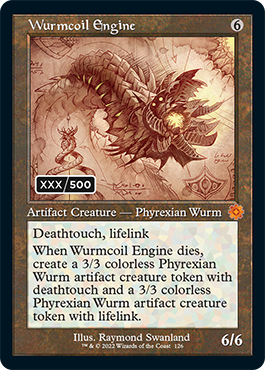
My Take

While the potential of the card as a combo enabler is yet unproven, it was definitely an oversight on my part to never consider Recommission. However, I also know why I did. Recommission competes with Unearth for the same role, and I'm not sure it wins. Unearth is narrower, but cycling and costing one forgives many deficiencies. Recommission gives creatures +1/+1 and finds artifacts but is also in a color not known for getting cards into the graveyard to reanimate.
There was an error retrieving a chart for Can't Stay Away

Of course, Unearth is also not legal in Pioneer, so that's not a concern. Can't Stay Away on the other hand, is another matter. While again, Recommission has upsides, I don't think they outweigh flashback. This leaves the card as either a gimmicky Scales card or a dedicated cheap artifact reanimator, which has never really existed before. The problem is that outside of Inspector, I have no idea what engine card is worth reanimating. Thus, this still seems like a card that is only seeing play because it's new. However, maybe there actually is a combo this enables? I guess we'll see.

Defabricate

Format: Modern

There was an error retrieving a chart for Defabricate

I've never seen this card in person, but in several YouTube Modern stream uploads over the past week, I've seen this card played against the streamer. In one case it was played game one, in the others, it didn't show up until games two or three. The first was definitely main decking Defabricate, which was quite perplexing by itself, but the others having such a card in their sideboard is equally weird. I remember the modes being chosen equally, though the Stifle effect was always used against Urza's Saga.

There was an error retrieving a chart for Karn, the Great Creator

As I didn't have direct contact with the games, I've no way of knowing exactly what the players were thinking in playing Defabricate in Modern. It doesn't actually answer anything Karn, the Great Creator wishes for as they're exiled and can be wished for again. Thus, I have to assume that they were primarily playing it for the Stifle effect and hoping for some additional value of countering artifacts occasionally. I can't think of enchantments that need countering maindeck.

My Take

Stifle and similar cards occupy a weird place in Magic. When they are good, they're backbreaking. However, mostly they're mediocre at best. Countering a trigger is card disadvantage and tempo advantage unless it's a fetch land being Stifled. It takes countering a saga or storm trigger to be good, and those are really niche situations. Consequently, they don't usually see play outside Legacy, and even then it's limited to Delver of Secrets decks.

There was an error retrieving a chart for Stifle

The exception has been Stifles with additional utility. Tale's End saw play when Omnath, Locus of Creation was at its height since it countered Omnath while Stifling fetch lands. However, I haven't seen End being played in months. In that light, if there are enough artifacts seeing play that need to be countered, Defabricate starts to make sense.

There was an error retrieving a chart for Tale's End

However, that's tempered by the fact that exile is actually a disadvantage thanks to Karn. Defabricate would benefit from putting artifacts in the graveyard instead of exile so long as Karn is legal. I'm therefore left thinking that the players running Defabricate are playing to the wrong metagame.

Bitter Reunion

Format: Modern

There was an error retrieving a chart for Bitter Reunion

I have seen a number of recent Indomitable Creativity decks running two or three Bitter Reunions in Modern, both as I'm doing the metagame data and personally. Looting effects aren't uncommon in the archetype though it's mainly been Tainted Indulgence and Fable of the Mirror-Breaker. Seeing another mono-red one, and a much weaker one at that, made me double-take. I thought it might be a budget option until I looked more carefully and saw Fable.

There was an error retrieving a chart for Fable of the Mirror-Breaker

While I don't know what the MTGO players were thinking, I did ask the player I saw why Reunion. He was unequivocal: it's for the sacrifice ability. His games tended to go long so being able to immediately attack with multiple Archon of Crueltys was not merely an option but necessary. The looting was powerful, but they're dime-a-dozen. Being able to immediately win the game is quite rare for the deck, and so he'd picked Reunion over other options to supplement Fable.

My Take

As far as I'm concerned, the explanation tracks. The Creativity decks with Indulgence haven't set the metagame on fire, at least compared to all the other Creativity variants. Consequently, replacing it with something else is a perfectly valid option.

There was an error retrieving a chart for Tainted Indulgence

I do question whether the situation described is truly a reason to adopt Reunion. The player specifically said it was for when he had multiple Archons to just end the game, but most of the time two Archon triggers functionally end the game anyway. The only situation where attacking immediately is necessary is when Supreme Verdict is a threat, and that's quite rare. Reunion is still reasonable but seems slightly win-more to me.

Obliterating Bolt

Format: Legacy

There was an error retrieving a chart for Obliterating Bolt

I'm no Legacy expert, but I do like to dabble. Sunday I was playing Death and Taxes on MTGO when an opponent killed my Batterskull's germ token with Obliterating Bolt. I was shocked. I expected Bolt to see play in Pioneer as it answers a lot of cards in Mono-Green Devotion. Two-mana burn removal is generally playable there but usually only makes the older formats if it can also burn face. Seeing Bolt in Legacy was utterly shocking.

There was an error retrieving a chart for Minsc & Boo, Timeless Heroes

Fortunately, my opponent explained the inclusion, and their answer was as unequivocal as the previous story. He was playing Obliterating Bolt to answer Minsc & Boo, Timeless Heroes. This just begged more questions from me. I'm not that plugged into Legacy, but I do know that the D&D duo is quite strong. However, having to run an answer like Obliterating Bolt specifically for that card seemed questionable. My opponent said that it's actually not so surprising and Bolt is gaining traction on the 4-Color Control discord he was on.

My Take

I'd have thought that Legacy players concerned about Minsc & Boo would load up on Hydroblast and Blue Elemental Blast before resorting to a card like Obliterating Bolt. I guess there are concerns about Veil of Summer but still. Bolt is not the sort of card that one expects to see Legacy play. There is something to be said for attacking from an unexpected angle, but I really question Bolt's efficacy outside of killing Minsc on the turn it's played. This strikes me as an echo chamber feedback loop, but again, I'm not a Legacy expert. Maybe this is the right move, weird as it looks.

Titania, Voice of Gaea

Format: Modern

There was an error retrieving a chart for Titania, Voice of Gaea

I was playing Merfolk online against what appeared to be a standard-issue Valakut, the Molten Pinnacle. It had the right lands, Dryad of the Ilysian grove, and Primeval Titan. However, in game one my opponent played Argoth, Sanctum of Nature. It was weird and unexpected, but I didn't think much of it. Then came game two, when my opponent started using Life from the Loam and then Titania, Voice of Gaea. I was perplexed.

There was an error retrieving a chart for Argoth, Sanctum of Nature

I did find out what my opponent was doing, but not why. A few turns later he successfully melded Titania and Argoth into Titania, Gaea Incarnate with Dryad out to win via Valakut triggers. I Dismembered the Dryad then killed Titania with Merfolk Trickster. My opponent was apparently so upset they disconnected. They were pretty ahead in that game and won game one, so I can't think of any other reason they'd just leave.

My Take

I've seen this in Modern before. It's called Splendid Reclamation, and it was tried for a while before being abandoned as too gimmicky. Trying to get there via meld as a primary plan is going to great lengths for no real gain. If Life is the plan, just run Seismic Assault.

There was an error retrieving a chart for Splendid Reclamation

Even as an incidental combo (which is not what my opponent intended, there were multiple milled Argoth's and another Titania), this is questionable. Titania has the same stats as Endurance but lacks reach and has a more marginal ability. Argoth is clunkier than Urza's Saga, which already sees play in lands decks. Unless the meta swings heavily toward Burn I can't imagine this catching on. That said, players do love a gimmick.

Harbin, Vanguard Aviator

Format: Pioneer

There was an error retrieving a chart for Harbin, Vanguard Aviator

For the record, I wouldn't be surprised to see Harbin in Pioneer, or even in Modern, in his intended role. If there's a soldier tribal deck that can challenge human tribal, Harbin will be a key component. It's an evasive threat that can win a creature stall, what's not to love? No, the issue is that I saw Harbin being played game two in Pioneer UW Control, which I found perplexing.

There was an error retrieving a chart for Geist of Saint Traft

I was playing Spirits, so Harbin was a cheap way to slow me specifically down. However, that's a really narrow use. My opponent didn't respond to my MTGO message inquiry, so I don't have their explanation. However, in the past I've used Geist of Saint Traft in Modern control decks as a way to juke out of the typical control mirror. I'd guess that was the intention with Harbin since the only answer to Harbin turn two is Censor or March of Otherworldly Light, which I'd expect to get boarded out.

My Take

While sideboarding in creatures is a legitimate repositioning strategy, doing so with Harbin is really weird to me. Cheap high-power creatures which dodge the usual post-board control answers are good, but they should normally be resilient too. Shark Typhoon is still a card, so I don't think anyone will be riding Harbin the way that used to be possible with Geist. If they'd been playing Raffine, Scheming Seer it would have made more sense.

There was an error retrieving a chart for Hullbreaker Horror

However, it's still weird for Pioneer control players to be trying to get under each other in the mirror. There are so many ways to go over each other now, that they just stick to that. Hullbreaker Horror is the most common, but there are many similar creatures now. I really wonder what my opponent was doing playing control with Harbin.

Anything is Possible

That these cards have seen play may not make sense to me, but they certainly make sense to their players. Of all of these, Bitter Reunion is the only one that I could see making it long-term. Everything else seems like enthusiasm and optimism more than effectiveness, but I could be wrong. Anything is possible in Magic.

Are the Best Commons Just the Unearth Cards?

Are you a Quiet Speculation member?

If not, now is a perfect time to join up! Our powerful tools, breaking-news analysis, and exclusive Discord channel will make sure you stay up to date and ahead of the curve.

Some have said that the graveyard, in modern Magic, is just an extension of the hand. While I would hardly call this a graveyard set, the Brothers' War (BRO) takes advantage of this truism.

Undead Allstars

Whether we want to be aggressive or play a more attrition-based gameplan, these cards help us accomplish our goal. Each is powerful individually and on its own merits. This format, however, appears to be curated to maximize their effectiveness.

Actual Artifactual

Artifacts have a reputation for doing broken things. Black Lotus? Artifact. The Moxen? Artifact. Affinity hasn't been a problem unless it's affinity for artifacts. They even made a cycle of monochromatic lands, coded them with the artifact subtype, and subsequently had to ban them from multiple formats. Artifacts have a reputation for doing broken things.

This format introduced the powerstone token. In our preview guide, we projected casting our prototype cards at full cost to be the best use of this newly ubiquitous resource. We may have overlooked the power of this returning mechanic because of the shiny newcomer.

Powestones can both cast and reuse unearth cards, contributing to fast starts and mana-efficient plays. Additionally, artifacts have tons of value in the format, both when entering the field or as fodder once they've outlived their usefulness.

Just a few payoffs

Benefiting the Macro and the Micro

If we want to ramp with powerstones, the unearth cards provide flexible ways to use our mana. In a more aggressive deck, our attacks are bolstered with unearth threats. Because the creatures come back at sorcery speed before being exiled, they make for natural attackers. Additionally, nearly all of them provide value to support more attrition-based approaches. They provide card advantage, card selection, life, or tokens.

The lone exception is Mishra's Juggernaut. That thing is a bowling ball of butcher knives, to borrow an old description from the NFL. Maybe we can bring down the juggernaut, but it's going to cost us. The price is often an unfortunate combination of life and creatures. While it doesn't bring value in a traditional sense, it creates difficult situations for opponents.

The more specific archetypes for BRO synergize even further. The UB deck wants to draw two cards a turn. The downside is that this often costs us tempo. However, Scrapwork Rager, Combat Courier, and Scrapwork Mutt all allow us to trigger this condition twice while adding board presence.

The GW deck wants artifacts to enter the battlefield, usually while remaining aggressive. Scrapwork Cohort and the uncommon Mask of the Jadecrafter provide four triggers each. While the RW deck is a little less defined, these support the generally aggressive game plan with creatures entering the battlefield and doing so hastily the second time around.

The only archetype that doesn't explicitly benefit from the unearth cards is the UR Spells deck, however, Combat Courier and Scrapwork Mutt still represent excellent options for the deck in the early game. As a result, these cards are excellent early picks as we await the draft to point us in a more specific direction.

Early Look at the Data

The early data reveals a strong performance from these cards, with cohort and mutt appearing amongst the top three commons.

The performance of these commons mirrors the performance of the color pairs in this format. The two unearth creatures propel RW to the format's best results, with RG following it by nearly an entire percentage point, and UR spells in third. In the format's early days, red appears to be a great place to start.

The woeful data for GU leads us to believe that, while generating powerstones has value, we need to use them efficiently. This is the biggest indictment against the prototype strategies. Whereas other combinations have access to multiple common unearthers, GU only has Combat Courier. The little construct is blue's top common by a large margin, but they can't do it alone!

Looking Ahead

It makes sense that the unearth creatures are thriving. When compared with the prototype threats they offer more flexibility. When we spend seven mana on a single creature, we are vulnerable to interaction. If that mana is spread over two turns generating resources each time, we give ourselves more options. In my experience, this format has not felt as flat as Dominaria United. This is a format with good cards and worse cards. In DMU the cards were fairly close, and synergy separated them. The unearth cards provide additional uses for our mana, helping us minimize our reliance on those lesser cards.

Though this format is still finding its form, data at this stage tends to be reliable. While cards will move, we shouldn't expect huge swings.

Shine a Little Light

To close out this article, let's shine a little light on Boulderbranch Golem. This article has not been kind to the prototype creatures. However, this one has been pretty strong.

There was an error retrieving a chart for Boulderbranch

Boulderbranch has a lot of the strengths of the unearth cards. It immediately provides life. It is a flexible spell and is fine at both points on the curve. In our preview guide, I suspected the massive Rust Goliath would be the premium prototype common. The massive body and keywords embodied my expectations of the set. Perhaps it was my affinity for a certain Warner Brothers film.

With ten mana being unrealistic, and the demand for immediate value from our creatures, Boulderbranch has been the common prototype creature that's performed best. It's the third-best green common and it fits well on the curve.

While the Goliath can be a defensive stopper on five, it simply doesn't do enough. Boulderbrach Golem is the giant robot you want in your deck. The upside is not as powerful, but you can't put a price on the reliability.

Generational Magic: The Brothers’ War Prerelease

Are you a Quiet Speculation member?

If not, now is a perfect time to join up! Our powerful tools, breaking-news analysis, and exclusive Discord channel will make sure you stay up to date and ahead of the curve.

Back in 1998, a set of books called The Artifact Cycle were released. The first book was, you guessed it, The Brothers' War. When this set was being previewed, my son Jarod asked me about the story behind the set. I had shared bits and pieces of it with him over the years, but he requested more detail this time around.

So as I'm running through the highlights of the story for him, I'm getting somewhat nostalgic. It took me back to a younger time, and I wondered how Wizards planned on sharing the story with a whole new generation. Would they push the envelope and retcon various plotlines, or rely on the the story for what it is? Fortunately, it looks like they didn't change much of the original story, and just elaborated on the finer, more ambiguous details.

Of course, once my Dominarian history lesson was over, we started talking about the cards and looking forward to the prerelease. Unfortunately for Jarod, his work schedule changed, and when the time came he wouldn't be able to join in Friday's event. Fortunately, he was able to go Sunday night, so all was saved.

A Dream Come True

I arrived at the store, but before I start crawling into the Caves of Koilos and digging into the sad lesson of Sibling Rivalry at its most extreme, I want to share a very cool thing that happened at the event.

Matt and Urza, best of friends

Yep, Matt pulled both halves of Urza, Planeswalker! I was sitting a couple seats down from him when he was cracking his packs. He declared that no matter what else was in the cards, his goal was to meld!

I found out afterwards that Matt had actually melded twice during the evening. A timely Dreams of Steel and Oil stopped him from doing it a third time, but he easily won both games once melded.

My Mavericks Prerelease Deck

My white and red cards were just bad: creatures that you really don't want to play, like Survivor of Korlis, and almost non-existent removal. Green was a little better, with larger creatures, but nothing stood out.

I worked into a UB deck that highlighted Gixian Puppeteer and similar cards, but I really didn't have much in the way of extra draws other than Mazemind Tome and The Mightstone and Weakstone.

My removal was decent, yet I was hoping that Ramos, Dragon Engine and the rest of the flight crew would get me there. I knew I had my work cut out for me. For clarity, I didn't play the three rares and four retro artifacts shown at the bottom of the image.

Round 1: Ted, UB Draw Power

Introduce yourself!
I've been playing since 1996 and a couple friends at school got me into it. We played mostly with Revised and Legends cards.

Generally, which formats do you enjoy?
The limited formats. I enjoy Draft the most. It has a better playstyle and Sealed has higher variance. I have played most constructed formats, but don't have much time to pursue them.

What are you looking forward to in this prerelease?
Just to get out and sling cards with others is great. I'm a father of seven, so as you can imagine I don't get out to play very often. I do play MTG: Arena, but sporadically. I'll go hard with it for a while and then have a long drought.

My friend, Kory, was also also able to come up from South Carolina for a couple days. It's been great, since we both love playing Magic!

Which Brothers' War card are you most excited for?
I haven't looked at the set that much, and I'm hoping that the draft experience is similar to Dominaria United, which was very fun. I did enjoy Hurkyl, Master Wizard in our second game. If you balance your deck with her in consideration, you can really go off.

Aaron Forsythe, Vice President of Magic Design, recently asked, "Why has sanctioned Standard play declined relative to other formats in your store?" What would you say?
I believe it's been a multitude of things. All of the Standard bans throughout the last three to five years, the natural rotation of sets depreciating card values, Arena taking the format over, and of course, the pandemic. I believe we were heading to a decline in Standard before it, but when COVID hit, the other issues hit the regular Standard player hard.

As far as coming back from it, Wizards needs to support the LGSs better than they are currently to lift up the format. Maybe a better casual entry, less cost, I'm not really sure, but it needs to be a more grassroots effort.

Match Details (0-2)

The interesting thing about this match was that our decks were very similar. We both had a blue legendary creature, and many of the same commons and uncommons. That was on top of both of us having Ramos, Dragon Engine and Gixian Puppeteer.

Our first game went back and forth between attacks and removal. We both ended at two life and all I needed was a way to draw a second card on my turn before I played my Gixian Puppeteer. Unfortunately for me, I didn't; Ted had the removal for my Puppeteer, and I ended up dying to his Gixian Puppeteer trigger.

The second game was less of a battle, and Ted kept the advantage throughout. One funny moment happened when he cast his Ramos, Dragon Engine. At the end of his turn, I scryed with my Mazemind Tome, destroyed his legendary dragon, and smiled. He wondered what the smirk was for, so on my turn I played my copy of Ramos, Dragon Engine. We both had a good laugh. He destroyed it a couple of turns later and was able to finish me off.

Round 2: Michael, RB Artifact Sacrifice

Introduce yourself!
I started playing in the mid-90s. I fell away from the game and picked it back up about two years ago. I distinctly remember playing in grade school on the playground blacktop, scratching up all of our cards in the process.

I started up again after seeing it on YouTube. I caught a couple videos of Tolarian Community College and Alpha Investments talking about Magic cards, so I checked them out. I honestly had no idea the game was still going strong, so my interest was reinvigorated.

Generally, which formats do you enjoy?
My favorite is Pauper. For me, it has the same feel as when I first played. It sends me back in time. Less emphasis on planeswalkers and other broken cards.

Nice! What Pauper decks are you playing currently?
I like the elves deck and UR Skred. Any sort of value deck. I love me some Thraben Inspector.

What are you looking forward to in this prerelease?
I really love the retro border cards; they take me back to my early days. I got a Sculpting Steel and Bone Saw. They look awesome!

Which Brothers' War card are you most excited for?
I would love to get a retro Mystic Forge, but I'm mostly drawn to the set because of the story. I remember reading about Urza, Mishra, and the Weatherlight and her crew dealing with the Phyrexians. I'm enjoying that immensely.

Aaron Forsythe, Vice President of Magic Design, recently asked, "Why has sanctioned Standard play declined relative to other formats in your store?" What would you say?
When I got back into the game, I didn't even consider playing Standard. I was dumbfounded by the cost of the cards and the fact that they rotate out and lose value. That's what initially drew me to Pauper. Outside of Arena I haven't touched it, and it doesn't surprise me that it's struggling.

To have a chance at bringing Standard back, I believe Wizards needs to bring more focus to in-store play. They've put a lot of effort into Arena, and that's good. It's fun and enjoyable, but you lose the "gathering" that the game truly relies on.

Match Details (2-1)

Michael was able to take game 1 through constant bombardment. If I remember correctly, he played a creature almost every turn after the first, up to when his Heavyweight Demolisher hit the board. I was able to remove a few of them and play my Su-Chi Cave Guard to stem the tide, but his Sibling Rivalry and ward payment sealed the deal.

Games 2 and 3 were better for me. Michael didn't have the continuous barrage like the first game. I was able to take small chunks out of him with flyers, like Carrion Locust and Wing Commando, and destroyed anything that would have caused me problems.

Round 3: Paul, Naya Goodstuff

Introduce yourself!
I played for about a year back in 2013 with some friends in high school, but never really got into the game. My friend and co-worker Dewey invited me, and that's why I'm here today.

Generally, which formats do you enjoy?
I'm not able to comment much, but I have enjoyed the sealed format. I play Eternal quite a bit, so I have some experience with the genre in general.

What are you looking forward to in this prerelease?
Just having a good time and checking out the cards. A lot has changed about the game, but the overall gameplay is still the same.

Which Brothers' War card are you most excited for?
From what I've seen so far, I've liked the artifacts and recursion cards, like Repair and Recharge and Emergency Weld.

As for specific cards, Pyrrhic Blast is fun. Teething Wurmlet has been interesting. Even though it's better to play out early, it's not a dead card in the late game. I like that it can build into something.

Match Details (2-0)

Even though Paul hadn't played Magic in almost ten years, he still performed well. In the first game, we were both low on life, and he was almost able to get there. I believe if he had one more turn, he could've pulled it out. I had one to many flyers in the way and after removing his Boulderbranch Golem I got in for exact damage.

The second game was more interesting. I started off pretty quick, but Paul slowed me way down with two Static Nets. We started trading back and forth, but I was gaining board advantage. That is, until he played Draconic Destiny on his Argothian Sprite. I took a hit for eight and knew the end was in sight if I couldn't finish him in a couple turns.

Paul played a Scrapwork Mutt a few turns earlier and it was now sitting in his graveyard. I was able to exile it with my Carrion Locust, and give myself some breathing room. After those couple of turns I was able to swing in the air for just enough. After the game, Paul reviewed the board and if I hadn't exiled the robot dog he would've won the turn before I did. Nice and close games!

Round 4: Kory, RG Powerstone Midrange

Introduce yourself!
I've been playing since 2013 during Return to Ravnica. My brother-in-law introduced me. I tinkered with the cards when I was six or seven, but being that young, I only enjoyed the novelty of it.

Generally, which formats do you enjoy?
I mostly played Modern and draft before the pandemic and moving to South Carolina. I enjoyed Rock-type decks and UR Arclight Phoenix decks.

What are you looking forward to in this prerelease?
I used to play quite a bit, but times have changed and I'm mostly on Arena now. It is nice to get back out amongst the living and play in person though. Arena did a lot of good things for me, where I don't worry about card values so much, but you can't beat playing Magic with friends.

Which Brothers' War card are you most excited for?
I hadn't looked at any of the cards before I arrived today, but in my deck, Gwenna, Eyes of Gaea has been a bomb.

Aaron Forsythe, Vice President of Magic Design, recently asked, "Why has sanctioned Standard play declined relative to other formats in your store?" What would you say?
I saw that tweet. I noticed a lot people who commented on his post, many being Magic pros, weighing in as well. I believe Standard has had problems for a while. Not getting enough value out of your cards is a big issue. The pandemic made it worse, but I believe the format was heading that way, and I imagine Wizards saw it coming.

How to bring it back is more difficult. My initial thought is they could put Arena booster codes in the physical packs. People getting value out of their packs for both tabletop and digital might help bridge that gap. I've seen other digital card games do that and I'm not sure why Wizards hasn't picked that up.

Match Details (Draw)

At this point in the evening, Kory and I were fine with a draw and splitting the pot. We both received three packs for our trouble and he was able to head out to grab a bite with his friend Ted (yep, my first round opponent). I am about the split though. Looking at Kory's playable rares, I wasn't filled with confidence on my chances.

War's End

I was able to join in another event with Jarod on Sunday, but my card pool wasn't great. The only saving grace was winning one match by equipping Helm of the Host onto a Su-Chi Cave Guard.

Even so, there was another dream that came true that night for Keith and Zak. They were finishing up the finals of the Two-Headed Giant event and won on the back of a melded Mishra, Lost to Phyrexia. Pretty cool!

Keith, Zak, and Mishra basking in the win!

Prereleases are always fun. Win or lose, you get to open packs, build a deck, and hang out with the local Magic community. Thanks again to my fellow players for the matches and insights.

How was your prerelease? Did you pull some great cards, or have an awesome or bad beats story to share? Were you able to make new Magic friends? I would love to hear about your experience in the comments below or on Twitter.

Taking Stock of the Hasbro Downgrade

Are you a Quiet Speculation member?

If not, now is a perfect time to join up! Our powerful tools, breaking-news analysis, and exclusive Discord channel will make sure you stay up to date and ahead of the curve.

On Monday morning Bank of America (BofA) double-downgraded Wizards of the Coast's parent company Hasbro's (HAS) stock to "underperform" from "buy." The move was announced following what BofA called a "deep dive" on Magic: The Gathering.

BofA slashed their price target for HAS to $42 per share from $72, considerably lower than Friday's closing price of $63.41, implying significant risk to investors. According to the report, Magic generates 15% of Hasbro's total revenue and as much as 35% of EBITDA.

In a quote from the report widely shared among the Magic community, one of the report's authors noted:

We've spoken with several players, collectors, distributors and local games stores and have become aware of growing frustration. The primary concern is that Hasbro has been overproducing Magic cards which has propped up Hasbro’s recent results but is destroying the long-term value of the brand.

The report echoed some legitimate concerns expressed by the Magic community in the last two years. In the immediate aftermath of the report, several commentators, and numerous Magic fans on social media, were quick to say the equivalent of "I told you so." Not all commentators took the BofA report and downgrade at face value. Rich Stein over at Hipsters of the Coast published an analysis of the BofA report critical not only of its conclusions but of what it left out of the report.

The Quiet Speculation Take

Though long known as a leading source for Magic finance, Quiet Speculation is more than just finance, and our team of content creators all approach Magic from differing perspectives. Compiled here are the team's takes on the Hasbro stock situation, and some possible ways forward for Wizards.

Sigmund Ausfresser

There are two schools of thought regarding BofA's market call, and their "deep dive" analysis of Magic.

On one hand, many players feel justified that Wall Street is finally taking notice of the missteps Hasbro, the parent company of Wizards of the Coast, has made over the past 12-18 months. Social media has been particularly vocal about the glut of product releases, massive waves of reprints, and general fatigue players are experiencing with Magic. Because players can't keep up with all these releases and their resources are limited, the BofA analyst indicates excess supply and unprofitable releases have damaged Magic's distribution network, leading to a reduction in offerings at many retailers. It also pokes holes in the integrity of Magic's secondary market. This is not a new story.

On the other hand, some players are challenging this analyst's write-up, calling it shallow and narrow-sighted. For example, some have stated that this analysis fails to touch on the explosive growth that Magic Arena, the online platform, has experienced over the past couple of years. I, myself, play the vast majority of my Magic on Arena now because of its convenience
 that being said, I also don't spend a dime on the platform, so it does beg the question of what kind of revenue stream potential the application offers. The highlights from the downgrade piece also fail to talk about the larger context, such as a weaker macro environment and overall economic recession. Naturally, if people are on a budget and watching their spending, luxury purchases such as Magic cards may reduce temporarily.

Nonetheless, the message should be loud and clear to Hasbro. Players are not happy. The problem is, I don't know what they can actually do about this information. A vocal portion of the player population has been unhappy for years now, yet the game remains as strong and healthy as ever.
In my opinion, this won't really change much. Business as usual is what I anticipate, with zero acknowledgment of this analyst downgrade. Large publicly traded companies have to deal with analyst reports all the time, and this one is no different. Do I hope that Wizards makes some adjustments to their product release schedule going forward? Of course. Unfortunately, I don't expect any changes to occur, at least not in the short term.

As for the health of Magic in general? I think the secondary market is taking a much-needed break from the massive growth it experienced over the past few years. Magic isn't going anywhere, but neither are falling prices (especially on older cards). It's one of a handful of reasons why I sold most of my collection in Las Vegas. Because of that move, I can happily say I won't lose any sleep over this recent development. If you are concerned about this analyst report and are in the camp that this is a bad omen for Magic, perhaps consider following suit and cutting back on your own collection? There are many inexpensive ways to enjoy the game, so there's little need to keep the expensive stuff.

David Schumann

What They Got Right

There is a large consensus on both the Quiet Speculation Discord server as well as on a lot of the Magic groups across various social media platforms that Wizards, whether at the behest of Hasbro or not, has gone overboard with their recent product release strategy. The term “wallet fatigue” has been frequently thrown around, and many players are backing off buying much of the new product Wizards has pushed off their printing presses lately. The idea of not purchasing a given release was a nigh unheard-of concept in the community until very recently.

On top of this wallet fatigue, There's been widespread outrage regarding Magic 30th Anniversary Edition. These are non-tournament legal cards priced at $999 for four randomized packs. The product hasn't even been released yet, so its success or failure has yet to be proven, but the attitude surrounding it is almost exclusively negative. Let's be real: even if Wizards manages to sell just a few of these, they're likely to wind up in the black profit-wise, so there's no way it ends up a failure... in the short-term. Shaking player confidence, though, has far-reaching costs as well.

Lastly, the constant barrage of new products has really harmed many local game stores (LGSs). These retailers are often required to order products well in advance, and if the hype of their new inventory or even “soon to be” inventory gets overshadowed by the next product announcement, they can be left holding a lot of undesirable inventory. This could easily be validated by contacting a large number of LGS owners and asking about stale inventory.

What BofA Got Wrong

“The increased supply has crashed secondary market prices”, is a damning statement that unfortunately, does not include any evidence I can see to back itself up. If one looks up set Expected Value(EV) we can see that the most recent sets have EVs well in line with what we have seen historically throughout Magic's recent history prior to Wizards' decision to run their printers at warp speed. If we compare sets that came out in 2013-2016 to newer sets we should expect to see a much lower EV of any given newer set if this statement were true.

YearSetEV YearSetEV
2013Theros$79.22 2020Theros Beyond Death$132.77
2013Born of the Gods$46.10 2020Ikoria: Lair of Behemoths$106.71
2014Journey into Nyx$93.30 2020Zendikar Rising$73.13
2014Khans of Tarkir$124.87 2021Kaldheim$84.14
2015Fate Reforged$58.86 2021Strixhaven: School of Mages$74.99
2015Dragons of Tarkir$80.61 2021D&D: Adventures in the Forgotten Realms$63.86
2015Battle for Zendikar$72.46 2021Innistrad: Midnight Hunt*$79.24
2016Oath of the Gatewatch$99.63 2021Innistrad: Crimson Vow*$65.56
 Average$81.88  Average$85.05

While this data is not conclusive based on a random year sampling, one thing it does indicate is that the value of the singles has not crashed. You could make an argument that the trend since 2021 does appear to be negative; however, the EV for the most recent sets are; $97.93 (Kamigawa: Neon Dynasty), $68.29 (Streets of New Capenna), and $84.07 (Dominaria United) all of which seems on par with what we have seen of set EV historically.

It is also critical to understand that to most of the Magic community the “secondary market” is all the single cards opened from sealed products. Wizards, in almost all instances, sells sealed products. Thus, the secondary singles market only occurs because people buy those sealed products and open them. This means Wizards makes its profits upfront regardless of what happens to the secondary singles market. If this secondary singles market had indeed crashed, then Wizards would see a massive drop off in purchases of sealed product as stores would choose not to reorder boxes because players were opting not to purchase enough singles to justify opening the boxes themselves.

I would also argue that a “deep dive” analysis should include significantly more input than that from “several players, collectors, distributors, and local games stores”. One would likely need to run polls in multiple established groups of each of those categories. I would expect that a growing frustration and comments of the aforementioned “wallet fatigue” would be rampant, but that kind of diligence should be required before issuing a major downgrade from a large institution's investor unit.

Lastly, I want to cover the following statement: “Not only is the price excessively high, but the set also includes Reserved List cards which Hasbro had promised to never reprint.” It would also be quite damning if it were true. As almost every Magic player knows, Magic 30th Anniversary Edition does not in fact include Reserved List cards; it includes non-tournament legal cards that are far less functional due to their lack of legality. In all fairness, that product doesn't actually affect tournament legal cards in any way other than instilling fear into some who think that Wizards may go further with toeing the line of the Reserved List and cause people to sell cards which will cause prices to drop.

In the end, I do agree that Wizards appears to be putting short-term profits over the long-term sustainability of Magic itself. It seems like a questionable assumption to believe that should Magic start to see negative growth Wizards would not pump the breaks on their current strategy and revert more towards what has proven successful over all these years.

David Ernenwein

When analyzing a source, it is important to keep that source's purpose and perspective in mind. Bank of America (BofA) had an agenda, and unless that agenda fully aligns with your own, don't assume their words mean what you want them to mean. In downgrading Hasbro's stock, BofA's goal is not the preservation of Magic as a game. They want to preserve it as an investment opportunity. While I agree with the substance of their criticisms of Hasbro policy, the conclusion I reach is that they're overextending the game and driving away players which could collapse the game in the long-term. BofA's conclusion is that Wizards is devaluing the collectability and therefore the investibility of Magic, which makes it an unattractive stock option. BofA wants card prices higher and cards scarcer, whereas players want prices lower.

Whether this will translate into action on Hasbro's part is impossible to say. Corporate boards tend to be more responsive to stock prices than customer discontent, so it is possible that this downgrade will give Hasbro pause. However, if they do change policy, it would be to placate their investors and shareholders, not players. Furthermore, the money they're making off their current policies including the ones BofA is criticizing may be enough for them to ignore BofA entirely. In either case, this stock drama is not actually a win for players.

Joe "Beardy" Mauri

Hasbro has finally done it. They've crossed a line and are getting pushback in the form of a double downgrade from BofA. With Magic's 30th Anniversary, it's important to consider Hasbro's recent strategy and what 30 more years of Magic could look like.

There is absolutely no chance that Magic lasts another 30 years if they continue to pump out product as they have been. I was there for Fallen Empires and Chronicles; those were dark times for Magic. It makes me wonder if Hasbro missed the industry history lesson that day. Too much product can have a tremendous chilling effect on future growth. Not only that, but they are also continuing to make a low-quality product in many instances. Cards come pre-damaged, and foils are the worst they have ever been.

The Hipsters of The Coast article covering this BofA forecast suggests not enough research was done for what could be called a "deep dive," but then goes on to mention several "strong concerns." Well, what is it? Are these concerns, or "strong concerns?" If your product at the end of the day is "making cards," and you produce low-quality cards, that is a huge issue, not a minor one. Once you wrap that into everything else, I see some big red flags for the future. Wizards once knew how to manage the future of the game to grow it steadily year over year, and did so successfully for decades. Now, Hasbro is forcing the goose to lay golden eggs until it dies. The former strategy was good for both players and investors. The latter is bad for both groups, and for the longterm health of the game.

Which would you bet on?

Adam Cohen

Players in recent years have complained about an unending spoiler season and product fatigue. This can largely be attributed to the accelerated release of supplemental products. With the shift to Commander as Wizards’ primary focus, instead of one Commander product released each year, 2020 introduced three, followed by five in 2021 and 2022. It’s unlikely this will stop anytime soon.

To make matters worse, several of the Commander set cards are not found in the Commander product itself. Instead, more desirable inclusions are hidden away in Collector Boosters and Set Boosters, more expensive premium products, which offer higher chances of foil and alternate art versions of cards as part of Wizard’s Project Booster Fun. In reality, Booster Fun is capitalizing on interest in foil and alternate art cards to the detriment of both the product and player.

Secret Lairs have exacerbated the special printing issue as well. Seven Secret Lairs came out in 2019, followed by 26 in 2020, and 46 in 2021. At the time of this writing, just under 50 Secret Lairs have come out so far in 2022, with the total projected to surpass 60 before the end of the year. When foils and alternate arts were scarcely used promotional pieces, collectors found them to be highly enticing. Now that everything is special, nothing is.

Moreover, with these supplemental products acting as vehicles for reprints, anything not on the Reserve List is fair game. As Wizards continues to go back to this well, card value and reprint equity is quickly diminishing. While it’s offering Hasbro short-term gains, it’s going to keep getting more difficult to get players excited about the seventh reprint of Birds of Paradise in three years. My recommendation is to take a breather, turn off the firehose, and allow the products to stand on their own so that players can appreciate each individual release.

Anthony Willier

BofA's rating on Hasbro has shaken up a large part of the Magic world, especially financially. There’s been much speculation and concern over what’s going to happen and how Hasbro/Wizards will react. If you’re invested in the game, you’re at least thinking about it.

With all the doom and gloom, is Magic dying? Let's say for a moment this worst-case scenario were true. Most cards would lose much of their current value and much of the economy around the game would go with it (say goodbye to many of our favorite LGSs). It would absolutely affect many. Would it be the end of the game? Doubtful. Magic has taken on a life of its own. The game is more than the sum of its parts. As it has before, Magic will adapt and survive.

If I'm worried about this doomsday scenario, should I sell out? In order to answer that question it's important to consider just how one is invested in Magic. The game is many different things to many people. Am I a player? A collector? What about a seller or an investor? Do I get commissions from altering cards? Am I a cosplayer? Most of us are invested in the game in more than one way.

Personally, I’m not a retailer. I don’t move a lot of Magic product. I am somewhat concerned for those that have their livelihoods tied to the game, but only in the short term. I might be more concerned about it if it wasn’t for one main thing: Players' involvement in the game changes. Whatever the reason, as long as the game continues to be a consistent source of enjoyment and a creative outlet, it will weather the storm.

We, the people who love the game, will improvise and adapt. As an Uncanny X-Men fan I recall this quote from a couple of their more though provoking issues: “Through chaos come change, and through change, growth.”

Of course, I do believe that Wizards, and in turn Hasbro, should take a good hard look at this development before forging onward. If they do take action, I’m sure, like most of their decisions, it’ll take a while before it gets back to the consumer. It behooves them to do their best to keep those who love the game in mind. We are Magic.

Jordan Boisvert

Consider the worst-case scenario: Hasbro milks the Magic market dry and alienates large chunks of the playerbase before finally deciding to pull the plug on the game. At that point, they sell Magic to the highest bidder; hopefully, an entity buying the franchise because they love the game and intend to do what they can to revive it (think Snoop Dogg acquiring Death Row Records, another former Hasbro asset).

Alternatively, Hasbro may sell to another large company with cash-now values and a losing strategy similar to their own, thereby causing the cycle to repeat itself. And then what? I for one believe in the game's longevity enough to feel comfortable assuming Magic isn't going anywhere, even if it does experience peaks and dips, as do most longstanding franchises.

With all that being said, then, let's focus on the positives of our current situation: we are seeing an unprecedented amount of new product, with releases targeting players virtually everywhere on the spectrum from casual to competitive. The habit of overprinting has led to staples being more accessible than ever, lowering the barrier to entry for formats like Modern that have historically belonged exclusively to enfranchised players. A team of experts painstakingly crafts dynamic, flavor-loaded Limited environments among the most fun I have ever played. Too much product? Just don't buy it all. We may well be experiencing the game's golden age if only we can see it as such.

Paul J. Comeau

The stock downgrade should certainly be a wake-up call to Hasbro/Wizards, but I don't know that it is the cause for celebration many have been taking it as. The language expressed in the report, and its overall perspective raises the age-old question we've been dealing with since the early days of Magic. Is Magic a card game, or is it an investment vehicle?

In the mid-'90s, Wizards tried to have it both ways, overprinting certain cards to make them accessible to players, while at the same time locking out certain cards from ever being reprinted via the Reserved List. The results were so destabilizing that the game nearly imploded. It took the introduction of a new Magic format, Standard (then called Type 2), and a strong push towards competitive organized play utilizing the new format, to carry Magic through these growing pains.

The recent Project Booster Fun (PBF) was another way to appease both players and investors. The extreme scarcity of the alternate art treatments gave investors something valuable to chase while leaving regular versions at reasonable prices for players. Among the many problems with PBF though, is the sheer number of variants, and the number of SKUs these variants are spread throughout. Too many variants and too many SKUs make it impossible for both players and stores to keep up. This is even before factoring in the endless waves of Secret Lairs. Could a middle ground be possible? I think so, but Wizards will need to find it before the bottom falls out on Magic's economy.

End Step

What do you think of the Hasbro stock situation? How do you feel about the current state of Magic? Let us know in the comments or on social media.

Are the Brothers’ War Commander Decks Good… or Great?

Are you a Quiet Speculation member?

If not, now is a perfect time to join up! Our powerful tools, breaking-news analysis, and exclusive Discord channel will make sure you stay up to date and ahead of the curve.

Disclaimer! I love The Brothers' War! It's by far the coolest set to come out in... virtually ever. Anything Dominaria-related hits at my fandom in an unfair way. So how could I give you an unbiased review of these Commander decks? I'll point out some obvious flaws, of course, and hopefully not oversell them.

But First, a Hurricane Named Nicole

Pre-order? What Pre-order?

Yes, my BRO cards arrived a bit late. Normally by the time I sit down to write this kind of article I have played several games with each deck both multiplayer and even 1-on-1 just to get a read on power level, consistency, overall feel, and inventiveness. I have gotten to try out both Urza's Iron Alliance and Mishra's Burnished Banner, but not to the level that I would like. Am I impressed? Mostly. Could Wizards have done better? Well, a little.

Warhammer 40k Quality?

Heavens no, and in a good way! Let me explain. The Warhammer 40k Commander decks were well done. The artwork, deck contents, 40k grim dark feel; it was all impressive. I look forward to future Universes Beyond releases that are done this well. However, the actual, physical card quality was terrible. Many, many decks came pre-damaged or otherwise not correct. Certainly, hardcore collectors want some of these types of "misprints," but overall the shoddy release points to production issues. Personally, I can feel the difference in card quality between the 40k Commander decks and other Magic cards, and it is not a good feel. Additionally, this represents my interaction with cards from different vendors across the country. It's not a limited issue.

Thankfully, the BRO Commander cards feel amazing! Not only that, but they look and smell like Magic cards. Yes, I know, weird thing to say right? But it is true! I'm very happy with the obvious high quality of these cards, and I may even keep a couple deck boxes sealed just for the nostalgia of opening them years later.

Additionally, I am in love with the retro style of these cards, but the borders sometimes annoy me. A blue artifact card has the exact same border as a blue card. At a glance, it can be difficult to tell what is and is not an artifact, and there are a lot of artifacts in these decks. A minor criticism.

Who Is the Better Artificer?

Urza Vs Mishra

Let's go over some key points. Urza costs six while Mishra clocks in at five. But, you say, Urza has affinity, he will always cost less! Not so: it's affinity for artifact creatures, which is way worse. I give this round to Mishra for the first few turns of the game. Sure, eventually, you could have so many artifact creature tokens that Urza takes off, but that is a "win more" style of thinking.

Alright, what about abilities that work right away? Mishra goes off at the beginning of combat; Urza, at the end of turn. While Urza does give artifact creatures menace, that's a minor ability if you have a limited board state.

In straight up combat, Mishra kills in five attacks to commander damage. Unlikely, but possible. Urza needs six attacks. Another point to Mishra. What, then, is the point of the Urza deck? The fact is that in the very late game, Urza creates arbitrarily large constructs that have menace, and he keeps coming out for only three mana no matter how many times they have been removed. So there is some upside. But really, it's probably better to just use another commander altogether: Tawnos, Solemn Survivor.

Tawnos, the Much Better Choice

Lore-wise, Tawnos is Urza's apprentice. Nearly half the cards in Urza's Iron Alliance make tokens Tawnos can copy for just two mana. Also, he mills. Why would you want to mill? Because for four mana you can cheat out a powerful artifact or creature from your graveyard, making a token copy of it. You know, a token you can copy with Tawnos. Since Tawnos only costs two mana, you can always drop him on an off-turn with a mana rock. Did he die? Just play him again! The student is now the master!

If you make the switch, some of your less valuable cards can play a bigger role, like Armix, Filigree Thrasher and Teshar, Ancestor's Apostle. And you don't need to rely as much on turning creatures sideways to win, as various value engines can give you a massive incremental advantage.

Mishra, the Great Choice

Essentially, the deck is a one-card engine. Mishra plus anything is value, sometimes insane value. This is what sets the deck apart from many other Commander decks. Because Mishra is both a token generator and a sacrifice outlet, you need only have any artifact with your commander to start a value engine that will quickly accelerate you. From there it goes good or better.

Mishra + Anything = Value

Meanwhile, If you already have the engine going, Ashnod the Uncaring is the perfect boost, effectively doubling whatever it is you are doing. On top of that, you have Strionic Resonator and Lithoform Engine providing the same boost.

The unique part here is that the deck functions without these cards, as it has sufficient value just from Mishra to operate. So many other commander decks get into what I call the "one-third problem," where the deck needs the perfect ratio of mana, value, and payoff to work. Mishra effectively solves two of three most of the time. However, that is the Achilles' heel of Mishra's Burnished Banner. You guessed it, removal! With Mishra, the deck functions well. Without? It's a struggle.

A Handful of Boggles

Hellkite Igniter is in the Mishra deck, but feels out of place. Shimmer Dragon in the Urza deck is vastly better, and fits the theme much better. I'm not sure how that card got included, and a fire breathing that includes artifact count sounds thematic, but isn't really part of the Mishra plan.

The same goes for Sphinx's Revelation and Phyrexian Rebirth in the Urza deck. These are fine cards but, again, don't really have any synergy and could really be anything. Rebirth might be looking for an exemption based on lore, but no way!

Finally, it's obvious that Swords to Plowshares, Blasphemous Act, and Chaos Warp are staple Commander cards, and that is why they were included, but they feel sloppy, disconnected from theme, and thrown in as crowdpleasers.

Overall, I do like the mix of cards in each deck. There is very little overlap even though both decks share blue and black. There are a lot of little nuances, like Urza having Evolving Wilds but Mishra having Terramorphic Expanse, that can make it worthwhile for Commander newbies to pick up both decks. While it would be easy to make each deck absolute carbon copies of one another with some minor adjustments, I think their respective decklists demonstrate an amount of care that, for the most part, indicates these decks were thought out and not just algorithmically developed.

So, Are These Decks Good, or Better?

They are definitely good. The most interesting aspect I am looking forward to is mixing the two decks together and playing a 1-on-1 "all-play" variant where we have a single combined graveyard and library. Furthermore, they look very well balanced as sort of "Duel Decks" of the Commander variety, and I think they will function really well in a head-to-head situation. Outside of variants, I'm also very much looking forward to boosting up the Mishra deck. As I mentioned, I'm biased, and this is definitely my favorite Mishra in the set.

The few SpellTable games I got in pointed to each deck providing a casual-friendly out-of-the-box experience, but charting very low on the competitive power scale. Guess what each deck lacks? No, you don't get a guess. Removal. There's almost no removal! It's basically impossible to play even "casual-level" games without a Disenchant effect in hand every game of Commander.

So, in terms of overall value for your money, I have to give these decks an average of eight out of ten. I'd definitely recommend buying them and yeah, you may feel a little FOMO if you don't. I don't think they are going to come down in price very much unless you can get them as part of a holiday sale. That said, if you can find them for anything less than the full retail price, definitely snag them!

Which brother do you support? Does anyone care about Tawnos and Ashnod? Let me know in the comments below!

Want Prices?

Browse thousands of prices with the first and most comprehensive MTG Finance tool around.


Trader Tools lists both buylist and retail prices for every MTG card, going back a decade.

Quiet Speculation