menu

Creeping Tar-Pit

Are you a Quiet Speculation member?

If not, now is a perfect time to join up! Our powerful tools, breaking-news analysis, and exclusive Discord channel will make sure you stay up to date and ahead of the curve.

Courtesy of Wizards of the Coast, Quiet Speculation has been given an exclusive spoiler, and what a spoiler it is!  While the card had been rumored on MTG Salvation, it is our pleasure to reveal and confirm it!

With 4 of the 5 Man-Lands revealed officially, we can really start to understand which ones will fit into decks and which will not.   The G/W one is rumored to cost 1GW for a 3/4 Reach, but we can neither confirm nor deny that.  As it stands, Lavaclaw Reaches appears to be far and away the best of the cycle.  The logic is as follows.  Lavaclaw Reaches is below par for a Man-Land without factoring in its X:  +X/+0.  You're paying 1BR for a 2/2, which is just worse than Ghitu Encampment.  Lavaclaw Reaches gives you a way to turn mana into damage without any prior resource expenditure and only a minor opportunity cost (the land coming into play tapped).  For that ability to come on a dual land of any sort is unprecedented. 

Enough about the Lavaclaw Reaches.  Let's talk about our new unblockable friend.  There is exactly one drawback to this card - its 2 toughness.  The key to most of these man-lands is the proper moment to activate them for the first time.  Terminate and Lightning Bolt are the most popular removal spells in the format, and both can blow away Man-Lands without discrimination.  Thus, these cards shine in decks that can draw out removal ahead of the Man-Lands.   This is more true with a card like the Reaches, which asks for a heavy mana commitment to reach full potential.  The beauty of Creeping Tar-Pit, however, is that it does not ask you to clear the way for it.  It simply asks you to bait out removal.  If your deck can craft a game state that involves a depleted hand across the table, Creeping Tar-Pit is likely enough to win the game. 

Some players will find the temptation to activate these without any guarantee that they'll survive the turn.  Please don't do that.  This is the same game played when your un-pumped Putrid Leech is facing down an untapped Mountain.   Just the mere presence of Creeping Tar-Pit will force your opponent to play differently, and that's a pretty tall order for a dual land.  It will effect games in which it is not even activated.   It seems like it has the most potential to effect the board in an average game.  Blue and Black decks are not often the best for clearing the board, a feat owed mostly to Red decks.  Black has good removal, but it seems like Red is the color you want for clearing the way for one big attacker (Lavaclaw Reaches).  Blue and Black are good at buying time, engineering stalls, and that's where Creeping Tar-Pit shines.  A 3-power unblockable attacker will do wonders for ground stalls.

It's unknown what the starting price for this card will be, but it seems like a lot of the Man-Lands are being undervalued.  Lavaclaw Reaches and Creeping Tar-Pit have the most immediate uses, but Celestial Colonnade has its place as well.  Raging Ravine is unimpressive by comparison and probably won't see play, and the rumored Green-White Man-Land does not impress.  The top Man-Lands should be fetching a higher price, especially Lavaclaw Reaches.    It goes directly into Jund decks and has a noticeable impact on the board.  Please bear in mind that Worldwake is effectively a Third Set, like Alara Reborn and Future Sight.  Rise of the Eldrazi will be a full-sized set and will be drafted alone. This means that we can start expecting a shortage in these man-lands about 45 days after Rise starts being opened. That seems like ages away right now, but remember how far away Extended season felt?  We're almost a month in!  You don't need to go buy these Man-Lands off the bat, but they should be top-of-list on Opening Day.

Kelly Reid

Founder & Product Manager

View More By Kelly Reid

Posted in Uncategorized8 Comments on Creeping Tar-Pit

Have you joined the Quiet Speculation Discord?

If you haven't, you're leaving value on the table! Join our community of experts, enthusiasts, entertainers, and educators and enjoy exclusive podcasts, questions asked and answered, trades, sales, and everything else Discord has to offer.

Want to create content with Quiet Speculation?

All you need to succeed is a passion for Magic: The Gathering, and the ability to write coherently. Share your knowledge of MTG and how you leverage it to win games, get value from your cards – or even turn a profit.

Leaving a Legacy – One Player’s Journey Into the Format

Are you a Quiet Speculation member?

If not, now is a perfect time to join up! Our powerful tools, breaking-news analysis, and exclusive Discord channel will make sure you stay up to date and ahead of the curve.

What a treat!  Baltimore native John Ugalde wrote us a nice little piece about his experience getting into Legacy, which seems to be surging in popularity lately.  Today's piece sets the stage for his tournament report, which will be published shortly.
 -------
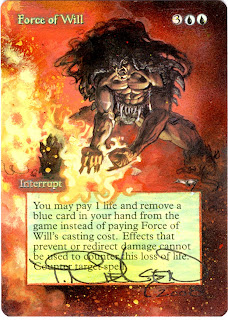
With Star City Games hosting the Open Series Invitationals, the Legacy portion of the 10Ks has sparked great interest in the format. This is being demonstrated by increased attendance in Legacy events and a higher price on Legacy staples as well. If you have interest in playing Legacy, or even Vintage, now is the time to begin investing. Cards such as Force of Will, Tarmogoyf, and even Stifle are steadily rising in price. Once SCG announced that there would be a Legacy day at each SCG Open, I immediately sleeved up my all foil, altered art, signed by God Himself, Countertop 'Goyf deck.  It's a Bant-colored archetype abusing Sensei's Diving Top and Counterbalance synergy to create a soft lock and "get there" with low-cost creatures.
Sadly, the cards weren't all signed, nor foil.
In actuality, the deck did not even exist.
I was ready to invest in the eternal goodness of Legacy, where a 5/6 costs 1G, being tapped out means nothing, and where Ad Nauseam is actually playable. After doing some research on the popular archetypes in the format, I found out there wasn't really a Boogey-man (see Jund in Standard) deck to hate out. This showed me one of the great aspects of Legacy; there is no such thing as THE deck to beat. There are a wide variety of archetypes to choose from, each having strengths and weaknesses. The three types of decks are well balanced between Control, Combo and Aggro, and with a super-silly amount of cards to choose from, there is a large variance in what you'll see in a given tournament. I began meeting with local Legacy players, asking them what they felt was a good deck to break the ice with, and play at upcoming local tournaments. They insisted a combo deck would be a good choice since the decks are relatively easy to pilot, and it often just builds towards one specific goal.
I didn't listen to them.
Since tapping the card, 'Island' was one of my favorite pastimes, I decided to build the U/G/R Tempo-Control deck known as 'Canadian Threshold' or 'Tempo Thresh'. This deck features 8-10 creatures, 18 lands, plenty of cantrips, removal, as well as counterspells to get yourself to your end game, while your opponent scrambles to get off their feet.
'Tempo Thresh'

4x Tropical Island
4x Volcanic Island
4x Wasteland
3x Scalding Tarn
3x Misty Rainforest

4x Tarmogoyf
4x Nimble Mongoose
2x Vendilion Clique

4x Lightning Bolt
4x Fire/Ice
4x Brainstorm
4x Ponder
4x Force of Will
4x Daze
4x Spell Snare
4x Stifle

Though the deck's cost is around $850, most if not all of the cards can be used in other archetypes within the format. Dual Lands, Tarmogoyf, Force of Will and Wasteland will be the biggest investments. But they are just that - investments. Shelling out a few bills for decade-old cards will not be a common occurrence. Unlike standard, Legacy cards never rotate, meaning my Force of Wills will continue to pitch a blue spell for a free counter in years to come!
When I began building the deck, I was fortunate enough to have a friend that was looking to sell his collection. I picked up Force of Wills, Tarmogoyfs, as well as several out-of-print un/commons from him for a disgustingly cheap price. I was also able to find $1+ commons, in the commons bin at my local card store for $.10/each. If your local shop has a un/commons bin, it is worth the 15 minutes to rummage through for cards such as Brainstorm, Ponder, Daze, and Lightning Bolt. In the weeks following, I checked eBay, my brother's collection (Sorry Joe), and the backs of binders at FNM to complete my deck. Often times you'll find non-Eternal players more than willing to trade their "old cards" for Standard goodies. Do that. Do that often. 2 Day of Judgements and a Meddling Mage is much easier to acquire than a mint FoW. 
This all being said, Legacy is becoming a format certainly worth investing in, and I am very excited to dive deep into it. Tomorrow, I will give a report on my first sanctioned Legacy tournament, and explain some budget-friendly archetypes that are viable in Legacy.
Hoping to never skip the Draw Step,
John Ugalde
 

4 Worldwake Spoilers!

Are you a Quiet Speculation member?

If not, now is a perfect time to join up! Our powerful tools, breaking-news analysis, and exclusive Discord channel will make sure you stay up to date and ahead of the curve.

Although not 100% exclusive to Quiet Speculation, we've been granted an early peek at some spoiler cards!  We'll have an EXCLUSIVE card before the prerelease comes along, but for now, these should whet your appetite.

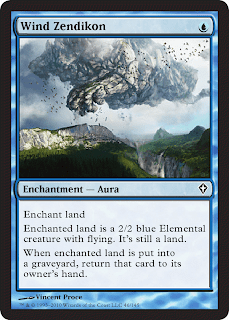
Wind Zendikon: I had been discussing the interactions with Fetch Lands with a few people via AIM and Twitter and our main thought was "wouldn't it be nice if there was a 1-cost Zendikon"?  This allows aggressive decks to get multiple Landfalls in a turn easily by turning a fetch land into a 2/2 flier.  Sacrificing the fetch land, recurring it with Wind Zendikon, and replaying it gives decks access to 3 Landfall triggers in a turn.  The potential is endless, and at worst, this card is a 2/2 flier for 1U.  Might not have a home in Standard, but should be a high draft pick and has a ridiculous amount of synergy.

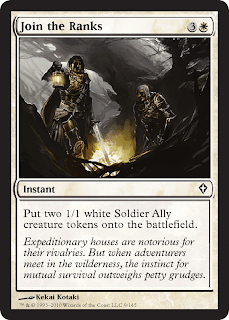
Join the Ranks: This card used to cost 1W when it was in Mirrodin, but by giving the creatures an Ally subtype has serious implications in Limited.  It's probably too slow for Constructed, although the milling Ally will pair naturally with Join the Ranks and Hedron Crab.  In Limited, it's a combat trick with potential for good synergy.  It gives the Ally draft decks something to look forward to in pack 3.

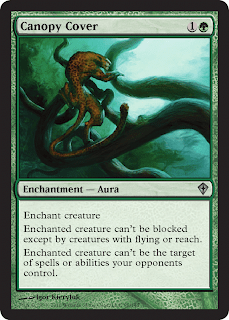
Canopy Cover: It's pretty unexciting, but turning some creatures into a Silihana Ledgewalker can be deadly.  Auras rarely see constructed play, but expect this to be a nice late pickup in Limited.

Quest for the Nihil Stone: Well hello there.  My name's Blightning.  What's a pretty young thing like you doing in a dump like Zendikar?  Why don't you come on over to Alara.  We can have a nice glass of Mind Rot and then maybe I can un-Duress you.  Don't mind the Rotting Rats, my cat drags them in.  Making players discard cards is usually not difficult, especially considering the Jund deck's main killer, Blightning.  Whether it fits in Jund or not is debatable, but with access to the discard named above and Sedraxis Specter, Scepter of Fugue and Esper Charm, keeping your opponent's hand empty is not entirely too difficult.  It lacks the leniency of The Rack, which would do a modest amount of damage if their hand was only kind of empty, but the fact that it Lava Axes your opponent each turn for not having cards is really fabulous.  This also has natural synergy with Bloodchief Ascension, so we may see this combine with cards like Megrim and heavy discard.  Casual players are sure to go wild for this card, but it's entirely possible to see it in Tier 1 decks at the post-Worldwake 5K tournaments.  This is one that I'll be pre-ordering aggressively.

Kelly Reid

Founder & Product Manager

View More By Kelly Reid

Posted in Uncategorized11 Comments on 4 Worldwake Spoilers!

Have you joined the Quiet Speculation Discord?

If you haven't, you're leaving value on the table! Join our community of experts, enthusiasts, entertainers, and educators and enjoy exclusive podcasts, questions asked and answered, trades, sales, and everything else Discord has to offer.

Want to create content with Quiet Speculation?

All you need to succeed is a passion for Magic: The Gathering, and the ability to write coherently. Share your knowledge of MTG and how you leverage it to win games, get value from your cards – or even turn a profit.

Sam Stoddard on Proxies in Eternal Formats

Are you a Quiet Speculation member?

If not, now is a perfect time to join up! Our powerful tools, breaking-news analysis, and exclusive Discord channel will make sure you stay up to date and ahead of the curve.

Sam Stoddard joins us today to discuss the issue of diminishing accessibility in the Eternal community.  Sam is the author of the well-known Fearless Magical Inventory, and has made multiple appearances on the Pro Tour.  He hosts the In Contention Podcast and has written for many Magic the Gathering sites in his elongated tenure in the game.

Legacy and Elder Dragon Highlander have done a tremendous job recently of keeping the
prices of old cards on the rise. Three or four years ago, you could
pick up a revised Tropical Island for around 20 bucks. Today,
you'd pay at least $40. The prices on some of the historically more obscure cards like Grindstone have seen even greater rises. Even older power-uncommons like Wasteland have begun to hit $15. This is good for
dealers, who have an even deeper set of cards to make money on, and
Wizards, for whom it solidifies the 'collectible' nature of the game.

There is a limit to all good things, however. Although we've seen a few $50 standard rares in the past few years (Tarmogoyf and
Baneslayer Angel come to mind), they never suffered from long term card
availability issues. Short term, yes, but enough of these exist that
they are still shuffled around pretty regularly. You may not want to
pay the cost of the cards, but you can find them. Not so with cards
like The Tabernacle at Pendrell Vale or Imperial Recruiter. These
cards are in short supply, and their cost reflects that. Recruiter is
now a $150 card, while Tabernacle, if you can find one, is approaching
$270, making it currently the most expensive land outside of Beta.

We are getting close to the time where action is required keep Legacy, and Eternal formats in general, within reach
of most players. Almost every pack of sets like Legends and Portal 3
Kingdoms in the wild has been opened. Cards are still being lost,
stolen, destroyed, or otherwise removed from circulation every day. If
the demand stays anywhere near the same level, the prices will
continue to increase. In addition, as the oldest Magic cards approach seventeen
years of being shuffled in decks, we will begin to see more and more
of them becoming tournament unplayable due to condition. I believe we
have come to the time when Wizards needs to develop an official policy
on using proxies in sanctioned events.

Now, when I say proxies, I don't mean the letters FoW scribbled on the
back of a land and put in a sleeve. Ideally standards can be set up to
ensure that the presence of these cards disrupts gameplay as little as
possible. Proxies should be standardized. This is where Wizards would
come in. They could easily print a number of semi-blank cards that
players could fill in. Two of each color, and for artifacts (one frame
for creatures and one for spells), and a land card. Create a formal
requirement for these to be filled out with complete information. The
card name should appear in small text in the top right, and in much
larger text in the picture box. You would fill your deck list out like
normal, but you would also list all of your proxies in a special
section of the registration sheet. If you were found to have falsified this
information in a deck check, you would be awarded either a game loss,
or disqualified. If a proxy has incomplete information, is illegible,
or otherwise looks shady, a warning can be issued.

While that is a start, I also think it is important not to simply
allow any number of proxies a player wishes. There has to be a
balance between preventing extreme cost and availability issues from
choking a format, and retaining the collectible nature of the game.
Five proxies per deck seems like a good number to allow. In addition,
you don't want proxies to simply become a way for people
to purchase fewer cards. This should be a way to ease card availability
issues. With that in mind, the rule could state that you can only proxy
cards which haven't seen print since a certain date. Ten years would
let you proxy Force of Will, Imperial Recruiters and Ravages or War.
FIfteen years would let you proxy only the sets before Homelands.
This aging solution also means that you don't need to restrict proxies
to only sanctioned events in Legacy and Vintage - the age restriction
automatically removes them from Standard and Extended. If Wizards ever
wants to sanction EDH, then they can do so and keep this rule in
effect.

There must also be a penalty for playing with proxies. My first idea
was to allow the player with the least proxies to choose play or draw,
then roll off in case of a tie. That seemed far too drastic. I was
discussing the idea of  sanctioning proxies with my friend Matt
Kransteuber, I came up with a few more reasonable ideas:

1) Proxies become a part of your tie breakers at the end of the Swiss
rounds.  Each proxy in your deck (up to 5) removes one percentage point
from your Opponent Match Win when the final standings go up. This
means that if you go x-0-2 or x-1, you will probably still top8 a
tournament, but the more proxies you have, the worse your chances of
top8ing with an x-1-1 record. Because this is adjusted after the final
round of Swiss, your number would not effect your opponent's
tiebreakers.

2) Proxies cost a sideboard slot (up to 15 proxies). In this scenario,
if you want to play 43land but you don't have Tabernacles, you can
make the decision to not get the card, but you will only have 13
sideboard slots. This would provide a solid incentive for people to
acquire the actual cards for the deck, but allow them to compete
without them.

Matt had a third way, which he felt was more fair:

3) You can proxy up to 5 cards, but you pay an additional entry fee
for each one. I'm not sure what the exact correct price would be, but
something in the $1-2 range seems reasonable. This would be marked on
your sheet, and if you were found to lie about it, you would be
disqualified.

I ran this by another friend and legacy player Andrew Cooperfaus who
pointed out that the extra money involved here would go a long way
towards encouraging more tournament organizers to run legacy events.
At two dollars a proxy, it wouldn't be unheard of for a TO with good
turnout to earn an extra three hundred dollars at an event.

I don't think that any of these solutions are perfect. Each has
serious implications for the format, but I think they are a good
starting point. If the classic formats are going to continue to see
the kind of growth they have in recent years, something has to be done
to ease the point of entry costs. I don't believe that any of these
solutions would severely hurt the average price of legacy cards, but
it would keep the most expensive cards from creating a format that has
distinctive tiers of decks based solely on card cost. The older Magic
becomes, the more important this issue becomes. There will come a time
when card condition and availability becomes a breaking point for
older formats. The more proactive Wizards is about it, the better
chance that time will be far in the future.

 -------

Editor's Note:  I feel strongly on this issue, and rather than distracting from Sam's great post with a followup article, I want to add a few things that are my own responses to his ideas.

1)  You must find a way to ensure that proxies do not replace the use of the cards themselves.  By allowing 5 proxies, you essentially zero the playable value of the top 5 cards in a format.  Obviously that math isn't 100% correct but by allowing a small penalty
to replace a card that's $200 or more, you're playing with fire.

2) You must give players an incentive to play with the real thing.  This is tied directly to point 1.  An extra 10 dollars a tournament doesn't make financial sense.  I'd rather play 10 tournaments with proxies than buy a Tabernacle and a slew of other power cards.  Trading a sideboard slot is pretty drastic, but I think that is the level on which we need to be.  Players need to lose a competitive edge by playing with proxies to remove finances from the equation altogether.  If your deck can handle a 10 card sideboard,  you can proxy 5 cards.  5 should really be the limit, and that might be too high for Legacy.  Revised Dual Lands are still abundant, although somewhat expensive.  The bottom line is, we're concerned with cards like Power and Bazaar of Baghdad and Tabernacle, not cards that can be had for the price of Standard's elite rares.

My suggestion a while back was to circumvent the Proxy issue entirely and dodge the Reserved list clauses by printing a significantly limited quantity of promotional, commemorative Power 9 cards.  They would be on the old borders, with original art, but would be premium cards (which the Reserved list would allow) with a date stamp like a pre-release card.  Wizards would then hold something akin to what Star City Games is doing with their Legacy 5K schedule, and distribute these cards to the Top 8.  Give Top 8 a set of Power, and give 9th place a "Wild Card" shot at the last piece.  This also preserves the integrity of the Top 8 and discourages prize splitting.  This would have to be done tastefully, carefully, and with the guarantee that they would not just keep printing more and more copies of Power.  Look how the Judge foils don't really effect prices of their regular-print analogues.  This is the best way to introduce more Power into circulation without sliding down the slippery slope of proxy cards.


Guest Author: Noah Whinston – Another Angle on Standard

Are you a Quiet Speculation member?

If not, now is a perfect time to join up! Our powerful tools, breaking-news analysis, and exclusive Discord channel will make sure you stay up to date and ahead of the curve.

Hey everyone, my name is Noah Whinston. For those who don’t know me, I’m very involved with Magic strategy content.  I’m a paid writer for tcgplayer.com, a podcaster for blackborder.com and I maintain one of many Magic blogs at Tends Towards Infinity.  There, I do something that I haven’t seen all that much anywhere else: I provide MTGO Constructed walkthroughs by recording games as I play them along with my commentary and thought process. I’ve also recently started doing Deck Techs with the decks I use in the videos so that viewers can get a better idea of the specific cards in them. If this sounds like something you’d be interested in, don’t hesitate to check out my work.
My history with Quiet Speculation is shorter. I first started reading the site just before Kelly made his Bushwhacker Breakthrough, as I like to call it.  After Boros top 8ed the first Star City Games 5k, Kelly was kind enough to discuss the deck with me, and provide me some excellent quotes for my first article on TCG Player.  From then on, I have been one of the sites many devotees, and base all of my card investments on it. I’ve wanted to write a guest spot for the site for a long time, but have never found the time until now, so I’m glad to finally be here.
The main topic I wanted to talk about today is a financial response to the Standard portion of the recent Star City Games 5k. The winner was Louis Scott-Vargas, well known for his appearances in Pro Tour top 8s, piloting a UWR Control deck. The deck put another copy into the top 8 in the hands of Jeff Huang.  It is built around a defensive shell of Wall of Denials, cheap spot removal like Lightning Bolt and Path, and counterspells like Flashfreeze. After getting itself out of the early game, the deck takes control of the board through Earthquake and Ajani Vengeant, keeps its hand full with Jace and Mind Spring, and finishes off the opponent with Sphinx of Jwar Isle. 
I don’t know how many of you are familiar with the theory behind stages of a game of Magic, so here it is in a nutshell. The game starts off in stage 1, where players play out their first few turns, build up their mana, but do little that affects the board. In stage 2, the midgame, the board becomes more cluttered as players drop reasonably sized creatures. And in stage 3, the finishers come down to end the game.
To give an example of this stage theory, Mono Red is a deck that is heavily focused on stages 1 and 2. It wants to come out of the gates quickly and finish off the opponent before it can get outpowered.
On the other hand, a control deck wants to get out of the early stages of the game as fast as possible so that it can deploy its undeniably more powerful cards, but to do so it needs the tools to make sure it is not overwhelmed in the early game.
So as an immediate aftereffect of these results, the number of people playing UWR will rise, perhaps even more than normal because they see a well-known pro playing it. To look at how to exploit a metagame full of UWR Control and Jund (because that, as we know, is ever-present), we need to use Stage theory to exploit these two decks’ weaknesses.  Both Jund and UWR Control have a weak stage 1.  Jund decks rarely run Putrid Leech anymore, so their first board presence is going to be a turn 3 Thrinax at the earliest. UWR Control is in the same situation, but starts out with a turn 3 Wall of Denial. Because of both these decks weak early games, a fast aggro deck seems like a good way to attack these strategies. Here, our two options are Boros and Mono-Red.  Boros has been falling by the wayside as of late. It has a poor matchup vs. Jund, due to Boros’ inability to recover from having its first two threats Bolted. Mono-Red, on the other hand, is well-known to have a good Jund matchup. Mono-Red has seen a large rise in play, up to the third most popular deck at the 5k, because of this Jund matchup, but it’s matchup against UWR is less good. Why? Because Wall of Denial is really good against 6/1s that die at end of turn. What Red lacks is a way to push through late-game damage  amidst a barrage of counterspells and Planeswalkers. To deal with this weakness, I’ve been brainstorming up a Red deck fast enough to out-race Jund, but still having late game threats that can deal with a Control deck. I introduce to you, Big Red:
4 Arid Mesa
4 Scalding Tarn
3 Teetering Peaks
2 Valakut, the Molten Pinnacle
12 Mountain
4 Goblin Guide
4 Plated Geopede
4 Hellspark Elemental
4 Ball Lightning

4 Hell’s Thunders
2 Obsidian Fireheart
2 Siege-Gang Commander
4 Lightning Bolt
4 Burst Lightning
3 Earthquake
I based this list off of an article by Adrian Sullivan on Star City Games. In it, he talked about some of his ideas for Mono-Red at States, and his innovative use of the late game card slots opened my eyes. Prior to then, all of the Red decks I had constructed, and most of the ones putting up good results at tournaments, used their 4 drops for 4 Quenchable Fire, an understandably fine choice in a format with no Blue. With Blue back in the metagame, it’s a much better strategy to have a late game consisting of repeatable damage sources.
Obsidian Fireheart is the first of these. Fireheart is not only excellent against Control if you can get it to stick, as it will become uncounterable burn turn after turn, but is also decent vs. Jund and other midrange decks.  The base power and toughness of a creature in Standard at the moment is 3/3, and having 4 toughness makes Obsidian Fireheart one of the bigger bodies on the board.  Sullivan’s original list ran 2 copies of Elemental Appeal instead of my 2 Siege-Gang Commanders, but to fit the theme of repeatable damage and card advantage, I think Commander is a better choice.  It’s very good against Control because if it resolves, only a Day of Judgment or Earthquake can really clean up the board.  If you can untap with it, you can likely convert it into 6 points of direct burn.

By replacing cards like Quenchable Fire with Commander and Fireheart, we remove effective card disadvantage from the deck. If you point a Quenchable Fire at your opponent’s head and it doesn’t kill them, you have achieved nothing unless you have the ability to kill with the remaining cards in your hand. It’s the last burn spell that kills you.
On the other end of the spectrum, we can exploit weakness in Jund’s and UWR Control’s stage 3. Grixis Control has a tremendously powerful lategame, one that can take out both Jund and opposing control decks.  Grixis decks have the ability to run the card advantage titan Cruel Ultimatum, which outpowers any other deck in the field when it resolves. Cruel Ultimatum combined with Sorin Markov and the nigh-immortal Sphinx of Jwar Isle give Grixis the undisputed best late game in the format, but getting there is sometimes half the battle.
How can you capitalize on these metagame fluctuations? One of the most overlooked tools in a trader’s arsenal is the ability to predict trends not just one step ahead, but two steps ahead of everyone else.  For example, if Dredge wins a Pro Tour, buying up not just Dredge cards, but anti-Dredge sideboard cards is a smart move. While it’s true there’s more risk involved in trying to be that far ahead of the curve, the rewards available for reaping are so much the greater. So if UWR wins a 5k, while everyone else may be buying up their Ajani Vengeants and Jaces, you could be looking ahead to your Cruel Ultimatums and Ball Lightnings.  Using this strategy, you can be on the bleeding edge of the metagame at all times and always be trading in relevant cards. 

Boot Camp – Los Angeles 5K Open Analysis by David Campano

Are you a Quiet Speculation member?

If not, now is a perfect time to join up! Our powerful tools, breaking-news analysis, and exclusive Discord channel will make sure you stay up to date and ahead of the curve.

This past weekend brought us the first major Magic tournament of the new decade, and what a tournament it was.  Over 300 people made their way to sunny Los Angeles, California for their chance to win a spot at the Star City Games Invitational and a big pile of cash.  When the dust had settled, Louis Scott-Vargas stood at the top holding the trophy triumphantly. His deck of choice? A metagame-tuned Blue/White/Red Control deck that rode past two Jund decks in the Top 8 to claim the final prize.
The first major takeaway from all the tournament reports is the excessive amount of Jund being played.  1/3rd of the field was playing Jund, including the new “Jund with Blue” decks that have been surfacing recently.  Not only has Jund been showing up, Jund has also been winning. 9  of the top 16 decks from Los Angeles were Jund, with 2 of the lists reaching the semifinals and another making it all the way to the finals but coming up short. [sorry, Arthur!  -kbr] Though commonly criticized by the Magic community as being an “auto pilot deck”,  Jund has shown its resilience and continues to stay strong. Every new deck that comes out claims it can beat Jund, but as proven by this tournament, there is no one deck that can hate Jund out of this metagame. Even decks that can beat Jund 75% of the time still fall short to one of Jund’s many different god hands. One example is the all too common turn 2 Leech, turn 3 Blightning, turn 4 Bloodbraid into Blightning. Not many decks can come back from that much damage and resource disruption.
The breakout deck from the 5K was definitely the winning Blue/White/Red Control list piloted by Louis Scott-Vargas and his Channel Fireball crew as well as other notable professionals such as Brian Kibler.  The deck was highly metagamed to beat Jund, with mainboard Flashfreeze and Spreading Seas. The plan game one is to take control of the board with various Planeswalkers, while keeping your life total in check with Wall of Denial and various counterspells. Once gaining board control, you drop Sphinx of Jwar Isle to finish off the game. Having only shroud creatures game one shuts down all of your opponents removal, and they will often side most of it out for game two. This is where the fun begins, because you bring in four Baneslayer Angel from the board and prey on your opponent’s lack of removal with the most expensive card in Standard. This “surprise” caught many decks off guard, which probably played a role in the deck’s high win percentages. However, as this deck becomes more popular, the “Baneslayer Surprise” will be more expected and decks will continue to leave in removal. Of course, UWR can adapt and choose to not sideboard the Baneslayers in, making the removal just as dead as game one.
With the 5K Standard Open in Dallas fast approaching this weekend, finding the right deck to play can be a hassle. The metagame will almost definitely be heavy Jund and UWR Control with some RDW/Barely Boros decks floating around as well. A deck that wants to be competitive needs to have a good matchup with Jund and UWR, but can’t outright die to RDW either. This could be Vampires time to shine. Every pro who brought UWR with them to the 5K in Los Angeles said that Vampires was by far their worst matchup. Mind Sludge is absolutely insane, and Gatekeeper of Malakir and Vampire Nighthawk do a great job at holding off Wall of Denial and Sphinx. Plus, Malakir Bloodwitch is an absolute bomb. Not dying to Path to Exile and having the ability to block Baneslayer all day really puts Bloodwitch ahead of UWR. Vampires are highly favored in this matchup and would be a smart deck to run if you plan on facing a lot of UWR.
However, Vampires definitely aren’t the answer to the current metagame. Though the matchup is highly favored against UWR, the Jund matchup is not so straightforward. Jund has better cards than Vampires, and unlike UWR, doesn’t struggle against Bloodwitch and friends. Jund can take control of the game a turn or two faster than Vampires, which makes the matchup very difficult to win for the Vampire player. If you plan on playing Vampires, make sure to have at least 4-8 dedicated Jund hate cards in your sideboard. Another route would be splashing a color for additional spells. A Black/Red Vampires list made the Top 16 in Los Angeles, proving that Vampires have what it takes to make it to the top tables. The combination of Blightning, Terminate, and Lightning Bolt tacked on to the already solid Vampire package made the deck much more consistent and made the Jund matchup much more winnable.
Overall
, if you plan to play in one of the Standard tournaments going on this weekend - Star City's Dallas 5K, Pastimes' Midwest Masters in Indianapolis, or your local FNM, plan to face a fair amount of Sphinxes and Bloodbraids. These two decks will probably make up almost half of the field combined so be prepared. Vampires might be a possible answer to UWR and with the right sideboard plan could give Jund a run for their money. Financially speaking, if Vampires do come out on top, look for Sorin Markov and Malakir Bloodwitch to jump in price slightly. Malakir probably won’t get too out of control thanks to her inclusion in the black theme deck, but Sorin is already in double digits, and could easily hit $20 if Vampires become a force to be reckoned with.
Thanks for reading,
David Campano
I will be attending the Star City Games 5K in Dallas this weekend so if you will be attending, feel free to say hello.  I will be keeping tabs on the tournament all day, so check my twitter (@dcampa93) for metagame reports and any breakout tech that may make it to the top tables.

German Legacy Tech

Are you a Quiet Speculation member?

If not, now is a perfect time to join up! Our powerful tools, breaking-news analysis, and exclusive Discord channel will make sure you stay up to date and ahead of the curve.

Courtesy of reader Matthias, fresh from Germany, is this off-the-wall combo deck.  It uses mana acceleration and Lim-Dul's Vault to fire off a Show and Tell and dump Dream Halls into play.  Using any colored card in your hand, you cast Conflux for free, tutoring up 2 Cruel Ultimatums and 3 Progenitus.  Use 2 of the Progentus to cast 2 Cruels, empty their hand, draw 6, and use one of the card you draw to stick Progenitus.  Pass the turn, untap, and kill them.   I haven't actually seen this in action, but from the list, this is the win that makes the most sense. 

Show and Tell and Dream Halls have already seen some movement and are VERY hard to find online right now.  Bear in mind that the deck will be available on MTGO as soon as Urza's Saga hits shelves.  Conflux is a Mythic rare that's still dirt cheap all over, so grab a bunch and ride the lightning.

4 Flooded Strand
2 Scalding Tarn
5 Island
1 Polluted Delta
3 Ancient Tomb
2 Underground Sea
1 Bogardan Hellkite
4 Progenitus
4 Dream Halls
4 Show and Tell
4 Brainstorm
4 Ponder
4 Force of Will
3 Cruel Ultimatum
4 Conflux
3 Lotus Petal
4 Thoughtseize
4 Lim-Dul's Vault

Sideboard
1 Hydroblast
2 Pithing Needle
1 Rushing River
3 Propaganda
2 Duress
2 Meditate
4 Spell Pierce

Kelly Reid

Founder & Product Manager

View More By Kelly Reid

Posted in Uncategorized7 Comments on German Legacy Tech

Have you joined the Quiet Speculation Discord?

If you haven't, you're leaving value on the table! Join our community of experts, enthusiasts, entertainers, and educators and enjoy exclusive podcasts, questions asked and answered, trades, sales, and everything else Discord has to offer.

Want to create content with Quiet Speculation?

All you need to succeed is a passion for Magic: The Gathering, and the ability to write coherently. Share your knowledge of MTG and how you leverage it to win games, get value from your cards – or even turn a profit.

Adrian Sullivans (rumored) PTQ List

Are you a Quiet Speculation member?

If not, now is a perfect time to join up! Our powerful tools, breaking-news analysis, and exclusive Discord channel will make sure you stay up to date and ahead of the curve.

PTQ":

Main Deck

4 Arid Mesa
2 Blood Crypt
1 Gemstone Caverns
2 Ghitu Encampment
1 Godless Shrine
4 Grove of the Burnwillows
4 Marsh Flats
1 Mountain
1 Plains
1 Sacred Foundry
1 Swamp

3 Countryside Crusher
4 Dark Confidant
3 Simian Spirit Guide

4 Bloodchief Ascension
3 Burst Lightning
4 Isochron Scepter
4 Lightning Bolt
4 Lightning Helix
3 Path to Exile
4 Punishing Fire
2 Terminate

Sideboard

3 Dead // Gone
3 Engineered Explosives
3 Extirpate
1 Hide // Seek
1 Relic of Progenitus
4 Thoughtseize

Bloodchief Ascension, Adrian Sullivan, the PTQ

Are you a Quiet Speculation member?

If not, now is a perfect time to join up! Our powerful tools, breaking-news analysis, and exclusive Discord channel will make sure you stay up to date and ahead of the curve.

I'm just getting this now - apparently Adrian Sullivan top 8'ed with a deck featuring Bloodchief Ascension and Isochron Scepter, and copious amounts of burn.  Apparently, Bloodchief punishes players for untapping their Shock Lands, which seems utterly amazing in Extended these days.  I'm still waiting for full confirmation, and apparently Adrian is not shipping out his list, but this is what I'm told.

Happy New Year from QuietSpeculation.com!

Are you a Quiet Speculation member?

If not, now is a perfect time to join up! Our powerful tools, breaking-news analysis, and exclusive Discord channel will make sure you stay up to date and ahead of the curve.

I'd like to thank all of my readers for their time, attention, feedback, and praise of this site in 2009!  2010 will mark the first full year of Quiet Speculation's existence, and I can assure you it will be filled with all kinds of incredible surprises!  Worldwake spoilers are starting to roll in, so brace yourselves for another month of card evaluations. 

I've got a lot of really groundbreaking projects in the works, and you can expect to hear about them here, and via Twitter, where I can be reached @kellyreid.  In the waning hours of the millennium's first decade, I want to extend my heartfelt gratitude, literally, to every single person who's read this site since we launched in May.  It's been more successful in 7 1/2 short months than I could have ever hoped. 

I'm looking forward to adding even more guest and staff writers in the coming year, as well as making behind-the-scenes changes to the site.  I'm also looking forward to making improvements to things like the ever-popular ticker, expanding further into MTGO and developing resources for fellow card speculators.  Magic players are often at the cutting edge of technology, and are consistently some of the smartest and most driven people I know.  I will be working tirelessly with many members of the MTG community to utilize technology to the fullest.  The game has come so far since 1993, but we've really only scratched the surface in terms of our understanding of the game and its economy. 

With under four hours until Midnight here in the Eastern Standard time zone, I want to once again thank all of my readers, contributors, fans, and the other members of the community who helped spread the word and get the Quiet Speculation name into bookmark lists of Magic players everywhere.  This site would be nothing without you.  We'll see you in 2010!

Warm wishes for a safe and happy New Year celebration,

 Kelly B Reid
Editor, Quiet Speculation

Guest Author – 2009’s Hits and Flops by Russel Tassicker

Are you a Quiet Speculation member?

If not, now is a perfect time to join up! Our powerful tools, breaking-news analysis, and exclusive Discord channel will make sure you stay up to date and ahead of the curve.

Hi folks, this is Russell from Gwafa’s Bazaar with a guest spot for all you fine readers of Quiet Speculation. As Magic’s biggest ever year draws to a close, it’s time to look back and see what we’ve learned along the way. For card speculators, that means reviewing surprise hits and over-hyped flops. I’ll look at the top 5 of each, but feel free to chime in with your own hits and misses in the comments below!

Hits

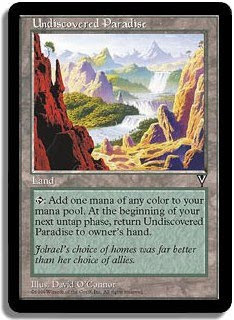
5. Undiscovered Paradise

For every card from new sets that makes its way into the eternal formats, there are just as many hidden gems from old sets that find a home. Because of their generally lower circulation and the number residing in the collections of lapsed players, their price can skyrocket in a matter of hours. Undiscovered Paradise was appropriately named until Bloodghast appeared in legacy Dredge lists. It remained undiscovered, and trading for a dollar or two, but now a playset will set you back around $50. With the Star City Games Legacy $5k events happening throughout 2010, this land not likely to fall anytime soon.

4. Windbrisk Heights

A fine example of how metagame shifts affect card prices, the rise of white-based token decks in early 2009 showcased the previously unrecognised power of Windbrisk Heights. Card advantage and free spells? Overrun at instant speed? Yes, please. The "Hideaway" mechanic was scorned when Lorwyn first appeared, and people at prereleases groaned about opening these. From the dollar bins to a high of nearly $20, rotation has seen Heights take an inglorious tumble back to its previous budget price. Its meteoric rise demonstrates just how easy it is to miss a future format staple.

3. Dark Depths

Lands, lands and more lands! While the value of dual lands is usually obvious from the get-go, unique lands like these are often sleepers, and none slumbered more deeply than Dark Depths. A casual favourite from a rubbish set, Dark Depths was worth a few bucks at the start of the year. Zendikar’s Vampire Hexmage turned it into a busted extended tournament rare, and the price shot past $25 around Pro Tour: Austin. Hexmage/Depths is a real deck, even showing up in legacy, so don’t expect this land to drop in price in the near future.

2. Vampire Nocturnus

‘Why did they print this card?’ was a question asked by many players when M10 emerged, and it’s a question that should be asked of every new card. A savvy speculator would have noticed that Vampire Nocturnus is not your average lord. It’s a mythic rare, and if there were more vampires to come it would be very strong and in demand. Casual players love tribal decks and everyone loves vampires! Reasoning that they must be printing more vampires, since giving flying to a tribe of fliers is silly, playsets could be had for pennies. With more vamps to come in Worldwake, the mono-black decks could become top-tier, at which point this guy’s price would go slightly higher.

1. Baneslayer Angel

Nobody thought the marquee mythic of Magic 2010 would be a sleeper hit, but somehow Baneslayer has managed it. Kelly has already discussed the perfect storm that formed around her – set in short supply, casual appeal, tournament powerhouse. Starting at around $15, Baneslayer has only gone up from there by threatening to dominate standard, extended, and kitchen tables everywhere. She saw the biggest jump after Ben Rubin and Brian Kibler built a pro-tour winning deck around her, and she is now trading at Tarmogoyf prices with little hope of a price dip even if she rotates out in M11.
[Note: For a few hours, Baneslayer Angel could be pre-ordered from Star City Games for $7 each. Dang. -KBR]
 

Misses

5. Lord of Extinction

People are still having trouble properly valuing mythic rares. The promise of a huge dude for five mana got some people very hot under the collar, and this card started up around ten bucks. No evasion and no way to protect itself made Lord of Extinction just another fatty, and one has to wonder if they printed a 1000/1000 creature for five mana, would it see play? Probably yes, but that doesn’t save Lord of Extinction from the bargain bins.

4. Silence

Heralding the new, powerful, tournament worthy core sets was Silence. Orim’s Chant in standard? Unbelievable, get your preorders in now! White Weenie was theoretically amazing, but it hasn’t panned out that way, and Silence didn’t even show up in Rob Dougherty’s Worlds WW deck, or Joel Callafell & Kenny Oberg’s fog deck. Fittingly, the card hasn't even been mentioned in months and it seems to have sunk without a trace from an initial price around $10.

3. Jenara, Asura of War

A tournament worthy legendary angel at mythic rare, Jenara should by all rights have taken the same path as Baneslayer Angel. Starting in the mid teens Jenara has seen an inexorable slide as people found out she wasn’t as tournament worthy as first thought. Bant decks have generally preferred Rhox War Monk as the big rhino eats Lightning Bolts for breakfast and blocks Bloodbraid Elf all day, and as such, Jenara has settled at around $3.

2. Meddling Mage

A reprint of a previously powerful, expensive card seemed like a sure winner and both ARB and Planeshift Meddling Mages went up to $12-$15 in May, even amongst the furor over printing an invitational card without the invitational portrait in the art. A hostile standard metagame full of red burn spells has seen that figure tumble to below $4 at present, though it could see a bounceback now that extended season has rolled around. Picking some up these days is not a bad idea.

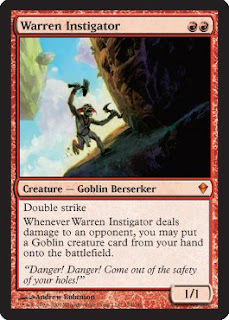
1. Warren Instigator

Heralding the doom of magic once again, Warren Instigator was all the proof a lot of watchers needed that "Wi$ard$ of the Coa$t" was printing more and more busted mythics that weren’t legends, weren’t planeswalkers, and weren’t what we’d been promised at all. Goblin Lackey is $10 at uncommon, and here was a mythic double-striking version! This guy preordered above $10 but dropped very quickly when people realized Goblins weren’t going to make it in the current standard environment. The magnitude of the price drop is not why he makes the list. It's the hype and the wailing and gnashing of teeth that surrounded his reveal. Mindbreak Trap was much the same story. People were speculating that both would be tournament staples, and nothing has been farther from the truth...yet. We already know there will be more new goblins in Worldwake and if they become a factor, Warren Instigator will certainly play a main role.

In success and failure, one can always learn lessons. First, mythics aren’t as rare as people thought they would be. Tournament playabilit
y is still the most important part of a card’s value and a decent standard rare is still going to be worth much more than the Mayael the Anima rotting in your trade folder. Second, cards that do unique things are worth acquiring, just in case. Especially lands. Third, don’t believe the hype. For every Baneslayer Angel that starts high and just goes higher, there is a Jenara, or a Meddling Mage, or a Warren Instigator to blow out your wallet. Unless you personally have a sick read on a card and can justify its astonishing power and place in the metagame, don’t buy the expensive singles at release. They usually come down after a few weeks.

Finally, when you’re considering new cards, consider why R&D; chose to print them. Mark Rosewater tells us constantly how R&D; thinks about the game, and they aren’t just printing any old junk they feel like. If a card doesn’t make sense given the cards around it, like Vampire Nocturnus, it could be a mistake, but it's more likely it could be a sign of things to come. Then again, it could be a sick joke, like poor old Halo Hunter. Lullmage Mentor doesn’t make much sense considering how bad counterspells are at the moment, so maybe we should expect more of those coming soon.

I hope you’ve enjoyed this look back at 2009. The tournament scene is healthier than ever, smaller set sizes have brought rare prices down, Duels of the Planeswalkers is bringing thousands of people back to the game and the Wizards branding department has done a stellar job getting people excited about the new sets. 2010 promises to be just as good, with an extra large set in the shape of Rise of the Eldrazi and a ton of new Star City open tournaments to go along with the usual DCI gigs.

What would have been on your Top 5 lists this year? What great trades did you make in 2009? What "sick reads" did you have in the past 12 months? Sound off in the comments!

You can follow Russel Tassicker on his twitter feed and read more of his work on his site, Gwafa’s Bazaar!

Guest Author – 2009's Hits and Flops by Russel Tassicker

Are you a Quiet Speculation member?

If not, now is a perfect time to join up! Our powerful tools, breaking-news analysis, and exclusive Discord channel will make sure you stay up to date and ahead of the curve.

Hi folks, this is Russell from Gwafa’s Bazaar with a guest spot for all you fine readers of Quiet Speculation. As Magic’s biggest ever year draws to a close, it’s time to look back and see what we’ve learned along the way. For card speculators, that means reviewing surprise hits and over-hyped flops. I’ll look at the top 5 of each, but feel free to chime in with your own hits and misses in the comments below!

Hits

5. Undiscovered Paradise

For every card from new sets that makes its way into the eternal formats, there are just as many hidden gems from old sets that find a home. Because of their generally lower circulation and the number residing in the collections of lapsed players, their price can skyrocket in a matter of hours. Undiscovered Paradise was appropriately named until Bloodghast appeared in legacy Dredge lists. It remained undiscovered, and trading for a dollar or two, but now a playset will set you back around $50. With the Star City Games Legacy $5k events happening throughout 2010, this land not likely to fall anytime soon.

4. Windbrisk Heights

A fine example of how metagame shifts affect card prices, the rise of white-based token decks in early 2009 showcased the previously unrecognised power of Windbrisk Heights. Card advantage and free spells? Overrun at instant speed? Yes, please. The "Hideaway" mechanic was scorned when Lorwyn first appeared, and people at prereleases groaned about opening these. From the dollar bins to a high of nearly $20, rotation has seen Heights take an inglorious tumble back to its previous budget price. Its meteoric rise demonstrates just how easy it is to miss a future format staple.

3. Dark Depths

Lands, lands and more lands! While the value of dual lands is usually obvious from the get-go, unique lands like these are often sleepers, and none slumbered more deeply than Dark Depths. A casual favourite from a rubbish set, Dark Depths was worth a few bucks at the start of the year. Zendikar’s Vampire Hexmage turned it into a busted extended tournament rare, and the price shot past $25 around Pro Tour: Austin. Hexmage/Depths is a real deck, even showing up in legacy, so don’t expect this land to drop in price in the near future.

2. Vampire Nocturnus

‘Why did they print this card?’ was a question asked by many players when M10 emerged, and it’s a question that should be asked of every new card. A savvy speculator would have noticed that Vampire Nocturnus is not your average lord. It’s a mythic rare, and if there were more vampires to come it would be very strong and in demand. Casual players love tribal decks and everyone loves vampires! Reasoning that they must be printing more vampires, since giving flying to a tribe of fliers is silly, playsets could be had for pennies. With more vamps to come in Worldwake, the mono-black decks could become top-tier, at which point this guy’s price would go slightly higher.

1. Baneslayer Angel

Nobody thought the marquee mythic of Magic 2010 would be a sleeper hit, but somehow Baneslayer has managed it. Kelly has already discussed the perfect storm that formed around her – set in short supply, casual appeal, tournament powerhouse. Starting at around $15, Baneslayer has only gone up from there by threatening to dominate standard, extended, and kitchen tables everywhere. She saw the biggest jump after Ben Rubin and Brian Kibler built a pro-tour winning deck around her, and she is now trading at Tarmogoyf prices with little hope of a price dip even if she rotates out in M11.
[Note: For a few hours, Baneslayer Angel could be pre-ordered from Star City Games for $7 each. Dang. -KBR]
 

Misses

5. Lord of Extinction

People are still having trouble properly valuing mythic rares. The promise of a huge dude for five mana got some people very hot under the collar, and this card started up around ten bucks. No evasion and no way to protect itself made Lord of Extinction just another fatty, and one has to wonder if they printed a 1000/1000 creature for five mana, would it see play? Probably yes, but that doesn’t save Lord of Extinction from the bargain bins.

4. Silence

Heralding the new, powerful, tournament worthy core sets was Silence. Orim’s Chant in standard? Unbelievable, get your preorders in now! White Weenie was theoretically amazing, but it hasn’t panned out that way, and Silence didn’t even show up in Rob Dougherty’s Worlds WW deck, or Joel Callafell & Kenny Oberg’s fog deck. Fittingly, the card hasn't even been mentioned in months and it seems to have sunk without a trace from an initial price around $10.

3. Jenara, Asura of War

A tournament worthy legendary angel at mythic rare, Jenara should by all rights have taken the same path as Baneslayer Angel. Starting in the mid teens Jenara has seen an inexorable slide as people found out she wasn’t as tournament worthy as first thought. Bant decks have generally preferred Rhox War Monk as the big rhino eats Lightning Bolts for breakfast and blocks Bloodbraid Elf all day, and as such, Jenara has settled at around $3.

2. Meddling Mage

A reprint of a previously powerful, expensive card seemed like a sure winner and both ARB and Planeshift Meddling Mages went up to $12-$15 in May, even amongst the furor over printing an invitational card without the invitational portrait in the art. A hostile standard metagame full of red burn spells has seen that figure tumble to below $4 at present, though it could see a bounceback now that extended season has rolled around. Picking some up these days is not a bad idea.

1. Warren Instigator

Heralding the doom of magic once again, Warren Instigator was all the proof a lot of watchers needed that "Wi$ard$ of the Coa$t" was printing more and more busted mythics that weren’t legends, weren’t planeswalkers, and weren’t what we’d been promised at all. Goblin Lackey is $10 at uncommon, and here was a mythic double-striking version! This guy preordered above $10 but dropped very quickly when people realized Goblins weren’t going to make it in the current standard environment. The magnitude of the price drop is not why he makes the list. It's the hype and the wailing and gnashing of teeth that surrounded his reveal. Mindbreak Trap was much the same story. People were speculating that both would be tournament staples, and nothing has been farther from the truth...yet. We already know there will be more new goblins in Worldwake and if they become a factor, Warren Instigator will certainly play a main role.

In success and failure, one can always learn lessons. First, mythics aren’t as rare as people thought they would be. Tournament playabilit
y is still the most important part of a card’s value and a decent standard rare is still going to be worth much more than the Mayael the Anima rotting in your trade folder. Second, cards that do unique things are worth acquiring, just in case. Especially lands. Third, don’t believe the hype. For every Baneslayer Angel that starts high and just goes higher, there is a Jenara, or a Meddling Mage, or a Warren Instigator to blow out your wallet. Unless you personally have a sick read on a card and can justify its astonishing power and place in the metagame, don’t buy the expensive singles at release. They usually come down after a few weeks.

Finally, when you’re considering new cards, consider why R&D; chose to print them. Mark Rosewater tells us constantly how R&D; thinks about the game, and they aren’t just printing any old junk they feel like. If a card doesn’t make sense given the cards around it, like Vampire Nocturnus, it could be a mistake, but it's more likely it could be a sign of things to come. Then again, it could be a sick joke, like poor old Halo Hunter. Lullmage Mentor doesn’t make much sense considering how bad counterspells are at the moment, so maybe we should expect more of those coming soon.

I hope you’ve enjoyed this look back at 2009. The tournament scene is healthier than ever, smaller set sizes have brought rare prices down, Duels of the Planeswalkers is bringing thousands of people back to the game and the Wizards branding department has done a stellar job getting people excited about the new sets. 2010 promises to be just as good, with an extra large set in the shape of Rise of the Eldrazi and a ton of new Star City open tournaments to go along with the usual DCI gigs.

What would have been on your Top 5 lists this year? What great trades did you make in 2009? What "sick reads" did you have in the past 12 months? Sound off in the comments!

You can follow Russel Tassicker on his twitter feed and read more of his work on his site, Gwafa’s Bazaar!

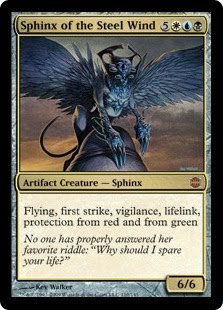
Sphinx of the Steel Wind!

Are you a Quiet Speculation member?

If not, now is a perfect time to join up! Our powerful tools, breaking-news analysis, and exclusive Discord channel will make sure you stay up to date and ahead of the curve.

Sphinx of the Steel Wind, Standard's analogue to Akroma and the hardest-hitting artifact creature in the format, just doubled on MTGO.  It seems that lots of dealers online are also selling out, and ebay is low in supply as well.  We've got a third-set Mythic on our hands here, folks.  Supply low, demand high, same formula that we're used to.

The fact is that Jund as a deck simply cannot handle this card.  There is literally no answer to it in the main 60, and some Jund lists aren't sideboarding Deathmark.  Not yet, at least.  A few Esper-colored control decks are popping up around the 'net using Sphinx as a finisher.  The real kicker?  They take advantage of Blightning's popularity by playing Open the Vaults, thus turning a Blightning into a profitable, if painful, proposition.  Star City's sold out at $7, and many of the other large dealers are as well.  There's no reason this card doesn't pass $10, as the deck will prove popular as long as it's vaguely competitive.   Early testing posts a good matchup against Jund, but only some tournament results can solidify the deck as a true competitor in the metagame.  I've just gone and purchased a few, for full disclosure, and I recommend you follow suit.  If this card shows up in a Top 8 at a 5K in 2010, you can expect it to soar.  Most lists are using 3 copies, for reference.

Kelly Reid

Founder & Product Manager

View More By Kelly Reid

Posted in Uncategorized2 Comments on Sphinx of the Steel Wind!

Have you joined the Quiet Speculation Discord?

If you haven't, you're leaving value on the table! Join our community of experts, enthusiasts, entertainers, and educators and enjoy exclusive podcasts, questions asked and answered, trades, sales, and everything else Discord has to offer.

Want to create content with Quiet Speculation?

All you need to succeed is a passion for Magic: The Gathering, and the ability to write coherently. Share your knowledge of MTG and how you leverage it to win games, get value from your cards – or even turn a profit.

Want Prices?

Browse thousands of prices with the first and most comprehensive MTG Finance tool around.


Trader Tools lists both buylist and retail prices for every MTG card, going back a decade.

Quiet Speculation