menu

Daily Stock Watch – Entreat the Angels

Are you a Quiet Speculation member?

If not, now is a perfect time to join up! Our powerful tools, breaking-news analysis, and exclusive Discord channel will make sure you stay up to date and ahead of the curve.

Hello, readers and welcome to the Monday edition of the Daily Stock Watch! Masters 25 spoiler season begins today, and we'd be looking at prices of cards crashing down to earth once more as we get more visuals of what's to come in the set. Today, I'd be talking about a card that has shown flashes of its old brilliance, thanks largely to Jace, the Mind Sculptor's return to Modern, and what could be in store for you if this is one of your specs.

There was an error retrieving a chart for Entreat the Angels

Entreat the Angels was a fringe mythic that saw some play in Legacy via Miracles prior to the return of JtMS in Modern. Thanks to UW's resurgence, it has re-emerged as one of the best finishers for a control shell that doesn't need to win games quickly. Two to three 4/4 angels would usually finish the game on a two-turn clock, and having a card like Entreat the Angels as a one or two-of gives you the much needed space to insert more cards in your deck that help fend off threats from your opponents.

It wasn't doing particularly well financially until this month when it climbed out of the cellar as a $3 card to become a respectable $8 mythic rare. Just how good is Entreat the Angels when paired with JtMS? Check out this list that was made by Ali Aintrazi.

UW Miracles by Ali Aintrazi

Instants and Sorceries

1 Negate
2 Cryptic Command
2 Logic Knot
2 Think Twice
4 Opt
4 Path to Exile
2 Entreat the Angels
3 Serum Visions
4 Terminus

Other Spells

4 Jace, the Mind Sculptor
2 Detention Sphere
2 Search for Azcanta
1 Crucible of Worlds
1 Azor's Gateway

Lands

3 Plains
4 Island
1 Ghost Quarter
1 Glacial Fortress
2 Hallowed Fountain
4 Celestial Colonnade
4 Field of Ruin
4 Flooded Strand

Sideboard

1 Settle the Wreckage
1 Surgical Extraction
2 Negate
1 Supreme Verdict
2 Dispel
2 Geist of Saint Traft
1 Disdainful Stroke
2 Stony Silence
2 Celestial Purge
1 Eidolon of Rhetoric

I'm not really sold on the idea of having Snapcaster Mage being played alongside JtMS, but I am no pro so I'd like to think that Ali Aintrazi gave more thought on this than I actually did. It obviously lacks Sensei's Divining Top which makes the legacy Miracles tick, but that's where Jace comes in here to do the trick. A pair of Entreat the Angels here works just fine but outside of it, the deck only has the Celestial Colonnades and Jace as its win conditions.

The Quest for the Best Jace Deck

There are tons of ways to build a JtMS deck, but they should all be trimmed down soon once the dust has settled. I think that these cards are all good enough to compliment it in various archetypes but for now, I like Entreat the Angels more than any of these cards.

At the moment, you could find non-foil copies of Entreat the Angels from online stores such as Card Kingdom, TCGPlayer and ChannelFireball, for anywhere between $5.59 to $7.14 depending on its condition. StarCityGames is out of stock at the moment and they are primed to reload at the $9 range once stocks are up. Foil copies are also a bit high again, with some sites pegging it at $13-$30 for the normal foils, and at around $15 for the FTV copies. I'm still not sold on this JtMS hype, and I don't think he'll stick around long enough in the format if everybody decides to play decks that feature it. I'll have to say that you could start letting go of your Entreat the Angels copies anytime now if you have people buying it for above $8, as there will be better blue decks that could dictate where the meta goes from this point onwards.

And that’s it for the Monday edition of the Daily Stock Watch! See you again tomorrow, as we check out a new card that should be on the go, or good enough for speculating. As always, feel free to share your opinion in the comments section below. And if you want to keep up with all the market movement, be sure to check in with the QS Discord Channel for real time market information, and stay ahead of the hottest specs!


Insider: Speculating on Rivals of Ixalan, Part I

Are you a Quiet Speculation member?

If not, now is a perfect time to join up! Our powerful tools, breaking-news analysis, and exclusive Discord channel will make sure you stay up to date and ahead of the curve.

Rivals of Ixalan seems to have stabilized in price, hovering around $55 for the past three weeks. That's a bit higher than I had expected, but now that the typical array of gauntlets, flashbacks, cubes, and masters set releases has begun in earnest, the infusion of supply of Rivals of Ixalan cards into the MTGO marketplace will slow down. There's little reason to believe that fresh infusion of supply will outpace demand for redemption going forward, so now begins the optimal time to look into investing in Rivals of Ixalan cards. Investing in March through May will be optimal, and today, I'm here to help you prepare by discussing the mythic rares from Rivals of Ixalan !

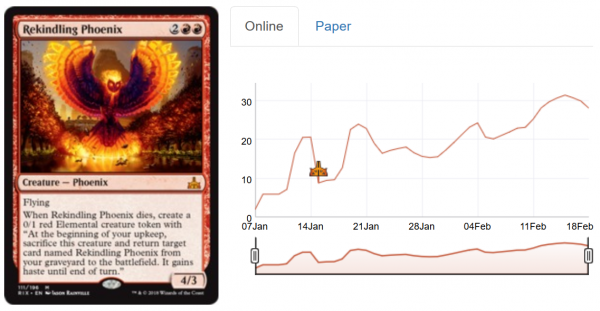
(I) There's no bolting this bird - Rekindling Phoenix is the premier card from Rivals of Ixalan.

Rekindling Phoenix is the card that everyone wants me to talk about, and for good reason – it is currently eating up 50 percent to 60 percent of the set's value! Unlike a lot of other Standard cards in recent memory that reached 30.00 tix, Rekindling Phoenix did so at lightning speed without giving investors a real chance to judge the card on its merits and capitalize on its rapid rise. The card is obviously excellent and, critical to sustaining such a high price, is good in a variety of archetypes, capable of serving as a premier midrange threat and as a curve topper for an aggressive shell that is happy to sacrifice speed for increased resiliency.

Rekindling Phoenix will likely see more time between 30.00 and 40.00 tix, with some potential to spike north of 40.00 tix. Unless Lee Sharpe opts to give this card a curated list value above 12, I'll be a happy buyer if this card dips into the upper teens or low twenties. Even after The Scarab God broke out, it experienced a dip into the low twenties, and we should expect the same from Phoenix. Buy at that time.

I do want to raise one red flag about this card that is worth keeping in mind: all of the premier threats in Standard today demand an exile effect for a clean answer, and half of them can be dealt with by an Incendiary Flow effect. I have a hard time imagining Wizards not printing such an effect soon to help keep these threats in check. I'm thinking a more efficient (and perhaps instant speed) Puncturing Blow.

My recommended buy price: 17.00-21.00 tix

(II) Rivals Planeswalkers

For those of you who read my piece on mythic rares with converted mana costs of four and five, you know already that planeswalkers tend to be a conservative investment choice, usually offering decent returns. Angrath, in particular, fits the bill as a run-of-the-mill planeswalker that will likely increase in price at some later date due to an uptick in demand.

Huatli is much more narrow, but it could support or anchor a token strategy after Annointed Procession leaves the format. The tokens deck is already glutted at the four slot, so I don't think it will see play anytime soon. My recommendation for Huatli is to wait until July and August, then see if her price is hovering around 1.00 tix.

My recommended buy price for Angrath: 2.00 tix
My recommended buy price for Huatli: 1.00-1.35 tix

(III) Let's talk Merfolk

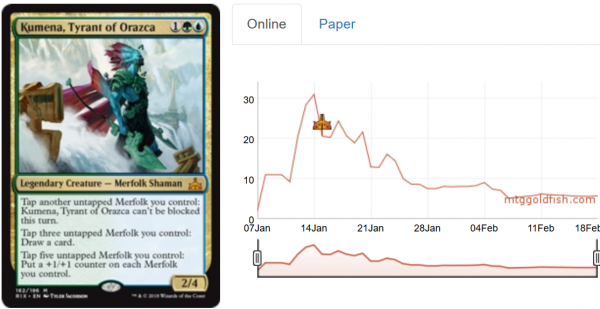
For the first week of release, Kumana, Tyrant of Orazca was the most valuable card in Rivals of Ixalan. Once a top-tier Merfolk deck could not be constructed, however, its price crashed hard. Kumena's future prospects will rely entirely on the future printing of Merfolk, either in Dominaria or in Core 2019.  I don't know how wise it is to speculate entirely on that sort of potential. If Kumena falls closer to 2.00 or 3.00 tix, I'll be more likely to pull the trigger. At 5.5 tix, it still has plenty of room to fall.

Merfolk is an iconic race for Magic, and I think the recently coined Play Design Team will be tasked with ensuring that Merfolk is a top-tier strategy moving forward.

My recommended buy price: 2.00-3.50 tix

(IV) Ancient Aztec Artifacts

Azor's Gateway is a prime example of where the research done on these mythics can pay off. I'm now inclined to believe that this will make for a good speculation opportunity. It's an artifact that costs two mana, and the back side is an enabler for janky win conditions. At minimum, it is a future Saffron Olive spike card; at maximum, it is a future staple of Standard control decks, and the reality will likely be that it will be a key piece in tier-two combo and control decks.

The question is how low will it go? I don't want to pay 4.00 tix for it, but I think somewhere between 2.00 to 2.50 is acceptable, and 1.50 to 2.00 ideal.

I would steer clear of The Immortal Sun for now. The only way I could see this being a Standard-playable card is in a token deck, and right now token decks have better ways to grind out card advantage. I do believe this card has a chance, especially when Angel of Invention rotates this Fall.  If the meta shifts more toward planeswalkers, as well, this card could be a legitimate option. I expect it to fall to bulk in late spring or early summer, and at that time it is reasonable to speculate on it if you're a believer.

My recommended buy price for Azor's Gateway: 1.50-2.50 tix
My recommended buy price for The Immortal Sun: 0.50 tix

(V) Azor, the Lawbringer

Easily the most polarizing mythic rare in Rivals of Ixalan, Azor often generates two reactions — "unplayable" or "future control finisher like Sphinx of the Final Word." As someone who made a good amount of money on Sphinx of the Final Word, I want to urge caution on Azor. Sphinx saw play as a mirror breaker — Azor is not an ideal mirror breaker because it can be countered.  Azor is at its best against midrange, but control is already good against midrange and likely won't need to devote sideboard slots to Azor. I'm thus inclined to pass. Wizards will print something better in the next three sets, I promise.

My recommended buy price: N/A

(VI) Signing Off

Saffron Olive favorites: Polyraptor and Azor's Gateway.

Which five mythics am I most likely to invest in within a few months?

  1. Azor's Gateway
  2. Angrath, the Flame-Chained
  3. Polyraptor
  4. Rekindling Phoenix
  5. Kumena, Tyrant of Orazca

A copy of my portfolio can be found here. As always, I look forward to reading your comments down below, and please feel free to ask any questions. What are your favorite speculation picks for Rivals of Ixalan? In the next two installments of this series, I will cover rares, and in the final article, I will cover uncommons.

I won my first ever card-design competition this past month, and I've already shown you one of the five cards from the final round (Dakthos). Today I'll show you another one, for your viewing pleasure. The design constraint was that the card had to be able to be cast from multiple zones, but not from your hand.

Insider: It’s Time to Trade Up

Are you a Quiet Speculation member?

If not, now is a perfect time to join up! Our powerful tools, breaking-news analysis, and exclusive Discord channel will make sure you stay up to date and ahead of the curve.

Another week gone by, another wave of buyouts across Legends, Antiquities, and Arabian Nights. This movement is reminiscent of a bull stock market, where purchasing just about any stock would make money for the investor. If you find a $2 rare from one of these sets in decent condition, you can profit. It’s that simple.

There was an error retrieving a chart for Axelrod Gunnarson

By now you all likely know how these older cards are in my wheelhouse for speculation—I continuously purchase cards like these to flip either on eBay or to buylists for sizable profits. What I want to talk about this week are two interesting trends: one that has already been transpiring, perhaps under some people’s radars, and one that I anticipate will start to happen in the near future.

It all boils down to the relative movement of card prices.

Where Has All the Power Gone?

Less than a year ago I found myself with some spare investment funds and an opportunity. Cool Stuff Inc had a sizable stock of played Power, and they had a particularly heavily played Mox Jet from Unlimited that was a screaming buy. It was priced at $700, and the customer loyalty program helped knock the all-in price down to $665.

There was an error retrieving a chart for Mox Jet

There were other tempting cards, but none as attractive as this one, so I went for it. Fast-forward to the present, and I sure would like another such opportunity. The problem is, there are almost no pieces of Unlimited Power in stock on their site anymore. I see two played Mox Sapphire for $1700 each. Gross. No Time Walk, no Timetwister, and only a single Ancestral Recall, which is BGS 9.0 and $2000. No thank you.

It seems the only other Power Cool Stuff Inc has are played or overpriced Alpha and Beta copies, which are far outside my price range. Abandoning this once-plentiful source for discounted Power, I broadened my search to some other major retailers.

I hopped over to ABU Games with high hopes. Now that they’re paying such crazy high prices on Arabian Nights cards, I should be able to trade in a couple less-than-useful cards to get a discounted Unlimited Mox. That 50% trade-in bonus is sure to help.

Upon browsing, however, I noticed the same exact problem. They have virtually no well-priced Unlimited Power! Sure, they have a “Near Mint” Time Walk for $2000 that barely passes for SP, a Near Mint Ancestral Recall for $2200 (clearly Cool Stuff’s is preferred over this), and a Near Mint Mox Jet for $1900. These are all way overpriced.

I was hoping to get some discounted HP/MP Power that can double as an investment and a copy to play with in Old School. If they had a played Mox for $1200, say, then I could ship them a played Juzám Djinn and some other mediocre cards to get it. A played Juzám nets you $800 in store credit, after all. But no such luck—that well is dry. And I’d be dreaming if I should expect them to list a played Black Lotus—instead all they have are a couple “Near Mint” copies at $7500.

There was an error retrieving a chart for Juzám Djinn

You’re probably getting the picture. Card Kingdom was my next logical stop since they pay so well on these random old cards, but they had similar stock. Very little Unlimited pieces of Power and a smattering of overpriced Alpha and Beta. Star City Games did have an HP Mox Ruby for $900, but with such abysmal buy prices this isn’t an attractive proposition either.

What Is Happening?

I thought I was being clever by converting profits from these random Old School cards into high-end investment cards like Power. When a couple cards purchased two or three years ago are suddenly worth as much as a played Mox, you can’t fault one for attempting the trade. While a great idea on paper, the struggle is finding that Mox in stock anywhere. What few pieces on the market were likely scooped up by people in front of this very trend.

The moment ABU Games and Card Kingdom went crazy with their Arabian Nights buylist, I’m sure some savvy investors were all too happy to ship their random Ifh-Bíff Efreets and Serendib Djinns for $100-plus each in store credit to get that critical piece of Power. The unattainable had suddenly become within reach, and the rest is history.

There was an error retrieving a chart for Serendib Djinn

The result: an apparent shortage of low-end Power at the major online vendors. I can’t comment on the stock of smaller vendors, but I will say that finding a non-damaged piece of Power on TCGplayer or eBay for under $1000 is no easy feat as well.

I think we’re on the cusp of a pricing reset on Power, with HP copies of the least desirable pieces in the $1000 range and upward from there. With a two-day Vintage tournament hosted by Star City Games coming up, I think we may see a tiny push in demand that just may be the catalyst needed to cause the pricing reset. We shall see.

Getting in Front of the Next Trend

Now I’m noticing that some of these buy prices have retracted a bit at Card Kingdom. They went aggressive to restock but now that they have ample stock, their buy prices are much more in-line with the rest of the market. Instead of offering $105 on Serendib Djinn they now offer $75. They were up to $210 on Ali from Cairo and now they’re at $165. City in a Bottle was $130 and now $105. Even some Legends and Antiquities prices have calmed down a bit.

Here’s the thing: I think these modest drops are short-lived. Why? Two reasons. First, these remain attractive Reserved List collectibles with an upward trajectory as long as the game itself remains healthy.

Second, with random junk like Elder Spawn and Merchant Ship buylisting for $8 and $15.50, respectively, it’s never been easier to accumulate store credit. Card Kingdom has even been getting aggressive on some Alpha cards lately, such as a $10 buy price on Psychic Venom.

There was an error retrieving a chart for Merchant Ship

I myself have made a decision recently: rather than shopping for arbitrage and turning underpriced junk into modest cash profits, I’m going to start accumulating store credit. I won’t be able to grab that Power that I was hoping for, but that doesn’t mean there aren’t high-quality pickups to go after. My next logical choice will be some better quality Old School cards, such as the ones with dropping prices mentioned earlier. If those are still too expensive, then my next choice will be dual lands.

In fact, let’s stop on duals for a minute. These have been gradually rising in price lately, haven’t they?

There was an error retrieving a chart for Scrubland
There was an error retrieving a chart for Volcanic Island

I predict this trend will accelerate at some point in 2018. Why? Well for one, I’d much rather own a couple extra Tundras and Plateaus than Cyclones and Rebirths. As cards in the latter category spike, acquiring duals in trade is becoming more feasible. But also, don’t forget we have a Pro Tour coming up that will feature some Legacy play. That combined with reprinting of some Legacy staples like Jace, the Mind Sculptor in Masters 25 could rekindle interest in the format.

So this is the trend I’m predicting—that Power will climb out of reach and all of us speculators will have to convert our profits from a pool of Legends and Antiquities junk into dual lands and high-end staples. The rising tide will continue to lift ships and so on and so forth.

I like dual lands most in this environment, but I suppose other Reserved List cards are fine to acquire: Library of Alexandria, Candelabra of Tawnos, Moat, The Abyss, Lion's Eye Diamond, etc. These are what I’ll be trying to convert profits into over the coming months while speculators continue to chase the stupidity that is $20 Shapeshifters.

There was an error retrieving a chart for Shapeshifter

Wrapping It Up

These silly spikes in unplayable rares from Magic’s earliest expansions are difficult to justify. For some reason a few people probably decided these cards were worth acquiring due to their age and collectibility. Rather than question the movement, I’ve chosen to embrace it and will continue to do so. After all, there are still Legends rares under $5 out there, so the movement isn’t done yet. Keep an eye out for deals.

As this unfolds further, I expect Card Kingdom and possibly ABU Games to move their buylists in step to keep these cards in stock. That’s our opportunity. It feels great selling a $3 Voodoo Doll on eBay for $6, but it may be even easier to convert gains by taking store credit at Card Kingdom and using that money to pick up key staples. While Power was my first choice, it looks like that well has already run dry. Therefore, I like cards that lie on the tier just below Power as fine pickups with store credit. Duals are on the top of my list because I think Legacy will get a jolt of energy in the coming months.

I continue to believe in the health of Magic itself, and so these Reserved List cards should continue to provide ample returns for patient investors. If the team Pro Tour coming up this year offers a catalyst for a short-term spike in demand, all the better. Let’s watch stock on dual lands together and stay on top of the trend. We may have missed the boat on Power, but there are still plenty of opportunities to convert unplayable cards into real gems.

…

Sigbits

  • You know what just hit an all-time high last weekend? Asceticism. The card has never been reprinted, and now it retails on Card Kingdom’s website for $14.99. Of course they’re all sold out. If they do restock at this price, you could do worse than to pick up some copies with store credit. Just watch out for reprints—although I can’t imagine this one is high on Wizards’s radar and it certainly doesn’t fit the Masters 25 theme. When was this card ever dominant?
  • Who’s ready for a buyout on Back to Basics. The once-critical sideboard Legacy card must be seeing plenty of play because I see just 18 vendors on TCGplayer at the moment and an all-time high price in the $30 range. Card Kingdom has eight Near Mint copies in stock at $29.99 that could present an attractive way of cashing out some store credit. If you can get $35 on these, you’d be looking at converting credit to cash netting you that extra 30 percent trade-in bonus!
  • Looking at TCGplayer’s top selling Legends rares, we can anticipate what is left to spike. Rubinia Soulsinger seems attractively positioned, as does Carrion Ants and Knowledge Vault (again). Card Kingdom pays $7.25, $3.80, and $14.50 respectively on each of these cards, so use these numbers as your downside protection when buying these up.

Insider: Into the Realm of Foils

Are you a Quiet Speculation member?

If not, now is a perfect time to join up! Our powerful tools, breaking-news analysis, and exclusive Discord channel will make sure you stay up to date and ahead of the curve.

Welcome back, readers!

I'm not usually one to favor foils—I tend to build a lot of decks, so I prefer to have the cheapest option when possible. However, I happened to scroll through the MTGStocks interest page and noticed they now have a "foils" page so you can see just foils. Scrolling down the page there were plenty of obvious gainers (a lot of Pauper and Modern/Commander playables), but also some head-scratchers—cards that don't see play in any major format yet had significant gains in the past week.

Often we just attribute these types of moves to Cube playables. However, I feel that sometimes that's not accurate and just a default way of thinking. Today I'm going to go over some of the recent jumps in foils and lay out what factors I think were driving them.

I will be using CubeTutor to see how often cards show up in cubes. This is admittedly not an all-knowing source, but similar to EDH REC serves as a useful tool to look up how often a specific card shows up in the perspective format. I will also be using the aforementioned EDH REC to see how often a card shows up in Commander.

We will focus specifically on cards that show up in very small percentages of either format. Though it is important to note that some cards show up in very specific Commander decks, and if they are rare enough that alone can account for any gains.

There was an error retrieving a chart for

10th Edition Horseshoe Crab is worth over $5. This is the only foil printing of the card, but it tends to show up in under 12% of cubes and it only shows up in Experiment Kraj and Mairsil, the Pretender Commander decks in any meaningful number (62% for Kraj and 45% for Marsail).

As Mairsil, the Pretender is still a relatively new Commander option and Experiment Kraj has been around for quite awhile, I tend to believe this card's movement is tied with Mairsil.

There was an error retrieving a chart for

Similar to Horseshoe Crab above, this card has two printings, but only one of which has a foil option (the Dark Ascension version). It sees play in UR Storm Commander decks (Mizzix of the Izmagnus and Melek, Izzet Paragon are the most popular of this archetype). It too seems to show up in under 11% of cubes so its gains are likely tied to Commander play (even if it's not an obvious inclusion in most decks).

There was an error retrieving a chart for

Telepathy actually has a lot of possible foil printings. The Magic 2010 version is likely the most common, as the other options are 7th, 8th, 9th, and 10th Edition (as well as Urza's Saga, which doesn't have a foil option).

This one too is in around 11% of cubes. However, unlike our first two cards listed, this one doesn't see a huge amount of Commander play. The two most popular commanders including it, Sen Triplets and Baral, Chief of Compliance, appear to run it under 30% of the time, which is a relatively small percentage.

Looking through other listings on TCGPlayer, I noticed that with the exception of the 7th Edition printing (which also has different artwork), all the other versions are sitting around the same price. The supply on this version is surprisingly low (only 10 sellers listed at the time of this writing) so it's possible that the cheapest copy was purchased and the next cheapest copy was simply 14% more.

There was an error retrieving a chart for

Interestingly enough, all of the original Circle of Protection cards have been printed a lot in nonfoil options (Alpha, Beta, Unlimited, Revised, 4th Edition, 5th Edition, 6th Edition, Ice Age, and Tempest). There are only two foil options: 7th Edition and 8th Edition. Both options have very limited supply on TCGplayer. It shows up in around 10% of cubes and very rarely in Commander.

This movement may be more linked to collectors (as I mentioned, the supply is extremely limited). It's interesting to note that with some of these older foils we often see a huge disparity between the average/market price and the cheapest NM price which may be what skews the data. This one is likely a forced price bump and not market-driven.

There was an error retrieving a chart for

Megrim is another card with a decent number of foil printings which are all pretty affordable. The biggest tell here is that 7th Edition foils are cheaper than the 8th Edition foil which jumped, though again it appears that this price spike is likely due to one seller putting up their copies significantly higher than their competitors.

This card shows up in under 10% of cubes and typically only finds a home in a few types of Commander decks (mainly Nekusar, the Mindrazer and Nath of the Gilt-Leaf, both of which have been out awhile and seem to be on the downturn in terms of popularity. This one too is likely a forced price bump and not market-driven.

There was an error retrieving a chart for

Here we have a single version of the card (from Invasion) so foils are likely relatively rare, though it lists a 172% price spike in the past week. It shows up in 9.3% of cubes (which is the lowest I've seen so far) and only seems to show up in Gisa and Geralf Commander decks (which is not a popular commander). Looking at the number of listings on TCGplayer it is down to five sellers so it's likely just a forced price bump and not market-driven.

There was an error retrieving a chart for

Treasonous Ogre does seem like a Commander type of card (as it allows you to convert life into mana). It only shows up in 11.5% of cubes, so it's likely not cube-driven. As for commanders, it tends to show up most in Marchesa, the Black Rose and Zada, Hedron Grinder.

In both instances it does show up in over 30% of decks so one would think it's Commander-driven. However, looking at how many are available on TCGplayer there is only one seller with one copy, so it looks more like it was the subject of a buyout (or extremely limited supply). My suggestion is to dig through your random foils and see if you have any lying around (as the old price was still $5 so there's actual legitimate demand for this one).

There was an error retrieving a chart for

Reality Strobe shows up in around 12.5% of cubes (which again is not a significant percentage). It doesn't see play in many Commander decks, with the only one of real note being Jhoira of the Ghitu, and even then it's typically only in about 16% of those decks.

Again, checking with the listings it appears that all the gains on this card are tied to the fact that there is only one NM copy listed on TCGplayer and it's significantly higher than all the other listings (of which there are still only five others).

Conclusion

To be honest this article didn't travel in the direction I originally expected it to. The major lesson we can pull from it is that when it comes to foils, especially older foils, the prices can move with the removal (purchase) or addition of a small number to the supply (even just one copy).

That being said, we need to be careful before jumping the gun and buying any just because we see some significant gains on MTGStocks or a low supply on TCGplayer. Many of these cards have likely had a low supply for quite some time (as most were printed more than five-plus years ago) and their price had remained stagnant for all this time. Foils seem to be particularly volatile when it comes to price swings, so it's important to do a bit of research to figure out why one of them moved.

Modern Top 5: Unban Winners

Are you a Quiet Speculation member?

If not, now is a perfect time to join up! Our powerful tools, breaking-news analysis, and exclusive Discord channel will make sure you stay up to date and ahead of the curve.

Bloodbraid Elf and Jace, the Mind Sculptor have been unbanned in Modern for a week now. Contrary to what we've heard since the announcement, the format is just fine, and perhaps even better: it's fresher, to be sure, with new decks popping up abusing Modern's newcomers and benefiting from the metagame warp. One development I have found especially interesting this week relates to the gains and losses made by other such role players in the format. Today, we'll focus on five cards in particular I think stand to benefit from the unbans.

This week's Modern Top 5 is a little different from previous episodes, as it deals less with Modern constants and more with of-the-moment happenings. In the spirit of breaking tradition, we'll start with our number one winner and work backwards from there.

#1: Lightning Bolt

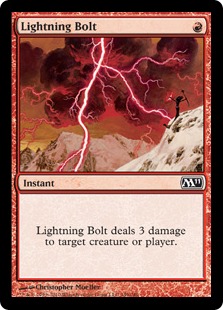
We have to start with Lightning Bolt because of how format-warping the card is. Bolt's strength in Modern directly affects the playability of its creatures, as well as the cards players must turn to if they aim to interact with opponents. Bolt will always be a Modern staple thanks to its raw power, but the card's also on an upswing for a variety of reasons.

Relevance

No matter the matchup, Lightning Bolt does something—heck, its floor is a strictly-better Lava Spike, one of Burn's most prized spells. When it comes to cutting down opposing life totals, three seems to be a number that means something significant; Delver of Secrets and Wild Nacatl are infamous for their unprecedented ability to clock, and Shock has never impressed anyone enough to splash for in any format in Magic's long history.

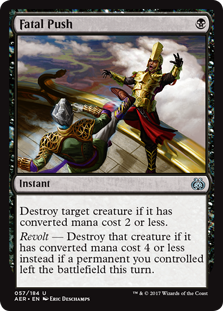
Bolt's sustained relevance across different matchups is a major factor causing players to prefer it over Fatal Push as a removal option. Nobody wants to stare down World Breaker or Secure the Wastes with a Terminate in hand (incidentally, we're likely to see more Tron-style decks crop up in the short-term to quell the tide of interactive ones). But a way to close out the game? Yes, please!

Planeswalker Removal

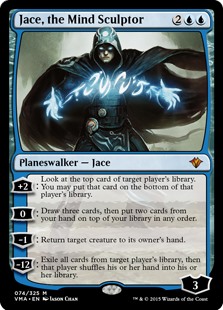
Fatal Push removes creatures. Dreadbore destroys creatures and planeswalkers. But Lightning Bolt kills creatures, planeswalkers, and players! With Jace, the Mind Sculptor showing up in all kinds of decks, having a flexible planeswalker-removing option handy is the dream for most interactive decks. Add to the fact that most interactive decks right now are playing either Snapcaster Mage or Bloodbraid Elf, and Bolt gets even more attractive, as it pairs fabulously with both creatures—and the pair respectively incentivize casting planeswalkers Jace, the Mind Sculptor and Liliana of the Veil.

Overall Flexibility

Relevance and planeswalker removal are draws to Bolt that contribute to its overall flexibility. The reason I'm singling out the card's wide applications is that interactive decks tend to favor cards with immense utility over all others, and Bolt is the obvious poster-child for utility in Modern. Despite its simple text, the card plays so many roles that it's difficult to overlook for interactive decks, which seek to maximize the work each of their cards put in during a tournament. Indeed, even before the unban, interactive strategies were experiencing something of a renaissance in Modern: Death's Shadow was stratifying; Logic Knot carved out a niche in Tier 1; Mardu reared its head for the first time ever. Common among most of these decks was Lightning Bolt.

Lightning Bolt: After-Effects

I don't buy the arguments for Jace or Bloodbraid homogenizing midrange. If aggro-control does become more homogenized, it will be to play Lightning Bolt. Bolt's "second life" as the far-and-away greatest thing to do for one mana in Modern will surely have far-reaching effects on the format, as we'll see with the next four picks for biggest post-unban winners.

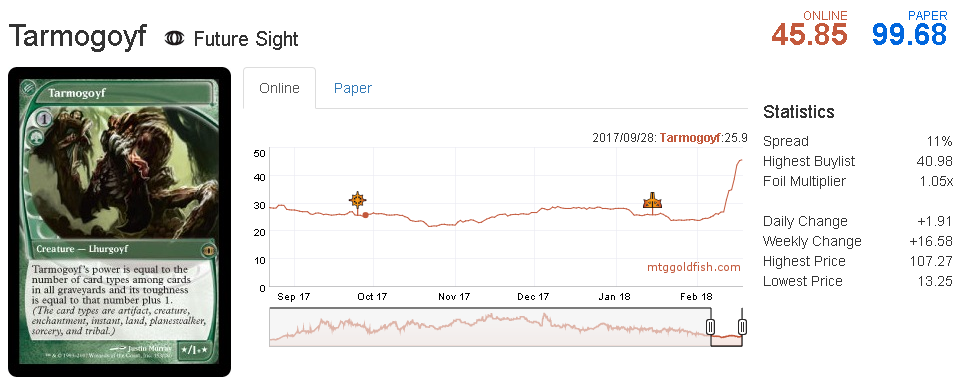
#2: Tarmogoyf

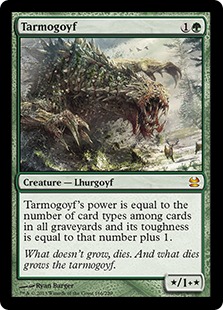
As a creature that merely attacks and blocks, Tarmogoyf is one of Magic's most conservative tournament staples in recent memory. How fitting, then, that his comeback coincide with that of the game's simplest and most iconic spell.

I bookended my long love affair with Goyf on this site with an article published last year about casting Goyf in a Fatal Push world. His reign as the greatest creature this side of the banlist, as I saw it, was over; while still an efficient creature with homes guaranteed in green midrange shells, Goyf could no longer be splashed willy-nilly into everything. Modern finally had a clean answer to the infamous beater.

The days of Goyf-splashing may be behind us for another reason, though: as more cards enter Modern, the format becomes increasingly streamlined. I don't mean it's got fewer decks; somehow, Wizards has managed to keep it incredibly diverse. Rather, the decks themselves boast enough on-theme tools these days to not want a Plan B at all, let alone one that's lost so much value thanks to Fatal Push.

That said, as interactive decks turn to Lightning Bolt as a primary removal option, Tarmogoyf's value shoots back up. Despite its fantastic applications in the mirror, I'm seeing Fatal Push be shaved unceremoniously from most Jund decks, with even Jund master Reid Duke opting for only a single copy in the sideboard. Outside of Shadow, which has precarious access to red mana, the decks that can run Bolt once again want it over anything else, opening a window for Goyf to barrel through. Oh, and did I mention Goyf's an excellent cascade hit?

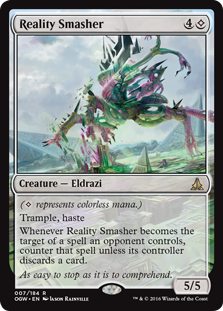
#3: Reality Smasher

Eldrazi tends to have the upper hand against three-color midrange decks. Its creatures are bigger, it's got easy access to disruption like Relic of Progenitus and Rest in Peace, and Eldrazi Temple makes the archetype faster than anything Thoughtseize-fueled can muster (outside of, again, Death's Shadow—apparently the great anomaly of midrange decks). Thought-Knot Seer benefits from Bolts becoming Pushes just as Goyf does. But the tribe's biggest winner is Reality Smasher.

Haste is a broken mechanic, and easily the best of the evergreen keywords. The immediate downside of creatures relative to instants and sorceries is that players need to wait a turn before using them proactively: sure, they'll block, but that won't actually win the game. In this sense, haste functions as Time Walk a lot of the time, and is degenerate on an already pushed creature. Consider the effects of Goblin Guide and Bloodbraid Elf on a format, or how the strength of Goryo's Vengeance and Through the Breach relies on their haste-granting line of text.

Reality Smasher is one such pushed creature, and critically is un-Push-able: while four mana used to ensure a creature's robustness thanks to the prevalence of Abrupt Decay, Fatal Push spares no creature costing less than five. Additionally, flexible removal spells like Dreadbore and Maelstrom Pulse are increasing in popularity to deal with Jace, the Mind Sculptor and other planeswalkers; these sorcery-speed options cannot remove Reality Smasher before it makes a huge attack.

Bringing everything home, Smasher itself is one of these "flexible removal spells:" trample lets it run through creatures and crunch into its target, which could very well be a Jace, the Mind Sculptor. Even ticking the planeswalker up upon resolution won't save it from the colorless behemoth. On a related note, interactive decks these days tend to strive for a late-game; it's hard to out-grind an active Tireless Tracker, or Command-looped Bloodbraid Elves. Smasher offers an appealing alternative: just kill your opponent faster.

We've seen Eldrazi Tron hemorrhage shares in the last few weeks, losing out to Mono-Green Tron and most recently GR Eldrazi (a deck already incorporating Bloodbraid Elf with some success). But between this new GR build and other options, there's certainly no shortage of shells for Reality Smasher right now, and very few decks can kill it reliably.

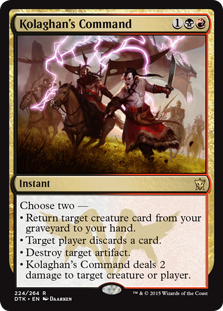
#4: Kolaghan's Command

Like Lightning Bolt, Kolaghan's Command is a highly flexible utility spell. It's also got a damage-based removal mode that plays double-duty in two matchup Bolt partly owes its comeback mode: Affinity, where it removes Cranial Plating, and Humans, where it shatters Aether Vial. Three may be the magic number for racing, but many Modern creatures that die to Bolt also die to Command. 2 damage also destroys a ticked-down Jace or Liliana.

It's no secret that Command is an insane cascade hit; with Bloodbraid Elf in the picture, Command's role in Jund shifts from role-player to power-play. Its nastiest mode in this deck is return-a-creature, which recycles Elf itself to yield an aggressive card advantage engine.

While it's a known quantity by now, Snapcaster Mage has a similar effect for blue midrange decks. Despite I've seen Traverse Shadow lists pop up recently packing a 4 Elf, 4 Command suite, and Corey Burkhart—who finished 13th at Pro Tour Rivals of Ixalan with a 4-Command version of Grixis Control—even advocates for the entire set alongside Jace, the Mind Sculptor.

Command's combined first mode improving with a widened card pool, the relevance of its damage-based effects with more planeswalkers on the horizon, and the card's natural inclusion in decks on the upswing ensure we'll be seeing plenty of this three-drop in the near future.

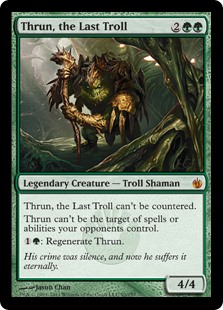
#5: Thrun, the Last Troll

If interactive decks struggle to remove Reality Smasher, they'll hate dealing with Thrun, the Last Troll! We haven't seen this card out in full force since the Splinter Twin days, where it single-handedly won the tempo games (some were of course still lost to the combo after Thrun ate all the BGx player's mana). Modern's a different beast now, but with the meta shifting towards permission and removal, Thrun smells like an awesome sideboard option. It can't be touched by self-protecting planeswalkers like Gideon of the Trials or Jace, either. Only Liliana of the Veil removes it, and she does so conditionally; either way, Thrun is a major headache for BGx.

A deck that's secretly helped Thrun get to its current stage of viability is Death's Shadow. Specifically, the omnipresence of Stubborn Denial is reason enough for UWx decks to pack Supreme Verdict over Wrath of God without thinking twice, and I doubt a mild Thrun resurgence changes that, boding well for the Troll. That said, Damnation still eliminates him, so Thrun-slammers will need to keep Grixis and other black-based control decks on their radar.

Old Dogs, New Tricks

Part of the fun in a format as dynamic and, well, supported as Modern is that old favorites are often bound to spring back up eventually. Listed here are just a few of the "old dogs" poised for a comeback in the wake of the recent unban. What's your Top 5? Let me know in the comments!

Insider: Modern Buys After the Unbannings

Are you a Quiet Speculation member?

If not, now is a perfect time to join up! Our powerful tools, breaking-news analysis, and exclusive Discord channel will make sure you stay up to date and ahead of the curve.

The unbannings of Jace, the Mind Sculptor and Bloodbraid Elf promise to bring massive changes to the Modern metagame, and that has led to rampant speculation on cards with the potential to become all-stars alongside the unbanned cards.

Much of the buying so far has been based on historical precedent and theory-crafting (to use another word: speculative), but the cards are now tournament legal, so we’re starting to see actual results with the new cards in action. The cards have been legal online for over a week now, and lists are being published, so there is some hard data to study to get a more informed idea of how the new metagame is playing out before paper results from major events like Grand Prix and SCG events come in and things really start to take off.

Today, I’ll go over some of the cards that are starting to perform online and increase in price, and are thus primed for a paper spike.

There was an error retrieving a chart for Voice of Resurgence

Voice of Resurgence was once a Modern all-star worth over $40, but it was slowly knocked from the metagame, and its reprinting in Modern Masters 2017 was the nail in the coffin that brought its price down further, and sagged as low as under $11 the turn of the year.

It has gain dramatically from the unbannings, because it’s one of the best hosers against counterspells, and it plays very well against decks relying on removal to beat a deck through attrition. That makes it line up very well against control decks with Jace and Jund decks with Bloodbraid Elf, so the metagame is shaping up to be one where it shines. It’s also found a new home in Zoo decks that were bolstered by BBE, so there is a perfect storm brewing around the card. The online price of both printings have moved up from under 8 tix to over 10, and they are only going higher. The paper price, on the other hand, has barely risen from the all-time low, so now is the time to buy.

There was an error retrieving a chart for Courser of Kruphix

Courser of Kruphix has lived right on the edge of Modern playability, but it has seen a big boost with the printing of Jace, the Mind Sculptor. The cards have great synergy, with Courser of Kruphix able to play lands Jace puts on top of the deck, and the 2/4 stats providing a robust body to help protect the planeswalker. It also has some potential alongside Bloodbraid Elf, and the cards can already be seen alongside each other in Green-Red Ponza, with more decks to come likely to include the combination, so it seems that it’s time for the card to become a true Modern staple.

Its price online has seen large growth from 3.3 tix to 5.6, and its paper price is starting to head up after languishing for years, from $4 before the unbannings to $4.30 now, with plenty more upside.

There was an error retrieving a chart for Keranos, God of Storms

Blue control decks are the biggest winner from the unbanning of Jace, the Mind Sculptor, including blue-red based decks like Grixis, Jeskai, Blue Moon, Through the Breach decks, and those with the Kiki-Jiki, Mirror Breaker combo.

Keranos, God of Storms has a history of being used in these sort of decks, often as a sideboard option where it’s a secondary win-condition, and whatever the use, there’s clearly a lot of interest in the card based on its online price more than doubling since the unbannings from under 4 tix to nearly 9. Its paper price has been relatively stable just above 7 for the last year, but will likely now start heading back to its previous post-Standard high of nearly $14 with the potential to surpass it.

There was an error retrieving a chart for Time Warp

Another major beneficiary from Jace, the Mind Sculptor is the Takin’ Turns deck based around chaining multiple Time Walk effects, which become more powerful than ever when you allow for repeated activations of planeswalkers. The deck was borderline before, but has had some big results, like making the top eight of Grand Prix Vegas last summer, and it seems to have been brought over the top from the unbanning. The deck with Jace added is already a big performer online since the unbannings, and even made top eight of the high-profile Modern Challenge event last weekend, which could explain the price of the multiple printings of Time Warp moving to around 7 to 8 tix from their previous range of 4 to 6. There are a few paper printings, and I expect them to all start rising.

There was an error retrieving a chart for Exhaustion

I also see big things for the other staples of the deck, many of which have also seen big online movements, like Exhaustion, which has seen its various versions move from around 0.05 to 0.1 tix to 0.25 to 0.60, quite massive gains. It has six paper printings, and I could see them all rising, with the $0.50 pricetag of the Urza’s Saga and Ninth Edition printings being the version most players will turn too.

What’s interesting is that the three Portal printings all have unique art, which makes the $1.20 price of the Portal version and the $0.90 price of the Portal Second Age very attractive. The big-ticket version is Portal Three Kingdoms and its $10 price tag, which may have the potential to spike the hardest due to its small supply.

There was an error retrieving a chart for Mikokoro, Center of the Sea

Another card to pay attention is Mikokoro, Center of the Sea, which had been seeing steady online growth all year from a bottom in December at around a quarter of a ticket to 0.70 before the banning, which has now doubled to 1.4. The paper price is at $14, and as a one-of may not exactly spike, but as an old third-set card in a maligned set that is in short supply, this has plenty of room to grow.

There was an error retrieving a chart for Day's Undoing

There was an error retrieving a chart for Dictate of Kruphix

There was an error retrieving a chart for Temporal Trespass

Other specs from the deck include Day's Undoing, which has doubled online from 0.9 tix to 1.80 tix, Dictate of Kruphix, which was mere pennies online but is now 0.14 tix, and Temporal Trespass, which is up to 0.20 tix from 0.1. These are all worth a dollar or two in paper, but would take off if the deck becomes top-tier.

There was an error retrieving a chart for Drogskol Reaver

There was an error retrieving a chart for Soulflayer

Drogskol Reaver was included in a Soulflayer deck featured at Grand Prix Lyon, which was apparently made viable by the printing of Zetalpa, Primal Dawn, and hype around the card has spike the price of its staples online. Drogskol Reaver is up from 0.60 tix to 3.60, while Soulflayer is up from pennies to 0.60, an astronomical spike. Both of the cards have also started to noticeably move in paper, from $2 to $2.1 and $0.30 to $0.37 respectively. This deck isn’t likely to be top-tier, but it’s now on the Modern radar, and can only be improved now that more players are working on it, so any future appearances would only bring these prices higher.

It's an exciting time to speculate on cards, and there's many opportunities to make money. What cards are on your radar after the unbannings?

–Adam

Cards You “Own” vs. Cards You “Rent”

Are you a Quiet Speculation member?

If not, now is a perfect time to join up! Our powerful tools, breaking-news analysis, and exclusive Discord channel will make sure you stay up to date and ahead of the curve.

There are many qualities about Magic that make it a popular and successful game, but Magic's greatest strength is its ability to provide players and collectors with variable options for customization. There are seemingly endless ways that one can play, collect and interact with the game.

There was an error retrieving a chart for Taste of Paradise

With all those options available, there are obviously a lot of ways to approach capitalizing off demand in order to grow the value of one's collection. As I stated a moment ago, there are infinite ways to play and collect – which also means there are infinite ways to approach the marketplace.

I'm a grinder, and I play and approach the game like a grinder. I also have a keen insight into the mind of how a grinder thinks and cares about. I am constantly using my "grinder sense" to sniff out good deals and make strong investments into my acquisitions.

Grinders make up a significant percentage of the Magic community population, but despite this, they are not the greatest trade partners. The problem with grinders and serious tournament players is that they primarily look to "rent" their cards as opposed to "own" them.

There was an error retrieving a chart for Cogwork Grinder

Recognizing Two Types of Cards

And thus, we find ourselves at today's topic. Obviously, there are not Hertz deck-rental kiosks inside of every convention center or game store (although, there are some savvy individuals who provide deck rental services – which is genius and is just waiting for somebody to really knock the concept out of the park...). What I mean is that tournament players are typically looking to build a deck that they will use for some finite period of time – and then move on.

The Magic metagame incentivizes players to switch decks in order to gain an advantage against the expected field, which means that dedicated grinders know that a new deck isn't forever, but rather, just for now.

Why does this matter? First of all, players who are looking to rent a card temporarily have very little attachment or desire toward the object. It's not something they actually "want," but rather something that they need to use for a while. These are cards that are kind of annoying to pick up and not things that people are particularly excited or happy to actually pay top dollar for, which is bad for traders and sellers.

There was an error retrieving a chart for Bitter Ordeal

Grinders also have ways of getting around paying rental fees on tournament staples. For starters, most people who have been slogging away at the tournament scene for a while have extensive networks of friendly players to borrow cards from. There are multiple pro players on my team that literally own zero actual, physical Magic cards but are able to borrow everything they need on a weekly basis.

To put it bluntly, renters are bad for business, which is why I typically try to avoid catering to them when I can. I'd rather rally my collection around the kinds of cards that people actively want to own. So, what do these cards look like and what is the difference?

Cards People Want for the Long Term

Well, there are a few of archetypes of cards that people buy to own forever.

  1. Foils for a personal, prized creation – People put a lot of work into their crazy Commander brews, and many of them like to reward their hard work with shiny cards. When a deck is never getting taken apart, it becomes a worthwhile place to invest some equity that also gets real play.
  2. Rarities, old cards, and nostalgia items – Again, these are cards that players feel a personal connection to and will be viewed as investments to be held onto forever. The might include an Alpha version of a favorite iconic card or a scarce version of a favorite staple for a deck. Dual lands to be used across a range of Commander decks.
  3. Ubiquitous "goes into everything" cards – These are cards that get spammed across numerous formats that players know they will get reuse value out of: fetchlands, Thoughtseize, Force of Will, Snapcaster Mage, etc. These are cards that can be hard to borrow that are very likely to be in a bunch of decks one might way to play. The reason these cards are hard to borrow is that everybody is always using them or trying to borrow them!

The absolute best card to trade for in the entire world is the expensive foil that your buddy has been targeting for his Commander deck or cube. There is the obvious upside of making a friend's day, but you also know that he'll give you a great deal in return because he actively wants it. (Well, assuming that your friend isn't too shrewd!)

There was an error retrieving a chart for Bazaar Trader

Buylist Patterns

We can also see the relationship between cards people tend to want to "own" as opposed to "rent" reflected in the way buylist prices are calculated.

Random, deck-specific Modern and Standard staples tend to have worse buylist prices by percentage than cards that I would describe as objects to be "owned." An $8 Standard staple might buylist for $2 or $3, whereas a desirable $8 Commander specific foil might buylist around $4 or $5. The retail price is the same, but acquiring those cards isn't equally easy.

First of all, cards that are likely going into collections or prized decks and are likely intended to be "owned" are much less likely to be sold back to a retailer, whereas Standard cards always have tons of renters willing to cash them in to rent new cards.

On the Type of Cards You or I Might Want to Own

I have very little interest in owning "rental cards." As a grinder, I constantly need to have "rental cards" in order to play, but I'm mostly looking to borrow them. I play a ton of Limited, so I end up owning a fair amount of Standard cards, but I'm always trying to dump them whenever possible. I choose to put that equity into cards that I believe are candidates for ownership or cards that I actually care to own.

There are also a lot of lower-end rental cards that are simply hard to find homes for. When we are talking about $1 to $5 Standard cards, a lot of grinders are happy to just buy them from the LGS rather than deal with making trades. So you are often working against convenience to make trades at this level. Frankly, I'm always thrilled to find trade partners who want "rental" Standard cards that I'm often happy to take less value on just to get something for them above buylist price – especially, if I'm trading into cards that fall into the "owner" camp.

I am a grinder, but I'm also a collector. I don't think that relationship to Magic is particularly uncommon. There are exactly three kinds of cards that I collect:

  1. Old School Cards that go into my Old-School Battle Box.
  2. Foil cards that go into my Danger Room / Battle Box (kind of like a Cube).
  3. Really high-end non-foil Vintage and Legacy Reserve List staples.

The idea for the article actually came from me thinking about what kinds of cards I actually spend money and resources on in paper. Aside from buying something out with the intention of reselling or trading for a quick profit, all of the cards fell directly into one of these camps. I realized that I'm willing to spend money on owning cards for my own purposes – but only for these specific kinds of cards. Not only that, I'm often willing to "overpay" or "overtrade" for something I really want for one of these purposes.

Here's an example: I was at my LGS and a guy had a foil Undermine that I actively wanted for my Battle Box. It's a new card that I've recently added and one of the few cards in my stack that isn't foil. I wanted this card.

There was an error retrieving a chart for Undermine

The guy was obviously a shrewd trader with a decently stacked trade binder and started giving me the, "Oh, it's pretty cool... I'm not sure if I really want to let it go." Driving up the price, as he should. My response was, "Look, I really want it for my Battle Box. It's $15 bucks on SCG NM. I've got to play a round in less than ten minutes. You can take any combination of $25 bucks worth of trades out of my binder if you can get it done before the pairings go up." Six seconds later, I had successfully acquired a foil Undermine for roughly double the market value. But here's the kicker – I was happy to do it.

Never underestimate the value of having something that somebody actually wants to own. The want is so strong!

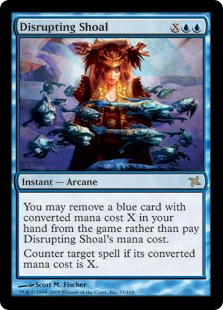
[card graph = "Disrupting Shoal"]

Disrupting Shoal, on the other hand, is a great example of a rental card. It is the type of card that may be good now as a result of the Jace unbanning that most players won't likely own. I fortunately own a playset – which I will likely be selling into the spike on eBay to some unfortunate renter who doesn't have good borrowing connections. Sure, Disrupting Shoal could suddenly becomes a staple, but more likely, it's a piece of technology that will be decent for a moment and then fade back into obscurity. Rental cards have a tendency to backslide in value as the shock demand that comes with the spike fades.

When a Standard or Modern card spikes, it is typically the highest value that card will ever hold for a few reasons:

  1. There are only so many people willing to buy in and rent the card. Once those people have it, there are more copies for sale than people to buy them up.
  2. The metagame changes and the hot new rental cards change like the seasons. Jace is hot now, and therefore things that might be good with Jace are also hot. However, things will settle back down and the metagame will reestablish itself. The next big thing will be whatever is good against the Jace decks, and then whatever is good against those decks. People only really want to rent what is good "right now," and then they won't need it once a new hot thing comes up.
  3. The Masters reprint series has shown us that Wizards of the Coast is happy to help fill the demand for expensive "rental cards." Think about the types of cards that get included in Modern Masters sets. They are exactly the kinds of cards that people need to play right now that are not necessarily going to be hot commodities forever. Sure, we get Snapcaster Mage, Cryptic Command and Mox Opal which are legitimate mainstays, but we also get a lot of Mishra's Baubles and Primeval Titans, which are specific to types of decks that are good now but may not be top tier forever.

The reason the idea of understanding the difference between cards people want to "own" as opposed to "rent" is important is that "own" cards are much better bang for your buck.

Final Thoughts

Cards that people view as rentals tend not to trend upward over time. They are also not cards that people are willing to pay a premium for. When you take that Disrupting Shoal to the trade table, a couple of things are likely to happen: you may find somebody looking to rent it for an upcoming event, but they won't be happy to trade for it. They will give you the detached story about how they will take it off your hands because they might try it out at Tuesday Night Modern, but don't really want to give up anything too good. 

Secondly, they are going to want a good deal on it. They will recognize that it has recently spiked and will probably go down again soon. They will look on TCGplayer and see that there are a couple of cheaper copies than the median and want to pick them up at the price without having to give up anything too exciting.

That is the problem with rental cards! The people who "want" them, don't actually want them!

Not all $10 cards are created equal. Obviously. Some cards go up, some go down, some people want, and some people would rather borrow than own. If you keep your trade binder stocked with cards that will go to "owners" rather than "renters," you'll likely take in a much better haul over time. Think about the cards that you actively want to "own" or have bought because you wanted to "own" them.

There was an error retrieving a chart for Mox Sapphire

What do they have in common? What do you use them for? Why did you want them in the first place?

These are things to think about when you are thumbing through another person's trade binder. There is a ton of value to being able to look at a card and imagine who will want to trade for it and why. The best way to ensure getting a good price for your cards is to know who is looking for each card and what they are going to use it for.

If you had to sell your collection, what would be the last things you'd try to hold onto? The cards that are personal and that you really enjoy:

  • A favorite Commander deck?
  • A cube that you worked on for years?
  • A Battle Box?
  • An Old School deck?
  • A foiled out Legacy deck?
  • A foiled out Pauper deck?
  • A favorite foil or Old School card?

Finding cards that fit into these niches for various people are the best possible value a trader or seller can find. Finding "owners" for cards ensures you'll bring in a solid haul (and maybe even make someone's day)!

What would be the hardest thing to let go of for you to let go of and why? Feel free to drop your answer into the comments – I'm always interested to hear what others value. Any other questions, comments or whatever? You know what to do.

Insider: QS Cast #88: Title Bout – JTMS and Modern

Are you a Quiet Speculation member?

If not, now is a perfect time to join up! Our powerful tools, breaking-news analysis, and exclusive Discord channel will make sure you stay up to date and ahead of the curve.

The QS Cast returns! Chaz, and Tarkan come together as the new panel – and in this episode they discuss the following:

  • Was the B&R Announcement a good or bad thing for the vision of Modern?
  • Discussion about Masters 25
  • Can Modern still be just as good as before? It was nearly-perfect.
  • Interests

Cards Discussed

Insider: QS Flash Cast #4: New Modern World

Are you a Quiet Speculation member?

If not, now is a perfect time to join up! Our powerful tools, breaking-news analysis, and exclusive Discord channel will make sure you stay up to date and ahead of the curve.

Play

Editor's Note: This Podcast was recorded last week on Tuesday Feb 13th. Apologies for the delay, and this is published now only for Insiders. Many cards were discussed extensively in Discord and many of the cards discussed have increased in price.


The QS Cast returns! Chaz, and Tarkan come together as the new panel – and in this episode they discuss the following:

  • Jace, the Mind Sculptor and Bloodbraid Elf unbanned in Modern!
  • Was this a smart move?
  • What does Modern look like going forward.

Cards Discussed

Video Series with Ryland: Jace Moon

Are you a Quiet Speculation member?

If not, now is a perfect time to join up! Our powerful tools, breaking-news analysis, and exclusive Discord channel will make sure you stay up to date and ahead of the curve.

What an absolutely wild week for Modern. Playing with Bloodbraid Elf and Jace, the Mind Sculptor legal has been incredibly exciting and exhausting. With so many shells to try, and so many changes in deck-building philosophy (particularly for control decks) I feel like I'll never have enough time to explore all the avenues! Today's Blue Moon list comes largely from the core of a 6-2 finish of MTGO user Gul_Dukat in the most recent Modern Challenge. Jace, of course, is the obvious addition to the archetype, but other innovations are present. Most importantly, in my opinion, is the implementation of four Disrupting Shoal.

When I first heard the rumblings of Shoal being used after the Jace unban, my initial impression was that it would be a trap. Nothing impressive, too restrictive, and altogether too cute. After my twenty or so matches with the card, I am incredibly impressed. I have been happy with it in nearly every matchup (GBx being the exception) and it has always overperformed. Whether it was countering a lethal Scapeshift, a turn-one Cranial Plating (I was on the draw), or helping me win early counter wars against Storm, it was outstanding.

I'm not sure that this Blood Moon shell is the best way to move forward with a Jace/Shoal list, but it is certainly a good starting point. Shoal decks are looking for a few important things:

  1. They incentivize tapping out for impactful threats.
  2. They require a heavy blue card count.
  3. They reward a variety of blue converted mana costs (low to the curve).

It may just be me (I'm a bit biased here), but this sounds excellent for UW. Originally after the Jace unban, I became concerned about the future of UW Control because of its relative lack of ability to deal with Jace efficiently in pseudo-mirrors. UW lists will always be lighter on countermagic, and without Lightning Bolt, it is difficult to have a clean answer to a resolved Jace. Now that I've been shown the truth that is Disrupting Shoal, I'm very curious to find if it can help solve some of these issues in the mirror.

This entire write-up became essentially about Disrupting Shoal (and less about Blue Moon in general) but it was hard to avoid! I'm genuinely excited about the future of the card in the format moving forward and I'm going to be testing a lot of shells with it. Enough about that though, you came here to see some games with Blue Moon!

I hope you enjoy the matches and, as usual, I'm interested to hear what kind of content you'd like to see moving forward, so I can continue to evolve and improve my videos. Please let me know your thoughts, and any improvements you would like to see concerning formatting, presentation, or whatever else strikes your fancy. If you'd like to see similar content, check out my Twitch channel for some more live Modern!

[youtube https://www.youtube.com/playlist?list=PL261kJ_cAQC8yKyh6vQg0LQiycsU924yI]

Jace Moon, by Ryland Taliaferro

Creatures

4 Snapcaster Mage
4 Thing in the Ice
2 Vendilion Clique

Enchantments

2 Blood Moon

Instants

3 Cryptic Command
4 Disrupting Shoal
4 Lightning Bolt
2 Logic Knot
4 Opt
2 Remand

Planeswalkers

4 Jace, the Mind Sculptor

Sorceries

4 Serum Visions

Lands

1 Desolate Lighthouse
7 Island
1 Mountain
3 Polluted Delta
4 Scalding Tarn
2 Steam Vents
3 Sulfur Falls

Sideboard

2 Abrade
2 Anger of the Gods
1 Blood Moon
3 Dispel
1 Entrancing Melody
1 Keranos, God of Storms
1 Negate
2 Pia and Kiran Nalaar
2 Surgical Extraction

Insider: MTGO Market Report for February 21st, 2018

Are you a Quiet Speculation member?

If not, now is a perfect time to join up! Our powerful tools, breaking-news analysis, and exclusive Discord channel will make sure you stay up to date and ahead of the curve.

Welcome to the MTGO Market Report as compiled by Matthew Lewis. The report will cover a range of topics, including a summary of set prices and price changes for redeemable sets, a look at the major trends in various Constructed formats and a "Trade of the Week" section that highlights a particular speculative strategy with an example and accompanying explanation.

As always, speculators should take into account their own budgets, risk tolerances and current portfolios before buying or selling any digital objects. Please send questions via private message or post below in the article comments.

Redemption

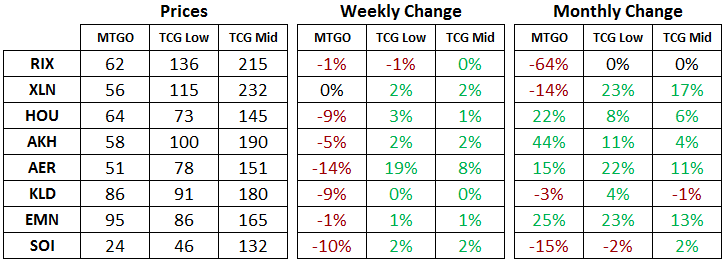
Below are the total set prices for all redeemable sets on MTGO. All prices are current as of February 19, 2018. The TCGplayer low and TCGplayer mid prices are the sum of each set's individual card prices on TCGplayer, either the low price or the mid price respectively.

All MTGO set prices this week are taken from GoatBot's website, and all weekly changes are now calculated relative to GoatBot's "full set" prices from the previous week. All monthly changes are also relative to the previous month's prices, taken from GoatBot's website at that time. Occasionally, full set prices are not available, and so estimated set prices are used instead. Although Hour of Devastation (HOU), Amonkhet (AKH), Aether Revolt (AER), and Kaladesh (KLD) are no longer available for redemption, their prices will continue to be tracked while they are in Standard.

Standard

Prices in Standard took a dip this week as the resurgence in interest wanes in the face of all the activity in Modern. From a macro perspective, there's no strong buying or selling opportunity at this moment in the churning market. I am continuing to keep an eye on Ixalan (XLN) and Rivals of Ixalan (RIX), with the fall set close to being a buy. The price of a full set of RIX is turning down, though, and it is still a few tix away from a good buying level.

There was an error retrieving a chart for Ixalan's Binding

My biggest trouble with full set speculations is the urge to jump in too early. Prices can look like they are reaching attractive levels, but usually there's plenty of time to be patient and wait for an even better opportunity. I think this is the case with the XLN and RIX, since there is still over a whole month of drafting to go. Don't get an itchy trigger finger just yet if you are a speculator, but if you are a player looking to fill out your playsets, then prices are just fine if you are going to get some use out of the cards in the next few weeks.

In terms of when to pull the trigger on these two sets for speculators, how the market reacts to the release of Masters 25 (A25) in March will be telling. If the set is popular to draft then prices will turn downwards as players sell their cards for tix in order to fund their drafts. At the very least there will be a temporary dip in the price of XLN and RIX boosters. Speculators will definitely want to have some tix available to scoop up deals in mid-March, the next best buying opportunity on the horizon.

In terms of singles, the emergence of a new ramp archetype in Standard has pushed the price of Hour of Promise up to 2.0 tix. This deck includes a ton of creature removal in Fumigate and Settle the Wreckage, as well as a Approach of the Second Sun as a victory condition. The use of Thaumatic Compass is also quite novel, and the transformational sideboard includes a number of hard-to-deal-with creatures like Carnage Tyrant and Nezahal, Primal Tide. Have a look at the deck list here.

There was an error retrieving a chart for Hour of Promise

I've long since sold my copies of Fumigate, but Hour of Promise is a card that I am holding still. If you are like me and looking at this failed spec turned good, then you might be tempted to sell right away. I think this is a fine call, but I also think the card will hit 4 tix before the uptrend is over. This looks like a fun deck to pilot, and ramp has always been a popular strategy, so I expect continued uptake among the MTGO player base, which will push the components of the deck like Hour of Promise higher.

Modern

It's a boom time for Modern, and you don't have to look further than any of the Jund components, including the mana base. Stomping Ground, Wooded Foothills and Blackcleave Cliffs have all powered to one-year highs, that last one with an assist from the Hollow One deck. Liliana of the Veil has also seen a strong resurgence and is tussling with Jace, the Mind Sculptor for most expensive card in the format.

There was an error retrieving a chart for Liliana of the Veil

I think Liliana has the chance to go to 80 tix, but it's currently wavering at just under 70 tix. I'd like to see this card back over 70 tix in the next week to demonstrate continued buying from players. I am still holding the copies I bought in October during the Innistrad (ISD) flashback drafts, as I don't think we've seen peak Modern interest yet. If the price of this card continues to drift down into the 60- to 65-tix range, then I think that selling would be correct as the uptrend would be over.

Trade of the Week

For a complete look at my recent trades, please check out the portfolio. In some ways, the unbanning of Jace in Modern was predictable. A few times in the past I have speculated on this exact possibility, but this time I had dismissed the idea due to the diversity of decks that Modern was displaying in high-level events. Unfortunately, there will not be a chance to rewind this scene and make a boatload of tix overnight, but I started thinking about other long-term opportunities that might be sitting around, waiting for their moment.

There was an error retrieving a chart for Isolated Chapel

At the top of the list are the Innistrad (ISD) check lands. Let me explain my reasoning. First of all, they rarely see Modern play so they are not too expensive; outside of Sulfur Falls, they are all cheaper than 1 tix. Since they are cheap the reprint risk is minimal – or rather, if they are reprinted, the downside loss is capped at a low level. Like the ISD check lands, the Worldwake (WWK) creature lands have only seen one printing so far, but due to their play in Modern, the reprint risk attached to this cycle of of lands is much more substantial. A reprint would significantly lower their price and generate large speculative losses for anyone holding the WWK creature lands. I would steer clear of these outside of your playsets, but the ISD check lands are a different matter. In fact the whole strategy here is to bank on a reprint, but in a Standard set.

If the ISD check lands are reprinted in a Standard set they would immediately become staples and integral to deck-building decisions. In terms of market impact, the originals from ISD would immediately be priced at a level to reflect that. To see this effect we only have to look at the fall release since XLN reprinted the allied-colour check lands. This was the fourth reprint of this cycle of lands, albeit the first reprint in a non core set. Just prior to the release of XLN Glacial Fortress carried a price tag of over 2 tix while the cheapest allied colour check land was Sunpetal Grove at 0.6 tix.

There was an error retrieving a chart for Sulfur Falls

I think it would be safe to say, given the lack of a reprint, that the ISD check lands would start in a higher price range, say 1 to 3 tix at the outset with the possibility of the most in-demand card to be 4 tix or higher. The trick to here is to be able to predict when this reprint might come to Standard. I think it's possible that this will occur in Dominaria (DOM), the next large expansion due in April. If not, then each large set, including this summer's core set, will be a chance at a reprint, but it might be a year or two before the reprint actually occurs.

With this timeline in mind it's clear that this has to be a long-term speculative position. Fortunately the prices are low enough that if the reprint does not happen in the next three or four large sets there will be ample time to expand the position with cheaper copies. This is no get-rich-quick scheme but it's almost a certainty that a reprint will happen – and that anyone holding copies of the ISD check lands will experience an overnight windfall when the opposing-colour check lands are spoiled or previewed for an upcoming set.

The Spice of Rivalry: Brewing with Rivals

Are you a Quiet Speculation member?

If not, now is a perfect time to join up! Our powerful tools, breaking-news analysis, and exclusive Discord channel will make sure you stay up to date and ahead of the curve.

So, a new set released and I haven't addressed it at all. It's not that I didn't want to, or lack things to discuss. I was just a bit busy with a far more important project. And then with watching a Pro Tour. And then with chaos. I realize that talking about Rivals of Ixalan is not exactly timely, but I've been sitting on this article for awhile now, and frankly I need more time to actually test Jace and Bloodbraid before I discuss them further.
By now, everything that could have been speculated about the various Modern playables has been dissected to death. I've got nothing to add to the speculation, but I do have reps. Several cards interested me when Rivals was spoiled, but have mostly disappointed. No real surprise there; Ixalan is a tribal block and feels very depowered compared to Kaladesh, Shadows block, or Oath of the Gatewatch. However, there are a few gems worth discussing.
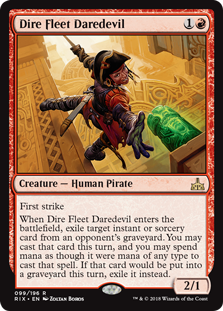
One "new" card I want to address before we dive in is Dire Fleet Daredevil. When the card was spoiled, there was a talk of a reverse Snapcaster Mage, but it has completely died. I also found it lacking. Daredevil has the "punisher" problem of being dependent on your opponent's choices to be good—specifically, they have to play spells that you want to steal. That means something bad happened to you first. However, it started popping up in Humans decks as sideboard against Jeskai. This surprised me, since it just seemed like a counter to Snapcaster Mage, which is marginal even with Aether Vial. I've played against this strategy a few times now and have never seen it work out. Spell Quellering the spell back is very big game.

UG Merfolk

If it wasn't obvious that I would start here, you've clearly never read my archive. Merfolk was my deck for years, but over the past year I've played it less. The midrange green creature decks that I used to dominate have completely disappeared, in the wake of fast, disruptive decks. Merfolk can go big and it can go wide, but it does so more slowly than other options like Humans. The metagame has just felt more unfriendly.

Ixalan attempted to reverse this trend. Instead of the traditional mono-blue or my favorite UW version, you could now play green. Kumena's Speaker and Merfolk Branchwalker proposed to overturn everything we thought we knew about Modern Merfolk. Their improved stats looked good enough to justify changing colors. The problem: Speaker was a fine card, but Branchwalker was frustrating. It was so close to Silvergill Adept, but not close enough and it never seemed to be what you needed. Then Rivals came along and gave us a new lord, Merfolk Mistbinder. This actually has changed the decision calculus and I've been running UG Merfolk for the past month.

UG Merfolk

Creatures

4 Kumena's Speaker
4 Cursecatcher
4 Silvergill Adept
4 Lord of Atlantis
4 Master of the Pearl Trident
4 Merfolk Mistbinder
4 Harbinger of the Tides
3 Merrow Reejerey

Artifacts

4 Aether Vial

Enchantments

4 Spreading Seas

Instants

2 Echoing Truth

Lands

4 Botanical Sanctum
4 Cavern of Souls
4 Mutavault
3 Breeding Pool
4 Island

Given that Lantern Control won the Pro Tour, I cannot fathom playing a creature deck without some way to remove an Ensnaring Bridge, so I'll never be without Echoing Truth. I don't miss the Branchwalkers, and the deck feels far better than the previous version of UG Merfolk. However, I'm still not sold on the deck.

Is It Better?

I'm not certain that UG Merfolk is actually better than mono-blue or my favorite UW deck. On the one hand, this is a far better aggro deck than either alternative. The green creatures allow you to curve out or kill on turn four more often. Having another pushed one-drop is enormous, and Speaker's actually worth a removal spell (unlike Cursecatcher). This may not sound like much, but getting opponents to kill something that isn't a lord is very good for Merfolk. Mistbinder isn't great compared to Master of the Pearl Trident, but a lord is a lord, and lords form the backbone of the deck. The more lords you have, the faster you kill.
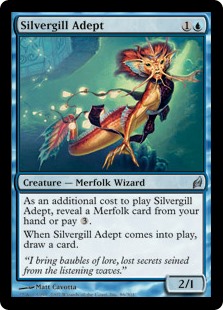
But is it a better Modern deck? I'm not sure. The aggro boost comes at a cost which may not be worthwhile. The problem comes from the sacrifices necessary to play green: my deck, and many others, struggle with the color requirements.

In other versions, you only really need blue mana. UW can survive without white because we only use it for sideboard cards and Path to Exile. UG consistently needs green, meaning accepting a vulnerability to Blood Moon. This normally isn't a problem, as mana denial is weak against aggressive decks (especially ones with Aether Vial). However, you can never fully rely on Vial, and the more non-basics you play, the higher the risk that hate will be effective and worthwhile. I have been locked out by Moon with UG, but never on UW. Opting for fetchlands to mitigate this problem just makes us vulnerable to Burn. Also, relying on Cavern of Souls as a fixer complicates casting non-creature spells.

The other big problem is the sideboard. Green doesn't provide many good sideboard options other than Natural State, and targeted removal isn't very exciting. Merfolk doesn't care about hard removal so much as tempo, so Echoing Truth is as good. Meanwhile, white has gamebreakers like Stony Silence. My experience so far says that UG Merfolk is better in race situations and worse in all other matchups. If what you want is pure aggression, then by all means. However, if you're expecting longer matches where the sideboard matters, then UW is advantaged. Meanwhile, if you worry about casting your spells on time, then you'll never go wrong with mono-blue.

A Red Sun Rises

The other big acquisition is Blood Sun. The online chatter seems to have died down, but when it was spoiled, there were discussion threads all over the place about the card, mostly focused on its use in Tron—Blood Sun does not affect Tron lands. However, it can do far more with a little effort.

The Obvious Use: Tron

Sun was made to shut down utility lands, so mana production is unaffected. Even if, like the Tron lands, your lands produce mana in a weird way, it doesn't matter so long as they are producing mana. Sun also cantrips, so even when it's a poor card, it isn't too dead. While many have focused on attacking fetchlands or Ghost Quarter, Sun's real advantage is against Valakut, the Molten Pinnacle. Right now, Tron has an even-at-best matchup against Valakut. Tron has a lot of land destruction, but Valakut can power through thanks to all the ramp and race Tron's bombs. Sun shuts down the combo, forcing Valakut to either answer Sun or win with Primeval Titan (a losing plan against Eldrazi). Whether this is enough to justify sideboard space is uncertain, but it is a strong option.

Spicy Sun

Wizards has a habit of revisiting old cards and trying to improve them. The goal is to keep the old effect or something similar, but remove whatever made it broken. Sometimes it works, like turning Sphere of Resistance into Thorn of Amethyst. Oftentimes it fails, and the "fix" doesn't work. Yawgmoth's Bargain "fixed" Necropotence by doubling the mana cost, but was more broken because you drew the cards immediately. Lion's Eye Diamond has an
enormous downside compared to Black Lotus, but it's just as broken alongside Infernal Tutor. Blood Sun is a "fixed" Blood Moon. Not as clearly oppressive as Moon, but potentially more powerful. How can we break this card in the grand tradition of "fixed" cards?

The key is the line, "lands lose all abilities"—be they activated or triggered. That includes drawbacks like enters-the-battlefield-tapped or additional costs while in play. Urborg, Tomb of Yawgmoth is unaffected because of layers. Similarly, if somehow you give lands an ability after your Sun starts shining, they'll keep it. Layers are a fun and intuitive part of the rules. Sun also doesn't affect anything in your hand or graveyard because those are land cards. In Magic, a thing is only just that thing on the stack or the battlefield; everywhere else it's a thing card. I figured there had to be a way to abuse this loophole.

Amulet Titan

When I think of removing drawbacks from lands, I immediately think of the Karoo lands. Simic Growth Chamber and friends have two lines of drawback text before their Sol-land mana ability. That is potentially a huge advantage (ignoring the fact that it can't happen right away). There is one problem, however. Consider this iteration of Amulet Titan.

Amulet Titan, Daryl Ayers, 91st Place SCG Charlotte

Creatures

4 Sakura-Tribe Scout
4 Azuza, Lost But Seeking
4 Primeval Titan
1 Walking Ballista

Artifacts

4 Amulet of Vigor
1 Engineered Explosives

Instants

4 Summoner's Pact
1 Pact of Negation

Sorceries

4 Ancient Stirrings
4 Explore

Lands

4 Gemstone Mine
4 Simic Growth Chamber
3 Gruul Turf
3 Tolaria West
2 Cavern of Souls
2 Forest
2 Grove of the Burnwillows
1 Bojuka Bog
1 Boros Garrison
1 Ghost Quarter
1 Khalni Garden
1 Radiant Fountain
1 Selesnya Sanctuary
1 Slayer's Stronghold
1 Sunhome, Fortress of the Legion
1 Vesuva

Sideboard

2 Relic of Progenitus
1 Hornet Queen
1 Thragtusk
2 Tireless Tracker
3 Dismember
2 Swan Song
1 Ruric Thar, the Unbowed
2 Pyroclasm
1 Cavern of Souls

While no longer scarily explosive without Summer Bloom, Amulet Titan is a viable deck. It is also still incredibly hard to pilot. I knew several pilots during PPTQ season who burned out playing Amulet Titan; not because they struggled to win, but because of mental exhaustion. Sequencing land drops is make-or-break for the deck. While miss-sequencing land drops often impacts decks, you can lose on turn two with an Amulet deck by playing or bouncing the wrong land. I can't find the thread, but I remember after PT Fate Reforged someone figured out that if Justin Cohen had taken a different, 30+ step line, he could have won the finals. Small wonder those players I know finished the season on far easier Bant Company decks.
In exchange for that complexity, you get an incredibly potent combo engine. Even with Bloom banned, Amulet can win on turn three with the right draw and correct sequencing. It's just less likely, and the old turn two kill isn't plausible. However, the aforementioned pilots told me that you can't rely 100% on that combo kill, particularly after sideboarding. There are too many answers for the enablers and Primeval Titan. Instead, the deck adopts a Summoner's Pact value plan. This works because of Karoo lands bouncing Tolaria West to find your Pacts, so you never have to hold them, smoothing your mana development. This is a much slower plan but makes it possible to overpower highly disruptive decks you can't combo out. The idea got me thinking that if the combo isn't really reliable and you want to be a ramp deck most of the time anyway, just embrace it.

Blood Amulet

Following that logic, Blood Sun fits right into the deck. You lose some long-game value because you can't bounce Tolaria under Sun, but that can be made up for with additional midrange creatures.

Blood Sun Rising

Creatures

2 Thragtusk
3 Azuza, Lost But Seeking
2 Tireless Tracker
4 Primeval Titan
2 Walking Ballista

Artifacts

4 Amulet of Vigor

Enchantments

2 Blood Sun

Instants

4 Summoner's Pact

Sorceries

4 Ancient Stirrings
4 Explore

Lands

4 Gemstone Mine
4 Simic Growth Chamber
4 Gruul Turf
3 Tolaria West
2 Selesnya Sanctuary
2 Cavern of Souls
2 Forest
4 Grove of the Burnwillows
1 Bojuka Bog
1 Ghost Quarter
1 Radiant Fountain
1 Hall of the Bandit Lord

Sideboard

2 Blood Sun
13 lands

To make this deck work, I replaced the combo pieces with the sideboard green creatures. Sakura-Tribe Scout is fine as an enabler, but is really bad if you aren't just winning right away. If you can win off Azuza and/or Scout beatdown, you weren't losing in the first place. To make Blood Sun castable, I added more red sources and took out the combo lands. In this deck, Hall of the Bandit Lord is better than Slayer's Stronghold, because it grants haste via mana ability (which Sun doesn't stop). Also, the sequencing with Boros Garrison required to make Slayer's Stronghold and Sunhome work really complicates things.

If nothing else, this deck is "easier" enough than Amulet Titan that even I can play it reasonably. Sun often acts like an additional pair of Amulets but costs three. This limits its maindeck value, but after siding you will want more, so I went with a 2/2 split. Blood Amulet has a slower goldfish than Titan, but in exchange, the deck is easier to pilot and has a better midrange plan. I can't say it is a better deck, but I can't pilot normal Amulet like I can Blood Amulet. In my book, that makes it far better.

Good Enough?

The question is whether this strategy is worthwhile. The combo, when you pull it off, is very fast; Amulet Sun definitely isn't. Speed made the combo matchup plausible. Ramp decks tend to be quite bad against combo because they lack disruption and tend to be slower than Storm or Ad Nauseam. This version doesn't have that advantage and the combo matchup is incredibly bad.
The advantage, besides ease of play, is that you are far better against midrange decks. You're starting game one with most of the anti-midrange package in and you have disruption in Blood Sun. Considering that both Jace and Bloodbraid are now free and belong in midrange decks, it is highly likely that midrange will be your primary matchup.

It is hard to say how aggro matchups will change. The extra Walking Ballista is huge, as is Thragtusk, but you are also slower. This makes it easier to be swarmed. Then again, the rise of additional control decks may push agro out entirely. This version of Amulet isn't obviously better than the mainstream version, but it may prove better in the metagame.

The Spice Will Flow

Blood Sun may only see play as a sideboard card right now, but I'm certain that's not its only use. There's combo potential, and while I have time before GP Phoenix, I will be looking into possibilities. Join me next week as I dig into my testing results with Jace.

Oh dear, am I turning into a polite euphemism?

Insider: Modern After the B&R Announcement

Are you a Quiet Speculation member?

If not, now is a perfect time to join up! Our powerful tools, breaking-news analysis, and exclusive Discord channel will make sure you stay up to date and ahead of the curve.

Hey, guys.

There was a huge change to Modern last week—Jace, the Mind Sculptor and Bloodbraid Elf are unbanned. Players may have speculated on one of these being unbanned but probably not both. I don't agree with WotC's decision to unban these cards personally, as the format is very healthy right now. Nevertheless, this is going to shake up the format by a lot.

A week after the unbanning, Jace, the Mind Sculptor is now 80 tickets each. Many people have already identified the JTMS and BBE synergies in Modern and thus those cards have increased in price. Therefore I think I'm a little bit late to the party, so I'm going to talk about something else.

The thing about MTGO is that you need to be online at the same time a B&R announcement happens in order to take advantage of it. The exception is if you bought some staples when they were cheap—for example Tarmogoyfs were below 30 tickets before the unbanning of JTMS and BBE. I talked about buying Goyf last October. If you invested in Goyfs, you should have been able to sell them for at least 15 tickets of profit each!

The last two weeks we talked a little bit about Liliana of the Veil. If you didn't sell them last week, I think you should keep them for some time longer as the price will probably continue rising. If you sold them, too bad—we can only blame luck as this B&R was definitely unpredictable.

If you didn't catch the announcement, there was basically nothing you could do because by the time you went online, everything became very expensive. So what we can do is think out of the box—find something that people haven't notice. Now, as usual there are two types of card that we can consider:

  1. Cards that have good synergy with the new card
  2. Cards that can beat the new card

With the unban of JTMS, I think some players will start to brew up planeswalker control decks. Thundermaw Hellkite is definitely one of the best cards that can beat JTMS and other planeswalkers after they resolve but I've thought of something different:

Sarkhan, the Dragonspeaker is a bit slow but it's a card that Jace can't deal with, and most cards in a blue-based control deck can't deal with once it resolves. Thundermaw Hellkite does hit harder but it can still be dealt with by bouncing the Dragon and countering it afterwards. So I strongly recommend buying some playsets of Sarkhan as investment.

Certain players figured out that Gaddock Teeg and Spell Queller are good creatures that can beat JTMS players. It's true, but JTMS decks will usually have a good mix of Lightning Bolt, Terminate and Fatal Push to deal with small creatures.

Thus, I think the best strategy to beat JTMS is to play BW Tokens. I think the deck is not only good against JTMS decks but it's also good against BBE decks. Despite generating plenty of card advantage, these midrange/control decks still have hard time dealing with creature tokens with their spot removal suite.

Most cards in BW Tokens are cheap right now, especially Gideon, Ally of Zendikar and Auriok Champion. In my opinion Auriok Champion is one of the most underrated cards after the recent B&R announcement. It has protection against most removal in the format plus it can block BBE and other black creatures. The only card that BW Tokens should be afraid of is Tarmogoyf, but with the printing of Fatal Push, that is no longer a big issue. Therefore I recommend investing in the cards in screenshots above: Auriok Champion, Bitterblossom, Gideon, Ally of Zendikar, Sorin, Solemn Visitor and Lingering Souls.

BBE is not only good in Jund midrange decks but also in aggro decks. A Naya Zoo deck packed with Wild Nacatl, Tarmogoyf, and Knight of the Reliquary is running around on MTGO. If you do some analysis on the decks that play BBE or/and JTMS, they have one similarity: they cut down their removal count to pack four copies of either BBE or JTMS in the deck. Thus, aggro decks that are able to beat their opponent before they slam the four-mana spells should become better.

Another thing about decks that play the unbanned cards: many of their spells are sorcery-speed, including BBE and its cascade trigger, and JTMS. This means if we can find decks that can win easily when opponents cannot react at instant speed, there is a potential that components of those decks will increase in price in the near future. In my opinion, there are few decks that fall in this category: Infect, Death's Shadow, and Gift's Storm.

I know I've talked about Infect many times but look at Inkmoth's price right now—its only 7.5 tickets! Both Jace and BBE can't do anything on Inkmoth unless BBE cascades into something that can destroy lands. Furthermore, with the reduction of spot removal in Jund and relying fully on the cascade trigger of BBE to gain advantage, Infect players can have good win rate with playsets of Vines of Vastwood and Blossoming Defense. I think this deck is worth investing in. Thus I recommend buying playsets of Inkmoth Nexus and Mutagenic Growth.

When the Death's Shadow deck first appeared in paper tournaments, it had a transformational sideboard which allowed the deck to play a heavily disruptive strategy. Basically the deck would destroy the lands and hands of their opponent by playing a combination of Thoughtseize, Fulminator Mage, Kolaghan's Command, and Surgical Extraction. While BBE is still affordable, if you guys want to have a slightly budget-friendly Modern deck that can compete with the JTMS and BBE hype, you can try going back to the old Death's Shadow build.


Alright guys, that's all for this week. Thanks for reading and I'll see you again next week.

Adrian, signing out.

Want Prices?

Browse thousands of prices with the first and most comprehensive MTG Finance tool around.


Trader Tools lists both buylist and retail prices for every MTG card, going back a decade.

Quiet Speculation