menu

Pro Tour Bilbao: Predictions and Premonitions

Are you a Quiet Speculation member?

If not, now is a perfect time to join up! Our powerful tools, breaking-news analysis, and exclusive Discord channel will make sure you stay up to date and ahead of the curve.

Pro Tour Bilbao's just two weeks away. Soon, all eyes will be on Modern, the now-beloved alternative to Standard and Legacy. And perhaps for the first time as a true replacement for those formats. Wizards has shown us unequivocally that they plan on supporting this format whole-heartedly—with tournaments; with reprints; with heavy-handed (and largely successful) banlist management. Among the many paying attention to Modern, a good chunk have begun wondering about what may actually go down at the PT. Today, I'd like to add myself to their ranks.

This article expands upon and analyses Jason's Pro Tour predictions from earlier in the week and proposes some original ones. If this article gets you thinking, please join the conversation in the comment section!

Addressing Internal Predictions

In his December metagame update piece from earlier this week, Jason made a few Pro Tour predictions of his own, with which I agree to varying degrees. He touches on some crucial issues, though, so I'd like to offer my takes on those predictions before presenting my own.

The idea here, of course, is not to tear into Jason. As a highly critical person, it's my nature to dissect the ideas of others—especially ones of those I respect. I found Jason's thoughts helpful in framing my own thoughts about the Pro Tour. They aided me in examining its possible outcomes from a second perspective, which I consider integral to developing a holistic view of the format and of player opinions. Seeing where other players are at about Modern is also something Wizards pays close attention to, and can in turn can help us make accurate banlist predictions or even metagame calls.

"The Field at Large Will Be Highly Diverse"
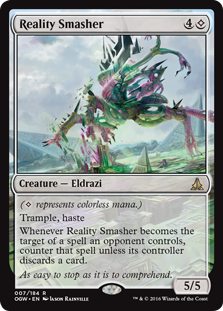
True, but I believe the Pro Tour will appear less diverse to spectators than it is in actuality, and the tournament itself is also likely to be less diverse than Modern itself at that time.

Think way back to the last Modern Pro Tour. PT Oath of the Gatewatch featured a relatively diverse field, but coverage was dominated by Colorless Eldrazi mirrors. Indeed, the teams that "broke" the format won the most, and therefore earned the most airtime.

To be clear, we don't have a deck like Colorless Eldrazi on the horizon. But Modern's still a play-what-you-know format, and I bet the teams who prepare better will do better and garner the most visibility. These players are also likely to be on the same deck or two, as disagreement within teams on which deck to play sort of goes against the whole idea of teaming up in the first place (although it does occasionally happen).

As for the field itself, some element of its diversity is bound to come from the fact that less experienced pros are likely to misunderstand the meaning of "Modern is an open format." I've seen plenty of great players, also format newcomers, fall into the trap of putting too much stock into the idea that you can play anything in Modern by expecting to do well with any random deck by virtue of being great players. Some then chalked their losses up to variance and quit Modern; the more productive among them learned from their mistakes and have since had success by intimately getting to know one or two decks.
Come to think of it, we just saw Brennen DeCandio fall into that very trap at SCG Columbus, bombing with the utterly fringe Mono-Green Devotion. Brennan justified his choice by arguing that people are now running Field of Ruin over Ghost Quarter (something that first of all isn't true and second of all isn't enough to suddenly make this bad deck playable), betraying his lack of reps in Modern. Not-so-coincidentally, Brennan is one of the format's most vocal critics in today's pro-Modern climate, attributing his failures there to the supposed matchup lottery. I can see other qualified players buying into a similar mentality and registering some off-the-grid deck, to an extent artificially buffing the tournament's diversity.

"The Top 8 Will Reflect This Diversity."

With this point I totally disagree. The best-performing teams are likely to make it to the top and be on the same thing, yielding a Top 8 of a couple of well-prepared teams. Combined with the birthday paradox, the likelihood of this scenario makes me believe the Top 8 might feature at most five different decks and is more likely to feature four.

"Storm, Shadow and Lantern Will Be Played in Higher Numbers"

Storm, Grixis Shadow, and Lantern Control certainly seem like some of Modern's best decks to me. I'd even add Eldrazi Tron to the list. Between these four decks, so much archetype ground is covered that the arguments for playing anything else really do fall into niche territory. For reference, that's fine with me—if there's ever been a format to feature decks that win by finding and exploiting a niche, it's Modern. But Storm, Shadow, Lantern, and Eldrazi Tron make up the framework that needs to be cracked.
That said, I'm not sure I agree that these decks will be played in higher numbers. I think Jeskai Tempo will be a huge favorite among pros, as it represents what that community has consistently endorsed since Modern's beginnings. In my eyes, the pros' frequent beefs with Modern over the years have in part been influenced by Jeskai's historically poor standing; now that the deck's a real contender, I expect pros to flock to it. Part of their gravitation to Jeskai has to do with convenience. The skills integral to decks like Jeskai—grinding out opponents; navigating battlefields; balancing life points; remaining aware of in-deck resources—tend to translate very well from other formats like Standard or Legacy, and most pros play other formats. Compare Jeskai to a deck like Lantern Control, that has highly specific lines inherently and that adjusts its lines significantly depending on each matchup, and it becomes apparent that players coming from other formats would immediately discount it, or at least be less excited to put in reps with it.

Jason puts Storm and Shadow into similar categories, alluding to their Modern-nicheness. But he argues that pros are likelier than your average other-format-goer to indeed learn the ins and outs of these highly specific decks. I think he may be overestimating how much time pros who primarily play Standard or Legacy will actually want to invest into Modern for this tournament, and underestimating the tangible emotional barriers specific decks like Lantern can pose for newcomers. If a given pro is having relatively sustained success with a deck that requires of them a more familiar skillset, I think they're likely to stay on that deck and tweak it for the anticipated metagame.
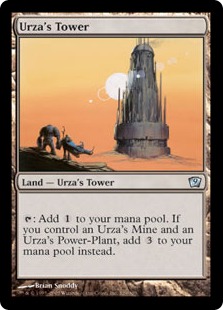
One deck I do expect to be played in higher numbers is Tron, which includes both Gx and Eldrazi variants. Tron decks are relatively straightforward with a shallow learning curve, and they produce "free wins" in some of Modern's most fundamentally understandable terms: "turn three Karn." Pros with a lot on their plate are likely to be drawn to the raw power and approachability of the Tron archetype, as well as its inherently favorable matchups against the Ux control decks unendingly advocated for by pros for years.

All that said, I do think Storm, Shadow, Lantern, and Eldrazi Tron are the decks to beat, and expect at least two of these decks to be very accomplished at the Pro Tour. I just don't think they'll be played in direct accordance with their actual power level, which incidentally mirrors their current metagame share.

"Humans Will Underperform"

I agree with this assertion overall, but take issue with some of the logic behind it.

Jason writes that "Modern is a format that rewards linearity and explosiveness," and notes that "Humans can’t really boast either of those things." On the other hand, I find Humans to be extremely linear, if not quite as much as something like Burn—its games only fail to play out the same way each time because of the deck's many unique spells and lack of consistency tools. Still, barring some minor variation in terms of board-dependant sequencing, Humans tends to play its game each game, with little room for pilots to adjust their gameplans.
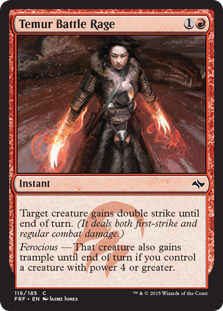
Nonlinearity, when possible, actually benefits strategies. The recent success of Shadow decks, Affinity, and Jeskai Tempo all attest to that—attacking from multiple angles, and boasting the ability to choose which angle to attack from at will, are indeed keys to success. It's just that nonlinearity generally comes at the cost of proactivity, as adjusting one's gameplan tends to be more reactive; proactivity, I'd say, is indeed tremendously important to success in this format.

The distinction between proactivity and linearity, hinted at in Roland's article on fairness, can certainly be tricky to pin down, since the two components tend to walk hand-in-hand. A second cost of nonlinearity is focus, which I plan to cover in detail in a forthcoming article; sacrificing synergy to attack from multiple angles can mean a drop in proactivity or consistency, both crucial components for Modern success. For more on the importance of these parameters—proactivity, interactivity, and consistency—check out my Three's Company article from September 2016.

So I'd rewrite Jason's sentence to read, "Modern is a format that rewards proactivity and explosiveness," which in my mind are synonymous terms. Of course, Humans itself is quite proactive. But then, I agree with Jason that Humans is unlikely to experience smashing success at the Pro Tour. How come?

Humans's strength lies in its ability to proact and interact simultaneously. Deploying threats like Reflector Mage or Meddling Mage interferes with an opponent's gameplan while developing one's board state. The deck's issue is a consistency one: without smoothing tools like Serum Visions or even Collected Company, Humans has no way to ensure it hits the right disruption for the right matchup. Reflector does very little against linear combo decks like Storm or Lantern, while Meddling embarrasses in the face of multiple cheap removal spells out of Jund or Grixis.
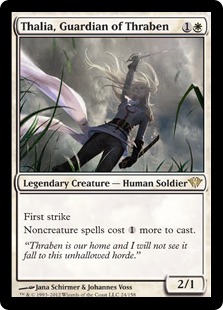
Similarly, Thalia, Guardian of Thraben offers nothing against creature-centric decks, and the same goes for Kitesail Freeboter. Many a Humans game is lost to drawing the wrong disruptive threats for the matchup, and that's not even accounting for the variance inherent to running Aether Vial (the card blows against removal-heavy decks, where we'd prefer another threat; late Vials contribute very little to a given game; removed Vials can totally screw hands depending on them).

If Humans indeed underperforms at the Pro Tour, as I think it will, it will be because of its consistency issues. I'm inclined to believe few experienced Modern players will pick Humans at all, as they will have recognized these issues in testing. If anyone plays Humans, it'll be the deck's die-hard proponents (is Collins Mullen qualified for this Pro Tour?) or players who don't play a lot of Modern (or at least haven't tested very much). I doubt such players barrel through Day 1 unencumbered.

Personal Prophecies

I'll just kind of rattle these off and open the floor to the readership in the comments.

Storm, Shadow, Lantern, or Eldrazi Tron Wins the Most
This isn't such a bold prediction, but I want to make absolutely clear that I think these four decks have the most going for them in this metagame. I'd be surprised (albeit pleasantly) if one of them (and am leaning towards two) didn't put multiple copies into the Top 8.

Meanwhile, I expect BGx decks to underperform. While Abzan and Jund have been gaining shares overall, and now combine to form a superarchetype that's the number three most-represented "deck" in Modern, the linear—especially big mana—slant I think the PT will take should keep them away from the winning tables.

The same goes for synergistic aggro decks. Let's get real: these decks kind of suck right now. Jeskai's on the up, and Shadow's likely to be a big hit in Bilbao. Company and yes, Humans are the big losers here. I think Affinity is the exception to this rule, and expect that deck to edge out other synergistic aggro contenders as Storm will other linear combo options.

Bans Unlikely

Unless something truly broken appears, I just don't see Wizards banning cards after this Pro Tour in light of reactions to their previous Modern bans surrounding Pro Tours. Even if one or two decks perform much better than others, I bet the company writes it off so long as medium-sized events maintain their diversity—which, by the way, they are likely to. In this way, Bilbao may end up a statistical anomaly as Worlds does. People have their Modern decks now and love them, and the big financial incentive to play the "best deck" will be gone after the Pro Tour. Besides, Modern shifts enough that the "best deck" is unlikely to remain so for long, at least in obvious terms.

Unbans Likely
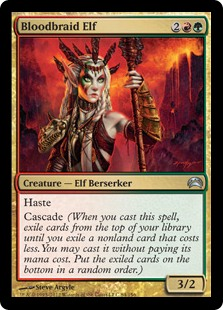
On the subject of bans, Wizards may look to shake up the format another way. The playerbase has become increasingly vocal about certain cards on the banned list, namely Stoneforge Mystic and Bloodbraid Elf. I think if fair, three-color midrange decks besides Shadow have a poor showing as I've predicted, Wizards will look to unban one of these cards. Both coming off at once is pretty unlikely in my eyes, as Wizards has always been conservative with their unbans. They may also want to keep the format how it is if they believe it has generated enough interest on its own, since unbans are unarguably a limited resource at their disposal with which to inject new life into Modern.

Pro Tip

No matter what the future has in store for us, I'm psyched for Pro Tour Bilbao, and so are most Modern players I know. I'm not looking to be vindicated with any of my predictions—I'm just so excited that I can't help but write 2000 words about it. If you share my enthusiasm, drop me a line in the comments.

Insider: QS Cast #85: RIX Review

Are you a Quiet Speculation member?

If not, now is a perfect time to join up! Our powerful tools, breaking-news analysis, and exclusive Discord channel will make sure you stay up to date and ahead of the curve.

Play

[note]: Apologies for the late post – as such, this will be Insider Only.

The QS Cast returns! Chaz, and Tarkan  come together as the new panel – and in this episode they discuss the following:

  • Rivals of Ixalan
  • Interests

Cards we discussed:

Avatar photo

Chaz V

Started playing during Invasion block at the age of 13. Always a competitive person by nature, he continues playing to this day. Got into the financial aspect of the game as a method to pay for the hobby and now writes, Podcasts, and covers all aspects of the game, always trying to contribute to the community and create great content for readers and listeners.

View More By Chaz V

Posted in Free Insider, QS CastTagged , , , Leave a Comment on Insider: QS Cast #85: RIX Review

Have you joined the Quiet Speculation Discord?

If you haven't, you're leaving value on the table! Join our community of experts, enthusiasts, entertainers, and educators and enjoy exclusive podcasts, questions asked and answered, trades, sales, and everything else Discord has to offer.

Want to create content with Quiet Speculation?

All you need to succeed is a passion for Magic: The Gathering, and the ability to write coherently. Share your knowledge of MTG and how you leverage it to win games, get value from your cards – or even turn a profit.

Insider: MTGO Market Report for January 17th, 2018

Are you a Quiet Speculation member?

If not, now is a perfect time to join up! Our powerful tools, breaking-news analysis, and exclusive Discord channel will make sure you stay up to date and ahead of the curve.

Welcome to the MTGO Market Report as compiled by Matthew Lewis. The report will cover a range of topics, including a summary of set prices and price changes for redeemable sets, a look at the major trends in various Constructed formats and a "Trade of the Week" section that highlights a particular speculative strategy with an example and accompanying explanation.

As always, speculators should take into account their own budgets, risk tolerances and current portfolios before buying or selling any digital objects. Please send questions via private message or post below in the article comments.

Redemption

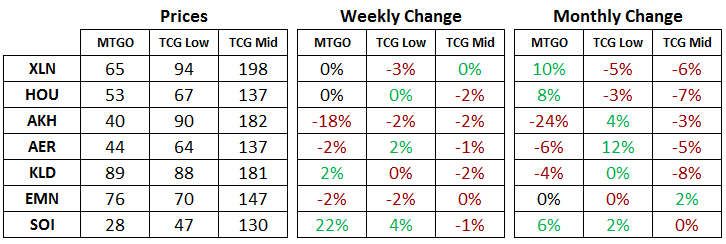
Below are the total set prices for all redeemable sets on MTGO. All prices are current as of January 15, 2018. The TCGplayer low and TCGplayer mid prices are the sum of each set's individual card prices on TCGplayer, either the low price or the mid price respectively.

All MTGO set prices this week are taken from GoatBot's website, and all weekly changes are now calculated relative to GoatBot's "full set" prices from the previous week. All monthly changes are also relative to the previous month's prices, taken from GoatBot's website at that time. Occasionally, full set prices are not available, and so estimated set prices are used instead. Although Hour of Devastation (HOU), Amonkhet (AKH), Aether Revolt (AER), and Kaladesh (KLD) are no longer available for redemption, their prices will continue to be tracked while they are in Standard.

Standard

Despite my best efforts at predicting when Energy would get nerfed in Standard, Wizards of the Coast (WotC) moved aggressively this week to balance out Standard. I thought that February would be a better time to handle this move from a marketing perspective, but it looks like WotC felt it had no choice but to move now to try and restore some diversity to the format.

In the MTGO market, the bans have shaken up the valuation of Standard playable cards and prices are responding. The big surprise was the hit that red took with Ramunup Ruins and Rampaging Ferocidon permanently sidelined in the format. Chandra, Torch of Defiance and Hazoret the Fervent are down as a result, though one of the first undefeated decklists from Standard leagues has been revealed and both of these cards are present. Have a look.

There was an error retrieving a chart for Chandra, Torch of Defiance

Hazoret and Chandra are both powerhouse cards still, but the market has soured on them in the short term. Players looking to round out their collections should take advantage of the dip in price and the turmoil in Standard. It's possible that both of these cards don't recover their previous prices, but I would bet that these are too cheap right now.

Elsewhere, some of the early winners are The Scarab God, Torrential Gearhulk, Heart of Kiran, and Angel of Invention. It's not clear if the trends on these will continue, so if you are like me and don't have a deep insight into where Standard is headed, selling some copies of these would be prudent in light of their recent jumps in price.

In terms of Rivals of Ixalan (RIX), the preview events put enough product into the market to stoke brewers interest and prices went bananas over the weekend. Starting at 164 tix on Friday, the set peaked over the weekend at a whopping 273 tix. An aggressive speculator could have been buying up cards and reselling them over the weekend at a nice profit, even if we assume much larger buy and sell spreads than normal. If preview events are a permanent feature of set releases going forward, this will be a trade to watch out for.

Modern

RIX hasn't yet filtered into Modern in a big way, though the market is anticipating that Dredge will be benefiting from the new set. Blooghast has just about reached its highest price in a year despite being reprinted in Iconic Masters (IMA) recently, and a relatively obscure Tenth Edition uncommon named Goblin Lore has perked up and is now at 2 tix.

There was an error retrieving a chart for Bloodghast

I think this is in reaction to the printing of Silent Gravestone, which on the surface looks like a bad Relic of Progenitus. It's cheap casting cost is the same, but actually hating the graveyard takes four colourless mana, so it's not at all suitable for Modern sideboards. Where Dredge gets utility from this deck is in the static ability that prevents targeting of cards in graveyards. This turns of two widely played graveyard hate cards in Surgical Extraction and Scavenging Ooze, and that's perfect for a deck like Dredge that's looking to fill and protect its graveyard.

Standard Boosters

Last week, I highlighted the opportunity on RIX boosters that I anticipated. Although these peaked at close to 4 tix over the weekend, that increase was tied to the high expected value of the boosters and not to broader market forces. If you were able to sell on the weekend, then you reaped a nice short-term profit, but this was a stroke of luck and not anticipated on my part.

This week, I am reviewing the thesis and I have found it wanting. XLN boosters have strengthened in price and now sit at 3.5 tix. RIX boosters have come back down and now sit at 3.2 tix. A draft set on the secondary market goes for just a little over 10 tix, the equilibrium price.

Where my thesis was wrong was to trust the most recent historical data on HOU and AKH boosters. After HOU was released, AKH boosters dropped to 1.5 tix, and never recovered a price higher than 2.5 tix while AKH block was the current Draft format. This gave me a guide for what to expect with XLN boosters, and the recent price dip to 2.0 tix also suggested lower prices were possible.

What I didn't take into account is the awarding of RIX boosters in last week's preview events. This fundamentally altered the relative scarcity of RIX and XLN boosters. Instead of RIX boosters accruing value due to being relatively scarce like HOU boosters last summer, the injection of supply has mitigated the issue and the price of each booster is much closer as a result.

Relative scarcity is an important concept to consider. Looking back at how HOU and AKH boosters move in price, the initial drop in AKH at HOU's release was a result of the scarcity of HOU boosters in relation to AKH boosters. There were lots of AKH boosters around but not many HOU boosters, and prices followed suit.

Over time, AKH rose in price, while HOU trended down. This suggests that HOU boosters were not as scarce as they were when the set was released, which is a function of how prizes are awarded in leagues and drafts. It's difficult to perfectly balance prizes in terms of draft sets, so the market was gradually leaking AKH boosters while HOU boosters were filtering in.

With the same prize structure in place for XLN and RIX drafts and leagues, and this week's price action, I think the trend in the price of these boosters will continue. RIX should gradually decline and XLN will increase, with a draft set maintaining a price of around 10 tix (at least initially). If you took my advice and bought some RIX boosters last week to speculate on, it's better to get rid of them sooner rather than later. Both XLN and HOU boosters are attractive to me at current prices.

Trade of the Week

For a complete look at my recent trades, please check out the portfolio. This week, I have moved some of the foil mythic rares from XLN that I bought in the fall. The return on these is over twenty percent. The foil mythic rare strategy is definitely a tried and true method for generating positive returns. I'll be starting to buy foil mythic rares from RIX this week as the market gets more supply from Limited events.

Army of the Night: Brewing Vampire Tribal

Are you a Quiet Speculation member?

If not, now is a perfect time to join up! Our powerful tools, breaking-news analysis, and exclusive Discord channel will make sure you stay up to date and ahead of the curve.

New sets often pique the interest of Modern players. My last article discussed about how Rivals of Ixalan has brought quite a bit of excitement for Merfolk in Modern. This time around, we'll see how the set's tribal theme might have improved archetype that has been biding its time in Modern for a long while. Vampires have received special attention in Rivals, and I believe some of their new ranks have made it worthwhile to seriously explore the deck in this format.


This article details how Vampires have received additions to the card pool over time, ponders why Rivals of Ixalan might be a tipping point for the archetype's viability, and presents the list I have been testing with over the past week.

A Brief History of Vampires in Modern

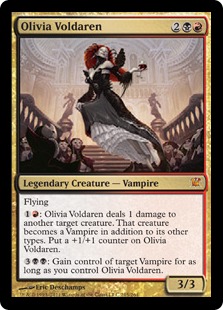
Vampires have almost exclusively made their Modern impact via powerful stand-alone cards like Kalitas, Traitor of Ghet and Olivia Voldaren, rather than in a synergistic tribal deck. However, both Innistrad blocks and some cards in Magic 2011 and 2013 have pushed the concept of Vampires as a cohesive archetype in the vein of Elves or Merfolk. Creatures such as Vampire Nocturnus and Stromkirk Captain suggested that once the tribe accumulated a critical mass of cheap, efficient creatures like Gifted Aetherborn, it would have enough Vampire-specific payoffs to make a dedicated tribal deck a possibility.
On the subject of colors, there was little doubt that black would be the deck's dominant color. The vast majority of the Vampires printed are black, and many charge multiple black mana symbols. When considering other colors, the red splash was the most common choice. Only token producers like Sorin, Lord of Innistrad provided reasons to look elsewhere.

As of of Ixalan, however, cards like Adanto Vanguard, Legion's Landing, and Mavren Fein, Dusk Apostle made white a significantly more appealing option, which somewhat complicates finding the optimal configuration of the deck. Ixalan also pushed the tribe into more of a token-generation direction; however, I am deeply skeptical of a Vampire-themed, token-based strategy being fast or powerful enough for Modern given the fringe status of WB Tokens (which features stronger token generators and better payoffs).

Vampire Cards in Rivals of Ixalan

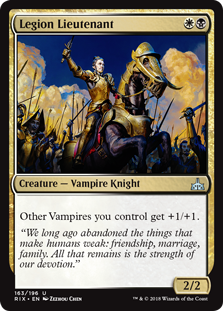
The first standout card in Rivals for Vampires is Legion Lieutenant. While it does lock you into splashing white, it's also a very promising tribal payoff card. Decks like Merfolk have long demonstrated the power of lord effects, and Lieutenant is the cheapest such effect available to Vampires.
Another potential white spell is Forerunner of the Legion; a utility three-drop with a tutor effect as it enters the battlefield is a fairly reasonable rate, especially in a tribal deck which benefits greatly from continually drawing relevant cards in the midgame.

Oathsworn Vampire is yet another. Provided that Oathsworn's condition can be met, a recurring threat will always be handy for an aggressive tribal strategy, and the body is decent for the cost. However, this card almost demands a deck built around lifelink effects in order to reliably meet its condition, so the deckbuilding requirements are a bit steep.

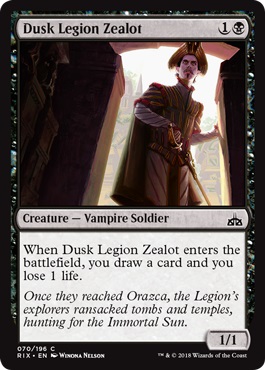
The final interesting Vampire from Rivals is Dusk Legion Zealot. While its 1/1 body is quite unimpressive, many tribal decks have made good use of a creature that provides an on-tribe body to project +1/+1 effects onto that also draws an extra card. Of the cards discussed thus far, this is the one I feel most confident will make an impact on tribal Vampire decks due to its similarities with Silvergill Adept, arguably the most critical creature in Merfolk.

Presenting the Test Deck

After examination of the available cards and some discussion, I settled on this list.

Mono-Black Vampires, by Roland F. Rivera Santiago

Creatures

4 Viscera Seer
4 Bloodghast
4 Dusk Legion Zealot
4 Gifted Aetherborn
4 Asylum Visitor
4 Captivating Vampire
2 Stromkirk Condemned
4 Vampire Nocturnus

Artifacts

4 Aether Vial

Instants

4 Fatal Push

Sorceries

2 Collective Brutality

Lands

4 Bloodstained Mire
2 Cavern of Souls
4 Mutavault
8 Swamp
2 Urborg, Tomb of Yawgmoth

Sideboard

2 Collective Brutality
2 Dismember
3 Fulminator Mage
4 Nihil Spellbomb
4 Thoughtseize

I chose to keep the deck mono-black as opposed to incorporating any of the previously discussed splashes. The major reason why I did so is the mana—this deck is pretty heavy on black requirements, and I was somewhat leery of trying to jam a second color. I did attempt to do so, but kept finding that the fastlands I wanted hindered my ability to cast four-drops on curve, and limited the number of land spots for utility and manlands.

Card Choices

Here's a brief summary of my card choices. My priorities in deckbuilding were to emphasize consistent openers, and ensure that the deck has a steady supply of threats on the battlefield. The curve is very similar to what you'd find in a Merfolk deck, and that is by design; I wanted to start with a deck type that had a good chance of working, and then adjust as necessary.

Creatures

Viscera Seer: Seer generates value from creatures in response to removal. It can also dig for a black card to put on top of your library for Nocturnus. Overall it's not amazing, but playable given the mostly subpar options at the one-drop spot.

Asylum Visitor: This card is good at pressuring opponents early thanks to its 3/1 body, and can also be relevant in the midgame thanks to its card-drawing ability. Lastly, the madness ability can lead to some sneaky situations with Stromkirk Condemned in which you can flash the body in at instant speed to devastating effect.

Bloodghast: An on-tribe body that makes the deck more resilient to spot removal. It also has some cute synergies with Collective Brutality, Stromkirk Condemned, and Viscera Seer.

Captivating Vampire: Lord effects make Bloodghast all the more intimidating, but Captivating also boasts the unique ability to break board stalls against opponents light on spot removal. Or just steal a Reality Smasher.

Dusk Legion Zealot: An on-tribe body that replaces itself, à la Elvish Visionary or Silvergill Adept.

Gifted Aetherborn: Trades up with beefier creatures, helps stabilize against faster aggro decks, and wins races, especially with some pumps.

Stromkirk Condemned: A recurring source of pump. Its cost can sometimes benefit us.

Vampire Nocturnus: Our primary payoff spell. +2/+1 and evasion is a massive tribal payoff, and while it can sometimes be a bit unreliable in terms of having the effect switched on, the deck is built around meeting its condition.

Spells

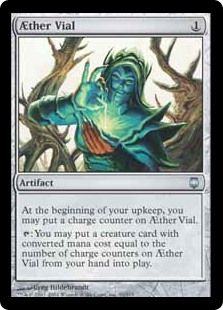
Aether Vial: Vial makes sense in this deck for a variety of reasons. Primarily, this deck is centered around two-drops (as the selection of one-mana Vampires is rather poor), so a one-mana accelerant makes a lot of sense. Vial's downside of being a dead topdeck later can also be mitigated by the deck's discard outlets.
Collective Brutality: Brutality serves as maindeck interaction against spell-based opponents, randomly creams spell-and-creature decks like Burn and Company, and even offers a bit of reach to close games out with.

Fatal Push: Bread-and-butter removal spell. Not much to say here other than any deck running black should consider it.

Lands

Bloodstained Mire: Mire serves several purposes in this mono-black shell. The most important function is to provide on-demand revolt triggers for Fatal Push. Mire also provides an on-demand source of landfall triggers for Bloodghast, which Viscera Seer can even use as a recurring sacrifice outlet. Lastly, in the event that Vampire Nocturnus reveals a nonblack card on top of the library, fetching provides a shuffle.

Urborg, Tomb of Yawgmoth: Simplifies meeting the deck's tough black mana requirements despite 4 Mutavault, and lets fetchlands tap for black without being cracked. Drawing the second copy is rarely an issue, thanks to the discard outlets.

Sideboard

Fulminator Mage: Slows down big mana decks, and perhaps pops a manland or two in a pinch.
Nihil Spellbomb: Standard graveyard hate. I chose Nihil over Relic of Progenitus largely because I wanted to avoid any potential awkwardness with Bloodghast.

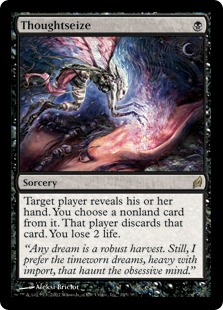
Thoughtseize: A concession to combo and big mana decks, this card comes in anytime the deck needs more disruption.

Dismember: Takes down targets Push and Brutality struggle against, chiefly the Eldrazi and delve creatures.

Testing Results

I tested the deck against a somewhat abbreviated gauntlet of competitive Modern decks. The decks I encountered included Affinity, Eldrazi Tron, Gx Tron, Grixis Shadow, Gifts Storm, and Mardu Pyromancer. Coming in, I expected the deck to do well against Shadow by virtue of being a go-wide creature deck; struggle against Tron variants because of the relative paucity of land hate; and enjoy various degrees of success against the rest of the field. My assumptions mostly held true, with a couple exceptions.

Grixis Shadow is a very straightforward matchup for Vampires—despite its ability to disrupt creature-based synergies and present beefy blockers, Shadow is poorly suited to deal with a constant stream of attackers, especially if its blockers can be removed. Vampires is good at both of those things, and thus good against Shadow. Due to the attrition nature of the matchup, Aether Vial should be benched in favor of Nihil Spellbomb, as Spellbomb is important and the Vial is a lousy topdeck late. I feel that similar tools would be applicable when facing the aggro-slanted Delirium Shadow deck, as Push and Spellbomb are even more effective against Tarmogoyf than against Gurmag Angler.

The Affinity and Storm matchups were better for Vampires than I expected them to be. We have enough spot removal to keep those decks off-balance long enough for our own clock to finish the game. That holds especially true post-board, when we've got playsets of Brutality and Push alongside Dismember in the case of Affinity, or Spellbomb and Thoughtseize against Storm.

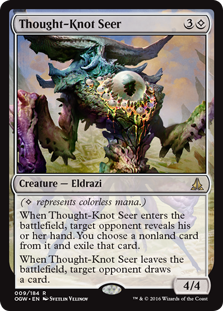
Vampires also proved surprisingly competent against Eldrazi Tron; while I lost any game in which my opponent was able to untap with Endbringer, I also won games in which the deck backed up an early clock with some removal, or ones in which my opponent didn't find removal and Captivating Vampire took over the battlefield. One highlight was a game in which I was able to snatch a Thought-Knot Seer and a Matter Reshaper from my opponent, and used them plus a couple of Mutavaults to close a game out through a resolved All is Dust.

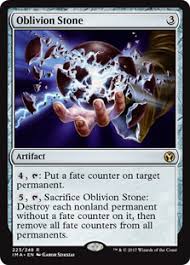
On the negative side, the Tron matchup was every bit as rough as I expected it to be. Ugin, the Spirit Dragon and Oblivion Stone in particular are an absolute beating, and Wurmcoil Engine typically forces us to win on the following turn... or else. Mardu also proved to be somewhat of a struggle, especially if Vampires happened to draw more than four lands in any given game. That said, the games in which the deck drew the appropriate amount of lands felt eminently winnable. In spite of these matchup pitfalls, the deck won enough games against the field that I still think it has potential.

Overall, the matchup profile diverged a bit from other fish tempo decks like Merfolk or Humans—Vampires trades in points against big mana strategies in order to be more solid against aggro-combo. Provided that the deck can hold its own against midrange and control as Merfolk and Humans do, the matchup profile exhibits enough of a divergence in order to provide Vampires with a unique niche.

Further Testing

I want to take this opportunity to qualify all of my matchup assessments by mentioning that my testing is preliminary, and thus my impressions of the matchups require more data in order to be definitive. While I strove to be objective in my evaluation of how the deck performed, my sample is limited, and variance can always play a role.

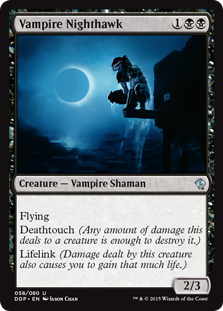
The deck is very much a work in progress. While I feel confident that centering the deck around Vampire Nocturnus and incorporating Dusk Legion Zealot were the right choices, I would love to further test cards like Legion Lieutenant or Stromkirk Captain. Setting aside the splash colors, cards like Gatekeeper of Malakir, Kalastria Highborn, and Vampire Nighthawk did not make the cut in my 75, but perhaps they should have. I'm also questioning whether Fulminator Mage is doing enough to earn its keep; it doesn't seem to be enough to make a difference in the Gx Tron matchup, and Vampires seems capable of putting together a board state that can beat back Eldrazi Tron.

If you have any ideas on those fronts or comments about the deck in general, drop me a line in the comments. Until then, hopefully Vampires suck (or, don't) in your hands as much as they do in mine!

Insider: Rivals of Ixalan in Modern

Are you a Quiet Speculation member?

If not, now is a perfect time to join up! Our powerful tools, breaking-news analysis, and exclusive Discord channel will make sure you stay up to date and ahead of the curve.

Hey, guys, and welcome back!

Last week, we talked about how Rivals of Ixalan will potentially affect Standard. Today, we are going to talk about the set as it relates to Modern – which happens to be the format of the Rivals Pro Tour.

Merfolky Waters

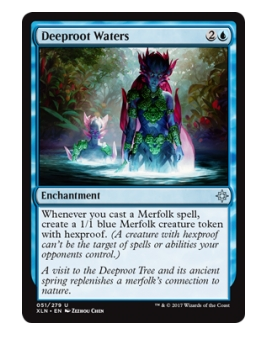
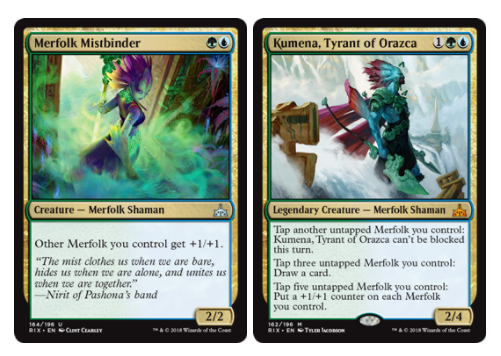
A very obvious archetype that Rivals of Ixalan will boost is Merfolk. With plenty of blue-green Merfolk creatures printed in this and last set, this green-splash version of the tribal deck will definitely be on every player's radar. Furthermore, with green in its mana base, there might  be a version of the deck with Collected Company.

Above are some of the cards that might see play in Modern Merfolk tribal, but let's focus especially on Kumena. This three-mana Merfolk lord provides incremental advantage as we accumulate more fish in play. The second ability of Kumena reminds me of Cryptbreaker from past Standard, and giving a deck the ability to draw cards is especially good for an aggro deck. Currently in the metagame, we rarely see Merfolk players, although the deck is good, so I'm not sure why it's not popular.

Assuming that popularity increases after the upcoming Pro Tour, what are some existing Modern cards that we can take a look at? As a baseline today, we will only look at cards that are priced at more than 1 ticket per playset:

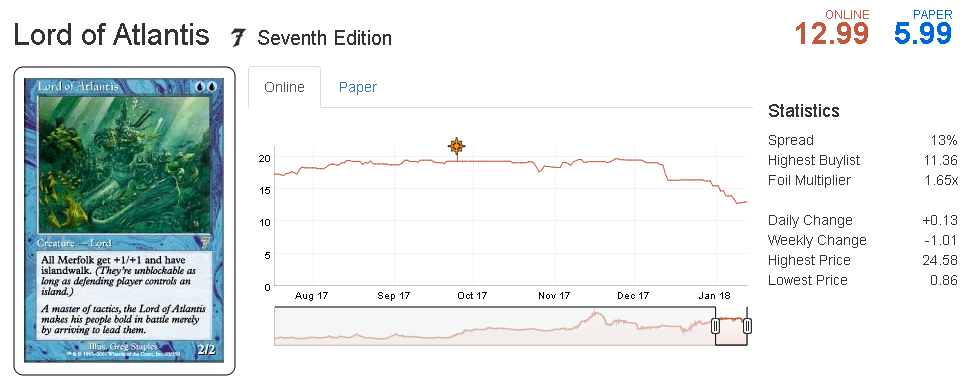
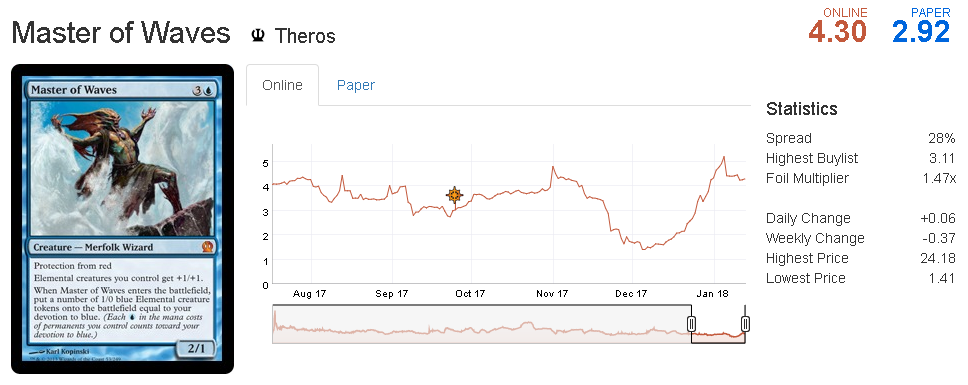
Master of Waves and Lord of Atlantis are already at their respective high points, which is not a recommended buy-in scenario.

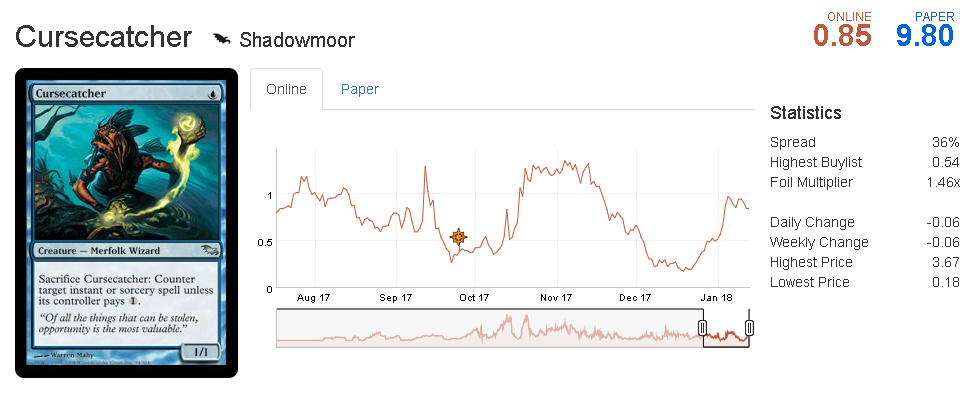
As for Cursecatcher, this card is the must-have one-drop in the deck (besides Aether Vial). Looking at its trend line, currently the price per copy is still below 1 ticket, and is beginning to dip after a small increase last month. I think this is our chance to buy in to playsets of Cursecatcher for investment. This card has potential increase to 2 tickets, as it went up to 2.5 tickets in January 2017 and 2 tickets in April 2017. Now consider the very real possibility that with the Rivals of Ixalan release, Blue-Green Merfolk will make Cursecatcher spike again.

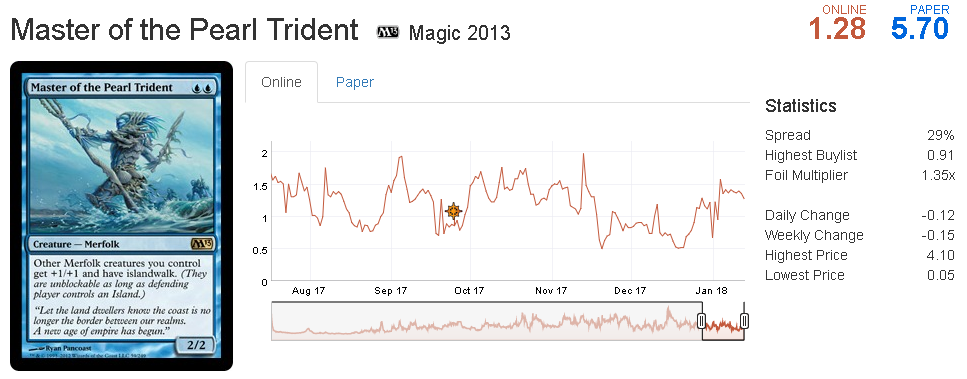
Another card here is Master of the Pearl Trident. It does basically the same thing as Lord of Atlantis except that the market has more supply of this card than the other. Interestingly, Master of the Pearl Trident spiked at different times compared to Cursecatcher; in Master's case, in February 2017 and July 2017. So we know if one of these spike, the other might not, and vise versa. According to the trend, the last times Master peaked at 4 and 3 tickets, respectively. Therefore, at the current price of 1.28 tix, picking up copies as speculation in anticipation of Blue-Green Merfolk making an impact in Modern is a move I advise.

Besides all the fishes, lets look at some other cards that are potentially being played in Blue-Green Merfolk.

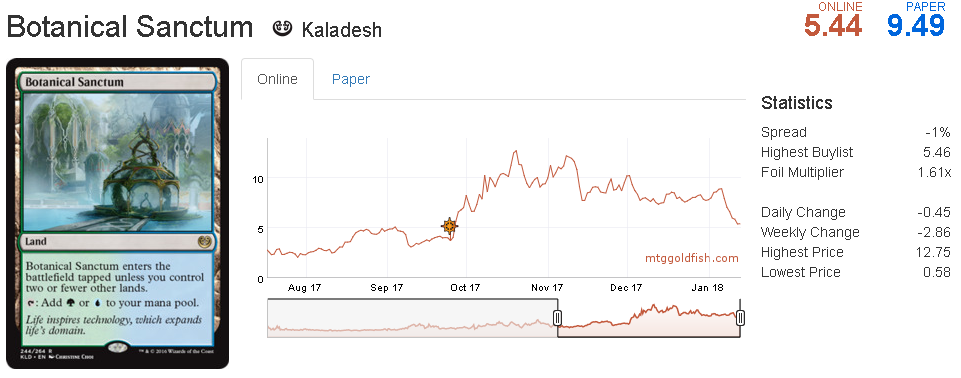
Fast lands are among the most commonly played lands in Modern. As Standard is slowing down, and there's a potential that Standard Energy deck might get a nerf in the next B&R, Botanical Sanctum's price is going downhill. When the price reaches the bottom, do remember to buy in playsets for the deck we've already discussed so much.

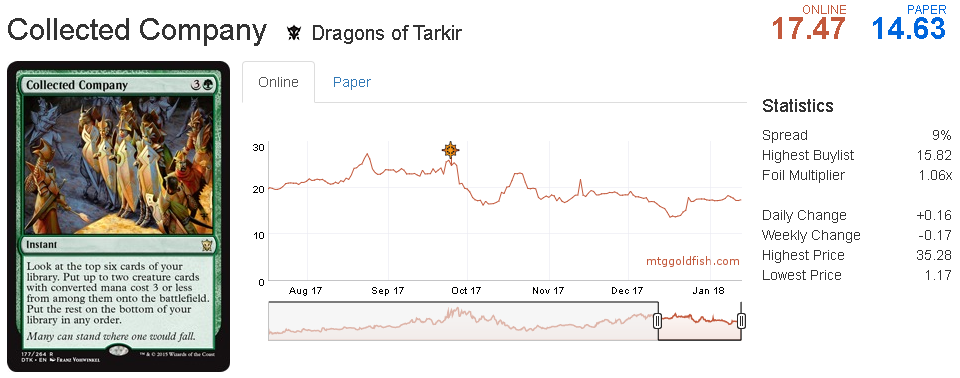
Collected Company decks were very popular last year, although there are a few different versions of the deck in the metagame. As we can see in the graph, the price can easily go above 20 tickets when the deck's variants are heavily played. Thus, I can say now is the golden opportunity to get your playsets, either for your own use or as speculations. A four-mana spell to put six mana's worth of permanents into play is just too strong in Modern. I don't think the price will decrease much from 17 tickets. With Collected Company, we have the opportunity to use Kumena's abilities after the spell resolves, so this might also affects how the opponent play against you. For example, whether they should kill Kumena or keep their removal up for another threat, like the lords.

Timey Wimey Stuff

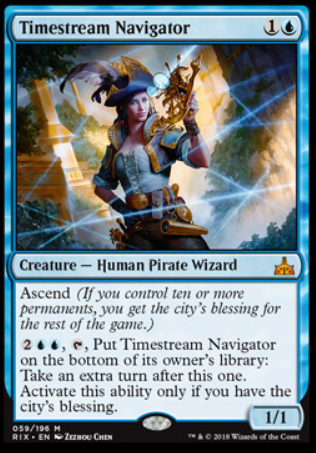
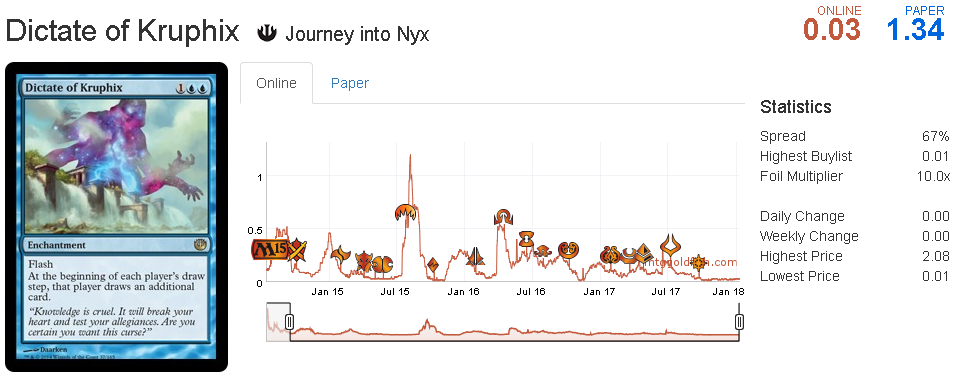
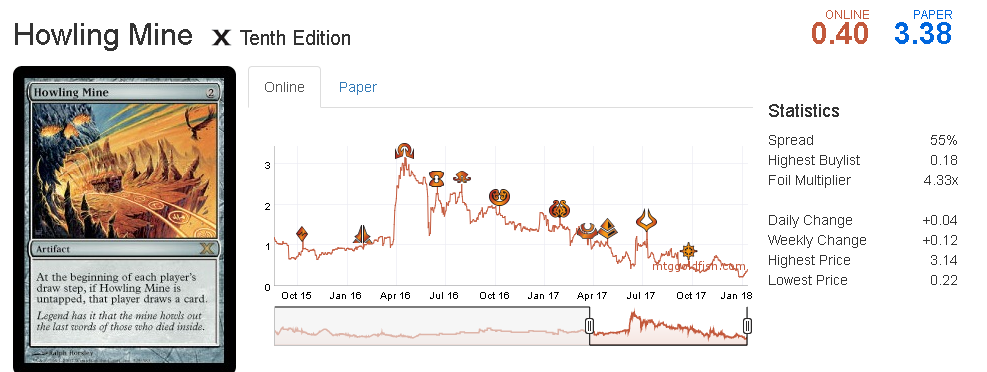
Timestream Navigator seems like it will be able to fit into the mono-blue Turns deck. The Turns deck can hit Ascend pretty easily in my opinion, between Howling Mine, Dictate of Kruphix and lands. In my opinion, this card might be added to the deck to increase the consistency of the combo. Since the Turns deck is not that popular right now, we can see this potential addition to the archetype as an opportunity to invest in other pieces of the deck.

Dictate of Kruphix and Howling Mine are the engines of the Mono-Blue Turns combo deck. The effect is one-sided when the extra turns spells are chained together. The deck usually plays six to eight copies total of the two cards to facilitate drawing into extra-turn spells and the lands to play them. Both these cards are very cheap right now, at 0.03 ticket and 0.4 ticket, respectively. Even if you don't see Timestream Navigator as potential addition and boost for the deck, these are still pretty good investments, especially Howling Mine. These seem reasonable to buy for speculative purposes.

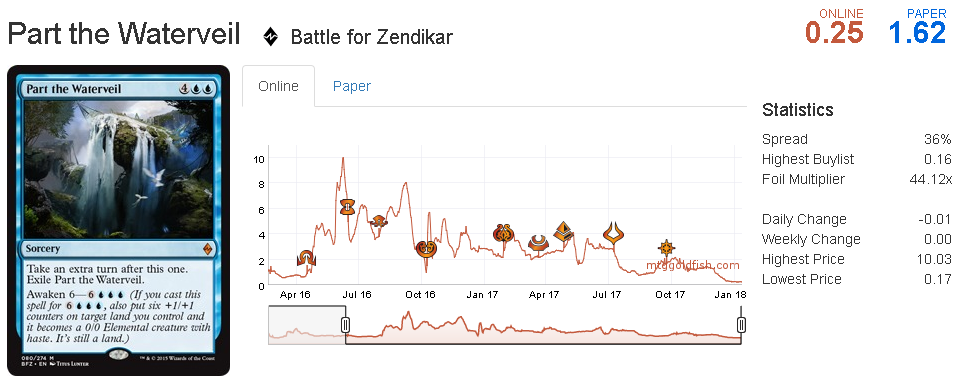
Part the Waterveil is the cheapest extra-turns piece in the entire deck, but it's also the win condition. The deck wouldn't be as good without this card. If we look at the history of this card, it peaked at 10 tickets while it was still Standard legal. After rotation, the price dropped very quickly, but immediately reversed and the hit 5-tickets mark. Currently at 0.25 ticket, I think there's a big chance that we can earn plenty of tickets by investing in this card right now. The Modern metagame shifts very quickly, so the more decks we see from week to week, the higher chance we will see the return of the Mono-Blue Turns deck, and that is when our specs will pay off for us.

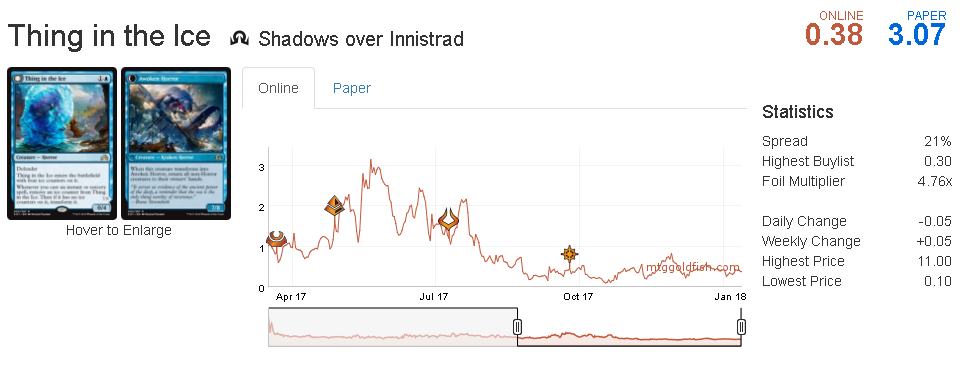
Whenever we talk about blue, I always want to highlight this card:

Thing in the Ice is a very good sideboard option for the Mono-Blue Turns deck. We can transform to a Thing in the Ice build in response to the opponent siding out all their removal spells. In addition, there's a Blue-Red/Jeskai Thing in the Ice-Pyromancer Ascension deck in Modern which was created by Pro Tour finalist Ryoichi Tamada. Although this is not directly affected by the Rivals set, I think Ryoichi is one of the best Modern players around, and I wouldn't be surprised to see him playing the same deck again in the coming PT. Thus, I recommend buying playsets of Thing in the Ice as Modern PT specs.


Alright, that’s all for the week. Thank you all for reading, and I will see you guys again soon!

–Adrian, signing out

Bloodbraid Month, Pt. 3: Qualitative Data

Are you a Quiet Speculation member?

If not, now is a perfect time to join up! Our powerful tools, breaking-news analysis, and exclusive Discord channel will make sure you stay up to date and ahead of the curve.

It has come to this. Time to start rolling out the results of the latest banned card test. Conducting this test has been weird for me. Having a hard deadline was actually a blessing as it helped discipline the testing period and we got done much faster than expected. However, this wasn't a fun experience for me or my team. Unlike the cards we've done previously, we all had extensive history with Bloodbraid Elf that hung over the whole experience. Old-timers can probably see where I'm going, but the rest of you will need to wait for the end.

We have two items on the agenda today. First, I need to reveal and explain our testing decks and the gauntlet. There should be no surprises here. Next, I will discuss the qualitative results. This is the "soft" data gathered during the experiment—things that cannot be numerically quantified. Everything we thought and experienced during testing is part of the testing and a result, and so needs to be reported. Furthermore, when players discuss the impact of a potential unban, it will be what most focus on, so we should be prepared.

The Test Decks

After my failed attempt to make a new, interesting deck for testing, I didn't have time to come up with Jund lists on my own. Normally, I spend some time looking through deck lists, aggregating their numbers and developing a statistically average decklist to use. I'm not interested in the best list; I'm always just looking for the most representative one. The time constraint meant I got to take an easier option. I asked my resident Jund expert if we could just use his list. He said yes, so here is what he was running back in November. For the curious, he's codename "Elliott" from a previous article. He doesn't want to be internet famous so I won't use his real name.

Jund, by Elliott (control deck)

Creatures

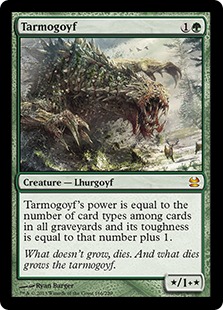
4 Tarmogoyf
4 Dark Confidant
3 Scavenging Ooze
2 Tireless Tracker

Planeswalkers

3 Liliana of the Veil
1 Liliana, the Last Hope
1 Chandra, Torch of Defiance

Instants

3 Fatal Push
2 Lightning Bolt
2 Terminate
2 Abrupt Decay
2 Kolaghan's Command

Sorceries

3 Thoughtseize
3 Inquisition of Kozilek
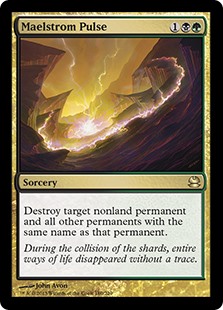
1 Malestrom Pulse

Lands

4 Blackcleave Cliffs
4 Verdant Catacombs
3 Raging Ravine
3 Bloodstained Mire
2 Blooming Marsh
2 Overgrown Tomb
2 Swamp
1 Forest
1 Blood Crypt
1 Stomping Ground
1 Wooded Foothills

Sideboard

3 Fulminator Mage
2 Ancient Grudge
2 Collective Brutality
2 Grafdigger's Cage
2 Surgical Extraction
2 Kitchen Finks
1 Liliana of the Veil
1 Damnation

In addition to the list, he also gave me a matchup and sideboarding guide. I will be posting that (kinda) next week as we go through the results, but I want to stress right now that this was all based on how things worked back in November. Please don't take any of this for actual strategic advice; I just play a Jund expert for this column.

Since we were using Elliott's list, I asked him how to rebuild with Bloodbraid Elf. At almost the same moment I hit send, his email with exactly that arrived.

Bloody Jund, by Elliott (test deck)

Creatures

4 Dark Confidant
4 Tarmogoyf
3 Scavenging Ooze
4 Bloodbraid Elf

Planeswalkers

4 Liliana of the Veil

Instants

3 Lightning Bolt
2 Fatal Push
2 Terminate
2 Abrupt Decay
2 Kolaghan's Command

Sorceries

4 Thoughtseize
2 Inquisition of Kozilek

Lands

4 Blackcleave Cliffs
4 Verdant Catacombs
3 Raging Ravine
3 Bloodstained Mire
2 Blooming Marsh
2 Overgrown Tomb
2 Swamp
1 Forest
1 Blood Crypt
1 Stomping Ground
1 Wooded Foothills

Sideboard

3 Fulminator Mage
2 Ancient Grudge
2 Collective Brutality
2 Grafdigger's Cage
2 Surgical Extraction
2 Kitchen Finks
1 Terminate
1 Anger of the Gods

This deck was not designed with the testing in mind, I didn't even tell Elliott what decks would be in the gauntlet. He assured me that this is the deck he would have played if Bloodbraid Elf was legal when we started testing. His reasoning for the changes was to make every cascade as good as possible. Therefore, the more situational Fatal Push and Inquistion of Kozilek are shaved for Lightning Bolt and Thoughtseize. The sideboard was also changed slightly for the same reason. He reasoned that Abrupt Decay isn't great, but is necessary and makes for a terrible sideboard card, so the more expensive Maelstrom Pulse was cut.

In our previous testing, we'd found that Grim Flayer was great alongside Bloodbraid by setting up the cascade, but he insisted on not playing any. Kolaghan's Command was also as good as you'd think, so I was surprised that there weren't more. When asked, my expert explained that Flayer is not well positioned compared to Dark Confidant right now. These days, card advantage is critical to Jund like never before, and Bob is the superior choice for that job. Command is very good at grinding, but he didn't think that would come up enough to warrant finding space.

The Test Gauntlet

As always, the five gauntlet decks were chosen to represent as broad a metagame as possible. Fortunately, Tier 1 is filled with diverse decks, which made the choices obvious and easy. We picked the obvious choices for aggro, control, combo, big mana, and Death's Shadow. The lists were built according to what was "stock" back in early November. Our list actually looks pretty similar to the 2012 metagame, to the point that I considered including Counters Company as a Birthing Pod analogue. Then it was pointed out that Company isn't doing that well compared to the other decks anymore, so it got left behind.

Affinity, test deck

Creatures

4 Ornithopter
2 Memnite
4 Signal Pest
4 Arcbound Ravager
4 Steel Overseer
4 Vault Skirge
3 Etched Champion
2 Master of Etherium

Instants

4 Galvanic Blast

Artifacts

4 Mox Opal
4 Springleaf Drum
4 Cranial Plating

Lands

4 Blinkmoth Nexus
4 Inkmoth Nexus
4 Darksteel Citadel
4 Spire of Industry
1 Mountain

Sideboard

3 Thoughtseize
2 Ancient Grudge
2 Rest in Peace
2 Whipflare
2 Blood Moon
1 Wear // Tear
1 Ghirapur Aether Grid
1 Bitterblossom
1 Engineered Explosives

We were never not going to test against Gx Tron, even though extenuating circumstances meant that we wouldn't use Eldrazi Tron. My Tron player hates Eldrazi Tron and insists that Gx Tron is better. I don't know if she's actually right, but I do know she had been struggling for weeks with Eldrazi Tron when I started putting the team together. Gx is also back in force in my local meta, while the Eldrazi have vanished. Your results may vary, but I believed her then and still do. I was tempted to run GR Tron for old time's sake, but BG had more wins in October.

BG Tron, test deck

Creatures

3 Wurmcoil Engine
2 World Breaker
1 Ulamog, the Ceaseless Hunger

Planeswalkers

4 Karn Liberated
2 Ugin, the Spirit Dragon

Sorceries

4 Sylvan Scrying
4 Ancient Stirrings
3 Collective Brutality

Instants

3 Fatal Push

Artifacts

4 Chromatic Sphere
4 Chromatic Star
4 Expedition Map
3 Oblivion Stone

Lands

3 Blooming Marsh
1 Forest
1 Ghost Quarter
1 Llanowar Wastes
1 Sanctum of Ugin
4 Urza's Powerplant
4 Urza's Mine
4 Urza's Tower

Sideboard

3 Nature's Claim
2 Orbs of Warding
3 Relic of Progenitus
2 Spellskite
2 Surgical Extraction
2 Warping Wail
1 Thragtusk

I planned to just run the list from the Preordain test, but I was told it was badly out of date. The differences look pretty negligible to me, but I'm not arguing with the Boulder Combo Cabal.

Gifts Storm, test deck

Creatures

4 Goblin Electromancer
3 Baral, Chief of Compliance

Sorceries

4 Serum Visions
4 Sleight of Hand
2 Past in Flames
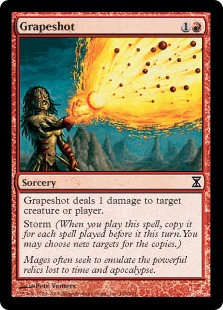
2 Grapeshot
1 Empty the Warrens

Instants

2 Opt
1 Noxious Revival
4 Desperate Ritual
4 Pyretic Ritual
4 Manamorphose
3 Remand
4 Gifts Ungiven

Lands

4 Steam Vents
4 Spirebluff Canal
4 Shivan Reef
2 Snow-Covered Island
2 Island
2 Mountain

Sideboard

3 Blood Moon
3 Lightning Bolt
2 Dispel
2 Empty the Warrens
2 Shattering Spree
1 Echoing Truth
1 Dismember
1 Pieces of the Puzzle

Grixis Death's Shadow, test deck

Creatures

4 Death's Shadow
4 Snapcaster Mage
4 Street Wraith
2 Tasigur, the Golden Fang
2 Gurmag Angler

Planeswalkers

1 Liliana of the Veil

Instants

4 Fatal Push
4 Thought Scour
2 Stubborn Denial
2 Opt
2 Terminate
1 Kolaghan's Command

Sorceries

4 Serum Visions
4 Thoughtseize
2 Inquisition of Kozilek

Lands

4 Bloodstained Mire
4 Polluted Delta
4 Scalding Tarn
2 Watery Grave
1 Blood Crypt
1 Steam Vents
1 Island
1 Swamp

Sideboard

2 Ceremonious Rejection
2 Collective Brutality
2 Young Pyromancer
2 Temur Battle Rage
1 Liliana of the Veil
1 Liliana, the Last Hope
2 Nihil Spellbomb
1 Kolaghan's Command
1 Stubborn Denial
1 Engineered Explosives

Jeskai Tempo, test deck

Creatures

4 Snapcaster Mage
4 Spell Queller
3 Geist of Saint Traft

Sorceries

4 Serum Visions

Instants

4 Lightning Bolt
4 Path to Exile
2 Spell Snare
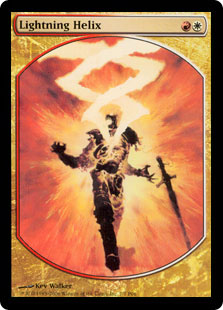
3 Lightning Helix
2 Logic Knot
2 Electrolyze
4 Cryptic Command

Lands

4 Celestial Colonnade
4 Flooded Strand
4 Scalding Tarn
3 Island
2 Steam Vents
2 Hallowed Fountain
2 Spirebluff Canal
1 Sacred Foundry
1 Mountain
1 Plains

Sideboard

2 Disdainful Stroke
2 Dispel
2 Relic of Progenitus
2 Pia and Kiran Nalaar
1 Celestial Purge
1 Engineered Explosives
1 Izzet Staticaster
1 Negate
1 Supreme Verdict
1 Vendilion Clique
1 Wear // Tear

With the gauntlet set, the only thing left to do was the actual, tedious grinding work of playing Magic for data. Let's talk about the unquantifiable data.

The Qualitative Results

The hard data will make its own argument about Bloodbraid next week. But also important is the soft data: What did it feel like playing with and against Bloodbraid? Did it improve the experience? That data matters because numbers cannot express player enjoyment or fun. Regardless of what the data show next week, the overriding concern for Wizards is whether an unban will make the game more or less fun. At least that's the impression their banning explanations give me.

Team Background

In the interest of full disclosure, I need to explain something about my team. I've known most of my team since we were undergrads. We've all been playing since we were kids. Everyone's a Spike, and all of us have at least a couple Pro Points in our history. We're "longbearded grinders," extending back to 2009 when Bloodbraid Jund ruled Standard.

And that's why none of us actually like the card. Even my Jund expert dislikes it now, though he admits to enjoying what it does for him (more on this later). We all dealt with the frustration of a Jund-dominated Standard, felt it again in Extended, again briefly in Legacy, and then finally in Modern. This is not the typical experience for most players, so you may have opinions that are wildly different. We're just coming to this from a long history of playing with and against Bloodbraid Elf. One peppered more with nausea than nostalgia.

More of the Same

It's really tempting to just let this section's title speak for itself. My team and I disliked this test because our experience during the test was identical to our experiences pre-January 2013: spin the wheel of git wrekt. Who's "getting wrekt" and to what degree aren't yet known, but somebody is going to be unhappy. You probably aren't getting wrekt; you get a spell off the top of your deck and play it for free alongside a 3/2 with haste. Having that make you worse off can happen, though in those circumstances you were dead anyway. That's more I got wrekt because you didn't git wrekt. Your opponent is almost certainly in for a very frustrating day, though.

Back in Standard, Elf cascades always seemed to be the perfect card for the situation, whether they were Blightning, Sprouting Thrinax, or Maelstrom Pulse. Even when they were only Lightning Bolt, Putrid Leech, or Terminate, the tempo and card advantage swing was enormous. When you were behind, no one card did more to catch back up. When ahead, nothing went further to ensuring you stayed there than Bloodbraid Elf. And that was as true during our testing as it was back in 2012.
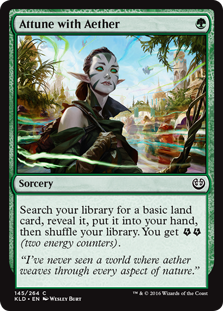
There are few things more frustrating than losing to random luck, and that is what it has always felt like to play against cascade. There's no play to it or a sense of in-game skill. It's just variance rewarding you for playing Bloodbraid Elf. It feels great to actually play the card, and I was certainly gleeful to get rewarded by "fate" (or rather, by building a deck with Elf in mind). However, I remember how bad it felt to play against the card. If you think players whine about variance and lucksacking these days, you didn't know me back in 2010. I could have written a full textbook on the subject. When I surveyed my team about playing against Bloodbraid, the unanimous response was "It's just as I remembered it." For good or ill, that's my qualitative result.

The Virtual Advantage

The other thing is that even when you do "miss" on your cascade, you're not really unhappy. You still have a 3/2 haste creature. But there's also something more subtle going on because that bad cascade improved your next draw step. By playing Bloodbraid Elf, you don't just get the actual card advantage from casting the second card, but you can get some virtual card advantage. My average cascade during testing revealed two cards. This meant that I got a land I really didn't need off the top of my deck and then cast whatever spell I found. Even if the spell was just dead, it was a dead spell I didn't draw, making my next draw step better by two fewer dead cards on top of my deck. The actual advantage this provides in-game is very hard to quantify or even perceive, but certainly adds up over a longer game. For this reason, I was never sad to cast Bloodbraid. Even if I didn't hit well, I was better off than I would have been otherwise. Bloodbraid is very insidious because this is arguably its greatest power.
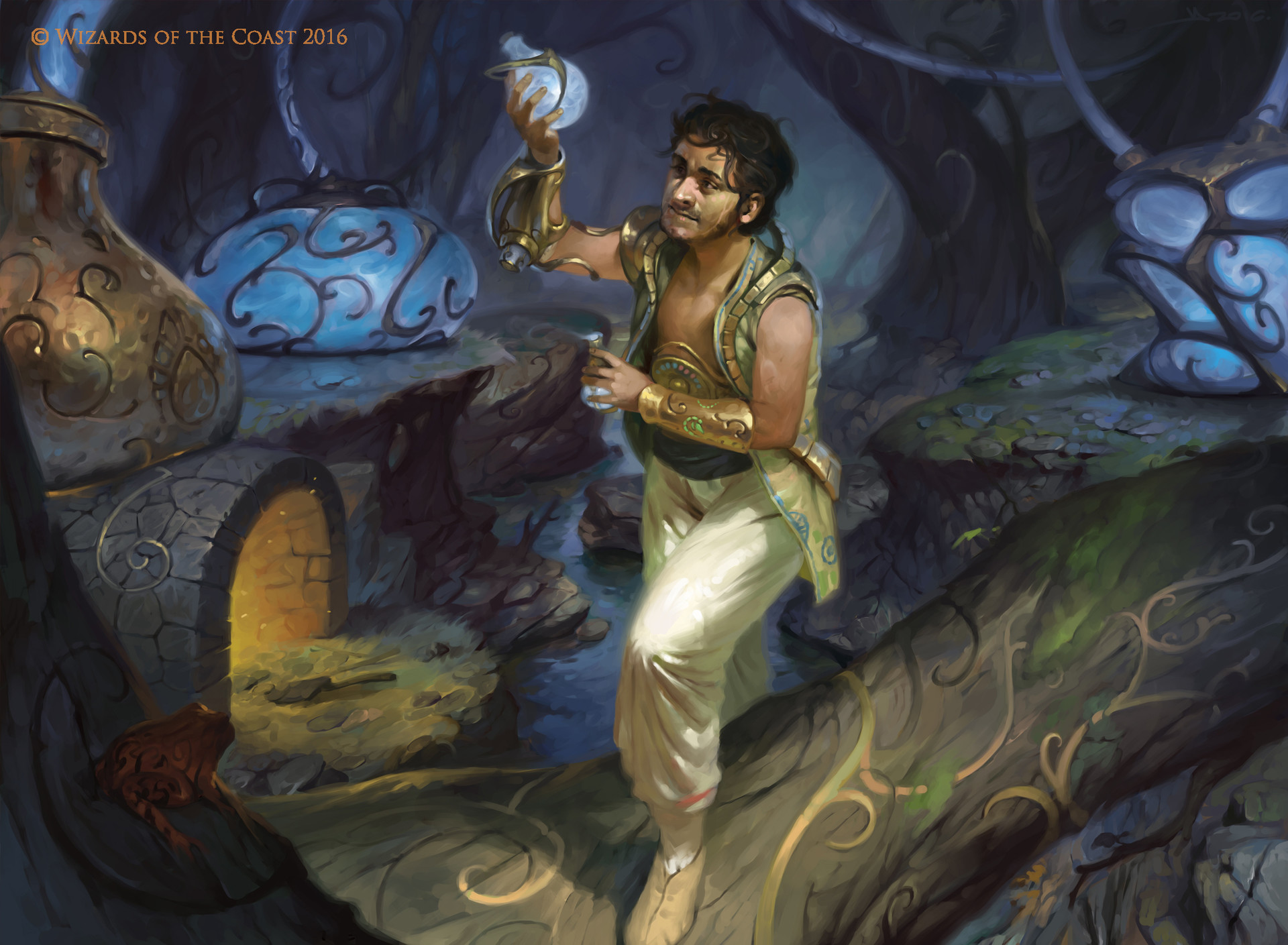
What Does it Mean?

Irrespective of the hard data, unbanning Bloodbraid will be a polarizing move. Jund players will rejoice and really enjoy having the card. Everyone else, not so much. Players hate losing to variance, and Bloodbraid Elf appears to be weaponized variance. That isn't true, but it does seem that way to outside observation. Rather, Bloodbraid rewards you for building the deck around it, maximizing the potential of each cascade. This is why I struggled to make it work in Death's Shadow Jund and why we played "weaker" but more versatile cards in Bloody Jund. This build-around-me aspect and the degree of reward is why many players love Bloodbraid. However, that won't be obvious to their opponents, who will assume as I used to that they're just getting lucky. There will be much complaining and gnashing of teeth.

Weirdly, I think that if cascade were definitively overpowered, the hatred would not exist. If instead cascade let you search your library for a card with converted mana cost less than the cascade card, it would feel better to lose to. That version is obviously stupidly overpowered, but you're losing to your opponent picking the right card to wreck you rather than it just happening to be on top of their deck. Losing to decisions feels better than losing to luck. Next week, the hard data.

Insider: Snap Reaction to 1/15/2018 B&R Announcement

Are you a Quiet Speculation member?

If not, now is a perfect time to join up! Our powerful tools, breaking-news analysis, and exclusive Discord channel will make sure you stay up to date and ahead of the curve.

Hey Insiders!

I wanted to provide a quick reaction to today's B&R Announcement (1/15/2018).

Standard:

Attune with Aether is banned.

Rogue Refiner is banned.

Rampaging Ferocidon is banned.

Ramunap Ruins is banned.

Effective Date: January 19, 2018

Magic Online Effective Date: January 15, 2018

The list of all banned and restricted cards, by format, is here.

Next B&R Announcement: February 12, 2018


Here's some quick takes by a couple of our QS Writers:

Pete Casella: Standard is going to feel fresh. I like Ripjaw Raptor at sub $4, I feel like BG Constrictor will be utilizing this card. It pairs really well with Walking Ballista while it's still in Standard. Red will have a harder time dealing with Raptor, and Bristling Hydra may not be as prevalent.

Tarkan: Still looking towards Dominaria with the upcoming PT as Modern. There will be some great purchasing at lows before then when we revisit this for PT:Dominaria.

We discussed some specific cards on the QS Insider Discord:


There's plenty more cards going forward but, we mostly focused on low buy-in cards that have been hyped in the wake of the Announcement, which appears to be Vampire and Merfolk archetypes.

Just keep in mind it's mostly throwing darts before any real results turn up. Many cards will fluctuate, especially cards that have already been proven regardless of Energy and Ramunap Red. I would urge to continue tracking results, there will be plenty of new technology to come. There will be somewhat of a focus on Modern with PTRIX - but Standard is again (for now) unknown which draws attention as well.

December 2017 Metagame Update

Are you a Quiet Speculation member?

If not, now is a perfect time to join up! Our powerful tools, breaking-news analysis, and exclusive Discord channel will make sure you stay up to date and ahead of the curve.

Welcome back for the December metagame update. This month saw two large-scale Grand Prix delineate an extremely diverse metagame. Perhaps it's just my own personal bias, but I believe Modern is in a great spot right now—healthy, diverse, with interactive games and relevant decisions in deckbuilding and sideboard construction. This is the "metagame to beat" as we gear up for Pro Tour Rivals of Ixalan in early February. I fully expect all the major decks in this update to make a serious bid on the biggest stage, barring something broken arising unexpectedly like Eldrazi Winter. That said, when the pros get their hands on an eternal format (especially after several years of absence), expect them to challenge assumptions, innovate, and ruthlessly weed out the lower-tier chaff. While this metagame is clearly diverse, I also think there's a clear upper tier with a better chance of success. After covering the data itself, I'll close with my thoughts on that upper tier and make a few predictions for the Pro Tour.

This month we're seeing what I believe are two distinct metagames developing on MTGO and in paper. Since the November update Tier 1 has changed only slightly, welcoming Gx Tron to its ranks as the containing decks shifted around in order. What's more interesting is how the rest of Tier 2 and Tier 3 have shaken out. Deciding where to draw the line between these was very challenging this month. At first I thought this was a function of a flat power level in the lower-tier decks that was blurring the lines between Tier 2 and 3. Upon further inspection, I think a better explanation is that the online metagame is reacting to some pretty radical differences originating from the presence of Gifts Storm.

I'll lay out that argument in more detail below. First, though, let's revisit the methods we use here at Nexus and go over the metagame data itself.

Data Collection Methods

I made one major change to data collection this month, which was to finally jettison the Day 2 component entirely. The Day 2 metagame breakdowns were initially intended to incorporate the idea of "conversion rate" in some faculty into our analysis. They accomplished this admirably until Wizards stopped reporting the Day 2 data for Grand Prix. Since that time, I've tried to operationalize conversion rate by cobbling together an index of other data points along with past Day 2 data and the breakdowns from Star City Games Opens. This process has been ad hoc, cumbersome, and seriously lacking in rigor. This month, for example, we would have been working with Day 2 data from only the SCG Roanoke Open. It really doesn't make sense to weight a single event as a separate branch of our metagame update. Moving forward this will no longer form part of our analysis, until and unless more data of this kind becomes readily available.

The paper data for December comprise 604 decklists across 79 different tournaments. The high-profile events from these data are two Grand Prix in Oklahoma City and Madrid, a Star City Games Invitational, and the SCG Roanoke Open and Classic from that same weekend. The treatment of both GP Madrid and the SCG Invitational merits further discussion as they had non-standard tournament structures.

GP Madrid was Team Unified Constructed, which means competitors on a given team could not share any cards across decklists. This incentivizes the selection of decks with little overlap across the format (Affinity, RG Valakut), and makes certain combinations of high-tier decks nigh impossible (Storm plus Grixis Shadow). It also means that one deck can perform poorly and nonetheless advance on the back of its teammates' record. That said, top finishers at GP Madrid had to slog through 14 rounds of Modern, and this event should still carry significant weight. Wizards reported all decklists with records of 12-1-1 or better—all are included in the regular paper data, but only the Top 4 teams were considered a "Major Top 8 finish."

As a split-format event, the SCG Invitational presents slightly different problems. Including Top 8 decklists would introduce Standard performance as a confounding variable. Instead, data consisted of all decks earning 19 points or more (6-1-1), which were entered as a normal paper event but didn't contribute to the Major Top 8 data.

Our MTGO data covers 379 decks from 38 events of three different types: Competitive Leagues, Modern Challenges, and PTQs.

  • Competitive Leagues - The daily 5-0 decklists published by Wizards. Remember that their current algorithm necessitates the appearance of different decks for each day, so there's a slight bias towards a more diverse metagame.
  • Modern Challenges - One for each week of the month (five in total for December). These represent the higher-tier, more competitive tournaments on MTGO, offsetting somewhat the bias of Competitive Leagues. Top 32 finishes (down to a 5-3 record) were included.
  • PTQs - There were two PTQs for the month of December, on the 11th and the 18th. Again the Top 32 is included. In November I actually treated these as Major Paper Top 8s. This month they appeared to skew the point assignments, so I went back to considering them MTGO-only data points.

The Metagame

Onto the numbers themselves. For a comprehensive explanation of how these are calculated, check out Sheridan's original description on the Top Decks page. Soon I hope to revisit some of the nitty-gritty to double-check that my updated spreadsheet ported over the old formulas correctly, and in particular that our margin of error is being calculated correctly. That will have to wait for a subsequent date, however. For now, just remember that our sample here doesn't paint an exact picture of the metagame, but an approximation. Margins of error shouldn't be huge for the top decks, but they will increase the farther down the standings we go. So make sure to take your favorite Tier 3 deck's metagame share of 0.5% (or whatever) with a grain of salt.

The complete December data is available in an easily readable form here.

Tier 1: 12/1/17 - 12/31/17

DeckOverall
Metagame %
Paper %MTGO %
Grixis Shadow5.5%4.5%7.1%
[archetype]Burn[/archetype]5.4%6.0%4.5%
[archetype]Gx Tron[/archetype]5.2%6.1%3.7%
Jeskai Tempo4.8%5.0%4.5%
[archetype]RG Valakut[/archetype]4.7%6.1%2.4%
[archetype]Eldrazi Tron[/archetype]4.6%4.6%4.5%
[archetype]Affinity[/archetype]4.5%5.1%3.4%
[archetype]Humans[/archetype]4.5%2.8%7.1%
[archetype]Gifts Storm[/archetype]4.4%2.6%7.1%
[archetype]Counters Company[/archetype]3.7%4.6%2.1%

Our Tier 1 for December consists of November's crew plus newcomer Gx Tron. In November we saw a relatively flat distribution of metagame share, with the bottom six decks in Tier 1 all hovering between 4.5% and 5.0%. Three decks—Affinity, Gifts Storm, and Jeskai Tempo—stood solidly atop this ranking, with shares ranging from 7.0% to 5.5%. In December we see Tier 1 flatten out even more, forming a pretty smooth gradient from Grixis Shadow on down. No deck is breaking 6% of metagame share, a strong sign of a diverse and healthy format.

However…this picture does start to break apart if we isolate the MTGO data. I've discussed in past articles how MTGO often represents an advanced state of the metagame due to its regularity of events and high level of competition, both of which encourage rapid iteration. Here we see three decks at the top of the MTGO metagame, each at 7.1%: Humans, Grixis Shadow, and Gifts Storm. Behind them the next highest percentage is a pretty precipitous drop to 4.5%.
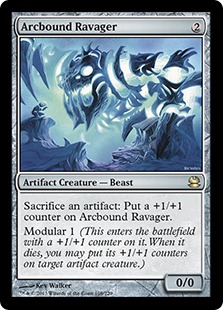
I believe the key to understanding this dynamic is Gifts Storm. Storm is, to be quite simple, the most broken deck available in Modern right now—it preys on lower-tier decks like no other, presenting an extremely powerful game plan that defies interaction and wins through disruption. To defeat Storm, a mere hate piece or two usually isn't sufficient—you must also present a fast clock yourself. Try to interact too much and Storm will craft a late game where it can fight through just about anything. On the other hand, go all-in on aggression in an attempt to race and you may find yourself on the short end of the turn-three-kill stick. The decks best positioned to attack Storm present both a fast clock and significant disruption. Of these, Humans and Shadow are the most powerful options, more than capable of combating the rest of the field as well.

So I'm inclined to say Storm is warping the MTGO meta around it to some extent—as we'll see below, I believe this is effect is influencing the lower tiers as well.

Tier 1 Changes: December 2017

Deck% Change November to DecemberOverall
Meta % 12/1 - 12/31
Overall Meta % 11/1 - 11/30
Grixis Shadow+0.8%5.5%4.7%
[archetype]Burn[/archetype]+0.5%5.4%4.9%
[archetype]Gx Tron[/archetype]+1.9%5.2%3.3%
Jeskai Tempo-0.7%4.8%5.5%
[archetype]RG Valakut[/archetype]+0.2%4.7%4.5%
[archetype]Eldrazi Tron[/archetype]-0.2%4.6%4.8%
[archetype]Affinity[/archetype]-2.5%4.5%7.0%
[archetype]Humans[/archetype]-0.4%4.5%4.9%
[archetype]Gifts Storm[/archetype]-1.3%4.4%5.7%
[archetype]Counters Company[/archetype]-1.2%3.7%4.5%

Looking to the changes since November, we see a little shuffling around of relative rankings but most decks staying more or less put. The big stories here are Affinity and Gx Tron.

Affinity is following a pretty clear pattern of online players moving away from the archetype as the paper population lags behind (but still follows suit). Its November paper and MTGO shares were 7.5% and 4.8% respectively, so this decline was already in progress then. In December Affinity's paper share of 5.1% has mostly caught up to the November MTGO numbers. Meanwhile, online players expressed even more skepticism in the archetype as the MTGO share fell an additional 1.4%. It's fair to say this isn't the best time for the robots, but don't write them off entirely. A deck as brutally efficient as Affinity never truly dies, and if Mox Opal, Arcbound Ravager, & Co. don't put any pilots into the Top 8 of PT Rivals I'll be surprised.
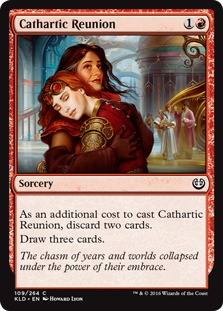
While Affinity was going down, Gx Tron was coming up. Strangely enough, the MTGO and paper share of this archetype seem to have swapped places since November. Last month it was 2.3% in paper, 6.4% on MTGO. In December it was 6.1% and 3.7% respectively. Note that this switch is more than enough to push it up a tier, as the paper n is higher (and thus carries more weight).

So what gives? Honestly, I'm at a bit of a loss on this one. Tron was notably one of the breakout decks at GP Oklahoma City, but people were picking it up for all kinds of other tournaments too. At the same time the online players were abandoning it. Weird. If you have some inkling of why this would be the case, I'd love to hear about it in the comments.

Tier 2: 12/1/17 - 12/31/17

DeckOverall
Metagame %
Paper %MTGO %
Abzan2.7%3.0%2.4%
Jund2.6%3.1%1.8%
UW Control2.4%3.1%1.3%
Dredge2.3%1.0%4.5%
[archetype slug="5-color shadow"]Traverse Shadow[/archetype]2.2%1.5%3.4%
Eldrazi and Taxes2.1%2.3%1.8%
UR Breach1.8%1.3%2.6%
Mardu Tokens1.6%0.8%2.9%
RG Ponza1.6%1.3%2.1%
Lantern Control1.5%1.3%1.8%
Bogles1.5%1.2%2.1%
Ad Nauseam1.4%1.2%1.8%
Death and Taxes1.4%2.0%0.5%
Elves1.3%2.0%0.3%

As I alluded to earlier, there was a high degree of variance in the Tier 2 and Tier 3 archetypes that made drawing the line between them tough. This was due to a significant gulf between the MTGO and Paper metagames taken separately, indicating that each is responding to different strategic incentives. To understand what this means for our tiers this month, it will serve to examine some of the more technical details behind tiering calculations.

The metagame spreadsheet uses a point system to assign each archetype a total rank according to various criteria. These essentially break into three categories: MTGO Tier, Paper Tier, and Major Top 8 finishes. The Major Top 8 finishes are easiest to understand—archetypes earn 2 points for each Top 8, 1 point for each Top 16. This only applies for events we've labeled as "major" (for this month, both Grand Prixs and the SCG Classic/Open pairing from Roanoke).

Tiers for MTGO and Paper metagames are calculated using the standard deviation of archetype percentage. That is to say, we calculate a baseline percentage (derived from the mean) of all archetypes in the data, then measure how far above that baseline a given deck varies. Tier 3 means just above the baseline, Tier 2 means one standard deviation above, and Tier 1 means two standard deviations above. Note this is done independently for both the paper and MTGO data—from there tiered decks are assigned points depending on where they landed in both metagames, which is added to the Major Top 8 points for a final score.

Finally, this same calculation is done for the entire data set combined. That's what yields the final percentages of our metagame picture, but the format-wide tierings are calculated using the point score instead. That means they won't always correlate exactly. Most months there are several decks with point scores indicating a given tier that doesn't mesh with its total percentage. These are usually the result of a rogue deck top-eighting a major event (which, remember, will earn it 2 points regardless of total metagame percentage). For these decks I manually adjust their tier up or down before publishing the final results to better reflect the percentages.
What's weird this month is we had tons of decks like this in Tier 2 and Tier 3. It was enough that figuring out where to draw the line was difficult, and somewhat arbitrary. What this means is that the differences between the Paper, MTGO, and Major Top 8 metagames were significantly higher than normal. We already saw above how Tier 1 decks on MTGO are presenting a more polarized format than their paper counterparts. In the lower tiers it's much harder to discern a clear pattern, but a lot of archetypes are still posting huge differences between the two formats. You can see this discrepancy clearest in Dredge, Traverse Shadow, Mardu Tokens, Death & Taxes, and Elves—in addition to yet more decks in Tier 3.

So, what I think we're seeing is essentially two different Modern metagames, where the constraints placed on decks in each is markedly different. If I'm right that Storm is warping the online meta, that could easily create cascading effects down to other archetypes in the lower tiers. Whatever the cause, it's clear that players on MTGO are navigating a very different environment—more so than usual—than what you may be seeing at your local paper events.

Per Archetype Notes

  • Dredge. This deck presents the biggest gap between its paper and MTGO shares at a whopping 3.5%. November painted a similar picture for the archetype, and I recall seeing this pattern during its pre-ban heyday as well. Is it possible people are just avoiding this deck as an "unfun" option in less competitive environments? My guess is simply that players are underrating its power level, as I think that has generally been the case, but it is likely being influenced by the differences in the online meta as well.
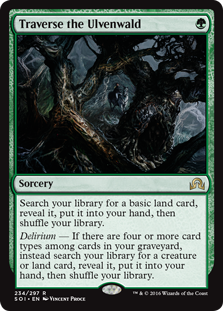
  • Traverse Shadow. Reid Duke has been recording games with all kinds of BGx over at Channel Fireball, including all the Shadow variants. He makes a strong case for the idea that Traverse the Ulvenwald builds are fundamentally the same deck, and I'm inclined to adopt his terminology. The majority of these builds are the typical 5-Color Shadow deck with Stubborn Denial in the main and Lingering Souls in the sideboard, but the December data also includes 4-Color builds and one Jund deck.
  • Bogles. To my knowledge Bogles has never been as high as Tier 2 in our metagame standings. It jumped up about half a percent from its November shares, mostly from paper players taking a cue from online players and picking up the deck.
  • Mardu Tokens. Here we have another deck starting to bleed from online to paper, jumping up a tier in the process. Bedlam Reveler packs a serious punch as one of the best delve spells still legal in the format. That said, I'm not sure I'm in love with this deck's overall power level, and I question if it's just a worse version of black midrange standbys Abzan and Jund.

Tier 3: 12/1/17 - 12/31/17

DeckOverall
Metagame %
Paper %MTGO %
As Foretold Living End1.2%0.2%2.9%
[archetype]Merfolk[/archetype]1.2%1.8%0.3%
8Rack1.2%2.0%0.0%
Hollow One1.2%1.2%1.3%
Living End1.1%1.8%0.0%
Griselbrand1.0%0.2%2.4%
Jeskai Control1.0%1.2%0.8%
Gx Eldrazi1.0%1.3%0.5%
GW Company0.8%0.8%0.8%
Mono U Tron0.8%0.3%1.6%
[archetype]Infect[/archetype]0.8%0.7%1.1%
Amulet Titan0.7%0.5%1.1%
UR Kiki0.7%0.5%1.1%
Goblins0.6%0.5%0.8%
Knightfall0.6%0.8%0.3%
UW Midrange0.6%0.8%0.3%
RW Prison0.5%0.8%0.0%
Grixis Control0.5%0.5%0.5%

Here in Tier 3 we see more archetypes with large differences in online/paper shares, with a good number posting practically 0% or close to it in one of the two metagames. Yeesh. Your MTGO-only Tier 3 consists of As Foretold Living End, Griselbrand, and Mono U Tron, while the paper-only contenders are Merfolk, 8Rack, and traditional Living End. Note that Elves above in Tier 2 follows a similar pattern, and easily could have been lumped in with Tier 3.

Remember that Tier 3 tends to go through a ton of churn each month, and December was no different. Being aware of these decks for your competitive ventures is advisable—worrying about them is not. I don't expect these decks to put up Pro Tour Top 8s, unless one of the major teams manages to break one of the newer decks like As Foretold or BG Eldrazi.

Per Archetype Notes

  • As Foretold. Over the past month this deck has been all the rage in the hands of a number of streamers (including our own Ryland). It's always exciting when a brand-new archetype gets enabled by some unique printing like As Foretold, and this deck appears to have real legs. Resolving Ancestral Recall for zero mana ain't no joke, folks. Neither is running Living End without constraints on your ability to play interactive spells like Remand or Serum Visions. I don't think we've seen the last of this archetype.
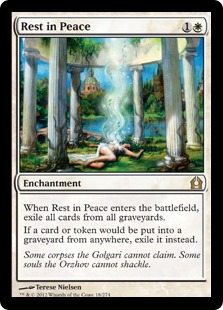
  • Merfolk. First Merfolk went green, then they went back. There were scant UG Merfolk decks in December's data, for whatever reason. I expect that to be short-lived, however, as the new two-mana lord from Rivals of Ixalan is likely to cement the tribe's forest affiliations for the foreseeable future.
  • Hollow One. As I predicted last month, the wonky red-based discard deck has fallen from its brief time in the sun in Tier 2 territory. Builds of this deck are nowhere near ironed out, so there may still be a potent strategy here waiting to be tuned.
  • Gx Eldrazi. This category includes the old Bant Eldrazi decks, which still show up semi-regularly if in much lower numbers than their younger brother Eldrazi Tron. It also includes a number of different-colored builds (Temur, RG, and BG), which are built around the same shell of Ancient Stirrings, Birds of Paradise/Noble Hierarch, and Eldrazi Temple. Rob wrote about some known pros that have been experimenting with the shell. Could one of these updated versions with new splash colors be a breakout deck at the PT?

Pro Tour Predictions

In the introduction I stated that a higher competitive echelon of decks in Modern can be discerned. What I'm referring to with this phrase is the trio of decks posting the highest precentage on MTGO: Grixis Shadow, Humans, and Storm. As we've seen, however, this more dominant performance on MTGO isn't translating to the paper metagame. I think there are two reasons for this.

First, my hypothesis is that Storm is being played in significantly lower numbers in paper. This is the classic example of a deck that grinders and pros gravitate towards while the population at large eschews. From my own anecdotal experience speaking to local players about the archetype, I believe that much of the population at large is underestimating its power. Skill level is a real impediment too. Storm is extremely challenging to pilot well and mistakes can be very costly, especially in post-board games. If you're playing Gifts Storm at, say, 75%, there's a good chance the hate pieces will take you down after sideboarding. The feel-bads of getting Rest in Peaced into oblivion may well lead you to conclude that hate is too prevalent to play Storm right now. Meanwhile, the MTGO players, many of whom will have many more games under their belt and a more competitive environment in general to fight through, are proving that contention mistaken.
The second reason for the divergence, I believe, lies in the less predictable nature of paper metagames. Modern is famously the play-what-you-know format. While this is certainly true across the board (and quite noticeable when compared to the often-stagnant Standard), the phenomenon often appears more marked in paper. The MTGO hive mind solves formats fast, switches decks rapidly, and puts enormous pressure on Tier 2 and Tier 3 decks to put up or get out. Against linear decks like Storm, Affinity, Burn, etc., this less diverse metagame might not have a huge effect—but the same isn't true against the likes of Humans and Shadow. Those two decks aim to interact, and if they're extremely well geared to take down Storm, they can fail against some of the more fringe strategies. In a certain sense Humans and Shadow are metagame decks, preying on the abundance of Storm in the online meta but losing some of their luster when their preferred target becomes less common.

That said, it would be easy to overstate this effect. Remember our highest share on the MTGO standings is 7.1%—that's several percentage points below Infect, Dredge, and Jund at their respective heights last year. Even the MTGO metagame is uncharacteristically diverse for Modern right now. That bodes well for the format's health and its return to the Pro Tour stage in February.

Given what I've seen in the December data, here are my predictions for Bilbao:

  • The field at large will be highly diverse. Even accounting for a slightly more homogeneous MTGO metagame, the Modern format is just very diverse right now. I expect this to be carried over to the Pro Tour. It might seem like the higher skill level at the PT would lead to a more solved metagame, but I don't think that will be the case. Skill is only one factor behind the "solved" MTGO metagame—Pro Tour competitors will be faced with a much less transparent field that will be very hard to metagame against. The split-format nature of Pro Tours further compounds this: any player whose specialty is Limited may indeed select a constructed deck that fits their play style over one they believe is better positioned. Given this uncertainty, I expect most competitors to follow the age-old format adage: play what you know.
  • The Top 8 will reflect this diversity. I expect this diversity to translate to the Top 8 as well, with six or seven different archetypes and no more than two of the same type. Every deck from Tier 1 is a serious candidate for a Top 8 berth, and I believe most slots will be occupied by these decks. But I expect to see a few lower-tier decks make a showing as well. My picks for the most powerful Tier 2 options are Dredge, Lantern Control, UR Breach, and UW Control.
  • Storm, Shadow and Lantern Control will be played in higher numbers. These three decks are difficult to pilot, and easy to write off if your experience facing them is against weaker opponents. Expect the pros not to shy away from the challenge. I've already gone on record with my belief that Gifts Storm is the most powerful archetype in the abstract, and the deck best suited to taking down the format at large. I'm slightly less confident in Shadow's lasting power, but I still think we'll see a high number of pros adopt it for Bilbao (note I'm including the Traverse variants here). As for Lantern Control, this is another deck pros sing the praises of while most players yawn and look away. The newest addition to the deck, Whir of Invention, has done wonders for its consistency. Remember, this was one of the best performing decks at GP Oklahoma City until it ran afoul of the Gx Tron decks at the top tables. If that archetype is played in lower numbers, it could be Lantern's time to shine.
  • Humans will underperform. If Shadow and Lantern are being underrated, I think Humans is a little too hyped right now. It's good against Storm, no doubt, and it can pack a wallop in other matchups too. I just think it's lacking the abstract power to fight through its bad matchups. At the end of the day, Modern is a format that rewards linearity and explosiveness. Humans can't really boast either of those things, and its interaction plan is conspicuously lacking in the best disruption piece Modern has to offer, Thoughtseize. For those looking to position themselves against Storm with an interactive counterstrategy, I believe Shadow will prove the superior option that sacrifices the least in other matchups.

So, that's what I think we'll see at Pro Tour Rivals of Ixalan. I myself will be in attendance trying to compete for the glory as well, so wish me luck!

What are your thoughts on the December metagame? Did I get it right in my analysis of the differing MTGO and paper metagames? Or is something other than Storm to blame for the gap? Will this be a highly diverse Pro Tour that validates Wizards's choice to bring the format back to the big stage, or will the pros break it open? Let me know in the comments, and thanks for reading.

Insider: Attempting to Explain Risk

Are you a Quiet Speculation member?

If not, now is a perfect time to join up! Our powerful tools, breaking-news analysis, and exclusive Discord channel will make sure you stay up to date and ahead of the curve.

Over the weekend I sat down to write my article and began pondering over the most interesting MTG finance news over the past week. We’ve had Rivals of Ixalan spoilers, but I’m not so interested in a set that will have little impact on Standard and won’t be showcased at a Pro Tour for a while (the next Pro Tour is Modern). We found out Masters 25 will be distributed to big box stores just like Iconic Masters, so we can do nothing but avoid potentially reprinted cards such as Rishadan Port.

There was an error retrieving a chart for Rishadan Port

Indeed the only really exciting trend I’ve noticed over the past week is the crazy surge in Old School prices. But you all knew these were great investments already, and hopefully you’ve been slowly acquiring cards you want for your collections. I don’t need to write about this topic yet again. Just know that price momentum is still positive and every single day I’m seeing buylist increases from Card Kingdom. These cards are truly low risk and high reward, and that’s my favorite type of investment!

There was an error retrieving a chart for Old Man of the Sea

Speaking of Risk

While I’m on the subject of risk, I wanted to touch upon this widely discussed but often misplaced topic in MTG finance. I decided to write a piece on risk after being called out again for the umpteenth time for being risk-averse/risk-intolerant. When people make these negatively charged remarks, they are doing so inappropriately and without context. I’ll explain.

There’s a well-written article on Investopedia that attempts to describe what investment risk truly is. The column summarizes itself by stating:

“There are no perfect definitions or measurements of risk, but inexperienced investors would do well to think of risk in terms of the odds that a given investment will fail to achieve the expected return, and the magnitude by which it will miss that target.”

Let’s think about that for a minute. When someone speculates on Magic cards—even Reserved List cards—they are doing so with an expectation of some return. If there’s a chance that return won’t be achieved, then there’s a risk associated with this investment.

The thing is, this “expected return” in the Magic world is a little nebulous. In the stock market, you can compare a given stock with the S&P 500 or other stocks within the same sector. But with Magic, it’s hard to compare what an Ali from Cairo’s risk is relative to a more traditional investment vehicle. Thus it’s hard to quantify “risk” in this space.

There was an error retrieving a chart for Ali from Cairo

I would argue that betting on pieces of cardboard from a game, no matter which you buy, carries a relatively high amount of risk. Every time I park money in a Magic card, I am doing so because I believe that card will yield a greater return than a stock investment over a given time horizon.

This is a huge bet when you think about it! Is this cardboard more reliable than a company’s stock? Or a basket of companies? Certainly not. There is a greater chance that this cardboard game will go bust than it is that all 500 companies in the S&P 500 will. Thus I would argue any cardboard investment is “high-risk.”

You could argue that betting on Standard cards and reprintable stuff is higher risk even still, but you all know my stance on this matter. A nontraditional investment like cardboard is risky enough, as we just defined, so there’s no need to introduce even greater risk within the class that is Magic cards. Some may argue that taking greater risk within Magic could yield better returns, but I challenge you to find many newer cards with the same two-year return as this one:

There was an error retrieving a chart for Juzám Djinn

Standard cards my pop temporarily, and there’s definitely an avenue worth pursuing to profit that way. But when it comes to longer-term investments, nothing can beat a solid, playable Reserved List card.

Taking a Step Back: Context

Now that I’ve established that any MTG investment can be deemed high-risk, I want to share an even broader context in defense of my investment strategies. Consider one’s total net worth and their relative allocation of this money. It may be in a home, in the stock market, retirement funds, artwork, watches, etc. All of these are viable methods to store value.

Where do you think Magic: The Gathering falls within this list when it comes to risk? Probably quite high in rank, right? A significant investment on game pieces controlled by a single company would likely be quite the high risk relative to other options.

Now let’s think about an individual and how they allocate their resources. First of all, they had better have their life in order before even thinking about investing in Magic cards. They better have all their basic necessities met, and I would always recommend a person looking to invest should first make sure they have health insurance. Why? Because one freak accident or genetically inherited disease can wipe you out if you lack health insurance. It’s a boring topic, but it’s absolutely most critical to have this in place before you start investing money.

Once you have necessities met and health insurance, you’re ready to invest incremental dollars. Where should you park this money? The smartest place to do this is a mutual fund or externally traded fund (ETF)—that is, a basket of stocks and bonds. Younger folks should lean more heavily into stocks because they can afford to take more risk (there’s that word again) while people closer to retirement age should consider a safer portfolio.

Personally, this is where I consider the majority of my risk exposure. I park most of my resources in individual stocks and baskets of stocks. I hold virtually zero bonds in my portfolio because I view that asset class as in a bubble thanks to the low-interest-rate environment the fed has given us. Would this be considered a high-risk portfolio? You better believe it! Every time I log into my Fidelity account I’m reminded of this.

Does this look like the portfolio allocation of a risk-intolerant individual? Not according to Fidelity! Risk is always relative to an expectation or another investment vehicle, and as far as stocks go I am one of the most aggressive I know.

Adding Even More Context

Now let’s consider even more life context. Would there be a different level of risk if someone had a spouse who stayed home to watch multiple kids? That person's income is the sole source of financial support for their family. Naturally this means their retirement contributions are the only ones the family has to depend on. What if that person also had other relatives that depended on this person's income? This would apply even greater financial pressure on the household.

Should that person lose their job or something for any reason, this would create quite the financial hardship on their family. Considering this reality, one may recommend this person should allocate resources in a conservative way. But if they instead continued to allocate aggressively to stocks, would they not be taking on a larger amount of risk? If we fell into another huge recession and this person lost their job, their retirement account would shrink drastically and the sole source of income in their household would disappear simultaneously.

Yet some people decide to take on this level of risk because they see the returns being achieved in the stock market and they want to participate in these gains. It doesn't matter if they're buying high beta stocks or blue chips—the risk is certainly elevated for this person and they need to acknowledge that.

Reflecting upon my own situation, it is readily apparent that people who judge me for my risk tolerance are doing so based on a single action, within a single investment position, within a single asset class, within the context of my life. All they see is, “Sig sold a Battle Screech he must be risk-averse. Or, “Sig doesn’t invest in cryptocurrency because he can’t handle the risk.” These are shallow statements made without any full appreciation for what risk truly is and how it fits within the context of one’s life.

Wrapping It Up

I recognize I spent some time this week on my soap box. I’m okay with that. It gave me an opportunity to share more context around my investment strategy and life situation, while also offering a topic to discuss outside of “Buy Old School Cards.” Risk is a very complicated subject, and if someone thinks they can judge another’s risk profile based on a tiny subset of investment decisions, they are possibly making too many poor assumptions.

If my entire life was Magic finance, would I be considered risk-averse? Possibly. But with such great returns from Reserved List cards, why do I need to expose myself to potential reprints? It’s not like foil Commander cards are growing much more quickly relative to some of these Arabian Nights cards. The returns are no more attractive, so I’d prefer the sure thing. I’d argue people investing in Commander foils and non-Reserved List cards for any timeline beyond a couple months are taking unnecessary risk.

And speaking of these older cards, have you seen some of the movement lately? Buylists are going insane! If you are investing in these classic cards, you should have absolutely no concern with liquidity. Card Kingdom and ABU Games are giving you all the opportunity to cash out that you need. Juzám Djinn buylist of $840! Elephant Graveyard at $100. Old Man of the Sea at $140. Erhnam Djinn at $175! The list is endless and the prices keep climbing.

There was an error retrieving a chart for Elephant Graveyard

If investing in these cards with such monotonically increasing values and little downside makes me risk-averse, then so be it. I’m making money for my family and that’s all that matters.

…

Sigbits

  • Ali from Cairo is completely sold out at Star City Games (along with many other Arabian Nights cards), with a price tag of $300. Think about it. A year ago I remember buying a nice condition copy for around $60. With returns like this, do you really need to take on greater risk?
  • Arabian Nights Serendib Efreet is also completely gone from Star City Games. This one has a $350 price point. Card Kingdom’s buy price is $210 and they currently only have one EX copy in stock. Based on how I’ve studied their pricing algorithms, I predict they will jack up that buy price nicely once someone acquires that lingering copy. With store credit, their price ($275) is actually not that bad!
  • I have also been watching Legends cards rise steadily. For example, Angus Mackenzie is the most expensive multi-colored creature from the set and Star City Games is sold out at $129.99. That price is far too low considering copies on TCGplayer are in the same price range or even higher for near mint. These will all continue to rise in price as well.

Insider: Five Pre-Pro Tour Modern Specs

Are you a Quiet Speculation member?

If not, now is a perfect time to join up! Our powerful tools, breaking-news analysis, and exclusive Discord channel will make sure you stay up to date and ahead of the curve.

Modern is the best format in Magic. It is an idea that I've been toying with for some time but is such a bold assertion that I've been holding back on actually saying it. It's kind of like telling someone, "I love you," for the first time. Once you open Pandora's Box it is pretty much impossible to take it back.

With that being said, I was initially planning on writing about speculating on new Standard with an imminent Energy ban on the wings. Unfortunately for me (but fortunately for you), Kyle already nailed the article I was planning on writing:

Insider: Preparing for an Energy Ban

I strongly recommend doing the things he suggests because I think he nailed it.

Modern Picks in Advance of the PT

Modern continues to thrive, and by thrive I mean prosper and be super popular with players.

I attended a nearly 1,000-player Star City Games Open in Columbus last weekend. The format is so much fun—more importantly, people really enjoy it and want to play it.

I've been vocal about my belief that Modern is not a format for long-term speculation targets. Particularly on format staples. The evidence is too conclusive that staples are frequently reprinted, and these reprints substantially impact the price of cards. If anything, long-term holds on Modern cards tend to be a death sentence for profit.

On the other hand, Modern is a great place to look for short-term "spike and flip" picks. A scenario where you buy or trade for a card today on some evidence that it is likely to flip and then immediately sell when the price goes up.

It just so happens that there is a Modern Pro Tour on the horizon (a rarity in and of itself) which makes it very likely that Modern will see some spikes on its heels.

The Pro Tour is a big game for influencing MTG finance. It is a singular event that absolutely everybody watches and is aware of. American players don't really follow European and Japanese coverage and the rest of the world doesn't really watch American coverage. People look at decklists, but they are not invested. The Pro Tour is a different animal altogether.

The PT is a tone setter in the sense that it creates a baseline for all metagames everywhere. Modern hasn't had an event like this for years. It will be a big moment for the format in the sense that it will tell players exactly what the format looks like and how to approach it moving forward.

With that being said, if you can correctly predict the metagame there is a chance that you would be buying into cards that are likely to have increased demand after the event has concluded.

There was an error retrieving a chart for Lightning Helix

I love Lightning Helix as a speculation target right now. The card has secretly become one of the most important format staples, seeing play in a slew of decks: RW Burn, Jeskai Aggro and Control, and Mardu Pyromancer.

The key is that the card is a major inclusion in two of the major pillars of the format, Burn and Control. There are very few cards in the totality of the format that transcend multiple major pillars and Helix is one.

It has been reprinted in several places which has driven the price way down. I think the reprints may work to our advantage as buyers, and here's why: The card is likely at a rock bottom price which is perfect for buying in. If the demand for the card spikes after the PT, the price will increase even if the supply is high. There will be lots of copies for sale, but they will all be more expensive.

For what it's worth, Lightning Helix is currently seeing the kind of play that Inquisition of Kozilek was six months ago. It's one of the best cards.

I also love the textless promo version of Lightning Helix as an investment card. It looks amazing. They don't make 'em like this anymore. If Lightning Helix decks are the talk of the tournament (and they may well be) it is possible the card could make significant gains.

I also think that Burn is poised to have a big weekend at the Pro Tour. It is one of the best decks in the format and exactly the kind of deck that people like to play. Efro has been advocating the deck lately which is a big endorsement since "the cool kids" rarely jump on board with a deck like Burn for fear of losing style points. The fact that a player that good has been so vocal about saying that Burn is the best deck in the format goes a long way.

There was an error retrieving a chart for Leyline of Sanctity

Speaking of Burn being great...how about being great against Burn!

Leyline of Sanctity is one of the most one-sided blowout cards in the format. Drawing one in your opening hand against a Thoughtseize or Burn deck is like casting three free counterspells. Starting with one against a deck like Storm could end the game on the spot!

People are aware of Leyline of Sanctity in the sense that they understand it wrecks them but not to the degree that they realize they should actually be playing it a lot more than they are. I think we will see a ton of Leyline of Sanctity at the Pro Tour and that will change the format.

It will be a more widely considered maindeck card as well as a more played sideboard card. If you are looking for an expensive card that has the ability to jump to the next level, I'd be thinking about Leyline of Sanctity. I'm pretty sure I just talked myself into cashing out some store credit to buy them out at my LGS tonight.

There was an error retrieving a chart for Search for Azcanta

Standard card alert! However, I think this card has buffs coming from Modern as well as Standard.

With Standard in mind, if they ban Energy (as I expect they might—I would, for one) the card has more opportunity to see play. Easy.

In Standard, the card is a feature in the Jeskai Control deck that lit up Columbus (taking both first and second place). I also think the card has potential legs as as sideboard card in non-control decks. It is a relatively new card whose potential we are only just realizing. It could see a lot of play at the Pro Tour. It could also be a major Standard player as well. Love this card right now as a pick.

There was an error retrieving a chart for Stubborn Denial

I'm a big fan of Stubborn Denial. Grixis Shadow is the most played deck in Modern, weighing in at roughly 10% of the metagame. I also think that Shadow will be one of the most popular decks at the Pro Tour. It's the "value" deck and, for better or worse, good players are addicted to value.

Stubborn Denial is a cheap staple right now but hasn't seen a reprint just yet. It also slots nicely into other decks like various Bant builds and Affinity. It is one of the more widely played permission spells in the format. I like the idea of stocking up on these while they are still cheap. These are great cards to get people to "throw in" during a close trade.

It feels like it can't really go lower (outside of a reprinting), so it seems prudent to pick some up.

There was an error retrieving a chart for Primeval Titan

Speaking of cards that have bottomed out, the Iconic Masters version of Primeval Titan tanked the value of all copies hard. It is unlikely that we'll get another reprinting of the card anytime soon which means that we are likely looking at the rock-bottom price on the card.

It just so happens to be the backbone of an entire archetype of Modern. And a darn good one too!

Valakut is one of the natural predators of the grindy decks that are likely to be popular choices at the Pro Tour. It seems very likely to me that Valakut could potentially be one of the best positioned decks in the format and could have a big weekend. If it does, don't expect to find too many $5 copies of Prime Time floating around after that.

Picking the Winners

There is a lot to think about when it comes to picking Modern winners. The key will be picking cards in the Top 8. I think it is unlikely that anyone will reinvent the wheel. The format is too big and too well defined for that. However, how the format will play out is on everybody's mind. It's easy, just like betting horses; pick winners, right?

Okay, yeah, it's hard to do, but there is something to be said for using the information we have to pinpoint trends that are likely to occur. I believe evidence shows that Lightning Helix decks are peaking in Modern which makes them a frontrunner. I also think strategies that are good against those decks (Leyline of Sanctity and Primeval Titan, for example) are also quite nice specs.

I've been really enjoying Modern. I think it is the best format. I can't wait to watch coverage and hopefully make a few bucks in the process.

Modern Top 5: Fair Plan B’s

Are you a Quiet Speculation member?

If not, now is a perfect time to join up! Our powerful tools, breaking-news analysis, and exclusive Discord channel will make sure you stay up to date and ahead of the curve.

Modern used to come under fire in its early days for how focused its decks were. The format's many linear decks gave onlookers and format dabblers the impression that Modern was but a mess of such decks "passing in the night," like "two ships." But focus isn't everything, and dilution has its merits. As perception of the format has shifted to become more positive, so to have players discovered savvier tech choices with which to give their decks multiple angles of attack.

Today's Modern Top 5 articles goes over what I consider the best options for players looking to add a new dimension of fair play to their decks, linear or otherwise.

The Elephant Not in the Room

Some weeks ago, I penned a piece on Tarmogoyf's fall from grace. Also in the aforementioned period of anti-Modern sentiment, Fatal Push was but a seed in some malicious designer's head, and not a format-defining staple. Tarmogoyf was therefore splashed into plenty of strategies as a fair Plan B, or additional angle of attack. For instance, decks looking to combat Infect with damage-based removal and sweepers could do little in the face of a Tarmogoyf, making the card a sweet pick for the Infect sideboard.

With Push keeping Goyf under control for the last year, swaths of other sideboard fair plans have emerged as real, ingenious contenders. The plans in this article exist as one-card options for decks looking to attack opponents from an angle they might not have prepared for between games, and one that has little if anything to do with their primary gameplan.

To keep things cohesive, we'll focus only on fair plans, leaving stuff like Madcap Experiment/Platinum Emperion for another day. Interestingly enough, many of the following "fair plans" end up being employed by unfair decks, since sideboarding to beat a linear combo strategy can leave players at the mercy of good ol' beatdown.

On Pick Order

Unlike the other entries in my Modern Top 5 series, this one doesn't provide metrics on which to judge each featured card. As such, the pick order is a bit up in the air. The cards are sorted subjectively, on gut reaction, and their order here is by no means set in stone.

With that out of the way, let's get started!

#5: Young Pyromancer

Young Pyromancer may well be one of Modern's most divisive creatures. The UR fanboys who play him, love him; other Delver aficionados have consistently decried the card as "garbage." Outside of some brief experiments with Day's Undoing and Dark Confidant, I've never been too keen on the Shaman myself. Pyromancer always seemed far better suited to older, stronger formats like Legacy and Vintage, where its drawback of dying to Lightning Bolt at a parity loss is greatly mitigated: cheap, unconditional removal is less plentiful in those formats, since the ubiquitous combo decks ignore it, and the combination of fast mana and free spells enable faster, stickier 2/1s.

But that was then. One might think the printing of Fatal Push would have nudged Pyromancer even deeper into the shadows. In fact, the ensuing metagame shifts have led players to discover an ideal role for red's supposed fabled two-drop: a post-board fair plan.

UR Breach, by Spottenger (5-8th, MTGO PPTQ)

Creatures

4 Emrakul, the Aeons Torn
2 Snapcaster Mage
1 Vendilion Clique

Planeswalkers

1 Jace, Architect of Thought

Instants

4 Lightning Bolt
4 Opt
4 Remand
4 Through the Breach
3 Cryptic Command
2 Electrolyze
1 Izzet Charm

Sorceries

3 Serum Visions

Enchantments

2 Blood Moon
2 Spreading Seas

Lands

2 Desolate Lighthouse
4 Polluted Delta
4 Scalding Tarn
7 Snow-Covered Island
1 Snow-Covered Mountain
2 Steam Vents
3 Sulfur Falls

Sideboard

1 Abrade
2 Anger of the Gods
1 By Force
1 Ceremonious Rejection
1 Disdainful Stroke
3 Dispel
3 Engineered Explosives
1 Keranos, God of Storms
2 Young Pyromancer

This UR Breach deck looks to cheese wins with Blood Moon and Through the Breach, cards opponents are unlikely to have answers for before siding. Young Pyromancer allows it to transition into a fair deck, playing a reactive tempo game with Snapcaster Mage and Lightning Bolt. Opponents are likely to drop some removal against this combo deck, but all the Dispels and Surgical Extractions in the world won't beat an army of Elementals.

Cantrip-heavy decks are great at mixing things up for games two and three, since their very core helps pilots find the right cards at the right time. They also naturally align with Pyromancer. It's no wonder we've seen the same plan in Grixis Shadow sideboards and even out of Jeskai Tempo.

All that said, there's a reason Pyromancer's never seen in the Storm sideboard. Opponents are in fact very likely to bring in damage-based sweepers for this matchup thanks to Empty the Warrens, and Pyromancer's vulnerable to the same kind of hate.

#4: Thragtusk

This Standard-defining fatty's first big Modern break came with a 2015 SCG Open finish by Gerard Fabiano, who took down the tournament with a head-turning Sultai Rock deck. Next, the card was played by Amulet Bloom until that deck's inevitable banning. Since then, surely to Gerard's chagrin, Thragtusk's unfair legacy has continued; the card is featured primarily in big mana strategies as a way to brute-force through disruption à la Eldrazi Tron, as in Rodrigo Togores's winning list from GP Madrid last month.

RG Valakut, by Rodrigo Togores (1st, GP Madrid 2017)

Creatures

4 Sakura-Tribe Elder
4 Primeval Titan
1 Obstinate Baloth
1 Wood Elves

Sorceries

4 Scapeshift
4 Farseek
4 Search for Tomorrow
2 Anger of the Gods
1 Sweltering Suns

Instants

4 Lightning Bolt
2 Summoner's Pact

Enchantments

2 Prismatic Omen

Lands

4 Valakut, the Molten Pinnacle
3 Cinder Glade
4 Wooded Foothills
4 Misty Rainforest
2 Forest
6 Mountain
4 Stomping Ground
60 Cards

Sideboard

1 Anger of the Gods
1 Obstinate Baloth
1 Ancient Grudge
1 Nature's Claim
1 Beast Within
1 Reclamation Sage
2 Mwonvuli Acid Moss
3 Relic of Progenitus
2 Leyline of Sanctity
2 Thragtusk

Besides Valakut, Gx Tron is Thragtusk's main employer. Tusk doesn't just check the value and body boxes, it gains life, giving it added utility in aggressive matchups—in other words, the matchups big mana decks play catch-up against once they've got their mana online.

Few and far between are the fair decks that can shell out five mana for a fatty, especially since enormous creatures come at unthinkably low CMCs these days. But anyone with a midgame predisposition and in search of a fair plan has Thragtusk as a juicy option.

#3: Tireless Tracker

Tireless Tracker attacks opponents on one of the game's most fundamental levels: card advantage. Bolt's gentle decline in popularity aids the Scout further, and Tracker slots right into most green decks running fetchlands as a result. Tracker into fetch and crack, even assuming the creature trades with a kill spell the following turn, nets two cards. And unchecked, there's no telling how much havoc Tracker can cause—it even grows in size!

The creature's also generic enough that it doesn't have to be played in a fetch-heavy deck to excel at its job.

Humans, by Collins Mullen (1st, SCG Cincinnati 2017)

Creatures

4 Champion of the Parish
4 Kitesail Freebooter
4 Mantis Rider
3 Mayor of Avabruck
4 Meddling Mage
4 Noble Hierarch
3 Reflector Mage
4 Thalia's Lieutenant
4 Thalia, Guardian of Thraben
2 Thalia, Heretic Cathar

Artifacts

4 Aether Vial

Lands

4 Ancient Ziggurat
4 Cavern of Souls
1 Hallowed Fountain
2 Horizon Canopy
1 Temple Garden
4 Unclaimed Territory
3 Windswept Heath

Sideboard

2 Ethersworn Canonist
2 Fiend Hunter
2 Izzet Staticaster
1 Mirran Crusader
1 Reflector Mage
2 Tireless Tracker
2 Vithian Renegades
2 Xathrid Necromancer
1 Anafenza, the Foremost

Humans runs only three fetchlands, but still makes room for a pair of Trackers to combat the removal-heavy midrange decks bound to hassle a synergy-based aggro strategy. The card has also become a mainstay in RG Valakut, Counters Company, and even off-the-wall stuff like Amulet Titan.

#2: Death's Shadow

As a plan, Death's Shadow isn't the easiest to fit into a given deck. It's not that the cards themselves are bad, but that the package takes up a whopping 12 slots (4 Shadow, 4 Street Wraith, 4 Thoughtseize), which many decks cannot afford. That said, Thoughtseize is one of Modern's most powerful disruptive spells, so including Wraith is the real "cost" of splashing Shadow.

Shadow still ranks so high on our list because it's simply so much better than other fair plans in Modern. I've come around by now on the idea that a good deal of the format's midrange decks improve with Shadow in the mix—the marginal benefit of added robustness rarely makes up for the huge boosts in proactivity and reversibility Shadow affords, which explains why we've seen Shadowless BGx decks take such a representation dive since the Avatar was discovered.

I agree with the sentiment that Shadow's underplayed in Modern for how powerful it is, and would take the notion a step further and suggest it's even underplayed as a Plan B. Black midrange or attrition decks struggling against aggressive strategies might do well to forget about Street Wraith and play Shadow in the sideboard for some help there, so long as they're otherwise proactive enough to take on linear combo decks. What deck checks all those boxes?

8 Rack, by Tom Ross (4th, SCG Louisville 2017)

Planeswalkers

4 Liliana of the Veil

Artifacts

4 The Rack

Enchantments

4 Shrieking Affliction

Instants

1 Dismember
3 Fatal Push
2 Funeral Charm

Sorceries

4 Inquisition of Kozilek
4 Raven's Crime
4 Smallpox
3 Thoughtseize
3 Wrench Mind

Lands

4 Mutavault
4 Urborg, Tomb of Yawgmoth
1 Marsh Flats
15 Swamp

Sideboard

1 Asylum Visitor
2 Death's Shadow
4 Leyline of the Void
1 Fatal Push
1 Shadow of Doubt
2 Bontu's Last Reckoning
4 Delirium Skeins

Honestly, I'm more interested in splashing Shadow into decks with an established gameplan as an alternate Plan A, as I did last week in Mardu Shadow (a spin on Mardu Reveler). But I'm sure the card's full potential remains untapped at this point. Let's not forget about Hiroaki Taniguchi teching a Shadow in his GP Kobe Counters Company sideboard—that's the kind of innovation I'm excited to see Shadow make possible this year.

#1: Lingering Souls

I doubt this pick surprises too many readers. Souls is ridiculous against spot removal, making it an obvious consideration for decks in black and white that are otherwise soft to spot removal. Or to counterspells. Or to fliers. Or to decks that don't beat fliers. It turns out a few decks fall into these categories, including Esper Goryo's and certain builds of Jeskai Control. But Delirium Shadow best embodies the Souls-Plan-B ethos.

All that deck runs to accommodate Souls is a Godless Shrine in the sideboard. At last weekend's Open, Dylan Donegan wondered why Grixis Shadow couldn't do the same.

Grixis Shadow, by Dylan Donegan (4th, SCG Columbus 2018)

Creatures

4 Snapcaster Mage
4 Death's Shadow
3 Gurmag Angler
1 Tasigur, the Golden Fang
4 Street Wraith

Instants

4 Fatal Push
4 Thought Scour
3 Stubborn Denial
2 Temur Battle Rage
2 Dismember
1 Kolaghan's Command

Sorceries

4 Serum Visions
4 Thoughtseize
2 Inquisition of Kozilek

Lands

1 Island
1 Swamp
1 Blood Crypt
4 Bloodstained Mire
4 Polluted Delta
3 Scalding Tarn
1 Steam Vents
1 Verdant Catacombs
2 Watery Grave

Sideboard

1 Izzet Staticaster
2 Ceremonious Rejection
2 Disdainful Stroke
1 Kolaghan's Command
1 Rakdos Charm
1 Stubborn Denial
1 Collective Brutality
1 Pyroclasm
1 Radiant Flames
3 Lingering Souls
1 Godless Shrine

I wonder if this development will inspire non-Shadow decks to start running Souls in their sideboards, even if they're off by a color. Perhaps that single off-color shock isn't such a steep price to pay if it means unhindered access to Modern's best token generator.

The Start of Something New

Plan B's are an important part of Magic, and a crucial component of Modern. It only makes sense that the most dynamic constructed format would have so much divergence and diversity among tech options, even within single archetypes. What's your favorite angle to attack from? Have I missed any reliable fair plans? Let me know in the comments.

Insider: Profiting From Price Spikes After they Happen

Are you a Quiet Speculation member?

If not, now is a perfect time to join up! Our powerful tools, breaking-news analysis, and exclusive Discord channel will make sure you stay up to date and ahead of the curve.

If you’re anything like me, you frequently check websites like MTGStocks or MTGGoldfish to check on the price movements of cards. Every once in a while, and seemingly often these days, a card has suddenly spiked out of nowhere. If only you could have predicted the movement, there would have been a ton of profit to be made. As it turns out, there is often ample opportunity to profit from these spikes even after they have occurred.

There was an error retrieving a chart for Timely Reinforcements

I don’t know exactly how these prices and movements are calculated by websites, but they seem to be tied to the prices on major retailers, with TCGplayer specifically being referenced, and while cards may have been bought out on that platform, that doesn’t mean the cards aren’t available elsewhere for the pre-spike price.

A Case Study in Scrounging for Deals

For a case in point, last week Blood Sun was spoiled, and the internet went crazy about the hard, hyping it up for Eternal formats especially, as a sort of alternate Blood Moon. That night, when I was checking prices, I noticed that Lotus Vale had seen a massive spike, from around $12 to $40, due to its drawback cost being eliminated by Blood Sun. A deeper look into the phenomenon showed that Scorched Ruins had followed suit for the same reason, spiking from around $7 to nearly $30. The cards offered possibilities in Legacy and Commander, and as old cards on the reserved list, these were prime for a buyout, which drove up their prices to obscene levels. Beyond the price movements, I hadn’t read or heard anything about these cards, so I assumed the buyout had happened very recently, and there was still a possibility that I could track down some copies and make some easy profits.

There was an error retrieving a chart for Lotus Vale

In the old days, I would have hit up the cases of local card shops hoping to make some easy money, but it doesn’t feel great to profit off the stores that build the local community and that I’d prefer to support financially, and besides, lately it seems every store checks TCGplayer or Star City Games to price their cards in real-time.

That leaves looking online as the best option, so I sprung into action, first searching for the cards on eBay, but cheap copies were gone, and there were already new copies being listed for the post-price spike, with auctions being actively bid on, which indicated there was some real demand at the new prices. Next I went to Amazon.com, but cheap copies were non-existent.

That brought me to my oldest standby, CardShark.com, and sure enough, I was able to score three copies of Scorched Ruins for an average of $10 each from three different retailers after accounting for the high $2.99 shipping from each, which still left me plenty of room to profit. I then turned to an old favorite, bidwicket.com, which shows the inventories of many retailers in one place, but it was bought out of both cards.

There was an error retrieving a chart for Giant Shark

I then checked some major retailers, but they were expectedly already bought out. I went deeper, searching every retailer I could think of, and I was amazed when I found a full playset of near-mint Lotus Vale in an unexpected place, ABUgames.com, which I assumed would have been one of the first places bought out. The price was over $18, which was higher than the pre-spike price, so I am not certain if it was already marked up or some sort of automatic system had increased the price, but that price still left me room for plenty of profit for the effort, so I quickly picked up the playset.

I then simply turned to Google, searching for each card under the “Shopping” option, but all the good deals it showed were already purchased. That left me Googling for things like “mtg cards” and “magic cards for sale” in a last-ditch attempt to find obscure Magic stores that might have the cards listed for sale. I searched a ton of sites without luck, but by going deep I was able to find a store that had a full near-mint playset of Scorched Ruins, which I picked up for around $32, a huge score. I also came across a site that had played copies for around $15, but I reasoned there wasn’t much money to be made there, so I declined.

For some further insight into the market, I also checked MagicCardMarket, and there were actually copies of both cards available for significantly less than on TCGplayer, so there was a potential arbitrage opportunity available for those in Europe that could make the purchase.

There was an error retrieving a chart for Trade Routes

With my cards ordered, the next move would have been to list them for sale ASAP on my preferred outlet, which in this case was TCGplayer, where I could capture the spiked price. Another option is eBay, where an auction could capitalize on hype to earn big profits. I didn’t consider listing on Facebook, but it would have been a great option to avoid fees. However, because the cards had been purchased after a spike, I thought there was some chance orders would be cancelled, so I wasn’t comfortable listing cards before I received a confirmation, so by listing them the next day when the prices had been tempered down a bit I left some profits on the table.

Lessons Learned and Improvements to Make

Next time, I’ll likely list on Facebook first, where there’s no real penalty if the retailers do indeed cancel on me, or I’ll suck it up and just post on TCGplayer or eBay and deal with it if they are cancelled. That said, in order to make cancelling less likely, I only buy a playset of cards when more are available, as retailers seem more likely to cancel when a buyer is clearly buying them out, or at the very least may cancel the order over a playset.

Wanting to capture a high price before the cards fell considerably, which they tend to do, I priced the cards to move, as the cheapest copies available for my condition. I went a bit low on the Lotus Vale, since played copies were already available in the low to mid $20s, listing for $29.99 each and selling the entire set to one buyer within the day, getting just over $100 after fees and shipping, making around $25 profit, but I likely could have sold for $34.99 each, based on an eBay auction for the set selling for $140, and nearly doubled my profits.

There was an error retrieving a chart for Scorched Ruins

I sold the playset of Scorched Ruins for $18 each, profiting around $30 total, doubling my investment. I listed the remaining three copies when they were confirmed, and because the price had already fallen, I sold these ones for $16 each, making around $15 total, for a 50-percent profit from the $30 I invested. When all was said and done, I made around $60 from my endeavors, not a bad result from about an hour of grinding, and a great learning experience.

It’s a method I’ll attempt on future spikes, and sure enough, this week Pyrohemia spiked from under $1 to $7, so as a little experiment, I went to seek out some copies. A simple Google Shopping search showed ToyWiz.com having three copies in stock for $1.25 each, which after the $2.99 shipping I acquired for under $7.

I figured this was the perfect opportunity to try selling on Facebook, so I posted them asking $6 each, or $15 for all of them, and by the morning I sold a copy. After the stamp and shipping supplies that covers about $5.25 of my $6.74 costs, meaning I have two left that cost me about $0.75 each, or the pre-spike price, so it’s basically all profit from here, regardless of what they sell for. I’ve posted on Facebook and I’ve listed them on TCGplayer at around $6, so I’ll be approximately doubling my investment if the remaining copies sell there or on Facebook. At these prices and for so few cards, it might not have really been worth my time, given the risk that I didn’t sell any, but it was a good exercise.

There was an error retrieving a chart for Pyrohemia

Another card that spiked this week is Resplendent Mentor, up to $4 from $0.50, and a search shows plenty of copies available. Shipping can be expensive from retailers, so I could acquire copies of Mentor for around $1.50 each and sell them for around $3 at the most, which doesn’t make this particular buy worthwhile, especially because they will likely fall. Besides, played copies are available in the $1 to $2 range, but it’s telling that with some effort there could be profit made, or at the very least one could buy an affordable playset. Assuming this was a spike for an actual Modern playable, with potential for even further future gains, it would have been a great opportunity.

–Adam

Daily Stock Watch: Resplendent Mentor

Are you a Quiet Speculation member?

If not, now is a perfect time to join up! Our powerful tools, breaking-news analysis, and exclusive Discord channel will make sure you stay up to date and ahead of the curve.

Hello, readers and welcome to the Thursday edition of the Daily Stock Watch! Brewing season has began in Standard as Rivals of Ixalan draws near. Players always try looking for cards to explore from the new set, and the brewers just found their new toy recently, so let's talk about the upside of this card in the coming days.

There was an error retrieving a chart for Resplendent Mentor

Thanks to Famished Paladin from Rivals of Ixalan, we have a new infinite life tagteam in the Magic universe. And since the hype train started, copies of Resplendent Mentor have disappeared online, which prompted those who still have copies to sell it at a higher price of around $2.50-$3.50 because it just reached its all-time high of $3.75 today. This is a classic example of good fortune that those who have kept copies of a certain card at bulk price can get; but we can't keep speculating on cards that we think will be good in the long run at no expense.

I'm not entirely sure how this new two card combo could raise the level of Karlov of the Ghost Council's game, but I'm pretty sure this will be an auto-in to the list.

Karlov of the Ghost Council

Commander

Creatures

Instants and Sorceries

Other Spells

Lands

This is actually a very good deck that could perform very well in a competitive league. The addition of an extra win-condition (against decks that actually care about how much damage they are dealing a.k.a Zurgo Bellstriker decks) is a big step in the right direction for decks that aren't really considered as tier one. Let's also not forget that you could just slot these two in on any deck that runs white.

Gain Life Brigade

Historically, creatures that help you gain life have always been popular in Commander, and the "Soul Sisters" have also proven that they could be competitive in other formats. I think that Resplendent Mentor and Famished Paladin's mettle will be tested soon in Modern, but I don't really like its chances of succeeding. I would rather sell the card at its current price tag than speculate on it. However, the lack of supplies and the possibility of it dodging a reprint anytime soon is quite appealing. Hold on to your copies if you still have them and wait for the price tag to reach $5 before selling them off, and refrain from buying copies for $3 and above unless you have someone who would be willing to get them at a higher price.

And that’s it for the Thursday edition of the Daily Stock Watch! See you again tomorrow, as we check out a new card that should be on the go, or good enough for speculating. As always, feel free to share your opinion in the comments section below. And if you want to keep up with all the market movement, be sure to check in with the QS Discord Channel for real time market information, and stay ahead of the hottest specs!

Want Prices?

Browse thousands of prices with the first and most comprehensive MTG Finance tool around.


Trader Tools lists both buylist and retail prices for every MTG card, going back a decade.

Quiet Speculation