menu

Daily Stock Watch – Daybreak Coronet

Are you a Quiet Speculation member?

If not, now is a perfect time to join up! Our powerful tools, breaking-news analysis, and exclusive Discord channel will make sure you stay up to date and ahead of the curve.

Hello, readers and welcome to the Wednesday edition of the Daily Stock Watch! The Modern meta is starting to tilt towards varying directions, and players have resorted to an old strategy to win tournaments lately. One archetype that has made a resurgence lately has been making lots of noise after it took down Magic Online's 2018 Modern Championship, and this has helped the cause of some cards to surge upwards again. Our card for today is one of the key components of the deck that allows it to make some games one-sided as it can be, and it's also one that got lost in transition as Modern shifted to different pacesetters in the past. It is now making a strong comeback financially, and we could be in for a ride.

There was an error retrieving a chart for Daybreak Coronet

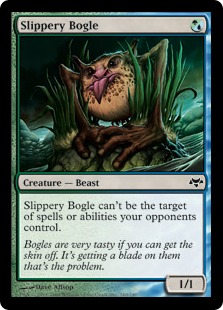
Aura Hexproof is now a thing again, and Slippery Bogle is just as scary as it was back in the day when it was dominating. Daybreak Coronet is a very fine card once it makes its way to Bogle's body (or with Gladecover Scout), and it just goes berserk if Kor Spiritdancer survives every possible removal that would come its way and become Voltron reincarnate. Thanks to this deck, Daybreak Coronet is back to $18.99, which is not so far from its all-time high of $21.63 back in 2015. This sudden surge also helps in padding the value of Modern Masters 2015 boxes along with the rise of Karn Liberated and the gradual rise of Tarmogoyf. The only thing we're uncertain here is for how long could it sustain this price tag in the current metagame.

For reference, check out the Aura Hexproof list that Dmitriy Butakov steered to victory in the said event.

Aura Hexproof

Creatures

4 Gladecover Scout
4 Kor Spiritdancer
4 Slippery Bogle

Instants and Sorceries

2 Path to Exile

Other Spells

4 Daybreak Coronet
4 Ethereal Armor
2 Gryff's Boon
2 Hyena Umbra
4 Leyline of Sanctity
4 Rancor
4 Spider Umbra
2 Spirit Mantle

Lands

1 Dryad Arbor
1 Forest
4 Horizon Canopy
1 Misty Rainforest
1 Plains
4 Razorverge Thicket
3 Temple Garden
1 Verdant Catacombs
4 Windswept Heath

Sideboard

3 Gaddock Teeg
1 Grafdigger's Cage
2 Path to Exile
2 Rest in Peace
3 Seal of Primordium
1 Spirit Link
3 Stony Silence

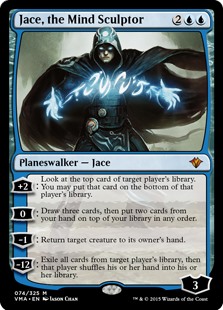
Upon checking the list above, some major gainers from the deck outside of Daybreak Coronet include Gaddock Teeg, Leyline of Sanctity, and Kor Spiritdancer. I think that the return of Jace, the Mind Sculptor and Bloodbraid Elf in Modern has caused some serious price uptick for a lot of cards, and this trend should continue every now and then once a new archetype emerges as a serious contender for format dominance. As things stand, the "solitaire" deck where Daybreak Coronet is a part of has been consistently making the top eight of certain events, both online and in paper, since people have been too keen on coming up with a deck that takes advantage of their new toys. This breakthrough could have had happened anytime in the past but is only occurring now because people are experimenting on what deck best fits their taste. Aura Hexproof should be just fine in this chaotic meta, but I don't want to pin my hopes on it for as long as Liliana of the Veil is everywhere.

Possible Short Term Gainers in Modern

There has been a lot of variance lately on what decks are winning big events, and these cards have made a number of appearance on most of them. I'm quite sure that some of them are already progressing upwards financially, but I won't be featuring any of them soon in the Stock Watch. We'll try to focus more on surprising developments from role players where we have more room for profit, or if we could get rid of some stocks while they are hot. Shoot me if I'm wrong, but I think that Daybreak Coronet is just a "heat of the moment" thing. I'd say that its time in the limelight won't be as long as some would deem it could be.

At the moment, online stores such as StarCityGames, Card Kingdom, and a majority of vendors via TCGPlayer are all out of stock of Daybreak Coronet. One more major win for the deck and we could expect this card to reach $20 territory in the coming weeks. They were handsomely priced at $7.99 before via Card Kingdom, so there must be a way to access them for that price range from players who aren't really into the hype. It would be best to sell off your spares once it reaches $20-$25 (for both the Masters copies and the ones from Future Sight) as it might plummet again soon once the Modern axis tilts somewhere else.

And that’s it for the Wednesday edition of the Daily Stock Watch! See you again tomorrow, as I preview new cards that should be on the go, or good enough for speculation purposes. As always, feel free to share your opinion in the comments section below. And if you want to keep up with all the market movement, be sure to check in with the QS Discord Channel for real time market information, and stay ahead of the hottest specs!

ION Retail and TCGplayer Pro: Fully Integrated

Are you a Quiet Speculation member?

If not, now is a perfect time to join up! Our powerful tools, breaking-news analysis, and exclusive Discord channel will make sure you stay up to date and ahead of the curve.

Quiet Speculation is thrilled to announce that ION Retail will now fully integrate with TCGplayer Pro. This means that retail stores will be able to fully sync their inventories and use several features from either platform interchangeably. Check out the full details and let us know what you think!

Beating the Heat: Anti-Jace/Bloodbraid Tech

Are you a Quiet Speculation member?

If not, now is a perfect time to join up! Our powerful tools, breaking-news analysis, and exclusive Discord channel will make sure you stay up to date and ahead of the curve.

As the first tournament results since last month's landmark unbans roll in, it has become abundantly clear that Bloodbraid Elf and Jace, the Mind Sculptor are going to be major players in the metagame going forward. Competitive players need a plan to face these cards. Fortunately, Modern's card pool has plenty of options for exactly this purpose, most of which are also good cards against the current field.

In this article, we will explore some such tech cards, what existing archetypes they fit into, and examples of how to successfully incorporate them.

Choking Hazard

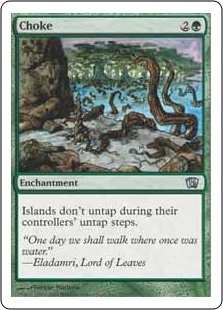
We'll kick things off with a classic piece of sideboard hate that not only stymies Jace, the Mind Sculptor, but blue decks in general: the dreaded Choke. Thanks in part to the powerful planeswalker, blue decks are now common enough that this card is worthy of consideration, and Choke is an undeniable haymaker against those decks. Its easy mana requirements also make it splashable for most decks incorporating green into their manabase (provided they don't also have blue, of course!).

One natural home is Jund, where Choke is usually the checkmate move in the BGx midrange vs. UWx control match. Here's a list that recently did well with it in a Modern Challenge:

Jund, by Greenman11 (5-2, Modern Challenge #11227646)

Creatures

4 Bloodbraid Elf
4 Dark Confidant
3 Scavenging Ooze
4 Tarmogoyf

Instants

1 Abrupt Decay
2 Kolaghan's Command
4 Lightning Bolt

Sorceries

1 Dreadbore
4 Inquisition of Kozilek
2 Maelstrom Pulse
1 Thoughtseize

Planeswalkers

4 Liliana of the Veil
1 Liliana, the Last Hope

Lands

4 Blackcleave Cliffs
1 Blood Crypt
2 Bloodstained Mire
1 Forest
1 Mountain
2 Overgrown Tomb
3 Raging Ravine
1 Stomping Ground
2 Swamp
2 Treetop Village
1 Twilight Mire
4 Verdant Catacombs
1 Wooded Foothills

Sideboard

2 Ancient Grudge
1 Choke
2 Collective Brutality
1 Fatal Push
3 Fulminator Mage
1 Grafdigger's Cage
1 Huntmaster of the Fells
1 Kitchen Finks
1 Kolaghan's Command
1 Liliana, the Last Hope
1 Thoughtseize

Other decks that could potentially consider this card are RG Ponza (where it can help overcome the deck's weakness to cheap countermagic), Naya Zoo (which is usually in the market for a bit of help interacting with blue decks that are light on creatures), and perhaps even Elves as way to deter control players from playing expensive sweeper effects.

Read the Omens

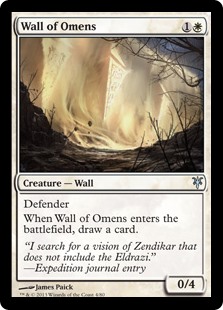
Next up is a seemingly innocuous but highly effective option for decks in white to fend off Bloodbraid Elf-fueled aggression: Wall of Omens. It blocks the Elf cleanly, maintains card parity by drawing an extra card, and only costs two mana to put down.

This cheap cost is especially relevant, as many decks that have opted for the Elf (such as the Ponza deck that took down the latest SCG Open) are pairing the cascade creature with a variety of mana acceleration tools, such as Arbor Elf and Utopia Sprawl. This means that Elf can hit the battlefield as soon as turn three, which represents a lot of pressure in a hurry. However, Wall is cheap enough to come down and hold the ground even when the opponent is on the play, making it very easy to use the Wall for its stated purpose. Even when drawn later in the game, the attached cantrip ensures that it's never truly a dead card.

When looking for decks that can easily incorporate this card, the obvious answer is UW Control. It's a deck that has the long game in mind (so Wall's defensive bent fits in the gameplan), has need of early blockers for aggressive decks (Path to Exile isn't always enough), and has powerful incentives to keep the card train churning in its planeswalker win conditions. Here's an example of a UW Control deck that incorporated Wall and scored a Top 8 in the Dallas SCG Open:

UW Control, by Gerrick Alford (6th Place, SCG Open Dallas)

Creatures

2 Snapcaster Mage
2 Wall of Omens

Enchantments

2 Detention Sphere
2 Search for Azcanta
4 Spreading Seas

Instants

3 Cryptic Command
1 Logic Knot
2 Mana Leak
1 Negate
4 Path to Exile
1 Settle the Wreckage
1 Sphinx's Revelation

Sorceries

4 Serum Visions
2 Supreme Verdict

Planeswalkers

1 Gideon Jura
1 Gideon of the Trials
2 Jace, the Mind Sculptor

Lands

4 Celestial Colonnade
4 Field of Ruin
4 Flooded Strand
2 Hallowed Fountain
1 Ghost Quarter
5 Island
1 Mystic Gate
3 Plains
1 Polluted Delta

Sideboard

1 Blessed Alliance
1 Celestial Purge
1 Crucible of Worlds
1 Disdainful Stroke
1 Dispel
1 Elspeth, Sun's Champion
2 Negate
2 Rest in Peace
1 Runed Halo
1 Settle the Wreckage
1 Timely Reinforcements
2 Vendilion Clique

While I feel Wall is a welcome inclusion in this deck, finding other homes for it has proven a bit trickier. It could potentially be slotted into a Death and Taxes shell in order to prevent them from being overrun (as the deck is somewhat soft to being rushed by creatures beefier than theirs) and provide a way to generate value with blink effects like Eldrazi Displacer, Flickerwisp, and Restoration Angel. But its inability to provide offense could prove problematic in matchups where Taxes is the aggressor. There could also be room for this card in a value-oriented creature toolbox deck, where the defensive body could come in handy early, then become Eldritch Evolution fodder in the midgame.

Feeling of Dread

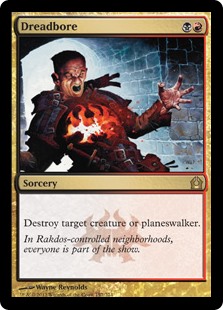
Next, we'll talk about what I feel is an underrated piece of anti-Jace tech in Dreadbore. While sorcery-speed removal is not very popular in Modern, certain cards that perform functions you cannot find elsewhere (like Maelstrom Pulse for BGx) will see the light of day. I believe Dreadbore's high degree of versatility is enough of an incentive to merit serious consideration.

It also has the benefit of being in very removal-dense colors in red and black. This means the few gaps in its coverage (most notably manlands such as Celestial Colonnade) can likely be addressed by some combination of Fatal Push, Lightning Bolt, Kolaghan's Command, or even its most direct competitor in Terminate.

Here's a Mardu Pyromancer list that employed it to good effect in an MTGO Competitive League:

Mardu Pyromancer, by normajean (5-0, MTGO Competitive League)

Creatures

4 Bedlam Reveler
4 Young Pyromancer

Enchantments

2 Blood Moon

Instants

2 Fatal Push
3 Kolaghan's Command
4 Lightning Bolt
1 Terminate

Sorceries

2 Collective Brutality
2 Dreadbore
4 Faithless Looting
4 Inquisition of Kozilek
4 Lingering Souls
3 Thoughtseize

Planeswalkers

1 Chandra, Torch of Defiance

Lands

4 Blackcleave Cliffs
2 Blood Crypt
4 Bloodstained Mire
4 Marsh Flats
2 Mountain
2 Sacred Foundry
2 Swamp

Sideboard

1 Blood Moon
1 Collective Brutality
1 Engineered Explosives
1 Fatal Push
2 Kambal, Consul of Allocation
4 Leyline of the Void
3 Molten Rain
2 Wear // Tear

Other decks that could consider this technology are Jund (some lists have already incorporated it), Grixis Shadow, Grixis Control (to gain a leg up on the Jace deck mirror), and Traverse Shadow. My opinion is that it currently outshines the likes of Terminate, and that any deck with access to these colors should at least kick the tires on it.

Coming of the Tide

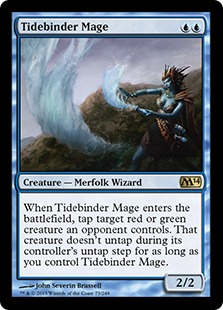
I'd like to cap things off by bringing it back to my favorite deck in Merfolk, and the adjustments I have made to account for the new metagame. I mentioned dabbling in a green splash before the unbans, but that plan is obsolete in the current climate: Master of Waves lines up too well against the likes of Bloodbraid Elf, Lightning Bolt, and the like to consider a Merfolk 75 without it.

The card I'd like to highlight in this article is one that was fairly commonplace in metagames past, but had faded from sight until now. Tidebinder Mage is a card that not only lines up well against the Bloodbraid Elf itself, but it is also handy against many of the other creatures found in decks featuring the Elf. It can lock down mana accelerants like Arbor Elf, Birds of Paradise, and Noble Hierarch to slow down your opponent's development, or it can lock down stand-alone threats like Scavenging Ooze and Tarmogoyf to give you the edge on the board.

I've incorporated Tidebinder in the following list, which has me on pace to qualify for the Modern Magic Online Championship Series Qualifier tournament on the 1st of April:

Merfolk, by Roland F. Rivera Santiago

Creatures

4 Cursecatcher
4 Harbinger of the Tides
2 Kopala, Warden of Waves
4 Lord of Atlantis
4 Master of the Pearl Trident
4 Master of Waves
4 Merrow Reejerey
4 Silvergill Adept

Enchantments

4 Spreading Seas

Artifacts

4 Aether Vial

Instants

2 Spell Pierce

Lands

2 Cavern of Souls
12 Island
1 Minamo, School at Water's Edge
4 Mutavault
1 Oboro, Palace in the Clouds

Sideboard

3 Ceremonious Rejection
4 Negate
4 Relic of Progenitus
4 Tidebinder Mage

I have extensively tested the configuration presented here, and I have been impressed by Tidebinder's ability to swing the tempo of the game in my direction. The rise of decks like Hollow One and Ponza have also made them applicable enough against the field to justify playing the full four copies. I think that any Merfolk pilot looking to navigate the current field should strongly consider this card.

Siding Out

As the metagame evolves, players refine their strategies and hone in on the best tech for the situation at hand. This suite of flex-spot cards is the first adjustment to the arrival of Jace and Bloodbraid, but it is likely far from the last. If you have any sweet anti-Jace or Bloodbraid tech you've been working on, drop me a line in the comments.

Some Cool News from ABU Games

Are you a Quiet Speculation member?

If not, now is a perfect time to join up! Our powerful tools, breaking-news analysis, and exclusive Discord channel will make sure you stay up to date and ahead of the curve.

Hey, everyone!

We're thrilled to let you know that ABU Games has launched its cool new website!

ABU Games has been partners with QS for years now, and we're very happy to see their vision for the new site come alive. The site has undergone a complete redesign, providing new functionality and even an updated store credit model for buylisting.

While we anticipate this being a great step up for Insiders, it is going to result in the price feed for ABU Games briefly being removed from Trader Tools. We need to work with the team at ABU Games to get the data transferring correctly again, but don't worry – we'll have everything back up and running as soon as possible. We trust the improved user experience will be worth the delay.

Thanks for your understanding, and congratulations to Team ABU!

–Tarkan


Insider: MTGO Market Report for March 14th, 2018

Are you a Quiet Speculation member?

If not, now is a perfect time to join up! Our powerful tools, breaking-news analysis, and exclusive Discord channel will make sure you stay up to date and ahead of the curve.

Welcome to the MTGO Market Report as compiled by Matthew Lewis. The report will cover a range of topics, including a summary of set prices and price changes for redeemable sets, a look at the major trends in various Constructed formats and a "Trade of the Week" section that highlights a particular speculative strategy with an example and accompanying explanation.

As always, speculators should take into account their own budgets, risk tolerances and current portfolios before buying or selling any digital objects. Please send questions via private message or post below in the article comments.

Redemption

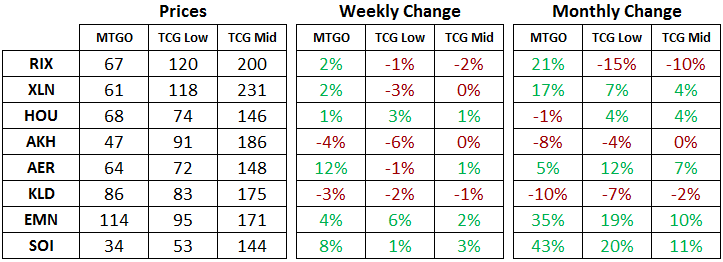
Below are the total set prices for all redeemable sets on MTGO. All prices are current as of March 12, 2018. The TCGplayer low and TCGplayer mid prices are the sum of each set's individual card prices on TCGplayer, either the low price or the mid price respectively.

All MTGO set prices this week are taken from GoatBot's website, and all weekly changes are now calculated relative to GoatBot's "full set" prices from the previous week. All monthly changes are also relative to the previous month's prices, taken from GoatBot's website at that time. Occasionally, full set prices are not available, and so estimated set prices are used instead. Although Hour of Devastation (HOU), Amonkhet (AKH), Aether Revolt (AER), and Kaladesh (KLD) are no longer available for redemption, their prices will continue to be tracked while they are in Standard.

Standard

With the spoilers from Dominaria (DOM) acknowledged by Wizards of the Coast, we know the Innistrad (ISD) check lands are being reprinted. I discussed this possibility in the the MTGO Market Report on February 21, and so the question is what to do next?

Standard players looking to prepare for the addition of DOM into the format will be a source of steady demand for these lands over the coming weeks. Once DOM is actually released, the ISD check lands will become legal in Standard, but at the same time the available supply will be almost entirely existing copies from ISD, since it takes time for new supply to enter the market from Draft and Sealed Deck events. This is the window that will be the best time to be a seller, when players get online and are brewing for Standard, but before drafters flood the market with supply.

There was an error retrieving a chart for Isolated Chapel

If preview leagues are repeated for DOM in the days before the paper prerelease events, then the selling window will be April 18 to April 22. Remember that preview leagues were introduced for the first time with Rivals of Ixalan (RIX) and they closed just prior to paper prerelease events. That generated massive price increases on the Saturday and Sunday for RIX cards on MTGO. If preview leagues are implemented in the same way for DOM, then April 21 and April 22 will be the best time to be a seller of the ISD check lands.

Outside of the actual lands themselves, these reprints will have a big impact on Standard. It's a bit simplistic, but the rule is that Standard will be populated by decks that use the most powerful cards with the best mana base. When a cycle of lands are introduced that are past Standard staples, then its safe to say that the best mana base and what it means for viable decks will be in flux. Difficult to cast cards like Legion Lieutenant and Merfolk Mistbinder will get a second look now, so be ready for the implications of the ISD check lands on the decks that are viable in Standard.

Also on the tribal front, the return of Llanowar Elves to Standard instantly makes green-based lines of play more powerful. Leading with Llanowar Elves into Jadelight Ranger or Rishkar, Peema Renegade on turn two is just scratching the surface. All green cards have to be reevaluated on their power level as if they cost one less mana, but the three casting cost slot is a critical one to pay attention to. One- and two-cost removal will become more valuable as a way to deal with this potent one-drop.

Modern

Not to be outdone by the Elf tribe, DOM adds the powerful Goblin Warchief into the Modern card pool and the Goblin tribe is eternally grateful. Although Siege-Gang Commander was already Modern legal, it's too expensive to show up in Goblin tribal decks. With Goblin Warchief in tow, Siege-Gang Commander becomes more viable, and including Goblin Piledriver into the package looks even more appealing.

There was an error retrieving a chart for Goblin Warchief

The trouble with the deck is that it lacks the raw power of a linear deck like Affinity, it doesn't bring any disruption like Humans and it lacks the combo kill aspect of the Onslaught (ONS) era version that used Patriarch's Bidding and loads of utility type goblins like Skirk Prospector. I am skeptical that a Goblin tribal deck could ever be tier one, but Goblin Warchief will be an important part of any uptick in playability of the tribe.

Masters 25 (A25) events have been moved up to today, so it's time to start considering what price point to be an interested buyer on Modern staples. Jace, the Mind Sculptor is about 20 tix off its peak and now sits at 55 tix. A dip to the 40-tix level doesn't seem realistic, but I'd be aggressively buying at that price.

There was an error retrieving a chart for Jace, The Mind Sculptor

Although not Modern legal, Ash Barrens from A25 is high on my spec list for this set. It's a Pauper staple and was recently priced as high as 10 tix. Although it shows up in Treasure Chests on the curated card list, it's an in-demand card, and Pauper is a growing as paper players have become interested in it. Check out Kyle's article this week for other interesting speculative targets in the common and uncommon slot of A25.

Trade of the Week

For a complete look at my recent trades, please check out the portfolio. Nothing too fancy this week as I have been adding complete sets of RIX and XLN to the portfolio. This is a fine time to be a buyer as interest in the draft format wanes. This doesn't mean the bottom is in, but I feel that it's a safe price level to be speculating at. I'll be slowly building my stock of full sets with an eye to selling them after DOM is release but before they go offline for redemption.

I've also been selling Battle at the Bridge, a penny spec from last year that has recently jumped up in price. In percentage terms, this is one of my best specs of the past year, returning nearly thirty times my buy price. However, I did buy it alongside other flops like Dark Intimations, so it's not all gum drops and puppy dogs. Regardless, the penny spec strategy is a fun one where you only need one hit for it to pay off, and Battle at the Bridge has done just that.

There's lots of potential in XLN and RIX for another round of penny specs, and I think uncommons in RIX have an excellent shot on top of cheap rares in both sets. I've already mentioned the tribal lords from RIX, but Baffling End and Ravenous Chupacabra seem like staples in Standard that will see prices in the 0.1 to 0.5 tix range next winter.

I like to minimize risk in general, but I also like a long shot and the fun that comes from watching it payoff. If you are getting bored of speculating on MTGO, penny specs are a way to inject some fun into your portfolio without breaking the bank.


Insider: Speccing Around the Dominaria Planeswalkers

Are you a Quiet Speculation member?

If not, now is a perfect time to join up! Our powerful tools, breaking-news analysis, and exclusive Discord channel will make sure you stay up to date and ahead of the curve.

Hi, guys,

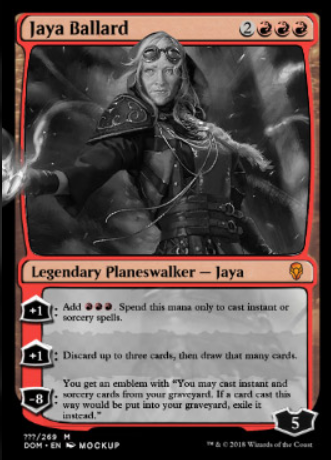
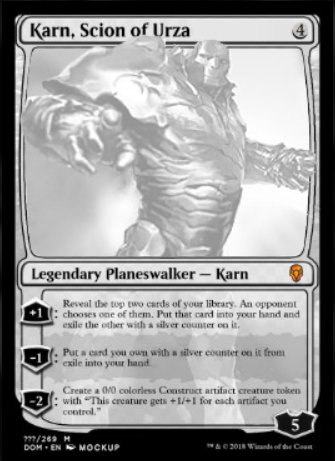
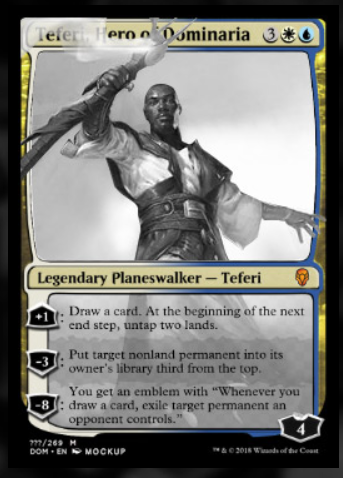
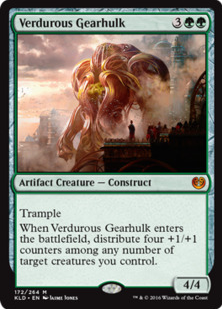
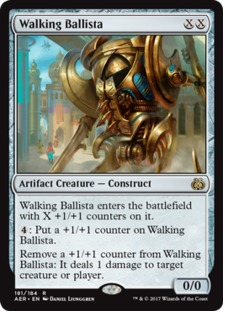
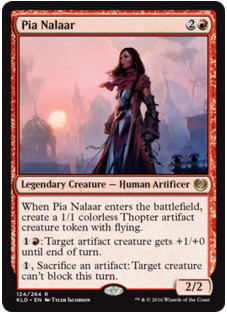
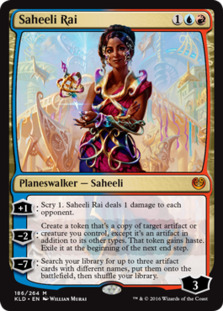
There was a huge leak of cards from Dominaria last week. Among them were three new planeswalker cards. (The following pictures are taken from Mythic Spoiler).

Let's start thinking of the synergies between these planeswalkers and existing Standard cards. Before that, a little bit of review from a macro perspective.

Jaya Ballard:

  • The cost of 2RRR makes it very hard to splash.
  • Has the ability to generate extra mana, but can only be used to cast instant and sorcery spells.
  • Unable to protect itself without the help of other spells/creatures.
  • Unable to win game on its own.

Karn, Scion of Urza:

  • Four generic mana means it can be played in any deck.
  • Able to gain card advantage with its first two abilities.
  • Third ability is only powerful if player controls lots of other artifacts.
  • Able to protect itself with its ultimate.

Teferi, Hero of Dominaria:

  • Provides cards advantage, and untaps lands for control decks.
  • Able to remove a resolved nonland permanent temporarily.
  • Ultimate probably wins the game or makes the opponent concede.
  • Not able to win game without another finisher.

Jaya Ballard

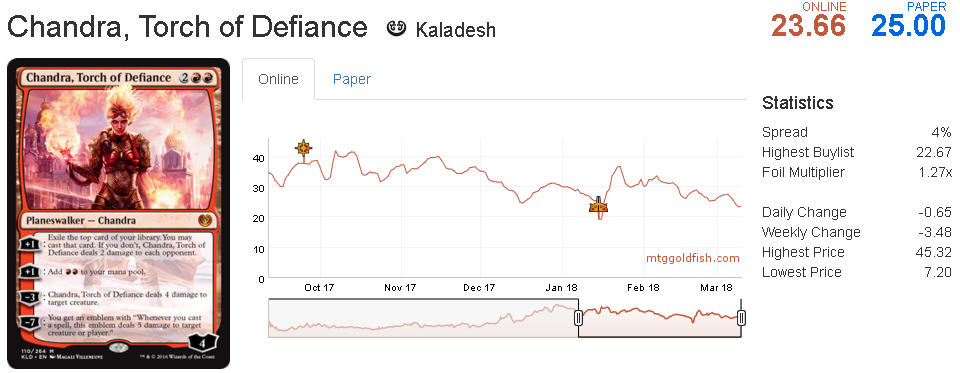
Alright, lets start with Jaya Ballard. In the current Standard format, it's quite hard to find a home for Jaya Ballard as a five-mana planeswalker. But if we combine Jaya with Chandra, Torch of Defiance, its not impossible to build a strong mono-red control/midrange deck. I was thinking of cards that are impactful enough that can be cast off Jaya's first ability.


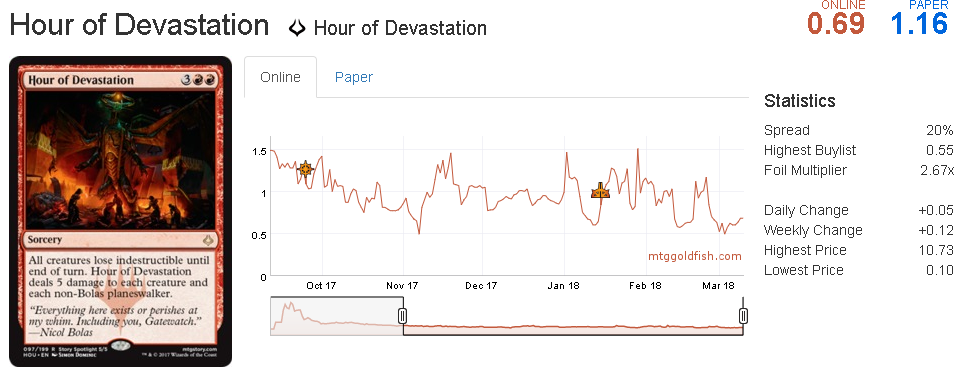
These cards cover almost every possible answer to the board in order to make Jaya survive the turn before we untap. Besides, if we are playing Jaya Ballard, Chandra, Torch of Defiance is probably one of the cards we will play before turn five. Thus, combining Chandra and Jaya's ability, we are able to cast bigger red spells like Hour of Devastation to deal with big creatures while leaving behind our planeswalker at one loyalty.

However, all these are just the best-case scenarios. For more understanding of how good the walker is, we will need to wait for the new cards to go legal.

From here, if you think Jaya Ballard is a good planeswalker, you might want to look at the following cards as investments:

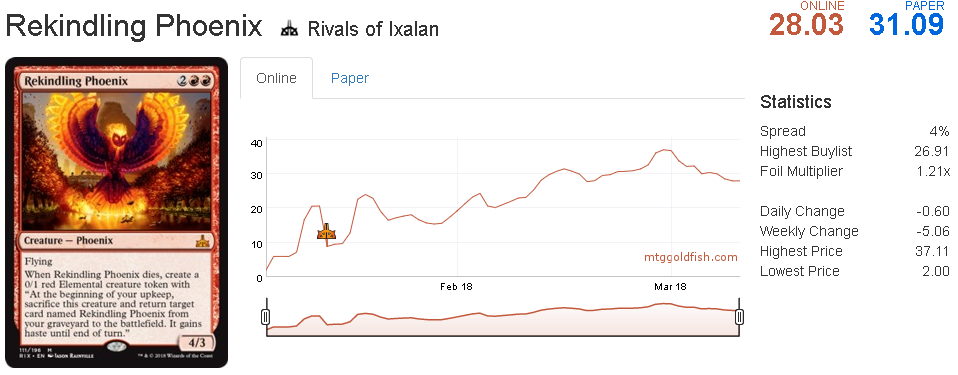
Both Chandra and Rekindling Phoenix are on downward trends. You can take note of these cards and grab playsets while they are low. As for Hour of Devastation, it gained popularity during the early days of Hour of Devastation Standard, together with Nicol Bolas. However it's now a forgotten card that I think is still very good in Standard against the creature decks available in the meta.

Karn, Scion of Urza

First, a few cards that come to mind when I look at Karn:

Karn is a great card to brew around. The existing decks that will probably include Karn in their 75 are GB Constrictor, Mardu Vehicles, and Grixis/UB Improvise. These decks play a good amount of artifacts to make Karn's token big enough, while Karn provides card advantage through its first two abilities.

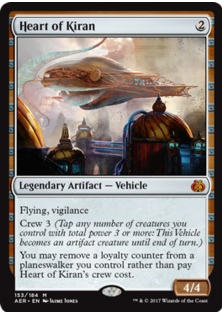
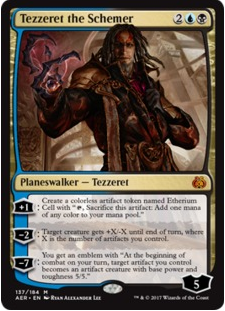
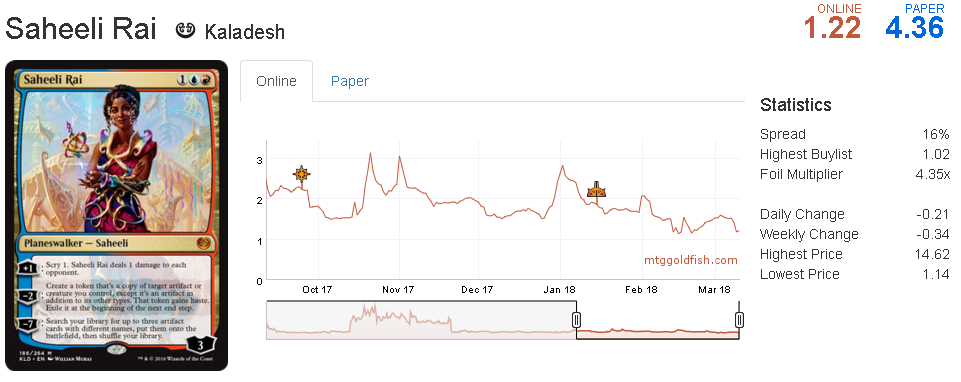
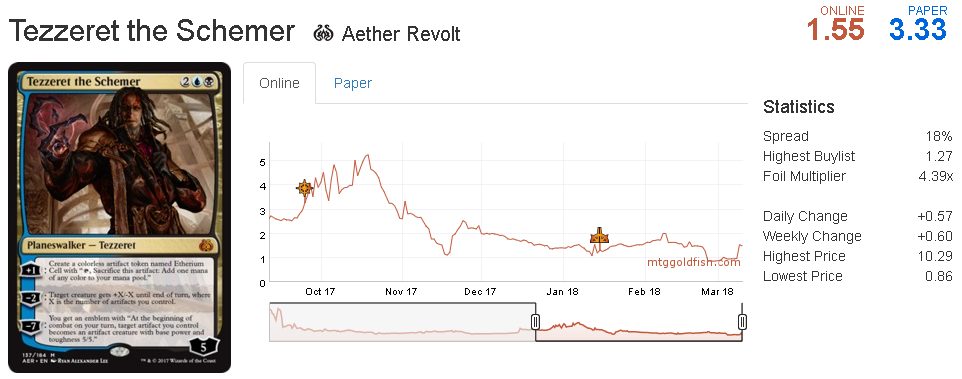
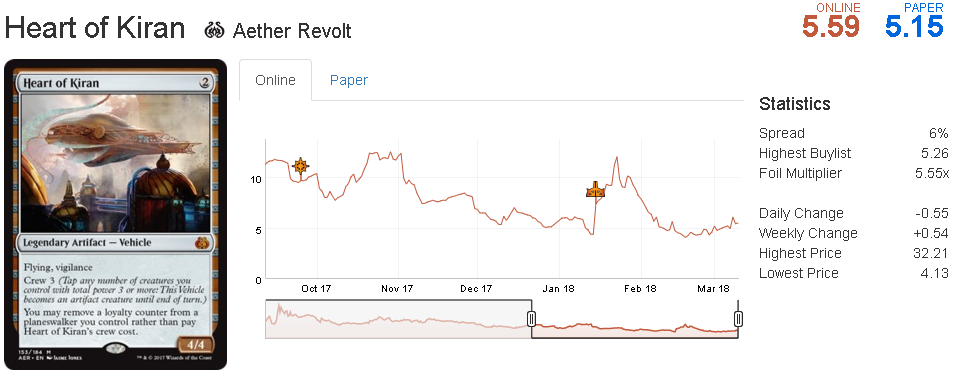
In a GB Constrictor shell, it may even be possible to remove the energy theme completely and go for more cards that can get +1/+1 counters, or include Heart of Kiran together with Karn. Karn can pair with either Saheeli Rai or Tezzeret the Schemer to create a good amount of advantage.

From here, I would suggest investing in some of these cards:

First of all, obviously the planeswalkers. Both of these cards are below 2 tickets and they are not played much in the current Standard. I think with the release of Dominaria Karn will be the real deal, and these two planeswalkers have a good chance of increasing in price with the appearance of new artifact-themed decks.

Next up, of course, is the best artifact that can protect planeswalkers. This card is heavily played in Mardu Vehicles but the price did not stay at its high point because Vehicles is not the best deck in the format right now. I think this card can still shine when Dominaria becomes Standard-legal. Thus I suggest buying playsets of Heart of Kiran for investment.

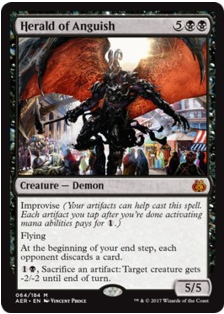
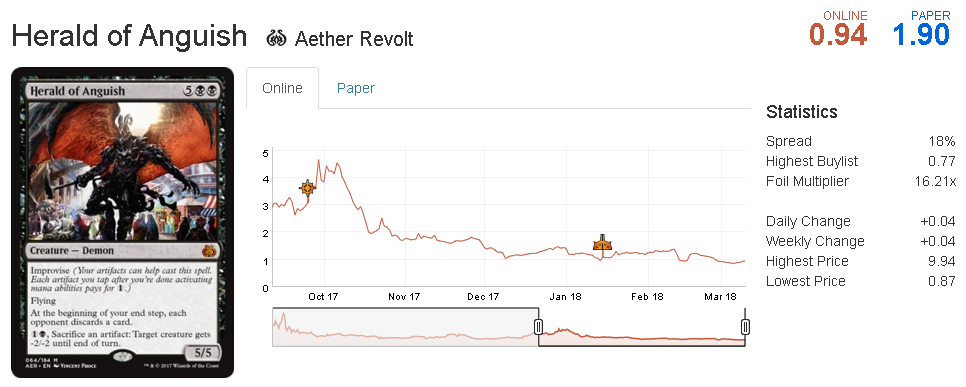
Herald of Anguish is probably one of the strongest cards if you are going to play an artifact-themed deck. This mythic can be very hard to deal with if it gets into play early in the game. Improvise is one of the most underplayed mechanics in Standard in my opinion, and I think Karn is going to change that in the upcoming Standard format. I suggest buying playsets of Herald just in case.

Teferi, Hero of Dominaria

Last but not least, Teferi, Hero of Dominaria. The fans of blue control are probably very excited about this card. The first ability is very strong as the control player can both resolve Teferi and hold up mana for something else. This card fights for a spot with The Scarab God at five mana, so it's likely to be a two-of card in Esper control variants.

If you like Teferi, you should have a look at the control components that are potentially good to play alongside it.

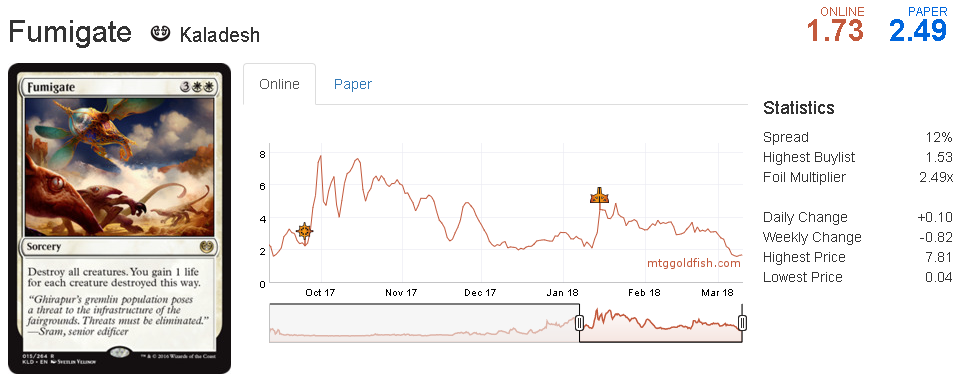
Fumigate is the best sweeper in the format. It's underplayed right now because blue-black seems to be a better control deck than blue-white because of its access to the best spot removal, Vraska's Contempt. But if Teferi is really good, no doubt Fumigate will come back—and its price will be at least 5 tickets when that happens. So I highly recommend picking up playsets of Fumigate at its current price below 2 tickets.

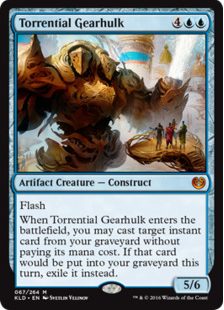
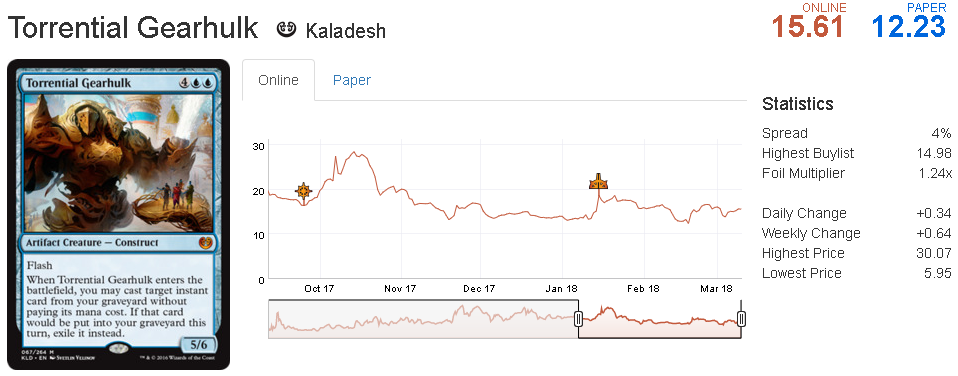
The blue Gearhulk can easily go up to 20 tickets when control decks are very popular. At its current price near 16 tickets, I suggest picking up few playsets for investment. This card seldom drops below 15 tickets based on past trends, so this pick is pretty safe.


Alright, guys, that’s all for this week. Thanks for reading and I’ll see you again next week.

Adrian, signing out.

Daily Stock Watch – Back to Basics

Are you a Quiet Speculation member?

If not, now is a perfect time to join up! Our powerful tools, breaking-news analysis, and exclusive Discord channel will make sure you stay up to date and ahead of the curve.

Hello, everyone and welcome to the Tuesday edition of Daily Stock Watch! It's time for some crazy card spike update, and that is pretty much what our segment for today is about. I'll be talking about a card that's heavily used in Legacy but isn't exactly a part of the fabled Reserved List. This blue spell just skyrocketed to its all-time high of $90 today and this might be its benchmark price for the coming years, barring any sudden reprints.

There was an error retrieving a chart for Back to Basics

Back to Basics is the more irritating version of Blood Moon because it just renders non-basic lands useless once it hits play. Blood Moon has the decency to allow you to use your lands as red mana producers but Back to Basics just shuts down everything that's non-basic until you could do something about it. It has been a staple in recent builds of Miracles, and Jim Davis just made it a very solid addition to an already potent list that he steered to third place at the recently concluded SCG Legacy Open Worcester. With the help of Monastery Mentor's tokens, a well-timed Back to Basics is basically the finishing touch in a matchup where your opponents are relying on their duals, colorless mana producers, and the rest of the crazy lands that are available in the format.

Check out how a pair of Back to Basics did the trick in that Miracles deck.

Miracles

Creatures

2 Monastery Mentor
3 Snapcaster Mage

Instants and Sorceries

4 Brainstorm
1 Council's Judgment
2 Counterspell
1 Flusterstorm
4 Force of Will
1 Path to Exile
4 Ponder
3 Portent
2 Predict
4 Swords to Plowshares
3 Terminus

Other Spells

2 Back to Basics
3 Jace, the Mind Sculptor
1 Search for Azcanta

Lands

4 Flooded Strand
6 Island
3 Misty Rainforest
3 Plains
1 Scalding Tarn
1 Tundra
2 Windswept Heath

Sideboard

2 Containment Priest
1 Council's Judgment
2 Disenchant
2 Flusterstorm
1 Karakas
1 Rest in Peace
1 Search for Azcanta
1 Supreme Verdict
2 Surgical Extraction
2 Vendilion Clique

This deck could just secure its way to victory by planting a well-protected Monastery Mentor at any point of the game, and then slamming a Back to Basics after creating a mini platoon of prowess-wielding monks. Blue is arguably the most powerful color in the format and the comparisons with the Blue Moon deck in Modern is inevitable in this one. They are basically trying to take advantage of enchantments that negate the utility of non-basic lands (Blood Moon and Back to Basics) and would try to win games via sheer card advantage and board position. It's hard to see future Miracle players not adapting to this list by sticking to Counterbalance and its strength alongside Sensei's Divining Top, but they might have just found the trick with Back to Basics.

This card is not restricted to one deck in Legacy, as it is also a staple in other good decks such as Aluren, Blade Control, and even in Merfolks. It's quite hard to find Urza's Saga cards nowadays, and it won't get any easier in the future. I hope you were able to get your hands on this card before this price spike occurred. There's no going back from this point on financially for this card, in my opinion.

The Scary Future

Back to Basics just joined this elite list of cards that are over $50 individually, but are very much in the hunt to be reprinted anytime soon. Imperial Recruiter will be returning in Masters 25, and I won't be surprised if the rest of the cards on this list will follow shortly. It would have been easier to buy cards of this price if they are in the Reserved List or has just been recently reprinted (which is the case for most of the Modern staples that are in this price range) because they will hold some value over time if you're in it for financial gains. It's quite tricky how we would assess this card going forward.

At the moment, online stores such as StarCityGames, ChannelFireball, TCGPlayer, and Card Kingdom are all out of stock of this card. They should be refilling soon at $90 and there will be demand for it, so try snaring some copies if they are still lower from other people who don't need it. This price could actually just work if Legacy is the thing for the people in your LGS.

And that’s it for the Tuesday edition of the Daily Stock Watch! See you again tomorrow, as I preview new cards that should be on the go, or good enough for speculation purposes. As always, feel free to share your opinion in the comments section below. And if you want to keep up with all the market movement, be sure to check in with the QS Discord Channel for real time market information, and stay ahead of the hottest specs!

First Strike: SCG Dallas Analysis

Are you a Quiet Speculation member?

If not, now is a perfect time to join up! Our powerful tools, breaking-news analysis, and exclusive Discord channel will make sure you stay up to date and ahead of the curve.

With SCG Dallas in the books, the process of deciphering the metagame can commence. True, there have been plenty of MTGO results to pore over, but selected lists don't form a random sample. It's curated with a goal in mind, and so not every deck has an equal chance of being included. In large tournaments, any deck can win, ensuring statistical randomness. The Worcester Classic was a decent start, and great for some, but a Classic doesn't provide the same value as an actual Open.

All that said, the results of Dallas don't inherently indicate the actual metagame. Rather, they provide the first major data point. The next few weeks promise a slew of high-level Modern events, and it will be the similarities and differences between those that actually define the metagame.

Today's article focuses on the rough metagame picture we can gather now. The coming weeks of tournaments will display how everyone reacts to this information. Once this process repeats itself a few times, the actual metagame will come into focus.

The Day 2 Metagame

GR Ponza won SCG Dallas. I am shocked. Andrew Wolbers must really know his deck, because I'd never expect Ponza to beat Storm. Yes, there's Trinisphere in his sideboard, but with only two Lightning Bolts, you'd think the Storm player would have an insurmountable advantage. Storm only needs two lands to go off, is also a Blood Moon deck, and usually destroys ramp strategies. Just goes to show that matchup percentage isn't everything and any deck can win any tournament (within reason, Mono-Green Stompy players).
Ponza's win doesn't necessarily mean anything analytically. To wrap our heads around the metagame, we need to look at the larger picture. It starts with the broadest picture available, which is the Day 2 Metagame. Take a look at it here.

My first thought is surprise at Storm's prevalence. We haven't heard much out of this deck lately, and its metagame share has been steadily decreasing. To see it come back in force is interesting. Part of it is certainly that one of the pilots is Caleb Scherer, and he's exclusively played Storm for years as far as I know, but that doesn't explain the rest of them. I know from experience that Storm is quite vulnerable to disruption, and with interactive decks supposedly on the rise post-unbannings, it's not a deck I expected to see to this degree.

Indeed, Jund and Burn are the next most-represented decks, both of which are favored against Storm—Jund has plentiful disruption and a clock, while Burn has Lightning Bolt and Eidolon of the Great Revel. Not to mention Jeskai Control, another heavily interactive deck, ties for third. There must be more to the Storm resurgence.

The Top 32

Let's move to the next level of data. Star City released the Top 32 lists instead of the usual 16, presumably because it's a "new" format, and the results are surprising, as they don't fall totally in line with metagame trends.

DeckTotal #
Gifts Storm5
Eldrazi Tron3
Counters Company3
GR Ponza2
Jund2
Jeskai Control2
Infect1
BR Hollow One1
Bogles1
Colorless Eldrazi1
UB Faeries1
UW Control1
GB Tron1
Four-Color Pyromancer1
Sultai Tezzeret1
Tribal Zoo1
Burn1
Blue Moon1
Humans1
GB Company1
UG Eldrazi1

Notably, the only UW Control deck to Day 2 also made Top 8. What is especially interesting to me is that the list is slower than mine, and my own deck's slowness proved problematic in testing. Perhaps I should just embrace the mighty glacier just like Gerrick Alford clearly has. I did wonder if my problems were unique, and this result suggests that it really is just my own problem.
The big winner is Storm, again. Five of its seven Day 2 decks made Top 32, with two copies in the Top 8—an impressive conversion rate. Storm's success makes it all the more incredible that Ponza was able to win the trophy. This is in sharp comparison to both Burn and Jund, who saw significant drop-offs. Also, Eldrazi Tron did very well, converting three of four decks and one Top 8. Here is another deck that seems to wax and wane in popularity. It's never awful, but it also never gets any press or real results for months and then reappears.

This Top 32 has a very wide spread of decks, which would indicate that diversity remains high. Storm is far ahead of everyone else, but after that it's relatively close. Were I to combine similar decks like the Tron variants, it would be a much shorter list. This gives me hope that the unbannings have been positive.

The Classic Results

Along with the main event, we have a Classic to investigate. It does not have the population of the Open, and so is of lesser value. Look at this as a spread of what is possible and potentially what wasn't quite enough for the Open's metagame.

DeckTotal #
Humans3
Jund2
Burn1
Gifts Storm1
UR Prison1
Mono-Green Tron1
Dredge1
Jeskai Control1
Titan Shift1
Esper Taxes1
Infect1
BR Hollow One1
Grixis Death's Shadow1

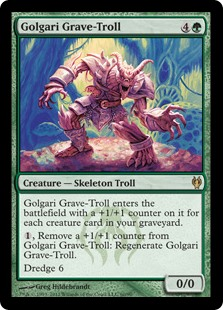
Once again, a dark horse took the race. Dredge won the Classic, and I would never have expceted that considering how little presence the deck has had since Golgari Grave-Troll was rebanned. Unlike with the Ponza vs. Storm upset, the fact that Dredge beat Jund in the final is not surprising. That said, it apparently had to get through a lot of ramp and combo decks—bad matchups—to make it that far.

Meaning

The fact that Ponza and Dredge won is very interesting, not only because they're already off-the-radar decks, but also because they fit into a recent pattern. This pattern has me wondering about the actual health of Modern.

The Linearity Cycle

Last week, Bogles won the MTGO Championship and everyone went rather hyperbolic. Before that, BR Hollow One did well at the Pro Tour, and suddenly everyone's lining up to play blackjack. Dredge gets press every time it reappears. I wouldn't be surprised if by the time this article is published, plenty of writers will have already begun singing the praises of GR Ponza and Storm (the former for winning the tournament, and the latter for its excellent conversion rate).

This pattern seems to repeat itself for whatever uninteractive deck outperforms expectations on a given next week. It is a bit cynical, though not wholly inaccurate, to chalk this up to jumping at the shiny thing. Talking about the thing that everybody is talking about is great for site traffic. However, if you look beyond the writers themselves, there is something going on. These weird and largely uninteractive decks pop up, then fade. This is no accident.
I have previously written about the Dredge Cycle, where Dredge would lie low and wait for everyone to forget to bring graveyard hate before winning everything one week before disappearing again. I've realized that this does not just apply to Dredge, but to a whole swath of decks. These decks are weak, either in a vacuum or to certain hate, but when nobody is looking, they will absolutely crush a tournament. Dredge is the poster child, but this also applies to Bogles, Lantern Control, Storm, etc. They're all linear decks that are absolutely killer when they're unexpected, but that fall apart with a target over their heads. I believe this is what we are looking at right now in Modern. Weird and unusual linear decks are winning and then fading while sideboards shift to answer them. The hate goes in, and a new and unaffected deck wins. I'm going to start calling this the Linearity Cycle until I come up with a better name.

Implications

Players are always looking to break the format. We're mostly spikes; we want to win. The best way to do that is play something powerful and left-field that nobody knows how to play against. Ergo, regardless of what deck is the actual best, players will be showing up trying to beat that deck. And it will work enough of the time to be worthwhile. Therefore, we should expect some distortion of our data sets while fringe decks have space to roam.

The metagame is still fluctuating and appears to be very open. However, I don't believe that it will stay that way. The success of the aforementioned decks suggests to be me that Modern is starting to narrow. In very wide metagames, targeted or fine-tuned decks tend to suffer from not hitting their targets. As a result, they disappear from view. When the metagame becomes more defined, they return. So to me, the recent success of these unique decks signals a loss of format diversity.
The common thread between these decks is that they crush midrange value decks. BR Hollow One explodes early with robust creatures. Bogles are hexproof. Ponza is functionally a ramp deck, though an odd one. Jordan's Eldrazi deck hits hard early and can't really be exhausted. All of these decks are designed to beat control and midrange decks, which were the decks that Jace, the Mind Sculptor and Bloodbraid Elf boosted.

If the metagame was slowing down, then we'd expect these predatory decks to resurface and thrive. Considering that Bogles is now maindecking Leyline of Sanctity, which was previously just an anti-Jund card, it certainly looks like everyone expects midrange to dominate. Storm has been quiet for a while, yet showed up in force in Worcester. Also, go back to Jordan's tournament report. He primarily ran into slower decks; I counted just pure aggro decks in Humans, Affinity, and Burn. Consider, finally, that six Jund decks made Day 2 of the Open, but only two made Top 32.

Is diversity decreasing, or are Jund and UWx Control actually pushing out other decks? I don't know, and even if I thought I knew, it is far too early to be certain. What I do know is that it will be harder to be certain than expected. If midrange decks actually are the best decks and are actually pushing out other decks, we may miss it, because the anti-midrange decks are doing the actual winning. This would create what I consider a false diversity, reminiscent of Standard Affinity at its height. I don't consider a deck, or strategy, and a bunch of decks that just prey on it a "healthy" metagame. As the metagame develops, we may not know if things are truly fine, or if we're blind to a major problem.

Looking Ahead
As more data comes in, the metagame will take a more concrete shape. Truth cannot hide forever. Whether we will have an accurate reading is an open question. I want to believe that we will, and that the data will reveal a perfectly healthy metagame. So far, it looks like unbanning Jace and Bloodbraid Elf was harmless. However, I'm concerned that there is a problem brewing that we just can't see yet. The first thing to observe is whether this trend of offbeat linear decks winning events continues through GP Phoenix this weekend. I'll be watching.


Daily Stock Watch – Legion Loyalist

Are you a Quiet Speculation member?

If not, now is a perfect time to join up! Our powerful tools, breaking-news analysis, and exclusive Discord channel will make sure you stay up to date and ahead of the curve.

Hello, everyone and welcome to a new week of the Daily Stock Watch! Masters 25 is coming out in a few days, but people have been busy checking out the cards from Dominaria. The very early spoiler has allowed people to somehow fiddle with their imagination and brew their new lists for every format out there. I'm thinking of covering some of the cards that I think should be good buys when the set comes, but I'll stray away from that for the time being and focus on the hot cards nowadays. My pick for today is a card that has slowly made its way to uncharted territory as a pricy rare in an ultra aggressive deck that could challenge the best that the Modern meta has to offer.

There was an error retrieving a chart for Legion Loyalist

Budget and new players have had this liking for 8 Whack because of its solid foundation as an aggro deck, and its ability to pull off quick and painful wins against legitimate tier one decks in Modern. With a plethora of creatures (30 plus of them at the very least in this kind of list) and some heavy artillery spells that could throw people off in a few hits, Legion Loyalist functions well as the pseudo-Overrun effect for Goblin Piledriver and Foundry Street Denizen to get through. Besides granting them trample, the extra leverage that having first strike and the evasion from creature tokens (hello, Lingering Souls) is exactly what these little goblins wanted in the first place to go over the top in creature-based matchups. And it's almost always certain that the Loyalist won't push through as a meager 1/1 crit without the backing of a Goblin Bushwacker, Reckless Bushwacker or Goblin Chieftain at the very least. I think that this deck is something that's worth considering if you're really looking to blitz your opponent to the ground.

In case you're wondering about the deck that I'm talking about, take a look at this 8 Whack list that has taken down tons of unsuspecting players in MTGO.

8 Whack

Creatures

4 Foundry Street Denizen
4 Goblin Bushwhacker
4 Goblin Guide
4 Legion Loyalist
3 Mogg Fanatic
3 Goblin Piledriver
4 Mogg War Marshal
2 Goblin Chieftain
4 Reckless Bushwhacker
1 Goblin Heelcutter

Instants and Sorceries

4 Goblin Grenade
4 Lightning Bolt

Lands

19 Mountain

Sideboard

1 Tormod's Crypt
1 Grafdigger's Cage
2 Relic of Progenitus
2 Shattering Spree
2 Dragon's Claw
1 Reality Hemorrhage
2 Skullcrack
2 Smash to Smithereens
1 Blood Moon
1 Goblin Rabblemaster

I'd be honest with you that I was really mugged by a player using a list that's very much identical to this one. We might be looking at these pesky 1/1 goblins as mere fodder (pun intended) but they are functioning well as one group of pundits that would just run over the ground. At the forefront of this lethal assault is Legion Loyalist, as it allows your best creatures to get past any defenses with the trample effect that its batallion trigger brings to the table. Its new price tag of $14.99 just might be as real as its gets if we see some actual success for the deck in the big leagues.

The Goblin Goons

These are the only main creatures on this deck that's really going to cost you more than the usual for a casual deck, and it might actually be a good thing if you're on a budget but you'd like to play competitive Modern. Legion Loyalist is slowly climbing in price as stocks online are starting to disappear one by one, and now might be the best time to pick them up before it reaches Goblin Guide territory. With the recent leak, we're all aware that it won't be making an appearance there, and its batallion mechanic won't make it any easier for it to appear in a supplemental product anytime soon. There could still be room for growth for this card.
At the moment, StarCityGames is alreaydy out of stock for normal copies of the card at $7.99. They should be up and about soon with more copies at the $15 range just like how TCGPlayer and ChannelFireball are already selling their copies for now. Before I started writing this article, I was still able to see a few copies of it via CardKingdom at $7.99 each, but it has since disappeared much to my dismay as I'm about to post this. The foils are nowhere to be seen as well, so it would be best to try and get copies from those who aren't updated with the price spike yet. Offering them good trades or deals by valuing Legion Loyalist at around $8 would be a good start.

And that’s it for the Monday edition of the Daily Stock Watch! See you again tomorrow, as I preview new cards that should be on the go, or good enough for speculation purposes. As always, feel free to share your opinion in the comments section below. And if you want to keep up with all the market movement, be sure to check in with the QS Discord Channel for real time market information, and stay ahead of the hottest specs!

Insider: How an Old Article Has Aged After Six Years

Are you a Quiet Speculation member?

If not, now is a perfect time to join up! Our powerful tools, breaking-news analysis, and exclusive Discord channel will make sure you stay up to date and ahead of the curve.

Let’s travel back in time for a moment. Back to an article I wrote nearly six years ago. It was on May 22, 2012 when I talked about a recent auction for Edvard Munch’s The Scream that had sold for over $119 million. The result inspired me to consider the rarest, most special Magic cards as art rather than as a game piece. Specifically, I talked about the investment merits of Near Mint Alpha rares.

Think about it. These cards were printed with known quantities in extremely low numbers. In the Old School Discord, some had referred to themselves as 1100ers because they had acquired one of only 1100 of any Alpha rare. Then when you filter out all the played stuff and focus on the Near Mint copies, you truly boil things down to a precious few.

This week I’m going to revisit this article for two reasons. First, I want to examine how well the topic has aged over time—these results may be surprising. Second, I want to take the topic of collectible Alpha one step further. I have noticed some very compelling trends lately and I think it’s worth highlighting so that our QS Insiders are fully aware of what is taking place in a very niche market.

Six Years’ Returns

In the 2012 article I talked about the minimal buylist for any NM Alpha rare (at the time, Star City Games was willing to pay at least $60 on even the worst rares). Right around when I wrote the article I had made two purchases myself: a Near Mint Two-Headed Giant of Foriys and a PSA 8 Earthquake. Now I’ll admit I flipped these both pretty quickly for an easy profit. But was that the right choice?

There was an error retrieving a chart for Earthquake

Nope! It turns out Earthquake has utility in Commander and Old School, and now Near Mint Alpha copies can buylist to Card Kingdom for $210! Oops. That’s one card I should have held!

How about the giant? That one didn’t age as well. The top buylist is currently $108 (MTG Seattle), not nearly as exciting as Earthquake. Still, this represents nearly a double-up from six years ago and this is not a return I would snub.

But here’s the thing: there are very few copies for sale on the open market right now. TCGplayer market price is $144.99, meaning copies have sold in that range. And there are zero Near Mint copies for sale right now. If I still had that card, I could pick a nice high price and sell to a collector. I’m thinking a Near Mint copy could easily sell at $200 with minimal effort.

In other words, just because buylists haven’t all caught up, finding gradable copies of Alpha rares has grown even more difficult over the past six years. For the record the lowest buy price on a Near Mint Alpha rare is now $79 (Living Artifact).

There was an error retrieving a chart for Living Artifact

So with a few terrible exceptions, Alpha rares in nice condition have performed quite well and I think they will continue to do so over the next six years.

Downshifting Doesn’t Mean Less Profits

Investing in nice Alpha rares ended up being a solid investment these past few years. Old School MTG likely catalyzed some growth, and the collector market has heated up lately. Now I’m seeing an even more exciting trend: Near Mint and graded Alpha commons and uncommons.
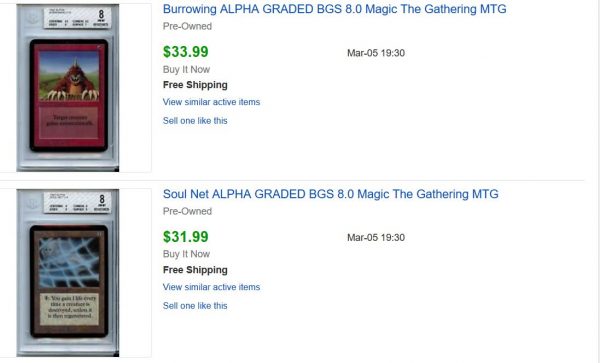
Before you scoff, you really need to see some of these completed eBay listings.

These are just a fraction of recently completed listings on eBay from the past couple months! Some of these cards don’t even have very good grades! A BGS 7.5 Holy Strength selling for $46, are you kidding me?! And check out that premium demanded by a BGS 9.5 Alpha card! Firebreathing isn’t exactly Old School-playable, yet one sold for over $130 shipped not long ago.

This hype is all happening right now, as we speak. Graded Alpha commons and uncommons are selling fast, and even ungraded Near Mint cards are demanding large premiums.

Let’s face it: while the rares are obviously the cards with the fewest numbers, Alpha commons and uncommons are still extremely sparse. According to Crystal Keep, only 4,500 of each Alpha uncommon and 16,000 of each Alpha common were printed. Now add in the fact that these cards were played without sleeves back in the day and you can begin to internalize just how rare Near Mint copies truly are. And with the recent run on Old School cards, it’s no surprise that these too are being targeted.

The Strategy

With cards of this rarity, it’s impossible to prescribe a single strategy for buying and selling. Like rare artwork, selling highly graded Alpha commons requires the right audience.

Finding underpriced copies can be difficult, but not impossible. Especially if you are willing to buy Near Mint cards and submit for grading yourself. A $15 purchase may yield a $60 sale if the grade comes in favorably. Unfortunately I can offer little in terms of where to make such purchases. Scrounge the market, watch TCGplayer and eBay closely for Near Mint listings, and see what you can dig up.

If you can find some nice Alpha commons on the market, there are definitely buyers out there. Even that BGS 9.5 Alpha Firebreathing can fetch a huge price tag, but you need to find the collectors. When I talked about Alpha rares six years ago I mentioned using buylists as your price floor—buylists were aggressive then and they remain aggressive now, making any Near Mint Alpha rare worth triple digits with few exceptions.

This same approach doesn’t hold water for the commons and uncommons because many have pitiably low buy prices. The lowest buy price award currently goes to Gray Ogre, which gets you a whopping $3.65 from ABU Games.

There was an error retrieving a chart for Gray Ogre

But that’s a bogus number. You know that. I know that. Just last week a PSA 9 copy sold on eBay for $63 shipped! And that was an auction with four bidders! That means there are at least two people willing to pay $60+ for a nice copy of the “cheapest” Alpha card out there (according to vendors).

(Click to expand.)

At this point, you need to use eBay, TCGplayer, or some other platform to make profits on these cards. This means they carry a little more risk since you don’t have the security of a store’s buylist backing you up.

Despite the lower buy prices, I still think this is a worthwhile endeavor. In fact, I’ve recently submitted an order for some graded Alpha cards ranging from BGS 5.5 (it was $7 so I figured why not?) to BGS 9.0 (with subs 9/9/9.5/9.5). If you’re hesitant to pull the trigger on this trend, you can wait to see how I do flipping these cards. If I can generate profits by tapping this collectors’ market, then it may be worth it for others to open up a modest position.

What Happened to the King of MP?

There’s a running joke in the Quiet Speculation Insider Discord that I’m the king of MP sales. The MP doesn’t stand for major profits. It stands for Moderately Played. That’s because I’ve developed a sense of played, older cards that still have a demand profile on the open market. This ranges from Dwarven Warriors I’ve sold for $7 to [card]Spell Blast[/cards] that went for $33. These Alpha cards are getting so rare now that even played commons have a price floor.

To be able to navigate the market of played Alpha commons, you need to rely heavily on buylists and eBay completed listings. They can guide you in finding what’s worth buying. If I search TCGplayer for Alpha cards and sort by price, lowest first, I see Fear as the first match.

So you may think Fear is a garbage card not worth buying. Wrong! Channel Fireball will pay $7 for Near Mint copies, $3.50 for SP, and $1.75 for MP. Card Kingdom only pays $4.40 for NM, but they’ll pay $3.52 for SP and $2.64 for MP. But good luck finding any for that cheap—they start at $11.50 on TCGplayer for HP and the cheapest Buy-It-Now listing on eBay is $6 (and five copies sold at this price in the past month).

(Click to expand.)

So, if you find any Alpha “bulk,” say under a buck or two, anywhere—your collection, your LGS, at a GP, anywhere. Even if it’s moderately and heavily played. Buy it. Don’t buy hundreds (I doubt you’ll find that many) because they won’t move quickly. But they’ll move. You’ll make a profit.

Wrapping It Up

I want to conclude this week with a bold call. I’m not Tarkan, who correctly predicted a $1000 price tag on Juzám in 2017. But I know the Alpha market fairly well now and I think I have the data needed to make a prediction. I think any SP Alpha card will sell for at least $10 and any MP Alpha card will sell for at least $7 by the end of this year. They may not sell overnight, and it may take work. But I think the days of finding cheap Alpha cards are just about gone.

As for Near Mint Alpha cards, I think any BGS 8.5 or better Alpha card will sell for more than $30. BGS 9.0 and better should sell for more than $50, and when the subs are 9/9/9.5/9.5 they will sell for nearly $100. Again, selling these cards will take time and effort. There aren’t a ton of people out there looking for that BGS 9.5 Firebreathing. But these cards are so rare that they will continue to climb in price as they disappear into collectors’ hands forever.

When dealing with Alpha, the quantities are so small that even the most pitiful, unplayable common can still be traded for a booster pack of the latest set. I’ve been checking TCGplayer constantly for Alpha cards, so I’m well acquainted with the data—unless you’re buying something damaged or HP and completely unplayable, you’re looking at double-digit prices for almost any card. You may get lucky of course, and find something listed on an obscure website that’s underpriced. But in terms of TCGplayer and eBay, that’s my prediction for 2018.

I guess all we have to do now is wait.

…

Sigbits

  • It’s only a matter of time before vendors react to the recent movement in the Alpha market. Star City Games is literally sold out of every single common from Alpha except Sinkhole. They have a few overpriced uncommons in stock and that’s it. Given they’ve taken their foot off the pedal when it comes to buying older stuff, I’m not sure they’ll make a change anytime soon. But don’t expect to find anything Alpha worth buying on their site until they increase their buy/sell prices.
  • Card Kingdom has been far more responsive to Alpha movement lately, and as a result you can actually find some cards in stock on their site. Of course, the most desirable commons and uncommons are still out of stock or carry hefty market premiums. But over the next 12 months, I am confident they’ll find the right equilibrium. And if my prediction is correct, they won’t be selling EX copies of any Alpha cards for under $10 for much longer.
  • Lastly, direct your attention to ABU Games. Their Alpha stock is also quite spotty, but they actually have a relatively large stock of graded Alpha. This is where I’ve acquired a few lately—with trade credit, some of their prices are quite attractive. Just be careful if you decide to jump in. Finding the right cards with the right grades and subgrades is critical and could mean the difference between easy profit and a painfully-long-term hold.

Unlocked: The EV of Masters 25 on Magic Online

Are you a Quiet Speculation member?

If not, now is a perfect time to join up! Our powerful tools, breaking-news analysis, and exclusive Discord channel will make sure you stay up to date and ahead of the curve.

With the release of Masters 25 fast approaching, it is time to examine the expected value of the set. Yesterday Lee Sharpe announced that the cost of the boosters, the cost to draft and the payout structures will be identical to those of Iconic Masters and Modern Masters 2017. Booster packs will cost $7 online and, with the doubled entry fee to draft, it will cost $25 to non-phantom draft this set.

Most other sites calculate the expected value of a given set in paper, but none look at how the expected value will play out on Magic Online. I'm here today to go over what you can expect to open when you sit down to draft Masters 25 and whether the widespread disappointment with the set is coloring our perception of its value on MTGO. Perhaps we have before our eyes the shadows on the wall of Plato's Cave, and we need the light of data to drive away misconceptions and turn our heads toward the sun.

Spoiler Alert: The rake for phantom drafts is an (always absurdly high) 32.5 percent. The rake on non-phantom drafts will be closer to a much fairer 21 percent! This was exciting for me to discover, and a big surprise at that. Continue reading to see all the details.

A methodological note before we get started. I am going to assume that foils are worth the same as the regular version of the cards. I am also going to assume that the watermarks will not command a premium. Both of these assumptions could very well be wrong, but I'm hoping that they will cancel each other out to present an accurate picture.

I. The Mythics

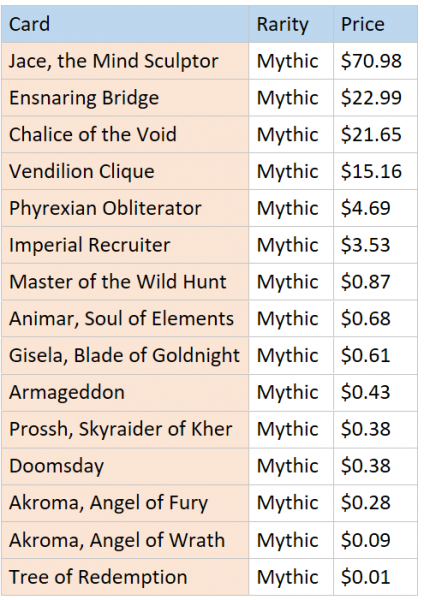
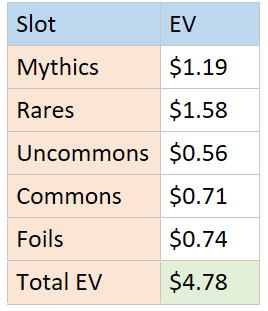
The mythic slot in Masters 25 is not good, contributing a meager $1.19 to the overall expected value of a booster of A25. There are simply too many duds, and more than half of the mythic slot's contribution to a booster's value comes from one card — Jace, the Mind Sculptor. One problem is that this Masters set contains several mythics that have demand in Commander, a format that does nothing to sustain values on MTGO. Another problem is that one of the chase mythics in paper – Imperial Recruiter – has already seen print on MTGO. Its value is 3.53 tix now, compared to $67 in paper.

Overall I'd say that four of the fifteen mythics are hits. All four of these mythics are high-demand competitive staples, and all will be potential speculation targets in the coming weeks (stay tuned for Matt Lewis's article on the subject, and I may write one as well). I expect all of them to hold their values and not tank too much. Of the others, only Imperial Recruiter has real competitive demand, but I expect its price to stabilize between 1.75 and 2.5 tix.

I love how Tree of Redemption is worth 0.01 tix on MTGO – it's a difficult feat to achieve for a mythic rare.

II. The Rares

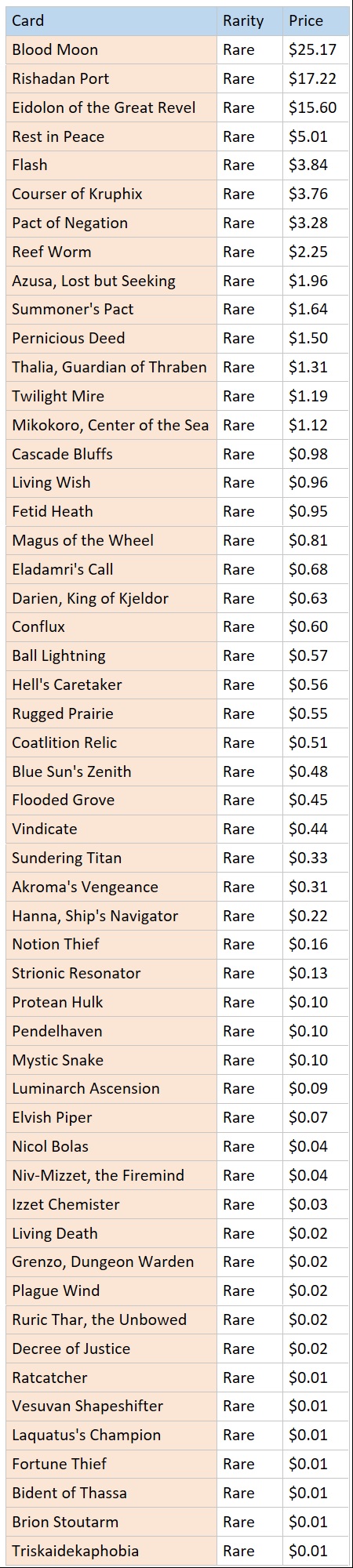
The rare slot in Masters 25 is also disappointing, contributing $1.58 to the expected value of a booster. Only 18 of the 53 rares have any real demand, and only three are worth more than the cost of a booster pack. Like the mythics, this selection of rares is worse for MTGO than it is for paper, and that's largely a consequence of the land cycle. While the filter lands have managed to hold a value north of $20 in paper, their values range from 0.45 tix to 1.19 tix on MTGO. I had predicted a reprint of the Worldwake manlands, and those would have been significantly better inclusions for the MTGO community. One reason Modern Masters 2017 was decent to draft on MTGO was that the Zendikar fetchlands were valuable both for paper and MTGO players.

One thing to keep in mind about some of these cards worth 0.25 to 0.75 tix — because these cards are not traded frequently, bots don't pay a premium for them, oftentimes offering about half their sell value. These cards will be much tougher to move than Standard cards or Modern cards that see a lot of play.

III. The Uncommons – a Surprising Boon!

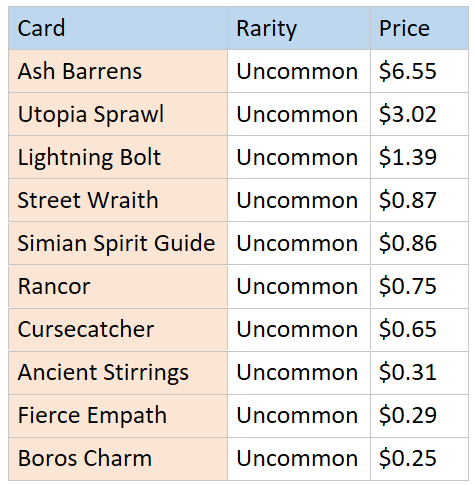
To give you some perspective — Jace, the Mind Sculptor adds $0.59 to the EV of a booster. Ash Barrens is almost half as important, itself contributing $0.25 to the EV of a booster. This collection of uncommons together add a substantial $0.56 to the expected value of a booster. It will thus not be uncommon for you to be able to pick up some value during your draft even if you don't open a good rare or mythic.

IV. The Commons — True Trees of Redemption for Masters 25

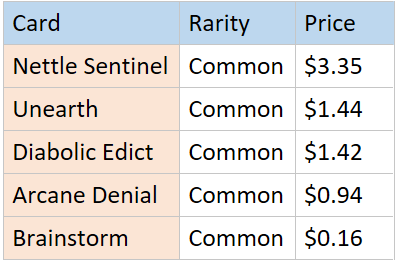
Most surprising of all is that the common slot in Masters 25 will contribute a whopping $0.71 to the expected value of a booster. With this group I am genuinely worried that this value will prove illusory since all of these cards should see major price drops. Normally I'd be optimistic about the future recovery of cards like these with significant Eternal demand, but their continued inclusion in treasure chests is going to make that difficult (see below).

V. Summing it all up! *Drum Roll.........*

$4.78 is the final number, and an unexpectedly high number at that! I had expected an EV of about $3.50, but $4.78 is actually comparatively decent. The reason the EV is substantially higher than one might expect is because of the all the quality commons and uncommons. This means that our draft experience will have a much more even financial outcome than we have grown accustomed to with Masters sets. No matter what, you are likely to come out of the draft with at least $3 to $5 of value.

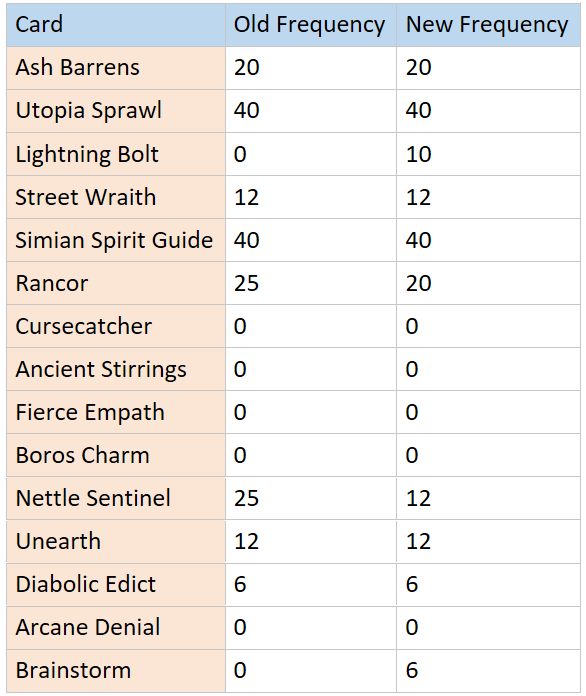
There is, however, a significant downside to the fact that so much of the value of this set is harbored in the commons and uncommons. Because these cards will be receiving such a high infusion of fresh supply into the market, their values are likely to tank harder than a staple rare or mythic normally would. Worse, Lee Sharpe inexplicably kept these commons and uncommons in the treasure chests at roughly the same frequency as before, and even added Lightning Bolt and Brainstorm to the chests because...who knows. See the chart below:

Masters 25 & Treasure Chests

As a result of these cards being attacked on two fronts, we should expect their values to tank much harder than normal and have significantly harder times recovering value. While we will undoubtedly see the usual 20 percent to 25 percent decrease in value for these rares and mythics, we are likely to see these commons and uncommons decrease in value by 50 percent (or perhaps more).

VI. What does this mean for drafting Masters 25?

The cost to draft M25 is $25, and the payout structure is 6-2-2-2. Below will be your EV at each possible draft record on the first day of release:

3-0: +$31.34
2-1: +$3.34
1-2: -$10.66
0-3: -$10.66

This means that you're likely to have the following outcomes given a certain win percentage on the first day of release:

40% win rate: -$3.94/draft
50% win rate: -$0.16/draft
60% win rate: +$4.46/draft

Once drafting Masters 25 kicks into full gear, I'd expect the rares and mythics to lose 25 percent of their value, and commons and uncommons to lose 50 percent of their value. This means that that the expected value of a booster will likely end up closer to $3.11.  Thus you'll likely be dealing with a reality closer to the following when you draft:

3-0: +$26.33
2-1: -$1.67
1-2: -$15.67
0-3: -$15.67

40% win rate: -$8.95/draft
50% win rate: -$5.17/draft
60% win rate: -$0.55/draft

These numbers are better than Iconic Masters, but not as good as Modern Masters 2017. The break-even point will be about a 63-percent win rate, which is typical for a usual competitive league draft with a set without Masterpieces. Before writing this article, I did not expect to do any Masters 25 drafts, but after examining the EV, it seems like it is (just barely) justifiable to draft the set non-phantom. Don't draft it too much if you're trying to come out ahead, but there is enough value to indulge in a draft once or twice.

One word of advice: for Eternal cards it's usually best to use GoatBots or bots from the WikiPrice library. Cardhoarder and MTGOTraders, while great for Standard cards, tend to have buy prices significantly lower than the others for Eternal cards. For example, just yesterday I sold Sphere of Resistance to ManaTraders for 0.56 tix. Cardhoarder was offering only 0.43 tix. That difference is typical for Eternal cards.

I would like to see the entry fee reduced from $4 to $2 going forward, as that would make these sets truly exciting and experiences to look forward to. This set in particular is supposed to be celebratory. Nevertheless, Masters 25 has gotten too harsh a reception, and it will be significantly better to draft non-phantom than Iconic Masters.

I hope you enjoyed this breakdown, and I will see y'all next time!

Insider: A Collection Buyer’s Guide

Are you a Quiet Speculation member?

If not, now is a perfect time to join up! Our powerful tools, breaking-news analysis, and exclusive Discord channel will make sure you stay up to date and ahead of the curve.

Welcome back, readers!

Last Friday evening I had some friends over to play Commander (or EDH for those of us playing awhile). One of my friends brought over a box of cards that were "left overs" from a big collection he'd purchased recently. He told me he'd spent around $4800 on the collection, which included one of every dual land and a full set of Survival of the Fittest. There were some good playable cards leftover that he didn't really need, and he wanted me to go through them and see if there was anything I wanted.

There was an error retrieving a chart for Survival of the Fittest

So Saturday morning I got up early and began looking through the box only to find a lot of highly liquid cards I could sell on my online store. This article will go over my process of buying cards when people come to me wanting to sell (or in his case trade).

Step 1: List Everything Valuable

Obviously the first thing you want to do when reviewing a collection to buy (regardless of size) is to get a list of everything of note.

What qualifies as "notable" will depend on your outs, and the profit margin and fees associated with them. In some cases you may only want to focus on cards over a certain value. As I've mentioned repeatedly, on TCGplayer net profit and percent returns based on sale price are pretty abysmal for anything under $5. That's where I usually set my lower limit, but depending on your own circumstances you may want to use a different threshold.

This part can be a bit tedious, and ideally the person selling to you already has this list. In this particular instance he only handed me a box so I had to sort and come up with a list myself.

I didn't mind doing this because he is a friend, but if you have to do this for a stranger it's important to remember that your time is valuable. If it's a larger collection, you need to include the value of your time that you've already spent when making a final offer. For example, if I created a list, ran my numbers, and was going to offer $500 on a collection, but I've already put in three hours of work, I may only offer $450.

Step 2: Price Out Everything on the List

The next step is to get the market value of the cards (using whichever price system you prefer). This is typically going to be the price you would sell them for before any taxes or fees are removed. This is where you need to be picky on condition, as it is the first step in the monetary evaluation.

We will use an example of one card on my friend's list to show each step moving forward.

Card Set Qty Condition Market Price
Geth, Lord of the Vault Scars of Mirrodin 2 NM $10
There was an error retrieving a chart for Geth, Lord of the Vault

So far, I doubt anybody is surprised with this exercise. However, this next step is something I haven't seen anyone else do.

Step 3: Cost of Selling

There is always a cost to selling something. It may be zero (like if you sell a card to a friend you're already planning on spending time with); it may be the fees and shipping cost of TCGplayer; or it could be much more if you end up having to buylist the card in the end. The important thing here is that both you and the seller come to an understanding about this cost. Nothing derails a buy faster than when you and the seller are on different wavelengths.

Up to this point in the process, I'm usually happy to be transparent with my seller. Everything is straightforward and there isn't anything that might be considered "company confidential" (i.e. information that you wouldn't want your competitors to have). If I'm sitting down with someone who is looking to sell me a lot of cards, I have no reason to deceive them on the numbers behind my offer.

Continuing our example from above, we now have something that looks like this:

Card Set Qty Condition Market Price Shipping Cost TCG Fees Card Sold Value
Geth, Lord of the Vault Scars of Mirrodin 2 NM $10.00 $0.51 $1.60 $7.89

Step 4: Risk Factor

When it comes to Magic cards, there is always risk when trying to sell them. If a card gets reprinted it loses a lot of its value. If it gets banned it can lose most of its value. If the metagame shifts or a better version is printed it can lose value. So for each card I have to determine the risk tied to it.

Currently my biggest concern is that Wizards is showing a trend of creating more and more supplementary products (i.e. products that may or may not be Standard-legal, but serve as additional sales revenue). Now I will admit that my risk factor is a somewhat subjective number, but it's important to have a process and to stick with it.

For me, I use the following table for my risk factor.

Risk Factor Description
1 Reserved List card
0.95 Extremely unlikely to be reprinted or banned
0.9 Very unlikely to be reprinted or banned
0.85 Unlikely to be reprinted or banned
0.8 Less than likely to be reprinted or banned
0.75 Could be reprinted or banned
0.7 Somewhat likely to be reprinted or banned
0.65 More likely to be reprinted or banned
0.6 Very likely to be reprinted or banned
0.4 Just got reprinted or banned

This part is a little more sensitive as far as divulging it to your seller is concerned. Unlike with card condition (which is something you should come to an agreement on), risk factor is highly subjective. It's important that you feel comfortable with the risk you're taking on, and your seller is likely to disagree with you—after all, they're trying to maximize their profit as well. Because of this, I simply let them know that I calculate the risk of getting reprinted/banned into my evaluation, but do not divulge what that factor is.

Continuing our example of Geth, Lord of the Vault:

Card Set Qty Condition Market Price Shipping Cost TCG Fees Card Sold Value Risk Factor
Geth, Lord of the Vault Scars of Mirrodin 2 NM $10.00 $0.51 $1.60 $7.89 0.85

Step 5: Expected Profit

The last step I have when calculating buy price is what I want my expected profit to be. Let's say that for Commander cards above $5 I want a 20 percent profit. Now I need to multiply things together to get a final price offering on a card. I do this with the following equation:

Returning to the Geth example:

Card Set Qty Condition Market Price Shipping Cost TCG Fees Card Sold Value Risk Factor Profit Margin Price Quote
Geth, Lord of the Vault Scars of Mirrodin 2 NM $10.00 $0.51 $1.60 $7.89 0.85 20.00% $5.37

So my final price quote comes to $5.37 per copy. This may seem kind of low, but thanks to the shipping cost and fees I have to look at the card as an $8 card and not a $10 card. If you have outs with lower fees/shipping than you can adjust accordingly and likely offer higher buy prices without taking on additional risk or lower profits.

Conclusion

The reason I like using this more methodical approach—as opposed to a blanket approach like what I see on Facebook all the time—is that it accounts for each card individually. Some people prefer to use a flat percent (like 70% of TCG Low), which doesn't consider the unique conditions for different cards.

I am also not a fan of TCG Low as a whole, because it's often manipulated with high shipping costs and isn't a good representative price, especially on cheaper cards. I can't tell you the number of times I've seen $3.5-market-price cards listed at $0.5 with $2.99 shipping. This can allow for some screaming deals if the seller has a lot of cards like that listed (as shipping isn't compounded), but it tends to distort the picture of the real market price.

My method does take a good bit more effort, but it also allows me to control my risk by making sure I factor it in before buying anything. In the end you need to figure out whatever method works best for you and your circumstances, but I wanted to share my method for those who didn't know where to even start.

Daily Stock Watch – Simian Spirit Guide

Are you a Quiet Speculation member?

If not, now is a perfect time to join up! Our powerful tools, breaking-news analysis, and exclusive Discord channel will make sure you stay up to date and ahead of the curve.

Hello, everyone and welcome to the last day of our Masters 25 Daily Stock Watch edition! A lot of us are probably still not over the Dominaria leak that happened earlier today, and this might somehow attract the attention of more players who have lost interest in M25. It's something that we'll have to address later on as I'd like to focus more on what's coming up next week, and that is the release of this new Masters set. For today's pick, it's something that not all of us might agree on but it's really something that could prove to be great down the line. I'm a fan of cards that boost your chances of starting out strong in a Magic game, and this one is definitely a fire starter.
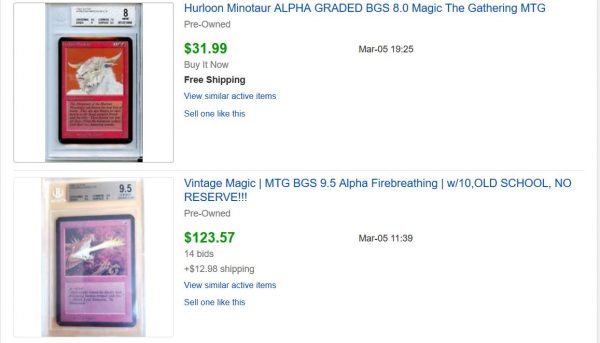
There was an error retrieving a chart for Simian Spirit Guide

Simian Spirit Guide is the animal version of Elvish Spirit Guide from another timezone that gives more gasoline to a color that's already scorching hot. This hasn't been the case for its primal appeal lately, as it has popped up in lists that don't even need colored mana to make things work. Modern has been the proving grounds for players who want to shine on the biggest stages with their own brews, and SSG might have just helped in engineering a new look for the Eldrazi Agrro lovers after Jordan Boisvert won SCG Classic Worcester with this list.
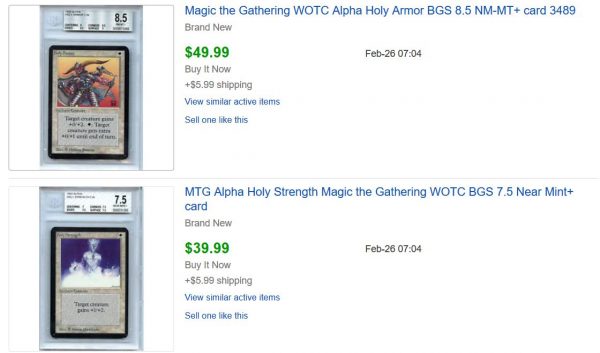
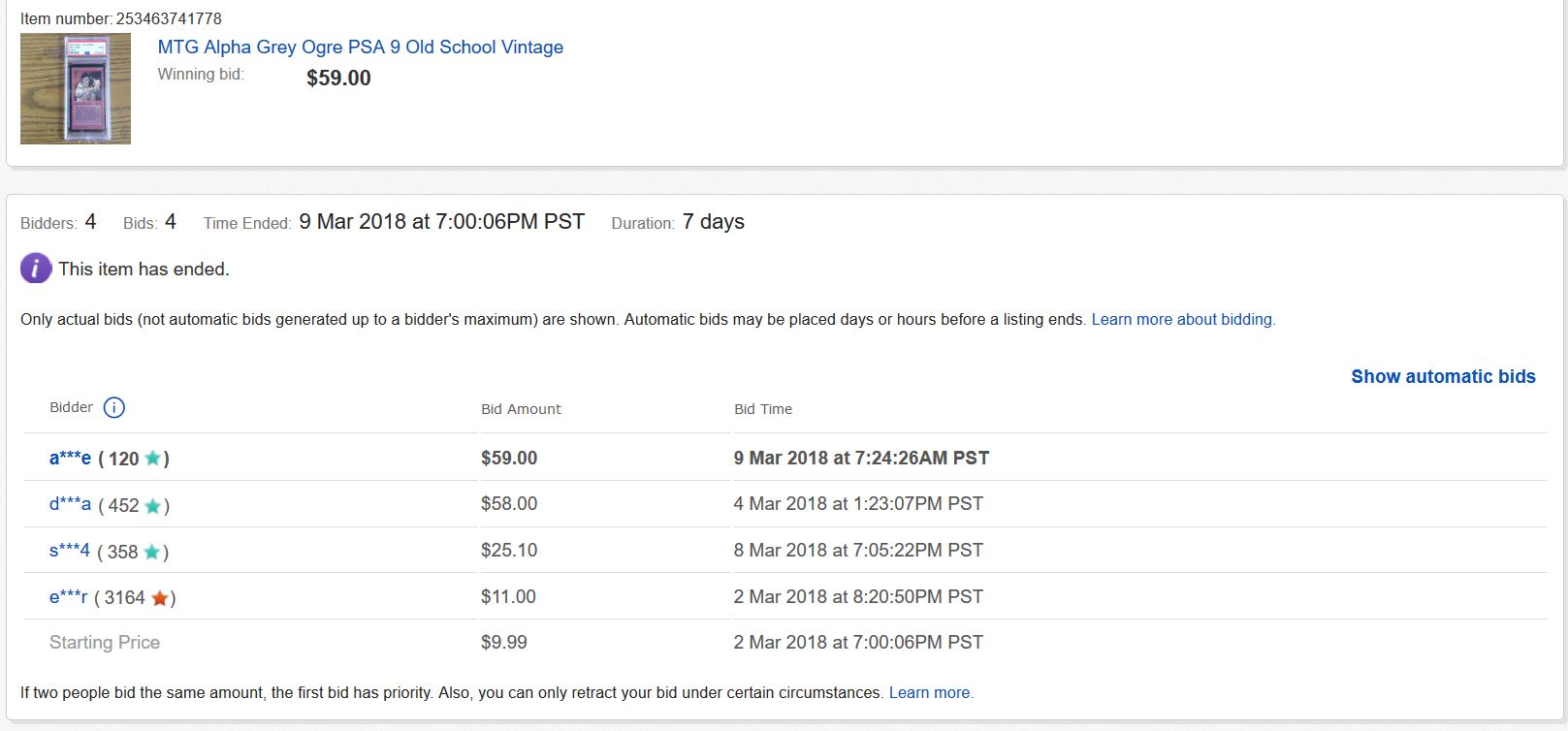
Eldrazi Aggro

Creatures

4 Eldrazi Mimic
4 Eternal Scourge
4 Matter Reshaper
4 Reality Smasher
4 Simian Spirit Guide
4 Thought-Knot Seer

Instants and Sorceries

4 Dismember

Other Spells

4 Chalice of the Void
4 Serum Powder
1 Smuggler's Copter

Lands

4 Blinkmoth Nexus
4 Eldrazi Temple
3 Gemstone Caverns
4 Ghost Quarter
2 Mutavault
2 Scavenger Grounds
2 Sea Gate Wreckage
2 Wastes

Sideboard

2 Gut Shot
1 Pithing Needle
4 Ratchet Bomb
4 Relic of Progenitus
3 Spatial Contortion
1 Surgical Extraction

This list puts an awful lot of premium on speed as it could simply power out a turn one Thought-Knot Seer or Reality Smasher given the correct number of SSG and Eldrazi Temple on your opening hand. A start like this isn't really something that could win you games at all times, but it would definitely get you in the driver seat for the remainder of the match. Drawing an SSG at any point of the game where you're trying to get ahead is always vital, as it gives you that much needed push to get over the top with your next big spell. The price drop in M25 would mean a lot for spec purposes, and it should be pretty handy to get from your LGS where people are cracking packs for drafting or plain fun.

The Best Uncommons In Modern

From the list above, only two other cards that I've also featured over the past two weeks are making an appearance in M25 as uncommons. I'm not sure how long people would be interested in opening these packs, so I'd like to take my chances in getting as many copies of SSG if possible. The only issue I have is that I'm not really sure for how much should we start hoarding them, but I'm quite sure that this is one of the cards that we should really consider keeping for spec purposes.

At the moment, online stores such as StarCityGames, ChannelFireball, CardKingdom, and TCGPlayer are pre-selling normal copies of Simian Spirit Guide for $2.49 up to $3.02, while the foil ones are somewhere between $29.99-$34.99. It might be a long shot, but I'm actually hoping that it could drop to $1.50 or even less if the market gets really flooded with tons of cards from M25. The foils are really good pick ups, as there aren't much of the Planar Chaos foils in circulation and this is definitely one of those cards that a lot of players waited for to get reprinted for its foils. The ideal price I have in mind for foils would be $10-$15 if that's possible, but $20 should be fine if you need to have it added to your collection. It's hard to go wrong on cards that are used a lot and barely has foils in circulation.

And that’s it for this week's special edition of the Daily Stock Watch! See you again next time, as I preview new cards that should be on the go, or good enough for safe keeping. As always, feel free to share your opinion in the comments section below. And if you want to keep up with all the market movement, be sure to check in with the QS Discord Channel for real time market information, and stay ahead of the hottest specs!


Want Prices?

Browse thousands of prices with the first and most comprehensive MTG Finance tool around.


Trader Tools lists both buylist and retail prices for every MTG card, going back a decade.

Quiet Speculation