
menu

Insider: Revisiting a Case Study

Are you a Quiet Speculation member?

If not, now is a perfect time to join up! Our powerful tools, breaking-news analysis, and exclusive Discord channel will make sure you stay up to date and ahead of the curve.

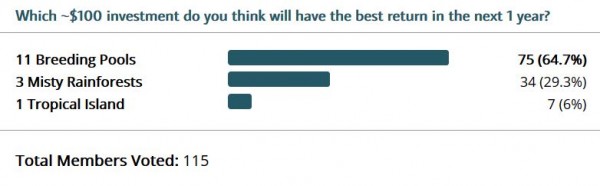
Four years ago this past Saturday, June 10th, I posted an innocuous question in the Quiet Speculation forums. "If you had to place a $100 bet on one of these three options, which would it be?” The choices were either 11 Breeding Pools, 3 Misty Rainforests, or 1 Tropical Island.

The goal of this case study was twofold. First, I thought it would be fun to test the collective mind that is Quiet Speculation. How good of a community are we at predicting the future? Second, I was looking for some guidance on where to invest some funds and was open to others’ opinions. The poll results today probably would not match the results from four years ago:
Results

Many who voted provided some context around their decision. Did they think a card would be reprinted in the near term? How strong was the Reserved List? What was the health of Modern and Legacy? All viable questions that still can be applied even today. This week I want to revisit this study and add some new commentary given where prices stand in 2017!

How Did We Do?

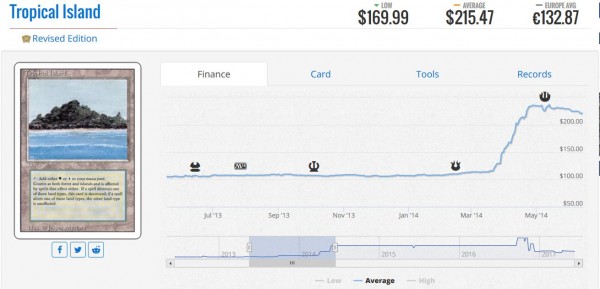
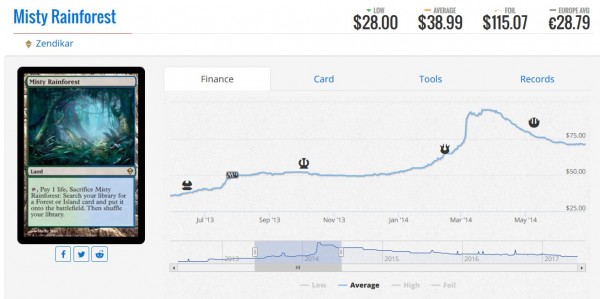
The actual question had a twelve-month time horizon. Therefore, the card that made the largest percentage gain from June 2013 to June 2014 would hypothetically have been the best option of the three. Let’s take a look at how each did over this particular time range.
Trop

Misty

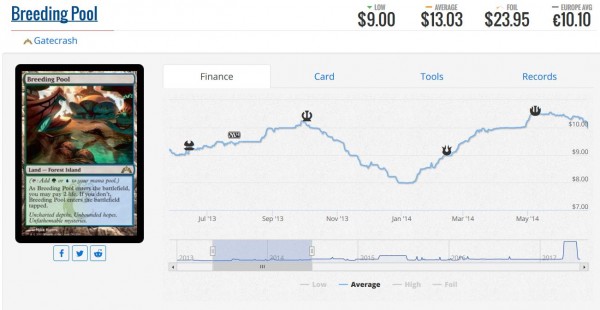
Pool

Looking at the numbers over the twelve-month range in question, we can estimate the percentage gains for each:

  • Tropical Island: $100  -> $220 (+120%)
  • Misty Rainforest: $35 -> $70 (+100%)
  • Breeding Pool: $9.5 -> $10 (+5%)

The option most chosen by Quiet Speculation Insiders ended up being the poorest performer. We were all banking on continued growth in Modern and no one had anticipated the negative impact of the massive print run of Return to Ravnica block. From a start-to-finish standpoint, the dual land was the best performer. Yet it was the least chosen option from Insiders.

In other words, we struck out.

Longer-Term View

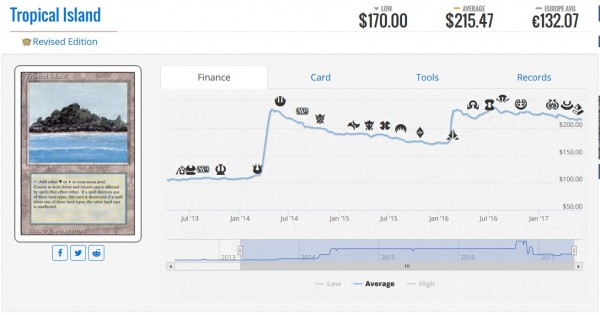
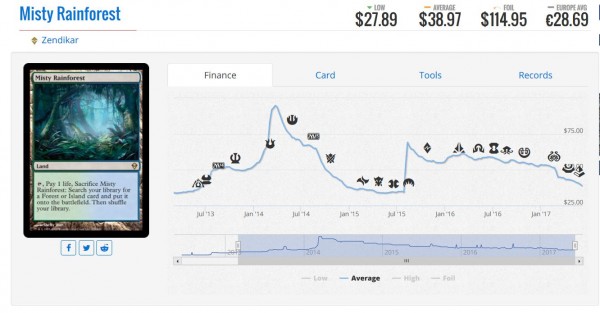
I don’t want to linger too long on the one-year analysis because it’s already history—water under the bridge, as it were. What I want to do now is zoom out even further to see how these three positions performed from June 2013 to today. Will the conclusions be any different?
Trop2

Misty2

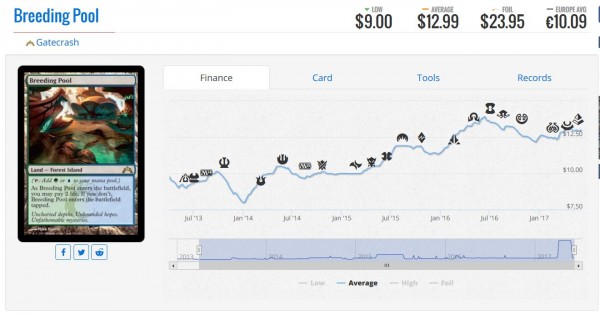
Pool2

Here are the approximate numbers:

  • Tropical Island: $100 -> $215 (+115%)
  • Misty Rainforest: $35 -> $39 (+11%)
  • Breeding Pool: $9.50 -> $13 (+37%)

Well, the results didn’t really change that drastically at first glance. The popular QS Insider opinion came in second place rather than last place, at least. But still, the least selected option (the dual land) is the clear winner here over the longer period of time. Not surprisingly, the fetch land came in last place due to its reprint in Modern Masters 2017.

But let’s look at this data one more way—let’s compare the numbers from June 2014 (the end of the one-year case study) to June 2017.

  • Tropical Island: $220 -> $215 (-2%)
  • Misty Rainforest: $70 -> $39 (-44%)
  • Breeding Pool: $10 -> $13 (+30%)

With this timeframe, Breeding Pool did gain the most! It would appear that in the middle of our case study, Tropical Island (along with most other relevant Reserved List cards) made a dramatic spike in price. But following that event, prices have done virtually nothing for three years. Thus when looking at the time range of June 2014 to June 2017, we see that Breeding Pool—which had no reprint—gradually grinded higher in price.

Making Some Predictions

With this data digest, we can start to make some predictions for the next few years. And the reality is, it’s very difficult to time things precisely enough. What I mean is, it’s impossible to determine when the next dual land spike will occur. For example, if I were to ask the same question today regarding where to invest money between these three options, the dual land will win if there’s another Reserved List spike in the next 12 months. If there isn’t, then it’s probable that the fetch land will jump most instead.

While I won’t pretend to be some all-knowing fortune teller, I do want to point out one curious trend on the dual land. It looks like when Tropical Island spiked during this case study, it did so in May 2014. From there, it took about 21 months of decaying value before the card jumped to new highs. Rather than rising gradually as other cards often do, it would appear dual land increases occur in dramatic episodes of rampant buyouts. Thus, the behavior we see on the chart.

The most recent dramatic spike occurred in February 2016. Since then, the card has been gradually pulling back after achieving overbought conditions. Buyouts will do that. If we apply the same 21-month window to allow the market to re-equilibrate and prepare to move higher again, we could extrapolate the next spike to occur in November 2017. While there is nothing special about the 21-month window in particular, this exercise does make me wonder if we’re not due for another spike in duals at some point in the next year.

If you had fresh cash to put to work and forced me to choose between these three options, I would probably have to go with duals. The reprint quantity suffocates growth on fetches and shocks. Meanwhile Reserved List cards are only getting harder to find with each passing month. Even now, some of the more popular dual lands in Legacy are seeing all-time highs without any dramatic buyouts. This is due to shifts in the metagame, indicating that Legacy demand can still move these prices despite the belief that it is a "dying format."

There was an error retrieving a chart for Badlands
There was an error retrieving a chart for Bayou

There are also only 104 sellers of Revised Underground Sea in stock. While that’s higher than it was during the last spike, I believe this represents a decline in stock relative to a few months ago. I’ve also been tracking Star City Games’ stock on the card recently, and have noticed a gradual decline of copies for sale. I wonder if we’re not due for another spike, perhaps catalyzed by GP Vegas? Note: it’s highly likely SCG took down most of their stock to bring with them to the Grand Prix, so chances are their in-stock numbers this week are artificially reduced.

I did hear on a recent MTG finance podcast that word on the street is some vendors are planning some significant buying on the GP floor in Vegas this week. I have no information to validate this claim, but it wouldn’t surprise me. With all the money in the room throughout the event, it’s the perfect time to make a move if you were planning on doing so.

If I had to pick a second choice, I would go with the shock lands next as a backup target. Star City Games is completely sold out of Gatecrash Breeding Pools and the card has finally gained some traction over the past few months. The same can be said for most of the other shocks. It would appear that finally, at last, after years and years of stagnation, the shock lands are moving in price. I don’t regret selling all mine a couple years ago though—the return on investment with these must be horrendous on an annualized basis. But perhaps that’s about to change if we don’t see a reprint in the next year or so?

Meanwhile, there are over 60 copies of Misty Rainforest in stock at Star City Games across Zendikar and Modern Masters 2017 printings. I do think the Zen fetches will recover eventually, but I would prefer to park my funds in duals—even with the extremely low likelihood of another reprint so soon after the last one. This should come as no surprise to my regular readers.

Wrapping It Up

A one-year case study from a while back reminded me of some of the ongoing decisions MTG investors face. I thought a revisit would be quite interesting given how poorly we as a community did at predicting the future back in 2013. When zooming out with a multi-year lens, it would appear that we did marginally better but still missed on the biggest gainer: the dual land. That said, all of the growth in duals happened within a narrow window of time, via a buyout. Prices never really dropped down after that.

With that being the case, I wonder if now, after many months of stagnation, duals could get another bump in price. Conditions are very different now than they were years ago, though:

  • There are no longer Sunday Legacy Opens on camera every week (negative).
  • Wizards of the Coast reduced the number of Legacy GPs across the globe (negative).
  • Commander popularity is at an all-time high (positive).
  • Old School MTG has exploded in popularity (positive).

I don’t know the breakdown in demand for dual lands between Legacy/Vintage players and Commander players. I believe demand from Commander players is fairly robust, especially given the advent of so many four-colored generals from Commander 2016. EDH REC also indicates the duals are heavily used, with Underground Sea appearing in nearly 5,000 decks. While their paper price may be prohibitive to some, others will justify the purchase of these mana-fixing lands to optimize their decks.

Weighing all the positives and negatives, I’ve decided I’d rather be a buyer than a seller of dual lands right now. There are likely better places to park money—Commander foils have been especially juicy in recent months. But if you had to pick between all the nonbasic two-colored lands in Magic to park some money, I think dual lands is a fine place to be. You’ll be able to enjoy use of the cards in your decks for years, with the possibility to spike a buyout and make some money along the way.

It’s been a while since we saw a spike, and I’m not sure if there’s one on the immediate horizon. But it only takes a few people to decide it’s time, and we could be looking at the next 100% increase in prices. Take advantage of the consolidation in price and you probably won’t regret it 12 months from now when we return to this case study again!


Sigbits

With Grand Prix Las Vegas on the horizon, I won’t look to SCG’s inventory online this week because quantities may be deceptively small. I’ll use TCG Player instead.

  • Two. That’s the number of copies of Arabian Nights Sindbad in stock on TCG Player. Both are Lightly Played and both are listed at astronomically high prices. Please, whatever you do, don’t purchase these at $50. Market price still shows around five bucks, and $10 is a much more reasonable place for this card to settle.
  • Despite being just a common from Ice Age, the number of Portents in stock on TCG Player is surprisingly small. When I filter down to the number of sellers with at least a playset for sale, we get down to less than 20. Full disclosure: you may be following my Portent antics on Twitter—I found a stack of copies from a single seller not long ago and have been selling them rapidly on eBay for between $6 and $7 a playset.
  • Drop of Honey may soon be spiking. There are just ten sellers with a copy for sale on TCG Player and only four of them are Lightly Played. It won’t take much for a speculator to buy these up and list one for $200, forcing a “spike” in price. Just be careful if you partake in such a scheme, as you won’t likely be able to move copies at that price for quite a while. It’s probably best to just grab a copy now if you need one for play, and leave it at that.
Insider: Standard Stocks to Watch

Are you a Quiet Speculation member?

If not, now is a perfect time to join up! Our powerful tools, breaking-news analysis, and exclusive Discord channel will make sure you stay up to date and ahead of the curve.

There is a lot going on in MTG in the coming weeks. In fact, with the triple Grand Prix in Vegas my current schedule looks like: RPTQ, three Grand Prix (Vegas), Grand Prix Cleveland, and an Invitational. Now, that is a ton of Magic. Game on!

I just wrapped up back-to-back weekends at Standard Grand Prix. By the time I'm done it'll be nine out of ten weekends in a row! I can't remember a more dense stretch, but I'm really enjoying the experience.

Let me tell you something else, you don't go nonstop for two months and not learn a few things about which way the wind is blowing. Today will focus on my thoughts on Standard staples (having just played the format for a month straight) and which cards I'm looking to pick up, hold, or flat out dump. When the dust settles I think I'll be pretty far ahead of the game in terms of gaining value on my cards.

Energy Is King

There was an error retrieving a chart for Aetherworks Marvel

Verdict: Sell

Temur Energy is the best deck in the format and nothing beats it. Dedicated hate decks don't actually beat it consistently, and they certainly do not beat anything else consistently.

Many people think that the slam-dunk Marvel into Ulamog is a hee-haw combo that makes the deck insane. Well, actually I disagree. Temur Energy is already the best deck in the format and having the ability to randomly end the game for no good reason by spinning the wheel puts it over the top. The thing people overlook is that the energy package (without Marvel) would already be the best deck, or close to the best, even without Marvel and Ulamog!

I played Temur Marvel in Omaha last weekend and went 5-4 and didn't make Day 2. I don't mean to complain, but to make a point, my Marvel spins were 2-28 on hitting an Ulamog. If you want an excuse for the bad record, well, a 7% conversion rate is a good one.

Here's my point: I'm certain that if my Marvels and Ulamogs were anything else I would have won a lot more matches (since I was constantly winning with my beatdown plan anyways). That very fact gives me a lot of faith that Energy will continue to be a strong deck in Standard even if Marvel or Ulamog get banned (which they definitely could).

There was an error retrieving a chart for Ulamog, the Ceaseless Hunger

Verdict: Sell

I strongly doubt that both Ulamog and Marvel are going to survive the next banning together intact. People are already starting to get frustrated and complain about the format and we are not even a month in. It can't go on this way for another rotation.

Marvel and Ulamog will likely now begin their slow decline into obscurity as far as price is concerned. Ulamog, the Ceaseless Hunger is still a good Magic card and will see play in Modern Tron and at the kitchen table. I will certainly keep a couple of copies for my Tron deck. However, if you are looking to get maximum value in the near future, now is the time to move.

I still think the other Energy cards are good value in Standard even if Marvel gets banned. They are mostly uncommons and commons that don't have a ton of current value. It makes them an easy hold. You never know, sometimes these kinds of cards will end up in high demand down the road.

Mistakes Were Made

There was an error retrieving a chart for Gideon, Ally of Zendikar

Verdict: Sell

I kind of buried this topic in the middle of the article because I don't typically like venting about these sorts of things, but from a finance perspective it is relevant to how I see the landscape for multiple reasons.

In my opinion, Wizards made major mistakes in the design of Kaladesh and Battle for Zendikar block. Obviously, cards have been banned and more cards may need to be banned yet. I also think they made mistakes with regard to what they banned and when they banned it, which has further exacerbated the problem.

What does this have to do with finance? Simple. Wizards did a terrible job with the product they put out. People are not happy or enthusiastic about constantly having borderline-unplayable Standard formats for over a year straight and having their cards banned. Magic has lost popularity as a result of the mismanagement.

Wrap your mind around this: back-to-back Standard GPs with less than 800 players...

That's unheard of. People hate Standard now. I don't blame them. It needs to be fixed.

Wizards' first problem is that they need to get people back out and playing Standard and enjoying it. If I were Wizards, I would want to dramatically change the way the format looks and feels as soon as possible. I'd ban the most warping cards, burn it to the ground, and start over. It's been a dumpster fire already, so why not just start over?

Goodbye, Gideon. Goodbye, Marvel.

Basically, I would eradicate the two best decks and level the playing field for new decks to become viable. At the very least, players get to enjoy a "new format" which is something they haven't been able to do for quite some time, since the best decks have dominated throughout.

Gideon feels like a solid dump right now because it has very little upside. If it gets banned, it's a $6 niche Modern/Legacy sideboard card. If it doesn't get banned, it is still racing the clock into Modern sideboard obscurity. It's a good time to dump these.

Looking for the Good Value

Now for the reason you tuned into the column. I think it's pretty solid advice to dump some of these format staples that have an above average chance of being banned. The other thing to keep in mind is that even if they don't get banned, I would still be advocating selling them off just based on commonplace trajectory.

Imagine a world where Mardu Vehicles and Temur Marvel are not dominating Standard. Imagine these two fun police were not holding all the other cards back. What would you play?

There was an error retrieving a chart for Verdurous Gearhulk

Verdict: Buy

To begin with, you could play BG Constrictor or Delirium. In either build, Verdurous Gearhulk may feature prominently.

Gearhulks in general are super cheap right now and they all appear to become potentially better positioned in the new metagame. The green one is great and it has a lot of room to grow.

There was an error retrieving a chart for Torrential Gearhulk

Verdict: Hold

The blue Gearhulk is so good. It is very likely to be at the heart of any and every blue-based control deck in Standard. Whether UR Counterspells survives or whether Temur Energy without Marvel were to shift around Gearhulk, I feel confident it will have a home.

The problem is that it is already one of the most expensive cards in the format and doesn't have a ton of room to grow. However, I don't see it trending down anytime soon. In fact, it seems more likely to trend up!

There was an error retrieving a chart for Glorybringer

Verdict: Buy

I bought a playset of Japanese Glorybringers at GP Omaha for $12. I think that Glorybringer's current price is a simple case of "great card without a home." Marvel pressures the format in a way that is messed up. Tap-out five-drops are about as bad as they can possibly be in a world where Marvel comes down on four!

The fact is that this card will be amazing at some point. It will outlive every card in Standard and I'm confident that it will be great and make money for me at some point during its lifespan. The card is just too good not to.

There was an error retrieving a chart for Dusk

Verdict: Buy

Dusk // Dawn is a powerful Magic card. I've also seen this card slotted into some Legacy Death and Taxes or Stoneblade sideboards. It's a great answer to True-Name Nemesis, Delver of Secrets, and Tarmogoyf.

What does that have to do with Standard? Very little. However, Dusk is a powerful Magic card that I could see finding a home in the format at some point. It's a great card. Imagine playing some sort of a White Weenie or Spell Queller deck and using this to wreck a BG Constrictor board, then buy back all your dead creatures. Definitely not a bulk rare.

There was an error retrieving a chart for Glory-Bound Initiate

Verdict: Buy

I've seen this card played in Modern lately. I also got completely crushed by it at the Grand Prix. Do you know what is really unfair? One-drop, Initiate, Always Watching. Vigilance allows you to exert creatures every single turn without the "no untap" drawback mattering.

They are pretty cheap right now. I recommend picking up a playset of these because they seem pretty great at a low price right now.

There was an error retrieving a chart for Hapatra, Vizier of Poisons

Verdict: Buy

I'm going rogue with this pick. However, I think this is a powerful Magic card. Also, consider that we get a whole other potential set of -1/-1 counters synergy cards. It only takes one or two to make a deck.

If you see them cheap, pick them up. I've been getting them out of three-for-a-dollar boxes.

There was an error retrieving a chart for Channeler Initiate

Verdict: Buy

A good two-drop mana creature that becomes an actual threat? I like this card and feel like it could have a home in tier-one decks at some point in the future. Don't pay much for them, but they can be had really cheap and have considerable potential upside.

There was an error retrieving a chart for Bristling Hydra

Verdict: Buy

Hydra is a really powerful threat. My experience with Marvel has made me think about wanting to play more of a RG Energy deck and this would be one of the centerpieces. It's so powerful!

Also, so cheap right now! It is a great card to pick up now that will likely yield returns down the road. Possibly, sooner rather than later!

Conclusion

Those are some of my thoughts on specific Standard cards and the format. I obviously don't know anything for sure—but, I'm anticipating bannings for Standard. It just makes sense for me that they've already come this far and not to fix the problem seems like a low EV play.

Regardless of whether bannings do or don't happen, there will be lots of opportunity to find new value. I'm glad I don't have to play Standard for a while as I'm not a huge fan of the format right now, however when I return in a few months I hope things will be better! Also, I hope my investments will have paid off!

Insider: Exploiting the MTGO Price Lag

Are you a Quiet Speculation member?

If not, now is a perfect time to join up! Our powerful tools, breaking-news analysis, and exclusive Discord channel will make sure you stay up to date and ahead of the curve.

Welcome back, readers!

I'll be the first to admit that I'm very much a paper Magic player. I have an MTGO account, but I only got it to redeem sets (specifically Fate Reforged when sets were dirt-cheap).

That being said, us exclusively paper players can still recognize MTGO as a good source of information. The efficiency of transactions and the ability to play formats at any time can lead to very fast developments in a metagame (regardless of format), and those changes can often lead to shifts in the paper metagame. This means that watching the MTGO marketplace can show us metagame trends that can lead to good speculation targets.

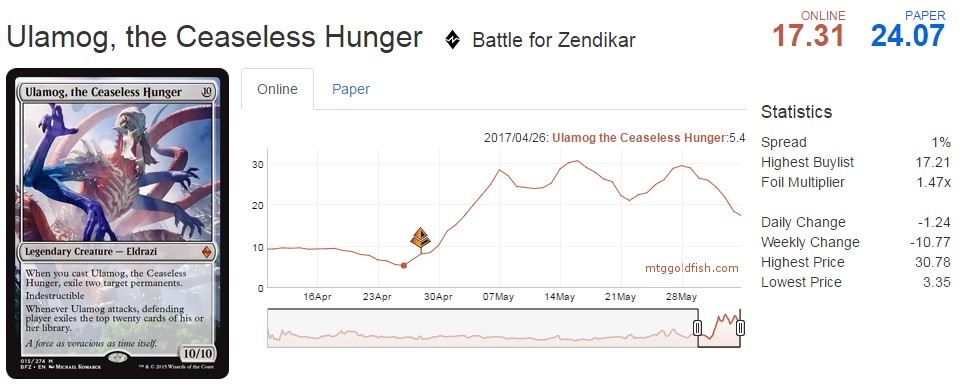
Now a word of caution: the MTGO economy is still different enough from the paper economy that not all price shifts will transfer over. However, it is similar enough that we should notice the trends—it's up to us to choose which ones we want to explore further. Case in point, here is the price graph of Ulamog, the Ceaseless Hunger on MTGO:

ulamog_MTGO

What you'll notice is that the price began an upward trend on April 26th, 2017, and it peaked on May 7th. If we look at the paper price now:

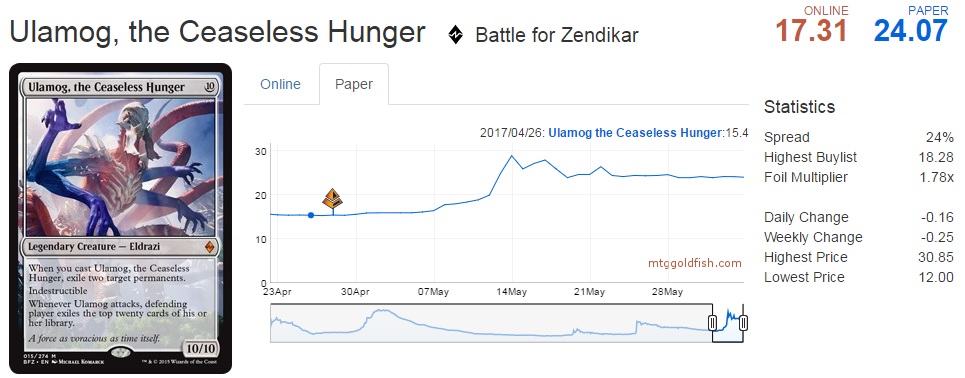
ulamog_paper

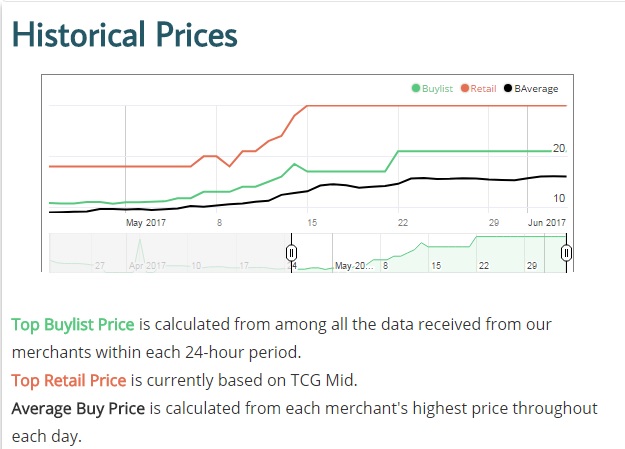
The price remained stagnant until after May 7th, which shows that the MTGO metagame showed strong demand for this card even while the paper metagame was slow to react. If you had bought paper copies of Ulamog, the Ceaseless Hunger anytime in that almost two-week gap, you would have seen decent profits (assuming you could out them anywhere close to retail).

Now I will admit that assumption is actually a bigger one than many might think, as buylist prices for Ulamog, the Ceaseless Hunger are still below the retail price from before the spike. If your plan was to out to buylists you still would have lost money, despite this card seeing around a 66% retail price increase.

ulamog_buylist

That being said, if your goal was instead to make it cheaper to play competitively, than you could still make your "profit" trading for the cards when they were cheaper (before the movement) and trading them away again after the movement. It's easy for many of us writers to forget that if your goal for MTG speculation isn't to make large amounts of money (which admittedly requires a great bit of work), but instead to simply expand your collection at a reduced cost, then these types of price movements still greatly benefit you.

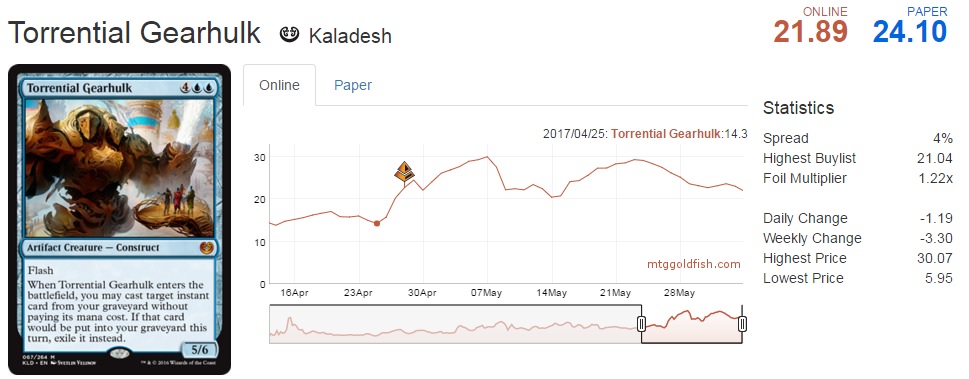
But back to the topic at hand. How about Torrential Gearhulk?

gearhulk_MTGO

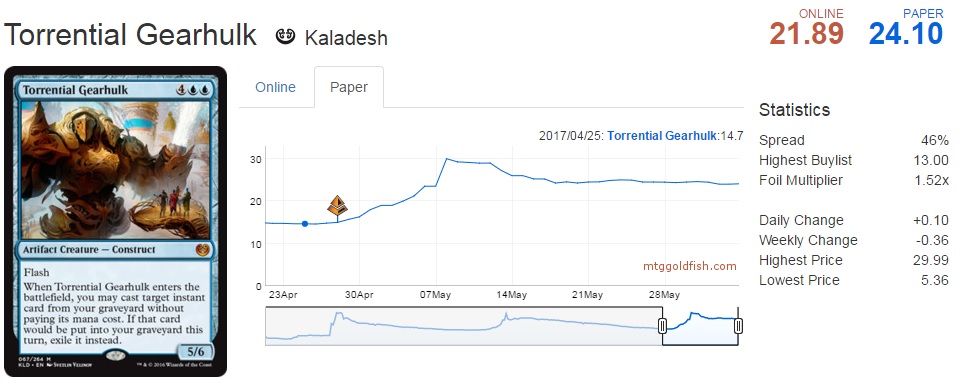
Again we see a price shift for Torrential Gearhulk on April 25th online. And here is the paper shift:

gearhulk_paper

We see a more gradual price rise in paper, but even still we see the card spiked 71% upward online between the 25th and 29th of April, yet our paper price moved only 7% during the same time period. Now the paper price eventually reached a full 100% higher in price, but that didn't occur until May 8th.

Note that Pro Tour Amonkhet occurred between May 12-14th, so there was definitely a lot of competitive players preparing for the Pro Tour (and likely trying to get ahead of the game and/or buying into the hype).

How about a non-mythic?

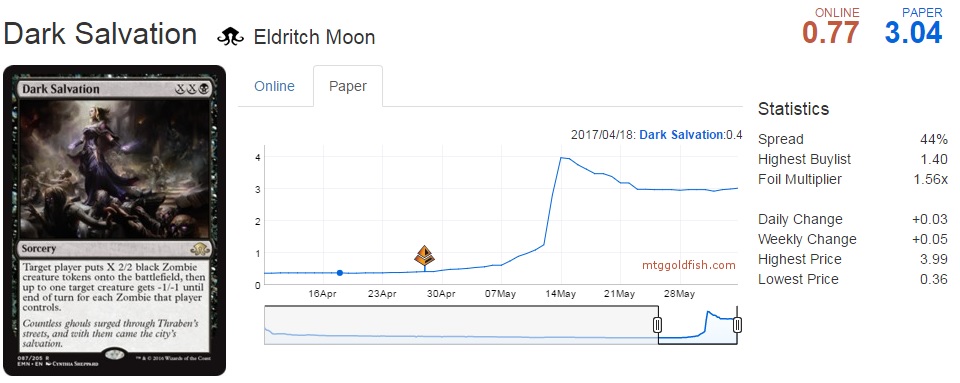
dark salvation_MTGO

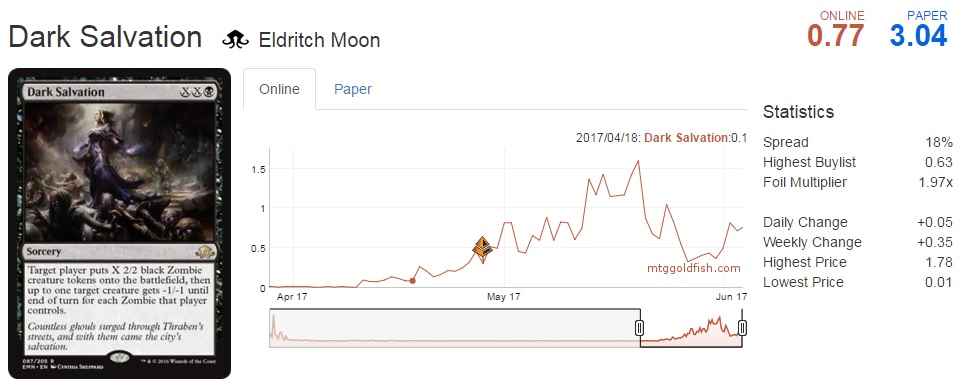
Here we see one of the big winners from the Zombie archetype. It was a bulk rare until late April on MTGO, and could be picked up for less than 0.1 tix until April 11th. Then it started to move and waffled a bit between 0.1 and 0.3 tix all the way until April 26th, when it broke 0.5 tix.

Then it began its ascent (with some additional waffling, mind you) all the way up to 1.3 tix, which meant that anyone who bought in early could have reaped massive MTGO profits in the neighborhood of 1300%. And yet, again, the paper price lagged:

dark salvation_paper

In paper this card remained in or around the bulk rare range all the way until May 7th. This means that one had three-plus weeks to acquire copies dirt cheap in paper at almost no risk, after a positive trend on MTGO had begun. (In theory we have had a lot longer for anyone who thought that Zombie tribal might be a thing.)

Having read up to this point, you might be thinking this seems like easy money. Why not buy into every card that spikes on MTGO before it moves on paper?

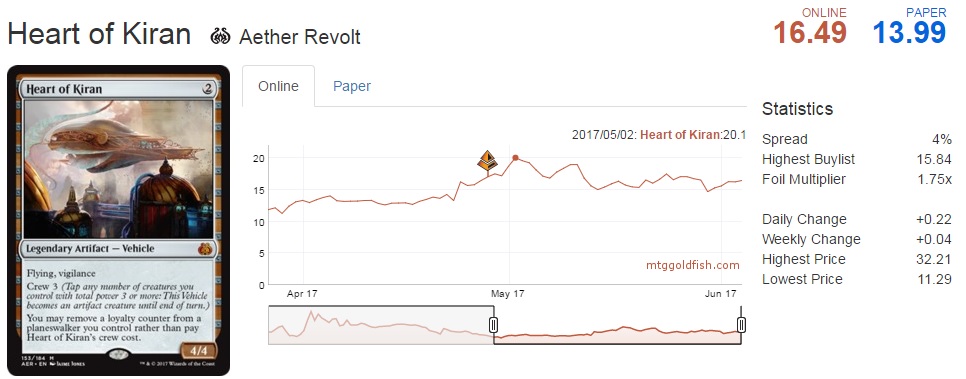
Let's look at one of the key cards in the supposed "best deck in Standard" leading up to the Pro Tour, Heart of Kiran.

Kiran_MTGO

What we see is a strong but gradual price increase. It peaks right after Amonkhet's release and shows a 70-90% price increase (depending on what day you might have purchased copies) from previous lows. That's even higher than the Ulamog bump.

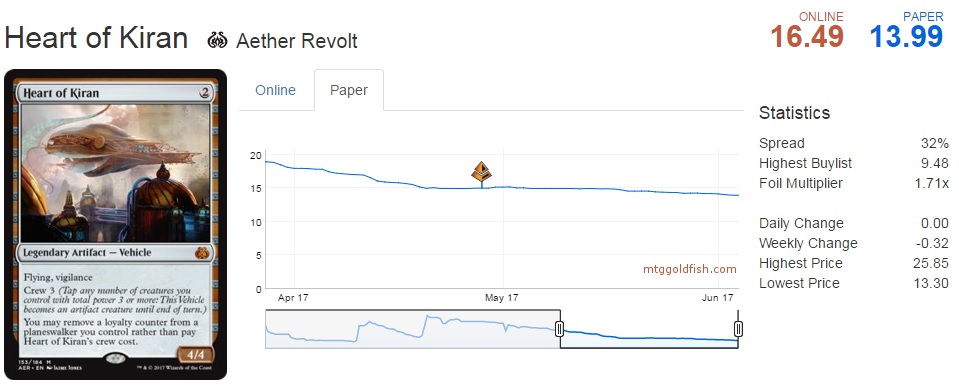
But here's how it fared on paper:

kiran_paper

No price increase at all. In fact, a continual negative price trend beginning before the Pro Tour (when everyone thought it would rule over the meta) and continuing past its lackluster showing and beyond.

This should serve as a word of caution that not all positive trends on MTGO translate to paper. If they did, assuming the information wasn't too hard to exploit, the system itself would result in shorter and shorter price windows until they basically matched lock and step.

Looking Forward

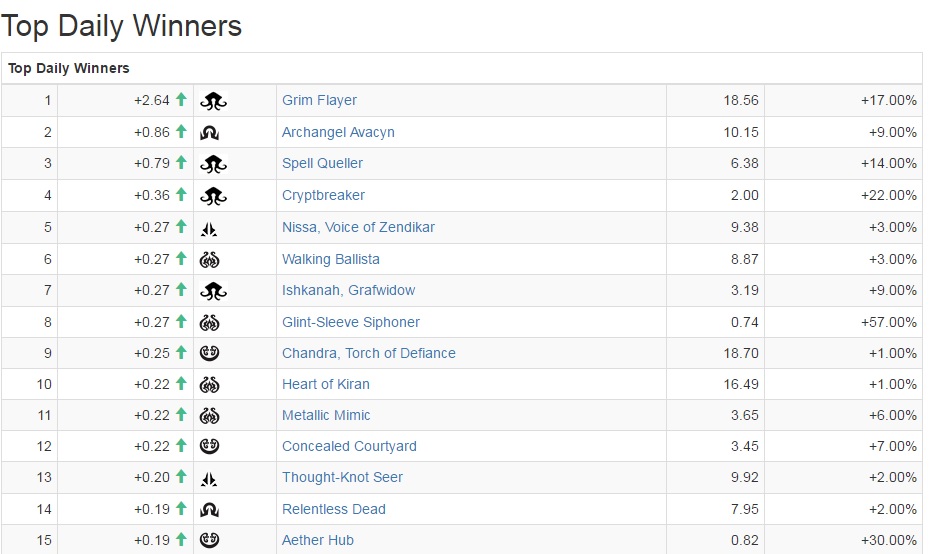
Now that we've established that there is often (but clearly not always) a delayed relationship between MTGO and paper price increases, let's see if we can find some of the recent movements on MTGO and evaluate their potential.
top 15 movers on MTGO
The first thing that jumps out is that there aren't any massive spikes like we saw on Ulamog, the Ceaseless Hunger or Torrential Gearhulk. The first card on this list is one that hasn't been seeing a ton of play in Standard at the moment, though it does see play in some Modern decks.
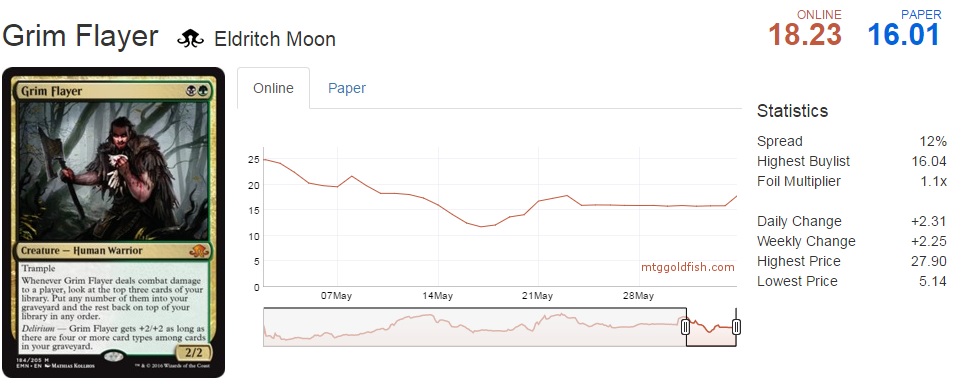
grim flayer_mtgo
When we look at the MTGO graph for Grim Flayer, it doesn't appear all that promising. It has generally trended downward, with only a few upswings. If we then compare it to the paper graph:
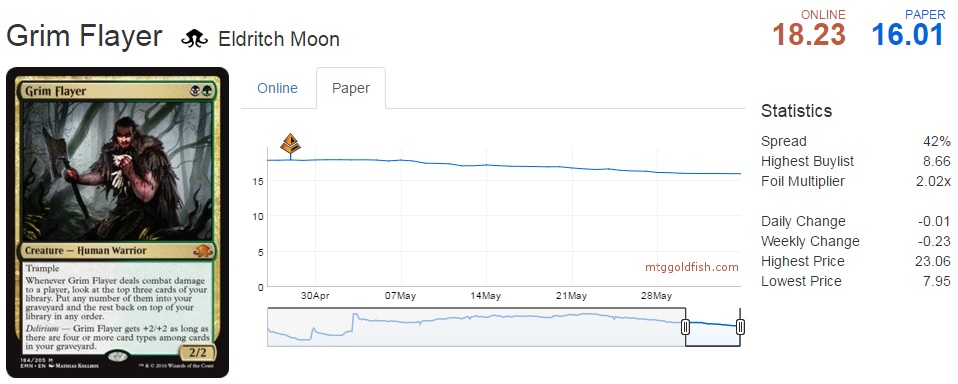
grim flayer_paper
What we see is a pretty continual negative trend. It is also important to recognize that in the fall we will see BFZ and SOI blocks rotate out, so the future potential for this guy has a pretty limited window. I like him long-term as a post-rotation pickup. But given that his price isn't currently inflated from Standard play, I don't expect the price to drop a ton (like it often does for Standard-only staples at rotation).

So what about Spell Queller?
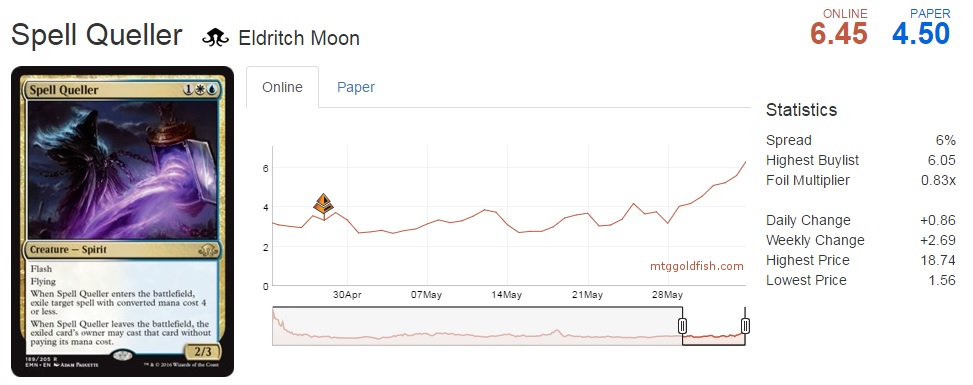
queller_MTGO
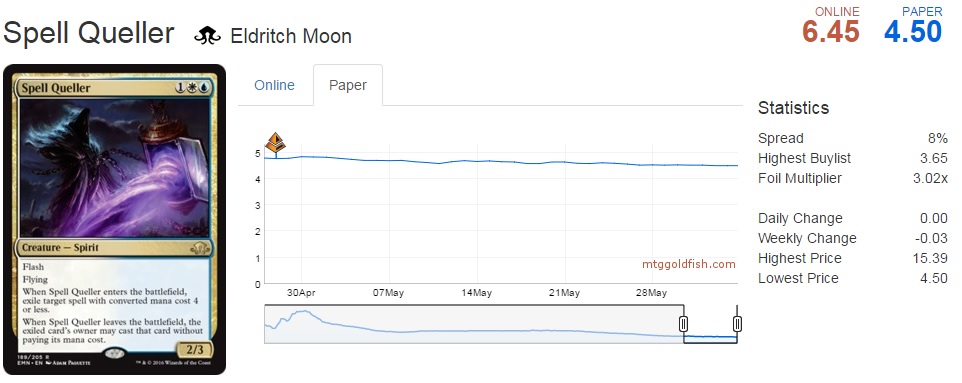
And here is the paper price:
queller_paper
I actually do like Spell Queller. I know what you're thinking. I just said I wasn't interested in picking up an eternal-playable mythic from Eldritch Moon but now I am for a regular rare (with the same rotational window). The difference is that the price gap for Grim Flayer between MTGO and paper is only around 12%, whereas the price gap for Spell Queller is closer to 30%.

When it comes to looking at cards' potential for profit, I'm a big fan of comparing percentages. If you have $1000 to buy stocks and your options are a $20/share stock with a potential 12% upside versus a $5 stock with a 30% upside—for comparison's sake, say they both belong to the same company, but the cheaper one is common stock—I'm going to take the $5 stock with the higher upside every time.

Note this is a personal approach. It is often riskier, after all—Grim Flayer is a mythic and much rarer than Spell Queller which means greater potential in general. However, most of my speculation targets with great returns have been on the riskier side (though as I mentioned last week they don't always end up well).

Spell Queller has other things going for it. It can hit Aetherworks Marvel on curve (whether on the play or draw). There's been an uptick in Counters Company decks in Modern, and we have seen Spell Queller show up in some of the Bant variants.

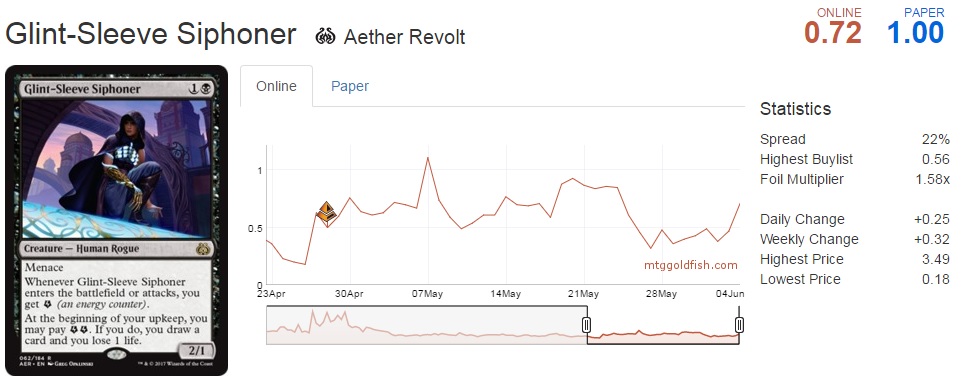
The last one we will discuss is the one with the highest increase, Glint-Sleeve Siphoner:
siphoner_MTGO
This card has waffled a lot online, with highs and lows showing a lot of variance. Siphoner serves as a decent Dark Confidant impersonator in decks that generate extra energy (as you want to play this card when you already have two energy to trigger it the first upkeep after you play it).

We didn't see any cards that produce energy in Amonkhet, so there is a strong likelihood that the energy mechanic will remain a Kaladesh block exclusive. Wizards tends to keep block mechanics exclusive during their days in Standard, so if we do revisit the energy mechanic I expect it to be after Kaladesh has rotated.

However, because we have a significant amount of Standard with Kaladesh left, there is a good bit of time for this card to find a home in another competitive deck. We are starting to see a Golgari Constrictor deck pop up on MTGO now—should it show some staying power, this card could see a decent-size bump in price.

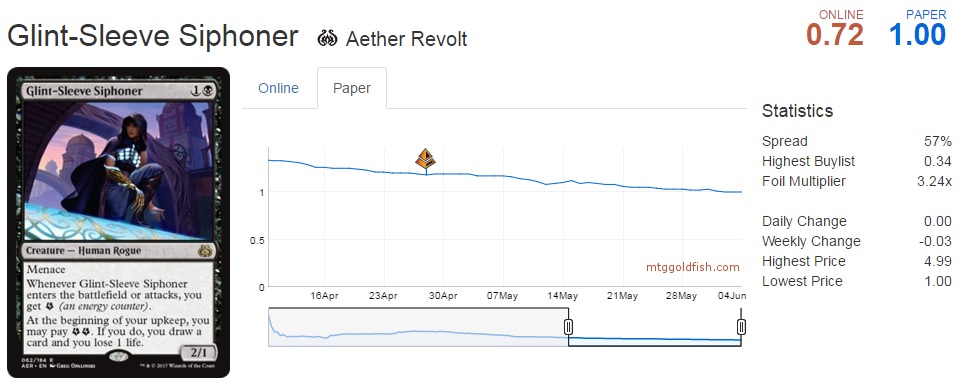
The current paper price has held a constant negative trend.
siphoner_paper

Conclusion

I am a firm believer in utilizing whatever resources you have available to you. Reviewing and keeping track of the MTGO metagame is a great way to pinpoint future speculation targets. The typical window of opportunity between online and paper price movements means that those who remain vigilant will likely make some solid profits.

Looking at Recent Foil Price Spikes

Are you a Quiet Speculation member?

If not, now is a perfect time to join up! Our powerful tools, breaking-news analysis, and exclusive Discord channel will make sure you stay up to date and ahead of the curve.

Foils are an interesting Magic investment because their extra rarity relative to nonfoils means that increases in demand have a greater impact on their price. When demand for a foil is particularly high, like with Modern or Commander staples, foils demand a very large premium, potentially even dozens of times the value of the nonfoil. When a foil suddenly sees an increase in demand, prices can go crazy.

When Vizier of Remedies emerged as a four-of in the newest Modern combo deck with Devoted Druid, its price spiked to over $15 before settling at almost $10. When Hapatra, Vizier of Poisons was printed, it created a brand new Commander deck that increased demand for all sorts of -1/-1 counter cards, many of which have seen their foil versions spike in price.

There has been a lot of other action on Commander foils, and some notable Modern spikes as well. Today I’ll explain what has happened.

Modern

There was an error retrieving a chart for Duskwatch Recruiter

The Vizier of Remedies price spike has bled to Duskwatch Recruiter, which has now doubled from $5 to $10. It’s the best sink for the infinite mana the combo generates and the de-facto third piece of the combo, so the future of its price is tied to the success of the combo. Recently there have been players using the combo in shells beyond the Abzan Chord version, so it seems to have a bright future.

There was an error retrieving a chart for Stubborn Denial

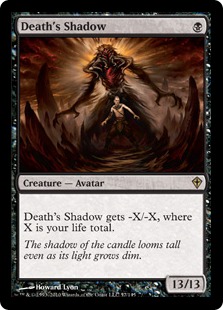
Foil copies of Stubborn Denial doubled in price from $12 to around $25, before settling at $20, after it became a maindeck staple in the hottest deck in Modern. Grixis Death’s Shadow won both SCG Baltimore and GP Copenhagen, and has grown in popularity to be the number one Death's Shadow variant, eclipsing Jund—that means Stubborn Denial is seeing a lot more play.

There was an error retrieving a chart for Logic Knot

Logic Knot was a four-of in the Jeskai Control deck that top-eighted GP Kobe, and its foil Modern Masters printing spiked from $1 to $4. The original-printing Future Sight with its unique future-shifted frame hasn’t budged from its $11 pricetag, but the reprint was a huge bargain at a dollar and has soaked up the new demand for foil versions.

There was an error retrieving a chart for Living End

Living End saw a spike that more than doubled its price, from $35 to over $80, which is indication of how much its stock has risen after gaining new cycling creatures in Amonkhet and making its way to the finals of GP Copenhagen.

There was an error retrieving a chart for Horror of the Broken Lands

Horror of the Broken Lands saw a massive spike from $1 to over $6 based on the growing popularity of Living End. Many versions of the deck also use Desert Cerodon. Under $1 foils seem like a real bargain, and at $3 Archfiend of Ifnir has room to grow.

There was an error retrieving a chart for Simian Spirit Guide

Simian Spirit Guide has been a Modern staple forever, but it’s currently seeing more play than ever. It’s a critical part of the Ad Nauseam deck, which has risen to new heights in competitiveness and popularity, and it has seen a new surge in demand from Living End players. This has sent the foil price up to nearly $80 from where it sat below $50.

There was an error retrieving a chart for Faerie Macabre

Another staple in Living End is Faerie Macabre, which offers graveyard removal that doesn’t get cascaded into, and that even offers great synergy with Living End because it discards itself to be reanimated. It’s seen a huge spike from $5 to nearly $20, and extra demand from other Modern decks and Legacy should help buoy its price.

There was an error retrieving a chart for Eidolon of Rhetoric

Foil Eidolon of Rhetoric grew from $5 to above $8 based on its increasing utility in Modern. It stops cascade spells from ever being cast, so it hoses Living End. Gifts Storm has also become a very serious contender in the format, so Eidolon of Rhetoric is better than ever and has plenty more room to grow.

There was an error retrieving a chart for Ethersworn Canonist

The increased value of the Arcane Laboratory effect in Modern explains the spike in foil Ethersworn Canonist, which has grown from under $9 to $50. I expect some of this is crossover demand from Legacy, which has seen Storm rise to the top after the banning of Sensei's Divining Top removed Counterbalance from the metagame.

Commander

There was an error retrieving a chart for Haven of the Spirit Dragon

The Commander 2017 leaks revealed that Dragons will be one of the stars of the show. In anticipation, foil Haven of the Spirit Dragon has spiked from $3 to $12. There will certainly be an increase in demand for Dragons, and because Haven of the Spirit Dragon is included in the leaks, there will be plenty of people who seek foil versions as they bling out their new deck.

There was an error retrieving a chart for Grim Poppet

Grim Poppet plays a part in the Hapatra deck that has driven up the price of all of its cards, and the artifact has a lot of crossover appeal and even sees fringe Eternal play. The new demand spiked the foil price to from $3 to $10.

There was an error retrieving a chart for Alesha, Who Smiles at Death

Alesha, Who Smiles at Death is growing in popularity as a commander, and that has spiked the price from under $3 to $8.

Outing Your Foils

When dealing in foils, condition is more relevant than ever, and the most premium prices are reserved for the cards in the best shape. There is certainly a market for played versions, especially for the most in-demand cards, but be sure to do your research and tread carefully.

Foils also tend to be less liquid than nonfoil cards, similar to old high-end cards, because there are fewer players that demand them. The average player who just wants to game doesn’t buy or trade for foils, which are reserved for more invested collectors.

Don’t expect to move your foils locally—and even some buyers at events will be hesitant to tie up cash into them. Thus the internet is your best friend for finding buyers for your foils at top dollar. Doubly so for foreign foils, which have an even more niche audience demanding them.

- Adam

Drawing Conclusions: Stoneforge Musings

Are you a Quiet Speculation member?

If not, now is a perfect time to join up! Our powerful tools, breaking-news analysis, and exclusive Discord channel will make sure you stay up to date and ahead of the curve.

I've had my mind on the Modern banned list a lot lately—in December, I optimistically wondered at the possibility of a Preordain unban; more recently, I wrote up some general thoughts on format health. In the conclusion of that article, I offered, "Blue and white do continue to struggle relative to the other three colors, making me think now’s perhaps as good a time as any for an unban. Wizards has always waited for periods of relative stability and health [...] to release cards back into Modern, and I wouldn’t be surprised if something like Stoneforge Mystic came off this time around."

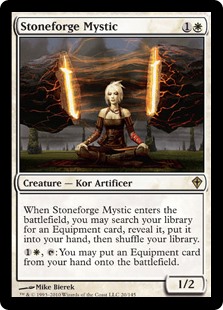
Indeed, a Stoneforge Mystic unban seems feasible for the first time ever. This article examines official statements from Wizards, the company's past behaviors, and Modern Nexus's own tests with Mystic to determine whether the card would be safe to release from the banned list.

A Blade Unforged

Wizards's banned list announcements, as well as their reasoning for banning Stoneforge Mystic from Modern in the first place, provide an ideal starting point for our discussion. At the end of the day, Wizards will decide whether Stoneforge ever again sees the light of day, but we can still draw conclusions from the language and habits of the company. Scrutinizing and understanding their previous actions will help us predict the card's fate accurately.

Stoneforge Mystic: The Crime

For starters, what did Stoneforge actually do to earn its ban? In Modern, nothing; the card was banned before it could ruin the format. Rather, Stoneforge was immediately banned from Modern as a sort of insurance. Just before Modern's creation, the Kor Artificer gave Wizards headaches as it dominated Standard alongside Jace, the Mind Sculptor and put on a show eternal formats, too. Here's Tom LaPille's explanation for banning Stoneforge from Modern's outset:

I hope that the fact this card is on the banned list isn't a surprise to you. Stoneforge Mystic has by now made its mark on every format from Standard to Legacy, and Stoneforge-based blue control decks regularly do well in Legacy tournaments. Porting such decks into Modern was a trivial affair, and resulted in very powerful decks. We prefer to just ban this card rather than risk yet another format dominated by Stoneforge Mystic.

In 2011, Wizards was primarily concerned with ensuring Modern wasn't simply a potpourri of existing decks from other formats, and especially from the miserably stagnant Standard they'd just diffused. They wanted the format to have a unique identity and original decks. Success in this aspiration was crucial at the format's birth, as Modern was not yet established, and needed to offer something novel and alluring to pique the interest of players frustrated with the dreary "Standard Plus" of Extended.

Similar Offenders: Valakut, Blossom, Vision

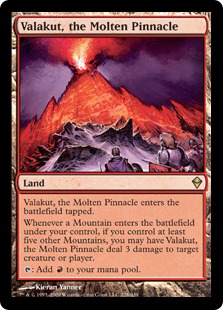
LaPille's theme of immediately banning recent, powerful Extended and Legacy strategies from Modern went beyond Stoneforge Mystic. Valakut, the Molten Pinnacle, Bitterblossom, and Ancestral Vision all reserved spots on the banned list too, as well as similar blurbs featuring much of the same language. By now, each of these other cards has come off the banned list. This section dissects the texts Wizards provided with those unbans.

Valakut, the Molten Pinnacle

Unbanned: September 20, 2012

Rationale:

Recent Modern tournaments have been diverse, with no deck dominating the metagame. Since Modern is a non-rotating format, banned cards never rotate out. The DCI is unbanning a card to see how that affects the format. We looked for cards that were on the initial banned list for Pro Tour Philadelphia. We wanted a card that would not easily slot into an existing top deck and also wanted to enable a deck with a different play pattern than the current top decks. After examining the options, Valakut, the Molten Pinnacle was selected as the card to unban.

Here, Wizards points to format diversity as a motivator for an unban. Modern looks especially healthy these days, meaning the time may be right for a card to come off.

They also acknowledge that the card to unban would need not to slot into a top-tier Modern deck. Since Death's Shadow's ascent, traditional BGx Rock decks like Abzan occupy a pitiful metagame share, and Stoneforge for the first time doesn't easily slot into any of Modern's top decks (Grixis Shadow, Jund Shadow, Storm, Affinity, Eldrazi Tron, Vizier Company, etc.). The card also enables new play patterns by bolstering fish decks like Death & Taxes and permission-based card advantage decks like UW Control.

Bitterblossom

Unbanned: February 3, 2014

Rationale:

At the time of Modern's inception, the dominance of Faeries in Standard was at the front of our minds. Therefore, we took the conservative approach of including [mtg_card]Bitterblossom[/mtg_card] in the initial banned list. After observing the evolution of the Modern format, we feel that it is of an appropriate power level to compete with the other powerful strategies in the format.

Wizards concluded in this announcement that casting Bitterblossom on turn two would not put the game away. After all, many Modern decks aim to win by turn four. While Bitterblossom interacts with some of these strategies, it leaves plenty of ground uncovered. Wizards was vindicated in their assumption, and may come to a similar conclusion regarding Stoneforge Mystic.

Ancestral Vision

Unbanned: April 4, 2016

Rationale:

Ancestral Vision is a very efficient card-drawer. Historically it has been strong in decks using the cascade mechanic, which immediately casts Ancestral Vision from the deck to draw three cards. It has also been strong in blue-based decks that are playing a longer, attrition-style game. With the current banned list, including Bloodbraid Elf, the types of cascade cards usually played with Ancestral Vision are not available. While there are some control decks that would use Ancestral Vision, it is an underplayed portion of the metagame. To allow for an increase in the number of blue-based control or attrition decks, we are unbanning Ancestral Vision.

This announcement calls out lesser-played archetypes as potential motivators for an unban. The fish and control shells in which Stoneforge Mystic finds itself most at home have been under-represented in Modern for years, especially compared with midrange archetypes like BGx Rock or aggro-combo decks such as Affinity and Burn.

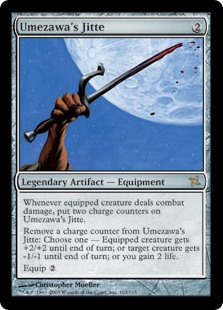
Wizards also mentions that the cascade creatures that make Vision great in Legacy are not legal in Modern. Similarly, the crucial Umezawa's Jitte is banned in Modern. Stoneforge Mystic in Modern is literally a less powerful card than Stoneforge Mystic in Legacy for this reason, and significantly so; Jitte is almost always included alongside Mystic in that format.

What Stoneforge Does for Modern

Based alone on the unban justifications for Valakut, Blossom, and Vision, it already seems Stoneforge Mystic has a chance of coming off the banned list. After all, the card seems to fulfill the conditions of each of these three announcements! To recap those goals, a Stoneforge Mystic unban would:

  • Come during a period of stability and diversity.
  • Not slot cleanly into a top-tier Modern deck.
  • Perhaps enable decks with play patterns different from those of the top decks.
  • Boost still-struggling, permission-based attrition decks.
  • Produce a much weaker version of the card than is available in Legacy.

But Stoneforge Mystic does something more for Modern: it specifically addresses a problem Wizards has with the format. Here's a quote from their April 24 banned list announcement this year:

In Modern, Death's Shadow continues to be the best deck, but technology like Condemn is starting to emerge, and the format appears to be in a safe spot at the moment. While deck diversity is good, we're keeping an eye on color balance. If there's an easy change to the banned list that could open up more decks in the future, we will examine it when other formats have less pressing needs.

Black, green, and red have been Modern's primary colors for years. Blue has needed help since the Twin ban, but is looking up now with Grixis Shadow and UR Storm (in fact, I would be against a Preordain unban now, and am relieved Wizards waited before pulling the trigger on that one). White, though, continues to struggle, often relegated to sideboard bullets or a Lingering Souls splash. Fatal Push's arrival only worsens the scenario by giving non-white decks a one-mana, heavy-duty removal spell.

Stoneforge Mystic may be powerful enough for players to splash for, as they do for Tarmogoyf. If it is, the "easy change" of unbanning the card could help mollify Modern's color diversity issues. And if not, Mystic doesn't belong on the banned list anyway.

Recalling the Nexus Stoneforge Tests

I'd be remiss not to mention the data Modern Nexus itself has procured on this subject. Our own David Ernenwein put in 600 games with a Stoneforge Mystic-featuring Abzan deck and concluded an unban to be unsafe for Modern. Here's his recommendation:

Based on the results of my testing Stoneforge Mystic in Junk Abzan I recommend against unbanning. My results partially prove the hypothesis true, but analysis of the impact suggests that over the long term it will have the opposite effect.

While its power is manageable and it would give players more reason to play white, its impact would not be positive. It negatively impacts the viability of fair aggro decks and non-Stoneforge midrange decks, while having a negligible impact on the less fair decks. The likely outcome would be a shift to more unfair decks and the speed of the format increasing to try to ignore and invalidate Batterskull and Swords. Therefore there is no reason to unban Stoneforge Mystic.

As he elaborates in the article, David found Stoneforge to aid fair midrange decks in combating aggro decks. He also found Stoneforge's presence to benefit unfair aggro decks that didn't care about Batterskull, especially Infect. But Infect bit the dust with the Probe ban. Modern's existing midrange decks, including the now-fringe Abzan, could definitely use a hand against the format's aggressive stalwarts—which, in turn, include the Death's Shadow menace.

Closing Statements

Four months have passed since GP Vancouver, and Death's Shadow is still Modern's deck-to-beat. Luckily for everyone, Shadow is a skill-intensive deck Modern players enjoy playing with and against, and prefer losing to over something linear. And while it's the best deck around, it's far from oppressive in terms of representation, whether or not those numbers correlate perfectly with its strength.

It seems to me that Wizards is at a crossroads. It's likely that classical BGx Rock decks return to their former glory should Wizards decide to neuter the Shadow decks, and at that point, Stoneforge Mystic could become an issue in Abzan. But should Wizards leave Shadow alone, Stoneforge can be unbanned without fear of creating a Tier 0 powerhouse, and stands to benefit the already thriving metagame in multiple ways. Let's hope the company's learned its lesson from trying in vain to shape Standard with a series of brute-force bans and tries giving Modern tools rather than taking them away.

Insider: Unexpected Spoilers – Dragon Tribal

Are you a Quiet Speculation member?

If not, now is a perfect time to join up! Our powerful tools, breaking-news analysis, and exclusive Discord channel will make sure you stay up to date and ahead of the curve.

It’s amazing how far technology has advanced in the past handful of years. Currently my computer resides in a corner awaiting parts to bring it back to functionality once more. I remembered I bought a tiny laptop, nearly a decade ago at this point, so I brought it out to type up this article for you guys. What I figured out is that it’s so slow that I’m better off doing my research on my phone and just using this machine for its word processing capabilities. It’s crazy that we have advanced so far with our phones that this would be true.

Wizards figured out that they needed to break the model for one of their product structures as well. Here’s what info they have given us so far:

“This year, Commander decks return with Commander (2017 Edition) on August 25, 2017. The set features four new tribal-themed, 100 card decks including 56 all-new Magic cards legal in Vintage and Legacy.”

Just like I’m using my phone to write this article, Wizards is breaking their five Commander deck model this year and only releasing four decks. Tribal themes are quite popular with the masses and I’m a big fan as well. Every set that’s released, the writers in the finance community tell you all about why this Dragon or that Zombie and maybe a new Goblin will be a great financial investment because the casual players will eat it up. That’s going to be the same for these four new decks.

What we know so far is next to nothing. Well, luckily for this article, that’s not exactly true. We don’t officially know anything, but thanks to a leak we know that one of the four decks will be Dragons!

As financiers we are well aware how popular the Dragon tribe is with the player population, especially the casual part of the spectrum. I can tell you from experience that I have patrons come in and specifically ask about Dragons. This has happened enough that I try to keep track of what Dragons we have in stock at any given time so I can point out some potential sales to interested buyers. I wouldn’t be surprised if, even if the value of the Dragon deck isn’t the highest of the four, stores have a hard time keeping it in stock.

The next question for me is what are the other three tribes going to be? After the disappointing From the Vault: Angels a couple years ago, I think Wizards may try to right some wrongs and use that popular tribe, but past that, things are a little uncertain. Last year the Commander decks were the four-color variety and 2015 was the enemy colors. We have to go back to 2014, when the mono-colored decks were released, to really get some tribal stuff from our Commander products.

That means it’s likely we’ll get Elves, Goblins, or Zombies. Whatever tribes are chosen, I hope we get some cool new cards with interesting colors. I don’t think we need a mono-white Angel commander deck or a mono-green Elf deck. We’ve had lots of products like that in the past and it’s time for something new.

I think by creating only four decks, Wizards is trying to tell us to expect something new and fresh. The best part about new and fresh is the sales that come along with it, so let’s all hope for an exciting new Commander product. Until we know more, let’s dive into the Dragon leaks and see what we’re working with.

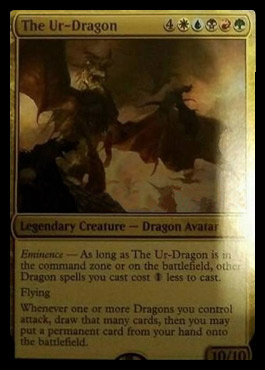
The Ur-Dragon & Ramos, Dragon Engine

theurdragon

Back in Time Spiral a card was released called Scion of the Ur-Dragon. This legendary creature was a popular commander for a while because of its combo potential. This Commander deck utilizes this plot hook and adds some new info with what seems like the marquee of the Dragon deck, The Ur-Dragon. I’m guessing Ur is like his title sort of like the king dragon. I’m not a huge fan of the name, but the card is sweet.

We get a new key word, eminence, which is basically the Oloro, Ageless Ascetic ability applied to more cards. Personally I find this ability to be a bit cheaty and unfair. Everyone else must have their Commander on the field, but with Oloro (and now other commanders), they can just chill in the command zone and you can wrack up advantage by doing nothing. Ranting about mechanics aside, this is obviously a great set-up and Commander players will love it.

The Ur-Dragon’s eminence ability makes all your Dragons cost one less mana and that’s crazy good. Unlike with Oloro, though, you won’t want him to sit in the command zone the whole game. Once he’s in play, you get to start drawing cards when your Dragons attack. Not only that, but, you get a free Show and Tell or Hypergenesis type effect! So you get to draw extra cards and cast things for free every turn. Yeah, I think Commander players are going to love this product.

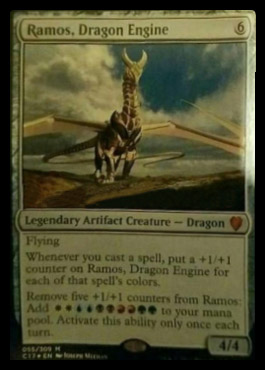
To go along with The Ur-Dragon, we also know about Ramos, Dragon Engine.

ramosdragonengine

With The Ur-Dragon as your commander, Ramos doesn’t cost the printed six mana though. He is reduced to a mere five mana. The ability to generate mana might be better suited but the fair thing to do with it is cast a five-color spell the following turn along with The Ur-Dragon. You could also cast Progenitus or any other combo-type cards with your ten mana too! There’s a ton of potential with Ramos but there’s also fair Dragon fun too, and that’s the best combination.

The great thing about these Commander products is that they always produce many options for commanders.

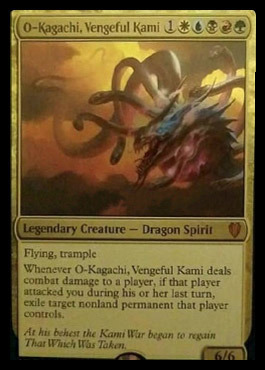
O-Kagachi, Vengeful Spirit

okagachivengefulkami

O-Kagachi, Vengeful Spirit will be one of the new options from this product. Despite his terrible name, his creature type being Spirit and Dragon will be fun for some in the Commander crowd. I know I’ve toyed with fun Spirit tribal builds before, so I’m sure others will be excited about this one too. It allows you to get revenge for other players attacking you too, so the players who enjoy the politics of the format will jump on board with this one.

Basically all of these mythic Dragons should hold some value as well. Even if they are only a couple bucks, they should be worth a little and the best ones will draw more demand than that.

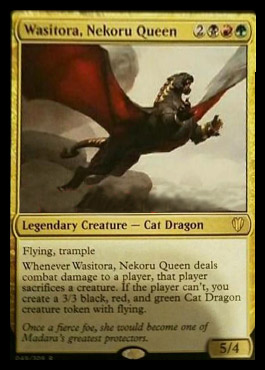
Wasitora, Nekoru Queen

The last Dragon on the agenda today is Wasitora, Nekoru Queen. With this Dragon we have yet another ridiculous name, but also a ridiculously cool design.

wasitoranekoruqueen (1)

Cat Dragon? That’s a new one. I guess this is similar to a Manticore but with relevant creature types, so that seems cool. I doubt this commander will be crushing the competitive scene anytime soon, but the fun crowd will love this.

For five mana you get a 5/4 flying, trample creature that makes other players sacrifice creatures. If they have no creatures to sac, you get a 3/3 smaller version of your commander. Seems really fun to me. Not going to break the bank on its price tag most likely though, but any of these commanders are great to have a couple of for the random player who’s interested.

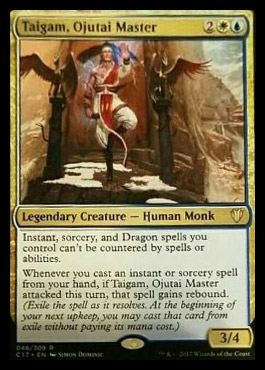
Taigam, Ojutai Master

Last up is a Human Monk that synergizes not only with Dragons but with other strategies as well.

taigamojutaimaster

Taigam, Ojutai Master is a huge part of what I love about these Commander products. Not only does it have Dragon synergy, but also combo or control synergy as well.

There are so many different ways you can utilize this commander and if it weren’t a rare, it might be worth some double-digit dollars. You can play it with Dragons to make them uncounterable or you can just play a normal blue-white control strategy with your spells uncounterable. Either route sounds great and will likely lead you to victory. If it cost a mana less, we’d be seeing some eternal play from this guy as well.

So far, none of these cards seem like they will break the bank with their individual price tag, but they look great to generate hype about the Commander decks. What are your thoughts on the Commander applications as well as their possible prices? Let me know in the comments.

Until next time,
Unleash the Dragon Force!

Mike Lanigan
MtgJedi on Twitter
MtgJedi on YouTube

Insider: Trading Is Dead (But Not for Bulk)

Are you a Quiet Speculation member?

If not, now is a perfect time to join up! Our powerful tools, breaking-news analysis, and exclusive Discord channel will make sure you stay up to date and ahead of the curve.

I'm sure this isn't the first article written about Magic finance to use Trading Post as a thumbnail. Thankfully, I'm pretty sure it's been a while. The concept of "trading" (between players, not trading cards into an LGS for credit) has been written off as dead or dying for the past few years, ever since the proliferation of MTG pricing apps and the constant fear of "losing value" on the side of either party. The ease and accessibility of buying cards online has contributed to this, of course. Dedicated "binder grinders" have mostly faded into antiquity, other than on the Grand Prix scale.

I personally stopped bringing binders to my LGS back in 2013 or so, because it was just too much of a hassle. I didn't want to spend 20 minutes of my time trying to find another dollar card to make a trade even, so trading as a frequent occurrence just sort of vanished. Of course, this is all anecdotal. I don't go to your LGS (unless you live in Upstate New York and frequent Legacy Gaming Company), so maybe trading between players is still alive and well where you are. Maybe none of this paragraph applies to you, and there are binders open all the time at your LGS, with players happy to work out deals among themselves.

I can only attest to my own experiences. I'm here to tell you why (and how) I shifted to trading for bulk rares, near-bulk rares, commons, and uncommons.

I wish I could tell you about the first bulk rare trade I made. It was probably around 2011-2012, and it was probably after reading an Insider article that suggested the concept. I had accumulated an average binder of singles, but I also had all the decks I wanted to put together completed. I had Standard Birthing Pod, Modern Birthing Pod, and my Savra, Queen of the Golgari EDH deck. I wasn't really wanting for anything other than foils for the latter two, so trading was spent trying to get value.

I would try to pick up cards that I thought would go up in price (shocklands were a big one back then), and I would be moving common/uncommon picks as playsets (Azorius Charm, Strangleroot Geist, that kind of thing), but it was really just trading for nickels and dimes. I wasn't moving $100 trades constantly, it was just low-level stuff. It had gotten to the point that, other than specs, there was nothing I could find in someone else's binder that I actually wanted.

There was an error retrieving a chart for Strangleroot Geist

Eventually, it got to the point where there was nothing in the other party's binder, but I still had something they wanted. Whether it was a Sphinx's Revelation, Griselbrand, or even one of the few dual lands I owned at the time, we had reached a point where I was staring at eight pages of Sire of Insanity and Corpsejack Menace, while they wanted a single card of high value.

I made an offer. "Would you be willing to trade all of the garbage rares, at a flat rate, towards this Tundra?"

You can, of course, let them choose what's bulk, and feel free to correct them if they make any egregious errors. Once I had someone try to bulk out a Coat of Arms to me at ten cents and I had to gently move it over to the four-dollar pile on my price mat. Giving people more value than they expect is a great way to make repeat customers. Moving stuff like Smuggler's Copter to the $0.50 pile will widen a few eyes too, considering how these have sat in binders for so long.

There was an error retrieving a chart for Smuggler's Copter

Obviously, pulling out a pricing playmat at a Grand Prix or inside of an LGS without permission is not okay. Discuss this with the owner prior, or figure out a solution that works best for both of you. However, local stores and conventions aren't the only places where Magic is played. Is there a weekly Commander league at your school where people bring their binders? Maybe you can make some extra value trades while you get some games in. Competitive playtesting sessions with the grinders looking to tackle PPTQs? Bring your binder just in case someone decides they want to tech the Leyline of the Voids you brought with you in their sideboard.

Bulk rares are more common than you might think, especially once you do this for a few months and eventually secure a reputation as "the bulk rare person." This strategy might not work for everyone, especially if your LGS is willing to accept bulk rares at a reasonable rate.

Alternatively, let's go down that road for a second. Maybe your LGS buys and sells bulk rares. Unless they're a very large and successful store, they probably don't have literally every card cataloged by set and alphabetically. Even now as the guy sitting behind the counter, I have customers pull out stuff that I probably shouldn't have had in my 25-cent box.

They make money off of me, and so can you. If your store has a $0.50 bulk rare box or something similar, I highly recommend going back and reading a few of my articles from last month (and the next few to come), then digging through the bulk at your LGS. You'll probably find some Reef Worms like we discussed previously, or even some of the non-bulk rares I'm going to go over now in this week's section of Breaking Bulk.

Breaking Bulk

There was an error retrieving a chart for Lifeblood Hydra

Lifeblood Hydra was in the Freyalise deck, and it's getting a reprint in Commander: Anthology. Don't let that fool you though; this Hydra isn't one of the bulk ones that rest in my quarter box. Retail on this card is close to $3, and I doubt that the upcoming reprint will be enough to put a dent in the price tag for very long. You might have local players cracking that very product to get the Kaalia, Meren, Freyalise, and Sol Rings, but they'll probably leave stuff like Siege Behemoth behind. Be there to trade for them or pull them from bulk.

There was an error retrieving a chart for Aegis of the Gods

This is one of my favorite trivia cards that everyone seems to think is worth bulking out at a dime. I'll happily pull these out and buylist them at close to a dollar all day, especially with such a small spread. TCG market on this fragile Leyline of Sanctity is close to $1.50, but he gets skimmed over all the time simply because Journey into Nyx was kind of a garbage fire of a set. It's also not really a competitive card (that I know of), so it flies under the radar pretty often.

There was an error retrieving a chart for Hornet Nest

It's Frontier-legal!! Okay, that's not why this card is $1. It's more than a bulk rare because it has one printing, and enough casual demand with people building Stuffy Doll-style decks where they ping their own creatures and play stuff like Blasphemous Act and Shivan Meteor.

Buylist? Anywhere from 25 to 50 cents, depending on the way the wind blows that day. Obviously you're not a Magic finance millionaire if you just find one of these in bulk, but that changes if you stop by an LGS that happens to have a playset of each card mentioned in this article so far. Add them to a buylist order to Cardkingdom or the Blueprint, and you suddenly paid for all your shipping costs.

End Step

This will be my last article before Grand Prix Las Vegas! I'll be working at the Hareruya vendor booth on Wednesday and Thursday, so feel free to stop by and say hi! I'll be spending the rest of the weekend selling cards to vendors, getting married, and then hanging out at the Command Zone's party on Thursday night. I hope everyone has safe travels to the event!

A Look Ahead: Predicting Modern Five Weeks From Now

Are you a Quiet Speculation member?

If not, now is a perfect time to join up! Our powerful tools, breaking-news analysis, and exclusive Discord channel will make sure you stay up to date and ahead of the curve.

This week, I plan on doing something unique. Event analysis has long been my preferred approach when it comes to writing—and reading—about Magic, and I feel strongly that my skills in methodically sifting through data, testing hypotheses, and arriving at conclusions is one of my biggest strengths in Magic, both as a writer and as a player. Still, I’m starting to come around to the idea that I should be considering a different direction when it comes to my weekly articles. The week before Baltimore, I correctly called Grixis Death’s Shadow as the deck to play on event weekend. The weekend after, I broke down the results (and my claims), evaluating the tournament results and speculating on what to do moving forward. Both of these pieces failed to generate much interest. The way I see it, there are two possible scenarios here: 1) everyone knew about Grixis Death’s Shadow, and my claims weren’t the hot takes I thought they were, or 2) I must be incredibly boring.

Feel free to tell me if I’m wrong, but for now, I’m going to go with Scenario 2, which means this week is as good a time as any to double down. I successfully called Grixis Death’s Shadow this weekend; can I do it again? Today, we’re going to take a look at the format as it stands now, anticipate what changes could be on the horizon, and conclude with some definitive claims about where I expect the format to be in a couple of weeks. Hopefully, this will prove as exciting for you as it is for me, as I flex my analysis muscles like never before, and put what little reputation I have on the line.

Modern Today

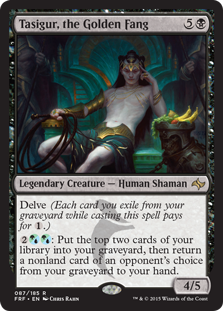
Grixis Death’s Shadow is the new kid on campus, a true dark horse candidate, catapulted seemingly out of nowhere to its lofty throne atop the Modern metagame spread. Central to its success is the relative strength and strong positioning it enjoys due to how its removal lines up against the format’s threats, and vice versa. Playing Lightning Bolt and Fatal Push to kill opposing small creatures, while simultaneously sidestepping the same removal with delve threats like Tasigur, the Golden Fang and Gurmag Angler, is the primary reason why Grixis Death’s Shadow is the current format king. The deck is fast, powerful, and flexible, and can play any phase of the game from a position of strength.
Hot on its heels, Eldrazi, Affinity, and Burn threaten to take the throne. In recent weeks, Affinity occupied the top spot, but only by default, as prospective opponents chose to devote sideboard slots to fight combo strategies like Dredge and UR Storm. Now, Affinity is seeing its numbers dwindle slightly, not due to any increase in specific hate, but rather a decrease in favorable format conditions thanks to a rise in cheap removal and Kolaghan's Command out of Grixis Control. Burn, on the other hand, is watching its stock rise, as Dredge and Grixis Control, poor and good matchups respectively, trend in favorable directions. Finally, as consistent as ever, Eldrazi Tron remains the culprit behind this highly linear field, single-handedly forcing midrange and RG Tron out of the Modern landscape.

Waiting in the Wings

Below these frontrunners are a shortlist of potential candidates, each looking to ascend into the conversation of top decks in the format. Modern’s second tier is smaller today than it’s ever been, thanks in large part to Eldrazi Tron forcing homogeneity in the format. As has always been the case, and is more so today—do what you want to do, and do it quickly. Jund, Abzan, and Grixis Midrange strategies have an uphill battle against five-plus highly competitive, highly focused top strategies, and stumbling in 2017 Modern is just as fatal, if not worse, as it has been in years past.
Still, UR Storm and Dredge lead a pack of plucky hopefuls, joined by newcomers like Living End and Counters Company. As is the case with Living End, it seems destined always to play second fiddle to Dredge, as it is hurt by the same cards without the consistency or reliability Dredge can claim game after game. Counters Company threatens to take over the format on power level alone (a two-card combo to give infinite mana on turn three?!) but runs headfirst into a format that currently remains prepared to deal with it, thanks to Grixis Death’s Shadow and their plentiful disruption and removal.

Two Possible Scenarios

As I see it, there are two possible scenarios that could play out in the next five weeks, a time period I’ve chosen specifically as it's not too long to become too unpredictable, yet not too short that nothing will happen. While it’s true that Modern moves slowly when there are no major events like we saw two weeks ago, five weeks is usually enough time for some changes to be made, both at the top and under the surface. After all, before Grixis Death’s Shadow took the lead, Affinity occupied the top slot in the format for at least a month, and before that, Dredge was putting up consistent results while the rest of the format came around to packing the hate they needed to supplant it. Five weeks ensures that the online metagame will “solve” the current format as it stands, whether that means things staying as they are now or molding to how thing should fall, while also giving the opportunity for a large-scale paper event to come along and shake things up.

Now, back to those two scenarios. Don’t worry, I won’t be hedging my bets and doing one of those, “banking evenly on both scenarios so I’m right no matter what happens” cop-outs here. I am, however, being honest by saying that the future is unpredictable, and the format can move in two very distinct directions based on one point of deviation. Let’s look at our options.

1) Eldrazi Tron recedes

First, as I’ve said for a while, the true villain in the format isn’t the top deck of the month—it’s Eldrazi Tron. Before, Bant Eldrazi kept many of the “honorable” strategies that struggled through one glaring weakness out of any hope for possible contention. If you stumbled too often, Eldrazi would destroy you. If you couldn’t turn the corner, Eldrazi would grind you down. If you didn’t find your answer in time, Eldrazi would run you over. Bant Eldrazi is gone from the top tables now, but the format boogeyman remains in the form of Eldrazi Tron—only this time it’s gotten even better.
Tron decks have always been the traditional foil to the midrange decks of Modern, claiming strong matchups across many different metagame contexts and format changes. Currently Eldrazi Tron is occupying this role most prominently, as the strongest and best represented big-mana deck. While Eldrazi remains a top-four archetype in the format, midrange will continue to struggle in their current form. The matchup against Eldrazi may look good for reactive decks on paper, but it isn't thanks to a ton of free value and game text that Eldrazi gets to enjoy. It’s a true catch-22 scenario—midrange could tool their decks to take down Eldrazi Tron, but in doing so would lose to everything else in the format, which has trended more linear and easily disrupted thanks to midrange not being around to punish them. Were Eldrazi Tron to suddenly disappear, midrange would return in full force, bringing with it sweeping changes to the highly linear Modern format we see today.

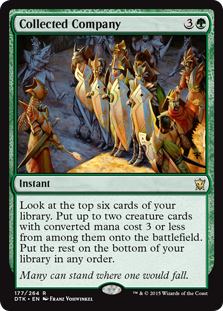
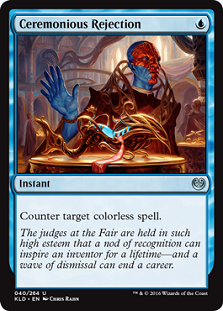
The seeds of Eldrazi Tron’s demise were planted two weeks ago, in the form of Ceremonious Rejection. Grixis Death’s Shadow proved to the world that it was possible to tune your maindeck to fight a large portion of the field, while at the same time retaining a core strategy, leaving the sideboard to shore up a few concentrated matchups. Three Ceremonious Rejection is a statement—one that, if adopted, will cause things to change, for better or for worse. Eldrazi Tron could adopt Cavern of Souls, but in doing so would have to lose Ghost Quarter, and it’s possible Cavern of Souls might not even be enough. Forcing Eldrazi Tron to become one-dimensional, losing out on their Karn Liberated top end (not to mention a ton of their fixing) could prove to be too much for the archetype, and might sponsor a change at the top. If this happens, expect midrange to return, individual archetype representation to fall across the board, and (potentially) a more diverse spread of archetypes to find a foothold.

2) Grixis Death's Shadow folds to hate

The second option, of course, is basically the opposite. The format chooses to respond disproportionately to Grixis Death’s Shadow, attacking its perceived threat to the format status quo, and in turn, Grixis Death’s Shadow fails to defend against this new threat while also keeping up its efforts against poor matchups across the board. With Grixis Death’s Shadow out of the picture, we could expect to see Burn’s numbers dip again, while Affinity potentially regains the top spot as players go back to see-sawing between fighting Dredge and UR Storm.

I find this unlikely, but possible, due in large part to Eldrazi Tron forcing format homogeneity. Grixis strategies of all flavors have suffered when there have been too many enemies to fight, and it’s poetic, in a sense, to see its true enemy in the format (Eldrazi Tron) doing it a favor by keeping out potential strategies that could give it trouble. Living End, Merfolk, true control, Scapeshift, and even ramp decks would have success against Grixis Death’s Shadow in its current form, but none of those strategies can pass the Eldrazi test that stands as a barrier to entry for the format.

Conclusion

It is my belief that Grixis Death’s Shadow will not remain on top for long, but before it falls from its throne Grixis will see the format shift around it in a meaningful way. While five weeks is a short enough time to see a small shift back to the way things were before Modern weekend, I believe that Counter Company as a new archetype in the format will force decks to prioritize cheap removal highly, which will continue to play into Grixis’ hands. If more players pick up the deck, which is likely given its strong performance, and said players choose to target Eldrazi Tron with their sideboards, we could see the format stress test take a significant hit.

A diminished Eldrazi Tron would allow multiple strategies into the fold that will in turn diversify the threats against Grixis Death’s Shadow, causing its decline (but overall, an increase in format health). Who comes out on top is hard to tell, and frankly, not really that important. Still, I’m banking on Eldrazi Tron diminished five weeks from now, midrange back in the fold, and a more diverse metagame across the board. This thanks to Grixis Death’s Shadow, which owes its thanks to Counter Company, which owes its thanks to Eldrazi Tron. The circle is now complete.

Thanks for reading.

Insider: MTGO Market Report for June 7th, 2017

Are you a Quiet Speculation member?

If not, now is a perfect time to join up! Our powerful tools, breaking-news analysis, and exclusive Discord channel will make sure you stay up to date and ahead of the curve.

Welcome to the MTGO Market Report as compiled by Matthew Lewis. The report will cover a range of topics, including a summary of set prices and price changes for redeemable sets, a look at the major trends in various Constructed formats and a "Trade of the Week" section that highlights a particular speculative strategy with an example and accompanying explanation.

As always, speculators should take into account their own budgets, risk tolerances and current portfolios before buying or selling any digital objects. Please send questions via private message or post below in the article comments.

Redemption

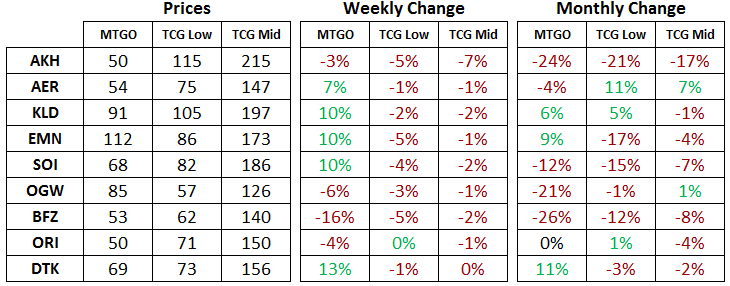
Below are the total set prices for all redeemable sets on MTGO. All prices are current as of June 5, 2017. The TCGplayer low and TCGplayer mid prices are the sum of each set's individual card prices on TCGplayer, either the low price or the mid price respectively.

All MTGO set prices this week are taken from GoatBot's website, and all weekly changes are now calculated relative to GoatBot's "full set" prices from the previous week. All monthly changes are also relative to the previous month's prices, taken from GoatBot's website at that time. Occasionally, full set prices are not available, and so estimated set prices are used instead.

june5

Standard

Amonkhet (AKH) sets continue to drop this week, off another 3% to sit at 50 tix. Although still dropping, the pace of decline is slowing so if you were thinking about buying sets of AKH, they are getting closer to a price floor. As a speculator, I'm keen to wait another week to see what happens but nibbling at this point or buying sets to play with is defensible.

There was an error retrieving a chart for Rhonas the Indomitable

Kaladesh (KLD) and Aether Revolt (AER) will no longer be redeemable when this article is published.  It's no secret that redemption supports the price of cards on MTGO, but typically we only see the end of redemption for a set after it has left Standard. Having a set in Standard and there being no redemption for that set hasn't occurred since the troubled switch to Version 3 of the client back in 2008, so it will be very interesting to see what this does to the price of these sets.

There was an error retrieving a chart for Spirebluff Canal

In the meantime, one favorite strategy of mine is to consider cards that are a part of a cycle. There's no better cycle to consider right now than the KLD fast lands, since the bulk of the drafting of this set has wrapped up. Spirebluff Canal and Botanical Sanctum are heavily played in Standard in Temur Aetherworks decks and they have the prices to match. High prices can sometimes lead to higher prices, but at the moment these two lands are priced to perfection. In other words, there is not much upside in these.

At the other end of the spectrum is Inspiring Vantage. This card has bounced between 1 and 2 tix since KLD was released, and with Mardu Vehicles on the wane, it is swinging lower at the moment. As a buy-low candidate in Standard, this one has excellent pedigree as it shows up in Modern Burn decks. Being played in Modern provides a nice margin of safety, but there is still plenty of upside if it shows up in Standard.

There was an error retrieving a chart for Blooming Marsh

Although a little more expensive, Concealed Courtyard and Blooming Marsh also see regular play in Modern. They've been in between the 2 and 3 tix level lately, so if you can pick off cheap copies of these two as well, you'll end up with a nice small basket of Modern-playable cards with upside exposure to Standard. These are all buys, but be cautious while prices adjust to the end of redemption.

Modern and Legacy

Grand Prix Vegas is looming and with it will be a spike in interest in both Modern and Legacy. If you've been holding Modern cards, consider this an excellent opportunity to sell down your positions in advance of the release of Hour of Judgement (HOU) in July. A new set is always the best time to be a buyer from a macro perspective, since players and bots alike are in need of tix. Keep that in mind over the next month and be sure to maintain an adequate level of liquidity.

There was an error retrieving a chart for Tangle Wire

Although I don't usually consider Legacy or Vintage, Tangle Wire is a card that has caught my eye in recent weeks. It has seen a massive drop from the 50 tix level a year ago all the way down to an all-time low of 7.5 tix today. This steep drop is unusual and I'd hesitate to assign a precise reason for the decline. There's no doubt the extra supply of these coming online from Treasure Chests has had some impact, but shifts in the metagame of the Eternal formats is likely the key reason. Keep an eye on this one for a potential rebound, especially with the introduction of the Weekend Challenges as driver of demand.

There was an error retrieving a chart for Temporal Mastery

Temporal Mastery has also been a surprise. This Avacyn Restored (AVR) mythic rare was reprinted in Modern Masters 2017 (MM3) and saw prices as low as 1 tix in the past three months. With the original at over 5 tix and the reprint at 3 tix, there's been a lot of buying of this card as a result of the introduction of the competitive Commander format to MTGO. Don't be afraid to scoop up the reprint as budget-conscious players will bid up the price of the cheaper version. This card looks sets to continue higher.

Trade of the Week

For a complete look at my recent trades, please check out the portfolio. This week I started nibbling on the three cheapest KLD fast lands as detailed in the Standard section. The plan is to build a large position in these over time by shopping around and targeting cheap play sets. There's always a bot that will sell a particular card below the price of what the major bot chains are selling theirs for, so building a position slowly can keep your average buy price low. Trying to establish a large position overnight in playable cards will almost necessarily result in short-term price increase, which will raise your average buy price.

Slow accumulation avoids introducing this distortion into the market. Where it can fail is if there is a big change to the metagame, and the price of the card you are targeting spikes higher. This will happen from time to time, and its important to understand your reaction to these events. If you start chasing the trend because the market moved much faster than you anticipated, you will be pursuing a marginal opportunity. It's better to take a step back and move on to other targets than to stick to your guns after the market has moved. There's always another good opportunity waiting to be found.

There was an error retrieving a chart for Inspiring Vantage

I don't expect much change on these in the near term, so being patient with an eye to Fall Standard is the timeline at the moment. However, with Aetherworks Marvel continuing to be a force in the Standard metagame, there's always the chance that another round of bans occurs, resulting in a shakeup in the market. A good speculator will plan for the long term, but will also accept short-term windfalls when they occur.

A Curious Trend: GP Vegas Prep

Are you a Quiet Speculation member?

If not, now is a perfect time to join up! Our powerful tools, breaking-news analysis, and exclusive Discord channel will make sure you stay up to date and ahead of the curve.

By the time this article goes live, it will be just over a week and a half until the Modern portion of Grand Prix Las Vegas. To close a previous thread, yes, I am going and yes, I did win two byes. Not because I actually won a GPT (I have a habit of getting second place at these things), but because I ground out the last 200 or so points I needed in May. This triumph did come at a great and terrible cost, however. I had to play Standard again. *Horrified shuddering*

Anyway, back to good Magic. Over the past month I have witnessed an odd trend at both the GPTs and weekly Modern tournaments: dedicated Legacy players. This is not a bad thing; new players leads to more innovation and coverage. More dynamism and visibility incentivizes Wizards to expand Modern tournaments. That's why I've spent so many words trying to make Modern easier for new players. However, most converts come from Standard. The Legacy crowd was an anomaly, especially since they usually want Modern to be Legacy-lite. I'm more accustomed to hearing them bemoan Modern's lack of cantrips and weaker combo decks. Recently, they've actually enjoyed themselves. This piqued my curiosity.

Talking to the Legacy players didn't yield any insights. I don't think I expected them to just give me an unequivocal answer, but I definitely didn't get one. Everybody had their own reasons for playing more Modern and for picking their deck. However, I think I have an answer. The Legacy players tended to favor Grixis Shadow and Eldrazi Tron decks, which are in fact Legacy-lite decks. Seeing that GP Vegas begins with a Legacy event, this has implications for the Modern field. The consensus best decks (which are definitely popular, but I'm skeptical they're really "the best") are Grixis Shadow, Eldrazi Tron, and Company Combo. Exactly which Company deck is the best is unclear, but both versions are considered very good. Based on this Legacy factor, I think the Vegas metagame will be skewed towards Shadow and Eldrazi. Prepare accordingly.

Legacy-Lite Modern

I will admit that the connection between Modern Grixis Shadow and Legacy Grixis Delver looks thin. As you'll see when I get to the decklists, there's not much overlap. The connection is far more subtle. There is no such problem with Eldrazi Tron. It is Legacy Colorless Eldrazi, but Modern-legal. While I cannot prove this, I suspect this has been the key to it dethroning traditional Tron lists. I know that its land base is harder to disrupt and its spells are overpowered for their cost, but the deck is very clunky compared to regular Tron. The higher threat density is good, as is the mana explosion from Tron, but the lack of accelerants compared to Bant Eldrazi and cantrips compared to GR Tron often make it worse than both. The best explanation I have is the Legacy crowd giving the deck a boost. Just look at the lists.

Legacy Colorless Eldrazi, by Brandon Johnson (8th Place, SCG Louisville)

Creatures

4 Eldrazi Mimic
4 Endless One
4 Matter Reshaper
4 Thought-Knot Seer
4 Reality Smasher
2 Endbringer
1 Walking Ballista

Artifacts

4 Chalice of the Void
2 Umezawa's Jitte

Instants

2 Dismember
2 Warping Wail

Sorceries

2 All is Dust

Lands

4 Ancient Tomb
4 Cavern of Souls
4 Eldrazi Temple
3 Eye of Ugin
3 City of Traitors
3 Wasteland
2 Mishra's Factory
1 Urborg, Tomb of Yawgmoth
1 Karakas

Sideboard

4 Thorn of Amethyst
4 Leyline of the Void
2 Ratchet Bomb
2 Phyrexian Revoker
1 Batterskull
1 Walking Ballista
1 Crucible of Worlds

Eldrazi Tron, by Fumiyasu Suzui (4th Place, GP Kobe)

Creatures

4 Walking Ballista
4 Matter Reshaper
4 Thought-Knot Seer
4 Reality Smasher
3 Endbringer
1 Ulamog, the Ceaseless Hunger
1 Emrakul, the Promised End

Artifacts

4 Chalice of the Void
4 Expedition Map
2 Mind Stone

Instants

3 Dismember

Planeswalkers

2 Karn Liberated

Lands

4 Eldrazi Temple
4 Urza's Tower
4 Urza's Mine
4 Urza's Power Plant
4 Ghost Quarter
2 Wastes
1 Sanctum of Ugin
1 Sea Gate Wreckage

Sideboard

4 Relic of Progenitus
2 Pithing Needle
2 Ratchet Bomb
2 Spellskite
2 Surgical Extraction
1 Crucible of Worlds
1 Ugin, the Spirit Dragon
1 All is Dust

The two decks share the same core of Eldrazi and are built to wield Chalice of the Void. Go back to PT Oath of the Gatewatch and the start of Eldrazi Winter and the similarities get more pronounced. Modern Eldrazi Tron is as close as possible to the Legacy version, and as those who remember the reign of Treasure Cruise Delver can attest, playing a Legacy deck in not-Legacy is really powerful. Colorless Eldrazi was very popular until recently thanks to a good Miracles matchup, so I suspect there will be plenty of pilots willing to make the swap (back?) to Modern.

Explaining Legacy-Lite

I think that what I originally perceived as increased fragility was actually a "legacification" of Modern decks. Legacy rewards decks that are pushed to the extreme of efficiency. Between fast mana, cantrips, and efficient threats it is not only possible, but preferable, for decks to be as cheap as possible. A typical Standard deck's average converted mana cost is 3-4. There are cheap enablers, answers, and threats leading into overwhelming threats. Modern decks' average CMC is normally 2. All of the best answers are one mana while the best threats tend to be at two. Decks don't play many 3-4 CMC spells, but there are enough to boost the average. In Legacy the average is one, and really it's less than one. Not only are there actual zero-cost spells like Lotus Petal, but there are lots of alternate costs that make spells free (i.e. Force of Will and Daze). Yes, I know they have actual mana costs, but that's not important. If they weren't free they wouldn't see play. Ergo, legacified decks will be pushed towards all one-mana spells.
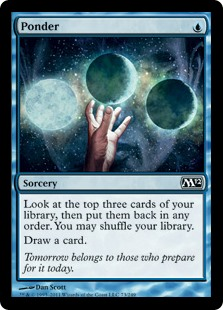
Furthermore, Legacy decks tend towards the fragile. Jordan and I have been over this a number of times, but having Brainstorm and Ponder allows decks to run fewer copies of cards and still expect to see them. Couple this with the fetchlands and you have lots of decks that run few "actual" lands, few threats, and more answers. This facilitates the aforementioned efficiency, allowing decks to only run the essentials, but it also means that they're fragile. With low threat density and high numbers of durdle cards, if you beat the first few threats from a Legacy list, particularly Delver, they are unlikely to have follow-ups. They'll find more eventually, but not without a lot of durdling first. This goes back to the car analogy I'm fond of because F1 is just like Legacy. Their cars, particularly the engines, are legendarily efficient and powerful, but if you get a rock into the system it explodes. When Legacy decks do they're thing it's a wonder to behold, but when things break down they really break down.
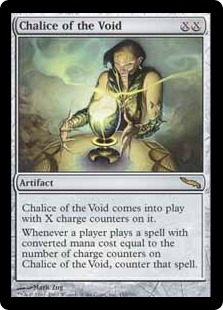
Grixis Shadow

As a result, I argue that Grixis Shadow is the Modern version of Legacy Grixis Delver. Delver of Secrets has never been very good in Modern, mostly because you cannot guarantee it will flip. Brainstorm makes it far more likely in Legacy. Even if that weren't the case, Legacy decks are removal-light compared to Modern so Delver usually just dies. It's just not an impressive threat. Death's Shadow has come to fill that niche.

Grixis Death's Shadow, by Mattia Rizzi (1st Place, GP Copenhagen)

Creatures

4 Death's Shadow
4 Snapcaster Mage
4 Street Wraith
2 Gurmag Angler
2 Tasigur, the Golden Fang

Instants

4 Thought Scour
3 Fatal Push
2 Lightning Bolt
2 Stubborn Denial
2 Terminate
2 Kolaghan's Command

Sorceries

4 Thoughtseize
4 Serum Visions
2 Inquisition of Kozilek


Lands

4 Bloodstained Mire
4 Flooded Strand
4 Polluted Delta
2 Blood Crypt
2 Watery Grave
1 Steam Vents
1 Island
1 Swamp

Sideboard

3 Ceremonious Rejection
2 Stubborn Denial
2 Surgical Extraction
2 Collective Brutality
1 Liliana, the Last Hope
1 Anger of the Gods
1 Engineered Explosives
1 Grafdigger's Cage
1 Nihil Spellbomb
1 Izzet Staticaster

Legacy Grixis Delver, by Spencer Garnier (1st Place, SCG Louisville)

Creatures

4 Delver of Secrets
4 Deathrite Shaman
3 Young Pyromancer
1 True-Name Nemesis
2 Gurmag Angler


Instants

4 Brainstorm
4 Lightning Bolt
1 Spell Pierce
4 Daze
1 Dismember
4 Force of Will

Sorceries

4 Ponder
4 Gitaxian Probe
2 Cabal Therapy

Lands

4 Wasteland
3 Volcanic Island
2 Underground Sea
2 Flooded Strand
2 Misty Rainforest
2 Scalding Tarn
2 Polluted Delta
1 Tropical Island

Sideboard

2 Flusterstorm
1 Engineered Explosives
1 Grafdigger's Cage
1 Baleful Strix
1 Grim Lavamancer
1 Darkblast
1 Diabolic Edict
1 Fire Covenant
1 Kolaghan's Command
1 Pyroblast
1 Red Elemental Blast
1 Surgical Extraction
1 Vendilion Clique
1 Cabal Therapy

Grixis Shadow is aping Grixis Delver. Yes, the cards are different, but they are as close as possible given the translation from Legacy to Modern. It has powerful one-mana (most of the time) threats, lots of cantrips, the best answers, an aggressively low land count, and some long-game value. The decks even play similarly. Legacy Delver seeks to ride a single threat to victory, wielding its answers defensively as protection and to keep the opponent on the back foot. Grixis Shadow is slower, but it also tries to force the opponent onto the back foot with discard while killing you with a massive threat. It may not be identical, but the same principles are at work. Play the best cheap threats possible and back it up with lots of disruption.

Implications

I've been polishing my Merfolk deck for the GP for months, but recent metagame developments and this revelation has shaken me. While I have good matchups against Eldrazi and Grixis decks, Merfolk isn't the best deck to really exploit this information. If two of the best decks in Modern are really Legacy-ports, then it would stand to reason that they should be attacked like Legacy decks. How practical this actually is will be covered in the next section, but it will still help guide us in the right direction. Full disclosure, in Legacy I play Death and Taxes. This should not be surprising. My experiences with these matchups are going to be the basis of my discussion. If you want more of an overhead view, go see a Legacy specialist.

Eldrazi Tron

Colorless Eldrazi is a very easy matchup for Death and Taxes. Eldrazi relies on Chalice of the Void to meaningfully disrupt opponents. Even when it sticks turn one, Chalice is bad against DnT. Flickerwisp invalidates Chalice and you also have Cavern of Souls and Aether Vial. Additionally, Wasteland and Rishadan Port can cripple mana-hungry decks. Eldrazi has so many lands that they will get out of it, but it rarely matters. The big problem that Eldrazi has against DnT in Legacy is Swords to Plowshares. Eldrazi gets a lot of value from the size of its creatures because hard removal outside of counters is pretty rare.
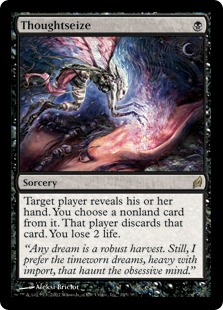
What this implies for Modern is that the key to beating Eldrazi Tron is to not lose to Chalice and pack hard removal. The deck plays a lot of creatures, but it also has a lot of lands. If you can deal with the first few threats there is a very good chance Eldrazi will simply flood out. The key is to avoid the lock piece and counter their size advantage. The deck is not fast, just overwhelming, so if you do dodge Chalice it's not that hard to race them. Don't try to go bigger than the Eldrazi, go under them.

Grixis Shadow

Legacy Delver against DnT can be weird. DnT packs a lot of good cards, but an unanswered Delver is still lethal. Sometimes you will Wasteland them out of the game, other times you stonewall them with creatures until equipment wins the game. Sometimes they just race you, sometimes they trade resources until you run out, sometimes Tarmogoyf just smashes through. The one thing I've found that consistently works is dodging, by which I mean you avoid their interaction. Legacy interaction is primarily countermagic and sometimes just sticking a Vial or Cavern wins you the game. Delver needs its interaction to line up in very specific ways and when that doesn't happen the deck falls apart. You really don't need to pick a Delver deck apart, if your cards don't line up the way Delver needs them to they may be powerless to win.

Similarly, Grixis Shadow needs to pick your hand apart to win the game. It often only has a threat or two in a game and if they get answered Shadow may impotently watch itself die. Therefore, if you're going to answer the deck you need to invalidate their interaction. Having a gameplan that is resilient to discard is a great plan, but so is invalidating their interaction. I've watched Little Kid Abzan dismantle very good Shadow players because Loxodon Smiter is so good against discard. A hand of just Smiter would normally be a mulligan, but against Shadow it might be a free win. I've also seen Shadow decks fall to UW Control because they knew the control player had more answers for their only threat than they could discard. Robust redundancy is terrifying to fragile decks. It is also important to note that just like Legacy Delver, Grixis shadow does not run many actual mana sources. As a result, it is possible to take them completely off their lands.
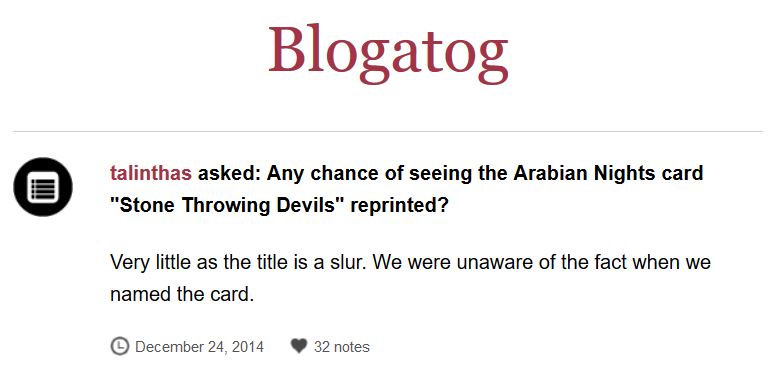
Can This Be Exploited?

It's tempting. I don't know if it is possible but it is very tempting. Thinking about all of this really makes me want to run Modern DnT in Vegas. The problem is that the actual Legacy crowd is small relative to other formats, and despite the large turnout I expect I don't think it will be enough to really tip things in Grixis and Eldrazi's favor. GPs are enormous tournaments and Modern is far too diverse a format for such a targeted approach. If the format was more legacified (legacrific?) then it would be a possibility, but as is I think it unwise to take an anti-Shadow or anti-Eldrazi deck to Vegas. There's too much noise in Modern for that to be a sure strategy.

Still, it's important to remember that the best decks in Modern are based on Legacy decks, and can be beaten by the same means. They're very good decks, but don't let the hype fool you. They're fragile and dodgeable. Attack them from angles they're not ready for and the decks just crumple.

Insider: No Offense Taken

Are you a Quiet Speculation member?

If not, now is a perfect time to join up! Our powerful tools, breaking-news analysis, and exclusive Discord channel will make sure you stay up to date and ahead of the curve.

I thought I would have a little fun this week by focusing on a subset of cards that many players don’t know about. They tend to get forgotten in their old age, though they still have some relevance in certain circles. But there’s one thing that sets them apart from the other 10,000-plus cards in Magic: The Gathering history. These cards transcend the Reserved List.

What Does That Mean?

Well, consider this: Wizards of the Coast has created a seemingly arbitrary list of cards they promised never to reprint again. No matter their value, every card on this list is treated equally: from Black Lotus to Zuberi, Golden Feather.

Over the years, many players have clamored for an end to the Reserved List. They cry out that abolishing the list would enable some of the game’s best formats to flourish due to the reduced barrier to entry. Some are even willing to stand by while their collection declines in value if it means they will be able to find regular Vintage and Legacy opponents.

No matter where you stand on the trade-offs involved, there’s one group of cards that have no chance of being reprinted even if the Reserved List disappeared. Perhaps these are cards worth scrutinizing more closely—but before doing so, allow me to explain.

No Offense

Some cards in Magic’s history carry with them some significant baggage in their title or artwork. These are cards Wizards of the Coast likely wishes never existed and would prefer to let drift into the game’s past. Therefore, even if the Reserved List was abolished immediately, this subset of cards stand out as safest from reprinting simply because of their negative connotations.

Consider this: someone asked Mark Rosewater on Blogatog if Wizards would ever reprint Stone-Throwing Devils.

There was an error retrieving a chart for Stone-Throwing Devils

His reply:
Blog

This creates a precedent: some cards can be even less reprintable than Reserved List cards simply because of their implications.

That’s not to say these are the best investments in the hobby. Surely there are better places to put money to work. But I suspect if an index were to be created that summarized these potentially offensive cards, there would be some real returns evident.

More Examples for Consideration

In a recent article, I alluded to the card Jihad, and I mentioned that regardless of the Reserved List’s fate, you can reliably invest here because the card can never be reprinted. Why not?

There was an error retrieving a chart for Jihad

Well, back when the card was printed, the term “Jihad” referred to the Arabic word meaning striving or struggling toward a praiseworthy aim. Seemingly harmless, the name fit the flavor of the card and set quite well. However, recent events have warped the term, and many now associate it with violence. According to Wikipeda, Jihadism is a “21st-centry neologism found in the Western languages to describe Islamist militant movements perceived as a military movement ‘rooted in Islam’ and ‘existentially threatening’ to the West.” I can conceive of no environment where Wizards of the Coast would want to remind the world of this card’s existence. Thus, it will disappear into obscurity.

How about the card Invoke Prejudice?

There was an error retrieving a chart for Invoke Prejudice

This harmless blue enchantment from Legends can’t possibly be offensive, can it? Well look closely at the artwork to see for yourself. What do those characters in the picture look like to you? To me, they closely resemble an American white supremacist group, the Ku Klux Klan (KKK). Whether or not the similarities are a coincidence, Wizards would be crazy to print a card that specifically mentions prejudice so blatantly.

Both of these cards are already pretty expensive, so they may be more well-known to all of you. Here’s something a little more obscure:

There was an error retrieving a chart for Martyr's Cry

What is going on in this picture? Just your usual depiction of a religious figure getting lit on fire! Talk about crossing the line. This one is also on the Reserved List, but does Wizards really need to overtly promise us they’ll never print this card again? One look at the artwork and this should be assumed!

Let’s stick with The Dark for a second. The set’s theme certainly has dark undertones, which resulted in some pretty extreme card concepts. If Martyr's Cry wasn’t worrisome enough, I suppose you could always talk to the Preacher about it. How’s that for pushing the envelope? Also on the Reserved List, this one is useful in Old School and will never see a reprint again due to the religious context.

There was an error retrieving a chart for Preacher

How about the card Grave Robbers, which literally depicts a couple guys robbing something out of a grave? We probably won’t see this card printed ever again.

Want to really feel uncomfortable? Check out the card Cleanse.

There was an error retrieving a chart for Cleanse

The name of the card itself doesn’t imply something taboo. But if you read the card’s rules text and stop and think about the implication, you can really start to feel squirmy. I’m not going to go any deeper into this explanation—you’ll never see this card again.

How about the bondage implied by artwork for Gwendlyn Di Corci? That will certainly get some people’s attention.

There was an error retrieving a chart for Gwendlyn Di Corci

According to Gamepedia, Gwendlyn was known as one of the great temptresses of Dominarian lore. Yeah, right, like Magic wants this kind of backdrop for their game? Imagine your 13-year-old son or daughter opening this card in a pack and asking you about what’s going on in the picture! No, thank you!

Lastly, although not as particularly offensive, consider Dystopia.

There was an error retrieving a chart for Dystopia

Here we have a card that literally means “community or society that is undesirable or frightening.” While flavor-wise it’s very clever, the political and social undertones may be a bit too much for a 21st-century collectible card game. Dystopian societies draw attention to real-world issues, and the fact that the card especially punishes green and white permanents magnifies to me the poor choice of name for this card.

Useful Information?

I’ll admit I wanted to have a little fun this week; I realize this set of cards may not be the most cohesive for speculation. It would make no sense to buy the market out of Martyr's Cry. However, if you look at the price charts of some of these cards, you’ll see that more than one of them has proven to be lucrative over the years. What’s more, they provide an offbeat look at Magic’s past, which may increase their allure to the nostalgic collector.

Some folks (myself included) tend to forget that while Magic has broken more into the mainstream nowadays, the game does have a few skeletons in the closet when it comes to its past. Collectors will forever be interested in some of these earlier cards, and the most offensive ones tend to provide a sort of notoriety about them.

If you were interested in this article, I’d encourage you to put your MTG finance hat aside for a day and browse through some more of Magic’s original sets. Arabian Nights, The Dark, Legends, and Fallen Empires really have some darker undertones associated with them that you don’t see in a modern-day set. Even Shadows over Innistrad, which seemed like a play on H.P. Lovecraft’s The Shadow over Innsmouth, didn’t reference evil, diabolic creatures or prejudices nearly as much.

Wrapping It Up

In the Seventh Grade, I was scolded by a teacher for talking about Magic cards in school. She saw the game as a negative influence on youth, and she certainly wasn’t the only one. Other adults saw cards like Unholy Strength, with the demonic pentagram, not to mention more blatant references like Demonic Tutor and Demonic Hordes. Ironically, these cards all seem harmless now when compared to the most offensive cards in the game’s history.

These cards fall into a category which I believe transcends the Reserved List. These are cards Wizards wants no 13-year-old opening ever, and therefore they will likely never be reprinted—even should the list be abolished.

Therefore, if you’re interested in owning some of Magic’s dark past, I encourage you to pick up a few of these cards. They’re certainly a conversation starter amongst friends, and you’ll even have a chance at making some money on them in the long term. Jihad and Preacher already spiked, but surely there will be others to follow. Perhaps an all-offensive Old School deck could be constructed with enough creativity. That’s sure to earn some flavor points with “The Underground”!

...

Sigbits

  • There was one card in Star City’s Old School MTG sale that caught my attention: their Near Mint Serendib Djinn. The markdown to $33.99 was just $2 above Card Kingdom’s buy list, so I couldn’t resist picking up their remaining copy. Perhaps when the sale ends this will be restocked, but it really belongs at $49.99 retail now given the recent rise in its price.
  • I hadn’t realized how many neat combos were achievable with Land Equilibrium in ‘93/’94. It seems that true land denial strategies in the format come in blue and white colors rather than black and red. The utility of this enchantment has not gone unnoticed, as it is sold out at SCG with a $49.99 price tag. Even Italian copies aren’t cheap, retailing for $29.99. That’s how you know the card sees actual play!
  • One last card Wizards will likely never reprint: Heaven's Gate. The artwork and flavor are brilliant, but I’m not so sure Wizards wants to release such religiously charged cards anymore. Sure, they make lots of Angels and Demons—but they haven’t printed many cards that literally depict concept religious concepts such as “heaven.” They might as well have printed a “Saint Peter” card that combos with this one!

Insider: QS Cast #65: Comments debate, Interests, and more!

Are you a Quiet Speculation member?

If not, now is a perfect time to join up! Our powerful tools, breaking-news analysis, and exclusive Discord channel will make sure you stay up to date and ahead of the curve.

Play

The QS Cast has returned: Chaz Volpe, and Tarkan Dospil continue on with where the cast left off and in this episode they discuss the following:

  • More considerations about Commander 2017 leaks.
  • Commander Anthology foil Commander reveals.
  • A bunch of different discussions and cards to think about.
  • Topics via Insider Article comment section.
  • Interests and more!

Cards we discussed: Meren foil* Amonkhet foils via Modern* Crux of Fate foil*


Enjoy! We’re glad to be back.

Find us on Twitter: @ChazVMTG  @the_tark

Scratching the Itch: Returning to Counter-Cat

Are you a Quiet Speculation member?

If not, now is a perfect time to join up! Our powerful tools, breaking-news analysis, and exclusive Discord channel will make sure you stay up to date and ahead of the curve.

I like winning as much as the next guy. Maybe even more. That's why, since even before the Gitaxian Probe ban, I've brought Colorless Eldrazi Stompy to three local tournaments a week. In doing so, I've racked up more store credit than I know what to do with, and gained a reputation around Boston as the boy who never cracked a fetch. How ironic---my first competitive Modern deck was Counter-Cat, a deck that played more fetchlands than mana-producing ones (something I can assure you was controversial at the time).

But while weeks turned to months as I exiled many openers in search of the "perfect five," my girlfriend Kelsey stuck by her Wild Nacatls. She learned to play Magic watching me pilot Counter-Cat at friendly FNMs, and barring an early stint with Jeskai Delver (I always forget new players actually have to play with Geist of Saint Traft before fully grasping how tiny it is), has played Counter-Cat for the entirety of her Magic career.

No matter the deck I'm on at a given time, Kelsey's affinity for Counter-Cat keeps me in touch with it, and keeps me tweaking it. Our latest build came about while we brainstormed ways to attack Death's Shadow Jund. Watching her pilot this build convinced me to try it out myself, and my own results in turn convinced me that Counter-Cat might actually be great right now.

The Cat's Meow

Let's start by addressing the literal elephant in the room: Wild Nacatl. The last time I brought this card up, I was thinking about integrating it into Death's Shadow Jund, where it might provide the early clock I was looking for in that deck. At the time, though, Modern was more hostile to Nacatl, and the creature didn't fit smoothly into the strategy for a host of other reasons I won't get into here.

But Nacatl is freaking bonkers right now for a few reasons that I will get into.

1. Nobody Is Playing Lightning Bolt

As of today, Lightning Bolt posts a 22% representation share according to MTGGoldfish. Granted, that's an improvement on its bleaker 19% share from a couple weeks ago, but it's still an unprecedented low for Modern's most historically played card. So, what's going on?
Perhaps most obviously, Fatal Push is going on. The card is great in Modern and deals with lots of threats Bolt can't touch, such as Death's Shadow and Tarmogoyf. It also allows black decks—which already enjoy another of the strongest disruption spells in the format, Thoughtseize—to reliably answer early creature plays with astounding efficiency and without needing to dip into other colors.

Bolt is also polarizing against Shadow decks, which most players have high on their radars these days. It's only impressive in this matchup for decks boasting a high degree of reversibility. These decks can sit around accruing cards and incentivize the Shadow player to burn ten life turning on its threats before getting in one hit with a fatty of their own and then ending things with a couple of domed Lightning Bolts.

Counter-Cat is one of these decks, but most Bolt decks in Modern aren't, which explains why even red-inclusive strategies like Grixis Shadow are choosing to all but abandon the iconic instant. Fortunately for us, the Kolaghan's Commands and Tarfires that replace those Lightning Bolts are pretty bad at killing Wild Nacatl, leaving only Path to Exile (woot, more mana to spend on Disrupting Shoal!) and Fatal Push (woot, one-mana spell not aimed at my two-mana Tarmogoyf!) to answer the feline at mana parity.

It's possible Bolt sees a comeback in the approaching weeks to help deal with UR Storm and Abzan Company, two successful decks in this metagame that rely heavily on creatures that flunk the Bolt Test. (Eldrazi Displacer deserves an honorable mention as yet another threat that continues to perform admirably in spite of its cost-to-toughness ratio.) But I'm counting on the Shadow decks and on faster combo decks to adapt and keep those strategies in check. Besides, Bolt isn't just going to swing back to 40% overnight.

2. Most of Modern Isn't Looking to Interact

Modern has always been a breeding ground (it's becoming increasingly difficult to use descriptive words absent from the titles of Modern dual lands) for linear decks, and today's format is no exception. UR Storm, Titan Shift, Living End, Tron, and Ad Nauseam are all players in this metagame, and running two sets of Delver of Secrets helps loads against each one. After all, thresh strategies were invented to prey on combo. Linear decks are rarely equipped to block opposing threats, which often makes Nacatl even better than Delver (it's easier to grow).

In Modern's more robust combo decks, blockers also find themselves in short supply. Abzan Company provides a fine example of Modern decks trending towards a single dimension. Here's a deck that has always claimed a decent fair game in addition to packing a combo. But with Vizier of Remedies in the format, the go-to Company builds are forsaking a grindier fair plan to dump eggs into their proverbial combo basket. This change drastically improves the relevance of turn-one, three-power clocks from its opponents.
The reasons for this shift are simple. With Modern's reigning best deck being a hyper-efficient, triple-threat disruption machine, any kind of synergy-based strategy needs to double down on its gameplan to stand a chance of executing it. Diluting synergy plans with fair cards to pull weight in the traditionally grindy BGx matchups doesn't cut it against the archetype's new breed of leaner, faster decks.

3. The Non-Shadow Interactive Decks Don't Block

Or, at least, they don't block well. Consider, again, Abzan Company—if Vizier of Remedies or Devoted Druid are blocking Wild Nacatl, we're in okay shape. These creatures used to be Wall of Roots and Spellskite.

Similarly, gone are Wall of Omens and Restoration Angel from most builds of UWx Control. Modern's shifts to accommodate bigger beaters—Death's Shadow, Tarmogoyf, Reality Smasher—leave little room for early blockers (a major reason Burn has performed so well online).

To fulfill a similar function, players have gravitated en masse to Lingering Souls, even splashing the card into the already-three-color Shadow decks. But Lingering Souls isn't great at blocking Wild Nacatl, either. The card shines when its Spirit tokens wall something that costs a significant amount of mana, such as Tarmogoyf, for multiple turns, or when they manage to team-block and subsequently kill a larger threat. Nacatl costs just one mana and can't be killed by the spell's front or back end alone, instead requiring the full five-mana investment to make a trade. And while Counter-Cat does play Tarmogoyf as well, it also packs plenty of Hooting Mandrills, another creature that sneers in the face of 1/1 tokens.

Re-Introducing Counter-Cat

I know some readers routinely skip to the decklists in the articles they read. For the more patient among you, reading through the above 1,000 words of Nacatl adulation must have been like pacing around the kitchen, hungrily watching me open a very large can of Fancy Feast. Well, it's time to eat!

Counter-Cat, by Jordan Boisvert

Creatures

4 Wild Nacatl
4 Delver of Secrets
4 Tarmogoyf
3 Hooting Mandrills
1 Snapcaster Mage

Instants

2 Thought Scour
4 Lightning Bolt
4 Path to Exile
3 Disrupting Shoal
2 Spell Pierce
2 Spell Snare
2 Mana Leak

Sorceries

4 Serum Visions
3 Sleight of Hand

Lands

4 Misty Rainforest
2 Arid Mesa
3 Scalding Tarn
2 Flooded Strand
1 Steam Vents
1 Temple Garden
1 Stomping Ground
1 Hallowed Fountain
1 Breeding Pool
1 Island
1 Forest

Sideboard

2 Spreading Seas
2 Huntmaster of the Fells
2 Negate
1 Dispel
1 Surgical Extraction
1 Grafdigger's Cage
2 Engineered Explosives
2 Pyroclasm
1 Destructive Revelry
1 Ancient Grudge

Post-Ban Tweaks: Cutting Helix

Counter-Cat only played two copies of Gitaxian Probe, but the ban still shook the deck's foundations. To quote my introductory article on the deck, here's what Probe does in Counter-Cat:

  • It grows an early Tarmogoyf past Lightning Bolt.
  • It fuels delve.
  • It flips Delver of Secrets.
  • It allows us to run fewer lands.
  • It gives us something to do with Snapcaster Mage for zero mana in a draw-go stalemate or an otherwise tight spot.
  • It lets us know whether we should dig for protection like Mutagenic Growth before committing threats to the board.
  • It provides perfect information so we know how to pace Spell Pierce, Spell Snare, Remand, and Mana Leak, as well as whether to hold up permission/removal or to increase our board presence.

Finding one card in Modern's admittedly deep card pool that filled all these roles was a fool's errand. So we started with a pair of Sleight of Hands, which proved surprisingly serviceable.
To be clear, losing Probe hurt the deck's consistency and decreased its proactivity (while gently improving our long-game). But without the life loss from Probe built into the deck's configuration, we were able to cut Lightning Helix, a frequently clunky card that's always been something of a necessary evil in Counter-Cat. Dropping Helix opened up the possibility of running Breeding Pool, a land that doesn't cast Boros-colored spells but has otherwise always been very appealing. Pool helps with the consistency issues created by Probe's void by improving the mana, lightening the load on our openers, and providing an extra failsafe against land destruction.

We also cut a Snapcaster Mage from the deck, although having one for utility reasons still seems beneficial. Snap is the most expensive spell in the deck, and our curve increases without Probe around. Probe also helped excuse running multiple Snaps, since we could slam the Wizard on turn two to get an extra draw when playing around enemy disruption.

Adjusting for Shadow: Adding Shoal

Kelsey had the idea of adding Disrupting Shoal for some points against Death's Shadow. Shoal performs well both offensively and defensively; it protects a pair of one-drops to help them get the job done, and it stops opponents from executing their own gameplan. The counterspell also gives Counter-Cat something to do with its occasional mid-game flood, hard-countering whatever opponents draw off the top of their decks.

Shoal's protective function overlapped with Mutagenic Growth, which we wanted to move away from anyway. As previously stated, Lightning Bolt is experiencing record lows in representation, and the card's combat-trick dimension loses value in such a linear format. Growth is also the wrong color for Shoal.
To hit enough blue cards and surpass the magic number 22, we added another Sleight and a pair of Thought Scours, which help with Hooting Mandrills. Scour is especially neat in Counter-Cat, since we can lead with a fetchland and represent Spell Pierce, Spell Snare, Lightning Bolt, and Path to Exile on our opponent's turn while still having access to a proactive play should they simply draw and pass.

Sideboard

We also made some significant changes to the sideboard, the biggest of which are the adoption of Engineered Explosives and Spreading Seas. The former destroys just about everything in a four-color deck, making it a great hedge against random post-board haymakers. The latter attacks Modern's increasingly precarious manabases without asking us to play a Blood Moon-resilient one ourselves. Both are stellar against Shadow decks.

Disrupting Shoal, Delver of Secrets, and Counter-Cat's wealth of permission and removal in its 75 make sideboarding very tricky with this deck. Maintaining the right density of blue spells for Shoal, or instants and sorceries for Delver, is crucial when making between-game decisions. It's sometimes correct to completely axe one of these packages from the main 60 to enable a more dedicated permission-based or removal-based gameplan, depending on the matchup.

With Path to Exile being the only white card in the 75, Counter-Cat sometimes boards into a Temur deck featuring "Kird Ape-Plus." This plan is most common against linear combo decks and against creatureless control decks, as Spreading Seas takes care of manlands like Celestial Colonnade in those matchups. The plan also makes us nigh-impervious to Blood Moon, allowing us to shave a Destructive Revelry from the sideboard.

Comparisons to Temur Delver

I gave up on Temur Delver not too long after the Probe ban, although I did try to rekindle the strategy a couple of times. More dedicated players than I have stuck with it, employing Narnam Renegade in some number to tame Modern's cliques of fatties. In many ways, this build of Counter-Cat is strikingly similar to those newer builds of Temur Delver, except it runs Nacatl over Renegade and mainboard Paths over sideboard Moons.

Path to Exile helps Nacatl break through, so we don't miss deathtouch so much here. In fact, I'd say Path to Exile is the biggest reason to play Counter-Cat—no, it's not even Wild Nacatl! The card removes any threat from either Death's Shadow deck, no questions asked, and ramping those decks is rarely a factor since they only play two basics. Path is also one of the few playable Modern spells that can take out a Reality Smasher or Wurmcoil Engine.


Compared with Temur Delver, Spell Pierce still gets the nod for us over Stubborn Denial. Pierce plays better with our many one-drops, as it excels against opponents on the back-foot. It's also tougher to get ferocious quickly in this deck; Mandrills is mostly a back-up plan should our one-drops get removed, and Goyf takes longer to grow without enablers like Tarfire.

Nacatl's Out of the Bag

So there you have it: my latest secret sauce. Assuming I can track down some extra Engineered Explosives, I'm excited to join Kelsey in turning everyone's favorite kitty sideways like in the grand ol' days. I encourage anyone looking for quick thrills in this uncharacteristically stable metagame to do the same.

Want Prices?

Browse thousands of prices with the first and most comprehensive MTG Finance tool around.


Trader Tools lists both buylist and retail prices for every MTG card, going back a decade.

Quiet Speculation