menu

Insider: MTGO Market Report for November 2nd, 2016

Are you a Quiet Speculation member?

If not, now is a perfect time to join up! Our powerful tools, breaking-news analysis, and exclusive Discord channel will make sure you stay up to date and ahead of the curve.

Welcome to the MTGO Market Report as compiled by Matthew Lewis. The report will cover a range of topics, including a summary of set prices and price changes for redeemable sets, a look at the major trends in various Constructed formats and a "Trade of the Week" section that highlights a particular speculative strategy with an example and accompanying explanation.

As always, speculators should take into account their own budgets, risk tolerance and current portfolios before buying or selling any digital objects. Please send questions via private message or post below in the article comments.

Redemption

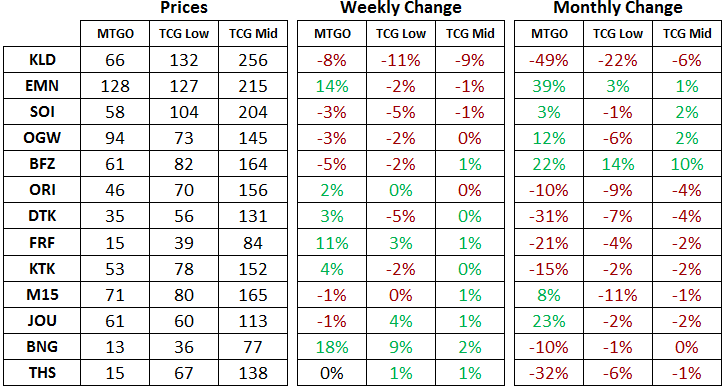
Below are the total set prices for all redeemable sets on MTGO. All prices are current as of October 31, 2016. The TCGplayer low and TCGplayer mid prices are the sum of each set's individual card prices on TCGplayer, either the low price or the mid price respectively. Note that sets of Theros (THS) are out of stock in the Magic Online store, so this set is no longer redeemable.

All MTGO set prices this week are taken from GoatBot's website, and all weekly changes are now calculated relative to GoatBot's "full set" prices from the previous week. All monthly changes are also relative to the previous month's prices, taken from GoatBot's website at that time. Occasionally, full set prices are not available, and so estimated set prices are used instead.

oct31

Flashback Draft of the Week

Innistrad (ISD) block draft adds a booster of Dark Ascension (DKA) in the flashback queues this week. Although a change to the format, the addition of DKA lowers the total expected value of the boosters one is cracking. However, Dark Ascension has value in cards other than mythic rares, so keep your eyes out for Grafdigger's Cage, a top sideboard choice to battle Dredge. Lingering Souls is an uncommon and a Modern staple that currently retails for 0.4 tix, and even the common Thought Scour is worth almost 0.1 tix.

There was an error retrieving a chart for Lingering Souls

Standard

There were two high-level Standard events this past weekend and here are the top eight decks from both Grand Prix Warsaw and Grand Prix Santiago. G/B Delirium was dominant, putting six and four copies of the deck into the top eight of these events, respectively. This has translated into another week of strong price gains for Eldritch Moon (EMN) on MTGO, where many of the deck components are found.

There was an error retrieving a chart for Liliana, the Last Hope

Until the format adapts to fight this deck, it's possible that the peak set price on EMN has not yet been reached. However, paper prices for most Standard sets were down this week. Declining paper prices removes the support of redemption which increases the possibility of a drop in prices. Prudent speculators should be taking this opportunity to pare down their positions in EMN.

Shadows over Innistrad (SOI) looks like it is good value at the moment relative to every other set in Standard. It is the cheapest set on MTGO and it also has a substantial gap between its digital and paper prices. It's possible that the low price of SOI is a result of the cards from the set being poorly positioned in the Standard metagame. If that's the case, and with Aether Revolt (AER) still months away, a shakeup in Standard is not going to rescue this set's price anytime soon. However, if you are holding cards from this set, selling now would be a mistake. I'll be holding onto my SOI sets into the winter and past the release of AER. At current prices, SOI has attractive upside relative to a small downside risk.

Modern

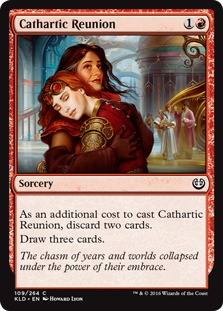
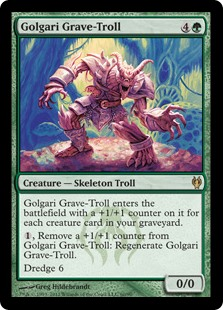
Taking a look at the recent Modern metagame at MTGGoldfish, Dredge variants are now 11 percent of the reported decks. This archetype seeks to load up the graveyard using Golgari Grave-Troll in order to power out Bloodghast, Prized Amalgam and zombie tokens from Bridge from Below. KLD gave this deck a substantial boost with the printing of Cathartic Reunion. This deck looks like it is gaining steam in the metagame and with a round of Regional Pro Tour Qualifiers featuring Modern coming up in December, this might be the deck to beat this season.

There was an error retrieving a chart for Cathartic Reunion

Although Golgari Grave-Troll is at an all-time high of 28 tix at the moment, there looks to be plenty of runway left as players continue to pick up the deck. Remember that at this time last year, Golgari Grave-Troll was on the Modern banned list. If Dredge dominates the Modern metagame over the coming months, a 40 tix price en route to a return to the banned list is not out of the question for this Ravnica: City of Guilds rare.

Standard Boosters

EMN boosters have powered higher to over 3 tix, more than doubling from their low of 1.4 tix from last month. Shadows over Innistrad (SOI) boosters have been more sluggish and have been stuck at the 1 tix level. The switch back to 6-2-2-2 draft queues has supported the price of EMN boosters through the skewed prize distribution. Although booster specs have been disappointing in their results, the recent gains on EMN boosters suggest that strategic acquisitions can still make a profit.

Players and speculators alike should be sure to target a few KLD and AER boosters when Amonkhet is released in the spring. With SOI as a guide, KLD boosters should find a floor at below 1 tix. Using EMN as a guide for AER, a price below 1.5 tix should be a safe level to target for purchase.

Trade of the Week

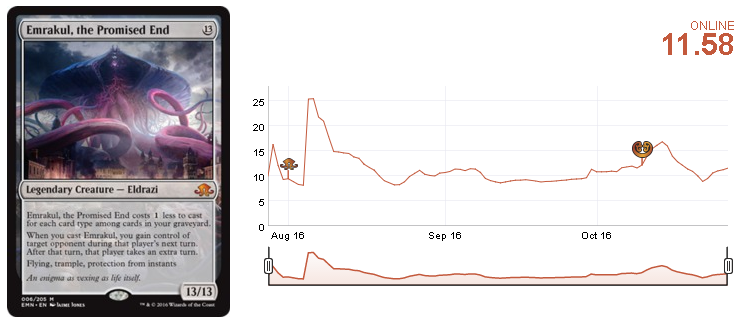
There was an error retrieving a chart for Emrakul, the Promised End

As usual, the portfolio is available at this link. With a dominant showing at both Standard Grand Prix events this week, B/G Delirium is the hottest deck in Standard. That deck features a number of cards from EMN inclulding Grim Flayer, Liliana, the Last Hope and Emrakul, the Promised End. These have all moved higher in the last week as a result. With a substantial gain already for EMN sets and a probable medium-term top in price, I felt it prudent to start selling some of the EMN sets I had bought in September.

Although complete-set buyers are few and far between, the big operators will buy most cards from a set all at once which is a de facto set sale. In this case, I found that MTGO Traders had the best buy prices on average, and I sold the 50 cards they were most interested in for 122 tix. This means that I can book the profit on the sale of EMN and still have a bunch of junk rares in my collection for possible future gains. There's no need to deal with the hassle of trying to sell a complete set anyway when 99 percent of the value is tied to the top cards.

The full set speculative strategy is working out very well for EMN. Unfortunately, the adjusted redemption window for KLD and AER mean that this broad speculative strategy is not going to be usable going forward. Hopefully you are enjoying this last kick at the can, although I will be working hard to divine future speculative strategies around the modified redemption window.

Insider: Why You Should Be Investing in Old School

Are you a Quiet Speculation member?

If not, now is a perfect time to join up! Our powerful tools, breaking-news analysis, and exclusive Discord channel will make sure you stay up to date and ahead of the curve.

Eternal Weekend was insane. I played so many games of Vintage, Legacy, and 1994 Magic that I felt like I went back in time to my middle school days and got to have a  ball. All things considered, the old eternal formats are some of the most fun, challenging, and rewarding ways to play Magic, period.

Vintage and Legacy both have pretty solid followings, and the pricey nature of the cards actively reflects the demand and scarcity of the cards. However, I think that collectors and investors have a really nice opportunity to jump into the Old School Magic market at this very second.

First of all, I have never really played too much Old School Magic before. Some of my friends have decks and I'll jump in to pilot a few games—but up until this weekend I've never been an active participant in the format. All of that changed when I started working on tuning a sweet control deck with my friend and fellow collector/investor, Jeff Anand.

The two of us chatted about the format and brewed up a really sweet Esper version of The Deck for the Old School Championship at Eternal Weekend. Overall, the two of us playing an identical 75-card list had a combined 12-4 record. Not too shabby for brewing up a list in a format I've never played before! I wrote about my list on Channel Fireball last week, but here is the updated version:

The Deck, by Brian DeMars

Instants

4 Swords to Plowshares
4 Disenchant
4 Counterspell
2 Power Sink
1 Mana Drain
1 Ancestral Recall

Sorceries

1 Mind Twist
1 Demonic Tutor
1 Recall
1 Amnesia
1 Time Walk
1 Braingeyser

Artifacts

1 Mox Jet
1 Mox Sapphire
1 Mox Pearl
1 Sol Ring
1 Black Lotus
2 The Hive
1 Disrupting Scepter
1 Chaos Orb
2 Jayemdae Tome

Enchantments

2 The Abyss

Lands

4 Tundra
4 Underground Sea
4 Strip Mine
3 Mishra's Factory
3 Scrubland
2 City of Brass
1 Library of Alexandria

Sideboard

3 Time Elemental
2 Blue Elemental Blast
1 Guardian Beast
3 Dust to Dust
1 Greater Realm of Preservation
2 Wrath of God
2 Plains
1 Ivory Tower

The format was surprisingly fun and interactive. The cards may be more simplistic, but the games feel more like a chess match of stringing plays together. I think that a lot of people are drawn to the format because the games feel very different than Vintage or Legacy where there are a lot of complex and tedious interactions. The games feel more straightforward and not bogged down by lots of library manipulation.

The format is also a jackpot of nostalgia factor. Aside from the fact that the old cards are actually great in Old School by default (duh!) the old cards are already desirable to investors because they are collector items. The big impact of Old School is that it creates actual demand for these collectible cards by players, which creates opportunity.

At Eternal Weekend, Old School staples were among the hottest movers at the dealer booths and trade tables, and I think that says a lot. While the format is relatively small at the moment, I also think it has a lot of potential for growth, which I will get into in a moment. Overall, given the Reserved List, the collectible element, and now the newfound playability of some of these cards—I think Old School is a great place to invest.

When it comes to how I feel about the future of the format, I believe the sky is the limit. Old School Magic has grown steadily over the past few years and the rising prices reflect this growth. I don't see any reason why the format would stop growing. On the contrary, I believe the format is fun, exciting, and enjoyable, which will lead to continued and sustained growth. When we consider that the format ought to continue onward and upward it only makes sense that these old versions and Reserved List cards cannot be reprinted and will continue to grow in price over time.

I've actually been writing about Old School cards on and off for the past year, and several of my early suggestions have already hit fairly hard. I advised buying the cheap Antiquities Mishra's Factorys a while back and they've nearly doubled since then. There are plenty of opportunities if you know where to look. Today I'm going to share some of my hottest Old School picks.

Beta/Unlimited Common & Uncommon Staples

There has already been some growth among the good singles in Old School, which is why Arabian Nights Serendib Efreet is now over $100. However, there are lots of cards that have likely only hit a fraction of their potential value. A great place to start are cards that don't have a ton of value yet and thus have room to grow—there are plenty of frequently-played commons and uncommons that fit the bill.

There was an error retrieving a chart for Power Sink

While Counterspell is insane, and Mana Drain is more insane but restricted, outside of those two there are not a ton of permission options. Power Sink is the next best thing and sees a ton of play in the format. Old versions of the card are beginning to command a premium. It is also worth noting that Power Sink is just a great card, and deserves a spot in many cubes and battle boxes.

There was an error retrieving a chart for Disenchant

Beta Disenchant was a huge mover at Eternal Weekend. Pretty much every deck that plays white in Old School has four Disenchant in the 75, as it is one of the best cards in the format. Also, it isn't exactly like Disenchant isn't great across a variety of formats, including Modern and Vintage.

There was an error retrieving a chart for Drain Life

Drain Life is a finisher in the Mono-Black decks and sees a fair amount of play. I would say that some variation of Mono Black—splashing either blue for Power or red for Bolts and Red Blasts—is the premier aggro deck in the format. Hymn to Tourach, Sinkhole and Strip Mine are all great ways to apply pressure to the control decks. With Drain Life being so cheap I think it is a very reasonable card to pick up and hold for future value.

There was an error retrieving a chart for Blue Elemental Blast

Blue Elemental Blast is another card that sees a ton of sideboard play across the format and has a relatively low price point for a Beta card. The burn spells like Lightning Bolt and Chain Lightning are important reach finishers out of the more aggressive decks, which makes it important to counter them in the late game. Blue Elemental Blast also has the added bonus of being able to kill a Blood Moon (which can be a huge deal) and is a one-mana answer to a quick Kird Ape.

There are more cards that fit my qualification: Beta commons that see substantial play but haven't spiked up past $10. I think these are all reasonable cards to invest in for Old School.

Arabian Nights, Antiquities & Legends

The same line of logic I applied to the Beta cards also plays when it comes to the first three expansions. It is obviously becoming more and more difficult to find these cards and they are prized higher than ever by collectors.

I feel like the expensive big-ticket items—Moat, The Tabernacle at Pendrell Vale, Library of Alexandria—have already reached maximum saturation when it comes to price. But there are plenty of other secondary staples that certainly have room to double or triple in price.

There was an error retrieving a chart for Argivian Archaeologist

In an artifact-centric deck, a creature that can rebuy artifacts is a pretty big game in the control mirror. It's a pretty common tactic to board out removal in these creatureless mirrors, so creatures have an opportunity to stick and dominate the game. Argivian Archaeologist is a powerful threat that can allow you to buy back artifacts that get countered or Disenchanted for the rest of the game. I ran one in my sideboard and was very happy with it.

Also, it is worth noting that Argivian Mummy Finder Guy can rebuy Chaos Orb every single turn which is pretty insane. Vindicate with buyback!

There was an error retrieving a chart for Time Elemental

The card has seen some reprintings which caps the price, but I really believe Time Elemental is a criminally underplayed Old School card. I had two in my sideboard and they completely dominated my post-sideboard games when they resolved. We didn't get a chance to test the Time Elemental beforehand, so we only played two—but I would easily have added a third and possibly a fourth if I had any idea how insane it would be.

Specifically, I like the Legends and other black-bordered versions of this card as an investment. The 4th Edition versions are super common and will likely never have value, but the scarcer ones likely will. I think it's only a matter of time before Time Elemental becomes a more commonly adopted piece of technology for the control mirror match, and getting in before the spike is a great idea.

There was an error retrieving a chart for Whirling Dervish

Whirling Dervish is another staple of the green decks that hasn't really gained too much value yet. It is worth noting that the card is pretty great at dodging The Abyss (protection from black) and is a house against the Mono-Black Aggro decks for obvious reasons. It is also a great nostalgia card from back in the day. I remember that this card used to be highly prized by collectors and players back before 4th Edition came out.

The same rules apply here—you want the original Legends version that die-hard flavor enthusiasts will want down the line.

There was an error retrieving a chart for Kird Ape

The Arabian Nights version of this card is still cheaper than I believe it should be—especially when you find deals for them online. The card is actually pretty decent in Modern Zoo as well. Taiga plus Kird Ape is one of the iconic openings in Magic, and I think these critters have room to grow.

Another trend I've noticed is that lots of people build The Deck as their first Old School deck because it is so format-defining, but then once they get into the format they branch out and build more decks. As more players start to acquire cards to build different decks, there's opportunity for some of the secondary-tier staples to go up in time.

Ice Age, Homelands & Alliances

These sets are illegal in most Old School tournaments, but I could certainly see a point where they get added to the mainstream format or splinter off to form a new format. Perhaps looking to the future on some of the good cards from these sets is a good idea as well.

There was an error retrieving a chart for Thawing Glaciers

Thawing Glaciers is certainly a card that would see a ton of play if the format were opened up to include Alliances. Glaciers is already a great old card, and I never mind picking them up and storing them away for a rainy day. I like Glaciers as a pick.

There was an error retrieving a chart for Necropotence

In any version of old-timey Magic where Ice Age is legal, Necropotence is a big deal. It is basically close to the power level of the Power 9 in terms of how the old cards play together. I'll probably look to pick up a playset of these at some point, just in case.

There was an error retrieving a chart for Autumn Willow

Autumn Willow is a great card. I could see demand for it rising considerably if Homelands were made legal for Old School. It dodges Swords to Plowshares, The Abyss and Terror, and is a pretty good beater in general.

There was an error retrieving a chart for Ihsan's Shade

Another fatty that dodges Swords to Plowshares and Terror that the Mono-Black decks can easily play. It is worth noting that this card crushes against White Weenie!

A Growth Format

My take on Old School is that the format is growing in players and popularity, and that it is a great place to focus some of our MTG investments. A lot of the key cards have already bloated up in price, which makes me think those are not the best bang for my buck right now. To be clear, I think those cards are acceptable as investments, but they will likely climb slowly in value, as opposed to the undervalued ones which have an opportunity to burst.

I like some of these smaller cards because I feel like they really have room to grow right now. As you all know, I love buying and trading into cards that I feel have nowhere to go but up because there is very little risk involved. For much of the cards I've described above, I feel those are the circumstances surrounding them.

One last note on Old School Magic: while I believe Old School singles are a great place to invest some portion of our collections right now, I also welcome you to actually consider buying in and playing the format at some point.

Obviously, the Power 9 might not be on everybody's list at the moment, but most of the local events allow for proxies. Generally speaking, the people who play Old School are chill and just want to hang out and play Magic the way it was back in the day. The format is fun and worth trying out at some point. The other upside is that nearly everything one would pick up to play is a great investment by virtue of being a nostalgic collector's item!

Insider: Commander 2016 Reprint Review

Are you a Quiet Speculation member?

If not, now is a perfect time to join up! Our powerful tools, breaking-news analysis, and exclusive Discord channel will make sure you stay up to date and ahead of the curve.

Welcome back, readers! This past week the full Commander 2016 decklists were revealed. There's a lot to take in, so let's get right to it.

There are quite a lot of decent reprints in this set (greater than $3). Usually each Commander series has a good number of them, so that's not too surprising. What is interesting is which ones they picked. I'll go card by card and offer my thoughts on what each reprinting means.

Scavenging Ooze

ooze

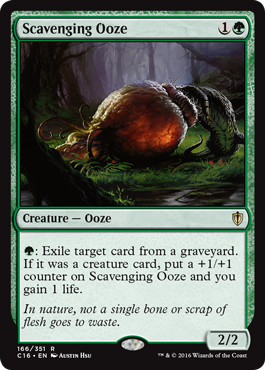
This card showed up in the original Commander decks and immediately skyrocketed to $40, thanks to Legacy Maverick decks. The recent M14 reprint brought the card into Modern, where it has served as a powerful anti-graveyard threat with incidental lifegain and the ability to grow big.

I love this card in Modern, but it honestly doesn't see a ton of Commander play (at least around my area). Most green players prefer to spend their mana going over the top. Without much casual demand to prop it up, this reprinting really hurts any growth Modern speculators were hoping for in the near future.

Burgeoning

burgeoning

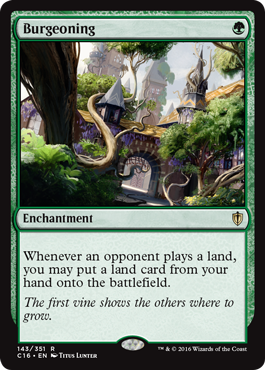
I've previously called out Burgeoning as a great spec opportunity thanks to its reprinting in Conspiracy: Take the Crown. It is an extremely powerful Commander card, allowing players to ramp ahead of opponents very quickly (assuming they don't run out of lands in hand). It also scales very well with more opponents.

The fact that this card is getting reprinted again, just on the heels of the last reprint, is a bit disturbing from a speculator's view. We typically expect that once Wizards reprints a valuable card, they will give it some time to recover in value. Granted they've never stated this policy explicitly or anything, but it was implied based on previous actions. If this represents a shift in philosophy it may have much larger effects on speculation down the road.

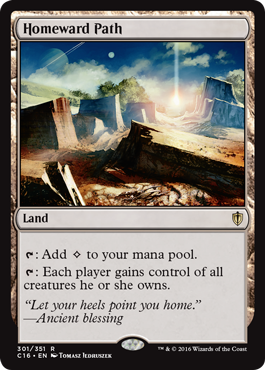
Homeward Path

homeward-path

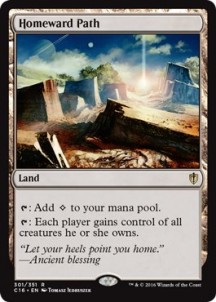
Homeward Path is very much a Commander type of card, and one that I'm sure a lot of Commander players were eager to see reprinted. It's shown up in two previous Commander printings (original and 2013). As with those printings, they've elected to keep it to a single deck. I honestly don't see the price shifting a whole lot unless Stalwart Unity happens to be the most desirable of the new decks.

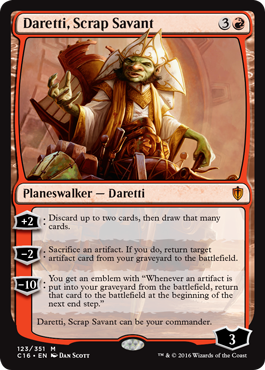
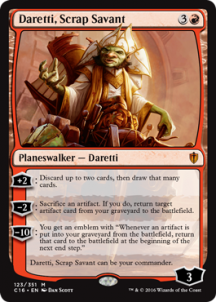
Daretti, Scrap Savant

daretti

Perhaps WoTC realized that they've tended to give red the shaft when it comes to planeswalkers, so they are just going to make sure red mages have them more readily available. This guy is a fun commander, but his price was already barely above $3 before this reprinting. None of the new four-color commanders has a strong artifact theme to pair with Daretti, so to me this just seems like a bit of an odd reprint choice from WoTC.

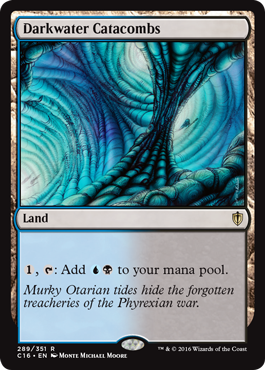
Odyssey Filter Lands

darkwater-catacomb

These lands are pretty spot-on for a Commander reprint. They were hard-to-find $3-$6 lands that help fix mana, and are perfect when you need a lot of different colors. Odyssey only had allied-colored versions, and I'm curious if WoTC will finish the cycle in the future. Keep in mind that only three (Darkwater Catacombs, Shadowblood Ridge and Sungrass Prairie) appear in the Commander 2016 decks.

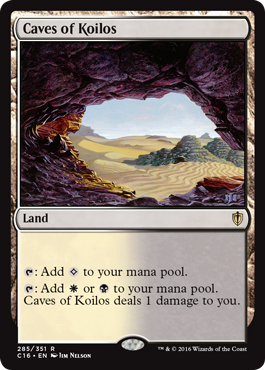
Painlands

caves

I'm curious how many of you knew that the painlands originated in Ice Age. For a while they were only available in allied-colored pairs, until Apocalypse finished out the cycle. They've largely been relegated to Standard play over the years, but that changed this year with the arrival of our Eldrazi overlords. Many have since gone up dramatically thanks to the fact that they provide mana fixing and colorless mana in Modern, Legacy and Vintage.

However, I've typically seen most Commander players shy away from painlands. Even though your starting life is much higher than in a normal game, there's just so much mana fixing available throughout Magic's history—it's not hard to get perfect mana painlessly.

As with the Odyssey filter lands, we're only getting three reprints here (Caves of Koilos, Karplusan Forest and Underground River). As a Modern player who traded his personal sets off long ago, I'm not unhappy to see these back so I can finish my playsets cheaper. That said, some of the more expensive ones (Adarkar Wastes, Brushland) might actually go up in value, having missed the reprint train in this set.

Murmuring Bosk

bosk

I've always appreciated this card and its uniqueness (and I'm secretly hoping WoTC finishes this cycle as well). It does seem like a fantastic card to include in a set where one might need four different colors of mana consistently on turn four. Bosk can provide up to three of those (assuming you're playing Abzan plus something else).

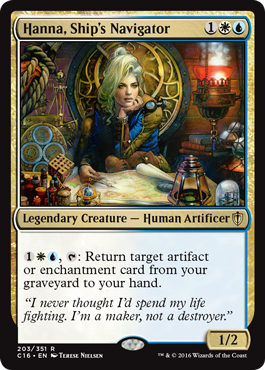
Hanna, Ship's Navigator

hanna

This Invasion block legend has been a favorite of many Azorius combo players throughout Commander's history. She's a powerful card, but not so over-the-top to be unfun to play with or against.

This is her second reprinting (though her first was a low-volume judge promo). I'm glad they kept the artwork of the judge promo because Terese Nielsen just does some amazing work and the original is pretty bland-looking.

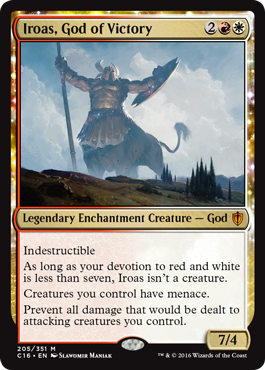
Iroas, God of Victory

iroas

This one was a bit surprising, given that it's still a pretty recent card. This was one of those speculation targets I really liked long-term as a lot of the gods are very powerful Commander cards and the fact that they can be your commander definitely means they can be built around.

It's interesting that this is the only god from Theros block that's getting a reprint. So for now your other god specs are safe, but take this as a warning that even plane-specific cards like this can easily appear in supplemental products.

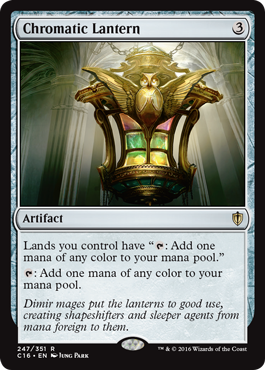
Chromatic Lantern

lantern

I buylisted all my extra copies of Chromatic Lantern at the first Grand Prix after they announced that the next Commander set would be four-color. This is a fantastic Commander card, and although it's relatively new, the fact that it could give any player perfect mana as quickly as turn three just screamed auto-include in four-color Commander decks.

Lantern only appears in one deck (Entropic Uprising), but it will still lower the ceiling a good bit. If you don't have any copies already, I'm not sure I can recommend it as a spec at this time.

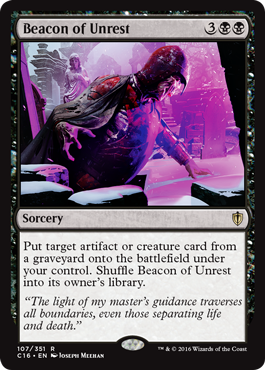
Beacon of Unrest

beacon

Another Commander favorite with multiple reprintings that still manages to maintain a $4-plus price tag. I know a lot of players love the fact that you can "re-use" this later (as long as you can draw or tutor for it). It's also very flexible, hitting opponents' graveyards and targeting both artifacts and creatures. I expect this card to stay in demand.

I'm a bit surprised with this reprinting only because it has double black in the mana cost. I would have thought with four-color decks they would try to keep any double-mana requirements to an absolute minimum.

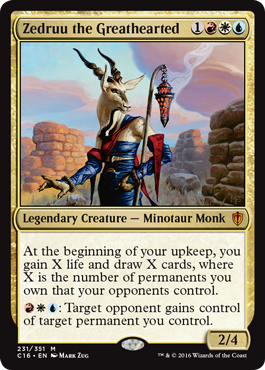
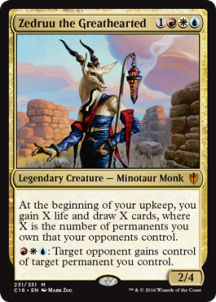
Zedruu the Greathearted

zedruu

Zedruu the Greathearted originally came out in the first Commander set in the most desired deck (the one with Chaos Warp and Flusterstorm). He quickly grew to be a casual favorite, as there have been a lot of Magic cards printed that harm the owner after providing some benefit.

Zedruu is perfect for giving all those cards to other players after the benefit has been granted, and he even nets you extra cards for doing so. He's also great in any deck that features a lot of symmetrical effects like Howling Mine, that affect all players regardless of ownership. I honestly doubt we'll see him drop much in value, thanks to the fact that he's such a hit with casuals and only shows up in one of the decks.

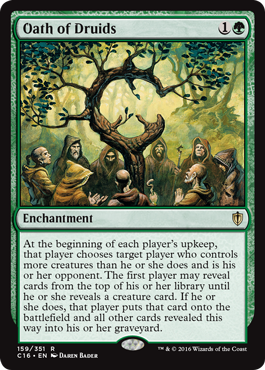
Oath of Druids

oath

How many people were aware that Oath of Druids wasn't on the Reserved List (or that the only Oath in the cycle on it is Oath of Ghouls)? This is a huge Vintage card with only the original printing and a judge printing.

It's perfect for Commander decks that want to cheat in big creatures or fill their graveyards (or both). More than anything, I think it plays well in casual Commander decks, since it introduces a random element (unless you can control the order of your deck or limit your creature count to only the biggest and the baddest) and it does affect everyone.

Takeaways

One of the big takeaways from Commander 2016 is that WoTC clearly has no issue with reprinting cards that were recently printed (or reprinted) if they feel they fit one of their deck ideas. While they have always had this option, we typically haven't seen them use it. I suggest that all of us who have a speculation box crammed full of Commander cards rethink our long-term hold strategy moving forward.

A long time ago I did an article on the effect reprints have on a card's price. While that was focused on a Standard-legal set reprint, which likely has a larger print run, these Commander reprints will hurt some prices and greatly reduce any long-term growth potential of some cards. For example, I had thought the gods from Theros block would be allowed to age and slowly grow in value before being reprinted—that's an assumption I will likely have to change moving forward.

One last note on the lands in the new Commander product. I didn't mention the inclusion of the M10 buddy lands. As with the Odyssey and Ice Age/Apocalypse lands, only three versions were included: Dragonskull Summit, Rootbound Crag and Sunpetal Grove (all appearing, strangely enough, in the same deck, Open Hostility). As I explained above in the section on painlands, anything in these cycles that dodged a reprint could be slated for an increase.

The Aggressive Decks: A Beginner’s Guide Part Two

Are you a Quiet Speculation member?

If not, now is a perfect time to join up! Our powerful tools, breaking-news analysis, and exclusive Discord channel will make sure you stay up to date and ahead of the curve.

Happy All Hallows' Day, Nexites! Hopefully your diabetic coma isn't too severe. Otherwise you might miss out on the second part of my discussion of playing with and against Modern's aggressive decks. Last week we dealt with the classic aggressive decks, linear aggro. Today we'll be dealing with the less fair versions.
slippery-bogle-banner-cropped

That's not to say that power card or gotcha! decks are inherently unfair. Many of them do follow the rules of the game enough to avoid being truly unfair, or even pseudo-fair (diet-fair? I'm still looking for a good term for "fair" decks). That said, their nature does lend itself well towards less fair Magic. I also need to stress that, despite what it may look like, none of these decks are inherently "better" than the fair linear decks. They tend to be far less reliable and much more vulnerable to hate. I liken more unfair lists as Formula 1 engines compared to fair-deck truck engines. Yes, when it gets to do its thing that F1 car is better than everything, but if anything is even slightly out of sync it does nothing. Put some fuel in the truck engine and watch it run forever. That reliability.

[wp_ad_camp_1]

What Makes a Power Card Deck?

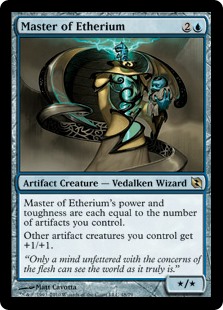
It's very easy to recognize these decks. They are perfect examples of the whole being greater than the sum of its parts. I have never seen a power card deck that looked obviously good on paper. They tend to be full of very weak cards and have plenty of hands that do absolutely Master of Etheriumnothing on their own. You can be forgiven for thinking that such a deck is a terrible pile right up until it draws the missing piece and that unimpressive board suddenly kills you.
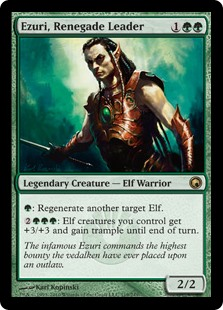
Power card decks maximize the impact of their power cards to win games like a combo deck. Much like a combo deck, power card aggro is built around a large number of enablers and a small number of payoff cards. These enablers may or may not be cards in their own right, but put enough of them together and toss a payoff card in and watch the wins rack up. Affinity, Elves, and Bushwhacker Zoo are examples. Vault Skirge and Memnite are not Modern-playable on their own, but alongside Arcbound Ravager they're a force to be feared. Mana elves are great but do nothing on their own. Mana elves plus Ezuri, Renegade Leader are a (nearly) instant kill. Goblin tokens are almost a strategy (when nobody's expecting storm), but add a Reckless Bushwhacker to the mix and suddenly you're dead.

Strengths and Weaknesses

The strength of a power card deck is explosiveness. When you put a lot of enablers, many of which make mana, together with a big payoff card you will see ridiculous board states way too early. With a good draw, Affinity and Bushwhacker Zoo can win on turn three. These decks vomit their hands onto the board and turn that board position into victory before other decks can react.
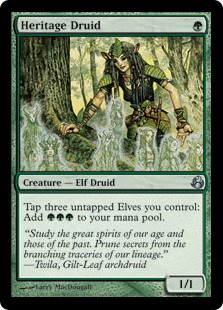
Heritage DruidWhich is also one of their great weaknesses. Power card decks have low resilience and redundancy. Shockingly, enablers alone do not win games, and payoff cards without enablers do nothing. If that initial board hemorrhage is defeated, these decks grind to a halt. Linear aggro can afford to sandbag threats just in case, but when your deck relies on quickly building an unbeatable board you really can't hold back. Yes, holding an extra Ravager or Elvish Archdruid in hand might give you a chance if your board gets cleared, but realistically, how easy is it for you to rebuild versus just killing your opponent before the sweeper?

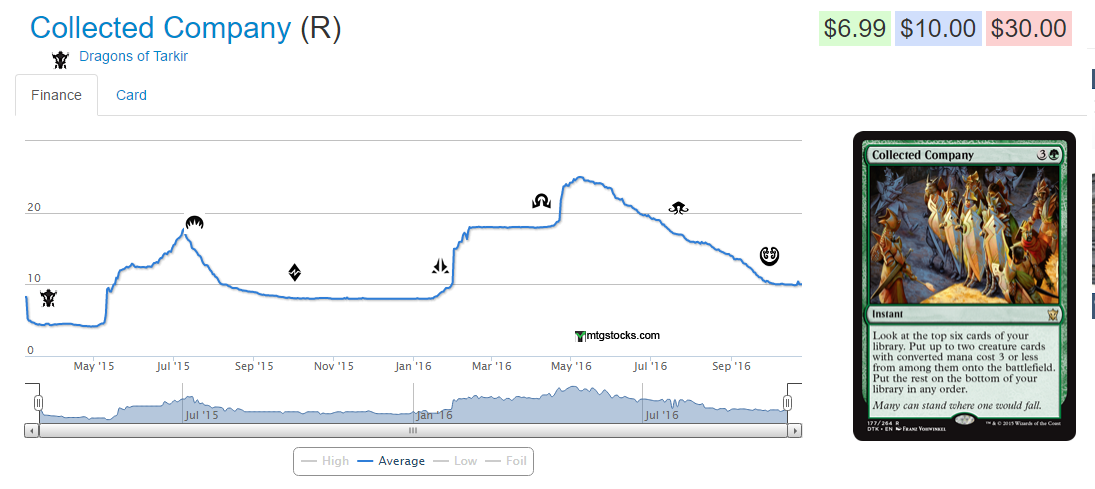
The other big weakness is a lack of redundancy. Without those payoff cards, these decks are anemic beatdown decks at best. They must see at least one, and usually several, to have a chance of winning. Affinity fights this by having a large number of different payoffs. Elves uses Chord of Calling and Collected Company to find its payoffs. Bushwhacker tries to be play as Burn when it doesn't "go-off." However, there's a reason that's not their plan A.

These decks are also very vulnerable to hate. They rely on synergy, and synergy is far easier to play specific answers to than raw power. Affinity is very vulnerable to artifact hate, while there's no targeted hate for Jund.

Playing a Power Card Deck

The most important skill in playing a power card deck is mulligan discipline. These decks have a lot of hands that look perfectly reasonable, but don't actually do anything. A hand of Ezuri, Renegade Leadertwo Llanowar Elves, Elvish Visionary, Dwynen's Elite, and Heritage Druid is very explosive, but it doesn't actually win the game. Similarly, Affinity hands without an Arcbound Ravager or Cranial Plating should be sent back. These decks are meant to explode before the opponent can react. The more time you give your opponent to react, the worse your chances of winning become. Elves's tutors make the range of keepable hands higher but the point remains—if you fail to recognize an unkeepable hand, you will not win.
Next, you need to evaluate how explosively you need to play to win. Some hands can afford to build into a big turn, while others need to be dumped before turn three to have any hope of victory. The more redundancy you have, the more time you can risk taking. Once you recognize that—sequencing! I have seen a lot of new Affinity players lose games they should have won because they did not sequence their plays correctly. Efficient goldfishing is the power card deck's friend.

Beating Power Card Decks

I realize that I've been harping on how dependent these decks are on a small number of cards, and it seems like I'm building up to advising you to eliminate them but I'm not. Never try to use Cranial Extraction type effects against these decks. Yes, if you remove all the power cards from their deck they will flounder, but it won't matter. Power card decks are too fast and explosive for you to wait around. By the time you could plausibly eliminate their key cards, you'll be dead. The only option is to react to their explosiveness and let them collapse in the long game.
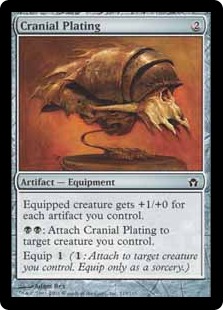
Cranial PlatingIt is possible, though not that likely, to race these decks. When going for their beatdown kill rather than Ezuri, Elves is a turn-four to -five deck and if you can evade their blockers you can win. Infect is frequently able to do this as well. The problem is that these decks are designed to be explosive and give the opponent as narrow a window as possible to respond, and aggressive decks aren't well suited for the task. Realistically, you will usually take the control role against these decks.

To beat power card decks, you must withstand the explosion, then win before they recover. You cannot just remove their power card(s) from play—you have to close out the game in timely fashion, especially against Elves. Targeting the power cards with spot removal isn't enough. There's a lot of situational awareness involved because sometimes it's correct to target the enablers just so the opponent is slowed down and commits to the board, so that you can maximize your sweeper. If you can remove a few enablers to slow their roll by a turn and then kill the first power card, you will buy enough time to catch back up. From there, your higher individual card power or creature power will win the game.

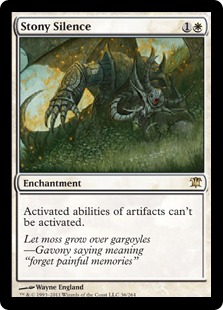
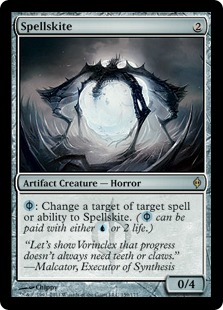
You will probably lose game one. That's why people play explosive decks. Post-board, things get much better because the sideboard cards against these decks are much better than the sideboard cards for these decks. Think Stony Silence against Affinity and Hibernation against Elves, versus Ghirapur Aether Grid and Spellskite. The former are just more powerful than the latter. Recognize this fact and plan accordingly.

Gotcha!

As I said in my first article on Modern deck types I strongly dislike this category of decks. They are frustrating to play against and extremely fast. Most of the decks here, and the mechanics they utilize, I think are bad for Magic. However, they continue to exist so I must deal with them.
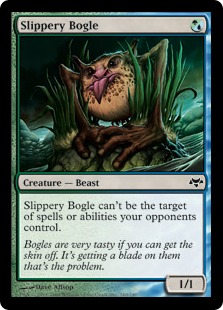
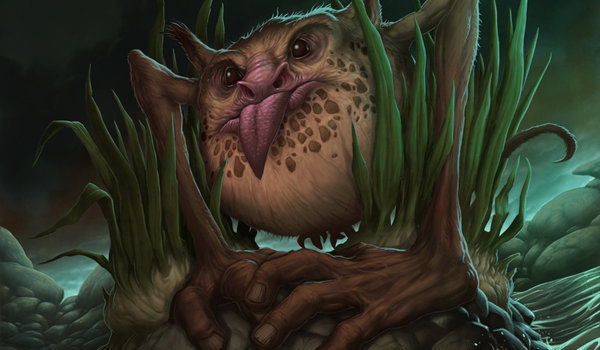
Slippery BogleGotcha! decks are built around some mechanic or card that lets them play less-than-normal Magic. As a result, they prevent the opponent from playing normal Magic. Usually this is because the normal answers and card interplay simply doesn't work anymore. Bogles renders spot removal (mostly) dead, Infect shrinks life totals and makes it permanent, Dredge turns the graveyard into your hand. These decks demand that you interact with them along a very specific timeframe and axis or you lose. Period.

I realize that many combo decks could fall under that definition. The reason they're another category is that those decks typically look to end the game with a single massive turn using impermanent spells, whereas the gotcha! decks play cheap permanents. They're a different playstyle—a combo deck like Storm wins by playing a lot of spells to generate a massive but temporary advantage. Gotcha! decks work either by loading up a lot of spells on a single creature or completely changing how the game is played. Simple combo decks exist within "normal" Magic.

Strengths and Weaknesses

The biggest strength of gotcha! decks are its free wins. Sometimes you get those with normal decks but these decks are designed with free wins in mind. It's why I picked the name. If you don't have the specific interaction required, which you probably won't, they will win. Did I mention the free wins? I feel like I really need to emphasize the free wins aspect.
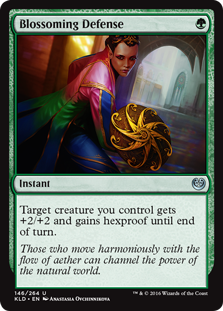
blossoming-defenseBeyond that, these decks typically have a respectable amount of protection for their free wins, such as Apostle's Blessing and Blossoming Defense in Infect. This often balances their vulnerability if you actually have the needed interaction. Many also play Gitaxian Probe, meaning they know what you have and what, if anything, they need to play around. This means that these decks have a large number of obvious free wins and wins thanks to information asymmetry. They know if they can go for the win; you don't. This tends to paralyze players and gives the gotcha! deck the initiative permanently.

This is fairly important for gotcha! because they have very little redundancy or resilience. To maximize their unfair thing they frequently have to go all-in on a single threat. This is the standard modus operandi for Bogles and Infect, but Death's Shadow Zoo often does so on a single unblocked creature. They'll dump all their resources into one attack and ask if you're dead. If you're not, they're not favorites to win. They also tend to play a relatively small number of actual threats compared to support cards, so they have to mulligan frequently and the loss of resources hurts. This also means that if you answer their initial threats they're unlikely to see many more. Dredge is different, but Dredge doesn't play Magic. It's doing something else that should never have been.

The other problem they have is that if you actually have the right spells they cannot win. Dredge must answer Rest in Peace or the deck ceases to function. Bogles can't really beat Liliana of the Veil. Death's Shadow only beats a pair of Lightning Bolts to the face when it sets up a fast namesake. That isn't likely to be the case game one, but games two and three tend to be much worse for gotcha! decks. There's a reason the Dredge sideboard is nothing but RiP removal.

Playing Gotcha!

You're almost always the aggressor—the question is how you're doing it. Sometimes you do it by methodically drawing out answers and using your information advantage to ensure your opponent is on the back foot regardless of their board advantage, leaving them afraid of going "shields down" for fear of losing. Sometimes you'll do it by screaming, "Blood in the water! Go, go, go!" and just trying to kill as fast as possible. Winning with these decks is very much an art based on resource management.
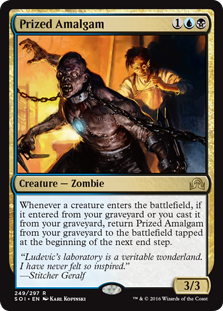
prized amalgumMulliganing is also very important here because while you need a critical mass of resources to win, you also need a threat to use them on, and you don't have many. You have to mulligan for them, but do that too much and you'll lack the resources to win. Very much a balancing act. Also, recognize that this deck only gets one chance to win, so don't be too worried about fragile hands. That's the risk you take for free wins.

Or you could be Dredge and simply build a massive board without paying mana for anything. In this case you need to be looking to maximize the number of cards you can dredge in a given turn and then return your Prized Amalgams to the field. If you have the option you want to do this on your opponent's end step so you get at least one attack in without risking sorcery-speed removal.

Not Getting Got

Each non-Dredge deck in this category plays a smaller number of cheap, small creatures and a lot of ways to defend them. They're very fast and can win from nowhere, so you can't really race them. You have to interact, and they make this difficult by design. It is not an easy thing to do.

But not impossible. Learning "Infect sequencing" is critical. What I mean is that you have to adjust how you play to account for the protection these decks play and the fact that if they use it you will die. Thus you have to force them to use resources when it is non-advantageous to do so. Use removal on your turn or after combat on their turn so they can't use their buffs to deal extra damage. You should only try to interact during combat if you will die otherwise. If you can manage their resources well, then it is possible to retake the initiative and then the game.
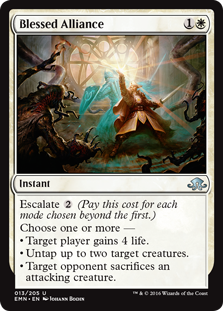
blessed-allianceA card I've found very effective against these strategies is Blessed Alliance. These decks are very good at answering spot removal, but cannot easily deal with untargeted removal. Given their tendency to only attack with one threat and commit lots of resources to that threat, Alliance alone can be game-winning. Pro tip: there's an opportunity to cast instants and activate abilities after combat damage before the step ends. If you kill off all but one creature thanks to blockers and aren't dead, you can still cast Alliance and make them sacrifice their last creature.

Against Dredge interaction is a losing proposition, but not a useless one. Their threats recur, so unless you can exile them (hello Anger of the Gods!) you're never really out of danger. Instead, assuming you can't exile their graveyard, you have to use removal to slow them down and then present a clock of your own. Dredge relies on opponents being swamped by a huge board early and it isn't good at defending itself. If you can slow them down even a little bit and possess a decent clock you can get there.

Take Back the Game

And with that, my introduction to the world of Modern aggression comes to an end. Remember, this is intended as a guide and a simplification. Every deck and matchup is far more nuanced in reality. Hopefully this will provide the overview to help you find your feet in this vast format.

In my article last week I talked about players' misconceptions about control, stemming from the prevalence of aggro in Modern. If you read this article series critically you've noticed all the references to the control deck I was thinking of. Join me next week when I stop the innuendo and spell out my position on control in Modern.


Insider: High Stakes MTGO – Oct 23rd to Oct 29th

Are you a Quiet Speculation member?

If not, now is a perfect time to join up! Our powerful tools, breaking-news analysis, and exclusive Discord channel will make sure you stay up to date and ahead of the curve.

Hello, and welcome back to High Stakes MTGO!

Finally, things are going better for me and my bankroll. Although still farily low compared to a few months ago, Modern prices have stabilized and some are even generating me some tix now. Hopefuly we are done with bad news for speculators regarding Modern, as I'm counting on recouping some of the losses accumulated in October.

Fortunately Standard is currently pulling my bankroll forward. Many singles are heading up and all my Standard full set positions are doing great, or in the case of Battle for Zendikar full sets, recovering from the bottom of the pit. The main protagonists of our current Standard metagame seem to have been determined, although their relative dominance will probably be refined over the months to come. Any changes in the metagame could signifiy both buying and selling opportunities, but it may also lead to lossses for speculators not ready to adjust.

Unlike Modern, where most cards cycle up and down, cards in Standard may cycle down and never recover from it. Whenever a good opportunity occurs, selling and never looking back is often better than waiting for a hypothetical better opportunity. Doubling up is often a very good deal with Standard positions, and rare are the positions that sustain a price spike in the long run. After all, Standard introduces a new set every three months.

Let's review my moves this past week. The link to the live portfolio is always available here.

Buys This Week

dtk-sets

The paper value of a set of Dragons of Tarkir has been virtually flat for two weeks now and is likely to have found its post-rotation (and absolute) floor.

On the other hand, the online version of a DTK full set has been at an all-time low for only a week. As Matt commented in last week's MTGO Market Report, DTK dropped to a really low price and now might be the best time for some post-rotation speculaton. With all the successes we know of for third-set specs, I'm expecting DTK to yield good profit as well.

ori-sets

Led by Jace, Vryn's Prodigy, the value of online Magic Origins full sets seems to have rebounded from a bottom found two weeks ago. The paper value of ORI full sets is not yet as flat as DTK ones, but I think it's a great time to get in here.

For both DTK and ORI full sets, I haven't yet commited a large amount of tix. I'll likely continue to buy more sets over the next few days if prices decline further or stay at the same low levels.

mt

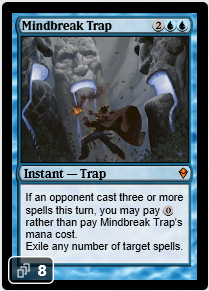
Following Zendikar flashback drafts, I bought 26 copies of this trap at the not-so-low price of 4.5 tix per copy. Mindbreak Trap was dragged down below 3 tix in the wake of the introduction of the Treasure Chests.

This card only has narrow applications in eternal formats. But historically it spikes once a year or so, and has a tremendous potential with a ceiling around 20 tix. I'm trying to be ready for the next spike—I'll be fully satisfied if this card only reaches 10 tix the next time it's in demand.

Sales This Week

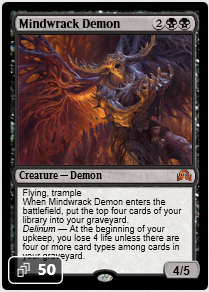
After Grand Prix Kuala Lumpur, W/U Flash decks came out to be very dominant. The future of B/R Delirium decks and Mindwrack Demon was not so bright and I decided to sell my copies of this demon while I knew I was making a profit.

However, starting with GP Providence, B/G Delirium decks have progressively become more popular. By now they're certainly filled the gap that separated them from W/U Flash and W/R Vehicles. Although Mindwrack Demon is not played in all variants of B/G Delirium, this card could have more upside than I thought. If you are still holding some copies of this demon it could be worthwhile to wait a week or two before selling.

I sold all my stock of Spell Queller after the results of GP Kuala Lumpur. 80% profit in less than three weeks is always something to consider.

This Spirit is certainly a great card and we'll see it around for a while in both Standard and Modern. With the dominance of W/U Flash decks declining a bit, I'm not sure how high this card can rebound after the peak observed last week. As Nicolas also suggested last Friday, selling now is likely to be the best overall move for a card that has almost tripled from a month ago.

Dark Ascension flashback drafts are next in line. My Thalia spec never really got me anywhere and I missed the few selling windows that would have allowed me to exit this position with a marginal profit. Taking advantage of a little price hike last week, I sold about half of my stock while I was still positive.

I didn't feel like selling the other copies now that buying prices are lower. Prices will certainly drop further with the flashback drafts and I'll wait for the next price increase to sell the rest of my Thalia, Guardian of Thraben.

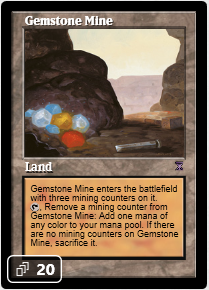
The Mines were a nice surprise of this past week. 7.3 tix felt like a good buying price point and I was not expecting the rebound to be so fast or high. Gemstone Mine is probably riding the trend of Dredge in Modern and I'm not going to complain about it.

Although rebounding to 15 tix is possible here, I decided to sell 8 copies this past week as the Mines were listed at 11.8 tix on MTGOTraders' Hotlist. After a lot of disillusions with Modern specs, I can't turn my back on 60% made in barely a week.

fgf

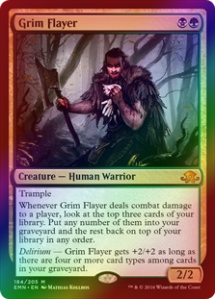
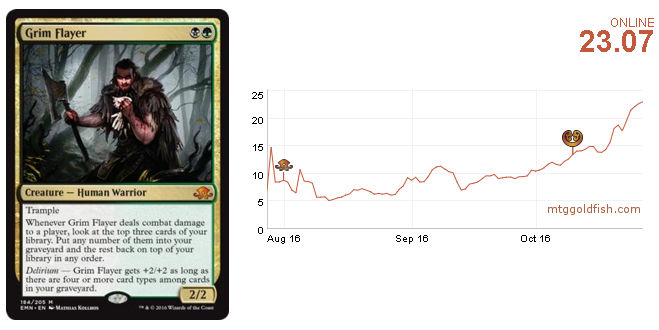
One more copy of foil Grim Flayer sold this past week. 16 tix seemed like a good price but it keeps climbing! Selling foils is always more tricky than regular cards and they're almost always under-priced these days. I have two copies left and 20 tix seems possible this week. An incredible ride with this little guy!

bfzlog

Thanks to Gideon, Ally of Zendikar, the value of Battle for Zendikar full sets is picking back up. The trend might sustain for a few more weeks but I don't want to take any more risk with these. Selling four sets just below my buying price was something I had a hard time imagining a month ago, so I'm not going to waste that opportunity. I still have 29 sets to go—hopefully the good shape of BFZ prices keeps up in November.

frf-sets

This full set spec never panned out. I could have sold these at a small profit several months ago but I guess I wanted more. Now it's pretty clear that I'm not going to make any tix on my Fate Reforged full sets. Now I'm looking for the best moment to sell the other 12 FRF sets I still own. I'm likely to sell them before the end of this year, whatever their price may be.

On My Radar

Innistrad has several of the most iconic and powerful cards for Modern and other eternal formats. With flashback drafts going these days, I will try to grab some of the staples at the best discount possible.

The only shadow hanging over these cards is that several have a decent shot at being reprinted next March in Modern Masters 2017. Although Modern prices are expected to regain some strength in the coming months, that doesn't leave us with a lot of room to turn ISD specs into a profit between now and the first spoilers of Modern Masters 2017.

I'm going to keep selling my Standard positions as they go. Standard is always susceptible to changes and nothing guarantees prices will make it through an initial spike.

More specifically, I'm on the verge of selling my Eldritch Moon full sets. They have performed pretty well and have reached my target. In addition, one month after the release of a new first set appears to be the good selling window to sell previous full set specs. No reason to be too greedy here, especially after the recent disappointing performanaces from other full set specs.


Thank you for reading,

Sylvain

Insider: Hidden Gems in Forgotten Sets

Are you a Quiet Speculation member?

If not, now is a perfect time to join up! Our powerful tools, breaking-news analysis, and exclusive Discord channel will make sure you stay up to date and ahead of the curve.

A couple years ago I made a rare purchase out of weakness. I had significant emotional attachment to the Homelands set, it being one of the first sets I bought packs of as a kid, and I decided to purchase a complete set of Homelands. The eBay listing cost me about $43.

Talk about a waste of money, right?

Sure, there’s no way I could sell the individual cards of the set for $43—the price I paid was more to cover someone’s time and effort to assemble the set than the value of the cards themselves. It is not my financial folly that I want to touch upon this week, however. Instead, I want to point out a couple of interesting trends in some of Magic’s most detested sets in history.

My Homelands set is a frequent reminder of some of these unexpected trends. Perhaps after finishing this column, you won’t be so inclined to breeze past cards from these horrendous sets when digging through bulk bins at your LGS. There are quite a few pleasant surprises.

Homelands

Despite the massive print run and lack of demand for Homelands, a few cards managed to break beyond bulk that I think are worth thinking about. We all know about the iconic Baron Sengir—this wouldn’t be a very valuable article if that was the only card I mentioned. Fortunately, I think there are a few more obscure and far more interesting cards to keep an eye out for from the unpopular set.

For example, my favorite speculation target from Homelands would have to be Koskun Falls.

There was an error retrieving a chart for Koskun Falls

This card spiked back in July—perhaps as part of the Reserved List buyouts that occurred this past summer—and has held its price fairly robustly since. Sure, the card is a bit odd in that it’s an enchant world. But it’s a Propaganda effect, in black, and on the Reserved List. To me this is a recipe for success. That $1.50 buy price is nothing to sneeze at either. If you can find any copies of this card make sure you tuck them away for a rainy day.

If Koskun Falls is a little tricky to track down in bulk, here’s another idea: Merchant Scroll. The blue card from Homelands was printed at common, so it’s very likely to show up in any Homelands bulk. You can see its price has also been on the move lately, despite being from that detested 1996 set.

There was an error retrieving a chart for Merchant Scroll

Its top buy list is now $0.65. To me, that’s more than worth pulling out of bulk whenever possible. After all, if you want a non-foil, black-bordered copy of this card there’s only one option: Homelands.

How could I possibly forget Didgeridoo? Remember when that card was $7 for about a day?

There was an error retrieving a chart for Didgeridoo

I’ll admit I like this card much less than Merchant Scroll and Koskun Falls. But it is on the Reserved List and it does buylist for a buck. I’d discourage speculating on this one in favor of the other two, but I would be remiss not to mention this card's above-bulk status.

Lastly, keep the following cards in mind: Leeches, Narwhal and Timmerian Fiends. All three of these are above bulk and buylist for at least $0.50. I list these cards separately because I do not advocate speculating on them. They’re all a trap. But I can’t deny the fact that they randomly have value nowadays. If you come across bulk Homelands cards, these are three other cards you cannot overlook…no matter how ridiculous it is. (I mean, an ante card, really?)

Fallen Empires

Back in 1997-1998, my LGS had packs of all the recent Standard sets. However those packs typically retailed for $2.95. They did have packs of cards from two different sets that were cheaper (read: more affordable for a 14-year-old). The only set cheaper than Homelands ($1.75 a pack) was Fallen Empires ($0.50 a pack). Needless to say, poor income-less me picked up my fair share of both.

Everyone probably knows about Hymn to Tourach already. I’m not going to waste any more space on that card. But how many of you are aware of the Reserved List card Rainbow Vale?

There was an error retrieving a chart for Rainbow Vale

This card has miraculously been moving higher lately. Part of that is due to recent interest that some people have taken to using these lands for pack wars (disclaimer: I myself have about 40 of these for pack wars). Apparently enough people are taking notice because buylists are now reaching $1.00. It won’t ever be a $20 Legacy staple, but the card is very unique and will never be printed again. It may be worth grabbing a few to sit on for a year.

Sadly, there’s only one more noteworthy card worth mentioning: Goblin Warrens.

There was an error retrieving a chart for Goblin Warrens

I guess even bad Goblin tribal cards are worth money nowadays? The artwork may be amusing, but the $0.30 buylist is actually not something to laugh at. Pull these out of Fallen Empire bulk whenever you find them.

Chronicles

Of course, Chronicles cards are more desirable than Homelands and Fallen Empires. They don’t really belong in the same category. The reason I lump them together is twofold. First, the set is known for its disastrous impact on the secondary market. Second, it’s the third and final set that I could buy packs of for below MSRP growing up.

In this set I need to be careful. Talking about Blood Moon is inconsequential—everyone knows this card is valuable. But believe it or not, there are some up-and-coming cards from this white-bordered set that may be worth buying and holding onto.

One card that may surprise you is Hell's Caretaker.

There was an error retrieving a chart for Hell's Caretaker

I’ll be honest with you: I don’t have a clue why this card spiked in April this year. But for whatever reason, the card popped from $1.75 to $2.75 during the spring. The card has been selling off since the spike, but eventually it will settle and flatten out. That may be a good time to buy.

The other Chronicles card I want to highlight is Concordant Crossroads. While not nearly as under-the-radar as Hell's Caretaker, this green enchant world is still worth far more than many may realize.

There was an error retrieving a chart for Concordant Crossroads

After flat-lining for years, the card just began gaining price traction in 2016. Much like the Caretaker, I’m not really sure why now, after 20 years, this card is finally gaining price traction. It can’t be any significantly rarer now than it was a year ago, right?

Either way, the ability this card offers is very strong. Wizards has shown a willingness to print cards at the same power level with the colorshifted Mass Hysteria, but haste is no longer considered part of green's color pie. So if you want this effect in this color, Crossroads is the only option. For this reason alone I’d keep this on your radar as a card worth picking up in trade.

Wrapping It Up

Homelands. Fallen Empires. Chronicles. These are three sets that have been written off as worthless for over a decade. Yet the year 2016, for some reason, has catalyzed movement in a number of surprisingly obscure cards. Would you have ever guessed that Narwhal would become one of the most valuable cards in Homelands? I sure wouldn’t have! (Aside: I believe there’s a person who is collecting Narwhals…either way, the card is worth more now than it was last year!)

As a person who has enjoyed Magic for 19 years, I can certainly appreciate the flavor these old sets have to offer. Therefore I naturally get excited when I see these price movements. I hope that by flagging some of them, you may have reason to look through any bulk from these sets you encounter, being sure to keep a sharper eye for cards mentioned in this article.

Chances are that not many people know Leeches is a card worth nonzero dollars—use this awareness to your advantage. Find enough quarters and dollars and you just may eek a little more cash out of a collection you bought. With many of the cards listed here as common or uncommon, there’s even more reason to look closely as you skim.

The classic feel, obscureness, and flavor of these cards are enough to get me interested in them. That’s why I purchased that Homelands set a while back. But then you add in the fact that some of these cards also show up on the Reserved List! This suddenly makes the proposition more interesting.

Granted, you won’t make millions buying out copies of Didgeridoo. But you can move the market if you wanted to do so. I’m not saying it’s a good idea—but it may be interesting to try.

You never know; maybe Soraya the Falconer will be the next $3 Homelands card. Stranger things have happened!

…

Sigbits

  • ABU Games is currently offering $0.50 on Narwhal. I would sell any copies you can find hand-over-fist at that price. Why do I suggest this? Star City Games has 118 copies in stock with Near Mint copies listed at $0.99. There’s no way this price sticks. The price may have spiked, but it is far from sustainable.
  • Contrast that to Didgeridoo, where Star City Games has 11 total copies in stock. There are far fewer of these available, and Near Mint copies are actually selling at $1.99. The tribal aspect of this card—yes even though it’s Minotaurs—makes it actually worth picking and keeping for long-term growth potential.
  • There are a few Homelands cards actually sold out at Star City Games: Ebony Rhino, Serrated Arrows, Truce, Veldrane of Sengir, Willow Priestess, and Winter Sky. I wouldn’t necessarily buy TCGPlayer out of these cards, but they may be worth checking out. Some of these are fairly unique, others are on the Reserved List, and all of them merit picking from bulk for long-term potential.

High Stakes MTGO – Oct 16th to Oct 22nd

Are you a Quiet Speculation member?

If not, now is a perfect time to join up! Our powerful tools, breaking-news analysis, and exclusive Discord channel will make sure you stay up to date and ahead of the curve.

Hello, and welcome back for this week's High Stakes MTGO!

Things look much brighter compared to last week, thanks to Standard in particular. Complete sets of Battle for Zendikar, Oath of the Gatewatch, Shadows over Innistrad and Eldritch Moon increased in value this past week, which positively impacted my bankroll.

Does the announcement of the reversion of the Standard rotation system have any thing to do with this? Maybe a tiny bit. Nonetheless, after embittering some of us, including myself, with its record low right before the release of Kaladesh, BFZ has now very nicely rebounded, on the path to reach its previous best pricing seen this Summer.

Another semi-good piece of news for the two oldest sets in Standard is the slight increase in BFZ and OGW booster prices. I assume that if full set values go up, pack prices have to follow to some extent. I'll take any gains here as I'm holding onto a big stack of these boosters. I have no hope of selling for more than I bought them at this point, but at least my losses will be less severe.

EMN and SOI have shown decent gains, which is rather good news for me since I had purchased a few of these full sets at what now appears to be good buying prices. Selling Grim Flayer and Gisela, the Broken Blade last week was not exactly the best timing. With U/W Flash poised to dominate Standard, often featuring two to four copies of Gisela, it looks like I'm going to be missing out on some tix here.

On the other hand selling Flayer was probably okay, as B/G Delirium decks, despite being well represented, are not posting strong enough finishes. Thus, that might cap the value of Grim Flayer around 17 tix. For both of these EMN mythics, now I'm waiting for the foil versions to catch up with their regular counterparts. The foil version of Grim Flayer is still lagging 3 or 4 tix behind, for instance.

The hemorrhaging of Modern prices looks to be subdued this week as the Total Format Modern Price index has been essentially flat this past week. Fall is traditionally a good season for Modern prices. With some Modern events lining up at the end of the year the tradition shall, hopefully, continue.

After the reversion of the Standard rotation system, Treasure Chests are probably the next thing players are hoping Wizards will go back on. The elimination of the Treasure Chests would certainly jump-start Modern prices, however removing the chests is more of a puzzle since they are the medium WotC chose to introduce the KLD Inventions.

Let's review how this past week went for me. As of Saturday October 22nd my portfolio looked like that.

Buys This Week

lolh

I said I would try to short-sell Liliana, the Last Hope, and I did. But it was for virtually nothing—16 tix of profit for about 300 tix manipulated. What I missed here was selling Liliana earlier. Selling in the 23-25 tix range would have been possible right before she plunged to 19 tix. I only sold my 14 copies at an average of 21.8 tix instead.

The price dipped further after that and I felt like buying back my copies of Liliana mid-week was the safest thing to do. Sure enough, Liliana, the Last Hope went back up to 27 tix this past weekend.

As I'm writing this it's not clear yet what portion of the metagame B/G Delirium (the deck making the most of Liliana, the Last Hope) will occupy. With two GPs featuring Standard Constructed this past weekend, short-selling Liliana again is in the realm of possibilities. 27 tix is a tough price to sustain for a mythic that doesn't end up occupying a solid place in the top decks. From what I can see from the two GP Trial Decklists and the three undefeated decks from Day 1 at GP Kuala Lumpur, Liliana is nowhere to be seen.

kgs

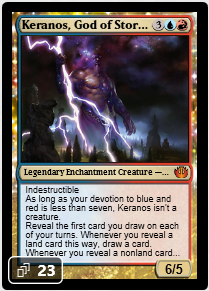
From a height of almost 50 tix, Keranos completely lost his support when Splinter Twin got banned. No other Modern decks since have picked up the blue-red god, and now here we are with a card once among the most expensive in Modern sitting at 7 tix.

Keranos's price has stabilized a couple of times in the past, around 20 tix in the Spring and around 13 tix this past summer. So I wouldn't conclude on this alone that 7 tix is the lowest he can go, even if that price has held for a month and a half.

However, when I was looking to grab my copies of Keranos, God of Storms it seemed like stocks were very limited. With 23 copies, I bought all the copies I could find under 8 tix. I also saw a few bots offering to buy Keranos at 7 tix, which is a sign of a certain demand for this god at that price.

gm

For the past year and a half, Gemstone Mine fluctuated nicely between 7 and 15 tix, with the most recent drop likely due to its appearance on the Treasure Chest Curated List. Right now its price is much closer to its long-term floor. Additionally, I believe the short-term impact of Treasure Chests is greatly exaggerated, so stocking up on a few playsets of this land sounded like a decent plan.

In addition, the supplies of Timeshifted cards are fairly low, and this set has already been flashback-drafted. Nonetheless, I'm only jumping on five playsets at this time as the price of the Mine could decline a bit further down to 5 tix. If this happens, I'll be a buyer for two or three more playsets.

md

Mindwrack Demon appears to be a very good mid-curve card for most B/G Delirium decks. Brian DeMars also confirmed last week that the Demon was solid, stating, "If The Rock makes a comeback, expect this card to see some gains in the coming weeks." This was therefore a perfect opportunity, since the price of the Demon has dropped from 3 tix to 1.3 tix—its baseline since the release of SOI—in the wake of Pro Tour Kaladesh.

This card already jumped back to 2.5 tix by last Saturday. However, I just mentioned that B/G Delirium decks may not be well-positioned after the two Standard GPs of this past weekend. I'm not looking after unreasonable profits here, and if B/G Delirium decks are effectively behind in the metagame I'll sell my Mindwrack Demons immediately.

Sales This Week

My second short sale of the week. To me, Nahiri's appearances in Standard and Modern decks are clearly insufficient to justify a 10 tix price tag. Since I now own a few SOI full sets, short-selling this planeswalker seemed like a good speculative move.

I'm expecting Nahiri, the Harbinger to follow in Oblivion Sower's or Ulamog, the Ceaseless Hunger's footsteps. A price of 5 tix is what I'm targeting, and that should be even lower if it appears that Nahiri can't find a strong Standard deck to fit in.

fos

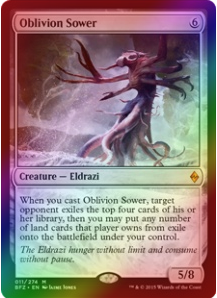
BFZ foil mythics have tanked a little bit these past two months, and Oblivion Sower was one of the foil mythics that maintained the cap somehow. While still profitable, I simply wanted to cash out a few tix here.

fgf

A last-minute sale, and one of the very few I made using an ad on the MTGO Classifieds. As I was saying in the intro, the foil price of Grim Flayer is lagging 2 to 3 tix behind the regular version if you want to buy it, and 3 to 4 tix behind if you are looking to sell. Apparently players don't mind paying more—up to 40% more sometimes—for the exact same thing, and this holds true for a lot of cards these days.

The best buying price I could find for foil Grim Flayer was about 13 tix; the average selling price was around 15.5 tix for foils and 18 tix for the regular version. I posted an offer selling foil flayer for 15 tix or 58 tix for a playset. It took me two hours but I found a buyer.

bfz

Cutting losses is virtually the only thing to do here. Considering the hundreds of boosters I have between BFZ and OGW, I'm selling some copies now that prices just saw a little increase. I don't even know if it's possible or not, but I'm not going to wait for these guys to reach 2.5 tix again before pulling the trigger.

Both of these cards have a shot in Standard and Modern, though limited ones, as it seems. I may have sold these two cards in too much of a hurry, but I'm okay with it and I'm not sure I'll be missing much anyway.

On My Radar

Now that Standard has significantly rebounded and that the metagame is settling down, I'll be trying to take every possible shot I have at selling my specs with a positive return. Cards may not have a second chance in a rotating format. U/W Flash might be dominating now but nothing guarantees it will still be the case in two months or even after the release of Aether Revolt.


Thank you for reading,

Sylvain

Insider: Adam’s Market Musings

Are you a Quiet Speculation member?

If not, now is a perfect time to join up! Our powerful tools, breaking-news analysis, and exclusive Discord channel will make sure you stay up to date and ahead of the curve.

The Ion Core Scanner is awesome.

I jumped headfirst into using Quiet Speculation's Ion Core Scanner last month as a tool to buylist my collection to online stores. I had a great and fruitful experience that I cataloged in a three-part series, and it’s certain that the Ion Core Scanner both saved me time and helped me extract more value from my cards. With my cards shipped and sold, now I’m eyeing the scanner for its potential to quickly sort and sell any new cards, which seems perfect for acquiring collections and turning them into cash.

The Ion Core Scanner is simple to use, and it doesn’t require anything special but a cheap laptop and a functional camera. It’s also portable, which is why I’ve seen dealers use it at events to help them buy cards. Kelly Reid even used it on a plane to sort a 1,000-card box on his hour flight en route to Eternal Weekend!

scannersonaplane scannersonaplane2

Standard

Wizards announced that Standard is going back to the old rotation schedule, meaning some cards just earned an extra six months in Standard, which immediately made all Standard cards more valuable because players have more time to play with them. It’s a good thing for everyone, and the community is celebrating the decision.

Confidence in Standard is high, but the utter dominance of Smuggler's Copter at last weekend’s Grand Prix double-header, being found in nearly 90 percent of decks, could change things. Those numbers rival the dominance of Jace, the Mind Sculptor and Stoneforge Mystic, and there are already loud people talking about potential bannings. There is hope, however, because the finals of Grand Prix Providence featured two decks that fought through a field of Smuggler's Copter specifically by not playing it themselves. Black-Green Delirium has emerged as a very clear rock to the Blue-White Tempo's scissors, and with time the Standard metagame should balance itself out to reasonable levels of Smuggler's Copter.

Cards from UW and BG seem like great buys. Selfless Spirit has already spiked, but the price of Spell Queller is near a low.

There was an error retrieving a chart for Spell Queller

My favorite buy from the deck is Gisela, the Broken Blade, which has proven itself as a staple sideboard card. It’s even seeing some play in maindecks alongside Bruna, the Fading Light. This mythic hasn’t seen much play yet and is still a bargain, but I expect the price to only rise.

There was an error retrieving a chart for Gisela, the Broken Blade

From BG, Ishkanah, Grafwidow is a staple that has been steadily decreasing in price, and it seems like a bargain under $9.

There was an error retrieving a chart for Ishkanah, Grafwidow

Wandering Fumarole spiked after the Pro Tour, but Hissing Quagmire is the real winner in this new Standard, especially because the ultimate winner of the Grand Prix actually played Sylvan Advocate instead of Grim Flayer. At just $3, it has room to double to $6, too.

There was an error retrieving a chart for Hissing Quagmire

Vintage Powerless Eldrazi

Powerless Eldrazi is a Vintage deck that can be had for around $1,000, which makes it closer to the price of a Standard gauntlet or a Modern deck than a Powered Vintage deck worth five digits. It makes the format much more accessible, and even thought it might not be the best deck, it's competitive enough to warrant playing. Today begins the Vintage Championships at Eternal Weekend, the first time the event has been held since the Eldrazi have invaded, and it’s certain that Powerless Eldrazi will be a popular choice. There are even prizes for the top finisher without the Power Nine or other broken cards, and Powerless Eldrazi qualifies, so there is additional incentive.

There was an error retrieving a chart for Null Rod

The card that stands out to me for speculation is Null Rod, which is on the Reserved List, and at around $25 is relatively cheap given its age and low print run. The price nearly tripled after a spike in February with the release of the Eldrazi, but it was a price correction that has maintained through the year. There will be more room for growth, and a buyout could spike this price higher, so it seems like a safe card to target in trades.

Holiday Shopping and Modern Masters 2017

The holiday shopping season is here, so stock your online and brick and mortar stores and take advantage of the increased sales opportunities. Stores are hungry for inventory, so it’s also a great time to buylist cards when prices are high.

There has been a phenomenon every winter when the prices of many Modern cards spike, partially related to the holidays and mostly in preparation for Modern season, but I am hesitant this year with the release of Modern Masters 2017 imminent next spring. I might look to sell staples when demand is high this fall, because the risk of reprint is high on many cards.

There are plenty of expensive staples that are liable to be reprinted, and while history shows that the most icon and expensive mythics aren’t likely to drop at all, anything else is fair game, and an unexpected reprint as a rare instead of a mythic could crash the price of any card. This is the first year Innistrad gets the Modern Masters treatment, so it’s all but certain that Liliana of the Veil and Snapcaster Mage will be included. Cavern of Souls is the most expensive cards from Avacyn Restored and a very likely inclusion.

The Return to Ravnica block is also included, which seems a bit too soon, but there’s room to reprint staples like Voice of Resurgence.

There’s a dire need to reprint some of the more expensive Modern cards from past sets, like Horizon Canopy and Grove of the Burnwillows, or even Crucible of Worlds. I expect any of these would be mythic, but because their demand is lower, I have to imagine their prices would still fall.

That’s not to mention the possibility of Zendikar fetchland reprints. I expect these will be released as rares when they are finally reprinted, because the market is so starving for them and Wizards will want to make a significant impact.


What is your experience with the Ion Core Scanner? Will/should Smuggler's Copter be banned? Is Powerless Eldrazi competitive in Vintage? What do you expect to see (or not to see) in Modern Masters 2017? Let me know in the comments.

--Adam

Insider: MTGO Cards to Buy, Sell or Hold – Episode 15

Are you a Quiet Speculation member?

If not, now is a perfect time to join up! Our powerful tools, breaking-news analysis, and exclusive Discord channel will make sure you stay up to date and ahead of the curve.

Hello, investors! This week was much calmer than the last few, and prices are finally starting to settle down. I don't think we will see big spikes in the following days, unless a new deck rise from the shadows – although this is always a possibility in Standard.

In regard to Modern, Treasure Chests seems to have reached a no-return point, and we will have to deal with it. Wizards's intention to lower singles prices is in conflict with speculators plans to make profits, and an unfortunate side effect is that it decreases the average portfolio price for all users, players and speculators alike.

Some Modern card prices could rebound once taken out of the curated Treasure Chest list and if they're not reprinted in a flashback draft event for a long while, but I won't invest in them because it is too risky. We still don't know if there will be any new event(s) after all the flashback drafts for the year are completed.

Based on Modern's riskiness, let's see what Standard is offering us:

Spell Queller

spell-queller

Blue-white decks didn't receive enough marketing at the Pro Tour because they didn't make top eight, even though they were the best-performing decks in the Constructed portion of the tournament. They managed to put up great numbers at recent GPs, though, and now are getting the attention they deserve.

Now is a good moment to sell Spell Queller, a key card in the deck, because many players are interested in it – in fact, it is the most-played deck in the online metagame. The field is open enough to keep changing, and I don't think it is worth holding to see if Queller will see even more play.

Verdict: SELL


Grim Flayer

grim-flayer

Another deck that made a glorious reappearance at last weekend's GP is Black-Green Delirium. Grim Flayer has been setting new high-point records almost every week since its release, and I think it is time to give it some rest. It is really hard for Standard cards to keep at this high a price level over time. "Buy when it is cheap, sell when it is high" is a phrase we all have heard several times and suits this occasion perfectly.

Verdict: SELL


Emrakul, the Promised End

emrakul-the-promised-end

Emrakul, the Promised End is another key card in BG Delirium decks, but if we compare the graphic above with Grim Flayer's, they are very different, maybe because Grim Flayer is a four-of while Emrakul is only a one- or two-of. The main difference is while Grim Flayer keeps making new highs every week, Emrakul has a more linear price history.

If you remember, the first spike was when Delirium and Emerge made their first appearances at Pro Tour Eldritch Moon out of nowhere. Plenty of investors quickly put their money on Emrakul, creating a financial bubble that exploded a few days later when those same investors liquidated.

The second and smaller spike was just before Pro Tour Kaladesh. This time investors bought in speculating that those same decks, almost unaffected by rotation, would dominate the tournament. That didn't happen, and again, the price plummeted.

This week, the deck showed it is still strong in the current metagame. From now on, I think Emrakul's price movement will start to look more like Grim Flayer's: a slow, steady climb upward. I won't recommend buying them right now, because the price has already rebounded and I'm not sure how high it will reach, but I would definitely hold any copies you have a little longer.

Verdict: HOLD


Oath of Nissa

oath-of-nissa

Oath of Nissa is completely off the radar in the current metagame. If you pay close attention, though, at the end of the above graphic you will see a small rebound after the announcement of the reversion to the old Standard rotation scheme. This week, the price went down again going below the 1 tix barrier. I think it is just a matter of time before we again see Oath of Nissa in decklists, and the price can hardly go lower. One of the best picks for such a dry week in terms of good buy options.

Verdict: BUY


Archangel Avacyn

archangel-avacyn

Archangel Avacyn is a staple in the blue-white decks that performed so well this week. Avacyn has reversed its long-term bearish trend since Shadows over Innistrad  rebounded. Mythic rares see different price movement than rares because they have a more limited supply, and the card could go up a little more, but in this case I prefer to sell into the hype rather than concentrate on making an uncertain extra profit.

Verdict: SELL

See you next week, and remember, if you want me to write about a particular card, just ask it in the comments below.

For Fog’s Sake: Beating Linear Decks

Are you a Quiet Speculation member?

If not, now is a perfect time to join up! Our powerful tools, breaking-news analysis, and exclusive Discord channel will make sure you stay up to date and ahead of the curve.

Modern's claim to fame is its diversity. I'm not alone in feeling like a notable portion of the format's card pool is playable, and Wizards themselves push this narrative heavy-handedly. For many players, though, Modern is less about openness than it is about linearity. There are indeed plenty of options—so long as you're not set on interacting with opponents. Learning to navigate the format's hazy muskeg of linear decks might seem daunting at first, but with the right attitude, it can prove exciting and productive.

fog-cropped

In his article yesterday, Trevor correctly identified the upcoming GP Dallas as a guaranteed trend-setter for next year's early format shifts. Until then, we have SCG Milwaukee to analyze. That tournament confirmed the feelings of many players frustrated with Modern's linear bent, featuring a characteristically goldfishy Day 2 metagame breakdown and Top 16. This article explores how to defeat linear decks without giving up too many points against Modern's diverse set of viable strategies.

[wp_ad_camp_1]

If You Can't Beat 'Em...

The most popular way to beat Modern's linear decks is to simply play another linear deck. This method might sound silly, but according to the format's numbers, it's the one the majority of players prefer.

Play Something Faster

Modern is a format structured around the Turn Four Rule—if a deck consistently wins before the fourth turn, makes up a large portion of the metagame, and is difficult for other decks to interact with effectively, Wizards will ban one of its components. But the presence of this rule doesn't mean all linear decks aim to win on turn four.

cathartic-reunionThere are a couple benefits to piloting a linear deck that wins later. Dredge generally goldfishes victories around turns five or six. In exchange for this weakness, it bypasses the most common form of disruption in Modern: removal. Lightning Bolt, Terminate, and even Path to Exile look silly in the face of so many costless, recurring threats. Efficient kill spells like Bolt are the best way to interact with synergy-based linear aggro decks like Infect and Affinity. Blanking those spells gives Dredge a leg up against players hoping to stymie their own linear opponents with traditional removal.

Another upside is longevity. RG Tron is renowned for its ability to steamroll midrange decks, which can't keep up with the huge mana advantage amassed by an assembled trio of Urza lands. While a sequence of Inquisition of Kozilek, Abrupt Decay, Lightning Bolt, and Tarmogoyf is likely to dismantle many starts from Gruul Zoo, it won't do much versus turn-three Karn into Wurmcoil Engine.

Slower linear decks like Dredge and Tron have their strengths, but also a glaring weakness: faster linear decks can race them without issue. Neither deck has much of a plan against a souped-up, hexproof-ready Blighted Agent.

Interact Incidentally

It's true that many linear matchups showcase two ships passing in the night. Since both decks are focused on their own proactive gameplans, neither has much interaction for the other, and the faster deck (or start) takes the game.

Searing BlazeBut many linear decks in Modern boast incidental interaction. Take the Burn vs. Infect matchup. The most efficient way to interact with Infect is with Lightning Bolt effects, and the most efficient way to interact with Burn is with lifegain spells. Burn is already packed with Bolt effects, making it an easy favorite in this matchup. Not only is Infect devoid of lifegain in the main, it rarely has much in the side, falling back on a few copies of Kitchen Finks or Pulse of Murasa at best. In this matchup, Burn essentially gets to play three post-board games, temporarily granting it the same kind of advantage enjoyed by Affinity: an enormous game-one win percentage.

An even more obvious example is RG Ponza vs. Tron. Of course the deck with mainboard Stone Rains will have a good time against the one looking to set up three specific lands. In this way, Ponza has plenty of incidental hate for the matchup. Getting paired with Tron isn't something Ponza players can do by choice, though (or there would be a lot more of them). The skill in incidental interaction lies in predicting metagame trends. A player who brings Ponza to a tournament likely to be full of Tron will probably pick up some free wins during the event.

Such an Ugly Word

Some players don't want to play a linear deck. Others do want to play a linear deck, but can't seem to beat a few other linear matchups. In these scenarios, hate cards provide an elegant solution to Modern's form-shifting linear menace.

Splashable Hosers

These types of hosers provide a type of incidental interaction—they're cards you'd run anyway because of their applicability in a wide range of matchups. The difference between incidental interaction and splashable hosers is the scale of the disruption they provide. Hosers can single-handedly shut down some linear opponents until they neutralize the disruption at hand, assuming they even have ways to.

relic of progenitusExamples include Thalia, Guardian of Thraben against Storm, Aven Mindcensor against Chord decks, Blood Moon against Bant Eldrazi, and Relic of Progenitus against Dredge. All four of these cards see mainboard play in certain Modern decks, and when they're drawn against their respective linear targets, games tend to end quickly. Splashable hosers can fit into mainboards or sideboards, and while they boast utility against most of the field, they can decimate certain decks that focus on doing one specific thing very well (i.e. casting 20 instants and sorceries, filling the graveyard, etc.).

One thing to remember about splashable hosers is that linear decks expect them. It's not uncommon for Infect to run some number of Twisted Image or Viridian Corrupter in the mainboard to deal with Spellskite, for instance, or for Burn to pack Atarka's Command or Skullcrack to get around a Lightning Helix.

Specific Hosers

Stony SilenceSometimes, 2/1s with neat effects won't cut it. Some linear decks pose such a threat to other strategies that those decks must prepare for the matchup with narrow, devastating answers.

Examples include Stony Silence against Affinity, Feed the Clan against Burn, Rest in Peace against Dredge, and Fog against Infect. These cards frequently do nothing against other decks, but pull so much weight in their target matchups that players run them anyway. Packing a few specific hosers is a highly efficient way to shore up otherwise abysmal linear matchups—if your deck can't be tweaked to win Games 2 and 3 fairly, just mulligan into a hoser and go from there.

Practice

As with most domains, practice makes perfect. Putting in games is the best way to ensure victory against Modern's many linear decks.

Side With the Enemy

blossoming-defenseOne way to practice linear matchups is to switch decks with your testing partner. Reading a few Infect primers and articles by writers you respect about the deck will give you an idea of how it works, as will playing against it. But actually shuffling up Infect yourself gives you front-row access to the deck's inner workings.

Playing as the linear deck you want practice beating will reveal the deck's weaknesses, showing you what the deck cannot deal with and how often it can execute its gameplan. Importantly, this method of practice will let you know the best time to cast your disruptive spells from across the table.

Hate for Hate for Hate

Jamming post-board games should tell you how linear decks plan to respond to the answers you board in. Modern's linear decks have a very good idea of what they're doing, and they're equally aware of the strongest disruption opponents have access to.

An example: Ancient Grudge might be great for blowing up Ensnaring Bridge, but the Lantern Control player knows that, which is why they bring in Grafdigger's Cage. Chalice of the Void might cut him off most of his spells, but assuming he has a Lantern on the field, he can still dig through his deck for Abrupt Decay. Being aware of these counter-attacks allows players to gauge how much time they have before opponents wriggle out of any soft-locks and make sure they apply pressure accordingly.

Play Delver

Disrupting ShoalClock plus disruption has always been the key to cleanly defeating linear decks in Magic. Midrange decks employ this strategy with slower cards, giving them extra points against fair decks. But tempo decks take the principle to its logical extreme, playing the most versatile interaction available—permission—alongside a given format's blue-chip efficient beaters.

Barring the Treasure Cruise fiasco, Delver of Secrets strategies haven't seen success in Modern since the printing of Abrupt Decay and Deathrite Shaman, which solidified Jund as a top format contender. But as Modern becomes more linear, even Jund is proving a little slow for the new onslaught of aggressive turn-four decks.

The result is that there couldn't be a better time for the Human Insect's return. Ryan Overturf suggested Grixis Delver's positive positioning earlier this week, and I feel similarly about Temur Delver—with Bant Eldrazi on the decline, and linear aggro rising in stock, Disrupting Shoal is starting to look ridiculous again.

Whatever your preferred color combination, things are looking up for the little blue Nacatl that could. My sick fantasy is that Wizards will stop banning all of Delver's great matchups (Storm, Twin, Bloom... Infect?!) and start letting Modern players figure out how dope Spell Pierce is.

Don't Get Discouraged

GriselbrandNo, you can't really play a Sphinx's Revelation deck in Modern right now. But as long as you have a strong proactive plan of your own, and either consistently win by turn four or understand how to attack the format's linear decks, you can play pretty much anything else. My final piece of advice is not to let a turn-two cheese from Grishoalbrand get you down. Just trust in your beloved Lightning Bolts and never stop learning!

The Reverted Rotation Schedule and Modern Finance

Are you a Quiet Speculation member?

If not, now is a perfect time to join up! Our powerful tools, breaking-news analysis, and exclusive Discord channel will make sure you stay up to date and ahead of the curve.

I'm sure plenty of Modern players are unconcerned with the new Standard rotation, assuming that it will have little effect on them. Regarding card prices, though, it matters to everyone. Increasing the length of time that sets will stay in Standard will have a pretty big effect on the price of cards, and you need to know about it. It will also affect how Wizards of the Coast approaches reprints and the power level of cards in Standard. Today I'm going to walk you through the reasons why Modern players should care about the reverted Standard rotation.

thoughtseize-small

As explained in Mark Rosewater's metamorphosis article, blocks were reduced last year from three to two sets, and the total number of concurrent blocks in Standard went up to three. Overall this changed the range of total sets in Standard from between 5-8 to between 5-6. Moving forward, every new block would cause a rotation of the oldest block, but this would take place twice a year—once in the fall and once in the spring.

Like many on the more competitive side of the spectrum, I thought this was a pretty great system, but apparently the greater Magic population didn't feel that way. Earlier this month, Aaron Forsythe announced that we were returning to the old rotation system to accommodate their concerns.

The new rotation schedule was slated to keep the first and second sets of each block in Standard for 18 months and 15 months, respectively. No matter when you bought your cards, they would have all had approximately the same lifetime in Standard. Now that we're returning to the once-per-year rotation, the fall set will be in Standard for 24 months while the summer set only gets 15 months. Typically, Standard-legal sets start to lose value approximately six months before they rotate—recently, this has coincided with the release of the block right before their rotation. Now that more sets will stay in Standard for longer, Modern players will have to wait a longer period of time to pick up Standard-legal cards at their lowest prices.

[wp_ad_camp_1]

Waiting Longer for Prices to Drop

Before the new rotation schedule, cards in the fall set of every year were the most sought-after and the most expensive on average throughout their lifetime in Standard. The rationale is that people are less reluctant to purchase cards with a longer life span and more likely to keep them. This means consumer confidence is high and the card's price will be higher than it would be in a set later in the year. The fall set is also usually the most popular and most purchased set, which tends to even out some of that demand. We can already see how reverting the rotation schedule has affected cards that are relevant to Modern, which should have been decreasing in price by now.

gideon-ally-of-zendikar

Gideon, Ally of Zendikar isn't a staple of Modern but he has appeared in the sideboard of some Abzan decks. If you were waiting to get some when they rotated you would be very confused by this spike. Prior to the announcement that Gideon will live another six months in Standard, I expected him to see a tiny uptick, if he was popular at the Pro Tour, and then to continue his descent until he rotated with the release of Amonkhet. Now that we know he won't rotate until next fall, he's basically been given a new lease on life. This probably feels miserable for Modern players who were waiting for his eventual fall to a reasonable rotation rate like Collected Company.

company

Collected Company decks were arguably the best decks in Standard before Kaladesh was released, and yet the card saw a steady decline starting immediately after Pro Tour Shadows over Innistrad, aka six months before it left Standard. With the change back to old rotations we will see more price graphs dipping during May, and that's basically it. Since four sets will rotate at once now, there is really only one good time per year to buy cards.

A Lower Power Level

My next argument is a little hard to show with data, but I think it makes sense logically. With the slower rotations there will be less room for R&D to make mistakes, which means they'll be more careful about introducing overpowered cards to the environment. For example, if Aetherworks Marvel is too good in Standard, the old rotation would have meant the deck only lasted for six months before Ulamog, the Ceaseless Hunger rotated in the spring. monastery swiftspearNow with the longer length of time that sets stay in Standard, they may not be able to print cards as powerful as before.

The longer cards stay in Standard, the more damage a broken one can cause—and over-correction can cause problems too. For a period of time, Monastery Swiftspear, Eidolon of the Great Revel, and Atarka's Command all existed in Standard together and, much like the Modern Burn deck, ran amok. I don't necessarily think that Wizards of the Coast's development team considers those cards mistakes, but I wouldn't be surprised if some red cards in Battle for Zendikar got toned down to alleviate another Standard with an excessively fast aggressive red deck.

This is a net negative for Modern players, as it's already hard for new cards to break into eternal formats. They either need to spawn a whole new deck (Nahiri, the Harbinger), be a land (Spirebluff Canal), be brutally efficient (Monastery Swiftspear, Collected Company), or simply be the most powerful payoff card for a given strategy (Ulamog, the Ceaseless Hunger). These cards are few and far between. If cards are deemed too strong to exist in Standard for 24 months, they may get toned down enough to be too weak for Modern.

Fewer Reprints of Staples

Perhaps the header image tipped you off, but there's also the matter of Modern reprints. If you played during the Return to Ravnica/Theros Standard format you probably ran into this sequence a lot: Turn one Swamp, Thoughtseize taking your only removal spell. Turn two Mutavault, Pack Rat. Many people were victims of this basically unbeatable sequence, and as a result I saw many people who looked like this while playing Standard:

rdj

I'm not going to deny that the reprints of Mutavault and Thoughtseize were great for Modern players, but they were atrocious for Standard. When Mutavault and Pack Rat left Standard, they were quickly replaced in the Thoughtseize decks by Siege Rhino. Siege Rhino is a creature that sees a marginal amount of Modern play so it's not fair to pin all of the blame on Thoughtseize, but there was a lot of Abzan fatigue by the time it left. So as Wizards treads cautiously when it comes to power level in Standard, it will affect reprints as well as new card designs.

One reprint that Modern players would really like right now is enemy-colored fetchlands. Every set there are a million fingers crossed in hopes that the spoilers will contain Scalding Tarn. With the Battle for Zendikar dual lands now surviving next rotation, the likelihood of a reprint is pushed out another six months. We had a short time with fetches and battle lands and it ended up supporting the most obscene Standard mana bases we've seen since Reflecting Pool plus Vivid Creek. There is almost no chance they make that mistake again. That means Amonkhet is no longer my primary candidate to receive a fetchland reprint.

The Challenge of Meeting Reprint Demand

Cards in Standard get printed to demand. If there are players willing to buy and open booster packs that contain that card, more will get printed. The last time I can remember there ever being a real shortage of sealed product is during original Innistrad—these days it's basically unheard of.

Noble HierarchIt is fantastic news for a card's price if it gets printed in an unlimited-print-run Standard set. Thoughtseize is 10% of its peak price. Mutavault is about 25% of its peak price. The allied-color fetchlands are 10-15% of their peak price. Even if you never play Standard, you can't argue that it's bad for Modern players when expensive cards get reprinted.

A decrease in the number of reprints in Standard-legal sets will lead to increased pressure on Modern Masters to deliver the reprints the format needs. As should be expected with any limited-print-run set, Modern Masters does not do enough to satisfy the demand for Modern-legal cards. Noble Hierarch is the poster child of a reprint policy that doesn't go far enough sometimes. If Noble Hierarch had been reprinted in Magic 2015 or another core set, it wouldn't be more than $20 right now. Increasing the amount of Modern Masters sets that get released every year might help with some of the reprint needs, but ultimately nothing is better for the price of a card than a Standard-legal reprint.

While this is true, however, you need to wait for cards to leave Standard to become affordable. When there were $30 Polluted Deltas in Standard they weren't a great pickup, but now you can buy a whole playset for about $60, less than a single Scalding Tarn. The reality of the situation is that slower rotations mean it's harder to reprint cards faster, and it will take longer for Modern to become more affordable.

Tying It All Together

So whether you play Modern, Legacy, or Commander, for eternal players the quicker Standard rotations were more likely to be in your favor. It's important to note that the trends that have been developing for the past year or so will no longer hold true. We will go back to a much more predictable and mundane price schedule, where we see cards start to dip in December a little bit, and then again in the Spring before rotation. If you're a player who was interested in acquiring a pile of Kaladesh fast lands for your collection, you'll have wait an extra six months before they become exceedingly affordable. As a result, you may just want to buy the ones you intend to play with in December because I'm not sure if it's worth waiting another 22 months for them to rotate.

As a side note, if you're a combo player who has shied away from Standard because it doesn't give you the ability to flex your combo muscles, I would recommend trying out the Aetherworks Marvel deck. It's not oppressively powerful, due to variance, but if you know how to limit your exposure to the variance (i.e. by having played a lot of combo) you may find yourself enjoying the deck a lot. I played it at Pro Tour Kaladesh, and had I constructed my deck a little better to beat counter spells and Spell Quellers, I may have ended with a much better record.

Two Weeks Out: Analyzing SCG Milwaukee for GP Dallas

Are you a Quiet Speculation member?

If not, now is a perfect time to join up! Our powerful tools, breaking-news analysis, and exclusive Discord channel will make sure you stay up to date and ahead of the curve.

We’re less than a fortnight away from Grand Prix Dallas, the first big-stage Modern event in what seems like forever. I’m pumped, even though I won’t be playing, as I recently returned from Dallas, Texas on an architectural field study and that place is freakin’ awesome. Why that matters to you I can’t imagine, but still, here we are. What does matter is that for the immediate future, GP Dallas is poised to shape Modern as we know it until the next big event. We’ve gone long enough without an under-the-lights, trial-by-fire gauntlet of high-profile, high-skill competitive play to stress-test the format, which has allowed monstrosities like this deck I mistakenly gave a chance to flourish. For better or for worse, GP Dallas is going to change Modern. It’s time to start getting prepared.

mausoleum-wanderer-cropped

For those like me who don’t plan more than a week ahead for anything, Dallas is November 4-6, or a week and a day from time of posting of this article. Normally, for those just starting to prepare for a large event, a week’s worth of time is hardly enough to gain a clear understanding of the format. Lucky for us, however, Star City Games showcased Modern as their format of choice for their Open Series in Milwaukee last week, which means we have some strong information to analyze for our preparation for Dallas. We’ll start, as we always do, with a macro look at the archetype representation in both the Top 8 and the Top 16.

[wp_ad_camp_1]

Top 16 Archetype Representation

  • 5 Dredge
  • 3 Infect
  • 2 Affinity
  • 1 Bant Spirits*
  • 1 Ad Nauseam*
  • 1 Titan Shift
  • 1 Jeskai Control
  • 1 Zoo
  • 1 Bant Eldrazi

*denotes finals appearance

Looking at the Top 16, immediately apparent in the data is the strong performance of both Dredge and Infect. Infect has consistently been one of the “big three” of Modern, pretty much ever since Eldrazi got nerfed. Dredge has wavered between dominant performances that brought up the "best deck" conversation to horrid showings due to the level of sideboard hate. To see it here suggests that players have been skimping on hate in their boards of late. Beyond the big two, Affinity is the only other archetype to put more than a single copy into the Top 16—this would be of interest, except it’s Affinity, and we all know exactly what to expect from that archetype by now.

As for the singletons, Bant Spirits is the only newish archetype to pop up here, and Jeskai Control deserves an honorable mention as a reminder of ages long forgotten (like what would happen if Ronald Reagan decided to crash a current Presidential debate, I guess). As a general takeway, looking purely at Top 16 data, Dredge and Infect seem to be the top targets for anyone looking to attack the metagame, and the absence of Burn and Jund is interesting as well. On to the Top 8!

Top 8 Performances – SCG Milwaukee

  1. Bant Spirits
  2. Ad Nauseam
  3. Dredge
  4. Titan Shift
  5. Affinity
  6. Jeskai Control
  7. Zoo
  8. Dredge

What a different story! Two of the singleton archetypes from the Top 16 bypassing the archetypes with stronger representation to meet in the finals, with the sole rogue deck taking down the whole thing?! This is what Michael Bay movies are made of (if we took out the whole plot and replaced them with gigantic shiny robots).

Looking at the Top 8 and the Top 16 data side by side, the biggest takeaway here is both Dredge and Infect’s poor translation from the Top 16 to the Top 8. Five copies of Dredge suggests a very strong performance, so seeing only two move forward into Top 8 (and no copies make the finals) does seem a disappointment to me as far as that archetype’s performance is concerned. As for Infect, three copies in the Top 16 (the second most represented archetype) suggests a strong performance as well, but zero copies in the Top 8 puts forth an entirely different narrative. How can we explain such disparity in the lists?

When looking at data like this, I’ve found that the solution can be one of two hypotheses. One, it’s possible that both archetypes were well set up to fight against the field, but fared poorly once they made it through the early rounds and into the "winner’s circle" metagame. The archetypes you face in rounds one to six can often look like an entirely different reality compared to the decks you face in the later rounds of an event, especially in a field as wide open as Modern. When players are piloting over 20 different archetypes at various levels of viability, it’s very likely that a strong, consistently powerful strategy would do well at cutting through the noise, and then possibly failing once they reached the top tier. For Infect and Dredge, this definitely seems possible, as both archetypes (along with Affinity and Burn) are fast, consistent, powerful, and do relatively the same thing regardless of matchup.

Golgari Grave-TrollAs for the second possibility, Dredge and Infect decks may have come into a hostile field, and brute-forced their way to the Top 16 before they eventually fell victim to bad matchups and prepared opponents. This sort of narrative is almost impossible to prove, due to the randomness associated with every player’s varying matchup experience on game day. (By "experience," I mean the specific narrative of the multitude of matchups they personally faced in their rounds, and not their player skill piloting the deck.) One Dredge player could face nothing but good matchups all day long (read: all my friends on Saturday) while another player had to slog through horrible matchup after horrible matchup all weekend (read: me at every event, kappa). If both players make it to the Top 16, who’s to know the difference?

Statistically, the more likely possibility is that the players met a favorable field on the bottom rungs and an unfavorable one at the top tables. Other justifications for these results are possible, but that’s the safest assumption I feel comfortable making. This is an important distinction to make, because a field soft to Dredge and Infect compared to a field hostile to both those archetypes will result in subsequent cascades that could lead us down the opposite path we want to tread should we guess wrong. More on this later. For now, let’s get to some decklists!

Bant Spirits, by Caleb Durward (1st, SCG Milwaukee)

Creatures

4 Noble Hierarch
3 Geist of Saint Traft
4 Mausoleum Wanderer
4 Selfless Spirit
4 Rattlechains
4 Spell Queller
2 Phantasmal Image
4 Drogskol Captain

Enchantments

2 Steel of the Godhead

Instants

3 Path to Exile
4 Collected Company

Lands

2 Botanical Sanctum
2 Breeding Pool
1 Cavern of Souls
4 Flooded Strand
1 Forest
1 Gavony Township
1 Hallowed Fountain
1 Island
3 Misty Rainforest
1 Plains
1 Razorverge Thicket
1 Temple Garden
3 Windswept Heath

Sideboard

2 Blessed Alliance
2 Engineered Explosives
1 Path to Exile
2 Qasali Pridemage
3 Rest in Peace
1 Rhox War Monk
1 Spellskite
3 Stony Silence

I absolutely love this deck. Caleb Durward, after months of Shadows over Innistrad being legal, finally cracked the “Spirits Code” and built a monstrosity that took home the champion's trophy. Since the printing of Spell Queller, brewers have been interested in trying to make him work in Modern. Personally, I found success in a blue-white Aether Vial "blink" shell focused on generating midrange level value while gumming up the ground and attacking through the air. Other players focused on a more tribal approach, pairing Spell Queller with other Spirits to take advantage of tribal synergies. For the most part, these lists never really "got there"…until now.
drogskol captainCollectively, every creature in Caleb’s deck (besides Noble Hierarch and Geist of Saint Traft) works to protect the team or interact with opposing spells in some way. Spell Queller eats spells, Selfless Spirit, Rattlechains, and Drogskol Captain protect the team, and Mausoleum Wanderer is an easy Judge's Familiar upgrade for free. With Rattlechains on the battlefield, everything has flash, which pairs nicely with Collected Company. Company, for its part, gives us the raw power at the top of our curve to make up for our individually weak elements. As with all tribal strategies, we will suffer when we draw nothing but lands and Noble Hierarch/Mausoleum Wanderer while our opponent casts Thoughtseize on our lone Collected Company, but we signed up for that when we sleeved up our deck.

Mausoleum WandererOverall, Caleb’s Spirits deck chooses to ride the line between aggro and midrange, slightly slower and less harder-hitting than Bant Eldrazi but much more reactive and tempo-like than any other creature deck in the field. With all of his fliers, most matchups will devolve into race situations as opponents realize they can’t block Caleb’s entire deck, and I like seeing two copies of Steel of the Godhead here as a way to suit up a pumped/protected Spell Queller and get to work. Giving our Geist of Saint Traft unblockable is fun as well, and I imagine Caleb got to live the dream and go Noble Hierarch/Geist of Saint Traft/Steel of the Godhead at least once over the course of the event.

Steel of the GodheadWhether this archetype has legs for the long haul remains to be seen, but for now I’m definitely intrigued. A plethora of cheap removal spells should make Spell Queller a liability, but with Drogskol Captain, Rattlechains, and Selfless Spirit in place, getting those Lightning Bolts to resolve might prove impossible. Sweepers would usually be the answer to all this hexproof, but Spell Queller gets around Supreme Verdict’s uncounterable clause nicely (and good luck resolving Damnation against Mausoleum Wanderer too).

Without testing, it seems to me the best way to fight this deck is either to just be faster (Burn/Affinity and pray) or take their hand apart à la Jund as I laid out in the scenario a couple paragraphs above. Noble Hierarch and Mausoleum Wanderer already give them about 30 slots worth of air, and their only payoff cards are really Drogskol Captain, Geist of Saint Traft, and Collected Company. Stop them from building a board and they're just spinning tires. That strategy sounds easy in theory, but their entire deck is built around slowly accumulating a board and keeping them around, so good luck. More testing here is needed.

Infect, by Joshua Collier (10th, SCG Milwaukee)

Creatures

4 Blighted Agent
4 Noble Hierarch
2 Spellskite
4 Glistener Elf

Instants

4 Might of Old Krosa
4 Mutagenic Growth
1 Spell Pierce
2 Twisted Image
4 Vines of Vastwood
3 Blossoming Defense
3 Become Immense

Sorceries

2 Distortion Strike
3 Gitaxian Probe

Lands

3 Breeding Pool
1 Dryad Arbor
2 Forest
1 Horizon Canopy
4 Inkmoth Nexus
2 Misty Rainforest
1 Pendelhaven
2 Verdant Catacombs
2 Windswept Heath
2 Wooded Foothills

Sideboard

1 Carrion Call
1 Dismember
2 Dispel
2 Fog
2 Grafdigger's Cage
3 Nature's Claim
2 Pulse of Murasa
1 Spell Pierce
1 Viridian Corrupter

SpellskiteJoshua Collier’s Infect list isn’t revolutionary, by any means, but two maindeck Spellskite is spicy enough that it’s worth pointing out. I’m not interested specifically in Joshua’s exact list as I am in Infect as an archetype, because I believe (as I have for a couple weeks now) that Infect is the clear best deck in the format week to week. Blossoming Defense just made it better, and the archetype has finally reached the critical mass of pump spells needed to start brute-forcing their way to consistent turn-three wins. It’s still correct to play Infect patiently, of course, but if everyone was "going for it" as often as they had it I imagine we would all be talking the “b-word” sometime soon. I know that’s jumping ahead of things a lot, but really, Infect post-Kaladesh is just a monster. Part of it can be chalked up to Blossoming Defense, and part of it is just due to favorable metagame conditions, but I don't think this deck has a weak link anymore, besides the 12-infect-creature problem it always had (and it has done just fine so far with that).
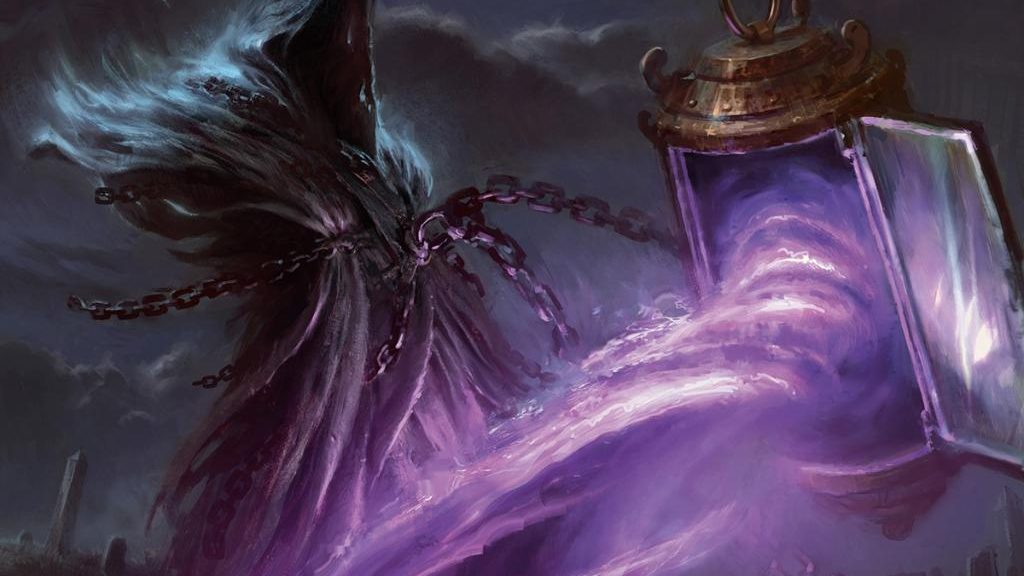
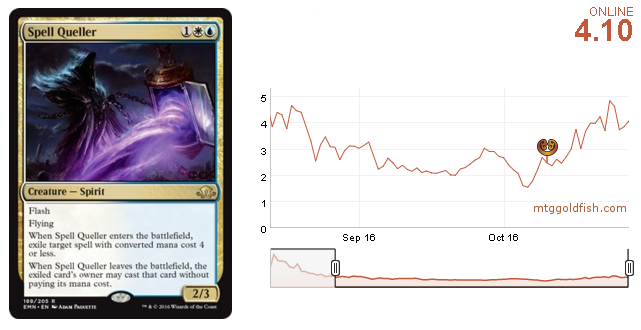



blossoming-defenseAs for Joshua’s list, I’ve been playing around with Infect online recently, so I feel enough up to speed to start talking about particulars without risk of 100% embarrassing myself. Joshua is playing Pulse of Murasa, a Kitchen Finks with higher immediate impact that keeps us on Plan A, but personally I’ve been playing Finks myself. Against removal-heavy decks persist is excellent, and whether it’s giving us two attackers, two blockers, or eating two removal spells, Kitchen Finks is a card I turn to consistently (probably too much) after board.

Beyond that, Distortion Strike has been unimpressive for me as I see it more of a game-one card, and I find myself already winning most game ones. Post-board, I’m not going all-in as much, relying more on Dispel and other reactive elements to nickel and dime my opponent while protecting myself from their blowout spells.

Takeaways

Across the Top 8, evidence of Infect and Dredge hate are everywhere. Three copies of Rest in Peace alongside Engineered Explosives in Caleb Durward’s Spirit list. Relic of Progenitus and more Explosives in Jeremy Jung’s 4th place Titan Shift list. Grafdigger's Cage and Scavenging Ooze in Micael Janny’s 7th place Zoo list. It seems to me that Infect and Dredge were known entities going into this event, and they performed well despite a relatively large amount of directed hate.

Still, there were a ton of Stony Silence floating around too, and Affinity did well, so I expect Dredge’s hate to increase, not decrease, moving forward. Hopefully most players look past the Top 8 results and see the five copies of Dredge in the Top 16, just begging for players to drop their guard so they can pounce on the format once again. Kent Ketter’s 3rd place finish should give most players looking to cut Dredge hate pause, which might in turn discourage some players from bringing Dredge to the Grand Prix.

Where the format goes in one week is tough to guess, but the continued lack of midrange (as Jund disappears entirely) is something to keep in mind. If Infect (possibly packing Kitchen Finks as a post-board plan) can find a way to fight through some middling amount of hate, it could find itself in prime position to take down a field distracted by other enemies. If I were playing in Dallas, that’s what I would play.

Thanks for reading,

Trevor Holmes

The_Architect on MTGO

Twitch.tv/Architect_Gaming

Twitter.com/7he4rchitect

Insider: Shifts in Dealer Prices and New Tournaments

Are you a Quiet Speculation member?

If not, now is a perfect time to join up! Our powerful tools, breaking-news analysis, and exclusive Discord channel will make sure you stay up to date and ahead of the curve.

Rules are meant to be broken. You’ve heard this saying before, usually by some rebel in a class you were in, but it can apply in lots of areas.

There was an error retrieving a chart for Rule of Law

For example, Wizards frequently breaks the rules of Magic. You could say that energy breaks a fundamental rule of the game: that mana is the only resource. Whether it's alternate costs for cards, cheating giant monsters into play, or individual cards that change the game from how it's normally played, we are used to seeing situations where what we know about the game differs from the norm.

Cards that break the basic rules of the game are good to keep your eye on financially as well – there’s a reason Platinum Angel is still worth money even after being reprinted. In the finance world these opportunities tend to pop up less often, but I think things are about to change. Many writers have spoken about the implications of the Masterpiece Series, but I believe we are about to see a shift directly influenced by this new rarity that has now become a permanent addition to our game. This process didn’t start with Expeditions, though, so let’s go back to where it really started.

Mythic Rares

There was an error retrieving a chart for Elspeth, Knight-Errant

In one of my favorite blocks of all time, Shards of Alara, we were introduced to the new mythic rare rarity. This new level of card you could (but weren't guaranteed to) open in a pack had a direct influence on card prices. Once there were mythics involved, rares had a ceiling, which with only a few exceptions, was pretty set in stone.

After a little bit of some sky-is-falling mentality, players were on board. Some of the cards in the set would still be valuable, while the prices of most of the rest of the cards would be much lower. If the community needed to open more packs for all of us to get the Sarkhan Vols or Rafiq of the Manys we were looking for, this at least left more copies of the normal rares like Broodmate Dragon and Cruel Ultimatum floating around the market for us to buy, and at lower prices than we could have previously expected.

The Masterpiece Series is doing the same exact thing to the other rarities as mythics did to rares. Here’s how I noticed this phenomenon in action.

What do all of these mythics have in common? They are all basically worthless. What I noted was that players love selling these to my shop. We have fifty of each of these and that’s not even that many. I’m sure the bigger online stores have tons of these cards lying around in boxes collecting dust. Who buys cards like this? Certainly there is a market out there for every type of card, but the market for bulk mythics is quite slim.

The decision my business partner and I made was that we were going to break the mold of having an automatic buy price of 25 cents on any mythic rare. Dealers everywhere have always had this rule about any mythic being at minimum a quarter. What I’m seeing is that some of the mythics from the M15-border era are only worth that much or a little more – at retail.

As the owner of a shop, I can’t expect anyone to pay much more than what the online price is for a card, so we adjusted our buy prices for these bulk mythics to 10 cents, the same as any bulk rare. I’m sure some casual players will be excited to grab these types of cards out of the bulk rare box, though, so they are not worthless, just undesirable.

There was an error retrieving a chart for Mind's Desire

After I made this change to my pricing structure this week, one of my employees did some research for me and found out that some other stores are following this trend as well. This is a good indication of change in the financial community. When multiple companies come to the same conclusion independently, the result usually sticks.

Although I have not confirmed this change for my shop, I think we are headed the same way with foil rares as well. What we need to keep in mind with big changes to Magic finance like this is that there are so many more Magic cards being made now than in the past. If we use our comparison of Shards of Alara block, the majority of players today haven’t even been playing since that set was in Standard. What that means is that the player base now compared to back then is not even double – it's much higher than merely double.

That brings me to my next point, bulk commons and uncommons.

Bulk Commons and Uncommons

For many years now, dealers have had an unspoken agreement that bulk commons and uncommons would have a buy price of around $5 per thousand cards. Before the introduction of mythic rares, we used to see rates above that threshold, but once that new rarity hit the scene, dealers adapted to the influx of packs being cracked in order to have a chance to open a mythic.

There was an error retrieving a chart for Overwhelming Stampede

While you could occasionally find some companies willing to go above the $5-per-thousand mark, the vast majority of companies held strong to that number. I’ve purchased and sold many thousands of bulk cards at this rate myself. Lately, though, it’s been a struggle to find dealers willing to buy your bulk at as much as $5. My store lowered our price to $3 per thousand a while ago, and many others have as well.

If you are into sorting your bulk, you could get a higher rate. There are many companies out there that reward your preparation with higher buy prices on bulk from older sets. Everyone has a different business model, but most of these changes are following the flow of price corrections from the Masterpieces Series.

The below is the bulk buy price model of a large online retailer, and many others are quite similar. This is the direction I would expect many companies to move in as well. So your course of action might be to unload some extra cards before the prices reach this low across the board.

Bulk Buy Prices
Any MTG common, uncommon or basic land - $2.00 per 1000
Any MTG rare or mythic (FOIL or NON-FOIL)- $0.10
Any FOIL MTG common, uncommon, promo or basic land - $0.03

Exciting New Changes

Wizards is rolling out some exciting new additions for Magic. They recently posted an article on the Wizards Play Network. I don’t think a lot of hype was generated, but my store is on board and we are really excited! Here’s the break down.

There are basically two new parts. The first is an extension of the Buy-a-Box promotion that always happens with each set release. This time, though, if you buy a box for Christmas, you will get a different promo than when Kaladesh first released. In fact, you won’t just get a promo, you will get a new kind of pack.

Additionally, you can get a new kind of pack by participating or doing well in a Standard Showdown. This new event is basically like an in-person version of Daily Events on MTGO. The difference is that you can get these new Showdown packs as prize support.

There was an error retrieving a chart for Prized Amalgam

There's a basis to compare both Buy-a-Box packs and Showdown packs to the old Guru program or something similar to what Yu-Gi-Oh! does for its prize support with OTS packs. Either way, here is what you can expect if you participate and get one of these packs:

Each of these packs can contain cards from any Standard legal set and include:
- One foil of any rarity or a card from the Masterpiece Series (drop rate 1/50)
- One rare or mythic rare
- One uncommon, rare, mythic rare, or full-art basic land

Now that’s an exciting addition to the prize pool!

Spread the word to your shop if you want to participate in this program. I think this is a great addition to the normal FNM routine and could really build up our community even more. What do you think about the Standard Showdown and Holiday Buy-a-Box? Let me know in the comments.

Eternal Weekend is also happening in Columbus this weekend, so if you see me around, feel free to stop and say hi. I’m always willing to make time to discuss whatever’s on your mind.

Until next time,
Unleash the Finance Force!

Mike Lanigan
@MtgJedi on Twitter

Want Prices?

Browse thousands of prices with the first and most comprehensive MTG Finance tool around.


Trader Tools lists both buylist and retail prices for every MTG card, going back a decade.

Quiet Speculation