If not, now is a perfect time to join up! Our powerful tools, breaking-news analysis, and exclusive Discord channel will make sure you stay up to date and ahead of the curve.
Do I hate J.R.R. Tolkien? No, heavens no. I've read The Hobbit, The Lord of the Rings and the Silmarillion. I've even watched the movies and the Netflix show. Am I a fan? Not in my estimation, but I enjoy high fantasy settings including Middle-Earth. If that makes me a fan, then, so be it.
So why would I suggest not pre-ordering this new product? There's one big reason.
There are going to be tens of thousands of copies of the Ring printed, with a bundle alt-art version guaranteed in every single box. There will be hundreds and thousands of special serialized and non-serialized Sol Ring printed in Quenya, the language of the High Elves. The set has the usual piles of variants in terms of showcase, double-rainbow foil, alternate art, etc. But the One Ring will only be available in English-language Collector Boosters. Except it's not really the One ring.
Now… If They Did Something Bolder
Perhaps you've heard of me...
This is Seto Kaiba, a big bad villain in the Yu-Gi-Oh! universe who possessed the ultra-rare card, Blue-Eyes White Dragon. Kaiba had three of them, the most legally allowed in any deck. However, when he found out someone else had one, he challenged them to a duel, won the card, and then destroyed it. He did this so that he could be the only person to ever use the powerful card in a deck. If the One Ring in LOTR was like that, that there was exactly one of them, it would be brave, different, ultra-collectible; I might even buy two cases of Collector Boosters. However, a fancy thing that is artificially scarce?
Sound Familiar?
Wizards has done this before. There are plenty of examples to choose from. Look at the red ink variant of Hidetsugu, Devouring Chaos. Sure, there is not just one variant red ink copy of Hidetsugu. But there are going to be plenty of variants of the One Ring out there, too. Some napkin math is all you need to determine you should expect one red ink Hidetsugu in about 1300 Collector Boosters; you know, after opening over $40,000 of product. It's not "1 of 1" rarity, but that's still very rare, if artificially rare. What does that artificiality mean for pricing? Early on, these sold for thousands of dollars each, but now the price continues to decrease.
What about the first instance of serialized cards in BRO? They were selling at about the $1,000 level at launch, but now most are creeping under $300, much like the "rare" foil shattered glass Transformers cards introduced in the same set. Keep in mind each individual number is as rare as the One Ring. There can be only one 007 Wurmcoil Engine!
Magic is not new to cards having extremely low availability. However, that was based on authentic, low-print runs, many years later, and oddities like Alternate 4th Edition and Summer Magic. Now? Hype and speculation. When it comes to how collectible something is, these qualities simply do not hold the same weight.
All Flash and No Substance... Still Sells Cards
I understand Wizards needing to sell cards; that's their business, of course. The problem is when you use FOMO to drive sales, but are not making the product any better, you get downgraded.
Fundamentals. Card quality is the worst it has ever been. Foil cards are pre-bent "pringles," and many cards come pre-damaged in packs. While Wizards is busy counting their profits and raising prices, ordinary people are getting a worse product. How do you keep the hype machine oiled month after month? Golden Tickets, of course!
Magic has always been in the scratch-off business, but they have upgraded considerably to lottery status now. When printing $100,000+ cards, what security measures is Wizards taking to ensure a fair and truly random outcome, and what third party are they employing to verify this? If you know, please share. Additionally, what safeguards have they taken to ensure that this doesn't happen?
Golden Arches, Golden Ticket, Golden Scam
Once upon a time, McDonald's ran a Monopoly game that could award customers with cash and prizes. They even hired a marketing company to provide security and legitimacy, proving it was random. Furthermore, they hired an auditor to follow and verify that the most expensive game pieces, $1,000,000, were not being improperly distributed.
How did that go? The corrupt individual providing "security" switched game pieces secretly and made deals with people who "won" the best prizes, provided they pay them first. This only came out because they did this over and over again, many times, over years of games, until they were finally caught. Damningly, with the Ring, Wizards only has one chance to get it right.
Wizards Is No McDonald's
A FOMO-inducing marketing stunt at least, but at worst, the One Ring is a complete scam. If one of the most recognizable and largest brands in the world can't secure a contest, how is Wizards going to? And even if Wizards takes the same precautions, there is no guarantee it will be fair. However, the hype train has left the station, and this is where we get to tin-foil-hat levels of conspiracy thinking. I don't believe this, but, I have to consider outcomes especially in light of similar real world events.
The Magic community at large does not agree on much; however, I'm certain everyone wants to believe they could open a million dollar card in a pack. For Wizards, if no one opens the One Ring, people will wonder if it was all a marketing stunt with no substance. In theory, there cannot be evidence to the contrary. Think about that. If it's truly fair, if it's truly random as best as they can make it, Wizards cannot verify exactly where the Ring goes. If they could, then it's not much of a leap to suggest they seeded the outcome. What good is a hyped product that is never found?
Given the large volume of new Magic that sits unopened, it's not a stretch to believe a single particular card could be languishing on a shelf, forever. Heck, there is so much new Magic product it ends up in landfills. This is a lose-lose for Wizards in most cases.
Secondary Market Prices Will Be Terrible
Pre-order prices are already through the roof for LOTR Collector boxes, and there is no inclination that this will be a limited product. It makes no sense to purchase any product after the first day of release. Would Wizards really wait to put the One Ring in a second print run of the set? That would mean anyone that pre-ordered had zero chance to get it.
So this brings us to the fact that secondary market prices are going to be literal pennies, as only pre-order Collector product makes any sense to purchase whatsoever; that's the stuff with the million-dollar prize. Sealed prices will explode, temporarily, and opened packs will be dumped into the market quickly.
You Can Still Win
For people who are not affected by FOMO and can wait, I see an easy way to collect all the cards you want for fractions of a penny, or to get sealed product from people who bought too much and didn't open the Ring. Black Lotus is a collectible; Summer Magic Blue Hurricane is a collectible. The One Ring? Artificial. Don't get caught up in FOMO, play the odds, and like Warren Buffet says: "Be fearful when others are greedy and greedy when others are fearful." In this case, the only winning move is not to play.
If not, now is a perfect time to join up! Our powerful tools, breaking-news analysis, and exclusive Discord channel will make sure you stay up to date and ahead of the curve.
Magic: the Gathering is a very hard game with many moving pieces. One of the harder ways to play this game is to play a dedicated control deck. Where other decks are proactively developing their gameplans, the control deck is all about pushing back against opposing gameplans, dictating the flow of the game until they can take the reigns and win. As a result, there's a tendency for players to under-test their control deck and then play too slowly, agonizing over what to interact with and what to let slide.
As I mentioned months ago, playing faster and testing better are critical to success in Magic. I was quite vague at the time about how to do both when it came to control decks. The issue is that all that advice applied equally well to control as other archetypes. However, there's a perception about control that makes players more resistant to faster play, especially coupled with testing inadequacies and win condition choices that can create a self-fulfilling prophecy.
The General Problem
Control is the slow archetype. Aggro and combo are both interested in doing their thing and ending the game as quickly as possible. Meanwhile, control is about lengthening the game by preventing others from executing their plans. This necessarily means that control requires a lot of thought, patience, and decisions to play correctly; you want your games to go long, and long games have more turns, which means more decisions. Consequently, control players tend to play very slow deliberately, and feel perfectly justified doing so.
Unfortunately, that slow-deck concept is frequently used as a shield and justification for playing too slowly. In fact, some play so passively and defensively that they miss chances to win and end up with worse records than necessary. This in turn can lead them to abandon control as an archetype.
The Playtesting Problem
The first problem I see with players trying to play control decks is that they're inexperienced. Not just with playing a given matchup, but with the deck itself. This leads them to play slowly and poorly. As mentioned in the previous article on the subject, players already don't goldfish their decks enough. Suggesting that they goldfish a control deck frequently is met with scorn, if not outright derision. "How can you goldfish a control deck?" they will usually cry; "it's an interactive deck, and everything is contextual. You can't make plays without something to interact with or contextualize!"
No Excuses
I'm not moved by those excuses. Players must determine if their deck works. BEFORE they start playing actual games! This is true of every deck. It is particularly true of control decks, where every card slot is critical. Control decks have less forgiveness in their deck construction relative to aggro decks because there are no wrong threats, only wrong answers. Any creature that can attack can end the game, and so can never be completely dead. An answer that doesn't answer anything will always be dead.
There was an error retrieving a chart for Solitude
Playtesting and goldfishing are far more important for control decks than other decks precisely because they're interactive decks. It is essential to iron out the kinks in testing because any inefficiency or poor choice will be amplified in-game. Control decks need to have the right answers at the right time and be able to cast them, which is a far more precarious strategy than playing creatures and attacking. Thus, they must find out if it works.
How to Goldfish a Control Deck
Everything I said about goldfishing other decks holds true for control. However, some questions from that article need to change when dealing with control decks. Here are the things to focus on when playing a control deck against nobody.
#1: Does the Mana Work?
The first reason to goldfish is to see if the mana works. This is true for all decks, even control decks. Goldfish the deck a few times to see if it can cast spells. However, for control decks, the principle should be modified to:
Does the mana work on time?
Missing an early land drop is always crippling for a deck's development. It can be fatal for control, as they fall behind and are overwhelmed. Control goldfishers need to ensure, first and foremost, that they aren't missing early land drops.
Additionally, control decks want more lands than most decks. Aggro rarely wants or needs more than 3-4 lands in a whole game. Control will need more to cast their top-end, and frequently wants as many as possible to cast as many spells as possible. How often will the deck hit the needed number of lands in the relevant time period? This is easy to find out in goldfishing.
#2: Does the deck do The Thing?
Finding out if the deck's strategy works or not is always important. Obviously, this will be hard for an interactive deck as there's nothing to interact with. So we'll modify the question to:
What can the deck interact with?
Take an opening hand. What sort of deck would it be good against? Play it out, imagining enemy plays, and see if that would continue to be true. Then ask if those decks are decks you'd be likely to face. At the same time, keep track of how long it takes for a given start to interact with other decks. A control deck that produces many hands that beat other control decks, but can't cough up removal against aggro, needs reevaluation.
Questions #3 and #4, How Quickly Does the Deck do The Thing? and Do I Know How to Do The Thing?, don't need to be altered for control.
#5: Is The Thing worthwhile to do?
It is always hard to evaluate whether or not a deck is doing something novel and good, or is just a worse version of an existing deck. This is true of all decks, even control decks. However, for control decks, there needs to be an addendum:
Is it possible to control the game?
Actually taking control of the game in the traditional sense is hard, and dependent on metagame and cardpool. The right mix of answers, card advantage, and win conditions may not exist at all in Standard, or be worse than all other option in older formats. Goldfishing will show if the deck is doing something powerful enough to work, or if the format is pushing towards a midrange strategy that just plays the control role in aggressive matchups.
Playtesting Control
Once goldfishing is done, then it's time for playtesting to determine actual viability. This is where a lot of players stumble, because they don't play enough test games with their control deck. Control decks are generally harder to play, and their games take longer. Therefore, players will get tired of playtesting a control deck more quickly than other decks (or, in fewer games), and may hastily decide whether control is either great or terrible.
There was an error retrieving a chart for Kaya's Guile
This is a mistake. Control matchups are dictated by experience as much as the cards themselves, and over time, a matchup may shift based on familiarity. Often, the early success or failure of a control deck in testing comes down to inexperience with or against the deck. More matches are necessary to get that experience, and then find out how good the deck actually is.
Playing Control Faster
The other issue is that players frequently fail to win the game as a control player. There have been many eras of my competitive Magic career where the X-X-1 bracket was known as the control mirror bracket. Even after extensive playtesting, the pressures of an actual game will make a control player slow down, or at least feel pressure to do so. This will lead to running out of time and therefore unintentional draws. Following the advice from my original article on the subject will help out considerably here.
However, there are two problems unique to control decks when it comes to speed. The first is playing too passively, and the second is not playing enough win conditions, and/or only expensive win conditions. It seems counterintuitive, but a big reason that players go to time with control decks, and not even in mirror matches, is that they spend too much time playing to not lose rather than win. I've often said that Modern UW Control wants to win only by concessions, and many players act like that's no joke. They don't want to win the game; they want the opponent to acknowledge their victory. That's great for boosting egos, but terrible for win rates because of time rules.
The Passivity Problem
The key to winning with control is remembering that a control deck will be behind early. It's reactive and won't be playing threats out, and therefore it isn't trying to win the game, but to not lose. At some point, the control deck turns the corner, gets ahead, and starts winning. Most players are good at the first part but fail to recognize the latter, which means they fail to actually win the game.
I have watched a frustrating number of players, both in videos and in person, refuse to play out a win condition when the opportunity presented itself, and lose as a result. The opponent being tapped out and you having five lands with Counterspell in hand is a golden opportunity to land that Teferi, Hero of Dominaria and start putting away the game. Instead, they'll do nothing and wait until they can cast more than one answer alongside Teferi. However, that opportunity never comes, and they start to fall behind and eventually lose.
There was an error retrieving a chart for Shark Typhoon
I've seen countless Pioneer UW players sit on Shark Typhoon, refusing to either cast it or cycle it because they don't want to, quote, "expose themselves." Expose themselves to what, precisely, I never get an answer for, and it frequently makes no sense as they've got the game otherwise locked up. Each turn the opponent gets another draw step that might turn the game around. There's no reason to fear the unknown and wait. Once the game is stabilized, take it!
Hoping for Perfection
The same problem applies to answering threats. Too many control players wait too long to deal with threats, meaning they're at low of life when they finally start trying to win. If anything goes even slightly wrong, they're dead. Players will wait for absolutely perfect circumstances to maximize their spells and just let themselves die to answerable threats. In my opinion, Gabriel Nassif is a poster child for this mentality, frequently holding answers for potential threats and falling to far behind against actual threats.
There was an error retrieving a chart for Counterspell
Thus, the biggest ways to play faster as the control player are actually answering threats and playing to win the game, not just survive. There are windows where the corner can be turned, and missing them pushes towards actually losing. Take the opportunity to actively get ahead and close out the game. Never assume the opponent will give up.
Lossett's Lesson
What really annoys me is that Magic's history shows that active control win conditions work as well or better than the few big threats. Legacy Miracles was the most successful control deck in Magic's history. From initial genesis in 2011 as UWx Counterbalance until Sensei's Diving Top was banned in 2017, the deck was the premier control deck in Legacy. It even lingered on in diminished form until Uro, Titan of Nature's Wrath arrived.
Probably the most successful Miracles player was Joe Lossett. He was a demon of the Star City Games circuit and frequently Top 8'd Legacy Grand Prix. When Top was banned, many players said that if more Miracles players played like Joe, there'd have been no need for a ban. He was so practiced that he could quickly Top, navigate complex board states, and then know exactly when to turn the corner and win the game. In other words, he did everything I've been discussing today.
The Key
However, a forgotten piece of Joe's success was that he rarely received unintentional draws, especially against the mirror. His personal speed was a piece of that, but he was also actively trying to win the game quickly. The typical win conditions in Miracles were exactly two each of Snapcaster Mage, Entreat the Archangels, and Jace, the Mind Sculptor. Joe ran those, plus an additional Snapcaster, three Vendilion Clique, and two Venser, Shaper Savant.
His intention was to play more as a tempo deck in the mirror and avoid the drawn-out card advantage fights that other Miracles decks were notorious for. He could also use Karakas to protect his legends or reuse their abilities. This meant that Joe never missed an opportunity to start winning the game; in fact, he was usually actively looking for the chance. Control doesn't need to have a slow and expensive win condition. It can win with anything, including a humble 2/1, so why not win quickly?
Play to Win the Game
Control is a slower archetype than combo or aggro. That is no excuse for how slowly so many players play it. Take testing and goldfishing more seriously, and speed will come naturally. Additionally, there's no reason to take forever to win the game. Control players will naturally play faster if they start more actively looking for the opportunity to win rather than continuing to not lose. This is a simple change that any control player can make. Or don't, and let me keep beating Legacy Uro decks on Magic Online because they clocked out. It's your choice.
If not, now is a perfect time to join up! Our powerful tools, breaking-news analysis, and exclusive Discord channel will make sure you stay up to date and ahead of the curve.
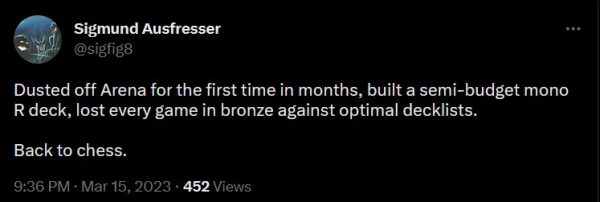
The question was timely because I hadn’t played a single game of digital Magic for the first ten weeks of 2023. Then I decided to fire up Arena and try my hand at Standard. I tweeted my results.
The devil on one shoulder and the angel on the other trope feels appropriate here. On one shoulder is the devil—tempting me to sell my collection to further invest in the college fund—and leave behind this often time-consuming and frustrating game.
On the other shoulder is the angel—my conscience—reminding me of the ways Magic has been healthy and rewarding for me over the years (or is it the other way around?). I already discussed the reasons to want to sell out and quit the game. This week I will provide five reasons why I prefer to stay engaged with the game of Magic: the Gathering.
Reason #5: Flexible Source of Fun
Magic can be time-consuming and expensive—in fact, I see many people in the community (especially on Twitter) venting about the high barrier of entry to the game. Formats like Legacy and Commander can be quite costly if one wishes to compete at a high level. Hours and hours of tireless practice are required to upskill and become a finely tuned player.
The amazing thing about Magic is that the game itself has no such expectations of you. If you want to play in high-stakes tournaments, you can certainly do that. If, on the other hand, you want to find piles of commons to play with a few friends, you can do that too! Thanks to the massive amount of reprints and supplemental products, you can even brew a halfway decent Commander deck for less than $20.
If you go the route of budget, casual play, there’s no expectation that you remain highly engaged with the game on a regular basis. You can play with your friends once a year—the cards will be just as effective and fun the next time you play. Sure, if you play at a public spot with new opponents you’ll have to learn what new cards do, but it’s not something you need to invest time in.
There was an error retrieving a chart for Farewell
This kind of flexibility—the ability to engage with Magic whenever and however you’d like—is what keeps me in the game. I work full-time and have two kids (11 and 6 years old), so I have minimal time to commit to this hobby. Because I can hop on Arena for ten-minute bursts, I can keep up-to-date on Standard. Because I can buy and sell cards from my couch, I can remain engaged with the financial aspect of the game. Because I can follow and engage on Magic topics on social media, I can maintain interest and participation in the community.
I love that Magic affords this complete flexibility. You can enjoy golf by flying to Florida to play on a professional course or by playing putt-putt at a local miniature golf course. Magic offers even greater flexibility than this!
Reason #4: A Way to See the World
Should you be so inclined, Magic can provide an excuse to travel to locales far and wide. Now that large events are back, there are plenty of exciting reasons to travel somewhere to enjoy this game.
When I think back, I realize I have played Magic in New Jersey, New York, Pennsylvania, Ohio, Nevada, Rhode Island, Massachusetts, South Carolina, Kentucky, Indiana, and possibly even other states I’ve forgotten. Outside the United States, I’ve played Magic in Belgium, Germany, France, The Netherlands, and England. I even managed to play in a Legacy Grand Prix in Strasbourg, France, by far one of the coolest experiences. It seems like no matter where I travel around the globe, there are Magic players to engage with.
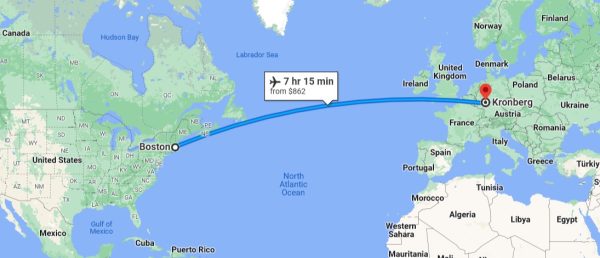
I’ll never forget the time I traveled to Kronberg, Germany for a business trip. I posted online that I was heading there, and another Magic player responded that he and a group of friends got together at a local university in Frankfurt on a weekly basis—he invited me to join, and I had the opportunity to do so! This spontaneous connection, with no bias or judgment whatsoever, was only possible because of Magic.
Whether the travel is for Magic specifically, or simply as a way to augment a trip already in progress, this game is a fantastic way of building bridges.
Reason #3: A Rare Hobby that Pays You Back
This reason is a significant one for me, personally. If you want to play golf on a regular basis, you need to invest in golf clubs, balls, and a bag, not to mention suffering the endless fees and costs associated with playing on well-manicured golf courses. It’s not easy to play golf cheaply (for example, is it worthwhile to take a club and a ball in your backyard to play with friends?). All that equipment adds up, and if you decide to change clubs there’s little chance you’ll get out the full amount that you put into them.
Not so with Magic. It’s one of a scant few hobbies that you can invest in, play for as long as you’d like, and potentially make money when you want to pivot or try something new!
There was an error retrieving a chart for Cruel Bargain
Depending on how you engage with the game, there are varying degrees of potential here. As a collector of Old School cards, I find this to be a particularly attractive component to remaining involved with Magic. I don’t have to worry about selling cards quickly out of fear of a reprint or a shifting metagame. Minus a few exceptions (including the current Magic recession), holding onto Old School cards leads to financial gains given enough time. There is no motivation to hurry and cash out.
Of course, if your primary method of engagement with Magic is playing Standard and/or Limited, then you’re not as likely to turn the same level of profits, or else you’ll have to remain more actively engaged to sell out of cards before they rotate. Even still, many powerful cards will maintain at least some value for years.
You could argue that used golf clubs will always maintain some value as well. To that, I counter that it’s very easy to browse online shops (using Trader Tools, for example) to find top buyers of cards. Submit the buylist order, drop the cards in the mail, and have cash within days. This process likely isn’t quite so convenient for golf club selling, though I am sure a golf aficionado reading this will provide some counterpoint.
Reason #2: Sense of Community
I’ve alluded to this previously when I talked about traveling abroad and finding friendly Magic players. One thing I love about Magic—since I began playing in 1997—is that I felt a sense of belonging in a world where I was often classified as a misfit.
In middle and high school, I struggled to fit in. In college, I was better off because I went to a small engineering school filled with nerdy kids like myself. Even beyond college, I’ve had a difficult time making many new friends. I know I’m quirky, I’ve learned this about myself over the years.
The wonderful thing about Magic is that the game comes with a community of people who share a common interest. I could never drum up more than two friends as a kid, but nowadays I have over 3,000 Twitter followers who will interact with me about the game we all love. I often joke that I wish Twitter existed when I was in middle school because I would not have felt so much like an outcast because I would have had access to thousands of like-minded individuals.
This community has done so much for me over the years, up to and including enabling my career-long goal of leveraging Magic to fund my kids’ college educations! I could not have even dreamt up such an endeavor if it weren’t for the power of this community. Thank you all for your continued engagement (and if you’re not already, feel free to throw me a follow on Twitter)!
Reason #1: Lifelong Friendships
Community is very important—I love that this group of individuals exists where I feel comfortable being myself. At work, with family, and even with certain friends, I need to censor some of my eccentricities. With Magic folks, I can be 100% genuine to myself, and I don’t have to worry about judgment.
Imagine, then, the long-lasting, positive effect making friends through Magic has had on my life. In seventh grade, I started a brand new school in a new district. I knew no one. It was a struggle to fit in. Our financial situation was precarious at best, and this further isolated me from a community of mostly well-off kids who grew up with each other.
Then I learned about Magic. Shortly thereafter I made a couple of friends who also enjoyed the game. These two friends, Dan and Chris, are still great friends even to this day. Our connection started over a common interest in a game but turned into lifelong friendships. Even though we live in different states and are in different stages of life, I am confident we would still do anything to help each other out.
Outside of these two, I also made some strong bonds with Magic players by simply interacting with them regularly online. One such friend, who goes by pi in the community, was one who I met through the Quiet Speculation forum a decade ago. We developed a connection through frequent discussions in the forums, and it led to my visiting and staying with him in The Netherlands! Even though we’ve only met in person a couple of times, I cherish his friendship and know that I can always reach out to him if I need someone to talk to.
This, in my opinion, is the best reason to remain engaged with Magic. It helps me keep in touch with old friends, and will probably help me make new ones. These are the friendships that can last a lifetime.
As tempting as it may be to sell out of Magic and free myself from its bonds, I don’t know if I can truly and completely go down that path. Ever. I’ve been involved with this game for 26 years now and I don’t even want to consider a world where I can’t enjoy its many benefits.
Whether it be the entertainment of the game, its lucrative nature, or the friendships and community it fosters, I’ll always want Magic to be at least a small component of my life. Even as I age and play much less often, I now have two children who may share an interest in the game; connection with my kids is yet another potential benefit to playing Magic. It truly is the gift that keeps giving.
I admire (and to an extent, envy) those who quit the rat race and escape the endless loop that is Magic. However in doing so, I wish them luck and I hope they can find another source of friends, community, money, and entertainment elsewhere as they did with Magic. Magic is one boon that will be difficult to find an adequate replacement.
If not, now is a perfect time to join up! Our powerful tools, breaking-news analysis, and exclusive Discord channel will make sure you stay up to date and ahead of the curve.
Bad decks. Every format has them. We have decks that we're "supposed" to be looking for, and others we're supposed to avoid. But how can we?
Sometimes we chase an off-color rare into a disaster. Sometimes it's just hubris, a cloying urge to prove the pundits wrong. There are some occasions where we're just bored of drafting "the good colors." But eventually, we all do it. Eventually, we draft the bad decks of the format.
However, just because we're not doing the best thing in a format doesn't mean we can't profit, or even trophy with a "bad deck."
What Are the Bad Decks?
The good decks are more accurately described as "the desirable archetypes we should seek out in the draft, if our goal is to optimize our win percentage." In Phyrexia: All Will Be One (ONE), the decks that fall into this category can be described as meeting one or more of the following criteria:
Decks with any two of the three Naya colors.
Decks that have fifteen or more red cards.
Decks with good, aggressive, cheap creatures.
Base-white Toxic decks.
The UW Artifact decks (although this is a little bit generous).
Decks that want to win using a tempo-based strategy.
Conversely, the bad decks are likely to fall into these camps:
Decks using any two colors in the Sultai Wedge.
Three-color decks.
Decks that are splashing without a great reason.
Toxic decks relying on Pestilent Syphoner or Prologue to Phyresis.
Decks that want to leverage an attrition-based strategy.
Just because we find ourselves building a bad deck does not mean that we should be resigned to punting our run. On the contrary, these decks often yield the most rewarding experience when we're able to be successful with a weaker strategy. However, to do this, we need to make sure we're cognizant of exactly what we're doing and how we plan to win.
Wrong Plan, Right Pieces
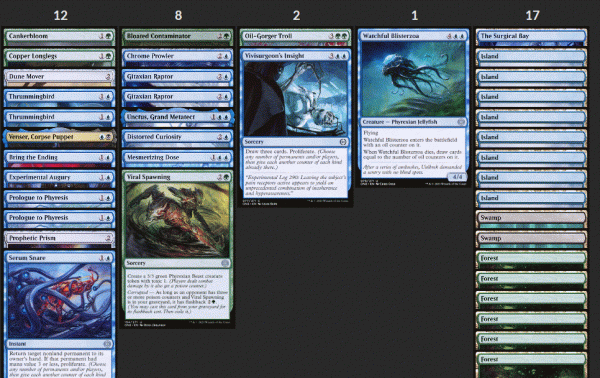
This deck basically checks off every box on our bad deck criteria. We aren't quite a three-color deck, but Venser, Corpse Puppet is a questionable splash. We're a blue deck, which, you know, isn't great. We're a little concerned about our early game, which is problematic in ONE. Nonetheless, this deck was able to get to seven wins.
7-2 UGb Proliferate
Creatures
1 Cankerbloom
1 Copper Longlegs
2 Thrummingbird
1 Venser, Corpse Puppet
1 Dune Mover
2 Gitaxian Raptor
1 Bloated Contaminator
1 Chrome Prowler
1 Unctus, Grand Metatect
1 Oil-Gorger Troll
1 Watchful Blisterzoa
Instants
1 Bring the Ending
1 Experimental Augury
2 Prologue to Phyresis
1 Serum Snare
Sorceries
1 Distorted Curiosity
1 Viral Spawning
1 Vivisurgeon's Insight
Artifacts
1 Prophetic Prism
Enchantment
1 Mesmerizing Dose
Lands
2 Swamp
8 Island
1 The Surgical Bay
6 Forest
This deck is reliant on an early Prologue to Phyresis, which is the sixth worst common according to 17lands.com. Gitaxian Raptor, Mesmerizing Dose, Viral Spawning, and Oil-Gorger Troll are a slog to fight through. While we often don't want cards like Distorted Curiosity and Vivisurgeon's Insight in this format, but they played well in this deck. As we're dragging out a resource war, cards like this served as haymakers. We just need to know how to support them through gameplay.
Building this deck, I knew our clock would rarely be as fast as our opponent's. So we need to be able to trade, sometimes at a loss, and recoup the value later. We want to win the late-game, but if we fall behind early, there won't be a late game to win. Keeping a high life total is essential, especially when we don't have Bring the Ending for an opposing Hazardous Blast.
Playing Outside the Rules
This format has rigid rules of engagement, and we need to anticipate our opponents following them. With this deck, Prologue is a decent two-drop, but it doesn't line up well against Barbed Batterfist or Crawling Chorus. When we expect to fall behind, being able to double-spell early is very valuable. While drafting decks like this, we want to make sure that we're keeping our curve low. If we're going to take time off to draw cards, we'd better be ready to deploy them in a hurry.
Additionally, we're okay trading two-drops for combat tricks. The transaction slows our opponent from developing their board while saving damage. We can draw cards later, but our life total is fairly limited. It's one thing to "make them have it." In decks like this, we just need to make them use it.
Trained to Train Wreck
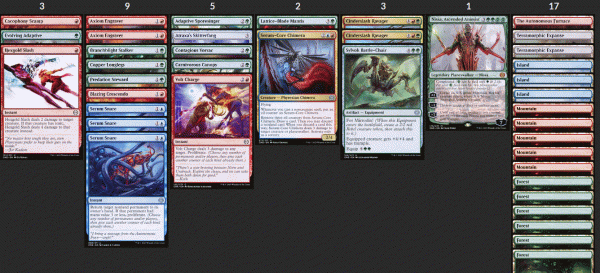
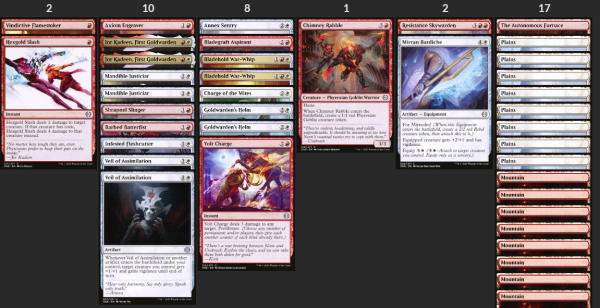
This started as a RG deck, but moved to blue, in the hopes of splashing a pair of Cinderslash Ravagers. We opened pack three and immediately greeted a Nissa, Ascended Animist. We couldn't shake the blue, but that was okay.
7-1 RUG Nissa
Creatures
1 Cacophony Scamp
1 Evolving Adaptive
2 Axiom Engraver
1 Branchblight Stalker
1 Copper Longlegs
1 Predation Steward
1 Adaptive Sporesinger
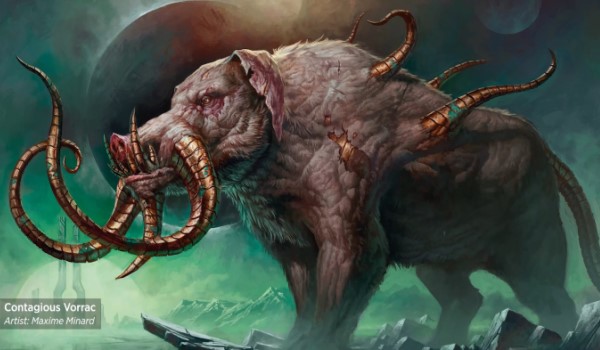
1 Contagious Vorrac
1 Atraxa's Skitterfang
1 Lattice-Blade Mantis
1 Serum-Core Chimera
2 Cinderslash Ravager
Instants
1 Hexgold Slash
1 Blazing Crescendo
3 Serum Snare
1 Volt Charge
Sorceries
1 Carnivorous Canopy
Artifacts
1 Sylvok Battle-Chair
Planeswalker
1 Nissa, Ascended Animist
Lands
2 Terramorphic Expanse
3 Island
1 The Autonomous Furnace
5 Mountain
6 Forest
Early on in this draft, I was seeing powerful cards, but couldn't find a clear direction. Terramorphic Expanse and Axiom Engraver help in these situations together. Additionally, cheap interaction like Hexgold Slash and Serum Snare can hold together a lot of decks. This draft was brutal, but we were able to walk out of it with an absolute powerhouse because we sensed that conflict and were rewarded for adjusting to it.
When it comes to building a bad deck, we need to make sure that we have a good reason to do so. We had some really powerful cards, and because we prioritized facilitating pieces and cheap interaction, we were able to make it work. While I might have forced this concoction without all the glue, it would not have gotten to seven without those pieces.
Single-Card Showdown: Carnivorous Canopy vs. Ruthless Predation
Carnivorous Canopy is a card that is steadily climbing up my pick order. With the Naya colors getting more attention, our decks are forced to rely on marginal role-players, and this one always seems to step up. It's a great answer to Gitaxian Raptor or even a bomb like Bladehold War-Whip.
In a deck like this, I value a Carnivorous Canopy over something like Ruthless Predation. While the fight spell is the more powerful option, it's also more reliant on a streamlined approach. Fight spells are great when we're getting out in front of our opponent and playing creatures on-curve. This deck plays tap lands and three colors. As a result, we may not have our over-statted three- and four-drop down on the turn we want them. It may then prove tougher to maximize a fight spell.
A deck like this needs clean answers, and Carnivorous Canopy can do that, if not so flashily. In most decks we want the Ruthless Predation and it isn't close. In this deck, I'm prioritizing the Canopy.
Rules for Breaking the Rules
We should have a good reason to be in one of the format's bad decks. However, the best reasons strongly contribute to a plan. As always, the most important thing in deckbuilding is having a plan. As we draft, we need to prioritize the support cards for that plan.
Last week we talked about the contest of "better vs. more valuable," and while Terramorphic Expanse is not a great card in this format, it's more valuable than a lot of other cards to a three-color pile.
Additionally, just because we're breaking the rules doesn't mean we should anticipate our opponents to do so as well. Most people are (correctly) playing ONE as a tempo format. We need to anticipate aggression, and draft in a way that helps us in faster matchups.
Finally, the bombs in this format have been significantly diminished in the face of the rampant aggression. If we're not hiding behind the format's rules of engagement, we need to recognize that we're less protected from cards like The Eternal Wanderer and Thrun, Breaker of Silence. This means removal and interaction are at a premium. Hopefully our reasons to play this kind of deck includes answers to those threats or trumps to them.
"ONE" Final Note
Since drafting this article, I've seen a lot of content encouraging players to specifically draft blue. While I've provided my thoughts on the color, it may be a suboptimal time to experiment with the format's less-popular colors. While personal experience always represents a small sample size, I've found red to be more open than it should be, and RG Oil is still the easiest deck in the format to draft, and more often than not, Naya will yield far more success than the format's other colors.
If not, now is a perfect time to join up! Our powerful tools, breaking-news analysis, and exclusive Discord channel will make sure you stay up to date and ahead of the curve.
Remember how I mentioned having fun and winning not mattering that much? All complete lies. Fabrications. These are things you say to yourself when you lose to ease the pain. No, in Commander, AKA cEDH, it's all about the W.
Of course, at a table, there are three other players who are also looking for that win. So how do you ensure victory? Well, there are a few tried-and-true tricks to winning games in cEDH, and today we'll review some of the best!
Don't let your opponents know that you are a threat and have a serious deck. Never show other players what you are working with until it's too late. This is actually the primary reason so many people say their deck is a "seven" when it's actually their best competitive deck. It's all a mind game, really. Keep your strategies hidden.
At one event I can remember, the players at the table talked about the cEDH meta. While I did not necessarily believe them, they claimed to not run Thassa's Oracle. Turns out one of their win conditions was Underworld Breach, and no, they did not run Thoracle. At the next event, I knew I'd have to stop a storm/graveyard deck and did not need to tutor for answers versus Thoracle. If they were trying to "next level" me they failed, because I had the right answers during that game.
Furthermore, do not make your move until it is a neck-breaking finisher. Unless you are in top-deck mode or 1v1, you never want to show that the shields are down. In cEDH, if three players are tapped out, it's likely one player is about to win. Merely leaving up blue mana can be enough to buy yourself one turn.
#2: Ixnay on Six
You need both answers and threats lined up for turns three, four, and, five. Be extremely careful with how many "uncastable" cards you put into your cEDH decks. Keep in mind more one- and two-drops means you will be able to play two cards on the early turns of the game, which are the most important. Five- and six-drops may never happen. There are some notable exceptions, like decks playing Rograkh, Son of Rogahh with Culling The Weak, but overall, six-mana cards are more often liabilities than assets. Not every five-drop is game winning, like a resolved Ad Nauseam; be critical!
Aggressively cut cards that cost six or more. Even in decks that have ways to make big mana, the game might be over before you get your turn. Spending two turns ramping, but being tapped out, can cost you wins. It's definitely a mistake to have too many win conditions and too many value cards. You want answers, tutors, threats, and payoffs, in that order.
#3: Prepare to Answer
Even more important is having one- and two-mana answers available every single turn for the first few turns of the game.
The most common mistake I've seen in competitive builds is not a lack of answers per se, but an overemphasis on threats and win conditions. A hand with three answers, one tutor, and one threat is way better than a hand with one answer, two tutors, and two threats. In many situations, not having the answer right now can mean the game is over. There are many cards that are undervalued as answers for competitive games. Keep in mind that most cards boil down to effectively being Time Walk, and the best decks play lots of cards like that.
#4: The Four Cards of cEDH
While it's fairly commonplace to say "I effectively Time Walked them," what about Fog or Shadow of Doubt? These cards also describe the most common effects of the format. Paying one mana to stop combat, or two mana to stop a play and also draw a card, are scenarios you want to replicate over and over again. Chains of Vapor and Rapid Hybridization are effectively the same card, especially under the locus of a game being just a few turns long. But they are also very similar to Fog in that case. Cards that effectively read "pay one mana and the game doesn't end" are what many early turns boil down into.
After adding cheap interaction, it's time to add more The Cheese Stands Alone, AKA win conditions. Of course cards like Thassa's Oracle and Demonic Consultation are extremely attractive. There's nothing wrong with playing efficient win-cons but keep in mind that strong metas will focus on countering the most recognized cheeses. Looking at EDREC can give you some "wisdom of the crowd" on both what is good to play and what is overplayed and needs to be countered, but don't build for a meta that does not exist! It's better to throw together anything, learn your metagame with that, and then adapt to attack what you see.
#5: Recognize Standout Cards
Check your EDREC Top 100 lists for these cards. Did you find them yet? Of course not! While I believe Muddle the Mixture and Angel's Grace have seen top 100 before, most of these other cards will likely never make the list.
Of course, this is all meta-dependent. Most of these cards are circumstantially powerful. But here's the thing: it is up to YOU to figure out if they are meta-breakers or not. EDREC cannot tell you if there are a lot of Isolate and Nix targets in your pods. In mine, Angel's Grace is sometimes an uncounterable win condition for one white mana when opponents "go off" and draw their entire decks but cannot beat split second.
Also, Muddle the Mixture is probably the best card in a lot of decks. It's close enough to Counterspell and tutors for 44 of the top 100 cards, including Demonic Tutor if you need even more options. Always be aware of trends within your local meta, which drastically alter what cards are broken versus merely good. Many of these cards are effectively one mana, stop someone from winning, and draw a card. That's crazy levels of power when it happens!
#6: Zig When They Zag
Netdecks can make Top 8, but rogue decks win tournaments. There's always so much resistance to change and innovation that most players fall back on the echo chamber of what was previously good is still good. Don't fall into that trap! Be ready to take some risks and play a few potentially questionable cards based on the local meta. In a statistically perfect world, you only win 25% of your game on average. That means your losing percentage is 75% at the deck shuffling screen. Do not be afraid of taking some risks!
#7: Practice, Practice, Practice
Once upon a time, a player said, "Why not tap all my lands during main phase?" even though they could have done their play on another player's turn. Well, that other player cast Stasis. Practicing creates solid play habits.
Additionally, practice allows you to be familiar with tricky interaction that might be tough to decipher in the middle of a close game. It's better that you are defaulting to "autopilot" and "muscle memory" and have experienced many different game states, so you are not learning as you go during an event. Conversely, if you have an opportunity to introduce some difficult-to-navigate cards into a pod that has never seen them, you can capitalize on their lack of familiarity.
#8: Don't Hate the Meta, Hate the Player
Diplomacy is a fickle beast in competitive. If you are known to be a good player or are favored to win, you will oftentimes have an uphill battle on your hands. The entire table might be against you from the very beginning. There are ways around this common issue, too.
Rather than building a somewhat balanced deck with both threats and answers, you might pile into either a degenerate deck or a stax monstrosity. If you know it will be three-on-one with balanced decks, try to play faster; if it's a more controlling meta, you can turn to a prison strategy, which inherently stops everyone. If that fails, try and ally with the next weakest player, because they may also be behind.
In any case, you need to utilize the habits and attitudes of the other players to your advantage. Betrayal was a commonly played card because it gave great card advantage for only one mana, and you knew you were being attacked anyways. Alternatively, you can let the table know you've given up on winning but are going to ensure that one player in particular is not going to win. That can sometimes remove pressure from yourself and give you a chance to make a comeback while the second and third player strengthen their own game. Game moves at the expense of the player in first place are the easiest to rally behind.
Winning Isn't Everything... Until It Is
A brilliant philosopher once said, "If you're not first, you're last!" In winner-takes-all events, this is very true. You can improve your chances of winning significantly with effort and practice.
A final point should be made regarding time management. There is only so much time. Playtesting is vastly more important than anything else. Seeing interactions in real time beats any amount of simulated practice and speculative analysis.
Furthermore, if you've been curious about playing competitively but are waiting on something, like acquiring cards for example, don't wait! Play with what you have, now! If The Chain Veil Teferi, Temporal Archmage can win a Black Lotus, anything can happen.
Have you practiced for a competitive event recently? What was your most important realization? Did you go with or against the local meta? Let me know in the comments!
If not, now is a perfect time to join up! Our powerful tools, breaking-news analysis, and exclusive Discord channel will make sure you stay up to date and ahead of the curve.
Last week's Modern metagame update indicated that Modern is quite diverse. The online metagame had 84 distinct decks while the paper metagame had 108. Modern is a huge format where almost anything can win. However, I'm often left wondering how meaningful that statement actually is, and judging by general online discourse surrounding Modern, I'm not alone. So, I've decided to follow up on that update and investigate from a new axis: Modern's strategic diversity.
Pop Quiz Time
Consider the following three-turn opening sequence:
Turn 1: Scalding Tarn, fetch and shock Steam Vents, cast Dragon's Rage Channeler, cast Mishra's Bauble, surveil away Unholy Heat. On opponent's upkeep, Bauble the opponent.
Turn 2: Cast another Bauble, surveil away Ragavan, Nimble Pilferer, play Island and Dash Ragavan then attack.
What deck is this? Archetype? Colors? Another example:
Turn 1: Tarn, pass. On your end step, crack for Zaitora's Proving Ground.
Turn 2: Shock in Steam Vents, cast Wrenn and Six, uptick.
Turn 3: Tarn, fetch and shock Blood Crypt, cast Fable of the Mirror-Breaker.
Again, which deck? And finally:
Turn 1: Windswept Heath, go. On your end step, crack for Raugrin Triome.
Turn 2: Shock in Breeding Pool, cast Wrenn and Six, uptick.
Turn 3: Play Plains, cast Teferi, Time Raveler, downtick.
Take a moment to lock in your answers before proceeding to the next section by leaving them in the comments!
Answer Sheet
It might seem obvious which decks I'm describing, but of course, I've set a trap. Which the observant and/or genre-savvy probably noticed. However, that's also a trap. You'll have to trust me about which decks I was looking at when making that puzzle; if you don't, I'm willing to swear on whichever holy thing it will take (as long as it's not dangerous and/or icky).
If you answered Indomitable Creativity, your answer is technically correct, but insufficient. You must specify the color combination for full points. In this case it was this Temur Creativity deck with a black splash, piloted by scipios.
Did anyone get them all right? Did anyone get any of the decks right? Probably not, and that's my point. There are a vast number of decks that play extremely similarly despite being demonstrably different decks. This begs the question of how strategically diverse Modern actually is.
Valuing Diversity
While there is no way to know how many decks a format can support, or even should support, players will agree that more is preferable to less. The more decks that are playable and, equally importantly, competitive, the better.
This idea underpins my yearly State of Modern article. I mentioned it then, but Modern's competitive diversity is suffering. For better or worse, the best decks take advantage of Modern Horizons 2 more than other decks. As my thought experiment shows, this means that lots of decks feel extremely similar because they're all playing the same cards.
This translates into many games feeling dismayingly similar, at least initially. I deliberately stopped on turn three because on turn four, each deck is going to start playing spells that help identify and differentiate it from the pack. However, even then, there are so many decks with similar plays that it is plausible to play through an entire match without even a highly informed player figuring out exactly what deck they just faced. This begs the question: how much of Modern's "diversity" is really just the same strategies masquerading as different decks?
Quantifying Diversity
In order to reexamine the metagame with an eye to its strategic diversity, I'll need to combine similar strategies. There is necessarily some subjectivity in doing this, but there's also a lot of very obvious decks to combine. Grouping the Creativity decks is easy, as they all share the same general strategy and most of the same cards. Their differences are in the details. Same thing with the Crashing Footfalls decks. Meanwhile, and despite MTGGoldfish's laziness, Domain Zoo is a distinctly different deck from Counter Cat, the former being a midrange beatdown deck and the latter a tempo deck.
Then, there are the Omnath decks. Does having Omnath in the deck constitute an Omnath deck, or does that distincton require more? I decided that The Omnath Deck is a midrange deck with Wrenn and Six and lots of removal, allowing me to sweep together all the midrange and control variants into one deck. However, the Glimpse of Tomorrow combo deck, as well as Copycat, remained separate, since they're sufficiently distinct from other Omnath decks and each other. Similarly, there were many different Storm decks in the data that remained separate because they play very differently.
There was an error retrieving a chart for Saheeli Rai
For UR Murktide and similar decks, I decided that the mix of Channeler, Ragavan, Bauble, Iteration, and Heat formed the core of the deck. All decks that shared that core were grouped together under the Izzet Aggregate banner, regardless of whatever ancillary strategy was bolted to that core. This meant all the tempo, midrange, and combo decks together, since they all play the same early game.
The MTGO Aggregated Metagame
After going through all my data for February and aggregating all the similar strategies, I was actually surprised at how few aggregated decks ended up on my tier lists. The only one that didn't make the list was the aggregate Goryo's Vengeance that was getting some play online. However, the overall diversity of both mediums was greatly affected, and the stats changed considerably.
I am only working with the population statistics, as that's what's relevant for discussions on strategic diversity. For MTGO, the total unique decks fell from 84 to 68. The total number of decks on the tier list fell from 25 to 19. The adjusted average number of decks rose from 8.02 to 8.45, so the starting line moved up to 9. The adjusted standard deviation (STdev) rose to 13.62 from 11.46. This means that the aggregate Tier 3 begins at 9 and runs to 23, Tier 2 begins at 24 and runs to 38, and 39+ is Tier 1.
Deck Name
Total #
Total %
Tier 1
Izzet Aggregate
171
19.52
Rakdos Scam
79
9.02
Creativity Aggregate
77
8.79
Omnath Aggregate
60
6.85
Hammer Time
58
6.62
Rhino Aggregate
43
4.91
Tier 2
Yawgmoth
36
4.11
Burn
36
4.11
Amulet Titan
32
3.65
Mill
32
3.65
Izzet Prowess
27
3.08
Living End
25
2.85
Tier 3
UW Control Aggregate
20
2.28
MR Moon
14
1.60
MR Artifacts
14
1.60
MG Tron
14
1.60
Merfolk
12
1.37
Counter Cat
11
1.26
Humans
10
1.14
The first thing to mention is that thanks to the aggregation, Omnath moved over the line to be considered an outlier alongside the Izzet Aggregate and Rakdos Scam. It was therefore removed from the stat calculations as normal. The second thing to note is that this isn't actually as bad as I was expecting. I thought the data would be far more skewed.
Izzet Aggregate Ascendant
To the surprise of absolutely no one, the Izzet Aggregate was the top dog by a wide margin. Normal UR Murktide is already an outlier, and I added a whole bunch more decks to it. This result was inevitable. However, I thought it was going to be worse. As-is, Izzet rose to 19.52%, which is an absurd 10.50% above its next rival. But given that Murktide accounts for 6.85% of that gap, this isn't too terrible of an increase.
I'm not saying that holding almost 20% of the metagame is acceptable. In Modern's healthiestperiods, no deck was ever more than 10% of the metagame, and there was minimal overlap between decks. This is closer to Standard numbers, with the worst I remember being Scars-Innistrad Standard where all the top decks started with Gitaxian Probe, [card]Delver of Secrets, and Geist of Saint Traft.
What I am saying is that I expected the overall aggregate to be much higher, up around 25%. I know how many different versions of the Izzet deck appear in my data and had it in my head that they took up a lot more space. It could be that thinking about all of this every month just lets it take free space in my brain. Thus, I was pleasantly surprised that it wasn't as bad as I expected. To be totally clear, though, it's still not good.
Omnath's Not Dead
Remember how after Yorion, Sky Nomad was banned, Omnath stopped being a boogeyman? Remember how many said that it was dead? That is clearly an exaggeration. What has actually happened is that midrange Omnath decks have heavily diversified. Where there were once only two versions that switched off in popularity, now there are enough variations to satisfy any pilot.
4-Color Elementals, which uses Risen Reef to get value off the evoking Solitude and Fury.
Tribal Elementals, which has all that plus more elemental tribal effects.
4-Color Control, which doesn't have Reef or any other tribal effects and runs more noncreature spells.
4-Color Blink, which exploits Ephemerate.
And a couple really niche builds that I don't have specific names for because they're singletons. Elementals is by far the most popular one, and even made Tier 2 in February. Blink is the next most popular and was Tier 3. Together, they moved the deck up to Tier 1. With all the other offshoots, it's the best performing non-outlier deck. That's quite strong for a supposedly dead archetype.
The Paper Aggregated Metagame
As the online data went, so too did paper. The total unique decks fell considerably from 108 decks to 90. The decks making the tier list fell from 23 to 20, which isn't as bad a fall as online. There was still only the one outlier, so the average barely changed from 7.37 to 7.47. The STdev did rise, from 11.80 to 13.85. Therefore Tier 3 begins at 8 and tuns to 22, Tier 2 begins at 23 and runs to 37, and Tier 1 is above 38.
Deck Name
Total #
Total %
Tier 1
Izzet Aggregate
146
17.87
Hammer Time
59
7.22
Creativity Aggregate
58
7.10
Rakdos Scam
56
6.85
Rhinos Aggregate
54
6.61
Amulet Titan
52
6.36
Omnath Aggregate
40
4.89
Tier 2
Burn
29
3.55
UW Control Aggregate
28
3.22
Merfolk
27
3.30
Yawgmoth
27
3.30
Tier 3
Living End
15
1.84
Mill
15
1.84
Affinity
13
1.59
Izzet Prowess
13
1.59
Counters Stoneblade
11
1.35
Domain Zoo
10
1.22
Mono-Green Tron
9
1.10
Jund Saga
9
1.10
Hardened Scales
8
0.98
The aggregated lists made it up to Tier 1, with only the UW Control Aggregate missing. It was just straight UW Control and two Esper Control lists in the first place, so that isn't unexpected. Izzet Aggregate's share of the metagame is lower than online, but the lead it has over Hammer Time is almost the same as online, coincidentally. Thus, everything I said a few paragraphs ago still holds true.
How Healthy is Modern?
The metagame's concentration around the Izzet core of Channeler, Ragavan, Bauble, Iteration, and Heat is quite high by Modern's traditional standards. There are many other strategies that hold large overall shares of the metagame despite being spread between multiple decks, many of which are quite different in terms of actual play. I genuinely thought when I decided to investigate this that decks like Creativity and Omanth would take up larger fractions of the metagame than they actually did. My excuse is that it's hard to wrap your head around all the data; you have to actually do the work for it to make sense.
It should be noted that if I defined the decks and how I aggregated them differently, then different outcomes would have emerged. For example, if instead of Omnath and Creativity decks I put all the decks that played Wrenn along with Teferi, Time Raveler. Such a grouping would include a number of decks not currently in this list and leave some of the Creativity and Omnath decks unaggregated. This would have dramatically changed the picture.
There was an error retrieving a chart for Wrenn and Six
While there are many ways to define and redefine concentration, I think that constantly doing so is missing the point. That Izzet core is dominating Modern to an extreme degree. Wizards has declared that they have no intention in doing anything for the time being, so players will either need to join in or adapt. Given history, I expect the former to be the more popular choice.
It Is What It Is
For better or worse, this not-so-secretly stale format is the Modern that is going to prevail for the time being. The next opportunity for disruption and a change to the status quo will be the release of March of the Machines on April 21. After that, I expect Wizards to reevaluate their position.
If not, now is a perfect time to join up! Our powerful tools, breaking-news analysis, and exclusive Discord channel will make sure you stay up to date and ahead of the curve.
This week Adam Plays Magic is legen—wait for it—dary, with Standard Esper Legends. This archetype put three players in the top 8 of of the European Championship in Naples over the weekend, including @ToffelMTG whose second-place list we've taken for a spin. The deck utilizes disruptive creatures like Thalia, Guardian of Thraben, Skrelv, Defector Mite, and Dennick, Pious Apprentice // Dennick, Pious Apparition to put the opponent on the back foot and throw off their curve. Then, Raffine, Scheming Seer and Adeline, Resplendent Cathar use these go-wide small creatures into very tall, game-winning threats.
What I Like
Each card in this deck is individually powerful but they also work well together. For example, Raffine's connive triggers work alongside Sheoldred, the Apocalypse to gain massive swaths of life to lock out aggressive opponents. It also helps to stick Dennick in the graveyard to bring it back for its disturb cost. With all of these legendary creatures, Otawara, Soaring City, Eiganjo, Seat of the Empire, and Takenuma, Abandoned Mire have their activation costs reduced to as little as one mana. This makes their effects much more efficient and makes it harder for the opponent to play around.
Additionally, Plaza of Heroes does a ton of work as an untapped five-color land and really ties the deck together. Casting pip-intensive spells like Dennick into Adeline into Sheoldred is surprisingly reliable thanks to Plaza. Later in the game, Plaza is an on-board trick that protects the deck's high-impact creatures by giving hexproof and indestructible.
I'm also a big fan of Razorlash Transmogrant in Standard since so many players are utilizing three-color mana bases. It's able to return to play from the graveyard for just two mana against top decks like Grixis Midrange, weakening the impact of opposing edict effects from Liliana of the Veils and Invoke Despairs.
Speaking of Grixis, Dennick's graveyard protection stops the triggered ability from Corpse Appraiser and Graveyard Trespasser // Graveyard Glutton, weakening those main threats. Similarly, Dennick stops reanimator strategies from cheating Atraxa, Grand Unifier and Titan of Industry into play. That's a lot of practical use for a two-drop!
What I Dislike
There isn't much to complain about with this deck. It runs smoothly and consistently. If I had to pick something, it would be that the deck's accommodations for Thalia prevent it from playing some of the stronger noncreature spells in the format like The Wandering Emperor and Make Disappear.
Given that each creature is legendary, there is a risk of drawing too many copies of any individual card since the legend rule will prevent them from being deployed to further grow the player's board presence. However, given the card selection of Raffine and the kill-on-sight nature of Adeline and Sheoldred, it makes sense to have backup copies ready.
Esper Legends is a powerhouse and a force to be reckoned with in Standard. Given how prevalent it was in the European Championship, I fully expect its popularity to rise. With "team up" legends confirmed for the upcoming March of the Machine set, I'm certain this deck will receive even more powerful additions and remain a top dog in the format. There are also many strong legends in the format that didn't make Thoralf's list but that did show up in other builds like Gabriel Nassif's. The Raven Man and Gix, Yawgmoth's Praetor especially seem great in the archetype. There are so many configurations this deck can take going forward, I can't wait to help iterate on it.
As always, you can keep up with me and my testing by following me on Twitch and Twitter. I'll see you all next time.

If not, now is a perfect time to join up! Our powerful tools, breaking-news analysis, and exclusive Discord channel will make sure you stay up to date and ahead of the curve.
I have been an active participant in the Magic Twitter community for many years now. In fact, Twitter likes to remind me of this once a year when I hit my anniversary date, whenever that is. Over the years, the site has become a powerful tool to help me reach tons of players all at once, building up a network of friendly players across the globe.
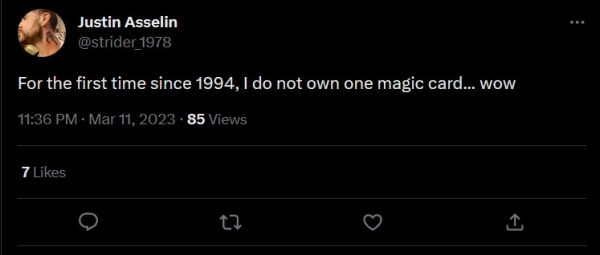
One such bond I forged a long time ago is with fellow Magic player Justin (@strider_1978)… or should I say, ex-Magic player? Check out this momentous tweet I stumbled upon over the weekend:
Justin is a long-time player, enjoying the game for nearly 30 years! Life circumstances and varying priorities contributed to his decision to sell out.
My first reaction to this tweet surprised me. I was jealous.
The Chase Is Over
This is a direct quote from Justin’s follow-up tweet. “Yes sir. I am done. The chase is over.”
Wow. This is such a profound tweet, and it’s one that really resonates. The way Magic is designed, there is always another card you’re looking for, another piece for the deck, another treasure to complete a collection, and another nostalgic piece of cardboard to remind us of our childhood. The pursuit is never-ending, part of the game since day one when Richard Garfield put the “collectible” in this collectible card game.
For example, Justin’s white whale in Magic was a Juzam Djinn. For years he was in active pursuit of an affordable copy—unfortunately, as the value of his cards climbed, so did the price of that pesky Juzam!
There was an error retrieving a chart for Juzam Djinn
When Justin made the decision to sell his collection, he abandoned the lifelong, insatiable pursuit.
Just like that, the tie is severed. “It was a huge weight off my shoulders,” followed Justin when I messaged him directly about his decision. He went on to admit, “Don’t get me wrong. It was kind of tough.” The decision to sell everything wasn’t taken lightly, but overall, he’s happy with the decision.
I look at this sense of relief and I can’t help but picture what it would feel like for me. I don’t think I’d ever quit Magic altogether, but the prospect of selling everything but for a single deck and/or binder of cards is attractive for a number of reasons. Let me count the ways…
Top Five Reasons to Sell Out of Magic
#5 Freeing up Space (physical and mental)
By itself, a single Magic card takes up virtually no volume of space. Add stacks of cards, deck boxes, binders, dice, tokens, playmats, and an array of other accessories related to the game, and suddenly you have a ton of “stuff” filling up your closet. Selling out of Magic means you can rid yourself of all these items, leaving you with a tidier home and more shelf space in the process.
There was an error retrieving a chart for Cold Storage
Beyond the physical, it’s also a relief to free up mental space. For example, if you’re spending time thinking about decks to build and adjust, cards you may want to pick up, cards you are actively trying to sell, etc., you are spending valuable mental energy on this game. In addition, I always monitor shipments of cards (to and from me) to ensure they aren’t lost by USPS—when you’re finished with Magic, these are minor worries and thoughts that no longer demand mental energy.
#4 Time
Magic is an extremely time-consuming game! Whether your favorite way of engaging is playing on Arena, playing against friends at the kitchen table, organizing and sorting through your collection, or buying and selling cards—hours can be sunk into this game before you even realize it.
Of course, if we’re having fun engaging in these Magic-related activities, then it’s all worth it. However, there is something to be said about the opportunity cost associated with all this time we’re spending. For example, as I write this article my two kids are playing nicely in the other room. I’m thrilled they’re getting along for once, but this is an opportunity to bond that I’m eschewing in favor of writing this article.
I sometimes wonder how much time I’d have back in my life if I were to leave Magic altogether. Sure, I love what I do in this game, but am I missing out on other life experiences without even realizing it? Are you?
#3 Money
Some say “time is money,” but in this case I am strictly referring to the financial value and opportunity cost associated with this card game. Take a step back for a moment and consider the approximate value of your collection. Next, think about what else that kind of money could help you buy. Whether your collection’s value is $100 and could pay for your next week’s grocery bill, or it’s $100,000 and you could pay off your mortgage with the money, there is always an opportunity cost associated with owning a Magic collection.
My primary motivation for engaging in Magic finance remains steadfast: saving money for my kids’ college educations. I’ve been completely transparent about this in the past—when there came a time when I could sell out of my cards to meet my college fund goals, I would do it. I’m nearly there today, and I’ve already begun selling much of the value from my collection as a result.
There was an error retrieving a chart for Black Lotus
If you are juggling multiple priorities in life, make sure you are actively deciding to invest so much money in this card game, rather than passively doing it (by ignoring card values as they fluctuate over time). You may be surprised at the alternatives you could be using that money towards when you stop and consider it more seriously. Also, there’s the side benefit of not having so much money in cardboard sitting in your basement. I no longer dread the idea of having a basement flood or other catastrophic event wiping out a chunk of my net worth.
#2 Ending the Grind
I participate in a group that focuses on mindfulness at work. One of the concepts I appreciate most is the idea of “non-striving.” Too often I hear my inner voice declaring, “I’ll be happy when…” In other words, there’s always a next step, or a goal, that I am working towards in order to feel more fulfilled.
Do you know what I realized when it comes to Magic? I’m never fulfilled. No matter which cards I buy, what deck I build, or what collection I complete, there is always a new objective to work towards. On the one hand, that may give me a feeling of purpose and drive. On the other hand, the constant pursuit feels Sisyphean in a way.
Sisyphus is a character from Greek mythology whose punishment for cheating the gods was to have to push a round boulder up a hill for eternity. As he nears the top, the boulder rolls all the way back down the hill, forcing Sisyphus to start over again. That’s very much like my experience collecting Magic cards. Every time I finish some minor quest, I barely celebrate before I shift focus to the next card I “need” for my collection. I always tell myself “I’ll be happy when I finish this next goal” only to find a new card I would love to buy.
The grind is perpetual, time-consuming, and leaves me with a hollow feeling. Abandoning the lifelong pursuit is akin to letting the boulder fall back down the hill, and then walking away. It’s no wonder my friend Justin used the term “relief” when he described his feeling about selling out of Magic.
#1 Shifting Life Priorities
In addition to ending the grind, Justin cited another significant factor that led to his decision to sell out of Magic.
“There is an emotional attachment to cards from a younger time in a person’s life. Memories. Good times. Good people. A totally different kind of life, or world, back then as opposed to now. Even the community is a lot different. We were once outcasts. The nerds. The losers. Now it’s very mainstream…”
Justin reminisces about a different time—the mid-1990s to be more precise. I can relate to this sentiment. I remember what Magic was like when I started playing in 1997. The game wasn’t well known to most kids in school. To play Magic was to be a nerd, and this was something you kept within your small circle of friends. You didn’t advertise that you played this game.
Justin looks back on that time period with nostalgic fondness, and I can understand why. The game looks very different now than it did back in 1997. It’s not that it’s significantly better or worse. It’s just different.
In addition to the game’s evolution, we as people have also grown and changed over the years. You could say this aging process can cause us to “grow out of Magic.” Life changes, our circle of friends changes, and as a result, our priorities change. Instead of leaning on Magic as a way to connect with friends in a society where we are social outcasts, we are now adults raising kids, working full-time jobs, and navigating through life. Magic is still a fun game, but it isn’t the anchor it once was while we were floating adrift in life.
It's perfectly reasonable to acknowledge this evolution and respond in the way Justin did.
Wrapping It Up
There’s nothing wrong with having Magic be a lifelong pursuit. I pass zero judgment on anyone who is wholly committed to this game. I know of many Old School players in particular who declare that they will never sell their cards, and that they’ll enjoy playing Magic their entire life.
My intent this week is merely to shed light on the other side of the coin. The decision to quit Magic is not one to be taken lightly, especially when there are significant financial implications. There can be a number of reasons it makes perfect sense to sell out of the game, whether it be motivated by time, money, or simply an acknowledgment that Magic is a perpetual grind with no end.
As for my friend Justin, I suspect he’s not going to own zero Magic cards forever. He already confided, “I am gonna pick up some cheap revised for a white and black deck, so I can still play when I do meet some of y’all!” He’s already finding a new way to stay involved in the game—I did something similar after I sold my Old School decks. I immediately built a budget friendly Erhnam and Burn ‘em deck, rocking white-bordered Revised and Chronicles through and through.
There was an error retrieving a chart for Erhnam Djinn
Perhaps that is the best reason of all to quit Magic. It allows us to reconsider what we truly want out of the game. After all the finance, competitiveness, and completionism are stripped from the game, what remains is what we truly seek from it. For Justin, it’s simply a reason to meet friends and enjoy a casual game. It took him a major decision to sell out in order to get back in touch with what made the game special to him.
Would you have the same courage? What would you do with Magic if you were to sell all your cards and start at zero again? Perhaps the answer to this question is what would truly make you happy when it comes to engagement with Magic: the Gathering.
If not, now is a perfect time to join up! Our powerful tools, breaking-news analysis, and exclusive Discord channel will make sure you stay up to date and ahead of the curve.
In the first weeks of Phyrexia: All Will Be One (ONE), we identified red and white as the best colors. Green, black, and blue followed, in approximately that order. The format was labeled one of the most aggressive of all time, and if you didn't have a play by turn two, you were probably losing. None of this has changed.
On a smaller level, however, things seem to be evolving. Last week's article on blue was a reaction to that. Once the color was labeled untouchable, we recognized we could cherry-pick its best cards. However, with less eyes on blue, Naya is getting crowded. In the early weeks of the format, we just wanted to be red and white. Toxic, oil, artifacts, whatever. Red decks got copies of Hexgold Slash and Chimney Rabble on the wheel. White decks had access to so many aggressive cards that toxic felt like just a bonus. Now, these colors are more contested. Which means Naya drafters (and most of the time, we should be Naya drafters) will have a tougher time.
Game Plan for Naya
The recipe for success in the early days of ONE was simple. Just be red and/or white. This deck wanted to be toxic enough to enable its corrupted synergies, but it didn't really have the means to win through toxic. This is an old-fashioned aggro deck.
7-1 RW Aggro
Creatures
3 Crawling Chorus
1 Sinew Dancer
1 Bladed Ambassador
2 Incisor Glider
3 Indoctrination Attendant
3 Basilica Shepherd
Sorceries
1 Hazardous Blast
Instant
2 Charge of the Mites
2 Volt Charge
Artifact
1 Prosthetic Injector
1 Barbed Batterfist
1 Urabrask's Forge
Enchantment
3 Planar Disruption
Lands
1 The Fair Basilica
1 Terramorphic Expanse
8 Plains
6 Mountain
Despite the number of toxic creatures in this deck, and my affinity for Prosthetic Injector in the early stages of the format, this deck isn't really a Toxic deck. It was toxic enough to enable corrupted, but hardly had a chance at getting opponents to ten poison. More often than not, the Basilica Shepherds hit like the Phantom Monsters they are and attacked for lethal.
If we can still pile up strong red and white cards, we should. However, it's less likely that this option will be available to us now that the format has adapted to the disproportionate strength of Naya. If Naya decks are going to evolve, they need to maximize the synergies of the scripted archetypes.
Naya in the New World
In a world where we can't get expect to see pack after pack of powerful cards in red, white, and green, we need to get more out of the synergy cards. Goldwarden's Helm and Bladegraft Aspirant are cards I wasn't interested in during the early weeks of the format. Now we should look to pick them up if we're heading into the RW equipment deck.
7-1 RW For Mirrodin
Creatures
1 Vindictive Flamestoker
1 Axiom Engraver
2 Jor Kadeen, First Goldwarden
1 Shrapnel Slinger
2 Mandible Justiciar
1 Annex Sentry
1 Bladegraft Aspirant
1 Chimney Rabble
1 Resistance Skywarden
Instant
1 Hexgold Slash
1 Charge of the Mites
1 Volt Charge
Artifact
2 Veil of Assimilation
1 Barbed Batterfist
2 Bladehold War-Whip
2 Goldwarden's Helm
1 Mirran Bardiche
Lands
1 The Autonomous Furnace
8 Plains
8 Mountain
Veil of Assimilation was a card that looked like a dud to me. The card is too reliant on synergies and didn't impact the board. In this deck, the card was a house.
If it looks like we're going to lean into an artifact subtheme, we can make those mediocre three drops better. While we should still snag a late Chimney Rabble or Hexgold Slash if we see it, the flow of red cards has slowed to a trickle. Don't be afraid to lean into those synergy cards early. Optimizing our presence in a specific archetype, specifically the red and white ones, should be a priority.
Big Oil vs. Oil Slick Aggro
RG Oil is probably still the best deck in the format when it comes together (RW Equipment and White Toxic are also in the discussion). However, the best RG Oil decks rely on premium cards up and down the curve.
We want some amount of one-drops, all of which are good to great. We want Axiom Engraver and Barbed Batterfist, some of the best two-drops in the format. At three, we're hoping for a Contagious Vorrac, but we're willing to settle. Then we top our curve with premium options at four and five. Furnace Strider, Lattice-Blade Mantis, Oil-Gorger Troll, and Chimney Rabble are all excellent.
That deck is basically a composite of the format's best commons. When we mix in the premium removal, and maybe the best uncommon in the set in Cinderslash Ravager, there's no question as to why this deck performed so well. Big Oil is a juggernaut, but is it sustainable?
As we react to restricted availability, we need to rely on synergy. Free From Flesh always felt like a bad Blazing Crescendo, but the most aggressive decks might prefer the one-mana trick. Using it precombat to boost a Kuldotha Cackler or to pre-pay for the Forgehammer Centurion trigger can accelerate the oil decks. While Big Oil is still better, Oil Slick is a potent off-ramp for many of the strong red cards, especially the multiple one-drops.
We're not seeing an endless string of powerful red cards these days. We need to know when our red decks should pivot into an even moreaggressive build. This audible can salvage a mediocre RG pile and lead us into the kind of lean, aggressive deck that thrives in this format.
You Come to a Fork in the Road
White has three strong common two-drops. In a perfect world, we know what our deck is going to look like before we have to make this decision.
Clearly, Mandible Justiciar performs better in artifact decks, whereas Duelist of Deep Faith is an option for toxic decks. Incisor Glider is great if we can reliably corrupt our opponents, but early in the draft, this card is a distant third choice.
Mandible Justiciar has a slightly better GIH WR% and OH WR%. Every deck in this format wants to gain life. Still, between the two, we should prioritize the Duelist. Certainly, both cards have decks they'll be good in. But knowing the importance of premium two-drops in toxic decks makes this card a more valuable early pick. While we're willing to include both creatures in either deck, not having good toxic two-drops in an otherwise strong Toxic deck is a disaster.
While Mandible Justiciar might be a better card, I'm not sure that it is a more valuable one. The toxic decks need to get through that toxic damage early. The first few hits are the most important, and Duelist of Deep Faith is more than up to the task.
Better vs. More Valuable
By most metrics, Annex Sentry is the best uncommon in the set. It has synergies with toxic and artifacts, white's two overlapping themes. It's a Fiend hunter in what's arguably the format's best color. And it boasts the highest GIH WR% and highest IWD% according to 17lands.
However, I'm not sure that it's the most valuable. Cinderslash Ravager has a strong claim to this throne, as does Bladehold War-Whip. Both are incredibly powerful cards that elevate their archetypes, but being gold comes with limitations.
In sports, they often award the MVP based on narratives and other unclear criteria. What constitutes value? And to whom must this card be valuable? With that being said, I'd like to debut an extremely unpopular opinion:
Bilious Skulldweller is the format's most valuable uncommon.
While we shouldn't take this card over Annex Sentry, it provides an unmatched opportunity for a strategy (admittedly a weak one) to exert its gameplan. Skulldweller allows Black Toxic to get their first poison damage in the early stages of the game. Unlike White Toxic, black decks rely on proliferate, and don't have the likes of Flensing Raptor, Crawling Chorus, or Duelist of Deep Faith to keep the pressure up. Black's next best applicant for this job is Pestilent Syphoner, which could be described as a necessary evil. In truth, the diminutive flyer is better classified as a liability.
Bilious Skulldweller unlocks an entire color in a way no other uncommon does. That is my reasoning for crowning this unassuming critter, despite its admittedly dubious 17lands stats.
Why "Valuable" Matters
Regardless of how you feel about Billious Skulldweller, as we look towards synergies, we should factor the value of a card over its raw power. This is not a new concept, but as this format matures, it becomes more important to view things through this lens. While last week we talked about cherry-picking blue, the Naya colors are ransacked by the middle of the pack. Therefore, as we select cards lower on our tier lists, we need to make sure we're creating a shell that can optimize our 20th-23rd inclusions.
As we're drafting, that means asking ourselves, "what does this deck do?" and "what does this card do for my deck?" These questions help us build more synergistic decks and prioritize how cards will support our overarching gameplan, especially as we find homes in contested colors. Yes, sometimes the draft will offer us untold riches and a clear path through two colors, but more often than not we're going to have to put forethought into our picks to end up in a strong position.
This is why we should take Duelist of Deep Faith over Mandible Justiciar early on. Conversely, we still shouldn't take Free From Flesh over Blazing Crescendo. While the one-mana trick might be better in some versions of the oil deck, it's unlikely to overpower the free card from Blazing Crescendo on average. Value and power might fluctuate in the eyes of a given drafter, but as our colors become more contested, small synergistic choices can mean the difference between flopping and trophying.
If not, now is a perfect time to join up! Our powerful tools, breaking-news analysis, and exclusive Discord channel will make sure you stay up to date and ahead of the curve.
The overwhelming vibe I get from February's data is stability. Players have been trying to disrupt the metagame's equilibrium, but like swinging a pendulum, it just keeps returning to its resting position. These new decks have promise, and I hope they survive to add needed variety to Modern's metagame. However, I have doubts that they'll have any impact on the metagame's equilibrium ahead of March of the Machines (MOM).
The Churn That Wasn't
The first thing to deal with is Phyrexia: All Will be One's impact, or rather lack thereof. Don't get me wrong, players are trying to adopt the new cards, and some have definitely made it into the regular Modern rotation. It just hasn't resulted in the churn that I expected it would in January. The main problem seems to be that, once again, the cards that are best in Modern are best in existing decks.
The Phyrexia card that's seen the most play, by a very long margin, is The Mycosynth Gardens. It naturally fit into Amulet Titan and has been universally adopted as a 3-4-of. I know that other decks were floated as homes for Gardens, but they're not really working out. Gardens is perfect for Titan because it's cheap to copy Amulet of Vigor, and more Amulets allows for more broken starts. I'm told by actual Amulet players that Garden doesn't make the deck that much better, as switching other lands for Gardens made the mana somewhat unstable, but being more broken makes up for instability.
After Gardens, the most played Phyrexia card is Minor Misstep, and that's entirely thanks to UR Murktide's prevalence. Misstep is not universal, but many Murktide players are running one or two main as anti-mirror cards. Some other decks are also running one or two as anti-Murktide cards. After that, Elesh Norn, Mother of Machines and Atraxa, Grand Unifier see some play, the former alongside Omnath, Locus of Creation and the latter in Indomitable Creativity lists and rarely elsewhere. Many niche cards, but nothing redefining.
Modern, Vaccinated
Significantly, and despite my concern, Venerated Rotpriest hasn't made much outside of Standard. This is not for lack ofeffort. There are a number of Storm lists floating around, and every Infect list I recorded in the data included Rotpriest, seemingly for the reasons I speculated on in my original article. That said, the fact that it's been a month since Rotpriest became legal, plus the extra time from the leak, and there's been no breakout deck suggests that there's no actual danger.
However, I'm not sounding the all-clear yet. Remember, it has proven surprisingly hard to innovate in settled metagames. Rotpriest may be more the victim of inertia than a lack of viability. Its home is also in two decks that have stigma associated in playing with them, Infect and Storm. Storm is a deck that traditionally turns off many players and players really hate getting got by Infect, which provides social pressure against playing them.
There was an error retrieving a chart for Grapeshot
Therefore, given the fact that decks running Rotpriest can win and the test decks I've seen perform reasonably well (on video, anyway) I'm sticking to my original assessment. Rotpriest is an inherently dangerous card, but a combination of metagame forces and social pressure are keeping it out. It may take a metagame shift or new printing to overcome the inertia, but there is certainly a Modern where Rotpriest is a player. Stay vigilant.
Humans Returning?
For the first time in a while, Humans made the Tier list. It's the bottom of Tier 3, but that's still a significant achievement for a deck that fell completely out of the metagame after once being the best deck in Modern. This happened thanks to the emergence of the Mono-White Humans list running Chancellor of the Annex and Shining Shoal I highlighted last week. It's still putting up enough results to potentially make March's tier list, but I don't think it will actually make it.
I mentioned that I like the idea of the deck far more than the reality, and nothing in the past week has changed my mind. When everything lines up correctly, the deck is beautiful. An opening curve of revealed Chancellor into Esper Sentinel and Thalia, Guardian of Thraben is crushing agianst Murktide. Having Chancellor to pitch to Shoal targeting Murktide Regent to close out the game is just gravy. The problem is that for each time things line up like that, there are three where Chancellor is drawn late, Shoal is worthless, and the deck is too anemic to compete. Which has been many streamers'experience too.
There was an error retrieving a chart for Shining Shoal
Consequently, I don't see a long future for this particular deck. However, there's definitely something to it, and a slightly different take could make the deck stick. I'm tooling around with a version that cuts the situational Shoals for more ways to discard Chancellor for value. It's definitely not good, but there's potential, so keep an eye on Humans. They always seem to sneak back into viability.
Dam Repaired
Underworld Breach was the Card of the Month in January. It was winning everywhere, and looked to be taking over Modern. That didn't happen in February. Jeskai Value Breach was a Tier 2 deck and no other version made the list. I recorded multiple version in the data, but only Value hit the threshold. Considering that I said that the upward trend we saw would continue, what went wrong?
The first thing to remember is that it's impossible to know when or if the sheen on The Shiny New Thing will tarnish. Every time some new exciting take on an existing deck comes out, there's a rush to adopt it followed by a crash. Players realize that either they don't like the different play style, or that it requires different skills than they expected, and interest wanes.
There's also the normal resistance of "isn't this just X, but worse?" That stigma isn't always justified, but it certainly dampens any momentum the deck was building. This certainly played a role as I saw numerous takes on Twitter saying that Breach decks are just Murktide, but worse.
There's also the fact that once opponents understood what was going on, the Breach decks became easier to beat than expected. It doesn't appear to me that there's more graveyard hate seeing play, despite my entreaties to the contrary. Instead, players have gotten smarter about employing their hate. They're also playing to minimize the impact of the Breach. Thus, the deck fell off. I expect Value Breach to remain in the mix, but it's up in the air for other versions.
About the Non-Banning
All that said, the really big development is that on Monday, Legacy saw a significant ban and Modern didn't. This isn't entirely surprising, as Wizards is often resistant to bannings unless forced. What's really got a bee in my bonnet (as evidenced by what I said on Wednesday) is that Wizards says that Murktide's lead on the other decks isn't large enough to warrant action. Given all the evidence I have, I can't fathom how they could genuinely believe that statement. However, they obviously do enough to push the line, and this has metagame and financial implications.
Paper is another matter, and I won't be considering it here. To the best of my knowledge, Wizards doesn't make events report decks to them. Thus, they'd only know what individual organizers choose to make public, just like me. Wizards does organize events and often requires decklists, so they can know about those events, but no others. Therefore, if they know more about the paper metagame than me, it isn't much more.
The Statistical Issue
I don't have all the data that Daybreak and therefore Wizards has about the Magic Online (MTGO) metagame. I can only work with the publicly available data on the winning decks from Premier events. They have access exactly what decks enter every event and how they perform from all the Premier events and Leagues. They can know exactly what is actually going on, while I can only guess, and therefore they could be right that outside of the top of Premier events Murktide doesn't show up that much.
However, for that to be the case requires the data to reflect something that seems statistically unlikely. The primary issue is that as the data set increases, the threshold for statistical significance shrinks as a percentage of the population. With a data set of 100 results, the threshold for statistical significance is about 20 negative responses, or 20% deviation. As the set population rises, the needed percentage falls.
Follow the Numbers
The data I have available puts Murktide over Rakdos Scam on MTGO by 6.85%. Given the population of 876 decks, this is a statistically significant deviation, enough to designate Murktide as an outlier above and outlier. For this not to be the case in the totality of the data requires that Murktide shows up at a lower percentage outside of Premier event results. This would mean that players aren't testing out their Murktide lists in Leagues and losing players aren't playing Murktide in the Premier events. Both circumstances are possible, but do seem unlikely.
It then requires that this drop off shrinks the gap by a significant amount. To shrink the gap requires that Murktide shows up in the overall data at a rate lower than 15.87%. In fact, it would need to be at a rate lower than Scam's 9.02% to actually close the gap between them. Even if that happened, the two decks would still be statistical outliers over Hammer Time. All these things are possible, but for it all to happen together seems unlikely and indeed implausible. Thus, I think Wizards is obfuscating.
Monkey on Our Back
Why would Wizards mislead us on Murktide? Every corporation has an incentive to deceive customers for financial gain, but there's a known financial reason for Wizards to avoid taking action. Specifically, Ragavan, Nimble Pilferer is being reprinted on March of the Machines' bonus sheet. He was, in fact, used as part of the announcement of said bonus sheet. The minute I saw that, I knew that there'd be no Modern ban anytime soon. Wizards isn't going to ban Ragavan if it might impact them selling MOM packs. They're just not, especially when the only format to (realistically) play him in is Modern.
Honestly, if Wizards had left it at that, I I'd be fine. They're not going to ban something they're reprinting before it's out, the company has to make money. I get it and can accept that reality. However, once you start saying that there's no need for action based on something that contradicts the visible evidence, I have a problem. That feels like deliberate misdirection and deflection, and I take it as an insult to player intelligence.
Stability Ahead
Thus, given Modern's resistance to organic change over the past year and Wizards being unwilling to ban anything until sometime after MOM, it is safe to assume that Modern will continue to remain as it is for the foreseeable future. Murktide will continue to dominate Modern alongside Scam, Hammer, and Creativity. Therefore, players need to adapt and prepare accordingly.
There was an error retrieving a chart for Tarmogoyf
On the financial side, Ragavan getting reprinted is an opportunity. This is likely to be a Tarmogoyf situation, and the increased supply will stimulate additional demand. I don't know how much of an increase to expect, but if players pull a Ragavan, they'll want to build a deck around him. Therefore, there should be brisk business in the rest of the cards for Murktide, Breach, and other Ragavan decks on the horizon. I'd start building inventory with that in mind.
What Will Be
Modern is in a highly stable period, and unless there's something truly impressive in MOM, it will remain so. The currently viable decks have proven resilient to disruption. We all need to settle in and wait.
If not, now is a perfect time to join up! Our powerful tools, breaking-news analysis, and exclusive Discord channel will make sure you stay up to date and ahead of the curve.
I haven't been to a major Magic: the Gathering event since Magic Fest Atlanta 2019 where I purchased a Japanese Tolarian Academy for $20 and an Earthcraft for $25. Times certainly have changed since then.
Recently, I've had the opportunity to attend SCGCon Charlotte, and doing so got me thinking about just who the event is for... and whether going was worth it for me! Today, we'll assess the EV (estimated value) of attending this type of event for players, buylisters, and traders in the hopes of seeing just how much major Magic gatherings offer the game's many fans.
But First, Some Background...
I haven't been to a large event since September 2019. This was before the Pandemic and before my son was born so I was really looking forward to going to this event.
I used to love going to Grand Prix and SCG Opens to trade, but that began to die out a few years prior. I then switched over to using these events as opportunities to buylist cards I had acquired in collection buys that were often found digging through bulk. I wrote several articles on my experiences back in 2017 and 2016.
In July 2019, TCGPlayer changed their minimum free shipping to orders of $5 or more, and it suddenly became very profitable to sell cheap cards. This meant I no longer spent all my free time leading up to an event pre-pricing cheap cards by the highest buylist price. Instead, I could play in Win-a-Box events, typically Legacy ones. By this time, my beloved UW Miracles deck had been neutered with the loss of Sensei's Divining Top, so I spiked such events with Sneak and Show.
Having attended major events as a trader, a buylister, and as a player, I was able to critically assess SCGCon Charlotte while I was there, and put together a sort of guide to figuring out whether to spend resources attending such events. Hopefully, my own minimum requirements as each type of attendee will prove helpful for others weighing the costs of time and travel next time around.
Attending as a Player
As a player, I want to have fun playing the game and feel like I get decent value for my entry fee. Obviously, much of the fun aspect is outside of the Tournament Organizer's (TO) control, but there are some parts they do decide:
Do events fire?
Are there enough judges to operate the events?
Are there lots of different types of events to play in?
Is the play area clean and well-maintained?
Next, I'll ask if there's decent value on the table for my entry fee, which admittedly also may have some "gray area" to it, as the value of playing one's favorite format/deck/etc. varies from person to person. There is also a cost to the TO to have judges and other staff members running these events.
There was an error retrieving a chart for Legacy Weapon
My baseline is that for years, you could enter an 8-man pod for $15 and the winner walked away with a booster box (36 packs). Interestingly, there were no 8-man pod-type events at SCGCon save for Booster Draft, and all events had a set schedule.
The Breakdown
The side events were now $20 to enter, and tickets were rewarded as prizes with the following breakdown:
3-0: 400 Prize Wall Tickets
2-1: 120 Prize Wall Tickets
1-2: 80 Prize Wall Tickets
0-3: 40 Prize Wall Tickets
This should mean that for every 8 players, each event paid out a total of 1,040 Prize Wall Tickets. It used to be that 10 tickets could be converted into any standard legal pack. However, now it appears that these packs are 40 tickets each, making the payout in packs as follows:
3-0: 10 Packs
2-1: 3 Packs
1-2: 2 Packs
0-3: 1 Pack
Currently, each event costs $5 more, and the total number of packs given out is 26. This payout was so bad that none of us actually bothered to play in any side events, but I don't necessarily think it's bad that they flattened out the prize support a little, as getting an unlucky draw after going 2-0 and walking away with nothing definitely feels bad too. This way, everyone wins a bit, instead of one person winning a lot.
I will give SCG credit in regards to the space, which was clean and well-maintained; there were a fair number of events to play in; and there didn't seem to be a lack of judges. Still, attending for side events in this climate would have to be based on the thrill of playing face-to-face Eternal Magic with light stakes, as going in to spike and make a killing for entry free is no longer in the cards.
Attending as a Buylister
As I mentioned above, I don't buylist like I used to, as I've found TCGPlayer to be far more profitable even though a sale is never guaranteed. That being said, several of my friends were intending to buylist cards to various vendors at SCGCon. I was open to buylisting any cards that had aggressive buy prices, but would use Trader Tools to compare against on-site buy prices.
Admittedly, there was sure to be some give-and-take on this, as more often than not Card Kingdom has the highest buy prices. However, I have to ship them cards, and there is always the potential for downgrades. To account for this, I feel that any buy price within 90% of the highest Trader Tools buy price is "aggressive" and should count towards this evaluation.
As my willingness to buylist was less than my friends', I helped them gather buy price information so they could compare with what vendors were offering. They also gave me first crack at their lists.
Cape Fear Games hotlist
Strike Zone hotlist (note the Minsc & Boo price)
Mighty Meeple hotlist
Another hotlist
The Breakdown
As seen above, many buy prices were very good. I even pulled some Show and Tells out of my trade binder becauseCardmonster Games was paying $24 each on them and TCGLow was $30, though I should mention that Cardmonster Games' hotlist was a QR code on their sign, which to me is pretty brilliant as they can adjust it as needed. Still, the code it also requires people to scan it and then scroll through it, which may have deterred some potential buylisters.
There was an error retrieving a chart for Show and Tell
My friends all did way better than they expected, with one netting $3200 in random cards he had just been sitting on and another making $1250 by downgrading some of his Commander decks.
I do want to bring up an issue that I would like other people's opinions on. The Strikezone hotlist had Minsc & Boo, Timeless Heroes listed for $14, but when my friend went to sell them one, they offered $7. He showed them a picture of their own sign which they then erased and wrote $7. I personally found that very scummy and have already had a dislike for them since GP DC years ago when they refused to match their own online buylist price on site. I hope others have had better experiences with them, but I will refuse to do business with them moving forward.
Attending as a Trader
Last but not least is the trading evaluation. I felt the best way to evaluate this event as a trader was to establish a trade "want list" and then see how well I could fill it. I also tracked the number of actual trades I participated in as well as any I happened to see, just to get a general gauge of trading activity.
There was an error retrieving a chart for Trade Routes
My trade list was decently sized, but my approach to trading and speculating ever since Ikoria: Lair of Behemoths has been to focus more on the rarer variants of cards as opposed to any old copy. These include extended art, extended art foils, retro frame, and borderless variants. As these versions are rarer, it would likely be difficult to find traders with lots, unless they were stores who opened a lot of product (which I have seen typically means "value trader"). Here is my list, with the regular version of a card in bold:
29 Cards wasn't a huge list, but it was large enough that I figured I should be able to find at least 20% of the cards on it in trade binders.
The Breakdown
This was the most disappointing of all; while walking around, I saw nobody trading. I remember a few years ago it was common practice to have a few empty tables available so people could sit down for a second, work on a deck, play some casual Commander, or trade.
There was an error retrieving a chart for Time Stretch
These tables no longer appear to exist, which means that to trade with anyone, you must find someone who wants to trade and then hopefully find a table that isn't being used for the main event or a side event. There's no more walking over to a buzzing trade table and peering through each other's binders, making the activity much more challenging.
I should be 100% honest and mention that I didn't spend a lot of time looking for potential traders. TOAMagic had a bunch of long boxes with cards in sleeves set at a specific price, and I spent a fair amount of time digging through them looking for underpriced Commander gems. I thought I had found a nice haul, but smartly looked up the cards before buying only to find most were the same price as I could get them on TCGPlayer in English.
I am sure many are aware, but for those who aren't, foreign Commander cards are usually very difficult to get rid of unless they are very high-dollar reserved list cards and you're selling them a good bit below the English equivalent.
The Verdict
My friends and I will likely go to the next SCGCon within driving range, but mainly to sell cards to vendors. I will not waste any of my "preparation time" on building up trade binders, but will instead focus solely on pre-pricing cards for vendors, like I used to do. I also plan on pulling some of my own store inventory that hasn't moved in 6 months or more and seeing what I can get for those cards.
Large SCG events have certainly changed quite a bit over the last few years. I hope the above gives prospective attendees a better idea of whether this kind of event is for them. Would you attend an SCGCon within driving range? How about outside of tha range? Let me know in the comments.
If not, now is a perfect time to join up! Our powerful tools, breaking-news analysis, and exclusive Discord channel will make sure you stay up to date and ahead of the curve.
After years of being a staunch Commander advocate, I've had a change of heart. Well, not really a change of heart, but a realization. It turns out I've never been a huge fan of Commander. It's really EDH, Elder Dragon Highlander, that I have always enjoyed.
Wait, you say, aren't they the same thing? What's the difference? The difference is why there are six times more Google search results for "What's the best commander" (267 million) versus "What's the most fun commander" (48 million). In short, Commander, not EDH, is a format created by Wizards of the Coast which pushes power creep and competitive play onto casual players. And it's not totally unique in that regard: Unfinity was another great example of Wizards dictating how casual games should be played.
Of course, there have been numerous changes from the original formula. Here's a great article by Vinicius Sorin going over not only the origins of the format, but also why it succeeded so greatly. To summarize, the format exists to allow lots of different cards, interactions, and multi-player politics to hold significant weight in a game. But I'm increasingly finding that too many new cards, particularly too many powerful new ones, remove player agency and detract from what originally made the format so great.
Should I Run This Card?
This is a question I read and hear constantly. "Should I run Demonic Tutor in my mono-black deck?" I don't know little Timmy, should you? The number of times someone has asked about running "generic high-powered card" dwarfs the number of times someone has wondered about fun or flavorful inclusions.
I do have an answer, though. Should you run that high powered card in a supposedly casual format? Probably not. Why ask random strangers on the internet rather than your local play group, though? Well, that's both complicated and simple at the same time. So here's an example that I hope illustrates some of my personal frustration with Commander.
A Story About Boats
Around 2012, I felt like there was significant pressure to increase the power of my decks as new product had been hitting the shelves throughout the previous year (gee, sound familiar?). I'm a contrarian, so my immediate thought was "No, I'm going to make something dreadfully bad;" and the idea was to make a deck with a unique build restriction. That restriction? Every card, including lands, must feature artwork of a boat.
Going through piles of cards, it became obvious that blue and black were really my only options, mostly because the land base would be impractical otherwise. Of very few choices, Skeleton Ship seemed like the perfect Commander. Initially, I had 50 land, because I could not find enough other cards to fill the gaps. How did my games go?
Well, terribly, of course. It was more a pile of cards than a deck. There were a couple of combos, but nothing game-ending. Removal and interaction existed, but most of it was not very good. My Commander basically did nothing; it just had three toughness and cost five mana. And let me tell you this: I was in heaven.
No one knew what my cards did, what my plan was, or how I was going to do anything but try to "stay afloat" and make boat puns. I lost something like my first ten or so games, and was a bystander a lot of the time because I could not meaningfully impact the board.
I remember my first victory with the deck when a board wipe caused death triggers to kill the other two players and I was locked into a 1v1. Skyship Weatherlight came to the rescue by giving me additional card advantage for only four extra mana per turn.
I looked forward to each set waiting for new boat cards to appear and incorporate into my pile of jank. After all, the format is about just having fun, right?
Several Years Later...
It would be one thing if I was simply getting more options for my meme deck or more battlecruiser-style cards. There is such a thing as too many seven-drops! The problem isn't how many boat card options I got every year. It's the number of extremely powerful cards with a boat printed on them that serves as a microcosm of the problem with Commander.
There was an error retrieving a chart for Demonic Tutor
Should I replace Dandan with Demonic Tutor? Gee, that's a tough one.
Too many, too much, and too good are all things that have grown to define the format. Without deliberately trying to make my theme deck more powerful, it continued to improve, and win games it had no business winning simply by staying "up to date."
One More Example
On a different note, I also have a Jasmine Boreal of the Seven deck which features mostly vanilla creatures. This deck is not busted, but it has held its own with the help of newer cards. For a deck that would in theory be mostly Grizzly Bears and Craw Wurm, it actually runs none of those cards, because far better vanilla cards and token generation have been printed over the years. So even running a deck with a deliberately low power concept has been impacted through the sheer volume of newer product offerings, the consistency of multiple copies of the same vanilla creature, and also acceleration from the Commander.
The Problem...
I believe that the majority of players have experienced some feel-bad moments in their games. In an effort not to repeat these moments, the players consult the wisdom of the masses. Instead of asking their play group for advice, they head to the internet and get advice that tends to accelerate and power up their deck, whether that is right for their meta or not.
There was an error retrieving a chart for Vampiric Tutor
But even if they do not seek advice from others, merely searching for cards generates the same issue. Too fast, too powerful and too many. This creates an arms race and you either need to keep up with new cards or pray the other players deliberately de-power their decks. So then, what is a player seeking more enjoyable games to do? The answer is move to a "different" format full of players that are looking for that kind of game.
...The Answer?
According to some, including Sheldon Menery of the Commander Rules Committee, PrEDH just may be the solution. PrEDH is a sub-format of Commander with a card cut-off point of New Phyrexia, which is just before Wizards began printing Commander-specific cards. I've played PrEDH before... because it was EDH. While it is anecdotal, the majority of my games were generally better than current day Commander. Why? Ease of power was lacking. You had to play some really specific decks to use some of the more powerful cards; otherwise, you might have to use a bad commander to access different strategies.
Less choice led to more interesting build decisions, and there was a consequence for each card being included or not. There are, simply, fewer good cards of every type, including mana rocks, in PrEDH. Consequently, decks are slower and tend to run a few more lands. For these reasons, everyone has more time to develop their board or counter a strategy before the game ends. Overall, PrEDH delivers a more interactive multi-player experience, where diplomacy and flavorful choices can impact a game meaningfully.
Instead of having to deny myself uber-powerful cards that happen to have boats printed on them, restricting myself to PrEDH boats returns the deck to its former status as something to bust out when I want to hang out and just play Magic. And yes, it's really that simple; it works. So many of the EDREC Top 100 Commanders and cards are not available in PrEDH that it's a refreshing experience to see "new" old cards, which is part of the point. Don't get me wrong; I don't think PrEDH is the only "solution." But it's a good, quick fix if your local meta is not making games enjoyable. On other options, I strongly believe that Conquest format is even better, but deemed it a bit too niche to explore in detail here.
Trying Other Formats
I'm no stranger to different formats and I love trying out different takes on Magic. That has always been part of the identity of the game. Commander, however, seems to be dictating how and what you end up playing, one way or another. I plan on continuing to test out PrEDH, but with my own particular variant on top of it. My twist? Post New Phyrexia cards are 100% alright to play, as long as they are played in the pre-con deck they came in. This way, I can always welcome new players to EDH and still have a vibrant and evolving format that won't be at the mercy of an advanced metagame.
In other words, I've already out-meta'd the meta. Do I think a lot of the pre-con decks over the last several years might be too good compared to a standard PrEDH deck? Possibly, but I think it will be balanced overall. And the benefit of bringing new players into the experience, who may then contribute more meaningfully with their own PrEDH decks, is totally worth it.
So where there was one format that grew to include two groups of people, there are now two. "Commander" is the competitive variant of EDH; PrEDH is the casual variant. Maybe this way, both groups will get what they want, games that make sense.
I would love to hear about ways you and your playgroup have attempted to solve the issues described above, or if you even consider them issues at all! Undoubtedly, there are plenty of people out there who genuinely love Commander, as competitive as it has become. Share your thoughts in the comments.
If not, now is a perfect time to join up! Our powerful tools, breaking-news analysis, and exclusive Discord channel will make sure you stay up to date and ahead of the curve.
It has been a year since Modern was redefined by Lurrus of the Dream-Den's banning. Modern was skipped over in the latest banning announcement. Thus, it is more important than ever to be tuned into the metagame. And it just so happens to be Metagame Update Day. Rejoice!
A Year of Outliers
A year and a day ago, Lurrus was banned. This kicked off the domination of Modern by UR Murktide, during which time it has never not been an outlier on Magic Online (MTGO) and usually in paper too. February 2023 is no exception, and with that the circle closes. 12 months of Murktide as a statistical outlier, and in both paper and MTGO.
Murktide is paper's only outlier, but is joined on MTGO by Rakdos Scam. Those two decks accounted for just under 25% of the metagame. Just two decks; a quarter of the visable metagame online. This is a sharp contrast to what Wizards said in their ban announcement, and I quote:
Izzet Murktide is currently the most popular archetype in competitive play, but not by a large margin, and the deck isn't showing a concerning win rate.
The second sentence of their Modern explanation. Underlined for emphasis.
Either Wizards has a very different definition of "large margin" than I do or Murktide doesn't show up in League play, bringing the overall percentage gap down substantially. There's really no other way that the 6.84% gap between Murktide's and Scam's population numbers aren't a statistically large margin. Yes, I am calling them out on this possible deflection.
Hammer Time didn't qualify as an outlier online comfortably, though paper is another story. It was literally on the line according to multiple tests to be considered an outlier, with one test putting the outlier line at 58.5 and another at 59. Hammer therefore isn't an outlier this time, but know that it is as close as possible.
As always, outliers are removed from the data analysis. They're in their correct position on the tables.
February Population Metagame
To make the tier list, a given deck has to beat the overall average population for the month. The average is my estimate for how many results a given deck "should” produce in a given month. Being a tiered deck requires being better than “good enough.” Every deck that posts at least the average number of results is "good enough" and makes the tier list.
Then we go one standard deviation (STdev) above average to set the limit of Tier 3 and the cutoff for Tier 2. This mathematically defines Tier 3 as those decks clustered near the average. Tier 2 goes from the cutoff to the next standard deviation. These are decks that perform well above average. Tier 1 consists of those decks at least two standard deviations above the mean result, encompassing the truly exceptional performing decks.
The MTGO data nearly exclusively comes from official Preliminary and Challenge results. Leagues are excluded, as they're a curated list and thus invalid. The paper data comes from any sourceI can find, with all reported events being counted.
The MTGO Population Data
In December, the adjusted average population for MTGO was 8.02, setting the Tier 3 cutoff at eight decks. I always round down if the decimal is smaller than .20. Tier 3, therefore, begins with decks posting eight results. The adjusted STdev was 11.46, which means that Tier 3 runs to 20 results. Again, it's the starting point to the cutoff, then the next whole number for the next Tier. Therefore Tier 2 starts with 21 results and runs to 33. Subsequently, to make Tier 1, 34 decks are required. This is just slightly above average.
February is the largest combined data set I've ever analyzed for this series. I have no idea why, but there were far more events with large populations on MTGO coupled with a large amount of paper events. January 2023 had 840 decks, while February had 876. I'm not complaining, but ever since Wizards farmed MTGO out to Daybreak games, I've been rolling in data.
A much higher population also means more unique decks. January had 74 unique decks, while February had 84. Of those 84 decks, 25 made the population tier. Which is down from January's 27 decks, and the fact that this has happened with more total decks is worrying.
Deck Name
Total #
Total %
Tier 1
UR Murktide
139
15.87
Rakdos Scam
79
9.02
Hammer Time
58
6.62
4-Color Creativity
43
4.91
Burn
36
4.11
Yawgmoth
36
4.11
Tier 2
Amulet Titan
32
3.65
Mill
32
3.65
Cascade Crashers
27
3.08
4-Color Elementals
27
3.08
Izzet Prowess
27
3.08
Living End
25
2.85
Jeskai Value Breach
24
2.74
Tier 3
Temur Creativity
19
2.17
UW Control
18
2.05
4-Color Rhinos
16
1.83
Mono-Red Artifacts
14
1.60
Mono-Green Tron
14
1.60
Mono-Red Moon
14
1.60
Merfolk
12
1.37
4-Color Blink
12
1.37
Bring to Light
11
1.26
Counter Cat
11
1.26
Humans
10
1.14
5-Color Creativity
9
1.03
Tier 1 is taking up larger and larger chunks of the metagame.
I suspect Hammer's decline online is down to Mill's ascendancy. Tasha's Hideous Laughter absolutely rinses a mana curve as low as Hammer's. That's true for Amulet Titan too, but I'm told The Mycosynth Gardens speeds up the deck enough to race Mill more often.
Not for the first time, Indomitable Creativity players have moved towards a single champion, and once again its 4-Color rather than true 5-Color, Jund, or Temur variants. That is always a bit deceptive as 4-Color is a big tent of variation, but color discipline doesn't seem to be a concern. The side effect is that overall Creativity numbers are down this month.
The Paper Population Data
The paper tiers are calculated the same way as the MTGO tiers, just with different data. In most months there are far more reported paper events than online, but paper also tends to report fewer results per event. It's quite annoying, but paper events rarely report more than the Top 8, and far too often for my purposes, the Top 4. This makes the paper data far more variable than MTGO. January saw 667 decks, while February is up to 807. As previously mentioned, this is the largest combined data set I've worked with, but paper is just naturally this variable.
With significantly more decks recorded come more distinct decks. January had 101 and February is up to 108. 23 decks made the tier list, which is seems low but is pretty typical for paper. There are scads of singleton decks every month. The adjusted average population was 7.37, so eight decks make Tier 3. The STDev was 11.08, so the increment is 12. Therefore, Tier 3 runs from 8 to 20, Tier 2 is 21 to 33, and Tier 1 is 34 and over. Exactly the same as MTGO, weirdly and coincidentally.
Deck Name
Total #
Total %
Tier 1
UR Murktide
85
10.53
Hammer Time
59
7.31
Rakdos Scam
56
6.94
Amulet Titan
52
6.44
4-Color Creativity
42
5.20
Tier 2
Cascade Crashers
33
4.09
Burn
29
3.59
Merfolk
27
3.35
Yawgmoth
27
3.35
UW Control
26
3.22
Jeskai Value Breach
25
3.10
4-Color Elementals
24
2.97
4-Color Rhinos
21
2.60
Tier 3
Living End
15
1.86
Mill
15
1.86
Affinity
13
1.61
Izzet Prowess
13
1.61
Counters Stoneblade
11
1.36
Grixis Shadow
11
1.36
Domain Zoo
10
1.24
Mono-Green Tron
9
1.11
Jund Saga
9
1.11
Hardened Scales
8
0.99
This is a healthier ratio between tiers. The "other" category of untiered decks reflects the overall metagame diversity.
Interestingly, due to the large gaps between the tiers, it didn't matter if I removed the outlier or not. The same decks would have made the list with unadjusted statistics and only 4-Color Rhinos would have changed tiers. However, I have a system, and I'm sticking to it.
Amulet Titan got a big boost in February thanks to Star City Games. I don't know why, but Titan has always been much more popular at their events than elsewhere. The Modern events in Indianapolis were positively swimming in Titans and boosted the deck from mid-Tier 2 to Tier 1.
There was an error retrieving a chart for Primeval Titan
The Mono-Red Artifacts deck showed up in paper exactly once all February. I speculated last month that it was a deck specific to the MTGO metagame, and that appears to be the case. Why this is the case makes no sense to me, but sometime it do just be that way. Perhaps March will be different.
December Power Metagame
Tracking the metagame in terms of population is standard practice. But how do results actually factor in? Better decks should also have better results. In an effort to measure this, I use a power ranking system in addition to the prevalence list. By doing so, I measure the relative strengths of each deck within the metagame.
The population method gives a deck that consistently just squeaks into the Top 32 the same weight as one that Top 8's. Using a power ranking rewards good results and moves the winningest decks to the top of the pile and better reflects their metagame potential.
The MTGO Power Tiers
For the MTGO data, points are awarded based on the population of the event. Preliminaries award points based on record (1 for 3 wins, 2 for 4 wins, 3 for 5), and Challenges are scored 3 points for the Top 8, 2 for Top 16, and 1 for Top 32. If I can find them, non-Wizards events will be awarded points the same as Challenges or Preliminaries depending on what the event in question reports/behaves like. Super Qualifiers and similar higher-level events get an extra point and so do other events if they’re over 200 players, with a fifth point for going over 400 players. There were a few 4-point events and no 5-pointer in February.
Total points rose just like the population, from 1321 to 1412. The adjusted average points were 13.14, therefore 13 points made Tier 3. The STDev was 19.09, which is a fairly high. Thus add 19 to the starting point and Tier 3 runs to 32 points. Tier 2 starts with 33 points and runs to 52. Tier 1 requires at least 53 points.
All the decks from the population tier made the power tier, and no new decks made it in. A number of decks jumped tier and many moved within their tiers, so it's not an identical list.
Deck Name
Total Points
Total %
Tier 1
UR Murktide
216
15.30
Rakdos Scam
118
8.36
Hammer Time
92
6.55
4-Color Creativity
67
4.75
Yawgmoth
66
4.67
Amulet Titan
57
4.04
Burn
54
3.82
Mill
54
3.82
Cascade Crashers
53
3.75
Tier 2
4-Color Elementals
47
3.33
Izzet Prowess
47
3.33
Jeskai Value Breach
42
2.97
Living End
37
2.62
Temur Creativity
32
2.27
Tier 3
UW Control
28
1.98
4-Color Rhinos
27
1.91
Mono-Red Moon
26
1.84
Mono-Red Artifacts
24
1.70
Mono-Green Tron
23
1.63
Merfolk
18
1.27
Humans
18
1.27
Counter Cat
14
0.99
4-Color Blink
13
0.92
Bring to Light
13
0.92
5-Color Creativity
13
0.92
The balance on the power tiers is always so much worse than population.
Somehow, while more points were concentrated in Tier 1 than population, it is slightly better spread out. Murktide and Scam only account for 23.66% of the overall results. Little victories and silver linings.
The Paper Power Tiers
Due to paper reporting being inconsistent compared to MTGO, I have to adapt how the points work. Applying the MTGO point system just doesn't work when I don't know how many points to award and there are data gaps. Thus, I award points based on the size of the tournament rather than placement. That way I'm being internally consistent with the paper results.
For events with no reported starting population and those up to 32 players, one point is awarded. Events with 33 players up to 128 players gets two points. From 129 players up to 512 players gets three. Above 512 is four points and five points will be reserved for Modern Pro Tours if they ever happen.
No event hit the four-point threshold in February, but there were tons of two-point events. January saw 1178 and February hit 1316. The adjusted average points were 11.96. This sets the cutoff at 12 decks. The STDev was 19.37, thus adding 20 to the starting point and Tier 3 runs to 32 points. Tier 2 starts with 33 points and runs to 53. Tier 1 requires at least 54 points. The total decks rose from 23 to 27. No deck fell off from the population tier and the bottom four decks all squeaked in.
Deck Name
Total Points
Total %
Tier 1
UR Murktide
139
10.56
Hammer Time
102
7.75
Rakdos Scam
88
6.69
Amulet Titan
87
6.61
4-Color Creativity
67
5.09
Tier 2
Burn
52
3.95
Cascade Crashers
50
3.80
Yawgmoth
45
3.42
Jeskai Value Breach
44
3.34
UW Control
43
3.27
4-Color Rhinos
36
2.74
Merfolk
35
2.66
4-Color Elementals
34
2.58
Tier 3
Mill
25
1.90
Affinity
23
1.75
Living End
22
1.67
Izzet Prowess
21
1.60
Jund Saga
18
1.37
Domain Zoo
17
1.29
Hardened Scales
15
1.14
Counters Stoneblade
14
1.06
Grixis Shadow
14
1.06
Mono-Green Tron
14
1.06
Counter Cat
13
0.99
Hell's Kitchen
13
0.99
Temur Combo Breach
12
0.91
Jeskai Combo Breach
12
0.91
The paper ratios are always pretty similar.
A quirk of larger data sets is that the lower bound tends to represent far less of the total percentage-wise. It'd be unheard of last year for decks with less than 1% representation to make the tier list, but that's exactly what's happening now. Really long tails will do that to data.
Average Power Rankings
Finally, we come to the average power rankings. These are found by taking the total points earned and dividing them by total decks, to measure points per deck. I use this to measure strength vs. popularity. Measuring deck strength is hard. There is no Wins-Above-Replacement metric for Magic, and I'm not certain that one could be credibly devised. The game is too complex, and even then, power is very contextual.
Using the power rankings certainly helps and serves to show how justified a deck’s popularity is. However, more popular decks will still necessarily earn a lot of points. Which tracks, but also means that the top tier doesn't move much between population and power, and obscures whether they really earned their position.
This is where the averaging comes in. Decks that earn a lot of points because they get a lot of results will do worse than decks that win more events, indicating which deck actually performs better. A higher average indicates lots of high finishes, whereas low averages result from mediocre performances and a high population. Lower-tier decks typically do very well here, likely due to their pilots being enthusiasts. Bear this in mind, and be careful about reading too much into these results. However, as a general rule, decks which place above the baseline average are overperforming and vice versa.
How far above or below that average determines how "justified" a deck's position is on the power tiers. Decks well above baseline are therefore undervalued while decks well below baseline are very popular but aren't necessarily good.
The Real Story
When considering the average points, the key is looking at how far-off a deck is from the Baseline stat (the overall average of points/population). The closer a deck’s performance to the Baseline, the more likely it is to be performing close to its “true” potential. A deck that is exactly average would therefore perform exactly as well as expected. The greater the deviation from the average, the more a deck under or over-performs. On the low end, a deck’s placing was mainly due to population rather than power, which suggests it’s overrated. A high-scoring deck is the opposite of this.
I'll begin with the averages for MTGO:
Deck Name
Average Points
Power Tier
Cascade Crashers
1.96
1
Mono-Red Moon
1.86
3
Yawgmoth
1.83
1
Humans
1.80
3
Amulet Titan
1.78
1
Jeskai Value Breach
1.75
2
4-Color Elementals
1.74
2
Izzet Prowess
1.74
2
Mono-Red Artifacts
1.71
3
Mill
1.69
1
4-Color Rhinos
1.69
3
Temur Creativity
1.68
2
Mono-Green Tron
1.64
3
Baseline
1.60
Hammer Time
1.59
1
4-Color Creativity
1.56
1
UR Murktide
1.55
1
UW Control
1.55
3
Burn
1.50
1
Merfolk
1.50
3
Rakdos Scam
1.49
1
Living End
1.48
2
5-Color Creativity
1.44
3
Counter Cat
1.27
3
Bring to Light
1.18
3
4-Color Blink
1.08
3
Surprisingly well done, Cascade Crashers. You snuck up to Tier 1 on power and then blew every other deck away with your performance. Bravo, you were the MTGO Deck of February.
Now the paper averages:
Deck Name
Average Points
Power Tier
Hell's Kitchen
2.17
3
Jund Saga
2.00
3
Jeskai Combo Breach
2.00
3
Hardened Scales
1.88
3
Counter Cat
1.86
3
Burn
1.79
2
Affinity
1.77
3
Jeskai Value Breach
1.76
2
Hammer Time
1.73
1
4-Color Rhinos
1.71
2
Temur Combo Breach
1.71
3
Domain Zoo
1.70
3
Amulet Titan
1.67
1
Yawgmoth
1.67
2
Mill
1.67
3
UW Control
1.65
2
UR Murktide
1.63
1
Izzet Prowess
1.61
3
Baseline
1.60
4-Color Creativity
1.59
1
Rakdos Scam
1.57
1
Mono-Green Tron
1.55
3
Cascade Crashers
1.51
2
Living End
1.47
3
4-Color Elementals
1.42
2
Merfolk
1.30
2
Counters Stoneblade
1.27
3
Grixis Shadow
1.27
3
Hammer Time may not have been an outlier, but it did outperform all the other Tier 1 decks in paper, so it's officially the Deck of the Month.
Composite Metagame
That's a lot of data, but what does it all mean? When Modern Nexus first started, we had a statistical method to combine the MTGO and paper data, but the math of that system doesn't work without big paper events. I tried. Instead, I'm using an averaging system to combine the data. I take the MTGO results and average the tier, then separately average the paper results, then average the paper and MTGO results together for final tier placement.
This generates a lot of partial Tiers. That's not a bug, but a feature. The nuance separates the solidly Tiered decks from the more flexible ones and shows the true relative power differences between the decks. Every deck in the paper and MTGO results is on the table, and when they don't appear in a given category, they're marked N/A. This is treated as a 4 for averaging purposes.
Deck Name
MTGO Population Tier
MTGO Power Tier
MTGO Average Tier
Paper Population Tier
Paper Power Tier
Paper Average Tier
Composite Tier
UR Murktide
1
1
1
1
1
1
1
Rakdos Scam
1
1
1
1
1
1
1
Hammer Time
1
1
1
1
1
1
1
4-Color Creativity
1
1
1
1
1
1
1
Amulet Titan
2
1
1.5
1
1
1
1.25
Burn
1
1
1
2
2
2
1.5
Yawgmoth
1
1
1
2
2
2
1.5
Cascade Crashers
2
1
1.5
2
2
2
1.75
4-Color Elementals
2
2
2
2
2
2
2
Jeskai Value Breach
2
2
2
2
2
2
2
Mill
2
1
1.5
3
3
3
2.25
Izzet Prowess
2
2
2
3
3
3
2.5
Living End
2
2
2
3
3
3
2.5
UW Control
3
3
3
2
2
2
2.5
4-Color Rhinos
3
3
3
2
2
2
2.5
Merfolk
3
3
3
2
2
2
2.5
Mono-Green Tron
3
3
3
3
3
3
3
Temur Creativity
3
2
2.5
N/A
N/A
N/A
3.25
Counter Cat
3
3
3
N/A
3
3.5
3.25
Mono-Red Artifacts
3
3
3
N/A
N/A
N/A
3.5
Mono-Red Moon
3
3
3
N/A
N/A
N/A
3.5
4-Color Blink
3
3
3
N/A
N/A
N/A
3.5
Bring to Light
3
3
3
N/A
N/A
N/A
3.5
Humans
3
3
3
N/A
N/A
N/A
3.5
5-Color Creativity
3
3
3
N/A
N/A
N/A
3.5
Affinity
N/A
N/A
N/A
3
3
3
3.5
Counters Stoneblade
N/A
N/A
N/A
3
3
3
3.5
Grixis Shadow
N/A
N/A
N/A
3
3
3
3.5
Domain Zoo
N/A
N/A
N/A
3
3
3
3.5
Jund Saga
N/A
N/A
N/A
3
3
3
3.5
Hardened Scales
N/A
N/A
N/A
3
3
3
3.5
Hell's Kitchen
N/A
N/A
N/A
N/A
3
3.5
3.75
Temur Combo Breach
N/A
N/A
N/A
N/A
3
3.5
3.75
Jeskai Combo Creach
N/A
N/A
N/A
N/A
3
3.5
3.75
I really wish the spread was more balanced.
To no one's surprise, the four fully Tier 1 decks are Murktide, Scam, Hammer Time, and newcomer 4-Color Creativity.
Modern Unchanging
The top tier is pretty well set at this point, and Wizards isn't in a hurry to change anything. There remains room to maneuver and explore in the lower tiers, but I don't think anything is going to seriously challenge the Big Three. Unless the Rakdos players all switch up their decks for no discernable reason. I'll wait and see.
Want Prices?
Browse thousands of prices with the first and most comprehensive MTG Finance tool around.
Trader Tools lists both buylist and retail prices for every MTG card, going back a decade.