
menu

Insider: Can SCG Con Compete with the Pro Tour?

Are you a Quiet Speculation member?

If not, now is a perfect time to join up! Our powerful tools, breaking-news analysis, and exclusive Discord channel will make sure you stay up to date and ahead of the curve.

First things first, I'm locked in for this event, and I haven't been so excited for a tournament weekend in years.

For those who don't know, Star City Games has pulled out all the stops for what I believe is a game-changing moment for the way that MTG tournaments may well look and feel in the future – and the implication for the secondary market could be profound.

I don't have any current affiliation with SCG and today's article isn't about plugging their event, but even unendorsed, I believe the event is significant and interesting enough that it deserves some serious discussion and consideration. SCG CON is not only the Invitational (SCG's flagship event) but a full-on Anything Magic Goes festival.

Why SCG CON Is Unique and Significant

I'm going to frame my discussion like this: the Pro Tour is next weekend and I am literally looking past it to SCG CON.

Perhaps things would be different if I were qualified for the Pro Tour, but perhaps not. I don't really care about Standard. I wasn't excited to play the last several Standard Pro Tours I attended and I'm not sure anything has changed for me in that department.

On the other hand, SCG CON as a high-profile event is a departure from the rigidity of the PT. Instead of a few hundred qualified players with name badges sequestered in a desolate, roped-off hall and removed from fanfare of the rest of the community, SCG CON has gone the complete opposite direction and declared: "We're having our Invitational the weekend after the PT, and everyone is invited to celebrate playing Magic. Bring us your Vintage, Bring us your No-Banned List Modern, and Bring us your Pauper! Come as you are."

There was an error retrieving a chart for Welcome to the Fold

Right? The main event is the Invitational, but there are a dozen great events that a fan of the game could legitimately be excited about. There's a Vintage Power 9 Open, a "No Banned List" Modern event (WHHHAAAT?), large-scale Pauper events, tons of Legacy, and even 93/94 Old School events. No matter what events you are into, this Magic bonaza has a game for you.

It's an interesting idea and one that, at least for me, captures the spirit of why I love and play the game. It reminds me in some ways of what Grand Prix Vegas represents, a Magic spectacular, except that SCG has decided to put the fringe formats in the limelight.

Obviously, the Invitational itself is geared toward the more traditional tournament grinder formats, but there are a dozen great reasons to attend even if you're not qualified. I'd argue that this is one of the more attractive event experiences for the majority of people who play Magic that has ever existed.

I would love to see the actual Pro Circuit events (PT and GP) follow suit with what SCG has done here to incorporate more of the formats. Magic is bigger than just Standard and Modern, and it feels like SCG has its finger on the pulse of what people enjoy about the game.

How Will This Impact Magic Finance?

Good question. I was beginning to wonder myself. It felt strange to spend a few hundred words singing the praises of SCG!

"Tournament Magic," as it has traditionally been understood and conceptualized, revolves largely around Standard, Modern and Sealed. These are great formats with a ton of appeal. They also have one very important thread in common: they are all three cheap-ish to play, at least by comparison to the Eternal Formats.

But wait, you say, isn't Pauper a "cheap" format to play? Yes, and it is beyond my comprehension why WOTC hasn't yet made Pauper an official, competitive tournament format. It baffles me and I don't understand it.

There was an error retrieving a chart for Gorilla Shaman

Nevertheless, the point is that it's easier to get players to an event for a format they can afford to play. Vintage and Legacy have that Reserved List, high-price-tag thing going on that keeps regular folks away. It doesn't mean these formats aren't great. It just means that they are less likely to get a larger turnout because of the cost of entry.

I love the way SCG has woven pricey and inexpensive niche formats together in order to create an environment where there is something fun for everyone, no matter how they like to play the game.

It's a Big Moment for Vintage

When I was in my early twenties, I was all about the Power Nine Open Series. Back in the day, when given the option between playing PTQs and Grand Prix or traveling across the country to play Vintage, it wasn't even a close decision. I love Vintage and always have.

There was an error retrieving a chart for Mox Sapphire

The escalation of Reserved List prices has basically crippled paper Vintage. Aside from the few Eternal Weekend Championship events, there are few opportunities to play Vintage in a large, in-person event. I'm glad this is a thing now, and I won't be missing the opportunity to crack Black Lotus once again.

It's a Big Moment for Old-School Magic

Another format that is going to get lots of lip service in two weeks is Old School. The format gets a weird rap where people assume it's cute or silly. It's not. The format is great. The games are good. There is a reason that Magic went from an obscure, small-print-run game into an unstoppable juggernaut.

There was an error retrieving a chart for Royal Assassin

The fact that it was great then had a big part to do with it! It's fun for me to relive the glory days of playing Magic as it was, and I think that it's even a great experience for player's who didn't get to experience it the first time around. It's a piece of historym and there isa good reason for it to exist.

Another Reason to Hoard Old Cards

I don't know what SCG CON means for the future of tournament Magic events. I hope that it's more than a one-time thing. In fact, I hope this is the kind of thing that happens a couple of times a year!

More large events that cater to the Eternal niche crowds like Vintage, Old School, and Legacy, creates greater demand for Old School cards. The only thing that keeps demand steady-ish is that there are simply not many good events worth taking one's Moxen out for a walk. Is that bound to change now?

If it does, and I hope it does, it means that Reserved List staples could be primed to make significant gains.

There was an error retrieving a chart for Ancestral Recall

Has anybody else noticed that for all of the buy-out, Reserved List craziness, Power has only ticked up modestly admist all the chaos? I still think it's coming, and when it does, it's going to be crazy. Events like Vintage Power Nine Opens at SCG CON can only add to demand for these coveted Old School gems.

Whether you are excited to attend an event like this (as I am) or just watching the stock ticker on Reserved List cards, it goes without saying that a trend toward tournament organizers providing a serious outlet for Eternal players is a big deal in terms of the viability of mostly overlooked Eternal formats.

As a player, I'm at a point with the game where I want to play what I like. I think a lot of players are figuring out the same types of things when thinking about traveling to tournaments. I hope this sticks. It's a big win for individuals who enjoy more than just the traditional Standard, Modern and Sealed formats. What's got you most excited for this event?

Insider: MTGO Market Report for May 30th, 2018

Are you a Quiet Speculation member?

If not, now is a perfect time to join up! Our powerful tools, breaking-news analysis, and exclusive Discord channel will make sure you stay up to date and ahead of the curve.

Welcome to the MTGO Market Report as compiled by Matthew Lewis. The report will cover a range of topics, including a summary of set prices and price changes for redeemable sets, a look at the major trends in various Constructed formats and a "Trade of the Week" section that highlights a particular speculative strategy with an example and accompanying explanation.

As always, speculators should take into account their own budgets, risk tolerances and current portfolios before buying or selling any digital objects. Please send questions via private message or post below in the article comments.

Redemption

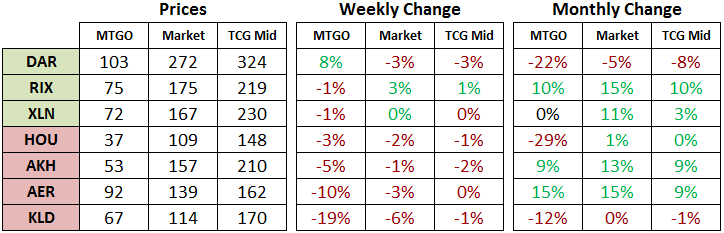
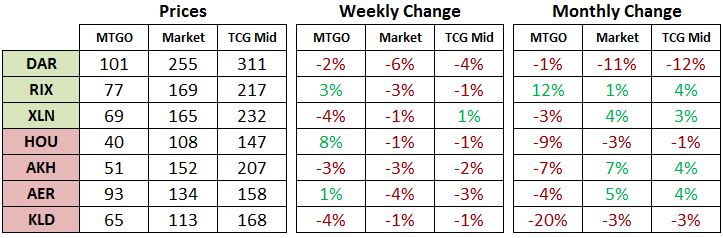
Below are the total set prices for all redeemable sets on MTGO. All prices are current as of May 28, 2018. The TCGplayer market and TCGplayer mid prices are the sum of each set's individual card prices on TCGplayer, either the market price or mid price respectively.

All MTGO set prices this week are taken from GoatBot's website, and all weekly changes are now calculated relative to GoatBot's "full set" prices from the previous week. All monthly changes are also relative to the previous month's prices, taken from GoatBot's website at that time. Occasionally, full set prices are not available, and so estimated set prices are used instead. Although Hour of Devastation (HOU), Amonkhet (AKH), Aether Revolt (AER), and Kaladesh (KLD) are no longer available for redemption, their prices will continue to be tracked while they are in Standard.

Redeemable sets are highlighted in green and sets not available for redemption are highlighted in red. Ixalan (XLN) and Rivals of Ixalan (RIX) officially go offline for redemption this week, but as announced on the MTGO client home screen, both sets are being reprinted and will be available for redemption in about a month.

Standard

All eyes will be on Standard this weekend as Pro Tour Dominaria (DAR) kicks off and the pros take their best crack at the new Standard format. I have no particular edge in speculating on the Pro Tour metagame as my understanding of the format is limited so I have no hot picks. I would say that any price spikes that are triggered this weekend in any Standard card are worth selling into, particularly if they are from the Kaladesh (KLD) and Amonkhet (AKH) blocks. These sets have a short time left in Standard and the relentless price decline associated with rotation is underway.

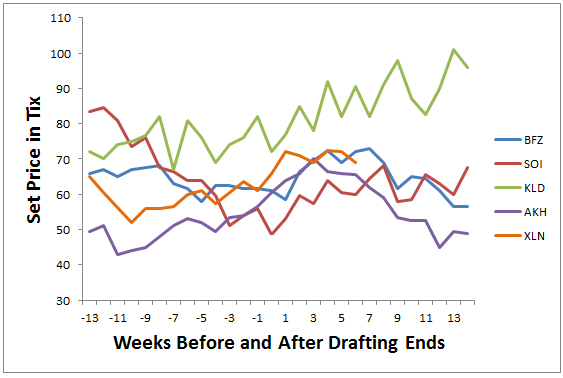
As for sets sticking around in Standard, Ixalan (XLN) is moving sideways so the post drafting price peak might have already occurred. Have a look at the chart below which tracks the prices of recent large sets in and around the end of drafting.

I was buying sets of XLN prior to the end of drafting at an average buy price of a little under 60 tix. With only a few sets left to sell, the average sell price is almost 68.5 tix, yielding over 8 tix in profit per set or close to fifteen percent. Current prices are down a little, and with another promised round of redemption set yet to be printed, I think another decent selling opportunity is not far away. These results are right in line with expectations. Sometimes you'll get a big win, especially in the fall with rotation, but often buying and selling full sets is closer to a ten to twenty percent gain, like with XLN.

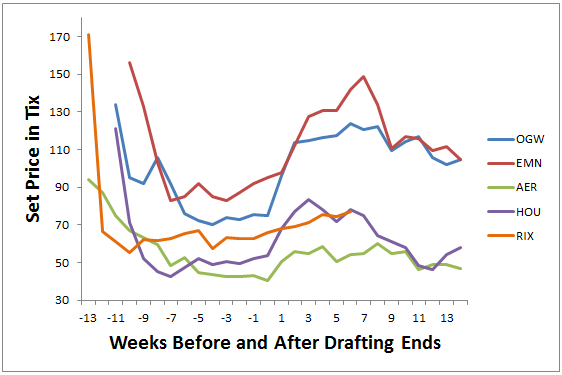
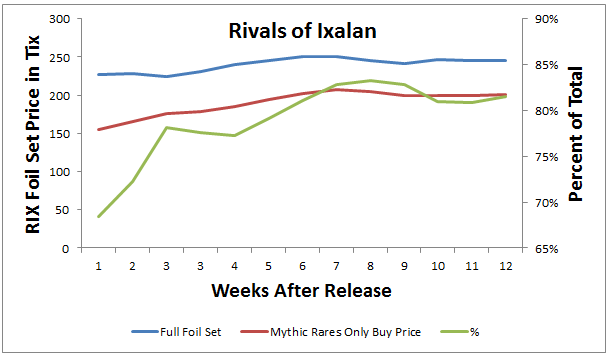
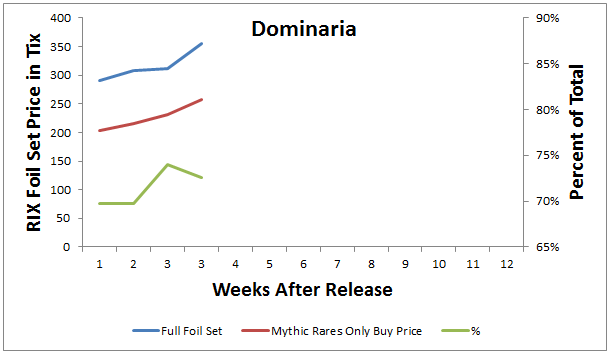
The outlook for Rivals of Ixalan (RIX) is a little better as it still is in an uptrend. Having a look at a similar chart for recent small sets, Oath of the Gatewatch (OGW), Eldritch Moon (EMN) and Aether Revolt (AER) all peaked about eight weeks after drafting ended. Hour of Devastation (HOU) was the lone exception, peaking three weeks after drafting ended. We are into week six for RIX so between the historical evidence, the pending Pro Tour and the current uptrend, there's no need to be rushing to sell these

For RIX, the average buy price is 63.5 tix per set, while the average sell price is close to 73 tix with about a quarter of the sets sold. Profit is about 9 tix per set or fourteen percent. I am looking for a set of RIX to hit 80 to 90 tix in the next month which would yield closer to 15 tix profit per set or over twenty percent.

Modern

There is some life coming back into the Modern market. The trough in prices triggered by the shift in demand to DAR and Standard is receding in the rearview mirror and a few staples are starting to see higher prices. Kolaghan's Command hit 15 tix in early May but is now back to 20 tix. Collective Brutality and Scalding Tarn have both seen a similar 5 tix price increase in the past month.

There was an error retrieving a chart for Kolaghan's Command

While the focus will still be on Standard with the Pro Tour stopping in Richmond, Virginia this weekend, the seeds of another strong run for Modern prices are being planted. Selectively targeting Modern staples is defensible at this time. Look for cards that see play across multiple decks, including sideboards, and look for cards that are much cheaper than they were a month ago. Recent steep drops in price are a result of players selling their cards and once they decide to buy back in then prices will really take off.

Standard Boosters

A draft set of two RIX boosters and one XLN booster has risen to a price of 5.3 tix this week. With the expected value of DAR boosters declining, players seeking good bang for their buck are gravitating towards XLN block draft. The selling window for these is not yet open but it's getting close as we head into June. Once Core Set 2019 releases in July, XLN block will leave the draft queues and the price of RIX and XLN boosters will only be determined by their expected value.

Trade of the Week

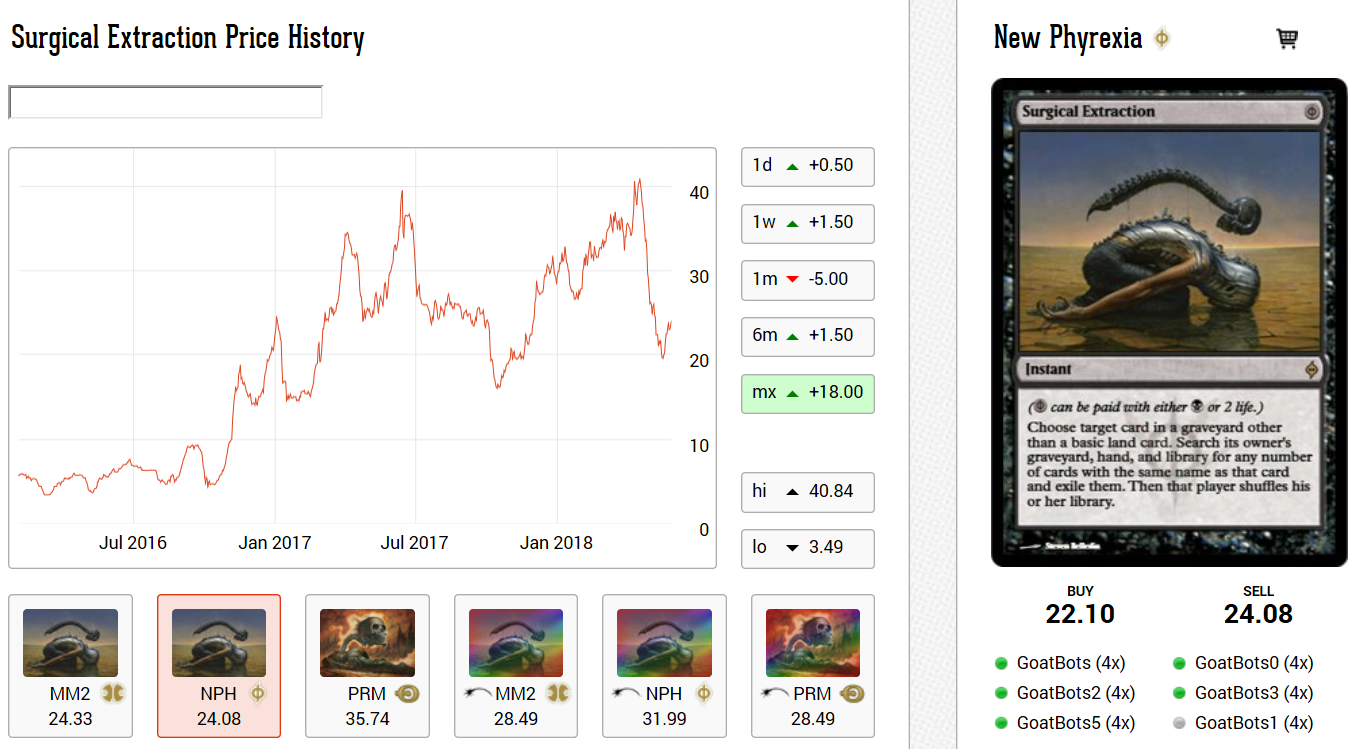
For a complete look at my recent trades, please check out the portfolio. Surgical Extraction is a great Modern staple to keep an eye on. It's a very mana efficient sideboard answer, it's available to all colours, and there are not a ton of copies floating around as it's from a third set with a Modern Masters 2015 (MM2) reprint a few years ago. Have a look at the price chart below, courtesy of Goatbots.

The all-time high of 40 tix was reached in April but its average range has been in the 25 to 30 tix range since early 2017. Once it dipped into the low 20 tix range it was starting to look like an attractive rebound candidate. I scoured the classifieds for the cheapest copies I could find, and I managed to grab a few play sets at 22.5 tix per copy.

This was not a full position that I acquired as I was concerned that there was potential for another leg down, even though it had come down almost fifty percent from its high. For this reason, I resolved to buy a few playsets and then wait to see what would happen in the market.

So far, the early returns are good as the price has hit 24 tix and there is strength in other Modern staples. Expanding the position by looking for more playsets at a low price would be a reasonable strategy to ratchet up exposure to this card.

Daily Stock Watch – Heart of Kiran

Are you a Quiet Speculation member?

If not, now is a perfect time to join up! Our powerful tools, breaking-news analysis, and exclusive Discord channel will make sure you stay up to date and ahead of the curve.

Hello, everyone and welcome to a new edition of the Daily Stock Watch! Pro Tour Dominaria is just a few days away, and we'll finally have a direction on where the meta is headed for the coming month until the Core Set is released. This simply means that cards that should be rotating out from Amonkhet, Aether Revolt, Kaladesh, and Hour of Devastation will see some minor (or major, if it makes numerous appearances in the top eight) price gains once the event is over. This will be the perfect time to let go of these pieces, as card prices of rotating cards this fall will go down significantly, especially if it isn't seeing play in any other format outside of Standard. The card that I'd like to talk about today is arguably one of the most used and ever resurgent cards in the format.

There was an error retrieving a chart for Heart of Kiran

Heart of Kiran is no Smuggler's Copter, and the fact that it's legendary also hurts its financial cause. This card was left for dead until decks that started utilizing it after the arrival of Dominaria has surfaced, and it has somehow regained its financial bearings after falling to as low as $2.75 some time in April. It's currently sitting at a shade below $4, and this should be a $5 card right after the PT, regardless of the results from the event. It's heavily used in the BR Midrange deck that has dominated the most recent tournaments, setting the bar for the deck to beat.

In case you're not too familiar with how it looks like, here's one of the winning lists for reference:

BR Midrange

Creatures

2 Glorybringer
4 Goblin Chainwhirler
2 Pia Nalaar
2 Rekindling Phoenix
4 Scrapheap Scrounger
3 Soul-Scar Mage
2 Walking Ballista

Instants and Sorceries

4 Abrade
2 Magma Spray
3 Unlicensed Disintegration

Other Spells

2 Chandra, Torch of Defiance
3 Heart of Kiran
2 Karn, Scion of Urza

Lands

1 Aether Hub
4 Canyon Slough
2 Cinder Barrens
4 Dragonskull Summit
11 Mountain
2 Spire of Industry
1 Swamp

Sideboard

1 Angrath, the Flame-Chained
2 Chandra's Defeat
1 Chandra, Torch of Defiance
1 Cut / Ribbons
1 Doomfall
3 Duress
1 Fiery Cannonade
1 Glorybringer
1 Heartless Pillage
1 Karn, Scion of Urza
1 Release the Gremlins
1 Vraska's Contempt

This deck knows nothing but destruction, and the addition of Goblin Chainwhirler made it a more potent deck capable of dominating a tournament on any given day. Heart of Kiran serves as the ever annoying beater at the two-drop slot, while patrolling the skies with Rekindling Phoenix, Glorybringer and the thopter tokens produced by Pia Nalaar.  The constant pressure from the deck gives it the distinct advantage against every other deck in the format (barring UW Control), and it's quite expected that there will be a representative of the deck in the top eight.

Going Obsolete

Riding these vehicles will soon be out of style, but with the entry of Weatherlight from DOM, it seems that we'll be getting vehicles from future sets consistently. However, I don't think that any of these remaining vehicles, Heart of Kiran included, would stay significant come the Core Set. If it gains more value over the weekend, feel free to dispose your copies if you have no plans of playing future Standard events. There's no way for it to go but down.

At the moment, you could still find lots of copies of Heart of Kiran for anywhere between $2.72 up to $3.99 via StarCityGames, ChannelFireball, TCGPlayer and Card Kingdom. I don't even bother checking out foil copies, so I suggest that you stay away from them as well. I know that this card is very good as it is, but it still lacks the swag that the copter brings to the table. I don't see it ever becoming relevant in older formats, so this is one of those pricey mythics (it was a $25 card for a certain point in time) that fades to oblivion as it shifts out of the format. Make sure that you cash out before it does.

And that’s it for today's edition of the Daily Stock Watch! See you again tomorrow, as we check out a new card that should be on the go, or good enough for speculating. As always, feel free to share your opinion in the comments section below. And if you want to keep up with all the market movement, be sure to check in with the QS Discord Channel for real time market information, and stay ahead of the hottest specs!

Insider: Getting Ready for the Pro Tour

Are you a Quiet Speculation member?

If not, now is a perfect time to join up! Our powerful tools, breaking-news analysis, and exclusive Discord channel will make sure you stay up to date and ahead of the curve.

Hi, guys,

Last week I wrote about early speculation on Pro Tour Dominaria. This week I'm going to talk about what you should be doing, both in the lead-up to the Pro Tour and during the event itself.

The thing about MTGO singles is that they fluctuate way faster than paper singles. But it's also easier to buy and sell digital cards from the comfort of your home. If you're doing any speculation on singles online, do make sure you stay in front of the computer while the Pro Tour is live.

Survey Online Traders

Before the Pro Tour, make sure you know which bots you're planning to visit to purchase cards. Bigger bot chains are generally better, as they make it easier to manage your tickets.

These chains might be slightly more expensive than the bots you usually use to buy your own playsets for games or collections. But when you want to obtain lots of cards in a limited time frame, big bot chains will help you avoid having leftover credits everywhere. They're also easier to get into a trade with during a high-volume selling time like the Pro Tour.

Also, know where to check MTGO singles prices on the web—for example, Cardhoarder has their own website to check prices. This is important as you will not be required to enter every bot to check the price for a particular card.

Set Up Your Devices

To be able to trade efficiently during the PT, you will need a good environment. For example, I like to have good WiFi to watch the PT live stream, and extra monitors to check prices and keep MTGO open. I don't need to elaborate more on this—just make sure you're comfortable and in a good place to work.

Study the Format

Not everyone who speculates on MTGO plays a lot of Magic. Even if they do, the Pro Tour might not be the format they're familiar with. If you're very familiar with Standard, then the coming PT shouldn't be a problem for you. If you don't play Standard, you should at least watch some videos to get an idea of what's going on in the current format. This is to ease your decision-making while you are watching the PT live stream.

For example, say a blue-white deck shows up on camera with the sideboard tech of switching to midrange with some History of Benalia. Let's assume this card is still underpriced, and that the featured player is doing well using that card. Will you be able to judge whether or not this technology is good in the metagame?

Some of the information required to answer this question will be readily available online—the metagame spread at the event, what commentators are saying, the Twitter discussions going on, etc. But knowledge of the format is indispensable here. If you have enough knowledge of every deck and how it works, it's much easier to tell whether the new sideboard tech can do well against the rest of the meta.

Take Note of Cheap Decks

Dominaria has been in the format for a few weeks now, but we cannot tell which deck is the best until the Pro Tour. This also means that many decks are still in the experimental stage—in other words, cheap decks right now might be the best decks next week! On the other hand, the current top-tier decks are already at their peak price, therefore there's no point investing in those decks.

I have a few decklists to share with you here that I think are worth watching.

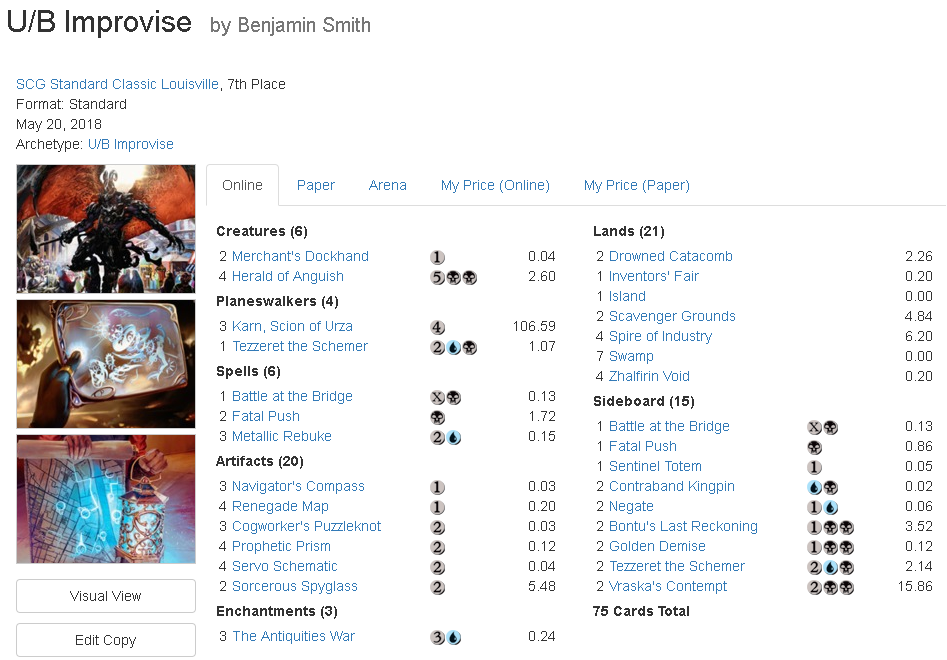
As you all know, Karn, Scion of Urza is one of the most powerful cards in the new set. No doubt we will see plenty of play for Karn at the PT, but which deck suits Karn the most?

I think the UB Improvise deck above can potentially be good. This list might not be the best version of the deck, but the core components are already there for you.

Tezzeret the Schemer is one of the least played planeswalkers in Standard right now, which explains why its price is only about 1 ticket. There's not much time left for Tezzeret in Standard, however, so you need to be very confident in this card if you want to invest in it.

Bontu's Last Reckoning is a very cheap sweeper to handle the aggressive decks, while the improvise mechanic can help to reduce its drawback.

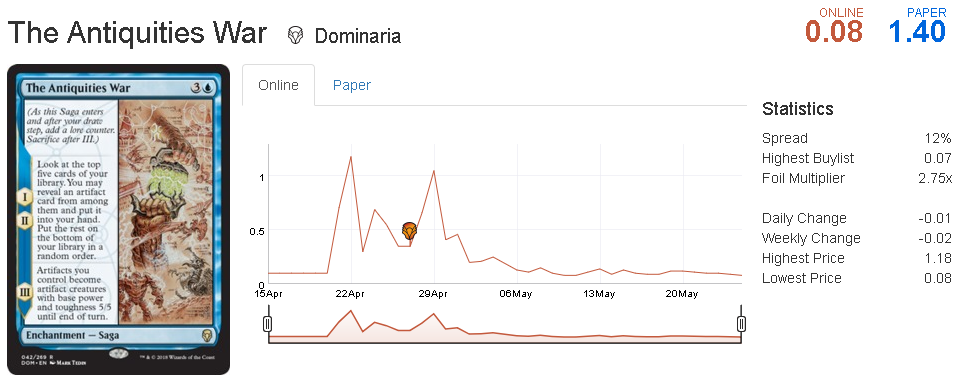
Another card that might fit this deck is a Saga from Dominaria:

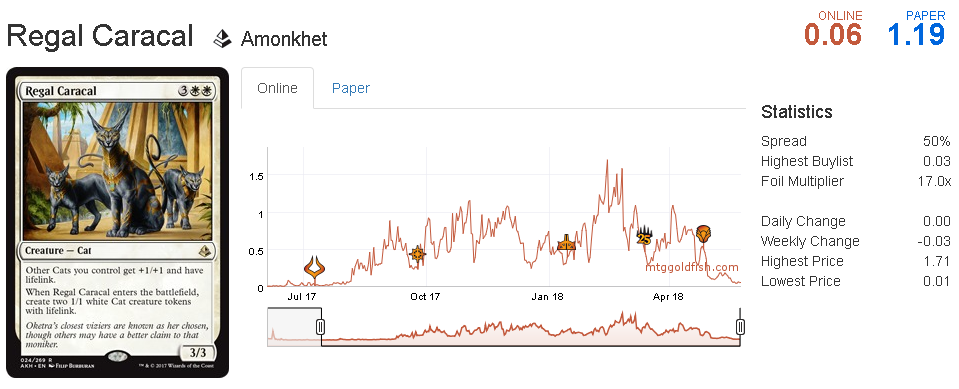
The Antiquities War might be a little too slow against aggro decks, but I think this is a very good sideboard card against midrange and control. This card is a free investment opportunity for this set. If you think junk rares at 0.08 ticket can't go anywhere, then you are wrong. A recent example of this happened with Regal Caracal:

The Cat lord's price was similar to The Antiquities War's back in July of 2017. Then it spiked to 1 ticket when everyone found out it was great against aggro. Similar things can happen with the blue Saga. The buy-in cost is very low—close to free, even—because you can simply include this card when you have leftover credits with bots after trades.

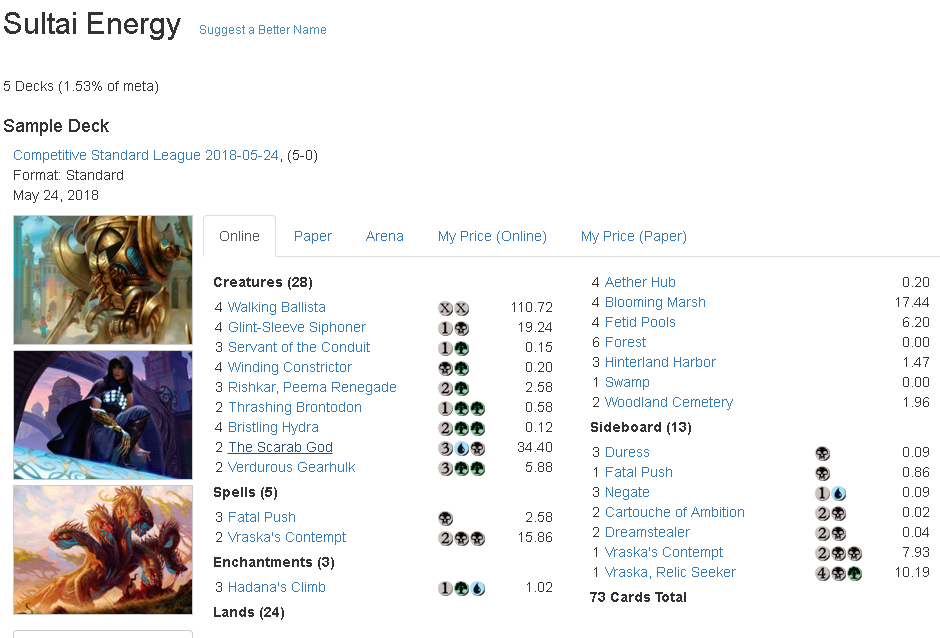
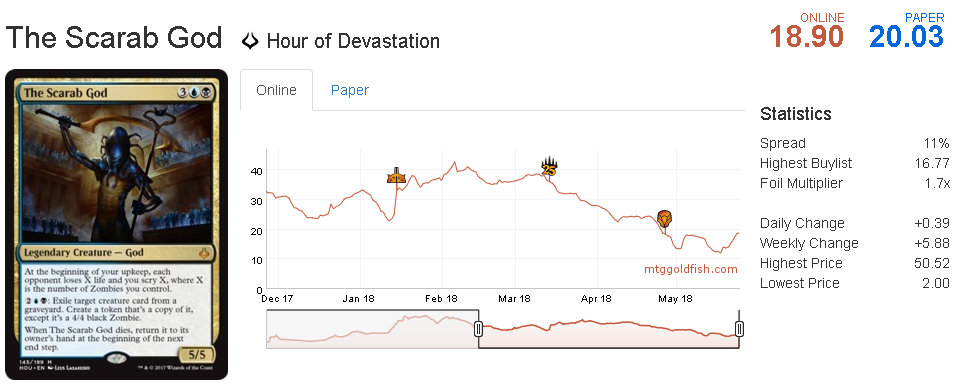
Sultai Energy slowly lost popularity after the release of Dominaria. However, in my opinion, that doesn't stop the deck from being good. The Scarab God is slowly regaining popularity in UB Midrange variants in Standard, and thus the price is going up.

Players are shifting away from blue in these decks because pure black-green can have Llanowar Elves while not easily getting mana screwed. But there could still be a version of Sultai that plays Llanowar Elves while splashing blue for The Scarab God. In my opinion, The Scarab God is still cheap enough to pick up some playsets for the PT.

Llanowar Elves opens up a lot of potential for three-mana spells, as there can be a big difference when they're resolved one turn earlier. For example, a turn-two Champion of Wits or Jadelight Ranger can be very strong. So do take note on three-mana cards that can become broken with the help of one-CMC mana dorks for this coming PT.

In either case, regardless of which cards you're aiming at, try to stay away from Kaladesh and Aether Revolt, as I mentioned for Tezzeret above.


Alright guys, that’s all for the week. Thanks for reading, and I’ll see you again next week.

Adrian, signing off.

Dynamic Equilibrium: SCG Minneapolis

Are you a Quiet Speculation member?

If not, now is a perfect time to join up! Our powerful tools, breaking-news analysis, and exclusive Discord channel will make sure you stay up to date and ahead of the curve.

With hard metagame data being increasingly hard to come by, having several events in a row is a relief. Rather than extrapolation and conjecture, data and fact can guide my recommendations. This string of Star City events will provide an excellent guide for those heading to GP Las Vegas, and preparation and information are the keys to victory.

I expected SCG Minneapolis to have a metagame similar to the Louisville open last week. It made sense given how little time separated the events. However, my hypothesis has proven to not be correct. While there are certainly similarities in the overall metagame composition between the two events, the changes that were obvious in Louisville are missing in Minneapolis. Exactly why remains unclear, though as always I have theories.

The Minneapolis Metagame

I was surprised by how few players made the cut for Day 2 last weekend: 67 compared to 154 in Louisville. The only explanation I have is players spending Memorial Day elsewhere. However, I'm also told that the cuts for Star City events can be weirdly non-indicative of the starting population, so if anyone knows why fewer than half as many made it in Minneapolis, please share. I do suspect that at least some of the variance between this event and the previous one can be explained by this apparent population drop.

The Day 2 metagame is both very familiar and very surprising. Humans is back on top, reflecting its observed position in the overall metagame, but after that, things get weird. There's a noticeable drop off from first with nine to Jund in second with six, while Jeskai Control, UW Control, Affinity, and Burn are all tie for third at five apiece. Considering how Jeskai dominated last weekend, this is an odd development. Elves fell off precipitously compared to last week, going from fourth place to low-Tier 3. Again, the apparent change in starting population may be the answer for these weird changes; the smaller the n of a sample, the more outliers affect the sample's statistics. However, this isn't a good explanation for Humans result. Again, the deck is very targetable, and that is exactly what happened in Louisville, so why not in Minneapolis?

The explanation may lie with the data itself. Jeskai is present in decent numbers, but it's matched by UW Control. The decks have similar matchups, though in my experience Jeskai is better against Humans while UW is better against big mana decks, so it could come down to a matter of taste. However, there is another possibility, because I've seen UW as favored against Jeskai Control. Jeskai is great at playing at instant speed and outfoxing its way to victory in control mirrors, but UW is able to play more of the game-winning haymakers and countermagic that usually dominate mirrors. I'd wager that at least some of the UW pilots looked at the results of Louisville and decided to shift off Jeskai to beat the control mirror and the anti-Jeskai decks that might arise.

The Classic Comparison

Accompanying Classics are often populated by decks that washed out of Day 1, making it reflective of the starting metagame. Certainly, this Classic looks very different to the Open, being awash with combo and featuring very little control. This makes sense given the prevalence of Humans in the Open results and its excellence against Storm and similar combo decks. There are also far more big mana decks in the Classic than Day 2. Players may have come to Minneapolis expecting a metagame very similar to Louisville's, only to be surprised to find Humans running wild again. The apparent big mana push is also a plausible reason for UW Control's presence in Day 2.

The New 32

The Open furthered the narrative of the Day 2 numbers. Both Humans and blue control decks placed six copies into the Top 32, more than any other deck. Jund was the only rival at four, while no other deck mustered more than two copies. To be sure, this is partially a function of population, but it isn't entirely reflective. Collectively, control had the highest population among the Day 2 decks, but Jeskai and UW were tied at five, indicating even advantage. However, UW's representatives in Top 8 placed 22nd and 23rd while Jeskai claimed 2nd (thanks in no small part to flooding out), 5th, and 16th. Higher places and higher population suggests Jeskai was the superior deck for Day 2.
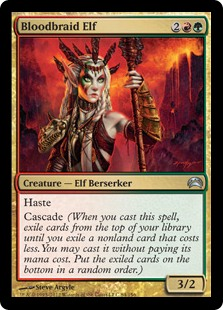
Jund's performance is intriguing. Only one Jund pilot made it to Top 8, but only one didn't make Top 32. These results speak to the lurking power of the deck: Jund can be overwhelmed or outraced, but never be ignored. The consistent-if-unexciting results from Jund may indicate that it's just waiting for a final piece to really be a threat.

Also of note is that Eldrazi Tron made fourth despite almost being replaced by RG Eldrazi a few weeks ago. E-Tron has always been a menace to slower midrange and control decks but struggles against Reflector Mage. Given how prevalent Humans was on Day 2, Carl Johnson's result is very impressive.

Stocky and Reliable

I noticed something about the Minneapolis results, and I wonder if my readers have too. Consider the winning decklist:

Humans, Sam Cocchiarella (SCG Minneapolis 1st Place)

Creatures

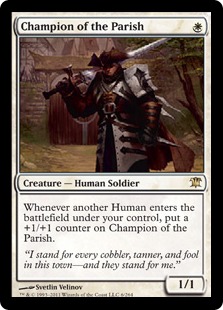
4 Champion of the Parish
4 Noble Hierarch
4 Kitesail Freebooter
4 Meddling Mage
4 Thalia's Lieutenant
4 Phantasmal Image
3 Thalia, Guardian of Thraben
4 Mantis Rider
4 Reflector Mage
1 Kessig Malcontents
1 Restoration Angel

Artifacts

4 Aether Vial

Lands

1 Plains
4 Ancient Ziggurat
4 Cavern of Souls
4 Horizon Canopy
4 Unclaimed Territory
2 Seachrome Coast

Sideboard

2 Auriok Champion
2 Izzet Staticaster
2 Reclamation Sage
2 Sin Collector
2 Gut Shot
2 Kataki, War's Wage
1 Mirran Crusader
1 Selfless Spirit
1 Dismember

Except for the maindeck Kessig Malcontents, itself a common tech, this deck is as stock as it gets. Looking through the results of both the Open and Classic, the story repeats. There's not a lot of meaningful deviancy among the lists. Sure, there are some numbers that differ here and there, such as a Mana Leak instead of Logic Knot, but in practical terms, the archetype lists are the same. There aren't even that many different decks for a Modern event, and only one that really stands out as unexpected. That list is Andrew Fielder's Tezzeret Prison deck, which despite being an object of wonder (mine being how it beats control decks) doesn't mean anything analytically; anything can do well in Modern, so only consistent results signify larger trends.

This also makes the Jund lists stand out. The core cards are present across all the decks, but not in consistent numbers, and with many deviating support cards. This is typical for Jund and usually done for edges in the mirror or expected matchups. However, the highest-placing Jund deck is card-for-card stock in my eyes. I don't think this is an accident.
Certainly, one should expect lists to be similar (that's why archetypes exist), but the degree to which the decks from Minneapolis converge suggests they're moving towards a "correct" build. More data is necessary, though I first noticed this trend from MTGO results: decklists identical to this degree is very unusual and could be important going forward. It does give credence to my theory that Modern has stabilized around Humans and has now entered dynamic equilibrium, wherein metagame fluctuations will happen predictably around the center of gravity. Whether this is something to be used and exploited is not clear yet, but should be certain after next week.

True Control at Last?

Control is back in force, but in a form atypical for Modern. In a change from last week, all the Jeskai decks from Minneapolis are pure control decks, as are the UW lists (though that is to be expected). I am not certain why Jeskai Tempo isn't present.

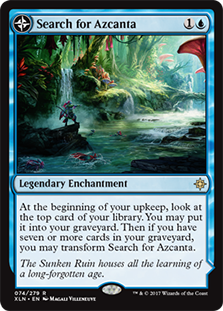
I'm not complaining, mind you; I've wondered for years why there weren't more control decks in Modern. The pieces have always been there, and there have been metagames that should favor answer decks. The fact that it's only happened now is interesting, but inexplicable. Search for Azcanta and Teferi, Hero of Dominaria are fine cards and certainly help win the long game, but before them, there were plenty of options like Sphinx's Revelation or Jace, Architect of Thought. Given that the deck's core hasn't changed in years and there's nothing particularly new or interesting in the Minneapolis decklists, there must be some other reason.

Once again, I blame perception. There's always been a bitter narrative that control isn't viable in Modern, though the reasons always change. Sometimes it's format speed, sometimes it's Tron or deckbuilding flaws, sometimes it's Modern's diversity, and sometimes the complainers are even right. This omnipresent opinion has always held sway, and given the lack of concrete evidence to the contrary, players bought in. Very few control decks won events or even did well in 2015-2016, so it looked like the control isn't viable narrative was correct. There were certainly some attempts to break this perception, but they never seemed to stick. It appeared to me that as soon as the new control deck didn't just crush an event, the "Control is Dead" shouts would return, turning players off the decks. Thus the perception became a self-fulfilling prophecy.
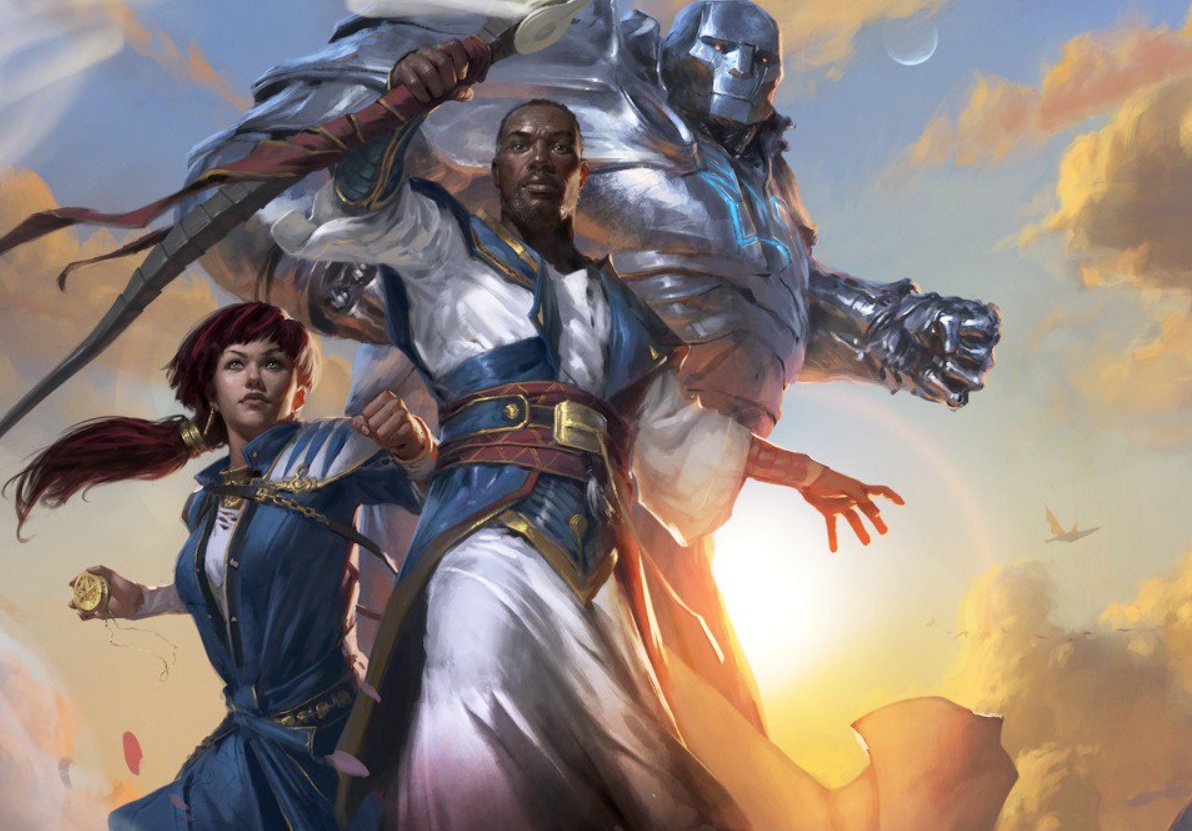
The perception has certainly changed and may now be largely dead. As cards have been printed, players have had reason to test control decks and gradually prove to themselves that the narrative about Modern control isn't true. Arguably this process began with Kolaghan's Command and Grixis, but last year's explosion of Jeskai Tempo really supercharged the process. There was proof that answer heavy decks not named Jund were viable, so once more cards that could slot in were printed it was off to the races. Perhaps ultimately this is the reason that pure control is replacing tempo control. It was always assumed that pure control wasn't viable, so playing an answer strategy required a fast clock. Now that the illusion is finally shattered players can play the control deck they always wanted in the first place.

Next Banned Test

So the results have been counted and the readers have spoken. The next banned card I will be testing is Green Sun's Zenith, which I will henceforth and in perpetuity only call GSZ. The result is surprising; I thought Dig Through Time (DTT) would be a shoe-in. I was also hoping it would win because I already had the deck to test it in ready. UR Delver got DTT banned by association so it is the obvious test platform, but with GSZ it isn't obvious. GSZ had a profound impact on the first Modern event, taking Josh Utter-Leyton and a fair deck to the Top 8 of a broken Pro Tour, but was banned immediately afterwards. The inheritors of the green toolbox tradition all rely on non-green creatures now and are primarily combo decks, so I'm not entirely sure what the most appropriate test deck is. Legacy suggests Abzan is best, but Legacy is Legacy so that may not apply to Modern. I am open to any suggestions left in the comments.

Looking Toward Vegas

Star City Regionals are this weekend for those east of the Mississippi. This massive data dump will show fairly definitively what the metagame actually is before GP Las Vegas. I suspect that the trend I've observed the past month will hold true, but I hope it doesn't. The unexpected is always far more exciting and easier to write about. Still, my advice is to not bet against Humans. It's still, mysteriously, holding its ground.

Insider: A Calendar Guide to Investing on MTGO

Are you a Quiet Speculation member?

If not, now is a perfect time to join up! Our powerful tools, breaking-news analysis, and exclusive Discord channel will make sure you stay up to date and ahead of the curve.

Welcome back, folks. MTGO speculators often want to know when they should start investing in cards from a particular set or format. How does one know when is a good time to be investing in Dominaria? Is it too soon or too late to be investing in Ixalan or Rivals of Ixalan cards? Should we be afraid to speculate on Amonkhet block cards? Is there a best season to invest in Standard or Modern cards?

Using the flow of the calendar year to your advantage is a critical step toward becoming a better speculator on MTGO. Let's go over how we might do so.

I. The MTGO Calendar: Level Up

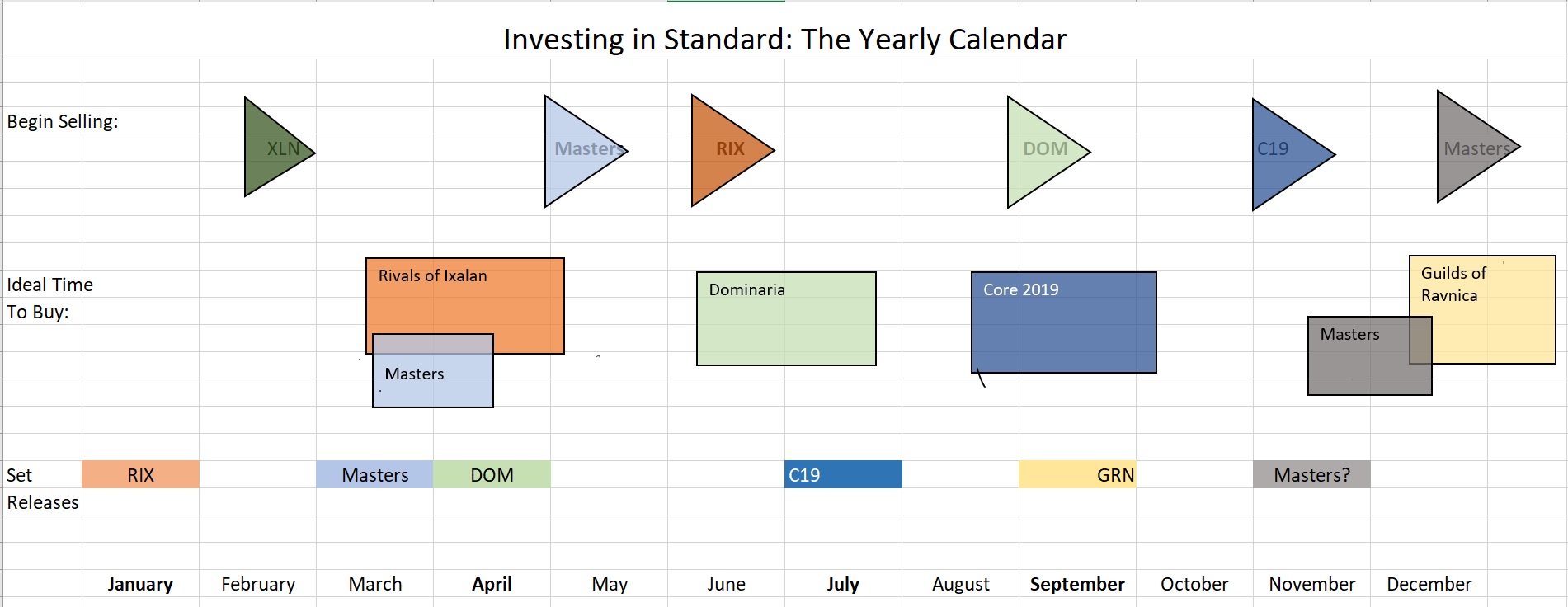
Today I'm going to show you how I use the yearly calendar in my investment strategy to maximize returns and minimize losses. I've created a visual chart that shows the general flow of my investment buys and sells over the course of a given year. The most important dates are, of course, the set releases. It is around those that the MTGO year revolves, and you should get accustomed to thinking of MTGO finance in terms of four seasons, which conveniently overlap with the astronomical seasons: the winter set, spring set, summer set, and fall set. This year, those four seasons will be represented by Rivals of Ixalan, Dominaria, Core 2019, and Guilds of Ravnica.

About 65 to 70 percent of my investments on MTGO follow the above paradigm. Remember back in April when I said that May would likely be a quiet month? The calendar indicates why - the optimal time to invest in Rivals of Ixalan cards has already passed, the optimal time to invest in Dominaria has yet to begin, and there's not much to sell since the Modern and Eternal cards in Masters 25 have yet to go up in value since the competitive focus is still on Standard.

Why is this calendar so important? Why should you internalize and memorize its rhythms?

1) Sets on MTGO follow a predictable pattern.

Their values are at their lowest (i) just before the release of the next set and (ii) just before they rotate out of Standard. The most elementary strategy you can employ to safely invest on MTGO is to buy cards during period (i) and sell them before period  (ii). Once you recognize this and start employing this strategy, it will seem intuitive, and you'll notice your rate of return go up.

Let's take Dominaria as an example. When will I be investing in Dominaria cards? Since Core 2019 is coming out the first week of July, I'll likely invest in Dominaria cards between June 10th and July 15th. All in all, as much as 75 percent of the money I ever pour into Dominaria will likely be done during that window. I then wait a few months to let the value of the set recover, and then I begin being open to selling. As the months go by, I become more and more willing to sell, and I will try to have all of my Dominaria cards sold by the release of the set just before Dominaria rotates (Core 2020, presumably).

On average, sets reach their maximum value between six and ten months after their release. The ideal time to sell Dominaria cards will likely be between October of 2018 and February of 2019, but I'm open to selling Dominaria cards at the time indicated in the calendar.

2) Use my article series on each set as a clue that you should start looking to invest in that set.

There's a reason why I don't write my articles on each set when everyone else does. If you go to StarCityGames or TCGplayer, you'll see that they do their Dominaria finance articles right when the set releases. One reason for that is that they are writing primarily for a paper audience. I write my set series at the time when I think you should be thinking about investing in that set, and that's typically about four to six weeks before the release of the next set.

3) Remember that cards on MTGO are not opened in the same way that they are in paper.

In paper, an overwhelming supply hits the consumer base like a freight train and then gets slowly assimilated over time. On MTGO, supply comes almost exclusively from Draft and Sealed, so supply is low at the start of a new set release and then gradually increases over time until the next set is released.

4) Masters sets do not follow the same price patterns as regular Standard sets.

Masters sets tend to reach their lowest point only a week or two after their release, and their recovery time is dependent more on the metagame and current interest in Modern (more on that in a bit) than on time-after-release. The ideal time to begin selling could be a month after release, or it could be nine months after release. This makes them more unpredictable.

II. The MTGO Calendar: Advanced Level Up

There are a few other aspects to the calendar to be aware of, especially if you're investing in Modern, Legacy, or Pauper cards.

1) Know when Modern is likely to be a popular format and plan your Modern investment around that.

The most important date to focus on is when the Pro Tour will have Modern. In general, Modern card prices will reach relative peaks in the month before and after its Pro Tour since that's when interest in the format is at its peak. This year that will occur twice thanks to the 25th Anniversary Pro Tour, as Modern was featured in February and will be again in August.

As a practical example of how this should affect your selling decision making, let's consider my Masters 25 investment into Ensnaring Bridge. I bought in around 21 tix, and recently the card has been doing well, up to 28 tix. One reason I'm waiting to sell it for even higher, and have the confidence that I will be able to sell it higher, is that the Magic community's focus is on Standard right now, thus depressing Modern prices. With the 25th anniversary coming in two months, it makes sense to wait for attention to turn to Modern. Then maybe I'll be able to sell those Bridges for 35 to 40 tix instead of 26 tix.

2) The month of December is a great time to make investments.

Not only is Standard growing stale at this time, but many are in the midst of finals, and many more are celebrating Christmas and New Years and traveling to visit family. Card prices always take a dip during this month, and it's a great time to buy some cards. It's a smart idea to try to do some selling in October and November to free up some capital to spend in December.

III. Signing Off

Thanks for reading this week. Next week I believe I'll be starting my series on Dominaria, so be on the lookout for it! A copy of my portfolio can be found here. If you have any questions, please leave them down below.

The Uncommon Cube is definitely my favorite cube of those that have been offered on MTGO. Give it a shot if you haven't already done so. While some traditional cube strategies are present (Ramp and good-stuff midrange chief among them), more often you need to develop a more concrete gameplan to succeed, something I enjoy very much. The gameplay is also excellent, as both players are given the chance to make meaningful decisions game-in and game-out.

Daily Stock Watch – Diabolic Intent

Are you a Quiet Speculation member?

If not, now is a perfect time to join up! Our powerful tools, breaking-news analysis, and exclusive Discord channel will make sure you stay up to date and ahead of the curve.

Hello, everyone and welcome to a new edition of the Daily Stock Watch! Battlebond is coming to town, and it's about to rock the world of MTG Finance once more. With reprints to lots of Commander and Legacy cards that have been expensive for a while, now's the perfect time to get a hold of some of them for speculation purposes. I'm quite sure someone from our team will give a more in-depth analysis about the set, but I'll probably touch some of these cards in the coming days. For today, I would like to talk about one of my favorite reprints from this set, and what financial implications lies ahead of it.

There was an error retrieving a chart for Diabolic Intent

I didn't see this reprint coming and I'm thinking that you weren't expecting it as well. Diabolic Intent is probably one of the best tutor cards out there if you consider its casting cost and color efficiency, and I'm sure a lot of Commander players are quite happy with this development. It's basically a Demonic Tutor that requires a sacrificial lamb to enable but more often than not, it's even used as a sac outlet to set off some combo strategies, or get rid of a creature that prefers the afterlife to make things work such as Academy Rector.

Just how good of a card is Diabolic Intent? Check out the synergies that it brings to the table in this Iname, Death Aspect Combo Control deck.

Iname, Death Aspect Combo Control

Commander

1 Iname, Death Aspect

Creature

1 Bloodghast
1 Grave Titan
1 He Who Hungers
1 Horobi, Death's Wail
1 Kokusho, the Evening Star
1 Krovikan Horror
1 Kuro, Pitlord
1 Nether Shadow
1 Nether Traitor

Other Spells

1 Beseech the Queen
1 Buried Alive
1 Cabal Ritual
1 Collective Brutality
1 Dark Petition
1 Dark Ritual
1 Demonic Consultation
1 Demonic Tutor
1 Diabolic Intent
1 Dimir Machinations
1 Dismember
1 Dread Return
1 Duress
1 Exhume
1 Fatal Push
1 Go for the Throat
1 Grim Tutor
1 Hymn to Tourach
1 Inquisition of Kozilek
1 Lay Bare the Heart
1 Living Death
1 Patriarch's Bidding
1 Rhystic Tutor
1 Thoughtseize
1 Toxic Deluge
1 Twilight's Call
1 Victim of Night
1 Victimize
1 Wretched Banquet
1 Animate Dead
1 Charcoal Diamond
1 Coldsteel Heart
1 Dance of the Dead
1 Everflowing Chalice
1 Expedition Map
1 Fellwar Stone
1 Infernal Darkness
1 Jet Medallion
1 Jeweled Amulet
1 Liliana of the Veil
1 Lotus Bloom
1 Lotus Petal
1 Mind Stone
1 Necromancy
1 Prismatic Lens
1 Recurring Nightmare
1 Star Compass
1 Thought Vessel
1 Worn Powerstone

Lands

1 Ancient Tomb
1 Bloodstained Mire
1 Cavern of Souls
1 City of Traitors
1 Crystal Vein
1 Ebon Stronghold
1 Lake of the Dead
1 Marsh Flats
1 Peat Bog
1 Polluted Delta
1 Rishadan Port
27 Swamp
1 Urborg, Tomb of Yawgmoth
1 Verdant Catacombs
1 Wasteland

In this deck, the spirits are very much willing to die at every opportunity it could get, making Diabolic Intent a very reliable tutor spell with the likes of Bloodghast, Nether Shadow and Nether Traitor hanging around. One Living Death (the card that I assume is tutored out of the library the most once Iname has done its job) later, and your opponent is toast.

The Tutor League

Cards that help you fetch the ones that you don't have in your hand are always very good cards. Just one look at the list above and you could already tell that each and everyone of it are game changers. Diabolic Intent belongs to the same league despite of its presumed drawback of having to sacrifice a creature to make it work, but it does what Demonic Tutor can do without having to fulfill certain conditions on what card to find. I'd love to have foil copies of this card from Battlebond, and I wouldn't mind hoarding a lot of the normal ones, given that the price is right. There's very little room for error on this one.

At the moment, StarCityGames is pre-ordering copies of Diabolic Intent for $11.99, while ChannelFireball and Card Kingdom has it for $9.99. There are lots of vendors via TCGPlayer that are selling it for $8.93 up to $9.54 for normal copies, and I'd say that we wait for it to reach the $6 range before buying in. Foil copies are currently at above $20, and I don't know up to what extent will the prices go down to. I'm a sure buyer at $12-$15 though, if ever it makes it to that range. This card is a tried and tested staple, and you can't go wrong with it.

And that’s it for today's edition of the Daily Stock Watch! See you again next time, as we check out a new card that should be on the go, or good enough for speculating. As always, feel free to share your opinion in the comments section below. And if you want to keep up with all the market movement, be sure to check in with the QS Discord Channel for real time market information, and stay ahead of the hottest specs!

Unlocked: Sharing Some Exit Strategies—If You’re Looking

Are you a Quiet Speculation member?

If not, now is a perfect time to join up! Our powerful tools, breaking-news analysis, and exclusive Discord channel will make sure you stay up to date and ahead of the curve.

Last week I missed my first weekly article in a couple of years. It was refreshing to ignore the MTG finance game for a while, but I didn’t disconnect completely. While away, I made a couple purchases, including a played Jihad for $155 from eBay, and a sweet Beta Lightning Bolt from Card Kingdom with store credit.

The Jihad I immediately buylisted to Card Kingdom while they were flashing a $245 Near Mint buy price—this will net me a solid gain despite the copy being Heavily Played.

There was an error retrieving a chart for Jihad

While I was making these transactions, I continued to ponder the magnitude of growth these cards have experienced recently. This newfound wealth isn’t something we really dwell on that much because we sequester our Magic resources within our brains. Magic money begets Magic money, so the absolute dollar values of our purchases and sales never really get put into context.

I want to change that a little bit.

What Can a Collection Really Get You?

I tweeted this off-hand comment a couple weeks ago and it was met with some interesting replies.

For the most part, people were in agreement that Magic card prices would look ridiculous to an outsider, and that these gaming pieces of cardboard are equal in value to some fairly substantial items. But as I mentioned in my tweet, we tend to think of Magic values within the context of Magic. So what if I sell a Bazaar of Baghdad for $700 to buy a Library of Alexandria for $850? It’s all Magic money, right?

The money may be coming from Magic, but it is completely fungible. Proceeds from a large Magic sale could be used to fund additional Magic purchases, of course. But it could also be used to buy substantial non-Magic items. That $700 Bazaar sale could pay rent for a month. Selling a Legacy deck can buy you a reasonable used car. And at this point, a Vintage deck can probably fund a major house project, such as finishing a basement.

Exit Strategies

I’ve already talked about the rising value of cards, and how, in a vacuum, they can be exchanged for substantial real-life goods and services. It is not my intent to repeat myself ad nauseam. Instead, I want to share some observations I’ve made recently on exit strategies.

I’m not really eager to sell out of my older cards. Far from it. But I have found myself in situations where I need to sell some cards in favor of others I wish to play in decks. Gone are the days I could just pick up extra, random Legends and Arabian Nights cards just because they’re cool. The prices are far too high. Luckily, I’ve noticed some really useful pricing trends I wanted to share here to help others accomplish similar goals.

Depending on what you’re trying to sell, I’ve found that different strategies yield more optimized payouts. Of course, grinding out sales on eBay, TCGplayer, and Twitter/Facebook are going to maximize proceeds. But in a world where card prices are rising fast, sometimes you can’t afford to wait for that sale. That’s where buylists come into play.

Card Kingdom

Card Kingdom has been my perennial go-to store for selling Magic cards. In fact I basically default to Card Kingdom 90% of the time, which has generally proven to be a solid strategy. Their 30% trade-in bonus provides a great boost and I have historically found good deals to spend that credit on. Also the fact that their condition downgrade percentages are very modest on all sets besides Alpha, Beta, and Unlimited make selling very played copies of cards to CK a solid proposition.

What I sell: Card Kingdom is great for selling Old School and Reserved List cards. They often have the best buylist prices on Legends, Antiquities, and The Dark cards specifically. I especially love selling them less useful rares from these sets because they still pay aggressively.

There was an error retrieving a chart for Field of Dreams

What I buy: At one point Card Kingdom had competitive prices on some Arabian Nights and Antiquities cards. Those were my go-to pickups. Then I noticed their Alpha prices were all extremely low. I amassed a modest Alpha collection from this shop at a low net cost because I was able to sell extra copies to offset my buy-in price.

But now their Alpha prices are closer to market prices. The one set they haven’t price-adjusted yet is Unlimited. Duals, Power, and playable Old School Unlimited cards are all great to acquire with store credit at Card Kingdom. Selling useless Legends rares and acquiring playable Unlimited cards is one of the best things you can do right now.

ABU Games

For a time I was ignoring ABU Games’s buylist because it seemed behind the times. But once their new website was launched, I noticed they had gotten quite aggressive on older cards. That trend has continued for the past few months, and in many cases they offer best-in-class buy prices.

What I sell: Whereas Card Kingdom is just now catching up on Alpha and Beta pricing, ABU Games was ahead of the curve. Therefore, selling ABU Games Near Mint and Played Alpha cards has become quite lucrative—especially if you have some played copies acquired from Card Kingdom just a few months ago. Taking the trade-in bonus yields an even juicier profit margin.

And let’s face it, selling a played Alpha Crystal Rod on eBay can take quite a while. Why not take the $10.60 ($16.00 in trade) and just be done with it? In addition, ABU Games sometimes pays even better than Card Kingdom on Arabian Nights cards specifically—especially if they’re Near Mint. Before shipping any Arabian Nights card to Card Kingdom, check ABU Games’ buylist first!

There was an error retrieving a chart for Serendib Djinn

What I buy: This is more difficult because ABU Games’s prices can be pretty steep on older stuff. Lately I had been flipping my store credit into graded cards: a bunch of graded Alpha cards and a graded Revised Badlands. But that well dried up pretty quickly. For now, your best bet may be to sit on credit and flip it into cards that are spiking. It will probably yield you the best payout. But if you’re desperate to acquire something before it spikes, you may be better off taking the cash.

There was an error retrieving a chart for Badlands

Other Sites

I don’t really engage with other sites in the same way as Card Kingdom and ABU Games. But I do have a couple remaining notes I can share about some other vendors.

First of all, Star City Games is still a little behind on pricing of Unlimited cards. I nabbed a Contract from Below from their site the other day for $10 and sold it on eBay for $35. There are some opportunities. I just don’t like their buy prices so I never have store credit there. But they do have some cheaper Old School stuff on occasion, when they actually have copies in stock.

Cool Stuff Inc is a great place to buy cards from, but not so great to sell older cards to. For the longest time they had some underpriced Alpha cards, but that ship has since sailed. Still, when they do restock there can be some great deals if you’re agile enough.

My Overall Strategy

While this article was about selling, I want to emphasize here that I am still a net buyer of older cards. Not only have I been loving the 93/94 format, but I also see more upside for these collectible cards ahead. There are some major events in the coming months that will showcase the Old School format, and this will increase demand.

Additionally, well-known players are starting to get involved, including Luis Scott-Vargas. When he starts tweeting about Old School, he is advertising the format to over 72,000 followers.

There may arise a time when a bubble really does form. But for now, the overall health of these cards could not be better. I will continue to buy and sell cards as I gradually grind out a larger collection. I will continue to advocate not buying out cards or speculating deeply on any single Old School card. But as I have been saying for the past couple years: if you want a given Old School or Reserved List card for your collection, the best time to acquire them is right now. Prioritize accordingly.

Wrapping It Up

Magic cards are silly, aren’t they? I never thought I’d see a world with $600 Underground Seas, $3000 The Tabernacle at Pendrell Vales, etc. but here we are.

There was an error retrieving a chart for Underground Sea

As prices reach into the stratosphere, it is natural to be tempted to sell out of some extra cards we’re not using for much-needed cash. This cash is often plugged right back into the Magic secondary market. But we should at least remind ourselves that we’re talking about real money here. Money that could be used to pay groceries, rent, fund a vacation, or support any number of alternate hobbies. The possibilities are endless, and they continue to expand as collection values climb higher.

In this light, I wanted to share some trends I’ve noticed across different vendor buylists. Since I live and breathe these older cards, I thought it would be helpful to share the insights I’ve picked up along my buying and selling journey. While I could have kept some of these observations to myself, I’d much rather share them so that others can temporarily reap the benefits.

Then, eventually, prices will adjust and the opportunity will disappear. But that will happen eventually anyway, and I believe it’s healthier for the market to adjust sooner rather than later.

In the meantime, I will continue to acquire key cards to build up my collection. I won’t do so aggressively, and I won’t be buying deeply into individual cards. But there’s always that update to make to a deck or that card to acquire to fill out a collection, and I don’t see that changing. This is the part of Magic I thoroughly enjoy—the thrill of the hunt! I’m just so excited there’s a format in the game now that facilitates this type of engagement!

…

Sigbits

  • This week I wanted to share a couple examples where ABU Games’s buy price on cards is actually better than Card Kingdom’s. For starters, consider Bazaar of Baghdad. As of right now, Card Kingdom pays $840 on Near Mint copies while ABU Games pays $1120! If I had to guess, I’d predict Card Kingdom will increase their price before ABU Games drops it.
  • Card Kingdom pays $180 on Near Mint Shahrazad, a solid price. But it pales in comparison to ABU Games’ $315 buy price! Now granted, ABU Games pays substantially less for played copies: $135. This is why I advocate selling played stuff to Card Kingdom—their downgrade on condition tends to be more tolerable.
  • Lastly, I wanted to mention Chaos Orb. Card Kingdom finally increased their buy price on this Old School staple a few weeks ago, and now they’re offering $600 for Near Mint copies. But ABU Games is currently paying $840! What’s more, Card Kingdom’s condition downgrade percentage for Unlimited cards is more aggressive. So while an MP copy will only fetch you $360 from Card Kingdom, ABU Games’s $525 buy price is still best in class.

Just a Phase, Pt. 3: Mains and Ending

Are you a Quiet Speculation member?

If not, now is a perfect time to join up! Our powerful tools, breaking-news analysis, and exclusive Discord channel will make sure you stay up to date and ahead of the curve.

Experienced Magic players stress the importance of testing matchups sideboarded—after all, more than half of all games in a given tournament are played sideboarded. So too must I stress the importance of mastering the main phases, of which there are two per turn!

Just a Phase focuses on the nuances of priority and phase manipulation in Modern. The first episode dealt with the upkeep and draw phases, and the second with combat. This final chapter explores a turn's two main phases and ending phase.

My Main Man

Unique among phases, the main phase is repeated once each turn, yielding a precombat and a postcombat main phase (hereafter respectively referred to as "main 1" and "main 2"). These phases are identical other than their placement on a turn's timeline.

Acting in Main 2

New Magic players habitually draw before untapping their lands, and similarly play out their fresh cards at the first opportunity. They quickly learn that doing so thoughtlessly is "wrong," and fall into a second trap: always acting in main 2. Many players stay victims of this mentality past the FNM stage of their Magic careers and a little into their paid Competitive REL-event stage.
To be fair, acting in main 2 is frequently correct; of course, doing so thoughtlessly is usually not. Reasons players may want to act in main 2 are to empty an opponent's mana pool before making a play, and, more commonly, to withhold information during combat.

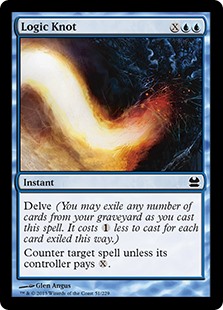
Drawing and immediately attacking forces opponents to choose how to navigate combat without knowing what's in store for them later. Do they zap a creature, or continue holding up Logic Knot? Do they block and trade, or take the hit and attack back next turn? Had the turn player played a land and tapped out for a new spell in main 1, these decisions would prove much easier.

Acting in Main 1

There are three reasons for the turn player to act at sorcery speed before combat: to widen their options during combat, to gain information, and to bait out responses.

Widening options is as simple as playing a land for the turn. Naturally, tapped lands should never be played for this reason; that information, which provides no benefit for giving up, is best kept hidden until later. But basic and fetchlands, as well as shocks that would enter untapped that turn cycle regardless, can be deployed immediately. Even if playing a land first makes no tangible difference for the turn player (i.e. their only play is to cast a creature in main 2), doing so signals more possible options to opponents.

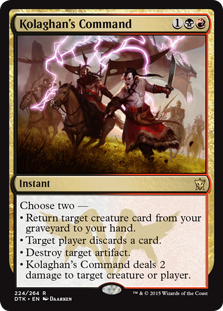
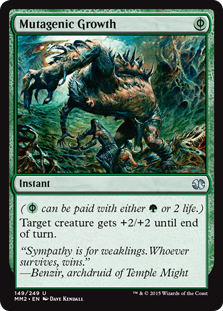
Take, for instance, the Jund vs. Infect matchup. On turn three, Jund may want to swing with Tarmogoyf and then use Liliana of the Veil to remove a Glistener Elf. Jund's third land should be played before attacks. What if Elf blocks and is supplemented with a pump spell? Jund can respond to Mutagenic Growth with the likes of Kolaghan's Command, rather than the other way around. Whether or not Jund has access to Command, playing out the land first presents that option and complicates enemy lines.
As always, there are exceptions to this rule, too; waiting with a land when there's nothing worth representing during combat is a way to bluff an additional play post-combat, which occasionally misleads opponents into disrupting sub-optimally. It's up to players to weigh the value of representing more options now versus representing more action in the grip.

Another reason to act in main 1 is gaining information, which leads to better attacks. Targeted discard like Thoughtseize and Thought-Knot Seer are the most obvious example of such spells, but being a creature, Seer is still mistakenly relegated to main 2 an uncomfortable amount of the time—even with opponents tapped out! There are other ways of generating information, too, like cantripping or casting spells into potential disruption.

The latter situation leads us to the final reason to act in main 1: baiting out responses. If it's holding three Mutagenic Growths, Counter-Cat might willfully slam Tarmogoyf into an opposing Logic Knot pre-combat to tap them out before dealing lethal out of seemingly nowhere. Baiting doesn't have to be game-ending, either; it's generally as simple as sequencing threats in order of least to most valuable. And sometimes, it's as subtle as, yes, attacking first. Whether it's ideal to deploy spells in main 1 or 2 depends heavily on the context and is best learned with reps.
Living at the Finish Line

The ending phase consists of two smaller steps: the end step and the cleanup step. The former has no turn-based actions, but remains one of the most popular times to act during an opponent's turn. Cleanup is a functional opposite, featuring turn-based actions but preventing deliberate ones from players unless certain conditions are met.

Acting in End Step

End step actions primarily serve to deny opponents options. The turn player cannot cast sorcery-speed spells once they've proceeded to the end step, so waiting until this step to act limits the possible plays opponents can make. It's not rare to take damage from an attacker and then kill it in end step to dissuade opponents from adding more to the board—by the end step, opponents have lost that option.

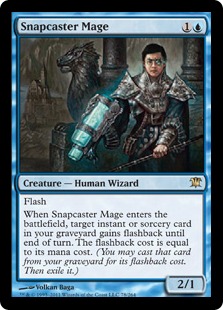
These actions also relate to information gathering. Critically, the end step represents the last time players receive priority, and the non-turn player is the last of the pair to do so. In other words, that player gets to work with full information about an opponent's plans for the turn: if they pass with seven or fewer cards, they have committed to stop making proactive plays that turn (barring instant-speed ones like Snapcaster Mage, which can then only be made in response to the defending player's action, if any).

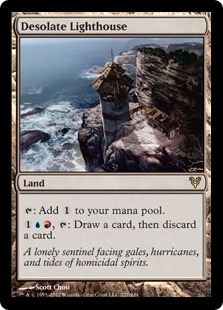
Finally, as the last time a player receives priority, the end step is an ideal time to activate spells or abilities that want to be activated during the turn cycle but cost mana or other resources. Waiting until now keeps more options open with that mana, but barring holding up a critical counterspell for instance, players are highly incentivized to activate something like Desolate Lighthouse here. Creature decks may also want to hold off on acting to complicate opposing removal; if opponents decide to kill off some threats, that may give the creature deck an opportunity to resolve something like Collected Company.
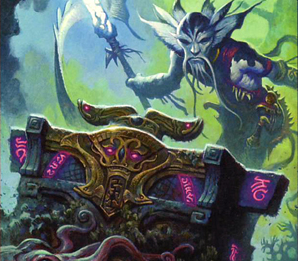
There's nary a reason to ever act on one's own end step. The most common reason for doing so is to react to new information gained, especially from opponents doing something in that step. Opponents usually have less mana after making a play on the turn player's end step, giving that player a safer window to execute a play.

Combing through Cleanup

The cleanup step features two turn-based actions: first, the turn player discards to hand size; then, damage is washed off all permanents, and "until end of turn" and "this turn" effects end. It doesn't naturally give players priority. That said, players do receive a round of priority if an ability is triggered by those turn-based actions, in which case the cleanup step is then repeated.

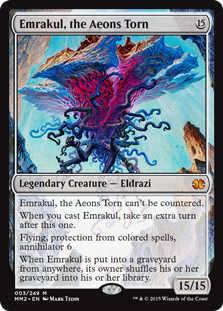
Plenty of theoretical Modern interactions can trigger abilities during cleanup—Kiki-Jiki, Mirror Breaker's token dying with Blood Artist on the board, for instance. But such interactions don't occur often in the format. Perhaps the most common is when blue decks discard to hand size by binning Emrakul, the Aeons Torn, which triggers the Eldrazi's shuffle ability.


In that and similar scenarios, players receive priority only when the triggered ability goes onto the stack, which is after cleanup's other turn-based action is completed. The most interesting change here is the end of "until end of turn" and "this turn" effects—Silence and related effects stop working here, while hexproof and stat boosts as from Vines of Vastwood fall off. In the latter example, protected infectors can again be interacted with before opponents untap their lands.

I have known many Modern players to misunderstand this step because of its nicheness. Acting in cleanup indeed comes up infrequently, but still sometimes presents a path to victory.

Phasing Out

Thus concludes Just a Phase. Did I miss any key uses for the main phases or the ending phase in Modern? Do you have any phase-related anecdotes to share? Would you like to see more content in the same vein as this article series? Let me know in the comments, and remember not to commit the Cardinal Sin of Phasing—treating it as though it doesn't exist!

Insider: Finding Underpriced Cards

Are you a Quiet Speculation member?

If not, now is a perfect time to join up! Our powerful tools, breaking-news analysis, and exclusive Discord channel will make sure you stay up to date and ahead of the curve.

Selling cards for a high price is great, but so is buying them cheaply, especially when the price is so low that they can be immediately flipped for a profit. It seems that the limiting factor to any Magic finance operation is acquiring cards, not necessarily selling them, which explains why dealers set up booths at events primarily to buy cards, not to sell them. There are even online stores that do nothing but buying, which in turn supply retail stores hungry for more stock.

I’ve been doing some more buying and selling lately, and in my efforts, I’ve been looking for unturned stones that could lead to bargains.

Misspelled eBay Auctions

A few weeks ago, I stumbled upon an old article by Sigmund that mentioned a website called fatfingers.co.uk that searches eBay for misspellings of a keyword. The idea is that misspells are relatively common in listings, and the mistake has the potential to keep cards from showing up on searches for the card. Auctions might garner little attention, and Buy-It-Now listings with a price set in the past could sit out of view after its market price has increased, so there’s a potential for bargains.

When I heard about this trick, I had to try it myself, and because it had spiked that day, I searched for Savannah. I found a lightly-played “Savanah” at the old price of $90, and I instantly became a believer in this technique. My search for other dual lands didn’t yield results, but I traded the Savannah at $140 towards an Ancestral Recall soon after, a nice profit.

There was an error retrieving a chart for Savannah

Watching eBay Auctions

Another technique to score deals from eBay is to simply watch every Magic-related auction, and prey on any that are selling under market value, for some instant buylist arbitrage, low-priced acquisitions for a store, or just cheap cards for a deck or collection.

Extracting the full value from this technique means sitting with eBay open and catching all of the ending auctions, but much of the work can be done in advance to make it more painless. Take note of all the juiciest auctions, and then come back to them before they end. The process could even be automated with auto-bidding websites that snipe auctions, with a set price at the highest price you want to pay.

Goodwill Auctions

Another source of Magic cards from auctions is an unlikely place, Goodwill. They have an online auction house that sells a surprisingly large amount of Magic cards. The catch is that there is very little information given about the cards beyond their weight and some pictures that show little of the contents.

These auctions are akin to storage locker auctions in that they are an educated gamble, and surely volatile in their payouts. There could be some rewards for those with a keen and watchful eye, but in my estimation, most of these auctions seem to sell at high prices, and they have high shipping costs. This leads me to believe that they are closer to lottery tickets, meaning they could occasionally pay out, but realistically they are unprofitable in the long term. I’d be eager to hear if anyone has had success with them.

Storage Locker Auctions

On the topic of storage locker auctions, they could be a nice source of Magic bargains, but I can’t imagine they appear often enough to make them worth pursuing solely for cards. A better idea would be to network with locals who frequent these auctions and tell them to be on the lookout for cards and to contact you if they acquire any.

Thrift Stores/Garage Sales/Estate Sales

Another place where Magic cards show up is in thrift stores, garage sales and estate sales. With some luck, you might come across listings that name Magic and can target them, but otherwise, it’s like searching for a needle in a haystack. Going out searching for cards is going to fail, but you might come across them while looking for deals on other goods. This is another place where the strategy of getting into contact with local estate and garage sale hunters and telling them to buy Magic cards to sell to you would make sense.

Local Stores

Another great way to acquire bargains is to simply go to card stores. Any store that doesn’t price its cards in real-time could have bargains, and in this market with so many cards on the rise, there are more and more opportunities to find mispricings.

For the past few months I have been downsizing my collection by trading up with the goal of acquiring the Power Nine, and last month I heard a local shop had some in stock, so I made it a point to check it out. I didn’t act on the news then because I wasn't interested in buying, but when I acquired some high-end cards as trade leverage, I ventured down to try to work something out. Not only was the Power a bargain, which I eventually bought, but I discovered a ton of other old high-end cards, some really underpriced ones. I compared their stock to buylists on my phone and picked up a nice stack of cards that I could flip for an instant profit.

There was an error retrieving a chart for Ancestral Recall

This week I ventured to a local store I wasn’t familiar with and found deals there too, picking through the showcase and stacks of 50-cent and $1 cards. At this point I plan on hitting every store I can find looking for deals. I know some people travel to stores around the country when travelling to GP or other events and buy stock from stores, and it seem like now is the time do it before the oldest stock of cards inevitably dries up.

Craigslist

Another source of cards is Craigslist, which these days seems to be saturated with people looking to buy cards but not many selling great ones. That said, plenty of nice cards do show up on Craigslist, and there are surely deals out there, it just requires a lot of checking listings. It’s also likely to involve a lot of travel, and wasted time picking through duds, but the opportunities are real.

Friends/Family/Local Shop

Another way to get deals on cards is to tap into your network, whether it is friends, family, or most likely, the players you interact with at the card shop and at local events. Everything has a price, and it’s not uncommon to run into people actively selling cards. Often a trade partner will say they are willing to sell, and that could start a conversation that leads you you buying their whole binder at a discount.

It also never hurts to ask. I’ve seen people clear out their binders to people buying “bulk rares,” when clearly some were above bulk. Don’t run afoul of the card shops you’re in if they frown against making buys in the store, but otherwise, it’s a win-win for both parties.

How do you acquire cards cheaply?

–Adam

Avatar photo

Adam Yurchick

Adam started playing Magic in 1999 at age 12, and soon afterwards he was working his trade binder at school, the mall food court, FNM, and the Junior Super Series circuit. He's a long-time Pro Tour gravy-trainer who has competed in 26 Pro Tours, a former US National Team member, Grand Prix champion, and magic.tcgplayer.com columnist. Follow him at: http://twitter.com/adamyurchick

View More By Adam Yurchick

Posted in Buying, Finance, Free InsiderTagged , Leave a Comment on Insider: Finding Underpriced Cards

Have you joined the Quiet Speculation Discord?

If you haven't, you're leaving value on the table! Join our community of experts, enthusiasts, entertainers, and educators and enjoy exclusive podcasts, questions asked and answered, trades, sales, and everything else Discord has to offer.

Want to create content with Quiet Speculation?

All you need to succeed is a passion for Magic: The Gathering, and the ability to write coherently. Share your knowledge of MTG and how you leverage it to win games, get value from your cards – or even turn a profit.

Insider: Karn, Teferi and Being “Jace-Like”

Are you a Quiet Speculation member?

If not, now is a perfect time to join up! Our powerful tools, breaking-news analysis, and exclusive Discord channel will make sure you stay up to date and ahead of the curve.

The release of Dominaria has cast Standard into an upheaval in terms of redefining what the format looks like. Generally, I'd describe the phenomenon as positive, since change often gets players excited about playing Magic.

Change is tremendously important in a format people actively don't enjoy, which could be said about pre-Dominaria iterations of Standard, which have been plagued by dominant decks, repeated bannings and stagnant metagames. Then Dominaria rode in on its white horse and slayed the The Scarab God, and the people rejoiced.

How can one set break up two years of quagmire so effectively?

There was an error retrieving a chart for Teferi, Hero of Dominaria
There was an error retrieving a chart for Karn, Scion of Urza

Well, when ludicrously busted new planeswalkers enter a format, it's bound to shake things up. I'd argue that the only thing that actually changed in Standard is that even more busted cards than existed before were added to the cardpool. It wasn't a subtle, we added some new checks and balances to the best strategies, it was more like, here's some even more absurd cards than already existed – go nuts.

On the one hand, Standard needed a face lift, but on the other, simply upping the stakes is a risky answer to a fundamental lingering problem.

Karn and Teferi are Modern Cards

I'm sure you've seen these powerful 'walkers creeping up in Modern. I think that is fairly common knowledge by this point. However, I'd argue that these cards are so buck wild in terms of power level and stats-to-mana-cost ratio that it appears to me they were designed to impact Modern.

There was a particular passage in the February 2018 B&R announcement about releasing JTMS and BBE back into the Modern wilderness that stuck with me:

"In looking at the top decks of Pro Tour Rivals of Ixalan, successful players only included a handful of cards with the intent of tapping four lands to cast them. (Colorless Eldrazi and Tron being the exceptions, among other popular decks.) Jace and Bloodbraid Elf are powerful options that fill similar roles in different decks as curve-toppers in the four-mana slot. Adding attractive options at the same mana cost in different color combinations at the same time mitigates the risk that one or the other could pull too many decks toward it at once."

–February 18, 2018 B&R Announcement.

There appears to be a mindfulness about what the landscape of Modern looked and a concerted effort to incentivize players to go a little higher on the curve. Nobody plays fours. What would it take for people to get on board with four-drops?

There was an error retrieving a chart for Jace, the Mind Sculptor
There was an error retrieving a chart for Bloodbraid Elf

"Hey kids, we noticed that people don't climb the curve into the 'four-drop territory.' Try these..."

At the time of the unbanning, I basically trusted that it would be fine. My thinking was that, Modern isn't really about cards like this anymore and they are likely role players at best. The calendar has flipped several times since then, and it would appear that assessment is more or less true.

There's some decks that play JTMS and BBE, but they are not in the top tier of the format. Long story short, Modern is so busted and broken that it is beyond even the range of JTMS or BBE to make much of a dent in the craziness that is a bunch of decks trying to checkmate each other on turn three.

Let's return for a moment to that statement from the B&R announcement. It would appear that at least some thought has been applied to the idea that it is strange that four-drop, tap-out threats are largely absent from Modern and that adding a few (JTMS and BBE) adds new options to the cardpool to consider.

It turns out that Wizards was right about these four-drops. In a format as broken as Modern, they don't carry much clout. They are obviously great and powerful cards, but they were right, Modern is not a format about tapping out for four-drops that don't win the game on the spot.

The question the whole situaion has me asking is: Is printing cards like Karn and Teferi doubling down on trying to make tap-out threats with CMC 4+ that matter? I think it's worth consideration on pure "brokenness" alone.

Effect-to-Mana Is the Only Thing That Defines Brokenness

How much does it cost and what does it do? These are the only questions that really matter when trying to determine how powerful or comeptitive a card or strategy is.

Keep in mind: that qualifying statement also applies to combos and synergies. Does Card A plus Card B equal a significant discount on effect to mana cost? For example, Throught the Breach plus Emrakul? The concept still defines these kind of interactions.

There was an error retrieving a chart for Emrakul, the Aeons Torn

When we take even a glimpse at Teferi and Karn, it becomes clear that these cards provide an absurd amount of bang for their buck. Both are a steal at their respective four- and five-cost price tags. Both have a slew of useful and flexible effects and high loyalty output. Both have rates that are among the most lopsided ever printed on cards at the four- and five-drop casting cost.

I find Karn, Scion of Urza to be a particular frustrating Magic card to exist because it simply has too much loyalty. If a key downside of a planeswalker is that it can be attacked, it is a significant advantage to have a cheap walker that generates so many hit points so quickly in the game. Even with a board presence, it often can't be attacked off the board.

Both also have modes that help each defend their position on the board. Teferi can plop down and either slay something outright, or untap lands to make another play in its own defense. Karn can make a blocker or simply buff itself to the point where it can't be attacked off the board.

The Jace Test

If you've been playing for a while, you're of course familar with the depressing qualifier of "The Jace Test." Basically, when JTMS was in Standard, players simply could not afford to play threats that didn't pass the Jace Test. Does Jace come down, bounce your threat, and win the game? Well, you can't play that threat then.

There was an error retrieving a chart for Primeval Titan

Jace was so powerful in Standard that it resolving with an opening was enough to steal games. The same feels true for Karn and Teferi in Standard. Each card is so powerful that if the opponent can't immediately deal with it, the game risks being over from the value the walker will generate over the next few subsequent turns. Everything you draw (unless it is a Vraska's Contempt) is likely not as strong as the opponent simply using one of their walker's abilities each turn.

It's messed up!

My argument is that these cards are basically designed like they are meant to be four- and five-drops that matter in a format (Modern) where four- and five-drops historically don't matter because they can't compete with the cheaper spells in terms of flexibility.

In terms of having spells like these in Standard, they simply offer a better mana-to-effect ratio than anything else. Teferi makes The Scarab God look tame by comparison. Karn makes The Scarab God look like hot garbage.

The Jace-Tag Debate

The last caveat I'd like to touch on in this finance article, that is admittedly less financially focused than I usually write on here, is the price of these new cards.

Karn has been selling well over $75.00 USD and Teferi around $35.00 USD. Karn is teetering into Standard price territory usually reserved for cards named Jace!

There was an error retrieving a chart for Jace, Vryn's Prodigy

There are a few factors to consider. There are no Expeditions or Masterpieces in Dominaria to help suppress the big price tag. The second is the overall usefulness of the card not only across Standard archetypes, but across formats and even into Eternal.

It's not just that Karn goes into the best decks, it likely goes into nearly every deck. I've found that most of my decks get better when Karn is added, simply because the card is so busted. Obviously, the law of survival of the fittest will dictate that only the strongest Karn decks survive, but individual Standard cards with such a high price tag create a considerable cost of entry to players of all levels. And I don't believe the price either of these cards has peaked yet.

I don't see other cards that are objectively "better" than these cards in Standard in terms of power level. I also don't see many other strategies that seem on the same level as these. Is Standard again headed for a stalemate mired in cards that are simply better than the rest of the heap? If history has taught me anything when it comes to Standard, I wouldn't bet against it. I would, however, bet on Teferi and Karn to continue to bushwack their way through Standard and continue to be the most desirable non-Reserved List cards in Magic for the foreseeable future.

At least, that is, until the next set when WOTC prints "Super Jace" and "Wonder Liliana," which respectively make Teferi and Karn look like a couple of unnamed henchmen, to shake up Standard or incentize people to tap out in Modern.

Just kidding. I hope.

Insider: MTGO Market Report for May 23rd, 2018

Are you a Quiet Speculation member?

If not, now is a perfect time to join up! Our powerful tools, breaking-news analysis, and exclusive Discord channel will make sure you stay up to date and ahead of the curve.

Welcome to the MTGO Market Report as compiled by Matthew Lewis. The report will cover a range of topics, including a summary of set prices and price changes for redeemable sets, a look at the major trends in various Constructed formats and a "Trade of the Week" section that highlights a particular speculative strategy with an example and accompanying explanation.

As always, speculators should take into account their own budgets, risk tolerances and current portfolios before buying or selling any digital objects. Please send questions via private message or post below in the article comments.

Redemption

Below are the total set prices for all redeemable sets on MTGO. All prices are current as of May 22, 2018. The TCGplayer market and TCGplayer mid prices are the sum of each set's individual card prices on TCGplayer, either the market price or mid price respectively.

All MTGO set prices this week are taken from GoatBot's website, and all weekly changes are now calculated relative to GoatBot's "full set" prices from the previous week. All monthly changes are also relative to the previous month's prices, taken from GoatBot's website at that time. Occasionally, full set prices are not available, and so estimated set prices are used instead. Although Hour of Devastation (HOU), Amonkhet (AKH), Aether Revolt (AER), and Kaladesh (KLD) are no longer available for redemption, their prices will continue to be tracked while they are in Standard.

Redeemable sets are highlighted in green and sets not available for redemption are highlighted in red. Ixalan (XLN) and Rivals of Ixalan (RIX) officially go offline for redemption this week, but RIX is being reprinted and will be available for redemption in about a month. Look for Wizards of the Coast to provide further updates on XLN this week.

Standard

Dominaria (DAR) was the only set not to be in the red this week, with Aether Revolt (AER) and Kaladesh (KLD) taking hits of ten percent or more. With good weather finally here in North America, interest in playing MTGO is naturally going to take a hit, and with the Standard metagame starting to come into focus there's really no need to hold onto underperforming cards.

There was an error retrieving a chart for Summer Bloom

Prices will perk up again in a couple of weeks when the Pro Tour DAR is held, but it's going to be harder and harder to speculate on Standard for the next few months. Fall rotation is the death knell for the price of cards in Standard as most do not transition into Modern play. For this reason, prices are bound to decline as we get closer to rotation and speculators and players alike should only be keeping small and short-term positions in KLD block and Amonkhet (AKH) block cards. If you are not confident in your abilities, do yourself a favor and stay out of speculating on cards from these sets for the time being.

Speaking of the fall, Wizards of the Coast announced that the set coming in October would be a return Ravnica. Although most synonymous with the shocklands, it's not clear that these will be reprinted for a second time in a regular set. Regardless, their utility in Modern makes them unattractive speculative targets as they are already priced at a level close to what I expect them to be in Standard.

What has been made clear though is the guilds that will feature in the fall set. Selesnya, Boros, Golgari, Izzet, and Dimir are the first five guilds on the menu, which means that the Standard format will no doubt slant in the direction of these colour combinations as new powerful gold cards are printed. Keep this in mind when you are making long-term speculative decisions for Standard.

There was an error retrieving a chart for Clifftop Retreat

Right off the top, this favors the mana fixing lands that favor these colours, such as Clifftop Retreat, Sulfur Falls and Temple Garden. There's no rush to acquire these, but look out for the cheapest copies you can find, particularly for the ones priced at 0.5 tix or less.

Although the colours are balanced as they each show up in two of the guilds, there are a few things to keep in mind prior to the fall. With the Azorius guild not be showing up until early 2019,  Teferi, Hero of Dominaria might be taking a back seat in the fall without Irrigated Farmland to fix the deck's mana.

There was an error retrieving a chart for Rekindling Phoenix

The rotation of Hazoret the fervent, Chandra, Torch of Defiance and Unlicensed Disintegration means that mono red and B/R vehicle decks are going to have to go back to the drawing board as well. Rekindling Phoenix is a card similar to Teferi that also might struggle in the fall as it's natural home mostly rotates out of Standard.

Modern

A variation on Lantern Control, minus Lantern of Insight, won the Star City Games Modern Classic this past weekend in Louisville. Have a look at the deck. It's hard to say if this is going to be the direction that this style of deck will go, but the market likes it as Whir of Invention has jumped up to 1 tix, its highest price in over a year.

There was an error retrieving a chart for Whir of Invention

There were three G/R Tron decks in the top eight as well. This is notable to me as the printing of Damping Sphere isn't holding this archetype down. Modern is still an incredibly diverse metagame and even flexible answers like this card will be hard pressed to find a spot in sideboards.

Trade of the Week

For a complete look at my recent trades, please check out the portfolio. When to sell a speculative position is a question that doesn't get as much coverage as it should. It's necessarily a difficult task though as the Magic finance field is a relatively new one and it intertwines with a game and all the attendant aspects of being a hobby. But as time passes and more data becomes available, some key signals have come into focus. Check out the chart below for Rivals of Ixalan (RIX) foil mythic rares and complete foil sets.

In blue is the sum of all list prices for RIX foils, while in red is the sum of the buy prices for the foil mythic rares only. Both prices are plotted on the left-hand side and are tracked over the twelve weeks since the release of the set. On the right-hand side is a percentage, calculated from the foil mythic rare buy price over the price of the full set.

You can see how the foil mythic rare strategy plays out here as the percentage rises from about seventy percent to over eighty percent. On top of that, the price of the full set rose slightly over its release. The flow of value to the mythic rarity on top of the price appreciation in the whole set is the foundation of the strategy. From this chart, the selling window opens in the sixth week although any time up to the twelfth weeks also seems fine.

For DAR, there are only a few weeks of data so far, but I've plotted an identical chart with the available information. DAR has been exceptional in that foil sets have been rising rapidly in price since its release and this has been dragging up the mythic rare buy price along with it. We are still below 75 percent though for the fraction taken up by the mythic rares. If eighty percent is a reasonable level to expect, then there is further upside in the foil mythic rares at this point.

Although I didn't get to buy as many sets of foil mythic rares as I would have liked, DAR has been hard to judge relative to past sets since the prices were so much higher in comparison. I did sell one copy of each foil mythic rare this week to capture some profits, but this analysis is encouraging me to hold off for a few more weeks before selling the rest. Further upside is visible as redemption opens and value flows to the mythic rares.

Want Prices?

Browse thousands of prices with the first and most comprehensive MTG Finance tool around.


Trader Tools lists both buylist and retail prices for every MTG card, going back a decade.

Quiet Speculation