menu

Why Not Control? – Attacking the Humans Meta

Are you a Quiet Speculation member?

If not, now is a perfect time to join up! Our powerful tools, breaking-news analysis, and exclusive Discord channel will make sure you stay up to date and ahead of the curve.

Humans is currently the best deck in Modern. The data is very clear about this: Humans is on top everywhere and has been for most of the year. This is causing a kind of dynamic stability to take over the format. The top decks have remained relatively the same for some time while the rest of the metagame shifts beneath them. One would think this stability is ripe for exploitation, but that isn't happening yet. I find this perplexing.

Today I will be looking at the metagame that Humans has wrought. I will examine the dynamic stability of the format and why I believe that it should have been taken advantage of already. The fact that the equilibrium has persisted will be discussed and I will explain my take as to why. I believe that Humans is driving a perception of the metagame that isn't true and this has prevented destabilization.

The Thing About Humans

I've always been surprised by Humans' success. It made sense for it to do well initially, as it was perfectly designed to destroy Storm back when Storm was popular. Since then I've been expecting it to drop off, but the opposite has happened. I don't know why this is happening because I know that Humans is very vulnerable to Jeskai decks. I absolutely destroyed Humans with Jeskai Tempo every time we crossed paths last year. Humans is filled with small creatures that die to Lightning Bolt at parity, and Spell Queller proved to be a house.
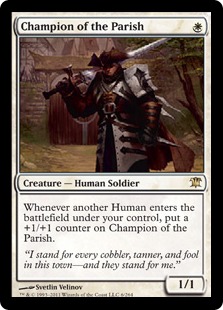
I'll admit that I dismissed the deck. Based on what I saw, it didn't appear that it could hang with the midrange decks of Modern. I was wrong, and Humans has become "The Deck" while control has declined. It's been a struggle to understand why, especially because the current iteration of Humans is not dramatically different from the one back in October.

Metagame Stability

Modern is dynamic and diverse, but that doesn't mean that it cannot or does not stabilize. What I mean is that often we've seen the same decks maintain their positions at the top of the metagame for months on end while there is considerable movement beneath them. This doesn't mean the format is unhealthy by any stretch, just that certain decks have proven that, given what is going on in Modern right now, they are better than other options. Decks may remain Tier 1 for a very long time without causing dynamic equilibrium *cough* Affinity *cough* because their relative position in Tier 1 changes often. As the top decks have been set for several months, I'd argue that we are in a dynamic equilibrium.

Is It Exploitable?

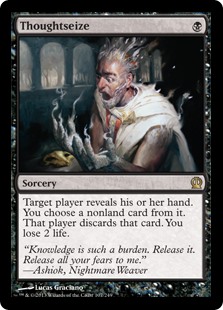
Equilibrium is neither inherently good nor bad. That is determined by context, specifically the fairness of the decks. Given how many fair creature decks are on top, I would argue that this current one is healthy and good. Furthermore, I believe that the stabilization of the metagame around Humans is exploitable. Last year the metagame was in dynamic equilibrium between Eldrazi Tron and Grixis Death's Shadow for most of the summer before Storm disrupted things that fall. This wasn't an easy metagame to attack because it was polarized between a big-mana deck and a hyper efficient disruption deck. There's a saying from Theros-era Standard that Thoughtseize is better than any answer, and it was on display last year. However, this equilibrium isn't like that one.
The current metagame sees Humans clearly at the top of the pile with Affinity, Jund, and Hollow One elbowing each other for second place. Tron and Eldrazi variants sit in third with Burn not far behind. While there has been some adjustment and movement, these decks have consistently been on top of Modern since February, and the order hasn't changed much since March. This equilibrium consists of a lot of creature decks, three of which (Humans, Affinity, Burn) are very similar creature decks—arguably four if you count RG Eldrazi separately. Against those decks, removal-heavy archetypes like Mardu Pyromancer, UWx Control, or Blue Moon should be favored. They play piles of removal for creatures and have strong disruption against the slow decks. They should be able to topple Tier 1.

The Inexplicable

Why isn't Jeskai Control more of a force? Or Pyromancer for that matter? Jeskai was a Tier 1 deck at the end of last year, and the metagame seems primed for it to thrive. Humans and Affinity are very good matchups, Jund and Eldrazi are no worse than even, and Tron is winnable with a good sideboard. The only truly terrible matchup is Bogles. However, its metagame share continues to decline while its presumptive prey continues to thrive. This doesn't make logical sense, so there must be more going on.

My Theory

I believe that the reason for Humans's continued prominence despite its vulnerabilities comes down to two factors, one intrinsic and the other extrinsic. The intrinsic reason is that Humans can power through a traditional control gameplan because it cannot really be exhausted, which fuels a perception of it being a poor matchup. The extrinsic one is the effect that Hollow One is having on players. Not the format itself per se, but the perceptions of the players. It looks like control is weak against the deck, and this belief fuels an unfounded fear of Hollow One, which keeps players away from actually playing control.
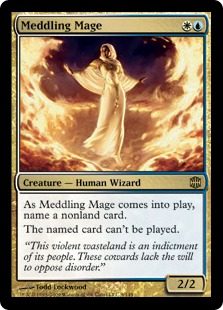
Don't get me wrong, Humans is a powerful deck. We've been over this a few times, but pairing disruption with a clock—especially a clock that doubles as disruption—is powerful. Add to that a high threat density and it appears to be very intimidating for reactive decks to answer Humans. The deck has around 18 lands, four Aether Vial, and 28 creatures. It's very unlikely that the board will ever be completely clear, which can make winning the game a dicey task for a control deck. You never know if a topdecked Thalia's Lieutenant or Mantis Rider will suddenly wreck you.

The disruption can be easily overcome through efficiency and answer diversity, but the second problem requires adjustment. Rather than take the full control route, you need to transition over to attack once the initial wave is dealt with. This is what Jeskai Tempo is good at, and why I had so much success last year. However, pure control decks struggle with this, and I think this is why they're dropping off.
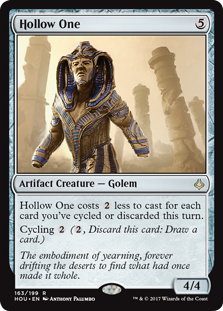
As for Hollow One, I both do and don't understand the fear. Yes, giant creatures on turn three are scary and hard to beat. So is potentially getting wrecked randomly discarding critical cards to Burning Inquiry. It is possible for a great hand to become terrible when you randomly discard all your lands.

However, those are pretty low percentage outcomes. I've been across from Burning Inquiry a lot and I've been wrecked by the card as often as my opponent. Granted, my circumstances are unique because I know guys that have been trying to make Waste Not work for years now—but I find that most of the time there's no measurable change to my hand quality, and I end up improved as often as damaged. A well-built control deck should have enough redundancy that it can overcome Inquiry, but the feel-bad aspect keeps players away.

The Jund Factor

One factor that cannot be underestimated is the return of Jund. The deck virtually disappeared last year, but has reemerged since Bloodbraid Elf was unbanned. Jund was a very even matchup for control in the past, but Bloodbraid has changed things. As I've mentioned before, Bloodbraid is very good against control decks, and employs a similar general strategy. I strongly suspect a lot of missing control players are actually on Jund because the deck feels better in the current meta.

The Jace Factor

Another problem is Jace, the Mind Sculptor. Jace may not have made much of an impact on the format as a whole, but it does loom over deckbuilding decisions. When I tested Jace, I found that he excelled in fair midrange games but didn't have much impact against fast decks. In midrange or control games Jace provides an enormous selection advantage and, over time, overwhelming card advantage. By the time Jace comes down against aggro or combo, the game should already be won. As a result I concluded that Jace would serve as the ultimate trump card for fair decks and push decks to either adopt him or go under him. I would argue this is exactly what has actually happened in Modern this year.
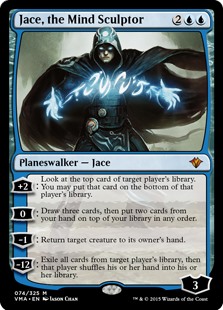
Since Jace was unbanned, my experience has largely validated this conclusion. Jace dominates control mirrors but he's largely irrelevant in other matchups. Jace will dominate an empty board, but there are so many haste creatures running around that Jace is never really safe. Therefore I don't really want Jace most of the time, but I feel compelled to play him anyway. Not having him is backbreaking when your opponent does. I suspect that many players feel the same way, as Jace appears in control decks all over the place, but only in small numbers. I suspect this deckbuilding tension is a significant factor in players not playing control, despite the advantages. Whether correct or not, feeling trapped into making certain deckbuilding decisions is not fun. I personally have opted to avoid actually playing control decks for more than a month for this reason, and I wouldn't be surprised if many potential control pilots were making the same choice.

My Solution

These problems provide parameters to work with, and with some finagling there is plenty of opportunity for control decks. If I were to build a control deck for the current open meta, I would definitely go Jeskai. If I go straight UW it will be harder to shift between roles, because Jeskai's burn makes going beatdown easier. I also prefer not to compete on the same axis in control mirrors and I've seen more UW than Jeskai Control in recent months. Given that counterspells and conditional removal are only situationally good, I would preference hard removal. Considering the format's speed and the resilience of Humans, I want a faster clock. Therefore, if I were to play control, I would play this deck:

Jeskai Tempo, by David Ernenwein

Creatures

4 Snapcaster Mage
4 Spell Queller
3 Geist of Saint Traft

Instants

4 Lightning Bolt
4 Path to Exile
4 Declaration in Stone
3 Lightning Helix
3 Mana Leak
3 Cryptic Command

Sorceries

4 Serum Visions

Lands

4 Flooded Strand
4 Arid Mesa
4 Celestial Colonnade
3 Island
2 Sulfur Falls
2 Steam Vents
2 Hallowed Fountain
1 Sacred Foundry
1 Plains
1 Mountain

Jeskai Tempo is good enough against Humans that I don't like shifting to a full-control build. Plus I can avoid worrying about Jace and just win. The changes I am making to the maindeck are targeted towards Humans and Hollow One. Counters aren't very powerful against either deck so I cut back and opted for the easier-to-cast Mana Leak over Logic Knot. This does make me weaker against big mana, but I feel that's an acceptable trade-off to have a counterspell that will always work on turn two. The prevalence of graveyard hate in the overall metagame means that Knot will often be poor anyway.
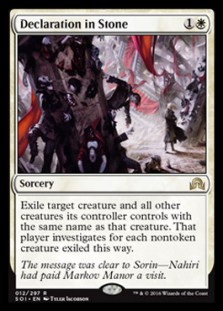
Declaration in Stone seems strange, but it is the right solution to the control problem. As previously mentioned, putting creatures into the graveyard is a liability and the power of Hollow One comes from dumping multiple Hollow Ones, Bloodghasts, and Flamewake Phoenix's into play during the first few turns. Declaration is the cheapest way available to Jeskai to deal with those threats permanently. You also don't care about giving them clues very much. Hollow One has few threats so turning creatures into clues usually just lets them draw more air. Declaration also has the benefit of cleaning up token swarms. It's not the best against Humans, but Declaration can be good against Jund when they play multiple creatures. I've been very impressed in my testing.

Seeking Answers

I will be the first to admit I may be reading too much from the apparent stability. There haven't been many events since the Pro Tour that were just Modern. It's been mostly team events and those don't often drive innovation or provide accurate metagame data. Once GP Vegas happens, it may be clear that the metagame has dramatically shifted. In the meantime, I encourage you to challenge the accepted wisdom of this metagame. Humans is a powerful deck, but it's still just a pile of creatures. Prepare correctly and it can be easily picked apart.

Daily Stock Watch – Marrow Gnawer

Are you a Quiet Speculation member?

If not, now is a perfect time to join up! Our powerful tools, breaking-news analysis, and exclusive Discord channel will make sure you stay up to date and ahead of the curve.

Hello, everyone and welcome to a new edition of the Daily Stock Watch! Standard has been the talk of town lately, with the massive prices spikes from the mythic rares of Dominaria, and some positive movement on some unplayable cards in recent sets, thanks largely to new brews and speculations on what could be the best decks in the upcoming Pro Tour. One thing that has also been talked about a lot lately is the insane movement of prices for cards that's on the Reserved List, and this has also caused some price spikes for other cards that hasn't seen a reprint yet. With all this in mind, I'd like to talk about a card today that has been on a tear by skyrocketing to its all-time high of $29.98 as a purely casual favorite, and what you should do about it as a finance junkie.

There was an error retrieving a chart for Marrow-Gnawer

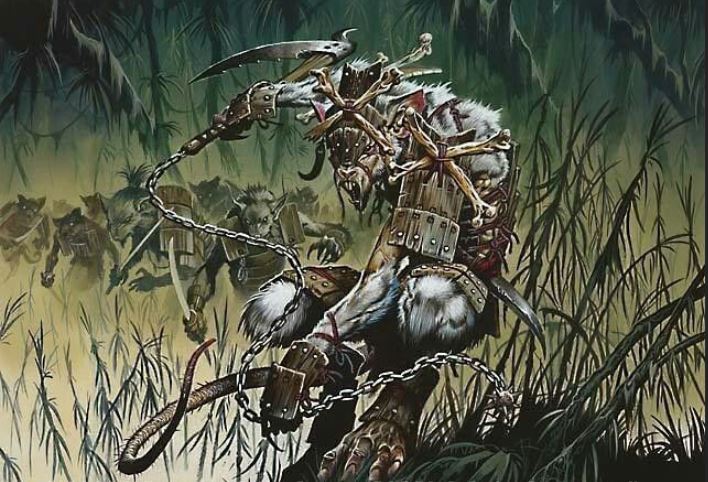
This dude is the cult leader of all Rat Colony and Relentless Rats lovers. He takes marrow-gnawing to another level by trying to chip away from your wallet with its ridiculous price, while staying in a league that reminds me of Exquisite Blood and Grave Pact. I'm not saying that these cards are seeing extreme price gains for no reason, but I've been sitting on some of them for a while because nobody is even interested in picking them up for their prices. I could say the same for this rat leader which has this nuts price tag, and a market that is clearly not looking for it.

For reference, this is how a Marrow-Gnawer Commander list looks like.

Marrow-Gnawer

Commander

1 Marrow-Gnawer

Creature

1 Ogre Slumlord
1 Gnat Miser
1 Locust Miser
1 Nezumi Graverobber
1 Nezumi Shortfang
1 Gray Merchant of Asphodel
1 Marrow-Gnawer
1 Mikaeus, the Unhallowed
1 Erebos, God of the Dead
1 Pack Rat
1 Ratcatcher
1 Magus of the Coffers
1 Swarm of Rats

Other Spells

1 Damnation
1 Thornbite Staff
1 Patriarch's Bidding
1 Consume Spirit
1 Nightmare Lash
1 Attrition
1 Contamination
1 Painful Quandary
1 Eldrazi Monument
1 Thrumming Stone
1 Torment of Hailfire
1 Liliana of the Dark Realms
1 Liliana Vess
1 Liliana, Heretical Healer
1 Lightning Greaves
1 Arguel's Blood Fast
1 Toxic Deluge
1 Whip of Erebos
1 Bontu's Monument
1 Urza's Incubator
1 Phyrexian Arena
1 Crypt Ghast
1 Vampiric Tutor
1 Demonic Tutor
1 Rise of the Dark Realms
1 Gruesome Fate
1 Soul Foundry
1 Illusionist's Bracers

Lands

29 Swamp
1 Crypt of Agadeem
1 Cabal Coffers
1 Cabal Stronghold
1 Cavern of Souls
1 Nykthos, Shrine to Nyx
1 Swarmyard

It's a typical Commander deck with all the feels of a tribal classic. It packs some really good Commander cards and a bunch of rats to pester your opponent. It's not really a tier one or two deck, so I don't see the reason why the main guy from this bunch is priced this high. I would have understood it if this was some fringe-Legacy playable deck, but I'm quite sure that it isn't. It's time to move around these copies if you have absolutely no need for it. This is one of those price spikes that's built around a fad, and in the aftermath of the Craig Berry-effect.

At the moment, there has been a massive buyout of English near mint copies of Marrow-Gnawer across big sites such as StarCityGames, Card Kingdom and ChannelFireball. SCG still has some foreign copies of the card from anywhere between $11.55 up to $16.19, and I would be fine in buying them if you have the absolute need for the card and have nothing against having foreign copies. Foils are also sold out at the $19-$25 range, and expect these prices to move as well once stocks have been replenished. I'm really recommending that you move your copies around as soon as you could, before sellers start undercutting themselves and stabilizing the market price once more. Now's the best time to make some profit out of a card that shouldn't even be this expensive to begin with.

And that’s it for today's edition of the Daily Stock Watch! See you again next time, as we check out a new card that should be on the go, or good enough for speculating. As always, feel free to share your opinion in the comments section below. And if you want to keep up with all the market movement, be sure to check in with the QS Discord Channel for real time market information, and stay ahead of the hottest specs!

Jund’s Ugly Cousins: Hot Tech, Pt. 2

Are you a Quiet Speculation member?

If not, now is a perfect time to join up! Our powerful tools, breaking-news analysis, and exclusive Discord channel will make sure you stay up to date and ahead of the curve.

I wasn't kidding last week when I revealed needing to halve my tech article. Modern's been a brewer's paradise ever since the Jace and Bloodbraid unbans, and the last couple weeks of 5-0s have proven especially fruitful. This past week adds another smattering of interesting candidates to the fray.

A Whole New Jund(s)

First, let's address Jund, which has indeed reached relative build stability since Bloodbraid Elf's arrival into Modern. Apparently, though, it's also ripe for tinkering. Some recent lists from the Mothership demonstrate surprising innovation for Modern's most storied midrange deck.

No Rhino, No Problem

We've seen Bloodbraid Elf shine in a few decks with mana ramp so far, from Ponza to RG Eldrazi to Valakut. It turns out casting the 3/2 haste a turn early is quite good in Modern (really, casting anything early is good in Modern). Jund also had a mana-dork featuring phase, while Deathrite Shaman was legal, and dominated the format with turn-two Lilianas. ALTNICCOLO wanted to live that dream again, and so took a page out of Abzan's book with a set of Noble Hierarchs.

Noble Jund, by ALTNICCOLO (5-0)

Creatures

4 Noble Hierarch
4 Tarmogoyf
4 Dark Confidant
2 Scavenging Ooze
4 Bloodbraid Elf

Planeswalkers

4 Liliana of the Veil

Instants

4 Fatal Push
2 Abrupt Decay
2 Kolaghan's Command

Sorceries

4 Inquisition of Kozilek
2 Thoughtseize
2 Maelstrom Pulse

Lands

4 Verdant Catacombs
2 Wooded Foothills
2 Bloodstained Mire
2 Blood Crypt
1 Overgrown Tomb
1 Stomping Ground
4 Blooming Marsh
3 Raging Ravine
1 Twilight Mire
1 Snow-Covered Forest
1 Snow-Covered Swamp

Sideboard

1 Scavenging Ooze
1 Ancient Grudge
2 Collective Brutality
1 Engineered Explosives
4 Fulminator Mage
1 Golgari Charm
1 Grafdigger's Cage
2 Liliana, the Last Hope
2 Surgical Extraction

Early Lilianas still tax the manabase heavily, since Hierarch doesn't tap for black. Hence the full set of Blooming Marshes and a Twilight Mire in place of other lands, including the third and fourth basics. This build also stays away from red as much as possible, only dipping into the color for Elf itself and a pair of Kolaghan's Commands. I can see Noble Jund being better against decks that force BGx to act proactively, such as Tron; still, relying on mana dorks makes the strategy less consistent overall. Nobles in Jund might grow into a respectable trend, though—LXCLXC 5-0'd with an identical list just a few days before.

From the Darkness

Why accelerate into Bloodbraid Elf when you could... not run the card at all? Pining for more control over his "cascades," OCELOT823 registered a Jund list that was fully legal before Elf's unbanning, relying instead of Goblin Dark-Dwellers to pull ahead in the mid-game.

Dark-Dweller Jund, by OCELOT823 (5-0)

Creature (11)

2 Goblin Dark-Dwellers
4 Tarmogoyf
3 Scavenging Ooze
2 Grim Flayer

Planeswalkers

4 Liliana of the Veil

Artifacts

2 Nihil Spellbomb

Instants

3 Lightning Bolt
3 Fatal Push
2 Terminate
1 Abrupt Decay
2 Kolaghan's Command

Sorceries

4 Inquisition of Kozilek
3 Thoughtseize
1 Maelstrom Pulse

Lands

4 Verdant Catacombs
2 Bloodstained Mire
1 Wooded Foothills
2 Overgrown Tomb
1 Stomping Ground
1 Blood Crypt
4 Blackcleave Cliffs
2 Blooming Marsh
3 Raging Ravine
2 Forest
2 Swamp

Sideboard

1 Maelstrom Pulse
1 Nihil Spellbomb
2 Anger of the Gods
2 Collective Brutality
2 Damping Sphere
1 Duress
1 Engineered Explosives
1 Goblin Rabblemaster
1 Hazoret the Fervent
1 Huntmaster of the Fells
1 Liliana, the Last Hope
1 Molten Rain

This deck leans more control than most Jund builds I've seen, boasting only 11 creatures and packing a whopping four basics. Kolghan's-Dwellers gives it a bigger Grixis-style value engine at the cost of proactivity—in other words, OCELOT823 isn't looking to shore up Jund's bad matchups so much as nail-in-th-coffin its good ones.

While this is the first Jund list I've seen without Elves (although straight BG Rock decks seem to be doing well in this metagame), the archetype is sometimes trimming its numbers. Even the more stock Jund lists are sometimes dropping to as low as 2 Bloodbraid Elf, making space for other top-end threats like Kalitas, Traitor of Ghet.

Architects of Jund

You've heard of Abzan Traverse. But how about Jund? Such a combination hasn't been attempted much for a couple reasons, chief among them that prime delirium enablers like Mishra's Bauble tend to play poorly with Bloodbraid Elf. Fortunately for WILLIAM_CAVAGLIERI, Architects of Will isn't a valid cascade hit at all.

Jund Traverse, by WILLIAM_CAVAGLIERI (5-0)

Creatures

4 Grim Flayer
4 Tarmogoyf
1 Scavenging Ooze
1 Huntmaster of the Fells
3 Bloodbraid Elf
4 Architects of Will

Planeswalkers

1 Liliana of the Veil
1 Liliana, the Last Hope

Instants

3 Fatal Push
3 Nameless Inversion
2 Abrupt Decay
2 Kolaghan's Command

Sorceries

4 Traverse the Ulvenwald
4 Inquisition of Kozilek
2 Thoughtseize
1 Maelstrom Pulse

Lands

4 Verdant Catacombs
4 Wooded Foothills
1 Bloodstained Mire
2 Overgrown Tomb
1 Stomping Ground
1 Blood Crypt
4 Blooming Marsh
1 Forest
1 Mountain
1 Swamp

Sideboard

1 Scavenging Ooze
1 Kolaghan's Command
1 Bojuka Bog
1 Kalitas, Traitor of Ghet
1 Nihil Spellbomb
1 Obstinate Baloth
1 Olivia Voldaren
1 Reclamation Sage
1 Shriekmaw
1 Thragtusk
1 Thrun, the Last Troll
1 Tireless Tracker
1 Tooth Collector
2 Yahenni's Expertise

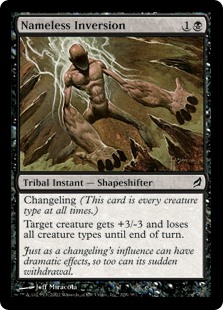
Only two planeswalkers? 20 lands? No Bolts... and Nameless Inversion instead?! This list violates plenty of Jund tenants, primarily because it isn't a true Jund list. Traverse the Ulvenwald lets it skimp on lands for better topdecks in the late-game, which it had better with no manlands in sight; as such, the deck makeup receives something of an overhaul.

One of the more intriguing developments here is Nameless Inversion, especially since Tarfire is generally just straight-up better at the same thing in red. It even goes to the dome and kills planeswalkers, while Inversion whiffs against plenty of Modern decks—not to mention costs twice as much! Sure, Inversion kills x/3s like Mantis Rider, which are plentiful in this metagame. But in that case, isn't Lightning Bolt worth inclusion despite not growing Goyf astronomically?
I also think the sideboard full of bullets is major overkill. As Traverse Shadow has taught us, it's often better to just have more copies of a deck's most awesome creatures than a scattered host of occasionally-useful ones.

Back to the Brew

While the innovation in Jund is eyebrow-raising, it's not necessarily as ooh-aah-inducing as a pile of brand-new brews. So, in the true spirit of this article series, here are three totally novel decklists from the past two weeks of results.

Monkeying Around

How many Kird Ape analogues are actually legal in Modern? At the April 29th Modern Challenge, ZASTOPARIKUS was determined to find out.

Reckless Rage Zoo, by ZASTOPARIKUS (30th, Modern Challenge)

Creatures

4 Kird Ape
4 Loam Lion
4 Wild Nacatl
4 Narnam Renegade
4 Tarmogoyf
3 Flinthoof Boar
3 Loxodon Smiter

Artifacts

2 Smuggler's Copter

Instants

4 Lightning Bolt
3 Reckless Rage
2 Path to Exile

Sorceries

3 Pyroclasm

Lands

4 Arid Mesa
4 Windswept Heath
4 Wooded Foothills
2 Sacred Foundry
2 Stomping Ground
1 Temple Garden
1 Forest
1 Mountain
1 Plains

Sideboard

1 Path to Exile
1 Ancient Grudge
3 Burrenton Forge-Tender
2 Dromoka's Command
1 Gaddock Teeg
1 Glaring Spotlight
2 Grafdigger's Cage
2 Selfless Spirit
2 Stony Silence

The final number ended up being 12, with a set of superior Wild Nacatls thrown in for very good measure. That said, this deck's most eye-catching feature isn't its creature suite, but its removal package.

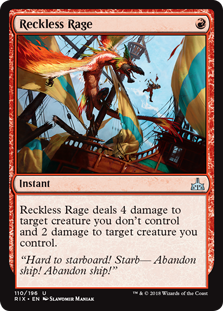
Relative newcomer Reckless Rage makes its Modern debut here, acting as an instant-speed Flame Slash in conjunction with any of the deck's creatures. With Lightning Bolt Modern's most-played removal spell, three's the magic number when it comes to toughness, so many creatures are considered by virtue of that critical extra point—Thought-Knot Seer, Restoration Angel, and Dominaria flavor Shalai, Voice of Plenty, for instance. Flame Slash has always had a damning speed problem, though; it can't interrupt combos, snap off attacking manlands, or work as a combat trick. Rage fills the void at this price point, only asking a deck such as this one to have a creature in play upon cast.
Also of note is the quasi-set of Pyroclasms. I've long sworn by Clasm as a sweeper in aggro-control decks, but in the sideboard! ZASTOPARIKUS instead takes a page out of Tron's book and runs the card main, ensuring his own little dudes don't find themselves raced by wider or more synergy-driven assaults.

Bad Company

OK, "bad" might be a little harsh; after all, this deck performed well at the Modern Challenge. But see if you can figure out what the heck is going on here.

BG Company, by FALKONEYE (22nd, Modern Challenge)

Creatures

2 Banewhip Punisher
4 Noble Hierarch
1 Birds of Paradise
4 Sakura-Tribe Elder
2 Fauna Shaman
2 Scavenging Ooze
1 Dark Confidant
1 Lotus Cobra
2 Eternal Witness
1 Fulminator Mage
2 Liliana, Heretical Healer
2 Nissa, Vastwood Seer
1 Merciless Executioner
1 Thrashing Brontodon
3 Tireless Tracker

Instants

3 Fatal Push
1 Abrupt Decay
4 Collected Company

Sorceries

1 Maelstrom Pulse

Lands

4 Verdant Catacombs
2 Overgrown Tomb
2 Blooming Marsh
3 Hissing Quagmire
1 Twilight Mire
3 Field of Ruin
5 Forest
2 Swamp

Sideboard

2 Fulminator Mage
1 Scavenging Ooze
1 Tireless Tracker
1 Fatal Push
1 Maelstrom Pulse
1 Big Game Hunter
1 Engineered Explosives
1 Fleshbag Marauder
1 Minister of Pain
2 Nihil Spellbomb
1 Reclamation Sage
1 Spellskite
1 Walking Ballista

Figure it out yet? Help a dude out and explain it to me in the comments.

The Lake of Fire

While Swans of Bryn Argoll is no stranger to Modern (if still unrecognizable at the top tables), the card's often played in conjunction with Treasure Hunt in a balls-to-the-wall, mulligan-into-one-card-and-hope-it-actually-wins-me-the-game combo deck. But we've hardly ever seen the card in a fair shell, the closest I can think of being a Skred-wielding deck dubbed "Snow Swans" from 2015. YOZO breaks new ground with this list, which repurposes the creature as an eventual wincon in a Bolting, Remanding Izzet shell.

UR Swans, by YOZO (5-0)

Creatures

4 Swans of Bryn Argoll
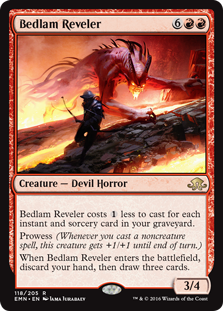
2 Bedlam Reveler
1 Kozilek, Butcher of Truth

Instants

4 Lightning Bolt
4 Anticipate
2 Izzet Charm
4 Remand
2 Pull from Tomorrow

Sorceries

4 Serum Visions
1 Anger of the Gods
1 Sweltering Suns

Enchantments

4 Seismic Assault

Lands

4 Steam Vents
4 Cascade Bluffs
4 Temple of Epiphany
3 Spirebluff Canal
2 Sulfur Falls
3 Dakmor Salvage
5 Island
2 Mountain

Sideboard

1 Anger of the Gods
2 Abrade
2 Crumble to Dust
2 Dispel
1 Echoing Truth
1 Keranos, God of Storms
3 Negate
2 Relic of Progenitus
1 Teferi, Mage of Zhalfir

Despite its control affectations, UR Swans is still a combo deck at heart, churning through its library and slinging removal and permission until it can string together a kill. It attacks disruptive opponents from a relatively unique angle, as its namesake combo piece helps the deck stock back up on cards should opponents try to deal with it. The card advantage possible from hitting one's own Swans with a Lightning Bolt, combined with the pull-ahead graveyard exploitation of Bedlam Reveler, remove the need for Snapcaster Mage in this shell.


I imagine UR Swans struggles against faster opponents, especially ones that can beat a few removal spells—the plan of assembling Seismic Assault and Swans on the battlefield at once is far from Modern's speediest kill. But Swans seems well-positioned to face Thoughtseize decks relative to other combo strategies.

A Modern for Everyone

I feel like a broken record at this point—for years, I've ended these sorts of articles with praise for Modern's diversity and innovation. But praise for these factors is all I've got! When we've reached a point where players can opt out of Bloodbraid Elf in Jund, the format's gotta be dynamic. Did I miss any sweet brews from recent events? Drop me a line below.

Insider: Major News and Trends This Week

Are you a Quiet Speculation member?

If not, now is a perfect time to join up! Our powerful tools, breaking-news analysis, and exclusive Discord channel will make sure you stay up to date and ahead of the curve.

It has been a big week in Magic finance, though these days it seems like every week is. Card prices have been on the rise for the past few months, and it has been exacerbated by enthusiasm for Dominaria.

Additional Older Sets Increasing in Value

The growing demand for Magic’s oldest and most iconic cards has dramatically increased the price of Alpha, Beta, Arabian Nights, Antiquities, and Legends. This demand is now spilling over to the next releases of cards, which for the longest time have been mostly ignored by speculators and collectors. Now, cards from The Dark and Revised are starting to appreciate. Given their age and relatively short supply compared to current releases, I suspect that these sets have been underpriced, and much of this growth will hold up. Now looks like a good time to acquire these cards if they can be found at a bargain. Condition is also very important for these sort of specs, with buyouts seeming to target near-mint copies for their higher collectability.

There was an error retrieving a chart for Ball Lightning

There's also been some movement in select cards from Alliances, Homelands, and Fallen Empires, including Kaysa, Koskun Falls and Elvish Farmer. As The Dark and Revised are bought up, buyers will turn to the next-best thing, which at this point are these cards, and in theory, the trend could continue to even later sets like the Mirage block and Tempest. We've already seen this happen with big-ticket reserved list cards like Mox Diamond and City of Traitors, and it's now happening with reserved list cards lower on the totem pole.

Widespread Reserved List Spikes

In addition to increasing demand for the oldest sets, which are desirable for their classic feel and nostalgia and are thus mostly immune to reprint risk, there has also been a huge increase in demand for reserved list cards. These cards have been rising for a while now, but now huge swaths of reserved list cards are being bought up, from iconic cards like Recurring Nightmare to what essentially amounts to penny stocks, cards like Ventrifact Bottle and Teferi's Realm.

There was an error retrieving a chart for Recurring Nightmare

I wouldn’t be too attached to the post-spike prices of cards like these as shown on sites that aggregate prices, and recommend doing some digging to see what cards are actually selling for, but people certainly are buying them, often at the higher prices. Acquiring any of these at the old price when possible doesn’t look to have any downside, but I’d reserve going deep on a spec for the most playable cards that might have the highest long-term potential.

Dual Lands, Power Nine Rising

There looks to be increased demand for dual lands and Power Nine, which makes sense given that so many other cards are rising. It seems that these cards increase in value whenever lots of other cards do, like four springs ago when fetchlands spiked, which was followed by dual lands spiking. It makes sense that some are trading up with their gains now to acquire Magic’s biggest-ticket items.

There are some other factors driving growth. Dual lands could be seeing renewed attention because Legacy will be featured on the Pro Tour later this year at Pro Tour 25th Anniversary, which is a large endorsement for the format by WotC.

There was an error retrieving a chart for Volcanic Island

I’ve heard that some increased demand for Power Nine is due to the upcoming SCG Con, which will have a Vintage “Power 9 Series” event that will give away the copies of the iconic cards. It’s another huge endorsement of the format by SCG and indication that they could host more events in the future.

Commander Decks Re-Release

One important piece of news this week not to overlook is the announcement that revealed what cards will be included in the Commander Anthologies V. II release. Four Commander decks will be reissued, meaning that many cards will be reprinted, some for the first time, so some prices will fall. I don't expect this release to really plummet the price of cards, so I wouldn’t panic to unload copies of soon-to-be-reprinted cards that you do have. On the other hand, I’d watch the prices of the reprinted cards if they do fall, because there are sure to be bargains at the low prices before the cards inevitably rise again.

An important factor to consider is that the Commander decks have have the new legendary border, so many legends will be receiving the border for the first time. If it’s desirable to Commander players or collectors, these versions may hold a premium over the old copies, although I could see old copies demanding a premium if the classic border is desirable to more players. I’m not sure how the border will go over, so I’d pay attention to which hits a higher bottom and spec accordingly.

All of the details are in the official announcement, so check that out for the decklists and a look at which cards will receive the new border. Someone on Reddit made a nice list of what notable cards are being reprinted.

There was an error retrieving a chart for Fiery Confluence

The card that is likely to fall the most in value is Lightning Greaves, which is found in two of the decks, so might be the best spec once it hits a bottom. Another card of note is Fiery Confluence, which recently saw its price spike. Wurmcoil Engine is also a notable, but it’s in such high demand from Modern and beyond that I don’t see its price really falling.

Daily Stock Watch – Gideon of the Trials

Are you a Quiet Speculation member?

If not, now is a perfect time to join up! Our powerful tools, breaking-news analysis, and exclusive Discord channel will make sure you stay up to date and ahead of the curve.

Hello, everyone and welcome to a new edition of the Daily Stock Watch! I've been hearing a lot of things from players lately that Standard is slowly becoming Modern, due to the fact that card prices of the best cards in the format are slowly getting out of hand. It is hard to argue with this observation, as big names such as Karn, Scion of Urza, Lyra Dawnbringer, Teferi, Hero of Dominaria, Mox Amber and History of Benalia have all commanded prices north of $20 for the majority of their existence in the world of Magic. Because of the movement that they are causing, a lot of other cards are also experiencing major spikes and decline in their prices but today's featured card is one of those that have benefited from these events.

There was an error retrieving a chart for Gideon of the Trials

Thanks to the success of Blue White Control, Gideon of the Trials has suddenly surged back to $24.50, after dropping to as low as $9.12 in the past. This has been caused by some major exposure on varying lists of the UW Control decks that made it to the top eight of events online and the recently concluded SCG Team Open Baltimore.

UW Control

Creatures

3 Lyra Dawnbringer
2 Shalai, Voice of Plenty
3 Walking Ballista

Instants and Sorceries

2 Disallow
1 Essence Scatter
2 Negate

Other Spells

3 Cast Out
2 Gideon of the Trials
3 Heart of Kiran
4 History of Benalia
4 Karn, Scion of Urza
3 Seal Away
3 Teferi, Hero of Dominaria

Lands

2 Field of Ruin
4 Glacial Fortress
4 Irrigated Farmland
7 Island
8 Plains

Sideboard

2 Fall of the Thran
3 Forsake the Worldly
2 Fumigate
1 Jace's Defeat
2 Negate
2 Raff Capashen, Ship's Mage
1 Seal Away
2 Settle the Wreckage

This UW list is starting to look like a good stuff list of old, as it packs the best creatures and planeswalkers that its colors has to offer in one solid core. Gideon's role in this deck is to make sure that your opponent is busy at all times in defending itself from your plethora of solid threats, and the added power of semi-invincibility that its ultimate has to offer, which could very well be a solid form of defense since you have creatures, other planeswalkers, some counter magic, and mass removal to defend the fort. As a three mana walker that could come in at any point of the game and make an impact, it is well-positioned right now to make a good push in Standard as one of the best walkers to finish games.

Standard Planeswalkers

It's obvious here that Karn and Teferi are the flagbearers of the current metagame, but it's no secret that Gideon is up there with Chandra, Torch of Defiance for as long as both of them are still in rotation. It is also seeing some fringe play in Modern UW Control variants, so there is quite a demand for this card from a set that's barely opened anymore. However, I do think that this price tag is just part of the hype that's surrounding it as the Pro Tour is nearing. I am a fan of the card's power level, but I would rather be inclined to move it around, especially if I'm not going to use it in my deck.

At the moment, you could get Gideon of the Trials from online stores such as StarCityGames, TCGPlayer and ChannelFireball for anywhere between $19.19 up to $24.99, while Card Kingdom is out of stock at $18.99 and is expected to refill soon enough at the $25 range. Foil copies are just $10 higher than normal ones, and I wouldn't really recommend getting them unless you crack them open from packs. Gideon will make a strong push until the Pro Tour reveals what the best decks in the format are, so don't fooled by this resurgence. Just remember how hard Vraska, Relic Seeker made a push after the Pro Tour where it made some camera time, only to plummet hard after a few months. Try moving around spare copies, especially if you're not really into Standard for the long haul. This will eventually crash back to earth once everything has settled down. I'd play it safe here rather than take my chances.

And that’s it for today's edition of the Daily Stock Watch! See you again tomorrow, as we check out a new card that should be on the go, or good enough for speculating. As always, feel free to share your opinion in the comments section below. And if you want to keep up with all the market movement, be sure to check in with the QS Discord Channel for real time market information, and stay ahead of the hottest specs!

Insider: The Trade Grinder’s Guide to Sharing a Collection (and Why It’s Profitable)

Are you a Quiet Speculation member?

If not, now is a perfect time to join up! Our powerful tools, breaking-news analysis, and exclusive Discord channel will make sure you stay up to date and ahead of the curve.

When it comes to investing and business, there is a significant advantage to having access to more capital, but the downside is that taking on partners lessens one's direct control over the decision-making process. Two is always better than one, except when it isn't.

Partnering up with a friend or like-minded individual to essentially double your trade stock is often a smart move, but be wary of the side-effects. Today I'm going to discuss my experiences with shared collections and outline some of the strategies that have worked, or haven't worked, for me in the past.

Why Would You Share a Collection?

The obvious reason is to have access to a much larger pool of cards to trade from. When our powers combine, we've got more powers!

There was an error retrieving a chart for Balance of Power

I've found sharing a collection to be an extremely effective way to make more trades and to more quickly grow a collection into more and better cards. I also think this is a particularly useful strategy for new players who are starting with an overall smaller pools of cards.

In addition, I've found this strategy particularly fruitful for acquiring Standard cards and being able to play the format with a little bit more ease.

Why You Might Choose Not to Share a Collection

The biggest downside of sharing a collection is that you don't have complete control over every single microtransaction as you would if it were just your cards. Trust is a big issue as well. Basically, if you don't trust a person 100 percent to be your teammate and partner, you can't team up!

There was an error retrieving a chart for Sneak Attack

A lot of finance people simply have enough cards that sharing a collection just isn't necessary. However, I would argue that if those individuals could share a collection with a trustworthy partner,  there is a lot of value to be had by simply pooling resources.

How I've Shared – and Why It Was Great

Let's talk for a minute about the method I've used in the past to share a collection. First of all, the person I was sharing with was a good friend that I trusted. Not only did I trust him to not steal from me, but I also trusted him to make smart trades with our cards.

We both had fairly nice collections and would play in a lot of the same local tournaments. We also both liked to trade a lot. So in between rounds, we'd often be jamming trades at the same table and hanging out. One thing that happened a lot would be that we'd find each other asking for cards from each other.

He'd be making a big trade with somebody and they'd ask if he had a card. If he didn't, he'd ask me, "Hey, do you have Card X? I need one to trade right now." And, vice-versa when I needed a card. It basically led to a situation where the snap response to this kind of question was:

"Yeah, here. It's in the trade."

The trade sort of became code for an outstanding balance of cards, cash, and credit. We would settle up later. I might have him trade me some card that I wanted, or maybe he'd want me to pay for the beers later. Either way, we were essentially already sharing a collection and were working together for mutual gain.

There was an error retrieving a chart for Alms Collector

It soon occurred to me that it made a lot of sense for us to simply pool resources rather than simply use this strategy. Here's what I proposed:

Obviously I didn't want to end up in a situation where I shared every card that I owned with a friend, nor did he. However, when it came to our trade stock, the stuff that we actively wanted to trade for better cards, there was a lot of value to be had.

We started the experiment out as a sort of trial. We both picked a relatively evenly matched batch of cards that came to about $1000 each. It was mostly comprised of tournament staple uncommons and hotly traded Standard cards. It was, basically, like a "throw-in" binder. It worked out really well, since by doubling our stock, it basically ensured we always had the cards that people needed.

In fact, it worked so well that we decided to implement the same strategy for basically our entire trade stock. We both put in equal shares and simply had a huge trade collection to work with.

I still owned my "real" collection, and so did he, but all of the cards we were actively trying to trade for better stuff was together in one equally shared collection.

We made a rule so that both sides would have equal say, and we had a notebook where we would write down every transaction going in or out of the collection. It would be way easier to do nowadays, as one could simply track the transactions with one of the many collecting apps or services, or even just by taking pictures of each trade on an iPhone and texting them.

So in summary, we ended up with a huge pool of cards to trade from, we had two people who could trade, and we had a good system for keeping track of the trades each person was making.

Nuanced Rules for Keeping It Fair

We also came up with a few rules to make sure that each person had an equal say in what was going on.

The first was that my friend and I were not allowed to trade from the shared collection with ourselves. Say, for instance, that I traded for a Moat out of the shared collection. I wouldn't be allowed to trade the Moat to myself. The Moat would go into the trade binder, and then I'd wait until my friend was around and he'd trade with me from the binder side, and vice versa. I was always able to get what I wanted, and so was he, but it was an easy way to make sure that both people were involved and happy about what was going on.

There was an error retrieving a chart for Moat

We were also considerate and fair with each other. We'd basically take turns trading for the "good" stuff that came through the trade binders. If I got the dual land last time, then the next one was his. At first, it was like sweet, we are both getting great cards! However, eventually we got to a point where we were just leaving those A+ cards in the shared collection to make bigger and higher-stakes trades.

Another cool thing that a shared collection offered was that it was very easy to have a ton of Standard cards for building decks. We were basically Eternal fans, but we liked to play Standard and Modern as well. So we'd use the shared trade binder as a way of having a huge pool to build decks from. We shared a collection for several years, and by the time we were done, we had multiple playsets of Standard and Modern. So, we would borrow cards from the binder to build decks for events, then put them back when we were done.

We'd also let each other know which decks we'd like to be able to play so the other person could keep an eye out and trade for the cards we didn't have. If we both wanted to play Siege Rhino decks, for example, we know to prioritize trading for enough cards to build two decks.

There was an error retrieving a chart for Siege Rhino

The overall objective was simply to grow the value of the collection, and we achieved this by doubling our trade stock and having double the opportunities to make trades. If I had to work on a Tuesday night, I'd hand him the binders and he'd go to the event. I'd take the binders when he had to work. So essentially, we had twice as many cards to trade and twice as many opportunities to trade!

Cashing Out

Unfortunately, all good things must come to an end. My buddy eventually decided that he had come to a point where he was done with Magic and wasn't going to be playing much anymore. Essentially, he was planning on moving to the other side of the country in a year and would have new priorities.

He actually thought that the process we had created was so profitable that he asked if I'd be cool just working the binder until he was ready to move and then cashing it out. I said sure. Win, win. He still liked to play once a month or so, and the binder was stocked with whatever he wanted when he decided to show up for a local event.

When it finally came time to cash out, we ended the shared collection the same way that it began: we sat down and we equally split up all of the cards. He took half and I took half. Since he was planning on selling a lot of it to finance his relocation, he gave me the option to buy him out at buylist prices, and I offered to do him one better and find above-buylist buyers for as much of his half as possible.

It was a fun time and a fantastic experience. Basically, it was similar to owning a small business with a friend, where neither person took advantage of the other. I think the model we used was extremely effective and allowed us to make many times the trades and profits than if we would have continued to work independently.

I think the keys success were fairly straightforward:

  1. Both people behaved in a trustworthy manner. You cannot go into business or partner up with somebody who isn't trustworthy. There is always risk involved. Sometimes people you trust can betray that trust – but nothing ventured, nothing gained.
  2. We had rules in place that we both felt were fair about how the collection was to be used and what it was trying to accomplish. We wanted to make money and we wanted to have cards to play with. These were great goals.

I do believe that a strategy like this is extremely effective for all kinds of different players who are trying to grow a collection. My friend and I made an unbelievable amount of profit from sharing a collection over the years. Would he and I both have made a profit separately, without the team up? Absolutely. With that being said, we probably made five times what would have made by working together than working separately.

Do you have a good buddy that you can trust to partner up with? If so, you might want to consider pooling your trade stock! If you have experience using this strategy, share your stories below!

Insider: Buyouts & The Fear of Missing Out

Are you a Quiet Speculation member?

If not, now is a perfect time to join up! Our powerful tools, breaking-news analysis, and exclusive Discord channel will make sure you stay up to date and ahead of the curve.

Welcome back, readers!

Today's article is going to discuss the "fear of missing out," and how it relates to Magic buyouts. While this concept is most often attributed to social media and people's fear of missing what their friends are doing, it's something that has been around for ages. People naturally don't like missing out on opportunities and this fear can lead them to make poor or irrational decisions.

One of history's best examples is Tulip Mania in the Netherlands. When the tulip flower was first introduced to Europe, because it was so novel, it became a status symbol to own them. The flower was particularly beloved by the Dutch. People began spending extravagant amounts of money on the bulbs, and rampant speculation (as well as futures contracts) caused the bulbs to keep jumping in price. This made those who imported and/or cultivated them obscenely wealthy, right up until it the market collapsed.

This mania actually spawned the title, "The Madness of Crowds." Everyone began buying into the craze for fear of missing out on profits, and as they watched others make money they felt that fear was validated.

So how does this relate to Magic? Check the MTGStocks website.

Every day we see lots of Reserved List cards with significant percentage gains, many of which see no play in any format. These jumps are pure speculation (or direct market manipulation) and don't represent real demand—therefore the new prices aren't real. Sigmund covered this a fair amount in his articles on GP Columbus and the comparison to real estate.

Let's look at a few concrete examples of how this has played out recently in the Magic market.

Mox Diamond

There was an error retrieving a chart for Mox Diamond

Mox Diamond is a four-of in a few Legacy archetypes (Lands, Turbo Depths, etc.) so there's actually some demand for this card. However, that's a pretty high spread for an eternal staple.

But it gets even worse. Here are the vendor buylists (not just the top buylist price) for the FTV: Relics version:

  • Card Kingdom - $200
  • Adventures On - $35
  • Channel Fireball - $150
  • Star City Games - $150
  • Troll and Toad - $179.66
  • Coolstuff Inc - $150

The average buylist price is only $145.77, which puts the average spread at 60% or 40% of retail. Just as telling, the TCG Market price is only $185.34. So the last ones sold were closer to $185 than the supposed new price. This looks to be a speculation-driven buyout.

Ancestral Knowledge

There was an error retrieving a chart for Ancestral Knowledge

Now let's look at a card that sees considerably less play than a staple like Mox Diamond.

Buylist prices on Ancestral Knowledge are around $1, which makes the spread something like 93%. This means that dealers have no desire to buy this card anywhere near its new "retail price." The market price is only $3.62, which also implies that nobody is buying at the new price (or anywhere near it).

Checking EDH REC, this card shows up in some Muldrotha, the Gravetide decks. However, it isn't an auto-include compared to something like Sakura-Tribe Elder, only serving as a psuedo-tutor (granted, one that can be repeated, but you have plenty of better cards in Sultai). This again looks like a speculation-driven spike.

Balduvian Trading Post

There was an error retrieving a chart for Balduvian Trading Post

I tried to see if this card had ever found its way into any mainstream deck, but I found nothing. The ability is really weak, especially nowadays. Then I checked EDH REC and found that it's not used all that often, and the decks that did call it out seemed to be budget versions of popular commanders.

Yet somehow it managed to jump 343% this past week. So whoever bought this one...at least you'll have plenty of tinder to start a fire.

Thoughts

When we see massive spikes like these we need to dig a bit deeper. The fact that buylists don't seem to be adjusting means that stores don't have confidence in the new price. However, they are happy to try and sell the stock they do have at the newly inflated price, to players fearful that the card will only continue to get more expensive.

This is something both Sigmund and I noted at two different major events, however, neither of us saw any copies actually being sold at this price. So the dealers missed out on potential profits. After all, they paid their old buylist price for said copies, and likely could have sold their stock at considerably below the new TCGplayer price and still made solid profit margins (upwards of 40-45%).

Another problem with the dealers adjusting prices upward to match this manipulation is that it can seem as though they are validating the new price by matching it. This encourages people to pump and dump Reserved List cards, hoping to make a quick buck, but hurting the MTG singles economy. Like I stated, if there isn't real demand for the cards, most dealers won't up their buylists just because one person bought every copy they had.

We will also see dealers ration their inventory more now—for example, Card Kingdom only lets you buy eight copies of a card (in a specific condition) at a time. This allows the stores to opt out of some initial sales but have potentially larger profits as the buyout continues. As mentioned, this can ultimately mean missing out on sales in general, but it does seem like a smart way to hedge your bets.

The good news is that these types of money-making schemes have a way of fizzling. Magic players will simply stop trying to pick up these bought-out cards. The buyers will be left with a giant pile of non-liquid cards that dealers won't buy at any sort of inflated price, and they will simply have to sit on the cards (or sell out to dealers at a loss).

I've also started noticing a lot of backlash on the Facebook selling groups, where players who are likely the causes of said buyouts try to unload the cards at newly inflated prices, only to be mocked and run out.

It's also important to look at whether the cards have any actual demand. Some of these choices seem like some random person found a really cheap RL rare and decided to just buy up all the cheap copies without even bothering to see if it was played in anything. These people will be the first to learn their lesson; nobody was buying Balduvian Trading Post when it was $0.35—hence why it was $0.35—and nobody all of a sudden wants them now.

Another important takeaway is that the people who bought these cards out often try to move them as quickly as they come in. In order to do so they try to use all their possible outs (including Facebook), but doing so they "out" themselves and get a lot of negative feedback. I saw the guy who clearly had bought out Serra's Sanctum and tried to unload them on Facebook get spammed with angry comments and eventually have his thread deleted.

While MTG finance doesn't have any regulation body (like the SEC does for the stock market) it does semi-self-regulate in a certain way. These buyouts tend to upset a lot of players, and those players have no qualm with venting at the people responsible. If the buyers aren't able to unload their products, they'll end up selling to buylists and likely lose money (or gain very little) for all their troubles. Some will choose to just sit on the cards, but they lose out on potential profits from cards with actual demand as their money is tied up in their buyout card(s).

Conclusion

Basically, you can't force large-scale demand for a card. You might get some short-term profits from panicky buyers, but you're far more likely to watch the card drop as more people pull them out, hoping to cash in on the recent gains, and then race toward the bottom.

If you want a great example of this, look to Aluren.

There was an error retrieving a chart for Aluren

There was a buyout in 2012 which caused the card to jump to $20. As you can see, it slowly fell back down to its pre-spike price. I know a lot of people think that a new price won't ever drop back down, and that a new floor will always be set, but this evidence indicates that isn't always the case (though it obviously can be).

The other aspect to consider is that buying out cards like this can hurt the game long-term, by discouraging new player base growth in eternal formats. While the old adage, "A rising tide raises all ships," remains true today, the same is true of a dropping tide.

Deep Diving into Bomat Red

Are you a Quiet Speculation member?

If not, now is a perfect time to join up! Our powerful tools, breaking-news analysis, and exclusive Discord channel will make sure you stay up to date and ahead of the curve.

As the metagame continues to incorporate cards from the past few expansions, we don't only see them slotting into existing decks; sometimes, their printing enables all-new archetypes to surge into the metagame. Modern is the non-rotating format in which this happens most readily, as recently demonstrated by the likes of Humans and Hollow One. However, not every newcomer to the format makes that kind of an impact; some fade into the fringes as inconspicuously as they came.

In this article, I'll be providing an in-depth report on my testing of what I consider an interesting fledgling archetype in Bomat Red. It covers my general impressions of the archetype and its niche in the metagame, the results of my testing, and adjustments I would make to the deck going forward.

Rolling Out

The first order of business is to give Bomat Red a proper introduction. Veterans of the most recent Standard format are likely familiar with Bomat Courier, and with the early pressure and lategame value it provides the pilots of red aggressive decks. This was a strategy that was so effective, it resulted in Ramunap Ruins and Rampaging Ferocidon being banned from Standard.

The Modern version of the deck is based on a similar concept, but goes lower to the ground: four-mana finishers like Hazoret, the Fervent and Chandra, Torch of Defiance are too pricey in this faster format, so the deck instead doubles down on pressuring opponents early. Some pilots looking to port the strategy over to Modern have chosen to substitute those larger threats for leaner finishers like Goblin Rabblemaster. However, the list that caught me eye went for a significantly different approach.

Bomat Red, by kylehl (5-0, MTGO Competitive League)

Creatures

4 Grim Lavamancer
4 Bomat Courier
4 Eidolon of the Great Revel
4 Harsh Mentor
4 Rampaging Ferocidon

Instants

4 Lightning Bolt
4 Searing Blaze
4 Searing Blood

Sorceries

2 Forked Bolt
4 Molten Rain

Lands

4 Bloodstained Mire
9 Mountain
4 Ramunap Ruins
1 Shinka, the Bloodsoaked Keep
4 Wooded Foothills

Sideboard

3 Damping Sphere
1 Jaya Ballard, Task Mage
1 Ricochet Trap
3 Smash to Smithereens
4 Shrine of Burning Rage
3 Tormod's Crypt

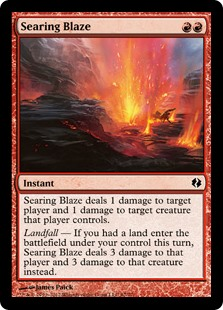
Some interesting cards present in greater numbers here are Grim Lavamancer (an early creature that puts discarded fetchlands and expended burn spells to use in the mid-game), Molten Rain (which helps compensate for this deck's slower clock against big mana and control), and the Searing effects. Searing Blaze and Searing Blood both remove opposing creatures while pressuring life totals, and as such give this deck more of a tempo feel than its aggro forefathers. This change in direction is reinforced by the inclusion of Harsh Mentor, a nondescript aggressive creature adept at punishing opponents for performing certain game actions.

Tempo decks sans Aether Vial are somewhat rare in the current format, which intrigued me enough that I decided to purchase the necessary components for this list and run it through some Magic Online leagues and two-person queues.

Minor Tweaks

However, I had a few quibbles with the list as presented. It only featured one legendary creature (a sideboard Jaya Ballard, Task Mage), and the absence of any cards penalizing me for running basic Mountains made Shinka, the Bloodsoaked Keep seem unnecessary. Jaya herself also seemed underwhelming, as her reusable Pyroblast-esque effect is a bit of overkill in a deck that already figures to be solid against blue-based interactive decks by virtue of the two-pronged pressure it applies. I had issues with Ricochet Trap for the same reason. Lastly, my experiences with Tormod's Crypt have strongly suggested it lacks the stopping power needed for most dedicated graveyard strategies.

This is the 75 I settled on for my initial testing.

Bomat Red v1, by Roland F. Rivera-Santiago

Creatures

4 Rampaging Ferocidon
4 Bomat Courier
4 Grim Lavamancer
4 Eidolon of the Great Revel
4 Harsh Mentor

Instants

4 Lightning Bolt
4 Searing Blaze
4 Searing Blood

Sorceries

2 Forked Bolt
4 Molten Rain

Lands

4 Bloodstained Mire
10 Mountain
4 Ramunap Ruins
4 Wooded Foothills

Sideboard

3 Damping Sphere
4 Relic of Progenitus
4 Smash to Smithereens
4 Shrine of Burning Rage

While Grim Lavamancer and Relic of Progenitus could potentially conflict with one another, I think the self-replacing upside of Relic is tangible enough to excuse it (an instance of acceptable tension). I also filled out the playsets for Smash to Smithereens and Shrine of Burning Rage, for differing reasons. Smash got the nod because artifact hate never goes out of fashion; Affinity is a pillar of the format, decks like Lantern and KCI are always lurking, and there are targets for it in a variety of other decks (such as Aether Vial in Humans). Shrine, on the other hand, is a card I have not played with competitively, and I was curious as to how it would perform. I presumed its purpose in this list was to serve as a catchall card to come in when Searing effects or Molten Rain are poor, and I wanted to play the maximum amount of copies allowed in order to give myself the best chance of evaluating how it would fare in that role.

The Testing

My testing preferences remain unchanged: I generally like giving a prospective list a 100-match trial to minimize the effect of variance on my assessments. However, I knew the timeline for this report would be insufficient to gather such a sample, so I decided to simply gather as much data as possible. My initial expectations were that the deck would hold up well against creature-based decks, but struggle against any deck where Searing Blaze and Searing Blood are dead cards. This would give it a well-defined niche as a deck excelling whenever creature decks are popular, which is a scenario we have seen in Modern before.

Since I faced a variety of different decks, I have decided to present some aggregated results in order to provide some additional information.

CategoryResults
Total Matches57
Overall Win-Loss29-28 (50.9%)
Creature Aggro Win-Loss
(Elves)
2-0 (100.0%)
Graveyard Aggro Win-Loss
(Dredge, Hollow One)
1-3 (25.0%)
Creature Combo Win-Loss
(Bogles, Counters Company/Evolution, Infect, Kiln Fiend)
5-5 (50.0%)
Vial Deck Win-Loss
(Death and Taxes, Humans, Merfolk, Spirits)
5-3 (62.5%)
Spell-based Combo Win-Loss
(Ad Nauseam, Storm, Thing in the Ice)
2-2 (50.0%)
Big Mana Win-Loss
(Gx Tron, Mono-G Devotion, Titanshift, Turbo Jace)
9-5 (64.3%)
Prison Control Win-Loss
(RW Prison, Lantern Control, Tezzerator/Thopter Sword)
2-2 (50.0%)
Midrange Win-Loss
(Jund, Mardu Pyromancer, Martyr Proc, Mono-B Devotion, RG Eldrazi)
0-6 (0.0%)
Ux Control Win-Loss
(UR Breach, UR Pyromancer, UW Control)
3-1 (75.0%)
Burn Win-Loss 0-1 (0.0%)

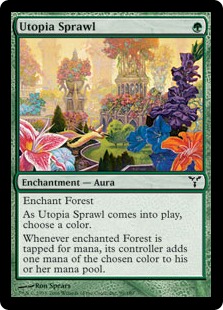
As illustrated, the deck has been rather hit or miss throughout the testing period, and some of that is due to pairings. Bomat Red indeed holds up well against creature-based decks of various kinds, and was generally solid against ramp/big mana decks. That's also unsurprising, as Searing effects can zap Arbor Elf to cause massive tempo losses. Molten Rain can also take out Urza's Tower, Valakut, the Molten Pinnacle, or a land enchanted by Utopia Sprawl.

Interestingly, the deck also performed versus blue control decks of various stripes, validating my decision to forgo playing Jaya Ballard, Task Mage and Ricochet Trap. It also suggests that Searing effects getting stuck in hand does not adversely affects these matchups too much.

On the downside, Bomat Red predictably struggled against graveyard-based strategies like Dredge and Hollow One, where its disruption is either insufficient or ineffective. It also was outright abysmal against midrange decks of all stripes, failing to win a single match. All too frequently in those matchups, my hand was either picked apart and I failed to mount a credible offense, or my hopes were dashed by spot removal on my refuel mechanisms followed by a sweeper. The deck also had a tough time with large creatures - anything from a Gurmag Angler to Hollow One to a Scavenging Ooze that goes unchecked caused big problems. The combo matchups were also highly polarized. Decks that I could interact with, such as Storm and Counters Company, yielded tight matches; decks where I struggled to interact, such as Ad Nauseam and Bogles, were uphill battles.

Digging Deeper

In addition these general observations on Bomat Red, I took detailed notes on each card's performance.

Maindeck

Bomat Courier: The deck's namesake has generally impressed. It gets bricked by pretty much anything, but stashing two or more cards under it is enough to make cracking it a profitable exchange, and the resulting refills have allowed me to close out the game.

Forked Bolt - Forked rarely takes down anything bigger than a mana dork on its own, the ability to damage two targets has rarely been relevant, and sorcery speed has occasionally been annoying. This feels like a spot that can be improved.

Eidolon of the Great Revel - A handy creature for pushing some extra damage through, either as an attacker or through its ability. Because Bomat Red is not quite as aggressive as Burn, pilots must exercise care when casting spells into Eidolon, especially against aggro.

Grim Lavamancer - Four copies feel excessive in matchups where Grim doesn't die, but it is often a priority removal target, and the deck feeds it well.

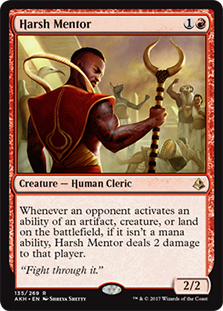
Harsh Mentor - This card has somewhat exceeded my expectations. Its effect covers a wide variety of common cards (fetchlands, manlands, and even Aether Vial), so it generally produces two to four damage in the first turn or so after entering the battlefield. It has been blanked, but only rarely.

Lightning Bolt - Not much to say here. Bolt's the most played card in the format for a reason.

Molten Rain - When this card is good, it's amazing. Some opponents never truly recover from getting thrown off-curve by it, and breaking up Tron, cutting off colors, or bashing manlands are all relevant tasks for Rain.

Rampaging Ferocidon - I was surprised by this card's strength. Three-mana creatures without enters-the-battlefield effects that also fail the Bolt Test are typically not successful in Modern, but Ferocidon has two highly relevant effects by shutting off lifegain and pinging opponents for casting creatures. A 3/3 with menace is also difficult to block when backed up by all of the removal this deck has at its disposal.

Searing Blaze - This Searing effect is the best of the two, mainly thanks to its increased stopping power and the fact that it damages opponents no matter what happens to its target. That said, only running eight fetchlands in such a mana-hungry deck occasionally complicates triggering landfall on the opponent's turn, so I have occasionally fired off the "unkicked" version.

Searing Blood - This card is somewhat weaker than its similarly named cousin, but more reliably provides reach against creatures that can't sacrifice themselves in response. Containing opposing creatures is a very high priority for Bomat Red, so I feel that having eight copies of this effect is appropriate.

Ramunap Ruins - This card was critical as flood insurance. We're quite mana-hungry, hence the 22 lands. However, our lack of cantrips sometimes makes us flood out in the mid-to-late game. I have closed out several matches by cracking these Deserts, and while the painful mana is an occasional bother, it's not enough of a downside to dissuade me from running the Ruins.

Sideboard

Damping Sphere - This card's inclusion was somewhat experimental, but Sphere has been a very strong contributor. Not only does it come in against the usual suspects (Tron and Storm), but it also helps against stuff like Infect and Kiln Fiend by making it harder for them to line up their pump and protection spells against our barrage of Bolts. The three copies have been exceptional, and I may look into clearing out some room for a fourth.

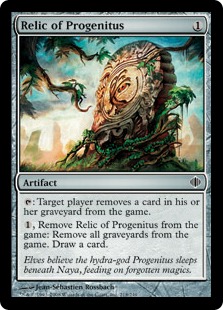
Relic of Progenitus - I went for the heavier-duty graveyard hate option, and I do not regret it. In fact, I may look for additional tools to complement Relic, as many of the decks I bring this card in against are pretty lousy matchups.

Shrine of Burning Rage - While I have certainly ended some games with a big Shrine activation, this card feels like the sideboard's weakest link. It's often a step too slow to matter, and as an artifact is somewhat vulnerable to splash hate from anyone looking to destroy Relics or Spheres. I am definitely in the market for a replacement option for creature-light matchups.

Smash to Smithereens - An excellent sideboard card. I even bring these in against utility permanents like Aether Vial; it might seem a bit narrow in such circumstances, but the payoff is high enough to mitigate the risk of it being a blank, and the presence of Bomat Courier's ability to get you a fresh hand means that even dead copies of the card are rarely going to sink you.

Marching On

Overall, this deck seems like it has some potential to be Modern-playable, but my rather uneven results and poor performance against midrange suggest this is not the optimal 75. I would consider cards such as Flame Slash or Roast to give the deck more bite against opposing fatties, and a consistency booster should also be experimented with. Faithless Looting is promising if the inherent card disadvantage can somehow be mitigated, as is a dual-use spell like Magma Jet. Alternatively, perhaps we imitate the Standard deck and look into how finishers such as Hazoret the Fervent and Chandra, Torch of Defiance would do.

While Bomat Red is the new archetype I've chosen to focus my energies on, there are several other cards that have real promise going forward. If you've been brewing with some unlikely candidates and come up with a new archetype you'd like to share, drop me a line in the comments.

Insider: MTGO Market Report for May 9th, 2018

Are you a Quiet Speculation member?

If not, now is a perfect time to join up! Our powerful tools, breaking-news analysis, and exclusive Discord channel will make sure you stay up to date and ahead of the curve.

Welcome to the MTGO Market Report as compiled by Matthew Lewis. The report will cover a range of topics, including a summary of set prices and price changes for redeemable sets, a look at the major trends in various Constructed formats and a "Trade of the Week" section that highlights a particular speculative strategy with an example and accompanying explanation.

As always, speculators should take into account their own budgets, risk tolerances and current portfolios before buying or selling any digital objects. Please send questions via private message or post below in the article comments.

Redemption

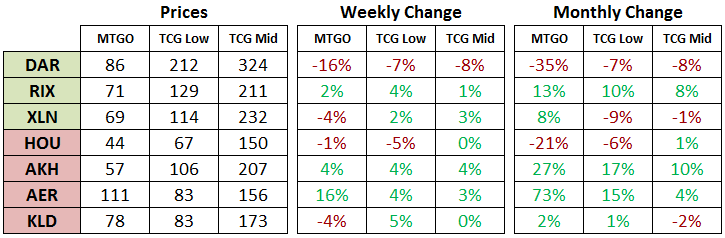
Below are the total set prices for all redeemable sets on MTGO. All prices are current as of May 7, 2018. The TCGplayer low and TCGplayer mid prices are the sum of each set's individual card prices on TCGplayer, either the low or mid price respectively.

All MTGO set prices this week are taken from GoatBot's website, and all weekly changes are now calculated relative to GoatBot's "full set" prices from the previous week. All monthly changes are also relative to the previous month's prices, taken from GoatBot's website at that time. Occasionally, full set prices are not available, and so estimated set prices are used instead. Although Hour of Devastation (HOU), Amonkhet (AKH), Aether Revolt (AER), and Kaladesh (KLD) are no longer available for redemption, their prices will continue to be tracked while they are in Standard.

Redeemable sets are highlighted in green and sets not available for redemption are highlighted in red.

Standard

With Ixalan (XLN) block draft now in the rearview mirror, it's time to check in on the full set speculative strategy as we near the end of redemption for both XLN and Rivals of Ixalan (RIX). A reminder, the original redemption cutoff date for both sets is May 23, 2018, but since both sets recently went out of stock it will work a little differently this time around.

When a set goes out of stock prior to the end of the guarantee date, Wizards of the Coast will commission a reprint, and then those sets will be available for redemption when ready, regardless of the date. Both sets are currently reprinted and so the cutoff date is a little looser this time around. We can surmise that there will be demand from redeemers when the reprinted sets become available, triggering a period of price strength. This will be the optimal time to be a seller if you are holding full sets of either XLN or RIX.

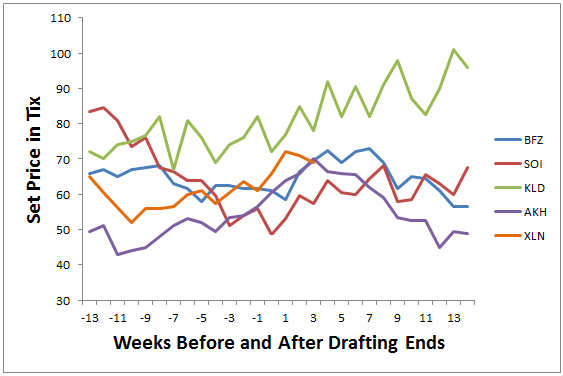
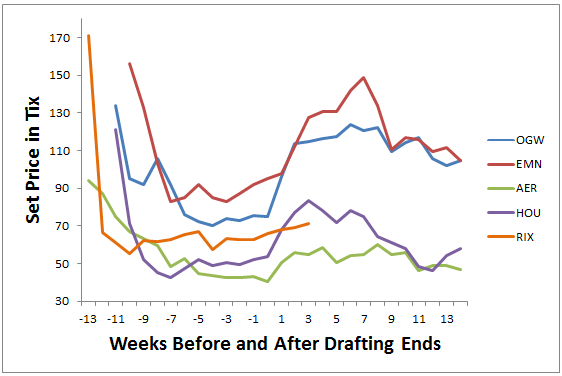
Checking in on the price graph for sets when they are no longer being drafted can give another clue to trying time a sale. XLN reached a peak in the mid-70-tix range two weeks ago, but it is right on track when compared to Amonkhet (AKH) and Battle for Zendikar (BFZ). Back in early April, I predicted it would hit a price range of 70 to 80 tix and this looks to have been accurate.

For RIX, this set has fallen off the pace when compared to Hour of Devastation (HOU) but it is still in an uptrend. I predicted a range of 70 to 90 tix for this set and it's reached that price range at the moment. It looks to be on track to at least hit 80 tix at some point in the next six weeks, most likely at the time when full sets become again available for redemption. We are entering the safe selling window for both RIX and XLN so close monitoring of the situation will be warranted into June and Pro Tour Dominaria (DOM).

Elsewhere, Aether Revolt (AER) is the little set that could, hitting a massive 111 tix on the back of two powerful artifacts, Walking Ballista and Heart of Kiran. The set is up a whopping 73 percent in the past month. Standard is hot right now and AER is getting the benefit this time around.

There was an error retrieving a chart for Sulfur Falls

A great resource which I like to check out every week is Chas Andres video series on MTGO finance that he produces for MTGOtraders. You can check out the latest video here. I don't always agree with his perspective on how prices will evolve for particular cards, but this week he was bang on in his assessment of the opposing colour check lands in DOM. They are excellent picks at current prices if you have a long-term perspective and can hold them past the fall and into next winter. Right now, they are just suffering from being constantly opened in draft and most of the top decks being either mono colour or are allied colours.

There was an error retrieving a chart for Inspiring Vantage

Buying the basket of all five lands is the safest way to speculate on these, but if you want to be contrarian than loading up on Clifftop Retreat could generate the biggest percentage gains. It's available for under 0.5 tix at the moment and it could easily hit over 2 tix in a fresh Standard metagame some time in the future.

Modern

Prices in Modern continue to be in flux but there has been some buying recently as tix get deployed into bargain-priced staples. One card that's been in a downtrend for over a year is Scapeshift. In the Treasure Chest era, it largely fluctuated between 20 and 30 tix before starting an extended slide last summer and hitting 10 tix in recent weeks. It's bumped up to 12 tix this week after Titanshift put two players into the top eight of the Star City Games Modern Classic in Baltimore this past weekend.

There was an error retrieving a chart for Scapeshift

I think decks based around Scapeshift have definitely been knocked down a tier as the Modern format has evolved and sped up. It definitely still looks like a metagame dependent deck that will occasionally make a splash, like this past weekend. It's got the raw power to win but benefits from players being unprepared, similar to Affinity in this regard.

Unlike Affinity though, the deck components don't show up in other archetypes. Mox Opal gets the benefit of also being a staple in Lantern decks. Scapeshift only shows up in, well, Scapeshift decks.

I won't be speculating on cards in this archetype in the near term but if the metagame shifts to favor this style of deck then a resurgence in price is possible and it will be worth paying attention to. I would want to see the downtrend on Scapeshift broken in the next two to four weeks to confirm this though which means at least a return to 15 tix to 20 tix. If it hits that range or higher, then it will be worth reassessing the potential for this deck and speculating on its components.

Standard Boosters

Draft sets of XLN block are back down to 5.1 tix, with value continuing to flow to RIX boosters over XLN boosters. They are looking more stable at this price in recent days and it looks like a price floor where players are no longer willing to sell boosters at these prices. With DOM draft still being explored though, there isn't much demand for XLN block draft though when I check the MTGO client there are usually a couple of drafts in various stages of completion.

Trade of the Week

For a complete look at my recent trades, please check out the portfolio. This week I took the advice of Chas Andres and put a few playsets of the DOM check lands away for the future. While these are being drafted the upside is not that high, but a long-term perspective will yield a nice return. This is a slam dunk for the patient speculator and you can get a volume benefit on your trades by including the original Innistrad (ISD) versions as well.

Daily Stock Watch – Shalai, Voice of Plenty

Are you a Quiet Speculation member?

If not, now is a perfect time to join up! Our powerful tools, breaking-news analysis, and exclusive Discord channel will make sure you stay up to date and ahead of the curve.

Hello, everyone and welcome to a new edition of the Daily Stock Watch! I hope that you've been browsing through a lot of Magic-related articles lately, particularly the financial ones, so that you get to stay in the loop of what's going on in the crazy world of our favorite card game. I've been doing some reading and one that particularly caught my eye was Adam Yurchick's article about Dominaria cards that he thinks will be major players in the market in the near future. Today, I'll be featuring one of my favorite cards from the set (which he also highlighted) which I think will really do well today, tomorrow, and in the following years to come.

There was an error retrieving a chart for Shalai, Voice of Plenty

A lot of angels are printed in almost every new set, and expectations are always high when you see one. Lyra Dawnbringer is the Baneslayer Angel reincarnate, albeit it's legendary, while Shalai, Voice of Plenty is in a world of her own even though it's just a rare card. It's worth nothing that this is already getting a lot of exposure in Modern just as Adam pointed out to, and I wouldn't be surprised to see this standing side by side with Lyra in the coming months. Blue White Control in Standard is a real deck and based on this winning list from SCG Baltimore Open, the best is yet to come for decks of its kind.

UW Control

Creatures

3 Lyra Dawnbringer
2 Shalai, Voice of Plenty
3 Walking Ballista

Instants and Sorceries

2 Disallow
1 Essence Scatter
2 Negate

Other Spells

3 Cast Out
2 Gideon of the Trials
3 Heart of Kiran
4 History of Benalia
4 Karn, Scion of Urza
3 Seal Away
3 Teferi, Hero of Dominaria

Lands

2 Field of Ruin
4 Glacial Fortress
4 Irrigated Farmland
7 Island
8 Plains

Sideboard

2 Fall of the Thran
3 Forsake the Worldly
2 Fumigate
1 Jace's Defeat
2 Negate
2 Raff Capashen, Ship's Mage
1 Seal Away
2 Settle the Wreckage

Raff Capashen, Ship's Mage gets booted out of this list as Walking Ballista makes its appearance in the maindeck along with the two angels that we've talked about earlier. Shalai gives the Ballista some nice protection as it prepares itself to become a bigger threat, and also gets some boost from Lyra with the lifelink assist off its ability. The rest of the deck is gasoline, with the re-emergence of Heart of Kiran (thanks to the knights that History of Benalia is producing) and some back up in the form of counter magic. The deck looks quite expensive on paper, but it sure is capable of producing wins just by sheer star power alone. Shalai will benefit from being included on this list, and expect to see more of her at the Pro Tour.

Dominaria Stars

We'll be seeing lots of these guys in the days to come, and that will also mean that there will be lots of action financially for most of them. Shalai has seen a steady decline since it was released, and it should continue to do so as more packs are opened (this set is really good so expect more supplies in the coming weeks) and lots of players will be looking to dispose their spare copies. I usually hate speculating on Standard cards and will only start doing so once rotation time is near, but rule of thumb says that multi-format stars are exceptions. I think that Shalai will be one of these cards from this set, and I'd start buying in as soon as it hits the $3 threshold. There's lots of room for growth for this card.

At the moment, you could get Shalai, Voice of Plenty from online stores such as StarCityGames, ChannelFireball, Card Kingdom and TCGPlayer for anywhere between $4.85 up to $6.49. It is very seldom that a rare gets to maintain its value in a heavily-opened set, so there might be some lull time on it being able to maintain this price tag. I'm looking to buy in at $3, but I'm not sure if that window will come anytime soon because of its popularity. Keep an eye on it in the coming weeks or months and get your copies once it hits rock bottom (or our buying price) as it should easily be a $5-$10 card in the future. Grabbing a few foils would also be nice.

And that’s it for today's edition of the Daily Stock Watch! See you again tomorrow, as we check out a new card that should be on the go, or good enough for speculating. As always, feel free to share your opinion in the comments section below. And if you want to keep up with all the market movement, be sure to check in with the QS Discord Channel for real time market information, and stay ahead of the hottest specs!

Insider: MTGO Block Staples to Watch – Time Spiral

Are you a Quiet Speculation member?

If not, now is a perfect time to join up! Our powerful tools, breaking-news analysis, and exclusive Discord channel will make sure you stay up to date and ahead of the curve.

Hi, guys.

Welcome back to another MTGO Block Staples to Watch. This week we will be visiting Time Spiral block, consisting of Future Sight, Planar Chaos and Time Spiral itself.

Each of these sets has powerful cards that are key parts of the Modern metagame. Future Sight, known for its unique card frame, also contains the most powerful vanilla creature ever printing, Tarmogoyf. Planar Chaos was the first printing of Damnation. Meanwhile, Time Spiral is where all the suspend cards like Living End and Ancestral Vision were printed.

I've talked so much about Tarmogoyf during the course of this column, I think I'll just skip the explanation part. Suffice it to say, this is definitely a card that should be on your watch list.

Next, we will look at two powerful lands from Future Sight: Horizon Canopy and Grove of the Burnwillows.

At one time Grove was heavily played in Tron, as RG was the only good version of that deck. Nowadays, players are exploring different color splashes to combat other decks in the meta. There was even colorless Eldrazi Tron, which my fellow countryman nasilemak used to earn many trophies on MTGO.

Recently, the red splash has become good again because the format is full of creatures with low toughness, making access to Pyroclasm valuable. Red also gives Tron decks access to artifact hate like Ancient Grudge and Abrade. As seen in the graph above, Grove is currently decreasing in price, which is the time we should be watching it closely.

Almost every deck playing green or white is interested in Horizon Canopy. It prevents flooding in the late game, trading one-for-one for a new card if you have no need for the mana. This card is played in at least five top-tiered decks in Modern and Legacy, which is why it's still so pricey after a few reprints.

Canopy fluctuates based on how popular the decks that run it are at the moment. As you can see in the graph, in each of these cycles the price can change by 20 tickets—sometimes much more. This card represents a huge opportunity for cyclical gains that you definitely want to be aware of.

Next we look at a powerful uncommon from Planar Chaos. Big Game Hunter appears occasionally in the Modern metagame. Several months ago, when Eldrazi was still popular, Big Game Hunter was used by black midrange decks to destroy Reality Smashers without having to pay the "discard a card" cost.

Recently this card has appeared again in Modern, but this time because of its madness ability. When it's played in decks like BR Hollow One, the player can discard this to any discard outlets, so instead of just throwing cards into the graveyard, the deck can do something profitable.

Looking at the graph, you can tell that you should grab this card for investment when the price goes below 1 ticket.

Boom // Bust was pretty broken back when players could abuse it with Brain in a Jar or cascade. Since the rules update that fixed that, the card has continued to see marginal play in certain land destruction decks.

The current price can't really go any lower, and I like these as an investment right now. MTGO players are constantly coming out with new ideas, and Boom // Bust is one of the top picks to brew around. I think this card has a good chance to increase to at least 2 tickets if and when someone makes it looks good again.

Ancestral Vision is one of the cards that came off the Modern banlist. Back then, Grixis Control became a dominant deck because of this card, but now it seems that control is temporarily overshadowed by aggro decks in the format. In my opinion, the control decks can no longer perform well because aggro decks are too fast. Drawing three cards after four turns is too slow, as the game will often end before Vision can be cast.

Anyhow, Modern is an interesting format where there are plenty of ways to cast spells for free—cascading into it, As Foretold, and so on. Maybe after a few months players online will manage to combine Jace, the Mind Sculptor, Bloodbraid Elf, and Ancestral Vision into a feasible deck? You never know!

Based on the graph, the price for Vision is dropping slowly. Make sure to get some playsets when it hits around 5.5 tickets.

To close we'll look at two lands from Time Spiral that I think are pretty low in price. First up is Gemstone Caverns.

Caverns is usually played in combo decks, or aggressive decks looking for acceleration. Caverns becomes enticing when a one-mana difference can gain you a great amount of advantage in the early game. It's similar to Simian Spirit Guide, except that it remains in play as a land for repeat uses. We often see Caverns alongside Blood Moon, Chalice of the Void, or Thought-Knot Seer, each of which can be devastating when cast a turn early.

As you can see above, the price is relatively low right now, so you can consider buying playsets of it for investment. While you are holding your pieces, you can also experience playing with it, as I bet many of you have not played with this card before.

It seems many online players have forgotten about the existence of Amulet Titan. Vesuva is staple in Amulet Titan, where it can copy any two-mana land or utility land in play.

Although it's less likely that this card will spike to a very high price, it can be an attractive penny-ticket pick. Basically, just use your spare tickets to buy some playsets of the card when you have nothing else to buy. Then wait for the price to go up by a bit so that you can gain that small number of tickets. Well, that's better than nothing!


Alright guys, that’s all for this week. Thanks for reading and I’ll see you again next week.

Adrian, signing off.

New Tricks: A Dominarian Merfolk Interlude

Are you a Quiet Speculation member?

If not, now is a perfect time to join up! Our powerful tools, breaking-news analysis, and exclusive Discord channel will make sure you stay up to date and ahead of the curve.

Merfolk has always been my workhorse Modern deck, but I haven't written about it in months. The metagame has shifted to a place I don't like with Merfolk, and so I've been playing other decks; as such, I had nothing much to say. However, I'm finding the deck's potential new includes from Dominaria promising enough to get back in the water.

This article describes the metagame developments that have turned me off Merfolk, as well as the new cards and how they impact the deck. I've found that while the new cards are certainly potent, there's not much need for them in the current metagame.

Metagame Considerations

Humans is on top of the metagame right now. This causes trouble for Merfolk, Firstly, Humans and Merfolk occupy a similar strategic space, but Humans has many advantages in the current metagame. Between its lower curve and mana acceleration, Humans can explode onto the battlefield with very large creatures, which is important since Lightning Bolt decks, particularly Jund, are back in vogue. Merfolk can do that too, but more slowly. The speed at which Humans dumps its hand also helps it dodges Modern's ubiquitous hand disruption spells.

A more pressing problem flows from the first. Because Humans is relatively prevalent, decks are being tuned to fight back. That preparation results in splash damage for Merfolk, most damning of all an increase in sweepers. Merfolk can deal with lots of one-for-one removal; the deck is mostly creatures and has cantrips, so opposing decks tend to run out of answers before we run out of threats. Kira, Great Glass-Spinner also invalidates one-drop removal.

Sweepers are far harder to deal with, especially in numbers. I'm seeing UW Control, which was never a great matchup, running Terminus, Supreme Verdict, and Wrath of God. Tron has always had Oblivion Stone and Ugin, the Spirit Dragon, but now I'm also seeing Pyroclasm, Anger of the Gods, and Kozilek's Return. One sweeper can be recovered from; two is often lethal.

Combo Rising

Between Matt Nass winning GP Hartford with Ironworks combo, Grishoalbrand showing up in Toronto, and Storm's tendency to simply hang around, true combo is increasingly present in Modern. This development hurts Merfolk, whose primary strategy is to race. In the past, this was fine, because Merfolk's goldfish speed sat at a reliable turn four, while combo decks were very inconsistent. This is no longer the case, and more often, turn four isn't good enough. With the addition of Baral, Chief of Compliance and Gifts Ungiven to Storm and Scrap Trawler to Ironworks, combo finally has the pieces to reliably kill fast instead of fizzle.
This is why Humans is doing so well. Again, Humans is a linear tribal deck like Merfolk, but it features intrinsic disruption in Kitesail Freebooter, Meddling Mage, and Thalia, Guardian of Thraben alongside the fast, growing clocks of Champion of the Parish and Thalia's Lieutenant. Subsequently, it doesn't usually lose game one to combo. Merfolk only has Cursecatcher in those matchups, and so can be easily raced, helping push Merfolk out of the metagame.

The New Fry

The most exciting Dominaria card is Merfolk Trickster. The Last time Merfolk got a blue candidate was Harbinger of the Tides back in Origins. After the greenfolk didn't work out, it's nice to see fish returning to where they belong.

Of course, new additions have their work cut out for them. While Merfolk will always welcome a new lord, other creatures need to really shine to be considered. The potential speed boost was enough for Kumena's Speaker, but Merfolk Branchwalker didn't do enough to earn a permanent place. Trickster is appropriately priced at two mana, and boasts a disruptive and potentially relevant ability. These are huge points in its favor, but the fact that it is clearly intended as a tempo card rather than a value one gives it stiff competition.

In Comparison

Trickster is therefore fated to be compared to the other two-drop tempo Merfolk, Harbinger of the Tides. I've never been a fan of Harbinger, but it caught on anyway. I don't like how tough it is to use Harbinger offensively because it can only bounce tapped creatures. Harbinger has always been at its best in racing situations. Being able to knock out an attacker, even for a single turn, can mean the difference between victory and defeat, especially if the creature is hard to replay like Gurmag Angler or has been boosted like Champion of the Parish.

Trickster can be used similarly to swing races, but its greatest ability is clearing out defenders. Tapping creatures may not be as powerful as removing them from play, but in a tempo deck, it can be functionally identical. The additional text after the tap ability is irrelevant in most creature matchups; critically, the creature will not attack or block for a whole turn, allowing Merfolk to swing through for the win.
The final consideration is flash. Trickster has flash all the time, while Harbinger requires additional mana to deploy at instant speed. This is obviously better in terms of using Trickster as an, erm, trick, but it also has other applications. It's often been argued that Harbinger's flash made it better than I thought just because it could be flashed in against control. I disagree with that argument, as four mana is often far too steep a rate for a 2/2. At two mana, Trickster is far more reasonable in this role.

The Key Difference

However, Merfolk Trickster has much wider implications. While the second line of ability text is often irrelevant against fair decks, it is incredibly important against unfair ones. Trickster removes all abilities from the targeted creature. That includes evergreen abilities like prowess and flying, power and toughness setting ones like Master of Etherium's (killing it), and special abilities like those of Goblin Electromancer and Scrap Trawler. Trickster can be an anti-combo creature rather than just a tempo play.

In my opinion, this gives Trickster a literal fin up on Harbinger. Eliminating the critical enabler creature often cripples Storm or Ironworks. Storm doesn't strictly need a cost reducer to go off, however enabled kills come far easier. The same is true for Ironworks, but even more so: it is technically possible to win simply by chaining eggs with Krark-Clan Ironworks, but the deck is far more likely to fizzle without Trawler.
So, I believe that Trickster is better than Harbinger in a vacuum. However, Modern is not a vacuum, and right now Humans is the best deck. Thus, Harbinger gets the nod over Trickster until things change.

Game Changer?

The other card that has been getting attention for Merfolk is Wizard's Retort. I was a bit incredulous, but testing has shown it to be more plausible than expected. Surprisingly, all the Modern-playable blue non-lord Merfolk are Wizards, so it's easier than I thought to have Retort be Counterspell, which was a Merfolk staple back in the day. Hard counters are usually very strong, especially against combo, so it makes sense that Modern Merfolk would want Retort.

However, just jamming Retort really isn't enough. Because the lords don't count for Retort, and they're a necessary 11-12 slots, we must work around them. There's limited maindeck space for non-Merfolk creatures, and Retort requires maximizing the Wizard count. Realistically, Retort will be the only interactive maindeck spell. This is fine, since Harbinger is technically a bounce spell and Trickster is also interactive. Kira is another awkward creature, but can be replaced by the weaker Kopala, Warden of Waves. Here's my starting point:

Dominaria Merfolk

Creatures

4 Cursecatcher
4 Silvergill Adept
4 Lord of Atlantis
4 Master of the Pearl Trident
2 Merfolk Trickerster
3 Merfolk Harbinger
3 Merrow Reejery
2 Kopala, Warden of Waves
2 Master of Waves

Artifacts

4 Aether Vial

Enchantments

4 Spreading Seas

Instants

4 Wizard's Retort

Lands

8 Island
4 Wanderwine Hub
4 Seachrome Coast
4 Mutavault

The Catch

While I found Retort to be reasonable in Merfolk, it never blew me away. It wasn't very hard to have a wizard in play by turn 4-5 when we'd want to keep mana up for counters, but Counterspell itself wasn't always relevant. Having a cheap, hard counter is very good against Tron, Ironworks, and Storm, but Affinity, Humans, and Hollow One will have done whatever they're going to do by then, while counters aren't very special against Jund or Jeskai. If the meta swings more toward combo, then Retort is definitely strong, but being weak against the most popular deck is a huge strike against the card. Also worth mentioning: Retort gets awkward around Mutavault, which counts as a Wizard but doesn't tap for blue.



One thing to consider is whether Retort can replace sideboard cards, as specialized counterspells are a staple of Merfolk sideboards. I'm not sold on that plan's practicality. Leaning too heavily on the four Retorts renders them overstretched and ineffective. Also, sometimes, we want more than one type of counterspell in a matchup. Another issue is impact: counters are necessary sideboard cards, but they're rarely high impact ones. How often do we actually want a counterspell? If the answer is "often," the sideboard must be focused on an anti-aggro package. I'm not ready to make that dive, and will be sticking with maindeck Path to Exile and Echoing Truth for the moment.

Swim Along

While I don't think the new additions will automatically bring Merfolk back from obscurity, they could be enough to return Fish to my toolbox. Trickster is far easier to effectively wield than Harbinger, and more generally useful; on the other side of the coin, Retort is terrific in the right metagame. As far as these new cards are concerned, though, everything depends on whether those correct metagames emerge.

Unlocked: An Objective Comparison of Magic and Real Estate

Are you a Quiet Speculation member?

If not, now is a perfect time to join up! Our powerful tools, breaking-news analysis, and exclusive Discord channel will make sure you stay up to date and ahead of the curve.

Last week I was meeting with a co-worker when he brought up a fairly controversial topic. There is a shortage of affordable single-family homes in hot markets, such as Seattle, due to zoning restrictions and real estate moguls impacting the market. These big shots ensure that new construction continues to be high-end homes, with price tags that are prohibitively expensive to newcomers. There’s an effort to lobby for more affordable housing, but this is being met with resistance.

There’s an article on the subject published online at Politico Magazine, and it’s an interesting read. It’s titled, “My Generation is Never Going to Have That,” and as my co-worker and I discussed this sticky situation it reminded me of Magic.

In fact, there are many eerie parallels between this article on the housing market in Seattle and Magic finance, especially concerning the Reserved List. If you read through the article and replace “homes” with “Reserved List cards,” you have an article that describes the haves and have-nots of Magic. There’s a quote further down in the article that strikes the chord perfectly: “Such nakedly self-interested politics have been all the more insulting to millennials, a generation that…puts a huge store in fairness… [M]any millennials find themselves looking at earlier generations and asking, 'You got yours, and now you don’t want anyone else to have theirs?'”

Sound familiar? While the article is talking about real estate, this could just as easily describe the current issue of disappearing Reserved List cards—especially dual lands and Power. This week, I’m going to dive into this controversial issue headfirst and attempt to share some objective perspectives from both sides of the debate. Perhaps there’s something from the real estate market history books we can use to predict the direction of MTG finance?

The Just-Missed Generation

Magic’s an old game—25 years old to be precise. I don’t know the age distribution of players, but I do know there are many players out there who are younger than the game itself. When you expand the population to include those who were infants or small children when Magic started, you have an even larger base of players who have never touched a piece of Power or a dual land.

Now imagine a scenario where these younger players are watching Legacy coverage on Twitch. They see the amazing power of dual lands, Brainstorm, Force of Will, and The Tabernacle at Pendrell Vale. After watching hours of coverage, they decide that Legacy looks like a ton of fun, so they want to build a deck and get involved.

Then they look up prices…

There was an error retrieving a chart for Underground Sea
There was an error retrieving a chart for The Tabernacle at Pendrell Vale

This must be one of the most disheartening experiences for a young player. To want to play a really fun game, and then not being able to because prices are prohibitively high. Then they see some big shot like Rudy of Alpha Investments making videos where they have piles of these cards sitting around not being played. This is a brutal combination that can really strike an angry nerve for newer players.

They look at these older, enfranchised players and they surely think to themselves, “you got yours, and now you don’t want anyone else to have theirs.” Many Legacy and Vintage players are in their 30s and 40s and have been enjoying these amazing formats for years or even decades. The older players have been around long enough to remember a time when dual lands were $15 and Power was $300. Because they started playing long ago, they can afford to sit on these four- and five-figure decks because their initial buy-in was much lower.

But with recent buyouts and manipulation, it leaves newer players empty-handed. They want to enjoy some of the best formats in Magic but cannot. Much like new homebuyers in Seattle, millennials want access to the same opportunities in Magic. But the reality is, they are locked out.

The Economist Mindset

In the United States, it is a privilege and not a right to live in a large single-family home. Almost everyone would agree that every hard-working individual deserves a home and a feeling of safety within that home. But does everyone deserve a five-bedroom, three-bathroom house in a gated community? Probably not.

So then why are these millennials so upset they can’t afford these million-dollar homes? If they can’t afford to live there, then they should live elsewhere. There are plenty of nice homes in other Seattle suburbs that are far less expensive and likely just as safe and perfectly sufficient. Does every newcomer need to start at the top?

This is the other side of the coin in both real estate and Magic. Players who have been involved with Magic for many years have opportunistically amassed a valuable collection through intelligent acquisitions, stalwart dedication to their favorite game, and a bit of luck. Why should they sacrifice their enjoyment of the hobby? No one has a right to own a set of Power 9—this is a luxury good and should thus be treated as such.

There was an error retrieving a chart for Black Lotus

Just as there are plenty of affordable homes in other Seattle suburbs, there are also plenty of affordable ways to enjoy Magic. Every new player doesn’t have to play Legacy and Vintage—they can have a ton of fun playing Modern, Commander, Standard, Cube, Draft, and 101 other affordable formats. And if they want a kitchen table game where they can feel the exhilaration of casting a Black Lotus, can’t they just proxy the card? There are so few opportunities to play sanctioned Vintage nowadays that it really shouldn’t matter that the card is worth so much.

In the current environment, Magic’s secondary market is unregulated and a thing from the Wild West. If someone has the resources to buy a ton of copies of a given card, there are no laws against it. People can do what they want with their money. And since we’re talking about a game here and not someone’s livelihood (food, shelter, water), how much does it really matter?

A Look at the Housing Market

Thus, the two sides of the debate are presented. I did my best to share both perspectives objectively. I’m sure I will anger some individuals with an insensitive remark, but understand I did my best to share two mindsets without presenting my own position. In reality, my position is irrelevant to the conversation. It’s an opinion like everyone else’s.

What may be more relevant is an investigation of the real estate market’s history. If there is such a parallel between housing and Magic, then maybe we can extrapolate past events in the housing market to predict what may happen in the Reserved List Magic market.

In my research, I came across this article, describing the Real Estate market in six charts. One such chart indicated interest in home buying. As you’d expect, the graph oscillates between peaks and valleys like most markets. During the Great Recession, interest hit a low. Currently we are approaching highs. This corresponds to home prices as well, which hit lows in 2009 and are now rebounding quite nicely in 2018.

Is there a parallel curve in Magic? Of course! It’s not explicitly drawn or tracked, but I suspect there are some common themes. During the Great Recession, people probably had less expendable income and so interest in high-end Magic cards may have cooled off. And as the economy has rebounded, so has interest in investable cardboard.

There are other confounding factors too, I’m sure, such as the popularity of Standard, the introduction (and sunset) of the Star City Games Legacy Open series, and the printing of various Masters sets. But I think we can all agree that the traffic of prospective buyers of Reserved List cards is quite high right now.

There may be a split between real estate and Magic in the next graph: the supply of new single-family homes.

It’s no surprise to see this value tank in 2009—demand hit an all-time low so new supply also tanked to adjust to that market. Since then, the new supply has gradually risen. Unfortunately for prospective home buyers, the demand has outpaced the supply. This has driven single-family home prices higher as discussed in the other article. But at least there is a gradual rise in the rate of new supply hitting the market. Presumably this trend will continue until an equilibrium is identified between new home buyers and new homes available to purchase.

Want to know what this graph looks like for Reserved List cards?

The magnitude is chosen arbitrarily, but the shape of the curve is accurate. Well, technically there were a few foil reprints of Reserved List cards, but you get the idea. The supply of dual lands, Power, and other key Reserved List cards has not changed in 20-25 years. You could even argue that the supply has dropped over the years as copies are destroyed, lost, etc.

So we are operating in a world where demand for Reserved List cards oscillates and the supply remains flat. To me, this implicates a scenario where prices will fluctuate drastically with demand. Over time, as supply slowly drains, prices will steadily climb higher and higher. There will be short-term dips as demand dips, but the trajectory over a long time horizon will remain upward and to the right. It has to as long as there’s no systematic drop in demand.

For now, the housing market can adjust to newfound demand with the building of new homes. In Magic this option is not available—thus in a market where demand for new houses and Reserved List cards move in tandem, price appreciation of Reserved List cards will outpace price appreciation of houses.

Wrapping It Up

Based on this assessment, I have some good news and some bad news for those trying to acquire Reserved List cards. The bad news is, as long as there cannot be new supply of these desirable cards, their prices will climb as long as the demand for them remains. Barring a collapse in the secondary market, there is no other possible outcome.

The good news: at least we’re only talking about a card game. If the housing market had a Reserved List and new houses could not be built for some reason, the skyrocketing of home prices would be a huge issue. People deserve a roof over their head. It’s fortunate the home-building industry is gradually responding to the recent rise in demand; this market will slowly adjust. That can’t happen in the Reserved List Magic card market. But fortunately the roof is the necessity and the cards are the luxury. If it were reverse, we’d have much bigger issues!

The good news may not offer much consolation to those who wish to play competitive Legacy and Vintage. But this is the current reality, so it’s all I can offer. I’m not making the rules—that’s all Hasbro and Wizards of the Coast—I can only respond to the rules accordingly. With an objective mindset, that’s all one really can do. In the meantime, let’s sit back and watch as things unfold.

…

Sigbits

  • Dual land prices continue to rise, and buy prices have moved up in tandem. Tropical Island now buylists for $205 at Card Kingdom and Bayou buylists for $200—the third and fourth dual lands to crack the $200 mark. Scrubland is the next dual to break through the $100 market, now buylisting for $105. Eventually they’ll all buylist for over $100—it’s just a matter of time.
  • Underworld Dreams from Legends has really moved lately. This took me by surprise. Now Card Kingdom is paying $49 on their buylist. This isn’t a Reserved List card. It’s just one of those original printing Old School-playable cards that sees steady demand.
  • Let’s talk for a moment about Chaos Orb. Card Kingdom hasn’t adjusted their pricing to reflect recent market conditions yet. But one look at some completed eBay listings should give you a feel for what has happened. Played Unlimited copies are now selling for over $600 and nicer copies are breaking the $1000 barrier. I suspect there are some manipulative players in this market, so buyer beware. But if you want to play Old School, this is one of those auto-include in most decks and they’re just impossible to find nowadays. Personally, I’d rather spend this kind of money on Power.

Want Prices?

Browse thousands of prices with the first and most comprehensive MTG Finance tool around.


Trader Tools lists both buylist and retail prices for every MTG card, going back a decade.

Quiet Speculation