Are you a Quiet Speculation member?
If not, now is a perfect time to join up! Our powerful tools, breaking-news analysis, and exclusive Discord channel will make sure you stay up to date and ahead of the curve.
Greeting QS Insiders. It's now time for me to dive into the data I presented on Wednesday and also discuss the observations that aren't visible in the data. November is going to be a bit odd in this regard as the observable data doesn't look dramatically different from October. However, that is a bit deceptive, and there's a lot going on beneath the surface. Modern is seeing a burst of brewing which might be a flash in the pan, or it could really turn into something. If it can break through the established players, which is looking... potentially possible. With an asterisk.
The Meta Shift That Wasn't
The first thing to address is the question posed by my previous analysis article in October: what effect will The Brothers' War have on Modern? I can now say that the answer is almost none. It's rather anti-climactic, but very few cards have made it into Modern decks at all and none have had any measurable metagame impact. Haywire Mite has seen the most play, as it's in pretty much every Urza's Saga deck which can produce green mana. It even inspired an attempt to make Insect Tribal a deck. The deck has (many) more legs than I'd expected, but hasn't really done anything in the wider metagame.
Outside of Mite, both The Stone Brain and Loran of the Third Path are seeing sideboard play. However, where Loran is seeing more play than I expected, Brain is seeing a lot less. Despite certain expectations, Prison Tron did not see a persistent surge of play, nor did it put up results. As expected, it was popular for the first weekend, then immediately fell off.
Brain does not fix any flaws in the deck. It wasn't good before BRO, and Brain doesn't move the needle enough to change anything. Bitter Reunion is still seeing some niche play as a supplement to Fable of the Mirror-Breaker.
Thinking With Portal
Which isn't to say that BRO might not eventually shake up Modern. There were also expectations for Portal to Phyrexia, both on its own and alongside Shape Anew. As of this moment, those expectations have not been met. There have been dedicated combo decks around the card, but they didn't put any results into my data. There have been some 4-Color Control lists that include the combo, but the current evidence suggests that their success is more down to the rest of the list than the combo itself. In which case, Indomitable Creativity would be better.
That said, there is potential here. Portal is quite expensive, but has two very powerful effects. The current lists all look too cute and/or janky to me, which explains why they're not currently working. With some more refinement, I could see this becoming a Splinter Twin-esqe combo for Modern control decks. However, there is a lot of tension and clunk to work out first.
The Wildcard
On that note, Sarinth Steelseeker has seen unexpected play. Everyone can thank aspiringspike for that; he's single-handedly revived interest in the Hell's Kitchen deck by incorporating Steelseeker. That deck didn't last because unless (deep breath) Asmoranomardicadaistinaculdacar hits play, the critical central engine does nothing. Even when the engine is going, the rest of the deck proved too anemic to cope. Spike has fixed this by adding Wrenn and Six, because adding good cards is always a good move, which makes Saga stronger.
More pertinently, he added Steelseeker, giving the food engine something to do besides fuel The Unpronounceable One. With Steelseeker, every food is an opportunity to rip though the deck and find the few good cards. This has increased the consistency and therefore the power.
However, it's not enough. Spike and all the other Food players did abysmally in the Modern Showcase Qualifier. Food remains a fringe deck, but I now believe that Steelseeker does have untapped potential. How it can be captured is anyone's guess at this point.
The Three-Outlier Metagame
From the hypothetical to the actual, the metagame is beginning to split between the online and paper metagame. Where the online metagame is essentially a continuation of pre-BRO trends, the paper metagame is going another way. It's not exactly rejecting the online trends, but it's not following them either. The reasons for this at the moment are transitory and this could all be moot by the next metagame update. Or there could be a major change in the winds incoming.
All Those Outliers
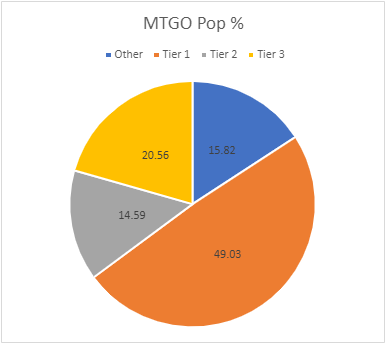
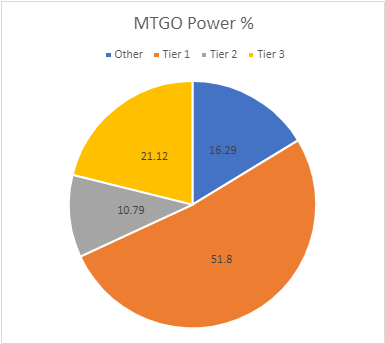
Addressing the elephant in the room, Magic Online (MTGO) not only produced three statistical outliers, but they're also outliers by a significant margin. Such a margin that I didn't both with my usual battery of statistical tests because the result was obvious. The overall metagame is being inexorably twisted around the pillars of UR Murktide, Rakdos Scam, and Hammer Time. It's not because they're so much more powerful than other decks, as evidenced by their winrates. Rather, these decks take up so much of the metagame that every other deck must be ready for them.
The question then becomes how and why this has happened. The how is straightforward: they show up a lot. Specifically, these three decks show up to an inordinate amount in the Challenges. While Hammer and Murktide do make ok showings in the Preliminaries, they really turn out for the Challenges. Scam takes this to an extreme, rarely showing up in smaller events and doing exceptionally well in the big ones. This is literally driving out the other decks, leaving only the three outliers.
The why is more complicated. No outlier deck has any particular natural advantage over the others, and each deck has a high enough power level to take any deck on. Murktide has been an enigma all year, being a deck that is absolutely everywhere despite an average win rate. Hammer and Scam are strong decks made outlier strong by the potential for free wins. Hammer can outright win on turn 2 several ways with a god draw. Scam can't outright win early, but it does feel that way when it evokes Grief into Feign Death on turn one. These lines negate some of each deck's weaknesses and make them major metagame players.
The Consequence
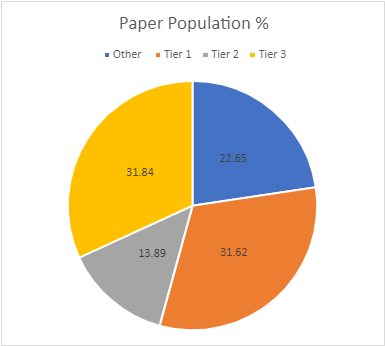
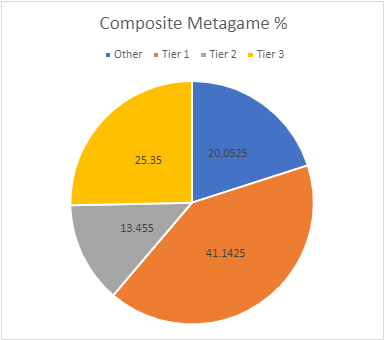
While neither deck being extremely popular is a problem on its own, the context and implications are more harrowing. Just look at the rest of the tier chart; the outliers account for over a third of the total results, and exceed their nearest competition by nearly 50% at minimum. Every other deck has cards in their sideboards (at minimum) specifically for the three outliers. Quite literally, all other competition is being crowded out.
When the only consistent outlier was Murktide, this wasn't really a problem. On its own, Murktide was never more than ~13% of Modern, which left plenty of room for other players. Even when it was joined by other decks, they accounted for less than 25% of Modern. This is damning by faint praise, but that's pretty typical for Tier 1 decks. However, the concentration in November is troubling. If it is sustained, there may need to be action to force the online metagame to diversify.
The Counterpoint
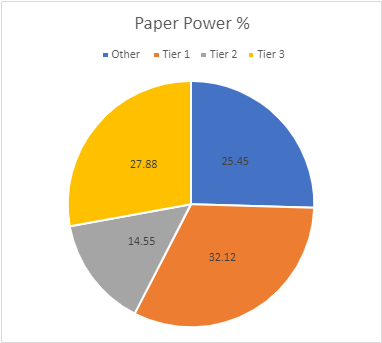
Such action would be unfortunate. The paper metagame looks very healthy. November is the second consecutive month without any outliers. It's also the first month since April where Murktide is not the top deck in paper. It is possible that this represents a genuine change in player taste and thus the metagame. It is also possible that it's a function of Modern being out of the spotlight, replaced by Pioneer. I have no way of knowing.
In fact, looking through the paper results (and online, to an extent) reveals a metagame that is very diverse both in terms of individual decks and strategy. The midrange and 4-Color decks are far less prevalent in paper than online, and there are combo decks doing well in the higher portion of the tier list. The MTGO results have that too, but more of them are sneaking in at the bottom of Tier 3. Therefore, they only made the list thanks to my accounting for outliers.
Outside of the warp on MTGO, Modern doesn't look like it needs intervention. There are things that could be improved, but the metagame is generally fulfilling the health criteria. The MTGO warp is the only visible problem, and that's mostly down to player tastes. It would be shame to ruin it for everyone because MTGO chases its own tail, but doing so might be the only way to fix that meta.
Year-End Outlook
What this means for the financially minded out there is unclear. On the face of things, the Modern metagame status quo will remain until at least January. Whether the worrying aspects will be sustained as well is impossible to say, but I don't believe that we'll see anything truly new to shake things up without Wizards intervening before Phyrexia: All Will Be One.
Of course, this is tempered by it now being December, a month when competitive Magic traditionally takes a breather. Prices always fall and so do sales. The traditional advice is that this is the time to pick up staples on the cheap and build inventory for the coming year.
While competitive Magic isn't what it once was, there is a new Modern tournament series coming to the US West Coast in 2023. The east has been well-served by both Star City Games and NRG, but there's never been anything like them in the west. This new series, limited though it will be, will drive demand for Modern staples in 2023. Thus, the old advice is still good.
That Controversy
Of course, I can't get away with any finance piece without mentioning all the controversy over Hasbro's actions vis-a-vis Magic, which the QS team has also weighed in on in article form. With the Magic 30 packs apparently failing to sell and Hasbro announcing that it intends to continue and expand its current policies, the financial Magic world is roiling. I don't need to reiterate to the Insiders the conversations happening on the QS Discord over this debacle. The thing is, I'd imagine that everyone reading this has already made up their minds about what they feel about everything, and nothing I say will change your mind about MTG finance in the near future.
Instead, let me remind everyone of one fact: Magic is the best-selling, most popular trading card game. Period. The game itself isn't going anywhere. The fact that a new tournament series is coming next year is proof of that. For those looking to make money buying and selling cards, that door will always be open. It is those seeking to hold cards as long-term investment opportunities that are affected. I've always been addressing everyone here as players looking to move cards and not investment types, and for those people the end of 2022 should be business as usual, with improved business conditions on the horizon.
Here's to the End
The holiday season is upon us and will be done when next I write this article. I hope everyone has a joyous season of whatever you celebrate and may your purchases be low and sales high. See all you Insiders in the new year!