menu

Early Insights from Magic 30 Research

Are you a Quiet Speculation member?

If not, now is a perfect time to join up! Our powerful tools, breaking-news analysis, and exclusive Discord channel will make sure you stay up to date and ahead of the curve.

Another week has gone by, which means we are one week closer to the Magic 30 celebration in Las Vegas at the end of the month! My anticipation is mounting exponentially as I organize my collection, make upgrades to my Vintage deck, and network with friends across the community to maximize my time in Sin City.

As I’ve begun preparation, I picked up on a couple of valuable Magic finance tips along the way. These may be specific, but they have the potential to be helpful to others who may be going through a similar thought process. If nothing else, these updates will provide full transparency to how I’m approaching the game in its current state.

Vintage Tweaks

After signing up, I mentioned my intention to play in a sanctioned Vintage event to a Magic friend and Quiet Speculation member, @Cardbreaker (Matt), on Discord. When he asked me about the deck I was playing, I quickly realized my build may be quite obsolete. For example, a cursory look at a couple of recent lists would indicate that Yawgmoth's Bargain isn’t really played in Vintage Storm decks any longer.

There was an error retrieving a chart for Yawgmoth's Bargain

To help me out, he sent me a link containing a recent, successful decklist that most closely resembles the one I currently have built. Here's the list:

Vintage Storm MTGO Challenge 9th Place by achillies27

Artifacts

1 Lotus Petal
1 Bolas's Citadel
1 Black Lotus
1 Lion's Eye Diamond
1 Wishclaw Talisman
1 Sol Ring
1 Mox Sapphire
1 Mox Ruby
1 Mox Pearl
1 Mox Jet
1 Mox Emerald
1 Mana Vault
1 Mana Crypt
2 Defense Grid

Instants

1 Vampiric Tutor
1 Mystical Tutor
1 Hurkyl's Recall
1 Chain of Vapor
1 Brainstorm
1 Ancestral Recall
2 Cabal Ritual
4 Dark Ritual

Sorceries

1 Yawgmoth's Will
1 Tinker
1 Timetwister
1 Time Walk
1 Tendrils of Agony
1 Ponder
1 Mind's Desire
1 Gitaxian Probe
1 Demonic Tutor
3 Preordain
3 Dark Petition
4 Duress

Enchantments

1 Necropotence
1 Underworld Breach

Lands

1 Volcanic Island
1 Tolarian Academy
1 Badlands
2 Bloodstained Mire
3 Underground Sea
4 Polluted Delta

Sideboard

1 Tormod's Crypt
3 Pyroblast
1 Narset, Parter of Veils
1 Karakas
2 Fatal Push
1 Empty the Warrens
1 Blightsteel Colossus
3 Hurkyl's Recall
1 Chain of Vapor
1 Defense Grid

I really liked the updates this list has implemented, including the addition of Underworld Breach, a card I didn’t even know about from Theros: Beyond Death. It was easy enough to pick up a copy of the red enchantment, along with a Wishclaw Talisman and Bolas's Citadel.

The one missing piece, then, became the pesky Volcanic Island that shows up in the manabase above. Previously, I was content to play a lone Badlands as the red mana source for my deck, since the only red spell I had in the main deck was Wheel of Fortune. In adding a second, it forced me to consider also including a second reliable red mana source (Mox Ruby isn’t exactly searchable with a fetch land).

Unfortunately, Volcanic Island has dethroned Underground Sea as the most expensive Dual Land. This meant my $20 investment for deck improvements would have to become more like $500. Of course, investing in Dual Lands isn’t a terrible thing. I’ll be able to recoup most if not all of my costs should I decide to turn around and sell the card again. However, I still wanted a good deal on it.

There was an error retrieving a chart for Volcanic Island

TCG low for heavily played copies started at about $470 plus tax. That’s not terrible, but without pictures, it was a riskier endeavor. Heavily Played on TCGplayer can mean a very wide range of conditions. I really didn’t want something creased and worn out like it was rubbed on concrete at a middle school playground for years.

Next, I ran a search on eBay. I didn’t find any attractive deals there, but I did note that Dave & Adams Card World had a few in stock. Most times I see Dave & Adams Card World listings on eBay, I can visit their site directly and purchase the same item at a lower cost. This was precisely the case this time—their HP copies were posted at $474.95. This is in line with TCGplayer, but at least for me (living in Ohio), there would be no sales tax from this store.

One last question remained: condition. I emailed the store, and they got back to me with pictures after 24 hours. I asked for the best-looking copy, and they set it aside for me! Talk about great customer service!

Shipping was free and quick, and the card is in my hands now ready to be shuffled up in Las Vegas. From my eye, the condition is borderline moderately played and was a very fair price relative to the open market. If you haven’t shopped at Dave & Adams Card World, I highly recommend it. They don’t have the widest inventory of Magic, but the things they do have are often priced well. If you’re making a large enough purchase, there can also be an opportunity to call them up to negotiate on price.

Researching Alpha Cards to Sell

Besides the events I registered to play, another major goal of mine at Magic 30 is to sell a decent portion of my collection. I haven’t quite decided yet what “decent portion” means, numerically, but suffice it to say I want to be a net seller at this event.

To facilitate negotiations, I’ve begun researching the values of my cards online to see what they fetch on the open market and what vendors are offering online. It may not come as a surprise to some, but I was personally shocked at how soft prices have gotten recently!

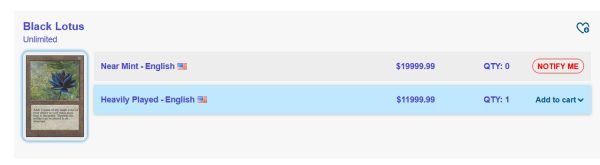
As a simple example, consider the big kahuna of Magic, Black Lotus. I could have sworn heavily played Unlimited copies of this card reliably sold for $10k-$12k. First, no vendors are paying that much for HP copies of this card. Second, recently sold copies on eBay are more in the $9k-$10k range. It doesn’t matter that Card Kingdom is sold out; they just don’t pay particularly well on copies that would be graded as “Good.”

There was an error retrieving a chart for Black Lotus

I see Star City Games has an HP copy in stock, listed at $11,999.99. With the 10% discount on singles for SCG Premium members, this equates to $10,800, which I thought was a fantastic price. Apparently, copies are selling for a good 10% below that!

Ok, maybe it’s not wise to sell Black Lotus in this weakening market. Let’s put a pin in that one. Next, I examined what Alpha cards could fetch on the market. I’m not looking at the high-dollar stuff like dual lands, Power, or Chaos Orb. I’m focusing on low-end Alpha cards: cards like Jump, Power Leak, and Crystal Rod.

There was an error retrieving a chart for Crystal Rod

Apparently, prices on low-end Alpha cards have also dropped! To feel out the market, I posted for sale on the Old School Discord a played Alpha Crystal Rod, Soul Net, and Earthbind. My prices were calculated as around 10% below TCG low. After 24 hours without a single inquiry, I dropped prices another $5 for each. Still nothing.

Card Kingdom’s downgrade percentage on MP/HP Alpha cards, 60%, and 40% respectively, make selling to them unattractive. Next, I turned to ABUGames’ buylist. I was pleasantly surprised, and this is the valuable tidbit I felt was worth sharing this week!

Apparently, ABUGames is best in class when it comes to Alpha buylist. I can’t say this is true for all the high-end stuff, but when it comes to commons and uncommons, ABUGames’ numbers were unbeatable. In many cases, they were paying (in cash) something within 10-20% of TCGlow. It was reminiscent of 2018 when they suddenly jacked up their buy prices on all cards from Alpha and Beta.

After some mental debate, I pulled the trigger and submitted a buylist. For anyone planning on following suit, I’d encourage them to consider trading in for store credit—I suspect their credit can be converted to cash at roughly a 65% rate. Therefore, every $100 in ABUGames store credit is worth about $65. I decided to forego that additional step, and just take the cash directly from ABUGames. It’ll net me a slightly lower amount, but the difference was small enough not to be worth the extra effort. You may feel otherwise.

Turning to Beta

Another reason I decided to sell cards to ABUGames’ buylist is that I suspect selling low-demand Alpha commons at Magic 30 would be difficult and time-consuming. These card values are so condition-dependent, and it’s not worth the effort of haggling over a couple of dollars on an $18 card. I suspect vendors are far more interested in purchasing cards with greater liquidity anyways—Dual Lands, Commander staples, etc. are much easier to sell than Alpha Stream of Life.

As I shift focus to other Old School cards, such as those from Beta and the Four Horsemen sets, I’m more inclined to hold out to see what I can get in Las Vegas. That said, initial searches online have been mildly disappointing at best.

It seems it’s not just Alpha cards that have really softened lately. Beta cards, including some low- and mid-tier Beta rares, have also dropped significantly in price since the first of the year. As an example, consider Beta Aspect of Wolf.

There was an error retrieving a chart for Aspect of Wolf

Is this card super playable? I’d wager no, though I know as soon as I write that an Old School player is going to send me a championship decklist from a local event where Aspect of Wolf makes an appearance. I’m sticking with my answer regardless. This card leaves much to be desired, even when card pools are restricted to the first two years of Magic.

That said, a year or two ago I decided I wanted a copy for my collection because I appreciated the artwork (green Beta rares are sweet!). I was lucky to find a heavily played copy in the $125 range.

Shifting my focus to selling, I began researching what this card would fetch me today. Sadly, it’s worth far less than $125—I’d be lucky to get $75 for my copy! What happened?!

It turns out, Beta rare cards like these have lost some of their lusters. Prices have really pulled back on them. There are of course exceptions like Royal Assassin, and I suspect the more playable rares will fare better than the rest. The bottom line, though, is that I need to adjust my expectations in Vegas if I’m planning on selling some of these cards. They aren’t worth what they used to be, and this research is eye-opening.

There was an error retrieving a chart for Royal Assassin

Oh, and ABUGames isn’t a viable out here as it was for the Alpha chaff. They don’t pay well on played Beta rares at all. Card Kingdom may be a better point of comparison when I’m on-site at the end of the month.

Wrapping It Up

As I shift focus away from Alpha and Beta and towards Four Horsemen cards, I am beginning to question my decision to sell so many cards in Las Vegas. My research thus far has given me some hesitation. Perhaps the market is a tad bit too soft? Perhaps come next spring, or when the Federal Reserve’s battle with inflation is won, it’ll yield better market conditions for selling.

Initial research on Arabian Nights and Legends cards suggests prices don’t appear to be as beaten and battered as Alpha and Beta. That’s where I’m shifting focus next as I continue preparations for Magic 30. If I have to hold onto some Alpha and Beta stuff and instead focus on selling cards from Arabian Nights that could still lead to a lucrative trip. It’ll really depend on how strong the numbers are, and whether vendors are willing to pay up for these cards. After all, I have to imagine vendors can sell Serendib Efreets more readily than Beta Kormus Bells.

There was an error retrieving a chart for Serendib Efreet

 Stay tuned over the coming weeks, and I’ll continue to share what I learn!

Dominaria Compleated: Alchemy’s Effect on the Format

Are you a Quiet Speculation member?

If not, now is a perfect time to join up! Our powerful tools, breaking-news analysis, and exclusive Discord channel will make sure you stay up to date and ahead of the curve.

Much like the Phyrexians converting the Planes of the Multiverse into soulless, compleated, mechanized worlds, so too has Wizards of the Coast continued its mission of augmenting its formats with digital-only mechanics. In short, Alchemy has come to Dominaria United (DMU) and the Gatewatch is powerless to intercede. The changes to the format include the introduction of thirty new cards, which have a tailored impact on the format. However, like any ecosystem adopting a new predator, this change has larger ripple effects on the format as a whole.

An Alchemy card replaces a common one in each booster. There is a 55% chance for this to be an uncommon and a 45% chance it will be a rare or mythic. In every draft, 24 of these cards will be picked and most will be played.

Intended Consequence #1 Two-Drops Get a Boost

The lack of impactful two-drops at common has shaped DMU Limited. Aggressive decks still have tools to thrive, but there is a significant difference between the two drop commons versus the two drop uncommons. Twelve of the thirty cards are two-drop creatures (technically Protean War Engine is a vehicle). There is also a single one-drop. This means that we should expect to see a lot more quality cards on turn two. While powerful two-drops have not dominated this format, their absence creates the meta we know. Generating advantage on two is something we need to anticipate.

As a result, we should be picking Tribute to Urborg, Flowstone Infusion, and other pieces of cheap removal higher.

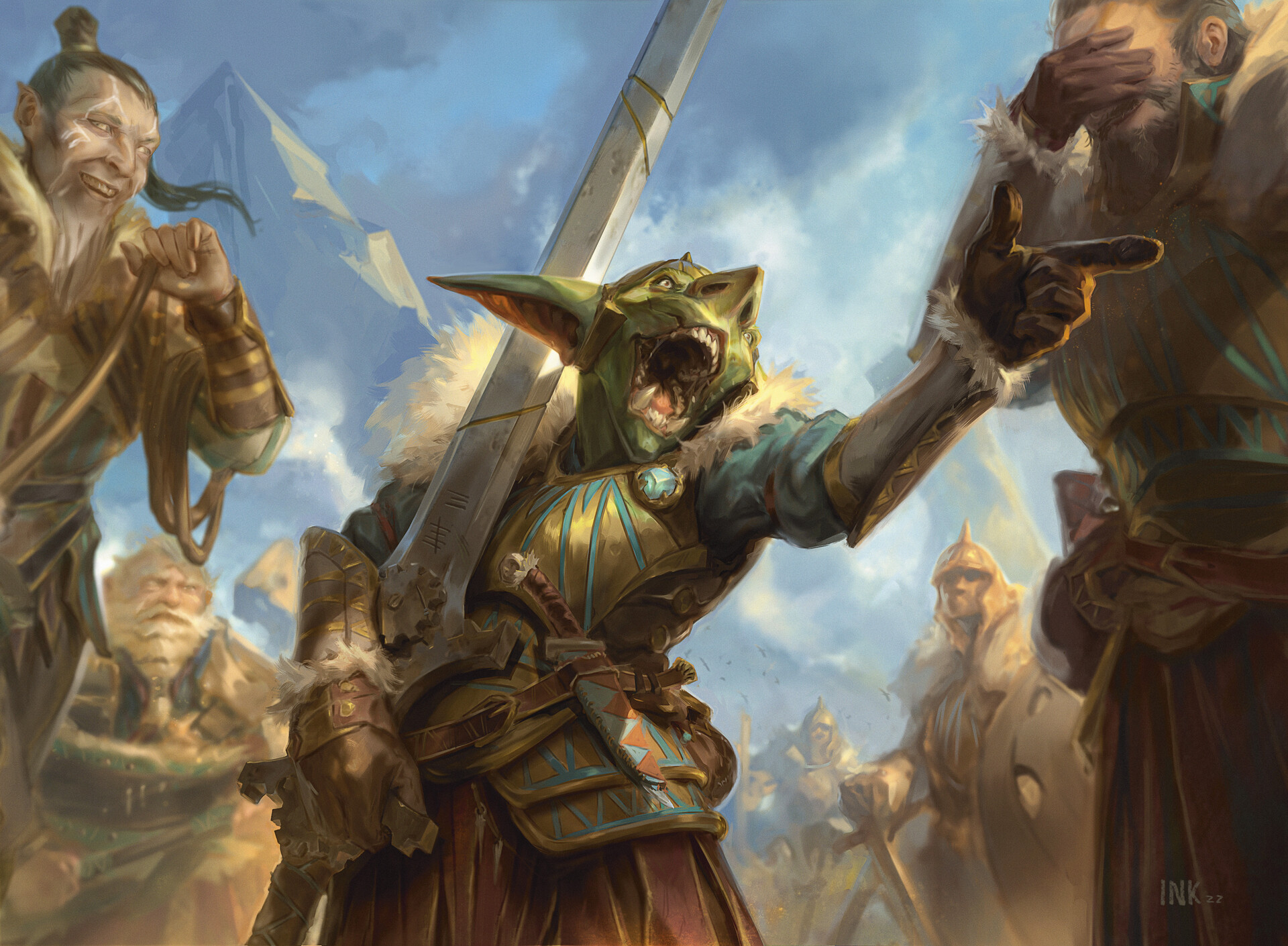
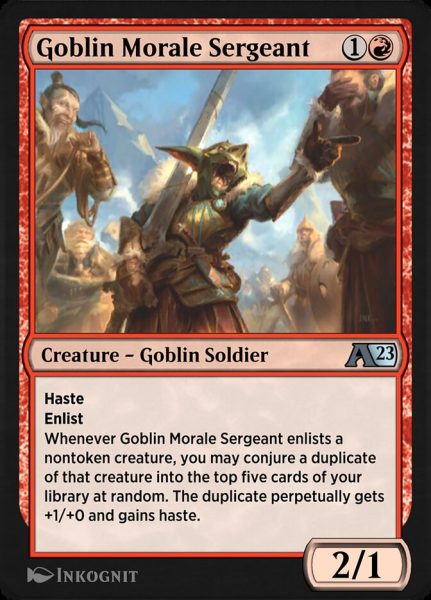
While many of these cards are powerful, Goblin Morale Sergeant has the potential to be a real difference-maker. There are ten uncommons Alchemy cards. We see uncommon Alchemy cards in 55% of packs. This means that 5.5% of packs will have this goblin. The combination of this card with Keldon Strike Team seems very potent. There is also strong synergy between its perpetual "+1/+0" clause and Baird, Argivian Recruiter. In short, this card is a great threat for the RW decks and changes their share of the metagame.

Slimefoot, Thallid Transplant and Wandering Treefolk are also powerful options on turn two. Conversely, an early Vinesoul Spider could accidentally bin important lands. This card looks like a trap to me, despite synergies with Soul of Windgrace and Uurg, Spawn of Turg.

Intended Consequence #2 Power Level Upgrade

The headline for every Alchemy upgrade is pretty simple. The format gets a lot more powerful. These cards are all designed for constructed play. DMU already encourages splashing and has a lot of fixing. These cards will draw players into Domain decks more often than they previously did.

These bombs, and the excitement that goes with playing new cards, will make Domain decks more coveted as the format crawls out of its formative phase. However, with improved pressure from aggressive decks, and the established understanding of the format's synergies, these Domain decks may struggle more than they did at the beginning of DMU. They also face a new obstacle that will drastically impact their viability.

Unintended Consequence #1 Dual Lands Decreasing

Arena draft packs have fourteen cards in them. Any of the ten commons can be one of the DMU duals. Over the course of a draft that represents 240 chances to see a dual. On average, a normal draft should yield a little less than 24 of these lands.

In Alchemy packs, there will be about three fewer lands per draft. In my first Alchemy Draft, I first picked a Drag to the Bottom and did not see a single dual-land for the rest of the pack. I adjusted pack two and pieced together a strong control deck, however, be wary. The decrease in duals is something we must recognize if we're going to build Domain decks.

Unintended Consequence #2 Tolarian Terror Powers Down?

Vesuvan Mist is a very powerful piece of interaction. Every deck that can kick this card will want it. However, the Blue Spells decks did not get much else. Only four of the Alchemy cards are instants and/or sorceries. While the Spells decks still have access to the suite of cards that made them the strongest pillar in the format, we should anticipate the archetype taking a step back.

Additionally, with the powerful two-drops coming to the format, there may not be as much time to cast Impulse and Phyrexian Espionage. With more pressure coming from the two-drops, the blue decks may need to make more of a battlefield presence early. Being on the draw with an Essence Scatter in hand is still fine, but it's not the position of power it once was.

Intended Consequence #3 Removal Is Mandatory

This is the biggest concern about a format change of this nature. So many of these creatures can take over a game through card advantage. They are mostly smaller creatures, so cheap removal is valuable, but Extinguish the Light, fight spells, and other interaction is starting to climb up my pick order.

Powerful creatures need to be dealt with. This format now has more powerful creatures. Adjust your picks accordingly.

Unintended Consequence #3 Raise Dead Effects Are Even Better

Urborg Repossession was already a strong common for black. In grindy games, this card was the Divination you wanted. Drawing two premium creatures in the late game, including a potentially cheap Writhing Necromass, Tolarian Terror, or a potent rare caused many heads to explode.

Now that more games will be determined by single cards, getting those cards back will be a winning strategy. The format looks to be more tied to singular power levels than the synergies that forged the pillars we discussed last week.

While Braids's Frightful Return and Sheoldred's Restoration were only fringe-playable, we should consider including them in this new version of the format

Draft Chaff

Alchemy's fingerprints are already all over this new format, and likely to spread like Glistening Oil on Mirrodin. Because of the new priorities the format demands, I suspect black has the most to gain, as it has removal and recursion. The aggressive red decks also look to be a force, whereas I suspect the blue decks might take a step back.

However, the open nature of DMU is what made it an all-time classic. All archetypes should remain viable. Many of the cards have exciting and interesting effects. This new format presents new challenges and new opportunities. While many of the cards are the same, expect these thirty cards to have an oversized impact on draft and gameplay. Next week, we'll be able to take a closer look with more data, experience, and observations. Until then, good luck!

Generational Magic: Unfinity Roundtable Discussion

Are you a Quiet Speculation member?

If not, now is a perfect time to join up! Our powerful tools, breaking-news analysis, and exclusive Discord channel will make sure you stay up to date and ahead of the curve.

Dominaria United. Dominaria Remastered. Warhammer 40K. The Brothers' War. Magic's 30th Celebration. Secret Lairs. With all of the Magic product pouring out currently it would be easy to forget about the goofiest, most enjoyable sets there are: Un-sets! Coming out this week is the latest set Unfinity! Both Sig and Paul have written about Un-sets of the past. With these cards, you can stretch your goofy muscles, throw caution, and potentially denim, to the wind.

I was able to sit down with a few players last week and discuss how these types of sets affect Magic in general. What do Un-sets, specifically Unfinity, bring to the Magic table?

Our Unfinity Spacefaring Panel of Players!

What's your name, how long have you played, and what are your favorite formats?

Curtis: I've played since around New Phyrexia and I mostly draft and play Commander.

Bill: I started with Scars of Mirrodin and play pretty well any format. Pioneer, Modern, Legacy, whatever I can play competitively.

Patrick: I've been playing since about 2015. Mostly competitive formats, but I do have a soft spot for Limited.

How Have You Played With Cards From the Previous Un-Sets?

Curtis: I haven't played with any of the previous Un-sets. I hadn't started playing during the first two Un-sets. When Unstable came out, I was living in the middle of nowhere with no place to play. Though looking back, if I would have had the opportunity, I definitely would have.

Bill: I hadn't played with the sets directly, meaning I haven't drafted them or anything like that. I do have my 480-card combo Cube that uses them. I have about thirty or forty Un-cards in it currently.

Which Un-cards do you have in the Cube?

Bill: Oh, let's see...there is one I really enjoy. It's Who // What // When // Where // Why.

There was an error retrieving a chart for Who // what // when // where // why

It's great when someone opens that pack and you see their head tilt and turn to read it. Magical Hacker can be powerful since it allows you to ultimate a planeswalker immediately. Another favorite is Baron Von Count.

Patrick: I drafted Unstable quite a bit and it was great! You got to do things like run around the room getting High Fives from everyone. Or asking people if they like squirrels and having a judge call to see if someone saying they "love" squirrels is sufficient. It's fun to draft a few times, but I wouldn't want to have any actual stakes with all of the wacky randomness. Immense fun though.

Tony: I agree. I've drafted all of the Un-sets and had a great time with them. I recall with the Unhinged event I drafted two Our Market Research Shows That Players Like Really Long Card Names So We Made this Card to Have the Absolute Longest Card Name Ever Elemental and two Wordmail. Having a 27/27 on turn four was awesome!

Bill: I'll always remember the Hurloon Wrangler story.

Patrick: Oh yea! When Mark Rosewater was at an Un-vent, he knew something was wrong when he heard, "In response I take off my pants!" Since Hurloon Wrangler has Denimwalk, that person's opponent wanted to block it. A judge was called and ruled that taking off your jeans before blockers is a special action that doesn't use the stack so he was able to block.

Tony: That's hilarious!

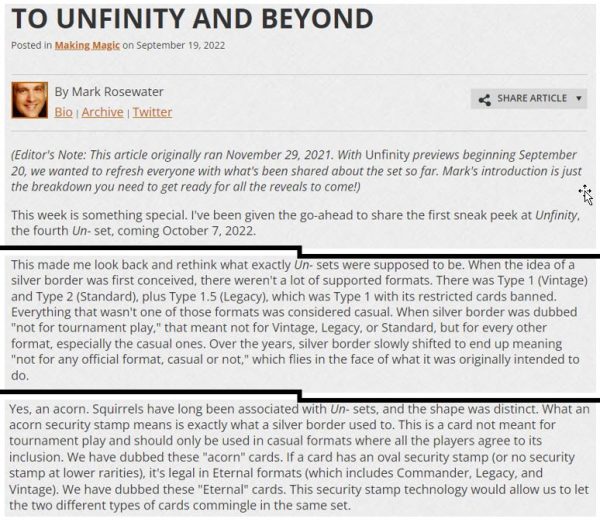
Mark Rosewater Has Expressed a Desire for Players to Use Acorn Cards in Their Casual Games, Especially for Commander. How Do You Feel About That?

Link to Mark Rosewater's post

Curtis: If it's casual only, I'm totally fine with that. I don't see myself using any silver-bordered or acorn cards, but I'm fine if others are using them.

Bill: For casual use, of course, it's great. When these cards start making their way into eternal formats, then I'm out.

Patrick: I'm the same way. As long as you let others know you're playing with silver-bordered or acorn cards beforehand and everyone's good with it, I'm all for it.

Patrick: There is a green card in the set (Tug of War) that creates a sub-game that Mark Rosewater really wanted to be eternal legal, and when he showed it to the others, they asked the question, "How is this eternal legal?"

Curtis: It actually wasn't his team that had an issue with it. After the team was done, they previewed the set for the rest of Wizards. It was at that point that the card was scrutinized and ultimately put back into acorn land.

The Acorn Stamp. Cards with this stamp are not legal in Eternal formats.

Bill: That part of Unfinity is very unusual for me. The way I see it, the precedent from the previous sets is that they were meant to be fun and casual. Now that they're starting to blend, it's an odd adjustment. Casually, I love them and would put more in my Cube.

How do the Jokes in Unfinity Stack Up Against the Jokes in Previous 'Silver-Bordered' Expansions?

Curtis: I'm not sure if I can appropriately compare, but I do love Un-jokes as a whole. My favorite in Unfinity is Carnival Barker. Being a literal dog and barker just cracks me up.

I also enjoy the continuation of the "Form of" cards, with Form of the Approach of the Second Sun.

(Bill squints his eyes as if he's unfamiliar with the card)

Patrick: Billy, you haven't seen this one, yet?

Bill: I haven't seen most of the cards in this set.

(Curtis and Patrick explain what Form of the Approach of the Second Sun does. Bill shakes his head.)

Patrick: My favorite part of the card, and it's been confirmed, is that you then become the card-type planeswalker. Not saying you'd want to, because you'd have to exile the card, but you could then search for yourself with something like, Call the Gatewatch.

Bill: That's pretty funny! Again, I'm not familiar with much of Unfinity, but I absolutely appreciate the funny. Infinity Elemental and Knight of the Hokey Pokey are a couple of different ones that are on point with these sets for me.

Patrick: I've heard that some don't enjoy the space carnival theme (of Unfinity), since it pulls away from the high-fantasy genre, but I really enjoy it. In comparison to the previous Un-sets, I feel the jokes are better since there are more people working on them.

Tony: I've enjoyed the goofiness with the creature types over the years. With Unglued you had Clams and Chickens, Unhinged it was Donkeys, Unstable was Squirrels, and Unfinity sends in the Clowns!

Do You Have a Favorite Card and/or Theme Among All of the Un-sets?

Curtis: I still have to say Carnival Barker is my favorite. I used to like the squirrel theme quite a bit, but I'm loving the space carnival theme.

BIll: Booster Tutor and Baron Von Count are in my top three.

Patrick: Eh...honestly, there are two cards from this set that I really like. Phone a Friend is a great card. The other is Exit Through the Grift Shop. I like the cards that get other people involved and you can affect other games. Not something you can do in sanctioned Magic and I love it!

Tony: I enjoy the cards that can play in other games. For example, Rock Lobster, Paper Tiger, and Scissors Lizard. Being that you can use them in other games with people who don't know Magic really helps to share the game.

What are You Looking Forward to From Unfinity?

Curtis: Drafting mostly. I don't have a lot of interest in acquiring any Un-set cards, even if they are legal. I'm just really excited to draft it since I haven't been able to with the others.

Patrick: I am looking forward to drafting it. A friend is buying a box and we're getting together with a few others to draft the night away. I feel that's one of the best ways to enjoy the Un-sets; with friends who you can really get into the jokes with. That's the best. Oh, and the lands. I'm looking forward to grabbing a lot of them, especially the shock lands.

There was an error retrieving a chart for Godless Shrine

Bill: I probably won't be drafting the set, but I will look through to see if I can find something to add in to my combo cube.

Tony: Drafting for me. Getting in a few drafts is always my focus for Un-sets.

Do You Like the Themes and Mechanics From the Set?

Curtis: Themes, definitely. Mechanics, I wouldn't say as much.

Bill: I like most of the mechanics in their appropriate formats. Again, nothing should be in any competitive format.

Patrick: I love the wordplay, people outside the game, and anything with those mechanics.

Tony: I enjoy all of them. I'm pretty open when it comes to wacky mechanics, but incorporating them into non-casual events? It'll be interesting to see how that fleshes out. I'm hopeful it'll be alright, but doubtful.

What are Your Favorites (Stickers, Attractions, Hats, Wordplay, Dice, People Outside the Game)?

Curtis: Well, overall I am fine with dice, people outside of the game, hats, and wordplay. I wouldn't have done stickers at all. I understand that they aren't supposed to be really sticky and you can put them on sleeves, but I foresee something bad happening with them, especially in the competitive formats.

Bill: Stickers are awful, I don't know why they even created them. I will not be letting someone put a sticker on my cards. No way.

Patrick: Putting a sticker on a sleeve in a competitive format? Nope. Just imagine a round later you get a game loss because you and your opponent forgot about it, and now you have marked cards? I'm sure I've forgotten to flip a DFC back over a few times after a match, so do you think I'm gonna remember a little sticker after five minutes, nevermind through multiple rounds of play?

Bill: Yea. I feel the same about Attractions. Technically, in a competitive event, you could bring an Attraction deck with you, just to make your opponent wonder if you're playing any Unfinity cards. Even if you aren't.

Curtis: I'm ok with the Attractions themselves, but yea, I don't like them being eternal legal.

Patrick: It injects a level of mind games that I believe doesn't belong in competitive Magic. It's like before Kaldhiem when you'd play Snow-Covered Mountains in your red deck to make your opponent think you might be playing Skred.

There's also the event logistics. Here's this extra pile of cards we now need to keep track of. My fellow players and I are already elbow-to-elbow with hardly any space to play, (having an attraction deck) just to plant a small seed of doubt in my opponent's mind? Too many issues.

Tony: It is mind games for mind games' sake, not something within the game itself.

All: Correct!

Are You Looking Forward to Incorporating any of the Unfinity non-Acorn Cards into Other Decks?

Bill: I don't feel I'm familiar enough, but I've heard talk about these stickers and some cards being Legacy legal. That's where I disconnect from it. As I stated before, I don't believe those things should be included into any competitive format at all, so more than likely no.

Patrick: …maybe Form of the Approach of the Second Sun?

Bill: Hehe, yea, that'll go in my cube with the original Approach of the Second Sun.

Curtis: I haven't seen any cards so far that I'm interested in adding. Again, I'm just looking forward to drafting silver-bordered cards, though I guess you can't really call them that anymore. That is one change for certain I don't like.

You Don’t Like the Switch From Silver Border to the Acorn Stamp?

Silver border-to-Acorn update

Curtis: NO!

Patrick: 100% keep the silver border.

Bill: Yes, I agree. I wouldn't have changed it.

Patrick: They're just so difficult to distinguish. If you are unfamiliar with what works and doesn't work within a game you're at a disadvantage. If I'm a new player and I don't know that this is a funny joke set, the joke may be on me, thinking these cards can be used anywhere. It might have been alright if the cards were simpler, but they aren't. The silver border is just so easy to see.
I also agree, I'm not currently looking to add any Unfinity cards into any of my decks.

So, between this question and the last, the answer for everyone on this one is pretty definitively, NO?

All: YES!

What do you Think of the Lands (Planetary, Orbital, and the Shock lands)?

Curtis: The shock lands are incredible! Knocked it out of the park. I like all of the basics too.

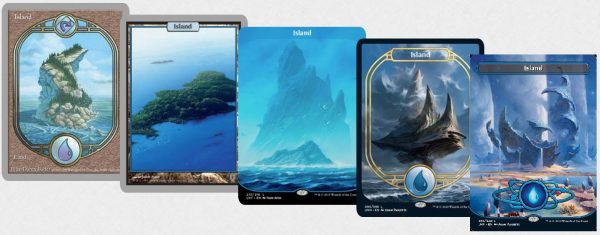
Patrick: All the lands are great. I love astronomy, space, planets, all of it. I prefer the Orbital over the Planetary though. The shock lands are awesome. They look amazing. I'm scared of how expensive they're going to be because I want them all! I also like that each land type is very clear on what it is. The island looks like an island, the swamp looks swampy, etc.

Tony: Are you going for the Galaxy Foils, Patrick?

Patrick: Dear Lord, no. They are nice, but I draw the line at foils. I'm just not into having my cards curl on me.

Bill: Blood Moon is one of my most hated cards and these lands remind me too much of that card, so I actually don't like them at all. I will admit, the shock land arts are nice and the Planetary basics are fine, but do not like the Orbital versions. I'm not super high on any of them. I'm a more old-school land aficionado.

Patrick: Any Ponza player that isn't running the Unfinity Stomping Ground, gets disowned! It's literally Stone Rain!

There was an error retrieving a chart for Stomping Ground

Which of the Cards are You Planning on Collecting? Will Some be More Difficult to get Than Others?

Curtis: Obviously, the shock lands will be difficult to get, and I did say that I really like Carnival Barker, right?

Bill: Once I really look into the set and determine what would work for my Cube, I'll get a single copy of those cards, but beyond that, not really anything.

Patrick: The lands. 'Nuff said.

Unglued, Unhinged, Unstable, Unsanctioned, and Unfinity

Tony: Collecting ten of each of the basics, both Planetary and Orbital, and grabbing a couple Comet, Stellar Pups for my wife. She loves puppies and requested both versions.

Epilogue

I want to thank the guys for sharing their thoughts, insights, and excitement on the latest Un-set. I hope you get a chance to get out and revel in the silliness that is Unfinity. Do you have any thoughts on the changes that Unfinity potentially brings or some crazy Un-stories? Feel free to let us know either in the comments below or on Twitter.

September ’22 Metagame Analysis: Metagame Shift

Are you a Quiet Speculation member?

If not, now is a perfect time to join up! Our powerful tools, breaking-news analysis, and exclusive Discord channel will make sure you stay up to date and ahead of the curve.

I was expecting Dominaria United (DMU) to shake up Modern at least slightly. There were a number of potent playables in the set, and there was a brewing rush at the end of August. While such excitement is normal for any new set, this hasn't been a normal year for Modern and the prospect of something, anything, breathing life into the metagame was exciting. After a month, it's time to see how that's shaken out.

But First!

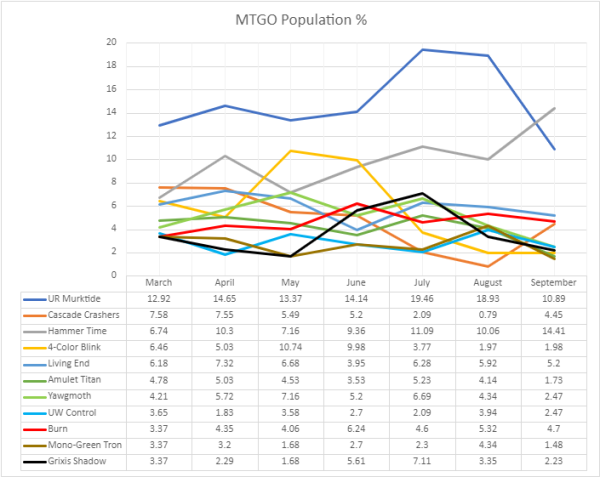
It's time to check in with the test subjects. For those new to the series (welcome, new Insiders!), I've been tracking how the top 11 decks from March have been performing this year. March was chosen because that was the last Modern banning, and 11 was because of a tie for 10th place. Up until August, the sampled decks had been gobbling up increasing metagame percentage despite many of them falling out of the top tiers. In August the trend finally started to fall, so now it's time to see if the trend continued into September.

Overall, yes it has.

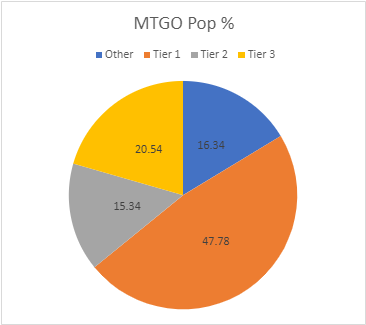
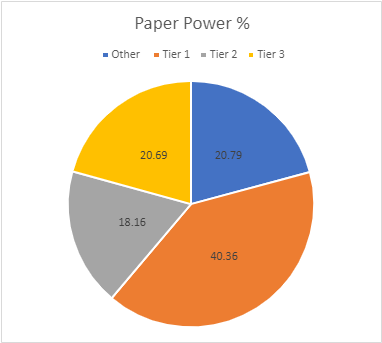
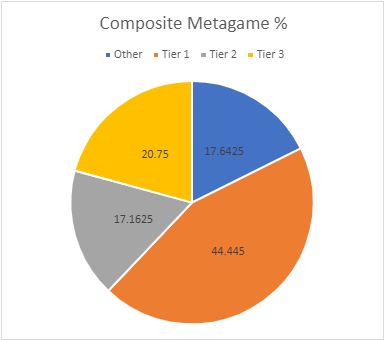
So, that's a yes. Most decks were down from August, with UR Murktide's fall being the steepest. Both Hammer Time and Cascade Crashers saw dramatic spikes, but they're the exceptions. Everyone else has declined. Magic Online (MTGO) is always quite volatile and prone to wild shifts, so it's important to compare them to the more stable paper results.

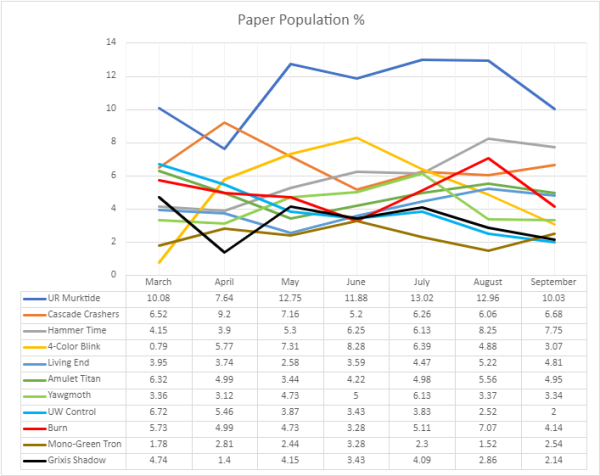
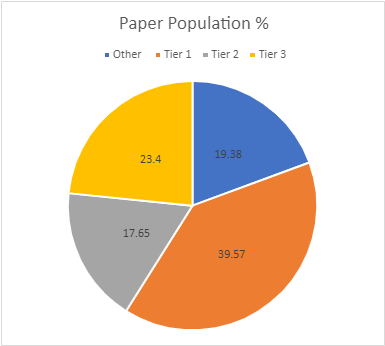
Looks similar to me.

And the trend looks consistent. Hammer fell instead of rising in paper, though it's still above its yearly average. Crashers and Tron are the only decks to have made actual gains, though the drop offs have not been as extreme as on MTGO.

Confirmed in the Aggregate

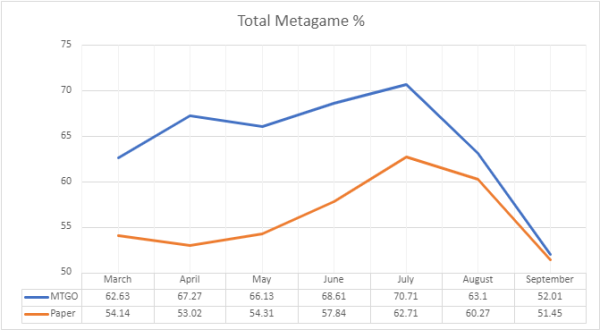
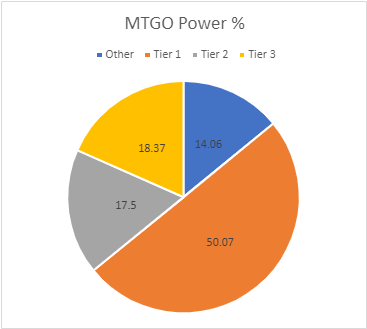
Looking at the data from my study, it seems like the overall situation in Modern is improving. Where at their height, the studied decks accounted for roughly two-thirds of the total Modern metagame, their percentage is falling significantly. There's no other way to interpret this trend other than Modern is finally moving past this particular metagame. There is still metagame dynamism in Modern.

If this trend keeps up, there will be no need to keep the study going.

Both the MTGO and paper data show a clear move away from the study deck beginning in August and actually accelerating in September. Said acceleration is almost certainly driven by the brewing pressures from DMU. Why stick with the old guard when there's something new to play? Especially given the pressure that Indomitable Creativity continues to exert on Modern.

Context Matters

Of course, factors outside of DMU must also be considered, as they impact the study group without being a part of it. Specifically, as has been the case every month, 4-Color Control has direct competition from fraternal twin 4-Color Blink. The Blink version plays Ephemerate and enjoys far more variation between builds than the control version. Control is basically a straightforward money-pile of the best cards, where Blink has actual synergies. There's no consensus best version of Blink, but its fortunes are mostly inverse of Control's. Blink was up slightly this month, and that's drawing players away from Control.

There was an error retrieving a chart for Omnath, Locus of Creation

Meanwhile, the big story from September was that many versions of Creativity did well, and none of them are in the study group. Were any of them included, the data would show high concentration. This would be true of MTGO darling Rakdos Scam, so named because its best starts feel like cheating and its worst feel like being scammed. However, the purpose of the study was to see whether Modern was still dynamic despite the persistent outliers, and it is looking like that may be true. I'll need to see how October goes before being unequivocal.

Murktide's Fall?

The headline is that Murktide isn't the top deck on MTGO. It's also losing metagame share in paper. This is good news, but I would urge caution. There was never any reason other than popularity for Murktide's domination of Modern statistics in the first place. Its win/loss records are solid but not particularly inspiring, and it doesn't take down an unreasonable number of events. Players just like playing it and did so in large numbers.

There was an error retrieving a chart for Murktide Regent

Therefore, its fall is almost certainly due to players just moving on rather than a change in viability. Murktide had some baseline of players that played it well, and a huge number of others that were jumping on the hype train. However, the deck is quite hard to play optimally, and so many players have become frustrated. I'd guess that the past two months have been the final straw for many and they're changing decks. Therefore, Murktide will probably lose more metagame share in the near future before stabilizing.

What's the Replacement?

Looking at the data, it isn't clear where the Murktide pilots are going. Hammer Time has been a top performer online for nearing two years now, so it's possible that players that jumped onto the Murktide train are jumping back onto Hammer. It is a solid deck with a brutal win, but it's also been far more popular online than in paper this year.

There was an error retrieving a chart for Puresteel Paladin

I think it more likely that the Murktide falloff is attributable to Creativity's rise. They're both Expressive Iteration decks and share many cards, making the transition easy. The latter's rise and former's fall are also correlated. The Underworld Breach decks are another a probable home. The more common Izzet version is mostly Murktide without the Murktide, switching out some control elements and the namesake Murktide Regent for the Breach combo.

Indomitable Ascension

Back in August, I noted that Creativity was already on an upward trend. I speculated that this was down to the Temur version having a stable manabase and embracing its identity as Modern's version of Show and Tell. However, Leyline Binding stood to unravel that and move Creativity back towards four colors. Which is exactly what happened. Temur still has its adherents, but there's been a clear shift towards 4-Color Creativity, which I expect will continue in October.

There was an error retrieving a chart for Indomitable Creativity

However, Grixis Creativity also made Tier 3, so that can't be all that's going on. For a single strategy to do well in numerous forms indicates that it has some fundamental advantage within a metagame. Especially when one is a hybridized deck like Grixis Creativity. Part of that is that Murktide is falling off. As Modern's premier counterspell deck as well as a tempo deck, players finally moving away is quite beneficial for a deck that must resolve one critical spell to win. Also worth noting, Solitude decks have been falling out of the metagame, which makes it much easier for Archon of Cruelty to go all the way.

Unexpected Help

There is another factor outside of normal metagame fluctuations. It's hard to see this unless, like me, you look at hundreds of decklists every month, but sideboards show a weird amount of inertia. For some reason, players appear to be more willing to change their maindecks than the sideboard. For me it's the opposite and I thought that was the typical case, but the available evidence says that I'm the unusual one.

There was an error retrieving a chart for Roiling Vortex

For example, the sideboards of most Burn decks since March have been static. It's almost always five 3-ofs: Roiling Vortex, Path to Exile, Smash to Smithereens, Sanctifier en-Vec, and Deflecting Palm. This configuration was quite good back in April, but it's been losing value over the months. However, players stubbornly hold to the old configurations. This is helping Creativity thrive.

There was an error retrieving a chart for Hallowed Moonlight

While common sideboard cards don't do much against Creativity, there are bullets against it. Specifically, Containment Priest and Hallowed Moonlight counterspell with upside against Creativity. However, neither sees much play. That is starting to change with Moonlight, but the writings been on the wall for a while and players really should have caught on. I have to assume that pure stubbornness or oversight is to blame.

Getting Scammed

Rakdos Scam is the latest effort to make turn one Grief good. The dream has always been to evoke Grief and then get three triggers and the body with Ephemerate, but that's also never worked out. Scam doesn't go that far, using Feign Death and similar and having the option to evoke Fury instead for a quick kill. The fact that it surged to Tier 1 in September is proof that it works.

There was an error retrieving a chart for Grief

...Except that's not true. Yes, Scam can make either play work, but that's a bonus. What's happened is that players took the solid but uninspiring Rakdos Rock shell, added more elementals, and then tossed in a few ways to get that turn one value. The real power in the shell comes from everything besides the Feign Death combo. That's a bonus. For proof, look at the numbers in the deck. The Feign Death effects have been declining since August.

Crashing Through Barriers

The final big shift in Modern is the rise of Cascade Crashers. Crashing Footfalls has maintained a decent baseline of stats in paper but had virtually disappeared from MTGO in August. It's come crashing back with all the subtlety I'd expect from a crash of rhinos.

There was an error retrieving a chart for Crashing Footfalls

Crashers became a deck immediately after Modern Horizons 2 brought Shardless Agent to Modern. It has been a major player ever since. However, the Temur version has seen a steep decline on MTGO and a gradual one in paper. Players were getting better at not-losing to rhinos and the interaction package Crashers ran was getting outdated. So, players moved on.

There was an error retrieving a chart for Leyline Binding

Leyline Binding has changed Crashers fundamentally, to the point that the deck is becoming increasingly unrecognizable. Binding solves a lot of problems the deck had, but it also opens up many opportunities. And are players ever taking advantage. I've seen decks that are effectively normal Omnath, Locus of Creation deck but with Footfalls; Zoo builds with Scion of Draco; the Temur Version splashing white; and even non-altered Temur decks. I have no idea where this is all going or where the deck will settle.

Where's the Value?

This is the part where I normally give advice on where Modern is heading so that all the Insiders can take financial advantage. The problem is that things have gotten so unstable that I genuinely have no clue what to expect over the next month. Binding is driving more decks to play more colors as predicted and will likely continue doing so, but what form that will take is anyone's guess. The non-Footfalls multicolor decks are likely to continue to see considerable play, which I'd expect to lead to more Blood Moons seeing play, but that hasn't worked before so I'm skeptical it will work now. There isn't a trend in this I can identify that's different from what I said about August except for the new instability. It's looking like Modern will be convulsing for the immediate future, so I'd prepare for unexpected shifts and changes.

The Churn Returns

In many ways, this feels more like the Modern I'd become used to for years. Modern had been churning for so long that I, and I suspect most players, simply saw instability as the norm. Modern being stable for most of a year was a novelty. Whether that eerie stability will reassert itself remains to be seen.

Explaining the Joke: A Spike’s Guide to Unfinity

Are you a Quiet Speculation member?

If not, now is a perfect time to join up! Our powerful tools, breaking-news analysis, and exclusive Discord channel will make sure you stay up to date and ahead of the curve.

I assume there are many people who enjoy the rampant silliness of the Un-sets. Perhaps it's the abundant references to squirrels, the mechanics referring to non-traditional card text, or the full-art lands? Whatever the reason, people seem drawn to this product in droves voluminous enough to necessitate the fourth (fifth if you count Unsanctioned) installment of Magic's equivalent to open mic night at The Laugh Factory. Regardless, I am not one of them.

However, as a Limited correspondent this format still falls under my jurisdiction. When it comes to Limited formats, I play to win. If you are looking for a day of laughter and merriment, goofing around playing Unfinity, I encourage you to look elsewhere. If you're looking to win your prerelease, then you are in the right place.

The Mechanics

Unfinity brings with it some new mechanics, as well as a focus on card elements that usually fall outside the scope of most Magic: the Gathering rules. This includes the names, art, and artists associated with various cards.

Attractions

Featured Attractions

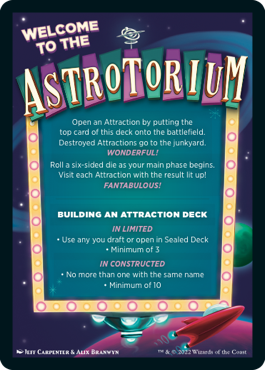
Much like Contraptions in Unstable, Attraction cards reside in a separate deck that is played from the command zone. You don't draw from this deck, nor do the cards go to your hand. Rather, when a specific card, like "Lifetime" Pass Holder, causes you to open an Attraction, you flip the top card from this deck onto the battlefield. Attractions are artifact permanents with the subtype Attraction.

The back of an Attraction card explains the rules.

At the beginning of your first main phase, you roll a die to visit the Attractions. Occasionally other cards will allow you to roll a die to visit your Attractions. If the number on the die matches any of the highlighted numbers in the bottom, left-hand corner of the Attraction, you visit those Attractions, triggering their text.

All of the Attractions trigger on a six, and none of the Attractions trigger on a one. This creates a likely game-warping critical hit and critical fail mechanic.

Also, when destroyed these cards go to the junkyard, which is its own separate graveyard, just like the scrapyard for Contraptions in Unstable.

Stickers

Essentially, stickers are like counters you place on cards, that remain on the card when it switches to certain zones. You place a sticker on a card when a spell or ability tells you to do so. There are four types of stickers.

  1. Name Stickers - These are words that add to the name of the card.
  2. Art Stickers - These are images that add to the art of a card. Both of these things sometimes matter in Unfinity. Cool.
  3. Ability Stickers - These are essentially unique counters that add lines of rules text to each card. Each has a "ticket cost" on the left of the sticker. To place an ability sticker you must spend "tickets" to do so. More on tickets in a bit. All stickers are found on sticker sheets, which are removed from the pack and kept as a resource to the player like a token would in most modern formats.
  4. Statline Stickers - These override a creature's power and toughness. They also have ticket costs.

Stickers remain on a card if it goes to any zone where information is public. This includes the battlefield, graveyard, exile, or the stack. Conversely, if the card goes to the library or a player's hand, the sticker is removed and returned to the sticker sheet, where it can be used again.

Tickets are a kind of counter that players can receive. The ticket-sticker economy has been compared to the Energy mechanic. We amass tickets and can eventually spend them on in-game resources, in this case, more powerful stickers.

Hats Matter

Okay, so cards with hats in the art interact differently with some spells. There's no real rule or reason for this, but it happens. You also probably should wear a hat to this event. Maybe multiple for the best possible outcome. Again, just be aware of this.

IT'S GONNA BE FUN.

You should also choose to wear as much Magic the Gathering paraphernalia as you own and a top sporting all five colors of mana. You should also go with a friend, who you can call on for all of the effects that refer to a person who is not in the game. Bring in a ringer for cards like Rock Star, Autograph Book, Gobsmacked, and a few others. You want to be facing multiple mirrors, and can probably bring one. It also might be good to know where the fire extinguisher in the building is, you know, for unmergencies. As irrelevant as these things might sound, in Unfinity, they can potentially give you an edge.

Words Matter

Words and the spelling thereof will also impact the effect of some cards. Occasionally cards will receive a benefit because of the number of vowels in their names or maybe alliteration, or multi-syllabic words. It's legal space for ruling in the world of Unfinity, but the best thing you can do is choose longer words when you can. The longer a word, the more powerful it will typically be during gameplay.

Preparing to Win

The Fixing

  • Nearby Planet - Basically a domain-triggering Gateway Plaza.
  • The Big Top - A painless City of Brass as long as you are wearing a very colorful top. Adjust your wardrobe accordingly.
  • Park Map - An expedition map that punishes you for using matching lands. Select your lands accordingly.
  • Ticket Turbotubes -A Manalith that can generate value in the form of tickets later in the game.
  • Coming Attraction - A Rampant Growth that opens an attraction.
  • The ten Ravnica shock lands - These are remastered with space-themed art and are likely to be the chase cards of the set.

The format's fixing does a nice job of setting up for value in the late game, which is exactly what the slower decks of the format want to be doing. Both Coming Attraction and Ticket Turbotubes help us cast more expensive and powerful spells while providing boosts of value the longer the game lasts. These are powerful draws to your pool and encourage a strong late game.

Potential Pillars

Both stickers and Attractions represent resources that we want to stack. The more tickets we have, the stronger the abilities we can generate from them. The most powerful ability stickers cost the most tickets. Similarly, a number of cards in the format benefit from stickers being placed on the permanents we control. If we lean into this mechanic there are synergies we can capitalize on. Stiltstrider seems like a very powerful five-drop, but many of the uncommons really push the mechanic.

However, the most attractive option is the Attractions themselves. Since we roll one die for all the attractions, the more attractions we have open, the more potent those die rolls are. While there is always inherent variance to rolling dice, we can stack the odds in our favor with multiple attractions. This archetype appears to be the most powerful in the format. Additionally, cards like Bamboozling Beeble and Line Cutter seem like staples in this deck, which theoretically looks to play a longer, more controlling game. If each turn we net small advantages, our advantage grows the longer the game lasts.

Speed of the Format

Much like in Dominaria United, the lack of two-drops at common will reduce the potency of aggressive decks. At uncommon, cards like Lineprancers, Haberthrasher, and Knight in ______ Armor should do a better job of pressuring opponents. The best aggressive deck will be the stickers deck, headlined by common two-drops Minotaur de Force and Chicken Troupe. Cards like A Good Day to Pie and Unlawful Entry can provide reusable evasion. Unfortunately, these cards are spread over four different colors, though red is the most aggressive with the highest number of cheap threats.

Sealed decks, however, play with a less focused approach than Draft. With all of the mechanics based around accruing value, the safe play in for Sealed prerelease events is to settle into a slower deck. This means that removal spells like Well Done and Disemvowel will be at a premium.

Additionally, two commons jump out as being effective tools against aggressive decks. Eelectrocute is a quick answer on turn two, that can find another use later in the game. Boing is a basic bounce card, but because stickers fall off when a card is returned to its owner's hand, this instant will disproportionately punish sticker decks more so than any other type. Overall, this set shouldn't be overly aggressive, and you should build your deck to win midrange mirrors and power out wins in the late game.

The Mythic Uncommon

Outside of rares and mythics, Wicker Picker is probably the number one card we want in our pool. Giving sticker kicker to every creature you play should lead to an insurmountable advantage. This card fits into any deck because it's colorless, and a 2/3 on turn three is pretty decent for the format.

Draft Chaff

While Unfinity does not represent what I love about Magic: the Gathering, the important thing is that some people will find a great deal of joy in it. Playing the game is fun with very few exceptions and I don't imagine the prerelease will be anything but a good time. Hopefully, this guide helps you, and if not, the good news is that Dominaria United, is still available on Arena.

Cheating, Magic, and You

Are you a Quiet Speculation member?

If not, now is a perfect time to join up! Our powerful tools, breaking-news analysis, and exclusive Discord channel will make sure you stay up to date and ahead of the curve.

Human beings have become the apex predator and dominant species on planet Earth. Go humanity! We love to compete at everything from riding bicycles to running to solving cube shaped puzzles crazy fast. There is nothing we won't compete at. However, there are some among us that do not compete on an even level. It does not matter if it's Magic, Uno, Monopoly, or taxes. Cheating has existed for as long as culture. Perhaps you have seen some of the recent headlines.

Who Cheats?

Lots of people, in fact, cheat at lots of things, like chess. However, it does not make headlines unless it involves Grandmasters. Take a look at this quote from an article by Scott Davis.

"Still, the practice is prevalent, at least in lower levels, he said. Chess.com is said to have some of the best anti-cheating software available, yet it still deals with a great deal of cheating — the website says it closes more than 500 accounts every day for cheating and has closed nearly half-a-million accounts over its history."

Half a million accounts. Let that sink in. There were absolutely no stakes on the line in the grand majority of these account closures. These players were not playing in tournament events for cash and prizes, yet still cheated. Of course, at the higher levels, there are significant stakes. The ongoing cheating saga involving potentially the best chess player ever, Magnus Carlsen, and previously admitted cheater Hans Niemann, is taking center stage right now.

The How Varies By Game

Hans has admitted to cheating in the past. And now, Chess.com has investigated further, and believes that Hans likely cheated in 100 more online games than admitted to. The offense? Analyzing the games pointed to it being more likely that a chess engine, not Hans, came up with the moves used in his games.

Why Cheat?

Money and fame, mostly. But at the end of the day, cheaters also seem to share a certain belief. They think they are better than everyone else, and deserve to win. It does not matter if you are in a world class tournament or a friendly game at home, the kind of person that cheats will fit this profile.

A couple of years ago, a massive YouTube streamer with over 30 million subscribers by the name of Dream livestreamed a Minecraft speedrun. Almost as soon as it was scrutinized, accusations of cheating emerged. I will give you the TL;DR of the events. Dream said they didn't cheat. Speedrun.com said they did.

"On May 30, 2021, in a written statement, Dream stated that he had in fact been using a 'disallowed modification' that altered item drop probabilities, although he maintained that the addition of the modification was unintentional."

Oops! Turns out they were cheating!

People Cheat at Fishing

Yes, it's true. Not only did these anglers stuff lead weights and other bits of fish inside their catches to inflate their mass, but it's also suspected they did this multiple times at other events as well.

If people cheat and get away with it, will they cheat again? Absolutely. Sometimes, it takes many, many years before cheaters are eventually caught. Lance Armstrong will likely be one of the biggest examples of this for the rest of time.

What Does This Have to Do With Magic?

A lot, actually. If you're at an official, sanctioned event, at least there are judges there to monitor players. Of course, they cannot be at every table, every single moment. We know that in big Magic tournaments, there are plenty of people who have been caught indisputably cheating on camera.

However, in normal Draft and Sealed events, it tends to be a free-for-all. Everyone is on the honor system. This goes the same for games on SpellTable. The moment cards go off camera, you can never be 100% sure if there is no deck or hand manipulation going on, and that goes double for people utilizing Moxfield to play rather than physical cards. The numbers in this case show that far more games are played with no oversight.

It's Story Time

I have seen cheating many times. In some cases, I have caught blatant cheaters red-handed. In others, it has been through deduction. The one person I can thank for this is Davyd. I went to high school with Davyd. We played many boardgames and Magic together. Davyd was (and remains) a cheater. He cheated on school tests as well as in every Axis and Allies, Risk, Settlers of Catan, and Magic game that we ever played. But, thankfully, he is awful at cheating.

There was an error retrieving a chart for Ongoing Investigation

How would Davyd cheat? Not tapping enough mana for spells, constantly. Drawing extra cards every chance he could get. Not paying upkeep on Stasis. You name it, he did it. When you cheat that often, you get caught. A lot. I got really good at catching Davyd cheating, so when it came to catching others, I was already adept. However, what happens when the cheater is careful?

Where There Is Smoke, There Is Fire

First at one LGS, then at another, I drafted with a particular player. Unlike Davyd, their name will be withheld. For three consecutive months it was a coin flip between myself and this player as to who would take home the draft that week. In all that time, I can say that I only ever caught them draw an extra card a single time. Every once in a while, you could honestly make a play error, and I was willing to let it go. What about my own gameplay?

Tons of Gameplay

Between playing on MTGO, doing simulated drafts on different websites, and having more experience than most of the players there, it was fairly obvious I had every advantage. Most of my losses were directly mana screw or flood or an occasional unlucky draft, not play mistakes. There is no other time that I played more Standard than during this era, so I believe I brought my competitive best.

I Got Mugged

It wasn't until I had an exceptionally poor draft at another LGS that I found my smoking gun. First, I was sort of in four colors because I'd opened some incredible bomb rares but was being passed other incredible bombs in different colors... I ended up chasing the rainbow.

There was an error retrieving a chart for Mugging

There were two ways I could go about it: try four-color or settle on two with some awful cards. Struggling, I asked this other player for help and, at first, decided to take their advice. This meant cutting red and in particular not playing my two copies of Mugging because I had so little else in red.

The Smoking Gun

After looking over the bad but consistent deck, I decided against it. At least the other version had bombs that would win me the game if I could cast them. A big if, but on second thought, it was my best out. So I searched my cards and one of my copies of Mugging was missing. I counted and was down one card. I asked around the room if anyone found a copy of Mugging on the floor or if I left it on a table. Coincidentally, that other player was showing their deck to the manager who noticed that they had three copies in their deck. I got the manager to count their cards.

Math, Do You Speak It?

They had one extra card. It does not take a rocket scientist to deduce what happened. The player thought they convinced me I wouldn't need Mugging, so they swiped one for their deck. It's really that simple. Can I prove that this happened? Well, I can get the manager to verify the card counts and the other player to admit to handling and seeing my cards, with my permission of course. I cannot give you video evidence, however.

Putting the "Nasty" in Neon Dynasty

My next anecdote takes place at a pre-release event. A group of players were busy cracking boxes they had pre-ordered. The sealed event followed immediately after. I was happy getting what I thought was a strong red/white Samurai deck and had several on-color rares and uncommons. I quickly got three wins and then met my opponent, also with three wins.

There was an error retrieving a chart for Lucky Clover

They had 15 uncommons and five rares on-color, and easily won the event. On a completely coincidental note, they were one of the people cracking boxes just before the event happened. Could this person simply have opened the perfect sealed pool? Sure, it's possible. It just did not feel very likely in this case. What does your intuition tell you?

Three's a Crowd

Okay, one more. A different store was having killer deals on events, so I started to go there. Two brothers and the older brother's girlfriend would draft there often. In an eight-player table, they represented three slots. See where this is going?

It's impossible to prove, but there was likely at the very least collusion between them, each picking colors before the draft started. Of course, they could have traded cards as they built their decks, with none of us the wiser. Here, I have scant evidence besides the particular looks they gave one another that felt coded and a weird, one-off draft. There were only six players that event and it had a palpable "us versus them" atmosphere.

Were These Players Cheating?

Brilliant quote, Carl!

This quote is my go-to for a variety of situations. However, its inverse is also true. Ordinary claims require ordinary evidence. People cheat every single day in online video games, on their significant others, on inspections and exams, and at Magic: The Gathering. There's no longer any doubt in my mind that a large number of Magic players are less than trustworthy. But don't take my word for it; look at Yuuya Watanabe being removed from the Hall of Fame and banned from Magic. Cheating matters at the highest levels and also at your casual events.

The Solution

How does the Magic community fix cheating? Better tournament procedures? No. More unpaid judges! No. Draconian punishments for those involved... unfortunately, no. It's not possible to stop all the cheaters all the time because, ultimately, it's extremely easy to cheat.

There was an error retrieving a chart for Rule of Law

The solution? Build a strong community of like-minded Magic players. If we de-emphasize a winner-takes-all mentality, strengthen the social aspects of play, and celebrate that games are for fun, it just might convince some players to play fair. I sincerely believe that the more players who play purely for the experience, with winning as a happy side effect, the less cheaters you will encounter. Encourage and build that community and you will eliminate problems before they start.

Then again, Davyd still cheats to this day. Lucky for us we are not all Davyds. We are better than him.

Have you experienced covert or obvious cheating at your Magic table? Tell your story here.

Avatar photo

Joe Mauri

Joe has been an avid MTG player and collector since the summer of 1994 when he started his collection with a booster box of Revised. Millions of cards later he still enjoys tapping lands and slinging spells at the kitchen table, LGS, or digital Arena. Commander followed by Draft are his favorite formats, but, he absolutely loves tournaments with unique build restrictions and alternate rules. A lover of all things feline, he currently resides with no less than five majestic creatures who are never allowed anywhere near his cards. When not Gathering the Magic, Joe loves streaming a variety of games on Twitch(https://www.twitch.tv/beardymagics) both card and other.

View More By Joe Mauri

Posted in FreeTagged , , , , , , , Leave a Comment on Cheating, Magic, and You

Have you joined the Quiet Speculation Discord?

If you haven't, you're leaving value on the table! Join our community of experts, enthusiasts, entertainers, and educators and enjoy exclusive podcasts, questions asked and answered, trades, sales, and everything else Discord has to offer.

Want to create content with Quiet Speculation?

All you need to succeed is a passion for Magic: The Gathering, and the ability to write coherently. Share your knowledge of MTG and how you leverage it to win games, get value from your cards – or even turn a profit.

From Pre to Post: Vending Experience Redux

Are you a Quiet Speculation member?

If not, now is a perfect time to join up! Our powerful tools, breaking-news analysis, and exclusive Discord channel will make sure you stay up to date and ahead of the curve.

Welcome to the follow-up piece to my last article, Vending Preparation: The Second Go-Round. In that piece, we went over the many things I had learned vending at a previous event, and how I planned to implement them at my next one. Well, that next event has now come and gone, and I'm back to share how it went... and, of course, some new lessons learned!

But First, a Pre-Order

As previously discussed, locking in pre-order sales can help manage the costs associated with vending. This time, I had 2 pre-orders prior to the event. One was for $80, while the other was close to $100. Given that each table cost me $20, as long as either person showed up, I could essentially break even.

The day started off on the right foot, as my $80 pre-orderer was there bright and early when the event started at 10:00.

Newer vs. Older Players

There was an error retrieving a chart for Old Fogey

My first customer was a nice gentlemen who had only started playing at Commander Legends: Baldur's Gate. This meant that much of what he needed were older cards for his Tor Wauki, the Younger Commander deck. He wanted me to look through his cards to see if there was anything I wanted to pick up to help reduce his tab. Unfortunately, everything was from either Double Masters or Dominaria United, and none of it was stuff I thought I could resell. 

This would be a repeating problem throughout the day, but provide a valuable lesson. The store hosting the event has been open a little over a year, and Magic is a small part of what they offer. Its Magic playerbase is predominantly players who only started playing in the last 2-3 years. This means that many of them have relatively small collections of newer cards.

Anyone who buys and sells cards regularly may know where this is going: such players tend to over value their own cards and don't understand why I can't trade them dollar-for-dollar on what they want. I do understand this mindset, as I shared it when I was a newer player. I remember how bad I felt the first time I buylisted cards to a store thinking I had ripped myself off. (Fun fact: that buylist order was to Card Kingdom for a bunch of HP dual lands when they were $35-$85 each.)

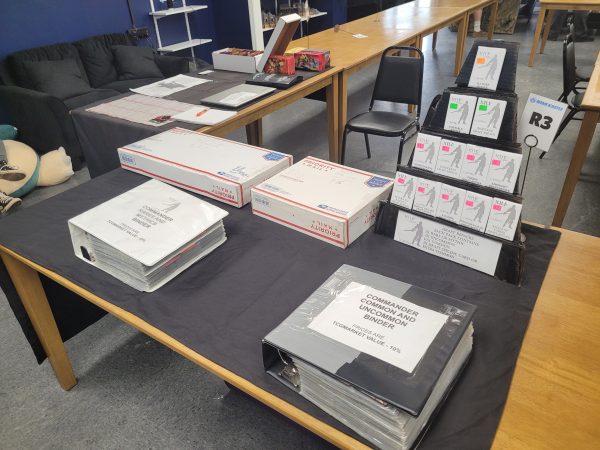
Table 1 Layout

As with most things, I quickly realized that this event was unlikely to be a good buying event. But it could be a good selling event. So I pivoted my attention towards talking with customers and highlighting cards that worked well with cards I saw them picking out, rather than digging through their boxes of Standard-legal cards to pick out cheap cards to buy.

This pivot allowed me to focus more on my customers and get to know their playstyles a bit better. I also forget how much joy people can find when they see a card they didn't know existed that fits perfectly in some deck they own.

I think one of the unfortunate sacrifices that us more competitive players make is the ability to consider the fun, exciting interactions a card may create, even if those opportunities are few and far between. I know that when I see a card that could do something amazing in a rare circumstance, I brush it off and look for cards that are more universally useful in nature.

Universal Selling Price

The last time I vended at this venue, I spent several evenings pre-pricing cards. This made transactions very easy, but given the small number of sales I got, the effort required was not worth the time savings. I calculated that I had essentially paid myself about $5 an hour doing that. For this event, I posted that I would charge the TCGPlayer market value -10%. Most of my customers seemed to appreciate this.

I used my MTG Familiar app and added in the cards they picked out to keep a running list of their order and provide up-to-date prices on cards. The obvious downside is that I was limited to two people at a time, as the trade setting on the app only has 2 columns. At one point I did have four customers, however; one was focused solely on the 3-for-$1 box, and the other was only interested in a couple of Temple Gardens.

Moving forward, I will maintain this pricing strategy given how easy it was to use and its universal acceptance.

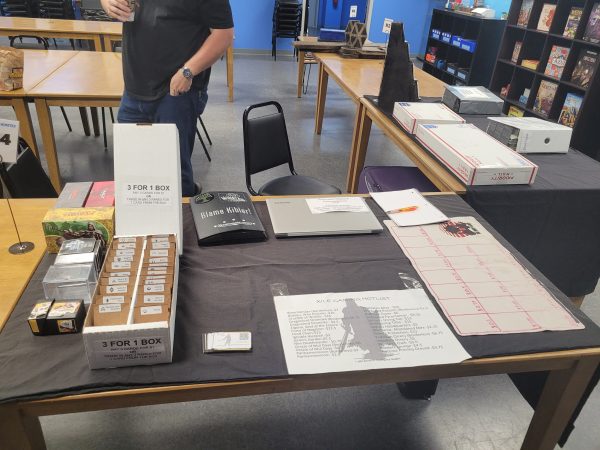
Table 2 Layout

Expanding Payment Options

I mentioned regarding my first vending experience that I had missed out on a couple sales due to my only accepting cash and PayPal. So the day before the event, I installed Cashapp, Venmo, and got Zelle setup as well. I would be lying if I didn't say I was hesitant to expand payment options, only because I don't like the idea of having money spread around all over. However, all these options have easy ways to "cash out," and by having money in them, I can also buy cards from people easier by using their preferred payment method. I actually had customers pay me in both Cashapp and Venmo, so I am glad I had those options setup.

Displays

I mentioned a display stand in my last article, and was able to complete it in time for the event. I will be the first to admit that my craft skills leave much to be desired. Still, thanks to black spray paint, I was able to make something that served its purpose and looked decent enough. I displayed my repacks on it, thus converting horizontal space into vertical space and providing a way for customers to get a better understanding of what I was offering. I actually ended up selling 14 repacks!

I made sure to print out signs for my binders and the 3-for-1 box. This provided my customers with pricing information before they put any effort into digging for cards. As I mentioned earlier, while my singles pricing wasn't pre-priced, if they looked up a card online, they would know the price. This seems obvious, but I have dealt with plenty of stores whose pricing is unknown until check out, which I as a customer hate. I want to know what something costs when I am considering it, not when I am at the payment step of the shopping experience.

People Problems

We did have Hurricane Ian hit our state this weekend; where I live we had mostly rain and some high winds, but very little damage to anything. Perhaps in part because of the hurricane, this event had a lot fewer people show up and a lot of empty vendor tables.

There was an error retrieving a chart for Hurricane

I personally feel the venue needs to shift its hours, which are 10am to 2pm, as most of the morning no customers were around. Most of my sales occurred after 12:30. The lack of customers and short window are definitely an issue, but I made sure to give every customer a business card and encouraged them to reach out to me for any Magic needs, which is something I failed to do at my first event. This is arguably one of the most important things to do when you are a very small business. I've already had one of my customers join my Facebook store group.

I will likely participate in the next event simply because the table cost is so low, but would like to see more of an effort from the venue to attract customers if I am going to continue vending there. I felt like I did more marketing and getting people to come than they did, and as their customer, I am not a fan of that.

The Cherry on Top

I did get lucky in that the people at the table next to me had a small Magic collection they wanted to sell and I noticed that it included the Magic Game Night Box, though it was opened. I offered them $30 without knowing what all was included and happily found the all the Game Night cards, as well as a few other hidden gems like a Stomping Ground and a Jace, Wielder of Mysteries. That final lesson is a classic: collection buying often offers the best bang-for-buck of any Magic purchase!

Magical Creatures: Weird and Camarid

Are you a Quiet Speculation member?

If not, now is a perfect time to join up! Our powerful tools, breaking-news analysis, and exclusive Discord channel will make sure you stay up to date and ahead of the curve.

Hello, creature enthusiasts! Welcome back to our series on each and every magical being created specifically for this game: Magical Creatures. We started this journey a few months ago, establishing the criteria to follow when picking the right creatures to discuss. In the last three installments, we moved to the second era of Magic, that of cards with the "modern" frame from Eighth Edition.

As you may have noticed, new entries in the creature canon became less and less frequent after 2004, the only exception being the Mirrodin block, which was packed with them. And yet, ever since the Kamigawa block, the number of new creatures unique to the Magic franchise dropped off dramatically. Last week, we saw the only two from the Kamigawa block. Today, we are going to cover two different blocks, each only featuring one new creature.

These two blocks are Ravnica and Time Spiral, and they respectively introduced the types Weird and Camarid. So, without further ado, let's begin with the former.

The Ravnica Block

Released between 2005 and 2006, this was the first block set on Ravnica, a plane mostly made of an enormous city. We came back to that plane time and again over the course of the years, both with Return to Ravnica and in a few standalone expansions. It centered around multi-color spells, the first block to do so since Invasion. More importantly, it introduced the "guild model" which would become so common in later years, with color combinations earning common names based on their association with a group of creatures in the lore. Its ten guilds, one for each color pair, were introduced over three expansions: Ravnica: City of Guilds, Guildpact, and Dissension.

And what about creatures? The large expansion introduced Archon and Lammasu, but unfortunately, neither is unique to Magic. The first one is self-explanatory, and the second comes from a Mesopotamian beast. Guildpact introduced Nephilim and Weird. This time, while Nephilim comes straight from the Bible and means something like "giant," Weird might be considered brand-new.

Super Weird

Let's be honest, a Weird is not that different from an Elemental. And then again, this is not the first time that we find subspecies: only last week we was talking about Zubera being a kind of Spirit! Weirds were designed as Izzet pets, which explains why they only come in blue and red. Ten such creatures exist, and their most interesting trait is that they are evenly distributed among the various expansions. The original Ravnica block introduced three of them: Gelectrode, Petrahydrox, and Steamcore Weird. Then Return to Ravnica block added five more, and the last ones appeared in War of the Spark and Core Set 2021.

What's a Weird, apart from being weird? Mark Rosewater once declared that the reason behind Weirds is that "world building made some weird creatures and didn’t know what to call them." So, it looks like "Weird" was just a nickame they used when designing Ravnica, and eventually decided to keep!

A Weird is an elemental used as lab assistant by Izzet League members. Their primary feature is bearing synergy with instant and sorcery spells, which makes sense since they are Izzet pets. Five out of the ten Weirds mention instants and sorceries, or at least "noncreature spells." None of them was ever particularly sought after for competitive play, at least not in constructed. As for limited, Gelectrode was a great pick, as all pingers are, and it surely made many new players come up with Izzet lists, together with Wee Dragonauts.

Time to move again, since Dissension only introduced Construct, and I can't in goodwill consider it a creature unique to Magic. What's next?

The Time Spiral Block

Coldsnap didn't bring any new creature types, so we'll move straight into the next block, which started with Time Spiral in October 2006. The following year, Planar Chaos and Future Sight would come to close the block, each expansion dealing in some way or another with time.

The Time Spiral block could easily be the deepest and most complex block ever created in Magic, as well as the one with the highest number of references and citations. It would might a series of its own, but for the moment we shall remain focused on creatures.

Some new creatures were printed within this block, yes, but mostly they weren't unique to Magic. I'm thinking of Assembly-Worker and Hellion, for instance. A couple of them were, though: Triskelavite and Camarid.

Triskelavite

We have already seen Triskelavite twice in the course of this series, so we won't spend too much time on it. The first time was in relation to Tetravite. And the last time was when regarding Pentavite. The fact is these three creature types are quite similar in that they only appear on tokens. We could consider all of them subspecies of the (non-existent) type "avite:" Tetravite, Pentavite and Triskelavite are all creations of an "avus" Construct. By the way, Construct is a creature type; it appears on non-token cards and is actually pretty common, with no less than 177 cards!

As for Triskelavite, it is only ever mentioned on the card Triskelavus, which in turn is a reference to both Tetravus and Pentavus. Not much else to say; it's one of the many cards mostly created for world building and lore, and not so much for game purposes.

Camarid

I've also mentioned Camarid, actually, although briefly: do you remember the piece on the Homarid type? Well, this is him now. I mean, it's the child: Camarids are just Homarids' offspring. Mark Rosewater made it clear that they would not return, though, even if Homarid could. After all, they are just a case "the juvenile version of a creature being a different creature type."

Like with Triskelavite, Camarid is another creature type only available as token. It's mentioned on Sarpadian Empires, Vol. VII, but was also present in Fallen Empires, on Homarid Spawning Bed.

Token Generators

In the last few installments, I tackled quite a lot of token generators able to create tokens with a creature type unique to Magic. These subtypes never had any special development by the Magic design team, and usually they were limited to one or two card each. The only exception was Saproling, the typical token created through Fungus creatures, which can be generated in many different ways and is mentioned on dozens of cards.

What do you think of these creatures? Do you have any personal favorite? Let me know in the comments or on Twitter, and stay tuned for next piece!

September ’22 Metagame Update: An Old Threat Rises

Are you a Quiet Speculation member?

If not, now is a perfect time to join up! Our powerful tools, breaking-news analysis, and exclusive Discord channel will make sure you stay up to date and ahead of the curve.

As inevitably as the turning of the seasons themselves, it's time for the first Modern metagame update of fall. For many, fall marks the return of the school year, and that always brings weirdness to the data. A number of players have to stop playing while they get their schedules together. However, there are also often more events in September for some reason. This has caused oddities in the past and should be kept in mind this year as well.

The Old Guard Surges

As is becoming customary, there are statistical outliers in the data. However, this month is different from the others. I've gotten used to UR Murktide being the top deck by far and being an outlier to boot. And that continues to be true in paper. Murktide is often followed by other decks, but that isn't true for paper Modern in September. It was close, with Cascade Crashers being just below the statistical line. With Crashers not being an outlier, Hammer Time doesn't qualify either. It's just Murktide outside the trendline.

There was an error retrieving a chart for Grief

Magic Online (MTGO) is another matter entirely. There are three outliers this month and Murktide is not the worst offender. Instead, Hammer Time is the big one followed by Murktide, a reversal from the norm, and a return to the standards of 2021. In addition, Rakdos Scam was fairly clearly an outlier despite being well below the other two. As I warned, the data is a bit weird. This might be a fluke, or it might be Rakdos reclaiming the crown it had back in 2020. We'll have to wait and see.

As always, the outliers are excluded from the actual statistical analysis. They’re reported in their correct place on the metagame chart.

September Population Metagame

To make the tier list, a given deck has to beat the overall average population for the month. The average is my estimate for how many results a given deck “should” produce in a given month. Being a tiered deck requires being better than “good enough.” Every deck that posts at least the average number of results is "good enough" and makes the tier list. Then we go one standard deviation (STdev) above average to set the limit of Tier 3 and cutoff for Tier 2. This mathematically defines Tier 3 as those decks clustered near the average. Tier 2 goes from the cutoff to the next standard deviation. These are decks that perform well above average. Tier 1 consists of those decks at least 2 standard deviations above the mean result, encompassing the truly exceptional performing decks. 

The MTGO Population Data

In August the adjusted average population was 4.82 setting the Tier 3 cutoff at five decks. This is a very low average, but given the three outliers being excluded, it makes sense. Tier 3, therefore, begins with decks posting 5 results. The STdev was 5.49, which means that Tier 3 runs to 11 results. Again, it's the starting point to the cutoff, then the next whole number for the next Tier. Therefore Tier 2 starts with 12 results and runs to 28. Subsequently, to make Tier 1, 19 decks are required.

There was an error retrieving a chart for Indomitable Creativity

To recap, January had 502 decks, February had 436 decks, March only hit 356, April was up to 437, May had 419, June had 481, July was 478, and August was 507 decks. September is a significant anomaly as it only has 404 decks. I'm not sure what happened to the missing 103 decks, but there were fewer MTGO events than in previous months. Naturally, the number of individual decks fell to 59. Of those 59 decks, 22 made the population tier. That's up from August's 18 but can be entirely attributed to the outlier effect.

Deck NameTotal #Total %
Tier 1
Hammer Time5714.11
UR Murktide4410.89
Rakdos Scam338.17
Living End215.20
4-Color Creativity194.70
Burn194.70
Tier 2
Cascade Crashers184.45
Temur Creativity174.21
4-Color Control153.71
Temur Scapeshift122.97
Tier 3
Yawgmoth102.47
UW Control102.47
Glimpse Combo102.47
Grixis Shadow92.23
4-Color Blink81.98
Amulet Titan71.73
Goblins71.73
Izzet Breach Combo61.48
Mono-Green Tron61.48
Jeskai Breach Combo51.24
Mill51.24

Starting this month, I'm adding in pie charts to help visualize the data. For this first month, it's broken down just by tier, with all the non-tiered decks under Other. I intended this to be deck by deck, but there were so many decks that it was an unreadable mess. I'll be refining these charts in the future.

That's a huge slice.

Scam has replaced Rock as the top Rakdos deck in Modern. The former uses the evoke elementals and Feign Death effects to gain a (theoretically) insurmountable early advantage while the latter is the traditional Jund-style deck. Scam has a lot of Deck-of-the-Month going for it thanks to recent wins, but it is quite high variance. It will be interesting to see if this shift in preferences is maintained.

Indomitable Creativity had a very good month, and if I combined all the variations, it would challenge Murktide. I'll be going into this in detail in this Friday's analysis article, but I'm not convinced this is more than a fluctuation. Underworld Breach also put-up numbers in several forms. Overall, combo decks did quite well in September.

The Paper Population Data

The paper tiers are calculated the same way as the MTGO tiers, just with different data. More paper events are reported each month, but they rarely report more than the Top 8 (sometimes less). However, that doesn't mean that the overall population is lower. July had 783 decks, while June had 640, and August recorded 594. September saw a surge up to 748 decks. It's looking like paper's data is just more volatile than MTGO, which makes sense as paper is decentralized.

Consequently, the number of unique decks is also up. August only managed 83, but September has 94. 26 of those decks made the tier list. The average population was 7.24, so eight decks make Tier 3. The STDev was 11.15, so the increment is 11. I round down if the decimal is less than .20. Therefore, Tier 3 runs from 8 to 19, Tier 2 is 20 to 31, and Tier 1 is 32 and over.

Deck NameTotal #Total %
Tier 1
UR Murktide7510.03
Hammer Time587.75
Cascade Crashers506.68
Rakdos Scam405.35
Amulet Titan374.95
Living End364.81
Tier 2
Burn314.14
4-Color Creativity293.88
Yawgmoth253.34
4-Color Control243.21
4-Color Blink233.07
Tier 3
Mono-Green Tron192.54
Grixis Shadow162.14
Jeskai Breach Combo152.00
UW Control152.00
Temur Creativity152.00
Merfolk131.74
Wishshift121.60
Affinity111.47
Temur Scapeshift101.34
Dredge91.20
Grixis Creativity81.07
Glimpse Combo81.07
DnT81.07
Goblins81.07
Domain Zoo
81.07
Paper stats always look better than MTGO.

As I said above, Crashers is just under the statistical line to be an outlier. Another result would have pushed it over the line. Additionally, Crashers wins the award for most changed deck in September. A new 4-color version emerged to take advantage of Leyline Binding after Dominaria United was released, nearly completely overtaking the traditional Temur version online. Then the MTGO players started brewing, and Crashing Footfalls is becoming another Omnath, Locus of Creation pile.

September Power Metagame

Tracking the metagame in terms of population is standard practice. But how do results actually factor in? Better decks should also have better results. In an effort to measure this, I use a power ranking system in addition to the prevalence list. By doing so, I measure the relative strengths of each deck within the metagame. The population method gives a deck that consistently just squeaks into the Top 32 the same weight as one that Top 8's. Using a power ranking rewards good results and moves the winningest decks to the top of the pile and better reflects their metagame potential. 

The MTGO Power Tiers

For the MTGO data, points are awarded based on the population of the event. Preliminaries award points based on record (1 for 3 wins, 2 for 4 wins, 3 for 5), and Challenges are scored 3 points for Top 8, 2 for Top 16, and 1 for Top 32. If I can find them, non-Wizards events will be awarded points the same as Challenges or Preliminaries depending on what the event in question reports/behaves like. Super Qualifiers and similar higher-level events get an extra point and so do other events if they’re over 200 players, with a fifth point for going over 400 players. There were no four-point events, but the Showcase Qualifier hit the five-point threshold. Consequently, it had an outsized effect on the data.

There was an error retrieving a chart for Puresteel Paladin

Total points fell significantly, as with the population, from 871 to 697. The adjusted average points were 8.58 Therefore 9 points made Tier 3. The STDev was 10.01, which is a bit low, but understandable in context. Thus add 10 to the starting point and Tier 3 runs to 19 points. Tier 2 starts with 20 points and runs to 30. Tier 1 requires at least 31 points.

Mill failed to make the power tier. It was replaced by Eldrazi Tron. Affinity also made the power tier, upping the total MTGO tiered decks to 23.

Deck NameTotal #Total %
Tier 1
Hammer Time9113.06
UR Murktide679.61
Rakdos Scam588.32
4-Color Creativity365.16
Temur Creativity344.88
Living End334.73
Tier 2
Cascade Crashers304.30
Burn294.16
4-Color Control284.02
Temur Scapeshift233.30
Yawgmoth223.16
UW Control202.87
Tier 3
Grixis Shadow182.58
Amulet Titan182.58
Glimpse Combo172.44
4-Color Blink152.15
Goblins121.72
Izzet Breach Combo111.58
Etron101.43
Mono-Green Tron91.29
Jeskai Breach Combo91.29
Affinity91.29
Seven decks have half the points.

The outlier gap is about the same for power as population, which is unusual. Frequently the gap looks worse in power terms than in population. I make the outlier decision based only on the population as it's the most objective measurement, but power does serve to highlight the scope of the warp on MTGO. There were a number of decks bubbling out of Tiers 1 and 3 into Tier 2 this month.

The Paper Power Tiers

Unlike with population, the paper power data works differently than the equivalent MTGO data. The data reported is usually limited to the Top 8 lists, even for big events. Not that I know how big most events are, as that number doesn't always get reported. In other cases, decks are missing. Applying the MTGO point system just doesn't work when I don't know how many points to award and there are data gaps. 

There was an error retrieving a chart for Murktide Regent

Thus, I award points based on the size of the tournament rather than placement. That way I'm being internally consistent with the paper results. The current system is that for events that don't report their starting populations or are under 50 players, I'm giving out 1 point. 51-300 players get 2 points. 301 and above get 3 points. I chose these levels based on the rarity of events over 300 compared to 100-200 and the fact that events under 300 tend to be local events in large cities. It feels like it should be 300 for truly unique events, despite there being no Grand Prix yet. I am currently reevaluating this system given how paper is evolving.

There were a huge number of events awarding 2 points in July and several 3-point events as well. Altogether September had 1068 points, well up from August's 861 points. Not having to exclude team events will do that.

The adjusted average points were 10.35. This sets the cutoff at 11 decks. The STDev was 16.52, thus adding 17 to the starting point and Tier 3 runs to 28 points. Tier 2 starts with 29 points and runs to 46. Tier 1 requires at least 47 points. The total decks fell from 26 to 23. Death and Taxes, Affinity, and Domain Zoo failed to win enough to make the power tier.

Deck NameTotal #Total %
Tier 1
UR Murktide1059.83
Hammer Time827.68
Cascade Crashers757.02
Rakdos Scam625.80
Living End575.34
Amulet Titan504.68
Tier 2
Burn464.31
4-Color Creativity413.84
Yawgmoth383.55
4-Color Control363.37
4-Color Blink333.09
Tier 3
Jeskai Breach Combo272.53
Mono-Green Tron252.34
UW Control252.34
Grixis Shadow232.15
Temur Creativity201.88
Wishshift181.68
Temur Scapeshift171.59
Merfolk161.50
Dredge151.40
Affinity131.22
Grixis Creativity111.03
Glimpse Combo111.03
Interesting that Tier 3 and Other are almost identical.

Average Power Rankings

Finally, we come to the average power rankings. These are found by taking the total points earned and dividing them by total decks, to measure points per deck. I use this to measure strength vs. popularity. Measuring deck strength is hard. There is no Wins-Above-Replacement metric for Magic, and I'm not certain that one could be credibly devised. The game is too complex, and even then, power is very contextual. Using the power rankings certainly helps and serves to show how justified a deck’s popularity is. However, more popular decks will still necessarily earn a lot of points. Which tracks, but also means that the top tier doesn't move much between population and power, and obscures whether they really earned their position. 

There was an error retrieving a chart for Leyline Binding

This is where the averaging comes in. Decks that earn a lot of points because they get a lot of results will do worse than decks that win more events, indicating which deck actually performs better. A higher average indicates lots of high finishes, whereas low averages result from mediocre performances and a high population. Lower-tier decks typically do very well here, likely due to their pilots being enthusiasts. Bear this in mind, and be careful about reading too much into these results. However, as a general rule, decks which place above the baseline average are overperforming and vice versa. How far above or below that average determines how "justified" a deck's position is on the power tiers. Decks well above baseline are therefore undervalued while decks well below baseline are very popular but aren't necessarily good. 

The Real Story

When considering the average points, the key is looking at how far-off a deck is from the Baseline stat (the overall average of points/population). The closer a deck’s performance to the Baseline, the more likely it is to be performing close to its “true” potential. A deck that is exactly average would therefore perform exactly as well as expected. The greater the deviation from average, the more a deck under or over-performs. On the low end, a deck’s placing was mainly due to population rather than power, which suggests it’s overrated. A high-scoring deck is the opposite of this. 

I'll begin with the average for MTGO

Deck NameAverage PowerPower Tier
Amulet Titan2.573
Etron2.503
Affinity2.253
Yawgmoth2.202
Temur Creativity2.001
UW Control2.002
Grixis Shadow2.003
Temur Scapeshift1.922
4-Color Creativity1.891
4-Color Control1.872
4-Color Blink1.873
Izzet Breach Combo1.833
Jeskai Breach Combo1.803
Rakdos Scam1.761
Goblins1.713
Glimpse Combo1.703
Cascade Crashers1.671
Baseline1.65
Hammer Time1.601
Living End1.571
Burn1.532
UR Murktide1.521
Mono-Green Tron1.503

Pat yourself on the back Temur Creativity, as the best performing Tier 1 deck, you're deck of the month! Of course, don't let it go to your head, your average is thanks to a great overall result in the Showcase Challenge, not consistent performance.

Then the average for paper:

Deck NameAverage PowerPower Tier
Jeskai Breach Combo1.803
Temur Scapeshift1.703
UW Control1.673
Dredge1.673
Living End1.581
Rakdos Scam1.551
Yawgmoth1.522
Cascade Crashers1.501
4-Color Control1.502
Wishshift1.503
Burn1.482
Grixis Shadow1.443
4-Color Blink1.432
Hammer Time1.411
4-Color Creativity1.412
UR Murktide1.401
Grixis Creativity1.373
Glimpse Combo1.373
Amulet Titan1.351
Baseline1.34
Temur Creativity1.333
Mono-Green Tron1.323
Merfolk1.233
Affinity1.183

Kudos to Living End for continuing to perform despite the changing metagame. Endurance is clearly insufficient graveyard hate.

Composite Metagame

That's a lot of data, but what does it all mean? When Modern Nexus first started, we had a statistical method to combine the MTGO and paper data, but the math of that system doesn't work without big paper events. I tried. Instead, I'm using an averaging system to combine the data. I take the MTGO results and average the tier, then separately average the paper results, then average the paper and MTGO results together for final tier placement. 

There was an error retrieving a chart for Living End

This generates a lot of partial Tiers. That's not a bug, it's a feature. The nuance separates the solidly Tiered decks from the more flexible ones and shows the true relative power differences between the decks. Every deck in the paper and MTGO results is on the table, and when they don't appear in a given category, they're marked N/A. This is treated as a 4 for averaging purposes. 

Deck NameMTGO Population TierMTGO Power TierMTGO Average TierPaper Population TierPaper Power TierPaper Average TierComposite Tier
Hammer Time111.00111.001.00
UR Murktide111.00111.001.00
Rakdos Scam111.00111.001.00
Living End111.00111.001.00
Cascade Crashers211.50111.001.25
4-Color Creativity111.00222.001.50
Burn121.50222.001.75
4-Color Control222.00222.002.00
Amulet Titan333.00111.002.00
Temur Creativity211.50333.002.25
Yawgmoth322.50222.002.25
Temur Scapeshift222.00333.002.50
4-Color Blink333.00222.002.50
UW Control322.50333.002.75
Glimpse Combo333.00333.003.00
Grixis Shadow333.00333.003.00
Mono-Green Tron333.00333.003.00
Jeskai Breach Combo333.00333.003.00
Goblins333.003N/A3.503.25
AffinityN/A33.50333.003.25
Izzet Breach Combo333.00N/AN/AN/A3.50
DredgeN/AN/AN/A333.003.50
WishshiftN/AN/AN/A333.003.50
Grixis CreativityN/AN/AN/A333.003.50
MerfolkN/AN/AN/A333.003.50
Mill3N/A3.50N/AN/AN/A3.75
EtronN/A33.50N/AN/AN/A3.75
Death and TaxesN/AN/AN/A3N/A3.503.75
Domain ZooN/AN/AN/A3N/A3.503.75

The three constants of the post-Lurrus of the Dream-Den metagame continue to hold onto their overall Tier 1 positions. That Living End, Murktide, and Hammer have been doing this for this long in Modern is something to keep an eye on.

Top heavy metagames are quite concerning.

Things Are Getting Weird

Leyline Binding is making considerable waves in Modern and many three-color decks are now four or five colors just for that card. This is spreading out the Omnath players even more than they previously were. Which is making it harder to guess where Modern is actually headed.

QS Insiders can tune in this Friday when I unpack some of this month's data and share my thoughts on its implications. If you're not an Insider, consider subscribing today!

Adam Plays Magic: Abzan Greasefang

Are you a Quiet Speculation member?

If not, now is a perfect time to join up! Our powerful tools, breaking-news analysis, and exclusive Discord channel will make sure you stay up to date and ahead of the curve.

Five months ago, I wrote an article focusing on Mardu Greasefang, a dominating Pioneer deck with all of its relevant pieces available in the new Explorer format. The Mardu builds utilized powerful rummaging effects like Bloodtithe Harvester and Fable of the Mirror-Breaker to put drawn copies of Parhelion II into the graveyard. Eventually, the player would find the titular Greasefang, Okiba Boss to bring back and crew the vehicle, swinging in the air for 13 damage, leaving behind two 4/4 angels to finish the job.

Since then, several variants have come about—notably Esper builds with Ledger Shredder and Tainted Indulgence which offered a tempo approach, and now a self-mill Abzan combo build that focuses on Grisly Salvage-style effects.

The core concept behind these decks hasn't changed, but the methods of facilitating the combo and creating a "plan B" has gone through some very creative iterations.

What I Like

The Abzan version of the Greasefang deck has two main areas that help it excel compared to previous builds. The first of which is access to Esika's Chariot. Chariot is a powerful midrange threat that's much easier to cast than Parhelion II or Skysovereign, Consul Flagship, while still working well with Greasefang's reanimating ability.

In fact, Chariot benefits from the otherwise detrimental "return to hand" clause from Greasefang. By bouncing back to the player's hand, the player gets to cast Chariot for another enters-the-battlefield trigger, creating an ever-growing army of 2/2 cat tokens. As it puts three permanents on the board, opponents will struggle to answer Chariot cleanly. These sequences create opportunities for card advantage as the opponent will need to waste multiple removal spells to clear out a single copy of Chariot.

The second benefit of the Abzan build is how quickly it can churn through the deck with cards like Grisly Salvage, Stitcher's Supplier, and Corpse Churn. These effects, combined with Can't Stay Away can ensure access to Greasefang and a well-stocked graveyard full of vehicles.

Witherbloom Command specifically is a big boon for the archetype. Not only does it help the self-mill plan, but it can also destroy disruptive hate pieces like Weathered Runestone and Rest in Peace.

Finally, Liliana of the Veil is a new addition to Explorer that's found an excellent home in this deck. She is a recursive discard outlet that dumps vehicles into the graveyard after they've been drawn or returned to the player's hand from Greasefang. As the combo necessitates the opponent keep up removal, Liliana penalizes them for holding cards in their hand. Her edict ability also helps to clear out creatures on an underdeveloped board. Often, she's a must-answer threat that diverts attention away from the player's combo, creating opportunities to win out of nowhere.

What I Don't Like

While Abzan Greasefang is great at digging through the deck, it's also at the deck's mercy. If the key pieces are in the bottom third, there isn't a great backup plan. So much of the deck is moving parts with low card quality that struggle to hold up on their own. A Stitcher's Supplier that whiffs on relevant spells is a dinky 1/1. Parhelion II without Greasefang is a dead draw. I'd love to see more individually powerful cards support the deck (like Fable of the Mirror-Breaker) for when the combo draws don't quite line up. I'm sure there's also something that can be done to better utilize the fluff filling the graveyard, be it Escape, Delve, or some other way of using this resource.

This build is much more reliant on the graveyard to facilitate its card draw and card selection compared to Mardu or Esper. Unlicensed Hearse can sidestep Witherbloom Command by crewing, making it a very difficult to remove lock piece. Leyline of the Void is similarly a sideboard card that Greasefang will struggle to deal with. Without Consider and Tainted Indulgence, finding answers to these cards like Tear Asunder can be a challenge.

What's Under the Hood?

Explorer Abzan Greasefang

Creatures

4 Greasefang, Okiba Boss
4 Stitcher's Supplier
4 Raffine's Informant

Artifacts

4 Esika's Chariot
4 Parhelion II
1 Skysovereign, Consul Flagship

Planeswalkers

2 Liliana of the Veil

Spells

2 Corpse Churn
3 Can't Stay Away
1 Duress
4 Grisly Salvage
2 Witherbloom Command
4 Thoughtseize

Lands

3 Blooming Marsh
1 Boseiju, Who Endures
4 Darkbore Pathway
4 Concealed Courtyard
1 Godless Shrine
2 Overgrown Tomb
1 Swamp
1 Takenuma, Abandoned Mire
4 Temple Garden

Sideboard

2 Duress
1 Skysovereign, Consul Flagship
2 Unlicensed Hearse
2 Tear Asunder
2 Assassin's Trophy
3 Graveyard Trespasser
3 Fatal Push

End Step

Another one down! Abzan Greasefang is certainly a powerful contender in the Explorer metagame, but I can't help feeling like there's something missing. As I mentioned above, the deck has a lot of moving pieces that are greater than the sum of their parts, though I'd love for some individually powerful cards to find their way into the deck. I haven't found anything that fits what I'm looking for, but maybe there will be something in a future set that will push the deck over the edge.

If you'd like to keep up with me, feel free to drop a follow on Twitch or on Twitter. I'll catch you all next week.

The Heart of Deck-Construction: Pillars, Piles, and Crossbeams

Are you a Quiet Speculation member?

If not, now is a perfect time to join up! Our powerful tools, breaking-news analysis, and exclusive Discord channel will make sure you stay up to date and ahead of the curve.

Pillars are decks that define the structure of a Limited format. They establish rules of engagement for the rest of the metagame. Each pillar has a clear and hearty game plan rooted in its commons. We should expect to see versions of these decks in every draft. Cards and colors outside these pillars are relegated to support roles. We can think of these as the crossbeams. They are tools that can strengthen multiple decks, and create variations on the pillars. Understanding both the pillars and the crossbeams and how they fit together is important for deck construction in any format.

Understanding Format Pillars in Dominaria United

We should consider these pillars as we're drafting and building our decks. Because of their power level, they make for the best and most reliable archetypes. Dominaria United (DMU) is defined by three pillars: Spell-based Blue decks, Domain, and creature-based White decks.

Spell-Based Blue

Typically UR or UB, these decks cast a high volume of cheap spells and find payoffs in Tolarian Terror, Tribute to Urborg, Balmor, Battlemage Captain, and Haunting Figment. This is probably the strongest archetype and the easiest to assemble at common.

Domain

In the first stages of the format, the Domain decks relied on an overwhelming endgame, with all sorts of kicker spells, uncommons, and rares to overpower opponents. Sunbathing Rootwalla has overtaken the Floriferous Vinewall as the two-drop of choice in all but the most controlling Domain decks and has opened up a more assertive approach to the strategy.

Creature-Based White Decks

These decks look to apply early pressure, win timely combat with Take Up the Shield, and deploy Argivian Phalanx well before its casting cost indicates. This assertive strategy can win with a rush of damage or win by accruing value on the board.

What About Wingmantle Chaplain?

The Defender deck is often referred to as the scourge of the format. However, I would argue that the defender package is most commonly found in one of these archetypes. Usually, it's in an Esper Spells deck or a Domain deck with lots of recursion. While it often feels like its own archetype, it's usually just a sub-archetype of one of the pillars.

What About Red and Black?

Red and black are the crossbeams of DMU, acting as supporting colors in the format. They lack premium synergies that we want to build toward but accentuate the gameplay of each pillar. They narrow the focus of the pillars above. In short, red looks to accelerate gameplay, while black looks to slow it down.

Consider the Spells archetype. The UB version is a control deck, upgrading Tribute to Urborg into hard removal. Ghitu Amplifier and red's burn spells accelerate the clock and push us towards a more assertive tempo deck. Similarly, the Go-Wide White decks gain access to Keldon Strike Team and the kicker on Heroic Charge, or get Gibbering Barricade and Bone Splinters to generate value.

The difference between Domain Stompy and Domain Control is the difference between kicking Colossal Growth versus kicking Urborg Repossession. One goes fast, and the other looks to go slow.

It's also why the RB decks perform the worst compared to the others. The color combination offers strong cards, but they don't coalesce into well-supported and consistent synergies.

A note on the data: While GU and GB have comparably low ratings, this represents a misuse of the color's identity. Slower Green decks should include splash cards and additional colors to win in the late game. GR and GW benefit from being more assertive and sacrificing less in a two-color deck. In general, we should try and avoid RB as a deck. It can potentially win, but it needs very high card quality to do so consistently.

Synergies at Common

The most commonly exchanged currency in Limited formats is creatures. Almost all decks rely on them. Being rewarded for playing creatures is like finding out there's a buy one get one sale on something you already wanted.

The spells in this format are efficient and we have time to cast them. This is not an aggressive format, so we're incentivized to play cards like Impulse and Timely Interference, which in turn makes cards like Essence Scatter much better. The spell-based decks incentivize us to do something that already works.

Similarly, the fixing in this format is plentiful with the dual lands. We already want to be splashing the powerful kickers, and the ten uncommon legends, so getting extra incentive makes this a strong strategy.

Red and Black are crossbeams, because while they have an identity, they lack an effective strategy at common. Black wants creatures in the graveyard to help rush out Withering Necromass. However, the only common that helps us do that is Eerie Soultender. Our cards will eventually trade off, but it's hard to accelerate that process profitably. Red has a lot of good cards as well, but its best commons are cheap interaction and a Domain payoff in Meria's Outrider.

When Pillars Crumble Into Piles

As we navigate each draft, we want to find a home in one of the pillars. Sometimes though, those pillars crumble. Sometimes we straddle between strategies, chasing high-power cards. Sometimes some overlapping synergies cause us to lose focus. Often, this leaves us with a deck lacking a clear identity, or a clear game plan. These decks are lovingly referred to as "piles".

Whether it be greed, experimentation, or just not seeing enough fixing to take these piles to a specific deck type, we still want to optimize our chances of winning.

The Mortar Holding the Pile Together

"Piles" often contain a number of high-power cards, but lack the cohesion of the pillars. To build a winning deck might require some extra mortar to hold them together. I want to highlight some key cards that helped me salvage some piles.

Salvaged Manaworker

Typically these "pile" decks have mana issues. Salvatore is a nice way to help out the mana as well as provide a cheap body. We discussed this little construct last week, but this list would be incomplete without his inclusion.

Sheoldred's Restoration

I find many of my "piles" end up being control decks gone wrong. As a result, I often need some life and have a Writhing Necromass or Tolarian Terror in my graveyard. Gaining seven life and getting a 5/5 via Sheoldred's Restoration is a powerful play and stunts aggression effectively. You're probably in a bad spot though if you can't kick it.

Artillery Blast

These decks are rarely going to be aggressive and Artillery Blast can still kill stuff.

Battle-Rage Blessing

The poor man's Take Up the Shield, Battle-Rage Blessing works nicely with the many menace creatures in the format.

Aggressive Sabotage

A bad two for one is still a two for one.

Automatic Librarian

Automatic Librarian provides colorless card selection without a loss of tempo. It can help us find the pieces we need.

Goblin Picker and Thrill of Possibility

These both allow us to trade our trash for treasure. When our deck is built from mismatched parts, tossing away one piece in search of another can be a winning strategy.

Draft Chaff

Navigating between pillars and power is what makes each draft a unique experience. At the heart of all this discussion is the central theme of all Magic advice: Always have a plan. All formats have pillars, and knowing them is a huge advantage.

The three pillars of the format represent the most common and easiest to assemble plans. Most of our decks should use those strategies. We read the table as best we can, and try to find the open lane. However, uncertainty and temptation can cause chaos. The pillars are important, but it's also necessary to know how to operate in the space between them. Each pillar has many versions. Learning the ins and outs of each, as well as the nuances and variations they offer will serve us well.

Preparation and Anticipation for Magic 30

Are you a Quiet Speculation member?

If not, now is a perfect time to join up! Our powerful tools, breaking-news analysis, and exclusive Discord channel will make sure you stay up to date and ahead of the curve.

The Magic 30 celebration in Las Vegas is less than one month away! After registering for the event, I proclaimed my intention to attend across Twitter and Discord social media platforms. I inquired eagerly, “Who will I get to see while I’m there?”

The response admittedly had me scratching my head. Not too many people responded to my initial posts, and I quickly learned there are some differences between this Las Vegas Magic event and those of the past. The main one is the fact that it’s behind a paywall—in order to visit the venue in person, one has to pay a baseline ($60) entry fee. Previous iterations of this event were all open to the public at no cost.

The other difference, I recently learned, is that there are allegedly no on-demand events. To play in an event, one has to register online and pay in advance. One of my favorite activities at a Grand Prix back in the day was registering for a one-off draft or side event when my schedule allowed it. This maximized my flexibility and gave me full control over my day. This won’t be the case in Las Vegas.

Despite these inconveniences, I’m still extremely excited to attend the event! This week I’m going to share some of my preparations and will highlight some of the research and activities I hope to conduct while I’m in Las Vegas at the end of October.

Business First

My first and foremost purpose for this trip is business—I’m traveling to Las Vegas under sponsorship from Quiet Speculation, and as such will prioritize the site’s and all its subscribers’ interests while on site.

Questions I’ve already received include understanding what the supply and demand currently looks like for old (pre-2000) sealed product. I’ve also been tasked with asking vendors about their inventories of said products.

Naturally, as I converse with each vendor, I also intend to get a broader feel for the overall secondary market. Are certain cards selling particularly well? Is the slowdown in the economy a threat to business? Is the strong U.S. dollar creating a shift in market dynamics due to international arbitrage?

Since I’ll be spending a good deal of time interacting with the vendors on site, I wanted to ask the question of my readership: are there other Magic finance areas you’d like me to focus on while I’m in Las Vegas later this month? Are there any questions I should ask, any supply I should take note of, any buy and sell prices I should observe, etc.? This is the time to maximize the value of my trip there, so please send your questions my way!

Personal Business

While I’m in Las Vegas, I also have some personal business to attend to. Namely, I hope to do some major card selling if the market is favorable enough. The strength of the market is yet to be seen though. On the one hand, I am optimistic that this will be a massive event attracting numerous vendors. Those vendors will want to maximize the value of their trip to the venue, and one way to achieve this is by bringing sufficient cash to bolster inventories. With so many vendors present, I’m hoping for ample opportunity to liquidate a portion of my collection, opportunistically infusing cash into my kids’ college funds while the stock market is weak.

On the other hand, I’m nervous that vendors won’t be so keen to stock up on high-dollar inventory out of fear they will run out of cash too early. If they spend a decent fraction of their cash on Friday morning, will they run out by Saturday evening? I remember this happened back in 2015 at the major Las Vegas Magic celebration, and it created quite the buzz. Major Magic shops were running out of cash on site, forced to offer trade credit in lieu of the green stuff. This was quite suboptimal for all parties involved.

(As an aside, this did enable me to acquire my first piece of Power, an Unlimited Mox Jet, for $700. I'd like to think I got a deal because the vendor was fairly desperate for cash).

There was an error retrieving a chart for Mox Jet

Fast forward seven years, and card prices are far more expensive than they were back then. Does this mean vendors will run out even more quickly? Will they anticipate this risk and bring even more dollars to the celebration event? Will the fact that there’s a cap on attendance (the event is already sold out) mean that the number of prospective sellers will be capped, generating greater selling opportunities for those in attendance?

These are all the questions I’m wrestling with in my mind. Because I don’t have any of the answers, I’ll attend with an open mind. If the selling situation is favorable, I’ll take advantage. If not, I’ll sell enough to make the trip worthwhile and bring home the rest. By keeping my expectations low, I’ll avoid any major disappointments.

Either way, I’m going in prepared. That means I intend to do my homework ahead of time, mapping out what I am willing to sell, the condition of said cards, and the estimated amount I hope to receive for selling them. I’ll also do some research just before the event, browsing online buylists from top vendors, so I am fully aware of how much my cards could potentially fetch me. This way, if I see the opportunity to sell for a comparable or greater amount, I’ll know it’s a good deal.

I’ll organize this data in a spreadsheet of sorts, which I’ll print out the day before the event so I have the most up-to-date numbers I can gather. Preparation is key, and I’m sure the vendors will appreciate a streamlined buying experience.

Time to Play

In addition to selling some cards, I also hope to play in at least a couple of events while on site. As I mentioned before, I don’t believe there are going to be on-demand events that weekend. To ensure I’d have at least a small dose of competitive play each day I’m there (Friday and Saturday), I pre-registered for one event each day.

On Friday, I’m registered to play in the Vintage for Vintage event. On Saturday, I’m registered for the Kamigawa: Neon Dynasty Sealed event.

For the latter, I genuinely enjoyed Kamigawa: Neon Dynasty Limited and I wanted the chance to experience it in paper. I initially attempted to register for the Friday Draft of the set, but it had just sold out. I settled with Sealed, hoping to put to work the experience I gained drafting this format over and over again on Arena. Kamigawa: Neon Dynasty was the first Limited set where I achieved a diamond ranking on Arena, so it’s become one of my all-time favorites.

Keep your fingers crossed with me that I open a Colossal Skyturtle and Season of Renewal so I can do loop-de-loops. This combination will ensure maximum fun. I will also plan to play every copy of Imperial Oath I open!

There was an error retrieving a chart for Imperial Oath

For the former, Vintage has always been one of my favorite formats. A few years ago, I decided to make the leap from Legacy to Vintage in order to experience the thrill of casting Black Lotus in a sanctioned event. It did not disappoint. Since building the deck, I have been able to play in two side events along with a couple of casual games on webcam. It’s been a while, however, and I am really excited to shuffle up the old list and give it a spin.

Unfortunately, I think the metagame probably shifted some since I built my deck; my list is probably a bit obsolete. You know what? I don’t care! Vintage is about the thrill of casting broken cards and I hope to accomplish this regardless. My list is designed specifically to play all the broken cards, as I play a Tendrils of Agony Storm list!

Sig's Vintage Storm Deck

Artifact

1 Mana Crypt
1 Black Lotus
1 Mox Jet
1 Mox Ruby
1 Mox Sapphire
1 Mox Emerald
1 Mox Pearl
1 Sol Ring
1 Mana Vault
1 Lotus Petal
1 Lion's Eye Diamond

Artifact Creatures

1 Blightsteel Colossus

Instant

4 Dark Ritual
2 Hurkyl's Recall
2 Cabal Ritual
1 Chain of Vapor
1 Vampiric Tutor
1 Brainstorm
1 Ancestral Recall

Sorcery

4 Dark Petition
3 Cabal Therapy
4 Duress
1 Tendrils of Agony
1 Mind's Desire
1 Tinker
1 Time Walk
1 Timetwister
1 Wheel of Fortune
1 Demonic Tutor
1 Ponder
1 Yawgmoth's Will
1 Gitaxian Probe

Enchantment

1 Necropotence
1 Yawgmoth's Bargain

Land

1 Library of Alexandria
1 Bloodstained Mire
1 Badlands
1 Tolarian Academy
4 Underground Sea
4 Polluted Delta
1 Swamp

Sideboard

3 Defense Grid
2 Mindbreak Trap
4 Ancient Tomb
3 Ravenous Trap
2 Hurkyl's Recall
1 Empty the Warrens

There was an error retrieving a chart for Bolas's Citadel

Knowing I’m registered for this event, I’ve already purchased a couple of ancillary cards in case I want to make some updates before the tournament. Purchases include a Bolas's Citadel as an upgraded Tinker target (I guess Blightsteel Colossus goes in the sideboard now) and a Wishclaw Talisman as another tutor effect.

There was an error retrieving a chart for Wishclaw Talisman

I know Bolas' Citadel from Historic on Arena, but I don’t think I had ever seen Wishclaw Talisman before. I guess I have some research to do if I want to be completely caught up with the metagame. Most likely, I’ll just have to read my opponents’ cards if they were printed after 2018!

Wrapping It Up

Magic 30 is less than four weeks away, and my anticipation is starting to climb! Despite some of the inconveniences associated with this particular event, I can’t help but look forward to the experience. I’ll be on the ground researching the health of the secondary market while networking and jamming a few side events. Any chance to play paper Vintage is a special occasion nowadays!

I’ll reiterate here that if anyone has any questions, any market research, or any requests while I’m onsite, please don’t hesitate to reach out to me on Twitter (@sigfig8) or the Quiet Speculation Discord. I want to make the most of this event for our subscribers and avid readers, and that’s only possible if the community engages.

While I’m on site, I intend to also conduct a live Q&A session in the Quiet Speculation Discord. This means I’ll be there at the venue taking questions from anyone who happens to be hanging out in Discord at that moment. Stay tuned for schedule details as the event gets closer.

Lastly, I look forward most to networking. One of the best parts of a large Magic event is the chance to interact with and meet the many great personalities I interact with on social media. Despite the underwhelming response I first received when I announced my intention to attend, I still have a short list of people I cannot wait to meet in person for the first time. I’m hoping that list will grow as more people are aware of my travel plans.

If you are reading this article and will be in Las Vegas for Magic 30, please let me know so we can meet up! I’ll have decks to play, cards to trade, and fun stories to share. The event will be a lot of fun, but connecting with amazing folks in the Magic community is what will make it unforgettable.

Generational Magic: 4 Ways Magic Has Affected My Life

Are you a Quiet Speculation member?

If not, now is a perfect time to join up! Our powerful tools, breaking-news analysis, and exclusive Discord channel will make sure you stay up to date and ahead of the curve.

It's hard to say what my life would be like without Magic. I've been playing the game longer than I haven't since starting in '94. There are times I've looked back and wondered, what if I hadn't started playing? Maybe I would have delved more into other games, sports, work; who knows? Sure, that's all in the make-believe land of what-if, but from time to time I've also pondered on how being involved with the game has helped make me who I am today.

Totally Awesome Game, Dude!

To give a little context on how my involvement in Magic started, I'll share a little personal history. Being a child of the '80s, there weren't many options for what is now a more commonplace term: gamer. The main choice back then was TSR's juggernaut:

Advanced D&D, 1st edition

I played in a few D&D campaigns, and they were fun and all, but the potential length of play was a problem. Mainly due to never being able to get the same people together again. It never failed; we'd start one campaign, enjoy a multi-hour session, and never get back to it. The reasons were various, but after doing that a few times, I lost interest.

The other early gaming experience I had, and still enjoy to this day, was with gamebooks. For the uninitiated, these are D&D games in book form. Even though it's not a true gamebook, I included the Choose Your Own Adventure book for those in the US who might not be familiar with Fighting Fantasy and Lone Wolf, which honestly are worldwide juggernauts in their own right and maintain a huge following.

Choose Your Own Adventure, Fighting Fantasy, and Lone Wolf

With these, I didn't need to coordinate with others, or plan out a large chunk of time. I could pick one up, start in, and put it down when needed. The only thing missing was friends. I enjoy hanging out with others, and even though these books scratched the gaming itch, something was still missing.

Fast forward to the fall of '94 and I'm in a small living room with my younger brother and two of our friends, trying to figure out how the mana pool works. Full disclosure: we thought you saved and built up your mana, so we kept track of it on separate sheets of paper. Fortunately, we figured out the correct process a little later... or maybe we were just ahead of our time?

There was an error retrieving a chart for Omnath, Locus of Mana

No doubt, if you're a Magic player, it's probably given you many good memories, friends, and experiences. Now, with Magic's 30th Anniversary on the horizon, I figure I'd share a few ways this wonderful game has affected my life and maybe yours too.

1. Almost Eight Billion People, and I'm One of Them

Grand Prix Las Vegas 2013

According to the World Population Clock, we're on the cusp. So many people and so many Magic players. Last I heard, there are approximately 40 million of us. Sure, it's only 0.5% of the world's population, but still a ton of people I haven't had the pleasure of playing Magic with yet. I have gotten to know quite a few people through Magic and learned some things in the process.

Understanding Others

Other than through my work, I've come across more people outside my sphere of influence through Magic than through any other. People from differing backgrounds, beliefs, ages, personalities, etc. I haven't gotten to know everyone intimately, but it has provided me with more insight into other players and what's important to them.

Sometimes it was subtle; other times, it was right there in front of me. By expanding my range, I've been able to engage in great discussions, make new friends, and even attend a wedding through Magic. You never know who you'll get to know.

Broadening My Worldview

Hand in hand with the meeting and greeting is how my worldview expanded. Every time I would play against or meet someone I wasn't sure of or didn't quite get, I'd think about it. Why don't I understand or fully appreciate this person?

I'd then work to resolve that within myself. Is it a difference in background? A language barrier? Even if I wouldn't be able to resolve it completely, I'd at the very least gain some understanding. I can respect that the world is much larger than I am and I'm still learning.

2. Seeing the World Through New Eyes

We see myself

When I'm around others and gain some knowledge, I try to implement it. I work to put what I've learned into practice; to constantly improve myself in how I deal with those around me and hopefully help those around me improve as well.

You Know What They Say When You Assume...

Being self-aware of limitations leads to better decision-making, which leads to better experiences. For example, when I've sat across from a young player just starting out, it feels natural to assume the game is in the bag. That kind of cockiness can spell trouble mentally.

When you start to write someone off, just because they're young, or a girl, or old, like yours truly, or whatever, you actually lose out. You lose the strategic advantage, possibly lose an opportunity to make a friend, or overall lose the chance to enjoy the event.

It is human nature to assume facts not in evidence. To judge before you know the situation. It can prove a struggle, but I have found it rewarding to always try to leave room to be wrong and then learn from the experience.

Let's Agree to Disagree

My son, Jarod, enjoys discussing and at times debating various Magic topics. It's all in good fun, but we can get verbally heated about trying to prove we're right. Sometimes you just need to not worry about it. Now, Jarod and I are comfortable and familiar enough with each other to know that the discussion isn't that big of a deal. That familiarity is not always the case.

While interacting with people I'm not familiar with or people with different viewpoints, it helps to know when to let the discussion go before it becomes something it shouldn't. Sometimes it helps to step back and ask, "What's my purpose here?" Am I there to have fun playing a game, or just prove I'm right about something? For me, it tends to be the former.

3. "Oh Lord, It's Hard to Be Humble When You're Perfect in Every Way"

Yes, this song and album cover is quite old

The picture above is of Mac Davis, a country singer with this section's title being one of his most popular songs. Mind you, I was ten back in 1980, but the song kind of sticks in your head. You can tell from the live version he's having a lot of fun with it. It does point out, in a humorous way, something that my long experience with the game has produced. Knowing that I am important, but not having to express it to everyone I meet.

I See You Know the Ways of Magic

I've been playing for 28 years and have a large collection, but I don't need to lord these facts over new players that don't. We all play, win, lose, and experience the game in our own way. My story is just that: mine. It's not more or less important than your story. Remembering that helps me enjoy the event more while interacting with my fellow players.

It's Like D&D, But with Cards

Nowadays, gaming in general is more accepted and understood. Fortunately, we don't have the same issues that were prevalent during the first couple decades of Magic. Still, don't fall into the same trap as those who don't understand what it's about. When someone is ignorant of what Magic really is, I've found that there are ways to help them to expand their understanding rather than perpetuate a stereotype.

4. What's this Left Brain / Right Brain stuff?

Whoa, colors!

Almost everyone's heard of the Left Brain vs. Right Brain debate. Are you more analytical? You lean left. Creative? Right. To be honest, it's really not much of a debate, since it's been disproven for the most part. In simple terms, we actually use all of our brains, just different areas fire off at different times. It's still fun to use the imagery to describe how our brain appreciates different aspects of a thing... in this case, a thing called Magic!

Let's Get Creative!

As I expressed in a previous article, Magic has stoked my creativity. Not just through the cards themselves, but in ways outside of the game. Still, the best way to express yourself in Magic is through the cards. Whether through deck-building, using only cards from a specific artist, or collecting your favorite card like mine below, the creative outlets are endless.

My around-the-world foil Nykthos, Shrine to Nyx collection

Being Left is All-Right!

Magic is absolutely a mix of both our creative and analytical aspects. The game was designed by a mathematician, for heaven's sake. Casting cost, power, toughness, the phrase "math is for blockers!" Analyzing is right in Magic's wheelhouse.

I'm no math genius, but I do enjoy crunching numbers every now and then. When I can potentially generate an almost infinite number of coin flips to win a game, you bet we're having fun with math!

Another realization is that my vocabulary has improved from the game as well. Where else would you encounter these words in a real-life setting?

Are You Ready for More?

I hope some of what I've shared here helps provide a better understanding of your own gaming experience and love of Magic. Do you have any tales or related experiences to share? Let me know in the comments or on Twitter. And until then, may you enjoy the 30 year celebration!
Want Prices?

Browse thousands of prices with the first and most comprehensive MTG Finance tool around.


Trader Tools lists both buylist and retail prices for every MTG card, going back a decade.

Quiet Speculation