menu

Insider: MTGO Market Report for December 7th, 2016

Are you a Quiet Speculation member?

If not, now is a perfect time to join up! Our powerful tools, breaking-news analysis, and exclusive Discord channel will make sure you stay up to date and ahead of the curve.

Welcome to the MTGO Market Report as compiled by Matthew Lewis. The report will cover a range of topics, including a summary of set prices and price changes for redeemable sets, a look at the major trends in various Constructed formats and a "Trade of the Week" section that highlights a particular speculative strategy with an example and accompanying explanation.

As always, speculators should take into account their own budgets, risk tolerance and current portfolios before buying or selling any digital objects. Please send questions via private message or post below in the article comments.

Redemption

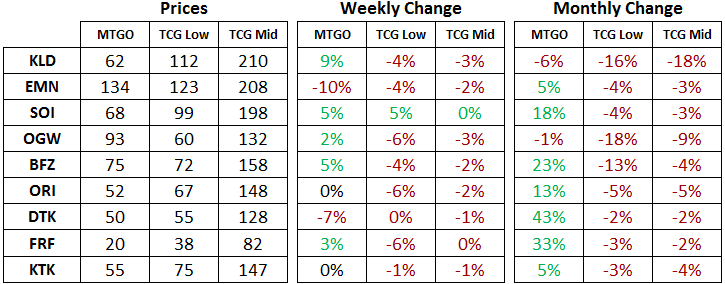
Below are the total set prices for all redeemable sets on MTGO. All prices are current as of December 5, 2016. The TCGplayer low and TCGplayer mid prices are the sum of each set's individual card prices on TCGplayer, either the low price or the mid price respectively.

All MTGO set prices this week are taken from GoatBot's website, and all weekly changes are now calculated relative to GoatBot's "full set" prices from the previous week. All monthly changes are also relative to the previous month's prices, taken from GoatBot's website at that time. Occasionally, full set prices are not available, and so estimated set prices are used instead.

dec5

Flashback Draft of the Week

Triple Gatecrash (GTC) enters the flashback draft queues this week. This is an aggressive draft format where you must prioritize taking two-drops on top of identifying which guild is open to you. Here's the Limited Resources episode that covers GTC draft, and you better be prepared to play if you enter this queue, because the expected value of a GTC boosters is low. The most expensive card is Stomping Ground at 6 tix and the other shocklands range in price from 1.5 to 3.5 tix.

There was an error retrieving a chart for Stomping Ground

There are lots of cards in this set that have been Modern-playable in the past, though. Card such as Borborygmos Enraged out of Grishoalbrand decks, Domri Rade in Gruul and Naya based decks from when Brian Kibler used to play Magic and Legion Loyalist from goblin tribal decks. There are also some key uncommons that players should be ready to scoop up such as Skullcrack, Boros Charm and Burning-Tree Emissary. If you are interested in speculating on any or all of these cards, then you have to be willing to take a long-term view of the Modern format. If Modern returns to a slower pace of play after a number of bannings, then these cards could see more play. In this case of a long-shot speculative strategy like this, the opportunity cost of holding these cards is going to be high, so novice speculators should be looking elsewhere for better opportunities.

Standard

Although the bipolar Standard metagame had been fracturing on MTGO recently, the results of Grand Prix Madrid and Grand Prix Denver confirmed that the stranglehold that UW Flash and BG Delirium had on Standard is ending. Aetherworks Marvel decks had been taking up a bigger chunk of the online metagame lately, and these paper results confirmed that trend. With Delirium strategies trending down relative to where they were a few weeks ago, the price of a complete set of Eldritch Moon (EMN) has suffered, dropping by 10 percent this week. Be on the lookout for opportunities to buy the dip on EMN cards, though nothing is jumping out at me as being attractively priced at the moment.

There was an error retrieving a chart for Aetherworks Marvel

Out of Shadows Over Innistrad (SOI), Nahiri, the Harbinger has been moving up and has just displaced Archangel Avacyn as the most expensive card in that set. SOI has moved up nicely over the past month and is getting close to being fully valued. I do think there is a little more room for the set to run higher, though. When Nahiri reaches a plateau, possibly in the low to mid 20s, I'd be inclined to sell the card.

Modern

The results from the Regional Pro Tour Qualifiers have not yet been released, so we have to look to the Star City Games Modern Open in Atlanta for a hint at the Modern metagame. Here are the Top 16 decks. Dredge took down the top spot, with GW Tron coming in second. In third place was a tribal Slivers deck powered up by Collected Company. This deck gets to use two rare lands to generate any colour of mana in Cavern of Souls and Sliver Hive. Top that off with playsets of Manaweft Sliver and Aether Vial, and this deck has no problem getting a variety of slivers into play. This deck also gets use of the tribal creature land in Mutavault.

There was an error retrieving a chart for Sliver Hive

The results remain diverse at this point and the chance of an addition to the banned list gets smaller as the results pile up. The format remains popular, and no one deck is dominant at the moment. Stay tuned for further developments, but the chance of a card being unbanned in January is going up in my view. It should be noted that there is no Modern Pro Tour event this winter to motivate a shakeup of the format, so no change to the banned list is also a possible outcome.

Trade of the Week

As usual, the portfolio is available at this link. This week there was a buildup of hype around the Aetherworks Marvel deck as it took up space in the Standard metagame on MTGO. When a deck is starting to put up results, I like to look at key cards from older sets that have been falling in price. Given a choice to speculate on a card from Battle for Zendikar (BFZ) or a card from Oath of The Gatewatch (OGW), I strongly prefer to focus my attention on a set that has shown higher peaks or more cards. In this case, I identified Kozilek's Return as a candidate to bounce up on a strong showing from the Marvel decks.

There was an error retrieving a chart for Kozilek's Return

Kozilek's Return looked like a good target for a number of reasons. The hype around Aetherworks Marvel was building, and the OGW mythic rare was showing up in the main deck and often in the sideboards of this archetype. The market also looked supply constrained in the 15 to 16 tix range. Not many copies were available for sale. As a result, I decided to wade in with a purchase for the portfolio. I would wait to get the weekend results, and then hope to sell Kozilek's Return for 20 tix or higher.

With the Marvel decks putting up good results at the Grand Prix events, it looked like my strategy was going to pay off. But the price of Kozilek's Return didn't follow suit with substantial gains as it got into the 18 to 19 tix range. My decision would then be to hold on in the hopes of further gains or to sell and book a modest profit. After examining the available supply, there were ample copies for sale and so further gains looked unlikely. I decided to sell in order to book a small profit and to remain liquid for other opportunities.


Insider: Top Tier Frontier Specs

Are you a Quiet Speculation member?

If not, now is a perfect time to join up! Our powerful tools, breaking-news analysis, and exclusive Discord channel will make sure you stay up to date and ahead of the curve.

Over the course of the past two or three weeks I've been gradually inducted into the world of Frontier. The arrival of the format has felt swift and real. Is it a fad? Maybe, but I think there is still time and space to capitalize even if it turns out to be a fad in the short term.

In the span of just a few weeks, I've seen Frontier take off as a format. My introduction was by word of mouth, when a friend told me how Hareruya was spearheading a new grassroots format. From there I began to hear all kinds of speculation about decks and strategy, to people showing up with actual physical copies of decks and playing games, to my LGS finally announcing it would offer Thursday Night Frontier.

The speed at which the format seems to be picking up in popularity feels very real. The fact that the format is associated with Saito's Harehuya—basically the super hip of MTG—also feels like a driving force to some degree.

Looking for Staples

Today, I'm going to take a quick inventory of some of the best Frontier buys to be looking for at the moment. Remember, we want to buy things cheap and be able to sell them into a peak.

There was an error retrieving a chart for Goblin Rabblemaster

All I have to say is, how badly do you want to use your Rabblemaster tokens to crew Smuggler's Copter in a beatdown deck? Sign me up for that.

Rabblemaster was an awesome card back in the day and it seems really strong with the vehicles that have cheap crew costs. There might also be synergy that could come into play in Modern somewhere down the line. Heck, I've even seen Rabblemaster played to some effectiveness in Legacy! Rabblemaster is just a good card and a fun, interesting Frontier option.

There was an error retrieving a chart for Anafenza, the Foremost

Anafenza is great because it goes into the aggressive Abzan decks and is an important sideboard option against Rally the Ancestors. Sure, there is a chance that Rally gets banned or something, but it isn't exactly like Anafenza is a bad card. In fact, with such a low price tag it's the kind of card I would be actively targeting for Modern and casual on "good card is cheap" factor alone.

There was an error retrieving a chart for Dig Through Time

Who isn't going to want to build a Dig Through Time deck at some point in Frontier? The card was excellent in Standard but banned in virtually every other tournament format. Except Frontier—which means people will take full advantage of getting a chance to cast this old favorite again!

Not only will DTT be a format-defining staple, it also has that forbidden fruit thing going for it that will draw more people to want to play it. With Dig currently so cheap it can't really hurt too much to have a small stack set aside just in case people end up needing them.

There was an error retrieving a chart for Mantis Rider

How the mighty have fallen. Mantis Rider is an excellent Magic card that masquerades as a bulk rare. So sad...

It has a tough time in Modern because it so perfectly dies to Lightning Bolt and is just outclassed by other faster aggro options. However, the card would be very strong in Frontier just like it was in Standard. Maybe it is time to take a chance on everybody's favorite little Lightning Angel.

There was an error retrieving a chart for Siege Rhino

This one's clearly in the "obvi" camp, but it bears mention. For so many reasons, cheap Siege Rhinos seem like a great acquisition in a world where Frontier is picking up steam. The card is great and goes into a wide range of decks. It is also just a good Magic card regardless of whether Frontier is a fad or not.

There was an error retrieving a chart for Whisperwood Elemental

Whisperwood is just a pretty solid Magic card that might end up being a player in Frontier. They are dirt cheap right now. I'm interested in taking a look.

There was an error retrieving a chart for Rally the Ancestors

There is a legit chance that Rally needs to be banned, but it could be the first real breakout deck for the format. Copies of the card are basically at bulk rare prices right now which leaves ample space for a spike to occur.

The biggest problem with Rally is that people didn't really enjoy the card when it was in Standard, so if it is great in Frontier it will probably get banned in order to keep the format feeling fun and fresh. It is the Old Extended problem: people hated having had to play Jund vs. Faeries for two straight years and then changing Extended into Jund vs. Faeries was just a really dumb move because nobody wanted to play that format.

If Rally is too good I expect it to be quickly banned. However, there is also a chance that it is more balanced in the larger card pool, so that could be neat as well.

There was an error retrieving a chart for Collected Company

Collected Company is another one of those cards that risks being too good and needing a banning. But since it will always have a home in Modern, I'm not too worried about losing money on it.

Collected Company is simply one of the most powerful cards Wizards has printed in the past four or five years, and will find a home in most formats where it is legal. It was absurd in Standard, great in Modern, and will have a home in Frontier as long as it doesn't get banned.

There was an error retrieving a chart for Dromoka's Command

Dromoka's Command is another cheap card that has potential to be very good in Frontier. It's a really powerful effect that is simply outclassed by better options in Modern. However, in a significantly smaller cardpool without Path to Exile, the card starts to look much more appealing.

People who are not stocking up on potential Frontier staples should be pretty happy to give up their Drom Comms for a low price, happy that somebody wants them.

There was an error retrieving a chart for Jace, Vryn's Prodigy

I'm not really sure that Jace's price has much to do with Frontier, or ever will, but I feel like I should at least note it. If Frontier does take off, Jace will be another very important card in the format, which will create a lot of demand for it among players. Who doesn't want to play Jace and Dig side by side again?

Filling a Format Niche

I've gotten a chance to battle some Frontier and the format feels really sweet. The games are fun, and it's nice to play with some of the cards that I enjoyed before but which currently don't have another home. Perhaps Frontier has become sort of a necessity with Standard being too boring and Modern being a little too busted. It creates a different kind of game somewhere in the middle that a lot of people are looking to enjoy.

Either way, the big draw for the singles I selected is that they are all Frontier cards that are not currently Standard-legal, which means they derive literally no value from Standard. In fact, most of these cards have very little value period, which makes them great investments if Frontier has a chance of making an impact at all.

Lesson Learned: The Value of Flexibility

Are you a Quiet Speculation member?

If not, now is a perfect time to join up! Our powerful tools, breaking-news analysis, and exclusive Discord channel will make sure you stay up to date and ahead of the curve.

Not every tournament is going to go your way. Sometimes no matter how well prepared you are or how well you play you just can't win. That does not mean that the tournament is a failure as long as you utilize it well. Every game you play is an opportunity to learn something. Something about your deck, your play style, or more general Magic theory. Sometimes, players forget lessons they learned many years ago, or get the opportunity to learn something that they skipped over when learning the game. And sometimes you apply an already-learned lesson that you didn't remember you'd learned. This is one such lesson.

call-to-mind-banner

My GP Denver experience did not go well. As in, 4-4 drop not well. In actual matches played I went 2-4 (yea byes). I was playing a solid deck and was well prepared but things didn't go my way. In two of my losses, there was nothing I could have done. One was a very good matchup where I easily won game one, but in both sideboard games I had to mulligan to five and keep mediocre-at-best hands. The other one was an extremely bad matchup where I was unlikely to win if my opponent's hand was mediocre or better. It was in fact quite good both games.

However, my other two losses were winnable, if I had taken a slightly different line of play and/or had better variance than I actually did. This same line came up in a game I lost in a match I won, and what they came down to was a choice between a more flexible or a more rigid line. In all cases, based on my testing, experience, and read of the situation, I chose the more rigid line. At the time I made these plays, it was the correct line. However, had I gone with the more flexible lines I was far more likely to win based on how the game actually played out. I've been thinking about why I played the way I did and it's coming back to how I approach Modern and how I'm preparing for the RPTQ.

[wp_ad_camp_1]

The Starting Point

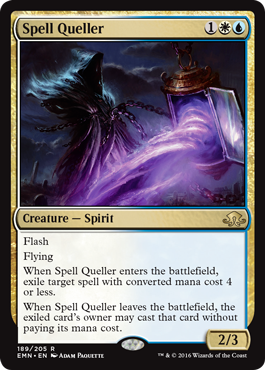
So why did I take the lines I did? I think it comes down to a bias in my testing prior to the Spell Quellertournament. My testing had shown that certain lines were inherently more powerful than others. This led me to an understanding of my matchups based around these powerful lines, and I was prepared to counter them. This strategy had served me well in tournaments prior to the GP, but not at the GP itself. What it came down to was a combination of bad draws on my part, and the fact that my opponents were working out of a different rule book.

They were on different lines than I was used to and so when I took stock of the board state and considered what the opponent could have, I made my decision based on the plays I knew were powerful against me. The problem was that those were either not the lines that my opponents took, or the follow-up that made my line good did not happen. So what could I have done differently?

The Value of Flexibility

Had I taken more flexible lines in those games, I would have been in a better position to deal with what my opponents actually did rather than what I expected them to do. I may not have actually won those games or those matches, but I would have definitely had more of a chance than I actually did. A lot else went wrong for me that tournament, but I did not give myself the best chance to actually win those games because I stuck to a very rigid gameplan.

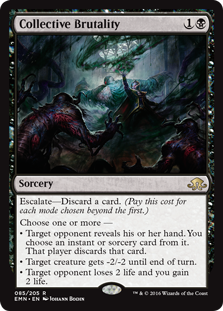
Collective BrutalityFlexibility is ultimately the reason that cantrips and card drawing is good. Why modal spells like Collected Brutality see play. It's why traditionally control decks were favored by the pros. They give you more options.

The more cards you see and the more decisions you are able to make, the better you are able to correctly respond to what your opponent is actually doing rather than trying to make do with the resources you have. Flexible lines are best when you lack perfect information on your opponent or their strategy, because you have some forgiveness built in. If the opponent is very limited in their options or is dancing to your tune, then yes, the inflexible line that scripts your plays is incredibly effective. The problem being it is far easier to disrupt a rigid plan than a flexible one.

Think of an ice column versus a rubber one. The ice is far stronger as long as it gets to do its thing, but hit it in the right place and it shatters. The rubber may not be as formidable, but it takes far more work to actually break the column. Flexibility lets you roll with the punches where rigidity will either shrug off the blows or shatter.

Had my opponent's gameplans lined up with my expectations I would have been fine. Because they did not I was out of position, fell behind and lost. Had I drawn better these mistakes may not have mattered, but as it stood they were the turning points. The were not mistakes at the time I made them, but the way the game played out they proved to be. Locking myself into a certain line with no margin of error caused a worse outcome than had I given myself more options. This is the lesson: Flexibility in the face of uncertainty is more valuable than raw power.

Modern's Weird

The thing is, I know I've learned and even taught that lesson about keeping your options as open as possible before. So why didn't I apply it here? The best explanation I've come up with at the time of writing is that I was applying Modern lessons to Standard and it didn't work. Now, obviously the lessons from one format aren't going to perfectly translate to another. It's why I've been writing the Beginner's Guide. In this case, I think the problem was that I was taking a Modern-style line in Standard and got punished.

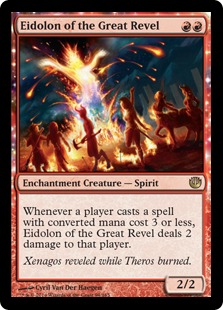
Eidolon of the Great RevelWhat do I mean? I've found through experience that Modern games, even sideboard games, are relatively predictable. Not as in actually predicting plays or who would win, but in terms of the lines you see. In Modern, the power level demands that each deck be as efficient as possible. This limits the effective card pool and subsequently limits the variation that is possible between decklists. If you're facing a Burn list the only real difference between maindeck configurations will be whether or not they have Wild Nacatl and small differences between numbers—not the actual deck composition.

Consequently, you can guess the cards in an opponent's deck with reasonable accuracy. This lets you infer their available lines with decent accuracy. It also means that you can reasonably guess what cards will be sideboarded against you and how they will change the overall matchup. The available sideboard cards that are effective against your deck are somewhat limited, so a reasonably experienced player should know what to expect and prepare accordingly.

That isn't possible in Standard. Wizards deliberately weakening sideboard cards and the limited card pool has paradoxically caused far more variation in sideboards. I've mentioned this before, but in Standard it is far more important to determine the ideal configuration of your deck in a given matchup rather than play the right hate or answers. This allows for variation based on how players perceive the matchup. Subsequently, trying to guess an opponent's actual line is far more difficult. Therefore, Modern rewards more rigid lines and punishes flexibility while Standard favors flexibility. Legacy also tends to favor more flexible gameplay due to the cantrips and more powerful answers.

The Catch

Or rather, I should say that Modern games make taking rigid lines more profitable. If you know what your opponent's options are, even without knowledge of their hand, you can position yourself to mitigate or counter them. Which again, paradoxically, means that if you juke with off-the-wall deck building or sideboarding you can catch your opponent completely off guard and score free wins. Yes, I realize that it all sounds contradictory, but let me explain. Standard requires you to build a 75-card deck using The Elephant method. This creates rigidity in terms of deckbuilding since you are locked into a given sideboard strategy. The relatively low diversity makes this possible and gives advantages for doing so. However, the relatively low card power and speed makes flexibility in game play more viable and rewarding.

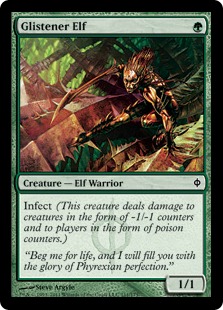
Glistener ElfDue to higher card power and speed, Modern demands more rigid game plans and play. There's only so much you can do in the face of Infect. However, its vast card pool allows greater opportunities to surprise the opponent and to reposition yourself, making flexibility in your sideboard easier. Furthermore, the diversity demands more flexibility. You cannot have specialized plans for every deck, but instead must play cards that have game in a lot of matchups. The places where you can be flexible are reversed.

What this meant for me is that I applied a Modern mindset to my Standard games. Making the percentage-based "right" choice in Modern is correct since you have a higher likelihood of actually guessing the opponent's line, but in Standard you're better off with "worse" but more widely useful plays. You're giving up some percentage against the perceived play in order to hedge against higher play variance.

Application

So what does this mean for me for the RPTQ? I will need to focus on ensuring that my sideboard has the right mix of the right hate cards and general answers to deal with the unknown metagame I'm likely to face. It also means that as I type I'm giving very hard looks at my prospective sideboard and asking if I'm being too specialized. You can see anything at a Modern tournament and you need to maximize the game you have against the totality of the format, accounting for how aggressive the format is.

Simultaneously, I need to use my testing to identify the optimal lines of play. Since Modern rewards executing your own game plan as cleanly as possible, you can determine what your opponent's plan is relatively easily and either play around it or disrupt it, assuming you correctly recognize it first. I need to be trying to build a mental index of plays from a given boardstate and turn. This will give me the best chance to make optimal plays and play around my opponent's answers. How well will it work? I'll let you know next week.

Avatar photo

David Ernenwein

David has been playing Magic since Odyssey block. A dedicated Spike, he's been grinding tournaments for over a decade, including a Pro Tour appearance. A Modern specialist who dabbles in Legacy, his writing is focused on metagame analysis and deck evolution.

View More By David Ernenwein

Posted in Modern, StrategyTagged , , , 2 Comments on Lesson Learned: The Value of Flexibility

Have you joined the Quiet Speculation Discord?

If you haven't, you're leaving value on the table! Join our community of experts, enthusiasts, entertainers, and educators and enjoy exclusive podcasts, questions asked and answered, trades, sales, and everything else Discord has to offer.

Want to create content with Quiet Speculation?

All you need to succeed is a passion for Magic: The Gathering, and the ability to write coherently. Share your knowledge of MTG and how you leverage it to win games, get value from your cards – or even turn a profit.

Insider: High Stakes MTGO – Nov 27th to Dec 3rd

Are you a Quiet Speculation member?

If not, now is a perfect time to join up! Our powerful tools, breaking-news analysis, and exclusive Discord channel will make sure you stay up to date and ahead of the curve.

Hi, everyone, and welcome back for another High Stakes MTGO article!

After a no-buy week, this past week was more balanced, with a few purchases and sales concerning both Standard and Modern. I'm still buying Modern specs at a clip, although I'm trying to grab positions with low chances of a reprint in Modern Masters 2017. I'll elaborate more on this topic in the Questions & Answers section below.

This past week I closed the biggest single position I had in my portfolio: Battle for Zendikar full sets. Considering the unexpected comeback of the value of BFZ sets, I'm almost having regrets here, but I'll live with it. Still on the topic of BFZ, I have also finished selling my booster position—although in this case the loss was far worse percentage-wise.

Without further introduction, let's see what I did this past week. The link to the live portfolio hasn't changed and is still available here.

Buys This Week

refill

A little round of reinforcement for these four cards. These are all positions I was still holding while their respective sets were flashback-drafted, or positions I purchased right after said flashback drafts. Still, prices are lower now than they were then, so I thought adding more copies of each to my stocks wouldn't hurt.

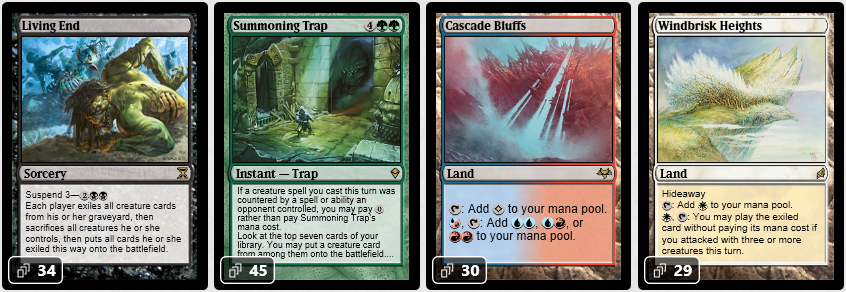
Rare land cycles are among the cards safest from a reprint in MM3. It wouldn't be totally impossible for a reprint of just one card from a given cycle, but that's extremely unlikely given Wizards's past decisions. Needless to say, there are about twenty valuable land cycles out there to choose from for reprints, so it would be very unlikely for the exact cards chosen to be Cascade Bluffs or Windbrisk Heights.

Reprints aside, I'm comfortable gathering more copies of these two cards, considering the speculative potential in case they become played again in trendy Modern decks. I may have to be patient, but since flashback drafts are behind us and reprints are not a concern here, I'm okay in this position.

Although they wouldn't be ideal reprints, Living End and Summoning Trap are certainly more likely to be in MM3. Considering my buying price for the green Trap, I have nothing to lose.

There's a little bit more at stake with Living End, though the risk-reward situation seems decent to me. Living End periodically comes into the spotlight in Modern, with a top price of 10 tix reached several times over the last year and a half. Adding more copies around 2 tix sounds like a good long-term bet.

cos

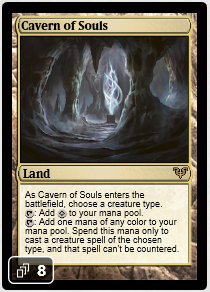
Cavern of Souls is not part of a land cycle, and definitely wouldn't surprise anyone showing up in MM3. However, there are only a handful of lands reprinted at rare and mythic rare in Modern Masters sets. With Avacyn Restored flashback drafts just behind us, this might be the only opportunity to grab copies of the Cavern under 30 tix for a while.

I'm taking the same position as Matt Lewis here. If Cavern of Souls hits the 35-40 tix price range before MM3 spoilers begin, I'll most likely sell. If not, I might gamble a bit and hope to dodge a reprint. Note that if Cavern of Souls doesn't get reprinted, it will likely find its way back to 40-50 tix, as players will be much more confident about the price stability of this multi-format staple.

Sales This Week

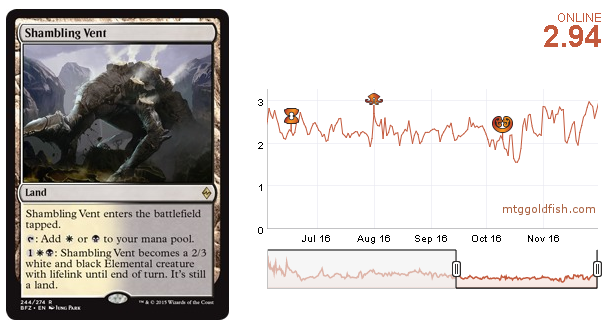
The black-white creature land from BFZ is getting some traction recently, cycling closer and closer to the 3 tix bar since the release of Kaladesh. Still, this land is not played in any of the top decks in the current Standard metagame.

As with my other BFZ positions, I was looking to sell this one as soon as I could break even, which is what I've done. My selling price isn't too bad given the price history of Shambling Vent—it's just that my timing on the purchase was poor, as with my other BFZ positions, which meant the buying price was too high.

bfzlog

There you go. I finally closed this giant position that has been dead weight for so long. I thought for long that I would lose a large chunk of tix on this full set spec, partially for having bought these too early in the season, and partially because of the low number of attractive cards in BFZ. At some point the value of a BFZ full set was almost 20 tix under my buying price, whereas now a BFZ full set is flirting with 80 tix.

The new block structure brought a lot of changes that required trial and error on the speculative front, and I paid my dues here. Of course, I wish I had anticipated the still-ongoing rebound BFZ saw after the release of KLD, in which case I wouldn't have sold 15 sets at 46 tix each back in October. All in all, I lost about a thousand tix with my BFZ full set spec, but it could have gone much worse.

mtgbfz_en_bstr_01_01

BFZ really sucked up a lot of my tix, booster spec included. Here too, I'm done with it—no more BFZ boosters in my portfolio. That's undeniably the biggest loss (-47%) I ever had with a booster spec, but I'll live with it.

Spellskite was a solid, if modest, spec picked up during New Phyrexia flashback drafts. My goal here was 16 tix, and I'm happy I met that goal before getting into potential trouble with MM3 spoilers.

This card could probably see another month or so of slow growth, before Modern interest fades away or it makes an appearance on the MM3 spoilers list. Either way, my investment goals were met here and I leave any extra tix for the next speculator.

On My Radar

Still focusing on Modern for the next few weeks, I'll be looking for Modern staples that have the least chance of being reprinted in Modern Masters 2017.

As it seems, the spoiler season for Aether Revolt has started. There isn't always a good speculative use to make of spoilers in Standard, but it can sometimes lead to momentary spikes. Being the first to buy and then sell into the hype can lead to some nice profits. If you have a good read of the current or future metagame in Standard, new cards from Aether Revolt could be a signal to buy under-valued cards from the previous five Standard sets. That, however, is not a job I'm very good at.

Questions & Answers

Finding Safe(r) Specs Before MM3

Since its inception, Modern has always been a speculative machine. It is almost too easy to find speculative winners, whether established Modern staples (and there's about a truckload of them) or under-the-radar cards just waiting for a Grand Prix or Pro Tour appearance on camera to take off. In many cases the uncertainty was "when," not "if."

Then the Modern Masters series kicked in. A lot of cards, including several expensive staples, took a hit, as they were suddenly reprinted in massive quantities compared to their original set run. We also learned from MMA and MM2 that almost any eligible card can be in the set. Worse, being already reprinted in a previous Modern Masters set doesn't spare you from being in the next one.

Now that MM3 is only three months away, trying to speculate with Modern positions can be like playing a hot potato game—you really don't want to hold the potato when the spoiler season starts. Nevertheless, if the two previous Modern Masters sets are any example, there might be one category of cards with much lower chances of reprint: rare land cycles.

A reprint of an entire cycle of five lands at rare is simply extremely unlikely. One reason for this is Wizards has incentive to save these land cycles, especially those that produce two colors of mana and are currently expensive, to help sell regular sets. Ravnica shocklands and Onslaught fetchlands both got reprinted recently, and it's only a matter of time before we see a new printing of Zendikar fetchlands, Scars of Mirrodin fast lands, allied-colored painlands, or the Worldwake creature lands. But, most importantly, I don't think in Modern Masters 2017.

Wizards has shown their willingness to print only one card out of a cycle—Primeval Titan and Leyline of Sanctity are two great examples—but that would be extremely odd with lands.

What about rare lands that aren't part of a cycle. Only four lands have been reprinted at rare in MMA and MM2: City of Brass, Blinkmoth Nexus, Academy Ruins and Eye of Ugin. So the likelihood of a reprint for any given land is very low, even if there are several good candidates including Cavern of Souls, Mutavault, Horizon Canopy, Grove of the Burnwillows, Pendelhaven, and Inkmoth Nexus.

In conclusion, if you want to gamble a bit and try to dodge the reprint bullet, I think some good opportunities can be found in Modern rare lands. In addition, the reward could be multiplied when the majority of players and speculators learn the cards can't fill the holes in the spoiler list. At that point they might get a nice price boost, as did several cards when they were confirmed out of MM2.

Thank you for reading,

Sylvain

Insider: The 2016 Election’s Impact on MTG Finance

Are you a Quiet Speculation member?

If not, now is a perfect time to join up! Our powerful tools, breaking-news analysis, and exclusive Discord channel will make sure you stay up to date and ahead of the curve.

It’s time to take a break from all this negativity. Since proclaiming my decision to move out of Legacy, I have done very little buying and selling beyond this singular focus. In fact I haven’t done any MTG buying at all. The hobby I’ve been buying deeper into lately is vintage video game finance, given the recent surge in interest sparked by the Nintendo Classic and the Pokémon craze. But that article is perhaps for another website.

Sure, there have been a few opportunities here and there as evidenced by the MTG Stocks Interests page. Clearly, opportunities still exist, especially in the casual and Commander realm where growth continues relentlessly.

There was an error retrieving a chart for Arcum Dagsson

But I think there may be another buying catalyst on the horizon: Donald Trump.

Don’t Change That Dial!

Now, before you close this window and deem it hopelessly polemical, rest assured this will not be a political article. I have no intention of passing public judgment on the president-elect—if you want to know my political opinions, you can talk to me privately about it. I won’t showcase my beliefs on a finance website.

That said, there was a great deal of profound rhetoric Mr. Trump pronounced while he was running for president. While I don’t think he can possibly deliver on all of his campaign promises, there are some general trends that have unfolded since Election Day. These trends are being driven by expectations of what a Trump presidency will accomplish.

I could delve into a complete macroeconomic analysis here. I truly enjoy economic study, and the behavior of the global markets since the election have been nothing short of fascinating to me. Surges in interest rates, crashes in the Mexican peso, massive rebalancing of stock portfolios—it’s all been very sudden and very drastic.

Rather than go into every detail, I want to focus instead on one trend. This trend has the ability to influence the MTG market and create new buying and selling opportunities. This trend must be monitored closely, because the movement we’ve seen has been significant. This trend must be followed because it has become relatively volatile in the market.

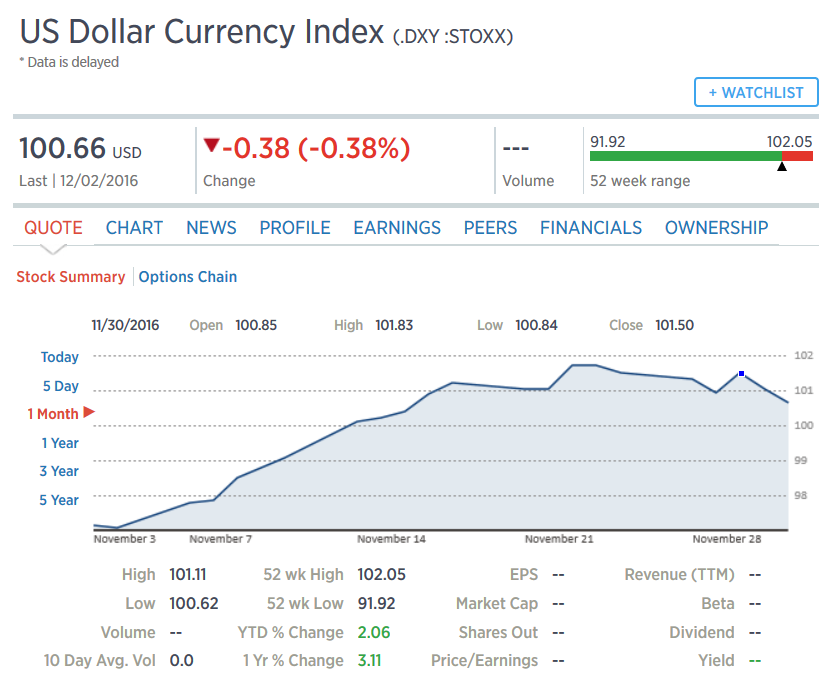
USD Currency Index
(Click to expand.)

The trend I’m talking about is the U.S. dollar:

While the chart above, depicting the US Dollar Currency Index, is not as flashy as the chart for, say, a regional bank, the fact that our currency has strengthened this much in just a month’s time can be a bit of a shock to the market.

For instance, the U.S. dollar is now worth $1.33 Canadian and ¥113.50 Japanese. The euro is very nearly at parity to the U.S. dollar, and I suspect the two will invert very soon—perhaps after the Italian referendum vote coming up. While these disparities aren’t all-time highs, they indicate large jumps off recent pre-election lows.

Where’s the Magic Finance?

Here’s where it gets interesting. Due to a number of factors I won’t get into in this article, I believe the U.S. dollar is poised to get stronger in the near term. That will mean that foreign currencies get cheaper. While that may mean devastating things for multinational companies that do significant business abroad, this could be a boon for MTG speculators stateside.

Allow me to illustrate with an example. Consider Chromatic Lantern, a fitting card given its spike over the weekend.

There was an error retrieving a chart for Chromatic Lantern

Currently, the Japanese MTG retailer, Hareruya, is sold out of Chromatic Lantern at ¥300. Using the previously mentioned conversion rate, that’s around $2.65 USD. If I do a quick search at Star City Games’s website, I see they’re paying $4. That’s 50% profit strictly based on arbitrage alone!

Now imagine what happens if the U.S. dollar becomes even stronger due to rising interest rates and a Republican-based presidency. Suddenly a dollar may buy even more yen, making that Chromatic Lantern even cheaper to purchase in U.S. dollar terms! The higher the dollar strength rises, the cheaper buying cards internationally becomes.

As it turns out, Hareruya is completely sold out of English Chromatic Lanterns, so clearly someone already beat me to the punch on this one. But there are certainly other opportunities out there—especially when it comes to casual and Commander staples.

Another benefit from shopping at Hareruya or other Japanese shops is their attention to condition detail. One of my favorite shops here in the U.S. is ABU Games. But they have one major flaw: their grading system. How can you possibly bucket cards into only three categories, Near Mint, Played, and Poor? That’s absolutely useless, especially on high-end cards like Alpha, Beta, and Unlimited cards. Isn’t that supposed to be what they’re known for?!

With Hareruya, you can shop high-end cards confidently knowing the condition will be well-articulated. While writing this article, I found (and purchased) a Beta Royal Assassin for ÂĄ13,000 (about $113).

There was an error retrieving a chart for Royal Assassin

Channel Fireball is paying $150 on their buylist so it should be easy to arbitrage this card for an easy $30. What about condition, you ask? The card’s condition was listed as NM+, meaning it will likely be grade-worthy! And if a card’s condition is not listed, you know the card is NM+ to EX, which, when you look at the site’s grading guide, is pretty attractive and will likely fetch NM buy prices at most vendors.

The arbitrage didn’t stop there. I also found a NM+ Beta Wheel of Fortune for ¥48,000 ($418). Star City Games’s buylist is paying $500. Given that this card is guaranteed to be Near Mint, this represents significant arbitrage-based profits. You can see how these numbers add up quickly and they get more attractive the stronger the U.S. dollar becomes.

Okay I’m Convinced, What Else Should I Know?

First, you need to keep in mind that shipping isn’t going to be cheap coming from Japan. I went through the procedure to check out at Hareruya and I see that shipping will cost me ¥2,000, around $18. While expensive, it’s definitely worth it because they package their cards very well and cards arrive often times within a week. Still, this will eat a chunk of your profits so make sure your transaction is large enough to justify these costs.

Second, don’t forget there are currency conversion fees. When I last made a purchase from Hareruya my credit card company charged a nominal fee based on the size of the purchase. Different banks and credit cards will have different fee rates, so you may want to research this before attempting arbitrage.

Third, don’t forget to check other Japanese sites. The other one I’m aware of is called Tokyo MTG. I have interacted with that site’s owner in the past and he is a great guy, so I can vouch for this site as well. There may be others too, but I don’t know them all so I encourage you to leverage your network to find them.

Fourth, don’t forget currencies beyond Japan’s! The Canadian dollar is very inexpensive relative to recent history, so stores that operate in Canada may have favorable buying conditions for arbitrage. Face to Face Games comes immediately to mind, but I’m 100% certain there are others that will ship internationally.

Finally, when pursuing arbitrage, I encourage you to trend off the beaten path. If you research the game’s hottest staples (Tarmogoyf, Liliana, the Last Hope, Underground Sea, etc.) you won’t likely find much opportunity. Stores usually stay on top of the prices for their biggest sellers, so it will be very rare that you’re the first to discover arbitrage in these singles. Instead, look towards cards that may be overlooked, such as some Old School playables, nice Alpha and Beta collectibles, and casual stuff.

Wrapping It Up

Whether you’re a Republican, a Democrat, or an advocate for a third party, the impact of our president-elect’s November victory can help us make money in Magic. Given the recent trends in the U.S. dollar triggered by Donald Trump’s victory, it would behoove us to pay close attention to the evolving market to look for arbitrage opportunities. We had a chance to do so a handful of months ago; then the dollar weakened and those opportunities were erased. But they’re back again, which means it’s time to do some shopping!

Keep an eye out for deals from Canadian, Japanese, and European online retailers. There will be more and more as the dollar gets stronger. And with pending increases in interest rates on the horizon, this trend may be here to stay for the foreseeable future.

But be careful—this trend may reverse on a moment’s notice. It only takes one statement or one decision from the Fed or Donald Trump and the trend could change. Inflation may become a concern if our nation’s debt levels become precarious. Such trends would hurt the U.S. dollar. As always, agility will be crucial for success here. Stick with Quiet Speculation, and we’ll help you navigate some potentially tumultuous times ahead!

…

Sigbits

  • I give Standard little attention these days, yet the strength in Liliana, the Last Hope’s value cannot be ignored. I am surprised to see Star City Games has just 21 total copies in stock across all conditions with a NM price of $49.99. I didn’t think $50 cards were possible any longer in Standard, but clearly I was wrong. What surprises me is that they’re completely sold out of foil copies. That $69.99 foil price tag will surely have to rise once they restock.
  • It appears the recent reprinting of Chromatic Lantern didn’t put too large a dent in the card’s value. The market seems to have absorbed these new copies rather quickly. SCG is sold out of the Commander 2016 copies and they have just 11 Return to Ravnica copies for $6.99. Foils and Masterpiece copies are awfully sparse as well!
  • Here’s a shout-out to my all-time favorite Magic card: Shahrazad! The card has recently gotten a bit of a bump in price, with Star City Games sold out of Near Mint copies at $99.99. They have just two Slightly Played copies priced at $79.99, a significant increase from a couple years ago when these were stuck at $30.

Function or Finance? The Cause of Modern Diversity

Are you a Quiet Speculation member?

If not, now is a perfect time to join up! Our powerful tools, breaking-news analysis, and exclusive Discord channel will make sure you stay up to date and ahead of the curve.

I've had a theory for a while about the supposed health of Modern. Diversity is a big talking point for people who want to play Modern or Legacy over Standard, and I'm not sure it's quite as diverse as people want to think. It's diverse in the sense that a lot of people play a lot of different decks, but I'm not entirely sure how much of it is by choice. The relative expense of Modern and difficulty of switching decks causes a lot of people to hone their talent with one deck rather than switch to the perceived best deck. I think this is a big part of the reason why Modern and Legacy look more diverse than Standard.

bribers-purse

The definition of a truly diverse format varies from person to person. For some it means you can play literally anything you want and still win with it, while others will content themselves with the presence of a deck for every play style. A lot of people say Standard isn't diverse because two decks make up a large portion of the top performing decks. Does that mean that other decks aren't good, or that people don't want to put the time in to make them good?

[wp_ad_camp_1]

Diversity and Cost

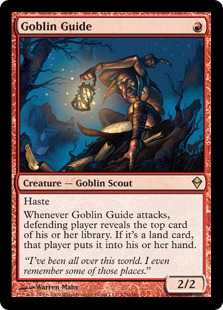
Maybe it means that decks are pretty inexpensive and that it's relatively easy to change to the perceived "best deck." Taking a quick look at the 5-0 competitive Standard leagues on MTGO, UW Flash finished 5-0 in approximately one to three of the 10 slots for the past two weeks. Goblin GuideFor Modern, almost every Competitive League has exactly one Burn deck that goes 5-0.

Does that mean that Modern is diverse and Standard isn't? I'm not really sure. But assuming we do consider the number of distinctly different decks as a sign of a healthy metagame, then is this diversity in Modern a product of the larger cardpool, or simply because it's really hard to switch decks?

I think the latter factor is far more important than people have generally accepted. Today I'll explain what obstacles are in place that prevent Modern players from switching decks, and how each might be affecting the metagame overall.

Cheap cards promote an easy switch

When the best decks in Standard were price behemoths with 10-12 fetchlands and 4 Jaces, Standard was pretty diverse. Most people couldn't afford to play decks that had all of those expensive cards so you saw a lot more Siege Rhino midrange decks. siege rhinoWith good mana, sometimes it looked like all of the decks were the same, but the reality of that format was you could play whatever you want. Sometimes you played against a Kalitas, Siege Rhino, Crackling Doom deck. Sometimes it was a Mantis Rider, Kolaghan's Command, Jace deck.

Modern is seeing some of the same trends. You want to bring Bogles to a Grand Prix? You can probably win a ton of matches and feel like the deck is really good. Does that mean that Bogles is actually a good deck choice? It depends on what people are playing. If you get matched against Lantern Control and Sun and Moon decks early, you could be dropping before lunch. I don't usually consider decks that have such a hard time beating certain obscure cards "playable." Many people will disagree with that assessment—but there are others who do agree but continue to play decks with these weaknesses anyway. Why do they do it?

It's really hard to switch to the best deck in Modern

Ultimately it comes down to cost. Most decks in Modern have almost no overlap in cards. If you're playing Affinity and think that Jund is the best deck in Modern, how much does it cost for you to switch decks? You're basically forced to purchase the entire deck and learn all of the Jund matchups from scratch. The financial and mental cost of switching decks is so much for some players that they simply refuse to do it.

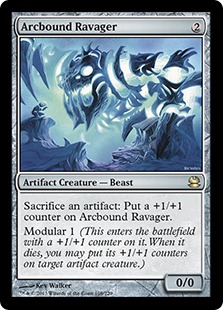
Arcbound RavagerAs Modern card prices drop, the metagame seems to get more focused. We can see the effect pretty easily on Magic Online. The Modern metagame changes quickly online and focuses so much more than it does in paper. A big reason for this is that the amount of money you lose for buylisting cards is so much smaller. For example, as of writing the buylist price of an MTGO Arcbound Ravager on Cardhoarder is 6.89 tickets (tickets are worth approximately $1). The sell price is 8.08 tickets. This makes a spread (or what you'd lose by selling them at buylist) of 15%. The spread on paper copies is 37% (assuming buylist of $24 and retail price of $38). So the opportunity cost just for selling and repurchasing a Ravager is more than double in paper. This differential is pretty typical for format staples.

This may be one of the main reasons why people just "play their deck" rather than try to figure out a way to buy a better one. MTGO cards are also just a lot cheaper by virtue of constant reprints via flashback drafts, and a higher volume of drafting in general. You know one of the biggest symptoms of easier access to cards? Entire decks can just fall off the MTGO radar. You might find some 8-Rack enthusiast practicing on MTGO once in a while, but you're more likely to play against five Burn opponents in a row.

The cost of learning

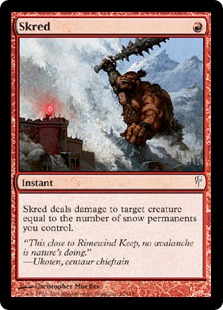
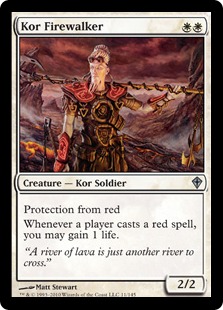
SkredWhen there are fewer decks to test against it's definitely a lot less mentally taxing to learn to play a new deck efficiently. I've been playing Burn for close to three years. I still haven't played every matchup in Modern yet, but you learn a lot from playing similar decks. I'm pretty sure the only time I've played against a Skred deck was piloting Twin against Jeskai Skred. Does that mean I won't be able to adapt and win a match against Skred Red? No, my familiarity with how Burn sideboards in general should be enough to figure it out. I'll obviously bring in Kor Firewalkers if I have them, and ways to kill artifacts, since I assume some number of Ensnaring Bridges or Dragon's Claws are in their deck. But past that, I don't think I need to play the matchup to know how to win.

On the other hand, I've been playing Dredge casually for maybe a month. I'm not sure if I could find the correct configuration of cards to win sideboard games. Does that mean that I can't win them? No, but it is definitely a cost that I would pay if I were to switch decks. With an unprepared metagame, Dredge is likely my choice for the best deck in the format. But I'm not going to play it at the RPTQ because I know I don't have the experience necessary to play it at a level I'm comfortable with.

Kor FirewalkerHas any of this run through your mind too? I have to believe I've never had this experience with Standard because the reality of the situation is the smaller card pool is just easier to learn. Even when there are tons of different decks and configurations, I can figure out a way to win in any situation. There are just too many situations that could come up in Modern that require prior experience to navigate expertly. The amount of investment required to learn a new archetype is another thing that keeps players from adopting the best strategies. Maybe a player thinks that Lantern Control is better than their current Affinity deck (and they even have some expensive overlap in staple cards) but they won't make the change because they don't believe they know the matches well enough.

What Can Modern Masters Do for Diversity?

I've already explained the two major barriers to switching decks (money and time)—what happens if one of them is almost entirely eliminated? Reprints bring down the cost of decks pretty significantly (usually). What happens when decks get cheap enough that players can own more than one without feeling bad? I think we are going to see a big contraction in the number of Tier 3 and lower decks and a larger percentage of the meta will become Tier 1 decks.

Is that bad? Maybe, but it will start to make Modern look a lot more like Standard than Legacy at some point. As the number of decks people play decreases, the number of matchups you need to prepare for also decreases. The reality of lower price of entry into Modern is that there will just be fewer decks that people are willing to play. When players weigh the pros and cons of playing certain decks, there is definitely a lot of thought given to the cost of the deck.

Going Forward

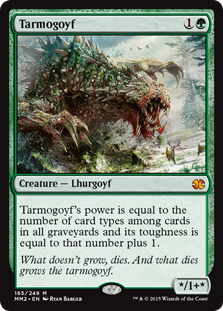
We've seen a pretty big downward trend in the price of a lot of Modern cards. Some of it is anticipation of a reprint (like Snapcaster Mage) and some of it is just decks falling out of favor. At some point the demand for these cards will be so low, because of the perceived cost of the deck, that the bottoms will fall out on some of them. Tarmogoyf is a status symbol in Modern. It has fallen $10 in the last month after a year of decreasing price. TarmogoyfWhile it's the end of the year and prices are likely to sag, an 8% drop on a Modern staple in one month is significant. If this begins to happen to most other staples, I think we'll begin to see a shrink in Modern diversity.

Modern is the most successful and most played format in Magic right now and that likely won't change. There's an even split of Star City Games Opens (between Modern and Standard) in the first half of next year, but I would be extremely surprised if Modern didn't continue to grow and overtake Standard. There is an obvious draw to Modern due to its low long-term costs and increasingly lower barrier to entry. Years of reprints and bans have brought the format to a place where almost anyone can buy in.

I'm worried that with the arrival of even more reprints in Modern Masters 2017 we will see people gravitate to a smaller number of decks. Reprints heavily incentivize people to purchase decks that receive them and I don't think we're too far off having more of the top decks become a larger part of the field as a result. I know it seems weird and counterintuitive, but I think the more reprints we see, the less people will start to enjoy Modern. The freshness and openness is largely influenced by the price. As we see prices go down, we may also see a decrease in the things that make Modern great.

Going Deeper: Brewing Ninjutzoo in Modern

Are you a Quiet Speculation member?

If not, now is a perfect time to join up! Our powerful tools, breaking-news analysis, and exclusive Discord channel will make sure you stay up to date and ahead of the curve.

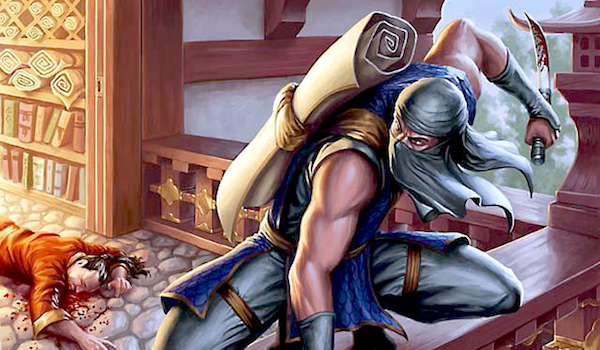
I'm preparing for an RPTQ, but it's hard to stop brewing. Whipping up decklists full of pet cards is just too fun. Even when those pet cards are literal pieces of trash. Ross Merriam's recent Legacy article reminded me of one pet card I'd long forgotten, four copies languishing in my Modern collection with the other rejects. I don't expect to break the format with this project—when I build around fair cards, I never do. My goal this week was simply to find the best possible shell for a playset of Ninja of the Deep Hours.
ninja-of-the-deep-hours-art-crop

Two Ways to Brew

Brewing is a lot like eating a Reese's cup—there's no wrong way. Still, I've identified two primary methods of brewing since I began: around concepts and around cards.

[wp_ad_camp_1]

Brewing Around Concepts
Lantern of InsightConceptual brewing is the most common form when it comes to high-level Modern. Competitive players seek to attack the format a certain way, or to exploit an identified soft spot in the metagame, and create decks that do so. Since the question, "How can I effectively attack the metagame?" is one anyone looking to spike a Modern event is bound to ask themselves, it's no wonder that conceptual brewing spawns so many winning decks.

With an idea in mind, crafting a list becomes easy. After that, testing hopefully indicates if there's a better way to represent that idea in 75 cards or whether the idea was worthwhile to begin with. Death's Shadow Aggro with more interaction? Death's Shadow Blue. (Not worth it.) A delve-abusing Temur Delver deck in a Treasure Cruise-less world? Monkey Grow. (Worth it.) Early lock pieces and cheated-out threats? Colorless Eldrazi Stompy. (The jury's still out on this one.) These three are just examples that I've worked on, but conceptual brewing abounds in Modern.

GP Charlotte 2015 featured a Top 16 that exemplified this principle. Michael Malone exploited the absence of red sweepers to take the tournament with Elves. Zach Jesse also cracked the Top 8 with Bob Huang's Grishoalbrand, which preyed on the Grixis Control-heavy metagame's lack of efficient graveyard hate, cheap counterspells, and Path to Exile.

Coming in at 9th place, Patrick Chapin employed the untapped potential of Fate Reforged's under-costed fatties to concoct a delve-heavy build of Grixis Control that went on to define the coming summer. Zac Elsik joined Chapin in the Top 16 with Lantern Control, a deck that had Grafdigger's Cage and Surgical Extraction to answer everyone's favorite artifact removal spell, Ancient Grudge, and locked up games with the at-the-time unanswerable Ensnaring Bridge.

These diverse decks have something in common: their creators followed one idea to its logical conclusion and ended up contributing one more deck to Modern's vast roster.

Brewing Around Cards
PeppersmokeThe second method of brewing is largely utilized by casual players (even if many pros have a pet card too). Building around cards is what led me to the Thieves' Fortune-highlighting Temur Rogues, the Blood Moon and Goyf slumber party of GRx Moon, the Peppermoke vanity project Sultai Faeries, and a slew of Mantis Rider decks. It's rare that decks built around a single card break into the competitive scene. Successful examples include Living End, Restore Balance, and Ninja Bear Delver (which, despite boasting three other card names in its title, revolves around Disrupting Shoal).

In a format with stand-alone goodstuff cards the likes of Tarmogoyf and Lightning Bolt, card-focused brews are routinely combo-oriented. Deckbuilders see a unique card like Ad Nauseam, dream up its most degenerate applications, and tinker around with lists until someone Top 8s an event and ends up writing history (or doesn't, and doesn't). But building around a fair card generally yields worse results than simply playing fair cards that excel individually. This depressing truism explains why my own card-focused brews, all of them as fair as first snow, never performed as I'd wished.

Consider the Ninja

To play bad cards in Modern, we must first understand what makes those cards so bad. So must we examine Ninja of the Deep Hours.

Failing the Bolt Test
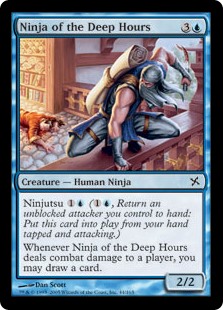
ninja-of-the-deep-hoursOne reason is his toughness. At 2/2, Ninja's stats plant him firmly in the "dies to Lightning Bolt" camp of Modern deplorables. Creatures in Modern with less than three toughness need to fulfill certain conditions to succeed. Most of them simply break parity with the instant, either by costing one (Goblin Guide, Signal Pest) or by making Bolt cost more than one (Thalia, Guardian of Thraben).

Boltable creatures that check neither box must either offer a strategy tremendous synergy (i.e. Leonin Arbiter, Lord of Atlantis), cast a spell upon entering the battlefield (Eternal Witness, Sin Collector), or take over the game when left unanswered (Dark Confidant). So how does Ninja of the Deep Hours stack up against these requirements?

We're looking to specifically build around Ninja of the Deep Hours, so let's bench the synergy criterion for now and assume the card will work in our deck. Ninja sort of casts a spell when he enters the battlefield, but opponents can't kill him after he tags in, and he necessitates an unblocked attacker to lay out the red carpet. "Draw a card" hardly even constitutes a full spell, since it's a line of text shared by many two-drops (Wall of Omens, Silvergill Adept), and Ninja of the Deep Hours is functionally a three-drop. Unfortunately, these factors make Ninja's "spell" too conditional to count, despite its potential renewability.

As for winning the game unchecked, Ninja certainly does that, especially in a deck full of high-powered cards. Dark Confidant is a format staple, but there's a reason we never see Goblin Rabblemaster or Geist of Saint Traft take down Opens. Three-drops that win the game unchecked aren't fast enough for Modern. Factoring in both the cost of ninjutsu and the price of a bounced attacker, Ninja of the Deep Hours stands to charge us three mana even when snuck in, so he's not eligible for this criterion, either.

Losing Us Tempo
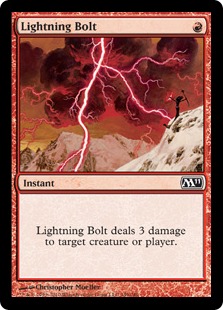
Lightning BoltFormat newcomers often ask, "so what if Card X dies to Bolt? It's still a good card." But it's usually not still a good card. Failing the Bolt Test is such a big deal because it incurs a tempo loss. Despite crushing from a flavor perspective, the ninjutsu keyword sets users back drastically on this misunderstood mechanic.

Modern in particular rewards players for capitalizing on tempo advantages and disregarding card advantage. Trading three or more mana for an opponent's one is an easy way to lose games here. On top of all that, Ninja takes our tempo and offers us card advantage in return. In Modern, we want to cash out the opposite way!

Deep Hour Accommodations

With all Ninja's shortcomings in the foreground, we can begin to address them head-on. Luckily for us meatheads, there are a few ways to cheat on the Bolt Test.

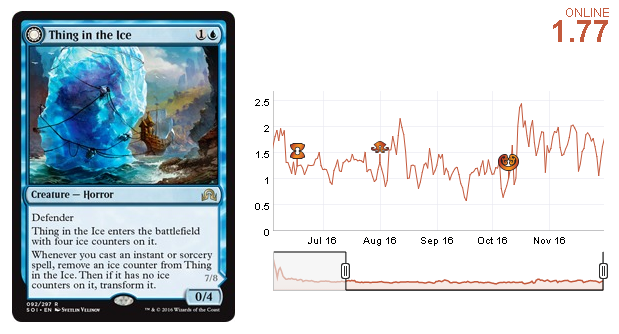
One technique is to play Mutagenic Growth, a card that acts as Mental Misstep against the ubiquitous instant. I've enjoyed this strategy in Counter-Cat, and others, led by Jeff Hoogland, have applied it to Jeskai Aggro strategies to render Mantis Rider a playable Modern card. Perhaps more famously, Death's Shadow Aggro and UR Prowess use Mutagenic Growth to push through extra damage with prowess threats, turn on synergies with Thing in the Ice, and of course save Wild Nacatl or Kiln Fiend from Lightning Bolt. It should be noted here that Swiftspear and Nacatl already pass the Bolt Test, so saving them with Growth is just gravy.

Another solution is to lure out an opponent's Bolts elsewhere. Leading with Noble Hierarch almost guarantees opponents will spend their Lightning Bolt if they're holding one, clearing the way for Ninja of the Deep Hours and other fragile threats. A common pitfall to avoid with this strategy is going "too wide," which opens us to blowouts from Anger of the Gods. The idea here is to go wider than an opponent's Bolts, but not wide enough to be crippled by sweepers. In many games, walking this line is a simple matter of not overcommitting threats to the board.

Since Ninja requires us to jump through so many hoops, each of my takes on the Ninja deck combined both approaches.

Version One: Monkeying Around
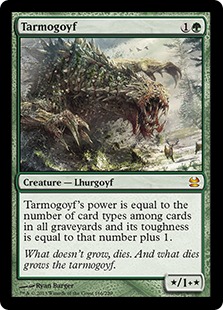
TarmogoyfI considered trying a straight blue-red shell, but soon came to my senses and realized I wanted Tarmogoyf. Goyf is another way around the Bolt Test, especially in a deck that wants to distract an opponent's Bolts with decoy targets. When one of those creatures hits the bin, nothing cleans up the mess like our favorite fatty.

In this version, green gave us Noble Hierarch, which improves an active Ninja drastically in multiples, and Kird Ape, an aggressive one-drop that can be saved by Mutagenic Growth. Having savable attackers is paramount to this strategy once opponents figure out our plan, since they can just Bolt our attacker before blocks if they anticipate ninjutsu plus Mutagenic Growth and deny us the opportunity to even sub Ninja in.

I still wanted Noble Hierarch in this build, since she attacks past 1/1s on her own to enable ninjutsu if necessary. The acceleration she provides allows us to get more out of Spellstutter Sprite and Snapcaster Mage, enters-the-battlefield creatures that grant us additional value just by helping pay for ninjutsu. The former happens to be stellar at stopping Path to Exile and Lightning Bolt, and the latter allows us to re-use our valuable instants and transition to a reach plan if necessary.

Temur Ninja 1.0, by Jordan Boisvert

Creatures

4 Kird Ape
4 Noble Hierarch
4 Spellstutter Sprite
4 Snapcaster Mage
4 Tarmogoyf
4 Ninja of the Deep Hours

Instants

4 Mutagenic Growth
4 Lightning Bolt
4 Vapor Snag

Sorceries

4 Serum Visions
2 Flame Slash

Lands

4 Misty Rainforest
4 Scalding Tarn
2 Steam Vents
1 Stomping Ground
1 Breeding Pool
2 Botanical Sanctum
2 Island
1 Forest
1 Mountain

Sideboard

2 Blood Moon
2 Huntmaster of the Fells
2 Spellskite
2 Kitchen Finks
1 Threads of Disloyalty
1 Forked Bolt
2 Destructive Revelry
1 Ancient Grudge
2 Surgical Extraction

I often start my brews by throwing 60 cards together and adjusting for what I need as the games fly by, but this first draft was particularly atrocious.

For one, it durdled too much. I could beat Burn thanks to Tarmogoyf and Spellstutter Sprite, but victories against Tron proved far out of reach, even after sideboarding. Besides slowing us way down and taking forever to kill opponents without a Ninja around, Spellstutter Sprite was often a crapshoot with no Mutavault to turn it into Spell Snare. Despite the format's speed, or perhaps because of it, many decks just didn't have that many one-drops to counter once Spellstutter came online.

Kird Ape proved lackluster too, if better than Sprite and Snap. Returning aggressive one-drops for ninjutsu and recasting them seemed far more reasonable than goofing around with 187s. I had tried Monastery Swiftspear in this slot, but with so few instants and sorceries, the creature performed even worse than Ape. Goblin Guide also let me down, as giving opponents lands before returning Guide for ninjutsu just felt wrong. I wanted to be the only one getting up on cards from my attacks. (It's a little embarrassing, but for posterity, I'll add that I played a few games with a build mashing all of these creatures into one pile and adding Atarka's Command. I'll let you guess how that turned out.)
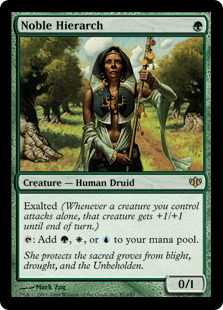
Noble HierarchIn the end, all three creatures seemed too inefficient to impress in this shell. They were at their best when they ate a Bolt and made way for Tarmogoyf. It's doesn't speak much to the competence of your creatures when you spend games hoping they die. Even Noble Hierarch fell short of my expectations. I habitually found myself wanting to attack with multiple bodies at a time, invalidating exalted, and flooding on mana despite only running 18 lands.

Another issue I had with this build is it didn't utilize the graveyard enough. I'm a big fan of squeezing every resource out of the game state. Without Hooting Mandrills, Grim Lavamancer, or something with the word "delirium," I often felt my graveyard was literally just a place where my used cards went. What is this, 1995? All the graveyard did was grow Tarmogoyf. If Prized Amalgam taught us anything this year, it's that we should expect more from our graveyards.

Some quick notes on the sideboard: Finks and Huntmaster came in against grindy and aggressive decks, and could both be bounced to ninjutsu for value (at the expense of much tempo). Spellskite added another way to dodge Lightning Bolt and hosed pump decks. Threads and Forked Bolt are just cute cards to kidnap Goyfs and kill Lingering Souls tokens, respectively.

The more impactful slots were Blood Moon, which stole many games on its own and helped against big-mana decks, and the Revelry/Grudge package, a necessity for dealing with Rest in Peace, Chalice of the Void, Ensaring Bridge, and other problematic permanents. Surgical Extraction was also integral to beating Dredge, although achieving that feat still required a fair amount of luck with this build.

The problems I experienced with each creature in the deck brewed a perfect storm of consistency complications, and I always seemed to have the wrong creatures handy for a given situation. I think this is an excusable problem for a first draft that jams a bunch of ideas together to see what happens, so long as deckbuilders learn from the brew's ineptitude and focus on honing its more successful undertakings in future builds.

Version Two: Gnarly, Dude
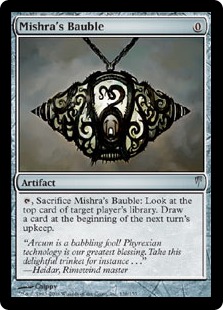
Mishras BaubleTo my chagrin, there was no way to incorporate enough instants and sorceries to reliably cast Delver of Secrets as a ninjutsu enabler, not to mention how stupid I'd feel bouncing the transformed Insect to my hand. After spending some time longing for efficient one-drops I could save with Mutagenic Growth, Gnarlwood Dryad popped into my head, and I took the second version in the same direction as Delirium Zoo. Surf's up!

Gnarlwood put Kird Ape to shame. It became a 3/3 immediately if opponents chose to interact with me, and if not, I could drown them in cards with Ninja. Barring either scenario, weird card types like artifact and tribal could turn the Dryad into a clock early. Its deathtouch clause acted as pseudo-evasion, allowing it to easily tag out for Ninja when opponents didn't feel like losing a valuable creature. And with the new influx of card types, Monastery Swiftspear became playable, as this version went from 18 to 22 prowess triggerers.

I already wanted a total of six sorceries for Tarmogoyf, and they had to be easier to bin than Flame Slash if I also needed delirium. Traverse the Ulvenwald mostly made the cut here as a sure-fire way to find lands early. It still has obvious upside in a shell so focused on stocking the graveyard.

Delirium-mode Traverse usually grabbed Goyf for me, but it could also fetch utility via Snapcaster Mage, or Ninja when opponents had an open board. I think for Traverse the Ulvenwald to be splashable, decks must be able to make use of its Lay of the Land mode a good chunk of the time. Between Blood Moon in the board, prowess and delirium on our one-drops, and a miserly land drop, we can.

Temur Ninja 2.0, by Jordan Boisvert

Creatures

4 Gnarlwood Dryad
4 Monastery Swiftspear
4 Snapcaster Mage
4 Tarmogoyf
4 Ninja of the Deep Hours

Artifacts

2 Mishra's Bauble

Instants

4 Mutagenic Growth
4 Lightning Bolt
4 Vapor Snag
2 Tarfire

Sorceries

4 Serum Visions
2 Traverse the Ulvenwald

Lands

4 Misty Rainforest
4 Scalding Tarn
2 Wooded Foothills
2 Steam Vents
1 Stomping Ground
1 Breeding Pool
2 Island
1 Forest
1 Mountain

Sideboard

3 Blood Moon
2 Mana Leak
2 Disdainful Stroke
1 Dispel
2 Destructive Revelry
1 Ancient Grudge
2 Pyroclasm
2 Surgical Extraction

This version felt much better, but ran into the same problems as my first build (albeit less often): it could clunk out on two-drops and sometimes lacked ways to enable early Ninjas. Generating extra value with ninjutsu and Snapcaster Mage never came up, and I lost plenty of games to nasty threats sticking on an opponent's field after mine had been destroyed.

Losing Sprite meant gaining access to Pyroclasm in the sideboard. I added Leak and Stroke to help against Tron, Ad Nauseam, and other big-spell decks. Between these cards, Moon, and my upgraded threat suite, these matchups became favorable. After testing Spellskite in the previous version, I switched to Dispel as my extra anti-removal measure of choice. Skite doesn't really attack, it doesn't really block, and it dies to Twisted Image. Additionally, we have game against Affinity and Infect just by virtue of our wedge. Nice card, just not for us.

Version Three: Ninjutzoo

My best games with the second version involved a triplicate of one-drops chased with Bauble and Probe. Ninja truly shone with these openers, since he always had a mate to come in for and was practically guaranteed to connect at least once with so many targets for opposing removal. Snapcaster MageOn the other hand, Snapcaster Mage disappointed me enormously. He conflicted with my aggro Plan A and wrestled with ninjutsu shenanigans for mana. I frequently wished Snap had been another one-drop.
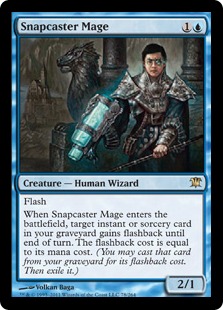
I thought about ditching Snap to add Kird Ape again, but decided to try splashing white first. Wild Nacatl is the greatest creature to ever meet a Mutagenic Growth, and I've been having a swell time testing for my upcoming RPTQ with that combination in Counter-Cat. Path to Exile also addressed the deck's other problem of struggling to overcome beefy threats, a shortcoming I feared would worsen without Snapcaster to reuse my Vapor Snags.

With fewer basic lands in the deck, more threats, and stricter mana requirements, Traverse the Ulvenwald became Gitaxian Probe. Probe also plays a little better with Swiftspear and makes sure the coast is clear for a Growth-less ninjutsu attack.

I mostly cribbed the manabase from Counter-Cat. Since we use so much green and red we may also want Breeding Pool and Sacred Foundry in the mix somewhere, although that combination complicates the Lightning Helix package in the sideboard.

That said, Destructive Revelry can't be cast off Hallowed Fountain and Stomping Ground. I think this quirk presents less of an issue because we'll be harder-pressed to find answers to aggressive creatures than to aggressive artifacts and enchantments in Modern. We also prefer to fetch Steam Vents and Temple Garden in this deck to have red and green on separate lands, making Revelry easier to cast generally. Finally, casting Wild Nacatl off a Breeding Pool doesn't allow us the opportunity to save him from Lightning Bolt with Mutagenic Growth, which may be the nail in the coffin for the Pool/Foundry combo.

The sideboard set of Helix mitigates the life loss concurrent with aggressive fetch-shocking. Although we can't really run Blood Moon ourselves on four colors, we're surprisingly resilient to the enchantment. All it turns off in our mainboard is Path to Exile, a card we don't usually want against Blood Moon decks anyway. Moon also turns our Nacatls into Kird Apes, but even Kird Ape starts to look a lot better when opponents have to spend three mana on it. So long as we prioritize fetching up Island and Forest, we should get under Moon just fine.

The smallest change I made to the deck was splitting Tarfire with Seal of Fire. I happened to draw a pair of Tarfires in a game with my second build and wished I had more variety. Besides, Seal compliments Monastery Swiftspear, and we lose Blood Moon from the side in this version, giving us no enchantments in the 75 otherwise.

Ninjutzoo, by Jordan Boisvert

Creatures

4 Wild Nacatl
4 Gnarlwood Dryad
4 Monastery Swiftspear
4 Tarmogoyf
4 Ninja of the Deep Hours

Artifacts

2 Mishra's Bauble

Enchantments

1 Seal of Fire

Instants

4 Mutagenic Growth
4 Lightning Bolt
4 Path to Exile
1 Tarfire

Sorceries

4 Serum Visions
2 Gitaxian Probe

Lands

4 Misty Rainforest
3 Wooded Foothills
2 Scalding Tarn
2 Arid Mesa
1 Steam Vents
1 Stomping Ground
1 Temple Garden
1 Hallowed Fountain
1 Forest
1 Island
1 Mountain

Sideboard

4 Lightning Helix
2 Mana Leak
2 Disdainful Stroke
2 Destructive Revelry
1 Ancient Grudge
2 Pyroclasm
2 Surgical Extraction

Nacatl gives this deck a rush of power, allowing Ninja the consistency he needs to sneak in for three mana (lol) and connect once or more. Path lets us keep up with midrange decks by removing their biggest threats at a tempo gain. Trading our one mana for their two or more compensates for the losses we take on ninjutsu, and gives us time to make Ninja's extra cards actually matter. Having a reliable way to push blockers aside also helps Ninja get through more often.

Nin'ja Glad I Didn't Say Delver?
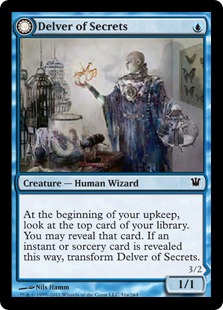
DelverGiven its colors and many similar cards, I can't say for sure that Ninjutzoo isn't a worse version of Counter-Cat. I will say that Counter-Cat is almost certainly a better deck. Whether Ninjutzoo has anything over it remains to be seen.

In any case, I can't wait to bring this baby to my shiny new Boston locals. Few feelings are as gratifying as winning with your pet cards. I must sound like a broken record by now in my unending praise of the format, but that's what I love most about Modern—if we account for metagame parameters, creature playability requirements, and the ol' Bolt Test, much more is possible than meets the Top 8 database.

Jordan Boisvert

Jordan is Assistant Director of Content at Quiet Speculation and a longtime contributor to Modern Nexus. Best known for his innovations in Temur Delver and Colorless Eldrazi, Jordan favors highly reversible aggro-control decks and is always striving to embrace his biases when playing or brewing.

View More By Jordan Boisvert

Posted in Brewing, ModernTagged , , , 14 Comments on Going Deeper: Brewing Ninjutzoo in Modern

Have you joined the Quiet Speculation Discord?

If you haven't, you're leaving value on the table! Join our community of experts, enthusiasts, entertainers, and educators and enjoy exclusive podcasts, questions asked and answered, trades, sales, and everything else Discord has to offer.

Want to create content with Quiet Speculation?

All you need to succeed is a passion for Magic: The Gathering, and the ability to write coherently. Share your knowledge of MTG and how you leverage it to win games, get value from your cards – or even turn a profit.

Insider: MTGO Cards to Buy, Sell or Hold – Episode 19

Are you a Quiet Speculation member?

If not, now is a perfect time to join up! Our powerful tools, breaking-news analysis, and exclusive Discord channel will make sure you stay up to date and ahead of the curve.

Welcome to another Buy, Sell or Hold after a short break caused by server problems. The good news is that you haven't missed much, as prices were pretty quiet.

Fortunately, this week we are starting to see more action. Standard players are trying new builds to beat UW Flash and BG Delirium. As of today, they are not tied for the most played decks anymore. Half of the BG Delirium players have moved into a new competitor, RG Aetherworks. The Magic Online metagame now looks like this:

  • UW 28%
  • BG Delirium 15%
  • RG Aetherworks 15%

With that in mind, let's see which opportunities we can find this week.


Shambling Vent

shambling-vent

With a resistance level at 3 tix and support at 2 tix, it is time to sell Shambling Vent and wait until it drops to 2 tix to buy it again. This type of investment is the easiest kind for beginners.

Verdict: SELL


Thing in the Ice

thing-in-the-ice

Thing in the Ice is one of the most volatile cards in standard. These cards offer great profits but they are also very risky. Pro Tour Kaladesh proved the card can be played in the Standard. It is even played in Modern. I think now is a good time to sell any copies you have, then track its movements to rebuy when it drops to 1 tix, providing a 50 percent profit or so.

Verdict: SELL


Tamiyo, Field Researcher

tamiyo-field-researcher

This weekend we will have two Standard Grand Prix and one important SCG tournament. Tamiyo, Field Researcher is not worth buying now that it has rebounded, but I will hold them until the weekend to see if a new deck plays it in those tournaments. If nothing happens, I will sell my copies right away, because the card should drop to 3 or 3.15 tix, a price I will be happy to buy them for again.

Verdict: HOLD


Thalia's Lieutenant

thalias-lieutenant

Another card similar to Tamiyo in that I would sell it right now if there were no big tournaments this weekend. Thalia's Lieutenant has spiked in the last few days, and some WR human aggro decks could be the responsible for this. I'm not completely sure about the reason, so I will hold them until the weekend to confirm more increases aren't coming.

Verdict: HOLD


Tireless Tracker

tireless-tracker

I have been tracking Tireless Tracker's price movements very closely, and I haven't decided to sell my copies yet. This weekend will be the determining factor, so I will pay attention to the dominance of BG Delirium and RG Aetherworks (which usually plays four copies of Tracker in the sideboard) – and, of course, whether a new deck appears. If BG or RG don't have outstanding performances in this weekend's tournaments, I will finally liquidate my copies of Tracker.

Verdict: HOLD


Have a wonderful weekend. See you next time!

High Stakes MTGO – Nov 20th to Nov 26th

Are you a Quiet Speculation member?

If not, now is a perfect time to join up! Our powerful tools, breaking-news analysis, and exclusive Discord channel will make sure you stay up to date and ahead of the curve.

Hello, and welcome back for another High Stakes MTGO!

This past week was quite a special one for my portfolio—not a single purchase! This is a very rare event but it might actually happen more frequently in a near furture. One reason for this was a very busy week for me—partially due to my job and partially due to Thanksgiving here in the US. Another reason was the incoming release of Modern Masters 2017.

Nothing is yet known about what could possibly be in MM3, which means that at this point everything can potentially be in MM3. With less than three months before the major themes and early spoilers of MM3 are known, there's a short time to secure profitable Modern specs. Flashback drafts are still creating a few decent buying opportunities, but outside of slam-dunk picks, the time period for cards to cycle up again before a potential reprint is extremely short.

The Modern Masters series can have dramatic consequences on prices. We've seen quite a few cards on MTGO go from double-digit prices to less than a ticket, and this will happen again with MM3. We also know that Modern staples of all ranks can be reprinted multiple times in the Modern Masters series. With so many possibilities I'm just not willing to take unecessary risks with Modern at the moment.

On the other hand, Standard is currently cruising. While full sets of Battle for Zendikar and Shadows over Innistrad rebounded markedly from a little price drop encounter about two weeks ago, the value of Eldritch Moon full sets kept climbing, now well over 150 tix per set. I was pretty happy with my EMN full set spec, but I have to admit that I didn't expect it to go so high. It's crazy to think that EMN has almost doubled since last September when the set hit 81.6 tix. Only Innistrad could brag about having done better.

With Standard as well, the context is not very favorable for buying positions. There will certainly be some cards to take a chance on as Aether Revolt approaches. But I probably won't be buying anything until mid-December, to ensure I get the best prices on the positions I decide to go with.

Let's see how my selling-only week went. The latest snapshot of my portfolio can be found here.

Buys This Week

None.

Sales This Week

Since the beginning of this month the MMA version of Path to Exile has been oscillating between 3.5 and 4 tix, and that's actually the best it has been for more than a year now. I was expecting a rebound in the 5-6 tix range at some point but it never happened.

Despite a spread frequently over 20%, I managed to sell all of my 91 copies of this white removal spell with an honorable 36% profit. I'm not sure it would have been reasonable to wait for more considering that Path to Exile could easily be in MM3.

I wasn't holding out for new record highs on Cryptic Command, and I close this position very satisfied after all. Two and a half months after I bought this position, the price finally took off recently. I didn't want to let this opportunity go and sold my blue command with a nice 58%. I wish more of my Modern specs would just do that.

Probably a victim of its own success as a card and a spec target, Abrupt Decay never did anything price-wise in the same way the shocklands did. Less obvious choices such as Rest in Peace, Jace, Architect of Thought, and Supreme Verdict did much better, speculatively speaking, in Return to Ravnica.

RTR is actually next in line for the Modern flashback series, and with Abrupt Decay jumping from 3 tix to 5 tix this past week I thought now was my chance to exit this spec with only marginal losses. I can't say the same for the other RTR positions I'm still holding—I'm ready to swallow the pill.

Simply an awesome random Modern spec and another success provided by the flashback drafts. Phyrexian Metamorph was never close to being a Modern staples and is only played in some variants of Shop decks in Vintage. Nonetheless this card have shown a nice cyclical pattern, roughly fluctuating between 2 tix and 6 tix for the past four years.

It made sense to buy this guy right after New Phyrexia flashback drafts and it made sense to sell it now. One could say I'm selling too early, but I learned that 150% profit in six weeks is not something I should pass on easily, especially when a massive reprint is a possibility in the near future.

bfzlog

BFZ full sets are back above 70 tix—I wasn't asking for so much. I was still planning on liquidating my BFZ full set position and if I can grab a couple more tix per set in the process then let's take them. I'll be done with these sets by the end of this week. In the end, besides that initial fifteen sets sold at 46 tix to get liquid, I pretty much broke even with the rest of my BFZ sets—something I wouldn't have thought possible two months ago.

soilog

SOI full sets also rebounded this past week. That all I needed to sell the six sets I was still holding. Unlike with BFZ full sets, these guys netted me a little bit over 15% in profit and in less than ten weeks.

mtgbfz_en_bstr_01_01

My weekly unloading of BFZ boosters. 50% loss and 48 more to go.

On My Radar

Nothing has changed from the previous week and Modern is virtually the only format I'm paying attention speculative-wise nowadays.

Thank you for reading,

Sylvain

Deck Overview- Izzet Kiln Fiend

Are you a Quiet Speculation member?

If not, now is a perfect time to join up! Our powerful tools, breaking-news analysis, and exclusive Discord channel will make sure you stay up to date and ahead of the curve.

Love the format or hate it, there's always something new to talk about in Modern. This deck has been showing up for a minute on Magic Online, and I'm curious to see if it will be present at the SCG Invitational in Atlanta this weekend. Some refer to this deck as "Bloo"... and they should cut that out.

Izzet Kiln Fiend

Creatures

2 Bedlam Reveler
4 Kiln Fiend
4 Monastery Swiftspear
4 Thing in the Ice

Spells

4 Gitaxian Probe
4 Serum Visions
2 Sleight of Hand
2 Apostle's Blessing
4 Lightning Bolt
4 Manamorphose
4 Mutagenic Growth
4 Temur Battle Rage
1 Vapor Snag

Lands

4 Flooded Strand
2 Island
1 Mountain
3 Scalding Tarn
4 Spirebluff Canal
3 Steam Vents

Sideboard

1 Bedlam Reveler
2 Vapor Snag
1 Blood Moon
2 Ravenous Trap
2 Shattering Spree
3 Stubborn Denial
2 Twisted Image
2 Young Pyromancer

This is another deck that meets Infect and Death's Shadow Zoo halfway. It doesn't have the raw explosiveness of either deck, though it can deliver turn three kills off the back of Kiln Fiend, and technically has turn two potential with Monastery Swiftspear. The primary advantage that this build offers is that Thing in the Ice offers some disruption for opposing creatures as well as Bedlam Reveler's ability to gas back up.

One thing that is really nice about this deck over Infect, is that every creature can be saved from a Lightning Bolt either with four printed toughness or a single Mutagenic Growth. The sideboard Stubborn Denials are also a nice boon for this type of strategy both as disruption, or protection. It is very convenient that Kiln Fiend gives you ferocious with just one trigger.

Now that Thing in the Ice is finding its footing, foil copies could very well be a great long term play. Foil double-sided cards aren't super easy to come by, and it's definitely a pickup worth considering.

Insider: Planechase and Uncommon Finance

Are you a Quiet Speculation member?

If not, now is a perfect time to join up! Our powerful tools, breaking-news analysis, and exclusive Discord channel will make sure you stay up to date and ahead of the curve.

In every set, there is at least one uncommon worth paying attention to. There is usually at least one card that is not bulk that inevitably gets lumped in with the rest of the draft leftovers. So take a second and look through the discarded pack chaff to see if you find some gems. Typically, these are cards like Aether Hub and obvious to anyone paying attention to finance, but sometimes they are not quite as obvious cards, like Harnessed Lightning. To start things off, here’s a quick list of Standard uncommons to be on the lookout for.

Of these cards, there are a couple that actually look good post rotation from Standard. If you follow my articles, I talked about how amazing Aether Hub was in my Legacy top-eight deck from Eternal Weekend. This widely applicable land should be utilized in eternal formats for a long time. Get your set now while they are in Standard. The other uncommon I like is Hedron Archive. This screams Commander staple to me. It does everything you want to be doing in Commander.

I’ve been thinking a lot about picking bulk lately because with the introduction of Masterpieces, my thought was that these money uncommons would cease to be a part of the financial landscape of Standard. That theory appears to be wrong. I think the demand for these tournament staples has superseded the supply increase from Masterpieces.

The topic of picking bulk came up for me because I was sorting Eternal Masters cards from this past Summer. Sets like that have a much higher percentage of money uncommons and are well worth your time to pick through. Luckily, I’ve done your homework for you, so take a look at your quick list.

Wow that’s a lot of bang for your buck. Unfortunately, the mythics and rares aren’t holding up their end of the pack’s price. The “small reprint” has added a ton more stock to the pool and dropped the price of the singles even lower. Can you believe that after what seems like fifty printings, Counterspell is still worth picking? What about Peregrine Drake or Ashnod's Altar? Those cards are great because most players won’t value them, but they can help you get more out of your bulk.

You even have cards like Hydroblast, Wirewood Symbiote, Ancestral Mask, Invigorate, and Worn Powerstone that aren’t worth much right now but are still worth holding onto.

Planechase Anthology

Next up, we have a new product that was recently released, Planechase Anthology. This big box set looks gorgeous sitting on the shelves at my store, but the problem is they aren’t selling well. Let’s get a frame of reference as our starting point.

There was an error retrieving a chart for Baleful Strix

Planechase Anthology comes in three parts. The bright orange box contains the four Planechase decks, all of the printed planes (the big cards), and a set of dice. All of the cards in the decks have been reprinted multiple times at this point, but some are still worth a couple bucks. The planes as a whole are worth some money too, but they are only worth something to a select group of players who enjoy the chaotic nature of the Planechase format. And, let’s face it, everyone loves dice, so that’s always a winning part of any product release. We’ll go through each category individually and break it all down so we can see what’s happening with the finance behind the scenes of this product.

The Decks

Let’s face it. Most players don’t care about the decks because they aren't excited to play the decks as they are built. Players do get psyched up about the individually powerful cards themselves, and those are the ones worth looking at. They also happen to be the ones that are valuable, so it's doubly important to us in the finance community.

Unfortunately with all of these cards being reprints, many players already have the cards they need from these decks. With that being the case, of course the price will drop on these cards due to lowered demand. The ones that haven’t been reprinted much will have prices that are more stable. Take Maelstrom Wanderer, for example.

There was an error retrieving a chart for Maelstrom Wanderer

This commander is one of the more popular generals and it’s still sticking above the $10 mark for now. All of the rest of the cards in the set have fallen below that mark, though. Even the legacy staples like Shardless Agent and Baleful Strix that once made these decks highly sought after have fallen considerably thanks to their multiple reprints this year. When these cards were first released in the Planechase decks, there was some serious money to be made if you were able to hunt down copies of these decks and resell them.

Since we are mainly concerned with the price of the high-profile singles, as we so typically are, I took some time and listed them all here for you to see.

Maelstrom Wanderer $12
Sakashima's Student $10
Silent Blade Oni $7
Shardless Agent $6
Vela the Night- Clad $6
Preyseizer Dragon $5
Thromok the Insatiable $5
Ink-Eyes, Servant of Oni $4
Awakening Zone $4
Krond the Dawn-Clad $4
Baleful Strix $4
Quietus Spike $3
Beast Within $3
Glen Elandra Liege $3
Ghostly Prison $3
Bloodbraid Elf $3
Mycoloth $3
Spirit Mantle $3
Exotic Orchard $3
Krosan Verge $2
Dragonlair Spider $2
Indrik Umbra $2
Three Dreams $2
Etherium-Horn Sorcerer $2
Brindle Shoat $2
Felidar Umbra $2
Rancor $2

If you total up just these 27 cards worth $2 or more, you will have a total of $107! I’ll let you in on a secret: that’s basically the price of the whole Planechase Anthology set, and we haven’t even gotten past the first category yet. Since this product just came out, the price of the singles is still unstable, though. I’d imagine that once more copies of the decks are opened, the prices could drop further than their current price point. If not, this could be a great product to invest in.

My gut tells me, though, that it will be difficult to make money on this if you try to split it up. Because all of these cards have been reprinted many times now, what players need these cards? Certainly players need change and new players wouldn’t have been around in 2012 the last time these came out, but they very well could have picked up the singles individually or opened them from another products where they were printed, like Conspiracy 2 or Eternal Masters.

One positive aspect about these cards though is that they are Commander Gold™. Each of these cards offers a unique effect on the game and many players find cards from this set quite desirable for their fun 100-card decks.

The Plane Cards

Next up we have the planes themselves, which are extra-large cards. This plus-size deck functions as a chaotic way to play any casual format, but mainly players pair their Commander decks with the planes for some wacky fun.

In case you didn’t know, some of these planes are worth some real money. I’ve happily sold individual planes over the years for a couple bucks each to a variety of vendors. Most of the time though, the desirability of these unique cards is linked with them as a complete set. If you are into Planechase, you might as well have all the planes so you can have the fullest experience, right?

Anyway, if you want to buy the full set, my quick eBay research tells me you can acquire them for about $50. I believe this is way down from where they were before this reprint, but $50 isn’t too big of an investment for something you can pair with any decks and have fun with.

My only issue with the plane cards is that they don’t apply to a wide audience. I’ve played this format recently with some friends using our Commander decks. I found the randomly generated effects the planes grant you to be much too silly for my tastes most of the time. I think many players agree with me on this point, which leaves fewer buyers in the market for this product. From the perspective of a store owner, I know we didn’t order many copies of this big box because of these very reasons. Also, over $100 is a lot to spend on one product for most people, so that’s definitely a factor as well.

The Dice

In this set, you get four black spindown 20-sided dice along with the cool blue planar die to help you visit all the planes in the multiverse. Dice from these unique sets are always worth picking up if you find them cheaply, because players will seek them out. Everyone loves dice – remember?

eBay listings confirm that these dice definitely do hold value on their own. In fact, if you want to buy just the planar die itself, you will have to spend at least $8! To get the whole dice set, you’re looking at over $20.

Planechase Wrap Up

So, if the singles themselves are worth over $100, the plane cards are $50, and the dice are $25, this product is looking like a great investment. The problem is that the price keeps dropping. TCGplayer has copies available for barely more than $100. That says to me people aren’t buying much. If sellers have to continuously drop the price on a $150-MSRP product, then each of my categories aren’t really worth as much as they seem. What I think will happen is that the three parts of this product will all drop in value to match the full buy-in price of $100.

If you are one of the people interested in this set, I’d hold off for a couple weeks and see how the market adjusts. You may be able to get a better deal than what’s available right now. The same goes for the price of the singles as well. If someone can open one of these boxes and instantly turn a profit, people will do that until the market adjusts. Believe me, people are already trying to squeeze every penny out of this set. I’m not the only one who had thoughts about trying to make money on Planechase Anthology.

If you have experience about any part of this topic, please feel free to add your two cents below in the comments and we'll discuss.

That’s all for me this week. I hope my cautious tone came through about Planechase from a financial perspective, but if you’re in it for the fun, this is definitely a great buy. Don’t forget to pick that bulk too and get your value from that avenue as well.

Until next time,
Unleash the Finance Force!

Mike Lanigan
MtgJedi on Twitter

Under the Hood: Inspecting Infect

Are you a Quiet Speculation member?

If not, now is a perfect time to join up! Our powerful tools, breaking-news analysis, and exclusive Discord channel will make sure you stay up to date and ahead of the curve.

I’ve been saying for a few weeks now that, since the printing of Blossoming Defense, Infect is far and away the best deck in the format. The addition of yet another pushed pump effect seemed to me to be a strict upgrade to Apostle’s Blessing, an already powerful card in the archetype. While Infect’s weaknesses still remain (a poor matchup in Jund, and an inherent unavoidable inconsistency in deck composition) the archetype has only gotten better recently, while most every other archetype has remained stagnant.

wild-defiance-banner

Still, the archetype has only put up results that can best be described as "lukewarm," especially considering the rhetoric surrounding the strategy (thanks in part to me, but attributable to others as well). So, for the past few weeks, I’ve been working on the deck myself, tuning, perfecting, learning the ins and outs. Today, I share my knowledge. Welcome to Infect 101.

[wp_ad_camp_1]

Infect, by Trevor Holmes (5-0, Modern League)

Creatures

4 Glistener Elf
4 Blighted Agent
4 Noble Hierarch
1 Dryad Arbor

Sorceries

4 Gitaxian Probe
1 Distortion Strike

Instants

4 Might of Old Krosa
4 Mutagenic Growth
1 Apostle's Blessing
3 Blossoming Defense
1 Dismember
2 Twisted Image
4 Become Immense
4 Vines of Vastwood

Lands

2 Breeding Pool
2 Forest
4 Inkmoth Nexus
3 Misty Rainforest
2 Pendelhaven
2 Verdant Catacombs
2 Windswept Heath
2 Wooded Foothills

Sideboard

2 Dismember
3 Nature's Claim
3 Ravenous Trap
4 Spell Pierce
2 Spellskite
1 Wild Defiance

For the most part Infect is still Infect, and hasn’t changed much since the OG version with Ponder and Preordain. Become Immense will go down in history as the inflection point for this archetype, the reinvigoration that elevated it back to Tier 1, but beyond that, everything else has stayed routine for the most part. blossoming-defenseThe ability to essentially one-shot our opponent for one mana (given some setup) is excellent, as is the ability to capitalize on a resource that would otherwise be left unutilized (the graveyard). The card isn’t without negatives, as the second copy can often be a dead draw, but for the most part getting a Might of Old Krosa or better at instant speed is the best possible thing we could be doing.
Blossoming Defense is, in my opinion, the second gift (alongside Become Immense) that has finally pushed this archetype firmly in front of the rest of the field. Before Blossoming Defense, Infect had to turn to Apostle's Blessing if they desired more protection effects than the four copies of Vines of Vastwood. In doing so, they diluted the consistency of their deck by trading a pump spell for what is essentially a narrow Spell Pierce. Spell Pierce is great, as the playset in the board can confirm, but it goes against our Plan A and we would much rather be disrupting our opponent with it than using it to protect our own creatures. There are metagames where Spell Pierce is a maindeckable card and even possibly better than a protection effect, but in the abstract, maximizing the percentage of our spells that pump our creatures is where we want to be.

Now, I can anticipate the reaction here, which would go something like this:

“But Apostle's Blessing can Falter blockers! That’s what you’re really losing with Blossoming Defense.”

This is 100% true, and definitely something that would be a mistake to overlook. Blocking isn’t something that’s happening often against our Infect creatures, as Inkmoth Nexus flies and Blighted Agent came prepared, but still happens often enough that we need to have a contingency in place. Lingering SoulsOne copy of Lingering Souls is often enough to stall us out for enough turns that opposing removal or counter-threats can take over. Young Pyromancer tokens or even just a Snapcaster Mage can make attacking with Glistener Elf seem like spinning tires. We have methods in place to live through such engagements (exalted, Pendelhaven), but if we’re not doing damage to the player we’re usually losing.
What it comes down to is how many non-pump spells we can afford to run. We can’t cut our Falters completely, and as narrow as Distortion Strike may appear it does a fine job providing us two attacks in one card. That might not seem like much, but two attacks is usually all we’re looking for to kill our opponent, and if we’re facing any sort of board, two turns is often all we’re going to get anyways. Against over half the field we’d much rather have access to Dismember or Spell Pierce, but in the matches where we’re looking for Distortion Strike, it’s often the only unique effect that can save us. So, necessary evil, but I’m only playing the singleton.

Settling on Flex Slots

Infect has around five flex slots that we adjust to whatever we see fit, and then the sideboard which can take one of two approaches based on similar factors. We’ll tackle the maindeck first.

Dismember

Creature removal isn't strictly necessary in Infect, as we’re usually faster than other creature decks besides Burn. Burn is a bad matchup, but it isn't really a creature deck and Dismember isn’t what we want there regardless. DismemberFor everyone else, one copy of removal is fine to dig to or hold as insurance. Nabbing a Dark Confidant from Jund, a Tarmogoyf that's beating down, a Narcomeba hanging back to block, or a Thought-Knot Seer sitting on a free card are all solid uses, to say nothing of the mirror. Dismember is fine against Affinity—popping a Cranial Plating-toting attacker or a Steel Overseer before he starts rolling can often swing the race—but we’re not really playing Dismember for this matchup. Out of all the archetypes in the format, we can probably race Affinity in game one the best, but there’s a reason for the three Nature's Claim in the board. Adjusting maindeck numbers to fight an 80/20 game-one deck is defensible in some metagames, but in a field this varied there are bigger fish to fry.
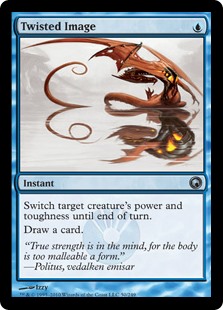
As a final note, if we’re looking for more removal, the second Dismember is probably too expensive. Just because we’re playing two maindeck doesn’t mean we’re always drawing and casting both, as we are really adding the second copy to draw one more often. Just keep in mind that we’re probably taking more damage in game one against the field as most maindeck archetype configurations will be forced to race. Between Dismember, Gitaxian Probe, Mutagenic Growth and our opponent kindly helping, the second Dismember might end up uncastable in our hand. I’ve seen a few other options that all look horrible, but we could do worse than add a maindeck Spellskite to gum up the ground and provide an extra piece of protection. Not to mention the rude game-one mirror bomb potential.

Twisted Image

I went from cutting this card after almost every game one to keeping it in almost all the time. The right play is somewhere in the middle, but I’m still figuring that out. twisted-imageThere are fewer Spellskites running around now that Splinter Twin is banned, but they are still out there, and Twisted Image is designed to be functional and never dead. This sounds great in theory, but what do you do in-game, when you haven’t seen a Spellskite yet and are digging for pump (because Twisted Image is taking the place of a pump spell in hand)? Do you cycle it for action, only to be left cold to a Spellskite later in the game? These intricacies are context-dependent and complicated, and to be honest the whole draw to playing the archetype in the first place, besides turn-threeing plebs. So, no, I’m not going to give you the answer.
Nabbing opposing Noble Hierach, Birds of Paradise, Ornithopter and Signal Pest are great, and drawing a card off the kill just feels dirty. Were it not for the plentiful Affinity targets I could see myself going down to one, but I like having access to a way to kill Spellskite should somebody random like RG Breach decide that they aren’t losing to Infect today. And yes, you can get an extra point of power out of Pendelhaven. Now we’re all pros together.

Wild Defiance

I’ve gone from trying this card, to cutting it, to bringing it back multiple times now. When we stick it against damage-based removal it’s huge, but ever since Blossoming Defense I haven’t had much trouble keeping creatures alive. wild-defianceMost of my losses have been to discard, losing races, or Liliana, the Last Hope. Wild Defiance doesn’t help in those situations, as often the mana I’ve spent to cast Wild Defiance was the mana I needed to pump for the win. Remember, every non-pump slows us down, and from my experience Wild Defiance counts as a non-pump the turn it’s played.
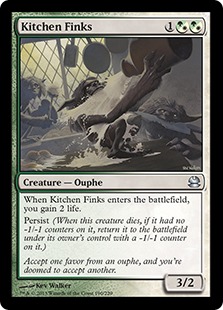
I’ve got the feeling we want this most against midrange archetypes full of removal and discard, so the one pump spell they leave us with actually ends up being enough to kill them. I know it’s a great card, but we could possibly be in the wrong metagame for it. I’m only playing the singleton, and I would say I’ve boarded it in around 10% of my matches, and drawn it even less. So I can’t have played with it north of ten times by now, even though I’ve played a bunch of matches. Still, the times I’ve cast it, it hasn’t saved me where no other card could.

Kitchen Finks

On the other hand, Kitchen Finks has saved me where no other card could, and I’m loving it. There’s your McDonald’s plug in case you missed it. You may notice there are no Finks in the list above. Kitchen FinksI've been trying lists both with and without the card—the lists with Finks make room for three copies by cutting a Spell Pierce, a Ravenous Trap, and the Wild Defiance.



Aside from Burn (where it’s great, but we’re not talking about Burn in this metagame) the lifegain is welcome for Affinity, Dredge, and even Eldrazi. Nothing stops a race like Kitchen Finks, and on top of everything we get to give Jund fits. I’ve brought this in against almost everyone, even in the mirror against an Infect opponent with what seemed like a ton of Apostle's Blessing and Dismember in game one. With so much random pump, we can get the “hard way” kill more often than you would think, and having another creature with actual printed power besides Dryad Arbor can help us get there. Kitchen Finks gives us options, it gives us blockers, and it gives us more guys for the red zone.

Conclusion

Infect is a deceitful archetype, in the sense that it looks relatively the same on the surface, but 20 cards (5 maindeck, 15 sideboard) can influence matchups greatly. Spotting the difference in numbers, and discovering how they affect various results is an acquired taste, and one I’m just now starting to get the hang of.

Decklist analysis is important, but nowhere near as influential as play familiarity. Around 80% of your mileage out of Infect comes from in-game decisions, not deck composition. Results may vary, and I implore readers looking to pick up the archetype to put in the work. I’ve been playing steadily for about a month now, and I suffered through a few 2-3s and 3-2s while I got my bearings.

Points can be lost in areas that aren’t immediately apparent, so pay close attention to results and what you could have done to change things. While I rarely use the MTGO replay feature, I’ve found myself turning to it with this archetype, to uncover lines I might have missed and visualize results had I taken a different fork. While I’ll eventually put Infect down in favor of other decks, familiarizing myself with the lines and capabilities will definitely help me down the line when I find myself on the other side of the table. If you plan on picking it up, good luck!

Trevor Holmes

The_Architect on MTGO

Twitch.tv/Architect_Gaming

Twitter.com/7he4rchitect

Stock Watch- Bloodspore Thrinax

Are you a Quiet Speculation member?

If not, now is a perfect time to join up! Our powerful tools, breaking-news analysis, and exclusive Discord channel will make sure you stay up to date and ahead of the curve.

Bloodspore Thrinax was basically a bulk rare at the time of its release, though it has seen a ton of price movement in the wake of the printing of Atraxa, Praetor's Voice. Bloodspore Thrinax was basically a bulk rare at the beginning of the week, and currently you would be lucky to find a copy for under $5.

There was an error retrieving a chart for Bloodspore Thrinax

Given that this card was only released in a Commander deck, most copies are sitting in the trade binder of people who purchased said deck, so there isn't a lot most of us can do with this information. Though if this is the sort of card players are interested, I'm inclined to believe that other devour cards and cards with the evolve mechanic are worth exploring. Dragon Broodmother is a long time casual favorite that could see some growth. I think that Gyre Sage is an interesting penny stock. If Astral Cornucopia wasn't in Commander 2016 I might be looking that way, though Gyre Sage does much the same thing.

There was an error retrieving a chart for Gyre Sage

There are plenty of non-foils out there due the card being from Gatecrash, though we're talking about Commander specs. I like picking up some foil copies of this card, which is both a potentially large creature and mana generator. I'm no Commander genius, but both of those things seem to be what the format is about.

Want Prices?

Browse thousands of prices with the first and most comprehensive MTG Finance tool around.


Trader Tools lists both buylist and retail prices for every MTG card, going back a decade.

Quiet Speculation