Are you a Quiet Speculation member?
If not, now is a perfect time to join up! Our powerful tools, breaking-news analysis, and exclusive Discord channel will make sure you stay up to date and ahead of the curve.
As promised, welcome back to the Beginner's Guide. Back in August I explained the general types of Modern decks to explain why Modern is so proactive and diverse. Today we will start to unpack that riddle by examining how to approach playing and playing against Modern's aggro decks.

As I said last time, aggressive decks are by far the most common decks in Modern. And this shouldn't be surprising. Wizards has printed a lot of cheap, efficient, and powerful creatures over the years. They've also printed a lot of very good support spells for those creatures. As well as burn. As a result there exists a critical mass of tools for aggressive players to choose from and a vast array of decks is the natural result. It should surprise absolutely no one.
However, more players complain about how aggressive Modern is than anything else. There are a number of schools of complaint, but on whole the problem seems to be how difficult it is to be anything other than aggressive. I'm not entirely sure what players are expecting, the larger the format the better the threats are going to be. This is true of every eternal format. The only reason control rules Legacy is because Miracles employs a soft lock.
The thing is, I don't think most players think about the Modern metagame correctly. Look at our Top Decks page. Most of the decks in Tier 1 are aggressive. Many of the aggressive decks in Tier 2 are Tier 1 contenders. You can prepare a control deck to beat aggressive decks and expect to do reasonably well in a tournament. Beating other decks should necessarily be a lower priority. If you prepare against these decks correctly, then true control decks DO work in Modern.
[wp_ad_camp_1]
What is Linear Aggro?
Linear Aggro decks are the classic creature decks of Magic, a lineage stretching back to the original Sligh deck. These decks seek to utilize the mana curve and mana efficiency to knock their opponent to zero as quickly as possible. The original Sligh decks played worse cards than everyone else (Goblins of the Flarg? Seriously?) but it didn't matter because other decks at the time didn't use their first few turns worth of mana. By the time they really began 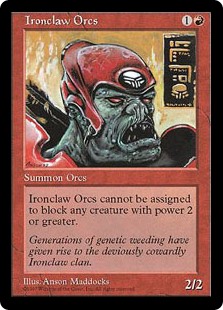 playing Magic they'd taken enough damage for a few Incinerates to finish the job. A good linear aggro deck follows this tradition by playing efficient creatures and frequently burn to kill the opponent on turn 4. It seeks to be the first onto the battlefield and win the game via tempo and raw damage output.
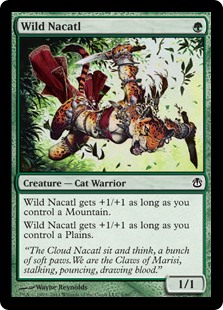
The classic example is Zoo. It plays the most efficient creatures at every mana cost and supports them with burn to quickly kill an opponent. Wild Nacatl is a 3/3 for one mana. Tarmogoyf is rarely less than a 3/4 for two. You play the best cheap creatures in large quantities, attack with them, and if the opponent answers the creatures you finish them off with burn to the face.
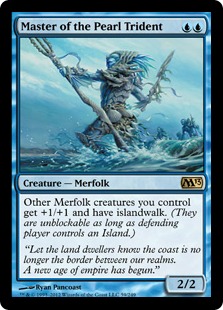
This is not the only strategy available to linear aggro. You can go the Merfolk route of playing synergistic or evasive creatures. This will not be as fast a kill as a Zoo style deck, but it gains some additional reach and flexibility. Large creatures are less likely to stall your offense if you can match or exceed their size or simply go around them. You can also reposition away from pure agro towards aggro-control by playing ways answers yourself. You lose speed but gain the ability to protect your clock and disrupt your opponent, which is valuable against control and combo decks. Linear aggro decks are recognizable by their gameplan and creatures, but they can take many forms.
Taking the initiative
When playing any deck it is important to remember that you have a gameplan and then execute it. This is deceptively hard for an aggro deck. Yes, you have a very straightforward plan - kill the opponent quickly. The problem is that said opponent gets a vote as well. Determining how to correctly sequence your threats to mitigate the impact of answers on your clock is as much an art as a skill, and you frequently find yourself making very simplistic plays following complex thought.
 On the surface this makes no sense. Linear aggro wants to play its creatures and attack. The problem is that your threats are not particularly durable and it is rare for aggro to have any card drawing. This isn't necessarily a problem, your card advantage comes from the opponent dying with cards in hand. Except when they have answers for all your threats and you're stuck in topdeck mode, desperately trying to put a board back together. You have to play enough threats to close out the game, but no so many that you cannot rebuild if things go wrong. This is not an easy skill to master.
The important aspect to remember is that as an aggressive deck you are dictating the pace of the game. Your opponent is reacting to you in a timeframe and on a battleground of your choosing, not theirs. You can set the clock as fast or as slowly as you wish. I don't recommend going for a slow pace in most circumstances, but if your threat density is high enough compared to the opponent's answer density then it can be effective. The key to being an aggressive deck is to either push the opponent onto their back heel and keep pushing until they fall over or make them fight on your choosing. If you do that effectively, you will win. Allow the opponent to dictate the pace or place of battle, and their more powerful cards will crush you.
Being the Aggressor
Every deck is different and demands its own playstyle and skillset, but I can offer some general advice for those looking to start attacking in Modern.
 First of all, a new aggro player must learn sequencing. Knowing which threats you can expose to answers when and how to maximize your clock in their face is critical. This requires learning your deck and understanding what cards really matter in a given matchup. The second skill is to learn what answers see play, how they affect you, and when you need to or can afford to play around them. You need to be able to recognize what your opponent's mana represents and how that card will affect the battlefield. Some cards you cannot avoid, but you can mitigate their impact. Others you can make less valuable by changing playstyle.
The final skill is learning to play on your opponent's fears. Creating uncertainty in your opponent is valuable and it is possible for proactive decks, especially aggressive ones, to make an opponent so afraid of dying from the wrong play that they make no play, or one that is good on paper but bad in the context of the game. Making the opponent play scared of a burn or pump spell you don't have, or simply fear tapping out and getting hit by Collected Company, generates a tremendous amount of virtual card advantage and is an excellent way to steal wins.
Fighting Fire with Fire
Building off of that advice, if you want to beat a linear aggro deck you can either answer them or ignore them. Thus far in Modern, ignoring linear aggro has been far more successful than answering it. Aggro traditionally suffered against combo when its clock wasn't fast enough to race the deck. Ramp was also a struggle because aggro's creatures are easily outclassed. Aggro's power comes less from card impact than it does from efficiency, and it is not that hard to out impact a Kird Ape. This is why decks like Titan Breach and Ad Nauseam are good choices in an aggro filled Modern metagame.
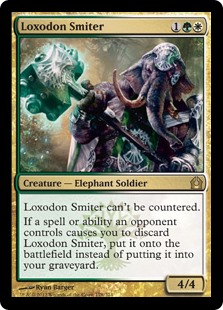 In Modern, it is not that hard for aggressive decks to find some form of disruption to improve their matchup against combo and/or ramp. Thoughtseize, Ghost Quarter, and Spell Pierce are just a few options and they go a surprising distance to closing the traditional weakness. What few aggressive decks can easily do is improve the size of their creatures (Merfolk being the main exception). Big green creatures from midrange or Stompy decks are the traditional nemesis of aggro, and the go bigger strategy still works today. Wild Nacatl is a very good creature but it isn't going through Loxodon Smiter without help.
You can also beat aggro by being even more aggro. In the past aggro on aggro was decided by who had the most removal and resolved the threat that stuck. Now it is possible to simply blast past them. Decks like Infect, Affinity, and Suicide Zoo have good matchups against normal Zoo, Eldrazi, and Merfolk because they have much faster goldfishes and can win though blockers. If you want to beat linear aggro, it's a proven strategy to be more proactive than they are.
Quench the Fire
The other option is to answer the aggro decks, exhaust their answers and win back the initiative. This is the midrange/control strategy. The midrange decks have been very successful, particularly Jund, but in Modern control struggles.
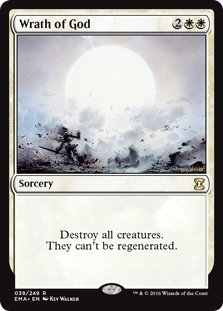 Traditionally control decks have focused on having answers for everything, card advantage, and a few largely unanswerable win conditions. Look back at everything Shaheen Soorani has written for some examples. These decks ran a lot of counterspells, targeted removal, and sweepers to staunch the bleeding from aggro decks and break-up combo decks. This was fueled by card drawing and games were closed once they were already won. This doesn't happen in Modern, and most players blame the diversity and speed of the format. I disagree, and think the problem is that control players misbuild their decks. Most Modern control decks focus on targeted removal and card drawing but don't play sweepers. This is a mistake.
The most common control list in Modern is Jeskai Control. The only truly hard answers it plays are Path to Exile and a few counters. It relies on soft answers in the form of burn. As such it is unequipped to effectively fight aggro when they are able to outsizeLightning Bolt (which explains Eldrazi's rise)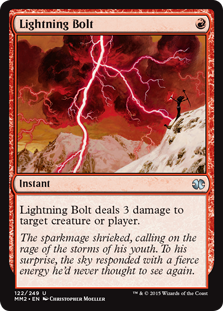 . Lacking sweepers like Supreme Verdict means that it struggles to come back from behind, once control's greatest strength. This is the real problem with Modern control, not the rest of the meta.
As a Merfolk player, I am not afraid to play against a deck filled with targeted removal. All I have to do is avoid getting my Silvergill Adepts countered and my threat density and cantrips will keep me ahead of all the Bolts in the world from my opponent. What I never want to see is straight UW Control with lots of sweepers. I can deal with one-for-ones, I can't fight multiple-for-one more than once. If you want to beat aggro as a control deck, BE A CONTROL DECK! Stop being a glorified burn deck.
Burn
I'm going to single out Burn for a digression. This decks gets a lot more hate than the other true linear agro decks, and in my experience it does not deserve it. The deck is not that hard to beat or to correctly play against. It is a very good deck, especially in the hands of an experienced player, but it isn't so good that it is actually oppressive or too powerful. The problem for many players is that they've made themselves needlessly vulnerable to Burn.
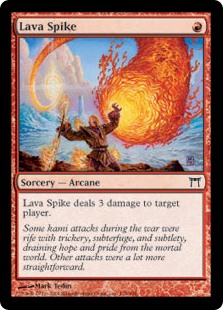 Burn has been called the seven-card combo deck, since it just needs seven spells that deal three damage to win. Anyone who's tested the deck will tell you that it is far more complicated to pilot than it appears. The reality is that Burn is a deck that excels at dealing 18 damage to their opponent. They can do it with any reasonable opening hand. The problem is those last few points. However, they often don't have to do it alone. The opponent does the job for them.
I am convinced that the hate stems from players killing themselves in the face of burn. The fetch/shock manabase of Modern makes it very easy to give Burn players free Lava Spikes, ignoring the Philosophy of Fire. The problem isn't that Burn is too good. It's that players play into the strategy.
If you struggle against Burn the solution is simple and obvious: stop Bolting yourself. Saving even a few points of damage may be the difference between victory and defeat. Merfolk has a good matchup with Burn, not because of a faster clock (they're about equal speedwise) but because it employs a painless manabase. If you cannot avoid self-harm, seek help. Run some lifegain. Lightning Helix sees more play than it "should" for this reason. Burn takes advantage of players ill-discipline and greed. Be more virtuous and you will easily overcome.
This article is starting to run long, so I'm ending it for this week. I'll be back next week with the Power-Card decks and Gotcha!
More Importantly...
The voting has closed on my banlist testing. I was surprised by the number of responses and encouraged by the thoughtfulness behind them. Bravo Nexites. Bravo.
Drumroll, please!
AND THE WINNER...By a nearly two to one margin...IS...
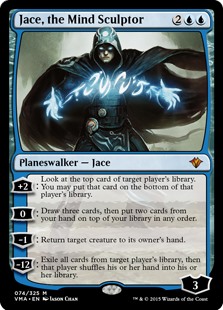 <Fanfare> Jace, the Mind Sculptor! <Cheers, confetti, party horns, etc.>
While I'm not surprised by the result (I'd started looking at candidate decks before the article was a day old) I was surprised by the scale of the victory. Jace received 21/57 votes to runner-up Preordain's 11. Dig Through Time was third with 9. The people have spoken, and I hear you. Sometime reasonably early next year I'll show you the results of my work with Jace. Until next time!




 Not only that, but the fact that two very different proactive strategies were projected to be great choices for the weekend made it a lot harder for a blue control deck to succeed, especially with Bant Eldrazi being a feature of the format now. As such, Jadin likely played against very few decks featuring permission elements.
 Fetchlands are also a big part of casting Tasigur, the Golden Fang on time, and as such Spirebluff Canal doesn't belong in Grixis Delver as more than a one- or two-of.
 It will be important to board out removal spells for counters in matchups where removal is bad, though as of now I am choosing "non-combo blue mirrors" as the category I would skimp on in the sideboard to make room for graveyard hate.
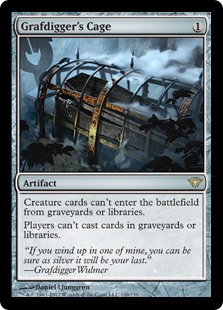
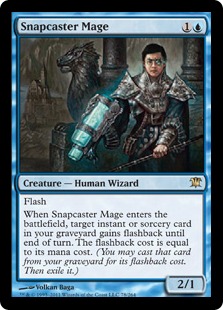 One thing to keep in mind is that people will side in the graveyard hate they're packing for Dredge against you too. Grafdigger's Cage is laughably bad against this deck, as it only does anything to Snapcaster Mage, which barely matters when you consider that they basically mulligan for every Cage that they cast. Relic of Progenitus is also generally unimpressive against this deck, as Thought Scour just puts too much pressure on the card to matter in the majority of games.







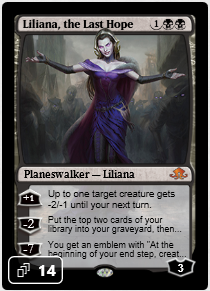
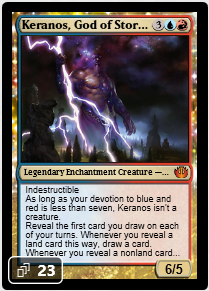
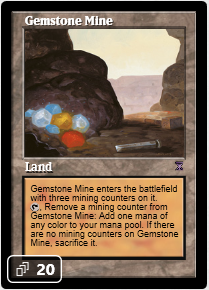
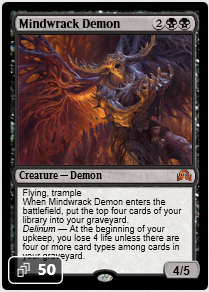
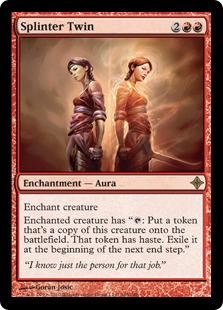 Gee, what a deck that was. Twin sat atop Modern as of the format's
 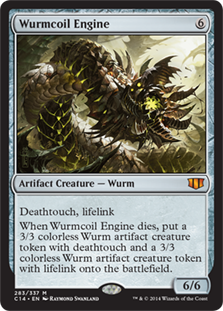 In practice, Twin kind of plays the same role in blue midrange decks as reach plays in tempo strategies. These low-to-the-ground
 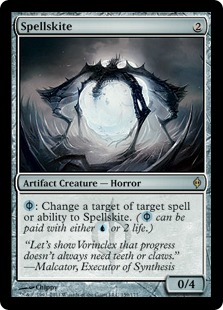 Spellskite. Spellskite hoses a few archetypes on his own (Infect, Death's Shadow Zoo, Bogles), but I prefer to use the Horror as a Chalice of the Void for Lightning Bolt. Having Skite on the table prevents opponents from zapping anything else, and the card requires two Bolts from decks without any heavy-duty removal. Many Bolt decks rely on Path to Exile to remove big-booty creatures, in which case Skite doubles as Thoughtseize plus Rampant Growth.
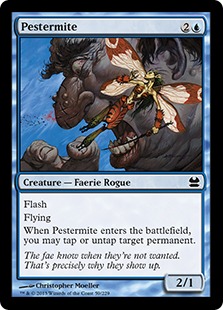 Pestermite: Thanks to stupid Kiki-Jiki, our combo can be Bolted by default, making Pestermite more or less strictly better than Deceiver Exarch. She hits twice as hard and becomes a Vendilion Clique with Noble Hierarch in play. Mite's evasion has additional synergy with Tarmogoyf, since she can poke in the air while the jolly green giant holds down the ground.
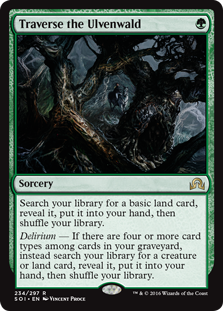 Serum Visions is the obvious cantrip in this kind of shell, but Traverse the Ulvenwald is our most important. Once delirium has turned on, we get to play an entirely different game, fetching up a stream of Lhurgoyfs or comboing off as needed. In the meantime, Traverse's Lay of the Land mode helps with Kiki-Jiki's high mana cost, casting Blood Moon on time, and ensuring we make our land drops against speedy linear decks.
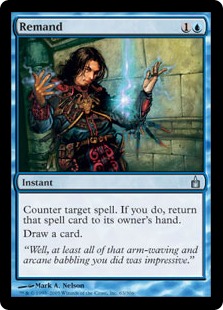 Remand: I think Remand is a horrible card in Modern. Ever since the Twin ban, this card's stock has gone down the drain. Rare are the times we can Remand our own spell in response to an opponent's counterspell, and Remand does practically nothing against low-to-the-ground strategies like Affinity and Burn. But the card does shine in certain matchups, especially in those which we want Kiki-Jiki for. Much of our removal is lackluster there, so Remand can come in for it and give us extra points.