menu

Fixing Modern: Pro Tour Ends and New Beginnings (Part 2)

Are you a Quiet Speculation member?

If not, now is a perfect time to join up! Our powerful tools, breaking-news analysis, and exclusive Discord channel will make sure you stay up to date and ahead of the curve.

Between the Platinum fee changes, the ensuing #PayThePros fallout, and Wizards' subsequent retraction, it's no wonder most Magic and Modern players have lost sight of Aaron Forsythe's seminal article, "Where Modern Goes from Here," released that same week. Talk about getting overshadowed. I can only imagine how the poor documentarians behind Enter the Battlefield felt when the #PayThePros din drowned out their Twitch premier.

Although the Platinum wrongs have since been righted, I'm still seeing plenty of Modern commentary and punditry that is totally out of dialogue with Forsythe's game-changing article. It's hard to go about "Fixing Modern" if we're ignoring Wizards' best efforts to do just that. Today, following my last article focusing on the "Pro Tour Ends" side of Forsythe's announcement, we're switching gears to the "New Beginnings," taking a close look at his long-overdue, but graciously welcomed, format guidelines.
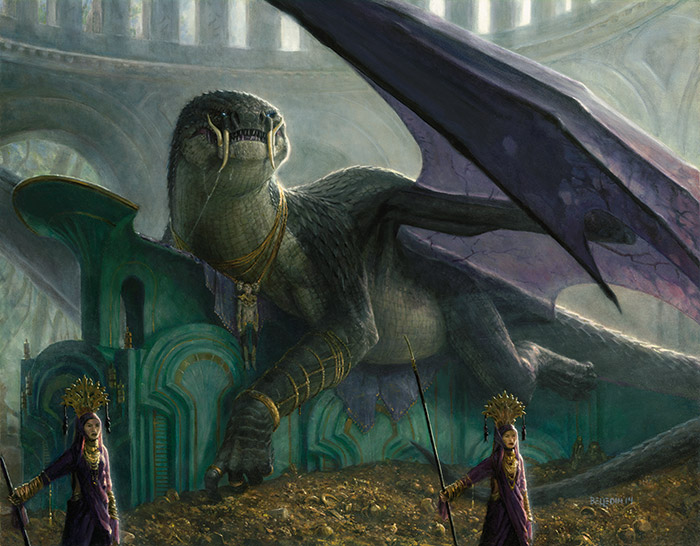
Writ-of-Passage-art-cropped

I've already criticized Wizards for their poor communication and unclear definitions, and I was thrilled to see Forsythe address both points in his April 24 piece. I don't know if "Fixing Modern" had anything to do with the decisions outlined in Forsythe's article, but needless to say, I'm elated we finally have nine format guidelines to inform popular understanding. My goal today is to explore these guidelines as related to broad format management issues such as the banlist, reprints, the metagame, and similar topics. Forsythe has given us one of the most significant pieces of Modern literature since LaPille's inaugural articles. We have a responsibility to understand and cite it in the future, and today's article will help us accomplish that.

[wp_ad_camp_1]

Sources and Review

This latest installment in the "Fixing Modern" column is a Part 2 follow-up to my Pro Tour-centric Part 1. Before we get started, take a few minutes to re-read Part 1 and to re-read Forsythe's actual article. If you remember both, feel free to skip ahead to the next section. If not, the articles (Forsythe's much more than mine) are worth the second read-through.
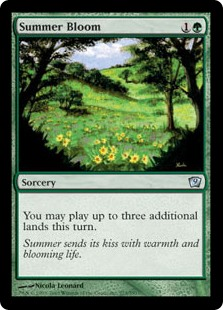
summer bloomI trust the Modern Nexus readership to venture into the big, scary Magic world armed to the teeth with information. This can take the form of metagame breakdowns, card-prevalence benchmarking, historical analyses, close-readings of important Modern policies, and much more. In all those cases, I don't necessarily need our Nexus audience to champion a single opinion (unless that opinion is "the Bloom ban was justified"). Rather, I want our readers to bring a data-driven and evidence-informed perspective to their gaming communities. This means citing sources, challenging unsourced facts and opinions, and trying to elevate the conversation everywhere through quantitative and qualitative datapoints.

Going forward, Forsythe's nine format guidelines are going to be critical determinants of format policy and direction. Whether you agree with my take on them or draw different conclusions entirely, "Fixing Modern" is doing its job if it keeps readers in close conversation with the actual evidence and source material. So take one last close-read of Forsythe's article, especially his "What we want Modern to be" section, and get ready to familiarize yourself with Modern's newly minted mission.

Framing Format Guidelines

In my experience, only a Sith (and Modern/Magic players) think in absolutes. A new set is either busted or Commander and Limited garbage. A new policy is either the Magic apocalypse or the second-best thing to Reserved List abolition. Certain Modern colors or strategy are either banworthy Tier 1 oppressors or unplayable Tier 4 jank. Although we can find middle ground on some issues (David's beloved Merfolk seem to be fair to almost everyone), most Modern opinions, especially those discussed online, veer too far in either extreme.

Introducing his "What we want Modern to be" section, Forsythe encourages us to jettison this black-and-white mentality. It is critical to remember this framing as we unpack the different guidelines, lest we falsely confuse these general principles for hard rules:

"I am frequently asked what we want Modern to be as a format. My answers to these questions should be seen as guidelines that we use to help our thinking internally, but they are not infallible policies. Should players' attitudes toward the format change over time, we're likely to adjust our guidelines as well."
R&Ds Secret Lair"Not infallible policies?" I can already see eyes rolling at this fluffy "mission." I get it. I'm a statistician and, much to my wife's dismay, I can be a fan of rigid, uncompromising, formulaic rules. Part of me wants Forsythe to just go out there and reveal R&D's secret, immutable protocols so we can chisel them all in stone tablets on our local gaming store's wall. That said, I'm also a social worker, a middle manager, and a husband, which gives me a deep appreciation for the importance of uncertain, flexible, and nuanced policies and approaches. You probably have the same appreciation from your own walks of life, or just from being human. As much as I love my data tables, most issues are too complicated and messy for the "infallible policies" every mathematician covets. That includes managing a complex entity like Modern.

Based on this, we need to understand Forsythe's nine guidelines as the loose and fallible policies they are. We also should not hold this against Wizards in any way. For me, this fluidity suggests a mature management approach which reflects Modern's and Magic's complexities. Could this be interpreted as a corporate double-speaking disclaimer, loathed by Internet commentators and Bernie supports everywhere? Sure, but that doesn't categorically sink Forsythe's entire presentation. Even if there's a bit of back-covering going on, this disclaimer also underscores how format guidelines must be evolving principles which change as players and the game change too. Forsythe says as much at the close of his Modern section:

"There's room for interpretation in many of those statements—intentionally—but this paints a clearer picture of how we see Modern."

This is the kind of informed and sophisticated approach we should expect and want from any major organization.

The Power Nine (Guidelines)

With Forsythe's framing in mind, we can now dive into the format guidelines themselves, reading between the lines to talk about what these parameters mean for major Modern issues. For each guideline, I'll present the text itself, make a general appraisal of its intent, and then conduct a brief analysis on any of three dimensions important to high-level Modern health, management, and policy:

  • Banlist application: The Eldrazi in the room for most people---how does the guideline inform future bans and unbans?
  • Prices and availability: From its birth, Modern was made to address availability issues. Where applicable, does the guideline relate to topics such as reprints, prices, card-availability, supplemental products, etc.
  • The metagame: Some guidelines points to a certain metagame vision. How can we understand that vision from the guideline?

If the guideline doesn't speak to one of these categories, I'll leave it out for that particular sub-section. Also, if I missed some critical area, feel free to nudge me in the comments about the omitted piece. Assuming I've hit the most important areas, let's jump right in with Forsythe's (obligatory) starting point: "Modern should..."

1. Be a fun way to play Magic (first, and easy to forget, but very important!)

When I first read Forsythe's article, I sensed we were getting a disclaimer about Modern being fun. It's no surprise this was the opening guideline, just as it's no surprise Forsythe quoted it again, almost verbatim, in the "So what is Standard?" follow-up section. Don't read too much into this point---it's practically mandatory for a discussion of Magic or any game. That said, the notion of Modern being "fun" is likely to show up in numerous other domains.
  • Blood MoonBanlist: preserving fun
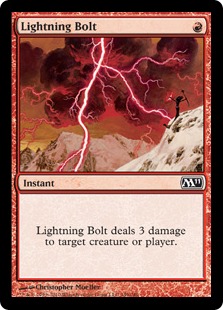
    It's tempting to assume every unfun Modern card should get axed. There's a Blood (Moon)-thirsty contingent of Modern personalities who want Blood Moon, Ensnaring Bridge, and even Lightning Bolt banned whenever they get a platform to shout from. That's a gross misreading. Remember: Wizards is a global brand and almost assuredly cares about net fun, not how much individual fun the one Hypergenesis lover isn't having. Based on that, bannings will still have non-arbitrary criteria such as Top 8 prevalence, MTGO and format-wide shares, and turn four rule violations. Think of these benchmarks as objective indicators of a subjective concept like "net fun." Unfun cards break those rules. Fun ones don't. Similarly, if a currently-banned card is unlikely to promote net fun, it's staying on the list. By contrast, cards that might improve Modern could be released. All that said, this isn't a radical reinterpretation of current banlist policies, so don't bet on any major changes beyond the pace of change getting much slower.
  • Metagame: uphold diversity!
    Wizards loves to talk about Modern's diversity. Basically every Grand Prix or Pro Tour coverage page is peppered with references to the format's staggering diversity, and you could practically play a drinking game around how often it's mentioned on Twitch streams. This diversity is Modern's claim to fame and to fun. For Wizards, diverse metagames are fun ones because they represent choice and variation at events. Expect Wizards to keep touting and upholding this diversity (for better or worse) in the future, and expect them to make decisions to support it.

It's important to remember fun for the many may not equate to fun for you. Having Jund at 9.4% of the metagame directly gives midrange players a fun option. Indirectly, it promotes a fun metagame environment where BGx Midrange is present as an interactive matchup and a regulating force. For some, however, Jund is a synergy-crushing goodstuff pile that screws with their untiered combo brews. Wizards is fine with that balance because an individual's sense of fun may justifiably take backstage to Modern-wide fun.

2. Let you tap into your collection to expand upon established decks and familiar strategies from Magic's recent past

Here, Forsythe doubles down on David Sutcliffe's definition from Modern's dawn: "In many ways Modern is like a Greatest Hits of Magic format, that allows people to play pretty much any of their [favorite] decks from the past eight years.” This format guideline establishes one of Modern's roles as a retirement community for old Standard strategies. Note the guideline does not necessarily support specific cards. It's the "strategies" and the "established decks" which get attention.

  • siege rhinoBanlist: don't worry about power-levels
    I can already see the objection in the comments: "If Modern is too powerful to accommodate Standard staples, will bans power it down?" Stay calm and don't worry. As I talked about last week, the Pro Tour change was largely made to decelerate bannings. Wizards isn't going to reverse that just so you can play UR Sphinx's Tutelage. Moreover, Modern is already accomplishing the guideline without a new ban policy, both with respect to strategies as a whole and even individual cards. For example, Burn and Gruul Zoo "expand upon" old Atarka Red. Standard's Dragon decks become the Jeskai Controls of Modern. Abzan and Naya Company go a step further to both "expand upon" existing Standard Company strategies and even bring Collected Company itself to Modern. Speaking of cards, Siege Rhino is still Siege Rhino. As long as similar strategies and cards continue to enjoy Modern play (see format guideline #8), Modern is adopting Standard castaways and fulfilling this second guideline. No banlist policy changes are needed.
  • Prices: reusing old staples
    If some of your old Standard cards are usable in Modern, the format is that much cheaper to buy into. Recent Standard seasons have accomplished this nicely, especially with the Return to Ravnica shocklands and the Khans of Tarkir fetchlands. It's unlikely we'll see such obvious examples of this for a while, but even if it's just Standard's Eldrazi Ramp importing Ulamog, the Ceaseless Hunger into RG Tron, that's still money saved for the average player.
  • Metagame: diversity to facilitate transitions
    The jump from Standard to Modern can be daunting, and I read this format guideline as helping players bridge that gap. If you had a favorite strategic style in Standard, Wizards wants you to identify a new home in Modern. You might need to upgrade your cards to support the Modern aggro or control habit, but a) the strategy as a whole should still be viable and b) at least a few of your cards should probably still see play (again, more on that in guideline #8). Wizards will promote metagames where these options exist, and disrupt metagames where that diversity isn't present.

3. Offer different types of decks and gameplay than what you typically see in Standard

Forsythe's third guideline pairs with his second, and should also diffuse any lingering worries about Modern devolving into Standard-Plus. Modern will necessarily have strategies and gameplay (e.g. dedicated combo, prison, draw-go control, etc.) that Standard cannot support. Wizards is not just "okay" with this. They will actively encourage and protect it.
  • Ad NauseamBanlist: "difference" is not bannable
    Some players prefer midrange slugfests, the combat step, and protracted duels. Other players want to drop Lantern of Insight and screw with your draws all game. Or win on turn three with Blighted Agent. Modern is designed to encourage that gameplay (unless Mr. Agent is doing it too consistently), so don't point your pitchforks at certain strategies just because they are no longer Standard-appropriate. This guideline supports net fun by allowing Modern players to choose from a bevy of deck-types and gameplay styles. If that means beating you with Pact of Negation's trigger on the stack after drawing 45 cards with Ad Nauseam, that's just Modern. Banlist talk often devolves into archetype hatred for unfair ramp, unfair combo, unfair control, etc. Stop hating and start accepting, because Modern is always going to be home to these strategies.
  • Metagame: unconventional decks must be viable
    You can't really play committed combo decks in Standard. You can barely play Plan B combo decks. The same goes for many graveyard strategies like Dredgevine and Grishoalbrand, prison decks like Lantern Control and 8Rack, toolbox tutor approaches like Kiki Chord, etc. Don't worry! Wizards wants these options to be available in Modern. Don't get salty on the Internet or to your gaming buddies about how certain kinds of older strategies shouldn't be acceptable in Modern. Modern is going to be their home for years to come and healthy metagames will showcase that diversity.

4. Not rotate, allowing you to keep a deck for a long period of time

There are two ways to read Forsythe's fourth guideline. Option one: he's just restating the format's non-rotating identity. If you're happy to leave it at that, scroll ahead to guideline #5. If you find that interpretation as boring as I do and want to live up to our close-reading agenda, here's option two: Forsythe might be positing a larger point about the importance of Modern stability and consistency.
  • TwinBanlist: keep decks intact
    I'd bet no one at Wizards views the Splinter Twin ban as an artificial rotation like I do, but I'm pleased they admitted the Pro Tour shakeup connection in Forsythe's article. Following that acknowledgement, I believe Wizards knows how bans can dismantle decks, devalue investments, and drive players out of the format. Guideline #4 might suggest a deepened commitment to deck longevity in Modern, which further moves Wizards away from regular bans. This point is supported both in the Pro Tour section of Forsythe's article and in later format guidelines (see #9). Bans are sure to remain a Modern management tool, but in the spirit of preserving decks, they should be more surgical and far less frequent.
  • Prices: investments should last
    Standard rotates multiple times a year, forcing players to spend money on new cards every 3-4 months. Modern doesn't rotate at all, but the initial buy-in is much steeper. Although that Modern entry price is necessarily and understandably higher than Standard's (read Travis Allen's excellent breakdown on the MTG Price blog), this heftier investment should come at the benefit of security. If we read Forsythe as committing to stability generally, we should also read him as committing to deck value stability specifically. That is, the longevity of your deck and its longstanding value. If you spend money on a Modern deck, you should be able to keep and use that deck for a long period of time. Sure, the deck's dollar value might fluctuate due to inevitable reprints, but the basic investment will give you Modern tournament mileage for years.

5. Consist of cards that we are willing and able to reprint

I'm still not convinced format guideline #4 relates solely to Modern's non-rotating nature. That said, I'm 90% sure this fifth guideline is primarily a statement about Modern's separation from the Reserved List. Tom LaPille promised Modern as a format without Legacy's card availability problems, and Forsythe couldn't be more in conversation with that promise unless he had quoted LaPille directly. I'm giving two price-driven analyses here out of respect for this guideline's importance for future Modern finance.

  • Force of Will EMAPrices #1: Modern is the non-rotating format
    Earlier this year, Wizards announced Eternal Masters to the joy of many Eternal veterans. In that same update, they also revisited one of their oldest and most incendiary promises: "[Eternal Masters] will not contain cards from the Reserved List..." Cue the jeers and incensed Redditors. Writing months later, Forsythe's article continues that tradition, in one stroke reinforcing the Reserved List promise while also setting up Modern as the default non-rotating home. Forsythe's use of the word "able" is suggestive, implying Wizards is not "able" (or views themselves as unable) to reprint Reserved List cards. I'll let the actual and e-lawyers debate the legal merits of that position, but either way, we see a Wizards representative yet again promoting this stance. That's bad news for those who would see the List disbanded and great news for Moderners who want Modern to stay strong. As LaPille talked about in his own early Modern writings, Modern was designed as a non-rotating home for old cards, one that does not have Legacy's "card availability" problems. Here, Forsythe assures the community of Wizards' intentions to keep the Reserved List and, by extension, keep Modern. I'd be lying if I said I'd dislike an "Eternal" or "Unreserved" style of format, but I love Modern and it looks like the financial momentum is on our format's side.
  • Prices #2: reprints matter
    It's hard to support a non-rotating, reprint-driven format without actual reprints. Wizards surely knows this and I except we'll see an accelerated supplemental product schedule in 2017 and beyond. Despite the very real hurdles to mass-Modern reprintings (if you haven't read him yet, Travis Allen is still waiting), there is also a very real profit margin to be made here and an equally real demand for conservative, strategic reprintings. As Wizards keeps refining print-runs and optimizing their product release calendar, we should see Modern benefit from increased support. I'll be looking for this in 2017 when the new Modern Masters 2017 heralds more Modern hype---I can't think of a better place to make announcements about new Modern-themed products than the Modern Masters Grand Prix release weekend!

6. Have a diverse top-tier metagame featuring over a dozen archetypes

With format guidelines six and seven, we get two Modern missions that are almost explicitly banlist-linked. Six refers back to the "format-diversity" ban, defined by Wizards in most of its B&R updates: "We also look for decks that hold a large enough percentage of the competitive field to reduce the diversity of the format." Instead of analyzing this guideline as a new piece of information (we've known about it since the Pro Tour Philadelphia bannings and I mention it almost every ban cycle), I'm going to focus on a critical new detail we pick up in this short but deceptively insightful guideline.
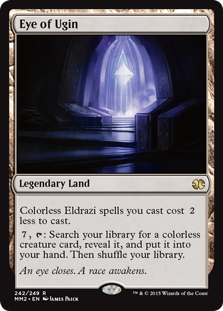
  • Eye of UginBanlist: Wizards' "top-tier" includes Nexus' Tier 1 and Tier 2 collectively.
    Maybe Wizards reads "Fixing Modern" articles and uses them as one of many datapoints to inform decisions. Maybe they don't. That said, I'm certain they don't use our tiering system to determine a deck's metagame position. Why would they? They have the population data, not just a sample. That said, readers frequently ask me how to translate Nexus tiers into Wizards' language. Now, we know: when Wizards talks about "top-tier" decks, we should consider all of the Nexus Tier 1 and Tier 2 contenders together. The Rosetta Stone in this translation is Forsythe's mention of "over a dozen archetypes." At Nexus, we've never had a Tier 1 with more than 7-8 strategies, despite the overall metagame being quite healthy. But if you combine Tier 1 and Tier 2, you easily meet the "over a dozen archetypes" benchmark and also tend to wind up with a healthy format. Going ahead, we'll use this 12+ decks in Tier 1 and Tier 2 criteria to guide our classification of Modern as healthy or broken. We'll also think about "top-tier" decks as those in Tier 1 or Tier 2, which is especially relevant when applying the turn four rule.

7. Not be dominated by fast, non-interactive decks (consistent kills before turn four are a red flag)

Speaking of which, the turn four rule returns! Just like guideline six invokes "format-diversity" bans, so too does guideline seven reference "turn four rule" violations. Most of what I wrote in "Understanding the Turn Four Rule" is still accurate, so there's no reason to retread the terrain too much. Indeed, with Summer Bloom banned following my application of the rule, I'm more confident than ever we have a good understanding of the rule's execution. That said, Forsythe uses an important word in this guideline which also relates back to one of the most misunderstood and misapplied elements of the rule. It's worth going over again.
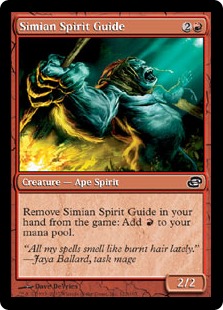
  • Simian Spirit GuideBanlist: fast decks are fine unless they "dominate"
    Almost every week like clockwork, some major Magic content website posts a sensationalist article about Modern bans. Out of respect for those authors (who otherwise write quality pieces), I'm not going to link to their recent fumbles, but that doesn't stop me from heading to the comment section to bring some perspective. Nine times out of ten, the area where other authors stumble is around the turn four rule because they forget the critical "top-tier" qualification. Puresteel Paladin Cheerios is one of my pet strategies, but Paladin himself doesn't need a ban because you had a rough FNM facing down the turn two Grapeshot. In this guideline, Forsythe's use of the word "dominated" reads to me as an indirect reference to the "top-tier" nature of turn four violators. If a deck is winning on turn three but not dominating, it's probably not top-tier, and is definitely not in the turn four rule crosshairs.

8. Be at a power level that allows some newly printed Standard cards to affect the format (we don't have other ways to introduce cards into the format, and we like it when cards or decks can transition)

In many respects, format guidelines eight and nine are the most interesting bullets on Forsythe's list because they are the newest. Points one through seven mostly suggest a mission we already knew, even if it's long overdue to see them condensed into one place. Eight and nine are much newer, and although we've seen hints of them before in scattered sources, Forsythe is now giving them official confirmation. Because guideline #8 shares so much with #2, I'll mix in some of those older points with newer ones about the beloved topic of Modern-targeted reprints and new cards.
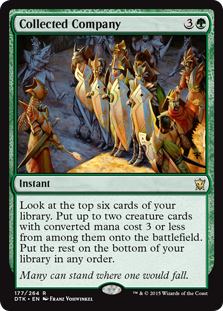
  • collected companyBanlist: again, don't worry about the power-level
    With Forsythe restating the Standard-to-Modern transition, I anticipate a number of readers rekindling their fears. Thankfully, there's no need to panic. Forsythe is very clear that only "some newly printed Standard cards" need to "affect" Modern, not all of them. Between Tasigur, the Golden Fang, Collected Company, Pia and Kiran Nalaar, and those wretched Eldrazi from the big (World Breaker) to the small (Eldrazi Skyspawner), recent Standard sets are largely accomplishing this already. By all current measures, Forsythe's announcement is all about decelerating bans and realigning Modern with its original mission, not pushing some sinister pack-selling agenda.
  • Prices: reprints are unlikely to come through Standard
    Mark Rosewater set off a mini-Modern firestorm with his comment about Modern reprints being generally too powerful for Standard. Like MTGGoldfish's SaffronOlive, I don't really buy this, but I'm willing to accept it as the current status quo until we install another one. That means high-demand reprints such as Goblin Guide, Snapcaster Mage, Liliana of the Veil, Noble Hierarch, and others are chained to supplementary products for the foreseeable future. This raises their price ceilings and promises higher card values going ahead, at least until 2017 when I believe Wizards will start making a more concerted (but still conservative) effort to tackle the price issue.
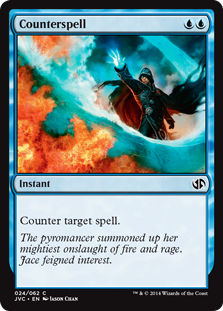
  • CounterspellMetagame: format evolutions must pass through Standard
    I want a Modern-specific feeder set as much as the next guy, but Forsythe uses this guideline to reassert Wizards' position on not bypassing Standard for the sake of Modern. I'm going to need to parse through that decision in a later "Fixing Modern" column, but for now I'm accepting it as gospel and making the best of what we have. As they say, when life gives you Clue tokens, make Emrakuls! Assuming Wizards sticks with this parenthetical disclaimer for the near future, we'll need to table discussion of reprinted Counterspell, Mother of Runes, Baleful Strix, and others until Standard's power-level changes significantly, or until this policy gets revisited. But don't lose hope entirely because every set invariably has a few cards to bring to the Modern table. Maybe the Liliana-themed Eldritch Moon will even get the black-based control mages their Innocent Bloods!

9. Have as small a banned list as possible that accomplishes all the previous goals

We've seen hints that Wizards prefers smaller banlists, but never such a clear, unambiguous declaration. The last time we talked about banlist size was Tom LaPille in "Welcome to the Modern World," admitting "this list is a lot longer than it was at the Community Cup" before qualifying, "We may have overbanned here, and if we did, we have plenty of time to go back and fix that." Since then, Wizards banned almost a dozen cards and released only six, for a net increase to the banlist. Looking ahead, I expect changes. Format guideline #9 suggests Wizards is much more attuned to the damage that large banlists and "ban mania" cause Modern, and future banlist management should reflect that.
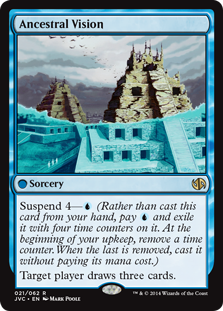
  • Ancestral VisionBanlist: freeing the innocent, delaying guilty verdicts
    In Modern, a small banlist means two parallel changes: unbanning wrongfully-imprisoned cards and waiting on bans. It's possible Forsythe is secretly trolling us and intends on banning swaths of cards to fulfill his eight other guidelines, but this feels totally misaligned with the article's overall context. "Smaller banlist" is much more likely to indicate a conservative banlist approach, not an overzealous one. If so, this policy will initiate a gradual release for cards that are unlikely to harm Modern. We've seen a comparable unbanning approach in Legacy, and Forsythe's article suggests a similar trajectory in Modern. There aren't many cards left on the banlist that might fit in this category, but if it means an annual parole hearing for the preemptively banned cards like Stoneforge Mystic and Jace, the Mind Sculptor, I'm on board. As for bans, I'll just restate Forsythe's explanation from the Pro Tour section: "We'd rather let those deck evolutions play out over months on Magic Online or at store-level events, as that accelerated metagame pace often just means speeding up more changes to the banned list as well." This is the small banlist future we can look forward to.

Mission: Accomplished

Nine format guidelines, about 15 individual analysis points, and one coherent Modern mission. "Fixing Modern" has never been looking more promising and attainable. I'd be much more excited about all this if I had confirmation about some Eternal Masters reprints, a sneak peek of Eldritch Moon previews, or some more concrete evidence about the Lovecraftian mystery of Innistrad's madness, but I'll settle for a dose of optimism for now. Besides, with the Grand Prix weekend coming up on May 20 and a Star City Games Open just days away, I'll have plenty of data to occupy me until then.

Thanks for joining me today as we dissected these nine format guidelines and their future in Modern. As we confront other Modern policy and management issues, you can be sure we'll return to Forsythe's canonical work to help us understand format decisions and trajectories. If you have any questions about the guidelines or any interpretations of your own, let me know in the comments and I'll talk to you all soon. Join me next week as we make some last-minute preparations before the Grand Prix MAY-hem (oh yeah: the pun is back), and remember to stay in dialogue with the Modern literature as you take to the forums and comment sections this week.

Stock Watch- Grafdigger’s Cage

Are you a Quiet Speculation member?

If not, now is a perfect time to join up! Our powerful tools, breaking-news analysis, and exclusive Discord channel will make sure you stay up to date and ahead of the curve.

I've spent a lot of time the past couple of days trying to perfect a Modern Dredge deck. Something that I discovered is that a lot more people have access to hate than you might expect. In particular, literally any opponent could lead on turn one Grafdigger's Cage in sideboarded games.

There was an error retrieving a chart for Grafdigger's Cage

While I was losing to the card playing Dredge, Cage has actually seen in increase in play as a way to combat Abzan Company as it hoses creatures entering the battlefield from libraries as well as from graveyards. What I'm getting at is that Grafdigger's Cage is becoming an increasingly popular sideboard card in Modern.

Cage has been slowly creeping up in price for a little while, and if Dredge becomes a deck that people play in paper tournaments and Abzan Company continues to put up results then I expect demand for Cage to increase.

I was actually expecting foils to be more expensive than they are due to relevance as a Vintage sideboard option, though currently the multiplier is only about 3x. I like Grafdigger's Cage as a position in foil and non-foil alike right now.

Avatar photo

Ryan Overturf

Ryan has been playing Magic since Legions and playing competitively since Lorwyn. While he fancies himself a Legacy specialist, you'll always find him with strong opinions on every constructed format.

View More By Ryan Overturf

Posted in Finance, FreeTagged 1 Comment on Stock Watch- Grafdigger’s Cage

Have you joined the Quiet Speculation Discord?

If you haven't, you're leaving value on the table! Join our community of experts, enthusiasts, entertainers, and educators and enjoy exclusive podcasts, questions asked and answered, trades, sales, and everything else Discord has to offer.

Want to create content with Quiet Speculation?

All you need to succeed is a passion for Magic: The Gathering, and the ability to write coherently. Share your knowledge of MTG and how you leverage it to win games, get value from your cards – or even turn a profit.

Insider: MTGO Market Report for May 9th, 2016

Are you a Quiet Speculation member?

If not, now is a perfect time to join up! Our powerful tools, breaking-news analysis, and exclusive Discord channel will make sure you stay up to date and ahead of the curve.

Welcome to the MTGO Market Report as compiled by Matthew Lewis. The report will cover a range of topics, including a summary of set prices and price changes for redeemable sets, a look at the major trends in various constructed formats, and a "Trade of the Week" section that highlights a particular speculative strategy with an example and accompanying explanation.

As always, speculators should take into account their own budget, risk tolerance and current portfolio before buying or selling any digital objects. Questions will be answered and can be sent via private message or posted in the article comments.

Redemption

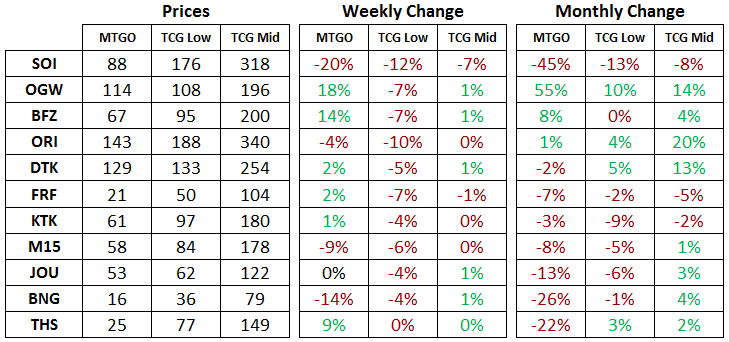
Below are the total set prices for all redeemable sets on MTGO. All prices are current as of May 2nd, 2016. The TCG Low and TCG Mid prices are the sum of each set’s individual card prices on TCG Player, either the low price or the mid price respectively. Note that sets of Theros (THS) are out of stock in the store, so this set is no longer redeemable.

All MTGO set prices this week are taken from Goatbot’s website, and all weekly changes are now calculated relative to Goatbot’s ‘Full Set’ prices from the previous week. All monthly changes are also relative to the previous month prices, taken from Goatbot’s website at that time. Occasionally ‘Full Set’ prices are not available, and so estimated set prices are used instead.

May2

Flashback Draft of the Week

Flashback drafts add one booster of Planar Chaos to the mix, so the draft format is now Time Spiral-Time Spiral-Planar Chaos. Noted limited format analyst Oraymw posted a triple Time Spiral (TSP) draft guide over at the Limited Resources reddit. His work is top notch and always worth a read, so if you are thinking of dipping your toe into this draft format, definitely start with reading his post.

Modern

Cedric Phillips took down the weekend Modern PTQ with Bogles, a linear strategy focused on hexproof creatures and auras. Daybreak Coronet used to be a great card to speculate on, since it was in short supply coming out of the lightly printed Future Sight. It would fluctuate up and down in price as the Bogles deck came in and out of style.

Being reprinted in Modern Masters 2 as a rare made this a less attractive proposition. It's possible a new price pattern emerges if the deck sees increased short-term interest so it will be worth paying attention to.

Alternately, Horizon Canopy is another four-of out of this deck. It is also from Future Sight but it has not yet been reprinted (outside of the Oath of the Gatewatch Expeditions). This card saw a recent drop in price from 35 tix all the way down to 23 tix, but has since recovered back to 35 tix. The good thing about this land is that it finds application in other decks so it has a good chance of seeing 40+ tix again before the Fall.

Both of these cards will have fresh supply coming onto the market in the final week of Time Spiral block flashback drafts as Future Sight is added as the third booster.

Standard

Two Standard Grand Prix events were the place to look for new themes and archetypes this past week. I've linked here to the Grand Prix Tokyo Top 8 decklists and the Grand Prix New York Top 8 decklists.

Right off the top, Seth Manfield's winning deck from GP New York took a new direction with a planeswalker-heavy W/B Control list. As a result, Gideon, Ally of Zendikar has jumped to a six-month high of 23+ tix. This is the best and most played card out of Battle for Zendikar, so this kind of uptake in a new deck is significant. If Gideon dips back down to 20 tix or less over the summer, speculators and players should consider buying into this card.

Gideon has also been showing up in the G/W Tokens lists, but there was an interesting inclusion in Takuma Morofuji's version of that deck. He had Deathmist Raptor in the sideboard as a three-of. This green creature has been out of favor since the release of Shadows over Innistrad and the price has collapsed as a result; from a steady range of 13 to 15 tix, all the way down to 3 tix this week.

Although there's not much time for this card to rebound with Dragons of Tarkir rotating out of Standard in the Fall, any uptake in the short term could quickly push this card back into the 8+ tix range.

Standard Boosters

Magic Origins and Dragons of Tarkir boosters have both hit the 4 tix mark this week. There's not much left for these to do, although they will probably hit the 4.1 to 4.2 tix range at some point over the next month. If you are holding a draft set or two, and can't imagine playing these formats, then be sure to sell your boosters sooner rather than later. Eventually rotation out of Standard will start gnawing at the value in these sets, including the value of boosters.

Elsewhere, both OGW and BFZ have drifted down to 3.4 tix and 2.3 tix respectively. OGW was bid up by speculative buying which has eased off in the past week, but BFZ hasn't seen the same support. Until a firm bottom is in place for BFZ this one should be avoided, although it's difficult to imagine it dropping in price substantially from current levels. OGW boosters will be a buy if they fall into the 3.0 to 3.3 tix range again.

Trade of the Week

As usual, the portfolio is available at this link. With Planar Chaos being added to the Time Spiral flashback draft queues, one of my favorite pet cards is going to be on sale. Boom // Bust has never broken into the mainstream of Modern play, but it hangs around the edges and every now and then makes a small splash. This is not a good spec, but if you've got a hankering for land destruction, the next two weeks will be a good time to target this card.

For Every Answer, New Questions: Testing Death and Taxes

Are you a Quiet Speculation member?

If not, now is a perfect time to join up! Our powerful tools, breaking-news analysis, and exclusive Discord channel will make sure you stay up to date and ahead of the curve.

Magic is not an exact science. Playstyle, both players' shuffling techniques, deck composition, and mistakes are just a few variables that you'd need to control or eliminate to get a truly rigorous scientific analysis of deck performance and winning probability. Instead we tend to focus on results and how a deck will play over multiple games. This might not be the most "valid" method, but when you dig into results, there's still a lot of valuable information that can be analyzed.

Thalia-Banner-Cropped

I've spent the previous week trying to explain the odd disparity between my results from Magic Online and paper Magic with Death and Taxes. To do this I've been playing the deck to the exclusion of all others and I have not changed my list since last week to prevent additional variables from distorting my data. I still don't have that answer, but I have learned a lot about my DnT list and its place in the metagame. It's not been what I expected, and it's left me wondering what DnT's actual role in the metagame could be. I think that the deck is worth investigating, but I don't think it's ready for prime time. That doesn't mean that it won't eventually be, though.

[wp_ad_camp_1]

The Issue of Speed

There is no getting around it---the deck was surprisingly slow. There was never a time when actually aggroing out the opponent was correct, and frequently it was impossible. For reference, the deck that I was testing:

Death and Taxes, by David Ernenwein (Test Deck for States)

Creatures

4 Thraben Inspector
4 Thalia, Guardian of Thraben
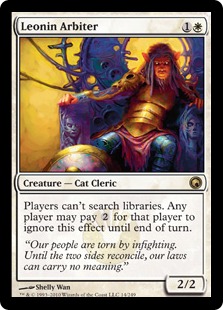
4 Leonin Arbiter
2 Serra Avenger
4 Flickerwisp
3 Kitchen Finks
3 Blade Splicer
2 Eldrazi Displacer
1 Vryn Wingmare
3 Restoration Angel

Artifacts

4 Aether Vial

Instants

4 Path to Exile

Lands

11 Plains
1 Eiganjo Castle
4 Ghost Quarter
4 Mutavault
2 Tectonic Edge

Sideboard

3 Sunlance
2 Disenchant
2 Rest in Peace
2 Mirran Crusader
3 Kataki, War's Wage
2 Kor Firewalker
1 Aven Mindcensor

As a preface to the rest of the discussion, the sideboard was definitely wrong, but I never changed it to keep my testing consistent. As I said, I was trying to answer questions that earlier testing raised and at that time I thought the sideboard was correct and if I made changes it would have invalidated my data. The Disenchants were there for Ensnaring Bridge and Ghostly Prison, but I failed to account for how powerful Flickerwisp actually is and so Disenchant was unnecessary. They should have been another Kataki and Sunlance. Mirran Crusader was a little underwhelming as well for reasons I will explain later. It really wants equipment to excel and could have been more Mindcensors or possibly Tectonic Edge.

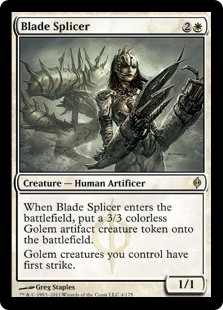
Blade SplicerThis deck has a bad curve. Out of 38 total spells 16 cost three or more. Of the remaining spells Serra Avenger effectively costs four due to its playability clause and Path to Exile is reactive, leaving 16 cards that we can play before turn three. Compared to a typical burn deck with only one- or two-mana spells, or Jund which typically runs 12 three-or-higher-drops and 27 two- or one-drops, DnT is alarmingly top-heavy.
The Clue from Thraben Inspector helped alleviate some of the pressure on your mana, but far too often your curve was a single one-drop and hand full of threes that took forever to deploy. Your one- and two-drops are a bit too anemic to really be considered aggressive. This isn't a problem for GW Hatebears thanks to Noble Hierarch, but the best non-green decks can do is Aether Vial which doesn't help the problem until turn four at the earliest. This made the deck feel incredibly clunky. It was prone to falling behind and losing to good curve-outs from nearly every other deck.

Weirdly Enough...

The speed issue was rarely a problem. Yeah, I fell behind a lot but once I hit three mana all my spells were effectively two spells that gradually made up for the tempo I lost the previous turns. It wasn't a guaranteed thing, mind you, and it is very hard to fight a really excellent curve, but if you do or the opponent just has an average hand, you will claw your way back with the value creatures. My losses tended to come from my slow curve letting me get swamped or from the opponent going over my head. I rarely lost the grindy games.

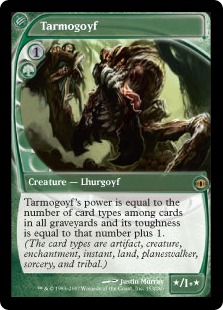
This was especially surprising against Jund. In my initial testing online I was demolished when TarmogoyfJund kept answering my creatures cheaply and then deployed a threat that went unanswered. My disruption was too fragile to be meaningful and Jund simply powered through. In paper the games played out as grindfests and DnT would either end up with the last threat standing due to threat density or it would race Tarmogoyf with a combination of fliers andKitchen Finks. Online, Crusader frequently saved me since only Lightning Bolt could answer it on the board and it ended the game very quickly, but in paper it ended up being just another threat and wasn't necessary.
I'm at a loss to explain this disparity. The best I can do is speculate that variance works differently on MTGO thanks to the shuffling program than it does in paper (interesting idea for a statistical/programming study if anyone needs a paper topic). If the number of good-to-great hands were somehow lower in paper than online, that would necessitate more grindy games between average hands, and in that situation the deck with the most two-for-ones will prevail. Of course that would mean the shuffling algorithm was somehow "correcting" for bad hands. This seems unlikely, but it's not impossible if the algorithm inadvertently selects for a mix of spells and lands.

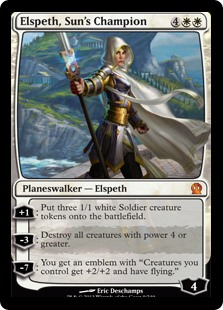
This also made the deck very weak to Ancestral Vision. It's bad for a deck that grinds based on value creatures to face counterspells in the first place but counterspells backed by cheap card advantage is a nightmare. Worse, most Vision decks focus on big impact spells like Supreme Verdict and Elspeth, Sun's Champion which are nightmares for this style of deck.

What Does This Mean?

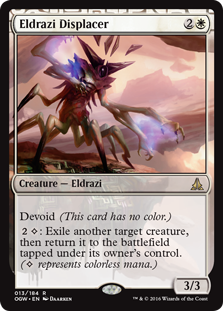
What these results suggest is that DnT needs to maximize the direct value creatures it plays Eldrazi Displacerand that synergies aren't particularly important. This means that the Eldrazi Displacers are out of place and should have been additional Finks and Blade Splicers. A deck like Eldrazi Taxes can make greater use of his ability thanks to Eldrazi Temple but any other deck should stay away. It also means that four Restoration Angels are a must to maximize the grinding potential and add more fliers.
I suspect that future mono-white DnT builds will be midrange-slanted to maximize the power of white value creatures and outgrind GBx decks. Whether or not they will be successful is up in the air, and an answer needs to be found for Ancestral Vision. Eldrazi processors might be the answer, but Jim Davis didn't have much success with that so we'll have to wait and see.

The Issue of Disruption

Death and Taxes is a force in Legacy thanks to the power of its mana denial package. Legacy decks tend to be light on actual, mana-producing lands to maximize their fetchland count because of the synergy with Brainstorm. (This has long made me wonder if Leonin Arbiter has a place over Phyrexian Revoker.) The ridiculous power of Wasteland and Rishadan Port, coupled with the tendency of the cantrip-heavy decks to play 18 lands total, means DnT can easily soft-lock other decks.

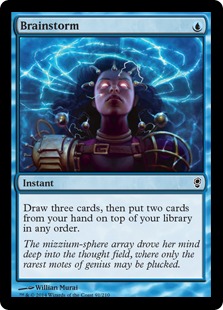
BrainstormThis is impossible in Modern. Ghost Quarter (even when it impersonates Strip Mine) is much weaker, there's no Port equivalent, and decks run more lands. The weird thing about land destruction is that while it really hurts land-light draws, it turns flood into an advantage and I lost a lot of games where my opponent answered each Strip Mine or Tec Edge with another land. We don't have Ponder and Brainstorm so you can't cheat on lands, and for a deck that wants to constrict its opponents' mana this is very bad news. Thalia is at her best against decks that like to play a lot of non-creature spells every turn and those decks are far less common in Modern than Legacy. The value of your taxing effects is far lower and consequently Modern DnT is far less disruptive than Legacy DnT.
Weirdly Enough...

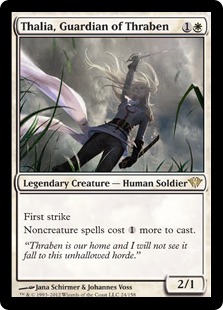
thaliaI might not have been taxing my opponent consistently or for more than a turn or so, but the numerous little hiccups DnT induces combined together to make my opponent's play non-optimal enough for the midrange threats to catch me up and win the game. Thalia and Arbiter were frequently killed at sorcery speed so that I couldn't take advantage of them on my turn, which severely crimped my opponents' ability to develop their own gameplan. Aggro decks were often forced to use an entire turn's worth of mana to get past Thalia just so they could attack, and Arbiter proved to be far more threatening to those decks than he was against midrange or combo.
Even the value creatures were disrupting since it took far more to answer them and it could only be done cleanly with Anger of the Gods (the Kor Firewalkers should have been Burrenton Forge-Tenders for that reason). Rather than directly attacking my opponents' ability to play spells, my deck was constricting what spells could be played and that was enough. An early Thalia or Arbiter required an answer, Kitchen Finks needed two, Flickerwisp and Resto blanked a removal spell, and eventually the opponent had spent all their cards and mana trying to answer mine and something finally won me the game.

Elspeth, Sun's ChampionOf course this really didn't work against decks that just drop big bombs that invalidate incremental advantage. Against them the direct disruption was necessary, and unfortunately when Ghost Quarter wasn't good enough I was just dead. UW Control was a nightmare for this reason, though Jeskai was still good since it relies more heavily on incremental advantage and efficiency. Some decks can directly be answered with DnT creatures, like Aven Mindcensor blanking Scapeshift, but on the whole the lack of direct, universal interaction like Thoughtseize really hurts.
What Does This Mean?

Legacy Death and Taxes players need to accept that the Modern version is going to be weaker against combo and tempo, but in exchange you'll be better against fair midrange decks. This suggests that a complete role reassessment is necessary, which might in turn dictate a large-scale rebuild. I don't think that the other disruptive options will fix the problem I found, but I'll discuss that in greater detail next. I think the long-standing criticism that DnT is bad Merfolk or Zoo is unfounded because it's more directly fighting for space with Jund and Junk. What exactly this means for the deck's future I don't know at this time.

The Issue of Build

As I mentioned last week there are a lot of different possible builds of DnT out there and each has it strengths. BW decks are very disruptive and have much lower curves. The Eldrazi builds have more impressive threats that can be accelerated out. GW decks have general acceleration, impressive creatures, and Gavony Township. My build is fairly middle-of-the-road compared to the other versions. While it seems well suited for grinding it's not that great against more extreme decks, and there is still room for it to improve on currently good matchups. Trying to find the optimal build appears to be a Herculean task.

Weirdly Enough...

I don't think that matters. Seriously. Let me explain: All the versions currently agree on the same eight disruptive creatures, Thalia and Arbiter. Everything else is just a complement to Samurai of the Pale Curtainthose cards. White has the best non-Blood Moon hate in Modern---the question is simply which piece is good when. I'm not just talking about Rest in Peace and Stony Silence. I mean that you can maindeck more direct hate in white than in other colors (no, Thoughtseize doesn't count).
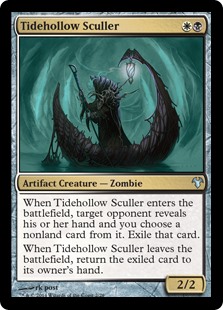
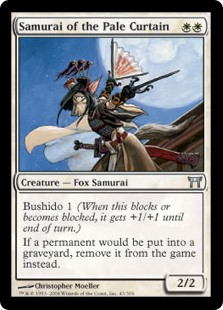
For example, Torpor Orb is very good against a number of decks. There are many more times that the Orb is utterly dead, which is why it doesn't see maindeck play. If you really need that kind of effect (Kiki-Chord is rampant in your local meta, say) you can get the same effect without it being completely dead by playing Hushwing Gryff. Sphinx's Revelation getting you down? Spirit of the Labyrinth laughs at that card. If Abzan Company is running riot, Samurai of the Pale Curtain trades or defeats every non-Wall of Roots card in the deck and breaks up the combo. If you need to hate on a specific deck/card, white has an answer attached to a maindeckable creature.

What Does This Mean?

I think that DnT is a deck that can beat any deck individually, but can't be built to beat everything simultaneously.

I'm seeing nods of understanding and confused, frightened stares in equal measure. Let me explain.Tidehollow Sculler I'm not certain that it is possible, or even preferable, for a stock version of Death and Taxes to exist in Modern. In Legacy the ubiquity of Brainstorm means that decks have enough in common for the same kinds of hate to be equally effective against a wide swath of the metagame. Modern is too diverse for that to be true, so instead you need to focus your deck to beat an expected metagame and then adjust week to week.

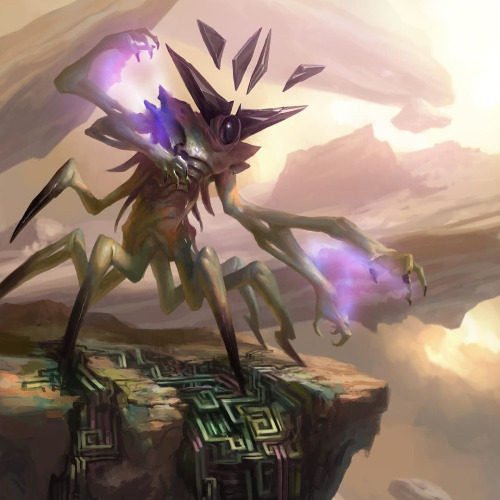

It's a tuner's deck, pure and simple. If you think that Jund is going to be highly played one week then Loxodon Smiter is where you want to be. Heavy Burn necessitates mono-white. Lots of combo calls for BW. You need to be on top of metagame shifts and adjust accordingly.

A Few Other Thoughts

  • Inspector Clouseau (Not my nickname for Thraben Inspector, but I like it) is very good. Unless the metagame gets less fair it is the best one-drop available. A 1/2 for one is better than you think on the defense and the Clue is very important when you have no two-drop or as you head to the lategame.
  • Fliers are surprisingly underrepresented in Modern. The more you can justify playing, the better.
  • Flickerwisp is surprisingly hard to play optimally. There have been several occasions where post-match analysis has shown that non-intuitive chains involving Flickerwisp and Restoration Angel would have won games against Affinity and Goblins that I lost. There are times when maximizing the number of your own creatures flickered has been correct and sometimes you just want to take the opponent's lands. If you're going to play this card, you have to learn to look at all the angles and really work to extract maximum value from the card.
  • If your own Leonin Arbiter gets Path to Exiled and there's no other Arbiter on the field, you get to search without having to pay.
  • Avoid Strip-Mining early, except against Tron and Scapeshift. I know it's the big appeal of the deck but it is much harder to mana screw your opponent in Modern than in Legacy, and even if it sets your opponent back it stunts your mana as well. In a deck so full of three-drops that can be fatal.

There is real potential to be found in Death and Taxes in Modern, and I am not abandoning the deck by any means, but I am putting it on the shelf for a while. When the format is still in considerable flux it's not the time to play such a metagame-dependent deck. Once things get a little more settled and it is possible to really target your deck then it will be worthwhile to try again with specialized builds. If this proves successful it might be an interesting choice once the PPTQ season rolls around.

As always, if you have your own take on the deck or experiences different from mine, I'm eager to hear from you in the comments and our Contribute page is always open.

Insider: Where’s the Money in Eternal Masters?

Are you a Quiet Speculation member?

If not, now is a perfect time to join up! Our powerful tools, breaking-news analysis, and exclusive Discord channel will make sure you stay up to date and ahead of the curve.

Eternal Masters (EMA) hangs in the balance and nobody wants to talk about eternal cards until after the spoilers starts to trickle in. In other words, nobody wants to actually speculate on the eternal market until after it's too late.

I don't consider applying new information to trading and buying decisions before others have gotten the memo to be speculating per se. It is certainly profitable, and I recommend doing it whenever you can. But the opportunity for capitalizing on this kind of moment is fleeting.

Anyways, we are at an interesting moment where everybody is sort of waiting to see what will happen next. Everything hinges on

  1. What cards are in Eternal Masters; and
  2. Whether Eternal Masters will foster new interest in eternal formats.

Let's use some practical problem-solving skills to anticipate where some of the smart money may be hiding.

What Cards Are in Eternal Masters?

We don't know much. However, we do know some of the cards that specifically will not be in Eternal Masters. If we were playing a game of Werewolf we would have a safe camp of "every card on the Reserved List."

The scenario that's likely to play out is that the value of every single card appearing in EMA goes down. That is bad. The upside is that every single card that isn't in EMA has a good opportunity to improve in value.

The fact that cards on the Reserved List cannot appear in EMA means they all have opportunity to improve and little reason to decline. So, let's take a look at some cards that seem nicely positioned.

Copy Artifact

There was an error retrieving a chart for Copy Artifact

I love Copy Artifact as a card to sink some resources into right now. The card has a notably low price tag at $5. It is worth noting that the card was not reprinted in 4th Edition (only Revised, Unlimited, Alpha and Beta).

The card is clearly quite powerful. It doesn't really see Eternal play but it potentially could at some point. I think the big appeal for this card is that it is very good in casual-competitive formats like Commander, Cube, Combo Cube, and Tiny Leaders.

Basically, its just a cool old card that is good in those kinds of formats. These kinds of cards actually have a very strong marketplace. There are plenty of cards that have fat price tags because of their place in casual Magic. And consider that the most recent printing of Copy Artifact was over 20 years ago! Also, it will never see print again.

Not to mention that Copy Artifact is also a staple in Old School Magic, or 1994 Magic. I see that format as trending to allow Revised copies as a more universally accepted thing in the future. All good things for Copy Artifact on the horizon.

It hits all of my criteria for a good speculation target. It's at a near hard floor and trends suggest it should go up. I like this pick a lot.

Transmute Artifact

There was an error retrieving a chart for Transmute Artifact

Another safe pick with both competitive and casual appeal is Transmute Artifact. First of all, Transmute has somehow managed to dodge all the spikes on old cards for two years, despite being a busted and awesome old Magic card.

I've played with this card in competitive Vintage and at a Legacy Grand Prix, and it is certainly a "real" Magic card by constructed standards. In addition to being a fringe card for competitive Magic it also sees play in the competitive-casual decks of Commander and 1994 Magic players.

The effect is very powerful and allows players to do things that are quite broken. Tutoring artifacts directly into play is something I don't see Wizards printing a ton of in the future... Oh, and also they will never reprint Transmute Artifact because it's on the Reserved List.

It is a desirable, unique, and scarce-enough card to easily justify the current price tag, which is probably the floor. With a little bit of interest or a small buyout the card could really surge in value. Or, God forbid, they print something that pushes this card into the limelight in Vintage or Legacy, and lots of people suddenly put on the bat signal for a playset!

In the Eye of Chaos

There was an error retrieving a chart for In the Eye of Chaos

In the Eye of Chaos is another casual and competitive card that could have desirability among lots of different groups of people. Remember, you only need one group of people to say, "card is good," and the price will jump pretty significantly in the future.

$40 is a pretty low price tag for a card that is considered fringe-playable card in eternal formats.

Some cool applications of this card are that it is absolutely insane against the best combo decks in Vintage. It is difficult to cast Gush when you are "in the eye." The card also does a number on Force of Will and other counterspells. I could see Vintage players start to actively seek out In the Eye of Chaos in order to punish Gush decks if they become dominant.

I also have to give the card the nod in a format like Commander. The upside could be high here.

Not that this tends to dictate price or anything, but the card is also just "kind of cool," which sometimes matters on old cards. It has a neat name. It has cool art. It's an enchant world. It is just sort of a neat old card that looks cool in a collector's binder.

Undiscovered Paradise

There was an error retrieving a chart for Undiscovered Paradise

Undiscovered Paradise is also on the Reserved List and has a pretty modest price tag for how much constructed eternal play it sees.

The card is a cornerstone of pretty much every dredge deck in every format as a land that can continually retrigger landfall for Bloodghast.

Dredge also has the advantage of being the default "budget deck" in Vintage (I know, I know oxymoron...) because it doesn't require Power 9. In the grand scheme of things, four Bazaar of Baghdad and a bunch of Dredge cards is much cheaper than P9 and duals.

Dredge is also playable in both Legacy and Vintage, which makes it kind of appealing since a lot of the cards go in both decks. So, for people who just want to be part of the Eternal crowd they can kill two birds with one deck. Not to mention the interactions are all the same which makes learning the decks easier.

Just saying that a snap four-of in Legacy and Vintage Dredge is probably better than the current price tag on a Reserved List card.

Will EMA Foster New Interest in Eternal Formats?

Unfortunately, I doubt we're going to see eternal formats explode in popularity off the back of Eternal Masters. I just can't fathom this set suddenly making people want to buy Vintage or Legacy decks. The price on Force of Will dropped $30! I can't wait to buy $300 Volcanic Islands now!

That seems delusional to me. I think the Vintage and Legacy crowd may well be pretty locked in. Not much goes in and not much goes out...

The place I think Eternal Masters makes the greatest impact off the bat is with the Commander crowed. The set gives players better access to some of the pricier cards they might not have been able to afford before. People who might not have wanted to buy $80 Wastelands for a Commander deck might be temped if the reprints are $25 or something.

Better access to expensive cards could lead to more Commander players deciding to retool their decks to include cards they didn't want to buy before. Or, it might create interest for these players to begin work on a new deck project. My prediction is that this set will creates more spikes in Commander cards than it does in other places.

There was an error retrieving a chart for Plateau

I'm beating a dead horse here but I think the cheaper dual lands are among the best spec targets in all of Magic. They are among the best cards ever printed in the history of the game. Vintage and Legacy may be dominated by blue decks, which push these cards out of the competitive scene more than is fair---but they are still tremendous in every casual format ever.

There will never be more of these cards. Ever. Reserved List.

These are the kind of cards that players building new Commander decks often seek out. You want to play Jund? Guess you need Badlands? Cool.

There was an error retrieving a chart for Rainbow Vale

Yeah, that's right, Fallen Empires on the Reserved List! The set was so bad they had to make a rule that says they are not allowed to reprint much of it LOL.

Rainbow Vale is actually quite a gem of a card for Commander players. It allows you to make friends with other players at the table. Who wants to share this Rainbow Vale with me?

The card is very cool and actually quite good. The tactical element it adds to the game is super interesting and fun. Also, the card basically has zero value right now and will never be reprinted.

~

As we prepare for the release of Eternal Masters, I'm speculating on Reserved List cards that look to have niche applications in Vintage and Legacy but still have lowish price tags. That, or cards that are old, cheap, and feel great for Commander.

Stock Watch- Eldrazi Displacer

Are you a Quiet Speculation member?

If not, now is a perfect time to join up! Our powerful tools, breaking-news analysis, and exclusive Discord channel will make sure you stay up to date and ahead of the curve.

While Grand Prix New York was won by Seth Manfield with his Orzhov Super Friends deck, there is plenty of other data to look at from that event. One thing that is becoming increasingly clear to me as we get deeper into this Standard format is that Eldrazi Displacer is quietly one of the best cards in Standard. The new four color Cryptolith Rite decks are taking advantage of a full four copies of the card for their infinite combo, and even just the interaction with Reflector Mage can be backbreaking.

There was an error retrieving a chart for Eldrazi Displacer

If you count the copy in Manfield's sideboard, there were 9 Displacers in the Top 8 of GPNY, and frankly it's telling that the one copy of the card even appeared in the sideboard of Manfield's creatureless control deck. The Top 16 of the event adds eight more copies of Displacer to the total. If you reach into the Top 32, you'll find 16 more copies. That's 33 Displacers in the Top 32. The majority of the Top 32 decks boil down to Grixis decks, Selesnya Tokens, and Displacer decks.

Eldrazi Displacer has seen small gains recently, and is almost $4 now, though I don't expect the growth to stop there. I could easily see Displacer being an $8-10 card should it continue to post this many copies in the winning decks of premier events, and frankly it might already be there if the tournament winning deck were a Displacer deck. I like these well enough as a buy, and love them as a trade target right now.

Avatar photo

Ryan Overturf

Ryan has been playing Magic since Legions and playing competitively since Lorwyn. While he fancies himself a Legacy specialist, you'll always find him with strong opinions on every constructed format.

View More By Ryan Overturf

Posted in FreeTagged , , 1 Comment on Stock Watch- Eldrazi Displacer

Have you joined the Quiet Speculation Discord?

If you haven't, you're leaving value on the table! Join our community of experts, enthusiasts, entertainers, and educators and enjoy exclusive podcasts, questions asked and answered, trades, sales, and everything else Discord has to offer.

Want to create content with Quiet Speculation?

All you need to succeed is a passion for Magic: The Gathering, and the ability to write coherently. Share your knowledge of MTG and how you leverage it to win games, get value from your cards – or even turn a profit.

Insider: A Strong Foundation – Value

Are you a Quiet Speculation member?

If not, now is a perfect time to join up! Our powerful tools, breaking-news analysis, and exclusive Discord channel will make sure you stay up to date and ahead of the curve.

Welcome back, readers! I got a lot of positive feedback on this series so I look to continue it this week. Last week we discussed risk. This week we'll discuss value.

"Price is what you pay. Value is what you get."

 -Warren Buffet

warren buffet

Not surprisingly, Mr. Buffet also has a great quote for the term "value." Unfortunately in the Magic: The Gathering finance realm (and, let's be honest, competitive Magic in general) this term gets thrown around a lot, so much that it seems to have lost its meaning. Well today my goal is to help you regain (or gain for the first time) what the true meaning of value is.

I especially love the quote from Mr. Buffet above because a lot of people confuse price and value and he found a way to succinctly remind everyone that there is a difference. But before we dig into that we need to define value and look at the different types.

Value (noun): a fair return or equivalent in goods, services, or money for something exchanged.

Types of Value

There are quite a lot of websites discussing the types of values, but for our purposes we need to define the types clearly and unequivocally.

  • Market Value - The market value is defined as the value that the market is willing to pay for a good or service. For example, a typical loaf of bread can be purchased (in the US) for around $2. This is pretty common no matter which grocery store you go to or in what city or state you're in. The consumer market has decided they are willing to pay $2 for the loaf of bread.
  • Emotional Value - This is value that an individual assigns to a specific good or service because of a "special" feeling of attachment to it. One may see this in trading when one trader points to a card they want and the other starts to talk about how they won their very first tournament with it. One party has now assigned an additional value beyond "market value" to the item because of the memory associated with it. However, emotional value is usually only on one side of any exchange (the side that already has the good). It's typically irrelevant to the receiving party because they don't have that special feeling of attachment and it is unlikely to transfer from one party to the other.
  • Relative Value - This is a value assigned to a good or service in relation to another (or many other) goods or services. This is often tied heavily to the Market Value, but not always. For example, the relative value of a hot new Standard card right before deck registration at a major event often exceeds the actual market value (though one could argue that it matches the local market value because that's the price by definition). The point is that the relative value of this card is the market value plus the time value (which we will go over next).
  • Time Value - This is value associated with a good or service with a time factor associated with it. For example, the value of milk decreases as you get closer to the expiration date, which is why you tend to see grocery stores mark down the milk that's going to expire in the near future. Another example (as mentioned above) is when a player needs some hot new Standard card right before they have to turn in their decklist at a major event they'll often overpay in cash or trade to get that item as long as they get it right now.
  • Intrinsic Value - This is the value associated with the actual values of the parts that make up the good (or service). For instance, every Magic: The Gathering pack has at least one rare in it (unless you're insanely unlucky) and bulk commons/uncommons can commonly be sold for $3/1000 to almost any decent store. That means that every pack of Magic cards is worth at least the sum of these values, which comes to about $0.142 (the bulk value for a rare + (14/1000) * $3). Now you could also look at the intrinsic value as the value of the raw materials used to make the cards, but that's likely much lower and I don't know the pricing for that type of cardboard, ink, etc.

Price vs. Value

The price of a good (or service) is typically based on the culmination of all its values. Thus the equation is something like Price = Market Value + Emotional Value + Relative Value + Time Value + Intrinsic Value. Looking at this equation you'll notice a few things...the price is only equal to the market value when all the other potential values are $0, which is the case in many situations.

Another important thing to consider is that some values can be negative, which can drive the price of a good down. For example, say a plain black t-shirt costs $5:

blank t-shirt

If you add a cool Punisher logo, that same t-shirt now costs $15. You have added additional value to the shirt (most likely relative value because let's be honest, who doesn't want this shirt now?)

punisher t-shirt

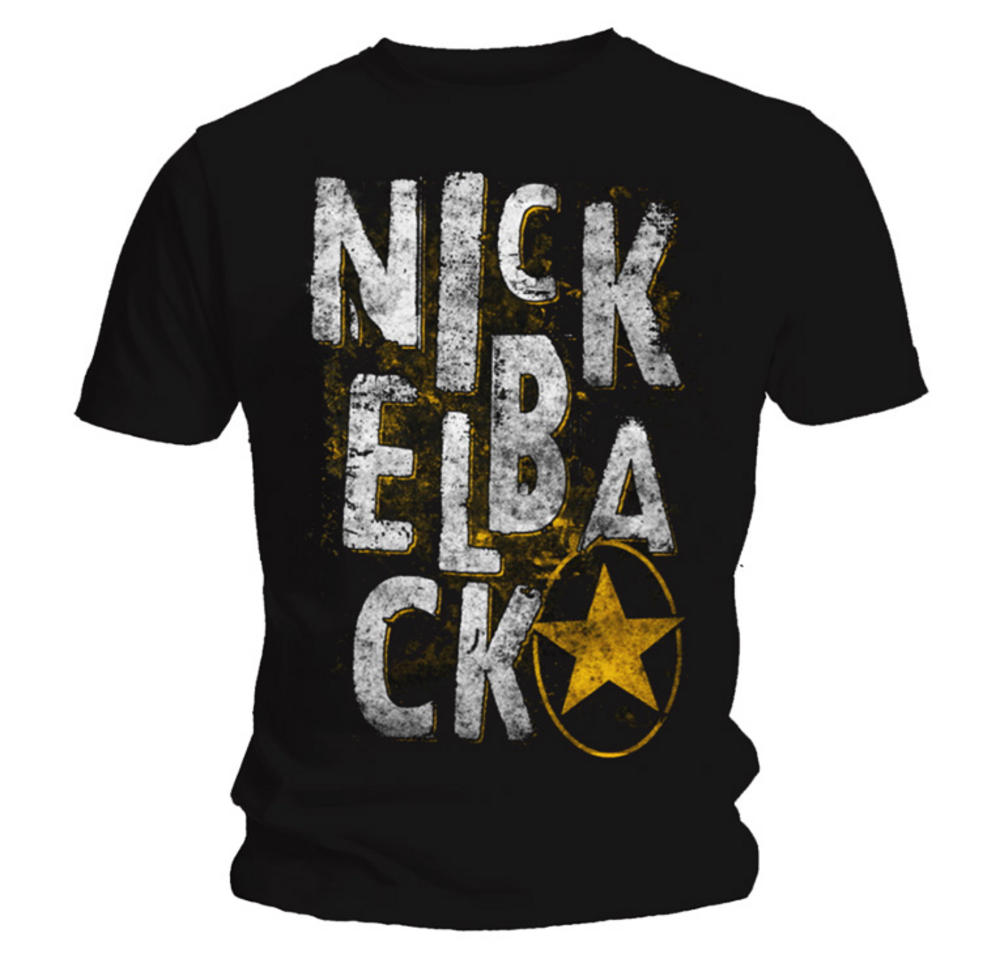
Conversely, if you instead add a Nickelback logo, that t-shirt now costs $3 as far more people would prefer the plain black t-shirt than wearing one that promotes these guys. This is an example of negative relative value.

nickleback t-shirt

In the end, all three shirts will provide the owner something to cover their upper torso with, all three likely have the same actual intrinsic value (or what it cost to make them), but the relative values are zero, positive, or negative depending on the shirt.

Future Value

While I gave a quick definition of all the value's listed above, I didn't mention "future value." The reason for this is that future value is very amorphous, in that it often doesn't dictate a specific time frame (unlike the fact that we know milk expires by a certain date). Future value is difficult, if not impossible, to accurately calculate ahead of time.

The future value is actually a type of relative value. While normal relative value compares the current value of one good/service with another at this moment in time, the future value looks at what that good/service will be worth compared to another in the future.

For a good Magic example, let's look at Languish.

There was an error retrieving a chart for Languish

Some of our Insiders thought that Languish's ceiling was $5 and that it would never go higher. Others thought it was a great four-mana sweeper similar to the ones WoTC said they weren't going to print again.

When Origins first released, Languish was one of several sweeper options available to Standard players. We had End Hostilities and Crux of Fate already and Crux proved to be an often one-sided sweeper in the deck that played it most (Esper Dragons). At the time Siege Rhino reigned supreme and the fact that Languish couldn't handle Siege Rhino pushed it down to the $2.5-$2.75 range as Standard players relied on the five-mana wraths that could take care of everything.

Thus, the relative value of Languish when players had access to more powerful wraths was low, which was reflected in its price.

However, we all knew when rotation would hit. We knew Siege Rhino would finally move out of Standard trade binders (and into Modern ones) and we knew we'd lose both End Hostilities and Crux of Fate. Sure we still have Planar Outburst, but then they spoiled Archangel Avacyn and the ability to get around mass indestructibility became very relevant.

Avacyn herself was spoiled on March 5th, yet Languish remained under $3 until April 11th. Shadows over Innistrad was officially released April 8th. Savvy speculators had over a month to pick up copies of Languish cheaply (regrettably I only got about six over this time period), knowing full well that its value was likely to go up. The writing was on the wall.

Now the reason I did pick up my extra six copies was because I knew that while this card's relative value was currently low, the future value was much higher because of its unique positioning against Avacyn. (Another card in this vein is Descend upon the Sinful, a target I currently like for the future.)

Conclusion

The point of this piece was to provide a stronger understanding of the different types of value, so when you talk about the "value" you got, you can at least be more accurate. I also wanted to consider how value affects price, and more importantly, how to look at relative value from both a present and future perspective.

Assigning relative value especially is not an easy task, and in something like Magic where demand changes daily it may not be 100% possible. Luckily for Insiders, the forums are a treasure trove of information about others' opinions on cards---and constitute one of the true intrinsic values of a QS subscription (remember they apply to both goods and services).

Exploring Scapeshift – Top 64 at SCG Milwaukee

Are you a Quiet Speculation member?

If not, now is a perfect time to join up! Our powerful tools, breaking-news analysis, and exclusive Discord channel will make sure you stay up to date and ahead of the curve.

These days I'm somewhat schizophrenic in my long-distance tournament planning. Usually I make the entirely adult decision to stay home from any GPs or Star City Games Opens requiring a day's drive or flight. Some quantity of these good decisions are inevitably reneged on when a friend convinces me through last-minute pleading and/or reminders of Magic's awesomeness to accompany them on a weekend of debauchery. SCG Milwaukee was about in this vein. Two days beforehand I get the bug, and end up jammed into a car with four other people Wisconsin-bound after cobbling together a 75.

Explore

Since the Splinter Twin ban I haven't played much Modern (and deliberately avoided it like the plague during a certain deck's reign of horror) and I've been struggling to find a deck I like. Typically I'm all about that Bolt-Snap-Bolt life, and I love the dynamic of a control shell with a combo finish. The natural place to go was Scapeshift. Being unfamiliar with the archetype, I scoured the internet for various high finishes. Here's what I knew going in:

Prismatic Omen

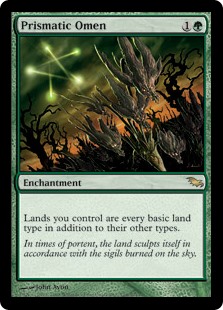
  • I wanted to run Prismatic Omen. I've always felt the Bring to Light package is a smidge on the cute side in a format so dominated by blisteringly-fast combo and aggro decks. The toolbox approach is nice, but I really wanted the potential to just slam my sixth land and kill the opponent from nowhere when I'm forced into a race.
  • Ancestral Vision in some capacity. This was less about my convictions of its strengths, and more for the purposes of testing. Ancestral is obviously one of the most exciting tools blue mages have been gifted in a while, and I wanted to see if it had legs in Scapeshift. Since most Omen lists ran Ancestral in the board, I assumed that's where mine would start as well.

Those were just two bullet points, but they gave me a working framework. My carmates turned me on to the list Daryl Ayers used to win the SCG Classic in Baltimore a few weeks back. The maindeck looked pretty solid to my eye but I had some reservations about the sideboard. Most notably, the absence of Anger of the Gods seemed like a red flag, but maybe Ayers had expected a particularly non-aggressive field for the event he played. I also was less than enthused about the Shatterstorms. I've always preferred Ancient Grudge as my anti-Affinity tool in Twin builds, but I knew the possibility of ramping into a sweeper on turn three might be the tie-breaker in Scapeshift. Ayers also came packing 2x Nature's Claim, so we could still tag any opposing Cranial Platings during combat if necessary. (At this time I was unaware that Affinity would be at an all-time low in Milwaukee---I never played against the archetype.)

The one other concern I had about the sideboard was its seeming lack of flexibility. I'm generally a huge fan of the one-of sideboard slot in general, but especially in Modern where you're trying to cover so many different matchups. Ayers' list had no Negates, Vendilion Cliques, Spellskites, or big finishers like Wurmcoil Engine or Inferno Titan.

Ultimately I reasoned that my lack of past experience with the archetype precluded any rash changes to Ayers' clearly-proven list. After all he was a well-known player and there was undoubtedly a reason for all his inclusions. I registered his exact 75:

[wp_ad_camp_1]

Scapeshift, by Jason Schousboe (52nd place, SCG Milwaukee Open)

Creatures

4 Sakura-Tribe Elder

Enchantments

4 Prismatic Omen

Instants

4 Cryptic Command
4 Lightning Bolt
4 Remand

Sorceries

4 Explore
2 Farseek
4 Scapeshift
4 Serum Visions

Lands

1 Forest
3 Island
1 Mountain
1 Breeding Pool
4 Flooded Grove
4 Misty Rainforest
4 Steam Vents
4 Stomping Ground
4 Valakut, the Molten Pinnacle

Sideboard

3 Obstinate Baloth
1 Oracle of Mul Daya
2 Dispel
2 Nature's Claim
2 Sudden Shock
3 Ancestral Vision
2 Shatterstorm

Note this list cuts the Search for Tomorrows for the full playset of Explore. That's partly because the basic land count is frighteningly low (five) and also because Explore into Valakut is an excellent way to mitigate the enters-the-battlefield tapped problem. When you have an Omen going it's also nice because you can trigger Valakuts with additional copies of itself, something the other ramp spells don't enable.

Search for Tomorrow

The other notable thing is zero Snapcaster Mage (to my chagrin, most certainly). In the car I discussed Snappy's role in Scapeshift with my friend Jon who has extensive experience with the archetype. Our conclusion was that running anywhere from 0-2 Snapcasters in a list like this was defensible. They would have been pretty nice to draw into against BGx post-Thoughtseize with a Scapeshift in the graveyard, but I did have Omens to topdeck as well. At this point I'm pretty sure I would run one copy (probably over the second Farseek), but at the time I just deferred to Ayers' wisdom.

I'll spare you guys the grueling match-by-match recounting of all 15 rounds, and just touch on the interesting plays and moments that occurred during the tournament. Then I'll suggest some updates for the list.

Day 1

Rounds 1-4

I start out on a heater, crushing the first four rounds without dropping a game. Jeez, Scapeshift, where ya' been all my life? These rounds are something of a blur, but I do remember I took down two Burn players in decisive 2-0 fashion. At this point my thoughts are something to the extent of, "Scapeshift, bah-roken. Even its bad matchups are unloseable."

Round 5 (Abzan Company)

My opponent is an acquaintance from local tournaments back in Minnesota, and he plays pretty tight the whole round. Wish I could say the same. Game Two I just completely punt the match to him when I miss an on-board kill. Luckily the universe gives me a break and he misses on his draw step. I tighten up for game three and manage to take the match.

Round 7 (Death and Taxes)

leonin arbiterBy this point I'm 6-0 and feeling good. My opponent is a young child (12-14 or so) who impresses with surprisingly tight play the whole round. Game one I start Cryptic'ing his team to dig for Scapeshift, which he's basically cold to. I manage to chain together two Serum Visions, a couple Explores, and two Cryptics and still brick. All told I have something like 12 draws to find my eponymous game-winner, but as I reflect to myself, I did choose to sleeve up a deck that's reliant on finding that one card.
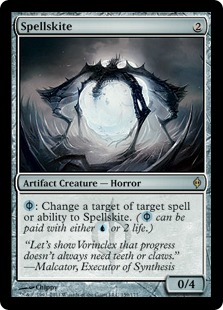
Game two I just combo him super fast. Game three is where things get interesting. He's doing the annoying Death and Taxes thing of tightening the screws one turn at a time. In the late game I'm facing down Leonin Arbiter, Spellskite, two sphere effects in Thalia and Vryn Wingmare, and a motley crew of other mono-white dorks threatening my life total. I Cryptic to buy time, getting to enough land drops for the Scapeshift in my hand to be lethal. On his end step I kill Skite with a Nature's Claim, untap and slam Scapeshift for six mana.

SpellskiteIt's at this point I look to his board and see the Arbiter, sitting there in full view. My opponent calmly (and snarkily) turns it 180 degrees so I can read it. Riiiiight. "At least I didn't sac any lands yet," I quip out loud, before tossing the Scapeshift in the yard and passing the turn.
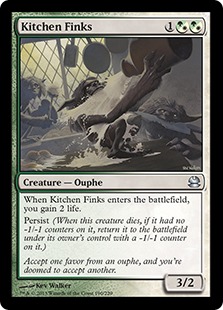
Later I find out the spotter was right behind me trying to decide whether to bring me into the feature match area when I made this play. First impressions, nice.

If I sandbag the Scapeshift I have one more turn before dying, in which I can topdeck Lightning Bolt to kill Arbiter. Either way it wasn't to be as my opponent's next draw step is a second copy of Arbiter which just puts the nail in the coffin. That's the second punt rendered irrelevant as I pick up my first loss.

Round 8 (Mono-Red Burn)

The word's been going around in the tournament hall about my opponent's deck this round. He's playing Mono-Red Burn with some, shall we say, spicy Standard inclusions in four- and five-drop dragons... Game three after mulliganing and getting stuck on lands he reveals a hand of two Thunderbreak Regents and a Stormbreath Dragon. If he's playing traditional burn with white and/or green cards I can't possibly win the match (the same was true of one of the earlier rounds too). I thank my lucky stars to be 3-0 against Burn.

At this point I'm locked for Day 2, but I'm itching to end the day X-1. My carmate, Will Drescher, is fighting for his tournament life (he will eventually Top 8) so I'm cheering for him too as we hit the final round.

Round 9 (Jund)

They jam my opponent and I this round in the "fake" feature match area, where we're essentially on standby if the main match finishes early. I can tell right away that's he's seasoned and talented. Unfortunately he dispatches me in quick fashion well before any opportunity to get on camera.

Kitchen FinksThis match my sloppy play finally catches up to me. He has a Liliana of the Veil ticking up alongside a small beatdown squad, and I'm holding the game-winning Scapeshift plus the extra card to pitch to Lili. All I need is one more turn of fading Thoughtseize to untap and 18 him for exactsies. He takes his turn and casts... Kitchen Finks. Damn. After pitching my Lili fodder, I draw a brick (I can't remember now what it was) and am faced with a decision.
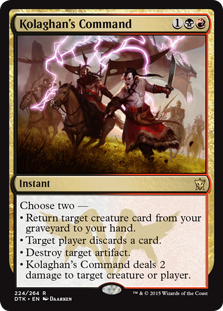
Liliana is on 5, so I have another turn before all hell breaks loose. If I Scapeshift now and put him to 2 I'm drawing live to Bolt, or a combination of mana source plus Prismatic Omen. Alternately I can Scapeshift for less than the full amount to get Liliana off the board and/or kill his Scavenging Ooze, but I'm pretty sure that's just a losing line. After mulling it over, I decide that there's no reason to 18 him this turn, when all I have to do is draw a land next turn to deal the full 36 off two Valakuts.

If you can't see how this is a horrible, horrible play, well let me tell you. He untaps, Lilis away my extra card, then passes the turn. I'm thinking it's clear sailing (assuming I draw one of my many outers), when he stops on my upkeep to Kolaghan's Command my one-card Scapeshift hand!

Kolaghans CommandLesson learned. At least I'm still in Day 2. I check in with Will and am happy to hear he won. I also note to myself that Ancestral Vision's performance this match was lackluster at best.
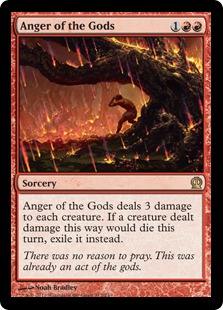
Day 2

Round 10-11

I start off the day 1-1, losing to something I forgot and demolishing a Kiki Chord player who mulligans and misses land drops. That third loss certainly hurts, but I'm relatively zen about it---still live to Top 16.

Round 12 (Infect)

This was the first match I played all weekend that just felt hopeless. Every other round I thought I had game, even the ones I lost, but this one was just a one-sided massacre. He starts with fetch into basic Forest, Noble Hierarch. I'm not sure why but I just kind of put him on Infect in my mind and pray I'm wrong. It's possible for an Abzan Company player to take this line if they don't need the extra dual land, I rationalize to myself, as I play a land and pass.

Sure enough, he's playing filthy, filthy Phyrexian monstrosities and proceeds to "compleat" me in two short games. I try to Remand, Dispel, Bolt and Cryptic my way into a lethal Scapeshift, but he handily kills me both games with several turns to spare.

Anger of the GodsThe Infect matchup is the reason for Sudden Shocks in the sideboard, and this round was enough to convince me they're just not worth it. I brought in both, and while I didn't draw them game two, they just wouldn't have mattered. I think the Infect matchup is just so abysmal that the correct strategy is to say screw it and hope you dodge them all day. If those Sudden Shocks had been Anger of the Gods I might have been able to win the match against Death and Taxes, or improve my lot against Abzan Company. I'm not even sure that Sudden Shock is strictly superior to Anger in the Infect matchup. As it stood, I basically mulliganed two sideboard slots to bring in solely in one round where they made zero difference.
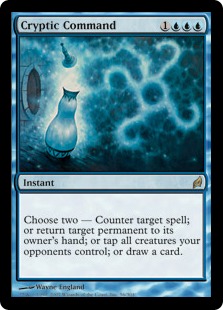
Round 14 (Bring to Light Scapeshift)

By this point I've picked up another win, and need one more to cash, two to Top 32. I figure out pretty quickly that my opponent is on Bring to Light Scapeshift, and we play the pass back and forth do-nothing game for a while. Unfortunately I'm missing land drops throughout this whole process, which is the death knell. He untaps with billions of mana and Bring to Lights for the win, powering through my meager tap-out-for-Cryptic Command disruption.

Game two I'm starting to brick on land drops again and getting frustrated. He's tapped out on my turn, so I have free purchase to resolve anything. His board is 5 lands. Mine is 4 lands, Omen. This turn I've again failed to draw a land, and I have no Explores or ramp spells to keep digging. What I do have is a Cryptic. I bounce one of his lands and draw, reasoning that he can resolve Bring to Light next turn but can't get up to the critical 7 lands. I'm ecstatic to hit a Valukut off my Cryptic draw, and play it and pass the turn.

Cryptic CommandHere some unfamiliarity with Bring to Light lists gets me pretty good. He untaps and slams Crumble to Dust on Valakut. Ewwwww. Well, I say to him, I can maybe beat you down with 10 hits of an Oracle of Mul Daya (which I haven't drawn yet). "I don't think that's likely," he laughs. "Yeah, me neither." He goes on to crush me as you would expect.
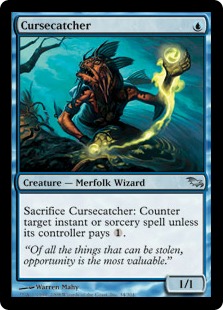
I spend a lot of time thinking through that turn and this match later, and eventually reach the conclusion that it was the right play after all. Assuming he has access to Crumble to Dust post-board, he can Bring to Light for it, so I'm pretty unlikely to fade that play from him. But I can always hit a different, non-Valakut land which makes my play better. Ultimately, I think if I just let him keep hitting land drops and try to keep up Cryptic indefinitely he's eventually going to overwhelm my defenses.

Either way, the matchup definitely seemed in his favor. They just have so much more play than the Omen version, and being a turn faster isn't that relevant in a matchup of Remand and Cryptic wars. I'm still skeptical of Bring to Light's positioning against the field at large, but it certainly is advantaged in the mirror.

Round 15 (Merfolk)

My tournament goes out in a whimper as I play against a very green-behind-the-ears Merfolk player who makes multiple critical misplays, including leaving in all his Tidebinder Mages and Harbinger of the Tides. I'm worried to hit another bad matchup, though, even against a less-skilled pilot, and he gives me a run for my money. Again I'm kicking myself for leaving the Angers at home.

CursecatcherGame three is the interesting one. I let his fishies hit me for a few turns until they're lethal, then Cryptic them down. I have the Scapeshift in hand, six lands, and a Sakura-Tribe Elder waiting to fetch up the seventh, with him on 20 life. His hand is empty so all I have to do is rip a land to 36 him through his double Cursecatcher. On his end step I tank for a while on whether to crack Sac-Tribe. Ultimately I elect not to, in order to marginally increase the chances of drawing a land.

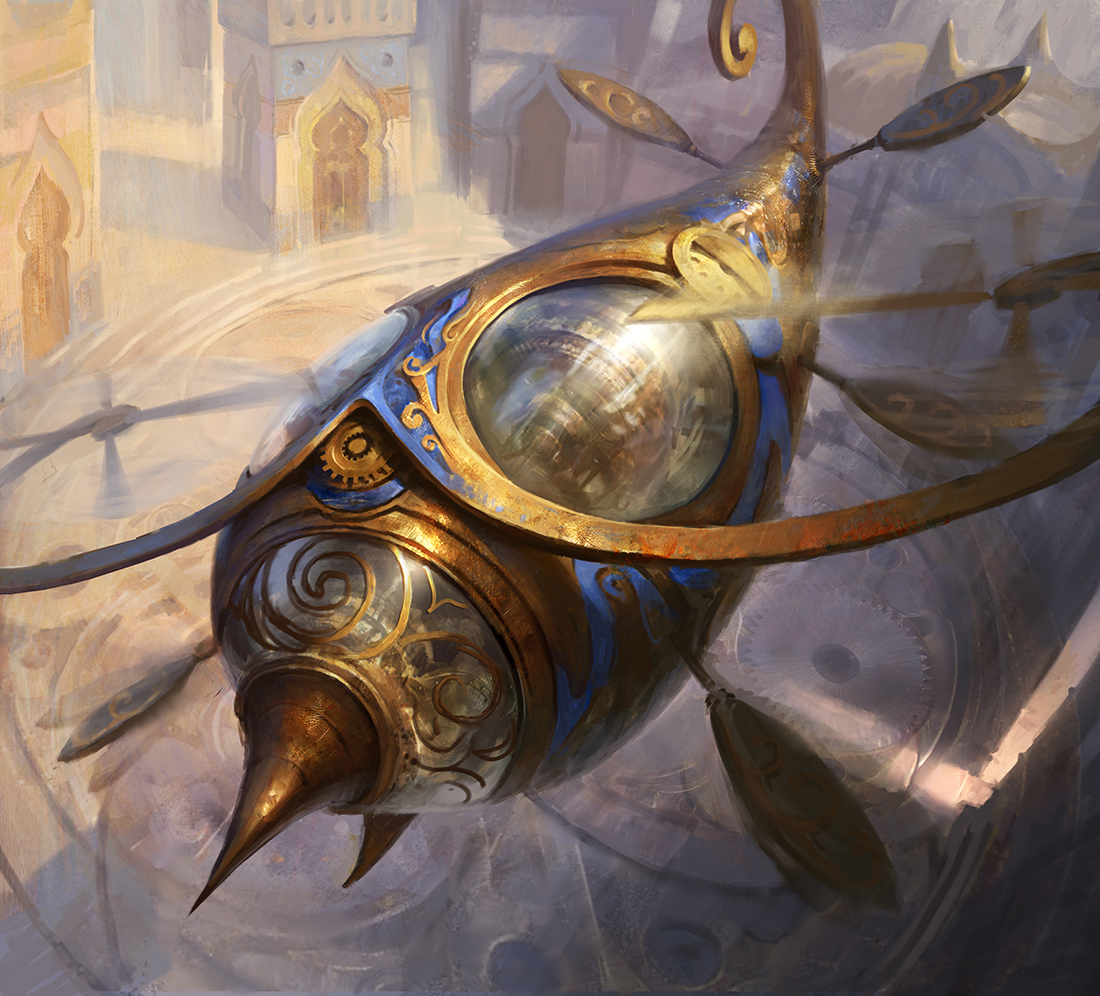

My draw for turn is Lightning Bolt. Wow, I'm so bad. If I just fetch up a land end step, I have exactly seven mana to cast Scapeshift for 18, pay for both Cursecatchers, and finish him off with Bolt. I tank for a while trying to figure out if I can mind-game him into forgetting to sac the Cursecatchers. Maybe if I Bolt him after Scapeshifting, he'll forget how much mana I have floating. The other line is to kill all his guys, leaving him with Mutavault and 3 Islands. This is somewhat scary as I'm on 3 life.

Ultimately I decide it's way too risky to just hope he doesn't know how his own cards work. I kill his team and hope to fade a two-mana lord for one draw step (Merrow Reejerey doesn't do it as he can't cast it and activate Mutavault). He bricks and on the subsequent turn I bolt the creature land when he tries to get in with it. Several miraculous draws later (and more bricks from him), I find a Prismatic Omen and eventually bolt him to death. Phew! I'm in Top 64 and get $100 for my troubles. Not a bad weekend.

Changes to Scapeshift

As you might guess from my tournament report, I want to overhaul the sideboard pretty extensively. Anger of the Gods just feels so necessary, and frankly I'm not sure how Ayers managed without it in his list. I want to cut the Sudden Shocks as they're not accomplishing their intended goal, and also add some alternate wincons like Wurmcoil. I wouldn't mind squeezing in a few utility and flex slots too, like a singleton Negate or Vendilion Clique. Clique especially I've always loved so much in blue sideboards for its ability to pressure combo, beat down in the face of disruption, and still not be embarrassing against Jund.

Finally, a note on Ancestral Vision. If you noticed I barely mentioned this card during the whole report, that's because I rarely boarded it in. Even in the Jund matchup, it felt like a mistake to try to beat them on the card advantage and grinding axis. At this point I'd much rather assume the aggro role and just try to combo-kill them. Against the mirror I think the card advantage game matters, but less so than mana development. So the only place it feels truly excellent is against Grixis or Jeskai Control---two matchups that are traditionally favorable.

So yeah, as much as it pains me to say it, I'd probably leave the Ancestrals out of Omen Shift for the time being. Oracle of Mul Daya, on the other hand, was amazing all tournament. I probably boarded it in more than any other card. It plays the card advantage and alternate wincon roles very well while synergizing with our Plan A. With fetchlands and Sac-Tribes it also lets us effectively "Top" into high-impact sideboard cards. I'd probably go up a copy.

Below is the updated sideboard I would play. If (let's be honest, when) Affinity makes a return you might have to load up on more artifact hate, but right now I like the following:

3 Obstinate Baloth
2 Oracle of Mul Daya
2 Nature's Claim
1 Wurmcoil Engine
1 Vendilion Clique
2 Dispel
1 Negate
2 Anger of the Gods
1 Ancient Grudge

The only other change I would make, as I mentioned above, is to add a Snapcaster Mage to the main over a Farseek.

What are your experiences building and playing Scapeshift? Any experts out there who can chide me on my foolish deckbuilding choices? Anyone who can articulate the argument for the Bring to Light version? Let me know in the comments.

Thanks for reading,
Jason Schousboe

Deck Overview- Standard Orzhov Control

Are you a Quiet Speculation member?

If not, now is a perfect time to join up! Our powerful tools, breaking-news analysis, and exclusive Discord channel will make sure you stay up to date and ahead of the curve.

Seth Manfield is on a serious heater. I suppose you would have to be to be the number one ranked player in the world. Coming off a Top 8 at Pro Tour Shadows Over Innistrad, he won Grand Prix New York this weekend. His deck for the PT was somewhat suspect given the inclusion of three Narset, Transcendent, and given his list from New York it looks like he feels similarly.

Orzhov Control by Seth Manfield

Spells

4 Gideon, Ally of Zendikar
3 Ob Nixilis Reignited
2 Sorin, Grim Nemesis
4 Languish
4 Read the Bones
1 Planar Outburst
2 Transgress the Mind
2 Ruinous Path
3 Anguished Unmaking
2 Ultimate Price
3 Grasp of Darkness
2 Hallowed Moonlight
3 Secure the Wastes

Lands

3 Westvale Abbey
4 Caves of Koilos
4 Forsaken Sanctuary
4 Shambling Vent
1 Blighted Fen
6 Swamp
3 Plains

Sideboard

1 Ultimate Price
1 Hallowed Moonlight
2 Transgress the Mind
3 Kalitas, Traitor of Ghet
1 Bearer of Silence
2 Dead Weight
3 Duress
1 Eldrazi Displacer
1 Thought-Knot Seer

Despite the absence of Narset, the strategy is still to play a planeswalker heavy control deck with sweepers. At the onset of this Standard format we saw Orzhov Eldrazi builds outperforming the control decks, though now with the majority of the format being dedicated to casting a lot of small creatures, Languish is looking very powerful.

There was an error retrieving a chart for Languish

Manfield ran three Anguished Unmaking, which is one more copy than many mages previously had courage for. Sorin helps to recover the life loss, though more than anything this is likely because the alternative to being heavy on Unmakings is to be dead to Ormandahls. Anguished Unmaking seems like a solid card to trade for right now, though at $3 the upside is rather low.

There was an error retrieving a chart for Anguished Unmaking

On the topic of Ormandahl, Manfield was running three Westvale Abbey of his own. Secure the Wastes and Gideon, Ally of Zendikar help enable this creature-less deck to summon demons, which is another way to gain life/win games and to ease the pain of playing so many spells that cost life to cast.

More than anything, this weekend solidifies to me the fact that white decks should just all be jamming a bunch of Gideons. Gideon has been right around $20 for a very long time, and I expect that it won't be terribly long before we see that price increase significantly. Gideon is just fantasic on his own, and "comboing" with Secure the Wastes is no joke. This combination was featured both in the PT winning Selesnya Tokens deck as well as this one. Selesnya Tokens also went 15-0 in the hands of Mike Sigrist at GPNY, which is just another data point suggesting that Gideon is just the truth.

There was an error retrieving a chart for Gideon, Ally of Zendikar

Insider: Modern Thopter-Sword’s Early Failures

Are you a Quiet Speculation member?

If not, now is a perfect time to join up! Our powerful tools, breaking-news analysis, and exclusive Discord channel will make sure you stay up to date and ahead of the curve.

By the end of May, we'll be two months into the new, post-April 4 Modern and over 200 events into the new metagame standings. This will include a formative Grand Prix Weekend on May 20, where East and West Coasts alike will get a chance to shape the new format at GP Charlotte and GP Los Angeles respectively. I published the April metagame standings last week on Modern Nexus, but expect the format picture to get even clearer once we get our Grand Prix data.

Looking ahead to the Grand Prix, the Nexus breakdown shows a wide-open format with unprecedented diversity. Tier 1 and Tier 2 feature strategies to suit every play style and budget, ranging from old favorites like Jund and the Big Aggro Three (Infect, Burn, and Affinity) to upstarts like Gruul Zoo and R/G Primeval Titan Scapeshift.

That is, every play style unless you want to use Modern's hot new unban Sword of the Meek.

There was an error retrieving a chart for Sword of the Meek

Despite an initial burst of internet-busting hype, Sword and its partner in crime Thopter Foundry have yet to take flight in Modern. In fact, if the metagame breakdown is any indication, Thopter-Sword is dead on the runway. All Thopter-Sword decks combined make up a measly 4% of Modern. Although that doesn't necessarily condemn the pairing to Tier 3 irrelevance for all time, it's not an auspicious start to what should have been an exciting new Modern strategy.

Given the metagame and monetary stakes (Sword still clings to a $25 price tag despite its failures), there's tremendous incentive for Modern players to figure out what's going on with this combo and where it's heading from here.

Today, we'll investigate some of the reasons for Thopter-Sword's shortcomings and its trajectory going forward. We'll pay special attention to how you can translate these strategic and metagame observations into financial takeaways.

Comparing Decks and Strategies

Thopter-Sword's 4% performance is spread across not two, not three, but a whopping seven-plus strategies. This includes U/W Thopter Gifts (à la Unburial Rites), U/W Tron, U/B Tezzerator, Krark-Clan Ironworks Eggs, and a number of other representatives. It also encompasses Jeskai and Grixis lists dabbling in a combo Plan B.

Given the combo's diffusion across different strategies, we're presented with two approaches for analyzing its performance. The first is to break down each individual strategy to see where they are going right or wrong. The second is to treat all the strategies as a collective and look for broader themes.

Thopter Sword Homes in Modern

It takes just a cursory glance at Thopter-Sword's many faces to realize a deck-by-deck analysis isn't the best approach. This is more appropriate when we're analyzing differences between similar lists, but becomes significantly less helpful when the decks are as varied and diverse as we see with Thopter-Sword.

A great example of a smart deck comparison is the classic decision between Jund and Abzan. Here, we have two decks with a common foundation (Tarmogoyf, Abrupt Decay, discard, etc.) that make metagame calls between Lightning Bolt and Path to Exile, Kolaghan's Command versus Lingering Souls, etc.

The Abzan and Jund Spectrum

These decks have established lists and cores. They also have established metagame factors which drive one deck over the other. Aggressive metagames favor Jund's Bolts and less painful manabase. Grindier ones favor Abzan's Souls and heavier removal. Both lists have a stock 50-55 cards which don't change much from metagame to metagame and list to list.

This is not at all the case with Thopter-Sword today.

The different Thopter-Sword decks vary widely in both color and strategy. Some favor the Tron artifact core (Talisman of Progress, Thirst for Knowledge, etc.), while others elect for Supreme Verdict or the Jeskai removal arsenal of Lightning Helix and Path to Exile. And those still share the exact same color pairing of blue-white! Add in the Grixis experiments, the more Esper-driven control shells, Eggs combo, etc., and you have a sign of serious deckbuilding uncertainty.

I'm all for trying to make sense of uncertainty, but sometimes you need to call a spade a spade. Here, I don't see a combo core bouncing around in different metagames like Jund vs. Abzan. Instead, I see a clear metagame indicator that players just have no idea how to build around this engine.

From Decks to Themes

If you can't compare distinct strategies, instead you can look for themes across the strategy's collective share. I'm seeing two major themes across all the different Thopter-Sword decks, and both of them explain where the deck is falling short right now.

First and most importantly: no one knows how to optimally build this deck.

The Thopter-Sword lists don't have established cores, gameplans, or metagame positioning, let alone the nuts and bolts of deck development such as card ratios and even card choices. This divides the attention of current and prospective brewers, making it less likely that any single variation will emerge as a frontrunner.

Moreover, these inconsistencies suggest an underlying challenge with building the shell. Some decks put themselves together. It took less than a month for Birthing Pod expatriates to take Collected Company and create the Abzan Company groundwork that remains to this day. Kolaghan's Command, another Dragons of Tarkir all-star, slotted effortlessly into Grixis Delver and Grixis Control---even if those decks didn't have a foundation like the Melira Pod-to-Abzan Company shift.

There was an error retrieving a chart for Collected Company

An optimal Thopter-Sword list is more elusive. The same brewers and Modern community which cracked the Company Elves, Abzan Company, and Grixis puzzles have been so far stumped by Sword of the Meek. Don't blame the lack of Grand Prix for that either---those decks roared onto the scene in April and May before the major Grand Prix season of June 2015.

All of this underscores the difficulties in building Thopter-Sword. Between the wide-open color options, the supporting cards, and the choices between Plan As, Bs, and Cs in each strategy, it's no wonder players have struggled to solidify a home for Thopter Foundry.

This brings us directly to the second theme behind Thopter-Sword's failings: just as no one can decide how to build the deck, no deck can decide which plan the combo should occupy. Is this a format-defining Splinter Twin inheritor? A Plan C-D in the Tezzeret toolbox? An incidental 4-5 slots in an already decent Tier 2 control deck?

Finding the Thopter Sword Plan

Depending on which plan you assign to the combo, your deckbuilding parameters are going to change considerably. Similarly, mis-assigning the combo, or mis-identifying the deck that suits your combo's plan, is a recipe for disaster.

For example, assume you tried to build Twin as an all-in Simian Spirit Guide strategy. You would have incorrectly identified Splinter Twin/Deceiver Exarch as a Plan A combo deck, not a control Plan B. Or believing Bant Company was where Collected Company would have shined back in April 2015. Right idea for using the card, wrong execution in the deck itself.

Until players puzzle through all these challenges, Thopter-Sword is never going to shine in Modern. This plays out in both a theoretical assessment of the combo and a more data-driven look at Thopter-Sword's scattered metagame shares.

Now that we've identified the primary factors behind the deck's early bust, we can look to how this might change and how its success or failures will play out in dollars.

Bright Prospects Ahead

Earlier in the article, I talked about the May 20-21 Grand Prix Weekend and its importance for Modern's direction. This is just as true for Thopter-Sword as for the metagame at large.

There was an error retrieving a chart for Thopter Foundry

If Thopter-Sword has a shot in Modern, we'll see it make a play at the big-leagues over the Grand Prix Weekend. Brewers and developers will have a clear metagame picture to work from (what decks to beat, what to ignore), not to mention significant incentive to get the shell right: a Grand Prix has bigger stakes than the average regional weekend event or even a Star City Games Open.

Between this metagame knowledge, the possible rewards, and the sheer benefit of additional time, Thopter-Sword sees its best chances over Grand Prix weekend. Of course, this has big implications if you're trying to invest in the shell or speculate on its success.

During the 20th and 21st, you'll need to pay careful attention to Twitter, Twitch coverage, and the buzz around social media. Move quickly on anything that is doing well. Without any significant results, Sword of the Meek and Gifts Ungiven are already huge winners going into May. Their prices are driven by hype and hype alone. A real Grand Prix Top 8 result will see them exploding.

There was an error retrieving a chart for Gifts Ungiven

For those who can't decide what Thopter-Sword deck to hedge bets on, I'd pick either U/W Tron or U/W Thopter Gifts. Tron has the highest metagame share currently, which might attract more quality deck developers and pilots. Just be careful for splash damage from the R/G Tron haters, who will be more prepared for the Urza's lands than they were at the SCG Open.

As for U/W Thopter Gifts, this is the unestablished but theoretically potent shell which is a brewer's paradise. It's a "true" Modern control deck by most definitions, and what blue mage can deny the temptation to work on such a Modern masterpiece? It's also the most obvious option if you want a more dedicated Thopter-Sword list, as opposed to the old-school U/W Tron, which has been around for years and may have lost its luster.

Gifts Ungiven is a major player in both decks, so that's the safest starting point if you aren't sure where to allocate resources. Same with the Rites backup plan, along with your heavy-hitting reanimation target of choice and a few other shared elements.

UW Tron and Gifts Thopter Commonalities

Of course, there's another possibility for Grand Prix Weekend, and that's yet another total bust by the Thopter-Sword decks. Alternately, a middling performance with just a Top 16 or a few Top 32s, which would be tantamount to a bust as far as prices go.

In both cases, this will be Thopter-Sword's second major failure, the first being in the month following the initial hype, and the second being a misstep on a huge Modern stage. It's unlikely the Sword of the Meek bubble, along with the bubble around its supporting cards, would last in such a climate, which might spur investors to offload stock immediately.

Personally, I think the former scenario is likelier than the latter. The combo itself is inherently quite good, and it's early enough in the year that I'm willing to explain away its initial failings on the basis of the reasons I gave earlier. If we get past Grand Prix weekend and the deck is still languishing in Tier 3 or lower, then we can start doubting the synergy itself.

Until then, I'm optimistic we'll see someone or multiple someones emerge on May 22 with a more definitive and commanding list.

Thanks for reading and for joining me as we dissected Thopter-Sword's performance so far and where it might be heading from here. Join me next week as we make some predictions about the impending Grand Prix Weekend and check-in on the results of the SCG Open on May 13-14. Find me in the comments with any questions and I'll see you all soon!

Insider: High Stakes MTGO – May 1st to May 7th

Are you a Quiet Speculation member?

If not, now is a perfect time to join up! Our powerful tools, breaking-news analysis, and exclusive Discord channel will make sure you stay up to date and ahead of the curve.

Welcome back for another week of High Stakes MTGO! After a small break due to important deadlines in my day job I'm back for fully developed High Stakes MTGO articles.

Although I had very little spare time these past few weeks my account saw a lot of movement. I didn't really have the opportunity to speculate on cards spotlighted during Pro Tour Shadows over Innistrad such as Seasons Past, Dark Petition and Kalitas, Traitor of Ghet (which I can't believe I missed) and I mainly sold a few of my positions according to their new trends, selling out too early in some cases.

Following the end of Shadows over Innistrad release events a lot of prices are currently rebounding. Battle for Zendikar and Oath of the Gatewatch singles are more or less slowly taking off and Modern cards are cycling up for the most part. This is going to be a good period to sell and look for tastes-of-the-day to cash out on, especially in Standard and in BFZ and OGW.

The new Standard rotation structure simply doubled the opportunity for cards to have their moment of fame. We can already see that effect on some Magic Origins and Dragons of Tarkir cards that probably would have not shined in the previous rotation structure.

As usual, the live portfolio is available here.

Buys This Week

OoN

This oath is starting to see play in more and more decks in Standard, Modern and even Legacy. I clearly didn't catch it at its absolute bottom but I think I still have a good margin of progress from my buying price.

Oath of the Gatewatch just stopped being the main set opened from drafts so I would expect the price to slowly creep up if the green oath keeps seeing play across several formats. You can also check Adam Yurchick's article for additional reasons to buy Oath of Nissa.

CCo

Affinity decks are not as prevalent now as they were a few months ago, which might partially explain why Creeping Corrosion crashed to its one year-low at 1 tix last week. This is part of the usual up and down cycles in Modern that are of interest to speculators. As of writing, the price has already heavily rebounded; I might actually be selling this one very soon.

Sales This Week

After a global dip at the end of April, the price of these Magic Origins painlands are back up. With less and less time before ORI rotates out of Standard I have to intensify my sales of painlands. I have lowered my minimum selling prices at least momentarily to liquidate several hundred copies.

Along with red in general in this current Standard metagame, Shivan Reef and Battlefield Forge are pretty low. Hopefully the metagame will evolve to favor red and these two painlands next. If not, my last chance will be a change brought by Eldritch Moon.

This bulk spec never got anywhere. I took advantage of an unexpected little spike last week and sold about two thirds of my position here. I'll wait a little bit more now that the price is back to its baseline, but I'm only looking to exit this position at this point, with or without further gains.

Legendary Cube Prize Pack

The price of the Legendary Cube Prize Packs keeps fluctuating up and down but the global trend is still up since last December. Sales from speculators surely have affected the trend but I keep selling my stock as soon as the buying price is at 2.8 tix or more.

As I mentioned before, this spec has been a great ride and I don't want to ruin everything by being caught by an unexpected reprint. For this reason I'll be selling more of these packs whenever the opportunity occurs.

The powerful Eldrazi creatures (this along with Thought-Knot Seer) were somehow relegated to the sidelines during PT SOI. Reality Smasher even dropped to 1.4 tix, when I decided to buy it. A week later the Smasher was back in the 3.5-4 tix range, its pre-SOI high. At this point I had more than doubled my spec and I decided to let go with 130 tix in profit in only about a week.

Despite my latest move, I think this guy may have more to offer in the long run. I just felt like this spec had been good enough to me at this very moment to lock in some profits. If Reality Smasher goes below 2 tix again I'll become a buyer once more.

OGW

Never has a full set spec gone this well in such a small period of time. OGW was also strangely disappointing in that it's the only full set spec I couldn't buy as many copies of as I wanted, because the price was moving up too soon, too fast. Anyway, OGW sets are up by more than 50% compared to my buying price. Historically it's very hard to beat a +50% on a full set spec.

Whether OGW will be the exception or not is nothing to worry about any more, as far as I'm concerned. I sold my 11 OGW full sets and got exactly what I was looking for.

From 18 tix on April 25th to 40 tix this past weekend, this is how fast a price can grow with Modern cards, even with a high starting price tag. With Future Sight flashback drafts just around the corner and a price already that high, this was a selling opportunity I didn't really want to miss. Too bad I was so reluctant to buy more copies above 21 tix. Chances are I'll rebuy some copies of the Grove later this month.

On My Radar

While I'll be watching my Modern specs in the new format as the metagame settles, my Standard specs are really the ones I don't want to lose track of. Unlike Modern specs where missing a peak is not the end the world since just about everything is cyclical, Standard specs do not offer that degree of freedom.

Especially for specs from Magic Origins and Dragons of Tarkir, this is the final lap. I tried to sell some of these positions during PT SOI, some of them perhaps a little too prematurely. However my portfolio still holds a lot of specs from these two sets, including mythics, rares, bulk specs and thousands of painlands!

With ORI and DTK positions I clearly can't miss any spike. As I'm writing these lines I'm carefully watching Dragonlord Silumgar making his way to the top again. Good results during the two Standard GPs of this past weekend would mean an extra 2 or 3 tix per copy, but I will have to sell during this spike.

I'm also aware that I will have to suffer some losses here and there. For instance I'm not going to wait until the last minute to sell Woodland Bellower and it looks like 1 tix is the best I can hope for at the moment.

I'll also be watching my BFZ and OGW specs. Although I may have more time with those specs I will nonetheless be selling when my target prices are met. Reality Smasher was the first one down this week for this very reason. I'm happy when my specs have a high turnover and I intend to keep up with the pace with my Standard picks.

Questions & Answers

Q1

These are recurrent questions but my answer is actually evolving so it's totally fine to revisit this. As bot chains are evolving too, I'm using now bots I was not using few months ago.

Adam is assuming correctly that I almost exclusively use bots for my transactions, probably 99.5% of the time. The spread very often favors using bots and with a limited time to dedicate to MTGO, I try complete as many transactions as possible when I'm online. Bots are the fastest mechanism to buy and sell cards.

As you certainly know there's no one bot chain that has the best selling and buying prices for all cards. Even if such a bot chain existed I would need to check other bots anyway to acquire the dozens of playsets I want for each position. These days, whether I'm selling or buying cards, I always put up five websites (in no particular order): MtgoTraders, GoatBots, DojoTrade, MtgoLibrary Bots and Clanteam.

MtgoTraders and GoatBots are two of the largest vendors online and have the advantage of keeping a large stock of just about any card. More importantly, they will let you buy as many copies as you want if you are willing to pay a small increment after each purchase (or accept a smaller price after each sale).

CardHoarder and CardBot are two other large bot chains that use the same pricing as MtgoTraders. I rarely use them since when a price gets too high with MtgoTraders it will get too high as well on these two other stores. By habit I keep using MtgoTraders. GoatBots is also a bot chain of choice for boosters and full sets.

DojoTrade is a bot chain you should consider if you're not using it already. You are limited with buying and selling a playset per 24 hours but they have a decent stock and very competitive prices, often the best buying/selling ones. They also sell sets at great prices which is another advantage.

MtgoLibrary groups together a ton of individual bot chains, big and small. At some point I've probably used about 95% of the regular, decently-priced and -stocked bots, and I must have attained the "speculator" special pricing for some of them. It's easy to compare prices across the various bots, and I simply start with the cheapest when buying or the most expensive when selling. I would strongly recommend respecting the playset limitation some bots have set to avoid being banned. There's more to gain in the long run by respecting these limits.

On their website Clanteam bots advertise boosters, full sets, Standard and recent Modern sets, but actually sell almost everything if you check their bots on MTGO. They rarely have the best prices but are always competitive. They sell full sets and are also one of the very rare chains to buy full sets. One thing that comes handy with Clanteam is that they buy absolutely everything for 0.0001 tix at the lowest.

Besides this I happen to screen the Classifieds from time to time or check alternative bot chains such as Mtgo Academy or TheCardNexus and bots using the same software. And once every blue moon I buy or sell to humans through offers on the Classifieds.


Thank you for reading,

Sylvain

What’s in a Goyf? Benchmark Creature Playability in Modern

Are you a Quiet Speculation member?

If not, now is a perfect time to join up! Our powerful tools, breaking-news analysis, and exclusive Discord channel will make sure you stay up to date and ahead of the curve.

Modern is full of great creatures. A Goyf by any other name is still a Goyf. And yet, no other Modern creature commands as notoriously high a price tag. As of right now, MTGGoldfish's data lists Tarmogoyf as Modern's number-one most-played creature. The first time I read Tarmogoyf myself, after a multiple-year Magic hiatus in 2009, I didn't understand how or why this apparently-vanilla creature was finding its way into Standard Top 8s, Legacy combo decks, and bulletproof pawn shop display cases alike.

kitchen finks art crop

That was seven years ago. I can now tell you why Tarmogoyf is so good. Today, we'll look at the requirements for playability in Modern by analyzing a list of the format's top 50 most-played creatures.

[wp_ad_camp_1]

Data Collection

CursecatcherTo gather data for this article, I merely wrote down Modern's top 50 most-played creatures, as listed by MTGGoldfish last Tuesday, and sorted the creatures to fit my purposes. Since Tuesday, the data has shifted a bit---some Abzan Company staples like Sin Collector have fallen off the list, making room for Merfolk mainstays like Cursecatcher---but these shifts are natural given a live metagame. I decided to work with my Tuesday data for this article, since I've worked with those numbers more, and the principles in play apply to both lists. It would also be futile to try "catching up" to such protean data---by next Monday, the list will surely have changed again.

Sorting the Creatures

Our resident statistician can tell you raw data is useless if it isn't properly organized. There are lots of ways to break up a list of 50 creatures, but since we're considering their playability, I've organized it based on removal resiliency and additional effects. I then grouped the creatures into larger sections by mana cost. As we're working with lists, I've added numbers to the end of each card to indicate its ranking. For example, "Tarmogoyf (1)" indicates that Tarmogoyf is the most-played creature in Modern.

Lightning BoltResisting Removal

MTGGoldfish also keeps an index of most-played spell cards on hand. Both on Tuesday and today, that 50-card list contains just five* removal spells:

  • Lightning Bolt (1)
  • Path to Exile (2)
  • Abrupt Decay (15)
  • Terminate (29)
  • Dismember (42)

*Lightning Helix and Searing Blaze also make the list, but as strictly worse Bolts in terms of removal, I’ve excluded them from this section.

Lightning Bolt and Abrupt Decay, the most flexible removal spells of the bunch, are also the easiest to get around. As such, we can talk about these spells in terms of "tests": creatures with 4+ toughness pass the Bolt Test, and creatures that cost more than three pass the Decay Test. To survive Path to Exile or Terminate, creatures need rare keywords like protection from white or hexproof; given the difficulty of such a feat, I see no need to outline something like a "Path Test."

It's no wonder Path comes in at number two on the spells list, since it cleans up so much for just one mana. Dismember, too, kills almost everything for one; in a format with Burn as the number-two most-played deck, though, it's unsurprising we don't see more of it.

blood baron of vizkopaInterestingly, none of the fifty creatures on this list survive Path to Exile, Terminate, or Dismember (except for one, which ignores all five removal spells!), although such creatures do exist in Modern.
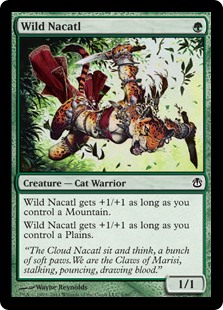
Blood Baron of Vizkopa is my favorite example. This guy dodges every one of Modern's top removal spells, and has lifelink to boot! Cards like Baron (i.e. Stormbreath Dragon) don't see much play because of the format's blistering nature. There are plenty of matchups in Modern where dodging removal just doesn't matter, like Ad Nauseam and Grishoalbrand. In these matchups, the game is won or lost around turn four, so ripping five-drops basically equates to skipping draw steps. It also doesn't help the Baron's case that Tarmogoyf totally dwarfs him in combat!

Casting a Spell

Many of the creatures on the list that don't pass the Bolt test cast a spell when they enter the battlefield. For example, Eternal Witness casts Regrowth, and Sin Collector casts Duress (sort of). Along with resistance to Bolt and Decay, the ability to cast a spell on resolution is the other metric we'll use to determine creature playability in Modern.

With the formalities out of the way, let's move on to analyzing Modern's creatures. I've excluded the zero-drop creatures, Ornithopter (16) and Memnite (27) from my analysis, as they're simply cogs in Affinity that constitute a sort of outlier.

One-Drops (13/50)

These creatures fail every removal test, but they do so willingly; since none of Modern's top removal spells cost less than one, they're guaranteed to at least break parity with opponents on tempo. None of these creatures cast a spell. Since the bar is so low with one-drops, it's fairly easy for new cards to enter their pool of Modern playables (most recently, we've seen Insolent Neonate in successful decklists, who "becomes" a spell by sacrificing himself). I've sorted these creatures based on their uses across different archetypes. Since many of the decks that want to play a creature on turn one fall under the aggro umbrella, nearly half of the one-drops are combat creatures.

Combat Creatures (5/13)

  • Wild NacatlGoblin Guide (7)
  • Monastery Swiftspear (10)
  • Wild Nacatl (11)
  • Kird Ape (37)
  • Experiment One (43)

Combat creatures simply attack and block well. Threats like Goblin Guide and Monastery Swiftspear represent the peak of creature efficiency at their mana cost (it's no coincidence these two creatures invariably find themselves in every build of Burn, Modern's most classic aggro deck). One-drop combat creatures from Standard don't often make it in Modern, since they have these best-of-breed staples to contend with.

Synergy Creatures (3/13)

  • Glistener ElfSignal Pest (17)
  • Vault Skirge (19)
  • Glistener Elf (23)

Synergy creatures each fit into their own decks, and don't easily mesh with other archetypes. Signal Pest can deal far more damage in combat than a single Wild Nacatl when played in the right deck. Vault Skirge (which functionally costs one mana and some life) is an exceptional threat in Affinity, giving that deck the unique ability to turn its board into heaps of life. Glistener Elf was trickier to classify, since it's a straight-up combat creature that only performs in Infect. One-drop creatures with synergy in one of this format's many viable decks can easily transition from prerelease to Modern tournament.

Enablers (3/13)

  • Birds of ParadiseNoble Hierarch (4)
  • Birds of Paradise (8)
  • Viscera Seer (32)

Enablers speed up or empower certain strategies. The enablers on this list have seen tournament play across multiple formats since their release. Wizards has explicitly acknowledged the immense power of starting the game one mana ahead of opponents, and even vowed not to print any more one-mana dorks the likes of Birds and Hierarch for Standard.

As such, it's rare to see generic enablers from Standard break into Modern. Seer allows a plethora of creature-velocity decks to exist in the format, such as Abzan Company and Esper Rally. It doesn't make the list, but the aforementioned Insolent Neonate is Modern's newest one-mana enabler, combining with Faithless Looting to give Dredge eight ways to dump Golgari Grave-Troll on turn one.

Grim LavamancerUtility (2/13)

  • Grim Lavamancer (31)
  • Burrenton Forge-Tender (49)

Utility creatures fill gaps in deckbuilding or address specific problems. They are often relegated to the sideboard. Grim Lavamancer guns down creatures from linear decks like Infect or Affinity, while Burrenton Forge-Tender hoses Modern's aforementioned number-two deck and Anger of the Gods, the most-played sweeper. At just one mana, these creatures are easy includes for archetypes that can benefit from their effects. For new utility creatures to see play in Modern, they need to do something entirely unique, or undercut similar utility creatures on mana.

Two-Drops (23/50)

The bar for playability gets higher as we move up in mana costs. Naturally, a two-drop needs to do more than a one-drop---maybe even twice as much! Modern's two-drops either dodge Lightning Bolt, provide immediate value, greatly bolster a specific strategy, or win the game if unanswered.

Passes the Bolt Test (7/23):

  • TarmogoyfTarmogoyf (1) - attacker, blocker
  • Scavenging Ooze (3) - attacker, blocker, utility, hate
  • Spellskite (6) - blocker, utility, hate
  • Voice of Resurgence (15) - attacker, blocker, hate
  • Kor Firewalker (26) - combat, hate
  • Wall of Roots (33) - blocker, enabler
  • Wall of Omens (44) - blocker, utility

Tarmogoyf excels in battle and nowhere else, but two-drops in Modern often play multiple roles. Scavenging Ooze can enter the fray, hate on graveyards, or gain life; Voice of Resurgence attacks and blocks decently, slows down counterspell decks, and helps out-grind attrition strategies. Two-drops take up the largest portion of this list, clocking in at close to 50%. Since I sort by playability factors for the rest of the article, I’ve added additional classifications to the above two-drops to describe their possible roles. The roles differ based on context---in some decks, like Mono-Green Stompy, Scavenging Ooze primarily attacks and blocks. In others, like Abzan Company, it's a graveyard-hate bullet.

The scarcity of combat creatures at less than three mana that pass the Bolt Test explains Tarmogoyf's throne at the top of Modern's top creatures list. Paying three mana for such a creature opens players up to tempo losses from Abrupt Decay. Just behind Kitchen Finks, Scavenging Ooze comes in at number three on the list for similar reasons. Unlike Goyf, Ooze requires an additional mana investment to grow past Lightning Bolt and excel in combat, but is guaranteed to resist the instant in longer games between interactive creature decks like Jund or Zoo. Granted, Ooze has other strengths---it disrupts graveyard strategies and can sometimes grow bigger than Goyfs---but it differs from Goyf in that it doesn't do any one thing better than all other options at the same mana cost, instead bringing versatility to the table.

Modern's other top Bolt-proof two-drops are enablers and utility creatures. Two-mana dorks in this format can't die to Lightning Bolt, explaining the presence of Wall of Roots and the absence of cards like Deathcap Cultivator. Wall of Omens slows down hyper-aggressive decks without costing a card, and threatens to provide continuous value bursts with other utility creatures like Restoration Angel. Spellskite and Kor Firewalker more deliberately shut down linear aggro strategies, and Voice of Resurgence is one of only three creatures on the list at less than four mana that isn't completely dealt with by Abrupt Decay.

Strongly complements a strategy (10/23):

  • leonin arbiterEidolon of the Great Revel (13)
  • Arcbound Ravager (18)
  • Blighted Agent (25)
  • Thalia, Guardian of Thraben (29)
  • Reckless Bushwhacker (35)
  • Leonin Arbiter (38)
  • Melira, Sylvok Outcast (39)
  • Burning-Tree Emissary (42)
  • Anafenza, Kin-Tree Spirit (47)
  • Lord of Atlantis (50)

These synergy creatures greatly enhance their archetypes, despite dying to Bolt. Death & Taxes couldn't exist without Arbiter and Thalia, and Merfolk wouldn't work without its oldest Lord.

Casts a Spell (4/23):

  • Tidehollow ScullerSnapcaster Mage (5)
  • Sakura-Tribe Elder (20)
  • Tidehollow Sculler (30)
  • Qasali Pridemage (40)

The difference between Eternal Witness (which casts Regrowth) and Sakura-Tribe Elder (which casts Rampant Growth) is that the Elder trades his own body for the effect, essentially becoming the spell instead of simply casting it. Creatures that cast a spell and leave a body behind cost three mana in Modern, including the flashback-cost-taxing Snapcaster Mage, the most played card in this section because he at least can cost just two mana.

An exception on this list is Tidehollow Sculler, who casts a pseudo-Thoughtseize and lives to tell the tale. Since Sculler gives the card back after dying to a card present in 45% of all Modern decks, the spell he casts is only temporary, making him more of a Meddling Mage than a Thought-Knot Seer and explaining his slumping rank on the list.

Ends the Game If Unanswered (2/23):

  • Dark Confidant (9)
  • Steel Overseer (21)

Leave these creatures on the battlefield for a couple turns and you're dead meat. Steel Overseer also could have gone in the synergy section, but since his effect is so devastating in Affinity, I chose to put him here. Confidant is much more splashable, earning his status as one of the game's best two-drops. No other creature gives decks spanning multiple archetypes the same kind of inevitability.

Three-Drops (8)

Three-drop creatures in Modern supply pilots with value, often in the form of card advantage. These creatures either resist multiple removal spells or cast a spell.

Passes Bolt and Decay tests (2/8)

  • Etched ChampionKitchen Finks (2)
  • Etched Champion (22)

When it comes to combat creatures, merely passing the Bolt test doesn’t guarantee a three-drop’s playability. Kitchen Finks provides huge bursts of value against aggro decks, synergizes with already-good creatures like Restoration Angel, takes part in an infinite life loop, and grits his teeth through removal spells. He isn’t only featured in Abzan Company—his applications are so broad he makes it into midrange sideboards and mainboards, and comes in just behind Tarmogoyf as Modern’s second-most played creature. Etched Champion only works in Affinity, but he dodges every removal spell in the format with his “protection from all colors” clause, making him the one creature in the top 50 that skirts Path to Exile.

Eternal WitnessCasts a Spell (6/8)

  • Fulminator Mage (12)
  • Eternal Witness (14)
  • Simian Spirit Guide (28)
  • Flickerwisp (34)
  • Wasteland Strangler (46)
  • Sin Collector (48)

Modern's three-drops offer pilots the opportunity to cast a spell while putting bodies onto the battlefield. Only Simian Spirit Guide, which is less of a creature and more of a ritual, and Fulminator Mage, whose spell (Stone Rain) costs as much as he does, trade themselves for the effect.

Other Three-Drops

With these principles outlined, we can see why prerelease-hyped creatures like Sin Prodder never make it into Modern. Prodder dies to Bolt and doesn’t immediately cast a spell. He also doesn’t threaten to take over a game, since opponents can choose not to give us the card he reveals. But even if we always drew the card, I don’t think Prodder would see much play. Prophetic Flamespeaker boasts Courser of Kruphixa superior effect, and Countryside Crusher allows us to draw past extra lands. Neither of those creatures see Modern play, despite outclassing Prodder in combat.
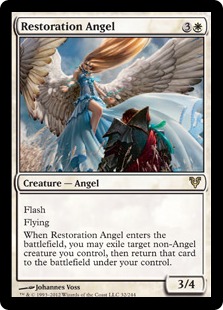
One three-drop that does see Modern play, but doesn’t make the list, is Courser of Kruphix. Courser survives Lightning Bolt and provides value over the course of a game, but he doesn't provide immediate value as he enters the battlefield by casting a spell. He also can't take over a game like Confidant; he can just occasionally draw lands if opponents don't find ways to remove him, at the cost of giving opponents perfect information. Modern contains many creatures like Courser that have enough going for them to see some play, but don’t quite make it to staple status.

Four-Drops (4)

Four-drops benefit from an inherent immunity to Abrupt Decay, but with a downside: they often resolve on the turn some Modern games end. The four-drops that make this list all resist Lightning Bolt, cast a spell upon resolution, and boast a special ability.

  • Restoration AngelRestoration Angel (24)
  • Thought-Knot Seer (36)
  • Obstinate Baloth (41)
  • Siege Rhino (45)

Restoration Angel outranks the other four-drops here because of her immense versatility. She casts Cloudshift to provide value with 187 creatures, surprises attackers or gets around countermagic with flash, and applies an evasive clock in the air.

Thought-Knot Seer comes next, casting one of the best spells in Modern—Thoughtseize—to protect himself from relevant removal. Since he dodges Bolt and Decay, Seer will often take an opponent’s only answer, allowing him to bash into the red zone uninhibited. Thought-Knot doesn’t have any extra abilities, but the potent combination of Thoughtseize and Tarmogoyf has kept Jund a Tier 1 deck since Modern’s humble beginnings. This creature combines them on one card. Having his own Sol land doesn't hurt, either.

Obstinate Baloth and Siege Rhino both gain life when they enter the battlefield, but Rhino basically outclasses Baloth on every level with his draining effect, higher toughness, and trample. Baloth only sees more play because it fits into decks like Scapeshift that need the discard insurance and can’t splash a Rhino.

Other Four-Drops

Some four-drops see play in Modern without entirely resisting Lightning Bolt. Since Tuesday, Pia and Kiran Nalaar has jumped up the rankings to the 49 slot. Bolting the parents doesn’t exactly remove them, since they leave two fliers behind. Same deal with Huntmaster of the Fells, who has the added benefit of ending the game if left to his devices for a few turns. Another honorable mention is Kalitas, Traitor of Ghet, who’s become a Jund staple thanks to his adherence to more traditional four-drop values: don’t die to Bolt, apply pressure, and provide value.

woolly thoctarApplying Playability Parameters

The parameters for creature playability outlined in this article have widespread utility. I use them to decide whether newly spoiled creatures merit Modern testing, to scour the format’s enormous card pool for sleepers, to examine a deck's positioning in the metagame, and to teach new faces at FNM why Woolly Thoctar isn’t any good. Hopefully, these parameters will do a Kitchen Finks on your Magic experience, and provide you with similar value!

Insider: Recommended Standard Buys

Are you a Quiet Speculation member?

If not, now is a perfect time to join up! Our powerful tools, breaking-news analysis, and exclusive Discord channel will make sure you stay up to date and ahead of the curve.

We're seeing an uncommonly diverse Standard format, coming off a Pro Tour with eight distinct archetypes in the Top 8. Brewers and grinders are hard at work tuning decks and debuting new archetypes. In the midst of all this movement, several cards with lower price tags are primed to jump as they get adopted into more winning decklists.

Here are the best cards I can recommend picking up right now.

Eldrazi Displacer

There was an error retrieving a chart for Eldrazi Displacer

Eldrazi Displacer fell from grace with the banning of the Modern U/W Eldrazi deck, but Standard rotation has breathed new life into the card.

It’s played in Standard Eldrazi decks of all sorts, most often B/W, but recently mono-white and even blue-white versions have been successful. It’s also making its way into other archetypes, like Bant Company. It has also spawned a new variation of the B/G Aristocrats deck that combines it with Brood Monitor to create an infinite loop and a game-winning combination with Zulaport Cutthroat in play.

The card will only grow more popular from here, and it has a long life left in Standard, so now is the time to buy. It has seen massive growth on Magic Online in the last week, but the paper price lags behind, so there is some indication the price is overdue for an increase.

Dragonlord Silumgar

There was an error retrieving a chart for Dragonlord Silumgar

Westvale Abbey transforming into Ormendahl, Profane Prince is one of the biggest problems confronting black decks in Standard. Those that also play white get plenty of answers, but decks like Grixis and Sultai and left without such clean solutions. Enter Dragonlord Silumgar, which takes the threat for its own use.

It’s a tremendous swing, and if the opponent can’t deal with the dragon, which they likely can’t given it dodges most of the removal spells in the format, it’s sure to end the game. Dragonlord Silumgar is also an ideal solution to planeswalkers, which can give black control decks issues.

Olivier Tiu played two copies in his GP Toronto Top 8 Grixis Control deck, and it was part of Lombardi’s winning Esper Control deck. There is also a growing movement of Sultai decks including the Dragon.

Ulamog, the Ceaseless Hunger

There was an error retrieving a chart for Ulamog, the Ceaseless Hunger

Ulamog, the Ceaseless Hunger was once over $30, and now it’s just half that price. The card is seeing increased play in both Standard and Modern, and it’s primed for growth.

The price has declined in part due to a drastic decrease in Standard use, but the trend has reversed. It’s seeing play in a new version of R/G Ramp being popularized by Sam Black and Justin Cohen, and it’s been successful in a blue ramp deck having success on MTGO. It is also part of Joe Lossett’s Tron deck that finished second in the recent SCG Modern Open, which is indication it’s going to be a big player in the metagame at Modern Grands Prix this month.

Oath of Nissa

There was an error retrieving a chart for Oath of Nissa

Oath of Nissa was called the green Ponder, but it has been slow to earn the title. Rotation has been good for it, and the enchantment is earning slots in green decks all sorts.

There are many great creatures, planeswalkers, and even nonbasic lands to find, and synergies to create. The consistency provided by Oath of Nissa is invaluable to the decks that include it. I am seeing it played more often than ever before, and its presence will only increase from here.

The Gitrog Monster

There was an error retrieving a chart for The Gitrog Monster

The Gitrog Monster was far too awkward for a format dominated by Mono-White Humans and Bant Company, but it’s great in a format where control decks and midrange are taking over, which looks to be the case in Standard. The ability to draw extra cards is great, and the huge body means it is both well-protected from removal and a huge threat.

I’ve been seeing the card more often lately, and the price has trended upwards online over the past few days. I expect the paper price will begin to follow suit.

Ulvenwald Hydra

There was an error retrieving a chart for Ulvenwald Hydra

Ulvenwald Hydra was heavily hyped and once spiked to over $12, but now it’s down under $4 at an all-time low. Last weekend it was seen being played as a four-of in the R/G deck of Sam Black and Justin Cohen, and if this deck becomes popular the price of Ulvenwald Hydra is going to see sharp rise.

An increase in the hydra also means an increase in utility lands, so that means something like Mirrorpool, which can create a chain of Ulvenwald Hydras, could be a great buy as well.

Oath of the Gatewatch Eldrazis

There was an error retrieving a chart for Thought-Knot Seer
There was an error retrieving a chart for Reality Smasher

The Eldrazi have been cold since the banning, and they didn’t make a huge impact immediately after the Standard rotation, nor at the Pro Tour. Their prices have been slowly and steadily decreasing, but they are beginning to see more Standard play so demand is rising. The online price of these cards reflects that, but paper prices are still lagging behind.

Secure the Wastes

There was an error retrieving a chart for Secure the Wastes

The MTGO price of Secure the Wastes shot up from just over 7 tix at the end of April to over 13 tix this week. The increase is a natural response to an upsurge in its numbers being played competitively.

It’s played in the G/W Tokens decks, which is quickly growing into the most popular deck in the format, but it’s also being used in black-white decks of all sorts. It’s notable for its ability to enable Westvale Abbey, and that interaction is an additional factor driving up the the price.

Chord of Calling

There was an error retrieving a chart for Chord of Calling

Finally, we have a bonus Modern-based spec. Abzan Company won the SCG Modern Open with other copies not far behind, and Chord of Calling continues to be a key card in the deck. It’s going to be a big player at the Modern Grands Prix this month, and demand is going to increase. Big finishes there could increase exposure and cause a spike.

~

Those are the cards I'm targeting right now. Anything glaring you think I missed? Any amazing tech you think will hit it big in Standard soon? Let me know in the comments, and thanks for reading.

-Adam

Want Prices?

Browse thousands of prices with the first and most comprehensive MTG Finance tool around.


Trader Tools lists both buylist and retail prices for every MTG card, going back a decade.

Quiet Speculation