Are you a Quiet Speculation member?
If not, now is a perfect time to join up! Our powerful tools, breaking-news analysis, and exclusive Discord channel will make sure you stay up to date and ahead of the curve.
Welcome back readers! I'm currently reading a book called Superforecasting: The Art and Science of Prediction by Philip E. Tetlock and Dan Gardner. The book is pretty fascinating. I got the name from one of our forum members who posted that he was reading it as well (unfortunately I can't remember exactly which person posted it).

To begin with I'll give you a little background information. Mr. Tetlock is currently a professor at the University of Pennsylvania. He started the Good Judgement Project (GJP) back in 1984, in which a small group of people make predictions (forecasts) about potential future events.
The project received a lot of media attention when he was called on to participate in a challenge set forth by Intelligence Advanced Research Projects Activity (IARPA). The people in The Good Judgement Project forecasted better than many of the government analysts who had access to classified (and thus additional) information.
The people in his project only had access to the same information we all do, but he found that his best forecasters had a lot of similar traits. Those were:
- Open minded - They didn't allow opposing views to be circumvented by their existing viewpoints. It may sound easy, but we all have a lot of inherent biases in our thinking process and it can be difficult to detach ourselves from this bias, especially if we aren't aware of it. For a simple test, ask yourself how many close friends you have that disagree with you on major issues (politics, religion, etc.). If you're like me you may have found yourself unable to name anyone (or at most 1-2 people). Like-minded people tend to band together and it takes actual work to force yourself to move out of that comfort zone.
- Methodical - The GJP participants hail from a plethora of different backgrounds, from artists, to professors to former government workers, but they are all methodical in their approach. When they forecast they ask themselves a ton of questions and then do research to find answers, which often causes them to ask more questions. Now that might seem like an infinite loop, but each question answered gets them a better understanding of what they are being asked to forecast and eventually they reach a point at which they are happy supplying a likelihood of an event occurring.
- Mathematical - While the participants do hail from all walks of life, they are still mathematically inclined regardless of profession. They assign values to likelihoods based on research and they refine these values with additional research. The reason this is so important is that they'll often run into conflicting probabilities and if they have refined values on the likelihood of either event occurring they can use those values to adjust the more likely event and thus refine their model.
So why did I bring all this up? We speculate a lot on this site, but we rarely forecast. One of the big challenges with forecasting is that it can't be open-ended with regards to a time scale. In order to properly forecast we need to have a specific(-ish) end date.
Forecasting With Tarmogoyf
Let's use a simple example to illustrate. We want to answer the following question:
Will the average price of Tarmogoyf drop to $125 within the next year?
Let's break it down into additional questions.
- What would cause the price of Tarmogoyf to drop?
- A reprinting.
- A better card being printed.
- Reduction in the interest of playing green cards.
- Reduction in the interest in playing Modern.
- Powerful/efficient graveyard hate seeing a lot of additional play.
- What will happen within the next year regarding Magic?
- New sets are released.
- Eternal Masters is released
- Conspiracy 2 is released
- Shadows over Innistrad is released
- Eldritch Moon is released
- "Lock" is released
- "Stock" is released
- New supplemental products will be released.
- New sets are released.
- How strong will the dollar be within the next year?
- How will the presidential election affect the dollar?
- How will the price of crude oil affect the dollar?
- How will the euro affect the dollar?
Now obviously we may be limited in how deep we can go on some of these, but I wanted to make sure to show you just how deep you might want to go in order to achieve the best possible forecast solution.
We'll likely want to focus on #1 and #2 above as I don't have the background (nor the time) to properly break down #3. I won't cover #2 in detail, but I will allude to it while going through #1.
1. Reprinting
This one is entirely possible. We've seen Tarmogoyf in both Modern Masters printings and he's still in the $140 range. In both Modern Masters sets he was printed at mythic rare, which given the power level of cards in Modern makes perfect sense. This may not translate to Eternal Masters, however, and he could easily be printed at rare.
The first round of the Conspiracy set also seemed to lag in sales (at least judging by the amount of product left collecting dust on our local store shelves). One primary problem was that there were no real Modern chase cards and Modern was picking up steam. If WoTC were to sneak him into the set it would help boost sales, and his power level would still be acceptable in a multiplayer format without a lot of deck manipulation or ways to fill the graveyard.
Given their track record I honestly feel like there's probably a 70% shot that Tarmogoyf ends up in Eternal Masters or Conspiracy 2 (with a higher chance for Eternal Masters). I would then put it at a 60% shot he'd be a regular rare in Eternal Masters, whereas if he showed up in Conspiracy 2 I think he's more like 95% at mythic.
How did I get these numbers? They are basically educated guesses. In coming up with these numbers I considered the following.
Given Tarmogoyf has shown up in all previous iterations of Masters sets, and given his continual demand (it's the most expensive card in Modern) it makes sense to keep printing him until his price finally drops. One complaint against Modern as a format is that while it is supposed to be a cheaper alternative to Legacy, the cost of a typical deck is quickly catching up to the cost of a Legacy deck four years ago. Wizards wants to rectify this.
The 60% rare vs. mythic split is based on an assumption that power level in the respective format affects rarity. In Modern Goyf is one of the single-most powerful cards. In eternal formats there are much more exciting, "mythic-feeling" cards to occupy those slots, and Tarmogoyf may be relegated to second-class status.
But, as I don't know how concerned WoTC is with dropping the price of Tarmogoyf, I can't say this with too much certainty. Hence the slight imbalance of 60/40.
If he were to show up in Conspiracy 2, he would almost assuredly need to be mythic. Conspiracy had a much larger print run than either Modern Masters set before it and introducing too many copies will tank the price and erode consumer confidence.
2. A better card being printed
This one is a bit less likely. WoTC has been rather careful with eternal-playable two-drops in the past few years. We got Young Pyromancer, which is definitely good, but WoTC didn't feel the need to make it rare or mythic on power level alone.
The problem is that WoTC has been knowingly pushing the power level of creatures for a while. While this might imply that a better card will be printed, keep in mind WoTC puts a lot more effort into balancing the Standard format than they used to. Back in the days of Future Sight, decks splashed green just for Tarmogoyf and that doesn't lead to a very diverse format.
I would argue they have already printed a better creature than Tarmogoyf in Monastery Mentor, but it's a three-drop that requires playing a lot of non-creature spells. Tarmogoyf wins when compared to how much your deck needs to be built around it, but Mentor can win a lot faster and also generates card advantage.
Given their track record I wouldn't put the probability of this occurring very high---maybe 5-10% even with six sets coming out within the time frame. I came up with this number because Future Sight released May 2007 and there have been 35 Standard-legal sets released afterwards, none of which had a green creature better than Tarmogoyf.
Of course what makes Tarmogoyf so good is that you get to "set and forget" him and he grows in power as you progress your intended game state. He doesn't require additional outlets/efforts like, say, Scavenging Ooze, which I feel is the closest competitor to him, and because of this the likelihood of a better version seems particularly low.
3. Reduction in the interest of playing green cards
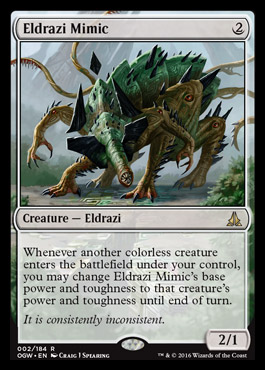
This actually may not be too far off. Thanks to the power level of the colorless Eldrazi decks in Modern, they can ramp out a 5/5 with trample, haste and psuedo-protection on the same turn one can drop a Tarmogoyf. We have seen the format warp around this archetype recently, though many expect it'll suffer from a banning in April (I'm in that camp too).
However, if it doesn't then a lot of players will likely put away their Tarmogoyfs and just play Eldrazi. If so, it makes sense that demand for the card drops as does the price. Since our price forecast is only about a 10% reduction in its current price this could easily occur with continual Eldrazi dominance.
Given we're already seeing this, the probability it will occur is nearly 100%---however the probability that WoTC does nothing is inversely low, maybe 10%-15%. I came up with these numbers based on the fact that it seems abundantly obvious from the player perspective that WoTC needs to act, but their past history with MTGO issues shows that they can be a bit slow at times.
I don't think this is one of those times, but thanks to that history I feel the likelihood is a little bit higher than, say, printing a better Tarmogoyf.
4. Reduction in interest in Modern
This one actually carries over from the last issue. With the current Eldrazi decks winning very quickly and consistently there are plenty of players who are hanging up their hat and awaiting a banning. I've heard of plenty of players (both pros and local) that are skipping Modern tournaments because they don't want to "join 'em" and they are having a difficult time "beating 'em."
Now WoTC will definitely take notice of this problem and if it persists it will likely be the reasoning behind any bans. However, if they are slow to react we could easily see Modern demand continue to drop until that time.
As stated above, I feel like we're already seeing this a bit. However, thanks to the preponderance of cards in the Eldrazi decks coming from the latest set, it's still reasonably cheap to assemble.
Again, I see WoTC's chances of doing something about the Eldrazi menace as 85-90% likely to happen, so inversely this is only a 10-15% likelihood. See the same logical reason as #3.
5. Powerful/efficient graveyard hate seeing a lot of additional play
Prior to Oath of the Gatewatch, a mono-black Eldrazi deck had already started to find a home in Modern. This deck had maindeck Relic of Progenitus and some had maindeck Nihil Spellbomb. If these types of cards start seeing a lot of play, poor Tarmogoyf looks awfully bad as a card choice.
This archetype has since morphed into the post-Oath Eldrazi decks we're now seeing, so these cards have been relegated back to the sideboard, but the archetype did exist and proved to be decent. I would expect a similar problem if Modern got a Helm of Obedience-style card to combo with Rest in Peace.
As a Legacy Miracles player, I can tell you, while maindeck Rest in Peace is sometimes a dead card it actually hoses a lot of strategies and cards (Snapcaster Mage, Tarmogoyf, Dredge decks, Reanimation decks, Nimble Mongoose, Deathrite Shaman, etc.). And it feels dirty when you do play against a deck that utilizes the yard and isn't expecting to get hosed game one.
The probability of this one is actually pretty even. There is enough graveyard synergy in Modern that playing maindeck hate isn't out of the question. I put this one at a 50/50 shot.
Final Tally
- 70%
- Eternal Masters rare - 60%, mythic - 40%
- Conspiracy 2 mythic-95%, rare-5%
- 5%-10%
- 10%-15%
- 10%-15%
- 50%
Now that I've set my forecasts (and the reasoning behind my decisions) I'll update them accordingly as I receive new information. While there is a logical method to forecasting, in the end it's important to understand that we have to make our forecasts without perfect information (otherwise it would be omnipotence and not forecasting).
I plan on turning this into a series of articles using the principles I learned from the book. Let me know what you think in the comments!
 Does the card fit into an existing Tier 1 strategy?
 Does the card matchup favorably against multiple existing Tier 1 strategies?
 Does the card matchup decisively against one existing Tier 1 strategy?
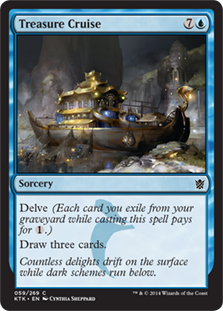 What about new cards that fundamentally alter the Modern landscape? I'm not talking Kalitas, Traitor of Ghet, which occupies a singleton Jund slot as a metagame-specific edge against Abzan Company and Arcbound Ravager. I'm talking Siege Rhinos and Thought-Knot Seers. In these outlying cases, are Tier 1 decks still important? Can't powerful new entrants disrupt the standing tiers and introduce new competitors? The answer to both questions is a resounding "Yes!" Even in the case of format-warping monsters, and even in the case of new decks, Tier 1 frequently carries most of its listings from one month to the next and is always the best place to start the evaluation process.
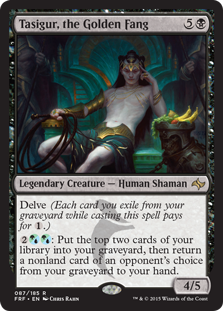 In the case where Treasure Cruise 2.0 sails through development into Modern, the upstart Cruise-powered strategies are still building from the old guard. Fall 2014 saw Cruise slot into Burn, an existing Tier 1 strategy, and URx Delver, an existing Tier 2 player. Kolaghan's Command and Tasigur, the Golden Fang of early 2015 outright created a Grixis Control/Midrange strategy where none had previously existed in any serious competitive sense (sorry, Cruel Ultimatum proponents). Even so, this new Grixis deck still arose out of the context of other Tier 1 strategies that had been around for months. In the case of Cruise, the new cards empowered old, top-tier decks. In the case of Grixis staples, the new cards allowed a new strategy to excel as part of a preexisting context. We even see this today in Modern's most warped moment, where Tier 0 Eldrazi still share chart placement with Tier 1 mainstays Jund, Affinity, Burn, and others.
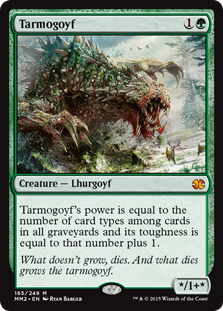 At its most basic level, Modern is a turn four format with a fundamental turn closer to 3.5. This is a Tarmogoyf format where two mana on a creature better get you a 4/5 beatstick or a 2/2 Goblin that wins the game for you if you can untap. This is a Lightning Bolt format where losing a Wild Nacatl at parity isn't the end of the world, but losing your turn three Glissa, the Traitor to a one-mana spell is fatal. In all these examples and countless unmentioned others, some combination of cards, decks, and precedent determines if cards are appropriately-priced relative to their casting costs. Ultimately, it's a relatively elementary calculation: better cards have more powerful effects at cheaper cost.
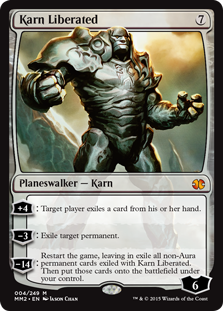 Complicating this picture, we've probably heard all the Modern tales about certain cards being unplayable over certain mana costs. Yes, cost alone is important, but without also considering our first questions of context, cost loses real-world meaning. An excellent example of this is Drowner of Hope, which is unplayable Limited fodder in a climate where Eldrazi Temple and Eye of Ugin don't exist to accelerate it out far ahead of its six-mana cost. Another example is Timmytastic Karn Liberated, which falls well outside the conventional playability range for most decks, except for the one Urza's Tower-powered deck where it shines. That said, no amount of favorable context will make some cards playable: poor six-mana Chandra, Flamecaller is bad in Modern no matter how you spin her.
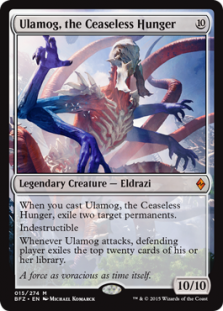 As an illustration of these dangers, Ulamog, the Ceaseless Hunger costs 10 mana, which is clearly unplayable in the average Modern deck and initially appears unplayable even in RG Tron, where Wurmcoil Engine and Karn are dropping on turn 3-4 at six and seven mana respectively. But in the context of the Tron engine, its cantrips, and its tutors, 10 mana is more than attainable on turn five and within reach as early a turn four. Add Ulamog's double Vindicate interaction even if it gets countered (and its virtual Remand immunity), and the card easily becomes a strategy-defining staple. This evaluation, as with many others, starts first in context before moving to cost, and is just one example of why I prefer this order.
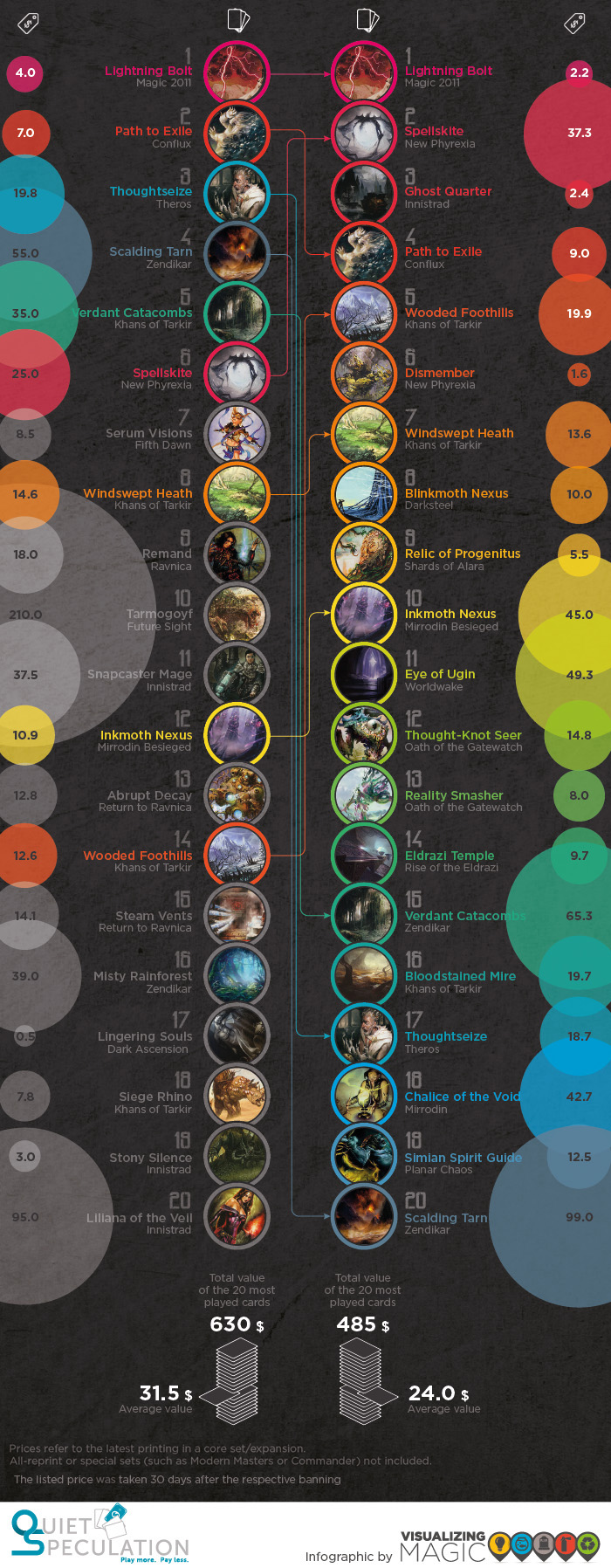

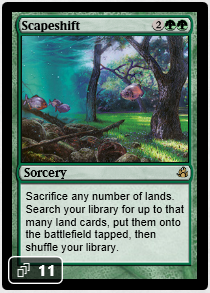
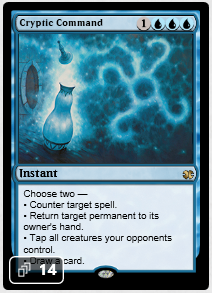
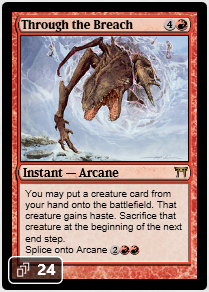
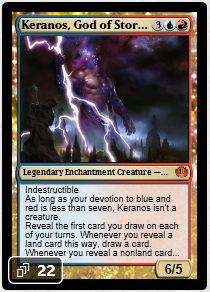
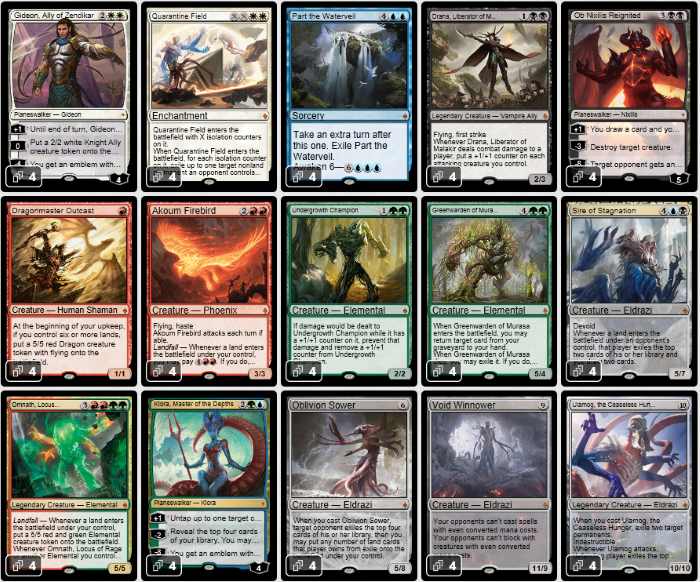
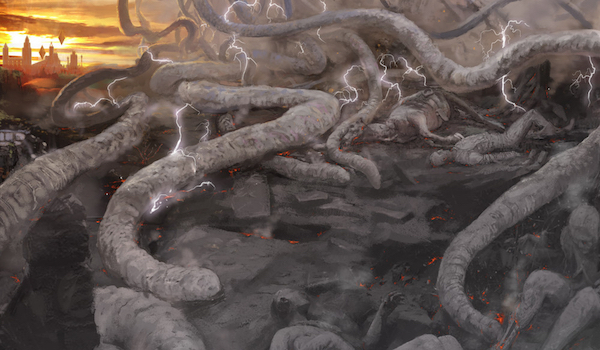
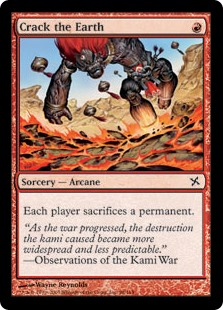 whose presence indicates a deep imbalance in the format. I
 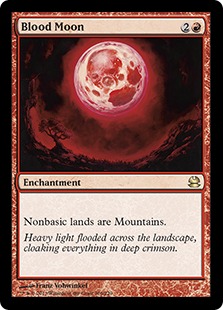 The resources necessary to cast turn one Blood Moon left me too down on cards to chase the lock piece with game-winning cards like Huntmaster. We did another six games without sideboarding, and I resolved not to slam my Moons on turn one. The new numbers:
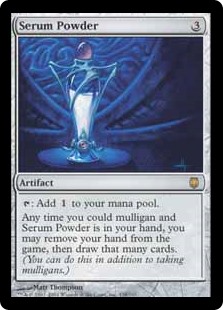 Powder Moon is basically pre-borded against the colorless menace, so if all we can manage is to tie things up, I don't think these results even warrant any sideboarded games. If this hate-filled deck had any real promise, it would at least boast a 60% win rate against its supposed prey.
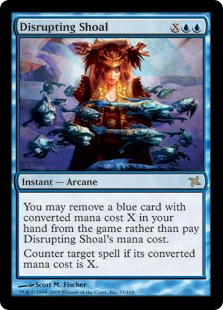 Achieving great speed generally comes at the cost of card disadvantage. In Temur Delver, Disrupting Shoal chews through our hand so we can create a board state so favorable that a single Mana Leak (read: Time Walk) brings the game home. In ritual-based builds of GRx Moon, Simian Spirit Guide and Desperate Ritual allow us to trade one card for one mana, enabling us to resolve Blood Moon a crucial turn earlier.
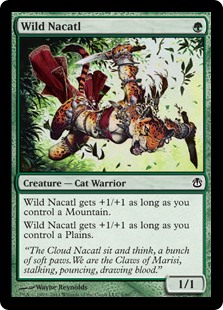 Against a deck as fast as Affinity, most decks opt to take the control role. Eldrazi has an early game that’s just as explosive, rendering a beatdown plan unattractive; nobody wants to cast Goblin Guide and Wild Nacatl when opponents can match these threats with Thought-Knot Seer and Reality Smasher. But taking a control role against Eldrazi proves just as dangerous, since the tutoring power of Eye of Ugin gives the deck a late-game as solid as Tron’s. Should you run Eldrazi out of gas, the Eye threatens to take the whole game back unless you can now kill them right away. Additionally
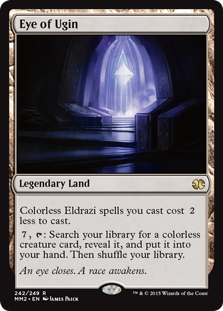 On turns 4-7, the threats come down to pressure an immobilized Eldrazi player. Even without considering that Eye of Ugin becomes active in a couple turns, this plan doesn’t really work. The reason: threats that come down for 2-5 mana can’t really tangle with cards like Reality Smasher, which opponents can topdeck at any time. 4/5 Goyfs, Batterskull tokens, Tasigurs, and Siege Rhinos are immediately outclassed, presenting nasty new roadblocks in the three-turn window players have to beat Eldrazi. Not that it would actually predate Eldrazi, but only Splinter Twin has a reasonable way to kill opponents in that tiny window.