
Are you a Quiet Speculation member?
If not, now is a perfect time to join up! Our powerful tools, breaking-news analysis, and exclusive Discord channel will make sure you stay up to date and ahead of the curve.
I've said as much in other articles but I'll reiterate here--you can't predict the future. Even professional investors fail to do so on any consistent basis; the classic experiments that pit pro stock traders against random decisions demonstrate this quite readily.
So if the millionaires on Wall Street can't predict the future, how could you possibly expect to do so?
It all started with Ezuri, Renegade Leader. I bought about 100 of them, many many years ago, under the assumption they were "cheap" and "should be good some day." Boy, was I ever wrong (or so I had thought for those many years).
For years they languished on my account, forgotten to time and tale. But one day I saw something that shocked me; Ezuri had spiked hard as a result of an Elves deck performing well in Modern.
Suddenly, my $1 worth of junk rares was worth close to $100. I hadn't been that excited since I bought a Bazaar of Baghdad with Bitcoins!
Turning trash into treasure felt amazing, and it rekindled my interest in Magic Online. When I realized that a dollar spent three or four years ago had basically kick-started my MTGO account again, I was hooked. What looked like a failure (albeit a really cheap one) for years had turned into a comparatively huge payout overnight.
Getting Beyond "Right" and "Wrong"
There are plenty of other bulk rares I hold on the account, which are still sitting around gathering digital dust. If you looked at the number of cards purchased compared to the number of cards sold for a profit, you'd say I was "wrong."
Let's say I bought 100 copies of 20 different cards. Considering only 100 of those ended up profitable, you'd say I was 95% wrong. I'll take 95% wrong all day, and I'll explain why in a moment.
You don't need to predict the future to make some money and keep Magic affordable. You just need to be right sometimes.
The key here is that "predicting the future" is too specific. If I say, "Card X will be worth $Y more in Z months," I am either right or wrong. That's called a binary outcome. It's either A or B, 1 or 0.
The issue with a binary outcome is that you don't get bonus points for being correct about the precise magnitude of change. Nor are you getting any extra credit for being spot-on with the timing. The framework above is far too rigid. You want to be able to profit from any positive change, not exactly $Y. You want to be able to say "eventually" rather than "in three months."
The real issue is that you have no actual idea which direction the price will move, let alone the magnitude. Trying to pin down the vector (up or down) and the velocity (by how much) is a losing proposition when you try to do it with a single card. There are too many variables at work for anything more than a loosely-educated guess about the outcome.
If you're right, you're lucky. If you're wrong, you're unlucky. And last I checked, Magic is not a game of pure luck; neither playing nor trading should be considered as such a game, especially when money's on the line.
Buying a Basket
The upshot of all this is we want to avoid individual stock picks, because they amount to nothing more than gambling.
Since this particular article is focused on MTGO, I will leave paper cards out of the discussion. The economics at work don't apply offline in quite the same way (though some of the core concepts are certainly applicable).
We want to embrace the fickle nature of the MTGO market, not fight against it. We can do this by buying a large batch of similar cards at once, something our other analysts have called a "basket." The idea is that you're not certain which assets in your basket will gain or lose, but you believe that some of them will gain enough to cover the whole portfolio. I'll elaborate on this shortly.
Lately there have been a few awesome Insider articles talking about using redeemable full sets to assemble a basket and deploy large amounts of capital in a few small transactions. This is a similar concept, but it requires significant capital; redeemable sets can cost anywhere between 50 and 150 tix, so getting broad exposure on a budget can be difficult.
My primary investments in Magic are on paper, but since I started living a life of full-time travel, I decided to make MTGO a secondary project. It's appealing due to the ease of transactions and lack of physical inventory.
I decided to use the 100 tix I got from cashing out my Ezuri position to kick-start a new project. With my strategy, 100 tix was a lot of capital, so it gave me ample time and space to test many hypotheses.
The Method
In a nutshell, my strategy revolves around buying a selective basket of bulk-rate rares with the hope that one or more of them rises to relevance. This works for a number of reasons, each of which represents an optimization that gives you further leverage on your positions.
Selective Broad Exposure
This is a necessity of any basket strategy. You want to expose yourself to gains in multiple "sectors" (i.e. formats), like Modern, Standard, and even Pauper (where old commons act like rares).
The key to my strategy is never buying into "known dead money." This happens when you buy a complete redeemable set--you get all the Trained Orgg-caliber cards that will literally always be worthless.
With my strategy, you only buy assets you believe have intrinsic value not represented in their current (bulk) status. Review your options, discard obvious junk, and pick the best 20 or so cards you can afford with your micro-tix budget.
One note about choosing a quantity: I initially started with 100 copies of each card, but I found selling that many at once difficult, especially without moving the market at least temporarily. I have revised my strategy to only buy about half that many.
40 or 50 should still give me plenty of leverage, but I suspect I will also be leaving some money on the table.
Optionality & Minimizing Costs
Defined by Nassim Nicholas Talem,
“Optionality is the property of asymmetric upside (preferably unlimited) with correspondingly limited downside (preferably tiny).”
In our case, we are working with optionality because bulk rares are effectively at the floor; 0.01 tix is the bare minimum for most rares, as there seem to be plenty of bots that will buy any rare at that rate. Thus, you only stand to lose the tiny amount you invest above that bulk rate.
This allows us to "overpay" when necessary, going for cards at 0.05 or so, which is venturing dangerously into "predicting the future" territory! Basically, you're wagering that these cards will never get substantially cheaper, and that there's a non-zero chance of them being successful.
The nature of success makes all the difference here. A card can rise from bulk status to relevancy with a single tournament performance (even a sub-par one), and the rate of gains is fairly predictable.
Depending on a number of fungible factors, they tend to gain in multiples of 0.25. I believe this number derives from the fact that it represents a playset of cards (the largest quantity that brings gameplay utility) for the lowest indivisible unit of liquid currency on MTGO (1 tix). More often I see the card reach 0.50, and occasionally it pushes even higher.
It should be obvious that these gains are crazy high percentage-wise. Enumerating them in percentage is useless; I think about them in terms of raw dollar gains. This way I can compare the profit of the position to the overall portfolio cost without complicated math.
Let's do a simple case study to show why this works. Take a set of bulk rares chosen with selective broad exposure. I'll give some specific examples later, but let's just work with a set of 20 bulk rares across Standard and Modern.
Assume we purchase these rares at an average cost of 0.01 tix each, something that's common and reasonable. Let's pick 100 of each, to make the math easy. We will discuss the logistics of selling 100 bulk rares (and why 100 may be too many) in a moment.
The above works out to a cost of 20 tix for 2000 cards, all rares. Now we're dealing with a large number of cards and a relatively small number of tix. For the price of a playset of a Standard staple, I have exposure to 20 cards at a multiple of 100x. That's awesome in terms of optionality.
Why? Because remember what can happen to rares that break out; they go from 0.01 to 0.50 tix. That leaves you with a profit of $49 ( (0.50 * 100) - (0.01 * 100) ). That's more than double the initial investment, and we still have 95% of the positions open.
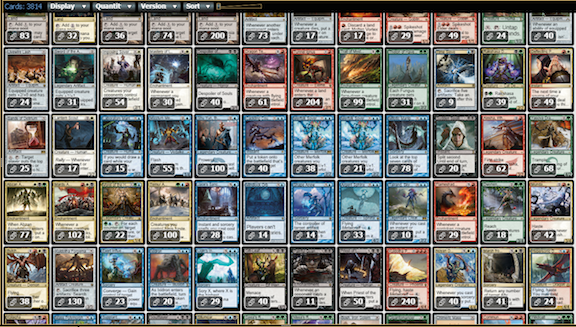
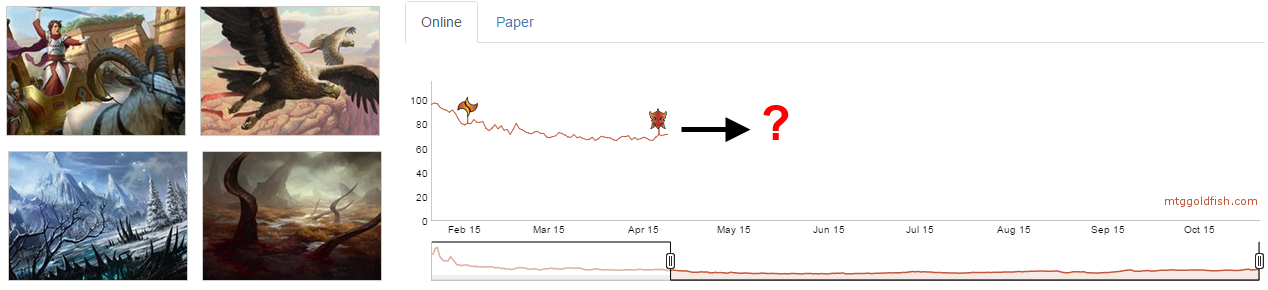
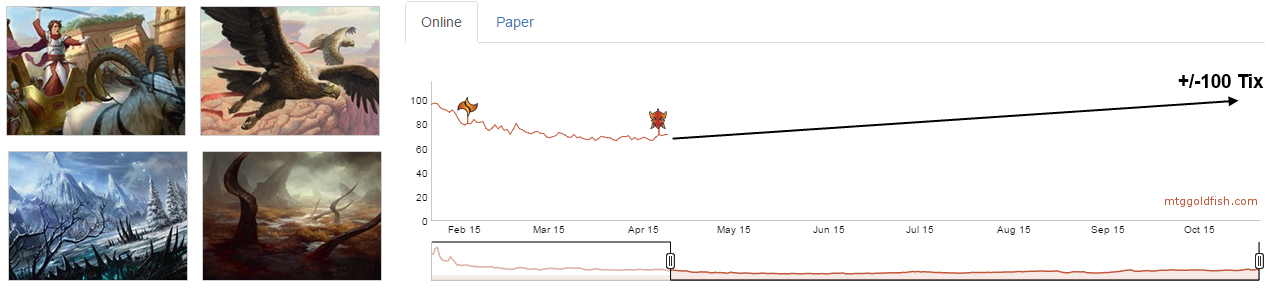
This isn't just theorycraft--it bears out in real life. Here is an example of a handful of cards that were successful bulk picks over the last year.
Each of these was cashed out, approximately, at the 0.50 tier. Some were lower, some were higher. Looking at my MTGO account today, I own 3650 rares in quantites of 20 or more. That ratio works out well if you assume a cost of 0.01 per card. In fact, it works out profitably at costs up to 0.05 per card!
Dead Money & Remainder Credit
Most MTGO accounts have store credit with a few bots, the remainders of past transactions in which fractional tix cannot be given. I make a point to keep track of my credit so I can deploy it usefully. You can usually generate a meaningful position using only credit, but you should take the time to deploy some tix as well so that you get a properly sized portfolio.
Bulk rare buying is about the only way to make use of this remainder credit, so I consider it free money.
Of course, I always try to extract tix before keeping credit, but when you have no other choice, you might as well buy some cheap options! This is yet one more way to extract leverage from an already multiple-rich strategy.
Taking Profits & Reinvesting Gains
Take profits aggressively. MTGO moves fast; you must be ready to close out the position in its entirety at any time.
My targets are 0.25 and 0.50 in most cases, as cards that jump tend to stabilize around those prices and you can cash out a non-fractional number of tix. The key here is not to be greedy. If you get a 25x or 50x return, don't worry about "future upside." Just take your profits and reinvest!
As for what to reinvest in, the issue is you can only deploy so much capital chasing after bulk rares. As described above, you can only deploy about 20-30 tix at a time. The key is what you do with your profits.
Of course, feel free to invest those profits into cards you plan to play. There's no better goal than free-rolling your MTGO play.
If you want to reinvest for pure profit, I suggest buying redeemable sets. As I've said, this isn't feasible with a micro-bankroll, but once you've flipped a few of these bulk positions for 50 tix, you have the capital to start looking at full sets.
Other authors have covered the nuances of redeemables, so I will leave it to them to explain. I will simply say that, timed correctly, redeemable sets are generally profitable and follow predictable cycles.
Booster packs (another topic our authors have covered) are a similarly predictable asset, but they lack the game play utility of complete sets. Sets also give you the opportunity to short-sell, yet another way to add leverage to your portfolio strategy.
My Current Picks
I'll end the theory section here, and show you what a basket of bulk rares looks like. This is a sample of my current portfolio, representative of what I believe are the most promising positions. Not all of these are 0.01, but most are under 0.05 at the time of writing (my max for bulk rares).
 the format in this update, that's an unusual degree of linearity in both Modern's best decks and the format more generally. To some extent, Modern has always been characterized by these aggressive, linear strategies, but we haven't seen quite this many since February, following PT Fate Reforged. We also haven't seen so many linear decks increase their individual shares in a single update: with the exception of Affinity, every single linear deck increased its prevalence from September to October. It's telling that the collective increase among non-Affinity linear decks, +2.4%, actually exceeds Affinity's own decrease of -1.7%. Some of the +2.4% undoubtedly originates among Affinity pilots who swapped decks to beat the hate. The rest? Those players are coming from far and wide to switch into the linear role: everyone wants to the aggressor in today's Modern.
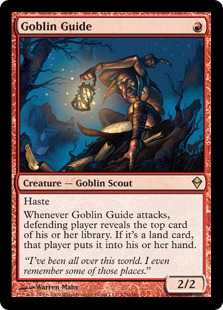 Linear decks dominated at GP Porto Alegre and SCG Dallas, although there were enough other midrange and control successes to suggest the format isn't all Goblin Guide swings. This has huge implications going into November. Looking at the six biggest linear players, it's hard to find hate cards that effectively address all their attack angles while still leaving you room for other matchups. Between artifact hate for Affinity, life-gain for Burn, two different kinds of mana-hate for Tron and Bloom, and varied removal (spot and sweeper) for Infect and Merfolk, what are you supposed to do against other decks in Modern? Many players have complained about this before, but this is the first metagame update where the data really supports the (often hyperbolic) pessimism.
  So far, I've been more measured (even uncertain) about Modern's health in this article than in previous updates. Jund, to the rescue! Ever since Modern parted ways with Deathrite Shaman, BGx decks have been a healthy and necessary policing force in Modern. That's never been truer than in October. Despite all the Bolts, Blooms, Blasts, and Become Immenses, Jund still managed to be the second most-played deck in Modern, actually increasing its metagame share from September to October. This suggests that Jund is not just alive and well in Modern, but also that Jund is thriving and ready to fill its role as format policeman.
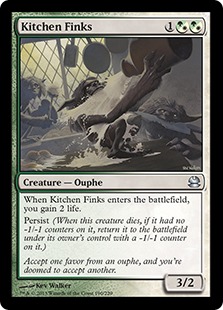 individually. In the maindeck alone, we could see Jund lists with Huntmaster of the Fells and/or Kitchen Finks, on top of the brutal removal suite of Bolt, Terminate, and Decay. Looking to the board, Jund gets artifact destruction in Ancient Grudge, lifegain in Feed the Clan, and creature hate in Night of Souls' Betrayal and Anger of the Gods. Yes, all of this might necessitate a shift away from traditional Jund powerhouses like Dark Confidant and Liliana of the Veil, or at least trimming their numbers. But that's okay! Jund is at its best when adapting to new threats, and October's metagame data already shows that in action.
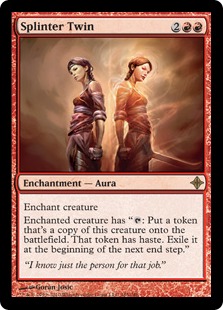 I've tracked Twin's decline since August, and I'm both excited and completely unsurprised to see these decks return today. With the exception of Merfolk, the linear tier 1 decks struggle in the Twin matchup, and it was about time Twin returned to exploit this. That's especially true of Affinity which remains the most-played linear deck in Modern. With BGx decks shifting to more anti-aggro options, away from the combo-busting power of Thoughtseize and the card advantage of Bob, Twin becomes even better. I never thought I'd see the day where I lamented Twin's absence, but seeing the format without Twin has changed my tune: welcome back, Deceiver Exarch overlords.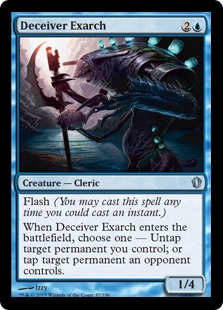
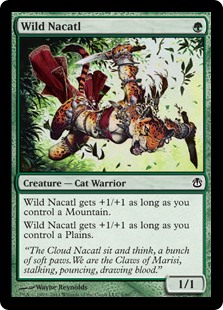 no-Company Zoo decks and more Burn-oriented blitz builds. These aren't showing up in the tierings because the majority of their finishes are in the skewed MTGO dataset, so we'll need to allow more time to see if they can fit into the rest of the metagame. This also doesn't include the Burn decks that are running Wild Nacatl in their main 60: those are still Burn decks, even if they borrow Zoo's workhorse (workcat?). As we go into November, you need to be prepared to handle these ultra-aggressive, creature-oriented strategies. Although they don't yet have the metagame shares to hit tier 1, they are definitely pre-trending in that direction, and I wouldn't be surprised if they get there by December 1st. Pack sweepers, lifegain, and plenty of removal that kills things at parity or better.
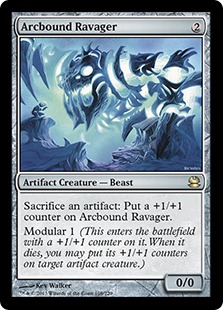
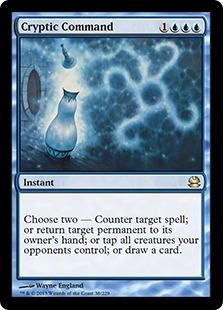 Cryptic Command is a great card in certain metagames and a wretched one in others. You know what isn't going to save you against the stream of turn 3-4 decks in Modern? A four-mana, cantripping counterspell. This is the problem decks like Scapeshift, Grixis Control, and UW Control all find themselves in, struggling to adapt to linear metagames with tools more suited to fair/midrange ones. We are already seeing Grixis mages make the shift to a more midrangey build with Liliana and Inquisition instead of the more traditional countermagic lineup. UW Control hasn't quite made the transition yet, even if Scapeshift is already experimenting with Bring to Light as a way to bring more firepower to their linear matchups. We should see these decks make changes by November, but it remains to be seen whether those changes will be enough.
 Back when I made this prediction, I couldn't imagine a Modern where players blithely allowed Affinity to enjoy an 11% metagame share while Twin floundered at 2%-4%. The community agreed and struck back with a vengeance, propelling Twin back into tier 1 off a +1.1% increase from September to October. Grixis Twin followed UR Twin's return to glory, but its own increase (+.1%) was far less meaningful than UR Twin's massive jump. Extending last months' prediction into November, both Twin decks should be able to maintain these shares through next month, with the potential for a UR Twin or Temur Twin increase depending on other factors. Grixis Twin, with a more painful manabase and inefficient removal, is unlikely to get much better in a metagame clogged with linear decks that can blast through a cute Snapcaster/Kolaghan's interaction.
 This is technically two predictions in one, but they are related enough that I'm comfortable discussing them together. The premise of this prediction is that linear decks will decline. The question is, which ones? Affinity and Burn are Modern mainstays that are unlikely to ever leave tier 1, even if their shares ebb and flow by a few percentage points from month to month. What about RG Tron? A natural Jund predator, this deck is unlikely to go anywhere, especially if BGx remains the format policeman that I hope it will. As for Merfolk, with Twin back we aren't likely to see Merfolk decline any time soon. This means the linear downshift needs to happen among the weirder, outlying decks like Amulet Bloom and Infect. Both of these decks struggle against Twin, so the Twin uptick should have the biggest impact on these two strategies. By a similar token, we shouldn't see Zoo's share drive the deck into tier 1, at least if Twin and Jund are doing their jobs.



![Insider: [MTGO] Short Selling, Part 1 – Full Set Speculation](https://www.quietspeculation.com/wp-content/uploads/2014/01/IMG_7555.jpg)




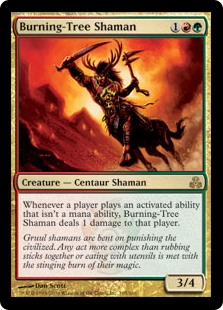 Wrisley captures my heart not with Hellrider (which, if you can't tell yet, I hate), but with Burning-Tree Shaman and Eidolon of the Great Revel, both pet cards of mine. Shaman resists Bolt, prevents Twin from going off, and does a number on activated ability decks like Affinity over the course of a game. It even punishes players for fetching. Eidolon is sorely unexplored in non-Burn aggro decks, best following an aggressive one-drop like Wild Nacatl. Granted, Wrisley doesn't have any aggressive one-drops, so I'll keep scratching my head at this beautiful mess. (What does Phyrexian Metamorph even copy? I feel like I'm taking crazy pills!) For now, let's be happy Wrisley drew his Bonfires when he did. Eccentric decks like Rob Wrisley's R/G Aggro turn limiting conceptions about Modern on their heads, hopefully encouraging would-be brewers to try their hand at something unique.

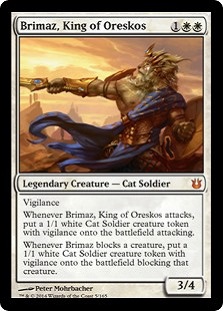 Why does Loxodon Smiter see play, while Brimaz, King of Oreskos does not? Why isn’t Bloodghast the best creature in Magic? Is Jace, Vryn's Prodigy excellent in Modern, or terrible? While I’m sure we could argue both sides to each of these questions forever (as both sides have valid points), at their core the answers to these questions rely on a two-fold principle. First, every card in Magic exists in a perpetual state of context where its inherent value increases and decreases based on a myriad of environmental factors. Second, while outliers like archetype-specific hate-cards and combo pieces that ignore the normal rules of Magic also exist, what makes a card “playable” is, for the most part, the summation of its variable characteristics. I know that’s a mouthful, and I can see our editor David shaking his fists at me now, [Editor's Note: Of course I am!] so let’s break that down:
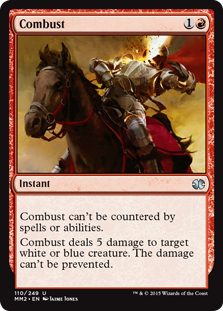 We all know the answer, but I doubt we’ve really stopped and broken it down before. Behold, the narrow argument: Combust only hits white and blue creatures with five toughness or less, while Terminate hits everything! The “counter” to this argument is that Terminate can in fact be countered, while Combust cannot. Disregarding everything we know about Modern, on the surface this seems like a pretty uneven comparison. Terminate hitting five colors of creatures while Combust hits only two more than makes up for the fact that Terminate can be countered and has a more restrictive mana cost. But, once we evaluate Context and see Splinter Twin as a tier 1 archetype in the metagame the picture becomes clearer. In fact, an uncounterable removal spell is probably the absolute best thing we could use to fight Splinter Twin, as their primary strategy revolves around protecting a blue creature with countermagic.
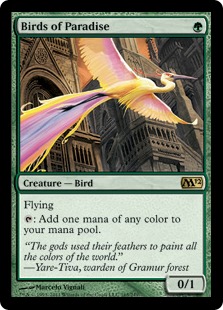 Oh, you never thought of Magic cards that way? Just remember that the Llanowar Elves have feelings too, and are tired of being compared to Birds of Paradise. Here we’re looking at the fundamental principles of Magic and how we can apply them to Magic cards. Lingering Souls nets us four creatures for five mana, while Spectral Procession offers us three for three. Which do you choose? We all know the answer, but again; the reasons tell us something. The ability to flashback for extra value later, its synergy with Liliana of the Veil, along with its resiliency against counterspells, all combine to make Lingering Souls the “better card” assuming we have access to black mana. But how do you compare Voice of Resurgence to Qasali Pridemage? Or Ancient Stirrings to Peer Through Depths? How do we evaluate cards that don’t have direct comparisons, like Shriekmaw or Slaughter Pact or Domri Rade? If only there was a baseline we could use for reference…
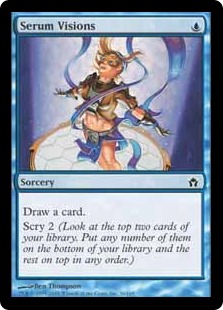 Lightning Bolt is the baseline for removal/burn in red because it has the best rate compared to everything else. Should Lightning Bolt be banned, Pillar of Flame might become the best red one drop Burn spell of choice, similar to how Serum Visions is the “best of the rest” left in the wake of Ponder's and Preordain’s exodus. This is important, because every new card printed both affects and is affected by this principle. Were we to start seeing 4/4’s for G, or two damage + scry 2 for R we might see a paradigm shift, which would result in cascading changes further down the line. When evaluating new cards for Modern, or really just new cards for a deck, keep this list in mind, both as a reality check and a baseline for comparison.
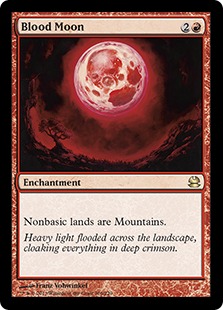 Easily the most significant pressure in the format after Stony Silence, Blood Moon actually isn’t seen that much, mainly because the mere threat of it is often enough to keep irrational manabases at home. Jund splashing Lingering Souls, Jeskai Control splashing black for good cards, even Four/Five Color Gifts decks (like the one I played in
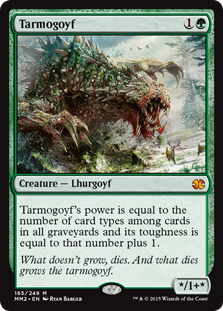
 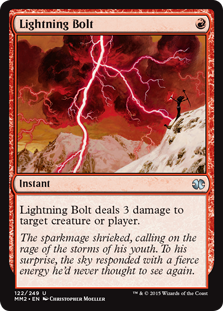 full card, Tarmogoyf is just bigger. The cards that do die to it are “worth it”. Dark Confidant, Jace, Vryn's Prodigy, Ezuri, Renegade Leader. Strategies like Merfolk/Mono White know they can't play around it, so they just flood the board and fight Bolt through sheer numbers or Kira, Great Glass-Spinner and Restoration Angel. The give and take that comes from Lightning Bolt being “the best” can have a few interesting effects. For one, Lightning Bolt forces decks to either work to dodge it by moving up the curve, or moving far enough down the curve that everything does to it but one-for-one damage based removal isn’t enough (Burn/Infect/Affinity). Two, if everyone is relying on Lightning Bolt, then that can be exploited. Kor Firewalker, Deceiver Exarch, and Tasigur, the Golden Fang all punish an opponent relying on Lightning Bolt to trade.