menu

Brewing R/W Kiki Control

Are you a Quiet Speculation member?

If not, now is a perfect time to join up! Our powerful tools, breaking-news analysis, and exclusive Discord channel will make sure you stay up to date and ahead of the curve.

kiki control jiki

R/W Control is a rogue archetype in Modern that probably hasn't been explored nearly as much as it should. The basic idea behind the deck is to include removal and wrath like Jeskai Control, but eschew counter magic for lock pieces and/or hate cards, which is highly enjoyable for people like me that love the tap-out style of control.

While it is a semi-flexible archetype with many different varieties, the two I believe to be the most successful are the Restoration Angel/Kiki-Jiki, Mirror Breaker combo package version, which includes control spells and digging, and the prison version, which does it best with Ensnaring Bridge and Leyline of Sanctity, among other cards, to prevent the opponent from doing anything while you kill them with win cons like Ajani Vengeant and Assemble the Legion. Both are very effective and fun if built properly.

Today I'll be exploring the Resto/Kiki combo version; I'll be sure to explore the prison version in the future.

[wp_ad_camp_1]


The Staples, The Hate, The Combo

Off the bat, we know we want three staples of red and white: Lightning Bolt, Path to Exile, and Lightning Helix. Bolt is a no-brainer because it's hyper-efficient, versatile, a much-needed 1-drop, and we have enough burn in the deck to consider it part of a viable backup plan. Path is also hyper-efficient removal that deals with problem cards like Wurmcoil Engine neatly. It is a non-bo with Ghostly Prison, which can be problematic at times, but I believe the upsides outweigh that downside. I do run 3 instead of 4, partly for this reason -- it is vaguely possible one of the cards should be replaced entirely, though. Finally, Helix is extremely good in a meta that's almost 20%, Burn, Affinity, and Merfolk.

Our mainboard hate pieces include Blood Moon, which is brutal in this meta, and Ghostly Prison, which does stupid amounts of work against the aforementioned aggro decks while making it impossible for Twin to combo off and giving Infect and Delver a hard time, too. Both can buy many turns needed to set up your combo or just beat down and throw burn spells to the face -- either way, you win.

Wall of Omens serves beautifully as a Bolt-proof anti-aggro card that also digs for your combo and synergizes with both pieces of it (many games I've blinked it with Resto or copied it with Kiki and out-valued the opponent); Magma Jet is great as removal or as part of a win con, and helps you work toward your combo.

Wall of Omens

Pyroclasm is one-dimensional, but like Bolt and Path, extremely efficient and relevant (there isn't really any Zoo going around, so no need for Anger of the Gods).

Then you have the aforementioned combo pieces (Resto is Bolt-proof, if you somehow missed that, by the way, which makes her even greater), and finally, a flex slot or two. It's important here to include some source of pseudo-card advantage (since red/white don't have any real card advantage outside of what we're already using). Typically it's Batterskull, Gideon Jura, or Isochron Scepter (Scepter is great game 1 but can be awful games 2 and 3). All are good; I personally prefer Gideon main because of its versatility and Batterskull side for more specific situations. Scepter I haven't really tried yet but will at some point.

The land base should be tuned around Blood Moon, and include Tectonic Edge to deal with manlands and such. Temple of Triumph needs to be in there to help out with red/white's card advantage issue, and to help us hit our combo.

Lastly, the sideboard should include hate cards (we are in white, after all), more Pyroclasm, and staples like Deflecting Palm and Wear / Tear.

The List

Pretty straightforward, right? With that, below is my tentative list. I've tested a previous version similar to this and was mostly pleased with it, but this specific version is technically still in the untuned pre-testing stage, so keep that in mind when evaluating.

R/W Kiki Control by Sean Ridgeley

Sorceries

2 Pyroclasm

Planeswalkers

1 Gideon Jura

Enchantments

4 Ghostly Prison
3 Blood Moon

Instants

3 Path to Exile
4 Lightning Bolt
4 Magma Jet
4 Lightning Helix

Creatures

4 Wall of Omens
4 Restoration Angel
2 Kiki-Jiki, MIrror Breaker

Lands

4 Arid Mesa
1 Marsh Flats
4 Mountain
7 Plains
2 Rugged Prairie
2 Sacred Foundry
2 Tectonic Edge
3 Temple of Triumph

Sideboard

2 Wear / Tear
1 Spellskite
1 Rest in Peace
2 Stony Silence
2 Pyroclasm
2 Deflecting Palm
4 Leyline of Sanctity
1 Batterskull

Why Run Kiki Control?

You're probably wondering why you shouldn't run Jeskai Control instead of this. There are several reasons Kiki Control could just be flat out better right now: it's proactive instead of reactive (the latter is generally bad in Modern, and this does seem to be a key reason behind Jeskai's lacking numbers), it lets you run Blood Moon (huge), and it takes less damage from the manabase (very relevant versus aggro).

Then there's the Twin / Blue Moon / Temur Moon problem. Our key advantages over those decks are better aggro matchups (Helix, Ghostly Prison, Wall of Omens, Gideon, Pyroclasm, etc make most of these matches stupid easy), and better hate cards (Stony Silence is often auto-win versus Affinity, Leyline is great versus Burn and Abzan, etc).

So, while our combo is slower and less consistent than Twin, and we don't have catch-all answers in counterspells that these decks do, we make up for it by being proactive, laughing at aggro, and hating on more decks, and hating on them harder. This isn't to say any R/W Control deck is better than any of these decks necessarily, just that the archetype gives them a run for their money. However, I would say that in an aggro heavy meta, this deck is definitely better.

Credits, Final Thoughts

To give credit where it's due, the origin of this deck is Viomonk on the MTGSalvation forums, who created it in March of 2014. Sadly, it's gotten little attention since then. I wanted to highlight it for the diamond in the rough it is and provide my own, current take on it, so here it is. Note that I don't run Ajani unlike him -- I tested it and found it unreliable and weak most of the time. I believe it's best suited to the prison version, where it can do all kinds of work, often unscathed, and synergizes better with the resource denial options.

For those who might be making the comparison to Shaun McLaren's old Jeskai Kiki-Control list, there are certainly similarities, although this version came first (about a month or two before, in fact).

As ever, give the list a spin yourself and let us know what you think. And for those of you hungry for video footage, I'll have that at a later date.

Tiny Tuesday: Milling with Sygg

Are you a Quiet Speculation member?

If not, now is a perfect time to join up! Our powerful tools, breaking-news analysis, and exclusive Discord channel will make sure you stay up to date and ahead of the curve.

As I mentioned in my piece on Sultai Poision, the 25 point starting life total in Tiny Leaders makes alternate win conditions attractive. In particular, a 49 card library makes milling sound like a very viable win condition. Fetchlands are popular, drawing cards is always popular, and if your opponent keeps a seven card hand then you're only looking at getting rid of 42 cards!

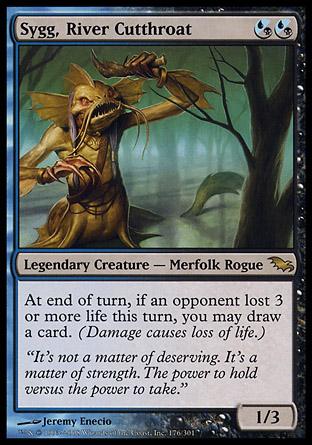
42 is still, obviously, higher than 25, but the cards that mill compare much more favorably in this ratio than they do when you compare 53 to 20. Ambassador Laquatus is the leader that you could select if you wanted something in your command zone that actively contributed to your plan, but considering that Glimpse the Unthinkable, a veritable two-mana Lava Axe, is only available in blue/black that seems to be where the smart money is at. Unless we want a third color (we probably don't), Sygg, River Cutthroat is our only option.

There was an error retrieving a chart for Sygg, River Cutthroat

Ultimately, the best deck is going to focus on efficiently milling with a few options as milling-mana-sinks. Glimpse the Unthinkable is great, Nephalia Drownyard is great, Sands of Delerium is slow. Here's where I landed on a list:

Tiny Sygg

creatures

1 Hedron Crab
1 Snapcaster Mage
1 Drowner Initiate

spells

1 Mesmeric Orb
1 Ashiok, Nightmare Weaver
1 Jace Beleren
1 Glimpse the Unthinkable
1 Increasing Confusion
1 Mind Funeral
1 Mind Grind
1 Mind Sculpt
1 Tome Scour
1 Memory Erosion
1 Grindclock
1 Dream Twist
1 Twincast
1 Brain Freeze
1 Brainstorm
1 Ponder
1 Preordain
1 Memory Sluice
1 Smother
1 Drown in Sorrow
1 Shriekhorn
1 Dimir Charm
1 Counterspell
1 Mana Leak
1 Far // Away
1 Lotus Petal

lands

1 Shelldock Isle
1 Creeping Tar Pit
1 Drowned Catacomb
1 Nephalia Drownyard
1 Oboro, Palace in the Clouds
1 Watery Grave
1 Underground Sea
1 Dimir Aqueduct
1 Polluted Delta
1 Scalding Tarn
1 Misty Rainforest
1 Flooded Strand
1 Bloodstained Mire
1 Verdant Catacombs
1 Marsh Flats
2 Island
2 Swamp

Having 25 life gives us a good amount of time to do nothing, but we do need to play a few cards that stop us from dying. Dimir Charm plays pretty well in Tiny Leaders, as it kills a very high percentage of the creatures. Countering a sorcery is reasonable value for two, and now and again you can use it to mill in your mill deck.

The card that probably looks most out of place here is Lotus Petal. In general, I think that Lotus Petal is awesome in a lot of Tiny Leaders decks. While you'll want more than three lands fairly often, it won't often matter that you have a ton of mana on a given turn. Lotus Petal allows you to do something like power out Ashiok, Nightmare Weaver a turn early, and is also a free way to power up Brain Freeze.

There was an error retrieving a chart for Lotus Petal

Some might consider not playing Duskmantle Guildmage and Mindcrank as a glaring omission, but I really dislike their inclusion. You already don't play many targets for removal, and Mindcrank doesn't really do anything in this deck on its own. Having a combo win is nice, but it's difficult to justify playing a combo with weak pieces in a deck that otherwise spends a lot of time casting cards that count as functional mulligans until you actually win the game.

Insider: Modern Masters 2015’s Effect on Prices

Are you a Quiet Speculation member?

If not, now is a perfect time to join up! Our powerful tools, breaking-news analysis, and exclusive Discord channel will make sure you stay up to date and ahead of the curve.

Welcome back, readers! The inspiration for this article was from the debate on what MM2015 is expected to do to prices. We still don't know a whole lot about MM2015 (except for a few of the cards that have been spoiled thus far and hearing from shop owners who are getting considerably more product this go around), but we can see how the original Modern Masters (MMA) affected overall card prices and make inferences from that data.

It's important to keep in mind that the modern playerbase has grown considerably since the original release of MMA. The original MMA set was released June 7, 2013. In order to try and isolate the price changes caused by the playerbase growth we'll actually look back in time at the price changes of the individual cards one month after the set's release (in theory when most of the new supply was already opened and near its maximum).

Another reason for picking a date close to the MMA release is that the Modern metagame is unlikely to have changed much in that time frame (and we all know that the a sudden shift in the metagame can cause a major spike in a card's value).

So here's the list of MMA mythics:

Mythics Price June 6th, 2013 Price July 7th, 2013 Price Change
Dark Confidant 59.97 71.99 20.04%
Elspeth, Knight Errant 24.97 22.99 -7.93%
Jugan, the Rising Star 2.97 2.49 -16.16%
Keiga, the Tide Star 5.97 4.98 -16.58%
Kiki-Jiki, Mirror Breaker 24.97 20.99 -15.94%
Kokusho, the Evening Star 17.97 12.02 -33.11%
Progenitus 15.97 12.71 -20.41%
Ryusei, the Falling Star 1.97 1.9 -3.55%
Sarkhan Vol 19.97 13.24 -33.70%
Sword of Fire and Ice 29.97 29.69 -0.93%
Sword of Light and Shadow 24.97 24.9 -0.28%
Tarmogoyf 109.97 144.19 31.12%
Vedalkan Shackles 14.97 12 -19.84%
Vendilion Clique 49.97 44.98 -9.99%
Yosei, the Morning Star 9.97 7.25 -27.28%


The average percentage price drop for the mythics of MM2013 was -10.3%.

Here's the list of MM Rares:

Rares Price June 6th, 2013 Price July 7th, 2013 Price Change
Academy Ruins 11.97 7.99 -33.25%
Adarkar Valkyrie 9.97 4.16 -58.27%
Aether Vial 14.97 10.98 -26.65%
Angels' Grace 2.47 1.49 -39.68%
Arcbound Ravager 19.97 16.6 -16.88%
Auriok Salvagers 0.97 0.59 -39.18%
Blinkmoth Nexus 14.97 9.69 -35.27%
Blood Moon 9.97 7.21 -27.68%
Bridge from Below 11.97 7 -41.52%
Chalice of the Void 7.97 6.6 -17.19%
City of Brass 7.97 4.98 -37.52%
Cold-Eyed Selkie 3.97 1.99 -49.87%
Countryside Crusher 1.47 1.38 -6.12%
Cryptic Command 29.97 24.65 -17.75%
Death Cloud 1.97 1.16 -41.12%
Demigod of Revenge 5.97 3.49 -41.54%
Divinity of Pride 7.97 4.46 -44.04%
Doubling Season 29.97 18.99 -36.64%
Dragonstorm 2.97 1.45 -51.18%
Earwig Squad 0.97 0.65 -32.99%
Engineered Explosives 14.97 9.2 -38.54%
Ethersworn Canonist 7.97 4.33 -45.67%
Extirpate 4.97 3.99 -19.72%
Figure of Destiny 5.97 3.53 -40.87%
Gifts Ungiven 9.97 6.45 -35.31%
Glen Elendra Archmage 14.97 7.49 -49.97%
Glimmervoid 14.97 9.69 -35.27%
Grand Arbiter Augustin IV 9.97 4.82 -51.65%
Greater Gargadon 1.97 1.07 -45.69%
Jhoira of the Ghitu 5.97 2.69 -54.94%
Kataki, War's Wage 7.97 4 -49.81%
Kira, Great Glass-Spinner 14.97 7.29 -51.30%
Knight of the Reliquary 7.96 5.99 -24.75%
Life from the Loam 4.97 3.73 -24.95%
Lotus Bloom 7.97 5.44 -31.74%
Maelstrom Pulse 11.97 8.79 -26.57%
Meloku, the Clouded Mirror 1.47 1.27 -13.61%
Molten Disaster 0.97 0.53 -45.36%
Oona, Queen of the Fae 4.97 2.51 -49.50%
Pact of Negation 14.97 9.99 -33.27%
Pyromancer's Swath 1.47 0.92 -37.41%
Reveillark 4.97 3.75 -24.55%
Rude Awakening 0.97 0.53 -45.36%
Scion of Oona 4.97 2.42 -51.31%
Skeletal Vampire 0.97 0.62 -36.08%
Slaughter Pact 2.95 1.99 -32.54%
Squee, Goblin Nabob 3.97 1.99 -49.87%
Stonehewer Giant 4.97 2.88 -42.05%
Summoner's Pact 14.97 8.08 -46.03%
Tombstalker 5.97 3.01 -49.58%
Tooth and Nail 11.97 7.97 -33.42%
Verdeloth, the Ancient 0.97 0.66 -31.96%


The average percentage drop for the rares in MM2013 was -37.37%. That's a pretty massive drop in average value. In fact with the exception of two cards (the most expensive mythics in the set at its release) all the cards dropped in value within the first month of the set's release.

GP Vegas occurred on June 23rd (in between our dates), during which the major retailers were buying both Tarmogoyf and Dark Confidant at retail prices (and building up a major stockpile of those two staples). This likely played a major role in their price jump after release.

One could argue that dropping the low-dollar cards skews the data (after all when a $1 card drops to $0.5, nobody really cares or notices but that accounts for a 50% drop). So if we filter out every card that was under $5, we get something that looks like this.

Tarmogoyf 109.97 144.19 31.12%
Dark Confidant 59.97 71.99 20.04%
Vendilion Clique 49.97 44.98 -9.99%
Sword of Fire and Ice 29.97 29.69 -0.93%
Cryptic Command 29.97 24.65 -17.75%
Doubling Season 29.97 18.99 -36.64%
Elspeth, Knight Errant 24.97 22.99 -7.93%
Kiki-Jiki, Mirror Breaker 24.97 20.99 -15.94%
Sword of Light and Shadow 24.97 24.9 -0.28%
Sarkhan Vol 19.97 13.24 -33.70%
Arcbound Ravager 19.97 16.6 -16.88%
Kokusho, the Evening Star 17.97 12.02 -33.11%
Progenitus 15.97 12.71 -20.41%
Vedalkan Shackles 14.97 12 -19.84%
Aether Vial 14.97 10.98 -26.65%
Blinkmoth Nexus 14.97 9.69 -35.27%
Engineered Explosives 14.97 9.2 -38.54%
Glen Elendra Archmage 14.97 7.49 -49.97%
Glimmervoid 14.97 9.69 -35.27%
Kira, Great Glass-Spinner 14.97 7.29 -51.30%
Pact of Negation 14.97 9.99 -33.27%
Summoner's Pact 14.97 8.08 -46.03%
Academy Ruins 11.97 7.99 -33.25%
Bridge from Below 11.97 7 -41.52%
Maelstrom Pulse 11.97 8.79 -26.57%
Tooth and Nail 11.97 7.97 -33.42%
Yosei, the Morning Star 9.97 7.25 -27.28%
Adarkar Valkyrie 9.97 4.16 -58.27%
Blood Moon 9.97 7.21 -27.68%
Gifts Ungiven 9.97 6.45 -35.31%
Grand Arbiter Augustin IV 9.97 4.82 -51.65%
Chalice of the Void 7.97 6.6 -17.19%
City of Brass 7.97 4.98 -37.52%
Divinity of Pride 7.97 4.46 -44.04%
Ethersworn Canonist 7.97 4.33 -45.67%
Kataki, War's Wage 7.97 4 -49.81%
Lotus Bloom 7.97 5.44 -31.74%
Knight of the Reliquary 7.96 5.99 -24.75%
Keiga, the Tide Star 5.97 4.98 -16.58%
Demigod of Revenge 5.97 3.49 -41.54%
Figure of Destiny 5.97 3.53 -40.87%
Jhoira of the Ghitu 5.97 2.69 -54.94%
Tombstalker 5.97 3.01 -49.58%


We still see an average of -29.48% drop in average price. So this means that while the more expensive cards (as a whole) tended to drop less than the average, they still dropped considerably.

Interpreting the Data

What can we glean from this information? First of all, it seems really dumb to pre-order any MM2015 cards, since the probability that they drop in value after the first month is likely 97% (or higher), assuming similar trends with MM2015.

Wouldn't it be awesome if we could figure out what price to expect MM2015 cards to hit?

We can create a weighted function to apply to existing card prices (once they are spoiled), though this function will rely on some assumptions (which I can't 100% verify) and it neglects shifts in the metagame since MM2013 (so use it at your own risk). Instead use this when considering what prices to expect from the reprinted cards in more general terms.

Assumptions

  • G = Player growth since 2013 (29% [2013 year playerbase growth] + 6% [2014 active player growth] + 2% [2015 growth unknown, but likely similar to 2015 pace]) = 37% total player growth. This helps account for the fact that there are in fact more MTG players now than in 2013. (Data taken from this thread created by QS's own Shor which pulls numbers directly from WoTC's earnings calls.)
  • To be as conservative as possible we'll assume Modern playerbase growth mirrors that of total playerbase growth (it is likely not, but because we don't know how many existing players jumped onto the Modern bandwagon vs. how many new players only play Standard it's what we'll work with).
  • P = Modern Masters 2015 print run is 2.66x larger than MM2013 (QS's own Brett Schmuckler is a store owner and was kind enough to share his allotment comparison (27 boxes of MM2013 compared to 72 boxes of MM2015). This helps account for the fact that this MMA print run is considerably larger so each rare/mythic will be printed almost 3x more than those in MM2013.

So, the function is:

Weighted Card Price = Card Price * (1 + G) * (1 / P), which equates to about a 49% drop in price (which is noticeably higher than the MM2013 price drop one month in.)

However, one month in the cards were not at their lowest. The low point seemed to occur Dec. 2013/Jan. 2014. Taking a decent sample of the MM2013 (shown below) we see the average rare price drop was -49.03%.

Rares Price June 6th, 2013 Price Jan 1 2014 Average Price
Academy Ruins 11.97 5.44 -54.55%
Adarkar Valkyrie 9.97 2.13 -78.64%
Aether Vial 14.97 13.75 -8.15%
Arcbound Ravager 19.97 13.49 -32.45%
Blinkmoth Nexus 14.97 7.01 -53.17%
Chalice of the Void 7.97 4.54 -43.04%
Countryside Crusher 1.47 0.98 -33.33%
Cryptic Command 29.97 24.45 -18.42%
Doubling Season 29.97 14 -53.29%
Engineered Explosives 14.97 5.65 -62.26%
Figure of Destiny 5.97 2.48 -58.46%
Gifts Ungiven 9.97 3.88 -61.08%
Glimmervoid 14.97 7.29 -51.30%
Knight of the Reliquary 7.96 4.39 -44.85%
Lotus Bloom 7.97 3.72 -53.32%
Pact of Negation 14.97 7.39 -50.63%
Scion of Oona 4.97 2.24 -54.93%
Slaughter Pact 2.95 1.65 -44.07%
Stonehewer Giant 4.97 1.94 -60.97%
Summoner's Pact 14.97 4.74 -68.34%
Verdeloth, the Ancient 0.97 0.54 -44.33%


Let's see how this compares to the mythic price difference January 1st 2014.

Mythics Price June 6th, 2013 Price Jan 1st 2014 Price Change %
Dark Confidant 59.97 70 16.73%
Elspeth, Knight Errant 24.97 19.98 -19.98%
Jugan, the Rising Star 2.97 2.02 -31.99%
Keiga, the Tide Star 5.97 3.74 -37.35%
Kiki-Jiki, Mirror Breaker 24.97 17.25 -30.92%
Kokusho, the Evening Star 17.97 9.65 -46.30%
Progenitus 15.97 10.04 -37.13%
Ryusei, the Falling Star 1.97 1.56 -20.81%
Sarkhan Vol 19.97 10.98 -45.02%
Sword of Fire and Ice 29.97 29.49 -1.60%
Sword of Light and Shadow 24.97 22.94 -8.13%
Tarmogoyf 109.97 133.09 21.02%
Vedalkan Shackles 14.97 10.49 -29.93%
Vendilion Clique 49.97 44.97 -10.01%
Yosei, the Morning Star 9.97 5.25 -47.34%


The average price change for the mythics between their release date and their lowest point was -21.92%. This implies that we likely don't want to apply our weighted function to the mythics as it would give us a much lower expected value based on original price than will likely occur. (For those interested, if we remove Dark Confidant and Tarmogoyf from the data set we have a drop of 28.19%, which is closer to our weighted function but still far enough away that I wouldn't confidently use it.)

Insider: Recapping SCG Cleveland

Are you a Quiet Speculation member?

If not, now is a perfect time to join up! Our powerful tools, breaking-news analysis, and exclusive Discord channel will make sure you stay up to date and ahead of the curve.

We lacked a GP this weekend, but SCG Cleveland has given us a lot to talk about anyway. Over five hundred people showed up to do battle with swords and sorcery in Standard, leading to an interesting and highly competitive Top 8.

Heroes Abound in Cleveland

Bant Heroic took the top spot in the event, highlighting a deck that's been floating around for a month now. Ever since Tom Ross concocted this, we've seen it on the fringes.

Last week, I called this the deck to play at the moment and it looks like I was right! The deck makes phenomenal use of Dromoka's Command.

There was an error retrieving a chart for Dromoka's Command

The Command gained $2 since the beginning of April and this deck was a great showcase for it. In the quarterfinals, Ross Merriam used it to blow away a blocker and make his opponent sacrifice a Mastery of the Unseen. Two-for-ones (with the kicker +1/+1 counter) are normal in this Heroic deck.

Monastery Mentor showed up as a two-of and Lagonna-Band Trailblazer also appeared in an interesting pair. The latter, I believe, is to gain an amount of built-in resistance to Draconic Roar and Wild Slash messing up your day. Those cards are getting ever more common and Trailblazer makes a good counter.

Monastery Mentor is another thing, though. Merriam used a pair of Mentors to steal an unwinnable game from his quarterfinals opponent, shamelessly spamming little monks for a big alpha strike. Mentor has been looking for a home in Standard for a long time. I doubt that this deck can support four, but two is an interesting number. Remember that for all the hype Dragonlord Ojutai gets, it started off as a two-of in a few lists. It's entirely possible that Mentor gains a home in Heroic, the Heroic deck gains speed, and Mentor's price stabilizes.

Stabilizes, you say? That guy has been on a price decline for two months, dropping $9 to a current price of $17 in that time. Despite an interesting showing here, now's not the time to buy.

Actions: Keep a very close eye on Bant Heroic and especially whether it's running Mentors. If this deck has three more good weeks with Mentor, then I predict the price will see a modest gain. This is not an endorsement of buying Mentors, but it should make you reconsider trading yours away if you're fearful of more price drops.

Dragons Starting to Turn on One Another

This Top 8 had two Esper Dragons decks filter to the top and Gerard Fabiano's list is the next stage. Why? He's got a maindeck that keeps an eye on beating the mirror. For example, two maindeck Ashiok are there to grind away an Esper opponent (while also nabbing fatties from G/R Monsters). He packed in three Dragonlord Ojutai to get better odds of landing the hexproof finisher. At the same time, there's two copies of Foul-Tongue Invocation in the main to eliminate opposing untargetable Dragons.

He can also turn to his sideboard and pull out Narset Transcendent. We saw Narset come and go from this deck and the consensus right now is that she's not maindeck material. On the other hand, she's downright nasty in a mirror where she can rebound a spell or two.

Note as well that he and Kenta Hiroki both have trimmed a copy of Drown in Sorrow from their boards. They fear tokens and Mono-Red a lot less. I tend to think that the double Invocations in the main add a bit of padding for the life total, making it an even better matchup for Esper Dragons.

Actions: The price of Ashiok is very fickle. At the beginning of October 2013, it jumped from $17 to $26 overnight. There must be something about autumn because this September, it again spiked up from $10 to $16. Finally, Ashiok ended January by going from $10 to $18. It's now at $13 and trending downward.

That kind of behavior makes me happy to see. It says people are quick to buy these, but also to sell them when they don't need them any more, making them rebuy. The next few iterations of Esper Dragons will likely involve much more Ashiok in the maindeck, so the price should see upward movement. It's still dropping, though, and you don't want to buy into a dip.

If Ashiok ends up at $10 by the end of May, it's a good pickup. If it doesn't drop by that point, avoid it--the season won't be long enough to use the planeswalker much more.

G/R Dragons Remains Strong

Second place went to a straightforward G/R Dragons list. I thought his choices were pretty interesting because he ran four Draconic Roar and only two Crater's Claws, which indicates that the Searing Blood effect is overtaking the burn firepower. Thunderbreak Regent has held steady at $10 despite its event deck printing. Like I said last month, this card is the $10 bill in DTK that will facilitate trades for you.

Xenagos is holding steady just shy of $7. He's a three-of in this list but a lot of G/R Dragons lists skip on him entirely. I don't like picking him up right now, since he's thinly played and close enough to rotation to spook me. The more worrisome thing for me about investing in cards from this deck is that the whole core is a Theros list with Thunderbreaks and efficient burn rounding it out. The core of this deck just evaporates on rotation.

Actions: Avoid picking up anything from this deck besides Thunderbreak Regent at this point.

Abzan Goes Aggro This Week

Maybe it's all the Bile Blight floating around, but Elspeth was mostly absent from the two Abzan aggro decks that made the Top 8. Kyle Boggemes had a pair of her in the sideboard, while Connor Bowman had two Sorin, Solemn Visitor in the same role. The list that Kyle Boggemes played was pretty stock; two Wingmate Roc made things interesting in the maindeck.

Connor's list, though, was pretty wild. It felt like a real homebrewer deck, to be honest. I'm not sure that's a compliment, but I do have a lot of respect for a guy who jams four Collected Company in his main. To maximize it, he's got things like Boon Satyr, Herald of Torment (!) and even a pair of Grim Haruspex to get with the instant.

It's a list that just keeps the hits coming. Warden of the First Tree can lifelink back damage from Herald of Torment, for instance. Collected Company can spawn a big army. Haruspex can pick up value from guys you're sacrificing to Foul-Tongue Invocation.

I like Connor's list and I'd love to run it, but there's little to speculate on right now because this list is unlikely to get much attention. That's sad because it's neat; Connor isn't a famous writer, he didn't take the event down, and his deck name doesn't draw attention to the fact that he's using the innovative Collected Company in his list.

Actions: Keep an eye on this list. If we see Company get love again in the next few weeks, it could jump in price from $4 to about $7. I'm also following Warden's slow decline. If I'm wrong and this deck gets picked up, expect both cards to go up a bit. Warden can see $10, even though I don't respect it as a card. It is, however, a mythic that comes down from Company and can really mess up the math on an attacking Thunderbreak Regent.

Quick Hits, With Bonus Modern Stuff

  • One Jeskai Tokens deck in the Top 8, but only one Secure the Wastes in it. This is another bog-standard Dragonlord Ojutai strategy, but it's good to see people still running Tokens.
  • No Mono-Red in the Top 8, but some of it appears at the end of the Top 16; not a good week for it, but as Drown In Sorrow disappears from sideboards, it'll be back.
  • Collins Mullen made the Top 8 with a G/W Deathmist Raptor-Den Protector-Mastery of the Unseen deck, splashing Ojutai. It looks decent but I have to imagine these decks would be so much better if they had 2x Nykthos to make their lategame mana crazy. It looks so bottlenecked as a deck.
  • For all the talk of how good Twin is in Modern, only one list made it to the Top 16.
  • G-Fab's Sultai Control deck from Modern makes another appearance this week in the top spot, piloted by someone else. That was the deck that made people lose their minds speculating on Night of Souls' Betrayal last month.
  • If you're going to a Modern event, Affinity is probably the deck to run these days. It rampages past the very annoying Amulet Bloom decks that still float around Modern.

If it happens next week, we'll talk about it next Monday. Until then,

-Doug

Lightning Bolt’s Strength in Different Metagames

Are you a Quiet Speculation member?

If not, now is a perfect time to join up! Our powerful tools, breaking-news analysis, and exclusive Discord channel will make sure you stay up to date and ahead of the curve.

You can't play Modern without hearing about the "Bolt Test". If a card or deck is soft to the format's most efficient removal spell, then it might not be a good choice for Modern. The Bolt Test is a big reason otherwise decent creatures, like Figure of Destiny or Vampire Nighthawk, don't really see Modern play. It is one of the reasons for Twin's continual dominance, a deck-maker in Jund, Grixis Delver, and UWR Midrange/Control, and the workhorse of Modern Burn. It is also the reason Lightning Strike is the new face of Standard-legal burn (because those T2 mages couldn't take the heat!). When it comes to efficient damage, it doesn't get any better than the Alpha original. But as Modern has evolved, Lightning Bolt's fortunes have risen and fallen in turn. And at times, this has led Modern players to wonder if Bolt is always as good or important as we are led to believe.

Lightning Bolt Art Cropped

There was a time in Modern when you couldn't question Bolt's value. But once BGx went the way of Abzan instead of the traditional path of Jund, it was hard to not doubt Bolt's necessity. But just when you thought the issue might be decided, we see the continual dominance of the Bolt-backed Twin, as well as the return of Delver (Grixis style) to the scene. We also saw a huge rise in Infect, a deck that was particularly successful in a Boltless metagame. None of this is to tell us whether Bolt is good or bad. It's just to show how complicated the question can become, especially for deckbuilders. This article tries to address the problem in two ways. First, I propose some theoretical frameworks you can use to evaluate Bolt's effectiveness. Second, I create a quantitative system around those frameworks, giving some data-driven suggestions about Bolt's effectiveness today. In the end, this article will give you some more tools to help understand when Bolt matters and when you can ignore it. This is important both as for players who might want to use Bolt, and for those who might want to pilot a deck with Bolt weaknesses.

[wp_ad_camp_1]


When Is Bolt Good?

Before we get to the quantitative stuff, I want us to think about the theory behind Bolt's strengths. Questioning Bolt's significance in Modern feels wrong, kind of like questioning Led Zeppelin's importance in the history of rock. But to understand when Bolt might not be the best choice, we need to first understand why it is so good.

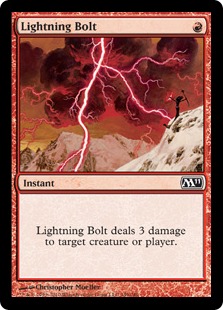
Lightning BoltTo start, it's not enough to say "Bolt is good because it is Modern's most efficient removal spell." For one, this gets us in shaky terminological territory because "most efficient" sounds synonymous with "best". It's like saying Bolt is the best removal spell in Modern because, well...it's the best removal spell in Modern! So that answer alone doesn't get us very far. Moreover, this statement is not even always true. There are tons of threats Bolt can't "remove" one-for-one: Goyf, Exarch, Rhino, Tasigur, Etched Champion, Resto Angel, Geist, and an endless list of creatures who have endured specifically because they passed the Bolt test. There are also many cards Bolt kills but definitely not "efficiently", like Spirit/Faerie/Soldier tokens, Kitchen Finks, Voice of Resurgence, etc. So even if we do define "most efficient removal" as a term, we are still leaving ourselves in a situation where Bolt has glaring weaknesses not covered in "most efficient removal".

When I look at Bolt, I see two sets of reasons explaining why the card is good. The first are "objective" reasons. These are innate strengths or qualities Bolt will always have regardless of what decks are in the format, aspects to Bolt which will always be true and always be appealing to players. When people talk about Bolt's strengths in a vacuum, i.e. without metagame/format context, I believe these are the two strengths they are thinking of.

  • INNATE STRENGTH 1: Cost to damage ratio
    There are few cards in Magic as a whole, let alone Modern, that give you 3+ damage for 1-0 mana. It's the reason Shock is gone, Lightning Strike is in Standard, and why Flame Javelin costs three red instead of one.
  • INNATE STRENGTH 2: No restrictions
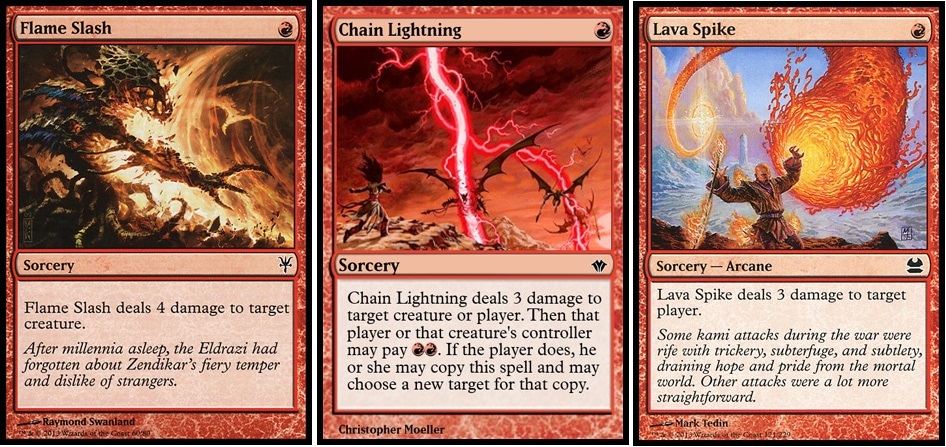
    Of the few cards in Magic dealing 3+ damage for 1-0 mana, many have targeting restrictions (e.g. Strafe, Rending Volley), timing restrictions (e.g. Chain Lightning), cost restrictions (e.g. Sonic Seizure), or some combination of the three (e.g. Flame Slash, Lava Spike).

3 bolt effects v3

Whether we are talking about Modern, Legacy, Commander, or any other format, there is no burn spell in the game with such a favorable relationship of cost-to-damage and no restrictions. Yes, we could envision some bizarre format where deckbuilding constraints minimize these strengths, or even turn these strengths into weaknesses (e.g. your deck can only have 4 cards at CMC 1), but they will mostly be true of Bolt no matter where you go.

But these are also not the most important reasons Bolt is good in Modern. The most important reasons aren't necessarily "strengths" to the card itself. They are "contexts" existing in Modern as a format which make Bolt good. Here they are in rough order of most-specific to most-general.

  • CONTEXT 1: One-drop prevalence
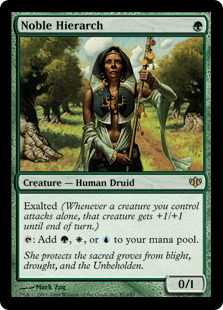
    Noble HierarchIf the "Bolt Test" is the Lightning Bolt-related aphorism of Modern, "Bolt The Bird" is the Bolt-related saying for all Magic. Although in Modern, I'd probably rename it to "Bolt The Noble/Guide/Delver"  these days. Almost any time you can use your Bolt to blow up a turn 1 play, that's a big win for you and a serious setback for your opponent. It's particularly important with manadorks, hence the origin of the phrase. Keeping your opponent from dropping turn 2 Lily or turn 3 Rhino is well-worth your one mana removal spell. Even in decks with lower curves, such as Infect, blowing up Noble Hierarch can keep the opponent off turn 2 Agent with one mana up for Vines of Vastwood. It's just as important for decks with consistent 1 drops, even if they aren't mana producers. This includes strategies like Burn (Swiftspear/Guide), Infect (Hierarch/Birds), and Zoo (Hierarch/Nacatl/E1). As with all rules, there will be exceptions to this, and only format and matchup experience will help you navigate this. But for the most part, Bolting the One-Drop is the right choice.
  • CONTEXT 2: Creature toughness
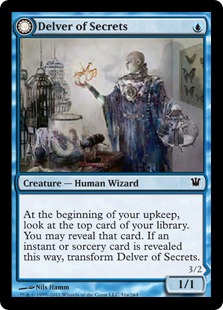
    DelverThere is nothing inherently special about the number "3" in Modern. If Wizards started printing X/4s tomorrow en masse, Bolt would look a lot sillier. But with the cardpool what it is, a lot of decks rely on X/3s or smaller, particularly in early turns. So in a metagame with more relevant low-toughness targets, Bolt becomes strong. In a metagame where creatures are hardier, Bolt becomes weaker. Note you need to consider relevant low-toughness targets, not just any creature in the deck. Delver of Secrets and Signal Pest are relevant targets. Snapcaster Mage and a Spirit token are not. Neither is Slippery Bogle. Of course, this minimizes the importance of "3 damage" relative to player life totals, which is a more objective measure. But I'm going to touch on that in the final context about deck aggression. Context 2 is just about creature toughness because most decks aren't playing Bolt just to burn opponents. If they were, they would just use Lava Spike instead. They use Bolt primarily for removal, which is what Context 2 is all about.
  • CONTEXT 3: Aggro/fast combo prevalance
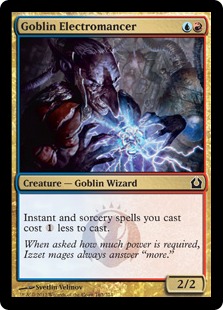
    Goblin ElectromancerBolt is at its best against decks relying on fast, aggressive creature drops to close out a game. This includes both more traditional aggro decks like Burn and Zoo, aggro/combo element decks like Infect and Affinity, and straight creature-based combo decks like Storm. Anything you can do to efficiently answer their threats early is time bought to get you to the later turns. In some cases, particularly with a threat like an Infect creature or Goblin Electromancer, Bolt can win the game outright if played at the right time. Even if you are playing an aggressive deck yourself, Bolt can give you a lifetotal or boardstate edge for you to get ahead. As a caveat, this won't include fast decks like Bogles, which ignores Bolt, or Amulet Bloom, which plays creatures too big for Bolt to hit.
  • CONTEXT 4: The importance of aggression
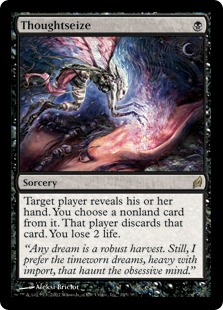
    ThoughtseizeSo far, most of my contextual reasons have to do with creatures. But as we know, Bolt doesn't just target creatures. It also targets players and, in some Modern metagames, added aggression can be the deciding factor in a game. This is particularly true in metagames where decks rely on relatively dangerous manabases, where top-tier decks aren't using cards like Kitchen Finks and Lightning Helix,  and where decks are too busy playing fair to race a deck with an aggressive stance. But the reverse is also true. When decks have relatively pain-free manabases, lots of maindecked means for blunting aggro, and are overall well-prepared for aggressive gameplans, then Bolt becomes a lot worse. To some extent, this is about knowing your deck's role in the metagame. When decks rely on Thoughtseize and fetchlands, going down to 15 life on turn 1, then aggression becomes much more relevant (and, by extension, Bolt too). But when you are playing against two-colored UW Control decks, Bolt is much worse.

In essence, when assessing Bolt's effectiveness in Modern, you are never really assessing the innate strengths of the card. Instead, you are looking at these four contextual points and seeing how Bolt interacts with them. These contexts also suggest situations where Bolt substitutes, like Path to Exile, might be good or bad in a particular month.

Are there other contexts we can consider in there? Absolutely! One notable example is the relevance of Red as a color. If Red is a good choice in Modern (e.g. Blood Moon or Terminate are strong cards), then Bolt becomes a bit better. If it stinks, Bolt will be worse just by extension. Another notable example is the opportunity cost of running Bolt over other cards. If you are running Bolt, you are running Red. If you are running Red, you probably aren't going four colors for Siege Rhino. Or if you are running Bolt in your Soul Sisters deck, you are now using fetchlands/shocklands in a deck that benefits from being monocolored. These are just two examples of the many other contexts we can think of for determining Bolt's metagame effectiveness.

That brings us to the more data-driven part of the article: applying these different contexts to the metagame data and trying to evaluate Bolt's effectiveness. This is the kind of mixed-methods approach I feel is very valuable in Magic. We have already used experience, theory, and qualitative observation to come up with a framework, and now it's time to plug in some values and run it through a quantitative test to see how it holds up in practice.

The "Lightning Bolt Index": A Metagame Comparison

If we are thinking about context to determine Bolt's effectiveness, there's no more important context than the Modern metagame. This means when assessing Bolt's context on those four counts above, we need to do so with respect to the top tier decks in the format. To do that, I'm going to look at all the tier 1 and tier 2 decks from our Top Decks page. These 21 decks represent about 75% of the overall metagame, and are themselves decks you would be most likely to face at any given event.

To establish some kind of "Bolt Index" for our current metagame, I'm going to rank all of those decks for each different context. I'm not a big fan of using semi-arbitrary ordinal rankings of 1-5 or 1-10 for stuff like this, because it's hard to say a 4 is really twice as good as a 2. It's particularly problematic if we eventually intend on combining those rankings into some weighted score for each deck, which we definitely do. So instead, I'm just going to use a binary system of 1s and 0s for each context. If the answer to the context-related questions below is "yes", then it gets a 1. If "no", then a 0.

  • Does a deck 8+ one-drop creatures?
  • Does a deck have at least 4 "relevant" creatures with 3 or less toughness?
  • Is a deck an aggro, aggro/combo, or combo deck based on creatures? (Bogles doesn't count!)
  • Does a deck have enough shocklands/fetchlands/life-losing spells that it is often at 15 life or less by turn 3 and < 4 maindeck lifegain cards?

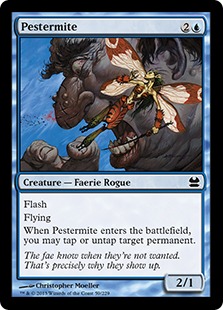
PestermiteOf course, there is some subjectivity (even arbitrariness) in answering these questions and in setting some of the count cutoffs. But this is the sort of potential limitation we can minimize through transparency (i.e. just showing everyone how I ranked things) and through our own experiences with the different decks. This is also where we see some pitfalls to a binary system. For instance, even though Twin has legitimate targets, like Pestermite, Bolt isn't quite as good against Twin and its Exarchs/Skites as it is against Burn. But the binary values are much more useful in the final scoring, which I think is a good tradeoff for the absence of weight.

After I assign a deck a 1 or a 0 in each category, I tally their score and multiply it by the deck's prevalence. This give us a "Bolt Score" for each deck, the sum of which is the overall "Bolt Index" for the metagame. Let's see how this works with our current metagame, reflecting events from mid-March through the present. Again, this represents 21 decks comprising about 75% of the Modern metagame.

DeckMeta %One-drop
score
Toughness
score
Speed
score
Aggression
score
TOTAL
SCORE
Weighted
score
Abzan11.5%01012.23
UR Twin10.5%01001.11
Burn9.7%11103.29
Affinity6.7%11103.20
Infect5.7%11114.23
Jund4.4%01012.09
Grixis Delver3.5%01113.10
RG Tron2.8%00000.00
Abzan Liege2.6%11114.10
Merfolk2.5%01102.05
Amulet Bloom2.4%00000.00
Scapeshift1.9%00011.02
Bogles1.8%01001.02
Grixis Twin1.8%01012.04
UWR Midrange1.8%01001.02
UWR Control1.6%00000.00
Blue Moon1.3%00000.00
Living End1.3%00000.00
RUG Twin1.3%01012.03
Naya Zoo1.2%11103.04
Esper Midrange.8%01012.02

Current Metagame Bolt Index: 1.57

This gives us a final number (1.52), but doesn't actually give us a point of reference for that final number. What exactly is a "good" score for Bolt? Is 1.52 high? Low? Average? How do we establish a reliable benchmark? One option is to assume a situation where every deck has a 1 in every category and then compare our number (1.52) to the theoretical value if every deck had a 1 (3.08). But that isn't contextual; it's just an absolute comparison. Maybe NO metagame will have a 3.08, so it isn't a realistic comparison. A better option is to just look at a metagame where we knew Bolt was pretty good, and then compare the score of that metagame to the score of our current one. To that end, I want us to look at the era of Treasure Cruise Delver and Pod. Bolt was not the best card in the world in this format, but it was still highly relevant and very strong. So we are going to want to compare Bolt's Index in that period with the 1.52 Index we just calculated for the current one. Although this only includes 17 decks instead of 21, it still made up about 75% of Modern at the time.

DeckMeta %Dork
score
Toughness
score
Speed
score
Aggression
score
TOTAL
SCORE
Weighted
score
UR Delver14.2%01102.28
Melira Pod9.8%11002.20
Burn8.8%01102.18
Scapeshift7.5%00011.07
Affinity6.4%11103.19
Abzan3.5%01012.07
Merfolk3.4%01102.07
Bogles3.3%01001.03
Amulet Bloom3.1%01000.00
UR Twin2.5%01001.02
RUG Delver2.5%01113.07
UWR Control2.3%00000.00
Martyr Proc1.8%11103.05
UWR Ascendancy1.6%00011.02
Abzan Pod1.6%11002.03
UWR Midrange1.4%01001.01
Death and Taxes1.4%11103.04

TC Delver/Pod Metagame Bolt Index: 1.62

Based on this, we would tentatively conclude Bolt is roughly as useful today as it was in the Delver/Pod metagame of October 2014 - January 2015. Given how popular Bolt was then, we would expect players to value Bolt almost as highly today. This means if you are deciding whether to play Abzan vs. Jund, or Esper Control vs. UWR Control, Bolt's relevance could sway your deck decision. It also means if you are playing a deck that is weak to Bolt (notably Infect), you shouldn't just expect to fly under the radar anymore.

Next Steps

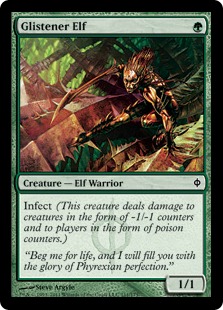
Glistener ElfNaturally, there are all sorts of ways we can challenge these conclusions and expand our methods. We can tweak different cutoffs for the binary values (e.g. instead of 4 "relevant" creatures, 6-8 "relevant" creatures). We can also weight the binary values depending on how important they are with respect to the deck. For instance, even though both Infect and Abzan Liege scored a "1" in the "One-drop" column, it feels more important to blow up Infect one-drops than Abzan ones. There's only so much an unanswered Birds of Paradise can hurt you. But Glistener Elf threatens a turn 2-3 win. So we might give some kind of weight to the Infect score to account for this. Ultimately, there are lots of ways we can expand or refine this system, and this should mostly be treated as a jumpoff point for players looking to evaluate Bolt.

In the end, this is all just another way to use "data" (broadly speaking) to help you succeed in Modern. The Bolt Test will always be relevant in Modern, no matter what some subjective index might say, but sometimes it will be more or less relevant depending on the format. This system is just one way you can reach an objective valuation for Bolt in any given metagame, but feel free to modify and change as best fits your deckbuilding needs.

Finally, big shout out to MTGS user rickster_ and darksteel88 for brainstorming on this a while ago with me. I changed some stuff from our original methods, but wouldn't have had the inspiration for this without our initial conversations.

Deck Overview- Standard Flores Dragons

Are you a Quiet Speculation member?

If not, now is a perfect time to join up! Our powerful tools, breaking-news analysis, and exclusive Discord channel will make sure you stay up to date and ahead of the curve.

This weekend I qualified for PT Origins in Vancouver via the RPTQ in Kansas. If you're an Insider, you're already familiar with the Chromanticore deck that I used to take it down, but today I'd like to highlight the deck that Mike Flores used to qualify.  Insiders can also read a much more in-depth analysis of Flores Dragons by our resident competitive expert Adam Yurchick.

Flores Dragons

creatures

2 Icefall Regent
3 Dragonlord Ojutai
3 Dragonlord Dromoka
1 Dragonlord Silumgar
1 Dragonlord Atarka

spells

2 Anticipate
1 Disdainful Stroke
2 Encase in Ice
1 Voyage's End
2 Nullify
4 Silumgar's Scorn
4 Dissolve
2 Perilous Vault
1 Dragonlord's Prerogative
3 Dig Through Time
1 Ugin, the Spirit Dragon

lands

4 Crucible of the Spirit Dragon
4 Having of the Spirit Dragon
5 Island
4 Polluted Delta
2 Temple of Deceit
4 Temple of Enlightenment
4 Temple of Mystery

sideboard

1 Disdainful Stroke
1 Encase in Ice
1 Negate
4 Omenspeaker
4 Master of Waves
1 Silumgar, the Drifting Death
1 Dragonlord Silumgar
1 Dragonlord's Prerogative
1 Dragonlord Atarka

By Flores' account, "Silumgar's Scorn is a messed up Magic card."

There was an error retrieving a chart for Silumgar's Scorn

In the simplest terms, this is a blue control deck splashing dragons. On closer inspection, this is a very Floresian "jam all the best cards" style deck. This deck likely started as a way to make Dragonlord Ojutai, Silumgar's Scorn, Dig Through Time, Haven of the Spirit Dragon and Ugin, the Spirit Dragon work best together in the same deck. Crucible of the Spirit Dragon allows the deck to play all of the best dragons while the rest of the non-spirit dragon lands allow the deck to cast Counterspell.

Some of the spell slots look a little rough around the edges. For example, maindeck Encase in Ice isn't going to be good in every metagame, and Voyage's End is pretty medium. Once you get past those though, this deck is playing cards that minimally trade one-for-one, and a number of cards that are worth significantly more.

The sideboard suggests that the maindeck is a little soft to red decks, as Omenspeaker doesn't really do the job anywhere else. Boarding it in along with Master of Waves and another Encase in Ice sounds great against red, though this strategy doesn't really translate against any other matchup.

There was an error retrieving a chart for Master of Waves

This deck looks both great and fun, and I imagine that we'll be seeing plenty more of it in the coming months.

Insider: Under the Radar – Five-Color Dragon Control, by Mike Flores

Are you a Quiet Speculation member?

If not, now is a perfect time to join up! Our powerful tools, breaking-news analysis, and exclusive Discord channel will make sure you stay up to date and ahead of the curve.

This past weekend was significant in that the first round of Regional Pro Tour Qualifiers took place all around the world. Preliminary Pro Tour Qualifiers, or PPTQs, have been occurring for months, and finally players have come together in Regional PTQ magnet tournaments to vy for invitations to Pro Tour Origins this Summer.

There are surely many great storylines to come from these rPTQs, but so far the most important result to be aware of was that of Mike Flores. Mike Flores was so determined to qualify for the Pro Tour, and so confident in his Standard deck, that he flew to Salt Lake City, Utah, to play the Regional PTQ there. In the end, he qualified with his Five-Color Dragon deck, which is something that must be on your radar this week.

The decklist:

Five-Color Dragon Control

Land

4 Haven of the Spirit Dragon
4 Crucible of the Spirit Dragon
2 Temple of Deceit
4 Temple of Enlightenment
4 Temple of Mystery
5 Island
4 Polluted Delta

Dragons

3 Dragonlord Ojutai
3 Dragonlord Dromoka
1 Dragonlord Atarka
1 Dragonlord Silumgar
2 Icefall Regent

Planeswalkers

1 Ugin, the Spirit Dragon

Artifacts

2 Perilous Vault

Counterspells

4 Silumgar's Scorn
4 Dissolve
2 Nullify
1 Disdainful Stroke

Creature Removal

2 Encase in Ice
1 Voyage's End

Card Draw

3 Dig Through Time
2 Anticipate
1 Dragonlord's Prerogative

Sideboard

4 Master of Waves
4 Omenspeaker
1 Dragonlord's Prerogative
1 Encase in Ice
1 Disdainful Stroke
1 Negate
1 Dragonlord Atarka
1 Dragonlord Silumgar
1 Silumgar, the Drifting Death

Mike is a hype machine, and the internet catches on to things quickly, so his deck has already blown up on social media like Facebook, Twitter, and Reddit. There will surely be articles on the deck across the web, including Mike's own column on TCG Player, and it’s likely that Patrick Chapin will discuss the deck at length in his article this week on SCG.

This deck is more like Mono-Blue, with the splashed colors only coming from the dragons themselves. These dragons are supported almost solely on the four Crucible of the Spirit Dragon and four Haven of the Spirit Dragon in the deck, with extra help from ten blue scry lands.

Cards of Note

There was an error retrieving a chart for Crucible of the Spirit Dragon

Mike played four Crucible of the Spirit Dragon, a card that not many people can legitimately claim has been on their radar. The price is near rock-bottom on MTGO, selling for around 0.11 tix, while it’s $0.50 in paper, half the presale price of $1. As a four-of in a deck with hype around it, this seems like a slam dunk pick up all around.

I’m not sure where the price could go--$5 if it really gains steam, more likely a few dollars, but certainly not down. It’s also likely that this card is not only good in Mike’s deck, but other dragons decks as well, and it will be widely adopted.

There was an error retrieving a chart for Haven of the Spirit Dragon

This card is not off the radar, but Mike’s deck uses it as a four-of. On MTGO, price has already grown by 40%, from 1 tix to 1.4 tix, and I expect it will hit 2 tix. The paper price has already grown from $4.6 on the back of Esper Dragons, so if Mike’s Dragons deck or another that uses four Haven of the Spirit Dragon becomes a popular top-tier archetype, this could very well creep up towards $10, and perhaps towards 5 tix.

There was an error retrieving a chart for Dragonlord Dromoka

Dragonlord Dromoka is a featured player in Mike’s deck, getting equal billing along with Dragonlord Ojutai.

It has more than doubled on MTGO in the past day, from 1.8 tix to 3.6 tix, likely based on hype from Mike’s deck. The price has already ticked up in paper, from $7 to $7.2 in the last day, and I expect the price will only grow in both mediums over the coming week.

5 tix and $10 are reasonable expectations, and given the massive spike in the price of the other Dragonlords after strong finishes, these numbers could be too conservative. Much like Dragonlord Ojutai, Dragonlord Dromoka is not only good in dragon control decks, but in other archetypes as well.

There was an error retrieving a chart for Master of Waves

On MTGO over the past day, Master of Waves has grown from 5 tix to 7 tix. I am sure some of this demand is driven by Mike’s deck, and if it catches on more, this could grow to 10 tix or more.

Given the low transaction costs on MTGO, cards are less subject to cyclical price trends around format rotation. They are also significantly more volatile. While paper prices of Theros block cards have began falling and will continue to do so into the Fall, online cards are more likely to spike after a big weekend without regard to rotation. If the deck becomes hyped further, the price will spike further, but it’s important to sell into it, because rest assured the price will fall right back down as the hype dies.

Consider that this sideboard plan is viable for any dragon deck going forward, and it will remain a potent anti-red sideboard strategy for the remainder of its Standard life. It’s liable to make an appearance on any given weekend.

These are a good paper target if you can get in cheap this week, with potential for profits if you can move them quickly over the weekend. This is also a solid long-term hold that’s likely to appreciate as a “blue chip”, given the Merfolk status and its occasional eternal format play, so any investment comes with minimal risk of catastrophic failure.

There are other unexplored cards in the decklist, and while their common status makes them less financially relevant, it’s certainly valuable to know what cards may be in demand this weekend and beyond.

In the sideboard, four Omenspeaker support the Master of Waves plan.

Maindeck, two Nullify add redundancy to Mike’s counterspell plan. This card is criminally underplayed in Standard, and it could play a star role given how central creatures are to the format. This card is excellent and could be a part of any Silumgar's Scorn deck going forward.

Even the name, Nullify, signals that Magic R&D intended this to be a tournament staple; the most elegant names, especially one word names, are reserved for only the best cards. (Roast is a good recent example.) Foil copies, especially foreign, would be strong pickups, because this will be a casual-format favorite for years to come.

A single Voyage's End also graces the maindeck.

~

Not only is this deck likely to generate a lot of buzz this week, but it may be a paradigm-shifting archetype that changes the Standard landscape as we know it. Time will tell, and as I begin testing it myself and researching how others perform with the deck, I'll certainly report back my findings.

What are your thoughts on this deck?

-Adam

Follow me @ www.twitter.com/adamyurchick

RPTQ Promo Liliana of the Veil

Are you a Quiet Speculation member?

If not, now is a perfect time to join up! Our powerful tools, breaking-news analysis, and exclusive Discord channel will make sure you stay up to date and ahead of the curve.

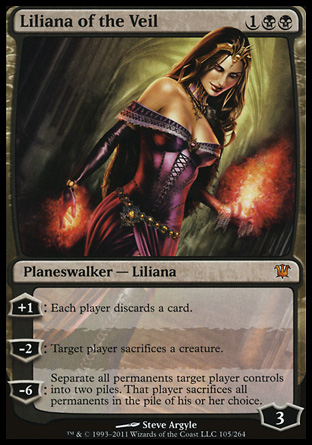
Tomorrow marks the first set of RPTQs, and with that qualified players will be receiving the first ever RPTQ promo in Liliana of the Veil.

There was an error retrieving a chart for Liliana of the Veil

With Liliana being safe from a Modern Masters reprint and being widely played in Modern, the price of Innistrad copies is quite high right now. Pack foils are currently going for ~$200. So that begs the question, what will the RPTQ foils be valued at?

One ambitious eBay seller is looking for $300. With the art matching the pack foil exactly, it's difficult to imagine that the price will be that much higher.

I've heard it speculated that the promo Lilian's price will probably settle close to that of the non-foil pack price, but there is a question of how long it will take to settle there. The starting price will likely be high (though probably sub-$300), then will drop continually as the rest of the RPTQs happen this year, and then, by my guess, they'll slowly appreciate in value from there.

What do you expect the retail of the promo Liliana to be?

Avatar photo

Ryan Overturf

Ryan has been playing Magic since Legions and playing competitively since Lorwyn. While he fancies himself a Legacy specialist, you'll always find him with strong opinions on every constructed format.

View More By Ryan Overturf

Posted in FreeTagged 10 Comments on RPTQ Promo Liliana of the Veil

Have you joined the Quiet Speculation Discord?

If you haven't, you're leaving value on the table! Join our community of experts, enthusiasts, entertainers, and educators and enjoy exclusive podcasts, questions asked and answered, trades, sales, and everything else Discord has to offer.

Want to create content with Quiet Speculation?

All you need to succeed is a passion for Magic: The Gathering, and the ability to write coherently. Share your knowledge of MTG and how you leverage it to win games, get value from your cards – or even turn a profit.

Insider: Modern Masters 2015 Preparation

Are you a Quiet Speculation member?

If not, now is a perfect time to join up! Our powerful tools, breaking-news analysis, and exclusive Discord channel will make sure you stay up to date and ahead of the curve.

Hello, fellow financiers.

This time I wanted to devote an article (possibly another) to some of the questions that caught my eye over on the subreddit. I know there are other writers who covered the subject over the last several months, but I wanted to delve a little deeper behind the exact market reactions to some of these questions.

So, here is my take on the upcoming Modern Masters 2015. It’s an entirely different animal from the first time around, a time that most of us have lived through, and saw some very interesting trends. This topic has been covered in the past months on this very site, by some great financiers, but I wanted to also convey my thoughts on the subjects. I will do my best to get you all ready for what will be another wild ride in MTGFinance.

SecondArticleRotation1.1

Modern Masters 2015 Preparation

Now, I’m not going to sit here and try to speculate or crunch numbers on a set that isn't even out yet. Besides some rumors buzzing around, they’re still simply that, rumors. Wizards has been very tight-lipped on what is about to happen, and how much of this product will be hitting shelves.

So, let’s start with what we know, straight from the source:

Modern Masters 2015 Edition takes players back to some of the most remarkable planes from recent history, including Zendikar, Mirrodin, Ravnica, Lorwyn, Kamigawa, and Alara.

Set Name:
Modern Masters 2015 Edition
Number of Cards:
249
Release Date:
May 22, 2015
Twitter Hashtag:
#MTGMM2015
Initial Concept and Game Design:
Erik Lauer (lead), Ben Hayes, and Ken Nagle
Final Game Design and Development:
Tom LaPille (lead), Ben Hayes, Max McCall, and Adam Prosak
Languages:
English, Japanese, Chinese Simplified
MSRP:
$9.99

Every box of Modern Masters 2015 Edition contains 24 booster packs—each with 15 randomly inserted game cards, including one premium card in every pack

Additionally, to celebrate the second Modern Masters set, we're running a triple Grand Prix weekend, May 30–31, 2015, in the following cities:
Las Vegas, Nevada
Chiba, Japan
Utrecht, Netherlands

So, that’s what we know and quite frankly everything else is hearsay. Multiple store owners who are weighing in on the exact allotment can shed some light on this, but there isn't actual confirmation yet to quantify the exact numbers. We can crunch numbers and speculate until kingdom come, but that won’t get us anywhere. So what we are left with are the facts, and that is how we are going to try and approach things to prepare ourselves to generate some profit.

We also know that Karn Liberated, Emrakul, the Aeons Torn, and our old pal Tarmogoyf are being reprinted. Again, a fact.

So, let me break down some of my considerations from the last time around. At the time reprint sets like this were unprecedented and new to everyone, and there was no shortage of discussion among financiers. I think some of the same rules will apply to this release as well. In my opinion there are four ways we can approach this release:

  • Buy MM2 in early stages and sell older versions now.
  • Do not buy MM2 and sell older versions now.
  • Buy MM2 now and keep older versions.
  • Do not buy MM2 and keep older versions.

Let me elaborate a little more about each of these approaches.

Buying MM2015 during early stages and selling the older versions now is the position I am currently in favor of.

Advantages: I think the prices of Modern Masters 2015 cards will go down by a fair margin a couple of weeks after the release because the supply will be quite high. This trend happened exactly the same way during the first MM release. Thus, selling older versions now allows one to realize a return at a peak, even if the market somehow tanks.

Further, the MM2015 replacement cards will be purchased at little relative value, no matter if you go the singles route or the box route, so there is little downside with the purchase and a ton of upside. It is the way to minimize risk while making an expected profit.

Disadvantages: It requires the most work, by far. Also, there is only a limited time for this to be possible. If one wants to hold their current singles, then the profit potential is higher but with much greater risk. In addition to this risk, the cards' prices won't decrease at all during this time period.

So as an example, purchasing cheap copies of Tarmogoyf during this mass opening frenzy is a way to re-invest, and one can either horde them or re-sell them as many financiers and large stores will be purchasing drafted copies up at an aggressive rate, believing those cards will keep appreciating during these time periods of release. Although that’s assuming they will keep the Modern Masters sets going, and that these trends keep repeating themselves.

Not buying MM2015 and selling older versions is what people will do if they feel prices will tank because of bad experiences with other various reprints. I think people who do this are just a bit nervous. While it is the least-risky route, it can also deny one of the ability to have playsets for usage and reap the potential profits of the new set.

Now the caveat here, is that we know for a fact MM2015 will be printed on a larger scale than before--to fill the needs of the large Grand Prix, and then to continue hitting shelves after that. So, not re-purchasing during the initial frenzy of the set being opened lends one to potentially lose out, and miss the opportunity to re-stock on the new versions at a lower cost.

Buying MM2015 and holding onto current versions has the highest potential return. If the prices do tank, financiers want to be protected against price movements. And selling the older versions and "replacing them" at a lower value is the way to do this.

Not buying MM2015 and not selling reprints will likely cause one to be at the whim of the market. Again, the caveat here is that Modern Masters 2015 is a much different story than the first time around. Especially if this set is set up to be a yearly, or bi-yearly set.

What’s in Modern Masters?
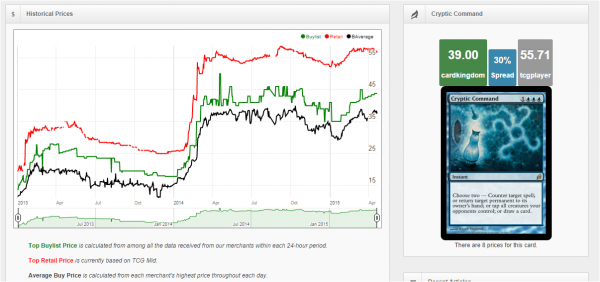
CrypticCommandMM

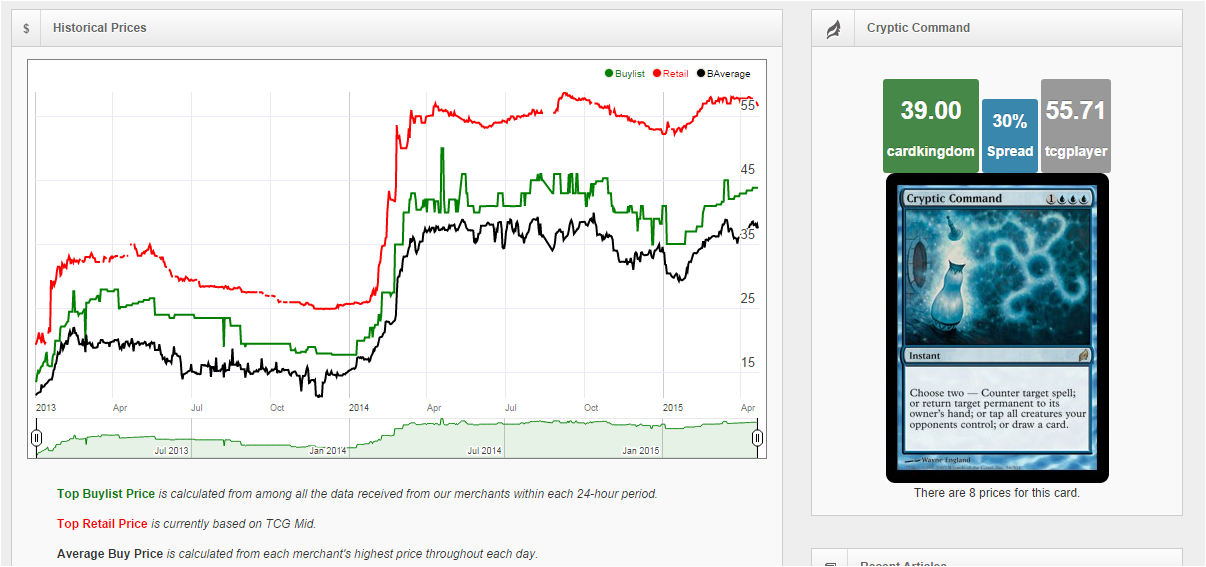
Let’s look at a few of the trends of what happened during Modern Masters release to re-printed cards. For the graph, note that the set was released on June 07 2013.

So looking at the graph, Cryptic Command saw a fairly good decline in retail price once the June 07 2015 date hit and Modern Masters was being purchased and drafted. The price depressed for a little while, but it wasn't long until it started to appreciate again. Very sharply, and right around February, just seven months later. Roughly a 111% increase.

The trends are there to be documented. Using Trader Tools to determine how long the time frame was on the price deflation and the subsequent appreciation can help one plan and invest accordingly. With numbers--it’s phenomenal stuff, to be honest. Telling a story, just with numbers.

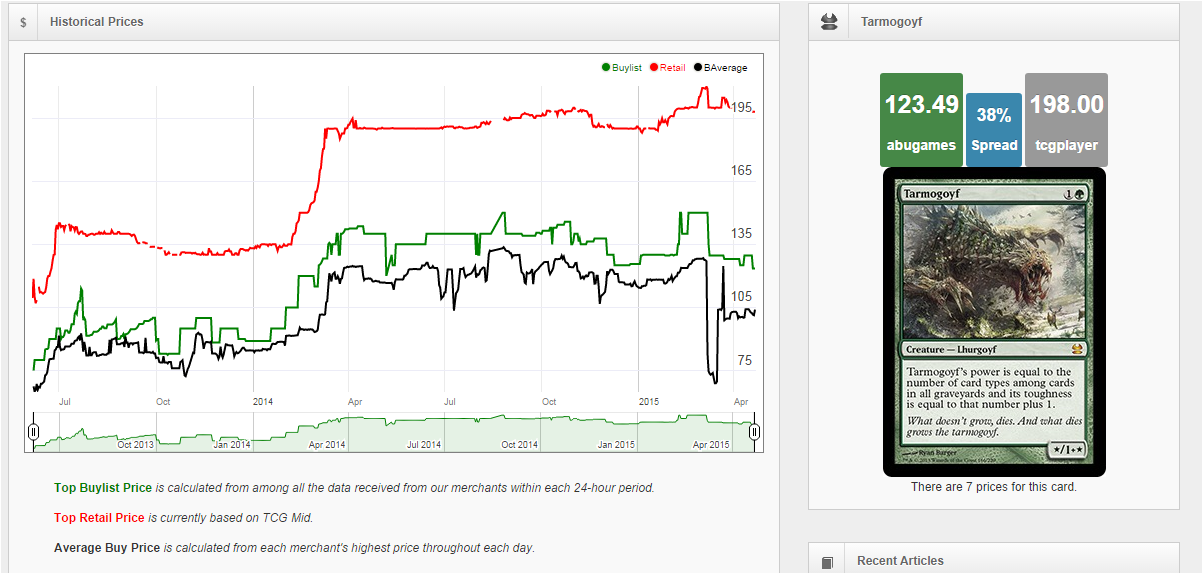
Cryptic Command wasn't the only card, but that was a rare. Let’s try looking at good ol’ Tarmogoyf:
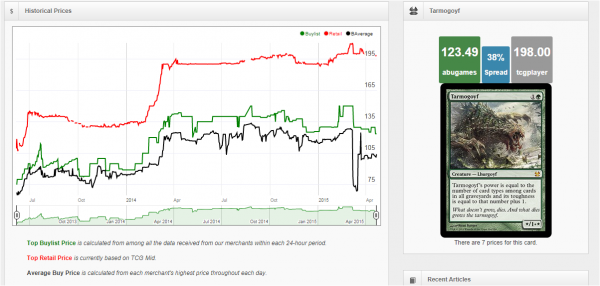
TarmogoyfMM

So, that’s odd, that graph is nothing like Cryptic Command, and in fact the price on Tarmogoyf never dropped. It actually increased. At the same time, the freshly printed Modern Masters version was able to keep a more reasonable price (around $109 retail) for about…12 days.

Now, before you jump all over me about picking the approach before, this was Modern Masters. The facts are Modern Masters 2015 will be different. We already covered the facts earlier in the article. We don’t know how the market is going to take another new wave of reprinted cards.

We've been discussing a technical analysis, trying to look at these trends as something that will repeat itself. I’m more of a fundamental financier, and while there are trends in MTGFinance, there are also intangibles as well. Most other stock markets don’t have to really worry about if X Stock is in the next new Y best deck. Or if stocks get "reprinted" in Modern Masters.

In that regard, another intangible here is a player's perception of value. This is Tarmogoyf's third printing, and the second MM set. One can assume there will be more, and if they decided to jam Tarmogoyf into every reprint set here on out, there’s no way that the trend before can continue on. Players won’t want to shell out that kind of money on something that’s going to be shoved into a supplemental product every other year, or even more.

However, I think there will be a very small window to start re-acquiring some of the cards that are reprinted. Whether that window is any longer than last time will remain to be seen--it’s a larger market, and many more financiers are out there. We haven’t seen any spoilers at this point, but with boxes being sold somewhat close to MSRP, it could depress them for a little while longer.

What’s Not in Modern Masters 2015

What’s Not in MM2015

As much as Modern Masters 2015 is the focus on many financiers' horizon, there are also important cards not being reprinted. These can create some profitable investment opportunities as well.

Let’s isolate a card that was left out of the first Modern Masters:
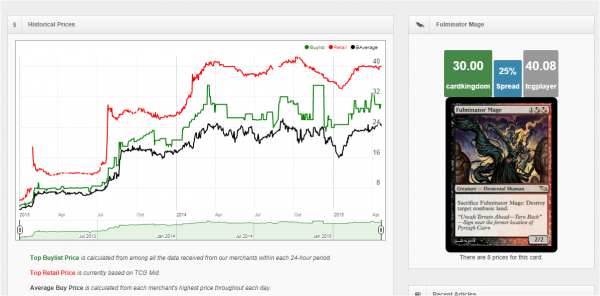
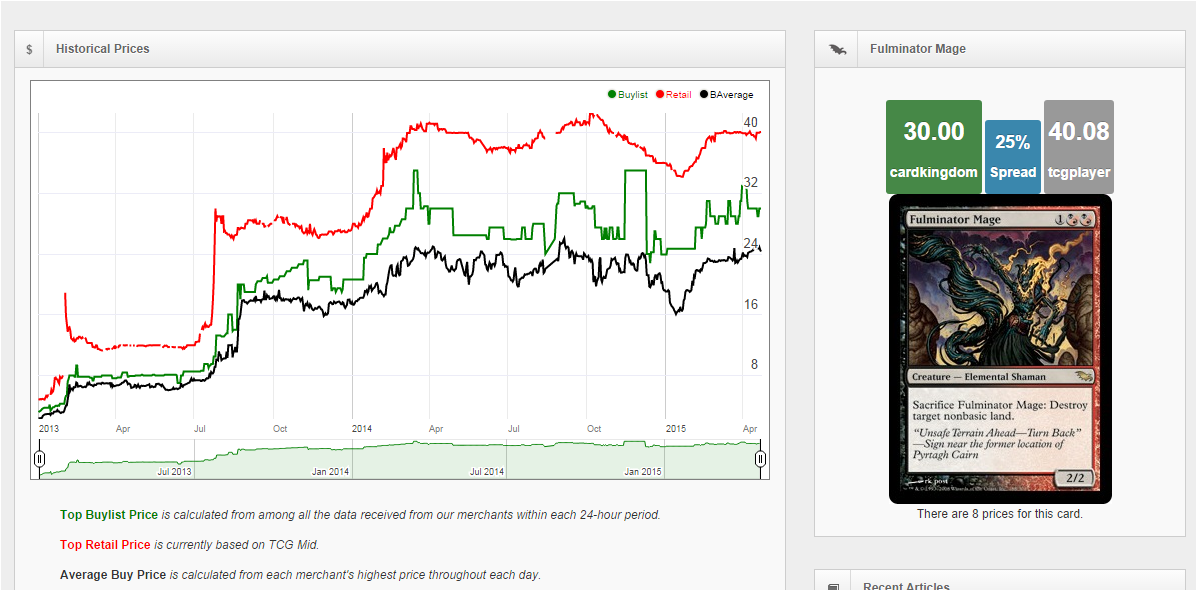
FulimatorArticletwo

The chart looks back to the release date of Modern Masters, June 7 2013. Fulminator Mage increased 142% the very next month in July. So the time frame on certain cards was very drastic, while others took a few months to suddenly jump in price.

There were probably many different factors at play, but I think the technical analysis here is probably going to hold true for non-reprinted cards. It could very well be pushed by the finance market itself--either way, the cards left out of Modern Masters 2015 will probably react in a similar way. Maybe not as drastic as the very next month, but I wouldn’t expect Snapcaster Mage, for example, to be slowing down anytime soon without some reprint elsewhere.

The caveat is that we have seen Wizards reprint select cards that were left out of the Modern Masters set as early as the very next block, so hedge bets accordingly. An example here is Thoughtseize. If we see an important card in dire need of a reprint omitted, be sure it's on Wizards' radar. Unless it’s a specific card--again I use Snapcaster Mage--where flashback would have to be a part of that block.

To always have full disclosure to my readership, I’ve been picking up copies of Abrupt Decay very aggressively. To be truthful, I think it’s almost a crime to be picking up copies in the 10-11$ range. I understand RTR was very successful, and there are a lot of copies floating around out there, but eventually it’s going to start trending upward. It’s arguably one of the best removal spells ever printed.

Innistrad was also very popular, and while everyone knew Snapcaster Mage was "good", and "worth purchasing", here we are looking at 50$ retail price-tag. David Schumann recently highlighted Abrupt Decay in his article as well.

I will continue to flesh out my portfolio with cards that will be omitted from Modern Masters 2015, since I think the trend will continue. I think it’s a great strategy alongside purchasing cheap copies of newly printed staples of Modern Masters 2015. It’s also far less risky, so if you’d rather not be so bold to play the market, rest assured investing into cards like the ones listed above is sound.

Conclusion

Well, that about wraps things up for this time. Hopefully this article sheds some light on past trends and helps you draw some conclusions on your own. Sometimes in this particular market, things aren't always cut and dry, but it's good to evaluate what has happened.

My stance on this subject has been clearly outlined, and I think selling copies and re-purchasing will be the best way to yield profit, and act as a security blanket at the same time. Worst case scenario, you're basically just pay shipping fees on purchasing new copies, should every card fail to budge in price. Best case scenario you have a situation like this:

Pile A: 4 Karn. Pile B: 4 Karn and $40.

Which one do you take?

With this approach, you minimized risk and maximized potential gain by selling and re-purchasing. Over the course of time, this method will pay off. Even if some of the reprinted cards don't end up losing value, you will have secured yourself and may have paid a higher price just sitting on the sidelines at the whim of the market.

There has been much literature written about Modern Masters 2015, so by all means consider others' thoughts along with mine. I think taking the proper steps and keeping the literature on-hand will yield some great opportunities to generate profit. So stay prepared and...

What will your strategy be?

Until next time!

Chaz (@Boltsnapbolt)


Feel free to post any comments/questions/concerns below. I'd be happy to discuss things further!

Stock Watch: Thundermaw Hellkite Dodging Modern Masters 2015

Are you a Quiet Speculation member?

If not, now is a perfect time to join up! Our powerful tools, breaking-news analysis, and exclusive Discord channel will make sure you stay up to date and ahead of the curve.

Dragons of Tarkir's success in Standard, along with so much buzz about Modern Masters 2015, has made me think of a specific dragon.

That dragon is Thundermaw Hellkite. Once the supreme ruler of the skies during its tenure in Standard, the card has been quiet for some time now. Many months of minuscule movement on such a card that once was very popular. That popularity could be sparked once again, as have many other dragon related cards recently. Scourge of the Throne comes to mind--although the two cards are not even in the same stratosphere in terms of Constructed relevance.

Let's look at the facts:

  • The card dodges an immediate reprint in Modern Masters 2015.
  • Only one printing.
  • Proven Constructed-viable.
  • Mythic dragon.

HellkiteQuickStockfinalcapture
Thundermaw Hellkite as of January 1st 2015
Now there is a chance, like most cards omitted from Modern Masters sets, that Thundermaw Hellkite gets itself a reprint. Though, I can't see any place for it in the immediate future. Magic Origins is really the only shot this has. Though with the recent block being about dragons, I could see them continuing the trend with another tool for dragon-related cards like Silumgar's Scorn.

Looking at the card right now, it's spread is not super attractive, yet. Though one can notice the small steady increase in buylist prices. That could quietly indicate that stores want to be stocking up on this mythic as an insurance policy against a spike.

In the meantime, there has been some literature about making dragons in Modern a thing. One such article can be found here: http://www.channelfireball.com/articles/devotion-to-dragons-in-modern/.

The potential is there in Modern, Silumgar's Scorn is probably as close as we will get to a Modern version of old favorite Counterspell, and well-known pros and deckbuilders are really pushing the idea to utilize these cards. Thundermaw Hellkite is one of the better dragons printed in Magic history, and in this current state of Modern deals with a highly popular card in Lingering Souls.

So, I'm glad I had an inclination to check this card out. I think the curiosity of Silumgar's Scorn's relevance in Modern let me stumble on what could be a slam-dunk card in the coming months. It's certainly one to watch as of now. Just keep in mind the spread, and the supply out there in various stores. One thing to note is that Star City Games is currently out of stock, so take it for what it's worth.

There was an error retrieving a chart for Thundermaw Hellkite

What are your thoughts on Thundermaw? Is this one just as attractive as other Stock Watch cards that have been highlighted? I think it really has potential, and an interesting pick to move on preemptively.

Insider: Speculating on Khans of Tarkir

Are you a Quiet Speculation member?

If not, now is a perfect time to join up! Our powerful tools, breaking-news analysis, and exclusive Discord channel will make sure you stay up to date and ahead of the curve.

I really wanted to make some kind of time travel pun, or minimally a Back to the Future reference as the title for this article, but instead I thought I'd get right to the point. It's time to start investing in cards from Khans of Tarkir.

Otherwise Michael J. Fox will never be born!

Khans of Tarkir is a very powerful set, and while Battle for Zendikar is unlikely to offer much support for the enemy-color theme, Khans itself offers more than enough incentive to battle with three-color constructed decks. Tri-lands, fetchlands, and taplands will all be staying in Standard even if we do lose painlands, temples and Mana Confluence.

There was an error retrieving a chart for Mana Confluence

As of right now, there are a lot of cards from Khans that, despite having a high power level, are valued relatively lowly. Part of this is due to the set being extremely popular, but it's also true that until recently the set was still being drafted. Now that Dragons/Fate is the common draft format, fewer cards from Khans will be entering the market, and we should start to see values increase over time.

Here's a short list of cards from Khans that I see as solid investments right now.

Anafenza, the Foremost

Anafenza can currently be purchased in the $4 range, and looks to be hitting the bottom of a price valley. $4 is typically a price that you'd only see for fringe mythics, and Anafenza is a Pro Tour champion. Not every Abzan deck wants Anafenza currently, as being more controlling is an enticing option in Elspeth, Sun's Champion Standard, but Abzan aggro may very well be the only way to Siege Rhino post-rotation.

There was an error retrieving a chart for Anafenza, the Foremost

Anafenza is also a great Tiny Leader, but there are so many copies out there that this fact won't impact the price of non-foils. Even still, Anafenza is a great pickup right now.

Crater's Claws

An SCG Open winner, a PT Top 8 competitor, a card that only got better with the printing of Thunderbreak Regent... it's difficult to figure how Crater's Claws is still under a buck. More than anything, I imagine that we can attribute this to the heavy supply of Khans.

There was an error retrieving a chart for Crater's Claws

While it's true that supply is heavy, there's just no justifying a staple of Gruul and Temur decks being so cheap. The ceiling might be as low as $3-4, but even then buying at the card's floor is profitable.

Hooded Hydra

The long and short of my spiel on Hooded Hydra is that the card is basically at "bulk mythic" status.

There was an error retrieving a chart for Hooded Hydra

There was some excitement about this card when we found out about the manifest mechanic, but that strategy, at least with this card, has not come to fruition. It's worth noting that Hooded Hydra plays very well with Whisperwood Elemental and Deathmist Raptor, which leads me to believe that this card has non-zero Standard potential.

It's not the most powerful card, but these synergies and the low price are worth paying attention to.

Jeskai Ascendancy

This card is pretty absurd. We get to keep Dragon Fodder, Hordeling Outburst, and Monastery Mentor--all of which are great with Jeskai Ascendancy. This card also has fringe Modern and Legacy applications, and I'm sure it has some casual appeal as well due to the uniqueness of the effect.

There was an error retrieving a chart for Jeskai Ascendancy

People avoided this card for fear of a Modern banning previously, which as of right now is a laughable proposition. Decks that play this play four, and decks will continue to play it for as long as it's in Standard. I'd say it's a great pickup for under a buck.

Mantis Rider

Speaking of great Jeskai cards, Mantis Rider plays a valuable role in another powerful type of Jeskai deck. Curving Mantis Rider into Thunderbreak Regent is good for approximately 1,000 damage, and it's hard to imagine such an efficient package not constituting a real deck.

There was an error retrieving a chart for Mantis Rider

It's also true that regardless of whether a Jeskai deck wants Jeskai Ascendancy, it probably wants Mantis Rider in its 75. Another solid pickup in the sub-$1-range, though it's worth noting that Mantis Rider's appeal is relegated to Standard only.

Rakshasa Deathdealer

This is a great late-game card for Abzan that comes down on turn two. Every aggressive Abzan deck wants them and most of the controlling ones do, too. It also sees some play in Sultai decks, though not nearly as much as in Abzan.

There was an error retrieving a chart for Rakshasa Deathdealer

Yet another rare from Khans selling for <$1. This looks like another easy pickup.

Rattleclaw Mystic

This card is slightly higher than $1, which is odd considering that it was the buy-a-box promo, a prerelease promo, and sees less play than Rakshasa Deathdealer. I can definitely see where this card could have casual appeal, so there might be something to that.

As I'm sure you've read 100 times, when Sylvan Caryatid rotates, this card's stock increases substantially. It's worth waiting to see if Birds of Paradise is in Magic Origins, but I expect this card to tick up in value either way.

There was an error retrieving a chart for Rattleclaw Mystic

Sagu Mauler

I might be alone on this card, but I've been playing four copies in Standard for some time. Granted it's in a deck that won't survive rotation, but even as a singular card there are things to like about Sagu Mauler. It's bigger than Siege Rhino and it's a great follow-up after a five-mana wrath from a control deck.

There was an error retrieving a chart for Sagu Mauler

If we see a four-mana wrath printed in Standard then Mauler's value will certainly be diminished, but this card has some real potential. I wouldn't speculate aggressively on it, but it's worth tossing a few bucks at and getting in early if the card does take off.

Savage Knuckleblade

I've written about this card before, and with Goblin Rabblemaster rotating this card will become more attractive. It's also notable that while there is a ton of competition in the four-slot, Savage Knuckleblade stands alone as the three to play in Temur decks.

There was an error retrieving a chart for Savage Knuckleblade

It's also relevant that if we find ourselves with Rattleclaw Mystic as the go-to option for mana dorks, then there will be a high incentive to just play Temur.

Siege Rhino

We all know about Siege Rhino. Right now, it seems impossible that Abzan won't be a deck post-rotation. If it is, four Siege Rhino will undoubtedly remain a thing.

There was an error retrieving a chart for Siege Rhino

I'm not sure what the price ceiling on Siege Rhino would be, but we're definitely nearing the card's floor, as it's great in both Standard and Modern. Picking up less than a set seems wrong, and this card could potentially double or more during its time in Standard.

~

It will be interesting to see what happens to the price of Khans cards as we move further and further away from the Fate/Khans draft format. Will the set's popularity cripple the price of the chase cards? Will the fetchlands eat all the value of the set?

Like my list? Any cards that you're big on that I left out? Let me know in the comments!

Thanks for reading.

-Ryan Overturf
@RyanOverdrive on Twitter

Innistrad Real Estate – Time to Buy?

Are you a Quiet Speculation member?

If not, now is a perfect time to join up! Our powerful tools, breaking-news analysis, and exclusive Discord channel will make sure you stay up to date and ahead of the curve.

The Five Lands

Today I want to talk about poverty in the lands of Innistrad. In the Isolated Chapels and the Hinterland Harbors, land values have hit rock bottom. Rooms at the Clifftop Retreat are empty. And as a prospector eager to develop, I am wondering if right now is a good time to buy in.

The best clue I found for considering whether or not Innistrad land values will rise was Sulfur Falls. 

There was an error retrieving a chart for Sulfur Falls

Stock Chart - Sulfur Falls 4/19/15

The stock chart reveals that Sulfur Falls steadily climbed this time last year and yet again last quarter. Each of these climbs correspond to the opening of Modern season. The card is readily seen in several Top 8 decks at the state level including Splinter Twin. Unlike scry lands, (Temple of Malady, Temple of Enlightenment, etc.) these lands actually see Modern play, which will be a huge factor in predicting their upward value.

But not all of them will be worth buying into. Sulfur Falls for instance has probably hit its ceiling. If last year can be a predecessor of this year, it will quit climbing and level off this summer.

Instead, let's turn our attention to the lands below poverty. Turns out the poverty line in the United States for a single individual is an income of less then $11,945 a year. In Innistrad, I'd fix the poverty line at about 4 dollars/per land (you could extend this metaphor to other dual lands; the target price for shocklands is $10).

All of these lands have the privilege of having seen one print run. But a reprint of these lands would act like social welfare.

There was an error retrieving a chart for Isolated Chapel
Any card below poverty would rise to at least $4 by virtue of seeing Standard play again. Meanwhile, it would bring down any land above it. So my keener interest is in real estate below poverty; the ghettos. In Innistrad that would be Isolated Chapel. To me, with or without a reprint, its only direction will be up.

Just at the poverty threshold, Hinterland Harbor, Clifftop Retreat, and Woodland Cemetery make for riskier--but fair--investments. Like Sulfur Falls, Hinterland fixes the land base of several Top 8 Modern decks. Woodland Cemetery too, although at a lesser degree. In terms of their stock chart, they have all leveled off and show little movement. But they're not losing value either.

If you can snag these up for less then $4, I'd do so. Just by considering their stock in context, I figure by this time next year they have a chance of gaining some moderate value. The only 'risk' being that any value they would have gained could be lost by a reprint.

There was an error retrieving a chart for Hinterland Harbor
There was an error retrieving a chart for Woodland Cemetery

As a final thought, the time is coming very near to cash in on scry lands. There's going to be a vacancy for dual lands in the rotation. Obviously everyone hopes for off-color fetch lands. But it could very well be a reprint of off-color Innistrad lands instead.

At their height, these lands saw values upwards of $13. And although I have been rather conservative in my estimates (I could have set the poverty line at $5 or even $6), I predict if there is a reprint, good money can be made off these lands. Some thoughts to consider, my friends, while deciding whether or not its worth it to take the chance/risk to invest in Innistrad lands.

800px-Caspar_David_Friedrich_-_Abtei_im_Eichwald_-_Google_Art_Project
Casper David Friedrich painted his own Isolated Chapel, "Abby in the Oakwood," in 1810.

8Rack on a Budget

Are you a Quiet Speculation member?

If not, now is a perfect time to join up! Our powerful tools, breaking-news analysis, and exclusive Discord channel will make sure you stay up to date and ahead of the curve.

Despise

8Rack is a reasonably strong Modern discard deck that straight up wrecks certain metas, and provides one of the few, good means of playing "hard" control in this format.

However, it costs about $700. So maybe you can't afford it, maybe you're unsure if it's your thing or not and just want to test the waters and invest only a bit at first, or perhaps you're just holding out for another Liliana of the Veil reprint cause you think spending ~$360 on cardboard is silly (it is). Whatever the case, this article will show you how to play 8Rack for about $50.

[wp_ad_camp_1]


First, let's take a look at non-budget 8Rack:

8Rack by Sean Ridgeley

Sorceries

4 Thoughtseize
4 Inquisition of Kozilek
4 Wrench Mind
4 Raven's Crime

Planeswalkers

4 Liliana of the Veil

Enchantments

3 Shrieking Affliction

Artifacts

4 The Rack
4 Ensnaring Bridge

Instants

3 Victim of Night
1 Slaughter Pact

Creatures

2 Pack Rat

Lands

15 Swamp
1 Dakmor Salvage
4 Urborg, Tomb of Yawgmoth
3 Mutavault

Sideboard

2 Pithing Needle
3 Surgical Extraction
2 Darkblast
1 Pack Rat
2 Bile Blight
1 Syphon Life
3 Nyxathid
1 Shrieking Affliction

About half the cost comes from Lily herself, but Thoughtseizes aren't too cheap either (~$80 for a playset), Ensnaring Bridge is about $80 for a playset, Mutavaults are ~$40 total, Urborgs are ~$40 total, and Extractions are ~$24 total.

Fortunately, just the Extraction is truly needed, so if we gut the rest, we save about $620. Seems good! What to swap in?

Making the Substitutions

Necrogen Mists does a great impression of Liliana's +1. You'll miss the other two abilities sometimes, but such is life on a budget. On the bright side, enchantments are almost never destroyed, and the effect can stack, unlike with her.

Using Duress instead of Thoughtseize means we're less consistent, but Modern does have tons of targets for it. Looking at the current top decks, you can see this won't miss much, even with the creature centric decks. The real issue is sometimes you won't be able to take a creature when you really need to. However, we do run Nyxathid, more Pack Rat, and removal, and we have Despise in the board, so we shouldn't suffer for it too much. Also, not losing life can be huge versus Burn and other aggro decks.

WP_Nyxathid_1280x960

Bridge comes out for Nyxathid, which can act like a Bridge. Sometimes it will be much worse (like when Lingering Souls tokens are out, or the opponent has many cards in hand), but as with Mists, sometimes much better (like when the opponent has just one creature out and you're at a high life total and can afford to swing in every turn, or you're playing against decks that dump their hand, like Burn and Affinity).

The non-basics simply come in for Swamps.

Noticing a pattern here? For whatever we lose by substituting cards, we gain something else. Overall we're worse off, but we offset some of the damage with unique advantages. This is key when converting an expensive deck to a budget one.

8Rack on the Cheap

So that's the jist of it all. With some more tweaks, here's what we have:

Budget 8Rack by Sean Ridgeley

Sorceries

4 Duress
4 Inquisition of Kozilek
4 Wrench Mind
4 Raven's Crime

Enchantments

3 Shrieking Affliction
4 Necrogen Mists

Artifacts

4 The Rack

Instants

4 Victim of Night

Creatures

3 Pack Rat
3 Nyxathid

Lands

22 Swamp
1 Dakmor Salvage

Sideboard

2 Despise
3 Surgical Extraction
1 Nyxathid
2 Pithing Needle
2 Darkblast
3 Bile Blight
1 Syphon Life
1 Shrieking Affliction

Upgrading

Should you purchase this and decide you enjoy it and want to take it further, I recommend buying Thoughtseize, then Bridge, then Lily, assuming you are doing it gradually. After that, you can pick up Mutavault, Urborg, and Slaughter Pact. Make the appropriate swaps and tweaks as you go.

Happy discarding!

Want Prices?

Browse thousands of prices with the first and most comprehensive MTG Finance tool around.


Trader Tools lists both buylist and retail prices for every MTG card, going back a decade.

Quiet Speculation