menu

The Ring’s True Power: Sequence Better in LTR Draft

Are you a Quiet Speculation member?

If not, now is a perfect time to join up! Our powerful tools, breaking-news analysis, and exclusive Discord channel will make sure you stay up to date and ahead of the curve.

In a grindy BETW mirror-match, I had fallen to a precipitous life total. Fortunately, I had the tools to stabilize. Lotho, Corrupt Shirriff would trade on the ground with my opponent's Orc Army, and my freshly played Voracious Fell Beast would defend my life against the three Spirit tokens. I would untap, crack the Food, and the board would be in my favor with a grip of cards. Unfortunately, that's not what happened.

Because of poor sequencing, Lotho triggered, drawing me a card, creating me a Treasure and, most importantly, inflicting the loss of a single life. Next turn, I died to two of the three attacking spirits for exactly lethal.

Lord of the Rings: Tales in Middle Earth (LTR) is a format of small edges and costly mistakes. After the hyper-aggressive ONE and the princely MOM, LTR feels like a return to the basic fundamentals of Magic. Of all those fundamentals, sequencing is particularly important in the format. Today, we'll look at LTR's sequencing challenges and how they prove especially pertinent with two new mechanics, The Ring and amass.

What Is Sequencing?

Sequencing refers to the order in which we perform our game actions. In life, this could be as simple as putting the butter on the pancake before you pour the syrup on it. The syrup traps the butter to the warm, fluffy pancakes, thus making it easier to spread. If we put the syrup on the pancake first, the butter slips around, and we've got a whole situation on our hands.

There was an error retrieving a chart for Second Breakfast

In Magic, sequencing helps us optimize our gameplay. Some of it is simple: we want to put our equipment on a creature before it attacks, we want to cast our combat tricks after blocks are declared, etc. However, different circumstances call for different sequences.

In LTR the most common sequencing decisions involve the two keywords, amass and tempt. For both abilities, we need to consider whether to invest more into our current attack, or to prepare to rebuild should things go wrong.

A World of Sorceries

Instants let us sequence with flexibility. We can wait for an opponent to take a game action or to be at their most vulnerable before utilizing an instant-speed effect. LTR downgrades some familiar effects from instant to sorcery, typically offering tempt or amass as a payoff.

Slow it down

Because of this limitation, we want to be very careful as to how we plan our turns. Thoughtful sequencing is necessary for maximizing Orc Armies and Ring-bearers, as these game pieces are amongst the most important in the limited landscape.

Ring-bearer 101: Eggs vs. Basket

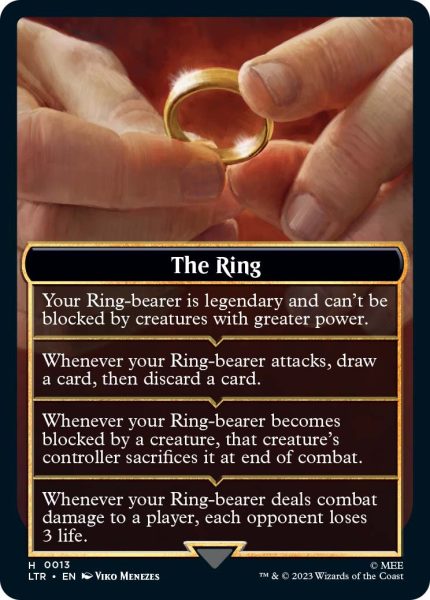
The default decision for both amass and tempt is to do it before combat. We want our attackers to be large, so we want to amass. The Ring's second level triggers when declaring attacks, while the first and third happen before blockers are declared. That value is all sequence-dependent, and we miss opportunities when we do this post combat.

We always have to ask how The Ring is contributing to our gameplan. The Ring makes small creatures evasive and eventually punishing to block. This should push decks in a more aggressive direction; however, the most significant ability is granted at level two. Looting every turn helps smooth out hands regardless of position.

If we can reliably attack with a level two Ring-bearer, we have an enormous advantage over opponents who can't. Level three can punish blockers, especially the 1/3s and 1/4s in the format, but what do we lose if we can't re-equip The Ring? Often times it is better to lose a looter in combat, and then tempt again to set up more looting for the future. This is especially true if we can generate value from the bearer on the way out.

For value's sake

Losing the Ring-bearer can mean our engine no longer functions. When deciding between the first three levels on the ring, we need to consider what we stand to lose if we can't tempt a new creature. The longer we anticipate the game going, the more valuable an active Ring-bearer will be.

BYOB: Build Your Own Bolt

Looting accrues advantage. We want to tap that advantage every turn if we can. An active Ring-bearer develops our hand and battlefield. But when we get to step four, the Ring's evasion becomes even more punishing, and the mechanic shifts to be even more aggressive.

Because it triggers after the other three, level four makes the best use of the instant-speed effects. The fourth level triggers when our creature does damage. So, in an ideal scenario, we can get the sacrifice trigger off a level three Ring when opponents declare blocks, and then move The Ring at instant speed to also get the level four trigger on an unblocked creature.

When we're playing a tempt-heavy deck, cards like Slip On the Ring and Dreadful as the Storm can overperform. They facilitate difficult attacks while passing the ring to an unblocked attacker. Sneaking in a Ring-bearer this way can earn us three damage. Whether we use The Ring's evasion or instant-speed tricks to supplement our pressure, free Lava Spikes should end the game quickly.

There was an error retrieving a chart for Lava Spike

Sequencing with Ring-bearers often asks us to evaluate the current attack versus the possibility of future attacks. My heuristic is that I want to set up as many turns where I'm attacking with a Ring-bearer as possible.

Ring-bearers, landcycling, and scry

It's a basic virtue of sequencing that we want to do things as late as possible, as long we still reap the desired effect. Basically, the idea is that we get maximum information before committing to an action. So why would we ever landcycle before our looting trigger?

If we're digging for outs, it might make sense to thin our deck first. The landcycler can only fetch its corresponding basic. Getting that land out of the deck before looting raises our chances of drawing the card we need. Affecting the deck size after drawing may not do anything at all. And the land may be a good card to discard regardless.

Similarly, we usually want to sequence scry triggers before looting trigger. This will allow us to put the desired card in hand rather than draw randomly and set up the following turn. If we're hellbent and know this card will be tossed away, it makes more sense to scry after looting, so that we control a future card in hand rather than one milled to the graveyard.

When to Pass on Amass

An oversized Army token has ended many a game in LTR limited. It's very easy to get them to four power, and after that, they become a huge issue. Because bigger attackers hit harder, it often makes sense to play out amass pre-combat. However, caution has some value here.

Isolation at Orthanc matches up really well against Orc Armies. While I will routinely Torment of Gollum into an open four mana, I don't want to load up on amass if I'm staring down a potential Isolation. Again, we have to ask ourselves: how many eggs are we willing to put in one basket? Unlike The Ring's levels, when we lose our Orc Army, we have to start from scratch.

My goal with tempt is usually to attack with a level two or higher Ring-bearer as many times as possible. My goal with amass is to have the most +1/+1 counters left for the following turn. Both of these approaches need to take the game's pace into account, but provide a good place to start.

Both amass and tempt look to build out a single threat, but once that threat is neutralized, we are forced to regroup. When it comes to both effects, we want to think about what the value and goal of this combat compared to how we envision the rest of the game developing. With amass, my heuristic is more about removal. I want my creature to be big enough to demand removal, without being so big that I'm overcommitted. Once my opponent shows they can't interact with it, I'm more confident going all-in.

Thinking of Amasster Plan

When are small Armies better than large ones? If our plan is to convert tokens for value, it might make more sense to squeeze value from a token before amassing again. While red and blue often want to build a massive Orc Army and use it to pressure opponent life totals, BW cares more about the cardboard than the dice placed on it.

Make objects, make profit

To be fair, black has plenty of ways to use smaller amass tokens without white's support. Gollum, Patient Plotter, Gothmog, Morgul Lieutenant, and Cirith Ungol Patrol all like smaller tokens. Black's flexibility makes it the best color in the format.

There's some tension between these cards, though, and sorcery-speed effects like The Torment of Gollum or Dunland Crebain. Once we grow an amass token to 3/3 or 4/4, we're probably looking to do more with it than sacrifice it for value. Maximizing these resources over a series of turns can be complicated, and our decision is game-state dependent. Usually I'm asking myself, "am I ready to pressure their life total, or am I trying to grind value?"

All-In on LTR

I'm not one for Core Sets. I've heard them described as a pallet cleanser for the super complicated formats that cycle through the rest of the year. They've been explained to me as a soft reset to slow power creep. Sure. If you say so.

Furthermore, I'm not a huge fan of the Universe Beyond content. Worst of all, I have concerns about the pricing of this set and what it means for general product distribution.

Still, I have to admit, I'm completely smitten by this limited format. The power level rewards tight gameplay. Uncommon build-arounds really shine, and with a second "signpost uncommon," archetypes have more variation. Something about it reminds me of an older brand of Magic.

While that may just be the nostalgia of a 25-year veteran of the game, I've really enjoyed it so far. It rewards doing the small things right, and sequencing is a big part of that. So let me know what sequencing situations you've come across in your journeys of LTR.

A Different World: Vintage, Explained

Are you a Quiet Speculation member?

If not, now is a perfect time to join up! Our powerful tools, breaking-news analysis, and exclusive Discord channel will make sure you stay up to date and ahead of the curve.

The only known cure of burn-out is a change of pace. That's solid advice for life in general, but it was also my approach to testing frustrations. As I discussed last week, I spent the latest Magic Online (MTGO) All-Access Pass period extensively testing Pioneer. It wasn't a fun experience, so to break it up, I also played more Vintage in two weeks than I had in the past two years. It's something I'd recommend to every player, but there are some eccentricities that they need to be ready for before trying Vintage.

Today, we'll explore what makes Vintage special, dispel some myths, and review the format's rules of engagement as I've come to understand them.

The Moneyed Format

Most players are at least aware of Vintage, and for those that aren't, Vintage is where (nearly) every card in every expansion in Magic's history is legal. Rather than banning cards, Vintage restricts them to a single copy. For many hideously broken cards, it's the only format where they're legal for play, Commander included. Therefore, it is the most powerful format in all of Magic.

That power is not without cost. Literally: Vintage is the most expensive format in Magic, no ifs ands or buts. For a player looking to buy into Vintage, it's going to cost a minimum of $10,000 to get a competitive deck. That's because the cheapest deck by far is Vintage Dredge which requires a playset of Bazaar of Baghdad, the best price for which is (at time of writing) $2.422.48 a pop.

There was an error retrieving a chart for Bazaar of Baghdad

Thus, the format remains firmly outside 99.99% of the general public's price range. And even for those wealthy few who could buy into Vintage, there's not much reason to do so. Vintage events are few and far between these days. There was a time when they were kept afloat by allowing proxies and Wizards officially unofficially allowed it. There's been a crackdown, and now there's no market for paper Vintage events.

Online Opportunity

For this reason, it is only really possible for most players to experience Vintage on MTGO. Which is unfortunate, as MTGO isn't popular, at least relative to Magic at large. Players generally don't like paying real money for intangible cards, and most that do want to play the formats they play in paper. The MTGO-only formats being niche at best demonstrate this aptly.

However, I'd argue that playing online Vintage is the best value for money in all of Magic. In terms of relative price, online Vintage is as cheap as it gets. The Dredge deck I linked above is currently $11,753.86 in paper and $349.94 (tix and dollars are roughly equivalent), or 33.59 times cheaper. It only gets more extreme from there.

There was an error retrieving a chart for Black Lotus

Online Vintage decks cost about the same as online Modern or Legacy decks. However, that's deceptive, as all the expensive cards in Vintage decks are expensive because they're also Legacy and/or Modern staples. Vintage-only cards cost pennies on the dollar. You can get the whole Power 9 for about $35. Since Vintage-caliber cards extremely rare, decks rarely need updates or rotate. Buy once, play forever.

Money Where My Mouth Is

I am speaking from experience here. I bought my paper Death and Taxes deck on MTGO in 2020 at the start of the pandemic, on the belief that I wouldn't have to put much money into Legacy and could just play forever. That was true for about six months, until I caved to collective wisdom and joined the Yorion, Sky Nomad crowd. Since then, I've paid for Solitude both in paper and online and all the initiative cards online.

There was an error retrieving a chart for Solitude

During that time, whenever there was an All-Access event, I'd have a Vintage Taxes deck made up to dabble with on the side. I updated it for the first time ever this time with the white initiative creatures and was having a blast when I had an epiphany. The only cards for the Vintage deck I didn't already own from Legacy were the Vintage-only cards. And I could have them all for about $40. So, now I'm playing Vintage Initiative.

I literally hadn't updated the White Taxes deck I'd proxied up online for All-Access events from 2020 until 2023. That had been my entire plan in buying Legacy Taxes online. Frankly, from a bang-for-buck stance, buying Vintage from the get-go would have been a better plan. Having to update a Vintage deck at all is quite rare, and most decks have barely changed in the past ten years. It's incredibly stable.

Enter the Unknown

So now that I've intrigued at least some new Vintage players, it's time to throw out a big BUT FIRST! Vintage doesn't work like other formats, be they competitive or casual. All players will recognize elements they're familiar with, but things are happening in ways which would be considered impossible and/or terrible in their home formats.

Trying to play Vintage like normal Magic is a recipe for frustration and failure. The rules of engagement are different. What matters is different. There are cards that are define Vintage are are garbage elsewhere, Paradoxical Outcome foremost among them, Slash Panther an example from the not-too-distant past. Vintage must be played like Vintage.

The Cause

The issue is the restricted cards. Generally banned in every other format, these are the most powerful cards ever printed in Magic's history, and they're game-defining. Commander players are used to playing with singletons and some playgroups may even allow Vintage restricted cards up to and including Black Lotus. However, thinking that Commander in any way emulates Vintage is wrong.

There was an error retrieving a chart for Sol Ring

This isn't gameplay like (most) players are used to. There are an entirely different set of rules for deck construction, hands to keep, sequencing, and even win conditions. New players have to get used to the fact that Vintage requires them to do things that are not only wrong in normal Magic, but sometimes actively bad. However, they work in Vintage.

I'm no Vintage expert with special insight. Every one of these rules is something I've worked out over the years sticking my toes into Vintage, and they have become clearer since I actually bought in and started playing more often. As I understand them, here are the rules of Vintage in roughly the order I discovered them.

Rule #1: Bazaar of Baghdad Breaks Every Rule

I think my first exposure to Vintage was watching Luis Scott-Vargas videos. His reaction to seeing Bazaar played against him was always, "Whelp, time to lose game 1." That would proceed to happen, and Luis would have to mulligan for graveyard hate in games 2-3. Didn't seem to matter what deck he was playing, that was how it always went.

There is no deck that works quite like a Bazaar deck, for no other deck has a card more central to its gameplan. Bazaar decks don't work at all without the namesake. Their gameplan: mulligan and use Serum Powder until Bazaar is found in their opening hand. Then, activate Bazaar and continue to do so until the opponent is dead. There really aren't alternative lines, as the deck doesn't pay mana for spells.

There was an error retrieving a chart for Ichorid

There are many types of Bazaar decks. Some are souped-up Dredge decks, some feature Hollow One engines, and then there are the weird decks. Some have tons of interaction, while others have combo kills. Don't sweat the specifics. These decks are operating on an axis unlike any other in all of Magic, and make their own rules.

Rule #2: The Mana Curve Doesn't Exist

There is no mana curve in Vintage. Decks still play cards of many different mana costs, and the balance is tilted to the low end as in other constructed formats. However, they're not looking to play the cards on curve, and the expectation of doing so is detrimental to success. It's easier to show the reason visually than write it out:

These zero-mana artifacts are collectively known as Jewelry and their job is to jump decks up the curve. They're very good at it, especially when coupled with all the other restricted artifact mana available. It is possible and desirable to try and play as many spells as possible in one turn, or simply dump all the mana into an end-game bomb on turn one. Trying to play a normal game means immediately falling behind.

Every Vintage deck can play any number of these cards and needs very strong reasons not to do so. So strong that the only decks that don't play at least a few Moxen are instead playing Bazaar. (That card makes its own rules.) Everyone else is obligated to sport some Jewelry.

Consequence #1: Aggro Doesn't Exist

In normal Magic, aggro decks work by being faster than anything else. They're utilizing the mana curve to tempo out the slower, more powerful opponents before the high-cost spells overwhelm them and the slower decks win. Against combo, aggro is utilizing its more reliable win speed. That isn't going to happen in a format where Jewels allow slow decks to jump the curve and combo to win on turn 1.

There was an error retrieving a chart for Seasoned Dungeoneer

That's not to say that it's impossible to win with creatures. Initiative and Bazaar decks deny that idea. However, these decks are either using creatures as part of a combo kill or heavily incorporating disruptive elements. There are no pure drag-race creature decks. They're all creatures plus something else.

Consequence #2: Life Total Is Just a Number

It's an old principle in Magic that the only life point that really matters is the last one. While I've pushed back on that idea before, the principle is still sound. No format demonstrates it more than Vintage. Thanks to the lack of pure aggro and the overwhelming bombs that get dropped fast, life doesn't really matter, and decks are quite loose in dealing themselves damage. Sometimes a deck will kill itself when things go poorly, but usually they're not bothered. Games are over too quickly. This causes Rule 3.

Rule #3: There Are Three Win Conditions

There are many different ways to win a game in Vintage. However, they will all be via one of three roads:

  1. Combo kill
  2. Lock pieces
  3. Card advantage

The first is the most obvious. When most players think about Vintage, they think the absurd combo decks. They're not wrong; combo is the easiest way to win in Vintage. These are the drag racers of the whole format.

There was an error retrieving a chart for Bolas's Citadel

That lock pieces are a win condition far less obvious. While I play many creatures and attack with them, White Initiative actually wins by locking out the opponent long enough to win. Thalia, Guardian of Thraben, Archon of Emeria, and Phyrexian Censor keep the opponent from doing anything so I can claim victory. Out of the sideboard, there's Null Rod.

There was an error retrieving a chart for Null Rod

The fair decks win the third way, by overwhelming the opponent with card advantage. Ancestral Recall is the poster child of this strategy, which wins by being able to do more than the opponent. This is usually achieved by having more answers in hand than the opponent has spells to deploy, but can take many forms. The game will be over well before any real damage has been dealt.

Rule #4: Artifacts are King

One of the longtime pillars of Vintage is Mishra's Workshop. Almost every deck has lots of artifact mana. Artifacts are everywhere, define every deck by their presence or absence, and are some of the most powerful threats in Vintage. That means:

Consequence #4: All Cheap Artifact Removal Is Playable

Steel Sabotage is main-deckable because it answers anything out of Workshop decks for one mana. It also bounces a Blightsteel Colossus tutored into play by a card advantage deck's Tinker. Every deck needs ways to escape from prison pieces and/or disrupt the opponent's artifacts. Null Rod is a game-winning card for a reason.

Rule #5: Mulligan Aggressively

Bazaar players are an extreme example, but all Vintage players need to be willing to mulligan aggressively. Every deck has something busted it does, so every decks needs to either have the means to do the busted thing in their opening or some way to answer the opponent's busted thing. For example, consider the following hand from my Initiative deck:

This is an almost perfect hand for Legacy Death and Taxes, as it can Thalia turn two and answer any creature turn one. However, this is Vintage, and this hand is a mulligan unless I know I'm against Bazaar. It's unlikely that I'll need to kill a creature at all, much less on turn one, and playing Thalia turn two is too late. By then, the opponent will have dumped their Jewels if I'm on the play or killed me if I'm on the draw. Meanwhile, this hand:

Is a snap-keep in Vintage and quite questionable keep in Legacy. There, the turn 1 Censor is likely to get Lightning Bolted, at which point I'm out almost all my cards and am hoping for a land to cast Dungeoneer and that it isn't just Daze. It's perfect for Vintage since creature removal is very sparse and a turn 1 Censor will stop cold the typical opening for most opponents. It's imperative that Vintage players keep hands that are not necessarily good by normal standards, but that do something broken.

Fairly Busted

Vintage takes some getting used to, and I can't say that it's for everyone. However, those players that are already online and are paying into the card market really have no excuse not to maintain a Vintage deck on the side. It's much cheaper than whatever you've already bought, and unlocks plenty of events, not to mention fun and additional opportunities for success. The key is to that fun and success is to never forget what makes the format Vintage.


Zoom Zoom: Izzet Drakes in Pioneer

Are you a Quiet Speculation member?

If not, now is a perfect time to join up! Our powerful tools, breaking-news analysis, and exclusive Discord channel will make sure you stay up to date and ahead of the curve.

It's All About the Game and How You Play It

In this week's video, I'm playing a brand new take on a longstanding Magic archetype, Izzet Tempo. More specifically Izzet Zoomer Drakes in Pioneer. Why is it called Zoomer Drakes you ask? Well, the Magic "Zoomers" are responsible for this list. As for the Drakes? The main way we win is by attacking with Crackling Drake. Now I'm going to take you though the cards and philosophy behind the deck!

There was an error retrieving a chart for Crackling Drake

The Creatures

Crackling Drake is extremely vital to the success of this deck. The fact that it counts the instants and sorceries that are in the graveyard and in exile is important. It ensures that even if we exile most of our graveyard with Treasure Cruise our Crackling Drake will still have a ton of power to attack. More often than not we can get an eight or nine-powered Crackling Drake to be able to close the game in a turn or two. Even if it's a much more modest three or four power it draws a card when it enters the battlefield so it can keep the cards flowing to ensure we don't run out of gas in the middle of the game.

There was an error retrieving a chart for Crackling Drake

Ledger Shredder has proven itself to be a multi-format powerhouse. It's a main cog in Modern's Izzet Murktide deck. Here it serves a similar purpose. Getting to connive every time we or our opponent play two spells in a turn is powerful. Much like Crackling Drake it ensures we keep the cards flowing and is a great attacker that avoids a ton of removal in the format. It works well in a "Spell Slinger" style deck like this because we can cast our cheap spells all the while the Ledger Shredder draws us more cards and gets bigger each time we do so. Basically, it's the perfect Izzet Tempo Creature in the format.

There was an error retrieving a chart for Ledger Shredder

The Spells

The spells are the meat and potatoes of this deck. There's a reason why there are only eight creatures and twenty-seven non-creature spells in the deck. Simply put we rely heavily on the spells to clear the way and protect our creatures.

The Draw Spells

Consider, Opt, and Treasure Cruise are our main ways to dig through our deck. Consider and Opt are excellent ways to trigger Ledger Shredder's connive on the cheap.

Blitz

Blitz of the Thunder-Raptor is a card I had literally never heard of until I saw this deck, but oh boy does it fill an amazing hole in this deck. Think of it as a Pioneer version of Unholy Heat. It clears away any and almost all creatures and can deal with problematic planeswalkers.

There was an error retrieving a chart for Blitz of the Thunder-Raptor

The Rest of Our Removal

In addition to Blitz, Fiery Impulse, Fires of Victory, and Spikefield Hazard // Spikefield Cave are the rest of our removal. Keep in mind Fires of Victory can be kicked to draw a card if we start to flood. Additionally, it is our second-best way to deal with large creatures and planeswalkers.

Fading Hope is here to deal with problematic cards such as blockers with flying and reach as well as Sheoldrerd, the Apocolypse.

About Fable

Lastly, we have the best red card in the whole format Fable of the Mirror-Breaker // Reflection of Kiki-Jiki. This card is paramount in this deck. It does almost everything we want to do. It makes a creature, it draws cards while also filling our graveyard, and it flips into a creature that if left unchecked lets us copy our threats. Let me tell you if we get to copy a Crackling Drake we are living the dream, and it comes up more than you'd imagine.

There was an error retrieving a chart for Fable of the Mirror-Breaker // Reflection of Kiki-Jiki

The Decklist

Izzet Zoomer Drakes, Pioneer

Creatures

4 Ledger Shredder
4 Crackling Drake

Sorceries

2 Strangle
4 Treasure Cruise

Instants

3 Blitz of the Thunder-Raptor
4 Consider
1 Fading Hope
4 Fiery Impulse
1 Fires of Victory
4 Opt
4 Spell Pierce
2 Spikefield Hazard // Spikefield Cave

Enchantments

4 Fable of the Mirror-Breaker // Reflection of Kiki-Jiki

Lands

2 Hall of Storm Giants
2 Island
1 Otawara, Soaring City
4 Riverglide Pathway // Lavaglide Pathway
4 Spirebluff Canal
4 Steam Vents
2 Stormcarved Coast

Sideboard

2 Abrade
2 Aether Gust
2 Alpine Moon
2 Brotherhood's End
2 Disdainful Stroke
3 Mazemind Tome
2 Mystical Dispute

Wrapping It Up

If you're looking to play a spell-slinger-style deck that can be blistering fast and also play the long game you will definitely want to try Izzet Zoomer Drakes. It has play against any top-tier deck in Pioneer. Now that you've read the article go watch the companion video on YouTube and don't forget to Like, Comment, and Subscribe!

Avatar photo

LessAlex

LessAlex, AKA Alex Blackard, is a Magic: The Gathering content creator who is passionate about playing Control decks in Constructed, particularly in the Pioneer, Modern, Explorer, and Historic formats. He also enjoys experimenting with combo decks and brewing up new and exciting strategies to stay ahead of the competition. With a focus on in-depth strategy breakdowns and gameplay, LessAlex offers a unique perspective on the game that is both entertaining and informative. His competitive resume includes a Top 4 at an SCG Open in 2014, splitting an NRG Trial in 2017, as well as countless SCG IQ Top 8s and Game Day wins. He hosts The Control Freak Podcast where he discusses playing Control decks in Constructed, and brings on guests including prominent players and creators to share their expertise. You can catch him streaming on Twitch weekdays at 9 am, and on his YouTube Channel for even more content.

View More By LessAlex

Posted in Deck Building, Deck Overview, Pioneer, Video, VideosTagged , , , , , , Leave a Comment on Zoom Zoom: Izzet Drakes in Pioneer

Have you joined the Quiet Speculation Discord?

If you haven't, you're leaving value on the table! Join our community of experts, enthusiasts, entertainers, and educators and enjoy exclusive podcasts, questions asked and answered, trades, sales, and everything else Discord has to offer.

Want to create content with Quiet Speculation?

All you need to succeed is a passion for Magic: The Gathering, and the ability to write coherently. Share your knowledge of MTG and how you leverage it to win games, get value from your cards – or even turn a profit.

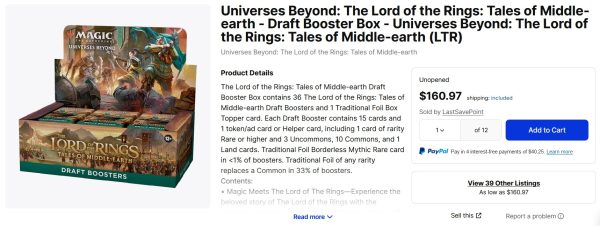
Tales of Middle Earth Draft Booster Box Prices

Are you a Quiet Speculation member?

If not, now is a perfect time to join up! Our powerful tools, breaking-news analysis, and exclusive Discord channel will make sure you stay up to date and ahead of the curve.

After much-anticipated hype, The Lord of the Rings: Tales of Middle Earth has officially launched across the globe. At last, players can sleeve up their favorite characters from the trilogy and do battle. Despite not being Standard legal, the launch feels like a “normal” release because the set is available in draft boosters, set boosters, collector boosters, bundles, etc. The set is also available to draft on Arena.

There was an error retrieving a chart for Frodo Baggins

With all this hype, I decided to swing by my local game store (LGS) to pick up a booster box of draft boosters to sit on for a bit. I figured it was a novel set with a strong tie to a world-renowned property, so it was bound to be a success.

Limited streamers with early access have already been sharing their enjoyment of the format, leaving me optimistic for another great draft set. A few commented that the set is a little powered down, much like your typical summer Core Set, but that doesn’t mean the set won’t be fun to draft. I was in.

Not Your Average Box

I arrived at the shop and asked how much the draft booster box of the new Lord of the Rings set cost. I was expecting the box to be marked up a little bit because I was purchasing from a small business, a brick-and-mortar store with overhead costs and all that. I was happy to support the shop, so I braced myself for something in the $120 range.

The answer made me do a double-take: $159.99. What?! For a core set?!

I kept my cool in the shop and pulled out my phone, checking TCGplayer to see just how much of a market my buddy at the LGS was charging me. Boy was I surprised!

He wasn’t up charging me a cent! In fact, his price was lower than what I could find on TCGplayer (box prices may have drifted a little lower since). The shop owner wasn’t padding his margins—instead, he was giving me a discount!

Why are boxes of this set—a set that my favorite Limited podcasts describe as akin to a “core set”—cost more than your typical Standard booster box?

A Straight-to-Modern Set

The piece I missed when I first read about this set was how Wizards of the Coast was treating its format legality. I knew the set wasn’t Standard legal, but beyond that, I wasn’t fully aware of how the set was being managed. According to my research, “While the set isn’t focused on Modern as a Modern Horizons set might be, R&D wanted to allow as many players to play with these cards and enjoy them.”

OK… Wizards of the Coast wants more players to enjoy these cards, so how does leaving them out of Standard enable that? This is perplexing to say the least, especially given the fact that these cards seem underpowered relative to other straight-to-Modern sets, such as Modern Horizons.

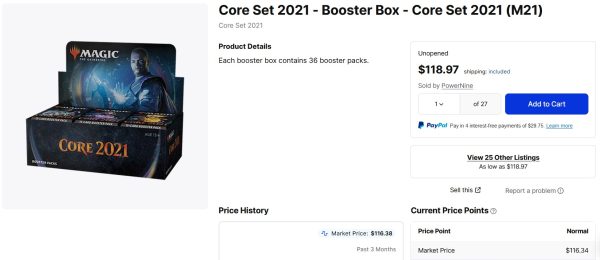
As such, it is my understanding that distributor pricing is in-line with sets like Modern Horizons and not like Core Set 2021, for example. A higher price at the distributor means game shops have to pay more for the product; a premium that they pass, in turn, to customers.

I did a Google search but couldn’t find any definitive source for the distributor prices of Tales of Middle Earth draft booster box prices. The only data point I found was mentioned by somebody on Reddit claiming the distributor box pricing is $200 CAD or about $150 in U.S. Dollars. A second commenter chimed in by stating that a $150 price point likely implies $110-$120 for “real” prices.

I don’t understand this rhetoric around “real” prices, but this Reddit contributor's number is plausible. If local game stores are paying upwards of $110-$120 for booster boxes, it seems reasonable they would charge between $150 and $160, at least at release.

Concerning Prospects

Draft booster boxes of previous straight-to-Modern sets have held up considerably well price-wise. Booster boxes of the first Modern Horizons sell for around $220 on TCGplayer, and the newer Modern Horizons 2 boxes sell in the $180 range. Granted, a year ago these were selling for around $210, but in the grand scheme these haven’t completely collapsed and I suspect the price is going to stabilize in this range rather than dip even lower.

The issue with comparing Modern Horizons boxes to Tales of Middle Earth boxes is, of course, the delta in power level. Modern Horizons cards were designed to influence and shape Modern. I don’t think Tales of Middle Earth cards are destined to shake up Modern too much—the cards themselves are simply not powerful enough.

Orcish Bowmasters is rumored to be the exception, which is why it remains one of the most valuable cards in the set. Unfortunately, I don’t think it’ll maintain its current $20 price tag. Modern is a supercharged format, So a card must be quite potent to have any influence on the metagame. I'm not convinced Orcish Bowmasters can get there.

There was an error retrieving a chart for Orcish Bowmasters

One may point out that the set will be more desirable to the Commander audience, especially those casual players who enjoy the overlap of Magic and Lord of the Rings lore. I concede this point. However, Commander is a format of 1-ofs… it will take much longer for Commander demand to absorb supply and increase prices.

The Battle of Commander Sets

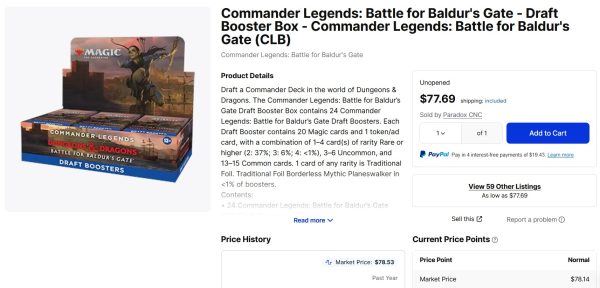
In terms of Commander-oriented sets, we already had a set release once before that was Commander themed: Battle for Baldur’s Gate. Sealed booster boxes of that set have held up poorly, to put it mildly.

This operating zone—a set of cards not legal in Standard but not powerful enough for eternal formats—is quite the awkward one. I guess the business plan is to lean heavily on the intellectual property associated with the set to sell product.

In the case of the Dungeons and Dragons crossover, the plan didn’t meet expectations as evidenced by the dirt-cheap booster box prices. Is the Lord of the Rings franchise enough to overcome a weaker set with fewer playing outlets?

The Fanbase: A Magnitude of Difference

There are some noteworthy differences between Lord of the Rings and Dungeons and Dragons. While I have no hard data here, a quick Google search can provide some order of magnitude differences in the fanbase.

According to a 2020 Forbes piece, Wizards of the Coast claims that over 50 million people have played Dungeons and Dragons. Meanwhile, one article suggests that 500-750 million people have watched the Lord of the Rings movie, with around 150 million people having read the books. I can’t confirm or deny these numbers, but in my opinion, these numbers when compared to each other make some sense. I fully expected Lord of the Rings to be more mainstream than Dungeons and Dragons and the data supports this hypothesis.

Does that mean we’ll see greater sales numbers for the Tales of Middle Earth set than we saw for the Battle for Baldur’s Gate set? To an extent, I’d say this is likely, though I can’t quantify the degree to which we’ll see the difference.

License To Reprint

The other factor that could buoy Tales of Middle Earth box prices is the licensing situation. While Wizards of the Coast owns both Magic and Dungeons and Dragons, they don’t own the intellectual property associated with The Lord of the Rings. Those rights belong to Middle Earth Enterprises, a subsidiary of Embracer Group.

Why does this matter? Well, when Wizards of the Coast wants to print more Dungeons and Dragons-themed Magic cards, they can design the cards, fire up the printing presses, and go to town as much as they’d like. If they want to print (or reprint) any Tales of Middle Earth cards, however, they’ll need licenses and permission from the owners of the intellectual property. There is no guarantee that will be desirable (or profitable), so reprints of this set may or may not ever occur.

Some of my friends theorize that this is why cards from Tales of Middle Earth were underpowered—there was a concern that they’d print a card that heavily impacted Modern, would soar in price, and then become prohibitive as Wizards of the Coast struggled to obtain a license to reprint the card. It was safest to keep cards slightly underpowered to avoid this situation.

Longterm Prospects of LOTR

No reprints could bode well for long-term booster box prices if enough fans of the franchise buy product. It seems this is the business strategy that Wizards of the Coast is banking on—if association with Lord of the Rings is enough to drive purchase, then this set can be a screaming success. If it is successful, then box prices can remain elevated. Years from now, without a reprint, Lord of the Rings fans may wish to come back to Middle Earth to enjoy reliving the experience of drafting this set.

On the other hand, if the cards are too underpowered and there’s no demand for these singles in constructed play, what will the expected value be for a draft booster box of this set? In a word, abysmal. Will people still open product if they can’t crack more than $50 worth of singles? Some might, but many won’t.

Thus, we have an interesting tug-of-war between two market factors that will be fascinating to watch as it plays out. I honestly don’t know which direction things will go. My gut says that in the short term, prices will fall rapidly. I am confident booster boxes will be less expensive sometime between now and the end of the year. What I’m less confident in, however, is what the price of these boxes will be three years from now.

Wrapping It Up

I’m hopeful that my box can climb in price, but also nervous after seeing the failure of Battle for Baldur’s Gate. At least Tales of Middle Earth is Modern-legal, unlike Battle for Baldur's Gate, though I'm not sure if the set is powerful enough for that to matter. Perhaps the Lord of the Rings fanbase is larger and will be more passionate about this set, driving sales of the product higher than anticipated. Only time will tell.

The Secret to Drafting Jeskai Tempo in Tales of Middle Earth

Are you a Quiet Speculation member?

If not, now is a perfect time to join up! Our powerful tools, breaking-news analysis, and exclusive Discord channel will make sure you stay up to date and ahead of the curve.

It's hard not to compare Lord of the Rings: Tales in Middle Earth (LTR) to the format that preceded it, March of the Machine (MOM). From a complexity level, LTR resembles a core set. Synergies are important, and clearly guided by signpost uncommons. The power level is a nowhere near as high. While some commons do stand out, specifically Errand-Runner of Gondor, we want to make sure we're supporting them by adhering closely to the format's archetypes.

In my preview guide, I discussed my thoughts on the Jeskai tempo decks in the format. With the help of my old friend, confirmation bias, I leaned towards those archetypes to navigate this brand-new playing field. During the early-access event I was able to have a lot of success by playing the wedge's aggressive decks, especially in red.

But before plunging into that topic, I want to discuss one of the major differences between LTR and MOM.

Synergy Is Everything

The best decks in MOM got a big boost from rares. It was often worth splashing powerful bombs, even if they didn't perfectly meld with a deck's theme.

Additionally, redundant keywords work together well. For example, in War of the Spark (WAR), amass was often used to create tokens to sacrifice. Here, amass plays well with... more amass. We want our army tokens to be huge, not just measly bodies. Tempt plays well with more tempt, which is a little more intuitive.

Because of this, there is more incentive to get into the open colors, rather than to hold onto a first-pick bomb.

Hoards of lords

Early on, this format feels like it's about the uncommons. These cards enhance the effectiveness of many of our commons... though some commons can have a similar effect.

High-synergy commons

Much like in the novelized battles of Middle-Earth, the legends have a profound impact on those surrounding them. Because these cards can boost multiple archetypes, Great Hall of the Citadel becomes an interesting option to enable splashes.

There was an error retrieving a chart for Great Hall of the Citadel

Overlapping archetypes might make Old Man Willow a potent splash in a BW or GW deck. This nonbasic land splashes legends better than off-color basics. It can meet all of our off-color mana requirements while still creating a better mana base to cast on-color legends. In the early weeks, it will go much later than it should.

UR Spells

Similar to the UR Spells deck in Dominaria United (DMU), this Izzet deck focuses on tempo and aggression. The most synergistic versions of the deck play like a burn deck, but it can skew towards a more traditional aggressive deck.

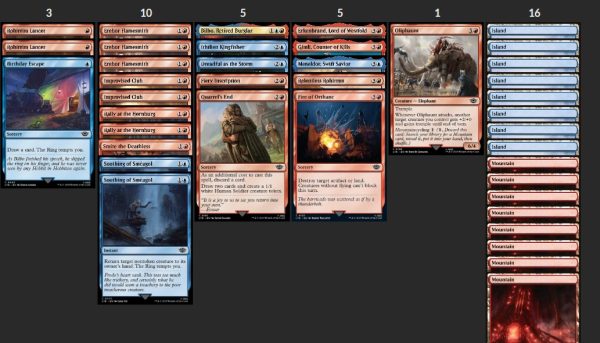
UR Spells (7-0)

Creatures

2 Rohirrim Lancer
3 Erebor Flamesmith
1 Bilbo, Retired Burglar
1 Ithilien Kingfisher
1 Erkenbrand, Lord of Westfold
1 Gimli, Counter of Kills
1 Meneldor, Swift Savior
1 Relentless Rohirrim
1 Oliphaunt

Instants

2 Improvised Club
1 Smite the Deathless
2 Soothing of Sméagol
1 Dreadful as the Storm

Sorceries

1 Birthday Escape
2 Rally at the Hornburg
1 Quarrel's End
1 Fire of Orthanc

Enchantments

1 Fiery Inscription

Lands

8 Island
8 Mountain

The four-mana legends were underperformers in the deck. Though each is powerful, they lack synergy with the rest of the deck. They generally weren't fast enough to help with our central gameplan. Erkenbrand, Lord of Westfold was an exception. This card is bonkers with Rally at the Hornburg, and it swung games completely.

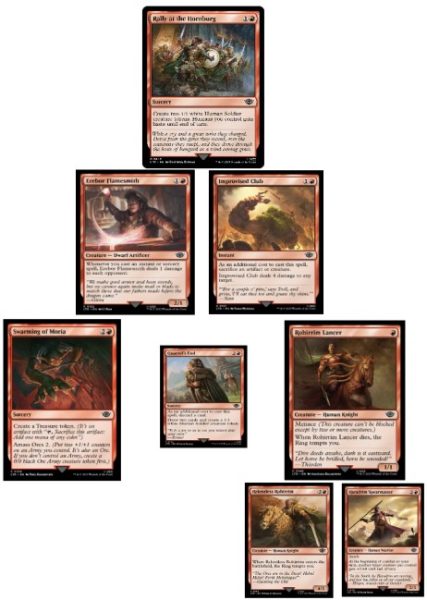
Rally thrives in this deck. It's an aggressive two mana spell, playing well with Erebor Flamesmith and Improvised Club, both of which out-performed expectations. This trio of red cards make for the cornerstone of a very aggressive color.

The powerful build-arounds incentivize a more spell-based approach. If we see those cards, they're worth taking a flyer on. Seven or so triggers are enough for Erebor Flamesmith, but Fiery Inscription is a furnace that must be fed.

UR Synergy (7-0)

Creatures

3 Erebor Flamesmith
1 Grey Havens Navigator
1 Gandalf the Grey

Instants

1 Hithlain Knots
1 Soothing of Sméagol
1 Isolation of Orthanc
1 Press the Enemy

Sorceries

1 Fear, Fire, Foes!
1 Rally at the Hornburg
2 Gandalf's Sanctions
2 Quarrel's End
3 Swarming of Moria
2 Treason of Isengard
1 Surrounded by Orcs
1 LĂłrien Revealed

Enchantments

2 Fiery Inscription

Lands

8 Island
8 Mountain

To be frank, I feel like I peaked before the format's release.

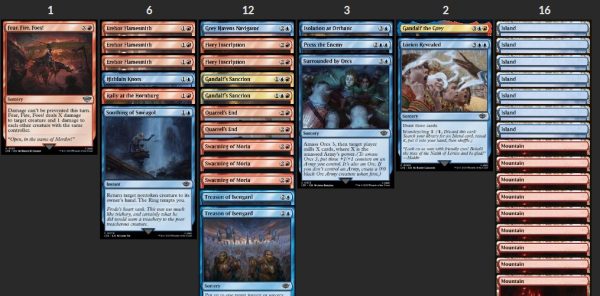
Double Fiery Inscription, triple Erebor Flamesmith, double Gandalf's Sanction, and Gandalf the Grey himself headline this five-creature opus.

This deck was all synergy. Middling cards like Swarming of Moria, Quarrel's End, and Treason of Isengard were often burn spells in addition to their stated value. Building around build-arounds means always building towards something. The UR build-arounds are definitely worth the commitment.

RW Humans

This is the other Rally of the Hornburg deck, a card that might be both the set's Gust Walker and most valuable glue card. The two haste bodies are generally good, but the fact that they can each carry DĂşnedain Blade makes RW a threat at common.

RW Humans 6-3

Creatures

1 Esquire of the King
2 Rohirrim Lancer
2 East-Mark Cavalier
1 Shire Shirriff
1 Errand-Rider of Gondor
1 Grishnákh, Brash Instigator
1 Éowyn, Lady of Rohan
3 Protector of Gondor
1 Relentless Rohirrim
1 Éomer, Marshal of Rohan
1 Eagles of the North

Instants

1 Improvised Club
2 Smite the Deathless

Sorceries

1 Rally at the Hornburg
1 Swarming of Moria
1 Now for Wrath, Now for Ruin!

Artifacts

3 DĂşnedain Blade

Lands

8 Plains
8 Mountain

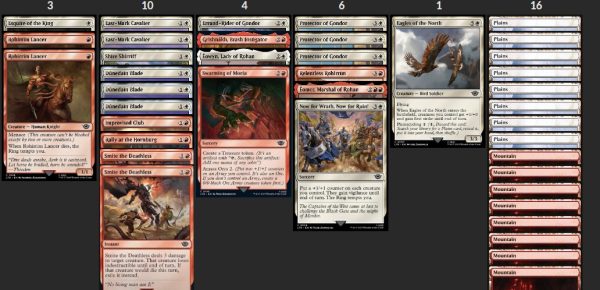
Rohirrim Lancer made for a decent stand-in, but what this deck wanted was more Rally of the Hornburg. Efficient creatures get a ton of value out of the cheap equip cost on DĂşnedain Blade, and this trio pressures well early and into the mid-game. Protectors of Gondor provides redundancy once we're going in this direction.

Improvised Club may be the Price of Loyalty of this set. It's the secret sauce to the format's aggressive decks, and this is probably its best home. This deck makes a lot of bodies and some of them end up chump attacking. Club is a versatile tool that provides needed reach to the RW decks.

Through the power of Microsoft Paint, I've outlined a synergy triangle between the red commons of RU and RW. Rally the Hornburg is a cornerstone of both decks.

UW Draw Two Aggro

This was the deck I was most excited about. However, it doesn't have access to the aggressive starts of the red decks. I anticipated The Ring to be active enough in this archetype to fuel the "draw two" payoffs while applying aggressive pressure.

White and blue are a little more midrange than I predicted. Turning on The Ring is not trivial, and the format has a lot of one-power blockers. In my first draft of the format, I first-picked an Prince Imrahil the Fair and aimed at the UW aggro deck I expected to dominate the format.

Blue Streak

In my draft, I prioritized power level where I was supposed to prioritize cheap tempt triggers. Slip on the Ring and Birthday Escape may have played better than Saruman the White and Boromir, Warden of the Tower. Those cards would have empowered my swarm of middling cheap creatures and enabled more aggressive gameplay.

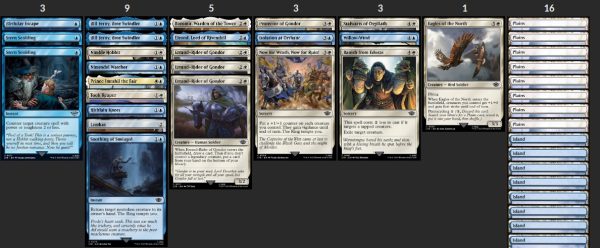
UW Tempo (3-3)

Creatures

2 Bill Ferny, Bree Swindler
1 Nimble Hobbit
1 Nimrodel Watcher
1 Prince Imrahil the Fair
1 Took Reaper
1 Boromir, Warden of the Tower
1 Elrond, Lord of Rivendell
3 Errand-Rider of Gondor
1 Protector of Gondor
1 Stalwarts of Osgiliath
1 Willow-Wind
1 Eagles of the North

Instants

2 Stern Scolding
1 Hithlain Knots
1 Soothing of Sméagol
1 Isolation at Orthanc

Sorceries

1 Birthday Escape
1 Now for Wrath, Now for Ruin!
1 Banish from Edoras

Artifacts

1 Lembas

Lands

8 Plains
8 Island

This deck was great when it drew Prince Imrahil the Fair and Errand-Rider of Gondor, but pretty bad when it didn't draw either. The two-drops aren't given enough support and the five-drops aren't positioned to synergize with them. Errand-Rider of Gondor cures a lot of ills though. I think this deck is supposed to be built to set up an active Ring-bearer and generate value with it through the mid-game.

Building a Better UW

The better UW decks are going to play a slower game. Blue has tons of card draw, and reasonable support for it in Pelargir Survivor.

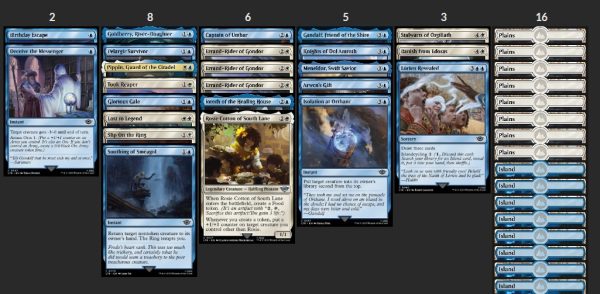
Bigger UW (7-2)

Creatures

1 Goldberry, River-Daughter
1 Pelargir Survivor
1 Pippin, Guard of the Citadel
1 Took Reaper
1 Captain of Umbar
3 Errand-Rider of Gondor
1 Ioreth of the Healing House
1 Rosie Cotton of South Lane
1 Gandalf, Friend of the Shire
1 Knights of Dol Amroth
1 Meneldor, Swift Savior
1 Stalwarts of Osgiliath

Instants

1 Deceive the Messenger
1 Glorious Gale
1 Lost to Legend
1 Slip on the Ring
1 Soothing of Sméagol
1 Isolation at Orthanc

Sorceries

1 Birthday Escape
1 Arwen's Gift
1 Banish from Edoras

Lands

8 Plains
8 Island

This deck more closely aligns with what the blue commons are trying to achieve. It tempts better. It plays more individually powerful cards and leans into the ample card advantage blue offers. Because the format feels very sorcery-heavy, cards like Slip on the Ring, Deceive the Messenger, and Gandalf, Friend of the Shire are all easier to use. The Melendor, Swift Savior and Errand Rider of Gondor combo is very real as well.

For the Shire!

So far, the format has been a blast. Despite boasting a lower power level, it has felt very skill-intensive, and sequencing is extremely important. My prediction was that Jeskai would be the tempo wedge, but ultimately I think the red decks are where aggression lives. BR has felt really powerful and might be the best deck in the format. Still, it's very early. So let me know what you think of the format in the comments! Until next week... I'll be drafting.

Did Middle-Earth Break Legacy in Baltimore?

Are you a Quiet Speculation member?

If not, now is a perfect time to join up! Our powerful tools, breaking-news analysis, and exclusive Discord channel will make sure you stay up to date and ahead of the curve.

This weekend, I was fortunate enough to attend SCGCon Baltimore and play 21 rounds of Legacy. I’ve been very focused on Pioneer lately for Organized Play and this weekend was a wonderful break. A lot of my opponents expressed being in similar boats.

The new Lord of the Rings cards had a significant impact on the format, including prime suspect Orcish Bowmasters. Today, we'll take a look at some of the more interesting developments from this weekend and assess how the format could shift to accommodate them going forward.

Mini-Report

Round after round, all but one of my opponents were all smiles and fun. I went a total of 14-5-2 over the weekend. While my results were nothing special, I did manage to at least win my money back, and had a great time.

There was an error retrieving a chart for Dark Depths

As expected, I ended up playing the Naya Depths list I shared in my previous article. The list treated me well as usual. I took an unexpected loss to Grixis Delver and a less surprising loss to Mono-Black Storm. My other three losses on the weekend were to various combo decks featuring blue, which tend to be my worst matchups. If the metagame continues to develop how I'm expecting, I think Depths will continue to be a strong choice. This works out great for me, so hopefully I'm right.

Baltimore Meta

Baltimore was a notable event because it was our first look at how the new Tales of Middle-Earth cards might perform in Legacy.

RW Initiative

I want to start by highlighting Forth Eorlingas!. Quinn Tonole slotted this card in to Boros Initiative and cruised his way to a Top 8 finish.

Boros Initiative, Quinn Tonole

Creatures (23)

4 Anointed Peacekeeper
4 Archon of Emeria
4 Simian Spirit Guide
4 Caves of Chaos Adventurer
4 Seasoned Dungeoneer
3 Solitude

Artifacts (12)

4 Chalice of the Void
4 Chrome Mox
4 Lotus Petal

Enchantments (5)

3 Fable of the Mirror-Breaker // Reflection of Kiki-Jiki
2 Touch the Spirit Realm

Sorceries (3)

3 Forth Eorlingas!

Lands (17)

4 Ancient Tomb
4 Cavern of Souls
4 City of Traitors
1 Mountain
2 Plains
1 Plateau
1 Karakas

Sideboard (15)

4 Swords to Plowshares
3 Faerie Macabre
3 Containment Priest
2 Loran of the Third Path
2 Magus of the Moon
1 Solitude

Forth seems really strong here. The Initiative deck is full of fast mana sources, but if the game goes long, the deck can't make good use of all of its sol lands and mana rocks. Forth gives the deck the late-game mana sink it so desperately wanted. It can also be a very punishing early play. If people aren't prepared to block early, adding the Monarch to the game can be a very potent strategy.

There was an error retrieving a chart for Anointed Peacekeeper

I'm not actually sure how much to expect to see of this deck moving forward. This was one of the best-performing popular decks on Saturday, but a lot of that had to do with Quinn. On Sunday, the deck performed abysmally. I do know a couple of the pilots were not super familiar with the format which probably depressed the win rate some. Regardless of how the deck does in the future, if you play against it, make sure to be mindful of surprise hasty attackers.

RB Painter

Last week I said people should respect this deck going into the weekend, but I didn't realize just how right I was going to be. RB Painter had an absurd win rate on Saturday, putting only a single copy into Top 8 but two more in Top 16. If you include Mono-Red and RW builds, the numbers get worse but remain strong.

RB Painter, Kenton Najdzein

Creatures (20)

4 Goblin Welder
4 Goblin Engineer
3 Orcish Bowmasters
4 Painter's Servant
1 Phyrexian Dragon Engine
1 Simian Spirit Guide
2 Fury
1 Chaos Defiler

Artifact (7)

3 Lotus Petal
1 Mox Opal
2 Grindstone
1 Nihil Spellbomb

Enchantments (4)

4 Fable of the Mirror-Breaker // Reflection of Kiki-Jiki

Instants (8)

2 Lightning Bolt
4 Pyroblast
2 Red Elemental Blast

Lands (21)

4 Ancient Tomb
1 Arid Mesa
2 Badlands
1 Bloodstained Mire
1 City of Traitors
3 Great Furnace
4 Mountain
1 Scalding Tarn
4 Urza's Saga

Sideboard (15)

1 Chaos Defiler
1 Soul-Guide Lantern
2 Mindbreak Trap
3 Surgical Extraction
2 Magus of the Moon
1 Fury
1 Pithing Needle
1 Canoptek Scarab Swarm
1 Opposition Agent
2 Sheoldred's Edict

The black splash is small, but potent. Despite being a one-of, I think Chaos Defiler is actually the bigger of the two pickups. Defiler isn't new but unfortunately hasn't made its way on to Magic: Online yet. The most notable thing about this card is that it doesn't target. When combined with Goblin Welder, this card will quickly mow down any and all opposing nonland permanents. It was very impressive every time I saw it. Orcish Bowmasters easily slotting in also added some power to this deck.

Cephalid Breakfast

Four years ago, if you told somebody that Cephalid Breakfast won a major tournament, they probably would have laughed at you. This deck is no joke though. Brian Coval used it to take down the 10K main event.

Cephalid Breakfast, Brian Coval

Creatures (12)

3 Nomads en-Kor
1 Brazen Borrower // Petty Theft
4 Cephalid Illusionist
3 Narcomoeba
1 Thassa's Oracle

Artifacts (7)

1 Retrofitter Foundry
2 Shuko
4 Staff of the Storyteller

Sorceries (8)

1 Cabal Therapy
4 Ponder
1 Dread Return
2 Step Through

Instants (10)

4 Brainstorm
2 Orim's Chant
4 Force of WIll

Lands (21)

4 Flooded Strand
2 Island
2 Misty Rainforest
1 Mystic Sanctuary
1 Plains
1 Polluted Delta
2 Scalding Tarn
4 Tundra
1 Underground Sea
3 Urza's Saga

In addition to winning the event on Saturday, the deck put up another Top 8 on Sunday in the hands of Paul Lynch. This was the most popular deck between days and still managed an impressive win rate. Often, as decks get more popular, their performance starts to move closer to average. This was clearly a good choice for the weekend. Being able to back up such a compact combo package with Force of Will means the deck will likely always be reasonable at worst.

Delver aka The Fun Police

For as long as I can remember, Delver has always been one of if not the best deck in the format. For years now, Izzet has been the most prominent flavor. Ever since the Expressive Iteration ban, people have been unsure of what to do with the deck though. This was very evident this weekend. UR remained the most popular choice but had a pretty poor showing.

Three-color Delver seems to be the way of the future. Temur and Grixis both performed better than Izzet builds. The green splash was most notably for copies of Tarmogoyf, a card I think is underwhelming in the format. Black allowed the deck to add removal in Snuff Out and to also try running its own copies of Orcish Bowmasters. This was the best-preforming Delver variant.

It's an Orc's World Now

There was an error retrieving a chart for Orcish Bowmasters

Often when we talk about cards we expect to show up in main decks, we ask what it's doing for a deck. With this particular card, I think it's better to talk about how it attacks other decks. This approach is really unusual for a main deck card, but this is a weird one. It really does hit a lot of the metagame. I'm still not convinced it's going to warp the format as much as some say, but let's explore anyways.

Effect on Breakfast

Bowmasters will see a lot of play over the next few weeks while we figure out its true power. So regardless of how good the card ultimately ends up being, it is liable to have a pretty big impact on the immediate future. Let's look at how this card lines up against our favorite Cephalids. Every creature in the Breakfast deck has one toughness. The fact that Bowmasters doubles as removal against every creature in the deck is likely to be a problem. It might encourage some players to return to Stoneforge Mystic, but it might also just chase people away from the deck. Worth noting: Bowmasters itself is also a potential option for some of the flex slots.

Effect on Delver

Delver is another deck that seems weak on the surface to the Orc. Delver is known for casting small creatures and lots of cantrips. This is far from ideal against the Orc. All weekend I heard victory/horror stories of people casting a Brainstorm that ended up killing their own Dragon's Rage Channeler. Delver players should be able to adjust their play patterns to not get blown out by the Orc, but it will likely take some practice. As mentioned above, the card can also slot into this deck and might be the future of the archetype.

Effect on 8 Cast

8 Cast is another deck I expected to show up in force at Baltimore. It was very popular but didn't have a great showing. A lot of things go into a deck having a good or bad weekend but I bet some of it had to do with our new Orc.

8 Cast draws a lot of cards. That's sort of the deck's whole shtick. It also doesn't play any main deck removal. It's pretty easy for a Bowmasters to pick off an Emry or Thought Monitor to help contain the board, and then just sit there making life difficult. It's also hard for 8 Cast to develop without letting their opponent generate a huge army token. It may be enough to make 8 Cast consider main decking copies of Dismember or Brazen Borrower // Petty Theft.

Effect on Elves

Against the Glimpse of Nature builds of Elves, it basically shuts down the deck's engine. The deck is almost exclusively X/1s. While Glimpse would still allow for additional draws, it wouldn't be able to build its board. Elvish Visionary and Wirewood goes from strong engine to non-existent real fast.

Effect on Miscellaneous Other Decks

Against any blue-based cantrip deck, the card can only be so bad. The card doesn't actually apply that much pressure, but becomes oppressive when it can gun something down. Even killing off a Staff of the Storyteller Spirit token or Snapcaster Mage can be enough. Most non-blue decks have some amount of targets: Goblin Welder, Dryad Arbor, Baleful Strix, and Ice-Fang Coatl are all creatures I expect to see falling to Bowmasters a lot over the next few weeks.

Delighted Halfling

This card was one of the first we saw from the set and it's pretty strong. The 5C Zenith decks in Legacy they seem like a natural home for this card. The deck already incidentally plays a lot of legendary permanents. Getting to ramp into these haymakers AND make them uncounterable is really strong. It means knowing your turn two Grist, the Hunger Tide or Leovold, Emmisary of Trest will resolve on turn two.

There was an error retrieving a chart for Delighted Halfling

If we really want to up the ante though, on turn three you can fore through an Omnath, Locus of Creation or Minsc & Boo, Timeless Heros. Outside of Zenith, I could also see Halfling contributing to the foundation of a Legacy version of the Modern Yawgmoth, Thran Physician deck. And perhaps most promising is slotting it into the very fringe Planeswalker Stompy deck we see from time to time. It is worth noting, though: that deck normally plays Chalice of the Void, and I'm not sure which is better for the archetype or whether both cards can coexist in one shell.

Taking a Bow

Are there other cards you're excited for in Legacy? I'd love to hear about your ideas, so feel free to reach out on Twitter or in the Quiet Speculation discord. Next week, we'll cover Modern's adoption of Lord of the Rings. I have a lot of ideas I want to work on and I'm sure we'll see a bunch of neat stuff in the MTGO Challenges. Until then!

Avatar photo

Michael Mapson

Mapson is a constructed specialist and Level 2 judge. While he has a strong preference for Modern and Legacy, he is happy to play any form of Magic. He enjoys most decks, but can most often be found playing various land-based strategies such as Amulet Titan, Scapeshift or Naya Depths. His most notable finishes include a Modern Grand Prix Finals appearance, a team SCG Open top 4, and some 5k wins. You can also catch his thoughts each week on the Dark Depths Podcast where he and his cohost, Billy Mitchell, talk about Modern and Legacy.

View More By Michael Mapson

Posted in FreeTagged , , , , , , Leave a Comment on Did Middle-Earth Break Legacy in Baltimore?

Have you joined the Quiet Speculation Discord?

If you haven't, you're leaving value on the table! Join our community of experts, enthusiasts, entertainers, and educators and enjoy exclusive podcasts, questions asked and answered, trades, sales, and everything else Discord has to offer.

Want to create content with Quiet Speculation?

All you need to succeed is a passion for Magic: The Gathering, and the ability to write coherently. Share your knowledge of MTG and how you leverage it to win games, get value from your cards – or even turn a profit.

Pioneer Summer: Lessons Learned in RCQ Testing

Are you a Quiet Speculation member?

If not, now is a perfect time to join up! Our powerful tools, breaking-news analysis, and exclusive Discord channel will make sure you stay up to date and ahead of the curve.

Testing is necessary for success in competitive Magic. It is also very hard and frequently boring. As a result, most players go to events underprepared. This has definitely been the case for me attending Pioneer RCQ's this past year. I don't like Pioneer to begin with, so testing has felt like a chore. The Magic Online All-Access pass a few weeks ago gave me the opportunity to do a lot of testing relatively quickly and painlessly, so I took advantage. Here's what I learned.
Rakdos Rocks By Default

Remember about a month ago, where I claimed that Rakdos Rock was the top deck in Pioneer thanks to being the least bad deck? I played it myself and against it frequently over the All-Access event and had everything I said about that deck reinforced. The deck is so... aggressively medium in a field of feast or famine decks that it works. I still wouldn't call it good, but at least it doesn't have as many feels-bad moments as other decks.

Rakdos never felt completely overmatched against any deck, even when very behind or badly positioned. Thoughtseize answers everything after all, so there was always the chance to steal games by destroying opponent's hand. Fable of the Mirror-Breaker //Reflection of Kiki-Jiki is a very strong way to come from behind. Sheoldred the Apocalypse is often backbreaking.

There was an error retrieving a chart for Fable of the Mirror-Breaker // Reflection of Kiki-Jiki

The flip side to that is that Rakdos also never got me any free wins. With a lot of decks I played, there were matchups that felt unlosable (assuming your deck didn't crap itself) to compensate for near-unwinnable bad matchups. Rakdos had to work for every win, and I'd guess my opponents did too. It was possible to snowball games, but I had to carefully set up to make it happen.

Midrange Alternatives

While my serious testing was focused on two decks, I tried out a vast swath of decks. Part of that was simple curiosity, maybe a deck outside my usual preference would interest me. A lot of it was to better understand how the metagame works and how to fight against it. It's also good to try alternatives to established doctrine.

Annoyingly, there doesn't seem to be a viable alternative midrange deck to Rakdos. Every other deck I tried just felt anemic or inconsistent compared to BR. Trying to go a different direction but maintain the pace of midrange only led to more frustration and a lingering question of why I was bothering to even try. This was especially true of Abzan Greasefang, but I'll discuss that deck separately.

There was an error retrieving a chart for Thoughtseize

All the best midrange answers and threats are black or red. Trying to move away from either of those colors means involving worse midrange cards. This in turn translates to approaching either control or aggro. The deck stops being particularly midrange-y and instead becomes a bad control deck or bad aggro deck. I know that accusation gets thrown at midrange a lot, but it's true. Pioneer's midrange deck is Rakdos. End of story.

Annoying Abzan

I have open contempt for Abzan Greasefang. I've been open about this since I started writing about Pioneer. I understand the appeal it used to have, but the deck doesn't even try for that anymore. The ideal plan used to be cast Stitcher's Supplier turn 1, flip Greasefang, Okiba Boss and Parhelion II, and then cast Can't Stay Away on Greasefang to reanimate Parhelion and functionally end the game turn 2. However, Greasefang has cut Supplier to go more midrange.

There was an error retrieving a chart for Greasefang, Okiba Boss

Greasefang players have cut the Suppliers and some other milling creatures for Vessel of Nascency and interaction. The plan has morphed from turbo-ing Parhelion to casting Esika's Chariot. They've made this change because Abzan decks of old would durdle around milling themselves without actually finding the combo. Now the milling is more for value.

The Problem

This isn't a bad plan. Chariot is a rather absurd card and is the tentpole card of Gruul Vehicles. The issue is that Greasefang has been and still is a very inconsistent deck. Even with the move towards midrange, it's still filled with air, because it hasn't given up entirely on early Greasefang and Parhelion. Since I first encountered it, I found the deck infuriating for its inconsistency, and nothing has been done to fix that flaw.

There was an error retrieving a chart for Esika's Chariot

As things stand, Greasefang is a deck of compromises. When things go its way it appears very strong. All the discard it plays does wonders for opening the way for vehicle attacks. However, if it stumbles, it still just durdles around and dies. Gruul Vehicles is a worse deck by the numbers, but at least it always does something. Abzan needs to fix its identity crisis. I never won playing the deck and never lost to it during testing.

Missing Devotion

On that note, I didn't encounter Green Devotion at all during the two weeks of All-Access. Given the stats from MTGGoldfish, it should have been relatively common. I was a little disappointed as I was playing decks with allegedly good Devotion matchups primarily, but it is a little perplexing. Were it not for the stats, I'd assume online players abandoned the deck.

There was an error retrieving a chart for Nykthos, Shrine to Nyx

It wouldn't have surprised me if players had abandoned Devotion online. After all the hype last year, it never had a very disappointing season. It's also a very complex deck to combo with online thanks to all the clicking, and decks like that tend to be unpopular in that setting. The fact that the deck can just play the beatdown game gave it legs, but that usually isn't enough. I'm genuinely curious about what's up with the deck.

Oh, the Humanity

I went into this testing session thinking that I'd be perfecting my Mono-White Humans list. At most of the RCQs I've been to it's felt like the best performing aggro deck, and again that's backed up by the overall stats. I was committed to the deck, only to have it completely fall apart on me during testing. Some of that was purely thanks to good old Matchup Roulette, but there were problems with the list I was using.

Ongoing Development

I don't keep close tabs on deck development for Pioneer. I don't play Pioneer that often (see my earlier frustration) and even when I do, it's not against the top tier decks. Most of the Pioneer players in my area have pet decks and don't change often. So, I don't need to innovate my decks and fall behind the curve. When All-Access came about and I decided to extensively test Humans, I just netdecked.

Humans, Test Deck

Creatures

3 Dauntless Bodyguard
4 Hopeful Initiate
1 Kytheon, Hero of Akros // Gideon, Battle-Forged
4 Recruitment Officer
4 Coppercoat Vanguard
4 Thalia's Lieutenant
4 Thalia, Guardian of Thraben
2 Luminarch Aspirant
4 Adeline, Resplendent Cathar
4 Brutal Cathar // Moonrage Brute

Enchantments

4 Ossification

Lands

2 Castle Ardenvale
2 Eiganjo, Seat of the Empire
4 Mutavault
14 Plains

Sideboard

4 Portable Hole
3 Invasion of Gobakhan // Lightshield Array
2 Rest in Peace
2 March of Otherworldly Light
4 Wedding Announcement // Wedding Festivity

As I suspected they would, Humans had dropped Brave the Elements for Ossification. Coppercoat Vanguard was immediately and fully adopted, pushing out Luminarch Aspirant. I was also pleased to see Shefet Dunes leave. That card never did what I wanted it to do. I spent about a week on this deck before giving up.

I would advise against running Invasion of Gobakhan in Humans. As a go-wide aggro deck, it's not advantageous to take a turn off of damage to flip the battle. The information gained is of limited value most of the time. This is a deck for putting one's head down and just going for it. Invasion is also awkward with Thalia, Guardian of Thraben.

Test and Evaluate

It wasn't that I wasn't winning enough, it's that the wins all felt really close, while my losses were blowouts. I consistently felt like I was taking advantage of my opponents' stumbles, but they were winning on their decks' merits. That seemed like too poor of a place to be so I moved on.

There was an error retrieving a chart for Coppercoat Vanguard

The problem wasn't the deck's construction. There were times I wanted Brave, but those were balanced by times Ossification was the only way to win. One card wasn't better than the other in the matchups I faced, it was just a metagame call trade-off. Vanguard isn't a better card than Aspirant as it isn't a threat on its own, but it is more aggressive, which plays better in the deck. The deck felt fine and no change to the sideboard or maindeck made any difference.

The deck seems to be in a transition period. Since All-Access ended, I've seen a lot of decks running both Brave and Ossification, while some have dropped them entirely for grindy creatures. There's been some shifting in the maindeck removal packages of many decks, and Humans is trying to adapt. The evidence suggests that it hasn't been optimized yet.

The Spirits of Pioneer

This led me back to my old standby, Spirits. I'd given up on Mono-Blue Spirits for Humans after Angels started dominating the skies. Though Angels has fallen off, what with removal changes rendering Ascendant Spirit a liability and the UW Control match remained pretty poor in general. Switching back to UW Spirits was the answer.

UW Spirits, Test Deck

Creatures

4 Mausoleum Wanderer
4 Spectral Sailor
4 Rattlechains
4 Shacklegeist
4 Supreme Phantom
4 Spell Queller

Instants

3 Lofty Denial
4 Geistlight Snare

Battles

3 Invasion of Gobakhan // Lightshield Array

Enchantments

4 Curious Obsession

Lands

4 Adarkar Wastes
4 Hallowed Fountain
3 Field of Ruin
4 Island
2 Plains
1 Hall of Storm Giants
4 Seachrome Coast

Sideboard

4 Portable Hole
2 Destroy Evil
2 Mystical Dispute
2 Rest in Peace
2 Damping Sphere
3 Skyclave Apparition

This is the deck I was playing when All-Access came to an end. It performed a lot better for me overall than Humans, though the matchups are much more extreme. Spirits still has a poor matchup against other creature decks, which is why the sideboard is full of removal.

Deck Repositioning

At its most basic, all that's changed is replacing Ascendant Spirit with Spell Queller and altering the manabase. However, that has drastically changed how the deck plays. Spirit pushed the deck towards aggressive tempo while Queller moves towards reactive tempo. UW Spirits plays more at instant speed than mono-blue, and as a result is harder to play, but also harder to play against.

Invasion of Gobakhan is a big part of that, and really shines in Spirits. Unlike Humans, Spirits can use the information gained to play around opponent's hands, and it fits into the disruption package seamlessly. Spirits isn't a go-wide deck, so taking a turn to flip the battle is feasible and worthwhile.

There was an error retrieving a chart for Invasion of Gobakhan // Lightshield Array

This also means that the deck's matchups have changed a lot. UW Control is a much easier matchup for UW than mono-blue, and the creature matchups are slightly easier, though still unfavorable. Midrange is a wash, as mono-blue got to steal wins getting under it while UW wins by answering their threats and answers. Overall, an improvement, though not a complete blowout.

Unusual Choices

I'm playing a number of unusual cards in my deck. Field of Ruin, Rest in Peace, and Damping Sphere aren't commonly played in Spirits. I found them very important in the Lotus Field matchup, but they have considerable utility elsewhere. The usual disruption plans weren't quite good enough anymore, but these really worked for me.

There was an error retrieving a chart for Lotus Field

Field's primary role is killing Thespian's Stage. In other matchups, it's great for killing creature-lands, but there are also decks that don't play any basics and losing a land drop is crushing. Sphere is the best anti-Lotus card around and also hurts Devotion more than they'd like to admit. Rest shuts off Lotus's easy win, and is also great against Greasefang and graveyard decks generally.
I was playing Lofty Denial, but it's far from required. Other Spirits decks are running a mix of Denial, Spell Pierce, Slip Out the Back, and even more creatures. I haven't found it to make much difference which utility spell is run in this slot. Each has enough pros and cons in each common matchup that I'm convinced it's a matter of preference.

Season Rolls On

The Pioneer RCQ season will continue into August, but I don't expect any real shakeup outside of bannings on August 7th. As such, this is the time to lock in decks and really get the nose to the grindstone to have a chance of winning. Just make sure to make appropriate devotion to the Matchup Roulette Wheel, lest it render all preparations moot.

Strictly Speaking: Azorius Lotus Control in Pioneer

Are you a Quiet Speculation member?

If not, now is a perfect time to join up! Our powerful tools, breaking-news analysis, and exclusive Discord channel will make sure you stay up to date and ahead of the curve.

Something Old, Something New

In today's video, I'm playing another Azorius Control deck in Pioneer. This time it's Lotus Control a flavor of Azorius Control that Patrick Wu took to a second-place finish at the Toronto Regional Championship. This version uses Lotus Field in combination with either Strict Proctor or Discontinuity. This effectively ramps two mana and gives Azorius Control a much-needed power spike that it has been lacking in recent months.

There was an error retrieving a chart for Lotus Field

The deck still plays Teferi, Hero of Dominaria and powerful wrath effects like Doomskar and Farewell. Teferi, Hero of Dominaria is actually immensely important in the deck, but let's not get ahead of ourselves. Let's first delve into how to set up the "combo" and we'll go from there.

There was an error retrieving a chart for Doomskar

Leveling the Playing Field

One of Azorius Control's biggest downsides historically in Pioneer has always been that it is trying to be too fair in a format full of unfair decks. Lotus Control looks to shift that paradigm. Having access to Lotus Field gives the deck a way to keep up with all the shenanigans that most of the other decks in the format are trying to do.

The way we set up our Lotus Field turns is as follows: on turn three we play Strict Proctor then play our Lotus Field. The Lotus Field trigger goes on the stack and then Strict Proctor's ability goes on the stack we can simply decline to pay the two mana for Strict Proctor's ability. From there, we ramp two mana going into our fourth turn. This means that assuming we hit our fourth land drop we'll have access to six mana on turn four. That unlocks basically every haymaker in our deck.

There was an error retrieving a chart for Strict Proctor

Aside from Playing Strict Proctor on turn three we can also just cast Discontinuity in response to Lotus Field's trigger which ends our turn on the spot. This means the stack is cleared, effectively "countering" the "sacrifice two lands" trigger from Lotus Field. Let me stress that we would much rather have a Strict Proctor on turn three rather than a Discontinuity for several reasons but one of the biggest is that Strict Proctor is actually quite good in the early game versus many decks. On the flip side of that coin Discontinuity is absolutely cracked late game. We'd love to have them at the ready to cast late game on an opponent's critical turn.

There was an error retrieving a chart for Discontinuity

On Strict Proctor

Aside from just the "combo" with Lotus Field, Strict Proctor completely shuts down a ton of cards in the early game. Vs Greasegang Combo it stops Raffine's Informant, Saytr Wayfinder (if they're playing it), and even Esika's Chariot. Vs. Rakdos Midrange Strict Proctor disrupts Graveyard Trespasser // Graveyard Glutton and Bloodtithe Harvester. However, we need to be wary if we suspect them having a Kroxa, Titan of Death's Hunger because they will just get a two-mana 6/6.

There are plenty of other cards in many of the top-tier decks that Strict Proctor disrupts. Just know it has a ton of flexibility outside of its interaction with Lotus Field.

There was an error retrieving a chart for Bloodtithe Harvester

On Discontinuity

Discontinuity is an insanely important and versatile card in this deck. Not only does it enable turn three Lotus Fields. It also is the best Counterspell/Time Stop ever because if you have two Lotus Fields on the battlefield with a Teferi, Hero of Dominaria you can just cast it off of two lands which is extremely powerful.

There was an error retrieving a chart for Teferi, Hero of Dominaria

One discussion I've seen online has been whether we should cast Discontinuity in our opponent's upkeep or wait until they make a game action, such as moving to combat and attacking or casting a spell. In my opinion, it's extremely contextual much like almost everything in Magic. Generally, though I like to wait. We should let our opponent go to cast a spell or attack and then we can shut their entire turn down with Discontinuity.

On the Lack of Early Game Interaction

This deck has a laughably limited amount of early-game interaction. Aside from Strict Proctor, Jwari Disruption // Jwari Ruins, and a Foretold Doomskar or Behold the Multiverse there aren't any spells that cost less than four mana. Which seems like a huge liability, which it certainly can be but think of the opposite side of the spectrum. The fact that every card in this deck is a haymaker and an excellent top deck gives this deck an extra layer of power that a more traditional version of Azorius Control just simply doesn't have access to in its current configuration.

Rather than relying on Absorb's, Temporary Lockdown's, and a much more fair approach to the game Lotus Control leverages its powerful spells to make the opponent actually kill us fast because we have an overwhelming late game.

The Decklist

Lotus Control, Explorer/Pioneer

Creatures

1 Dream Trawler
4 Strict Proctor

Planeswalkers

4 Teferi, Hero of Dominaria
3 The Wandering Emperor

Instants

2 Jwari Disruption // Jwari Ruins
4 Memory Deluge
2 Behold the Multiverse
4 Discontinuity

Enchantments

2 Shark Typhoon

Sorceries

3 Farewell
1 Finale of Revelation
4 Doomskar

Lands

1 Castle Ardenvale
1 Castle Vantress
1 Eiganjo, Seat of the Empire
1 Hall of Storm Giants
4 Hallowed Fountain
4 Hengegate Pathway // Mistgate Pathway
4 Irrigated Farmland
1 Island
4 Lotus Field
1 Otawara, Soaring City
1 Plains
3 Thespian's Stage

Sideboard

3 Aether Gust
4 Dovin's Veto
1 Dream Trawler
2 Lantern of the Lost
2 Narset's Reversal
1 Rest in Peace
2 Thought Distortion

Now Go Watch the YouTube Video!

If you're wanting to play an extremely powerful and fresh version of Azorius Control look no further than this deck. It has game against every deck in the format and definitely has a gear that a traditional Azorius Control deck wouldn't have. Also if you want to listen to Patrick Wu talk all about his magnificent creation I implore you to go listen to The Control Freak Episode titled "Lotus Control a Deep Dive with Patrick Wu."

Now go watch the gameplay video and don't forget to Like and Subscribe to the Quiet Speculation YouTube Channel!

Avatar photo

LessAlex

LessAlex, AKA Alex Blackard, is a Magic: The Gathering content creator who is passionate about playing Control decks in Constructed, particularly in the Pioneer, Modern, Explorer, and Historic formats. He also enjoys experimenting with combo decks and brewing up new and exciting strategies to stay ahead of the competition. With a focus on in-depth strategy breakdowns and gameplay, LessAlex offers a unique perspective on the game that is both entertaining and informative. His competitive resume includes a Top 4 at an SCG Open in 2014, splitting an NRG Trial in 2017, as well as countless SCG IQ Top 8s and Game Day wins. He hosts The Control Freak Podcast where he discusses playing Control decks in Constructed, and brings on guests including prominent players and creators to share their expertise. You can catch him streaming on Twitch weekdays at 9 am, and on his YouTube Channel for even more content.

View More By LessAlex

Posted in Deck Building, Deck Overview, Free, Pioneer, VideoTagged , , , , Leave a Comment on Strictly Speaking: Azorius Lotus Control in Pioneer

Have you joined the Quiet Speculation Discord?

If you haven't, you're leaving value on the table! Join our community of experts, enthusiasts, entertainers, and educators and enjoy exclusive podcasts, questions asked and answered, trades, sales, and everything else Discord has to offer.

Want to create content with Quiet Speculation?

All you need to succeed is a passion for Magic: The Gathering, and the ability to write coherently. Share your knowledge of MTG and how you leverage it to win games, get value from your cards – or even turn a profit.

The Ring Tempts Me

Are you a Quiet Speculation member?

If not, now is a perfect time to join up! Our powerful tools, breaking-news analysis, and exclusive Discord channel will make sure you stay up to date and ahead of the curve.

I’m not much of a gambler.

Ok, that’s not entirely true. Technically, when sports betting became legal in Ohio, I promptly signed up for a half-dozen apps to redeem promotional freebies and bonus bets. I only did this because it yielded (and still occasionally yields) free money! Perhaps the more accurate statement would be, “I love gambling, so long as I’m using other people’s money to do it.”

The opportunity to win something of value while putting little-to-no resources of my own at risk sounds like the optimal risk-reward proposition.

Magic: the Gambling?

Magic has always had an unofficial gambling component to it. I vividly remember cracking open a booster pack of Stronghold back when I was around 14 years old and finding a beautiful Mox Diamond inside.

There was an error retrieving a chart for Mox Diamond

I had paid $3 for that booster pack, and immediately upon opening the card another kid in the hobby shop proffered $20 for the rare artifact. I accepted, thereby increasing my net worth by fivefold in all of thirty seconds. Do you know where else you can do that kind of thing? A casino.

There’s a very important distinction when it comes to Magic, however, that I need to emphasize. Rather than re-hash it, I’m going to quote an important synopsis I found on cardboardkeeper.com:

“Magic The Gathering [SIC] is not gambling. Wizards of the Coast doesn’t assign a monetary value to individual cards and sells what is advertised on card packs. Magic doesn’t advertise potential monetary gain decided mainly by chance, but some governments still choose to apply gambling laws to MTG.”

The rest of the article is a fascinating read, and I recommend folks check it out. I intend not to rehash all points made in that article—I’m not a lawyer and am far from qualified to make commentary in this space. I merely present the information as background.

I can buy a booster pack for an amount of money, open the booster pack, and sell the contents for a different amount of money. Sometimes it’s more, but most of the time it’s less, as dictated by the secondary market.

Increasing Values and Rarities

For many years, the range of card values one could open from a booster pack of a new set was fairly fixed. I remember when I first started playing Magic in 1997, cards that were still in print would almost never exceed about $25 in value. In addition, finding card values was nontrivial—I remember using the same InQuest Magazine for months because it was the only resource I had. My stepbrother and I used to call the local hobby shop and inquire about card values just to facilitate a trade.

If you didn’t know what your cards were worth, you simply guessed based on how attached you were to them. Most of the time that meant commons were $0.25, uncommons $0.50 to $1, and rares $1 to $3. Basically, the math worked out to be worth about the price of a booster pack—you got what you paid for.

That changed with the advent of the mythic rare. Suddenly, these ultra-rare cards could be worth $30-$50 if they were powerful enough in Standard. Jace, the Mind Sculptor broke that mold even further, notching around $100 of value for a single, in-print card! I’ll always remember the time Ben Bleiweiss, general manager of sales at Star City Games, advertised that a set of Jaces could be traded to Star City Games for a heavily played Unlimited Time Walk ($349.99 at the time).

There was an error retrieving a chart for Time Walk

The Masterpiece series, first introduced in Battle for Zendikar block, made things even more interesting. Suddenly, a $4 booster pack could yield a $150 card, albeit at a much lower frequency. Rewards for cracking sealed product became juicier and juicier.

Enter The One Ring

The ante was upped even further when Wizards of the Coast introduced Set Boosters and Collector Boosters. These packs contained a more concentrated amount of desirable, rarer cards, and thus commanded a premium price. You have to pay up to crack open a collector booster pack, but the rewards are there to be reaped.

To make things even more interesting, Wizards of the Coast has started introducing special cards that can only be found in collector booster packs. For example, collector boosters of Dominaria United could contain a random card from the original Legends set. Deemed “Lost Legends,” their inclusion meant a player could open a near mint The Tabernacle at Pendrell Vale from a booster pack, valued somewhere in the $3000 range.

There was an error retrieving a chart for The Tabernacle at Pendrell Vale

Newer collector booster packs began introducing the occasional serialized card, introducing a new rarity and new monetary incentive to crack open the premium packs. Nothing, however, compares to the hype and value driven by the serialized 001/001 The One Ring.

A couple of people have already boasted about opening this one-of-a-kind card, creating skepticism in the community around authenticity. All that aside, this card is so rare that a €2 million bounty has been publicly placed on the card for anyone who opens it.

Two. Million. Euros. From a single booster pack of new Magic: the Gathering cards. A booster pack that sells for around $45. That’s a return of over 4,000,000%. Suddenly, opening a booster pack of Magic cards can be just as lucrative as winning the lottery.

Let’s Talk About the Odds

Let’s compare the odds to the lottery for just a moment here. The odds of opening a two million euro card from a Tales of Middle Earth collector booster is <.00003%--this comes from the product description. That means the odds are worse than 1 in 3,333,333.

Here are some other odds I found on Google that can offer up an interesting comparison:

Odds of getting in a car accident per 1,000 miles driven: 1 in 366
Odds of navigating an asteroid field: 1 in 3,720
Odds of getting struck by lightning: 1 in 15,300
Odds of flopping a royal flush in poker: 1 in 19,600
Odds of becoming a movie star: 1 in 1,190,000
Odds of dying in a shark attack: 1 in 3,700,000
Odds of winning the Mega Millions lottery: 1 in 302,000,000
Odds of a perfect NCAA basketball bracket: 1 in 9,223,372,036,854,775,808

This really helps put the odds of opening the The One Ring in perspective. According to Google, you’re more likely to become a movie star and about as likely to die from a shark attack.

Therefore, when we talk about opening a million-dollar card from a pack of Magic, we really need to consider the most likely outcomes.

The One Ring Tempts Me

Han Solo famously responded, “Never tell me the odds” when C-3PO advises that the odds of successfully navigating through an asteroid field were 3,720 to 1. There’s something to be said about the thrill of the hunt and that sliver of hope.

In the same vein, despite what math tells me, I sit at my computer and look at the image of The One Ring and think to myself, “Why not me?” I have the same odds as everybody else, and surely someone has to open the card and make bank. It’s the same reason I play the lottery once in a blue moon when the jackpot exceeds some crazy-high threshold: it gives you a license to fantasize about winning.

At the end of the day, isn’t that what gambling on long shots is about?

The sage words of Wayne Gretzky come to mind here. “You miss 100% of the shots you don’t take.” If I don’t purchase any boosters, I am guaranteed not to win. The only way to open a seven-figure Magic card is to crack open some packs, and I plan on doing just that, despite what logic and mathematics dictate.

Wrapping It Up

Wizards of the Coast has finally done it. They’ve elevated Magic to a new threshold of gambling without actually calling it such. The concept of inserting a card that will sell for seven figures on the secondary market into a booster pack is a brilliant way to sell record levels of product. Players are sure to purchase more collector boosters for the same reason I will: for that chance at the million.

Of course, more than 99.999%  of us will fail to open the card. Luckily, there are enough “consolation prizes” in these packs to make the endeavor fun and exciting. It’s akin to matching five numbers on your pick-six lottery; not enough to win the jackpot, but enough to fund a fun night out on the town.

If these parallels to the lottery aren’t designed, they should be. I don’t care about the legalese and the tightrope walk that Wizards walks. If this isn’t akin to playing the lottery, I don’t know what is. One thing is certain: the psychological aspect of gambling is there, and that’s what counts when it comes to selling product. Just be sure you know the numbers before giving in to emotions.

Avatar photo

Sigmund Ausfresser

Sigmund first started playing Magic when Visions was the newest set, back in 1997. Things were simpler back then. After playing casual Magic for about ten years, he tried his hand at competitive play. It took about two years before Sigmund starting taking down drafts. Since then, he moved his focus towards Legacy and MTG finance. Now that he's married and works full-time, Sigmund enjoys the game by reading up on trends and using this knowledge in buying/selling cards.

View More By Sigmund Ausfresser

Posted in Finance, Finance History, Lord of the Rings, MasterpiecesTagged Leave a Comment on The Ring Tempts Me

Have you joined the Quiet Speculation Discord?

If you haven't, you're leaving value on the table! Join our community of experts, enthusiasts, entertainers, and educators and enjoy exclusive podcasts, questions asked and answered, trades, sales, and everything else Discord has to offer.

Want to create content with Quiet Speculation?

All you need to succeed is a passion for Magic: The Gathering, and the ability to write coherently. Share your knowledge of MTG and how you leverage it to win games, get value from your cards – or even turn a profit.

Big Picture and Little Details: Lord of the Rings Tales of Middle Earth

Are you a Quiet Speculation member?

If not, now is a perfect time to join up! Our powerful tools, breaking-news analysis, and exclusive Discord channel will make sure you stay up to date and ahead of the curve.

Magic: the Gathering's newest offering is the first full set from its Universes Beyond series. Magic has hopped into the Intellectual Property of JRR Tolkein's Middle-Earth, for a non-Standard, straight-to-Modern expansion set.

This new landscape is home to orcs, goblins, wizardry, halflings, timeless legends and of course, the magical artifact known as The Ring. So let's jump right in and begin examining this new Draft environment.

New Mechanic: The Ring

The Ring enters the world of Magic through a new mechanic. As The Ring "tempts" us, we unlock powerful effects on its titular emblem.

Make no mistake, this is an aggressive mechanic. It incentivizes attacking, provides evasion, and boosts damage. To get the most out of this mechanic, we want creatures, especially small creatures. With The Ring, smaller creatures are more evasive and more punishing to block, though there is some inherent tension between those two lines of text.

The way the text is layered creates a snowballing dynamic, especially for aggressive decks. Evasion helps keep our little creatures alive, but once we unlock the looting ability, we can start to seek out other cards featuring "The Ring tempts you" rules text (hereafter, tempt) as well as backup Ring-bearers.

Bling The Ring

In simplest terms, The Ring plays like an equipment. It grows in power over the game, enhancing our Ring-bearer, but we can only reequip it when we have a card with tempt. While it can grow in power without a Ring-bearer, it can only affect the game when we have one.

Returning Mechanic: Amass

The amass mechanic from War of the Spark (WAR) returns with a slight change. The mechanic creates a 0/0 Army token with a designated number of +1/+1 counters. If we already have an Army token, then we don't get a new body; rather, the counters are placed on the existing Army token. Essentially, amass makes a new Army, or grows the one we already have. We don't get a choice here. If we can grow an Army, then we do. If we don't have an Army token, then we create one.



Amassive attack

The only update to the amass mechanic has to do with creature typing. Amass made Zombie Army tokens. Amass Orcs makes, you guessed it, Orc Army tokens. Orcs have support in this format, often paired with Goblin support. As a result, these tokens benefit and trigger certain applicable effects.

Orc-Goblin payoffs

As far as this format goes, Orcs and Goblins are essentially one tribe. They share all the same payoffs. The Orc distinction was made for reasons of flavor, not gameplay.

Color Pairs and Overarching Synergies

LOTR has signpost uncommons to help navigate towards some of the scripted archetypes seeded in the format. In fact, this format has two for each color pair. This is similar to March of the Machine's second signpost slot, which was used to support the new battle mechanic. The result of the second signpost uncommon will have a few impacts on the format. It incentivizes us, even more so, to get into the open color pair. Secondly, it creates a little more variation as to the way each color pair might develop throughout the draft.

While each pair guides us toward specific incentives, there are some overlapping synergies that stretch across the format. The biggest amongst these is The Ring. This mechanic will dictate the tempo of the format, as well as being a centerpiece that allows for many archetypes to thrive. Additionally, tokens are all over the place, and many abilities trigger in response to any token. This versatility allows a card to play well with Food, Humans, and Armies alike. This liberal wording allows for ambitious deck-building.

There was an error retrieving a chart for Rosie Cotton of South Lane

Still, these archetypes are valuable tools for navigating the draft in its early stages.

Finally, this format includes quite a few legends. While the Ring-bearer is an honorary legendary permanent, each color is heavily seeded with unique legends. Additionally, there are a number of cards that benefit from a player controlling a legend. If we can collect a reasonable number of extra legends, we might be able to leverage additional value from later picks.

UB: Core Set Control

This is a control deck that happens to have a high quantity of cards with tempt. However, it's hard to imagine that control decks will maximize this ability. That being said, Ring-bearers are almost all upside, and this deck will get some value out of them. Amass also plays a role in these colors and should be more valuable to its general strategy. Those tokens represent value, whereas The Ring is more a tempo game piece. These colors will prioritize the value.

The two uncommon gold cards don't seem to be perfectly in line. The Mouth of Sauron is clearly more of a graveyard and spell-based card. It's a decent amount of stats for five mana, but there is no double-Raise Dead in the format, which is the natural pairing for a card like this. Ringsight seems unplayable, depending on the speed of the format, but only time will tell. It's a three-mana tutor that requires setup, although The Ring facilitates it nicely. Regardless, this card looks like a bust to me. The control angle should still play out fine, even if the signposts don't support a particularly linear approach.

UW: Draw Two

UW is labeled as the Draw Two deck, or D2. While that might sound controlling, this deck wants to draw cards as it pushes damage. Birthday Escape is not just an easy way to trigger the "draw two" effects, but it also helps us turn our Ring-bearer into a looter, which will help us trigger payoffs repeatedly and without a mana investment. We want cheap evasive creatures, tempo-driven interaction, and cards that tempt.

Prince Imrahil the Fair is a strong payoff, and matches perfectly with Gwaihir the Windlord, creating a really clear vision of an aggressive D2 strategy. Additionally, with both cards being legendary, this unlocks some other cards that might play nicely in the deck. Esquire of the King and Errand-Rider of Gondor will already be supported by the Ring-bearer's honorary legendary status. The signposts give us two extra hits.

This deck is going to make great use of The Ring with its draw payoffs and many small creatures. This is my early pick for best archetype, and these types of decks will dictate the speed of the format.

GW: Food

Butterbur, Bree Innkeeper is the posterboy of this archetype. I'm just not sure what he wants to do. Many of the cards in GW have "create a Food" as trinket text to create archetype synergies on evergreen effects. Second Breakfast is a pump spell that makes a Food. Many Partings is a Land Grant that makes a Food. We players are humans, not hobbits, so the trick with this deck will be finding reasons to want Food. There are certainly cards like Rosie Cotton of South Lane, which helps generate value, and Peregrin Took, which can serve as the world's lowest-impact Doubling Season. Still, there are pieces to an engine here.

The best common payoffs seem to support an aggressive gameplan. Mushroom Watchdogs reminds me of Wild Mongrel as a two-mana creature that represents a lot of damage. Obviously, two decades of power creep helped these dogs evolve. It's a growing threat, and the vigilance lets them play both ways. Pippin's Bravery also seems like a huge beating for risky blocks and will probably end a lot of games in the first week of the format. Eastfarthing Farmer also looks like a perfect inclusion, but mileage will vary based on how much bread is coming out of the oven.

Conversely, life gain prepares us for a long game. When we're building this deck, we need to consider whether we're on a linear GW Food beatdown plan, or a slower deck that creeps into the late game with life gain, perhaps splashing off-color bombs and a powerful top end. Quickbeam, Upstart Ent and a Treefolk package could be a powerful way to end games in a deck looking for one.

The best versions of this deck look to be explosive and aggressive, using Food to stave off the evasion of aggressive blue decks.

UG: Scry

Speaking of trinket text, Scry is in the building. This archetype gives added bonuses each time we scry, aiming to set up a powerful engine of effects that waterfalls into more scry effects, eventually overpowering our opponents. Arwen UndĂłmiel is a two-mana 2/2 that puts a +1/+1 counter on a creature whenever we scry. It also has a pricy activation for the late game, letting us scry 2 for six mana.

Cards like Elrond, Lord of Rivendell, Council's Deliberation, and Legolas, Counter of Kills all seem a little small-ball to me. I can envsion this archetype coming together on the strength of its uncommons, but I would not want to fight over this color pair. Nimrodel Watcher is clearly aggressive, but many of the cards look to set up a longer game.

This deck might need to prioritize Wose Pathfinder to jump start its plan. However, Galadhrim Guide seems like a baby Imperial Oath. If we set up the scry to trigger additional value than it becomes extremely potent, to the point where each Guide just wants to find the next one.

RW: Human Tribal

Unsurprisingly, RW looks to be aggressive. The Humans-matter bonuses should help create some potent synergies. Théoden, King of Rohan is a great reason to look for evasion, and if we can include enough tempts, that will help. Giving a Ring-bearer double strike and getting double triggers of the life-losing clause is game-ending. But even giving double strike to a flier should be plenty powerful.

DĂşnedain Blade is going to play like a signpost uncommon in this deck. For those who missed Ixalan, Pirate's Cutlass was the best common in the entire set, and this card looks awfully similar. With all of the cards that make 1/1 Human tokens, having access to cheap 3/2s is big game, and if we end up with multiple blades, we should move those token generators to the top of our pick order. On the other side of the coin, there are quite a few legendary synergies that leak into this color combination. It may make sense to select legends early on to improve the power level of cards like Gimli's Fury.

BR: Amass and Goblins/Orcs

Both signposts are legendary Orcs with very similar abilities. UglĂşk of the White Hand and MauhĂşr, Uruk-hai Captain bring the +1/+1 counter archetype across the color pie to Rakdos. They synergize particularly well with the amass effects. Additionally, there are a number of strong legends in this color pair that further support this archetype.

Black is specifically pretty grindy, and generally looks strong. Red does a nice job creating tokens, and I could see those being used as sacrifice fodder. I think this deck will look to push damage early, and then try to bleed out opponents with various sacrifice attacks.

Army tokens will be a growing threat, and this color combination adds counters to those cards effortlessly. This deck looks to be a little more midrange. We'll play the cheap cards in red for curve consideration, but I don't think this deck is going out of its way to be aggressive.

RG: Ferocious, Landfall, Legendary

Red-green seems a little off theme, but completely on plan. The signpost uncommons point to a legends-matter theme with Friendly Rivalry and Strider, Ranger of the North. The Ranger plays with landfall and ferocious, both of which have some evidence of support in the color pair, though neither have a major presence. Bag End Porter is a card that checks both boxes, and as a result could be a sneaky overperformer. Holistically, this is a pure beatdown deck. It plays creatures and wants those creatures to attack.

And it's moderately well-positioned. This format has some mechanics that will overpower this deck in the late game. However, there's not a ton of removal to deal with this many large creatures. This is definitely a deck that wants Wose Pathfinder, and it might also want Swarming of Moria, just because getting ahead on mana will help us outclass our opponent. While our uncommons and rares give us more direction than that general overview, the general plan is to be a stompy aggro deck and beat opponents down with large creatures.

UR: Spells Tempo

The Ring has a place here, and I think this archetype wants to keep a low casting cost, whereas UB will use its spell count to play a more controlling game. I imagine the two decks will have a similar dynamic to UB and UR in Dominaria United (DOM). Bilbo, Retired Burglar makes a very efficient bearer.

UR's most clear synergies fall under the spell slinger archetype, headlined by the signpost uncommon Gandalf's Sanction. Sanction is a scalable burn spell that essentially has trample. This makes me think the color can play a powerful tempo game, leveraging evasion from The Ring, cheap creatures, burn spells, and efficient interaction as we try to finish off the game with a massive Sanction. Treason of Isengard is a nice way to set up a two-turn kill, rebuying Sanction's effect.

Fiery Inscription looks like a UR build-around and could be a powerful clock. In these types of decks we want as many copies of Smite the Deathless, Glorious Gale, and Ranger's Firebrand as we can get. These cards will likely be high picks, so we shouldn't hesitate to grab them when we can. Soothing of Sméagol, however, is a card that we will want more than our neighbors. If we see this late, we can take it as a sign the archetype is open.

BG: Sacrifice Tokens

Old Man Willow is a beating. It grows with our land count and can turn extra Foods into copies of Disfigure. Opponents will need to answer this card, or they will lose to it. Black and green both create a lot of tokens, and this might be the best way to use them. Mirkwood Bats and Mushroom Watchdogs look like strong payoffs. Revive the Shire will probably be an important piece of the puzzle for a deck that is looking to replay its important pieces, but one that can still get value from a random piece of cardboard.

This deck will take its time getting to the late game and cards like Gollum's Bite, Mirkwood Spider and Morgul-Knife Wound will prove essential tools in that slog.

BW: Aristocrats

There will definitely be some Abzan overlap in Middle Earth. Both BG and BW want to generate and sacrifice lesser game pieces to build an advantage. While BG leans towards a more controlling and value-oriented route, BW leans more aggressive and looks to attack our opponents more directly.

Denethor, Ruling Steward is a fuelling sacrifice engine, but the effect is slow and less effective when it has to generate chump-blockers. It wants us to attack and sacrifice a chump-attacker to ensure that it gets to create a token on our end step. Shadow Summoning is very exciting. While it doesn't immediately give us two blockers like Lingering Souls, these tokens are ready to attack with evasion as soon as we untap.

This color is supported by white's flurry of small creatures and black's ability to generate tokens. I think this will be a great spot for cards like The Torment of Gollum, Nasty End, and Protector of Gondor. GrĂ­ma Wormtongue, Faramir, Field Commander, and Bitter Downfall all look to be all-stars in the archetype.

Top Ten Commons

10. Dunland Crebain

There was an error retrieving a chart for Dunland Crebain

1/1 flier and amass 2 is a solid amount of game pieces for a three-mana common.

9. Mirkwood Bats

There was an error retrieving a chart for Mirkwood Bats

Liberal wording gives the Bats a lot of play. I'm wary of paying four mana for a common creature, especially on the heels of MOM, but this thing triggers on the creation and sacrifice of any token. I think Abzan Food might be a thing, and if it is, thank the Bats.

8. Lembas

There was an error retrieving a chart for Lembas

I wanted to give a slot to either this or Wizard's Rockets, but drawing a card on ETB is way better than drawing one on the way out. These cards tend to overperform, and scry, draw two, Food, and tokens in general all have value in the format.

7. Rohirrim Lancer

There was an error retrieving a chart for Rohirrim Lancer

An evasive one-drop that dies into more evasion is exactly how we want to start the curve in our aggressive decks.

6. Claim the Precious

There was an error retrieving a chart for Claim the Precious

I'm betting on the cheaper interaction in this format, but to quote Bunk Moreland, Murder stays Murder.

5. Easterling Vanguard

There was an error retrieving a chart for Easterling Vanguard

The Gust Walker committee has its eye on this one. A 2/1 that dies into support for most on-color archetypes is pretty exciting. Whether we're doing sacrifice-aristocrats things, trying to amass an Army, or just being aggressive, this card will play well in all the black decks.

4. Smite the Deathless

There was an error retrieving a chart for Smite the Deathless

This looks like a good format for Incinerate.

3. Errand-Rider of Gondor

There was an error retrieving a chart for Errand-Rider of Gondor

Between all the legends and The Ring, this card will often draw a card in the late game. In the early game it helps us shape our hand. This might end up being the best common in the set.

2. Birthday Escape

There was an error retrieving a chart for Birthday Escape

Too high? I'm not sure. It's a one-mana, card-neutral tempt. This will be really strong in both UW and UR. When our bearer gets destroyed, The Ring essentially dies with it, until it tempts us again. This card basically does that for free.

1. DĂşnedain Blade

There was an error retrieving a chart for DĂşnedain Blade

There are enough Humans and Human tokens to make this card play like a rare. In the early days of the format, this is a card that is going to go way too late. As a result, I plan on forcing RW Humans until the meta catches on.

Scourge Alert?

The Nazgûl is an absolute bomb in the disguise of a meme card. We're never going to draft the full nine, but let's take a look at what the first copy represents.

There was an error retrieving a chart for Nazgûl

For three mana, we get tempted and get a 2/3 growing deathtoucher. Admittedly, deathtouch is typically more valuable on small creatures. However, having a lower power than toughness makes for a better Ring-bearer. The deathtouch makes double blocks a nightmare.

With the second copy of Nazgûl, we're looking at a 3/4 beside the 2/3, both ready to grow every time we're tempted. With the way tempt is printed in this format, I'm willing to label this uncommon a first-pickable card. This horseman will be huge, and it's going to run rampant over the format.

While it can't be tutored up like Wingmantle Chaplain or hit with maximum velocity like Zenith Flare, I envision a similar feeling when we see this card resolve. The second one will be horrifying. More than that, may Gandalf have mercy on your soul. Stern Scolding and Ranger's Firebrand are both one-mana answers that hose the horseman. I expect both will perform well in the format, as they'll play well against the tempo-oriented decks, and I expect those to be the best archetypes.

Just Like MOM Used to Make: Land-Cyclers Return

This format doesn't offer a ton of fixing. The land-cyclers, however, provide us one way to tutor up basics. While these cards underperformed in MOM, this cycle offers a major advantage. In MOM, these cards cycled for two mana. As a result, they oftentimes felt clunky and underperformed.

Half-priced real estate

Cycling these on turn one is a really efficient way to use our mana. It's also easier to find time in our curve where we have an unused mana, whereas two can be awkward. Additionally, all of the creatures only require a single color, making them better splashes. The blue one, LĂłrien Revealed, is the only non-creature, and it also requires double blue.

This format looks less hospitable to splashes, but these cards can help us cut that 17th land, which I think could be a valuable edge for certain decks.

Big Picture: Thoughts on the format

When writing about the double-team mechanic in Alchemy Horizon: Baldurs Gate, I made a claim that might be relevant here. If attacking nets value, then it becomes nearly impossible to play control. When our opponent can pressure our life total while maintaining a stream of value, it's hard to stabilize and take over. I believe tempt generates a similar, though less potent, effect.

As a result, the two-color decks in the Jeskai wedge strike me as being the most powerful decks. The evasion offered by The Ring, compounded by its looting, will bury opponents before they can stabilize. These three colors appear to be the best-suited for that gameplay.

GW looks like it can be an explosive counter, with Food helping to extend the game. GR looks like it can play an aggro game that might be strong enough to race, but in general both of these plans seem easily disrupted, specifically by the blue interaction.

Black is also a powerful color, but I wonder if the format is going to slide under it. It appears to be the most controlling color, and that could struggle in the tempo-driven environment I predict.

The Summer Set with a Premium Price

This is an aside from the Limited coverage, but a thought that I felt compelled to share. Fifteen dollars for a draft is a great deal. And while I'm mostly playing on Arena these days, this has been one of those timeless exchanges that seemed to boldly withstand the fluctuating economy of the world.

Arizona Iced Tea has impossibly remained ninety-nine cents through hell or high water, and Magic has done an impressive job maintaining a similar consistency. Slamming a premium price tag on the summer draft set, however, signals to me that Wizards of the Coast is testing a new price point on their booster packs.

While this set is supposedly Modern-level in terms of power, it looks weaker than the Standard set we just played in MOM. They say it's a premium set, but it has all the makings of a regular Draft format, including its presumed role as "the summer set." There are many great Magic finance articles on our website, and I do not pretend to be an expert in this field. However, the card quality in this set doesn't strike me as justifying the price tag. Do with that what you will.

For the Shire!

This format looks to be a major shake-up from MOM. We should anticipate more aggressive gameplay, and in The Ring, a meaningful new game piece. I'm excited to learn, analyze, and dissect a brand-new format. What mechanics, archetypes, and cards are you excited for? Let me know in the comments, and good luck at the prerelease!

How Wizards of the Coast Can Save Standard

Are you a Quiet Speculation member?

If not, now is a perfect time to join up! Our powerful tools, breaking-news analysis, and exclusive Discord channel will make sure you stay up to date and ahead of the curve.

Wizards of the Coast recently made radical changes to Standard, extending the lifetime of all sets from a two-year rotation cycle to a three-year rotation cycle. This allows for a larger card pool in the format and could make room for a more diverse Standard. With no Standard rotation happening in 2023, Wizards took the additional step of banning several cards from the format and announcing changes to their banning policy. These changes all came about as a way to "Save Standard."

This raises the immediate question of "Does Standard even need saving?" Let's assume, as Wizards does, that yes the format needs saving. If that's the case, what are the underlying problems with Standard?

What's the Problem With Standard?

Are Bannings The Issue?

I found it humorous when Wizards stated that part of the reason behind making changes to their banning policy was specifically to help Standard. Their argument was that players were never sure if the cards they were playing were going to get banned as they could make an announcement basically any week. Their chosen solution is a single yearly announcement for all formats with a three-week emergency ban announcement window after every set release.

There was an error retrieving a chart for Fable of the Mirror-Breaker // Reflection of Kiki-Jiki

While I have certainly stepped back from the competitive Standard scene, I have rarely heard anyone mention that the uncertainty behind continued legality was one's biggest concern behind the format. In fact, for those unaware, the old B&R announcements were scheduled 4 times a year, and emergency bans were implemented when necessary. It was only a few years ago that Wizards changed the cadence of announcements to be more flexible due to numerous Standard bannings. The most recent change walks back that flexible policy, to something akin to their older system.

The Decline of In-Person Standard

This problem feels like a red herring, but it is undeniable that there has been a significant decline in in-person Standard play. There is not a lot of solid data for us to look at to compare Standard event turnouts over a period of time to prove this, but there is plenty of anecdotal evidence. Just try to find an upcoming Standard event within 10-25 miles of where you live using Wizards' own Event Locator. How many stores are running Standard events? One? Two? None?

While I don't like relying on anecdotal evidence, I ran a loose poll in the Quiet Speculation Discord asking whose local game stores (LGSs) were still running Standard Friday Night Magic (FNM) events. Few people knew of any. I currently have five LGSs within a 25-mile radius of where I live. None of them currently run Standard events for FNM, whereas, pre-Covid all of them did. Standard was arguably in decline even before the pandemic, but the months-long pause in in-person play of any kind only exacerbated the decline.

What is really Killing Standard Demand?

So what actually is the reason for the decline of in-person Standard? I'd say the short answer is Magic: Arena. The long answer is also Arena. I remember back when Magic: the Gathering Online (MTGO) was first announced, people feared it would kill off paper Magic. Obviously, that didn't happen. The reason why it didn't is actually pretty logical. Players still had to pay to play on MTGO. If you enjoyed playing in paper and online you might have to acquire two playsets of your cards, paper versions, and digital versions. This cost was, and still is, very real for MTGO players. While diehard players had the chance to play whenever they wanted more casual players were less likely to jump in. The same cannot be said for Arena.

Why Pay to Play?

Magic: Arena is a great way to play a lot of Magic for free, and therin lies the current problem with Standard. When Standard is free to play on Arena, why would someone want to pay for physical cards and then pay a store to play in an event? This is the critical question Wizards of the Coast needs to resolve in order to get Standard back to its glory days.

Potential Solutions

Incentives

One Potential Solution is to provide players with an incentive to play in a store.

Years ago, There was just such a system, called the Players Rewards Program, wherein players built up points by playing in different events. After accruing a set amount of points, Wizards of the Coast mailed players special promos. One of the most desirable was the foil textless Cryptic Command.

There was an error retrieving a chart for Cryptic Command

While that was arguably one of the poorest choices to make textless, it is a beautiful card and I remember many people wanting copies back in the day. Sadly, Wizards of the Coast ended the Player Rewards program, in part thanks to a few unscrupulous stores finding ways to abuse the system. I don't doubt that the cost of mailing promos to so many players' homes was also a factor in the decision.

Even if Wizards didn't want to go back down the rabbit hole of managing a program like Player Rewards, at the very least they could return to making highly desirable Friday Night Magic (FNM) promos again.

Back when Path to Exile and Fatal Push were FNM promos, they were easily worth more than the typical $5 FNM entry fee, and the chance to win one was a strong incentive to encourage players to turn out. Obviously, the challenge here is identifying good candidates to make promo cards out of. More often than not, the more valuable promo cards are tied to eternal formats rather than to Standard. Winning non-Standard legal cards at a Standard event can sometimes be at odds with the goal of growing Standard attendance, but hey, they can always be good trade fodder.

There was an error retrieving a chart for Path to Exile

Tournament Byes

Another option Wizards has used in the past was allowing players to earn byes for larger regional tournaments by accruing points won at smaller local events. This mainly affects those who enjoy competing in large events, but these competitors are often the customers who also buy more cards from their LGSs and thus keep the gaming economy going. This particular solution has very little cost to Wizards themselves and marginal cost to tournament organizers, though I suspect it would have the least overall benefit to increasing Standard play mentioned so far.

Random Giveaways

While I often consider random giveaways to be a bit gimmicky, Wizards has already started moving in this direction. They've given out serialized Shivan Dragons and Giant Growths at a few large events. While these types of giveaways may cause some people who were on the fence about attending the next big event to go, they don't do anything to encourage small local event growth.

There was an error retrieving a chart for Giant Growth

One way to do this could be to randomly reward participants via the event registration system. For example, if they mailed special promos to one out of every 5,000 FNM participants, I could see more people wanting to play just for a shot at the Golden ticket. Ideally, winners would be notified immediately so that the store itself could celebrate and everyone could get to feed off that excitement.

Make Standard Fun Again!

I understand that "fun" is a subjective term so this solution is a bit more nuanced, but I think today's "perfect mana" Standards are a problem. When players have access to lots of mana-fixing lands, the focus of decks shifts towards "good stuff piles" rather than focused decks built on a specific theme or synergy. These "good stuff piles" tend to meld together into only a few archetypes, resulting in a stale format as players tire of mirror matches or repeat matches. It is also a lot harder to metagame around these types of decks as they inherently have few if any real weaknesses.

I remember Standards of yesteryear where metagames were far more diverse than they are now. In older Standard formats the big weakness of multi-color decks was their mana fixing. The lack of reliability for a multi-color deck to cast all its spells on time allowed more streamlined decks to go under them. I would argue that any format where you can reliably cast three-or-more colored spells on time after the third turn, is a format that will inevitably get stale.

There was an error retrieving a chart for Spara's Headquarters

The problem with this strategy is that people have come to expect nearly perfect mana in Standard. I don't doubt that many would bemoan their inability to play four and five-color good stuff piles, but for the overall health of the format mana restrictions are a necessity.

Final Thoughts

This article began as a conversation over on the QS Discord server. If you're not yet a member, I suggest checking it out. I feel that if Wizards really wants to bring people back to what once was their flagship format changing B&R announcements and increasing the time between rotations is not enough. While I don't doubt that there are some ideas I have missed, the above ideas are all ones I have discussed with fellow QS members, and friends who are all heavily invested in the game. What do you think is needed to save Standard? What do you think of my proposed solutions? Let me know in the comments below.

What Makes Modern and Legacy Special?

Are you a Quiet Speculation member?

If not, now is a perfect time to join up! Our powerful tools, breaking-news analysis, and exclusive Discord channel will make sure you stay up to date and ahead of the curve.

Call Me Mapson

My name is Michael but most people just use my last name, Mapson. Some of you may already know me as the guy who came in second at a 1300-person Modern Grand Prix with Amulet Titan. Some of you may know me for my Legacy success with various Marit Lage decks. Some of you may not know me at all. Perhaps most importantly though, I'm the guy who once drove three hours to go 0-6 in an event.

I've been playing Magic: the Gathering for about 17 years now, which is horrifying to think about. My friend Adam got me into the game so he would have somebody to play with other than his brothers. That summer I went to my summer camp and found out a lot of the boys in my unit played. That's where I got hooked.

In college, My campus was very near a game store. As I spent more time there my love of Magic only grew. During this time I switched from casual formats to competitive play. I started with Modern and later picked up other constructed formats and became a judge. Magic has become a huge part of my life and my biggest hobby. Like everyone else, I've certainly had my highs and lows with the game.

I’m really excited to join the Quiet Speculation crew. My focus here each week is going to be on Modern and Legacy. I might also drop an article or two about Standard or Pioneer before Regional Championships and Pro Tours. With that in mind, I’m going to talk a bit about what makes Modern and Legacy my favorite formats and what I would play this weekend.

What Makes Modern Great

Modern and Legacy are both fairly open formats. I love that they give people the ability to express themselves in their deck and card choices. It’s neat that people get to express themselves so much in this game. This sentiment is a large part of what makes Commander so popular, I just happen to prefer sixty-card formats.

I love that the top decks have fairly even matchups against one another. In a lot of matchups, it feels like your individual card choices and play decisions matter much more than your archetype. Even though every deck has bad matchups, you can often construct your deck to combat them. Modern rewards you for knowing the metagame and how to beat the hate. However, metagame prediction is challenging because the format is usually pretty open and diverse.

It feels like those two are opposing ideas, but in the end, it really just means you get rewarded for following the format. I really appreciate that Modern readers the fans rather than those who only play occasionally. The complaint I hear the most about Modern is the prevalence of Modern Horizons cards. Most commonly, people call out Fury, Solitude, Urza's Saga, Ragavan, Nimble Pilferer and especially, Wrenn and Six.

There was an error retrieving a chart for Wrenn and Six

The manner in which the cards entered the format doesn't matter to me personally. All that matters to me is their effect on the games. Are these cards too strong? Maybe, I don't really think so though. They're also great answers to many complaints people used to have about Modern. I agree that there are a lot of cards in common between the archetypes. However, the decks play out differently enough to be interesting. Jund Saga and 4c are both decks with Wrenn and Six, Fury, and sometimes Ragavan, but they don't feel at all similar. Consider how Wrenn and Six functions in Scapeshift and compare it to Temur Grinding Breach, 4c Omnath, or Creativity. The same card fills different roles in the deck and feels unique in all of them.

The last common complaint I hear is that games of Modern are too short. People say they aren’t able to make meaningful decisions. While you make fewer decisions than in formats such as Legacy or Commander, you are still making them. In many ways, your decisions actually matter more since the games are so compressed. Questions such as, should you play a turn-one Ragavan on the draw against an opponent's possible Wrenn and Six make for exciting points of tension. One wrong choice can end the game! I'll end with this, Modern is the most popular 60-card format for a reason.

What Makes Legacy Great

That’s enough about Modern. Time for Legacy. People say all the time that the format is dead but that's just not true. Yes, I understand that it is no longer very relevant to paper Premier Play and it hurts. Thankfully, Legacy is still contributing to online Premier Play. It made sense to remove it from paper due to the rising financial barrier. Online, prices are much more manageable, especially with rental services. Also, Magic is first and foremost a game. Many of us have Pro Tour aspirations, but Legacy doesn't need to get there to be a fun experience. 

Legacy is one of the most misunderstood formats in the game. People operate under the assumption you have to play blue to be successful and that's simply not true. It can certainly help, but players like John Ryan Hamilton, Newton Hwang, Julian Knab, and Albert Lindblom have made names for themselves among Legacy greats without casting Brainstorm.

Legacy games involve a lot of decisions. This really rewards you for having a good understanding of how games should play out. The decisions on a whole are less impactful than in a lot of other formats but you make many more of them over the course of a single game. You have a lot of agency over how the games play out because of the vast amount of card advantage and tutors in the format. It really feels like you have more opportunities to trap your opponent and craft these elaborate stories. There are definitely matchups that are lopsided such as Naya Depths vs Doomsday Combo, or Elves vs The Epic Storm, but they aren't the norm. It's possible to overcome a lot of bad matchups by understanding what the game is about better than your opponent.

What To Play This Weekend

Legacy

I've got a Legacy 5k and 10k to win this weekend so I thought I'd share where my head is currently at. Legacy has been fairly open since the last round of bannings. The two biggest winners seem to be Tundra decks and Artifact decks.

The Boogeymen

I expect Painter and 8cast to be among the most popular decks this weekend. Especially in paper as 8cast is one of the cheapest competitive decks in the format. I would highly recommend showing up with artifact hate in your sideboard this weekend. Cards like Serenity, Meltdown, Collector Ouphe, and Seeds of Innocence, all do wonders here but even cards such as Wear // Tear or Force of Vigor that aren’t exactly hammers can still be part of the plan.

As I mentioned, the Tundra decks are also looking really nice to me. Marcus Ewaldh aka iwouldliketorespond on Magic the Gathering: Online has been consistently putting up results with his UW Saga Deck, and Cephalid Breakfast also remains a strong choice.

UW Saga by Marcus Ewaldh

Creatures

2 Snapcaster Mage

Planeswalkers

2 Teferi, Time Raveler
2 Narset, Parter of Veils

Spells

4 Brainstorm
4 Ponder
2 March of Otherworldly Light
2 Prismatic Ending
4 Swords to Plowshares
2 Minor Misstep
2 Spell Pierce
2 Force of Negation
4 Force of Will

Artifacts

1 Retrofitter Foundry
1 Soul-Guide Lantern
4 Staff of the Storyteller

Lands

3 Island
2 Plains
2 Tundra
1 Volcanic Island
4 Flooded Strand
1 Karakas
1 Arid Mesa
4 Scalding Tarn
4 Urza's Saga

Sideboard

1 Pithing Needle
1 Mountain
2 Pyroblast
1 Surgical Extraction
2 Red Elemental Blast
3 Terminus
1 Containment Priest
1 Hydroblast
1 Lavinia, Azorius Renegade
2 Deafening Silence

At the end of the day it seems like maybe just having Urza's Saga in your deck is the best thing to be doing. If you don't want to play Saga I would also look at the 4c Zenith decks that have been tearing it up. Three copies in the top 8 of the Showcase Challenge is insane, not to mention Stefan Schutz aka MentalMisstep winning the Legacy Super Qualifier with it two weeks ago. The deck has the tools to out-grind the UW mages while also having some really hard-hitting bullets to tutor up vs artifacts, putting it in a great spot.

To be honest, I'm not sure what I'm playing, I will likely register Naya Depths. The matchup spread is similar to the Zenith decks and it is also just my favorite deck. I think Zenith is a better choice but my proficiency with Depths should make up the last few percentage points.

Naya Depths by Michael Mapson

Creatures

4 Elvish Reclaimer
1 Sylvan Safekeeper
1 Endurance
4 Knight of the Reliquary
1 Ramunap Excavator

Spells

4 Swords to Plowshares
2 Prismatic Ending
3 Crop Rotation
4 Green Sun's Zenith

Artifacts and Enchantments

3 Mox Diamond
2 Sylvan Library

Planeswalkers

2 Minsc & Boo, Timeless Heroes

Lands

1 Bojuka Bog
2 Dark Depths
1 Dryad Arbor
2 Flagstones of Trokair
2 Forest
1 Karakas
1 Plains
1 Plateau
2 Savannah
2 Sejiri Steppe
1 Taiga
3 Thespian's Stage
3 Wasteland
4 Windswept Heath
2 Yavimaya, Cradle of Growth

Sideboard

1 Choke
1 Collector Ouphe
2 Deafening Silence
1 Endurance
2 Surgical Extraction
2 Force of Vigor
1 Outland Liberator // Frenzied Trapbreaker
2 Pyroblast
1 Red Elemental Blast
1 Seeds of Innocence
1 Tower of the Magistrate

Modern

In Modern, Creativity and Rhinos have been everywhere lately. Jeskai Fair Breach has also been putting up some impressive results. It's pretty hard to go wrong with any of those decks. Between the three I would go with Creativity or Breach. Having access to Teferi, TIme Raveler and Spell Pierce seems really good right now. I would also look into playing Living End. Living End historically beats up on Rhinos and Creativity. If those are going to remain popular, it seems like a solid choice. I would make sure my Living End deck had copies of Subtlety to help combat the prominence of Teferi.

Jeskai Fair Breach by Burnt_Taco77

Companion

1 Jegantha, the Wellspring

Creatures

4 Dragon's Rage Channeler
4 Ragavan, Nimble Pilferer
4 Ledger Shredder

Planeswalkers

2 Teferi, Time Raveler

Spells

4 Consider
4 Lightning Bolt
2 Prismatic Ending
2 Spell Pierce
3 Unholy Heat
4 Expressive Iteration

Artifacts & Enchantments

4 Mishra's Bauble
4 Underworld Breach

Lands

1 Arid Mesa
1 Fiery Islet
3 Flooded Strand
1 Hallowed Fountain
1 Island
1 Mountain
1 Sacred Foundry
4 Scalding Tarn
4 Spirebluff Canal
2 Steam Vents

Living End by MeminoNey

Creatures

1 Brazen Borrower // Petty Theft
4 Shardless Agent
4 Architects of Will
4 Curator of Mysteries
4 Grief
4 Street Wraith
1 Colossal Skyturtle
4 Striped Riverwinder
3 Waker of Waves

Spells

4 Living End
4 VIolent Outburst
4 Force of Negation

Lands

1 Boseiju, Who Endures
2 Botanical Sanctum
2 Breeding Pool
1 Forest
1 Island
4 Misty Rainforest
1 Otawara, Soaring City
2 Scalding Tarn
2 Spirebluff Canal
2 Steam Vents
1 Sunken Ruins

Sideboard

2 Endurance
2 Mystical Dispute
2 Force of Vigor
2 Foundation Breaker
3 Leyline of Sanctity
2 Leyline of the Void
2 Subtlety

Outro

Anyway, I think it's time for me to go. Hopefully, you enjoyed this introductory article. Good luck if you're playing any Magic this weekend. I assume a lot of you will be at Prereleases so I hope you pull some sweet The Lord of the Rings: Tales of Middle-earth cards. Maybe you'll even open The One Ring. I'll see you next week to discuss how my events went and the impact Tales of Middle-earth is having on our two favorite formats.

Not “The One:” Assessing Tales of Middle Earth for Modern

Are you a Quiet Speculation member?

If not, now is a perfect time to join up! Our powerful tools, breaking-news analysis, and exclusive Discord channel will make sure you stay up to date and ahead of the curve.

For the first time, one of these Commander-centric special sets will be legal in Modern. Legacy players have enjoyed that perk since Wizards started releasing them, but younger formats had been immune. Companies like money, and Modern is far more popular than Legacy, so Wizards is clearly hoping to drive sales with this legality change. Not that they needed the help thanks to The One Of One Ring promotion. That said, Wizards is hoping that these cards see Modern play. Will they?

Not Modern Horizons 3

The first thing to address is that contrary to some fears, The Lord of the Rings: Tales of Middle Earth is not Modern Horizons 3. It's not even close. There are a lot of interesting cards that aren't powerful enough for Modern, a few that are quite good, and at least one that will have an effect on Legacy. Otherwise, it's an incredibly flavorful set aimed at Commander. It's closer in power to a hypothetical Pioneer Horizons.

The Headline Mechanic

On that note, the headline mechanic is The Ring. This is perfectly on-theme, and I will say that the entire set is a massive flavor win for those like me who've read the books multiple times. The Ring is similar to both "venture into the dungeon" from Adventures in the Forgotten Realms and the initiative mechanic from Battle for Baldur's Gate in that it creates an outside-of-the-game marker to keep track of.

The difference is that the previous mechanics happened independently of anything else, whereas The Ring is tied to creatures. (For the details on the mechanic, check out the Wizards article.) The fact that The Ring does nothing unless players have a Ring-bearer means that it is significantly weaker than initiative, which led to bannings in Legacy and Pauper. The question then becomes how it stands up to venture.

Middle (Earth) Mechanic

I noted in my article on dungeons years ago that incremental advantage is playable, and the rewards for moving through the dungeons are quite solid. The problem was how long it took to move through each dungeon, and that ultimately the enablers were too weak for constructed. Outside of Standard, the only venture card to see play is Acererak the Archlich as a finisher in Legacy Aluren.

There was an error retrieving a chart for Aluren

The Ring is worse than venture in that getting any value out of the mechanic requires either attacking with the Ring-bearer or having a card that cares about temptation. So creature removal shuts down The Ring, unlike venture. However, the bonuses of The Ring are permanent and build over time, so all it takes is one bearer to survive to attack. The abilities are decent, with the third being best since it bypasses protection and indestructible.

I'd put both mechanics as decidedly mid, with The Ring being ahead of venture on useability and behind on flexibility. They're not terrible, but are a little clunky, and require jumping through hoops to pay off. It will come down to whether there are playable enablers. The Ring beats venture on that metric, so it's ahead though still really mid.

Repeatability Key

The biggest plus for The Ring is that there is a dedicated enabler whose only purpose is tempting Ring-bearers. Venture has nothing remotely close to Call of the Ring.

If a deck exists that wants to make sure it always has a bearer, Call will absolutely do the job. If venture had this, it'd be much closer to initiative. The issue is that Call does nothing on its own. Even when it does something, it's only on upkeep. That's a really big ask for Modern, especially for a mid mechanic like The Ring.

There are other ways to repeatedly trigger temptation with one card, but they're aimed at Commander. The only exception is our dear friend, Frodo Baggins, but there's an asterisk there, too.

In a legendaries-matters deck, Frodo would stand out were the intention to make the other legends Ring-bearer. Making Frodo carry the horrible thing is unlikely to end well. I have doubts as to the viability of such a deck, but if it is in fact viable, Frodo would be among friends.

The other cards require considerable hoops being jumped to get additional temptations. That said, I actually think that Sauron, the Dark Lord has a chance in Modern. Here temptation is rather incidental to the overall card, but when it all comes together, there's a big a payoff that never stops rolling. However, that's not the actual reason Sauron might see play.

No, the reason that Grixis decks might play Sauron is that ward condition. There are very few lengendaries that see regular play. Ragavan, Nimble Pilferer is the most common, and then it's Omnath, Locus of Creation and The Ozolith, both versions. Most decks won't be able to kill Sauron at all if it lands, and even then, the legendary sacrifice can be killed in response to the trigger.

The Incidentals

That said, temptation is treated similarly to cantrips and appear on a lot of cards, apparently randomly. Most of them aren't remotely playable, but one that will definitely see some play is Samwise the Stouthearted.

I've heard a lot of chatter about Samwise as a Project X-style combo piece like Saffi Eriksdotter. I don't know how it's going to work, but I'm certain that there will be plenty of players trying this combo and consequently Samwise will tempt plenty of players. Whether they'll actually need it is another matter. A combo deck normally doesn't attack.

Of all the other incidentals, I think that two might see play not on their merits but thanks to Izzet Prowess. Birthday Escape and Ranger's Firebrand could make it in Prowess, with Birthday far more likely than Firebrand.

Being one mana spells is a good start, but Prowess might actually want The Ring. The prowess creatures would like to be harder to block, and the whole deck does nothing but attack. There is the issue that creature removal is already good against Prowess. Escape and Firebrand are only playable if Prowess really wants to be tempted, so this does seem precarious. Escape being a cantrip makes it more likely since it can find better cards, but I'm skeptical.

Do Legends Matter?

The other big theme of LoTR is legendary matters. There are a ton of legendary creatures and even more cards that are improved by having a legendary creature. While this slant is, again, clearly targeted at Commander, there will be players trying to make legendary matters work in Modern. After all, we all tried back when Mox Amber was printed.

There was an error retrieving a chart for Mox Amber

The issue is that Amber has never really facilitated any kind of legends matter deck. Amber's seen plenty of play, but near exclusively as a function of Emry, Lurker of the Loch and Urza, Lord High Artificer. LoTR wants us to play legends in a beatdown role. I'm certain that many players will try to wield all the characters alongside Amber, but I'm skeptical it will work.

The problem is that it is necessary to play multiples to actually see the cards. However, duplicate legends are useless unless the opponent is killing them. Thus, legends matter decks have problems actually casting spells. Rona, Herald of Invasion could be employed to help, but she's not aggressive, which is what the LoTR legends are pushing towards.

The Last Hope

If there is anything to these hypothetical legendary matters decks in Modern, it will be thanks to one card from LoTR, Flowering of the White Tree. The extra point of power for legends is nothing compared to giving all of them ward.

Being legendary itself is surprisingly irrelevant, as all the cards that care about legends are looking for legendary creatures or artifacts in Sauron's case. That's probably a good thing since multiple Trees could quickly overwhelm any opponent. As it is, this will simply give the deck a push toward viability. It is certainly the card that caused the chattering about legends matters in the first place.

The secondary possibility is that legends matter pushes toward a value deck rather than beatdown. If that's the case, then the legends matter lands will be a critical piece.

Rivendell in particular provides desperately needed deck smoothing in what would otherwise be a fairly clunky deck. Great Hall of the Citadel is likely unnecessary in Modern, but I've been surprised by cards like this before.

Build Me a Worthy Army

The final major mechanic in LoTR is amass. This isn't a new mechanic and debuted in War of the Spark. There, it made Zombie armies, but this time it makes Orc armies. The mechanic is otherwise identical. Amass didn't do much in any format last time around, though that could be that it was simply overshadowed by planeswalkers then Throne of Eldraine. That isn't really the case this time.

That said, I wouldn't expect much from amass this time around either. Similarly to tempt, amass is often used like a cantrip add-on to otherwise underpowered spells. That's great for Limited but not usually good enough for constructed. For the most part, each instance of amass only makes a 1/1 Orc, which isn't a supported tribe and so the value is limited.

Shoot to Kill

The exception is Orcish Bowmasters. The actual card itself is quite desirable; amassing orcs is just gravy.

The dream with this card is to land it in response to Brainstorm, decimate the opponent's board, and be left with the Bowmasters and a 4/4 Orc Army. It's such an appealing thought that I suspect Bowmasters will upend Legacy for at least a few weeks. I doubt Legacy players will let this completely redefine the format, though.

Bowmasters faces a tougher road in Modern. Card drawing and cantrips are sparse here. Bowmasters is best against UR Murktide where it can snipe Ragavan, Nimble Pilferer and trigger off Mishra's Bauble, Consider, and Ledger Shredder. No other deck has that kind of card drawing density, so I think Bowmasters is a niche sideboard card. Two 1/1s and a ping for two mana isn't worth a whole slot in most matchups.

An Upgrade

Finally, I'd be remiss to snub the one card in this set I'm definitely going to play. Reprieve is almost a strict upgrade on Remand, a card that still sees play in Modern occasionally.

Unlike Remand, Reprieve doesn't counter, so it gets around all those "can't be countered" clauses. The only reason I can't call it strictly better is that it's in a different color. Remand has been said to be the closest thing in Modern to Time Walk, and I expect Reprieve to be no different. I will be testing this as an anti-control sideboard card in Humans. In the right metagame, it'd be mained.

Outside of that use, it is unclear how much play Reprieve will see. Were this legal in Pioneer, it'd be a maindeck all-star in a lot of decks I play. It's certainly no slouch in Modern, but leaving up mana is much riskier in this metagame than in Pioneer. Modern is and has always been tempo-centric, and falling behind is dangerous. Reprieve might end up being a good card in the wrong format.

Concluding the Tale

The Lord of the Rings: Tales of Middle Earth is an interesting and flavorful set that has a lot of cards that will shine in not-Modern. The actual pickups for Modern are fairly narrow and rely on other cards being played to be relevant. There are a lot of borderline cards in this set, and you never know what might actually make it. But first, there's plenty of metagame inertia to overcome.

Want Prices?

Browse thousands of prices with the first and most comprehensive MTG Finance tool around.


Trader Tools lists both buylist and retail prices for every MTG card, going back a decade.

Quiet Speculation