
menu

Getting Aggressive with Mono-White Humans in Explorer

Are you a Quiet Speculation member?

If not, now is a perfect time to join up! Our powerful tools, breaking-news analysis, and exclusive Discord channel will make sure you stay up to date and ahead of the curve.

Warding off the Competition

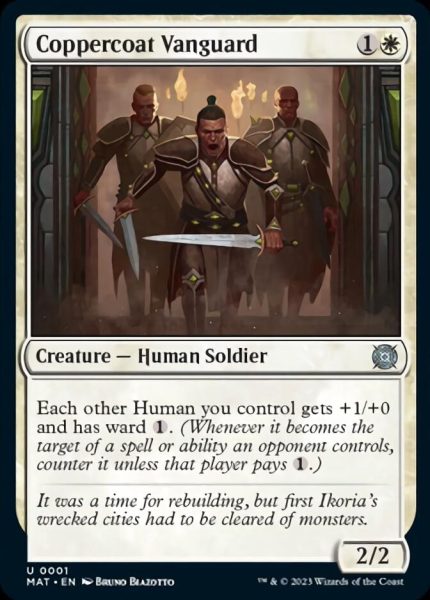
In today's video, I play the newest addition to a deck that is already strongly positioned in the Pioneer and Explorer metagame: Mono-White Humans. Coppercoat Vanguard adds a new layer of aggression and protection to your band of aggressive Humans.

There was an error retrieving a chart for Coppercoat Vanguard

Let's look at the other creatures in the deck, and how Coppercoat Vanguard makes them even better.

The One-Drops

There was an error retrieving a chart for Dauntless Bodyguard

Starting things off we have Dauntless Bodyguard. While it's mostly here to protect our other more impactful creatures, it's a nice Savannah Lions with upside on turn one. Then we have Hopeful Initiate, an excellent card that is possibly our best play on turn one. It not only grows as you attack with creatures that are more powerful than it, but it can also remove counters from itself and others to destroy pesky enchantments such as Fable of the Mirror Breaker and slain Old-Growth Troll's. Lastly, in the one-drop suite of creatures, we have Recruitment Officer. Much like Dauntless Bodyguard, it is a fine Savannah Lions on turn one but shines in the late game against Control and Midrange strategies. Paying four mana to grab a creature that is three mana or less is massive for any beatdown deck. Giving the deck a late-game reach on a power level similar strategies haven't had access to in the game's history.

The Two-Drops

The two's are where things get spicy. Leading the charge, we have our newest addition and the reason I wanted to play the deck: Coppercoat Vanguard. It's the perfect card in this slot. It punishes slow starts and greedy mana bases playing lots of tapped lands while also protecting your team. Not to brag, but I really think I nailed it on the head saying in my Top 5 Cards from Aftermath piece that this is the best card in the set. Next up is Luminarch Aspirant. This card is so flexible. Playing it on turn two when you got to play a one-drop on turn one is everything you want to be doing in this deck. It's also among the better top decks late-game, giving you an extra point of attacking power to finish off those close games.

There was an error retrieving a chart for Luminarch Aspirant

What hasn't been said about Thalia, Guardian of Thraben? It's one of the most powerful two-mana white creatures in the game. It is an absolute nightmare for Azorius Control pilots, and quite strong in any matchup where they want to resolve expensive Planeswalkers or big game-ending instants and sorceries. Overall, Thalia is the G.O.A.T. when it comes to White Beatdown decks. Lastly, we have the absolute best top deck in most situations Thalia's Lieutenant. This card is amazing, period. It grows your team and grows itself every time another Human enters the battlefield. It truly is an absolute All-Star in this deck.

There was an error retrieving a chart for Thalia, Guardian of Thraben

The Three Drops

So if the two drops are the spice in this deck the three drops are certainly the hammer that can slam the door in most matchups. Brutal Cathar // Moonrage Brute is exactly that, absolutely brutal. It can use its enters the battlefield ability multiple times if you can switch between night and day in a single game. It also flips into Moonrage Brute which can be punishing for opponents to deal with.

There was an error retrieving a chart for Brutal Cathar // Moonrage Brute

Lastly the biggest and best attacker in the deck, Adeline, Resplendent Cathar. This card grows as your team does. It makes your opponents attacking more difficult thanks to having Vigilance. Something small, but comes up more often than you would imagine, is attacking with Thalia's Lieutenant while Adeline, Resplendent Cathar is on the Battlefield. It puts a +1/+1 Counter on Thalia's Lieutenant at instant speed which can mess up combat math for your opponent. Adeline, Resplendent Cathar is pound-for-pound the most powerful card in the deck and can swing a game singlehandedly.

There was an error retrieving a chart for Adeline, Resplendent Cathar

How Much Better is Mono-White Humans Now?

In my opinion, this deck has become a significant player in Pioneer and Explorer thanks to the addition of Coppercoat Vanguard. Not to say that it wasn't powerful before, but with Vanguard, this deck can now roll with the other big dogs in the format like Mono-Green Devotion and Rakdos Midrange. It's a deck that you should consider if have an RCQ or big paper tournament coming up.

The Decklist

Mono-White Humans, Explorer

Creatures

4 Dauntless Bodyguard
4 Hopeful Initiate
4 Recruitment Officer
4 Luminarch Aspirant
4 Thalia, Guardian of Thraben
3 Coppercoat Vanguard
4 Adeline, Resplendent Cathar
2 Brutal Cathar // Moonrage Brute
4 Thalia's Lieutenant

Instants

2 Brave the Elements

Enchantments

2 Ossification

Lands

3 Castle Ardenvale
1 Eiganjo, Seat of the Empire
14 Plains
4 Mutavault
1 Shefet Dunes

Sideboard

4 Portable Hole
3 Destroy Evil
3 Wedding Announcement // Wedding Festivity
1 Invasion of Gobakhan // Lightshield Array
2 Rest in Peace
1 Ossification
1 Reidane, God of the Worthy // Valkmira, Protector's Shield

Wrapping It Up

Looking to play a great deck with a fast clock that has the staying power to grind close games? You should give Mono-White Humans a spin! Check out the gameplay video and don't forget to Like and Subscribe to the YouTube Channel!

Avatar photo

LessAlex

LessAlex, AKA Alex Blackard, is a Magic: The Gathering content creator who is passionate about playing Control decks in Constructed, particularly in the Pioneer, Modern, Explorer, and Historic formats. He also enjoys experimenting with combo decks and brewing up new and exciting strategies to stay ahead of the competition. With a focus on in-depth strategy breakdowns and gameplay, LessAlex offers a unique perspective on the game that is both entertaining and informative. His competitive resume includes a Top 4 at an SCG Open in 2014, splitting an NRG Trial in 2017, as well as countless SCG IQ Top 8s and Game Day wins. He hosts The Control Freak Podcast where he discusses playing Control decks in Constructed, and brings on guests including prominent players and creators to share their expertise. You can catch him streaming on Twitch weekdays at 9 am, and on his YouTube Channel for even more content.

View More By LessAlex

Posted in Arena, Explorer, Free, Magic: The Gathering Arena, Pioneer, Playthrough, StrategyTagged , , , , , , , , , Leave a Comment on Getting Aggressive with Mono-White Humans in Explorer

Have you joined the Quiet Speculation Discord?

If you haven't, you're leaving value on the table! Join our community of experts, enthusiasts, entertainers, and educators and enjoy exclusive podcasts, questions asked and answered, trades, sales, and everything else Discord has to offer.

Want to create content with Quiet Speculation?

All you need to succeed is a passion for Magic: The Gathering, and the ability to write coherently. Share your knowledge of MTG and how you leverage it to win games, get value from your cards – or even turn a profit.

Fable and More Banned in Standard, Plus B&R Policy Changes

Are you a Quiet Speculation member?

If not, now is a perfect time to join up! Our powerful tools, breaking-news analysis, and exclusive Discord channel will make sure you stay up to date and ahead of the curve.

Today Wizards of the Coast announced a series of bans affecting Standard and a change in philosophy regarding how bannings are enacted. Three cards were banned from Standard today as part of the announcement including Fable of the Mirror-Breaker // Reflection of Kiki-Jiki, Invoke Despair, and Reckoner Bankbuster. The bans will take effect for tabletop and MTGO on May 29, 2023, and for Arena on May 30, 2023.

There was an error retrieving a chart for Fable of the Mirror-Breaker // Reflection of Kiki-Jiki
There was an error retrieving a chart for Invoke Despair
There was an error retrieving a chart for Reckoner Bankbuster

Changes to Banning Philosophy

In addition to the Standard bans, Wizards also announced a change to their philosophy behind how bannings are enacted.

Beyond Today's Bannings

The first annual banned and restricted announcement under the new system is set to take place August 7, 2023, just prior to the start of Wilds of Eldraine preview season. For more info on today's bannings and the changes to Wizards' policies surrounding bannings, check out the full announcement. What do you think of today's bans? The changes to Wizards' ban philosophy? Let us know in the comments or on Twitter.

Avatar photo

Paul Comeau

Paul is Quiet Speculation's Director of Content. He first started playing Magic in 1994 when he cracked open his first Revised packs. He got interested in Magic Finance in 2000 after being swindled on a trade. As a budget-minded competitive player, he's always looking to improve his knowledge of the metagame and the market to stay competitive and to share that knowledge with those around him so we can all make better decisions. An avid Limited player, his favorite Cube card is Shahrazad. A freelance content creator by day, he is currently writing a book on the ‘90s TCG boom. You can find him on Twitter and LinkedIn.

View More By Paul Comeau

Posted in Banning, Free, News, StandardTagged , , Leave a Comment on Fable and More Banned in Standard, Plus B&R Policy Changes

Have you joined the Quiet Speculation Discord?

If you haven't, you're leaving value on the table! Join our community of experts, enthusiasts, entertainers, and educators and enjoy exclusive podcasts, questions asked and answered, trades, sales, and everything else Discord has to offer.

Want to create content with Quiet Speculation?

All you need to succeed is a passion for Magic: The Gathering, and the ability to write coherently. Share your knowledge of MTG and how you leverage it to win games, get value from your cards – or even turn a profit.

Adventures in Par Magic: Going Infinite with March of the Machine Draft

Are you a Quiet Speculation member?

If not, now is a perfect time to join up! Our powerful tools, breaking-news analysis, and exclusive Discord channel will make sure you stay up to date and ahead of the curve.

I've had my Arena account for over four years. I've put money into it twice. The first time was the five-dollar Welcome Bundle. The second time was to purchase gems before 2019's GP New Jersey, so I could squeeze in a little extra Ravnica Allegiance Sealed practice. The secret to playing free Magic isn't just collecting trophies. Rather, it's playing Par Magic.

What Is Par Magic?

While our gold supply will increase through Daily Quests, getting four wins (1400 gems) or five wins (1600 gems) represents a break-even point for entering a draft (1500 gems). In my circles, we refer to these parity drafts as playing Par Magic. It's how I grind to Mythic each month, and how we manage to continue playing Arena without investing a cent. It's how we go infinite.

This week, rather than dedicating an article to one specific observation , I wanted to take a broader approach. We'll focus on my most recent decks and the lessons and observations that naturally come from them. This is a new approach for me, and I look forward to hearing feedback on the value it provides or interest it generates.

Red Runs Rampant

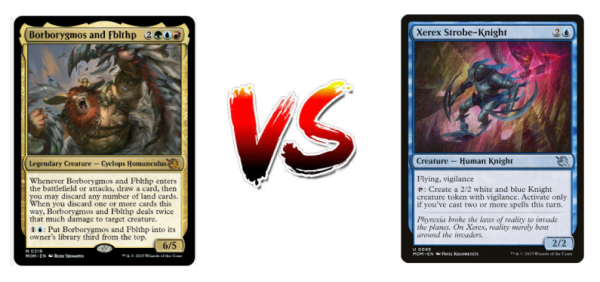
In the first deck of our session, I was presented with an interesting pick.

A month ago, I would have leaned into the power. Borborygmos and Fblthp wins games by itself. This reflected the mentality that first defined the format. Instead, I selected Xerex Strobe-Knight. This is still a Prince Format, but we need to approach drafts with discipline if we're going to win consistently.

With the legend, I would have tried to get deep into blue, preferably leaning towards green's natural ability to splash and adding in some other cards worth splashing for. If all things went according to plan, the deck would've been powerful, albeit messy. However, this requires good fixing and cards worth splashing.

These types of high-risk, high-reward lines run antithesis to the concept of Par Magic. That idealized image of a draft would be a strong contender for a trophy. But the odds of a trainwreck are equally realistic. The Knight puts me in the format's deepest color, with particularly powerful uses in both UW Knights and Hopper Aggro. These reflect strong fundamentals that are easy to abandon when we lazily label a format "Prince" and forsake all agency that a given draft offers.

For pick three, I was given an absolute gift: Voldaren Thrillseeker. While red has struggled in the format, this is a card I would gladly snap up first pick. It's a powerful and dynamic tool, and even better than that, it's an enormous sign that red is open. Spoiler alert: it was.

There was an error retrieving a chart for Voldaren Thrillseeker

In the draft I bobbed between different Jeskai configurations, but the flow of red cards in pack three made UR an easy choice.

Avoiding Red Is a Mistake

We want to be in the open color. This often remains true even if the color is significantly weaker than other options. This is the case in March of the Machine (MOM) for two major reasons.

First, the format is dense with higher-rarity cards. The Multiverse Legends and Battle slots offer more rares, which can warp the power-level of our draft. If we're the only red drafter, we're going to get all of those. In this draft I got a pack three, pick five Brudiclad, Telchor Engineer into a pick six Rampaging Raptor and a pick eight Khenra Spellspear // Gitaxian Spellstalker. I was willing to splash the Thrillseeker, but with these pickups a more streamlined build became optimal.

Secondly, this format is slow enough to accommodate splashing. If we put feelers into red and identify a few powerful cards, but simply don't see enough powerful red cards, we have outs to splash. I considered this option, but settled on a clean UR deck that used convoke to leverage aggressive threats.

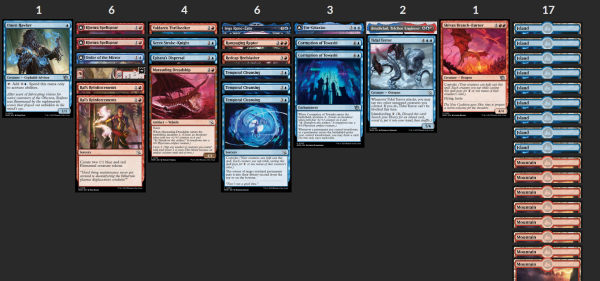
UR Midrange (6-3)

Creatures

1 Omen Hawker
2 Khenra Spellspear // Gitaxian Spellstalker
1 Order of the Mirror // Order of the Alabaster Host
1 Voldaren Thrillseeker
1 Xerex Strobe-Knight
1 Inga Rune-Eyes
1 Rampaging Raptor
1 Redcap Heelslasher
1 Jin-Gitaxias // The Great Synthesis
1 Brudiclad, Telchor Engineer
1 Tidal Terror
1 Shivan Branch-Burner

Battles

1 Invasion of Mercadia // Kyren Flamewright

Instants

1 Ephara's Dispersal

Sorceries

2 Ral's Reinforcements
3 Temporal Cleansing

Artifacts

1 Marauding Dreadship

Enchantments

2 Corruption of Towashi

Lands

9 Island
8 Mountain

Ultimately, the deck proved a little torn between being aggressive, utilizing convoke synergy pieces, and just playing a bigger gameplan. It had a muddy gameplan offset by high card quality. Still, it was able to get to six wins, with what I think represents a pretty well-navigated par draft.

Between pressuring opponents with a fast start and generating advantage in the late-game with Jin-Gitaxis and Compleation of Towashi, the deck went 6-1 into losing double boss battles, first to a Polukranos Reborn // Polukranos, Engine of Ruin and then to a busted GW counters. Still, that's great Par Magic, baby!

Building Around a Mythic

In the next draft, I opened a P1P1 bomb.

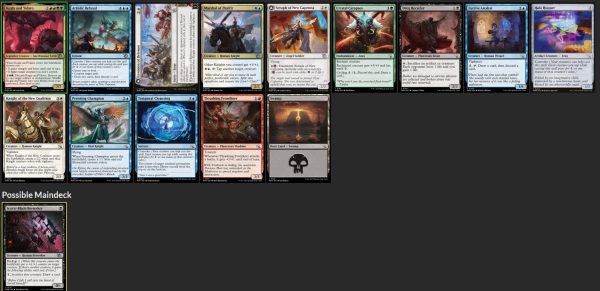
Elesh Norn is independently a strong card, but optimizing it requires some deliberate deck building. It's definitely a strong top-end threat in Hopper Aggro, as that deck has a ton of cheap creatures. Additionally, a WB build offers Unseal the Necropolis and Ichor Drinker to fuel and protect this engine. Yes, basically any white deck would make good use of it, but I wanted to draft with optimization in mind. While the 3/5 vigilance is a good body and the static is powerful, especially in aggressive decks, I wanted to "do the thing."

Second pick was more difficult than it looked. While Umori, the Collector was clearly the most powerful option, Ichor Drinker, Unseal the Necropolis, and even Aerial Boost were all closer to what I envisioned for the deck. Still, this early in the draft, it felt like poor judgement to overlook such a clear gap in power. I took the Umori, and remain confident it was the right pick.

Following the pick, I made selections that drove us towards one of those two ideal homes for Elesh Norn and ultimately WB seemed to be reasonably open. I was able to secure Unseal the Necropolis, and even got a late Halo Hopper which struck me as an interesting card for the deck, as both white and black have one-drops I wanted to play. Knowing what I know now, I could have leaned towards splashing blue and moved away from some of the aggressive cards. While optimizing Elesh Norn makes sense, I think I could have accommodated the Halo Forager and Atris, Oracle of Half-Truths. Chalk it up to overcommitting.

Leaning Aggro, Leaning Midrange

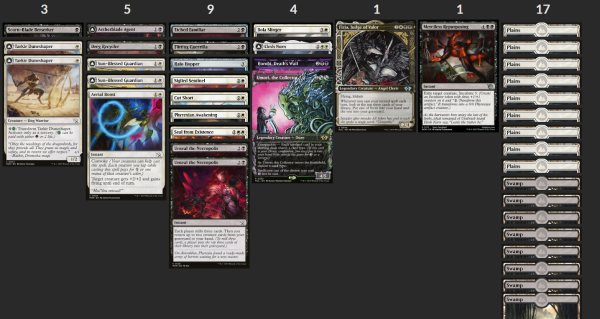
WB Elesh Norn (4-3)

Creatures

1 Scorn-Blade Berserker
2 Tarkir Duneshaper // Burnished Dunestomper
1 Aetherblade Agent // Gitaxian Mindstinger
1 Dreg Recycler
2 Sun-Blessed Guardian // Furnace-Blessed Conqueror
1 Etched Familiar
1 Flitting Guerrilla
1 Halo Hopper
1 Sigiled Sentinel
1 Bola Slinger
1 Elesh Norn // The Argent Etchings
1 Horobi, Death's Wail
1 Umori, the Collector
1 Firja, Judge of Valor

Instants

1 Aerial Boost
1 Cut Short
2 Unseal the Necropolis
1 Merciless Repurposing

Enchantments

1 Phyrexian Awakening
1 Seal from Existence

Lands

9 Plains
8 Swamp

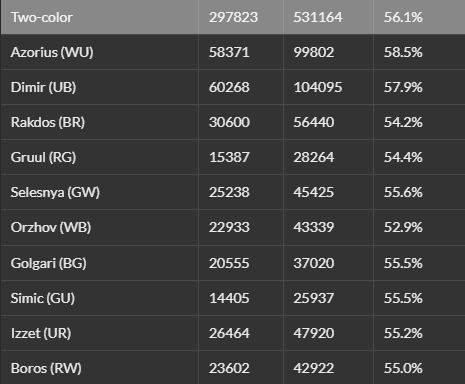
I would argue that it's a bad sign when a deck is running both Aerial Boost and Unseal the Necropolis. They point in two very different directions. Aggressive decks are going to lean towards certain card choices in hopes that more of those cards will be available. More value-driven strategies do the same thing. Here, I found myself caught between what white is trying to do in the format and what black is trying to do in the format. There's not a lot of overlap, and that's why WB is the worst-performing color pair.

As a result, I tried to make some interesting pieces work. Horobi, Death's Wail turned all of our back-up creatures into Ravenous Chupacabra. The cheap creatures fueled Firja, Judge of Valor, but too often I found myself grinding into a late-game where I was the underdog. Ultimately, the draft didn't come together. Many synergies, while somewhat mismatched, were able to pull me to Par Magic. Plus, when it came to Elesh Norn, I definitely got to do the thing, in one game even grinding out an opponent with multiple flips.

Ugh... Gruul

Gruul is easily my least-favorite color pair in the format. It's not the worst, but it's the one I work hardest to avoid. Is there a single interesting green common in the entire set? When paired with Red, you're often just beating down without the upside of the aggression you get in RW. Still, if we're going to play Par Magic, we have to know when it's time to go RG. My feelings made this pick more difficult than it should have been:

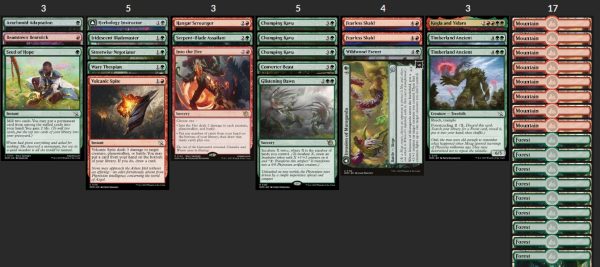
There are definitely some strong blue cards in this pack, but Kogla and Yidaro is completely busted. It's often the most important spell cast in any game. It's a 7/7 that comes with the modality of being a burn spell or a removal spell, or even a Slice in Twain if the situation calls for it. The blue options are nice, but in my opinion wrong.

After the pick, I tried to navigate towards Jund. I hoped that black would let me grind and provide access to removal. I wanted more versatility than RG would offer, but the cards just weren't there.

RG Beats (5-3)

Creatures

1 Herbology Instructor // Malady Invoker
1 Iridescent Blademaster
1 Streetwise Negotiator
1 Wary Thespian
1 Hangar Scrounger
1 Serpent-Blade Assailant
3 Chomping Kavu
1 Converter Beast
2 Fearless Skald
1 Wildwood Escort
1 Kogla and Yidaro
2 Timberland Ancient

Battles

1 Invasion of Muraganda // Primordial Plasm

Instants

1 Arachnoid Adaptation
1 Seed of Hope
1 Volcanic Spite

Sorceries

1 Glistening Dawn
1 Into the Fire

Artifacts

1 Beamtown Beatstick

Lands

8 Mountain
9 Forest

I wasn't able to generate a fast enough start to dominate all the matchups. When I fell behind it became very difficult to overcome our opponents' card advantage, except via Kogla and Yidaro. Kogla and Yidaro don't really care about card advantage.

However, in games where I did get ahead, the onslaught of triple Chomping Kavu and double Fearless Skald pressured opponents winningly. Opponents could generate value, but this deck made the game about life totals.

I punted one game because I forgot to Volcanic Spite a Portent Tracker on my turn. As a result, it was able to untap Arixmethes, Slumbering Isle, allowing them to triple spell on turn four. I knew immediately that missing that play would lead to a loss.

While I dislike the colors, they were the natural landing spot for this draft. Sometimes maximizing our wins means taking what the table has to give. In this case it yielded a very powerful RG deck and I got to bully some opponents for wins.

Lessons from Par Magic

We can't always trophy our drafts, and while I would never suggest one should lower their expectations, learning to appreciate our accomplishments is extremely valuable. More pragmatic than that, if we can maintain Par Magic, our drafts will pay for themselves as our rank moves us towards Mythic.

But playing Par Magic demands that we handle the draft with both a plan and flexibility. Once I draft my first card, a plan starts to form. What colors do I want to pair this card with? How committed am I to these visions I'm starting to form? We answer these questions based on data points that flow through the draft. Each choice helps us guide towards the eventual landing point, but also helps us envision our realities with increasing clarity while we disqualify other options. That's how any good drafter approaches deck-building, but if our goal is to consistently achieve high results, we need to make each decision with fidelity.

So until next time, I'll be doing my best to optimize each decision, and continuing to play Par Magic. And hopefully snagging some trophies along the way.

Pioneer Check-In: Why Rakdos Wins

Are you a Quiet Speculation member?

If not, now is a perfect time to join up! Our powerful tools, breaking-news analysis, and exclusive Discord channel will make sure you stay up to date and ahead of the curve.

Pioneer, I need to level with you. While I have never actually understood what you're supposed to be, I thought I had a handle on what you actually were. The metagame data seemed to back up my assessment. However, as another Pioneer RCQ season kicks off and I'm watching other players preparing for the Dallas RC, I'm getting increasingly frustrated by all the curveballs being thrown to me. Pioneer, you have an identity problem, and one deck is a huge beneficiary of that fact.

Format Frustration

Look, I've tried to be on Pioneer's side, but it's getting harder and harder the more I play the format. I know that it isn't Modern and accept that it isn't even Modern-lite. Pioneer is closer to Standard-plus, which isn't a pro for me as I don't like Standard. However, understanding that made me more tolerant of what Pioneer has to offer. However, as testing progresses, the experience is increasingly just this Tweet:

Other than the odd player playing some off-meta jank, nobody I talk to ever gives a full-throated defense of their deck or Pioneer, never mind an exaltation. I've repeatedly asked players why they play Pioneer, but it's always 1) It's cheaper than Modern or 2) Because that's what the RCQ season is. I never get anyone saying they actually like Pioneer for its own sake anymore.

There used to be some at my LGS, but they've stopped showing up to weekly Pioneer events. I don't know why, but this does seem to be a trend:

I know there are many confounding variables surrounding tournament attendance, but I do consistently hear the same thing. Given a choice between Pioneer and anything else, most players pick anything else. Which further contributes to Pioneer's stagnation from lack of new ideas and brews.

The Off-Metagame

To make things worse, I don't see anyone winning in paper with the supposed "good decks" of Pioneer. I realize that this is selection bias, but I've never been to a Pioneer RCQ in the past year where an ostensible "best deck" won. It's either been off-meta decks like Enigmatic Incarnation or on-meta but supposedly ill-positioned deck like UW Control and at my most recent RCQ, Humans.

While this can happen in any format and for any event, it happens regularly enough in my Pioneer experience that it's starting to feel more like a feature than a bug. I vividly remember one player who entered a Pioneer RCQ I atteneded with Izzet Phoenix, confidently stating that his deck was favored against the expected meta. He proceeded to hit nothing but, and I quote "terrible off-metagame jank" (meaning decks he wasn't expecting) and dropped at 1-3.

There was an error retrieving a chart for Arclight Phoenix

I've had similar experiences of entering a room full of control, combo, and midrange and hitting nothing but aggro decks. That's just the Pairings God hating you. However, again, there does appear to be a theme of local RCQs having an expressed metagame, and then an actual one made of unexpected decks.

The Coin-Flip Problem

The really big frustration has been playing on the draw. It is well established that being on the play is better than the draw 99% of the time because tempo advantage is better than card advantage. However, I constantly hear that the disparity is worse in Pioneer than other formats. I constantly hear complaints from players testing for Dallas is that their deck is phenomenal on the play and worthless on the draw.

There was an error retrieving a chart for Monastery Swiftspear

I don't know if the claim is true, or even provable. I do know that the removal available to Pioneer is worse than other non-rotating formats. This coupled with mana being relatively worse means that stumbles are punished more severely. Pioneer is also a format where threats are generally more powerful than spells. Thus, it makes sense that the active players have a large advantage, and that's frustrating.

The Consistency Problem

On the note of mana being worse, decks are a lot more inconsistent in Pioneer than elsewhere. No format can match Legacy's deck smoothing, but Wizards has been freer with cantrips than they used to be. Look at Modern today versus five years ago. That said, I've heard from actual Standard players that they think Pioneer is less consistent than Standard, which makes everything feel worse.

There was an error retrieving a chart for Consider

I can't really explain why this is the case. However, I have seen it in action. The Izzet Phoenix player I mentioned a few paragraphs ago had claimed that much of his deck's power came from it being more consistent than other decks thanks to all the cantrips he played. The problem was that while the deck did filter through itself well, the initial starts were always slow, and he couldn't catch up after falling behind.

There seems to be something in how Pioneer decks are built compared to Standard or Modern where the delta between their best games, average games, and their worst. I definitely feel the difference between Pioneer and Modern, but I just have to take Standard's word on the subject. Given that it seems widespread (or at least is about complained to me universally), this seems to be a feature of Pioneer.

The Matchup Spread

The final, nearly universal complaint I've heard and felt in testing Pioneer is matchups are extremely polarized. Decks don't appear to have a normal matchup spread. Instead, they seem to wax from very good to very bad. For example, I haven't lost to UW Control playing UW Spirits since adopting [card]Invasion of Gobakhan // Lightshield Array/card]. However, I'm a complete dog to any aggro deck.

There was an error retrieving a chart for Invasion of Gobakhan // Lightshield Array

I've experienced this with other decks, and had many others complained about to me. Sideboard cards are generally weaker in Pioneer than Modern or Legacy because Wizards consciously powered down hate cards over the past five years. Thus, there are few silver bullets that can turn a matchup around by themselves, meaning that the matchup doesn't change as much between games 1 and 2.

Along with weaker hate cards comes better answers to the hate that exists. Theoretically, Archon of Emeria and Deafening Silence kill Lotus Field combo. However, Otawara, Soaring City is maindeckable and dodges both cards restrictions while answering them. It being harder to hate decks out means that bad matchups stay bad which makes pairings more deterministic of outcome.

The Exception

For all those reasons, I and a lot of players I know are getting really frustrated with Pioneer. It feels like everything is bad and there's no way to fix things if the pairings are against you. However, there is an exception. I've never heard anyone say that Rakdos Rock is a bad deck. Plenty have said it's a mediocre deck in a field of bad decks, but never that it's bad itself. Which probably explains why it's top deck in the metagame.

There was an error retrieving a chart for Thoughtseize

It's strange to consider, but Rock has just been sitting on top of Pioneer's metagame since last summer. I remember everyone freaking out about Mono-Green Devotion, but the bottom line is that every site's stats have Rakdos on top by a wide margin. I finally put it together after seeing a Discord post saying, "Pioneer wants me to play Rakdos, so fine, so I'll just play Rakdos!"

There was an error retrieving a chart for Bloodtithe Harvester

It feels obvious, and I even mentioned this in another article, but Rakdos just seems to be exempt from the usual complaints about Pioneer decks. Blood tokens and Fable of the Mirror-Breaker // Reflection of Kiki-Jiki smooth out draws better than other decks, the matchup delta seems lower, and it has game against everything. When everything's bad, the least bad is by default good.

Beating the System

The biggest key to this status is that Rakdos doesn't have any deck that it's truly bad against. Thoughtseize is live in any matchup, after all. It's been said repeatedly that it's a 50% against everything deck and I've no evidence to contradict the claim. In a format where decks are mostly 80/20 in one matchup and 20/80 in another, 50/50 means that every matchup is actually winnable.

This solves not only the matchup spread problem but the off-meta problem. It doesn't matter what deck it hits, Rakdos will always be in the game. Its cards aren't especially specialized or context specific, they're just the best available cards at their mana points. The only times that Rakdos will have dead cards are late-game discard or removal against Lotus Field. Again, that's better than most decks can say.

There was an error retrieving a chart for Enigmatic Incarnation

That isn't to say that Rakdos is perfectly 50/50 against everything. I'm told that Enigmatic Incarnation and Gruul Vehicles are very bad matchups. Thing is, neither deck are big players in the metagame. Meanwhile, Rakdos has even to good matchups against the more popular decks, which is all that's really needed.

Play/Draw Defied

In my experience, Rakdos is also the deck least affected by the play/draw disparity in Pioneer. Obviously, it still wants to play first, but it does play better from behind than most other Pioneer decks. On the play it wants to curve Thoughtseize into Bloodtithe Harvester and Fable. On the draw, that is still a solid curve against control or combo. If instead it's against aggro, Rakdos can happily play Fatal Push, Stomp, and Kolaghan's Command.

There was an error retrieving a chart for Bonecrusher Giant // Stomp

I don't know of another deck as comfortable on the draw as Rakdos. Every other deck really feels the missing tempo, but Rakdos can tweak its role better than any other deck. Consequently, it has no issue starting out behind. It will just play out removal and eventually its card quality and card advantage will pull it through. In a format that many claim is coin-flip dependent, Rakdos' defiance is a huge advantage.

Sounds Familiar

All of this sounds really familiar. It's almost exactly what players used to say about Modern Jund. From when Modern was new up until Death's Shadow became a thing, Jund was a fixture of Modern, and it played the same way as Pioneer Rakdos now does. Jund never did the most powerful thing in Modern. It just did something decent every game and could play against anything.

There was an error retrieving a chart for Tarmogoyf

Jund's entire gameplan was to overpower its opponents by simply being more efficient. Its card quality was slightly better than every other deck, so it just traded up until the opponent couldn't anymore and then won. That is essentially all that Rakdos is doing now. The format composition was also similar in that the power was fairly low across the board and so individual cardpower was critical.

Disconcerting Realization

So, if pre-2017 Jund and current Pioneer Rakdos are similar, what does that say about their respective formats? The implication here is that this style of deck thrives in an environment where it's just slightly better than everything else rather than being good itself. Looking at how Modern's powerlevel started to spread out and get more good cards after 2017 where Jund declined certainly lends credence.

There was an error retrieving a chart for Death's Shadow

Pioneer is still in its relative infancy, so it makes sense that card power is all over the place. It also makes sense that playing the deck where card power is concentrated would be a strong strategy. However, I'm now having to deal with the implication that Modern was kinda bad for a long time and that freaks me out.

Pushing on Ahead

What that means for my RCQ testing and others RC testing is that it's time to adjust expectations. I used to deal with the Jund-defined Modern by going off-metagame and wonky, so maybe it's time to do that again. Certainly, I'll be applying lessons from old Modern to Pioneer testing to test out my theory. If it works, then I'll finally be satisfied that I understand Pioneer. Otherwise, back to the drawing board.

Narset, Enlightened Exile in Jeskai Pyro in Explorer

Are you a Quiet Speculation member?

If not, now is a perfect time to join up! Our powerful tools, breaking-news analysis, and exclusive Discord channel will make sure you stay up to date and ahead of the curve.

From Master to Exile

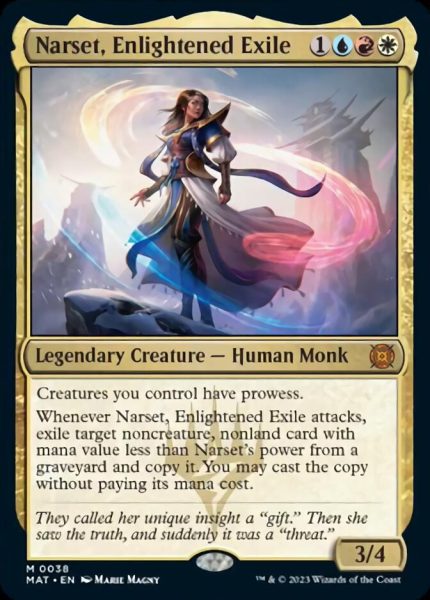
In today's video I try to play Narset, Enlightened Exile in Izzet Pyro, an established deck in Explorer. Izzet Pyro is already a pretty good deck in the format. Is stretching the manabase from Izzet colors to Jeskai colors worth it?

There was an error retrieving a chart for Narset, Enlightened Exile

In addition to Narset, adding a third color also gives us access to a card that has incredible synergy with the deck. Monastery Mentor is a card that I revere. In a Pre-Modern Horizons 2 format, it saw a fair share of play in Modern Azorius Control sideboards. I'm hopeful in this deck it can be an all-star. Additionally, I'm trying Secluded Courtyard as the deck doesn't play any white spells other than Divine Smite which is in the sideboard.

There was an error retrieving a chart for Monastery Mentor

The rest of the decklist is pretty stock. The philosophy is a classic strategy: play Young Pyromancers and/or Third Path Iconoclasts and cheap spells to amass an overwhelming board and get your opponent's life to zero.

Is Narset Actually Good?

Well, that's what I want to find out. In testing with this deck this week for this video it seems that Narset, Enlightened Exile is extremely good when you're ahead. Getting to Power Word Kill your opponent's blockers before they get a chance to block is pretty amazing. Additionally getting to cast Opts and Considers for free to grow your attackers only to draw into removal or Meeting of Minds which you can immediately cast off of the Tokens that your Young Pyromancers created off of the free Opt you just cast is extremely strong.

The Decklist

Jeskai Narset Pyro, Explorer

Creatures

4 Young Pyromancer
4 Third Path Iconoclast
3 Narset, Enlightened Exile
2 Monastery Swiftspear
3 Monastery Mentor

Instants

4 Fiery Impulse
4 Opt
4 Consider
2 Spell Pierce
4 Meeting of Minds

Enchantments

4 Fable of the Mirror-Breaker // Reflection of Kiki-Jiki

Lands

4 Hallowed Fountain
4 Steam Vents
2 Island
1 Riverglide Pathway // Lavaglide Pathway
3 Spirebluff Canal
1 Mountain
1 Seachrome Coast
1 Glacial Fortress
1 Den of the Bugbear
4 Secluded Courtyard

Sideboard

2 Mystical Dispute
3 Rending Volley
1 Disdainful Stroke
1 Strangle
2 Change the Equation
1 Divine Smite
2 Unlicensed Hearse
2 Obliterating Bolt
1 Chandra, Hope's Beacon

If you want to play a fun take on an already established deck this might be the deck for you! Check out the gameplay video and don't forget to Like and Subscribe to the YouTube Channel!

Avatar photo

LessAlex

LessAlex, AKA Alex Blackard, is a Magic: The Gathering content creator who is passionate about playing Control decks in Constructed, particularly in the Pioneer, Modern, Explorer, and Historic formats. He also enjoys experimenting with combo decks and brewing up new and exciting strategies to stay ahead of the competition. With a focus on in-depth strategy breakdowns and gameplay, LessAlex offers a unique perspective on the game that is both entertaining and informative. His competitive resume includes a Top 4 at an SCG Open in 2014, splitting an NRG Trial in 2017, as well as countless SCG IQ Top 8s and Game Day wins. He hosts The Control Freak Podcast where he discusses playing Control decks in Constructed, and brings on guests including prominent players and creators to share their expertise. You can catch him streaming on Twitch weekdays at 9 am, and on his YouTube Channel for even more content.

View More By LessAlex

Posted in Arena, Explorer, Free, Magic: The Gathering Arena, Playthrough, Strategy, VideoTagged , , , , Leave a Comment on Narset, Enlightened Exile in Jeskai Pyro in Explorer

Have you joined the Quiet Speculation Discord?

If you haven't, you're leaving value on the table! Join our community of experts, enthusiasts, entertainers, and educators and enjoy exclusive podcasts, questions asked and answered, trades, sales, and everything else Discord has to offer.

Want to create content with Quiet Speculation?

All you need to succeed is a passion for Magic: The Gathering, and the ability to write coherently. Share your knowledge of MTG and how you leverage it to win games, get value from your cards – or even turn a profit.

How I’ve Upped My MOM Limited Game

Are you a Quiet Speculation member?

If not, now is a perfect time to join up! Our powerful tools, breaking-news analysis, and exclusive Discord channel will make sure you stay up to date and ahead of the curve.

I've dedicated most of my content for QS over the years to topics related to Magic finance. It's no surprise—given the focus of this website when I first started writing here—and my own mindset when approaching the game. When I engage with this hobby, card values, pricing fluctuations, reprints, the Reserved List, and a myriad of similar things are always on my mind.

One subject I’ve virtually never written about though, is one of my favorite ways to actually play Magic: Limited (Draft, in particular).

That changes today! After a bumpy start, I've grown to enjoy March of the Machine Draft. Through a little practice, some podcast listening, and a deliberate desire to win more games, I’ve slowly improved my MOM Draft performance.

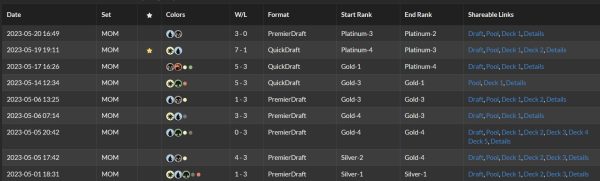
This week, I wanted to touch on a few changes I’ve made to my strategy/thought process, harvesting my 17lands.com play data to showcase a couple of board-state examples. These changes helped me go from multiple dismal Draft performances to trophying in Platinum.

Let Your Counterspells Be Good

I’ve seen all sorts of Counterspell variants in Limited over the years. Some are particularly strong in their respective formats like Make Disappear in Streets of New Capenna (SNC), and now Artistic Refusal in MOM. In other formats like The Brothers' War (BRO), counterspells were more lukewarm in power. No matter the format, an unexpected counterspell used at the right time can be backbreaking in a best-of-one game. Up until recently, the part I struggled with was figuring out when was “the right time.”

In some cases, I would tap out too frequently, leaving myself vulnerable to opposing bombs while sitting there with an uncastable counter in my hand. This is especially important in formats like March of the Machine with its numerous bombs. Holding a counterspell and being unable to cast it on my opponent’s Boon-Bringer Valkyrie or Sunfall is one of the biggest mistakes I’ve made in this format.

There was an error retrieving a chart for Sunfall

Here’s the deck I trophied with recently, jamming a basic UW Knights build with very little as far as bombs go. Lurrus of the Dream-Den was more powerful for what it threatened to do, rather than anything it actually did in my games.

MOM Draft UW Knights

Creatures

1 Alabaster Host Intercessor
2 Knight of the New Coalition
1 Norn's Inquisitor
1 Seraph of New Capenna // Seraph of New Phyrexia
1 Zhalfirin Lancer
1 Captive Weird // Compleated Conjurer
1 Oracle of Tragedy
2 Order of the Mirror // Order of the Alabaster Host
2 Preening Champion
1 Skyclave Aerialist // Skyclave Invader
1 Wicked Slumber
1 Marshal of Zhalfir
1 Tetsuko Umezawa, Fugitive
1 Lurrus of the Dream-Den

Battle

1 Invasion of Dominaria // Serra Faithkeeper

Enchantments

1 Astral Wingspan
1 Stasis Field

Instants

1 Negate
2 Assimilate Essence

Land

8 Plains
9 Island

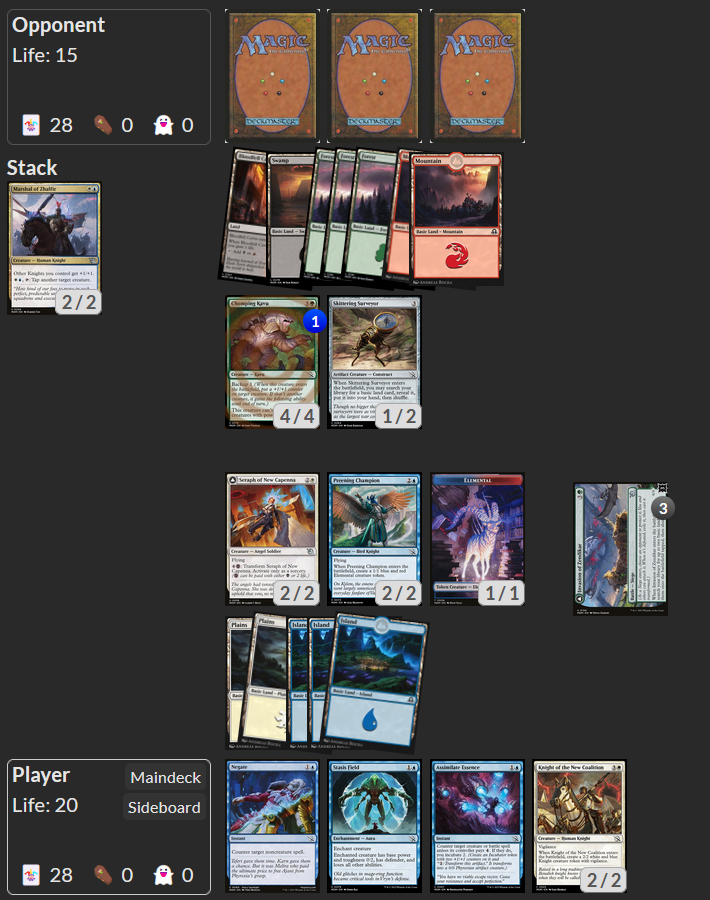
Because my deck was so low-to-the-ground, I often found myself slightly ahead in the early turns. Once I had even the slightest edge, I deliberately left up two mana for my Assimilate Essence and Negate to protect my advantage. Being selective in what I countered and didn’t counter, allowed me to maximize the power of these cards.

An Aside on Negate

This was the first time I included Negate in my deck and it was an absolute all-star.

The reason Negate was so instrumental to this deck’s success is twofold. First, I believe this format has enough powerful non-creature cards to merit main decking. Between battles, convoking combat tricks, powerful removal spells, card draw spells, etc., having a Negate in hand gives a warm and fuzzy feeling throughout the game.

Second, I had ample creatures to gum up the board. I wasn’t as concerned with most creatures my opponents could put into play. If my opponent did have a creature bomb, I had the two Assimilate Essence to hopefully counter them. The non-creature spells were what concerned me most, and that’s where Negate came into play.

In one game, I was pressing an advantage in the air when my opponent put Kitesail on the stack. I negated the spell and proceeded to win with flying creatures.

My favorite play, however, came in my fifth game against BG. I had the chance to add to my board presence and cast Stasis Field to hinder my opponent and press my advantage. Instead, I held up Negate as a precaution.

It didn’t pay out immediately, but just two turns later I was handsomely rewarded for my clever play.

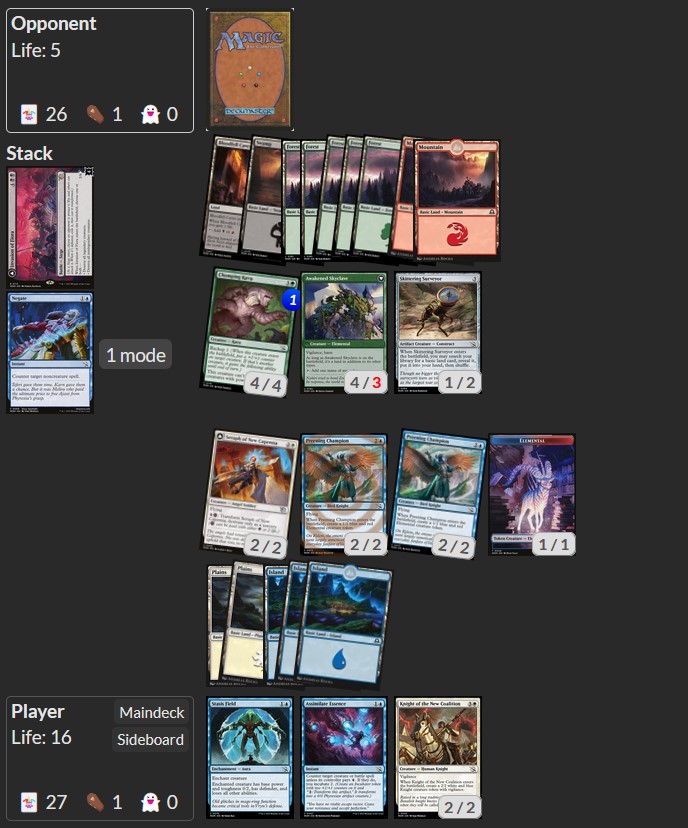
My opponent cast an end-of-turn Vanquish the Weak on my Marshal of Zhalfir and I nearly countered it. I reminded myself that, while the Marshal was pumping some of my team, it wasn’t the reason I was winning the game. My flying creatures were the key to victory. I let the removal spell resolve.

When my opponent untapped, attacked, and slammed their bomb: Invasion of Fiora // Marchesa, Resolute Monarch! I was ready with the counter. Game over.

Have a Strategy and Stick to It

I tend to get a little trigger-happy in Limited games of Magic. If I have a removal spell, I tend to fire it off on the first juicy target I see. I cast combat tricks as soon as I have the chance to generate a favorable attack. As I mentioned before, I tend to cast my countermagic as soon as I have a viable target.

I’m convinced these behaviors have been a detriment to my win rate. Recently, I've tried making improvements in my decision process.

The example above is one case where I exercised some discipline and saved my interactive spells for the truly problematic cards—cards I wouldn’t be able to deal with otherwise.

I was able to identify exactly what cards I needed to worry about because I had developed a strategy for my deck, and then stuck to it. In the case of this UW deck, I knew flying creatures, partnered with some strategically cast counterspells, were my primary method of winning. Therefore, I maintained the discipline to worry less about cards my opponents cast that didn’t hinder my goals.

My most recent deck is a well-tuned UB build with two copies of Invasion of Amonkhet and one Invasion of Kamigawa. I don’t have any rare bombs, but I did manage to draft two copies of Grafted Butcher. Here’s the list:

MOM Bo1 Draft UB 7-0

Creatures

1 Oculus Whelp
1 Preening Champion
2 Skyclave Aerialist // Skyclave Invader
2 Expedition Lookout
1 Aetherblade Agent // Gitaxian Mindstinger
2 Grafted Butcher
1 Halo Forager
1 Tetsuko Umezawa, Fugitive
1 Dreg Recycler

Battles

2 Invasion of Amonkhet // Lazotep Convert
1 Invasion of Kamigawa // Rooftop Saboteurs

Instants

1 Artistic Refusal
1 Assimilate Essence
1 Deadly Derision
1 Wicked Slumber

Sorceries

1 Eyes of Gitaxias
2 Temporal Cleansing
1 Traumatic Revelation

Enchantment

1 Gift of Compleation

Land

1 Dismal Backwater
8 Island
8 Swamp

My primary strategy for this deck is leveraging unblockable abilities in Tetsuko Umezawa, Fugitive and Expedition Lookout to flip my powerful battles, generate card advantage, and eventually push through lethal damage. The list is light on removal, so I’m leaning pretty heavily on the two Temporal Cleansing and Wicked Slumber to provide sufficient tempo against my opponent to further the battle-flipping goal.

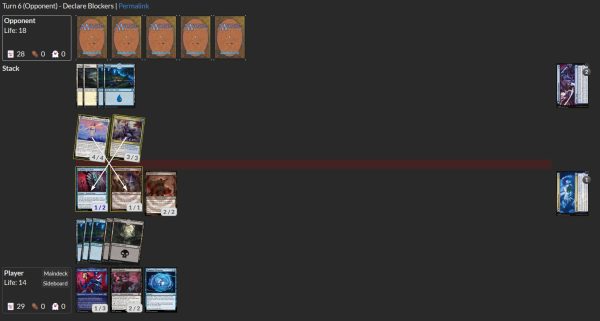
In one game I had with this deck, I made multiple tough blocking decisions in early turns in order to achieve my goals. I knew that if I could get this game to go into double-digit turns, I’d be able to turn my battles into card advantage. As a result, I made some necessary chump-blocking decisions to keep things from running away from me.

While this block looked clunky, I knew I’d soon be flipping my own battle and harnessing some card advantage shortly thereafter. I also had a disruption spell in Temporal Cleansing should I need to buy more time.

The game remained close until the end, but a blunder on my opponent’s behalf led to their ultimate defeat.

Slowing Down The Pace of Play

The last strategy I’ve begun implementing is more about general play style than a Magic-specific idea. For the most part, I’ve done my best to slow my pace of play in order to allow myself more time to think through my decisions.

There’s no reward for playing as quickly as possible. I'll admit that often, my first inclination isn’t the best in-game decision. By deliberately slowing my pace, I’ve allowed myself more time to think through components of a decision that I historically would not have considered.

For example, I’ve begun thinking through what my opponents could have in their hands as far as interaction goes. Do they have that Ephara's Dispersal in hand? Will I mind if they do use the bounce spell on my creature? Could they have Cut Short? Should I play around that?

There was an error retrieving a chart for Ephara's Dispersal

I’ve also given myself more time to plan my reactions to opponent decisions. This is showcased in my Negate example, where I thoroughly scrutinized the impact my opponent’s play would have on the game before choosing to respond. If an opponent puts a spell on the stack that is more annoying than problematic, I’m more inclined to let it resolve—especially if I have sufficient power in my hand to respond on a subsequent turn.

This brings me to another benefit of slowing down: improving my ability to plan multiple turns out. Instead of just firing off the best creature in my hand each turn, I have chosen to hold certain resources back when I need to keep up the option to interact. This format is slow enough that holding up countermagic or other interactive spells (thereby not maximizing your mana each turn) isn’t overly punishing. By recognizing this, I’ve been able to make wiser decisions throughout my games.

In the example below, I recognized that an aggressive use of Wicked Slumber meant I could flip my Invasion of Amonkhet on turn four, leading to a 5/5 flying Oculus Whelp for my opponent to deal with.

It turns out they did have a way to deal with the creature, but not until after I cast the second Invasion of Amonkhet and flipped it into a second 5/5 flying Oculus Whelp. By then it was too much for my opponent. My plan had been successfully enacted, leading to victory.

Wrapping It Up

I don’t claim to be a top-tier Limited player—far from it. I do love the format though, and I try to spend my gold and gems on drafts whenever I have enough to spend.

Unfortunately, I quickly ran out of said resources this month when I recklessly barged into a couple of drafts, ill-prepared. I don’t think I was drafting bad decks—rather, I suspect my gameplay needed some desperate sharpening. After listening to more Limited podcasts (I enjoy Lords of Limited and Limited Resources in particular), and deliberately transforming my gameplay, I started seeing more success.

Some of these strategic decisions may be obvious to a season Limited player. To a newer player, or to an experienced player who is struggling, these actions may prove highly beneficial. For me, learning the strength of countermagic, learning how to maximize these interactive spells (including Negate), knowing my strategy up front, and making gameplay decisions that align specifically with this strategy have all led me to an increased win rate.

Perhaps the overarching theme around it all is simply my decision to slow down my pace of play and think more carefully about my in-game decisions. It’s this move to a more deliberate play style that could be boosting my win rate most of all.

MOM Draft Deck Primer: Hopper Aggro

Are you a Quiet Speculation member?

If not, now is a perfect time to join up! Our powerful tools, breaking-news analysis, and exclusive Discord channel will make sure you stay up to date and ahead of the curve.

March of the Machine (MOM) will be remembered for its bombs. We've talked about it as a Prince Format for the last few weeks, and while that definition shouldn't evoke the abominations of decades past, the high quantity of rares make it hard to label it anything but.

That said, this is a format where synergies still thrive. Early on, we labeled UW Knights as the most supported archetype. It probably still is. However, UW Convoke, hereafter lovingly referred to as Hopper Aggro, is another great way to approach the format when we're not seeing a stream of broken rares.

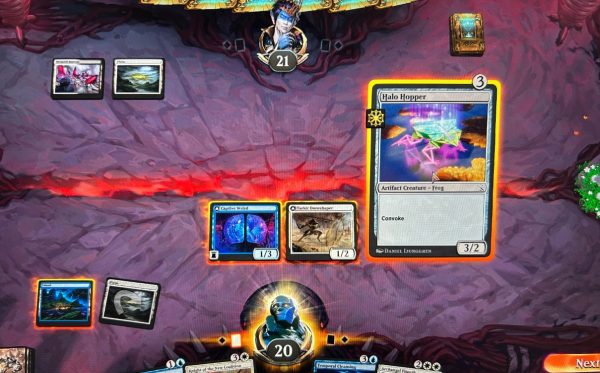
I first discovered the deck watching Twitch Streamer and Pro Tour Competitor The Ham pilot it to success. Having long considered the namesake card Halo Hopper unplayable, I needed to know more. To say this card goes late is an understatement. With an ALSA of 8.78, 17Lands has it a mere eight spots from the last picked card in the entire format. If we want the frog, it's ours. But making the frog hop is another thing all together.

What is Hopper Aggro?

Hopper Aggro is a UW Convoke deck that utilizes an aggressive start to manufacture a big board presence. With combat tricks and tempo plays, it's easy to finish off unexpected opponents. The removal in the format is not well set up to defend against this. The removal spells in the most commonly played colors are great for eliminating the huge bombs that have defined the meta. Good for them. We got Frogs.

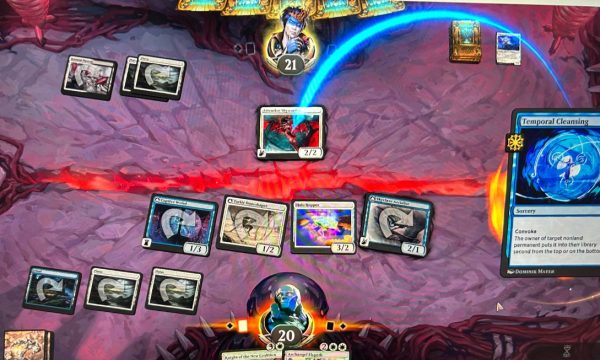
Taking turn four off to kill a 3/2 that cost us zero mana after we first resolved a Preening Champion in the same turn is not a winning play. It is, however, one opponents may need to make if they're on the backfoot against this deck.

While this deck doesn't have the highest power level in the format, it provides pressure that many decks are too slow to combat.

One-Drops Wanted

One-drops are essential to this strategy. If we want to play Halo Hopper before turn three, we need a one-drop, and any one drop will get that done. There is, however, a hierarchy to which ones we want.

Tarkir Duneshaper // Burnished Dunestomper and Captive Weird // Compleated Conjurer are by far our best options. When I'm in this deck, there is usually an early Weird that got me on the path. The synergy with Weird is nice because we don't lose damage when we tap it for mana, and when it flips, it offers us a reasonable creature and a card to boot.

The more of these flipping one-drops we have, the better Omen Hawker gets. We don't really want to play any Incubate tokens because they're just too slow. If we get dragged into a midrange configuration, we're likely to get wiped out. We're not against playing a copy or two of Order of the Mirror // Order of the Alabaster Host, and this helps there as well, but ultimately there's a cap on its usefulness.
In my less-successful ventures with this deck, I've been forced to settle on Enduring Bondwarden. It's a necessary evil and a really bad top-deck, but it is a one-drop.

These are the kind of starts that make the deck feel great. We can't do any of this without one-drops.

Of Jetpacks and Flying Rhinos

Aerial Boost is not a card I ranked highly when the set released. It's currently white's top-performing common, and this deck loves a jetpack. Because we're playing such a high creature count in these decks, this card provides reliable burst damage. Occasionally it's the reach we're looking for to close out a game, but sometimes we just draw three and we can jump creatures over for consecutive turns and that's game.

Originally when building this deck, I was leaning on Thunderhead Squadron as a finisher. It's important to remember that this is an aggressive deck, and while we're good at ramping, we don't want a clunky card to eventually close out the game. We want to push damage without losing tempo.

Astral Wingspan is powerful, but probably worse than Aerial Boost. It replaces itself, which is nice, but the five mana is restrictive. I'm probably taking Boost number four or five over the first Wings. This can change if our deck leans slower, but that's probably not a great sign for us.

Four-Warned

The four-drops pack a punch, but we don't want too many. Bola Slinger is a very nice option. Growing a frog into a 4/3 or a Preening Champion into a Phantom Monster while tapping down a creature for an attack, and still knowing we get to disrupt blocks again, next turn, is a good way to finish off opponents if we don't have the top finishers we want.

Putting blockers on skates

Protocol Knight can be even better but needs support. If it's just a 3/4 Frost Lynx it's excellent, but because none of the knights cost one mana, we need to have a good number of two-drops or Preening Champion to help this card perform at its best. Fortunately, a lot of our filler two-drops are likely to be knights just by the nature of the color-pair.

Knight of the New Coalition hasn't lived up to my expectations. A couple of 2/2s just don't matter as we move into the mid-game. However, the vigilance can be nice for convoke, especially if we're heavy on Aerial Boosts. Because the jetpack ignores blockers, it invalidates the ability of the other two options.

Discounted evasion, though, will always have a place in this deck. This card plays in a nice package with Raff, Weatherlight Stalwart and Temporal Cleansing. If we see the deck heading in that direction, we might want to prioritize the Knight, although it's much worse in the more aggressive builds.

My personal favorite four-drop for this deck, however, is not a creature at all.

There was an error retrieving a chart for Wicked Slumber

This card often feels like a nail in the coffin against slower decks. Casting this end step to neutralize blockers usually just means you win. Still, there does need to be a balance between creature count and these types of spells. The heavier we are on Aerial Boost, the less we want Wicked Slumber.

Prioritize Good Cards

Preening Champion is one of the best cards for this deck. It lets us double spell on turn three with the Frog very easily. A couple weeks ago I said I would take Deadly Derision over the Bird. This deck reminded me how powerful convoke can be, and I've audibled back to Preening Champion over every common. Hopper Aggro is one of its best homes.

There are some rares that are excellent in this deck. Archangel Elspeth and Zephyr Singer are two stand outs. We shouldn't eschew great rares because we want to catch frogs. However, once we're in the deck, those are two nice grabs.

Captive Weird // Compleated Conjurer, Artistic Refusal, and Xerex Strobe-Knight are three great uncommons. This is probably the best home for Strobe-Knight, and that's including UW Knights. Skyclave Aerialist // Skyclave Invader is another great option. These are the cards that everyone wants, so we need to fight for them.

After that, we need to make sure we have sufficient one-drops. If we don't have the one-drops, we want to pivot into UW Knights. Again: this deck does not work without one-drops.

We want to wheel Halo Hopper, but the card is valuable. While it often wheels, if it's clearly the best card for you in the pack, then you should take it. The extra pressure it provides is one of the incentives to being aggressive in this format.

Hopper Aggro

Here's the version of the deck I'm currently playing.

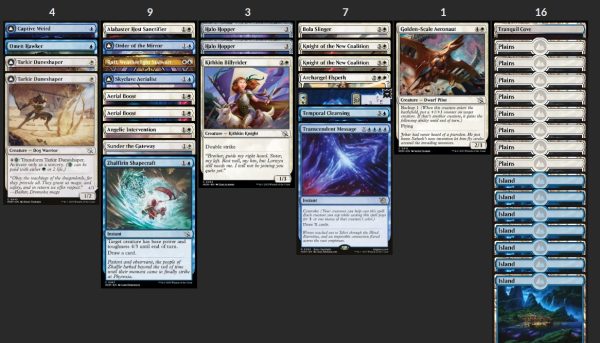
Hopper Aggro (2-1)

Creatures

1 Captive Weird // Compleated Conjurer
1 Omen Hawker
2 Tarkir Duneshaper // Burnished Dunestomper
1 Alabaster Host Sanctifier
1 Order of the Mirror // Order of the Alabaster Host
1 Skyclave Aerialist // Skyclave Invader
1 Raff, Weatherlight Stalwart
2 Halo Hopper
1 Kithkin Billyrider
1 Bola Slinger
2 Knight of the New Coalition
1 Golden-Scale Aeronaut

Battles

1 Invasion of Xerex // Vertex Paladin

Planeswalker

1 Archangel Elspeth

Sorcery

1 Sunder the Gateway
1 Temporal Cleansing

Instant

2 Aerial Boost
1 Angelic Intervention
1 Zhalfirin Shapecraft
1 Transcendent Message

Land

1 Tranquil Cove
8 Plains
7 Island

This deck has good one-drops, but it's definitely playing a few cards I wish had been left out. The Golden-Scale Aeronaut is pretty mediocre, as is the Kithkin Billyrider. I really wanted another Halo Hopper. I'm going to cut Sunder the Gateway for another land. While this deck can probably afford to cut a 17th land, a below-average spell is just not worth the spot. This is, however, a good representation of what this deck usually looks like for me.

The above build definitely wants a little more interaction, and could stand for a slight uptick in card quality, but it's been blessed with a couple of bombs and should do just fine.

Hopper Aggro vs. Convoke Midrange

My best version of this deck went a little bigger. This version played like more of a midrange deck, and we can definitely leverage our card selection to build the deck this way as well.

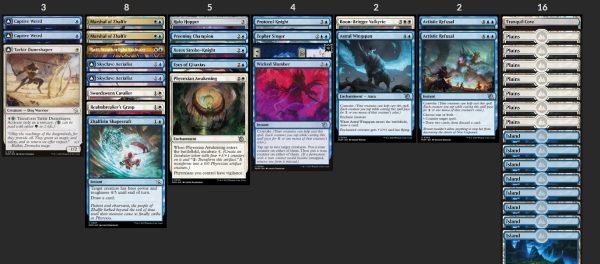
Convoke Midrange (7-0)

Creatures

2 Captive Weird // Compleated Conjurer
1 Tarkir Duneshaper // Burnished Dunestomper
2 Marshal of Zhalfir
1 Raff, Weatherlight Stalwart
1 Swordsworn Cavalier
2 Skyclave Aerialist // Skyclave Invader
1 Halo Hopper
1 Preening Champion
1 Xerex-Strobe Knight
1 Protocol Knight
1 Zephyr Singer
1 Boon-Bringer Valkyrie

Battles

1 Invasion of Xerex // Vertex Paladin

Sorceries

1 Eyes of Gitaxias

Instants

1 Zhalfirin Shapecraft
1 Wicked Slumber
2 Artistic Refusal

Enchantments

1 Realmbreaker's Grasp
1 Phyrexian Awakening
1 Astral Wingspan
1 Tranquil Cove
7 Plains
8 Island

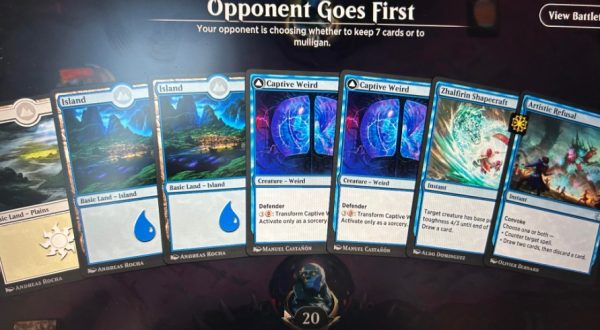
This is not really Hopper Aggro, but it operates with a lot of the same principles. It's just not as aggressive. Still, the early game allows us to get a decent Halo Hopper, though we only play one. Our high card quality was accelerated by the same principles that make Hopper Aggro work; we were just settling in for a longer game. Besides, how can you say no to hands like these?

When life give you lemons, make lemonade. And when life gives you a pallet like this, make some weird art. Typically, Hopper Aggro has served as a great place to go when I'm no opening bomb rares. Some of those archetypes are hard to come by.

Credit Where Credit's Due

This deck is a lot of fun and uses some of the format's most overlooked cards. It's very easy to get access to and in my previous articles, I've had a lot of follow up, specifically about this deck. If you want to know more about it, visit TheHamTV on Twitch. Or follow his podcast, The Art of Draft.

The Commander Clash Decks to Choose If You Want to Win

Are you a Quiet Speculation member?

If not, now is a perfect time to join up! Our powerful tools, breaking-news analysis, and exclusive Discord channel will make sure you stay up to date and ahead of the curve.

Wizards has announced a good idea: pitting players against each other using recent sealed Commander pre-cons. There are 11 decks in total to choose from, and they all have a chance. But which decks, if any, have a way better chance? Since the announcement, I've been playing sealed pods on SpellTable, and I believe there are two or three top contenders. Let's find out why they are the strongest options if you are seeking the win.

But First: A Comment and Some Ground Rules

Why are the starter decks not allowed for this event? In another baffling move, Wizards just keeps doing patently unreasonable things. How is it not a slam-dunk to allow your new players to participate in an event centered around sealed decks?

Yes, I understand that this is an in-world, story driven event. Alright, well, here's what Wizards says about that story: "The Phyrexians left devastation in their wake and permanently altered the Multiverse. The planes are riddled with strange, new Omenpaths—unpredictable gateways that provoke chaos and clashes between legendary characters."

There was an error retrieving a chart for Atarka, World Render

Furthermore, they also say: "This event is the perfect fit for your Commander community and for players new to the format. Commander Decks are designed to play right out of the box, giving you the unique opportunity to introduce new players to Commander."

So at this event which spans the multiverse, where legendary characters from all over are clashing, which is supposedly for new players, the new-player-friendly starter decks are not allowed? These decks came out after the Dominaria United decks and at the same time as the Brothers' War decks. If I were an event organizer, I would allow players to use the starter decks if they wanted.

Additionally, five of the decks have cards that say "When you do Planechase stuff…." There is no indication that Planechase is part of this event. While rules are meant to be house-ruled, I think it's a safe assumption that there will be no Planechase element. I think it would be more fun to mix in Planechase but that would reward the newest decks with one better card. Overpowered? Probably not. Fun? Likely. But on a pure power level basis, the decks must be rated as standing on their own without outside help.

The Single Most Important Feature

It's board wipes! Virtually every one of these decks have decent engines that will create a massive amount of value. However, there are multiple wipes in every single deck. Building a large board state is not enough to seal the deal. It is extremely likely you must prevent, survive, or recover from one or more wipes to win a pod.

There was an error retrieving a chart for Wrath of God

Most of the decks have lackluster protection and poor post wipe recovery. Here is a short count of wipes or anti-wipe tech in each deck. For any boarderline cards, for example, destroy all creatures that cost two mana or less, I would consider that more of a "plus," or card that generates some advantage. I only count cards that will kill 99% of creatures in play as a wipe.

Protection means giving your creatures indestructible or phasing or countering the wipe in question, and recovery means that after a complete wipe, you can rapidly achieve a new board state with just one card. There are precious few counters in the available decks, so virtually every spell is guaranteed to resolve. It's no wonder, then, that the decks with the highest-impact spells rate admirably.

Rebellion Rising: Four wipes, three protection, four plus recovery = 11+

Painbow: Five plus wipes, two recovery = 7+

Tinker Time: Two plus wipes, one protection, two plus recovery = 5+

Urza's Iron Alliance: Three plus wipes, one protection = 4+

Growing Threat: Three plus wipes, one protection = 4+

Cavalry Charge: Two plus wipes, one protection, one recovery = 4+

Divine Convocation: Two plus wipes, one recovery, one plus protection = 4+

Corrupting Influence: Three plus wipes = 3+

Legends Legacy: Two wipes, one protection = 3

Mishra's Burnished Banner: Two wipes = 2

Call For Backup: Zero plus wipe, one plus protection = 1+

There you have it: a breakdown and scoring of what I believe to be the single largest factor in determining these game outcomes. This shows that most of the decks are on the same, rough playing field, but there are also two very clear standouts.

Of course, board wipes are not the only thing that matters; we must also talk about diplomacy and game theory.

Avoiding a Three Versus One

Drawing table aggression is a huge mistake, especially when we're talking about pre-constructed decks. These decks have minimal tutors but all have some removal. You do not want that removal pointed at your stuff because getting set back even a little will severely impact your chances to win.

Strategically, this means that a couple of the decks like Corrupting Influence and Call For Backup are at risk of being on the receiving end of the entire table. Why? Because of how they work.

There was an error retrieving a chart for Nicol Bolas

Corrupting Influence is a special case. Spreading poison around the table is what your deck wants to do, and proliferating everyone is massive value. But when you poison three players, making three enemies becomes not worth it. The smarter play is to make friends with one player and proliferate their +1/+1 counters.

Or maybe there is another Corrupting Influence deck at the table? This instantly makes the game an unofficial 2v2, which is a strategy. Of course, once we start talking about teaming up in FFA, it's a different conversation entirely. All decks must be judged on their own, and for that reason Corrupting Influence is at a relative disadvantage.

Call For Backup is similarly not a bad deck. You can quite easily build up a huge damage, double striker that cannot be blocked. This is scary and should trigger threat recognition pretty easily. Plus, you have many attack triggers, so you must attack each turn to maximize value.

The problem here is obvious: you are going to make enemies quickly. At the same time you have little power in terms of wipes, recovery or protection. The deck is relatively all-in. Your best strategy is to single one player out, and kill them while convincing the other two players they should let it happen. It makes sense because they will have one less opponent to worry about.

Best case for them, though, is that both of you expend all your resources weakening each other while not stopping either of the other two players. In this case, you have two other players who were developing their game plan that you now have to kill. How do you do it? Unless they are vastly unlucky, this is an uphill battle I don't think the deck can win most of the time.

What Does Optimal Play Look Like?

It's likely to look a lot like sitting there building a board and appearing non-threatening until you assemble a game-ending advantage. In such an environment, decks with lots of board wipes and recovery mechanics tend to beat decks without. That is what puts both Painbow and Rebellion Rising ahead of the pack.

There was an error retrieving a chart for Arcades, The Strategist

Painbow has plenty of turns where you cast a mana rock or a ramp spell like Cultivate. Non-threatening, yet advancing the board. Similarly, Rebellion can drop any of their enchants like Assemble the Legion and just sit there, casting their commander and potentially reanimating Otharri, Suns' Glory for only four mana no matter how many times it has died.

Once the table has too much pressure, and a board wipe resolves, Painbow has several value mechanics from Maelstrom Nexus to Jared Carthalion which likely survive wipes and quickly reestablishes a considerable board presence. Furthermore, the deck uses wipes like Iridian Maelstrom, Duneblast, and Time Wipe, which are inherently one-sided.

Rebellion on the other hand has two free anti-wipe spells in Clever Concealment and Flawless Maneuver. On top of that, Roar of Resistance grants haste to tokens, and Rebellion can make a large amount of them at instant speed, which can be more than enough to kill the shields are down.

So Which Deck Is Better?

It's a cliché answer, but it is going to come down to player preference. Let me explain that a little more, though: whichever deck you are more comfortable piloting will trump a deck that might be a little bit stronger.

Rebellion has a lot of extended lines where you can end of turn make a pile of tokens and threaten killing someone while keeping up two free protection spells. The deck definitely has the capability to go from zero to instantly eliminating two players with the right cards like Hexplate Wallbreaker to generate an extra attack step or Adriana, Captain of the Guard giving all your creatures +3/+3. However, this requires planning and excellent play sequencing.

Painbow, on the other hand, generates pure value, huge monsters with great abilities, tons of wipes, and enough modal spells to have the right removal for any situation.

There are two reasons I think Rebellion looks significantly stronger, though. Painbow does not run Sol Ring, and Rebellion does. Because of the heavy commitment to mana symbols, it's not a mistake in deck construction; the colorless mana is a lot less valuable for a five-color deck. Rather, since Painbow has a lot of enters-the-battlefield-tapped lands and Rebellion runs so many two- and three- drops I think it's more consistent and potentially explosive deck.

Of course, that all begs the question of what looks more threatening: playing a tapped land or adding another 2/2 to the table. In either case, skillful play, good timing, diplomacy, and pure luck will all have at least as much of an impact as what deck you run. Most of the decks have a decent shot; I just believe these two are significantly ahead of the curve and a couple of decks are way behind.

Even at this moment, I'm still not sure which deck I'm going to run, but it is definitely an A or B situation, so I will see you there!

Venerated Rotpriest: Failure, or Misunderstood?

Are you a Quiet Speculation member?

If not, now is a perfect time to join up! Our powerful tools, breaking-news analysis, and exclusive Discord channel will make sure you stay up to date and ahead of the curve.

Despite being at this for decades, Magic creators still cannot guess with 100% certainty which new cards will actually impact formats. It's easy to see how a card could be used, but whether it will be used is another matter entirely. There is so much that goes into card viability in a given format, especially Modern, that we can only guess at what will happen. The end result might be obvious in retrospect, but it often isn't, and there's a particular miss that I feel the need to reexamine.

The Nightmare That Wasn't

A few months ago, I made the bold claim that Venerated Rotpriest was the scariest card in Phyrexia: All Will Be One for Modern. The potential for a turn two kill was high enough that I bought (and subsequently sold for profit) sets of Melira, Sylvok Outcast, the only way to protect against getting comboed out by Rotpriest. As everyone should be aware, the threat never materialized.

There was an error retrieving a chart for Venerated Rotpriest

There was certainly no lack for players trying to make Rotpriest work in Modern, and many even said they were impressed by the card and the results. However, all of that came to naught, while leaving the question of why unanswered.

There was an error retrieving a chart for Melira, Sylvok Outcast

There is almost certainly an element of metagame inertia at play here. Convincing players to give up established good decks in favor of an untested semi-combo deck is a huge ask. Especially since Rotpriest's gameplay isn't what most players enjoy. However, if Rotpriest was good enough, it would be adopted anyway. Thus, why was I wrong about the danger.

Historical Hangover

I have been playing Modern long enough to remember when Simic Infect was such a format boogeyman that there were articles about how to correctly use removal against Infect (in short, it was anytime after combat unless absolutely necessary). The Infect of that era was looking to kill in one big hit after playing a lot of pump spells. That deck was the perfect environment for Rotpriest.

There was an error retrieving a chart for Phyrexian Crusader

However, I didn’t appreciate how much things have changed. These days, Simic isn't the only way to play Infect. Over the past month, I've seen quite a few Golgari Infect decks at local events and Modern 1Ks, but only one Simic, and Golgari did better in all cases. In my original article I noted how important Phyrexian Crusader’s protection from red and white are in the current Modern, but I didn't appreciate how differently Golgari actually plays.

Modern Reality

In the old days, the ideal Infect curve yielded a turn-two kill. Cast Glistener Elf turn one and then immediately pile Might of Old Krosa and Mutagenic Growth onto it for lethal. These days, the ideal turn one is casting Hierarch to play an infect creature and a protection spell the following turn. From there, the goal is to hit with chip damage once or twice before playing a single pump spell for the win.

There was an error retrieving a chart for Mutagenic Growth

In neither case does Rotpriest fit in elegantly. However, it at least makes sense in the old style. That deck played a much higher quantity of pump spells than current builds, and thus would have the means to kill via Rotpriest triggers. The current versions of Infect play fewer pump spells than the old versions so they can also run Spell Pierce or Thoughtseize and Crusader. As such, Rotpriest's ceiling lowers considerably.

Operational Changes

Replace Elf with Rotpriest turn one in the first scenario, and there’s the guarantee of at least two poison counters making it through (from the kill spell used against it and Growth). If the kill spell was Lightning Bolt, then it wouldn’t even work, and Rotpriest would get to attack next turn. It wouldn’t be an outright lethal attack, but it would be well on the road to victory.

There was an error retrieving a chart for Noble Hierarch

Replace a Hierarch with Rotpriest in the second scenario, and things are much clunkier. First, while Bolt and Unholy Heat are the most-played removal in Modern, Fury and Solitude are still around, and neither triggers Rotpriest. So no guaranteed poison, and Infect will immediately start to flounder. Worse, playing Rotpriest means no Crusader, and makes the deck more vulnerable to Counterspell.

It Gets Worse

A bigger problem is that Rotpriest doesn't ultimately solve any of Infect's problems. The biggest problem the deck has these days is sticking a threat. Infect has been in decline ever since Fatal Push was printed. All the protection spells and Crusader help, but it's not enough to overcome Modern's waves of removal.

The sideboard is even worse for Rotpriest. According to the Infect players I've spoken to, Infect is now a win Game 1, try to steal a sideboard game kind of deck. There’s nothing wrong with this plan; Affinity made it work for almost 9 years. However, it is much harder for Infect to do so now than when Affinity was at its peak because the Infect hate is maindeck.

There was an error retrieving a chart for Dress Down

Another issue is that Dress Down exists. UR Murktide always plays at least two copies either maindeck or sideboard. Dress completely defeats the point of infect creatures and makes Crusader vulnerable to red removal. That isn’t even getting into Engineered Explosives. Rotpriest plays into Explosives and does nothing against Dress, and therefore it just isn’t working for Infect.

The Combo Problem

Storm was another potential home for Rotpriest, and there were efforts to make it work in there. However, they haven’t gone any better than just playing traditional Infect, despite many Storm streamers praising the card. While I ultimately don’t think this is Rotpriest's fault, it does highlight the overall difficulty the card has gaining traction in Modern.

Operational Success

The weird thing is that Rotpriest did exactly what it was supposed to do in Storm. Go watch the above linked videos. Any time that Rotpriest was relevant it was because it allowed Storm to shortcut its way to victory by targeting it instead of the opponent. 20 life is harder to chop down than 10 poison counters. Having multiple Rotpriests out was practically cheating a way to victory.

There was an error retrieving a chart for Desperate Ritual

I did say "any time that Rotpriest was relevant." Rotpriest was, in fact, frequently irrelevant, even in the versions that ran Ground Rift specifically to kill via Rotpriest. The issue is that outside of the Storm kill, Rotpriest didn't actually contribute to the deck. Rotpriest adds storm count and a way to cheat the kill, but nothing more.

When the Rotpriest Storm decks lost, it was because the combo didn't come together. Sometimes they were raced; often they were disrupted. Storm needs a very specific combination of spells to come together and that's hard in the current metagame. Again, I said this above, but Rotpriest added another angle of attack without fixing a deck's fundamental problem.

What's Wrong?

Rotpriest works in Storm but didn't suddenly make the deck a metagame force. The logical question is whether that means that Rotpriest just can't hack it in Modern. Given my conversations with actual Infect players and trying Storm myself, I think the answer is "We're not trying hard enough." I'm as guilty as anyone, but I think we all thought that fitting Rotpriest into Modern would be easier than it's turning out.

What really stands out to me is one of the Golgari Infect players' assessment of Rotpriest. I asked him about his deck during a deck check at a 1K, and he said that he didn't play Rotpriest and "loved slash hated" the card. His reasoning was that the potential of Rotpriest was significantly higher than the actual results. He acknowledged that it had won some otherwise unwinnable games, but mostly it was useless.

There was an error retrieving a chart for Ignoble Hierarch

I naturally followed up asking what it would take for Rotpriest to reach its potential. This got him really animated, and the crux of the rant was that Infect would need to be more like Pioneer Heroic, which doesn't work in Modern. Asking if he'd tried that resulted in scoffing and an even more animated rant that was fortunately interrupted by the return of the judges.

Fixing the Problem

I agree with the central crux of the rant. Rotpriest has a great deal of potential, not just in Modern but in Pioneer and maybe even Legacy. Unlocking that potential is proving very difficult. The bottom line is that the decks Rotpriest fits into aren't good in their respective metagames. However, to the best of my Googling ability, efforts to really brew decks around Rotpriest and innovate have been lacking.

Crafting a Better Storm

In the case of Storm, everyone (me included) took existing Gruul Storm lists and just shoved Rotpriest into them. We didn't think beyond that action, and I suspect that it was the wrong call. I don't know if anyone tried it, but in retrospect I wonder if adding blue for cantrips to improve consistency might help. That would solve the central issue of Gruul Storm. Abundant Harvest alone just isn't cutting it.

There was an error retrieving a chart for Abundant Harvest

I'd also ask if the current Gruul Storm builds are correct. They mostly seem to be built on the assumption of a win via Underworld Breach. Breach had a great month right around when Rotpriest came out, but has been declining since then. Maybe it's time to stop dreaming the Yawgmoth's Will dream and focus on winning from the hand instead.

Deadly Infection

Making Rotpriest work in Infect may be a pipe dream. Decks like Heroic do not and have never worked in Modern. There's too much removal. Bogles isn't even regularly played anymore. The format has evolved, while Infect has not received (and likely never will) any upgraded creatures. Thus, it's probable that the fundamental problem of Infect will keep the deck down.

A more radical redesign might fix Infect, though I don't think the cards exist for that yet. Infect is tied to creatures and has always been dealt through combat. Has anyone ever tried bite effects? Flesh // Blood and Soul's Fire exist and allow Infect to strike directly at players. It would also trigger Rotpriest. The existing options are a little weak, but Wizards is always pushing the envelope.

There was an error retrieving a chart for Flesh // Blood

Also, what about Pioneer? Has anyone tried to fit Rotpriest into a Heroic shell? I know that Heroic isn't in a great place, but Rotpriest would at least fix the deck's lack of reach. There are plenty of green pump spells if white or red must be cut, and Pioneer is more open to splashing than many give it credit for.

Don't Leave It to Rot

Just because Rotpriest hasn't done much outside of Standard doesn't mean that it won't ever have its day. The ceiling on the card is extremely high, but players haven't been able to reach it. While it might always be the case that the cards to make it happen don't exist yet, I suspect in this case that players need to put more work into Rotpriest to make it work. I know I'll be revisiting the card soon.

Top 5 March of the Machine: the Aftermath Cards For Pioneer/Explorer

Are you a Quiet Speculation member?

If not, now is a perfect time to join up! Our powerful tools, breaking-news analysis, and exclusive Discord channel will make sure you stay up to date and ahead of the curve.

Aftermath is a set like nothing I've seen since I started playing Magic. With only 50 cards in the set, you might assume that none have playability outside of Standard or Commander. However, after reviewing the entire set it's clear that there are some hidden gems for Pioneer and Explorer, the two formats I play the most. Today I'll share with you my Top 5 picks for best cards from March of the Machine: the Aftermath. Make sure to check the video portion out as well because I go into deeper detail and may or may not have a few honorable mentions.

5. Metropolis Reformer

In my initial look at Metropolis Reformer, I didn't think too much of it. The fact that it can be found off of Collected Company isn't nothing. I think that this has a chance of slotting into Selesnia Angels. The fact that it protects you from Thoughtsieze effects and in Pioneer, and specifically it helps protects against Peer into the Abyss which is Lotus Combo's win condition of choice these days. Additionally, the incremental life gain that this card has built into fits with Angel's game plan. I know that Selesnia Angels has taken a back seat recently but maybe Metropolis Reformer is a tool that that deck can use to regain some metagame share in the format.

There was an error retrieving a chart for Metropolis Reformer

4. Narset, Enlightened Exile

Now this is a card that excites me from this set.

Narset, Enlightened Exile doesn't come with a home that she can slot right into in Pioneer/Explorer. This, to me, is a huge flavor win. However, I do think this card could be useful in a Pyromancer-style deck alongside Young Pyromancer and Third Path Iconoclast which is an established archetype. You would have to stretch the mana base into white to do so but it could prove to be powerful. The fact that Narset, Enlightened Exile grants all your creatures prowess is massive. Imagine having her, one Pyromancer, and a couple of tokens in play. The damage potential is huge. I haven't even mentioned her other ability because when she attacks things get nasty. Even if all you have in your graveyard is an Opt you can cast it off of her ability, trigger Prowess on everything and it only gets better from there. If you have a Fiery Impulse you can likely kill one of their blockers while growing your attackers. It's pretty clear to me that the potential is there. The only question is will players want to stretch their manabase to include Narset, Enlightened Exile?

There was an error retrieving a chart for Narset, Enlightened Exile

3. Jirina, Dauntless General

Much like Narset, Enlightened Exile, Jirina, Dauntless General doesn't exactly have a deck to fit into. However, Orzohv Humans is something you will run into here and there on the Ladder on Arena and in Leagues on MTGO. When she enters the battlefield she nukes your opponent's graveyard which is great against Greasefang, Okiba Boss decks and Lotus Combo. It also has that secondary ability where she can sacrifice herself to protect your whole team. Whether it means saving them from a Supreme Verdict/card] or just a pesky [card]Fatal Push, Jirina, Dauntless General is certainly something I'll be on the lookout for in the coming weeks.

There was an error retrieving a chart for Jirina, Dauntless General

2. Ob Nixilis, Captive Kingpin

If Ob Nixilis had a quarter for every time he lost his spark he'd have two, which isn't a lot but it's just weird that it happened twice, you know? With that being said his latest iteration is looking like he could resurrect an old archetype in Pioneer and Explorer. I'm talking of course about what is in my opinion the most obnoxious deck to ever see the light of day in Pioneer, Rakdos Cat Oven.

When paired with Cauldron Familiar and Witch's Oven he can get massive with a quickness. Then you can start bashing your opponent with the Flying, Trampling Demon. It can definitely be the top-end that this deck has been lacking.

But wait there's more to the story. It goes infinite with the card All Will be One. Not that I think this will be a legit contender in Pioneer or Explorer but I'd be wary of it while grinding the Ladder or at weeklies at your local game store (LGS).

There was an error retrieving a chart for Ob Nixilis, Captive Kingpin

1. Coppercoat Vanguard

Yes, it's the uncommon Human lord that's taking the top spot on my list. Why? Because Coppercoat Vanguard slots perfectly into a preexisting deck in Pioneer and Explorer. Mono White Humans is among the best decks in the format and any given week is arguably the very best deck in both formats.

If this was just a Human lord it wouldn't even crack the top five for me. What makes this card special is the Ward 1 it grants to all other Humans. Mono White Humans is a deck that already kills quickly. Tacking Ward 1 text to all of your creatures is going to make them extremely hard to deal with. Vanguard plus Thalia, Guardian of Thraben makes opposing Fatal Push's cost three mana, which is so bad for opponents. It gets almost unbeatable in multiples because the Ward 1 stacks. This card is going to tear up both formats and I can't wait. Mono White Aggro has always been one of my favorite strategies in Magic so this will be a fun one to revisit!

There was an error retrieving a chart for Coppercoat Vanguard

See More In Today's Video!

Now that you've read the article check out today's video. There's a more in-depth discussion of each of these cards, and I also share some honorable mentions that I think could also show up in Pioneer and Explorer!

Avatar photo

LessAlex

LessAlex, AKA Alex Blackard, is a Magic: The Gathering content creator who is passionate about playing Control decks in Constructed, particularly in the Pioneer, Modern, Explorer, and Historic formats. He also enjoys experimenting with combo decks and brewing up new and exciting strategies to stay ahead of the competition. With a focus on in-depth strategy breakdowns and gameplay, LessAlex offers a unique perspective on the game that is both entertaining and informative. His competitive resume includes a Top 4 at an SCG Open in 2014, splitting an NRG Trial in 2017, as well as countless SCG IQ Top 8s and Game Day wins. He hosts The Control Freak Podcast where he discusses playing Control decks in Constructed, and brings on guests including prominent players and creators to share their expertise. You can catch him streaming on Twitch weekdays at 9 am, and on his YouTube Channel for even more content.

View More By LessAlex

Posted in Explorer, Free, PioneerTagged , , , Leave a Comment on Top 5 March of the Machine: the Aftermath Cards For Pioneer/Explorer

Have you joined the Quiet Speculation Discord?

If you haven't, you're leaving value on the table! Join our community of experts, enthusiasts, entertainers, and educators and enjoy exclusive podcasts, questions asked and answered, trades, sales, and everything else Discord has to offer.

Want to create content with Quiet Speculation?

All you need to succeed is a passion for Magic: The Gathering, and the ability to write coherently. Share your knowledge of MTG and how you leverage it to win games, get value from your cards – or even turn a profit.

Sealed Product and New Standard Rotation

Are you a Quiet Speculation member?

If not, now is a perfect time to join up! Our powerful tools, breaking-news analysis, and exclusive Discord channel will make sure you stay up to date and ahead of the curve.

In 11 years of writing weekly articles, I have yet to experience any dramatic writer's block. This is partly a testament to Wizards of the Coast’s constant evolution of the game of Magic. If Magic remained stagnant, even for a few months, I would run out of topics.

Fortunately, the only constant in Magic is change.

This week, the change I'm covering is the major transformation of Standard. In the past, Standard sets rotated out of the format after two years. With this announcement, sets will now remain in the format for three years! What's more, as a part of this change, there will be no Standard rotation this fall at all. Another full year of Standard life is a fifty percent increase. It also means another full year of Sheoldred, the Apocalypse, Invoke Despair, and Fable of the Mirror-Breaker // Reflection of Kiki-Jiki.

There was an error retrieving a chart for Sheoldred, the Apocalypse

Is This What the Player Base Wanted?

I’m not sure this is going to deliver against Wizards’ objectives. While it bodes well for anyone who has invested in or speculated on Standard cards, the health of the format may not see the measured improvement predicted.

Alas, I am no expert in Standard so I won’t speculate too much on this aspect. Instead, I’ll refer you to David Schumann’s article from last week. David does a fantastic job diving into this topic, as well as covering some of the financial implications and his predictions for what it means for the format in general. I’m not going to re-hash his article.

I will repeat for emphasis my agreement that singles offer more potential as a result of this change. Cards that were on the verge of rotating will now have another year in Standard, and an expanding card base could open doors for new archetypes. This means either popular cards will get more popular and harder to find, or new cards will suddenly rise in popularity. Either way, it should lead to some interesting price increases.

There was an error retrieving a chart for Shipwreck Marsh

Rippling Effects in the Sealed Market

One thing David did not cover in his article, which I'll discuss today, is the potential impact on newer sealed product. In fact, I had already noticed some upward momentum on certain draft booster boxes from Magic’s more recent sets even before the announcement.

Check out the TCGplayer market price one-year graph for Innistrad: Midnight Hunt draft booster boxes.

These booster boxes were left for dead late last year—I purchased a booster box of the set back in November for $72.99 shipped (plus tax). Now at $86, this set has already seen a 17% increase in value. Granted, I can’t realize any profit yet because of shipping and fees, but it’s promising to see the momentum in the positive direction.

I suspect that, with an extended shelf life in Standard, these boxes will offer more potential upside over the next year. If individual singles from the set increase in price, it could drive increased box openings of the set, reducing the supply of said boxes.

Midnight Hunt isn’t the only set that has seen a rebound. Check out the graph on Dominaria United, or should I say, “the Sheoldred lottery.”

It’s true that this set’s draft booster boxes haven’t rebounded as much as Midnight Hunt. On the other hand, Dominaria United boxes never dropped down as low as $72. These bottomed in the $86 range, and have since rebounded $10. Checking my order history, I see I purchased a draft booster box of this set in November 2022 for $90.94 plus tax.

Honestly, if Sheoldred, the Apocalypse remains legal in Standard, I could see it hitting price points not seen in Standard since the days of Jace, the Mind Sculptor. Should this happen, DMU booster boxes could easily surpass $100 while still legal in Standard.

There was an error retrieving a chart for Jace, the Mind Sculptor

Lastly, the price of Streets of New Capenna booster boxes remains the cheapest of the bunch, but these are also well off their lows.

I’m expecting these boxes to cross $80 soon, with the potential to approach $100 while still in Standard if the set can offer a bit more to the format. Currently, SNC’s biggest contribution is the tri-lands. Hopefully, the set can offer more at some point during its Standard shelf life. If not, then we’ll have to wait for Commander cards like Halo Fountain and Bootleggers' Stash to gradually climb in price.

Bucking the Trend: Neon Dynasty

One set is bucking the overall trend discussed above: Kamigawa: Neon Dynasty. NEO booster boxes haven’t bounced at all.

My hypothesis here is that the set’s draft booster boxes never got as low as some of the others—currently, it is bottoming out in the $91 range, $20 higher than the bottoms of Midnight Hunt and Streets of New Capenna. It's Perhaps because Neon Dynasty never showed any booster box pricing weakness that we’re not seeing a notable bounce.

I’m keeping an eye on these all the same though. NEO offered a fantastic draft experience, and cards like Fable of the Mirror-Breaker // Reflection of Kiki-Jiki, Farewell, and the channel lands offer enough upside to potentially lift box prices while still legal in Standard.

There was an error retrieving a chart for Boseiju, Who Endures

Forward-Looking Statements and Accountability

Even though I’m not writing on behalf of a publicly traded company, I still feel obligated to make some sort of forward-looking statement disclaimer. Those who follow the stock market and company earnings reports are probably familiar with this lingo. It’s basically a disclaimer used whenever a company is making written or oral statements about projected financial performance, execution of vision and growth plans, etc.

In my case, I’m using this as my unnecessary caveat around predictions for sealed product. I think the extension of Standard rotation from two years to three years will lead to higher booster box prices, particularly on sets released in that twoish-years-ago range, whose shelf life in Standard just got extended another year.

Namely, this includes AFR, MID, VOW, and NEO booster boxes. I don't expect these to double in price or anything like that. I just have an inkling that extended life in Standard will lead to some higher singles prices and a lengthier time period of demand for these sets in general.

For accountability, I’m going to list the current TCG low pricing for each of these draft booster boxes to track trends over the next 6-12 months. We’ll see if this pans out at all.

AFR: $91.85
MID: $86.19
VOW: $77.52
NEO: $91.75

I don’t think these are going to jump 50%, but I wouldn’t be surprised to see them rise by another $10-$20 throughout their lives in Standard.

Wrapping It Up

I should also disclaim that, while I don’t have much interest in flipping Magic singles these days, I still have a small pile of booster boxes for investment. Naturally, this biases my point of view.
That being said, I do think this change to Standard rotation timelines bodes well for booster box demand. I don’t know if it’ll lead to dramatic profits, but I do think there is some potential here, even after accounting for shipping costs.
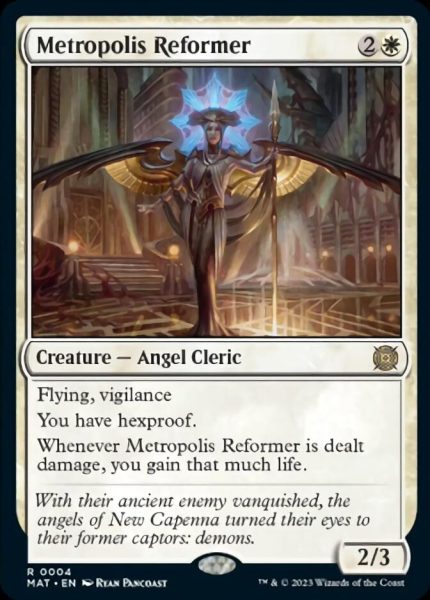
Consider, booster boxes from just a few years ago, such as War of the Spark, and Dominaria, already sell for a significant premium over their price points while in Standard. Dominaria in particular has flirted with a $200 price tag. That could provide a reasonable profit for those who bought in when the set was relatively new.

The trend of increasing box prices is likely to magnify a bit under the new Standard rotation rules. For this reason, I remain optimistic about holding a smattering of boxes for the long haul. I can’t pretend to know which sets will be the Innistrad and which will be the Dragon’s Maze, so instead of concentrating on one set I choose to diversify—one box each of many sets should be a way of spreading risk around.

This, along with my recent focus on Magic original art, is what keeps my interest in Magic, fueling more article ideas for the foreseeable future. Here’s to another 11 years without writer’s block!

What Does Wizards’ Change to Standard Rotation Mean Financially?

Are you a Quiet Speculation member?

If not, now is a perfect time to join up! Our powerful tools, breaking-news analysis, and exclusive Discord channel will make sure you stay up to date and ahead of the curve.

First, for those who don't read our Discord chat or keep up with Wizards of the Coasts' website announcements, we got a doozy on an otherwise calm Sunday afternoon.

There will be NO Standard rotation this year! That means when the fall set, Wilds of Eldraine, releases, no sets will leave Standard. That means another 16 months with Innistrad: Crimson Vow, Innistrad; Midnight Hunt, Kamigawa: Neon Dynasty, and Streets of New Capenna. This will lead to some financial ramifications for cards in these sets.

The Old Normal: Price Pullbacks

In most years, late spring is when we typically expect to see the Standard staples that will be rotating out in the fall begin to drop in price. They typically reach their floor around late summer. We can see this trend in cards like Adeline, Resplendent Cathar

There was an error retrieving a chart for Adeline, Resplendent Cathar

However, with this announcement, I would expect any cards that had begun to dip pending rotation may rebound in price. This means there are some possible financial gains in finding these types of cards. However, it is important to remember that the Standard metagame is volatile. There is no guarantee that a card that was a Standard powerhouse returns to its former glory given this extra lease on life.

Former Duds May Find a New Home

We all make bad speculation picks from time to time. It's easy to over-value a "what-if" scenario to the point that you convince yourself that everyone else is wrong on a card and you've found the next Arclight Pheonix. Now it seems all of us who missed thus far are given a "next shot" opportunity. I'm not suggesting you double down necessarily, but perhaps it's a good idea to dig through those misses and at least keep them on your radar rather than confining them to the "ole box of shame."

On a similar note, there are some cards that barely found a home in the current Standard environment but are now more likely to find one. Often these are mana-fixing lands. The two I am keeping my eye on are Shipwreck Marsh and Rockfall Vale.

The other lands in this cycle all have a TCGPlayer Market price above $5. Shipwreck Marsh though is at $2.92, and Rockfall Vale is under $1! I think this cycle of lands was well-designed and I've seen most of them in Commander decks I've played against. Barring a reprint, these two especially seem like they have good potential.

There was an error retrieving a chart for Shipwreck Marsh
There was an error retrieving a chart for Rockfall Vale

The Biggest Potential Winners

I normally focus on rares and mythics for speculation. The cards that typically drop in price the fastest and the farthest though are the strong uncommons. At a glance, the most played uncommons have so far shown little to no drop in value. A deep dive into all the strong uncommons might be worth your efforts if you want to buy up some "penny picks" thanks to this change.

One of these uncommons I will be keeping my eye on is Thirst for Discovery. it is a very strong card that provides card advantage and allows you to easily dump cards from your hand into your graveyard. We are already seeing archetypes built around dumping Atraxa, Grand Unifier into the graveyard and reanimating it.

There was an error retrieving a chart for Thirst for Discovery

Wilds of Eldraine Previews

It is unlikely that the design team behind Wilds of Eldraine or the sets occurring immediately after it was aware of this possible change. It also means that the play design team responsible for playtesting the set for Standard may also not have seen this change coming. If that is the case, it is possible some powerful and or broken interactions may occur with cards that weren't designed to be in the same Standard format. This means we will need to pay extra attention during Wilds of Eldraine spoiler season for speculation targets that fit this bill.

Why Did Wizards Make This Change?

While the focus of today's article has been on the financial ramifications of this change to the Standard Format, I think it worthwhile to briefly examine the reasons Wizards of the Coast stated were behind making the change.

  • Card Longevity - Like many others, I used to play Standard pretty competitively and rotation was always a time I dreaded as I watched the value of my collection plummet. While I can appreciate the logic behind this the flip side issue is that Standard often gets stale as a format. Like most other formats, the top cards tend to dominate, and having them remain for an additional year could easily dissuade people from playing the format rather than enjoying it. The Standard card pool will likely not be large enough to allow for a "rock/paper/scissors" type of format where different decks keep each other in check.
  • Mechanics and Archetypes Built Up - This one I will give them, I am sure lots of players noticed some potential cool interactions between cards that were released in the fall and those that had just rotated out of Standard. Oftentimes, these types of interactions aren't strong enough to survive in much larger card pools like Modern and Pioneer but may have worked in something like the old Extended format.
  • Want to push a more thematic environment instead of all midrange - I would argue that this one is more likely wishful thinking. The reason that midrange decks tend to become dominant is that they tend to play the best cards in the format at the cost of speed.

Lipservice to Local Game Stores

The announcement also mentions a push to strengthen local game stores. This is the part I find the most insincere, given that the push towards the digital realm has kicked most local game stores to the curb by cutting them out of the supply line to the players. It often seems like Wizards of the Coast knows that local game stores are the lifeblood of their game but can't get over the fact that by bypassing them they make a lot more money.

My Personal Take

I'm honestly not a big fan of this change. While I don't play a lot of Standard anymore, when I did, I loved rotation. It gave us a chance to brew and try out cards that couldn't cut it in the previous Standard format. Now, we will have less rotation and a much larger card pool in Standard. This means the cream of the crop cards like Fable of the Mirror-Breaker, Sheoldred, the Apocalypse, The Wandering Emperor, and Farewell will just continue to dominate the format and cards that might have finally had a chance to find a home will be kept out. I'd argue that a better solution would be to rotate one set out each time a new set rotates in. This would mean more opportunities to brew and would likely mean more cards ended up being played in the format.

Here’s Hopping: Rhythm and Variation in March of the Machine

Are you a Quiet Speculation member?

If not, now is a perfect time to join up! Our powerful tools, breaking-news analysis, and exclusive Discord channel will make sure you stay up to date and ahead of the curve.

Commons will always be the most consistent element of a Limited format. They create predictable openings and familiar exchanges. They communicate the terms of engagement that define the give and take of a format. They create the rhythm of the format.

As we discussed last week, March of the Machine (MOM) is a "prince" format. It has more rares and uncommons than most sets due to the Multiverse Legend and Battle slots and, as a result, the format has a heightened power level, annunciated loudest at higher rarities. These powerful cards exist, however, in a landscape crafted by commons.

To maximize the power of our rares and uncommons, we need to understand what the commons are doing at a fundamental level. Many of the rares are strong, but deck configuration helps us optimize these cards. There is a clear difference between hoping to draw good cards and building a deck that uses those game pieces in a powerful way.

Today, we'll closely examine the dynamic between commons and higher-rarity cards in MOM Draft.

UW: Utility Creatures

The small creatures in this format offer a lot of utility. This is especially true in UW. They ramp out convoke cards and utilize Knight synergies. Many of these small, flexible game pieces are at common to provide pressure and synergy, occasionally flipping into threats.

If our plan is to convoke, then we need to prioritize one-drops. In the right deck, Tarkir Duneshaper // Burnished Dunestomper plays like Llanowar Elves in the early game, and a 4/3 trampler in the late game. That's a powerful card, but it only does those things in the right deck.

UW rhythm

Raff, Weatherlight Stalwart and Baral, Chief of Compliance can both turbo-charge the convoke decks. Marshal of Zhalfir wants to use our creatures to attack. However, without the enablers, all these powerful pieces will fail to generate their game-warping power.

UW variation

Halo Hopper has been a surprising overperformer. This little frog can come down on turn two with as few as one or as many as three one-mana creatures, as well as be a free spell on turn three after a timely Preening Champion or Sigiled Sentinel.

Convoke in Practice

UW Convoke (5-3)

Creatures

1 Omen Hawker
1 Tarkir Duneshaper // Burnished Dunestomper
3 Enduring Bondwarden
1 Faerie Mastermind
1 Tetsuko Umezawa, Fugitive
2 Marshal of Zhalfir
1 Errant and Giada
1 Preening Champion
3 Halo Hopper
1 Zephyr Singer
2 Thunderhead Squadron

Instants

2 Ephara's Dispersal
1 Meeting of Minds
1 Artistic Refusal

Sorceries

3 Temporal Cleansing

Land

8 Plains
8 Island

Here's a different take on UW aggro. Halo Hopper helps build a wide aggressive board, and the discounted convoke cards finish off opponents.

There was an error retrieving a chart for Halo Hopper

Thunderhead Squadron was a little too clunky. Going forward I'd like to try Astral Wings or Tidal Terror in its place. Omen Hawker probably didn't need to be in this deck. The Marshals were underutilized. I tinkered with the build a few times yet struggled with a final list.

The frog, however, is real:

This UW strategy, turbo-charged by Halo Hopper, is quite powerful. If we can find tools to capitalize, this deck becomes a sneaky way to approach the format. Frog aside, the little creatures are important to the format, especially in UW.

BR: Sacrifice and Rectangle Theory

The UW creatures offer versatility. The BR creatures generate value. Cheap creatures in these colors thrive at trading off with a card and potentially leaving behind value. If we can capitalize on that extra bit of value, we can leverage it into big gains.

BR rhythm

Ethan Saks describes this as rectangle theory. The approach values the number of "rectangles" a card generates. This can mean tokens or other fungible game pieces. It's the reason why Lingering Souls saw play in Modern. The more game pieces we generate, the more options we have.

Wizards has labeled this strategy as Sacrifice Control, which is a novel approach to BR's perennial sacrifice theme. While the commons encourage this type of deck, the uncommons dictate what it might look like.

BR variation

The "steal and sac" principles traditionally make for aggressive gameplay, but a lot of the payoffs in this color ask us to move at a slower pace. While the commons provide excellent fodder, the uncommons will cause us to either lean more aggressive or defensive. If we're sacrificing Nezumi Informant after blocks to make an Incubate token or to draw a card, we're playing on a more value-driven spectrum. If the card we're sacrificing is dealing damage with Judith, the Scourge Diva or Juri, Master of the Revue, our deck will be more controlling.

Sacrifice in Practice

BR Sacrifice (7-1)

Creatures

1 Akki Scrapchomper
1 Ichor Drinker
2 Scorn-Blade Berserker
1 Aetherblade Agent
1 Dreg Recycler
2 Pyretic Prankster // Glistening Goremonger
1 Flitting Guerrilla
1 Hangar Scrounger
1 Voldaren Thrillseeker
1 Nezumi Freewheeler // Hideous Fleshwheeler
1 Scrappy Bruiser

Instants

1 Volcanic Spite
1 Stoke the Flames
1 Deadly Derision

Sorceries

1 Ral's Reinforcements
3 Furnace Reins

Artifact

Battles

1 Invasion of Eldraine // Prickle Faeries
1 Invasion of Ulgrotha // Grandmother Ravi Sengir

Lands

9 Swamp
8 Mountain

This deck casts many of the BR commons to generate small advantages and then utilizes them with sacrifice synergies. While Dreg Recycler and Scorn-Blade Berserker aren't game-enders, they generate a good amount of advantage that aggressive decks can leverage towards victory. The commons pressure opponents well, but also generate value. These effects allow us to keep pressuring until we can cobble together lethal.

While that general strategy is familiar to the Rakdos deck in this format, this deck gets a unique edge from three copies of Furnace Reins. This powerful effect often represented damage and a removal spell. Cards like Juri, Master of the Revue and Judith, the Scourge Diva similarly boost this style of aggression.

However, if we end up with cards like Sheoldred or Phyrexian Garagantua, our gameplan changes. In those cases, we want to prioritize cards like Nezumi Informant or Unseal the Necropolis to grind longer without reach. While the BR small-ball two-for-one engine is consistent, we want to be selective as to how we support our payoffs.

UB: Value and Power

UB is the best color combination in the format. It has been the best combination since the opening weeks. UB generates value more slowly than the other colors, but the format allows this slower approach. The payoff is power.

UB rhythm

These cards all want to play a longer game. They want us to generate cards and use more mana over more turns to overpower our opponents. The format has a lot of interaction at common, and the marriage of card draw and removal spells is timeless. Of all the archetypes in the format, this one is hungriest for payoffs.

Slower decks actively seek top-end power. The longer a game goes, the more of our deck we're going to see. If we plan on seeing a lot of our deck, we want to be confident that it will yield more powerful draws than our opponent can take on.

UB variation

The commons are more interchangeable in this archetype. They draw cards, interact, and prolong the game. However, we still want to optimize our decks around our key cards. Corruption of Towashi wants Incubate tokens and Battles. Grimgrin, Corpse-Born does not.

Nearly all of our big, bomb-y creatures appreciate a Saiba Cryptomancer for protection. Additionally, any of these potent creatures make Unseal the Necropolis skyrocket in value.

Conversely, Halo Forager and Chrome Host Seedshark both want spells, while Breach the Multiverse wants Halo-Charged Skaab to loop its effect. These cards play well together, but to support them could mean cutting something like Nezumi Freewheeler. Don't be afraid to!

UB Value in Practice

UB Busted (7-2)

Creatures

1 Order of the Mirror // Order of the Alabaster Host
1 Tymaret, Chosen from Death
2 Nezumi Informant
1 Chrome Host Seedshark
1 Flitting Guerrilla
1 Preening Champion
1 Rona, Sheoldred's Faithful
1 Halo-Charged Skaab
1 Sheoldred, Whispering One
1 Hoarding Broodlord

Instants

1 Mirrodin Avenged
1 Zhalfirin Shapecraft
1 Ephara's Dispersal
1 Unseal the Necropolis
2 Deadly Derision
1 See Double
1 Transcendent Message

Sorceries

1 Eyes of Gitaxias

Battles

2 Invasion of Eldraine // Prickle Faeries
1 Invasion of Ulgrotha // Grandmother Ravi Sengir

UB wants commons that say "draw a card," removal, and a strong end game. In general, these decks are looking to play as many powerful things as they can.

In the above case, if my opponent and I were to flip our decks over, we were likely to agree that mine was more powerful. That's how I won, and this is a totally valid strategy in the format. There was some tension between the convoke cards and Chrome Host Seedshark. Cheap creatures help with convoke, but the Shark wants spells. Fortunately, Eyes of Gitaxias, See Double, and Unseal the Necropolis did a nice job tying the room together.

However, it's worth mentioning what I was doing early. Mirrodin Avenged and Zhalfirin Shapecraft helped to make better trades while digging deeper into the deck. The Informants traded off. It proved less important what they traded for. I just wanted the resource.

These cards prevent us from falling behind. From the very beginning of the game, we're looking to grind down our opponents. When we land something like Invasion of Eldraine // Prickle Faeries, the path opens for one of our bombs.

Maximizing Mana

Because the commons in this format don't incentivize aggression, splashing is better than usual. However, not all fixers are created equal. The power in the format can be tempting, so we should be willing to speculate on the gain lands at common.

While we have options for splashing, we want to remain cognizant of our build. Some of the fixers go from unplayable to reasonable options depending on how we're building our decks.

There was an error retrieving a chart for Skittering Surveyor

It's hard not to smile when we see this card late in the pack. Colorless fixing is a gift in this format, and the many small-creature strategies want extra bodies. We can speculate on this early. It will usually make the cut.

There was an error retrieving a chart for Blighted Burgeoning

This is a powerful option that can fix for double-pipped cards like Ghalta and Mavren or Kolga and Yidaro. It's a powerful combo with Portent Tracker, and the duo can do some silly things if our draw lines up.

There was an error retrieving a chart for Flywheel Racer

This little moped is more playable than it looks. Because so many of the cards offer little bodies plus value, an extra way to utilize those bodies can be worth its weight in gold. Especially if we're managing an ambitious mana base. This card does a not-terrible Citanul Stalwart impression, and sometimes we're okay with that. This is a card we should anticipate picking up on the wheel.

There was an error retrieving a chart for Urn of Godfire

This is the weakest piece of fixing in the set in draft. However, in Sealed, it can be quite solid. Having access to a late-game piece of removal is nice when our opponents are less synergistic. Still, in Draft, we can get a little more out of it with Omen Hawker or Lurrus of the Dream-Den. We should still generally look for superior options.

Balancing Rhythm and Variation

This limited format has more payoffs than most. Whether we're thinking about maximizing a bomb rare, optimizing our mana, or getting the most out of our convoke creatures, card values fluctuate throughout the draft.

At common, the format offers predictable options. They may seem unexciting when compared to the Multiverse Legend we first-picked, the rare we got second, and the battle we were passed third. However, making the right choices at common to optimize those selections is the difference between having a good deck and hoping to draw a bomb.

Don't get it twisted: this is indeed a prince format. But that doesn't mean we're completely at the mercy of the draft. This game offers a great deal of autonomy. To take ownership of our draft, we need to know what the commons offer on a fundamental level. By capitalizing on these strategic edges, we can make our uncommons play like rares and our rares feel unbeatable.

As the format changes, and we transition to March of the Machine: The Aftermath (MAT), we will be tempted by new rares and uncommons. Still, all of the commons remain unchanged. This means the fundamentals of this format will be the same. Same rhythm, different variations. While evaluating the new cards, reflect on what this format offers at common. There's plenty of interaction and a lot of little value creatures. They're not going anywhere, so consider them carefully and use them well.

Want Prices?

Browse thousands of prices with the first and most comprehensive MTG Finance tool around.


Trader Tools lists both buylist and retail prices for every MTG card, going back a decade.

Quiet Speculation