menu

Top 5 Cards I Want from Shadows Over Innistrad Remastered

Are you a Quiet Speculation member?

If not, now is a perfect time to join up! Our powerful tools, breaking-news analysis, and exclusive Discord channel will make sure you stay up to date and ahead of the curve.

Shadows Over Innistrad Remastered releases in just a few short weeks and I cannot wait. There are a ton of Pioneer staples from the original SOI block that will be format-defining in Explorer. Since Explorer is slightly lower-powered than Pioneer at present, even corner case cards have the potential for major impact. This week, I'm highlighting five cards either confirmed or expected from this upcoming release that I'm especially excited for.

5. Thing in the Ice

There was an error retrieving a chart for Thing in the Ice // Awoken Horror

First up is Thing in the Ice // Awoken Horror, which was one of the first cards officially confirmed for the set. I have a soft spot for this little horror both in the Arclight Phoenix deck and the Pyromancer's Ascension deck from yesteryear. With a 0/4 body, it stabilizes well against most aggressive threats, forcing the opponent to spend time and resources to go-wide, only to have those bounced back to their hand once Thing flips. By that point, a 7/8 creature is going to be the largest stat line in most matchups.

Even though cards like Fatal Push and Portable Hole mean that Thing isn't as big of a threat as it used to be, it's still a powerful creature that helps to enable spell-slinger strategies. While we wait for Treasure Cruise to get the full Phoenix experience, I'm interested in exploring Thing in the Ice as a sideboard juke for control strategies to beat decks siding out removal.

4. Sigarda's Aid

There was an error retrieving a chart for Sigarda's Aid

Easily one of the most anticipated cards for Explorer is Sigarda's Aid. This enchantment went from bulk rare to staple thanks to the printing of Colossus Hammer, which essentially gives a permanent +10/+10 to a threat at instant speed. The Hammer Time deck is extremely potent in Modern and right on the cusp of playable in Explorer. It's just missing an enabler or two. With Aid joining the fray, we're one step closer to Hammer Time supremacy in all formats.

Expect this card to see significant play in the first few days of the updated format alongside Fighter Class and Resolute Strike.

3. Eldritch Evolution

There was an error retrieving a chart for Eldritch Evolution

Much like its cousin, Neoform, Eldritch Evolution has never been used fairly and I don't expect that to change here. The Pioneer decks featuring this card primarily use it in conjunction with delve creatures such as Tasigur, the Golden Fang and Hooting Mandrills to tutor out a seven mana game-ending threat like Velomachus Lorehold or Atraxa, Grand Unifier.

While we don't have those delve creatures quite yet, Evolution is a powerful tutor effect for combo and mid-range toolbox decks. In particular, the Enigmatic Incarnation deck that features a plethora of three-drop value creatures can tutor out Elesh Norn, Mother of Machines by turn four. The prospect of turning a Llanowar Elves into something like an Archon of Emeria is also very appealing.

2. Emrakul, the Promised End

There was an error retrieving a chart for Emrakul, the Promised End

Emrakul, the Promised End is a monster of a card, having earned itself a ban in Standard. It saw some play back when Uro, Titan of Nature's Wrath was still legal in Pioneer and was a mainstay in the Modern Four-Color Control deck up until the Yorion, Sky Nomad ban. I think Emrakul has a lot of promise as a sideboard win-condition for Control decks, decks featuring Nykthos, Shrine to Nyx, and ramp strategies featuring Omnath Locus of Creation. I could see a shell popping up with Lotus Cobra and Genesis Ultimatum with the goal of just going over the opponent. In any scenario, Emrakul is a scary card to face down and everyone is a little less safe with it around.

1. Geier Reach Sanitarium

There was an error retrieving a chart for Geier Reach Sanitarium

The card I'm most excited to see from this product is Geier Reach Sanitarium. This simple looting land is a combo piece with Narset, Parter of Veils. When activated on the opponent's upkeep, they will loot, then skip their normal draw for the turn. If the opponent doesn't have any cards in their hand when this sequence starts, they will be soft-locked out of the game unless they can get rid of either Narset or Geier Reach. Ultimately, this will be a massive boon for control strategies as they're already incentivized to play Narset and the deckbuilding cost of an untapped colorless land is nearly nonexistent.

End Step

There are so many great inclusions in this product I didn't even get to! Spell Queller, Pieces of the Puzzle, and Traverse the Ulvenwald are especially nice additions. Given that we got cards like Anger of the Gods in Amonkhet Remastered, it's very likely we'll see other reprints that weren't even in the original SOI block. Even if it wouldn't be Explorer-legal, I'd love to see Snapcaster Mage make its way onto Arena and this would be a perfect product for it!

Spoilers are already underway and Shadows Over Innistrad Remastered releases on March 21st, so get ready! You already know I'll be diving into new brews with the cards on future installments of Adam Plays Magic.

Until then, you can keep up with me on Twitch and Twitter. I'll catch you all next time!

The Great Magic 30 Debate

Are you a Quiet Speculation member?

If not, now is a perfect time to join up! Our powerful tools, breaking-news analysis, and exclusive Discord channel will make sure you stay up to date and ahead of the curve.

Ever since joining Twitter, I’ve had a goal of “going viral” in some manner (preferably not in a negative context). Unfortunately, pigeonholing myself into a subculture within a subculture known as “Magic finance” and/or “Old School Magic” significantly limits my reach. I suspect this is why I’ve capped at around 3,500 followers for many years now.

Given my limited circle, I was thrilled with the reach a tweet of mine had last week—as of this morning, the total number of impressions is flirting with 100,000!

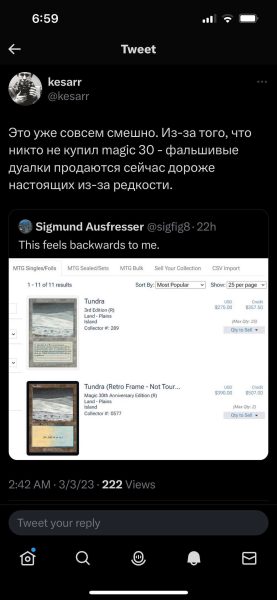
Simple, elegant, and easy to interpret—these seem to be characteristics of an influential tweet. I was delighted to see responses from across the board! The coolest part was seeing multiple quoted retweets in different languages. I went global!

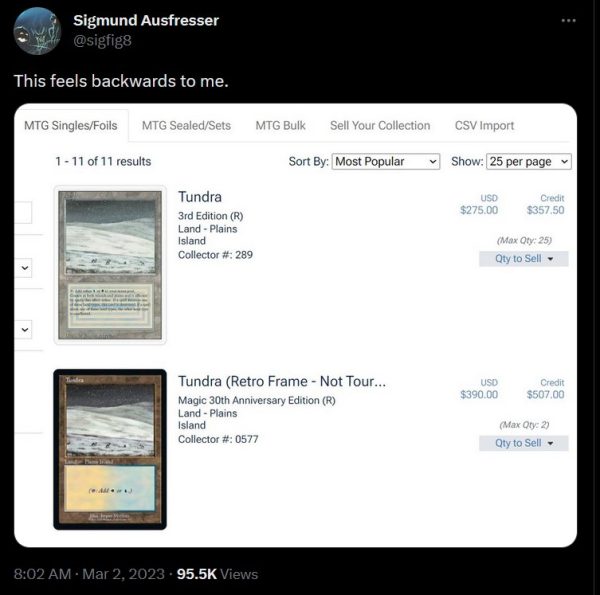
Clearly, the topic of this tweet, a comparison of Revised and retro-framed Magic 30 (M30) Dual Lands is in order. I’ll investigate the data and explore the overall sentiment distribution of the community.

Just the Facts, Ma’am

I’ll begin with the data, focusing on Card Kingdom’s buylist prices (as pictured in my tweet above). Here is a comparison of the data:

Card Name: Revised NM Buy Price / M30 Retro Frame NM Buy Price / M30 New Frame NM Buy Price
  • Volcanic Island: $535 / $520 / $295
  • Underground Sea: $440 / $520 / $295
  • Tropical Island: $365 / $425 / $325
  • Tundra: $275 / $390 / $295
  • Bayou: $260 / $325 / $260
  • Badlands: $255 / $295 / $230
  • Savannah: $245 / $295 / $230
  • Taiga: $245 / $325 / $230
  • Plateau: $175 / $325 / $215
  • Scrubland: $175 / $325 / $195

Card Kingdom is paying more on retro frame Magic 30 Dual Lands as compared to their Revised counterparts with one exception: Volcanic Island.

Non-retro-frame Dual Lands from Magic 30 are cheaper than their respective retro-frame copies. When comparing these less popular copies to Revised ones, some are more expensive and some are cheaper. I count six that are cheaper than Revised, three more expensive, and one priced the same.

These numbers are subject to change as Card Kingdom does tend to update their buy and sell prices quickly on such high volume cards as Dual Lands. Hopefully, this snapshot in time gives you a feel for where pricing is even if the numbers fluctuate. Even with some noise in the data, the bottom line is clear: retro-frame Magic 30 Dual Lands are more expensive than both non-retro and Revised copies.

The Reactions

My initial impression of this comparison was one of curiosity. While I couldn’t help but pass some judgment on the data (I am human, after all), the intent of my tweet was not to incite a debate about the merits and meretriciousness of Magic 30 Dual Lands. (I’m using the second definition of “meretriciousness” here, by the way. “Tawdrily and falsely attractive, superficially significant, pretentious.”)

Because Twitter is what it is, a debate is exactly what unfolded in my feed in response to my tweet. While the tweet netted over 20 retweets and over 20 responses, I can categorize them all into three primary buckets. I will do my best to share each of these viewpoints objectively, without personal bias. Please note that the points I make across these three buckets do not necessarily reflect my own opinion.

Bucket 1: Disgust

Ever since the concept of Magic 30 was announced, many players decried the set as a cash grab on Wizards of the Coasts’ part. The opinion was that this predatory product was designed to drive up sales and create an inflated collectible for the sole purpose of pleasing shareholders.

Many members of the community are still upset about this perceived transgression, and some of the responses to my tweet reflect this frustration.

As a reminder, these cards are proxies, they’re not tournament legal, and they come from booster packs that were sold at a rate of $1,000 per four packs when they were released. That is a lot of money for four booster packs of cards that aren’t tournament legal.

Today a set of four boosters will cost you around $1200 buying from the secondary market on a platform such as TCGplayer.

Bucket 2: Justification

Another popular response to my tweet was an attempt to explain/justify the difference in price between the Revised Tundra and the retro-frame Magic 30 counterpart. Whether it was out of genuine appreciation for the proxies or merely an attempt to “put me in my place”, there was a significant representation of Magic 30 defenders.

Multiple people, including popular vendors such as Tales of Adventure (above), provided a rationale for why these cards are priced the way they are relatively speaking. In short, the Magic 30 retro frame cards are scarce—Michael Caffrey estimated 350 copies of each rare—so if a handful of people are pursuing a complete set, it won’t take much to move their prices significantly.

Honestly, if I may interject my personal opinion here for a moment, I must say that if I had assurance that Wizards of the Coast would never print a product like this again, I’d advocate picking up these retro-frame cards for long-term investment. They’re extremely rare and will disappear from the market and into collections given enough time. Scarcity can drive collectible prices sky-high as long as there’s some basis for demand.

Bucket 3: Financial Outlook

The third bucket of responses is those engaging in dialogue about the price predictions of these cards.

Eric’s question above is a logical follow-up to my tweet: will Magic 30 copies drop in value or will Revised increase? In reality, there’s no rule that says they should be priced identically, and I did not intend to imply that with my original tweet. However, I think the question is a fair one. Collectors aside, if one is looking for a copy to shuffle in a deck, why not choose the less expensive option?

Will the price differential sustain because people really prefer black-bordered cards? If Dual Lands are primarily played in Commander, maybe the non-tournament legal nature of the Magic 30 copies isn’t a major factor. On the other hand, if I want to build a deck in Commander with a restricted budget, I’d be perfectly fine playing a Revised Dual Land to save $100+ over the Magic 30 alternative.

What about comparisons to Collectors’ Edition? This was another response I received, extending the financial outlook discussion to the older, square-bordered parallel.

This is another great question. Collectors’ Edition Dual Land prices have definitely dropped over the past six months, but was that in response to Magic 30, or is it just a victim of the softening secondary market? Perhaps it’s both? It’s tough to say with certainty, but I could see the non-retro-framed versions of Magic 30 Dual Lands maintaining price points near corresponding CE/IE copies in the long term.

My Personal Take

I did my best to capture each bucket above without allowing my opinion to sway my prose. Of course, as a finance columnist, I have my own thoughts on Magic 30 Dual Lands and their current pricing. My intent isn’t to pour gasoline on a dumpster fire of a debate, however, so I’ll try to keep this brief.

As a player, I have no interest in Magic 30. I’m perfectly happy playing the cheapest copies I can find (and often that is Revised). As a collector, I also have a bias toward Revised copies because that’s what I remember owning over the years. Most of you already know I’m a sucker for nostalgia.

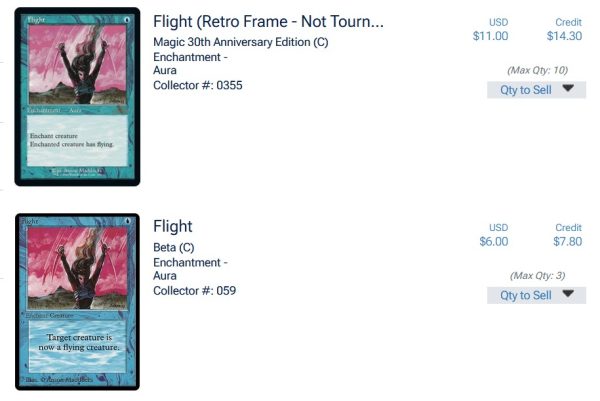
When it comes to Magic finance and investment, I do find myself intrigued by Magic 30 cards. It has become apparent that these cards are extremely scarce—retro-frame versions, especially so. When random commons like Flight are buylisting for $3.20 (non-retro-frame) or $11 (retro-frame), my interest is piqued. I love the classic artwork on Flight just as much as the next person, but seeing the retro-frame Magic 30 copy buylisting for nearly double its Beta counterpart is eye-popping. Despite their lack of tournament legality, these retro-frame cards are rare and they’re for real.

I don’t know if I’ll actively acquire any of these cards, but I may take a flyer (no pun intended) on a few nostalgic cards if I can find an attractive price point. I believe having a little diversification into retro-frame Magic 30 cards is a savvy financial play. As long as Wizards of the Coast doesn’t make another set of these, and they stop giving them away at large events like the one in Las Vegas last year, these will see a diminishing supply over time. That’s a recipe for rising prices, and I wouldn’t mind a piece of that action.

Wrapping It Up

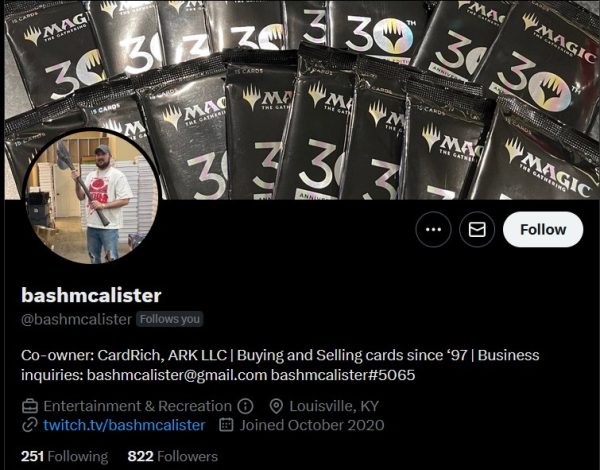
Some people were brilliant in their prediction of Magic 30 prices at the onset. I remember when one Magic vendor, @bashmcalister, touted his decision to purchase a bunch of Magic 30 packs when they launched. Talk about a lucrative payday!

I didn’t believe, and I must give credit where credit is due. The collectible allure of this extremely rare product is driving price points I didn’t think possible. I’m not at all surprised by the price of the Power—there really was no cheap alternative for those. As for retro-frame Flight and other such commons, price points are exceeding anything I could have imagined.

This is one market I’ll pay close attention to going forward. I’ll do my best to pick up a retro-frame Magic 30 card here or there, and we’ll see where things go. Craw Wurm remains one of my favorite cards from my classical days of Magic so that one will probably top the want list.

As for Dual Lands, I think I’ll stick to the tournament-legal, more nostalgic, and less expensive Revised copies. I already have a Tropical Island and Plateau, and I just recently purchased a Tundra from a Canadian seller (fitting, right?). Regardless of their Magic 30 counterparts, I like Dual Lands for their 2023-2024 prospects.

What do you think though? Should I diversify out of Revised and into a couple of Magic 30 copies? Follow me on Twitter and weigh in with your thoughts: @sigfig8.

Understanding Blue in All Will Be One Draft

Are you a Quiet Speculation member?

If not, now is a perfect time to join up! Our powerful tools, breaking-news analysis, and exclusive Discord channel will make sure you stay up to date and ahead of the curve.

Draft is self-correcting.

Or so they say.

The age-old expression implies that if a given color or given strategy is over-powered in a given format, then it will be over-drafted. Which will cause the weaker colors to be more available. An equilibrium then takes place, allowing the weaker color to rise up and perform nearly as well as the stronger colors.

While we are starting to see changes in ONE, blue is still the least desirable color. Pick orders are shifting to reflect this. We are prioritizing red and white and to a lesser extent green. This inbreeding of the format weakens the best decks, and in theory should strengthen blue considerably. Still, I'm not sure it's advisable to actively be looking to move into blue.

The Problems with Blue

Even in our preview guide, we recognized the overall low power level of the blue cards. However, the rules of engagement in the format amplify those problems. Blue has the worst removal, by far, of all the colors. It also has bad early plays and struggles to assert control over the tempo of a game. Even if our blue deck does stabilize, the payoffs make it hard to win before our opponent is able to break through our defenses with a Hazardous Blast, Flensing Raptor, haste creatures, lethal proliferate effects, or by eking out combat damage with For Mirrodin! equipment. Additionally, the speed of the format punishes counterspells and cantrips, which should be an area where blue gains its edge.

Even worse, Experimental Augury has been a flop. It doesn't impact the board, which complicates its inclusion in many decks, and this card seems like it should be the glue piece in blue.

There was an error retrieving a chart for Experimental Augury

In theory, we want the proliferate effect, the card selection, and the noncreature spell. However, the speed of the format puts constraints on this card. Meldweb Strider is often priced into using its lone counter and Ichor Synthesizer eats a lot of combat tricks because blue lacks the cheap interaction to fight back. Blue falls behind a lot, and it struggles to turn the corner. Whether it's losing early or losing late, blue tends to be losing.

Concerns with Blue-Based Artifact Decks

Chrome Prowler has been the best blue common in my experience, but the rest of the artifact deck is inconsistent by design. Eye of Malcator and Escaped Experiment are embarrassing on defense, yet these are the tools that we are expected to build around.

A three-mana 4/4 that scrys when it enters the battlefield should be great in this format. However, the fact that we have to use our mana before sending it into combat is a major knock against it. Additionally, there are going to be a lot of times when we can't activate it, and this format punishes such fumbles. Worst of all is when we try to use it on defense. Again, Chrome Prowler is a reasonable way to make this happen, but don't try and sell me on Charge of the Mites here. If we have to make two 1/1s that can't block to help us play defense, we're in a lot of trouble.
This card is strong when we're beating down, but missing an attack can be a major drawback. While there are decks for Eye of Malcator, it is not a card that we should prioritize in the draft, due to its inconsistency. Furthermore, these cards get paired with uncommon support like Transplant Theorist and Tamiyo's Logbook which are designed to play a longer, grindier game.

Blue Tools

The best performing blue commons are the three-drops: Gitaxian Raptor and Chrome Prowler. These cards are an exception in blue, as they play well on offense and defense. In a lot of formats, I would be happy with Malcator's Watcher, but cycling our two-drop on the battlefield for a card in hand is not something I'm excited about here.

Those are really the only commons in blue we should be excited about, though Experimental Augury still has upside as long as we can support it in a reasonable shell. Typically, I'm only looking to play this in a deck with multiple copies of Scheming Aspirant or Axiom Engraver.

Getting Punished for Doing the Right Thing

When we see a late Chrome Prowler, we should take it as a sign. As blue cards keep tabling, we might take it as a certainty that blue is open. When we see our pick fourteen Malcator's Watcher, our dream of being the only drafter in a specific color may be all but realized. We're alone in blue! Typically, any time we're the only drafter in a color, it's going to work out well for us. However, in ONE, it might not.
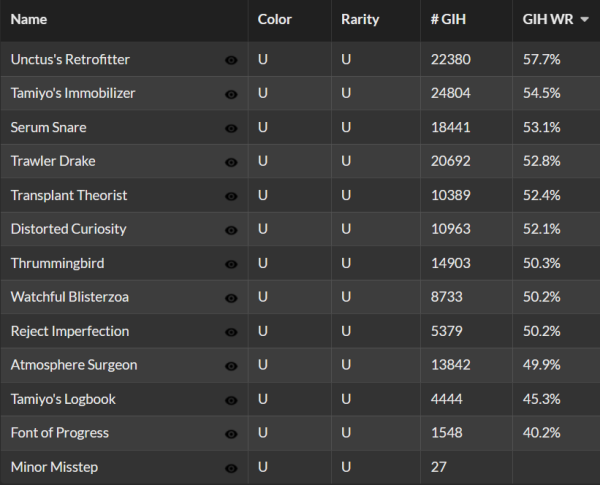
Even if blue is wide open, we are still at the mercy of the packs. Blue's best uncommon is Unctus's Retrofitter, which is indeed very good. Additionally, I have found Tamiyo's Immobilizer to have outperformed its 54.5% GIH WR. But beyond those two, there is a steep drop-off at uncommon.
Serum Snare is a nice tool, in that it gives blue cheap interaction. For this reason, I also really like to include a single Aspirant's Ascent in my blue decks. Both of these cards help shore up a weakness, but neither is particularly strong. If we don't include them, we're basically hoping to dodge Blazing Crescendo and every fight spell in the format. Not great.

Speculate Until You Know It's Safe

When we see an opportunity to snag a blue card because it is the best card in a pack, we should do so. However, blue should almost never be our main color. This is, to a lesser extent, true about black as well.

Perhaps we took an early white card, got deep into red, and then see a Chrome Prowler or Serum-Core Chimera. We can take that card and continue drafting the good red cards that we see. If good green cards come, then we can easily switch. If we keep seeing good blue cards, then perhaps UR is a reasonable landing spot for our deck.

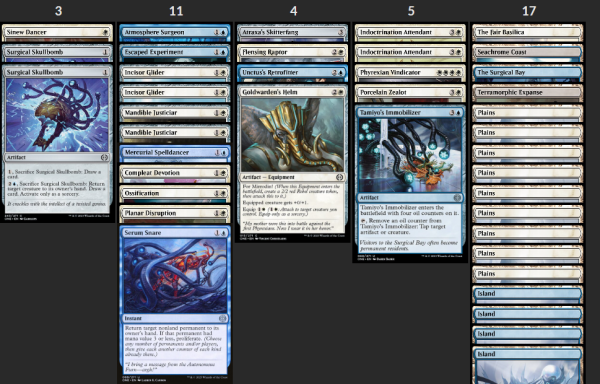
The draft below started off with the top two blue uncommons. For the sake of truthfulness, I have been leaning into blue in an effort to broaden my understanding of the format (this has not been great for my rank). The Atraxa's Skitterfang was probably the best choice pack one, pick one. I stand by the other picks.

UW 3-0

Creatures

1 Sinew Dancer
1 Atmosphere Surgeon
2 Incisor Glider
1 Escaped Experiment
1 Mercurial Spelldancer
2 Mandible Justiciar
1 Atraxa's Skitterfang
1 Flensing Raptor
1 Unctus's Retrofitter
2 Indoctrination Attendant
1 Phyrexian Vindicator
1 Porcelain Zealot
1 Tamiyo's Immobilizer

Instants

1 Compleat Devotion

Artifacts

2 Surgical Skullbomb
1 Goldwarden's Helm
1 Tamiyo's Immobilizer

Enchantments

1 Planar Disruption
1 Ossification

Lands

1 The Fair Basilica
1 Seachrome Coast
1 the Surgical Bay
1 Terramorphic Expanse
9 Plains
4 Island

Blue Is a Support Color

We simply do not want a lot of blue cards in our decks. We want to make sure that we can get deep into another color, and then take advantage of the stronger blue cards that we see, because no one else is prioritizing them.

As a result, the best colors to pair with blue are red and white because those have the best assortment of commons.

UW unsurprisingly has the highest win rate amongst the blue decks. The artifact theme lives in that color pair, and white provides Mandible Justiciar, a premium role-player in that deck. The lifegain offsets the struggles we discussed earlier regarding Eye of Malcator. Additionally, white toxic decks can get some value from blue's proliferate effects, and some of the cards that can help it gain tempo.

Toxic tempo

Big Red, Little Blue

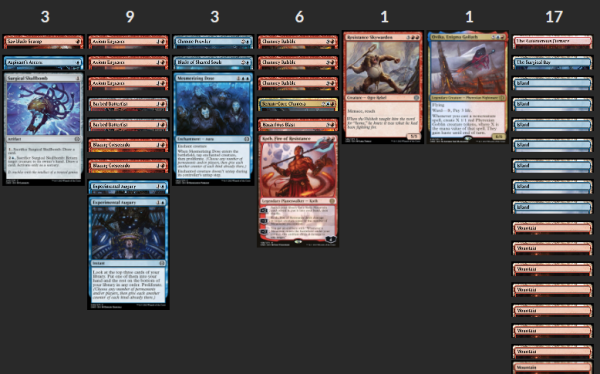
UR has been better for me than this chart would imply. The Jeskai wedge offers artifact synergies, but we should be more interested in card quality. This deck found a strong cache in red, and speculated on blue early. That speculation panned out nicely.

UR 7-2

Creatures

1 Sawblade Scamp
3 Axiom Engraver
1 Chrome Prowler
1 Serum-Core Chimera
3 Chimney Rabble
1 Resistance Skywarden
1 Ovika, Enigma Goliath

Instants

1 Aspirant's Ascent
2 Blazing Crescendo
2 Experimental Augury

Artifacts

1 Surgical Skullbomb
2 Barbed Batterfist
1 Blade of Shared Souls

Enchantments

1 Mesmerizing Dose

Planeswalkers

1 Koth, Fire of Resistance

Lands

1 The Autonomous Furnace
1 The Surgical Bay
7 Island
8 Mountain

This deck gets a lot of value out of Axiom Engraver to play a longer game, but as we can see, it's mostly a red deck. Because red and white offer so many more playables than the other colors, we shouldn't be stunned that those decks outperform the other color combinations. The biggest mistake players are making in UR is committing to the spell-based synergies, as that is putting them behind on board.

Red wants to be assertive and aggressive, but its best attribute is high card quality. One nice, minor synergy is that Barbed Batterfist counts as a noncreature spell while offsetting blue's lack of assertive early plays. A red base makes sense as a shell for good blue cards, because red shines where blue falters, namely with cheap interaction and strong early plays.

Finally, if red has any weakness, it's the three-drops, and blue's best commons are its threes. This archetype should be more about good cards than the spells-matters synergies, which means that it should be more red than blue.

The Threshold for Getting Into UB or UG

I've had success in UB, but those decks were able to avoid playing many commons. In general, I think both UB and UG are traps. Neither of these colors support blue's weaknesses enough. The same truism nonetheless applies here as above. If we can get very deep into one of these colors and are seeing a ton of strong cards, we can still take the good blue picks if no one else wants them.

I imagine Whisper of the Dross and maybe Offer Immortality could play okay with Ichor Synthesizer, but those are all cards I'm hoping to avoid playing in general.

The rule with blue is that we want both blue and the other color to be very open. In these combinations, my threshold for "very open" is much higher. These colors aren't nearly as deep as red or white, and blue is critically shallow. Honestly, I'm surprised the win percentage for these colors isn't higher, because the only reason I would end up in these pairs is if I was seeing insane card quality. While blue is not as unplayable as some have made it out to be, it really does need a strong partner. It's hard to make that combination with black and green.

Blue or Not

There is an opportunity, right now, to get in on blue. We just want to exercise caution in doing so. In a lot of pods, blue is wide open, and that might be a good thing. But if we commit to blue early and its strong cards aren't opened at the table, it won't matter how open the color is. The synergies are a nice bonus, but we need to prioritize high card quality.

Remember, we can speculate on this color without committing to it. That's the best way to navigate a draft in general, but with blue in ONE, the door must be left ajar. I'm not committing to blue until I see, at the least, two very good cards.

We can take a Retrofitter early, but we should lean towards our other color to build depth. While we took an early blue card, we're not married to it. Never go blue for the commons; speculate on blue if it seems open, but don't commit until you have strong reason to stay in the color. If we follow those rules, we can pick up a lot of equity in playing the format's most under-drafted color.

Trash for Treasure: How I Turned Crabs Into a Dual Land

Are you a Quiet Speculation member?

If not, now is a perfect time to join up! Our powerful tools, breaking-news analysis, and exclusive Discord channel will make sure you stay up to date and ahead of the curve.

What is a card worth? It's a fundamental question to any Magic player. The most obvious answer is that it depends on the market fundamentals of supply and demand. Good old basic economics! However, market theorists consistently miscount human sentiment (FUD) and lag time. I have taken advantage of both numerous times to get some great deals. Why, just last year, I traded Islands, Counterspells, and Crabs for a Tundra.

But First, What Set This Into Motion

Let me tell you a story called "How Beardy finally acquired full play sets of Revised dual lands which were then stolen from him… twice." Alright, the story name is way too long, as are the stories themselves. The short of it is that I have collected, traded, and purchased my way to full sets of dual lands multiple times and, unfortunately, lost them as well.

Recovering from something like this proved tough, as I could not afford to simply re-purchase every dual in 1999 and 2001; I did not have that kind of income! Over the years, I worked my way back one deal at a time. I managed to get a few sets completed and even scored an Unlimited Tropical Island for 60% of the price of a Revised one.

That being said, I have always been in the market for duals, both bidding on eBay and trading my way up, so I feel I have a very good idea of what they are worth versus what they are selling at. Last year, with the announcement of proxy duals being reprinted in 30th Anniversary, I knew it was the right time to make some moves. Consumer sentiment would be at its absolute lowest point maybe ever, so I started tracking prices daily as they crept downward. Simultaneously, vendors were a little scared, and wanted to divest some of their inventory in case duals crashed. I was scanning cards with Ion Scanner and noted anything that seemed unusually high.

That's when I noticed what seemed like outrageously high vendor prices for Hedron Crab, Snow-Covered Island, and some editions of Counterspell. Checking across formats, I concluded there was nowhere but down for these cards to go. Snow-Covered lands in particular have been reprinted multiple times and were even about to get a reprint in Jumpstart 2022! There simply was no way that any of these cards would command the same premium in one year compared to right then and there.

Can Bulk Trade Up?

There was an error retrieving a chart for Black Lotus

It's a simple question: can I give you a stack of bulk for one good card? The answer has always been "probably not." How many bulk Magic cards would I have to give someone for one Black Lotus? Today, with prices in the tens of thousands and greater, I don't think someone would take one million bulk cards for one Lotus (if you would, let's make a deal).

But what about five million? What about ten? At a certain point, it's possible, but it seems like the bulk trader would have to give up significant potential value. How many Hedron Crabs would I need to trade for one Tundra? By the numbers at that time, it would be about forty or so. I don't think this is a trade that normal players do, but vendors are effectively doing these trades every day. What about Counterspell? It would take about 100 of them, and a few more than that for Snow-Covered Island. At the end of the day, I had a pile of $1, $2, $6, and $8 cards that turned into one significantly under-priced dual, and I did it in one transaction.

That's a Good, Bad, Even Trade

I did this trade in 2010. My Jace, The Mind Sculptor for their four copies of Misty Rainforest.

Over the years this trade has alternated in who got the better deal. Some years, it's been Jace; more often, it was Misty. But the fundamental of the trade is one great card for four great cards. That is why I did it. Tundra is one great card, and the pile of other cards are good, but not nearly on the same level.

If you ever have the opportunity to trade up, you should always take it; however, sometimes it can be a toss-up. I'm sure from my trade partner's perspective, they were the ones trading up, and at that time Jace was certainly much more valuable than a single Misty. As a rule I never trade down a "format," meaning if I have Standard-legal cards, I will trade them for other Standard-legal cards, but I almost never trade Legacy cards for Standard cards.

Trading with vendors, however, is pretty straightforward. You slightly overpay for their cards while trading in your own. The fact is, if you can predict the market, you can win every trade, and they do not really have a choice regarding whether or not to make those trades.

Pondering the Future

From where I am sitting, my purchase went up in value about 20% and the cards I traded in have all gone down between 15-50%. Both Snow-Covered Island and Counterspell have been reprinted since then. Hedron Crab has stayed pretty stubbornly at around $6, with one reprint in Mystery Boosters, but look for a reprint soon. Certainly there was the risk that 30th Anniversary would have crushed prices, but it did not happen. In the face of rising inflation, it feels good to be "up" a considerable amount, and I know when I sell, it will be at a level vastly higher than what it cost me to acquire. It will also be much easier to sell a single valuable card than dozens of smaller cards.

Future sets look like they will support dual land pricing. Why do I say this? Because Wizards is continuing to crank out higher and higher powered cards for Commander, which is squeezing out all but the absolute best cards. In that kind of environment, duals become even more sought out. On top of that, there is a growing movement to play PreDH, which does not include many budget land options. All of these signal potential for higher prices in the future.

I Missed the Bus; What Can I Do Now?

This is a sentiment that I see all the time, but, it's not true! There are always opportunities to trade, collect, and efficiently buy your way to a vastly better collection or a higher-valued inventory. Timing, though, is something you cannot ever do over, so understand how to min/max.

Right now, I'm making some moves that count on Commander Masters tanking the price of many staple cards, but pushing up the price of some PreDH all-stars that will not get a reprint. There are always moves you can make! Minimize your maximum loss and only take risks that you can afford. This brings us to the infamous Yogi Berra quote: "It's hard to make predictions, especially about the future." I've missed just as many opportunities continuing to hold Mystic Remora and Ashnod's Altar in the face of declining prices.

Some easy ways to get ahead are to buy complete collections, take advantage of low-priced or unsearched inventory, and divest yourself of cards you think are not going to hold value. By taking any of these steps, you're setting yourself up to have a more valuable collection or inventory in the future, which only further enables you to make additional moves. A collection or inventory is just like a snowball rolling downhill; it will keep expanding if you keep rolling.

MTG finance has changed, and drastically. The game is the same but the rules are different, and it can take a lot of micro-transactions to make one big score. But even as of last year, it's still totally doable; deals are still out there and there is a lot of value not being picked up in the market.

I would love to hear some of your best trade-up stories, or even about a missed opportunity. Let me know in the comments!

“New Decks Are Bad:” Overcoming Metagame Inertia

Are you a Quiet Speculation member?

If not, now is a perfect time to join up! Our powerful tools, breaking-news analysis, and exclusive Discord channel will make sure you stay up to date and ahead of the curve.

Modern's metagame is as stable now as it has ever been. That is an odd opening, but it's true. From 2016 through 2020, Modern was constantly churning as cards redefined the metagame. Since the companion debacle, things have settled down significantly. Pioneer is in the same boat. In fact, in its short life, Pioneer has been inclined to stabilize quickly following any disruption and then resist change until the next major shakeup. Players seem to prefer to build their deck once and then not change a card unless absolutely necessary.

This is strange, because conventional wisdom says that settled metagames are the most open and vulnerable to attack. When all the best decks are known, it should be easier to identify and exploit their weaknesses with a solidly-built rogue deck. Which may (or may not) be true, but I don't see it happening very much. Every month there are many interesting decks in the metagame data, with few if any ever making a noticeable impact on the wider metagame. I have a theory as to why.

Standard Disclaimer

To get it out of the way, yes, sometimes innovation isn't actually possible. In Tier 0 situations like Eldrazi Winter and Hogaak Summer, the top decks are so powerful and resilient that there's no way to innovate around them. In certain others, top decks are covering for each other's weaknesses. Modern saw this back in 2017 when Eldrazi Tron and Grixis Shadow. E-Tron was very strong against the midrange decks which preyed on Shadow, a deck which in turn beat up on the combo and big mana decks that crushed E-Tron. Both decks were strong enough to take on random targeted rogue decks, and so innovation was suppressed. It happens.

There was an error retrieving a chart for Murktide Regent

I do not believe that either scenario is happening in Pioneer and Modern. Despite being a statistical outlier for a full year now (as will be seen in the metagame update next week), UR Murktide is quite beatable, and is far from a true Tier 0 deck. Rakdos Rock is the most popular deck in Pioneer, but it's only recently taken that title. There's no evidence or suggestion that decks are covering for each other in either format. While it's true that Modern Horizons 2 is more powerful than other sets, plenty of decks get by without its cards. There should be room to innovate and attack either format.

Pro Tour Aftermath

Last week, I noted that the Pro Tour results suggested that everyone was misreading Pioneer as an aggressive format when it's actually a defensive format. While I didn't expect players to suddenly change their minds and follow the pros' lead, I did expect to see some changes to how players build their decks. Players normally at least copy the Pro Tour decks, which in turn normally means of week of format disruption and brewing.

There was an error retrieving a chart for Thoughtseize

As far as I can tell, that didn't happen in Pioneer. The decks that are winning now look unchanged from what was winning before the Pro Tour. No deck is fully identical, but the variation between lists looks the same as it always has. Meanwhile, results have roughly the same decks in the same ratios now as before (at time of writing, anyway). Any shifts in the standings appear to be based on the Pro Tour numbers rather than changes in the weekly events. If the Pro Tour had any impact on players decisions, it's very hard to find.

Case in Point

I specifically highlighted Takumi Matsuura's take on Mono-White Humans to illustrate how the Pros saw Pioneer differently. Since the Pro Tour, there were a few decks that followed Matsuura's lead the day after, but that's it. Everyone else has stuck with Brave the Elements and being highly aggressive rather than taking the defensive line.

There was an error retrieving a chart for Skrelv, Defector Mite

Having tested Matsuura's take, I think that while there are some oddities in the build, it's very solid. In a grindy metagame I'd cut Hopeful Initiate before Dauntless Bodyguard, and Sword of Forge and Frontier didn't do what I wanted it to do, but the principle was sound. Skrelv, Defector Mite was much better than anticipated and overall, I felt that the Rakdos and control matchups were much improved. So, why aren't other players seeing the same result?

Metagame Inertia

I postulate that players are not, in fact, seeing results different than mine. The problem is that metagame inertia is preventing any major changes. For those who either haven't taken or don't remember high school physics, inertia comes from Newton's First Law of Motion and is the principle that an object at rest will stay at rest until acted upon by an outside force. Every resting object has a quantifiable amount of inertia that must be overcome before it will move.

There was an error retrieving a chart for Sphere of Resistance

Applying inertia to Magic, a metagame that has settled will remain settled until its inertia is overcome and changed is forced onto it. A churning metagame will continue churning until metagame friction forces it to stop. This implies that it is much easier to keep a churning metagame churning than to take a settled one and make it move. In turn, this implies that it's actually easier to meaningfully innovate in dynamic, churning metagames than in stable ones, defying conventional wisdom.

New Cards Prevent Stagnation

While I'm not going to do a full scientific proof and case study (not without a big research grant, anyway), but it would explain several aspects of Modern that have never fully been explained. The first one is how Modern turned from stable, to unstable, and then back again.

There was an error retrieving a chart for Splinter Twin

Prior to 2016, Modern barely moved from year to year. Unless a deck was specifically banned, its viability and deck composition would remain largely untouched. 2017 saw Modern enter a period of continual instability and churn as decks rose and fell in viability and were constantly being reinvented. This was largely thanks to new cards, with Fatal Push, Omnath, Locus of Creation, Teferi, Time Raveler coming from Standard-legal sets, as well as both Modern Horizons sets.

There was an error retrieving a chart for Omnath, Locus of Creation

Following MH2 in 2021, things have dramatically calmed. Modern has received new cards, but they've largely fit into existing decks and so haven't generated the shifts from earlier. Thus, it can be argued that only Wizards had the necessary force to overcome Modern's inertia and create change. Before the big printing fest, metagame shifts and changes were up to players, and no individual player had enough power to really shake things up themselves. Wizards is in another league and can overcome format inertia at will and did for about five years consecutively.

A Frustration Explained

Furthermore, this postulate would go a long way towards explaining something that has otherwise defied explanation. In March 2022, UR Murktide more or less exploded to the top of Modern's metagame as a statistical outlier. Next week, the February 2023 update will still have Murktide as an outlier, closing the loop. There has never been a truly satisfactory explanation for this dominance other than players just like playing Murktide.

There was an error retrieving a chart for Ragavan, Nimble Pilferer

If I look at the situation as dictated by inertia, it starts to make more sense. The Lurrus of the Dream-Den ban lowered certain decks' power and left others intact, including Murktide. Later in the year when Yorion, Sky Nomad was banned, it took out more of Murktide's competition without affecting it. The players that had been playing Murktide could continue to do so, and as time has gone on, more and more players have gravitated toward the deck without having any need to change. Thus, the inertia on deck choice built up.

There was an error retrieving a chart for Otawara, Soaring City

Wizards' printings have reinforced this inertia. The biggest pickups since 2021 have been the channel lands, which fit into the existing decks, particularly Wrenn and Six decks, effortlessly. Ledger Shredder was a natural fit in Murktide and few other places. Fable of the Mirror-Breaker supercharged Indomitable Creativity decks but didn't create them. Leyline Binding caused a small burst of diversification, but that's largely subsided. Modern hasn't been shaken up to the extent of earlier eras since MH2.

What Causes Metagame Inertia?

If my idea is true, then every metagame is going to naturally move towards settling. This certainly feels accurate since there will always be the best decks in any format, and they'll eventually be found. At that point, the ability to maneuver in the metagame will be somewhat limited, and the pressure to fully innovate rather than optimize and tweak will lessen. It's a bit like how waves in a tank of water will eventually dissipate unless the water is stirred up again.

There was an error retrieving a chart for Standstill

However, there is a human aspect that must be considered. Human beings, as a rule, prefer stability and certainty to change and uncertainty. Even those people who claim to like change (myself included) aren't quite as open to it as they'd care to admit (guilty as charged). Players like more settled and predictable metagames and actually like playing their deck repeatedly rather than making new decks, again more than they'd like to admit. Therefore, while there are natural reasons for metagames to settle, players are going to encourage the settling of a metagame and resist change because it's easier than adapting.

Recent Example

I've mulling over this idea for some time, but a recent deck brought it into focus for me. On February 17, this deck won the Modern Challenge 32:

Mono-White Humans, (HanktheObese, 1st Place)

Creatures

4 Champion of the Parish
4 Esper Sentinel
4 Hopeful Initiate
4 Luminarch Aspirant
2 Raffine's Informant
4 Thalia's Lieutenant
2 Thalia, Guardian of Thraben
4 Adeline, Resplendent Cathar
3 Solitude
4 Chancellor of the Annex

Instants

4 Shining Shoal

Sorceries

4 Emeria's Call

Lands

4 Cavern of Souls
1 Eiganjo Castle
2 Eiganjo, Seat of the Empire
4 Mutavault
6 Plains

Sideboard

2 Burrenton Forge-Tender
3 Cathar Commando
2 Drannith Magistrate
4 Sanctifier en-Vec
2 Loran of the Third Path
2 Sanctum Prelate

I really like the idea of this deck. Chancellor of the Annex as a way to disrupt the opponent's opening while pitching to Solitude or Shining Shoal is genius. It's not like this deck will realistically cast Chancellor. It's far from a perfect plan, as Chancellor is dead outside the opening hand and Shoal isn't aways useful, but this is a very interesting and unique deck which you'd expect the community to embrace.

There was an error retrieving a chart for Chancellor of the Annex

That's not what happened. While the linked Reddit thread called it the biggest flash in the pan ever, on Twitter and elsewhere, I saw players deriding the deck as a pile of janky junk that just got lucky and benefitted from the best players being away at the Pro Tour. All without actually testing the deck.

While there are many reasons why players might have reacted this way, I'd wager that if this was 2020, the reaction would have been more positive. That metagame was far more volatile than 2023's, and so players didn't have their current inertia, leaving them more open to change. Now that things are settled and inertia has built up, the thought of something new and innovative is less welcome.

Overcoming Inertia

The Modern and Pioneer metagames have proven to be resistant to change. Metagame inertia is almost certainly a strong factor behind that resistance. Human nature, and internet culture as well, reinforce the belief that change isn't actually possible, which becomes a self-fulfilling prophecy. It is hard to fight, but if players want more dynamic metagames, it needs to happen. There's no way to know if or when Wizards will shake things up for us. Thus, the solution is to keep more open minds and be more willing to try new ideas, rather than the knee-jerk "it's new and bad" reactions I've been seeing lately.

Team Up! Five Legendary Pairings for March of the Machines

Are you a Quiet Speculation member?

If not, now is a perfect time to join up! Our powerful tools, breaking-news analysis, and exclusive Discord channel will make sure you stay up to date and ahead of the curve.

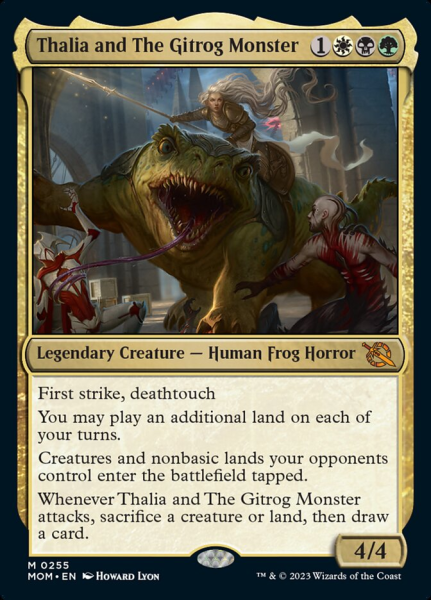
Last weekend at MagicCon Philadelphia, Wizards of the Coast unveiled a handful of cards from the upcoming interplanar crossover set, March of the Machines. The Phyrexians have breached into countless planes, including the last dozen or so visited by us, the players. As demonstrated by new cards such as Thalia and the Gitrog Monster, inhabitants of those worlds become unlikely allies, teaming up to fend off this otherworldly threat.

Inspired by this thread on Twitter, I've assembled my top five legendary team ups. Based on what we've seen so far, the only hard rules are that the characters must be from the same plane and the creature type combination must be at least a little goofy like our previously mentioned human frog horror. There also seems to be a thematic throughline calling back to the abilities of previous iterations of those legendary characters, though it's not 100% required as seen with Drana and Linvala and Yargle and Multani.

With that out of the way, let's get into the countdown.

5. Borborygmos and Tomik

First up on my list is a mix of Borborygmos Enraged and Tomik, Distinguished Advokist. Tomik is a small-framed man who specializes in contracts and verbal agreements for the Orzhov Syndicate. Borborygmos, the massive cyclops and former head of the Gruul clans is also quite adept with words. His prose can be found in the flavor text of cards such as Gruul Charm, "Not Gruul? Then Die!" as well as the brilliant, "Meat and eggs. We eat!" on Protean Hulk.

Most importantly, Borborygmos's and Tomik's most recent cards have a focus on lands. Tomik protects the player's lands from the opponent and Borborygmos, uh, throws them. Bringing these two together for a Naya lands-matter legend would be an absolute win for our Commander crowd.

4. Ragavan and Gonti

Soldier, Poet, King? More like Aetherborn, Monkey, Pirate. That type line is reason enough to pair these two creatures together, but let's go in even more. Both Ragavan, Nimble Pilferer and Gonti, Lord of Luxury are mechanically similar, stealing cards from the opponent's deck. Lore-wise, Ragavan's owner, Kari Zev, Skyship Raider and Gonti allied with Chandra and the Renegades, so this isn't the first time they've been on the same side of a fight against an oppressive power. It is worth noting it's somewhat difficult to find red and black-aligned characters that could be considered protagonists interested in fighting for the greater good, so I'm more than happy to lock these two in.

3. Jinnie Fay and Ziatora

This pairing is more a matter of who's left than anything else. Following the events of the Streets of New Capenna story, Xander's dead, Giada's dead, and Jetmir's mortally wounded. As Jetmir's lieutenant, Jinne Fay, Jetmir's Second is a natural fit to lead the Cabaretti with her army of token cats and dogs. Ziatora, the Incinerator leads the Riveteers faction and their hoard of treasure (tokens). The Riveteers have a monopoly on the city's supply of Halo, the anti-Phyrexian angel juice that beat the first Phyrexian invasion. If Ziatora can provide the Halo and Jinnie can ready an army of citizens, it's a perfect match.

Going back to game mechanics, this pairing cares about creating tokens and sacrificing disposable creatures. Mixing and matching tokens for a base-red and green team up card is exactly what these crime families need.

2. Rankle and Emry

I'll concede that this pairing is almost entirely fanservice. Both Rankle, Master of Pranks and Emry, Lurker of the Loch are popular characters due to their competitive viability. From a gameplay perspective, both do a great job of filling up the graveyard and snowball card advantage. Faerie and merfolk are also very relevant creature types, allowing for potential cross-tribe synergies.

There also aren't very many legendary creatures in Eldraine. The Syr cycle isn't especially noteworthy and Ayara has already been confirmed to be compleated in the upcoming set. In theory, I could see Questing Beast replacing one of these characters in the team up, but if we're trying to hybridize their text boxes, there's no way we're fitting even more text onto that beast.

1. Hazoret and Djeru

Coming in at number one is a team up with Hazoret the Fervent and Djeru, With Eyes Open. This is the only pairing I'm certain we'll see for the simple reason that nearly every other named character from Amonkhet is dead. Plus, legendary creature—Human God is just so incredibly cool.

Hapatra, Vizier of Poisons could potentially replace either of these characters, however, Thalia and the Gitrog Monster is already an Abzan creature, meaning Hapatra and Djeru would overlap, causing color balancing issues.

Lore-wise, Hapatra is the leader of the refugees from Naktamun and in the event of an interplanar crisis, her work is most needed leading her people to safety, not on the battlefield. Although I have a bad feeling that she may be joining the Phyrexians in the near future. The flavor text on Hapatra's Mark reads, “If you fear poisons, it is because you are ignorant of them.” I worry this mentality may mean she gets a bit too close to the glistening oil for her own good.

Marching Onward

I'm so excited for the epic conclusion of the Multiverse Saga Phyrexian War in this next set. Between these team up legends, compleated versions of major characters, and whatever these new battle cards are supposed to be, there's so much to look forward to.

Leave a comment letting me know what you're most looking forward to and what characters you most want to see return (and whose side you want them to be on). As always, you can find me on Twitter at @adamecohen and on Twitch at AcexSpades.

I'll catch you all next week.

PreDH: The Community’s Call for Nostalgia

Are you a Quiet Speculation member?

If not, now is a perfect time to join up! Our powerful tools, breaking-news analysis, and exclusive Discord channel will make sure you stay up to date and ahead of the curve.

Ahhhh the good old days. By now readers should come to expect any perspective piece I write will involve some level of reflection back at the earlier days of Magic. This week is no exception—after reading buzz in the Twitter and Discord community about a new subset of Commander. Dubbed “PreDH”, the format basically restricts the card pool to cards printed before Wizards of the Coast started printing Commander-specific products.

The Commander Rules Committee acknowledged the rules set following Magic 30 in Philly a week ago, and some major personalities in the game are singing its praises. Naturally, this is music to my ears.

PreDH – A Brief Synopsis

What exactly is PreDH, other than a clever play on words (before being called “Commander” the format was known as EDH, short for Elder Dragon Highlander)?

The rules set is elegant in its simplicity. PreDH is identical to today’s Commander, except the card pool is cut off after New Phyrexia. Every new card printed after NPH is not allowed, and the rest of the normal Commander banlist applies. Sheldon Menery, who is on the Commander rules council, acknowledged this format’s existence and popularity with a couple of simple tweets back in mid-February.

A quick Google search reveals that New Phyrexia was released in May 2011. Therefore, any new cards released in sets after that date would not be permitted in PreDH decks. This means every single Commander product, starting with the original (that’s right, no Scavenging Ooze, Chaos Warp, or Flusterstorm), would not be allowed in PreDH.

There was an error retrieving a chart for Flusterstorm

The intent is to provide players with the experience of Elder Dragon Highlander as it was initially devised in the late 1990s and ultimately made “official” back in 2004. This is the precise play environment I experienced when I first explored the format over fifteen years ago.

Of course Sol Ring is still a mainstay, but I remember other powerhouse cards from those days. Lightning Greaves comes immediately to mind, and I still think Portcullis is one of the most underappreciated cards in Commander.

There was an error retrieving a chart for Lightning Greaves
There was an error retrieving a chart for Portcullis

Why PreDH?

The format itself is easy to define, but explaining the draw of this format is a bit more complicated.  That’s a much deeper, more complicated question.

Joe Mauri, a fellow Quiet Speculation writer, recently published a piece on this topic that I think really drives home the motivation for PreDH, even though he doesn’t explicitly call out the format’s inception.

My take on this is going to be biased since I am the type of player who longs for “the good old days” of Magic. That said, it’s clear many other players are experiencing the same longing for nostalgia, given the fact that this format has received noteworthy recognition.

Here’s the essence of the argument: by expanding the Commander card pool and printing cards intentionally designed for play in the format, Wizards of the Coast has effectively homogenized and power-crept the format into a state that’s unrecognizable to those craving the nostalgic. There are far too many cards that are the “obvious choice” due to power level. What’s more, Wizards of the Coast has effectively spoon-fed Commander players with cards clearly designed to do one thing, and do that one thing extremely well.

Consider one of Magic’s most popular creature types as an example: Dragons. Everybody loves dragons. Going back to the OG Shivan Dragon, these flying, Firebreathing creatures have always captured the imagination of Magic players young and old.

There was an error retrieving a chart for Shivan Dragon

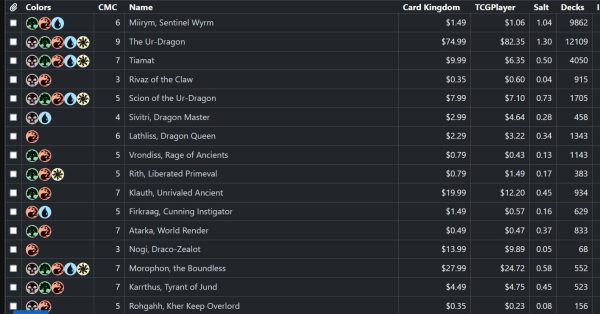
Let’s say you want to build a powerful dragon commander deck—one that can compete with your friends. A quick Gatherer search reveals 95 legendary dragons to choose from, not counting shapeshifters that can count as dragons. That’s a phenomenal card pool to choose from! There must be dozens of versions of the Dragon Commander deck, right?

Hardly. Dragons come in all sorts of color combinations over the years, but only two color combinations really have sizable representation: five-colored or Temur.

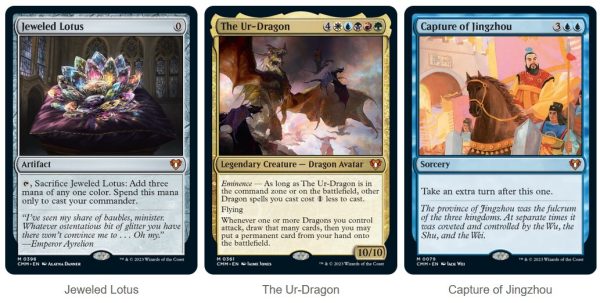
Of the 30,000+ Dragon Commander decks built on EDH REC, only a handful have a reasonable representation. Basically, if you want to build the best Dragon Tribal Commander deck, you’re going to use The Ur-Dragon, Miirym, Sentinel Wyrm, Tiamat, or Scion of the Ur-Dragon as your Commander. Honorable mention would go to Lathliss, Dragon Queen and Vrondiss, Rage of Ancients for also having over 1,000 lists on EDH REC.

That’s it. Of 95 different options (not counting shapeshifters), there are basically 6 popular choices for a streamlined, competitive Dragon Tribal Commander deck.

I have to acknowledge that EDH REC doesn’t always provide the most representative portrayal of the true Commander metagame. That doesn’t really matter. What matters is the clear trend, whereby Wizards of the Coast identifies a popular theme and then prints cards that obviously associate with that theme.

The quest to find synergies, the journey to research and identify fun cards to try—in other words, the creativity—is severely hampered with the printing of these cards. Dragons were just one case study, but the same is true across the board in Commander. All popular archetypes have “obvious” cards, from Voltron-style decks to coin-flipping decks. Even Group Hug has an obvious Commander choice nowadays.

Why Now?

Whether you buy into the nostalgia of PreDH or not, the trend is clear—people feel a pull toward the “old days” of EDH, and the trend has potential. I don’t think this is necessarily going to move the market on individual cards—at least not in 2023. That being said, it’s worth acknowledging the community aspect of the game.

My best guess is that players are reacting negatively toward the announcement of Commander Masters, scheduled to launch this August.

The tagline may excite some players, but to the Magic classicist, this runs counter to the allure of Commander. “Get the ultimate power right out of the box,” to me, screams “No effort required! You’ll have a powerful deck as soon as you open these flashy, new products!”

This is missing the mark. What we nostalgic players loved about EDH was that we could play all sorts of older, obscure cards to try and cobble together synergies that people wouldn’t expect. For example, I remember when I discovered the potent combination of Vendilion Clique and Sunken Hope.

There was an error retrieving a chart for Vendilion Clique
There was an error retrieving a chart for Sunken Hope

These fun combinations, completely unexpected by opponents, were what made EDH so enjoyable! I could dig up obscure cards from Magic’s history and surprise my friends. I feel like Commander Masters is going to tear up that potential creativity and defenestrate it. Do you want power? Do you want synergy? Look no further than this product! These are the cards you’re supposed to build around.

By the way, did we really need a Black Lotus in Commander? Every deck is already basically required to play Sol Ring and Command Tower. Jeweled Lotus is another virtual must-include in a Commander deck—why do we need more homogenization? The need for creativity is slowly dwindling.

It’s my guess that products like these, with the intent of providing you with the most obvious deck-building choices possible, are what’s pushing older players to this new PreDH format. We want to recapture the thrill of the adventure, digging through decades of Magic cards to find the surprising synergies that our friends haven’t yet discovered.

Wrapping It Up

What’s going to happen next? As I mentioned earlier, I don’t necessarily believe the advent of PreDH is going to catalyze much price movement—certainly not in the short term. This isn’t a Magic finance play.

Instead, I’d recommend trying this format out to experience what Elder Dragon Highlander used to be like years ago. Whether you’re an experienced player longing for the days of the past or a newer player curious about a Commander format without “made-for-you” Commander cards, there’s something new to discover playing PreDH.

Me, personally, I must admit that I don’t play much Magic these days. I haven’t even touched Arena since the start of the year, and I don’t exactly miss it. If I do act on this new PreDH trend, it’ll be through the simple act of updating my mono Blue Commander deck to be PreDH compliant. Since I touch up my decks so rarely, I suspect more than eighty percent of my deck would already be from before 2011.

In order to achieve 100% compliance, I’d likely have to do some research to find cards that would fit well in my deck. Then I would have to order them online. This feels like an effort in a way, but honestly, this is recapturing the excitement of building EDH decks that we’ve lost with the printing of so many new Commander products!

Yes, it’s work. Yes, we have to be creative. Yes, we must research and find cards that work well in our decks. That’s the point!

No Myr Coincidence: Speculating on Urtet

Are you a Quiet Speculation member?

If not, now is a perfect time to join up! Our powerful tools, breaking-news analysis, and exclusive Discord channel will make sure you stay up to date and ahead of the curve.

New sets mean new potential Commanders, and with them, plenty of price adjustments as players speculate on the cards that fit with each legend the best. Take Urtet, Remnant of Memnarch. This new commander helps out the under-supported Myr tribe, and as such has caused shake-ups in the financial world. But there are some cards the speculators may still be sleeping on.

The Urtet Effect

For those who check the MTGStocks Market price daily, you may have noticed an interesting trend the past 2 weeks.

There was an error retrieving a chart for Myr Matrix
There was an error retrieving a chart for Myr Turbine
There was an error retrieving a chart for Myr Reservoir

The above cards are obviously auto-includes in an Urtet, Remnant of Memnarch Commander deck. When I saw the first two cards spike, I began digging for other rare and mythic Myr cards. Sadly, the list is pretty short, as most of the cards are common or uncommon and the older options are pretty lackluster anyways.

There was an error retrieving a chart for Myr Superion
There was an error retrieving a chart for Myr Welder
There was an error retrieving a chart for Myr Propagator

These were the top three I found that have a single printing and showed promise. Obviously, two of them have already begun their ascent. I bring these up because I found lots of copies of the last two in my bulk boxes and a few copies of Myr Superion. I have sold multiple copies of all of them already using TCGPlayer, have raised prices repeatedly, and still keep getting sales.

The beauty of Urtet, Remnant of Memnarch is that it is a five-color commander that can be cast with any three mana. While this may seem innocuous, it means that one can consistently cast it on turn three and begin to take advantage of the abilities without fear of mana issues typical of five-color commanders. The biggest challenge with a deck like this is that if you want to keep it on the Myr theme, you have to play a lot of mediocre cards, as most of the Myr cards aren't all that good on their own. To make speculating even harder, most of the remotely playable ones have been printed repeatedly.

Urtet, Remnant of Memnarch: The Specs

There was an error retrieving a chart for Alibou, Ancient Witness

Alibou has one single printing and very relevant abilities for Urtet. While scrying is nowhere near as powerful as card drawing, that fact that Alibou doesn't care why the artifacts were tapped does allow players to attack with a single creature and still abuse the damage and scry X ability. As Urtet, Remnant of Memnarch makes a token whenever any Myr card is cast, the haste provided by Alibou, Ancient Witness can prove surprisingly relevant.

There was an error retrieving a chart for Padeem, Consul of Innovation

Padeem, Consul of Innovation offers great protection, and while it was reprinted in Commander Brothers' War in retro frame, that version is currently hovering around 50% of the market price of the original Kaladesh version. I personally love the retro frame look, and many other older players I have talked to agree with me. I wouldn't spec on regular Kaladesh versions, but would instead put my money towards these cheaper retro frame copies. As these are near bulk prices, it's very possible to get them as throw-ins to balance out trades.

There was an error retrieving a chart for All is Dust

All is Dust is a mostly one-sided Wrath in an artifact deck, and as a bonus it gets around indestructible. Currently all versions are near their all-time lows, making this a low-risk pickup. This is also the type of card that can really turn a game around, especially when you consider how a large majority of Commander decks have few colorless permanents besides mana rocks. The upside of removing annoying planeswalkers, enchantments, and so on is nothing to sneeze at.

There was an error retrieving a chart for Semblance Anvil

Semblance Anvil allows you to turbo out Artifacts and conveniently makes the colored-mana-producing Myr free to cast. Similarly to Padeem, Consul of Innovation, the retro frame versions are currently cheaper and in my opinion look better. It's also important to keep in mind that when you exile an artifact creature with Semblance Anvil, it reduces the cost of both artifacts and creatures in the deck, though the ability does not stack for artifact creatures.

There was an error retrieving a chart for Time Sieve

Time Sieve - this card goes infinite with cards that produce lots of artifact tokens. Given Urtet, Remnant of Memnarch makes artifact tokens, it seems pretty easy to abuse this. Sieve has already rebounded from the Double Masters reprinting. It does currently appear to be trending downward from a spike, so I don't know if now is the time to buy in or if a little patience will go a long way. I believe that the most recent spike is most likely speculator-driven, based off of knowledge that The Brothers' War and Phyrexia: All Will Be One were going to be artifact-heavy decks.

There was an error retrieving a chart for Daretti, Scrap Savant

Normally, I would shy away from cards with multiple printings; however, Daretti, Scrap Savant is a planeswalker that is currently near bulk pricing, boasting very relevant abilities, and is pretty much an auto-include in any artifact deck that includes red. It also seems reasonable to assume that most Urtet, Remnant of Memnarch decks will have plenty of artifacts to sacrifice to Dartti's second ability, helping cheat in very powerful artifacts repeatedly.

There was an error retrieving a chart for Wake the Past

Beneath the Surface

My last spec choice for Urtet, Remnant of Memnarch decks seems like a very powerful option. Much time has passed since the days when Replenish was a powerful Type II (now known as Standard) archetype, but the ability to mass-recur artifacts is extremely powerful. Interestingly, Wizards of the Coast seems to have started shifting away from these types of effects being universal, and newer versions only affect the caster, which is extremely important in a multiplayer format like Commander. The fact that this card grants recurred artifacts haste is also pretty important, as it can really swing a game and turn the tides.

I do want to be up front and state that I personally do not think that Urtet, Remnant of Memnarch is likely to be a top commander in the long run, as the ability, while unique, is not powerful enough to justify running the likes of Gold Myr in any sort of competitive environment. That being said though, there are plenty of players who like building thematic decks that are fun and still have some powerful plays.

My closing suggestion would be to plan on selling into short-term gains and not park money into any of these specs for the long-term. The spikes we have already seen on Myr Superion and Myr Matrix serve as a reminder that when a new legendary creature arrives that affects a less mainstream tribe, speculating on rares and/or mythics that play well with it will likely net decent profits if you jump in fast enough. The power level of that legendary creature or tribe isn't even that relevant. Rather, the key takeaway is that every tribe has its fanbase, and while visible players make up the tip of the iceberg, Magic's casual player base is in fact massive.

Signed, Sealed, Delivered: Preparing for Qualifier Weekend

Are you a Quiet Speculation member?

If not, now is a perfect time to join up! Our powerful tools, breaking-news analysis, and exclusive Discord channel will make sure you stay up to date and ahead of the curve.

This weekend is the Arena Qualifier Weekend, and a huge opportunity for Limited players. With a ticket to the Arena Championship and the Pro Tour (!) at stake, we want to be ready. Since last week's article, I've switched my focus from Draft to Sealed to better prepare myself for this event. The format retains some of the truths we discussed last week, while being influenced by a few new wrinkles.

The Nature of Sealed

Sealed, by nature, is a less streamlined environment than Draft. Players do not get to cultivate their card pool by finding open lanes. Rather, we open six boosters, and we get whatever's there.

This impacts the format in a number of ways. The three biggest differences, and this is always true of Sealed vs. Draft in any expansion set, are as follows:

  • Decks are less streamlined, and typically less aggressive.
  • Bombs have an oversized impact on gameplay.
  • The full side-board juke is in play.

ONE has its fair share of game-wrecking bombs. Whether it be the Sun's Twilight cycle, the Planeswalkers at rare, or the insane mythics, these cards can be devastating. As a result, we should value removal spells more highly. We need a plan to beat those bombs, and if we're not going to have enough aggression to keep our opponents from casting a Kaya, Intangible Slayer while still at 12 life, we need to have removal and counters to answer them (or in Kaya's case, to clear the way).

The aggressive nature of Draft format keeps many of the bombs in check. In Sealed, we need to rely more heavily on removal.

The Nature of ONE

Whether our sealed memories come from local prereleases or the GPs of yore, they're often marred by a similar experience. After a number of difficult decisions, we've finalized a configuration that balances power and consistency as best our pool offers. We have a plan as we sit down in front of an overzealous neophyte. They're excited, but unfamiliar with the nuances of the game, and we anticipate moving on to the next round with a win. However, as the game matures, we are outgunned. Our ingenuity and careful navigation of every micro-decision up to this point crumbles as we do battle with the fifth and sixth rare to come off the top of our opponent's deck. We fall in defeat.

While these memories stick out, they don't define effective deck building. This is still ONE. That means the fast starts from the Toxic decks, or a quick finish from Hazardous Blast, can still punish us. Holding an off-color removal spell instead of an on-color combat trick can cost us the game.

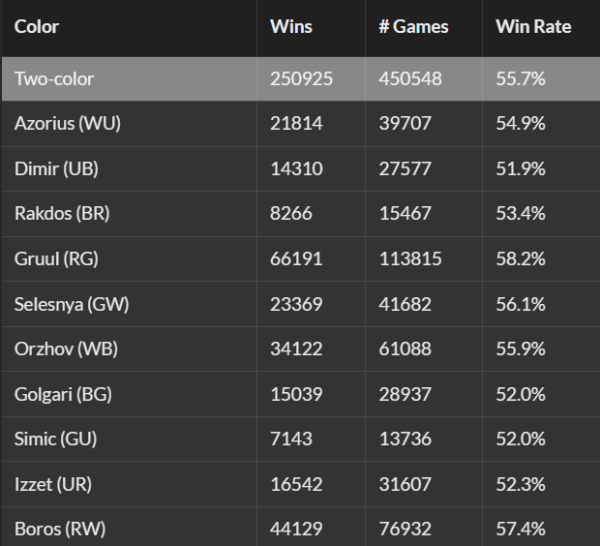
ONE is still an aggressive set, and we need to make sure we keep that in mind as we build our decks. While some formats give us more leeway when it comes to building messy four-color, rare-filled piles, ONE is not kind to such liberal designs. The best decks are still going to be two-colors, possibly with a small splash. As of writing this article, 17Lands has two-color decks winning 57.2% of the time, while two-colors with a splash and three-color decks win 54.4% and 51.4% of the time, respectively.

I'm not saying don't splash. I'm saying be responsible. Our two-drops are essential, and our cards will be better when we're ahead, rather than desperately trying to play catch-up.

Red Stays Strong; White Steps Back

In last week's article, we talked about how red and white had the best commons, and therefore provided the best starting points for draft. The biggest difference between these colors, however, is that red is less reliant on synergies. Many of the best red commons will flourish in any shell, even if the deck fails to optimize its keywords.

Reddy for anything

These cards are reliable in many circumstances. They play with the format's rules of engagement in mind, and while some archetypes or color combinations will get more out of them than others, seeing a stack of these cards in our pool should tempt us to play red. We still want to pressure our opponent, even though the format is less synergistic. Hazardous Blast is still going to win games out of nowhere, and these cards are still good cards.

Conversely, white requires a more inventive approach. It pairs well under a few different circumstances, but the focused Toxic deck is harder to build. Fortunately, many of these white cards still pay well in aggressive strategies, and if our pool supports that build, white can be a meaningful role player. Cards like Compleat Devotion, Zealot's Conviction, and even Flensing Raptor, while still good, are not the draws into the color that they can be in draft.

We can also pair white with proliferate to help threaten a win over the longer game.

Proliferate Gets Its Moment

Toxic, corrupted, and oil have dominated ONE draft so far. These mechanics play to the board, and when properly supported, can snowball into insurmountable advantages. This has pushed the slower proliferate effects to the corner of the format. However, when players don't have the luxury of prioritizing early, synergistic plays, it lessens this impact. Proliferate is a glue mechanic in a format that is a little too streamlined to want one. Sealed gives it the space it needs to thrive.

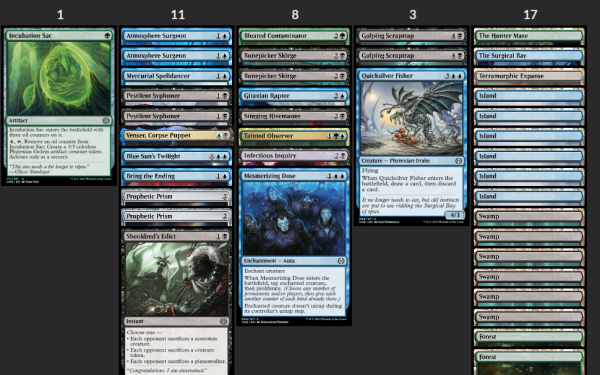
UBg Proliferation Control 7-2

Creatures

1 Mercurial Spelldancer
1 Venser, Corpse Puppet
2 Atmosphere Surgeon
1 Bloated Contaminator
1 Gitaxian Raptor
2 Bonepicker Skirge
1 Stinging Hivemaster
1 Tainted Observer
2 Gulping Scraptrap
1 Quicksilver Fisher

Instants

1 Bring the Ending
1 Sheoldred's Edict

Sorceries

1 Blue Sun's Twilight
1 Infectious Inquiry

Artifacts

1 Incubation Sac
2 Prophetic Prism

Enchantments

1 Mesmerizing Dose

Land

6 Island
1 The Surgical Bay
6 Swamp
2 Forest
1 The Hunter Maze
1 Terramorphic Expanse

This deck played very smoothly. I was able to incorporate my bombs in a three-color deck. It was a slower, more controlling deck, but the low average casting cost prevented me from falling too far behind. My allotment of 2/1s were great at trading off, while Venser, Corpse Puppet impressed mightily. If you told me you were sleeving up this deck in draft, I'd be very worried. In Sealed, we have more time to let our synergies develop.

Gulping Scraptrap improves by more than three percent GIH WR in Sealed as compared to Draft. This card has seemed like a reasonable finisher in Toxic, and a decent value spell in more controlling shells.

Getting the Most Out of Other Colors

The biggest issue blue and black have is the relative weakness of their early plays. Both colors, especially blue, want to play an attrition game and posture defensively. This is a liability in the format. However, the following cards might impress you if you end up in these colors.

Dimiracle workers

First, we still want to make sure we have a good reason to be in these colors, so don't abandon a perfectly good GW aggressive deck because for a couple of Serum Snares.

Assuming we have a good rare, some meaningful uncommons, and Anoint with Affliction, we may find ourselves in black. When our two drops matchup ineffectively with our opponents, we need to be able to find edges in early combat. Whisper of the Dross can help provide this. It isn't exactly Hexgold Slash, but it does a similar job. Killing a Dune Mover or Mandible Justiciar on the draw feels insane.

Offer Immortality is the trump card for every combat trick in the format. Is our opponent setting up a Blazing Crescendo? How about a Ruthless Predation? If so, this Offer can't be refused. This card plays better when behind, and while we shouldn't actively be trying to fall behind, this color combination often does.

The name of the game is keeping parity through the early stages so we can curve into card advantage and a powerful top-end. Testament Bearer and Dross Skullbomb seem better in Sealed than Draft, and Quicksilver Fisher goes from a card I'm trying not to play to one that I'm relatively happy to include.

Bombs vs. Removal

"Play your bombs, play your removal:" once the most common piece of advice we could get when it came to Sealed. While our attention should lean closer toward building a functioning deck with two-drops, the old adage still has some truths. Our opponents will have more bombs than a typical Draft deck. The biggest draws into each color will be the rares we open, not the open lane. If we anticipate seeing threats that will warp the game, we need removal spells. In sealed, I'm typically willing to have an over-costed answer in my deck.

There was an error retrieving a chart for Molten Rebuke

In an ideal world, we'll open Volt Charge, Planar Disruption, and Infectious Bite. However, we might not be so lucky. Cards like Vanish into Eternity might find their way into our maindeck because we're more incentivized to have removal, especially the kind that can answer anything. While we should hope to have more efficient answers, a card like Vanish or Bring the Ending might be a necessary inclusion to prevent us from losing to a Nissa, Ascended Animist or Capricious Hellraiser. We will see cards at that rarified power level more often in Sealed. And unlike in Draft, we may not have the aggressive start to rush by them.

The 40-Card Sideboard Juke

One of the last GPs I went to was Ravnica Allegiance Sealed. My pool did not seem particularly strong, though had I recognized the power of Dovin's Acuity, I may have reconsidered. Regardless, I played an Azorious Control deck (without the Acuity) that splashed green for three copies of Rampaging Rendhorn, as my deck offered only blue-green duals and very few win conditions. I lost the first round and considered side events. My fortune would soon change.

There was an error retrieving a chart for Rampaging Rendhorn

Between each subsequent round I tinkered with the cards in my pool, looking for other options. I found one: a removal-heavy Rakdos Tempo deck that was short a couple playables. Still, the deck had a plan.

After game one of each round, I swapped decks, going from a slow controlling deck to a more aggressive strategy. Game two, my opponent was always caught off guard as I embarrassed their sideboard plans, and game three they were left guessing. Being able to identify which of my two decks was advantaged in a given round gave me an enormous strategic advantage. I was able to rally, finishing X-2 and made the second day of the tournament (where I earned my first Pro Points, days before they disbanded the system).

Those of us new to Sealed, or less familiar with sideboarding as the best-of-one landscape has become dominant on Arena, may not know of this option. If we have two reasonable decks to use, we might want to consider both. While we'll have to start with one, if we recognize a brutal match-up, we need to know when we have access to a full pivot. While sideboard in draft is limited to a shifting a few cards or less, in Sealed, we might consider all forty.

Sealing the Deal

As we get ready for this weekend, hoping to crash the Pro Tour, make sure to get all of your edges. We want to be proactive in our deckbuilding and gameplay, and we want to make sure we have a strong curve of creatures that hopefully gets the most out of our bombs and removal. While Sealed can sometimes feel frustrating, it asks the most of us as deck-builders. Leave no stone unturned, know your sideboard plans, and play tight. This could be your weekend.

After 12 Years, Is Commander Worse than Ever?

Are you a Quiet Speculation member?

If not, now is a perfect time to join up! Our powerful tools, breaking-news analysis, and exclusive Discord channel will make sure you stay up to date and ahead of the curve.

Way back when, regular sets were released, and the playerbase of "EDH" (Elder Dragon Highlander, the format's old name) incorporated new cards as they saw fit. It was very different then and the rules, and cards, have changed considerably.

And now, a new Commander set is coming... Commander Masters! It was inevitable. This announcement got me thinking: is Commander "better" now, or how it used to be? Here's my take.

The Format Was Always About Being Accessible and Balanced

That was part of the reason that the banned list included the power nine from day one(well, minus Timetwister). However, the original dual lands and other expensive cards were all allowed. Why? Because part of the identity of the format is the inclusion of rare, old, and, powerful cards that not everyone owns.

Does Commander need to ban dual lands and cards like them? No. But Conquest format does. This is the crux of the matter. If you're playing Commander as was intended, there's no issue. You are supposed to rein in what you are playing to match your local table. Of course, if you're playing with three other competitive players and you all want to play cEDH, then by all means, battle! That is the key: maintaining a relative balance of power at a table. If you, the player, cannot figure out how to balance your own deck, you might to find need a different format or a different play venue.

So far, so good, right? Mostly. The format exploded in popularity, and regular Magic featured cards that seemed perfect for a casual format but useless otherwise. Now, there have always been multiplayer-friendly cards, but Wizards began taking it to another level as they printed Commander sets. Eventually they even made a Black Lotus for Commander.

Is This What a Balanced Card Looks Like?

There was an error retrieving a chart for Jeweled Lotus

Not only has Wizards increased the power level of Commander to absurd levels, they have decreased the variety of cards that make their way into decks. When they are printing more new cards than ever before, how could this be?

Simple. Rapid power creep makes dozens of cards obsolete every month as new set after new set drops. With more product offerings than ever, there's vastly more to choose from. This means you are excluding more cards than ever. Which cards get included? Typically, the best ones.

Twelve years ago, we had access to Lion's Eye Diamond, which is absolutely played in cEDH decks but doesn't work in every deck. Now we have Jeweled Lotus, which is a competitive card, but with the expectation that many casual decks will run it. Unlike LED, Lotus fits into far more decks, and is a virtual auto-include in Commander, just like Sol Ring.

Making decks less distinct is the opposite of what Commander is about, yet that is what has continued to happen. Instead of making more situational cards and archetypes, Wizards has continued to reprint "staple" cards and make new cards that are almost always strictly more powerful versions of existing cards. It's alright to do this once in a while, but it's happening every single set.

The Evolution of a Magic Card

Behold the progression of Lay of the Land, a card originally printed in 2001. Can you see the power creep over 20 years? We've gone from a simple spell, to the same spell with a situational upside, to a pseudo-"Charm" or modal spell.

That's not a bad thing. However, it does mean that most of these versions of Lay of the Land are completely obsolete compared to the two that were printed in the, you guessed it, latest two sets. This is the troubling trend that is not subsiding.

The Tuck Rule and Other Commander Oddities

A long time ago at a Commander table somewhat far away, Commanders that left the battlefield didn't necessarily go back to the command zone. With certain cards, you could put Commanders into other zones like the library. The story goes that this made people feel bad and that is why the rules needed to change.

So rather than allow specific cards, lots of white cards by the way, to have a very specific identity... we instead changed the rules? The argument goes that Commander is, of course, a format about having access to your Commander; otherwise, what is the point?

Alright, fine, for the sake of argument, I agree. Let's see where this goes. This created CR 903.9, or the "replacement rule:" if your Commander left a game zone, you could instead, as a replacement effect, put your Commander back into the Command zone. This made sense to every player I have ever asked. Still, the rule was changed for one key reason.

As Good as Dead

It turns out that many Commanders had triggered abilities, for example, on death. But those abilities would not trigger if they died and you sent them to the Command zone as a replacement effect... thus, the rules "needed" to be changed once again. Now, we have CR 903.9A and B and C (a brief write-up in case you wanted to know more). It's no longer merely a replacement effect, but a replacement effect as a state-based action. Why is this important? Well, now you get triggers when they hit the grave. But as a side effect, it makes a handful of cards a bit more powerful than they "should" be.

Cards like Necromantic Selection can kill a commander, steal it, and you don't get to use the replacement effect until the game checks state-based actions, so by the time you have the option to put your commander into the Command zone, it's too late; they have stolen it. To me, this feels bad. And anyway, isn't the point of Commander to have access to your commander? Where have I heard these complaints before?

But far worse than simply a "feels bad" interaction, it's also the change from a rule that is easy to explain and ultra-consistent to a modification of that rule that is in fact three rules and that makes certain cards way better than they should be. This is not simple or elegant in terms of game play and rules knowledge in a supposedly casual-friendly format.

An Accessible Secret

Wizards saw that Chaos Warp, Oblation and Trade Secrets were popular, and reprinted these cards in new Commander decks. Now you have access to these cards, yay! Except once more people started playing with Trade Secrets, they found out it was busted, and it got banned.

There was an error retrieving a chart for Trade Secrets

Furthermore, the tuck cards then got de-powered through rule changes. As a player, it can be disheartening to finish a deck or find a strategy only to have it be "nerfed" by the game developers. This is an unfortunate situation that is happening in Magic more and more.

However, Trade Secrets is merely a symptom of the problem, not the cause. I for one am curious what will happen after Commander Masters starts distributing more copies of powerful cards at more Commander tables than ever. More than one person is going to be sorely disappointed after their shiny new card gets banned or slapped with a functional change. We'll have to wait and see on this point, but I am looking to the past to guide my expectations of the future.

Other Random Rules and Side Effects

Commander color identity has finally reached a relatively stable form. But did you know that if you generated mana that was not in your commander's color identity, it used to be colorless mana instead? Some cards were banned, but only as a commander. Then, Magic added the companion mechanic, which is Commander-legal (well, except for Lutri, The Spellchaser and, technically,Yorion, Sky Nomad is "illegal as a companion" but isn't banned).

My point: Commander is far more complicated than it ever has been, and for a casual format, that's somewhat disappointing. Nothing is stopping anyone from playing simpler decks, but even pre-constructed decks are being made with vastly more mechanics than ever. It's an ever-increasing challenge to choose between power level and complexity. Wizards is not making it easier.

Finally, free mulligans in Commander are meant to reduce non-games, but are being used to support greedier mana bases and more explosive openers, ironically creating non-games for those who do not do the same thing to keep up.

Two Steps Forward, Three Steps Back

Wizards is the Two-Headed Giant of Foriys. A great set like Baldur's Gate with a new background mechanic, and initiative as a better dungeon mechanic, stand out. It potentially adds a lot of variety to Commander games and many new combinations for your commander and background. Unfortunately, the background mechanic seems a bit underplayed according to EDHREC. Baldur's Gate was not an expensive set, so budget is not the reason. Dungeons and Dragons very popular and there is significant overlap of the player base so it's not about setting. Most likely? Purely for power reasons.

If I want to make Homarid tribal, who is the only commander? Morophon, The Boundless. What about 20 other lesser-supported tribal types? Still Morophon. The problem is that after they print supporting tribal commanders, it will likely still be Morophon. Rather than making yet another reprint set, it would be nice for Wizards to add some spicier variety into the mix. They could have done that with Baldur's Gate by allowing more color combinations with backgrounds, but likely did not in favor of some idea of balance. (Keep in mind these are the designers who made Thassa's Oracle, Dockside Extortionist, and Elesh Norn, Mother of Machines; they can't balance a gyroscope)

The Inevitable Conclusion

Don't get me wrong: Commander is still a great format, and one I spend tons of time on. It's my very love for Commander that makes me want it to be better. Do I pine for the days of Commander with far less powerful decks? Of course. It was a lot easier to balance decks against one another and make sure power levels were at parity. Today, the divide between casual decks, decks with only a few cEDH level cards, and entire cEDH decks is growing smaller. With more cards than ever, creativity is in fact being stifled by ubiquity and power.

It would be nice for Wizards to grow the game horizontally with more unique choices rather than vertically with obviously stronger options. We'll never go back to the days of Wood Elemental, but it would be nice if more flavorful cards could exist outside of the cEDH vacuum.

What do you think? Was Commander better with the tuck rule? How about the old replacement effects for the Command zone? Has the game gotten a bit too complicated and cut throat for its own good? Or did these thoughts read as "old man yells at cloud?" Let me know in the comments.

The Secret Identity of Pioneer: Pro Tour Weekend Lessons

Are you a Quiet Speculation member?

If not, now is a perfect time to join up! Our powerful tools, breaking-news analysis, and exclusive Discord channel will make sure you stay up to date and ahead of the curve.

I've never been a huge fan of Pioneer. I don't know if that's been entirely clear in the past, but I dislike the format. I'm not sure why, but I do. It's not even that I dislike the gameplay. Pioneer just... feels wrong somehow, like there's something missing or that I don't get, and it's keeping me from having fun.

I've explored my hang-ups before and failed to find a clean answer, but recent events have left me even more puzzled than before. My personal experience at a Pioneer RCQ coupled with Pro Tour Phyrexia have left me wondering if anyone knows how Pioneer is supposed to work.

What Is Pioneer's Format Identity?

Standard? A showcase for the most recent expansions. Modern? A turn-four, non-rotating format with no reserved list. Historic? The powered-down Arena version, featuring re-imagined cards. Legacy? A combo and tempo haven for the most enfranchised players. Vintage? A place where anything goes. But Pioneer...?

I do not have, nor have I ever received, a satisfactory answer to this central question. The closest anyone's ever come is that Pioneer is cheaper Modern, but that's not really an identity per se. That's also not something that will last forever, especially if Wizards' pushing Pioneer makes it more popular. Looking at what sees play is the best I can do, but that says more about the metagame than format identity.

There was an error retrieving a chart for Thoughtseize

At time of writing, the Top 8 deck of Pioneer (according to MTGGoldfish, anyway) are, in order: Rakdos Rock, Mono-Green Devotion, UW Control, Lotus Field Combo, Gruul Vehicles, Mono-White Humans, Izzet Phoenix, and GW Angels. By my count, there are two beatdown decks with ramp elements (Angels, Vehicles); one true combo deck (Lotus); a ramp/combo deck (Devotion); a beatdown combo deck (Phoenix); an aggro deck (Humans); a midrange beatdown deck (Rakdos); and UW Control. Seven proactive decks, one true answer deck: at the very least, Pioneer is about threats.

Survey Says...

Anyone who takes a Google through Magic discourse will quickly find that most players agree with that assessment. Going back to 2019, every Pioneer metagame has been defined by powerful aggro or combo decks. Control in various configurations has always been present, but it's never been on top, and even the midrange decks tend toward the proactive side (at least in the maindeck).

There was an error retrieving a chart for Supreme Verdict

The belief was that the threats of Pioneer were so much stronger than the answers that to play reactively was to play from behind, and eventually fall. This proved especially apparent at the start of Pioneer, when UW Control had to make do with just Azorius Charm for targeted, instant-speed removal. Fatal Push was also quite weak, thanks to the fetchlands being banned. Thus, players prioritized threats, and while Pioneer was never quite a two-ships-passing fest, it wasn't a very interactive format either.

I also know that may players say that Pioneer is more play/draw dependent than other formats. I don't know if that's actually true, but it does show how players believe that falling behind in any way is fatal in Pioneer, reinforcing the proactivity bias.

My RCQ Experience

I was operating under this assumption as I prepared for the Pioneer RCQ I played in last Saturday. My previous experience at Pioneer RCQs had certainly reinforced that whoever fell behind in a match would likely lose.

My preferred deck, Mono-Blue Spirits, exemplified this problem. Slapping a Curious Obsession on a flying one-drop is backbreaking against decks that aren't doing anything on turns 1-2, but pales in comparison to what actual creature decks can do. Knowing that Humans was becoming a larger part of the meta made me shy away, and Angels gaining metagame share queued a full retreat.

There was an error retrieving a chart for Curious Obsession

Thus, I shifted focus to Humans as well. I have a long history with Humans and already owned most of the cards, so it was an easy switch. I spent that past month playing and testing extensively on Magic Online, and felt that my handle on what to expect and how to play against it was solid. Most of the decks I saw both in the Tournament Practice room and in Leagues were known, proactive decks. I adjusted my play and sideboarding plan accordingly.

While I had less opportunities to play Pioneer in paper, when I did, the field and my results were in line with what I saw online. All this to say that going into the RCQ, I was quite pleased with my preparation and expected good results.

The Twist

Instead, I went 1-3 drop, with my only win coming because my opponent didn't show up. It was a bad start to the day when scouting showed that the room was about 50% Blackcleave Cliffs. Neither of my decks has a good matchup against Rakdos, but Humans is slightly better than Spirits, so I stuck to my choice. I then proceeded to hit terrible matchups and got crushed.

There was an error retrieving a chart for Blackcleave Cliffs

Being on the draw all three matches and playing poorly against RW Heroic didn't help, but the pairings god was definitely against me. The irony is that Spirits has a much better matchup against the decks I actually faced, even if it was a worse deck in the field of Rakdos.

This gave me ample time to see what actually was winning, and it was strange. While there was a lot of Rakdos decks there, the flavors at the top tables were all Sacrifice decks rather than midrange. They were also joined by Enigmatic Incarnation, a deck I thought dead locally after multiple terrible showings at other RCQs. There was also some strange Acererak the Archlich combo and UW Spirits. Only one player had Devotion, and all the UW Control players were at the middle tables.

There was an error retrieving a chart for Enigmatic Incarnation

Rakdos Sacrifice would ultimately win that RCQ. It was joined by another Sac deck, two Rakdos midrange decks, Humans, Lotus Field, and two Incarnation decks. The sort of field that all my preparation and experience said shouldn't happen, but did.

The PT Experience

Meanwhile, on the professional stage, something else unexpected went down. In a field that broadly conformed to the overall metagame, Reid Duke won his first ever Pro Tour, about the only accolade missing from his resume. Rather than play one of the metagame's top decks, Reid was playing Indomitable Creativity, as was a good chunk of his team. Gabriel Nassif was running the same deck and reunited with Reid in Top 8. They were joined by Humans, Auras, two Lotus Fields, Incarnation, and Rakdos Midrange.

There was an error retrieving a chart for Indomitable Creativity

While it's interesting that Incarnation made the PT Top 8 too, what is more interesting is how Reid played. I didn't watch every match that was streamed, but every time I saw Reid playing, he was being extremely deliberate... and defensive. Unlike how Creativity plays in Modern, Reid was treating the deck like a control deck with a combo finish. He only went for Creativity at the last possible second after ensuring that his opponent couldn't stop him from just winning. Nassif was doing the same thing, but I didn't see other Creativity players playing as cautiously as those two.

Defense Wins Championships

That was actually something of a theme of the Pro Tour. In contrast to expectations and how the format is believed to work, defense was favored over offense; the more defensive the deck, the better it did. This is exemplified by Takumi Matsuura's Humans deck. In a complete departure from norm, Takumi didn't run Brave the Elements. Instead, Ossification and Skrelv, Defector Mite made the main. This is far less aggressive and more defensive, indicating that Takumi was planning on playing more attrition games.

There was an error retrieving a chart for Skrelv, Defector Mite

Th same could be seen in Benton Madsen's second-place Auras deck. Bogles has always been about rendering removal moot, but Pioneer doesn't have all the hexproof creatures Modern does. Therefore, Benton played many more auras that cantrip, expecting to have to win through grinding. He also had Skrelv maindeck and many sideboard cards for attrition matchups. It is clear that, unlike me, the best players were anticipating the format being about interaction rather than aggression.

What Does It Mean?

A lot of the discussion in the aftermath has been on Mono-Green Devotion's fall from dominance and/or the unexpected win rates various decks posted. Which is fair, but this is exactly what happened after the Regional Championships too. Mono-Green did quite bad there. Then it was like everyone forgot and it immediately went back to being treated as Pioneer's boogeyman. I'm as guilty as anyone of doing this, though I have the excuse that my focus is Modern.

There was an error retrieving a chart for Nykthos, Shrine to Nyx

Admittedly, there are always complications and qualifications for drawing conclusions from a single event. In this case it's that the Pro Tour has a draft component, and those drafts can repair a mediocre Constructed run or ruin a great one. I therefore can't say that the lesson from Philadelphia necessarily applies to Pioneer RCQs. However, there is a thread running through my experiences, the Regional results, and now the Pro Tour that suggests Pioneer isn't what I, or many Pioneer players, may think it is.

Maybe We're All Wrong

What if Pioneer isn't supposed to be an aggressive format? What if instead, the answers are stronger than the threats? What if the format is actually about defense and attrition? I've had this thought scratching at the back of my head since my first Pioneer RCQ last summer. UW Control was a breeze for Spirits back when Pioneer was new, but at that tournament, I felt like Spirits was massively out-gunned. The new white removal like Portable Hole was bad enough, but Shark Typhoon was just unfair.

There was an error retrieving a chart for Shark Typhoon

This thread continued through later tournaments. Spirits was good against the slower decks, but it increasingly felt like that wasn't intrinsic to the matchup so much as it was them being unfocused and unoptimized. Where early on I mostly had to worry about sweepers, increasingly I had to fight through waves of spot removal. I was being ground under despite drawing well. The matchups were still winnable, but it was getting harder and harder.

There was an error retrieving a chart for Resplendent Angel

Now we've come to the Pro Tour. What ultimately won the day was card advantage, defense, and above all else, patience. This is completely contradictory to what everyone has said about Pioneer for years, but it does gel with how I've seen matchups playing out. The free wins from players stumbling against aggressive opponents still happens, but they're getting rarer. Pioneer is changing under our noses.

Time to Reevaluate

I think it's past due for players to take a step back and reevaluate Pioneer. Last weekend was the first time that the big-name pros have dug into the format in years, and they came to very different conclusions about what is good in Pioneer. That should be a wake-up call for the rest of us that have been operating under the old assumptions.

There was an error retrieving a chart for Inverter of Truth

I know it is for me. I, and I suspect most other players, didn't have much reason to pay attention to Pioneer 2020-2021. Certainly, the numbers on MTGO suggested as much. The format was left to the devices of true believers, and when we started coming back, we asked them what was good and ran with it. However, they were a fairly small group, and had been allowed to do as they pleased.

Consequently, Pioneer's metagame was a function of what they wanted to do, not what was possible. Now that more eyes are on Pioneer, it's becoming clearer that Pioneer has a lot more going on than anticipated, and the format doesn't work the way we were told.

I have a month before the next round of Pioneer RCQs start, so I'm going to really start digging into deckbuilding. There are concepts that I feel need to be explored, but conventional wisdom said would never work. If that wisdom is wrong, then I've been on the completely wrong track.

Shifting Down

The developments from the Pro Tour weekend strongly suggest to me that Pioneer is supposed to be much slower and attrition-based than I've previously given it credit. I intend to start investigating this because I'm tired of struggling at RCQs. I can't play a Modern one for the foreseeable future, so I'd better quickly get better at Pioneer or suffer through a very frustrating year! Readers: what is Pioneer to you? I'd love to get your take.

Adam Plays Magic: Explorer Jund Transmogrify

Are you a Quiet Speculation member?

If not, now is a perfect time to join up! Our powerful tools, breaking-news analysis, and exclusive Discord channel will make sure you stay up to date and ahead of the curve.

This week on Adam Plays Magic, we've got a new brew showcasing the new reanimator staple, Atraxa, Grand Unifier. Atraxa is a house and arguably a better card to "cheat out" than even Griselbrand. For seven mana across four colors, Atraxa offers a 7/7 flying, lifelink, deathtouch, and vigilance threat that typically draws between three and six cards.

When behind, she's an incredibly powerful tool to help stabilize. Even if she's dealt with, the opponent will need to contend with the full hand she helped to reload. This means she can often just bring herself (or another copy) right back onto the field. Between Transmogrify and Liliana, Death's Majesty, it's not unreasonable to stick Atraxa as early as turn three or four. Pioneer and Explorer absolutely need to respect this threat going forward.

What I Like

Indomitable Creativity is a powerful card. It's the centerpiece of a tier-one Modern deck, and Reid Duke won the Pro Tour this weekend with the Pioneer variant which attempts to cheat Xenegos, God of Revels and Worldspine Wurm into play for a one-shot kill. Creativity has a much steeper deckbuilding restriction though. To ensure it performs the combo sequence as expected, the deck cannot have any creatures or artifacts other than the intended tutor targets.

This deckbuilding restriction means losing access to important sideboard cards like Unlicensed Hearse and Damping Sphere. It also makes the deck very all-in on the combo, since the only plan B is Shark Typhoon.

There was an error retrieving a chart for Transmogrify

Swapping Creativity out for Transmogrify regains access to not only strong sideboard artifacts but mainboard ones as well. In particular, Esika's Chariot is a midrange threat that can win on its own all while providing ample token creatures to enable the combo. Similarly, Reckoner Bankbuster is an excellent grindy threat in a format rife with Thoughtseize and it can threaten resolved planeswalkers like Liliana of the Veil.

Access to black mana for Thoughtseize and Duress allows the deck to take a more proactive element while protecting the combo. These discard spells ensure the coast is clear and provide critical information at a more efficient rate than a protective counterspell like Make Disappear. Even though Atraxa doesn't one-hit kill the turn the combo resolves, it's much more resilient against interaction like Leyline Binding.

What I Dislike

Honestly, there isn't much to gripe about. The midrange plan for the deck runs smoothly thanks to the card selection and mana fixing from Fable of the Mirror-Breaker // Reflection of Kiki-Jiki. Ob Nixilis, The Adversary helps to pad the player's life total against aggressive strategies. The main downside to the deck is that Atraxa is nearly uncastable when copies are drawn. It takes a minimum of two treasures to get the prerequisite colors, saying nothing of the full seven mana to cast it. However, Fable and Thoughtseize are able to discard Atraxa so that Liliana, Death's Majesty can reanimate her, so even then it's not a totally dead draw.

There was an error retrieving a chart for Atraxa, Grand Unifier

It should be noted that Creativity is able to target artifact tokens like Clues and Treasures, while Transmogrify can only target creatures. Creativity can also select multiple targets while Transmogrify cannot. This makes Transmogrify less reliable in the face of small creature removal like Fatal Push. Ultimately, it's a trade-off. One has a flimsier combo with a better fair game plan and the other has a better combo with a middling plan B.

The Deck

Explorer Jund Transmogrify Atraxa

Creatures

3 Atraxa, Grand Unifier

Artifacts

3 Reckoner Bankbuster
4 Esika's Chariot

Enchantments

4 Careful Cultivation
4 Fable of the Mirror-Breaker // Reflection of Kiki-Jiki

Planeswalkers

2 Ob Nixilis, the Adversary
2 Liliana, Death's Majesty

Spells

4 Fatal Push
4 Thoughtseize
1 Tear Asunder
2 Sheoldred's Edict
4 Transmogrify

Lands

3 Blackcleave Cliffs
3 Blood Crypt
4 Blooming Marsh
1 Boseiju, Who Endures
1 Sokenzan, Crucible of Defiance
1 Overgrown Tomb
4 Stomping Ground
4 Ziatora's Proving Ground
1 Forest
1 Mountain

Sideboard

3 Duress
2 Fungal Infection
2 Pithing Needle
2 Unlicensed Hearse
2 Damping Sphere
2 Brotherhood's End
2 Ritual of Soot

End Step

I really cannot recommend this deck enough. It does powerful things; it does cool things; and it does cool, powerful things. Expect this and variations of the archetype to see more play in the coming weeks, and be sure to pack some sideboard hate for it. If you want to stay up to date with me and what I'm playing, be sure to follow me on Twitch and Twitter. Don't forget to leave a comment here and on the video. Engagement helps us keep doing what we're doing.

Catch you all next time!

Dual Lands In Vogue Once Again

Are you a Quiet Speculation member?

If not, now is a perfect time to join up! Our powerful tools, breaking-news analysis, and exclusive Discord channel will make sure you stay up to date and ahead of the curve.

I’ve been playing Magic for a long time now, but there are a few distinct moments that really stand out in my memory as most influential to my game experience. Included are things like the first time I ever drafted (Unhinged), my first competitive event (a 20+ player free for all with no deck-building rules), and my first Grand Prix (Columbus, Legacy format, I went 6-2-1).

One of the most memorable moments has to be the very first time I purchased a Dual Land. I remember so many details from this experience—it had a lasting impact on me even though I didn’t realize why at the time.

Flashback Scene

The kid’s name was John, he sat behind me in one of my eighth-grade classes, and I don’t even think he played Magic. John must have overheard that I liked the game, and he approached me with an offer: he had a relative who ran a hobby shop, and could get me good deals on Dual Lands if I was interested.

I knew of Dual Lands of course—their colorful striped textboxes could be spotted ten feet away, and my friends and I knew they were coveted by many. This was my perfect chance to impress my friends by stepping up my deck’s power level!

At the time I had a Red/White deck and a Blue/Green deck, so the choice of which duals to purchase was a no-brainer: one Revised Plateau and one Revised Tropical Island. The price: $12 each.

There was an error retrieving a chart for Plateau
There was an error retrieving a chart for Tropical Island

Deal! Later that week John brought the two cards in and I brought the cash—probably a significant portion of my recent savings from birthday money or what have you. I honestly don’t remember where I obtained $24 at 13…my family was always strapped for money in those days. Somehow I scraped together the funds and I was in business. The Dual Lands were mine, they were real, and they were spectacular.

At the next opportunity, I included the cards in my decks and battled with my friend. The exhilaration at laying down that Tropical Island in play was a high point for me in Magic. Unfortunately, it was also a bit anti-climactic. I had a powerful, $12 card. Why didn’t I win more games?

It turns out that when you’re playing strictly casual games, where Craw Wurm and Fireball dominate the game, a single Tropical Island doesn’t do a whole lot to improve your deck.

I traded away the cards. I probably didn’t own them for more than six months.

Present Day

26 years later, I have a grander appreciation for Dual Lands. Dozens of them have passed through my possession over the years—every time I marvel at their beauty, their power, and their desirability. Every time, I realize I’m not using them, they aren’t improving my game (I only play Limited or Casual games now), and the money can serve me in many other ways. It’s an endless cycle of ups and downs.

In Las Vegas I sold every last Dual Land I still owned: four Underground Seas, four Taigas, and one Badlands, all Unlimited.

There was an error retrieving a chart for Underground Sea

I felt a huge burden lifted from my shoulders as I saw those crisp $100 bills counted out on the table in front of me. Finally, I was going to cut ties with my lifelong Dual Land love-hate obsession.

It didn’t last.

Dual Land Mania

Even though my collection’s value is now greatly reduced, I still keep a close watch on the Reserved List market. Prices have really tumbled in recent months, making for occasional, attractive deals I couldn’t resist. My focus was spent mostly on Beta rares that ABUGames frequently lists on eBay—these seem to sell consistently lower than comparable cards on other marketplace websites.

In the meantime, I began observing some interesting trends in the Dual Land market. It started with Card Kingdom’s site—when I navigate to the webpage where I can browse their singles, their default “Sort By” is always set to “Most Popular.” I couldn’t help but notice two things. First, Dual Lands are always towards the top. Second, their Dual Land prices have climbed extremely high! Here are the near-mint and heavily played (good) prices for the ten Dual Lands:

Card Kingdom Dual Land Prices (As of 2/19/2023)

  • Volcanic Island: $949.99 NM, $664.99 G
  • Underground Sea: $899.99 NM, $629.99 G
  • Tropical Island: $699.99 NM, $489.99 G
  • Tundra: $549.99 NM, $384.99 G
  • Bayou: $529.99 NM, $370.99 G
  • Badlands: $479.99 NM, $335.99 G
  • Taiga: $419.99 NM, $293.99 G
  • Savannah: $399.99 NM, $279.99 G
  • Plateau: $379.99 NM, $265.99 G
  • Scrubland: $349.99 NM, $244.99 G

Do these prices seem a bit inflated to you? I surf the Old School Discord regularly, and never see people selling Dual Lands for nearly this high. Even adjusted for store credit (about a 15% discount), I still couldn’t bring myself to pay these prices.

Sure enough, TCGplayer prices aren’t nearly so high, especially if you’re comfortable with heavily played copies. I’d probably aim to pay $50 to $100 under the prices above if I were in the market for a Dual Land.

Which I was not…

Then I saw tweets from MagicCon in Philadelphia last weekend.

Ben Bleiweiss advertised they were paying “super high” on Dual Lands. Interesting. I re-tweeted this to share the specific call out of Dual Lands with my followers. I received a couple of interesting replies:

Clearly Dual Lands are taking the interest of major vendors in the Magic community. This started warming me up to the idea of owning duals again. Another synopsis tweet from Chris at Chicago Style Gaming sealed it for me.

Dual Lands are hot, and clearly, retailers are noticing this trend.

With this backdrop, I saw a listing for a pretty beat Revised Tropical Island and I could resist no longer. I snapped it up, and I’m extremely excited to own a Dual Land once again. You can fully expect that I’ll be buying a Plateau next, just so I can once again proudly own a Tropical Island and Plateau as I did back in 1998. The total cost will be in the $550 range, more than 2,000% above my 1998 price.

Why Dual Lands, Why Now?

Hopefully, I provided enough background to explain why I am finding myself once again in the market for Dual Lands. What’s harder to nail down, however, is why the rest of the market is once again in love with the game’s most iconic cycle of lands.

Commander vs. Magic Finance

The first thing my mind goes to is Legacy, but I don’t think that format has been a major influencer of Dual Land prices in a number of years now. Certainly Vintage has nothing to do with it, and I’d argue the Old School community is a bit too small to move the market on Revised Dual Lands—there are too many in supply for that.

No, my best guess is a combination of two things. First and foremost, there’s Commander, the game’s most popular format. Since Dual Lands are legal in Commander, there’s virtually no downside (other than the cost) to including them in any multi-colored deck. The more players that play and the more decks being built, the greater the demand for Dual Lands.

The other factor is the more nebulous though less popular side of Magic finance. I suspect that due to depressed prices and more eager selling, Magic investors are once more staking a claim on Dual Lands. Retailers are now reacting, but a few months ago perhaps Dual Land pricing was soft—especially on an open market like TCGplayer. If someone was eager to invest in the blue-chip staples of Magic, in recent months they had a prime opportunity to “buy low.”

Magic Cards and Crypto

Let’s combine that with the fact that cryptocurrency is on the rebound. Bitcoin, for example, bottomed out under $16,000 and is now trading north of $24,000.

While I can’t claim a direct connection between cryptocurrency and Magic, there’s enough rumbling in the community to be confident that when one goes higher, the other tends to follow suit. It’ll be interesting to see where things go from here.

Lastly, I should mention that I believed for a short moment that the Magic 30 proxies would lead to a drop in demand for Dual Lands. If they were cheap enough and plentiful enough, I thought Commander players would settle for these non-tournament legal (but still beautiful) copies of the cards for nonsanctioned play. I don’t know whether or not this is happening. What I do know is that there are not nearly enough Magic 30 Dual Lands to move the needle significantly. At least, not yet.

Given the option to pay $1000 for a minty Tropical Island proxy or $350 for a beat-up Revised Tropical Island, I’m taking the tournament legal Revised copy every time.

Wrapping It Up

The more things change, the more they stay the same. If someone had told me 25 years ago that I’d still be buying Tropical Islands and Plateaus in 2023, I don’t think I would have believed them. These cards are just as hot now as they were back then though, only a lot more expensive.

What has changed is the demand profile for these cards. They used to be far easier to come by and were really only used in Type 1 tournaments (what Vintage was called back then). Nowadays you can still find hundreds of Dual Lands for sale at large conventions, but their price points are significantly higher. Instead of being auto-includes in any old deck, these are now highly coveted and sought-after relics from Magic’s history. I occasionally see people declare on Twitter their euphoria at finally acquiring a single Dual Land, accomplishing a pursuit years in the making. They are truly icons of Magic unobtainium.

Many copies of these cards are all beaten up now from years of use. Revised duals in particular see so much play that it’s no surprise the vast majority of copies in existence show at least some playwear. Mint copies can demand a significant premium simply because they’re so rare. Back in 1998, not many people worried about protecting their $12 duals. I suspect players paid even less concern to this from 1994-1997.

The prices have changed and the care for these cards has changed, but one thing has not changed—the awe these cards inspire. To this day I look at a picture of a Dual Land online and I marvel at the artistic detail. The trees on Tropical Island, the wolves in Tundra, and the person riding the horse on Plateau. They grip the imagination in a way that not many other cards can.

Perhaps, at the end of the day, this is what keeps me coming back to Dual Lands. Their investment prospectus is attractive of course, but it’s the childhood awe they invoke that will keep me interested for years to come.

Want Prices?

Browse thousands of prices with the first and most comprehensive MTG Finance tool around.


Trader Tools lists both buylist and retail prices for every MTG card, going back a decade.

Quiet Speculation