menu

Daily Stock Watch – Wound Reflection

Are you a Quiet Speculation member?

If not, now is a perfect time to join up! Our powerful tools, breaking-news analysis, and exclusive Discord channel will make sure you stay up to date and ahead of the curve.

Hello, everyone and welcome to the freaky Friday edition of the Daily Stock Watch! It's that time of the week again where I talk about a card (a Commander beloved card for most of the time) that has surged financially for varying reasons. Today's featured card is another one that's not even seeing competitive play in any other format outside of EDH but is already commanding a $20 price tag due to buyouts and low supply in the market.

There was an error retrieving a chart for Wound Reflection

I remember having a conversation with some shop owners at a recent Grand Prix I attended about how big Gods in Magic are to their certain communities financially. They command fairly high values that you don't see much on some Modern cards that look subjectively as mediocre as some of these Gods, but they still sell relatively well and continue to keep their values over time. With that in mind, we could turn our attention to the Shadowmoor "Reflection" cycle, particularly to Wound Reflection which is now sitting at its all-time high of $23.41.

The Other Shadowmoor Reflections

It should be fair to say that Mana Reflection and Wound Reflection are the two financially popular cards from this cycle and should continue to be expensive barring any reprints. Both were able to dodge the most recent product release from WotC where a few Standard staples (hello, Ghalta, Primal Hunger) just got hit by the additional prints. This triggered the buyouts as finance junkies considered the popularity of the Commander format again in the aftermath of Commander 2018's release.

The Popular Commander Magic Gods

I wanted to write an article about these Gods but I figured that they have pretty much been moving in the same trajectory as time goes by. I am still not certain up to what extent could we speculate on certain cards that have very high casual appeal just like Wound Reflection, but will almost certainly lose tons of value outside of table top Magic if it gets reprinted. There are plenty of cards that have really absurd power levels when it hits play and this one in particular works brutally in multiplayer games when left unsolved. Enchantments have been pretty hard to answer in thise format and will continue to be long term problems that drags games into healthy yet competitive battles that a majority of its target audience will enjoy.

From a finance perspective, it's hard to move cards of this caliber around for pieces that are easier to trade (Modern and Standard staples move fairly quickly) or even sell for its online price among players who are interested in it. I am a seller at buylist prices and I would suggest that you do the same. Card Kingdom and StarCityGames would always welcome this to their inventory for a price that I believe is fair enough if you aren't keen on using it or if you don't have the patience/means to move it around. After all, it's hard to speculate on something like this without actually knowing the crowd who buys into it. I'd always lean towards selling cards that will lose so much of what it's worth if it gets reprinted because they just aren't good enough or worth the price tag that they command in my opinion. You could always trust your instinct as a finance junkie but if you'd like to consider my thoughts, you should be starting to fill your online selling cart and be ready to checkout with all of your Wound Reflection copies in it.

At the moment, English copies of Wound Reflection are out of stock via StarCityGames, Card Kingdom, and ChannelFireball. TCGPlayer is down to its last vendor as we speak and it could be out of stock by the time I have published this. If you're into foreign cards, SCG should handily have lots of stock with Japanese, Chinese, and German versions. I'm not a Commander expert so I would stay away from this for spec purposes but I'd recommend you get your copies if you want to play with it. They should be reaching $30 territory once this buyout period is over.

And that’s it for this week's edition of the Daily Stock Watch! See you again next time, as we check out a new card that should be on the go, or good enough for speculating. As always, feel free to share your opinion in the comments section below. And if you want to keep up with all the market movement, be sure to check in with the QS Discord Channel for real time market information, and stay ahead of the hottest specs!

Tough as Nails: Combat, Removal, and Stats

Are you a Quiet Speculation member?

If not, now is a perfect time to join up! Our powerful tools, breaking-news analysis, and exclusive Discord channel will make sure you stay up to date and ahead of the curve.

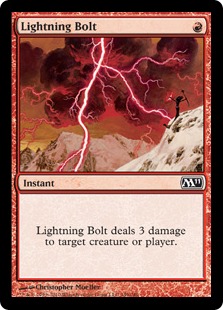
Lightning Bolt once set Modern's high-water mark: the most efficient and flexible removal spell at its price point, Bolt dictated which creatures did and didn't see play in Modern almost single-handedly. Today, Bolt's no longer the end-all-be-all of Modern kill spells. Instead, a diverse array of removal contributes to a colorful patchwork of playable creatures.
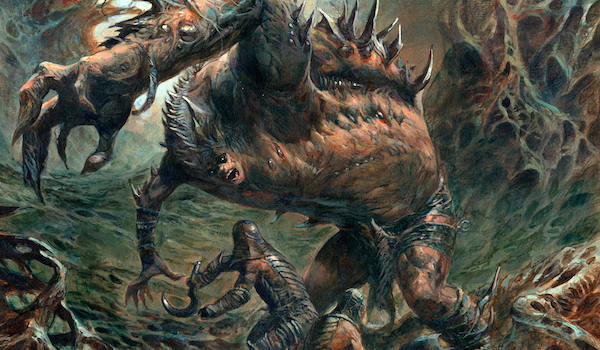
This article ponders Modern's switch from limited removal options to an embarrassment of riches, divides combat creatures into four categories based on their preferred stage of a game, and unearths a couple sleepers for this battle-based metagame.
The Water's Rising

Modern's Bolt-dominated chapter lasted for most of the format's lifespan. In those days, creatures needed to pass the "Bolt Test" to earn spots in Modern decks. Sheridan's version of the Test:

1. “Does the creature die to Lightning Bolt at parity? If not, what is the resource difference?”
2. “Does the creature have a game effect even if it immediately dies to Bolt? If so, how valuable and reliable is the effect?”
3. “Does the creature take over the game if it is not Bolted? If so, how quick, consistent, and decisive is that impact?”
4. “If yes to any of the above, the creature might be playable in Modern.”

End of an Era
Precious few creatures were in fact playable in Modern during Bolt's unchallenged reign. Bigger stats tend to cost more mana; as a result, players were incentivized not to run creatures with 2 or 3 toughness, as cheaper alternatives with just 1 toughness died to Lightning Bolt all the same. I even advocated for cards like Tarfire and Peppersmoke as Lightning Bolt analogues, since they fulfilled a similar function.

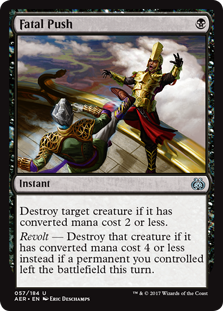
In "A Fatal Push Retrospect and the Future of Fair," I remarked that significantly more creatures became playable with Fatal Push in the picture. The bottom-light creatures surfacing in Modern mostly cut into shares previously occupied by spell-casting value creatures (newly replaced in part by cheaper utility options, e.g. Meddling Mage) and Tarmogoyf (newly replaced in part by other combat creatures, e.g. Young Pyromancer).

Removal Renaissance

Fatal Push turned Modern on its head—looking at a pre-Push most-played-creatures list reveals that virtually every creature would have died to the instant. With the exception of a few new archetypes (RG Ponza, which employs Inferno Titan) and some Push-wise adoptions from aggro-control decks (namely delve creatures), the kill spell still nabs most of Modern's creatures for one mana. In this sense, it's like a Path to Exile Jr., except Push can fill the role Lightning Bolt once did in many decks of removing creatures early before getting other engines online. Path has historically left much to be desired there, since it ramps opponents during those critical turns.

The result? Fewer Bolts, more Pushes. Therefore, more creatures that die to Bolt; if they're unsafe, they're unsafe, right? And if more creatures see play than ever, it follows that more removal spells are viable than ever. Push's domino effect has led not just to a diversification of playable creatures, but a diversification of playable removal.
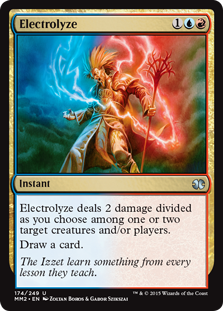
Current Modern players should expect to run into all sorts of removal. Toughness stats of 2 and 3 finally matter: Collective Brutality and Electrolyze don't kill Spell Queller, nor does Gut Shot nab Goblin Guide. But the former two play important roles in their respective decks, and the latter has become a necessity for color-light decks like Eldrazi Tron and Humans to keep up with small creature strategies.

That such diversity yields bizarre scenarios adds to Modern's density. For instance, while testing a Sultai brew the other day, my Hollow One opponent beat me with a singleton Tasigur as I stared dumbly at my own singleton Cast Down.

Removal options as diverse as their targets can feel disorienting in nonrotating formats, which are sometimes expected to lean heavily on their most obvious answers. But that's where we are in Modern. Heck, in my latest brew, I'm still on a Firespout/Anger of the Gods split in the sideboard and run five different removal spells in the main deck.

Call to Combat
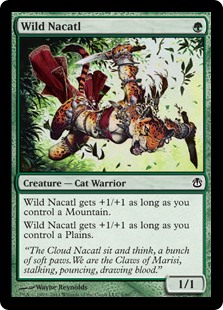
More playable creatures means more playable creature decks, and the rise of different attack-and-block strategies has partially shifted Modern's focus on stats away from kill spells and towards combat. After all, after damage-based removal, toughness matters most in the face of other creatures.

My last article called out Wild Nacatl as a big loser in the new Modern, but perhaps prematurely. Nacatl is still a hyper-efficient combat creature, or threat that attacks and blocks efficiently independent of other nonland permanents. It walls most unpumped bodies in Humans, for example, not to mention Modern standbys Snapcaster Mage and Goblin Guide. Based on how early they resolve, I'm calling Nacatl and Guide Stage 1 combat creatures. Combat is their specialty, so combat creatures at this stage have the upper hand in a fight over Stage 1 and even 2 utility creatures, as in those native to Humans.

Sorting popular combat creatures into stages illuminates the different roles creatures play in their homes, and can subsequently help with deckbuilding and tuning. This section outlines the attributes of each stage.

Stage 1 Combat Creatures
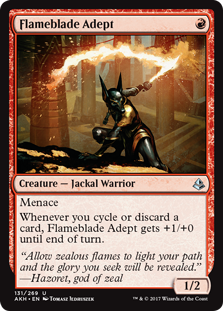
Stage 1 creatures always come down on turn one. Their role is to put opponents on the back foot, either slowing down their development as they deal with the threat or contributing to a blossoming board advantage that will end the game quickly. They tend to care little about removal because they all trade at mana parity or better with available options. Lightning Bolt, Fatal Push, Gut Shot, and Collective Brutality are commonly run to answer Stage 1 creatures; the first two kill every Stage 1 creature, while the last two narrow their sights to provide other benefits.

Not all aggro decks run Stage 1 combat creatures, but many with an aggressive bent include at least one. It's common to either run a single Stage 1 threat, to help with curving and punish an absence of lightweight removal (as does Hollow One), or to run many at once, overloading all removal (as does Zoo).

Examples: Wild Nacatl, Goblin Guide, Flameblade Adept, Delver of Secrets, Monastery Swiftspear, Champion of the Parish

Omitted from the above list are tribal synergy and aggro-combo creatures. Mausoleum Wanderer and Signal Pest exist primarily to front damage, but they don't succeed without a supporting cast; similarly, Glistener Elf flounders in the absence of pump spells. Bomat Courier also puts opponents on the back foot early, but doesn't excel at combat in the traditional, stat-based sense. None of these creatures particularly want to interact with opposing creatures, whereas combat creatures by my definition are happy to, and able to do so alone.

Stage 2 Combat Creatures
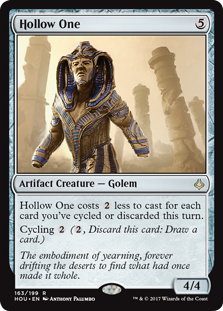
Stage 2 creatures appear on turns two-three, or on turn one with some luck. They aim to establish a clock after opponents have been lightly disrupted, to clean up the mess once opponents deal with a Stage 1 creature, or to contribute to a game-winning board state. They have built-in protection from Lightning Bolt: some have 4 or more toughness, others a recursion mechanic, and others still a way to lock in value before opponents receive priority. All but Death's Shadow and Tarmogoyf resist Fatal Push. To their credit, Shadow and Goyf make up for their weakness to Push by outgrowing every other combat creature in Modern.

In this metagame, Stage 2 threats make up the bulk of Modern's combat creatures.

Examples: Death's Shadow, Tarmogoyf, Young Pyromancer, Mantis Rider, Vengevine, Hollow One, Hooting Mandrills, Tasigur, the Golden Fang, Gurmag Angler

Absent from this list is Knight of the Reliquary, a Stage 2 creature that offers plenty of power/toughness for the mana cost. Despite its body, Knight is played mostly for its tutoring abilities, or as a combo piece alongside Retreat to Coralhelm; even when it emerges turn two off a mana dork, Knight generally doesn't enter the fray until later. Scavenging Ooze and Tireless Tracker are also played chiefly for utility reasons, and these creatures require a sizable mana investment before growing past their mana costs. I don't consider any of them combat creatures.

Stage 3 Combat Creatures

Stage 3 creatures are deployed on turns three-five. Their job is to heavily pressure or disrupt opponents while contributing significantly to the red zone. These creatures generally swing the tide of a game and form the top-end of many interactive aggro decks.
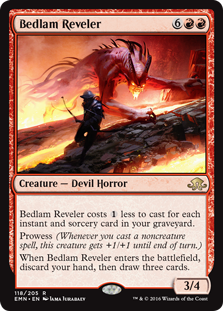
Examples: Thought-Knot Seer, Restoration Angel, Siege Rhino, Kalitas, Traitor of Ghet, Huntmaster of the Fells, Hazoret the Fervent, Reality Smasher,Thragtusk, Glorybringer, Bedlam Reveler

At this price point, playable Modern creatures have both combat and utility applications. Thought-Knot Seer is frequently cast for its Thoughtseize effect, but it's still played due to its strength on the battlefield; Tron, for instance, wields the card not just to disrupt combo, but to throw a wrench in opposing aggro plans and provide an alternate win condition in the face of nonbasic hate like Damping Sphere. By letting pilots operate on a traditional, stat-based combat axis, its inclusion there is similar to Tarmogoyf's in old Infect sideboards.

Stage 4 Combat Creatures
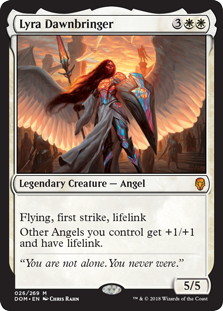
These creatures typically resolve on turns five or later, once the game state has been stabilized. They are relatively rare in Modern, as planeswalkers often occupy this closer role. But they still offer attractive alternatives in certain colors, and off-brand win conditions even for planeswalker-rich combinations like UW.

Examples: Lyra Dawnbringer, Baneslayer Angel, Endbringer, Wurmcoil Engine, Inferno Titan, Torrential Gearhulk

Stage 4 creatures are played less frequently in aggro decks than in control, combo, and ramp, which makes it awkward to even call them combat creatures; nonetheless, their on-field duties primarily involve attacking and blocking.

Phyrexian Treasures

The new Modern, no longer as restrained by the Bolt Test, is a breeding ground for creative deckbuilding. There's still lots to explore, both in terms of novel decks and defensive strategies for existing ones. I mentioned Gut Shot above; despite its narrowness, that's the only spell that trades at a parity gain with Stage 1 creatures. But I think some other Phyrexian spells boast even more promise in this metagame.

Dismember
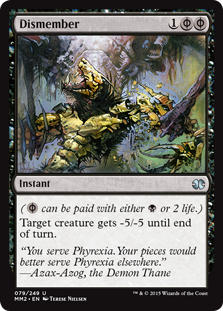
Dismember is the cheapest spell in Modern that removes any creature for one mana, no-questions-asked. Path to Exile gives opponents a land, making it awful in the early turns; other candidates cost two mana or more. The only threats Dismember doesn't touch are Etched Champion, which is impervious to all removal spells; a couple of Stage 4 combat creatures; and the aforementioned huge Shadows and Goyfs, which pay for that privilege by trading cleanly with Fatal Push.

The only issue with Dismember is where it fits: in a combat-focused metagame, 4 life can seem like a steep price to pay. But I've found the card to excel in any aggressive shell with a fine Burn matchup. Unequivocally sniping opposing creatures is exactly how to win the combat mirror. The card gets even better in builds with Faithless Looting, which can dump Dismember for something else should they draw it while low on life. Grixis Shadow seems to be packing a pair moving forward, and I'd be surprised if more spell-based combat decks didn't consider adopting Dismember in the near future.

Mutagenic Growth

Changing the math by 2 creates a major swing in a format featuring so many toughness-matters removal spells. By now, I've saved an unflipped Delver of Secrets from Collective Brutality and the like countless times. Growth also shines at countering Lightning Bolt, something it does for all Stage 1 combat creatures (barring fresh Champions of the Parish). But you haven't lived until you've saved a Stage 2 creature from Dismember!
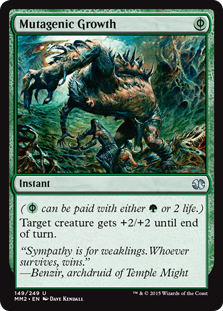
Mutagenic Growth is equally impressive in combat. For starters, Growth dismantles the stat hierarchy within a stage: Thought-Knot dies to Tasigur, which dies to Gurmag, which dies to most contemporary Tarmogoyfs, etc. But it also lets creatures transcend the stage levels: Wild Nacatl now eats Hollow One; Hooting Mandrills suddenly outsizes Reality Smasher. Best of all, since Growth costs zero mana, it can be cast at any time and by decks of any color combination.

On splashability, though, many Modern decks are too streamlined to want multiple Growths main. But we did see the card surface in Eldrazi sideboards during Eldrazi Winter, another combat-heavy format full of toughness-based removal. Death's Shadow Zoo appears to have legs right now, and is the most obvious home for the card. That said, I hope we see Mutagenic spring up as a one- or two-of in more popular aggro decks. I just know I've championed the card in Delver for ages and have been especially impressed with it lately.

Get Your Feet Wet

More creatures are playable in Modern than ever, and the same is true of removal. But I think players will continue to enjoy success with narrower answers if they remain aware of the points gained and ceded by their choices. In any case, choice is the name of the game. What's your Lightning Bolt?


Unlocked: A New Look at MTGStocks

Are you a Quiet Speculation member?

If not, now is a perfect time to join up! Our powerful tools, breaking-news analysis, and exclusive Discord channel will make sure you stay up to date and ahead of the curve.

Welcome back, readers!

Surely those of you who check MTGStocks.com to see the biggest daily movers are weary of some of the massive jumps we have been seeing, especially in the past year. It seems like every day some obscure card gets bought out and jumps in price dramatically. Then everyone sees the percent gained and thinks they have struck gold when they pull a few copies out of their binder.

However, just because the new selling prices are much higher doesn't mean the card's value has increased. It is extremely important in any sort of investment market to understand as much as you can about a given price movement. Sometimes it is obvious, like when a stock jumps because the company announced better-than-expected profits for the quarter, or when an oft-forgotten card blows someone out on camera to win an event and suddenly doubles in price.

These movements make sense because there is legitimate causation behind them. But what we often see on MTGStocks is one person (or small group) buying all or most copies of a card, and then relisting them at much higher prices. It appears to have jumped in price—but we all know price isn't everything.

"Price Is What You Pay, Value Is What You Get" - Warren Buffet

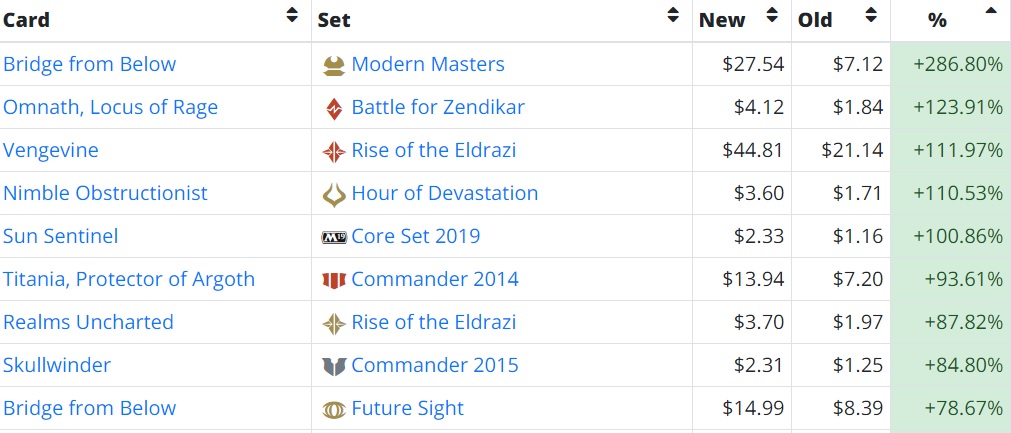
For example, here is the recent data for Bridge from Below. The TCGplayer Sales Price jump is shown below.

Notice the percent jump is very dramatic (above 250 percent). The TCGplayer Market Price jump is quite a bit lower, though still significant.

While the Modern Masters version has jumped by a similar amount, the Future Sight version showed far more modest gains.

They key here is that Market Price is only affected by completed sales, unlike TCG Mid which is affected by asking price. When you see a dramatic gap between the two it likely means a buyout has recently occurred, and the sellers are trying to capitalize by establishing a new price. In this case, using Market Price as the variable of interest paints a more accurate picture of card price movement. Sales Price can be manipulated by sellers, but market price is established by buyers.

Now, it is important to understand that market price is likely to move much slower than TCG Mid. There will be more people adding the card to their stores to capitalize on the new price than buyers looking to purchase it. Thus the rate of increase is expected to be lower. However, that's the real key characteristic we want to review: the "rate of price increase in the market value."

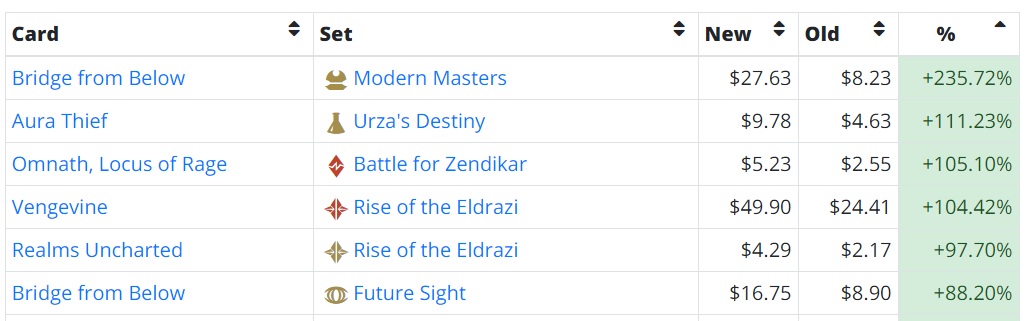
The images above were taken on August 8 (around 5:45 PM). If we look at the TCG Market price on August 10 (at around 5:45 PM again), we see the following.

So in the two days that had passed we see that the Modern Masters rate of growth is around $0.045 per day, whereas the Future Sight rate of growth is $0.88 per day.

This implies that the Modern Masters price has peaked and isn't likely to grow anymore, so now is a good time to sell them. The Future Sight versions are still noticeably lower in price, and showing a modest price rate increase, so it might be wise to hold onto them a bit longer.

One last data set taken on August 12.

We can see that the Future Sight version did in fact continue its upward trend, adding an additional 15.4% at a rate of $0.645 per day. The Future Sight version is still significantly lower than the Modern Masters version, so it is likely to continue to rise (I imagine it will eventually plateau within a few dollars of the Modern Masters version).

Moving Forward

We've seen how the TCG Mid Price doesn't really reflect the actual real market value of a card, and is easier to manipulate. So we need to instead focus on the TCG Market Price. We are far less likely to see a major price shift in the TCG Market Price, and we will use the Market Price movement to validate a card's real price movement (as again, it reflects actual sales, thus someone was willing to pay the new market price).

This protects us from moving in on any cards that are bought out for a "pump and dump" scheme, which sadly we seem to be seeing more and more this day in age.

We can also review the Market Price increase rate over a certain amount of time (I prefer using at least 2-3 days) to determine if the price will likely continue to move upwards, has plateaued, or started dropping. Then we can make an informed financial decision whether we want to pick up additional copies, list the ones we have, or stay away.

I've found that using a scientific and logical method to make one's financial decisions can help reduce or eliminate the emotional aspect of buying and selling. I've lost out on profit because I sold out too early for fear of a false spike, and I've bought cards at the peak of a spike expecting them to continue upwards. I'd rather my readers learn from these mistakes and remain in the green rather than fall into the red.

I would also be remiss if I didn't mention that MTGStocks has other additional tabs, specifically the Foil Market tab. Many of us tend to focus a lot on the TCG Mid (and now hopefully the TCG Market) tabs. However, foils are typically much rarer than regular versions of cards, so it's important to monitor foil movements as well (especially since they can be quite lucrative if you speculate smart).

It is also telling when the foil Market price doesn't even register after a regular price shoots up dramatically. Each of these cases is different, and in some cases the foil price can already have a significant multiplier on the regular version. However, it's not uncommon for foil copies to be ignored—especially during a manipulated buyout, as the buyer has to sink significant capital into the regular versions.

So when the foil multiplier isn't that high, and the foil copies aren't that much higher than the regular version, we are likely to see one of two things occur. Either the foil will rise as well (if there is truly demand for the card); or, the regular price will fall back down and the foil will remain steady (which is a decent indicator of a "pump and dump" attempt).

Avatar photo

David Schumann

David started playing Magic in the days of Fifth Edition, with a hiatus between Judgment to Shards. He's been playing Commander since 2009 and Legacy since 2010.

View More By David Schumann

Posted in FreeTagged 3 Comments on Unlocked: A New Look at MTGStocks

Have you joined the Quiet Speculation Discord?

If you haven't, you're leaving value on the table! Join our community of experts, enthusiasts, entertainers, and educators and enjoy exclusive podcasts, questions asked and answered, trades, sales, and everything else Discord has to offer.

Want to create content with Quiet Speculation?

All you need to succeed is a passion for Magic: The Gathering, and the ability to write coherently. Share your knowledge of MTG and how you leverage it to win games, get value from your cards – or even turn a profit.

No Context? No Problem! Investing in the New Standard

Are you a Quiet Speculation member?

If not, now is a perfect time to join up! Our powerful tools, breaking-news analysis, and exclusive Discord channel will make sure you stay up to date and ahead of the curve.

We are still a month or so out from the upcoming Standard rotation, but as is always the case with MTG finance, it pays to be ahead of the curve. At this point in time, we know that the tides will soon be turning and that multiple sets will be leaving Standard, creating a brand new format. Prices are bound to follow the advice of House of Pain and "Jump Around."

Today, I'll be discussing a few of the different ways that I evaluate cards going into a rotation as I try to stay one step ahead of the pack.

Dump Those Old Standard Cards ASAP

The first thing to keep in mind is that when cards rotate out of Standard, there is a very limited ceiling for their value. Is the card good enough for Modern or Eternal? Is the card a Commander or casual all-star? If the answer to both of these questions is no, chances are that the card is headed for a nose dive from which it likely won't return.

The problem is that most savvy players are looking to dump Standard mainstays that are not well-positioned to have a spot outside of Standard. It makes a lot of sense to be getting out of these cards for whatever value can be had over the next month or so, because chances are the getting won't get much better.

There was an error retrieving a chart for Noxious Gearhulk

Make some trades. Get some value. Look for opportunities to move these rotating Standard cards without a future whenever you can!

Predicting the Unpredictable

Trying to find hidden Standard value before the new set has been spoiled is very difficult. The problem is that we lack context.

Magic cards are always good or bad within the framework of their format. A card can be sweet or great, but if there isn't a deck to put around it, chances are that it won't see a ton of play and thus won't be valuable. Magic is littered with sweet cards that never found the right support deck.

There was an error retrieving a chart for Metallurgic Summonings

Without knowing what the cards to come will be, it's difficult to figure out which cards or decks will be the rage in the fall.

We do know a couple of things. The first is the sets that will remain: Ixalan, Rivals, Dominaria and Core Set 19. The second is an upcoming Ravnica set, which means a likely multicolored set.

We can use both of these pieces of information to make educated guesses about the cards that have a high potential for being major players in the fall.

Good Card Theory

One abstract concept that I frequently use when deciding which cards to invest in is simply "good card theory." The MTG metagame, economy, and demand are all fueled by cards in context, but we can also discuss how good a card is without that supporting context.

It's pretty easy to understand why a Tarmogoyf is more powerful than a Grizzly Bear: it has more potential upside and synergies with potential cards we might put around it. When you look at enough Magic cards, it becomes easier and easier to evaluate which cards have better stats or do things for better rates. Is the card good?

There was an error retrieving a chart for Tarmogoyf

I love looking for cards that I think are good but never quite had a home in Standard when it comes to a rotation. The first thing to consider: with several sets leaving the format, there is less competition and more opportunity for a card to find a new place in the meta. Secondly, new sets always present the opportunity for a new supporting cast of cards to create a context where the old card can thrive.

I look for cards that I think are actively great and have a legitimate shot of finding a place post rotation. Whether or not these picks will pan out comes down to two factors: how accurate is my assessment that the card is powerful and whether or not the metagame (context) aligns to make the card a real player in the format.

The Price is Right, Right Now

Another thing to consider is that leading up to a rotation is typically a great time to get good deals on Magic cards. People are done with Standard until rotation. Interest, and thus demand, is low.

Secondly, nobody knows which cards will actually be good post rotation, and so there's less incentive to hold onto cards. The prices tend to go down in the months before rotation and then pick back up in the fall when the new set and new format dazzle and excite players once again.

Cards Tha Could Be Good Post Rotation

I took a look through the cards that won't rotate from Standard and made a list of the ones that I plan to target in trades. These are all cards that I think have a relatively low price tag, but also have a power level that I would expect to be a competitive Constructed Standard card.

Let's take a look at some potentially good targets:

There was an error retrieving a chart for History of Benalia

History of Benalia is a great Magic card that I would expect to be a player post rotation. The card is so good that it almost doesn't matter whether it goes into a controlling or aggressive shell. It would also be a strong "tokens matter" deck card. The card is at its all-time lowest point, which makes it an ideal time to move in.

There was an error retrieving a chart for Benalish Marshal

Another card that could be good alongside History of Benalia. These are dirt cheap right now, but it is a good card and thus could be a player in a go-wide style deck.

There was an error retrieving a chart for Shalai, Voice of Plenty

Another powerful creature that has a shot at being a major player after rotation. Also, knowing that Ravnica tends to be guild and multicolor based, there is a chance that the Selesnya ability will be at a premium.

There was an error retrieving a chart for Sai, Master Thopterist

Sai is a great card and I've been writing about him in my finance column for months. He could be a major player in Standard if the artifacts align.

There was an error retrieving a chart for Mistcaller

There are multiple Token hate cards in Standard... I wonder if Tokens are going to be a major player post rotation. Maybe a Selesnya based token mechanic? These are basically a bulk rare but could be important down the line.

There was an error retrieving a chart for Carnage Tyrant

Carnage Tyrant is so powerful. I could see this card doing major damage once two large blocks rotate out of the format and leave a smaller format. It's good to be king. Not a cheap card, but a card that I think will still gain value down the line.

There was an error retrieving a chart for Vraska, Relic Seeker

Another powerful finisher and value card that will likely thrive on its power level alone. Could be made better by Golgari cards from Ravnica.

There was an error retrieving a chart for Deathgorge Scavenger

The card is great as far as three-drops go. Maybe Dinosaurs have a future with some of the big fish rotating. These are flexible enough that they are good beyond just a tribal shell. Lots of different decks would be happy to play this creature.

There was an error retrieving a chart for Search for Azcanta

I think this is a great card that will be great for a long time. It is becoming a bigger and bigger player outside of Standard. I've even seen it played in Vintage. I think this card, alongside Teferi, will be the tone-setters post rotation. It's already expensive, and I'd expect it to be even more so post rotation.

There was an error retrieving a chart for Sorcerous Spyglass

If Teferi and Search are the big dogs, I guess this card has the potential to be strong... I've played Spyglass in basically every format and it's for real. I like picking these up now before fall.

There was an error retrieving a chart for Rampaging Ferocidon

What are the chances this card needs to be banned after all of the Amonkhet and Kaladesh sets rotate? I'd love to see it unbanned and allowed to play alongside its other little dino friends. Could be a great heads-up investment.

There are lots of places to look for value in the coming months, but preparing for rotation is where it's at as far as Standard cards go. Remember to get out of those rotating cards while you can, but also be thinking about cards that could be strong if given a new context.

Speculating on the Modern Metagame Shift

Are you a Quiet Speculation member?

If not, now is a perfect time to join up! Our powerful tools, breaking-news analysis, and exclusive Discord channel will make sure you stay up to date and ahead of the curve.

Welcome back, guys.

The team Pro Tour 25th Anniversary has concluded. As usual, the Pro Tour is likely to affect the online metagame, and in turn prices. Here's the list of the most played Modern decks at the Pro Tour:

  • BR Vengevine
  • BR Hollow One
  • Humans
  • UW Control
  • Ironworks Combo
  • Tron

Players have started to discuss whether BR Vengevine might soon replace Hollow One as the better version of the archetype. The main difference between the two decks is that Vengevine is heavily graveyard-based, while Hollow One deck is based partially on discard and partially on the graveyard.

In other words, Leyline of the Void can shut down Vengevines and Bridges easily, but not Hollow One. Technically, BR Vengevine can win through a Leyline with Greater Gargadon, but the deck wouldn't be that explosive anymore.

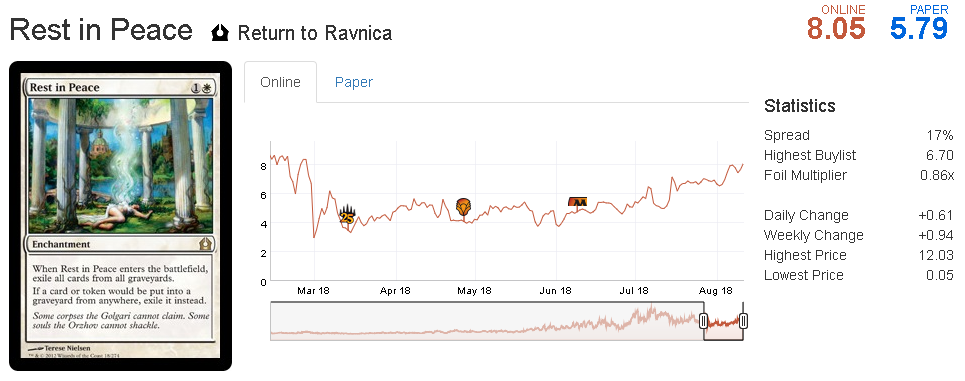
Anyhow, I don't think these are the best decks in Modern right now considering how many Leyline of the Voids and Rest in Peaces are appearing in sideboards. So, be prepared to sell off the components of these black-red decks, as well as the expensive sideboard card Leyline of the Void.

Rest in Peace, being the cheaper option, is a better card to play with from a finance point of view. Also, one of the current Tier 1 decks—UW Control—plays two to three copies of the card. If you want to play some Modern while still holding cards for speculation, I strongly recommend picking up UW Control.

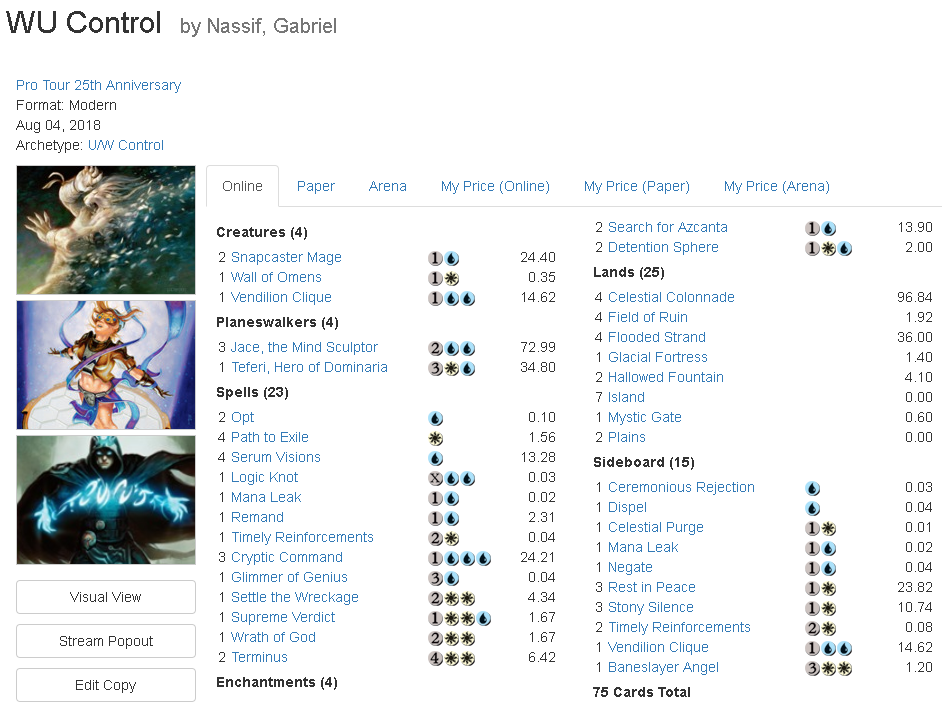
Let's have a look at how Hall-of-Famer Gabriel Nassif built his deck at the Pro Tour:

Terminus and Settle the Wreckage are really good against the BR decks, while four copies of Path to Exile are great for big threats that comes down early like Hollow One, Gurmag Angler, and Tarmogoyf.

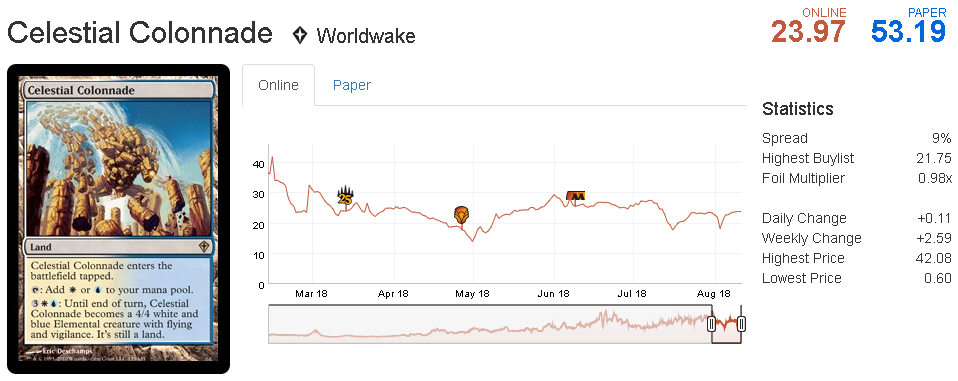
Once the deck stabilizes after turn four, that's the time to start pressuring with Vendilion Cliques and Celestial Colonnades. The blue-white creature land is the most expensive card among its cycle right now:

Colonnade might still increase in price considering its highest price in history was 42 tickets, but the most important thing about picking up UW Control is that it consistently wins games, and its cards rarely go down in value. Meanwhile, certain cards in the list have the potential to increase; let's have a look at those.

We talked about RIP earlier. This card is not just good against Vengevine and Bridge from Below. At the same time, Dredge and BG Midrange decks with Goyfs and Scavenging Oozes are weak to RIP. This card increased by 1.5 tickets since I talked about it last week, and I think it will continue to grow in value as players continue to shift away from black towards white.

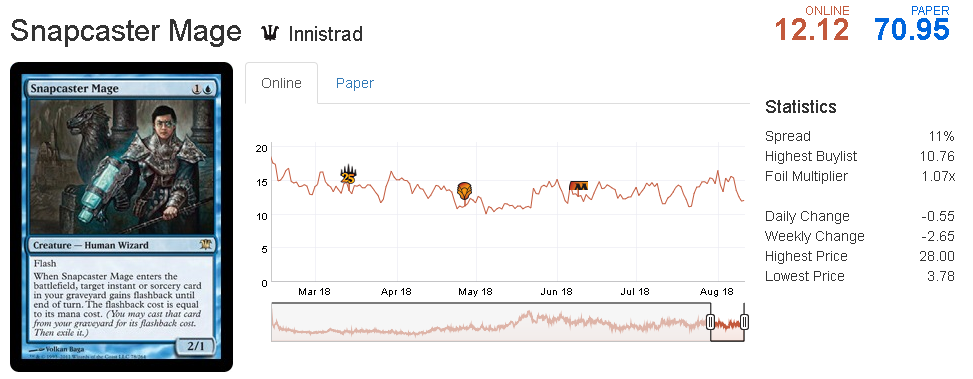
Snapcaster Mage is a card that I usually pick up when the price goes down to 12 or lower, as its price will slowly go back up again. Snapcaster is also getting more popular in Legacy since Deathrite Shaman was banned, and I believe more blue decks will be playing with Snapcaster, making its price higher in the near future.

The Archetypes That Gain

There's one thing in common among the Tier 1 decks I mentioned earlier, with the exception of UW Control: they have very little removal in the mainboard. These decks are basically racing each other, and whoever can come out with a better board presence usually wins the game.

Given this, my theory is that two decks in the format are in a great position right now: Infect and BG Midrange. Let's look at each.

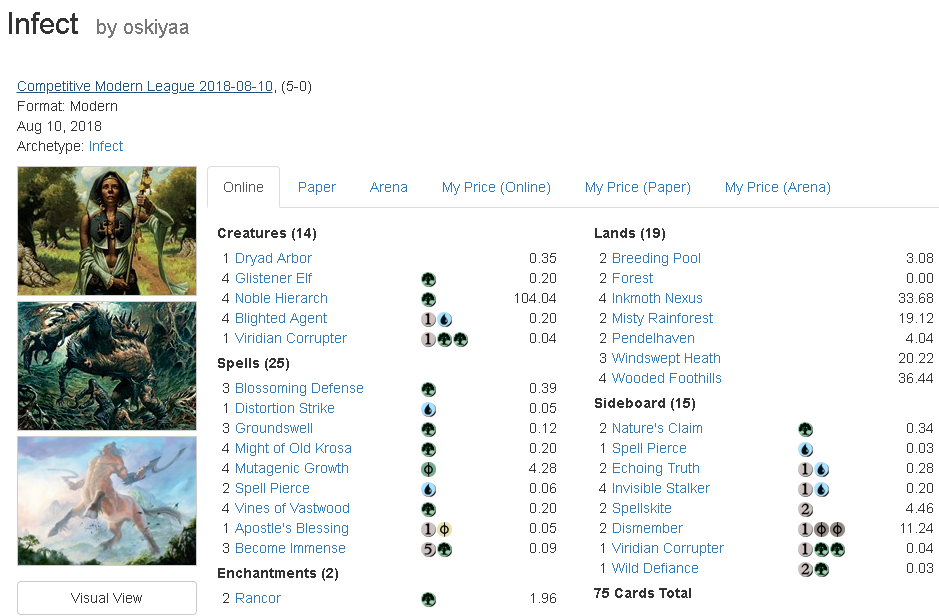
Infect was a Tier 1 deck when Gitaxian Probe was still legal, but now it's overshadowed by Humans and the BR decks. However, I found out that this deck is actually pretty good against the current metagame.

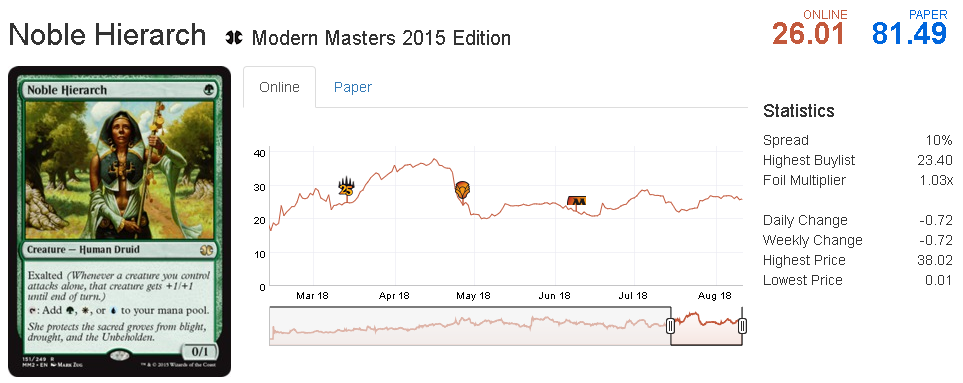
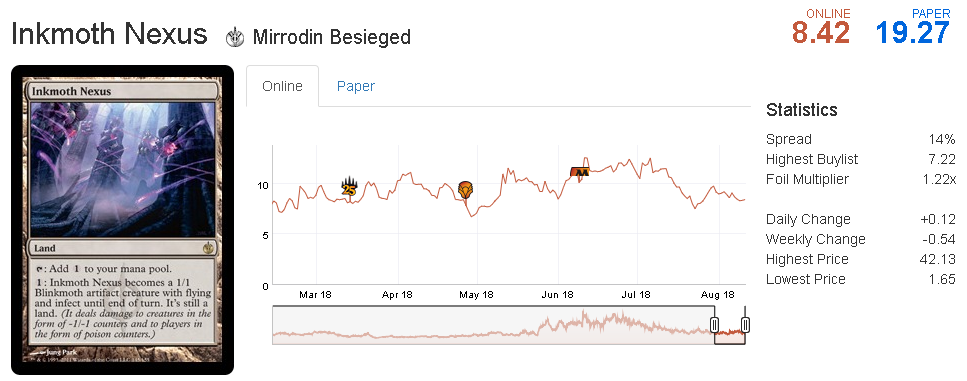
Inkmoth Nexus is one of the core components besides Noble Hierarch. Hierarch is already at its high price so if you want to play this deck, do keep an eye on any possible price drops and sell them as soon as possible unless you want to continue grinding for treasure chests with this deck.

As for Inkmoth, it's a creature land that is evasive and hard to deal with. It is played in all Affinity variants so at its current price, I think its worth picking up a few playsets as investment.

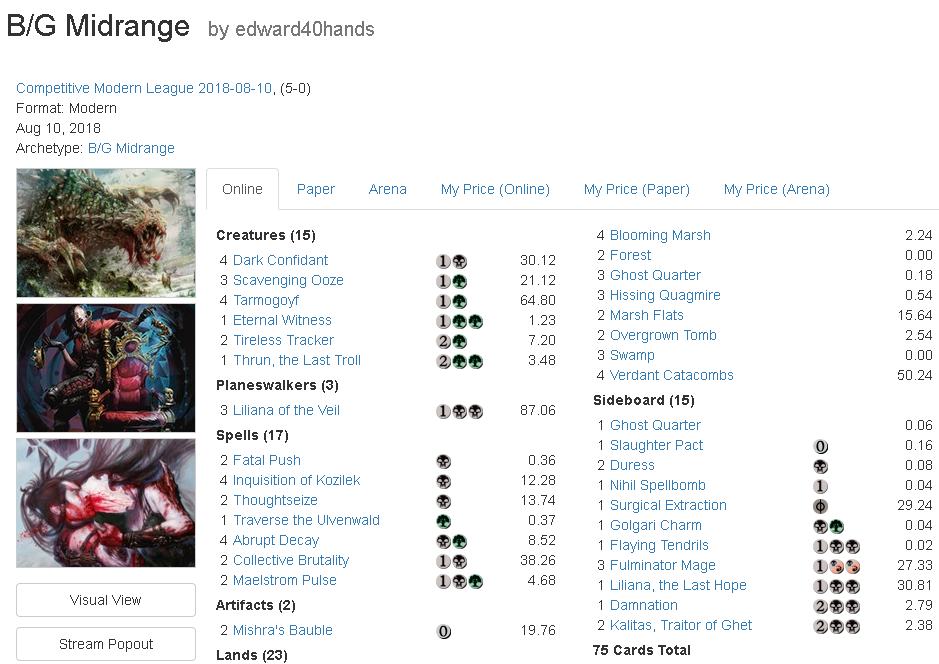
Besides Infect, there's another deck I've been following for quite some time: BG Midrange, often played by edward40hands on MTGO. This player has a very unique build of BG Midrange as shown below:

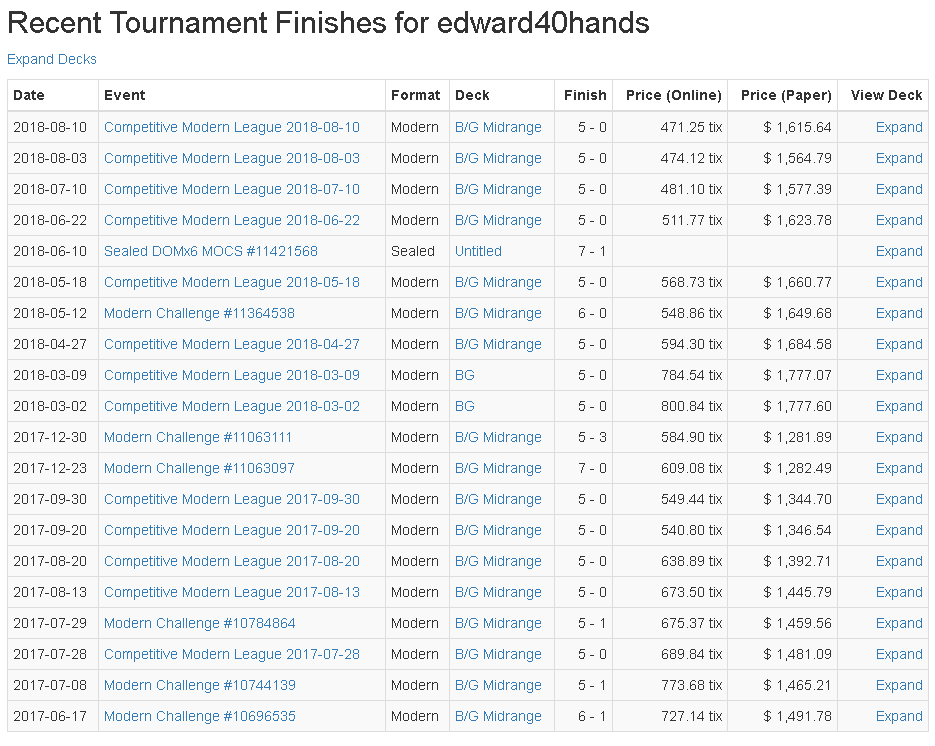
If you look at the leagues that edward40hands won, he has played the same archetype in all of them—so we can be sure this player is very good at tweaking black-green decks!

Considering that edward's BG deck took down two Competitive leagues in two weeks, I imagine it has a good matchup against BR post-sideboard, with cards like Kalitas, Flaying Tendrils, and Nihil Spellbomb. It's surprising that this deck is not playing any copies of the black Leyline when the field is full of graveyard-based decks. But edward40hands is a highly experienced player with this archetype, and he thought Scavenging Ooze and Kalitas, Traitor of Ghet combined with the correct removal was enough to beat most graveyard decks in Modern.

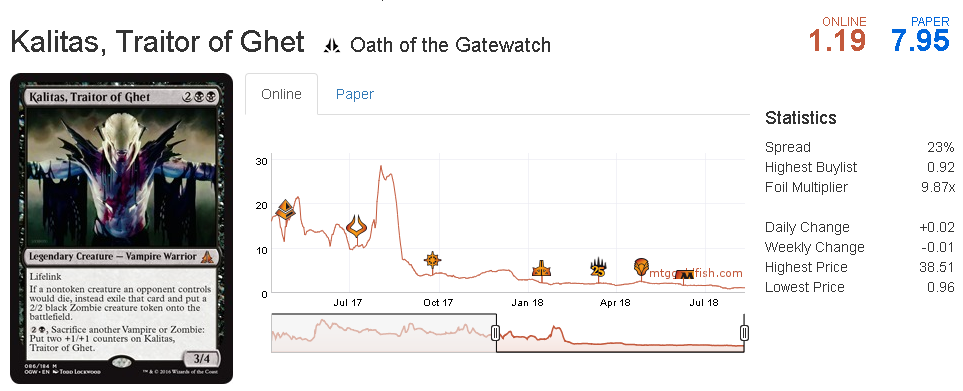
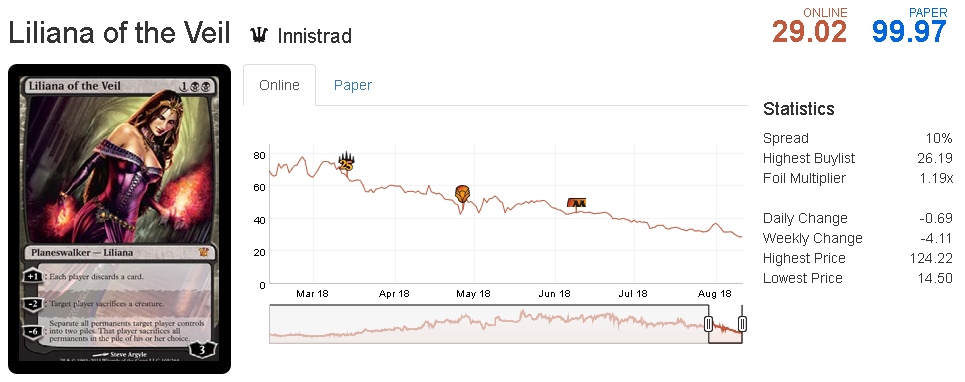
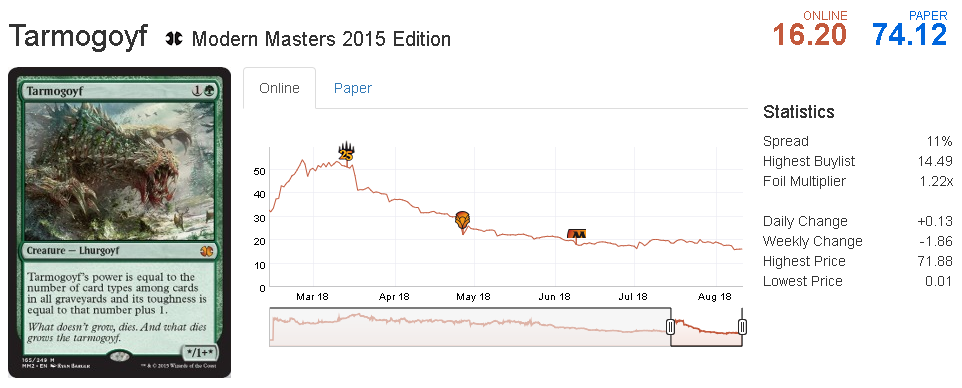
Kalitas, Traitor of Ghet was the best weapon in Jund when Melira combo was a thing, but its price went downhill after Oath of the Gatewatch rotated out of Standard. I don't think the price of Kalitas will go above 5 tickets but I would play this card in the mainboard for the current meta. Meanwhile, all the main staples in BG variants are at their respective low points (very low points) as shown:

Liliana at 30 tickets each and Goyfs at 16 tickets each? This is definitely the lowest possible price that these two cards can get. For your information, LotV was about 100 tickets before any reprints, and Goyf was a 30-40-ticket card. I'm going to give this deck a try; I strongly recommend you guys do the same, and pick up some Goyfs and Liliana if possible. BG decks might not be the best right now but its time in Modern will eventually come back.


Alright guys, that’s all for the week. Thanks for reading, and I’ll see you again next week.

Adrian, signing off.

Unlocked: Big Changes to the MTGO Market Report

Are you a Quiet Speculation member?

If not, now is a perfect time to join up! Our powerful tools, breaking-news analysis, and exclusive Discord channel will make sure you stay up to date and ahead of the curve.

Welcome to the MTGO Market Report as compiled by Matthew Lewis. This will be the final weekly report and it will cover the fundamental speculative strategies that anyone can use to build a MTGO portfolio and harvest tix from the digital Magic economy. Look for quarterly updates on these strategies beginning in October of 2018.

Redemption

Redemption is the process by which digital sets are translated into paper sets. This mechanism ties the value of digital cards within the MTGO economy to paper cards in the real world, giving tangible value to digital objects. Its existence has profound effects on the MTGO economy, and understanding its impacts is essential to understanding how and why fundamental speculative strategies work in the MTGO economy. Ergo, set prices for both digital and paper are collected each week for the purpose of identifying value and pricing trends, all through the lens of redemption.

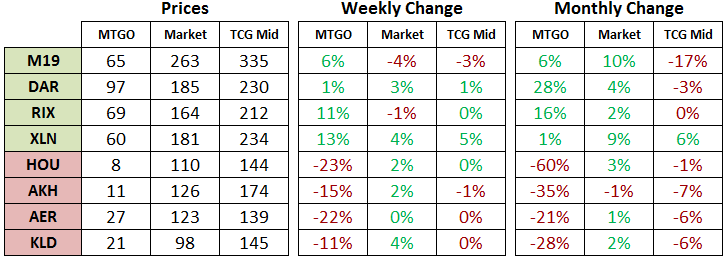
Below are the total set prices for all redeemable sets on MTGO. All prices are current as of August 13, 2018. The TCGplayer market and TCGplayer mid prices are the sum of each set's individual card prices on TCGplayer, either the market price or mid price respectively. Redeemable sets are highlighted in green and sets not available for redemption are highlighted in red.

All MTGO set prices this week are taken from GoatBot's website and all weekly changes are calculated relative to GoatBot's "full set" prices from the previous week. All monthly changes are also relative to the previous month's prices. Occasionally full set prices are not available, and so estimated set prices are used instead. Although Hour of Devastation (HOU), Amonkhet (AKH), Aether Revolt (AER), and Kaladesh (KLD) are no longer available for redemption, their prices will continue to be tracked while they are in Standard.

Foil Mythic Rares

If you've studied the MTGO economy long enough, you'll have noticed that foil mythic rares have strange prices relative to their nonfoil versions. You might have even realized that it's a good idea to buy foil mythic rares early in a set's release as they tend to go up in price over time. If you are curious about the genesis of the foil mythic rare strategy and some further theorizing, please read part one, part two and part three from September 2015. Although redemption on new sets has been shortened substantially since I wrote those articles, the experience I've gained in applying the foil mythic rare strategy has given me confidence that it still works. The foil mythic rare strategy is the peak of my analysis of the MTGO economy and is still a great strategy for players to lower their costs and for speculators to make consistent profits. Below is the algorithm for applying the strategy for any given newly released Standard set.

There was an error retrieving a chart for Karn, Scion of Urza

Opening the Position

Buy each foil mythic rare from a given set after it becomes available for Draft and Sealed Deck . The average per-card price will be in the 10- to 15-tix range. Recent average prices are 14.5 tix per foil mythic rare from Core Set 2019 (M19) and 13.3 tix from Dominaria (DAR). Do not avoid buying high-priced ones and do not buy extra of the cheap ones; it is difficult to predict which cards will rise in value, so making any guesses increases the riskiness of the strategy. The pool of value represented by each of the foil mythic rares together is what you want to bet on and not individual cards. Buy each and every one from the set as long as they are a part of the redeemable set – buy-a-box promos like Nexus of Fate are not part of redemption and should be ignored.

The next time to employ this strategy will be with the release of Guilds of Ravnica (GRN). The prerelease will be at the end of September, which will coincide with the start of sealed deck leagues on MTGO. Supply of foil mythic rares is a little thin on the first weekend so start looking for these once draft leagues open on Monday, October 1.

Closing the Position

For players, simply holding their copies of each foil mythic rare until the release of the next set is fine. In the week prior to the release of the next Standard set, exchange your foil versions for regular versions and save the remaining tix to buy the foil mythic rares from the next set. In this way, you will have each and every mythic rare to play with as soon as a set is released and you won't be bleeding value as drafters flood the market with their leftovers. Alternatively, be sure to sell your foil mythic rares at least two weeks before the end of redemption.

For speculators timing the sale of foil mythic rares requires a little more due diligence. A good guideline is when the summed buy price of the foil mythic rares is 75 to 80 percent of the foil set price. Recent examples include Rivals of Ixalan (RIX) peaking at 83 percent eight weeks after release and DAR also peaking at 83 percent, in its case six weeks after release. M19 has not yet peaked but is currently at 77 percent six weeks after release. Speculators must be sure to sell their position at least two weeks prior to the end of redemption. Redemption anchors this strategy and as the redemption window closes, there is a rush to the exits as the value in foil mythic rares dissipates.

The anticipated selling window for GRN foil mythic rares is between the middle of November and the start of December.

Expected Return

A recent example of this strategy being employed is DAR, where I bought five foil mythic rare sets for 997.6 tix at the end of April and I sold these sets for 1404.7, mostly in early June, for a net return of 407.1 tix, or about 41 percent. This is an exceptional return – Ixalan (XLN) and RIX netted lower returns in the fifteen to twenty-five percent range. At the time of writing, M19 is tracking to have similarly lower returns.

Caveats and Other Notes

If redemption ends, this strategy will no longer work and the value of foil mythic rares will be tied only to the value of the regular version.

If redemption is shortened again, both players and speculators will have to adjust accordingly. A redemption window as short as six weeks will make this strategy unsuitable for speculators, although players will still be able to preserve their tix by using this strategy.

If a given set contains Masterpieces, the foil mythic rare strategy will still work.

The strategy is becoming more widely known and understood, which means it's getting harder to buy large quantities of foil mythic rares. This is also reducing the profit potential for speculators. It's possible that the strategy becomes crowded enough to drive profits to zero or negative. For this reason, speculators should be cautious in deploying this strategy and should ensure that the average price of a foil mythic rare must not exceed 15 tix when purchased as a part of a set's mythic rares. Individual cards can be 30 tix or higher, but the average must not exceed 15 tix or the returns will be curtailed.

The next buying window for foil mythic rares will be at the end of September when Guilds of Ravnica (GRN) is released.

Full Set Strategy

For any new Standard set, prices decline over time as more cards enter the secondary market after they are opened in Draft. Demand from redeemers and Standard players will act to support prices, but the general trend for the price of a new set is lower. Eventually, prices become anchored around the equilibrium established by the fresh supply from drafters and the demand from redeemers and Standard players. This is when it's time to be a buyer: when prices are established and drafting of the set is coming to a close.

Once the following set is released, the price of cards from the set we are interested in have to be updated.  By this I mean that the market has to figure out what price will balance supply and demand in the new equilibrium now that there is much less supply entering the market due to the end of draft leagues. The process of finding this equilibrium doesn't happen overnight; it takes some time for it to unfold. What we can observe in the historical data is that a set's price tends to drift higher after it is no longer being heavily opened in Draft. The full set strategy seeks to take advantage of this process.

Redemption is also a key factor here. Sets are guaranteed for redemption for fifteen weeks, starting about a month after a set is released. With new sets being released quarterly, this means that set prices will be supported after the set is no longer being heavily drafted and the new set is released. For example, M19 will be guaranteed for redemption until November 21, nearly two months after the release of GRN.

There was an error retrieving a chart for The Scarab God

Opening the Position

Timing the bottom of full sets has been a little tricky historically in the two- or three-set blocks era, because the flow of supply of a given set in a block changes as the draft format changes.  But the new single set draft structure has greatly simplified the matter. The price bottom for a new Standard set will occur in the last week or two of drafting and that is when it's time to be a buyer.

Look for M19 to bottom in the last two weeks of September. At this early stage, I am looking for a price bottom of 50 tix.

Closing the Position

The key for this strategy to be successful is to avoid holding on too long. Full sets are now inserted as prizes in Treasure Chests after a set is no longer being drafted, so there is a risk that set prices fall over time. The trick is to identify if a set has stopped rising in price. The recent Pro Tour pushed the price of DAR sets up substantially as Teferi, Hero of Dominaria featured heavily in one of the top Standard decks. This was an easy sell signal, since it's often correct to sell into hype and you should be looking for reasons to sell your full sets. Looking for reasons to not sell is a long-term losing strategy. Look to sell full sets four to eight weeks after a set is no longer being drafted.

Expected Return

DAR again proved to be an exceptional set for speculation. Four sets bought for 73.0 tix each on July 9 were sold for 95.4 tix on August 7, netting 22.4 tix per set or about 31 percent. RIX and XLN were more of a mixed bag and there were issues with redemption availability, as they both went out of stock in the store prior to the redemption cutoff date. XLN sets were bought in March at an average price of 59.7 tix and were sold in April at 68.8 tix, netting 8.7 tix per set or about 15 percent. RIX fared a little worse, as sets were bought an average of 63.3 tix and sold for 67.8 tix, netting 4.2 tix per set or about 7 percent.

Caveats and Other Notes

As always, redemption matters. If a set is out of stock in the store prior to the end of drafting, this will hurt the potential returns of this strategy.

A return to multiple sets in a draft format will significantly complicate this strategy. Do not engage in the full set strategy as described here if this occurs.

Booster Strategy

The idea behind this strategy is that a supply of boosters has built up in the MTGO economy as a result of the steady number of Limited players entering the Draft and Sealed Deck leagues. When players complete their leagues, boosters are awarded as prizes. Exceptional players will build up a stock of boosters over time.

As a result of having a slightly discounted tix-only entry fee for these leagues, the market price of boosters is determined by this alternative. The tix-only entry fee for Draft is 12 tix and for Sealed Deck it is 24 tix. When entering with boosters, you must also pay 2 tix (4 tix for Sealed Deck) on top of having the appropriate number of boosters in your collection. Thus, the market price of boosters is 12 tix minus 2 tix divided by 3 or 3.3 tix. The calculations for both Booster Draft and Sealed Deck return the same result.

The opportunity to speculate on boosters arises when draft formats switch over to the next set and demand for the old boosters craters. When players are no longer interested in playing in the old format, they try to sell their boosters for tix rather than shelling out cash for the new set. This generates a rapid price drop in the old boosters as bots slash their prices in response to the flood of supply, which also coincides with a steep drop in demand. Eventually, this process comes to an end as players look at the meager prices the bots are offering and decide that they would rather hold the boosters for the future.

This is the point when buying up the boosters in order to hold for the future is a good speculative strategy. It works because the price of a booster will have often fallen so far that it is substantially discounted compared to the MTGO store price, but more importantly, it will mean that entering the draft queues with these discounted boosters is much cheaper when compared to the tix only entry fee. For instance, if you had bought a draft set of DAR as soon as M19 was released, you would have paid about 6 tix for it. Combined with the 2 tix entry fee, the total cost to enter the DAR draft queue would have been only 8 tix, a 4 tix discount to the tix only entry fee. That's a strong incentive and can be good value for players who enjoy DAR draft.

The strategy works because players are impatient and the bots compete on price. Since players are impatient, they dump their boosters at a discount compared to their long-term value. Bots just want to buy and sell at high volume, but since the market for boosters is so competitive, prices drop quickly. Patient players and speculators will take advantage of this situation by giving up tix today at full value for the discounted boosters. After a month or two, value-conscious players will have migrated to the cheaper draft format after tiring of the new format. Eventually, prices rise as these players chew through the available supply of these older boosters.

There was an error retrieving a chart for Hazoret the Fervent

Opening the Position

Once a new set is released and the previous set is relegated to the draft queues only, buy up draft sets of the older booster for 7 tix or less. Often the price of a draft set will dip below 6 tix. This can be a high volume speculative strategy (buying hundreds of booster is not difficult) so timing the precise bottom is not necessary. Be sure to wait for the leagues to finish and for the draft queues to start.

For M19, look to the first week of October for these boosters to hit their lowest price.

Closing the Position

The price target is 9 to 10 tix for a draft set but sometimes a draft set will exceed 10 tix and sometimes it will peak at 6 or 7 tix. Each set is different and has different demand due to varying popularity of the different draft formats as well as the value of the booster contents. DAR appears to be quite popular as a draft format and the prices for singles are quite high, so it might peak at over 10 tix for a draft set.

The other thing to keep in mind is that you want to close the position before the next set is released. Once the next set is released, the old set will get pushed out of the draft queues and will not be available for draft at all. At that point, the boosters lose their draft value and will only be valued by their contents, which is typically less than 1 tix. On top of that, Cube draft is a periodic event just prior to the release of a new set which takes interest away from Standard draft formats.

The expected selling window for M19 is the end of November and into early December. Ravnica Allegiance (RNA) will be released in January and December often features the Vintage Cube so you will want to have completely exited this strategy by the middle of December.

Expected Return

I am currently in the process of selling off my DAR draft sets, and the returns have been great so far. Between July 7 and July 11, I bought 128 draft sets for an average of 5.7 tix. As of this writing, I have sold 45 draft sets for an average of 8.6 tix each. The net return so far is 2.9 tix per draft set, or 50 percent. Having said that, XLN block was a slightly negative return on two hundred and fifty draft sets, meaning a lot of work buying and selling was done in order to ultimately lose tix in the end.

Caveats and Other Notes

A change back to two- or three-set blocks does not change this strategy. Boosters should always be purchased in draft sets as that is how they are consumed by players. Trying to pick out the relatively scarce boosters in a two or three set block is tricky and should be avoided lest the wrong booster be chosen.

Treasure Chests previously awarded boosters as part of the prizes and a reversion of this change would complicate the booster strategy and should be considered carefully.

Controlling your costs is critical to the success of this strategy. Moving into boosters too soon will substantially reduce your returns, particularly for unpopular draft sets. The key mistake I made with XLN block draft sets was to be a buyer when I thought they had reached a good price. If I had been more patient, a better entry point would have been visible and the strategy would have yielded some profits as opposed to a loss.

The relative popularity of the current and older draft formats matters. DAR draft was exceptionally popular which made XLN block draft a poor choice in the minds of most drafters. This severely curtailed the demand for XLN and RIX boosters relative to an average set.

Trade of the Week

For a complete look at my recent trades, please check out the portfolio. The portfolio will remain available for viewing and I will update transactions and returns related to the three strategies discussed today. Single card strategies will no longer be recorded in the portfolio.

Keep an eye out for the first quarterly MTGO Market Report coming in October 2018.

Daily Stock Watch – Damping Sphere

Are you a Quiet Speculation member?

If not, now is a perfect time to join up! Our powerful tools, breaking-news analysis, and exclusive Discord channel will make sure you stay up to date and ahead of the curve.

Hello, readers and welcome to another edition of the Daily Stock Watch! My pick for today might surprise you a bit but I really like the upside of the card for a long term basis. It's not something that has spiked recently and as a matter of fact, it has continued to slide downwards ever since it came to existence in the world of Magic. Should we be baffled why a card that's seeing an enormous amount of play is only priced this low?

There was an error retrieving a chart for Damping Sphere

People were so hyped by the strength of this card when Dominaria was accidentally leaked that pre-orders for the normal copy of this card hit a high of $14.95 back in March. It doesn't take a genius to see how this card hoses a powerhouse deck such as Eldrazi Tron (or any Tron variant) with relative ease while making it hard for other decks such as Storm to go off in just a single turn for as long as it's on the battlefield. Fast forward to a few months later, we're still seeing Tron dominating the metagame, thanks to a large chunk of players who continue to flock tournaments using it, and the consistency of Ancient Stirrings. This has pushed the price of Damping Sphere to a downward spiral that not so many expected but has relatively accepted.

Just how many decks use this in their sideboards in Modern? At least 10 tier one and two decks is a safe number to consider for that question. It's so good that even a deck like Humans, which could use Gaddock Teeg to give Tron a run for its money, has already started running it in their board to avoid getting waylaid by Tron. Just check out this version by Jackomatrus from the most recent MTGO Modern MOCS which won the whole thing.

Humans by Jackomatrus

Creatures

4 Champion of the Parish
4 Kitesail Freebooter
4 Mantis Rider
4 Meddling Mage
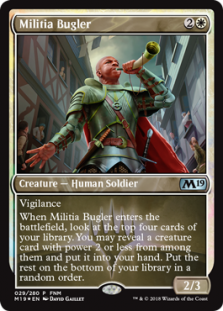
4 Militia Bugler
4 Noble Hierarch
4 Phantasmal Image
2 Reflector Mage
4 Thalia's Lieutenant
3 Thalia, Guardian of Thraben

Artifacts

4 Aether Vial

Lands

4 Ancient Ziggurat
4 Cavern of Souls
4 Horizon Canopy
1 Island
1 Plains
1 Seachrome Coast
4 Unclaimed Territory

Sideboard

2 Auriok Champion
1 Damping Sphere
1 Dismember
1 Gut Shot
1 Hostage Taker
2 Izzet Staticaster
1 Kambal, Consul of Allocation
1 Kataki, War's Wage
2 Reclamation Sage
1 Reflector Mage
2 Sin Collector

You'll rarely see a non-creature spell in the usual 75 of this archetype but Damping Sphere easily cracked the list nonetheless. Tron players would play something like Dismember to solve a Gaddock Teeg but wouldn't exactly side in a Nature's Claim against Humans, so this addition is a both smart and innovative. Only time will tell if other players will adopt this mentality and since a chunk of tournament players use Humans during competitive events, this could only mean good news for Damping Sphere hoarders.

Modern Hosers

There are tons of good sideboard card in the format to shut down the best decks but none of them comes close to the versatility of Damping Sphere. At a cost of two generic mana, you're giving yourself a chance to beat arguably one of the three best decks in all of Modern just by getting it into play while hoping that the opposition has no answer for it. I think that this card is one of the reasons why there hasn't been any major banning (fingers crossed) in the format for the past months, and it's also the reason why new archetypes continue to emerge with no fear of getting dominated by big mana decks (just look at Hardened Modular which has four copies of Damping Sphere in its sideboard.) At its current price tag of $1.39 (which has been sitting firmly for the past couple of weeks) and the upcoming arrival of Guilds of Ravnica, less packs of DOM should be opened but there should be plenty of this in the market that could be swept. I don't mind investing on this card a lot given how low I could get it for now. Experts know that it's just a matter of time before this card recovers its bearings financially and it's time to cash out.

At the moment, you should be able to acquire copies of Damping Sphere from every major online store out there such as StarCityGames, Card Kingdom, ChannelFireball, and TCGPlayer. Foil copies of it is an auto buy for me at $12 or less and has just as much of an upside as the normal copies. Keep a considerable amount of it with you as a spec target for now and don't be afraid to tank it. There's no way to go but up for this card when the right time comes.

And that’s it for today’s edition of the Daily Stock Watch! See you again next time, as we check out a new card that should be on the go, or good enough for speculating. As always, feel free to share your opinion in the comments section below. And if you want to keep up with all the market movement, be sure to check in with the QS Discord Channel for real time market information, and stay ahead of the hottest specs!

Money, Magic, and the Kitchen Table

Are you a Quiet Speculation member?

If not, now is a perfect time to join up! Our powerful tools, breaking-news analysis, and exclusive Discord channel will make sure you stay up to date and ahead of the curve.

Hey, QS Readers!

My name is Chris Martin. I've been a casual Magic player since the Urza's Saga block and I have played at a lot of kitchen tables across the Midwest. As I aged and my opportunities to play dwindled, I found myself dabbling with Magic finance to stay in touch with the game. My writing focuses on "The Casual 60" and EDH, but I do cross into other formats whenever appropriate.

In anticipation of #MTGC18 release weekend, I scoured Gatherer to identify some underrated picks which might find their way into the new Commander themes and be ripe for MTG finance gains. Commander has a history of being lucrative when targeting the right cards, and I am confident the specs I have to offer should continue with that trend.

Commanders from MTGC18

Lands Really Do Matter

I landed the Nature's Vengeance theme deck at the GenCon preview event. As a Gitrog player, I am extremely familiar with a "lands matter" strategy. I still had some cards lying around from building a The Gitrog Monster EDH deck a few years ago, and at least one card from the deck I believe to be a better fit with Lord Windgrace:

There was an error retrieving a chart for Overlaid Terrain

A lesser-known card from an older set that does something Lord Windgrace players should want to do: ramp fast. The ability of Overlaid Terrain is comparable to the likes of Mirari's Wake, but the fact you have to sacrifice lands is a drawback. Fortunately, Lord Windgrace's -3 can return them to the battlefield and get you back to netting the same mana almost immediately.

You can cast Overlaid Terrain for free as long as Lord Windgrace is on the board, and even get a landfall trigger out of it when relevant. Additionally, there are plenty of ways to recur lands from your graveyard in any “lands matter” strategy. Once you get stabilized, Overlaid Terrain ramps exponentially. It is a casual gem at its current price and has a new home with Lord Windgrace.

There was an error retrieving a chart for Overlaid Terrain

I recommend targeting foils if you're interested in the card, as that will help you lock in longer-term value. The supply is fairly low due to it being from an old set (Nemesis), so if it catches on even in the tiniest way the foil will likely jump into the $10+ range. I would not recommend the non-foil version for significant appreciation, but it is a great budget option if you are looking to upgrade your Windgrace deck!

Fate Shifting

I am ecstatic to build around Aminatou, the Fateshifter! This creepy new planeswalker has some exciting abilities that will let players own their fates by controlling the top of their decks and their assets on the battlefield.

There was an error retrieving a chart for Inner Sanctum

An old card from Weatherlight which has never had a home until now, Inner Sanctum should see some play in Aminatou, the Fateshifter strategies.

Inner Sanctum has a cumulative upkeep cost of 2 life a turn, which is a significant drawback, but its effect on the board is completely one-sided in your favor. With Aminatou, the Fateshifter, you can reset the cumulative upkeep every turn by bouncing it, and in the meantime, your creatures are all but indestructible. If a wrath comes down, just let Inner Sanctum go by sacrificing it... oh, the fate-shifting flavor!

It should be noted that this card is on the Reserved List. With Aminatou making this playable, look for near-mint copies of Inner Sanctum to move into the $8 to $10 range in the future.

Bantchantress!

There are just so many good enchantments to add to the "Bantchantress" Estrid, the Masked decks, so let's go with one that hasn't been mentioned much yet.

There was an error retrieving a chart for Myth Realized

Here is a spec I targeted years back when it hit bulk because of its casual appeal, power-level for 1 CMC, and ability to slot into so many strategies. I'm sitting on a small stack of foils ($1 entry point) and I think Estrid, the Masked might finally be the catalyst to move the needle. The text "non-creature" is relevant beyond just enchantments, but in a deck where enchantments matter, Myth Realized is a superstar.

It is a cantrip draw with Argothian Enchantress and has Vehicle-esque utility whenever called upon. It's the type of card that sits there in a four-player pod and is forgotten about until it is too big to miss. It also dodges all but instant-speed creature removal, so you can Supreme Verdict then activate your Monk Avatar and go on the offensive.

There was an error retrieving a chart for Myth Realized

I plan to target additional foils of this card – they are still very reasonably priced (under $2) and should see appreciation as casual and EDH players look to upgrade their "Bantchantress" builds.

Pick of the Week

If you follow me on Twitter, you already know I am a huge Saheeli, the Gifted fan. I think her and Brudiclad, Telchor Engineer are both going to be very popular new commanders from #MTGC18. Because of that, my pick of the week is Storm the Vault // Vault of Catlacan.

Storm the Vault Vault of Catlacan

Storm the Vault // Vault of Catlacan is a potential ramp tool on the front and a Tolarian Academy on the back. Note, Tolarian Academy is banned or restricted in every format it is eligible for, so you know the power level is real. With a blue-red artifact-based strategy, regardless of if you can deal combat damage to a player or not, pumping out five artifacts to flip into Vault of Catlacan isn't difficult.

I see Storm the Vault // Vault of Catlacan being a realistic target for both Brudiclad and Saheeli players, so I would encourage buying your copies, foil or non-foil, as quickly as possible. The demand should easily outpace the supply. Foil prices have already moved a few dollars since spoilers, but I could see them continuing to move into the $20 range over time. Storm the Vault // Vault of Catlacan already shows up in some Breya, Etherium Shaper lists, so you are talking about three possible EDH decks it has a home in, and maybe three different players who want one.

One last note: flip cards should be much harder to reprint in the near-term, especially given the most-recent FTV was FTV: Transform.


That's it for me this week! I am always posting spec targets and tips on my Twitter feed: @ChiStyleGaming. Please feel free to comment with feedback, your likes/dislikes, cards I may have missed, or questions. I am always up for talking about Magic!

Cheers,

Chris

Daily Stock Watch – Sai, Master Thopterist

Are you a Quiet Speculation member?

If not, now is a perfect time to join up! Our powerful tools, breaking-news analysis, and exclusive Discord channel will make sure you stay up to date and ahead of the curve.

Hello, everyone and welcome to a new edition of the Daily Stock Watch! It has been hard for us to find some value rares from Core 2019 as the vast majority of sales from that expansion have been brought in by the mythic rares from the set. From a financial standpoint, smart (like us!) and hardcore finance junkies know that at some point in time, a rare from the set will rise out of the ashes to become a prominent inclusion in a Standard, Modern, or Legacy winning list. Our card for today is one that has been making a name for itself in the competitive circuit of both Standard and Modern, and it's actually looking good for the years to come.

There was an error retrieving a chart for Sai, Master Thopterist

Sai, Master Thopterist first made waves in the Modern scene by showing up in the sideboard of some KCI decks then made more heads turn by showing up as sa four-of in a Blue-Red Aetherflux Reservoir deck that went undefeated during day one of Grand Prix Orlando 2018. The game plan was pretty simple for the deck and Sai was a perfect backup win condition in case things go bad for the Reservoir.

UR Reservoir by Luke Feeney

Creatures

2 Jhoira, Weatherlight Captain
2 Glint-Nest Crane
4 Ornithopter
4 Sai, Master Thopterist

Instants and Sorceries

2 Commit // Memory
4 Paradoxical Outcome
2 Baral's Expertise

Artifacts

2 Metalspinner's Puzzleknot
2 Navigator's Compass
2 Aetherflux Reservoir
3 Mox Amber
4 Inspiring Statuary
4 Prophetic Prism
4 Renegade Map

Lands

1 Mountain
2 Sulfur Falls
4 Zhalfirin Void
12 Island

Sideboard

1 Sorcerous Spyglass
1 River's Rebuke
4 Negate
2 Magma Spray
3 Karn, Scion of Urza
1 Jace's Defeat
1 Baral's Expertise
2 Glint-Nest Crane

After getting a lot of exposure of the past couple of weeks, Sai has rebounded nicely from the sub-$2 range by going back to an average price of $3.31 as of writing to alleviate the pain of cracking M19 boxes. It would have easily been a good pick up when it went down to a little under two bucks, but I don't think that it's a bad pick up at $3 if ever you plan on getting them now. Sai is a formidable role player that will get its job done at any point of the game even though it looks a bit weak when you assess the card for its mana cost. This is why I think that this card is underrated despite of the multiple things that it could do, oftentimes at no cost at all when you have enablers such as Ornitopther, and should be valued more in the long run especially if the decks that are running it will prove to be consistently successful.

The Friends of Sai

It looks like these guys will be with Sai going forward as deck innovators try to come up with lists that could abuse its ability going forward. I'm not really a fan of slow and grindy, storytelling decks like KCI and Reservoir but cards like this one bring a different dimension to those archetypes just by being a part of the list's 75. By surprising your opponent off the board with it (in Modern) and forcing them to leave removals  (in Standard) against a spell-heavy deck, you're actually putting yourself in a good position to win games from different angles without having to deviate from original game plan. Sai should be a decent card going forward and is something that I'm considering as a spec target now while it's still cheap. It's a pretty safe bet that you could hold on to for a while and in multiples if you have leg room for doing so.

At the moment, StarCityGames and ChannelFireball are out of stock of Sai but there should be plenty of vendors via TCGPlayer that's still selling it for anywhere between $1.50 up to $4.98 for normal copies. Card Kingdom still has two sets at $3.99 a piece and is expected to run out of it soon. I would suggest that you scour the remaining normal copies from TCGPlayer as I expect less M19 boxes to be cracked as people gear up for the next set. Foil copies of this card will be great pickups at $7 or less and should command a good value in the long run. This should be a pretty safe bet with lots of upside and little risk in my opinion.

And that’s it for today’s edition of the Daily Stock Watch! See you again next time, as we check out a new card that should be on the go, or good enough for speculating. As always, feel free to share your opinion in the comments section below. And if you want to keep up with all the market movement, be sure to check in with the QS Discord Channel for real time market information, and stay ahead of the hottest specs!

Spirits vs. The New Hotness: Testing Perspective

Are you a Quiet Speculation member?

If not, now is a perfect time to join up! Our powerful tools, breaking-news analysis, and exclusive Discord channel will make sure you stay up to date and ahead of the curve.

Another missed PPTQ means more time to test. In addition to refining my own decks, I've been looking into Modern's hot discussion topics. We've seen time and again that Modern's cardpool hides monstrous decks just missing a piece or two to become major players. Several such decks have recently emerged that appear to have found those pieces. But based on testing I've done against them with UW Spirits, I'm not so impressed by UR Wizards or Bridgevine. Infect's return is another matter.

Updating Spirits

After more work, I'm finally happy with my flex slots choices in UW Spirits. The most glaring problems with Spirits are that if it runs out of gas, it struggles to recover, and it really needs some way to find Spell Queller in combo matchups. I tried Bygone Bishop and found it too clunky. Fortunately, Humans players were having the same problem, and solved it for me.

UW Spirits, David Ernenwein (PPTQ Deck)

Creatures

4 Mausoleum Wanderer
4 Rattlechains
4 Selfless Spirit
4 Supreme Phantom
2 Remorseful Cleric
2 Phantasmal Image
4 Spell Queller
4 Drogskol Captain
2 Militia Bugler
1 Reflector Mage

Artifacts

4 Aether Vial

Instants

4 Path to Exile

Lands

4 Flooded Strand
4 Seachrome Coast
3 Cavern of Souls
3 Hallowed Fountain
3 Ghost Quarter
2 Plains
1 Island
1 Moorland Haunt

Sideboard

3 Stony Silence
3 Negate
2 Rest in Peace
2 Eidolon of Rhetoric
2 Settle the Wreckage
1 Leonin Relic-Warder
1 Worship
1 Blessed Alliance

I was initially wary of Bugler because it couldn't find everything in Humans, and outside that deck, it had even fewer targets. Neither of these are problems for Spirits. The fact that it's a hit off Bugler is also why I'm running Leonin Relic-Warder over Disenchant in the sideboard. Bugler has been phenomenal, and I'd argue it's better in Spirits than Humans. Mantis Rider is usually the best Human, but isn't a hit; Spell Queller is usually the best Spirit and is a hit. I'm only running two to still have room for Reflector Mage, itself a Bugler hit.
I've also cut a Ghost Quarter for Remorseful Cleric. Part of the reason is the aforementioned gas problem, but the other is that graveyard decks are gaining ground. Cleric is mediocre-at-best-hate, but it's maindeckable hate, and against combo decks, Cleric is as good or better than Spell Queller. Quarter was the cut because I was flooding a lot, and Quarter is the most situational land.

The Bant Alternative

Of course, UW is not the only nor necessarily the most popular version of Spirits. The perception is that Bant is, which I had trouble verifying. I don't see Bant in paper or MTGO published results with greater frequency than UW Spirits, but it was also more popular at the Pro Tour. This may not mean anything, as Collected Company is a very powerful card that players naturally gravitate towards. It does mean that I'm constantly asked why I'm not on Bant, while Bant pilots are simply accepted.

Bant Spirits, Djac (Modern Challenge 10th Place)

Creatures

4 Mausoleum Wanderer
4 Noble Hierarch
1 Birds of Paradise
4 Rattlechains
4 Supreme Phantom
3 Selfless Spirit
1 Phantasmal Image
4 Drogskol Captain
4 Spell Queller
1 Geist of Saint Traft

Instants

4 Path to Exile
4 Collected Company

Lands

3 Botanical Sanctum
3 Misty Rainforest
3 Flooded Strand
3 Windswept Heath
2 Hallowed Fountain
1 Breeding Pool
1 Cavern of Souls
1 Forest
1 Horizon Canopy
1 Island
1 Moorland Haunt
1 Plains
1 Temple Garden

Sideboard

3 Leyline of Sanctity
2 Damping Sphere
2 Stony Silence
2 Unified Will
2 Rest in Peace
2 Thalia, Guardian of Thraben
1 Worship
1 Dromoka's Command

I feel UW is better positioned in this metagame. UW is better against control decks because Aether Vial lets the deck play exclusively at instant speed, and Vial coupled with Cavern of Souls negates countermagic. This makes is far easier to blank an opponent's disruption. Bant is better against midrange decks because of the card advantage and tempo boost from Collected Company, and it has fewer dead cards: Noble Hierarch isn't better in a vacuum than Aether Vial, but it's never dead in the mid- to late-game and incidentally outs Ensnaring Bridge.

The choice is also personal: each deck has strengths and weaknesses, and I'm more comfortable with UW's weaknesses than Bant's. Chiefly, UW is easier to grind out than Bant. Militia Bugler mitigates the problem but doesn't solve it. Company is fantastic here because in a 30 creature deck it's improbable not to hit, and anything but Birds of Paradise does something. By contrast, UW has to maximize the value it gets from Rattlechains and Selfless Spirit, which is a game I enjoy playing.
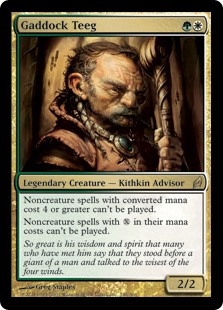
Additionally, Bant's manabase can be quite painful, especially in dorkless games. Every version I've seen maximizes its fetches and shocklands, opening Bant up to Burn and Blood Moon. UW's two-color manabase is rock solid, and Vial is less vulnerable than Hierarch, so UW can more easily get through mana disruption. Vial also facilitates multi-spell turns better than Hierarch. Mana dorks accelerate mana, but they still only make one, no matter the turn. Vial can produce up to three per cycle, meaning double Spell Queller turns.
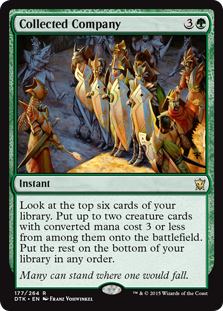
The other big distinction is in sideboarding. Both Bant and UW have access to the white hate cards, but green gives Bant some key extra options. Natural State is normally better than Disenchant; Qasali Pridemage is arguably better than Leonin Relic-Warder, etc. Bant also has access to Gaddock Teeg, arguably the best anti-combo and anti-UW Control card around. Specifically, he stops Supreme Verdict, planeswalkers, Engineered Explosives, and Krark-Clan Ironworks. This is balanced by Company getting worse the more non-creatures are in a deck, somewhat restricting Bant's sideboarding options.

The Company Conundrum

There are also issues with running Collected Company. It's a four mana card that has a random but significant effect. Sometimes you spin the wheel and hit the jackpot. Other times you whiff. This isn't a deal breaker, but it can make it awkward when Bant uses Company in response to a spell, looking for Spell Queller, and ends up getting blown out by the whiff.
The real problem is the mana cost. Company is very castable with 22 lands and five mana dorks. However, there are plenty of games without a dork where Company just rots in hand. None of these issues are problems in the attrition matchups (barring an active Liliana of the Veil), since there's time to draw out of land problems, and any creature is better than none. However, when mana utilization is important, Company suffers. This is also why Company has historically been better in combo decks than as a value plan. On balance, UW is the best deck for me, but I don't think anyone is wrong for playing Bant instead.

Testing Perspective

Modern is a dynamic format where decks constantly jockey for a place in the metagame. Sometimes they have staying power like Grixis Death's Shadow. Sometimes they have their success then gradually fade away like Lantern Control. Some are flashes in the pan like Grishoalbrand. Recent tournaments have showcased a few new decks, so naturally I've been testing against them. Based primarily on my experiences against them with Spirits, I'm skeptical of their staying power.

UR Wizards

UR Wizards had a very good result, but almost any deck can do that in Modern. This is especially true when the rogue factor is strong, as it was for Jeff Hoogland. Every time I've seen it in action, either watching or playing against it, I've been underwhelmed. It can do some powerful things and is devastating against the right decks, but against Spirits, it is severely underpowered. There may be a real deck inside Wizards, but it's missing something.

On paper, Wizards should be great against creature decks because it runs ten Lightning Bolts. However, that's all it has. The only means Wizards has of gaining card advantage is Snapcaster Mage. Baiting a few Bolts then answering one with Rattlechains, or just Quelling Snapcaster, usually puts Spirits uncatchably ahead on cards and tempo. Wizards is all-in on Bolt being good and on keeping tempo in its favor. Contest either successfully and the deck fails. Hexproof is huge game against Wizards for that reason, as is toughness boosting.
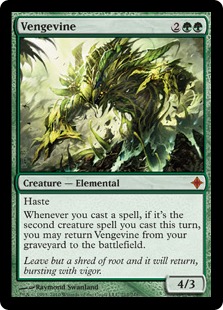
The real power of the deck is Nimble Obstructionist. Stifle is a powerful effect, and Obstructionist is uncounterable, which is devastating against combo and control. The problem against creature decks is that it costs three mana, and those matchups frequently involve tapping out every turn. Also, now that the word is out, it's not that hard or burdensome to play around Obstructionist—opponents can simply activate abilities after Wizards has tapped its lands.

Spirits is a better creature deck than Wizards. We can trade creatures at better rates than Wizards, have more of them, and can make them better. The only trump creature Wizards has is Grim Lavamancer, a two-of. When Delver flips turn two it can be threatening, but Spirits has so many ways to push back on the tempo that it isn't always enough.

BR Vengevine

After receiving roughly all the hype at the Pro Tour, BR Vengevine is Modern's latest new hotness. Yes, I have heard that something similar has been floating around MTGO for some time, but until Stitcher's Supplier arrived, it didn't see mainstream success. As Jordan noted, it's certainly looks like it has staying power in Modern. Naturally, comment sections are arguing it's too strong and needs to be banned.

To me, playing against BR Vengevine feels exactly like facing BR Reanimator in Legacy. You might be dead on turn one, but with every turn you're not dead, the likelier you are to win easily. Both decks are geared towards blistering starts, dumping critical pieces in to the graveyard with Faithless Looting, and then creating a huge board. Both get wrecked if the right interaction is played against them. Also, both can fail without outside interference. They're very much right-card combo decks; here, those cards must not only be found, but also put into the right zone. Otherwise, the decks do nothing. They're made to act like drag racers, but there's an equal chance they'll just do a burnout, spending all their resources to go nowhere.
I haven't seen enough consistency from BR Vengevine to worry about the deck yet. Their best starts are soul-crushing, but I've been beating their reasonable starts with Spirits fairly consistently. While they're dumping cards into the graveyard searching for Bridge from Below and/or Vengevine, I'm just playing Spirits and flying over their 1/1's for huge chunks of damage. Adding the extra Remorseful Cleric has been a huge boost as well. Vengevine has no interaction beyond Walking Ballista, so running out Cleric turn two and just daring them to give you reason to pop it is incredibly powerful. I'm not dismissing Vengevine as a deck, but I haven't seen evidence that it lives up to the hype.

Infect

Despite supposedly dying after Gitaxian Probe was banned, Infect is creeping back into the metagame. The deck hasn't noticeably changed in the last year, but the metagame has changed dramatically. Last year, interactive decks, particularly Death's Shadow and Jeskai, were everywhere. However, players are moving away from spot-removal-heavy decks towards top-heavy control decks and linear creature decks. This is perfect for Infect.

Losing Probe hurt a lot, but Fatal Push was even worse for Infect. Like Bogles, the deck relies on a small number of creatures; unlike Bogles, they don't protect themselves. This isn't a problem when everyone is goldfishing, since turn two Blighted Agent, turn three triple pump spell is lethal. However, that isn't possible against waves of removal. Now that it's less of a concern, Infect has resurfaced. This is bad for Spirits, as it's a creature deck without much creature removal. Spell Queller is not relevant interaction when the deck gets under Spirits so effectively. This is a huge reason why I still have Reflector Mage.


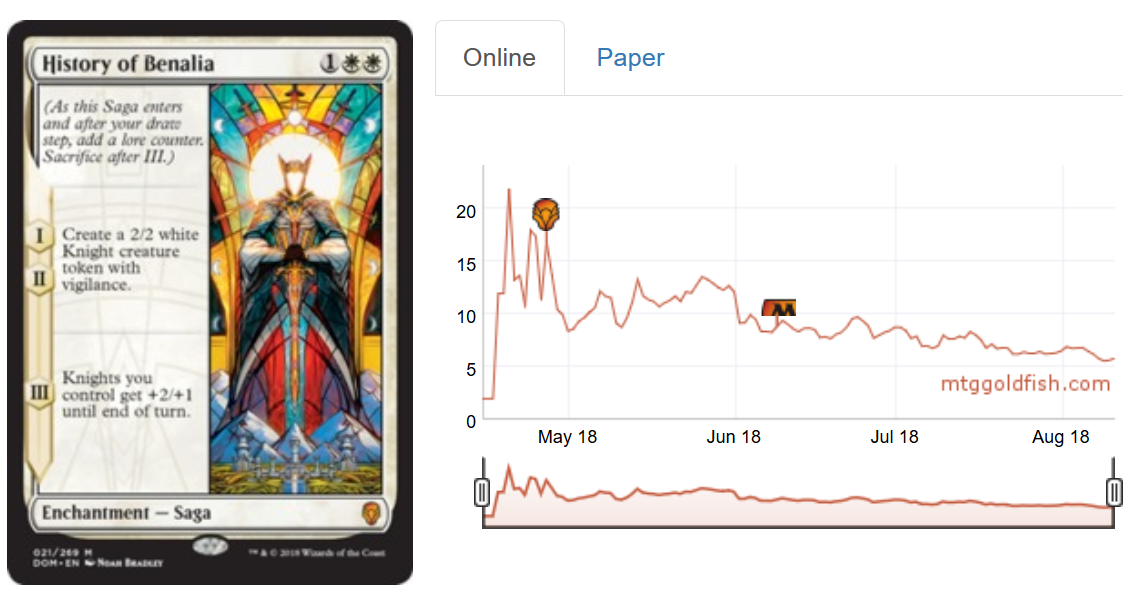
Infect has existed for some time now, and can be beaten with enough interaction. However, Spirits doesn't really have the right interaction in the quantity necessary to consistently win. Therefore, if Infect really takes hold, I'll be moving back to Jeskai Tempo, and I suspect the metagame may have the same reaction, driving Infect away again until players forget about the threat.

A Shifting Scene

The metagame remains dynamic and I'm glad to see that new decks continue to emerge. It will be interesting to see if continued refinement turns them into real threats, or if the new hotness is just that and nothing more. In the meantime, I'll be flying the spooky skies.

Rotation is Coming! Rotation is Coming!

Are you a Quiet Speculation member?

If not, now is a perfect time to join up! Our powerful tools, breaking-news analysis, and exclusive Discord channel will make sure you stay up to date and ahead of the curve.

It's that time of year again! In just a little over a month, Amonkhet and Kaladesh blocks will rotate, drastically altering the financial landscape of Standard. We all know what's going to happen to the value of the rotating cards, but what will happen to the cards that will remain in Standard? I'm here to walk you through it.

And remember...October through November is the major Standard season in Magic. This is when Standard card prices are at their peak, and so August is perhaps the best month to expand your portfolio and buy the specific cards you think you'll want to play with over the next year.

Red is Dead

...We hardly knew ye

The exodus of these cards from Standard will have far-reaching effects on the Standard metagame, giving other archetypes new life and the opportunity for new cards to shine. Almost every speculation decision we make over the next month should take this into account.

I. Making One-Toughness Creatures Playable Again

It will be highly unlikely that a mono-red deck will sit in Standard's top tier. Goblin Chainwhirler and Rekindling Phoenix can't do it alone, and thus Chainwhirler's triple red cost will likely keep it relegated to sideboard status for at least six months while the fleet of overpowered and resilient red threats is rebuilt. This gives an opening to a whole host of cards that, while unplayable today, will immediately become playable after rotation.

I've beaten this drum before, and I will beat it again. Mono White looks really good. It has busted mythic rares like History of Benalia, eight playable 2/1 creatures for one, and efficient creatures all throughout the curve. Without its nemesis seeing maindeck play in Standard's premier deck, expect to see a lot more white-weenie creatures backed up by powerful anthem effects.

I believe these four rares and mythics will see significant gains in the coming months. Two of them already have seen growth in the past month, but History of Benalia ($5.90) and Benalish Marshal ($0.17) are still at relative lows. If Legion's Landing ($1.70) or Radiant Destiny ($1.00) see a dip in the coming weeks, consider snagging your playset at that time.

History of Benalia in particular seems like a really safe pickup. I rated it #4 in my Dominaria Mythic Power Rankings with a B+ rating, and its current price of $5.90 is lower than I had anticipated it would go.

II. Other One-Toughness Creatures to Consider

We can definitely look beyond white for good speculations in this category. Two in particular, Deadeye Tracker and Dire Fleet Daredevil, had already seen some play before Chainwhirler was printed. Deadeye Tracker ($0.09) is at its lowest price ever, and I think it would make for an excellent speculation. Dire Fleet Daredevil ($0.52) is also at an all-time low. This one is less likely to pay off in my estimation, but I do believe it could get back to $2.00 if the metagame is slow enough and midrange battles dominate the format. I've invested in both cards.

III. Control Gets Better

A lot of pros have talked about how, given the diversity and resiliency of the threats presented by Mono Green Stompy and Red Aggro, traditional Control decks just can't compete in the current metagame. That will likely change with rotation, since UW Control is keeping the vast majority of its best cards and the overall threat quality will be lower than it's been for a long time.

There are fewer actionable speculations I can recommend for UW Control. Teferi, Hero of Dominaria ($35) has already ballooned, and Search for Azcanta ($7.00) probably doesn't have too much room to grow. What I will say, though, is that if you want to play Control next season, consider getting your Teferis, Search for Azcantas, Glacial Fortresses, and Settle the Wreckages now.

IV. What will Happen to Rekindling Phoenix?

This is a common question I've received, and I suspect it's because there's no easy answer. On the one hand, it loses all of its competition for "best red threat", but on the other hand, red's metagame share is going to drastically decrease after rotation. You can see how the market feels in the graph above, and my hunch is that the market is correct at the moment. Rekindling Phoenix strikes me as a $30 card, and will likely see play in Grixis Midranage alongside Nicol Bolas and in other value shells like RG Midrange. I'd feel comfortable getting your playset now, but I wouldn't invest in it.

V. Signing Off

As always, feel free to message me on Discord if you want to see my latest portfolio snapshot. I've mostly been getting rid of failed investments from Amonkhet and Kaladesh blocks, though I did sell a few Teferis and several Jaya Ballards into their recent highs. In the coming weeks, I expect to sell a lot of my Pauper speculations for a good profit. Burn has risen in the Pauper metagame, and that coupled with growing interest in the format thanks to the Pauper Gauntlet has cards like Martyr of Ashes and Flaring Pain going up.

Next week I will conclude my yearly series on rotation finance (a series I wish I could do every six months, but I digress). There's a lot we can glean from what we already know about Guilds of Ravnica, but we'll talk about that next week! Until then, happy gaming.


Daily Stock Watch – Throne of Geth

Are you a Quiet Speculation member?

If not, now is a perfect time to join up! Our powerful tools, breaking-news analysis, and exclusive Discord channel will make sure you stay up to date and ahead of the curve.

Hello, readers and welcome to a new week of the Daily Stock Watch! The Modern madness continues today with a surprisingly risky spec gambit for whoever bought out the copies of our featured card. Who would have thought that a witty (yet wild) idea to beat Chalice of the Void for one or zero is by proliferating? Are people buying into that risk by going for this card? Absolutely not. It actually has something to do with the new Affinity variant called "Hardened Modular" that runs this card in their main decks that's causing this hype train.

There was an error retrieving a chart for Throne of Geth

Buyouts are happening everywhere and that's for a good reasoning. A recent MTGO Modern MOCS just concluded with three players making it to the top eight running this list that looks and feels just like Affinity, except that it's mono green and was reliant on the modular ability more than anything else.

Hardened Modular by Joao_Andrade

Creatures

4 Arcbound Ravager
4 Arcbound Worker
4 Hangarback Walker
1 Sparring Construct
4 Steel Overseer
4 Walking Ballista

Instants and Sorceries

4 Ancient Stirrings
1 Apostle's Blessing

Other Spells

1 Animation Module
4 Hardened Scales
4 Mox Opal
2 Throne of Geth
3 Welding Jar

Lands

2 Blinkmoth Nexus
4 Darksteel Citadel
6 Forest
2 Horizon Canopy
4 Inkmoth Nexus
1 Pendelhaven
1 Phyrexia's Core

Sideboard

2 Animation Module
4 Damping Sphere
2 Dismember
1 Natural State
4 Nature's Claim
2 Surgical Extraction

As much as it looks like the Affinity of old, this one attacks you in a way that aren't really suspecting it to. Sure, it could kill you in an instant via infect with the classic Arcbound Ravager and Inkmoth Nexus one-hit combo but what makes this variant extra scary is that it could do it a whole lot earlier, thanks largely to Hardened Scales and Throne of Geth. Almost every Affinity list would succumb to a turn two Stony Silence but this list doesn't die to that one card hoser because of green cards in its sideboard such as Nature's Claim and Natural State. Therefore, there is no surprise that Affinity has gone missing in the top tables and was replaced by this archetype that could still catch some people off-guard with its ways.

Throne of Geth has spiked to its all-time high of $3.02 as of writing, but I already saw the TCGPlayer median price hitting the $6+ range while supplies continue to thin out. This card is from a fairly old set called Scars of Mirrodin where Modern staples such as Blackcleave Cliffs and Seachrome Coast come from. An uncommon that hasn't been reprinted (and which I believe won't be getting reprinted anytime soon) such as this one will continue to spike as more players start searching for it to try the new deck and we might be looking at its new standard price for the coming months.

What We Could Still Spec On

Just like every other archetype that's only starting to gain traction in Modern, there are still plenty of pieces that could be used for this deck or are already in this deck that could still see some financial gains. The meta has adapted to a sideboard plan that hates on graveyards more (Rest in Peace, Remorseful Cleric, Leyline of the Void) and less on artifact hate (although less copies of Kataki, War's Wage are around, Stony Silence remains an auto-inclusion in white-based sideboards) which puts this deck in a tremendous position to make a case for tier one consideration in lieu of Affinity. This makes Throne of Geth such a valuable card going forward and justify its price increase further. We could still make a last minute run for it before it goes completely off the charts.

At the moment, StarCityGames, Card Kingdom, and ChannelFireball have all gone out of stock of this card. Only a few vendors remain on TCGPlayer with copies of it and with a vast majority of those that still have it for under $3 is because it's either a non-English copy of the card, or the condition is non-mint. I would still go for the ones under $3 if the condition is tolerable, especially if you'll need it for playing. Foil copies of this card hasn't been around for a while but it would be an awesome pickup at $10 or less if ever you come across one. There's still some time to buy it before it goes obsolete!

And that’s it for today’s edition of the Daily Stock Watch! See you again next time, as we check out a new card that should be on the go, or good enough for speculating. As always, feel free to share your opinion in the comments section below. And if you want to keep up with all the market movement, be sure to check in with the QS Discord Channel for real time market information, and stay ahead of the hottest specs!


Unlocked: Don’t Panic!

Are you a Quiet Speculation member?

If not, now is a perfect time to join up! Our powerful tools, breaking-news analysis, and exclusive Discord channel will make sure you stay up to date and ahead of the curve.

Buylists are dropping across the board. ABUGames dropped their buy prices drastically across the board, allegedly to better control cash flow. Then they list over 1,000 Alpha and Beta cards on eBay in what appears to be a desperate move to raise cash. Card Kingdom’s buy prices have been steadily dropping across most Old School cards. Even Rudy of Alpha Investments is piling on, creating this video addressing the drop in Reserved List prices.

I’m envisioning a sinking ship with the classic alarm sound—you know the one.

But let’s take a step back for a second. Is this selloff really that concerning? Have we really peaked in Magic, only to see downward price trajectories going forward? Something tells me this isn’t the case. In fact, as Rudy alluded in his video, I think this is a positive for the health of Magic as an investment. Allow me to explain.

Corrections: A Necessary Evil

When the stock market cools off and sells down 10%, people often refer to the movement as a “correction.” These happen all the time in all sorts of markets. Prices can’t simply climb up and up forever indefinitely. Eventually people will sell to take profits and raise cash. Some people believe these corrections are the symptom of a healthy market. According to CNBC:

“Many investors and analysts look at corrections as a necessary ‘evil’ to cool off an overheated stock or bond market. This is to prevent a huge sell-off or ‘bubble burst’
it’s believed that corrections adjust stock prices to their actual value or ‘support levels,’ and so are not overpriced or inflated. Many short-term investors look at corrections as buying opportunity when the stock or the overall market has reached a bottom or the lowest price level. Their buying helps push the price back up and stops the correction.”

Do you think this mindset applies to the Magic market? I do. The Old School market in particular was way overheated. Cards had increased hundreds of percentage points over timespans of a couple years or even a few months. Even unplayable junk from the oldest Magic sets suddenly spiked in price.

There was an error retrieving a chart for Bronze Horse

If this chart doesn’t represent overheated, then I don’t know what does.

The next question to ask is whether or not we believe people will view this pullback in price as a buying opportunity. While this is based on my opinion, I would say the answer is “yes.” For starters, Rudy himself mentioned that he personally knows people who would aggressively scoop up Old School cards should their prices dip significantly. While I have no way to prove if he’s being honest or not, I can certainly say I also know people who would do the same. In fact if prices got low enough, even I would start aggressively buying. Imagine how sweet it would be to finish a set of Arabian Nights for half its current price! What a steal!

And therein lies the final leg that props up prices during a correction: support levels. These are price points where buyers would hypothetically come in to acquire the equity. For example, I own three Shahrazad. It’s my favorite card in all of Magic. But at $200 for heavily played copies, I am not compelled to finish my playset. It’s not like I’m playing the card, after all.

There was an error retrieving a chart for Shahrazad

But what if the price dropped to $100? At that point I would eagerly scoop up that fourth copy! I suspect others would also buy Shahrazad at $100 or even $150 if they had the chance. This demand at lower prices is probably robust enough to provide price support on these cards even as they gradually decline.

Net, this price correction is healthy, presents a buying opportunity once things settle out, and should reflect the health of the Magic market. Don’t forget, this is the summer doldrums. It’s never a great time for Magic appreciation.

Actionable Advice

With the above mindset, I wish I could advocate logging into eBay and buying up ABU’s listings. Card Kingdom and Star City Games’ stock of older cards has also gradually refilled. Even TCGplayer has seen a rise in stock of late. But despite the return of supply, I can’t recommend shopping aggressively. The reason is simple: prices are too high.

Sure, you could buy ABU’s near mint Alpha Counterspell on eBay for $1624.99. It’s nice to even see that there is an Alpha Counterspell for sale on eBay in the first place! But that price is absolutely insane, especially considering ABU has a tendency to accept cards as near mint that I personally would grade slightly played.

There was an error retrieving a chart for Counterspell

You would probably be better off acquiring Card Kingdom’s two EX copies in stock at $1279.99. But even that price point is just crazy relative to where it was six months ago. I want to say these were in the $300 range at the beginning of the year. An eBay auction from Kid Icarus sold on May 14th of this year for $350.67! Talk about a superheated market.

Looking at more recent completed eBay listings, I can see a handful of these selling nowhere near $1279.99. A BGS 8.5 copy just sold on August 1st for $840. This is the new reality we live in: there’s finally enough supply on the market to meet demand for these Old School cards, but the prices are way higher than we’re used to even a couple months ago. Large vendors like Card Kingdom and ABUGames had aggressive buy prices for a while, and now their stock is refilled. But with the higher price points, it’ll take a while for them to move all this supply. Thus, we see a drop in buy prices and an apparent market correction.

My advice: start shopping around for Old School cards from smaller sellers. This includes eBay listings from lesser known sellers as well as TCGplayer sellers. For example, Hexproof Games on TCGplayer has an MP Alpha Counterspell listed for $700. There are also a couple sellers with $900 LP copies. Better yet, wait another month or two to see where prices settle out—perhaps more copies will hit the market and prices will drop a bit further. It will be impossible to time the exact market bottom, but some savvy shopping from private sellers may score you a deal or two.

More Specifics

The above may seem fairly obvious: “the market is correcting, so look for deals.” That may not seem as useful to some folks. So let me get more specific. Just keep in mind, if people act on this advice the opportunities may be gone by the time you look. So you’ll have to act fast if you like these suggestions.

First and foremost, we need to acknowledge that ABUGames still has fairly aggressive buy prices on cards if you’re willing to take store credit. There is still plenty of opportunity to grind value from any Old School cards you already have.

I could list an infinite number of examples, but one buylist I submitted recently included a played Unlimited Power Surge. I bought the card for $3 at Gencon and I’m getting $7.50 in store credit for the card. I also shipped a near mint Revised Force of Nature for $3.04 in store credit. This doesn’t seem like much, but when you’re submitting a bunch of cards like this, it adds up quickly. If you’ve got higher-end stuff to move, you can also do well getting trade credit from ABUGames. Getting $270.75 in credit for a heavily played Arabian Nights City of Brass, for example, is nothing to scoff at.

There was an error retrieving a chart for City of Brass

The list goes on and on.

What should you do with all that store credit? Well, you could scrounge their site looking for underpriced cards. But that may be difficult and time-consuming. You may be better off waiting for that next buyout to show up on MTG Stocks and scoop up any copies that ABUGames has listed. You may be overpaying a tad, but given the crazy store credit numbers you’re getting from your buylist, there’s certainly profit to be made from this strategy.

Card Kingdom has cooled off on their buylists, but they still pay relatively well for seemingly useless cards. Not long ago I shipped them two MP Angelic Voices and got $11.20 cash on each! They also paid me $13.60 for an EX Bronze Horse and $8 for a NM Psionic Entity. Net, if you have lower-end Old School cards you can still get pretty solid numbers for them from Card Kingdom—this is especially helpful in freeing up cash to take advantage of the declining prices.

If you don’t want to deal with buylisting, then keep an eye on TCGplayer. If I browse TCGPlayer’s Alpha listings right now, I see plenty of well-priced cards. On the low end, there are commons like Firebreathing and Circle of Protection: White for $8-$10 in MP condition. That doesn’t seem like a steal, but keep in mind ABUGames offers $13.05 in trade credit for a played Alpha Firebreathing.

There was an error retrieving a chart for Firebreathing

I see an MP Pestilence for $23.50—that’s not a bad price. Going to the higher end, there’s an Alpha Gloom for $79.90 in MP condition that seems reasonable. The fact that you can still buy an MP Alpha Demonic Tutor for $600 baffles me. Card Kingdom’s VG price is $839.99, so $600 seems to me a great deal.

There are also still good deals on Cool Stuff Inc’s website, by the way. Their prices aren’t slam-dunks like they once were, but you can still find some stuff there at or near buylist pricing.

If Alpha’s not your thing, no problem. I am confident you can find deals on many other older cards on TCGplayer if you search. I bet you can also negotiate some good deals from private sellers on Facebook or Twitter as well. Just point out the declining buylists and lower prices on TCGplayer and you should be able to negotiate a deal. It’s a buyer’s market right now.

Wrapping It Up

Corrections happen all the time in the stock market. Many experts believe such trends are healthy for the market because it helps vent off the overheated conditions in the market leading up to the correction. While Magic cards are different from stocks, I absolutely believe the same general theories are applicable. This correction is healthy for Magic.

We certainly were overheated. When ABUGames jacked up their buy prices they really moved the market. But now they are overstocked with this stuff and their buying has cooled. The same can be said for other large vendors as well. This retraction in buy prices has caused some people to worry about the market’s health. Trust me when I say everything is fine and this is actually a good thing.

I can say this with confidence because the market was way too hot for a while. Selling Alpha Glasses of Urza to a store for $70 made little sense! In addition, there are many potential investors out there eager to buy more in the event there is a significant pullback in prices. That demand is out there, waiting to pounce. Because of this, prices simply can’t get too low. Without panic and capitulation, we’ll see a normal rebound when the dust settles.

When that will happen is tough for anyone to predict. But strategic buying from private sellers over the next few months should be a sound strategy to set you up for profits when the correction does inevitably end. Feel free to leverage the still-aggressive buy prices on certain older cards to generate cash/credit. With some patience, you should be able to take advantage of the buyer’s market.


Sigbits

  • Card Kingdom dropped most of their Arabian Nights buy prices not long ago. JuzĂĄm Djinn dropped from $1260 to $1080, for example. Bazaar of Baghdad, Library of Alexandria, Drop of Honey, and Serendib Efreet went through similar drops. Know what actually went up at the same time? Shahrazad. I’m not sure why, but it’s worth keeping an eye on that one.
  • Shifting towards Legends, Card Kingdom made similar drops to their buy prices on this set as well. Land Equilibrium’s buy price has remained robust at $140, however. They also increased their buy price on Legends Mana Drain from $90 to $100 not long ago. Demand for Karakas has also remained robust thanks to its popularity in Legacy.
  • One very recent addition to Card Kingdom’s hotlist is Beta Lightning Bolt. They are offering $225 for near mint copies now. This is far superior to ABUGames’ $140.40 cash offer, though if you went the credit route you’d get more from ABU ($321). Playable Alpha and Beta cards should remain the most robust in a market correction, so you may want to prioritize these in your shopping.

Want Prices?

Browse thousands of prices with the first and most comprehensive MTG Finance tool around.


Trader Tools lists both buylist and retail prices for every MTG card, going back a decade.

Quiet Speculation