Are you a Quiet Speculation member?
If not, now is a perfect time to join up! Our powerful tools, breaking-news analysis, and exclusive Discord channel will make sure you stay up to date and ahead of the curve.
Podcast: Download (Duration: 22:32 — 20.6MB)
The QS Cast returns! Chaz, and Tarkan come together as the new panel – and in this episode they discuss the following:
- Summer Recess - What to consider
- Looking back on Battlebond (already).
- Interests - Cast Picks
Cards We Discussed
Insider: Speculating Around Arcades, the Strategist

Are you a Quiet Speculation member?
If not, now is a perfect time to join up! Our powerful tools, breaking-news analysis, and exclusive Discord channel will make sure you stay up to date and ahead of the curve.
First I'd like to apologize to any regular readers who were disappointed I didn't have an article come out last week. However, I had a pretty good reason...

Now that I'm all married, I'd better get back to the grindstone to pay for all of that pomp and splendor. This week we got a very cool spoiler from M19 (well we got a lot of cool spoilers, but for the sake of this article we will be focusing on one).
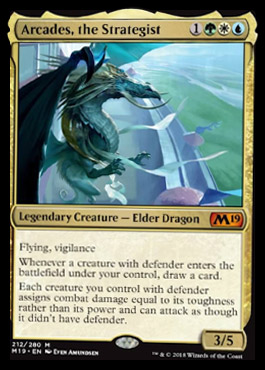
This is a better version of Doran, the Siege Tower. Why better? Well, Arcades lets creatures with defender attack and each one replaces itself on enters-the-battlefield. Also, blue is arguably a stronger color than black.
Arcades has already caused some interesting card spikes in the past few days, so our goal today will be to look at what could potentially spike next. Our winners so far are Wall of Kelp and Shield Sphere.
Both have seen tremendous gains (700%+) in just a day or two. It's important to note that Wall of Kelp is actually on the Reserved List, and its new price puts it at the most valuable card from Homelands (not the greatest distinction, but one nonetheless).
I can also vouch that people are actually buying it at this new price (as I sold five on May 21 which I had only put up that morning). Only a couple of my Shield Sphere's have sold so far—despite being the cheapest in the stated condition—so the jury is still out on that one (for me at least).
Rare/Mythics
One major challenge with speculating on walls is that honestly there aren't a whole lot of rare or mythic ones. There are actually only two mythic ones, Tree of Redemption and Tree of Perdition, only one of which an Arcades deck can play. That being said, let's start with the few rares and mythics that look interesting.
While I think using its ability is a bit risky in many Commander games, a 13/13 for four mana seems extremely powerful. It has two printings (both at mythic): one in Innistrad and the other in A25.
Foils of this card are currently pretty reasonable (many sitting in the $2-$3 range) and as a foil mythic there aren't a lot in the current supply. A search on June 24 showed zero copies of the foil A25 version on TCGplayer, and only around 25 of the Innistrad version). Interestingly enough, Card Kingdom is out of every single Tree of Redemption.
Grozoth has actually been on a gradual rise from bulk status to around $2 since 2016. This shows continual demand, yet it's not really a commonly played Commander card; so any sudden increase in its playability will likely drive its value up considerably.
Now to be fair it is a nine-drop, so it's hard to know if it will in fact show up in an Arcades deck. Magic has a plethora of walls throughout its history, and while Grozoth's ETB is cool, I don't know if that's enough to justify it finding a home in this deck. For now I just suggest you be aware of its existence, but I wouldn't buy in expecting Arcades decks to increase the demand for this card.
Opal-Eye is another steady gainer (though very slowly) having gone from around $0.7 up to around $1.7 since 2013. Not the most impressive gains for a Magic card, but it still shows constant continual demand.
I like this option a lot more than Grozoth simply because it's got a reasonable mana cost and the tap ability allows its owner to survive one massive damage spike. It has just a single printing from Betrayers of Kamigawa, so it wouldn't take a whole lot to cause this card to jump in price. This is definitely one I would look at acquiring as a speculation target.
Typically we see this card in "group hug" decks thank to the "each player draws a card" clause. However, it does fit in an Arcades deck as well, allowing the Arcades player to draw a card when it enters and add counters at the end of an opponent's turn to draw additional cards on their turn.
This is a single-print rare from Dissension, but interestingly the foil price is about three times the regular price. So there is definitely some room for growth on the foil end, especially since there are a grand total of 10 copies on TCGplayer as of me writing this. Supply is already low so it wouldn't take much demand to jump.
This Innistrad bulk rare has rarely found a home (even in the most casual of decks), but it has a very interesting interaction with Arcades. As it's specifically worded to lose indestructibility only if it loses defender, Arcades allows it to attack while maintaining indestructibility.
Now, Innistrad is a recent enough set that there is a boatload of regular copies of this card lying around, and while it is a bulk rare now, I think its max price ceiling is pretty low due to the massive supply. On the other hand, foils are also near bulk ($0.5 each) and while there are still a fair amount of foils lying around as well, there are a whole lot fewer.
Uncommons
I'll preface this section with the fact that I typically avoid speculation on non-rares/non-mythics due to the much larger supply. However, that doesn't mean one should always avoid speculating on them—just keep the larger print run in mind.
Here we have a Mercadian Masques uncommon with no reprint that basically taps to give any of your creatures +4/+4. Unfortunately, the cat's out of the bag on foils of this, as TCGplayer only has three sellers and the lowest price is $16.
Still, it's an old enough uncommon for regular copies to jump to $1.5-$3, should Arcades prove popular enough. I don't know if I'd go and buy any, but I'm definitely going to dig through my Mercadian Masques uncommons and pull them out of bulk.
Here we have an Apocalypse uncommon (so another one that's old enough to be rarer than a new-age rare). However, this one does have a reprint (two in fact, in Explorers of Ixalan and Iconic Masters).
The Iconic Masters foils can be found for under $0.1 so they are a pretty low-risk spec, but I like the Apocalypse foils a lot more. Many can be found for under $0.5 and they have the beautiful old-style foiling. The fact that this wall already cantrips even without Arcades in play means it's never a bad play.
Battlement is a newer card and is only uncommon in Iconic Masters (it was originally printed as a common in Rise of the Eldrazi). However, the foil IMA versions can be found for around $0.25, while Rise foils are more like $1.50. As this one produces mana (and likely a fair amount the longer the game goes) it seems like a clear auto-include in the Arcades deck.
Captain is an uncommon from Worldwake, a second set that wasn't drafted excessively, because of the triple-set Rise of the Eldrazi format that followed it. At the time, cracking WWK boxes was basically a Jace, the Mind Sculptor lottery—if you missed, you lost money. Of course, now we know there are tons of valuable cards from the set, but at the time it was pretty lackluster. Because of these factors, foils from the set are a bit rarer than those from Zendikar or Rise of the Eldrazi.
Perimeter Captain provides continual life gain at a very low cost. It seems likely that a wall-themed deck would be more popular on the casual spectrum. Unsurprisingly, the lifegain on this card could similarly appeal to the same players. Currently there are 7 foil copies on TCGplayer all with a buy-in under $1 (though several have higher shipping costs).
This card was powerful tech back in the days when UW Control was trying to defeat the Jund Menace (before we got Squadron Hawk, Batterskull, and the swords that created Caw-Blade). It provided a powerful brick wall to protect one's Jace, the Mind Sculptor, that was incredibly difficult to deal with.
It has four non-foil printings, but only two printings with a foil option. The original Alara Reborn has copies in the $1.5-$2.5 range, and the much cheaper MM17 printings has foil options at $0.5-$1. This card is extremely powerful in the Arcades deck (basically an 8/8 shroud flyer for three mana) and I'd argue is another auto-include in said deck.
Normally I avoid more expensive foil cards (especially non-rare/mythics), however, Wall of Shards is different as it's a Coldsnap uncommon, which are much rarer than you might think. The regular version sells for over $3, so the fact that you can buy foil ones for under $10 means there's definitely some potential here.
Again, as of June 24 there are only eight copies on TCGplayer (and two on SCG) so supply is extremely low, and the cumulative upkeep seems pretty minimal when you get to hit for eight a turn (with flying).
Commons
As you might guess, if I'm wary of speculating too hard on uncommons I'm even more so for commons. However, I would be remiss if I didn't include some that I think have potential.
Here's another foil that appears to have been bought out on TCGplayer. There were zero copies listed as of June 24. It's a single print (from Rise of the Eldrazi) common that provides all your walls +2/+2 (really +0/+2, but when Aracdes is out it's basically a double anthem for 1W).
If you can find any at the old price there is some easy money to be made (this is the type of card that would likely end up in a bulk foil box). I don't think I'd buy in at the new price though.
Planeshift released way back in 2001 and the playerbase was much smaller back then (so a lot fewer of these are floating around). More importantly, it was a second set, and as I recall a pretty weak one (I believe the big card was Phyrexian Scuta).
Interestingly enough, foils of this were already worth something before Arcades came out back in January 2018, likely because it's good enough to fit into any Bant Commander deck. This is another one that you might find in a bulk foil pile (though a lot less likely than the Shield-Bearers above).
Conclusion
There are a lot of random old defender cards spiking in value thanks to the spoiling of Arcades, the Strategist. Typically walls end up mostly in bulk, so there's definitely potential for some major gains. We have already seen this on a few cards, and will likely continue to see more as the hivemind optimizes the Arcades builds.
Insider: Standard Decks to Watch
Are you a Quiet Speculation member?
If not, now is a perfect time to join up! Our powerful tools, breaking-news analysis, and exclusive Discord channel will make sure you stay up to date and ahead of the curve.
Hi guys,
Two Standard Grand Prix concluded last weekend: GP Singapore and GP Pittsburgh. Usually the Standard Grand Prix after the Pro Tour are the events that will affect the Standard format going forward. Let's have a look at the top-performing decks at each GP.
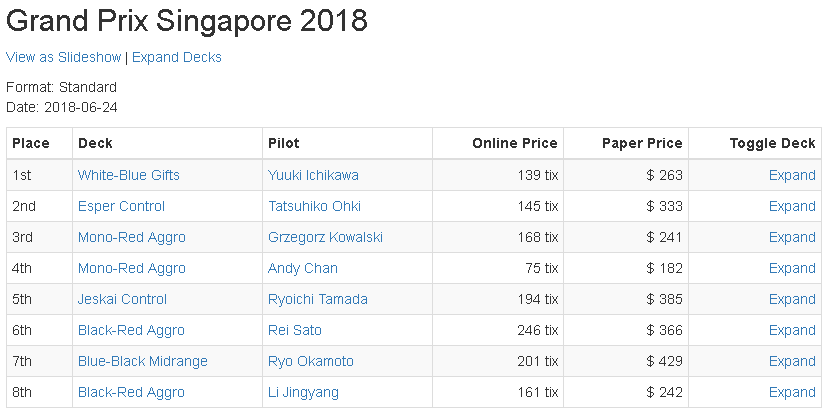
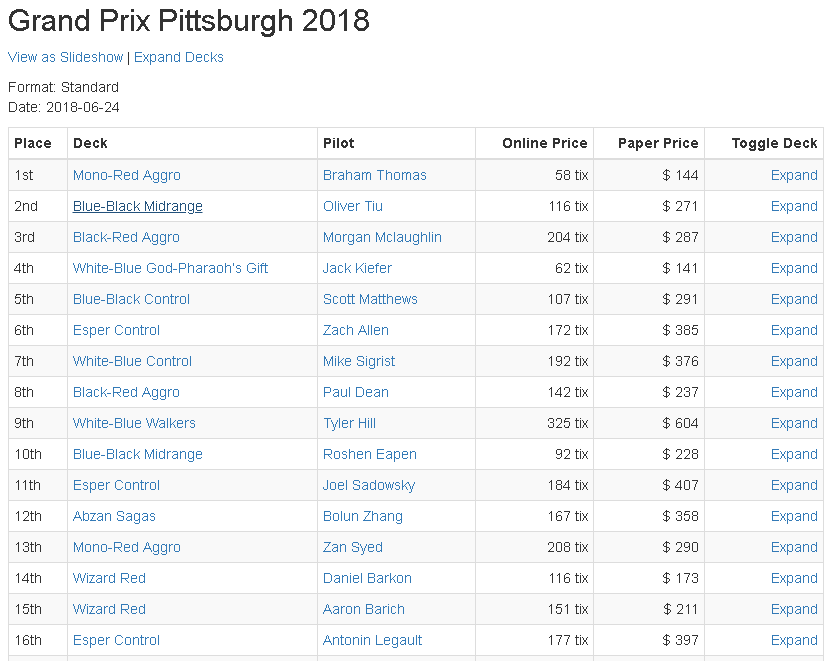
Overall, Standard is cheap—as you can see in the list, the average cost to make a Standard deck is around 150 tickets. The only really expensive cards in Standard are Karn, Scion of Urza, Rekindling Phoenix, and Teferi, Hero of Dominaria.
However, the most expensive cards in the format don't always make up the best performing decks. The GP Pittsburgh winning list contains zero copies of those cards mentioned above, while GP Singapore winner Yuuki Ichikawa only has two copies of Teferi in the Sideboard. From the GP events, we can actually separate Standard decks into three categories:
- Red Aggro variants
- God-Pharaoh's Gift variants
- White/Blue/Black Control or Midrange variants
Many other decks, like GB Constrictor, Mardu Vehicles, and UG Karn, did not perform so well during the weekend. There won't be other Standard Grand Prix for awhile but there will be Nationals, which is a mix of Standard and Draft. So, if there would be another big metagame change affected by offline events, it will be caused by one of the Nationals Top 8 decks. Therefore we are going to look at a few potential decks that might become the king of Standard in the next few weeks.
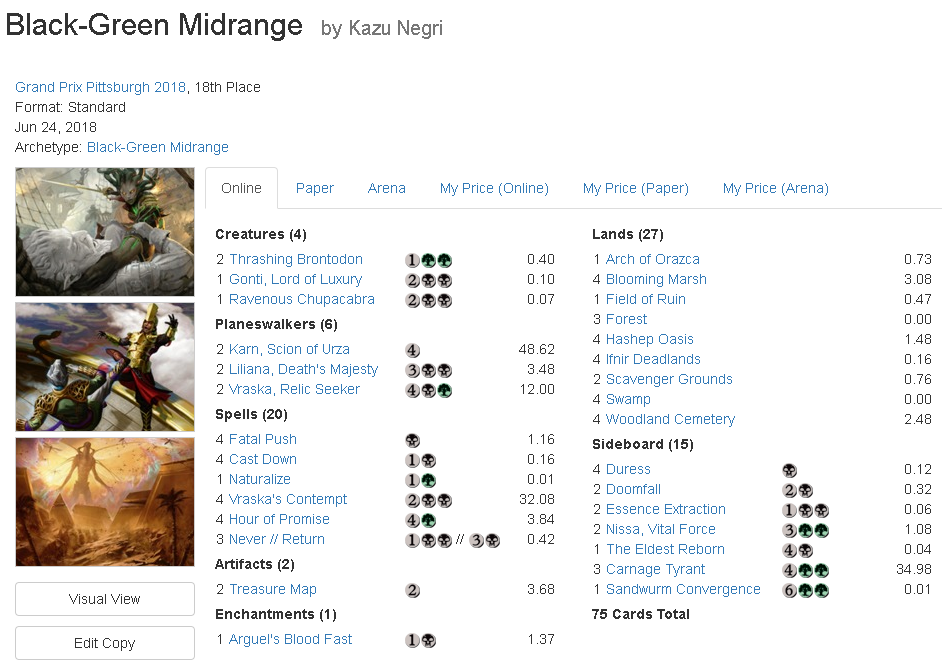
It's always the case that midrange decks become better from week to week as players find better builds for their favorite decks. For example, if you look at BG Midrange above, it looks like a completely different deck compared to BG Constrictor. Considering that a new deck made 18th place at a GP, I have to give this deck another look.
Hour of Promise is actually the card that stands out. With the land tutor, the player is able to search for different utility lands in the deck depending on the matchup. Arch of Orazca seldom see play in Standard but I think it is really good in this deck, as most of the spells will put more permanents into play. I think many players online have already been messing around with this deck, which means Hour of Promise should be increasing in price shortly.
Scavenger Grounds is another card that is good in the current metagame as God-Pharaoh's Gift has returned to the top of the format. The interesting part of this deck is that it is pretty resilient, as the current version already has fair number of cards against each matchup. 1) Good amount of removal against aggro decks; 2) A planeswalker package and discard spells in the sideboard to to fight control matchups; 3) Mainboard artifact and graveyard hate against Gift decks.
Recognizing that this deck is good against the current "big three," you know it has some potential. My suggestions on cards to watch from this deck: Hour of Promise, Nissa, Vital Force, Arch of Orazca, and Scavenger Grounds.
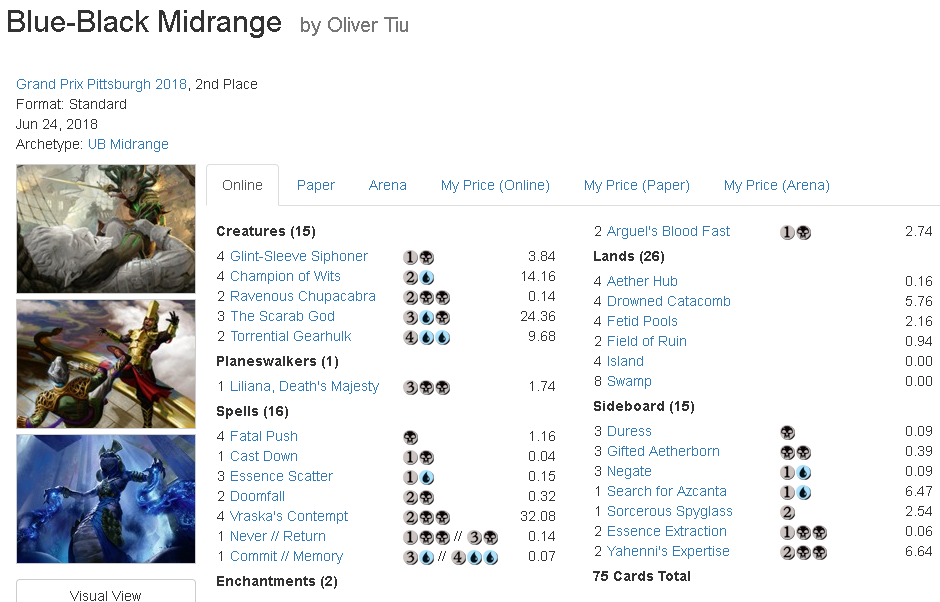
The most expensive cards from this list are the four-of Vraska's Contempts. The rest of the cards are at their low points mostly. While it's generally ill-advised to buy cards that are going to rotate two sets from now, sometimes there can be exceptional cases where cards will still increase in price.
Blue-black is the color pair that has the most value creatures and good removal spells. The list above, played by Oliver Tiu, plays all the best creatures in Dimir colors. The only downside to these creatures is that they are from blocks that are going to rotate in October. Let's look at each of those creatures played here:
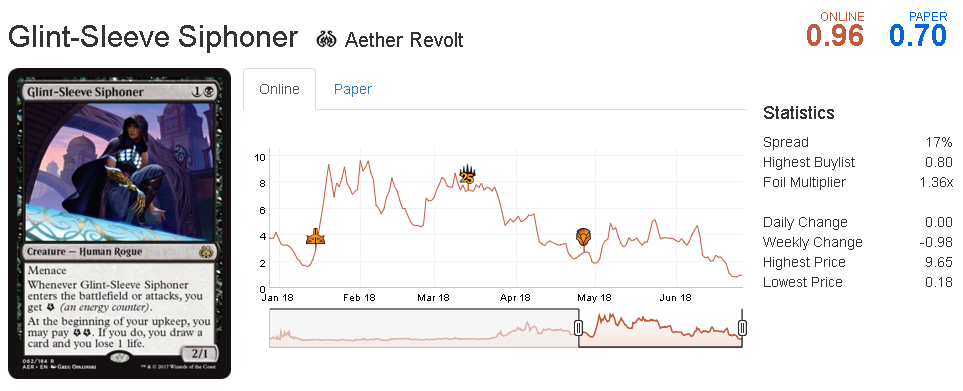
Glint-Sleeve Siphoner is the Dark Confidant of current Standard. It's the best card draw engine provided you can generate enough energy each turn. 1 ticket should be the bottom price before the card enters Modern, because players will still need this card for some time.
If UB or other black midrange decks become tier one in the following weeks, there's a high chance that Siphoner will gain value again. I think the possibility of black decks coming back is pretty high, so I suggest grabbing some Siphoners just in case.
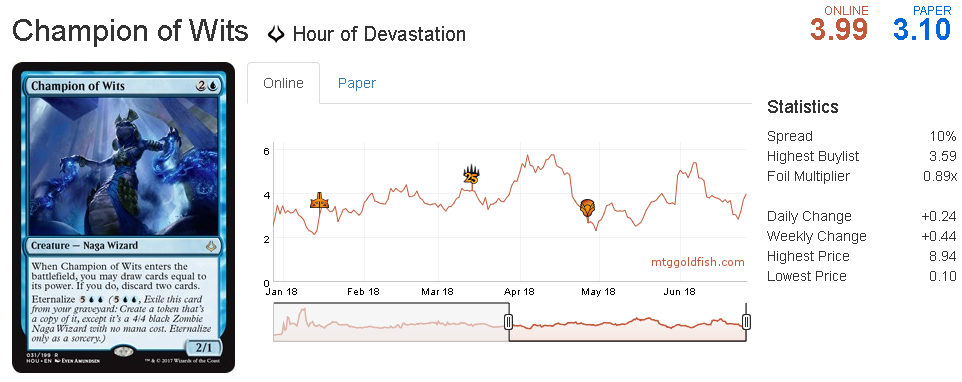
Champion of Wits increased in price along with the increase of Gift decks in the format. However the price will not increase further at this point unless a third deck with Champion of Wits comes up. I don't think it's wise to buy copies of this card right now.
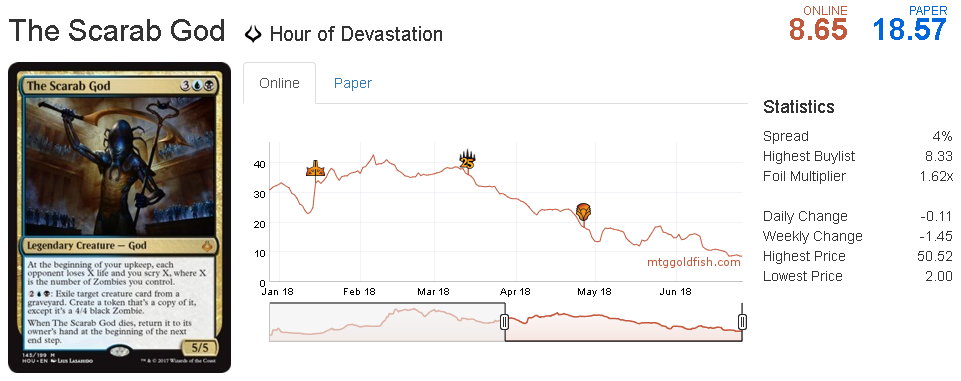
*Sigh* The Scarab God is one of the failed specs from Pro Tour Dominaria, but this card once again appeared at the top tables. This is definitely a trap if you are not careful. It's usually very hard for mythics to go up in price again after they reach their low price, unless they are Modern-or-older-playable. Some good examples of mythics that fall in the same category as Scarab God: Gideon, Ally of Zendikar and Ishkanah, Grafwidow.
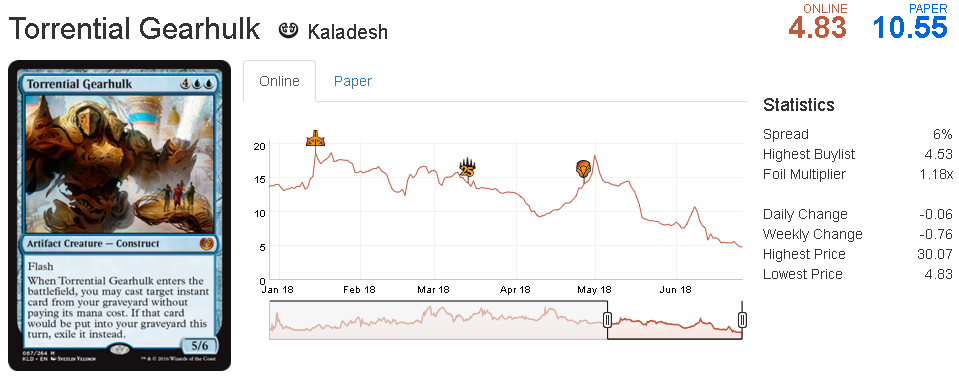
Torrential Gearhulk was once a four-of in UR Control variants. At the Pro Tour, Control was comparatively weak if we look at how dominant the red decks were. However, things have changed after a few weeks—Gift decks and other midrange decks popped up with better configurations to beat the red decks.
Torrential Gearhulk is one of the most important cards in blue Midrange/Control decks, which I can foresee becoming more popular soon. Aside from Standard, Gearhulk is also played in Modern and usually can catch opponents by surprise. So overall I think Gearhulk is worth investing in; do grab some copies for investment if you have spare tickets.
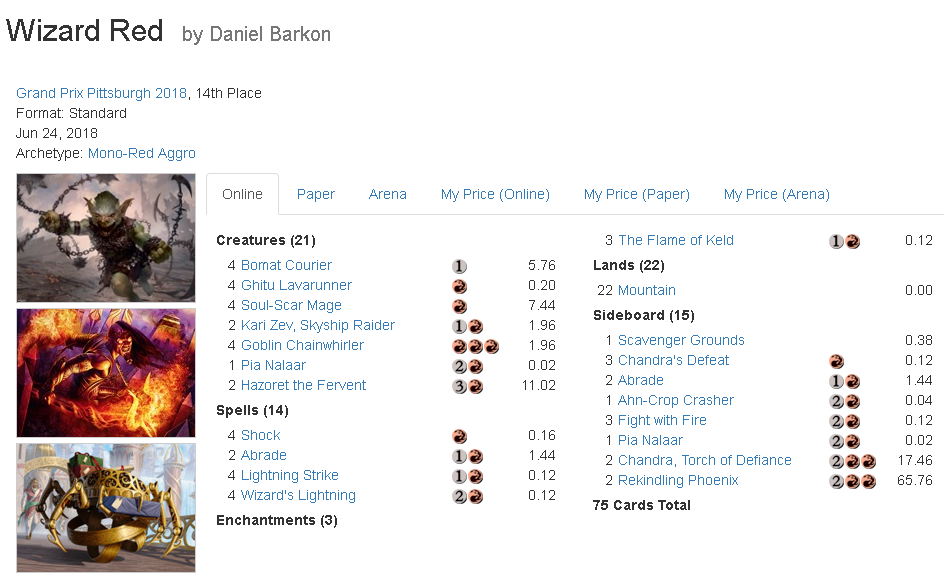
Wizard Red is a new red variant from GP Pittsburgh. The deck basically plays eight copies of Wizards so that the Wizard's Lightnings in the deck become Lightning Bolts. This deck is super cheap on MTGO and most cards are cheap to get.
I'm actually not going to suggest any card from this list but I would recommend picking up this deck if you want to win some chests from leagues. I think picking up cheap but powerful decks is an important part of MTGO finance, so I will try to include more deck suggestions in my future articles. What do you think? let me know your thoughts in the comments section below.
Alright guys, that’s all for the week. Thanks for reading, and I’ll see you again next week.
Adrian, signing off.
Unlocked: Preparing for a Chainwhirler Ban
Are you a Quiet Speculation member?
If not, now is a perfect time to join up! Our powerful tools, breaking-news analysis, and exclusive Discord channel will make sure you stay up to date and ahead of the curve.
Today I'm going to help you prepare for the next three months of Standard finance. There are precisely two events that can shake up Standard before rotation, and both are happening next week. First, the Banned and Restricted Announcement is this Monday, July 2nd. Second, Core 2019 will be released on July 6th on Magic Online in the form of Sealed Leagues, and on July 9th will be fully released.
What I want to examine today is whether these two events will change the financial outlook of cards already in Standard. Will any cards go up in value? Are there certain cards you should sell? How might Standard look over the next few months? Read below to find out!
I. Is the Ban Hammer Coming for Goblin Chainwhirler?
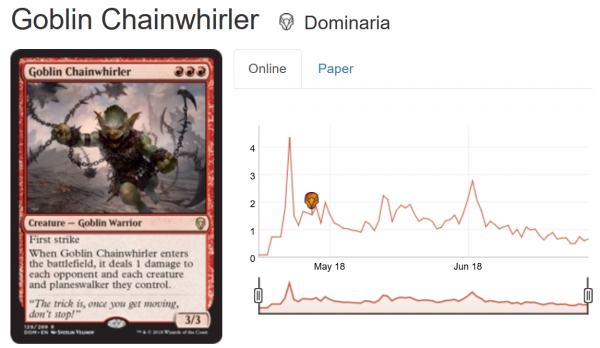
Goblin Chainwhirler has a ridiculously low price on Magic Online right now: 0.68 tix. As a rare in a set currently being drafted, an accurate valuation based on the amount of play it sees would be somewhere between 1.50 and 2.50 tix. Clearly, then, the market feels moderately confident that Chainwhirler will be banned.
The week before Energy was banned, I predicted the ban correctly. I'm far less confident that Chainwhirler will be banned than I was about Energy. This go-around we don't have the indications from Wizards R&D personalities about how Chainwhirler was bad design or a design mistake, the overall mood of the MTG Community is relatively better now because of the overall success of Dominaria, Standard participation has rebounded, and we are approaching a rotation that will see red weakened significantly.
My gut tells me that Chainwhirler will not be banned, and if it is banned, Rampaging Ferocidon will be unbanned. I think there's an outside chance that they get cute with the B&R announcement, either unbanning a lot of the cards currently on the Standard banlist or banning Chainwhirler specifically until rotation. But, at the end of the day, I think the likely aftermath of the B&R announcement will be that red will still have a premier three-drop that guarantees it a prime position in Core 2019 Standard.
II. What Improves If Chainwhirler Is Banned?
The decks most likely to benefit from a Chainwhirler ban are Stompy, White Aggro, and Tokens. Stompy because Llanowar Elves gets better. White Aggro and Tokens because not all of their threats and board advantage engines will meet such easy deaths and be so easily countered.
I don't think the overall price valuation of green cards will change very much. Jadelight Ranger is currently at its all-time low, and I think that that is a good speculation heading into rotation (I've got 35 copies of it right now). But that's not a speculation you should look to cash in on over the next few months.
White cards, however, could see some genuine price resurgences.
The biggest short-term beneficiaries of a Chainwhirler ban will be cards contained in Anointed Procession decks like this.
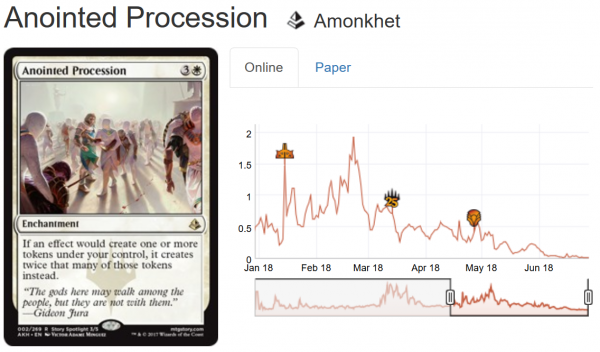
Anointed Procession, currently at bulk rare pricing, could spike up to 0.50 tix or even 1.00 tix. Adorned Pouncer, also at bulk, could spike up to 0.25 tix. Angel of Sanctions, too, could get in on the price spike action, although that one bears more risk.
Long-term, a Chainwhirler ban will improve the odds that these four cards see Standard success, and all but guarantees that Legion's Landing and Benalish Marshal will be lucrative investments. Legion's Landing is currently hovering just above 1.00 tix, and that won't last long if Chainwhirler gets banned.
III. Will Core 2019 Alter the Standard Landscape?
After reading articles by pros at Star City Games and doing some of my own brewing, I can identify a few different ways that Core 2019 could shake the predictable and stale metagame. The most likely contenders are (i) that Zombies rises to tier status off of the back of new lords, and (ii) that Tezzeret gives artifact-improvise decks the raw power it's been lacking to be truly competitive.
Regarding Zombies, I am deeply skeptical because the deck seems incapable of presenting a line of attack different from the one that red aggro presents more potently. It needs to go wider than red, but it doesn't seem to have the tools to do so.
Consider this ultra-streamlined Zombie deck that I built. It's one token-producer short of presenting a unique line of attack that I think it needs to be a competitive option. If Wizards bans Chainwhirler and leaves Ferocidon banned, then I think this deck could be a real competitive option.
In such a scenario, the best specs would be Ifnir Deadlands and Dread Wanderer. Both would be poised to quintuple in value.
Regarding the artifact-improvise deck, I remain less confident in predicting one way or the other. And I couldn't in good conscience recommend a spec into such an abyss. Herald of Anguish would likely see the largest gains, and perhaps at its present 0.72 tix price tag the risk is low. Spire of Industry is criminally low right now too, but that's more of a long-term spec opportunity. Investing in Karn, Scion of Urza feels like a mistake prior to Heart of Kiran leaving the format.
IV. Conclusion
Ultimately, therefore, unless red receives a major nerf, I think the fabric of Standard is going to remain intact. The cards that are good now will continue to be good, and the cards that are bad will continue to be bad, which means that short-term speculation opportunities are going to be hard to come by.
Keep that in mind as you look for short-term speculation opportunities, and keep in mind that short-term speculations are at their riskiest at this time of year—not only is there less interest in Standard overall, but an impending rotation means that a failed speculation could prove calamitous, especially a speculation on a Kaladesh or Amonkhet block card.
Let me know in the comments below what you are thinking of investing in, and how excited you are about Core 2019. Thanks for reading, and I'll see you next time!
Basic Instinct: GR Moon with Sarkhan, Fireblood
Are you a Quiet Speculation member?
If not, now is a perfect time to join up! Our powerful tools, breaking-news analysis, and exclusive Discord channel will make sure you stay up to date and ahead of the curve.
It's been awhile since I last discussed GRx Moon, one of my darling archetypes. Sarkhan, Fireblood inspired me to return to the deck for the first time since the Bloodbraid Elf unban, itself an episode that ended up frustrating me as I tried and failed to integrate the hasty 3/2 into the deck. M19's new planeswalker seems to tie all the pieces together. Today, I'll unveil and explain my newest build of GR Moon.
Keeping the Faith
Between hyperbolic endorsements as "Brainstorm" and continued success in aggro-control strategies as diverse as Mardu Pyromancer and Grixis Shadow, Faithless Looting has fully caught on in Modern.
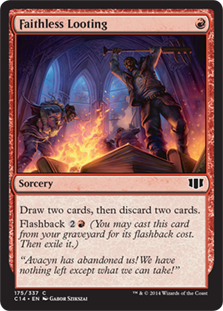 Looting has always been at the center of GRx Moon, a deck I developed while working on Skred Red in 2012 after splashing green for Tarmogoyf in that shell. Here, it transforms excess mana sources and lock pieces into more business or otherwise fixes early draws, all while growing Tarmogoyf.
The card also represents the key divide between GRx Moon and GR Ponza, the Inferno Titan-toting land destruction deck that rose to prominence a couple years ago. While that deck continues making land drops to cast its pricey bombs, we accommodate Looting by willfully giving up mana sources beyond the fourth, instead relying on an incidentally huge Goyf to apply late-game pressure. We don't spend early turns setting up our mana; we spend it interacting and putting opponents on a clock.
GR Moon, by Jordan Boisvert
The New
Upping Aggression
Elephant in the room: for all the years I've played around with GRx Moon shells, Bloodbraid Elf has not been Modern-legal. But it slots right into our curve by coming down after three-mana play, and clearly plays roles this deck seeks to fill. Some of those roles include quickly applying pressure (haste), sifting through excess mana sources (cascade), and out-spelling our opponents (also cascade).
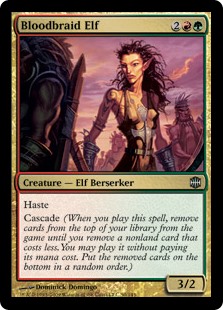 What's awkward about Elf is that it occupies the same slot in the curve as Huntmaster of the Fells, historically a powerhouse for us. The plan has long been to supplement Huntmaster with another threat and call it a day. But jamming Elves there doesn't actually work, since with Huntmaster as our other premier non-Goyf threat, our cascades are simply too mediocre on average to justify playing Elf at all. Besides, the sudden aggression Elf provides doesn't mesh so well with Huntmaster's preference for resource-strapped grinding.
The solution? Cutting Huntmaster entirely. I've filled his shoes with Goblin Rabblemaster, a high-impact cascade hit in line with Bloodbraid's bottom line. And joining Bloodbraid at the four-mana slot is Hazoret the Fervent, another curve-topper adept at closing out games. Hazoret mitigates our feel-bad Lootings and proves troublesome for certain decks to remove. Its reach ability tends to deal around four damage, too, so the card often translates as half our opponent's life total. Bloodbraid, Rabblemaster, and Hazoret all share the same philosophy: get opponents dead fast after tripping them up with a Blood Moon.
Super Sifting
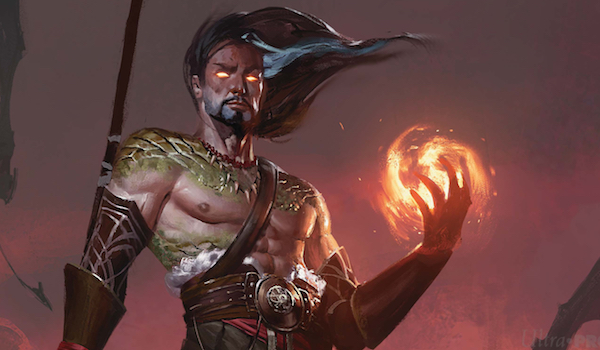
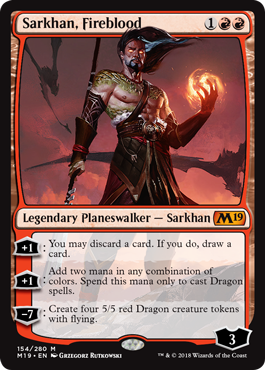 GRx Moon would play more than 4 Faithless Looting if given the chance, and I've tried quenching the deck's thirst for worthwhile discard outlets with candidates as diverse as Liliana of the Veil and Collective Brutality. Sarkhan, Fireblood is an exciting addition to Modern from M19 that may serve up the extra Lootings we crave.
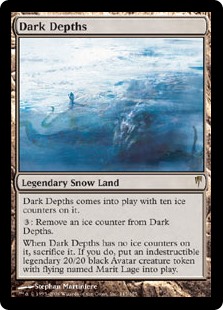
Sarkhan may lack the sorcery's brute efficiency, but he does boast several benefits. For one, Sarkhan's a planeswalker, a card type Tarmogoyf has desperately wanted since I began this project. I've tried Nahiri, the Harbinger, Chandra, Torch of Defiance, and Chandra, Pyromaster in this deck, but none quite cut it—four mana's a steep price to pay for a walker in Modern, as we know from Jace, the Mind Sculptor's relative failure post-unban. At three mana, Sarkhan comes down on turn two off Hierarch or Sprawl to start digging through the deck.
 While digging, Sarkhan also pressures opponents from a unique angle: by steadily ticking up to an ultimate that's difficult for most decks to interact with. Four 5/5 Dragons is like Marit Lage Plus in a format so reliant on Path to Exile. After an activation or two, and especially on an empty board, opponents must start dedicating resources to getting Sarkhan off the table, which lets us happily continue looting and take games the old-fashioned way.
Finally, Sarkhan's an excellent cascade hit, and a fine play against opponents clutching a grip full of removal. Its inclusion also gives us enough reliable discard outlets to accommodate a pair of Darksteel Citadels (this time without the hit-or-miss Boom // Bust), which are basically free Goyf pumps in a deck with such good mana.
The Old
Mana
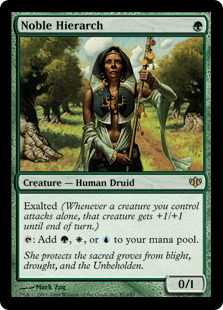 I went with the classic 4-4 dork/sprawl split in this list. Sprawl is tougher to interact with, and so a safer bet when it comes to slamming fast lock pieces. But dorks are preferable in many instances, too; for a big Sprawl turn, wherein the enchantment acts as a sort of Springleaf Drum by breaking even on mana while ramping us, or to walk opponents into an angry Tarmogoyf. Running both card types gives us more choice regarding how to play out our openers and adds depth to our mulligan decisions.
Despite this build's demanding RR requirements for Sarkhan, Fireblood, Anger of the Gods, and Molten Rain, I went with Noble Hierarch over Birds of Paradise. Exalted is just too important with our threats. It helps us win Goyf wars, of course, but also significantly enhances Goblin Rabblemaster and Bloodbraid Elf. Not to mention Hazoret hits like a ton of bricks with Hierarch in play.
Moons
4 Blood Moon is a given, so let's talk about Magus of the Moon, which I include in my GRx Moon decks at 0-2 copies. This card's worth 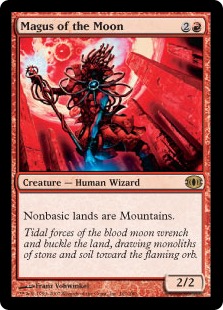 shifts with both the metagame and the build of its home deck—both cases thanks to the existence of Lightning Bolt. With more opponents on Bolt, Magus becomes worse, as it does in a shell light on mana dorks. Dorks power Magus out right away if opponents demonstrate no kill spell by not shooting our accelerant, and they also draw fire away from the pricey Magus, which otherwise can cost us some tempo.
In addition to the Hierarchs, our hasty Elves fight for opposing removal. And should they not have any, cascading into Magus is even better than hitting a Moon, since our clock becomes that much faster while opponents struggle to draw out of the scenario,
Murders
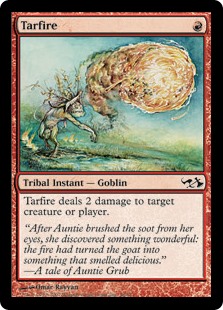 Our removal package is very straightforward: 4 Lightning Bolt, 2 Tarfire. The purpose of these spells is to clean up early threats from opponents and mana dorks before we land Blood Moon or otherwise put the game away. Between Elf, Rabblemaster, and Hazoret, this build is significantly more aggressive than previous iterations of GRx Moon; as such, our need for heavy-duty removal decreases. The best late-game plan is to never enter the late-game!
I experimented with varying amounts of Dismembers in the mainboard and eventually settled on 0. Much as I love the card, Dismember only sometimes snipes enemy Goyfs, and is a hit-or-miss cascade in the dark. It's painless to Loot away, though, and helpful in certain matchups (chiefly Eldrazi), so I kept one in the sideboard.
Sideboard
4 Dire Fleet Daredevil: The other big addition to GRx Moon is Dire Fleet Daredevil. This card comes in against all spell-based fair decks, which mostly means blue control (Jeskai) and black midrange (Shadow, Mardu). Its original purpose here, though, was to answer enemy Goyfs, something my "Turbogoyf" decks have always struggled with to some degree.
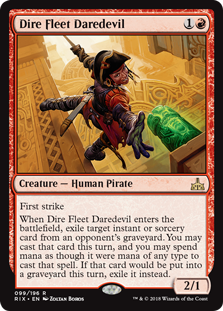 I realized in testing that the Goyf decks currently in Modern are also Fatal Push decks, and ones that struggle against specifically Snapcaster Mage. Daredevil turns their Pushes on their own Goyfs while plussing in a way difficult for them to answer cleanly. The only problem with this plan is that Daredevil needs a Push to eat before opponents start beating us up with their Goyfs.
Hierarch and Tarmogoyf are critical at baiting out the removal spell, but especially the latter; should opponents miss on removal, our Goyf will handily hold down theirs until a stall-breaker arrives, and can even go on the offensive with some help from Hierarch or a burn spell.
3 Molten Rain: Our Stone Rain analogue, Molten gets the nod mostly because we can support it. It's also a superior cascade hit and supports our reach plan.
3 Ancient Grudge: The most effective artifact spot removal in Modern. Tripling up on Grudge is quite easy to do at this stage in the deckbuilding process, and makes our artifact matchups a breeze.
2 Anger of the Gods: Gets the nod over Pyroclasm for the extra damage and exile clause. We need to be able to cleanly deal with gummy Collected Company boards, or Tarmogoyf loses a lot of value. The last point matters against Humans. I've also found Anger invaluable for the Krark-Clan Ironworks matchup; if we keep them off their namesake card, they chump Goyf eternally with Scrap Trawlers and Myr Retrievers, a plan Anger halts.
 1 Dismember: All-purpose removal for every creature matchup.
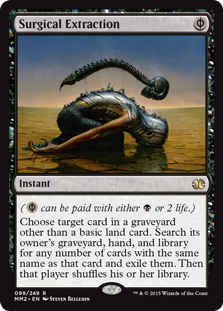
2 Surgical Extraction: I tried a black splash early on to address enemy Tarmogoyfs, and now dearly miss Nihil Spellbomb in this build. But Surgical's still plenty strong in Modern, especially in the hands of a skilled pilot. While an unexciting cascade hit, Surgical in the hand protects us from all kinds of enemy shenanigans, and the card has over-performed relative to my expectations so far.
A Loot of Options
So far, I've noticed multitude of differences between this and other builds of GRx Moon: we gain consistency in the mid-game, but suffer more if we lose our accelerant right away; we're softer to go-wide aggro decks, but better against everything else. Adding dorks is the first agenda point to try.
I'll have to test a good deal more before making any major tweaks, but am stoked with Sarkhan so far, and encourage naysayers to try him out—other shells I think would benefit from the walker are Skred Red and Mono-Red Prison. Happy digging, everyone!
Insider: MTGO Market Report for June 27th, 2018

Are you a Quiet Speculation member?
If not, now is a perfect time to join up! Our powerful tools, breaking-news analysis, and exclusive Discord channel will make sure you stay up to date and ahead of the curve.
Welcome to the MTGO Market Report as compiled by Matthew Lewis. The report will cover a range of topics, including a summary of set prices and price changes for redeemable sets, a look at the major trends in various Constructed formats, and a "Trade of the Week" section that highlights a particular speculative strategy with an example and accompanying explanation.
As always, speculators should take into account their own budgets, risk tolerances and current portfolios before buying or selling any digital objects. Please send questions via private message or post below in the article comments.
Redemption
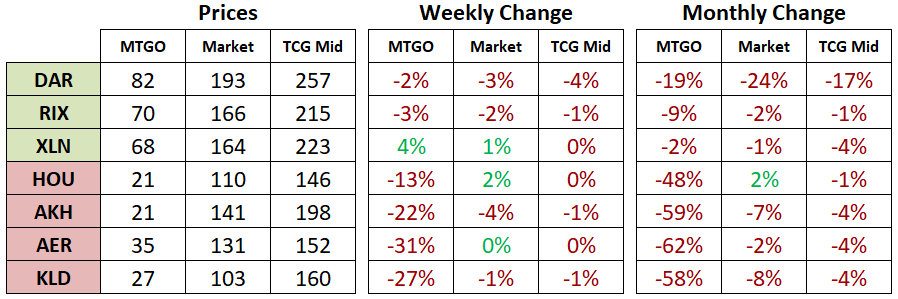
Below are the total set prices for all redeemable sets on MTGO. All prices are current as of June 18, 2018. The TCGplayer market and TCGplayer mid prices are the sum of each set's individual card prices on TCGplayer, either the market price or mid price respectively. Redeemable sets are highlighted in green and sets not available for redemption are highlighted in red.
All MTGO set prices this week are taken from GoatBot's website, and all weekly changes are now calculated relative to GoatBot's "full set" prices from the previous week. All monthly changes are also relative to the previous month's prices, taken from GoatBot's website at that time. Occasionally, full set prices are not available, and so estimated set prices are used instead. Although Hour of Devastation (HOU), Amonkhet (AKH), Aether Revolt (AER), and Kaladesh (KLD) are no longer available for redemption, their prices will continue to be tracked while they are in Standard.
Standard
It was another big down week for prices on MTGO. Looking at the monthly changes, the rotating sets are all down in the 50 to 60 percent range. Prices are down so much that it is time to start considering these sets for their bounce-back potential. The rotating sets are priced to move, but will they bounce enough to make it worthwhile? Or will they just level off, or possibly even go even lower?
To resolve this question will be difficult. We are in uncharted waters when it comes to sets rotating out of Standard that have been and continue to be heavily mined in Treasure Chests. It's possible that selective speculative bets on Standard singles from Kaladesh (KLD), Aether Revolt (AER), Amonkhet (AKH) and Hour of Devastation (HOU) will be fruitful over the coming weeks, but caution is warranted.
The best advice for experienced speculators at the moment is to keep an eye on the market and see if there's an upswing in demand on cheap Standard staples from these sets. The release of Core Set 2019 (M19) will be a catalyst as it shakes up the metagame, so watch for emerging trends in archetypes and singles that could yield some nice short-term gains. It's tricky to gauge momentum plays like this but one thing to look our for is if a new, dominant archetype develops after M19 is released. This would be a good signal for speculators to pile on and buy up the staples from the deck.
Otherwise, full sets of Dominaria (DOM) are coming into view as a good place to deploy some tix. The heavy drafting of this set will come to a close in less than two weeks, which means we are close to peak supply. Redeeming digital sets for paper sets still looks attractive based on the spread between MTGO and Market prices and the guarantee date for DOM redemption is September 5. This means there will be a little under two months for digital sets of DOM to appreciate. I anticipate a net gain in the 5 to 15 percent range based off of the returns to Rivals of Ixalan (RIX) and Ixalan (XLN) full set speculation.
The other great place to have some tix ready to deploy will be into M19 foil mythic rares. This strategy paid off handsomely for the portfolio most recently. DOM returned 41 percent on five sets of foil mythic rares. This is a little high relative to the returns on foil mythic rares from RIX and XLN, but the strategy is consistently turning in net profits in the 15 to 25 percent range.
If you are looking to employ the foil mythic rare strategy, look to buy each of the foil mythic rares from M19 in the week of its release. It can be difficult to judge what a good price is, but an average of 10 to 12 tix per copy is a good guide. For DOM, I paid between 11.8 and 14.7 tix per mythic rare, so it will be worth watching to see if M19 follows this trend or reverts back to the lower price range that has occurred historically.
Modern
The Modern Pro Tour Qualifier from earlier in June had some interesting results that are reverberating in the market. Check out the results here. The winner of the PTQ was rizer with a Goblins variant typically called 8-Whack. It also featured an old favorite in Devastating Summons. Legion Loyalist has rebounded from 1.2 tix back to 6 tix as a result.
The other standout of this event is a BG Infect deck that put two players into the top eight. Phyrexian Crusader is enjoying the resulting attention, with a price spike to over 2 tix.
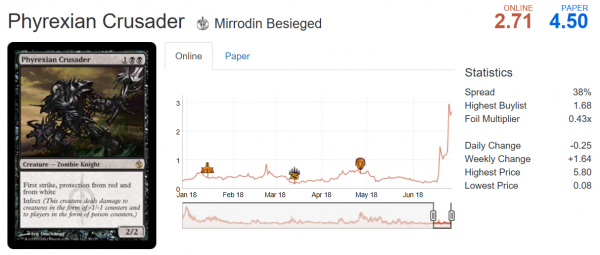
Both archetypes strike me as flash-in-the-pan type decks that a practiced field would be able to handle. If they continue to post good results then I would have to revisit this conclusion, but there's no reason to chase cards featured in these decks. Most likely prices will come back down and wait for the next high-profile result.
Standard Boosters
DOM has a little under two weeks left to be the new set in the draft queues, and the price of a booster is starting to reflect this as it dips under 3 tix for the first time. These will be a good purchase after M19 is released; I will be watching the market to see what price is possible, but a price in the 1.7 to 2.1 tix range is my initial guess. That works out to 5 to 6 tix for a draft set, which is roughly the buying range I used for draft sets from XLN block draft.
Speaking of XLN block draft, the market has sold off on draft sets this week. RIX in particular has dropped off a cliff going from 2.3 tix to 1.6 tix. If you are holding any excess boosters it's still not too late to sell these. There might be a slight bump in price over the next ten days, but XLN block draft will leave the queues with the release of M19.
At that point, both RIX and XLN boosters will continue to decline. Any declines below 1 tix will be considered a potential buy, but 0.7 to 0.8 tix would have a much larger margin of safety for speculators looking to buy the dip on these.
Trade of the Week
For a complete look at my recent trades, please check out the portfolio. This week I've been wrapping up the full set speculative strategy for XLN and RIX.
Profit on RIX is 4 tix per set or 7%, and profit on XLN is 9 tix per set or 15%. This was a little disappointing, but the lack of availability of redemption sets looks to have had an impact. Nevertheless, it's a low-risk strategy that can be deployed at the end of any set's drafting window in large volumes. I bought and sold over forty sets of each of XLN and RIX.
As mentioned in the Standard section of this article, full sets of DOM are quickly going to be the next opportunity to deploy some tix into this strategy. The precise bottom will only be obvious in hindsight, but a 75 to 80 tix price range seems reasonable, and DOM is just a little over 80 tix at the moment, so we are close.
Insider: QS Cast #99: New Tax Laws with Jordan
Are you a Quiet Speculation member?
If not, now is a perfect time to join up! Our powerful tools, breaking-news analysis, and exclusive Discord channel will make sure you stay up to date and ahead of the curve.
Podcast: Download (Duration: 1:06:34 — 60.9MB)
The QS Cast returns! Chaz, and Tarkan come together as the new panel – and in this episode they discuss the following:
- We discuss the new Tax laws with a tax adviser - Jordan!
- Please enjoy this very informative episode for all sellers out there.

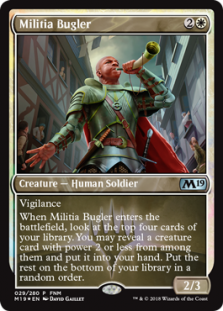 The first card that I saw spoiled and got me testing new cards is Milita Bugler. I'm a Death & Taxes player at heart, and I've longed for Recruiter of the Guard or even Enlistment Officer in Modern. Recruiter was a sea change for Legacy Death & Taxes, becoming the card advantage engine the deck needed in addition to finding lockout creatures; Officer is the lynchpin of
 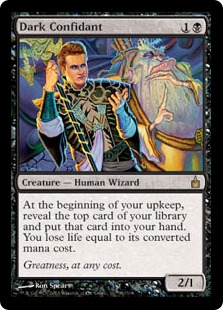 Dark Confidant and Kessig Malcontents maindeck with another Confidant in his sideboard. I've seen anything from Restoration Angel and Shalai, Voice of Plenty to Whirler Rogue and Dire Fleet Daredevil in those slots. Bugler needs to distinguish itself above the other options.
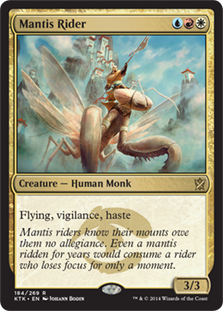 Worst-Case Scenario: Turn four on the draw, no mulligan. One land and one Aether Vial in play. Have drawn only 2 power creatures. 49 cards in library, 3 Vials, 18 lands, 4 Mantis Rider, and 24 hits remain for a simple hit probability of 49%. Odds are 24 : 25 to hit any legal creature.
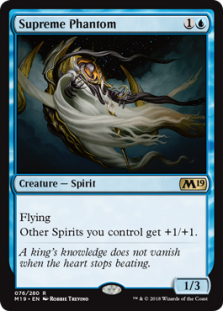 I have a
 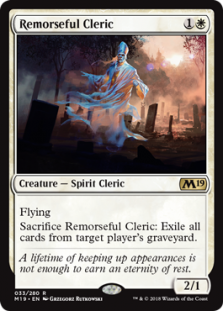 being overrun by creature decks or synergies.
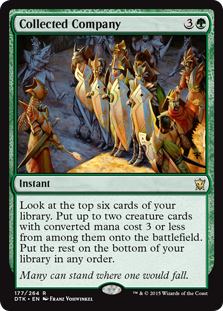 While I am talking exclusively about UW Spirits, there is an alternative.
 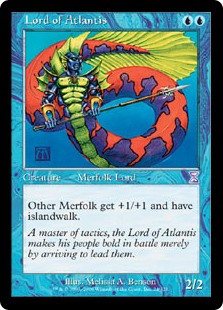 place. This has improved the big mana and creature matchups noticeably. The question is whether that's good enough. As a disruptive tribal deck, it competes for space with Humans and Merfolk. Spirits is slower than both decks; Merfolk has more lords, Humans has a better curve.