

Are you a Quiet Speculation member?
If not, now is a perfect time to join up! Our powerful tools, breaking-news analysis, and exclusive Discord channel will make sure you stay up to date and ahead of the curve.
Welcome back, readers!
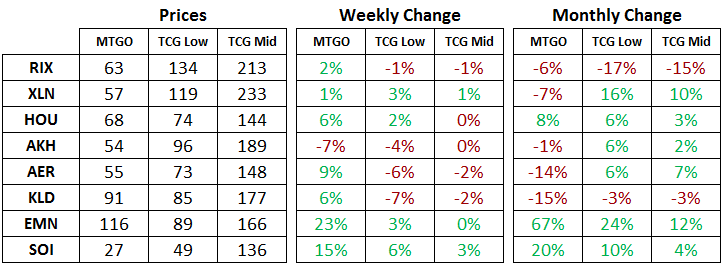
We had quite the bombshell dropped on us this past Friday. Wizards published the decklists for the Challenger Decks they'd alluded to earlier in the year. Now, obviously the cards included on these lists will drop in value, especially the ones that are included as multiples (looking at you Heart of Kiran).
Back before we had the Planeswalker decks, WotC made Event Decks. These often had a chase card or two in them—we had one that contained not one but two copies of Stoneforge Mystic, and one that came with both a Verdant Catacombs and a Bloodghast). Event decks were far from strong decks capable of taking down even a remotely competitive FNM event. They were more like thematic decks created by WotC meant as a stepping stone to get new players into trying out FNM.
The new Challenger Decks are very different from the Event decks of old. All four are somewhat watered-down versions of tier-one decks (and they aren't watered down much). I could see someone actually winning an FNM with one of these decks—instead of a stepping stone, they have a full competitive deck with some upgrade potential (i.e. the decks could be upgraded somewhat with additional copies of some cards, but are very playable as is).
Hopefully many of you are in the habit of reading through the Discord channels when you can—when these were announced my phone blew up with Discord notifications. Many QSers were jumping to buylists to unload any and all copies of cards that were spoiled in the decks. Buylist prices for many cards have dropped dramatically (25-30% in just a day, as I'm writing this on February 24) presumably because the stores have been flooded with people buylisting to them.
Having had a day to discuss these decks with both QSers and some of my friends, there are some important things to take away from the introduction of these decks.
1. WotC has taken a hard stance on the price ceiling for Standard. The threat of these cards potentially tanking in price will likely keep stores and players from speculating on Standard a lot. We don't know how often these decks will come out, but if WotC continues to keep them this full of value then we will see a very low price ceiling on Standard staples. This brings up some further points to consider.
- With the increase in Masters sets being printed (and the larger print run of these sets), local game stores could rely less on strong profits of eternal staples and more on Standard singles. Unfortunately, the printing of these decks too may squeeze LGS owners even more. If WotC continues to offer these decks, I expect that a good number of LGS's will close down or find alternate sources of revenue (with the former being very unfortunate and the latter being a wise decision).
- The lower price ceiling on Standard will likely make it more accessible to more players, so we may see playerbase growth.
- The price of cards that are integral to tier-one decks that are not included could easily move upwards a good bit.
2. These decks will be available at big-box stores (like Wal Mart, Target, etc.). This means that market value will likely adhere to MSRP. With the From the Vault series, only game stores had access to the product line, which meant supplies were limited and they could charge whatever they wanted. This often led to prices considerably higher than MSRP.
With Challenger decks, however, one could just go to their local big-box store (which almost always follows MSRP for these types of products). As a result, game stores that try to charge more will simply be left holding them as players buy up the copies from big-box stores.
3. These particular decklists seem to heavily favor Kaladesh and Amonkhet blocks, which are set to rotate out in the fall. WotC may have chosen to put a lot of the valuable cards from these sets for several reasons:
- It doesn't affect their bottom dollar much (as players aren't drafting either of these blocks and most prize packs are more likely to be Ixalan block).
- It does limit the backlash from the expected price drop of many of these cards, as we already expect to see a gradual downward slide of card prices as we near rotation. These decks simply speed it up and cause an initial immediate drop, so the downward trend just starts at a lower point.
- They could be skewed towards these blocks due to power level. Kaladesh block in particular is considered to be a very high-powered block (the energy mechanic has proven to be pretty broken) given we've had more bannings in Standard than any other time in Magic's history while the block has been legal.
This last point is important to consider. The question is, are these decks heavily skewed towards Kaladesh because it's so powerful, and thus to be competitive the decks would likely need to include a lot of Kaladesh cards? Or was it chosen because the block as a whole is already nearing its end of legality?
If it's the former reason, then the next round of decks may hurt the secondary market even more if more of the newer set's staples are included. If it's the latter, then we will likely see a shift toward people unloading soon-to-rotate sets even earlier (likely before the decklists are announced).
4. We don't know how often these decks will be released. My biggest concern is that if they prove to be successful and generate a lot of profits, then we may see them more and more often (as with Masters sets). That would make speculating on Standard an even riskier strategy than it already was.
5. As I stated in the Discord channel, this honestly looks like WotC is carving out some of the secondary market with these decks. These decks come off as a halfway method for WotC to sell singles without selling singles... After all, with the MSRP of $30 if you only need a few cards in the deck and there's so much "value" in it that it makes perfect sense to buy the deck, take what you need, and try to trade off the rest.
If this does happen on a large scale, then I expect we'll see near-bulk prices for a lot of playables that happen to be included in decks with very desirable staples. We saw this with the leftovers of the "Mind Seize" deck back with the 2013 Commander products (as someone who has a ton of bulk rares, I can honestly say that of all my Commander 2013 bulk rares a good 60% came from just that deck). This will of course keep the price of Standard very low, which again seems like one of their obvious goals with these decks.
Unfortunately, this could also seriously harm speculation for eternal cards that happen to be legal in Standard. If you do happen to speculate on a rare or mythic that isn't big in Standard, which then happens to end up in one of these decks, the price ceiling on that target drops dramatically (especially if it ends up as a more than one-of).
6. With all of these new products coming out from WotC including a plethora of reprints, I expect we'll see more players flock to "locking in" value by targeting Reserved List cards (either for speculation or when trading in). Don't be surprised if the MTG Stocks Interest page starts showing a ton of cards with asterisks behind them again, and we'll likely see another price jump on the more playable options.
I can personally admit that my speculation targets are dropping off like flies. I'm pulling back from investing a lot of money in any picks (I used to speculate on a lot more cards than I do now) because I don't see WotC pulling back the reigns on their reprint frenzy anytime soon. I'm starting to wonder if they forgot that the original intention of Magic was to be a collectible trading card game—and that collectibility requires scarcity.
Conclusion
I think these decks may gave WotC a quick boost to both profits and FNM participation. However, I am deeply concerned that WotC is either ignorant of, or choosing to ignore, the dangers of reprinting so many valuable cards in such a relatively short time span. It seems they may have forgotten some of their follies when they printed Chronicles, and are on pace to repeat themselves.
My suggestion to readers is to take a step back and consider how you speculate, especially on anything that is Standard-legal. It's entirely possible for WotC to throw in that "Commander spec" you started hoarding when it first came out into any of these new decks in multiples, which will flood the market and likely ruin any real profits that can be made on such a spec.
I'll be perfectly upfront that nothing in these decks really hit me hard. I have a few copies of some of the reprints, and one of my few specs got hit (Kefnet the Mindful, for those interested), but I decided a couple years ago not to speculate on Standard because I didn't have a consistent out at the time.
That said, I'm still troubled by WoTC's shift towards printing more and more products, which hurts the secondary market so instrumental to keeping the game going. People are far less inclined to spend money on boosters if the cards in those packs are basically worthless on the secondary market.



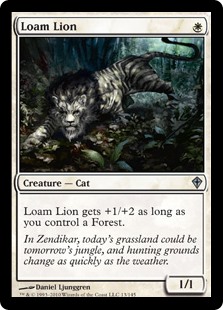 Each list featured cards I wanted to cut immediately: worse-Nacatls Kird Ape and Loam Lion out of the Mantis build, and unexciting meta-breaker Loxodon Smiter out of the Flayer build.
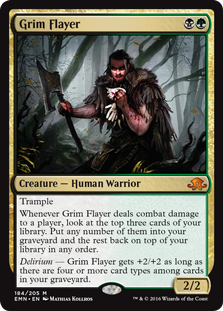 Grim Flayer's constraints are a bit more complicated. Mantis asks us to pack a high density of creatures, but Flayer wants a diverse array of card types. There's a reason they don't play this guy in Humans: he's just not worth two mana without delirium. Delirium gets even tougher with Bloodbraid in the mix, since the best enablers (Mishra's Bauble; Tarfire) are miserable cascade hits.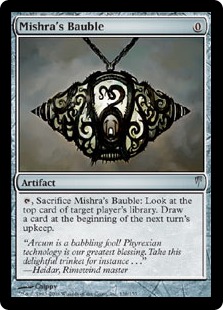
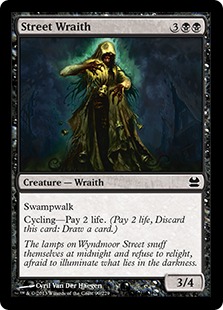 Keeping this result in mind, I took a minor detour from my original mission to try supplementing them with Flayer and Nacatl.
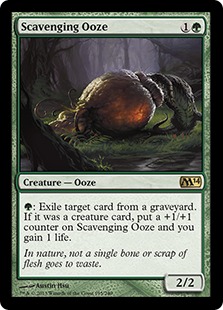 So it was back to the Mantis-Flayer drawing board, now with some valuable lessons learned. No Wraith meant a return to Hierarch, and subsequently, a way to use the excess mana. I turned to Scavenging Ooze, an incidental grave-hater with wide applications against midrange decks. Manamorphose and Inquisition of Kozilek made the cut over Seal of Fire and Tarfire for help with delirium.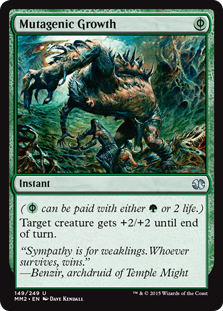
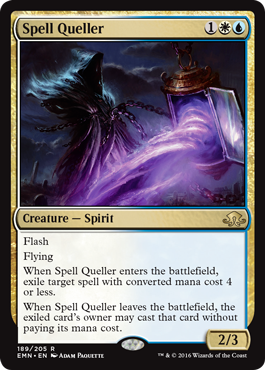 Queller's a bit more complicated. It turns our 3/2 haste into a 2/3 flying and insulates us against removal spells, most notably sweepers—should Queller die, we get to cast Elf for free, which again triggers cascade. It's a shame the Spirit doesn't boast a "may," as 2RG for Vulshok Berserker and Talon Trooper is a fine rate. But it's still a counterspell we can run alongside cascade, and one the deck needs.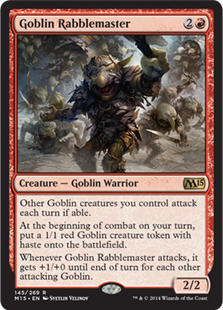
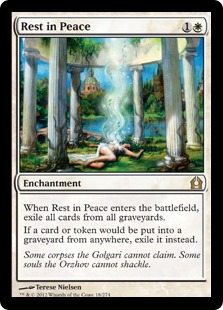 An unthinkable include for my delirium builds, Rest in Peace also appears here. This card is really gross, but
 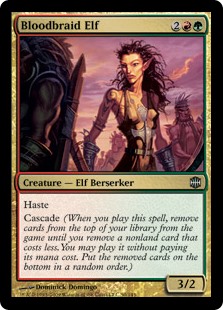 The most obvious draw to this deck over Humans is its access to non-Human creatures. Queller has some coverage with Kitesail Freebooter and Meddling Mage, but does more than either of those creatures by itself, even sapping enemy mana. Scavenging Ooze gives us a much-needed mana-sink, as Humans too is prone to flooding. But Bloodbraid Elf is the deck's biggest gain, providing a Collected Company
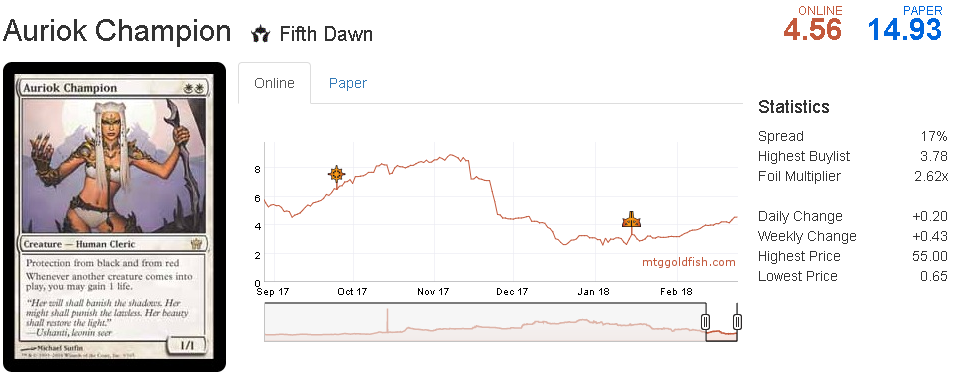
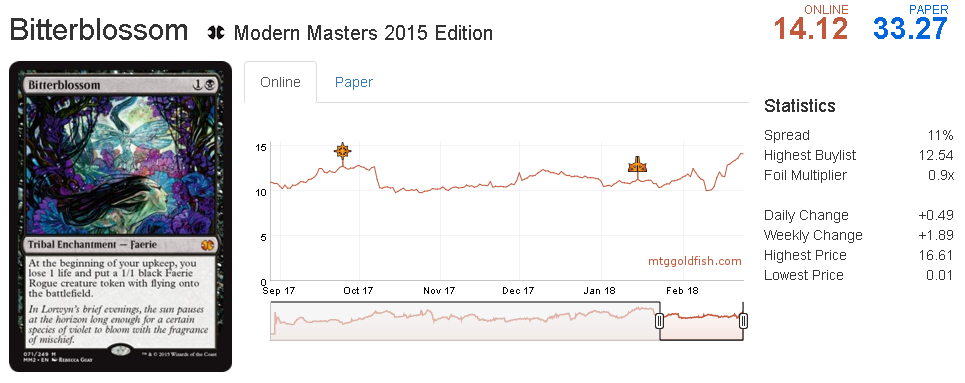
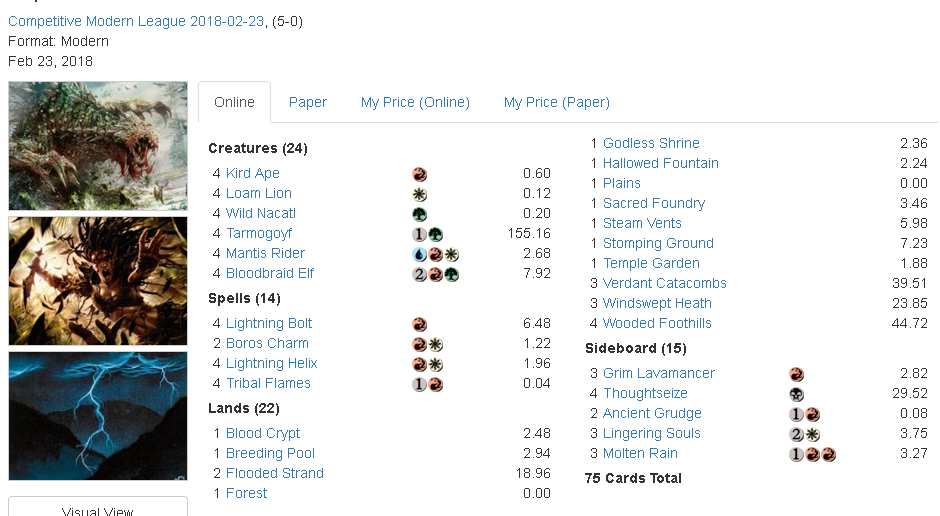
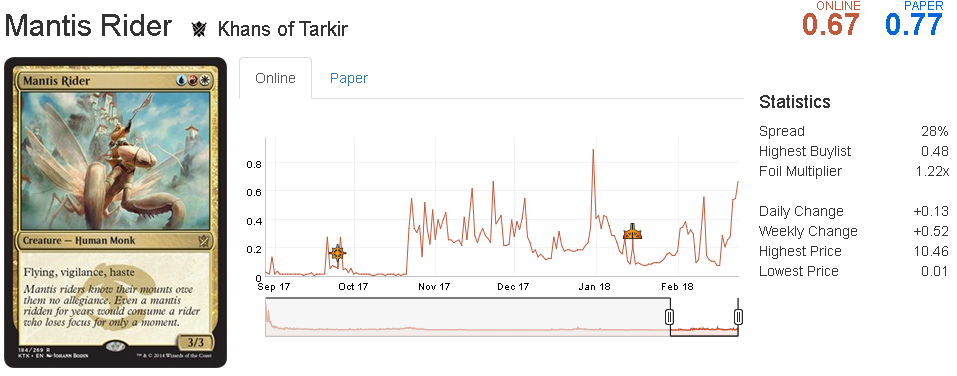
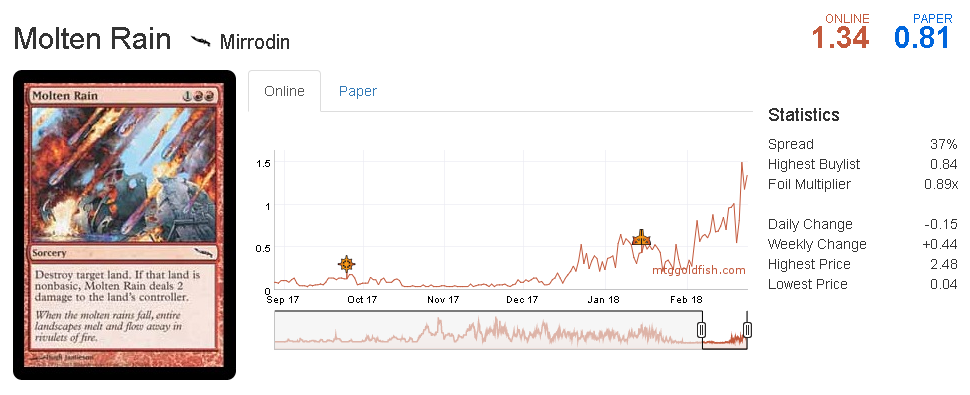
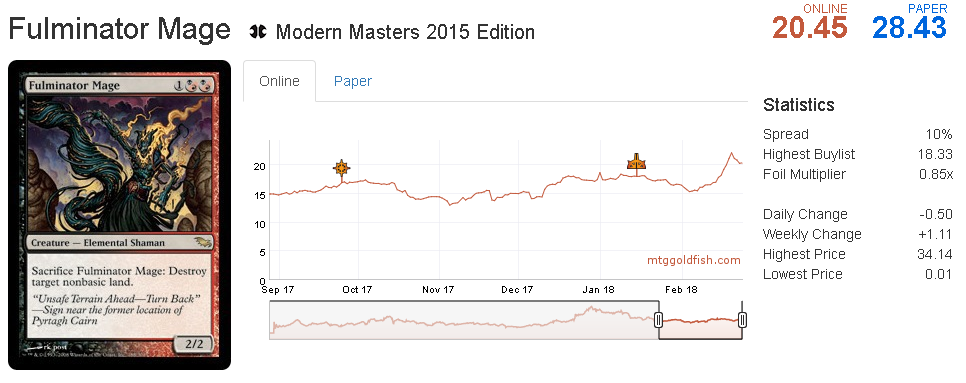





 While I think that this sideboard is still very much a work in progress (for example, I would really like to see some number of Fiery Justice to address faster creature decks), I do like the premise of pairing Bloodbraid Elf with its onetime Standard teammates in Wild Nacatl and Knight of the Reliquary, and then tacking on a ton of burn and a variety of top-end creatures.
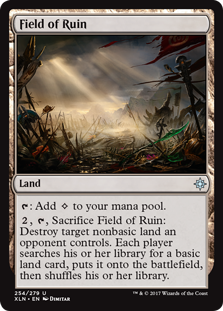
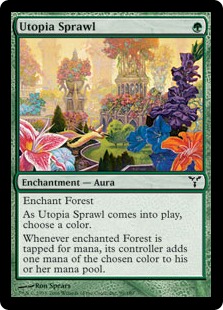 We'll next examine a deck that has put up competitive results in the past, but is incidentally boosted by the return of Bloodbraid Elf: RG Ponza. Ponza is reliant on early accelerants to power out land destruction spells and delay its opponent's development; then, it ends the game with fatties cast ahead of schedule. It has sometimes faced the problem of drawing lots of disruption but no way to actually close the game, or investing lots of card capital in accelerants, and then running out of gas in the midgame.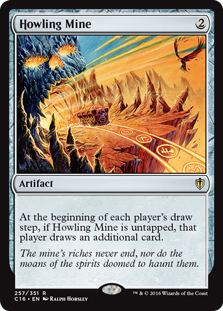
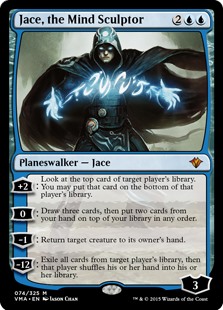 You'll notice that I devoted significantly more space talking about decks leveraging Bloodbraid Elf to good effect than I did discussing ones on Jace, the Mind Sculptor. This is by design, as I feel that thus far, the Elf has proven to be the more versatile card for deckbuilding purposes.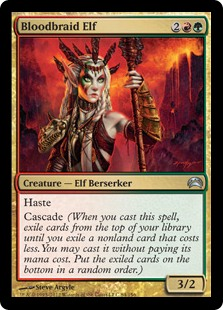


 Meanwhile, Bloodbraid gains back tempo, catches you up on card advantage, and then kills or at least heavily pressures Jace.
 these cards in that type of matchup is superior to not playing them. I think the results of my data will play out over the long-term, as Modern moves closer to solving itself, with decks gradually fading away until only the best remain.