menu

Bring a Little Halloween Flavor to Your Commander Table

Are you a Quiet Speculation member?

If not, now is a perfect time to join up! Our powerful tools, breaking-news analysis, and exclusive Discord channel will make sure you stay up to date and ahead of the curve.

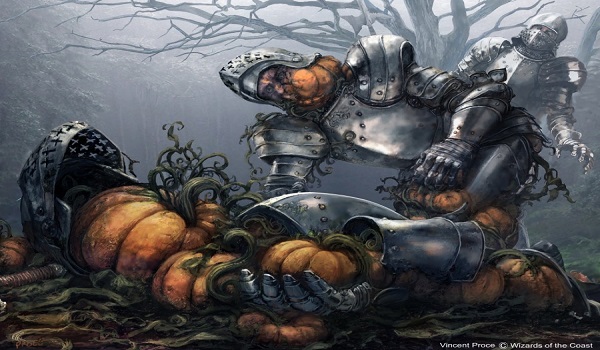
Costumes, candy, pumpkin spiced everything. The Halloween season is loved by many. If you are both a Halloween and Magic enjoyer, then why not combine them both?

There was an error retrieving a chart for All Hallow's Eve

Here are some ideas for Commander-centric rules for the month of October. Introducing additional rulesets like these is not only festive, but it adds a twist to your game nights that can make for unforgettable rounds of Magic. Of course, don't feel obligated to use rules you don't think sound fun. Use what sounds good and modify what does not!

What Counts as "Halloween?"

Whatever your playgroup decides, of course! It can be broad or narrow, horror-based or seasonally-charged. With this in mind, the most important question to ask is what counts as Halloween for the purposes of your Magic games. Some tribes like Zombies, Vampires, and Werewolves have a fairly established presence in the spooky season. However, there's nothing saying that Eldrazi are not the most terrifying ghouls out there, or that Shapeshifters aren't the best cosplayers.

What about sets? There are definitely several entire sets like The Dark, Innistrad, or Throne of Eldraine that are sure to be hits given their themes. Of course, Magic has so much more which will fit. For me, nothing says Halloween like trick-or-treating. So how do we incorporate that into a game of Magic?

Halloween Rule: I've Got Candy

First, each player needs to bring some delicious candy to their game night. Obviously you want to use individually-wrapped, bite-sized candies. Each player starts with ten pieces of candy. The objective is to get candy, and it's a limited resource. What does candy do? Well you could eat it, but you probably shouldn't. If you run out of candy, you lose! You acquire more candy from other players through diplomacy and trick-or-treating.

There was an error retrieving a chart for Gingerbrute

One thing to note is that if you are eliminated from the game, you keep your excess candy. This is important for scoring purposes but also because hey, at least you got candy!

Candy-Based Diplomacy

Players are completely free to exchange candy, bribe, and, otherwise engage in normal Commander-style diplomacy. When a player wants to kill one of your things, maybe they could be talked into killing something else for a candy. The introduction of an outside factor like candy changes the relative value of all cards. This makes even universally recognized good cards less automatically powerful.

There was an error retrieving a chart for Giant Opportunity

With this in mind, all players should recognize that table talk is very, very important. A single candy can be a Counterspell, a Vindicate, or a Disenchant that doesn't cost you a card or mana.

Halloween Rule: Trick-or-Treat

Trick-or-treat adds a new mechanic to the combat step. Before you declare attackers, you ask opponents, in turn order: "trick or treat?" Resolve each choice before tapping and declaring attackers. For each opponent that says "treat," you take one candy from them, and cannot attack them this turn. Simple enough. But what about "Trick?"

There was an error retrieving a chart for Tricks of the trade

"Trick" means that for each of your creatures that deals combat damage to an opponent, you take one of their candies. However, for each attacking creature of yours that the defender "tricks," they take one candy from you. To trick a creature, they merely need to bounce it, kill it, exile it, or even return your creature to the hand. Combat definitely gets dicier when candy is on the line. For the purpose of this variant, the name of the game is "trick!"

Halloween Rule: Pumpkin Points

At the last local Commander event, we played for points. In my opinion, it made the games better, and showed that every decision counted. While many of the points were freebies, others were fairly difficult. Consequently, every single point mattered! With that in mind, here are some suggestions for thematic Halloween points to try out.

There was an error retrieving a chart for Get The Point

If you are combining both candy and points, you might notice that it is entirely possible to eliminate a player but not acquire all of their candy; this is entirely intentional. One-shotting someone with infect or commander damage is likely to only get you one candy out of the deal. Looping various things to win might kill the entire table, but not get you any candy at all. To get the maximum amount of candy, you need to pace yourself and play a little fair.

Play Points

  • Trick-or-treat at least once: 1 Point
  • Be the First trick-or-treater: 1 Point
  • Eliminate a player with treat: 1 Point
  • Eliminate a player with trick: -1 Point
  • Have the most candy at end of game: 2 Points
  • Player is costumed as their commander: 1 Point

Build Points

  • Commander is Werewolf/Vampire/Zombie/Spirit-type: 1 Point
  • Thematic Halloween Deck (tribal, artwork, set restrictions): 1 Point
  • Everything 13 (include exactly 13 cards of each type: creature, sorcery, instant, planeswalker, artifact, enchantment, nonbasic land, or 91 total; 8 basic lands; 1 commander): 2 Points (13 points would be too many!)

Fun Points

  • Bring candy to share with the table: 1 point
  • Who brought the best candy: 1 point
  • Which deck best represented Halloween: 1 point

Do We Have to Trick-or-Treat for Candy?

No, of course not. Because some individuals cannot eat or do not like candy, no one should be forced to use a game mechanic they don't enjoy. What if no one is interested in trying out variants? Well, you can still dress up and bring candy for fun. However, it makes for a healthy metagame to try new things from time to time!

There was an error retrieving a chart for Kongming's Contraptions

There are plenty of Magic variants already in existence that can easily be adapted for seasonal play. Archenemy sounds superb with sufficiently spooky schemes. Or a monster mash of Grand Melee proportions with survival horror enchant world elements. Two-Headed Giant with team Vampires versus team Werewolves? There really are infinite possible combinations. Take advantage of the season's pervasive thematics to stir up your local group's creativity, and you're bound to have a great time!

Magical Creatures: Moonfolk and Zubera

Are you a Quiet Speculation member?

If not, now is a perfect time to join up! Our powerful tools, breaking-news analysis, and exclusive Discord channel will make sure you stay up to date and ahead of the curve.

Hello everyone, and welcome back to Magical Creatures. In this series, I'm analyzing every creature type that's unique to Magic: The Gathering. The last installment dealt with three subtypes from the Mirrodin block: Vedalken, Blinkmoth, and Bringer. And the first piece of this series, in case you missed it, was about setting the criteria to consider when choosing what creatures to discuss. Uniqueness is key, but as you'll see in today's piece, I'm still not about to miss a chance to delve deeper in Magic's lore!

Last week, we finished our double feature on the Mirrodin block. It introduced six creature types unique to Magic, and thus I had to split it into two parts. What now? Today is time to change block again, and move to Kamigawa! Before discussing the new creatures in more detail, let's take a look at this infamous block.

An Ill-Famed Block

If you played back in the days, you may recall the bad reputation of the Kamigawa block. Born between 2004 and 2005, it was the tenth block in the history of Magic, and possibly the least popular. Many players reportedly quit the game for good! How come? The fact is that Champions of Kamigawa (as well as its two expansions Betrayers and Saviors) was considered a failure both regarding its power level and its design.

In terms of power level, there's not much to be said. The Mirrodin block was so packed with overpowered cards that it would have been hard (not to mention reckless) to match. The following block, Ravnica, went back to powerful spells, leaving the block in between a bit overshadowed. And the design? This is where personal taste really starts affecting one's judgment. If you ask me, I didn't hate Kamigawa at all. On the contrary, I liked it better than Ravnica, and considered it close to Mirrodin! Maybe the books by Scott McGough had an influence, but still. As you'll see from the gallery below, however, Kamigawa too contributed some very powerful cards to this game.

A Dive into Japanese Folklore

Kamigawa's focus on Japanese mythology makes it the block most connected to a certain culture since Arabian Nights, and for a long time, it was the only block to be set on the plane of Kamigawa. That is, until the release of Kamigawa: Neon Dinasty in February 2022. The premise behind this block is a typical "what if:" what if the boundary separating the physical world and the world of the kami (or spirits) collapsed? In a setting which is very similar to feudal Japan, of course.

The first consequence of this premise is the kind of creatures to see print. If you look at the creature types used in these expansion sets, it doesn't even look that weird. The five new subtypes were Advisor, Monk, Moonfolk, Samurai, and Zubera. Of these, only Zubera sounds funny, but the rest is easily understandable. Advisor, Monk and Samurai are just classes, not even races. As for Moonfolk, it's a generic term for any people who live on or come from the Moon, right?

If you look at the other creature types, those that were used in this block but had also appeared in previous sets, things look even more normal. You find all the typical creatures, such as Demon, Goblin, Ogre, Rat, Snake, and so on and so forth. So where is the novelty? The Japanese culture?

A Shift in Creature Representation

The fact is that even though a given creature might has the subtype Goblin, the illustration actually shows an Akki. And if another creature has the subtype Snake, the art depicts an Orochi. The same goes with Fox (Kitsune), Rat (Nezumi), and so on. As far as I'm concerned, this was a brilliant move to achieve two goals. First, to (mostly) keep the regular creature types, so as to maintain interactions and tribal synergies with creatures from other blocks. Second, to nonetheless produce a complex pool of cards that looked different. Any card from that block is immediately recognizable from its art, and yet can still smoothly merge with other cards. What more could you want?

Not your usual fox, rat, goblin and snake

Now, since this series focuses on creatures unique to Magic, we'll have to leave things there regarding Nezumi, Orochi, and the like. In fact, most of them are not technically new to the fantasy world, but rather come directly from the Japanese folklore. If we really want to be strict, the only subtype that belongs to our series is Zubera (although it's coming from a Japanese concept, too).

However, I'm willing to include Moonfolk as well. The reason is that even though most cultures have at least some legends about people living on the moon, this is the only one that gained a new subtype for Magic. While Kitsune, Nezumi, Akki, and Orochi were respectively considered foxes, rats, goblins and snakes, Soratami received a brand new creature type. So, without further ado...
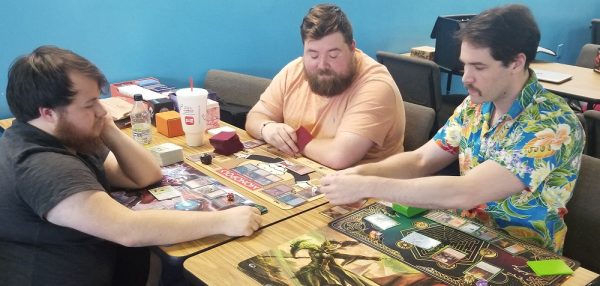
Moonfolk

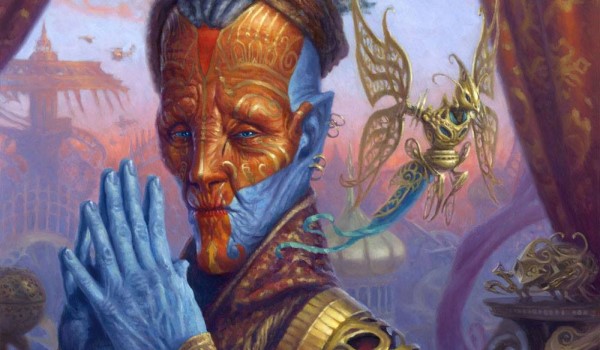
As I had anticipated at the end of last week's piece, we were going to see another blue creature, a sort of cousin to Merfolk and Vedalken. Enter the Soratami, a mysterious race of flying, humanoid beings that live in the clouds. Their slim bodies, gray-blue skin, and strong blue alignment all bear a resemblance to the Vedalken. Which doesn't really makes any sense, since they are actually very different races. The only other feature they share is the interest towards magical arts, and the high proportion of Wizards when it comes to their class.

Soratami and their palace

One last thing about their appearance: since the Japanese traditionally see a rabbit's profile on the Moon, Soratami were designed with a very special feature. In case you didn't notice, most of them have long, dangling ears hanging down from their heads. Which means they could have been made Rabbits, if only such creature type was supported in Magic!

25 cards exist with this subtype, and they all come from the same plane. Over a half of them come from the original Kamigawa block, with the rest added in Neon Dynasty. What about their mechanics? The most widespread ability, at least in the original Kamigawa block, is one that requires you to spend some generic mana and return lands to your hand in order to trigger an effect. Even rare creatures, such as Uyo, Silent Prophet and Meloku the Clouded Mirror, share the same activated ability. And most of them fly, too, which makes sense since they dwell on a "palace in the clouds."

Four shapes of Tamiyo

Another interesting thing to note is that we even have a Moonfolk planeswalker! Who would have guessed, back in 2004? Planeswalker had yet to be introduced as a card type; that only happened with the Lorwyn block, three years later. Today, however, we have no less than four different cards, all referring to Tamiyo. And you can immediately tell she's a Soratami, although being a Planeswalker, none of these cards bear the Moonfolk creature type.

Zubera and Kamigawa's Limited

The other subtype I wanted to discuss in today's piece is Zubera. And, as anticipated, it's the only creature type that really belongs to this series. So, why did I hint that it also borrowed something from Japanese culture? Well, its name comes from the term "zuberabo," meaning "smooth-face," and thus "faceless." There are many legends in Japan concerning this creature, and they always end badly for those who have the misfortune of crossing their path.

Apart from their origin, what are Zubera creatures in Magic? They are described as the "faceless kami of a human who has been pulled into the spirit world". So, they are basically spirits. And that's why every Zubera ever printed (which is not that many) also bears the subtype Spirit. But there's a reason linked to the game, too. According to Aaron Forsythe, the creative team took this decision "so that they could key off of type when they died."

Old and new zuberas

In fact, the ability shared by the first five Zubera creatures was a triggered ability: when this creature dies, you do something for each Zubera that died this turn. This could be gaining life, drawing cards, making your opponent discard cards, and so on. The typical actions you would expect from each color, right?

And they don't look that powerful... unless you could find a way to trigger them all at the same time! Devouring Rage and Devouring Greed, perhaps? Even if not, they are much scarier than one would think, at least in Limited formats. And this is why they were a thing in Kamigawa drafts!

A Crossover from Japanese Culture into Magic Lore

The most important trend we saw today is doubtless the unique and ambitious project to transpose elements of the Japanese folklore to Magic. While maintaining the old, reassuring, and (game-wise) more coherent creature types, Kamigawa also folded a whole new universe into the game. It did so through names, flavor text, and illustrations. In my opinion, it was a masterpiece of a crossover.

What do you think? Are you a supporter of this plane, or did it leave you indifferent? Were you playing at the time of the first Kamigawa block, or maybe only when Neon Dynasty was released? Let me know in the comments or on Twitter!

Vending Preparation: The Second Go Around

Are you a Quiet Speculation member?

If not, now is a perfect time to join up! Our powerful tools, breaking-news analysis, and exclusive Discord channel will make sure you stay up to date and ahead of the curve.

Back in May I vended my first event, and was able to cover it over two articles. I learned a lot of valuable lessons from that first experience, and want to build on those for my second event. With that event coming up, I've got some preparation to do... and am looking to share my head start with you lot at Quiet Speculation!

Pre-Event Marketing

Before the last event began, I had three presales setup via social media ahead of time. While that number isn't massive, it did make sure I would have some known customers, and that I would have cards I knew they wanted.

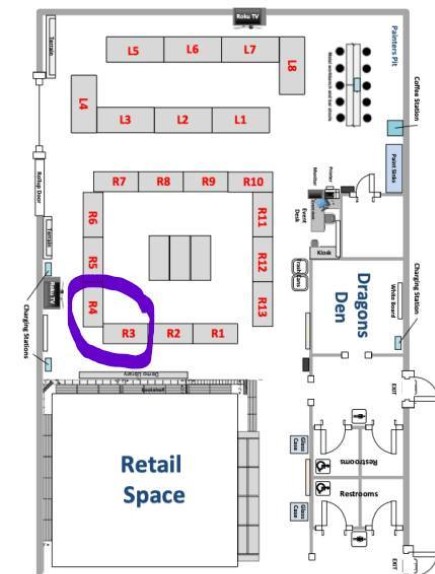
Unfortunately, two of them were not prepared to buy on-site, as they only had credit cards. As I have been preparing for this event, I have reached out more on my local Magic Facebook groups to let people know three things: that the event was happening, that I would be there, and crucially, where I would be located. I highlighted my specific "booth" location on the overall map the store sent out, included a bigger list of what types of things I would be offering, and emphasized that I was interested in buying, as well.

Booth Location - Venue Layout

Table Layout

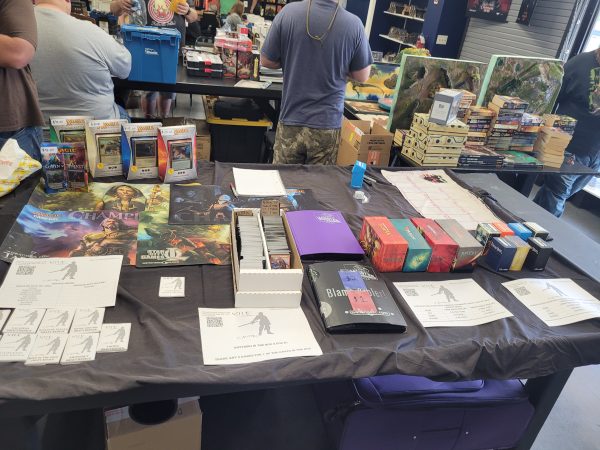
While I did consider my table layout to some degree before my first expedition into the world of vending, I didn't dig into the details enough. As a refresher, this is what my table looked like last time.

Table Layout from First Vending Experience

A few things jump out at me as I look over my layout pictures.

  • Horizontal vs. vertical space: I have a lot of things laying out horizontally in this picture. This means that my customers must be standing up close and somewhat over my products to get a good view of them. For my upcoming event, I plan on stacking things and working on a bit of a display stand that will allow me to have more product displayed.
  • Low dollar value per square foot: I had exactly 32 square feet worth of display space. The only things worth more than $15 on that table were a few cards in the purple binder and the sealed commander decks in the back corner. Even worse, the items worth $2 or less take up over half the overall table space.
  • No "hotlist" display: I have been to a fair number of Grand Prix, and one thing that I always check when I first get on site is the vendor "hotlists." Typically these are boards, TV screens, or printouts of the cards the vendor is most in need of, and is paying a premium on. There were a few cards I was looking to pick up that I would have paid more than my going rate on, but I had to "inject" that information into the conversations I struck up with customers, which wasn't ideal.
  • Tall tables: While it may not be apparent from this picture, the space I purchased last time is typically used for their table top games, and is thus higher off the ground to accommodate people standing around it. This meant that I was sitting on a tall stool for four hours, which provided no back support. For my upcoming event, I have purchased two smaller tables of normal height.

Put Yourself in Your Customer's Shoes

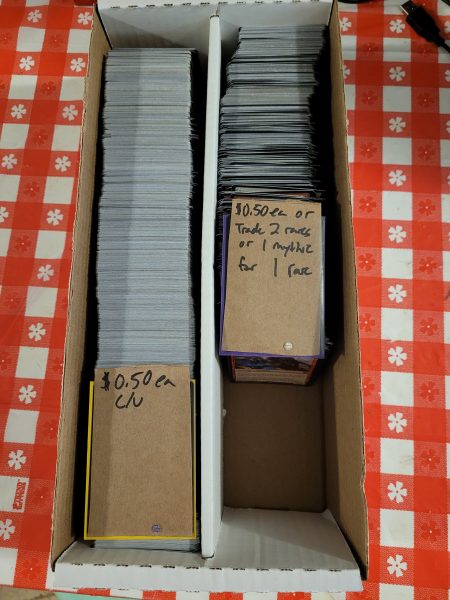
2-for-1 box

Previously, I had a "2-for-1 Box" which allowed people to trade in two rares for one rare out of the right side of the box, or purchase two rares for one dollar. There were two issues with this. the first and most obvious was that I should have split the box into two so that people weren't trying to get cards from the left side for two rares. This issue caused some confusion and made for some awkward conversations.

The rate itself was also a bit unbalanced in that I typically offer between 9 and 10 cents per bulk rare, so people were somewhat confused by their rares being worth twice as much when trading into this box. Essentially, this made the box encourage trading in much more than buying.

For this next go around, I have decided to make it a "3-for-1" box, which means that the trade-in value of a rare essentially matches my cash price + trade in bonus and allows people to buy the other cards cheaper.

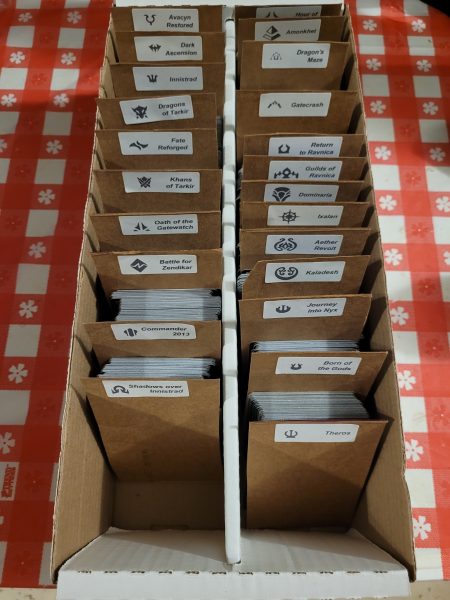
I imagine many of you are like me in that when you see these boxes at Grand Prix, they call out to you, saying "find my hidden gems!" I am hoping that potential customers will get that same feeling for my new box, which has everything sorted by set to make digging for specific card(s) easier. This is something I personally would prefer when digging, but given it takes up front time for something the vendors typically view as low-value money, I am not surprised they don't.

3-for-1 box

Back on the Block

I am excited to get back to vending, even if it is a small event. I enjoy the face-to-face time with customers that you don't get when selling over the internet. I think that those conversations about decks they want to build and their views on the metagame of various formats serves as both a way to reconnect with people over a game we all love and highlights what type of inventory one should look at picking up for future sales.

Lastly, I pre-priced cards ahead of time, and while it made it easy for people to know how much they were spending and to decide whether or not they wanted to buy a card, it was very time consuming up-front. I don't know if it was worth the effort, so I am still on the fence as to whether I will put in the time again. If anyone else has vendor experience with pre-pricing, I would love to hear your thoughts in the comments. Otherwise... which set would you dive into first at the 3-for-1 box?

Avatar photo

David Schumann

David started playing Magic in the days of Fifth Edition, with a hiatus between Judgment to Shards. He's been playing Commander since 2009 and Legacy since 2010.

View More By David Schumann

Posted in Free, VendingLeave a Comment on Vending Preparation: The Second Go Around

Have you joined the Quiet Speculation Discord?

If you haven't, you're leaving value on the table! Join our community of experts, enthusiasts, entertainers, and educators and enjoy exclusive podcasts, questions asked and answered, trades, sales, and everything else Discord has to offer.

Want to create content with Quiet Speculation?

All you need to succeed is a passion for Magic: The Gathering, and the ability to write coherently. Share your knowledge of MTG and how you leverage it to win games, get value from your cards – or even turn a profit.

Devotion to Pioneer: Why Only Green?

Are you a Quiet Speculation member?

If not, now is a perfect time to join up! Our powerful tools, breaking-news analysis, and exclusive Discord channel will make sure you stay up to date and ahead of the curve.

As evidence comes in, opinions and conclusions must change. To hold onto them in the face of contrary data is childish stubbornness. However, said opinions shouldn't just be thrown away, either. Every piece of evidence must be critically evaluated. If the data is questionable, then any conclusions based on it must also be considered questionable. Valid data and results should be considered contrary evidence and used to reevaluate previously held ideas.

Case in point: A bit over a month ago when I covered Liliana of the Veil making it into Pioneer, I predicted that she would lead to Mono-Black Devotion becoming more of a thing than it currently was. So far, I've been kind of right. That also means I've been kind of wrong. Why this has happened says a lot about Pioneer as a format.

Always Trying

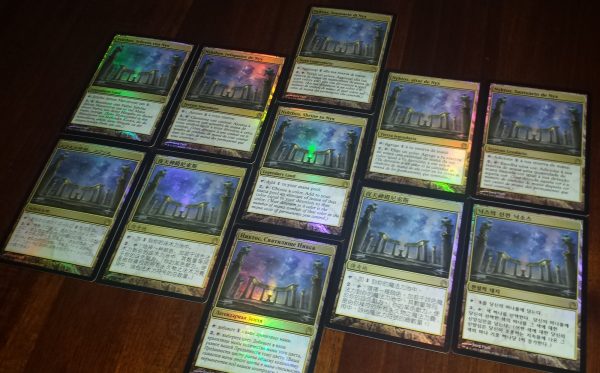
Dominaria United brought a surprising number of mono-black cards, and players were quick to take advantage. Liliana was obvious, but Evolved Sleeper was a nice pickup as well. A solid early beater, it's also a great late-game mana sink for Nykthos, Shrine to Nyx. What I wasn't expecting was Sheoldred, the Apocalypse making waves. It turns out that a 4/5 for four with a punisher mechanic is quite solid. Individually, these cards were quite good, but together with Gifted Aetherborn built a very solid devotion curve, and players tried to take advantage:
Mono-Black Devotion, FAdvisor82 (MTGO 5-0, 9/5)

Creatures

4 Evolved Sleeper
4 Gifted Aetherborn
1 Tymaret, Chosen from Death
2 Murderous Rider
2 Sheoldred, the Apocalypse
2 Gray Merchant of Asphodel

Planeswalkers

2 Liliana of the Veil

Instants

4 Fatal Push

Sorceries

4 Thoughtseize
2 Invoke Despair

Enchantments (9)

4 Warlock Class
2 The Meathook Massacre
3 Leyline of the Void

Lands

4 Castle Locthwain
1 Hive of the Eye Tyrant
1 Ifnir Deadlands
4 Nykthos, Shrine to Nyx
12 Swamp
1 Takenuma, Abandoned Mire
1 Urborg, Tomb of Yawgmoth

Sideboard

1 Duress
2 Noxious Grasp
2 Parasitic Grasp
1 The Meathook Massacre
1 Liliana of the Veil
2 Liliana, the Last Hope
1 Leyline of the Void
1 Sorin the Mirthless
2 Gray Merchant of Asphodel
2 Thought Distortion

When I said that Mono-Black Devotion should exist in Pioneer, this is what I was thinking of, though there are some odd choices. I have to believe that Warlock Class is only there as a Nykthos sink, the effect is pretty small otherwise. Similarly, maindeck Leyline of the Void can only be explained as free devotion, as the metagame barely calls for graveyard hate. There are a bunch of other numbers I'd quibble with too, but overall this seems like a solid way to build the deck.

However...

The problem is that this doesn't appear to be working out. Dedicated black devotion decks have had extremely limited success. Mono-black decks are overall seeing more play than pre-DMU, but they're hardly setting the world on fire. If Nykthos sees play at all, it's as a one-of.

Mono-Black Midrange, Surebud (MTGO Preliminary 3-1, 9/23)

Creatures

3 Evolved Sleeper
3 Gifted Aetherborn
3 Tenacious Underdog
3 Graveyard Trespasser
4 Murderous Rider
1 Kalitas, Traitor of Ghet
2 Sheoldred, the Apocalypse

Planeswalkers

3 Liliana of the Veil

Instants

4 Fatal Push

Sorceries

4 Thoughtseize
1 Sign in Blood
1 Agadeem's Awakening
2 Invoke Despair

Artifacts

2 Reckoner Bankbuster

Lands

3 Castle Locthwain
4 Field of Ruin
2 Hive of the Eye Tyrant
1 Nykthos, Shrine to Nyx
12 Swamp
1 Takenuma, Abandoned Mire
1 Witch's Cottage

Sideboard

2 Duress
1 Noxious Grasp
1 Go Blank
2 Lifebane Zombie
2 Witch's Vengeance
2 Extinction Event
4 Leyline of the Void
1 Invoke Despair

It might be easy to brush off the lack of Nykthos in this deck as a function of too many colorless lands given the Field of Ruin. That is quite similar to why Standard Mono-Blue Devotion only ran one, after all. However, again, this deck is an aberration for playing any Nykthos, so clearly there's a problem with the card. One that cannot be solved with Urborg, Tomb of Yawgmoth.

The Rival

The obvious reason for this faltering launch is that there's already a strong midrange black deck in Pioneer. Yes, it's actually a Rakdos deck, but it's not an equal RB split. It's more rB, with far more mono-black cards than mono-red ones.

Rakdos Rock, Bryzem1 (MTGO Preliminary 3-1, 9/23)

Creatures

4 Bloodtithe Harvester
1 Kroxa, Titan of Death's Hunger
1 Tenacious Underdog
3 Bonecrusher Giant
3 Graveyard Trespasser
2 Kalitas, Traitor of Ghet

Planeswalkers

3 Liliana of the Veil
1 Chandra, Torch of Defiance

Spells

1 Bloodchief's Thirst
4 Fatal Push
4 Thoughtseize
3 Dreadbore

Artifacts

1 Unlicensed Hearse

Enchantments

4 Fable of the Mirror-Breaker

Lands

4 Blightstep Pathway
4 Blood Crypt
1 Castle Locthwain
2 Den of the Bugbear
4 Haunted Ridge
2 Hive of the Eye Tyrant
2 Mountain
1 Sokenzan, Crucible of Defiance
3 Swamp
1 Takenuma, Abandoned Mire
1 Urborg, Tomb of Yawgmoth

Sideboard

2 Duress
2 Rending Volley
2 Abrade
2 Epic Downfall
1 Unlicensed Hearse
2 Go Blank
1 Hidetsugu Consumes All
1 Lifebane Zombie
1 Extinction Event
1 Skysovereign, Consul Flagship

Rakdos Midrange has been a solidly performing deck in Pioneer for quite a while now, and the addition of Liliana has largely done what I expected. Gone are the other cheap planeswalkers and the deck is far more attrition focused than before. With this pedigree, there would naturally be resistance to a new deck in the same metagame niche.

The Main Advantage

However, a strong enough game plan would win over converts regardless of entrenchment. The fact that this didn't happen is instructive, and it comes down to the irreplaceable red spells. Surprisingly, these are neither Kroxa, Titan of Death's Hunger nor Bonecrusher Giant, whose primary functions can be replicated by another Liliana and Murderous Rider respectively. Not perfectly, to be fair, but close enough to make only a minor difference.

There was an error retrieving a chart for Fable of the Mirror-Breaker

No, the problem is that there's no good replacement for Bloodtithe Harvester or Fable of the Mirror-Breaker. I found this very surprising, but my testing and testimonials from other players confirmed this conclusion. It's an issue of velocity. While the bodies that both cards are quite relevant, the main draw are the rummage effects. Harvester's blood token and the second chapter of Fable are the glue holding the whole deck together, and while there are alternatives available, none are as efficiently powerful as Harvester and Fable.

Pioneer's Problem

As everyone I've ever discussed Pioneer with has said, there's something inherently clunky about Pioneer. It represents a swath of often contradictory design philosophies in Magic's history and lacks a solid anchoring identity. Legacy has blue cantrips and Force of Will. Modern has its fetch/shock lands manabase. What is Pioneer built around? I don't know, and nobody I've asked agrees on anything.

There was an error retrieving a chart for Nykthos, Shrine to Nyx

A lot of this is that the card pool is quite weird. There's a lot of power concentrated in a few sets with wildly different design philosophies. Khans of Tarkir was card advantage and card draw rich with powerful three mana or more threats while simultaneously being poor on answers. Streets of New Capenna has great low-end threats, looting effects, and answers. The power's all over the place and the deckbuilding options are wildly inconsistent.

There was an error retrieving a chart for Treasure Cruise

Consequently, any deck that wants to can draw lots of cards, but generally as high-end effects like Treasure Cruise. Cheap ways to smooth out draws are quite thin. Any deck that has access to looting or rummage effects has an advantage over those that don't, and this is true for Rakdos vs Mono-Black. The latter has strong card advantage but getting to the point where it can actually deploy it is harder than Rakdos' cheap rummaging. Thus, Rakdos is better at overcoming Pioneer's innate clunkiness than Mono-Black and is rewarded with more and better results.

The Nykthos Problem

All of that goes a long way to explain why Mono-Black Devotion isn't catching on, but it doesn't help with why Nykthos sees relatively little play. Powerful, colorless mana engines are usually more widely adopted but that isn't true of Nykthos. My testing showed that it can work in non-green decks, but nobody really tries. So, I asked several players working on mono-black decks at my LGS whether they'd tried Nykthos out and what they thought. While each had multiple answers, there were two in common that were illuminating.

#1 Nykthos Is Clunky

The main point that everyone agreed on was that too many Nykthos made their deck clunky. There were too many hands rendered unkeepable when the only lands were Nykthos. This wasn't helped by Urborg because drawing too many of those is equally bad. Without Expedition Map there's no good way of ensuring that the critical cards are found without having to play too many and therefore make the deck inconsistent.

There was an error retrieving a chart for Urborg, Tomb of Yawgmoth

#2 Nykthos Is Kinda Useless

This was a shock to me, but they all agreed that they didn't actually need Nykthos, so it wasn't worth risking the above clunk. While a pile of mana is always great, their testing showed that they didn't need to deploy more than two spells a turn, so paying for them via normal lands was always an option. Using Nykthos as an investment for their top end sounded like a good idea, but they...don't really have one. Invoke Despair is the best curve topper any of them had found, and at five mana isn't something for a Nykthos deck. Consequently, Nykthos didn't do anything, so it got cut for other utility lands.

There was an error retrieving a chart for Invoke Despair

At Last, An Answer

That last point has finally answered my longstanding question. There aren't more Nykthos decks in Pioneer because only green can make use of the mana. There's no reason for a blue devotion deck to exist, Spirits is just better. Black and red have devotion decks but they can't really do anything with Nykthos as they don't need to build mana for a massive endgame. They're perfectly fine chipping away at their opponents with already affordable cards.

There was an error retrieving a chart for Torbran, Thane of Red Fell

Green devotion, on the other hand, needs Nykthos to power its game plan. While initially, Mono-Green was a straight beatdown deck, it's now more of a combo deck that beats down as a backup plan. It needs the mana to power out Storm the Festival and then power its Chain Veil combo finish. The ramp is meaningful and the mana useful.

There was an error retrieving a chart for Walking Ballista

To be fair, the answer was perhaps sitting in front of me this whole time. When Walking Ballista was legal, green devotion and white devotion were both good and players were more willing to make red and black devotion work. Ballista was the game-winning mana sink Nykthos needed, and anyone could use it. Once Ballista was banned, devotion collapsed down to green because no other color needed that much mana. Nykthos is a combo card, not a value card.

It Is What It Is

Pioneer is very strange. It represents an extremely volatile time in Magic's design history. Consequently, there's some tension and inconsistency in the card pool that players just have to deal with. I thought that said card pool should push towards more Nykthos-powered devotion decks, but I never appreciated how most decks just can't make use of the card. I remembered Nykthos as a value engine, but in Pioneer's context, it's more of a combo card. I'll just have to get used to this new reality.

Co-worker Collections: Unlocking the Potential

Are you a Quiet Speculation member?

If not, now is a perfect time to join up! Our powerful tools, breaking-news analysis, and exclusive Discord channel will make sure you stay up to date and ahead of the curve.

Very rarely do I discuss my professional career outside of Magic. This week I want to share a couple of minor details as it relates to this fantastic hobby.

For those who don’t know, I work in research and development at a Fortune 500 company. As a cog in the corporate machine, I meet a ton of new people—there is always someone new coming into a role, someone retiring to be replaced, and new project teams to work with.

To facilitate these “join-ups”, informal one-to-one meetings where we introduce ourselves and share our background inside and outside of work, I have a PowerPoint slide for display. It contains my work history, pictures of my family, and my hobbies and interests outside of work. Included on this slide is my favorite fun fact about me: I write a weekly column for a website about the finance of Magic: the Gathering cards.

Every time I get to this bullet point on my slide, I ask a question…

Tracking Down Lost Collections

Bear with me, this story has a purpose and it relates to Magic. I used the heading “Tracking Down Lost Collections” as a big hint—you probably know where this is going.

When introducing myself to a new co-worker, the first question I’ll ask after mentioning my Magic hobby is if they are familiar with the game. This usually spawns one of three answers:

  1. No, I haven’t.
  2. Yes, I think so. Is that like Pokemon?
  3. Yes, I used to play a while ago.

Each time I bring up my hobby, I get an answer that falls into one of the three categories above. Naturally, I’m most interested in responses of the third variety, where my co-worker not only knows of the game but has even played it in the past. If I get one of the first two responses I politely give a brief summary of what I write about and then we move on. If I receive the third answer, however, I ask the next question: “Do you still have your cards?”

Now we’re getting into statistically infrequent territory. I’ve only met a handful of colleagues who play(ed) Magic (or who are willing to admit they play). Finding those colleagues who not only play(ed) but also still have their cards is even less common. Yet it does happen, and when it does, the most important question comes next.

Obtaining Said Collections

“When did you used to play?”

Depending on the age of my co-workers, the response tends to vary. Most recently, however, I have had two co-workers both state that they still have their collection and they used to play in the mid-1990s. Of course, that could mean a lot of things. They could be sitting on a stack of unplayed Dual Lands and Force of Wills (I met a co-worker like this back in 2007ish) or they could be holding a collection of Fallen Empires, Homelands, and Ice Age bulk. There are a lot of worthless cards in those sets.

No matter the answer, I ask if they can track down their collections and bring them to work so I can appraise them for them. Most of the time if they still own their cards, the cards are sitting in a closet or basement somewhere, untouched for multiple decades. These cards deserve to see play! They deserve to see the light of day! If nothing else, the valuable cards can represent cold hard cash for these colleagues of mine.

I try leveraging these arguments to convince said colleagues to bring in their cards. It’s worked a couple of times, but not many. Luckily, it worked very recently, and I had the pleasure of navigating just such a collection.

About this Collection

My co-worker and his brother used to play back in the day (he’s around my age). When I pressed, he mentioned his collection was still at his parents’ house. Sure enough, after a subsequent visit with his parents, he brought the collection to work.

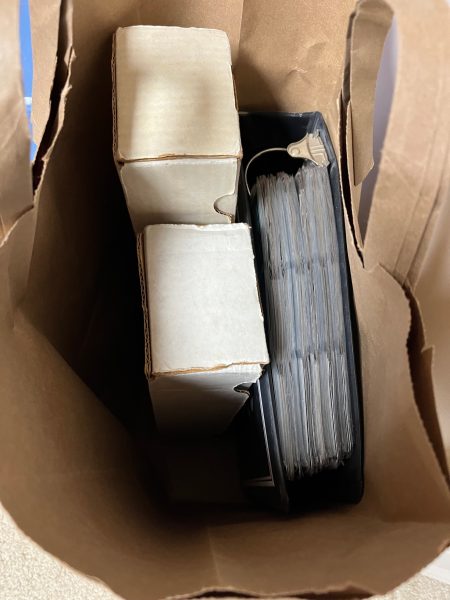
This is exactly how the cards came to me: two boxes and a binder in a paper bag. The boxes were incredible—they had the words “Magic cards” written on them and it was like opening a time capsule.

Immediately I started sifting through the collection digging for Power 9, Dual Lands, and other high-dollar cards. Unfortunately, this collection fell more on the Fallen Empires and Ice Age bulk than the four-figure cardboard spectrum. That didn’t mean there were no valuable cards, however, and it definitely didn’t mean I didn’t have an absolute blast sorting through and organizing the collection to sell for my co-worker.

My Process

When picking a collection, especially a co-worker’s collection, I like to ensure I’m extracting as much value as I can. This demands a rigorous process—one which ensures I can pull out most cards worth picking in a timely fashion.

Finding money cards, especially in older sets without indication of card rarity, can be tricky. Back in 1998, I probably could have picked out most rares from this kind of collection strictly from memory. Those days are gone though. I can still confidently extract cards worth $100 or more with high accuracy, but there are plenty of random $10-$20 cards I don’t know much about thanks to Commander.

The First Pass

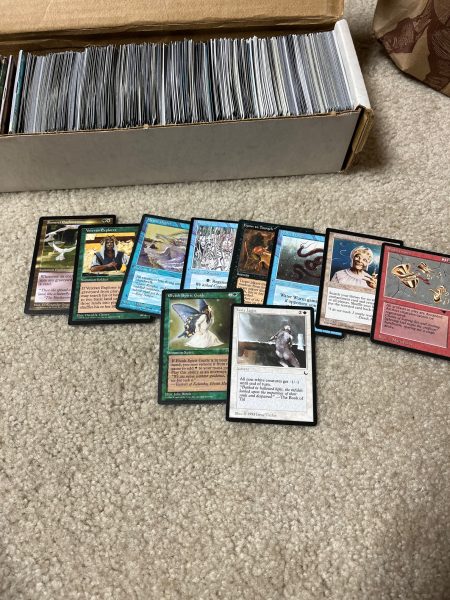
Here are two examples of some cards I pulled out of the two boxes in my colleague’s collection. Shatterstorm was one of the pricier pulls, but I didn’t realize how expensive Enlightened Tutor had gotten.

There was an error retrieving a chart for Enlightened Tutor

I also thought Veteran Explorer would have been money since it sees (saw?) play in Legacy. Apparently not. Oh, and those cards from The Dark were nearly worthless, and I didn’t expect that.

My first pass through the cards was the most exciting, but not the most complete. If you’re familiar with cards from this time period, you’ll know that in the pictures above are some $5-$10 cards, like Didgeridoo, and some near-worthless cards, like Thran Forge. Most excitingly, there’s an Intuition, the most valuable card I found in this collection.

There was an error retrieving a chart for Intuition

The Second Pass

It was time for the second pass.

In order to maximize value within a reasonable amount of time, I sorted all my co-worker's cards by set and color. Why do this? It’s no secret that I’m a heavy fan of Card Kingdom’s buylist. I don’t run a TCGplayer store and I have no intention of trying to piece out all the cards in this collection one at a time. Instead, I’m going to use Card Kingdom’s buylist as a compromise between decent values for these cards and simplicity.

I’ve found the best way to shop Card Kingdom’s buylist is to organize a stack of cards by set and color. Then, I can bring up the buylist for a specific set (and filter down to commons and uncommons if I want) and compare the cards that show up with the collection. Since I can identify the colors of the money cards, it makes it easier to sift through the smaller piles in order to extract said cards. Sorting the collection didn’t take too long (maybe an hour or so) and it made the buylist process so much easier.

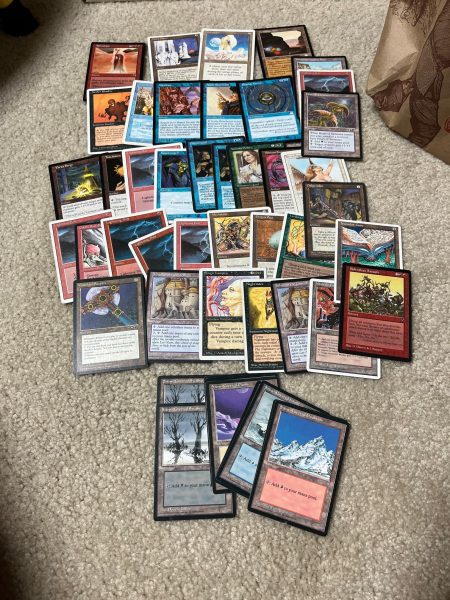
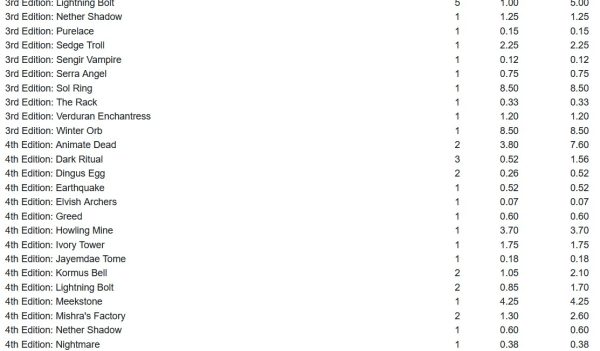
I also made sure to sort Card Kingdom’s buylist by price, highest to lowest. This way I knew I was looking for the most valuable cards in a given set first so that I made the most out of my time. Here’s a quick snapshot of some of the cards I found (before grading):

It’s a pretty sizable list, as you can gauge from the snapshot above. The order contained north of 120 cards totaling around $250. (Note: I sold the Intuition, Enlightened Tutor, and a couple of other cards to a friend for $215, so these cards were not included in the Card Kingdom buylist order).

There was an error retrieving a chart for Meekstone

Granted, these cards were not in near-mint condition (especially some of the Revised stuff). I fully expect downgrades closer to the $150-$175 range. Still, not a bad amount for the work, and I’m sure it’ll be a delightful surprise for my co-worker. I already paid him the money for the cards I sold to my friend, and this buylist will give him a second, unexpected deposit.

The Third Pass

Is that the end of the collection? Not quite yet! I often enjoy hunting for those nickels and dimes and I fully anticipate I’ll have time to do so as early as today (Sunday). Once I track down all the cards that are worth picking (using the same strategy as above, only focusing on lower-value cards this time), I’ll submit another buylist to Card Kingdom. This time I’ll mark for trade credit, however, with the hope of racking up enough to justify shipping costs.

That credit will make up the bulk of my “payment” for helping out my co-worker. From there, once it’s only bulk that remains, I’ll have to figure out what to do next. At that point, it’ll be a lower priority.

Wrapping It Up

I hope you enjoyed going on the recent journey down memory lane with me. Browsing through my co-worker’s old collection was like a lens into the past—it genuinely felt like I was looking through my own collection from back in the day. I’ll always have a biased preference for the aesthetics granted by these older cards.

None of this experience would have been possible had I not said something at work about my hobby. In fact, just last week a different co-worker asked me about the games I liked to play and I mentioned Magic. She indicated that she also still had her old cards lying around somewhere. Could I have the good fortune of browsing and picking two such collections in back-to-back months? One could only hope!

My company always encourages its employees to be open, and genuine, and to “bring your full self to work.” I admittedly try to temper my nerdiness at work on some occasions (e.g. meetings with upper management), but when it comes to Magic, this is one instance where being my full self can unlock old collections and even make a little cash for me and a co-worker on the side. I’d call that a true win-win.

An Ode to Salvaged Manaworker

Are you a Quiet Speculation member?

If not, now is a perfect time to join up! Our powerful tools, breaking-news analysis, and exclusive Discord channel will make sure you stay up to date and ahead of the curve.

A couple of weeks back, I wrote about the evolution of DMU. The first phase of the format was defined by splashy Domain decks overpowering the competition. The second phase was marked by the emergence of the UR Spells deck. I believe we are on the verge of seeing the third phase, on the back of one hard-working robot.

The State of the Two-Drop

The common two-drops in this format are weak. The UR Spells deck has access to Haunting Figment and Ghitu Amplifier. As a result, this deck has become the definitive aggro deck of the format. These cards deal lots of damage early and still have value late.

The format's second-best aggressive deck leans on Domain synergies and gets its best two drop in Sunbathing Rootwalla. This deck is comfortable playing lesser two-drops like Goblin Picker and Juniper Order Rootweaver because the deck leverages the potent pump spells in the format. Gaea's Might, Colossal Growth and Twinferno necessitate targets, and cheap ones work best.

Splatter Goblin and Phyrexian Vivisector are good cards, but they're not aggressive. The common red and white two drops are all low impact.

Underwhelming Options

...you disappoint me.

The uncommon and rare two-drops are major upgrades for this deck because they're so much better than the alternatives. However, the Mardu aggressive decks struggle with another problem.

Three-Color Aggro Still Has The Three-Color Aggro Problem

Aggressive decks want to curve out.

However, we also want to kick our Benalish Sleeper and Keldon Strike Team. The double-pipped Citizen's Arrest and Extinguish the Light can be difficult for decks that can't afford to stumble when pushing damage.

We actively want the dual-lands, but unlike the Domain decks, we're very particular about including the right ones. Combine the scarcity of on-color dual-lands with the increasing rate at which they're picked and we have a problem.

How can we keep our creature count high, potent spells in our decks, and maximize our kicker cards all while having an extra cheap body for our pump spells and early pressure?

From Humble Beginnings

My discovery began here.

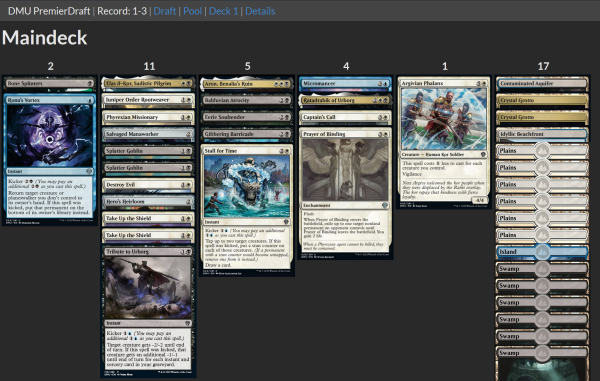
Esper Legends

Creatures

1 Elas il-Kor, Sadistic Pilgrim
1 Juniper Order Rootweaver
1 Phyrexian Missionary
1 Salvaged Manaworker
2 Splatter Goblin
1 Aron, Benalia's Ruin
1 Balduvian Atrocity
1 Eerie Soultender
1 Gibbering Barricade
1 Micromancer
1 Ratadrabik of Urborg
1 Argivian Phalanx

Instants

1 Rona's Vortex
1 Destroy Evil
2 Take Up the Shield
1 Tribute to Urborg

Sorceries

1 Bone Splinters
1 Captain's Call

Artifacts

1 Hero's Heirloom

Enchantments

1 Prayer of Binding

Lands

1 Contaminated Aquifer
2 Crystal Grotto
1 Idyllic Beachfront
6 Plains
6 Swamp
1 Island

I had been watching streamers using Crystal Grotto and wanted to give it a try. It would shore up my ambitious and unnecessary blue splash and also help with the multiple gold legends. However, the Grotto Tax was a real problem. On one turn, I used five lands to cast a Juniper Order Rootweaver. No, I don't want to talk about it.

However, an early Salvaged Manaworker made the deck hum. Channeling one mana a turn can help you unload your hand at a surprising rate. You get even more value if it enables instants on your opponent's turn. But wait, there's more.

The 1/3 is an extra target for combat tricks, carries +1/+1 counters surprisingly well, and feeds into both the attrition and go-wide strategies that black and white want to capitalize on. It works with both uncommon legends, cycles with Gibbering Barricade, and is the fodder you're looking for with Bone Splinters after it enables a fluid early game. Salvaged Manaworker is a top-five common two-drop.

But It Might Be Better Than That

One of the decks I wanted to talk about this week was this Wingmantle Chaplain deck.

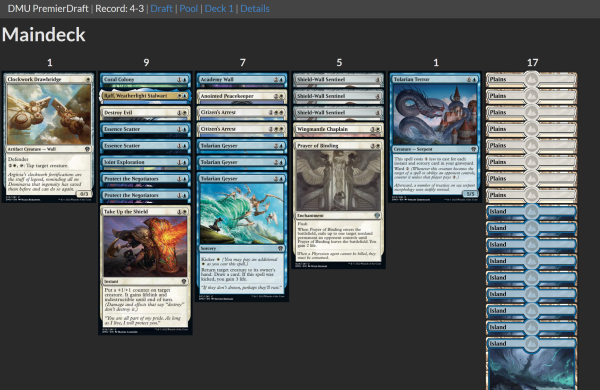
UW Defenders

Creatures

1 Clockwork Drawbridge
1 Coral Colony
1 Raff, Weatherlight Stalwart
1 Academy Wall
1 Anointed Peacekeeper
3 Shield-Wall Sentinel
1 Wingmantle Chaplain
1 Tolarian Terror

Instants

1 Destroy Evil
2 Essence Scatter
1 Joint Exploration
2 Protect the Negotiators
1 Take Up the Shield

Sorceries

3 Tolarian Geyser

Enchantments

2 Citizen's Arrest
1 Prayer of Binding

Lands

8 Plains
9 Island

This deck had a good UW game plan featuring Raff, Weatherlight Stalwart, Tolarian Terror, and three copies of Tolarian Geyser. It also has a solid wall package to enable Wingmantle Chaplain.

Unfortunately, it's missing a key piece. While I have three Geysers to bounce the chaplain, I have zero forms of recursion to replay it from the graveyard. In two of my losses (and one of my wins), I played better Wingmantle Chaplain decks. They had multiple copies of the mythic uncommon, but they also capitalized on Raise Dead effects to recast the wall.

The irony is that I had access to those cards. Phyrexian Missionary, Urborg Repossession, and Braids's Frightful Return all waited, dormant in my sideboard. I could not find a single dual in the draft that would have enabled their inclusion. However, I passed three copies of Salvaged Manaworker and wheeled two of them. Had I selected the construct, I would have had access to those powerful cards and a more robust strategy.

Good Homes and Bad Homes for Our New Favorite Construct

A lot of the best two drops in this format are interaction. If your deck wants Essence Scatter or Tribute to Urborg, you may not be in the market for a two-mana creature. A deck like that probably gets more value from the scry on Crystal Grotto.

Additionally, relying on this card in Domain decks is a liability. Though it helps you cast your spells, it doesn't contribute to powering up the domain keyword. You're better off with a Floriferous Vinewall in those situations.

Salvaged Manaworker performs best in decks that value creatures. These strategies need bodies that actually do things. Salvaged Manaworker doesn't deal much damage, but it adds to your creature count and plays to the board early. It helps you curve out into better effects, and there are plenty of uses for the body in the late game.

Finally, it's important to remember that, although Salvaged Manaworker is a useful tool, its overall power level is relatively low. The humble worker will hold your deck together, but if you're not surrounding it with powerful cards, you may want to rethink your approach.

Draft Chaff

This weekend at a local Game Day, I played the following list in Sealed.

Game Day Sealed

Creatures

1 Clockwork Drawbridge
1 Guardian of New Benalia
1 Yavimaya Iconoclast
1 Phyrexian Missionary
2 Quirion Beastcaller
1 Salvaged Manaworker
1 Sunbathing Rootwalla
1 Automatic Librarian
1 Argivian Cavalier
1 Mesa Cavalier
1 Tatyova, Steward of Tides
1 Nael, Avizoa Aeronaut
1 Elfhame Wurm
1 Argivian Phalanx
1 Yavimaya Sojourner

Instants

1 Gaea's Might
1 Bite Down
1 Destroy Evil
1 Take Up the Shield
1 Stall for Time

Sorceries

1 Scout the Wilderness

Enchantments

1 Citizen's Arrest

Lands

1 Idyllic Beachfront
1 Sacred Peaks
1 Tangled Islet
6 Plains
1 Island
8 Forest

My best cards were the rare and uncommon two-drops, but my low curve and high power level were slowed down by my mediocre mana-fixing. Leave it to Salvaged Manaworker to save the day. When it was in play I was able to hit my splash cards on time, as well as double-spell my way into devastating turns. Kicking Yavimaya Iconoclast and Phyrexian Missionary in consecutive turns felt like cheating.

For most of the format, I looked past this card as unplayable. Salvaged Manaworker is the hero Mardu aggro has been waiting for. It's hard to get a card's worth of value from your two-drops, but enabling kicker gets us close. Facilitating double-spelling and casting double-pipped spells on curve is a huge boon. Finally, enabling us to play functional games with untenable mana draws is a world of difference. Maybe it isn't a first pick, but this robot can do a lot of work in the right deck. You may want to give it a second look.

Generational Magic Player Spotlight: Matt

Are you a Quiet Speculation member?

If not, now is a perfect time to join up! Our powerful tools, breaking-news analysis, and exclusive Discord channel will make sure you stay up to date and ahead of the curve.

Sharing our Magic: the Gathering journey with each other is what makes this game more than just a game; it becomes a community. We create enjoyable moments with people who become friends and friends who become family. Here's a glimpse into someone's Magical life and how the game has influenced it.

Today we're meeting Matt. He's a Commander player that frequents Hero's Hearth. Join me as Matt shares a little about his Magic life!

Help Me Welcome Our Next Contestant...

What's your name and how long have you played Magic: the Gathering?
My name is Matt and I've played since 1999. I started around Mercadian Masques and Invasion blocks.

Matt

Who initially shared Magic with you?
I attended a local YMCA day camp and saw some of the other kids playing on the picnic tables, without sleeves mind you...

OUCH! We didn't think about condition much then, but now...
Oh yea, I cringe when I think about it. I saw these cards with cool artwork and asked about it. After getting a little more familiar with the game, I asked my mom if we could buy a few packs. She took me to my first card shop, which is no longer in business, called Comic Central. One of the employees, Daryl, was really helpful to my brother and I. His positivity in sharing the game, and finding out that my best friend Eric played as well, locked me in.

What was one of your first experiences playing the game?
I remember Eric had a mono-black deck that focused on Volrath the Fallen. Whenever he would get Volrath into play, we'd be quaking in our boots. At that time, we really didn't know what we were doing, but somehow he'd crush us with that card. Again, it being our early days of Magic, we'd just throw cards together and make a deck. Very kitchen table.

Were you ever able to beat him?
Yeah, sometimes he wasn't able to draw it and we'd gang up on him and take him down. I believe I would normally play my five-color Bringer deck in that group. It wouldn't win all the time, but it was a lot of fun.

I also recall one of my first shark moments, during Onslaught block. I had a foil Silvos, Rogue Elemental, which was worth a lot at the time. There was an older guy who offered me some garbage uncommon for it.

He tried hard to convince me that his card was better since it had a higher power and had trample. Fortunately, even at twelve years old, I knew this guy wasn't being straight with me. I impolitely declined his offer, but it stuck in my head. I hardly trade due to always thinking back to that.

What did you play tonight?
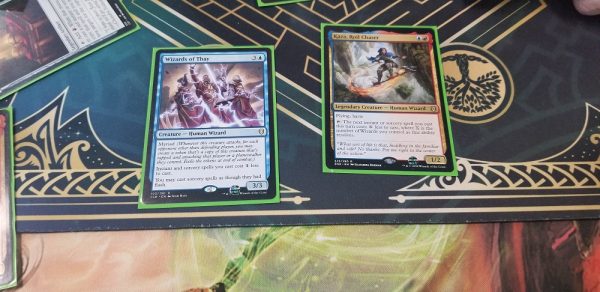
I played my Izzet Spellslingers Commander deck headlined by Veyran, Voice of Duality. I enjoy copying spells and spreading the love to everyone. A couple of my favorite cards in the deck are Wizards of Thay and Kaza, Roil Chaser. The deck also has a wizard tribal component, where putting these two really reduce the cost of my instants during an attack and give me an advantage.

Wizards playing spells. Imagine that!

So is Commander your favorite format?
Definitely, but I enjoy playing an occasional Modern game and getting schooled by Nick [co-owner of Hero's Hearth].

I see. What deck do you play when your stretching out into Modern?
I have a fun Naya big boy burn deck. I get out a couple creatures with five power or greater, toss in a little Temur Battle Rage, and smack for a bunch. Nick usually has a more tuned deck, but I get to beat down every now and then.

Since you've been in the game for a while, how has your play style developed over the years? Any recommendations?
Mainly don't be a jerk to your fellow players. We're pretty casual around here, so we all aren't very cutthroat. Meaning, playing a lot of tutor effects or quick combos. Not that those are bad in the right context, just be aware of the group dynamic.

Sharing your personality is easy and fun in Magic. I have a deck with Garth One-Eye and I put a lot of odd, rarely used creatures in, mainly to get reactions from other players stating, "Wow, I haven't seen that card before!" I'm more into the overall experience than just the win.

Do you play any digital Magic?
Very little. I just started trying Arena out about two months ago. I've tried a few Standard decks and I do enjoy the free-to-play option so I can test them out and see if I like the experience. I would love if they would have an option to test a deck without having to get all of the wildcards for it. Like try a Commander deck for a couple days and then it times out or something. Either way, I enjoy playing in person a lot more.

Have you been able to share Magic with anyone?
Every one of my girlfriends.

Very interesting! Tell us how that worked.
We would only play coffee table Magic, no in-store gaming. It was easy and fun to share the game with someone I cared about. Looking back, the nice thing is that three of the five took to it very well and really enjoyed it.

What did they like about the game?
One of them had fun with the pronunciation and wording within the game. For example, she would say, vil-igence instead of vigilance, just to be silly and goof around. The other two enjoyed how the cards interacted and how the rules worked. They definitely leaned toward the Melvin personality.

Matt showing a couple friends his winning moves with Veyran, Voice of Duality

What's one of your favorite Magic cards?
Definitely Door to Nothingness.

There was an error retrieving a chart for Door to Nothingness

Very nice. Why so?
When it was first printed in Fifth Dawn, I thought it was the most hilarious card ever, so I had to play it! It was a lot of fun to do something that Magic didn't really have before. Sure, you had cards that said you would win the game, but none that I recall that specified a player loses the game.

My friends at that time didn't really play artifact removal, so I would ramp up and make my opponent lose the game. After a while, whenever it would hit the battlefield, my friends would just shrug and groan. Of course, I had Coalition Victory in the deck as well. Go big or go home!

Haha... absolutely! Are there any final words you'd like to share?
I appreciate the community of Magic, especially here at Hero's Hearth. Between the regular players and the staff, we're all pretty comfortable with one another and welcoming to new players. We help each other out in various ways and it feels great to be a part of that.

On that, how long ago did you start coming to Hero's Hearth and what drew you to it?
My first visit was last October since I had some extra free time and started playing again. I live about five minutes away, so it was pretty easy to stop by and get my game on.

The Wrap-Up

Being Matt's premier place to play, I'd also like to congratulate Hero's Hearth! As mentioned in their interview, they had been working on achieving WPN status and have succeeded! Good job guys!

I want to thank Matt for sharing his story and how Magic has been a part of it. I hope you enjoyed our talk and look forward to the next installment. Feel free to share your story with us in the comments or on Twitter.

Are Unfinity Cards Right For Your Commander Games?

Are you a Quiet Speculation member?

If not, now is a perfect time to join up! Our powerful tools, breaking-news analysis, and exclusive Discord channel will make sure you stay up to date and ahead of the curve.

Gigantic Caveats

There was an error retrieving a chart for Cheatyface

This is Cheatyface my favorite Un-card. I have a side goal of sticking about 50 of them under a play mat and sneaking them into play. Of course, Cheatyface allows you to literally cheat and would never be allowed at an official event. It's just for fun, you say. Fun for who? Well, the cheater in this case.

I can and have used silver-bordered cards in Commander decks and purely casual constructed decks as well. Besides Cheatyface, I also love Booster Tutor and Ashnod's Coupon as some of my all-time favorites. However, I never take umbrage when someone vetoes my silver-bordered stuff.
What is the difference between an acorn card from Unfinity, Cheatyface, a homemade card, or a proxy? To me, there is very little difference. None of these cards are "legal" for Magic tournament play. Unfinity is unique, though, for having both cards that are not legal for tournament play while also having cards that will be allowed in eternal formats. From this point on, however, we have to make an assumption.

Huge Assumption

A casual play group accepting acorn Unfinity cards must accept silver-bordered cards. This creates some tangible problems because there are hundreds of silver-bordered cards that tables have not considered.

So yes, if your playgroup has never allowed silver-bordered cards it's less likely you will opt to allow the new acorn cards. However, new players especially are going to want to give them a try. I think that means that silver-bordered cards will see a resurgence, at least briefly.

A Slippery Slope

To quote Mark Rosewater:

"Over the years, silver border slowly shifted to end up meaning "not for any official format, casual or not," which flies in the face of what it was originally intended to do."

"They were silver border only because the set was silver border, not because they couldn't work in black border. Why were we making cards casual players could play and then not allowing them to play them?"

No, Mark, I'm just not sure that lives up to my Commander experience. Since day one people have brought silver-bordered cards and decks to casual Commander pods. Part of the proof of this is the high prices that some silver-bordered cards carry to this day because there is demand for some of these cards.

The assumption has always been that you would ask the group if they were okay with silver-bordered cards. Sometimes a group said "Sure thing" other times "No thanks, play a regular deck please." No representative from Wizards ever showed up at my tables and stopped us from playing with silver-bordered cards in casual games.

If I sit down with other players for Commander our rule zero discussion is what we have. Some people do not enjoy Stax, others hate mill. Even legal, black-bordered cards get vetoed regularly at casual Commander tables. Then there's the power level.


Outside of that, the Commander Rules Council has done a fabulous job of keeping the format fairly healthy. It is my belief that the format itself is mostly self-regulating but does need a bit of help from time to time. Introducing this new class of "black bordered but really silver bordered" cards is strange. It's solving a "problem" that does not exist and I feel that it muddies the waters, considerably, in multiple ways.

What Is The Harm? Backward Compatibility, Assumptions, And Power

There was an error retrieving a chart for Ass Whuppin'

There are a significant number of cards from previous Un-sets that are drastically powerful. Ass Whuppin' is not one of them. However, does this card works on the new black-bordered acorn cards of Unfinity? This article written by Matt Tabak indicates that yes, Ass Whupin' will work with black-bordered acorn cards, as will any other cards that reference silver border such as Underdome. Is this a big deal? No, however, there are far more than just these two examples of confusion and necessary errata and the article even references an exception. I can't think of anything my casual table enjoys more than being forced to check rules errata for supposedly casual cards during games.

What About Power?

There was an error retrieving a chart for Richard Garfield, Ph.D.

Take a look at the price graph for February-March of this year. What happened? Speculators saw the idea of Unfinity and made some guesses as to some particularly powerful cards that might be in high demand as a result. If you're not familiar with it, Richard Garfield, Ph.D. is one of the absolute most powerful Un-cards allowing you to engage in a game called "Mental Magic." Now, don't get me wrong, Mental Magic is fun! We would often play this with draft boosters between rounds and it is a blast. However, in a format like Commander, it is far too easy for Dr. Garfield to become a one-card, game-ending combo with counterspell backup.

There was an error retrieving a chart for Super Secret Tech

Is making all your premium foil cards cost one less good? Super Secret Tech has gone way up in price. Considering how common foil cards have become, this makes everything in your deck cost one less. As a side effect, your foil creatures also get +1/+1. This is a very decent card and would show up in a massive number of Commander decks if it were implicitly allowed. Would it be too powerful? Potentially. Would it be completely ubiquitous? I think it would.

There was an error retrieving a chart for Mox Lotus

Another inarguably powerful Un-card, Mox Lotus adds infinite mana to your mana pool. For "only" 15 mana the game ends. It's colorless and works best with decks that use a commander that wins with infinite mana like Kenrith, The Returned King or Tasigur, the Golden Fang. Much like the reasoning behind banning Emrakul, The Aeons Torn too many players would play the card and it would inevitably create too many "oops the game ends" moments, and Shape Anew decks.

Lies, Damned Lies, and Assumptions

There was an error retrieving a chart for Animate Object

Have you ever heard of someone flipping a table at their local game store (LGS)? It's happened more than once in more than one place. Now, instead of that, we get animating the table. I joke but only a little. Lots of the new Unfinity cards will cause physical issues. Several of these cards are going to be difficult to use across SpellTable. I'm not sold on many of these cards being fun concepts and some are making my head ache when I'm trying to figure out what they do.

I can see this causing a bit of a row in the playerbase in the near term. As mentioned previously, not everyone wants to play casually, or competitively, versus Stax, or against mill. There are a lot of preferences to balance in a healthy pod. Revisiting the concept of silver-bordered cards won't make finding compatible pods any easier. This is, of course, different than releasing another Un-set because this time it's more confusing. Some cards are perfectly legal to play and some are not. Mixing them all together with black borders seems like an unwise decision that will cause confusion.

Changing Things for The Sake of Change

In a few weeks, players will get their heavily playtested and designed "unofficial official" Unfinity cards. But not for tournaments. Well, only certain cards. Most cards will be allowed. But not everything! And this is good and makes sense because, uh, yeah because! It's new and different, and did we mention new? Plus these cards will be Commander legal... except for the cards that aren't, of course. Yikes!

There was something unique and special about pursuing the idea of silver-bordered cards as a purely casual endeavor in and of itself but that idea did not resonate with Wizards R&D. Why make a purely casual format when we can inject potentially competitive cards into it? I simply do not buy into the idea that casual players at casual tables never built decks or played games utilizing silver bordered cards because, well, I've played with and against said casual cards. Maybe my experience is just an outlier?

Time will tell if I am correct in asserting that if Unfinity does well, we are going to see a surge in demand for silver-bordered cards, even temporarily. But if not, maybe the whole idea simply does not appeal to as many people as Wizards suspects and a big part was the very nature of silver-bordered itself.

Magical Creatures: Vedalken, Blinkmoth, and Bringer

Are you a Quiet Speculation member?

If not, now is a perfect time to join up! Our powerful tools, breaking-news analysis, and exclusive Discord channel will make sure you stay up to date and ahead of the curve.

Hello, fellow creature enthusiasts! Welcome back to Magical Creatures, a series on uniqueness among Magic designs. In the first article, I proposed a way to select creatures "unique" to this game, such as Atog, Beeble, and Cephalid. And last week, we discussed half of the new creatures of this sort from the Mirrodin block: Myr, Pentavite, and Slith.

As we mentioned in the past installment, Mirrodin and its two follow-up expansions (Darksteel and Fifth Dawn) were packed with new creature types. And six of these were not only new to Magic, but to all of fantasy. As such, they are all perfect for this series, and today we'll have a look at the rest: Vedalken, Blinkmoth, and Bringer.

As with last week, one creature type is going to be huge, while the other two will be more modest. Can you guess which one appears on the greatest number of cards? They don't have a particularly celebrated record in tournament history, but this type is undeniably the most widespread tribe among the six analyzed in this double piece...

Vedalken

Yes, Vedalken are even more numerous than Myr (62 against 38)! The fact is creatures with the Myr subtype only appeared in the Mirrodin and Scars of Mirrodin blocks, with very few exceptions. On the other hand, Vedalken may have had a few dedicated cards in the Mirrodin block, but they kept popping up in the following years.

"Original" vedalkens from the Mirrodin block

So what is a vedalken? Well, the first thing we can tell is they are very blue creatures. In fact, although Vedalken of all five colors exist, blue is always the main color, present in each and every creature of this type. That being said, we can also agree that they are humanoid beings, with hairless, blue skin. Don't forget that Vedalken is just the race, though! So, what about the class?

Vedalkens of several different classes have been printed over the years, including Rogue, Soldier, and even Knight. However, the most represented class by far is Wizard, with roughly 30 cards. In second is Advisor, with approximately 15. This clearly shows that their main qualities pertain to the mind's domain, as one would expect from such a blue creature.

Vedalken Killed the Merfolk Star?

As a matter of fact, Vedalken creatures are obsessed with knowledge and hyper-intellectual. In some respects, they could remind of another typical blue creature: Merfolk. And not by chance! When Mirrodin came out, in late 2003, Merfolk was in the process of being abandoned as the main representative blue race. The reason? The simple fact that they were limited to watery environments. To put it bluntly, as Doug Beyer did, Merfolk "just don’t do what an iconic race needs to do, which is walk."

What about competitive play? Most of them didn't make the cut, but Master of Etherium certainly is a huge exception! In the past few years, it's mostly been played at just one copy, as you can see from Tuan Nguyen's result at the 2018 Magic Online Championship. In the past, though, it was even stronger. Other notable Vedalken are Grand Architect and Vedalken Archmage, since both can prove to be pretty versatile, and are particularly strong in combos.

Blinkmoth

Time to leave Mirrodin and move to the second set of that block: Darksteel. Released in early 2004, Darksteel is particularly infamous for generating two overpowered cards: Aether Vial and Skullclamp. Apart from that, it kept running the huge artifact theme, and gave us a new creature type unique to Magic: Blinkmoth. Well, it also introduced Artificer, but that's definitely not new.

Blinkmoths and their best friends

Let's make it clear from the start: no card was ever printed with the Blinkmoth subtype. And yet, it's among the numerous creature types that any creature with changeling would have. How come? We discussed similar cases in Tetravite, Pentavite and Triskelavite? And the same thing happened with Saprolings. The fact is all these creature types only exist in the form of tokens.

With Blinkmoth, things are a bit different. It's an artifact creature representing a small, flying insect-like creature, very common on Mirrodin. But it doesn't come as a token. The only way to have a Blinkmoth is to animate either Blinkmoth Nexus or Inkmoth Nexus. These two lands can tap for colorless mana, or they can turn into a 1/1 flying Blinkmoth until end of turn.

Animated Lands in Competitive Play

The former was used both in standard and extended tournaments, as it gave Affinity decks a boost (as if they needed it, right?). When transformed in an artifact creature, it helped for the affinity count, and even better, it could be equipped with Cranial Plating. It was even played in Burn, either to inflict the last hits or to sacrifice for Shrapnel's Blast's sake.

As for the latter, it didn't only have flying, but also infect. Which of course made it much stronger, but at the same time limited its use to decks taking advantage of the infect mechanic. For instance, at the World Magic Cup 2012, Stjepan Sučić brought a list of Mono Green Infect to the Top 8!

Bringer

The last creature type we're discussing today is Bringer. And I'm sorry to say this tribe is neither numerous nor competitive. Only five Bringers exist, they all come from Fifth Dawn, and they obviously form a cycle.

Just a few words on this third set from the Mirrodin block, before passing to Bringer: Fifth Dawn, released in the summer of 2004, finally fixed the issue of printed artifact cards looking too similar to white cards color-wise, by darkening the gray border. Apart from that, it introduced some unique and enduring artifacts, such as Crucible of Words, Engineered Explosives and Krark-Clan Ironworks.

Okay, there is not much to be said about Bringer. The tribe's best feature, if you ask me, is its illustration. Five different artists created them, including Kev Walker and Carl Critchlow. Each of them gave his take on these weird crystalline beings, with results that are different, but equally astonishing.

Each Bringer costs nine mana (seven generic and two specific), but you can pay only five by using one mana of each color. That's the main theme of Fifth Dawn, after all, as indicated by the sunburst mechanic. Indeed, Bringers themselves are manifestations of the very energy of the five suns (well, technically moons) of Mirrodin.

They are all 5/5s with trample which do something big at the beginning of your upkeep. Which is great, but not for that much precious mana. Anyway, when we were beginners, this certainly didn't stop most of us from yearning for the five bringers... but then again, didn't we pine the same after Enormous Baloth?

Variety vs. Versatility

Among today's three creature types, my favorite is probably Blinkmoth, because of its versatility despite only two cards mentioning the type. Blinkmoth was not the first "manland:" we'd had plenty before and would get many later, including the celebrated Mishra's Factory. Nevertheless, Blinkmoth Nexus and Inkmoth Nexus are the only two lands that transform into creature with a subtype invented specifically for Magic.

Vedalken were also an interesting addition to the game, at least from the point of view of variety. Speaking of which, in the next installment, we'll meet yet another blue tribe that might remind you of Merfolk and Vedalken. It comes from the Kamigawa block... can you guess what I'm talking about? Stay tuned to find out!

Tournament Fundamentals: Your First Event

Are you a Quiet Speculation member?

If not, now is a perfect time to join up! Our powerful tools, breaking-news analysis, and exclusive Discord channel will make sure you stay up to date and ahead of the curve.

There are many ways for players to enjoy Magic. Some are tournament grinders, others are FNM warriors. Many kitchen table players never even step foot into their local game store. There is no wrong way to play, but casual players can sometimes feel intimidated when trying to branch out into higher-stakes play. Here are a few tips for those taking these first steps into unfamiliar territory.

Selecting your Deck

The first step of the process is finding a deck that's legal in the format you plan to play. There are plenty of resources to help with this. MTGTop8 and MTGGoldfish are two sites hosting databases of some of the most popular high-performing decks for you to browse and review.

Newer or more casual players are often apprehensive about copying a decklist from the internet, a practice commonly referred to as "netdecking." In reality, nearly every deck idea a player can come up with has already been explored. Lists that continue to perform well and populate a metagame are ones that have been iterated upon by countless other players with robust understandings of their respective formats. We can save ourselves the hassle of trying to solve a new format solo by finding a tried and true deck that fits our preferred play style. As we grow as a player and learn more about how to target specific weak points in a metagame, that's when a homebrewed deck can be the right call to take down an event.

Rules Enforcement Levels (REL)

Playing with friends doesn't usually come with a time limit, and rules are often more relaxed. Take backs are allowed if they make for a better play experience for all. Tournament play on the other hand does have time limits, and players are held to higher standards of play. In fact, there are different levels of rules enforcement depending on how competitive a tournament is, and the stakes involved.

Per the Comprehensive Rules, Rules Enforcement Levels (REL) are a means to communicate to players and judges what expectations they can have of the tournament in terms of rigidity of rules enforcement, technically correct play, and procedures used. The Rules Enforcement Level of a tournament generally reflects the prizes awarded and the distance a player may be expected to travel to reach the event.

  • Regular REL is what we'll typically encounter at our local game store for an event like Friday Night Magic. Players are generally expected to know what they're doing, but the emphasis is on fun over procedure and technical precision.
  • Competitive REL is something you'll find at something like a Regional Championship Qualifier (RCQ). Players are expected to have a reasonable understanding of the rules, but judge staff is typically present to answer questions. Generally speaking, Competitive REL is where there are no take-backs.
  • Professional REL holds players to the highest standard of behavior and technically correct play. This level of play is typically reserved for events like the Pro Tour, with massive prizes on the line. Sometimes multi-day tournaments utilize Competitive REL on the first day and switch to Professional after the first round of eliminations.

All of this is to say that there are different strictness levels to the rules, but as long as we know what our cards do, have a general idea of what the other top played cards do, play at a reasonable speed, and can make it to our seat on time, everything should go perfectly. A judge or the tournament organizer will communicate the rules enforcement level at the start of a tournament if it's at Competitive REL or higher.

Call a Judge

Speaking of judges, they're our best friend at a tournament. Have a question? Call a judge. Need to use the bathroom? Call a judge. Think the opponent is playing too slowly? Call a judge. Do we suspect cheating? Absolutely call a judge.

Judges are present to ensure a tournament is run with integrity and in a timely manner. It's common for less seasoned players to feel like they're tattling, causing a fuss, or bringing unwanted attention. The truth though is judges are there to help us and to make sure everyone has a good time, especially the newer folks.

Deck Lists

At Competitive REL and up, players are required to submit decklists to the tournament organizer at the start of the event. This is a safeguard to ensure there's no funny business mid-tournament with players swapping to more favorable decks and card choices. The penalty for an inaccurate decklist, if found, is typically a game loss in the round it's discovered. Judges conduct deck checks at random throughout the tournament, so this may happen at any time.

There are many ways a decklist error may manifest. Sometimes it's forgetting to list a card, putting down the wrong number of copies, or accidentally using the wrong card name. I can't count how many times I've gotten Emrakul, the Aeons Torn and Emrakul, the Promised End mixed up or how many times I've written Forest instead of Snow-Covered Forest.

Remember to be like Santa—make your list and check it twice.

Don't Forget to Eat and Hydrate

Tournaments can go long, and while they're a ton of fun, they can be taxing on the mind and body. An RCQ with a modest turnout of 40 players will run for six rounds at roughly an hour each, followed by an additional three rounds in the top eight. MagicFest main events typically run for nine rounds on the first day with an additional six rounds the following day for those who do well enough to advance.

That's a long time for our brains to run on all cylinders. Bringing snacks and hydrating throughout the event will give us the fuel needed to continue performing at our best for the full duration of the tournament.

One of the great parts of traveling to events with friends is if someone finishes a round early or doesn't do well and drops from the event, they're able to do a food run to help out the rest of the team. Sometimes all a person needs is to scarf down a quick food delivery from the sandwich shop down the road to bring their health bar back up to full.

Don't Base Success on Performance

This one applies to new players and veterans alike. Do not base success or the fun of the event on how well the tournament went for you. Magic is a game of probability and variance with the player only helping to guide their deck to the final result. Even the top players in the world maintain only a 60% win rate.

As players continue to test their mettle against other strong opponents, they'll similarly improve. Try to identify what strong plays you made throughout the event and, more importantly, what mistakes were made and how they could be avoided. Learning from blunders is the best way to minimize future mistakes.

At the end of the day, this is a game. Don't be hard on yourself if the tournament doesn't go well. Some days the chips fall in our favor and other times they don't. The goal is, and will always be, to have fun.

End Step

This is the second article in my series of Tournament Fundamentals geared for players just starting out in the competitive scene. Let me know if there are any essentials that you think I may have missed and if there are any topics you'd like to see covered in future installments. I'll catch you all next week!

Fundamentals: Playtesting Actively

Are you a Quiet Speculation member?

If not, now is a perfect time to join up! Our powerful tools, breaking-news analysis, and exclusive Discord channel will make sure you stay up to date and ahead of the curve.

When I see players jamming games in between rounds at the Local Game Store and they tell me they're playtesting, I'm deeply skeptical. I don't doubt that they're learning something by playing games. In fact, it'd be alarming if that wasn't happening. However, playing games isn't the same thing as actually testing. It's an important component, to be sure, but actual testing is closer to work than play. Testing is an act of active learning. Just playing games is passive learning at best.

If this sounds rather familiar, that's good. It means that you read last week's article. This is a direct continuation of that discussion. Once a deck has been put through enough goldfishing to ensure that it actually works and the pilot is minimally competent, then it's time to actually playtest the deck. This requires playing actual games but isn't just playing games. Players looking to test for tournaments and develop need to get serious about testing. This involves actual work.

Active Learning vs Passive Learning

When I said testing is active learning while just playing is passive learning, readers in the education field almost certainly took up arms over said terms. Everyone else was just confused. How can actually playing games be passive, and why isn't that ok? To the first group: Chill, this isn't about the academic debate. To the latter, it's not an either-or thing. Both active and passive learning have their uses, but players need to be aware of what they're doing to maximize testing efficiency and results.

There was an error retrieving a chart for Standstill

To simplify the linked Wikipedia articles, active learning requires students to be actively involved in teaching themselves while passive just requires them to absorb information. This probably sounds contradictory, but the way most players playtest is very passive. They sit down, play some games, and intend to absorb the lessons the match gives them. There's nothing inherently wrong with that.

There was an error retrieving a chart for By Force

However, it does mean that the lessons that can be learned from this are dependent on the random chance inherent in the games. Whatever happens, happens, and thus whatever lessons happen, happens. If a player wants to learn something specific, they cannot rely on passively waiting for it to happen. Take an active role and set up to learn what needs to be learned.

Test Scenarios

Case in point, at the end of last week's article, I said that if there is something specific that needs to be tested, then test it. Just test it. Set up the scenario that you want to test rather than passively waiting for it to happen organically in-game. Waiting for it to happen "naturally" is passive learning. It's hoping that the relevant information will come and also stick. Setting up what specifically needs to be tested is active learning and needs to happen too.

There was an error retrieving a chart for Test of Talents

Players are, in my experience, perfectly fine passively learning via playing games and seeing what happens. However, if I tell them to set up the exact circumstances they want to test, they balk. The justification for said resistance is always some variant of "it's not natural." The feeling is that only data from games is valid. This is wrong.

There was an error retrieving a chart for Natural Order

If something is worth wondering about, it's worth understanding. When that question lingers despite repeated test games, it obviously doesn't come up enough to definitively answer in normal games. Therefore, the only way to see it enough is to force the scenario to happen. Doing anything else is just wasting time.

I'm not saying that playing a game normally as part of testing isn't useful. I am saying that doing so is insufficient and players need to take more agency during testing. Especially more intense, tournament-focused testing.

Testing the Hard Way

From my experience, most players are very lackadaisical towards testing. Even serious players would rather treat testing as hanging out time, with most of the learning coming via post-mortem dissection. Which I do, absolutely and unequivocally, understand. Hanging out with friends is far more enjoyable than actually working. However, for players like me, it is necessary to break out of that mindset.

There was an error retrieving a chart for Hard Evidence

I have a lot of ambition as a Magic player. I want to win, keep winning, and win at the highest level. However, I don't have the natural talent and luck that help the best players make it look easy. I've seen plenty of them do exactly that, and envy is but the tip of my ensuing emotional iceberg. No, if I want to do well, I need to work for it. Hard.

There was an error retrieving a chart for Midnight Oil

Which is exactly what I did at the grindiest time in my life. In 2014-2015, grinding Magic was my job. I was traveling to every event I could, testing as much as possible, and playing as much as finances and travel time allowed. I cashed more tournaments in that period than the rest of my life, probably combined. It paid off when I made it to Pro Tour Khans of Tarkir, making Day 2 of my first and so far only Pro Tour.

There was an error retrieving a chart for Jeskai Ascendancy

Which I should mention, was despite all my drafts going horribly awry and my Jeskai deck being suboptimal. I could never figure out the right top end and just split the difference having run out of time. However, the work I'd put into testing everything beforehand let me sufficiently navigate past my shortcomings to kinda-almost-get there anyway. Here's the system I had then, parts of which I still use despite not having time for all of it anymore.

Step 1: Change Testing Tools

The biggest suggestion I can make is to not test with actual Magic cards. Use universal proxies instead. I know that sounds weird, but there are two reasons not to test with the actual deck. The first is purely financial as it saves wear and tear on real cards and sleeves. Yes, I really was that big of a penny-pincher once. However, it also forces players to think harder about the game and to actually understand their cards.

Universal Proxies

The first thing is to make universal proxies. Normally, when players make proxies they Sharpie lands with enough information to identify a specific card. Instead, make proxies that could be any card:

Step 1: Make a grid. It should have four columns and enough rows for the number of cards in the test deck. For a 60-card deck, that means a 4 x 15 grid.

Like this

Step 2: Proxy enough lands so that each one corresponds to one of the boxes in the grid. Mark them only with the grid coordinate, i.e. A1, G3, D4. No jokes about battleships or the sinking thereof. I've already made them all. Sleeving is optional, but I'd only use otherwise busted-up non-tournament usable sleeves. Pinching pennies and all that.

Step 3: Fill in the grid. Each row should contain as many of the same cards as possible. For example, if a deck plays four Ponder, then B1, B2, B3, and B4 should all be Ponder. If it's only two, then B3 and B4 and fill in B1 and B2 with a different two-of. Don't mix and match, it makes it hard to keep track of everything. The order of the cards doesn't matter, feel free to input the cards in whatever order makes sense.

Step 4: Repeat the process for everyone involved in testing.

Step 5: Have the Oracle text for each card available, either via Scryfall or Gatherer.

Why Proxies?

I'll preface that I didn't come up with this idea. The original idea came from a Star City Games article from years ago. There's no link because I don't remember who wrote it or the name and my Google-fu wasn't strong enough to find it again. I have refined that idea heavily so that it's not really recognizable anymore, but I always cite my sources.

There was an error retrieving a chart for Copy Artifact

Anyway, the purpose behind these proxies is to break familiarity with the cards. So many players play their cards on autopilot without really thinking about the cards themselves. At some point, everyone gets more used to playing (and even seeing) their card as they remember it being used. I know what Lightning Bolt does, I don't need to read the card. For simple cards that might be true. However, I've watched players misplay their cards so often by adding or subtracting functionality that this is a serious concern.

Playing with proxies breaks that familiarity because to know what a card does requires looking at the grid for identification, then to the Oracle for what it does. It retrains the brain away from what it thinks a card does to what it actually does.

There was an error retrieving a chart for Sunscape Familiar

Also, it speeds up testing in the long run. When finished testing one deck, grab another deck grid instead of making another. Rather than physically replacing cards during deck refinement, just change the grid. It saves a lot of time fiddling around with cards.

Playing With Proxies

Of course, in the short run using just proxy decks will be awkward. Getting used to looking up the cards will slow players down for the first few iterations. However, it gets much easier over time.

There was an error retrieving a chart for Careful Study

Playing with the proxies is no different than playing with actual cards. It just requires checking the grid to see what the cards are. Where it gets weird is that the first time that any non-basic land card is played, the player must read out loud the full and unabridged Oracle text. This is essential so that every player knows what's happening and is key to the retraining bit from above. Subsequent plays don't need to be read out in full but repeat this process for every game. Not match, game.

Additionally, any time there is any question about a card, read out the full Oracle text. No cutting corners, no assumptions, just hard data.

Step 2: Record Everything

I do mean everything. Every decision made and why, every observation and thought, wins and losses, and every single data point should be recorded for dissection and discussion afterward. It's best to write them down so as to keep the opponent in the dark, but do whatever works.

There was an error retrieving a chart for Reki, the History of Kamigawa

Also, record the game in video form. This will be a lot easier for anyone today because phone cameras actually work now and are good. Back in 2014, I was fiddling with a full digital camera that didn't like to focus. Today's webcams and smartphones are vastly superior. It's critical to record every play and every single card drawn in a match and the order in which they were drawn for the purpose of Step 3b.

Step 3a: Play Matches

With the test decks built, now start playing the test matches. For the first few, play typical Magic matches, but play them to their conclusion. Don't concede, don't assume defeat or victory. Play until someone actually loses. Hard locks are an acceptable win. There are many ways that a match can turn around. Use testing to look for those opportunities.

On that note, play all three games in a match. Even if one deck just blows the other out convincingly in two, play the third one anyway. There's value in playing as many individual games as possible, but more importantly, more game threes mean more opportunity to test sideboards, which are often undertested relative to the maindeck.

There was an error retrieving a chart for Stony Silence

After some number of standard matches, stop playing normal games and start the hard testing. How many matches depend on the player, I usually play 10-20. The purpose of the typical matches is to learn how the match works, which cards matter and why, and if the sideboard strategy is appropriate. Once there's a reasonable answer established, it's time to start digging in.

Step 3b: Replay Matches

Did the match hinge on a certain decision, or was a mistake critical? Back the game up to that point and find out. Use the recording to rebuild the boardstate to that moment, with the right cards in each player's hand, and try the game again. Put the cards back in the exact order that they were drawn. Or even separate them from the deck and just draw from the pile until the whole library needs to be shuffled.

There was an error retrieving a chart for Rewind

This allows players to really dissect their decisions and get into how valid their instincts were and refine them. It's possible that the decision didn't really matter, and defeat was inevitable from that position. If that's the case, then finding out and subsequently determining if the original line was best is very useful. If there was a better option, how obvious was it originally, and how can it be found more easily in the future?

I don't know how useful it actually is, but back in 2014, I'd also insist on backing games up all the way to the beginning and switching who was on the play vs the draw. Many games will play out very differently and there can be insights to be gained, but many hands are unkeepable on the play vs the draw. It feels like doing this would be useful, but I've never been sure.

Step 4: Test Scenarios

For all the reasons already stated, test scenarios. The rest of the testing up until now should have identified corner cases, specific interactions, sequencing lines, and other interesting data that should be looked into. Set them up and then dissect them. There's something there worth learning. Find it.

Step 5: Analyze and Adjust

This is the really critical part. Up until now, the decks shouldn't have changed from the first match. The whole plan was to test that deck, and only now is there the data to know if it works and what must be changed. Analyze that data and make changes accordingly. This is where having the decks just be Excel spreadsheets is very convenient. Once the chosen adjustments are made:

Step 6: Once Again, From the Top

Now return to Step 3 and do it all again with the adjusted deck. Don't forget to update every other deck, too. I said at the beginning it's hard work. However, I stand by the results it brought me.

Not For Everyone

While the whole thing requires a level of commitment only the most dedicated grinders can match, using proxy decks and testing scenarios is useful for almost everyone and easy to adopt. For players looking to improve and who feel their skill is plateauing, my system can make up for skill deficiencies with pure practice and knowledge.

New Discoveries in Dominaria United

Are you a Quiet Speculation member?

If not, now is a perfect time to join up! Our powerful tools, breaking-news analysis, and exclusive Discord channel will make sure you stay up to date and ahead of the curve.

One of the most essential skills for navigating a draft is knowing when to pivot. Should we stay with our current plan or change directions based on the information we're seeing? Because of the powerful cycle of non-basics at common, the powerful domain payoffs, and the versatility of kicker spells, a third option often emerges in the Dominaria United (DMU) draft format. Should we stay, should we pivot, or should we absorb this card and try to make it work?

As is always the case, to make the optimal decision we need to know the reliable landing spots. While Wingmantle Chaplain, Big Domain decks, and UR Spells still seem to be the best archetypes, that doesn't mean they'll be the right ones for our seat. DMU has proven to be relatively balanced, and the second tier of archetypes can easily put together a 7-win run on Arena or a clean sweep of a competitive Friday Night Magic (FNM).

Green's Aggressive Side

In its early stages, Domain decks were perceived as controlling. Splashy mana-bases lead to slower games and more powerful spells. Last week, we explored how blue profited from the powerful kicker cards. However, domain powers up the aggressive strategies as well and some of its most powerful spells don't cost as much as you might assume.

Welcome to the Jungle

While every color profits from domain, the most aggressive builds benefit from being base-green. Green aggro uses a ton of combat tricks to leverage a proactive start. However, when you're using high picks on dual-lands, and other early picks on efficient threats, it may be difficult to round out a complete deck. Fortunately, this archetype utilizes some cards that other decks might not want.

Rounding Out Domain Aggro

Lovingly referred to as "Gruul with Duals", this deck wants to apply pressure on curve. Having access to the domain duals helps pay for kickers in the late game. The evasion of Bog Badger or the tempo gained from a top-decked Ghitu Amplifier can push an opponent off their back foot and into a loss. Additionally, this deck makes great use of combat tricks to punish blockers or push lethal damage.

Captain's Call is a Trap

Speaking of combat tricks, the white aggressive decks are defined by one of the best. Take Up the Shield can defend creatures from a removal spell, flip a race, or most importantly, play the trump card in combat. It's the single best way to leverage aggression in white decks at common. If we're seeing the two mana instant late in packs, we should consider leaning into a combat-centric white-based deck.

Captain's Call on the other hand, is a trap to avoid. On the surface, the card looks to fulfill the promise of the go-wide deck. Without being all-in on Heroic Charge though, it's difficult to get four mana worth of value from the tokens it makes. While it plays nicely with Griffin Protector, there are far better ways to flood the board. Additionally, Call takes you in a direction away from the color's best cards. It does have synergy with black cards like Gibbering Barricade and Bone Splinters, but it's generally not worth the commitment.

Argivian Cavalier and Phyrexian Warhorse give us much more maneuverability while still providing multiple bodies. We get similar synergy for our Argivian Phalanx and other go-wide payoffs without the risk of being blanked. Furthermore, these cards play much better with Take Up the Shield, which we want to optimize.

Outlasting the Opponent

On the other side of the spectrum, black has the grindiest cards in the format. These tools can serve as an engine for decks looking to outlast the competition, as well as a great shell for going long.

A War of Attrition

Recurring an Archangel of Wrath, Wingmantle Chaplain or Mossbeard Ancient is a critical piece of what black is doing in this format. With a number of Raise Deads in the format, it's possible for a single bomb to hit the table two or three times in a single game.

This deck had a few bombs and did a great job grinding out games thanks to powerful synergies and abundant card advantage. As games went long, it became easy to generate value. It was hard for opponents to get under us because of the abundant removal in these colors, and the speed at which we established defenses. The last thing an aggressive deck wants to see is Splatter Goblin into a Gibbering Barricade. If our deck starts with a bomb, we can maximize it in a similar shell.

Draft Chaff

There are numerous iterations within each individual strategy in this format, and many of them feel very powerful. White Aggro, Black Grind, and Domain Aggro are powerful avenues to explore, but the format offers a lot more. When we're thinking about picking a dual land, pivoting to a new strategy, or absorbing an extra color, we need to consider what is available to us now, and what will be available in the future. In this format, that means considering quite a bit. However, with each individual pick our options narrow. Look ahead for those potential landing spots. While you may discover a new one, it will probably find a foundation in some of the established principles of the format.

Back in Black

Are you a Quiet Speculation member?

If not, now is a perfect time to join up! Our powerful tools, breaking-news analysis, and exclusive Discord channel will make sure you stay up to date and ahead of the curve.

“I see a red door and I want it painted black. No colors anymore I want them to turn black.” – The Rolling Stones

This lyric pretty much sums up my perspective on Standard (and, by extension, Alchemy) these days. Black has been a powerhouse since rotation, and the printing of cards like Liliana of the Veil and Sheoldred, the Apocalypse have really cemented black’s dominant status.

What does it mean for card prices? Are we seeing subtle shifts reflecting the popularity of black cards in Standard? Let’s investigate!

The Data

First, let’s dive into some data. First, I took a look at the most played cards in Standard according to MTGStocks.com. Here’s a snapshot of the top 20:

I’m not sure where Snow-Covered Forest came from to be in the top spot. Ignoring that, I’m seeing the far-reach of black sprinkled throughout this top 20 list. Counting lands that tap for black, I count 12 cards of the top 20 either black or multicolored and inclusive of black. New Dominaria United cards Cut Down and Liliana of the Veil are already making waves, and I suspect those rankings could climb higher in the coming weeks.

You could argue that red is also a dominant color based on the top 20 list above. But there are only half as many red cards (6) as there are black cards in this list. More than the 20% you would expect from a perfectly color-balanced metagame, but a far cry from 12.

Still skeptical? I am, too. So let’s dig a little deeper.

Here’s another set of data, this one being a snapshot of the Standard metagame according to MTGDecks:

This lists the Tier 1 and Tier 2 decks along with their respective share of the metagame. Every single tier 1 deck includes black, with Mono-Black being the deck with the highest share. There are two Tier 2 decks that don’t include black (Red Deck Wins and Boros Justice), but otherwise, you can find black in nearly every other top tier Standard deck.

The total share percentage of the tier 1 and tier 2 decks that contain black is 55.45%. This is consistent with the most played card data above, where black or B/X represented around 60% of the top 20 list.

These data sources, combined with my own experience (albeit playing Alchemy instead of Standard), has convinced me that black remains a force to be reckoned with in current formats.

Examining Specific Cards

What does a typical Mono-Black deck look like in Standard? Here’s a list by Imazawa Junmpei, which won a Qualifier at Hareruya:

Mono-Black

Artifact

3 Reckoner Bankbuster

Instant

1 Cut Down
4 Infernal Grasp

Sorcery

1 Soul Transfer
4 Invoke Despair

Enchantment

3 The Meathook Massacre

Planeswalker

2 Sorin the Mirthless
2 Liliana of the Veil

Land

1 Takenuma, Abandoned Mire
2 Roadside Reliquary
23 Swamp

Sideboard

1 Reckoner Bankbuster
1 Pithing Needle
1 Malicious Malfunction
2 Unlicensed Hearse
2 Soul Transfer
2 Cut Down
2 Parasitic Grasp
4 Duress

One of the first things I noticed when looking at the list was the new cards that show up thanks to Dominaria United: Sheoldred, the Apocalypse, Evolved Sleeper, Cut Down, and Liliana of the Veil. These cards, in combination with the powerhouses black already boasted from recent sets, have really set black up for success in Standard.

Mythics On The Move?

It’s no surprise that the most valuable cards in Dominaria United are Liliana of the Veil ($48 retail) and Sheoldred, the Apocalypse ($45 retail).

There was an error retrieving a chart for Liliana of the Veil
There was an error retrieving a chart for Sheoldred, the Apocalypse

For those who weren’t around when Liliana of the Veil was last seen in Standard, I seem to recall she was pretty powerful then too. With the right supporting cast, she can really warp a format. I’m not saying she’s that dominant (yet), but it wouldn’t surprise me if things moved that way.

Looking at these two price charts begs a question I recently asked on Twitter. I had just opened up two Dominaria United collector boosters, and one of them contained a showcase printing of Sheoldred. After seeing this card’s value, I asked if I should sell it immediately. The tweet spurred some interesting debate on the card.

Paul, Quiet Speculation's Director of Content, was pretty high on the card. So far, he’s been correct—Sheoldred has minimally maintained her value throughout the week, and I could see some potential upside. For comparison, The Meathook Massacre, another black Standard powerhouse, is trickling up towards $70 post-rotation. Granted, The Meathook Massacre may see more play than Sheoldred for now. Still, $50 for Sheoldred is definitely not far-fetched.

Rooting For the Underdog

Expensive mythic rares aren’t the only cards seeing movement thanks to black’s dominance in Standard. Check out the recent price action on Tenacious Underdog:

There was an error retrieving a chart for Tenacious Underdog

This card headlined an article I wrote back in late May when Streets of New Capenna hit the scene. At the time, copies were around a buck each, and I predicted a climb to $5. At the time of this writing, Card Kingdom’s near mint price is $4.49 and there aren’t many copies in stock—this card is likely to climb over $5 now that I see how powerful it is in the new Standard. I only wish I had higher confidence in this spec, as I already cashed out of them once I saw the buylist move. I could have made a good bit more had I been patient.

Not Busting The Bank Yet

Another card I like in the new Standard is Reckoner Bankbuster, the number three most played card in Standard, according to MTGStocks. I know, I know, this isn’t a black card. I’m cheating a little bit here. However, there’s no argument that the card is powerful and is making waves in Standard. Despite this, it’s only $1.99 retail and copies can be had for a little less on TCGplayer.

There was an error retrieving a chart for Reckoner Bankbuster

I am seeing some movement in the card’s price lately, and I expect that momentum to continue heading into the fall. This could be another $5 rare before you know it.

Other Cards of Note

Graveyard Trespasser has already climbed significantly off its lows reached at the beginning of 2022. That being said, people aren’t going to be opening many packs of Midnight Hunt anymore. This could see some movement higher as a result. However, since it’s already worth a few bucks, I’m less inclined to go so crazy over it. Standard rares just don’t have the upside they had once upon a time.

Invoke Despair also deserves mention. Not only is it a four-of in the Mono-Black list posted above, but it’s also a four-of in some non-Mono-Black lists. For example, I see a Grixis Standard list hit mythic on Arena recently. Despite being three colors, the deck still runs the full playset of Invoke Despair. If players are jamming the 1BBBB spell in three-color decks, then it must be extremely powerful! Hovering around $1, this card hasn’t moved a lot. This will change if three-colored decks continue to run four copies.

There was an error retrieving a chart for Invoke Despair

Lastly, I want to give honorable mention to Soul Transfer, a powerful rare played as a 1-of in a couple of these lists (with additional copies hiding in the sideboard).

There was an error retrieving a chart for Soul Transfer

The card hasn’t moved at all, and the market price is virtually bulk, at about $0.15. This isn’t likely to break out and become a $5 rare, but if you’re buying other cards already you could do worse than to add a couple of cheap copies of this card into your cart.

Lands: The Glue Holding it All Together

I can’t wrap up this article without acknowledging the dependence on lands in the current Standard manabase. Mono Black decks of course don’t have to worry much about this, but the two- and three-colored decks need to rely on ample dual land variants. Take a look at the manabase for the aforementioned Grixis deck, the one that runs four Invoke Despairs:

Grixis Manabase

1 Shivan Reef
1 Raffine's Tower
1 Takenuma, Abandoned Mire
1 Sokenzan, Crucible of Defiance
1 Stormcarved Coast
1 Mountain
1 Island
2 Swamp
4 Shipwreck Marsh
4 Xander's Lounge
4 Haunted Ridge
4 Sulfurous Springs

Holy nonbasic lands, Batman! I’m seeing a combination of pain lands out of Dominaria United, three-colored triome variants out of Streets of New Capenna, and the Haunted Ridge variety of lands. By the way, did you know Haunted Ridge retails for $20? I had no idea these were so expensive!

There was an error retrieving a chart for Haunted Ridge

I don’t expect pain lands to get anywhere near that high since they’ve been reprinted a ton. That being said, you can definitely expect them to maintain a modest price point during their lives in Standard. The triome variants can definitely climb higher, so I’d keep an eye on those and pick them up strategically if the price is right.

Wrapping It Up

It’s very rare that I study and write articles about Standard. Ironically, it was my Alchemy play on Arena that got me reading up on Standard. Well, that and the fact that I opened two Dominaria United collector boosters and I wanted to see if I opened anything valuable. It turns out the Sheoldred, The Apocalypse card I opened was a chase mythic of the set! I’m not normally this lucky, so I think I’ll stop here and call it a win.

Just because I’m done opening Dominaria United product doesn’t mean I’m done acquiring new cards. I don’t speculate hard on Standard, but I am liking some of the trends that black cards are seeing recently. The metagame is definitely favoring that piece of the color pie, and it’s moving card prices in step.

With another 6 weeks or so until the Vegas event, I’m inclined to sit on my DMU cards for the time being. In the meantime, I may even acquire a few more speculative cards based on the strength of black across the Standard metagame. Either way, it’s definitely worth keeping a close watch on the cards showing up in the lists above—with paper Magic back in full swing again, these could all be well positioned as we head into the fall.

Want Prices?

Browse thousands of prices with the first and most comprehensive MTG Finance tool around.


Trader Tools lists both buylist and retail prices for every MTG card, going back a decade.

Quiet Speculation