menu

Deck Overview- Standard Rakdos Zombie Madness

Are you a Quiet Speculation member?

If not, now is a perfect time to join up! Our powerful tools, breaking-news analysis, and exclusive Discord channel will make sure you stay up to date and ahead of the curve.

Haunted Dead is one of the more subtly powerful cards printed in some time. It has the appearance of a draft uncommon with some synergies that push it over the edge for Constructed play. It's a card that you don't mind discarding or milling incidentally that enables the other cards that you want to discard down the line, and is the glue that holds together decks like Brandon Ayer's Zombie build from Pro Tour Kaladesh that he piloted to an 8-2 record:

Rakdos Zombie Madness

Creatures

4 Cryptbreaker
4 Haunted Dead
2 Insolent Neonate
4 Prized Amalgam
4 Scrapheap Scrounger
4 Voldaren Pariah

Spells

4 Cathartic Reunion
4 Fiery Temper
1 Lightning Axe
2 Unlicensed Disintegration
4 Smuggler's Copter

Lands

4 Foreboding Ruins
5 Mountain
4 Smoldering Marsh
10 Swamp

Sideboard

2 Lightning Axe
3 Collective Brutality
3 Distended Mindbender
4 Transgress the Mind
3 Kalitas, Traitor of Ghet

Even if you don't have an appreciation for the subtleties of the deck, you'll be able to win some games by smashing with Smuggler's Copter. An unanswered Cryptbreaker can also lead to some games that are reminiscent of Pack Rat. That said, this deck definitely rewards tight play and familiarity with the archetype, as knowing how to sequence around triggering madness, facilitating Voldaren Pariah, and maintaining access to resources for Haunted Dead will greatly increase your win percentage.

This deck features three copies of Kalitas, Tratior of Ghet in the sideboard, no doubt in part for the mirror. Kalitas poses a serious problem for this and similar decks, which is part of why you see more copies of Lightning Axe in the sideboard. This deck already likes having access to Lightning Axe simply because it's so efficient and this deck often prefers to be discarding its spells to hardcasting them. If not for the aggression facilitated by Unlicensed Disintegration, this deck would certainly include the full four Lightning Axe in its 75.

Zombies puts a ton of pressure on opponents to be able to exile its threats, as Haunted Dead, Prized Amalgam, and Scrapheap Scrounger all have a way of recurring from the graveyard. This resilience puts a lot of pressure on control decks to draw specific cards if the pilot is even savvy enough to be playing the correct answers. Meanwhile, against aggressive decks you have some explosive draws to keep pace, a small removal package, and Voldaren Pariah to Plague Wind your opponent.

I've been running into this deck a good amount on MTGO, and I definitely think it has what it takes to compete in the post-Pro Tour metagame. I believe that Voldaren Pariah is a rather underrated card, and if this deck gains a significant metagame share I expect to see some growth for that card from its current $1 position. Notably, the card has risen from a bulk status recently to nearly a ticket on MTGO, with the price continuing to trend upwards.

There was an error retrieving a chart for Voldaren Pariah

High Stakes MTGO – Oct 9th to Oct 15th

Are you a Quiet Speculation member?

If not, now is a perfect time to join up! Our powerful tools, breaking-news analysis, and exclusive Discord channel will make sure you stay up to date and ahead of the curve.

Hello and welcome back for another High Stakes MTGO article!

These past two weeks were dedicated to preparing a round of specs, both singles and full sets, and a truckload of quickflips for Pro Tour Kaladesh. As you may have seen in my live portfolio and as you'll read below, things didn't really go as planned, especially for my quickflips. That's part of the game and at least with quickflips when losses occur they are rarely big in terms of percentages.

Besides this, it clearly hasn't been my best three months of MTGO specs. Too many of my most recent specs are performing poorly and several of my older specs took a hit with the Treasure Chest announcement. Although nothing is set in stone, that's still several significant losses to swallow for very few gains to compensate.

Nonetheless I'll keep moving forward and try to refocus my portfolio, probably with fewer positions total to make sure I get a better grasp on all of them. Another way to regain control of my bankroll is to seek a lower profit per position and make sure every tix invested is used for a purpose. This may imply having more free tix on my account if no specs look attractive enough.

In the meantime, let's see what I did this past week. The latest snapshot of the portfolio can be found here.

Quickflips This Week

This past weekend I repeated the massive quickflip spec I did two and a half months ago during Pro Tour Eldritch Moon. Unfortunately, the balance didn't end in my favor this time around. As of last Thursday, here are the Kaladesh mythics I had decided to buy:

As usual, this was a mixed basket of just about everything, from near-trash cards to potential Standard staples. The idea is to try to hold anything that can potentially, even remotely, explode during the Pro Tour. Aetherworks Marvel, Torrential Gearhulk and Verdurous Gearhulk were my three big winners. Three out of fifteen should have been enough to generate some profit after selling everything. However it didn't.

A major reason for this unfavorable end was timing. When I turned off my computer late night on Friday, all the winners had significantly raised in price and many losers were still available at a decent price. I thought waiting until early Saturday morning to sell everything would still be okay, and even give me better margins on my winning positions. I was wrong.

By Saturday morning all prices, with the exception of the blue gearhulk, had either stabilized or gone down. Most importantly, many bot chains had replenished their stocks, and selling several playsets at once happened to be even more difficult.

The gains of the winners were not that bad but what ended up costing me a lot were the losses from the losing positions. I was down by about 200 tix. Clearly a disappointing performance, especially considering where prices lay when I left them on Friday night.

In retrospect, a better move would have been to stay up later and start selling the cards that hadn't made a splash at the Pro Tour. That would have started with the junk mythics such as Angel of Invention, and mid-price mythics, including all the planeswalkers.

Buys This Week

soi

Shadows over Innistrad (SOI) is the second large set of the new two-set block structure after Battle for Zendikar (BFZ). The major difference is that SOI doesn't come with a set of Expedition lands or Inventions---this should theoretically make a difference when it comes to total set value. I bought most of my BFZ full sets during Oath of the Gatewatch release events, nowhere near the absolute bottom of BFZ full set prices.

With SOI, I decided to move on full sets now (during the release event of the next large set) and at a much lower price---under 50 tix per set. In addition, now knowing the chaotic price trajectory of BFZ full sets, I'll be looking to sell my SOI sets in the 60-70 tix price range. If the trend observed for BFZ is any guide I would expect this increase in price to occur within six to eight weeks.

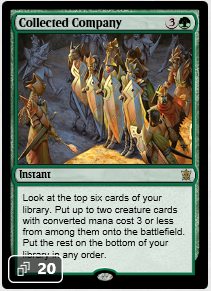
cc

I bought a first round of Collected Company around 5 tix this past week. As the price started to rebound I wanted to wait a little bit to see if it would come closer to 5 tix again. It didn't, and I'm not really willing to buy at a higher price at the moment.

Collected Company and the rest of Dragons of Tarkir may have already reached their post-rotation bottom. It may sound like I'm playing it too safe but I'm okay with only five playsets here. However, I should give a closer look to DTK singles. As a large third set, DTK has a lot of Modern (or other format) playables that could see a decent price increase in the following months.

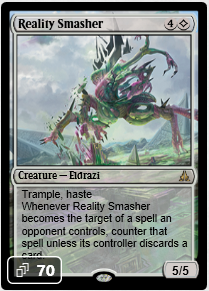
rs

Along with Thought-Knot Seer, Smasher went totally unseen at this Pro Tour, and might well disappear from Standard deck lists. Both cards fit in the rare category of powerhouses in all eternal formats that are nonetheless not good enough in Standard.

I picked up 36 more copies under 2 tix before Pro Tour KLD. As it seems, I won't be able to count on Standard to boost the price of Reality Smasher. With an average buying price of 2.5 tix, it may not be easy to make a profit on this---I'll probably be looking to sell this as soon as possible whenever the price gets closer to 3 tix.

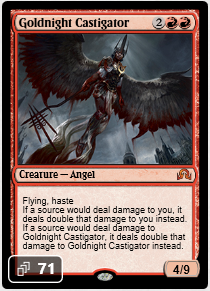
gc

Another ride with Goldnight Castigator. It didn't pay off right away in Pro Tour results, but as long as red has a decent shot in Standard this guy has a chance to spike. It did so two times in the past and I only need it to happen once more, even something moderate like a 2-tix spike.

Sales This Week

Let's be frank, this move was a total bust. Gideon didn't look too good after Day 1 at PT KLD, and as the price was heading down I decided to get rid of my copies. Guess where Gideon's price is today: back at 22 tix where it was last Thursday.

At last a sale that seems well-timed. My only regret is that I was unable to grab more copies. Doubling up on a 7-tix mythic doesn't happen every day. Although B/G Delirium saw a decent amount of play, I would rather sell the Flayer now at 14 tix than wait and gamble for more. Could Grim Flayer reach 20 tix? It's not impossible but I feel like now is a perfect opportunity to cash out.

Despite exceptional stats, Gisela appears unfit for the current Standard metagame. My profit is small here, but I'm satisfied with this spec, considering Gisela might not go anywhere from here. I'd rather sell now with just 28% profit than watch Gisela fall down to 2 tix because she can't find a home in Standard.

This spec never went anywhere, and I can't expect the triple Innistrad flashback drafts to help. Most likely I should have pulled the trigger several months ago, but better late than never. There's probably still a solid tix to lose between Olivia's price now and what it will be after ISD block flashback drafts.

On My Radar

Pro Tours always shake up formats like no other tournament. Often enough, the Standard metagame seen during Pro Tours doesn't represent what the vast majority of players will play subsequently. Following the Grand Prix, SCG tournaments and, most importantly for us, the MTGO metagame, will help us see more definitely which cards deserve a better or worse price.

As it has happened frequently in the past, the Standard metagame could evolve several times before Aether Revolt hits next January. Until then, I'll focus on seizing any good selling opportunity. The key is not to miss an opening, because a spike for a given card may not last long and may only happen once.

With Pro Tour Kaladesh behind us and KLD release events about to end on MTGO, I'm also closely watching how Modern prices will evolve under the price pressure set by the Treasure Chests.

Lastly, I'm currently pondering if and when to get into Magic Origins (ORI) and Dragons of Tarkir (DTK) full sets. These two large sets have fallen under 50 tix for the past two weeks and seem to have found a floor around 46 tix. The paper version of both sets is also slowing down the price drop, so it may be time to jump into another full set spec.

Both ORI and DTK have several casual and competitive cards of interest, which should help support price regains in the paper world in the coming month. With redemption still available for both I would anticipate some price gains for the MTGO version of these sets soon as well.


Thank you for reading,

Sylvain

Insider: How I Used the Ion Core Scanner to Maximize My Buylisting Profits – Conclusion

Are you a Quiet Speculation member?

If not, now is a perfect time to join up! Our powerful tools, breaking-news analysis, and exclusive Discord channel will make sure you stay up to date and ahead of the curve.

Over the past few weeks, I have been using Quiet Speculation's Ion Core scanner to help me sell the extra cards in my collection, and I've detailed my experience using the scanner and the process of selling to stores with the help of Trader Tools. There’s always some uncertainty with card grading and price offers when sending cards off across the country, so today I wrap up this buylisting series with my report on the results of my experience with each store.

Mythic MTG

The first store to process my buylist order was Mythic MTG, which wasn’t surprising given that it was the closest store to me. The original price for the cards was $119, and the revised offer was $111.35, a multiplier of 0.94 and a price I was very satisfied with. Given their close proximity and my good grading experience, I look forward to selling to them again. Earlier this week, I sent out a few playsets of Kaladesh mythic speculations that Mythic MTG was paying the best price for, and I expect to get paid full value by week's end.

Strike Zone

The next store to process my buylist was Strike Zone. They finished the process two days after Mythic MTG, and I was impressed by the expediency given that my package likely took two more days in the mail before arriving.

Based on what I had read about harsh grading, I was somewhat reticent about Strike Zone, but they paid $90.76 of the $102.26 original estimate, or 89 percent of the original price. They sent back a few cards that they weren’t interested in. Conveniently, because I had already paid $1 to have a check payment shipped, they simply packed them together. I was very satisfied with the speed and the grading. One of my qualms about the buylist not having a search function was resolved by a reader who directed me to it on Strike Zone's website, so I guess my only concern with their buylist is that it doesn’t work with Trade Routes.

This week I did another round of buylisting, this time processing all of my foil cards with the Ion Core Scanner, and Strike Zone paid the best price on the majority of them, so I happily sent them a large stack of cards worth more than the previous order.

Cape Fear Games

My small Cape Fear Games order was processed quickly, paying $33.05 of the $33.50 order. Knocking a few cents off felt like a slap on the wrist – basically nothing, with the order paying nearly 99 percent of its original estimate. This made me confident to send them another small buylist order of foils this week.

Isle of Cards

Isle of Cards

Isle of Cards was my biggest buyer, and I actually sent them two orders in the same package, as explained last time. They were both processed at the same time, and I was paid a combined total of $492.74 of the $497.81 quote, a payment that actually exceeds the Cape Fear Games percentage but with a much bigger sample size. I was very satisfied and look forward to selling to them again.

ABU Games

I also sent a two-part order to ABU Games. Their processing is nuanced, separating out all of the cards they will pay full value for from the cards they have revised an offer on, and then asking you to approve the sale of the changed cards or alternatively to have them returned.

They offered to pay $77.59 of the original $104.55 offer for the played cards, a 0.74 multiplier that seemed quite fair. They also paid half price for a couple cards that were heavily played or even damaged. It all equates to them paying me $148.93 of their $185.20 offer, or an overall multiplier over 0.80. Given their ease of use with Trade Routes and fair grading system, I recommend their buylist.

Card Kingdom


Image result for card kingdom logo

Card Kingdom paid $102.34 of their $130.59 offer, a multiplier of 0.78 comparable to ABU, and given their reputation, my experience with harsh grading and the fact that many of my cards were played, I was satisfied. They also processed my cards quite quickly given the longer shipping time to the northwest corner of the country.

Cool Stuff, Inc.

download

Cool Stuff, Inc. didn’t send me any email confirmation of receiving my buylist, and when I checked on their website I was informed they had processed it but needed me to specify a payment type. Once I did, I was immediately paid. I was informed that a couple cards they did not want and were slated for return at my convenience, but otherwise my order was processed and paid in full, which means I certainly recommend them and have already sent them another order of foil cards.

Troll and Toad


TrollAndToad.com

Troll and Toad didn’t send me a confirmation that my cards were processed, but their website indicated they offered the full $73.99 of the original invoice, which matches my previous experience and expectation. I recommend them highly.

Magic.Cards

I sent Magic.Cards a large, two-part order, and the order took over a week to be processed, but they did alert me that the cards had been received and would take some time to process. They offered a total of $215.90 of the $262.15 original estimate, a 0.82 multiplier. Given that they accepted three grades of cards and I was lax in my classification, I was very satisfied with their price, and combined with their outstanding website, it means I will gladly sell to them again.

AdventuresON

adventuresON.com

AdventuresON's website shows that they received my cards on the same days as the first stores to pay, but they still haven’t made an offer.

Conclusions

Selling to online buylists can be a lot of work, but the Ion Core Scanner made the job very manageable. Using Trader Tools to look up the prices of cards was already a huge upgrade to scouring each buylist, but the Ion Core Scanner elevates it to the next level, and I couldn’t imagine tackling future projects without it.

Now that I have gone through my extra cards, I’m excited at the prospect of acquiring collections and using the Ion Core Scanner to quickly and efficiently convert them to cash or credit. I can’t recommend the Ion Core Scanner highly enough. If you’ve already used it, then I’m preaching to the choir, so please share your tips in the comments!

--Adam

Avatar photo

Adam Yurchick

Adam started playing Magic in 1999 at age 12, and soon afterwards he was working his trade binder at school, the mall food court, FNM, and the Junior Super Series circuit. He's a long-time Pro Tour gravy-trainer who has competed in 26 Pro Tours, a former US National Team member, Grand Prix champion, and magic.tcgplayer.com columnist. Follow him at: http://twitter.com/adamyurchick

View More By Adam Yurchick

Posted in Buylist, Finance, Free Insider, ION, Trader Tools2 Comments on Insider: How I Used the Ion Core Scanner to Maximize My Buylisting Profits – Conclusion

Have you joined the Quiet Speculation Discord?

If you haven't, you're leaving value on the table! Join our community of experts, enthusiasts, entertainers, and educators and enjoy exclusive podcasts, questions asked and answered, trades, sales, and everything else Discord has to offer.

Want to create content with Quiet Speculation?

All you need to succeed is a passion for Magic: The Gathering, and the ability to write coherently. Share your knowledge of MTG and how you leverage it to win games, get value from your cards – or even turn a profit.

Grixis Control Today: Fine-Tuning for the Meta

Are you a Quiet Speculation member?

If not, now is a perfect time to join up! Our powerful tools, breaking-news analysis, and exclusive Discord channel will make sure you stay up to date and ahead of the curve.

Last week I introduced my new submission for Grixis Control, Fall 2016 style. My reasons for revisiting the archetype were simple: Modern is polarizing, Grixis hasn’t been putting up results lately, and the deck is freakin' awesome. If you missed last week, be sure to catch up to speed first. That article framed most of the discussion around the notion of context, and why I felt Grixis would be successful in this specific metagame, so non-Grixis players would be able to take my process and hopefully apply it to their own archetypes. Today, I’ll be building upon last week’s work, talking specifically about my list’s choices, how it compares to other variations, and how it lines up against the format. Let’s go!

bitterblossom-art-cropped

To start, here’s the list I proposed last week for reference.

Grixis Control 2.0, by Trevor Holmes

Creatures

4 Snapcaster Mage
3 Tasigur, the Golden Fang
2 Gurmag Angler
2 Vendilion Clique
2 Jace, Vryn's Prodigy

Instants

4 Thought Scour
4 Kolaghan's Command
4 Lightning Bolt
2 Terminate
2 Remand

Sorceries

3 Inquisition of Kozilek
4 Serum Visions
1 Anger of the Gods
1 Pillar of Flame

Lands

1 Darkslick Shores
2 Spirebluff Canal
1 Blackcleave Cliffs
2 Creeping Tar Pit
4 Scalding Tarn
3 Polluted Delta
2 Bloodstained Mire
2 Steam Vents
1 Watery Grave
2 Island
1 Mountain
1 Swamp

Sideboard

3 Dispel
2 Thoughtseize
1 Inquisition of Kozilek
1 Anger of the Gods
2 Yixlid Jailer
1 Terminate
1 Grim Lavamancer
1 Slaughter Games
1 Damnation
2 Negate

Last week I pointed to the general aggression of the format as the cause of my interest in playing this particular version of Grixis Control. Ever-present zero- and one-cost creatures have me unenthusiastic about Terminate and expensive card advantage spells; hence the overall efficiency and reduction in converted mana cost among my choices. These changes leave us vulnerable to dedicated midrange and control strategies, but in return we gain smoother gameflow and increased levels of interaction against most of the aggressive and combo elements in the format.
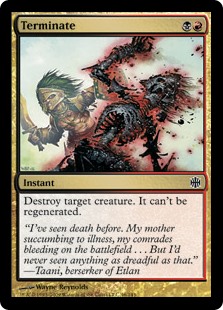
TerminateWhen I published my article, I expected some feedback regarding the similarities between my list and recent Grixis Delver lists that have performed well. Cutting expensive spells, trimming high-cost threats in favor of cheaper options, and gaining access to more burn elements are all primary deviations that signal a shift in deckbuilding from Grixis Control towards Delver (besides the inclusion of Delver of Secrets, of course).

This insight got me thinking about the ever-present question of identity, and the challenges it presents primarily to reactive strategies with historical overlap in deck composition. If we’re playing 67-71 of the same cards as Grixis Delver, can we really call ourselves Grixis Control? Where is the line between doing something "different" and just having a slightly shifted version of another strategy? Especially in reactive strategies, does our deck composition influence our primary gameplan directly, or should we let matchups and the metagame sponsor that change?

These are complicated questions to answer, but I think they're important to recognize, at least. It's tempting to just plow ahead with the first brainstorm that seems to solve the format, but it's important to be honest with yourself about your own ideas. This includes past choices in deck composition. As a "tuner," I’m constantly struggling to remove from the design process my own preconceptions about the format and specific card quality, in the hopes of reaching a clearer conclusion about what cards I should be playing.

[wp_ad_camp_1]

Taking a Page from Delver

Theoretical thinking aside, the real question I’m asking myself right now is whether I should be playing Grixis Delver. Historically, Grixis Delver has performed better in high-level events than Grixis Control, and is considered by many to be the better deck. After a week of tuning and adjusting, I’ve come to the conclusion that I’m correct not to play Delver of Secrets, but I am attempting to incorporate elements of what makes Grixis Delver a powerful deck into my own strategy. Here's a typical list from a recent IQ:

Grixis Delver, by Gabriel Womack (3rd, SCG Super IQ Atlanta)

Creatures

4 Delver of Secrets
1 Gurmag Angler
4 Snapcaster Mage
2 Young Pyromancer
3 Tasigur, the Golden Fang

Instants

2 Countersquall
1 Electrolyze
1 Kolaghan's Command
4 Lightning Bolt
2 Murderous Cut
2 Spell Snare
3 Terminate
4 Thought Scour

Sorceries

1 Dreadbore
3 Gitaxian Probe
4 Serum Visions

Lands

2 Island
1 Mountain
1 Swamp
1 Blood Crypt
1 Bloodstained Mire
4 Polluted Delta
4 Scalding Tarn
3 Spirebluff Canal
1 Steam Vents
1 Watery Grave

Sideboard

1 Engineered Explosives
1 Izzet Staticaster
3 Blood Moon
2 Dispel
1 Kolaghan's Command
2 Magma Spray
1 Rakdos Charm
2 Surgical Extraction
2 Painful Truths

Delver is proactive, synergistic, a strong choice against a field with combo elements, and powerful when we need to end the game quickly. It benefits from a synergistic gameplan that isn’t reliant on one specific card, and it can adapt to fit different draws or matchups easily. Gitaxian ProbeIn addition, it can more easily interact with other aggressive strategies and benefits from an increase in overall mana efficiency compared to the "bigger" control lists.
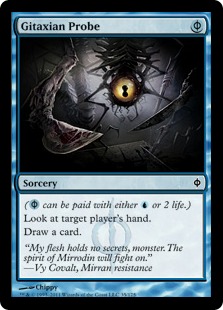
The downside? Grixis Delver decks play Delver of Secrets. I have trouble finding another card that's simultaneously as awkward and potentially game-losing as it is central to an archetype’s strategy. Delver of Secrets commits us to an aggressive line that the rest of our deck isn’t entirely built on pursuing. It's much worse on the draw, especially in aggressive pseudo-mirrors. It promotes linear deckbuilding with the inclusion of spells like Gitaxian Probe and Spell Pierce, which take away from the strengths of our color identity: reactivity, card advantage, and power. Let’s not talk about when it doesn’t flip.

Grixis Delver decks win a large percentage of their games without ever drawing and casting Delver itself, which leads me to believe that the card isn’t as central to their strategy as is widely thought. What’s stopping us from adopting the strengths of Grixis Delver, without committing ourselves to the radical changes they force upon their own lists by playing Delver of Secrets? To wit:

Grixis Control Tuned, by Trevor Holmes

Creatures

3 Tasigur, the Golden Fang
4 Snapcaster Mage
2 Gurmag Angler
2 Vendilion Clique
1 Jace, Vryn's Prodigy

Instants

4 Thought Scour
4 Kolaghan's Command
4 Lightning Bolt
2 Terminate
2 Remand
1 Burst Lightning

Sorceries

3 Inquisition of Kozilek
4 Serum Visions
1 Collective Brutality
1 Anger of the Gods

Lands

1 Darkslick Shores
2 Spirebluff Canal
1 Blackcleave Cliffs
2 Creeping Tar Pit
4 Scalding Tarn
3 Polluted Delta
2 Bloodstained Mire
2 Steam Vents
1 Watery Grave
2 Island
1 Mountain
1 Swamp

Sideboard

3 Dispel
2 Thoughtseize
1 Collective Brutality
1 Anger of the Gods
1 Bitterblossom
1 Terminate
1 Grim Lavamancer
2 Surgical Extraction
1 Damnation
2 Negate

After some more testing, this is where I’m at currently with Grixis Control. As Zach Allen suggested on Twitter, Collective Brutality is a solid card worthy of discussion in Modern, especially in Grixis Control. After some testing with the card, I’m convinced it has a home here. While I can definitely see it experiencing varying levels of play depending on metagame, currently the Modern context has never been better for Collective Brutality.
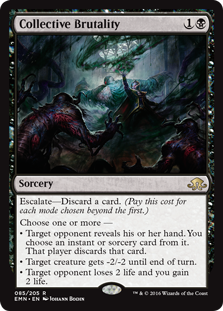
Collective BrutalityLifegain is hard to come by in our colors, and Collective Brutality has been excellent against Burn in testing. Killing a Goblin Guide, taking a 3-4-point burn spell, and giving us an almost-free Countersquall for two mana (and two cards out of our hand) isn’t the absolute best on rate, but it's excellent when we factor in mana efficiency. Remember that in the Burn matchup all we’re looking to do is trade cards for life, so discarding a spell to drain for two is over a full card’s worth of value anyways. That we’re getting it for no extra mana is just icing on the cake, as that frees up our later turns to Dispel and Negate away without fear of wasting mana on cards left in hand.

Outside of the Burn matchup, Collective Brutality is actively great against every aggressive deck and solid against combo and midrange/control as well. For a Grixis "Control" deck we’re playing a surprising amount of burn, and the two-point drain is better here than it would be in other decks. Between this, the four Kolaghan's Command, Lightning Bolt, and Snapcaster Mage, we have a surprising amount of non-creature surprise damage, and it’s not even a stretch to call Vendilion Clique "Bolts 5-6" either.

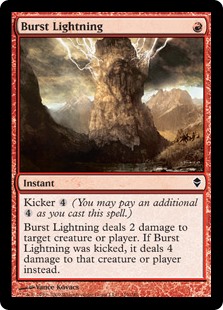
With this in mind, I’ve begun testing out Burst Lightning in place of Pillar of Flame. Wanting to kick it should come up more than the exile clause in theory, especially since we have access to two Anger of the Gods to deal with Kitchen Finks in those specific matchups. Burst Lightning gives us a fifth five-mana instant speed option in addition to the normal Snapcaster Mage/Kolaghan's Command play, and I could definitely see the extra two damage mattering in many games. burst-lightningRemember that yes, you can pay the kicker cost on flashed-back spells. Seven mana is a lot, but we could also potentially cast this off a flipped Jace, Vryn's Prodigy, in which case we would only need the easily attainable five. Burst Lightning is a late addition, and I’ve yet to see a situation where I’m glad I had this over Pillar of Flame, but then again I’ve yet to find myself wanting Pillar of Flame when I drew this too.
Jace, Vryn's Prodigy is a pet card, and I realize this completely. That's why I’ve gone from playing a playset in previous lists, down to two in the original concept for 2.0, and finally down to a singleton copy in this list. The card has always been excellent, but the format has just moved away from the front half of the card. I say this because the flipped side is still excellent—shrinking small creatures, distracting big ones, providing extra copies of previously cast spells. I still like the card, I just don’t need the late-game power it provides and I’m much more interested in never drawing two copies at once. In this deck, in this format, Jace, Vryn's Prodigy is cast on turn four or five at the earliest. We’re just too busy doing more important things. Sorry, buddy.

Tweaks to the Sideboard

As for the sideboard, the Yixlid Jailers are gone, replaced (along with Slaughter Games) by Surgical Extraction. Just drawing one of these against Dredge should be enough to win (take their Prized Amalgam and we should be fine from there). Yes, I know they have other stuff, but we have big delve creatures and removal spells to go with them. As long as we don’t open ourselves up to a blowout Rally the Peasants, we shouldn’t have a problem.
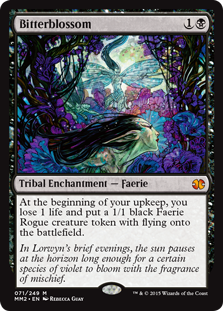
BitterblossomI’m more interested in how we react to the increased graveyard hate that is almost assuredly coming with Dredge’s renewed increase in format market share. Five delve creatures is just enough to make it awkward to defend against graveyard hate ourselves. It’s just really tough to ignore Rest in Peace—it may be card disadvantage for them, but it still does enough against us that we can’t laugh in their faces when they cast it. To hedge, I’m diversifying my threats post-board, with my old favorite in Bitterblossom making a return.

I’m not sold on this choice, as we’re not playing Bitterblossom against Burn or most of the combo decks in the format. Still, I’m bringing it in against Affinity, Infect, all the midrange and control matchups, and probably against Dredge as well if I have room. An easy way to generate free value/attackers/blockers is hard to laugh at, but I wonder if it does enough. Jund is still the third most-played deck, however, and this card is excellent against them. Watch them squirm as they hold onto their useless Liliana of the Veil, and take pride in the fact that you made them keep in their garbage Abrupt Decay that does nothing against our delve creatures.

Conclusion

I've called Grixis Control "the blue mage’s Jund" in the past, so it makes sense that we would eventually end up modeling our Control list after Grixis Delver now. Grixis players of all types have always recognized how their specific choices place them on a spectrum, one that shifts with the changing tides of the metagame. If you choose to partake in the "dark side" of Control, understand that taking up this mantle brings with it a responsibility to disassociate yourself from presumptions. Be sure never to lose track of your identity as the world shifts around you. Thanks for reading, and I’ll see you next week.

Trevor Holmes

The_Architect on MTGO

Twitch.tv/Architect_Gaming

Twitter.com/7he4rchitect

Insider: The Real Story of the Pro Tour

Are you a Quiet Speculation member?

If not, now is a perfect time to join up! Our powerful tools, breaking-news analysis, and exclusive Discord channel will make sure you stay up to date and ahead of the curve.

Every time the Pro Tour rolls around, you will see a mass migration towards the top eight decks that the pros have innovated. What most players don’t follow, though, is what happened outside of the top eight. My favorite decks to look at are usually not the top eight or top 16 decks, but rather, the most successful decks in the two Standard portions of the competition. These decks can sometimes be difficult to track down (you have to find them on the Wizards website, after all), but it's well worth the effort. (Also, you can always read my articles because I cover these decks after every Pro Tour.)

By looking at the top Standard decks, you gain valuable insight into what decks actually performed well in the format overall. For example, if you didn’t look at this list, you may not know the real story of this Pro Tour. I’ll let you in on some secret info: the real story isn’t the deck that won the event, or even the runner up. The real story of this tournament is Blue-White Flash. All four of the decks with the best Standard record, 9-1 or 27 points, were Blue-White Flash.

In other words, the deck may not have won the event, but it was the most successful archetype overall and produced the best results.

UW Flash by Joey Manner (Pro Tour Top 8)

Creatures

4 Thraben Inspector
3 Rattlechains
4 Selfless Spirit
4 Reflector Mage
4 Spell Queller
4 Archangel Avacyn

Spells

1 Declaration in Stone
4 Smuggler's Copter
3 Stasis Snare
4 Gideon, Ally of Zendikar

Lands

4 Port Town
4 Prairie Stream
2 Westvale Abbey
6 Island
9 Plains

Sideboard

2 Blessed Alliance
2 Ceremonious Rejection
1 Declaration in Stone
2 Fragmentize
1 Fumigate
2 Jace, Unraveler of Secrets
1 Linvala, the Preserver
2 Negate
2 Summary Dismissal

If you dissect this deck list, there aren’t many surprises to be found. One thing that did stand out to me was the inclusion of Gideon, Ally of Zendikar. The rest of the deck is what you’d expect when you look for cards to fit into a Blue-White Flash archetype. For example, every pilot included the best flash creature in the format, Archangel Avacyn, and her counterpart, Spell Queller. In addition, most versions also played Rattlechains to add a Scion of Oona effect to the deck's repertoire.

Getting back to the surprising card, Gideon, I like this card in the list for one main reason. There is no better threat to follow up a flash spell than Gideon. You always want him to resolve and survive, so casting something at the end of your opponent’s turn and then playing him as your follow-up on your turn is an incredibly powerful sequence.

There was an error retrieving a chart for Gideon, Ally of Zendikar

Another great aspect about this deck is the ability to bring in lots of counter magic during sideboarding. This is a strategy I’ve used a lot in combination with Collected Company, and I think it would fit like a glove with this assortment of cards, too.

This may not be the most surprising deck to come out of the Pro Tour – after all, we all knew going into this season that this was most likely going to be a tier-one strategy – but it is consistent and powerful. Many players will jump on board with this deck because it fits their play style. Come prepared to battle against this archetype at events.

Successful Metagame Picture

Let’s take a look at what the best decks look like when we break them down by archetypes.

Control
Jeskai
Grixis
UW
UR Spells

Aggro
Rakdos
BG Delirium
RW Vehicles
Bant
Gruul Energy

Combo
Aetherworks Marvel

Even just looking at the decks that had winning records in the Standard portion of the Pro Tour, there is something here for everyone. There are four different types of control decks, including UR Spells, which utilizes Dynavolt Tower to help control the game. Most of these decks just rely on Torrential Gearhulk to gain some card advantage and eventually win, but if that’s not how you’d like to win in this format, there are options.

There was an error retrieving a chart for Thing in the Ice

There are lots of flavors of aggressive strategies as well. Most of them include Smuggler's Copter because it’s the best card in the format, but they all surround it with different things. If you like messing around with your graveyard, there are a couple ways to do that – or you can just smash your opponent with the fastest creatures the format has to offer until you're ready for them to pilot the vehicles.

Finally, if you are the type of player who likes combo or ramp decks, Aetherworks Marvel is sort of a hybrid of those two concepts. My friends tried to convince me that this strategy is consistent enough to compete, but I would never play something as unreliable as a deck revolving around looking at the top six cards and hoping to find one of your eight Eldrazi to cheat into play. Maybe with as much energy as the deck makes, getting multiple activations to see more than six cards is enough to consistently win games. But I think more often than not, if your Marvel doesn’t get countered, you will whiff. This is definitely a strategy you want to have an answer for, though, because if this deck is allowed to run its course, you’ll be dying to Emrakul, the Promised End  or Ulamog, the Ceaseless Hunger rather quickly.

There was an error retrieving a chart for Aetherworks Marvel

Financial Impact

Financially speaking, most of the cards have already peaked, so your window to buy has closed. One of our best services here at Quiet Speculation is the on-site coverage of Pro Tours. This gives Insiders the quickest information about what’s happening on the floor at the event so you can react and make some money.

If you bought in on any of these spiking cards, make sure you lock in your profit quickly. It seems like we’re in a bubble right now with Kaladesh. All the cards are currently rather expensive, and the set still has sweet Inventions cards that can be opened. Kaladesh is generating an enormous price per pack right now, and it cannot possibly maintain its current expected value. If you have cards, move them, because they are about to come crashing back down.

There are some cards that may not have popped up in value yet, and that’s because they are hidden at the end of the successful deck lists. Kibler may have spoiled the secret tech already, but let’s take a look and see what’s in store.

Gruul Energy

Creatures

4 Longtusk Cub
4 Servant of the Conduit
2 Lathnu Hellion
4 Tireless Tracker
4 Voltaic Brawler
3 Bristling Hydra
1 Verdurous Gearhulk

Spells

4 Attune with Aether
1 Blossoming Defense
4 Harnessed Lightning
3 Incendiary Flow
2 Smuggler's Copter
2 Chandra, Torch of Defiance
1 Skysovereign, Consul Flagship

Lands

4 Aether Hub
2 Cinder Glade
4 Game Trail
4 Mountain
7 Forest

Sideboard

2 Weaver of Lightning
1 Dynavolt Tower
1 Commencement of Festivities
2 Root Out
1 Lathnu Hellion
1 Aetherworks Marvel
1 Natural State
4 Galvanic Bombardment
1 Nissa, Vital Force
1 Fleetwheel Cruiser

First of all, I think this deck is great and underrated. Gruul Energy didn’t top eight the event and is hidden at the end of the Standard results. Both of these factors make this look like a deck poised to crush a tournament, as it can clearly compete, but now people won't be preparing to battle against it. I also like both Lathnu Hellion and Bristling Hydra as potential spec targets. They may be at their peaks at around $1.50, or slightly above bulk, but I think if this deck finds a larger following, they could increase a bit more. You can probably find these still priced as bulk, so keep your eyes open.

Question of the Day

To finish up today, I want to leave you with one question I’ll be pondering in the next couple of weeks, as well as throughout the year: how will the rotation reset to the old, one-rotation-a-year model affect the price trajectory of card prices?

The main issue on my mind is whether the market will shift back into the traditional ups and downs under the old system, or if the structure of sets now including Masterpiece Series cards every time will cause prices to always stay low?

There are many topics to explore in the finance world. Let me know your thoughts below.

Until next time,
Unleash the Force!

Mike Lanigan
MtgJedi on Twitter

Reverting Standard Rotation

Are you a Quiet Speculation member?

If not, now is a perfect time to join up! Our powerful tools, breaking-news analysis, and exclusive Discord channel will make sure you stay up to date and ahead of the curve.

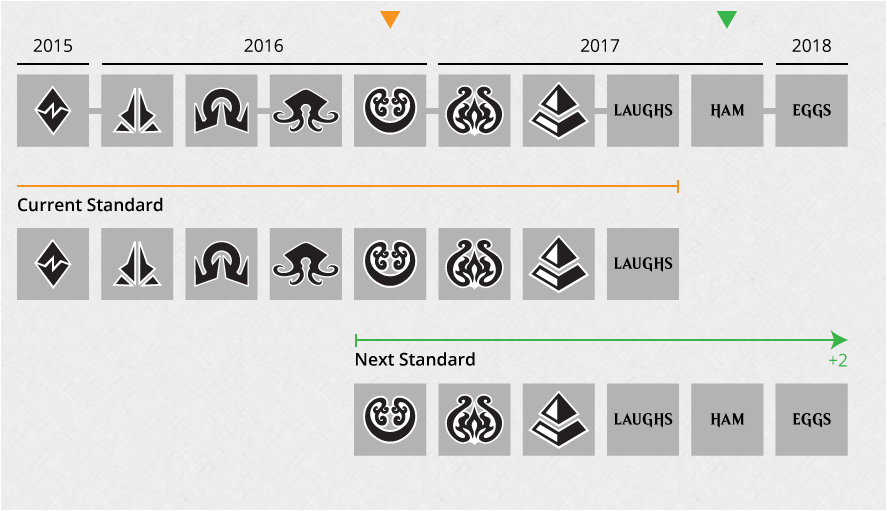
I was pinged about this about one-hundred different ways, but in case you missed it there was a huge announcement on The Mothership yesterday. The long and short of it, is that Standard is reverting from the new 18 month rotation back to the two year rotation.

This announcement will apply to the current Standard legal sets, meaning that Amonkhet will not cause Battle for Zendikar to rotate out of Standard. In other words, get used to this guy.

There was an error retrieving a chart for Gideon, Ally of Zendikar

I was personally enjoying the new rotation system, though many players felt like it made Standard rotate too much, and made the format feel less accessible to less enfranchised players. It certainly made it more expensive to have a deck on week one or two of every new Standard format.

This will impact investment strategies with regard to the current sets, and you can expect this to be expanded upon on the Insider side. Shadows Over Innistrad positions certainly have gotten more interesting.

Avatar photo

Ryan Overturf

Ryan has been playing Magic since Legions and playing competitively since Lorwyn. While he fancies himself a Legacy specialist, you'll always find him with strong opinions on every constructed format.

View More By Ryan Overturf

Posted in Free1 Comment on Reverting Standard Rotation

Have you joined the Quiet Speculation Discord?

If you haven't, you're leaving value on the table! Join our community of experts, enthusiasts, entertainers, and educators and enjoy exclusive podcasts, questions asked and answered, trades, sales, and everything else Discord has to offer.

Want to create content with Quiet Speculation?

All you need to succeed is a passion for Magic: The Gathering, and the ability to write coherently. Share your knowledge of MTG and how you leverage it to win games, get value from your cards – or even turn a profit.

Insider: A Blind Look at MTGO

Are you a Quiet Speculation member?

If not, now is a perfect time to join up! Our powerful tools, breaking-news analysis, and exclusive Discord channel will make sure you stay up to date and ahead of the curve.

Magic Online is known for being a competitive environment to test Standard and Limited. Bugs aside, it's the main way to play Magic on a digital platform while coming as close to the paper version of the game as possible.

Because MTGO lacks the social "kitchen table" aspect, there are far fewer casual players diving into the online version of Magic. There are thousands of other casual games out there, and very few are less intuitive than the '90s-esque digital platform that Wizards of the Coasts provides us.

There was an error retrieving a chart for Nostalgic Dreams

The markets are entirely different, too; I was surprised to learn that Kozilek's Return is $25 online, when it's around $10 in paper. Apparently certain Standard staples can command a premium above their paper counterparts. Who knew? On the opposite end of the spectrum, I'm pretty sure EDH is a lot less popular online than it is at your LGS. There's less face-to-face interaction, and it's just not the same feeling.

Why am I going over this now? Because I wanted to start this article off by saying, "I have never owned a Magic Online account in my entire life," but that's technically not true. Back when I was a casual durdly player and some of my decks didn't even have sleeves, I managed to convince my mom to let me use her debit card to sign up for an MTGO account. At the time, I was completely opposed to having two separate collections, so I just bought the gold-bordered expansions within MTGO that only let you build and play with other people who were using the gold-bordered expansions. I played for about a month before uninstalling.

Does this have any relevance to the actual article? Yeah, kind of. When I decided to sign up for MTGO again, I couldn't even remember my username or password for that account; the email address I had used was disconnected. It had been around seven years ago, so for all intents and purposes, yes, this article is pretty much a first look at MTGO from a long-time paper player's perspective.

reclamation

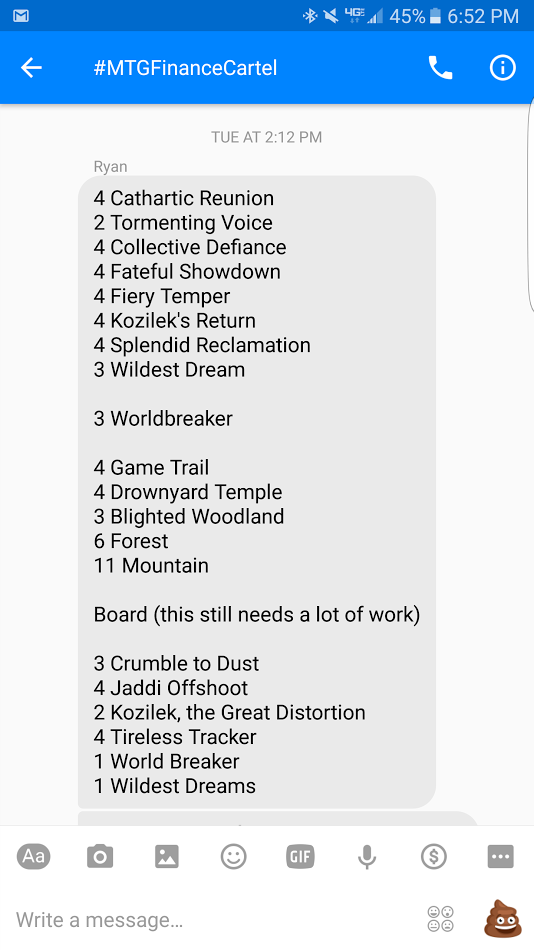
When my friend Ryan Bushard shared a fun-looking Standard brew in our group chat, I knew that I wanted to put it together mainly because it played Splendid Reclamation. I wasn't planning on grinding PPTQs or anything, but it looked like a fun FNM brew.

The only problem is that I don't really have time to even play FNM anymore between work, graduate school, Magic content, and sales. I wondered if I could just make an MTGO account and then mess around with the deck in the digital realm. The only cards in the list that were worth anything were the Kozilek's Return, so those would be even cheaper online, right? (Whoops.)

So here we are. I downloaded MTGO on Tuesday night, and am sitting here reading some articles on how to get started. This will document my process of figuring out exactly what I'm doing, and maybe we'll learn something along the way.

mtgo2

Alright, so we downloaded the client. That's... encouraging, I guess.

I did a quick Google search of what I get with this $10.73 purchase (a New York tax seems to have been applied), and apparently I get 5 Event Tickets (I think these are the "tix" that everyone trades as money) and 20 New Player Points, which are used to "join events specifically designed for players who are new to Magic Online." I get 40 of each basic land, and two commons from every current Standard-legal set (Kaladesh, Eldritch Moon, Shadows over Innistrad, Oath of the Gatewatch, and Battle for Zendikar). I also get two of each of the cards from the "Welcome 2016" decks, which basically amounts to the Serra Angels and Nightmares from those little 30-card decks that they give out for free.

Okay. Let it be known that I have no idea how trading with bots works, or if I can turn any of this random jank into some semblance of value to make my janky Standard deck even a little bit cheaper. We'll figure that out later, I guess.

video-tutorials

Hey, look! Video tutorials. I mean, I didn't actually watch any of them, because I figured it would be a bit more fun for me (and more entertaining for you) to watch me blindly struggle through figuring all this stuff out.

So after doing a bit of googling about MTGO, I ended up getting a Facebook-targeted ad from Cardhoarder. For those who don't know, Cardhoarder is the MTGO-only version of Isle of Cards, the very same buylist that we've seen really strong numbers on while writing about Trader Tools and bulk commons and uncommons. Thinking that their sister company's stock would likely be competitively priced like Isle is on paper cards, I provided Facebook its ad revenue and proved myself a slave to advertising.

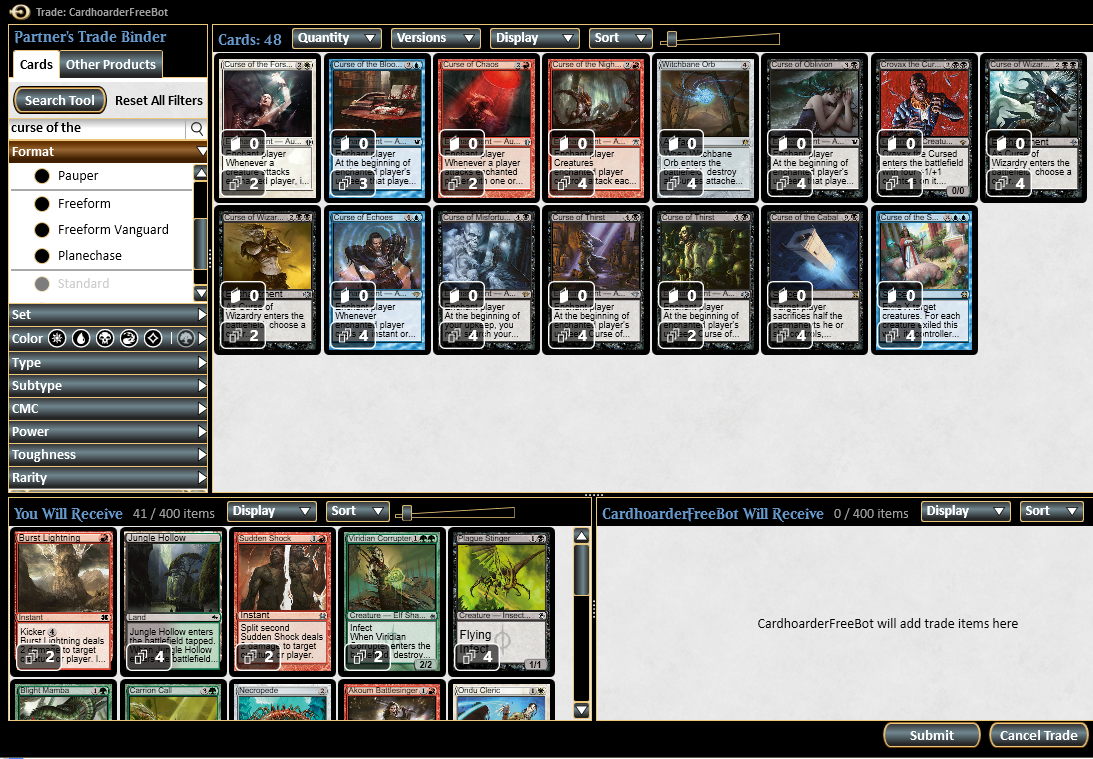
One of the draws of the advertisement was that Cardhoarder provided two free "bot credits" to anyone with a new MTGO account. Cool, that's me! I had no idea what bot credits were, but I assumed that they were basically $2 in store credit at that specific bot chain. Turns out I was right, and I also learned that Cardhoarder provides 64 free cards to MTGO users once per account from the CardHoarderFreeBot, which I thought was pretty neat. While they weren't giving out Kozilek's Returns, I got a nice warm-up exercise in trading and the MTGO interface by using the search parameters to figure out what I wanted for my free samples.

freetrade

While I searched pretty thoroughly for Pauper staples (just in case I ever feel like getting into the format), I still found some pretty nice playsets to officially start off my MTGO collection. Free Plague Stingers seem like they might be used eventually if I want to do some Pauper brewing, or maybe some $1 to $5 budget Ally deck. I was searching for some Curse of the Pierced Heart in the above picture, but no luck. If you're a new MTGO player like me, I highly recommend digging around in those bots for your free 64. At the very least you might be able to find some bulk rares that you can sell back to other bots for fractions of a penny, or maybe a janky casual Curse deck to play in the "Just for Fun" room.

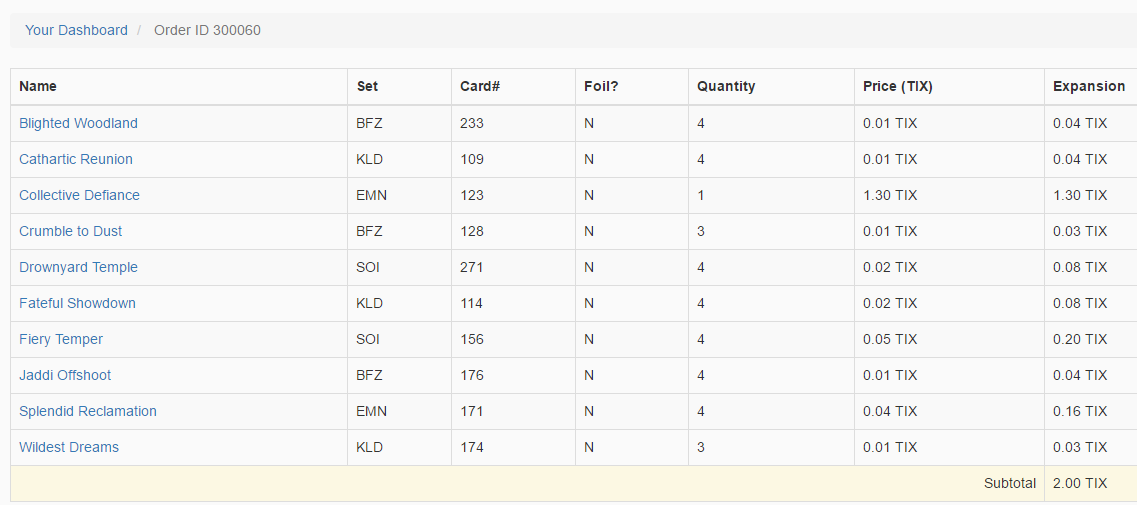
After getting my free samples, I wanted to spend the two bot credits that Cardhoarder had given me. It was overall a fast and painless process. I went to cardhoarder.com to check out the store, and ended up with this.

mtgorder

A slight misplay here: picking up four-ofs on Fiery Temper and Cathartic Reunion, because I forgot that those were commons from current Standard. Signing up for MTGO had given me two of each already, so I technically wasted .12 tix, or about 12 cents, or however you want to quantify it. Feels pretty bad, man; we were doing so well on the value up until this point.

The rest of the deck would end up costing me around $110, but with a much higher exit margin as long as I timed my sales properly. I think you all figured this out by now, but I don't exactly have a long-term relationship planned out with this janky Standard brew. I'm probably going to play it for a couple dozen matches, realize that it's awful, and then quit and look for something else to occupy my time.

There was an error retrieving a chart for Sands of Time

When that time comes, hopefully Kozilek's Return is still 22 tix on a buylist, because I paid 25 for each of mine. On that note, I was really happy with Cardhoarder and their customer service team. They helped me navigate a bit through my first couple of bot trades, and it only took like ten minutes tops for my card orders to show up in my account. Contrast that to the five or six business days that we wait for paper cards...

End Step

This is the part where you tell me whether or not you're interested in more MTGO debauchery. I got a pretty loud resounding "Yes" when I asked if you all were interested in reading about my first foray into the program, and I think it would be fun to jump back in and document my learning experiences for those of you who might be considering shrugging off the constant complaints about the system. I haven't found any bugs yet and the client looks awful, but maybe we'll see how my first draft goes next week. Maybe even a video component to my article? Who knows? Hit me up on Twitter or in the comments below.

Insider: The Importance of Reputation in Trading

Are you a Quiet Speculation member?

If not, now is a perfect time to join up! Our powerful tools, breaking-news analysis, and exclusive Discord channel will make sure you stay up to date and ahead of the curve.

Teller of TalesAs I've mentioned before, I'm a casual player at heart. What gets me most excited in Magic is a close, well fought, free-for-all multiplayer game. The kind of game where minor advantages end up making all the difference. Where decks are fairly evenly matched, and where politics have a major influence on the results, as any combination of players could take you out.
I've been fortunate enough to have had a regular casual group for several years. In such groups you see a metagame develop and get to understand different people's tastes. You may even pick up on what a new deck of theirs is likely planning to do (remember the guy who managed to figure out I was on combo based on me playing Wild Growth?). You also get to understand their thought processes, plays they're likely to make (good and bad), and their reputation with the other players.

Ultimately, you realize that people are watching you too, and that you also have a reputation within the group.

During games I generally leave people alone, but will retaliate fiercely if you come for me or are known to play something that ruins games, like Armageddon.

In deckbuilding I tend to prioritize synergy over raw power (that innocuous-looking card will probably prove stronger than expected), and often go for strategies off the beaten track. Where Jason Alt preaches building decks at 75% power level, I tend to choose an underpowered strategy and then build it to its full potential. I'm also known for being knowledgeable on deck building, so people seek my advice on their decks.

Concerning politics, I'm known to keep my word even if it costs me the game, though I generally phrase things to leave wiggle room. People know me to pretend to be weaker than I am (I've been compared to the emperor of Star Wars). People also expect me to have a good understanding of the current board state, so any advice I give is generally sound (even if I'm understating my own capabilities to elicit someone else to act).

This reputation has been crafted carefully, and it carries certain benefits. My reputation makes people less likely to attack me, more likely to listen to me, less likely to play tons of mana acceleration (I always recommend against it), and more likely to trust me when I make a promise or threat.

A Trader's Reputation

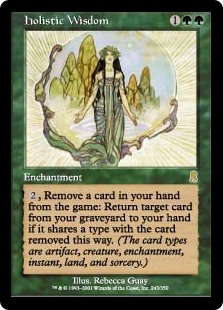
Holistic WisdomBy now I imagine you're all wondering how this is relevant to Magic finance. I see many parallels between free-for-all multiplayer games and trading in Magic cards. In both contexts your reputation is essential. It will heavily influence any deal you make, whether with opponents or trade partners.
You want the person you trade with to like and trust you. Not only for the purposes of completing the current trade, but also to make sure they come back and bring their friends. Someone who likes you is more likely to make a trade in your favor, but it's the repeat business that truly matters. After all, you can shear a sheep many times but kill it for meat only once.

As such, it's important to keep your reputation in mind when trading. Following a few simple practices will help you establish the rapport you want in your trading circles. What follows are the ones I see as most important.

Engage in Casual Talk

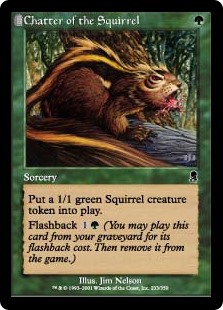
chatter-of-the-squirrel

You want to make your trade partners comfortable and find out what they could be interested in. Fortunately, asking them about the deck they'd like to improve, or whatever other reason they may have for trading with you, should cover both. Similarly, when looking at a collection to purchase, I have found it beneficial to ask them what deck they used to play. Hopefully they remember you being pleasant and come back, or recommend you to others.

Suggest Other Cards

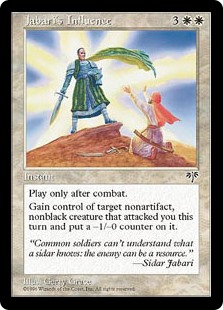
jabaris-influence

This is where it pays to know a lot of cards. You'll get the opportunity to make the deal bigger and better, possibly even to move a card that's been sitting in your binder for a while. You'll leave the impression of trying to help them, as well as being the go-to person for obscure cards. Of course, moving cards that are just taking up valuable binder space into cards you prefer is great anyway.

Include Throw-ins

throwing-knife

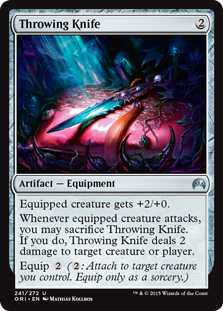
Got some low-value stuff that fits their plans? Leave it with them to remind them of your trade whenever they see it. Consider letting beginners just rummage through bulk for things they like, and they're bound to remember you. Meanwhile, more accomplished players will see you as the good guy you are. A good reputation is definitely worth a few cents here and there.

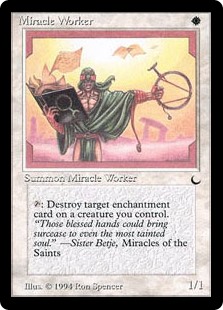
Do the Work

miracle-worker

We all know the trick of asking the other party for their prices and jumping on cards they seem to undervalue. Many players are discouraged from trading because this either takes up their time or causes them to end up in bad deals. Of course, you already know what you value cards at, and can easily make a decent proposal. Don't hesitate to do this to make their lives easier.

If you can give them the impression that you know your prices, especially when they check and your deal is fair, they will trust you in the future and trading will speed up quite a bit. Personally, I like splitting up larger deals into several smaller transactions of roughly equal piles. Then I can point out where one pile is a bit more than its counterpart, and where another pile compensates by going in the other direction. This illustrates clearly how you got to your valuation, helps identify possible disagreement on specific prices, and tends to convince them that you know what you're doing.

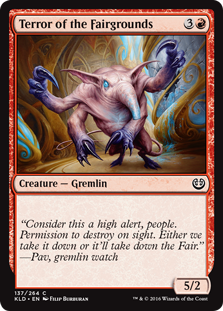
Be Fair

terror-of-the-fairgrounds

Gone are the days of making large profits on each deal. I will not deny having made deals that were way too good for me in my almost two decades of trading Magic cards. But in this day and age, everything can and will be checked, so you will soon get caught on shady practices.

These large profits are not needed either. You can make your profits on speculation, trading away cards likely to drop, trading up and down, using different price sources, etc.—there's just no need to go overboard on profits.

That isn't to say you can't add a little margin for yourself to play things safe—nobody will mind a small difference, especially if you explain that a trade needs to be interesting to you in some sense or you might as well not make it. Personally I trade if I feel that it will gain me cards I want, better cards, easily movable cards, or some profit; those motives should all be understandable to anyone.

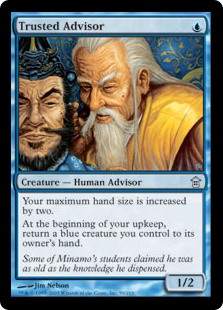
Be Trustworthy

trusted-advisor

There's a fine line between knowing your stuff and appearing to be out to get them using superior knowledge. It takes practice to make sure you appear to fall on the knowing side and thus seem trustworthy, rather than the other side that will make you seem shady. The more you apply the good practices mentioned above, the more they should have trust in you and come back.

Always watch for signs that they may be doubting you, and ask if there's anything you can do to make them feel better. Perhaps they are concerned with one of your valuations or perhaps they just don't like parting with a certain card. If you know what it is, you can do something about it and leave them feeling better about the deal.

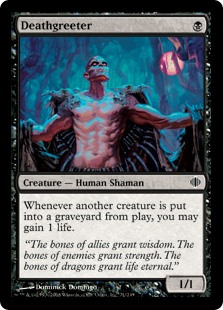
Take an Interest in Them

deathgreeter

You don't want to appear like you see them as nothing more than a binder. Wish them a fun day or good luck in the tournament; perhaps even greet them when you see them later. If you can remember their name the next time you trade, they'll feel honored. You may even make a friend.

Considering Your Actions

There may be other things that you can do—this is not meant to be a complete list. The most important thing is to think about how your actions influence your reputation among the people you deal with, and what you want that reputation to be. Ultimately, a better reputation will improve your chances of making good trades and help you land deals that others can't.

Good luck!

Avatar photo

Niels Rietkerk

Niels currently lives in Amsterdam, The Netherlands and has been collecting, playing and trading since '97. A casual player at heart, his first official tournament was the Unhinged prerelease. You can most commonly find him playing multiplayer Commander, probably trying to talk his way to a win. He has always been passionate about trading, but these days leaves the more volatile markets to people with more time, instead focusing primarily on bulk and collections. As he's one of the most prolific forum members it should come as no surprise that Niels loves to discuss. Feel free to comment or reach out to him on the forums or through Twitter.

View More By Niels Rietkerk

Posted in Finance, Free Insider, Timeless Info, TradingTagged , 4 Comments on Insider: The Importance of Reputation in Trading

Have you joined the Quiet Speculation Discord?

If you haven't, you're leaving value on the table! Join our community of experts, enthusiasts, entertainers, and educators and enjoy exclusive podcasts, questions asked and answered, trades, sales, and everything else Discord has to offer.

Want to create content with Quiet Speculation?

All you need to succeed is a passion for Magic: The Gathering, and the ability to write coherently. Share your knowledge of MTG and how you leverage it to win games, get value from your cards – or even turn a profit.

Insider: QS Cast #39: Post PTKLD, New Standard

Are you a Quiet Speculation member?

If not, now is a perfect time to join up! Our powerful tools, breaking-news analysis, and exclusive Discord channel will make sure you stay up to date and ahead of the curve.

Play

The QS Cast has returned, having shuffled once again—Chaz Volpe and Tarkan Dospil continue on where the cast left off. In this episode they discuss the following:

  • Post-Pro Tour Kaladesh
  • Is the Pro Tour worthwhile?
  • New Standard Rotation

Edit: We recorded right before Wizards' new Standard rotation announcement. We added a section at the end of the cast to reflect some thoughts on this.

newrotationschedule

As always, please comment and leave questions for us to address on the next cast! We will be making QS Insider questions a priority, and we want to know what you want covered.

Enjoy! We’re glad to be back.

Find us on Twitter: @ChazVMTG  @the_tark

Avatar photo

Chaz V

Started playing during Invasion block at the age of 13. Always a competitive person by nature, he continues playing to this day. Got into the financial aspect of the game as a method to pay for the hobby and now writes, Podcasts, and covers all aspects of the game, always trying to contribute to the community and create great content for readers and listeners.

View More By Chaz V

Posted in Free Insider, QS Cast2 Comments on Insider: QS Cast #39: Post PTKLD, New Standard

Have you joined the Quiet Speculation Discord?

If you haven't, you're leaving value on the table! Join our community of experts, enthusiasts, entertainers, and educators and enjoy exclusive podcasts, questions asked and answered, trades, sales, and everything else Discord has to offer.

Want to create content with Quiet Speculation?

All you need to succeed is a passion for Magic: The Gathering, and the ability to write coherently. Share your knowledge of MTG and how you leverage it to win games, get value from your cards – or even turn a profit.

Breaking Down Bant Eldrazi

Are you a Quiet Speculation member?

If not, now is a perfect time to join up! Our powerful tools, breaking-news analysis, and exclusive Discord channel will make sure you stay up to date and ahead of the curve.

Oath of the Gatewatch significantly changed the face of Modern upon release. Even after the deck that the set spawned was hit by the ban-hammer, the Eldrazi have found a way to claw back to the top of the format. If you checked out the most recent Modern Metagame Breakdown then you no doubt noticed that Bant Eldrazi has risen once again to being the most played deck in the format. Clearly the current percentages don't match the deck's former dominance, though it is a deck that you can expect to play against frequently in Modern. As such, I would like to offer an in-depth breakdown of the deck, discussing both how it functions and its core weaknesses.

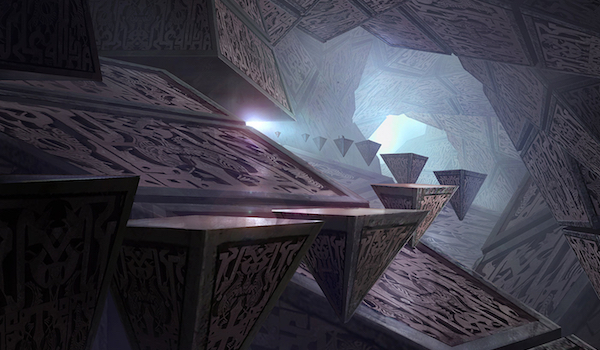
eldrazi temple art

There aren't a ton of deviations in how to build Bant Eldrazi. Some players have advocated for Tarmogoyf at various times, though mostly the deck is just large Eldrazi, a handful of removal spells, powerful lands, and great sideboard spells. It's safe to assume that most lists will look very similar to Brian Braun-Duin's list from his World Championship win:

[wp_ad_camp_1]

Bant Eldrazi, by Brian Braun-Duin (1st, 2016 World Championship)

Creatures

3 Drowner of Hope
4 Eldrazi Displacer
2 Eldrazi Skyspawner
3 Matter Reshaper
4 Noble Hierarch
4 Reality Smasher
1 Spellskite
4 Thought-Knot Seer

Artifacts

1 Engineered Explosives

Instants

2 Dismember
4 Path to Exile

Sorceries

4 Ancient Stirrings

Lands

1 Breeding Pool
3 Brushland
4 Cavern of Souls
4 Eldrazi Temple
2 Forest
1 Hallowed Fountain
1 Plains
1 Temple Garden
4 Windswept Heath
3 Yavimaya Coast

Sideboard

2 Engineered Explosives
2 Elspeth, Sun's Champion
4 Chalice of the Void
2 Grafdigger's Cage
1 Rest in Peace
3 Stony Silence
1 Worship

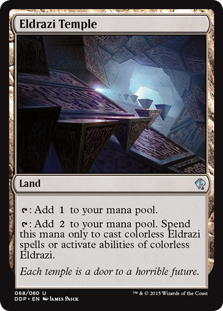
I wouldn't fault somebody tapping four mana to cast Thought-Knot Seer in Modern, though the backbone of the Eldrazi deck is Eldrazi Temple. Eldrazi Temple lets you cheat on mana, which is a consistent reason cited for banning cards in Modern, including the very similar Eye of Ugin. Many of the spells in the Eldrazi deck are overcosted for Modern by one-half to a whole mana—Eldrazi Templea land that taps for two suddenly makes these spells reasonable, or for some of the cards well above the curve.
Something that is important to understand when you look at the current Eldrazi decks, is that the deck responsible for getting Eye of Ugin banned mulliganed very aggressively and won a lot of games simply by virtue of a single Eldrazi Temple. The broken Eye of Ugin and Eldrazi Mimic draws got Eye banned, though the Eldrazi Temple and Eldrazi Displacer draws on five cards were often more than enough to win games. As such, many of the starts of the current configuration mirror exactly some percentage of the games that once completely broke Modern. The deck's ceiling has been lowered, though there are going to be times when you aren't sure if you're watching a post-ban or pre-ban game with the archetype.

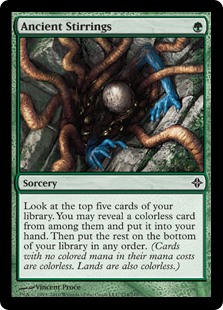
What the deck lost in raw explosive power it has made up for in consistency with the adoption of Ancient Stirrings. Ancient Stirrings is undeniably the most powerful cantrip still legal in Modern, adding a ton of consistency to Tron, Lantern Control, Amulet Bloom, and now Bant Eldrazi. Stirrings smooths out draws and finds the missing piece for the fast openers, whether that's the appropriate threat for the situation, or an Eldrazi Temple to push the archetype to the limits of the format's power level. This improved consistency is precisely what makes the current iteration the force that it is.

The Case for Joinin' Em

The power of Ancient Stirrings is just one premise for the argument that Bant Eldrazi is more than just another linear Modern deck. The primary difference is that Bant Eldrazi is generally rewarded for sticking to its theme with cards that are individually powerful. Other linear decks, such as Affinity, Burn, and Infect, play a specific subset of narrow cards to maximize their game plan and consequently find themselves weak to hate cards. Ancient StirringsBant Eldrazi, alternatively, is granted far more upside than downside by sticking to its theme. It gets a phenomenal card-selection spell in Ancient Stirrings, a land that taps for two mana in Eldrazi Temple, and the absurd upside of Cavern of Souls. Counters aren't the most popular spells in Modern, though I think it's worth mentioning given that the "hate" card we were given in Kaladesh is Ceremonious Rejection. Realistically, there's basically nothing you can add to your sideboard to give you a significant edge against Bant Eldrazi if you're struggling game one.
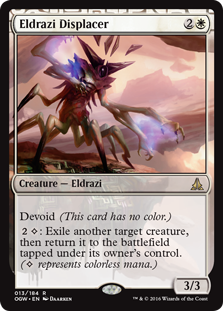
Given the abstract power level of Bant Eldrazi's spells, and its general resilience to individual answer cards, it generally crushes decks that are trying to force interaction. Thought-Knot Seer is big enough to demand specific removal spells in addition to providing disruption, while Reality Smasher is even larger and offers its own form of resilience. Drowner of Hope is larger still, with an extremely relevant ability in combat, and being a Flagbearer is just one of many talents of the consistently amazing Eldrazi Displacer. The composition of the deck and its general resilience allows it to effectively play the control in most matches, forcing the opponent to kill the Eldrazi player before the deck buries them with its huge spells.

Against the other linear proactive decks, Bant Eldrazi also fares quite well. The deck just needs less to go right for its individual spells to be great, and the deck both has very potent sideboard options and a healthy bout of disruption in its maindeck. Eldrazi DisplacerLike other linear Modern decks, Bant Eldrazi will have to mulligan some percentage of its "lands and spells" hands. However, a high percentage of five- or six-card hands containing Noble Hierarch and/or Eldrazi Temple will be actively great, and Ancient Stirrings is arguably the best spell in Modern to have in your deck on a mulligan.
With all of these strengths, it is not surprising that Bant Eldrazi is currently the most popular deck in Modern, and I would not be surprised to see its metagame share grow. I would say it is definitely a great choice for the Star City Games Milwaukee Open this weekend, and I'd be rather surprised not to see at least one copy in the Top 8. If you're looking to pick the deck up, the skills you'll need to hone more than anything are assessing mulligans and managing Eldrazi Displacer, as those will be your two biggest avenues to throw away games. A couple rules of thumb are to mulligan any seven-card hand that doesn't have a mana creature or an Eldrazi Temple, and with regard to Eldrazi Displacer it will very frequently be better to leave up activation mana than to cast spells.

Combating Bant Eldrazi

The tone of the article to this point feels like I'm establishing a case for Bant Eldrazi being the best deck and/or worthy of a ban, though that's not exactly where I land. I would be totally on board with banning Ancient Stirrings and/or Eldrazi Temple, though we are far enough from the level of dominance that necessitates this that I don't see much reason to have that conversation. Instead, we should focus on the weaknesses that the deck does have.

Prison Elements

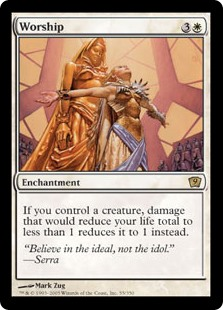
For those not deeply entrenched in Modern, BBD's sideboard Worship may seem a bit odd, and it is included specifically as a trump for the mirror. worshipBant Eldrazi has a lot of difficulty with non-creature permanents that lock up combat, and a Worship can just stop your Bant Eldrazi opponent cold. Similarly, Ensnaring Bridge out of Lantern Control, with Pithing Needle backup naming Engineered Explosives, can make quick work of the deck. In fact, Lantern Control was one of few playable decks during the Eldrazi deck's original dominance. A board filled with Ghostly Prisons can similarly give the deck fits.
If you're looking for a single-card strategy to beat the deck though, then I hope you're into Blood Moon. Blood Moon makes it very difficult to generate colorless mana, and it's much more difficult to kill with an Engineered Explosives than Ensnaring Bridge. Notably, Eldrazi Skyspawner and Drowner of Hope will give the Bant Eldrazi player outs to your Blood Moon if you take your time killing them, though if you combine it with a quick clock you should have a solidly positive matchup.

Going Wide

Another way to be favored against Bant Eldrazi is with a fast clock that goes wide. Affinity and Elves are the primary examples of decks that can quickly make too many relevant bodies against Bant. The set of sideboard Stony Silence out of BBD's board can hose some Affinity draws, though Bant Eldrazi is basically dead to rites against Elves on the deck registration sheet. The Eldrazi deck simply does not have the tools to clean up boards that quickly go wide with a massive damage output. silvergill-adeptOnce Elves starts snowballing, Eldrazi realistically can't catch up.


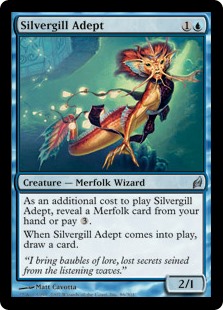
By most accounts, Merfolk is a pretty poor matchup for Bant Eldrazi too, given that Silvergill Adept enables a go-wide plan in addition to the small prison elements of Spreading Seas. There is definitely a ton of pressure on the Bant Eldrazi deck to draw its removal spells against Merfolk. That said, Merfolk is far from my first choice of tools to combat Eldrazi, given that it doesn't snowball or pressure the Eldrazi deck the way that Elves and Affinity do, and generally relies on more things going right. I am positive that Merfolk players will disagree with me on this, and I acknowledge that is likely not a universally accepted position.

Spell-Based Combo

I don't know if prison decks or non-creature combo decks are a smaller share of the Modern metagame, though both offer strategies that Eldrazi has difficulty interacting with. Thought-Knot Seer is a hell of a card, but they basically can't win without it against a good draw out of Ad Nauseam or Storm, and even with it they can still lose. Chalice of the Void out of the sideboard is definitely relevant for the Eldrazi deck in these matchups, but the combo decks can still beat it. Of course, some Stubborn Denials and/or Negates out of the Bant Eldrazi deck can make these matchups pretty positive for them post-board. If you weren't a combo player before, I don't think now is necessarily a great time to become one.

A Great Choice

Bant Eldrazi makes a strong case for being the best deck in Modern, and I think it's very telling that every type of strategy that could be used to hate it out is much more easily hated out itself. Many Modern decks can be defeated by individual cards, whereas Bant Eldrazi demands a commitment to specific strategies to be especially favored. If you're looking for a Modern deck to pick up, then Bant Eldrazi would be my recommendation. The archetype's current popularity is no fluke, and there's some very solid theory to explain how it carved out its favorable metagame position.

Thanks for reading.

-Ryan Overturf
@RyanOverdrive on Twitter

Stock Watch- Spirebluff Canal

Are you a Quiet Speculation member?

If not, now is a perfect time to join up! Our powerful tools, breaking-news analysis, and exclusive Discord channel will make sure you stay up to date and ahead of the curve.

I cannot tell you how happy that I am that blue/red decks are great in Standard right now. A Jeskai versus Grixis Pro Tour final in Standard is like a second Christmas to me. That said, I think that now is a better time to be selling off of many cards in the deck than buying in.

There was an error retrieving a chart for Spirebluff Canal

Kaladesh has a lot of powerful cards, and as such it's going to be very difficult for specific cards from the set to hold value given the inclusion of Kaladesh Inventions. Hype around Spirebluff Canal decks and the fact that we are far from peak supply suggest to me that we have already seen the short term ceiling. As such, I would definitely try to sell any Canals that I wasn't playing.

While it is true that Spirebluff Canal is also a great card for Modern, that demand simply does not justify a $10 price tag under these conditions. One only needs to look at the price history of Thought-Knot Seer to know where this one is going.

There was an error retrieving a chart for Thought-Knot Seer
Avatar photo

Ryan Overturf

Ryan has been playing Magic since Legions and playing competitively since Lorwyn. While he fancies himself a Legacy specialist, you'll always find him with strong opinions on every constructed format.

View More By Ryan Overturf

Posted in FreeTagged , Leave a Comment on Stock Watch- Spirebluff Canal

Have you joined the Quiet Speculation Discord?

If you haven't, you're leaving value on the table! Join our community of experts, enthusiasts, entertainers, and educators and enjoy exclusive podcasts, questions asked and answered, trades, sales, and everything else Discord has to offer.

Want to create content with Quiet Speculation?

All you need to succeed is a passion for Magic: The Gathering, and the ability to write coherently. Share your knowledge of MTG and how you leverage it to win games, get value from your cards – or even turn a profit.

Insider: MTGO Market Report for October 19th, 2016

Are you a Quiet Speculation member?

If not, now is a perfect time to join up! Our powerful tools, breaking-news analysis, and exclusive Discord channel will make sure you stay up to date and ahead of the curve.

Welcome to the MTGO Market Report as compiled by Matthew Lewis. The report will cover a range of topics, including a summary of set prices and price changes for redeemable sets, a look at the major trends in various constructed formats, and a "Trade of the Week" section that highlights a particular speculative strategy with an example and accompanying explanation.

As always, speculators should take into account their own budgets, risk tolerance, and current portfolio before buying or selling any digital objects. Please send questions via private message or post below in the article comments.

Redemption

Below are the total set prices for all redeemable sets on MTGO. All prices are current as of October 17, 2016. The TCGplayer low and TCGplayer mid prices are the sum of each set's individual card prices on TCGplayer, either the low price or the mid price respectively. Note that sets of Theros (THS) are out of stock in the store, so this set is no longer redeemable.

All MTGO set prices this week are taken from GoatBot's website, and all weekly changes are now calculated relative to GoatBot's "full set" prices from the previous week. All monthly changes are also relative to the previous month's prices, taken from GoatBot's website at that time. Occasionally, full set prices are not available, and so estimated set prices are used instead.

oct17

Flashback Draft of the Week

Flashback drafts are on hiatus until the end of the month. Look for triple Innistrad (ISD) drafts just in time for Halloween.

There was an error retrieving a chart for Full Moon's Rise

Standard

Edit: A change to the frequency of Standard rotation has been announced and it's reverting to only occurring in the Fall. This means that Battle for Zendikar block will be in Standard an extra 6 months, rotating in the Fall of 2017 instead of the Spring. There will be extra time for your specs from this block to pan out, so it lowers risk a little. Note that, Shadows Over Innistrad block is still in Standard for only 18 months as it will rotate in Fall 2017 as well.

Pro Tour Kaladesh (KLD) is in the bag and the new Standard format is starting to take shape. Here are the top performing decklists. The MTGO market is going to be digesting this new information over the coming weeks. Needless to say, speculators should be very cautious now on the new cards from KLD.

The flood of supply from drafters and Sealed players will be relentless in bringing prices down. Combine that with the shortened redemption period, and there's no reason to be establishing long-term positions in any cards from this set right now. There will be a large price drop for this set near the end of the redemption period in the spring. This will be a buying opportunity, but it will be difficult to spot and only obvious in hindsight.

From a player's perspective, if you are looking to test out the format, it's a fine time to be picking up cards from Eldritch Moon (EMN) or Shadows over Innistrad (SOI). Both of these sets still have a year to go in Standard, and the winter is typically the period of time with the highest prices. The near-term bottom on these sets has come and gone, but I anticipate higher prices down the road.

There was an error retrieving a chart for Spell Queller

On the other hand, players should be very cautious around picking up cards from Battle for Zendikar (BFZ) and Oath of the Gatewatch (OGW). Both of these sets will be rotating in the spring, so at some point in early 2017 they will come under strong selling pressure. Any significant price spike on cards from these sets over the coming months should be considered a good time to sell cards and reduce holdings.

Lastly, I'll leave my readers with a bit of a puzzle. Foil versions of Aether Meltdown, an uncommon from KLD, are currently carrying a buy price of 10 tix at GoatBots. This is an unprecedented price for an uncommon from the current draft set. If this is a signal about the relative scarcity of foil uncommons in a short redemption window, there could be opportunities lurking in the other sets that have longer periods of redemption.

Edit: This puzzle has been solved! Apparently the distribution of KLD foil uncommons was off, resulting in a much lower quantity being 'printed'. This has been corrected for so we should start seeing more normal foil uncommon prices in the coming weeks.

Modern

Now is an excellent time to be accumulating Modern staples in your portfolio. With the Magic-playing world focused on KLD Standard and the fallout from the introduction of Treasure Chests still reverberating, many cards are on sale right now. We've even see a few cards that have already rebounded in price. It can be difficult to be a buyer in times like these, when prices have been going down for months, but as Warren Buffet likes to say, "If you wait for the robins, spring will be over."

On the horizon there is a Modern Regional Pro Tour Qualifier season in early December. Some players will be testing on MTGO for this event, which will drive interest in the format. Following that, there is a MOCS monthly event in early January that is Modern, followed by a MOCS playoff event two weeks later. There will be ample reason to be playing Modern on MTGO over the next few months. For more details on the MOCS events, check out this link.

There was an error retrieving a chart for Tarmogoyf

For Dragons of Tarkir (DTK) and Magic Origins (ORI), these two just-rotated sets are on sale at the moment. It looks like the absolute bottom on set prices was last week, so players should feel confident about picking up their playsets of cards like Jace, Vryn's Prodigy and Collected Company. Once we see paper prices on these sets stabilize, redemption will provide support on digital prices, but both sets certainly look like good value at the moment, with the edge going to ORI.

A reminder that Born of the Gods (BNG), Journey Into Nyx (JOU) and Magic 2015 (M15) will all go offline for redemption in November. This means that there will be some price adjustments on cards from these sets as the price floor provided by redemption disappears. If you are holding any mythic rares from these sets, particularly cards that are not Modern-playable, be sure to sell these soon. For example, Ajani Steadfast is a 7-tix card right now, and this value is coming mostly from redemption since this card is not Modern-playable.

Standard Boosters

KLD booster prices have recovered and are sitting closer to their equilibrium price in the 3.2 to 3.3 tix range. This is a good demonstration that the short-term trade of buying boosters during prerelease events will yield small but guaranteed profits. It looks like one will be able to bank on generating 0.2 to 0.3 tix of profit per booster, if you can acquire them at 3 tix or less. Speculators will have to decide for themselves whether or not this trade is worthwhile; buying and selling 100 boosters would yield about 25 tix at this rate.

Elsewhere, EMN and SOI boosters are recovering from their lows as we get further away from the release of KLD on MTGO. This uptrend will slow down when flashback draft queues return, but for the moment, the second trip to the plane of Innistrad is the only draft format available as an alternative to triple-KLD draft. It also helps that it is very cheap to enter using product from the secondary market, with a discount of over 4 tix relative to the tix-only entry fee of 12 tix.

There was an error retrieving a chart for Arlinn Kord

Lastly, EMN boosters will become increasingly scarce as the 6-2-2-2 draft queues award a skewed prize total of five SOI boosters and seven EMN boosters. If the prizes were instead four and eight boosters respectively, then the amount of boosters entering the market would be in the same ratio that they are drafted. The fact that they are not awarded in this ratio means that EMN boosters should become relatively more scarce over time when compared to SOI.

Although I was skeptical about the long-term viability of EMN and SOI boosters as a speculative strategy, this does not rule out potentially profitable short-term dips. Like most of the prices on MTGO, these also fell in price substantially once KLD was released. Buying these boosters on the weekend of KLD prerelease events has proven to be a profitable move.

Trade of the Week

As usual, the portfolio is available at this link. This week I was focusing on the short-term plays around the results coming from Pro Tour Kaladesh. This is a highly speculative strategy, as the price swings on cards that get exposure can be very high. This strategy works best when there is some knowledge around which cards might be making an impact, especially as the effect becomes more widely recognized by speculators and the market. If everyone is buying up cards to speculate on, it will be easy to turn a loss if your timing is not perfect.

There was an error retrieving a chart for Torrential Gearhulk

For this reason, I think it's better to go with cards that have some pedigree. In this case, I decided that I wanted to go with the Gearhulks, the flashy cycle of creatures reminiscent of the Magic 2010 titans. I did eliminate one card from the cycle, though, judging Combustible Gearhulk as being the least likely to make a Constructed impact. All the other Gearhulks have an immediate board impact, while the red one does not. This relegates the card to only having fringe applications and thus unlikely to make an impact in Standard in the near term.

With no actual knowledge of how Standard was shaping up, purchasing these four creatures allowed me to spread my risk around. The key would be take advantage of any price swings related to coverage of the top decks. With KLD only being available for a little over a week, there is not enough supply on MTGO to accommodate a spike in demand. Catching that spike and the resultant increase in price would be my challenge.

There was an error retrieving a chart for Combustible Gearhulk

Over the weekend prices peaked in the evenings when constructed coverage was live and the North American market was online playing MTGO. There was a 5-tix difference in the buy price of Torrential Gearhulk between the morning and the evening on both Saturday and Sunday. For short-term speculative strategies, it is crucial to maximize your winning picks. Selling in the evening could be the difference between a nice short-term profit and a small loss.

It turned out that Torrential Gearhulk was the big hit of the weekend and was the card that doubled from Thursday prices into the weekend. Verdurous Gearhulk came largely as advertised, but it has fallen about 40 percent from its Thursday price, with Noxious Gearhulk suffering a similar fate. Cataclysmic Gearhulk appeared as a singleton in one of the top decks from Pro Tour Kaladesh, and its price is following suit. Buying a basket of Gearhulks proved to be a modestly profitable short-term strategy.

Banned List Testing: Rules and Possibilities

Are you a Quiet Speculation member?

If not, now is a perfect time to join up! Our powerful tools, breaking-news analysis, and exclusive Discord channel will make sure you stay up to date and ahead of the curve.

My article about testing Stoneforge Mystic generated a lot of conversation, both here on Modern Nexus and elsewhere. Judging by the reaction, people really do want some actual data and scientific method brought into discussions of the Modern banned list. Which means that I've got a lot of work to do.

councils-judgment-cropped

But I also know that if I don't establish some guidelines, I'll have to rehash the same arguments every time. So what I'm going to do today is establish my permanent methodology going forward, and set the ground rules. I don't expect my methods will make everyone happy. I am only one man, and I have limited time and resources with which to test. Thus I have to make compromises.

Deck Selection

It is impossible to adequately test against every deck in Modern. It is extremely impractical to test against all of Tier 1. I will be strategic about the deck I use to test a card, and the decks I play against—to yield not only the most representative results, but also the most useful results. I will never use decks where the impact of a banned card is expected to be indeterminate or mediocre. It's a waste of my time and yours to produce medium results. All decks will be built based on archetypes being played in the metagame at the time I start testing.

[wp_ad_camp_1]

The Test Deck

Whenever possible, the test deck will be one that got a card banned in the first place, updated for current Modern. When that isn't possible I will use a deck that the banned card is likely to improve by a considerable amount. There will be a known list (hopefully played to reasonable finishes) for establishing my baseline win percentage, and an "improved" version of that list for the actual test. This is how I approached the testing of Stoneforge Mystic.

The reason is simple: the purpose of this exercise is to determine if known or suspected Ponderbroken cards are still broken. For example, testing Ponder in Jeskai would not produce very interesting or helpful results. The deck currently plays Serum Visions, and Ponder is better than Visions. Therefore we would expect Jeskai's overall win percentage to improve. However, Jeskai is a control deck that will win slowly. Even with the consistency boost from the second-best cantrip in Magic, the change will not be that dramatic and our conclusion would be weak. Storm or Ad Nauseam, on the other hand, will benefit far more from an additional cantrip than a fair deck would. Those archetypes are a far better indicator of whether or not Ponder is safe to unban (I firmly believe it isn't, just for the record).
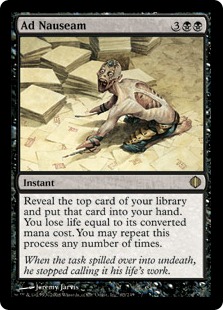
Think about the issue like this: Wizards doesn't ban cards just because of power level. It bans because of degeneracy or oppression. It is very hard for a truly fair deck to be either. Unless they're Jund with Bloodbraid Elf and Deathrite Shaman. The fair uses of a card are not on trial—what is, is whether they're still as unfair as before. If we want to evaluate that aspect, we must try to put the card in an unfair shell. This may not always be possible, but I will preference less fair shells over more fair ones.

The Gauntlet

My testing gauntlet will be a representative selection of decks from all ends of the spectrum. I will prefer Tier 1 decks whenever possible, though for unfair combo decks I will most likely need to dip into Tier 2. These are decks with proven power and resilience, and they will do the best job of teasing out a banned card's power. A lower-tier deck may have interesting gameplay with a banned card, but it will not indicate the actual strength of the card in the overall metagame. If we want to learn what is the best, we must play the best.

Ad NauseamI want to see how the full spectrum from the truly fair, to the "fair" or pseudo-fair, to the unfair, will be affected. A broadly improved win percentage may indicate that the card is oppressive. A more localized impact might signal a metagame shift which may or may not be welcome. This is also the only way I can try to model the total reaction that a card will have on Modern.
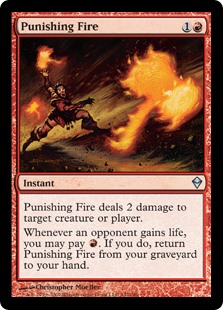
When I build gauntlet decks they will all be "average" builds of the currently played decks as of the moment I start the testing. I will not try to adapt the gauntlet decks to the banned card. The answer why is twofold. First, I don't want to take the time to try and figure out how a deck would react. I'm not a normal player of any of these decks, and my perceptions may not be in line with the reality of the decks' strategic considerations. If I guess and get it wrong it will ruin the results.

The second reason follows from the first: the need to limit variables. For any experiment to be scientifically valid, you need to focus your testing on as few variables as possible. In economics, we use graphs with several curves on them to describe supply and demand. If you shift a single curve, say supply, the results are easy to quantify and predict. If you shift both curves the results become indeterminate, dependent on the magnitude of the shifts. If I start adapting the gauntlet decks, I add in uncertainty that might mask the real impact behind an improperly built test deck. Thus I will stick to known knowns.

Testing Procedure

To obtain valid results, I will use the exact same procedure for each card. Once I begin testing with one configuration I will never change that configuration, lest it invalidate my previous data. I am not so committed to this series that I'm willing to redo hundreds of datapoints because of a new methodological revelation.

To try and prevent suboptimal builds, I will goldfish and playtest the decks before testing begins. This will also help me learn the decks to reduce play mistakes affecting the results. Some will happen regardless, but it should be small enough not to impact the end result.

Every test session will begin with at least 10 practice matches so that whoever I've roped into this madness and I can get a feel for the matchup. We will then play 50 matches with the baseline deck and 50 with the test deck. For Magic Online testing misclicks will be taken into account. If they're correctable through a change in play, we will do so—otherwise the match will be thrown out. All testing sessions for a given deck will take place as close together as possible.

The Test Subjects

Now to the really critical part: what am I actually willing to test? Not every card on the banlist needs to be tested. It should be obvious why Hypergenesis, Rite of Flame, Dread Return, or Cloudpost will not and should not ever be freed. Proven broken cards are not up for consideration; realistic options only please. Of the less obvious ones, some are still not up for consideration.

No Jund Cards!

Punishing FireI will not be testing Bloodbraid Elf, Deathrite Shaman, or Punishing Fire. Hard no. Absolutely not. I don't care how much you whine or how good your arguments are, up to and including masters theses on the impact of Bloodbraid Elf's unbanning on global happiness. I will not test them.


Jund is a very good deck. It has been since Modern's inception. The only times it hasn't been Tier 1 were when something very odd was going on in the metagame. It has reached Tier 0 levels in the past when it had access to some of the banned cards. It doesn't need any more toys, so these overpowered cards can stay where they are.

Stop. Be honest with yourself. Will the boost to whatever deck you care to name actually be greater than the boost Jund receives? No. It won't. Jund doesn't need a boost, and no deck will benefit enough to justify that. No Jund cards.

No Top!

I know all you Miracles players out there want to oppress Modern too. I hear your arguments about boosting control and the ubiquity of Abrupt Decay. The answer to Sensei's Divining Top is no.

The frustration caused by the Counter-Top lock is only one part of my concerns. It isn't the experienced Miracles players I have an issue with—it's the derps. Those fools who waste time looking at the same three cards over and over again, dragging out the game ad infinatum. Legacy tournaments always run late thanks to Top players, and it just gets worse the more inexperienced the players are. For the sake of tournament run times, Top should stay banned. This is also why I will not look at Second Sunrise. I have better things to do than watch you play with yourself.

No Twin or Pod

Splinter Twin was a good deck. I think banning it was a mistake. We know what would happen if it were unbanned. There's nothing interesting or new to learn here. Birthing Pod falls under the same category.

Cards I Will Consider

I wouldn't choose any of these cards myself, but if there's enough community interest and strong arguments are made, I'm willing to try them.

  • The Artifact Lands - Many Affinity players I know say that Affinity doesn't want these anymore. The only decks I can imagine wanting them are Eggs and maybe Thopter combo. I have no interest in trying them out, but I will relent if the outcry is sufficient.
  • Green Sun's Zenith - I suspect that repeated tutoring and mana acceleration is just as powerful and warping now as it was when this was axed. Still, if a really good argument is backed by overwhelming support, I'll give it a try.
  • Preordain - Preordain and Ponder were banned for making combo too consistent. I suspect this will still be the case, but I am willing to consider experimenting with the weaker of the two. If it's too strong, Ponder definitely is, so consider improved Serum Visions the gatekeeper to that test.

Cards I'm Actively Interested In

This is not a declaration that I will test every single card listed here. Merely that I would do so without needing convincing. Which ones I ultimately test will be determined by time and other constraints.

  • Chrome Mox - Fast mana is generally a bad idea, but many have complained about Affinity getting the only mox in Modern. I can see an argument that if everyone had access to the more balanced mox it would reduce Affinity's speed advantage. I think that the unfair uses will still be greater and it will empower combo far more than other decks, but that is pure speculation that should be evaluated.
  • Dark Depths - Ghost Quarter is very much a card these days, as is Path to Exile. Blood Moon also sees extensive play, unlike back in Extended. Marit Lage may not be the terror that it once was.
  • Dig Through Time - Dig was always overshadowed by Treasure Cruise and never really got an opportunity to prove itself in Modern. Splinter Twin was the best argument for banning the card, but with that combo gone it might be okay to free Dig. At the very least it deserves a trial.
  • Jace, the Mind Sculptor - This is a ridiculous card, but I'm willing to believe Modern can handle it—if only to shut up everyone who argues that Nahiri, the Harbinger and Emrakul are more powerful.
  • Seething Song - I freely admit that this one is speculative on my part and likely a bad idea, but it is possible that the addition of more targeted discard and better hate cards would keep Storm down sufficiently even with the Song. It's probably still really broken, but it costs enough that I am willing to give it another shot. I also like the card and enjoy Storm, so this is a convenient excuse to play them.

So there you have it: the six cards I'm actively eyeing and the three I'm willing to be convinced to try. What happens next? You!

Your Voice, Your Choice

For one week, until my next article goes up, I will be watching this article's comment section. Post which card you want me to test next and why. I will test the card that receives the most votes.

Every reader who posts a preference will have their first, and only their first, card request counted. You can double-post or make multiple requests to your heart's content—only the first card from the earliest post will be counted. Any request not on the approved list or which I specifically said I wouldn't test will be discounted. Only posts made here on Modern Nexus in the comments section of this article will be counted. I encourage you to discuss it as much as you want elsewhere, but trying to scour the internet for every forum post on the subject won't be feasible for me.

If this goes like last time, I should have results from the first test around April, 2017. Join me next week when I announce the winner and continue the Beginner's Guide.

Want Prices?

Browse thousands of prices with the first and most comprehensive MTG Finance tool around.


Trader Tools lists both buylist and retail prices for every MTG card, going back a decade.

Quiet Speculation