
menu

UNLOCKED: Top 20 Standard Price Gainers Last Week

Are you a Quiet Speculation member?

If not, now is a perfect time to join up! Our powerful tools, breaking-news analysis, and exclusive Discord channel will make sure you stay up to date and ahead of the curve.

With the Battle for Zendikar prerelease events now a week behind us, prices of the new cards have had a considerable amount of time to adjust since initial pre-order evaluations. A weekend of prerelease play combined with a week of testing and reading articles has changed the demand for the cards, which is reflected in their prices.

Today I will discuss the top ten Battle for Zendikar cards that gained in price this past week, attempt to explain the logic behind their rise, and assess their potential Standard applications.

New Battle for Zendikar cards are just part of the picture, however, and some existing cards in Standard have also seen significant price changes this past week. I'll start today by identifying the top ten price gainers from earlier sets in Standard. I'll explain what is driving their price growth, and what roles the cards will play in Standard.

Old Standard Gainers

Hardened Scales

There was an error retrieving a chart for Hardened Scales

The 18% growth of Hardened Scales this week signifies a greater respect for its namesake green-white archetype, a fringe player before rotation that survived the trip to Battle for Zendikar nearly unscathed. The cheap enchantment powers up a host of other cards to create a unified aggressive deck, and it's one of the most promising archetypes of the new Standard.

Avatar of the Resolute

There was an error retrieving a chart for Avatar of the Resolute

With many of the best two-mana cards leaving Standard, cards like Avatar of the Resolute, which hit hard for the cost, fill in the gap. This is also a key player in the G/W Hardened Scales deck, so it's no surprise the card grew by 23% this past week.

Knight of the White Orchid

There was an error retrieving a chart for Knight of the White Orchid

Previously relegated to White Weenie decks, and the occasional ambitious two-color midrange deck, Knight of the White Orchid could do a lot more in the current Standard. One, the generous mana of this Standard allows the card to be cast with ease even in three-color decks. Two, it can find a lot more than basic Plains, also digging for Canopy Vista or Prairie Stream to serve as mana fixing.

The loss of Fleecemane Lion and other two-drops like Sylvan Caryatid also leaves a major hole in the mana curve of Standard, so it's up to other cards to fill in the gap. Knight of the White Orchid is a major winner from rotation, and with Brad Nelson championing four of the card in Abzan Aggro in his article this week, there is surely something to the card.

Though it gained 22% last week, the price is still under $2, and there is more room to grow.

Mantis Rider

There was an error retrieving a chart for Mantis Rider

Last season, Mantis Rider was pigeonholed into Jeskai builds. It's still great in Jeskai, a wedge that has become even more competitive after rotation, but now Mantis Rider can be easily splashed in various aggressive shells by using fetchlands and BFZ duals. A bargain under $1 a couple weeks ago, the price is moving upwards, and grew 15% last week.

Anafenza, the Foremost

There was an error retrieving a chart for Anafenza, the Foremost

Anafenza, the Foremost was the star of Abzan Aggro last season, but the archetype remains a premier option after rotation. Like Mantis Rider, it also benefits from better mana, and could be played in a variety of different archetypes. It grew by 22% last week after three weeks of stability, and a big finish could bring the price higher.

Ojutai's Command

There was an error retrieving a chart for Ojutai's Command

Ojutai's Command headlines a greater trend of the Dragons of Tarkir commands seeing consistent growth. A relative bargain compared to other commands, 16% growth last week brings the price to just $2.60, with potential for more.

Atarka's Command

There was an error retrieving a chart for Atarka's Command

Post-rotation red aggro decks are light on burn, and a token-based strategy is the most popular option; Atarka's Command is critical to such a strategy. Atarka's Command has found another calling in landfall aggro decks, where its formerly forgotten option of putting a land into play takes center stage.

14% growth last week brought the price to just under $7, before its big finish at SCG Indianapolis. Now it's all the way up to $14, and I expect the price has settled.

Regardless of its performance in Standard, play in Modern Burn will help keep the price buoyed indefinitely, although demand right now is largely driven by Standard.

Wingmate Roc

There was an error retrieving a chart for Wingmate Roc

Like last season, Wingmate Roc could find itself in familiar homes like Abzan and Jeskai, and it could see play in any number of strategies, especially with the new dual lands improving access to mana. The card saw 11% growth last week, but it remains a bargain under $3.50.

Dromoka's Command

There was an error retrieving a chart for Dromoka's Command

Dromoka's Command has fallen significantly since it was printed, down to an all-time low of $3 in August. It has slowly started to creep up. Last week it saw a 14% gain, and future success in decks like G/W Hardened Scales or Abzan Aggro could drive it higher.

Roast

There was an error retrieving a chart for Roast

An uncommon rounds out the list, because with the loss of Searing Blood and Lightning Strike, Roast is now the best red two-mana removal spell available. It will see play in all variety of red decks, and it's highly splashable in nearly any strategy. The price continues to march upwards, now well over $1, since bottoming out at $0.5 in July.

Battle for Zendikar Gainers

Drana, Liberator of Malakir

There was an error retrieving a chart for Drana, Liberator of Malakir

The biggest story of last week is Drana, Liberator of Malakir, which has nearly doubled in price since the prerelease with 93% growth. The card snowballs a game very quickly, and even by itself is a significant threat. It has applications in a variety of strategies, and it's very likely to perform well in Standard.

There is some uncertainty built into the price, as it might be inflated in hopes of a big finish. Consequently now may be the best time to sell, but a strong showing could bring the price even higher.

Shambling Vent

There was an error retrieving a chart for Shambling Vent

The creature lands are among the best cards in the set, and Shambling Vent stands out as the best because it fits right into existing Abzan strategies. This card is a staple, and in the long term the price is likely to rival that of the dual lands.

32% growth last week brings the price to a reasonable $7.5, and new supply should keep the price stable.

Radiant Flames

There was an error retrieving a chart for Radiant Flames

Radiant Flames fills in the major void left behind by Anger of the Gods and Drown in Sorrow. This version is much more accessible, highly splashable, and a sure staple going forward.

The card grew 20% last week, and it will likely remain in the $2-3 range like Anger of the Gods during its reign in Standard.

Oblivion Sower

There was an error retrieving a chart for Oblivion Sower

It's uncertain whether or not there's a competitive Standard ramp deck. If there is, Oblivion Sower is very likely a part, due to its incredible capacity for mana acceleration and card advantage, and its efficient body. 13% growth last week shows the market is confident in its chances.

From Beyond

There was an error retrieving a chart for From Beyond

Part Bitterblossom and part Awakening Zone, From Beyond also offers the ability to tutor for Eldrazi. This powerful card is a certainly a key part of big mana Eldrazi strategies in Standard, and it could have applications in token or sacrifice strategies. It saw 13% growth last week.

Scatter to the Winds

There was an error retrieving a chart for Scatter to the Winds

Scatter to the Winds is a great replacement for Dissolve, and because it's a rare, it will command a modest price throughout its Standard lifetime. The price grew 12% to over $3, and if blue control is a top-tier archetype the price will move higher.

Gideon, Ally of Zendikar

There was an error retrieving a chart for Gideon, Ally of Zendikar

Gideon, Ally of Zendikar is likely the single best Standard card in Battle for Zendikar. The price always has been high, but it has grown 9% higher than the pre-sale price. Like most new planeswalkers, I would assume the price of this one is destined to move down sooner rather than later.

Smoldering Marsh

There was an error retrieving a chart for Smoldering Marsh

The new duals are marquee cards of the set, and Standard staples. Smoldering Marsh has been relatively cheap, but hype over Mardu and Butcher of the Horde has brought the price nearly 8% higher.

Brutal Expulsion

There was an error retrieving a chart for Brutal Expulsion

I don't have a lot of hope for Brutal Expulsion, but it would not be surprising to see this successfully played in a deck like Jeskai. It grew 7% last week, but I don't think it can support its current price tag.

Dragonmaster Outcast

There was an error retrieving a chart for Dragonmaster Outcast

Dragonmaster Outcast is a reprint that has provided a discount for casual players who were in the market for a copy. This isn't exceptionally strong in Standard, but it's not out of the question in a red aggressive deck or a ramp deck. 6% growth last week could be sign of further growth, or it will slowly fall towards a bargain mythic.

~

The price of Khans of Tarkir block cards are likely to peak around the time of Pro Tour Battle for Zendikar in two weeks, so start thinking about your exit strategies now.

Battle for Zendikar cards are currently inflated by hype and low supply, but with the set officially released now, the supply will increase and prices will fall across the board. That being said, these cards have a longer life in Standard than Khans of Tarkir cards, which will rotate away in six months.

-Adam

Insider: Week One Standard – The Decks and Specs

Are you a Quiet Speculation member?

If not, now is a perfect time to join up! Our powerful tools, breaking-news analysis, and exclusive Discord channel will make sure you stay up to date and ahead of the curve.

Goodbye Theros and hello Battle for Zendikar! Week one is in the bag and the format is shaping up to be a really interesting one.

Last weekend’s SCG Open in Indianapolis showcased lots of great new decks and tech, giving us insight into what the format will look like moving forward. Personally, I have really enjoyed playing the new format, but I guess that is pretty easy to say considering I won the entire event…

In today’s article I’ll take a look at the top decks and suggest cards from each that I think are undervalued and primed for picking up.

Atarka Red

The deck I played, a unique take on Atarka Red, was completely fantastic.

The big innovation was a combo finish in the form of pump spells like Titan's Strength and Become Immense plus Temur Battle Rage. The combo generates an insane amount of damage via a gigantic, double-striking, trampling creature. The deck also has a “go wide” combo in the form of tokens, prowess creatures, and Atarka's Command.

The deck is actually the brain-child of another RIW Hobbies guy named Devon Paynter. The deck has been his baby for the past few weeks, and he put in a lot of work developing it. I actually built a four-color morph deck that I was planning to play until he gave me a pretty thorough thrashing in a playtesting session.

The power of the deck was too strong to ignore and I jumped on board the night before the event. I made a few tweaks and tune-ups to the manabase and the sideboard, but for for the most part I was lucky to be gifted such a tremendous deck week one.

The best and most important card in the deck is pretty clearly the namesake:

There was an error retrieving a chart for Atarka's Command

Unfortunately, Atarka’s Command has already spiked really hard so if you haven’t picked them up it’s too late to jump in now. Honestly, I didn’t think of the green-red command as a $15 card and I think it’s likely to come down a little bit.

The card from my deck I really like as a speculation target is actually an uncommon.

There was an error retrieving a chart for Become Immense

The card is completely insane. It’s often one mana for six damage and when paired up with Berserk in Legacy or Temur Battle Rage in Standard or Modern it can get out of hand quickly. I see Become Immense becoming a $3 uncommon very shortly down the road. I strongly recommend double-checking your Khans bulk for these gems.

Come to think of it, Temur Battle Rage is a common that's also worth setting aside.

The other card in the red deck that I think is criminally underpriced is:

There was an error retrieving a chart for Thunderbreak Regent

It’s a dragon, which is great because Dragons of Tarkir has a dragon sub-theme with powerful spells like Draconic Roar. It’s also just an amazing card. Four mana for a 4/4 flier with a strong ability is a great value.

Another thing that I noticed after playing 18 rounds of Standard is that Hangarback Walker is literally everywhere. The Walkers really clog up the ground and make attacking a pain in the butt--any great creature that can take to the skies is at a huge premium. Thunderbreak was a crucial part of my sideboard and I will probably just move them to the maindeck moving forward.

There was an error retrieving a chart for Chandra, Fire of Kaladesh

I’m hesitant to say this card “overperformed” because I think it's just insanely powerful. It's trivial to flip in a deck full of cheap red spells and when it does flips it deals a ton of damage. It’s essentially a three-mana Lava Axe that continues to deal two damage every turn until your opponent kills it. At $7 I’m pretty happy picking this card up in trades.

Abzanesque & G/W Aggro

The most popular week one deck were the many, many flavors of Siege Rhino. Abzan with red, Abzan with blue, Abzan with both--at the end of the day these are all Siege Rhino midrange decks.

There was an error retrieving a chart for Siege Rhino

Since I started this finance column, I’ve written the phrase, "Rhino is not a $3 card," about a dozen times and I stand by that statement. It's Modern-playable and the format-defining card in Standard. It’s only a matter of time before we see a spike. Maybe not tomorrow, maybe not the next day, but eventually Siege Rhino will gain in value.

The tango lands have opened up a lot of space to play four- and five-color decks, and Siege Rhino benefits from the wide-open mana bases. Chances are, if you're playing four or five colors, three of those colors will be Abzan and one of the biggest incentives is that you get the great privilege of casting the Rhino.

I expect it to creep up as the format wears on. Don't forget new players start playing every day and they all need Rhinos...

There was an error retrieving a chart for Dromoka's Command

If Atarka’s Command is a $15 card then how can this card be $4? It gets played way more in Standard than the green-red command. Dromoka’s Command was also a key card in Michael Majors G/W Aggro deck that made it to the finals of the SCG Open. The fact that it combos with Hangarback Walker by adding a counter to the pesky little robot is icing on the cake.

I also noticed that all of the local card shops around me in Michigan are always completely sold out of this card, which is typically a strong indicator of a popular and undervalued card.

There was an error retrieving a chart for Warden of the First Tree

Another card to keep an eye on is Warden of the First Tree, a mythic that will see play in G/W and Abzan Aggro decks. Depending what happens at the Pro Tour, tons of Magic players could end up clamoring all at once to acquire this card after the results are in.

It can't really go lower and there is significant upside--this is one of the prime targets I'm looking to acquire right now.

Jeskaiesque & Other Blue Decks

Jeskai put up an excellent showing in Indianapolis. It's the next deck I intend to work on moving forward.

I played against Adam Varner's Jeskai-splash-black deck in the Top 8 of the tournament and felt very fortunate to get past him. He was one of my losses in the Swiss and his deck was well constructed to take advantage of Atarka Red's weaknesses. We played a close match and I ended up edging him out, but it is worth noting that he had mana issues in game three that caused him to fall behind.

Obviously, mana issues are something that are going to happen in a four-color aggro deck, but the fact of the matter is Mantis Rider is a scary card when you're playing red aggro.

There was an error retrieving a chart for Mantis Rider

In fact, I think it might secretly be the best card in the format...

Mantis Rider has undergone an up-and-down ride on the price front, and is currently sitting at a pretty stable spot. However, I could certainly see the card gaining some ground again. There's a chance Jeskai is actually the best deck in the format after the PT, and if this is the case I expect a lot of people to buy in. People seem to love playing Jeskai decks.

There was an error retrieving a chart for Jace, Vryn's Prodigy

Well, if you haven't picked them up yet you are late to the party. The card has skyrocketed and may actually surpass the Mind Sculptor in price in the near future. I'm pretty surprised the card reached these heights so fast but it's undeniably completely insane across multiple formats. Not to mention, well, it is a Jace...

My advice on this card is that if you are going to play it, bite the bullet and buy in--but I sense the card doesn't have much room to grow.

Standard demand is what has driven the price through the roof, but it will surely return to earth once it rotates out. I don't think it's a great long-term speculation target and in the short term it's risky at best.

There was an error retrieving a chart for Bring to Light

Bring to Light was one of the breakout decks of the event but I'm a sell on the card at $9. It's the kind of card that I think will seriously tank in value once more packs get opened. It only goes into one deck, and isn't clear yet if that version is even the best multi-color control deck.

There was an error retrieving a chart for Exert Influence

I love this card as a buy right now. If the G/R Aggro deck hadn't fallen right into my lap I would have played a Bant/Abzan four-color control deck featuring this card. Control Magic effects are no joke...

One of my friends ended up playing the deck and said that Exert Influence was one of its most impressive elements. Keep in mind that you can Exert Influence, flip Jace, and then steal another creature two turns in a row! Take your Rhino, and just for fun, let's go ahead and take your other Rhino.

The last "good blue deck" that I'd like to hit on is Esper Dragons. Dragons did really well this weekend and I think it will be a major player at the Pro Tour. It is super powerful and takes full advantage of Dig Through Time.

Dig seems like a weak spec target because it recently got banned and restricted in both eternal formats but there are other cards in the deck I could see ticking up.

There was an error retrieving a chart for Ojutai's Command

I like this card right now because it goes into a lot of different blue decks. If you're playing Jace then you're playing blue, and if you're playing Jace chances are you want some number of the good dragon's command. The card is also really good against red decks because of the lifegain option.

There was an error retrieving a chart for Haven of the Spirit Dragon

I like this card a lot as a spec target. I think there's strong chance of various dragon-related decks breaking out at the PT. Dragons are powerful and this land lets you play lots of different ones.

The card also shines in multiple different archetypes. There are green-based and Esper-based dragon decks which gives the card a lot of crossover applications.

~

Week one is in the bag and the format is shaping up to be pretty sweet. I had a blast in Indianapolis and look forward to playing even more Standard in the coming weeks.

The key is to keep an eye on cards you anticipate doing well at the PT. There's always something that jumps significantly both during and immediately after the event. Right now you should be looking at the results from the Open and thinking about what you think the pros will be playing.

It seems pretty clear that red aggro, green-based midrange, and blue tempo and control decks are the clear front runners with regard to archetype, but figuring out the undervalued cards is where the real money is.

Insider: Biting the Bullet on Three Expensive Modern Staples

Are you a Quiet Speculation member?

If not, now is a perfect time to join up! Our powerful tools, breaking-news analysis, and exclusive Discord channel will make sure you stay up to date and ahead of the curve.

Tarmogoyf's price tag is one of the scariest barriers to Modern entry. You can add a few others to that daunting list: Snapcaster Mage, Liliana of the Veil, and even the Zendikar block fetchlands. Staples like these are widely played in Modern's top-tier decks and they have the dollar value to prove it.

Although there are plenty of decent Modern decks that don't use these cards (Affinity, R/G Tron, Amulet Bloom, etc.), the biggest Modern names all require Goyf and company. This can be intimidating to players who are hesitant to spend hundreds of dollars on a few pieces of cardboard.

Big bucks for a bunch of paper

I know plenty of Modern players who get by just fine without these cards. Unfortunately, this means they also need to get by without some of Modern's best decks. Want to play Jund or Abzan? Better be willing to fork up $700+ on some just the Lilys and the Tarmogoyfs. That doesn't even count the lands! Interested in Twin variants, Grixis Control, or Burn? They aren't quite as steep as the BGx decks, but you'll still need to shell out a chunk of change to sleeve up their cores and manabases.

We're still in the Modern off-season, which means it's a perfect time to talk about buying into Modern's costliest staples. You don't need these cards to succeed in Modern, but it never hurts to have your Jund or U/R Twin boxed up and ready to go if you can't figure out what else to play in a metagame.

Today, we'll go over how to time your purchase around metagame and market cycles so you aren't spending more than you have to on three of Modern's most expensive cards.

Tarmogoyf: Modern's Posterchild

When Wizards announced Modern Masters back in 2012, it was no coincidence that Tarmogoyf was the first spoiler.

Modern's not-so-jolly green giant was always one of the format's most expensive cards, and also one of its most-played. BGx decks use it, Zoo decks use it, Temur Twin decks splash for it: Goyf is the benchmark by which other Modern creatures are judged, and that's reflected in its price tag.

There was an error retrieving a chart for Tarmogoyf

If you want to play any of those decks mentioned above or any of their versions, you'll need your Tarmogoyf playset. And if you need your Goyf playset, that means you'll need $600 or more just for the creature alone. You'll need more than that if you want the (superior) Future Sight art!

What's a prospective BGx or Zoo player to do?

One option, both with Goyf and all the other cards we'll talk about today, is to wait for a downturn in the metagame cycle. This means holding out until one of Goyf's many decks becomes less viable, either due to a new competing card, a banning, a breakout deck seizing the spotlight, etc.. Lower format shares for BGx, Zoo, and Temur Twin might mean lower Goyf stock, as players sell off their Goyfs and migrate to other decks.

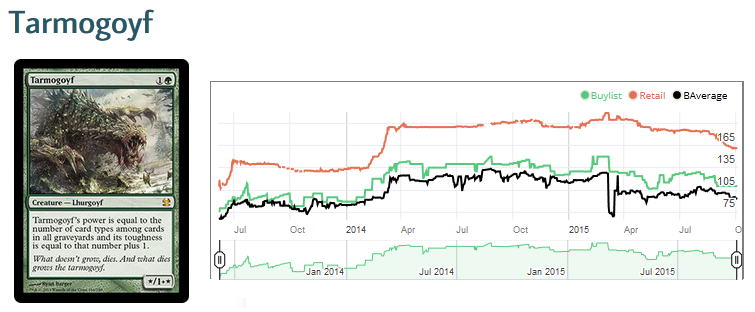
Unfortunately, this doesn't happen in practice:

Goyf Price ChartSince 2014, Tarmogoyf's price has shown remarkable stability, weathering a huge metagame downturn during the Treasure Cruise and Birthing Pod winter of late 2014. Despite Delver and Pod decks dominating the format, with few Temur decks to buoy the card's value, price memory held on tight and Goyf kept its $150+ throne. Siege Rhino's prominence in Abzan decks helped keep Goyf afloat, but the overall metagame outlook was bleak for the Lhurgoyf.
And yet, Goyf's price stayed high, never dropping below ~$160.

What about market downturns? Metagame shifts might not cut it, but surely a mass reprinting could affect the price, or even the printing of a new card to compete with Goyf. Not with Goyf. Neither a Modern Masters 2015 reprint nor the rise of Tasigur, the Golden Fang could dent Goyf's price tag. The best even the reprinting could do was a $20 or so drop, but no one is calling $150 "cheap".

There was an error retrieving a chart for Tasigur, the Golden Fang

Given Goyf's history and outlook, when exactly is the best time to get in on Modern's best green creature?

As much as it pains me to say it, the answer is "sooner rather than later". Unlike some cards, Goyf isn't really a staple you can sneak into. Between the continued relevance of Goyf in BGx and Zoo/Temur decks, its profile in Legacy, and the steady growth Modern experiences as a format, there will never be a time where Goyf's stock is going to crash. A huge reprint might do this, or a reprint at rare, but Wizards has given no indication this is in their longterm Modern plans.

Ever want to play Goyf in Modern? Buy it now. This card is never going down, especially if Wizards continues an every-other-year Modern Masters cycle, and especially if the format continues to enjoy popularity. I could see Goyf's price retreating on a 2-3 year timeline, but that's way too long for most Modern entrants to think about. If you want your Goyfs for the upcoming November tournaments, you just need to bite the bullet and buy your Goyfs as soon as you can.

Snapcaster Mage: The Format's "Best" Card

Earlier this summer, at GP Charlotte, a number of pro players gave their opinions about the best cards in the format. Most of them agreed that the hand's-down winner was Snapcaster Mage. Tiago Chan's invitational card is the defining blue force in Modern, almost singlehandedly allowing blue mages to compete in a format that would otherwise be dominated by BGx and linear strategies.

There was an error retrieving a chart for Snapcaster Mage

You sometimes hear Modern players complain that you actually can't play green in Modern without playing Tarmogoyf. That's not close to true. Elves, Abzan Pod, Abzan Liege, Amulet Bloom, Scapeshift, R/G Tron, and a huge range of other Tier 1 or Tier 2 decks stand as clear counterexamples to this theory. You can even play aggro without playing Goyf: just look at Merfolk, Affinity, and Burn to see that in action.

The same is not true of Snapcaster and blue. If you want to play a controlling blue deck in Modern, you really do need Tiago in your 75. Grixis Control and the control-in-disguise Twin decks both illustrate this phenomenon. The Delver decks, Jeskai Control and Midrange, and Scapeshift also count Snapcaster on their roster, as do fringe strategies like 4C Gifts, Esper Control, and many U/W Control variants.

Those Emeria, the Sky Ruin/Sun Titan control strategies are a bit of an exception here, but for the most part, Snapcaster is blue-based control in Modern.

Best friends with Snapcaster

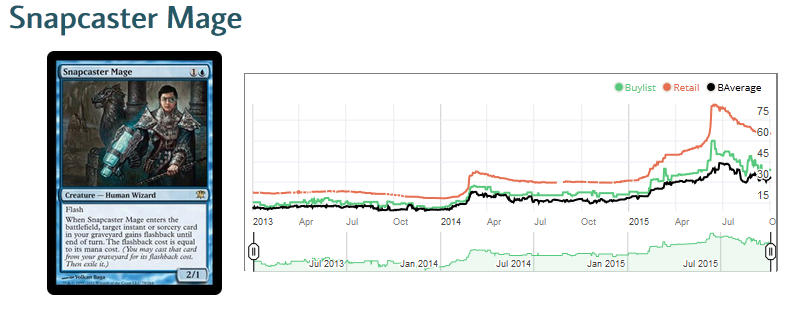
From a price perspective, Snapcaster saw a a massive price increase when the Modern community internalized his exclusion from Modern Masters 2015. Making matters worse for Snapcaster buyers, Grixis Delver/Control strategies took off at around the same time, creating further pressure on Snapcaster's limited supply.

The end result was a $75.00 price high by the beginning of the summer, a spike only worsened by the Grixis success during GP Charlotte.

Snapcaster Price ChartBad news: Snapcaster today is significantly more expensive than it was a year ago. This graph probably depresses you as much as it depresses me. Don't you just wish you picked up some Tiago's back in early 2014 when Deathrite Shaman got banned?
Good news: Snappy's price has dropped a lot since June and now is a great time to buy into Modern's best card.

After a promising start in June, Grixis decks took a huge hit in August and September. As I (and other authors) wrote about on Modern Nexus, we saw steady shifts away from Grixis in Worlds, the SCG Opens, and at GP Oklahoma City as players overprepared to beat Grixis. Twin didn't do much better: as I discussed in an August metagame breakdown, the deck actually fell out of Tier 1 for the first time in years.

Worst enemies with Snapcaster

All of these metagame factors led to a major decline in Snapcaster's price, and a shining opportunity for enterprising Modern players to snag this iconic creature. I expect Snapcaster will continue to drop as we move through October and into November, so you don't need to pull the trigger on your Snapcaster purchase just yet. Off-season pre-trends tend to continue through the off-season, so there's no reason to believe Snapcaster will suddenly experience a price reversal before late November.

Like Goyf, Snapcaster is a card that is always relevant and gets better with new sets. Unlike Goyf, Snapcaster is undervalued now relative to what it is likely to become next year. Snapcaster also benefits from new sets and cards much more than Goyf.

Just like how Birthing Pod got better with every new creature printed, so too does Snapcaster improve with every new instant and sorcery, or even just URx-colored card benefiting his various shells. At this point, it's only a matter of time until the next Kolaghan's Command.

There was an error retrieving a chart for Kolaghan's Command

Whether you get your Snapcasters now or get them in November, don't wait longer than that: this card is bound to go up again in the new year.

Liliana of the Veil: The Queen of BGx

First Tarmogoyf and now Liliana of the Veil: black-green decks get all the love in today's article. That should make sense to anyone who has bought the deck before, or at least looked at its cost. Jund and Abzan are easily the most expensive decks in Modern, and Queen Lily is a big contributor to those price-tags.

Compared to Snapcaster and Tarmogoyf, Liliana sees less play in Modern's overall Tier 1 decks. Outside of Jund and Abzan, you won't see a lot of Innistrad's leading lady. At least buying Tarmogoyf lets you switch between the BGx Midrange decks and more aggressive options like Zoo.

Lily? It's BGx or bust for her. A notable exception to this is Michael Majors' techy Grixis list from the SCG Charlotte Open, but she's definitely no regular in Grixis colors.

Unfortunately for anyone who wants to sleeve up those Lilianas, she still commands a hefty price tag, despite her relative absence from Tier 1 decks.

There was an error retrieving a chart for Liliana of the Veil

Liliana illustrates an important Modern rule that you also see with Goyf: never bet against BGx. The BGx core has survived two bannings and numerous metagame shifts, and its staple cards will always hold value in even the most midrange-hostile metagames.

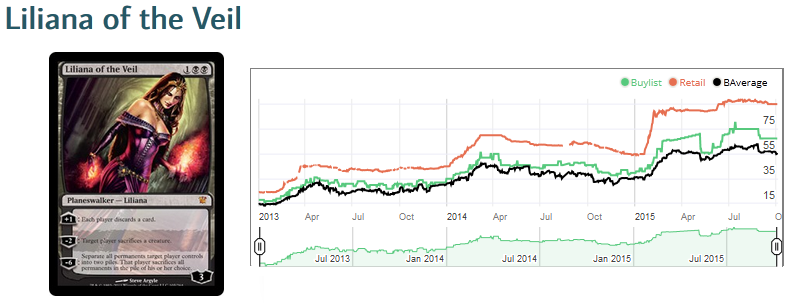
We certainly see more demand for Goyf than for Liliana, but she has enough players to hold a $75 price tag and a price history that never saw her drop value.

Lily Price ChartAnother depressing graph that makes me unhappy for not buying a hundred Lilianas back in early 2013. Liliana's price history closely mirrors metagame trends, and anyone who knows BGx's evolution in Modern can chart those alongside her rise.

Lily saw a slight uptick after Deathrite Shaman's 2014 banning when it became clear BGx would be just fine even without the one-mana planeswalker. She also held value throughout the Treasure Cruise era, even though the delve sorcery singlehandedly invalidated her best mode. This was followed by a huge spike in Abzan's February 2015 rise, and another jump when the Jund hype train was in full steam in early summer.

BGx's fortunes have risen and fallen from 2014 until today, but Lily's value has been eternal. This makes her, like Tarmogoyf before her, a steep purchase target that you won't be able to sneak in on. We'll never see a metagame where Lily is bad enough to drop her price: if Cruise-era Delver couldn't do it, nothing else will. Jund and Abzan will continue to see play and, as they do, players will continue to play Lily.

Never bet against BGx

For more wallet-conscious individuals, Liliana of the Veil doesn't need to be bought as a playset. Many BGx lists are running only three or even two of the planeswalkers in this aggressive metagame. This means you can get away with buying 2-3 of them if your bank account can't take another hit after getting that Goyf playset.

That said, there are metagames where four Lilianas are mandatory, so you might as well get them now before they go up any more.

The Reprint Question

As Ryan Overturf discussed in an excellent article last week, it's important to consider Duel and Event Deck reprints when buying into these kind of staples. He even had a few words about Tarmogoyf, using the beat-stick as an example of high-price cards that virtually guarantee their own reprinting. These considerations are also at play in Snapcaster, Lily, and any other expensive card you have your eyes on.

I expect all three of these cards to be reprinted in Modern Masters 2017. If that seems far away that's because, well, it is far away: Wizards seems locked into a two-year MM release cycle and there's no indication that this will change.

I could see a card like Liliana reprinted in a Duel Deck before then, especially a Modern-themed one, but Goyf seems like the kind of card that's reserved for Modern Master's print runs. Besides, you can always just play Scavenging Ooze to prey on those Goyf-dependent players.

There was an error retrieving a chart for Scavenging Ooze

As for Snapcaster, this is a strong Event Deck contender. I could see Wizards releasing some decks like this around the Modern Pro Tour next February, and Snapcaster would be a great inclusion for a Grixis or Jeskai-lite Control deck.

It's a great time to buy into Modern cards, and I'm excited to hear your own stories of off-season Modern investment. Any cards you think are good pickups? Any price analysis on Goyf, Snapcaster, or Lily that you think I missed? Let me know in the comments and I'll see you all next week!


Deck of the Week – Jeskai Allies

Are you a Quiet Speculation member?

If not, now is a perfect time to join up! Our powerful tools, breaking-news analysis, and exclusive Discord channel will make sure you stay up to date and ahead of the curve.

Last weekend was the not-so-eagerly awaited Modern debut of Battle for Zendikar. Man-oh-man did it meet its lack of expectations. Although the SCG Standard Open in Indianapolis saw some exciting performances by Bring to Light and five-color manabases, Modern was much less hospitable for our newest set. Only two of the Top 16 decks played any cards from BFZ at all. Even going down to the Top 32, the handful of BFZ appearances, often just single copies, doesn't inspire a lot of hope in the new set. That is, unless you're playing Allies.

Hada Freeblade

Battle for Zendikar might not have had the most exciting welcome party in Modern, but the set is already making a big impact on Allies players and tribal aggro brewers. Matthew Farney piloted an innovative Jeskai Allies list to a 10th place finish at the event, combining the old Zendikar Ally staples with the newcomers from Battle. Sky is off this Tuesday so I'll be taking a quick look at Farney's list, highlighting the differences and overlaps between his build and previous Allies lists we have seen in the past. Both BBD and Brad Nelson might doubt Allies' potential in Modern, but Farney and his stalwart soldiers were there on Sunday to try and prove them wrong.

[wp_ad_camp_1]

The List

Longtime readers know I'm a big fan of Allies, a sentiment I share with Ari Lax. We've seen a few Allies lists in past articles, including a Collected Company themed list from the Italian PPTQ scene, and Naya Allies from GP Charlotte. Farney's Jeskai Allies is a new color combination for the valiant tribe, but it's packed with the same tricks and synergies we have come to love in different Allies versions.

Jeskai Allies, Michael Farney (10th place, SCG Premier IQ Indianapolis 10/2015)

Creatures

3 Jwari Shapeshifter
3 Phyrexian Metamorph
4 Akoum Battlesinger
4 Expedition Envoy
4 Hada Freeblade
4 Kabira Evangel
4 Kazandu Blademaster
2 Kor Bladewhirl
1 Lantern Scout

Artifacts

4 Aether Vial

Instants

3 Cloudshift
4 Path to Exile

Lands

1 Mountain
4 Plains
4 Ally Encampment
4 Arid Mesa
4 Cavern of Souls
1 Sacred Foundry
1 Scalding Tarn
1 Steam Vents

Sideboard

3 Dragon's Claw
1 Lantern Scout
2 Tuktuk Scrapper
3 Pay No Heed
3 Rending Volley
3 Wear // Tear

Some SCG Indy decks threw in a handful of BFZ cards as if to prove the set could see play in competitive decks. Jeskai Allies takes this to a whole new level: 11 cards in the maindeck are new arrivals from BFZ. This is on top of old Allies staples (the almighty Kabira Evangel and his blitzing buddy Akoum Battlesinger) and some neat tech we don't often see in competitive Allies builds (versatile spells like Cloudshift and Phyrexian Metamorph).

The Allies

Before comparing Farney's Allies take to the more traditional Naya/Company-based lists we are accustomed to, let's look at all the new cards and see how Battle for Zendikar benefited the deck. I'll also give some quick notes on the pre-BFZ, but still nifty, technology Farney included in his build.

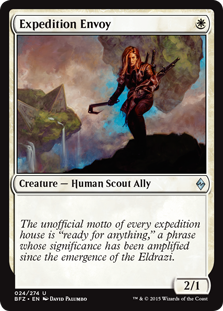
  • Expedition EnvoyExpedition Envoy: She's often no Hada Freeblade, but Envoy still functions as a virtual Freeblade 5-8 in a deck that really wants to make its curve. In the first few turns, Envoy gets across for early damage, ensures you have something to do with Aether Vial at one, and benefits from fast Battlesinger openings. It's true that, unlike Freeblade or Champion of the Parish, Envoy can never grow into a Wild Nacatl or Tarmogoyf over those initial turns. That's made up for by Envoy's midgame presence, where she still triggers your other Allies but can also swing for two without requiring a pair of creatures entering play after her.
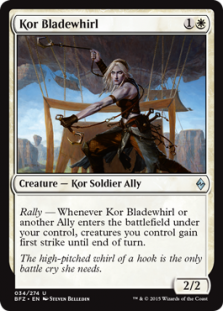
  • Kor BladewhirlKor Bladewhirl: While Allies like Lantern Scout got all the attention (more on him momentarily!), many players forgot about this creature matchup trump. Not Sky Mason, who praised Bladewhirl as one of the best Allies to come out of Battle, including two in his own take on the tribe. As Sky discussed, Bladewhirl massacres any deck trying to play a fair blocking game. SCG Indy had a mix of Bladewhirl prey in GW Hatebears, Affinity, Company decks, and even Jund, along with decks that completely ignored the Kor. If you can rely on about 50% of your matchups being creature-heavy slugfests, Kor Bladewhirl is your girl, especially if Abzan and its Lingering Souls takes off. Like Sky talked about the other week, two copies is exactly where you want to be.
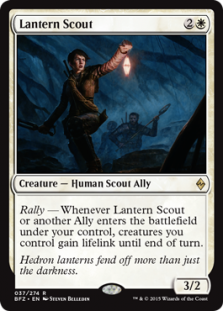
  • Lantern ScoutLantern Scout: I already gave my thoughts on Scout in my review article from two weeks ago, and all of that is just as true in Farney's list as it was in theory. Farney is down to a single Scout in the maindeck and one in the board, which I believe reflects a local metagame that seems largely devoid of Burn: there was only a single Burn list in the Top 32, which suggests Farney knew the deck was absent at the local level, he knew the players weren't good, and/or he just got lucky. Either way, 2-3 Scouts are right where you want to be between the maindeck and the sideboard, but don't skimp on your Ondu Clerics (or Dragon's Claws in Farney's case).
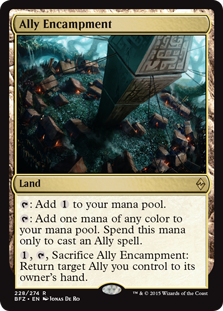
  • Ally EncampmentAlly Encampment: I'll admit it: I was skeptical of Encampment when I first saw the card. Although Encampment was clearly a decent and relevant Allies card, it both seemed somewhat weak for a tribe known for explosiveness, and didn't appear to fix the main issues Allies have in Modern (namely, they are too fair but are often locked out of the best interaction). Farney appears to have proven me wrong, and after testing this list a few times I can see why. For one, Encampment's painless mana-fixing is invaluable in a metagame that punishes even the smallest life total ding. It also insulates you against removal, particularly sweepers that so often plague tribal strategies. Encampment is at its best, however, when pushing aggressive turns. With enough mana, you can easily play, bounce, and re-play an Akoum Battlesinger for some serious damage (especially if it's triggering +1/+1 counters on other creatures). Encampment also improves your Metamorphs and Shapeshifters, allowing you to cast and re-cast them throughout the game without committing to any single copy. I expect we'll see more of Encampment in Allies decks to come.
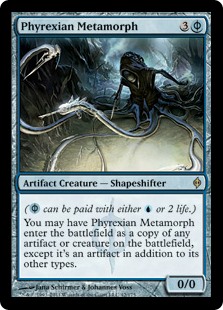
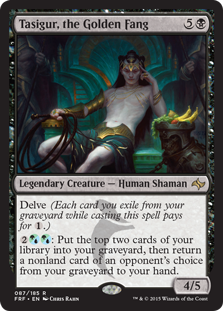
  • Phyrexian MetamorphPhyrexian Metamorph and Jwari Shapeshifter: I've always loved Metamorph and I'm happy to see the card show up in Farney's list. Whether copying your own Battlesinger or Blademaster or taking on an enemy's Tasigur or Goyf, Metamorph is an extremely versatile card that adapts to any given situation or matchup. I'd almost rather Phantasmal Image here just to abuse Vial more, but I understand why Image's illusion-drawback can be an issue for a deck that wants to maximize Encampment activations. As for Shapeshifter, she really shines with Encampment and Vial, enabling a number of surprise synergies that opponents will have a tough time planning around.
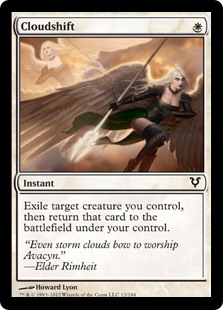
  • CloudshiftCloudshift: The overlooked white instant does it all in Allies. It retriggers rally, helps you punch through enemy defenses, Dispels targeted removal, and makes combat and casting decisions a nightmare for an interactive opponent. On the other hand, it's not Lightning Bolt, and it troubles me that we're playing Jeskai and not playing Modern's best removal spell. Jeskai Allies isn't as aggressive as Naya Allies, so I understand trading some reach for some anti-midrange trickery. Then again, this is Modern and I'd rather take a small hit to an already favorable matchup than go against Infect, Affinity, and Burn without Bolt. Playing aggressive red decks without Bolt makes me feel naked, and I'm curious to hear your take on why this card is absent.
In addition to the cards listed above, we notice many staples from past Allies lists: Path, Vial, Evangel, Blademaster, etc. The sideboard is one of the more targeted boarding strategies I've seen in a while. Every card is aimed to beat Burn, Lantern, Affinity, or Twin, with a little splash damage for Amulet Bloom and Delver decks. This ensures that Farney was completely ready for the decks he targeted instead of being slightly prepared for a wide number of decks like most singleton-full sideboards. Singletons may help you hit as many decks as possible, but also make it less likely to actually see any one card in those matchups. Given the deck's grindiness and its ability to break through stalemates and smash groundwars, I think this decision is a good one. Based on Farney's 10th place finish, it also seems to have worked well in practice.

Jeskai or Naya?

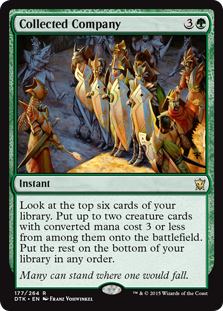
collected companyThis leaves us with the big question all Allies players are asking: Jeskai or Naya? That's another way of asking about Collected Company or not, which Charm/Command to use, and which sideboard cards you want available. We're going to need more Allies finishes to know this for sure, but for now, I think the scales are tipped in Naya's favor.
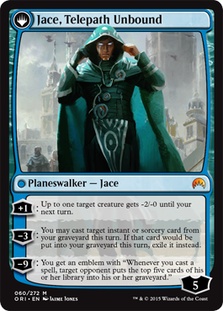

When I'm playing Allies, I don't want to be playing a bad Merfolk or a bad Abzan/Elves/Naya Company. What makes Naya Allies so strong is its ability to win out of nowhere with a good Company flip. It can even do this after a board wipe or a bad removal turn, let alone in a more even game-state. It can also do this with only two creatures, whereas a deck like Merfolk might need 3+ to recover from a sweep. Jeskai Allies trades that strength for consistent anti-creature wallop, but that's not a trade I necessarily want to make in Modern. For every deck that wants to interact with you via Souls, Tarmogoyf, Tasigur, etc., there's another deck out there just waiting for you to slip on a turn. I don't want to durdle around with a turn three Cloudshift to give first strike to my squad if my opponent is about to swing with an 11/11 Blighted Agent. Naya Company can play both the grind game and the explosive one, and that's something I miss in this Jeskai list.

Ultimately, it will come down to more players like Farney to decide the Allies issue. I'm confident we haven't seen the last of the tribe, and I expect to see these cards crop up more and more as the year draws to a close. Don't be surprised to see more GP Day 2 Allies if the trend holds: Battle for Zendikar block has only just started and already the tribe is getting better.

What other aspects of Jeskai Allies do you like or dislike? Any experience with the deck or any improvements you would make? What about other performances from last weekend's tournament? Take it to the comments and I'm looking forward to seeing you all tomorrow for our 9/1-9/30 metagame update!

Stock Watch- Jace, Vryn’s Prodigy

Are you a Quiet Speculation member?

If not, now is a perfect time to join up! Our powerful tools, breaking-news analysis, and exclusive Discord channel will make sure you stay up to date and ahead of the curve.

With 87 copies in the Top 64 of the first post-rotation Standard Open, it's no surprise to see the price of Jace, Vryn's Prodigy soaring. Before Theros rotated, you could get really punished for playing a Jace if you ran into a Searing Blood, but with that downside out of the way players are big on little Jace.

There was an error retrieving a chart for Jace, Vryn's Prodigy

The question is, how sustainable is a $65 price tag, and what is the ceiling? Well, that's going to boil down to Pro Tour results. What players do at Opens doesn't often correlate to what breaks out at the Pro Tour, but it's important to note that a lot of actual pros are advocates of the card as well. Gerry Thompson, for example, had four copies in his Top 8 list.

Over the next couple days, we'll see if players liquidate copies and lower the price. It's hard to imagine that anybody had a target price higher than $65 to turn a profit. If this happens we'll see prices dip. If it doesn't happen and/or Jace sees remotely comparable success at the Pro Tour, you might find yourself wishing that you ponied up that $260 to have your set for the next year. It's worth noting that a handful of buylists now exceed Jace's former retail of $40. Whether this number increases or decreases over the week is another great sign of market confidence.

Insider: Inventory Control & Smart Investing – Keeping Only What You Need

Are you a Quiet Speculation member?

If not, now is a perfect time to join up! Our powerful tools, breaking-news analysis, and exclusive Discord channel will make sure you stay up to date and ahead of the curve.

As I mentioned in last week's article on inventory management, today I'm going to talk about inventory control.

The two concepts are related, but distinct. While inventory management is about organizing to optimize internal efficiency, the basic premise behind inventory control is to make sure your inventory reflects what your customers need.

Just in Time Principle

In the business world there is a concept called "just in time" manufacturing, in which parts arrive at an assembly line with minimal time in storage. In manufacturing, storing things costs money so minimizing storage time saves money. If you buy all the washers you need for two years, you may save money on a bulk rate, but you'll also tie up capital in something you can't use for several years.

That may sound a bit abstract, so let's look at an example.

Tim owns a hobby shop. He hosts Standard FNMs, weekly Legacy tournaments on Saturdays, and an EDH night on Wednesdays. He tends to get 15-20 players for his FNMs, 10 players for his Legacy tournaments, and 30 players for EDH night. His singles sales mirror attendance (i.e. he makes the most singles money on EDH night). He hasn't built an online presence yet, so his marketplace is limited to the local playerbase.

One Wednesday three different EDH players request Doubling Season, which unfortunately he's out of. The next day he drives to the other store in town (which has no EDH presence), and lo and behold it has 20 Doubling Seasons in stock. The owner normally sells them at $26.50, but he offers a bulk discount--the whole lot for $20 each, or 10 for $24 each. Tim knows he can sell them for $27.50.

  • If he buys all 20 he'll maximize profits, but he doesn't know how long they will take to sell. He would have to sink $400 into that investment. Once sold, his profit would be $150 (assuming the $27.50 price remains the same).
  • If he buys 10, his investment is $240. It's easier for him to sell 10 than 20, but even then he doesn't know how long it will take. Once sold his profit is $35.
  • If he buys three, his investment is $79.50, but he'll sell all three within the week. His profit in this case is only $3.

If he operated on the "just in time" principle he would only purchase the three he knows will immediately sell. He won't sink a lot of money into "storing" the remainder of the stock in the hopes of unloading it slowly.

If Tim has a lot of cash available, then he might seriously consider the full allotment option. But if he's like most LGS owners I've met, he probably doesn't operate with a huge profit line and instead tries to make easy money when he can.

Sunk Costs

A "sunk cost" is an unrecoverable cost that has already been incurred. If Tim were able to sell his Doubling Seasons they would not be a sunk cost, but in theory they are until they do resell.

Even worse, if Doubling Season were reprinted and the price dropped to $10, then he would truly have a sunk cost because his $400 inventory would now be worth $200, equal to the sunk cost of acquiring it. In Magic finance we're familiar with the inherent danger of investing a large amount of money on any single card--its price may be stable for a long time only to get cut in half with a single announcement.

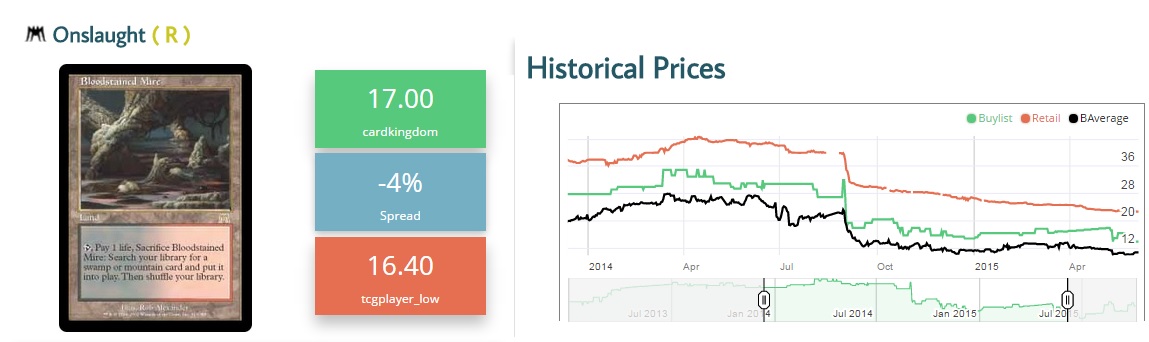
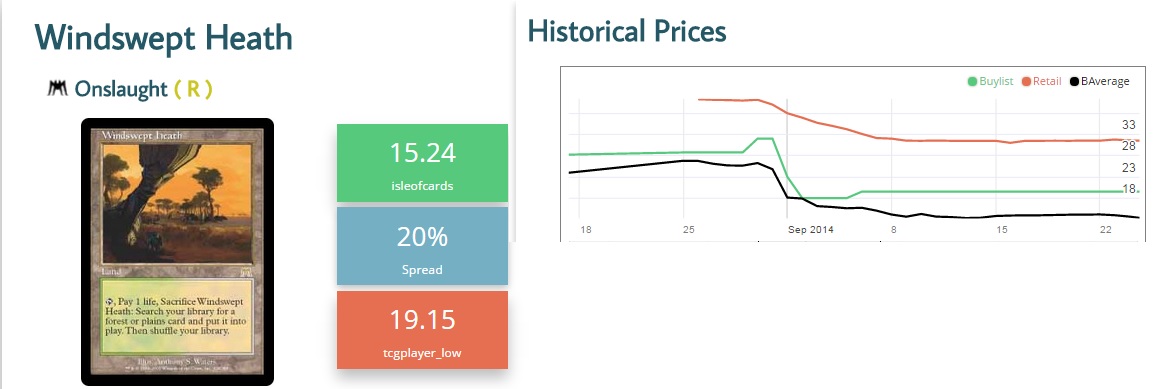
windswepth heath

bloodstained mire

Notice the sudden drops in the charts above. Care to guess what was announced on August 30th, 2014?

Stores and players who had stockpiled fetchlands lost a lot of money on these. Along with the shocklands, these are the largest-profile reprints we've seen, but are unlikely to be the last. That means that anytime you invest a lot of money into any specific card there is a cost associated with that risk.

In an article I wrote a while ago, I noted that the average price drop from a reprinting was around 28%. That might not seem like a lot, but with some cards the spread can be very low (10-15%) and the total value obviously grows with the quantities you have in stock. Knowing that, it's wise to reduce your sunk cost risk to a minimum.

The other thing to consider was that my 28% calculations were based on an average; some cards lost significantly more. For example, Akroma's Memorial lost 70% of its value when the reprint came out (it has since rebounded to within about 15% of the original price).

This is why all of us writers at QS push the idea of diversifying your portfolio to eliminate this type of loss, much like investments in index funds or hedge funds.

Reinvesting

It's also important to reinvest some portion of your profits to grow your business by way of an increasing inventory. As you can see by a simple glance at TCGplayer.com, it's pretty easy to sell Magic cards; it's much harder to sell them consistently and profitably.

One of the most important attributes of a good store owner is willingness to reinvest in their business at the cost of immediate gratification. Instead of going out for that $40 steak dinner, buy some of those hot Standard staples from the person with the overflowing binder who's in need of gas money.

Obvious right? But how about a tougher question, "How much should I reinvest?" There are a lot of factors that affect this, but the general rule is to leave yourself enough cash to cover current commitments (up to six months away). Let's use our friend Tim for an example again.

Tim had a stellar year of sales. He's got $10,000 in his store's bank account and he wants to buy some cards. His rent, utilities and insurance come to $1,000 a month. Reinvesting all $10,000 would be unwise because if he fails to sell he goes under after a single month. If he reinvests $9,000 then he's only giving himself a month to make his next rent check.

The general recommendation is to reinvest up to $4,000 back into the business. His potential for profit is lower, but he maintains a good safety net, with his bills covered six months out.

Dividing Up Your Investment

Once you have a general idea how much to reinvest, the question becomes where to park it.

Let's say someone walks into your store looking to sell a full set of dual lands, but you have no regular Legacy players (and no online store). It isn't wise to buy them, even for a good price, because they may sit there indefinitely.

My suggestion would be to review your previous 2-3 months worth of sales. (If you don't keep detailed-enough records to know which cards sold on what date, you may want to start.) Once you have your data set, break the cards down into individual categories:

  • EDH Staples
  • Legacy Staples
  • Modern Staples
  • Standard Staples
  • Casual Favorites

Now that you know what your playerbase wants, you can reinvest more intelligently.

Let's go back to Tim. He has $4,000 to invest and his records indicate:

  • 40% of sales are of EDH staples
  • 25% of sales are to Standard players
  • 15% of sales are to Legacy players
  • 10% of sales are to Modern players
  • 10% of sales are to casual players

He should consider breaking his $4,000 investment up into ratios similar to his sales.

  • $1600 worth of EDH staples
  • $1000 worth of Standard staples
  • $600 worth of Legacy staples
  • $400 worth of Modern staples
  • $400 worth of casual favorites

This method will help him avoid the mistake of buying cards his playerbase has no interest in and tying up capital with inventory he can't move.

Lastly, he'll want to monitor the sales trends and note any shifts (for example if Standard picks up and begins to increase in share size). This way as he reinvests weekly or monthly, he'll know which category to focus on.

~

I hope this article has given you a better grasp of proper inventory control techniques. Applied well, these concepts will help maximize your investment dollar and your profits.

Insider: Analyzing the First Week of BFZ Standard

Are you a Quiet Speculation member?

If not, now is a perfect time to join up! Our powerful tools, breaking-news analysis, and exclusive Discord channel will make sure you stay up to date and ahead of the curve.

Five out of eight Top 8 competitors at SCG Indianapolis agree: Gideon, Ally of Zendikar is the most exciting card from Battle for Zendikar.

'Ol Gid is a punishing attacker, for sure. But ultimately what makes him good is the same thing that made Elspeth and Xenagos good--a stream of 2/2s. Magic loves its Bitterblossoms.

Red, Deep Red

As expected, red aggro made a big showing this weekend. It makes sense to try it in an open environment, and this was the correct call for our very own Brian DeMars.

Brian is a long-time player who referred to the combo of Become Immense and Temur Battle Rage as "Blood Lust plus Berserk." His deck is simple, strong, and it's going to define what people play for the next few weeks, setting the tone for aggression. It will eventually be contained, but I'm expecting a lot of the cards will see a good price boost.

Actions: Atarka's Command has disappeared from the internet at $7, only to reappear at $14. This makes sense because the rest of the deck is just so cheap--something has to rise to match the popularity. Abbot of Keral Keep is $7 as well, which seems about right.

My favorite target here is Wooded Foothills. It has flattened out at $17 for the past month. That's pricey, but this is a good trade target. The deck relies on Become Immense and you'll need some cards in the yard to fuel it.

Rocs and Dinos Ride Again

In second place, G/W Megamorph reminded us that Deathmist Raptor and Den Protector still function well together. This deck is a natural home for Gideon.

It also hailed the reappearance of Wingmate Roc. Michael Majors ran three in his maindeck as a big dragon-like finisher. The lifegain can be significant against the base-red decks, if you can survive that long. The card is at $3.50 right now, and as a mythic from last year it has plenty of room to grow.

I have never liked Deathmist Raptor but it does decent enough work. The low impact of BFZ in the event means that we can rely on this block combo for awhile.

Jeskai Black, the Most Ambitious Manabase

Two players made Top 8 with Jeskai Black, a Mantis Rider deck splashing for Crackling Doom and Tasigur, the Golden Fang. If you can accept your lands coming into play tapped just about every turn, the deck will reward you with some big three-color spells. Jace, Vryn's Prodigy is one of the most powerful elements here, both recycling kill spells and looting through the deck.

This is an ambitious manabase. I don't think it can stand the test of time, even though Crackling Doom is a pretty sweet card. Looping that thing through a Soulfire Grand Master seems even more potent.

Actions: I was most surprised to see people playing Dragonmaster Outcast. The reviled reprint has dropped the price of the card to about $4, an appealing spot. Outcast lets you play a much more controlling game because it's both a six-drop and a one-drop. You can cast it with countermagic up to ensure it resolves and survives.

Back in the original Zendikar, nobody but Brian Kibler ran the Dragonmaster. This time the landscape is different. Let these sink in price for another week or two and then scoop them up.

Nine Siege Rhinos

Gerry Thompson played Bring to Light this weekend to a Top 8 finish. Gerry goes a long way back with this sort of deck; he first gained prominence while slinging Gifts Ungiven in Kamigawa block.

It doesn't surprise me that he's drawn to a ponderous deck whose premise is to sneak out dragons or, in this case, rhinos. Gerry drew on four Rhinos, four Bring to Light and a Clever Impersonator to make sure he had a neverending stream of dumb rhinos, with the latter doubling as a planeswalker clone.

This is an expensive deck to put together. It draws on an expensive manabase and four copies of Jace. This alone will limit its appeal. The support pieces tend to be small commons and uncommons like Reave Soul and Sultai Charm. Even things like Clever Impersonator and Gilt-Leaf Winnower have a limited speculation window, since they could be cut from the list in a week or two.

Actions: I like Abzan Charm as a pickup. It's one of the few instant-speed removal pieces that exiles a card. It sits a little under $0.50 right now. We are awash in Khans cards, but that will dry up soon enough. People will put their draft boxes away, start new ones for BFZ and cease buylisting their draft piles. This card has looked strong for a while and I believe it's a good long-term spec.

Esper Dragons Is Back

Esper Dragons, the best contender for "alive or dead?" in Standard, is alive this week; I'm as surprised as you are. Two copies made it into the Top 8 on the back of a few new BFZ cards.

One copy had two Blighted Fens maindeck, a move that I like. The deck needs mana and spell lands are a good hedge against flooding out.

They also play well with Crux of Fate. Astute players will hold a monster or two back, and when you tap out for Crux they'll have the backup ready to go. Blighted Fen gives you a little more action to stop an opponent from slow-rolling you. I also like how well it plays with other instant-speed spells.

Foul-Tongue Invocation is another interesting element. It does obvious work against a red deck, but also punishes players intent on making the effort to fetch Siege Rhino with Bring to Light. It can clean up a Jace on an early board, too.

I thought this deck would die off after losing eight temples, but it remains. Dig Through Time is a heck of a card and so is Counterspell.

Quick Hits

  • Bradley Carpenter's Abzan Control deck has two Greenwarden of Murasa on the sideboard. Cool tech, and likely to become more common.
  • Abzan Aggro floods the 24th-48th ranked decks. Tournament grinders like Todd Anderson and BBD ran it, but fell a match or two short of the Top 8.
  • No ramp really at all.
  • It has to be a bummer for someone at WoTC to look at this event and see so few BFZ cards. I hope the Pro Tour doesn't have an "Eldrazi Counter" like the DTK "Dragon Counter" so we can save everyone some embarrassment.
  • Mantis Rider is also well represented in the Top 64. This next month will be a banner month for it.

If it happens this week, you'll read about it here!

-Doug

Trevor Holmes Plays MTGO: Temur Prowess

Are you a Quiet Speculation member?

If not, now is a perfect time to join up! Our powerful tools, breaking-news analysis, and exclusive Discord channel will make sure you stay up to date and ahead of the curve.

Hey guys! Welcome to Episode 3 of our Modern Nexus Video Series, where we pick a sweet list and run it through some matches on Magic Online. This week we have Patrick Chapin’s 64th place Temur Prowess deck from Grand Prix Oklahoma City in mid-September. With Battle for Zendikar coming to Magic Online next week, I figured now would be a great time to explore a relatively under-the-radar archetype for a bit before we get into some new brews.

Thumbnail_Master

Expect either B/W Tokens or Retreat to Coralhelm Combo next week (MTGO release bugs willing). If you have any suggestions for future videos or would like to vote for one of those two options, let me know in the comments! With that, let’s get to the games.

[wp_ad_camp_1]

Temur Prowess, Patrick Chapin (64th, GP Oklahoma City 2015)

Creatures

4 Abbot of Keral Keep
4 Monastery Swiftspear
4 Snapcaster Mage
4 Tarmogoyf
1 Grim Lavamancer

Sorceries

4 Gitaxian Probe
4 Serum Visions

Instants

4 Vapor Snag
4 Lightning Bolt
1 Izzet Charm
2 Remand

Artifacts

4 Mishra's Bauble

Enchantments

1 Seal of Fire
1 Rancor

Lands

1 Copperline Gorge
4 Misty Rainforest
4 Scalding Tarn
1 Breeding Pool
1 Stomping Ground
2 Steam Vents
1 Wooded Foothills
1 Polluted Delta
1 Mountain
2 Island

Sideboard

1 Roast
1 Feed the Clan
1 Izzet Staticaster
2 Spellskite
2 Deprive
3 Dispel
1 Volcanic Fallout
1 Negate
2 Ancient Grudge
1 Seal of Fire

Deck Tech

[youtube http://www.youtube.com/watch?v=gPlof9bax6c&w=560&h=315]

One thing I forgot to mention is a little bit more discussion about our identity as an “Abbot deck” rather than a “Delver deck”. Playing Mishra's Bauble gives us eight free spells to hit off our Abbot of Keral Keep, and helps us with chaining prowess activations together. Its classification as an artifact pushes us towards looking to maximize our Tarmogoyf's size, which in turn leads us to look for enchantments to grow our Tarmogoyf even larger. This means that we’re playing a relatively low 19 instants and sorceries, where we would really be looking to play 22 or more were we playing Delver of Secrets. Think about this before trying to slot Delver into this deck!

Round 1 [su_spoiler title="Result"] Win 2-1 vs. B/G Rock [/su_spoiler]

[youtube http://www.youtube.com/watch?v=a9o1flbY2bk&w=560&h=315]

Game 1 illustrated how these tempo-oriented strategies can struggle when they draw hands with elements that help us push our advantage (Vapor Snag/Remand) without threats to apply pressure with (Tarmogoyf/Monastery Swiftspear). Our opponent helped us out by casting Bitterblossom, which is a big liability for him in the matchup and translated directly into us winning Game 1. Game 2 showed us that Kitchen Finks is a gigantic beating for a tempo strategy looking to accrue incremental damage. The ETB trigger makes casting Vapor Snag a losing proposition, and the persist trigger is great against our lack of Pillar of Flame. If Kitchen Finks becomes more popular, moving away from Seal of Fire will probably be our response.

Round 2  [su_spoiler title="Result"] Loss 1-2 vs. Jund Midrange [/su_spoiler]

[youtube http://www.youtube.com/watch?v=JW-MVycrAq0&w=560&h=315]

Jund is a difficult matchup. As we talked about in the video, their combination of cheap hand disruption, plentiful removal, and hard-hitting threats line up well against our synergistic spells that only work well in multiples. Their unique ability to grind us out and strip our hand of unique elements can make finding an avenue to win extremely difficult (read: leaving us with Vapor Snag after they Thoughtseize our Tarmogoyf). Speaking of Tarmogoyf, he is our best individual card against them and equally powerful against us from their side as well. A hard-hitting threat that wins almost all fights and demands a quick answer; casting and protecting Tarmogoyf should be our primary gameplan both pre- and post-board.

Round 3  [su_spoiler title="Result"] Win 2-0 vs. U/R Twin [/su_spoiler]

[youtube http://www.youtube.com/watch?v=oUJK-vZtiyc&w=560&h=315]

Our Twin matchup, on the other hand, seems excellent. They are restricted to pretty much just Lightning Bolt as far as removal goes, relying on counterspells to “control” the game and keep creatures off the board. This lines up very poorly against our flash threats, Tarmogoyf and Monastery Swiftspear, which lets us play to the board first and then push our advantage with tempo-generating spells like Vapor Snag and Remand. After board, we get to take full advantage of the power of Dispel, and counterspells of our own alongside Vapor Snag and Spellskite make it very difficult for Twin to combo out.

Quick Hits

Rather than go in-depth on matchups/sideboarding, I had the idea that a short, bullet-point style section to communicate quick thoughts/tips would work with the "notes" feel of the text portion of this series. As always, expect a lot of the main discussion to occur verbally in-game, but it seemed a good idea to me to provide a short section in each article where readers that might not have time to watch all the videos/want some quick tips can get some information from the article. Let me know what you guys think, for now, let's call this our test run.

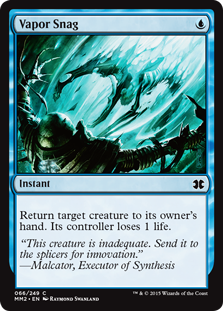
  • Vapor Snag has a lot of utility.Vapor Snag Don't be afraid to Vapor Snag a Monastery Swiftspear to save it from removal! We don't play many creatures, and often need to be racking up damage each turn. Swiftspear's haste ability means that Vapor Snag isn't even that much of a drawback, as we can just replay him next turn and get right back to swinging.
  • Vapor Snag draws us cards! When used on Abbot of Keral Keep or Snapcaster Mage, we can turn Vapor Snag into a cantrip. This is great against control decks and combo decks that might not have a bunch of creature targets, and can be life-saving if we need to dig for a certain spell or re-gain access to something in our graveyard.
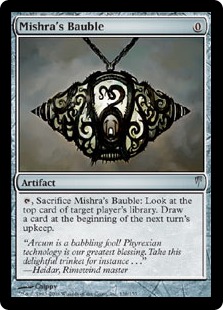
  • Don't be lazy with Mishra's Bauble! It doesn't always need to be cast turn one. If we don't have a Monastery Swiftspear to take advantage of the prowess, and we already have a plan for our turn two (say, play Tarmogoyf), it might be better to sit on the Bauble and see if we can get a prowess trigger off it a little down the line.Mishras Bauble Holding it instead of casting on turn one means we have at least two more draws (our turn two draw and turn three draw) to hit a Monastery Swiftspear, and while the one damage seems minor it can really matter over the course of a game. Prowess triggers and Vapor Snag life adds up, so take things slow and think through everything!

  • On the other hand, if we don't have much going on (say our hand is poor, or our best turn two play is Gitaxian Probe/Snapcaster flashing back Probe), cycling the Bauble to dig for Tarmogoyf/Serum Visions might also be right. It's a delicate balance and a squeeze that's not immediately easy to solve, but that's what makes this puzzle so fun!
  • Decks looking to interact with us in combat or attempt to race all seem to be great matchups. Archetypes like Burn, Grixis Control, Twin, and other creature decks seem to be what we are built to prey on. Slow combo like Scapeshift, or creature based combo like Elves also seem to be great matchups. Jund is poor, and Tron might be diffcult as well. I haven't played against Living End but we might not be fast enough/have enough interaction to push them out of their lane. Keep this in mind when tuning the sideboard!

Conclusion

Thanks for watching! Temur Prowess is a fast, synergistic aggro deck that can take advantage of Abbot of Keral Keep more than any other strategy in the format, and gets to play cool under-the-radar spells like Mishra's Bauble, Rancor, Seal of Fire, and Vapor Snag. The deck has a lot of play to it and can play aggressive or controlling depending on multiple factors, and the decision trees involved are both long and complex. I’ve had a lot of fun playing this deck, as we really can “play it how we want to”, and the sideboard allows for even more customization to really make it our own. If you’d like to see more of this deck in action feel free to stop by my Twitch stream at twitch.tv/Architect_Gaming, where we will definitely be evolving and updating this strategy for weeks to come. If you have any comments/suggestions/questions, let me know in the comments! Thanks for watching and I’ll see you next week.

Trevor Holmes
The_Architect on MTGO
Twitch.tv/Architect_Gaming
Twitter.com/7he4rchitect

Deck Overview- Jeskai Black

Are you a Quiet Speculation member?

If not, now is a perfect time to join up! Our powerful tools, breaking-news analysis, and exclusive Discord channel will make sure you stay up to date and ahead of the curve.

This weekend saw the first major tournament of new Standard, with Quiet Speculation's own Brian DeMars taking the whole thing down. The finals of the tournament pitted a pair of two-color decks against each other, though there was no shortage of decks exploiting the power of fetch+dual manabases. With two copies in the Top 8, you could make the argument that Jeskai Black was the most successful deck of the tournament.

Jeskai Black by Adam Varner

Creatures

4 Hangarback Walker
1 Butcher of the Horde
2 Dragonmaster Outcast
4 Mantis Rider
4 Jace, Vryn's Prodigy

Spells

3 Gideon, Ally of Zendikar
4 Crackling Doom
3 Dig Through Time
1 Dispel
1 Fiery Impulse
1 Jeskai Charm
2 Ojutai's Command
3 Valorous Stance
2 Wild Slash

Lands

1 Island
2 Mountain
3 Plains
1 Swamp
4 Bloodstained Mire
3 Flooded Strand
2 Mystic Monastery
4 Polluted Delta
2 Prairie Stream
2 Smoldering Marsh
1 Sunken Hollow

Sideboard

3 Arashin Cleric
1 Disdainful Stroke
1 Dispel
1 Negate
1 Ojutai's Command
2 Surge of Righteousness
3 Radiant Flames
2 Touch of the Void
1 Tragic Arrogance

Jeskai Black by Clay Spicklemire

Creatures

3 Abbot of Keral Keep
4 Mantis Rider
3 Soulfire Grand Master
2 Dragonlord Ojutai
4 Jace, Vryn's Prodigy
1 Tasigur, the Golden Fang

Spells

2 Crackling Doom
3 Draconic Roar
2 Jeskai Charm
2 Kolaghan's Command
3 Ojutai's Command
2 Valorous Stance
2 Wild Slash
3 Treasure Cruise

Lands

2 Island
2 Mountain
1 Plains
2 Battlefield Forge
4 Bloodstained Mire
4 Flooded Strand
4 Polluted Delta
2 Prairie Stream
2 Smoldering Marsh
1 Sunken Hollow

Sideboard

1 Arashin Cleric
1 Dragonmaster Outcast
2 Felidar Cub
2 Outpost Siege
4 Disdainful Stroke
1 Silumgar's Command
1 End Hostilities
3 Radiant Flames

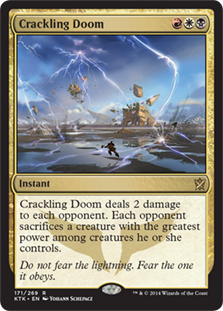
Both decks are taking advantages of different strengths of the Jeskai base, but both players agree that Crackling Doom is a great reason to splash black. Jeskai has always been a little soft to Siege Rhino and other large creatures, and Crackling Doom allows the Jeskai player to deal with problematic creatures while also applying pressure.

This is just the tip of the iceberg when it comes to experimenting with new manabases and spell combinations. Gerry Thompson also made the Top 8 of the event with a five color list, and watching the metagame unfold will undoubtedly be very exciting. You can really just find the spells you want to play together and there will be a manabase that can support your idea. Be careful though, the red decks can and will run you over if you stretch yourself too thin.

Some Bob With Your Bugs: Confidant in Delver

Are you a Quiet Speculation member?

If not, now is a perfect time to join up! Our powerful tools, breaking-news analysis, and exclusive Discord channel will make sure you stay up to date and ahead of the curve.

Since Origins was spoiled I’ve been tuning iGrow, a Delver deck abusing Day’s Undoing to crush the midrange strategies that have historically oppressed my buggy buddy since Abrupt Decay’s printing. It worked, but at the cost of dedicating an entire sideboard to beating the aggressive decks that benefitted from my mainboard set of Undoings. With today’s metagame shifting away from midrange and towards aggro, iGrow looks less appealing, and I’ve begun re-tooling my first Delver brew, Counter-Cat (more on this deck in another article). But this week, something else had my attention.

dark confidant bob fixed dimensions

Monday night, a friend asked to borrow Confidants for a Jund deck he was putting together. As I dug Bob out of my Modern box, I realized how bad a time opponents would have trying to kill him through Disrupting Shoal. Something clicked, and I scribbled down a list that soon evolved into this one:

[wp_ad_camp_1]

Grixis Grow, by Jordan Boisvert

Creatures

4 Dark Confidant
4 Delver of Secrets
4 Monastery Swiftspear
4 Young Pyromancer

Sorceries

4 Serum Visions
4 Gitaxian Probe

Instants

4 Disrupting Shoal
4 Lightning Bolt
4 Terminate
2 Vapor Snag
2 Spell Snare
2 Mana Leak

Lands

4 Darkslick Shores
4 Scalding Tarn
4 Polluted Delta
2 Island
1 Swamp
1 Steam Vents
1 Blood Crypt
1 Watery Grave

Sideboard

4 Day's Undoing
2 Remand
2 Forked Bolt
2 Kolaghan's Command
2 Inquisition of Kozilek
3 Spellskite

Disrupting Shoal: The Reason to Play Grow

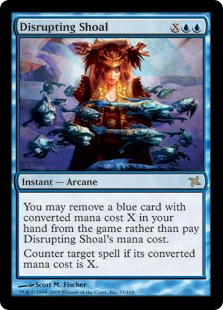
I have to stress how integral Disrupting Shoal is to the tempo archetype in Modern, and specifically, to grow decks. (If you don’t know what I’m talking about, check out my four-part series on Modern archetypes.)Disrupting Shoal Grow plays the nastiest threats a format has to offer, ignoring tribal synergies in favor of raw efficiency. Its pilot sticks one or two of these creatures early, and protects them long enough to win, often depleting his cards and life as the game progresses. Ideally, the grow deck beats opponents with all its resources exhausted. For this reason, the player sitting across from a grow deck usually feels like he’s winning until the turn he loses.
Part of what enables grow is efficient countermagic, which Modern lacks. Our catchall answers, Mana Leak and Cryptic Command, boast costs so prohibitive (yes, two mana is prohibitive in this archetype) that grow decks struggle here; we can’t expect something like Young Pyromancer to survive the second turn in a format where half the decks run a set of Lightning Bolt. Tempo decks must then slow down to ensure the safety of their sparse threats, pushing them into midrange territory and eliminating a need for cheap creatures altogether. After all, if we’re waiting until turn four to play a threat, why not just cast Siege Rhino instead of Delver of Secrets?

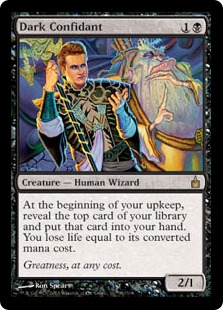
Disrupting Shoal solves this problem, letting us tap out for Pyromancer and counter Lightning Bolt in the same turn cycle.Dark Confidant The two cards we spend net us a boatload of advantage if we consistently untap with cantrips and Mana Leak. Additionally, most opponents won’t have multiple answers in hand, giving us time to draw additional countermagic and to carry the game away on the wings of our fragile, ferocious threat. Years of Jund domination have conditioned Modern players to fear card disadvantage and to shy away from Disrupting Shoal. But free countermagic has always been integral to grow decks, and Shoal shines brighter here than any other permission spell.
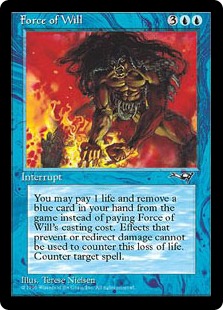
These last couple months with iGrow showed me how easy it is to carry a game after protecting a frail threat for that crucial, “open” turn – Shoaling a Bolt aimed at Pyromancer ends things right away in that deck. Saving Delver of Secrets, Tarmogoyf, and Young Pyromancer with Disrupting Shoal may cost us a second card, but saving these threats lets us untap and attack with them . Bob offers something other than damage output for his protection, but the resource he provides has always granted tempo decks many victories regardless: cards.

Force of WillIn “Power Calls: iGrow and Broken Tempo," I wrote about how busted card advantage engines are in tempo decks. Bob might just be a 2/1, but as he draws us into removal, threats, and countermagic, his hits begin to add up, and opponents have difficulty overcoming him.

Just as Legacy players have established a "minimum" of 15 blue cards for Force of Will, I've found that 22 blue cards should be included to take full advantage of Disrupting Shoal in Modern grow decks. We require more than Force of Will does because of Shoal's "CMC" clause, which only allows certain blue cards to pitch successfully. Holding on to blue cards rarely poses an issue with 22 in the deck, since when we're ahead (we often are), we don't mind conserving a Probe or Snag in hand to secure our threat's leading position.

Dark Confidant: The Reason to Play Black in Grow

Grixis Delver: Firmly Midrange

Grixis Delver decks have done well in Modern since Tasigur, the Golden Fang began his reign. I want to specify that these decks are not tempo decks. Grixis Delver is a midrange strategy that usually disrupts opponents before it begins committing threats to the board, explaining cards like Kolaghan's Command and Snapcaster Mage. Tempo decks can't run so many high-curve cards, as they need to land threats early and dedicate the rest of the game to protecting their initial investment.

I’ve heard Grixis Delver players call Delver of Secrets “the worst card in the deck.” To me, that makes perfect sense: why wouldn’t the best tempo threat be the worst card in a midrange deck? Still, these players often defend the deck against my categorization. I’ll argue that if a deck can play a tempo game, it doesn’t necessarily become a tempo deck. Consider Jund: sometimes, this deck casts Goyf, then Abrupt Decay and Thoughtseize, then Liliana of the Veil, then Maelstrom Pulse.Tasigur And by then, the Goyf has dealt lethal damage. In this instance, Jund committed a threat, then disrupted its opponent. It played a tempo game. But unless a deck utterly dedicates itself to reliably executing this gameplan, it doesn’t qualify as a tempo deck. Most of us can agree that Jund is designed to play in the opposite direction, tearing opponents apart with disruption before cleaning up the mess with a huge Lhurgoyf.
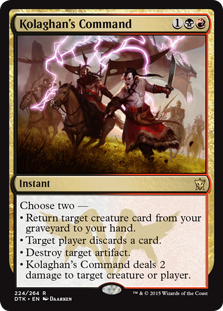
It’s okay that Grixis Delver is a midrange deck. A case can be made in favor of the Grixis Delver deck we’ve seen thus far, and that case relies on midrange’s undeniable strength in Modern. Unfortunately, Grixis Delver’s diluted gameplan does the archetype no favors. When it comes to midrange, I think Abzan (in metagames teeming with fair decks) and Jund (everywhere else) outpace Grixis Delver every time. But either way, I have little interest in the disrupt-then-commit strategy. To me, rewarding games of Magic involve the meticulous resource management only the grow archetype requires of its pilots.

Grixis Grow: Tempo, at Any Cost

To make Grixis Delver a grow deck, we first need to lower its curve. That means we trade clunky three-drops like Kolaghan's Command for grow staples like Disrupting Shoal. Then, we choose to either abuse Delve fatties with Thought Scour, or to find other cheap threats to back our namesake bug.Kolaghans Command I’ve chosen the latter option, because when it comes to grow in Modern, I don’t see what Grixis offers the archetype that Temur doesn’t. Tasigur and Angler? We have Hooting Mandrills and Tarmogoyf. Sideboard tech? We have Destructive Revelry and Feed the Clan. “Hard” removal? Who needs it? We’re tempo, not midrange! Bounce effects will do just fine, especially when they boast the supreme versatility of Simic Charm.
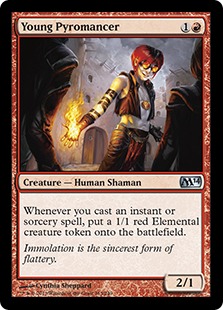
If the Tasigur/Shoal deck is just a worse Monkey Grow, we need a better reason to play black. Enter Dark Confidant. Like Young Pyromancer and Delver of Secrets, here’s a threat that dies to Lightning Bolt, but wins you the game if he doesn’t. Unfortunately, it’s too risky in a format full of Burn decks to run delve fatties and Dark Confidant. It’s possible that the Grixis grow deck is better with delve guys and no Bob, but in that case, we should just go Temur. Dark Confidant is the only reason to play black in a Modern grow deck.

Analyzing Grixis Grow

Card Choices - Mainboard

Monastery Swiftspear: A one-mana lightning rod to compliment Delver of Secrets. Bob’s cards turn Swiftspear into a quick win condition, but if she eats a Bolt on turn one, she’s more than done her job. She also makes Inquisition of Kozilek and Gitaxian Probe better.

Young PyromancerYoung Pyromancer: A must-answer two-drop to compliment Dark Confidant. Instead of cards, Pyromancer gives us 1/1s for our trouble, which in a deck with eight highly effective removal spells can end games very rapidly.
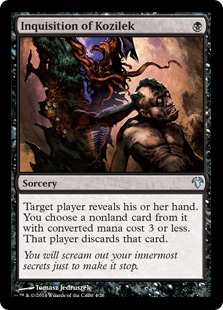
Vapor Snag: As mentioned above, bounce spells frequently get the job done in tempo decks. Terminate’s expensive, colorful cost sometimes undermines its strength, and Snag can do a similar job for less. Snag also supports Swiftspear and Pyromancer in ways Terminate can’t, but it's Snag’s blueness that seals its inclusion here.

Mana Leak: Catchall countermagic that follows Disrupting Shoal perfectly, while pitching to the Instant once it’s passed its prime.

Darkslick Shores: The Dimir fastland feels right at home here, cranking out threats, cantrips, counterspells, or discard pain-free in a deck that wants to trade life for cards. The ETB condition is rarely relevant since our curve is so low, but I may want a third red land as I continue testing.

Card Choices - Sideboard

Spellskite: One of the sideboard's key components, Skite shuts down decks like Bogles and Infect while bringing our Burn matchup to favorable. Between the Shoals, the threats, and the Skites, that deck has a hard time overcoming our own aggression. Against other Bolt decks, the artifact Horror does a fantastic job soaking up removal spells aimed at Confidant and Pyromancer.

Inquisition of Kozilek:Inquisition of Kozilek A card I originally played mainboard, IoK shines turn one, paving the way for Pyromancer or Confidant to take over the game. It works with Shoal to ensure our game-winning threats go untouched, but loses value later on. IoK also syngergizes with Young Pyromancer and Monastery Swiftspear. I moved it to the board to max out on Terminate, but IoK still proves its worth against Bolt-heavy decks and linear aggro strategies like Burn.
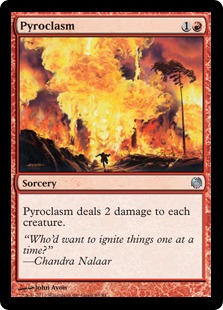
Kolaghan's Command: My Affinity hate of choice, since it has other applications against non-Robots aggro decks. Along with Forked Bolt, KC improves this matchup enough that we don't need ultra-specific hosers like Hurkyl's Recall or Shatterstorm.

Remand: Complements Day's Undoing against midrange decks, which this deck has more trouble with on paper than green grow iterations, thanks to the fragility of its threats.

Weaknesses

pyroclasmRed sweepers: No deck is perfect. This one hates Pyroclasm. Midrange Grixis decks and green grow decks run enough beef to ignore the devastating sorcery, but Grixis Grow doesn’t have that luxury. Luckily, Grixis Grow doesn’t struggle with Tron like its midrange cousins, and playing out threats one or two at a time should help immensely with this issue.
Midrange: Grixis Grow can never “go Kolaghan” against BGx. As such, it can struggle in game one against Abzan and Jund. I crafted the deck with this weakness in mind, including a set of Day's Undoing in the sideboard and building the mainboard to facilitate a transformation into iGrow. Undoing single-handedly beats decks shooting to win via incremental advantage, giving Grixis Grow the tools it needs to address midrange matchups.

Strengths

I’ve saved the trickiest section for last. At this time, my testing hasn’t shown me what Grixis Grow does better than my other grow decks. Its advantages over Grixis Delver (the deck with Tasigur and Kolaghan's Command) are obvious, as they mirror the strengths any grow deck has over a midrange deck; conversely, that Grixis Delver deck also outperforms Grixis Grow against decks soft to midrange. Since the two Grixis decks occupy separate archetypical spaces, the real question here is what Grixis Grow gives us over Monkey Grow, iGrow, and Counter-Cat, and with my three days of testing, I don’t yet have an answer.

Insectile AberrationWhile it remains to be seen what Grixis Grow has on my other grow decks, I know the great power of grow in Modern, and in every format the archetype is supported. This deck's advantages over Tasigur/Command Grixis Delver (midrange) or Twin (aggro-combo-control) should be obvious to anyone, since Grixis Grow is of a different archetype: grow.
As with most decks, the larger a format's card pool, the more support grow strategies have. But unlike other archetypes, like midrange or aggro (both virtually absent from modern Vintage, for example), grow's competitiveness seems to increase exponentially as support for the archetype improves. That's because grow decks master the resource management at the very heart of Magic. So far, my testing with Grixis Grow suggests its viability. Adding its name to the roster of possible grow decks in Modern is a strength in and of itself, since grow naturally predates so many other Modern archetypes (combo, control, linear anything, and, since the release of Day's Undoing, blue midrange).

Introducing and Analyzing Sultai Grow

Another deck I’ve been messing around with forsakes red entirely. Tarmogoyf gives us some needed bulk, and Simic Charm helps recover the reach that leaves with Lightning Bolt. Charm also improves Disrupting Shoal while supporting our protect-the-queen gameplan, and Abrupt Decay tries to fill Bolt’s shoes as versatile removal.

Sultai Grow, by Jordan Boisvert

Creatures

3 Pack Rat
4 Tarmogoyf
4 Delver of Secrets
4 Dark Confidant
2 Snapcaster Mage

Sorceries

4 Serum Visions
4 Gitaxian Probe
4 Inquisition of Kozilek

Instants

4 Disrupting Shoal
4 Abrupt Decay
4 Simic Charm
1 Mana Leak

Lands

2 Darkslick Shores
4 Misty Rainforest
4 Polluted Delta
2 Island
1 Swamp
1 Forest
2 Breeding Pool
1 Overgrown Tomb
1 Watery Grave

Card Choices

Pack Rat: No Pyromancer in these colors, but we need another must-answer threat on turn two. With the extra blue from Simic Charm, we can afford a full set of Inquisition of Kozilek, making Pack Rat the perfect candidate for our extra killer. This threat is our funniest, since he basically stops us from playing Magic once he's resolved. After that, we're just playing Pack Rat. Rat gives us a tremendous edge against midrange decks, which is valuable considering we can't run an Undoing plan in the board without Lightning Bolt.

Abrupt DecayAbrupt Decay: Versatile and powerful. It's no Lightning Bolt, but Decay answers a plethora of random cards like Vedalken Shackles that can otherwise wreck us.
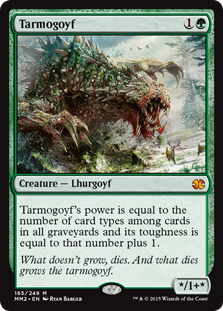

Simic Charm: One of the main reasons to go Sultai. Charm has proven itself in my Monkey Grow builds, and it's no less vicious here, combining with unblocked creatures for reach, saving our beaters from removal as deliberate as Abrupt Decay, and laughing at Wurmcoil Engine and Raging Ravine.

Mana Leak: Simic Charm handles expensive threats, and Decay deals with cheap fatties on the ground, so we don't need the effect as much here as we might in other colors. Still, I like having one copy for opponents to play around, and I love getting to 25 Instants and Sorceries in my Delver decks.

Gitaxian Probe: This card deserves a section here since its applications are less obvious than in Grixis Grow, where it supports Swiftspear and Pyromancer. Besides helping Goyf and Snapcaster, Probe gives us information that allows us to perfectly sequence Simic Charm, Mana Leak, Abrupt Decay, and Disrupting Shoal. It also provides another blue one-drop for Shoal. We run 23 blue cards in this deck, and Snag is too redundant with Charm to merit inclusion. I don't think life loss is a major issue here because Goyf helps out so much against aggressive strategies, so until we see a better option, I'll stick with the Probe.

Weaknesses

No Bolts makes it harder for us to close out games than Grixis Grow, and Pack Rat doesn't do much against certain strategies. An inherently grindy color combination, Sultai Grow has less game against linear combo than the faster red decks. It may not seem like much on paper, but losing Lightning Bolt - especially for a grow deck - hurts like hell. More on Bolt's essential role in this archetype here.

Strengths

TarmogoyfA resistance to Pyroclasm is the biggest draw to Sultai colors. Tarmogoyf is the best creature in Modern and has occupied a place of honor in grow decks since his printing. Pack Rat also packs a huge punch against anyone trying to out-grind us (most people), and the Decay/Inquisition suite answers enough random Modern cards to make this deck extremely well-rounded at the cost of the ability to switch gears instantly, formerly granted by Lightning Bolt.

Adam Fronsee and Sultai Monkey Grow

A week after my IQ win, Adam Fronsee reworked my list in a BUG shell and took 12th at a StarCityGames Invitational. While the deck's core obviously "got him there," I don't think this is a viable place for Sultai Grow. Fronsee's deck improves on nearly all fronts with Bolts, and I've already made the case for Mandrills over his black ilk. As stated above, I don't think there's any reason to play grow decks in black besides Dark Confidant, since we have everything else black offers us in Temur colors.

Bob and the Future

I don't know how much I'll test this deck in the coming weeks, since I consider Counter-Cat so well-positioned at the moment. I'm also anxious to get back to my German Wild Nacatls. But for Grixis Delver players proud of their colors but frustrated by the grindiness of their supposed "tempo deck," Grixis Grow seems like a strong starting point.

Jordan Boisvert

Jordan is Assistant Director of Content at Quiet Speculation and a longtime contributor to Modern Nexus. Best known for his innovations in Temur Delver and Colorless Eldrazi, Jordan favors highly reversible aggro-control decks and is always striving to embrace his biases when playing or brewing.

View More By Jordan Boisvert

Posted in Modern, TechTagged , , , 28 Comments on Some Bob With Your Bugs: Confidant in Delver

Have you joined the Quiet Speculation Discord?

If you haven't, you're leaving value on the table! Join our community of experts, enthusiasts, entertainers, and educators and enjoy exclusive podcasts, questions asked and answered, trades, sales, and everything else Discord has to offer.

Want to create content with Quiet Speculation?

All you need to succeed is a passion for Magic: The Gathering, and the ability to write coherently. Share your knowledge of MTG and how you leverage it to win games, get value from your cards – or even turn a profit.

Insider: Managing Risk in the Face of Reprints

Are you a Quiet Speculation member?

If not, now is a perfect time to join up! Our powerful tools, breaking-news analysis, and exclusive Discord channel will make sure you stay up to date and ahead of the curve.

I've said my piece on Battle for Zendikar, which won't change until we start seeing the new Standard metagame flesh out. There will probably be some surprise winners and losers as always, but as I've said it's best to play it by ear from here.

What I do want to talk about more in depth is the Battle for Zendikar event deck. I don't think anybody saw such an impressive list of reprints coming.

I'm reminded of Homer at the Bat, the episode of The Simpsons in which Mr. Burns hires nine ringers to play for his baseball team and sees them all unable to play in the big game.

"Smithers, there's no way I can lose this bet. Unless, of course, my nine all-stars fall victim to nine separate misfortunes and are unable to play tomorrow. But that will never happen. Three misfortunes, that's possible. Seven misfortunes... there's an outside chance. But nine misfortunes? I'd like to see that."

People are undoubtedly invested in all five of these cards. It's likely that most investors already made their money on Hangarback Walker, but it was poised for more gains prior to this announcement. The other four were well positioned to see gains from their low points in the months preceding the announcement. Now, at least in the short term, these cards will take a hit.

Seeing two mythic rares and a $15+ rare in the same supplementary product is something of a sobering experience. I'm sure that this hit some speculators particularly hard, and should be one of many occurrences that remind us all of the importance of diversifying our portfolios.

Assessing the Reprints Individually

This reprinting is a death knell for Evolutionary Leap, Warden of the First Tree, and Whisperwood Elemental. Of the three I could see Warden rebounding if it sees play as a four-of in a popular deck, but otherwise I think the damage is done.

Hangarback Walker is a more interesting position. The price has slightly increased since the deck was announced, which is sustainable if the price of all the other cards tank. I'm not saying that Hangarback Walker is Umezawa's Jitte-powerful, but that is an example of a pre-con card from Magic history that didn't much sweat its printing in a supplementary product.

It's not true that every deck needs Walkers the way that they needed Jittes, but it's not everyday we see a card as ubiquitous as Hangarback Walker. I think the comparison is worse between Walker and Thragtusk, but Thragtusk is another good example of how a card can retain value in the face of increased supply.

If you see people trying to unload Walkers out of fear, pick them up. Don't go nuts on your offer, because the ceiling has obviously dropped to a specific price point, but don't forget just how powerful this card is and how popular it will remain.

There was an error retrieving a chart for Hangarback Walker

Tasigur, on the other hand, just isn't as good in Standard as he once was. Don't get me wrong, he's a great card, but his price was already pretty low and has taken a hit. I can see him falling all the way into the $1-2 range, and at that point in time I love buying Tasigur.

In Legacy players have biased themselves towards Gurmag Angler, which I think is correct, but Tasigur is likely to be a Modern staple for years to come. There will definitely be a lot of copies out there, but over time they'll slowly disappear and Tasigur will prove to be a great long-term hold.

It might be wise to unload any copies you can for $3-5 and buy back in later.

There was an error retrieving a chart for Tasigur, the Golden Fang

A Lesson About Risk

The interesting takeaway from this deck is that the lower-valued cards will be more impacted than the higher-valued ones.

When I first started investing in Magic cards, I was more interested in lower-cost options as they presented less risk and allowed me to diversify more. But as it turns out, not all cheap investments are low risk.

If you put a million dollars into $1 items and they drop fifty cents, you're out half a million. That's if you could even sell them at market price. Low risk only applies to having a modest amount invested, and speculators with stacks of Whisperwood Elementals will certainly feel the impact of this event deck.

Meanwhile, expensive options are expensive for a reason. Some reasons may not make for great investments--for example, Portal: Three Kingdoms cards are expensive due solely to scarcity and tank whenever they are inevitably reprinted. It's easy to tell when this is the case though, and most "high-risk" investments tend to demand higher prices because real demand exists.

A couple years ago, fearing more reprints, I made the decision to sell my Tarmogoyfs. I was off of RUG Delver, and I had no interest in acquiring the other pieces for the Modern Tarmogoyf decks. I expected that a Modern Masters 2015 reprint would significantly impact the card's price, and instead of risking that possibility I sold my Goyfs for $135 a piece.

There was an error retrieving a chart for Tarmogoyf

As things unfolded, Tarmogoyf was reprinted but player demand prevented a significant drop in price. All told, it wouldn't be hard to sell them today for close to the price I got for them.

More expensive things are more expensive for a reason, and if that reason is good (demand), their prices will be resistant to factors like increased supply.

Obviously you'll make the best returns percentage-wise by picking the next sleeper, but there's an argument to be made that higher-end investments are actually lower-risk. You can point to Vendilion Clique, Cryptic Command, and a number of other cards that were negatively impacted by Modern Masters 2015, but they all have significantly lower demand than Tarmogoyf and there was a ton of MM15 opened.

The event deck is also a good reminder of the importance of neutralizing costs early. That is to say, if you bought 20 Hangarback Walkers for $5, it would be wise to sell half of them for $10 when the opportunity strikes to cover your costs. Then you can figure out what to do with the rest, confident in the knowledge that you're ahead on the transaction.

Doubling up is an arbitrary watermark for this example. When to cover costs should be determined relative to specific specs, their price trends, and your plans for them.

~

When speculating, it's important to remember there are no sure things. Be realistic about the risks you're taking on for every investment you make, and plan strategically to minimize losses.

Just because there are no core sets anymore doesn't mean that cards are safe from reprints. And just because you lose little money per card when a spec doesn't hit doesn't mean it was "low risk." Don't be sorry, be careful.

Thanks for reading.

-Ryan Overturf
RyanOverdrive on Twitter

Insider: QS Cast 7: The Highs and Lows of BFZ

Are you a Quiet Speculation member?

If not, now is a perfect time to join up! Our powerful tools, breaking-news analysis, and exclusive Discord channel will make sure you stay up to date and ahead of the curve.

This week, the cast talks about their prerelease experiences and their hopes for the next month of BFZ.

Play

Douglas Linn

Doug Linn has been playing Magic since 1996 and has had a keen interest in Legacy and Modern. By keeping up closely with emerging trends in the field, Doug is able to predict what cards to buy and when to sell them for a substantial profit. Since the Eternal market follows a routine boom-bust cycle, the time to buy and sell short-term speculative investments is often a narrow window. Because Eternal cards often spike in value once people know why they are good, it is essential for a trader to be connected to the format to get great buys before anyone else. Outside of Magic, Doug is an attorney in the state of Ohio.  Doug is a founding member of Quiet Speculation, and brings with him a tremendous amount of business savvy.

View More By Douglas Linn

Posted in Free Insider, Podcast, QS Cast3 Comments on Insider: QS Cast 7: The Highs and Lows of BFZ

Have you joined the Quiet Speculation Discord?

If you haven't, you're leaving value on the table! Join our community of experts, enthusiasts, entertainers, and educators and enjoy exclusive podcasts, questions asked and answered, trades, sales, and everything else Discord has to offer.

Want to create content with Quiet Speculation?

All you need to succeed is a passion for Magic: The Gathering, and the ability to write coherently. Share your knowledge of MTG and how you leverage it to win games, get value from your cards – or even turn a profit.

Three-Tier Breakdown of BFZ Rares for Standard

Are you a Quiet Speculation member?

If not, now is a perfect time to join up! Our powerful tools, breaking-news analysis, and exclusive Discord channel will make sure you stay up to date and ahead of the curve.

Welcome to Part 2 of my BFZ evaluation!  Part 1 can be found here.

Next up, we have the rares of the set. This was fairly challenging because this set will likely be opened a lot in search of Expeditions. Rares in this set will have to do some heavy lifting to maintain any of these prices, let alone increase. With a relatively normalized EV in the 90$ range, this is likely KTK all over again. I don’t like the idea of using this caveat to come off as negative or overall devaluing this set, but it is a hard truth. That being said, like the Mythic section of my evaluation, I do think there are opportunities here.

I feel like a broken record at this point, but it’s really how I feel about the situation. If Expeditions weren’t in this set, then maybe we’d be having a different dialogue. I just look to a lot of solid rares in Standard (I love using Mantis Rider as an example) and see an overall depression of value. This is ultimately great for us as players, but not so much if you're trying to make some extra money on Magic.

My methodology that I post with all of these evaluations doesn’t really lend itself to a set like BFZ because it’s not a normal set. We’ve never had this situation of Expeditions before. Even with future cards being printed that make any of these BFZ rares better, it still might not be enough to create an increase in their prices.

The Tier System

Breaking down the cards into a tiered list makes it easier for me to look at what will hold the majority of the value in the set. I will most likely use this methodology going forward in evaluating future sets. I also wanted to do it this way because I don’t feel like attaching a future value to any of these cards. I feel like that method is a little inefficient and doesn’t take into account future printings that could potentially make these cards better.

So, I wouldn’t want to attach a low value to a card that’s potentially powerful like I have in the past. The truth is while a card may look terrible right now, we don’t know the future and how this card could interact with future cards.  Cards can move between tiers as new information comes and goes.

  • Top Tier is reserved for the cards that will most likely hold the majority of the value in the set. Commonly known as the “chase cards”.
  • Middle Tier is reserved for the cards that aren’t necessarily bad but may be overshadowed at this current point. These could easily jump to top tier in the future, or vise versa.
  • Low Tier is reserved for the cards that will most likely be near bulk. Like Middle Tier cards, these could get upgraded to a higher tier, but it will be more difficult for that to happen.  I don’t think these are necessarily bad cards, but my analysis is that these will be the cheapest and least desirable cards in the set.

These tiers are built primarily for Standard, however if a card has clear implications in Modern or beyond, it will also appear in a higher tier.  Commander and casual appeal are not factor heavily into these ratings.

Top Tier Rares

Middle Tier Rares

Bottom Tier Rares

Top Tier Rares

There was an error retrieving a chart for Fathom Feeder

First and foremost we have Fathom Feeder. I wanted to highlight this card because it's been talked about extensively here at QS. We've covered it on the forums, the QS Cast, and in my column (where I've been transparent about my pre-orders of it).

Opening pre-orders came in at $0.49 on StarCityGames, it has come up considerably since then, now near $4.  From day 1 through the final release of the full BFZ spoiler, this has been the card that's interested me the most.  Quite frankly, it still seems like a strong candidate as “best bang for your buck”.

If you were one of the people that bought into this at a dollar or less, I wouldn’t blame you for trying to lock in your profits now. I think there’s still a short window to wait to see where this ends up after the first release weekend, or you could wait until just after the Pro Tour.  If the hype has diminished or the card doesn't see play, it will be painstakingly obvious. At the same time, Fathom Feeder could continue to be a great card but just end up having a sharp decline anyway (which I anticipate happening along the same lines as Mantis Rider).

Current price: $4.00

There was an error retrieving a chart for Bring to Light

Bring to Light has a lot of hype coming out of the gates, and that’s why it’s in Tier 1. I have some concerns about this card, but I can’t deny it’s inherently powerful, and can do some cool stuff. It has very intricate interactions with other cards, and I do think it will remain as one of the best rares in the set.  I look at most rares in this set and ask, "can this do more powerful things than Bring to Light?"  and in most cases, the answer is "no".

Its implications across multiple formats will need to be established, and quickly, in order for Bring to Light to hold its current price.  Without adoption in Modern, an $8 price tag is far too high.

Current price: $8.00

There was an error retrieving a chart for Radiant Flames

This is quickly becoming the go-to sweeper in the early days of BFZ. After some solid playtesting sessions, this has shown its merit. It’s doesn’t seem as good as it’s predecessor Anger of the Gods but, it’s actually much easier to cast, and converging 3 colors isn’t really that hard in current BFZ Standard. This has grown from a paltry $1 during pre-sales and will likely be able to be traded/sold in the 3$ range for at least a short while. I would recommend selling and/or trading during said time, and move these into better things. For as good as this card will be, the price will come down considerably after supply isn’t as constrained as compared to demand.

I'm placing this card in Tier 1,  with the caveat that it will likely decline in price regardless.

Current price: $2.50

Mid Tier Rares

There was an error retrieving a chart for Woodland Wanderer

This was probably the hardest card to evaluate. I ended up placing it here to be safe, but I understand there has been some attention on this card. It is by no means a bad card, and I do think it can have some success early on in Standard. It is a candidate to move up a tier if conditions are right. I prefer to err on the side of caution from a financial standpoint because, like any rare in BFZ, this must exceed expectations and see play across multiple archetypes to justify a higher rating.  It's not a must-play in Green as Polukranos, World Eater often was, but it's clearly very strong.  It just needs the right context.

There was an error retrieving a chart for Emeria Shepherd

This was another card that was difficult to assign to Tier 2.  The card is objectively powerful but that doesn’t always translates to financial relevancy. It's as good as any other high mana card to ramp into or cheat into play with See the Unwritten. There's a heated forums discussion about this card, where some Insiders are arguing that it's got the potential to dominate a game, Sun Titan style.  Whether that’s enough to bring it above $1 remains to be seen, but I like placing it here in Tier 2 because it will have plenty of time to prove itself. At the very least it’s not an intro pack rare, right?

Current price: $1.00

There was an error retrieving a chart for Brutal Expulsion

We round out the "tough cards to evaluate" section with Brutal Expulsion. When this was initially spoiled there was some hype surrounding this, and it has moved around in pre-order price, and ultimately trended upward.  The hype has died down since then, and that’s precisely why I will leave it in Tier 2. I don't think it's a bad in the least, and it could end up seeing play (albeit fringe) in Modern. At the same time this card is going to compete with the likes of Ojutai's Command, which appears more powerful.

Considering how Ojutai’s Command interacts with Jace, Vryn's Prodigy and to a lesser extent Fathom Feeder,  Command might end up winning out over Brutal Expulsion.  I’ve seen discussions on this card as somehow climbing to the 8-9$ range, and while I wouldn’t completely rule it out, I’m just not super optimistic at this juncture.  A lot needs to go right for any rare from this set to reach, and maintain, that price target.

Current price: $3.00

There was an error retrieving a chart for From Beyond

Much like Thopter Spy Network this lends itself to be played early on as a very reliable token generator with the upside of grabbing an Eldrazi card. I’ve spent plenty of time talking about this card, but put this card in this tier with very high upside of hanging out in the $5 range should it see success early on. Looking back at Spy Network, I’m optimistic that it has potential.

Current price: $3.00

Low Tier Rares

There’s not much to say here, as usual. Some of these have more upside than the rest, but after looking at the Intro Pack deck list and recently revealed Event Deck, the upside on reprinted cards is very limited.  Now that Wizards releases so many of these cards in intro packs, event decks & prerelease foils, there are fewer good, cheap targets for speculative purchases.  Compounded by the assumed glut of rares due to the hunt for Expeditions, mediocre rares just don't have a whole lot of upside.

Here are a few that might:

Tier 3 Rares with Upside

Before I go, for the sake of transparency here is what I pre-ordered this time around:

36 Fathom Feeder @ .92c (average price)
12 From Beyond @ 1.99

Questions? Comments? Concerns? Feel free to comment or message me via social media. Hopefully this list his helpful in deciding what to target over release weekend, and going into the Pro Tour

-Chaz (@ChazVMTG)

Want Prices?

Browse thousands of prices with the first and most comprehensive MTG Finance tool around.


Trader Tools lists both buylist and retail prices for every MTG card, going back a decade.

Quiet Speculation