
menu

Insider: Hopelessly Devoted to U

Are you a Quiet Speculation member?

If not, now is a perfect time to join up! Our powerful tools, breaking-news analysis, and exclusive Discord channel will make sure you stay up to date and ahead of the curve.

Guess mine is not the first heart broken
My eyes are not the first to cry
I'm not the first to know
There's just no getting over you

There was an error retrieving a chart for Master of Waves

Do you remember your first time? The first time that you stared down a Fleecemane Lion while your four drop generated fourteen power of creatures? Master of Waves is a farce of a Magic card. Not on the same level as, say, Treasure Cruise, but it's well within Master of Waves' range to completely turn games around against unprepared opponents.

Blue Devotion rose and fell in popularity during Ravnica-Theros Standard and, with rotation, many believe the deck is dead. It lost every reasonable creature that produces multiple devotion, it lost Cyclonic Rift... It lost Mutavault.

There was an error retrieving a chart for Mutavault

I also didn't see much reason to actively pursue a Master of Waves deck in Theros-Khans Standard, but then Patrick Chapin posted this:

Mono-Blue Devotion

spells

4 Master of Waves
4 Omenspeaker
2 Paragon of Gathering Mists
4 Triton Shorestalker
4 Vaporkin
4 Hypnotic Siren
4 Thassa, God of the Sea
2 Disdainful Stroke
1 Dissolve
1 Polymorphist's Jest
2 Voyage's End
1 Hall of Triumph
3 Bident of Thassa

lands

20 Island
2 Radiant Fountain
2 Nykthos, Shrine to Nyx

Chapin's list is definitely rough, and this deck plays a lot of cards that are worse than the cards in Black Aggro, and that's a bad deck.

But the payoff here is higher. Kai Budde once mused that "I think Thassa, God of the Sea and Bident of Thassa are the two biggest cards to have come out of Theros," and the German Juggernaut tends to know his stuff. Black Aggro just starts to play more of the same on turn four, while Blue Devotion starts casting some serious business spells.

Chapin missed a few cards I believe this deck should really be playing, but the most important issue with his list is that Thassa, God of the Sea lost a lot of stock when Nightveil Specter and Frostburn Weird rotated out. You need several non-Thassa permanents to ever turn Thassa on in this deck, and most of those permanents die to Drown in Sorrow, Anger of the Gods and Arc Lightning, which will consequently turn off the Thassa and leave you down like four cards.

Further, losing Tidebinder Mage and Nightveil Specter made it so that every creature in the deck just attacks and blocks, and therefore the creatures in the deck are generally lower impact than every card in every other deck. Drawing multiple Thassas is very unfortunate when your other cards are all Welkin Terns.

That said, there are some things we can do to increase the power level of the deck. Military Intelligence is a serious omission and one that helps the deck hit its land drops without having to play too many lands, as again, this deck doesn't have the luxury of bricking too many times and still getting back into long games.

There was an error retrieving a chart for Military Intelligence

With Intelligence in the deck, and the fact that the deck needs to get on the board fast, I really like playing Dakra Mystic in addition to the other 8 one-drops. Dakra Mystic is a very interesting card, and one that had some buzz when it was first spoiled but then never really did anything.

I've been playing with it for the better part of the week, and I must say that it's a pretty awesome way to interact with opposing Courser of Kruphix and scry abilities. It's a much more skill-testing card than I gave it credit for, and I have to say I'm still not positive that I'm activating and attacking in the proper ration, but its ability is much more powerful than I first evaluated it as, particularly in this deck. While Blue Devotion has a few standout haymakers, you'll generally have some low-impact card like Triton Shorestalker on top of your deck to put in the graveyard along with their Siege Rhino.

When I first started playing this deck, I tried four Voyage's End and it was okay. The ability to bounce your own Master of Waves is certainly not for nothing, but over time I ended up cutting more and more copies. Ultimately what it came down to is that a lot of creatures have come into play abilities and this deck doesn't clock especially fast, so bouncing a problematic creature for one turn just isn't really worth a full card. As of now, I'm convinced that counterspells should be played over bounce spells in any slot that would be either.

After some preliminary testing on MTGO, I brought this list to a local Game Day Event:

Hopelessly Devoted to U

spells

4 Master of Waves
4 Omenspeaker
4 Triton Shorestalker
4 Dakra Mystic
4 Vaporkin
4 Welkin Tern
4 Hypnotic Siren
1 Flitterstep Eidolon
1 Thassa, God of the Sea
3 Thassa's Rebuff
2 Military Intelligence
1 Dissolve
1 Hall of Triumph
1 Bident of Thassa

lands

21 Island
1 Nykthos, Shrine to Nyx

sideboard

3 Dissolve
3 Jace's Ingenuity
1 Dig Through Time
3 Dragon's Eye Savants
4 Negate
1 Nullify

I went with Thassa's Rebuff as my counterspell of choice to test the idea out, and it turns out that it's okay. I chose Rebuff as it would counter an Elspeth or a Rabblemaster, but I think that this deck really needs to focus on countering the sort of spells that Disdainful Stroke counters and beating Rabblemaster with Omenspeaker into Master of Waves.

It is unfortunate that Stroke misses Anger of the Gods and Drown in Sorrow, but counters that hit both come in post-board where your opponent is more likely to have those cards anyway.

The biggest problem with Rebuff was that it was a counter that I wanted to side out for post-board games against controlling decks, and that's where your counters are supposed to shine.

The entire sideboard is designed to board into the wonkiest control deck you ever did see against anybody that can consistently 2-for-1 you, and having counterspells that you want to board out in this set-up is just wrong. I'd probably keep one Rebuff because when it's good, it's really good, but I plan to turn the other two into Disdainful Strokes.

The biggest reaction I got from anybody while I cobbled the deck together from the store's bulk box was the inclusion of Dragon's Eye Savants in the sideboard. I haven't cast one yet, but it seems pretty strong against the black and red aggressive decks, where you can play it facedown to trade with any of their guys. And if you're lucky enough to have them Magma Jet it, you're rewarded with a blocker that will still survive blocking any creature in their deck for the turn and a free Peak. Well, you don't draw a card, but you can't have everything. It's experimental, but the deck needs something that fills a role similar to this, as the maindeck cards don't exactly shine against decks with similar mana curves to its own.

So is this deck actually playable?

I ended up 2-1 in a 10 person game day with the deck, and it was super fun to play. I beat up on two Abzan decks, which seems like a good place to be in the current metagame, and there isn't any matchup where I just feel like I'm dead, particularly with the "transformational" sideboard.

I'm going to continue to gamble my tickets with the deck on Magic Online, and if it continues to be enjoyable for me, which by my standards includes having a reasonable win percentage, then I will very likely play it at the SCG Open in Minneapolis this Saturday. If not, then I'll play some version of Jeskai, but I'm really hoping to raise some eyebrows with crappy 1/1s.

Financial Relevance

If there is actually a build of this deck that is good, then that has interesting applications for Master of Waves and Hypnotic Siren, which are the only four-of rare cards in a dirt cheap deck. You're not gambling much on either, but I'm not sure how high either card can really go. Getting Sirens close to bulk just seems smart, as it's a really cool card and it belongs in every Edric, Spymaster of Trest EDH deck and has casual appeal beyond that, so foils could be good to pick up.

Master of Waves at one point in time saw a $20 price tag, but that was when it was probably in the best deck in the format and wasn't easily hated out by cards that a lot of people have access to. If this does turn out to be a real deck, however, Master is likely to mature somewhat, though I'm not sure if the potential is much higher than $10 for a one-trick pony.

I would definitely be more interested in Sirens. In particular, the card has seen some weird movement on MTGO. It shot up to nearly a ticket recently, then dropped to around .6 tickets, and is currently ticking back towards a ticket. There might be some money there if you can find cheap copies.

There was an error retrieving a chart for Hypnotic Siren

~

I will fully admit that this is more of a pet deck than anything, but it's one that I see potential in, and I'm usually an extremely dismissive person.

This deck is a lot worse on the draw than on the play--like a lot. But every change I make makes it stronger and I feel like this is getting close to the best version. I'm still figuring out how to sideboard and the deck is generating almost exclusively close games when it loses, and a number of runaway games when it wins.

Further, it likely draws more cards than any other deck in Standard, and that's just plain awesome. If that's your thing, definitely give it a try.

Thanks for reading.
-Ryan Overturf
@RyanOverdrive on Twitter

Insider: MTG Stock Watch 10/19/14

Are you a Quiet Speculation member?

If not, now is a perfect time to join up! Our powerful tools, breaking-news analysis, and exclusive Discord channel will make sure you stay up to date and ahead of the curve.

Welcome back, readers and speculators! Today's another MTG Stock watch so sit back and enjoy.

Penny Stocks

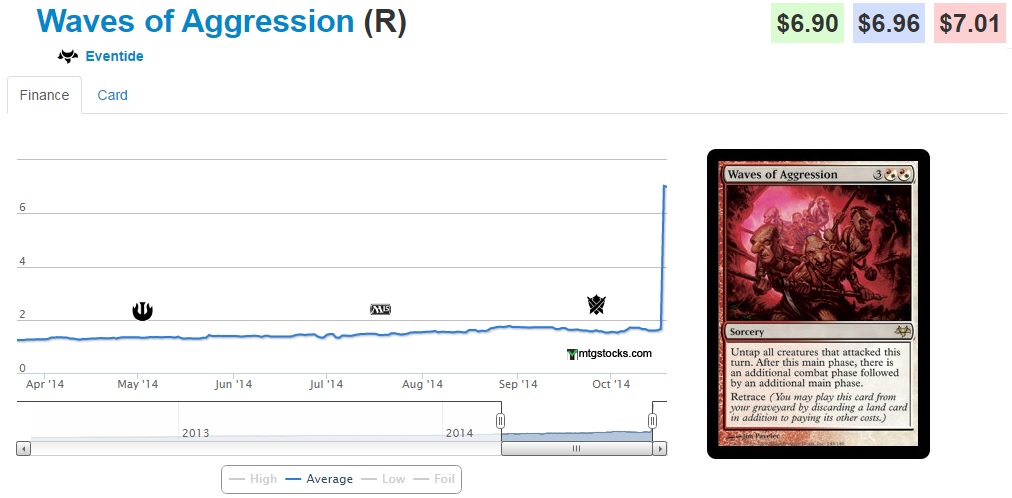
#1 Waves of Aggression (+316.8%) - This one smells of buyout (as of this writing 9:05 PM 10/19/14 EST) there are only three copies left on TCG player. However, just because it's a buyout doesn't mean it's not a solid pick. This is an amazing card in the Narset EDH decks that are proving themselves very powerful.

In fact I imagine this is the next Commander to cause spikes similar to Nekusar (though it appears to have already started). I would expect similar jumps in other cards with one printing that provide extra combat steps (for example Seize the Day, Savage Beating, and Aggravated Assault).

waves of aggression

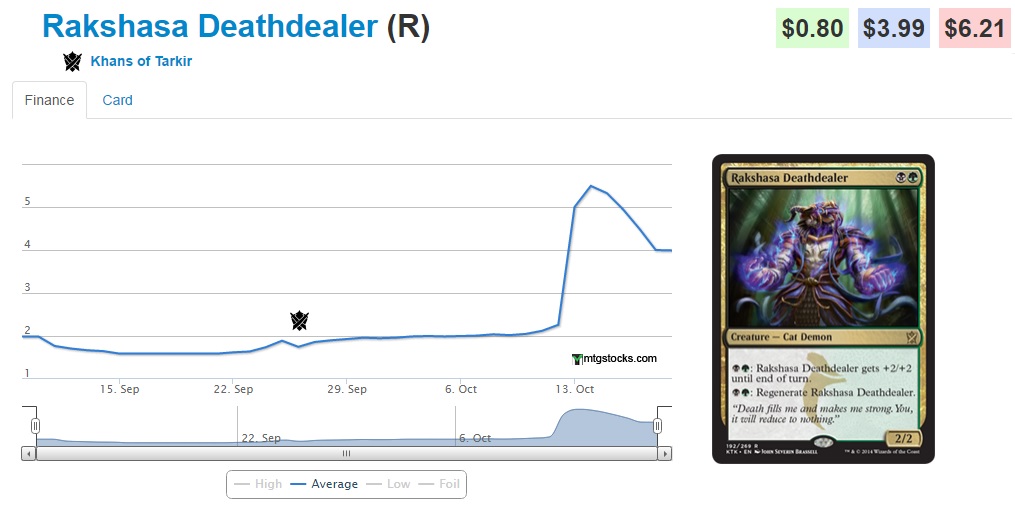
#2 Raksasha Deathdealer (+76.6%) - This one got a bump from seeing play at the Pro Tour (in the Abzan Aggro decks). He's proving to be a very difficult creature to remove and one of the few that can go toe-to-toe with Caryatid and Courser in the first few turns and come out on top.

It is a regular rare in what I expect to be the most opened set of all time (so the price will likely not hold for the long term) but until supply catches up with demand (or Abzan Aggro is relegated to Tier 2 or below) he'll probably maintain some of the spike.

raksasha deathdealer

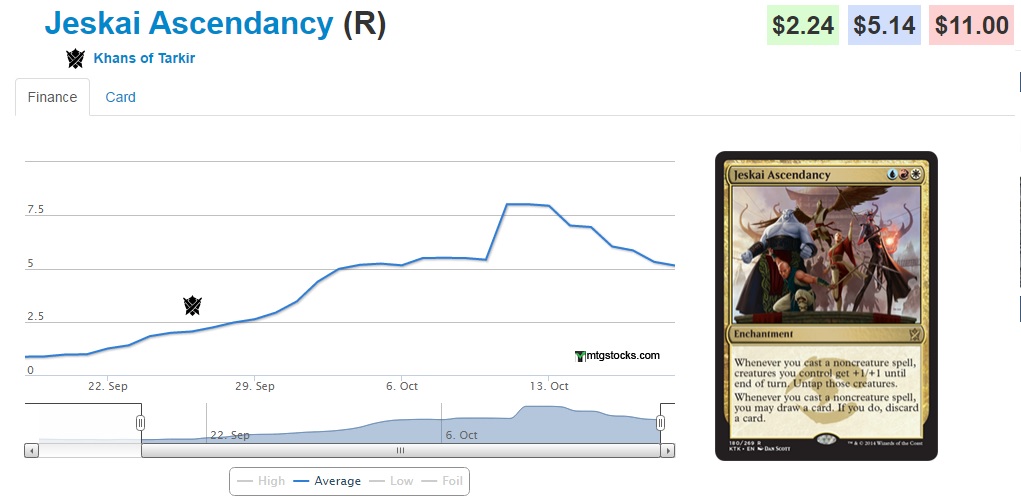
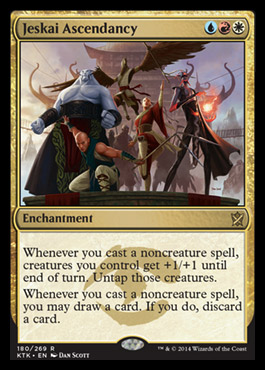
#3 Jeskai Ascendency (-35.7%) - This card saw a major drop after the Pro Tour (despite Channel Fireball playing the combo deck and a lot of people claiming how dominant it will be in Modern). I fear this is one of those cards that's so close to bannable that people are spooked and want to unload them ASAP--hence a big bump in supply pushing the price downward.

The standard version does have some great matchups (Mono-Green for example) but in the end it only has two win conditions (Altar of the Brood and attacking with a big creature), so it's not that hard to hate out in Standard. In modern it's weak to Abrupt Decay and Thoughtseize, which happen to be major players in the format.

jeskai ascendency

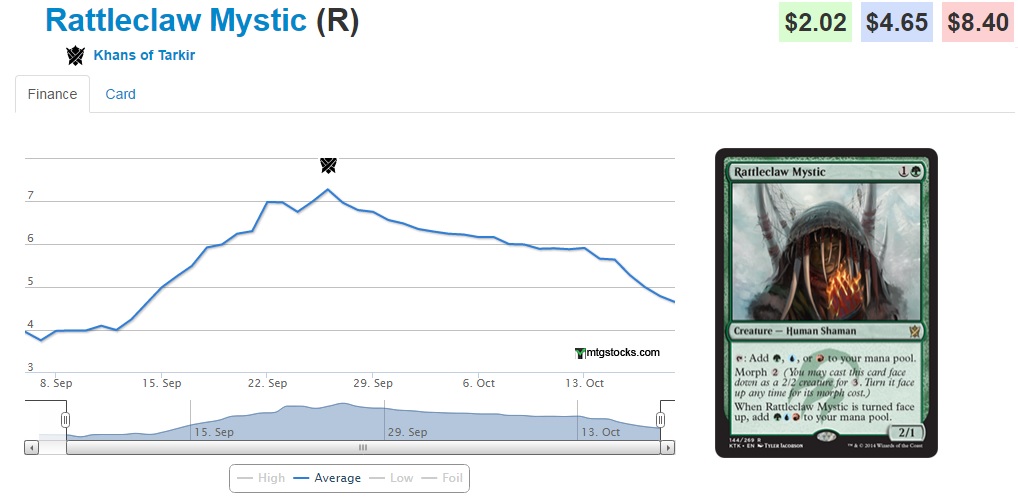
#4 Rattleclaw Mystic (-20.9%) - This mana dork really hasn't found much of a home in Standard (outside of the Jeskai Ascendency deck and some Temur aggro type decks). He's good, but he's nowhere near as versatile as Sylvan Caryatid. I think a lot of people were worried he'd be the next Caryatid so they wanted to get them ASAP, thus creating a lot of initial demand. Once those people got their copies the rest of the population just hasn't really wanted them.

rattleclaw mystic

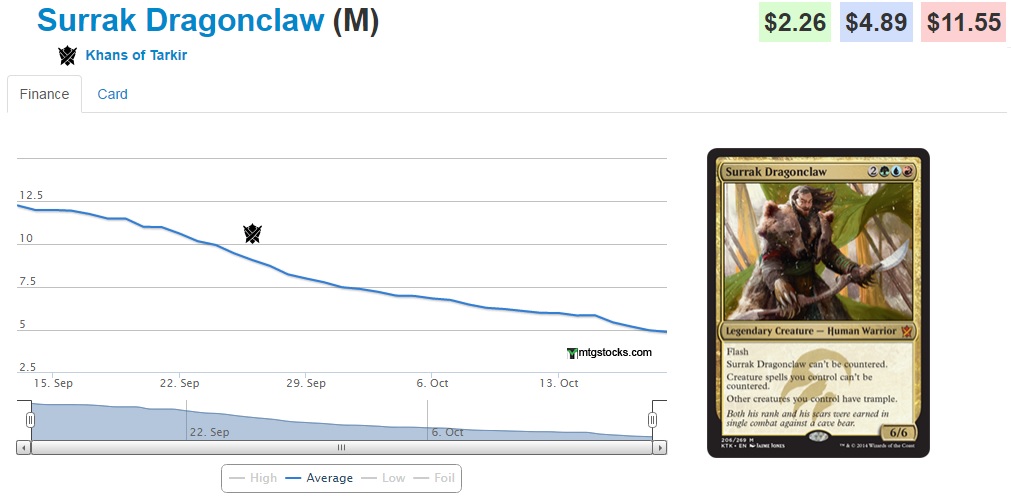
#5 Surrak Dragonclaw (-18.5%) - If you ever needed a reason not to pre-order (despite the fact that almost everyone on this site reiterates this sentiment every new set), here's another great example. This guy has just continued to go down since release. He hasn't found a home in anything but sideboards.

However, it's important to keep in mind that with U/B control strategies doing decently at the Pro Tour it's not long before the control mages put down their Siege Rhinos and pick up their Dissolves again. If/when control decks begin to take back the format, you will likely see a resurgence in this guy as the defacto "out" to those decks.

Surrak Dragonclaw

Blue Chip Stocks

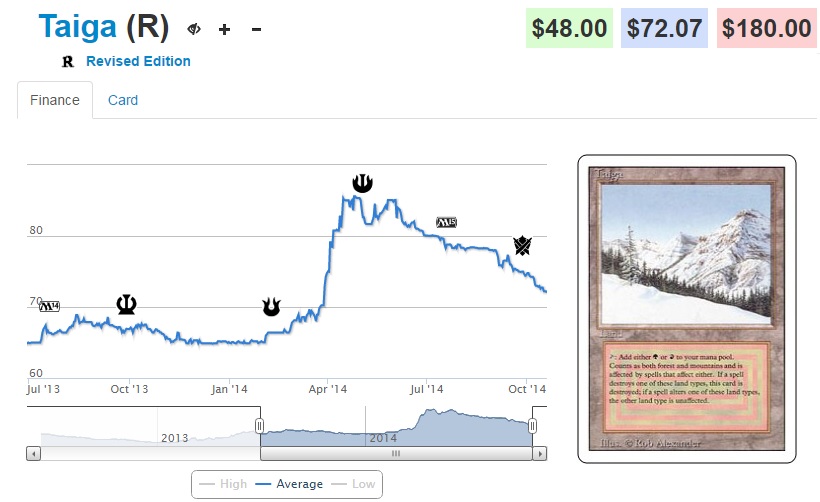
#1 Taiga (-2.71%) - Poor Taiga, yet again it finds itself on the list but in a perpetual downward trajectory. The Legacy metagame is just becoming worse and worse for Zoo (which outside of Belcher has pretty much been the only Legacy deck in a long time to run Taigas). The only upside (for people who don't own them) is that they are getting much closer to their pre-spike price.

taiga

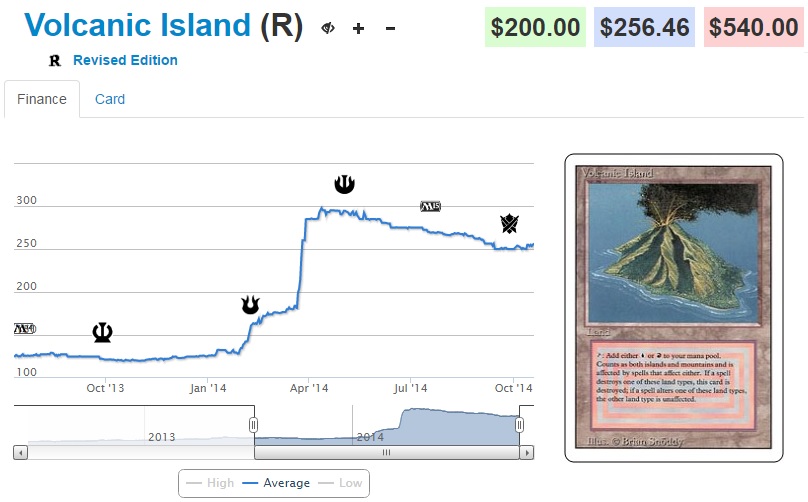
#2 Volcanic Island (+1.84%) - The only card in our blue chips that's positive this week. Volcanic Island has seen an increase in demand courtesy of the bump in U/R Delver and Burn decks taking advantage of the ridiculousness that is Treasure Cruise. Finally, the decks that only need to cast seven spells have a way to gain actual card advantage and they can use a resource they previously had little access to (save the versions running Snapcasters).

volcanic island

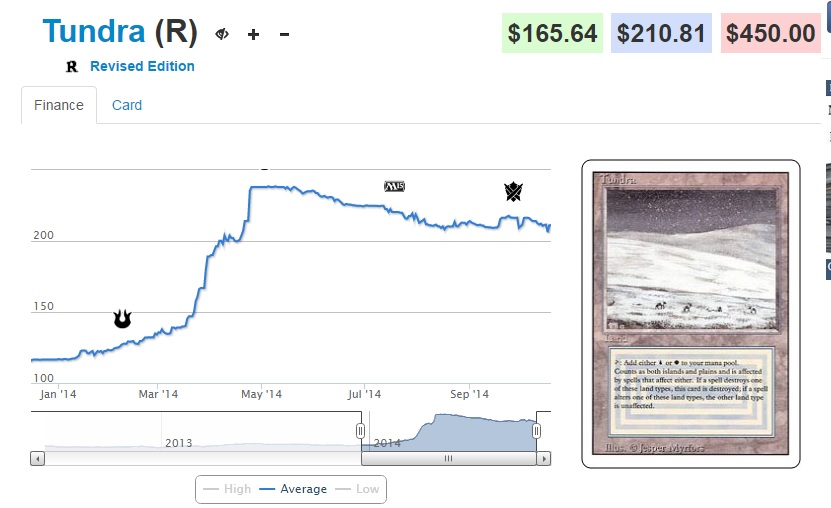
#3 Tundra (-1.80%) - Good ol' Reliable Tundra is sadly continuing it's slide downward. While Miracles continues to see a decent amount of play (and Esper Deathblade pops up here and there), the UWR Stoneblade decks of a few months ago are nowhere to be seen (and these decks were a major reason Tundra saw continued demand).

tundra

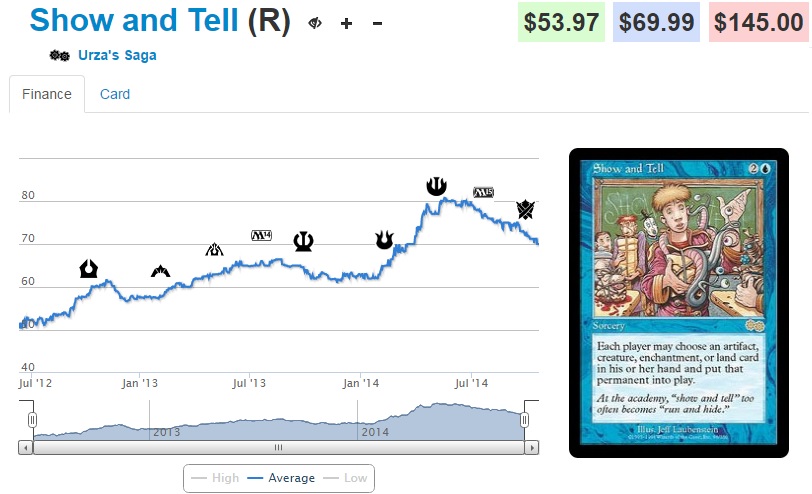
#4 Show and Tell (-1.78%) - Once a cornerstone of the Legacy metagame (and my least favorite deck) it seems Show and Tell has been pushed out of dominance. The current metagame is very unfriendly to those trying to force through a three-mana sorcery or four-mana enchantment.

show and tell

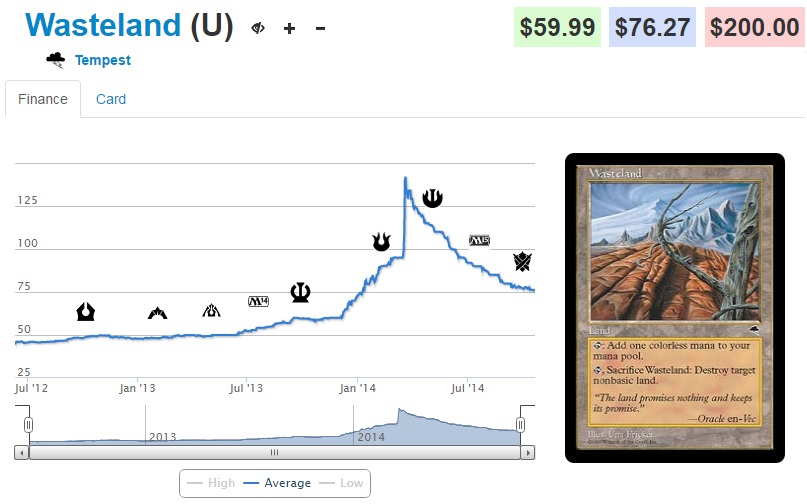
#5 Wasteland (-1.34%) - With a shift in the metagame to a lot more U/R Counter-burn decks, using a tempo play like Wasteland just isn't worth not providing either red or blue mana. The fact that the decks that love Wasteland the most (RUG and Death and Taxes) are just being outraced by straight burn spells means that players are pushing away from Wasteland and either joining them or trying to go faster.

wasteland

Value Stocks

The current value stocks are relatively hard to pick. The early metagame is constantly evolving and to be honest I haven't seen the kinds of jumps in the scry lands I expected (except Temple of Epiphany). The painlands have gone up much higher than I expected (with Battlefield Forge averaging almost $9 per). In fact the painlands have done what we expected the scrylands to do (despite the fact that the painlands have had several printings).

Khans hasn't been out long enough for any of the cards to be at their floors yet, but when I start seeing the fetchlands in the 8-10 range I will aggressively trade for them, with emphasis on Flooded Strands. U/W is still one of my favorite color combinations for Modern and barring a banning of Treasure Cruise I expect UWR burn to be a major player moving forward.

Growth Stocks

Last, but not least, we have our "growth stocks" or sealed product. The biggest jumps were all in the previously "cheap" boxes, with Innistrad boxes, Scars of Mirrodin, and Mirrodin Besieged all jumping double digits. Interestingly enough there were no changes to the Worldwake boxes (the last one that was sold on eBay was sold on October 1st.) This would imply that sealed Worldwake is drying up fast so if there is still demand for it, I wouldn't be surprised to see a decent price jump the next time one does sell.

The biggest loser is Zendikar again. The massive influx of new Khans fetchlands has caused the original Zendikar fetches to drop to 50% or less of their yearly highs--and when you just want fetches, it makes a lot more sense to just buy the new Standard-legal set for one fourth the price.

Week of 10/19/14 Box Most Recent Completed Auction Second Most Recent Third Most Recent Fourth Most Recent New Average Average comparison
Innistrad $199.95 $211.00 $199.99 $185.00 $198.99 13.50%
Dark Ascension $85.00 $115.99 $87.00 $119.99 $102.00 6.38%
Avacyn Restored $138.75 $130.00 $129.95 $135.00 $133.43 -3.43%
Scars of Mirrodin $190.00 $184.99 $190.00 $199.95 $191.24 11.83%
Mirrodin Besieged $169.99 $187.99 $138.49 $117.49 $153.49 13.84%
New Phyrexia $285.00 $309.99 $294.99 $299.99 $297.49 -2.51%
Zendikar $380.00 $400.00 $495.99 $416.00 $423.00 -4.28%
Worldwake $622.00 $659.99 $740.00 $621.00 $660.75 0.00%
Rise of the Eldrazi $400.00 $599.99 $625.00 $490.03 $528.76 0.24%


A Case for Swiss Drafts

Are you a Quiet Speculation member?

If not, now is a perfect time to join up! Our powerful tools, breaking-news analysis, and exclusive Discord channel will make sure you stay up to date and ahead of the curve.

Any Magic Online player will tell you that 8-4 drafts are the place to be if you want the best competition and the most return on your drafts. I'm not here to disagree with this assessment—it's clearly correct. I fancy myself a pretty decent drafter and have won my share of 8-4s, but without fail, I begin each new format jamming Swiss drafts.

swissflag
shutterstock

I like Swiss drafts early in a format for a few reasons. First, I just want to play as many games as possible. If I lose in the first round, I want a slightly larger sample size to decide whether that was variance or bad strategy (and really, even three matches is not much of a sample size, but it's better than one).

Second, it's easy to go on a run where you lose in the first or second round of several 8-4s in a row. This tends to make for an expensive evening. By playing in Swiss drafts, even though you won't very often come out ahead, it's much easier to break even or just cut your losses.

Finally, I'm more likely to experiment with new or novel strategies in a Swiss draft. I don't want to try out something I'm unfamiliar with in a single-elimination event only to draw poorly and not even have a chance to see how the pieces fit together. Even going 0-3 or 1-2 provides a better learning experience than getting knocked out in the first round without getting to see how things work.

learningexperience
zazzle

Once I feel comfortable in a format, losing in the first round of an 8-4 stings significantly less. When I'm very familiar with a set, my goals switch from getting some games in and having a good time to winning a lot and proving to myself that I can crush this format. I got there with triple Theros, but I'm nowhere close with Khans of Tarkir yet. So I'll just keep jamming Swiss drafts until I get there. Even though I like the thrill of tough competition, I like playing Magic even more, and Swiss drafts are more likely to provide those opportunities while I'm finding my feet.

What prize structure do you usually play on MTGO? (And please don't say 4-3-2-2. How is that still a thing?)

Avatar photo

Danny Brown

Danny is a Cube enthusiast and the former Director of Content for Quiet Speculation.

View More By Danny Brown

Posted in Drafting, Free, MTGO5 Comments on A Case for Swiss Drafts

Have you joined the Quiet Speculation Discord?

If you haven't, you're leaving value on the table! Join our community of experts, enthusiasts, entertainers, and educators and enjoy exclusive podcasts, questions asked and answered, trades, sales, and everything else Discord has to offer.

Want to create content with Quiet Speculation?

All you need to succeed is a passion for Magic: The Gathering, and the ability to write coherently. Share your knowledge of MTG and how you leverage it to win games, get value from your cards – or even turn a profit.

Insider: Stability

Are you a Quiet Speculation member?

If not, now is a perfect time to join up! Our powerful tools, breaking-news analysis, and exclusive Discord channel will make sure you stay up to date and ahead of the curve.

Greetings, Spectators!

Is it just me, or did this Pro Tour feel a little bit different?

An Era of Volatility

There was a lot in my mind that differentiated Pro Tour Khans of Tarkir from one like Pro Tour Theros. For example, I heard a lot less about orders being cancelled.

Now there can be a lot of explanations for this. Maybe people were less outraged this time because they're so used to the cards they order on Saturday of Pro Tour weekend not showing up, a phenomenon known as "learned helplessness". Either it was happening less or people were bitching less, or the people who bitched last time were culled from my social media feeds because of all of their bitching. I'm not sure what's true, but, anecdotally, fewer orders were cancelled.

Another difference this time around is the diversity in possible cards. While the decks in Theros-era Standard seemed somewhat monolithic and mono-colored cards spanned multiple decks, we're experiencing that to a lesser extent. Whereas Theros had cards like Thassa, God of the Sea, Elspeth, Sun's Champion and Master of Waves that could potentially slot into a few of the relatively small number of decks considered "Tier 1", Khans of Tarkir is affording us more options and therefore more diversity.

It's not surprising to see a card like Sarkhan, the Dragonspeaker command a high price tag due to his relatively high degree of adoption afforded him by being mon0-colored. What is also not surprising is that the color requirements of cards like Savage Knuckleblade and Crackling Doom put a bit of a virtual cap on their potential degree of adoption which limits their financial upside, especially in the short-term.

This last weekend at the GP in Los Angeles, every Khans tribe was represented, but older archetypes were as well. A diverse format means that there are fewer "must have" cards, and when those "must have" cards are identified early more often like in the case of Khans rather than late like in the case of Theros, there is less scrambling and fewer crazy price spikes.

That's not to say there weren't crazy price spikes. Somewhere at an event right now there is a person playing Magic who paid $80 for his or her playset of Dig Through Time because they bought on the eve of the Pro Tour from some lucky TCG Player merchant. Siege Rhino flirted with an absurd $14 and is already back down to reality. In fact, some of the only cards that are holding more than 50% of their Pro Tour weekend gains are mythics; notably Pearl Lake Ancient and See the Unwritten and even those cards took a significant hit.

I'll get more into that later, because it's kind of my entire thesis for this article. I could stop this preamble paragraph right now and segue into it, but you're not my boss and I have another point I need to make first, so why not just give me a minute?

A significant difference about this season was that I felt like I was paying more attention, and that had a significant impact on how I felt. When I didn't pay as much attention during Pro Tour Theros (I keep using it as an example because it felt like the first PT in a while where we knew how much MTG Finance had shifted and how efficient it had gotten), I felt bad, like every spike I wasn't ahead of was lost money. Couple that with people asking me financial questions because they were having as much trouble coping with the new paradigm as me and I was left with a real gut-punched feeling.

I still made money, but I made money because I was selling cards I'd traded for on hunches and generally just selling pack winnings and value trading gains into the PT hype. I'm really settling into the Medina method (it's better to buy cards for 40% of retail and just sell them on TCG Player than it is to spec) as my primary way to get value in MTG Finance, and when you have cards before the PT, the PT sure helps you sell them.

I was forced to pay more attention this time because QS experimented with having an irc chat for insiders and then a live-streamed google hangout to discuss prices. I participated in both the chat and the first google hangout and having to be able to answer questions and therefore having to know what I was talking about was good preparation for the weekend. I'm not trying to puff up Insider--if anything, you should all be kinda ticked off. I'm implying I got more out of it than the Insiders, and I got paid to do it because my life is dope and I do dope shit.

What Paying Attention Got Me

I've known for a while that buying reactively on the eve of the PT was a good way to overpay. I'm not going to insult your intelligence by pretending that was what we needed to talk about today. No, what I learned this time was that right after Pro Tour Khans of Tarkir, your window to really benefit from Khans of Tarkir was small and annoying. I don't like small windows. I like big ones, and I realized that there is a whole class of cards that we forget about when a new set is out and those windows close much more slowly.

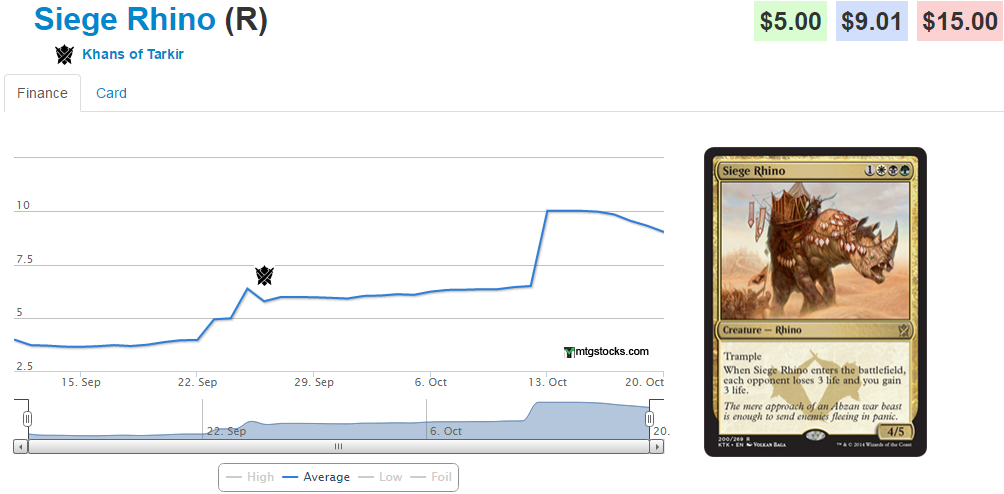
Siege Rhino is a very good card. But even though no one disagrees with that statement, the price of Siege Rhino is tanking.

Untitled

The card didn't get worse. The card isn't getting played less. The spike wasn't false hype.The reason Rhino is coming back down? People are opening the card.

Let's look at our window. The base of the spike peak is October 12th, the Saturday of the Pro Tour. Provided the Rhinos you ordered on Friday for $6.45 TCG Mid don't get cancelled like I'm sure some orders did, how are we doing?

Pretend we ordered 10 copies. You paid $64.50 plus $2.99 for shipping for a total of $67.49. The cards went into the mailbox Monday morning because they didn't process the order Saturday and there is no mail delivery (and therefore pickup) on Sunday. A standard three business days later, on the 16th, they arrive. If you listed them for the $9.96 they were TCG Mid, they likely didn't sell that day and the price began to decline. If you listed for TCG Low trying to be the cheapest and sell out, you sold them for $7.00 and then paid fees on top of that.

Now, if that doesn't seem like a fair comparison because TCG Low was $4.20 and not $6.45 so why would you buy for TCG Mid and sell for TCG Low, remember that we wanted 10 copies. There was only one seller with more than 4 copies selling for less than TCG Mid on the 12th. You're either paying TCG Mid or you're buying from a lot of individual sellers and exposing yourself to additional fees, additional wait time and more cancellation risk.

Ultimately this seems like a lot of pain for a small gain. With Rhino's price declining as increased supply offsets steady yet high demand, you are forced to either stick to your guns and keep trying to sell at TCG Mid and watch the price tank, or you're forced to sell for TCG Low and just offload them for pennies in profit.

Why let an increasing supply force you to make a hasty move? Buying at Mid and selling at Low is terrible, so why put yourself in that situation? Why not look at some cards with a known, steady supply?

Untitled

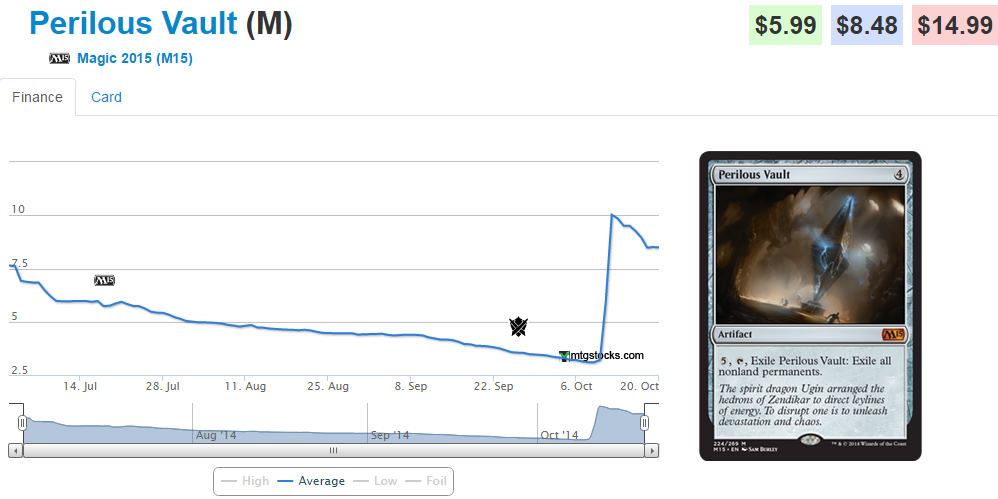
Vault also went up, but while Rhino doubled, Vault tripled. While Vault isn't as splashy as a sexy, new card, Vault also has the ability to go in more decks than Rhino due to being colorless. Not only that, the number of Vaults out there is basically the number there are. No one is buying M15 packs and selling the cards on TCG Player. People are buying M15 packs at Walmart and playing them unsleeved on a kitchen table in Des Moines, Iowa.

Vault's price has already appeared to plateau, unlike that of Rhino which is going to see the price stabilization we're used to after a spike exacerbated by increasing supply. Increased supply will not make it decrease steadily forever, but it will make the card less stable. Why not buy into a more stable card?

It isn't just cards from core sets I like, it's any Standard-legal set not currently being drafted. I like cards from Theros block and M15 a lot more than cards from Khans block as specs around the time of the Khans PT for several reasons, and the next time a new block comes out and we have that first crazy PT, we can remember how this went and apply the lessons from this time to that situation.

  • The supply is more stable.
  • You can easily buy 10+ copies from one dealer and therefore make big moves.
  • The pre-spike price is established by supply and demand only, not by guesswork like with new cards.
  • You can trade for copies you're speculating on rather than being forced to pay cash.
  • Their power level is established.

Rather than trying to buy unstable cards (especially non-mythics) I think the better play this time of year is to look at cards from older sets that have upside and stability due to a more defined supply. Rather than Pearl Lake Ancient and Siege Rhino, I have other cards in mind that it's not too late to go after.

Untitled

This is a card that didn't really have a home but is getting one. Playable in Abzan decks alongside Siege Rhino, this is a little more awkward because it's tougher to cast on two without taking damage from lands.

Still, I expect this to see about as much play as a card like Rakshasa Deathdealer but without the specter of incoming supply limiting its upside. I'd get these to trade out rather than sell since its price already doubled this week. Still, not every card I like right now has recently doubled.

Untitled

Whenever I see a bulk rare start to show up in decks, I pay attention. Playable in lots of control decks right now and benefiting from a cycle of lands capable of making sure you get a Mountain when you need it and being cheap enough to remove a creature like Goblin Rabblemaster early like you need to, this card does it all. This is a spec with a lot of upside and with a stable supply.

Untitled

Narset, Enlightened Master isn't affecting many Standard prices, but she is making Relentless Assault effects go up based on the silly Goryo's Vengeance deck in Modern, but I don't think it stops there. Narset is one of the best EDH generals to come along in a long time.

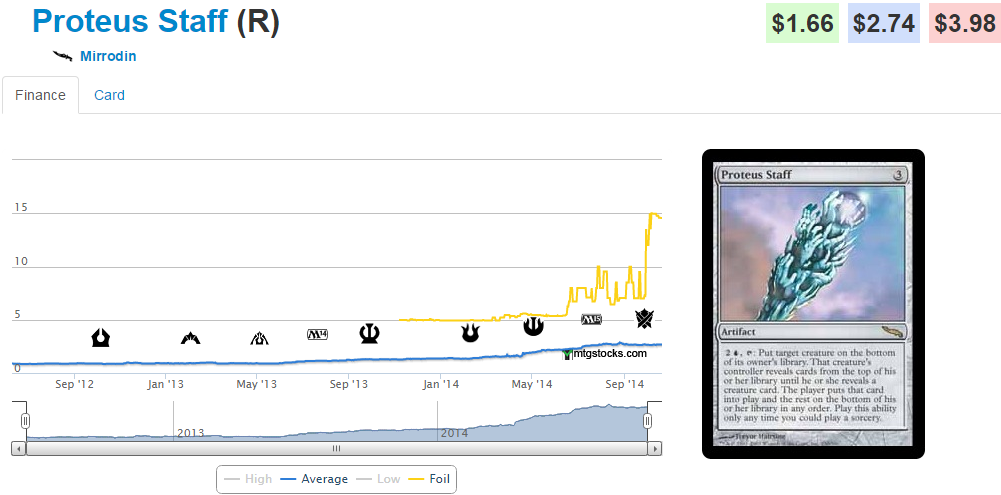
If you don't think Narset is relevant to EDH, notice that the foil price of Proteus Staff doubled after Narset was printed. There is money to be made on non-foils as well and Staff is old enough that a reduction in supply will have a large effect on prices.

My Jerry Springer-esque Final Thought

New blocks make lots of cards go up, not just the cards in those sets. Focusing on cards from older sets with a more stable supply means your orders are less likely to be cancelled, your window to sell the cards is much larger and your upside margin isn't getting squeezed by increasing supply.

People aren't drafting M15 with Khans legal, they're not redeeming sets of Born of the Gods on Modo and they're not buying Theros boxes. Look at other opportunities when the market is volatile and you'll feel a lot less heartburn when the Pro Tour comes around.

Insider: [MTGO] Small Concessions for Higher Returns

Are you a Quiet Speculation member?

If not, now is a perfect time to join up! Our powerful tools, breaking-news analysis, and exclusive Discord channel will make sure you stay up to date and ahead of the curve.

I could have also put it this way: "Less is more." It may sound more like a philosophy of life than a MTGO finance concept. Nonetheless giving up some profit here may lead to more profit there.

I'm not going to show you a magic trick to turn a poor spec into a good spec. Rather, I want to discuss how and why the expectations you have for one spec have consequences beyond that single spec. Small concessions can sometimes lead to higher profit in the long run.

Managing your portfolio may sometimes include making small concessions for the sake of higher returns in the long run. Let me walk you through some examples explaining how I apply this concept to my own investments.

Good Discipline Is Better Than a Good Spec

In no time and with the help of the QS community you will realize (or you already have) that there is a very decent amount of speculative opportunities on MTGO. Off course not every spec is a great spec but soon enough your only problem will be which one to chose from.

If carefully chosen all of your specs have equivalent chances of success. The only issue now is to deal with them the best you can. Ideally, you want to cut your loss on bad specs as soon as possible and let good ones run as close as possible to their peak. And when an investment is neither going up or going down what should you do?

Making concessions and lowering your expectations on specific specs doesn't always mean that you are setting the bar lower or that you are not confident in your moves. In many cases it's actually applying a better discipline with your positions and with your bankroll management.

Picking up a card that everybody described as a good target and selling it after it has doubled is great but it doesn't happen as often as we wish. What do you do when that supposedly good target has only moved up by 20%, or is down by 20%? Maybe it is time to close this position and move on to the next one.

Admitting that you were wrong or that the spec didn't go the way you wanted is no easy task and often disappointing. How you handle these missed opportunities is what makes the difference between a successful speculator and a mediocre speculator. Remember, we just said that good opportunities are (almost) everywhere on MTGO.

This being said, there's probably more discipline to enforce when selling than when buying. Nonetheless at both ends of a spec there's something that can be improved.

Selling When Time Has Come

There are basically two circumstances when you want to sell a card--when you want to collect the benefit of a successful spec and when you cut your loss on a losing position.

Selling when your spec has tripled is not something you think you may have a problem with. However when on your spec is spiking hard, as Perilous Vault just did the past two weeks, the temptation might be here to hold on forever, expecting the Vault to break 20 Tix, which may happen, who knows? I started to sell my copies of Perilous Vault last week with most of them on the weekend. It was really time to cash in with this fantastic spec.

We often hear repeated the words, "leave 10% for the next guy." Actually, in many situations you are not exactly leaving 10% for the next guy if you are selling at this point. Whether there is 10% more to make or not is not even a question.

I know other specs are waiting around right now. The 10% I might be leaving on the table with Perilous Vault are going to be made elsewhere, with Rakdos's Return for instance. I didn't sell the first copies of the Vault for as much as the last copies, but the Tix made from the first copies allowed me to buy some Rakdos's Return which has jumped by about 50% last week. A little less here for a lot more there.

If pulling the trigger is rather easy when a spec has tripled, it is a different story when your positions are showing minimal profit or even losses. However it is even more critical to get out when your specs are on a slippery slope.

As we approached Khans of Tarkir release the vast majority of Modern staples kept dipping. You can see this with the Modern index, which is back to its level of last January.

This round of sales netted me about a 20% profit total. Nothing very fancy especially for cards that I was holding for more than six months. However, this round of sales actually served two purposes. I cashed out several hundreds of Tix with small but positive returns and, more important, I raised some cash ready to be reinvested into better opportunities at this time of the year.

Sure, many of the Modern positions I was holding are going to recover and will probably be high again in a near future. The point is that with this extra cash I was able to invest more in the most recent opportunities, including the big hits that were Perilous Vault and Temple of Epiphany these past weeks, generating additional profit down the road.

In my Nine Months of Portfolio Management series I showed the example of Loxodon Smiter and Varolz, the Scar-Striped that sat in my portfolio pretty much forever waiting for them to gain value. I didn't want to cut my losses early enough and as a result I lost even more. I should have swallowed the losses and moved on by reinvesting, for instance, in Modern positions available at the moment. A small concession I was never able to do, a bigger loss in the end.

I have only been disappointed with cards I sold too late, never too early. Getting out of a losing position not only saves you money but precious time.

Buying Higher And Still Making Profit

Buying at the lowest possible price or at the absolute bottom may be an obsession for many speculators. Knowing if a card that has already risen significantly has more to offer and therefore still constitutes a good opportunity is equally important. You might be late on a spec but if you think there's more room to grow, getting in that spec with a little premium should not be an obstacle. A little profit is better that none.

Despite being "late," I recently moved on two positions that eventually gave me strong returns.

The first one is Goblin Rabblemaster. Since its release this card has been on a constant rise. I was not sure if its popularity would survive a Standard rotation and didn't buy into it in the beginning. I discussed it early September and after weighing pros and cons I decided buying the goblin at 6 Tix was probably going to be a profitable move.

Less than two months later I have sold this position with close to a 100% profit. When conditions are favorable, buying with a little premium doesn't really mater.

The other example is Glittering Wish. Along with Jeskai Ascendancy, it is the key cards of the Modern Ascendancy deck. Righ after several lists started being posted online, Glittering Wish could be found below 0.5 Tix. Less than 48 hours later its price had already bumped to 2-3 Tix, when I found out about this potential spec.

I was 48 hours behind here. However the deck seemed pretty strong and Glittering Wish is from a set with a rather limited supply. Enough potential for me to acquire two playsets at ~2.5 Tix per copy. A week later and with my copies of Glittering Wish sold at 12.5 Tix, who remembers that I had, maybe, overpayed on them originally?

Don't be afraid of paying a little premium to get on a spec you know has a strong upside.

Hit and Run

Jumping from one opportunity to another happens to be quite an efficient way to manage your portfolio and increase your bankroll faster than it seems. Giving up a little here to get a stronger position there.

An example from my Nine Months of Portfolio Management series illustrates well this strategy. Back then, I had jumped from Archangel of Thune to Craterhoof Behemoth to Vengevine. Closing a spec in order to jump to the next one can be extremely profitable. There's no need to always hit the max of every spec.

Although this was from one positive spec to another one, the concept also applies when you closing a losing position. The next one may be positive, but only if go for it--you don't make any money with positions you wish you were on.

Last month I wrote about selling some Modern positions, anticipating a seasonal dip coming along side with Khans of Tarkir release. Although this is a period of the year I anticipated selling Modern cards, I actually sold many positions with only little profit or even small losses for some.

Finally, not later than last week and with the results of Pro Tour Khans of Tarkir, I sold several of the positions I considered would not get me anywhere. Among them Kiora, the Crashing Wave, Stormbreath Dragon, Ashiok, Nightmare Weaver, Garruk, Apex Predator and Prophetic Flamespeaker. Although some made me a slight profit, it was time to leave these guys and move my Tix into Modern or Return to Ravnica block positions. Cutting some losses here and reinvesting elsewhere was the move to make in my opinion.

I encourage you to evaluate or re-evaluate your current specs. Maybe it's time to sell and move to the next spec?


Thank you for reading,

Sylvain Lehoux

The Rise and Fall of Khans

Are you a Quiet Speculation member?

If not, now is a perfect time to join up! Our powerful tools, breaking-news analysis, and exclusive Discord channel will make sure you stay up to date and ahead of the curve.

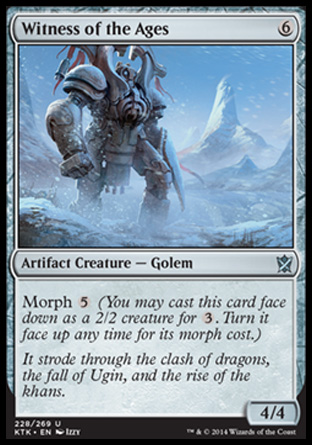
It's been a good run, Khans of Tarkir. But, financially at least, your time may be coming to an end.

For now.

witnessoftheages

What an exciting time for Magic, right? We have lots of sweet decks out of the Pro Tour. We have a new set with all kinds of playables in every format, a new metagame, a great draft format, and I think Wizards is even folding the dollars bills in our packs the right way this year.

Everything's coming up roses on the bloody fields of Tarkir. We're seeing cards spike, and every weekend it seems like there's a new hotness. Right now people are very excited about Savage Knuckleblade being the next big thing, or maybe See the Unwritten. Now that we've seen the first wave of spikes, the narrative seems to be that something else is just on the horizon.

But here's the thing: it's not.

You can read the full article here.

Avatar photo

Corbin Hosler

Corbin Hosler is a journalist living in Norman, Oklahoma (also known as the hotbed of Magic). He started playing in Shadowmoor and chased the Pro Tour dream for a few years, culminating in a Star City Games Legacy Open finals appearance in 2011 before deciding to turn to trading and speculation full-time. He writes weekly at QuietSpeculation.com and biweekly for LegitMTG. He also cohosts Brainstorm Brewery, the only financial podcast on the net. He can best be reached @Chosler88 on Twitter.

View More By Corbin Hosler

Posted in Feature, Finance, FreeLeave a Comment on The Rise and Fall of Khans

Have you joined the Quiet Speculation Discord?

If you haven't, you're leaving value on the table! Join our community of experts, enthusiasts, entertainers, and educators and enjoy exclusive podcasts, questions asked and answered, trades, sales, and everything else Discord has to offer.

Want to create content with Quiet Speculation?

All you need to succeed is a passion for Magic: The Gathering, and the ability to write coherently. Share your knowledge of MTG and how you leverage it to win games, get value from your cards – or even turn a profit.

The Man Who Ate Pumpkins

Are you a Quiet Speculation member?

If not, now is a perfect time to join up! Our powerful tools, breaking-news analysis, and exclusive Discord channel will make sure you stay up to date and ahead of the curve.

It's that time of year when the pumpkins are out. Pumpkin spices are in everything from lattes to air fresheners, and when white people can't get their pumpkins, they get upset.

Untitled

You know who likes pumpkins even more than white, suburban college-aged kids? People who eat pumpkins. Specifically, pumpkin eaters of the "cheater cheater" variety. People like Trevor Humphries.

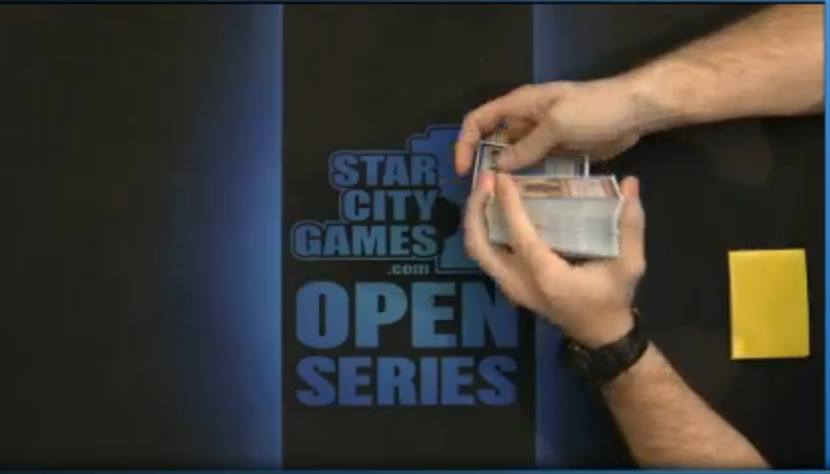
How does Trevor Humphries like to shuffle decks on camera? Like this.

The video evidence is beginning to add up quickly. Allegations of Humphries using the opportunity to shuffle an opponent's deck (ironically, to prevent the opponent from stacking their deck) to put non-lands on top, forcing repeated Mulligans have been coming in. There is a pretty decent reddit thread devoted to the topic.

The thread in question

Not only did Humphries win the SCG Standard Open over the weekend, he won the Modern Open. There is another video link running around, showing him up to those shenanigans at another event, shown here.

Evan Erwin tweeted today that SCG is aware of the video evidence impugning Humphries and they are looking into it. Will Humphries be denied some of the significant amount of prize money he's won over the weekend? I'm not sure, but what we do know is that the evidence is very clear. Twitter is abuzz with the allegations and I will be monitoring the reddit post as well. More on this story as it develops.

Avatar photo

Jason Alt

Jason Alt is a value trader and writer. He is Quiet Speculation's self-appointed web content archivist and co-captain of the interdepartmental dodgeball team. He enjoys craft microbrews and doing things ironically. You may have seen him at magic events; he wears black t-shirts and has a beard and a backpack so he's pretty easy to spot. You can hear him as co-host on the Brainstorm Brewery podcast or catch his articles on Gatheringmagic.com. He is also the Community Manager at BrainstormBrewery.com and writes the odd article there, too. Follow him on Twitter @JasonEAlt unless you don't like having your mind blown.

View More By Jason Alt

Posted in Free21 Comments on The Man Who Ate Pumpkins

Have you joined the Quiet Speculation Discord?

If you haven't, you're leaving value on the table! Join our community of experts, enthusiasts, entertainers, and educators and enjoy exclusive podcasts, questions asked and answered, trades, sales, and everything else Discord has to offer.

Want to create content with Quiet Speculation?

All you need to succeed is a passion for Magic: The Gathering, and the ability to write coherently. Share your knowledge of MTG and how you leverage it to win games, get value from your cards – or even turn a profit.

How Do You Handle Standard Cards for Casual Play?

Are you a Quiet Speculation member?

If not, now is a perfect time to join up! Our powerful tools, breaking-news analysis, and exclusive Discord channel will make sure you stay up to date and ahead of the curve.

I draft a lot, and I maintain a cube and a Maelstrom Wanderer EDH deck, but I do not play Standard. As a drafter, I open a lot of Standard staples that are often good in Cube and/or EDH. As a financially minded mage, I don't like my cards to lose value to rotation, but I also want to play them in the casual formats I enjoy. This presents me with a dilemma.

masterofpredicamentsgerman

Some cards are easy. Stuff like Thoughtseize, Abrupt Decay, shock and fetch lands, and Dig Through Time may lose a bit at rotation, but ultimately, these are good long-term holds that I don't mind just hanging on to through rotation and for years to come.

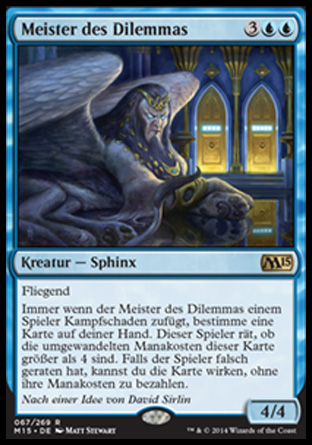
Other cards aren't so simple, though. Something like Elspeth, Sun's Champion will likely never break through in Modern or Legacy due to its six-mana casting cost. While it's at $30 retail right now, by this time next year, after rotation, the card could be as low as $5, and I would be surprised if it was over $10. But I want it in my cube. I don't want to proxy it for a year until the price goes down, and I don't want to just remove it from my cube until that point, either.

There was an error retrieving a chart for Elspeth, Sun's Champion

I know some players who don't worry about card prices at all. They're looking to get the cards they want from the new set, and once they have those cards, they're permanently a part of those players' collections. On the other end of the spectrum are the players who are constantly pulling cards from decks to trade away because they just can't handle not getting full value for their cards. Both of these positions are defensible, but it's hard to say if one is right.

I fall somewhere in between these two extremes on the spectrum, largely based on how much trading and/or selling I feel like doing in a given season. Elspeth and a bunch of her Theros friends are on my mind lately, and I honestly don't know whether I feel like going through the effort of trading and then reacquiring later. But it's also distasteful to consider losing large amounts of card value that I could have gotten back with just a little bit of effort.

I'm not the only one who has this inner debate, am I? How do you handle situations like this? Do you err toward maximizing dollars or minimizing work? And what do you do about playing with a card in between selling at its peak price and re-buying at its post-rotation price? Let me know your thoughts on this issue in the comment section below.

Insider: Glacial Trends in Magic Finance

Are you a Quiet Speculation member?

If not, now is a perfect time to join up! Our powerful tools, breaking-news analysis, and exclusive Discord channel will make sure you stay up to date and ahead of the curve.

We've trained ourselves to adapt to changing prices occurring week to week.

Weekly!? More like daily at this point, with a strong movement towards prices changing in real time, 24/7.

Trading without a smartphone has become tantamount to walking down the wrong alley in Mexico City with a stack of bills hanging out of your back pocket. Predicting the next series of spikes and crashes has become--for a number of players--a larger part of playing Magic than ... ya know, playing Magic.

I already talked about the idea of MTG Finance as a solved format--mostly as hyperbole--but you probably got the jist of what I was getting at.

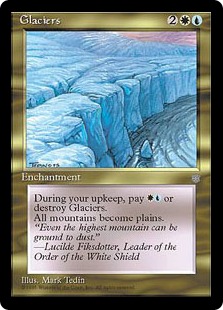
There are deeper financial trends afoot than just the constant shifting of the sands. Entire continents are slowly and steadily being consumed beneath the glacial advance of an aging player base, yielding trends that were only obvious when viewed in hindsight.

After a few years, I've found myself on the winning end of these glacial shifts and feel really fortunate that my collection had matured into something substantial.

Glaciers

The Next Frontier

I came into Magic (for the second time) around the release of Conflux. I putzed around at FNMs for a few months with an inexpensive deck that I cobbled together featuring cards like Master Transmuter, Platinum Angel and Grim Poppet. As I became reobsessed with Magic and filled out my Standard collection, I looked to other formats to satiate my urge to collect and consume.

We are Borg.
Your cards will be added to our own.

It really began to change when I tagged along with a local band of hooligans to a couple PTQs during Extended season.

Yeah, that Extended season... the one that ended with the format warping around Dark Depths, Thopter Foundry and Jace, the Mind Sculptor.

I was hooked despite posting an abysmal record with the only deck I could cobble together on short notice--Scapeshift. I started buying into the format pretty heavily. Dark Confidants, Tarmogoyfs, Shocklands, Chrome Moxen, and essentially any card that appeared in any Extended deck anywhere. I had to have everything.

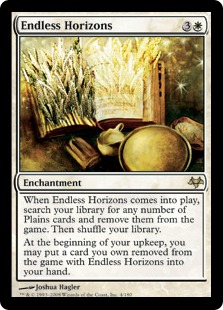
Endless Horizons

Endless Horizons

It didn't stop there. Of course it didn't stop there.

We are Borg.
Your collection will be assimilated and added to our own.

Before Extended season even rolled around again on the calendar, I became enchanted with Legacy. I acquired Wastelands and Aether Vials and everything else to play Goblins... aaaand then Merfolk.

After all, they were pretty much the cheapest decks to get in Legacy (back then). Then, having never played Legacy, I just started trading for dual lands and Onslaught fetches and everything else Legacy. I was pretty indiscriminate with my acquisitions, trading Standard cards for Legacy cards at every opportunity.

I hadn't even played Extended again, let alone Legacy. It was probably another year before I even had the opportunity to play Legacy for the first time but I had accidentally been making the best financial investments of my life. Those $65 Underground Seas were creeping up to a hundred dollars! A hundred dollars!

Legacy was taking off in a big way and I had apparently gotten in at the ground floor. I finished up playsets of cards I would never and have never used, and I started to amass sealed product. Anybody else from the Midwest remember the "bucket o' boosters" that Pastimes used to carry around with them? I bought 8-man draft sets of Ravnica-Guildpact-Dissension for $70 and threw them in the closet, not as an investment, but more as a novelty. How cool it would be to have a draft party and draft all kinds of formats?

So I bought into sealed product. Duel decks, booster boxes, Commander decks, Planechase decks, and From the Vaults all filled up chests, then closets, in my home.

What next?

Power
#humblebrag

The Final Frontier

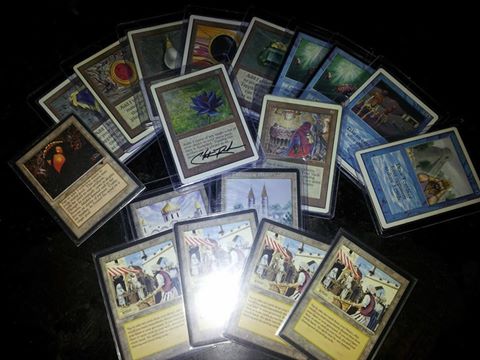
I had dabbled in power once before, acquiring a Mox Sapphire and Black Lotus and flipping them for a quick $200 profit when I became nervous at how much money I had tied up in two cards.

If I had only known.

Early in 2013, I decided I "might as well" acquire Power in case I ever wanted to play Vintage. It had worked out for Legacy, right? Power had been sitting pretty stable for a few years, experiencing modest annual gains but nothing monumental.

"Might as well!"

Remember all that sealed product I had casually acquired? I ended up selling and trading off most of those booster boxes for Moxes. I traded those From the Vaults for Time Vaults, I traded Shards for Bazaars. By the end of Gencon 2013, I had acquired everything minus a Mox Sapphire, which I quickly snatched up when a local vendor offered to trade one for recently inflated Modern staples.

I was done. This is where I decided to get off the train and let those faithful few continue onward to destinations unknown.

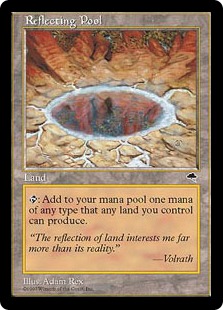
Reflecting Pool

Reflecting on Success

So here I am, sitting on a Magic collection worth well more than double what I've spent obtaining it. How did I get so lucky? Was I a trading and finance wunderkin? The more I thought about it, the more I realized that I was just riding a wave of inevitability.

It's no secret that Magic has been experiencing end over end growth for years now, and that wave really started to grow at Zendikar.

So picture a train that stops at the station once every three months, allowing players to get off and on. After years of players mostly choosing to stay on the train rather than quit, the average player has been on that train for a much longer time. This means that player tenure creeps up by a few fractions of a percentage point with every set's release. The longer a player stays in the game, the more likely they are to explore older formats.

So let's think about that for a second. We'll use hypothetical numbers because where can we even find that info?

Player tenure:

  • <1 year: 50% Kitchen Table, 35% Standard, 15% Commander, 10% Modern, 4% Legacy, 1 % Vintage
  • 1-3 years: 25% Kitchen Table, 80% Standard, 60% Commander, 40% Modern, 20% Legacy, 2% Vintage
  • 4-7 years: 10% Kitchen Table, 95% Standard, 80% Commander, 70% Modern, 40% Legacy, 4% Vintage
  • 8+ years: 5% Kitchen Table, 95% Standard, 80% Commander, 80% Modern, 80% Legacy, 5% Vintage

So as you see, a population that increases year after year and that player base's tenure grows longer year after year, the natural progression is that more and more players will explore and buy into older formats.

Even with a fraction of the total player base wanting to acquire Vintage cards, .5% of 10 Million players is still 50,000 people. I believe this is the major reason that we've seen the prices rising over the past few years.

Room to Grow

So where do players and collectors go beyond Vintage? There's always the followup goal to acquiring Power Nine, then getting them all converted to Alpha/Beta...

Then what?

Have you noticed how Summer Magic has become more and more desirable?

Sealed boxes of older sets. Reminiscent of how much fun drafting Rise of Eldrazi was? For $600, you and seven of your closest friends can relive the Magic once more.

Have you seen the prices on foreign foil cards? Russian foil Polluted Deltas from Khans of Tarkir are selling for $800+ on eBay. Those are completed listing, none of that "hehe look at this price I made up" people do to be cute.

How about the misprints and oddities community?

Take a look at how much original Magic artwork is going for these days. You'll probably be fairly astonished.

The player base is aging. Those high school and college kids that started playing with Zendikar are in the workforce making money and just can't spend it fast enough. It's a great time to be sitting on a pile of pretty cards.

Insider: A One Week Look-Back at Standard

Are you a Quiet Speculation member?

If not, now is a perfect time to join up! Our powerful tools, breaking-news analysis, and exclusive Discord channel will make sure you stay up to date and ahead of the curve.

The dust is beginning to settle following the excitement of Pro Tour Khans of Tarkir. The pros have revealed their various brewing ideas, with much focus on Jeskai decks. We saw multiple buyouts resulting from the event, including sudden jumps in Dig Through Time and Pearl Lake Ancient.

These two cards likely made many speculators decent profits. It’s not everyday one can earn a 200% return on an investment. But not everything was warm and fuzzy – the market of MTG speculation can be a double-edged sword. If you’re not quick enough, you might be signing yourself up for some disappointing results.

This week I’ll do my best to boil down some data into a couple of overarching conclusions, while also pointing out some observations from Grand Prix Los Angeles.

Live and Die by the Sword (Or Leviathan)

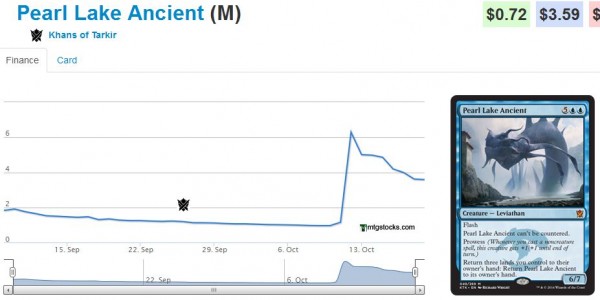
While watching the Pro Tour event a week or so ago, I noticed the sudden excitement Pearl Lake Ancient had been drumming up. It appeared to be a solid choice for win condition that multiple control decks favored. The result was a significant jump in the leviathan’s price:

Pearl Lake

After spiking to over $6, the card has since retraced its way back down to around $3.50 at TCG Mid. This number is fairly misleading, however, as multiple playsets can be purchased on eBay for a mere $9. I’m fairly certain we are going to see this card drift back down towards its initial $2 preorder price unless it wins a major Standard event.

“Okay”, you say. “Show us a card that spiked and actually did well at the Pro Tour.”

Let’s look at the biggest winner from Pro Tour Khans, Dig Through Time:

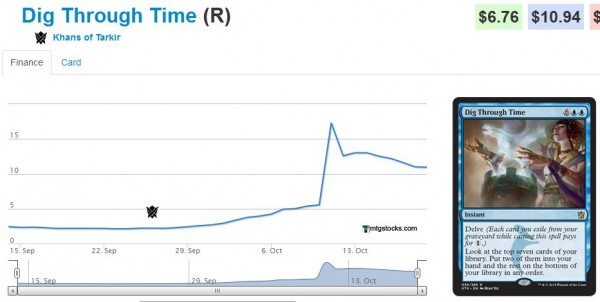
Dig

Here we see an even larger spike from $2 to over $15 in one weekend. This was truly the break-out card of Standard. But do you see the trend after the weekend passed? Since spiking near $16, the format-defining instant has drifted back towards $10. Once again, we see that selling into the weekend hype or shortly thereafter was the correct play. Those who hesitated were left settling for a lower (though hopefully still profitable) price.

Tell Us Something We Don’t Know

Most experienced speculators already know that selling new cards into hype is the way to maximize profits. After seeing cards shoot for the stars only to settle back down to earth in a matter of days, you begin to become accustomed to this pattern. Of course, selling at the peak is easier said than done.

I managed to move my single set of Dig Through Time in the neighborhood of the peak. But I was not as successful with moving my Pearl Lake Ancients, mostly because one of the two sets I purchased took a full week to arrive in the mail.

Thus my first lesson: if you need to wait for a breaking out, newly printed card to arrive in the mail to sell into hype, you’d better make sure it can get to you quickly. Even a three day delay could be the difference between a 100% profit and a 50% loss.

If I may, I’d like to argue that another card had a breakout performance at the Pro Tour: Temple of Epiphany. I know, this card was already climbing heading into the event. But its recent success in the Jeskai aggro decks has led to greater demand for the mana-fixing land.

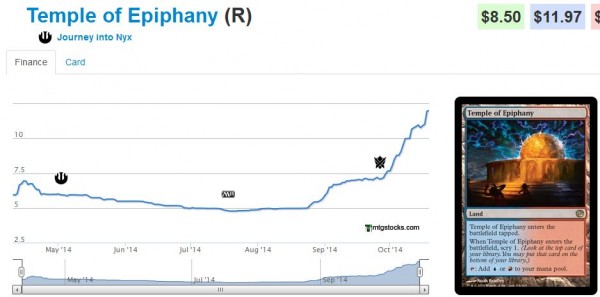
Epiphany

In about a week, this land jumped from $7.50 to $12. While the jump wasn’t as significant, there is a very favorable feature to this price curve that isn’t present in the other two shared earlier. There’s no drop! This land is still on the rise, meaning profits you may be sitting on are still growing.

What distinguishes this card from the previous two? Two key characteristics: it’s a land, which means it yields utility beyond the Standard builds that leveraged it most at the Pro Tour, and it’s from Journey Into Nyx.

Being from the third set of the previous block means there are fewer copies around and there are far fewer being opened going forward. Therefore, the demand is rising but the supply is far from liquid enough to keep up. Hence the monotonically rising price.

Contrast this with Mantis Rider, which is arguably just as format-defining. Despite its ubiquity thus far in Standard, the overall trajectory of this creature is negative. More copies are being opened every week. Being a large set rare, supply is really going to put downward pressure on this card’s price. And being in the same set as five highly sought-after Fetch Lands, the price of this card will be even more kept in check.

Here is my second lesson: if you want to buy into spiking cards based on a Pro Tour result, look at moving in on the older cards. They may not yield the same percentage increase, but the pressure to move them quickly will be virtually absent. Newer cards, on the other hand, tend to spike artificially high and then face ongoing downward pressure as more copies are opened. If you are concerned you may not be able to act quickly enough, avoiding trends like Pearl Lake Ancient may be the best decision you can make on a Pro Tour weekend.

By the way, this observation is very applicable to one of the breakout cards from GP LA, Savage Knuckleblade.

There was an error retrieving a chart for Savage Knuckleblade

To be fair, this article is being written Sunday morning, so I cannot anticipate whether or not this three-drop creature will continue to shine throughout the Grand Prix. But if it does, I can assure you there will be a run on this card. Likely the price trajectory will overshoot reality, and once again a downward trend will resume. If you participated in a buyout of this card, I urge you to sell immediately into any spike. Don’t get left holding the bag.

One More Thing

While not reflected in the SCG Open from last weekend, the Grand Prix yielded new successful deck lists – at least as of day one’s completion. I’m referring to the mothership’s content that claims

Although Siege Rhino and Mantis Rider still left their mark of the day, the biggest stories to come out of Day 1 are the rise of Sultai, Mardu, and Temur decks. All three performed very well over the course of the day, with Pro Tour Hall of Famer Brian Kibler’s Temur deck leading the pack overnight. The other players with perfect records of 9-0 are Peter Ingram, Tamada Ryoichi, Isaac Sears, and Carlo Falcis.

I want to use this statement as an opportunity to remind everyone of one important thing: while the Standard format may appear to be approaching a steady state, it’s far from solved. Therefore, be prepared to see shifts in the metagame. Mantis Rider may be the best card in Standard right now, but this may not be the case in a month. Therefore the urgency of selling into spikes is even more relevant.

I’m even thinking about cashing out on my Temple of Ephiphany investment very soon. I don’t have too many, but the ones I do own are worth considerably more now than they were a couple months ago.

Could they go higher? Certainly. Could they go lower? I’d rephrase that question as “When will they go lower?” because they certainly will eventually.

If U/R continues to be a dominant color pairing through Standard, then it may take a while. But the inevitable fact is Standard rotation will apply downward pressure on all temples. Therefore selling the copies while they are hottest in Standard seems like a solid strategy. They may appreciate further from here, but they could just as easily be replaced by a different temple due to metagame shifts.

This leads me to my third and final lesson for today: it may not be a bad idea to sell your hyped cards, even ones that aren’t as prone to sudden drops, if the Standard metagame is still in flux. This also frees up your cash to take advantage of any potential shifts in the format.

This last statement may be most controversial. Many readers may raise their arms exclaiming how foolish it will be to sell Temple of Epiphany now rather than wait for further upside. They may even be correct. To me it all boils down to risk/reward. At $12, the upside on the U/R temple is much smaller than before. I do think we can hit $15, but there are no guarantees.

The only guarantee is that new decks will be brewed and tested ad nauseam, and one day we may see a shift. You can’t sell the farm and move out of Temple of Epiphany completely while it’s the hottest temple, but don’t forget about the underappreciated Temple of Enlightenment or Temple of Malice. These are out of favor right now, but could easily become top dog should a new deck break out.

My point is, in a format filled with powerful multi-colored cards we are sure to see anything and everything. Each temple will have its chance to shine, and moving out of popular ones while cheaply acquiring a few unpopular ones may be the way to go.

Good luck to you all in this dynamic time period of shifting trends! Be sharp and operate with discipline in order to ensure you are netting profits and not getting stuck holding the bag on cards like Pearl Lake Ancient.

…

Sigbits

  • Further evidence that Pearl Lake Ancient is no longer exciting: Star City Games now has 26 copies in stock at just $2.99. They also have 25 Mantis Rider in stock at $7.99. Compare this with last block’s Sylvan Caryatid of which they have 0 regular copies in stock at $19.99!
  • You could be holding onto your Dig Through Times after their Pro Tour breakout. They are still out of stock at SCG with a price tag of $11.99. But personally, I find the data on Thoughtseize far more exciting. There are only 14 Theros copies in stock with a price tag of… wait for it… $29.99! By the way, they’re paying $17.50 for nonfoils and $50 for foils. Their nonfoil buy price is significantly higher than those buyers on Trader Tools, just FYI. Talk about a bullish outlook!
  • We have a very good measure of the impact of Modern and Legacy on Thoughtseize’s price by comparing it with Hero's Downfall. Both are played heavily in similar decks in Standard. But while SCG is nearly sold out of Theros Thoughtseize at $29.99, they have 40 copies of Hero's Downfall in stock with a modest price tag of $11.99.

Boycott MTGO?

Are you a Quiet Speculation member?

If not, now is a perfect time to join up! Our powerful tools, breaking-news analysis, and exclusive Discord channel will make sure you stay up to date and ahead of the curve.

After some server issues over the weekend, that's the latest idea being floated around by all those who hate Magic Online.

Pmxe196

"If you don't like it, Don't play it!" seems to be the newest rallying cry for all those who hate Magic Online.

Will this happen? Will anyone do it? Will Wizards care?

I don't know the answers to those questions, but I'm not sure boycotting is the right answer. As others have pointed out, taking more money out of the platform may not necessarily convince Hasbro/WotC to put more money into it. In reality, they may do the opposite since they don't see the money there. It's hard to say, especially when the unspoken assumption by everyone hating on the program is that the people working on it simply aren't good at what they do. The reality is that the people working on Magic Online care about the program and want to make it better. "Firing everyone" isn't the right option, and I wish that wasn't glossed over so much in these discussions.

Avatar photo

Corbin Hosler

Corbin Hosler is a journalist living in Norman, Oklahoma (also known as the hotbed of Magic). He started playing in Shadowmoor and chased the Pro Tour dream for a few years, culminating in a Star City Games Legacy Open finals appearance in 2011 before deciding to turn to trading and speculation full-time. He writes weekly at QuietSpeculation.com and biweekly for LegitMTG. He also cohosts Brainstorm Brewery, the only financial podcast on the net. He can best be reached @Chosler88 on Twitter.

View More By Corbin Hosler

Posted in Feature, Free14 Comments on Boycott MTGO?

Have you joined the Quiet Speculation Discord?

If you haven't, you're leaving value on the table! Join our community of experts, enthusiasts, entertainers, and educators and enjoy exclusive podcasts, questions asked and answered, trades, sales, and everything else Discord has to offer.

Want to create content with Quiet Speculation?

All you need to succeed is a passion for Magic: The Gathering, and the ability to write coherently. Share your knowledge of MTG and how you leverage it to win games, get value from your cards – or even turn a profit.

A Beta Black Lotus: Only $100,000!

Are you a Quiet Speculation member?

If not, now is a perfect time to join up! Our powerful tools, breaking-news analysis, and exclusive Discord channel will make sure you stay up to date and ahead of the curve.

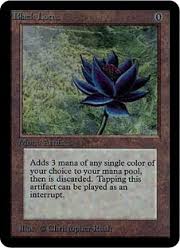
I know Beta cards are obviously worth a ton of money, and rightfully nothing moreso than Black Lotus, the game's most iconic card.

imgres

But this Ebay posting takes it to a whole new level. In fact, for many people this was a "trending interest" on Facebook, which is where I first saw it. Expensive collectibles always are a fun occurrence for people to look at and go "huh," so it makes some sense in this case.

And this is apparently the only Beckett-graded 10.0 Beta Black Lotus out there. There's some complicated math the owner of this card tried to use to sell the $100,00 price tag, but I seriously doubt anyone bites. Grading is cool and all, and rightfully increases the value, but not this much at all.

Which, I suppose, is why there's still the "make an offer" button. If you want your shot at owning a perfect Beta Black Lotus, now's your chance.

Avatar photo

Corbin Hosler

Corbin Hosler is a journalist living in Norman, Oklahoma (also known as the hotbed of Magic). He started playing in Shadowmoor and chased the Pro Tour dream for a few years, culminating in a Star City Games Legacy Open finals appearance in 2011 before deciding to turn to trading and speculation full-time. He writes weekly at QuietSpeculation.com and biweekly for LegitMTG. He also cohosts Brainstorm Brewery, the only financial podcast on the net. He can best be reached @Chosler88 on Twitter.

View More By Corbin Hosler

Posted in Feature, Free7 Comments on A Beta Black Lotus: Only $100,000!

Have you joined the Quiet Speculation Discord?

If you haven't, you're leaving value on the table! Join our community of experts, enthusiasts, entertainers, and educators and enjoy exclusive podcasts, questions asked and answered, trades, sales, and everything else Discord has to offer.

Want to create content with Quiet Speculation?

All you need to succeed is a passion for Magic: The Gathering, and the ability to write coherently. Share your knowledge of MTG and how you leverage it to win games, get value from your cards – or even turn a profit.

The Umbrella Revolution

Are you a Quiet Speculation member?

If not, now is a perfect time to join up! Our powerful tools, breaking-news analysis, and exclusive Discord channel will make sure you stay up to date and ahead of the curve.

Lately I have been writing fewer  posts about cards and decks and more about the culture of the game. There isn't always something that is "bigger" than mere cards but every once in a while something comes along that's too compelling not to write about.

This week on Gathering Magic, Adrienne Reynolds wrote a powerful article about PT Khans of Tarkir Pro Tour Top 8 finisher Lee Shi Tian.

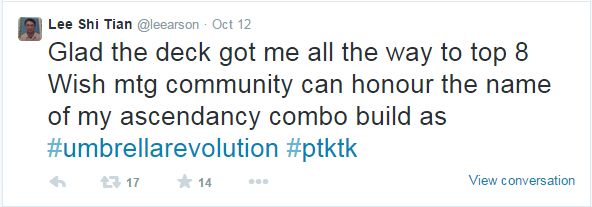
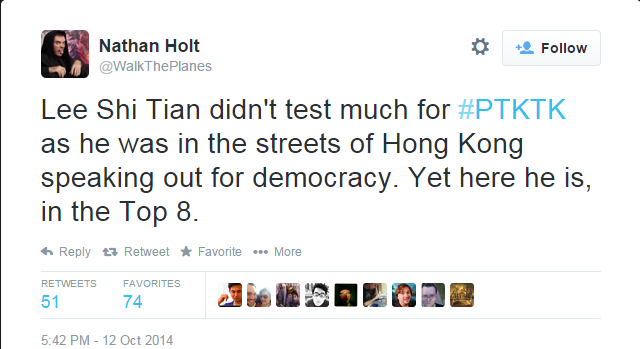
Why is Li Shi Tian special? Basically, he didn't have much time to practice for the Pro Tour because he was engaged in "The Umbrella Revolution"

Untitled


Untitled


Untitled


Armed with umbrellas and plastic sheeting, thousands of young people in Hong Kong took to the streets to protest the government announcing plans for electoral reforms that would severely limit the peoples' ability to elect the leaders of their choosing. While some people don't like the name "The Umbrella Revolution", Lee Shi Tian has asked that the community honor the bravery of the youth of Hong Kong by referring to his Ascendency combo deck as "Umbrella Revolution".

Many people in the community were aware of and had been monitoring the situation in Hong Kong, but many more had not heard about what was happening until Lee Shi Tian's Top 8 run brought attention to the cause.

I think calling the deck "Umbrella Revolution" is the least we can do to honor the brave youth of Hong Kong.

And let's be absolutely clear - engaging in civil disobedience is absolutely brave. Many of us had the chance to join members of the community like Billy Moreno in Ferguson when he went to try and help out with the protests there (protests that are still going on, although the camera crews have all gone home). Few were brave enough to head into an area occupied by a hostile police force. It's a small consolation to honor Lee Shi Tian's request.

Do yourself a favor and take the time to read Adrienne's piece on Gathering Magic. It's compelling, not a bad profile of the deck, and it's one small way we can spread awareness about the struggle for Democracy abroad.

Avatar photo

Jason Alt

Jason Alt is a value trader and writer. He is Quiet Speculation's self-appointed web content archivist and co-captain of the interdepartmental dodgeball team. He enjoys craft microbrews and doing things ironically. You may have seen him at magic events; he wears black t-shirts and has a beard and a backpack so he's pretty easy to spot. You can hear him as co-host on the Brainstorm Brewery podcast or catch his articles on Gatheringmagic.com. He is also the Community Manager at BrainstormBrewery.com and writes the odd article there, too. Follow him on Twitter @JasonEAlt unless you don't like having your mind blown.

View More By Jason Alt

Posted in FreeLeave a Comment on The Umbrella Revolution

Have you joined the Quiet Speculation Discord?

If you haven't, you're leaving value on the table! Join our community of experts, enthusiasts, entertainers, and educators and enjoy exclusive podcasts, questions asked and answered, trades, sales, and everything else Discord has to offer.

Want to create content with Quiet Speculation?

All you need to succeed is a passion for Magic: The Gathering, and the ability to write coherently. Share your knowledge of MTG and how you leverage it to win games, get value from your cards – or even turn a profit.

Want Prices?

Browse thousands of prices with the first and most comprehensive MTG Finance tool around.


Trader Tools lists both buylist and retail prices for every MTG card, going back a decade.

Quiet Speculation