Are you a Quiet Speculation member?
If not, now is a perfect time to join up! Our powerful tools, breaking-news analysis, and exclusive Discord channel will make sure you stay up to date and ahead of the curve.
New month, new metagame update. It is the way. And I'd like to kick this one off by tempering expectations. The near-perpetual spoiler season we now inhabit did spit out another set. However, Adventures in the Forgotten Realms is no Modern Horizons 2, and did not have that much impact on Modern. The resulting July metagame is an evolution of June's rather than another big shakeup. MTGO is also settling into its usual routine of follow-the-leader and piling into the same deck. I'm wishing for more data sources and paper events to return more and more.
Also, there's going to be a policy change for these articles. I've been a bit all over the place as far as deck names are concerned. This is made worse by Wizards constantly making new factions to use as color-pair names. This was driven home for me recently hearing new players refer to WR Burn as Lorehold Burn rather than Boros Burn. As such to avoid ambiguity I'll be dropping guild names and instead spell out the color pairs. I'll keep using the shard names because they're well established and I've never actually heard anyone use the Ikoria shard names. Of course, when possible I'll use actual deck names but there is some ambiguity there too. Thus I'll be referring to the various tempo and midrange decks that are mostly similar using the naming conventions Jordan outlined here.
July Metagame
To make the tier list, a given deck has to beat the overall average population for the month. The average is my estimate for how many results a given deck “should” produce on MTGO. Being a tiered deck requires being better than “good enough;” in July the average population was 6.75, meaning a deck needed 7 results to beat the average and make Tier 3. This up 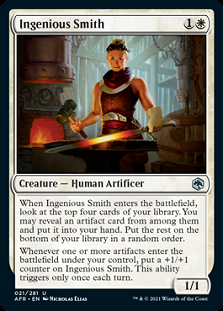 from June, but about average for the past year. Wow, I just realized it's been a year since I brought the monthly update back. How time flies.
Anyway, it makes sense for July to be closer to average than June. June was a huge set release and a brewing paradise while July showed some settling. Then we go one standard deviation above average to set the limit of Tier 3 and cutoff for Tier 2. The STdev was 11.24, so that means Tier 3 runs to 19, and Tier 2 starts with 20 results and runs to 32. Subsequently, to make Tier 1, 33 decks are required. This is also pretty typical for MTGO metagame updates.
The Tier Data
The total number of unique decks was down for July from June's 87 to 60. Again, it makes sense as June was very experimental. However, July also had an extremely low deck count, just 405 to June's 457. Some of that is down to smaller Preliminaries, but far more impactful was that July had fewer events. There were a few Preliminaries that never got posted, and there were fewer non-Premier events posted to MTGMelee. I'm not sure why that happened, but it's what I have to work with. Consequently, the higher average and STDev mean that the tier list has shrunk significantly. June boasted the highest number of tiered decks ever with 28. There are only 14 deck in July's tier list. I'm pretty sure that's the lowest total for a full month since I restarted this project. It also means that the MTGO inbreeding problem is back. Most of the players placing in Challenges are there every week, and so the sample is less about the overal meta and more about that group of grinders. But an analysist must work with the data available.
| Deck Name | Total # | Total % |
|---|---|---|
| Tier 1 | ||
| Hammer Time | 58 | 14.32 |
| UR Threshold | 56 | 13.83 |
| Tier 2 | ||
| Cascade Crashers | 28 | 6.91 |
| Blue Living End | 26 | 6.42 |
| Tier 3 | ||
| UR Prowess | 19 | 4.69 |
| BR Stompy | 19 | 4.69 |
| Channeler Control | 17 | 4.20 |
| Elementals | 15 | 3.70 |
| Lorehold Turns | 14 | 3.46 |
| Jund | 12 | 2.96 |
| Amulet Titan | 11 | 2.72 |
| 4-Color Bring to Light | 9 | 2.22 |
| Death and Taxes | 8 | 1.98 |
| Urza's Kitchen | 7 | 1.73 |
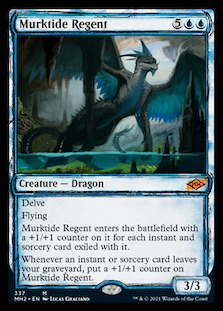
And July is rather weird. Tier 1 is split between Hammer Time and UR Thresh. And they're twice as popular as the next deck. I have a theory on why, but more on that later. To clarify, UR Thresh is not actually deck that cares about achieving threshold, but delirium is quite similar. Rather, it's the more specific name for the UR Tempo deck from June. Thresh decks historically are about a small number of early-deployed threats backed up by lots of non-creature spells, particularly counterspells. That is exactly the strategy most UR Ragavan/Channeler/Murktide Regent decks follow. Similarly, there are versions of BR Ragavan/Channeler decks with more or fewer creatures, and the decks with more get called Stompy.
A New Pillar?
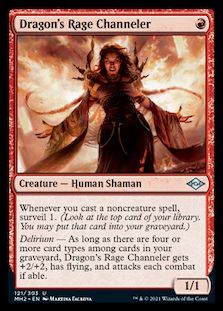 Given how skewed the metagame appears it is natural to assume that Modern is being pulled towards a dual pillar system between Channeler and Urza's Saga. Certainly, I've heard that theory thrown around a lot. There are those that say Ragavan, Nimble Pilferer is the pillar, but Channeler shows up in more decks and is more important to the opperation of said decks. Ragavan seems to get thrown in "just because" a lot, but Channeler requires some build around and to me that's defining of being a pillar more than just seeing lots of play. Also, I'm on board with considering Channeler a new Modern pillar for that very reason.
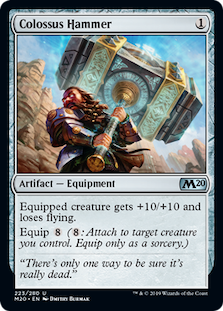
Saga, on the other hand, I'm skeptical of. Outside of Hammer Time, Saga decks were pretty poor performers in July. The play pattern is a rolling snowball of advantage, but it comes at a significant tempo cost. All the Underworld Cookbook decks and incidental Saga decks took a beating, so I'm not convinced Saga is that good in general. 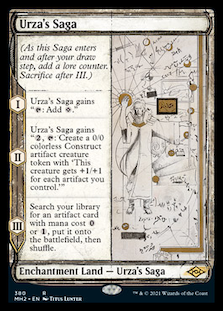 It's extremely good in Hammer Time because that deck only needs a few lands and Saga fills a number of holes in the deck. Older versions struggled with running out of threats in general but particularly suffered when they didn't hit Stoneforge Mystic to find their hammers. Saga makes threats and then Mystics for a Hammer. Or other bullet if necessary. Being good in a specific deck doesn't make a card a pillar.
Shardless Agent, on the other hand, is making a case for itself. Tier 2 is just decks that are only really playable thanks to Agent, and it shows up in plenty of other cascade decks and even occasionally as a value play in creature decks. Widespread success in many decks is more pillar-like to me, so watch out for Agent.
The Pattern Repeats
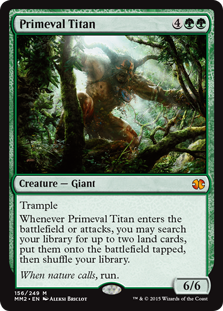 Remember a few weeks ago when I begged MTGO to get help for its focusing problems? Well, the phenomenon I commented on there did in fact repeat again. June's top deck was Amulet Titan. I predicted that Titan would immediately fall off because that's what had happened the last three months. Make it four for four because Titan is at the bottom of Tier 3. And I'm not saying that I'm magic, but after I complained, Amulet picked up just enough to make the Tier list, preventing the worst swing ever from happening. But I'm also not saying that I'm not magic. Thus I'm going to predict that the pattern will continue and Hammer Time and UR Thresh will fall off substantially in August. Hammer Time is the top deck, but there's so little space between them I'm calling it a tie. So both decks must weather the curse.
Power Rankings
Tracking the metagame in terms of population is standard practice. However, how do results actually factor in? Better decks should also have better results. In an effort to measure this, I use a power ranking system in addition to the prevalence list. By doing so I measure the relative strengths of each deck within the metagame. The population method gives a decks 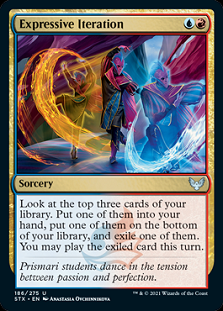 that consistently just squeaks into Top 32 the same weight as one that Top 8’s. Using a power ranking rewards good results and moves the winningest decks to the top of the pile and better reflects its metagame potential.
Points are awarded based on the population of the event. Preliminaries award points for record (1 for 3 wins, 2 for 4 wins) and Challenges are scored 3 points for Top 8, 2 for Top 16, 1 for Top 32. If I can find them, non-Wizards events will be awarded points according to how similar they are to Challenges or Preliminaries. Super Qualifiers and similar level events get an extra point if they’re over 200 players, and a fifth for over 400 players. There was one Super Qualifiers awarding 4 points in July and a Showcase Challenge that awarded 5 points.
The Power Tiers
The total points in July were actually up from June. This tracks given bigger events, though is surprising given the smaller population. June had 706 total points while July has 741. That's still pretty low for a full month, but it is closer to the normal average. Had there been more usable events from MTGMelee, July would have been a more normal month points-wise. The few events I saw were too small to use, and I didn't see usable events anywhere else either. The average points were 12.35, so 13 makes Tier 3. The STDev was 21.76, which is on the higher end, so add 22 and Tier 3 runs to 35 points. Tier 2 starts with 36 points and runs to 58. Tier 1 requires at least 59 points.
There are 15 decks in the power tiers, which is up one from population. Urza's Kitchen didn't make the transition from population to power, which in my mind cements Saga's decline. It's just not as good as everyone thought. In Kitchen's place are Mill and a resurgent Heliod Company. Both did pretty poorly overall in population, but in the events they did place, they placed very high. This strongly suggests that they're out of the mainstream and are being held up by enthusiasts and specialists. However, both also seem like good choices in a metagame defined by Hammer Time and UR Thresh.
| Deck Name | Total # | Total % |
|---|---|---|
| Tier 1 | ||
| Hammer Time | 109 | 14.71 |
| UR Threshold | 106 | 14.30 |
| Cascade Crashers | 63 | 8.50 |
| Tier 2 | ||
| Blue Living End | 48 | 6.48 |
| BR Stompy | 40 | 5.40 |
| UR Prowess | 36 | 4.86 |
| Tier 3 | ||
| Grixis Channeler | 34 | 4.59 |
| Lorehold Turns | 25 | 3.37 |
| Elementals | 24 | 3.24 |
| Jund | 20 | 2.70 |
| 4-Color Bring to Light | 19 | 2.56 |
| Heliod Company | 16 | 2.16 |
| Amulet Titan | 15 | 2.02 |
| Mill | 14 | 1.89 |
| Death and Taxes | 13 | 1.75 |
The top two tiers have expanded and overall this looks more like the typical tier list. I did check for outliers, and neither Tier 1 deck were over the line. Cascade Crashers moves up to Tier 1 thanks to many high finishes and is replaced by BR Stompy and UR Prowess. The latter has fallen a lot from its glory days, but remains a very strong contender in the metagame. Grixis Channeler is a blanket term for very similar not-quite-midrange, not-quite-tempo, definitely not control or aggro decks build around Channeler and Kolaghan's Command. And given its move up the rankings late in the month is my pick for where the renters will move to for August. We'll see how psychic I am in 42 days.
Average Power Rankings
Finally, we come to the average power rankings. These are found by taking total points earned and dividing it by total decks, which measures points per deck. I use this to measure  strength vs. popularity. Measuring deck strength is hard. There is no Wins-Above-Replacement metric for Magic, and I'm not certain that one could be credibly devised. The game is too complex and power is very contextual. Using the power rankings certainly helps, and serves to show how justified a deck’s popularity is. However, more popular decks will still necessarily earn a lot of points. Which tracks, but also means that the top tier doesn't move much between population and power, and obscures whether they really earned their position.
This is where the averaging comes in. Decks that earn a lot of points because they get a lot of results will do worse than decks that win more events, indicating which deck actually performs better. A higher average indicates lots of high finishes, where low averages result from mediocre performances and high population. Lower-tier decks typically do very well here, likely due to their pilots being enthusiasts. So be careful about reading too much into the results.
The Real Story
When considering the average points, the key is to look at how far-off a deck is from the baseline stat (the overall average of points/population). The closer a deck’s performance to the baseline, the more likely it is to be performing close to its “true” potential. A deck that is exactly average would therefore perform exactly as well as expected. The further away the greater the deviation from average, the more a deck under- or over-performs. On the low end, the deck’s placing was mainly due to population rather than power, which suggests it’s overrated. A high-scoring deck is the opposite.
| Deck Name | Average Points | Power Tier |
|---|---|---|
| Heliod Company | 2.67 | 3 |
| Mill | 2.33 | 3 |
| Cascade Crashers | 2.25 | 1 |
| BR Stompy | 2.11 | 2 |
| 4-Color Bring to Light | 2.11 | 3 |
| Grixis Channeler | 2.00 | 3 |
| UR Threshold | 1.89 | 1 |
| UR Prowess | 1.89 | 2 |
| Hammer Time | 1.88 | 1 |
| Blue Living End | 1.85 | 2 |
| Lorehold Turns | 1.79 | 3 |
| Baseline | 1.68 | |
| Jund | 1.67 | 3 |
| Death and Taxes | 1.63 | 3 |
| Elementals | 1.60 | 3 |
| Amulet Titan | 1.36 | 3 |
The baseline was pretty average as these go, but appears very low in the standings. That's what happens when there are events awarding extra points. It's easier for decks to beat the average but it's rare to see many unique decks get more than one point, which really kills the average.
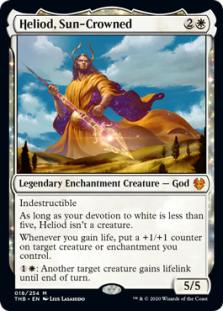 As previously mentioned, Heliod Company did perform very often. But when it does, it does very well and took the top slot, indicated that it was quite underplayed in July. Thresh and Hammer Time appearing in the middle of the pack is actually fairly worrying for them, as it again suggests that they were more popular than actually good. However, they're enough above baseline to say that their population is justified.
Amulet Titan, on the other hand, had an abysmal showing. That is really weird, since it's normally in the upper third of the standings. It's been an enthusiast deck for a long time, and that meant specialists doing well with their special deck. I wonder where they went to allow Amulet to fall this hard. Elementals appears to be the new It Deck, gaining a lot of attention, but its position on this list says that's the wrong choice. This is down to a surge of interest following Kanister winning a Challenge with Elementals and players copying him.
All for Now
And Modern rolls on. The MTGO metagame continues to churn violently, and I will continue to observe and record. And hopefully refine my psychic powers.



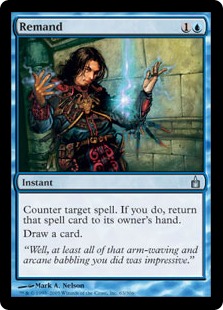 therefore constitute overplaying. A tempo deck using Remand is appropriate since all it wants is to delay the opponent. Lots of
  Instead, we'll focus on which cards are currently seeing play in the decks that also see play and don't make sense to me. To make my list, the card needs to be a combination of out of place and ineffective in the metagame as it's developing. My perception is based on what I'm seeing in the metagame data, watching
  card actually do what it's supposed to do? Will the card's intended primary function actually come up during games often enough to justify playing the card? And if it does, can the deck playing it make use of the effect to full impact? If the answer isn't yes to all those questions, the card needs to be questioned.
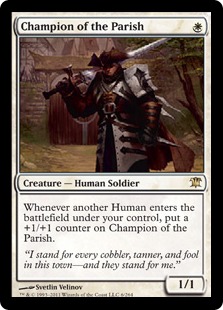 Does the card stand on its own or require help? A card that is good by itself in a wide variety of contexts is no parasite. However, if a card absolutely needs others to be good, let alone playable, then it is one. This isn't a problem by itself, as tribal cards are inherently parasitic and there's no issue with their playability. The problem comes when a card is a parasite but the parasitism isn't obvious. Champion of the Parish is highly parasitic but nobody would ever run it without support, meaning it will only see play in the right context. Thus, it wouldn't meet my definition of overplayed.
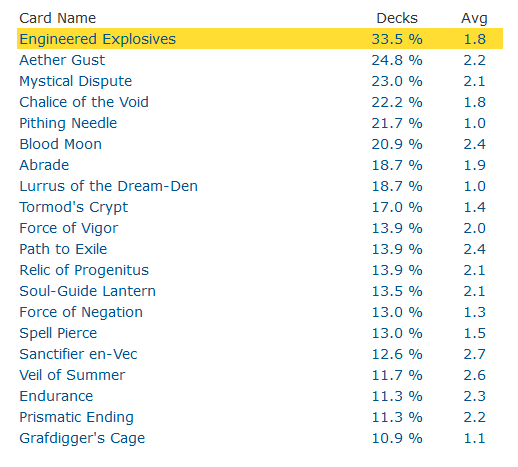
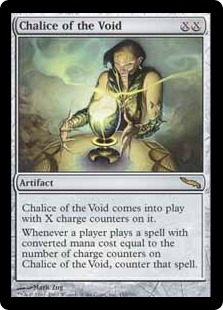 Conversely, Chalice of the Void doesn't need much support from its own deck to do its thing. However, its only meaningful in the context of the opponent's deck, which is still parasitic in the
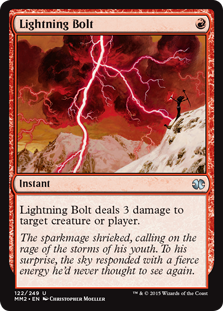
 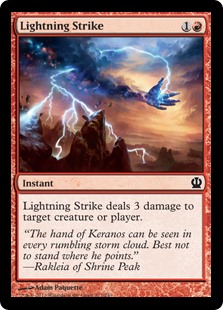 than the alternative? No card is ever actually a free include. There's always an alternative that could be played and therefore there is always an opportunity cost to every card. However, a card with a low opportunity cost will either have few alternatives or be significantly better than said alternatives. For a high one, the opposite is true. To wit: the opportunity cost of Lightning Bolt is its alternative, Lightning Strike (same effect, different cost). As Bolt is cheaper, that opportunity cost is very low. However, in the context of removal spells, Bolt may be quite high, as there are a wide range of one-mana kill spells and depending on metagame context, it may prove expensive to include Bolt over something else.
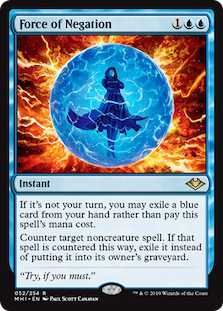 Force of Negation is a good card, and at times it has been a necessary card. It's the most flexible free counterspell in Modern. Disrupting Shoal never saw much play because it's hard to use. So Force is the only means most decks have of protecting themselves against opponent's the turn they tap out. This is very important against control and combo decks. The problem is that Force is only actually free on the opponent's turn. Even then, you only want to counter really important spells, and only if absolutely necessary. There's a reason that Force of Will gets cut in fair matchups in Legacy.
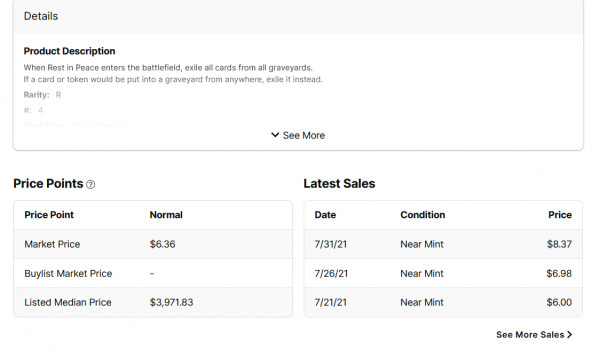
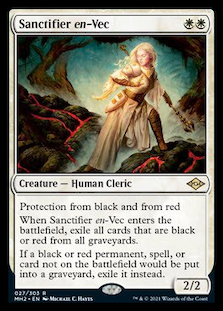 I like Sanctifier en-Vec. However, players have taken to playing it instead of Rest in Peace in decks that formerly ran Rest. The thinking is that all the cards that most decks want to exile are red, because they're thinking of Dragon's Rage Channeler decks. Having a protection from red creature is really good against those decks, so Sanctifier does the job of Rest and Auriok Champion, freeing up sideboard space. The catch is that Sanctifier doesn't actually answer Dragon's Rage Channeler because it can't exile artifacts, lands, or blue cards. And that's not even considering white and green decks.
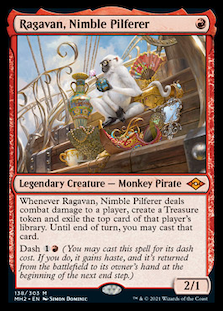 The most hyped red one-drop from MH2 was Ragavan, Nimble Pilferer. The most played one has proved to be DRC. It may be this hype and the dream of stealing opposing cards which has led many players to run Ragavan in decks that cannot support him. And Ragavan needs a lot of support.
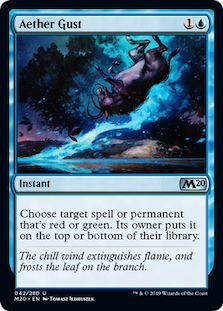 It was watching a UW Control deck Aether Gust a Primeval Titan three times and then die once it resolved that got me thinking about overplayed cards in the first place. Gust is a tempo card that somehow mostly sees play in non-tempo decks, primarily control decks. Which want to permanently remove things, not delay them to be answered again. Were Gust seeing play in UR, there'd be no problem. But it's the high control play that earns Gust it's spot.

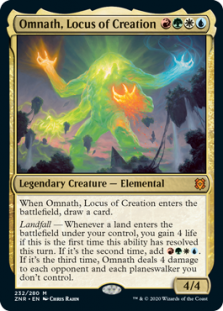 MTGO, you have a problem. You have no demonstrated ability to focus. You just swing wildly and alarmingly between whichever deck strikes your fancy, use it up, and immediately discard it in favor of the Hot New Thing. It's happened three times this year so far, and is happening again. In the
 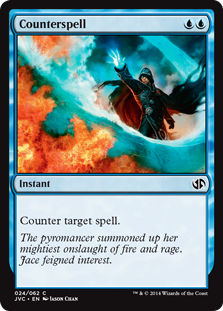 How easily does the card achieve a desired end? Not every card is equally effective at all tasks. If there's ever a card that actually does everything at a good price it will hopefully be banned. What I'm looking at is how well the card does whatever it's meant to do. For example, Counterspell rates very high as a general-purpose answer (the point of Counterspell), but very low as a win condition (it's just not a win condition).
 First up is the earliest and most definitive Go-Away-Artifacts card in Magic, Shatterstorm. Both
 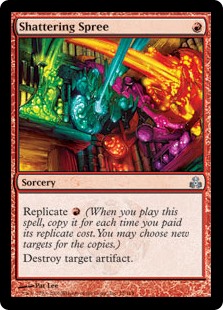 Shatterstorm does exactly one thing: sweep the board of artifacts. This is only relevant against decks that flood the board with artifacts. There are quite a few of them right now, but it's not universal. Against many deck with few artifacts, such as Eldrazi Tron, decks are better off with Spree since it's far cheaper.
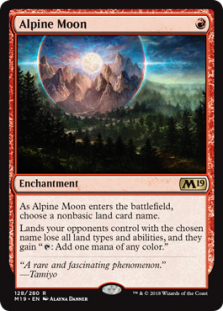 There are
 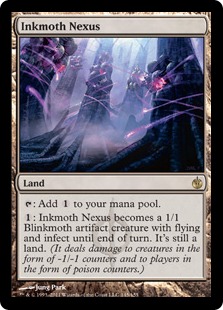 The cards a specifically mentioned see play in many decks. However, almost every deck has some land that's worth naming with Moon: Inkmoth Nexus, Fiery Islet, manlands, and utility lands are everywhere. It's not always necessary to Moon every deck to win, but the fact that Moon has value against the vast majority of decks gives it huge versatility points.
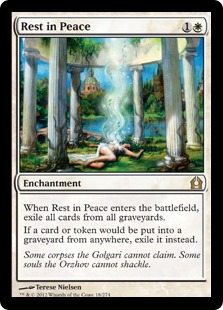 This is Modern. The graveyard is an
 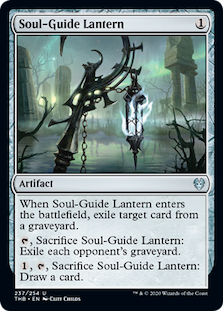 There are a lot of decks which Rest is very important against. However, there are plenty of others against which Rest has no utility. Not every deck has graveyard synergy, and some that do have so little that Rest is overkill and Soul-Guide Lantern is more appropriate.
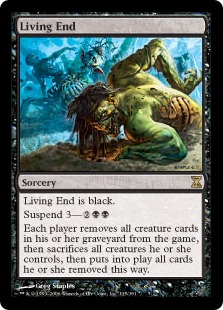 As mentioned, it is very strong against the cascade decks. They see a lot of play and there are a wide variety of them. It is also very effective against the numerous UR Channeler decks that have been the everywhere. It's even strong in multiples, as a Chalice on zero stops cascade spells and Mishra's Bauble and another Chalice on two stops all the maindeck answers to Chalice in those decks.
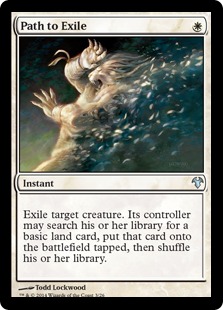 Why is it that Path is seeing
  The only decks that don't have creatures that you want to Path are some control lists and Ad Nauseam. That's not enough to worry about, but the bigger concern is that Path does ramp opponents. This is a large part of its drop off since one mana creatures are seeing more play now than before. However, this is balanced for me by instant speed, equivocality, and price.


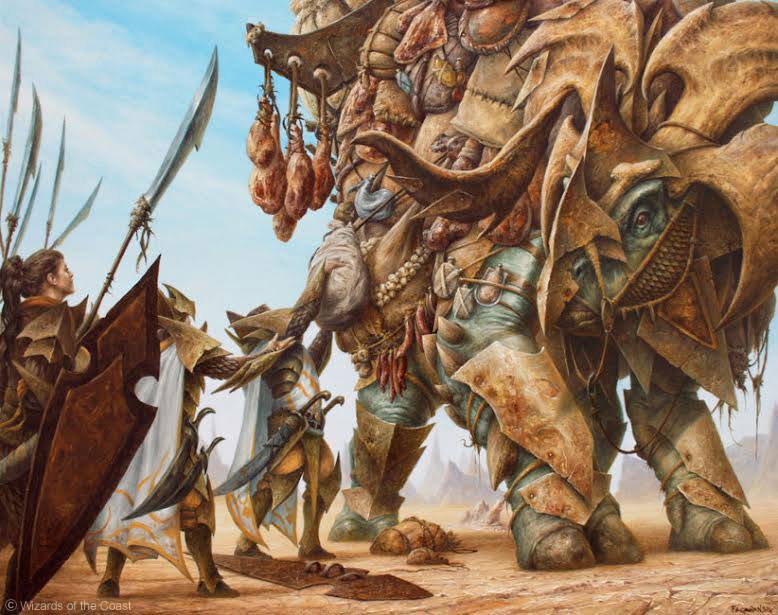


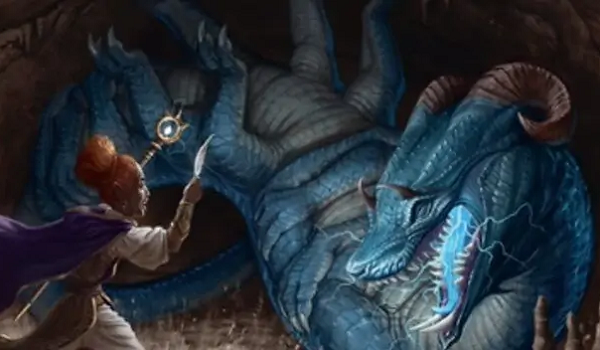
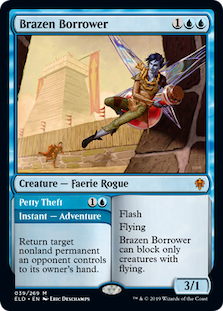 However, it's also a weird set power-wise. There are some potentially very strong cards and interactions, but nothing on Throne of Eldraine's level. Which also makes sense; Wizards did get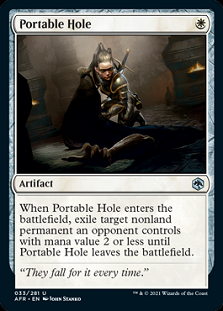
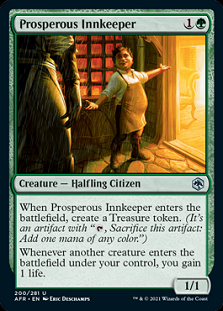 However, they were spoiled before MH2 was. And that set killed their playability. There is no reason for 99% of decks to run Hole over Prismatic Ending. Ending is forever, but a hole is escapable. It's just a cheap Banishing Light in a format where Assassin's Trophy and Abrade saw considerable play and now Ending is everywhere. Ending also scales to hit more things than Hole. Hole
 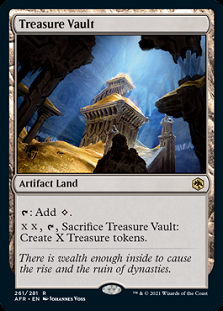 The biggest potential winner form AFR are artifact decks. I'm sure exactly which artifact decks, but the highest concentration of playable cards are all artifact synergies. I've already mentioned Portable Hole, but the card that I think will see more adoption is Treasure Vault. Between the ETB tapped artifact lands in MH2 and now the untapped Vault, I'm suspicious of Wizards testing the waters ahead of unbanning the original artifact lands. I've never been clear why they needed to stay banned once Krark-Clan Ironworks was banned, but we'll see. Vault is an upgrade on the MH2 artifact duals only because it enters play untapped. Power Depot is seeing play in the
 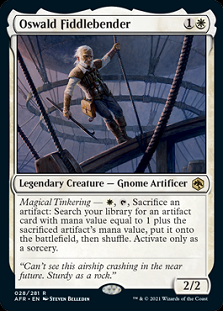 on a lot of AFR cards, so it looks like they've finally started taking the potential for abuse seriously.
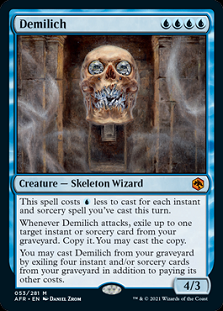 This card actually worries me. On face, a four mana 4/3 that has to attack to mimic Snapcaster Mage is not Modern-playable. However, the same could be said of a 3/2 flyer with haste for four, and Arclight Phoenix was the
 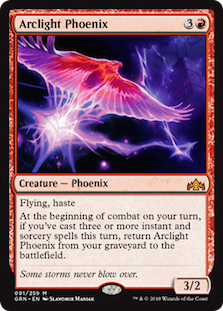 It's the first clause of text that makes Demilich Modern playable. In a typical Prowess or Storm turn, Demilich is actually free to cast, even from the hand. Casting Arclight always costs 3R. And free is always dangerous. The question is whether this danger is theoretical or real. Best-case scenario: a turn 2 'lich off two Manamorphoses. That's harder and less aggressive than casting Stormwing Entity, which tells me that Demilich isn't a Prowess card. Storm is a possibility, but attacking really isn't Storm's thing except in emergencies. Which suggests that Demilich could be a sideboard card for when the combo fails.
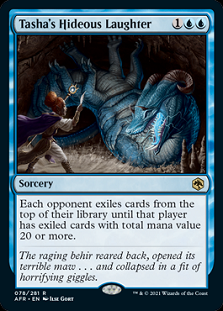 On the subject of AFR cards already seeing play, Tasha's Hideous Laughter has replaced Mesmeric Orb in
 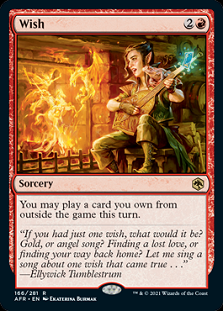 The last card is also the most speculative. There's never been a wish this broad before. Appropriate really, since Wish is as definitively and broadly named as possible. Which again makes sense since it's from D&D and predates the Magic wishes. While normally this would open a wide range of possibilities for almost every deck to exploit, Wizards seems to have considered that and Wish works differently from other wishes. All the other options place the wished-for card into the hand to be used whenever. With Wish, the card must be cast in the same turn. No sandbagging, no stockpiling value; just get a sideboard card and cast it the same turn. This is balanced somewhat by Wish never specifying the card that must be played, so the caster can revaluate their choice if something happens after Wish resolves.
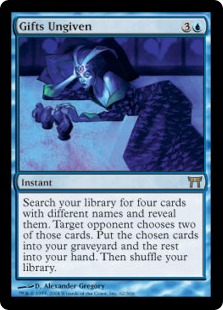 However, the requirement of casting the card in the same turn puts a lot of strain on the manabase for most decks. Especially since Wish costs three. That's a huge burden for aggressive decks and is no small problem for control. Combo, particularly Storm, is the only strategy that may want to Wish and will have the mana left over to cast the card and likely follow up to win. Wish also has an advantage since it costs less than current staple Gifts Ungiven. Still, I'm not a combo player, so we'll have to wait and see how this plays out.

 Every metagame update has its own weirdness. June's is high volatility. Again, Modern Horizons 2 released and with it came a flood of cards that are
  This is one of the lowest baselines ever at 1.43. Which makes sense given how many decks were in the overall sample. When most decks only earn one point, the average will be very low. Keep that in mind when considering how many decks are above the baseline this month.