menu

Screaming Muses, Like Monster Trucks | CommanderCast S2E11

Are you a Quiet Speculation member?

If not, now is a perfect time to join up! Our powerful tools, breaking-news analysis, and exclusive Discord channel will make sure you stay up to date and ahead of the curve.

This week Andy hosts the entire Muse Vessel from http://musevessel.wordpress.com/ in another edition of CommanderCast. Instead of the usual "women alluring you to ruin with their singing" stuff, these muses are here to entertain and inform you about EDH. We're talking about how many decks to bring to a gaming session, Balancing vs. Bandwagoning, and of course Muse Vessel Secret Tech. Also be sure to check out http://commandercast.blogspot.com/ for additional content including videos, articles, and information on how to join our call-in episode next week.

Can't use the Flash player? Try the direct download of the cast here!

Somebody’s About to Get Fired

Are you a Quiet Speculation member?

If not, now is a perfect time to join up! Our powerful tools, breaking-news analysis, and exclusive Discord channel will make sure you stay up to date and ahead of the curve.

In case you are somehow unaware, the entire New Phyrexia set has been spoiled. Someone who was trusted enough to receive a "godbook" from Wizards has violated their trust (and non-disclosure agreement) by first posting a couple of screenshots to make themselves nice and traceable, and then by uploading a PDF of the entire visual spoiler. In short, someone's out of a job.

I'm not here to discuss the cards in the set yet, although I must say that on the whole the set seems incredibly powerful for constructed, fun for tournaments, and full of gorgeous artwork. Instead, I'd like to discuss the implications of spoiling an entire set at once and the winners and losers in this entire ordeal.

Loser: Wizards of the Coast writers. Preview weeks are just starting, yet now we have the entire set. This means that we're about to have 2 weeks worth of articles that no one really cares about.

Sure, people like myself will still be interested in Mark Rosewater's design stories. Others will anxiously await Mike Flores's traditional overhyping of cards that almost invariably don't pan out. For the most part, however, people won't care, site traffic will be down, and the writers will feel completely robbed.

Rumor season is an awesome time, and it's something everybody likes to be a part of. I've had the privilege of spoiling a few cards in the past (unofficial spoilers, of course. I could never get Wizards to get on board with "Dr. Jeebus's explicative-laden preview card extravaganza...punch and pie.") and it's a lot of fun. Having that opportunity taken away from you would just suck.

Winner: StarCityGames, et al. Online retailers have taken to preselling cards as they were officially spoiled. With the entire set spoiled weeks ahead of schedule, this gives them the opportunity to have a few extra weeks of presales.

If you're unaware, presale prices are almost always inflated and start to drop the day of the prerelease when people actually have cards in their hands instead of worrying that they will never see another piece of cardboard again.

Loser: Brick and mortar stores. Yup, we're boned. People have a lot of extra time to preorder the cards that they want to buy instead of buying them from us. Also, rumour season generates excitement, and that excitement translates into sales.

With the entire set already spoiled, however, the excitement is going to fade. Fast. By the time the set is released, the honeymoon will be long over, people will have had time to think about the set at great length and figure out exactly what half dozen cards they want, and may have already gotten impatient and ordered them online.

Loser: Whoever spoiled this. It won't take long for whoever spoiled this to be caught. The full screenshots they posted have some pretty incriminating evidence in them, and if they haven't been fired yet, they will be caught and fired soon.

Winner: Dr. Jeebus. Writing a full set review is a pain in the ass. The tight lid that Wizards had been able to keep on unofficial spoilers only made this task even more difficult by giving me approximately 24 hours (10 of which I would be at work) to write an entire set review and get it posted before the prerelease. I now have plenty of time to do a full, well thought out review before the prerelease.

Winner: Top tier deck designers. Grand Prix Providence is two weeks after the set is released and GP Singapore is the following week. While there was already a decent amount of time for people to design and test decks for these events, that time has now been doubled. Instead of someone potentially showing up with an innovative deck that is discovered to be running a sub-optimal list, there is now the time to test extensively and have a finely tuned new deck for these events.

So what do we draw from all of this? I have to say that the only reasonable conclusion from this information is that this is a huge blunder on someone's part, and that this sort of behavior should be discouraged.

In terms of business,  StarCityGames winning out over brick and mortar stores is bad for the long term health of the game (Notice how Wizards keeps doing things to try to help out those brick and mortar stores?).

In terms of writing, anything which is somehow good for me and bad for Maro has to not only be awful for society, but will also somehow wind up being terrible for me anyway.

Besides, are you even excited anymore? I was extremely excited when the set was spoiled because I got to read about it. In the days that have followed, that excitement has disappeared. It's agreed that the set is extremely powerful with some cards that may even be broken, but, with the exception of Mental Misstep, no one seems to have much to say anymore. I honestly wouldn't be surprised if this affected Prerelease numbers as well, but I guess only time will tell.

The moral of the story: If you have the opportunity to spoil a ton of cards unofficially, take your time. We may find it exciting at first, but if you blow your load in the first few minutes we'll all wind up very disappointed in the end.

Dr Jeebus

Dr. Jeebus is the most electrifying man in intellectual sports entertainment. He has been playing all forms of Magic since early 1995, and was recently voted the angriest Magic personality on Twitter. Though Jeebus does not have the time or money to go pro, but he's still really good and understands both the intricacies of play and of design, so you should listen to him. His notable accomplishments include beating a pro player so severely as to make him cry while at the age of 13, and defeating 5 multiplayer opponents using a single Thoughtlash.

View More By Dr Jeebus

Posted in Feature, Finance, FreeTagged 9 Comments on Somebody’s About to Get Fired

Have you joined the Quiet Speculation Discord?

If you haven't, you're leaving value on the table! Join our community of experts, enthusiasts, entertainers, and educators and enjoy exclusive podcasts, questions asked and answered, trades, sales, and everything else Discord has to offer.

Want to create content with Quiet Speculation?

All you need to succeed is a passion for Magic: The Gathering, and the ability to write coherently. Share your knowledge of MTG and how you leverage it to win games, get value from your cards – or even turn a profit.

Mental Misstep Leads to Record Low Tide

Are you a Quiet Speculation member?

If not, now is a perfect time to join up! Our powerful tools, breaking-news analysis, and exclusive Discord channel will make sure you stay up to date and ahead of the curve.

It’s no surprise by now that the full set of New Phyrexia has been leaked. While I feel sadness for the people who would have had sweet preview cards and exclusive spoilers on their sites, it’s time to start planning our trades based on all the information available. Hopefully, some of you are using the tools we discussed last time to breakdown what you expect certain cards to sell for a couple months after the release, and on through their Standard lifespan. The card we’re looking at today, is Mental Misstep, using the tools from last time, I’m estimateing around $3, do you agree? The value of Mental Misstep is not what I want to look at though. I want to look at Mental Mistep, and how its going to shake up the Legacy pricing across the board.

Legacy, as we all know, has been shooting prices through the roof as a result of a huge demand increase, likely tied to the Star City Games Open Series. Availability of staples is low, while other decks simply need rares from sets that have extremely low print runs. Making a prediction of what cards will climb in value is usually how we grade our financial information suppliers, but knowing when a card is about to drop severely is also crucial. If you own these cards, you should be selling them, and picking them back up again once the price goes down. As a result, you’ve got the same collection at the end, but some extra dollars in your pocket. In either case, these are the safest plays to make, because these cards certainly won’t be going up any more than they already have. So let’s get to it, and identify the cards that are going to see a decline due to one simple card.

In this format, threats hit the board early and often, and a counterspell that hits early combo pieces and cheap threats is crucial, especially when any deck can play it. For reference, let’s look at the card in question. (Note: These cards are unofficially leaked, and we’re working with cards we presume to be accurate)

Mental Misstep - (P/U)
Instant
(P can be paid with either U or 2 life.)
Counter target spell with converted mana cost 1.

Now that’s a counterspell! It’s castable in any deck, for no mana, and hits a lot of relevant spells. Let’s look through some recent top 16 decklists from Star City Games open, and see what lists and cards are going to take a hit. One thing to keep in mind, is a Misstep can counter another Misstep, so while it may hose many cards, it can also be used to protect yourself from your opponents Missteps.

First and foremost, High Tide decks. Every combo deck has its day in the sun, but the sun always sets due to answers being discovered or printed. High Tide made up three of the top 16 slots in the most recent Star City Games open, two of which were in the top 8 and of course one of those was the tournament winner. While Misstep counters the actual namesake card, High Tide, it isn’t an expensive piece of that combo deck; however, Candelabra of Tawnos, also costs 1 and is a very expensive puzzle piece. Time Spiral is also in this deck, and while it can’t be countered by Misstep, it will take a hit in value as this deck’s playability is certainly put into question.

Candelabra itself is the most notable card to look at in this deck. It currently sits around $200, but had been comfortably sitting around $50-60 for years. This gives an idea of the potential range of the card. It’s collectability due to being an Antiquities rare, will keep it at the 50-60 mark regardless of what happens as an absolute low. High Tide is taking the biggest hit of all the decks because two of the key cards are squashed by this new counterspell. As a result, I really see the playability of this deck dwindling back to the fringe areas, and the value of Tawnos falling down close to where we once saw it only a few months ago. It may maintain some value as some people will simply be too stubborn to put the deck down after investing so much. It may take some time, but this card will come back down to earth, and dumping yours now, to replace them in six months to a year is a really wise move. That is of course, if you even still want them. Hopefully those of you who jumped on the opportunity when Doug emailed all the insiders about Candelabra, can cash in at the peak. The other card of note here, is Time Spiral. Retailers are selling this card for more than $30, and have tons in stock. I’d expect this card to come down to at least $20, if not more.

Next deck(s) I want to look at is all the “tribal decks”, I mean Elves, Goblins, and Merfolk (Oh, my!) Both Goblins and Merfolk run Aether Vial, which Misstep would love to counter (and likely will). Vial is currently a $15 uncommon, and most vendors have their fair share of stock. It’s likely people are going to move away from Aether Vial decks to some degree, and this price is likely to come down. Star City Games currently has over 300 copies in stock for sale between $15-17. I’d expect this card to come down to the $10 range. Other 1 drops that are key to these decks are: Goblin Lackey, Glimpse of Nature, Nettle Sentinel, Cursecatcher among others. As a result, these decks should become slightly cheaper overall to build, as people move away from strategies that are being hammered by the Misstep. There may not be a big enough price change to sell them off, and pick them back up at a notable profit later, but if you’re considering building it, I’d wait to see how prices settle after a few months.

Zoo fits in to this category too. The deck runs tons of one drops, like Kird Ape, Loam Lion, Grim Lavamancer and Wild Nacatl. Not to mention 1CMC utility spells like Path/Plow, Bolt, Chain Lightning and more. While countering a single one of these spells isn’t devastating to the deck, the fact that any deck can run Misstep and counter a good portion of the deck with it, is certainly notable. The G/W and Bant aggro decks are going to be a bit more resilient due to the fact that most of the creatures are 2 and 3 drops, and offer card advantage or disruption to coincide with the higher casting cost.

Then there are some decks that are totally unphased. One such deck is CounterTop, while Misstep can counter the Sensei's Divining Top, the deck has a suite of spells to help protect it. Outside of the top, it only really has tutors as a target, which can serve as Misstep bait. If nothing else, I’d see a rise in this deck, which could see some of its main pieces climb a bit, but probably not too much.

The other deck in this category I want to touch on is Dredge. Dredge is known as the cheapest viable deck in the format. It’s also nearly unaffected by the new “hottest” counterspell in the format. It does have some targets in it (Cabal Therapy and Breakthrough), but in reality not many cards in the deck sell for much more than $5, and that’s unlikely to change.

If you’re already a proud owner of the pieces for High Tide, get out now. At worst, you’ll be buying back into it at little to no change in price. At best, you can get back into it after Candelabra comes down $100+. Tribal decks are a hold at the moment, but those that want to buy into one should probably wait for some price changes to occur, while Dredge and Countertop are probably a good place to be buying right now, if you needed a deck today.

In closing, I do want to mention, that some of the high dollar staples are not affected by this printing. Especially the Dual Lands, they are in such low availability that their current pricing should be fairly stable, and the same can be said for Force Of Will. While these may have shot slightly past their equilibrium price, I wouldn’t expect them to come back down too much. Another in this category is Wasteland. If you're trying to get into Legacy, these cards are hard to find, and will hold their value for years to come.

Also, big thanks to my twitter followers who all had great suggestions for a title. This one came from @rwildernessr.
Follow me on Twitter @torerotutor
Check back in two weeks, where I return to my model of evaluating cards to break down some of the new Mythics and Rares in New Phyrexia!

New Phyrexia Review

Are you a Quiet Speculation member?

If not, now is a perfect time to join up! Our powerful tools, breaking-news analysis, and exclusive Discord channel will make sure you stay up to date and ahead of the curve.

Howdy everyone! What an exciting week! The "Godbook" was released and we got ourselves a full spoiler a week before the season even started! Not gonna lie, that made this week's article really easy to write. I am going to touch upon a few of the cards spoiled (the all-stars really, and some pretty good rookies with some potential) and tell you what I think they will do.

Batterskull 5
Artifact – Equipment (M)
Living weapon
Equipped creature gets +4/+4 and has vigilance and lifelink.
3 : Return Batterskull to its owner’s hand.
Equip 5

Man, this card is a beating already.  I think you are going to see a 3-way battle between this guy, the Sword of Feast and Famine and Sword of War and Peace for the spot opposite of Mortorpod in Caw-Blade.  Presales have this at $20, and I am inclined to see it over between $15-$20 while Stoneforge is around. Who knows what will happen to all this equipment prices when the mystic rotates but until then this guy is going to put a serious damper on any aggro deck.

Sword of War and Peace 3
Artifact – Equipment (M)
Equipped creature gets +2/+2 and has protection from red and from white.
Whenever equipped creature deals combat damage to a player, Sword of War and Peace deals damage to that player equal to the number of cards in his or her hand and you gain 1 life for each card in your hand.
Equip 2

So, we swing, hit the opponent for some amount and then immediately kill their planewaslker? Seems really good. The "good" problem to have is what effect is swingier? Sword of FaF or this guy? I am giving the slight edge to this guy since it battles through Squadron Hawks and stops bolts and condemns. Card should stay in the same range as Sword of Feast and Famine for the rest of the summer.

Hex Parasite 1
Artifact Creature – Insect (R)
x(P/B): Remove up to X counters from target permanent. For each counter removed this way, Hex Parasite gets +1/+0 until end of turn.
1/1

This guy is real interesting, I just don't know how interesting. At this point it is determining which planeswalker killer is better: the Sword, Beast Within, or this guy. Vampires will for sure love this guy. They Jace, and then just die the next turn. Same with the red decks.  Probably be around $5 for awhile and then settle down to $3 eventually, kind of like Phyrexian Revoker, except this one should actually work.

Myr Superion 2
Artifact Creature – Myr (R)
Spend only mana produced by creatures to cast Myr Superion.
5/6

All I have to say is: Aether Vial much? Probably stay low for a bit unless something stupid comes out in type 2 that makes this guy just become the next cheap giant creature.

Mental Misstep (P/U)
Instant (U)
Counter target spell with converted mana cost 1.

Card is good. "Free" spells are dangerous. Countering all sorts of one drops has real potential, especially in the older formats. I would see this thing being in the $5 range to start, dropping down to $2-$3 while the foils will be in double digits for the Vintage players loving this card.

As for the rest of the set, tons of casual goodies. Grab as many giant creatures in foil as you possibly can. These are the cards that are worth several times more than their non-foil version based on their appeal to the EDH crowd.  There are tons of good cards in the commons and uncommons, so I see this set shaking things up. Old cards will find new uses and prices will change all across the board. The next few weeks should be very exciting.

Contact
E-mail: tennis_stu_3001@hotmail.com
MOTL/MTGO: stu55
AIM: stoopskoo15
Store: The Vault- Greensburg, PA

Posted in Finance, Free Insider1 Comment on New Phyrexia Review

Have you joined the Quiet Speculation Discord?

If you haven't, you're leaving value on the table! Join our community of experts, enthusiasts, entertainers, and educators and enjoy exclusive podcasts, questions asked and answered, trades, sales, and everything else Discord has to offer.

Want to create content with Quiet Speculation?

All you need to succeed is a passion for Magic: The Gathering, and the ability to write coherently. Share your knowledge of MTG and how you leverage it to win games, get value from your cards – or even turn a profit.

Making the Right Play

Are you a Quiet Speculation member?

If not, now is a perfect time to join up! Our powerful tools, breaking-news analysis, and exclusive Discord channel will make sure you stay up to date and ahead of the curve.

[Editor's Note: I'm pleased to welcome, yes, the third new Commander writer for Quiet Speculation! Robert will handle further introduction below but I hope you'll find time to squeeze all three of our new faces into the mix. Enjoy!]

Welcome to my new column here on Quiet Speculation. Stay a while and listen! (Bonus points for those who get the reference.)

A Few Facts about Me

  • I’ve been playing since Fallen Empires with no breaks
  • All except 2 years of that has been focused on multiplayer, whether the standard 4-of, 60 card deck format (hereafter referred to as 4/60 multiplayer) or Commander (EDH)
  • I enjoy every aspect of Magic, and build decks that do pretty much everything

What I Plan to Write About

  • My experiences with Commander (EDH) and how you can apply it to your play
  • Game theory as it applies to Commander
  • Multiplayer politics and how to work with your group
  • Commander reviews where I talk about a particular commander (or several similar ones) and discuss strategy
  • Individual card discussions (this includes set reviews, looking for diamonds in the rough, and anything else interesting that comes to mind)

Today I’m going to talk a little about game theory, and a little bit about math.

Eww, math.

Yeah, for the most part, I share your sentiments.

On the Subject of “Overpowered” Creatures

Commander is the format of haymakers. Playing Commander means casting spells that have a converted mana cost of 7 or 8 without even blinking an eye. We like our spells big, and we like them to have a correspondingly large impact on the game. Creatures that are good enough in the land of board sweepers are often so over the top that they require an immediate response (which perpetuates the board sweeper proliferation, but that’s a topic for another article). Today I’m going to look at the best ways to deal with threats like these as opposed to the way they typically get handled.

But you can just Control Magic them and then you get all the value, right? Blue makes everything better!

Not necessarily. Sometimes trying to use someone else’s stuff just puts you farther in the hole.

Wait, what?

Let me explain.

When the Right Play is the Wrong Play

When faced with a big threat in multiplayer, oftentimes the first thought that people have is “How am I going to deal with that?” This in and of itself is not wrong. The problem is the solution that many people pick.

Say one of your opponents (we’ll call him Jim) drops a Primeval Titan and gets a Volrath's Stronghold and some other busted land. You have a way to exile the Titan or take control of Jim’s [card Primeval Titan]Prime Time[/card], let’s say Swords to Plowshares and Control Magic, in hand and can play either. What’s the Right Play ™?

Many players (in fact, most of the ones I’ve met) will tell you the right answer is to steal the Primeval Titan and start attacking with it to get triggers out of it. It seems like a good idea, right? Getting free lands while you attack someone with their own threat looks like a good idea. It’s not quite that easy, though.

As I mentioned above, Jim fetched a Volrath's Stronghold with his Primeval Titan trigger. This suggests he’s planning on reusing his creatures to some degree, and there are very few creatures more potent to abuse with enters the battlefield (ETB) triggers than Titans. If you play against Jim regularly, you probably know he has a lot of reanimation effects in his deck.

Commander is the format of board sweepers, so it’s likely that Primeval Titan is going to be dead shortly. At that point, Jim can happily reanimate it using one of the other cards in his deck, or just by using the Volrath's Stronghold he already tutored up. Effectively, you turned your Control Magic into two non-entwined Reap and Sow, or nothing but a tempo loss for Jim if you don’t actually ever get to attack with it. You could Swords to Plowshares the Titan in response to the sweeper, but then you’re spending two cards instead of one. Despite the potential upside of stealing the Titan, you’re going to be better off exiling it now, while you have the chance, rather than waiting until later in hopes of getting a better payoff since it’s highly likely you’ll need to do it anyway.

The problem is there was a basic fallacy in our initial assumption: you assumed that someone won’t steal the Titan from you or kill it after you’ve spent the card to take it from Jim before you get some value out of it. The problem is, with a multiplayer situation, this is much more likely to occur than to not occur, and the ideal time to do it is before you get anything out of it.

For those of you familiar with the concept of the Danger of Cool Things, “stealing the big threat rather than exiling it” is a prime example of that issue. Stealing a Primeval Titan and getting the triggers out of it is exciting! It’s a very powerful card with the potential to break the game wide open! Why wouldn’t I want to try and steal it?

By not exiling it immediately you’re giving Jim the ability to abuse it again later, requiring you to use more cards to answer it again later. Jim will, almost without a doubt, have more ways to abuse the cards in his deck then you will have ways to abuse the cards in his deck. Even if you can get something out of stealing one of your opponent’s creatures, you’re most likely better off putting it somewhere where they can’t abuse it (graveyard, exile, shuffled into library) than leaving it on the battlefield. Considering how the rules of card advantage change in a multiplayer situation, your best bet will be to use the fewest cards possible to answer problems.

The “stealing it is better than exiling it” thought process leads to several things. First, you end up with banning discussions and in some cases actual bannings (Kokusho, the Evening Star says "Hi!") that are unnecessary. People lose to a powerful card because they didn’t play the appropriate removal spell and then get angry. Second, it creates what many people consider an unfun board state where a single card becomes the complete focus of the game, which is incidentally the reason most often cited for [card Kokusho the Evening Star]Kokusho[/card] being banned. Rather than pass the threat around the table, everyone would be far better served by cutting their losses and exiling the card.

So what does all this mean for me when I go to construct a shiny new Commander deck (or update an existing one)?

Picking the Right Tools

Now that we have the basic ideas of risk vs. reward down, we can distill that into some guidelines for deck construction. In general, you need to play ways to exile troublesome cards and play ways to get your own troublesome cards back.

Starting with ways to exile cards, you have a few different options. If you’re in white, there’s many ways to exile pretty much anything short of lands. Swords to Plowshares and Path to Exile are the all-stars for targeted creature removal, and you also have access to exiling sweepers like Final Judgment. Return to Dust is an excellent card for dealing with shenanigans regarding enchantments or artifacts.

Blue can exile as a bonus following a counterspell with spells like Dissipate and Counterbore, but is generally light in the exile arena. Black is the king of removing the cards before they become a problem with effects like Sadistic Sacrament (often referred to colloquially as Cap effects, after the Original Gangster of this effect, Jester's Cap). Red has a few removal spells that will exile a creature (Disintegrate) or artifacts (Into the Core).

Green has no real way to exile things while they’re on the battlefield, but they do have a few ways to exile from the graveyard (Night Soil) or put them back in the deck (Deglamer). The occasional artifact can also do the job (Brittle Effigy).

Another often overlooked way to exile things is to play graveyard hate. Most decks play significant amounts of recursion to reuse their powerful effects so having ways to exile them from the graveyard should be a consideration for every deck. Thankfully, artifacts really lead the way in this category, with green and black having very strong options as well. Just because you can’t deal with it on the battlefield doesn’t mean you can’t get rid of it once it’s in the graveyard.

For getting your own troublesome cards back, it’s entirely dependent on what type of permanent you happen to need to reuse. Green has the most versatile recursion effects, black is the best at creatures, blue and red work instants and sorceries, and white can cover artifacts and enchantments.

Stealing is bad…Or is it?

I bashed on Control Magic effects (or steal effects, pick a term of your choice) quite a bit. The truth is, while they potentially have a lot of upside, they can potentially hurt you as much as they help. Enchantment-based versions are choice targets for enchantment removal. Non-enchantment based versions are still weak to bounce, which normally would let you replay your own beater, but in fact gives it back to your opponent if you stole something. There’s also the occasional silver bullet like Brooding Saurian which can ruin your entire plan.

Really, the steal effects that tend to be effective are the ones that also cheat mana cost in a similar vein to Tinker. Bribery is a prime example because it lets you steal your opponent’s biggest creature and put it directly onto the battlefield. Steal effects also tend to generate a lot more frustration and enmity from your fellow players than simply destroying the creature would, so keep in mind when trying to maneuver at a multiplayer table.

A little from column A, a little from column B

I hope you found all this information about selecting and using your removal an enlightening experience. Always remember to use your weapons the right way the first time. I'm looking forward to feedback on this article so I can give you more of what you want in the future; speak up in the comments!

The cost of Legacy – how we got here, where we’re going, and why it matters

Are you a Quiet Speculation member?

If not, now is a perfect time to join up! Our powerful tools, breaking-news analysis, and exclusive Discord channel will make sure you stay up to date and ahead of the curve.

We’ve got all of New Phyrexia spoiled, and the response has been quick. The entire set was spoiled on Tuesday, and by Wednesday there were multiple columns devoted to it already, including on this very site. It’s pretty nice to see such a quick response from the community, though I do echo the sentiments of many who say they wish we could wait until the prerelease to actually see the cards.

I promise I’ll get to the spoilers in the next few weeks, when I make my official calls on the new cards. But this week and next, I want to look at a different hot-button issue with the community right now – The explosion of Legacy prices. Rather than turn this into a rant like so many of the articles about it I’ve seen, I want to trace the problem to its roots.

The goal of this is two-fold. First off, this week I’m going to look at how we got here, this will serve to catch everyone up who has caught only bits and pieces of the debate (or has no idea what I’m talking about). And next week, by establishing the pattern that led us here, we can hopefully use it to track similar patterns in the future, allowing us to foresee a coming price spike, and therefore profit from it.

Let’s start at the beginning.

Dec. 11, 2009 – Star City Games begins Legacy Open series

The first Open weekend that started it all. Pat McGregor takes down the title with Aggro Loam, while Owen Turtenwald takes second with Lands. 12 Force of Wills litter the Top 8 of the tournament. Force averages a price of $21 a copy on Ebay. Star City will go on to host 15 Legacy Opens in 2010, setting attendance records along the way.

Feb. 5, 2010 – Worldwake is released on the market

While this doesn’t directly impact the Legacy market, the printing of Jace, the Mind Sculptor and its subsequent rise to unparalleled prices ignite interest among the Magic community for “beating the market” to a card in order to save money.

February 2010 – Kelly Reid and Jon Medina examine the trend of Legacy prices

In this article, Kelly Reid examines prices of Legacy (and Extended) staples such as Tarmogoyf, which had begun to climb in price (‘Goyf was fetching $100 from major sites at the time). Dubbing cards like ‘Goyf and The Tabernacle at Pendrell Vale the “New Power,” (an idea I revisited here). Medina also uses his blog MtgMetagame to advise investing in Legacy. Kelly and Jon are the first to publicly identify the rising tide of Legacy and suggest investing into the format. By this time, Force had climbed to nearly $30 apiece on Ebay.

April 29, 2010 – Jon Medina starts “Pack to Power”

With Force of Will now quietly up to $36, Jon Medina introduces the Pack to Power series on ManaNation. The quest to trade from a Bear Umbra to a piece of Power 9 fascinates the Magic community and turns Medina into an MTG financial star almost overnight. A whole new group of Magic players (including this author) begin to become more heavily involved in “value” trading, creating a previously unprecedented audience for Magic-related financial content.

July 2010 – DoublingSeason.com launches

Capitalizing on the success of Pack to Power and Kelly Reid’s personal finance blog Quiet Speculation, Kelly, Jon, Doug and a group of other like-minded writers launch Doubling Season, the first website to focus exclusively on financial content. Catching onto the trend, Star City Games quickly hires Medina away from DS and includes him in their premium content. Other major sites such as Channel Fireball quickly follow suit and increase financial coverage. This leads to the closure of DS and the formation of the modern Quiet Speculation. Prices of Force of Will and Wasteland are up more than 25% since January.

August 1, 2010 – Tomoharu Saito wins Grand Prix: Columbus

With demand for Legacy staples already growing, Saito takes it to the next level by taking down a field of 1291 players at Grand Prix: Columbus with UB Merfolk, of course rocking four Forces. The event solidifies the demand for Legacy inside the United States. Another result from Columbus is the appearance of Caleb Durward’s UG Madness deck, also known as Survival Vengevine. The deck exploded in popularity after the event, creating the first major run on a Legacy card, pushing Survival of the Fittest from $15 to $40 over the course of a few months. The deck’s ubiquitous appearance in future Legacy Top 8s eventually leads to its banning.

December 2010 – Star City Games hosts $50,000 Invitational and announces 2011 improvements

The force that was the Star City Games Open series culminated in a $50,000 tournament to end the year, firmly establishing itself as a Series for everyone in the game to pay attention to.

Around this time, changes are made to the Series for 2011 – including additional payouts and double the number of events, making for a total of 30 Legacy Opens in 2011. With more players taking notice of the Series, and more Legacy events being hosted, demand for Legacy cards doesn’t show any sign of slowing down. Force of Will ends the year up more than 50%.

January through March, 2011 – Open Series attendance grows

With the increased schedule of events, some expect attendance at Star City Games Opens to level off. Instead, attendance continues to grow and Star City Games begins to run out of stock on many Legacy staples.

March 15, 2011 – Star City Games updates Legacy prices

Seemingly out of nowhere (to those who weren’t paying attention or reading QS), Star City Games makes major revisions to its Legacy buylists, buying up cards at the prices they were sold for just weeks previous, and other websites soon follow the trend. The move comes on the heels of nearly every financial writer telling their readers they were running out of time to invest in the format at reasonable prices. Force of Will suddenly runs from $45-50 on Ebay and continues to rise. The sudden run-up in prices causes many to ask if the higher prices are real, to which the most influential Magic finance writers (and even I) confirm that the higher prices are here to stay.

April 6, 2011 – Sean Morgan calls Legacy prices a “bubble”

The article that started a firestorm. Attempting to draw parallels to real-world events such as the housing collapse, Morgan predicts the collapse of the Legacy market. The truly interesting discussion comes from the comments section of the article, where most of Morgan’s financial colleagues refute his claims. More importantly, the article draws frank comments about the demand for Legacy cards from SCG Director of Sales Ben Bleiweiss. Force of Will is nearly double what it was a year prior, and Wasteland has almost tripled.

That brings us up to the present. Next week I’ll delve into what we can expect in the future from the Legacy market, and what information we can learn from it besides “Buy Legacy cards now.”

Let me know if you liked or hated this piece and if I missed any important events from the past year-and-a-half.

Thanks,

Corbin Hosler

@Chosler88 on Twitter

Waving to the Horizons

Are you a Quiet Speculation member?

If not, now is a perfect time to join up! Our powerful tools, breaking-news analysis, and exclusive Discord channel will make sure you stay up to date and ahead of the curve.


Last week I wrote about using point removal in Commander, and how Commander doesn’t abide by the rules of regular Magic if you will (that is, card advantage is not king). This week I’ll do the opposite: how do the ways that we have to play Commander relate back to what we like about Magic in general? I can’t really give you objective answers to questions like this one. But I can give you an account of my own experiences and thoughts, so here goes nothing.

I’m a control player. It’s not just that I like longer games (I do), or that I enjoy the security that comes with knowing that you cannot lose (with countermagic, top decks are a lot scarier). It’s more that I enjoy gaining incremental advantages as time goes on due to making a series of correct decisions. I enjoy the feeling that each game is a complex puzzle which I have to solve in order to snatch victory from the jaws of defeat.

My favorite games are those in which I quickly drop to a single life before making the right plays over and over again to inch my opponent out of the game until I’m in complete control. Coming from my Spike side, I believe that this is where the skill comes in; of course every deck takes skill to pilot, but many are more forgiving. With a slow grinding deck playing the whole game at one life, you can’t ever mess up or you lose. I enjoy the challenge, and I enjoy the focus that comes with it. In a game with such a small margin, I can really engage myself completely with the problems at hand and get more engrossed in the game than I could otherwise.

I’ve often expressed this tendency in my tournament decks. When I started playing Standard around the release of Time Spiral, I quickly fell in love with UB [card Mystical Teachings]Teachings[/card] (then known as [card Dralnu, Lich Lord]Dralnu[/card] du Louvre). Chaining Mystical Teachings together to generate card advantage before eventually dropping [card Teferi, Mage of Zhalfir]Teferi[/card] to lock the other player out was my kind of game, and I didn’t stop there. The popular version of the deck wasn’t grinding enough for me, and so after Lorwyn came out, I ran Grim Harvest as a [card Mystical Teachings]Teachings[/card] target to use with Shriekmaw, Mulldrifter, and even Triskelavus. I didn’t just two-for-one a few times; I could do so indefinitely, and never again would I run out of [card Mystical Teachings]Teachings[/card] and [card Think Twice]Second Thoughts[/card]!

Needless to say, I really like to grind.

So when I first heard about Commander and decided to build a deck, it was only natural that I would take the same approach. In fact, in honor of how much I loved that Standard deck, I picked [card Dralnu, Lich Lord]Dralnu[/card] as my general. Now was my chance to build the ultimate control deck! I get forty life to make the format slow and get to play all of the best blue and black control cards in Magic’s storied history? Sign me up! What’s more, I always have [card Dralnu, Lich Lord]Dralnu[/card] on hand for card advantage.

What could go wrong?

It was in playing with this deck that it occurred to me that other people didn’t really seem to enjoy it when I cast Time Stretch and flashed it back; nor did they seem to like it when they knew I had Forbid (with plenty of cards in hand) as well as [card Dralnu, Lich Lord]Dralnu[/card] untapped to flashback the Hinder in my ‘yard. In a tournament setting nobody complained; they were there to win. But as soon as the objective changed to having fun, my playgroup felt free to let me know just how unhappy they were with [card Dralnu, Lich Lord]Dralnu[/card]. So I set the deck aside, deciding to use it only against cutthroat players who ‘deserved’ to have their fun wrecked (a topic for a later article). To replace it, I decided to build a deck that would satiate my appetite for attrition without annoying everybody so much.

Here, I realized the same thing that Mark Rosewater observed in a recent article of his: though it’s illogical, people are more upset, at a more visceral level, when their Craw Wurm gets Essence Scattered than when it gets Doom Bladed. This stems from the fact that people like to be able to accomplish their in game goals, and while ‘attack with Craw Wurm’ is a goal that both spells interrupt, only Essence Scatter gets in the way of your opponent’s goal of ‘casting Craw Wurm’ (part of why land destruction is so unpopular). With this in mind, I resolved to make an attrition based deck with no Counterspells and no Time Walks. This meant, or rather I thought it meant, abandoning my favorite color so I built Shirei, Shizo's Caretaker.

This deck utilizes its Commander with [card Bottle Gnomes]self[/card]-[card Mindless Automaton]sacrificing[/card] [card Thoughtpicker Witch]one-or-less creatures[/card] to slowly grind out advantages and eventually take over the game. The deck certainly wasn’t as oppressive as [card Dralnu, Lich Lord]Dralnu[/card] in the middle of the game, but by late game people were getting fed up with it. Once again, they couldn’t do anything. Even without actually stopping them from casting spells, exhausting everyone’s resources left them with no way to break back in.

This is the antithesis of fun: feeling powerless. People play Commander so that they can enact their favorite game plans, and if I wanted the table to have fun I had to abandon the decks that I loved: the decks that hinder anyone else’s ability to execute a game plan. But I didn’t take [card Shirei Shizos Caretaker]Shirei[/card] apart, it was the epitome of the one thing I loved, even if other don’t like playing against it. However, in playing it I found the spark for a new way to enjoy Magic: Cabal Coffers.

While in tournaments I’d always been a Johnny-Spike, I started my Magic life as a Timmy. The first deck I built myself was a mono green monstrosity filled with nothing but Llanowar Elves and Krosan Cloudscrapers. In the ludicrous amounts of mana I generated with [card Cabal Coffers]Coffers[/card], I rekindled that spark of my inner Timmy. While in tournaments I had always despised doing so because it was too luck based and required no decision making, it was through Commander I discovered that I love to ramp.

A Rant About Why Ramp is so Great

Splashy spells are fun. Even if you aren’t a Timmy, there’s something deeply rewarding about experiencing something that’s much bigger than what you were expecting. Novelty makes things memorable, and the most memorable moments of games are the ones that will be the most rewarding in the long run. Grinding back into a close game is a lot of fun for me during the game, but [card Genesis Wave]Genesis Waving[/card] for 72 is also fun in the moment, and creates a more lasting impression.

Ramp is what makes these plays possible; they wouldn’t be memorable if they happened all of the time, and the biggest constraint on what happens in a game of Magic is mana. Moreover, ramp doubles as a method of alleviating your deck’s propensity for mana screw. Not only does it create more fun moments, but does away with some of the unfun ones. This may not be true for everyone, but I end up feeling worse when I’m short on mana than when I’m flooded, making drawing ramp spells rather than ones that ‘do something’ a net positive in my eyes. Ramp will make the average game more fun, and will facilitate the greatest games you’ve ever played.

What’s not to love?

Back to the Story

I fell in love with ramping into splashy spells by trying to play to the group’s interests (not being disrupted) and looking for something I could enjoy within that sphere. Part of what makes Magic so great is that so many people can enjoy the different aspects of it, and I think that the degree to which the game is entertaining depends upon how much of it you enjoy. Commander is great for learning to appreciate new aspects of Magic. Many facets are legitimate options due to the format’s casual nature, and your playgroup may push you out of your comfort zone.

I hope this piece has given you a bit of insight into what there is to love about Magic in general (and about Commander in particular), but more importantly I hope that it has inspired you to broaden your own horizons. Magic is an incredible game, and no matter how long you’ve been playing I’m confident that you have more joy to discover in it. Let me know what you think in the comments, over email, or in a Tweet.

Jules Robins
julesdrobins@gmail.com
@JulesRobins on twitter
toahaomin on mtgo

Speculating in Phyrexia, Snap Calls

Are you a Quiet Speculation member?

If not, now is a perfect time to join up! Our powerful tools, breaking-news analysis, and exclusive Discord channel will make sure you stay up to date and ahead of the curve.

I had originally written today's article with the intent on looking back through Magic's history at other Phyrexian names cards, and hoping to find some to speculate on last moment before the set was spoiled, but today we got what appears to be the entire set spoiled. Looking through the freshly spoiled set from a so called "Godbook", sadly none of the cards I was looking to speculate on were there. I was rather sad to see that none of the older, cooler Phyrexian cards had made the transition into New Phyrexia. You can find the projective spoiler here on MTGsalvation.

Regardless, we do have a number of rather awesome cards to look at, so I'll try to highlight a few of them, starting with the mythics. I'll be trying my hand at snap calls tonight, so if anything sounds too crazy, please forgive me.

The first of the new mythics we haven't seen yet is:

Jin-Gitaxias 8uu
Legendary Creature - Praetor (M)
Flash
At the beginning of your end step, draw seven cards.
Each opponent's maximum hand size is reduced by seven.
5/4

The blue praetor has a very blue feel to him. His cost is prohibitive to his use in constructed formats, but I can see him being a very popular EDH general. I would get at least 1 if you're able, because he's the kind of big mana, huge splashy effect that Timmy players love, and EDH players enjoy using to lock opponents out.

Projective: $4 Mythic. A foil one will probably fetch $10-$15, maybe higher to the right person.

Vorinclex, Voice of Hunger 6gg
Legendary Creature - Praetor (M)
Trample
Whenever you tap a land for mana, add one mana to your mana pool of any type that land produced.
Whenever an opponent taps a land for mana, that land doesn't untap during its controller's next untap step.
7/6

In keeping with the common Praetor theme now, this one is also cost prohibitive to seeing constructed play. I'll give the same advice I did on this one, but I would get two. Why? Many newer players love smashing with green fatties above almost all else. In the first few weeks you can probably trade this for almost any newer value card you can find to the right EDH/Timmy player. Aside from that, his effect is rather awesome. At a lower price I could see him finding some form of use in constructed combo, but as of now I just don't see it happening.

Projective: $6 mythic. The "Green fatty smash, awesome legendary creature" will carry some price weight here.

Batterskull
Artifact - Equipment (M)
Living weapon
Equipped creature gets +4/+4 and has vigilance and lifelink.
: Return Batterskull to its owner's hand.
Equip

Alright, this is a mythic I can get behind. For 5 mana you get a 4/4 vigilance and lifelink creature. if the creature dies, the equipment stays behind to be picked up and reused as a creature again. This means we now have a recurring decent creature we can fetch out with a stoneforge mystic.

Projective: $8-$10 mythic. I may be calling it low here, being a recurring source of damage with lifelink and vigilance isn't anything to sneeze at. We'll have to see how the constructed guys make use of it though.

Etched Monstrosity
Artifact Creature - Golem (M)
Etched Monstrosity enters the battlefield with five -1/-1 counters on it.
wubrg, Remove five -1/-1 counters from Etched Monstrosity: Target player draws three cards.
10/10

Another awesome, splashy effect, another $5 Mythic. Its basically a 5/5 for 5, unless you can find a way to come up with one of each mana or  a way to eat the counters, it wont see much more of a price raise.

Sword of War and Peace
Artifact - Equipment (M)
Equipped creature gets +2/+2 and has protection from red and from white.
Whenever equipped creature deals combat damage to a player, Sword of War and Peace deals damage to that player equal to the number of cards in his or her hand and you gain 1 life for each card in your hand.
Equip .

This is borderline insane. Put a Sword of Body and Mind on first, then this thing, proceed to win Caw Blade mirror unchallenged. Magical Christmas Land? Yeah probably, but I can dream. Needless to say, get all of these you can. We saw what the older swords did as thy aged and matured, even the new swords carry a decent price tag.

Projective: $10-$15+. It could easily go higher depending on its impact on Legacy (if any), and how used it is in Caw Blade.

That's all the new mythics, but lets go and look at the new rares we get to play with. Some of them could see some demand, and where there is demand, there is profit to be made.I won't look at all of them, but I will look at a few that catch my eye.

Chancellor of the Annex 4www
Creature - Angel (R)
You may reveal this card from your opening hand. If you do, when each opponent casts his or her first spell of the game, counter that spell unless that player pays .
Flying
Whenever an opponent casts a spell, counter it unless that player pays .
5/6

Hooray for casual cards! If there is something that everyone should remember it's that the casual market is a goldmine if you know how to use it properly. While this is another "most likely won't see constructed play" pieces, it is casual gold. No shame in keeping one on hand to help even out deals with EDH players, or trade off to someone who likes it.

Projective: $1

Chancellor of the Spires 4uuu
Creature - Sphinx (R)
You may reveal this card from your opening hand. If you do, at the beginning of the first upkeep, each opponent puts the top seven cards of his or her library into his or her graveyard.
Flying
When Chancellor of the Spires enters the battlefield, you may cast target instant or sorcery card from an opponent's graveyard without paying its mana cost.
5/7

Same as above, just add in the fact that mill and casting free spells are cool.

Projective: $1

Life's Finale 4bb
Sorcery (R)
Destroy all creatures, then search target opponent's library for up to three creature cards and put them into his or her graveyard. Then that player shuffles his or her library.

Sadly, I'm having trouble finding any gold in the gold as far as constructed goes, but hopefully as we continue on that will change. More casual cards though, which is always good if you have a strong casual/EDH group.

Projective: $2, up from $1 because of wrath effects that remove more threats. Cool factor dollar if you will.

Birthing Pod 3{pg}
Artifact (R)
1{pg}, t, Sacrifice a creature: Search your library for a creature card with converted mana cost equal to 1 plus the sacrificed creature's converted mana cost, put that card onto the battlefield, then shuffle your library. Activate this ability only any time you could cast a sorcery.

This has the possibility to be good, but the requirement to be 1 plus the sacrificed creature's cost will most likely hold it back.

Projective: $3, similarities to Survival and Recurring Nightmare will probably keep this price out of the bargain bin, but it wont be high.

Fresh Meat 3g
Instant (R)
Put a 3/3 green Beast creature token onto the battlefield for each creature put into your graveyard from the battlefield this turn.

Caller of the Claw anyone? I like this card, and it could give a needed boost to green aggro based strategies that are currently dependent on the opponent not drawing mass removal. Keep an eye on this one.

Projective: $3 with a chance to move to $5 if it finds use.

Melira, Sylvok Outcast 1g
Legendary Creature - Human Scout (R)
You can't get poison counters.
Creatures you control can't have -1/-1 counters placed on them.
Creatures your opponents control lose infect.
2/2

Cool ability, and if infect starts gaining popularity after this sets release and into the rotation she could see high demand. Pick up a few if possible, though I wouldn't value them any higher than $2 each. I know quite a few kitchen table players who would love this card against a friends infect deck, and they should trade for approximately $5 each at the end of the day.

Phyrexian Swarmlord 4gg
Creature - Insect Horror (R)
Infect
At the beginning of your upkeep, put a 1/1 green Insect creature token with infect onto the battlefield for each poison counter your opponents have.
4/4

I do love token generating creatures, and the ability to survive bolts is fun. I'm starting to lose hope in finding a stand out rare though.

Projection: bulk

Jor Kadeen, the Prevailer 3rw
Legendary Creature - Human Warrior (R)
First strike
Metalcraft - Creatrues you control get +3/+0 as long as you control three or more artifacts.
5/4

I could see this finding use if Boros were retooled to hit metalcraft often. I'll pick up a few of them when possible, as I do like to have cards with potential use on hand.

Projection: $1

Caged Sun
Artifact (R)
As Caged Sun enters the battlefield, choose a color.
Creatures you control of the chosen color get +1/+1.
Whenever a land's ability adds one or more mana of the chosen color to your mana pool, add one additional mana of that color to your mana pool.

More casual meat. Enjoy the free cash

Hex Parasite
Artifact Creature - Insect (R)
x{pb}: Remove up to X counters from target permanent. For each counter removed this way, Hex Parasite gets +1/+0 until end of turn.
1/1

I've already talked about this guy, and I think he's going to be that constructed card I'm hoping to profit from the most.

Myr Superion
Artifact Creature - Myr (R)
Spend only mana produced by creatures to cast Myr Superion.
5/6

The myr have been building an army, and this guy could very well lead the charge. Pick up some, because this is just saying "under rated" to me

Projective $1-$4, a wide margin because even I might be under rating the myr possibility here.

Torpor Orb
Artifact (R)
Creatures entering the battlefield don't cause abilities to trigger.

Another possible amazing rare. Stopping [cardSquadron hawk[/card]s and stoneforge's from searching for the cost of two is attractive, and ETB triggers define the current meta.

Projection: $3

That's almost all of what I wanted to go over, but there is one last card I felt needed a mention.

Mental Misstep {pu}
Instant (U)
Counter target spell with converted mana cost 1.

Another card much like Surgical extraction, but with uses limited almost completely to legacy. Outside of stopping a few bolts and goblin guides in standard, it won't be massive. It could easily be this sets chase uncommon, since you can simply pay 2 life to stop a turn 1 effect even if your opponent is going first. Stopping that turn 1 Vial, Top, or Guide can very well swing the game into your favor. Get all you can.

Projective: $5+ Don't under estimate the power of paying life to counter spells even before your first turn.

That's all for this week, thanks for reading!

Stephen Moss

@MTGStephenmoss on twitter,

mtgstephnmoss@gmail.com

Stephen Moss

Stephen Moss currently lives in Lancaster, CA, is a usual PTQ grinder in the southwest region and working on his Masters in Business Administration. He has an obsession with playing League of Legends when not working on articles or school work. His articles often take on a business minded tone, and usually contain information applicable to magic trading as well as real world business.

View More By Stephen Moss

Posted in Finance, Free InsiderTagged , , , 10 Comments on Speculating in Phyrexia, Snap Calls

Have you joined the Quiet Speculation Discord?

If you haven't, you're leaving value on the table! Join our community of experts, enthusiasts, entertainers, and educators and enjoy exclusive podcasts, questions asked and answered, trades, sales, and everything else Discord has to offer.

Want to create content with Quiet Speculation?

All you need to succeed is a passion for Magic: The Gathering, and the ability to write coherently. Share your knowledge of MTG and how you leverage it to win games, get value from your cards – or even turn a profit.

Gaming the Game for Fun and Profit

Are you a Quiet Speculation member?

If not, now is a perfect time to join up! Our powerful tools, breaking-news analysis, and exclusive Discord channel will make sure you stay up to date and ahead of the curve.

In Africa there is one animal responsible for more human deaths than any other. It's not the Jungle Lion, or the Rogue Elephant, or even the Stalking Tiger (because killer tigers live in Asia, not Africa). No, the deadliest animal lurks beneath the water, silent and deadly, waiting for others to invade its territory: the hippopotamus.

In the case of Commander, equally deadly is the Phelddagrif, a hippo that looks friendly but secretly plays a highly political game that ends in teeth and blood.

Everyone has a pet deck. If you read StarCityGames you'll know Sheldon Menery returns to Kresh the Bloodbraided as regular as clockwork. My pet deck is the "Group Hug With A Dagger" led by Phelddagrif. Most people understand and recognize a true Group Hug deck, one that attempts to 'play friendly' with the entire table. The Dagger deck plays on the expectations of people up in a pool with a Phelddagrif deck by acting friendly in the early turns, then decidedly unfriendly later on. The reason I enjoy this is because, ultimately, I prefer to win through politics than through power and the Dagger deck allows me to push my influencing skills to their utmost.

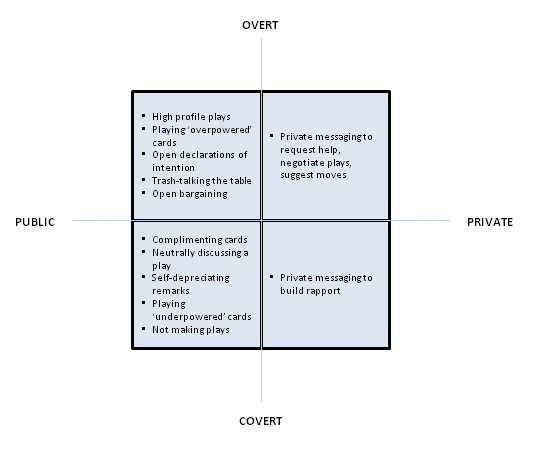
Communication during Commander games in Magic Online is very important and happens in multiple ways. Imagine one axis of communication as the option for either Public or Private discussion. On the other axis is either Overt or Covert messaging. This creates the following styles of communication in the multiplayer format:

  • Public/Overt Communication: The most basic form of communication at the table, it is an obvious signal to everyone sitting there. Examples include playing Stasis, or declaring "If you attack me I'll Mindslaver you next turn" in the general chat, or using Zur the Enchanter as your General.
  • Public/Covert Communication: The second most common form of communication, this is essentially subtle signals sent to everyone playing. Examples include stating "I really love that card!" to point out a potential threat, or complaining that you're mana flooded (even when you're not), or using Ramirez DePietro as your general.
  • Private/Overt Communication: An all-too-often unused form of communication, it's making clear statements of intent or request using the direct messaging capabilities of Magic Online. Examples include privately negotiating to take an third opponent out of the game, or privately asking if an opponent has an answer to a particular problem on the field.
  • Private/Covert Communication: The least used form of communication, its building rapport with an opponent for no obvious intent using the direct message form. Examples include privately complimenting a choice general, asking if that you can buddy a player, or intentionally answering a public question privately.

Here's a diagram to make it a little clearer:

The Dagger deck subverts the first two forms of public communication as it signals one thing (smiley, happy Hippo holding hands) while disguising its true intent (faster, hippo, kill kill). Below I'm going to describe a game I recently played with the Dagger deck to demonstrate how you can use various quadrants to help you achieve victory.

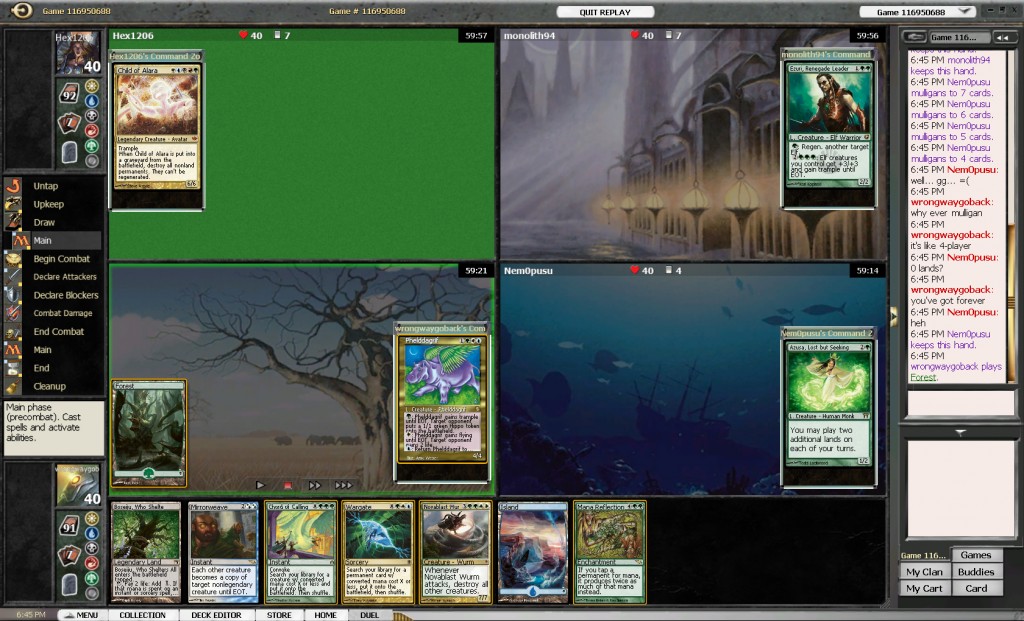
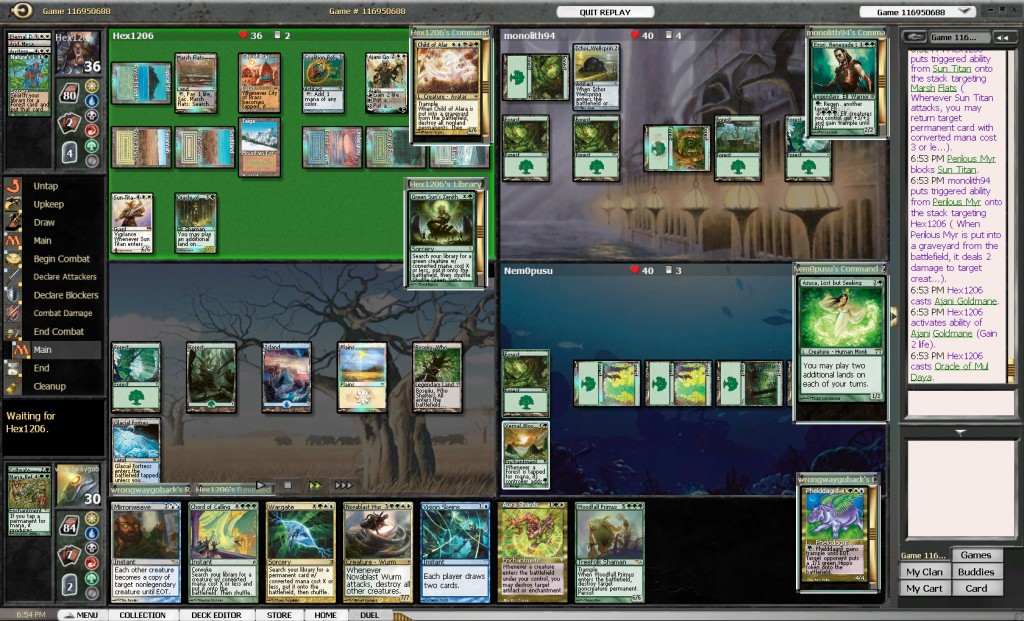
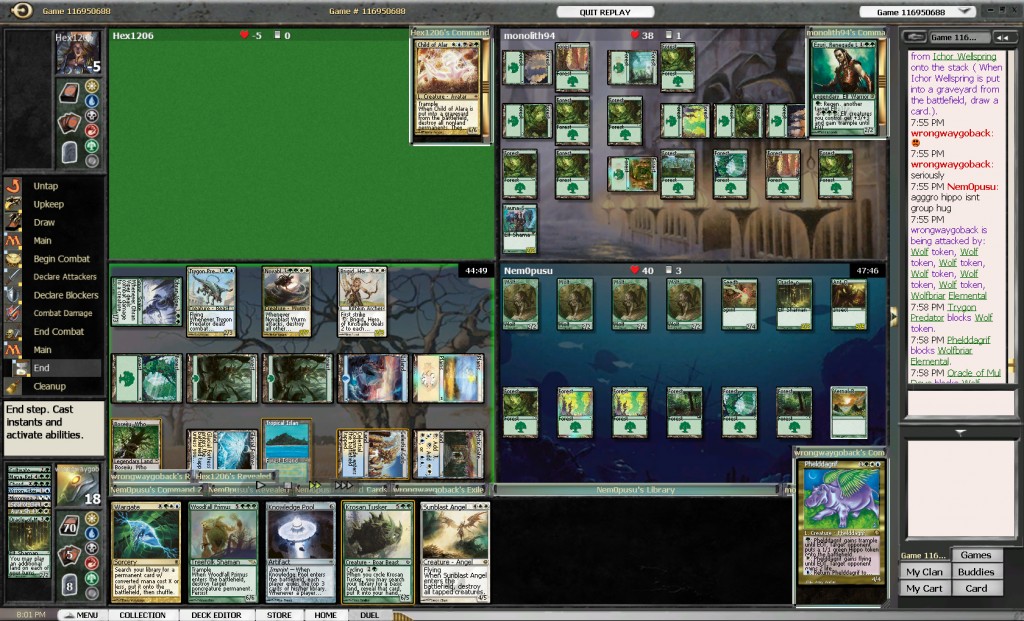
In this game I was playing against Hex1206 with a 5-color Child of Alara deck, Monolith94 with monogreen Ezuri, Renegade Leader and Nem0pusu with monogreen Azusa, Lost But Seeking Ramp. Both Monolith94 and NemOpusu were playing what appeared to be similar lists, which isn't surprising as monogreen ramp is a popular choice for Magic Online at the moment.

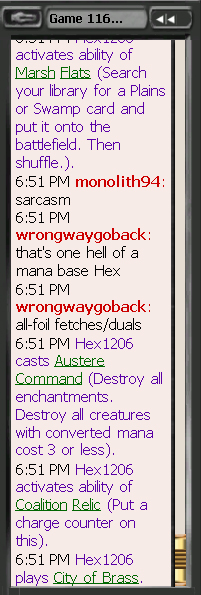
In the early turns the usual ramp occurred. Hex1206 made some very Public/Overt plays early, however by laying down a fast Sun Titan. I made my own overt play trying to stick a Mana Reflection however it was quickly destroyed by Hex1206, who adds insult to injury by attacking me with the Sun Titan. At this point I made my first Public/Covert play with this line:

My aim was doublefold. Firstly, I wanted my other two opponents to focus their attention on Hex1206. Secondly, I wanted to highlight the likelihood that Hex1206 would be playing expensive, overpowered cards in his deck. I needed to get across the message that this guy was a threat without necessarily making Hex1206 incensed enough to take me out of the game.
Monolith94 bought some friends by playing Vernal Bloom, a card which wou,d survive until the final turn of the game. Hex1206 went all out by sticking Ajani Goldmane, followed by Green Sun's Zenith for Oracle of Mul Daya.

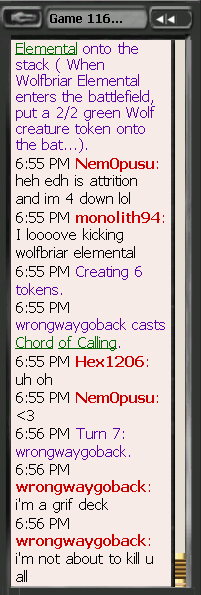
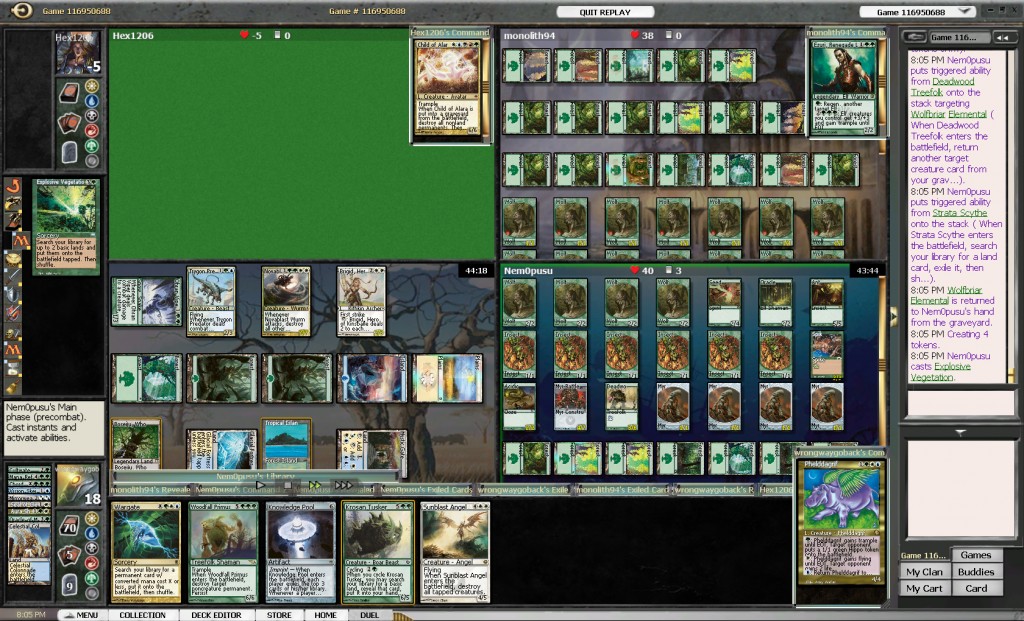
Monolith94 played out a Myr Battlesphere and a Strata Scythe named Forest, then equipped it to the Sphere. NemOpusu spurted out a zillion Wolf tokens off a kicked Wolfbriar Elemental. At end of turn I Chord of Calling'd into an Oracle of Mul Daya, then try to buy friends with a Vision Skeins (a Public/Overt move to buy some friendship from the table and reinforce my faux-friendly-hippo status). I hit an Ohran Viper and played it (a Public/Covert message to not attack me),then followed up with a reminder that I’m the Phelddagrif player (a Public/Covert move to again lose aggro).

Hex1206 lucksacked his way into a second Green Sun's Zenith to fetch a Primeval Titan, but with no good attacks can’t bash in with the Sun Titan.

I considered my options. I had a Novablast Wurm in hand so the token strategies of my monogreen opponents didn't particularly worry me. What worried me was player Hex1206, who had more card advantage and raw power than I could handle.

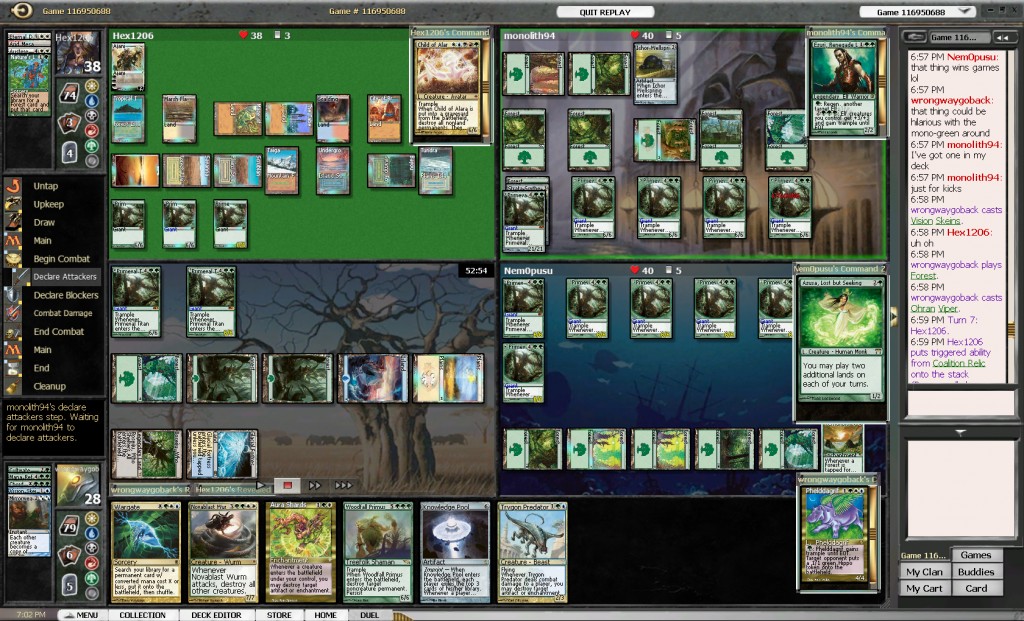
I opened up a direct chat line to player Monolith94 (a Private/Overt move). I let him know that if he attacked Hex1206 I'd Mirrorweave all his attackers into Primeval Titans. This was a high-risk/high-reward strategy for me as I was trading a short-term problem for a long-term one, but it would kill the deadliest guy at the table while allowing me to make a friend of Monolith94. Plus, how often do you get to see 17 Primeval Titans on the board?

Monolith94 seemed attracted to the idea. I pass the turn, Hex1206 skipped a beat as there are no profitable attacks on the board. Monolith94 hit me up for the Mirrorweave. I choose to do it precombat to allows the land-fetch triggers to occur because, hey, I'm the hippo player, right?

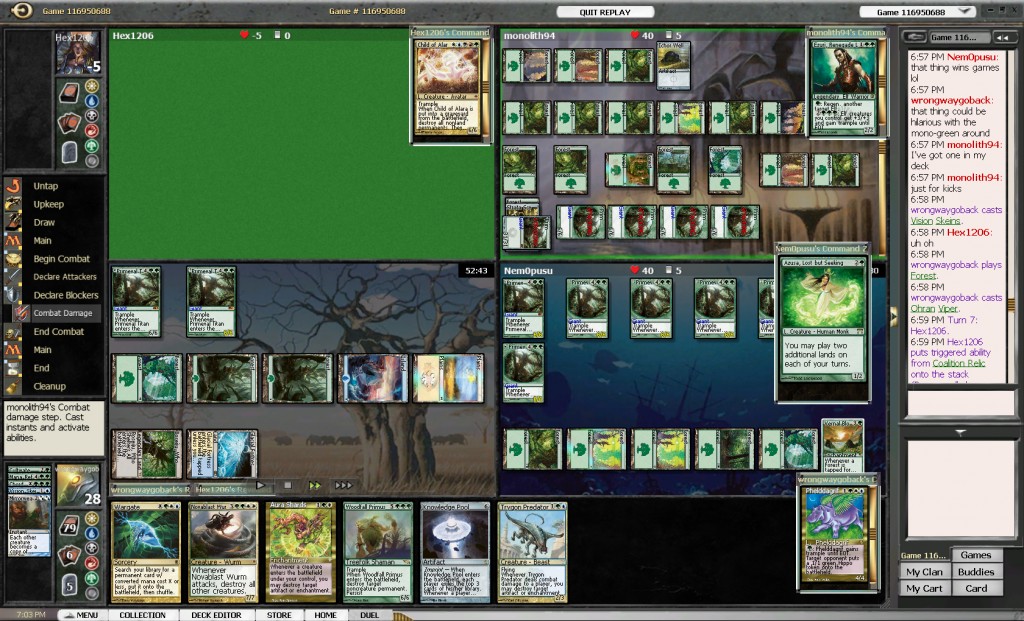
Suddenly Monolith94 had a 31/31 trampler with his four 6/6 buddies aimed at Hex1206's head. Hex1206 had no outs and this prompted the instant concession. Plan A was a success.

NemOpusu put down a Citanul Flute and Green Sun's Zenith for a Seedborn Muse, then passed the turn. After a bit of mana math, I laid down Aura Shards, a Trygon Predator to kill the Strata Scythe, and then my Hippo to kill the Myr Battlesphere. In one cycle of the board one opponent has been nuked and another’s board position has been decimated (except for the thousand lands he has in play).

There's a lesson there: your opponents are not on your side. If they suggest a play there's a good chance they have a follow-up play to kick your ass. Every time you talk to an opponent you need to ask yourself "What's in it for them?". In this case I managed to devolve two opponent's boards at once, with one of them helping me to do it.

I bash my Viper into Monolith94 to draw a card. I passed the turn and NemOpusu used Citanul Flute to tutor up an Ant Queen. Monolith94 plays a Knowledge Pool, a card I really love in Commander. The field takes a while to settle after that, but NemOpusu pushed it off the table with a well-played [Creeping Corrosion] by pushing it through the Knowledge Pool on his own turn. I try for my own mind games by suggesting openly that Ant Queen plus Seedborn Muse is the best win-condition on the table (a Public/Overt communication to convince Monolith94 to attack into NemOpusu). But NemOpusu wasn't having any of it, rightly suggesting I'm not playing Group Hug but "Aggro Hippo". NemOpusu attacked into me with his critters and I blocked as many as I could.

Having noted the loud-and-clear signal from NemOpusu its time to move into the end-game, I laid down a Novablast Wurm (a Public/Overt move). Monogreen has singular problems dealing with Novablast Wurm, and it's also one of the best creatures for nuking token strategies. I also stuck a Brigid, Hero of Kinsbaile, another great creature for opposing token strategies, but without haste she's fairly useless.

I note my vulnerability to Ant-death. In response NemOpusu declares he's not planning on making a million tokens and skips making tokens on my turn, a terrible misplay.

Then Monolith94 kicks 33 Wolves off his own Wolfbriar Elemental and suddenly its insects ahoy from NemOpusu. who then cast a Genesis Wave for nine and dropped a bunch of great stuff, including a Contagion Engine to nuke Monolith94's board.

NemOpusu then attacked into me, bringing me down to six life. If he had made the extra tokens on my turn I would have been dead. He shipped the turn and my Novablast Wurm became active.

I Wargate for Venser, The Soujourner and use him to blink my Brigid, Hero of Kinsbaile, allowing me to attack profitably with Novablast Wurm. After wiping the board I land a Hunting Grounds, which should allow me to stay ahead of any attempts to recover from my two opponents. Monolith94 played his general, Ezuri, Renegade Leader, which allowed me to land Woodfall Primus to destroy the Strata Scythe. NemOpusu dropped some more equipment then ships.

My combination of Novablast Wurm, Woodfall Primus, and Venser, the Sojourner got going. It’s nice to kill two noncreature permanents a turn and power up a planeswalker. I followed that up with my own Genesis Wave for nine, and even though all I drop are some lands and Future Sight, it’s enough.

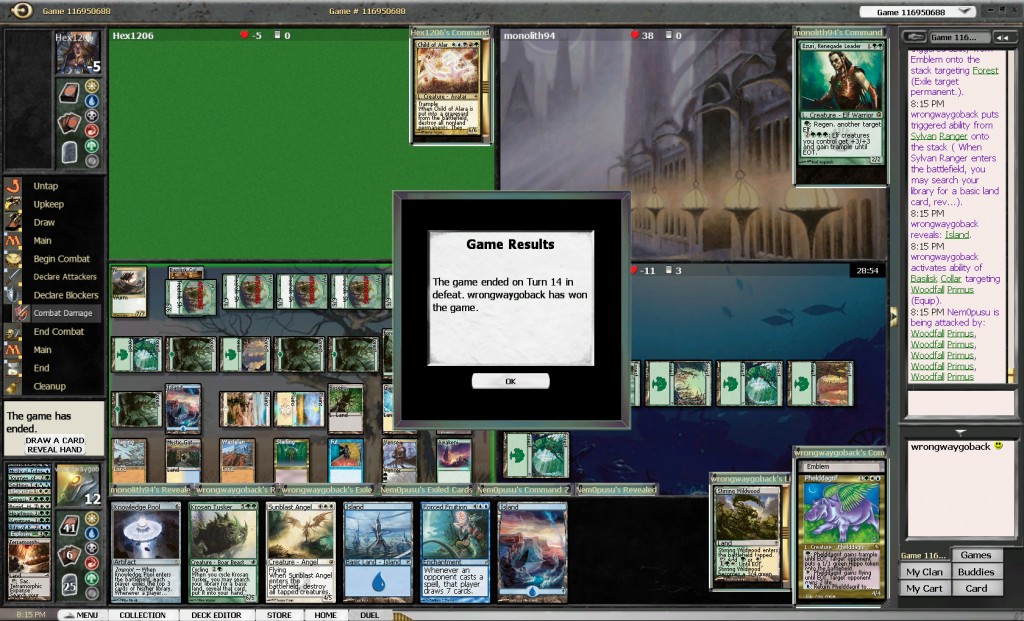
Seeing the writing on the wall Monolith94 conceded. NemOpusu vowed to fight on, but from that point on it was basically Wurm beatdown, followed by some shenanigans with Woodfall Primus and Venser, the Sojourner. I hit a Rite of Replication to stick the nail in the coffin, finally destroying Nem0pusu's Vernal Bloom and leaving him with just eight lands.

He drew the Duplicant a turn too late. I could ultimate Venser, the Sojourner, which I did, then used cards off Future Sight to start exiling NemOpusu’s board, allowing me to swing the many copies of Woodfall Primus for the win.

Playing Dagger shows that winning isn’t just a matter of using the most powerful cards you can. Being able to send out the right signals at the right time is a powerful strategy that any player with any deck can attempt. As you play you should take care to use the necessary channels of communication, whether they be Public or Private, Overt or Covert, to influence people into playing how you want them to play for your own personal advantage. To me, that’s the fun of multiplayer Commander; a unique set of social interactions every time.

Plus killing people with Hippos.

Petal’ing for Legacy

Are you a Quiet Speculation member?

If not, now is a perfect time to join up! Our powerful tools, breaking-news analysis, and exclusive Discord channel will make sure you stay up to date and ahead of the curve.

Given the all the talk about legacy prices, I thought I would add my two cents. My opinion is that I have no opinion. The prices are going to do what they do, no matter whose “fault” it is. All I know is that I listened to John Medina and the fine writers here at QS and got in while the getting was good. As such I have my play sets of Force of Will and Wastelands and I don’t need to worry about their prices. I'm not an economist, so I don’t know about bubbles and how to break them, but I do know that the warning signs were there, and I heeded them. As readers of this site I know you did as well. If you didn’t, there are still interesting ways to help ease the cost of getting into legacy. Naturally, I'll be talking about altering legacy cards to do just that.

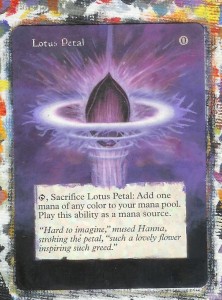
Lotus Petal is still an easy to pick up legacy staple. Earlier I stated that I'm not an economist, and so I don’t have a reason for this, but they are hanging around $4. These never stay in a binder for long either. Perhaps their best feature (for us) is the artwork. It's a very evocative picture, one that is fantastic in the literal sense of the word. Pictures like this allow us the inspiration to do more than just expand the borders of the artwork. With the fast pace that legacy cards are being scooped up, there is a huge demand for unique cards, be they foreign, foil, or altered. In other words, the legacy demand drives our prices up. The plan here is to take a $4 card and turn it into a $25 card, perhaps a Grim Monolith or a Mutavault.

I must also mention that I am introducing a new color to the arsenal today. The color is Brilliant Purple and can likely be purchased from wherever you got your other paints. From time to time, I will introduce certain new colors. While I realize that new colors do cost money, they also save a lot of time and aggravation, and far exceed their costs in other benefits.

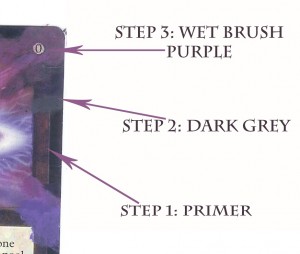
To begin with we start with an undercoating of a mixture between Naphthol Red and Ultramarine Blue. The general balance of the colors doesn’t matter as we just want to cover the original markings on the card, but a deep purple is desirable. The next step is tricky, but the result can be quite beautiful if done properly. The background of this card is layered, and so to match it, we must do some layering of our own. The first layer is the primer that we just laid down. For the second layer, we'll use a very dark gray mixture of Mars Black and a touch of  Titanium White. The gray should be brushed on in and around the darker parts of the background. I chose to do mine almost in stripes radiating from the petal, but you may choose to do it in a different pattern. This is your chance to use your creativity to create something unique. Just be sure to pick out the name and casting cost so as not to lose them.

The third step is something that I like to call “wet brushing”. The technique is similar to dry brushing, but it is done with a wet brush, usually dipped in water. There is a fine balance between how much water is too much and not enough, this can only be found through experience. Optimally, the paint should go on wet but not run. Too much water may result in the removal of paint from the card, so err on the side of caution. The color is a mix of Naphthol Red, Ultramarine Blue, and our new friend Brilliant Purple. Mix the red and blue first, then adjust the tone with the purple. With your wet brush, pick up some paint, and wipe some of it off on your palette. Apply the paint over the gray and primed areas alike. You'll notice that the moisture gives the paint a bit more opacity, which allows it to appear darker over the dark gray. Now, adjust your purple mixture with red, blue, purple, or even white and continue this operation, matching the colors closely (Not exactly) around the borders of the card. You can see that the water allows the colors to blend in interesting ways. Don’t worry about the sparkling blue bits flying off of the flower, remember that we always paint the background first, then move forward in the picture.

This may take some time, but you'll soon find that there are only two or three mixtures of purple and pink needed here, and that they will blend to create their own subset of colors. While you're at it, why don't you fill in the bottom of the card with black, and blend that in too.

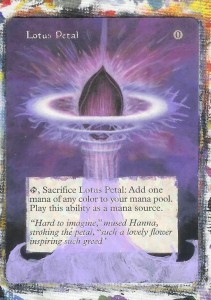
Having familiarized yourself with the color range of this project, it should not be difficult to mix up that sparkly blue color from around the petal. Allow yourself a second to imagine what and where these little magic lines are traveling to and from and what they should look like while doing it. Visualize it, then paint it. You may need to use just the tip of your brush to create the thin lines that you want. Don’t forget that spout from the bottom, which turns out to be nothing but a small set of vertical lines in different colors. When you have finished with that, you should have a very satisfactory borderless Lotus Petal, and this would be a fair place to end the project. You are of course welcome to stop here if you like, but this card gives us so much more to work with that I won't allow myself to stop here. I will say that the “Step-by-Step” portion of the article is done. So consider the following the “advanced” portion

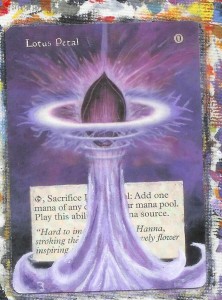
You'll notice that this petal appears to be shooting up from some sort of spout or well. So imagine how that might look and “draw” the outline with your brush to create a primer coat. I used a very light purple for mine.

Brace yourselves, because I'm going to turn you loose in a second. Before I do, it is important to note that while I can teach you brush techniques and color theory, ultimately your success will come from your creativity and imagination. Fortunately, we are painting a world where there are no limits, no right or wrong way to do things, and no rules on how to do them. When going above and beyond a borderless alter, you must use your imagination to create something from the clues that are given to you from the artwork.

You can see from my example, that I started with a darker purple, and worked my way up to a very light lavender color. I used pure white to create highlights. I used very broad, free, confident brush strokes, and generally had the most enjoyable five to ten minutes of my painting career. I can also tell you that I used the same color mixture as the back ground, adding Brilliant Purple and Titanium White in turn to make the color lighter.

Take a minute now to visualize your picture. How do you imagine yours? Are their more cascades? Perhaps it creates a mist along the bottom. Does it end in a more rounded curl instead of the points that I have created? Your spout should be your own, but certainly feel free to mimic what I have done here if you happen to like it.

I hope you all are working hard on your contest entries. There are only 2 weeks left before the due date. Again feel free to contact me with an questions.

-The Painters Servant

Twitter: PaintersServant

Email: Mbajorek02@gmail.com
On the Way Down

Are you a Quiet Speculation member?

If not, now is a perfect time to join up! Our powerful tools, breaking-news analysis, and exclusive Discord channel will make sure you stay up to date and ahead of the curve.

So we have covered the ins and outs of quite a few trade styles and ways to trade over the past couple of weeks and that’s a great start but by now you may be wondering “How do I make all these cards turn into real profit?”  Well that is exactly what I will be covering this week, from knowing how to make most for your cards to when to sell out and when to hold.  Knowing how to trade is only half the battle, profiting can be just as involved and skillful as the trades themselves.

There are many different ways to approach Magic from a money making perspective. The first widely used method is E-bay or other online auction sites.  This allows you to set the price or minimum you need for your cards but also has an attached fee for their services.  Typically a card on E-bay will sell between 50-80% of its retail price on major websites which leaves plenty of room still to profit.  I have given up doing E-bay sales myself due mostly to the ever increasing fees and hassle of constant e-mails informing me of problems.  I was finding myself using a significant portion of my time I could spend otherwise furthering profits wasted behind a keyboard for 4-6 hours some days.  However this does not mean E-bay is not a great tool that should be utilized if you have the time to devote and don’t mind the fees through E-bay and Paypal.

Beyond E-bay but still in the cyber world you have buy lists from websites such as Starcity, Channel Fireball, CardKingdom and countless more offering sometimes close to retail for particular cards they may be short stocked on.  This is the ideal form for quick cash if you have a large collection and don’t need to move a lot of stock right away.  Most cards will not be above the line you may be seeking for margins, but as long as there’s a few (and you have a good stock of these in demand cards) you can make good money.  For those with smaller collections or just starting out who may not have a lot of money cards that sell well it may be best to stick to sites such as E-bay so as not to lose too much.  Buy lists average at about 30-50% of a cards value. Some sites have higher or lower numbers depending on the quantity in stock and how they run their business model.  At times however when a card is in high demand (Stoneforge Mystic, Swords) the buy price will hit 80-90% of the retail value leaving you with a great deal of profit.

If you are able to travel to major events, one of the most profitable ways to cash out is at the vendor’s booths at Grand Prix’s.  Sitting down with a dealer can be a daunting task the first couple of times but when you travel enough and start recognizing faces and people the process becomes much more streamlined. The key here is to not be a pushover. Granted you can’t be unreasonable either but you can always say no if a number is too low.  They are used to it and they will move on. Never sell a card for less than what you paid for it under most circumstances (rotation, dead deck, etc.).  Letting the dealer know you will take whatever price they offer will in some cases make them lower their price.  On the other hand being unreasonable about your price’s is not in your best interest either. They are not going to pay you what Starcity sells it for…no one is.  You have to accept you will not be getting top dollar, that is part of the territory of being a backpack dealer, as long as you’re making your margins: move it and move on.

One important point to make when working with dealers is negotiation.  They may offer a price that is slightly lower than what you want for the card and haggling is acceptable.  A great example of this was the Gideon’s I picked up in last week’s trade.  The buy price at one of the dealer’s who I enjoy working with was $22. Now this was a fine number considering the card regularly sells for $25 on E-bay, but was not quite what I wanted. I asked for $24, he thought for a moment and pulled them out.  This may not seem like a huge gain but if you can manage an extra 10-15 dollars each time you sit down it adds up over time.  This does not mean you should haggle with every price (that will just be tiring for both of you and cause you to lose business in the end) but the higher end or in demand cards are worth it.

The last and most crucial point to coming out ahead at events is learning buy lists.  You do not need to memorize every card on there as most are far lower than what you want to sell them for. Knowing the cards with good margins (80-90% of retail) can be a great boon when you hit the trade floors seeking maximum value. In Atlanta the big card for me was Sarkhan Vol, few people realized his value and subsequently I profited greatly. I was regularly picking them up for $3-$5 as most people assumed they were a dead card that saw no play and was worthless.  What they forgot was the casual market appeal, which is common in cards such as Planeswalkers and flashy creatures or spells.  On one of the buy lists they had him marked at 8 and I was able to talk him to 9 meaning not only did I make a great sale I was literally turning 3 dollars worth of cards into 9 instantly.  Knowing these prices can be a great boon to your arsenal when attempting to value trade.

When attending major events it can also be a good idea to know what your local stores stock looks like, such as if they are running low or out of a particular card that is hot in Standard right now. It can be a great opportunity to not only pick those cards up but also build a good relationship with your store which may in some cases make you their go to guy when stock is running low allowing you a premium on your cards as well as a local outlet when you need money.

On the topic of local players it can also be wise to know what they are seeking whether for trade or buy.  Providing hard to find cards to your local area can help you corner that market as well as infuse your meta with cards that would otherwise be difficult to find.  Be sure however if you are doing cash deals to speak with your local card shop owner as to not step on any toes.  Some will be ok with you buying and selling in their shop especially when they may be out of a card. Others are not ok with this idea and it is best to respect these wishes.  This again comes back to making a good relationship with your shop owner, if they know that you can help restock them they will be less likely to be bothered by the transactions you partake in.

The Attitude

Keeping a good reputation is key when dealing with a multitude of different people.  Keep in mind each person you trade with/sell to has their own agenda whether it is getting the cards for their deck or profiting from the cards they buy. Working together will not only ensure future transactions but also keep you with a plethora of options when seeking to unload cards for cash. Try not to burn bridges, be considerate and kind in trades and sales and make yourself known for being a genuinely good person. It’s a lot easier to make money if people are seeking you out for trades at events rather than having to always search for a trade partner.

Good communication and genuine manners can carry you a long ways in this game and not only make trades easier but sales as well. When dealing with vendors it is great to be recognized. Let them know what your doing as it will streamline the process and allow for idle chit chat while your selling. They have their job to do as well and let me tell you sitting there buying cards for 8-12 hours during a day can put some stress on you, making it easier on them will only in turn make it easier on you.  This will also benefit you in the long term as vendors will eventually recognize what you need on cards and will not try to give you lowball prices. When I have my binders scoured certain vendors I regularly work with know not to offer me prices that are below 50%. This creates a smoother faster process saving both of you time and putting you back on the trade floor quickly.

Well that’s all for this week, join me next week as I cover the flip side of the coin, buying and the different avenues you can take. Until then keep trading and let me know trough the comments on what you do and don’t like about these articles. I write for you guys so reader input is always welcome. If you have a subject you would like covered or even just a basic idea post it or shoot me a message on Twitter I am always happy to oblige.

Until next week keep on trading.

Ryan Bushard

@CryppleCommand on Twitter.

Guest Spot Recursion | CommanderCast S2E10

Are you a Quiet Speculation member?

If not, now is a perfect time to join up! Our powerful tools, breaking-news analysis, and exclusive Discord channel will make sure you stay up to date and ahead of the curve.

Andy, Carlos, and Byron and joined once again by Mr. Scotty Mac of The Eh Team podcast for this episode of CommanderCast. Tackled head-on in this podcast: Netdecking, Attrition decks, Scars of Mirrodin, and more! If this avalanche of Commander discussion leaves you unsatisfied, you know we've got full show notes, links, articles and videos popping off over at our home base, http://commandercast.blogspot.com/.

Can't use the Flash player? You can down the episode directly here!

You can also check out this episode's full show notes here!

Assembling Apocalypse

Are you a Quiet Speculation member?

If not, now is a perfect time to join up! Our powerful tools, breaking-news analysis, and exclusive Discord channel will make sure you stay up to date and ahead of the curve.

Apocalypse was our first taste of enemy-color cards, and those combinations often can bring out incredible results. What one color is poor at, its enemy might be superb at. Thus, you end up with fun cards like Illuminate, Fire/Ice and Prophetic Bolt. Want to build monoblue control, but also interested in some creature removal that doesn't suck? Those three cards gave casual players a taste of going over to the enemy's side, and there were plenty like it. Apocalypse also spawned legions of greedster deck builders who wanted to play Spiritmonger and Absorb in the same deck, because they finally had the painlands to support it. They never really panned out (you need Vivid lands and Reflecting Pool for that stupidity!) but it was fun to “splash” Fact or Fiction in your G/B deck. Let's look at what held up to the test of time!

Battlefield Forge

Consigned to the Island of Unloved Manafixing

This includes all the enemy-color painlands, since they're all around the same price.

These cards were revolutionary because they didn't completely suck. To give you an example of what a little bit of time did for design quality, compare Salt Flats to Caves of Koilos. Salt Flats comes in tapped and still eats some pain! We lack enemy taplands, though the tri-lands like Arcane Sanctum can work decently. These lands are, with the enemy filter lands like Flooded Grove, the go-to mana producers for many decks angling to gram Red and White alongside each other, or support Green and Black. They've been reprinted a little bit, but people hold out for, and pay a premium for, the black-bordered versions.

As an aside, it's interesting how much painlands have dropped in price. For years, they were a solid fiver. That's because, aside from dual lands, you could only play absolute trash cards for mana fixing. Timberline Ridge bad. If painlands were evergreen base set cards, they'd still be worth something. However, R&D realized that new players hate to pay life for mana, even if it's something good like City of Brass. Thus, we got a new line of shocklands, filter lands, and whatever we call M11 lands. Many times, those cards were as good as, or better than, the painlands, and casual players bought them instead. Even EDH doesn't sustain painlands! For example, in a Bant deck, I would have to get through duals, shocklands, filter lands, fetchlands and cards like City of Brass and Seaside Citadel before I considered the painlands. With utility lands, I hit 40 before I dipped into painlands. In 5-color EDH decks, you've got all the duals, all the fetches and all the filters before you stare at something that will actually ping you when you tap it. The end result is that there's not even much of a casual market for these guys.

$1.50 - $2.50

Cromat

From the makers of Morphling... Cromat is a punisher, but he requires a lot of mana commitment to make it work. I suspect that most of the people who buy them put them to use as their General in EDH, which is what I do. Because of this, the normal version is worth nothing, while the foil version is worth “something.”

$1.00 ($12.00 in foil)

Total format destroyer - as bad as Lin-Sivvi!

Desolation Angel

This week, Tom Lapille wrote about what R&D thinks of 32 Jace in the Top 8 of a major tournament. He discussed, at length, what makes a format-warping card. Jace doesn't warp things around him into “play Jace or lose.” Desolation Angel had a terrifying ability to do just that, though. For newer players, let me explain how that happens. First, she's never played unkicked. You'd pack her in a deck with Fact or Fiction, Absorb, Repulse, Exclude and all the other incredible card draw from Invasion. You'd stay alive, easily, until you got to seven mana. Then you'd cast Armageddon with a 5/4 flier attached to it. The game would be over because none of the answers in the format could take out that Angel for less than three mana. Your opponent had to hit every land drop from there on out to stand a chance! If they countered the Angel, you'd cast another – you had four, after all. Your opponent, meanwhile, would be trying the same thing, and whoever landed Angel first won. That was how Invasion Block games played out. Standard was a little less painful, mainly because decks like Rebels punished the big-mana decks too much.

While cheap normally, the Angel's foil price is artificially inflated by one dealer (who I will not reveal) that collects foils of this card. He wants, and has the cash for, every copy. So know that out there is a kook who will drop a bill for your Angel!

$1.25 ($25 in foil)

Dragon Arch

I was surprised to see that this is an uncommon.

The Arch lets you put in lots of guys, if you build a deck around it. The card is no Quicksilver Amulet, but it's sufficiently thematic that enough people want to build around it. That makes the card worth something, and it is and excellent find if you can get a foil.

$2 ($7.00 in foil)

Goblin Ringleader

This Goblin is the lynchpin of every Goblin deck, turning them from simple aggressors into an attrition machine. One Ringleader buys back after a Wrath of God or the like. While some Goblins decks, competitive and casual alike, negotiate on card choices like Skirk Prospector and Goblin Sharpshooter, this makes its way into any list that can support it. Thus, a simple uncommon is worth digging through boxes for.

$2.00

Pernicious Deed

What can be said about Deed? It's the reason to run BG in so many formats. It's a bane of the EDH table. It bouyed the deck The Rock, which was mostly-bad, except for the four copies of this board-sweeper that it ran. People go nuts for this card. It's easily understandable to the most casual of players. If I were making a “solid investment” list for Magic, I'd put Deed on it. You'll never see it reprinted in a Standard-legal format, and the judge foils didn't change the price very much. It isn't a big gainer, but it's a solid card that you can trade to a lot of people for a lot more than you'd think.

$11.00

Phyrexian Arena

Every time this card has been in Standard, people angle for a monoblack deck with it. The reason is clear – a personal Howling Mine pays big benefits over time. You can even Live The Dream with this and Dark Ritual on the first turn. The lifeloss can be offset by any number of black lifeleeching cards like Corrupt. Even in other decks, the Arena is a good bet. I try to fit it in every EDH deck I can, since the lifeloss doesn't matter so much. The card has been reprinted in a base set, along with a duel deck. That's kept the price down, but it's certainly no bulk rare.

$2.50

Spiritmonger

When Timmy sleeps at night, he dreams of this.

If Pernicious Deed sustained The Rock, then Spiritmonger let people live the dream of an on-color Morphling. Often, Spiritmonger didn't live up to what people thought about it on paper. It still has legions of loyal fans, though. People who played during Invasion and were bad have all these great nostalgic memories about Spiritmonger, and they want their copies.

Spiritmonger used to be about $15, but it was printed as the Grand Prix entry bonus in 2007 (I think). Hundreds of thousands of foil Spiritmongers entered the market, since few players actually wanted to hold onto that thing. As a result, if you wanted the monster for a deck and didn't care about it being foil, you could get them for about $6 at the time. The price has since dropped even more.

$4.00

Vindicate

I like to bring up Vindicate as an example of what color pricing is all about. The other comparable effect is Desert Twister, which costs 4GG. Vindicate costs 1BW, or 1XY if we want to be a little theoretical. However, BW isn't just any color combination – it's one of the weirder ones, and it's hard to pull off. The reason is that you have neither blue, to draw on-color lands, or green, to get on-color lands. Thus, 1BW is more like 2XY, since you have to work really hard to reliably get those colors going in your deck. If you can get them online on turn 9, you could have just played Desert Twister instead, after all. So Vindicate shows you what a good discount you can get if you're willing to work a little for the mana. I wonder if it'd still be a fair price to charge for the effect today. It might be more palatable at 2BW, especially since mana fixing is so good these days.

Vindicate is obviously popular with most Magic players. It's casual crack cocaine and it even shows up a bit in bad Legacy decks. EDH players want it for its great utility. It showed up as a judge foil, but that has not touched the price much. Vindicate is real binder gold!

$19.00

That wraps up Invasion block, which had one of the most recognizable themes in Magic. Next week, we'll start reading through Odyssey, a set with an unspellable name and an obtuse theme that often made players confused. Luckily, it was also packed with money cards!

Until next week,

Doug Linn

www.twitter.com/legacysallure

Want Prices?

Browse thousands of prices with the first and most comprehensive MTG Finance tool around.


Trader Tools lists both buylist and retail prices for every MTG card, going back a decade.

Quiet Speculation