menu

Beginner’s Mindset: A Fresh Look at Magic

Are you a Quiet Speculation member?

If not, now is a perfect time to join up! Our powerful tools, breaking-news analysis, and exclusive Discord channel will make sure you stay up to date and ahead of the curve.

One of my favorite characteristics of Magic is its ability to refresh itself time and again. This happens every couple of years, in my experience, and occurs because of both external and internal factors.

Externally, Wizards of the Coast continues to evolve this game with the advent of new sets, new formats, new keywords and abilities, new playing media (Arena has been a major boon), and more. Internally, Magic has managed to meet my evolving social and entertainment needs as I navigated through numerous life stages—from my pre-teen years up through parenthood.

With each new evolution, I experience a period of “beginner’s mindset,” a concept from Zen Buddhism that instructs the concept of openness, eagerness, and a lack of preconceptions. Every time I try something new in the world of Magic, I enter with an open heart and mind as I eagerly learn about that new area.

This past week I experienced three such “beginner’s mindset” moments in Magic, all with varying degrees of success.

My Foray into the Art World

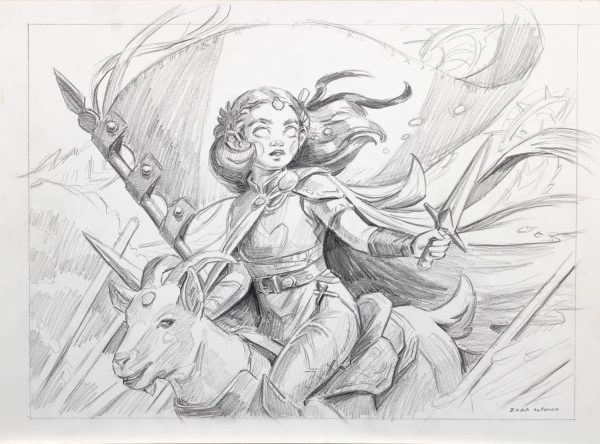
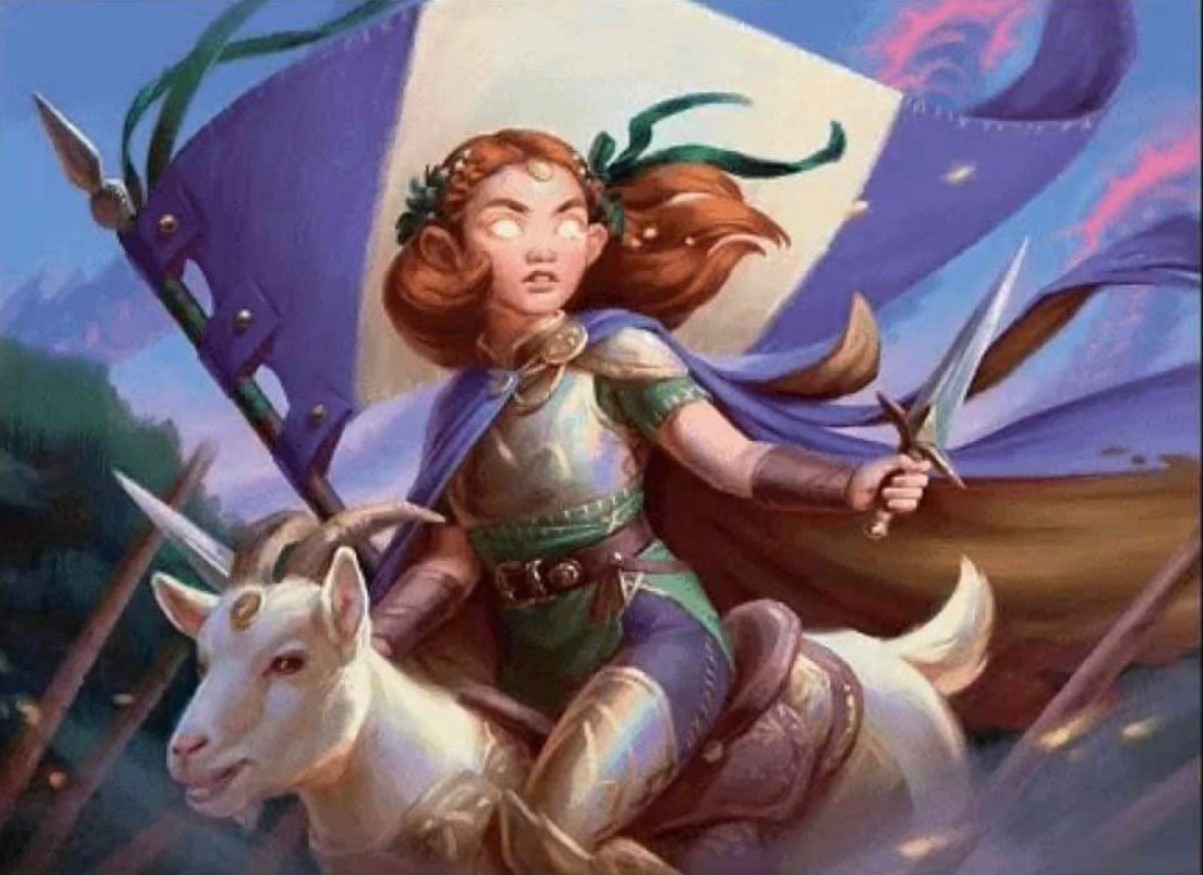
Last week I declared my newfound interest in acquiring a piece of original Magic art. I had my eyes set on Zara Alfonso’s sketch of Kithkin Billyrider, but I lost out in a bidding war on Facebook. This was disappointing and humbling. With my beginner’s mindset approach, I took it as a valuable learning experience and an invitation to try again.

When I tweeted about my defeat, multiple members of the Magic art collector community reached out and offered to help me acquire my first piece. The response was so welcoming and supportive. I was blown away by everyone’s kindness and generosity with their time. I want to say that my foray into Magic finance was the same way, but let’s face it: the #MTGfinance community can be a toxic community at times.

A special shoutout goes to Phil Li (@ThePheylop) who has gone out of his way to educate me in the original Magic art space. He sent me links to different pieces of art that are for sale, discussed pricing with me, and even offered to help negotiate on my behalf to leverage a cash + trade offer on a piece I like. If the rest of the Magic Twitter community functioned this way, it would be a much brighter place to hang out.

For all I know, there may be politicking and drama in the art community too, but as a pure beginner in this space, I have nothing but warm and fuzzy feelings toward everyone. Through these interactions, I’ve learned so much more about Magic art and artists, and I am absorbing this new knowledge like a sponge! With their help, I am confident that I will find that first beloved piece that I can hang on my wall.

Additionally, I’ve acquired a much greater appreciation for modern Magic art. A few years ago, in the heart of my “Old School MTG” phase, I once made the naïve comment that I appreciated classic Magic art over modern-day pieces. I would like to retract that statement. While I’ll always have a nostalgic soft spot for classic pieces such as Shahrazad and Eureka, the detail and depth of contemporary pieces like Kithkin Billyrider or Alessandra Maria’s Nesting Dovehawk blows me away.

Art will always be subjective, but my opinions have evolved. I apologize for any hurt feelings I might have made with ignorant, misplaced comments.

My Foray into March of the Machine Limited

I didn’t draft Phyrexia: All Will Be One when it first launched on Arena because I was pursuing other interests at the time (mostly chess). A couple of weeks into the format, it became clear from listening to my favorite Limited podcasts, Lords of Limited and Limited Resources, that this was not a community-favorite draft format. I was fairly convinced it wouldn’t be worth my gold and gems, but I did try one draft during the course of the format. When it was done, I didn’t feel inspired to run a second. One draft of ONE was enough.

I have a little more free time to try drafting now that March of the Machine is out on Arena. Once again, I employed the beginner’s mindset to remain humble, eagerly learning all I could about this new format. Boy oh boy was there much to learn!

The First Draft

My first draft left me somewhat short on playables. I hesitated too long before picking a third color. I knew I would run black because I picked up some solid removal spells, but the bomb rares weren’t flowing my way and I was receiving mixed signals from both red and blue. Ultimately, I ended up on a black-red sacrifice deck that didn’t see any Furnace Reins. The deck played clunky, but I still managed a 5-3 result simply because I was playing in the bronze portion of the ladder.

The Second Draft

I had a little more luck in the second draft. I picked up a Polukranos Reborn // Polukranos, Engine of Ruin after first picking an Invasion of Karsus // Refraction Elemental.

There was an error retrieving a chart for Polukranos Reborn // Polukranos, Engine of Ruin

While I was light on removal, I picked up a Lutri, the Spellchaser and I was excited to draft a Red Green beatdown deck!

I promptly went 1-3, losing to bombs like Skithiryx, the Blight Dragon, Tribute to the World Tree, and (in my opinion) the most offensive bomb of all, Invasion of New Phyrexia // Teferi Akosa of Zhalfir.

There was an error retrieving a chart for Invasion of New Phyrexia // Teferi Akosa of Zhalfir

Suddenly my brew with a giant hydra and the ability to fork Cosmic Hunger with Lutri felt insufficient. I quickly realized that a tightly built deck can easily be outclassed by the format’s numerous bombs and heavy hitters. While I felt like I had a couple of powerhouse cards myself, they simply could not hold a candle to what my opponents were throwing against me. I understand now why my favorite Limited podcasters are describing this format as very Cube-like in power level.

I haven’t given up, though, and I’ll maintain my beginner’s mindset for at least a couple more drafts before I make a broader decision about where March of the Machine falls in my personal preference ranking. I struggle with Cube drafts, so I suspect I won’t have tremendous success with this set.

My Foray (Back) Into Standard

It feels like ages ago since I hit Constructed Mythic on Arena and felt confident enough in Standard to enter small (free) events through Star City Games. It’s frustrating how less than a year away from Arena can send you so far behind, in both card pool (wildcards don’t create themselves) and in metagame knowledge.

Despite this, I’m adopting the beginner’s mindset once again and dipping my toes back into Standard. I’m beginning this foray by copying one of Ashlizzle’s decks. It's a Red-Black deck centered around sacrifice synergies. I’ve been a huge fan of sacrifice strategies ever since Throne of Eldraine blessed us with Cauldron Familiar and Witch's Oven.

Here’s the list I’m following as closely as I can, given my limited supply of rare wildcards (I still need Blackcleave Cliff)s.

RB Sacrifice, Standard Deck

Creatures

4 Scorn-Blade Berserker
4 Unlucky Witness
3 Vraan, Executioner Thane
4 Bloodtithe Harvester
3 Braids, Arisen Nightmare

Battles

2 Invasion of Azgol // Ashen Reaper

Sorceries

2 Annihilating Glare
4 Furnace Reins

Instants

4 Corrupted Conviction

Artifacts

4 Oni-Cult Anvil

Enchantments

4 Fable of the Mirror-Breaker // Reflection of Kiki-Jiki

Lands

1 Takenuma, Abandoned Mire
1 Sokenzan, Crucible of Defiance
4 Blackcleave Cliffs
4 Haunted Ridge
4 Sulfurous Springs
2 Mirrex
3 Swamp
3 Mountain

Sideboard

3 Duress
1 Eaten Alive
2 Go for the Throat
2 Ob Nixilis, the Adversary
2 Cut Down
2 Vampires' Vengeance
2 Sheoldred, the Apocalypse

I’ve only played a couple of best-of-one matches so far with this deck—I’ve won and lost with it, so it’s too soon to pass judgment. One thing I will say is I have much to learn regarding how the cards work together and how the metagame has evolved since I last played Standard. I can readily see how mistakes I’ve made have cost me chances to win the games I lost. With the beginner’s mindset, I’ll continue to study the strategy and hopefully grind my way out of bronze and back up to a respectable tier on the ladder. It will take time, practice, and a great deal of learning.

Wrapping It Up

Regarding gameplay, I’ve rediscovered Magic for the umpteenth time via March of the Machine Limited and Standard, courtesy of Arena’s ultimate flexibility. As a parent of two kids, this is the best way for me to enjoy playing this inventive game with minimal disruption to my home life.

On the collecting side, I’ve moved off Old School cards and random Beta rares and towards art collecting. I had no idea what I was missing until I joined the Facebook art group. I've discovered the beauty and talent this community boasts. Rather than try to fight the impossible battle of obtaining the “One Ring” card, why not consider obtaining a 1/1 art piece instead? That’s the strategy I’m going to use, and it should be about 1/100 the price!

As long as I maintain the beginner’s mindset, I should enjoy these newfound spaces in the universe of Magic. I’ve been playing the game for 26 years and I’m still blown away by how diverse and expansive the hobby can truly be. Whether it’s Limited, Constructed, new formats, old formats, collecting cards, collecting art, or any combination therein, it truly feels like Magic is a hobby that has something for everybody to enjoy.

March of the Machine Limited: First Takes and Archetype Breakdown

Are you a Quiet Speculation member?

If not, now is a perfect time to join up! Our powerful tools, breaking-news analysis, and exclusive Discord channel will make sure you stay up to date and ahead of the curve.

And they're off!

So far March of the Machine (MOM) appears to be a wildly popular format. The culmination of the Phyrexian Saga ends with a final battle between the forces of good and evil, but regardless of this climactic clash, we have a brand-new Limited format, and it is an absolute blast. MOM will no doubt become a fan favorite.

To the delight of many players, this format is a huge change from WOTC's most recent offerings. While BRO and ONE were considered very aggressive, this format is decidedly more midrange. This week, we'll greet the format with a couple of fresh takes and a breakdown of the archetypes.

Flip-Flip-Flipadelphia

In last week's article we discussed the lack of potent early creatures. The flip commons would like a word.

Lower your curve, not your threat density

These four cards have felt excellent. Tarkir Duneshaper // Burnished Dunestomper, Order of the Mirror // Order of the Alabaster Host, Aetherblade Agent, and Pyretic Prankster // Glistening Goremonger eloquently answer the call for a presence in the early-game, as well as being real cards in the mid- and late-game. The early data has admittedly been underwhelming, but these are still the commons we want at the start of our curve.

Bonded Herdbeast // Plated Kilnbeast, the fifth member of the cycle, looks to be solid but replaceable. The other four are premium options for any deck. The bar for a good five-drop is simply higher, and there is no shortage of options there.

Early Thoughts on Battles

Battles complicate Michael Flores's age-old question. Instead of simply asking "who's the beatdown," we now need to know where it's heading as well. That target changes at different states of the game. Our opponent's life total becomes more valuable with scarcity. For example, we might send six damage at a battle when our opponent has twenty life, but we should never do it when they have six.

As a result, if we play battles early, there's a good chance we'll defeat them. If we play them late, they are more often reduced to just the front side's value. In other words, if that one side is not a card we're willing to include, we need to consider other options.

Tempo-Positive Interaction Swings Games

The swings in this format are real. Flipping battles, casting end-step convokes, or just playing a game-warping bomb can rescue games from the brink of finality.

Ephara's Dispersal, Cut Short, and Vanquish the Weak play on this axis. They manage the tempo of the game but typically trade down on resources. Because card advantage is so plentiful in the format, most decks can afford to absorb the loss. But snowballed advantages are harder to overcome with raw value alone. These cards help with that.

The card that has most outperformed expectations has been Wicked Slumber. Casting this with zero mana up is a beating. Slumber is potently templated, providing an option to put both stun counters on a single creature. Whether it helps us defeat a battle, push damage, or buy time, this card can wreck tight games.

Blue Is the Best Color

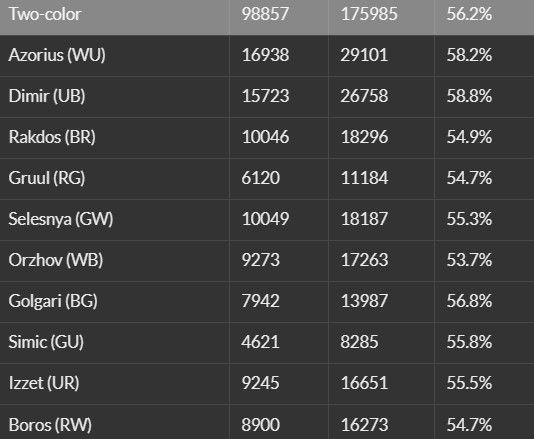
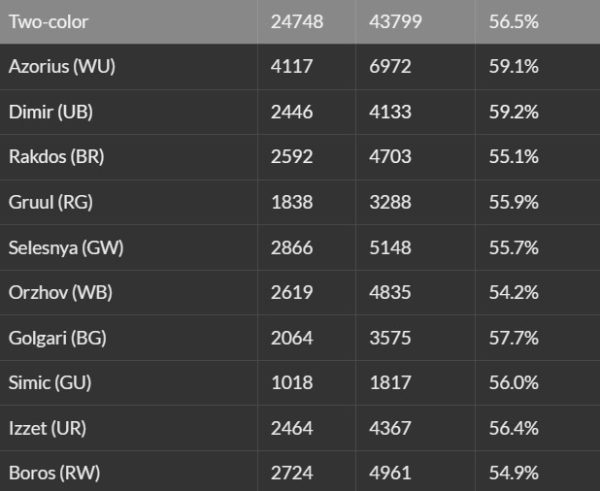
Four of the top five two-color decks, according to 17lands.com, feature blue. The color plays host to the format's most powerful keyword, convoke, and most supported archetype, UW Knights. Furthermore, blue has access to strong tempo plays at all rarities, while still boasting cards that can generate advantage over a long game.

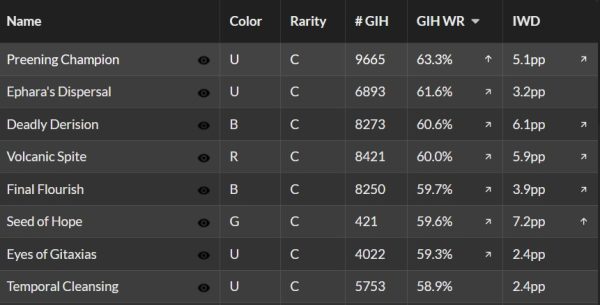
Moreover, blue does all the things that are important in this format. It has strong synergies, can play a long game while still adding to the board, and interacts in a way that helps control the tempo of the game. Check out the current top commons in the format, according to GIH WR%. There are four blue spells, three removal spells, and one outlier.

Seed of Hope has the smallest sample size, by far. It's a cantrip that feeds the graveyard, gains life, and carries a minor risk of disaster. The most likely conclusion? It's seeing disproportionate play in the hands of stronger players. But if that's the case, why does it have such an outlandish IWD?

Knights Is the Most Supported Archetype

Knights looks to be the most supported archetype in the format. It's deep at common. The synergies in this deck matter. Swordsworn Cavalier is a buzzsaw in the early game. Until we get to four mana, very few creatures in the format can block a 3/1 first strike profitably.

Chivalry alive and well

This deck also has the ability to maximize convoke cards, because it already creates a vigilant board presence. This is an aggressive deck that can go late. However, with all the bombs in the format, an Artistic Refusal, while off-plan, can go a long way. If our Knights deck looks like it might need to pivot into a longer game, this is a worthy consideration.
Convokin's Broken

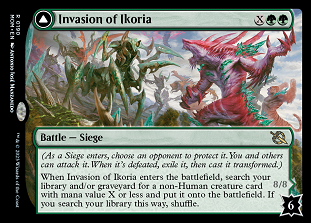
The returning convoke mechanic is a lot better in this set than it was in Guilds of Ravnica. Convoking spells feels like a completely different mechanic than convoking creatures. The mechanic thrives in MOM because we already want to build out our board and need to make tempo positive plays. The following cards have all exceeded expectations.

No joke convoke

If we're still seeing these cards go late, we should take advantage of it. However, if we are in this archetype, or if we're simply playing convoke cards, we need to build out an early board. Ral's Reinforcements is a fine enabler, but the nature of the format leads to wide, complicated boards. Turns out that's pretty good for convoke. Who knew? Even cards like Shatter the Source and Astral Wingspan have been strong.

UR Convoke is not as thematic as Wizards would have us believe. Convoke for the sake of convoke. We don't need to overcommit to keyword-driven synergies.

UB: Not Just Run of the Mill

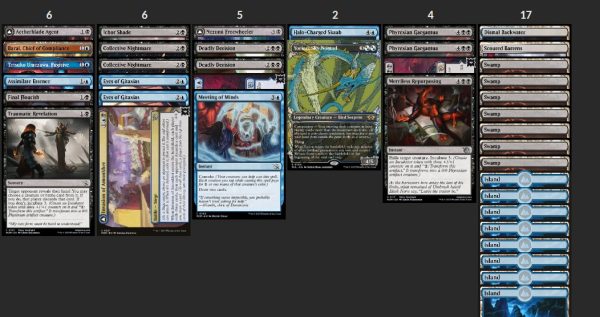
UB is supposedly a Mill deck. Tenured Oilcaster and Halo-Charged Skaab aren't very convincing though. This is a slower, value-based deck that wants to get ahead on resources. Fortunately, that's what this format is all about. UB currently has the highest win rate of all color combinations.

This color combination has some of the most powerful battles in the form of Invasion of Ulgrotha // Grandmother Ravi Sengir, Invasion of Amonkhet // Lazotep Convert, and Invasion of Eldraine // Prickle Faeries. We want to win a war of attrition, so of course UB is a solid place to be. Breach the Multiverse might look too expensive, but it's a battlecruiser trump card.

There was an error retrieving a chart for Breach the Multiverse

This deck is powerful, but really gets its juice from cards at higher rarities. Blue and black both have great commons, but there's an old adage: the longer the game goes, the more powerful you need your deck to be. UB has the tools to win any slugfest.

RG: Battles

Pressure the battles early, dominate the battlefield. It's strange to see an aggressive deck ready to play a long game. This deck has a hellbent problem. It's asking us to do something we don't typically benefit from doing. RW Samurais in Kamigawa: Neon Dynasty had the same issue. Aggressive decks don't want to attack with only one creature. They also don't want to take detours before shortening the game. This deck faces an interesting crossroads on every attack.

However, to get to those battles, we have some tools. War Historian, War-Trained Slasher, and Thrashing Frontliner do a nice job applying pressure to battles. The jury is still out on Onakke Javelineer and Portent Tracker. While ramp and reach are valuable, they pressure battles slowly. It might be a liability while other decks are doing more by building out a battlefield and convoking.

The biggest concern for this deck is that it doesn't necessarily have the tools to play from behind. This deck wants to snowball its advantage by having a big board presence and adding to it with each battle it defeats. However, if it stumbles early, or hits a road block in the form of one of MOM's extremely powerful rares or mythics, it might have trouble. While we shouldn't avoid playing RG, we should have a good reason to navigate ourselves towards these colors.

GW: Counters

GW Counters looks very solid. There's nice overlap between green's ability to go after battles and the backup mechanic, which helps accelerate the process. This deck also wants to bully the board and defeat battles. Plus, the uncommon payoffs are all very strong.

Outpacing opponents

The backup mechanic makes it much easier to find counters, which can sometimes be a bottleneck for this archetype. To further assist this issue, the incubate mechanic also uses counters, so there's definitely synergies to be had there.

Just about every white deck is going to want Angelic Intervention, but this one makes the best use of it. It's a powerful effect whenever it's printed. Getting a bonus off of the counter is just gravy. If our GW deck is creature-heavy, we could realistically be happy playing three of these. The commons for GW are shallow, but if we have the strong payoffs, we can get more out of them.

Abzan: Phyrexian/Incubate

GB and WB are technically different archetypes, but they look and play very similarly. These decks want to bog down the board with incubate tokens, soften the board with black's great depth of removal spells, and grind out games. The format has a couple of enchantments with incubate that are all excellent in these decks, even if splashed.

The eggs got legs

Green and white both shore up black's early game with two-drop creatures. Black provides interaction to help keep the game from getting out of hand. The incubate cards are how we get ahead. It's a simple recipe, but there are some strong build-arounds at uncommon that can help us in that third stage.

There was an error retrieving a chart for Elvish Vatkeeper

The Phyrexian tokens are surprisingly big, and once they start stacking keywords from the enchantments, they take control of a game.

UG: Transform/Splash

This archetype does not seem particularly well-supported. The signpost uncommon is clearly built with the archetype in mind, but even the UG Battle looks like they just stapled the "double-face" language onto it.

This is the type of archetype we might find ourselves in if both colors are open, but the synergies are underwhelming. There is enough power in the format for any deck to seem viable, as long as the colors are open. We already want to be blue; however, from a theory-crafting perspective, green's fight-style removal isn't particularly well-supported by blue's cards.

Splashing wisely, though, can turn an open UG pile into a deadly deck. UG and UB are currently the best two decks that splash a third color, and amongst three-color decks, the best two both include blue and green. UG typically slides into a multi-colored deck, and this format supports this strategy. Of note, there is a big difference between the good mana-fixers and the bad ones. The best one is Invasion of Zendikar // Awakened Skyclave.

RW: Backup

Backup is spread equally across the Naya shard. However, GW seems to profit the most, as multiple cards care about +1/+1 counters in those colors. RW obviously has access to the white cards that care about counters, but red is a strange bedfellow for this gameplan. Scrappy Bruiser lets us reset our backup cards. Temporarily gifting Karthus Depthguard double-strike or flying is a nightmare for opponents. However, most of the cards in this format don't need additional support to be good.

This deck has to decide if it's a Kor Halberd deck or an Inspired Charge deck. The equipment has an excellent rate, but it's unclear if this will be a good format for equipment. It moves around for one mana, and vigilance matters when we're fighting for battles. If we have multiple Ral's Reinforcements and Knight of the New Coalition, we will want to optimize the instant for an alpha strike, and the RW battle Invasion of Kylem // Valor's Reach Tag Team plays to that strategy.

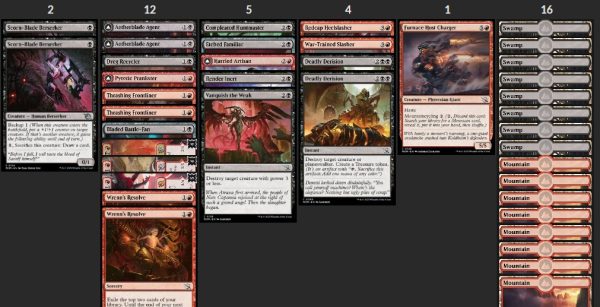
RB: Sacrifice

RB sacrifice usually needs to hit three checkpoints to work. The steal effect, the sacrifice effects, and the ability to generate fodder.

The Threaten effect is at uncommon, which is a knock against the deck. That being said, Furnace Reins has incredible stats in the archetype, where it boasts a 61.1% GIH WR and an outstanding 7.7% IWD.

There are a number of sacrifice outlets in the format at both common and uncommon. Akki Scrapchomper lets us play a longer, value-oriented game by sacrificing lands, but it cannot sacrifice non-artifact creatures. Be careful if this is how you plan on finishing off a Threaten-ed creature. There are plenty of other options though.

Sac outlets

Scorn-Blade Berserker has also impressed, though frequently, it's best to play it on one and get the free damage before cycling it. This format isn't as fast as others, and getting the Berserker down early can represent some valuable damage. The quantity of outlets is a relative strength when comparing this archetype to other formats.

There are some solid options for sacrifice fodder as well. Ral's Reinforcements, Ichor Drinker and even Nezumi's Informant are reasonable options here.

Like all red decks, this will be a great home for Pyretic Prankster. Nezumi Freewheeler has been an all-star in small sample size. It helps this deck grind. Together, these two let this deck play a slower game. It does this surprisingly well, though we definitely need to put our opponents on a clock.

Add some removal and a bomb, and you have a pretty strong iteration of a timeless classic.

Some Perspective

MOM appears to be a pretty complex format. There's a lot going on, and the cards are extremely powerful (though it does feel like I've been saying that a lot in recent months). The early data will definitely shift, but the current information represents a reasonable sample size. Don't be quick to dismiss it.

Are you enjoying March of the Machine as much as I am? What archetypes are working best for you? And what commons have I understold? Let me know in the comments. Until then, I'll be drafting!

Relentless Appetites: Why You Should Build a Rule 0 Commander Deck

Are you a Quiet Speculation member?

If not, now is a perfect time to join up! Our powerful tools, breaking-news analysis, and exclusive Discord channel will make sure you stay up to date and ahead of the curve.

What are Rule 0 decks? Essentially, they are decks that break the normal rules of the game and require permission from the table to allow them.

Some examples of Rule 0 possibilities include using banned cards and silver-bordered or acorn stamped cards, or adding a mechanic that does not appear on the card (but probably should). One might think that this only applies to casual games, but they would be wrong. There are "no banned list" events for various competitive formats, and they are increasing in frequency. Another thing to consider is that EDREC shows a small number of submitted decks with cards that cannot be played without Rule 0 help. Yes, this does happen "in the wild."

So, should you build a Rule 0 Commander deck? It's a deckbuilding question that is somewhat uncommon, but getting more frequent as new cards often beg the question.

Cards That Already "Break" the Rules

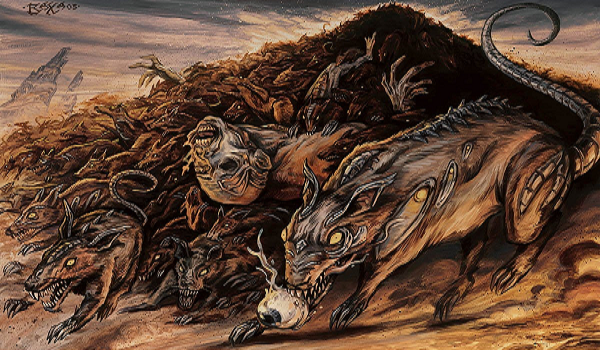
Do you recall a time when Relentless Rats was limited to a one-of in Commander? The original idea of EDH was that it was, in fact, Highlander. However, once Commander's very fundamental limitation of one copy per card was removed, the floodgates continued to open ever wider. Furthermore, the format has reached a point where there are a massive number of functionally equivalent cards, so it's a bit disingenuous to say it's truly a Highlander format anymore. This is where a Rule 0 deck can give you a little bit more flavor to work with if you're interested in expanding your deckbuilding horizons.

Contrary to what Mark Rosewater says, people are regularly making Rule 0 decks. This has been true of my experiences every week at casual Commander, both on SpellTable and since 1994. The one unifying principle I can ascribe to Magic players is, paradoxically, diversity. We all collect, trade, and play this game for many different reasons. Deckbuilding is equally diverse.

Some Cards That Need a Small Push

Hedron Alignment is a perfect alternate win condition card, except it is functionally impossible in Commander. Rule 0 is the fix! Allow four copies, and instead of stifling player creativity, watch as one or two players try and incorporate the card into an existing archetype. This is not going to make your games worse, less fun, or less interactive. If anything it's going to add another element to fight over, or allow the game to develop a little bit more before concluding.

Remember Caw-Blade? Letting the spirit of this deck relive its glory days in the Commander format is completely within bounds. Is any table, from casual to competitive, really threatened by three additional 1/1 Birds? Let loose the hawks of war and see that it adds to the history and flavor of a deck without offensively upping its power.

Undead Servant is another story entirely, as it works in a completely different way and is four mana. If you allow an unlimited amount of copies in a deck, it's still easily countered via graveyard hate, and only accelerates well with many, many copies. I think that some, but not all, Zombie decks would love to have maybe ten or so copies, but none would go all in. The only way to find out would be to show up with a Rule 0 deck and see!

There are plenty of cards with the same template of getting multiple copies, and under normal rules, they are functionally useless. However, with a little bit of creativity and the permission of the table, you can be free to experiment with these cards. It's called "the Gathering," right? Keep in mind that future themes will develop, so it helps to have an open mind when new deckbuilding opportunities arise.

Just Some Broken Things

In terms of competitive viability, there are powerful mechanics to build around. Players already use Thrummingstone with Rats and Petitioners. There are plenty of cards that combo here, like Cathar's Crusade or Impact Tremors.

For a much more abusive combo, Cadaverous Bloom allows you to turn your creature search spell into extremely large quantities of mana. Broken? Well, that ends up being a five-cost enchantment with another three-cost creature spell to get massive, but not unlimited, mana. Eight mana to not necessarily end the game on the spot is far from out of the question in casual games. Plus, think about the openers in a deck that has 30 copies of Battalion Foot Soldier. Can you keep two in your opening seven? That doesn't sound very unfair.

Alternatively, using Lost Legacy on your own creature can result in a thinned deck and a pile of card draw, a potential wincon alongside another card like Thassa's Oracle or Laboratory Maniac. Clearly these are additional ways to win, but nowhere near the absolute most efficient or competitive, especially using the cards mentioned. Furthermore, that card and others like it are counters to your own strategy. Imagine someone playing Meddling Mage, Nevermore or Declaration of Naught against you.

Finally there's Zombie Infestation, which I think is one of the most broken interactions if you powered up Gathering Throng or Battalion Foot Solidier with a no limit Rule 0. This means that you could T2 Infestation, T3 search 50 cards and put 25 2/2 Zombies without haste into play. Maybe you kill one player, maybe. However, this relies on everything going your way, and there are so many commonly-played cards like Propaganda and any four-mana board wipe that stop you from winning the game. To me, it feels like a classic degenerate deck, which I think are fun to see once but not regularly. The fact is, you do not need Rule 0 help to build degenerate decks, so there is little point.

In or Out? Mostly Out

Wish-type cards have always been a little bit controversial in Commander, and for good reason. The idea is that within your 100 card deck, you really ought to have plenty of room for a variety of cards. However, we've blown away that limitation, and demonstrated you have access to far more than 100 cards in modern Commander. That means that cards that reference even more cards from outside the game don't make a whole lot of sense in the format. Beyond being format flavor fails, functional Wish effects are simply too powerful.

That's why I bring up both Booster Tutor and Ring of Ma'Ruf as counter-examples. You need a vastly high degree of randomness and/or a massive cost, in Ring's case ten mana and a skipped draw, to make these cards merely interesting and not game-ending. Most of the Wish effects at two or three mana, however, are simply too good to allow. To Rule 0 them in a high powered, no-banned-list-level environment makes sense, but not for lower-powered games where more fun cards like Booster Tutor can spice up a game without ruining it.

Flavor With Some Power

This is an example of a Rule 0 "partner with" combination that is played at one of my local stores. There's nothing extra powerful about this pairing, in fact, Edgar Markov is more powerful. However, because of the thematic nature of a set featuring Vampires getting married, you know, literal partners, maybe they could have had the partner with mechanic? They made Wedding Ring and Rhoda, Geist Avenger and Timin, Youthful Geist, but somehow missed an obvious flavor slam-dunk. Well, one local Commander player stepped up to the plate and succeeded where Wizards failed. This pairing has never been vetoed because it's not overpowered and makes too much sense. I also suggested to them that they include three copies of Wedding Invitation, one for each other player.

Furthermore, many Planeswalkers are suitable as commanders even if they lack rules text saying so. We know this because Oathbreaker is now a recognized format! So yeah, the community is better at this than Wizards, and Wizards knows it. Obviously Oathbreaker is not a one-for-one analogue for Commander, but it is pretty darn close. If parts of the Magic community can come to this conclusion without express company endorsement, can't we all?

Not a Waste of Time; a Time Investment

So should you build a Commander deck that utilizes Rule 0? Absolutely. Unquestionably. Maybe? I'm joking; of course you should! Deckbuilding is a skill like any other, and building under even loose limitations increases your experience. Sometimes, breaking a limitation shows you why it is in place and even how you can work around it. There is always value to perspective, even a completely different one from the norm. So do yourself a favor, not only for fun and flavor's sake, but also to increase your flexibility, awareness, and adaptability to future printings and developments

Have you ever built a deck using Rule 0 in Commander? Would you allow one at your table? I'd love to hear your thoughts.

Testing with MOM: Unexpected Success

Are you a Quiet Speculation member?

If not, now is a perfect time to join up! Our powerful tools, breaking-news analysis, and exclusive Discord channel will make sure you stay up to date and ahead of the curve.

Every spoiler season is another opportunity to relearn what is actually good in Modern. There are so many new cards entering that, even when the broader metagame doesn't measurably change, specific matchups can be reshuffled thanks to new sideboard cards, role-players, and even lands. Also, despite years of trying, nobody has ever accurately predicted what cards will actually have an impact on every format. Testing often reveals unexpected additions, which is what happened to me this week as I tried a couple of March of the Machine cards in Modern, including a battle!

Testing in Gobakhan

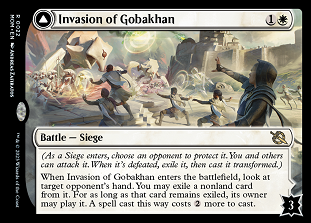
As I mentioned last week, the battles were quite underwhelming. The only one I thought might actually see play as intended was Invasion of Gobakhan // Lightshield Array, mainly thanks to its cheap cost and low defense. The fact that the back synergizes with attacking battles was a nice bonus, but I wasn't expecting too much from the card. That said, it's a natural fit into Modern decks I like, so of course I tested it.

Mono-White Humans, Test Deck

Creatures

4 Champion of the Parish
4 Esper Sentinel
4 Dauntless Bodyguard
4 Thalia, Guardian of Thraben
4 Luminarch Aspirant
4 Thalia's Lieutenant
3 Adeline, Resplendent Cathar
4 Solitude

Battles

4 Invasion of Gobakhan // Lightshield Array

Sorceries

4 Emeria's Call // Emeria, Shattered Skyclave

Instants

4 Shining Shoal

Lands

4 Cavern of Souls
2 Eiganjo, Seat of the Empire
4 Mutavault
7 Plains

To begin, I grabbed a Mono-White Humans list I saw while gathering data for the metagame update and moved some numbers around to fit in Invasion. I'd also like to take this opportunity to thank the players working on this deck for cutting Chancellor of the Annex. A card that you'll never cast, can use only if it's in your opening hand, and whose primary purpose was to be pitched was never going to work out. Shining Shoal, on the other hand, was a great card to rediscover.

Confusing Discoveries

While I always try to keep an open mind, I was very skeptical of Invasion going in. Just because I said it was the most plausible didn't mean I thought it would actually be successful. However, a very strange thing happened. Invasion was good; playably good. Maybe even meta-shakingly good. That wasn't even factoring in Lightshield Array; the front side by itself was shockingly playable.

There was an error retrieving a chart for Invasion of Gobakhan // Lightshield Array

Cheap disruption is always playable, especially when it's a disruption effect that a color doesn't often get. White doesn't get direct hand disruption often, and Elite Spellbinder is just a little too slow for Modern. Wrenn and Six existing doesn't help, but regardless, Spellbinder always feels a half-turn too slow in the current metagame. Invasion being cheaper for the same ability means that the disruption is a bit more timely, and thus more powerful.

Lost the Beat

One aspect of Invasion's power has been players forgetting they can cast the exiled spell. Unlike Spell Queller- or Banisher Priest-type effects, opponents don't get the card back if Spellbinder or Invasion die. Thus, the spell is simply exiled, rather than put under them, and it's easy to forget that it's special as the game goes on. This doesn't really impact playability in a vacuum, but it is worth mentioning, especially since the card is new.

There was an error retrieving a chart for Elite Spellbinder

Instead, what I didn't appreciate (because it had never come up before) was how disruptive it was to remove a spell from a hand. That Thoughtseize is disruptive is well-known, but Invasion lets them cast the spell down the line. If it was straight-up Castigate there'd have been nothing to discover. However, even if the spell is cast down the line, often times it's lost a lot of its bite by then.

There was an error retrieving a chart for Castigate

Sometimes, it's simply a case of an opening hand needing to play certain spells in a certain order to win. Take a link from the chain and the whole thing falls. Others, it's simply that a spell isn't good at the new mana cost. Expressive Iteration is quite mediocre, almost aggressively so, at four mana instead of two. It's like throwing a dance off by a few beats.

Compare with Thalia

The other unexpected result of my testing was how Invasion works alongside Thalia, Guardian of Thraben. Based on Pioneer experience with Spellbinder, I expected Thalia to be the main disrupter, with Invasion to simply be clean-up. As it turned out, the impact of Spellbinding something at two mana is very different than at three.

There was an error retrieving a chart for Thalia, Guardian of Thraben

Thalia introduces inefficiency into a noncreature-based deck's gameplan. To use engines as an analogy, Thalia removes the grease from the gears. It's damaging, but might not be a killer. Thoughtseize is like throwing a wrench in the gears. It might shut everything down, or it might just get spit out of the machine. Spellbinder was like sticking a screwdriver in a critical gear after Thalia removed the grease.

There was an error retrieving a chart for Thoughtseize

Invasion is more like throwing a log of wood into the gears. It will rattle the engine and gum it up, but a robust one will eventually work it out. That's worse than Seize, but better than Spellbinder. There was a time that Kitesail Freebooter was a staple in Humans (Unholy Heat proved its final straw), and it filled a similar role. In the current metagame, Invasion being a noncreature spell and thus immune to Heat and Push was almost an advantage, making this effect much more lasting.

About the Array

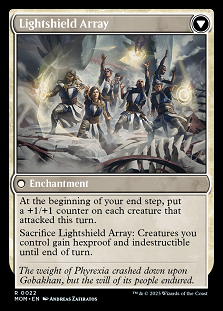
It occurs to me that I've spent all this article on the surprisingly good frontside, and have been ignoring the back. In my initial evaluation, I thought that Lightshield Array was the big upside that would actually make the card playable. After testing, I'm cooler on Array.

There was an error retrieving a chart for Fury

Don't get me wrong, a few extra Thalia's Lieutenant triggers go a long way to winning a game, and may well put the game away against any fair deck. However, it wasn't especially common to have many creatures left to receive counters, and rarer to have the Array around. The sacrifice ability was frequently invaluable, and as testing progressed, opponents frequently tried to get me to pop it as quickly as possible. Trading Array for Fury is a pretty good deal.

Bottom Line

I am very surprised at how much better Invasion of Gobakhan is and how medium Lightshield Array has turned out. That said, I'm not sure that Humans was the best test platform. The lack of synergy with the rest of the deck and being impacted by Thalia were major sticking points. I'm currently testing it in a Death and Taxes-style deck, where netting multiple triggers thanks to Flickerwisp is quite appealing. But the bottom line is that Invasion is much more playable in Modern than anticipated.

Diet Hogaak

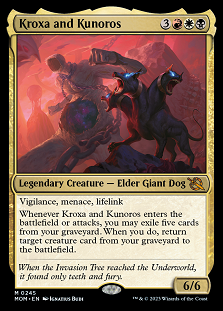
Remember the early days of Hogaak, Arisen Necropolis? How the deck was a mill-combo deck first, and a graveyard beatdown deck second? I've been testing Kroxa and Kunoros with Altar of Dementia, and while it is nowhere near as good as Hogaak, it certainly has shades of that deck.

There was an error retrieving a chart for Kroxa and Kunoros

For some context, I see a lot of different decks gathering metagame data. A lot of decks are trying to cheat Atraxa, Grand Unifier into play, and the more glass cannon-y versions are gaining ground. While other sites list them as Reanimator decks, they're much closer to Legacy Tin Fins than Reanimator. It's about getting a big legendary threat out cheaply, gaining value, and then letting it die rather than keeping it around. This seemed like a natural fit for Altar as a value play, so I'd just need to add Kroxa and Thassa's Oracle

Combo Kroxa

This was actually a harder fit than I thought. There are two versions of turbo Atraxa, one featuring Ephemerate and the other, The Underworld Cookbook. The former is more robust, but the latter makes more sense for my purpose, so I modified it and started testing.

Kroxa's Kitchen, Test Deck

Creatures

4 Asmoranomardicadaistinaculdacar
3 Ovalchase Daredevil
4 Atraxa, Grand Unifier
4 Emrakul, the Aeons Torn
1 Kroxa and Kunoros
1 Thassa's Oracle

Sorceries

4 Profane Tutor
1 Bone Shards
4 Thoughtseize

Instants

4 Goryo's Vengeance

Artifacts

2 Blood Fountain
4 The Underworld Cookbook
1 Altar of Dementia

Lands

1 Blood Crypt
2 Bloodstained Mire
4 Blooming Marsh
1 Boseiju, Who Endures
2 Overgrown Tomb
4 Swamp
4 Urza's Saga
4 Verdant Catacombs

Between Profane Tutor and Atraxa, I didn't feel like I needed more than one of each combo piece. I can't cast Oracle or Kroxa, but the deck was intended as a proof of concept. I wasn't planning on playing drawn-out matches where I needed to. I just wanted to see whether the combo fit in.

I Forgot Something

The short answer was kinda. Altar fit in quite well, anyway. Not casting legends is what the Atraxa decks are about, so the mana wasn't an issue. Even without going for the combo, getting an Atraxa trigger, attacking, and then sacrificing Atraxa to Altar usually set up the next Goryo's Vengeance perfectly, making that Altar worth the card. Thanks to Profane's searches and Atraxa's draws, finding Altar was less of a problem than anticipated despite being a one-of, and this quickly set up a self-sustaining cycle of deadly value. Not having to exile Atraxa was nice value, too.

There was an error retrieving a chart for Altar of Dementia

That said, adding the combo made the deck significantly worse. The combo wasn't bad, but it was only sometimes necessary. Vengeance for Atraxa and repeat was usually good enough. However, the biggest problem was Emrakul, the Aeons Torn. I forgot that when Emrakul is milled it shuffles the graveyard back into the deck. This made it impossible to actually combo off. Whoops, time to try again.

Kroxa 2.0

For the second try, I removed Emrakul, and added some more Altars and a Kroxa and another discard outlet. I wasn't interested in straying too far from accepted norms on the deck.

Kroxa's New Kitchen, Test Deck

Creatures

4 Asmoranomardicadaistinaculdacar
3 Ovalchase Daredevil
4 Atraxa, Grand Unifier
2 Kroxa and Kunoros
1 Thassa's Oracle

Sorceries

4 Profane Tutor
1 Bone Shards
4 Thoughtseize

Instants

4 Goryo's Vengeance

Artifacts

3 Blood Fountain
4 The Underworld Cookbook
3 Altar of Dementia

Lands

1 Blood Crypt
2 Bloodstained Mire
4 Blooming Marsh
1 Boseiju, Who Endures
2 Overgrown Tomb
4 Swamp
4 Urza's Saga
4 Verdant Catacombs

While this deck wasn't capable of the free-ish wins that Emrakul can deliver, it did work closer to my intentions. Alter filling the graveyard off Atraxa ensured that the combo could happen, and the deck got thin enough often enough that it was rare to not find a Kroxa if I wanted to try and combo. Each cycle of Vengeance and sacrifice saw 17 cards, after all.

The lingering question was whether this was better than the standard plan of just bashing with Atraxas or Emrakul. I'm not sure I have an answer. This deck is more vulnerable to graveyard hate like Endurance but less vulnerable to Solitude or Ensnaring Bridge. The nuance leads me to believe that there is real potential here. It is more waiting for the right metagame than not being viable.

Bottom Line

Assuming they aren't already, Vengeance players should seriously consider retooling their deck around Altar. There's a lot of value to be had there, and even without the combo, the option to just mill out the opponent rather than exile the legends is attractive. The combo fits in without problem, but it felt like a Plan C and might not be necessary.

Expect the Unexpected

Testing only rarely confirms suspicions. Magic is so complex that there's always something new to discover, and some things are more powerful than they appear. My results from March of the Machine testing aren't what I expected. How are you all doing? If you've found something surprising, drop it in the comments!

Stumbling Through the Magic Art Market

Are you a Quiet Speculation member?

If not, now is a perfect time to join up! Our powerful tools, breaking-news analysis, and exclusive Discord channel will make sure you stay up to date and ahead of the curve.

One activity that really surprised me during my vacation to Texas a couple of weeks ago was the Museum of Fine Arts. It’s not that I don’t appreciate world-class artwork, but I was concerned that my kids would lose interest quickly and that the activity would be a way to kill a couple of hours at best.

The outcome exceeded my expectations, and we all found different pieces that we enjoyed for various reasons. My wife was eager to see a few of the big names the museum had to offer (Monet, Van Gogh, Picasso, etc.), my kids enjoyed the interactive, modern art exhibits, and I enjoyed the historical pieces, going back before 1000 B.C.

The experience piqued my interest in artwork in general, so I decided to join the MTG Art Market Facebook group. Boy was I unprepared for what lay within!

Some Background

First, I need to provide a little context. Despite being an avid fan of many of the game’s classic art pieces, I never seriously explored original Magic art ownership. I think there was a part of me that always valued having a card over a piece of art because I was a player of the game for so many years.

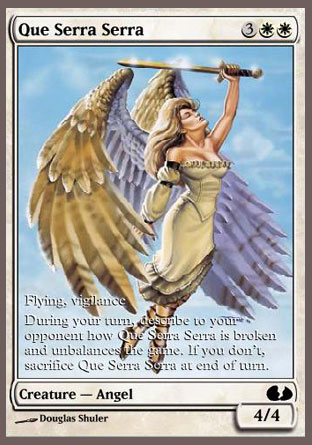
In fact, the only time I ever inquired about purchasing a piece of Magic art was in 2013, when I stumbled upon Douglas Shuler’s email address and contacted him directly about pieces he had for sale. We talked specifics for a couple of pieces, including Soldier of Fortune, Homarid Spawning Bed, and an un-set card that never saw print, Que Serra Serra.

Passing on Douglas’s offer to purchase these pieces was one of the worst Magic finance decisions I made in my career. While the pieces we discussed were small, the pricing was also very reasonable—I’m 100% confident if I had purchased any of the original artworks we discussed via emails, they would have looked amazing on my wall while also appreciating in value significantly.

Alas, I made the wrong decision and passed on the offers. Fast forwarding to 2023, I still own zero original artwork pieces from Magic.

Newfound Interest?

Now that I sold the majority of my collection (value-wise), I’ve shifted focus away from speculating/investing in Magic cards and towards other interests. Don’t get me wrong, I still buy and sell a card now and then, and I’ll continue to write about any interesting financial opportunities I am pursuing. The days of daily #MTGMail deliveries, however, are a thing of the past.

With a decreased interest in acquiring cards for my collection, where should I channel my focus? Original Magic art came to mind as a possibility once again, a decade after the last time I investigated it. Only this time I have a house with space designated for displaying my nerdy hobbies and I don’t play paper Magic much anymore. This could be the perfect opportunity to take a small portion of my Magic card proceeds to find a neat art piece to hang on my wall!

Unfortunately, I know virtually nothing about this market. As someone without original art knowledge, I had no clue how to proceed. I learned a bit by reading through Paul Comeau's high-level review on collecting Magic art, but I still had many unanswered questions.

Where to Start?

Serendipitously, I received an email from a modern-day Magic artist about a couple of auctions she was posting for some Magic-related sketches she had drawn. Her name is Zara Alfonso, and she’s created artwork for numerous recognizable cards, including Slip Out The Back, Shalai's Acolyte, and Tenacious Underdog.

There was an error retrieving a chart for Tenacious Underdog

She happened to create sketches for a couple of cards in March of the Machine, including Nahiri's Warcrafting and Kithkin Billyrider. “Perfect,” I thought to myself. “I can check out her auctions and maybe acquire an affordable, recent piece to hang on my wall.”

Well, it wasn’t quite so simple. It turns out Magic artwork buying is a highly contested market! Unlike in 2013, when I explored the possibility of acquiring artwork by emailing Douglas Shuler directly, one does not simply email an artist to inquire about available pieces for sale anymore. With the soaring popularity of owning original Magic art, the market has streamlined itself into a well-oiled machine.

Stumbling Block #1

For example, after I clicked on the email from Zara Alfonso, I was directed to her website. There on the site was a link to the auctions, which brought me to Facebook of all places! I was not expecting this redirect.
It turns out many artists auction their original work using this Facebook group. This makes sense when I think about it. The popularity of both Magic and Magic art has soared in recent years—I’m sure artists don’t want to deal with endless emails inquiring about their work. Auctioning art in a central location means a streamlined process and, hopefully, maximum value for the artists themselves.

Stumbling Block #2

I had to request permission to join this Facebook group, and my access was granted shortly after. Then a post was created welcoming all new members over the past few days—it was heartwarming to be welcomed by the group, as my Imposter Syndrome flared up. Everyone starts somewhere, though, so I hope I earn my stripes soon enough.

The next thing I had to learn about was the format of these artwork auctions. It’s not just willy-nilly bidding with the high bidder taking the prize like an eBay auction. Instead, there are a number of rules I had to familiarize myself with.

For example, here are the terms for Zara Alfonso’s sketch auctions:

Starting the auction now and it ends at 10:00 pm Eastern New York time on Sunday April 16th. We are looking for a $400.00 opening bid. Please bid in $25 minimum increases. Any bid made within the last 10 minutes of the end will cause the auction to extend 10 minutes from that bid time until there are no bids for a full 10 minutes. If I do not know you and you have no reference in the art market, you will be required to make a fully refundable 10% deposit (if you lose) on Pay Pal. This is for the safety of all bidders. Payment will be made directly to Zara by bank transfer, or Pay Pal friends or family, or Pay Pal purchase adding 4.1% for Canadian(5% for non Canadian). Shipping will depend on final price and where you are located on this planet compared to her in Western Canada. Pm me, Mark Aronowitz. Thanks, Mark and Zara Alfonso.

Choosing an end time, starting bid, and bid increments I completely understand. The bid sniping proofing with the 10-minute clause is something I can adjust to easily enough. Since I’ll have no references in the art market specifically (I’m not sure if I’m known enough outside of my little Old School / Magic finance sphere), I’m going to be expected to make a 10% deposit via PayPal. Then there are the fees, additional currency considerations, and shipping from Canada.

OK then, this is starting to get complicated. I’m certain there are ways to acquire original art without going through the Facebook route, but to a newcomer, it does feel like this is the marketplace for Magic art.

Stumbling Block #3

I’ve already overcome stumbling block 1 by finding the Facebook marketplace and gaining access to the group. Stumbling block 2 isn’t going to be hard to overcome and I don’t mind making a deposit and covering shipping. The third, and most challenging (for me) stumbling block, is the price tag.

Original artwork is expensive! These artists deserve every penny, so I don’t mean to shortchange them. I was just blown away by the demand in this market. My naivete inquires, with 1000s of new cards with unique art being released every year, wouldn’t there be ample supply for purchasing? Would not that ample supply lead to some affordable pieces for purchase?

Perhaps not. Looking at some of the recent auctions on the Facebook page, I’m seeing sketches bid up to nearly $1000. Colored paintings, such as this beautiful art for the Cloud of Fairies reprint by Iris Compiet, is bid up to $4000 so far!

Clearly, I have much yet to learn.

Wrapping It Up

The jury is still out on whether or not I’ll be purchasing any original Magic art pieces. I suspect there may be some smaller, less complete pieces that would sell for a price that falls more within my budget. At that point, however, is it worth my purchasing? I mean, hanging a tiny pencil sketch on my wall won’t exactly have the presence I’m interested in.

I have learned so much over my thus far brief foray into the world of original Magic art. The market is organized, streamlined, and highly competitive. This doesn’t mean I’m barred from participating, of course, but it does mean I need to decide if I’m serious about the pursuit. It would appear one does not luck into an inexpensive piece of artwork these days.
Perhaps with enough patience, I’ll stumble upon a piece that resonates with me, yet is affordable. Until that day occurs, however, I’ll continue to marvel at the beauty (and expense) of these beautiful pieces of art… just like I did at the art museum a couple of weeks ago.

March of the Machine: Format Dynamics and 10 Best Commons

Are you a Quiet Speculation member?

If not, now is a perfect time to join up! Our powerful tools, breaking-news analysis, and exclusive Discord channel will make sure you stay up to date and ahead of the curve.

The sun sets and rises again. So it is for Limited formats. March of the Machine (MOM) arrives this weekend, and with it new cards, keywords, and most intriguing of all, a new card type. Battles are the ninth card type in Magic, and the first addition to the roster since planeswalkers were introduced in Lorwyn. That was in 2007. For those keeping score at home, it's been sixteen years since a new card type debuted, so let's get right to it.

Battles and the Other Keywords

Battles are a new double-faced permanent. They can be attacked, similar to planeswalkers. Unlike planeswalkers, however, the player casting the battle chooses an opponent to defend them. They provide the caster a bonus when they enter the battlefield, and if we're able to deal them enough damage to "defeat" the battle (note: not destroy), then it flips and we get a second effect from them, usually a creature.

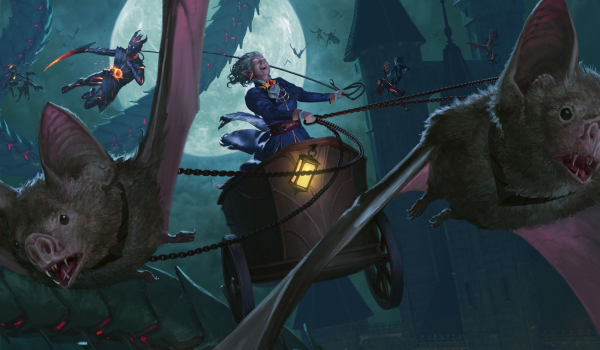
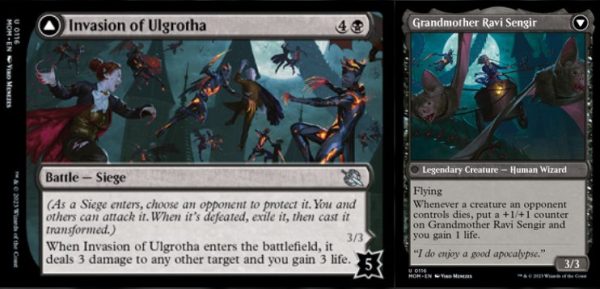
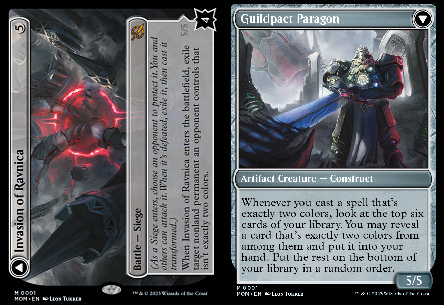
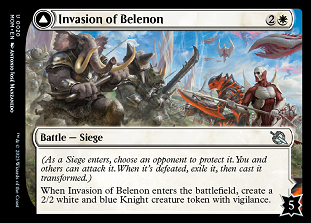
For example, Invasion of Ulgrotha offers a five-mana Lightning Helix at sorcery speed. Each damage we deal it removes a defense counter. If we remove all five, the card flips, unlocking Grandmother Ravi Sengir. Opponents can try to protect it via blocks or otherwise. They also can destroy it with cards like Atraxa's Fall.

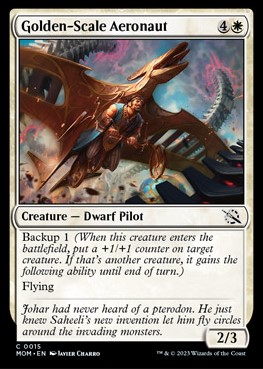
Though none are as novel as battles, other keywords will lay their fingerprints on the format as well. Backup gives creatures some modality as they enter the battlefield. They can enter with a +1/+1 counter, or they can give that counter to another creature. If they do, that creature inherits all subsequent abilities until end of turn.

Golden-Scale Aeronaut can be a 3/4 flyer, or a 2/3 flyer that gives another creature a +1/+1 counter and flying until end of turn.

Additionally, convoke returns, allowing creatures to tap and pay for spells bearing that keyword. Incubate is an ability that creates a token in waiting. A creature with Incubate X creates an Incubator Token, a dormant artifact, with X +1/+1 counters on it. For two mana, the token awakens into a 0/0 Phyrexian who still bears those counters. Remember: the Phyrexian token will not have summoning sickness if the Incubator was in play at the beginning of the turn.

How Keywords Shape This Format

MOM's keywords imply that this will be an aggressive format.

Backup is an ability that favors attacking. Battles generate value through the midgame. If we're ahead on board, we're able to pressure battles and unlock that battle. Pressure in MOM is different, though, then it was in ONE. Battles create detours from the opponent's life total, which will lead to longer games. Defeating a battle can help fortify those we need to defend. While early starts won't end with the swift lethality of the last format, they will create devastating advantage, which may end the game some time after. Whereas ONE was clearly an aggressive format, this one will be defined by aggression's crafty brother: tempo. Get ahead, and try to stay ahead.

Furthermore, convoke only works when we have creatures on board. Otherwise we're just overpaying for these spells. If we get on board early, we position ourselves to generate board advantage and mana efficiency. This might not be a lightning-fast format, but we still want to curve out.

Incubate tokens counter this strategy. These tokens take two mana to activate, but they're bigger than other tokens in this design space. As aggressive decks storm the midgame, trying to flip battles, these tokens will stand as massive barriers in their way.

Extra Jumbo Eggs

Incubate can provide the defensive bulk needed to play a slower game. By defending our opponent's battles, we can strand card advantage and pull ahead in the late game. If we can't, we're likely to fall behind and stay there.

Can We Trust These Two-Drops?

When previewing a format, we should examine the two-drops. There are no Barbed Batterfists or Duelist of Deep Faiths to get excited over. This might be a hedge against the power of backup-driven starts. If we can get uncommon and rare two-drops, then we can play a better aggressive game. The last time I felt this way was in DMU, where the best aggressive decks wanted multiple uncommon two-drops.

The tension between challenging battles and backing up attackers against the slower midrange pace of the Phyrexian-themed spells will define this format. If we're not pressuring our opponents early, we want to stabilize as soon as possible. Using an instant-speed burn spell to flip a battle, or using the discounts on convoke cards or Ephara's Dispersal, all help with recovery. Tempo plays like these, and even timely combat tricks, will represent massive moments in individual games.

Furthermore, removal is at a premium in this format. There are plenty of bombs that will threaten to take over games, and being able to remove a key blocker to defeat a battle will help to snowball advantage. The best removal spells will help us flip our board position, and those are represented highly on our top common list.

Ranking the Top Commons

There was an error retrieving a chart for Overgrown Pest

10) Overgrown Pest: This card is getting compared to Carnivorous Vorroc for all the obvious reasons, but the downgraded stats are very meaningful. ONE's best common was often the biggest creature on the board when it resolved. This card won't be. While picking up a battle will feel powerful, I'm not sure a 2/2 on three will put us in a prime spot to capitalize on it. The card should be good, but not spectacular.

There was an error retrieving a chart for Converter Beast

9) Converter Beast: This card has a lot of stats... for admittedly a lot of work. For four mana, we get to incubate five, and the 0/1 theoretically defends our life total while we wait for the egg to hatch. The format has support for tokens and Phyrexians and even +1/+1 counters, but the card that makes me excited about this Beast is Scrollshift. It's possible that the instant is the card we need to prioritize if this hidden archetype materializes, but at least in the early weeks, we should be able to get it late.

There was an error retrieving a chart for Ichor Drinker

8) Ichor Drinker: A one-drop with lifelink that dies into a 2/2? Sign me up. This card will be a nuisance in aggressive decks.

There was an error retrieving a chart for Cosmic Hunger

7) Cosmic Hunger: Instant-speed bite that can hit battles and planeswalkers is great. Especially because it can defeat battles at instant speed, unlocking a hidden blocker or end-step attacker. We need to make sure we have the right creature suite to support this, but it should be strong in most green decks.

There was an error retrieving a chart for Alabaster Host Intercessor

6) Alabaster Host Intercessor: Six-mana commons are not frequently admitted to this list. This one has Plainscycling, so there's some inherent flexibility there. The most interesting aspect, however, is using these to facilitate a splash, where the first one not only helps cast a splash-worthy rare, but also all subsequent versions of this Samurai. It's a powerful effect, and I love the way it increases threat density as we move into the late game.

There was an error retrieving a chart for Ephara's Dispersal

5) Ephara's Dispersal: Cheap interaction with surveil tacked on. This is a blowout against big incubate tokens, and much better on defense, where we can stabilize off of the mana-advantage this generates. In the aggressive decks, it will push damage and still be fine.

There was an error retrieving a chart for War Historian

4) War Historian: The other green three-drop gets the attention. However, War Historian will challenge opponents on creature sizing, while generating value on battles and being an excellent landing place for backup counters. Pest is a good card, but this three-drop could end up the scourge of the format.

There was an error retrieving a chart for Deadly Derision

3) Deadly Derision: Killing things is good. Treasure is good. Instant-speed Grim Bounty is good.

There was an error retrieving a chart for Volcanic Spite

2) Volcanic Spite: The debate between the second- and third-best commons comes down to the nature of the format. Both will thrive here. In addition to being excellent removal spells, each can help flip tempo. However, the ability to finish off a battle at instant speed to provide a flash blocker while allowing us to rummage puts the Fire Prophecy ahead by a hair.

There was an error retrieving a chart for Preening Champion

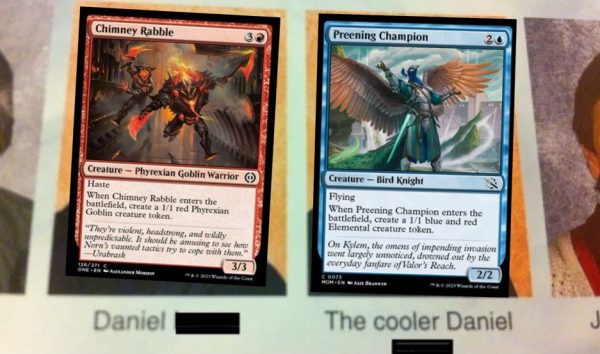
1) Preening Champion: This card does it all. It provides evasive pressure for battles. It's a Knight for archetype synergies. It creates two bodies for convoke synergies. The token is even "blue and red" so we can pay for Stoke the Flames. The best common in the set appears to be preen-ordained.

Prerelease Weekend

This weekend marks the first chance many of us will have with the new cards. With all of the high-powered rares, battles, and even a multiverse legend in each pack, this format will be a unique experience, and one that should mature nicely. There are creative build-arounds, new mechanics, and plenty of powerful effects that should make this weekend an interesting one.

What commons did I miss? What archetypes look the strongest? How many times did you accidentally call it "March of the Machines" before being corrected? Let me know in the comments, and good luck this weekend!

I Built a Deck with All Number 13s That Doesn’t Need Luck to Win

Are you a Quiet Speculation member?

If not, now is a perfect time to join up! Our powerful tools, breaking-news analysis, and exclusive Discord channel will make sure you stay up to date and ahead of the curve.

The universe aligned to bring you this article on the 13th of April, a special day for more than one reason. I have always been fascinated by 13 as a number and how it is associated with crummy luck, something that as a Magic player I am all too familiar with. So I set out to build a Commander deck with all number 13s and leave the rest to chance.

The result? A challenging deck to build, acquire, and play that offered a unique experience not only come game time, but also during construction. Top-down deckbuilding in this way can be fun, rewarding, and illuminating. Let's dive into my process and the payoffs I discovered!

How Does This Work?

The wonderful people over at Scryfall have got an amazing tool to help us with this bad luck build. Imagine having to comb through set after set looking for that 13th card; it would take forever! Luckily, with just a couple of pieces of syntax in "number:13 t:legend," we can quickly find all the legendary permanents that are card number 13 in their respective expansions. Here are my top choices for a commander.

Could we even do a mono-colored commander for this deck? Searching with only "number:13" yields a scant 285 total choices, and that's in all five colors. By adding "id:w,u,r," we learn that there are 239 white, blue or red color identity cards to choose from, or just over 80% of all the results. Sorry, green and black! Optimus Prime, Hero // Optimus Prime, Autobot Leader is our lucky winner (and unlucky commander).

Next, there is a handy sorting button for people pressed for time or those lacking inspiration. Why sort by name, or price, when you can sort by EDHREC Rank. Taking a quick look shows me that I won't want for power. Yes, my choices for infinite combos are pretty limited, but there is decent removal in Farewell, Disenchant, Crush Contraband and Condemn, along with a bunch of other perfectly usable cards. But what about spicy cards? What about thematic cards? There's more here than I could ever hope for!

The Spice

On a purely thematic level, I'd be a fool not to include Death or Glory and Misfortune's Gain. A lot of the removal and interaction of the deck is combat-based, and I have a great selection of cards from many different sets, including Grey Knight Paragon straight from the 40k universe. I'm excited to give Mirror Match a try, as it seems like a crazy powerful card even if it's so much mana.

Also, I included Urborg, Tomb of Yawgmoth just because I can. As it is a colorless land with no color identity, I can safely add it to the deck even though there is no current usage for it. It just seemed like the right thing to do! It is a 13, after all, and giving players black mana can create diplomacy opportunities in rare cases.

I leave Gathering Throng for last because it's a potentially deck-defining card with a Rule 0 adjustment. In the future, I might consider playing exactly 13 copies of the Throng if the deck does not have enough of a distinct identity; however, that would be a large change, and necessitate a lot of rebuilding. Still, it's an idea for the future.

Pricy Printings... How Unlucky

Not just any Divert can go into the deck. Nope, to get that "13," I have to buy the special Amonkhet Invocation printing. Luckily, it's one of the lowest-priced cards of that type, but still not a common card to come by at all.

There was an error retrieving a chart for Divert

Elspeth, Knight-Errant can go in, but only the 2014 Modern Event Deck printing. It's budget-breaking but the Kaladesh Invocation of Hangarback Walker is also a choice down the road. I own plenty of copies of Land Tax, including an original Legends print, but not the Renaissance version I will need to acquire.

Making choices and searching out very specific cards is a mini-game all its own, and offers something to look forward to when buying collections and looking for deals.

Breaking the Rules

There was an error retrieving a chart for Mountain

This is a basic Mountain that happens to be number 13 in the set. Do I mind paying upwards of $20 for a single basic land? I've done sillier things. However, my strict options are limited. What are we to do? Cheat, but only a little. Commander 2011 has a basic Mountain numbered 313 if I want to save a little money.

There was an error retrieving a chart for Island

Unstable basic Islands will set me back a few dollars, but at least it's a really cool land, I already own several, and it is #213, hardly breaking theme!

Two down, but what about our most important basic? Plains is another story entirely, but we can use the same workaround.

There was an error retrieving a chart for Plains

While it's not perfect, 130 is still 13 with a zero after it, which is how many games I expect to win with this deck. I found a set of Plains, Mountain, and Island all with set number 132 - then went back and checked other numbers. So I can either use the same number for each land or make a pattern like 131, 132, 133. Options!

Being forced to build under constraints has sparked even more possibilities not only for this deck, but future ones as well, and just as an exercise this has already been vastly worth it. Not only do I have more options for my budget, but also more avenues to build in sub-themes and unique deck building constraints as well.

Turning It Up to 13

Is this on-theme enough?

Here is where we come full circle. I strongly predict that serialized cards will, eventually, start to creep back up in price for exactly this reason. There is no end to the potential of some crazy numeric themes, and serialized cards open up worlds of possibilities. Given a few super-powerful serialized cards, I can make the deck as strong as I want... for a steep price.

Come On, Wizards...

Full stop: somehow this card is not set number 13.

There was an error retrieving a chart for Triskaidekaphile

Wizards of the Coast has continued to manufacture poor quality product, pre-damaged cards, pringled foils, poor writing, and, wrong art attribution. Every month, there's one mistake after another. On top of these repeated failures, they still make absolutely amateur level mistakes when designing cards! To not make this card set number 13? Come on. You can do better, Wizards.

Can I include this card in my deck? I could, but I think it makes more sense to deliberately leave it out as proof the game is going in too many directions, and continues to experience wild quality control issues on multiple levels both big and small. Remember the double downgrade to Hasbro stock? Well, now they are feeling their own lack of quality control and acquiring a new CFO. What did this CFO do for Harley-Davidson? Simplify the product by making fewer product offerings, exactly what Magic needs to do to avoid these continued mistakes.

The Deck List as it Stands

An Ode to 13

Commander

1 Optimus Prime, Hero // Optimus Prime, Autobot Leader

Creatures

1 False Prophet
1 High Sentinels of Arashin
1 Mahamoti Djinn
1 Dromoka Dunecaster
1 Boss's Chauffeur
1 Fairgrounds Warden
1 Flourishing Fox
1 Linvala, Keeper of Silence
1 Rune-Tail, Kitsune Ascendant // Rune-Tail's Essence
1 Teferi, Mage of Zhalfir
1 Shivan Dragon
1 Vedalken Humiliator
1 Reya Dawnbringer
1 Helionaut
1 Portal Mage
1 Archangel Avacyn // Avacyn, the Purifier
1 Karmic Guide
1 Kor Cartographer
1 Giver of Runes
1 Archaeomancer
1 Flickerwisp
1 Eldrazi Displacer
1 Containment Priest
1 Crystal Dragon // Rob the Hoard
1 Mageta The Lion
1 Gathering Throng

Non-Creatures

1 Haunting Imitation
1 Condemn
1 Death or Glory
1 Fierce Retribution
1 Farewell
1 Disenchant
1 Crush Contraband
1 Elspeth, Knight-Errant
1 Gideon, Champion of Justice
1 Benevolent Blessing
1 Blessed Alliance
1 Dawn Charm
1 Descend upon the Sinful
1 Devouring Light
1 Divert
1 Elspeth Conquers Death
1 Forsake the Worldly
1 Gideon Blackblade
1 Brainstorm
1 Land Tax
1 Marshaling Cry
1 Mirror Match
1 Misfortune's Gain
1 Negate
1 Prison Term
1 Unsummon
1 Hyena Umbra
1 Justiciar's Portal

Lands

1 Strip Mine
1 Urborg, Tomb of Yawgmoth
1 Tolaria West
11 Island
21 Plains
10 Mountain

What does the deck do? Well, it establishes board presence with a bevy of expensive permanents and also has a lot of endurance. So many cards grab permanents from the graveyard or flicker things back into play for enters-the-battlefield triggers. That's about half of the deck.

The other half? Lots and lots of removal. So we are either winning on board or it's time to reset the game with a wipe and then start getting permanents back with Death or Glory, Reya Dawnbringer, or Karmic Guide and Eldrazi Displacer.

I think it will hold its own in lower-powered games at the five or six mark. Admittedly, it will indeed rely on good luck to win games a lot of the time. However, I'll continue to be on the lookout for upgrades, and if serialized cards get cheap they'll go directly into the deck. Maybe, one day, even Sol Ring will have a 13 on it.

Looking Ahead

Maintaining decks like this one gives players like me a reason to look forward to new set releases and to scrutinize every possible angle to optimize a theme. Also, I am going to eventually build a deck where every card is in numerical sequence, and potentially a pi deck... that one is going to get complicated! In any case, I have a ton of new material to work with and will continue building, tinkering, and applying creative thinking to get the most out of build restrictions on every angle.

Do you have a number-based deck? Are you too enthusiastic about math? Which crazy deckbuilding challenges have you tried out? Let me know in the comments!

Prepare For War: March of the Machine Spoilers

Are you a Quiet Speculation member?

If not, now is a perfect time to join up! Our powerful tools, breaking-news analysis, and exclusive Discord channel will make sure you stay up to date and ahead of the curve.

I was quiet this spoiler season. I primarily had other writing priorities, but also, there wasn't anything that I felt needed immediate attention. For better or worse, March of the Machine (MOM) is not an overly powerful set. There are numerous interesting cards and it's sure to shake up Standard, but as far as my preferred formats are concerned, nothing is an obvious fit. That said, there's an entirely new card type coming, and it needs close scrutiny.

Marching Into Battles

For the first time since Lorwyn introduced planeswalkers, Magic has a new card type. Called battles, there will be many types eventually, but for now there are only Seiges. The idea itself is interesting, though I'm quite skeptical of their actual impact outside of Standard.

When a Siege battle resolves, it gets a number of defense counters (that work exactly like planeswalker loyalty) and is then assigned a defender. The defender must be an opponent of the player casting the battle. Any other player can attack the battle. Once the last defense counter is removed, the battle is exiled, transformed, and cast. The owner of the battle then gets whatever is on the backside.

I'll go ahead and get this out of the way: because the battles are exiled, then cast as a triggered ability, Teferi, Time Raveler answers them. As the battles are cast from exile, Drannith Magistrate also answers the transformed side. That they're cast means that transformed battles can be countered. I don't think any of this affects their playability, but they are useful interactions to remember.

General Complaint

The idea is interesting, and I get the intent. However, I feel that the execution is lacking. The rules make it clear that there were multiplayer implications and intentions in making these cards, but there's no reason for any player other than the Siege's controller to attack them. Each Siege has a fairly minor, and often slightly overcosted, triggered ability on entering the battlefield, and then does nothing. There's no harm in letting a Siege sit there, nor any direct benefit for any player to attack one they don't control. The only reason to do so is to trigger the transformation and give the controller a bonus spell.

I appreciate that this will certainly change in the future, but for now, this feels really anemic and forced. If there was incentive for players to want to remove the battle, then it would make sense. If the one who defeats the battle got the transformed spell, that'd be one thing. If the battle had a continuous effect or repetitive trigger incentivizing other players to remove it, that'd be another. As-is, there's no reason for anyone beside the battle's controller and the designated defender to care. It's like Diet Archenemy.

Draft Dodging

So why does the defending player care about the battle? It's not actively hurting nor benefitting them. The backside of all the battles are decent, but not overpowering. In fact, the fact that their opponent is attacking the battle is arguably a good thing. As far as the defender is concerned, each Siege reads "Opponent gets an overcosted effect. You gain life equal to the number of defense counters on the battle plus any excess damage." The opponent gets another spell after giving you that life, but none of those spells are crippling. There are few if any that would be good enough on their own by my reckoning.

Missing in Action

Actually, having typed all that out, I'm now questioning why the controller would want to attack the battle at all. It's directly giving the opponent some amount of life and indirectly Time Walking yourself, as it will take most if not all available attacking creatures to take down the battle. That's an attack step when the opponent's life total isn't under pressure, and therefore another draw step for them. Again, the rewards for defeating a battle are good but not great, so I'm not sure it's actually worthwhile.

There was an error retrieving a chart for Vampire Hexmage

Altogether, I'm now thinking that trying to use the battles as intended is not a great plan. The transformed spells are barely (at best) worth the time and effort required to gain them. However, Hex Parasite and Vampire Hexmage effects do work on battles, so perhaps cheesing them is a better option.

Invasion of Ikoria

There's a perfect, built-in test for this idea: Invasion of Ikoria // Zilortha, Apex of Ikoria. While narrower, and generally worse, than Finale of Devastation, I could see Ikoria make it in Pioneer simply because it has two green pips. Mono-Green Devotion already doesn't play humans and might want a tutor. The fact that Invasion of Ikoria is a battle with a creature on the back wouldn't really be relevant.

However, this Invasion could also find a home in Modern for a different reason. For four mana, you can tutor for Hexmage and be ready to flip over Zilortha anytime. This is as close to Dark Depths as Modern is ever likely to get. It's leagues and leagues worse than Depths, admittedly, but an 8/8 for four isn't terrible, and the second ability might win a game. The problem is that Zilortha dies to Fatal Push. I'm certain that players are going to try it, but I'm skeptical that it'll work out.

Invasion of Gobakhan

If any of the sieges are going to work out as intended, my bet would be on Invasion of Gobakhan // Lightshield Array. The front being a cheap disruption effect is worth looking at in both Pioneer and Modern. Elite Spellbinder has seen Pioneer play and is borderline for Modern, so shaving a mana and not being a creature almost balances out. The pluses are that this siege only has three defense, and the backside rewards attacking.

The ideal situation for Gobakhan is for Modern Counter Cat to play Wild Nacatl turn one, then Invasion on turn two, attack and immediately flip it, and then Lightshield Array will trigger, turning the Nacatl into a 4/4. That is obviously an absolutely perfect scenario, but Array is strong enough that disruptive white aggro may want this in multiple formats. Losing three damage might be worth making every attacking creature more powerful.

Graveyard Smash

Looking outside of the battles, there are a number of cards that offer interesting, if slightly convoluted, combo potential for Modern. The headliner is Kroxa and Kunoros. While a solid card if cast full price, this is not the type of effect any Modern deck (and probably no Pioneer deck, either) would pay six mana to have. There are cheaper and less conditional ways to reanimate creatures. However, the templating of the reanimation ability creates a combo with Altar of Dementia.

The second ability triggers without a target because it is a reflexive trigger. The conditions must be met first for the trigger to do anything. This means there is a window to sacrifice Kroxa to Alter, mill six cards, and use five of them to pay for the trigger and reanimate Kroxa. Rinse and repeat until your library is empty and use the final trigger to reanimate Thassa's Oracle. It's a self-sustaining combo.

There was an error retrieving a chart for Altar of Dementia

The catch is that making this happen requires a lot of moving pieces. The earliest it could come together is turn three, by using The Underworld Cookbook to discard Kroxa, then playing Alter turn two, and finally reanimating Kroxa with either Persist or Goryo's Vengeance. That's not bad, but it's also all-in on a combo that can be responded to and broken up by Endurance. There's also competition in the niche from Jeskai Combo Breach and Goryo's Kitchen decks. It will be interesting to see if Kroxa can outcompete the existing decks.

Rhino Bait

Next is Halo Forager. Faerie's holdouts always get excited whenever a possibly playable faerie comes out. Bad news, those guys, it's still no longer 2008, and Bitterblossom is obsolete. However, Forager here is still playable without any Faerie-type support. Paying more for Snapcaster Mage with flying instead of flash isn't a good deal, but a Snapcaster that can target the opposing graveyard opens possibilities.

Forager can also be used to flashback opponent's cascade spell. A three-mana Snapcaster isn't great, but three mana for a 3/1 flier and a Crashing Footfalls you don't own is pretty amazing. Of course, Rhinos has Subtlety and Force of Negation as answers, but the best-case scenario on Forager remains pretty awesome.

There was an error retrieving a chart for Living End

That said, I actually think that the best use is as an anti-Living End card. Discarding Forager before End resolves ensures that you can immediately undo the sorcery. Of course, getting that scenario to play out in reality may be tricky enough not to be worthwhile. That said, being able to play Forager the same turn via Aether Vial) or cast it normally the following turn ensures that the opponent won't just win on the spot.

Niche Seekers

Honestly, that's all I'm seeing in terms of impact players for the older formats. The competition for space is high enough, and MOM's power level isn't especially pushed, by the standards of recent sets anyway. However, there are a number of interesting cards that could make an impact if the right circumstances rise. They don't currently have a niche but would fill one well if it existed.

Faerie Mastermind

Again, Modern Faerie hopefuls, this will not reinvigorate your pet deck. Modern decks don't draw two cards a turn. They're running Mishra's Bauble and Expressive Iteration, or have Teferi, Time Raveler, so there's no surprise value. Paying four so the opponent draws one card and you draw two isn't a great rate. Legacy would rather play Hullbreacher. For Faerie Mastermind to see play, there needs to exist a Pioneer blue tempo deck that isn't Spirits.

Omen Hawker

Wizards really doesn't make mana dorks in Standard anymore. Blue never gets mana dorks, so Omen Hawker's stock is incredibly high. The fact that Hawker generates more than one mana means that it plus Freed from the Real make infinite mana. Mana that can only be used activating abilities. There are easier ways to make an infinite Walking Ballista, but players will always experiment with unique effects.

Deeproot Wayfinder

A 2/3 merfolk for two is solid but not very exciting, and Simic Merfolk never took off in Modern, which limits Deeproot Wayfinder's playability. The second ability is intriguing, but so long as Wrenn and Six is legal, it is completely outclassed. If a Merfolk deck ever gets fins in Pioneer I could see this working there, but as is there are easier ways in all formats to get lands from graveyards.

Ozolith, the Shattered Spire

An additional Hardened Scales for one more mana probably isn't good enough. Ozolith, the Shattered Spire also gives counters (expensively), so it might be good. The real question is what can Hardened Scales afford to cut to fit in the Shattered Spire.

Just Another Set

March of the Machine has some interesting cards, though the headline new mechanic raises enough questions that I don't foresee widespread adoption in older formats. Those cards that do make it could inspire some strategic repositioning and a new twist on existing decks. However, there's nothing here that will definitely disrupt Modern's status quo. I expect that to persist for some time yet.

Avatar photo

David Ernenwein

David has been playing Magic since Odyssey block. A dedicated Spike, he's been grinding tournaments for over a decade, including a Pro Tour appearance. A Modern specialist who dabbles in Legacy, his writing is focused on metagame analysis and deck evolution.

View More By David Ernenwein

Posted in Free, Modern, Spoiler3 Comments on Prepare For War: March of the Machine Spoilers

Have you joined the Quiet Speculation Discord?

If you haven't, you're leaving value on the table! Join our community of experts, enthusiasts, entertainers, and educators and enjoy exclusive podcasts, questions asked and answered, trades, sales, and everything else Discord has to offer.

Want to create content with Quiet Speculation?

All you need to succeed is a passion for Magic: The Gathering, and the ability to write coherently. Share your knowledge of MTG and how you leverage it to win games, get value from your cards – or even turn a profit.

Content Creators Wanted

Are you a Quiet Speculation member?

If not, now is a perfect time to join up! Our powerful tools, breaking-news analysis, and exclusive Discord channel will make sure you stay up to date and ahead of the curve.

You Can Be a Content Creator with Quiet Speculation

Do you love Magic: the Gathering? Are you exploding with stories to tell and knowledge to share about your favorite game? Are you able to write and speak coherently? If this sounds like you, Quiet Speculation is actively looking for new content creators to join our team. Share your knowledge of Magic and how you leverage it to win games, get value from your cards – or even turn a profit.

Open Roles

Quiet Speculation is actively recruiting content creators to cover these specific areas of focus:

Constructed Specialist - Competitive (Standard, Modern, Pioneer, etc.)

The Competitive Constructed Specialist loves 60-card formats, whether played on the Arena ladder or at their nearest RCQ. More than just a grinder, they should be looking to improve their knowledge and understanding of the game of Magic and be able to eloquently share that knowledge with an audience. The Constructed Specialist doesn't just tell the audience something is good, they tell them why it is good, and teach the audience the tools to develop that understanding for themselves.

Constructed Specialist - Eternal Formats

While just as competitive-minded as our other Constructed Specialist, The Eternal Formats specialist focuses on Vintage, Legacy, and/or Pauper in addition to covering other 60-card formats. They have a deep knowledge not just of current eternal metagames, but also of the histories and evolutions of the respective formats.

Finance

Quiet Speculation was founded as a Magic Finance website. While in recent years we've broadened our offerings, Magic Finance is still a core part of our content offerings and will remain so as long as there is a secondary market. A finance writer for QS teaches readers how to leverage the secondary market to achieve their individual goals. This can range from turning a profit, to growing a collection, to having a competitive deck for the next big Modern tournament. Sharing individual specs, and investment opportunities with readers is good. Teaching readers the skills to identify specs on their own is better.

Teaching readers the skills they need to be savvier in interacting with the secondary market encourages investment in the game in more than just a financial sense. It gives readers analytical tools they can apply to all aspects of their Magic game, and beyond. QS Finance writers share tools that let players get the most out of their collections and enjoy their Magic passion to the fullest.

Other Opportunities

We are looking for diverse content creators who bring something new to the table. If none of the above roles is a good fit for you, don't hesitate to apply and pitch us what you want to cover. We've launched the careers of numerous Magic content creators over the years. Could you be next? Smash the button below and apply today.

Avatar photo

Paul Comeau

Paul is Quiet Speculation's Director of Content. He first started playing Magic in 1994 when he cracked open his first Revised packs. He got interested in Magic Finance in 2000 after being swindled on a trade. As a budget-minded competitive player, he's always looking to improve his knowledge of the metagame and the market to stay competitive and to share that knowledge with those around him so we can all make better decisions. An avid Limited player, his favorite Cube card is Shahrazad. A freelance content creator by day, he is currently writing a book on the ‘90s TCG boom. You can find him on Twitter and LinkedIn.

View More By Paul Comeau

Posted in Announcement, FreeTagged , , , , Leave a Comment on Content Creators Wanted

Have you joined the Quiet Speculation Discord?

If you haven't, you're leaving value on the table! Join our community of experts, enthusiasts, entertainers, and educators and enjoy exclusive podcasts, questions asked and answered, trades, sales, and everything else Discord has to offer.

Want to create content with Quiet Speculation?

All you need to succeed is a passion for Magic: The Gathering, and the ability to write coherently. Share your knowledge of MTG and how you leverage it to win games, get value from your cards – or even turn a profit.

An Alpha Opportunity

Are you a Quiet Speculation member?

If not, now is a perfect time to join up! Our powerful tools, breaking-news analysis, and exclusive Discord channel will make sure you stay up to date and ahead of the curve.

I went to Magic 30 in Las Vegas last year with the goal of significantly reducing my investment in Magic. While I was successful in this mission, I had a difficult time moving the few remaining Alpha rares I had left. It perplexed me. Each Alpha rare is a precious piece of history. Wizards printed only 1,100 of each. It's impossible to say how many have been damaged, destroyed, or otherwise lost over the years. Their scarcity and value are almost unrivaled.

Despite this, all the vendors I approached declined to make an offer on these collectibles. It became clear to me that just because a card is scarce, doesn't make vendors interested in purchasing them. There still must be demand from their customers. I was a bit bewildered by this at first because I was not seeing a lack of demand from my vantage point. I'd seen many Alpha rares sell in the Old School Discord. There’s even a format dedicated to Alpha cards, for crying out loud!

Alas, after failed attempts to move these cards in person, I shifted my focus to online buylists. Ultimately, I traded in my Alpha rares to ABUGames for store credit, and moved that credit into high-end Old School singles that would be easier and faster to sell.

Alpha Stagnation

That was almost half a year ago now. Since then, I’ve continued monitoring the Alpha rare market despite owning zero copies myself. I wanted to see if prices were truly softening or if finding a particular Alpha rare remained as difficult as always.

So far, it seems like (with some exceptions) the answer is the former. Bear in mind I didn’t own any true chase Alpha cards—my collection consisted of cards like Farmstead, Northern Paladin, and Fungusaur. These were less-desirable cards for play purposes, and most of their demand would come from the collector market. I don’t think prices on Alpha rares like these have been very strong lately.

There was an error retrieving a chart for Fungusaur

What’s more, I’ve seen the same inventory sitting in vendor inventory for a while now. This subset of cards isn’t exactly flying off store shelves. I admit I haven’t been tracking the high-end stuff as closely—it’s fully possible that Alpha dual lands, power, and playables like Birds of Paradise are on the rise. I don’t think that’s the case, though, judging by the sparsely populated data we have on such cards.

For example, consider Alpha Mox Jet, the first power nine card that came to mind. Retail pricing and best buylist pricing for this card is well off its high, set back in 2021.

There was an error retrieving a chart for Mox Jet

The charts for Alpha Chaos Orb and Timetwister look similar in shape, though I will confess Timetwister’s pullback has been much shallower in nature. Alpha Black Lotus, arguably the most collectible non-misprint non-custom card in Magic, hasn’t pulled back one bit, and Card Kingdom still boasts a nearly-six figure buy price.

Top end aside, however, I’d posit that Alpha rares have cooled off in general, and the less playable the card is, the more its price has dipped.

Pricing Mismatch and the Bid-Ask Spread

Readers may start to poke holes in my claim above, citing the still-strong pricing on obscure Alpha rares listed across multiple online platforms. For example, consider Alpha Gaea's Liege, one of my favorites.

There was an error retrieving a chart for Gaea's Liege

Online Store Pricings...

Card Kingdom has just two copies of Gaea's Liege in stock: a near mint one for $1999.99 and an excellent one for $1599.99. If they had a good copy in stock, it would be listed at $800. That seems like a strong price for this card, doesn’t it? The best buy price is currently over $900, which seems robust at first glance. Before jumping to that conclusion, however, keep in mind that’s a near mint buy price; a heavily played offer will be less than half that number.

Next, you may challenge me by highlighting TCGplayer pricing—currently, there’s only one lonely copy of Alpha Gaea's Liege in stock. It’s listed as heavily played for $799.99 plus shipping. That’s a steep price for an HP copy, and it corroborates Card Kingdom’s $800 “good” condition price tag. Doesn't all this data support the notion that obscure Alpha rares are stronger than ever?

...Versus eBay Pricing

I would be inclined to agree, but for one final data point. Check out this eBay listing that ABUGames has posted currently, an auction for a heavily played Alpha Gaea's Liege:

This is a major disconnect! This copy is currently listed at $337.54, less than half of Card Kingdom’s “good” price and TCGplayer pricing, and there are still zero bids!

I could be challenged by someone claiming that this card’s listing is still active and that it could receive multiple bids before the auction’s end. Crazier things have happened. I'd rebuff that by highlighting this card’s auction history on eBay. You see, this isn’t the first time this card has been listed by ABUGames. Nor is it the second. Nor is it the third.

Nope, this is the fifth time this card has been listed; the previous four listings for this card concluded without a single bid. In fact, a very heavily played Alpha Gaea's Liege did sell recently, and the auction ended at $305.21.

Thus, I’d put forth the argument that, while Card Kingdom and TCGplayer sellers can try to sell their copies at whatever pricing they’d like, this card is worth far less than these sites indicate. The amount someone is willing to sell at (aka the “ask”) is significantly higher than the price at which someone is willing to buy (aka the “bid”). In this environment, the spread between the bid and ask has ballooned, leading to stagnant inventories—the very thing that Magic 30 vendors in Las Vegas wanted to avoid.

The Exception or the Rule?

One card is not sufficient to establish a trend. Perhaps this one instance is a fluke? I can tell you one thing for certain: that Gaea's Liege auction isn’t going to end without a bid again because I absolutely plan on bidding on it myself before the auction ends.

At least, I would… if there weren’t other equally tempting auctions out there. You see, Gaea's Liege is not the exception in this bid/ask pricing mismatch. In fact, ABUGames currently has a dozen Alpha rares at auction currently, with prices of varying attractiveness. Here are the few that tempt me most, along with TCGplayer low and Card Kingdom “good” pricing:

Played Chaoslace: TCG low $450, Card Kingdom good $260 (completely sold out)

Heavily Played Clockwork Beast: TCG low $700, Card Kingdom good $600

Played Zombie Master: TCG low $650, Card Kingdom good $520

Heavily Played Demonic Hordes (gotta love the “BBB” in the text box!): TCG low $960, Card Kingdom good $1480!!

Heavily Played Meekstone: TCG low $880 (a damaged copy sold at this price), Card Kingdom good $760.

Including the Gaea's Liege, that’s six raw Alpha rares that ABUGames currently has listed on eBay at arguably attractive prices. In most cases, the prices are well below alternate listings across the internet. While I compared the cards above to Card Kingdom’s “good” pricing, keep in mind that Card Kingdom doesn’t actually have any good copies in stock; in most cases, they are either sold out or have only the pricier NM or EX copies in stock.

If ABUGames had more Alpha rares to sell, I suspect many would fall in a similar camp to the listings above. Week after week ABUGames has listed these for sale at auction, and each time they’ve ended without bids. Now, after watching these cards for as much as a month, I’m starting to feel tempted—these price points are awfully attractive for such iconic, collectible cards.

A Nod to Other Old Sets

Now that I’m bringing these listings into the spotlight, I wonder if they’ll all sell this time around. As I mentioned before, I plan on bidding on one of these cards myself—I don’t have the bankroll for all of them, and I’m not sure what my priority is just yet. It feels like a game of chicken: do I bid on something now to lock in a purchase, or do I wait and see if the auctions end another time without any bidders, thereby giving me the chance at a lower price? The joys of the Dutch auction style at work.

Beta Price Trends

I want to take one moment to step aside and acknowledge that I’ve also been monitoring Beta rare prices; indeed, I have even purchased a couple of cheaper Beta rares from ABUGames over the past couple months. Currently, ABUGames has 62 Beta rare auctions listed on eBay, but I don’t think the prices are nearly as attractive as the Alpha cards I mentioned above. It seems we’ll have to wait a few more weeks for auctions to end without bids before prices become interesting—I’ll continue monitoring and will report back what I find!

Other Old School Sets

For those interested, ABUGames also uses this Dutch-style eBay auction listing strategy for other Old School cards from Arabian Nights, Legends, Antiquities, and The Dark. I would guess they do the same for Unlimited cards too, though I’ve never searched myself. The only other ABUGames eBay auctions I watch closely are for Revised Dual Lands, which seem to frequently receive bids before they can end and drop in price.

Wrapping It Up

For now, my focus remains on Alpha cards. There simply aren’t many for sale out there and after these auctions end, it’s hard to predict when ABUGames will have new copies available to sell. It could be that they won’t have another Alpha Demonic Hordes to auction for months. By then it could be the case that $1000+ copies are the only ones available on the open market. Once again, widening the bid/ask spread.

If you have any interest in the Alpha cards above, don’t dilly-dally. Place your bid! Be thankful that you are purchasing a piece of Magic history at an attractive price, up to 60% off “retail” prices offered by other websites. I will be following my own advice, and I’m already excited to own one out of 1,100 copies of a card once again. I know I had a few before that I sold, but as prices have softened over the past few months, I can’t help myself.

Sometimes a deal is just too juicy to pass up!

Out of the Shadows: Diving into the Data of Innistrad

Are you a Quiet Speculation member?

If not, now is a perfect time to join up! Our powerful tools, breaking-news analysis, and exclusive Discord channel will make sure you stay up to date and ahead of the curve.

Shadows Over Innistrad Remastered (SIR) has been a difficult format for me. After experiencing unprecedented personal success in ONE, culminating in a top 250 finish in March (finishing 109th, after hitting 51 and hiding in the safe haven of best of three), SIR has not felt as intuitive. This fall from grace has been a humbling reminder of the highs and lows of Magic's variance.

When we experience unfortunate results in any aspect of life, we're presented with a myriad of options. We can blame barriers outside of our control and bemoan the cruelties of the world, or we can choose to reflect and get good (or, at least, better).

There is a major difference between playing a focused game on Arena and just clicking through plays in mindless tilt. When our failures lead us to hopelessness, we take less accountability for our actions, and it reflects in our gameplay. That being said, we won't spend this week congratulating ourselves on being reflective. Rather, we'll dive into the numbers and come away with learning that gameplay has yet to offer us (read: me).

Game In Hand Win Rate

When trying to understand a new format, the first thing we should look at is the Game in Hand Win Rate (GIH WR%) of the commons. While there are other important data points, we want to know what cards are winning the most. Typically, we'll see an overlap between the top commons and the winningest archetypes, but most formats don't reward forcing a single deck. Last week we talked about the power of the archetype synergies in SIR. It's very difficult to build off of those synergies if we can't read what's open.

Looking at the format's top commons provides a couple of meaningful takeaways, answering questions as critical as:

  • Is there an archetype we should lean into?
  • What cards does each archetype/color want to prioritize?
  • What general trends do we notice about the overperforming commons in each color?
  • Which cards can tell us a specific archetype is "open?"

GIH WR% is the best way to gleam the answers to those questions. When we're struggling, it can be our best friend.

This format features a rotating sheet, which means one card out of every pack will only be in the set for the week. This means the data features some variables that might go unaccounted for. This is not a reason to discard the data. It is, however, information we need to factor into our conclusions. For example, we should assume that specific creature type synergies received a boost in the first week. Spell-based synergies were the largest beneficiaries from the flashback themed week. The "morbid" theme of this week will again emphasize creatures, but also sacrifice synergies.

Initial Takeaways from the Data

It is hard to ignore the abundance of white cards at the top of the list. What is more shocking is how replaceable some of them seem.

Thraben Inspector has a strong pedigree. It sees play in constructed formats, and we shouldn't be surprised to recognize it atop the list by over 2%. Cheap red interaction plays well in most formats, and this one is no exception. Silent Departure and Forbidden Alchemy have both rotated out of the format, and we won't see them for the rest of SIR's run.

The biggest shock on this list is the second-winningest common. While the combat trick has overperformed, this doesn't mean we want to second-pick Strength of Arms. If we go deeper into the data, we'll notice that Strength of Arms has an ALSA of 7.85. Similarly, Lunarch Mantle has an ALSA of 8.03. If we use early picks on cards that are going late, we're sacrificing too much to include them. This means they'll never live up to that GIH WR%. These cards win at their GIH WR% because of their ALSA, not in spite of it.

Still, they should be on our radar. More importantly, we need to be able to infer that these cards are going to thrive in aggressive decks; the high performance of these cards is buoyed by a strong overall performance by the strategy, as well as more powerful cards that are picked earlier.

The high success of aggressive white commons is reflected in overall color performances. White decks do well, but if we're not supposed to spend early picks on Lunarch Mantle and Strength of Arms, how are we supposed to build these decks?

Using the Data to Build White Decks

To make sure that we're building our white decks correctly, we can look at the top performing cards in each of the four white color pairs. Again, we want to make sure that we're considering the ALSA when looking at each of these picks, as well as using reasonable judgment to factor in what our deck needs at any given point. Still, these lists can provide valuable information when considering each pick.

Unsurpisingly, we see a lot of low-costed cards. When looking at the data, it seems to imply that the best WG decks utilize delirium more than we would expect. Last week, we discussed the powerful payoffs in Obsessive Skinner and Gnarlwood Dryad. While green's enablers are well-documented, white provides Lunarch Mantle, Bound by Moonsilver, and Angelic Purge to get multiple card types in the graveyard. This makes a lot of sense, as the two aforementioned delirium payoffs play better as aggressive threats than control cards.

Surprisingly, Dauntless Cathar and Steadfast Cathar are further down on this list, and not shown in the data set. This color combination was billed as a Humans Aggro deck, but the data implies that the delirium builds are stronger. Even in its short time in the format, Elder Cathar had only a 52.9% GIH WR. Not great.

Moonlight Hunt performs really well in this archetype; however, its small sample size implies that it's only seeing play in decks with an extremely high Werewolf counts.

Gleaning an Edge

Spirits has performed well for me in this format despite my previously mentioned struggles.

UW Spirits is a little less mysterious. This deck is a tempo deck, so we want to set up the clock early. Tattered Haunter does that very well and Apothecary Geist gains us life to help us win the race. This deck is pretty intuitive to build, so it's not surprising that it has such a high win percentage. Speaking of straightforward decks, the RW deck is a quintessential aggressive deck.

This is the deck that wants Dauntless Cathar. It's a low-curve aggro deck, but the missing ingredient in my recipes has definitely been Magmatic Chasm. Hazardous Blast was the scourge of the format in ONE, and this card does a lot of the same work. It lets us finish games afterDrownyard Explorers and Graf Mole stabilize the board.

Building BR

The two most prominent themes in BR are Madness and Vampires, and they're both well-represented amongst the top commons in the color pair.

Alchemist's Greeting needs a lot of support to be great, and in this deck it is. With Vampiric Fury out of the format, the top ten commons are either efficient removal spells or part of the Madness equation, as either discard outlets or madness payoffs. Other decks don't really want Weirded Vampire or Insatiable Gorgers, so if we're seeing them around their ALSA, it might mean the color is open. If we're not seeing those cards late, we should consider finding a new home for our red cards. The problem is that the madness enablers and payoffs are insular. Gisa's Bidding is good in any black deck, but the other black cards are much better in Vampires than anywhere else.

Because the best red cards are efficient removal spells, we should consider UR spells a natural home for them.

It's safe to assume that this color pair peaked when the bonus sheet provided a flashback card in every pack. Getting extra spells and cast triggers is a nice bonus. Furthermore, the deck loses out on two of its best cards, Silent Departure and Forbidden Alchemy.

Because the removal is so valuable in this deck, we naturally will want to pair that with card draw. The more we consider the strategy of this deck, the more we want Take Inventory. It's the best way to generate raw card advantage, and if we can cut them early, we gain a lot from them late.

This deck doesn't prioritize aggressive creatures, which confirms my initial feelings that this is best built as a control deck. Drownyard Explorers outperforms Pyre Hound despite being taken slightly later in drafts. Spontaneous Mutation is a strong performer here as well. Instants and sorceries naturally power it up, and the slower we are, the better this effect.

Bouncing Back

Some formats come naturally, while some require more work. SIR has been of the latter variety. That being said, we can't expect to have an incredible comeback unless we're down a few points. While our winning percentage might have dropped a few points, refining our strategies with data-supported practices should yield positive results.

Furthermore, Magic is a game where variance plays a major role. In the draft and during in game plays, all of us are subject to good hands, lucky top-decks, finding the open lane, as well as flooding out, or mulliganing into oblivion. However, if we focus on the things we can control, we'll put ourselves in position to create positive change.

Finally, while I wish I could say I plan to immediately utilize this information to go out there and win some drafts with GW Delirium decks, or torching opposing defenses with Magmatic Chasm, it looks like the good folks at Wizards of the Coast have decided that my talents would be more appropriately challenged in Explorer. Not quite sure why a top finish in Limited would force me to battle it out in Constructed (gross), but you can be sure I'll be utilizing the data to put myself in the best possible position. If you have any thoughts on the data, or some tips as I venture into Explorer, do share in the comments!

Is Magic Getting More Expensive?

Are you a Quiet Speculation member?

If not, now is a perfect time to join up! Our powerful tools, breaking-news analysis, and exclusive Discord channel will make sure you stay up to date and ahead of the curve.

I was intrigued by a recent article from CBR.com, which claimed that Magic is getting more expensive. The article called out last year's Magic 30 product and collector boosters for the forthcoming The Lord of the Rings: Tales of Middle-earth set as examples of an increasing onslaught of top-end products. While I am not a fan of all the high-end product releases that Wizards of the Coast is increasingly dumping into the market, I don't know if it's accurate to argue that this is actually making the game more expensive to the average player.

I decided to investigate this myself by examining the costs of decks for various constructed formats and comparing them to historical prices for decks in those formats. I did all this while trying to keep in mind what price control Wizards of the Coast actually has, if any, over the secondary market prices of their cards.

Format Price Comparison Methodology

I chose to limit the scope of my data pool to the two most popular sanctioned constructed formats: Standard, and Modern. I looked at these two formats specifically, rather than Magic's most popular format, Commander, for a few reasons. First, as sanctioned formats, decks for Standard and Modern are required to be composed of genuine Magic cards. Proxies of any kind, officially printed or not, are not allowed for sanctioned formats. This makes the prices of cards in these decks a legitimate factor, unlike in Commander, where a player can simply proxy up a copy of any card not within their means to own, and play it—barring any Rule 0 objections of course.

Second, the Standard and Modern formats both have long histories. Modern has been a sanctioned format since 2011. Standard has been a sanctioned format since almost the beginning of the game—originally called Type 2, as it was the second Magic format ever after Type 1, or what we now call Vintage.

because of their histories, there is plenty of historic pricing data we can look back on to compare the costs of decks for these formats, and determine if it's true or not that Magic is getting more expensive, or has gotten more expensive over time.

If current prices are the same or lower than in previous times then Magic is getting cheaper. If current prices are 15% higher or more than previous times then Magic is getting more expensive. I chose 15% because it is high enough that it would clearly discern a true deviation from previous prices, but is not so high that it would be untenable.

There was an error retrieving a chart for Thragtusk

Standard

One could easily make the argument that Standard is the format Wizards has the most control over. The cards are by default all the newest ones. Nothing is on the reserved list or anything like that. There's also historical precedent for Wizards injecting previously valuable cards into event decks (added to the Thrive and Thrash Gatecrash Deck) to help regulate prices.  The fact that new Standard-legal cards enter the market all the time thanks to both Limited play and people just opening packs for fun, means that the supply is constantly growing. This is what we see if we look at the top decks in Standard according to MTGGoldfish's metagame breakdown:

  • Grixis Midrange - $411 (35% of which is due to running two copies of Sheoldred, the Apocalypse)
  • Monowhite Midrange -$293 (33% of which is due to four copies of The Wandering Emperor)
  • Monored Aggro - $107 (33% of which is for the three of Chandra, Dressed to Kills)
  • Esper Legends -$583 (50% of which is due to four of Sheoldred, the Apocalypse)

These four decks make up roughly 51% of the metagame with an average deck cost of $348.50. While $350 is still a fair amount of money, there have been multiple times in Standard's history that decks cost close to $1,000. Decks like Caw-Blade (Zendikar-Scars Block Standard) and 5-Color Goodstuff (Khans of Tarkir-Battle for Zendikar Standard) were easily $1100+ in their heyday. 

There was an error retrieving a chart for Stoneforge Mystic

Mitigating Factors on Standard Prices

Now it is important to admit that for Standard, current prices have more factors affecting price than just card availability. Thanks to Magic: Arena, a lot of more casual players are likely shifting away from playing paper Magic to playing digital Magic. I have already dug into the pros and cons of Magic: Arena in a previous article. Suffice to say, it is my belief that Friday Night Magic and Weekly Booster Drafts have likely been, and continue to be, cannibalized by the monster that is Magic: Arena.

Unrelated to Arena, but equally as impactful, has been the dramatic drop in larger in-person events like Magic Fests/Grands Prix, Starcity Games Opens, and even Regional Qualifiers. This can be attributed partly to varying Pandemic-related restrictions on these types of mass gatherings by local governments.

The combination of the rise of Arena, and the decline in large in-person events, means there is less demand overall for paper cards. This is one factor that I believe is helping keep the average deck price down. Another factor that we must also consider is that the Standard format right now is quite varied. There is not one particular deck exerting a stranglehold over the format, thus driving the prices for its signature cards higher.

There was an error retrieving a chart for Sheoldred, the Apocalypse

Modern

Modern is interesting for a number of reasons. Again, as in Standard, none of the cards are on the reserved list. In fact, Wizards has actually frequently reprinted some of the most in-demand ones. Despite this, Modern decks are still quite expensive compared to Standard. One very noticeable trend when looking at the top lists of the format is how many cards in the decks are from Modern Horizons 1 or Modern Horizons 2.

  • Izzet Murktide - $1038 tops the metagame with a 12.6% share. Almost 30% of the deck cost is in the four copies of Ragavan, Nimble Pilferer a Modern Horizons 2 card.
  • 5 Color Creativity - $1236 which accounts for another 10.2% of the metagame. Around 22% of the cost is tied up in Wrenn and Six and Archon of Cruelty, cards from Modern Horizons 1 and Modern Horizons 2 respectively.
  • Hammer Time - comes in at $967 and accounts for around 7.2% of the metagame. Urza's Saga and Esper Sentinel take up around 25% of the cost of the decks, both of which are from Modern Horizons 2.
  • Temur Rhinos - $1214 and accounts for around 6.8% of the metagame. We have 23% of the deck cost tied up in a playset of Force of Negation and Fury which again are from Modern Horizons 1 and Modern Horizons 2 respectively.

These four decks make up around 37% of the metagame. This means you are likely to play against at least one if not several of these decks in any larger tournament setting. While these decks cost a good bit of money, they are arguably in line, if not cheaper, than many decks throughout Modern's history. For example, back in early 2015, Modern Jund played:

  • 4x Tarmogoyf ($150+ each)
  • 4x Liliana of the Veil ($75+ each)
  • 4x Dark Confidant ($70+ each)
  • 4x Verdant Catacombs ($35+ each)

This doesn't even include numerous $10-$15 cards rounding out the deck. 2015 Jund easily topped out at $1500 at the time.

While not all top-tier Modern decks approach Jund price levels, many have often been upward of $1000-$1400. Current prices appear perfectly in line with this.

Aggravating Factors On Modern Prices

I wanted to call out the more expensive Modern Horizons cards in current decks specifically, because of Wizards of the Coast's penchant for Secret Lair drops and the general consensus from players that these cards need a reprint to lower their prices. I could easily see many of them getting reprinted in the near future. This isn't to say go and sell your personal copies now, but I see very little upside to their current prices and significant risk.

There was an error retrieving a chart for Solitude

I will be the first to admit, that I own none of them and a large part of that reasoning was that I don't play a lot of Modern anymore and I can wait to pick up copies for our local Legacy tournaments when prices drop.

When looking at Modern, or really any non-rotating format, the deck price is typically a one-time expense. Most players pick up a Modern deck and either try to master it or trade the cards off towards building a deck they do like. Either way, deck costs aren't really a recurring factor like they are in Standard. Thus, it's acceptable, and almost expected, for the overall cost to be higher. This is partly because these cards are typically the best of the best, and there's a sentiment among players that they should be more valuable for that reason.

Accessibility vs Collectability

Accessibility and Collectability are two sides of the same coin. You can't have both. For cards to be accessible they must be readily available and thus cheap. For cards to be collectible they need to be rare and hard to find. I must admit that as a store, I find Wizards of the Coast's push towards numerous variants of differing availabilities to be annoying to monitor and maintain. However, as a player, it is abundantly clear that this avenue allows the "more common" versions of cards to be pushed into the marketplace by the collectors looking to recoup some of their costs of chasing the extremely rare variants. This then lowers the price of the normal versions and allows players to get their necessary cards for less than they might have in the past.

There was an error retrieving a chart for Supreme Verdict

My Final Verdict

No disrespect to the writers at CBR.com, but after looking at the numbers, I think they got it very wrong. While it's true that the rarest of the rare cards are ballooning in price, the game as a whole appears to be getting less expensive. This is especially true of the Standard format. It's definitely nice to know that if a player wants to play paper Standard competitively, they no longer have to fork over suitcases full of money to play.

One could argue that the price of Modern appears relatively stable at around $1000 for a top-tier competitive deck, but at least the prices are stable. Indeed, with the potential for reprints at any time, as we discussed, they could even get cheaper.

That's my perspective, what's yours? Do you think Magic is getting more expensive? Let me know your thoughts in the comments.

March ’23 Metagame Analysis: A Fable of Outliers

Are you a Quiet Speculation member?

If not, now is a perfect time to join up! Our powerful tools, breaking-news analysis, and exclusive Discord channel will make sure you stay up to date and ahead of the curve.

March's data shows that a small number of decks are dominating Modern to a degree I find concerning. Given how UR Murktide has been an overwhelming metagame force for an entire year, this strongly indicates a stagnating metagame. I'm working on a full article examining Modern's health, but for now I'm focusing on what happened in March and how.

Unpacking the Big Five

There's no getting around the population data: UR Murktide, 4-Color Creativity, Hammer Time, Temur Rhinos, and Rakdos Scam (for the rest of this article, the Big Five) are the most popular decks in Modern by a lot, and across play mediums. Creativity makes a solid claim as the best overall deck in Modern, as it had the best average points among the Tier 1 decks in both paper and online. This is quite surprising. Modern has had one or more statistical outliers since this time last year, but never so many, nor so consistently.

There was an error retrieving a chart for Murktide Regent

Paper actually included another outlier in Amulet Titan, but I don't think it counts. It wasn't close to outlier status online, unlike the other decks. This is because Amulet's paper numbers are driven not by the overall metagame but by a single source. For reasons unknown to me, Star City Games attracts Amulet players. It always has. I always input the SCG data into my spreadsheets last so I can watch and see how it changes the numbers. This time I watched SCGCon Charlotte's results move Amulet from below Burn to outlier territory. It's not the same as other decks.

The MTGO Trends

As I mentioned in the data article, I know how these decks achieved their huge populations but not why. When the Big Five are the decks that show up in the large events far more than any other deck, of course they're going to beat out everything else. Therefore, the first question to ask is if I should have seen this coming. Was there an upward trend with these decks that predicted this outcome? Let's check the graph:

Not what I expected at all.

Well, Murktide has been on a gradual upward trend, which isn't too surprising given its history. Hammer Time hasn't recovered despite Mill falling off in March. Scam is volatile, so there's no way to know what happens next. On net these three, which had been the top decks for a while, fell. Thus, any upward trend was driven by the other two decks.

Both Creativity and Temur Rhinos spiked hard in March. Creativity was 4.91% in February rising to 9.27% in March. Rhinos was at 3.08% in February and skyrocketed to 7.98% in March. That is quite shocking. I knew both decks were up in March, but I didn't know how strong the spike was. Therefore, these two are the decks to focus on.

The Paper Trends

What about paper? It had been healthier from an outlier and general data distribution standpoint before March. To have suddenly become arguably unhealthy is quite shocking. What does the graph show?

Something very surprising, apparently.

I knew that Murktide was relatively down, but I didn't know how. It's one thing to have access to all the data; it's another to be able to visualize it. Murktide and Hammer Time have clearly fallen off significantly in paper while Scam is fairly stable. It's been up and down, but just barely. Again, the overall trend was driven by Rhinos and Creativity.

The increase isn't as dramatic in paper. Rhinos was at 4.09 in February, increasing to 5.61 in March. That's a decent bump, but not anything like what happened online. Creativity was at 5.20 and rose to 8.21, notably having been trending downward previously. That's significant, but still lower than Magic Online, which leaves paper's concentration as a bit of a mystery. The overall spread of the rest of the data isn't much greater despite the higher population and lower unique decks. However, overall lesson is that the movers in March were Creativity and Rhinos.

Rhinos Rising

That Temur Rhinos (formally referred to in this column as Cascade Crashers) is doing well is not surprising. It's been a consistent strong performer for two years now. The main hiccup was when Leyline Binding convinced players that 4-Color Rhinos was the way to go. That surge has subsided, and the Temur version is back on top. This is the advantage of being a more focused list.

There was an error retrieving a chart for Crashing Footfalls

The merits of Temur Rhinos vs. other versions are somewhat old hat at this point. What is relevant today is that Temur's very focused manabase and gameplan make it a perfect metagame tool. In a field where other fast aggressive decks are down and Creativity is rising, Rhino's maindeck Force of Negation proves fairly meta-breaking. Couple that with playing Blood Moon either main or side, and I suspect that the rise of Rhinos was a direct result of Creativity's own ascent.

Creativity's Conundrum

It's a strange thought that Indomitable Creativity is making a play for the best deck in Modern. Murktide has always been more popular, but Creativity has the better win rate. 13 months ago, I accused the deck of being a pretender, and here we are now. I stand by that analysis, as it was all true at the time. For Creativity to rise, something needed to change. And change something did.

There was an error retrieving a chart for Fable of the Mirror-Breaker // Reflection of Kiki-Jiki

In a card, the change was Fable of the Mirror-Breaker. Two creatures and a Faithless Looting for three mana is pretty good as-is, then add in treasure making and suddenly Creativity could consolidate a lot of slots into one card. This adoption let Creativity transition away from racing to Tinker for a fatty, a strategy that wasn't working, to playing a long, more controlling game. If the optimal strategy was racing out Archon of Cruelty, then Jund Creativity would be on top.

Instead, 4-Color Creativity is making waves and is the current driver of the metagame. It gets to threaten Creativity without having it, while still advancing a clock thanks to Fable. This gives it a Splinter Twin-like tempo drain, while playing a decent control game. Thus, it can just wait for the moment to strike or win the game while the opponent is distracted.

Time to Reposition

Consequently, I think that some of Creativity's rise is being facilitated by opponents playing poorly against it. They're still largely focused on the old, straightforward plan, and don't really appreciate how different the deck is now. When the current plans for fighting the deck clearly aren't working, it's time to reposition and adjust. I think players need to adjust their focus from Creativity itself towards Fable, to the point I think it's more correct to name Fable with Necromentia effects than Archon.

The Wider Metagame

As for the wider metagame, the only deck that consistently challenges the Big Five is Burn. This isn't entirely surprising, as in my experience Burn has at-worst even matchups against all of them except Hammer Time. Any deck that's careless with its life total is going to fall to the fire, and Creativity in particular can be loose. I'd expect Burn to remain the best also-ran deck in Modern for the time being.

There was an error retrieving a chart for Tasha's Hideous Laughter

As for the rest of Modern, there are a lot of solid decks that simply could not hang with the Big Five consistently. However, that hasn't stopped them from winning events. Both Mill and Tron won Challenges in the past week, which highlights the weird paradox of Modern's statistics. The Big Five puts up absurd numbers and dominates the field, but they don't actually win events. As far as the stats go, there's been a solid case for calling Murktide Tier 0 for a while, but since it rarely actually wins events, it can't be. The struggle with this paradox of decks dominating field but not actually winning events is a major focus of my present research on Modern's health.

Metagame Opportunity?

Given that the Big Five constitute ~40% of Modern, and with Burn and Amulet ~50%, this seems like as close a time as any to try metagaming. Normally, metagaming in Modern is a very bad idea. The field is too wide to accurately predict what will be played at any tournament. However, the actual competitive field in this Modern is narrowing, possibly significantly. This suggests that this is finally the time to really bend a deck towards the narrow metagame.

There was an error retrieving a chart for Stoneforge Mystic

I'm not outright opposed to the idea. A ~50% of hitting one of seven well-prepared-against decks is decent odds and certainly better than most metagames. However, that still leaves a 50% chance of missing entirely. I'd further ask how exactly the metagaming will work. Just building a focused sideboard is definitely fine. Bringing a deck that is great against the top decks and nothing else seems suspect. For one, what single deck is great against those seven, wildly different decks? For two, is it worth the risk of missing? Thus, I'd say that, contrary to my usual advice, some metagaming is justified in the current Modern.

Finance Corner

As always, we'll close out this column with some financial advice. With Modern stabilizing, so are staple prices. There's still good demand for them, but we're not seeing much upward pressure on prices. There is actually more likely to be downward pressure as players settle into their decks, stop switching, and thus stop buying new cards. Down the road, there will almost certainly be new upward pressure once instability returns, but for now I'm forecasting gradual decreases.

There was an error retrieving a chart for Indomitable Creativity

The exception has been Creativity. That card spiked in February, and while we're down from the spike, the deck's sustained success is likely to keep demand high. It's still on the upward price trend that began in 2022. Given the chatter around the deck, including this article, there should be plenty of arbitrage opportunities for the Creativity staples.

Money-Making Monkey

The wildcard in the next month will be Ragavan, Nimble Pilferer. It's being reprinted in March of the Machines' bonus sheet, and that's going to drive both demand and supply, just as when Tarmogoyf was first printed in Modern Masters. That caused a significant price spike. This might suggest that this is the time to stockpile Ragavan in anticipation of a price spike, but hold on. This is 2023, not 2013, and the supply and demand forces won't necessarily play out the same way.

There was an error retrieving a chart for Tarmogoyf

MM1 was opened in large numbers, but it was still a non-Standard legal set and had a relatively higher price point. The number of players was also smaller back then. Therefore, MOM is very likely to be opened more than MM1, which translates into a large number of new Ragavans. Thus, I have to believe that the supply of new Ragavans will be at least as high as that of new Goyfs was ten years ago.

There was an error retrieving a chart for Ragavan, Nimble Pilferer

On the demand side, 2013 Goyf and 2023 Ragavan are similarly metagame-defining threats. At the time, it was said that opening 'Goyf was the gateway to buying into Jund, and that's what drove the price spike. Having opened Modern's flagship creature, curious players decided to buy into Modern, which was still only two years old. The format is more mature no, and at this point, most players have made up their mind about buying in, so the impulse to join off opening one card is likely lower. Moreover, Modern is more expensive these days. The average price of a deck is about $900, which would have bought a high-end Jund deck back in the day. Thus, given uncertain demand and a supply increase, I'd actually expect the price to fall after the reprint, as opposed to Goyf's which ended up rising.

Waters Calming

I haven't seen anything in MOM that's going to dramatically change Modern. There are plenty of interesting cards and interactions to discuss next week, but probably not anything to shake the hold of the Big Five. The data I've seen from April is following March's lead. I therefore expect to be discussing the same trends in April's article. See you then!

Want Prices?

Browse thousands of prices with the first and most comprehensive MTG Finance tool around.


Trader Tools lists both buylist and retail prices for every MTG card, going back a decade.

Quiet Speculation