menu

Grinding Value with Buylist Arbitrage

Are you a Quiet Speculation member?

If not, now is a perfect time to join up! Our powerful tools, breaking-news analysis, and exclusive Discord channel will make sure you stay up to date and ahead of the curve.

Sigmund’s article this week about MTG Finance on a Budget really resonated with me, partly because many of the techniques he described are things that I have been doing over the past couple of months. Using easy arbitrage opportunities and taking advantage of store credit bonuses for trade-ins are how I have extracted full value from my collection and used it to finance high-end purchases. Today I want to a dig a bit deeper into the nitty-gritty details of the process of buylisting and buylist arbitrage, explaining how I maximize my value and sharing some tips I’ve learned along the way.

Buylist Arbitrage Basics

Sig’s basic strategy for grinding out value is using arbitrage in the market, which boils down to finding cards one place and selling them somewhere else for more. Occasionally I’ve found cards in an obscure online store that I can resell to a buylist for a profit, but typically if I can find an underpriced card in a store, I’ve been better off just selling it on my own on TCGplayer or eBay and getting more value.

There was an error retrieving a chart for Rishadan Port

Where I’ve found the easiest value to be gained from buylist arbitrage is from the trade-in bonus, which brings up the price paid significantly, which is the basis of Sig’s second point: always take the credit.

In my efforts to acquire some high-end cards, I’ve utilized buylists to convert swaths of low- to mid-value cards into the thousands of dollars necessary to buy them. Rather than sell my cards and buy what I want with cash, I’ve used buylist trade-in bonuses to extract extra value from the cards. Getting full value from my cards has meant selling each card to the buylist paying the highest for it, leading to credit split between different stores.

Rather than accumulate enough credit at each store to buy something I am looking for, I accumulate credit at specific stores by using my credit at other stores to buy specifically to sell into another’s buylist. At first, I did so to finance a card that came in stock at a store, and I simply wanted to transfer my credit with minimal loss, but by meticulously looking through the stock, I was able to not only preserve my credit, but add to it by finding cards I could sell at a premium. I was able to find plenty of opportunities, to the point that the problem became one of maximizing my profit.

There was an error retrieving a chart for Wasteland

What’s exciting is that, in my experience, this process can actually be done in reverse, and the credit, including the profit credit gained from the arbitrage, can be then used to buy cards to sell back at a profit to the other buylist, or another buylist. Assuming every transaction leads to a small profit, it can be continually repeated to significantly add to the value of a collection. It can be used to eventually fund the purchase of high-end cards, like I have done, or as a sort of bank account to fund specs that can be sold for cash, which I have also done.

The Risks and Rewards of Near-Mint Cards

The process of buylist arbitrage comes down to comparing the stock of one store to the buylist of another or multiple stores. Condition plays an important role in this, and can often be a source of profit.

Buylists will often pay a premium for certain near-mint cards, which can occasionally lead to pretty spectacular profits, like a $129.99 near-mint purchase I was able to sell to another for nearly $190 after the trade-in bonus.

There was an error retrieving a chart for Mishra's Workshop

On the other hand, buylists can also be incredibly fickle about condition on near-mint cards, and will downgrade a card you thought was gem mint, which I’ve also experienced. The problem is amplified when you consider that you can’t be certain about the condition of a card that a store is sending you, and could very well send you a claimed near-mint card that is less than so, which will ruin your arbitrage.

If you do receive a card that is in inferior condition, you can likely return it to the store, or in the case of a recent incident I had, ask for a partial refund based on condition, which allowed me to continue with buylisting to another store and accept the reduced price they would pay, made up for by the refund. Buylist arbitrage with near-mint cards is a dangerous game, but can definitely be worth playing in cases where the payoff is high if you accept the risks and potential hassle.

Heavily Played Cards

Other than in special cases, I try to avoid arbitrage with near-mint cards, but instead have embraced the opposite: heavily played cards.

There was an error retrieving a chart for Mutavault

Heavily played cards can’t be downgraded in price, so there’s no risk of the arbitrage being ruined by being sent inferior cards. With such cards, the only risk is that you are sent a card that is past heavily played and into truly damaged, but I’ve found that cards tend to trend the other way, and have a good chance of being in better condition than advertised. By focusing on heavily played cards, I have seen minimal risk of losing value, but a real chance of being sent cards that are better than I expect, sometimes to the point that I can buylist them at a higher grade and earn extra profit.

Other Factors to Consider

Note that most buylists have a more harsh pay scale for Alpha, Beta, and Unlimited cards, so be careful if your arbitrage on these cards hinges on condition. I’ve also avoided foils entirely, for the same reason that they are typically graded more harshly, and have a risk of being in worse condition than you expect.

What are your strategies for maximizing profits through buylisting and arbitrage?

Avatar photo

Adam Yurchick

Adam started playing Magic in 1999 at age 12, and soon afterwards he was working his trade binder at school, the mall food court, FNM, and the Junior Super Series circuit. He's a long-time Pro Tour gravy-trainer who has competed in 26 Pro Tours, a former US National Team member, Grand Prix champion, and magic.tcgplayer.com columnist. Follow him at: http://twitter.com/adamyurchick

View More By Adam Yurchick

Posted in Arbitrage, Buying, Buylist, Free Insider, Selling1 Comment on Grinding Value with Buylist Arbitrage

Have you joined the Quiet Speculation Discord?

If you haven't, you're leaving value on the table! Join our community of experts, enthusiasts, entertainers, and educators and enjoy exclusive podcasts, questions asked and answered, trades, sales, and everything else Discord has to offer.

Want to create content with Quiet Speculation?

All you need to succeed is a passion for Magic: The Gathering, and the ability to write coherently. Share your knowledge of MTG and how you leverage it to win games, get value from your cards – or even turn a profit.

M19 Spoilers: the Good, the Bad, the Maybe

Are you a Quiet Speculation member?

If not, now is a perfect time to join up! Our powerful tools, breaking-news analysis, and exclusive Discord channel will make sure you stay up to date and ahead of the curve.

Wizards designing core sets again is an exciting prospect for Modern players. This decision allows the company to print cards that answer problems in non-Standard constructed formats, or otherwise supply those formats with new toys, unfettered by the flavor restrictions a given world imposes. For Wizards' part, they've seemingly jumped at this opportunity, for the first time aided by a perhaps-overlealous, but clearly Modern-aware, Play Design team.

The yield? M19 is positively bursting with cards purposefully friendly to Modern, be they surgical answers to UrzaTron, handy role-players for established tribal strategies, or the all-purpose answers Modern has come to be known for. This article breaks down the smash hits, smash misses, and smash shrugs of M19 so far.

The Good

Why save the best for last? The following cards are certain to see play in Modern.

Alpine Moon

At once one of the most anticipated and controversial cards from M19, Alpine Moon gives Modern players something they've clamored for since Tron burst onto the competitive scene half a decade ago: a dedicated answer to big mana decks relying on specific lands. Tron lands check for type, not name, so Alpine Moon does indeed shut down the engine.

Unlike Blood Moon, whose hefty converted mana cost and inherent deckbuilding restrictions severely restrict its potential homes, Alpine slots into just about any deck with red, offering pilots a Pithing Needle-style solution to whatever land they hate the most. For many decks, most notably Jund, that's Urza's Tower. But even Tron itself can play the card, and is most likely to board it in against Valakut decks and Inkmoth Nexus.
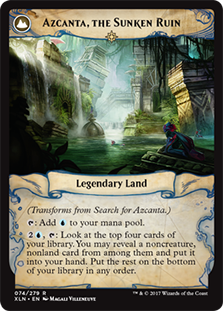
Inkmoth just scratches the surface of Alpine's utility. Against Jeskai, it plays double-duty by hitting either Celestial Colonnade or Azcanta, the Sunken Ruin; the same goes for Affinity, where it covers both Nexuses. Still, expect Urza lands and Valakut, the Molten Pinnacle to be the Modern cards most named by Alpine Moon.

Wizards has long been weary of printing overly-efficient nonbasic land hate, but they did an admirable job with this card. Alpine Moon gets around many of the current design issues surrounding Blood Moon itself, like the fact that it is often used to colorscrew opponents. Alpine's uses are limited to nerfing land abilities, and may even fix enemy colors from time to time. At one mana, the effect's still a serious bargain, and this card is sure to see play in Modern for many years to come.

Militia Bugler

Spell-worthy effects on limited-playable bodies frequently survive the journey from Standard to Modern, and Militia Bugler is no different. Rather than return a card from the graveyard like Eternal Witness, Bugler digs deeper into the deck, scouring the top four cards for a utility creature with the right text box for a given situation. Choice hits that spring to mind include Thalia, Guardian of Thraben, Meddling Mage, Thalia's Lieutenant, and Phantasmal Image. Oh, and one more thing: Bugler's a Human!

Humans is already strapped for space, and has resorted to cutting Thalia herself to accommodate more utility options. But consistency of this quality tends to find its way into competitive decks—after all, if a card digs deep enough, it essentially provides players with additional copies of those they would have included anyway... not to mention improves valuable sideboard slots like Kataki, War's Wage. I'd be surprised if Bugler didn't surface in Humans at some number. And who knows? It may even buff other creature strategies like Death & Taxes or Counters Company.

Sarkhan, Fireblood
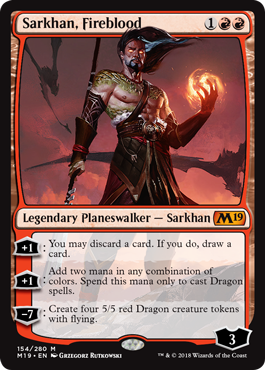
Users of the spoiler sites I follow were quick to write this one off. True, Sarkhan, Fireblood's second ability only works for decks with Dragons, and very few Dragons are actually Modern playable (just Thundermaw Hellkite, Stormbreath Dragon, and Glorybringer, each run in small quantities and as flex spots topping out the curve in their respective homes). But his other two are great!

Red-heavy decks love consistency. Take a look at the cards they run: Blood Moon, Ensnaring Bridge, Skred... against some opponents, and on certain board states, these high-impact cards can just be dead. I've even employed Faithless Looting in my own Blood Moon decks to sift past redundant pieces, and have long sworn I'd play more than four copies if allowed.
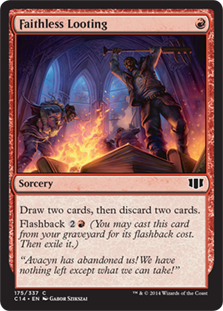
It seems that opportunity has arrived, and on a critical point in the curve, no less. Sarkhan comes down as early as turn two off a mana dork and immediately starts filtering draws. What's more, his ultimate is nothing to scoff at—it's a win condition of its own. Creeping toward that ultimate, which provides a unique angle of attack for many red decks, forces opponents to deal with the rummaging engine and makes them play into removal and other tricks.

I imagine we'll see Sarkhan, Fireblood in a variety of red decks, but especially ones with cards to spare. There, he's a cheaper Karn, Scion of Urza with more upside in the long run. And after a couple days of testing, I can confirm that cascading into Sarkhan with Bloodbraid Elf is just as juicy as it sounds.

The Medium

I've divided this section into two parts: cards that will need to prove themselves, and cards that will need certain conditions to be met before they can start proving themselves.

Testing Short-List
These cards merit testing immediately, and will probably appear in some number in the 5-0s once M19 becomes legal online. But a small-scale result or two doesn't mean they're here to stay.

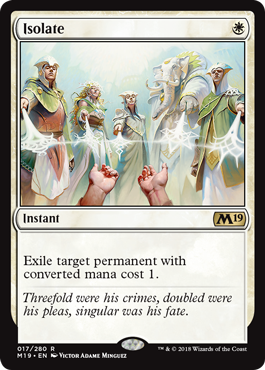
Isolate: Noble Hierarch? Goblin Guide? Death's Shadow? Fatal Push already killed those. Aether Vial? Alpine Moon? Lantern of Insight? Now we're talking. The latter can't even be saved by Welding Jar in response.

Clearly, Isolate has plenty of targets in Modern, but I wonder if it's not too narrow for widespread adoption. We might see Jeskai try out a copy in the mainboard. The spell almost definitely doesn't do enough for the side.
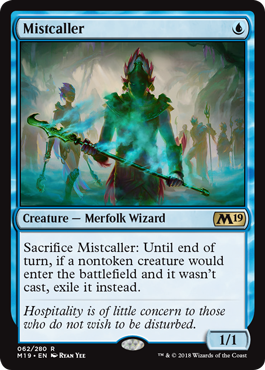
Mistcaller; Remorseful Cleric: A twofer! These creatures automatically slot into their respective tribal archetypes, Merfolk and Spirits... or do they? Spirits may just not care about any graveyard-related thing people are doing, especially since it has access to Rest in Peace already. But the incidental mainboard hate can't hurt.

As for Mistcaller, this creature represents a huge step down from Containment Priest in terms of power level. Aether Vial users can even choose not to put a creature down after Caller's been sacrificed. But as Merfolk becomes more Death & Taxes-like in its employment of disruptive creatures, I wonder if there isn't a metagame for Mistcaller after all. My gut says if Cursecatcher no longer cuts it, neither does this.

Infernal Reckoning: This spell isn't the godsend against Eldrazi that Grixis players might have hoped for—Ceremonious Rejection, which also hits the increasingly relevant Krark-Clan Ironworks, handily trumps it there. But Reckoning does have its uses, chief among them providing Jund with a clean out to Wurmcoil Engine, otherwise a game-ender if not a massive resource swing. Unfortunately, this card has few other uses, and is further limited in application for Death's Shadow decks thanks to the lifegain clause.

Runic Armasaur: 2/5? Talk about body! Armasaur survives not just Lightning Bolt, but Chandra, Torch of Defiance; it walls Thought-Knot Seer and all but the meanest Tarmogoyfs. It's the creature's ability I'm worried about, especially relative to Armasaur's cost. At this price point, the Dinosaur competes with Courser of Kruphix and Tireless Tracker, although both of those are functional four-drops when it comes to card advantage. Armasaur's plenty conditional too, though, requiring opponents to activate abilities before pilots draw their cards.
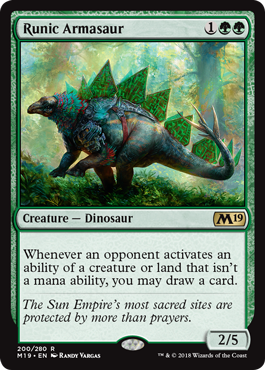
It helps that the Dinosaur is triggered by fetchland activations, and is likely to make Affinity players think twice about tapping Steel Overseer, let alone going all-in on a Ravager attack. This kind of combo play is what Armasaur excels at stopping—Devoted Druid, you too. Such activation-heavy plays give players a window to draw into removal and disrupt out the combo.

At three mana, though, I'm still not very excited about this creature. I think it will mostly deter opponents from activating their abilities, serving as a soft hate piece. After all, opponents reserve the choice to play through Armasaur if they want, so beware of tapping out.

Homeless but Motivated

These cards lack an ideal home in Modern, but have potential for greatness should a proper shell emerge.
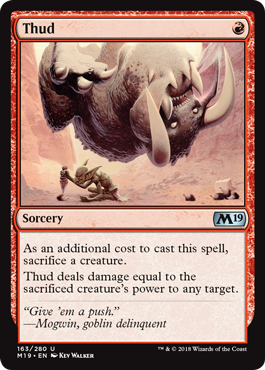
Thud: A two-mana effect on an instant shifted to a one-mana effect on a sorcery. I can't argue with the principle's elegance, but Temur Battle Rage has brutally power-crept this sort of Fling effect already.

Stitcher's Supplier: Quite a bit of self-mill for one mana. Supplier outdoes Thought Scour only in decks that prefer the body to a card, which at the moment are few and far between. Dredge will probably favor Shriekhorn.

Elvish Rejuvenator: Ancient Stirrings on a body, kind of—it only finds lands, but then it puts one into play. Counting the legs, that's a pretty decent rate for three mana. But I don't know what deck would want this card. Valakut decks just want any land, making Wood Elves a more reliable three-mana ramper. Rejuvenator would be sweet in something like Dark Depths, were it legal. The upside is high with this one.

Amulet of Safekeeping: Here's where Wizards' drive to create multi-purpose Modern sideboard cards spiraled out of control. Amulet mashes two mostly unrelated effects together into one weird-looking trinket. Sure, they combine to stop Storm's win conditions, but don't de-sleeve those Damping Spheres just yet—Storm can just go off, find Repeal, and then kill you, while Sphere prevents them from doing even that. And Amulet marginally slows down Burn, but the token clause does nothing there.

For Amulet to become a sideboard staple, Modern will need top-performing decks to care more about its effects; right now, they just don't.

The Bad

None of these cards will see play in Modern, mostly as a function of their middling toughness.
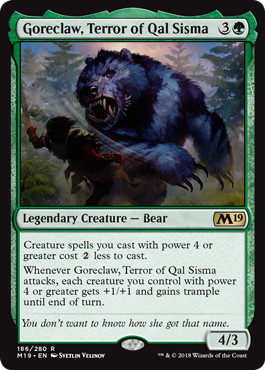
Goreclaw, Terror of Qal Sisma: The latest in a long lineage of cards that get people excited about trying to cast Myr Superion in Modern, Goreclaw features an exciting build-around on an aggressive body. But that body also has three toughness. And Bant Eldrazi doesn't want this anyway; it's already emptied its hand by then, and has evasion redundancy with Smasher, Drowner, and Displacer.

Isareth the Awakener; Resplendent Angel: Pushed effects on overpriced 3/3 frames. The former's a harder-to-cast Alesha without first strike; the latter, a build-around Angel factory. These cards are very unlikely to do anything in Modern.

Bonus Decklist: Four-Color Doran
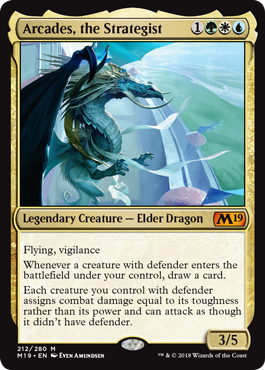
Doran, the Siege Tower decks have existed since Modern's humble beginnings. Existed, not succeeded; revolving around their namesake card, the decks were crippled by needing Treefolk Harbinger to reliably take advantage of Doran's text box. Assault Formation slightly alleviated this problem by granting the deck some redundancy, but the enchantment's uselessness in multiples forced pilots to continue running Harbinger or suffer from the occasional do-nothing draw. Another option was to tune the deck to play more like Abzan Midrange, relying on Doran synergies as an afterthought.

Arcades, the Strategist gives the deck another Doran effect attached to an imposing body. It allows pilots to do away with Harbinger once and for all and benefit from pulling out of the Abzan boat with hateful sideboard cards like Rest in Peace.

Four-Color Doran, by Jordan Boisvert

Creatures

4 Sidisi's Faithful
4 Nyx-Fleece Ram
3 Wall of Omens
4 Spellskite
4 Noble Hierarch
4 Doran, the Siege Tower
4 Arcades, the Strategist

Enchantments

3 Assault Formation

Instants

4 Path to Exile

Sorceries

3 Lingering Souls

Lands

4 Verdant Catacombs
1 Forest
1 Swamp
1 Plains
1 Overgrown Tomb
1 Breeding Pool
2 Temple Garden
2 Blooming Marsh
1 Murmuring Bosk
2 Shambling Vent
4 Windswept Heath
1 Hallowed Fountain
2 Misty Rainforest

Sideboard

2 Ensnaring Bridge
1 Damping Sphere
1 Grafdigger's Cage
2 Rest in Peace
2 Stony Silence
2 Negate
2 Tower Defense
3 Collective Brutality

This deck is obviously quite rough around the edges, but it has some promising dimensions. Arcades lets us run actual defenders, the best of which is Wall of Omens. And the blue splash enables Sidisi's Faithful, a utility bomb in this deck that sets up alpha strikes, disrupts creature plays, and swings for four most of the time.
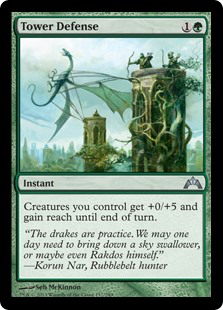
The supremely versatile Lingering Souls is all that's left of the backup Abzan plan. Without Goyfs and Knights to nurture, Ensnaring Bridge becomes an option out of the sideboard, as does Rest in Peace. Another interesting spell is Tower Defense, which at first glance is crazy with Souls and Doran, but upon further inspection has more to it. Defense reads a lot like Temur Battle Rage, enabling wild comebacks or quick wins and forcing terrible blocks. Even with a couple of 0/5s in play, the instant can often present lethal out of nowhere, a threat we may want to take advantage of in the mainboard.

Can't Coreplain

As of this writing, just under 50 cards remain to be spoiled. I'm not as excited by the prospect of looking over the final commons as I am by the deliberate efforts Wizards made in M19 to support Modern. Their earnestness offsets ham-handed designs like Amulet's, and the direction they've moved towards with simpler ports of lowering the mana cost by slightly altering the spell is right up my alley. Which M19 cards have you the most excited?


Jordan Boisvert

Jordan is Assistant Director of Content at Quiet Speculation and a longtime contributor to Modern Nexus. Best known for his innovations in Temur Delver and Colorless Eldrazi, Jordan favors highly reversible aggro-control decks and is always striving to embrace his biases when playing or brewing.

View More By Jordan Boisvert

Posted in Modern, SpoilersTagged , , , , , , , 9 Comments on M19 Spoilers: the Good, the Bad, the Maybe

Have you joined the Quiet Speculation Discord?

If you haven't, you're leaving value on the table! Join our community of experts, enthusiasts, entertainers, and educators and enjoy exclusive podcasts, questions asked and answered, trades, sales, and everything else Discord has to offer.

Want to create content with Quiet Speculation?

All you need to succeed is a passion for Magic: The Gathering, and the ability to write coherently. Share your knowledge of MTG and how you leverage it to win games, get value from your cards – or even turn a profit.

Unlocked: MTGO Market Report for June 20th, 2018

Are you a Quiet Speculation member?

If not, now is a perfect time to join up! Our powerful tools, breaking-news analysis, and exclusive Discord channel will make sure you stay up to date and ahead of the curve.

Welcome to the MTGO Market Report as compiled by Matthew Lewis. The report will cover a range of topics, including a summary of set prices and price changes for redeemable sets, a look at the major trends in various Constructed formats and a "Trade of the Week" section that highlights a particular speculative strategy with an example and accompanying explanation.

As always, speculators should take into account their own budgets, risk tolerances and current portfolios before buying or selling any digital objects. Please send questions via private message or post below in the article comments.

Redemption

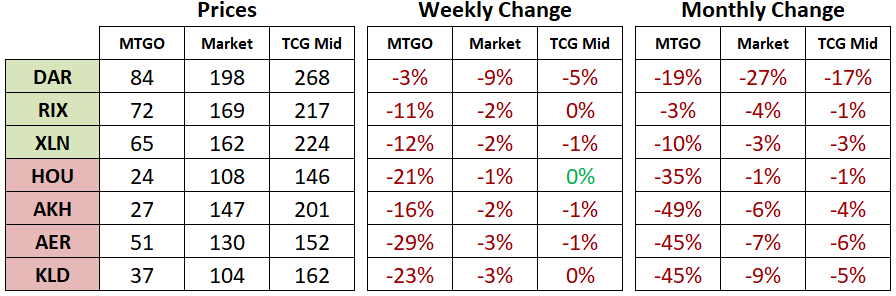
Below are the total set prices for all redeemable sets on MTGO. All prices are current as of June 18, 2018. The TCGplayer market and TCGplayer mid prices are the sum of each set's individual card prices on TCGplayer, either the market price or mid price respectively. Redeemable sets are highlighted in green and sets not available for redemption are highlighted in red.

All MTGO set prices this week are taken from GoatBot's website, and all weekly changes are now calculated relative to GoatBot's "full set" prices from the previous week. All monthly changes are also relative to the previous month's prices, taken from GoatBot's website at that time. Occasionally, full set prices are not available, and so estimated set prices are used instead. Although Hour of Devastation (HOU), Amonkhet (AKH), Aether Revolt (AER), and Kaladesh (KLD) are no longer available for redemption, their prices will continue to be tracked while they are in Standard.

Standard

It was a bloodbath this week in both digital and paper prices, with the sets rotating out of Standard dropping by an average of 22 percent on MTGO. The summer lull has arrived and prices have reflected that reality. The redeemable sets held up better, but it is mentionable that Rivals of Ixalan (RIX) and Ixalan (XLN) are both out of stock in the store at the moment and await the arrival of a fresh (and final) redemption print run of complete sets.

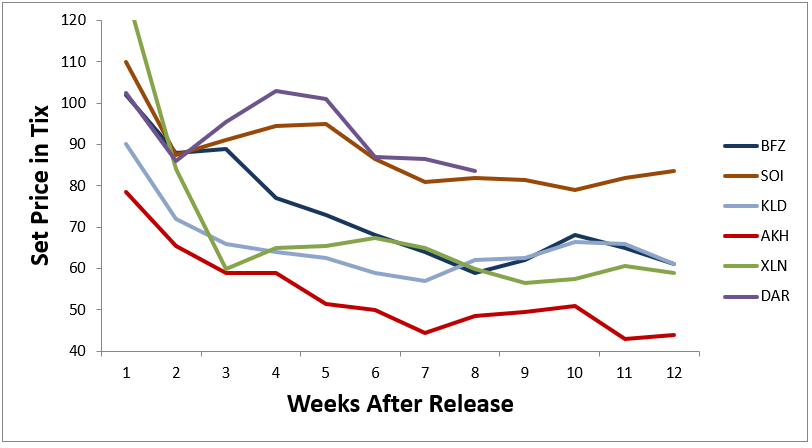
For players and speculators alike, Dominaria (DAR) is an interesting question as to when it will bottom out in price. Buying in at the approximate bottom can go a long way toward stretching your tix and allowing you to play cheaper or speculate with more success, so researching this question is valuable. Any research should start with the historical precedent, then updating that precedent with the current or new realities. To get a sense of where the price of DAR is heading, let's have a look at how the price of recent large sets have evolved over the weeks after they were released.

DAR is carving out an interesting path as it is currently the most expensive set at this point in its release window, though it is not far off of Shadows over Innistrad (SOI). That is very interesting, as both sets were late spring releases and both sets did not feature Masterpieces. Thus, SOI is our best historical indicator for where the price of DAR will end up, at least while it is being drafted in triplicate.


There was an error retrieving a chart for Jace, Unraveler of Secrets

There is a little under three weeks of DAR drafting left before July 9 when Core Set 2019 (M19) is released on MTGO. DAR is currently at the eight-week mark and sits in the low 80-tix range. At the ten- and eleven-week marks, SOI hit 79 tix and 82 tix respectively. From this analysis, it's reasonable to surmise that DAR is close to a price bottom and that dipping below 75 tix is unlikely over the next month.

From a player's perspective, this is great news, as they can feel safe in rounding out their playsets over the coming weeks without the fear of a great loss of value in the short term. There's just not much further for this set to drop, so buying now makes sense if you are going to be playing Magic and getting some utility out of your cards.

For speculators, it's a little too early to start establishing a large position in full sets. The strategy is to buy full sets while the cards are being opened in Draft, hold as long as the set is still available for redemption, and then sell when prices creep upward. The returns are not fantastic in an absolute sense, but they are predictable and the risk is low.

Speculating on singles is something I am fine with doing at the moment, though I would slant my purchases to long term value plays. The big price movements are going to come in the fall as Standard rotates, so I don't want to be a buyer of a single like Karn, Scion of Urza right now, as it would tie up a lot of tix over the summer and it might not yield a big return until October or later.

There was an error retrieving a chart for Karn, Scion of Urza

I would note, though, that buying Karn in the context of a full set purchase is correct, as you want to be diversified over the entire set. It might be that Karn goes up or down in price, but the price of a full set of DAR will go higher. Buying the full set means you are speculating on the pool of value that it represents and the price fluctuations of individual cards carry less weight.

Treasure Chests

When Wizards of the Coast (WotC) created Treasure Chests, they were looking to capture the value of the lightly printed cards that commanded high prices. Mercadian Masques (MM) block was a prime example of where they were trying to mine for value, as the set was never released online and it was only available in flashback draft formats. MM block cards ended up being some of the most expensive cards because the draft format isn't popular, resulting in very low supply.

Two prime examples of this are Rishadan Port and Tangle Wire, which carried prices of over 100 and 60 tix respectively before they were included in Treasure Chests. They now sit at 9 and 1.2 tix.  This created a new problem for WotC. They were successfully mining the value, of these older, out-of-print cards, but they quickly ran out of fresh veins to tap as the price of these old cards collapsed.

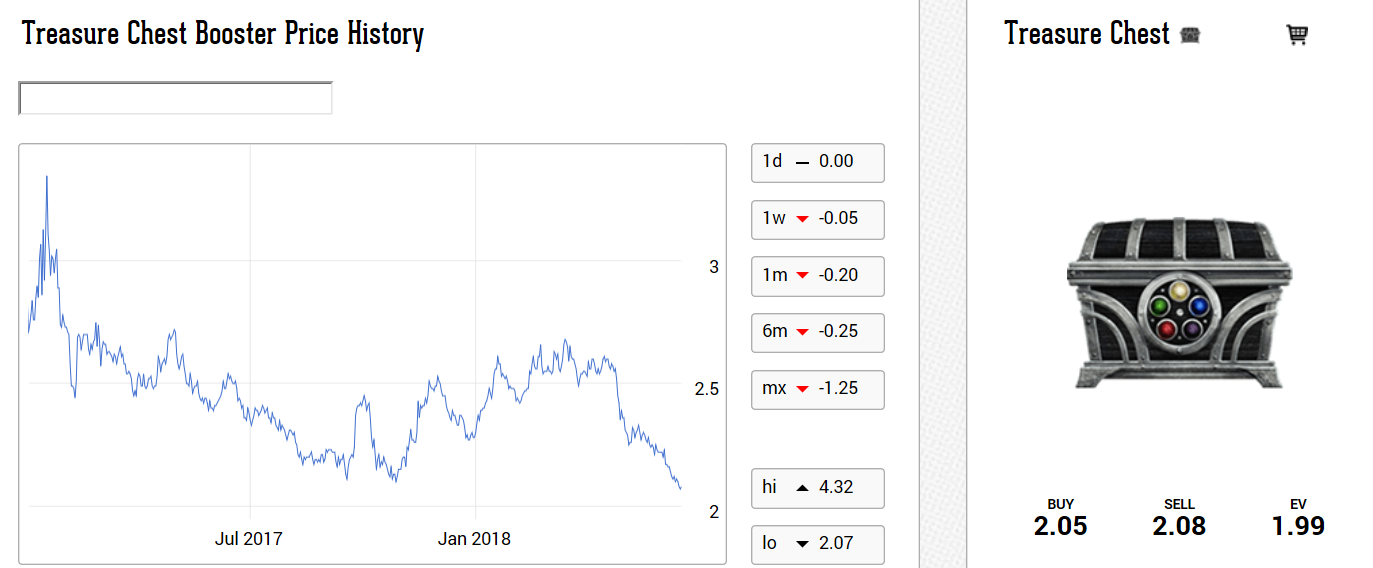
Last year, they shifted to including a lot of high-priced Standard staples and even complete sets from Standard on the curated List. This certainly helped raise the price floor and the recent strong interest in Modern helped push the price of  chests to a six-month high in the spring. Have a look at the chart below, courtesy of GoatBots, to see how the price of Treasure Chests has evolved over time.

Moving away from relying on older cards to maintain the value of chests worked for a while, but now that the summer lull is here, the price of a Treasure Chest has reached an all-time low. WotC will have to reconfigures the curated card list to restore their value as the price of rotating Standard cards plummets. Look for a change to the curated card list in the next three weeks and for the price of Treasure Chests to rebound as a result.

Just before going to press, WotC made an announcement on a change to address a previous collation issue for DAR foils. You can read the full change here. They are going to be adding in the foils that were missing from DAR boosters from the first couple of days of the set's release, and they are replacing a portion of the Standard common/uncommon slot. This is going to give a temporary boost to the expected value of Treasure Chests when the change is made. They also hinted at further changes with the release of M19.

Trade of the Week

For a complete look at my recent trades, please check out the portfolio. The change to Treasure Chests just announced means that the expected value and the price of these will increase when the change is implemented.

There was an error retrieving a chart for Treasure Map

It's worth keeping in mind that these are a very liquid digital object, traded in a similar way to in print boosters, so buying a few Treasure Chests today is a guaranteed profit. This works because the contents of a Treasure Chest is only determined when it is opened, so when the contents are updated there will be a step increase in the value of the contents. All you have to do is buy a few Treasure Chests today and then you can wait for the addition of these foils and the price will increase, though the bigger increase will occur when WotC reconfigures the curated card list with the release of M19, which they have only hinted at so far.

Daily Stock Watch – Secure the Wastes

Are you a Quiet Speculation member?

If not, now is a perfect time to join up! Our powerful tools, breaking-news analysis, and exclusive Discord channel will make sure you stay up to date and ahead of the curve.

Hello, readers and welcome to a new edition of the Daily Stock Watch! Now that the Pro Tour is over, let's go back to Modern cards for our speculation portfolio. For today's segment, I'd like to put the spotlight on one of the biggest gainers in the format for the last few weeks. This card is now creeping towards the $10 barrier with much gusto, thanks to its importance in the now surging Jeskai Control deck.

There was an error retrieving a chart for Secure the Wastes

If you can finish the game in one fell swoop by summoning a platoon of 1/1 soldiers during your opponent's turn, you know that your deck is in control. This is the strategy that this new rendition of Jeskai is trying to implement, by mixing the usual suspects of its core (burn spells, cantrips, some counter magic and mass removal), and then splashing the ground with the tokens from Secure the Wastes to get the job done in a few turns.

Jeskai Control

Creatures

4 Snapcaster Mage

Instants and Sorceries

1 Secure the Wastes
1 Negate
2 Lightning Bolt
2 Electrolyze
3 Logic Knot
3 Lightning Helix
4 Cryptic Command
4 Path to Exile
4 Opt
2 Serum Visions
2 Wrath of God

Other Spells

2 Search for Azcanta
2 Teferi, Hero of Dominaria

Lands

1 Field of Ruin
1 Sulfur Falls
1 Glacial Fortress
1 Mountain
1 Plains
1 Spirebluff Canal
2 Steam Vents
2 Hallowed Fountain
3 Celestial Colonnade
3 Island
4 Flooded Strand
4 Scalding Tarn

Sideboard

4 Spell Queller
1 Lyra Dawnbringer
1 Izzet Staticaster
1 Gideon Jura
1 Emrakul, the Promised End
2 Dispel
2 Celestial Purge
1 Baneslayer Angel
1 Negate
1 Logic Knot

The addition of Teferi, Hero of Dominaria gave this deck the much needed boost it lacked to reach tier one territory once more. With a permanent that threatens to end the game after a few turns if it goes unchecked, and is firmly protected by a turn four Wrath of God or Logic Knot on the turn that it goes down, Teferi, HoD has helped a lot in giving Jeskai players a lot of ways to win games against any matchup. One of the biggest beneficiaries of this addition is Secure the Wastes, which is an instant-speed threat that could neutralize early aggression from the opposition, or be a late game finisher that's still recyclable, thanks to Snapcaster Mage. After staying at the $2 range for the past two years, Secure the Wastes is currently sitting at $9.44 as of writing, and should continue rising if more players decide to shift to this archetype.

Possible Inclusions for Jeskai

Above are cards that could be seeing fringe play in these new Jeskai lists, or ones that I think are possible inclusions in future revisions of the deck. Any of them could see some financial movement if they do get included, but I don't see any of them matching the spike that Secure the Wastes experienced over this past week. It's been a trend for the past few months that whenever a new archetype emerges, one or more of its key cards will receive an unlikely financial boost (see Goblin Lore and Meddling Mage for reference) and still be able to maintain its price tag going forward. Good news for us is that this Jeskai list will probably continue evolving, and there will be more of where Secure the Wastes came from. Keep your eyes open.

At the moment, StarCityGames, ChannelFireball, and Card Kingdom is out of stock of Secure the Wastes, while there's still some vendors via TCGPlayer that's selling it for various prices based on its condition in the $7-$9 range. All online stores are expected to refill near the $10 mark, and expect foil prices to move up as well. I honestly think that Secure the Wastes is a good finisher for this archetype, and will always be included in the main or sideboard lists of any variant going forward. Start buying in now if you intend to play with the deck, and feel free to pick up a few copies for speculation purposes. This card is for real.

And that’s it for today's edition of the Daily Stock Watch! See you again next time, as we check out a new card that should be on the go, or good enough for speculating. As always, feel free to share your opinion in the comments section below. And if you want to keep up with all the market movement, be sure to check in with the QS Discord Channel for real time market information, and stay ahead of the hottest specs!

GP Las Vegas and the Ironworks Conundrum

Are you a Quiet Speculation member?

If not, now is a perfect time to join up! Our powerful tools, breaking-news analysis, and exclusive Discord channel will make sure you stay up to date and ahead of the curve.

With Grand Prix Las Vegas in the books, it's time to reexamine the metagame. 2,779 players in a single event provides a valuable data crucible. In theory, such an event would produce results very similar to the "real" Modern metagame. In theory. Reality is chaotic, and has given us something far more interesting to dissect: the continued success of Kark-Clan Ironworks.

GP Las Vegas: Placings

Players have had months of looking at data, just as I've been doing, to innovate and brew. I was hoping that players would show off just how vast and unexplored Modern is, but was sorely disappointed.

The Top 16

Deck NameTotal
Mono-Green Tron6
Ironworks3
Humans2
Grixis Death's Shadow1
Jeskai Control1
Bant Company 1
Hollow One1
GW Company1

That is a lot of Tron. It's been a long time since any Top 16 was dominated by one deck to this extent. Worse, they're pretty stock mono-green lists. So much for innovation. Tron hasn't been performing recently, but it definitely came to Vegas looking for redemption. Ironworks was a distant second, despite winning the event. Which was in itself surprising, as back-to-back performances are rare in recent Modern, especially when they necessitate facing some very poor matchups.

The Top 32

The Top 32 continues the narrative of the Top 16, with midrange taking a beating. However, that's not because this part of the field is overrun with predators. In fact, this is where midrange should have thrived.

Deck NameTotal #
Humans6
Mardu Pyromancer2
Hollow One2
Ironworks2
Thopter-Sword1
Mono-Green Tron1
Esper Gifts1
RG Tron1

Where Tron dominated the Top 16, Humans rule the Top 32. Midrange is again largely absent, and half its representation consists of rogue decks. Apparently, this is where the interesting brews ended up, though not in numbers. While Humans succeeding is not that surprising, the extent of its representation is. Humans did well at Regionals, but prior to this, it was an also-ran. Its return to prominence reconfirms the deck's resilience. Jeskai's absence from the Top 32 and single representative in Top 16, coupled with Tron's dominance, suggests that Jeskai had a target on its back in Vegas.

The Winning Deck

On top of all the Tron, Ironworks was back in force, winning for the second GP in a row in the hands of the same pilot. Who was playing almost the same deck in both events. It is tempting to see this as a clear endorsement of Ironworks's power and potential in Modern. I definitely want it to be true, so I can yell about Ancient Stirrings being too good again. However, that's not fair.

Matt Nass is running very hot this season. Remember, he also made Top 8 with Ironworks in Phoenix, and luck is going his way. On paper, Grixis Death's Shadow takes Ironworks apart, but Ben Friedman had some very anemic draws to lose in the semifinals. The deck's staggering success may just be Matt Nass's. Remember, he's a dedicated Ironworks enthusiast and a high-rated Pro, and the metagame isn't particularly hostile to Ironworks. I'm willing to give the deck the benefit of the doubt unless its success streak continues with another pilot.

Dissecting the Data

On its face, this result is exactly the opposite of what I predicted for Vegas. It certainly appears as though players showed up expecting Jeskai to be huge and played the deck that preys on slow blue decks. This in turn allowed Humans to flourish, though the presence of anti-decks kept Humans from rising as high as Tron. However, I must caution that these data do not include anything about the starting population or even the Day 2 metagame. If Jeskai was a significant portion of the metagame, then the earlier interpretation is likelier correct. If it wasn't, then this result could a function of representation of other factors. To those of you who attended GP Las Vegas, I'd love to hear your insight in the comments.

Another Possibility

That hedging aside, it's very clear that midrange did not have a good weekend. This may be a reaction to its success in previous weeks, but it more strongly speaks to how powerful Tron is despite its recent unpopularity. Part of this is certainly a lack of preparation for Tron. Looking through the decklists, most sideboards are packed with one-ofs, which indicates hedging. Rather than focusing on known matchups, players were trying to be ready for anything.
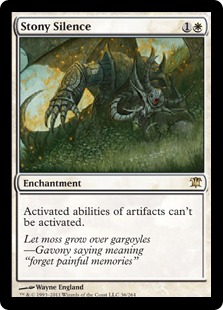
Furthermore, even within these hedged sideboards, the card choices are intended to be general cards rather than specialists. For example, Relic of Progenitus rather than Leyline of the Void or Rest in Peace. This is okay if, as was fully possible at this event, every round is against a different deck and the sideboard response is dramatically different for each, but that strategy will never be as powerful in specific matchups as playing the most powerful hate. Stony Silence says to Ironworks, "remove me or die." Disenchant says, "wait for a replacement." If the hedging I see in the Top 32 is representative of the field, then I'm not surprised that decks that require surgical answers, like Tron and Ironworks, excelled.

The New Combo King

Matt Nass aside, why has Ironworks done so well compared to Storm in recent months? The decks are very similar strategically, and Humans is known as an anti-combo deck, yet Ironworks has captured two GP trophies while Storm struggles outside of StarCityGames events. A tale of the tape doesn't explain this disparity, but looking at the wider context of Modern does.

Iron and Thunder

On paper, Storm has many advantages over Ironworks. The first and most obvious is speed. Storm reliably combos off on turn three, while Ironworks goldfishes wins on turn four. Storm is built around mana acceleration in the form of rituals. The turn three Storm kill involves a cost reducer and Gifts Ungiven, though there are many permutations. When the stars align, it can actually win via Grapeshot on turn two, though if Storm is going off, it's usually trying for a functional win with Empty the Warrens.

Conversely, the engine, fuel, and keystone of Ironworks is Krark-Clan Ironworks, a four-mana spell. It must resolve to combo, and the only mana acceleration available is 4 Mox Opal. While Ironworks is mostly cantrips, the odds of going off early are low. The deck also only plays 18 lands, which leads to hands that can never cast four-drops.
The second advantage of Storm is in-game resilience. Storm plays a lot of redundant combo pieces, and can cobble together a win despite multiple Thoughtseizes and counterspells, absent enemy aggression. It needs a critical mass of cards to win, but Storm isn't overly picky about which cards.

Without its namesake card, Ironworks can't go off. Getting it discarded or countered is devastating. Furthermore, Ironworks is far more vulnerable to hate. Both decks are vulnerable to anti-combo hate like Eidolon of Rhetoric or Damping Sphere and graveyard hate like Rest in Peace. However, Ironworks is additionally vulnerable to anti-artifact cards, including speed-bump extraordinaire Ancient Grudge and game-ender Stony Silence.

The Humans Factor

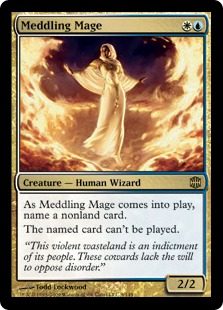
The tale of the tape is minor compared to the metagame context, and that is where Ironworks noses out Storm. Humans was built to destroy Storm, and months of tournament results confirm that it does. Thalia, Guardian of Thraben is the headliner, but she is manageable with Baral or Electromancer. The real killer is Meddling Mage. Mage naming Grapeshot often guts Storm, as that's often Storm's only win condition. The typical Storm deck has Remands, which are weak at best against Aether Vial and Cavern of Souls, and recently a singleton Repeal and Unsubstantiate for interaction. Given Humans' fast clock, there's almost never time to find an answer and unlock the win.
Ironworks doesn't have that problem. It can and does play the very relevant Engineered Explosives as maindeck interaction. Sweepers are very good against creature decks, and all the disruptive creatures cost two, meaning one Explosives gets them all. Ironworks also has the versatile Pyrite Spellbomb as backup. Having a better gameplan against Modern's best deck is a huge plus for Ironworks.

Metagame Context

On the flipside, Thalia is far more potent against Ironworks than against Storm. It can be hard enough for Ironworks to get four mana; five is often implausible. On top of that, Thalia's tax makes feeding eggs to Ironworks and buying them back mana-neutral at best.
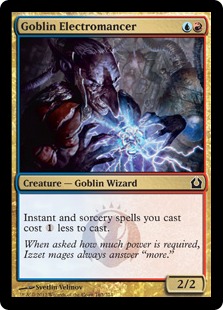
But Thalia isn't as pressing  a problem for Ironworks as it used to be: Humans also exists in the wider metagame, which has led to pilots trimming Thalia. Most lists now only run 3 Thalia to fit in more utility creatures, benefiting Ironworks. Thalia isn't that impressive in Modern because there is far more removal than in Legacy, and decks don't depend on one mana cantrips to function. With Path to Exile, Lightning Bolt, and Fatal Push being very common cards, Thalia is annoying-but-not-devastating against control and combo decks, and mostly irrelevant elsewhere. One fewer maindeck Thalia translates into a noticeably decreased chance to draw her against Ironworks, which then translates into wins for the combo deck.

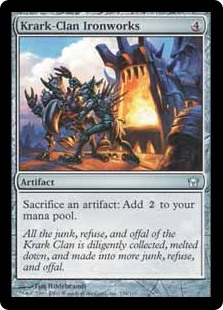
Furthermore, the effect that Humans is having on the metagame is making it more favorable for Ironworks. Looking through the Vegas decklists showed that nobody was playing Stony Silence. This is huge for an artifact combo deck. Ironworks' sideboard is built around defeating Stony; that's how devastating it is.

Stony has disappeared because players aren't scared of Affinity anymore. The rise of Humans alongside Affinity has allowed Mardu Pyromancer and Jeskai Control to rise and feed on them. Both decks play enough creature removal to make specialized answers against Affinity superfluous. In turn, this frees up board space that usually goes to more general answers. Because Humans is so prevalent and metagame-defining, players opened themselves up to Ironworks.

The Difficulty Dimension

There is one last thing to consider: how difficult is it to combo with these decks? The power or positioning of a deck is irrelevant if players can't access it when it's hidden behind a high skill wall. For example, prior to Summer Bloom's ban, Amulet Bloom was capable of winning as early as turn two. However, it never had a metagame share to match that power, because it was very hard to play well. The basic gameplan was understandable enough, but actually pulling it off required non-obvious play patterns and long-term planning. Therefore, Amulet was severely underrepresented relative to its power.

Storm is a relatively simple combo to understand. Play lots of spells, accumulate mana, kill opponent is easy to understand. Executing the combo is also relatively easy: rituals, Gifts Ungiven, repeat. Having either Baral, Chief of Compliance or Goblin Electromancer out makes the combo easier to execute, but isn't necessary. Thanks to Gifts, it is also tough to fizzle, and losing individual pieces isn't a big deal because they're redundant.

With Ironworks, there is a lot more going into the combo. First and foremost, Krark-Clan Ironworks must be in play. Second, access to Scrap Trawler makes things far more manageable. It is possible to just naturally chain cantrip artifacts and win, but that is far riskier and prone to fizzling. Also, most decks are like Nass's, and only win via recurring Pyrite Spellbomb; only Trawler allows for that. Third, once the combo begins, there is far more that needs to be tracked: quantity of mana and of which color; draw triggers; Trawler triggers. Players also have to keep track of which artifacts are being sacrificed to optimize Trawler chains. Then, there is the timing of the Trawler/Myr Retriever loop. All these factors up the skill level of the deck, and therefore its entry barrier relative to Storm's.

The Place of Combo

Despite its apparently sound positioning, I don't think Ironworks will have a particularly notable impact on the overall metagame. Stony Silence is so crippling that if Ironworks becomes a problem, the answer will immediately follow. While fighting the enchantment may be manageable, the deck's difficulty is more hobbling to its potential. I cannot imagine that players will pick up the deck in great numbers. Therefore, I suspect that Ironworks will have high-level success for a while longer, but then eventually fade away.

Between a host of StarCityGames events in the next few months and the return of the Core Set, Modern may be due for an upheaval. Players have reacted to Humans being on top, and at Vegas, they reacted to that reaction. I'm hoping that my next metagame investigation shows movement away from the current dynamic equilibrium and towards something new.

Insider: QS Cast Infographics – June 2018 Graphics

Are you a Quiet Speculation member?

If not, now is a perfect time to join up! Our powerful tools, breaking-news analysis, and exclusive Discord channel will make sure you stay up to date and ahead of the curve.

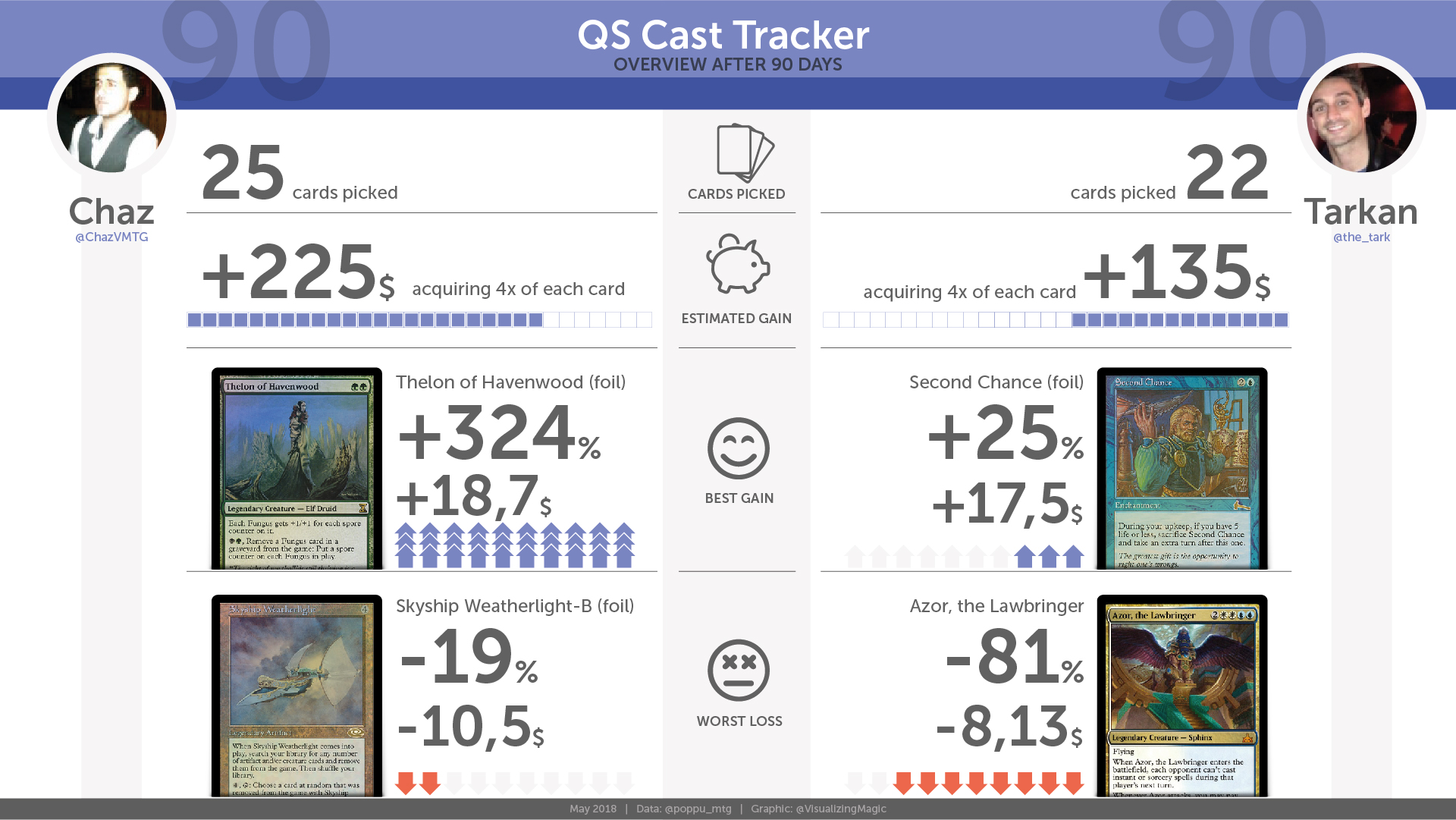
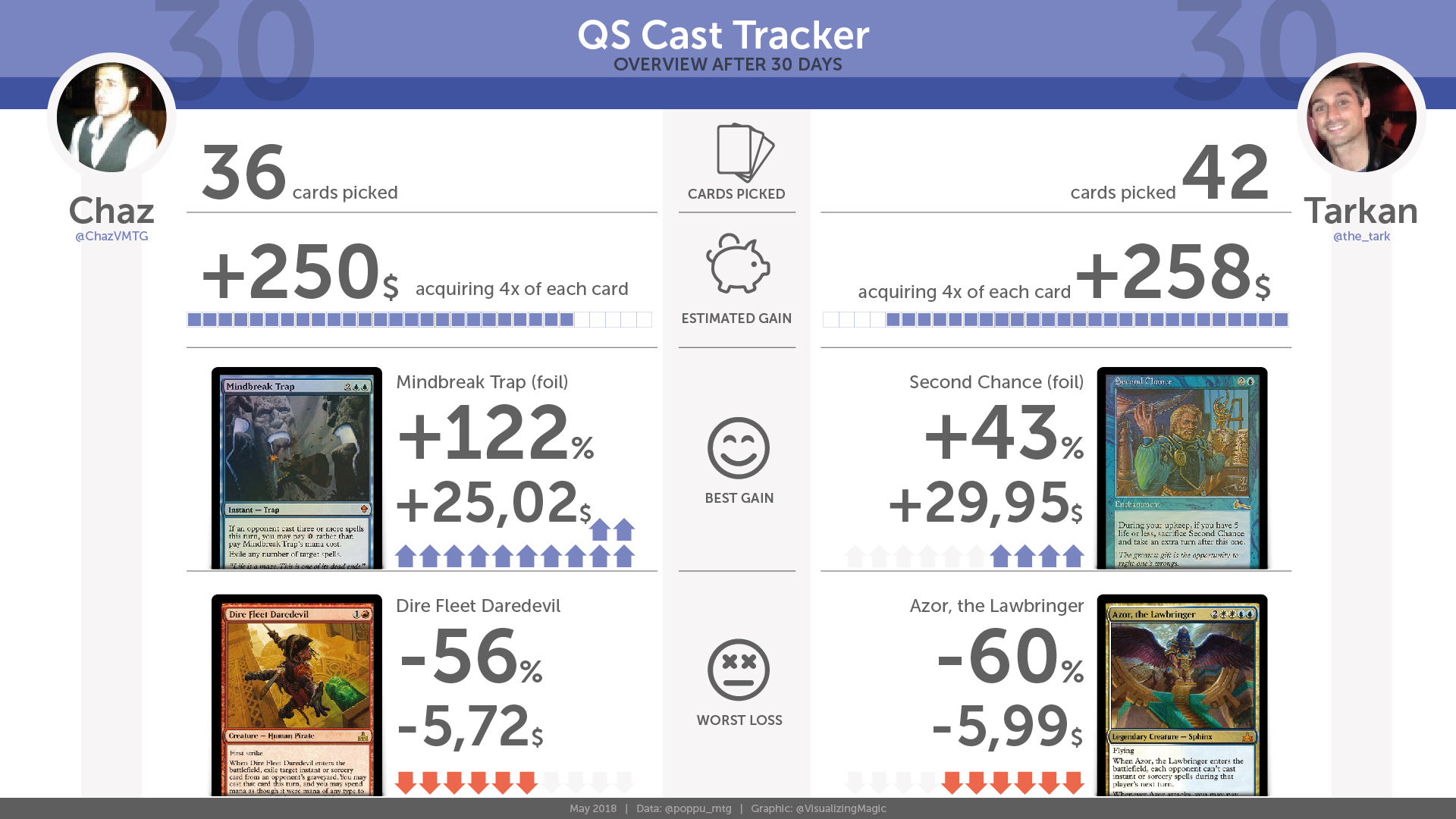
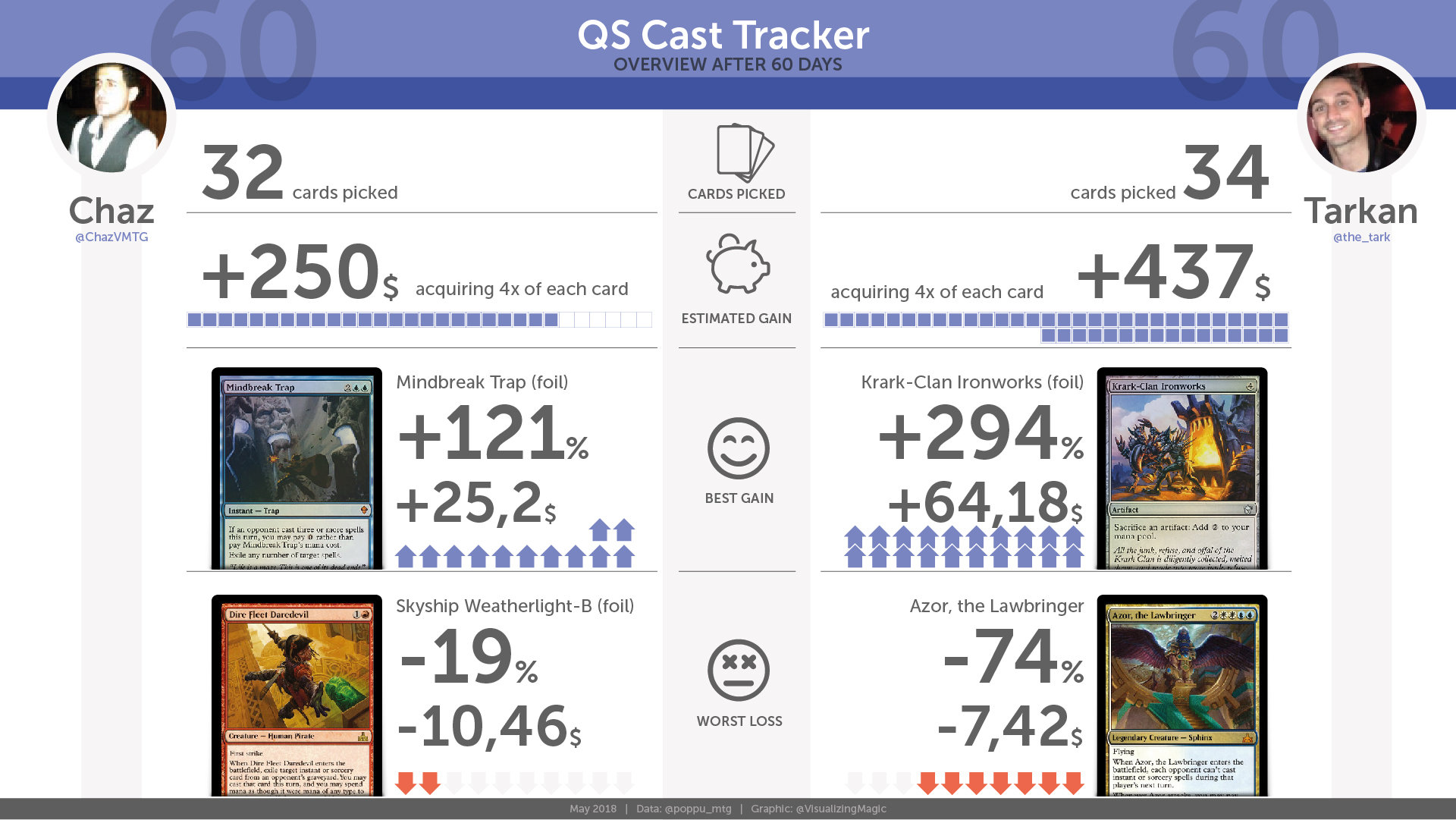
Hello, Insiders, and welcome to the June 2018 Edition of the QS Cast Tracker Infographics! Every month we take a look at how Chaz's and Tarkan's picks have fared since they mentioned them on a podcast episode. For convenience, we only keep track of six months worth of picks and check the price changes after 30, 60 and 90 days. Today's column will look at all cards selected since the January 4t 2018, episode.

Without further ado, here are the Infographics, as always courtesy of our very own Diego Fumagalli (Visualizing Magic):

As a reminder, the dollar amounts mentioned in these graphics are calculated based on the total amount gained or lost when purchasing a playset of a card picked by either caster at the time it was mentioned on cast, then "cashing in" on that playset after 30/60/90 days. With that said, let's analyze the numbers shown above in further details.

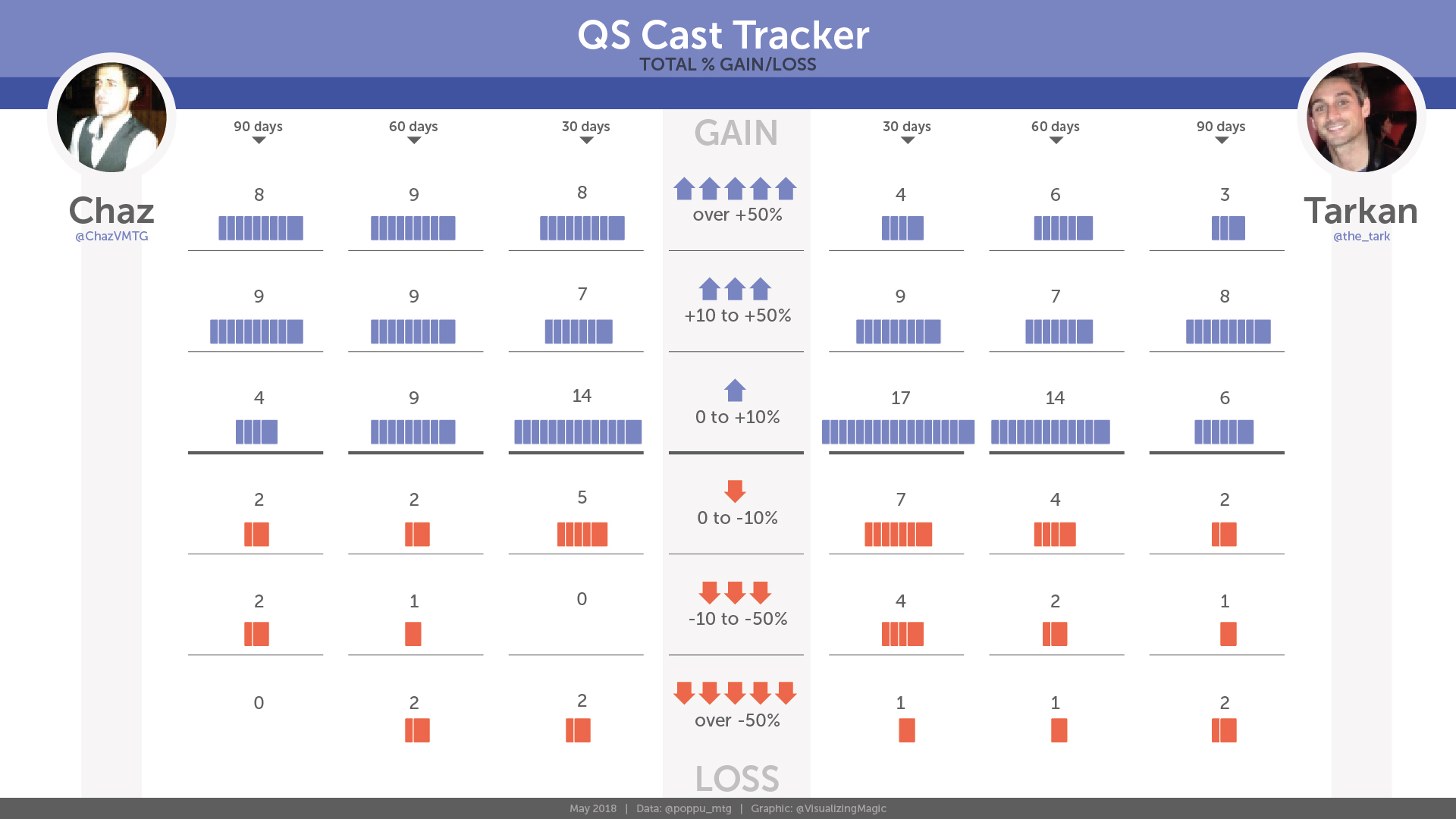
First off, it is impressive that, despite having their share of clunkers (looking at you, Azor, the Lawbringer and Dire Fleet Daredevil), both Chaz and Tark come out ahead as much as they do. Chaz's consistency over the these three intervals is quite an impressive feat on its own, netting at least $225 for each of them. Tarkan's average return falls in the same ballpark ($277 to Chaz's $242), but his numbers have a larger variance. This doesn't take anything away from his call on foil copies of Krark-Clan Ironworks, which spiked 294 percent with a gain of over $64 per copy.

Chaz's biggest advantage, however, is how good his good picks are (consistently having eight or more cards gaining over 50 percent of their original value) compared to how bad his bad picks are (at most three cards dropping more than 10 percent). Digging deeper, I found that it is actually the "preorder game" that is preventing Chaz from being even more successful: Dire Fleet Daredevil and Steel Leaf Champion are the only two cards dragging him down with losses over 20 percent, along with his only huge gamble of a pick in the alternate art foil of Skyship Weatherlight from Planeshift. Without these three cards, Chaz would easily make over $300 for each time period!

Tarkan's situation is definitely more intriguing: he doesn't post that many more duds than Chaz does (see the Overall chart), but the problem is the actual value lost per card which is often at or around $1 per copy. Thankfully, in what can now be established as Tarkan's pattern, his hits are very solid ones: foil Krark-Clan Ironworks and Second Chance along with a couple of foil EDH Generals (Athreos, God of Passage, Sidisi, Brood Tyrant) have all either spiked hard or significantly jump up. The foil Ironworks alone is responsible for $257 gained over the 60-day period!

All in all, the QS Cast picks are very representative of where the money is to be made – or saved, depending on your approach to the game. With the scheduling change of the time interval between set release and corresponding Pro Tour, it has become increasingly difficult to play the preorder game, especially when the new sets are opened as much as they recently have been.

So the next logical move is the EDH scene, and tribal strategies in particular: when discussing the Tracker with our casters earlier this month, Chaz was concerned that Tarkan had turned a corner with his call on Krark-Clan Ironworks thanks to the increasing popularity of the namesake new Modern hotness (piloted by Zac Elsik to a top eight at the most recent SCG Invitational), but then regained the upper hand when noticing the Saproling, Fungus and Thallid themes in Dominaria and pointed our listeners to foil copies of Thelon of Havenwood. The card then jumped by more than $19, good for a 333-percent increase.

After a tough learning curve early this year with the release of Rivals of Ixalan, both Chaz and Tarkan seem to have adapted to the new trends in MTG finance:

  • Stay away from Standard picks as often as possible unless you can get in super early in the preorders for the obvious picks (e.g. Steel Leaf Champion);
  • Observe the Modern meta and pick the relevant (most often the oldest) cards in the new, under-the-radar decks posting 5-0 results regularly;
  • Go for the sure-fire EDH techs: tribal (Chittering Rats anyone?), tokens, unique multiplayer effect;
  • And of course, sprinkle in some Reserved List love, even if it sounds too obscure – for every Mirror Universe, there is a Well of Knowledge, right, Tarkan?

Join us next month, when I will be rotating out all of January's picks: no more Azor nor Daredevil for anyone! The race is on; which caster will come out ahead at the end of the year?

Unlocked: The Dominaria Power Rankings: Rare Edition

Are you a Quiet Speculation member?

If not, now is a perfect time to join up! Our powerful tools, breaking-news analysis, and exclusive Discord channel will make sure you stay up to date and ahead of the curve.

Welcome back to the Dominaria Power Rankings. Last week we covered the mythics. This week we're going to tackle the rares. The overall value of a set of Dominaria hasn't changed from last week to this one – Dominaria is still stuck at $ 90. Although I expect that to dip $5 or $10 over the next three weeks, I predict that Dominaria is going to settle higher than every other set in recent memory.

For those of you new to Magic Online finance, keep in mind that there are fewer barriers to speculating on cheaper cards online than there are in paper. It would be crazy to invest in most of these cards in paper, but they can be the bread and butter of a Magic Online portfolio.

A brief refresher on the categories:

  • Risk: Relative to its current price, how much room is there for this card to fall? How much concern should you have that you'll be unloading this card at a loss in the future?
  • Potential: How much room does this card have to grow? Growth in an absolute sense (dollars and cents) and growth as a rate of return (percentage) are both important factors and I weight them equally.
  • Chance of Success: How likely will this card be a successful speculation? Is it a surefire bet or more of a dark horse?

15. Teshar, Ancestor's Apostle


Risk: low
Potential: low-moderate

Chance of Success: 5%
Recommended buy price: bulk

Teshar squeezes by The Antiquities War for the final slot. If Kaladesh block can't make The Antiquities War relevant, what block can? Teshar is a clunky yet powerful card, and likely depends on a degenerate interaction with a future card to become a successful speculation.

Verdict: D-

14. Tempest Djinn


Risk: low-moderate
Potential: low-moderate
Chance of Success: 5%
Recommended buy price: bulk

Tempest Djinn is one of the primary reasons to play a blue aggressive deck, and I like that the strongest cards to support this strategy are not going to be rotating. I could also see it as a beater in an aggressive Naban deck, which broadens its appeal a bit.

Verdict: D-

13. Grand Warlord Radha


Risk: low
Potential: low
Chance of Success: 10%
Recommended buy price: bulk

Radha made this list because she is an elf, is an excellent attacker at four mana, and is a synergy card that is still powerful on her own. Currently she is at bulk, so now is a good time to get her if you like her potential.

Verdict: D

12. Goblin Chainwhirler


Risk: high
Potential: moderate-high
Chance of Success: N/A

Goblin Chainwhirler is interesting. I think its price is so low because a possible ban looms over the horizon. I'll be steering clear for now, but if Chainwhirler stays in the format, snagging 4 or 100 copies for its present price of around 60 cents will make you feel like a modern day Jeremiah or Isaiah.

Verdict: D

11. Cabal Stronghold


Risk: low-moderate
Potential: low-moderate
Chance of Success: 15%
Recommended buy price: 0.03 — 0.10 tix

Narrow cards tend to fare better if they're mythic. The saving grace for Cabal Stronghold is that it's a land, and there are possible worlds in which this card sells for $0.50 to $1.00. Be on the lookout for a replacement for the mana sinks Torment of Hailfire and Walking Ballista.

Verdict: D

10. Siege-Gang Commander


Risk: low-moderate
Potential: low
Chance of Success: 33%
Recommended buy price: 0.05 — 0.07 tix

Standard would be a lot more fun if cards like Siege-Gang Commander rose to the top instead of those like Rekindling Phoenix. Siege-Gang can work well with Goblin and token synergies, but those will have to become competitive for Siege-Gang to rise in price. My hunch is that its true value is closer to 0.35 tix, so buying in this cheap should net you a return. Past printings put a hard ceiling on its price potential.

Verdict: D+

9. Rite of Belzenlok


Risk: low
Potential: low-moderate
Chance of Success:
10%
Recommended buy price: bulk

Rite of Belzenlok is a powerful token and sacrifice enabler. This is the first card on this list that truly piques my interest. If it's a requisite playset in a competitive tier-one deck, it should have a minimum price tag of 0.35 tix. Currently sitting at bulk, it strikes me as something of which I want to own a playset just in case.

Verdict: D+

8. Squee, the Immortal


Risk: low
Potential: low-moderate
Chance of Success: 25%
Recommended buy price: 0.01 — 0.04 tix

Squee is a potential enabler for different synergy decks, be they goblin focused, legendary sorcery focused, or sacrifice focused. It is also seeing some Modern play. Definitely a speculative pick, and there are a few speculative picks I like better, but this is definitely a defensible pickup.

Verdict: C-

7. Steel Leaf Champion


Risk: low-moderate
Potential: low-moderate
Chance of Success: 60%
Recommended buy price: 0.40 — 0.50 tix

Steel Leaf Champion has proven itself to be the anchor of a tier-one strategy, and we can expect that strategy to remain competitive after rotation. The ceiling for Steel Leaf Champion probably hovers around 1.50 tix, but I think it's worth an investment despite the low ceiling. I don't want to buy in yet (0.75 tix is a tad high), but you'll possibly see some of these in my portfolio by the time rotation hits.

Verdict: C

6. The Mirari Conjecture


Risk: low
Potential: low-moderate
Chance of Success: 25%

Recommended buy price: bulk

A good speculative pick. Its narrowness makes me wish it were mythic, but I think it's powerful enough and easy enough to build around that it has a decent shot to rise above bulk. If you're on a low budget and only want to speculate on bulk cards, you should pick these up.

Verdict: C

5. Naban, Dean of Iteration


Risk: low
Potential: low-moderate
Chance of Success: 30%
Recommended buy price: bulk

Naban is my favorite dark-horse pick. My main worry is that its price has bottomed out and has been bottomed out for quite a while. On the plus side, a potent Wizards shell already exists and will survive rotation intact. Count me intrigued.

Verdict: C

4. Dread Shade


Risk: low
Potential: moderate
Chance of Success: 40%
Recommended buy price: 0.05 — 0.10 tix

Dread Shade has already proven itself in Black control strategies, and it strikes me as a card that will have a small yet consistent presence in Standard going forward. I think an accurate valuation for this card is 0.33 tix, so nabbing it for less than a dime strikes me as a good pickup.

Verdict: C+

3. The Checklands

Risk: low
Potential: moderate
Chance of Success: 90%
Recommended buy prices: 0.35 — 0.75 tix

Not sexy pickups, but these will make you money. The Ixalan lands have been slower to move than I had expected, so that's dampening my enthusiasm for this set. Nevertheless, I will own at least 12 copies of all of them within a month.

Verdict: B

2. Benalish Marshal


Risk: low
Potential: moderate-high
Chance of Success: 75%
Recommended buy price: 0.10 — 0.20 tix

Benalish Marshal is simply a powerful card that could be a four-of in a few different decks. I have a hard time imagining the card never being worth more than 0.50 tix, and I think it's likely that it will see time above a dollar.

Verdict: B+

1. Shalai, Voice of Plenty


Risk: moderate
Potential: high
Chance of Success:
66%
Recommended buy price: 0.25-0.40 tix

I have Shalai over Benalish Marshal because I think it is the more likely card to break the 2.00 tix mark. Shalai is the real deal, and is the best way for aggressive strategies to combat Settle the Wreckage. That alone makes it likely that this card will pay dividends once it has left the draft tables.

Verdict: B+

Unlocked: MTG Finance on a Budget

Are you a Quiet Speculation member?

If not, now is a perfect time to join up! Our powerful tools, breaking-news analysis, and exclusive Discord channel will make sure you stay up to date and ahead of the curve.

Recently, I have touched upon many high-value cards in Magic. I’ve been writing about the surging prices of dual lands, the imminent price increases on Power (I heard Star City Games just upped their prices), and the chase rares from Arabian Nights and Legends. While this information may be informative, it may not be actionable for many readers.

There was an error retrieving a chart for Mox Sapphire

I want to emphasize, though, that you can be involved in the finance side of Magic without a bankroll that can purchase you a set of duals and Power. In fact, for just $20 you can start to make headway in reducing the cost of the hobby. Sure, it’ll take a lot more work because you’ll have to churn that initial investment over and over again. But there’s still opportunity to grind out some value if you know where to look for it.

This week I want to talk about low-end finance for a change. I’ll focus first on some strategies to help you maximize your dollar, and then I’ll share some specific penny-stock picks worth your consideration.  None of these ideas will fetch you thousands of dollars, mind you, but they may be exactly what someone newer needs to get started.

Strategies for Low Cash MTG Finance

Even with a restricted bankroll, there are some strategies at your disposal which will help you grind out a tiny bit of value, little by little.

Find the Easy Arbitrage

It takes work—I never said this would be easy—but you can find arbitrage opportunities within the U.S. market at any given time. Trader Tools has a feature that can help you find ideas, but I’ve found that sticking to older and more obscure cards yields the most attractive arbitrage. The idea goes like this: browse a set where cards may not sell all that quickly (Alpha, Portal: Three Kingdoms, Starter 99, etc.) and compare listings with top buylists.

There was an error retrieving a chart for Dakmor Ghoul

Sometimes when Card Kingdom specifically sells out of a card, they raise their buy price to near retail just to get a few copies back in stock. If you’re quick enough, you can take advantage of these opportunities. I was browsing Alpha cards the other day and noticed CK was paying quite aggressively on even the worst Alpha uncommons. I found a cheap MP Crystal Rod and flipped it to Card Kingdom for a few bucks’ profit.

It’s even possible to find prices that are below buylists at other vendors. This is a little harder, but it still exists in the wild. For example, Cool Stuff Inc restocked some Alpha and Beta the other day, and I managed to find a played Beta White Knight very close to ABU Games’s cash buy price. I immediately jumped on the opportunity even though I couldn’t necessarily eek out a cash profit right away. This brings me to my second tip.

Always Take Store Credit

When working with a smaller bankroll, taking advantage of online vendors’ trade-in credit programs can really make a huge difference. For one, you get a 30% bonus to Card Kingdom and sometimes an even larger bonus with ABU Games. You also get 50% bonus credit with Star City Games, though lately I’ve been less impressed by their buy prices.

With this strategy you’ll find that the arbitrage becomes a lot easier. Finding a card near buylist, like the Beta White Knight I bought recently, becomes “good enough” to grind. ABU Games only pays $42 in cash for it and my buy-in was about $44. But they offer $60 in store credit! Now I’m working with a 35% margin, and this could be a productive gain. I just need to know what to look for, which brings me to my third and final tip.

Use Store Credit to Advance the Grind

When working with a smaller bankroll, it is often tempting to take your newfound store credit and pick up a couple key pieces for your decks. Maybe you’re trying to grind out a Doubling Season for your Commander deck. Or maybe you just want to get a few shocklands to open up doors in Modern. Whatever your motivation, the best way to grind value here is to eschew your want list and spend your store credit on the best opportunities to repeat the arbitrage process.

This is possibly the most important strategy one needs to accept when trying to grind out value from a modest bankroll. If you are limited in how much you can commit to Magic finance, you need to prioritize the grind over personal interests. You may be able to turn store credit at ABU Games into even more store credit at Card Kingdom. But to do so, you have to find those obscure cards that ABU Games has underpriced and Card Kingdom has overpriced, or vice versa.

This means you’ll be dealing in cards you have little or no interest in: Portal cards, Archenemy schemes, Collectors’ Edition commons. The “what” really doesn’t matter. As long as you’re flipping credit, you’re slowly grinding out that value.

There was an error retrieving a chart for Alabaster Dragon

Penny Stocks

I’ve described this credit arbitrage process in the past. So for those who have been reading my articles for a while, this may be more of a review than a brand new strategy. But whereas the first section is evergreen and always relevant, this second section may be a bit more time-sensitive. I wanted to highlight a few sub-$1 cards worth your consideration if you’re trying to get the low-end grind going.

Just remember: when working with limited capital, you can grind out value, but it comes at a different cost: time. There are opportunities out there, but you have to be willing to invest the time to grind out those small margins until they add up to something more significant.

My first pick is Jayemdae Tome. But not just any printing will be worth your while. Instead, I’d focus on Revised copies for a short-term opportunity, and Fourth Edition copies if you’re comfortable sitting on them for the long haul.

There was an error retrieving a chart for Jayemdae Tome

The former has a market price still under a buck while the latter is plentiful for a quarter. Card Kingdom is paying $1 for NM Revised copies and these have some real upside. Fourth Edition copies have a ways to go, but they’ll soon become the inexpensive option once Revised copies jump. While we’re at it, you could consider Revised and Fourth Edition Disrupting Scepter as well for the same reasons.

For my next picks, I’ll follow my tried-and-true procedure with TCGplayer. I run an advanced search on Mirage rares, and the result is a list of rares from the set in popularity order. The cards selling most frequently of late show up on top. The number one match is a card I’ve never heard of: Preferred Selection.

There was an error retrieving a chart for Preferred Selection

Market price is under $0.50 and played copies are still available in the $0.25 range. For now there’s no arbitrage opportunity with this card as buylists haven’t moved yet. But if this does get bought out (as have many other Mirage cards), Card Kingdom will up their buylist. The price adjustments occur like clockwork and have become predictable in nature. For example, Circle of Despair spiked and now Card Kingdom pays $1.15 on the Mirage rare.

The next top sellers are Energy Vortex, Spectral Guardian (which has already jumped), Zuberi, Golden Feather, and Misers' Cage. If I had to guess, these are showing up because they’re on the Reserved List. With that backstop, combined with recent buyouts on these old cards, you have a low-risk proposition with modest upside potential when buylisting to Card Kingdom for store credit. Remember, you won’t be making a ton here in one shot—you need to be comfortable with this slow-and-steady grind!

At this rate you could repeat the same TCGplayer search process with other sets that contain Reserved List cards. I’m sure you’ll find similar opportunities in Visions, Weatherlight, and Ice Age. Each will net you a list of fast-selling cards with low(ish) inventory. You won’t be acquiring the most powerful or most exciting cards, but you’ll find cards with potential upside and a reasonable time horizon. That’s all you need.

Lastly, if you can find them, I’d recommend looking into playable Collectors’ Edition and International Edition cards. I’ve written about these in the past, and since then their prices have skyrocketed. But not everything costs an arm and a leg (yet). Something like Scryb Sprites can still be found for a buck or so while buylist is in the $0.75 range. Not profitable immediately, but CE and IE cards are extremely rare and won’t be dropping in price anytime soon. Don’t forget these were boxed sets so the concept of “rarity” is meaningless. A CE Scryb Sprites has the same print run as a CE Black Lotus!

You can still find some Collectors’ Edition cards in stock at random sites, such as Card Shark. You may even know some “secret” stores that are slow to sell out of cards as they spike in popularity. This is your chance to find those cards for cheap and re-introduce them into the market for a tidy profit. It’s a win-win because it makes you a little money for your investigative work while getting copies back into vendors’ hands so they can sell to players. We need to track these down!

Wrapping It Up

With so much talk about dual lands and Power recently, it can be intimidating to enter the MTG finance world when managing a more modest bankroll. But just because you can’t get into the high-end cards everyone is buzzing about doesn’t mean you can’t be involved. It just takes a little more effort.

By focusing on marginal arbitrage opportunities, taking store credit, and using that credit to trade into other credit-generating opportunities, you can slowly grind out value even with a modest collection. The key is prioritizing this process over personal interests, and recognizing the time investment required. It works as long as you’re committed.

Along with this overall strategy, I hope my specific ideas help. The market is very liquid right now, and you should have no problems finding opportunities with a little effort. Revised, Fourth Edition, Mirage, and Collectors’ Edition cards are all in my focus, but any older or obscure set is worth investigating. The more obscure, the better—it means some stores or online vendors may not have sold out of cards yet despite prices rising higher. You could also anticipate movement based on TCGplayer selling trends.

There are plenty of options if you know where to look and are willing to commit the time to the endeavor!

…

Sigbits

  • This week I want to share a few interestingly high buylist prices for cards you may be able to find for cheap. For starters, there’s Collectors’ Edition Unholy Strength. That’s right: a one-mana black enchant creature that gives it +2/+1. Know what Card Kingdom pays on this card? $2.10. That’s $2.73 in trade-in credit for something most people probably think is bulk. Kind of makes you re-think the whole thing, right?
  • It’s amazing to see how many random Mirage rares Card Kingdom pays over $1 for on their buylist. Null Chamber, Natural Balance, and Seeds of Innocence are just a few. And while Near Mint and Lightly Played copies may be targeted on TCGplayer, you an often find MP/HP copies for the near-bulk “old price.” Card Kingdom will downgrade them of course, but you can still get nearly $1 in store credit for an HP version of one of the above cards or something similar. Food for thought.
  • Now that Revised Royal Assassin spiked, Card Kingdom even pays $1.15 on Fourth Edition copies of the card. That’s food for thought considering how many Fourth Edition cards were printed. Keep this in mind when we see the next inevitable Revised spike. Perhaps you can get in on some dirt-cheap Fourth Edition copies, sit on them for a few months, and then ship them for a buck apiece in store credit!

Insider: 2018 Q1 Scorecard

Are you a Quiet Speculation member?

If not, now is a perfect time to join up! Our powerful tools, breaking-news analysis, and exclusive Discord channel will make sure you stay up to date and ahead of the curve.

Welcome back readers!

The world is full of people professing to be experts on various subjects, though in many instances these people's "expertise" may be cherry-picked data that implies positive results while ignoring or glossing over their failures. This led me to ask, "Why should someone value my opinion with regards to MTG finance?"

My first article for Quiet Speculation came out December 18, 2012, so I've been writing about MTG finance for about five and a half years now (writing that sentence, I can't believe it's been that long). I've had my fair share of good picks and some busts as well. I always try to use logical arguments when I propose any speculation targets, because I'm a logical person and I naturally distrust arguments made by anyone who requires I accept them at face value with no backing.

The engineer in me always loves to quantify amorphous concepts (like expertise) and I've been meaning to do a self evaluation article for quite some time. I'm writing this part of the article to lay the groundwork for a scoring metric before delving into any of the data (to prevent the internal bias that we all can suffer from when we are hoping for a good outcome).

I think it's important to look at every single speculation target (regardless of when I proposed it and what target time frame I proposed), simply to hold myself accountable and not be accused of cherry-picking data.

However I also feel it's important to keep expectations realistic. We still see cards jumping in value by hundreds of percent in a day (which you don't see in a well regulated marketplace), and that can amplify our expectations on returns to an unrealistic number. With that in mind, I will state that I believe a profit of 25% (or more) on a speculation target is a very reasonable target to define whether a pick was good or bad.

That in itself leaves some ambiguity, because while the term profit may be easy to define, how you arrive at it may not. In this case, I'm defining profit as the final dollar value (after all fees and shipping costs have been attributed), minus the initial investment cost (including all associated fees). Profit percentage would be calculated by taking the profit divided by the initial investment.

I always calculate my profits in this manner, but I don't know if everyone else does so I wanted to make sure it was well defined. With that out of the way, we'll move on to how I feel the data should be construed. For table simplicity and cleanliness, I will use a few acronyms which are defined below:

  • DoR - Date of Recommendation
  • HPP - Highest-Price Profit. The percentage gains you would have made if you sold in person at the highest price.
  • HPP (TCG) - Percentage gains if sold at the highest price on TCGplayer (which includes additional fees plus shipping).

For the "Price on DoR" I'll use TCG Marketplace price. We've seen how the "Average" price can be manipulated with huge price outliers, and the Market price reflects what one can actually buy the card for. It's also important to note that when you have fees and shipping to worry about (like when you sell on an online platform) then you need a larger percent profit to break even.

Lastly, I want to differentiate between current buy specs and future buy specs. I often advocate picking recently reprinted cards up in the future at a certain price. As the future date may not have occurred at the time of my writing, I will only discuss specs that I felt were acceptable to go in on at that moment.

For this article I am deeming Quarter 1 (Q1) for 2018 to be from January 1 - April 18. Normally one would end the quarter in March (and after just three months), but I didn't have a lot of speculation picks in January or February, and none in March. So in order to make sure we had a statistically relevant amount of data I added a few more weeks to the data set.

Now the data:

Card Name Set DoR Price on DoR Highest Price since DoR Current Price HPP HPP (TCG)
Oblivion Stone Iconic Masters 01/04/18 $5.29 $6.45 $5.29 21.93% -7.75%
World Breaker Oath of the Gatewatch 01/04/18 $1.88 $2.71 $2.60 44.15% -15.00%
Thopter Foundry Alara Reborn 01/04/18 $0.54 $0.54 $0.48 0.00% -156.69%
Sword of the Meek Futuresight 01/04/18 $6.32 $6.87 $6.87 8.70% -16.96%
Thing in the Ice Shadows over Innistrad 02/12/18 $3.36 $4.63 $3.92 37.80% -2.30%
Terminus Avacyn Restored 02/12/18 $0.87 $2.90 $2.07 233.33% 102.84%
Bonfire of the Damned Avacyn Restored 02/12/18 $2.89 $3.49 $3.45 20.76% -21.02%
Entreat the Angels Avacyn Restored 02/12/18 $2.45 $7.64 $4.42 211.84% 141.80%
Flooded Strand Khans of Tarkir 02/12/18 $14.34 $16.86 $15.69 17.57% -2.27%
Hallowed Fountain Return to Ravnica 02/12/18 $7.44 $9.75 $8.56 31.05% 4.51%
Thoughtseize Iconic Masters 02/12/18 $16.28 $17.71 $14.70 8.78% -9.33%
Kolaghan's Command Dragons of Tarkir 02/12/18 $13.47 $23.60 $16.56 75.20% 47.95%
Dreadbore Return to Ravnica 02/12/18 $1.96 $5.71 $3.23 191.33% 115.84%
Boundless Realms M13 04/11/18 $3.05 $3.86 $3.77 26.56% -14.52%
Wayward Swordtooth Rivals of Ixalan 04/11/18 $2.52 $4.55 $4.19 80.56% 27.49%
Burgeoning Conspiracy: Take the Crown 04/11/18 $4.90 $5.61 $5.57 14.49% -15.45%
Docent of Perfection Eldritch Moon 04/11/18 $0.94 $1.48 $0.91 57.45% -44.82%
Lullmage Mentor Zendikar 04/11/18 $0.92 $1.46 $1.43 58.70% -45.53%
Nemata, Grove Guardian Planeshift 04/11/18 $1.41 $9.41 $9.41 567.38% 430.30%
Elvish Farmer Fallen Empires 04/11/18 $1.79 $9.29 $8.36 418.99% 311.84%
Life and Limb Planar Chaos 04/11/18 $1.43 $7.19 $7.19 402.80% 286.66%
Saproling Symbiosis Invasion 04/11/18 $3.02 $11.96 $11.96 296.03% 221.69%
Spontaneous Generation Mercadian Masques 04/11/18 $0.34 $0.48 $0.48 41.18% -205.53%
Utopia Mycon Futuresight 04/11/18 $2.71 $6.89 $6.42 154.24% 94.32%
Tendershoot Dryad Rivals of Ixalan 04/11/18 $0.62 $7.43 $6.18 1098.39% 825.78%
Champion Lancer Starter 1999 04/18/18 $2.04 $2.04 $2.04 0.00% -50.49%
Haakon, Stromgald Scourge Coldsnap 04/18/18 $3.17 $4.88 $4.88 53.94% 10.48%
Sidar Jabari Mirage 04/18/18 $0.35 $0.41 $0.41 17.14% -220.06%
Aggravated Assault Explorers of Ixalan 04/18/18 $7.31 $7.31 $6.81 0.00% -22.92%
Bedlam 7th Edition 04/18/18 $0.62 $0.62 $0.54 0.00% -138.06%
Prismatic Geoscope Judge Foil 04/18/18 $8.10 $8.10 $5.75 0.00% -21.88%
Crystalline Crawler Commander 2016 04/18/18 $5.17 $5.41 $5.17 4.64% -23.26%
Sunforger Modern Masters 2015 04/18/18 $0.62 $0.75 $0.68 20.97% -119.66%
Aurelia's Fury Gatecrash 04/18/18 $0.77 $0.94 $0.85 22.08% -94.18%
Brightflame Ravnica:City of Guilds 04/18/18 $0.50 $0.79 $0.72 58.00% -117.36%
Energy Bolt Mirage 04/18/18 $0.49 $0.66 $0.63 34.69% -140.99%
Pernicious Deed Masters 25 04/18/18 $1.62 $2.49 $2.22 53.70% -13.27%
Birthing Pod New Phyrexia 04/18/18 $9.15 $9.61 $9.53 5.03% -16.36%
Voidmage Prodigy Timespiral 04/18/18 $4.23 $4.74 $4.74 12.06% -20.11%
Helm of Awakening Visions 04/18/18 $3.29 $4.38 $4.31 33.13% -6.89%
Kuldotha Forgemaster Scars of Mirrodin 04/18/18 $2.25 $2.39 $2.16 6.22% -41.46%
Average 108.31% 24.81%

What can we draw from the data? Well, if you had invested in the cards I suggested, and managed to sell them in person when they were at their highest, you'd average a 108.3% profit margin. I actually had no picks that only went down since picking them. That being said, I did have five out of 40 that did absolutely nothing and would have simply tied up your money.

That looks pretty good, but it does require a lot of things to go right (namely finding a buyer when they were at their highest). Your profit margin almost certainly would be lower on average, although you could make a fair argument that, so long as you sold them near when they peaked, you'd likely still have averaged a significant profit margin.

Now, I myself do not get a ton of sales in person (I do manage a few from time to time, but most of my sales are through TCGplayer). If we look at the numbers assuming your only out was TCGplayer, it looks a whole lot worse (a lot of red percentages), and the average profit margin drops to a little under 25% (still not that terrible).

I have stated numerous times though that I do not sell cards under $5 on TCGplayer (as the $0.3 flat fee and the shipping cost provides a very low profit margin and it's often more economical to simply buylist said cards). So let's filter those options out and look at the $5+ options.

Card Name Set DoR Price on DoR Highest Price since DoR Current Price HPP HPP (TCG)
Oblivion Stone Iconic Masters 01/04/18 $5.29 $6.45 $5.29 21.93% -7.75%
Sword of the Meek Futuresight 01/04/18 $6.32 $6.87 $6.87 8.70% -16.96%
Thing in the Ice Shadows over Innistrad 02/12/18 $3.36 $4.63 $3.92 37.80% -2.30%
Entreat the Angels Avacyn Restored 02/12/18 $2.45 $7.64 $4.42 211.84% 141.80%
Flooded Strand Khans of Tarkir 02/12/18 $14.34 $16.86 $15.69 17.57% -2.27%
Hallowed Fountain Return to Ravnica 02/12/18 $7.44 $9.75 $8.56 31.05% 4.51%
Thoughtseize Iconic Masters 02/12/18 $16.28 $17.71 $14.70 8.78% -9.33%
Kolaghan's Command Dragons of Tarkir 02/12/18 $13.47 $23.60 $16.56 75.20% 47.95%
Dreadbore Return to Ravnica 02/12/18 $1.96 $5.71 $3.23 191.33% 115.84%
Burgeoning Conspiracy: Take the Crown 04/11/18 $4.90 $5.61 $5.57 14.49% -15.45%
Nemata, Grove Guardian Planeshift 04/11/18 $1.41 $9.41 $9.41 567.38% 430.30%
Elvish Farmer Fallen Empires 04/11/18 $1.79 $9.29 $8.36 418.99% 311.84%
Life and Limb Planar Chaos 04/11/18 $1.43 $7.19 $7.19 402.80% 286.66%
Saproling Symbiosis Invasion 04/11/18 $3.02 $11.96 $11.96 296.03% 221.69%
Utopia Mycon Futuresight 04/11/18 $2.71 $6.89 $6.42 154.24% 94.32%
Tendershoot Dryad Rivals of Ixalan 04/11/18 $0.62 $7.43 $6.18 1098.39% 825.78%
Aggravated Assault Explorers of Ixalan 04/18/18 $7.31 $7.31 $6.81 0.00% -22.92%
Prismatic Geoscope Judge Foil 04/18/18 $8.10 $8.10 $5.75 0.00% -21.88%
Crystalline Crawler Commander 2016 04/18/18 $5.17 $5.41 $5.17 4.64% -23.26%
Birthing Pod New Phyrexia 04/18/18 $9.15 $9.61 $9.53 5.03% -16.36%
Average   117.11%

This one also looks pretty promising, with a solid average of 117.11% profit even when selling on TCGplayer. One could argue that it's heavily influenced by two specific calls. However, I feel that's likely common in the speculation market (not every target ends up being a home run so the home runs need to be factored in).

Finally, I'm going to look at these metrics and try to assign a grade to myself. Depending on your country's education system you might have different grading scales, but I'm used to the American scale, so that's what I'll be using. In case you're not familiar:

  • A - 90-100% correct. Highest grade one can achieve, meaning that you were at least 90% accurate.
  • B - 80-89% correct.
  • C - 70-79% correct.
  • D - 60-69% correct.
  • F - 0-59% correct (this is failing, and indicates a lack of knowledge).

Scores

Metric Result Grade Reasoning
Overall HPP % Average 108.31% A Exceeded 25% profits by a fair amount.
Overall HPP (TCG) % Average 24.81% B Just missed 25% profit goal.
$5+ HPP % Average 117.11% A Exceeded 25% profits by a fair amount.
Biggest Dollar Loss $2.35 C Could represent a significant loss for someone.
Biggest Dollar Gain $10.13 A Could represent significant gains for someone.
Number of No-Gains 5 C Represents money that was tied up earning nothing.

Conclusion

I plan on making this article a quarterly series, in order to allow my readers to hold me accountable for my picks. In the world of stocks and finance we often see so many claims and speculation picks, and those who do the picking are rarely held accountable for their picks (and more often than not only highlight their successes).

I am definitely open to any additional metrics anyone can suggest, as I'd like this to eventually develop into an easy-to-read "score card" showing my success (and failure) rates. I may break it up into speculation targets by format, as it makes logical sense that the more in-depth you know a format, the more accurate you will be on your successful speculation picks.

Avatar photo

David Schumann

David started playing Magic in the days of Fifth Edition, with a hiatus between Judgment to Shards. He's been playing Commander since 2009 and Legacy since 2010.

View More By David Schumann

Posted in Finance, Free Insider, Prediction TrackerLeave a Comment on Insider: 2018 Q1 Scorecard

Have you joined the Quiet Speculation Discord?

If you haven't, you're leaving value on the table! Join our community of experts, enthusiasts, entertainers, and educators and enjoy exclusive podcasts, questions asked and answered, trades, sales, and everything else Discord has to offer.

Want to create content with Quiet Speculation?

All you need to succeed is a passion for Magic: The Gathering, and the ability to write coherently. Share your knowledge of MTG and how you leverage it to win games, get value from your cards – or even turn a profit.

Daily Stock Watch – Karn, Scion of Urza

Are you a Quiet Speculation member?

If not, now is a perfect time to join up! Our powerful tools, breaking-news analysis, and exclusive Discord channel will make sure you stay up to date and ahead of the curve.

Hello, everyone and welcome to the freaky Friday edition of the Daily Stock Watch! Friday is that day of the week when I feature a card that's a bit funky or not too mainstream, but is still able to gain some financial traction. For today, I will be talking about a card that I never imagined getting the spotlight on this segment because of its power level. Thanks to some speculations and a few twists and turns in Standard, I believe that now's the time to consider my opinion on this card.

There was an error retrieving a chart for Karn, Scion of Urza

Karn, Scion of Urza on the Daily Stock Watch? Yes, seriously. After hitting Jace, the Mind Sculptor-like levels financially when it almost breached the $70 barrier exactly a month ago, the card has considerably simmered down to a mid-level price of $51.49 as of this writing. Its meteoric rise finance-wise wasn't caused by any buyouts or hype, but mainly because of the absurd strength of the card on any deck where it can be used, and the Modern consideration that is has garnered as a colorless planeswalker. Albeit it's still a $50 card, the $20 price drop is quite a big letdown, especially for the people who have started purchasing theirs in the $60 range in fears of it hitting the $80-$90 range not before long. However, the success of Goblin Chainwhirler decks in Standard have slowed down Karn wielding decks considerably, but this works out just fine for us who weren't able to buy in on it during the window of its financial rise.

But is Karn, SoU still a good investment going forward? Maybe the victory of Raja Sulaiman using this Orzhov Benalia list will help you decide if it's still worth investing on it.

Orzhov Midrange

Creatures

2 Angel of Sanctions
3 Glint-Sleeve Siphoner
2 Knight of Grace
3 Knight of Malice
2 Ravenous Chupacabra
2 Lyra Dawnbringer

Other Spells

1 Aethersphere Harvester
3 Cast Out
4 History of Benalia
2 Cast Down
4 Fatal Push
2 Vraska's Contempt
2 Gideon of the Trials
3 Karn, Scion of Urza

Lands

6 Plains
4 Swamp
4 Aether Hub
4 Concealed Courtyard
1 Forsaken Sanctuary
2 Ifnir Deadlands
4 Isolated Chapel

Sideboard

1 Sorcerous Spyglass
1 Glint-Sleeve Siphoner
1 Forsake the Worldly
2 Settle the Wreckage
2 Arguel's Blood Fast
1 Profane Procession
1 Liliana, Death's Majesty
1 Doomfall
4 Duress
1 Lay Bare the Heart

This win does a lot of good things for a lot people who are playing Standard. First, it lowers the chance of Goblin Chainwhirler getting the banhammer come July 2; second, it helps in keeping the price of Karn, SOU within the $50 range despite of the its dwindling success; and third, it gives finance junkies that much needed window to start getting cheaper copies of Karn before it skyrockets once more in the case that WotC decides to ban some key pieces of the very dominant red archetypes in Standard. I can't really say that Karn is that broken when it hits play based on the current scenery of the format, but it will be prominently strong once more in a world that's not ran ablaze by one-mana red creatures or a certain planeswalker called Teferi, Hero of Dominaria. There will be lots of room to work on new decks if that chain yielding goblin gets the axe, and trust me that Karn and Teferi will be the biggest gainers in that scenario.

Sleeping Titans

These cards are centerpieces of some very good decks that are fringe-level playable nowadays in a world filled with angry Earthshaker Khenras, Hazoret the Fervent and [card]Glorybringer[Card]s. Some, if not all of these cards, should get a great financial lift if things get a major shakeup come July. I like picking up some Karns now while the supplies are at its all-time high, and with the price having gone down considerably because of its inability to produce wins in a mono red world.

At the moment, you could get copies of Karn, Scion of Urza from stores such as StarCityGames, Card Kingdom, ChannelFireball, and multiple vendors on TCGPlayer from anywhere between $37 up to $51.94. I think that getting it for $40 is a big steal, but it's also possible that there might be some room for you to wait and see if it could go to as low as $30-$35, and be at a 1:1 range with Teferi, Hero of Dominaria. Foils are great pickups due to some multi-format relevance, and I would recommend getting them if they fall within the $60 range. Goblin Chainwhirler has saved Karn from getting banning considerations (for the time being, that is), so still be weary in your approach when acquiring copies of it.

And that’s it for this week's edition of the Daily Stock Watch! See you again next time, as we check out a new card that should be on the go, or good enough for speculating. As always, feel free to share your opinion in the comments section below. And if you want to keep up with all the market movement, be sure to check in with the QS Discord Channel for real time market information, and stay ahead of the hottest specs!

Insider: Using Best-Sellers to Predict the Next Reserved List Spike

Are you a Quiet Speculation member?

If not, now is a perfect time to join up! Our powerful tools, breaking-news analysis, and exclusive Discord channel will make sure you stay up to date and ahead of the curve.

I’ve just recently learned about the feature on TCGplayer that allows you to sort the results of a card search in order of best-selling, which provides some very interesting insight into the market. I’m curious if this feature could be used to predict cards that will spike in price, perhaps identifying the beginning trickles of a trend before it becomes a deluge. Today I will share the results of my searches and identify cards that could be good spec targets, and at the very least cards to watch going forward to test if the theory is sound.

I figure that one of the simplest and most effective ways to use the best-seller feature is to apply it to every set, which would highlight what cards in the set are moving the fastest and might be the best specs. I see this being valuable for bringing some clarity to the Reserved List, perhaps clearing out the noise and identifying the best reserve list cards to speculate on, rather than the approach of just targeting everything or them at seemingly random. With that, I’m going to focus my search on the Reserved List sets, and try to identify some bulk-level Reserved List cards that removing and might be next to pop.

There was an error retrieving a chart for Phyrexian Negator

Working backward, Urza's Destiny gives us Phyrexian Negator as its best-selling card. It was a staple in its day and a relatively iconic card, and definitely a bargain at under $1. It technically broke the Reserved List twice, once with a Judge promo, currently at $6, which might look like a bargain if the original version spikes, and a duel deck printing, which is also under $1.

There was an error retrieving a chart for Masticore

The set’s next best-seller is Masticore, another Reserved List card, and one with even more iconic status. Its price has increased around $0.50 in the last month to $2, and I see the pace continuing. It’s another card that broke the Reserved List, with a From the Vault: Relics printing, with a price actually lower than the original, so it might be a bargain.

In Urza's Legacy, Crop Rotation stands at #1, which makes sense given that it’s a Pauper staple, as well as a Legacy-playable, and a strong Commander and casual card, but it doesn’t seem like a very attractive speculation target.

There was an error retrieving a chart for Ring of Gix

At #2 comes Ring of Gix, a Reserved List card and a possible bargain spec at around $0.50.

Urza's Saga is very interesting because its best-sellers is dominated by Pauper cards and commons in general, with the highest being Priest of Titania, followed by Befoul, Exhume, Goblin Matron, Duress, Pestilence, and even Power Taint, then the Legacy-playable uncommon Carpet of Flowers, and finally a rare in Remembrance, but noy a Reserved List card. Then comes Dark Ritual and Turnabout, and finally the first Reserved List card, Karn, Silver Golem.

There was an error retrieving a chart for Karn, Silver Golem

Karn is one of Magic’s most iconic figures, one that reached mythic levels with Karn Liberated and has just reached a new generation of fans with Karn, Scion of Urza. Recently there has even been a giant-sized Karn cosplayer at Grand Prix events garnering huge amounts of attention.

Karn, Silver Golem was just $8 a month ago and is currently selling for $25, so maybe the ship has sailed in terms of it spiking, but I do see some more growth in the near-term and a ton of long-term potential, especially because its From the Vault: Relics reprinting has grown right along with it.

The next-best-selling Reserved List card and first real bargain spec is Herald of Serra, which is a rather uninspiring card and not something I’d want to go in on, but worth taking note of.

There was an error retrieving a chart for Herald of Serra

The best seller in Exodus is Fighting Chance, a bulk card but not on the Reserved List, and one likely there due to it being a coin-flip card relevant to the new coin-flip Battlebond planeswalkers. Below Mogg Assassin[[card]card], another coin-flip card, and [card]Forbid, a Commander staple, comes Ertai, Wizard Adept, a Reserved List card and potential spec. It’s already $16, up from $10, but after spiking it fell down to $14 and recovered, so it will likely just continue to grow in price. Many of the Reserved List cards in the set already demand a high price, like Survival of the Fittest and Recurring Nightmare, so the first best-selling Reserved List card with a more bargain price is Dominating Licid, which is actually up to $1.30 from a $1 a month ago and could be set to spike.

There was an error retrieving a chart for Dominating Licid

The best-seller in Stronghold is Tortured Existence, which is fitting for a Pauper staple, while number two is Hermit Druid, a Reserved List card with history as a card so broken that it is banned from Legacy.

There was an error retrieving a chart for Hermit Druid

With no basic lands in the deck, its ability will mill the whole thing, leading to easy graveyard shenanigans. At around $3.75 it’s not bulk, but it might be a bargain, up from $3 at the new year and trending higher. It did break the Reserved List with a Judge promo printing, which at $30 shows that the original has room to grow.

The best selling card in Tempest is Lotus Petal, no surprise for a Pauper and Legacy staple, while the next is Sarcomancy, a Reserved List rare and a staple for Zombie decks, so it might be a great buy under $2.

There was an error retrieving a chart for Sarcomancy

Weatherlight’s best-seller is Heart of Bogardan, a bulk-level Reserved List rare that has been trending upwards over the past month. I am not sure what is causing the increase, but it looks to have potential to spike.

There was an error retrieving a chart for Heart of Bogardan

Pauper staples Quirion Ranger and Fireblast make perfect sense as the best-sellers in Visions, while #3 is the recently spiked Anvil of Bogardan, which might have more room to grow but isn’t something I’d jump to buy. I’d focus my attention on the #4 card, Forbidden Ritual, a bulk Reserved List rare that has recently moved to $0.65 from $0.50 and looks to be heading higher, especially because it has a very unique and potentially powerful effect.

There was an error retrieving a chart for Forbidden Ritual

The best-seller in Mirage is Choking Sands, a Pauper staple, and number #2 is a true bulk Mythic, the $0.50 Energy Vortex.

There was an error retrieving a chart for Energy Vortex

It’s definitely a unique card, and I like it as a spec because it doesn’t seem to have much downside.

What do you think about this process and these cards?

-Adam

Legendary Lovers: Brewing Naya Legends

Are you a Quiet Speculation member?

If not, now is a perfect time to join up! Our powerful tools, breaking-news analysis, and exclusive Discord channel will make sure you stay up to date and ahead of the curve.

Dominaria's been Modern-legal for almost two months, and a host of players have tried their hand at brewing with Mox Amber, including yours truly. While more aggressive lists than mine have put up 5-0s here and there, the card has mostly fallen flat, as many expected. But the few results Amber has scored inspired me to revisit the card, which I still think has potential in Modern.

This article explains the possible directions I see white-based Amber shells going, and unveils my Naya Legends deck.

Metagame Niche

Creature-heavy aggro-control deck with fast mana. Sound familiar? The recipe's no stranger to Modern, and Legends occupies some of the same metagame ground as Affinity and Humans. This section illustrates its pros and cons over each.

Legends vs. Affinity

While it feels a bit obtuse to immediately compare Legends to Modern's other Mox-touting aggro deck, the parallels do exist. Affinity too uses sub-par creatures to power out dangerous threats ahead of curve. In practice, though, Mox Amber is a bit closer to Springleaf Drum than to Mox Opal; it requires a creature in play to tap for mana, and since our cheapest creatures cost one, we can't activate Amber without spending something. After the first tap, however, it goes back to being a Mox. It's also like a mana dork in this regard.
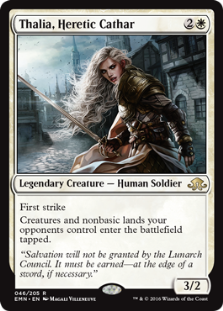
The most obvious edge Legends has over Affinity, which is otherwise a more proactive and all-around powerful deck, is resilience. Sure, most shells are soft to damage-based sweepers like Pyroclasm. But so is Affinity, and those cards are far rarer in Modern than artifact hate. Clasm even hurts Legends less than something like Ancient Grudge or Stony Silence hurts Affinity, and that's without mentioning absolute hosers such as Shatterstorm (which, as we'll see, Legends itself basically gets to run).

To compensate for its dip in proactivity relative to Affinity, Legends becomes interactive; à la fish, with creatures. Both Thalias headline the deck's disruption suite, with the first and smallest serving as its primary cog. Thalia, Guardian of Thraben is a cornerstone of creature-heavy aggro strategies from Humans to Bant Eldrazi, and for good reason: she forces spell-based combo (read: Storm) to deal with her before claiming a win, hassles three-color midrange decks like Jeskai, and passes the Bolt Test by rewriting its very rules.
Thalia, Heretic Cathar is more complicated, but equally devastating in Legends. Mox Amber provides an attractive way to slam her early, which spells doom for many Modern decks, and especially ones with fetchlands. Since Cathar's primary purpose is stunting enemy development, she's at her best when the pressure is magnified; turn one beater, turn two Cathar off a Mox is a line that creates that sort of clock, and sure beats casting her off a Birds of Paradise.

Finally, the creatures in Legends hold their own better than Affinity's do. Against a removal-heavy opponent, Affinity is liable to be left with some useless Memnites and Ornitopters unless it can find Cranial Plating. Not so with Legends, whose pseudo-Springleaf-enablers serve as reasonable attackers. Our grind game is helped further by haymakers like Shalai, Voice of Plenty, as well as token generators like Rhys the Redeemed.

Legends vs. Humans

Humans is another deck that begs comparison to Legends. Like Affinity, it's an overall better deck thanks to its proactivity and consistency, which Legends rarely achieves. Humans also takes our disruptive gameplan to the next level with Kitesail Freebooter, Meddling Mage, and Reflector Mage, and even runs both Thalias.
Our big trump over Humans is Urza's Ruinous Blast. This one-sided Oblivion Ring-plus is ridiculous in many matchups, and a major draw to the archetype. Mox Amber and other fast mana cards make casting it a breeze, especially in slower post-board games; Blast's hefty mana cost also offsets the now-infamous "Humans problem" of flooding out in the mid-game, as Drowner of Hope did for Bant Eldrazi many moons ago. It also doesn't hurt that Humans and Affinity are two of the matchups most hurt by our Blasts, although Lantern Control deserves an honorable mention.

Deckbuilding Options

Legends can easily manage reaching into a nonwhite color. Green and red, not coincidentally the only other colors featuring one-drop legends, seem like the best splashes. Each offers the deck something unique.

Green

Noble Hierarch: The biggest reason to go green, Hierarch doubles us up on fast mana sources, allowing for explosives starts and incentivizing opponents to spend their first turn reacting to our play. The dork's also a literal lightning rod, drawing fire away from the fragile Thalia, Heretic Cathar.

Oviya Pashiri, Sage Lifecrafter: Oviya is probably the worst one-drop legend in this deck, if only for her overlap with Rhys. We prefer the latter because of its mana smoothing qualities when combined with Mox Amber. That said, she's still a one-mana legend, and we can't get enough of those; the more names we run, the less chance we have of bricking with identical legends or opening anemic Moxen.
Rishkar, Peema Renegade: While unexciting on the surface, Rishkar impressed me in testing. He grows our smaller creatures into Wild Nacatls and ramps us right into whatever pricey spell we're looking to cast.

Reki, the History of Kamigawa: I had Reki in most of my GW builds. The creature provides plenty of advantage—turn one Untaidake, the Cloud Keeper, turn two Reki into Mox and a one-drop puts us far ahead of opponents on cards, and things continue snowballing from there. But Reki's fairly build-around, all but necessitating many Untaidakes, and some opponents could care less about our card advantage, instead daring us to just kill them quickly.

Red

Zurgo Bellstriker: Red's Oviya analogue: trash, but a name.
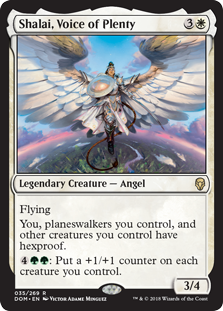
Hazoret the Fervent: A terrific reason to go red, Hazoret supports our natural gameplan of dump hand, attack, and pressures opponents from some unique angle: it's impervious to many types of removal, can kill planeswakers (and players) out of nowhere, and gives us repeated reach.

Utility options: Nothing in green had me tickled on this front, but red offers many intriguing utility options. I've integrated a few into the build I settled on, which ended up splashing both colors.

Stirring the Soup

Naya Legends, by Jordan Boisvert

Creatures

3 Rhys the Redeemed
3 Kytheon, Hero of Akros
2 Oviya Pashiri, Sage Lifecrafter
2 Isamaru, Hound of Konda
2 Zurgo Bellstriker
3 Thalia, Guardian of Thraben
3 Thalia, Heretic Cathar
2 Shalai, Voice of Plenty
2 Hazoret the Fervent
4 Noble Hierarch

Artifacts

4 Mox Amber

Enchantments

2 Blood Moon

Instants

4 Lightning Bolt

Sorceries

2 Faithless Looting

Lands

4 Windswept Heath
3 Wooded Foothills
3 Arid Mesa
2 Stomping Ground
1 Sacred Foundry
1 Temple Garden
4 Horizon Canopy
1 Eiganjo Castle
1 Untaidake, the Cloud Keeper
1 Plains
1 Forest

Sideboard

4 Urza's Ruinous Blast
3 Relic of Progenitus
2 Kataki, War's Wage
2 Hokori, Dust Drinker
2 Linvala, Keeper of Silence
2 Lyra Dawnbringer

Philosophy

Running all three colors lets us play every relevant one-drop legend in Modern. Combined with a full set of Hierarchs, all those cheap legends maximize the odds of getting to three mana on turn two, and to four mana on turn three.
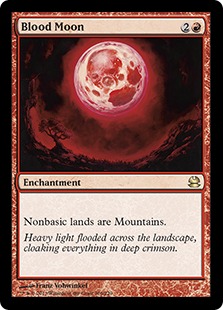
The rest of the deck seeks to capitalize on that advantage by either blitzing opponents with cheap legends or locking them out of the game, draws depending. At the top of the curve, Shalai and Hazoret lock things up, making it impossible for opponents to cleanly answer our boards. Shalai's activated ability also comes up in longer games, mitigating flood.

Red Utility

I found myself in want of more permanent disruption at three mana, and eventually added Blood Moon. The very threat of a turn two Moon from us, even when we don't start on a mana dork, spooks opponents stiff. They're also likelier to expect it post-board, after having seen the enchantment; many of my board plans involve removing Moon, though, and bringing in Blast. We end up benefiting from the card a disproportionate amount as opponents fetch badly in fear.

We lack the built-in creature interaction of Reflector Mage, but must play some form of efficient removal to survive and cast our funny Standard cards. Lightning Bolt helps us survive the early turns against the more proactive creature decks, and its reach plays nice with our Zoo-like assault of legendary bodies.
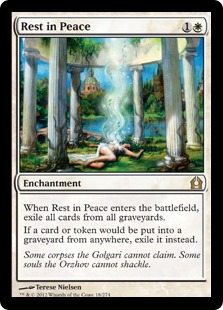
The flashiest include is probably Faithless Looting, a longtime pet card of mine that's at last garnered widespread attention as a defensible Modern cantrip. Looting lets us chew through redundant legends and lock pieces, but primarily gets us through chunks of lands: with Moon on the table, Horizon Canopy shuts off, and Canopy couldn't totally offset our flooding in the GW builds anyway. Early adopters of Mox Amber used Smuggler's Copter for this purpose, but I prefer the immediate draw in this build. Copter dies to Blast, flashback is easy to pay, and Looting has natural synergy with Hazoret.

Lands and Sideboard

The lone Untaidake may get cut soon, but the early Shalais, Hazorets, and Cathars are awesome when they do happen. The Sol land is also better post-board, when Moon frequently becomes Blast. Eiganjo Castle feels like a necessary evil against Bolt decks, primarily to protect Cathar. I'm looking to test a Mountain and try dropping down to 21 lands.

I started with Rest in Peace in the sideboard, but the enchantment had too much tension with Blast, so I replaced it with Relic. The eight legendary creatures all come in against different opponents, often for Looting (our curve increases post-board) or Hierarch (especially weak to damage-based sweepers and dies to Blast), or for whatever legend's bad in the matchup (i.e. Guardian of Thraben vs. Humans). I'm still testing the lot of them to see which ones I want to keep.

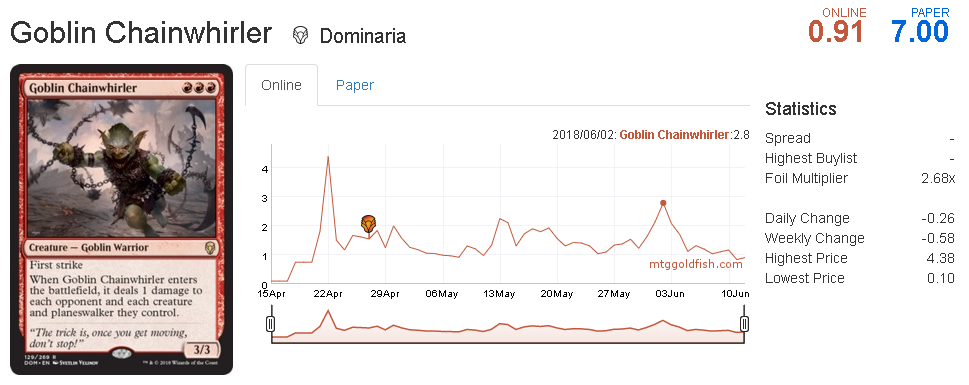
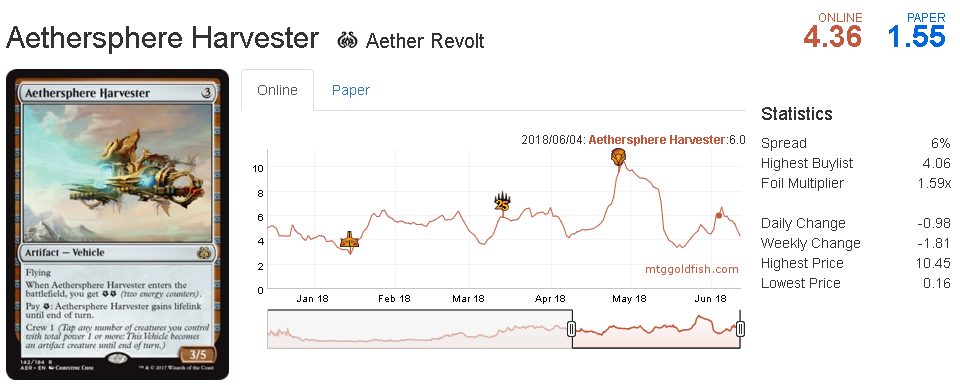
As the numbers indicate, the sideboard is built around Urza's Ruinous Blast. Four copies may be too many, but I want to draw it every game when I do bring it in. We can also pitch spares to Looting.

Underneath the Blood Orange Sun

Naya Humans is a brand-new brew, and quite unrefined at this point. It's fully possible I'm being too greedy on three colors and should stick with two, as have the Modern players achieving modest successes with the strategy. In any case, I know I'm still having fun playing around with the cards after a week, which bodes well for my future development of the deck. If you have any comments or suggestions, manage to take the deck out for a spin, or would like to share about your own experience with Mox Amber, drop me a line in the comments.

Insider: Lessons from Pro Tour Dominaria

Are you a Quiet Speculation member?

If not, now is a perfect time to join up! Our powerful tools, breaking-news analysis, and exclusive Discord channel will make sure you stay up to date and ahead of the curve.

Hi guys,

Last week I said I would do a recap on my Pro Tour specs to see how they might be improved. Here's what I wrote a few weeks ago in my article laying out my Pro Tour specs:

This week we are going to do some early speculation on Pro Tour Dominaria. After many weeks of Standard action, everyone knows the top decks in the format by now. The most recent Grand Prix was dominated by BR Vehicles—no doubt a deck that will be a big part of the Pro Tour.

Having seen the power level of the red deck, I predict one of two things for the coming PT. Either it’s going to be full of aggro decks like Pro Tour Hour of Devastation (the Top 8 consisted of 6 Ramunap Red variants, 1 BG Midrange, and 1 Zombies deck), or Shota Yasooka will come out with some special control brew and beat everybody.

My predictions were pretty accurate. BR Vehicles/Aggro and Mono-Red Aggro dominated the Top 8 of PT Dominaria. I'm not sure what Shota brought to the PT but he did not come out with any surprises this time. Let's proceed to revise what I picked over the last two weeks.

The Successes

This is a rather easy one, although I did not gain big money on it. It was pretty obvious back then that this is one of the most powerful cards in Standard, and having so many copies in the Top 8 is definitely one of the reasons the price spiked to 2.8 tickets.

From this 2.8-ticket peak, there's a sharp drop-off immediately following the Pro Tour. This highlights the importance of being physically in front of your computer during the Pro Tour, as I pointed out last week.

Two weeks ago Aethersphere Harvester was about 3.7 tickets. I believed it had potential because 3/5 stats and lifelink were well positioned—Harvester was a great card at the Pro Tour among a field of Mono-Red decks and Rekindling Phoenixes. Surprisingly, not many players played it in the mainboard, except for the new Blue Green-Karn brew that plays a full playset in the main.

I think this will be a staple moving forward, but its time in Standard is not long. I do hope you guys earned some tickets from Harvester but you probably shouldn't invest in it anymore in the future.

Good Picks During the Pro Tour

If you notice the most recent low point for Heart of Kiran, that was actually during Day 1 of the PT. It was a good pick at that point in time because red-black decks occupied 26% of the PT metagame. I'm not sure how the coverage team distinguished between RB Aggro and Midrange, but the important thing is that both of these decks play Heart of Kiran.

With such a big portion of the metagame consisting of this deck, there has to be a reason—many pros have identified it as the best deck after a bunch of testing. With this information from the coverage, we should know the chances of RB decks reaching the Top 8 is very high.

Despite a quarter of the field playing Red-Black, Mono-Red Aggro has its own advantages. It's easier to turn on Hazoret the Fervent in Mono-Red because the deck can usually dump everything in hand by turn four. Knowing how good Hazoret is, along with the info we got from coverage, we shouldn't have missed Hazoret as one of our purchases.

Rekindling Phoenix was one of the highlights of the Pro Tour. The price of Phoenix online increased by about 7 tickets throughout the event, and continued increasing after the PT concluded.

Many people probably missed out on this because of the 30-ticket buy-in at the time. Not everyone has hundreds of spare tickets and it's a pretty risky pick, as Standard cards rarely go beyond 30 tickets unless they're breaking the format.

However, it turns out that Phoenix really is the best card in the format. I'm not sure how can we learn from this, because it all depends on how much risk you can take at the moment.

The Failures

It's hard to acknowledge failures, but we need to learn from our mistakes. Most of my mistakes this time were caused by overestimating certain cards.

Ghalta, Primal Hunger was described as something similar to Metalwork Colossus. Previously I said the Dinosaur version of the Colossus was slightly better because the deck plays a bunch of big creatures at cheap costs. However, I didn't realize that creatures are easier to deal with compared to artifacts.

If we look at the top-performing decks at the PT, Mono-Green Stompy still performed pretty well, but the players didn't make it to Top 8 because of poor draft records. Nevertheless, Ghalta was not played as a four-of in these decks, simply because as a legendary creature, players can be stuck with multiple copies of them in hand. Furthermore, these 12/12 creatures can't do anything if you do not have enough power in play.

I still think History of Benalia is a great card, although the price has dropped slightly since two weeks ago. I think this card is being overshadowed by red decks in the format.

What I've learned from this pick is to avoid underplayed cards whenever there's a dominant deck in the format. These cards are underplayed for a reason—probably because the decks that play them just aren't very good against the best decks.

This is especially important when the best decks are aggressive, because more players naturally gravitate towards those decks already. When the win rates aren't high enough, these underplayed decks can easily be out-numbered, and the probability of them reaching Top 8 becomes slimmer. Thus cards under this category shouldn't be part of our specs.

Having said that, there are players who won seven or eight rounds out of ten with History of Benalia. If you have invested in this card, you can still hold onto them as they might become popular later.

The Scarab God was probably the most overrated card from my article. This card was simply too slow against the horde of red decks in the PT. Even if a player can survive until turn five with God in play, the red decks can always deal the last few points of damage through burn spells or flying creatures like Phoenix or Heart of Kiran.

Furthermore, the God is only played as a one- or two-of, unlike in the earlier Energy decks. The time for The Scarab God in Standard appears to be over, and I made a mistake by hoping it would be good in decks that weren't seeing much play at the time.


Alright guys, that’s all for the week. Thanks for reading, and I’ll see you again next week.

Adrian, signing off.

Want Prices?

Browse thousands of prices with the first and most comprehensive MTG Finance tool around.


Trader Tools lists both buylist and retail prices for every MTG card, going back a decade.

Quiet Speculation