menu

Speed Check: Is the Metagame Faster or Slower?

Are you a Quiet Speculation member?

If not, now is a perfect time to join up! Our powerful tools, breaking-news analysis, and exclusive Discord channel will make sure you stay up to date and ahead of the curve.

As the metagame continues to settle after the unbans of Jace, the Mind Sculptor and Bloodbraid Elf, an interesting dichotomy has arisen: some players claim that the presence of these powerful four-drops has made the format faster and less interactive, while another sector espouses the opposite belief. I took it upon myself to find out which camp has a better read on Modern.
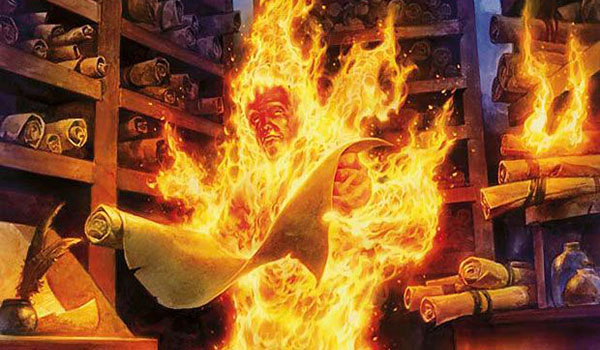
The former group claims that a deck lacking both Jace and the Elf cannot hope to win a grindy, fair game, and must thus resort to trying to get under decks with the cards. The latter holds that because these cards have mostly boosted the fortunes of fair decks, the format is more interactive than it has been in recent memory, resulting in longer, slower games of Magic.

This article lays out the current slate of top decks, then compares it to that of the most recent lineup before the unbans. Next, it attempts to determine whether the most represented decks attempt to win faster than their predecessors did.

The Usual Suspects

In order to establish a frame of reference, we have to establish a baseline of what decks are the most common performers in the current environment. While Wizards' change in policy regarding the publication of Magic Online league data has made direct comparisons with the past somewhat difficult, I think it's reasonable to assume that decks that make their way to the 5-0 listings regularly are at least somewhat well-positioned. With that in mind, a results accumulation resource like MTGGoldfish should still provide a sufficient approximation of what decks to focus on.
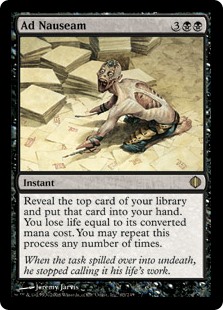
Another useful exercise at this stage is to establish a given deck's degree of interactivity. Storm isn't operating on the same axis as Jund, and there are plenty of decks somewhere in between those two that need their place defined. For the purposes of this discussion, we'll use the following categories.

Minimally interactive - These decks pack few or no ways to directly interact with their opponents. Some of their action cards can interact, but the gameplan is mostly to ignore what the opponent is doing.

Examples: Ad Nauseam, Gifts Storm

Moderately interactive - These decks tend to have a firmly established gameplan, but are also capable of disrupting opponents if the situation dictates it. The disruption these decks employ is often integrated into their gameplan.

Examples: Hollow One, Humans

Highly interactive - Disrupt early and often is the name of the game here. These decks generally have a small handful of win conditions, and then dedicate the rest of their shell to ensuring that opponents must fight tooth-and-nail to execute their own gameplans.

Examples: Jeskai Control, Mardu Pyromancer

The Need for Speed

Last but not least, we have to talk about speed, or proactivity. Decks like Burn aim to win as fast as possible; on the other side of the coin, control decks want to establish themselves on the battlefield and the stack, and then win much later. Here are some broad categories we can use to categorize the speed of the decks we are interested in evaluating:
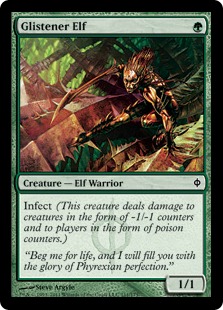
Fast decks - These are generally looking to win by turn four. Some of them are even capable of finishing the game before then if left to their own devices.

Examples: Burn, Infect

Moderately fast decks - These decks are generally proactive and looking to win the game in a reasonable time frame, but are not quite as "all-in" as the fast decks. Provided they draw the proper tools, these decks are as comfortable winning the game on turn four or five as they are on turn 10.

Examples: Grixis Shadow, RG Ponza

Slow decks - These decks have piles of interaction and a nominal amount of win conditions. Their goal is usually to stymie the opponent's gameplan, eventually find their ways to win, and then close the game out at their leisure.

Examples: UW Control, Lantern Control

Measuring Up

With these categories in mind, let's take a look at the top 15 decks currently on MTGGoldfish and see where things stand in the pre- and post-unban metagames.

Deck NameDeck RankingInteractivitySpeed
Jund1Highly interactiveModerately fast
Humans2Moderately interactiveModerately fast
Gx Tron3Moderately interactiveModerately fast
Burn4Moderately interactiveFast
Hollow One5Moderately interactiveFast
Gifts Storm6Minimally interactiveFast
Affinity7Minimally interactiveFast
Bogles8Minimally interactiveFast
Grixis Shadow9Highly interactiveModerately fast
Jeskai Control10Highly interactiveSlow
U/W Control11Highly interactiveSlow
Eldrazi Tron12Moderately interactiveModerately fast
Ad Nauseam13Minimally interactiveModerately fast
Ponza14Moderately interactiveModerately fast
Dredge15Moderately interactiveModerately fast

My prediction prior to putting these lists together was that the average speed and interactivity of a deck in the metagame will not have changed much, but the metagame will have become more polarized. Fast, minimally interactive decks and slow, highly interactive decks would find themselves on the rise, with the middle ground between these extremes eroding to some degree.
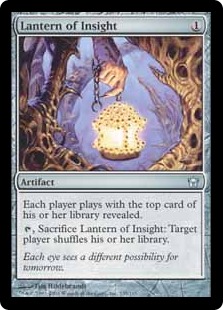
The hypothesis ended up only half-right. A look at the high-ranking decks in a vacuum instead favors the view that the metagame has gotten faster; while most of the decks here are interactive to some degree, they are all looking to win quickly. Cards like Bloodbraid Elf have injected speed into the likes of Jund and RG Ponza. Uxx control decks seem to be the only representatives of the slower side of the spectrum that are performing at a high level, as prison strategies like Lantern Control are pushed out by the re-emergence of decks heavy on artifact hate.

However, we cannot definitively state that the meta has gotten faster until we take a look at a snapshot of the metagame prior to the Jace and Bloodbraid unban:

Deck NameDeck RankingInteractivitySpeed
Gx Tron1Moderately interactiveModerately fast
Humans2Moderately interactiveModerately fast
Grixis Shadow3Highly interactive Moderately fast
Burn4Moderately interactiveFast
Affinity5Minimally interactiveFast
Eldrazi Tron6Moderately interactiveModerately fast
Mardu Pyromancer7Highly interactiveSlow
Dredge8Moderately interactiveModerately fast
Jeskai Control9Highly interactiveSlow
Titanshift10Minimally interactiveModerately fast
Traverse Shadow11Highly interactiveModerately fast
Counters Company12Minimally interactiveFast
UR Madcap Moon13Highly interactiveModerately fast
UW Control14Highly interactiveSlow
Abzan15Highly interactiveModerately fast

This list of decks does confirm the assertion that the current metagame has gotten faster and less interactive. Not only are there more representatives for the decks I consider fast (five examplars now to three previously), there's also a dip in decks that could be thought of as highly interactive (we went from seven decks in that ledger to four). Given this information, it's reasonable to conclude that one of the major ways decks have adapted to the rise of Bloodbraid and Jace is to speed up and duck under them.

Drilling Deeper

While our categorization does a reasonable job of illustrating broad trends in the metagame, we can also narrow our focus by examining the decklists of various archetypes one might expect to see in each metagame and how they have changed.

Let's begin the comparison with one of the pillars of Modern: BGx Rock. This is an Abzan list from just before the unban announcement.

Abzan, by ef_apostrophe (6-1, MTGO Modern Challenge #11145571)

Creatures

2 Siege Rhino
3 Grim Flayer
2 Scavenging Ooze
4 Tarmogoyf
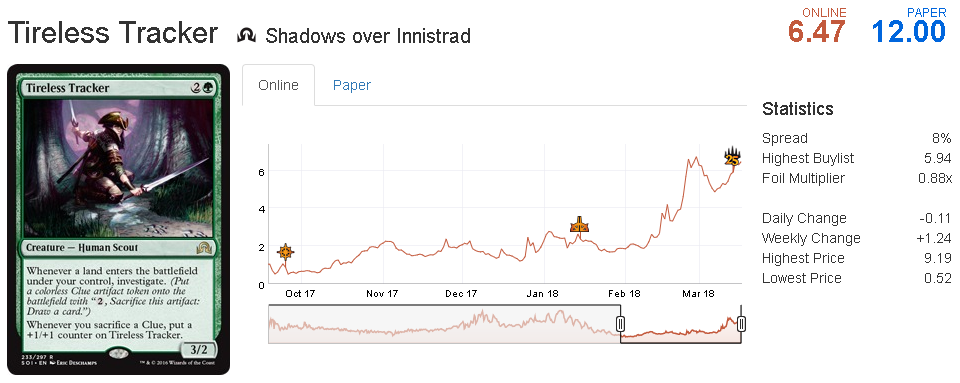
2 Tireless Tracker

Instants

2 Abrupt Decay
2 Fatal Push
4 Path to Exile

Sorceries

1 Collective Brutality
3 Inquisition of Kozilek
4 Lingering Souls
1 Maelstrom Pulse
3 Thoughtseize

Planeswalkers

3 Liliana of the Veil
1 Liliana, the Last Hope

Lands

3 Blooming Marsh
1 Forest
1 Godless Shrine
3 Marsh Flats
2 Overgrown Tomb
1 Plains
2 Shambling Vent
1 Stirring Wildwood
2 Swamp
1 Temple Garden
4 Verdant Catacombs
2 Windswept Heath

Sideboard

2 Collective Brutality
1 Damnation
1 Flaying Tendrils
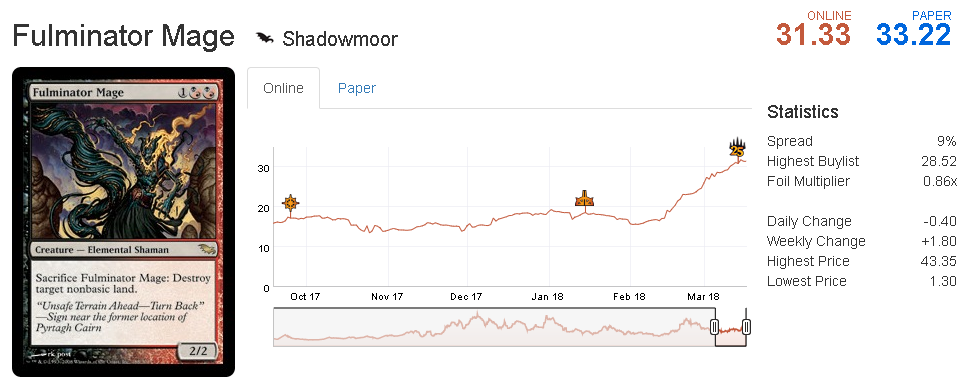
3 Fulminator Mage
1 Gideon, Ally of Zendikar
1 Maelstrom Pulse
2 Nihil Spellbomb
2 Stony Silence
2 Surgical Extraction

Compare this Abzan list to a Jund one from the latest MTGO Competitive League list dump.

Jund, by cliang (5-0, MTGO Competitive League)

Creatures

4 Bloodbraid Elf
4 Dark Confidant
1 Grim Lavamancer
2 Scavenging Ooze
4 Tarmogoyf

Instants

1 Abrupt Decay
1 Kolaghan's Command
4 Lightning Bolt
1 Terminate

Sorceries

4 Inquisition of Kozilek
2 Maelstrom Pulse
2 Thoughtseize

Planeswalkers

4 Liliana of the Veil
1 Liliana, the Last Hope

Lands

4 Blackcleave Cliffs
1 Blood Crypt
3 Bloodstained Mire
1 Blooming Marsh
2 Forest
2 Overgrown Tomb
3 Raging Ravine
1 Stomping Ground
2 Swamp
1 Treetop Village
1 Twilight Mire
4 Verdant Catacombs

Sideboard

2 Ancient Grudge
2 Collective Brutality
2 Fatal Push
3 Fulminator Mage
1 Grafdigger's Cage
1 Hazoret the Fervent
1 Kitchen Finks
2 Nihil Spellbomb
1 Tireless Tracker

Jund has classically been considered to be a more aggressive deck than Abzan, and a look at these two lists illustrates why very well: its removal spells can double as reach, its manlands are more offensively slanted, and Dark Confidant provides a strong impetus for closing out games before its drawback kills its controller. As Jund is currently ascendant, players can expect more offensive pop when opponents open with Swamp into Thoughtseize.

Next, let's look at some of the more aggressive decks. Here's the Bogles list Dmitriy Butakov piloted to a win in this year's Magic Online World Championship.

Bogles, by Dmitriy Butakov (1st Place, Magic Online World Championship)

Creatures

4 Slippery Bogle
4 Gladecover Scout
4 Kor Spiritdancer

Enchantments

4 Daybreak Coronet
4 Ethereal Armor
2 Gryff's Boon
2 Hyena Umbra
4 Leyline of Sanctity
4 Rancor
4 Spider Umbra
2 Spirit Mantle

Instants

2 Path to Exile

Lands

1 Dryad Arbor
1 Forest
4 Horizon Canopy
1 Misty Rainforest
1 Plains
4 Razorverge Thicket
3 Temple Garden
1 Verdant Catacombs
4 Windswept Heath

Sideboard

3 Gaddock Teeg
1 Grafdigger's Cage
2 Path to Exile
2 Rest in Peace
2 Seal of Primordium
1 Spirit Link

Bogles was fringe at best in the recent past, but now it's back with a vengeance, and one of the big reasons why is that it demands a very specific type of interaction. Spot removal spells are often useless, while black discard spells and sacrifice effects can be shut off with Leyline of Sanctity. Countermagic or enchantment destruction still stops Bogles, but only when paired with a clock, or the Bogles player will eventually draw through such disruption.

Compare this deck to a fast one from the previous metagame, Counters Company.

"Counters Company, by Steve Campen (1st Place, SCG IQ Bernardsville)

Creatures

4 Birds of Paradise
4 Devoted Druid
2 Duskwatch Recruiter
3 Eternal Witness
1 Fiend Hunter
4 Kitchen Finks
2 Noble Hierarch
1 Qasali Pridemage
1 Rhonas the Indomitable
1 Scavenging Ooze
1 Selfless Spirit
1 Tireless Tracker
1 Viscera Seer
3 Vizier of Remedies
1 Walking Ballista

Instants

4 Chord of Calling
4 Collected Company

Lands

2 Forest
2 Gavony Township
1 Godless Shrine
3 Horizon Canopy
1 Marsh Flats
2 Overgrown Tomb
1 Plains
2 Temple Garden
4 Verdant Catacombs
4 Windswept Heath

Sideboard

2 Abrupt Decay
1 Burrenton Forge-Tender
1 Eidolon of Rhetoric
1 Kataki, War's Wage
1 Orzhov Pontiff
2 Path to Exile
1 Reclamation Sage
3 Tidehollow Sculler
2 Voice of Resurgence
1 Worship

Bogles is built with the idea of invalidating spot removal in mind, whereas Counters Company's combo finishes are highly vulnerable to that very type of card. Furthermore, the toolbox nature of Company decks allows room for a few cards that push a plan other than the combo (such as Fiend Hunter, Tireless Tracker, Tidehollow Sculler, and Voice of Resurgence), but the all-in nature of a deck like Bogles does without such luxuries; virtually every inclusion in that deck is either part of the primary gameplan, or protects the primary gameplan.

These differences are only part of why Company is in the outhouse while Bogles is in the penthouse. More importantly, they establish a clear trend reinforced by the uptick in decks with recurring threats like Hollow One's Flamewake Phoenix and Bloodghast, or redundant proaction like Burn's removal-proof reach. Bloodbraid Elf and Jace, the Mind Sculptor have indeed primarily boosted slower decks, and the field has adjusted by rewarding decks that complicate interacting.

Running Off

Changes in the highest echelons of the metagame are increasingly apparent. But whether these development are good, bad, or neutral for format health and diversity remains to be seen. If you have any opinions on the current state of the format, or on the analyses I performed to arrive at my conclusions, drop me a line in the comments.

Insider: A Promising Pauper – Specs and Considerations

Are you a Quiet Speculation member?

If not, now is a perfect time to join up! Our powerful tools, breaking-news analysis, and exclusive Discord channel will make sure you stay up to date and ahead of the curve.

Welcome back, readers!

It does seem like Pauper is the new "it" format, with lots of cards moving up dramatically. Sigmund hit on a few some weeks ago, but in a format as diverse as Pauper with as large a card pool there are plenty of options. Today I'm going to offer my own picks for Pauper.

First we want to look at the top decks in the format. The information below is taken from MTGTop8.

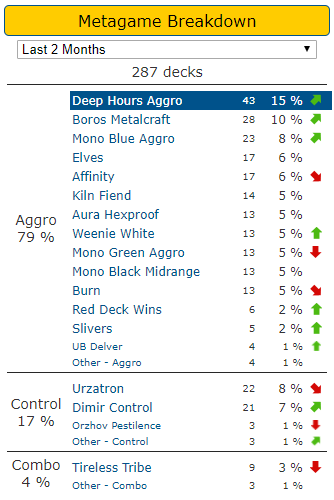
As is typical with Magic, the Pauper metagame does shift over time, so depending on when you're reading this is might look slightly different. However, the key takeaway is that aggro appears to be kind of the format.

The format is also extremely diverse. As the most popular deck, Izzet Delver occupies just 15% of the expected metagame, with everything dropping off after that. Tons of viable decks are here to explore.

This means we'll likely see a lot more players jumping onto the Pauper bandwagon and building decks. It definitely helps that the format is eternal so there's no danger of rotational drops in card prices, and the buy-in is so low that players can build a gauntlet for the price of a tier-one Standard deck.

There was an error retrieving a chart for Choking Sands

Interestingly enough, my first pick for a Pauper spec opportunity is from a deck that only makes up 4% of the metagame: Mono-Black Midrange. Choking Sands is a single-print common from Mirage (i.e. the last and only printing was from 1996) that's often a four-of in the sideboard. Four-ofs in the board are just as important as those in the main, and Mono-Black players will need copies of these.

Currently they're sitting under $0.5, with many in the $0.25-$0.35 range. I can easily see this card doubling up without much effort given how every copy is 22 years old.

There was an error retrieving a chart for Thorn of the Black Rose

A single-print card from Conspiracy: Take the Crown. Pauper is a format in which true card advantage isn't all that readily available, especially in mono-black decks. Becoming the monarch can be a fantastic source of card advantage, especially in a deck full of one-for-ones.

Foils of this card have already spiked hard, but regular versions are sitting around $0.5, and it's typically played as at least a two-of (and possibly more in the board) of many of the mono-black midrange decks. The Conspiracy sets as a whole tend to get drafted a lot when they first come out and then quickly dry up. This means not nearly as much product is opened, and thus not nearly as much enters the supply.

There was an error retrieving a chart for Carapace Forger

This one's quite a bit newer than our first spec, however, it's another single-printing that's played as a four-of in Pauper Affinity (currently about 6% of the meta). Recently we saw the foil price spike from $1 to around $9-$10, though that looks like a buyout that has since calmed down. The point is that the regular version is played a lot and can still be had extremely cheaply.

There was an error retrieving a chart for Nivix Cyclops

Dragon's Maze was a pretty awful set. It had a single valuable card for most of its Standard existence (Voice of Resurgence), and boxes can still be purchased dirt cheap online as they continue to gather dust wherever they are stored.

Now Dragon's Maze did occur after Zendikar (which is when we had an explosion in the playerbase) so the print run was likely very large. Even as a four-of in the Kiln Fiend deck, I don't think the regular version can jump a ton. But foils can be found for about $1, and I imagine the number floating around is a lot smaller than one might think simply because of how little Dragon's Maze was opened compared to the rest of Return to Ravnica block.

There was an error retrieving a chart for Birchlore Rangers

Pauper Elves plays this card as a common replacement for Heritage Druid. Yet again we have a four-of in a strong deck with only a single printing (from Onslaught, which means all copies are at least 16 years old).

Foils on this card are already $5-plus, and they've been this high for two years now (so it isn't buyout driven). Onslaught was a popular block, thanks in large part to the introduction of fetchlands, so a lot of it was opened—but that was a long time ago and the playerbase has expanded greatly since then. I think this could easily be a $1-plus card if Pauper demand continues to grow and it dodges a reprint.

There was an error retrieving a chart for Elvish Vanguard

Another pick from Pauper Elves, Elvish Vanguard is a relatively new addition to the deck thanks to getting downgraded from rare all the way down to common in Eternal Masters.

Foil copies from Eternal Masters are about the same price as the regular version and I like them as a cheap pickup with a lot of potential; though remember that there are a lot more foils from Masters sets thanks to each pack always having one. Original Onslaught foils are closer to $5 each (though I'd argue their artwork is better and they are much rarer to boot).

There was an error retrieving a chart for Mental Note

The original version of Thought Scour that could only target yourself was printed back in 2002 in Judgment. We've seen how powerful self-mill can be when stapled to a cantrip thanks in large part to the delve mechanic.

Yet again this is a single printing, typically a two- or three-of in most of the UB Delver lists. It definitely feels like it could triple up from its current price of around $0.3 and perhaps even break the $1 mark.

There was an error retrieving a chart for Faerie Miscreant

While likely the weakest of the creatures in the UR Delver lists, this is a four-of from Origins. While that set wasn't printed that long ago, it's a core set which generally means fewer copies, and Miscreant isn't likely to be picked out of bulk all that often.

The current price is misleadingly low, as all available "cheap" copies come with additional shipping cost. That means that to actually purchase a set of four of these off TCGplayer you're likely going to have to pay $0.5 or more per copy.

Can Selling Commons Be Profitable?

I have run the numbers previously with regards to costs of selling on TCGplayer, and cards that sell for $2 or less net very little—in fact anything below around $1.12 nets a loss. To compound this problem, the price ceiling on a lot of Pauper cards is relatively low, thanks again to them all being commons. So the question arises, how do we actually make money here?

One benefit to Pauper speculation is that, more often than not, you paid practically nothing for a lot of these cards. I buy a lot of bulk, so I've gotten a ton of these new Pauper staples at $0.003 each. So the profit percentage can be massive, assuming we can find a way to unload any of these cards.

One option that I've used numerous times is to buylist them, typically at a GP. The challenge here is that most stores don't offer a very aggressive spread on commons—they, too, likely can dig them out of bulk they've purchased, so they're paying you merely to save them the hassle. So while I won't sell $10-plus cards when the spread is below 65%, I don't worry about 50% spreads on commons—after all, if I get $0.25 on a card I paid $0.003 for, my profit margin is still 823%.

There is also a lot more risk of the price completely tanking with a reprint. If you think rare reprints are bad, look at the price of Spell Pierce—it used to be a $2 common you could buylist for $1.25, and now it's a dime. The other challenge is that while the whole Pauper format seems to have cards jumping left and right, most of them are simply going from bulk to $1 (or less)—and buylists seem to be very slow to respond to a lot of these jumps.

There was an error retrieving a chart for Spell Pierce

One method is to sell playsets of these cards on Facebook (thus reducing your profit loss due to fees) and making sure that the shipping cost stays reigned in.

I've also put together a Pauper trade binder full of the top cards for each color, with the idea that if local players want to get into the format I can trade them a lot of smaller cards for more expensive liquid cards. I haven't had a chance to break this binder out yet—I'm still in the building stages—but I expect it will be worthwhile given how many local players have started asking about Pauper cards and decks on my local Facebook groups.

You can also post them up on TCGplayer in multiples of four and hope that players buy more than one at a time. I've had some luck with this the past, though there isn't a guarantee on that one.

Dissecting Mox Amber: What Measures a Mox?

Are you a Quiet Speculation member?

If not, now is a perfect time to join up! Our powerful tools, breaking-news analysis, and exclusive Discord channel will make sure you stay up to date and ahead of the curve.

There is a reason that games have rules: without them, everything would just be Calvinball. Rules provide structure, cohesion, and comprehension. To mess with them is to risk your game flying apart. Magic is no different. Draw one card, play one land, each land produces one mana, use that mana to pay the cost of your spells; simple, easy, fair. Which is why cards that break those rules are so powerful, and why each time Wizards messes around with them too much, game stability is compromised.

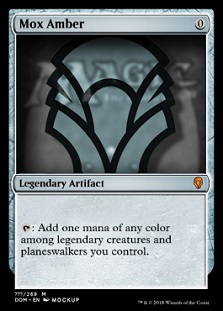
By now, you've certainly seen the leaked Dominaria FAQ. As a result, you know that there is a new mox coming. Mox Amber will be the ninth tournament legal mox in Magic's history. The question is, how well it will measure up? Older moxen have a somewhat inconsistent history, and it is not guaranteed that a new mox will be playable. Every mox has seen play, most extensive, but enabling them isn't always easy. Therefore, Mox Amber's playability will depend on how easy it is to use, and how closely it resembles the original, "unconditional" moxen. I am skeptical it is worthwhile in Modern, but there is a chance.

The Original Moxen

The original five moxen make up most of the Power Nine. They are arguably the best "lands" ever printed. They cost no mana to cast and produce mana, just like lands. Most of the time, they're better than lands because you can play multiples, in the same turn, in addition to a land. Mana acceleration is good, and free mana acceleration is utterly busted. Furthermore, because they function just like a land, they replace lands. Functionally, Mox Sapphire is an Island that you cast, meaning it replaces Island. This is how mana-hungry Vintage decks get away with low land counts. Yes, there are cards like Chalice of the Void and Stony Silence that make moxen liabilities, but the risk is small compared to the benefits.
Not only being the first moxen, but also the most busted moxen, makes the originals the measuring stick for all the subsequent moxen. There will never be anything that exactly copies them, but how close a given mox comes determines its playability. The degree to which the mox reduces the need for lands and accelerates your first turn determines its value. All the moxen have seen play, but none have the universal value of the originals: some are niche, which others are widespread in a certain type of deck.

The Balanced Moxen

Wizards has subsequently tried to weaken the moxen. They've also been incredibly stingy with them, only making four more in the past 25 years. In fact, as I was looking it up, I realized that it is a regular release every seven years. Mox Diamond was released in 1996, then seven years passed before Chrome Mox saw print in Mirrodin in 2003, and then seven more between that and Mox Opal in 2010. Mox Amber is overdue at eight years. I need to ask Rosewater if this was intentional. In any case, none of these moxen were as good as the originals, though a few came close.

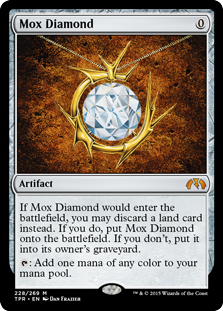
Mox Diamond

The first new mox is also currently the worst mox. As far as I can determine, and I will stress that records from 1996 are sparse, Mox Diamond saw limited play before Legacy Lands became a deck. The mana ability is superior to that of the originals since it produces all colors of mana, but the drawback is significant. You must discard a land for Diamond to enter play. This means you need extra lands in your hand when you play it, and as a result, you couldn't cut lands for the mox. Thus, it never saw widespread play, instead serving as an accelerant in broken combo decks that already played lots of lands. Between taking up a spell slot and requiring more lands, most decks didn't want Mox Diamond.
Legacy Lands changed that trend. Lands runs as many lands as its name suggests, frequently requires color fixing and acceleration, and can mitigate the drawback with Life from the Loam. Other land-heavy decks have also adopted Diamond, meaning that it is finally a format staple in Legacy, if a niche one. The lesson is that context is key, and having the ability to play a mox doesn't mean you should.

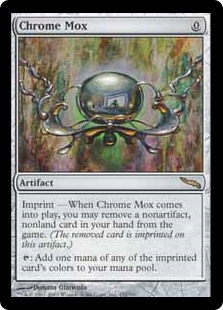
Chrome Mox

The second Mox is in my opinion the most powerful. Chrome Mox requires a sacrifice of a colored spell to do anything, but that proved to be acceptable. It could be used turn one without difficulty or any deckbuilding restrictions and functioned just like a land. This is as close to the originals as any mox has come and Chrome Mox has seen widespread play. In Standard it was everywhere. Affinity ran a set because even if you didn't imprint anything it was still mana for Frogmite and Myr Enforcer or Arcbound Ravager chow. Other, ostensibly fair decks, ran Chrome too to try and keep up with the artificial menace. Even the older formats got into the action.
Once Affinity was banned in Standard, Chrome Mox began to fall off. As the format slowed down card advantage became more important pitching a card to the Mox became too burdensome. Since then, fair decks have stayed away from Chrome Mox while broken combo decks are fine because they don't care about card advantage. For this reason, Chrome Mox is banned in Modern.

Mox Opal

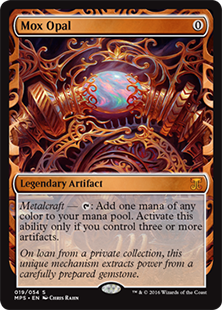
Next is the only Modern-legal mox. Mox Opal is designed to be the most niche mox ever, and it succeeds. Keying off the artifacts matter theme in Scars block, Opal only produces mana when you have metalcraft. Which isn't a big deal, as it counts itself, but most decks don't play many artifacts to begin with so they can't utilize Opal. The biggest change from Chrome to Opal was the addition of legendary. This appears to be Wizards' new balancing strategy, and it makes sense. Multiple moxen are extremely powerful after all, and legendary status means that any extra copies will be Lotus Petals at best. Which is still pretty good, but not five-jewels good.
The restriction on how it produces mana means that Mox Opal has never seen widespread play. However, in artifact-heavy decks, it's a four-of. It does everything you want from a mox in the right deck. In Affinity it is almost always active turn one and will always work by turn two in any artifact deck. This means it is always the same as a land turn one in Affinity and very close in artifact combo decks like Krark-Clan Ironworks. These decks would play the means to turn on Opal anyway so the restriction isn't a problem and thus it functions like a substantial chunk of a land. I can't say it's a full land because you can't keep multiples in play, but it certainly lets artifact decks cut some lands.

Mox Amber

And now, the star of the show. The first thing to note is that Mox Amber is legendary, just like Opal. Also like Opal, it keys off the set's focus, in this case other legendaries; specifically, creatures and planeswalkers. If you have a legendary creature or planeswalker, Amber produces a mana in their colors; otherwise, it does nothing. Colorless is not a color, so Karn and Hope of Ghirapur don't work.
Mox Amber requires cheap legends to shine, and for this reason, I don't think it was designed with Standard in mind. True, we haven't seen the full spoiler yet, but I have doubts about there being enough playable one-mana legends for the mox. The current spoiler has a number of two-mana legends, but again, the main value of a mox is first-turn acceleration.

That's why I think it was intended for Modern. Modern only has one legal mox, and I can't see Legacy or Vintage using this one. Considering that white has more cheap legends than any other color with red a distant second, I think it was intended for a white-based aggressive deck. The question now is whether it will actually have a home in Modern.

Is It Worthwhile?

Given the mentioned limitations, is Mox Amber a good use of deck space? That will depend on how much it resembles the original moxen, specifically how well it functions as an extra land drop turn one and if it replaces lands. The whole point is that you're running a card that functions as a land but is also an accelerant. If you can't replace lands or it can't be used until turn two or later, why not just run Birds of Paradise? Barring that, there needs to be some extra payoff to make it useful.

Is It a Land Drop?

Is Mox Amber an extra land drop? Kind of. If you have it, a land, a castable legend, and a one-mana, same-color spell in your opening hand, absolutely. If not, then you're wasting a card, because the mox isn't accelerating your turn one. As a means to jump up the curve it works, but I then question if it's better than a mana dork. Lightning Bolt on the creature slows you down in either case, but in the mox scenario, you also spent an extra card. That's not great. As to whether it replaces lands, the answer is no. In order for Mox Amber to do anything, you have to have already played a spell, so your demand for land on turn one remains the same. After that turn, Mox Amber becomes more like a land, but the value of the acceleration also substantially decreases.
This limitiation is a huge strike against the mox. Explosive creature decks that could play and may want a mox will struggle to include the card because they cannot shave on lands. Humans is close to this theoretical list, already runs 18 lands and has to mulligan a lot because it can't find the first land to get going. Meanwhile, Affinity runs fewer lands with a full set of Mox Opal, and is perfectly fine because in that deck, Opal is a land. They will always turn on Mox by turn two, frequently one, and can always use the mana. There's little hope that Amber can make Humans' problem better, so I think it compares poorly to Opal and the original moxen, putting it in the same category as Mox Diamond.

Build-Around Potential

What about the Mox Diamond approach of building around the card? There isn't a drawback that can be taken advantage of here, so the possibilities are limited. Instead, we would simply have to embrace the limitation and make use of the acceleration. We've established that cheap legends are necessary and that white has the best, followed by red. Why not go for a legend aggro deck? Because just playing a bunch of 2/2s for one isn't very good in a format filled with one mana removal. Flooding the board against Jeskai isn't useful when they can Bolt and Path your early plays then use Lightning Helix to stabilize. Instead, we need to go the blitz approach.

Legend-Whack, Test Deck

Creatures

4 Isamaru, Hound of Konda
4 Kytheon, Hero of Akros
4 Zurgo Bellstriker
4 Thalia, Guardian of Thraben
4 Kari Zev, Skyship Raider
4 Anafenza, Kin-Tree Spirit
4 Goblin Bushwhacker
4 Reckless Bushwhacker

Instants

4 Lightning Bolt
2 Path to Exile

Artifacts

4 Mox Amber

Lands

4 Sacred Foundry
4 Battlefield Forge
4 Arid Mesa
4 Inspiring Vantage
1 Plains
1 Mountain

The idea here is to flood the board with as many legends as possible, boost them with Bushwhackers, and hope that's good enough. Which is obviously the same plan as 8-Whack, and frankly I think it's quite a bit worse. While Thalia provides powerful disruption, especially in a fast deck, there's no real payoff other than Mox Amber. 8-Whack has all its Goblin synergies when the pure blitz plan fails; Goblin Grenade is surprisingly powerful. Instead, what if we used Amber as a turn two or later card to help accelerate out prison pieces?

Moon and Taxes, Test Deck

Creatures

4 Kytheon, Hero of Akros
3 Zurgo Bellstriker
4 Thalia, Guardian of Thraben
4 Leonin Arbiter
4 Magus of the Moon
3 Thalia, Heretic Cathar

Artifacts

4 Mox Amber

Enchantments

4 Blood Moon

Instants

4 Lightning Bolt
4 Path to Exile

Planeswalkers

2 Ajani Vengeant

Lands

4 Sacred Foundry
4 Inspired Vantage
4 Arid Mesa
7 Plains
1 Mountain

This is more plausible to me. There are plenty of ways to turn on the mox, and you do benefit from the mana even late because it gets around Blood Moon. The thing is, this is not as good as it could be because it is playing Mox Amber.

Compared to its Rival

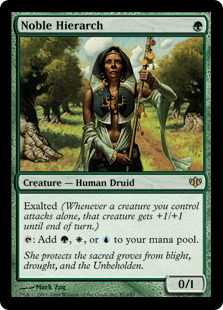
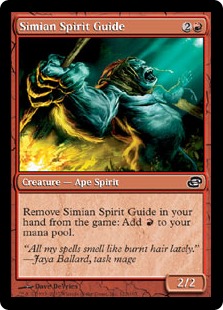
The biggest problem Mox Amber has in Modern is Simian Spirit Guide. It does most of what I've been doing with Amber, but at considerably lower deckbuilding cost. It's also much faster. Consider the above Moon and Taxes list. Changing Mox to Simian makes it far more likely to hit a turn one Blood Moon. This requires a land, two Simians, and the Moon compared to three moxes, a red land, a red legend, and the Moon. Simian also has other benefits, like easier turn one Thalias or just being a creature that can be played to deal damage. The versatility and greater speed are more valuable than the permanent mana boost.


Ultimately, this is the problem with Mox Amber in Modern. If you want to accelerate early, it will be far easier and more reliable to use Simian Spirit Guide. If you want a permanent boost down the road, there are plenty of options from Noble Hierarch to Talisman of Progress that don't require building a deck around the accelerant. Can you play the card and have it be good? Yes. But why would you want to?

Subject to Change

Of course, this is only the way things look right now. There are 117 cards left to be spoiled, and it is entirely possible that there is some amazing payoff card such that you want to play lots of legends in your deck anyway, in which case Mox Amber will be a natural addition. The legendary sorceries certainly suggest this is possible, though none is good enough on its own to justify such a deck. Time will tell, and if something does appear, I will revisit the mox.

Daily Stock Watch – Eidolon of the Great Revel

Are you a Quiet Speculation member?

If not, now is a perfect time to join up! Our powerful tools, breaking-news analysis, and exclusive Discord channel will make sure you stay up to date and ahead of the curve.

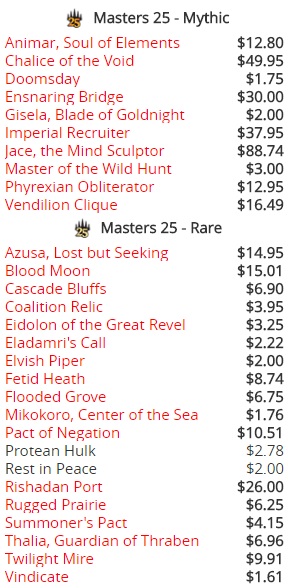
Hello, readers and welcome to a new week of the Daily Stock Watch! It's been a tough grind for Modern lovers lately as different decks have made their way to the top of recent tournaments. The initial fear that Jace, the Mind Sculptor or Bloodbraid Elf decks will dominate the format didn't actually happen, and the search for the most consistent deck continues. Aura Hexproof and RG Ponza have proven to be winners over the past few tournaments, while combo decks such as Ad Nauseam and Living End have resurfaced again, and a new one has emerged in KCI. One perennial contender that's missing the limelight lately is Burn, but if you know Magic long enough, you know that you could never sleep on it when preparing for your sideboard in big events. The card I'd like to feature today is a shoo-in for any Burn variant and thanks to Masters 25, its price has dropped significantly.

There was an error retrieving a chart for Eidolon of the Great Revel

Eidolon of the Great Revel has been one of the worst enemies of midrange and control decks alike throughout the years that Modern has existed. It punishes its opponents in such a way that you have to deal with it first to avoid so much life loss from its ability, and it could go a long way in beating you down if it sneaks into the game at turn two. I have once meddled with the idea of playing with a set of Simian Spirit Guide in my Burn deck to have this guy down on turn one, but that pretty much is all the good that its inclusion could do. Having this guy in play on turn one is kind of dope, though.

Red decks will always have a home for Eidolon of the Great Revel at any point in time. At its current price of $5, I think that it's worth investing some of your spec money on this fiery creature. Modern has seen multiple archetypes emerge as years gone by, but players have always made sure that they have answers to the threat of having Burn around. In case you aren't updated on how it looks like nowadays, check out this list that topped one of MTGO's Competitive Modern Leagues.

Burn

Creatures

4 Eidolon of the Great Revel
4 Goblin Guide
2 Grim Lavamancer
4 Monastery Swiftspear

Instants and Sorceries

4 Boros Charm
4 Lava Spike
4 Lightning Bolt
4 Lightning Helix
4 Rift Bolt
3 Searing Blaze
1 Shard Volley
3 Skullcrack

Lands

3 Arid Mesa
3 Bloodstained Mire
4 Inspiring Vantage
2 Mountain
2 Sacred Foundry
1 Stomping Ground
4 Wooded Foothills

Sideboard

2 Deflecting Palm
3 Destructive Revelry
2 Exquisite Firecraft
2 Kor Firewalker
1 Path to Exile
2 Relic of Progenitus
1 Searing Blaze
1 Searing Blood
1 Skullcrack

The bountiful supply of A25 has reduced the price of Eidolon of Great Revels marginally and this bodes well for us financially. This card should be one of the best specs that will rebound from the set in a few months time once people have stopped opening A25 packs, and there must be a clearer picture of the metagame by then. Modern has stayed healthy despite of the recent changes in how decks are being constructed lately, and it's not farfetched that it will stay the same in the foreseeable future. Once things have settled down a bit, Burn will return to prominence and steal a few tournaments every now and then. As one of the format's cheaper decks that could win big tournaments, there will be a demand for Eidolon again and we would be happy to have kept most of them, and cash out when we've made profit from our specs.

Annoying Red Creatures

There will always be a market for red staples at any point in time during the course of Magic's existence. There is very little room for error when you acquire these cards for future use, and I think that getting our Eidolon copies now would also merit us some good returns in time.

At the moment, we could pick up A25 copies of Eidolon of the Great Revel from StarCityGames, ChannelFireball, Card Kingdom and TCGPlayer for anywhere between $5.04 up to $6.49. Copies from Journey to Nyx are also available in the $6.49 to $7.99 price range. I am fine with getting the A25 copies for preferably $5 and less, but it wouldn't hurt to get the JOU version for the same price. It's also a proven fact that some players prefer the older versions even though I favor the new ones because of the authenticity seal. Either way, you can't go wrong on getting multiple copies of this card.

And that’s it for today's edition of the Daily Stock Watch! See you again tomorrow, as I preview new cards that should be on the go, or good enough for speculation purposes. As always, feel free to share your opinion in the comments section below. And if you want to keep up with all the market movement, be sure to check in with the QS Discord Channel for real time market information, and stay ahead of the hottest specs!

Insider: GP Phoenix’s Impact on the MTGO Metagame

Are you a Quiet Speculation member?

If not, now is a perfect time to join up! Our powerful tools, breaking-news analysis, and exclusive Discord channel will make sure you stay up to date and ahead of the curve.

Hi, guys.

This week we are going to study the most recent Grand Prix in Phoenix and its impact on the online metagame. GP Phoenix was taken down by 5-Colors Humans, piloted by Steve Locke. First, let's start with some statistics of cards played at the GP.

Card Copies in Top 8 Copies in Top 32
Noble Hierarch 15 31
Aether Vial 8 24
Cryptic Command 3 22
Bloodbraid Elf 8 20
Blood Moon 0 23
Jace, the Mind Sculptor 4 20

Before GP Phoenix, the top four decks on Magic Online were (from most to less popular) Mono-Green Tron, Humans, Jund, and Burn. Jund seemed like it would be the most popular deck at the Grand Prix, but as it turned out there were only two copies of Jund in Top 32. Let's have a look at the decks played in Top 8 and Top 32.

Top 8 decks:

  1. Humans
  2. Jund
  3. Krark-Clan Ironworks Combo
  4. Knightfall
  5. Bring to Light Scapeshift
  6. GW Hatebears
  7. Mono-G Tron
  8. GR Eldrazi

Decks appearing at least twice in the Top 32:

  • 5x Humans
  • 4x Blue Moon
  • 3x Affinity
  • 2x Jund, Mono-Green Tron, BR Hollow One, UW Control, Scapeshift

From here, we can tell that the Modern format is still pretty diverse even after the unbanning of Bloodbraid Elf and Jace, the Mind Sculptor, as there's no single deck that can dominate the entire metagame. Humans has been good since the Pro Tour and remains strong after the unbanning of two powerful cards. Jund seems like a very good deck from MTGO results but it seems like paper events didn't go the same way. From the Grand Prix results, I can see that blue decks and Affinity are doing quite well.

Rise of UW Control

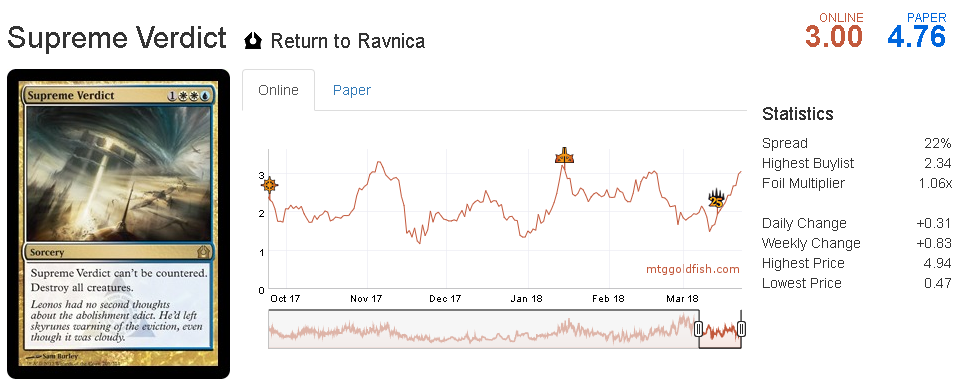
Both UW Control and Bring to Light decks play Supreme Verdict, one of the best sweepers in Modern. The uncounterability on Verdict is good against Grixis Death's Shadow and other creature decks that play counterspells. This card has increased in price by at least 1 ticket and still has no sign of slowing down.

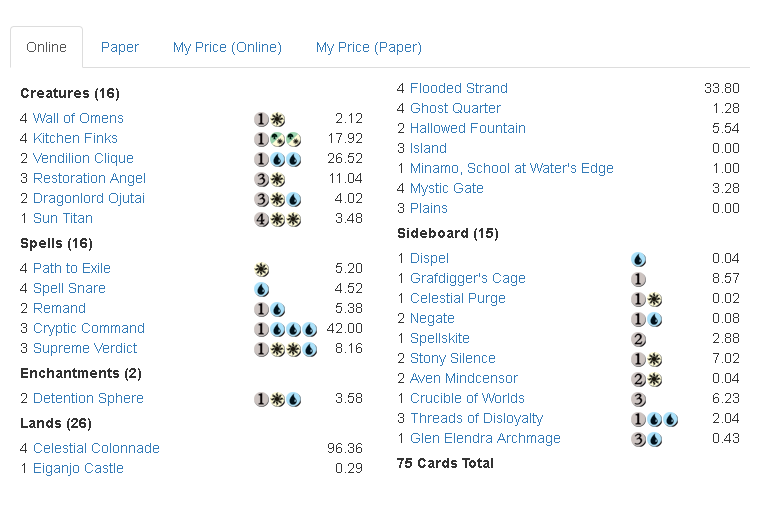
Seeing UW Control reminds me of the UW Midrange/Control deck played by Yuuya Watanabe at Worlds 2015. This deck is the perfect deck to bring back to Modern at this moment to combat Jund and Humans.

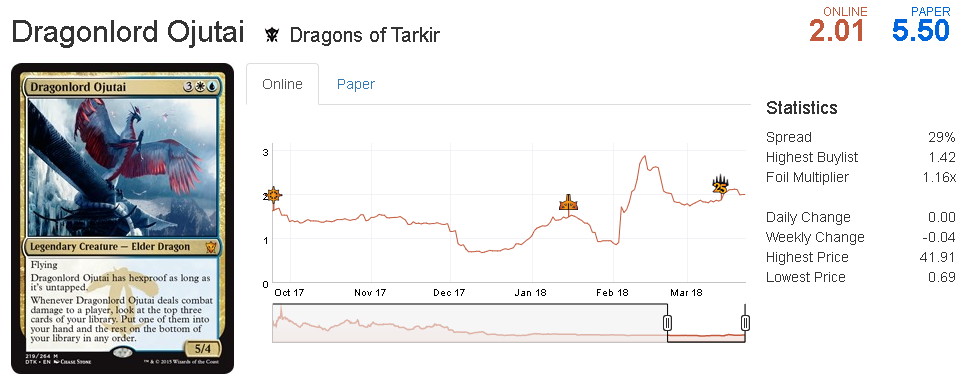
After the unbanning, Jace could also fit into this deck as it has a bunch of creatures that can curve into Jace and protect it. After Jace, the five-drop Dragonlord Ojutai is also pretty strong right now because Jund doesn't have much card that can deal with it except Terminate. Even if they have good removal against Ojutai, this blue-white deck will have cards to counter those spells.

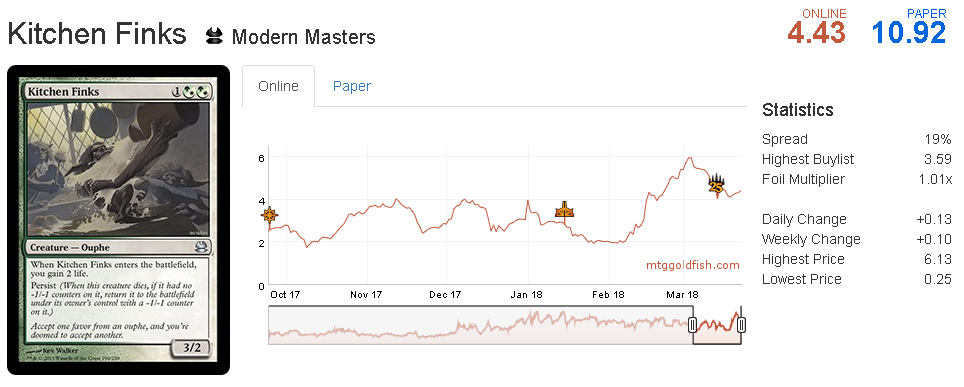
These creatures are rarely played in Modern nowadays but I do feel they have some potential. Kitchen Finks can be played in many green decks, be it creature combo like Counters Company or midrange like Jund, so it's surprising to see its price at only 4.5 tickets. This is a good short-term spec, as I think the price has a high chance of increasing in the next couple weeks.

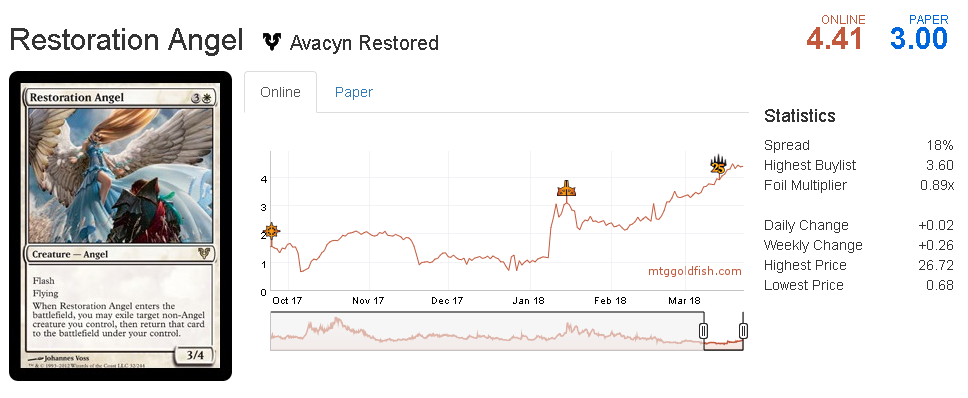
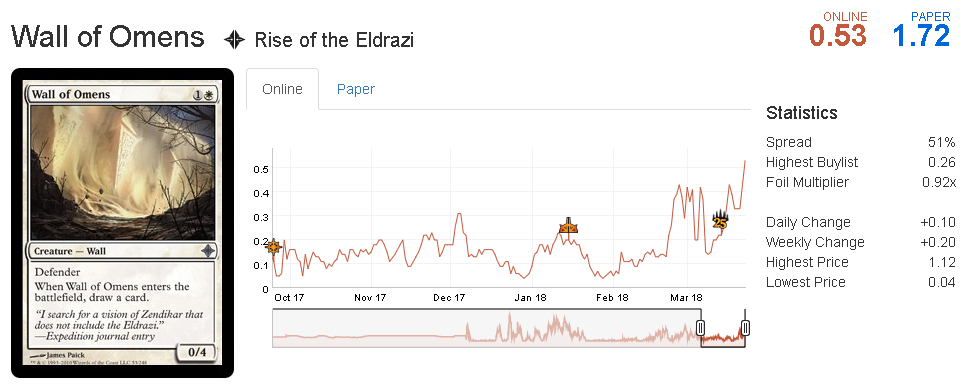
Another card in the UW decks I recommend buying is Restoration Angel. This is one of the best cards in the deck, although now it has to fight for a spot with Jace at the four-mana slot. Restoration Angel acts like a counterspell by flickering a creature the opponent is trying to kill, which can also generate card advantage when the creatures being flickered are either Kitchen Finks or Wall of Omens.

Moving forward, I suggest keeping an eye on the creature cards in Yuuya's deck. There's a good chance that players will bring this deck back to the online metagame, as it can easily out-value the midrange decks available.

Elves with Bloodbraid

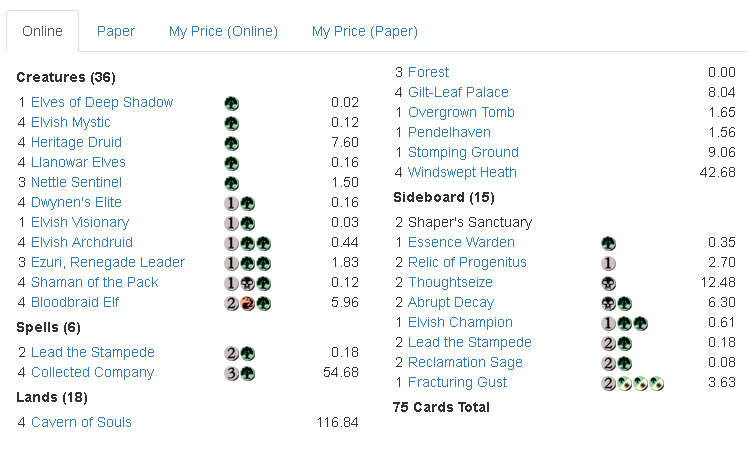
Elves used to be a dominant deck in Modern and I'm not sure why it disappeared. I still think this deck is pretty explosive. The good news is that someone made it to Top 32 of the Grand Prix using Elves, with the addition of Bloodbraid Elf. Let's have a look at the list:

The cards I'm most interested in here are mostly unique to the Elves deck.

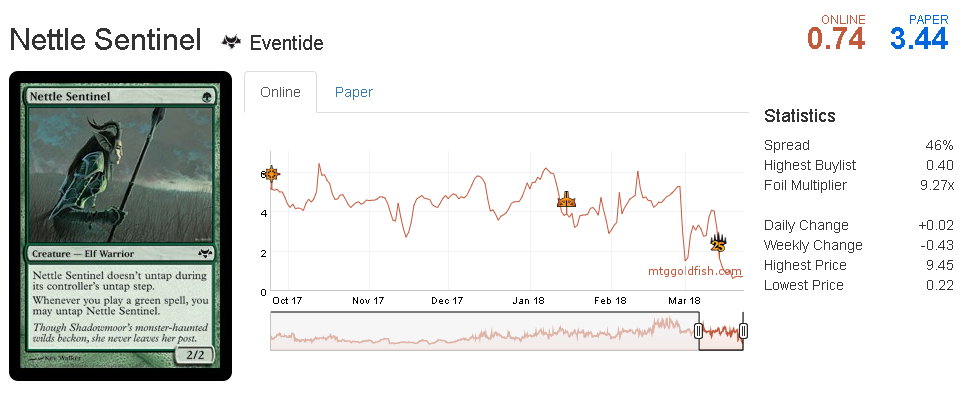
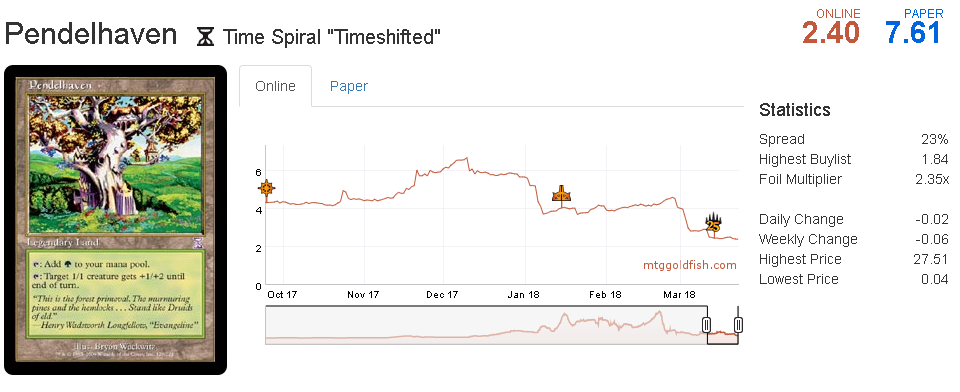
Nettle Sentinel and Pendelhaven got reprinted in Masters 25, which isn't good news. This probably means Nettle Sentinel will struggle to break the 2-ticket mark anytime soon.

As for Pendelhaven, there's still a chance if Infect makes a comeback. I think the Masters 25 version of Pendelhaven is low enough to buy some copies for investment. Bloodbraid Elf increases the explosiveness of this deck, and that may be enough to bring back its popularity.

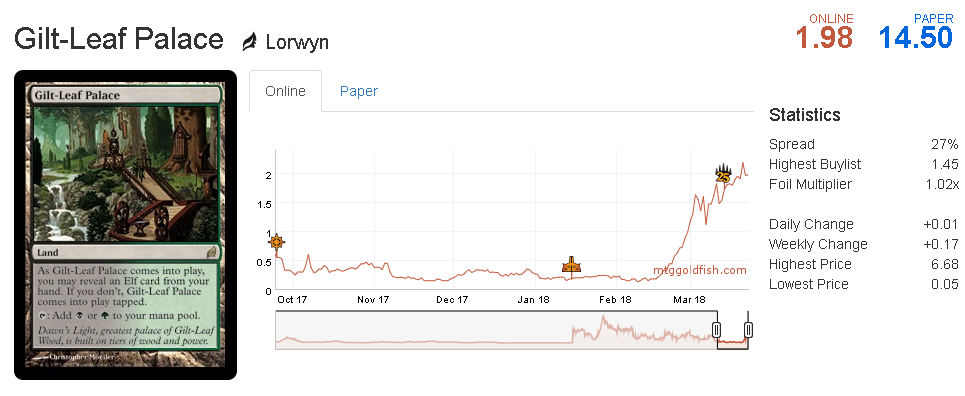
Gilt-Leaf Palace is only played in the BG version of Elves. I'm guessing many of you didn't notice the price increase until seeing the Elves deck in the Top 32 of GP Phoenix. I'm surprised too, but it's probably too late to get some copies.

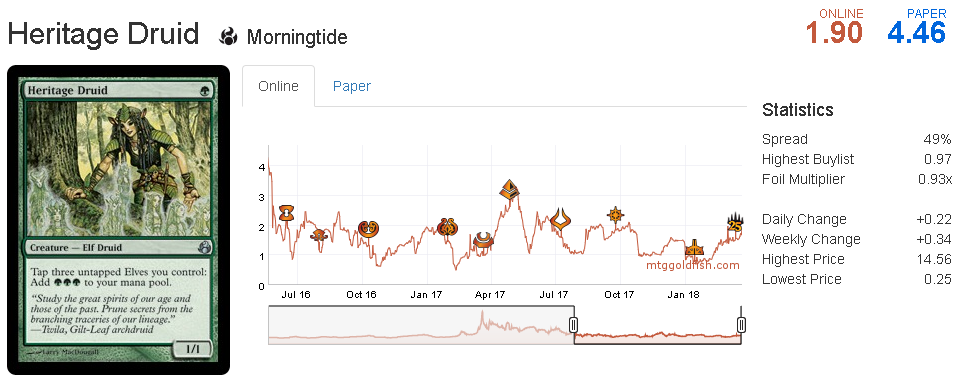
Heritage Druid was reprinted in Iconic Masters last year, and the price was affected. Now that Elves is seeing the light again in Modern, I think this will be the golden opportunity to invest in some Elf cards like this. Although Heritage Druid is just an uncommon, it's an important piece in the deck, as the three mana it generates can easily let the pilot combo off by spitting out their entire hand. I strongly recommend buying playsets of Druid just in case.

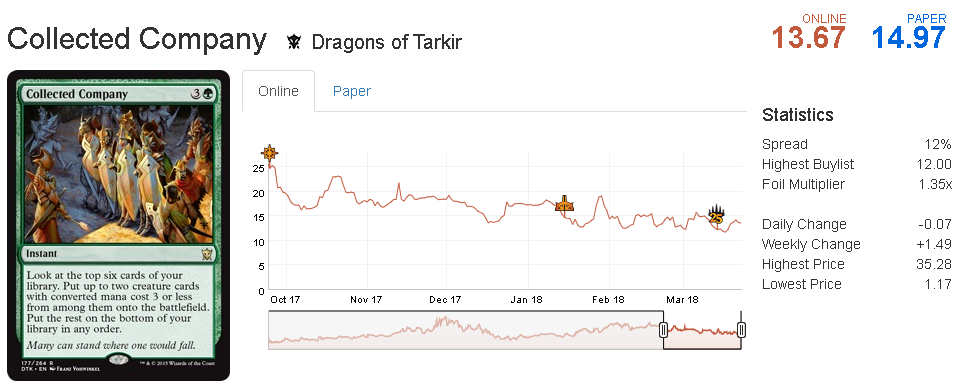
Last but not least, Collected Company. I have a feeling that this card is low in price because there weren't many Company decks running around recently. That is probably because players online have focused on Bloodbraid and Jace, and the unban hype has overshadowed Company decks. At its current price, I think it's worth investing in playsets—the card can easily go up to 20 tickets when the appropriate decks become good again.


Alright guys, that’s all for this week. Thanks for reading and I’ll see you again next week.

Adrian, signing out.

Insider: Making Money from the New Flashback Schedule

Are you a Quiet Speculation member?

If not, now is a perfect time to join up! Our powerful tools, breaking-news analysis, and exclusive Discord channel will make sure you stay up to date and ahead of the curve.

Welcome back! This week I'll be discussing how we can make money off of the new flashback schedule on MTGO and will provide an update on my portfolio. I've invested $700 and sold $300 this month on MTGO, so there's a lot to catch up on. The best way to get better at investing is to see how other people do it, and I'll give you the inside scoop on my portfolio today!

I. Safe, Easy Money from MTGO Flashback Drafts

A month ago Lee Sharpe announced a new path forward for flashback drafts. Because of the infusion of supply from treasure chests, 2017 saw a dramatic reduction in the number of flashback drafts offered. Players loved the 2016 "Year of the Modern Flashbacks," and last month it was announced that flashback drafts would be occurring more frequently again...but with a twist. They would only be phantom, and you could enter either with 10 event tickets, 100 playpoints, or two event tickets and two boosters of the set in question.

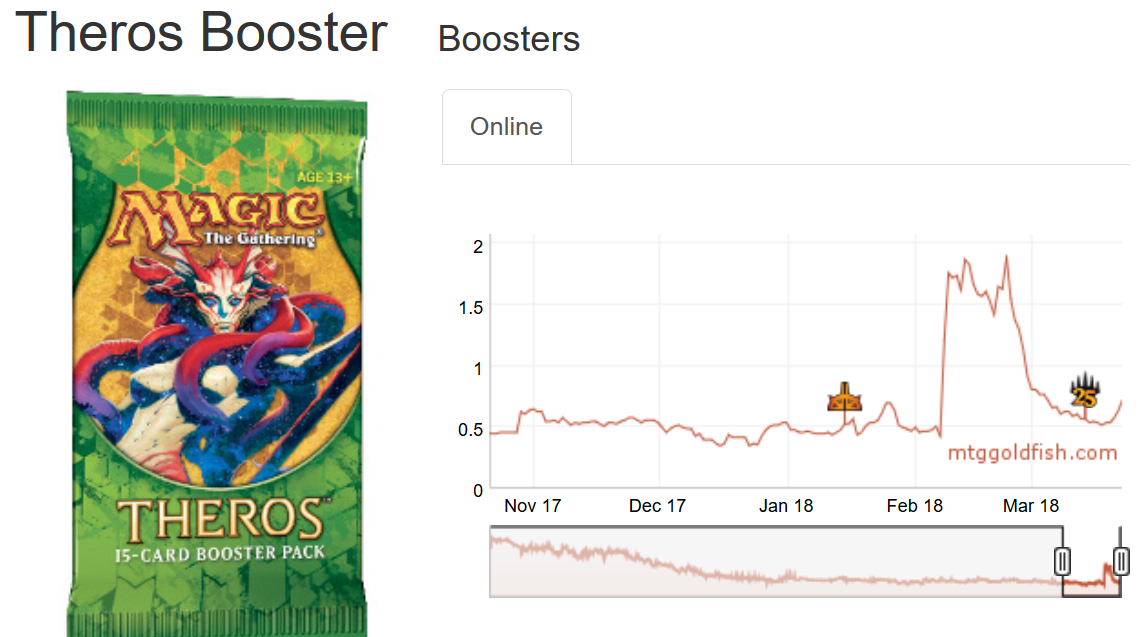
That last option, in particular, is why I'm writing this article today, because that is the factor that makes speculating in older boosters from specific sets a safe, viable investment strategy. For many flashback draft offerings, that last entry option will mean that the draft costs significantly less than it should. Last month we were treated to triple Theros drafts, and because of how cheap the Theros boosters were, players were basically getting paid to do the flashbacks, as it took only a 45-percent win rate to break even. Note too how Theros boosters shot up once the Theros flashbacks were announced.

Theros booster prices more than tripled, going from $0.50 to $1.75. You could have bought these for $0.50 and sold for about $1.35, a return rate of 170 percent! Let's not miss this boat again.

Because we know which formats are more popular and more likely to be chosen for the flashback treatment, we can look at those sets' booster prices and determine which ones are worth investing in. This is a strategy to employ with excess tickets, as you won't know in advance when you can sell out. But given that we've been told that there will be more flashback drafts going forward, chances are good you won't be caught holding onto these investments for more than a year.

Another thing you can consider doing is to just buy some of them in expectation of using them to draft the flashbacks. Especially for those of you who enjoy drafting, this is a good option to consider if you don't want to burden your investment portfolios with these boosters.

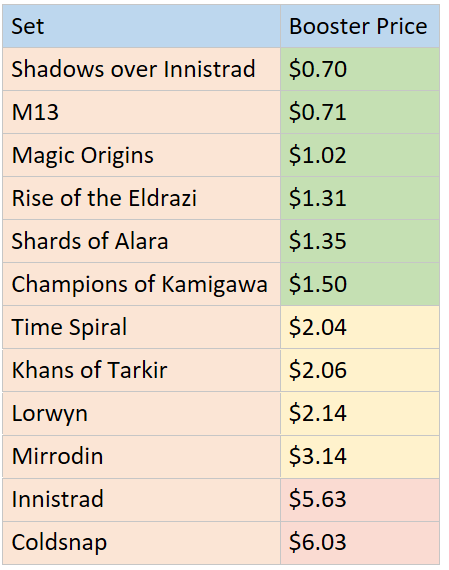
Below are the sets most likely to be chosen going forward. We know Lorwyn is next (unless they still haven't fixed that bug), but what comes after that is anyone's guess. My money is on Rise of the Eldrazi, Shards of Alara or Champions of Kamigawa.

You can expect more sizeable gains (as a percentage) from those I've colored green. Those colored yellow will still likely be profitable, but may not be worth holding over the long haul. Those colored in red will see no bump because the $10 entry option will be cheaper than using the boosters themselves.

I personally do not have many excess tickets to spend (I've invested a whopping $700 this month, more on that below), but in a few months, hopefully I'll have some extra tickets, and I'll likely put some of them in boosters from those sets colored in green.

II. Portfolio Update

A copy of my portfolio can be found here.

In February I bought $0.24 and sold $661.06 worth of digitcal cards on MTGO. This month I've deployed that recently freed up capital, buying $702.05 and selling $327.98. That's a heck of a lot of activity, so let's take a deeper look at what I've been doing.

1. For the past two months, I've been working to free enough capital to invest in Masters 25 and Rivals of Ixalan. This has led me to being an active seller. I flipped about half of the investments I made in the fall and winter months, and about 66 percent of my investments remaining from the summer months. The only major investment from Kaladesh block I have remaining is Voice of Resurgence, and that's been true for a while now. I've been holding out for $15 a copy, but Voice has yet to even reach a sell price of $15. I may begin to sell my Voices for a mere $11 a copy if I need to free up more capital, which would result in a disappointing 22-percent rate of return.

I stress my desire to sell cards from Kaladesh and Amonkhet blocks because it's important to not have dead weight in your portfolio. For example, I've sold almost all of my copies of Hour of Devastation, Earthshaker Khenra, Sweltering Suns, and half of my Rishkar, Peema Renegade. Why? Because even though those cards might spike this spring and summer, I think that the overall health of my portfolio will improve if I replace those cards with newer cards I have more confidence in.

My goal is not to have the highest percentage rate of return for any given season but is instead to make the most money. A 50-percent rate of return on $2,000 is better than a 75-percent rate of return on $1,000. Churn is important because it lets you invest more overall money.

2. I've begun to take the advice I've given in my Rivals of Ixalan article series.

My investment into Rivals of Ixalan cards kicked off with Baffling End, Skymarcher Aspirant, Path of Mettle, and Angrath, the Flame-Chained, with a sprinkling of Legion Lieutenant and Polyraptor for good measure.

Over the next two months I'll be looking to continue investing in the Rivals cards I identified in my previous articles. Check them out if you want to catch up on what to invest in.

3. I made my investments into Masters 25 this week.

  1. Ensnaring Bridge
  2. Eidolon of the Great Revel
  3. Ash Barrens
  4. Courser of Kruphix
  5. Pendelhaven
  6. Rancor
  7. Street Wraith
  8. Mikokoro, Center of the Sea

My confidence in Eidolon of the Great Revel is sky high, which is why I've now invested more into it than any other card ever ($204.61). I will continue filling this portfolio out, especially with the uncommons. Ash Barrens is one that Matt Lewis has recommended, and I strongly second that recommendation. Like last time with MM17, I focused on cards that either (i) were eternal staples that took a massive hit but should recover or (ii) higher risk cards like Mikokoro or Griselbrand that have a high ceiling but aren't guaranteed to ever go up at all. This time I shifted the balance in favor of (i), whereas last time I invested more heavily into cards in category (ii). Ranger of Eos and Courser of Kruphix are cards that straddle both categories and are, in my opinion, often the best speculations.

For the record, here were my MM17 investments. As a whole, these turned out pretty well, although I wish I had invested more heavily into Ranger of Eos and the fetchlands:

  • Griselbrand: +$2.60 (+3%)
  • Voice of Resurgence: still outstanding
  • Linvala, Keeper of Silence: still outstanding
  • Pyromancer Ascension: +$3.19 (+142%)
  • Misty Rainforest: +$51.34 (+72%)
  • Verdant Catacombs: +$50.16 (+48%)
  • Restoration Angel: +$4.40 (+27%)
  • Grafdigger's Cage: +$50.60 (+183%)
  • Ranger of Eos: +$11.14 (+153%)

4. Pauper has been good to me.

I'm afraid that my December Pauper article got a bit lost amidst the flood of Pauper content that readers were presented both on QS and elsewhere. What I wrote there is worth having another gander at because I think that Pauper is a good area to focus on, especially online.

All of my Pauper speculations over the past three months have, at minimum, quadrupled in value. Custodi Squire, then 0.15 tix, now sits at 3.00 tix. Entourage of Trest, then 1.25 tix, now hovers around 4.25 tix.  Borderland Explorer, then less than 0.01 tix, now goes for 0.36 tix. I sold a few Custodi Squire for 2.50 tix this week, but am holding everything else. Of special note is that these three cards are no longer being released through the treasure chests.

This week I bought 25 copies of Serene Heart, a card not on the treasure chest curated list, that exhibits the slow cyclical movement I discussed in my December article. I'll be looking to sell it when it reaches 3.00 to 4.00 tix (whenever Bogles takes over a larger share of the metagame and Stompy needs a way to combat it).

III. Signing Off

I'm curious to hear what my readers think of this article, and I will happily answer any questions you may have. There's a lot to dig in here. Do you like Pauper cards? What do you think of my Masters 25 speculations? Have you started to invest in Rivals cards? Let me know down below!

Insider: My Motivation to Buylist

Are you a Quiet Speculation member?

If not, now is a perfect time to join up! Our powerful tools, breaking-news analysis, and exclusive Discord channel will make sure you stay up to date and ahead of the curve.

An interesting discussion with a fellow QS Insider in the Discord recently led me to wonder…why do we choose to buylist cards? By selling to a vendor who, by design, will sell the card for more money, aren’t we moving cards in suboptimal ways? While we can’t all demand retail prices, there usually is some spread within which one could operate, right?

Take Fiery Confluence, for example. I chose to buylist a couple of these Commander 2015 cards to Card Kingdom for $17 apiece. But copies were selling in the $25 range on eBay and TCGplayer—why didn’t I go that route?

There was an error retrieving a chart for Fiery Confluence

The argument could be made that I’m operating recklessly by not maximizing the value out of my specs. But this week I want to share a few reasons why I think that, despite not getting every last penny out of my cards, buylisting to online vendors can still be optimal. After all, you can optimize for money but that could be at the sacrifice of time, risk, and a good night’s sleep. Allow me to explain.

The Numbers

For starters, let’s get one thing straight: selling a card on eBay for $25 does not mean you net $25, or anything remotely close. After eBay and PayPal fees you’re looking at around $21.48 net. Next, you have to ship the card. I would ship this card in a plain white envelope with a non-machinable stamp (the post office I used once demanded the non-machinable stamp), so that’s another $0.71. Add in a couple pennies for the envelope, tape, and toploader, and my net proceeds from the sale is around $20.75.

Now let’s do some math on the buylist side. If I sell my card to Card Kingdom for $17 I have the option of requesting the 30% trade-in bonus, which is what I did. That means I’ll get $22.10 in trade credit by selling them my Fiery Confluence. Hey, that’s more than the cash I would have gotten selling for $25 on eBay!

Of course, I still have to pay that pesky shipping cost when selling to a buylist like Card Kingdom’s, so it’s not a true one-to-one exchange. But when selling to Card Kingdom, I always ship more than just a couple cards. I always have some nickels and dimes on hand that I can sell to pad the order.

In addition, I keep a few cards in mind that I know they have overpaid on in the past, and I check to see if I can be opportunistic and get that sale. This approach effectively reduces my shipping cost per card, making the credit option even more attractive. When the numbers are this close, the sacrificed value in buylisting versus selling on eBay is negligible.

The Store Credit Fallacy

Cash is king—you’ll hear me use this phrase time and again. Of course I’d prefer $22 in cash over $22 in Card Kingdom credit. Card Kingdom’s prices are all retail whereas my cash can purchase cards from other individuals at a discounted rate. But is it so bad ordering cards from Card Kingdom with store credit? Not necessarily.

With some credit, I recently acquired a "VG" Plateau, which I equate to Moderately Played, for $74.99. Why was this my target? Well, with the recent surge in dual land demand, TCGplayer pricing has become very much in-line with Card Kingdom’s pricing. For example, the cheapest Moderately Played Plateau from a seller with 99% positive feedback or better is $66.86 shipped.

There was an error retrieving a chart for Plateau

This is technically almost $9 cheaper, I’ll admit, but there are two additional factors that need to be accounted for.

First, I live in Ohio. That means I have to pay sales tax. That $66.86 Plateau may cost $67.16 to the average QS Insider. But for me, it’s $71.37. Aren’t I lucky?

Second, you have to consider the condition factor. I know when I buy from Card Kingdom I can expect a certain quality in card condition. While nobody’s perfect, my confidence level is very high that my VG Plateau from Card Kingdom will arrive on the better side of Moderately Played. But because the cheaper Plateau on TCGplayer isn’t sold via TCG Direct, I don’t have the same level of confidence in condition. The same goes for reliability and shipping speed: Card Kingdom’s orders are always prompt, shipped with tracking, and well packaged. That’s not always the case with sellers on TCGplayer.

So while I had to outlay $3.62 more for my Plateau, I consider that the cost for high quality and great customer service, and I’m not too ashamed to pay it. Plus some of this amount is offset by the extra buck or two I got in store credit by buylisting the card rather than selling on eBay.

And this example involved a dual land, one of the hottest commodities on the open market. I have found numerous opportunities to convert Card Kingdom and ABU Games trade credit into cards that I can sell for more than what I paid. (Recently it’s been Alpha commons and uncommons). It’s not a guarantee, but with enough patience the opportunities do arise and can be exploited. This turns the store credit into more cash than would have been obtained by selling the initial card on eBay in the first place!

Avoiding the Race to the Bottom

Sometimes I worry that market trends aren’t moving very favorably for a given card. This may be due to an artificial spike that I see regressing over time. Other times, it may have to do with actual metagame shifts. And in rare occasions, a rules change can change the utility of a card. That’s exactly what happened with Fiery Confluence. The new planeswalker rule being introduced with Dominaria makes Fiery Confluence less powerful. So while it’s exciting to see the card spike, I think we’re due for a pullback in the coming months.

What does this potential pullback mean? It means that sellers may be a little more eager to unload copies of the card on the open market. Buying may also slow down. While this may not lead to a huge price drop, it could mean an eBay sale wouldn’t happen above $25 despite the fact that some copies had sold for more in recent weeks. Do I want to take that gamble?

A better example involves crazy spikes in older cards that we’ve seen recently. I have buylisted multiple heavily played and moderately played copies of Urza's Avenger to Card Kingdom over the past few months.

There was an error retrieving a chart for Urza's Avenger

Why? Well, Near Mint copies may fetch a meaningful premium on eBay, but sometimes it can be a bit harder selling HP copies of these old cards on eBay (and trust me, I sold a couple copies on eBay too). I could have waited in hopes of getting that sale, but what if other people started listing HP copies and undercut me on price? Or even if that didn’t happen, how long would it take to get that sale? Since my buy-in was so low, I took the easiest route to profits by shipping to Card Kingdom’s buylist. Let them find a buyer, I didn’t want to bother.

Not to mention that I've lost count of the times I buylisted cards to Card Kingdom thinking their buy price was awfully high, only to see that buy price drop a day after. They manipulate their buylist every day, so when I find a good buy price I jump on it and don't look back!

Saving Time

Speaking of which, there’s one last benefit in buylisting that I wanted to highlight: saving time. When I sell cards on eBay—especially older cards in played condition—I post my listings with pictures of the card. That makes it easier to sell, but it also takes more time to list. TCGplayer enables faster/easier listing, but for multiple reasons I don’t use that platform to sell (that’s an article for another time).

Then there’s the waiting time. As you may imagine, the demand for heavily played garbage rares in Old School is pretty small. You can’t exactly move a Moderately Played Voodoo Doll every day, for example. It could take weeks to move a copy at a good price. Selling multiple copies would probably take a couple months. I’m impatient for profits, so I don’t want to wait that long.

Shipping to a buylist is an easy, instantaneous way to cash out of these slow-moving cards. I have shipped multiple played Voodoo Dolls to Card Kingdom in recent months because their buy price is solid, copies move slowly on eBay, and my buy-in price was low enough that the buylist route still netted me solid gains.

There was an error retrieving a chart for Voodoo Doll

While I could sit around on these Voodoo Dolls and potentially eek out an extra buck or two, I’d prefer liquidity in my portfolio. I have enough Old School cards that I’m sitting on for the long term—quality cards, no less—I don’t need to add stuff like Voodoo Doll to the list. Give me my store credit and I’ll move onto something more liquid.

Wrapping It Up

I started using buylists years ago, and I have always been happy to get the quick-and-easy profits when they’re available. This is my preferred selling approach in many cases, despite the fact it may net me slightly less financial gain. I think the benefits outweigh this small loss: cashing out instantly without waiting for a buyer, getting store credit, and using that credit to move into better liquidity. These are all valuable outputs to buylisting that, in my opinion, outweigh the couple bucks I may be missing out on in the long run.

Recently there’s been an added benefit to buylisting. I’ve been getting store credit to move into Alpha cards that are still underpriced relative to the open market. Just last week I grabbed a VG Alpha Giant Growth from Card Kingdom for around $18. I listed it on eBay for $35 and it sold in less than twelve hours. I also sold an Alpha Mesa Pegasus for $10 when it cost me under $7.

Since I’m having so much success flipping these Alpha cards, I am desperate to find ways to get store credit advantageously so I can pump it into Alpha cards for even more profits. I need to act fast, because eventually vendors like Card Kingdom and ABU Games are sure to catch on and increase their prices further. But in the meantime, I’m happy to help operate in that gap.

So next time you try and sell a card on eBay or TCGplayer, don’t ignore the benefits of the buylist. You may not get quite as much value in dollar terms, but there are other less quantifiable benefits to buylisting that just may make the endeavor worthwhile.

…

Sigbits

  • Dual lands had been at the top of Card Kingdom’s hot list for weeks. But that just changed over the weekend. Now Drop of Honey tops that hot list and the buy price jumped from $330 to $385. This could be a temporary increase until Card Kingdom can restock, but it’s interesting to see the strength in demand for this sideboard Legacy card.
  • Speaking of dual lands, some of the lower-end duals continue to creep higher and higher. Card Kingdom has slowly upped their buy price on Plateau from $50, to $55, to $60, to now $65! They are also paying more for Scrubland than I have ever seen before: $85. Legacy is gaining traction thanks to team tournaments, large-scale events at local shops, and of course the upcoming team Pro Tour. I think we’re due for an ever greater bump so get your duals now if you’re in the market for any.
  • I mentioned this in the QS Discord, and others have also pointed it out, but I wanted to reiterate here the recent jump in Card Kingdom’s Power buy prices. They now offer $5160 for Near Mint Black Lotus. That means they’re paying $4128 for EX copies and $3096 for VG copies. This is near retail pricing from just a few months ago. Other Power prices also increased: $1800 for Mox Sapphire, $1620 for Ancestral Recall, and $1500 for Time Walk are most notable. There’s a BGS 9 Time Walk on eBay for $2016 so that $1500 buy price seems very aggressive!

Daily Stock Watch – Phyrexian Altar

Are you a Quiet Speculation member?

If not, now is a perfect time to join up! Our powerful tools, breaking-news analysis, and exclusive Discord channel will make sure you stay up to date and ahead of the curve.

Hello, everyone and welcome to our crazy Friday edition of the Daily Stock Watch! If you remember last week, I featured Ward of Bones on this segment to let you guys know that there are cards out there that could fool you into spending unwisely. Although I'm not a hundred percent right at all times, (I mean, who is?) I'm quite sure that I could at least intelligently distinguish a good card from a bad one. In the case of today's card, I like how good it is gameplay-wise, but I think that the price has gone a bit overboard on this. In any case, let's talk about the financial future of this artifact.

There was an error retrieving a chart for Phyrexian Altar

This is a grown up's version of Ashnod's Altar, in a sense that it hasn't been reprinted ever, but it isn't also included on the Reserved List. Today, this card has been bought out and is sitting at $55.07 which is its all-time high. Quite pricey for an artifact that doesn't actually win you games out of nowhere, and it isn't even Modern legal. I tried looking for a decent deck where it's seeing play in Legacy, and this is what I stumbled upon.

Walking Dead

Creatures

2 Carrion Feeder
2 Diregraf Colossus
4 Relentless Dead
4 Wayward Servant
4 Cryptbreaker
4 Gravecrawler

Instants and Sorceries

3 Swords to Plowshares
3 Dark Ritual
3 Cabal Therapy
4 Thoughtseize
3 Vindicate
1 Living Death

Other Spells

2 Pithing Needle
2 Phyrexian Altar

Lands

1 Verdant Catacombs
4 Cavern of Souls
4 Marsh Flats
5 Swamp
4 Scrubland
1 Plains

Sideboard

3 Duress
1 Living Death
3 Engineered Plague
3 Leyline of the Void
2 Engineered Explosives
1 Pithing Needle
2 Ensnaring Bridge

The deck name is cool but it's basically a Zombie deck that aims to punish its opponents with the resilience of cards like Relentless Dead and Gravecrawler. The Phyrexian Altar acts like a conduit for your zombie minions to grind themselves into so you could help in padding a jumbo Diregraf Colossus. It's a pretty neat mini combo to begin with, but not exactly something that I would like to play in a competitive field. If you're up for some casual fun, this could work out just fine for you.

Sac Engines

There are tons of ways to get rid of your creatures and get something out of doing it. From this list above, the Phyrexian Altar looks like the most efficient one if you're after colored mana and a mana-less sacrificial altar at the same time. However, would you be inclined to paying $55 for a card that does just that? Not me. If you could find people who are hovering around with cheap copies of this card though, I'm not going to stop you from doing so. Just be sure that you could dispose them while they're hot.

At the moment, the only place where you could get non-foil copies of Phyrexian Altar is via Card Kingdom where they are up for grabs at $49.99 each. Some foils are available via ChannelFireball for $99.99, while there are more via TCGPlayer for $101. StarCityGames is out of stock but should be following this trend once they have their own supplies and this will be the benchmark price guide for the months (or years to come) until this card gets reprinted. I wouldn't mind grabbing copies that are cheaper than $40 if I have means to move it around, but I wouldn't lose any sleep if I don't get them in this price range. I'd rather invest in high value Modern cards that have quick and slick returns rather than these big buck cards that have the potential to be reprinted at any time that WotC decides to do so. Stay away from the foils as well unless they're going for so low.

And that’s it for this week's edition of the Daily Stock Watch! See you again next time, as I preview new cards that should be on the go, or good enough for speculation purposes. As always, feel free to share your opinion in the comments section below. And if you want to keep up with all the market movement, be sure to check in with the QS Discord Channel for real time market information, and stay ahead of the hottest specs!

Insider: What the New Brawl Format Means for the Standard Market

Are you a Quiet Speculation member?

If not, now is a perfect time to join up! Our powerful tools, breaking-news analysis, and exclusive Discord channel will make sure you stay up to date and ahead of the curve.

Wizards revealed that Dominaria will continue the trend of having a special buy-a-box promo for those that buy an entire sealed booster box at a local retail store, but this time it comes with a very big twist. As opposed to having unique art like past buy-a-box promos, this card, Firesong and Sunspeaker, won’t be included in the normal set and will only be available as a buy-a-box promo.

The announcement drew some public outcry about the fact that the card is being made Standard legal, out of fear that the rarity could lead to an exorbitant price if the card becomes a competitive staple. Those fears seem unfounded, because the six-mana legendary creature is clearly designed for more casual play, specifically Commander, but it seems that it’s truly intended as a marquee commander for the new "Brawl" format, which Wizards hinted at in the buy-a-box announcement and fully expanded on the following day.

What is Brawl?

Brawl, in a nutshell, is Commander for Standard, because it follows essentially the same rules as Commander, but only includes Standard-legal cards. There are a few key differences, the biggest one being that it’s played with a deck of 60 cards compared to 100, which is more suited to the smaller Standard card pool. It also allows for planeswalkers to be used as a commander, which offers an alternative to choosing a legendary creature.

There was an error retrieving a chart for Bludgeon Brawl

In normal Commander, the commanders deal special commander damage in addition to normal damage and dealing 21 points wins the game, but this rule is absent from Brawl, which does make commanders themselves slightly less powerful, but it’s a minor difference, and Brawl does share the same 30-point life total as Commander.

How Will Brawl Impact Standard Cards?

Well, the addition of what is essentially a new format that uses the same card pool as Standard will logically increase the demand for Standard-legal cards, and will thus increase the price of those cards. There will be plenty of crossover demand from players that will use the cards for both formats, which won’t actually add to overall demand, but because it is a technically a different format that will draw players that have no interest in Standard, especially because it’s being pitched as a casual multi-player format, it means there should be a very sizable amount of demand that doesn’t crossover.

There was an error retrieving a chart for Concordant Crossroads

Similar to how past attempts at creating new formats have increased demand, which caused the temporary price surges we saw with Tiny Leaders and Frontier, and have sustained huge growth in Old School and Pauper cards, anything that increases the utility of cards will increase demand for them and therefore their price. Brawl will have the effect of making Standard cards and decks more expensive, but this is balanced by making product more worthwhile to open, which also increases the relative value gained from playing Limited and from winning prize packs.

Brawl will also have the effect of increasing demand for cards that aren’t quite good enough for Standard but will be playable in Brawl due to the requirement that players dig deeper to find something like the best 35 cards to support their strategy instead of around a dozen in Standard.

Taking the current Standard format for example, the tribes of Ixalan haven’t made much of an impact on the competitive Standard metagame, but Brawl is the perfect place for these decks to shine, whether it’s a Admiral Beckett Brass Pirates deck, a Gishath, Sun's Avatar Dinosaur deck, a Kumena, Tyrant of Orazca Merfolk deck, or an Elenda, the Dusk Rose Vampire deck. There’s a limited number of on-tribe cards to fill out these decks, so pretty much all of them should see a significant increase in demand. From the perspective of Dominaria, which features a ton of legendary creatures that can be used as commanders, it’s going to breathe a lot of life into cards that are fun and exciting but won’t actually cut it in Standard.

There was an error retrieving a chart for Admiral Beckett Brass

This effect should be an all-around positive, since this demand isn’t impacting Standard staples, but is creating a market for cards that would otherwise have little to no demand and might otherwise be draft fodder. This will make packs more valuable, which helps justify opening product, whether it’s the retailer opening to create an inventory of singles or the player building a collection.

Another interesting thing to consider about Brawl is its potential to increase demand for foils, because if Commander is any indication, players like foiling out their singleton decks. A competitive Standard player foiling out their deck is rare, which means most Standard cards don’t demand a large premium for foils – but Brawl could change that equation and will lead to a whole new market for Standard foils.

On the other hand, Brawl decks will eventually rotate along with Standard, as opposed to Commander cards always being legal, which does make foils of its cards significantly less desirable, but I still expect that we'll see more demand than before. The best place to focus might be on the legendary commanders themselves, since like with Commander commanders, the conspicuous position they occupy outside the main deck lends itself to being blinged.

The Future of Brawl

In the announcement detailing Brawl, it’s described as having drawn the largest-ever crowds at R&D’s internal playtest sessions, which must have gone well seeing that it’s being introduced as a supported format, and reading around online shows a lot of excitement about Brawl.

I think it’s important not to underestimate the impact of the Commander crowd, which over the past few years has shown huge demand for that lion’s share of Magic cards that fall between competitive staple and useless, and has the potential to really help Brawl take off and change the landscape of the Standard market as we know it. There’s also a large contingent of players that might be interested in Commander but don’t buy the cards due to price, whether they borrow decks, proxy cards, or just don’t play, but now have the incentive and means to get into Brawl.

What do you think about Brawl and its anticipated impact on the marketplace?

–Adam

Adding Zhalfirin Void to Colorless Eldrazi Stompy

Are you a Quiet Speculation member?

If not, now is a perfect time to join up! Our powerful tools, breaking-news analysis, and exclusive Discord channel will make sure you stay up to date and ahead of the curve.

Dominaria leaks are well underway, and one recent card that's grabbed my attention is Zhalfirin Void. Unlike the clunky and frivolous Karn, Scion of Urza, Void looks to be a snap-include for Colorless Eldrazi Stompy in some number. We do have a few things to consider before sleeving it up, though: what the card does for us, the opportunity cost of inclusion, and how many to run.

My Worcester Classic win with Colorless Eldrazi Stompy has bought the deck significant air time on popular Modern channels. With great air time comes great misunderstanding, and I've watched pros and Modern dabblers alike experiment with misguided technology "upgrades" to the deck like Cavern of Souls and Sorcerous Spyglass. I'm excited the deck has struck a chord in the Modern community, and for innovations regarding its future developments to eventually roll in from elsewhere. But as things currently stand, I want those picking it up to have access to where I stand on card choice, since I've already tested most possible includes in my two years on the deck.
By now, my opinions on Cavern and Spyglass are well-documented. This article gives my first impressions of a new piece of tech in Zhalfirin Void.

For reference, here's my list from the Classic.

Colorless Eldrazi Stompy, by Jordan Boisvert (1st, SCG Worcester Classic)

Creatures

4 Eldrazi Mimic
4 Eternal Scourge
4 Matter Reshaper
4 Thought-Knot Seer
4 Reality Smasher
4 Simian Spirit Guide

Artifacts

4 Serum Powder
4 Chalice of the Void
1 Smuggler's Copter

Instants

4 Dismember

Lands

4 Eldrazi Temple
3 Gemstone Caverns
4 Ghost Quarter
4 Blinkmoth Nexus
2 Mutavault
2 Sea Gate Wreckage
2 Scavenger Grounds
2 Wastes

Sideboard

3 Spatial Contortion
2 Gut Shot
4 Relic of Progenitus
1 Surgical Extraction
4 Ratchet Bomb
1 Pithing Needle

Zhalfirin Void: Merits

"Scry 1" means different things to different decks. Ad Nauseam, a deck featuring one-drops like Serum Visions and Sleight of Hand, values the extra digging power enough to run tapped scry lands; so does Grishoalbrand, a deck on Faithless Looting. Zhalfirin Void is unique among scry lands in that it enters the battlefield untapped, allowing us to size it up based mostly on the merits of "scry 1."

Virtual Card Advantage

The virtual advantage benefits of "scry 1" in Colorless Eldrazi Stompy are obvious. To enable the broken openers that make this deck tick, we run relatively dead draws like Serum Powder and Simian Spirit Guide. Other crucial turn one cards like Gemstone Caverns and Chalice of the Void also get worse in multiples. Until now, we've only had Smuggler's Coper as an alluring way to filter through our draws, and doing that does indeed win us games. Zhalfirin Void joins Copter as an in-game consistency tool.

If playing the mulligan sub-game with Serum Powder doesn't lock things up with a nutty opener, we play a top-deck game, which we're actually quite good at. Like Reality Smasher, Void vastly improves this top-deck game. Scrying a weaker card to the bottom early is actually insane for us, even if we don't feel the benefit immediately. Say we bottom something small, like an Eldrazi Mimic; some turns down the road, we draw two lands and then eventually, a Reality Smasher that wins us the game. That early Void got us to it a full turn earlier.

Our games tend to be close enough that drawing the right card a crucial turn early matters immensely. This benefit of increasing our deck's density of powerful cards over time is mostly unique to decks without fetchlands, such as Ad Nauseam; everyone else "resets" their bottom scrys with each crack.

One other type of virtual advantage that Void provides is synergy, or meshing with our overall gameplan. Colorless Eldrazi Stompy's gameplan is basically "find Eldrazi Temple," and we enact it by aggressively mulliganing. Mulligans, by their nature, deplete our resources. Void further lightens the load on this axis, helping find whatever resources we're in short supply of once the game begins. Incidentally, it also helps find Eldrazi Temple.

A way to quantify the virtual advantage gained from "scry 1" likely exists—for instance, we could take a sample of openers to get an idea of the amount of dead draws our average in-game deck has, generate a number indicating the likelihood of drawing Void over however many turns and in however many games, and then calculate the probability of seeing a bad card on top with the scry and tucking it. But I'm no math guy, instead more the type to jam a bunch of games and feel out the right number. So that's what I'll be doing over the next few weeks. In the meantime, though, we have more pre-rep theory to discuss.

Raw Card Advantage

From a non-virtual card advantage viewpoint, Void is worse than many of our other lands. I've heard players, after much deliberation, roughly equate "draw a card" with "scry 3;" in that sense, Void counts for just a third of an extra card. Compare with Mutavault, which is a creature and can often trade with opposing removal; Scavenger Grounds, which says "draw X cards" depending on the amount of Eternal Scourges in our graveyard; and Sea Gate Wreckage, which literally draws us cards every turn once its condition is met.
So Void appears to boast a lesser card advantage effect than our other lands. That said, the above lands (besides Sea Gate Wreckage) usually have to hit the graveyard to trade in for a card, whereas Void remains on the battlefield after it has drawn us 33% of one, which is something to consider. Staying on the field is worth less in a land-heavy top-deck scenario, where we'd happily throw around Mutavaults or Ghost Quarters for opposing resources or life points, but it's valuable otherwise.

Efficiency

In addition to often sacrificing themselves, our raw card advantage lands also require a mana investment of some sort to trade up into an extra card's worth of value. Not so with Void, which scrys upon battlefield entry and never asks for a single mana in return. That's huge in our many mana-light games. In the first few turns of most games, we're casting the disruption and Eldrazi in our hand, not activating our lands; that's a plan for later in the game. Void improves this stage by smoothing out our draws at no immediate cost. The cost is paid much later, when (and if) the game devolves into a topdeck war; that's the scenario that calls for spell-lands. On the other hand, Void's efficiency makes it one of our best lands in faster games.
It's also good in longer games, where all that scry adds up and might bail us out of topdeck scenarios. We still have to wait a turn before using the card we see, though—unless we flip Void off a Matter Reshaper on our opponent's turn.

Fitting It In

In our discussion of Zhalfirin Void's merits, we touched on the opportunity cost of including it in Colorless Eldrazi Stompy: our other utility lands. The next question: which ones can we afford to cut? Here's a list of our non-Eldrazi Temple lands, in subjective order of importance.

Tier 1

  • 4 Blinkmoth Nexus
  • 2 Mutavault

Six manlands is the sweet spot for this deck. They insulate us against planeswalkers and sweepers, and supplement our aggression in different ways.

  • 2 Scavenger Grounds
  • 2 Wastes

Scavenger Grounds is a must when our deck's so apt at finding Eternal Scourge. It gives us a powerful mainboard way to hose attrition decks while buffing our graveyard-based matchups like Storm and Traverse Shadow. I tried a third Wastes after Worcester, and found it superfluous in a lot of matchups; it was best against UW Control, but a third Grounds shines there, too, and has wider applications overall. Still, we can't drop below 2 Wastes, as we need ways to punish players for firing off Path to Exile, Field of Ruin, and Ghost Quarter against us.
Tier 2

  • 4 Ghost Quarter
  • 3 Gemstone Caverns

These lands are crucial to the deck's strategy, but I'm not convinced we need so many. If Zhalfirin Void isn't just the reason to cut up to one of each, it's at least the first compelling argument I've heard.

Tier 3

  • 2 Sea Gate Wreckage

After Worcester, I was itching to cut one of these. I originally liked 2 Sea Gate to ensure I could draw into one after exiling a copy to Powder, but it's dead in so many matchups that I now think 2 is too many. Scavenger Grounds largely fulfills the same purpose against attrition decks, and does more elsewhere, too. The main benefit of Sea Gate is that it's a recurring value engine that attacks from a unique angle: drawing us cards from the deck. It can also be activated on an opponent's turn after representing other utility lands activations for a cycle (i.e. Ghost Quarter for a petrified Raging Ravine).
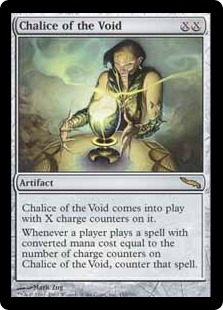
So the first copy's an easy cut, and the more I test, the more I think the second copy also needs to bite the dust. It's just dead in so many matchups. Void is dead in zero matchups.

Putting It Together

Looking over the list, we can at least begin by swapping the Sea Gates for Voids. From there, it's a matter of deciding whether we want to trim a Quarter or a Caverns for one or two more Voids. To get a solid sense of how the card performs in practice, I'm starting with the full set.

Colorless Eldrazi Stompy, by Jordan Boisvert

Creatures

4 Eternal Scourge
4 Eldrazi Mimic
4 Matter Reshaper
4 Thought-Knot Seer
4 Reality Smasher
4 Simian Spirit Guide

Artifacts

4 Serum Powder
4 Chalice of the Void
1 Smuggler's Copter

Instants

4 Dismember

Lands

4 Eldrazi Temple
4 Zhalfirin Void
2 Gemstone Caverns
3 Ghost Quarter
4 Blinkmoth Nexus
2 Mutavault
2 Scavenger Grounds
2 Wastes

Sideboard

3 Spatial Contortion
2 Gut Shot
4 Relic of Progenitus
1 Surgical Extraction
4 Ratchet Bomb
1 Pithing Needle

As I test, I'll be carefully monitoring to see how much I miss the Quarter and Caverns. I'll weigh that assessment against my impression of the amount of work Zhalfirin Void puts in to decide how many copies to run.

A final aspect to consider is the subtlety Void brings to Colorless Eldrazi Stompy. It's possible I'll want to make more drastic changes to the deck once I experience running it with a set of scry lands. After all, that's what happened with Scavenger Grounds, which encouraged me to slam Scourge more aggressively into permission and sweepers pre-board and incidentally invalidated Sea Gate Wreckage.

Eldrazi Lives

One of the exciting things about Colorless Eldrazi Stompy is that it will always receive playable cards through Standard, even if we're done getting literal Eldrazi creatures for a while. Wizards still has a ton of design space to explore when it comes to colorless cards like lands and artifacts; Damping Sphere, Karn, Scion of Urza, and now Zhalfirin Void all speak to that.

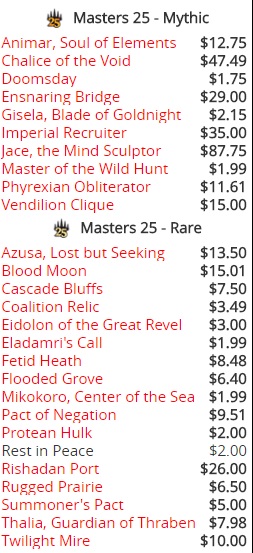
I've yet to settle on an optimal number for Void, but the card looks and feels sweet in this shell so far. So let's dwell on the details later and raise our Chalices to Colorless Eldrazi Stompy's newest include!

Insider: A25 Price Expectations

Are you a Quiet Speculation member?

If not, now is a perfect time to join up! Our powerful tools, breaking-news analysis, and exclusive Discord channel will make sure you stay up to date and ahead of the curve.

Welcome back, readers!

Last Friday Masters 25 (A25) officially released and we're seeing stores run drafts and sealed events left and right. The cards are finally hitting the market and prices are dropping. It's important to remember that when there is virtually no supply of something, any demand can cause dramatic price increases; the same as when little demand for something is met with a sudden influx of supply.

We see both of these right now with the release of A25. Before the set is actually released, there is a good bit of demand and no supply, so prices are extremely inflated. As cards start hitting the supply side, prices start to drop. From a percent standpoint, they will drop the most in the two weeks after release.

This is one of the few times when the lowest listed price is the one we really want to focus on because it indicates the true demand side. The median price will shift downward at a slower rate than the low price, for two reasons. One, because there will be people who listed cards initially and don't want to change their price based on what the cards are actually selling for.

Two, there will be people who are hoping for a price reversal—if the cards drop too quickly, it's definitely possible to see a minor spike as the market corrects itself.

Either way, when a set first releases, the price I'm most interested in is the low, as that's the closest to what the market will bear initially.

What we've seen so far has been pretty dramatic. The prices below are taken from March 18 and March 20.

Prices as of 3/18
Prices as of 3/20

Looking over this list, there are a grand total of 11 possible (non-foil) cards you can pull that are above the MSRP of the pack. Of those 11, three are on the cusp of falling below this threshold. That is not a good sign for MTG financiers, as there will still be plenty more packs cracked in the coming month and prices are likely to continue dropping.

The good news, as we can see by comparing the two lists, is that the prices appear to be stabilizing somewhat (at least for now).

The card I was most excited to see reprinted has also seen a massive price plunge (which I predicted on the Discord channel)

There was an error retrieving a chart for

I have a few interesting takeaways from all this.

1. As the card prices fall, there is less incentive to crack packs. Sure, you'll always have the people who just enjoy that for the fun of it, but it gets harder and harder to justify buying a pack (or box) when the EV keeps falling.

What we expect to see (and we already have) is a massive initial drop in card prices as product starts getting opened and everyone races to unload their cards as soon as possible. After card values drop, the rate of pack cracking also begins to drop. This in turn means that the cheapest copies of the cards will get bought up, but additional cheap copies may not enter the supply and thus the prices will stabilize.

2. The worse the EV of the box, the less of a hit the key staples will take. As players shy away from opening packs, the staple cards are the first to have the cheapest copies bought up and then have their prices stabilize. You may even get a slight jump if the prices stabilize, and players who were holding out in the hopes of getting them at the very bottom suddenly realize it has passed and they need to get them now.

We can see evidence of this with the price of cards like Azusa, Lost but Seeking, which is not only a solid Modern card but a Commander staple as well.

There was an error retrieving a chart for Azusa, Lost but Seeking

3. The cards that take the biggest hit are stuff like Vindicate—cards with multiple printings that were valuable at one time due to scarcity, but which don't have enough time to rebound before another glut of reprints hits the market. Of course, this is great news for casual players who have limited resources to spend on these once-powerful cards, who can now scoop them up at a fraction of their old price (and in turn don't care that the price may not ever go back up).

There was an error retrieving a chart for Vindicate

4. There is a lot of room for speculation when format staples from sets like these plummet. There is a lot of risk with this speculation, especially given WotC's propensity for reprinting more and more. However, you can pick up a good number of specific targets at rock-bottom prices, and if they do dodge a reprint, they may recover some.

My best example of this type of opportunity is with Tooth and Nail from the original Modern Masters set. It dropped to around $5 for a while before slowly making its way back to the original price of $15-plus. I picked up 16 copies of this card at $5 because I distinctly remember how difficult it was to find the originals back when I first started playing Commander.

There was an error retrieving a chart for

Some cards in this vein to keep an eye out for are Coalition Relic, Elvish Piper, Master of the Wild Hunt, Eladamri's Call, Mikokoro, Center of the Sea, Magus of the Wheel, and Luminarch Ascension.

5. There are a few first-time foils you want to keep an eye out for, especially when drafting. Plenty of players will ignore foils that don't seem good in draft and come across as less than amazing. Specifically, I'm looking at cards like Arcane Denial, Ancient Craving, Blue Elemental Blast, Red Elemental Blast, Ash Barrens, and Myriad Landscape. All of these are commons or uncommons that may or may not make it into a draft deck, but the foils have strong multipliers on them.

There was an error retrieving a chart for Ash Barrens

6. There is always a lot of excitement over the big-money reprints, but as I mentioned above there were plenty of $5-$10 cards that got reprinted and their prices got slashed. I expect to see the originals start to shift downward in value as well, especially for the Commander cards. The more casual a format is, the more likely players are to want the cheapest copy (instead of the original, which is a desire we often see in Vintage/Legacy).

However, it's important to remember that the original's value (prior to this reprinting) was decided on by market forces; so there was clearly enough demand to set that price originally. Now, obviously, we have a lot more supply—but one would expect that as the pack-cracking rate diminishes and the prices stabilize, we'll likely see the new reprints rising and the old originals slowly falling until they reach close to an equilibrium point.

This isn't to say that the original and the A25 reprint will be worth the same. But it makes sense that people who weren't willing to pay the old price may open up their wallets to buy the reprint—and they'll start at the bottom and work their way up.

Conclusion

As I've stated before, as both a speculator and collector I'm concerned about WotC's gung-ho approach to reprinting. However, I still see opportunity to speculate if you do so wisely.

I would caution about going incredibly deep on any one card, because of this reprint risk. But many Commander staples (especially) have taken a huge hit on their price, and these types of cards often get absorbed by the kitchen-table players at a faster rate than you might expect. I have already started picking up some extra copies of my targets and I'll continue to look for them in trade binders, especially when I need a couple bucks to even out a trade.

Insider: Studying Modern Price Changes

Are you a Quiet Speculation member?

If not, now is a perfect time to join up! Our powerful tools, breaking-news analysis, and exclusive Discord channel will make sure you stay up to date and ahead of the curve.

Hi, guys.

This week I'd like to take a deeper look at the changes to Modern card prices that happened over the past month. For this article, I'll be picking a few cards that became expensive all of a sudden and study why they increased in price so that we can do better at our speculations in the future.

Fulminator Mage was a 15-ticket card one and a half year ago. I remember this because that's when I started playing competitive Modern on MTGO. Back then, Jund Death's Shadow was just about to become the top-tier deck. It held at that price for a while but began to creep up in February, and now sits at double the price.

I mentioned Fulminator a few weeks ago and suggested getting your playset because Jund became so good after the unbanning of Bloodbraid Elf. That looks to be the major cause of this increase.

The main reason Fulminator is expensive is because it's irreplaceable—Stone Rain and Molten Rain do the same thing, but Fulminator Mage has a 2/2 body. Things like this may not seem like a big deal, but for the competitive players it's pretty important. The lesson here is, always invest in cards that are irreplaceable.

Tireless Tracker and Thrun, the Last Troll are cards used to gain advantage in attrition matchups. The rise of midrange and control decks after the unbannings made these cards become expensive.

Tracker used to be a Standard format staple and the same reason applied last time. Generally, the player with Tracker in play will be favored due to the massive card advantage generated by Clue tokens. Nowadays Tracker is used mostly in Collected Company decks and BGx midrange decks.

On MTGO, straight black-green decks are slowly becoming popular, although Jund seems to be a better deck due to Bloodbraid and all the powerful spells like Kolaghan's Command and Lightning Bolt. These pure BG decks usually play four Dark Confidant and four Tireless Tracker. The good thing about this version of midrange is that it has better mana consistency and creates more card advantage in the long term.

The conclusion is that when a card becomes the key to beat the consensus best decks in the format, they will eventually go up in price due to the increased demand.

As for Thrun, the Last Troll, this card is a silver bullet in midrange matchups, where it's very hard to deal with once it resolves and usually wins the game by itself. Thrun's price increased from 4 tickets to 15 tickets recently, even though it's usually a one-of sideboard card—so you can probably imagine how many players were playing midrange and control decks right after the unbanning. Eventually everyone started playing Thrun in the sideboard, and some even mainboard!

Some other examples of silver bullets are Thundermaw Hellkite and Blood Baron of Vizkopa. Recently Thundermaw also increased by 3 tickets, due to its ability to kill off a resolved Jace, the Mind Sculptor in one shot.

Big Mana Preying on Midrange

Next up, the big mana decks are making a comeback to bring down the midrange decks. Let's have a look at the usual components of big mana decks like Tron and Ramp.

As the strongest deck right now, Jund is good against most of the field, but there are still decks that prey on these fair midrange decks. The ramp decks can put Emrakul, the Promised End or Ulamog, the Ceaseless Hunger into play very quickly, at which point the midrange decks usually lose immediately.

This type of price change is easy to predict if you're actually playing Modern online in a league or two daily. Always think one step further on the next deck that will beat the current best deck—then you will figure out the cards that you should invest on. No deck in the Modern format will always stay at the top of the format. And in the rare cases where that does happen, WotC will do something about it.

Trinisphere is usually played together with Blood Moon and other land destruction cards to lock the opponent out of the game. This is one way to beat the tier-one decks.

When people can't afford to play expensive cards, they start looking for cheaper ways to win in the format. Playing Modern online you meet a lot of rogue brews, which can be a good source for potential specs. Look for cards that make a big impact on games, but which still have cheap prices—when and if these cards are adopted by more traditional decks, they have the potential for large gains.

Predicting the Next Combo Deck

Another strategy for speculating on Modern centers around combo decks. There are countless combos in Modern that can be good depending on the metagame. If you can predict the next combo deck that will become popular, based on testing results or metagame analysis, you can score big.

I have to say, this is a riskier way to speculate on singles—but if you're really confident in a certain combo deck, you can go ahead and invest on some of the components. The following are some combo deck components that increased in price recently:

One thing to note about speculation on combo components: they usually fluctuate very fast. This kind of deck can look strong on paper but be weak to specific sideboard cards. Once players get wind of it and react accordingly, the combo may suddenly become unplayable. So, always sell into the hype, especially when a decklist of your selected target has been posted online.

If the price has spiked and the decklist isn't posted yet, then yes, you can still hold them for a while, because not every player has experienced playing against your selected combo yet. But be careful, and be ready to sell quickly.

Last but not least, we have Tarmogoyf—the best creature ever printed in MTG. Goyf spiked after the recent unbanning and now it sits at its highest point since July 2016.

I think many MTGO investors caught this pick pretty easily. Basically there's only one thing about Goyf: it will always be the best creature unless WotC decides to print something even stronger to screw up the market of Tarmogoyf. So the conclusion is, as long as nothing crazy happens, Goyfs will eventually come back.


Alright guys, that’s all for this week. Thanks for reading and I’ll see you again next week.

Adrian, signing out.

Insider: MTGO Market Report for March 21st, 2018

Are you a Quiet Speculation member?

If not, now is a perfect time to join up! Our powerful tools, breaking-news analysis, and exclusive Discord channel will make sure you stay up to date and ahead of the curve.

Welcome to the MTGO Market Report as compiled by Matthew Lewis. The report will cover a range of topics, including a summary of set prices and price changes for redeemable sets, a look at the major trends in various Constructed formats and a "Trade of the Week" section that highlights a particular speculative strategy with an example and accompanying explanation.

As always, speculators should take into account their own budgets, risk tolerances and current portfolios before buying or selling any digital objects. Please send questions via private message or post below in the article comments.

Redemption

Below are the total set prices for all redeemable sets on MTGO. All prices are current as of March 19, 2018. The TCGplayer low and TCGplayer mid prices are the sum of each set's individual card prices on TCGplayer, either the low price or the mid price respectively.

All MTGO set prices this week are taken from GoatBot's website, and all weekly changes are now calculated relative to GoatBot's "full set" prices from the previous week. All monthly changes are also relative to the previous month's prices, taken from GoatBot's website at that time. Occasionally, full set prices are not available, and so estimated set prices are used instead. Although Hour of Devastation (HOU), Amonkhet (AKH), Aether Revolt (AER), and Kaladesh (KLD) are no longer available for redemption, their prices will continue to be tracked while they are in Standard.


Standard

Standard took a big dive this week on MTGO as players sold their cards off to fund drafts of the premium-priced Masters 25 (A25). Sets of Ixalan (XLN) and Rivals of Ixalan (RIX) dropped below 60 tix, and while XLN has been pretty stable in price, this was the first time in over a month that RIX has been below 60 tix. The low prices triggered a wave of buying and the GoatBots website had trouble keeping these sets in stock for a couple of days.

There was an error retrieving a chart for Carnage Tyrant

At this moment, the price of RIX has recovered and now sits at 60 tix, while XLN maintains the 58 tix level. GoatBots is back to being fully stocked, so the temporary buying frenzy has abated. It's still impossible to say whether or not we've seen the price bottom on these two sets, but each week that passes, I am getting more and more comfortable with being a buyer. I have been steadily adding sets into the portfolio, and I will continue to do so at these prices.

This is the time to be targeting cards from RIX and XLN, and full sets are a great way to reduce risk by just buying the whole lot. Case in point is the price of Vraska, Relic Seeker. This card was a high flier back in the fall, hitting 20 tix in early November as Temur Energy had adopted her into their decks.

There was an error retrieving a chart for Vraska, Relic Seeker

Buying the price dip on this card subsequently would have generated steady losses to date. But as Vraska has fallen in price, the price of a set of XLN has been much more stable due to redemption. Value has flowed from Vraska to cards like Carnage Tyrant. Buying the whole set means you miss the ups and downs of individual cards but capture the gains on the pool of value in the set generated by redemption.

If you haven't checked out Kyle's article from Monday, it's an excellent survey of the uncommons that are potential speculative targets in RIX. I think it's a certainty that one or two RIX uncommons will be priced in the 0.5 to 1.0 tix range next winter, and I would focus my attention on that set over XLN.  Uncommons from XLN have a much larger supply to overcome due to being drafted for much longer, so if I had to pick only one uncommon to speculate on between the two sets, it would be in RIX. Having said that Field of Ruin is a fine pick and will probably be over 1 tix next winter when interest in Modern hits a seasonal peak.

Modern

Prices in Modern have dipped as well for the same reason as Standard. Players want to draft the new set and A25 is driving that bus at the moment. The former high fliers of Jund have all taken a step back this week, perhaps as players realize this deck is great but still a complicated beast to play.

There was an error retrieving a chart for Tarmogoyf

There's also the fear that Tarmogoyf was plucked from the A25 print run for Dominaria (DOM) or the upcoming core set. The late inclusion of Tree of Redemption has been acknowledge by Mark Rosewater on his blog and this has got tongues wagging. The fact that the two cards share a rarity and their first letter adds fuel to the fire.

With Modern's continued popularity and a new flagship card in Jace, the Mind Sculptor to anchor the value of future Modern Masters sets, I think it's a possibility we'll see Tarmogoyf in a Standard set this year. This is not a card that I've speculated on in the recent past, but needless to say, a printing in a Standard set will absolutely crater the price of this card.

There was an error retrieving a chart for Jace, the Mind Sculptor

Players should not feel like they have to sell their playsets imminently. Nothing is confirmed yet, so there's nothing actionable at the moment. But if we get into the summer months and you are considering taking a break from MTGO, selling your playset of Tarmogoyf with an eye to buying back in the fall is a perfectly defendable strategy.

If prices are largely stable, then you suffer a 10-percent hair cut, but prices on Modern cards are usually weak in the fall, so it's possible you'll even gain a few tix. And if the card is reprinted in the core set, then you'll be happy you sold out when you weren't going to be playing with them anyway.

The key to this working is knowing yourself and what kind of player you are. If you sell out but continue to think about Magic and playing Magic, then it's better off to just hold onto your cards rather than go through the hassle of selling and rebuying. If you can take a real break and then come back to Magic in the fall, then turning your cards into tix is a great way to reduce your risk over the medium term.

There was an error retrieving a chart for Inner Calm, Outer Strength

If you can honestly answer what type of player you are then how to treat your online collection gets a lot simpler. Personally I love tracking the MTGO economy, playing Sealed Deck and occasionally playing some Modern. But I don't have any trouble selling a playset if a card gets very expensive, as I can go months without playing Modern

Trade of the Week

For a complete look at my recent trades, please check out the portfolio. Aside from continuing to add XLN and RIX sets, this week I was interested in A25 uncommons. Ash Barrens was high on my list for a number of reasons, starting with the fact that the card is a staple of the Pauper format. Next, it recently spiked as high as 10 tix which is a product of being a format staple and having limited supply.

There was an error retrieving a chart for Ash Barrens

This is the first time this card has been drafted, only showing up online so far in Treasure Chests. Although this card is still being cracked out of chests, the supply is more of a slow drip than a tidal wave. Short term demand can be much bigger than the incoming supply, as evidenced by the recent spike to 10 tix.

Lastly, there's the trend that is visible on playable Masters sets uncommons. In November with the release of Iconic Masters (IMA), Mishra's Bauble dropped to 3 tix right out of the gate. This was another short supply uncommon and prices quickly snapped back over 4 tix before heading to 8 tix in early January. It was a very successful spec and another great example of how these uncommons can be quickly over sold when drafting starts.

Checking in on the first night of drafts this time around, Ash Barrens started at about 3 tix, but was quickly available at 2 tix and even a little under 2 tix. The last time the Commander version of this card was priced that low was back in early 2017 so this felt like a snap buy and I bought a bunch at that price.

There was an error retrieving a chart for Paupers' Cage

By the following day, the price of both versions had bounced higher and that trend continued on the day after that. This was a good sign that I was on the right track. Prices have settled down a little since then and there might end up being another dip into the 2 to 3 tix range. This would be another good buying opportunity as I think this card will try to hit 10 tix again within a year. Although it's been a popular format for years on MTGO, paper players are starting to wake up to the format, which will help drive further interest in all Pauper staples such as Ash Barrens.

Want Prices?

Browse thousands of prices with the first and most comprehensive MTG Finance tool around.


Trader Tools lists both buylist and retail prices for every MTG card, going back a decade.

Quiet Speculation