
menu

Insider: Un-Cards Temporarily Legal in Commander

Are you a Quiet Speculation member?

If not, now is a perfect time to join up! Our powerful tools, breaking-news analysis, and exclusive Discord channel will make sure you stay up to date and ahead of the curve.

Welcome back, readers!

For those who don't know, the EDH Rules Committee decided to temporarily unban cards from the Un-sets (Unglued, Unhinged, and Unstable). This raises some interesting finance questions.

These sets were meant to be super casual and fun, and they can definitely make for an interesting game. However, the announcement caught everyone by surprise, and it felt like a gimmick proposed by Wizards to help sell Unstable packs (since typically the cards are nearly worthless except for the lands). Supposedly this isn't the case and the committee came up with this idea all on their own, but I'll remain a wee bit skeptical.

That being said, there was some significant financial movement in some of the better un-cards. We've seen cards like Johnny, Combo Player, Frankie Peanuts, and Jack-in-the-Mox jump by over 100% since the announcement. So there was definitely some opportunity for gains.

There was an error retrieving a chart for Johnny, Combo Player

The challenge, however, appears to be that this legality comes with a countdown. They are only legal until January 15, which means you have to move them quickly. Players will likely be unwilling to pay the new prices for long (if at all), as the cards' usefulness has an expiration date. This isn't to say that some casual play groups who hadn't been playing with them won't continue to allow them past January 15th—but major tournament organizers and many stores will likely revert back to them being banned.

It seems that this decision wasn't that well thought-out, as a lot of people came up with combos using Chaos Confetti and/or Blacker Lotus that involved destroying other players cards. They've since stated that these combos aren't legal (despite the fact that all cards necessary to pull them off still are). Normally the rules committee seems to think cards through and give many the opportunity to see play and prove whether they are problematic or not; but with these types of combos it honestly seems like they weren't even considered.

So what does this all mean financially? There are a few conclusions I take away from this development.

Arbitrary Timing

The committee is willing to make changes at arbitrary times (i.e. this wasn't expected). This knowledge can be critical if a new card comes out that proves itself extremely powerful in Commander (like, say, Paradox Engine). If something proves problematic to the format, one can't assume their copies are safe until the next banned/restricted update.

So if you are carrying around one or more copies of a card that looks like it might get the axe, you are better to unload them sooner rather than later (even if the price continues to rise somewhat thanks to the power level). After all, once it's banned it'll tank in price and become much harder to unload. It's often better to take a smaller guaranteed profit than to wait and hope to time the market.

Long-Time Ban Reversals

The committee is willing to look at cards banned since the beginning (if one can call it that) to review. It does seem like some cards are unlikely to ever get unbanned. The dexterity cards come to mind. Though it's worth pointing out that they are allowing some of the Unglued/Unhinged dexterity cards like Landfill or Orcish Paratroopers, so the headaches associated with cards like Chaos Orb will get to be enjoyed by players until January 15th.

There was an error retrieving a chart for Orcish Paratroopers

The fact of the matter is that very few people (I don't of know anyone) ever dreamed this would occur. If the rules committee is willing to do this, then perhaps other cards banned since the beginning might end up unbanned (at least for a while).

It's extremely difficult to find the "original" ban list, since there were two separate entities that drove the creation of EDH/Commander, and for a while both operated with their own banlist. But cards that have been banned for a very long time might be worth a second look.

One particular card of interest to me is Coalition Victory, which hasn't been legal since the format took off. It says, "You win the game," so it's powerful and appeals to casual players, but is restrictive enough that it honestly feels like it might be near the grey area.

There was an error retrieving a chart for Coalition Victory

I'm not saying to go out and buy a bunch because I think it's getting unbanned, but that if you have copies, maybe pull them out of trade binders. They are worth almost nothing currently, and an unbanning would cause them to jump to several dollars. Prior to this announcement I wouldn't really bother with that because the committee hadn't shown a willingness to unban a lot (especially cards banned very early on), but now it's worth considering.

Trial Periods

The Rules Committee may try to unban more cards with "trial periods." This is kind of a carryover from the previous point, but having a set deadline means that any damage an unbanning might do to the format can be rectified in a timely manner.

So consider this another factor when looking at cards that have been banned in the format for a long time as speculation targets (maybe something like Biorhythm since we have it attached to a creature already and that didn't break the format).

There was an error retrieving a chart for Biorhythm

It's hard to know what kind of gains we'll see on cards that fall into this category. We saw the un-cards shown above jump, but it's doubtful the new price will stick; especially if most playgroups move back to the way things were pre-announcement, which means gains may be rather limited.

Format Split

We may see a rift form between the Wizards and the EDH Rules Committee if players are upset about this change (even if it is short lived). I've heard from a lot of our local players that they will not play Commander with Unglued cards or allow them in games, despite their "legality." People as a whole tend to prefer routine over change and this is a huge one.

I myself fall into the "no un-cards in my games" camp, but I do imagine there are plenty of kitchen-top players who are thrilled to play all the weird cards that WotC came up with.

The question is whether this rift would cause a growth or contraction in the playerbase. I fear it might cause the latter, as players who fall into the local minority will feel unwelcome or unwanted at the table and thus stop showing up. There is definitely such a thing as too many formats, as many companies have found in other cases. When you specialize a product too much, you end up alienating too many customers and the product fails (even if it does make the actual target audience happy).

House Rules

We will likely see a shift towards house rules that are made up by the majority of players at most stores. The challenge here is that house rules are only relevant at that one location. This may force players to "pick" a store rather than to float to a few different ones, as constantly changing one's deck(s) to meet each store's house rules would likely prove cumbersome.

Obviously, this could be good for the stores whose rules are enjoyed by the largest number of "floaters," but bad for stores whose rules don't appeal to these types of players. This may also mean that Commander side events at GPs and other large events may see a drop in attendance as players fear not knowing what the rules for a given event are and/or don't want to keep modifying decks to meet the rules.

Potential Backlash

If the unbanning proves to be unpopular and the Committee goes back to banning silver-bordered cards, then there will be some backlash from the players who A) bought them at the newly inflated prices; and/or B) enjoy playing with them and feel like the committee is taking away their fun.

We've seen time and time again the vitriol WotC receives from players when they ban a card for these reasons, and we're looking at a large slew of cards as opposed to one or two. Wizards currently maintains the one-vs-one list on MTGO, but they have taken a hands-off approach to normal multiplayer Commander. If this decision proves too unpopular, we may see WotC take control over the banned list entirely as a way to appease players, especially if the unpopularity hits their bottom line.

Conclusion

This is an unprecedented move by the EDH Rules Committee that has definitely had financial implications. It will be very interesting to see what lasting changes this decision has on Commander.

I'm particularly intrigued by the idea of trial periods. I believe that could be one of the more interesting options to come out of this, and it could lead to a lot of price spikes. I am curious what your thoughts are on this change, so please leave them below in the comments, as I'd really like to get a feel for the general consensus.


Daily Stock Watch: Hateflayer

Are you a Quiet Speculation member?

If not, now is a perfect time to join up! Our powerful tools, breaking-news analysis, and exclusive Discord channel will make sure you stay up to date and ahead of the curve.

Hello, readers and welcome to the Tuesday edition of the Daily Stock Watch! There were a couple of high level tournaments over the weekend in Standard and Modern, but I felt like browsing through Commander decks is a good idea, to see if we could find something interesting. I think that I found one that needs immediate attention.

Our card for the day is Hateflayer

There was an error retrieving a chart for Hateflayer

I'm not sure what a seven mana creature, that has no immediate impact when it hits the battlefield, is doing in the "highest gainers" conversation. Just over the weekend, non foil copies of this card hit its all-time high of $4.15, while the foil copies are also sitting at its peak price of $13.95. I was bothered by this price movement, so I did a little research on where it's seeing play. Based on the Utility Checker, you won't find this card in any high placing Modern, Commander, or Legacy decks. I thought that the internet was broken, so I had to dig a little deeper.

This is what I found:

Mairsil, the Pretender

Commander

Creatures

Instants and Sorceries

Other Spells

Lands

The list you're staring at is a Multiplayer Commander deck that has Mairsil, the Pretender as its commander. I remember playing a very irritating, griever Commander deck that has Crosis, the Purger as the commander, and most of the players from my play group would eliminate me before they start attacking each other (we always played using house rules, so I was always at the receiving end of conniving punishment). Grixis colors are very strong in the format, and it almost always contains some mini-combo inside it. Hateflayer is a key component of one of the combos inside this deck, along with these other cards:

Infinite Damage Combo Pieces

Since Mairsil has all the activated abilities of the artifact or creature card that it exiled upon entering play, it has the ability to set off a combo that allows it to generate infinite mana, that also involves untapping Hateflayer. If you want a more detailed explanation of how it goes, feel free to check out the comments section of this page.

Right now, you could still get copies of this card via Star City Games for $3.99, and from Card Kingdom for $2.99. You wouldn't find foil copies anywhere, and I'm not sure if it's even a good idea to grab one. This card is absolute bulk in my opinion, and only casual interest is inflating its value. Sell right into the hype, and do it quickly if you have foil copies. Card Kingdom should be paying you a good amount for it, in my opinion.

And that’s it for the Tuesday edition of the Daily Stock Watch! See you again tomorrow, as we check out a new card that should be on the move, or for safekeeping. As always, feel free to share your opinion in the comments section below. And if you want to keep up with all the market movement, be sure to check in with the QS Discord Channel for real time market information, and stay ahead of the hottest specs!


Insider: Reemerging Modern Archetypes

Are you a Quiet Speculation member?

If not, now is a perfect time to join up! Our powerful tools, breaking-news analysis, and exclusive Discord channel will make sure you stay up to date and ahead of the curve.

Hi, guys!

After few weeks of Standard and recent picks analysis, this week we will switch our focus to Modern. I saw this week that there are some old archetypes in Modern reappearing in the top performing decklists online. Before we look at the decks, lets look at what the current metagame looks like based on the MTGGoldfish website:

Top Tier

  • Affinity
  • Jeskai Control/Tempo
  • Blue Red Gifts Storm
  • 5C Humans

Tier 2

  • Grixis Death's Shadow
  • Eldrazi Tron
  • Burn
  • Tron

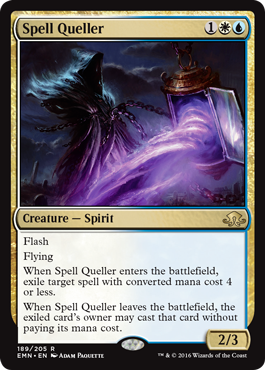
As you can see, Death's Shadow and Eldrazi Tron have been doing relatively poorly compared to two months back when they dominated the format. Jeskai Control and 5C Humans have the tools like Spell Queller and Reflector Mage to control their opponents' boards. This means that decks that play too few threats, or that play big-but-slow threats, are not as good against the Jeskai and Humans decks. This situation also encourages players online to test out more brews or old archetypes in the fresh metagame after Ixalan's release. Also, there will be two Modern Grand Prix going on next week, which is offers a great opportunity to anticipate some big things coming up in the format.

Infect

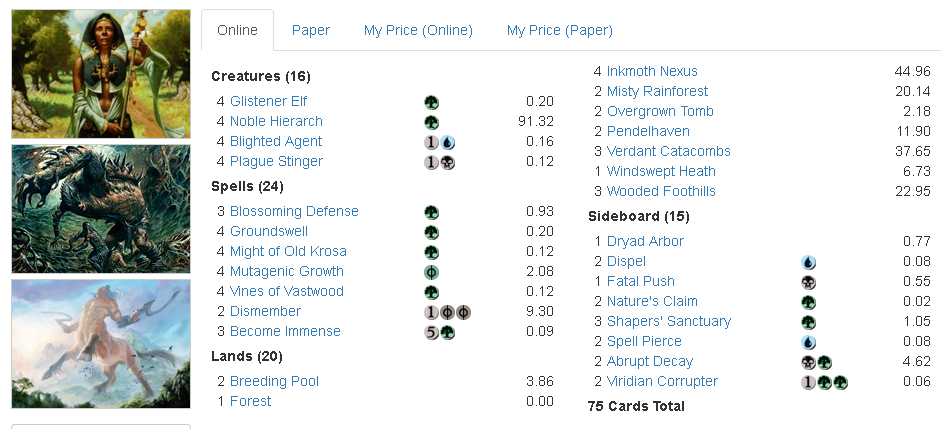
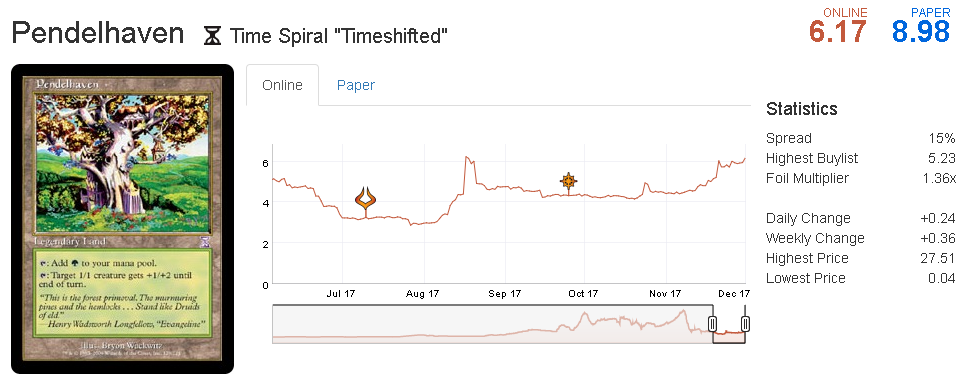
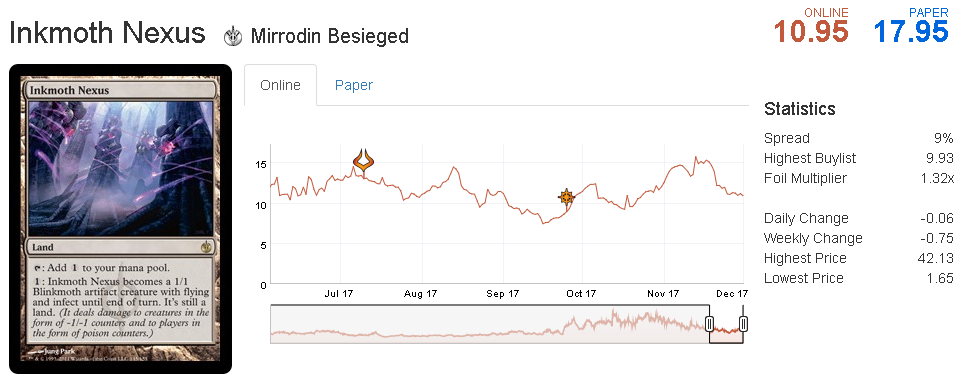
A little bit of history regarding this deck: Infect was the best deck last year as well as at the World Magic Cup 2016. Almost every team had a copy of Infect deck among its three decks. However, ever since Gitaxian Probe was banned in Modern, Infect has slowly disappeared from the top tier of Modern decks. All the latest Infect builds play more creatures than usual, often including two to four copies of either Viridian Corrupter, Plague Stinger or Ichorclaw Myr. The decklist above is a Sultai build with a mix of removal in the sideboard. If the players online found the correct build that can adapt to the current Modern metagame, the lands in this deck, namely Inkmoth Nexus and Pendelhaven will likely increase in price should the deck be picked up among a greater number of players.

Mardu Pyromancer

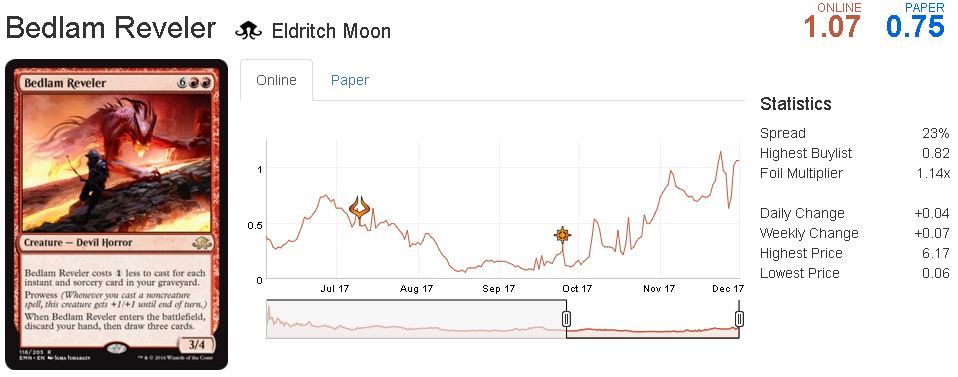
This deck focuses on casting spells to trigger prowess on Monastery Swiftspear and Bedlam Reveler while generating tokens with Young Pyromancer. There are certain cards in this deck that have rarely been played in the past three months.

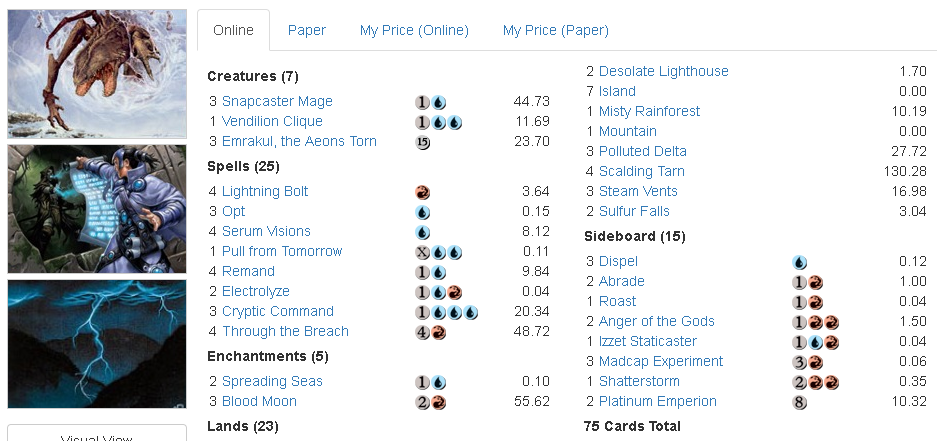
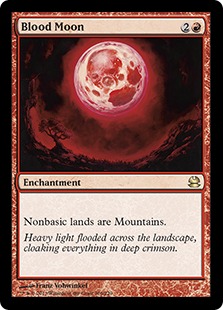
Blood moon was reprinted twice in 2017, once in MM3 and once as a Masterpiece. Besides this Mardu deck, there's another deck below that plays Blood Moon in the mainboard, so there's a possibility that these two decks will push the price of the card to a higher level. Given that the format seems poised for it and the card has been slowly increasing in price since October, I think this is a fine investment at this price.

This card has fluctuated a bit between 0.1 and 1 ticket. The reason for this spike is due to Modern Grixis Control, Legacy Blue-Red Delver and this deck, Mardu Pyromancer. At the current price, despite it being close to an all-time high, I think we can still buy into this card as a speculation target. The Mardu Pyromancer deck made top eight of an online RPTQ, won an SCG Modern event, and 5-0'd some MTGO Modern Competitive leagues. With a little bit help from Legacy Blue-Red Delver, this card has the potential to rise to somewhere near 3 tickets in my opinion.

Blue Moon

Blue Moon is the other deck that utilizes Blood Moon very well. The current Blue Moon deck is no longer the slow, grindly Blue-Red Control deck that dominated the metagame years ago. The new Blue Moon is a combination of Blue-Red Control and a few combos in Modern – Through the Breach, Emrakul, and Madcap Experiment with an option of Platinum Emperion in the sideboard. This deck plays similarly to the the old Splinter Twin decks, except the combo is not as fast.

As I said earlier, I suggest picking up playsets of Blood Moon for investment. Meanwhile, you guys should also take a look at the following card:

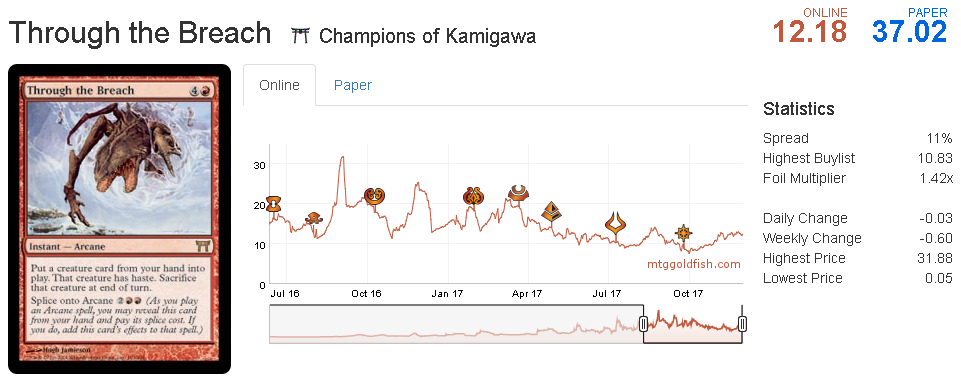
The price of Breach is at its low point compared to last year, mainly because of the drop in popularity as well as its reprint in the Masterpiece series. Do bear in mind that there are decks in Modern that play Through the Breach, like Green-Red Titan and Grishoalbrand, but those are not popular among players online right now. With the new Blue Moon deck, however, Through the Breach is seeing light again. Based on the graph, the average price is somewhere around 20 tickets – and the current price is much lower than that. With the emergence of Blue Moon and the data we have from its price history, I think Through the Breach is a fine card to target for investment.

Amulet Titan

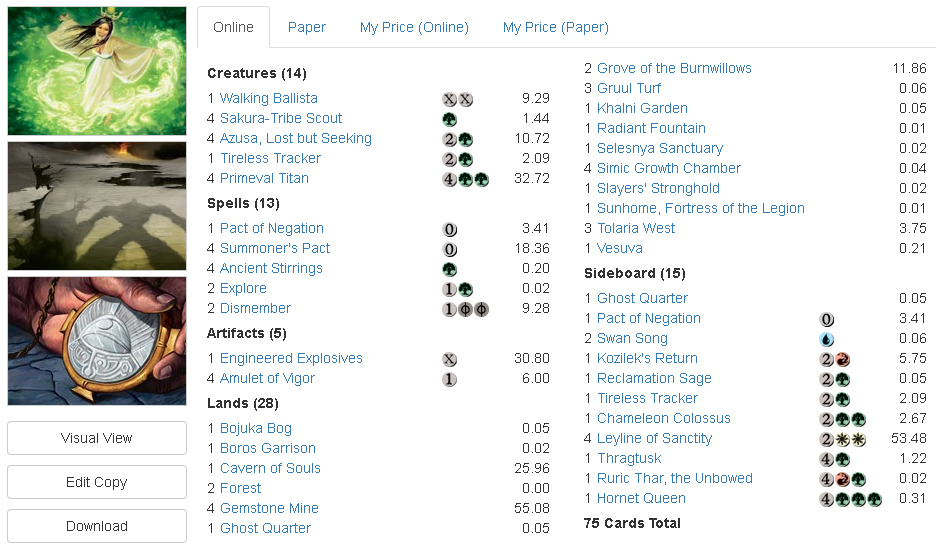
Amulet Titan was a victim of WotC's Banhammer, although the deck is not completely killed off. The latest decklist has not much difference from previous iterations, except it replaces some spells or lands for more creatures. Among the 75 cards, Grove of the Burnwillows and Azusa, Lost but Seeking are the cards that pique my interest the most.

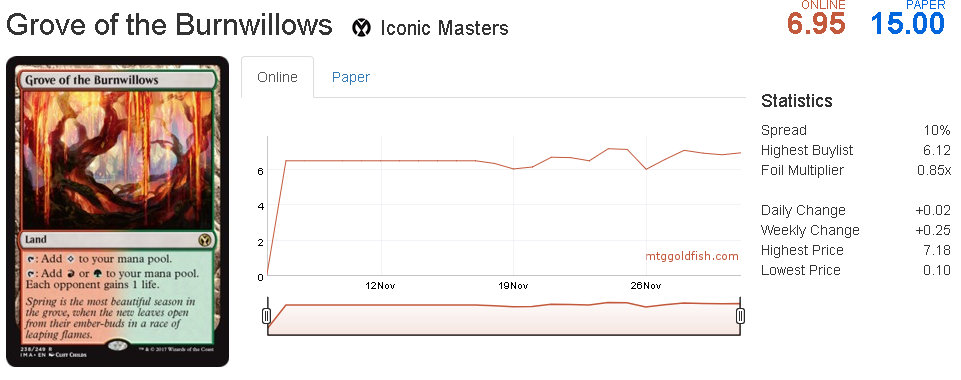
Grove has dropped by about 20 tickets since Iconic Masters  was spoiled. A price of 7 tickets is very cheap compared to where it's been, and it's the only untapped red-green land in Modern that doesn't deal damage to its pilot. Its hard to tell whether this card will rise back to at least 10 to 15 tickets, but it's currently a very good opportunity to get playsets if you want to play with the card. If you ask me whether it's fine to get more than just a playset, I would say yes. This is because the Iconic Masters draft events are ending soon, and if you look at the graph above, the price is pretty stable around 7 tickets, so we can safely assume that the price of this card will not get any lower than 6 tickets.

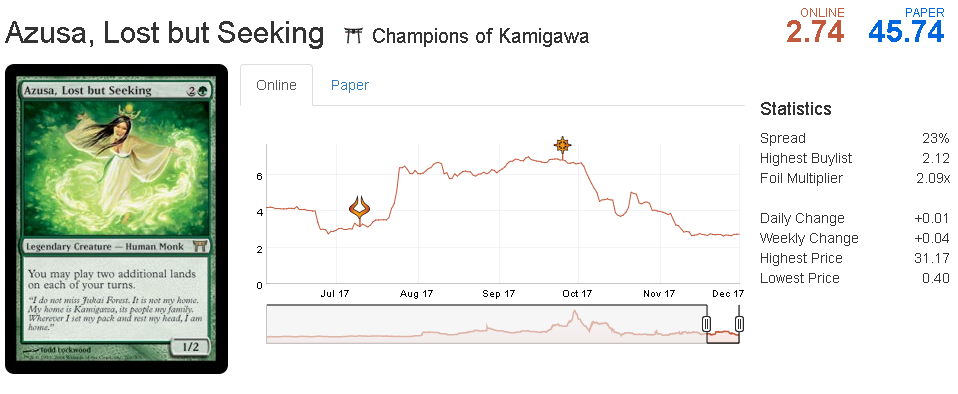
Azusa, Lost but Seeking's price always moves along in tandem with the popularity of Amulet Titan deck. The last time Azusa's price spiked was in July this year, and it stayed at around 6 tickets for two and a half months before it dropped back below 3 tickets. Now that Amulet Titan is reappearing in the Modern meta, I speculate that the same type of spike is possible in the near future. Thus, I suggest buying playsets of Azusa just in case.


Alright, guys, that’s all for this week. Thanks for reading, and I’ll see you all next week!

–Adrian, signing out.

A Complicated Metagame: Invitational Weekend Update

Are you a Quiet Speculation member?

If not, now is a perfect time to join up! Our powerful tools, breaking-news analysis, and exclusive Discord channel will make sure you stay up to date and ahead of the curve.

Once again, it's time to update my paper metagame table! Magic's had a busy weekend---between the SCG Invitational and the World Magic Cup, it was easy to miss the Roanoke Open. Which feels very odd to say, considering how popular and pervasive Opens are, but it's the truth. Not that it matters; the data it generated is still invaluable as we near Grand Prix Oklahoma City.

This article only reviews the open tournament results. Invitationals are not random samples, they're invite-only, and are therefore statistically suspicious. To take an accurate sample of a population, there needs to be an equal chance for every member of that population to be surveyed. Therefore, open tournaments provide more valid results than invitationals when it comes to deducing the metagame at large.

Of course, the new data isn't 100% comprehensive, but it's what we have.

The Open Results

Frustratingly, though understandably, there was no coverage of the Modern Open. Fair enough; if you're going to have an Invitational, you want that to take center-stage. It just means that the data I'm about to present is somewhat contextless. Previously, I was able to compare the results to the Day 2 metagame breakdown and provide a more accurate view of a deck's metagame strength. That isn't possible today, so I don't know if the results are accurate to metagame population. In other words, don't read too deeply into these results. As always, I'm just using the Top 16 decks because they're the most successful and that's all that is normally reported about Classics.

DeckTotal #
Grixis Death's Shadow3
Affinity 3
Mono-Green Tron1
Eldrazi Tron1
Dredge1
Mono-Red Prison1
GW Company1
Titan Shift1
Jeskai Control1
Jund1
4-Color Control1
UW Control1

That is an interesting spread. Mono-green Tron actually won the Open, but Affinity and Grixis Shadow are the real stories here. They're the only decks to place multiple copies into the sample; specifically, three apiece. That is quite the result. Again, without Day 2 data this could be the result of high initial population. The decks were known to be strong already, so I doubt surprise or simple power are the answer.

More interesting is the Mono-Red Prison list. It's effectively a port of Legacy Moon Stompy, and while I imagine it's the worst to play against, I'm not surprised it did well. As I've mused in the last few table updates, Blood Moon seems very well-positioned at the moment.

Travis Perlee's deck is listed as 4-Color Control because it contains one each of Kolaghan's Command and Mystical Teachings and three Lingering Souls, apparently for extra grinding value. Otherwise it's a typical Jeskai hard-Control deck. I really don't feel that one card's mana cost and flashback on four others constitutes an actually different deck, but they do change the deck's gameplan enough to fall within my own rules of differentiation (the same rules that make GR, GB, and Mono-Green Tron different decks). So I'll play along, although I hate when my own rules turn on me.

The Classic Results

With the... side-main event out of the way, it's time to examine the side-side event. The Invitational Weekend is really confusing. Anyway, Modern Classics are fascinating. There tend to be lots of interesting rogue and Tier 3 lists, which really help gauge format health. When the big decks do well it also speaks to their overall power and versatility.

DeckTotal #
8-Rack3
Jeskai Control1
BW Eldrazi Taxes1
Enduring Ideal1
Lantern Control1
Elves1
Death and Taxes1
WG Taxes1
Burn1
Mono-Blue Merfolk1
Affinity1
Eldrazi Tron1
Humans1

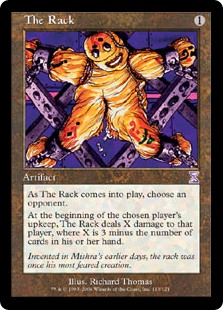
Wow. That is...a lot of 8-Rack. And weird 8-Rack decks, too. Aaron Slate and Michael Dudkow must be teammates, as they're playing the same 75. And with a lot of unusual choices, including Nezumi Shortfang as another Rack effect. I guess it makes sense given the singleton Ensnaring Bridge, but I've never seen that before. Why would anyone think the Kamigawa flip cards were Modern playable? It's a testament to how unexplored the cardpool really is, I suppose. Jessee Leese is on a more familiar list, but with mainboard Pack Rats. While somewhat off-theme, Rat gums up the ground against aggro decks, which can pose problems for 8-Rack, and serves as an alternate win condition.

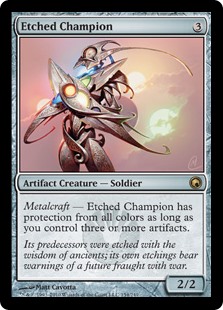
That said, 8-Rack wasn't enough to stop Mark Stanton from taking the trophy with a pretty stock Jeskai Control list. This probably surprised the 8-Rack crew, as that's supposed to be a great matchup. The stockness of the list is its most interesting aspect. This maindeck is the most common, and even deviations don't stray that far. The sideboard is also fairly typical, though Abrade and Kozilek's Return are interesting. Abrade shines against Humans, where it picks off threats in lieu of a Vial. And Pyroclasm or Anger of the Gods seem better than Return to me, although the devoid spell does kill Etched Champion and blow out aggro-combo decks like Counters Company.

The Aggregate Metagame

The next step is to put it all together and see where things stand. For comparison, here's what the metagame looked like right after Regionals.

DeckTotal
Jeskai Control18
Affinity17
Gifts Storm14
Grixis Death's Shadow11
Eldrazi Tron9
Counters Company9
Infect7
Humans7
UW Control6
Abzan5
Burn5
UG Merfolk4
Bant Company4
GB Tron3
Jund3
Elves3
Ad Nauseam3
Titan Shift3
Mardu2
UR Breach2
BW Eldrazi2
GW Company2
GR Ponza2
Death and Taxes2
Mono-G Tron2
Titan Breach1
Saheeli Evolution1
8-Rack1
Temur Aggro1
Knightfall1
BW Eldrazi and Taxes1
5-Color Death's Shadow1
GR Devotion1
RW Prison1
Bant Eldrazi1
Abzan Company1
Grixis Control1
Living End1
Skred Red1
Bogles1
4-Color Company1
RG Vengevine1
GR Tron1
Naya Company1
4-Color Knightfall1
GW Hatebears1
Grixis Delver1
4-Color Death's Shadow1

Get that fixed in your mind, or just glance between the tables really quick. We're looking for how the metagame is developing and where things are headed. Now, on to the new results.

DeckTotal
Affinity22
Jeskai Control20
Gifts Storm14
Grixis Death's Shadow14
Eldrazi Tron11
Counters Company9
Humans8
Infect7
UW Control7
Burn6
Abzan5
UG Merfolk4
Bant Company4
Jund4
Elves4
Titan Shift4
8-Rack4
GB Tron3
Ad Nauseam3
GW Company3
Death and Taxes3
Mono-G Tron3
Mardu2
UR Breach2
BW Eldrazi2
GR Ponza2
BW Eldrazi and Taxes2
Titan Breach1
Saheeli Evolution1
Temur Aggro1
Knightfall1
5-Color Death's Shadow1
GR Devotion1
RW Prison1
Bant Eldrazi1
Abzan Company1
Grixis Control1
Living End1
Skred Red1
Bogles1
4-Color Company1
RG Vengevine1
GR Tron1
Naya Company1
4-Color Knightfall1
GW Hatebears1
Grixis Delver1
4-Color Death's Shadow1
Dredge1
Mono-Red Prison1
4-Color Control1
Enduring Ideal1
Lantern Control1
WG Taxes1
Mono-Blue Merfolk1

Welp. That's not substantially different. The composition of Tier 1 and upper Tier 2 have not changed, though a few have changed places. Even looking more broadly doesn't reveal much movement. That isn't entirely surprising; there wasn't much movement between that Regionals update and the previous one after the Washington DC Classic.

DeckTotal
Gifts Storm9
Affinity9
Jeskai Control9
Infect5
Eldrazi Tron5
Grixis Death's Shadow4
Counters Company4
Humans3
Abzan2
UG Merfolk2
Mardu2
UW Control2
Ad Nauseam2
GB Tron2
UR Breach2
Titan Breach1
Jund1
Saheeli Evolution1
BW Eldrazi1
8-Rack1
Temur Aggro1
Titan Shift1
Knightfall1
GW Company1
GR Ponza1
BW Eldrazi and Taxes1
Death and Taxes1
5-Color Death's Shadow1
Bant Company1
Burn1
GR Devotion1
Mono-G Tron1
RW Prison1

Why should there be more movement now? Nothing has surged up from Tier 2 or dropped down from Tier 1 over the past month and a half. While these tables hint at a settled metagame, do not be fooled. There is still significant dynamism, as the Roanoke results will attest. For example, Storm has been putting up results in bursts. It did very well in Cincinnati and Charlotte, maintained though DC, dropped off during Regionals, and failed to produce any results this week. This does not mean that the deck is suddenly bad. More likely, it just means that players are more prepared than they were before. Storm's return was unexpected, and it's not an easy deck to learn to play against. I'd wager players have finally put in the time to learn how to win. The probability that it returns in force in Oklahoma City is high. A deck that powerful does not simply disappear.
In comparison, Affinity and Jeskai Control consistently put up results. They started out in the top and stayed there. I feel very confident saying they're the strongest decks right now. Exactly why is hard to say. In Affinity's case, I suspect familiarity is key. It's been a deck forever now, almost always in Tier 1, and rarely changes. The pilots are so experienced the exact metagame doesn't matter. They'll play robots and win, simple as that. Jeskai is harder to evaluate. The most substantial change over the older Jeskai Tempo lists is Spell Queller, which isn't much of an explanation because similar lists made headlines last year. Metagame positioning may be the key. I've been saying for months that removal-heavy decks should be favored in the Death's Shadow-flavored metagame. Jeskai isn't the removal heavy deck I expected, but it fills the role nonetheless, feasting happily on Collected Company and Affinity in the meantime.

What Does it Mean?

There are a few ways to look at these data. When looking at the table itself, we see a very stratified upper tier. Affinity is on top, followed closely by Jeskai. There's a six-point drop-off to Storm and GDS, a three-point drop to Eldrazi Tron, and then a two-point drop to Counters Company, after which things close up. This suggests that there is a very clear power jump from Tier 1 to 2, while Tier 2 is roughly equal. Within Tier 1, there is an obvious hierarchy and two clear best decks: Affinity and Jeskai. The two are too close to really separate. This seems reasonably valid, especially when you consider how long those two decks have stood atop the metagame and the fact that they've continued separating themselves since Regionals. This view suggests a stabilized metagame.

Another option is to take the long view and see how things have changed since Charlotte. Affinity has consistently sat atop the metagame. Storm was there too initially, but has gradually dropped-off. Jeskai was tied for first, dropped slightly in Cincinnati, and since then has been competing with Affinity for the top spot. Grixis Shadow had struggled to stay as competitive before, but as Storm fell, Grixis rose, and the deck now ties with Storm.
Meanwhile, E-Tron has been inconsistent. It was initially a non-presence, and even a failure in Charlotte. It still puts up results, but they're sparse. Counters Company was considered a contender for best deck over the summer but has now fallen into Tier 2. Humans wasn't a deck until Cincinnati and has also established itself in Tier 2.

According to this second view, Affinity remains constant, but the other decks rise and fall based on those around them. Additionally, a wide range of decks have been actually winning events, and we have huge variety in the lower tiers. This view suggests a dynamic, evolving metagame.

I don't have an opinion on which is correct. I'm more inclined to take the long view and see the continued adaptation and diversity as signs that the metagame is anything but solved. However, I wouldn't fault you for disagreeing with this perspective, as Affinity's continued dominace doesn't fit with that narrative. The Grand Prix will prove the real test and should provide a definitive answer. If Affinity and Jeskai do particularly well, then the stable perspective is favored. If they're just average, then the dynamic view is advantaged.

How to Respond

Regardless of how you see this metagame, I think the response is clear. First and foremost, be ready for anything in Oklahoma City. You should do that anyway, as it's a Modern GP, but the data show many different decks winning. That said, Affinity and Jeskai are winning more than other decks, so if you need to focus on any decks, pick those two. If you intend to play a top-tier deck, know that everyone else will be aware of your gameplan and prepare accordingly. Readjustment and preemptive sideboard plans will be your best friend.

The Lesson of 8-Rack

What you shouldn't do is take a metagame deck to the tournament and expect it to pay off. I know that 8-Rack did well this week, but that doesn't mean it will continue to do so. It isn't a typical part of the metagame; prior to this week, there was only one result for 8-Rack in the table. If you do want to metagame, look somewhere else. Players aren't going to be surprised anymore, and surprise is critical for decks like 8-Rack.

Use Data Wisely

I've said it before, and I'll say it again: don't overreact to the data. Try to keep your intellectual skepticism, because what these data unequivocally show is a wide-open field where anything is possible. If you fixate too much on any one aspect, the others will bite you. Best of luck to any of you going to Oklahoma City, may your performance be worthy of including in the data next week!

Daily Stock Watch: Tezzeret, Agent of Bolas

Are you a Quiet Speculation member?

If not, now is a perfect time to join up! Our powerful tools, breaking-news analysis, and exclusive Discord channel will make sure you stay up to date and ahead of the curve.

Hello, everyone and welcome to a new week of The Daily Stock Watch! There should be quite a number of Modern tournaments in the coming weeks, and winning lists from the said events should dictate how the metagame will look like once the new year enters. Just this past weekend, one interesting card that caught my eye was in action during the finals of Star City Games' Season Two Invitational.

There was an error retrieving a chart for Tezzeret, Agent of Bolas

When a card gets some much needed exposure in a major event, there's a tendency for players to buy in to the hype. There has been quite a longing for control decks in Modern, and Sam Black might have just started a revolution of sorts for its kin. He finished second, losing only to Gifts Storm, using this Lantern Control deck:

Lantern Control

Instants and Sorceries

1 Abrupt Decay
4 Whir of Invention
4 Ancient Stirrings
4 Inquisition of Kozilek
3 Thoughtseize

Other Spells

4 Codex Shredder
3 Ensnaring Bridge
1 Grafdigger's Cage
4 Lantern of Insight
4 Mishra's Bauble
4 Mox Opal
2 Pithing Needle
1 Pyrite Spellbomb
2 Pyxis of Pandemonium
1 Witchbane Orb

Lands

1 Academy Ruins
3 Botanical Sanctum
4 Darkslick Shores
4 Glimmervoid
2 Island
4 Spire of Industry

Sideboard

2 Abrupt Decay
1 Ancient Grudge
1 Grafdigger's Cage
2 Leyline of Sanctity
1 Nature's Claim
1 Pithing Needle
1 Porphyry Nodes
1 Pyroclasm
1 Search for Azcanta
2 Tezzeret, Agent of Bolas
2 Welding Jar

Tezzeret, Agent of Bolas comes off the board of this deck to assist it in midrange and other control matchups, and quite possibly in the mirror match as well. It is the perfect stalemate breaker when the board gets clogged, and your opponents are trapped via Ensnaring Bridge. I don't think there's enough reason for it to be included in the main deck, but as a vital part of the sideboard plan, this card could definitely go up in price if the deck gets more popular.

The Toys of Tezzeret

These are just some of the deck's components that Tezzeret could turn into a big, nasty 5/5 artifact creature when needed. I don't think that this Tezzeret was ever considered to be part of any Affinity lists (correct me if I'm wrong), as it could slow down the deck in a big way, so finding it in a deck like Lantern Control just suits it right. It is an unsuspecting threat that will be hard to answer, and majority of decks that are packed with creature removal usually side them out when playing against Lantern Control, which makes the Tezzeret inclusion a brilliant choice all the more.

I personally don't think that a lot of players can play this deck that well, and I'm not sure if we'll see new brews featuring Tezzeret. However, a few more decent finishes for any Lantern Control deck that uses it could cause some surge in its price. So far, the Utility Checker is telling us that only 0.3% of winning decks for the year have used an average of 2.9 copies of Tezzeret, but it has still stayed in the $15-$20 range because of its rarity. Bear in mind that this is the only printing of the card, but I wouldn't be surprised if it will be part of any future Duel Decks or From the Vault sets. The all-time highest price of this card was $44.50 sometime in April last year, and even though I don't expect that to happen again anytime soon, I think we have some room to gain something here.

Keep an eye on this card for the coming weeks. At the moment, there should be lots of stocks from online shops such as TCGPlayer, Star City Games, and Channel Fireball from anywhere between $12.99 up to $20.15. As soon as the card spikes up, get rid of your copies. Now might be the best time to let go of them while it's hot. I also wouldn't mind trading them away, especially if they've been sitting long enough in your trade binders. I'm not a fan of this card, and I don't think it'll be that good going forward.

And that’s it for the Monday edition of the Daily Stock Watch! See you again tomorrow, as we check out a new card that should be on the go, or good enough for speculating. As always, feel free to share your opinion in the comments section below. And if you want to keep up with all the market movement, be sure to check in with the QS Discord Channel for real time market information, and stay ahead of the hottest specs!

Insider: Looking Back and Lessons Learned

Are you a Quiet Speculation member?

If not, now is a perfect time to join up! Our powerful tools, breaking-news analysis, and exclusive Discord channel will make sure you stay up to date and ahead of the curve.

As the year winds down, now strikes me as a good time to look back and reflect on the investments I made and didn't make this year as well as the things about MTGO finance that surprised me along the way. I initially began keeping track of my investments in a portfolio precisely to keep a record that I could learn from. As I look back now, I can identify some things that I wish I had done differently, and I hope that sharing my own failings and musings will prove valuable to you, my readers. Having a copy of my portfolio open may prove helpful (be sure to unhide all the rows).

(1) Not Pulling the Trigger on Bulk Rares

This year there were quite a few bulk rares and near-bulk rares that shot up and would have yielded significant returns. I invested in a few such cards (Key to the City, Lifecrafter's Bestiary, Resilient Khenra, Rhonas's Last Stand, Grind//Dust), but I did not pull the trigger on Bomat Courier or Baral's Expertise, both of which would have made incredible investments.

I actually set a price alert for Courier at $0.03, but it only ever dropped to $0.05, so I never picked them up. That brings me to something I'll probably discuss later: a new set's release is a good time to go back through your price alerts, see which cards never made it to those prices, and reconsider picking them up at that time. Following up on insights you have earlier is really important, and failing to do so cost me this year. Fumigate is an interesting case, and one that I'm not too mad at myself about, since similar cards in Standard's past like End Hostilities never really shot up like Fumigate has. Nevertheless, at several points I could have picked up Fumigate for $0.10, yet I didn't even consider doing so.

I've learned that I need to be more liberal in speculating on strong rares that cost between $0.01 and $0.10. Even if I decide just to put a dollar in, I should put a dollar in! The risk is just too minimal, and the reward too great. Moving forward, I'll be more likely to pickup cards like Captain Lannery Storm, Growing Rites of Itlimoc, Daring Sabateur, and Deadeye Tracker when they fall below a dime. This is especially true of small sets.

(2) Overzealously Sticking by my Target Buy Prices

Under this heading I'm identifying two distinct sorts of mistakes that I hope to avoid in the future. First is the mistake I made with Glint-Sleeve Siphoner and Supreme Will: I stuck very closely to my target buy price, with the consequence being that I didn't get as many copies of each card as I would have liked. I invested in Rishkar, Peema Renegade and Glint-Sleeve Siphoner at the same time, intending to get 75 copies of each. I ultimately reached about 80 copies of Rishkar, yet only got 40 copies of Glint-Sleeve Siphoner. I'm happy with the number of Rishkars I ended up buying, but I realize that I should have taken the time around Amonkhet's release to buy the remaining copies of Glint-Sleeve Siphoner, even if $0.05 or $0.10 higher than I would have liked. This was the same mistake I made with Bomat Courier.

The other mistake is one where a card stays below my target buy price for a long time, and so I keep buying copies and buying copies until that card is over-represented in my portfolio. I had only wanted to buy 25 copies of Hour of Devastation, for example, yet I ended up with 50. Last month I repeated this error – there's also no excuse to have spent so much on Legion's Landing so quickly. The moral of this story, I think, is to buy copies of your targets slowly if you're relying on the natural cycles of Standard finance as I do. Reason dictates that Legion's Landing won't permanently shoot up in price just one or two months after release, so there's no reason to get all excited and buy 50 copies instead of 4 or 10 copies. My approach in investing in other Ixalan cards, especially the Ixalan lands, has shown a greater levelheadedness that will result in higher margins.

The other moral I drew from this mistake is to be cognizant of the total amount of dollars you've invested into any one card. Earlier this fall I created the "total input" column in my portfolio to help me make decisions that lead to a balanced portfolio.

(3) Not Investing in Lands

I was wrong about these lands, and I should have invested in 25 or 50 copies of each. I was fortunate to see my error quickly enough to invest in two of them, but I definitely hurt my Amonkhet season portfolio by not making these lands the backbone of my investment in Amonkhet block. Rare land cycles are just always going to exhibit growth now that we don't have fall blocks that last forever. All land cycles other than the painlands from Born of the Gods to the present, have exhibited solid growth and represent a safe and conservative way to invest in MTGO. Much of the reason my Kaladesh season speculations proved to be so good (a rate of return of 120 percent!) is that I invested heavily in the fastlands.

(4) Not Keeping Capital on Hand

This is less something I failed to do this year and more something that has come up continually in my time investing in MTGO, and it is something that I am struggling with now after deciding in late October to use money earned from investing to buy into Legacy. I think it's wise to set aside a certain amount of money for investing and a certain amount of money aside for playing. You don't want to invest so much that you're left with a small number of tickets, because that (i) makes you less happy playing Magic and (ii) inhibits your ability to invest optimally going forward. Always invest within your means and with purpose.

Shading Off

That's it for this week. I'm happy to field any questions you have about my portfolio and investment decisions this year. I tried to cover some of the lessons I've learned this year and hope they prove insightful and helpful for you. I'm also happy to read any lessons y'all have learned from speculating on MTGO this year that you'd like to share.

Today, I'd like to share a card from a custom set I'm making – although I'm still finalizing the set's architecture and mechanics, this is one of my exploratory cards I think is likely to make the final cut.

Insider: Magic Finance News This Week

Are you a Quiet Speculation member?

If not, now is a perfect time to join up! Our powerful tools, breaking-news analysis, and exclusive Discord channel will make sure you stay up to date and ahead of the curve.

There isn’t one big piece of Magic finance news this week that overshadows the rest, but there have been many little things that are worth discussing. Today, I’ll cover some news and trends occurring in the Magic finance world right now that you should know about.

BoGo “Buy One, Get One” Magic Cards

Shopping deals around the American Thanksgiving holiday during events like Black Friday and Cyber Monday extend to this entire holiday season, and Magic cards aren’t immune to them. There were plenty of deals occuring at online stores, and I expect stores to have more of them as Christmas quickly approached, so keep your eyes peeled.

What I know for certain is that some major brick-and-mortar retail stores are currently having a sale on their Magic product, and they present the opportunity to get some cards at a significant discount. The best of these is at GameStop, which is offering a 50-percent discount on its clearance trading cards until December 11th, which translates to some of the lowest prices on packs you’ll ever see. With prices low enough that buying and cracking packs have a positive expected value, there is an opportunity to crack the packs and re-sell the contents at a profit. It's also a great opportunity to obtain some product to play Limited, and because these include Standard-legal sets like Kaladesh and Aether Revolt, there’s an opportunity for players looking to build their playset collection. It's also a way to get sealed product to give as gifts! I was curious what set would offer the best value to someone simply looking to crack and resell the contents, and Ixalan has the highest value with a set retailing at $237, but I am not sure if those would be found in clearance, but Kaladesh isn’t too far behind at over $200. Of course, it all depends on how much the packs cost, and I’ve heard that some stores sell different sets for different prices, so react accordingly.

There was an error retrieving a chart for Carnage Tyrant

WalGreens is offering 40 percent off Magic cards until December 9th, which isn't quite as good a deal but still possibly worthwhile.

Iconic Masters Flops

The most recent release, Iconic Masters, seems to be bit of a flop. The set was loaded with reprints of high-value cards, but by virtue of them being reprinted, their value has tanked, and the value of the set is now lower than many anticipated. The value of the complete set peaked in early October at over $1000, but is now down to nearly $500. Rather than holding a premium over MSRP, like has been the case with the Modern Masters releases, the product can now be had at a discount. Stores seem to be fire-selling the product at a discount, as low as $140 per box, compared to the MSRP of $240.

There was an error retrieving a chart for Mana Drain

Many of the cards in the set are Modern staples, and the prices seem certain to rebound eventually, so there is an opportunity now to get in cheaply and make profit down the line. On the other hand, it’s not clear that we’ve actually reached the bottom, and the fact that the set is not in limited supply, and is even available at big box stores mean the prices could just continue to drown in the supply flood for the foreseeable future.

Un-Sets Temporarily Unbanned in Commander

The upcoming release of Unstable, the much-awaited third Magic Un-Set, has increased interest in the past Un-sets, Unglued and Unhinged. Magic has grown exponentially since these sets were released, and Unstable will expose a whole new generation to the Un-sets. This has brought a lot of attention to cards from the past Un-sets, and the demand is following.

There was an error retrieving a chart for Little Girl

These cards aren’t for competitive play, but they are fair game in casual circles, and players are going to play them in Constructed decks and Cube, and they are going to go deeper by exploring Un-cards from the past. Things came to a head on Friday, when Sheldon Menery, the steward of the Commander format and curator of the banned list, announced that silver-borderd Un-cards, meaning the new Unstable set along with Unglued and Unhinged, and even silver-bordered promo cards cards like the Hascon promo pack and Holiday promos like Fruitcake Elemental, would be legal in Commander until January 15th.

It is at the same time a massive announcement and a non-factor, because what would be a massive change is essentially just a holiday gimmick. The price of Un-cards were already trending upwards, but the announcement has massively driven up demand for some of the cards, especially the gold-bordered promos. The fact is that things will be back to normal on January 16th and demand will wane, but I think the real impact of the move is that it is bringing higher awareness to these cards, and I expect many play groups will continue using them far after they are again officially off-limits, so these prices increases are real demand, and while they will settle out as people sell into the spike, they won't fall back down to previous levels.

There was an error retrieving a chart for Booster Tutor

There were some notable price spikes before the announcement, and more have followed. Frankie Peanuts jumped to $5, which has been followed by Jack in the Mox growing past $10. Strategy, Schmategy has seen two spikes, and now can't be had less than $25. Johnny, Combo Player has moved past $8, and Now I Know my ABC's past $10. The high prices of these cards and others from the sets is because of their great playability and fun factor, and as players dig deeper and find more gems from the Un-sets, they too could rise.

A good way to see the general rising tide of demand for these cards is looking at completed eBay listings. In September, sets of Unglued were selling for around $80 to $90. By November, they were $120, and this week multiple sets sold for around $150 before the announcement. I can only see the demand continue to increase, at least until Unstable is released, and afterwards it will stabilize at some point. The days of these cards being off the radar and in very low demand are over, and the prices won’t fall to previous prices.

What else is going on in the Magic finance world?

–Adam

Deck of the Week: Lantern Control

Are you a Quiet Speculation member?

If not, now is a perfect time to join up! Our powerful tools, breaking-news analysis, and exclusive Discord channel will make sure you stay up to date and ahead of the curve.

Hello, Nexites, and welcome to a new edition of Deck of the Week. There has been some buzz lately that control is actually good in Modern again. We all know that means Cryptic Command and Snapcaster Mage, but really, what's more controlling than a full-on prison deck? That's right—Lantern Control has been on the rise, powered by the new tech of Whir of Invention. This weekend Sam Black proved its power in the current meta with an 8-0 performance at the Star City Games Invitational that helped cement his finals appearance.

If you're an avid follower of Modern, by now no doubt you're familiar with the absurd weirdness that is Lantern Control. This deck has been around ever since Zac Elsik won Grand Prix Oklahoma City with it in 2015. It tends to drift in and out of Tier 2, and now seems to be a time of resurgence for the archetype. Sam's list is typical of what's been appearing in MTGO Leagues.

Lantern Control, by Sam Black (2nd, SCG Invitational)

Artifacts

4 Lantern of Insight
4 Codex Shredder
3 Ensnaring Bridge
1 Grafdigger's Cage
4 Mishra's Bauble
4 Mox Opal
2 Pithing Needle
1 Pyrite Spellbomb
2 Pyxis of Pandemonium
1 Witchbane Orb

Instants

1 Abrupt Decay
4 Whir of Invention

Sorceries

4 Ancient Stirrings
4 Inquisition of Kozilek
3 Thoughtseize

Lands

1 Academy Ruins
3 Botanical Sanctum
4 Darkslick Shores
4 Glimmervoid
2 Island
4 Spire of Industry

Sideboard

2 Abrupt Decay
1 Ancient Grudge
1 Grafdigger's Cage
2 Leyline of Sanctity
1 Nature's Claim
1 Pithing Needle
1 Porphyry Nodes
1 Pyroclasm
1 Search for Azcanta
2 Tezzeret, Agent of Bolas
2 Welding Jar

If you haven't had the privilege of seeing this deck in action, or simply need a recap, here's what's going on. This deck is pure prison, dead-set on locking out an opponent from relevant draws using the namesake card, Lantern of Insight. A permanent peek at the top of the opponent's deck combines nicely with the so-called "mill rocks," Codex Shredder and Pyxis of Pandemonium. These allow the Lantern pilot to control every draw step the opponent gets, effectively shutting down their game plan entirely. Disruption in the form of Thoughtseize, Ensnaring Bridge, and Pithing Needle augments this plan by answering whatever has managed to slip past the draw-step filter.

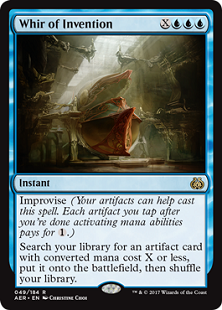
It's always exciting to see Lantern Control doing well, but the big story here is Whir of Invention. This isn't Sam's tech, exactly—it's a pretty universal four-of inclusion by now in all the MTGO decklists, and paper Lantern players are following suit. One of Lantern's traditional weaknesses was the difficulty of finding key lock pieces before it was too late, and an overreliance on Ensnaring Bridge specifically. Whir addresses both of these problems neatly, allowing the deck to incorporate a toolbox element to line up the perfect answer to the situation at hand. Past builds tried to use Infernal Tutor in this role, but the Chord of Calling analog from Aether Revolt avoids the problem of having to empty your hand first.
Alongside Ancient Stirrings, this suite of tutors ensures that the new Lantern Control will rarely be lacking for a mill rock or Lantern of Insight to begin locking down the opponent. It also means the archetype can afford to run several silver bullets like Grafdigger's Cage and Witchbane Orb. Sam has elected for only the most high-impact cards in this capacity, but you'll notice both are well positioned against Storm and Death's Shadow. Post-board, Whir in response to removal can also fetch up a Welding Jar to act as a protection spell for your most important permanent.

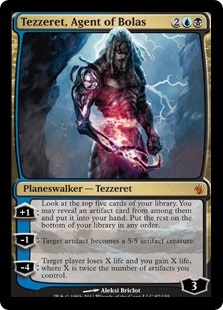
Also notable in Sam Black's list is some sideboard tech in Tezzeret, Agent of Bolas and Search for Azcanta. Tezzeret gives an opponent a one-turn clock to respond if you already have a plethora of artifacts in play, while also finding extra threats with its second ability. It is an interesting piece to side in against control and mirror decks, or even in some midrange matchups where they are already hard-pressed to find a solution to your other artifacts. On the other hand, Search for Azcanta gives you more power to filter your draws, and a very reliable card-advantage engine once it has flipped. I could see both of these being relevant in the grindier matchups, but Tezzeret also provides a much needed win condition outside of the painful (and possibly draw-inducing) Millstone plan.


With new solutions to problems that vexed the archetype in the past, and a rise in midrange decks that struggle against it, it's not hard to see why Lantern Control is doing well. This is a classic example of the "know what you play" mantra in Modern, as learning the fiddly ins and outs will take time and perseverance. But it looks like a great metagame call at the moment, and definitely worth mastering if you have the pieces!

So that’s it for this edition of “Deck of the Week.” Stay posted for our next feature next week. Until then, happy shuffling and thanks for reading!

Insider: Major Movements in Alpha

Are you a Quiet Speculation member?

If not, now is a perfect time to join up! Our powerful tools, breaking-news analysis, and exclusive Discord channel will make sure you stay up to date and ahead of the curve.

As the year comes to an end, I’m hearing summary discussion on various MTG finance podcasts. Analysts are looking back at the last twelve months and commenting on where they perceive market strength and weakness to lie. Many have expressed at least some level of concern that the hobby is less lucrative than it once was due to the massive wave of reprints and endless supply of new sets.

The fact that you can purchase Iconic Masters booster boxes for $148—far under MSRP—underscores the situation at hand. Wizards of the Coast has communicated time and again they want to avoid a Chronicles 2.0. We’re not quite there yet, but we are approaching that level rapidly without sign of reversing course.

Perhaps this uncertainty has pushed speculators and investors into the direction of the Reserved List and Old School. If there’s one consistent communication we’ve received from Wizards, it’s that the Reserved List isn’t going away. Period. End of discussion. Thus, money invested in these classic cards is protected from all that is going with reprints and supplemental product.

Another Reserved List Article?

Before you close the window to avoid reading another article touting the Reserved List, stick with me for this next section. I’ll be first to admit the Reserved List well has run fairly dry, at least for the short term. Gains realized on cards like Library of Alexandria may not be replicated so easily over the next few months as prices reach all new highs.

There was an error retrieving a chart for Library of Alexandria

This got me thinking, though. We’ve seen all the Arabian Nights, Legends, Antiquities, and The Dark cards spike like crazy. Meanwhile, there is a class of cards that are far rarer than all of these. One set in particular is so rare that many singles from the set are virtually sold out on TCGplayer, eBay and many major vendors. If we consider how parabolic the Reserved List cards went in price, I think this similar trend is in media res as we speak.

I’m referring to Alpha, Magic’s first set.

You’ve seen print runs for Alpha cards right? Only 1,100 of each Alpha rare was printed, 4,500 of each Alpha uncommon, 16,000 of each Alpha common and 85,500 of each Alpha land (per picture). Chas Andres over at Star City Games wrote a valuable piece on this set back in 2012, and I find the numbers more compelling than ever.

In that article, Chas goes on to point out that every Alpha common is rarer than an Unlimited Black Lotus. Add in the fact that many Alpha cards have been lost or damaged over their 25 year history, and you have a recipe for extremely rare and collectible pieces that will never be damaged by a market filled with reprints.

The New Information

Everyone actively involved in the Quiet Speculation community is probably familiar with the numbers on Alpha. So none of this so far is new information. But I do have some particularly interesting numbers that make it a worthwhile article topic this week.

First, let’s take a quick look at some specific card prices that Chas points out in his article. Below are Star City Games buylist prices at the time of his article’s publishing in August 2012. To the right of each I list the current SCG buy price and current highest buy price on Trader Tools. Keep in mind these are Near Mint numbers.

 Card  SCG Buy Price (2012)  SCG Buy Price (2017)  TT Highest Buylist
Wrath of God $200 $500 $600
Swords to Plowshares $60 $200 $213
Disenchant - $25  $30
Lord of Atlantis $80 $250 $300
Demonic Tutor $60 $250 $300
Wheel of Fortune $150 $600 $800
Lightning Bolt $15 $100 $125
Fireball - $15  $18
Birds of Paradise $200 $750 $1000
Chaos Orb $125 $500 $700

I hope you're as blown away by these numbers as I was. Buylists (and likely market values) of Alpha cards have all exploded over the last five years. We’re talking about gain percentages in the hundreds. I’ve always viewed Alpha cards as solid investments, but I could not have predicted this explosive growth. But despite these high numbers, I think the growth is far from done. Indeed much of this growth likely happened over the past couple years thanks to Old School. And most recently, interest in Alpha has been on the rise.

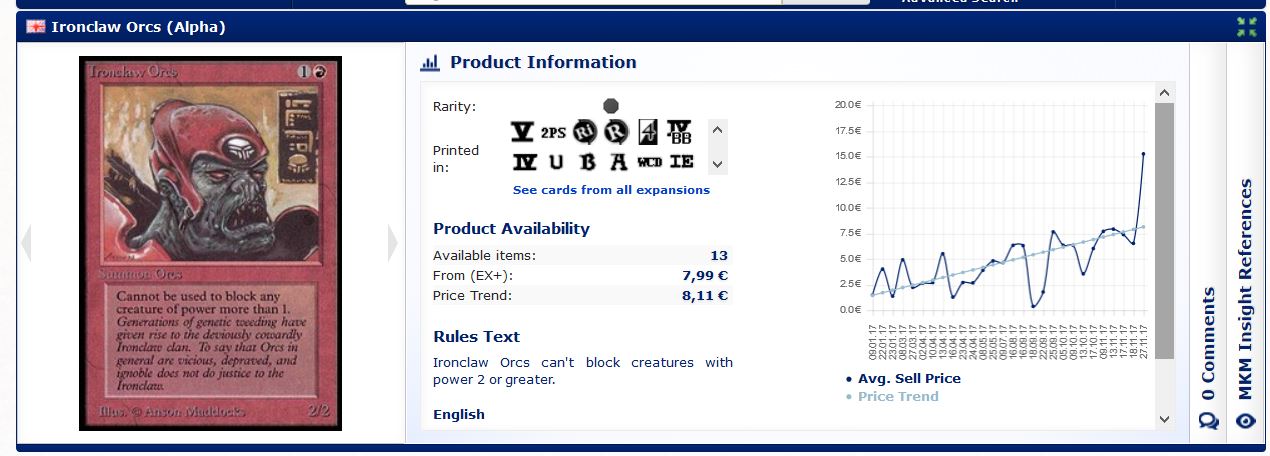
Here’s another number for you: 20. That’s the number of Alpha cards completely out of stock on TCGplayer. And this isn’t a collection of twenty cards you would be able to readily guess, either. It’s not just the Power 9 and dual lands that are out of stock. Instead, it’s pretty random stuff like Ironclaw Orcs and Uthden Troll.

There was an error retrieving a chart for Uthden Troll

Old School players and collectors are moving on these original cards aggressively, leading to a surge in prices and a sudden reduction in stock. Even with such limited numbers, it still takes a good amount of speculation/demand for a common to disappear from the market, but it is happening over and over again.

You need to be aware of this trend. Five years from now, the number of “out of stock” Alpha cards on TCGplayer will be even larger. There will come a time when an Alpha card you want won’t even be readily available on the open market—literally zero copies will be for sale.

Where to Shop for Alpha

Perhaps these numbers convinced you to shop around for a few Alpha cards you always wanted to own. I myself have been acquiring Alpha cards fairly aggressively lately—nothing expensive, mind you. Just some potentially useful commons and uncommons for Old School. You don’t need to invest in Alpha Shivan Dragons to make money on the set’s rarity. Even Alpha Dragon Whelp is sufficient.

There was an error retrieving a chart for Dragon Whelp

So where have I been doing my shopping? I’ve focused on a couple primary places.

First and foremost, Cool Stuff Inc has been my favorite vendor for Alpha cards. Their stock has been dropping steadily like everyone else’s, but their prices are quite competitive. A few times I have even been able to buy cards from their site to directly resell for a modest profit. The fact that they include high-quality pictures of most of their worthwhile Alpha cards is an added bonus, and their markdown on played copies are especially interesting.

Next, I have had some success acquiring Alpha cards from Tokyo MTG, an easily accessible Japanese vendor. Their prices are a little more hit-or-miss given the recent weakness in the US Dollar, but I love that they accept PayPal USD payments and they offer PWE shipping. This makes the site just as easy to buy from as any domestic vendor.

Beyond major vendors, I have done plenty of shopping on TCGplayer. Filtering out HP and Damaged cards has helped me focus on playable cards that aren’t too ugly to be buylisted to stores. Some of the obscure cards have been lucrative for me—it seems many vendors apply a standard minimum buylist price on Alpha commons and uncommons, and some smaller TCGplayer sellers don’t know about this (or don’t care). This has led to some immediate arbitrage opportunity.

I’ve even bought cards directly from Star City Games recently. It seems some playable Alpha cards have recently jumped in price, and vendors have been a little slow to adjust. Twiddle, Orcish Artillery, and Plague Rats are a few examples of cards you may find at an online vendor with prices that haven’t been adjusted to match recent market pricing.

There was an error retrieving a chart for Twiddle

Finding good deals on Alpha cards is becoming tougher and tougher. But by shopping around extensively you have a decent chance of finding that underpriced gem simply because vendors aren’t used to wildly fluctuating prices for Alpha singles. But that seems to have been changing lately.

Wrapping It Up

Alpha cards are arguably the most investible pieces in Magic. They have extremely small print runs, their age implies the number of remaining copies in nice condition are even smaller, and they are 100% immune to reprint. Wizards could churn out a dozen Masters sets over the next couple years and Alpha cards would do nothing but rise in price.

Speculators and collectors are catching on to this trend most recently, and even random commons like Ironclaw Orcs are disappearing. In Europe, these cards are moving in a big way as reflected by Magic Card Market’s price charting.

(Click to expand.)

The trajectory has always been upward, but most recently things have begun to go parabolic. “Begun” is the operative word now. I am flagging this trend to you as it is happening, and it may not be too late to pick up a few gems for your Old School decks, cubes, portfolio, etc. But there will come a time when it will be too late, and the card you’re looking for just isn’t available for sale on the open market. At least, not at a real price that isn’t silly.

Then again, with a market as special as Alpha cards, maybe there is no such thing as “silly” pricing anymore. A month ago I would have said 15 euros was already too silly for an Alpha Ironclaw Orcs, after all. This just goes to show you how real this market trend is. I’ll conclude with this completed eBay listing below, just for awareness.

…

Sigbits

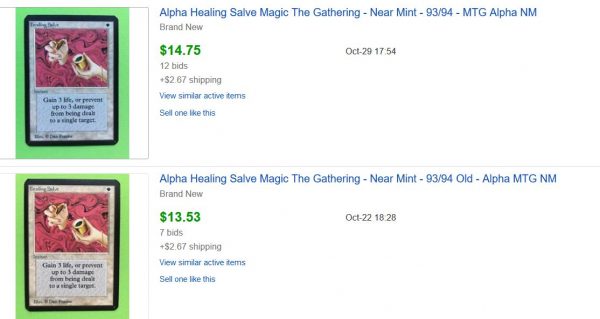
  • I did a quick browse of Star City Games’ stock on Near Mint Alpha cards and the numbers are staggeringly low. There are a few random ones left, don’t get me wrong. But unless you’re looking for a Near Mint Ankh of Mishra or Chaoslace, the available stock is nearly nonexistent. I am extremely tempted to try buying their Near Mint Healing Salve simply because of auctions like this one:

  • I just checked and confirmed that every common and uncommon from Alpha that is out of stock on TCGplayer is also sold out on Star City’s website. Coincidence? Or are these cards really in demand? Either way, if you can find any copies of these cards you could set the new market price by listing the only copy for sale on TCGplayer.

Insider: Non-TCGPlayer Outs

Are you a Quiet Speculation member?

If not, now is a perfect time to join up! Our powerful tools, breaking-news analysis, and exclusive Discord channel will make sure you stay up to date and ahead of the curve.

Welcome back, readers!

Today's article is one I was honestly surprised to see I hadn't already covered. The more I use TCGplayer as on out to sell cards, the more painful all those fees become. If you're a full-blown brick-and-mortar store that sells a lot of cards, then switching to TCGplayer Direct can save you a good bit of money. But for those of us whose stores are just a source of additional income outside our day jobs, the 12.75% + $0.3 really adds up.

Granted, TCGplayer has its benefits, most notably the huge pool of customers you get access to. They also do special kickback programs (like the recent promotion for 10% off on Black Friday), which help you sell cards but come out of their profits. All that being said, they aren't the only game in town. I felt that it would be wise to look at some of the other options on the table.

eBay

This is the most obvious one, and arguably the biggest competitor to TCGplayer as an online marketplace for collectible card games. eBay is definitely far better known (outside of the Magic sphere of influence), and its customizability allows you to sell cards differently than TCGplayer.

On TCGplayer you are limited to listing every card (or sealed product) as an individual item. That means a player might buy one card from you at a time, increasing transaction costs. eBay allows you to sell collections of cards (like, say, one of every Khans fetchland, or some other grouping that isn't just one item).

The downside is that eBay has a very similar fee structure, so you may not really save much money. eBay's fee structure looks like this:

  • Insertion Fee: $0.3. Only added if you list more than 50 items per month.
  • Final Value Fee: 10% of the final total, including shipping. This didn't used to include the shipping, so people would list items for $0.01 with a very high shipping cost—eBay put a stop to that.

Based on this fee schedule, eBay is cheaper than TCGplayer...or so it would seem. Unfortunately, there's a bit of fine print. If you end your auction early or don't meet their "minimum performance standard," you are hit with an additional 4% on your Final Value Fee. That puts eBay over TCGplayer by a good 1.25%.

MTGPark.com

This was a site founded by a few members here at Quiet Speculation. These gentlemen felt that the TCGplayer fee structure was too high and wanted to create some competition for them. The only fees on this site are the standard PayPal and credit card fees that the owners have no control over.

I remember getting very excited about this option when they first announced it. Currently the biggest problem is that they aren't well known. While they have a decent number of sellers, the lack of traffic means that sales originating from the site are much lower than TCGplayer or eBay. So you make about 10% more profit on each sale, but you make fewer sales.

I'm still hoping that this site will grow and more players will check it out, because I love having competition in every marketplace.

Magic Card Market

This is the European version of TCGplayer. While I haven't used them (as I haven't traveled to Europe in some years), they appear to be a solid option, charging only a 5% fee per transaction.

The challenge for those of us in the US is of course postage. International postage isn't cheap. It's unlikely that those in the US could use this marketplace very effectively without a counterpart in Europe or some method of getting the cards over to Europe frequently enough to mail them out.

However, it's important to know they do exist. Note that you can't register an account from the US (as the United States is not an option in the "country" box) so you have to have a European mailing address as well.

Facebook

Not only is it a great way to waste countless hours of your life, but you can also sell cards on there too! There are a lot of different Magic groups available—damaged cards only, general buy/sell, foreign buy/sell, foils, altered cards, and more. This option has been growing by leaps and bounds and will likely continue to do so, simply because the fees are extremely low (they can be down to the cost of shipping).

However, Facebook also carries with it a lot of risk. Transactions typically occur via PayPal or other money-exchange services, and neither the groups nor Facebook are accountable for you getting the cards you buy.

In this particular option, one's reputation is hugely important. One bad transaction can get you banned or kicked out of groups. People typically request references for each transaction (with a reference being a person you've done business with in the past who will vouch for you). People with a lot of references tend to be more trusted and there is less risk associated with doing business with them.

Most transactions are done via PayPal (at least for those of us in the US) which allows two options. The first is "Friends and Family," which carries with it zero fees to both parties. However, should the other person scam you there is no easy way to get your money back. (I haven't run into this issue yet, so I don't know if it's impossible or just extremely difficult.)

The other is through a regular PayPal transaction which carries a 2.5% fee to the person receiving the money. Should the other person not deliver, you can file a PayPal claim and get your money back.

According to PayPal, this is the proper method—Friends and Family is meant just for that. However, when using this method many sellers require that buyers eat the fees. My personal recommendation is to use the legitimate avenue, because the 2.5% fee is still the lowest option of any listed so far.

One other word of caution is that you need to price competitively on most Facebook groups. After all, if you are trying to sell cards at TCG Mid, why wouldn't your buyers just go to TCGplayer and buy the cheapest copies (especially since they are protected by TCGplayer if they do)?

Craigslist

If you want to move cards locally, Craigslist can also be a viable route, especially if you live in larger urban areas. Obviously you need to be smart whenever you physically meet up with a stranger. I suggest meeting at a very public place, ideally during daylight hours.

Around my hometown, a lot of Magic transactions occur at our local Barnes and Noble. They are accustomed to people coming into their coffee shop and sitting down with books/laptops/etc., so Magic cards aren't a stretch. They sell drinks and snacks, so if you get stuck waiting a while at least you won't go hungry or thirsty, and they have clean restrooms.

If you are buying off Craiglist you want to do a bit of prep work.

  1. Make sure to get good quality pictures and/or lists of cards ahead of time.
  2. Be very cautious of deals that sound "too good."
  3. Review every card of significant value (I examine everything over $3 personally).
  4. Check with local game stores ahead of time to make sure no collections were stolen recently (as Craigslist is an obvious out for thieves).

If you are selling, make sure you provide good pictures and a list of cards. Organize them in a way that allows your buyer to review the cards easily.

As an aside, you can also use Facebook for meeting up to buy/sell collections (I've done this a couple times).

Conclusion

While TCGplayer offers a massive marketplace and a lot of buyer protection (their seller protection is unfortunately rather limited currently), they aren't the only game in town when it comes to buying and selling Magic cards. As your business grows you'll find that fees that didn't bother you initially really add up, and it's important to maximize your profits when you can by using multiple options.

Avatar photo

David Schumann

David started playing Magic in the days of Fifth Edition, with a hiatus between Judgment to Shards. He's been playing Commander since 2009 and Legacy since 2010.

View More By David Schumann

Posted in Finance, Free Insider, Selling1 Comment on Insider: Non-TCGPlayer Outs

Have you joined the Quiet Speculation Discord?

If you haven't, you're leaving value on the table! Join our community of experts, enthusiasts, entertainers, and educators and enjoy exclusive podcasts, questions asked and answered, trades, sales, and everything else Discord has to offer.

Want to create content with Quiet Speculation?

All you need to succeed is a passion for Magic: The Gathering, and the ability to write coherently. Share your knowledge of MTG and how you leverage it to win games, get value from your cards – or even turn a profit.

Daily Stock Watch: Field of Ruin (foil)

Are you a Quiet Speculation member?

If not, now is a perfect time to join up! Our powerful tools, breaking-news analysis, and exclusive Discord channel will make sure you stay up to date and ahead of the curve.

Hello, everyone and welcome to the Friday edition of the Daily Stock Watch! Yesterday marked the first time that I did a "Month End Review", and based on your feedback, it's something that I might have to adjust going forward. Today, I'll be doing an exclusive foil review of a card that I really liked the moment that I first saw it.

Our card for today is Field of Ruin

There was an error retrieving a chart for Field of Ruin

I'd like to focus on the foil copy of this card for certain reasons: first, it is an uncommon from a recently opened set, so there should be a decent number of copies out there; second, it's being played in almost any control shell in Standard and Modern decks; and lastly, I think that it's still cheap, considering how powerful the card is.

For now, let me show you some lists where Field of Ruin is being used.

Standard Blue White Control

Instants and Sorceries

1 Disallow
4 Glimmer of Genius
4 Supreme Will
1 Pull from Tomorrow
2 Settle the Wreckage
4 Censor
3 Fumigate
3 Approach of the Second Sun

Other Spells

3 Aether Meltdown
4 Cast Out
2 Search for Azcanta
1 Thaumatic Compass
3 Gideon of the Trials

Lands

2 Ipnu Rivulet
4 Glacial Fortress
4 Irrigated Farmland
7 Island
6 Plains
2 Field of Ruin

Sideboard

1 Hour of Revelation
1 Commit // Memory
3 Authority of the Consuls
3 Negate
2 Torrential Gearhulk
2 Jace's Defeat
2 Regal Caracal
1 Kefnet the Mindful

Modern Blue White Control

Instants and Sorceries

2 Glimmer of Genius
2 Spell Snare
3 Mana Leak
4 Opt
4 Path to Exile
3 Cryptic Command
1 Negate
2 Serum Visions
3 Supreme Verdict

Other Spells

2 Search for Azcanta
2 Detention Sphere
1 Jace, Architect of Thought
2 Gideon of the Trials
1 Gideon Jura
1 Gideon, Ally of Zendikar

Lands

2 Hallowed Fountain
2 Plains
4 Celestial Colonnade
4 Field of Ruin
4 Flooded Strand
5 Island
1 Irrigated Farmland
2 Glacial Fortress

Sideboard

1 Wrath of God
1 Vendilion Clique
1 Timely Reinforcements
2 Surgical Extraction
1 Stony Silence
1 Runed Halo
1 Rest in Peace
2 Porphyry Nodes
1 Negate
1 Condemn
2 Ceremonious Rejection
1 Celestial Purge

Field of Ruin plays a vital cog in these decks in different ways. The Standard version uses it to punish 4C Energy decks that are already hard-pressed to find an answer to the matchup problem, while also giving it some leeway to respond to troublesome cards like Ramunap Ruins in certain cases. Modern is the format where Field of Ruin is money; it is the answer to traditional powerhouse lands such as Inkmoth Nexus, Cavern of Souls, Valakut, the Molten Pinnacle, and the ever powerful Urza lands.

What separates it from other lands with Strip Mine effects such as Ghost Quarter, Tectonic Edge, and Encroaching Wastes, is that it gives you a replacement land for what you gave up. For an extra kick, it also forces your opponent to shuffle their library, because it neglects the "may search" clause that Ghost Quarter comes with. This could be key in certain situations, such as when your opponent has just scryed on their previous turn (which happens a lot in Modern), or to save yourself from a second Approach the Second Sun that would end the game in your opponent's favor. As a matter of fact, I think that it will be utilized more in Standard once Rivals of Ixalan arrives, and it should be a four-of, once control becomes a thing again in the format.

I know that it's hard to speculate on foils, but I really like the upside of this card. Right now, you could still find foil copies of this card from Channel Fireball and TCGPlayer from anywhere between $6.99 up to $9. Card Kingdom has it for $10.99, while Star City Games are out of stock at $6.99, and should be refilling soon in the $10 range as well. I'd like to get all the $6.99 copies, as this could go up to $10-$20 in the future. I don't think people will still be opening Ixalan packs when the new year hits, so now might be the best time to buy in. Don't forget that we're only buying foils!

And that’s it for this week's edition of the Daily Stock Watch! See you again next week, as we check out new cards that might be good to invest on, or time to let go of. As always, feel free to share your opinion in the comments section below. And if you want to keep up with all the market movement, be sure to check in with the QS Discord Channel for real time market information, and stay ahead of the hottest specs!

Boremandos Enraged: Brewing Jeskai Delver

Are you a Quiet Speculation member?

If not, now is a perfect time to join up! Our powerful tools, breaking-news analysis, and exclusive Discord channel will make sure you stay up to date and ahead of the curve.

Deep in the Modern annals lies a deck called Boremandos. This deck was the format's first to feature Delver of Secrets, and was wildly successful in its heyday. It paired Delver with Steppe Lynx, Remand, and a hearty dose of burn spells to gently disrupt opponents and kill them quickly, and eventually inspired the blueprint for Counter-Cat.

These days, Delver's all but completely vacated the competitive scene. Not true of Boremandos's spiritual big brother, Jeskai Tempo. So what would it take for Delver of Secrets to claw its way back into successful Jeskai shells? Today's article explores the two builds I've been working with, and how Spell Queller and Chart a Course revolutionize the archetype.

Queller Delver

I started with the most vanilla shell possible---a 4-Snap, 4-Queller reactive deck Ă  la Jeskai Tempo, but with Delver of Secrets over Celestial Colonnade. Ryan Overturf experimented with a similar build when Queller was spoiled, if working from a Grixis Delver vantage point. Reps and tuning led me here:

Queller Delver, by Jordan Boisvert

Creatures

4 Delver of Secrets
4 Snapcaster Mage
4 Spell Queller
1 Vendilion Clique

Instants

4 Path to Exile
4 Lightning Bolt
2 Lightning Helix
1 Boros Charm
4 Disrupting Shoal
2 Mana Leak
2 Logic Knot

Sorceries

4 Serum Visions
4 Chart a Course

Lands

4 Flooded Strand
2 Hallowed Fountain
2 Island
1 Mountain
1 Plains
1 Sacred Foundry
4 Scalding Tarn
3 Spirebluff Canal
2 Steam Vents

Sideboard

2 Geist of Saint Traft
1 Engineered Explosives
1 Wear // Tear
2 Stony Silence
2 Rest in Peace
2 Disdainful Stroke
1 Ceremonious Rejection
1 Celestial Purge
1 Surgical Extraction
2 Pyroclasm

Quell Honneur!

Spell Queller is the reason to play Jeskai Delver. The card is just amazing in Modern. It's a Thought-Knot Seer-plus against less interactive decks (flying and stealing tempo are major upgrades), and can overload damage-based removal with Delver and Snapcaster at its wings. Best of all, Queller lets Delver play the excellent reactive game it never had access to.

Modern Delver decks have always boasted awkward threat suites. Without a true Nimble Mongoose equivalent in the format, it's short the one drops necessary to go all-in on a thresh plan (without dipping into four colors). The accepted solution has historically been to dumb down the strategy with Snapcaster Mage, giving the deck a more reactive bent (see: Grixis Delver). Pre-Queller, that plan also found itself lacking; no "second Snapcaster" exists.

Enter the Spirit. Spell Queller plays well both proactively and reactively, making it an easy fit in a 4-Snap Delver pile. We've now got plenty to do on an opponent's turn, as our open mana represents proactive plays like Snap-Bolt should they do nothing and reactive plays like Queller otherwise. Since Delver of Secrets only costs one mana, plopping him down to force an opponent's hand into our reactive creature plays is also an option as of the mid-game. Compare with a Colonnade plan, which asks pilots to extend the game significantly so that they can afford to tap down and animate the bulky land.

Other Creatures

Perhaps we should ask not what Queller can do for Delver, but what Delver can do for Jeskai. In short, the transforming Wizard improves Jeskai Tempo's matchups against decks that prove challenging to interact with, such as Tron and Dredge.

It also stirs the pot in fair mirrors. A turn one Delver puts opponents on the back foot immediately, which changes the flow of the game. As for the argument that Delver weakens the deck to Fatal Push, I'd sure rather my Delver eat the removal spell than my Colonnade. And on a good day, Delver teams up with Snap to gobble down the precious Bolts that potentially make Queller a liability in these matchups.
I also want to touch on Vendilion Clique. The 3/1 might not seem like much on the surface, but I think it's still one of Modern's hallmark creatures. Clique's problems are twofold: it's legendary, complicating building a deck around it, and it's expensive as a flex choice at three mana. Decks can only run Clique if their mid-to-high-end isn't occupied by something else. The biggest strike against the card is that it lacks a home.

But it's as flexible as ever and comfortable in Jeskai Delver, where it slots into the curve as Queller #5. Fatal Push slicing into Lightning Bolt's shares has incidentally improved the card, as has the general aggro-control trajectory of invalidating grounded combat via Eldrazi and Death's Shadow.

One big departure from Boremandos, and from many Jeskai Tempo lists: this build doesn't play Geist of Saint Traft in the mainboard. I have never been impressed with this card in Modern, and I think it's worse now than ever. Matter Reshaper and Death's Shadow can make getting through pretty challenging, and decks like Humans and Taxes block the 2/2 incidentally. Geist is better when the deck has more mana to throw around and is heavier on noncreature sources of damage. I think it has a place in our 75, but prefer Clique in the main.

Removal/Burn

Path to Exile is one of the main reasons to play white right now, so we naturally max out on those. The Bolt split proved a bit more challenging to figure out. I wanted to preserve Jeskai Tempo's burn-you-out plan to some degree, explaining the full set of Lightning Bolt and Snapcaster Mage. But I found Lightning Helix too inefficient to play in large quantities in a Delver deck. Besides, Delver itself compensates for dropping some reach spells by making our other burn all the more potent.
Boros Charm plays a few roles in the deck. Charm-Snap-Charm represents up to ten damage, which of course is ridiculous. Double strike mode never, ever comes up. The card's indestructible mode does, though; protecting Queller from removal to stop opponents from reclaiming their exiled spell, or saving Geist of Saint Traft post-board from a costly sweeper, are its primary uses. Oh, and one-shotting fresh Lilianas. Yum!

I considered rounding out the suite with Electrolyze, but eventually just opted for a pair of Pyroclasms in the sideboard. Lyze is too unlikely to impact the board to be worth three mana in this deck. It's more of a necessity in less proactive Jeskai decks, which can only do their requisite durdling if they clear opposing fields of incidental threats while pointing heavy-duty removal at the real ones.

Permission

The permission suite is simple and effective. I'm not a big fan of messing around with splits of stuff like Spell Snare or Deprive. Leak and Knot are great at stopping spells out of Queller's range, and both can help preserve an early lead from Delver; that's exactly what we want our costed counterspells to do. Why try harder?
Color is another big draw to Queller in a Delver strategy over, say, Hooting Mandrills. Disrupting Shoal is already fantastic in Counter-Cat, which runs 23 blue spells; this deck packs a whopping 29 blue spells. That's almost half the deck!

With its higher curve, Jeskai is likelier to hardcast Shoal in the late-game, and even to flash it back with Snapcaster Mage. But Shoal also plays an important role in the deck's design when it comes to balancing the curve. Minus the arcane instant, I think 20 lands is too few for a deck maxing out on Queller, Snap, and Chart. Since these cards can be pitched to Shoal, though, irksome mana-light early-games can be smoothly navigated into favorable board positions. We've also got too much card advantage, a mechanic notoriously overrated in Modern; Shoal's card disadvantage contributes positively to the balance, letting us benefit from those spells in grindy matchups and turn them into mana against faster decks.

Chart a Course

We touched above on the effect of including Delver of Secrets in Jeskai for fair mirrors. It's true that removal-heavy decks get a boost against us when some of our burn and two-for-one spells are 3/2s instead. But I've found Chart a Course to help offset that disadvantage.
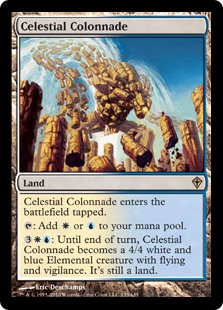
Chart has seen steady play in Vintage and Legacy since its release, but it's obvious why more decks don't play it in Modern: like Clique, the card lacks a true home. It's obviously great in Delver decks, but like, there are no Delver decks.

I expect that to change, if slowly. Backed up by some burn or another creature, Delver really is best-of-breed when it comes to pressuring uninteractive opponents. And Chart a Course neatly greases the engine as well as Serum Visions.

Sideboard

The sideboard is the other major draw to Jeskai Delver. Stony Silence and Rest in Peace can both be had relatively pain-free, giving the deck a potent prison dimension in post-board games against large chunks of the field. Geist of Saint Traft is simply a tough-to-kill threat that covers for Spell Queller in removal-heavy matchups, and Celestial Purge is anti-Lili tech that also removes Death's Shadow and a host of other random stuff. The counterspells here are all geared to fight big mana.

Pussyfooting Around

Playing a better reactive game is all fun and dandy, but Modern has never really rewarded reactiveness as it has proactiveness. My next order of business was to sleeve up an old friend and test an 8-Delver strategy without Wild Nacatl.

Jeskai Lynx, by Jordan Boisvert

Creatures

4 Steppe Lynx
4 Delver of Secrets
4 Snapcaster Mage
3 Spell Queller

Instants

4 Path to Exile
4 Lightning Bolt
4 Disrupting Shoal
2 Mana Leak
2 Spell Pierce

Sorceries

4 Chart a Course
4 Serum Visions

Lands

4 Flooded Strand
4 Scalding Tarn
4 Arid Mesa
1 Polluted Delta
2 Steam Vents
1 Hallowed Fountain
1 Sacred Foundry
1 Plains
2 Island
1 Mountain

Sideboard

2 Geist of Saint Traft
1 Engineered Explosives
1 Wear // Tear
2 Blood Moon
2 Rest in Peace
2 Stony Silence
2 Negate
1 Disdainful Stroke
1 Ceremonious Rejection
1 Electrolyze

What's New

Steppe Lynx's inclusion changes the deck in a couple ways. Less-efficient reactive spells like Lightning Helix and Logic Knot get the axe right away. Chart a Course improves and is likelier to be cast earlier, putting a premium on cheap permission---I love Spell Pierce in this kind of shell.

One of the issues with Chart's blind draws is that it sometimes just digs into a bunch of lands, overall having little impact on a game. Steppe Lynx gives us a use for these whiffs. Running and finding more fetches also makes Blood Moon an appealing candidate for the sideboard, further bolstering the Rest in Peace-Stony prison dimension.

Three-Way Tension

Nothin's free, of course. This build is pushed into three conflicting directions.

  • High instant/sorcery count. Necessary for Delver.
  • High land count. Necessary for Lynx.
  • High creature count. The 8-Delver approach needs us to keep the pressure on, and running more lands facilitates maxing out on Snapcaster and Queller.

It's impossible to fulfill all three requirements, so I've been working on striking the correct balance. So far I've bounced around between 20-land builds, 21-land builds, and 22-land builds, filling the extra slots with Quellers or Deltas. Right now, I like this one. The Boremandos decks of old would sometimes go as low as 20 instants and sorceries, but we're a civilized people now.

Quell 'Em All

If I had to say which of these decks is better, I'd put my money on the first, if only because it's so similar to an existing Tier 1 deck. That said, I'm not totally convinced the proactivity bump from Delver is worth giving up Cryptic Command and the late-game Colonnade engine. Although I do know I would never go near the Command deck, so at least it's worth it for me. Modern's about playing what you love, after all. On that note, good luck to all the Modern-lovers attending the SCG Invitational this weekend---we'll be watching!

Insider: QS Cast #83: Holidays and Doomsdays

Are you a Quiet Speculation member?

If not, now is a perfect time to join up! Our powerful tools, breaking-news analysis, and exclusive Discord channel will make sure you stay up to date and ahead of the curve.

Play

The QS Cast returns! Chaz Volpe, and Tarkan Dospil come together as the new panel – and in this episode they discuss the following:

  • Rumblings of an Merchant closing up shop - the fall out and MTG market discussions
  • How WOTC can pivot and potentially mirror the Pokemon TCG
  • Quick reviews of FTV Transform/Unstable/Iconic Masters
  • Interests

Cards we discussed:


Enjoy!

Find us on Twitter: @ChazVMTG @the_tark

Want Prices?

Browse thousands of prices with the first and most comprehensive MTG Finance tool around.


Trader Tools lists both buylist and retail prices for every MTG card, going back a decade.

Quiet Speculation