menu

Daily Stock Watch: Month End Special

Are you a Quiet Speculation member?

If not, now is a perfect time to join up! Our powerful tools, breaking-news analysis, and exclusive Discord channel will make sure you stay up to date and ahead of the curve.

Hello, everyone and welcome to a special edition of the Daily Stock Watch! Today, I'll be doing a recap of some of the cards that I've covered for the month of November, to check what are the hits and misses so far. We'll be using the average price of the cards based on MTGStocks as our basis.

I'll be doing this based on the card that I've first speculated on, up to the last card that I covered during my Iconic Masters special edition. I will do something like this every once in a while, just to see how we're doing with our targets. If you have any suggestions on how we could go about this in the future, please feel free to let me know.

The First Week

November 1 Meddling Mage - I covered this card right after Collins Mullen's Humans deck won SCG's Modern Open in Cincinnati, and said that it's a good buy for its current price tag for personal use. The average price back then was $16.46, and it's currently sitting at $17.99 right now. I'll tag it for now as a HIT.

November 2 Aether Vial - The day after Meddling Mage, I also covered another key component of the Humans deck, which will be having a reprint in Iconic Masters. I've noted that it should be a good buy at $30 (average price was $29.45 at time of writing) once supplies hit its all-time high, but it hasn't slowed down since and is currently sitting at $34.25. Two out of two so far.

November 3 Tarmogoyf - Goyf hit rock bottom (its lowest since 2013)  on the day that I wrote this article. The low for the card back then was $69.99 for the Future Sight version (now $72), and $48.95 for the Modern Masters copies (now $48). I don't think we could consider this a HIT or MISS at the moment, so I'll just check on this next time.

The Second Week

November 6 Vraska, Relic Seeker - This planeswalker suddenly surged after getting some top eight exposure in Pro Tour Ixalan. I was skeptic about buying it for $25.50 (its average price that time), and said it's something that I'd only get for $15. The price is now down to $17.99, so this is another HIT.

November 7 Jace, Vryn's Prodigy - Another planeswalker that I talked about was JVP. It was due to be released in From the Vault: Transform, and I did a review so that we could keep get our copies once it hits $15. So far, it has stayed at $20, and I'll get back on this in a month or so.

November 8 Bloodbraid Elf - The speculating season for BBE began a week prior to my article, and I said stay away from buying $2-$3 copies of the card. The price hasn't moved for this card, and we'll just check on this again in January.

November 9 Angel of Sanctions - I was so high on this card for $3 or less, and the price hasn't moved one bit. I'd say it's a MISS, but I wanted it as a long term prospect. I will check on this again come February when Rivals of Ixalan hits the stores.

November 10 Aether Hub - Another Standard card that I didn't want to hold on to was this land from Kaladesh. I think that this would get banned soon, and that the window to sell spare copies would be the next two months. We'll see if I made the right call come February.

The Iconic Masters Week

November 13 Ancestral Vision - This is quite a risky wager for me, but I said I'd love to get copies for below $20. The average price now is $18.87, and we'll soon find out if it will rebound just like how I predicted it.

November 14 Mana Drain - Without a shadow of doubt, this is the money card of the set. It's actually quite expensive to speculate on, but I would go all in once it hits $70. From a high of $100 (for IMA copies), it's currently sitting at an average price of $79.99. The window to buy in should be soon.

November 15 Thoughtseize - Another one of those multi-format staples that I'd gladly buy on any day. We're also on target for this one, as the average price has gone down to $16, and I called for $15 for spec purposes. Get ready to get them as soon as it hits that range.

November 16 Avacyn, Angel of Hope - Some expected this card to tank, and it is doing just that. It should be a $10 card soon if I get it right, but it's still $14.99 as of writing. Continue to stay away from this for now.

November 17 Grove of the Burnwillows - My personal pick from the whole set. I'm betting on Punishing Fire to be unbanned, so I like our chances here. I'm not sure if it would hit the $10-$12 range which I predicted, but it's at $15.15 right now. I think that you should start getting them once it hits $12.

I've been doing the Daily Stock Watch for a month now, and I've really enjoyed going over a different card everyday. I'm not so good with old cards, and I'd gladly take some flak if I miss out on something every now and then. I believe that Magic is something that's really hard to speculate on for different reasons, but this is why I love doing it. I'd like to quote one of my favorite pros -- "it is definitely fine to not be the best, because you could lose, and you'd still feel okay".

And that's it for this edition of the Daily Stock Watch! See you tomorrow, as we return to our normal segment. As always, feel free to share your opinion in the comments section below. And if you want to keep up with all the market movement, be sure to check in with the QS Discord Channel for real time market information, and stay ahead of the hottest specs!

Daily Stock Watch: Tolarian Academy

Are you a Quiet Speculation member?

If not, now is a perfect time to join up! Our powerful tools, breaking-news analysis, and exclusive Discord channel will make sure you stay up to date and ahead of the curve.

Good day, everyone and welcome to the Wednesday edition of the Daily Stock Watch! Today, I'll be featuring one of the more celebrated lands in the game that both new and old-school players are familiar with. It is part of the Reserved List, but I actually think that it's worth taking a look at, especially in the coming days.

Today, let's talk about Tolarian Academy

There was an error retrieving a chart for Tolarian Academy

Tolarian Academy has been creeping up slowly over the past few weeks because of its strength in Vintage MUD decks. In case you're not aware, the deck is called MUD not because it's a Mono Blue Devotion deck (which is what the acronym stands for), but because the cards in the deck still have that brown border that gives it a "muddy" color. Some even think that it's a "Mishra-Urza-Deck" but you could only find Mishra cards in this deck, and no Urza in sight. Meh. In case you're wondering how the deck looks like, here it is:

Vintage MUD

Creatures

4 Phyrexian Revoker
3 Steel Overseer
4 Arcbound Ravager
4 Foundry Inspector
1 Lodestone Golem
3 Hangarback Walker
4 Walking Ballista

Other Spells

1 Mox Ruby
1 Mox Jet
1 Mox Emerald
1 Mana Crypt
1 Chalice of the Void
1 Black Lotus
1 Mox Pearl
4 Tangle Wire
4 Sphere of Resistance
1 Trinisphere
1 Thorn of Amethyst
1 Sol Ring
1 Mox Sapphire

Lands

4 Wasteland
1 Strip Mine
1 Tolarian Academy
4 Ancient Tomb
4 Mishra's Factory
4 Mishra's Workshop

Sideboard

1 Witchbane Orb
1 Karakas
2 Phyrexian Metamorph
2 Wurmcoil Engine
2 Crucible of Worlds
3 Dismember
4 Grafdigger's Cage

This deck looks like a TriniStacks deck minus Smokestack, and we're down to one Trinisphere. Okay, so maybe this isn't that kind of deck after all. However, this deck relies on the synergy of artifact creatures that's powered by the always reliable Mishra's Workshop, and the presence of, well, six out of the "Power Nine" cards. There's no way to search for that singleton Tolarian Academy, but it is very strong when you draw it.

Lands that will always be Reserved

These lands are all part of the Reserved List, along with Tolarian Academy, and some other household names that we grew up playing with. Barring any MAJOR changes, the only place where you could get them with ease is via MTGO. However, such is not the case with Tolarian Academy, which I believe still has tons of potential to go up in value as soon as people realize how good it really is, and that it's not coming back anytime soon (I still believe that something will be done about the Reserved List in the future, but that's rather arbitrary).

Right now, you could find a Tolarian Academy in decks that run at least 20 artifacts in Vintage. Unless something crazy happens, Magic would continue producing artifacts, which means that more decks would want a copy of Tolarian Academy to play with. Although Vintage is not that popular anymore, and Tolarian Academy is an R1 card, I think that $37 (the listed price for TCGPlayer median price) is still a low price tag for a card with such a high power level. I'm thinking that $50 is what it's worth in the near future. I wouldn't mind speculating on this on a personal note, because there will always be a demand for it, however way you think of it.

You could still get copies of Tolarian Academy from TCGPlayer from anywhere between $20.99 up to $38, with the pricing range being that broad because of their differences in card condition. I'd say that you try to go for at least an MP copy if you're going to keep it for personal purposes, and try to buy the cheapest ones in the best condition possible for speculating.

And that’s it for the Wednesday edition of the Daily Stock Watch! See you again tomorrow, as we'll have a special month-end edition to take a look at how my picks for the month of November are faring so far. As always, feel free to share your opinion in the comments section below. And if you want to keep up with all the market movement, be sure to check in with the QS Discord Channel for real time market information, and stay ahead of the hottest specs!

Video Series with Ryland: Dredge

Are you a Quiet Speculation member?

If not, now is a perfect time to join up! Our powerful tools, breaking-news analysis, and exclusive Discord channel will make sure you stay up to date and ahead of the curve.

Dredge is a deck that ebbs and flows in popularity quite a bit in Modern. At some points in time, you would struggle to find many Dredge lists in a tournament center, and at others, it is the leading archetype. The reason for this is well known: the archetype preys on the format when people are unprepared. The deck is absurdly powerful, and it has been ever since the printing of Cathartic Reunion. That card put Dredge back on the map and was the biggest reason, in my opinion, that Golgari Grave-Troll had to be re-banned. Dredge has been on the rise again lately, so I thought it might be a good time for us to take it for a spin.

Cathartic Reunion is not the only powerful enabler present in this deck; you'll find both Insolent Neonate and Faithless Looting right alongside it. Combine that with the powerful engine provided by Life from the Loam coupled with Conflagrate, and you have some incredible reach. Closing games out with your opponent at ten or more life is often not a struggle when three Conflagrates show up in your graveyard. The relatively new Prized Amalgam gives you additional and reliable power alongside Bloodghast and Narcomoeba, allowing you to put a ton of power on the table early. With all that is going right with this deck what's not to love?

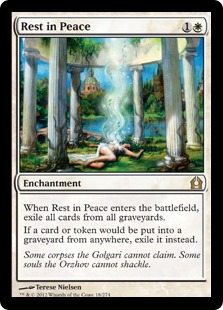
Oh yeah, hate. Modern has a myriad of cheap and efficient hate. Don't care about your own graveyard and you're playing white? Rest in Peace is clearly the way to go. If it stopped there, Dredge would be great all the time. Too many people don't fit into that slim category. However, with the cardpool Modern has to offer, there are many more reasonable choices. Playing black and want a card that is good in fair matchups and unfair ones? Nihil Spellbomb. Not playing black or white? No problem! Would you like Surgical Extraction, Leyline of the Void, Ravenous Trap, or Relic of Progenitus? Yeah I guess you can play Tormod's Crypt if you really want to...

No matter what matchup you are playing, people are going to have graveyard hate in Modern, and frankly, that's a good thing. Graveyard use in the format is too ubiquitous, especially in any deck trying to do anything remotely unfair. It's important that every archetype has access to hate, or decks like Dredge would run wild. At the very least, it would choke the format into a place where you had to be playing the right colors for hate, or be doing the thing that required said hating.

That said, I think Dredge is powerful enough that even when it is an expected archetype, even when people are packing that extra fourth graveyard hate slot, the deck is still a reasonable choice. Its ability to be proactive and powerful early coupled with a sideboard of anti-hate allow it to win games through Rest in Peace, or Relic of Progenitus. On top of that, you win a surprising number of games by just hardcasting Amalgams and Ghasts. That is the advantage of playing this fetchless manabase; being able to consistently cast Narcomebas and Amalgams is incredibly important, and in my opinion, more important than using a fetchland to play around Anger of the Gods.

I hope you enjoy the matches and as usual, I'm interested to hear what kind of content you'd like to see moving forward so I can continue to evolve and improve my videos. Please let me know your thoughts, and any improvements you would like to see concerning formatting, presentation, or whatever else strikes your fancy. If you'd like to see similar content, check out my Twitch channel for some live Modern games!

[youtube https://www.youtube.com/playlist?list=PL261kJ_cAQC8emUukXjy-INuWfzf2Hr3X]

Dredge, by Ryland Taliaferro

Creatures

4 Bloodghast
3 Golgari Thug
1 Haunted Dead
4 Insolent Neonate
4 Narcomoeba
4 Prized Amalgam
4 Stinkweed Imp

Instants

1 Darkblast

Sorceries

4 Cathartic Reunion
1 Collective Brutality
3 Conflagrate
4 Faithless Looting
3 Life from the Loam

Lands

3 Blackcleave Cliffs
4 Copperline Gorge
3 Dakmor Salvage
4 Gemstone Mine
1 Karplusan Forest
4 Mana Confluence
1 Mountain

Sideboard

2 Abrupt Decay
2 Ancient Grudge
2 Collective Brutality
1 Darkblast
1 Destructive Revelry
1 Driven // Despair
2 Lightning Axe
1 Start // Finish
2 Surgical Extraction
1 Vengeful Pharaoh

Insider: MTGO Market Report for November 29th, 2017

Are you a Quiet Speculation member?

If not, now is a perfect time to join up! Our powerful tools, breaking-news analysis, and exclusive Discord channel will make sure you stay up to date and ahead of the curve.

Welcome to the MTGO Market Report as compiled by Matthew Lewis. The report will cover a range of topics, including a summary of set prices and price changes for redeemable sets, a look at the major trends in various Constructed formats and a "Trade of the Week" section that highlights a particular speculative strategy with an example and accompanying explanation.

As always, speculators should take into account their own budgets, risk tolerances and current portfolios before buying or selling any digital objects. Please send questions via private message or post below in the article comments.

Redemption

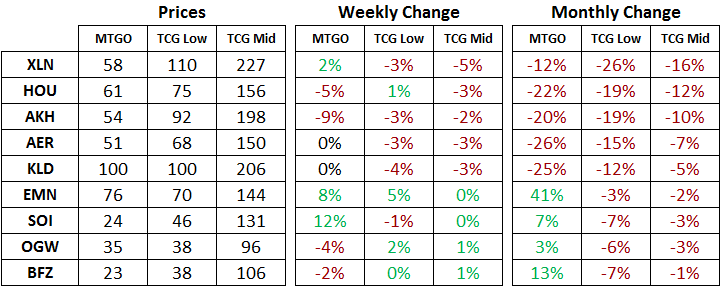
Below are the total set prices for all redeemable sets on MTGO. All prices are current as of November 20, 2017. The TCGplayer low and TCGplayer mid prices are the sum of each set's individual card prices on TCGplayer, either the low price or the mid price respectively.

All MTGO set prices this week are taken from GoatBot's website, and all weekly changes are now calculated relative to GoatBot's "full set" prices from the previous week. All monthly changes are also relative to the previous month's prices, taken from GoatBot's website at that time. Occasionally, full set prices are not available, and so estimated set prices are used instead. Although Hour of Devastation (HOU), Amonkhet (AKH), Aether Revolt (AER) and Kaladesh (KLD) are no longer available for redemption, their prices will continue to be tracked while they are in Standard.

Last week I got a bit of a shock when I realized that Battle for Zendikar (BFZ) and Oath of the Gatewatch (OGW) both went offline for redemption, alongside Dragons of Tarkir (DTK), Magic Origins (ORI), AKH and HOU. What happened was that the redemption cutoff date for BFZ and OGW was set to be about half a year after they were scheduled to rotate out of Standard. When Wizards of the Coast returned the Standard rotation schedule back to its previous incarnation, this meant that these two sets would get an additional six months in Standard, but they didn't adjust the redemption cutoff date. My assumption was that the cutoff date would adjust to be about a year after they rotated out of Standard, like all sets prior. This assumption was a big tactical error on my part, leading me to allocate too many tix to these two sets.

With redemption ended on BFZ and OGW, the link between paper and digital prices has been severed. Any card that had most of its value due to redemption will be falling in price and should be sold off immediately. Cards like Omnath, Locus of Rage and Kozilek, the Great Distortion come to mind. Modern staples like Thought-Knot Seer will be in demand as we get closer to the Modern Pro Tour in February, so holding these is fine, but a fringe Modern playable card like Nissa, Voice of Zendikar has more downside than upside at the moment.

When I make a blunder like this, it's important to realize a few things. One, mistakes happen, but it's important to recognize what went wrong and make adjustments as necessary. In this case, a rapid sell off in junk rares and mythic rares was the best thing to do. Next, good diversification has protected me from the full downside on these two sets. In October, I was also buying Shadows over Innistrad (SOI) and Eldritch Moon (EMN), which have shown nice gains and still have runway ahead of them. In this case, buying EMN was a difficult decision since it felt expensive relative to the other sets, but it looks like it will be the big winner at the end of the day. Without proper diversification, I might have avoided this set and torpedoed my returns.

Standard

A full set of Ixalan (XLN) has shown some stability in the last week; the 55-tix level is the new price floor and players looking to round out their collections with this set should consider that level for a purchase. I'll be waiting until the release of Rivals of Ixalan (RIX) to ultimately start speculating on XLN. February will be a good time to be loading up on full sets of XLN, though the end of XLN block draft in the spring will be better for targeting full sets of RIX and singles.

There was an error retrieving a chart for Vraska, Relic Seeker

The one exception to this is foil mythic rares from RIX. This is going to be the slam dunk trade in Standard during the month of January. The economic reasoning around buying foil mythic rares hasn't changed, and the example of XLN shows that a lack of Masterpieces can support higher set prices, including foil sets. This magnifies the opportunity, and I think XLN and RIX will ultimately show the best recent returns on this strategy.

There was an error retrieving a chart for Heart of Kiran

In terms of when to sell Standard cards, I'll want to be a seller in February of any positions that are stragglers. This basically looks like singles from KLD, AER, AKH, and HOU, including those ones with Modern crossover appeal like Spirebluff Canal. Hopefully RIX will shake up the Standard metagame and push lesser used cards into the foreground. I'm holding Heart of Kiran with this exact plan. It's been hovering around the 8-tix mark, but it doesn't look like it will be breaking out in this iteration of Standard.

Modern

Modern prices renewed their march higher on Thanksgiving weekend in the US. with Mox Opal close to reaching its two-year high and Scalding Tarn cresting 30 tix for the first time since the summer of 2016. There's no doubt that the bull market is continuing for the moment, so I am still holding on to my positions, while also adding Modern staples and playable cards from Iconic Masters (IMA).

There was an error retrieving a chart for Scalding Tarn

January will be a prime selling window in advance of the Modern Pro Tour. Vintage Cube is coming for the holidays, and this will take the focus of many players. Once we ring in the New Year, players' attention will shift to the next big ticket item on the agenda, that being Modern. There's always a few stragglers who wait until the last minute to get their decks together, so this is when the patient speculator wants to be a seller.

Standard Boosters

With IMA's draft winding down, the price of an XLN booster has recovered, hitting 3.2 tix briefly this week before coming back down to 3 tix. If you are still holding, don't wait for a further rebound and just sell now. The chances of this recovering to 3.2 tix to 3.3 tix level are slim. As mentioned, Vintage Cube is coming in December for the holidays and XLN draft will increasingly be seen as a lame duck draft format with the release of RIX so close. I don't want to be holding any XLN boosters until the release of Dominaria in the spring.

For AKH and HOU boosters, February and March will be the prime selling window. It's okay to lighten up on these now, but there is still 0.5 to 1.5 tix in upside for a draft set. If I need tix, I'll sell some boosters, but for the moment these are still a strong hold.

Trade of the Week

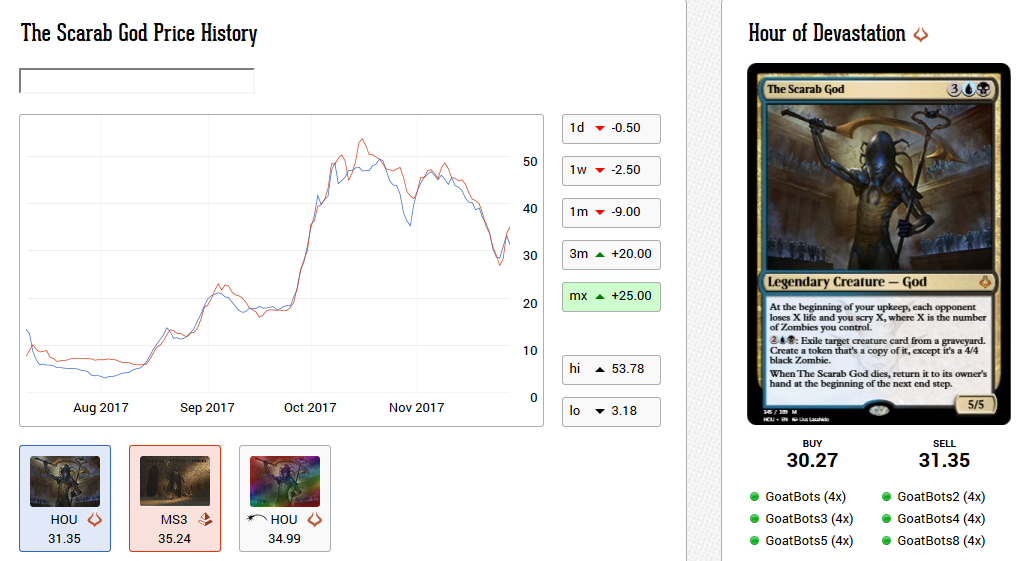
For a complete look at my recent trades, please check out the portfolio. With the end of HOU redemption, The Scarab God sold off and dipped below 30 tix this week before recovering to 32 tix. It's very natural for this type of activity to occur since redemption is a real source of value. When it disappears, the card has lost value and a sell-off ensues. However, the nature of the any market is that when sellers overwhelm buyers, the price drops too low. In this case, "too low" means beneath its play value. Although there is no perfect way to measure play value, Chandra, Torch of Defiance has regularly cycled up and down between 30 and 40 tix and hasn't been redeemable for months. Thus, its price must reflect its play value. I'd look for The Scarab God to take a run at 40 tix sometime over the next three months.

What was interesting about this trade was the price of the Masterpiece version of this card. Even though the price of the HOU version had already recovered to 30-plus tix, there were still Masterpiece versions available for 28 tix or less. Scooping up these cheaper versions seemed like a no brainer, since it is exactly the same in-game piece. If you look at this chart from GoatBots, you'll see the two version largely track each other over time.

A sustained drop below 30 tix combined with a shift in the Standard metagame would force me to reevaluate this position. A jump into the 38- to 40-tix range is a good target price for an exit.

I made a late trade this morning just prior to the scheduled downtime where I snapped up 60-plus copies of Primeval Titan. This card peaked at 20 tix just a few months ago, but had fallen into the 6 to 7 tix range with the reprint in IMA. Combined with a downturn in Titan Shift's play in Modern, this has created an oversold situation perfect for speculators. A 9- to 12-tix price is more like fair value on this card, and I anticipate a return to this price range in the next six weeks. If Titan Shift sees a resurgence in the Modern metagame, a 12- to 15-tix price is conceivable.


Insider: Scouring for Low Reprint Risk in Casual Cards

Are you a Quiet Speculation member?

If not, now is a perfect time to join up! Our powerful tools, breaking-news analysis, and exclusive Discord channel will make sure you stay up to date and ahead of the curve.

The Masters reprint series have really changed the way that we all think about Magic singles finance. It used to be that one simply acquired the best, most powerful staples and held onto them. Time + Demand = Profit. Easy game.

Reprints really put a damper on the obvious strategy. Before, the passage of time created scarcity which added to the value of one's collection. However, when any card non-Reserved List card can simply be reprinted at any time and for any reason, well—time for a new strategy.

Reserved List: The New Obvious

Personally, I think the smartest money in singles investment are old cards and Reserved List cards. The reasoning behind this logic is pretty straightforward. Reserved List cards cannot be reprinted which makes them relatively safe and stable investments. In fact, it makes them great investments.

Singles with old cardface also have a distinct advantage of looking different. The older versions are classic and iconic which makes them better able to weather the storm of a reprinting. New-cardface Mana Drain or Berserk will never have the same cachet as the originals.

There was an error retrieving a chart for Mana Drain

Old cards and Reserve List cards are the best and safest investments in Magic and I stand by that statement.

The downside of investing in old cards and Reserved List cards is that the price to buy in is pretty high on a per-card level. There are different strategies for investing in old cards that have been discussed here by various authors, but the gist of most of these strategies is, "Slow and steady wins the race." There is some ability for cards to spike, but for the most part the cards just slowly, gradually tick upward and onward over time.

Investing in Reserved List cards isn't a "get rich quick" scheme, it's more of a "get even more rich slowly over time" strategy.

Low-Reprint Possibility

Okay, so let's say that you don't want to invest several hundreds or thousands of dollars into cards that will generate on average a few percent every year or so. What if you are looking for more of a get-rich-quick scheme? Or, at the very least a strategy where a smaller buy-in has a decent chance of making a larger percentage gain?

I think there is some game to be had in this area, but it isn't without risk. It is obviously more of a gamble, but that the upside is much higher and the buy-in lower.

My general strategy for this kind of investing is to look for cards with low price points that I can hold onto for a while, but also to focus on cards that I think have a generally low probability of being reprinted.

The obvious problem with this statement is the "generally low probability of reprint" part. I've already stated that anything can be reprinted for seemingly any reason. How can we know? Well, we don't for sure. We're just making educated guesses.

There are a few attributes I can point out that make a card ripe for a reprinting.

  1. The card already sees a lot of constructed play. Wizards wants to reprint cards that people want.
  2. The card has recently spiked. Cards that have spiked in the past six months carry a lot of demand, and demand sells packs.
  3. The card hasn't seen a printing in a significant amount of time. It's not a hard-and-fast rule (none of this is) but cards that haven't seen print in a while have more demand than ones that have been printed recently.

So, as a general rule, for this type of investment I'd be looking for cards that have a stable, low price tag; see fringe constructed play (but not a ton of it); and haven't see a printing in some time.

Commander & Casual Constructed

For the purposes of investing, "constructed play" also extends to casual formats such as Commander or any other fringe format. In fact, these might be the best formats to look for exactly the type of cards that I'm describing.

I don't play a ton of Commander. I play it some, but I'm not deeply invested in it as a format. I don't regularly try out new cards or build decks. I have the cards to build a few generals that I like and that is about the extent of my experience.

To get more insight I went right to the horse's mouth and started looking at Commander decks online to see what other people like to play. I looked for examples of cards that fit the description that I just laid out. Here are a few cards that stood out as having potential:

There was an error retrieving a chart for Knacksaw Clique

Here's an excellent example of what I was trying to describe personified. The card has been in that couple-of-dollars range for a zillion years. It hasn't seen a reprint, ever. It sees some fringe play in casual formats. It is kind of unique and interesting.

It's unlikely to ever be reprinted but it has that "fun, playable" quality that people enjoy. It's probably a good pick-up.

There was an error retrieving a chart for Sepulchral Primordial

It's been a while since Return to Ravnica block came out. The card has basically been a buck forever. However, the card is quite great. I think this is a strong pick-up-and-hold right now. It could get reprinted in a Commander deck but it seems unlikely as it is part of a cycle where one is banned.

There was an error retrieving a chart for Cryptolith Rite

Another solid commander card that fits my mold. Cheap, but good. Relatively new printing that has rotated out of Standard. Fits the criteria.

There was an error retrieving a chart for Notion Thief

Another great casual card. I've even seen this card played in Vintage and Legacy. It's basically a bulk rare. I think cards like these make really nice investments. I always pull them out of three-for-a-dollar boxes and stash them away. It fits the model.

These are the kinds of cards I'm often looking for as fringe investments. There are enough people playing such a style of Commander to build interest, but not so many that these cards really warrant or require a reprinting.

There are not enough people who want Knacksaw Clique to make a reprint necessary. However, the card is pretty cool and there are some people who want it. It hasn't been printed in ten years, which makes it kind of annoying to find, which makes the price tick up. As the price slowly ticks up people take notice and are like, "Wow, I didn't realize that was worth anything...." The price goes up again.

Another group of cards that fit into the model are the Commander deck cards. In general, these cards don't come out of the gate uber expensive. They are a mass-produced printing and aside from the one or two chase cards per deck these cards fall into anonymity. However, they do tend to tick upwards over time. I've noticed they are hard to get and stock at the LGS. People who buy the unique decks don't tend to sell the individual cards off and break up the set.

I wouldn't get caught up in how "good" or "bad" these spec targets are, but rather try to focus more on how the players who use them feel about them. A lot of Commander groups are more focused on playing the style of games their playgroups enjoy. AKA, not the most spiky, miserable combo match-ups imaginable. A lot of these medium-range cards become quite good once there's a gentleman's agreement not to do "unfun" stuff.

Keep in mind, all of this stuff is exactly why I don't play Commander—it's too complicated for me to personally navigate the world of fun or not fun. I play battle box "for fun" because it's always fun by my definition. Nevertheless, a lot of people like to create that Battlebox feeling by building their own wacky decks.

Dig for Value

I use this strategy a lot when I'm digging through three-for-a-dollar boxes at Grand Prix tournaments before or after the event when I'm bored. You are already getting the cards cheap, which works in one's favor, but when you have a strategy for predicting which cards have the most upward mobility it makes those investments even stronger. Look for cards that:

  1. Have fringe playability somewhere, even in casual formats.
  2. Have not seen significant price gain for an extended period of time.
  3. Have not seen a print for a while.

I think these are really solid parameters for thinking about cards with a decent chance of making you some money down the line. These are like scrappy underdog cards. They are decent enough that some people will find a way to play with them, but not so obviously busted that they are already expensive and/or demand a reprint.

It's a fine line to walk, but there is decent money to be made here. The other good news is that when you "hit" you hit pretty hard. Since the cards are relatively cheap to acquire, when they go up in value they often make tremendous percentage jumps. It's not that uncommon for these types of cards to double or triple your investment.

Anyways, this is yet another outside-the-box way to grind some value out of Magic.

Daily Stock Watch: Geist of Saint Traft

Are you a Quiet Speculation member?

If not, now is a perfect time to join up! Our powerful tools, breaking-news analysis, and exclusive Discord channel will make sure you stay up to date and ahead of the curve.

Hello, everyone and welcome to the Tuesday edition of the Daily Stock Watch! Today, I'll be featuring a card that has seen its fair share of ups and downs, both financially and exposure-wise, but I think will be a force again soon. It's one of the beloved creatures of blue mages, and will always be loathed in Duel Commander by a lot of players.

Our card for the day is Geist of Saint Traft.

There was an error retrieving a chart for Geist of Saint Traft

GST has been a multi-format staple ever since it was printed. It is evasive, protected by the control-oriented base color of blue and white, and bashes you in the head with a 4/4 angel whenever he attacks. It is a blue mage's light sabre, capable of controlling the force, and winning games quickly if left unanswered.

It has forced countless Commander players to adapt to its presence, making sure that they pack an answer to a turn three GST in their decks, and instilling fear to Modern players, by being a vital cog of Jeskai shells. It formed a lethal aggro deck from the unlikeliest colors back in 2012 when it teamed up with Snapcaster Mage, Delver of Secrets, and Restoration Angel to dominate Standard with Azorious Aggro. Now, it's slowly crawling its way back up to prominence by showing its fangs once more in Modern.

Jeskai Midrange

Creatures

3 Geist of Saint Traft
4 Snapcaster Mage
4 Spell Queller

Instants and Sorceries

4 Cryptic Command
2 Electrolyze
4 Lightning Bolt
3 Lightning Helix
2 Logic Knot
4 Path to Exile
4 Serum Visions
2 Spell Snare

Lands

4 Celestial Colonnade
4 Flooded Strand
2 Hallowed Fountain
3 Island
1 Mountain
1 Plains
1 Sacred Foundry
4 Scalding Tarn
2 Steam Vents
2 Sulfur Falls

Sideboard

1 Abrade
1 Celestial Purge
2 Disdainful Stroke
2 Dispel
1 Engineered Explosives
1 Izzet Staticaster
1 Negate
2 Pia and Kiran Nalaar
2 Relic of Progenitus
1 Supreme Verdict
1 Vendilion Clique

Players have started to realize that you don't actually need four copies of GST in your deck to win games -- you just need a clear board to drop it there, so you could ride it all the way to victory. This deck clearly shows that with more removal and permission spells, and the aide of Snapcaster Mage and Spell Queller, now might be the best time to believe in GST again to succeed in Modern.

With the help of my Utility Tracker, I was able to find out that 5.4% of winning decks over the last two months have used an average of 2.8 copies of GST in their decks. Snap has posted the most impressive number, with 19.9% of winning decks using at least 3.5 copies of it, thanks to its exposure in Grixis Death's Shadow and Jeskai decks. The rise is significant for GST, considering that only 2.2% of winning decks have used it prior to the last two months, especially in a very healthy Modern environment that is considered as arguably the most diverse format in Magic right now.

GSTs Friends

These cards, with the exception of Angelic Destiny and Spell Queller, have already been printed more than once in recent years. I think that GST is primed for its first reprint in any of the following Masters sets next year that's not named Masters 25, but I expect him to see tons of action in the next two to four months, regardless if something gets unbanned in February.

Right now, Star City Games is out of stock of all copies of GST, but you should see a number of it via TCGPlayer in the $12-$15 range for Innistrad normal copies. If foils aren't your thing but you need a playset for deck building purposes, the Duel Decks: Blessed vs Cursed version is cheaper at around $8.97 up to 10.99 via TCGPlayer and Card Kingdom. I don't like the idea of buying foil copies from Innistrad, since there already are different foil versions (Duel Deck and WMCQ) that could hurt its value in the long run, but the original art is what I personally like the most.

I really think that GST will be back in the $15-$20 range in the next month or so, and I'd say this is a good pick up. It should be winning more tournaments soon, and I think the pros would consider it for Pro Tour Rivals of Ixalan. Get on the hype train before it begins. It should be fun and profitable.

And that’s it for the Tuesday edition of the Daily Stock Watch! See you again tomorrow, as we take a look at a new card. As always, feel free to share your opinion in the comments section below. And if you want to keep up with all the market movement, be sure to check in with the QS Discord Channel for real time market information, and stay ahead of the hottest specs!

Insider Field Report: Grand Prix Atlanta

Are you a Quiet Speculation member?

If not, now is a perfect time to join up! Our powerful tools, breaking-news analysis, and exclusive Discord channel will make sure you stay up to date and ahead of the curve.

Hello, all. My name is George Tudor, and this is my first finance article for Quiet Speculation. I have been playing Magic since 1996 (I started during Mirage block) and am now a two-time previous level 1 judge from Florida. Today, I’m going to tell you some of the excitement and pitfalls from my Grand Prix Atlanta experience, including my experiences with the vendors.

Overall, Grand Prix Atlanta was a horrendous experience for me, somewhat because of the event itself, but mostly due to outside circumstances. However, I can strongly recommend these events for players who are casual or semi-competitive – Grand Prix offer by far the widest range of experiences for playing, trading, selling, or meeting famous Magic players and artists.

There was an error retrieving a chart for Liliana of the Veil

So what was supposed to happen at the GP? I was supposed to have all of my cards sorted alphabetically by set and further divided into foils, non-foils and foreign cards. I feel this is the easiest way to sort cards in order to sell or put into trade binders for a large event like a Grand Prix. Unfortunately, I didn’t have enough time before the event to have all of my cards sorted, which caused some issues when trying to sell them – more on that in a bit.

My experiences with the vendors were mostly positive. I was a little intimidated, as even though I’ve been playing for a very long time, this was my first event that I attended solely to trade and sell cards. For many years in the past, I always thought vendors were simply ripping players off with high prices and mediocre service. However, as I have gotten older and wiser, I have come to realize that at the end of the day, these vendors are trying to operate a business and in order to be profitable, they must sell cards at events at higher prices than they would otherwise. There are two primary reasons for this:

  1. The price to simply have a booth to buy and sell cards at a large event is very expensive. These companies have to pay for the booth itself, the individuals’ salaries that buy and sell cards for them over the weekend, food, travel, and lodging expenses, plus determining the logistics of getting all the cards they purchased back to their stores.
  2. The basic premise of supply and demand. At large Constructed events, if players are trying to finish their decks at the last second, they are willing to pay a premium to acquire cards that they wouldn’t normally purchase at high prices. A prime example was me trying to help a friend finish purchasing cards for the mono-red deck he planned on playing in the Grand Prix. The cheapest prices we could find for Hazorets and Ramunap Ruins on site were $20 and $1 each, respectively. While these cards are much cheaper on many other websites, you are paying for convenience.
There was an error retrieving a chart for Ramunap Ruins

Vendor Reports

Here are the vendors I sold to and the amounts I received from them:

  • Alter Reality, Aaron ($350) – Aaron was friendly. Some of the prices Alter Reality offered on Standard cards were significantly lower than other vendors on site. Also, on their printed buylist for the weekend, they had Wurmcoil Engine listed at $9, but when I tried to sell him one he put it in the $8 pile. He may have simply forgotten or they may have already purchased several, I’m not sure.
  • Miniature Market, Jason ($66.50) – Jason and I have a friend in common who is the manager of one of Cool Stuff’s stores, so we had a good conversation. They had very good buy prices on Standard cards compared to some of the other vendors, and I sold several of the cards I bought from collections or bulk lots here.
  • Troll and Toad, Kyle ($303) – Kyle was awesome, very friendly, a funny conversationalist, and made me feel very comfortable during the whole transaction. Troll and Toad offered some great prices on foils, so I sold a lot of foils here, including a couple of Expeditions that I had been hanging onto for awhile. They also had some good buy prices on obscure Standard cards.
  • Cool Stuff, Inc., Jim ($51) – Jim is a good guy who I have seen many times while judging and playing Magic in Florida, and my interaction with him as a buyer was excellent as well. He’s pretty quiet, but found several cards and priced them very quickly. I wish I would have had more cards off of Cool Stuff’s buylist, as they were offering an insane 30-percent trade-in bonus and had an UNL Mox Emerald and UNL Mox Jet at very good cash prices that became insane with the bonus figured in. (The Emerald was priced at $900 cash, which comes out to only $692.30 in trade-ins!)
  • Cape Fear Games, Curtis ($55) – Curtis was also an excellent buyer, and while CFG unfortunately wasn’t able to offer top dollar on bulk, they did have very competitive buy prices on everything else.
There was an error retrieving a chart for Mox Emerald

I was pleasantly surprised at how excellent all of my interactions with the vendors were. I was half-heartedly expecting to have many aggressive traders, trying to pressure me into accepting sub-optimal deals, but that simply wasn’t the case. All of my interactions with the buyers were great. They were friendly, accepting when I didn’t like an offer, let me counteroffer, and were understanding that I was their customer. They all treated me like a person and not an ATM, which I greatly appreciated.

Unfortunately, I did have one negative experience with one very well known vendor; however, I am giving that vendor time to rectify the situation before I discuss it publicly. If any of you would like more information, feel free to message me on the forums or on Discord.

The Takeaways

Here are some recommendations I have for others based on my experience:

  • Make sure you have all of your cards sorted ahead of time. I can’t stress this enough. I had a goal of selling $5,000 worth of cards to vendors at the Grand Prix, and I was lucky to walk away with somewhere over $800. If my collection was sorted properly, I know I could have easily walked away with much more.
  • Don’t be intimidated by a buyer and don’t be afraid to ask for more if you don’t agree with a price. The worst anyone can say to an offer is no, and if they make you feel uncomfortable, you have every right to refuse a transaction and walk away. I want to make sure that those selling to vendors for the first time understand that you have a right to refuse any offer and you can also counteroffer. With counteroffers, I would stress not to do too many in small transactions, as time is invaluable for both the buyer and the seller, but in large transactions, I feel very comfortable asking for a little more, especially on higher-value cards. If you ever feel uncomfortable or pressured, it is always okay to say no and walk away. Maybe the vendor’s offers were fair and your expectations of a card’s value are too high… or maybe you find a better deal from another vendor. Either way, never feel like you have to sell something to a vendor at a price you feel is unfair; it’s okay to negotiate a better offer or just outright decline.
  • Utilize Trader Tools to get a good idea of what values are before you go to a large event, and create and organize an “Ogre Box.” Because I didn’t have my cards sorted, I wasn’t able to utilize this, and I feel this was my gravest mistake. Filling a four=row box with cards with escalating values can help you get rid of a ton of cards at once, and saves both you and the vendors time. I can almost guarantee my experiences would have been much more positive than they already were if I knew what I wanted to sell and who I wanted to sell it to and had an idea of a price range I was willing to accept before I even walked into the room.
  • Have a plan of attack before the event so you maximize the efficiency of both your and the vendors’ time. Time is money, and time is the one resource that we can’t get back once it’s gone. I printed out a document with my plan of attack for this particular event… then failed to email it to myself and promptly forgot the hard copy at home.
  • Try to sell cards as early as possible. I know many of these items have been said a million times before, but I will reiterate what others have said: vendors come with a certain amount of cash and they want to buy as many cards as possible over the weekend. This is a great chance for vendors to interact with hundreds or thousands of people each day, all with varying cards and collection values, and as badly as many people want to sell their cards, the vendors are equally eager to buy your cards, either to fill their cases with stock back at their local stores or to ramp up for upcoming local or regional events.
There was an error retrieving a chart for The Scarab God

I hope you all find my misfortunes beneficial to planning for your future events. Remember to relax and have fun! After all, this is the greatest game in the world. Feel free to leave comments or questions below, in the forums, or you can also reach me on the Quiet Speculation forums or private Discord channel if you are a subscriber. Thanks for reading, and I look forward to your feedback!

Don’t Metagame GP Oklahoma City

Are you a Quiet Speculation member?

If not, now is a perfect time to join up! Our powerful tools, breaking-news analysis, and exclusive Discord channel will make sure you stay up to date and ahead of the curve.

Next week is Grand Prix Oklahoma City, the biggest Modern event before the Pro Tour. And this week, there is a Modern Open alongside the SCG Invitational. These events should generate a lot of useful data. It will be tempting to wield this data and metagame your deck ahead of the Grand Prix. I am warning you to avoid this trap. While it's possible to game the field and succeed, it is improbable. Instead, focus on making your current deck as robust and versatile as possible. In a field as wide open and unpredictable as Modern, it's a more reliable strategy.
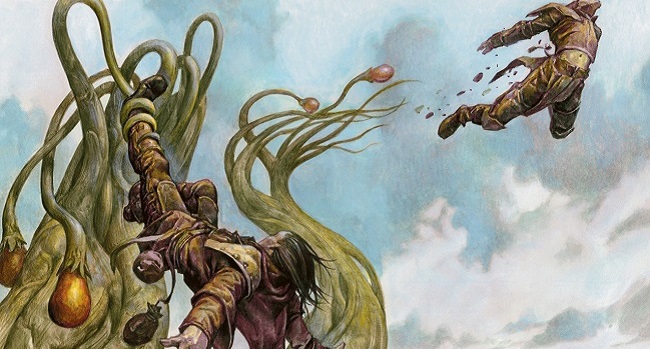
Building around the incoming data is tempting for me, as well---I am doing a lot of data gathering and analysis myself. Next week, I'll add the Open results to that data set, building as clear a paper metagame picture as I currently can. As such, I could assume to have a definitive read on the metagame and plan accordingly. Or at least come up with a bold declaration and click-baity title to boost my unique view count. However, I know how much uncertainty there actually is in the wider metagame. I also don't enjoy sticking my foot in my mouth (I do know where it's been, after all). Instead, I will examine the metagame trajectory leading into the GP. From there, I will discuss how to actually prepare your deck for the GP.

The Current Metagame

Let's start by looking at where the metagame currently stands. I have not updated my tables since all the Regionals results came in, mostly because I'm leery of the Baltimore Classic results. It was a team open; those tend to promote and reward weird deck choices, and that weirdness is often reflected in the Classic results. Regardless, the dataset we have is more than adequate.

DeckTotal
Jeskai Control18
Affinity17
Gifts Storm14
Grixis Death's Shadow11
Eldrazi Tron9
Counters Company9
Infect7
Humans7
UW Control6
Abzan5
Burn5
UG Merfolk4
Bant Company4
GB Tron3
Jund3
Elves3
Ad Nauseam3
Titan Shift3
Mardu2
UR Breach2
BW Eldrazi2
GW Company2
GR Ponza2
Death and Taxes2
Mono-G Tron2
Titan Breach1
Saheeli Evolution1
8-Rack1
Temur Aggro1
Knightfall1
BW Eldrazi and Taxes1
5-Color Death's Shadow1
GR Devotion1
RW Prison1
Bant Eldrazi1
Abzan Company1
Grixis Control1
Living End1
Skred Red1
Bogles1
4-Color Company1
RG Vengevine1
GR Tron1
Naya Company1
4-Color Knightfall1
GW Hatebears1
Grixis Delver1
4-Color Death's Shadow1

This table gives the illusion of definitiveness by compiling the past month or so of high-level paper results. With the strangling of MTGO results, this is the best data we have. Good data should lead to good decisions. Following that premise, one would expect that the best deck for GP OKC would be geared against Jeskai and Affinity, they being the clear two best decks. Having good plans for Storm and Grixis Shadow is also important.
Jeskai Control, Storm, and Affinity sit atop the field as they have all month, with Grixis Shadow snapping at their heels. Everything else lurks nearby. No reason to think anything will dramatically change. To put it broadly, we have lots of blue decks that maximize efficiency, both interactive decks and combo, and an explosive creature deck. Looking down the table, we have lots of decks that are similar but generally slower to Tier 1. They are either more interactive, resilient, or go bigger than Tier 1 decks to make up for reduced speed. So, would a fast deck that ignores interaction be favored?

This mentality eventually leads players to thinking that Bogles is good (Bogles being very much a metagame-call deck). And fair enough, it is winning, even if mostly online. However, it's done so before, and will likely always pop up whenever players aren't looking. That's what a metagame-call deck does. If it was an actually good deck it would see consistent play. If you try and use that deck to run the tables at a large, open tournament like a GP, prepare for disappointment.

The Trap

That Bogles kind of thinking is a trap. As Jason noted, the MTGO metagame is far more predictable than the paper one. There's no single explanation as to why this is true (and why doesn't matter much anyway), but results have consistently shown that there is far less diversity in the competitive MTGO metagame, so metagaming is more likely to payoff.

Predictability is the key to all metagaming. When playing a strong deck, raw power overcomes a lot of unpredictability. It shouldn't matter too much how unexpected and weird the opposing deck is, because yours is just better and will win anyway. When playing a glass cannon, nothing unexpected can happen. It is targeted at very specific strategies or interactions, and when those aren't present, the cannon shatters. That's metagaming in a nutshell: get it right and run the tables; get it wrong and go home early.
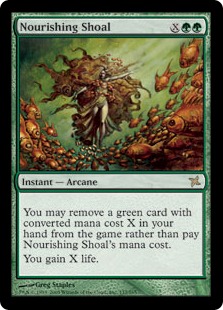
This problem was explained to me with the following analogy (if anyone knows where it's from, please remind me). The typical Tier 1 deck is an impenetrable fortress. Heavy cannons, massive fortifications, and a huge garrison make direct attacks suicide from anything not similarly equipped. The glass cannon is a ninja that can bypass all of that, enter the base and utterly destroy it---clean, quick, surgical, and embarrassing for that theoretically impervious fortress. However, if a random man with a dog and a gun happens along the ninja before he enters said fortress, the mission is blown. The dog raises the alarm, the man sees and shoots the ninja, whatever. Cover blown, fission mailed. The man has no chance against the fortress, but he can ruin the ninja's day. Therein lies the danger of trying to metagame a Modern Grand Prix.

The Grand Prix Metagame Problem

There will be a lot of figurative guys with dogs and guns at the GP (hopefully not literal ones). Remember my GP Vegas report? My friend played 8-Whack not only because he liked it, but because its speed let him dodge most interaction from Tier 1 and just win. He was very much gaming the system and became the ninja in my analogy. He just happened to hit the worst possible matchups the first two rounds. Decks that had no chance in the wider metagame, but were perfectly situated to ruin him. Weird and unique decks are the lifeblood of a Modern Grand Prix. You're not guaranteed to hit a given Modern deck in the first place, as no deck makes up enough of the metagame for that, but open tournaments notoriously bring out the fringe. You can't metagame fringe.

Day 1 vs Day 2

There is one caveat: the Day 1 meta is nothing like Day 2's. If you could start in Day 2, you absolutely could game the meta successfully, because it is likely to reflect the "real" metagame closely. Think about it: the "real" tierings are determined by win percentages from many players over many games. A large open tournament has many players and many games. The tournament's winnowing process is (sort of) the same as the actual metagame's, only accelerated. Thus, the best decks should rise to the top and make up the bulk of Day 2 while all those random armed dog walkers will have gone home.
For this reason, some players advocate preparing specifically for Day 2---focus your sideboarding strategies and testing on the "best decks" and don't worry about anything else. This never made sense to me. You can't just avoid Day 1. Even with byes, there's still a high probability of something weird sneaking through the first few rounds and even into Day 2. Furthermore, even if Day 2 does accurately reflect the true metagame, there's no reason to think your opponents will. Even in Standard, ostensibly bad decks make Top 16s. Right now, Temur Energy and Ramunap Red are the best decks, but Electrostatic Pummeler decks still win. Even mono-black aggro can get there. In Modern, it's guaranteed that something unusual will win. At least one will Top 8 and the Top 32 often features plenty of Tier 3 or lower decks. It's a wide open metagame; you can't just pretend otherwise.

That's why I don't include invitational tournaments in my metagame analyses. Frequently, the players will game their decks based on who they know will attend. For the SCG Invitationals this didn't used to be true, but they drastically cut the number of IQ's. So the population is smaller, and more players are likelier to be known, with biases towards certain decks or types of decks. This increases predictability and the opportunity to metagame. Worlds is worse; players have flatly admitted that it happens. It starts out non-representative, and when you add in that it isn't a random population sample, it really isn't a statistically valid result (no matter how interesting for other reasons).

Broaden Your Horizons

If you cannot directly metagame the Grand Prix, what can you do to get an edge? Over many years of playing GPs, I've found that small changes are usually best. Anything can show up on Saturday, so you need to be ready for that. It's very unlikely that you will find an actually unique way to attack such a large tournament. Therefore, I recommend embracing the openness and preparing accordingly. This is especially important for Tier 1 decks. Everyone knows about your deck, and therefore knows how to attack it. Rather than making huge changes and showing up with a subpar build, just anticipate how you can be attacked and preempt them.

Increase Robustness
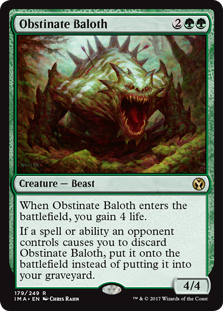
Every known deck has known strengths and weaknesses. Thus, players know how you attack and how to attack you. A very good strategy is simply to head off their attack by making your own strategy more robust post-board. Do you run a small number of win conditions, making you vulnerable to Slaughter Games? Just bring in more. Rather than relying on Primeval Titan, I've seen plenty of Valakut, the Molten Pinnace decks shift into midrange decks with Obstinate Baloth and Chandra, Torch of Defiance. Or, if you rely on the graveyard as Storm does, you dodge the hate cards with Empty the Warrens. Small changes like these that reduce expected lines of attack frequently provide more value than more dramatic alterations.

Maximize Sideboard Coverage

As noted above, the GP will have plenty of decks in many combinations. This will reduce the effectiveness of more narrow answers and reward those who plan for a broader metagame. Take out the really narrow answers and put in the broader ones. They may not be as effective in specific matchups, but being better across the board is more important. You will see something weird; you want to have something.

Don't Fret

Finally, have you ever considered just not changing your deck? Like I said above, it is very likely that even in the best circumstances you won't see the same deck more than once. You can take a loss or two in a long tournament and it doesn't hurt much. You deck has terrible matchups (this is Modern), and somewhere in the room somebody is playing that deck. Are you actually likely to sit across from them at any point? If it's a relatively common deck then be ready, but otherwise, why worry?
The other reason is that if you're making changes just for the GP, you probably won't have the time to adequately test. It takes considerable time to build a good sideboard. Trying to game a massive open field is time-consuming to begin with; do you have the time to substantially change things? The other thing you don't want to do is dodge right off a cliff. You may design the right repositioning strategy based on your read, only to have been wrong and hurt yourself. That matchup you expected took a more controlling form than you thought, and where your old plan would have been fine, now you're at huge disadvantage. Doing nothing would have served you better.

Consider this: during the Gunfight at the O.K. Corral, Wyatt Earp was the only participant who escaped injury, and he didn't move from his original position. Everyone else was trying to dodge for cover and was hit. Same thing happens in Magic. Older versions of decks will suddenly reappear because everyone adjusted away from them and now that older configuration is superior. Sometimes the best way to reposition yourself is to wait and let everyone else do it for you.

Don't Overthink Things

What I'm saying is whatever you've practiced and tuned going into Oklahoma City is what you should continue playing at Oklahoma City. Your deck is already part of the metagame, and must be doing well enough for you to travel to a Grand Prix. Don't panic and assume your deck isn't good enough for a big event just because it's a big event. My final advice is this: don't stress yourself out. Thinking too much about the problem gets you second guessing yourself, and that always leads to problems. You'll do better just by being confidant and relaxed. Next week I'll update the table again, and we'll see how it all plays out.


Insider: A Deeper Look at the Recent Rotation

Are you a Quiet Speculation member?

If not, now is a perfect time to join up! Our powerful tools, breaking-news analysis, and exclusive Discord channel will make sure you stay up to date and ahead of the curve.

Hi, guys.

The last times we talked about Standard rotation (here and here), I went through some predictions of things I predicted would happen along with the rotation. Let's revisit some of these highlights to see what we can learn.

The Eldrazi

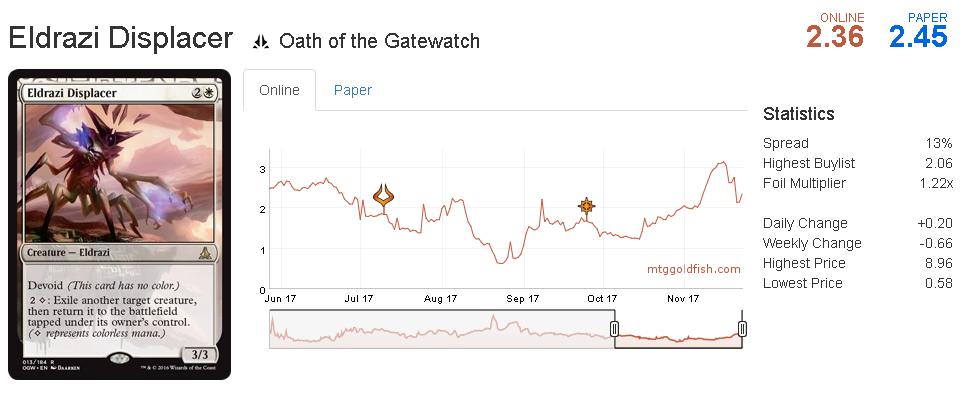
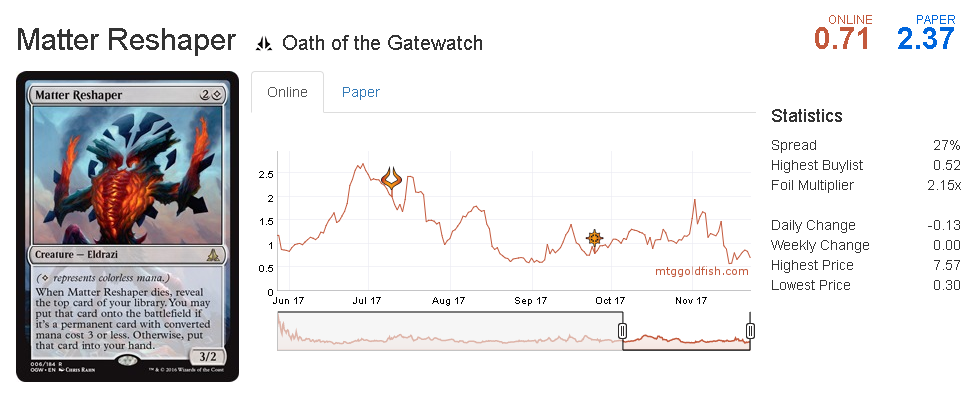
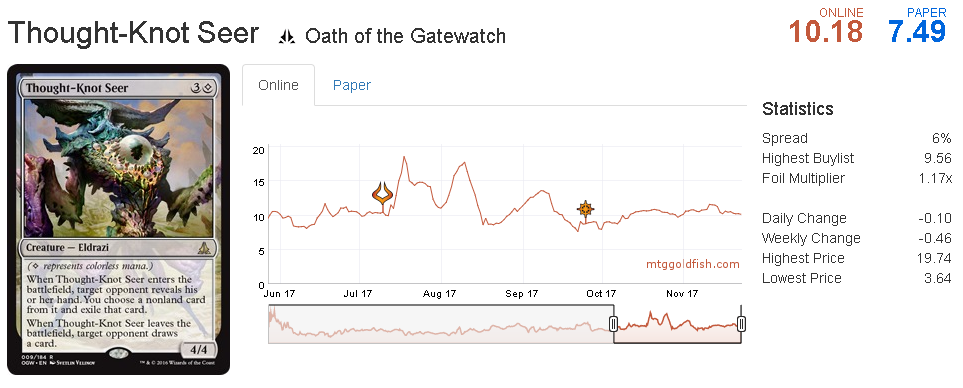
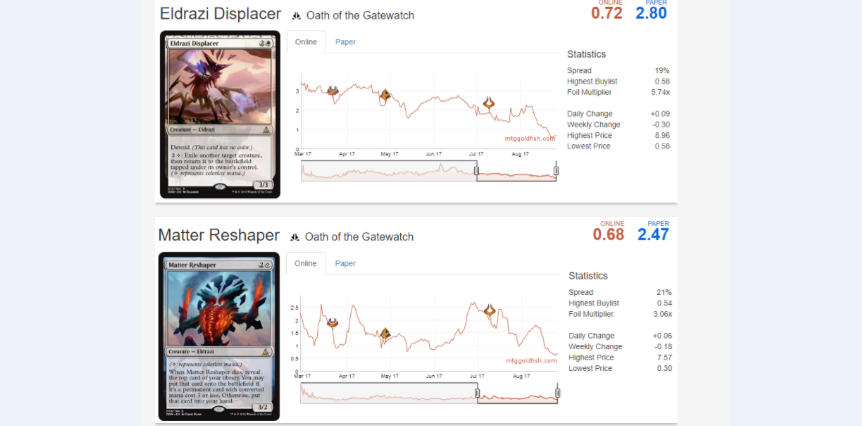
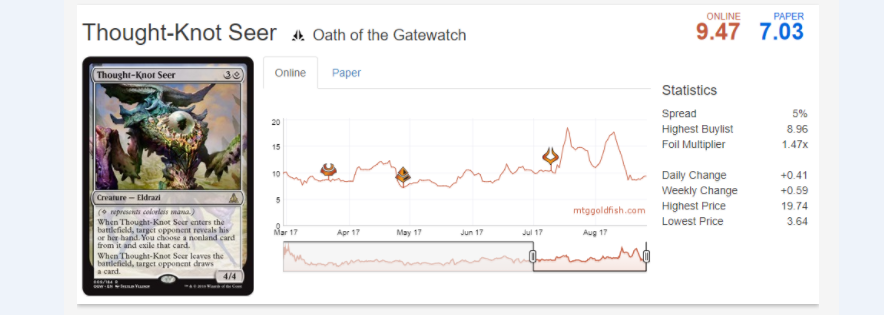
Among all the cards that rotated two months back, the Eldrazi are the obvious choices if you are investing your tickets in Modern speculations. Lets look at a few cards here: Eldrazi Displacer, Matter Reshaper and Thought-Knot Seer.

These are the most popular Eldrazi in Modern at the moment. Among the three, only Matter Reshaper remains at below 1 ticket, while the other two remain quite valuable even after rotation. Here's where the cards were a few months ago:

The price of Eldrazi Displacer went up between 1 and 2 tickets in September, pretty much in tandem with the Standard rotation. The price didn't go very low when players were getting rid of their copies because the card still had some demand in Modern or older formats. Soon after  rotation, the price of the card started to rise slowly as players started buying them for Eldrazi Taxes in Modern.

Compared to Displacer, the value of Matter Reshaper did not go as well. Displacer is played in more than one deck across multiple formats, while Reshaper is currently only being played in Eldrazi Tron. However, this doesn't mean Reshaper does not have potential to be a long-term gainer – overall, it's still a very annoying threat in Modern. When colorless Tron variations becomes the deck to beat again, that is when Matter Reshaper will earn us some profit.


Thought-Knot Seer went up to near 13 tickets at a point right before rotation. The reason behind this spike is probably that some Standard decks back then, like Mardu Vehicles and Mono White, somehow broke the format by playing this card instead of other usual components. This means that a Standard card can still go up in price two weeks before rotation due to its performance in premier events. It's rare that a card that is rotating can increase in price one to two weeks before rotation, but if by coincidence we had bought them as long-term speculations, this surprising Standard spike would have helped us earn some profit on a short-term basis.

Planeswalkers

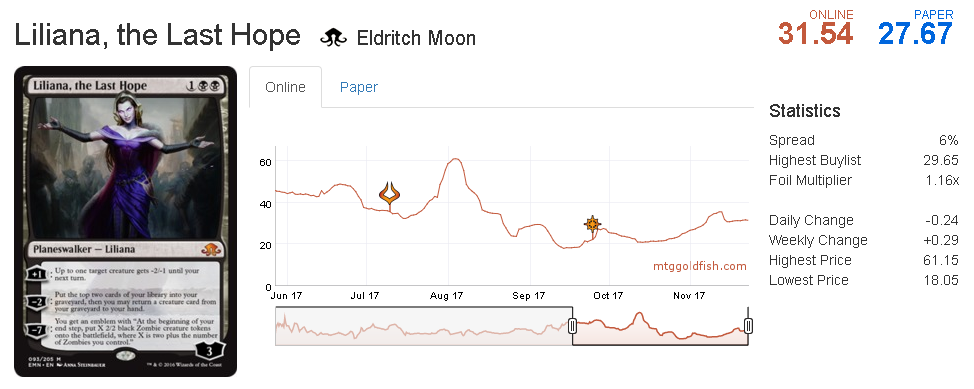
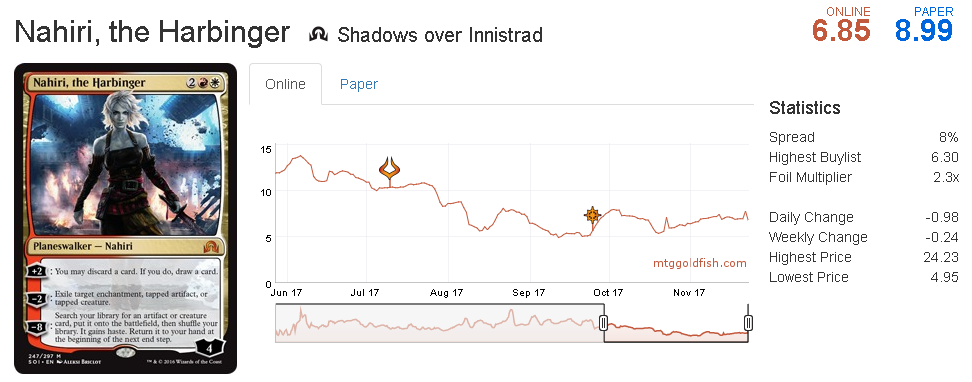
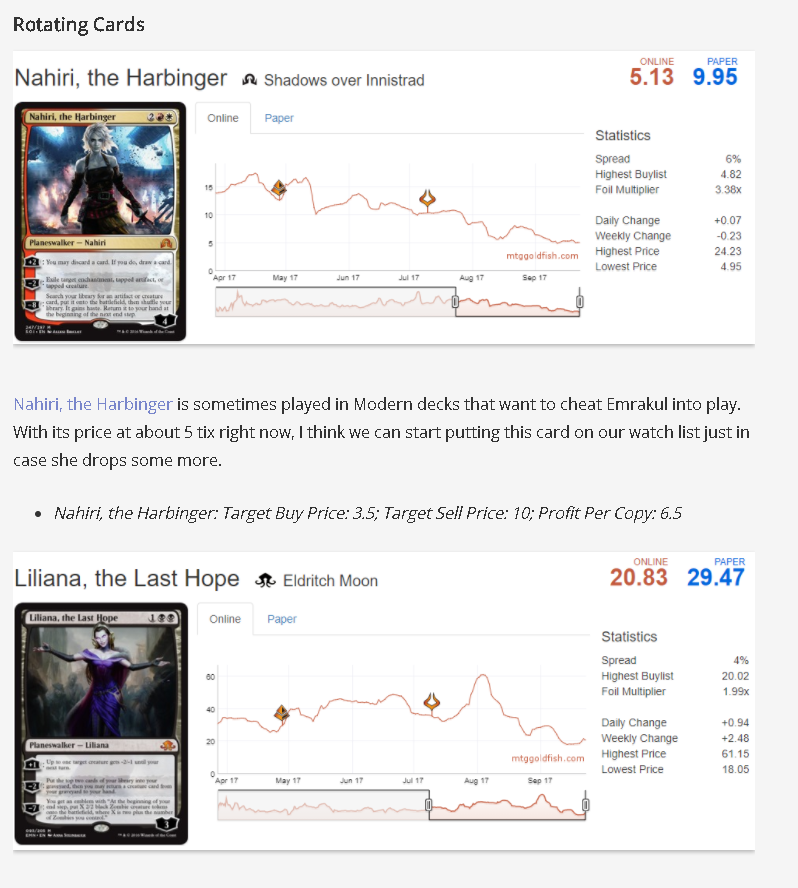
We shall look at the two best planeswalkers that rotated recently: Liliana, the Last Hope and Nahiri, the Harbinger. Liliana, the Last Hope is played in not only Modern but Legacy. I'm not very familiar with formats other than Standard and Modern, but if a card is played in older formats than these two, it generally indicates that the card is extremely powerful. As for Nahiri, she's not as popular, but remains stable between 5 and 7 tickets.

Let's look at the prices and some of my comments from previous discussions:

Many people would regret not buying Liliana, the Last Hope at that time once they see what's happened to her price now. This pick was pretty straightforward: as a planeswalker at 3 mana, with abilities that can generate card advantage, this is higher-than-average power level. You guys probably know what happened to Liliana of the Veil's price. Although the Last Hope is not as powerful as Liliana of the Veil, the card has a very high potential to grow further in value. If you ask me, it is safe to invest in Liliana, the Last Hope at her current price. In my opinion, below 35 tickets is still fine, but you probably should spend those tickets on other picks that have a higher chance to earn larger profits.

As for Nahiri, so far the Modern metagame has no room for her to shine, as most decks in the format like Five-Color Humans, Affinity, Burn, and Storm are just too fast. Previously, I suggested buying copies when the price dropped to 3.5 tickets each – and I still think the same right now.

Planeswalkers are comparatively easy for speculation because they usually show their Eternal value while they're still kicking around in Standard. Yet, we can still count on people selling their copies en masse prior to rotation.. Most walkers that falls in this category are below four man, with other good examples besides Liliana and Nahiri behing Jace, Vryn's Prodigy and Chandra, Torch of Defiance.

Good Creatures

Lets look at some other creatures that I've mentioned previously to see how they performed lately.

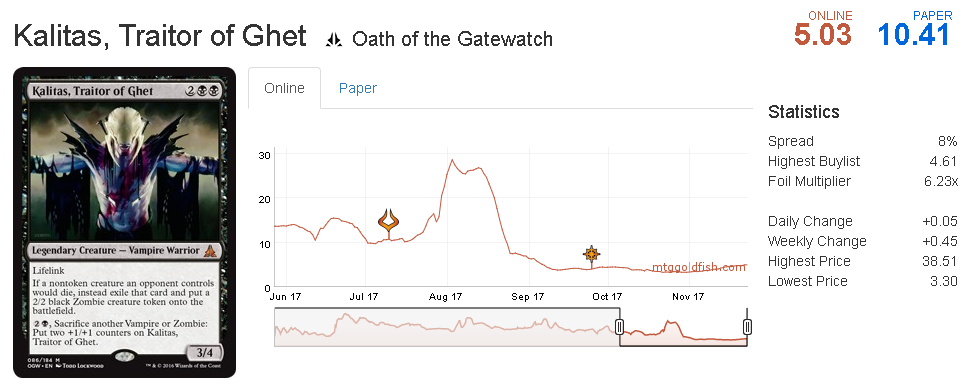
Kalitas, Traitor of Ghet was about 8 tickets when I discussed the card, and I suggested buying copies when they fell to 4 tickets each. We can see from the graph that the price fell to about 5 tickets in September and has maintained that price since. After observing the graph for about two months, I think this card is not likely to go up in price at any point soon. The format is very fast and decks that would lose to this card (like Melira/Anafenza combo and Dredge) are no longer the deck to beat anymore. If you are holding bunch of Kalitas, its time to decide whether you want to keep them for the long run or to free up the tickets for other specs.

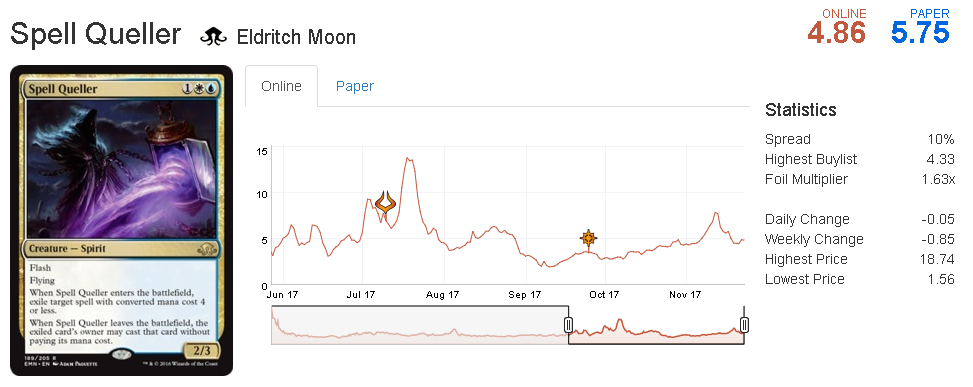
Spell Queller reached its absolute bottom in terms of price in early September. If you played along with this speculation, you should have cashed them out when the Modern Jeskai Tempo deck suddenly became very good online. Good creatures have a higher chance overall to increase in price, because almost all decks need creatures as finishers. Thus, for future rotations, I intend to aim for quality creatures I expect to be widely played after rotation.

Other Rotated Cards to Watch Out

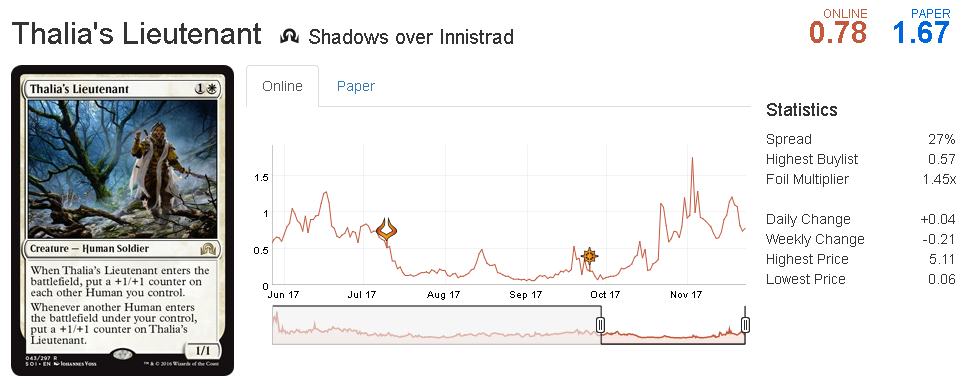
This card was one of the most broken cards when Collected Company was legal. Now its played in similar strategy – Five-Color Humans in Modern. I'm pointing this card out because I think it will see a cyclical pattern in its price graph. Anything that is good occasionally/seasonally will have a similar trend like this one.

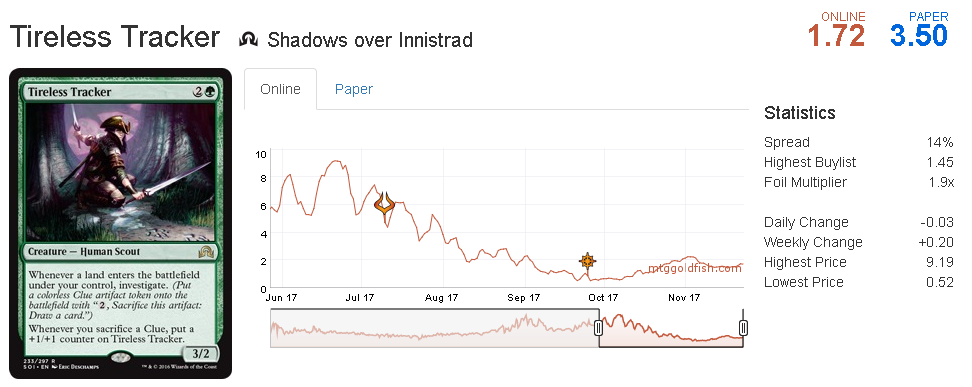
Tireless Tracker was a powerhouse in Standard and has seen play in certain brews in Modern. If I'm not mistaken, Todd Stevens had a few copies of Tracker in his "Value Town" deck that won some big tournament recently. I suggest you guys keep this card on your watch list just in case a good buying opportunity comes about.


Alright, guys, that’s all for this week. Thanks for reading, and I’ll see you all next week!

–Adrian, signing out.

Deck of the Week: Bogles

Are you a Quiet Speculation member?

If not, now is a perfect time to join up! Our powerful tools, breaking-news analysis, and exclusive Discord channel will make sure you stay up to date and ahead of the curve.

Greetings, Nexites. For this week's Deck of the Week segment I'm taking over from Rob, but you can expect him back in full force next week. Last weekend was an interesting one for Modern, as we saw an old fringe deck put up not one, but three finishes in high-level MTGO tournaments. I'm talking, of course, about the much maligned and polarizing Bogles. Coming more or less from out of nowhere, it put two pilots in the Top 8 of the Modern Challenge, and qualified one player for Pro Tour Rivals of Ixalan with a Top 8 berth in the MTGO Regional PTQ.

It's been a while since we've seen much of Bogles—much less multiple finishes in a single weekend—and this outcome might be a clue about the current metagame's effect on deck choice. The newer Bogles versions seem to have adopted some interesting tech, which I'm guessing is instrumental to their success. Take a look at the qualifying decklist from the Regional PTQ, which was typical of the bunch.

Bogles, by filippidis (Top 8, MTGO Regional PTQ, 11/25/17)

Creatures

4 Slippery Bogle
4 Gladecover Scout
4 Kor Spiritdancer
1 Dryad Arbor

Instants

2 Path to Exile

Enchantments

1 Cartouche of Solidarity
4 Daybreak Coronet
4 Ethereal Armor
1 Gryff's Boon
1 Hyena Umbra
3 Leyline of Sanctity
4 Rancor
4 Spider Umbra
1 Spirit Mantle
1 Triclopean Sight
2 Unflinching Courage

Lands

1 Forest
4 Horizon Canopy
1 Plains
4 Razorverge Thicket
2 Temple Garden
4 Windswept Heath
3 Wooded Foothills

Sideboard

3 Gaddock Teeg
3 Rest in Peace
3 Seal of Primordium
3 Spirit Link
3 Stony Silence

As a person who has been playing a lot of Gifts Storm of late, I can say this deck looks downright scary. It's absolutely packed to the brim with answers to Storm, and it seems well geared against the other consensus best deck, Death's Shadow. Unlike Humans, the other anti-Storm deck that's cropped up of late, this deck looks to have strong natural positioning against both of the top decks in the meta—not a bad place to be.

I'm no expert on the exact configuration of Bogles over the years, but there are some interesting card choices across the three builds that represent at least a partial evolution of the archetype.

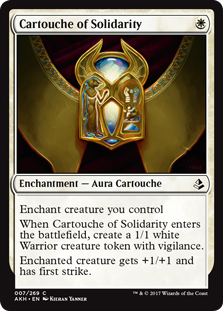
  • Cartouche of Solidarity. This is clearly a (relatively) new adoption by Bogles, seeing as the card itself is only about a year old. Much like its creature-combo brethren Infect and Death's Shadow, Bogles often struggles with a painfully low threat count. Each of these decks has a different way of mitigating this problem. Infect and Bogles attempt to protect their creatures (via instants and hexproof, respectively), while Death's Shadow has several library manipulation and recursion tools that let it run extra virtual copies of its threats. Of these, Death's Shadow is probably the best at addressing the issue—cantrips and card advantage tend to do that—whereas Infect and Bogles have traditionally struggled with it more. When creatures die, there aren't many more to be found.
Cartouche does a great job of helping ameliorate this problem, while still playing well in Bogles's core game plan. Of course, if you haven't drawn any creatures at all you're still out of luck, but the Cartouche ensures you have extra bodies to suit up to spread out damage, and acts as a natural counter to edict effects. The lists by filippidis and Elfkid only ran a one-of, but Modern Challenge finalist Dreamcrusher119 elected to go up to the full playset. I'm interested to see which of these tacks becomes the standard.

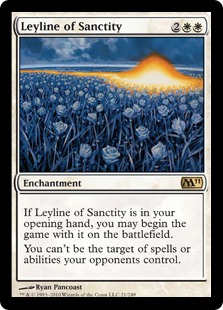
  • Leyline of Sanctity. Speaking of edict effects, those maindeck Leylines seem to be working overtime in this strategy. The obvious application is clearly to shut off Grapeshot, but it also does a great job of protecting versus black control elements. Both Thoughtseize and Liliana of the Veil don't play with a Leyline out, which means the lone threat you had to mulligan to find stays firmly in hand, and won't fall to a Lili minus. As a Storm player, seeing these in the maindeck is the scariest aspect of the list. We can theoretically counter with our own maindeck Empty the Warrens or Echoing Truth, but too much of that will dilute our game-one advantage. I would say jamming white Leylines randomly into most decks is a suspect strategy at best, but in Bogles, where the card shores up several weak points at once, it seems like an excellent meta call.
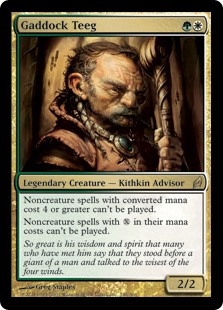
  • Gaddock Teeg. The sideboard of all three of these lists is clearly built with Storm in mind, and nowhere is this more apparent than in the inclusion of the classic Kithkin Advisor. Teeg's traditional job has always been to shut down Wrath effects, but Bogles is usually not hard-pressed to beat true control strategies like Jeskai or Esper. To my eyes, what those three copies say is, "I don't want my opponent casting Gifts Ungiven or Past in Flames." No doubt he can still come in against the hapless control player to make that matchup even more miserable, and he might also have reasonable applications against stuff like Scapeshift, Ad Nauseam, or Through the Breach.
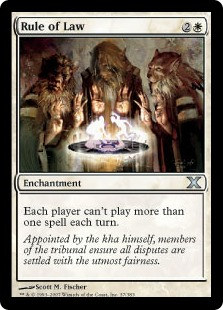
  • Rule of Law. White's status as best sideboard color in Modern is well known, and all three lists include typical fare like Rest in Peace and Stony Silence. Elfkid's third-place deck in the Modern Challenge ran Rule of Law as well. Did I mention I don't want to face this as a Gifts Storm pilot?

I'll be honest—when I first heard Bogles had dominated the weekend's MTGO events, I was skeptical of its staying power. But looking over these lists and thinking more carefully about how they might play against the two format boogeymen (Storm and Shadow), I'm a little heartened by its chances.

However, as with Humans from a month ago, I question if this archetype has the raw power and resiliency to compete in a large-round, open event like a Grand Prix. Remember, on Magic Online metagames are more predictable, an effect we can expect to be even more pronounced in large-scale tournaments like PTQs and Challenges. Showing up with a lower-tier deck tailored to beat specific matchups is appealing in an environment like this, but I'd caution against applying a similar tactic to GP Oklahoma City.

But then, I've been wrong before. Bogles has certainly had its proponents over the years. What are your thoughts?

Insider: Iconic Masters – To Invest or Not to Invest?

Are you a Quiet Speculation member?

If not, now is a perfect time to join up! Our powerful tools, breaking-news analysis, and exclusive Discord channel will make sure you stay up to date and ahead of the curve.

Historically, Masters sets have been among the favorite stomping grounds of MTGO investors. Although requiring more initial capital, the prospect of high-dollar returns have been enticing. However, the MTGO landscape has changed fundamentally over the past year. With the introduction of treasure chests and the decision to release multiple reprint sets each year, we have to reevaluate old wisdom. In this article, I'm going to try to arm you with some knowledge that will help you make smart investments in Iconic Masters cards.

I. Financial Histories of Past Masters Sets

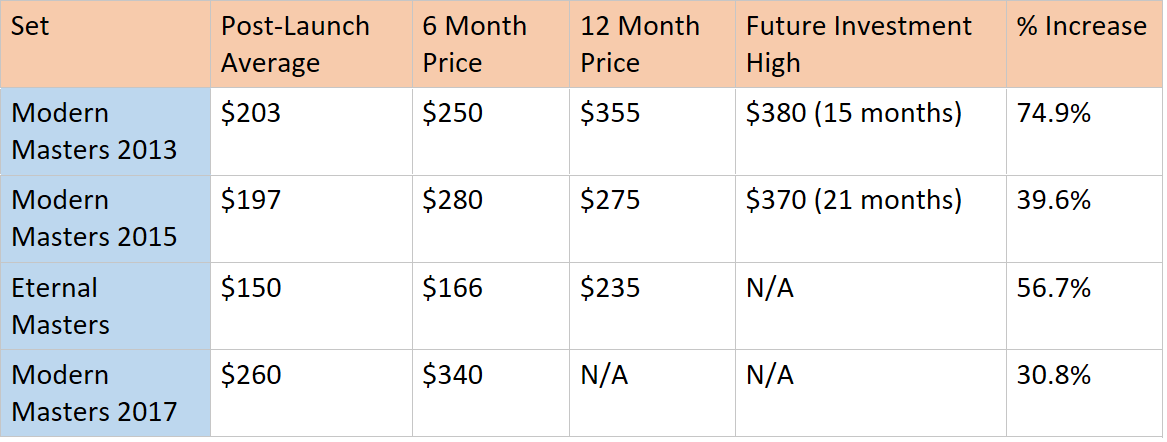
I was a bit struck from this research, as my image of the Masters sets' pasts were a bit rosier than reality. While all the sets did exhibit post-launch growth, that growth tended to be slower than I had imagined, and certainly slower than the growth that Standard sets exhibit once they cease to be drafted. Historically, Masters sets have grown by about 50 percent over their first year, and usually peak sometime during their second year. I expect the growth to slow by a moderate amount if Wizards continues to release two Masters sets instead of one.


For those of you who invest in entire sets, the above graph suggests that you should stick to Standard sets. Not only is the rate of return higher, but that investment strategy is backed up by something more tangible and predictable (redemption) than competitive Eternal demand. I thus believe that the best way to invest in Masters sets is to invest in individual speculation targets.

II. Reprints and Treasure Chests

Before investing into Iconic Masters, it's important to know some of the risk involved in the new current reprint-heavy environment. Three of my Modern Masters 2017 investments offer cautionary tales. The first, Griselbrand, was a card I was pretty excited to invest in...until it was announced that Iconic Masters would feature hallmark Dragons, Demons, Angels, Hydras, and Sphinxes from across all of Magic's history. And what Demon besides Lord of the Pit would merit a spot in such a set more so than Griselbrand? Fearing such a reprint, I sold mine at the first opportunity I had. If Masters sets continue to be released twice a year, especially under themes like "Iconic" or "Celebrating 25 years of Magic," selling in fear will become a more common occurrence.

Second, Restoration Angel. This was one of my favorite speculation targets from Modern Masters 2017, but this target got wiped out once it became known that it would be in Iconic Masters. Fortunately, I quickly sold it at exactly the same price at which I had invested in it, but even that result was extremely disappointing. And if I had been away on HASCON weekend, I would have lost money on that speculation.

Third, Voice of Resurgence. When making a decision on how best to allocate my resources for investment in Modern Masters 2017, I intentionally did some that were more risky, and others less risky. The final decision I made was to invest in Voice of Resurgence. Voice is a powerful card whose price had been high in part due to a dearth of supply. I liked that it was only receiving a printing as a mythic, and I felt that if the Modern metagame swung a certain way, or if something in the future was printed that would make Voice more of a Modern staple, I would be rewarded immensely. While that risk might still pay off, its chances are hurt by its (strange) inclusion on the treasure chest curated list mere months after its Modern Masters 2017 printing. Because of its lower overall supply, its price is being hurt by the treasure chest inclusion to a greater degree – it's basically receiving a full second reprinting this treasure chest cycle.

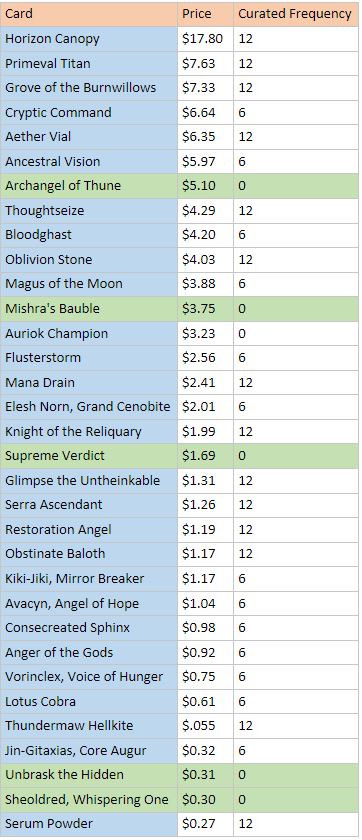
In light of the Voice of Resurgence tale, I wanted to find out which cards from Iconic Masters are curated card favorites – and my findings surprised me.

I was quite surprised to see that the vast majority of the valuable cards in Iconic Masters had not been taken off the curated list and given a figurative chance to breathe. This group of cards is burdened as a ship sailing ahead despite having dropped an anchor.

In the past, it was correct to view Masters sets as offering a temporary discount to cards that had been, and would become, more expensive. But what constitutes a good investment in a Masters set has now changed. No longer do you need to merely identify what will be a card that will be used extensively in an Eternal format – you need to identify cards that will be used more extensively in the future than they have been in the past. That could take the form of a metagame call – will Abzan and Jund Midrange decks make a resurgence next year in Modern? If you believe so, perhaps Thoughtseize is a worthy investment. Will controlling shells make a comeback in Modern? If so, perhaps you'd be willing to risk capital on Anger of the Gods or Ancestral Visions. Will Deathrite Shaman be banned in Legacy? If so, what cards might take up a higher share of the Legacy metagame?

Those are the types of questions I think you will need to answer, and have enough confidence in your answers to risk financial capital on them, to invest in Iconic Masters successfully. Phrased differently, I don't think you should invest conservatively in Masters sets anymore. And as those of you who read my articles know by now, I tend to invest fairly conservatively, using the natural cycles of sets' lows and highs to minimize risk. Occasionally I'll make metagame calls (my summer speculation on Kalitas, Traitor of Ghet comes to mind), but that's a minority of my investment decisions. More so than investments into Standard cards, I think you'll want a deep and extensive knowledge of Eternal formats, and an ability to predict how the metagames will manifest themselves over the coming months, to invest in Iconic Masters.

Signing Off

Here is a copy of my investment portfolio. No real changes from last week. If you want me to do a review of certain Iconic Masters cards for next week's article, do let me know. If I don't detect significant interest, I'm likely to next do a reflective piece looking over the year's mistakes and what I am learning from them. Also, how are y'all finding Iconic Masters? And do you plan on investing in it? I'm curious to hear your response to my article and see how others are approaching Iconic Masters from a financial perspective.

Daily Stock Watch: Goryo’s Vengeance

Are you a Quiet Speculation member?

If not, now is a perfect time to join up! Our powerful tools, breaking-news analysis, and exclusive Discord channel will make sure you stay up to date and ahead of the curve.

Hello, readers and welcome to a new edition of the Daily Stock Watch! My first feature for the week will be a card that I've kept my eyes on for quite a while. It's one of those cards that has maintained its price tag since its initial spike, and is still relevant in more than one format up to this day.

There was an error retrieving a chart for Goryo's Vengeance

Goryo's Vengeance is responsible for the re-emergence of Reanimator decks in Modern a few years back. Often paired with Through the Breach, it gave sense to cards like Griselbrand and Emrakul, the Aeons Torn (not that they don't make sense; it's just that they aren't living up to their full potential prior to Goryo's renaissance), and made Reanimator an actual threat in the format again, long after the departure of Dread Return.

Speaking of format versatility, check out this Legacy list where Goryo's Vengeance is having some air time:

Rogue Reanimator

Creatures

1 Emrakul, the Aeons Torn
2 Necrotic Ooze
4 Griselbrand
1 Children of Korlis

Instants and Sorceries

4 Shallow Grave
3 Goryo's Vengeance
4 Brainstorm
4 Entomb
4 Dark Ritual
2 Thoughtseize
4 Ponder
4 Collective Brutality
3 Unmask
2 Reanimate

Other Cards

4 Lotus Petal

Lands

1 Island
1 Marsh Flats
1 Swamp
2 Scrubland
2 Verdant Catacombs
4 Polluted Delta
3 Underground Sea

Sideboard

1 Necrotic Ooze
2 Monastery Mentor
2 Flusterstorm
2 Swords to Plowshares
2 Cabal Therapy
3 Serenity
3 Echoing Truth

One would expect Legacy to be the format where a card like Goryo would excel. Despite access to almost all the legendary creatures in the game via Legacy, it didn't find its footing in staple decks in the format until Shallow Grave became a mainstream favorite. These two have since formed a lethal tag-team that's known to many as "Instant Reanimators".

However, Goryo's Legacy buddy is in the Reserved List, and it's Modern ally has already resurfaced as part of the Masterpiece series.

Masters 25 Possible Reprints

Please bear in mind that the word "possible" meant more like "my dream" reprints in this case. If we're really getting cards from each set that haven't been reprinted yet (and is not on the Reserved List), Goryo's Vengeance, along with quite possibly some of these cards, has the word reprint all over it.

With that in mind, I wanted to feature Goryo's Vengeance because it's one of those cards that's seeing quite some play, and is hard to find for those who want to actually have their own playsets. It is hard to just reprint in any other set because of the arcane mechanic, but Desperate Ritual, Dampen Thought, Glacial Ray, Horobi's Whisper, and Torrent of Stones have already appeared in Modern Masters. In theory, Goryo's Vengeance could be primed for a comeback in a future Masters set and after missing the cut in Iconic Masters, I think that Masters 25 is the perfect time to bring it back. What other card from that set would you rather see reprinted more than Goryo?

We have tons of time to speculate on what could be included in Masters 25, as we still have Unstable in two weeks time, and Rivals of Ixalan in January. It won't make a sudden appearance in any of these sets (fingers crossed on RIX), and spoiler season should start somewhere in February, barring any major leaks or changes. As a spec junkie, people barely buy things during the holiday season, and are leaning more towards selling off their prized collections. Prices usually rebound in the early part of the year once everything has settled down, and that would also be the window for you to dispose your specs for the latter part of the year -- and I strongly feel that you should include copies of Goryo's Vengeance in your to-sell list.

Right now, you could find copies of Goryo's Vengeance for as low as $41.72 to as high as $49.99 from TCGPlayer, Card Kingdom, and Star City Games. Channel Fireball is currently out of stock, and will probably restock around the same price range as the other stores. Across all sites, only Star City Games has a foil copy of the card, which is up for grabs at $67.99.

I'd recommend that you let go of your Goryo's Vengeance copies whenever you could. Decks that use the card aren't that successful right now, and I think that the reprint is really happening next March. Proceed with caution when buying normal copies that are for speculation purposes, as I don't see much room for its price to increase in the near future. Grabbing foils might be a good idea if the price is somewhere in the $60 range; otherwise, I'd stay away.

And that’s it for the Monday edition of the Daily Stock Watch! See you again tomorrow, as we take a look at a new card. As always, feel free to share your opinion in the comments section below. And if you want to keep up with all the market movement, be sure to check in with the QS Discord Channel for real time market information, and stay ahead of the hottest specs!

Insider: Speculating on Unstable’s Launch

Are you a Quiet Speculation member?

If not, now is a perfect time to join up! Our powerful tools, breaking-news analysis, and exclusive Discord channel will make sure you stay up to date and ahead of the curve.

The year was 1998. I had been playing Magic for about a year when I learned about a new set that was just released (likely from an InQuest Magazine at the local hobby shop). The set would be filled with joke cards, not allowed in tournaments, that mock some of the themes of Magic. The set was called Unglued.

“10 Bizarre and Broken Cards,” boasted the packaging. And who could forget that classic image of Jester's Sombrero on the packaging—a mockery of Jester's Cap, one of the most dominant cards in that time period.

There was an error retrieving a chart for Jester's Sombrero

Other highlights from the set included Chaos Confetti, Jack-in-the-Mox, and Blacker Lotus. They all carried such allure to me as a newcomer to the game. Sadly, the set was released when I was but a poor middle school student. Obtaining booster packs was a rare occurrence and I never had the joy of opening a pack of this set.

When Unhinged was released six years later, I was a college student still with limited funds. I managed to acquire a few packs and even enjoyed a draft of the set (I went all-in on Tainted Monkey and lost in the finals). The experience was an absolute delight.

Now in 2017 we are at last witnessing the completion of the “Un” block with the release of Unstable. At this stage in life I am excited for the release of this much-anticipated set for four reasons. First, I always appreciated these joke sets and enjoy the casual appeal they offer. Second, I have the resources available to acquire a satisfactory quantity of product for once. Third, I can enjoy the set with my five-year-old son, who will surely get plenty of laughs out of these cards.

And fourth, I can try and make some money with this set.

Hold Your Horses!

Before diving in and buying product left and right, let me first caution you on something. Between the release of Unglued and Unhinged, Magic grew exponentially in popularity. The number of players in 1998 had to be miniscule as compared to 2004. By the time Unhinged was released, Unglued boxes were a hot commodity and tough to come by. Now, 13 years later, Unhinged product is equally coveted due to its rarity. That’s because there was again explosive growth in the player base from 2004 to 2017.

Fast forward to today, and we see a different landscape for Magic. Unglued and Unhinged were printed in modest quantities for their time. But given the growth of Magic’s player base, the quantities are laughably small. This catalyzed explosive growth in the price for boxes from these sets.

One may draw a seemingly logical conclusion that Unstable boxes will move in the same way. A $90 investment appreciating to $530 in 13 years equates to around 15% annualized, compounding returns over the course of that time period—not half bad. But remember that explosive growth in player-base that occurred around the time of Innistrad and Return to Ravnica. These sets brought a ton of new players to the game, which made the relative supply of Unhinged boxes insignificant compared to the demand to experience this joke set.

In order for the same kind of return to be expected with Unstable boxes, we would need a comparable explosion in Magic players. This is because Wizards of the Coast is very likely to print much more of Unstable. Will the print run still be small compared to, say, Ixalan? Probably. But I suspect the growth on Unstable boxes will be tiny compared to the other two un-sets unless some catalyst can spike the growth in Magic players. Therefore, I do not advocate buying cases of Unstable and parking them in your closet. The opportunity cost will be too great.

Okay, So What Should I Buy Then?

Fortunately, there are plenty of other angles to speculate on the launch of Unstable. For instance, we’ve already seen some movement in Unhinged cards as the release of Unstable approaches. Just this morning on MTG Stocks I noticed a spike in Enter the Dungeon. Make sure you log into MTG Stocks and activate Unglued and Unhinged prices or you may miss these jumps!

There was an error retrieving a chart for Enter the Dungeon

Earlier in the week we also saw an even more meaningful spike in Frankie Peanuts.

There was an error retrieving a chart for Frankie Peanuts

These buyouts are only the tip of the iceberg, in my opinion. For instance, just browse all Unhinged rares on TCGplayer and note how few are truly in stock in LP or NM conditions. You can quickly see how few copies need to sell in order to spike prices on some of these cards. R&D's Secret Lair, Johnny, Combo Player, and Richard Garfield, Ph.D. are all on my radar due to their low stock, and there are plenty of others.

And these are the nonfoils I’m talking about here. Forget trying to find good prices on these in foil—these are exceptionally rare. Just look at foil copies of Richard Garfield, Ph.D., for example: good luck finding these for a reasonable price! I found only one copy under $200 in all my searching on the internet! With how expensive the foils have become, I actually think the nonfoils have plenty of upside potential thanks to the release of Unstable. The set’s release is very likely to catalyze newfound demand for older, fun un-cards and I want to make sure I follow this trend closely.

I ran a similar exercise with Unglued cards to see what’s been selling on TCGplayer and oddly enough there wasn’t much that caught my eye. In fact, many of the rare Unglued cards had more stock than the popular Unhinged cards. I’m not sure if this is because Unhinged was released after EDH and Cube became formats or if it just reflects Wizards’ growing ability to make fun cards. In any event, there was only one Unglued card that really caught my eye—but it’s a great one:

There was an error retrieving a chart for Jack-in-the-Mox

There are only six copies of this card on TCGplayer and only one on eBay. I scrounged the internet for other copies and didn’t find much outside of Card Shark (which is where I bought a few copies). I can see this card making it into Cubes and the like, and the randomness keeps it very well-balanced. I think this card can climb higher.

But Silver Borders are Gross…

There is one major drawback with Unglued and Unhinged cards: they have silver borders and are therefore not tournament-legal. While some Commander playgroups will allow certain silver-bordered cards, the reality is they will never have the same demand profile as black-bordered and white-bordered cards. If you fall in this category as well, do not despair! I have some tournament-legal suggestions as well!

One of my favorites is actually not a card, but a sealed product. I’m referring to Legions booster packs, which have seen a recent jump in price thanks to the spoiling of Summon the Pack, the mythic rare that lets you crack a booster pack and put all its creatures into play.

Younger players may not be aware with what makes Legions packs so interesting with this card. But the reason is very simple: Legions is the only set that contained 100% creature cards! As a result, Legions booster packs have been selling briskly and have increased from $7 to $10 in price over the past couple weeks. I’ve grabbed a couple to use with Unstable play and a few more to speculate on with the hopes of outing them at around $15 each.

Digging a bit deeper, there are also some black-bordered singles that may be worth pursuing upon release of Unstable. Specifically, the rarer squirrel cards may see a surge in demand due to the inclusion of a squirrel theme in Unstable. Squirrel tokens, Squirrel Nest, Squirrel Mob, and Squirrel Wrangler all seem like viable options.

There was an error retrieving a chart for Squirrel Mob

Foils are probably more attractive, as there appear to be a decent supply of nonfoils available for sale. But I would keep an eye on the stock of nonfoils as well to see if sales accelerate after Unstable’s launch. These may not be as compelling, but they offer a tournament-legal alternative to speculate on the latest “Un” set.

Wrapping It Up

This is a very exciting time for casual fans of Magic’s joke sets: Unglued, Unhinged, and Unstable. I didn’t have sufficient resources to truly appreciate the first two sets in this block, and I will not let finances be a barrier for the third and final installment. I’ve already pre-ordered my box and I am awaiting another $15-off coupon from eBay to acquire a second. One will be to enjoy with friends around the holidays and one will be for a rainy day a few years from now.

While I don’t expect that spare box to appreciate much in value over the coming years, I do think there are some other cards worth acquiring in light of Unstable’s release.

Since I don’t play much Commander or Cube, I’d recommend using TCGplayer as a guide in identifying what should be acquired. Cards that get low in stock and consistently rank highly on the “Best Selling” list are surely worth speculating upon. I’ve already noticed some specific cards getting low in stock, such as Enter the Dungeon and Frankie Peanuts; two cards that already show up on MTG Stocks’ Interests page.

I hope other people are as excited as I am to cast some of the silliest cards ever to see print in Magic’s 25-year history. It took a long time for Mark Rosewater to convince Hasbro that another joke set could be sold, and there’s no telling if and when a fourth will ever be released. In case it’s not, make sure you hop on the bandwagon and try an Unstable draft at least once to get a once-a-decade experience. You never know what that same experience may cost ten years from now!

…

Sigbits

  • I browsed through Star City Games’ Unhinged foils stock and I saw a number that were sold out. A few of particular interest were Gleemax, Frankie Peanuts, Johnny, Combo Player, and Letter Bomb. The prices were $34.99, $12.99, $19.99, and $9.99 respectively. It wouldn’t surprise me to see these all move higher once Unstable is released and interest in these older joke cards spike.
  • Star City Games certainly seems behind on re-pricing their Legions booster packs. They still have a listed price of $5.99, but of course they’re sold out. I’m not sure how eager they are to restock this item, but I have to imagine that once they eventually do, the price tag will be double its current number.
  • As mentioned before, one of the reasons I like Jack-in-the-Mox from Unglued so much is that its online stock is extremely low. I couldn’t find more than a few copies across the internet, and Star City Games had zero in stock with a $2.99 price tag. While I don’t think this doubles overnight, I do think a $5 price tag is a next logical stepping stone, since a spike is virtually inevitable once someone lists a single copy on TCGplayer for some silly price tag.

Want Prices?

Browse thousands of prices with the first and most comprehensive MTG Finance tool around.


Trader Tools lists both buylist and retail prices for every MTG card, going back a decade.

Quiet Speculation