menu

Back on the PPTQ Grind: Week Four

Are you a Quiet Speculation member?

If not, now is a perfect time to join up! Our powerful tools, breaking-news analysis, and exclusive Discord channel will make sure you stay up to date and ahead of the curve.

This is a very frustrating week for me. You see, I have a very good result to report on and an embarrassingly bad one as well. It's not the ideal result, but much better than previous weeks. I almost got there, but that just isn't good enough for me. I'm massively competitive and will never be satisfied with anything less than victory. Given that, my second place finish at the PPTQ really stung.

This was the double PPTQ week, thanks to the RPTQ for Pro Tour Ixalan. I have to reiterate how annoying it is that Denver always gets the Standard RPTQs but not Modern ones. I want to get back on the Pro Tour regardless of format, but Modern is so much more enjoyable to me that I actually look forward to grinding this season. Not having to travel for them is a huge bonus, especially because it will be winter travel. Why couldn't the Modern RPTQ be in summer? It's so much easier to travel then. Still, at least this doubles my chances of getting there.

A quick note before we go on: neither Eldrazi Tron nor Grixis Shadow won a big Modern event this weekend. Grixis did have a very good showing, however, getting second in Richmond, and placing copies into the Top 8s of both GP Birmingham and GP São Paulo as well as the Classic. This ensures that Grixis will remain the focus of banning speculation for the foreseeable future. It doesn't matter if you believe it's justified or not, there is a very strong opinion in the community that the deck is too good and they are gathering the evidence to prove it. Couple this with calls from pros like LSV and I definitely wouldn't bet against the deck surviving past August 28. Which likely means that Eldrazi Temple will remain, much to my dismay.

The Deck

Last week I got my best result so far with UW Control. 10th may not be Top 8, but it is so much better than dropping with a losing record. As a result I intended to stick with the deck for another week. It was fairly well positioned, but I knew I needed additional practice. After spending the week doing just that, I was far less confident in my choice.
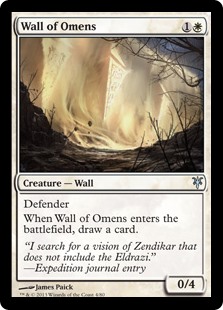
Two problems with my deck had appeared. First and foremost, I was struggling against red decks. Burn was an okay matchup, especially after board, but red creature decks were a nightmare. The problem was that my list was built to deal with small numbers of large creatures, not swarms. Against a swarm you need to prevent a lot of damage prior to playing your sweeper so you don't just die to the second wave of haste creatures and burn. This means Wall of Omens and Kitchen Finks, both of which aren't good anywhere else. I felt that this problem was acceptable—it didn't seem likely that this would manifest at the PPTQ. Goblin Bushwhacker decks just show up in my local meta every few months and aren't a reason to abandon a deck.

What was an actual problem was the mirror. I played a number of matches against several different types of control decks over the week and didn't win a single one. While in a few cases it was entirely my play mistakes that cost me, it was consistently clear that I was simply disadvantaged against other control decks. I didn't have anything to really break open the mirror and I was grinding at disadvantage. I didn't have Ancestral Vision to pull ahead on cards, Crucible of Worlds to grind out their lands, or extra disruption to force through a win. I just had to grind and hope they bricked out first. Was it doable? Certainly. Is that a great way to spend a tournament? No. This convinced me that control was a risky choice, and once I got to the site I decided not to play control. Instead, I played this:

UW Spirits, by David Ernenwein (2nd Place, PPTQ)

Creatures

4 Mausoleum Wanderer
4 Selfless Spirit
4 Rattlechains
2 Phantasmal Image
4 Reflector Mage
4 Spell Queller
4 Drogskol Captain
2 Ninja of the Deep Hours

Artifacts

4 Chalice of the Void
4 Aether Vial

Instants

2 Cryptic Command

Lands

4 Seachrome Coast
4 Hallowed Fountain
4 Cavern of Souls
2 Glacial Fortress
1 Moorland Haunt
4 Island
3 Plains

Sideboard

4 Unified Will
3 Grafdigger's Cage
3 Hibernation
3 Stony Silence
2 Detention Sphere

Yep. That's Ninja of the Deep Hours. And a full set of Chalice of the Void. Spicy, but there is madness to my method.

See, my versions of Spirits have always been great against control decks and terrible against creatures. I decided to just embrace this when I rebuilt the deck this week. Therefore I played the absolute best protection card in Chalice instead of Kira, Great Glass-Spinner. Playing Chalice meant cutting Path to Exile, which was never very impressive anyway. This let me play a full set of the far more impressive Reflector Mage, which is a messed-up card at instant speed even in Modern. Playing a full set of Cavern of Souls ensures that the only maindeck card that I can't cast through Chalice is Aether Vial. Ninja was added because this deck can flood and wanted some kind of card advantage, and I remembered that reusing Reflector Mage is very good.

The sideboard was built based on what I saw in my pre-tournament scouting. Extra counters for blue decks, Cage for graveyard and Chord decks, Hibernation against green decks, Stony for artifact combo. I didn't expect many Tarmogoyf decks so I didn't think Rest in Peace was necessary. The Detention Sphere was my flex slot. I initially had Disenchant, but after some consideration Sphere was better. Being able to hit multiple copies of a thing is good, but the main reason was in case I hit creature decks where Hibernation was poor. With no testing of this configuration, I sat down for round one.

The Tournament

The PPTQ was being run alongside the Last Chance Qualifier for the RPTQ. It was a large LCQ (didn't check numbers) and a 38 player PPTQ. This utterly maxed out the available space, and we had to be packed in like sardines to make it work. I really wish they didn't run things like this, or at least planned for huge attendances but c'est la vie. Additional judges would have been great, though in truth most events could use additional judges. Another six-round day, this time much longer because of logistical problems and players going to time.
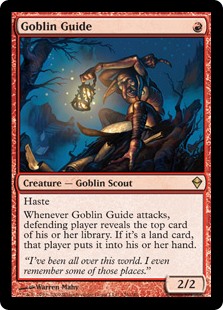
When I was scouting, it was hard to tell how many players were there for Modern. Of those I knew weren't in the LCQ, I identified three control players and four Chord players. I then saw two players testing with red decks (was hard to tell what exactly), two more playing Delver, and two on Storm. I never saw any Affinity, but I did see a Thopter Foundry player. Between the control decks, red decks, and Storm, UW Control felt like a poor choice. I really hate playing from behind round after round, and that is exactly what would happen in this field.

On the other hand, lots of control and combo with slower creature decks is exactly what Spirits wants to see, so I hurriedly rebuilt the deck from the cards I had with me. This worked out, as I finished in 2nd place, losing the finals to my nemesis, the UB Faeries player from last week. At least I don't have to worry about him at any more PPTQs this season. My Swiss record was 4-1-1, defeating Jeskai Control, Allies, Eldrazi Tron, and Jund Shadow, losing to the Thopter deck, and drawing with Counters Company. I beat midrange Abzan and Elves during Top 8.

What Happened?

I lost the finals because that Faeries deck is a terrible matchup. Normally, while I can't stop them from casting Bitterblossom, I can push through it just by going big. Chalice and Cavern shut off their interaction so I can win at my leisure. The problem is that this particular player plays a lot of devastating three-drops, namely Sword of Light and Shadow and Liliana, the Last Hope. He also has Creeping Tar Pit and Mutavault. I don't have instant speed answers except for Cryptic Command and Vialing in Reflector Mage, both of which are temporary. So I'm simply cold to creature lands, particularly one I can't block. Game one is a close race that he wins by drawing Cryptic when I don't, game two Tar Pit gets there.
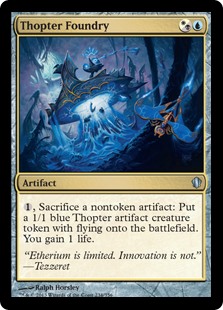
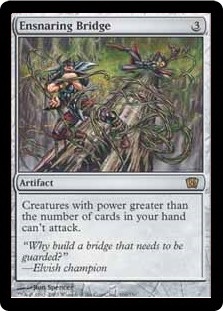
My other loss, to Thopter Combo in the swiss, was poor fortune. In game one I didn't have Spell Queller until the turn after he plays Ensnaring Bridge, and then he plays a second one the turn afterwards so I can't Cryptic my way out. Game two I mulligan to a terrible five and just die. Nothing I could do there. Normally decks like that are good matchups but I just didn't draw the cards to win.

Most of my wins were the result of my clock, and I got lucky against Allies. Jeskai can't really match Vial into Chalice for one, and when you have Queller for sweepers it's just unfair. Then again, that's what the deck is meant to do against Jeskai. Jund Shadow went the same way, with me also getting considerable mana and card advantage bouncing Reflector Mage with Ninja. He did get a game off of me by chaining a Grim Flayer into Tarmogoyfs. I could have set a Chalice on two when he only had Flayer on the board, but I couldn't remove it then and his deck is mostly ones, so that was the number I chose. I think if I do choose two I could have still lost based on all the ones he milled with the Flayer; hard to say. That was also how my quarterfinals match against Abzan went down. Game one against Eldrazi was easy, he played all the Chalices while I just flew in for massive damage. Game two he had turn four Ulamog, but I'd done enough damage that with a chump I was able to just nose him, winning at one life and four cards in library.
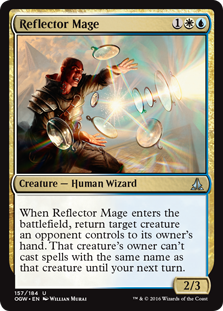
I should not have beaten Allies. It is exactly the sort of deck that should crush mine. Luckily for me, his draw was lackluster. Reflector Mage bought so much tempo that, coupled with a pumped Wanderer countering Collected Company, I won the race game one. Game two he was stuck on just Cavern of Souls for land, but had a lot of one-drops that got me to nine. Thankfully, that took long enough that my mull to five with Vial and Reflector Mage could blank an attack step and stonewall him until I had the win. Elves should have been a similarly bad matchup, but his draw is poor game one and game two I draw a Grafdigger's Cage to prevent him comboing off and then two Hibernations to seal the game. That's a really great card against Elves.

You may have noticed that I'm only talking about the Saturday PPTQ. This is because I didn't actually check on the Sunday PPTQ, concurrent with the RPTQ, and assumed it was at the same time as the previous one. It was not. It was earlier. As a result I missed it. In my defense, the first PPTQ ran very long in a building where the AC was badly overworked and I got home late. However, that is no defense. Always, always, always check before you go! I'm very irritated at myself over this.

Lessons Learned

My main takeaway is that preventing your opponent from playing Magic is a great way to win. My deck accomplishes this in spades and I could definitely see myself playing at another PPTQ. Also, always check the day and time of tournaments. That's... just awful of me.

On the gameplay side I felt like my play improved, but that may have simply been because I had to make fewer decisions playing this deck than UW Control. Once you're opponent's deck is neutered, you're free to do whatever. I will remind myself of this before the next one so I don't get undisciplined.

On the Deck

I was very happy with the maindeck and I don't think I want to make changes. Ninja was cute, but he can also be very effective. Drawing cards and reusing Rattlechains and Mage were all very good, but my opponents kept spending entire turns worth of mana to kill him and that's even better, especially with Vial. Chalice was generally better than Path, so I'm planning on sticking to this plan.

The sideboard was built according to my scouting and I will be making changes. Hibernation was great but it probably won't be great next time. I played against more decks that RiP was good against than Cage, but that also isn't likely to be a consistent thing. There was no Affinity, but had there been I would have wanted Kataki, War's Wage over Stony. Since I can protect Spirits like him it makes sense in an Affinity field to have him, but otherwise Stony is better. I'll just have to see where things stand in two weeks.

Moving Forward

Yes, two weeks. This week is GP Denver and there are no PPTQs to grind. I'm not playing the main event because I don't have a playable Standard deck and don't want to buy one just for this tournament, but I will grind Modern side events to evaluate my deck for the week after. I really like Spirits and I would like them to be good enough for the rest of the season. Hopefully it will work out.

...And On...

This means that I'll need to actually write something new next week. Might as well make it my qualitative report on Preordain. I've finished the Storm testing and am just under halfway through the Control test (been on the back burner compared to PPTQ work) but I've got enough of a handle on the card to give you a general idea about the card's place in Modern. Good luck and keep grinding!

Investing in Land Staples

Are you a Quiet Speculation member?

If not, now is a perfect time to join up! Our powerful tools, breaking-news analysis, and exclusive Discord channel will make sure you stay up to date and ahead of the curve.

Hello, dear readers.

This week, I'll be talking about some land staples that have very consistent trends on their graphs. By paying attention to these trends, we can make some easy money!

Standard Legal Fast Land Cycle

blooming_marsh

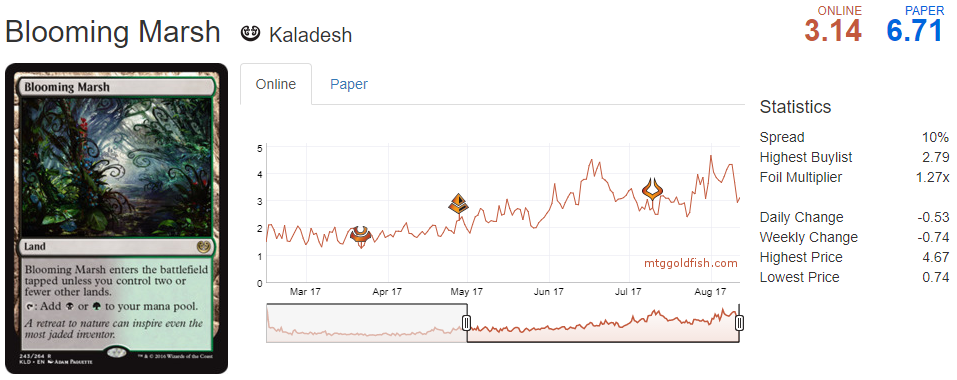
Blooming Marsh is one of the most-played lands in this cycle, as Standard Black-Green decks and Modern Jund/Abzan decks play two to four copies of the card. At the moment, Modern Jund and Abzan have not been showing up in the top-performing decklists, but these two decks are staples in Modern that have 50-percent win rate against the field, so at some point they will reappear in the metagame. When that happens, Blooming Marsh will grow to somewhere between 4 and 5 tix. Picking up a couple playsets for under 3 tix a card should be a nice buy.

Target Buy Price: 2.8; Target Sell Price: 4; Profit per Copy: 1.2

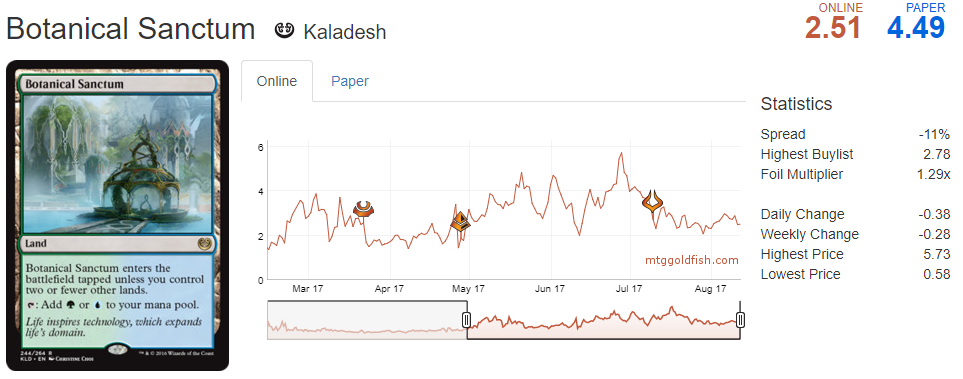
botanical_sanctum

Botanical Sanctum is a four-of in Standard Temur Energy, one of the top five decks in the current metagame. This card has hit 4.5 tix or more at least three times in the past, and it's currently 2.5 tickets per copy. When we are deciding whether to invest in a certain land, we want to think of any other possible decks that will play at least two copies of it. Currently, Sultai Delirium, A.K.A. Sultai Reanimator, with The Scarab God is getting popular, and some version of Modern Amulet Titan is using Sanctum as well. I can see this card going up to 4.5 tix in the near future, and we can probably sell them at 4.2-ish. Its always safe to pick up this card when it's at 2- to 2.5-tix range.

Target Buy Price: 2-2.5; Target Sell Price 4.2; Profit per Copy: 1.7

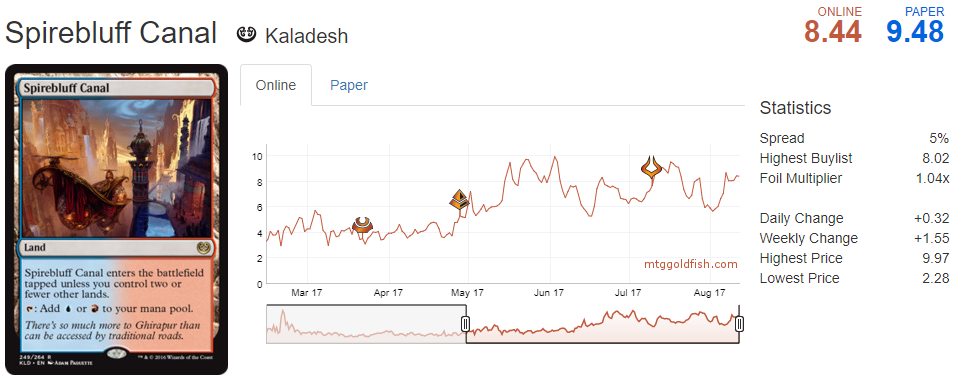
spirebluff canal

The next card in this category is Spirebluff Canal, which is currently the most expensive land in this cycle. This card has not dropped below 5 tix in the past three months. There are at least four decks in Standard and Modern that play at least two copies of this card in their 75, namely: Standard Blue-Red Control, Temur Energy, Modern Jeskai Control, and Blue-Red Gifts Storm. I don't think we'll see Canal drop in price any time soon, but you can add them to your watch list just in case. Get them when they are below 6 tix and resell them at 8.

Target Buy Price: 5.8; Target Sell Price: 8; Profit per Copy: 2.2

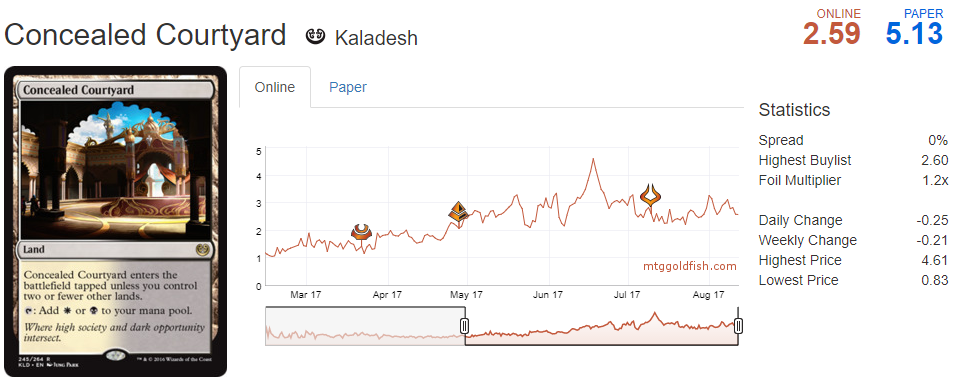
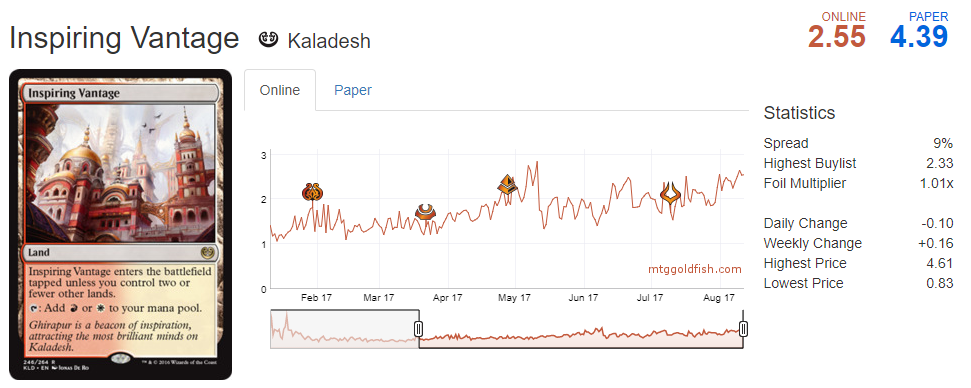
The two remaining lands in this cycle – Concealed Courtyard and Inspiring Vantage, they are less popular and there's lesser room to gain profit:

concealed_courtyardinspiring vantage

If you have plenty of spare tickets and are interested in picking up some long-term specs, these are two that you can consider. However, if you are aiming to gain at least one ticket from each copy of these cards, it's not likely to happen in the next two months.

Cyclical Movement: Creature-Lands

shambling vent hissing quagmire

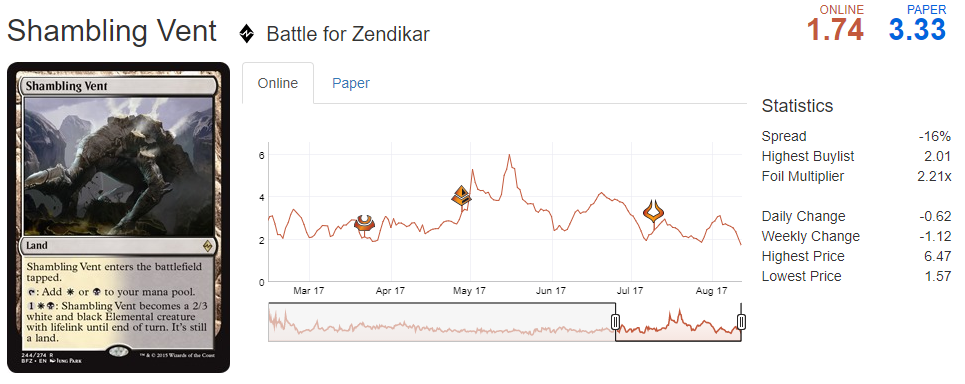
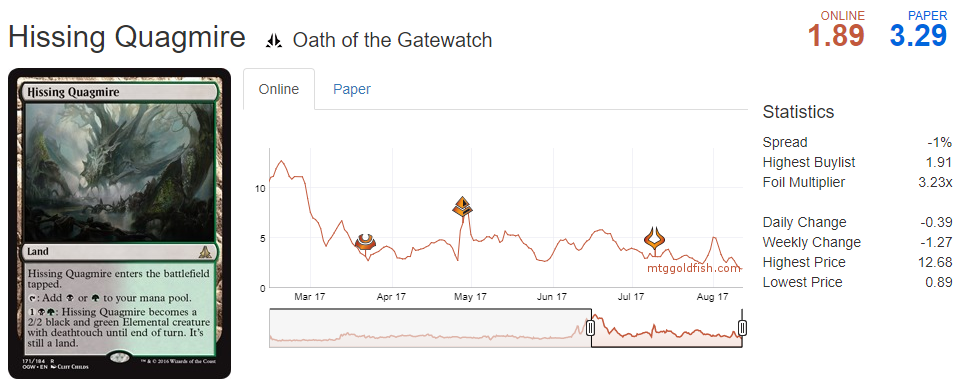
Of the Standard-legal creature lands, Shambling Vent and Hissing Quagmire are the most profitable ones from the past six months. You can usually buy them below 2 tix and resell them when they are at least 3 tix. This kind of price movement is likely to happen one or two more times before rotation. I'm not quite sure what is going to happen with them after rotation, but since they are Modern-playable (Hissing Quagmire in Black-Green Midrange and Shambling Vent in Eldrazi Taxes), I don't see any reason they will drop below 1 ticket.

Modern Infect

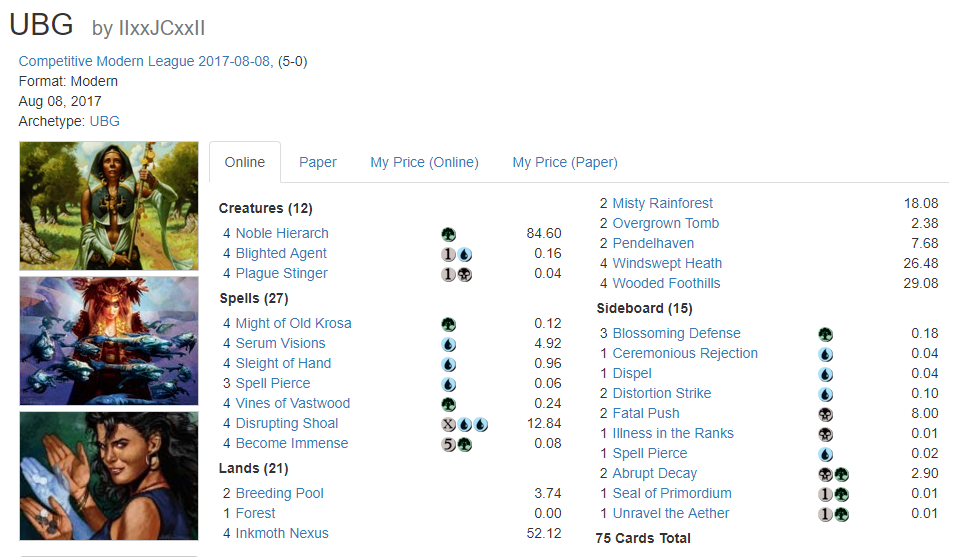
Recently, there's a Sultai Infect list doing pretty well on MTGO:

sultai infect

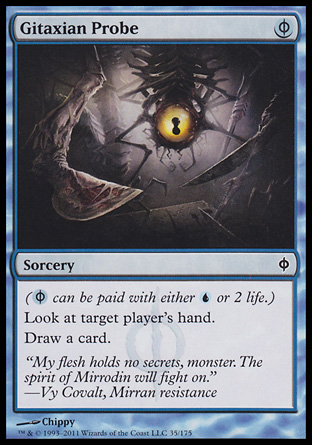
This deck is probably built to beat the "big-mana" decks in Modern like Amulet Titan, Scapeshift and Tron. It's a bit slower than the green-blue version, which dominated the meta before Gitaxian Probe ban, going more toward control-tempo style. I think this deck is one of the rising decks that is worth investing on. Based on the latest decklist, I suggest to buy in on the following cards:

inkmoth_nexus

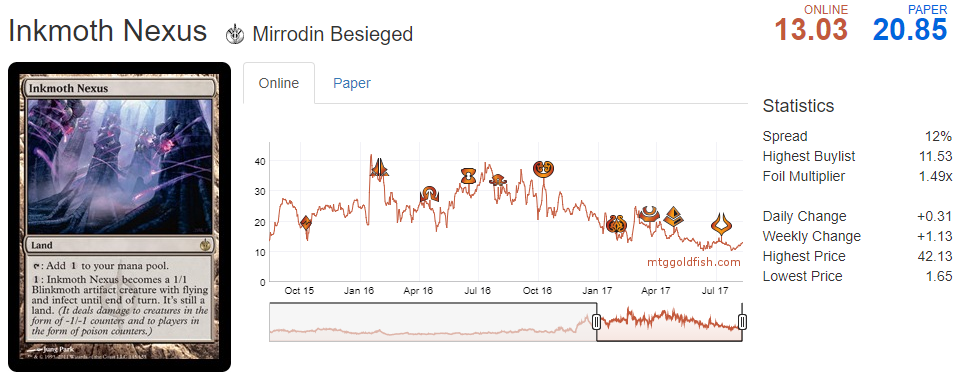
Inkmoth Nexus's price went downhill since the Gitaxian Probe ban. Although it still sees play in Modern Affinity, the supply in the market is not low enough for the price to go up again. However, with the Sultai Infect deck appearing among the 5-0 decklists, it's possible that players will start to give this deck a try, and the result is that Inkmoth Nexus will likely to go up to at least 18 tix again soon. I think this spec is pretty safe, because as I said, this is still a staple in the Modern Affinity deck. At 13 tix, it's the lowest price point in the past two years.

Current Buy Price: 13; Target Sell Price: 18; Profit per Copy: 5

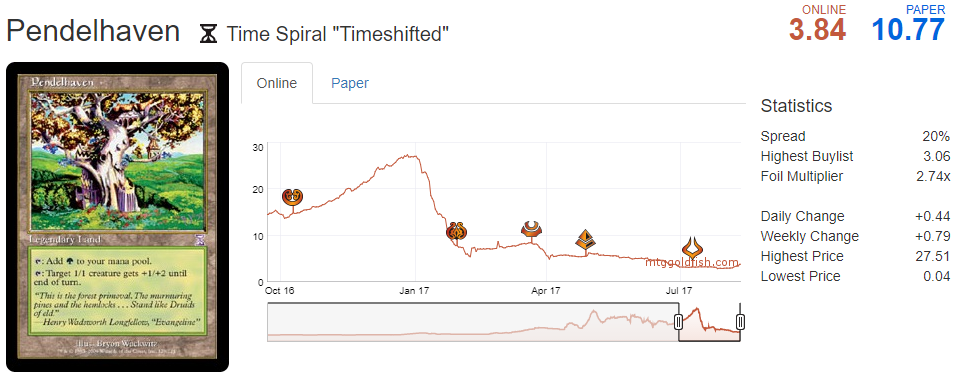
pendelhaven

Pendelhaven is slightly narrower than Inkmoth Nexus, only played in Infect and Elves decks as a one- or two-of. As with Inkmoth Nexus, when Gitaxian Probe was banned, this card became almost worthless compared to its previous value. With the deck above appearing in the Modern scene, I see hope again for Pendelhaven. I mean, for a card that has a median price of roughly 16 tix based on the graph, there is a lot of room for the price to grow.

Current Buy Price: 3.85; Target Sell Price: 10; Profit per Copy: 6

Saffron Olive Effects

Seth tweeted earlier that he'll not be around for a week:

saffron olive

This means there might not be any new brews from him until next week.

However, there are a few lands that are very cheap and are potentially used in Saffron Olive's Budget Magic decks or likely to become more popular after the next Standard Rotation:

The Cycling Lands

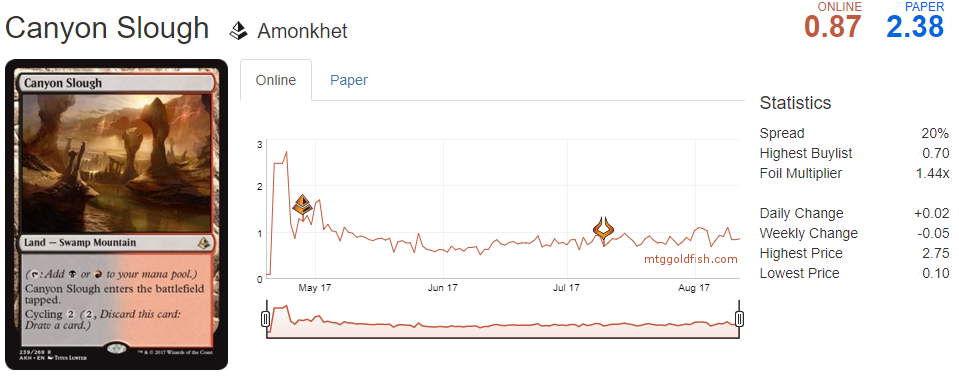
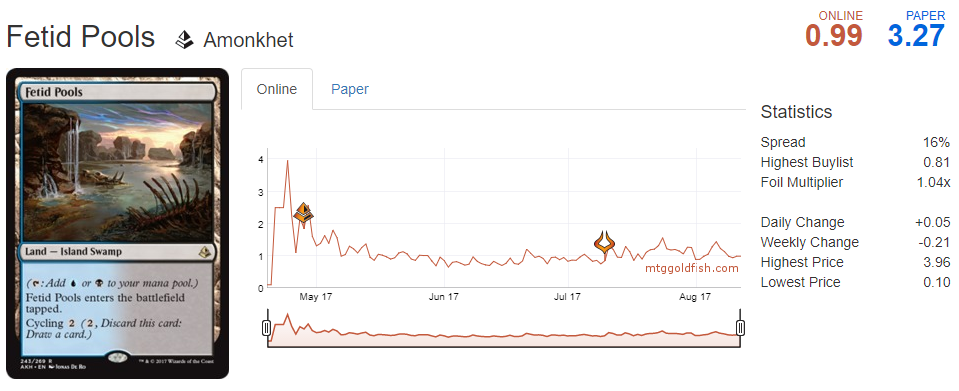
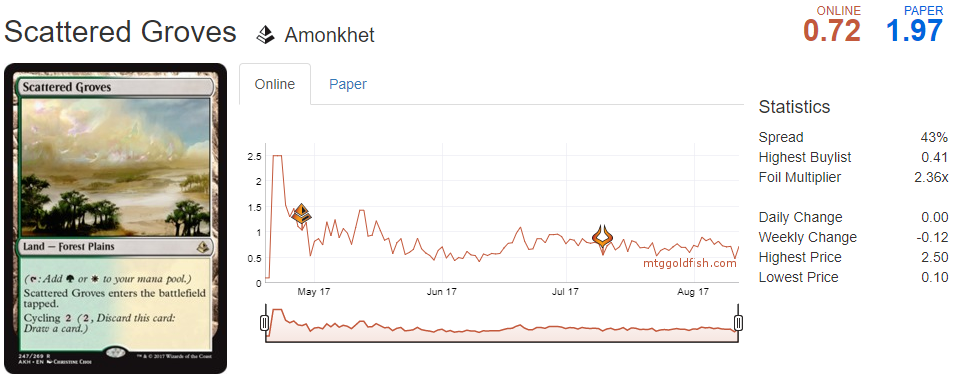
canyon_slough fetid_pools scattered_groves

These less-played cycling lands are some budget options that we'll likely see Seth use in three-color decks or two-color decks that are in friendly colors. If these lands are used, there's a possibility that they will go up by 0.75 to 1 ticket on MTGO. We can compare these with the other two cycling lands in this cycle, Sheltered Thicket and Irrigated Farmland, which are played in Standard. Based on the others in the cycle, we can assume that when these lands are played in top-tier decks, they can go up to 3 or 4 tix. So, even if these lands didn't increase in price due to Saffron Olive effects, there's still good chance that there are Standard decks that rely strongly on these lands after SOI's show-lands and BFZ's battle-lands rotate.

The SOI and BFZ lands are also very likely to see play in Saffron Olive's upcoming decks, but those lands are rotating in about seven weeks. Minus this week, as there's no Budget Magic, there are only a maximum of six more Budget Magic decks coming out before the mentioned lands rotate. For those specs to be profitable, we will probably need to hit half of them, which is not likely to happen in six weeks' time – at least, I won't be suggesting such risky specs to all of you.

Alright, that's all for this week. Once again, thanks for reading, and I will see you all again next week.

–Adrian, signing out

Insider: Shotgun Speculation on Commander

Are you a Quiet Speculation member?

If not, now is a perfect time to join up! Our powerful tools, breaking-news analysis, and exclusive Discord channel will make sure you stay up to date and ahead of the curve.

Up until recently Commander speculation evolved at a glacial pace, taking weeks, months, or even years for a well placed bet to come to maturity. Even speculation on Commander-driven hype from Hapatra, Vizier of Poisons unfolded after the general showed up on EDH REC’s list of most-played for the week. This gave analysts and well trained speculators plenty of time to browse lists on EDH REC and identify popular cards on which to speculate.

It was only until mainstream coverage was achieved on major podcasts that we saw spikes in the likes of Blowfly Infestation, Harbinger of Night, and Necroskitter.

There was an error retrieving a chart for Harbinger of Night

In the graph above you can see Harbinger of Night spike the week of May 22nd, 2017. Amonkhet was released nearly a month earlier, on April 28th, 2017. Players were brewing with Hapatra for weeks before people started going deep on -1/-1 counter themed cards—a bet that made perfect sense in hindsight.

The same sort of delay (or often an even larger one) existed with other Commander speculation of the past as well. Atraxa cards spiked well after the Commander 2016 decks were released.

It would appear that starting with Commander 2017, this has changed drastically…

Shotgun Approach

Before Commander 2017 spoilers began, we had leaks and rumors about the varying themes of the set. Dragons was the first creature type identified, and on-theme foils immediately reacted. A key card like Dragonspeaker Shaman jumped from $6 to over $11 in the early part of June. And who could forget the notorious spike on Reserved List Dragon Zirilan of the Claw? He jumped from a low of $3 to a peak of $12 in just two weeks based strictly on Dragon speculation.

There was an error retrieving a chart for Zirilan of the Claw

Meanwhile, Wizards hadn’t even confirmed the leak yet.

Then we had the next creature type for Commander 2017 spoiled: Cats! Once this news broke, buyers pounced on every relevant Cat foil they could! There was always a lingering fear of reprints, but sticking to foils was largely a risk-free endeavor. We saw immediate jumps in foil Raksha Golden Cubs, White Sun's Zeniths, and other Cat cards.

There was an error retrieving a chart for Raksha Golden Cub

Unlike previous Commander launches, it felt like speculators were jumping all over every possible relevant card immediately. They weren’t waiting for decks to be built, for EDH REC to update, or for true Commander finance experts to share their opinions. It became a game of “buy first, ask questions later.” I call this the shotgun approach because it’s imprecise. But with a wide enough spray, you’re bound to find a hit and profit.

I myself did this, although on a very small scale. I grabbed a few Cat foils here and there, and ended up selling every single one for breakeven or profit. Overall the endeavor paid off.

Since the initial leaks, Wizards has now revealed the complete Commander 2017 set. We know definitively what’s in, what’s out, and where the synergies lie. This would be the best time to review lists and determine what each deck needs most to improve, as these would likely be the best targets. But there’s one major issue with this strategy…

What’s Left?

All the obvious targets have already jumped! First, we had foils spike when people found out the themes of each deck. And then once complete lists came out, absent nonfoils also jumped—hence we have $20 Riptide Laboratory and $20 Patron Wizards.

There was an error retrieving a chart for Patron Wizard

Chances are some of these spikes will come all the way back down. To this day I don’t think Zirilan of the Claw is all that good in Dragon Commander decks. But the problem is, all of the targets that do fit well all jumped as well. There’s nothing left for the podcaster to recommend or the Commander writer to discuss. They can certainly identify what will jump, but everything already jumped! Speculators were ready and waiting to make their purchases and they did so with the slightest bit of news.

So where do we go from here? Well for one, I wouldn’t recommend chasing anything that has already spiked. You’ll be buying into peak hype, and I have to imagine many cards will come back down over the coming weeks. I sold everything I could into these rampant buyouts, and I won’t regret a single sale. But I am left wondering where I should put new cash to work in the field of Commander.

This is now the sandbox where Commander experts need to play. No longer are we in a world where they can browse EDH REC and make their “pick of the week” based on what cards are most played in the hottest Commander decks that week. Instead, people will have to reach deeper and deeper into the barrel to try and find some unturned stone with a prime speculation target.

This is not my expertise. I rarely play Commander these days and I’m more inclined to listen to the experts than to make recommendations on my own. That said, I do have a couple worthy ideas that fit within my wheelhouse.

Ideas: Research Before Buying

Naturally, my inclination is to look at older cards to see what has a chance to gain more attention. Usually with cards from Magic’s earliest sets, supply on the open market is much thinner. This means key targets are more like coiled springs ready to jump. If a card is on the Reserved List as well, it’s icing on the cake.

For the Wizards deck, a couple cards caught my eye. First, there’s the obvious: Ertai, Wizard Adept.

There was an error retrieving a chart for Ertai, Wizard Adept

He’s a Reserved List Wizard with a relevant ability, and therefore worth keeping an eye on. However he has barely moved in price post-announcement. This is either because people are neglecting this card or because it’s not very good. My guess is it’s the latter. This could be the Zirilan of the Claw of the Wizards, but for some reason speculators held back on this one as opposed to Zirilan. In any event, I prefer a different Reserved List target.

There was an error retrieving a chart for Mind Over Matter

This synergistic card has been gradually rising nonstop over the past few years. I can see players trying it out in their newly purchased Wizard Commander decks. With under 50 sellers on TCGplayer, it won’t take much for this one to pop.

Looking at the list of popular Vampire cards on EDH REC, I don’t really see any exciting, older cards listed. My heart goes immediately to Baron Sengir and the entire Sengir family from Homelands. But if you think any of these cards make a Vampires list, I have bad news for you. Only Old School aficionados like myself would have an appreciation for these suboptimal cards.

Shifting gears to the Dragon deck, the one card that has my attention is the original Nicol Bolas. I am referring specifically to the Legends printing, which also happens to be the most collectible version.

There was an error retrieving a chart for Nicol Bolas

He’s the original king of the dragons, and he even shows up as one of the key creatures in themed Dragons decks on EDH REC. But really, it’s his rarity and collectability that make this card a worthwhile consideration. I doubt he makes a ton of lists once these Commander 2017 decks are released.

Lastly, let’s take one last look at the Cats tribal deck in Commander to see if there are any unturned stones. This was the theme I put the most money into, and as I mentioned before I’ve already sold out of most of what I bought. But are there any classic cards worth another look?

Well, I always liked Mirri, Cat Warrior due to her involvement in some of Magic’s early stories. But the card itself isn’t all that good and she’s not on the Reserved List. That said, she is certainly on-theme and does show up in some of the EDH REC Cat lists. Maybe buying foil Tenth Edition copies is the way to go? They haven’t really moved yet.

The original cat warrior, Jedit Ojanen, can’t even be played in the new Cat deck because he’s white-blue instead of white-green, for whatever reason. Otherwise I would have recommended him from a nostalgia standpoint.

Alas, there’s not much else that has my eye. I was tempted by Nacatl War-Pride being from Future Sight, but it looks like I’m a week too late. Foils already popped. There aren’t a ton of non-foils on TCGplayer, so maybe it’s worth grabbing a few? I have to imagine there aren’t a ton of copies out there given Future Sight was printed a long time ago. If nothing else, make sure you dig through your bulk to pull these out.

Wrapping It Up

Speculators have been all over Commander 2017 this spoiler season. Their eagerness and shotgun approach has really reduced the number of strategic acquisitions based on strategy and synergy. Instead, every card with the word “Cat” or “Wizard” on it seems to have spiked.

The cards that belong in the new decks will hold their higher prices. Those that don’t belong will eventually drift back down again. But in either case, there’s no way I’d recommend buying anything that has already shot up in price. That doesn’t leave much, but I have two suggestions.

First, pay attention to the experts who specialize in Commander. They’ll be thinking next-level and are far more qualified to recommend under-the-radar targets than I am.

Second, keep print run and supply in mind when you reach deeper into the spec pool. Cards from Magic’s older sets—especially those on the Reserved List like Mind Over Matter—could be solid targets with very low risk. If they don’t hit, they won't be dropping in price anytime soon at least. And if they do, you have the most potential for profit.

This is how I’m going to play the rest of my Commander 2017 speculation. Unless something inspirational shows up in the QS Discord channels, I won’t be buying much else this time around. Even though I missed out on many opportunities, one thing is for certain: there will be plenty more opportunities each and every week. There always are!

…

Sigbits

  • When In the Eye of Chaos spiked, speculators forgot about ABU Games, who still had over a dozen copies of the card in stock. I managed to grab two myself. Now everyone’s price is much higher: ABU Games and Star City Games both updated their price to $79.99, though SCG still has zero English copies in stock. This new price is very likely to stick from here on out.
  • I’ve noticed Lake of the Dead peaking its head on MTG Stocks Interests now and again. It never makes a huge move, but it has certainly been rising steadily in price. Star City Games is sold out of the Alliances card with a $12.99 price tag. Being on the Reserved List, I can certainly see this continue to climb higher.
  • I noticed Beta Rock Hydra “spiked” on MTG Stocks over the weekend, probably because one copy sold and the next cheapest was overpriced. But it led me to look up Star City’s pricing. Turns out they are sold out at $79.99. It wouldn’t surprise me to see a small bump in this one’s price in the next few months. It’s not as popular as something like Elvish Archers in Old School MTG, but it is on the Reserved List and carries a bit of nostalgia for older players.

Insider: QS Cast #73: “Bend the Knee”

Are you a Quiet Speculation member?

If not, now is a perfect time to join up! Our powerful tools, breaking-news analysis, and exclusive Discord channel will make sure you stay up to date and ahead of the curve.

Play

The QS Cast returns! Chaz Volpe, Morgan Wentworth, and Tarkan Dospil come together as the new panel - and in this episode they discuss the following:

  • Reserved List discussion (yeah, it's about that time again)
  • Interests - discussion about watching cards that trend down, and looking at trends before cards increase drastically.
  • Commander 2017 Recap and choice cards to consider.
  • Really bad jokes.

Cards we discussed:

From Commander 207:

Licia, Sanguine Tribune - has some potential in 1v1 Commander, adding third color is a new dynamic outside of Karlov of the Ghost Council

Mirri, Weatherlight Duelist - 1v1 Commander potential, and has an outside shot at Legacy?

Kess, Dissident Mage - Is probably too inexpensive, and can likely be the chase (and most expensive) card from Commander 2017. Starting price was $4.99 and that seems wrong. Under $10 still has upside, as there's a lot of growth potential here.

Alms Collector - Outside shot in Legacy. Powerful (and splashable) effect.

Enjoy!

Find us on Twitter: @ChazVMTG @MTGValkyrie @the_tark

Insider: The Financial Considerations of Restricting Workshop

Are you a Quiet Speculation member?

If not, now is a perfect time to join up! Our powerful tools, breaking-news analysis, and exclusive Discord channel will make sure you stay up to date and ahead of the curve.

There are always a lot of buzzworthy topics floating around in MTG finance. Cards are going up, cards are going down, you do the hokey-pokey and you turn yourself around. With tens of thousands of unique cards in the game of Magic: The Gathering there is always a lot to think and talk about.

However, with that being said, the most interesting topic of conversation in Magic finance today is the discussion regarding Mishra's Workshop and its possible restriction in Vintage. The whole conversation is 1) fascinating, and 2) a really big deal for the future of MTG finance.

Let me start by saying that over the past weekend at Grand Prix Minneapolis I was asked no less than fifty times if I thought the DCI was going to restrict Mishra's Workshop on August 28th. It is a topic that people are interested in and care about—which is why I think it makes a great finance topic.

I'm a longtime Vintage player and fan. Long before I ever played on my first Pro Tour over a decade ago I was slinging Ancestral Recalls competitively on the local Vintage scene and the SCG Power 9 Open series. Vintage has declined in playability over the past ten years. My transition to a pro player has more to do with the nonexistent nature of Vintage events than anything else. It was inconvenient to play Vintage and so I started spending more time drafting and playing the other formats.

With that being said, I've never missed a Vintage Championship and whenever I have a free weekend to hang out at home I look to see if there is a Vintage tournament in my backyard. I'll admit I'm not a Vintage warrior anymore but I do follow the format with interest.

When I was an everyday Vintage player and wrote a primarily Vintage-related column for SCG back in the day, I wrote numerous articles where I suggested that Mishra's Workshop ought to be restricted in Vintage. The main qualification I gave was that the deck was dominant, and that in that archetype Mishra's Workshop was more powerful than literally any other card, in any other deck (with the possible exception of Bazaar of Baghdad in Dredge).

I have always felt that Mishra's Workshop was a card that ought to be restricted in Vintage because of power level concerns. The card and the decks it facilitates are format-defining, warping, and typically the best strategy in Vintage. They also tend to be non-interactive—their objective from turn one forward is to make it impossible for the opponent to cast spells.

The Price Problem

I'm not here to make definitive statements about what various groups of people think are fun and not fun. It literally doesn't matter to me one way or the other. I care about two things: 1) what formats look like, and 2) what options I have when playing formats. I'm to a point with Magic where I really don't care what they do or don't do with regard to play. If they ban my deck, I will get a new deck.

The kicker with Mishra's Workshop is that the individual card is worth $1000.00. If they ban the deck, players, vendors, and dealers could potentially lose a lot of money. I also believe that if somebody has made the investment of thousands of dollars into a playset of cards that they have every right to be justifiably angry if those cards are made illegal.

There was an error retrieving a chart for Mishra's Workshop

It puts Wizards in a tough spot when it comes to making a decision about the future of Vintage.

I'll also note that there has been a lot of discussion on Twitter about doing various Vintage leagues where Mishra's Workshop is restricted because people in those groups have gotten bored of the format as is. Not good.

We have gotten to a point in Vintage where more and more people are coming around to the opinion that Mishra's Workshop may not be a healthy mainstay for the format.

On the one side, Workshop does create format diversity in the sense that it is a non-blue deck that preys on blue decks. If Workshop is restricted, the format becomes much more blue-centric. It is also possible that Workshops push other potential decks out of the format by virtue of being overpowered in their own right.

I also don't want to overstate the point that everybody wants Workshop to be restricted. There are plenty of people who think the deck is fine and would prefer it continue to exist as is. My biggest question is whether or not these opinions are held mostly by individuals with a personal interest in the card—i.e., people who play, own, or have invested in Workshops.

I don't have the answer to that question. But here is my thought process on the subject. I 100% believe that if Mishra's Workshop had been printed in Kaladesh for the first time, and enabled the current iteration of Shop decks, that it would get restricted on the 28th. There is literally no doubt in my mind.

The fact that Mishra's Workshop has been allowed to run roughshod over Vintage for fifteen years is a by-product of nostalgia (it's an iconic Antiquities card) and potentially a finance/collectability issue (people will be mad if they restrict a super expensive card).

We know there has been considerable backlash to cards being banned in Standard and Modern. People do not like having their decks banned. It feels bad to invest money into a deck and then see it invalidated by a banning. Now imagine that your deck has cost thousands upon thousands of dollars, and now you have to invest thousands more into the blue Power Nine cards to continue to play. Such a scenario is catastrophic.

I've always believed that Mishra's Workshop's sustained dominance in Vintage has been a product of the price tag. The upside to potentially making the format a little bit better is severely outweighed by angering a percentage of players and collectors who will feel personally slighted.

Why Now?

I can say with some degree of certainty that the current version of Mishra's Workshop isn't even the best version of Shops that has ever existed. The Lodestone and Chalice of the Void versions were better and more dominant in their day. The problem is that the DCI has taken an approach to Workshops where instead of just eliminating the problem (which is the Shop itself) they have gone down the road of trying to make Workshops "fair" by restricting other tools.

We end up with lots of weird cards on the Restricted List (Lodestone Golem, Chalice of the Void, Trinisphere, etc.) because the DCI wants to keep the sacred cow in play. They did the same thing with Necropotence back in the day and the endgame was an abject failure.

Power creep ensures that Workshop will always get new and better tools, which means the song and dance of trying to balance Workshops is a forever project.

Ultimately, I think the risk associated with restricting Mishra's Workshop is too high. It would certainly shake up and destabilize the secondary market to some degree. People who invest thousands of dollars into cards don't want to think about having those cards Restricted or Banned. It's easier to ban $3 Lodestone Golem and call it a day.

There was an error retrieving a chart for Lodestone Golem

What would happen to the secondary market if Mishra's Workshop were restricted? We've already come to a point where collectors are wary of investing in cards to some extent. Eternal Masters and Modern Masters create a dynamic where the vast majority of investments are not safe for risk of reprints. The Reserved List is supposed to be the "safe stocks." Yet, if $1000 Reserved List cards are subject to being removed from the formats where they are played—that adds risk to these stocks as well.

Fixing the Current Vintage

From a pure playability standpoint, I would make the following changes to the Vintage Restricted List:

1. Restricted: Monastery Mentor, Paradoxical Outcome, Mishra's Workshop, Mental Misstep, Gitaxian Probe.
2. Unrestricted: Chalice of the Void, Lodestone Golem, Trinisphere

The format has been stale and locked in a Workshop vs. Mentor waltz for years now. Rich Shay wrote a very convincing article about how Monastery Mentor is the ultimate Turbo Xerox engine a few weeks ago, and I agree. With these two decks in the format there is literally nowhere else for the format to go or grow. They essentially weed out everything else and create a two-deck metagame where nothing else matters.

The problem is that removing Mentor simply plays into Workshop's hand. The fact that Mentor is one of the most busted blue decks of all time and Workshop is on the same level is deceptive. Typically, Vintage has one busted deck that rises to the top, dominates, and needs to be chopped back. Currently, there are two absurdly busted decks that "keep each other in check."

If it was one or the other it would be easy to restrict. However, because there are two decks it creates the illusion of diversity. The issue is that these decks literally push everything down into the second tier. There are other decks that are "good enough" to compete. Vintage is full of busted cards and anything is capable of winning on any given day. However, the point is the field will always be dominated by Mentor and Workshops until the format is forcibly altered.

Conclusion

Ultimately, I think Workshop will not be restricted despite the fact that for practical purposes with regard to playability of the format it probably should be. The primary reason is that I don't think enough people play and care about the format to justify making a move that would upset so many people on such a profound level. The people who play Vintage and love the format will play with or without Workshop. However, the downside of severely angering collectors, dealers, and Workshop players doesn't offset the net positives of making the format "better" in some abstract sense.

It is an interesting thought exercise to be sure. It also hints at the power of MTG finance—that the monetary value of cards can go a long way to influence what is and isn't acceptable in competitive constructed formats! Either way, it's a scary few weeks for Workshop fans. Hang in there Metal Warriors: I think you're safe—for now...

Insider: Notable Exclusions from Commander 2017

Are you a Quiet Speculation member?

If not, now is a perfect time to join up! Our powerful tools, breaking-news analysis, and exclusive Discord channel will make sure you stay up to date and ahead of the curve.

The Commander 2017 decklists have been revealed. Here's a quick list of omitted cards:


Modern Top 5: Hosers

Are you a Quiet Speculation member?

If not, now is a perfect time to join up! Our powerful tools, breaking-news analysis, and exclusive Discord channel will make sure you stay up to date and ahead of the curve.

Modern Top 5: Utility Spells kicked this series off, and in my eyes, it was hugely successful. Not only did it present a measurable way to analyze cards that I'm quite proud of, but the article also inspired a lively debate in the comments. Today, we'll revisit the series, focusing on some of Modern's most defining and reviled cards: hosers.

Hosers and utility cards are perhaps total opposites of one another; hosers occupy sideboards and have narrow, powerful applications, while utility cards passably play multiple roles and pepper the 75 as space allows. We'll use the same formula we did last time, but with some necessary tweaks.

Definitions and Parameters

As in Modern Top 5: Utility Spells, we won't get far in the way of constructive discussion without first defining the term at hand. Hosers are cards that single-handedly turn off or severely hinder the use of a single mechanic. Since Modern rewards deckbuilders for extreme focus, hosers generally have a high impact here—most of the format's linear decks are entirely built around a certain mechanic (Dredge, Affinity, etc.), and even its interactive decks tend to dip their hands pretty deeply into one cookie jar or another (be it graveyard synergy, one-drops, etc.). We'll again outline three parameters by which to rate the format's hosers. Power and splashability make a return today, and are likely to become staples of this kind of discussion; the third metric, flexibility, will be replaced. After all, flexibility isn't exactly what anyone looks for in hoser cards.

Power, Stickiness, Splashability

Most obvious when sizing up a card is the strength of its effect; how much does the card do for its mana cost? Many spells have different effects at different stages of the game; Engineered Explosives, for example, is great against a board of three Tarmogoyfs and miserable against a creatureless Scapeshift opponent with six lands. When it comes to hosers, a card's power level is also related to the uniqueness of its effect; Ghostly Prison and Ensnaring Bridge, for example, fight for favor in similar shells. The generally superior choice among them edges out the other(s).
We'll also look at power in terms of a card's floor (the worst it can do) and ceiling (the best it can do). Since hosers are so narrow by definition, though, we'll consider their floors and ceilings in terms of the matchups they're actually sideboarded in for; otherwise, many would have a floor of zero. It would be unfair to judge hosers the same way we judge utility cards for this metric, as the latter regularly find themselves occupying flex spots in the mainboards of interactive and linear decks alike.

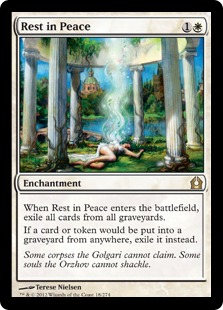
The reason all decks don't play such powerful cards is simple: hosers generally provide symmetrical effects. Good luck squeezing Rest in Peace into your Tarmogoyf/Lingering Souls deck! Hosers see play limited by how many decks can both wield it and ignore it. The third aspect to consider is whether the deck needs that effect to begin with—in linear decks that are fast enough, such as Affinity, turning off graveyards isn't exactly the first order of business. That deck in particular can often beat Dredge before its graveyard becomes genuinely frightening, and if the robots are worried about Conflagrate, Spell Pierce is a better side-in anyway. Taken together, these points form another crucial metric for analyzing a hoser's worth: splashability. Here we're talking not just the mana restrictions on the card, but the more general strategic ones as well.

Lastly, hosers see play based on how challenging they are to remove. While hatebear-style creatures like Aven Mindcensor boast powerful effects, countering a bird that's flashed in in response to a fetchland is as simple as casting Fatal Push. Stony Silence, for instance, asks Affinity a much tougher question: did you open a Spire of Industry? If not, the enchantment is favored to stay on the board for the rest of the game, which is then likely to end shortly. This concept forms the basis of our new second metric, stickiness.

Here are the parameters we'll use to judge our hosers:

  • Power: The degree of impact the card tends to have for its cost (floor vs. ceiling).
  • Stickiness: The trouble opponents have removing the card.
  • Splashability: The ease with which Modern decks can accommodate the card.

We'll again rate each parameter on a 1-5 scale, with 1 being the worst and 5 being the best, and add them all up for a card's final score out of 15. To it we hop!

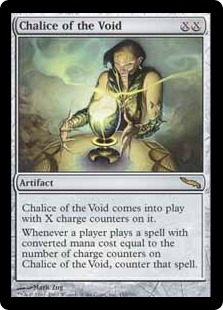
#5: Chalice of the Void

Similar cards: Eidolon of the Great Revel, Trinisphere

Power: 4

For a paltry two mana, Chalice of the Void can grind entire decks to a halt, sitting around as something of a Pandora's Box of Counterspell. But the artifact wasn't taken seriously in Modern for most of the format's lifespan. The conversion of BGx Rock to Grixis Shadow, a deck significantly more focused around the 1-CMC slot, and the subsequent metamorphosis of Gx Tron into Eldrazi Tron, a deck that can painlessly accommodate Chalice, has led to the card's meteoric rise.

Chalice is also relatively flexible. Coming down for zero on the play against Affinity can be nearly as debilitating as resolving Stony Silence. Coming down for two against UR Storm not only prevents the deck from going off, but turns off their preferred answer to hosers, Echoing Truth. And the now-constant threat of Chalice on one in Modern further contributes to Gx Tron's fall from grace. Why play a deck that loses to Chalice when you could play a similar deck that abuses it?

In relation to its contemporaries, Chalice shines even brighter. Eidolon of the Great Revel is trivial to remove, and at least gives opponents the option of resolving their spells. Trinisphere can be fought through with simple land drops and costs more than a Chalice on one.

Stickiness: 3

Chalice's ultimate balancing factor is its card type. Every Modern player packs interaction for artifacts, and between Ancient Grudge, Wear // Tear, and now By Force, there's no shortage of options available. Perhaps the single best card against Chalice of the Void is employed in multiples by the deck it directly preys upon, Grixis Shadow: Kolaghan's Command is too pricey to ever stop with a Chalice and comes with a second effect to boot. Grixis Shadow's Snap-Kommand plan gives them a line against even multiple Chalices.

That said, it does help that Chalice can be used to turn off artifact removal. Resolving it for two against Burn, for example, takes Destructive Revelry out of the picture.

Splashability: 1

The reason Chalice is so good in Modern is the same reason so few decks can play it. One-drops are everywhere in this format, and most decks would rather run even just one or two playsets of cheap interactive cards or strategic enablers than the off-theme hoser.

Overall: 8/15

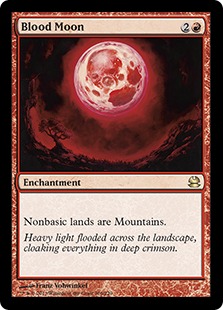
#4: Blood Moon

Similar cards: Choke

Power: 3

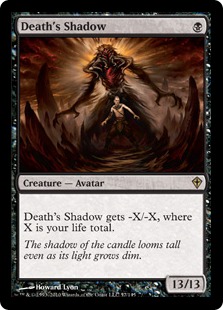
Blood Moon is a tricky hoser to evaluate. Its strength is contingent both on whether opponents open hands with the option of fetching around Moon, and on whether they choose not to fetch around it regardless. Decks like Death's Shadow don't have much of a plan against decks like RG Ponza other than to get under them, which means taking plenty of damage early on to facilitate their namesake threat. Since the most efficient way to do that is to fetch into shocklands, just the threat of Blood Moon gives Ponza a sizable edge in some games.

That threat is the next thing we'll talk about. Sure, Mooning your opponent on three shocks will probably put away the game. But players are wise to Moon now, and generally slow themselves by a turn or two to make sure that doesn't happen. Resultantly, Moon creates a weird tension—we need to run it to benefit from the effect of threatening it, but should we draw Moon instead of proactive cards after opponents slow themselves down to play around it, the speed bump is lost. Managing this tension means learning to fetch in a way that doesn't telegraph a Blood Moon when we have it (i.e. by digging out Shocks and sandbagging basics in hand), and fetching in a way that suggests it when we don't.

Moon also wins games by invalidating certain strategies. Decks revolving around certain lands, like Scapeshift or Amulet Titan, have a hard time winning through Moon even with their colors. Similarly, supplementing Moon with any kind of pressure makes it tough for big-mana strategies like Eldrazi Tron to resolve threats impactful enough to reclaim a populated battlefield.

Stickiness: 4

Enchantments are tough to remove. It helps that Blood Moon complicates casting Abrupt Decay, one of the cleanest answers around. Certain shards and wedges have few options when it comes to removing the Moon, especially Grixis (conveniently the best deck's color combination).

For some decks, killing Moon is as simple as rapidly fetching out basic Forest; after that, any Destructive Revelry or Seal of Primordium drawn will take it off the table. But that plan doesn't account for the possibility of multiple Moons, the fact that diggers like Serum Visions become harder and sometimes impossible to cast, and Moon's effect in the meantime, which otherwise prevents players from casting their spells normally. While destabilized, their opponents have plenty of time to just kill them—or to Stone Rain that Forest.

Splashability: 2

Many two- and even three-color decks featuring red can splash Blood Moon. But there aren't many of those decks out there anymore. For those that do exist, accommodating the Moon forces deckbuilders to construct their manabases a certain way that leaves them more painful (more fetches and shocks) and less flexible (fewer utility lands). Usually, this trade-off isn't worth it. But we do still see decks like Affinity packing Moons in the sideboard despite the card's non-synergy with creature lands.

Overall: 9/15

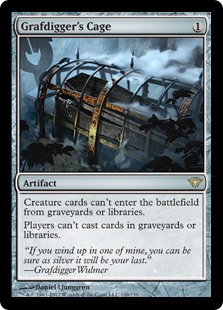
#3: Grafdigger's Cage

Similar cards: Rest in Peace

Power: 3

Cage has a strange and narrow effect, but there's no arguing that it's great for the cost. If opponents draw a Lingering Souls, Snapcaster Mage, or Kitchen Finks this game, Cage has already paid for itself in terms of card economy. And it often does much more. Resolving Cage against Collected Company decks forces them to play a fair creature game with eight blanks in their deck; sticking it against reanimator strategies like Grishoalbrand or Ghost Dad similarly shunts opponents into an uncomfortable Plan B. Against Storm or Dredge, the game is just over unless opponents remove the artifact.

A big draw to hoser cards generally is how low-maintenance they are; players can resolve them and then go about their business as the hoser sits there and disrupts opponents. Usually, though, hosers cost between two and four mana, requiring players to functionally take a turn off to deploy them. Since Cage costs only one, it hardly interferes with curving or an otherwise proactive gameplan.

Stickiness: 3

Like Chalice of the Void, Cage suffers from the curse of the artifact type. But unlike Chalice, it's very hard to remove Cage at mana parity. Almost every played answer costs two or more mana (including the three-mana Qasali Pridemage and Reclamation Sage, common solutions from the Company decks Cage brutalizes). That means that at its floor in relevant matchups, Cage steals tempo from opponents. As a bonus, Modern's best destroy effect for artifacts, Ancient Grudge, can't be flashed back while Cage is in play, forcing strategies like Dredge to find their answer the old-fashioned way.

Splashability: 4

The narrowness of Cage's effect, combined with its low and generic mana cost, renders the card highly splashable. Only decks reliant on casting cards from the graveyard (featuring the aforementioned Snapcaster Mage, Lingering Souls, etc.) need skirt it. It's no wonder we've been seeing so many Cages in sideboards as of late.

Overall: 10/15

#2: Rest in Peace

Similar cards: Grafdigger's Cage, Leyline of the Void

Power: 5

The only card here to earn a 5 in this category, Rest in Peace is great at virtually all stages of the game. Speed bump effects like Nihil Spellbomb and Relic of Progenitus let opponents rebuild after nuking the graveyard; similar hosers like Leyline of the Void are often too slow to have any real impact if cast later. Rest in Peace is really two cards in one, nuking the graveyard when it resolves and then preventing further abuse until dealt with. For its two-mana cost, this double-spell effect is a steal.

Stickiness: 4

Rest in Peace shares the coveted enchantment type with Blood Moon, making it tough to remove. Fortunately for opponents, their ability to find answers isn't touched by Rest in Peace; conversely, their proactive plans—be they swinging with Goyf and delve threats, growing a fleet of Amalgams, or comboing out with a huge Past in Flames—are neutered.

Splashability: 2

Many Modern decks use the graveyard, which limits Rest in Peace's appeal for some white decks. But white is also the color least likely to use the graveyard, so in one- or two-color shells, the card's a shoe-in. UW Control, Death and Taxes, and white Eldrazi decks love the card; linear strategies like Burn and Affinity have also been known to run it occasionally.

Overall: 11/15

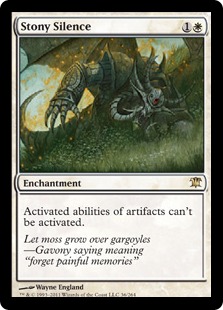
#1: Stony Silence

Similar cards: Damping Matrix, Suppression Field

Power: 4

Stony's as close to a "win button" as we have in Modern against artifact strategies. The other cards on this list are far from game over—they're easier to remove, for one, and their effects can be navigated around; Dredge can cast Amalgam through a Rest in Peace, for instance. And compare Stony to its kin, Damping Matrix and Suppression Field. Stony's more surgical than the former, as well as cheaper, and it blows the latter out of the water when it comes to raw power.

Stickiness: 5

Enchantment that prevents artifact sources from producing colored mana? Yes, please! And if your colors can't remove artifacts by themselves, forget about it—Ratchet Bomb and Engineered Explosives won't help you here.

Splashability: 4

Granted, Stony Silence has a color requirement. But it's not an intensive one; the card merely requires pilots to have access to white mana in any small capacity. Thanks to Affinity's recent reign of terror, we've seen Stony Silence enter sideboards all over the Modern, even in the Aether Vial-featuring Death and Taxes. The splash hate from a card this impactful is great enough to keep less proactive artifact strategies like Tezzeret and KCI Combo from rearing their ugly, metal heads.

Very few decks activate abilities of artifacts, making Stony Silence plenty splashable—and those that do all but lose to the card, making splashing it very attractive.

Overall: 13/15

Hose House?

So there you have it: the second edition of Modern Top 5! Any hosers I missed? Want to convince me why Ensnaring Bridge deserves a spot? I'll see you in the comments.

Insider: A Beginner’s Guide to the MTGO Marketplace, Part II

Are you a Quiet Speculation member?

If not, now is a perfect time to join up! Our powerful tools, breaking-news analysis, and exclusive Discord channel will make sure you stay up to date and ahead of the curve.

This week, I want to build upon what we started in part one: a helpful manual to help make you comfortable navigating through the MTGO marketplace. To that end, I want to first offer a few more pieces of advice, this time geared more for the MTGO veteran, and then I will provide a brief description of some of the major bot-chain companies in the MTGO marketplace I've done business with.

(1) Investors need to use a greater number of bots to buy and sell efficiently.

This is because bot chains change their prices in response to the cards that they buy and sell, and you can generally only buy and sell four copies of any given card in any given transaction. Some, like Cardhoarder and MTGOTraders, will usually change their prices in response to the buying or selling of roughly twelve copies of a Standard-legal uncommon, eight copies of a rare, and four copies of a mythic. Smaller bot chains like Goatbots are more responsive, probably because their inventories are smaller overall, so usually you'll see movement after eight copies of an uncommon and four copies of a rare/mythic.

There was an error retrieving a chart for Goatnapper

Practically speaking, then, you want to use a suite of several bot chains so that you can buy and sell a lot of copies of any given card at the price point you want. If you stick to one or two bots to do all of your investing, you'll need to make investments over a greater period of time or face paying more per card than you probably should. For a modest amount of investing, I'd recommend having a suite of three or four bot chains you can go to when you are looking to invest in 20 to 50 copies of a card. When investing in 50 to 100 copies of a card, I tend to make that investment over a greater period of time, but if you find yourself often making investments at that volume level all at once, it would probably be best to have a suite of five or six bot chains.

(2) Regard human sellers with skepticism.

The trained eye can tell the difference between a regular player trying to sell a card for better than what a bot would buy it at and a human who tries to passively make money off of people by taking advantage of their desire for interpersonal trading. Most human traders fall into the second camp, more so now than when I started using MTGO back in 2013. Just be vigilant when you trade with other humans to make sure that they aren't trying to scam you. Be nice to others, but don't blindly trust them. For those of you who like game theory, have a gander at this fun game based upon scholarly research that tries to use game theory to explain trust issues in contemporary society).

There was an error retrieving a chart for Trusted Advisor

(3) With that said, don't be afraid to list your expensive cards on the classifieds and sell them yourself.

When you're dealing with cards that cost more than 20 tix, bots usually sell them for 1 to 3 tickets more than they will buy. Standard cards will tend to be closer to one, and eternal cards closer to two or three. For example, as I'm writing this article, Cardhoarder is selling Chandra, Torch of Defiance for 41.25 tix and buying copies for 39.39 tix. That means that you can probably sell your Chandras for 41 or 40 tix if you list them yourself as a classified.

There was an error retrieving a chart for Chandra, Torch of Defiance

When I list my own classified ad for a card, I always offer it for a price lower than what all the bots are selling and higher than for what all the bots are buying. This ensures that both the player I'm trading with and I get a good deal. I wholeheartedly recommend doing this when you're trying to move an expensive card if you want to maximize your margins. I made an extra dollar per card moving my Kalitas, Traitor of Ghets last week employing this method, and I likewise made an extra $1.50 per card this way when moving Noble Hierarch last year.

(4) Use the specialty stores.

Oftentimes the specialty stores do actually give consistently great value. For bulk, for example, the j-raja bot consistently gives me triple or quadruple what other bots would give. The bots that only buy sometimes do beat everyone else by 0.50 to 1.00 tix. I only use BoosterCity to buy and sell boosters and treasure chests because they consistently offer prices slightly better than everyone else.

There was an error retrieving a chart for Trash for Treasure

(5) Once in a while, be sure to enter whatever you're buying or selling in the search bar just to have a look at the wider MTGO marketplace.

It's good to find a set of bot chains you're happy with, saving you both time and money, but once in a while it is beneficial to see what else is out there. Sometimes you'll find a new bot chain worth doing business with and you just need to do this to keep in touch with the pulse of the economy. This is how you develop "street smarts" when navigating through the MTGO marketplace. Honestly, this piece of advice goes for anything, whether it be the brand of jam you buy at the grocery store or the stores you frequent to buy clothes. The one exception is Blue Bell Ice Cream – if you're fortunate enough to live in a state that sells Blue Bell, all other ice cream can simply be ignored. (I jest...(but not really).)

There was an error retrieving a chart for Hungry Hungry Heifer

(6) Sell cards you aren't investing in after you open them. Don't hold singles in anticipation of a price increase.

Undoubtedly you will hear me and Matthew Lewis say how X set is at a low right now and will rise in price. I've already said that about Amonkhet, and in a few weeks will undoubtedly say the same thing about Hour of Devastation. Nevertheless, I think it is inadvisable to hold cards you open in Draft or Sealed events. It is hard enough and time-consuming enough to manage an investment portfolio on MTGO. If you make it a habit to hold opened cards you think might go up, you'll end up with a horde of singletons spanning across multiple sets and you simply won't sell them efficaciously. It's okay to hold a few like this, but in general it's better just to sell and focus more on managing the cards that you willfully chose to invest in. Which leads me to…

(7) Sell your Limited bulk early.

It used to be that you could be lazy about this. You could wait a year or more and not lose any value. Now that redemption ends one month after the next block releases, you have to be more conscious about selling your Draft and Sealed bulk to bulk bots, because those bots won't buy your bulk if those cards can't be redeemed. Additionally, don't hesitate to sell your foil uncommons. For the past few years, you could sell your foil uncommons for 0.75 to 1.00 tix, but those days appear to be over. Don't hold your foil Banewhip Punisher in the hope that its price will go up. Foil uncommons held a premium in past years because of redemption, but now that redemption has been curtailed, foil uncommons simply aren't worth as much anymore. Sell, sell, sell!

Drumming Off

Please let me know if you have any questions regarding what I've written in these two articles. Knowing how to operate within the MTGO marketplace is crucial for maximizing your MTGO investments as well as the value of your winnings in online competitive events.

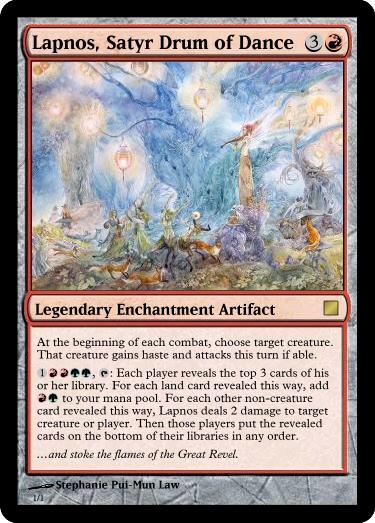
Last week, I presented a fun and powerful Commander card, and this week I give you its twin compliment, the Satyr Drum, another fun card for Commander. Sadly, I could not find a piece of artwork that fit this perfectly – we humans love painting satyrs with pipes and flutes, not with drums. Nevertheless, I did find a beautiful painting of a festival with a satyr and drum in it, so please enjoy that!

Lapnos Satyr Drum of Dance alternate

Avatar photo

Kyle Rusciano

Kyle started playing Magic with his little brother when they saw some other kids at a baseball camp playing. His grandma bought them some Portal: Second Age decks, and a hobby was born. Kyle played from Weatherlight through Invasion, then took a lengthy break until 2013. Now a PhD student in the humanities, the Greek mythology component of Theros compelled Kyle to return to the game. He enjoys playing Pauper and Limited as well as focusing on MTGO finance and card design. Follow him on Twitter at @KangaMage!

View More By Kyle Rusciano

Posted in Buying, Finance, MTGOTagged , , , 3 Comments on Insider: A Beginner’s Guide to the MTGO Marketplace, Part II

Have you joined the Quiet Speculation Discord?

If you haven't, you're leaving value on the table! Join our community of experts, enthusiasts, entertainers, and educators and enjoy exclusive podcasts, questions asked and answered, trades, sales, and everything else Discord has to offer.

Want to create content with Quiet Speculation?

All you need to succeed is a passion for Magic: The Gathering, and the ability to write coherently. Share your knowledge of MTG and how you leverage it to win games, get value from your cards – or even turn a profit.

A Modern Proposal: Six Years Later

Are you a Quiet Speculation member?

If not, now is a perfect time to join up! Our powerful tools, breaking-news analysis, and exclusive Discord channel will make sure you stay up to date and ahead of the curve.

This week, I’m doubling down. Modern is returning to the Pro Tour, and with that, banned list discussion is certain to resurface. I’ve chosen to get out ahead of it; my article last week speculated on a potential opportunity for Wizards of the Coast to "solve" the banning problem once and for all. Unsurprisingly, this take was pretty controversial. This week, I want to go a step further.

It’s easy to talk in broad terms about grand plans for the future, highlighting only the best case and ignoring the worst. I’m not going to do that. Instead, I want to take a systematic approach to the nitty-gritty, getting deep into the logistics of what a format-shaking shift might look like. This article will be speculative in the sense that we'll discuss decisions that Wizards of the Coast could potentially make, but my goal here is to outline, as specifically as possible, the theoretical approach they could choose. Farther down, I'll provide my own proposition for a rotating banlist that I believe will help to alleviate some of Modern's problems. Let’s get started.

Thesis

Modern has been plagued by bannings for the entirety of its six-year existence. Wizards of the Coast has flip-flopped regarding its treatment towards professional play, starting with supporting the Pro Tour, then attempting to remove it, then later successfully removing it, to now bringing it back. While the format is incredibly fun, stagnation is a real issue, and worries that the format under the spotlight will make things worse are prevalent. New set releases are currently the only way to introduce new cards to the format, but Wizards has to get creative to fit in cards that don’t adversely affect Standard. It is my opinion that all these issues can be solved by a policy switch from "fix-it bans" to "shake-up bans."

For clarity, here are the main arguments for and against a policy change to bannings. Entire articles can be spent on each point, so forgive me if I don’t elaborate fully here in the interest of economy.

For: No more inconsistencies from the top. Wizards' position on Modern (rumored or otherwise) has been, at best, inconsistent. Popular opinion among the community has been that WoTC considers the Modern Pro Tour as a pressure to be more hands-on regarding Modern, which some say has led to bans in the interest of a more interesting viewing experience. In 2017, we still don't really know Wizards' position, because their official language has often been non-committal and the waters are muddied with public opinion at this point. Nevertheless, uneasiness lingers among the playerbase as Modern returns to the Pro Tour, and all eyes are on Wizards’ reaction to the format, rather than, you know, the game.

For: Strategic implications. Shake-up bans would allow for seasonal shifts in the metagame, as effectively new cards are introduced and certain cards are removed, for a short while. Stagnation could be avoided entirely, as the entire format constantly adjusts to respond to new conditions. Modern would be volatile, fresh, and ripe for exploration.

For: Narrative changes. Modern is polarizing. Those who play it love it; those who don’t could care less. For years, Modern has been a format of incredible richness and character, but the discussion concerning the format has always been polluted by talk of stagnation and bannings. New players watching the Pro Tour are turned off by this discussion, souring their potential interest in the format. Change the narrative, change the perception.

For: Excitement. In my experience, playing Modern requires a sacrifice in terms of interest regarding set release. New sets are for Standard players, and 95% of the cards are irrelevant when it comes to Modern. Shake-up bans can provide a similar seasonal excitement that Standard players enjoy with every set release.

Against: Format stability. Bannings or unbannings will undoubtedly cause major shifts in the metagame, potentially turning an unbalanced situation balanced—but also likely breaking the format in some cases, at least until the next shift. Volatility goes both ways, and it will be impossible to prevent stagnation without also having the pendulum swing to the other side of the spectrum sometimes.

Against: Communication issues. The press releases from the top must be clear, approachable, and easy to understand. New players (especially younger ones) don’t like/understand being told they can’t play with certain cards. PR is an integral part of this process, as winning the hearts and minds of the players is probably more important than any logistical issue.

Against: Effects to the secondary market. This is the big one. Modern is expensive, and bannings by their nature remove entire decks from the metagame, causing price fluctuations. The current barrier to entry for the format is high, and most players only have access to a couple decks (or one). Getting hit by a ban is not fun, and wariness come ban time could create an unhealthy environment, or kill the format entirely.

There are more nuances, of course, but these are the main arguments. The positives include potential gains regarding strategy, interest, viewability, communication, and in the playerbase. The negatives include potential losses in terms of stability, player interest, and format health. Any potential shift in policy towards Modern would require specific attention paid towards timeline, communication, and the secondary market. If I were in charge, here are the steps I would take to implement this strategy.

Step 1: Establish a Banning “Rotation”

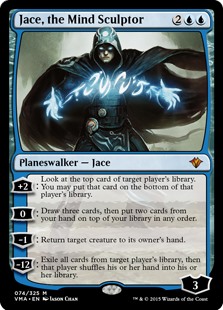
Currently, bans are indefinite. Splinter Twin is gone, and probably never coming back. Jace, the Mind Sculptor has never seen the light of day in Modern, and potentially never will. Step 1 would involve a new banlist, with a few offenders given "permanent" status, while other new bans would be temporary. A banning would occur every six months, with that ban lasting a year and a half. The exact numbers would obviously have to be tweaked, but the idea is that any banned card will return eventually.

In this scenario, bans are more prevalent, but they are consistent, reliable, and temporary. Much of the fear regarding bans in Modern surrounds the unknown. You know, the inevitable buttclench every few months at midnight, as you peek between your eyelids and hit refresh on the B&R update webpage. If you really weighed out the options, and had to choose between an all-powerful indefinite ban-hammer that could come at any moment, or a temporary ban-slap-on-the-wrist that you could prepare for, which would you choose?

Step 2: Clear communication

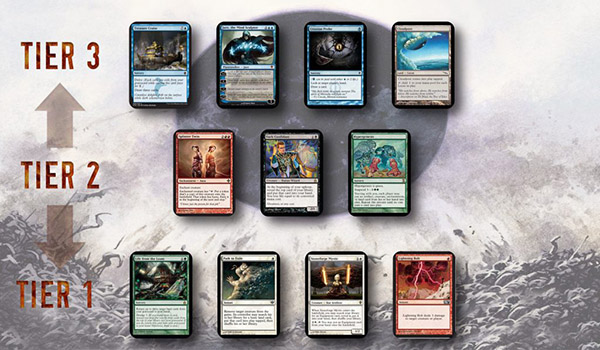
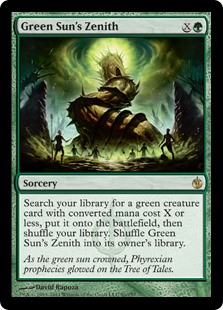
The ban list would be organized into three tiers. Tier 3 (Black) contains permanent bans; cards like Treasure Cruise, Green Sun's Zenith, and the artifact lands. To start, only cards that were banned either at the format's inception or immediately after Pro Tour Philadelphia would start at Tier 3. This means Splinter Twin could come back. Bloodbraid Elf could return. Tier 2 (Red) would be new bans, with one new card (potentially two, but probably one) added every six months, to be removed in a year and a half. No card can be banned without first being on Tier 1 (Yellow), or the Watchlist. Cards on the Watchlist are legal, but at risk of being banned. Five cards are on the Watchlist at all times, and must stay there for a minimum of three months before getting banned. Cards can move backwards and forwards on the Tier List, from Black, to Red, to Yellow, to off, and vice versa.

The Tier List sounds complicated, but it’s relatively straightforward and follows WoTC’s overall set release pattern. Every three months, a new set is released, and with it comes a change to the Yellow Tier. Every other set release (twice a year) we’ll see a banning, on the first and third set release of the calendar year. So, with every set release, cards can jump on and off the first Tier, but a card can only be banned every other set release. No matter what, players will always have a minimum three-month warning period before a card is banned.

With each set release, Wizards would release a statement on the state of Modern, explaining what they are seeing and asking for feedback. As they aren’t “fix-it” bans, Wizards doesn’t need to act like the format police. Let the community vote on what they want to see changed. Maybe a card from the top deck is the one to go, or maybe it’s something that’s just been in play forever, like Lightning Bolt. The most important thing is communication. Don’t blindside the community, make sure their voices are heard, and explain clearly the thought process that led to the decision making. Even if people disagree, no change is permanent.

Step 3: FTV: Modern?

A standalone, Modern-only product that fixes secondary market considerations is a necessity. Once a year, Wizards could produce a fifteen-card standalone collection, one that contains ten already-printed copies of Modern staples (perhaps with alternate art) and five new cards for Modern play only. With this product, Wizards could kill two birds with one stone, printing extra copies of format staples along with new cards to add to the format.

While Wizards does design with Modern in mind, they dedicate little attention to the format directly. They would much rather spend their time world-building and storycrafting their Standard and Draft experiences in each set release. Develop a team, in tune to the pulse of the community, that tests Modern and works to dream up new cards free from fitting into Standard’s thematic and strategic feel. Modern Masters was fine, but Modern players don’t need a unique draft experience or a ton of Commander and draft filler. Give us our sexy alt-arts, price it to sell, and make sure it actually affects prices. $8 Modern Masters packs might be a great short-term cash grab, but I’d gladly drop $100 every Christmas if it meant I was getting multiple format staples and new cards. As a final note, any card printed in Wizards’ yearly standalone should have a 12-month period of immunity from the Watchlist.

To summarize, here's my proposal:

  • A banning rotation. Three Tiers, minimum three months' warning before any card is banned. Any banned card is automatically unbanned after 18 months.
  • The establishment of a community watch and/or a dedicated group (in-house, or potentially a player’s committee) that tests changes, communicates with the playerbase, and releases regular updates and articles explaining the state of the game.
  • A standalone solution designed specifically for Modern players, with the aim of bringing down the secondary market prices of staples and introducing select new cards to the format, outside of constraining factors like Standard and Draft playability.

Conclusion

I know it’s a scary topic. I know there are tons of questions, and potential for error. My goal with this article (and my article from last week) is to hopefully cut through most of the entrenched opinions and present a possibility. I love Modern, and I see the potential for what it could be, and an opportunity to change it for the better. Modern is returning to the Pro Tour in February of 2018, and we have a chance to use that stage to introduce something new, fresh, exciting—and yes, maybe scary—to the conversation.

Bannings are an integral part of Modern (and perhaps now Standard as well), and it doesn’t look like they’ll ever go away. Why don’t we start talking about using the bannings for good, and letting them be a positive. Thanks for entertaining my long-winded ideas. As the preacher said, “I could write shorter sermons, but once I start I get too lazy to stop.”

Thanks for reading,

Trevor Holmes

Insider: Surprising Cards that Sell

Are you a Quiet Speculation member?

If not, now is a perfect time to join up! Our powerful tools, breaking-news analysis, and exclusive Discord channel will make sure you stay up to date and ahead of the curve.

Co-owning a store provides me with some firsthand data. The great part about that is I can share it with you.

There was an error retrieving a chart for Arms Dealer

What I want to dive into today is some cards you may not have guessed are all-star sellers for me. Let me know what you think about this concept in the comments, because this is a topic I can revisit from time to time as other cards come up.

The reason I like this idea is because most of these cards have recently risen in value. Additionally, since these are cards that sell really well, they have a higher chance of making you money. Let’s start with the first cycle, buddy lands.

There was an error retrieving a chart for Dragonskull Summit

Maybe I’ve mentioned this before, but Dragonskull Summit as well as the whole cycle sell extremely well. I move these lands frequently in the store as great budget-option dual lands, but we also sell these online a lot too.

Another aspect about these lands that’s important is that they’ve been slowly creeping up in price. Because Dragonskull and the like sell well, the buylist percent is usually great too. I used to buy these for a quarter and then fifty cents. Now I can buy them for a dollar and still make money on them. Granted, I typically buylist for store credit, so that helps even more, but still, if you find good deals on any of these lands, snap them up quick and you’ll be rewarded.

There was an error retrieving a chart for Reliquary Tower

Reliquary Tower has recently bumped up a bit in price, but this Commander staple has always sold well at a variety of price points. Despite five normal printings and an FNM promo that's nearly $10, Reliquary Tower’s normal printing is up to a whopping $4! That may not seem like much, but reprints like this are frequently held down. Reliquary Tower has shown it won’t be held down unless a bunch of the new Commander decks have a copy. (Quiet Spec will have a ton of awesome content about those new products, so click back and check on that as well.)

There was an error retrieving a chart for Sol Ring

Writers say all the time that casual players dictate a lot of the prices, and it’s totally true. Sol Ring has been reprinted too many times for me to want to go count, yet still, the lowest-price copy available is $3. That’s almost unbelievable. I know it’s an auto inclusion in literally every Commander deck, and maybe some other players might want some too, but the fact that this card is $3 speaks volumes about the cards we should be paying attention to. Maybe the mad rush for tribal Cats isn’t so absurd in this lighting.

There was an error retrieving a chart for Birds of Paradise

Another card with tons of printings is Birds of Paradise. This shouldn’t surprise you as a card on my hot sellers list, because Birds is always good. Recently, it even broke out of its long time price memory of $5. I snap-buy any copies of this card, from any set, and I’ll offer great percentages to obtain them. Every time we get a playset, it seems like someone comes in that week and buys them up.

There was an error retrieving a chart for Groundswell

Another great thing to pay attention to is playable commons or uncommons like Groundswell. When I’m picking bulk, I don’t just pull cards that are worth money – I also grab playable cards that I know are desirable. Groundswell is a great example of a card that hasn’t historically been worth anything even though this pump spell is in most Infect lists. Now it’s trending towards a dollar, and we have a bunch of copies ready for players. Even if it never bumped up, cards like this sell or trade well because often these are the cards no one can find. Hold onto stuff like this for sure.

There was an error retrieving a chart for Sidisi, Undead Vizier

Okay, we haven’t had a copy of Sidisi, Undead Vizier for a while, but I needed to include this because I feel like this is one that you have a better chance to find in bulk somewhere. Sure, this Sidisi is a tutor, but I was clueless this was a $4-to-$5 card. I’m sure we’d sell these at $4 if we had copies. The same goes for other cards that are going up like Ghoulcaller Gisa and Scourge of the Throne. Wow, double digits on those last two!? Crazy.

There was an error retrieving a chart for Erebos, God of the Dead

The gods of Theros are ones I get asked about a lot. We’ve sold a ton of them – and mostly after they rotated out of Standard. Erebos and Purphoros, God of the Forge are leading the way with price increases, but the others are great as well. If you can find cheap copies of any of the gods or get them with store credit, they’re great investments. I didn’t think this was true back when they were in Standard, because players seemed uninterested. Now that the supply has dried up, plus we have new gods to push them back into memory, players are starting to jump back and snatch them again.

There was an error retrieving a chart for Doubling Season

Last but also best, I wanted to mention Doubling Season, because it’s a great example of a busted card that bottomed out after a reprint. Sure it’s primed for another reprint, but if that happens, I’ll be buying aggressively the second time around. The best token doubler is approaching $60! The potential Modern deck using the card did generate some hype to jump up the price, but it would have gotten here anyway. Epic casual staples like this will always sell well. I bought one the other day and sold it the same day.

Local stores that don’t regularly get cards like this in stock can really sell this stuff well. What that means for you is that if you market yourself to a local store as the guy who gets stuff like this, you can probably arrange a deal for better numbers on cards like this. I feel the same way about the new white pseudo-version Anointed Procession as well. I need to start picking up copies of that one also, like ASAP.

That’s all of the surprising cards that sell for this week. Let me know what you thought because I’d be happy to revisit the topic.

Until next time,
Unleash the Force!

Mike Lanigan
MtgJedi on Twitter
MtgJedi on YouTube

Video Series with Ryland: GW Company

Are you a Quiet Speculation member?

If not, now is a perfect time to join up! Our powerful tools, breaking-news analysis, and exclusive Discord channel will make sure you stay up to date and ahead of the curve.

Hey, everyone! I'm back with another video series, this time with GW Company. Todd Stevens has been championing this deck for a while, most recently with a first-place finish at the SCG Team Constructed Open in Atlanta. This deck is an excellent choice for anyone who might be expecting a largely fair metagame and is quite a treat to play for anyone who enjoys playing lands to reap some sweet benefits.

This deck has some real wonderful synergies; other than just being a reasonable beatdown deck, your package of Azusa, Lost but Seeking, Ramunap Excavator, and Courser of Kruphix can generate some insane advantage incredibly quickly. It only gets better at that point with the possible addition of a Knight of the Reliquary or a Tireless Tracker to the mix.

The most wonderful part about this engine is the vast number of ways it can generate entirely unique types of advantage. If you have a Ramunap Excavator and an Azusa, you can use Horizon Canopy to draw three cards every turn, Ghost Quarter to demolish three of your opponents lands per turn, or add Courser to begin gaining a minimum of three life per turn. With the low number of basics many decks in Modern contain, you can quickly get to the point where you are Strip Mine-ing your opponent multiple times every turn, all the while gaining extra life or making additional clues.

Knight of the Reliquary allows you to control the top card of your library when you have a Courser, tutor for your Gavony Township, Ghost Quarter, or Horizon Canopy, and beat down efficiently. All of the cards function together wonderfully, and while you don't need all the pieces at once to be productive, each piece of the puzzle you add compiles to produce an even more formidable machine.

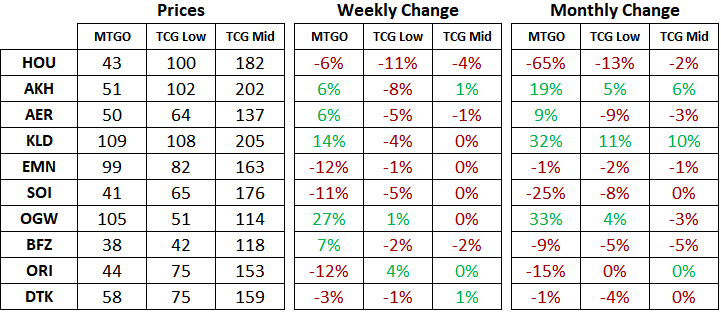
Honestly, as Magic players, we all love value. Who doesn't? We mention it all the time (assuredly too often). This deck scratches that itch we all have to generate as much of that sweet, sweet value as we possibly can in one turn. When playing it I often find myself trying to maximize the number of shuffles I can produce in one turn, so that I can use my clues to draw the specific cards I want, all while playing lands from the top of my library when they appear. That is why this deck is such a delight to play—when the cogs all come together, your sequencing becomes an intriguing puzzle to figure out how to draw the most cards and gain the most life, at the least expense.

That said, I am not overwhelmed by the deck's performance. It has been reasonable, and most fair matchups feel favorable. However, when confronted with the slightest whiff of degeneracy, the deck folds. This deck is flat-out poor at interacting with your opponent. Any combo-oriented match that demands early and frequent interaction (especially with something other than creatures or lands) will likely steamroll GW Company. The only ways for the deck to interact are Path to Exile (for any problematic creatures) and Ghost Quarter (for any irksome lands). Other than that, your plan quickly becomes beating down your opponent before they assemble their combo, or trying to get to the point where you are blowing up all of their lands with repeated Ghost Quarters. Against something like Storm, Ad Nauseam, Valakut, or one of Modern's many other combo decks, this will typically be far too slow. That said, we do have some sideboard slots to try and shore up some of these matchups, but if it were up to me I would pick playing against a fair deck over an unfair one every time.

Enough about the deck, let's hop into those games! As I said last time, I'm interested to hear what kind of content you'd like to see moving forward, so I can continue to evolve and improve my videos. Please let me know your thoughts, and any improvements you would like to see concerning formatting, presentation, or whatever else strikes your fancy. If you'd like to see similar content, check out my Twitch channel for some more live Modern!

[youtube https://www.youtube.com/playlist?list=PL261kJ_cAQC-Tl2ESEWBvht_mDujqF1RA]

GW Company, by Ryland Taliaferro

Creatures

2 Azusa, Lost but Seeking
3 Birds of Paradise
4 Courser of Kruphix
2 Kitchen Finks
4 Knight of the Reliquary
4 Noble Hierarch
3 Ramunap Excavator
2 Scavenging Ooze
1 Tireless Tracker
4 Voice of Resurgence

Instants

4 Collected Company
4 Path to Exile

Lands

1 Breeding Pool
4 Forest
1 Gavony Township
4 Ghost Quarter
2 Horizon Canopy
3 Misty Rainforest
2 Plains
4 Windswept Heath

Sideboard

1 Aven Mindcensor
1 Bojuka Bog
2 Engineered Explosives
1 Kataki, War's Wage
1 Qasali Pridemage
1 Reclamation Sage
1 Sigarda, Host of Herons
2 Stony Silence
4 Unified Will
1 Whisperwood Elemental

Hour of Devastation Draft #2

Are you a Quiet Speculation member?

If not, now is a perfect time to join up! Our powerful tools, breaking-news analysis, and exclusive Discord channel will make sure you stay up to date and ahead of the curve.

Avatar photo

Morgan Wentworth

Morgan has been playing Magic for seven years now and producing Draft content for four. She loves value and is notable for going out of her way to draw cards and nab two-for-ones. All of her content is made with a primary goal: improving her own game – and taking you along for the ride.

View More By Morgan Wentworth

Posted in Drafting, Free, Hour of Devastation, MTGO, VideoLeave a Comment on Hour of Devastation Draft #2

Have you joined the Quiet Speculation Discord?

If you haven't, you're leaving value on the table! Join our community of experts, enthusiasts, entertainers, and educators and enjoy exclusive podcasts, questions asked and answered, trades, sales, and everything else Discord has to offer.

Want to create content with Quiet Speculation?

All you need to succeed is a passion for Magic: The Gathering, and the ability to write coherently. Share your knowledge of MTG and how you leverage it to win games, get value from your cards – or even turn a profit.

Insider: MTGO Market Report for August 9th, 2017

Are you a Quiet Speculation member?

If not, now is a perfect time to join up! Our powerful tools, breaking-news analysis, and exclusive Discord channel will make sure you stay up to date and ahead of the curve.

Welcome to the MTGO Market Report as compiled by Matthew Lewis. The report will cover a range of topics, including a summary of set prices and price changes for redeemable sets, a look at the major trends in various Constructed formats and a "Trade of the Week" section that highlights a particular speculative strategy with an example and accompanying explanation.

As always, speculators should take into account their own budgets, risk tolerances and current portfolios before buying or selling any digital objects. Please send questions via private message or post below in the article comments.

Redemption

Below are the total set prices for all redeemable sets on MTGO. All prices are current as of August 8, 2017. The TCGplayer low and TCGplayer mid prices are the sum of each set's individual card prices on TCGplayer, either the low price or the mid price respectively.

All MTGO set prices this week are taken from GoatBot's website, and all weekly changes are now calculated relative to GoatBot's "full set" prices from the previous week. All monthly changes are also relative to the previous month's prices, taken from GoatBot's website at that time. Occasionally, full set prices are not available, and so estimated set prices are used instead. Although both Aether Revolt (AER) and Kaladesh (KLD) are no longer available for redemption, their prices will continue to be tracked while they are in Standard.

aug8

There are a couple of items to discuss right off the bat in the MTGO finance realm. The first is not new, but if you haven't checked out the Cardkeeper tool at the Cardhoarder website, I highly recommend giving it a spin. It's a fantastic way to get a visualization of your collection. Being able to sort cards by price allows one to think about the most expensive cards in one's collection, and thus the relatively most important cards in one's portfolio. It's a great way to keep track of your biggest positions, price wise.

The other tidbit is that Goatbots is now delivering historical price graphs on their website. You can now click on any object that they sell and get the price history. Although this is not a new thing as price graphs have been available at MTGGoldfish for years, Goatbots has the most robust booster and foil prices around. The MTGGoldfish prices are taken from MTGOTraders and Cardhoarder, and these stores have historically focused on non foil singles. For anyone interested in accurate booster and foil prices, Goatbots is a better choice. Now that they are producing historical price graphs, trends will be that much easier to identify.

Standard

The MTGO market is in a period of churn when it comes to Standard, with metagame shifts and the looming fall rotation moving prices. This is not a great time to be a buyer as there are no structural advantages to deploying tix. A structural advantage would include being at the end of a drafting format (and thus near peak supply of the drafted sets) or during a set release when tix are in high demand. Picking Standard singles is a risky venture with a limited window in advance of rotation.

Speculators should be scouring the KLD block and Amonkhet (AKH) block for cards that have potential but don't have a current home in Standard. Typically cards that fit this bill are close to junk in terms of price, so there's not much risk when it comes to tix. A fun strategy is to target a bunch of different cards, looking for that one breakout card that increases twenty fold.

Modern

There are two green cards with mana costs 2GG that have came onto my radar this week.

vengevine

Vengevine is a Rise of the Eldrazi (ROE) mythic rare that was a one-time Standard staple that has been in a long term price decline. As you can see in the chart, it's largely settled down at the 2 tix price level in the past year. As a barely fringe playable card in Modern, it tends to get some interest anytime a graveyard or self-mill theme pops up in a new set.

This week, the price spiked to over 6 tix after it got off to a good start at the Star City Games Open and a bunch of buying resulted. Chas Andres talked about this in his weekly MTGO finance video. With the deck not placing in the top 32, look for it to come back down in price. This price spike is definitely driven by hype and is not something that you want to be chasing.

On the other hand, last week's Trade of the Week highlighted a slowly building price in Primeval Titan as the Titan Shift and Amulet Titan archetypes continue to attract interest from players. Another card that is showing up in these decks is Chameleon Colossus.

CC

This card is being recruited in sideboards to help battle Death's Shadow decks. Having protection from black ensures it can successfully block Death's Shadow itself, while also being able to dodge Fatal Push, the premier removal spell in the format. A toughness of four also puts it out of Lightning Bolt range.

This card is exhibiting a much different price pattern than Vengevine. It has a steep but sustained incline over a number of weeks, and it's currently at an all-time high with no signs of slowing down. You'll see in the trade of the week that I didn't hesitate to put a number of copies into the portfolio this week, even though the price was high to begin with.

The reason I am confident this card will continue to rise is that the MTGO market is always reacting around supply and demand. The price graph on this card clearly exhibits a big shift in demand. What we don't know on this card is the available supply, but this is a pre-mythic era rare from a small set with no recent reprints. I think it's safe to say these aren't sitting around in many collections at the moment.

With very little play in Modern historically, this card is currently trying to find its price as it gets added as a Modern-playable card into players' collections. However, there is no price memory for this card, so it could keep rising for weeks as players add it into their collections and the bots slowly ratchet up the price.

If the bots could accurately assess the total available supply of this card and its relative value in the Modern metagame, they could possibly set a price at some level and be happy with that. But that's not how they operate. They collect the buy/sell spread in their transactions, adjusting prices as they go. They don't try to imagine what the value of a card is, just what it's currently being bought and sold for. With weeks to go in a lame-duck Standard format, and Primeval Titan decks continuing to attract players, I think this trend has room to run.

There was an error retrieving a chart for Geist of Saint Traft

Another card that has seen some buying interest lately is Geist of Saint Traft. It had fallen below 10 tix, but now is back above 14 tix. In his Modern article this week, Ari Lax at Star City Games discussed how this card was able to pressure Death's Shadow decks, and it looks like he is picking up on a shift that is underway in the Modern metagame. If this trend has any legs, its price will breach 20 tix by the end of the month.

Standard Boosters

I've been steadily selling my stock of KLD and AER boosters into the market, typically dropping four draft sets a day over the past couple of weeks. This hasn't disrupted the overall trend, as a draft set is now at 8.7 tix and is closing in on my target of 9.0 tix. This looks to be another repeatable trading strategy that will yield solid if unspectacular gains. I'm about halfway through my original position, and I will continue to sell down my stock of these boosters over the coming weeks.

Elsewhere, a draft set of AKH and Hour of Devastation (HOU) is priced at 10 tix at the moment. After accounting for the 2 tix needed to enter the draft queues with product, this is in equilibrium with the tix-only entry price of 12 tix. There is no upside at current prices, but if you've got any of these boosters kicking around and are not looking to draft in the next little while, selling is correct. Look for softening prices over the coming weeks as players get their fill of AKH block draft.

Trade of the Week

For a complete look at my recent trades, please check out the portfolio. This week I took the plunge on Chameleon Colossus. As usual, I like to spread my buys out as much as possible so that I can ensure a good average purchase price. Doing this means that the bots won't be changing prices as I pick up my copies.

There was an error retrieving a chart for Chameleon Colossus

I'll ride this one out for the next four to six weeks before considering a sell. September will be the last, best selling opportunity for Modern-playable cards this year. I don't want to be holding too many Modern positions in advance of the release of Ixalan and fall rotation. The fall is the best time of the year to be a speculative buyer, so being liquid and having tix on hand is imperative.

Want Prices?

Browse thousands of prices with the first and most comprehensive MTG Finance tool around.


Trader Tools lists both buylist and retail prices for every MTG card, going back a decade.

Quiet Speculation