menu

Insider: The Many Faces of Champion of Wits

Are you a Quiet Speculation member?

If not, now is a perfect time to join up! Our powerful tools, breaking-news analysis, and exclusive Discord channel will make sure you stay up to date and ahead of the curve.

If you haven’t listened to last week’s episode of the QS Cast yet, I highly recommend it. If you have, then you know that Chris VanMeter and I have exactly one thing in common: belief in Champion of Wits.

There was an error retrieving a chart for Champion of Wits

Champion of Wits is a card that I have been interested since I saw it in the spoiler, for a couple of reasons. First, there was its mana cost-to-power and toughness ratio. Three mana for a 2/1 was on the wrong side of the efficiency spectrum. The second standout was its ability: when it is played for three mana, it results in its controller drawing two cards then discarding two cards. The value hound in me immediately was crestfallen, as a card with the text “draw two, discard two” is card disadvantage.

Both of these attributes caught my eye, and not for the reason that you may think. I did not hang my head in disappointment at how bad this card was – no, instead I thought to myself, “This card was probably busted in development, huh?”

The reason I thought this is because a few minor changes could result in a very different and very powerful card. For example, what if Champion of Wits cost two instead of three? Or what if it drew cards equal to its power then only required its caster to discard one?

To me, these are the kinds of thing that I pay attention to. If you listen to Mark Rosewater’s Drive to Work podcast enough, you hear stories about cards that were changed because they were too powerful for their format, or they were the kind of thing that every deck played. A card-drawing engine that came attached to an uncounterable 4/4 could certainly be that, given the right conditions.

There was an error retrieving a chart for Hazardous Conditions

It is possible that the development team thought that this card would see a bunch of Standard play, and I'm wondering what they saw. I've come up with a slew of possibilities. Now that I have my playset of Champion of Wits, here are five things that I plan on doing with it while it is in Standard:

1. Discarding Two Champion of Wits to Another Champion of Wits’s Trigger

Champion of Wits has a small enough mana cost that I don’t mind playing multiples in whatever deck it is in. However, that does not mean that all I’ll be doing in such a deck is casting 2/1 Naga for three mana. I will probably have something better to do in the following couple of turns with the cards that I am keeping in hand after discarding two Champions. The decks where this would happen are decks that play Glimmer of Genius, Hour of Devastation and probably a couple of planeswalkers. In the case of choosing between playing a second Champion of Wits or casting a turn-four Glimmer, unless I am taking some serious beatdowns, I am picking the Glimmer line every time.

2. Putting Champion of Wits into My Graveyard with Strategic Planning

Strategic Planning is another card that perked the ears of value-seekers early on. The mana cost is the best we have been getting for card selection recently, and as far as digging goes, it lets you see lots of cards, and more importantly, it can find you lots of card types. I’m pretty interested in the applications of Strategic Planning when it comes to decks that want to play Descend Upon the Sinful and Scour the Laboratory, which have not found a permanent place in any archetype yet, but with attractive ways to dump cards in the graveyard like Champion of Wits and Strategic Planning, there’s the opportunity to play a cool control game and draw, like, so many cards, you guys. Green has always been the delirium color of choice, but the options for your deck are now much broader.

I would like to take this opportunity to agree with you that yes, Scour the Laboratory may not be as good as Glimmer of Genius is in a vacuum, but the difference between card selection with Glimmer and card quantity with Scour is not insignificant.

There was an error retrieving a chart for Strategic Planning

3. Sacrificing Champion of Wits to Cast Elder Deep-Fiend

The deck that I am hoping to look at first for Grand Prix Washington DC is UR Emerge, which appeals to the part of me that likes having options on what to do with my cards other than what is written. I also really enjoy flashing in giant, land-tapping monstrosities to tap all your lands during your upkeep. The ability to put creatures onto the battlefield at times other than your main phase seems beneficial, especially considering the whopping three board wipes entering Standard with Hour of Devastation (the set), and making creatures with six toughness seems fantastic when lined up against Standard’s new darling, Hour of Devastation (the card).

There was an error retrieving a chart for Elder Deep-Fiend

4. Eternalizing a Champion of Wits a Couple Turns Early

Like one-mana cantrips, one-mana mana dorks like Elvish Mystic and two-mana ramp spells like Rampant Growth are now personae non gratae in Standard, but there are still some ways to make extra mana on my side of the board available. For example, casting a two-mana creature like Servant of the Conduit on turn two into Champion of Wits on turn three, then casting Hour of Promise on turn four puts me at seven mana on turn five.

Dedicated ramp decks would also benefit from the card selection provided by Champion to prevent gluts of expensive cards early or ramp cards late. Alternatively, The Scarab God's activated ability can eternalize Champion of Wits at a steep discount. I have a less clear vision of what this deck may look like, but alongside Lord of the Accursed and Gisa and Geralf, UB Zombies may have a chance to shine should synergy and the ability to grind out games be competitive in Standard.

There was an error retrieving a chart for Hour of Promise

5. Curving an Eternalized Champion of Wits into Casting Nicol Bolas, God-Pharaoh

Champion of Wits is blue; Nicol Bolas, God Pharaoh has blue in his mana cost, so they go in the same deck, probably. The eternalize activation on Champion of Wits costs seven; so does Nicol Bolas. Naturally, my mind is bound to wander in the direction of the God-Pharaoh for as long as it is in Standard, so there’s a good chance that I will put the two together in at least one deck. Drawing six cards off of two Champion of Wits activations makes me confident that I will have drawn what will likely be my one copy of Nicol Bolas, God-Pharaoh by the time that I am able to cast it, too.

There was an error retrieving a chart for Nicol Bolas, God-Pharaoh

One of the things that I like about blue in formats like Modern or Cube is consistency. I can have a plan, and if I build my deck right, be reasonably certain of my ability to execute it. To me, Champion of Wits is the shining beacon of the possibility of some truly harebrained plans in Standard for years to come, and I can’t wait.

The Bottom Line

What does this mean for the future price of Champion of Wits? Given that it has already jumped from near-bulk to $3, there's a chance that it doesn't go higher than $5, although I could see it rise to $6 if it is a star at the Pro Tour this weekend. However, one of the important things to keep in mind with a card like this is that the cards that play well with it could get a boost too. If Champion of Wits is big, I'd watch out for Descend Upon the Sinful, Hour of Promise, and Elder Deep-Fiend to see a rise in price to accompany a rise in demand.

To be the very first to know when I have done something cool with Champion of Wits, follow me on Twitter and Twitch, and subscribe to my YouTube channel!

A Dramatic Set Review: Hour of Devastation and My Modern Wishlist

Are you a Quiet Speculation member?

If not, now is a perfect time to join up! Our powerful tools, breaking-news analysis, and exclusive Discord channel will make sure you stay up to date and ahead of the curve.

Today, I'm trying something different. Hour of Devastation released last Friday, but I haven’t had time to look at any spoilers, or read any discussion about new cards. As a result, we have an incredible opportunity to talk about the new set both before and after seeing every card surrounded by its context, in the same article! Stick with me here. Rather than give the vanilla, "Here’s a list of cards most likely to see play, but you already knew that!" I plan on talking about Modern as it is now, what I would like—not expect, but like—to see in the new set, and then immediately dive under the hood to see what has been given to us.

As you’re almost assuredly already familiar with the card pool, this article will be a literary form of dramatic irony, like when Juliet commits suicide thinking Romeo has done so himself. Article about Magic -> literary genius. We’ve bridged the gap, people.

Act 1: Ignorance Is Bliss

Let’s face it, the last few sets haven’t been great for Modern. Amonkhet, Aether Revolt, Kaladesh, Eldritch Moon, Shadows over Innistrad. Khans of Tarkir block feels like it happened years ago (oh wait, it did!), and it's been a while since I’ve seen a new card get me excited for Modern, beyond usual levels. Here’s a list of the recent new contributions to Modern:

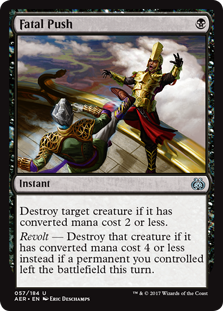
  • Fatal Push
  • Collective Brutality
  • Spire of Industry
  • Ceremonius Rejection
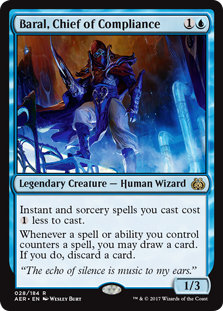
  • Baral, Chief of Compliance
  • Gideon of the Trials
  • Liliana, the Last Hope
  • Chandra, Torch of Defiance
  • Grim Flayer
  • Vizier of Remedies
  • Selfless Spirit

Hmm. Well, that wasn’t what I was expecting. It wasn’t until I had actually pulled up the teams to see what new cards were actually seeing play that I realized exactly how much of an impact recent set releases have had. Somewhere along the way, without even knowing it, it seems I have fallen into a rut of sorts, where I just expected each new set not to provide much for Modern, and the status quo to be maintained. Perhaps, subconsciously, I was still reeling from the effects of delve and the multiple bannings/unbannings we’ve had over the past couple years. Regardless, I’ve learned something about myself that surprised me, which means… introspection time.

At the risk of falling into random musing territory here, I’m wondering out loud why it is I was surprised to see a healthy list of new additions to the Modern card pool. One possible answer could be "level of play," as only Fatal Push has made a significant impact on multiple decks in the format. Still, Baral, Chief of Compliance has reinvigorated an archetype, and Vizier of Remedies has spawned its own, but both are out of sight, out of mind for their own reasons.

In Baral’s case, I have only seen Storm from a distance, not having much firsthand experience with the archetype either before or after its printing. As a result, seeing Storm in the metagame list feels like business as usual to me. “Yep, it’s always been there, moving on.” For Vizier of Remedies, it popped up one weekend, but hasn’t been able to stick, in part because it’s probably "too powerful." That’s a discussion all its own, but I think it’s safe to say a two-card combo that can do nasty things on the second turn is "too powerful" assuming no interaction. As a result, Counters Company exists as this deck that could compete in Modern on power level alone, but can't hold up to dedicated hate. So, to conclude, I don’t think level of play is the answer here.

What about a lack of knowledge/familiarity with the format? Lol. My RAM feels differently—MTGO has eaten it all to pieces. I knew all these cards existed, they just clearly didn’t imprint enough on my mind to make a significant impact. No, I think the answer lies on the emotional spectrum; none of them excite me. You know, like when your horrible team does something incredibly amazing? Or you eat the best burger of your life? Fatal Push is an excellent card, don’t get me wrong. But it doesn’t rustle my jimmies. Sorry, it’s not you, it’s me.

A big part of it, I already know, is that Modern is great. Matches are fun and interactive, nothing is broken, nothing needs to be banned, and the format is far from solved. Even with Grand Prix and SCG Opens seemingly around every corner, innovation keeps happening, to the point where I almost don’t even want another set. Let me solve this format before giving me the next one, maybe? I know I’m in the minority here, but I feel like we’re living through Modern’s (and Magic’s) golden age right now, and things are on their way down. Standard isn’t going so hot from what I hear, and WoTC’s track record hasn’t been great recently, so just, give me some space, yo’. What do you give the man who just wants time?

Act 2: The Pursuit of Happiness

I can’t go into a set release wishing it didn’t happen and simultaneously looking for something to excite me. That’s like staring at your peas wishing it was cake. The longer you want for cake, the worse those peas are going to taste. I sound like my mother, but she never even said that. I’m losing it. Still, I have to wish for something, otherwise I don’t have a dog in the fight, and another set release will go by whilst I remain unimpressed on the sidelines.

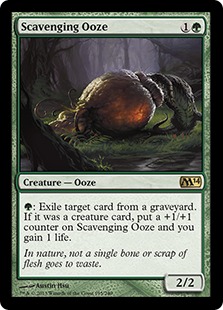
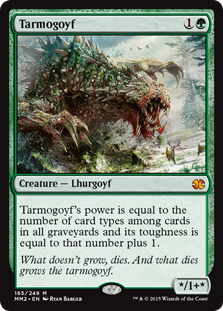
Knowing nothing about Hour of Devastation, mind you, I guess it would be nice to have another aggressive option for fast decks. Burn and Affinity have their lists fairly set, but beyond that, another fast aggro deck taking a piece of the pie would shake things up and introduce some diversity without totally upsetting the scales. Merfolk doesn’t seem like a likely candidate, and that archetype is failing primarily because of the field and Fatal Push, so its troubles are less likely to be answered by a new printing. But Tarmogoyf, as crazy as it seems, is outclassed in this current format, and I’d like to see him return. Two mana for an X/Y is much fairer than Death's Shadow, even I will admit, but his supporting cast has always been lacking. A Scavenging Ooze-esque creature for green or white could be interesting, with Hatebears making a recent appearance.

As far as spells go, could we see black get some card draw that is better than Painful Truths? I like the card, but life isn’t the resource I want to be giving up in my three-color Modern deck. Something that doesn’t use the graveyard, or it would just make Death's Shadow decks better. The goal here is to give Jund and Junk a little push back into the conversation, and perhaps shift some control strategies away from Jeskai and towards Esper. They are never giving up white, but if we could see Esper Charm back in the format, that could do some interesting things to all the grindy midrange decks taking advantage of its absence.

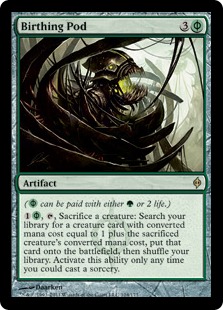
For combo, it’s never been my wheelhouse, but I’m ready for toolbox tutor to come back in some capacity. I know its playing with fire, but Birthing Pod was so good for providing a unique experience and rewarding both deck and format knowledge. Unfortunately it was too good and pushed out all other creature decks, but there isn’t a reason why toolbox couldn’t exist in some other fashion. I just want to exchange mana for options, and play a deck with lots of one-ofs. Solar Flare is almost there, but it uses the graveyard at a time when it's too popular to do so.

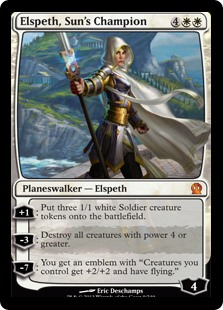
For control I wouldn’t mind seeing a finisher, but it would have to be insane to see play, like over Elspeth, Sun's Champion levels. There’s just no reason to go above 24 land in a format where Death's Shadow and Stubborn Denial can kill us so quickly. Cheap card draw would be nice, but it would have to be better than Thought Scour, which we’re not even taking advantage of as we’re trying to do big things. We’re never getting that Counterspell, so we should just put that to rest.

No, what we need is a three- or four-mana play that knocks our opponent off their game, something bigger than Kalitas, Traitor of Ghet or Gideon of the Trials. Nahiri, the Harbinger was spot on, but Reality Smasher, Stubborn Denial and a poor supporting cast must be keeping it down.

Act Three: Seeing the Light

  • Oketra's Last Mercy
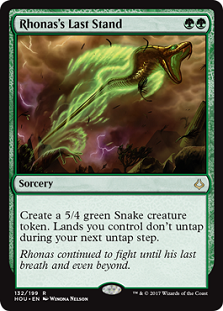
  • Rhonas's Last Stand
  • Champion of Wits
  • Torment of Hailfire
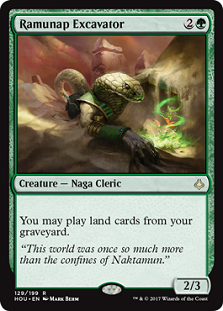
  • Ramunap Excavator
  • Supreme Will
  • Reason // Believe

I’m choosing to list these all at once, rather than individually, both because it's different and because I don’t want to feel obligated to spend a paragraph on cards that don’t deserve it. I'll touch on each one, for about as much time as I feel it merits.

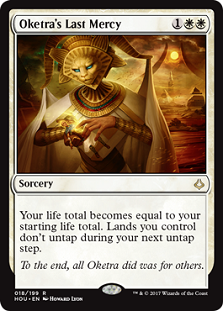
Oketra's Last Mercy is interesting, yes. Is it better than Leyline of Sanctity? Doubtful. We’re gaining life, which you probably know by now, so Skullcrack and Atarka's Command are on like Donkey Kong. I wish it wasn’t in white, but it is what it is. Affinity is the type of deck where lifegain is just that—they are building boards with most of their wins anyways so going from 2 to 20 probably only gains you a couple turns, and nothing if they’re killing you with Infect. Besides, we’re in white, so tell me why Stony Silence wasn’t good enough?

Rhonas's Last Stand could be that Tarmogoyf companion we were talking about, or it could be nothing. The lands-don’t-untap clause is so interesting because even if we try and dodge it with mana guys, we still have to sacrifice that land mana at some point, either this turn or next. Is Experiment One, Tarmogoyf, Rhonas's Last Stand into Dismember good enough? Probably not, but someone will try.

Champion of Wits is probably horrible, but could be good enough if the stars align. Control has gone so tap-out lately that a 2/1 that loots for two and chumps a Thought-Knot Seer isn’t embarrassing, if it comes back as a 4/4 to trade later and draw 4, discard 2. If we’re playing this, it’s because the body matters, and I don’t see that happening. If it was a 1/3, or even better a 0/4, then maybe, and if eternalize cost 6 instead of 7. So close, but it's probably for the better.

Torment of Hailfire is a Johnny-type card that can just kill you, leaving you shaking your head at the maniac casual as he signs his match slip. Just play a control game, tap all your mana and off you go. If Eldrazi wasn’t the best way to spend your mana these days, I could see this card, but it isn’t better than Karn Liberated or Ugin, the Spirit Dragon off a Sanctum of Ugin. There was a weekend two years ago when Mono-Black Tron was an option. Still, it’s so black to say, “Screw Sphinx's Revelation, this game has gone on long enough. Tap all my mana, you LOSE.”

Ramunap Excavator. Would you play Crucible of Worlds if it was green and a 2/3? I can see it. Leonin Arbiter, this guy, and start chaining Ghost Quarters. The body is unimpressive, but that’s what we say about all of Hatebears’s dudes. This guy has an effect the deck wanted and at least two power. That’s all they need, right?

Now Supreme Will, on the other hand, could be the Mana Leak/Forbidden Alchemy hybrid we never knew we wanted, this time with 80 miles to the gallon! I’m not excited to be playing counterspells in Modern anymore, unless they cost one mana, but the ability to have every single card in my UW Draw-Go cantrip has me itching to throw it in. I wish it was two mana for a Force Spike or Sleight of Hand at instant speed, but as much as I want to convince myself that would be okay to print, I imagine it's still too good.

No, if we are seeing anything impactful from this set, it's probably Reason // Believe. I’m not familiar enough with the quirky card pool to know if there are enough options for setting our library, but there has to be support for it in the card pool. The card just feels so Scapeshift. Do nothing, hit your land drops, draw some cards, kill you. This card has me wishing for a Magic of ages past where Courser of Kruphix and Oracle of Mul Daya were good cards. Who knows, maybe it can happen.

Conclusion

So, how did we do? It doesn’t seem like we have either the clear all-star like Fatal Push or the sideboard workhorse like Collective Brutality this time around. For control, we might have something in Torment of Hailfire to push people towards black. Green aggro could take advantage of Rhonas's Last Stand. Hatebears might have a walking Crucible of Worlds.

For the most part, it’s a bunch of "maybe it’ll work, shrug?" type cards, which means a few potential days of halfhearted attempts at trying them out and then back to the old grind. I’m not too upset about that, but I wish there was one really good addition. I’d be fine if WoTC even said, “Set releases from now on are Standard-only, but we’ll release one card on its own for Eternal too.” Give me that Scavenging Ooze-esque card. We'll give you our huddled masses. We need it.

Thanks for reading! I hope you enjoyed my article this week; I had a blast trying something different! Let me know what you think below, about the article, your thoughts on the set, or anything else. First one to 5-0 with Wretched Camel gets a pack from me in the mail.

Trevor Holmes

Insider: Best Specs for the Rotation Box: Commander

Are you a Quiet Speculation member?

If not, now is a perfect time to join up! Our powerful tools, breaking-news analysis, and exclusive Discord channel will make sure you stay up to date and ahead of the curve.

With the release of Hour of Devastation, we are quickly approaching our next Standard rotation. People are beyond sick of the format-defining staples like Gideon, Ally of Zendikar and ready to turn those older cards into money to buy Ixalan cards when they arrive this fall.

This offers us a great opportunity to turn some of the more popular Amonkhet block cards into Battle for Zendikar and Shadows over Innistrad block cards that will continue to see gains for the years to come. In this article I'll discuss the Commander cards that I think fit the mold, using EDHREC to supplement my own anecdotal information about their popularity among players.

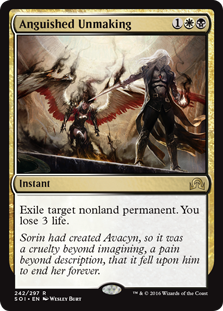
Anguished Unmaking

anguished unmaking

Anguished Unmaking is the most played card in Commander from the four rotating sets according to EDHREC. At first that doesn't make a lot of sense. It's a single-target removal spell that has a life payment—not exactly the most casual-friendly card. What it is, however, is an instant-speed version of the much more expensive Maelstrom Pulse and Vindicate.

While cost is not always the limiting factor (more people play Demonic Tutor than Diabolic Tutor), it can affect how much a card is played overall (Diabolic Tutor still appears in 27% of decks that play black).

Currently you can find Anguished Unmaking as low as $2 and buylists as high as $1.75. That's a pretty small spread for a card that isn't in high competitive demand and is also right about to rotate. Compare this to Gideon, Ally of Zendikar:

There was an error retrieving a chart for Gideon, Ally of Zendikar

The arguably best planeswalker in Standard is falling rapidly, but Anguished Unmaking is trending down much slower. This is definitely a card that can and probably will eventually get reprinted in a Commander set at some point in time. So if you wanted to get some now, I'd recommend the foils. Especially the Game Day promos which have historically never been reprinted because Wizards doesn't reprint full-art cards except Zendikar basics.

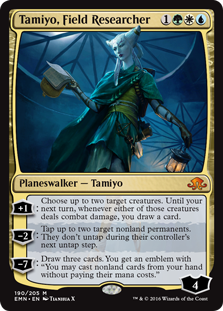
Tamiyo, Field Researcher

tamiyo field researcher

Bant Tamiyo, Field Researcher is much like the original Tamiyo the Moon Sage, as it's a planeswalker in a small set that has a game-breaking emblem. This card hasn't really sunk to true bulk levels yet because it's also a frequent inclusion in some off-the-wall Doubling Season Modern decks.

Basically, because she can ultimate when you have a Doubling Season, and because she gives you an Omniscience emblem, she will always be popular. Due to her colors, relative obscurity, low-print-run set, and being in the same set as a Modern-playable planeswalker (Liliana, the Last Hope), I think she will be a slam-dunk pick in a few years after the Commander players have soaked up all of the supply.

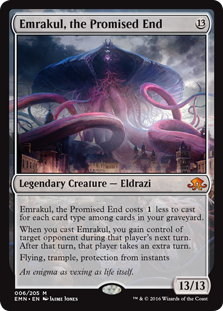
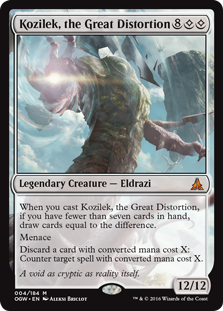
Eldrazi Titans

ulamog kozilek emrakul

The playability of each of the titans in competitive formats can be debated until the cows come home. The point is not what we think about them but what other players think about them. These titans cost significantly less money currently than the original titans and as such cultivate a lot of appeal. Over time, they will rise because they're popular in 60-card-plus casual decks as well as Commander decks.

Ulamog, the Ceaseless Hunger is the most flexible as it gives any color access to removal of any permanent type and kills people rather quickly. Kozilek, the Great Distortion is the most popular colorless general by a long shot. Colorless Commander decks were very expensive and difficult to make for a while before Wastes was printed, so there are still a lot of players who haven't ventured to make one yet.

Emrakul, the Promised End's lack of play may be due to her high price while she was Standard-legal. The effect is powerful and her buy and sell price has started to finally gain some ground. I think she will be the most popular titan in the long run because the original (Emrakul, the Aeons Torn) is banned in Commander. All of these cards can easily reach $20 or more in 3-5 years if they don't end up in a Masters set.

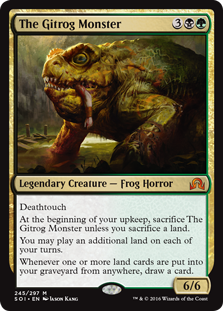
The Gitrog Monster

gitrog monster

The Gitrog Monster is the second most popular Golgari Commander of all time! It's pretty unique and will not likely eclipse Meren of Clan Nel Toth because she's much easier to build.

I expect this to be a slow gainer until a card is released that accidentally combos with it and makes it very popular again. We see this more often with old cards getting popular because of new Commanders, but this card is so combo-oriented that it is more likely to be the card to spike than the combo pieces.

Non-Titan Eldrazi

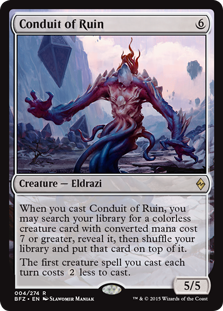
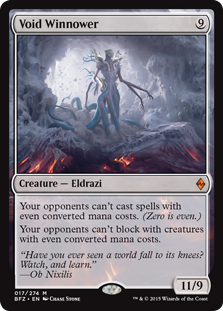
conduit of ruin void winnower

These are by far the most popular new Eldrazi outside of the titans and its not hard to see why. Conduit of Ruin is a self-contained combo that can find you a titan and help cast your creature spells for cheaper. I have yet to meet a player that didn't enjoy tutoring for his biggest creature and casting it for less. It's already a bulk rare but it will be buylistable for $1+ in a year or two.

Void Winnower, despite how many jokes and memes it encourages, is a very solid finisher. For nine mana you are likely to lock a lot of people out of important spells for a large portion of the rest of the game, and it makes most creatures unable to block. This isn't a bulk mythic and it doesn't see any competitive play, so the demand must be from casual players. I find it hard to find a place they can reprint a card as weird as this but, as always, foils are safer.

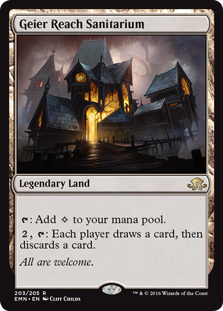
Geier Reach Sanitarium

geier reach sanitarium

You might be confused why this card is here but it's actually currently the most played card in the entire set of Eldritch Moon. I believe this is because it's a super budget version of Mikokoro, Center of the Sea. It also has some synergies with odd Commander-specific stuff like Captain Sisay, Thalia's Lancers, etc. Ultimately this card may not find a perfect home but if you find them in people's bulk it's worth holding onto them as they mature.

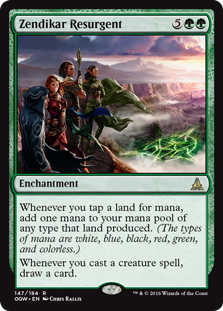
Zendikar Resurgent

Image

The most similar card to Zendikar Resurgent is Mana Reflection.

There was an error retrieving a chart for Mana Reflection

Obviously there is a big difference between a Shadowmoor rare and an Oath of the Gatewatch rare in terms of supply, but it also shows that there is a demand for this style of effect. The longer we go without a Mana Reflection reprint the more often Commander players are going to turn to Zendikar Resurgent as a budget replacement.

Once again it's not terribly difficult to get these from competitive players who think they're bulk rares and let them mature over the next few years like Dictate of Erebos. The more I think about it, the more I think the comparison of Dictate of Erebos and Grave Pact is a lot of the same shades as Zendikar Resurgent and Mana Reflection.

Greenwarden of Murasa

green warden

For comparison, Eternal Witness is the fourth most popular card in Commander after Sol Ring, Cyclonic Rift, and Swords to Plowshares. This is effectively two Eternal Witnesses stapled together. It's not as powerful in recursion strategies because it has to get exiled to get the second card, but as the price of Eternal Witness grows I believe this will be the preferred substitute.

Copies of this card are available for under $1, so I can't imagine a way that this spec goes horribly awry unless it's included in a Commander deck in the next two years.

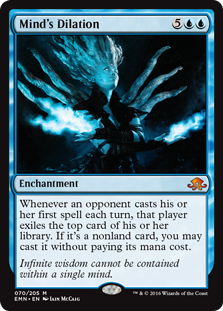
Mind's Dilation

minds dilation

My final card is a pet card of mine but also one that's much more popular than you might expect in Commander. Right now there are only 3600 decklists on EDHREC that include Mind's Dilation but it's just slow to catch on. It's got a great effect that scales with more people and can win a game by itself pretty easily. It's the kind of card that has to get popular via word of mouth and will take a while to catch on, but when it does you'll wonder why it's $5.

Finally, I think there are a lot of cards that will continue to decrease in price and be easy to find as players liquidate cards from rotating sets. Keep a sharp eye out for good trade and buy opportunities. The cards above are some that I am personally targeting and I think you will have a lot of success with.

An Affinity for Couriers: GP Las Vegas Report

Are you a Quiet Speculation member?

If not, now is a perfect time to join up! Our powerful tools, breaking-news analysis, and exclusive Discord channel will make sure you stay up to date and ahead of the curve.

Hello, everyone. My name is Andrew Dang. I placed 67th in Grand Prix Las Vegas playing an Affinity build of my own design with Bomat Courier. I began experimenting with Courier soon after the release of Kaladesh, and initial results led me to believe the card had promise. After nine months of testing and honing my list, I managed to 12-3 the main event in Vegas (with no byes). Today I'll recount the long and arduous journey I embarked on to reinvent Affinity, and what I learned along the way. Before getting into the tournament itself, I'll explain how I arrived at my list and discuss my approach to major matchups.
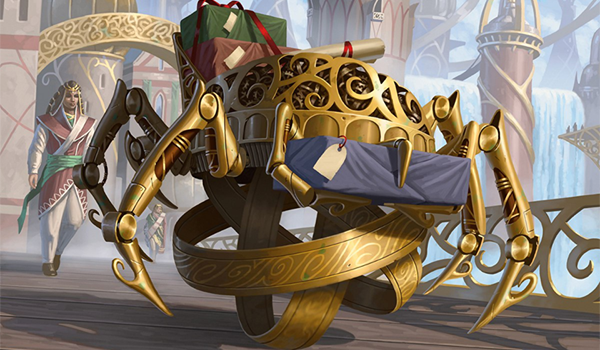
The main reason Bomat Courier was even remotely on my radar was due to the age-old debate of Thoughtcast vs. Galvanic Blast. For those unfamiliar with this debate, Affinity has always been very tight on colored mana sources, which means a limited number of slots for non-artifacts. Galvanic Blast looks to close out games faster by removing blockers and providing burn-based reach. Whereas the advantage of Thoughtcast is that it makes your longer games more consistent, at the cost of slowing down your deck.

Players have gone back and forth on which card is better positioned, and it can depend on both metagame and personal preference. My thought was to see if Bomat Courier could do a fine enough impression of both cards to take over the slot.

Developing Bomat Affinity

While my current list plays 4 Bomat Courier alongside 4 Galvanic Blast, this was not always the case. I originally began with a standard Master of Etherium list, cutting the four colored slots for Bomat Courier. I found that Bomat Courier would usually average out to be two cards and 2 damage. Imagine all of the upside of Thoughtcast while dealing 2 damage at the cost of just one additional red mana!
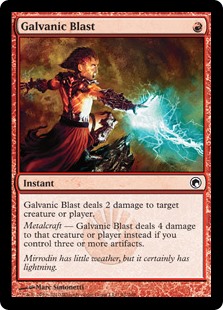
After these initial tests, I started to opt for a more aggressive build, even trying Simian Spirit Guide to accelerate the extremely aggressive turn-one hands. This proved to be a bit too reliant on opening with the small threats like Signal Pest and Bomat Courier, and too weak to longer game plans. I wasn't ready to give up yet, though. While the stock lists of Affinity have always merited their place in the Modern meta, after all this testing I felt that the deck could be improved immensely with the introduction of Bomat Courier. So back to the drawing board it was.

Then a good friend of mine recommended trying Galvanic Blasts alongside Bomat Courier. The pairing of reach with the explosive starts of Bomat Courier, mixed in with the normal opening hands of 3-4 artifacts on turn one, proved to be a match made in heaven. Stock Affinity often runs into the problem of the opponent stabilizing with 6-7 life. With the inclusion of Bomat Courier, this was rarely what happened. Instead they would “stabilize” at 3-4, well in range of Galvanic Blast and Blinkmoth Nexus damage.

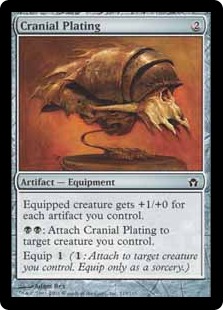
Bomat Courier is an extremely relevant threat in every stage of the game. Early it gets in chip damage and threatens to draw tons of cards if left alone. Late-game a hasty Courier off the top can attack for lethal with a Cranial Plating, or help swarm around blockers. As it's often a lightning rod for removal, it can also pave the way for your other creatures to break through.

Making Room for Courier
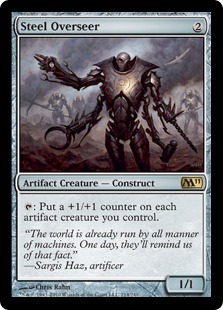
With the Galvanic Blasts back in the deck, I had to decide what would get cut to make room for Bomat Courier. I settled on cutting the Masters, one Steel Overseer, and a land.

-2 Master of Etherium. Typically I found that Master of Etherium would get destroyed for one mana (aka with Fatal Push). Affinity is extremely concerned with mana efficiency and board development, so losing your three-drop for so little investment from the opponent was a serious problem. Bomat Courier would offer the same trade while leaving two mana open, which could be used to drop more threats or animate a Blinkmoth Nexus.

-1 Steel Overseer. Overseer is typically the worst threat in Affinity. It does nothing the turn it comes down, and usually just dies. Absolutely horrible card—left unattended it can win games, but we are in the format of Fatal Push and Lightning Bolt.

-1 Land. The deck did not really need the additional land as it was too low to the ground, less prone to flooding, and more densely packed with threats.

Here is the final package I registered for the Grand Prix:

Bomat Affinity, by Andrew Dang (67th, GP Vegas)

Creatures

4 Bomat Courier
4 Arcbound Ravager
4 Ornithopter
2 Memnite
4 Signal Pest
4 Vault Skirge
3 Steel Overseer
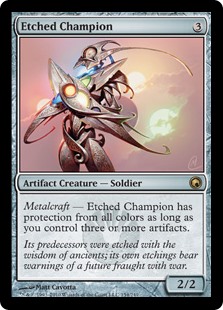
2 Etched Champion

Artifacts

4 Cranial Plating
4 Mox Opal
4 Springleaf Drum
1 Welding Jar

Instants

4 Galvanic Blast

Lands

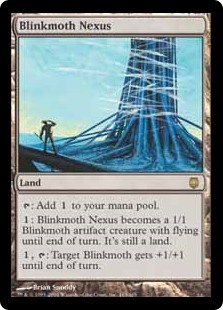
4 Blinkmoth Nexus
4 Darksteel Citadel
2 Glimmervoid
4 Inkmoth Nexus
1 Mountain
1 Spire of Industry

Sideboard

1 Ancient Grudge
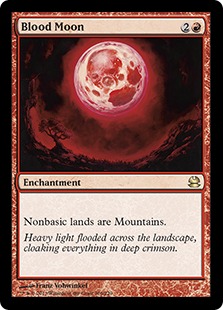
1 Blood Moon
1 Collective Brutality
2 Dispatch
2 Ethersworn Canonist
2 Ghirapur Aether Grid
2 Grafdigger's Cage
1 Spell Pierce
1 Thoughtseize
1 Wear // Tear
1 Whipflare

Match-ups and Sideboarding

Death's Shadow
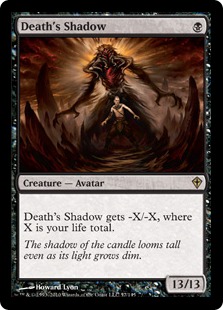
Whether Grixis or Jund, the Death's Shadow matchup plays out pretty similarly, with Jund having a higher threat potential. Either way focus on card advantage while drawing their removal away from the serious threats, aka Etched Champion and Cranial Plating. Ideally Bomat Courier should be the first play of the game, because it allows you to passively generate advantage that can accumulate and take over games.

In:
+2 Dispatch

Out:
-1 Steel Overseer
-1 Galvanic Blast

Titan Shift
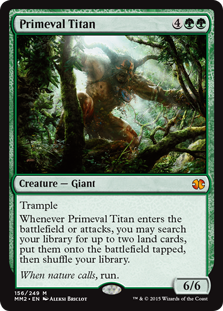
The name of the game is racing. These games are extremely dependent on whether your opponent fetches and shocks, or has the ability to retain their life total through basics. If so, go for infect kills with Arcbound Ravager and Inkmoth Nexus. If they fetch and shock, go for faster kills with Cranial Plating and Signal Pest combined with Bomat Couriers.

In:
+1 Thoughtseize
+1 Collective Brutality
+1 Blood Moon
+1 Spell Pierce

Out:
-3 Steel Overseer
-1 Galvanic Blast

Eldrazi Tron
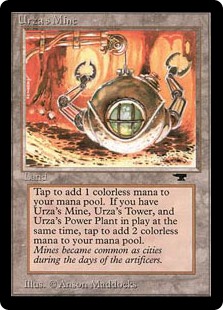
Again this is a race. Your end goal is similar, except these games will typically involve drawing multiple cards off of Bomat Courier. Focus on card advantage and dealing damage in quick succession before they can get Tron online. These lists typically do not play Oblivion Stone, so rain the aggression on them.

In:
+2 Dispatch
+1 Ancient Grudge
+1 Wear // Tear

Out:
-2 Etched Champion
-1 Steel Overseer
-1 Galvanic Blast

Living End
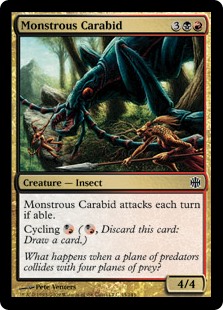
This becomes a great matchup with the inclusion of Bomat Courier. Navigation around their namesake card is everything. Keep some creature threats in your hand so that you can discard them as part of Bomat Courier’s effect. Reanimating two Etched Champions and a Vault Skirge while drawing four cards with Bomat Courier feels amazing, not to mention that it will come back to join the party as well. Remember to do this in response to Living End going on the stack and not in response to the cascade trigger, so they can't choose to whiff. This match is also won with Arcbound Ravager.

In:
+2 Ethersworn Canonist
+1 Collective Brutality/Thoughtseize

Out:
-2 Steel Overseer
-1 Galvanic Blast

Company/Elves
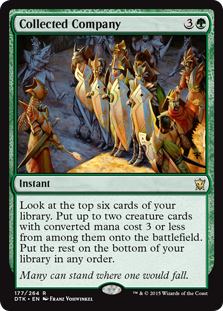
Dangerous matchup. Galvanic Blasts are used to kill their creatures here, typically the combo pieces. Spot removal won’t be enough for later stages of the game. Go for damage and kill them ASAP.

In:
+2 Grafdigger's Cage
+2 Ghirapur Aether Grid
+1 Whipflare

Out:
-3 Steel Overseer
-1 Welding Jar
-1 Galvanic Blast

Storm
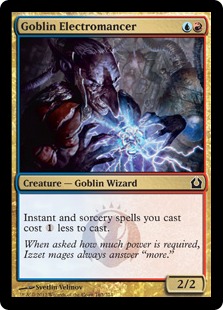
Drop their life total to 0 or infect them out—your choice, but race is the pace. Decent matchup post-board. Game one is definitely winnable if you can kill their creature(s).

In:
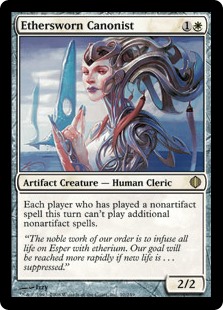
+2 Ethersworn Cannonist
+2 Grafdigger's Cage
+1 Spell Pierce
+1 Collective Brutality

Out:
-3 Steel Overseer
-2 Etched Champion
-1 Galvanic Blast

Burn
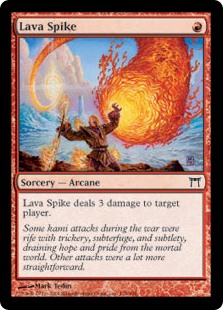
Race, definitely in your favor both pre- and post-board. Watch out for their creatures because those can rack up damage very fast. Vault Skirge makes these games easy. Bomat Courier offers race potential, and fliers are hard for them to deal with.

In:
+1 Collective Brutality
+1 Spell Pierce

Out:
-2 Steel Overseer (You should be noticing a trend.)

BGx (Jund/Abzan)

The important thing in the BGx matchup is to make sure your threats connect and don't meet a removal spell without giving you some kind of advantage. The two best tools you have are Cranial Plating, which hits for enormous chunks of damage, and Etched Champion, which can win single-handedly. Don't deploy either of these threats until it's safe. For Champion that means with metalcraft turned on, whereas for Plating you'll want to bait out artifact removal and try to land it when you know it's good for at least one hit.
Bomat Courier will likely open a gap in their defenses due to the threat of card advantage. Play out Steel Overseer or Arcbound Ravager with the idea that these will die. Do not fight too aggressively over their removal unless lethal is one turn away.

In:
+2 Dispatch

(Against Abzan also bring in enchantment removal due to the threat of Stony Silence).

Out:
-1 Galvanic Blast
-1 Steel Overseer

While Steel Overseer is a target for removal, post-board that's the only thing it's good for. The mana investment starts to get steep in the battle for marginal advantages—better to remove their blockers and get in damage where possible.

UWx/Grixis Control

Incremental damage is important against this style of deck. Their first few turns will be focused on slowing down your plays with small counters and bits of removal while sculpting a better hand. Out of UW Control, their board wipe will typically come down on turn four. Push damage and prioritize card advantage for Bomat Courier.
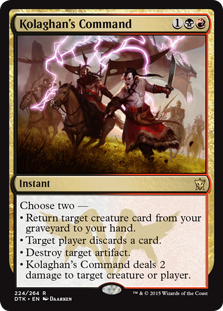
From Grixis, Kolaghan's Command is the larger threat. However, play so that you can connect with a large attack on turn four, after the initial resolution of Kolaghan's Command. This is typically when their guard is down, or when they deploy their own threat. Hold up the card advantage that Bomat Courier can produce.

In (Grixis):
+1 Blood Moon
+2 Dispatch (against the Tasigur/Gurmag Angler variant)

Out:
-1 Galvanic Blast
-2 Steel Overseer

In (UWx):
+2 Ghirapur Aether Grid
+1 Blood Moon
+1 Thoughtseize/Collective Brutality

Out:
-2 Galvanic Blast
-1 Vault Skirge
-1 Steel Overseer

Tournament Report

Day 1

Round 1: Living End

Game 1: He is on the play and mulligans. I have control over the board state, do not draw Bomat Courier or Arcbound Ravager, but finish with Galvanic Blast and Blinkmoth Nexus post-Living End.

Game 2: I start with Bomat Courier. He casts Living End on turn four, after missing a land drop, when I have two Etched Champions and a Vault Skirge in hand. In response, I sacrifice Bomat Courier and attack back for lethal with a Cranial Plating and the Etched Champions.

Round 2: Elves
Game 1: He curves out with Heritage Druid and Elves. Then Elvish Archdruid into Ezuri, Renegade Leader kills me on turn three.

Game 2: I mulligan to four, and do not see colored mana for my Ethersworn Canonist to slow him down.

Round 3: Burn?

I do not recall what deck he was playing, possibly Burn. Either way the match was short.

Game 1: I have a fast game with Cranial Plating, killing him on turn four.

Game 2: Very similar to the previous game but I end the game with Galvanic Blast and Blinkmoth Nexus.

Round 4: Grixis Death Shadow

Game 1: The game gets to a point where I take 9 damage from a Death's Shadow and Snapcaster Mage. But I win in the attack back with a Galvanic Blast when he is at 7.

Game 2: I am on the draw again, however Cranial Plating pulls most of the aggressive artifact destruction like Kolaghan's Command. Bomat Courier shines in this game as it ends up being based on attrition. He empties my hand with discard spells and kills both my Ravager and Vault Skirge. But with Bomat Courier out on turn one gaining advantage every turn, I'm able to recover by cashing it in for a new hand.

Round 5: Grixis Death Shadow
Game 1: Opponent mulligans to four, with no early discard spells. I land an Etched Champion he can't deal with.

Game 2: Turn-one Serum Visions into top, top. This spells really bad news from that turn on. He puts down an early threat after Thoughtseizeing and I die to it.

Game 3: Luckily enough I get to play Bomat Courier on turn one, and generate a threat each turn thereafter. He has to deal with the other threats, like Signal Pest and Cranial Plating, and it allows for Bomat Courier to bring me back into the game.

Round 6: Eldrazi Tron

Game 1: Good match-up. I am able to establish the board before he can, and kill him after a Reality Smasher tap-out.

Game 2: Sadly the opponent can’t get on board fast enough as he draws Tron too late with Thought-Knot Seer hitting nothing. I have Cranial Plating and attack for 11 in that turn and he cannot recover.

Round 7: Amulet Titan (Chris Loukopoulos)

Funny story, this match was for a Day 2 win-and-in. I end up getting matched up against one of my friends from our local game store.
Game 1: My hand is amazing but he has three Amulet of Vigors and kills me on turn two with an insane combo of Azuza, Lost but Seeking and three Titans.

Game 2: I am able to get under his threats and kill him quickly after landing a Blood Moon, with him having no green for enchantment removal at the time.

Game 3: He effectively ends the game by popping an Engineered Explosives on two to clear the board. It comes at the cost of destroying two of his own lands (Gemstone Mines), and tapping out. That gives me room to cast a Blood Moon again, which his deck cannot handle.

Round 8: BG Rock

Game 1: He is never able to establish a threat without me removing it. Bomat Courier digs me deeper and chips in damage very well this game. The game ends with Dark Confidant’s flip for three on a Liliana when I have a Blinkmoth Nexus for lethal.

Game 2: Inquisition of Kozilek and an early Tarmogoyf take advantage of my slow start. Key note here: he takes my Bomat Courier off the discard, and I cannot establish a good board.

Game 3: Opponent gets no second land and I get a Cranial Plating on my Vault Skirge so he cannot recover.

Round 9: Jund Shadow (Hao-Shan Huang)

Game 1: This was an amazing first game, one that I will remember for a very long time. My opponent was an amazing player with very intricate thinking, seeing many turns down the line.

I am able to create pressure on top of the damage that he deals to himself. He has very precise movements and impressive decision making. The board is stalled when I have two Galvanic Blasts, but he is able to turn off metalcraft for one of them. The second is turned back on with my Blinkmoth Nexus and an attack for lethal.

Game 2: He keeps a one-land hand with Mishra's Bauble, Fatal Push, and discard. I have turn-one Bomat Courier, but he respects it and Fatal Pushes it immediately. Next turn he passes without a land, after making me discard my Arcbound Ravager. I have Inkmoth Nexuses plus a Signal Pest to end the game when he misses another land.

Day 2

Round 10: RG Tron
Game 1: He gets early Tron and Karn Liberated starts annihilating my hand and board.

Game 2: Turn-two Cranial Plating equipped and attacking; he cannot stabilize.

Game 3: An early Cranial Plating again and Galvanic Blasts to end with more creature lands.

Round 11: Eldrazi Tron

Game 1: He has a slow start, and I can get underneath his threats. By the time he would stabilize he is one turn away from lethal.

Game 2: He keeps a turn-three Tron with Expedition Map, but I kill through poison after he gets Tron and cannot disrupt me enough.

Round 12: Affinity

Games 1 and 2: Both games Bomat Courier gets me enough for lethal infect, after he taps out to play a creature. Game one it's a Master of Etherium with no flier, and game two it's an Arcbound Ravager he taps his Blinkmoth Nexus to cast.

Round 13: Eldrazi Tron

Game 1: I establish a strong board with Signal Pest and attack for 7 on turn two with Bomat Courier. I have Cranial Plating for turn three.

Game 2: I punt like crazy and play into Walking Ballista.

Game 3: I get him to two life but cannot close out the game with his Chalice of the Void on one.

Round 14: Abzan (Lukas Blohan)
Game 1: I am able to get an early Bomat Courier and pressure his life total. I finish the game with Etched Champion after he starts casting multiple Lingering Souls.

Game 2: I have two Cranial Platings with Vault Skirge, but Lingering Souls start to block very well. He punts slightly not leaving enough blockers for the attack back with my Blinkmoth Nexus for lethal.

Round 15: Bant Humans

Game 1: Extremely bad match-up for the inclusion of Bomat Courier considering they have Thalia, Heretic Cathar. Doesn’t change how the game plays out too much with Galvanic Blast.

Game 2: He gets board control and huge Human threats.

Game 3: I mulligan to four with no land, but two Mox Opals, a Bomat Courier and Springleaf Drum. I draw a land two turns in but by that point it is too late. Nevertheless, he has three Path of Exiles for any creature I play and I cannot come back.

Conclusion

Bomat Courier was amazing for me during the whole tournament. It stole several games back after a string of removal had taken care of my more pressing threats. Another thing I noticed was the constant decision-making it forced on both players. Even so much as playing lands in an order to hide the fact that you have access to red mana changes the way you sequence your plays.

I think Bomat Courier should definitely see more play in the future. I took on many strong players and can honestly attribute many of my wins to Bomat. Give it a try, and decide if it is for you.


Insider: MTGO Market Report for July 19th, 2017

Are you a Quiet Speculation member?

If not, now is a perfect time to join up! Our powerful tools, breaking-news analysis, and exclusive Discord channel will make sure you stay up to date and ahead of the curve.

Welcome to the MTGO Market Report as compiled by Matthew Lewis. The report will cover a range of topics, including a summary of set prices and price changes for redeemable sets, a look at the major trends in various Constructed formats and a "Trade of the Week" section that highlights a particular speculative strategy with an example and accompanying explanation.

As always, speculators should take into account their own budgets, risk tolerances and current portfolios before buying or selling any digital objects. Please send questions via private message or post below in the article comments.

Redemption

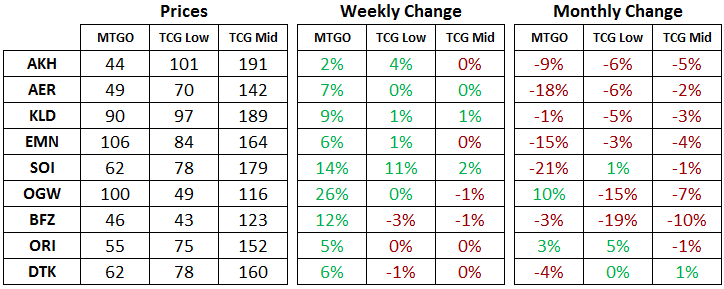
Below are the total set prices for all redeemable sets on MTGO. All prices are current as of July 17, 2017. The TCGplayer low and TCGplayer mid prices are the sum of each set's individual card prices on TCGplayer, either the low price or the mid price respectively.

All MTGO set prices this week are taken from GoatBot's website, and all weekly changes are now calculated relative to GoatBot's "full set" prices from the previous week. All monthly changes are also relative to the previous month's prices, taken from GoatBot's website at that time. Occasionally, full set prices are not available, and so estimated set prices are used instead. Although both Aether Revolt (AER) and Kaladesh (KLD) are no longer available for redemption, their prices will continue to be tracked while they are in Standard.

July17

Standard

Prices rebounded in a strong fashion this week, led by Oath of the Gatewatch (OGW) up a massive 26 percent. Thought-Knot Seer surged to a new all-time high of 19 tix, even though it is set to rotate out of Standard in the fall. This can be attributed to its play in Modern and the Mono-Red Eldrazi list that has been gaining steam and finished in 19th place the the Star City Games Open in Cincinnati.

There was an error retrieving a chart for Thought-Knot Seer

The Desert mechanic from Hour of Devastation (HOU) has given extra utility to mono-colour decks in that they can access these cards without diluting the ability of their manabases to generate coloured mana. Naturally, this also favors the colourless Eldrazi from OGW. Thought-Knot Seer, among other Eldrazi, will be an excellent target for speculators in the fall.

There was an error retrieving a chart for Ulamog, The Ceaseless Hunger

A ramp strategy did materialize at the Open, reaching 27th place. Expectations for this archetype were very high, though, and without a stronger finish, Ulamog, The Ceaseless Hunger has fallen back to 6-tix range after peaking at over 10 tix on Saturday. It will be up to the pros at Pro Tour HOU in Japan to see if they can crack this nut, but there looks to be plenty of room for this Standard format to evolve.

Modern

The Modern metagame remains diverse, with no deck dominating the metagame of late. The specter of a format ruled by Death's Shadow has diminished, even if that card fuels what is still one of the top archetypes of the format.

The financial outlook for the Modern format is good, even though the focus is currently on HOU Standard. There is typically a seasonal high in Modern interest that occurs in late August and into September. This is when players move on from Standard with the pending fall rotation, picking up their pet Modern decks in order to jam some Constructed games. This will be the next selling window for Modern staples and playable cards. The second weekend of August also features two Modern Grand Prix events in Sau Paulo and Birmingham. Keep an eye out for any price spikes that coverage of these events generate.

There was an error retrieving a chart for Tarmogoyf

One Modern staple that has fallen on hard times is Tarmogoyf. With a recent reprint in Modern Masters 2017 (MM3) and the relative decline in the Jund archetype, 'Goyf fell below 30 tix for the first time since the advent of the Modern format back in 2011. Players who have long coveted this high-priced staple should consider acquiring a playset over the coming months. For MM3 cards in general, the best buying window will be in October and November of this year as all eye shift to Standard Constructed post rotation.

Standard Boosters

Amonkhet (AKH) boosters finally showed signs of life this week, rising to over 1.7 tix after bottoming in the 1.4 to 1.5 tix range. With all the changes to Treasure Chests and boosters as prizes in the past year, we haven't had a chance to observe how the price of a large-set booster evolves after the small set is released. Prices are normalizing at this point, and it certainly looks as if AKH boosters will get to 2 tix.

There was an error retrieving a chart for Limits of Solidarity

A draft set of Kaladesh (KLD) block has softened to under 8.1 tix this week. There's a little over two months left for this block to be drafted, which leaves enough time for these to reach my price target of 9 tix. Nevertheless, the window to sell these will close and speculators should be cognizant of this fact. Once Ixalan (XLN) is released in September, KLD block will no longer be draftable, and the price of KLD and Aether Revolt (AER) boosters will fall as a result.

Trade of the Week

For a complete look at my recent trades, please check out the portfolio. This week I started buying foil mythic rares from HOU. When you are buying the complete basket of these, it's inevitable you'll end up overpaying for some while getting a deal on others. Even though the price of the foil version of Nicol Bolas, God-Pharaoh has dipped in the past week, I'm not worried about these types of fluctuations. The pool of value that a complete basket of the HOU foil mythic rares represents is intact and will remain that way over the summer.

There was an error retrieving a chart for Nicol Bolas, God-Pharaoh

I'll look to exit this trade and my AKH foil mythic trade in October and November, just prior to the end of redemption and after Standard rotates. The shortened redemption window generated a significant price spike in some of the Aether Revolt (AER) foil mythic rares in May, and I'm anticipating a similar effect to occur for HOU.

Insider: Top 5 Standard Picks After SCG Cincinnati

Are you a Quiet Speculation member?

If not, now is a perfect time to join up! Our powerful tools, breaking-news analysis, and exclusive Discord channel will make sure you stay up to date and ahead of the curve.

Week one has come and gone for Standard. I must say, the format looks enticing. Twelve different decks in the Top 16 of the Standard Open? Ladies and gentlemen, that is the kind of format that people want to play!

It is hard to identify exactly what the format will actually look like until after the pros have taken a shot at it in Kyoto two weeks from now. However, if I were a betting man (which I am) there are certain cards and strategies that are feel very likely to hit.

Today I will be sharing the Standard cards that I am most interested in picking up now at their current price in anticipation of possible gains in the current metagame. In addition to sharing my picks, I will also be giving the reasoning behind why I like these cards at their current prices.

Spell Queller

There was an error retrieving a chart for Spell Queller

One thing I noticed looking over the SCG Cincinnati Open results was that there were a lot of Spell Quellers floating around. The card is a staple in UW Monument (which may be the default "deck to beat") and also showed up in Esper Vehicles. It's a good tournament card in a sort of general sense and it may finally get its day in the sun now.

Copies are readily available on TCG Player at less that $3.00, which was almost surprising to me. It certainly feels like a card that has the opportunity to surpass its current price point. In addition, the card has significant applications in Modern and possibly Legacy at some point. Which means owning the card beyond rotation won't be complete dead weight in your trade stock.

However, I have a strong suspicion that the narrative coming out of the tournament among pro writers will be that Monument is the de facto deck-to-beat in Standard, which is likely to impact the price of Spell Queller out of the gate. I'd look to this card as a potential immediate gainer that also has long-term upside in Modern.

The card is obviously very good, which was reflected in its early price sky-rocketing to over $12. However, the card hasn't found a comfortable home in Standard yet. Is UW Monument finally that moment? I think it is. The ability to recur the card with Dusk // Dawn really puts it over the top. Eventually, it will stick, and the opponent will die.

Dusk // Dawn

There was an error retrieving a chart for Dusk

In the same vein as Spell Queller, I think we could do a lot worse than betting on the potential "best deck" in the format. One thing that is interesting, and might buy us some time, is that the Top 8 was particularly diverse at the Open. It isn't 100% obvious than anything dominated or what the format is going to look like.

With that being said, UW Monument was the best performing archetype overall that was widely played. It put the most amount of players into Day 2 and had a terrific conversion for cashing the event.

Dusk // Dawn is an important part of that strategy. It is a powerful removal spell against decks that play big creatures. It also gives the deck a ton of late game inevitability by rebuying all of the little creatures that have died along the way.

As of writing the article on Sunday evening, there are lots of copies on TCG for less than $0.50 and I actually picked up a few extra playsets at that price. I love investing in these kinds of cards because when they hit you are likely to double up or better on your investment. I also love the fact that this card will be in Standard for a long time which gives us lots of opportunities down the road to hit again.

Powerful spell. It's in the best deck. Also, it's fairly unique. I don't think it is out of the question that somebody will try and play this in Modern or Legacy at some point. Feels like a slam-dunk card to me.

Glorybringer

There was an error retrieving a chart for Glorybringer

If you are playing red, chances are there are some number of Glorybringers in your 75. I think that is a telling narrative. The card is so good, that if you play the color, you play the card.

It does a lot for the cost and is quite powerful. It impacts the board in a very serious way.

The card came out of the gates expensive but has dipped off significantly over the past few months. There are a few reasons. Firstly, it was a Game Day promo. However, the promo is actually super sweet-looking and likely a solid investment for not only Standard but also Cubes down the line.

Secondly, the card was outclassed by Aetherworks Marvel decks before that deck was banned. Now, it is Glorybringer's chance to be glorious.

In the $4 range I think we can expect to see this card start to make a bounceback if it has a nice showing at the Pro Tour. The fact that it is so flashy and a Dragon is likely to make its price end up higher that most really good Standard rares that see a lot of play. Buying in on these now while they are low feels like a good investment to me. It doesn't feel like the card can really end up lower than it is right now, but there are a lot of scenarios where I could see it going up. Most scenarios, in fact.

Bristling Hydra

There was an error retrieving a chart for Bristling Hydra

Bristling Hydra is another mainstay of new energy decks and has been appearing in all of the various flavors. Temur, GR Pummeler, and even BG Energy.

The card feels positioned to become a major part of the metagame and is selling for around a buck online. I love these kinds of cards because they feel hard to miss but can easily hit big as lots of players look to acquire copies at the same time.

It is worth noting that this card also benefits greatly from the banning of Aetherworks Marvel, as Marvel was the default best thing to do with energy. As players look to utilize the powerful energy shell in new ways, it becomes clear that Bristling Hydra is one of the best energy payoffs. I also love the fact that no matter what "flavor" of energy you choose, that Hydra is likely making the cut, which means it goes into a lot of different decks that draw on the same mechanic.

The energy engine is very powerful and I wouldn't be surprised to see it be one of the strongest archetypes at the Pro Tour. Be ready!

Hour of Promise

There was an error retrieving a chart for Hour of Promise

I suggested Hour of Promise as one of the underrated Hour of Devastation cards last week on its Commander applications alone. With that being said, there is a lot of murmuring that the card has serious Standard potential in addition to being a Commander slam dunk.

The ability to search up multiple copies of Shrine of the Forsaken Gods and accelerate out gigantic Eldrazi Monsters in Standard is no joke. In fact, it is one of the super-secret decks I could see coming out of Pro Tour Hour of Devastation in the coming weeks. I'm not 100% what the best way to build such a deck might be, but there were versions of the archetype that cashed the SCG Open last weekend.

I think Hour of Promise could easily be the sleeper card of the set and I'm not going to take that lightly. It is almost certainly the case that trading for these off of people who don't appreciate the Commander and possible Standard implications right now is a terrific idea.

Value of a Diverse Metagame

I'm really excited about this format because it looks to hold a lot of potential. The week-one results show a format that has a lot of viable decks that all look really fun to play. Don't underestimate the effect of a format that people want to play on MTG finance. When people are excited to play, they are much more willing to spend money on cards. When people are buying cards the prices go up. The circle of life...

There are a lot of potential earners in Standard as long as people are excited to play. Keep that in mind and invest your energy into picking up the cards that people are going to want before they know they want them. Then you'll be in a great place when the Pro Tour results roll around.

How to Approach the PPTQ Season Metagame

Are you a Quiet Speculation member?

If not, now is a perfect time to join up! Our powerful tools, breaking-news analysis, and exclusive Discord channel will make sure you stay up to date and ahead of the curve.

For most players, this week is the start of the Modern PPTQ season. Technically it started last week, but many of those PPTQs were Sealed to coincide with Hour of Devastation's release. Hopefully you have chosen your deck and are getting in the reps you need. This is Modern, master your deck—you've heard this before. What you might not have heard is how to prepare for the metagame. I'm going to describe my methods this week.

Every serious player devours metagame data. We want to win and will look for any edge. This is a good thing; decisions based on facts and data tend to be good. However, that data has to be applicable first. Relying on aggregate metagame data is a trap for PPTQ players. Those projections, standings, and data sets are tools to explain the total metagame. Unless you're going to a GP-level event with players from all over the state and country present, you're not going to see that entire metagame. At local events you're going to see a local metagame, and understanding how that differs from the national trend is the key to successful preparation.

A Metaphor and a Stats Conundrum

I'm sure everyone intuitively understands what I'm talking about, but I'm not leaving it to chance. Imagine each deck is a drop of oil paint. Placing each drop into a tank of water forms the entire metagame. Each drop floats alongside all the other drops in an oddly mesmerizing mosaic. A tournament is taking a plastic square and blocking off a section of that tank. The decks at the tournament are all the drops inside that square. When we do metagame analysis we stir the waters so that the colors separate out and we can see their relative quantity and draw conclusions. This is intended to inform us of the probabilities of seeing a given deck at a tournament and the relative strength of each deck.

As a result, the larger the square the more likely it is to accurately reflect that analysis. Smaller cubes are more likely to miss a color entirely, or even contain some that the big analysis will filter out. How many FMN metas contain lots of janky weirdness that never shows up on any standings? Mine definitely does. As a result, statistical modeling breaks down on the small scale. This is natural. Statistical analysis is intended to take lots of little numbers, aggregate them, and then model the totality of reality. The smaller the scale you're working with, the harder it is to get meaningful results. I've mentioned this about my sample sizes in previous banlist tests. This is why statistical analysis is great for looking at crime trends in an entire state, but if you want to examine a specific neighborhood you need to send in an expendable sociology student with surveys.
For this reason, PPTQ players should regard the total metagame data as a general guide. For reasons I'll be going into shortly, it is unlikely that a given PPTQ will model the aggregated data. Instead, you should regard those stats as an a priori (theoretical) assumption and point of departure for your analysis, not as the end point.

Who's Your Local Meta?

For me the most basic question is, "Who else is going?" Obviously, you can't know exactly who will be there (unless you're a time traveler or precog), since some players won't decide to go until that morning, and others may have spent weeks planning only for something unexpected to arise. (As in the trip car's transmission blows half an hour in because the driver's mechanic didn't actually fix the problem, despite billing as if he did, and then despite the ruined trip absolutely not being the driver's fault, the rest of the car never quite forgives him.) You can however get a sense of who might go and what they are likely to play.
See, PPTQs don't draw that wide an audience. Every early- to midseason PPTQ I've ever been to had five rounds and about 30 players. The only times they're smaller than 20 is when TOs have deliberately and aggressively limited participation, and they're only bigger towards the end when everyone's desperate. There are a lot of PPTQs in a season (in most places) so there's less incentive to drive for hours to make one. As a result most of the participants will be local players. Therefore you should know what at least 50% of a given field is just by being a member of your Magic community. Most players play the same deck at every event, either by choice or necessity, so whatever you see winning at FNM will also be at the PPTQ.

Gather Information

Of course this is not universally true; plenty of players will bring their janky fun to FNM because it's FNM and you'll never see their real deck. You need to look deeper to find out their preferences. You can also never forget the impact of big names on a metagame. When decks get a lot of coverage and pros extoll their virtues, players listen. Sam Black was partially responsible for Death's Shadow's rise by constantly hyping the deck. Decks that get a lot of press the week before an event will be more prevalent. Pay attention and plan accordingly.

Therefore, just listen to what your fellow players are saying. Even those who intend to play a different deck at every event or never publicly say what they're playing have opinions and will share them readily. Whether it's chatter between matches or social media discussions, you can find out what players in your area are thinking. This gives you a sense of their perception of the metagame and how they're preparing. Oftentimes players will reveal their deck choice just by revealing their biases.
Of course, don't be deceptive or manipulative about finding this. Having a reputation as a sketchy or manipulative player is bad. It's a great way to end up shunned and banished from the community. Don't pressure players to divulge information or leak confidential information. All I'm saying is that people talk and if you pay attention to conversations you will learn all you need.

Who Else May Come

It's also important to consider those players who will travel to the event. Some enjoy the trip, others have to because they don't have many where they live. Every region will also have a significant grinder population that will absolutely attend every event they can until victory is achieved. And everyone knows who they are. You see the real grinders at every event, you hear them constantly chattering about matchups and the meta, and other players talk about them. I'm a well-known grinder in my state, everyone knows the decks I favor, and I have the same information about the other compulsive grinders I hit every weekend. If you don't already know, just ask. Reputations are powerful and useful things.

What's Your Regional Quirk?

The final thing to consider is your region's reputation. The metas of many US states have quirks or favor certain types of deck over others, regardless of format or season. Colorado is notoriously red-heavy, while I've heard that Virginia's meta is so spikey thanks to Star City Games being there that the metagame charts are perfectly accurate. This is not necessarily accurate, but it can help guide your decisions.

Put It Together

The biggest question for me facing the first PPTQ Saturday is my deck choice. I have a number of decks that I'm very practiced with in this meta and I have a good sense of how they fare against the tiered decks. Picking which deck to register comes down to my read of the metagame and the best-positioned deck for this week. And you always have to consider this on a weekly basis—players at this PPTQ will react to what they saw for next week. Never rely on outdated reads or reasoning if you want to metagame. The decks I'm considering are UW Merfolk, Mono-White Death and Taxes, and UW Control.

As I mentioned, Colorado has had a reputation for being a Burn state for a very long time. It's not undeserved. It also tends to have lots of Jund and Tron. This has been the trend, but it isn't guaranteed. My local game store is arguably the center of Modern in the Denver area. We have the most Modern tournaments and the highest turnout every week. There has been a high amount of Burn and Tron, with Eldrazi recently having the edge on traditional Gx, but Jund has disappeared and there's only one GB Rock player left. Some have simply been turned off by all the Tron, others jumped ship to Death's Shadow. There has also been a surge in Living End and Affinity, both of which were big players two years ago but disappeared last year. Generally, every player talks about their deck as their deck and plays them at every event, so I'm not worried about left-field choices.
Looking to the other known spikes and grinders, there are several wildcards. There is a community of combo enthusiasts based at the School of Mines who sometimes come, as well as a significant cabal of Collected Company captains from all over. A sizeable group often comes down from Wyoming during PPTQ season but I know very little about their deck preferences. The usual grinders are split between just playing the best decks and weird metagamed decks. However, a number have started talking about and testing UWx control decks and they're starting to win local tournaments. This leaves me thinking that Affinity, Burn, and Tron of both varieties will certainly be present, with Death's Shadow, UWx control, and Living End likely to be there. Thus I'll be picking my deck and sideboard based on these six decks. You can't predict what combos or brews will show, so don't try. Most of your sideboard cards will work against them anyway.

What Does It Mean?

The whole point of metagaming is to maximize your odds of only hitting good matchups while avoiding bad ones. Given the expected metagame, I see the field like this:

BurnAffinityTronLiving EndGrixis ShadowUWx Control
MerfolkGoodBadFairGoodGoodGood
Death and TaxesGoodGoodVery GoodFairGoodBad
UW ControlGoodGoodFairVery GoodGoodFair

Now, based on this chart Merfolk seems like the weakest choice: the matchups are generally good but not spectacular and you have the very bad Affinity to consider. DnT is generally strong against the field but I have consistently struggled against control decks, particularly the Jeskai lists many appear to favor. UW doesn't have any truly bad matchups, which indicates that it is the best choice. However, that isn't the end of things because you have to consider what will happen if everyone draws the same conclusions as you.

Mirror Mirror

The final thing to consider is the mirror. How likely are you to face a mirror match, and how well prepared are you for one? If you're really weak to the mirror, either because you're unpracticed or you've metagamed away from the mirror, it may be fine if you're unlikely to face it. If you've got a brew, you can ignore the mirror. Playing a Tier 1 deck is more dicey; there's a much higher chance other players will play your deck. In the Merfolk mirror, I have a huge edge because I play Path to Exile and more non-islands than anyone else. There's not much in the sideboard except Echoing Truth, but I don't expect more than one other Merfolk player at any tournament, so why worry? I've also been playing the deck so long I've had plenty of practice.

For UW Control I'm more worried. As I noted above, there's been an upsurge in UW recently. While my technical play in the mirror is good thanks to years playing the deck, my deck is weak to other control decks. I don't play Ancestral Vision because it's too slow most of the time, but it really aides the mirror and I know that many other control players have Vision. This leaves me weak to the mirror.

Finally I have never played an actual DnT mirror. I've played against GW Hatebears, Eldrazi and Taxes, and mono-white Emeria, the Sky Ruin decks plenty but never DnT. I'm the only one who's tried until recently. This is a problem because social media chatter indicates that players who I'd never have thought would even consider a deck similar to DnT are seriously planning to play DnT. This isn't a disaster; they're going to be as green as me, but it's not what I call optimal either.

Here Goes

There are some local tournaments that I'm going to gather additional data from before I make a final decision. If I was less confident in my existing decks, I would probably make the choice now and focus on practicing before the season really starts. Fortunately I have the luxury to try to get more information before pulling the trigger. See you next week with the tournament report.

Insider: Investing on MTGO Level Up – Uncommons

Are you a Quiet Speculation member?

If not, now is a perfect time to join up! Our powerful tools, breaking-news analysis, and exclusive Discord channel will make sure you stay up to date and ahead of the curve.

My previous two articles both were focused on Amonkhet investment opportunities, but they were divided between less and more expensive cards. I did this in part because I wanted to follow that series up with an article discussing why card value should affect your investment decisions, and indeed why card value is a very personal variable that makes different investment strategies better and worse for different sorts of people. I hope that some of the practical insights here will help you shape your investment portfolios and decisions moving forward.

Since Quiet Speculation has historically had a focus on paper finance, I suspect that some readers may have been a bit perplexed about my article focusing on cards of such infinitesimal value. Can investing in supremely cheap cards have a meaningful return on investment? After all, in paper it is usually inadvisable to make such investments because the practical costs of moving and storing cards gobble up too high a percentage of whatever hypothetical return you would make – shipping costs and listing fees to name just a few.

Because these financial encumbrances don’t apply to the digital marketplace of MTGO, it is worth figuring out whether cheap cards are worthy of your investment dollars. I have been investing in tiny stocks for the past year and have learned a lot about the benefits and detriments to doing so in the process. The cards I’ve chosen to invest in provide a pretty decent snapshot that highlight many of the rewards and difficulties in doing so. We'll cover some of these down below.

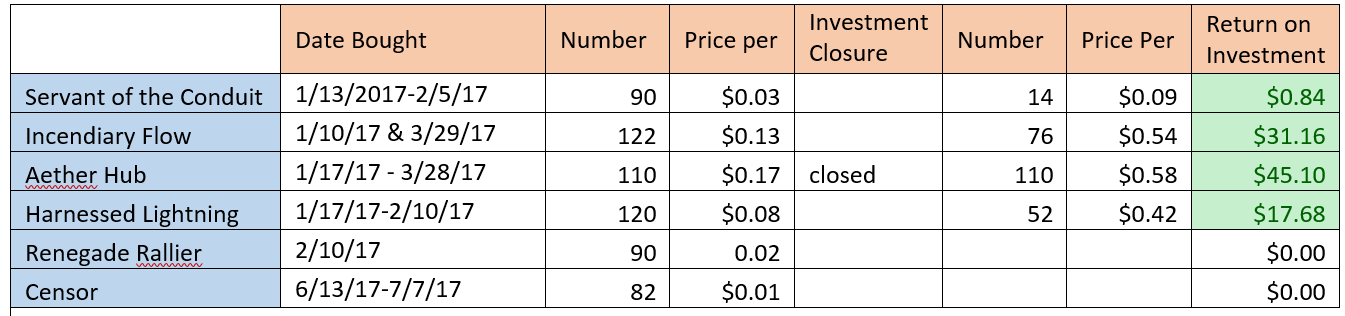
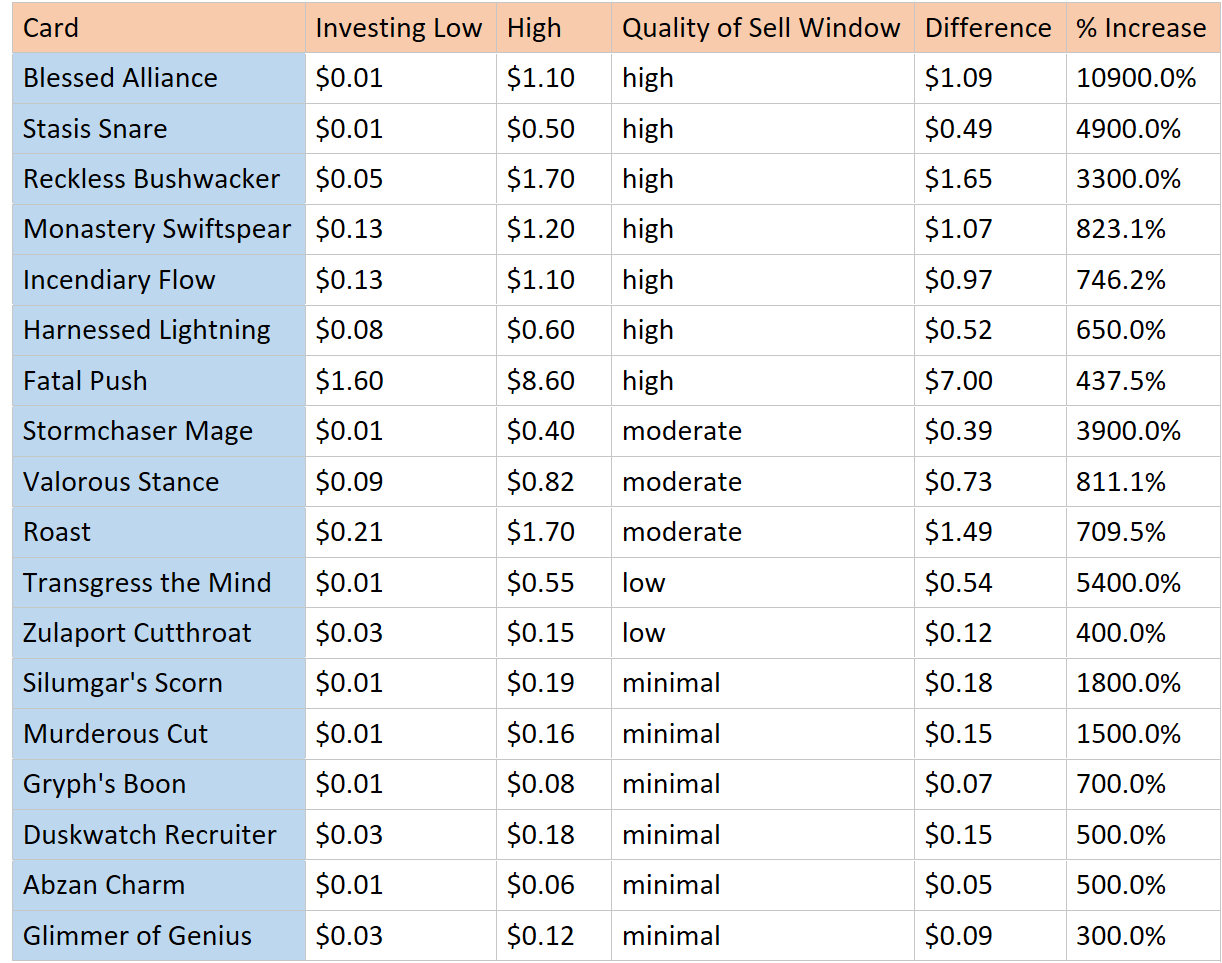
TIny Stocks for July 2

Tiny Stocks (~$0.25 and Lower): Standard-Legal Uncommons

All of the above investments fall into this category. Designing uncommons that see significant play in Standard is a staple of Magic set design, and so today we are going to look at whether we should consider investing in them.

To that end, I looked into the financial performance of uncommons that have seen significant play in Standard over the past few years, all the way back to Khans of Tarkir. Much of that data is available in the chart below. Do note that I've provided and organized the data most useful to you as an investor. The "Investing Low" listed for each card is the price at which you could buy a significant number of copies of that card (at least 50 copies), with a buy window of at least 4 weeks. The sell window is a qualitative measurement of how likely you would be to sell your card either at the card's peak price or near its peak price. Cards with a "low" window indicate that you have to be actively conscious of your investments and utilizing MTGGoldfish price alert updates to have a realistic chance at selling your card for near-peak value. Cards with a "minimal" window could not really be sold in time and would have been bad investments.

July 3 Standard Uncommons

What immediately jumps out is how, as a whole, these cards were immensely successful investments.  Ten of the eighteen cards had very good sell windows, and you'd be getting an excellent rate of return, assuming that you were able to sell the cards for 70 percent of their value back (bot buy prices for these uncommons tend to vary between 60 and 80 percent, so 70 percent is a decent benchmark to use). Specifically, excluding Fatal Push, the average increase for the moderates/highs was 0.93 tix, which translates to an average rate of increase of a whopping 2,971 percent! And yes, that is a comma, not a period!  Your rate of return, then, would be about 0.65 tix per card, constituting a 2,079-percent increase.

This compares favorably to the expected rates of return one would expect from investing in some of the most valuable and successful mythics and rares of Standard over the same time frame. Unlike the uncommon chart above, this chart is not exhaustive. I tried to take a good sample from a variety of sets, and in general used cards that had crossed the 20.00 tix threshold, but ultimately, no matter what grouping of cards we used, we'd see the same basic truths.

July 3 Standard mythics and rares

In particular, what I want to call attention to is that the average rate of return for the rares and mythics that have dominated Standard is significantly less than for the top uncommons that have permeated the format. Again ignoring the cards with low and minimal sell windows, and this time assuming a higher bot buy price of 85 percent of the card's sell value, your rate of return would have been about 15.26 tix per card, constituting a 300-percent increase. On average, then, you'd be tripling your money – good, but not vigupling good (or vigentupling good for you Latin purists out there).

There was an error retrieving a chart for Atinlay Igpay

Tiny Stock Investing Advice

So, should you stop investing in expensive cards and use all of your money investing in tiny stock uncommons? I wouldn't go that far. What is clear is that there is money to be made investing in uncommons, so don't hesitate to do so! As much as you and I would like to viguple our money, there are some things you need to keep in mind when choosing to invest in tiny-stock uncommons, and why I recommend including them in your investment portfolio rather than making them the entirety of it.

(I) Tiny stock uncommons require a greater amount of time and effort.

If you don't actively manage your investment portfolio, you should generally avoid investing in uncommons, or at least minimize the number of them you do invest in. The prices on MTGO are notorious for fluctuating rapidly. Cheaper cards that are used by Standard players usually experience these fluctuations to a greater degree than do other cards. Harnessed Lightning is a great example, albeit a tad extreme:

July 3 Harnessed Lightning Price Chart

It would have taken conscious effort, good timing and ready access to MTGO to sell your Harnessed Lightnings over time for a price above 0.40 tix. And generally, you can't unload hordes of a single card all at once without diminishing your rate of return. If you're going to invest in uncommons, I recommend having at least three bot chains you do business with so that you can sell about 15 to 20 all at once. I don't want to scare you away, but I just want to stress that uncommons require active, rather than passive, management. Which leads me to...

(II) Limit the quantity of any given uncommon you invest in to 50 to 100 copies.

You have to invest in a significant number of any given card to make it worth the effort of managing it as part of your portfolio, yet investing in too many will often lead to having excess copies that you can't get rid of profitably. For example, look at my Harnessed Lightning and Servant of the Conduit specs. I still have 70 copies of Harnessed Lightning and 75 copies of Servant of the Conduit to sell, and I think the prospect of making a good return on the remainder of these cards is bleak.

For cards that you are more unsure of, I'd stick closer to 50 copies, and for cards that you are confident in, I think going up to around 100 copies is ideal. The 120 copies of Harnessed Lightning should have been 100, and the 90 copies of Servant of the Conduit should have been 50. Don't repeat my mistake! This is the most significant reason for exercising moderation in your investment in uncommon cards on MTGO.

(III) Invest in uncommons from small sets.

This goes for all investing on MTGO, actually. The average quality of sell window is so much higher for uncommons from small sets than for those from large sets. All of the cards in both charts that had a "Low" or "Minimal" sell window rating were from large sets. One example of a card that was helped immensely by being from a small set is Stormchaser Mage.

(IV) Watch out for FNM promos.

Now that FNM promos are being discontinued, it is unclear whether this tradition will continue on MTGO. I suspect it will, and so you will need to be extra vigilant about which cards are being tagged as future promos (favorite this page!). These promos will tank the value of your investment when they are distributed, so be sure to sell your copies prior to the release of the promo.  If you don't keep up with the promos, then you too can have 50 copies of Incendiary Flow languishing away in your account. I learned my lesson and didn't make the same mistake with Aether Hub.

Sunning Off

Please leave any questions down in the comments below and I'll be sure to respond! Standard-legal uncommons are often overlooked as potential investments, and I hope that you consider incorporating them into your portfolios going forward!  I'm enjoying the summer, but I'm not so sure the denizens of Amonkhet are...

Brutality of the Second Sun

Insider: Avoiding the Largest Reprint Risks

Are you a Quiet Speculation member?

If not, now is a perfect time to join up! Our powerful tools, breaking-news analysis, and exclusive Discord channel will make sure you stay up to date and ahead of the curve.

Pop quiz: what infrequently used card is nearly the most expensive Modern-legal card in normal printing, using TCGplayer mid pricing? The answer may surprise you, because the card doesn’t crack the top 50 for most played cards in the format. Or any format for that matter. Give up?

There was an error retrieving a chart for Horizon Canopy

That’s right, Horizon Canopy has just about dethroned Tarmogoyf (using the cheapest printings available) to become the most valuable Modern-legal card. That’s what happens when a card sees fringe play and is released with only a single printing released in a small set a decade ago (Expedition supply likely added negligible volume to the market). At this point, the card is so expensive, you may as well pick up the Expedition version for a very reasonable $30 premium.

Canopy

Both printings are also very low in stock, which fuels the speculation fire.

However, I’m here this week to emphasize caution. Horizon Canopy may be difficult to reprint now due to its price, but it’s not immune by any means. With new sets being thrown at us left and right, this card and others are all at “high risk” due to their price points, limited play, and overall vulnerability to reprint. Allow me to explain further.

The Bigger They Are…

When I see a card worth nearly $100 despite not being played much, it raises a huge red flag. Remember what happened to Damnation? The card was approaching $70 when its reprint cut the value of the black sorcery in half!

There was an error retrieving a chart for Damnation

The card dodged reprint year after year and gradually rose in price. It sees plenty of Commander play and the occasional Modern sideboard may run a copy, but this card’s price was pretty much driven by its rarity and uniqueness. Sound familiar? I suspect Horizon Canopy is in a very similar boat. One opportune reprint and this card will tumble, because any appreciable increase in supply will very quickly outstrip latent demand.

If I take a step back, Horizon Canopy isn’t the only card at risk of significant price correction upon reprinting. In fact, I don’t even think Horizon Canopy is at greatest risk. There are a couple other cards that worry me even more, and I would advise you to develop an exit strategy and be prepared to execute said strategy at the drop of a hat.

First off, consider Mana Drain.

There was an error retrieving a chart for Mana Drain

Many people probably assumed this was on the Reserved List. But those misconceptions died when Wizards gave us a judge foil printing. Now it’s glaringly apparent: this card can and will be reprinted! I’m not certain where we will get the reprint, but now that Wizards has commissioned a new piece of art for the card, I suspect they will be eager to use it a couple more times.

It could show up in Masters 25 next year. It could be revisited as a judge foil just like Elesh Norn, Grand Cenobite was. Or it could show up in some other product altogether. All I know is that this is a $200 card that sees play only sporadically since it’s banned in Legacy. The original printing will maintain value, of course, but it will still fall a long ways when that reprint drops.

Another expensive card that is begging for a reprint is Rishadan Port.

There was an error retrieving a chart for Rishadan Port

This is another card some folks may mistakenly assume is on the Reserved List. But in reality, RL cards don’t exist starting with Mercadian Masques. That means all cards from this block and all moving forward are fair game. While the vast majority of Mercadian Masques cards are not worth visiting, I strongly believe we will see a Rishadan Port reprint at some point. Once again, this would be attractive in the Masters 25 set slated to launch next year. But it could be reprinted in other ways too. You may think this $100 card is safe from reprint due to its specific location reference, but Wizards has shown us time and again they have creative ways of reprinting cards. I wouldn’t sit on any copies of this one unless you regularly use them.

Another card that worries me is Flusterstorm.

There was an error retrieving a chart for Flusterstorm

Besides a judge foil, this was only printed in the original Commander series and has been gradually rising in price pretty much since the day it was released. Looking at its five-year chart, it’s incredible to see how this card has barreled through every price ceiling to set new highs. Now sitting at around $90, it seems almost inevitable this gets into triple-digit territory. Or does it?

Well, it is the 14th-most played card in Legacy, so it will survive reprint a bit better than other cards in this article. Then again, the fact that this card has never seen a normal printing means supply is artificially low. A sizable reprint in a Masters set would likely damage this card’s price for a long time. Judge foils could be safer to hold because you would avoid some pain from a nonfoil reprint. But if this gets a foil reprint as well, the judge promos are positioned to tank hard.

Lastly, let’s take a look at another card that falls in the top 10 most expensive in Modern. Perhaps even top five. I’m talking about Chalice of the Void.

There was an error retrieving a chart for Chalice of the Void

This is the 32nd-most played card in Modern. It also cracks the top 50 in Legacy. But is it really seeing enough play to justify an $80 price tag? I would say not. This card was initially printed in Mirrodin, then got a follow up printing in the first Modern Masters, which we know was printed in low numbers. Another reprint and we could see this card tumble all the way back down below $50. It may take a while for that reprint to come, but I would be on high alert if you have a bunch of copies in your inventory.

Alternatives

There are plenty of places to park MTG resources to reduce your risk profile. Obviously Reserved List cards are the ideal low-risk MTG investment, but I’m not going to dwell on this again. You all already know this. (Or if you're new to site or concept, welcome! Check out articles tagged "Reserved List" or "Timeless Info" to catch up on some core ideas.)

I’m going to try and come up with non-RL cards I would be comfortable with holding at least for the time being...at  least to start with. These may be places you want to look when cashing out of high-risk cards.

First off, I think foil printings of key Cat EDH cards could be a worthwhile pursuit. We already know that a successful Commander product leads to ample opportunities for profit. One look at the impact Atraxa and Breya had is enough to convince me that this is a great area to place some bets. I’m not going to pretend to be an expert in the field of EDH or the Cat creature type, but EDH REC already has an assembly of tribal cat decks.

Cats

I would start by browsing this list and picking up foils of key cards with low stock. Many have already moved, but I’m sure that as more spoilers are released there will be other cards that spike in price. By avoiding nonfoil printings, you are largely immune to reprints while maximizing upside potential.

The fun won’t stop at Cats, either. Once we know what the other tribes of the Commander 2017 product will be, there will be no shortage of opportunities. Stick with foils of key cards and you’ll be well primed for profits.

Another area worth your consideration are the Masterpieces that have not spiked yet. These are going to do double duty in your portfolio: they should provide steady, consistent gains over time and they will also be prone to spiking should any speculator decide to make another move. In particular, I’ve got my eye on Solemn Simulacrum and Extraplanar Lens. Both see significant Commander play but lag behind other Commander heavy hitters that have already spiked. There’s also the Expeditions Horizon Canopy, which is likely one day away from disappearing from TCGplayer. Just be careful with that one, because it’s probably expensive for different reasons, as discussed earlier.

Okay, you knew I couldn’t stay away from Reserved List cards completely. There are a couple ideas that have my eye that I would be remiss to leave out. These are almost assuredly off your radars, so hopefully it inspires you to a few new ideas. First off, consider Urborg Justice (credit to Chris Martin for the idea).

There was an error retrieving a chart for Urborg Justice

This Reserved List card from Weatherlight has been drifting higher over the years, but only marginally. But when you read its ability, the card actually does seem interesting. It requires a bit of activation, but at just two mana and instant speed, I’m surprised it doesn’t see more play. Perhaps that’s because not many people have heard of the card…until now, perhaps. Also, supply is very low. There may be 51 sellers on TCGplayer, but you can’t even buy half the copies due to TCGplayer’s $2 minimum policy. If Season of the Witch can maintain a $10 price point, there’s no reason this can’t be a $5 card in time.

Another idea worth your consideration is Reparations, the Reserved List enchantment from Mirage (credit to Chris Martin for the idea).

There was an error retrieving a chart for Reparations

This is another one of those cards with deceptively low stock on TCGplayer, since you can’t buy half of them without adding other items to your cart. I like this card because it draws you cards. Enough said. The two colors makes it awkward, and it certainly is no Rhystic Study. But only a little notice and it could see a 500-percent gain overnight. I’d suggest throwing a few copies in a box somewhere and revisiting it a year later.

Wrapping It Up

Wizards of the Coast has been ruthless with reprints lately. This trend is not likely to reverse, either, given the continuing pressures from Hasbro to sell more product. Therefore, I need to emphasize extreme caution to those who are sitting on high-dollar cards that aren’t on the Reserved List. It seems like it will be just a matter of time before these get the reprint treatment. Because many of these high-dollar cards are expensive due to low supply rather than high demand, their prices will absolutely tank upon reprinting.

The cards that worry me most are Mana Drain, Rishadan Port, and Horizon Canopy. I don’t want to own any printings of these cards. Since they see so little play, I suspect you don’t need to sit on them either. Why not consider moving them and picking up some safer bets?

We’re about to see a major catalyst in the realm of Commander thanks to the release of a few tribal-themed decks. Other than the commanders (which will all likely be new), there won’t be any foils in the decks. Therefore, picking up key foils now, in advance of the set’s release, could set you up for the most potential profit. Right now, we only know about Cats and Dragons, but when the other decks are spoiled you will have to act fast! Having cash on hand will enable you to make your purchases quickly to get the best entry point.

And of course, what would I do if there was no Reserved List? Time and again, I can revisit this well to draw up new places to invest. Reparations and Urborg Justice are a couple of cheap bets worth tucking away in your shoeboxes for a rainy day. I’m sure there are others as well.

The name of the game is to make profit, and I find it’s easiest to do this by avoiding unnecessary risks in the market. By balancing my portfolio and staying focused on potential reprint pitfalls, I can maximize my likelihood of success!

…

Sigbits

  • I wanted to be first to mention Willow Satyr, but it sounds like the QS Cast beat me to it. This one has been drifting lower in stock, and it’s an attractive Reserved List card that appears primed to pop. Star City Games is sold out at $19.99 – you may want to put in a restock alert in case they stock a couple more copies at this price point before increasing it.
  • There’s just one English copy of Sword of the Ages in stock at Star City Games, and it’s MP at $9.99. This is actually a good price because TCGplayer is higher. I expect this one to move up in price some time in 2017, though it’s not on the doorstep of a spike like Willow Satyr is.
  • One Old School card that really surprises me is Word of Command. I’m not sure I’ve ever seen this card played in a game of Magic. Yet its iconic nature and Reserved List status has led to all-time high pricing for the black instant. Star City Games is sold out of Alpha and Beta printings at $399.99 and $249.99, respectively. They have just one MP Unlimited copy in stock for $39.99, and even CE/IE copies are knocking on $10’s door.


Insider: QS Cast #70: Magic Players Like Funky

Are you a Quiet Speculation member?

If not, now is a perfect time to join up! Our powerful tools, breaking-news analysis, and exclusive Discord channel will make sure you stay up to date and ahead of the curve.

Play

The QS Cast returns! Chaz Volpe, Morgan Wentworth, and Tarkan Dospil come together as the new panel - and in this episode they discuss the following:

  • Esteemed guest Chris Van Meter joins the panel! You can find CVM and CVM's work here! @Chris_VanMeter
  • CVM gives us a fresh look at Hour of Devastation, as CVM reviews the set and talk about the cards we need to monitor and acquire.
  • Does the new MTGO Data change how we purchase cards and view results? Morgan brings up a great discussion piece.
  • Interests - spicy, and funky stuff.

Cards we discussed: (CVM is confident about Champion of Wits and disclosed about ordering 40 copies @ .49c) also note: The Scarab God Invocation version / Lord of Extinction Invocation version.


Enjoy!

Find us on Twitter: @ChazVMTG @MTGValkyrie @the_tark @Chris_VanMeter

Death’s Shadow: Hero or Villain? Metagame Impacts

Are you a Quiet Speculation member?

If not, now is a perfect time to join up! Our powerful tools, breaking-news analysis, and exclusive Discord channel will make sure you stay up to date and ahead of the curve.

The "Death's Shadow is the best deck" narrative we saw emerge in force around Grand Prix Vancouver has now split, with some claiming Eldrazi Tron is in fact the best deck. I tend to agree with the former, and will softly make a case for that inclination in this article. Regardless, we can surely agree that both decks are very powerful. Their influence in Modern is another, and in my eyes more interesting, story.

It's possible to read the metagame as David did earlier this week and point to Eldrazi Tron as the catalyst for Modern's reshaping. But it seems to me that Grixis Shadow is truly the best deck, and the one at the root of the shifts—ban Eldrazi Temple, and I bet Grixis Shadow enjoys a similar amount of success if not more, and the metagame trends established in the past few weeks intensify. Today, we'll look at the warping effects Shadow has had on the Modern metagame to assess whether the deck does more harm than good.

The Good

Providing a Skill-Testing, Interactive Option

Perhaps most obviously, Shadow being the format's best deck is great news for the Twin apologists who have been clamoring for such a deck. It's a Snapcaster Mage deck, which fulfills a certain niche by itself. It also doesn't suffer from the BGx problem of awful ramp matchups. The deck's skill ceiling is miles-high, and Shadow plays very fair Magic very effectively. That's why, despite the deck's sustained success, players calling for a Shadow ban are in the minority.

Enabling Control

Control decks in Modern have always struggled with the format's diversity. They found it difficult to at once attack linear combo decks, fast aggro decks, and attrition-style BGx decks at once. Control should have a naturally favorable BGx matchup, for example, but the deck was often stretched thin enough that the matchup was winnable for Tarmogoyf—in fact, BGx often preferred to pair with control decks than with Tron.

Now that Grixis Shadow is the reigning midrange deck in Modern, life gets much easier for reactive control decks. At level zero, Shadow is easier to beat than other midrange decks. It plays fewer threats and is overall much more fragile, trading in the robustness of GBx for the consistency and efficiency necessary to defeat big mana.

Going deeper, ramp's switch from Gx Tron to Eldrazi Tron, itself imposed by Shadow's presence, also throws a bone to control decks. Matter Reshaper and Reality Smasher are a lot easier to beat than Karn Liberated and World Breaker; after all, they die to cards that are great against the format's other top deck, Path to Exile and Surpeme Verdict.

Opening the Floodgates to Innovation

A year ago, Bolt was everywhere, and Mirran Crusader was a poster-child for unplayable Modern creatures. But times have changed. Shadow is focused and streamlined enough that savvy deckbuilders can find ways to exploit its taut design, such as running a three-mana, pro-black creature.

The general decline of Bolt has also fueled some innovation. Bolt is miserable against Shadow decks, and the Shadow decks don't have to play it to do well—in fact, they're often better off without it to gain an edge in the mirror. All that one-upmanship creates yet another opportunity for brewers to break through, though, and it's no coincidence we've seen Hatebears-style fish decks perform admirably at multiple high-profile events now, putting two players into the GP Las Vegas Top 8 and taking down the SCG Season 1 Invitational.

Given Modern's vast card pool, we're sure to see some more clever maneuvers to beat Shadow in the near future. But it's also important to remember that the innovation won't last forever. Once the dust settles, and Shadow gets more comfortable with its seat in the usurped BGx throne, Modern will stagnate again; the strategies that beat Shadow will have been discovered, and Shadow will either have adjusted to beat them or resolved to dodge them. Hopefully, more of those strategies pop up before that happens, and are competent enough to become Modern fixtures.

Adding Color Diversity

Wizards has recently expressed a desire to improve Modern's color diversity. At the time of the announcement, everyone and their Goblin Guide knew the company was referring to white and blue's relative weaknesses in, and absences from, the metagame. The statement even inspired me to write an article in favor of a Stoneforge Mystic unban.

Jund Shadow has since evolved into Grixis Shadow, a blue deck itself, which in turn buffed Path to Exile decks like UW Control and Hatebears. While I still don't think Stoneforge would be too powerful for Modern, the goal of that possible unban—to improve color diversity—has already been achieved by Grixis Shadow.

The Bad

Homogenizing Midrange

To be fair, pre-Shadow "discovery" and post-Twin ban, Modern's midrange decks were almost exclusively of the BGx Rock variety. That's a solid year of Goyf dominance. One might conclude, then, that Shadow isn't homogenizing midrange decks; midrange decks were already homogenized.

Why, then, does Shadow make up such a large percentage of all midrange shares? It currently occupies shares comparable to those of Jund and Abzan in the post-Twin period, and both decks are still Modern-legal in their entirety. So, as David asked, where's the Jund?

I think the answer is a bit more complicated than "Jund loses to Eldrazi Tron." In my experience, in fact, BGx does better against Eldrazi Tron than it does against Gx Tron. It's true that Shadow tends to defeat big-mana decks where Rock has failed, with Eldrazi Tron posing the most serious hurdles for Shadow (and still struggling in the face of an experienced pilot). But here, too, the refined statement, "Shadow beats big mana," doesn't account for other factors in BGx's decline—such as Dredge's comeback (fueled mostly by players realizing the deck is actually still great) and the rise of control decks (which are incentivized to play heavy removal suites in this metagame).

It doesn't just stop at metagame positioning. Grixis Shadow (and Jund Shadow, for that matter) is simply a far better Modern deck than BGx Rock. In "Death's Shadow: Analysis, Implications, Potential," I ran Shadow decks through the three golden parameters of Modern viability: proactivity, interactivity, and consistency. My theory states that successful Modern decks must score reasonably on one or two of these metrics while specializing in another, or otherwise totally nail one component. Shadow decks score highly on all three, though, which is something we haven't seen in Modern outside of decks Wizards has banned. That's not necessarily to say that I think Shadow will get a ban, but it does provide some quantifiable measures of the deck's immense power, especially relative to that of other Modern decks.

Gutting Aggro-Combo

Linear combo has never dominated Modern, if mainly for the reason that Wizards is forced to ban them—in order to succeed in a given metagame, linear combo must win more quickly than the format's aggro-combo decks, which in turn must win before turn four to be viable in Modern. Fast linear combo decks then violate the Turn-Four Rule and rarely last. Still, somebody has to police Tron and company. That's where aggro-combo comes in.

Aggro-combo frequently wins before turn four when unmolested, but the nature of its win conditions (Blighted Agent, Kiln Fiend, Signal Pest, etc.) opens the door for opponents to interact with them. As a result, these decks rarely become oppressive, and create a healthy (on paper, at least) rock-paper-scissors effect where midrange beats aggro-combo, aggro-combo beats ramp, and ramp beats midrange.

Grixis Shadow's rise to dominance has ravaged the once-diverse aggro-combo lineup. Three episodes led to its dismantling:

  1. The banning of Gitaxian Probe. In hindsight, it's probably for the best that Grixis Shadow never got to play with this card. But without Probe, Infect can't run as many copies of Become Immense and loses both the information necessary for such an all-in strategy, and velocity helpful for streamlined decks. Many other aggro-combo decks, such as UR Kiln Fiend and Jeskai Prowess, also went extinct with the Probe ban.
  2. The printing of Fatal Push. Perhaps the most impactful card to ever be printed in Modern (and not subsequently banned), Push radically reinvented the format landscape, pummeling the stock of Tarmogoyfs and Blighted Agents alike. Aggro-combo decks have a miserable time closing out games against decks with Fatal Push, and those decks happen to make up a huge portion of the metagame. It doesn't help that Push is great against the Shadow decks as well, so players suiting up to beat Shadow are likely to sleeve up a card that incidentally crushes aggro-combo.
  3. We don't need 'em. The least-talked-about reason for aggro-combo leaving the building? Its functions are being fulfilled by the Shadow decks. Thoughtseize into Shadow into Denial is plenty good against big mana and linear combo, so more fragile aggro-combo decks like Infect become silly to play—they retain their good combo matchups, but lose to Shadow and to decks trying to beat Shadow. Shadow borrows those good matchups and... well, and is Shadow.

On the surface, it might be tempting to cheer at the fall of aggro-combo. The archetype was everywhere after Twin got banned, and drew ire from players concerned Modern had become too linear. Indeed, since Shadow's ascent, Modern is significantly more interactive (in no small part thanks to the most popular deck being one of the most interactive the format has ever seen).

Aggro-combo devolving into only Burn, Affinity, and Dredge lowers format diversity. Where there were once plenty of aggro-combo options to choose from, only two remain. The third point on our above list concerns me the most. Shadow now controls not just the vast majority of the midrange shares but a good deal of the aggro-combo shares, simply by virtue of fulfilling the latter's roles more effectively.

The (Supreme) Verdict

Ultimately, whether the pros outweigh the cons depends on subjective perceptions of format health. So what do you think? Is Shadow friend to Modern, or foe? Let me know in the comments.

Insider: Using Your MTG Knowledge to Get a Job

Are you a Quiet Speculation member?

If not, now is a perfect time to join up! Our powerful tools, breaking-news analysis, and exclusive Discord channel will make sure you stay up to date and ahead of the curve.

No matter what you are after in the game, there is one constant in your search for Magic: The Gathering-related satisfaction: money.

There was an error retrieving a chart for Land Tax

The original-printing, near-mint, absolutely gorgeous foil of your latest Commander? That costs money. The latest A-plus grade sleeves? Money; probably $9.99. Entry to the nearest Grand Prix or Open or what have you? That costs money, and fortunately they take PayPal. Five hundred copies of a bulk rare that Chaz is sure is the next Sword of the Animist? That’s $50 plus shipping – I hope they were all from one vendor. While this site is rife with ways to make money or save money with Magic cards, there’s one way in particular that I want to tell you about…

Get a job!

That’s right, you don’t have to buylist uncommons for nickels (if that) or even take down Big Modern to bring home money with Magic. Believe it or not, you have developed a very special set of skills every time you did one of the myriad things that Magic players do – and those skills can help you land a job. In my life, I have been a Magic judge, an LGS employee and a content creator, and now I hold a job in an office. I can credit all of these jobs to Magic in one way or another, and I am really grateful for that. My hope is that you come away with the knowledge that you can use next time your LGS is hiring.

There was an error retrieving a chart for Hired Muscle

The business of Magic cards prominently involves the act of buying and selling cards. Generally, a store will find that the more cards they buy, the higher variety they have in stock, which leads to more sales.

Since you are reading an article on Quiet Speculation, congratulations! There’s a good chance that you know a thing or two about buying and selling Magic cards. After you buy the cards, though, you will have to put them away in an organized fashion. This requires some practice, which of course you would get on the job, but you can develop the muscle memory that it takes at home too with this simple exercise:

  1. Fill a five-row box with Magic cards, including decks from different formats and loose commons from your last draft. You don’t have to take off the sleeves.
  2. Mix those cards together! Dump them on the floor (carefully, of course), move them around again, and then put them back. You now have an accurate model of a “Put Away” box.
  3. Sort these cards by set, then by color, then alphabetically.
  4. Repeat step 2, then sort by rarity, then color, then alphabetically.

If you are feeling really ambitious, ask your LGS how they sort their cards for the best preparation! If you don’t own a five-row box or enough cards to fill it, you can make sure that you are familiar with set symbols and grading instead. I’ll leave it up to you to decide that for yourself.

Generally, your local game store sells more than just Magic cards and Mountain Dew. As an employee, part of your job is teaching and selling various board games that they stock as well.

As a Magic player, I have good news for you: Magic is one of the more complicated games out there, and provides the basis for all sorts of mechanics in some of the most popular board games. Sushi Go! is a game where you “draft” pieces of sushi. In New York Slice, you split a pizza, Fact or Fiction-style. Next time you are waiting on a round during Friday Night Magic, check out the demo shelf, pick a game and play with your friends between matches. Additionally, the ability to teach friends about Magic translates into being able to teach customers board games as well.

There was an error retrieving a chart for Venerated Teacher

Getting excited about a new set’s spoilers has prepared you well for selling the latest boosters and singles. Suddenly, you can get paid to have the exact same conversations about which cards will be good that you would have with your friends anyway, but with the people coming into your store. If you can translate that feverish enthusiasm into other products, like board games, you will be a salesperson before you know it.

There are some things that Magic may not have equipped you with that working at a local game store requires, like customer service. In that case, past work experience may help out here, especially in a food-service setting. Helping someone build an original Daretti, Scrap Savant deck is not unlike helping a diner navigate the daily specials menu. If you have never held a job like this, think about the first time you walked into a store to buy Magic cards. I don’t know about you, but I was terrified. Assume that everyone coming into the store is ready to bolt at any minute, so it is your job to make sure they have everything they need, even if they didn’t know they need it, while also making them feel as welcome as possible.

There was an error retrieving a chart for Welcome to the Fold

Unless your kitchen-table variants are particularly cutthroat, there’s a good chance Magic didn’t prepare you for cleaning the bathrooms. Believe it or not, what many employers want from their staff is for them to be able to clean a bathroom without the boss following behind them and pointing out missed spots like a parent. If you want an idea of why this is important, invite fifty friends over for a dinner party that lasts at least four hours. Then clean your bathroom until it is like new. Running a game store is like that, every day, except there are generally two or more bathrooms that need to be cleaned. Understanding this will take you a long way to being able to clean bathrooms effectively!

If you want to work in a game store, your interview process starts before the store even has an opening. The people who work there see everything you do, from the way you interact with players to the way you handle losing, and that can go a long way into getting you the job (or losing it, for that matter). The biggest thing that Magic can do for you when it comes to working at your LGS is get you some trust. The person hiring will rest easier knowing that the person they hire is a regular who can be trusted with all of that valuable, pocket-sized merchandise, because they are a member of that community too, and are invested in the success of the store.

Showing that you care above and beyond simply angling for a job will go a long way to getting what could be a sweet, sweet employee discount on singles and sleeves. Give it some thought.

–Morgan

Insider: Stock Watch – Bitterblossom

Are you a Quiet Speculation member?

If not, now is a perfect time to join up! Our powerful tools, breaking-news analysis, and exclusive Discord channel will make sure you stay up to date and ahead of the curve.

Hello, Insiders!

Chaz here, and I’ll be taking over a familiar segment presented formerly by Ryan Overturf. I wanted to bring these updates back on a semi-regular basis and quickly update Insiders about market movement and specific card choices – and explore why!

For this update, I’ll be focusing on Bitterblossom. This card needs no introduction, it has been a staple for as long as it's been printed. At the same time, since it's unbanning in Modern - it's play has been dubious at best. There hasn't been any consistency and that doesn't lead to a very good card to purchase, whether for play, or upside in value. Recently has been an entirely different story, and the card's price has increased almost to it's original $40 price tag up from $25 - as we can see from the graph:

BitterblossomChart

Foil versions of the card are also quite lucrative - as many foil prices now barely hold a higher price tag than the normal printing counterpart. It's something I've noticed over many of the major online retailers. While supply is still quite healthy over the internet - it's been a great tool to combat Death's Shadow as per Chris Van Meter's assessment on the most recent QS Cast. A few different archetypes are turning to this answer.

We've also seen more of UB Faeries in Modern, as an attributing factor to the cards demand. Many players won't ever let this archetype go, and rightfully so with additional tools to benefit the deck. We've seen an increase in Mistbind Clique not too long ago, so it would make sense this would follow. The deck now has access to some great tools:

While this may not have immediate upside in value - it would certainly be worthwhile to consider acquiring now rather than later for personal use. I would also like to mention the Judge Promo, which has decreased by 50% since drastically increasing when Bitterblossom was unbanned. I would prioritize Morningtide pack foils, then Judge promo, and MM2015 versions.

Want Prices?

Browse thousands of prices with the first and most comprehensive MTG Finance tool around.


Trader Tools lists both buylist and retail prices for every MTG card, going back a decade.

Quiet Speculation