
menu

Insider: Commander 2016 – Partner Commanders

Are you a Quiet Speculation member?

If not, now is a perfect time to join up! Our powerful tools, breaking-news analysis, and exclusive Discord channel will make sure you stay up to date and ahead of the curve.

Welcome back, readers! I hope you enjoyed reading my views on the four-color commanders last week. This time we'll be looking at the dual-color commanders, all of which have the new partner mechanic.

While they may not be as exciting as the four-color commanders (to me at least), don't write these off too quickly. The partner mechanic allows for a lot of new deck combinations (both three- and four-color), and players will be looking to explore all of the different options.

Like last week, we'll be focusing on old cards that could get a boost from the new strategies enabled by these commanders. For each one I'll discuss where I see it fitting in, and what cards pair well with it.
There was an error retrieving a chart for Akiri, Line-Slinger

akirilineslinger

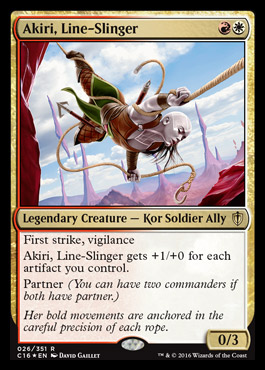
This is a pretty interesting commander, another in the "voltron" tradition where you take your commander and just power them up. What I like most about this one is the fact that she only costs two mana, as voltron commanders tend to be strongest in aggressive strategies. The fact that she starts with zero power does force you to play a ton of equipment, but she gets pumped for every artifact you control, so power-boosting equipment will obviously double-dip on your bonus.

This commander reminds me a lot of Jor Kadeen. They're both red-white commanders that incentivize playing a lot of equipment/artifacts. Jor is better in a swarm strategy because his bonus is applied to all creatures, but he also costs five mana. Akiri's creature types of Kor, Soldier, and Ally may be relevant as well, as there's a decent amount of tribal support for all three. Finally, first strike and vigilance means she can hit hard and provide solid protection.

If you're looking to speculate on her, I suggest equipment with good power boosts and low equip costs.

  1. Champion's Helm - This may be the best card for her—unfortunately the buy-in around $8 is difficult to speculate on.
  2. Basilisk Collar - I realize this doesn't actually add additional power, but lifelink and deathtouch on a vigilant first-striker is very powerful. This too has a higher buy-in than I prefer for my speculative purchases.
  3. Konda's Banner - This is an interesting one because while it may not go in a voltron-style deck, it would be fantastic in a swarm token deck with her (given all of her relevant creature types and dual color).
  4. Masterwork of Ingenuity - In an equipment-heavy deck, having a clone for your best one is definitely a good option. Its current buy-in is relatively low (under $1.25) and it has only a single printing in a less desired Commander set.
  5. Quietus Spike - Here's another one that doesn't technically boost the power, but it provides deathtouch and the effect is exactly where you want to be when you're a fully aggressive deck.
  6. Sword of the Animist - Even though this card is from Origins (and thus pretty new), I still love it for Commander, especially an aggressive equipment-themed commander. The ability to mana ramp and/or fix is always highly desirable in Commander. I can see this one being more valuable in the four-color partner-style deck.
There was an error retrieving a chart for Bruse Tarl, Boorish Herder

brusetarlboorishherder

I'm honestly not all that impressed with this one. It seems like an aggro-style commander and while the ability to give double strike and lifelink aren't bad, they just don't seem that broken. I could see this guy showing up in a one-vs.-one Commander environment (as the abilities get a lot better when you only have to focus on one opponent). It's also important to remember that neither double strike nor lifelink stack, so the bonus will be redundant in some cases.

With this commander it feels like you want to attack fast, and for large chunks of damage.

  1. Archangel of Tithes - Another Origins mythic, this one helps keep your Bruse Tarl from getting blocked or killed in combat.
  2. Blinding Angel - This one is a bit outside-the-box, but a Blinding Angel with double strike makes your opponent skip the next two combat steps. In multiplayer this will let you turn off several attacks each turn, which is pretty potent. It has a few printings but they are all much older (the last one was 9th Edition).
There was an error retrieving a chart for Ikra Shidiqi, the Usurper

ikrashidiqitheusurper

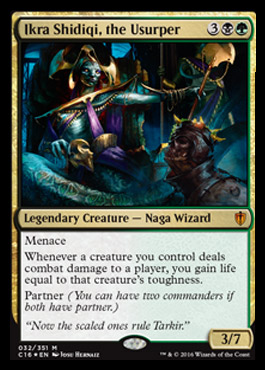
This is another so-so creature, but it could be fun for casual players. This general can provide a ton of life if your creatures have high toughness. This is the type of general I could see leading a Treefolk-themed deck (despite not being a Treefolk itself).

  1. Timber Protector - Obviously not a good card for the deck if you decide not to go the Treefolk route, but a fantastic option if you do. It provides both a pump and indestructibility.
  2. Unstoppable Ash - Another solid Treefolk, this one provides a really powerful back-end pump ability. However, it only occurs when the creature is blocked and Ikra's ability triggers on damage to an opponent, so it goes best with a way to grant trample.
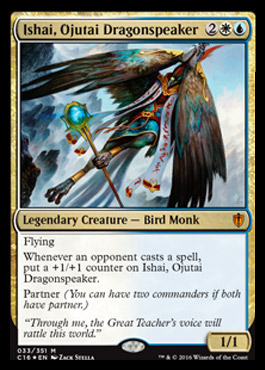
There was an error retrieving a chart for Ishai, Ojutai Dragonspeaker

ishaiojutaidragonspeaker

This could be a pretty powerful commander as it can get very large if left alone. It is a Bird (there are always players trying to build Bird-themed Commander decks) but four-mana for a 1/1 flyer are pretty bad baseline stats. To make this deck work I can see you wanting to give it hexproof or indestructible (or both).

  1. Bastion Protector - This one flew pretty under the radar coming from the last Commander decks, however it pumps Ishai and provides indestructibility.
  2. Darksteel Plate - A pretty obvious inclusion in this type of deck. Unfortunately its buy-in price is already pretty high, but if you want to play this general and don't have one you might as well pick up a copy.
  3. Deathless Angel - This is a solid single-print rare from Rise of the Eldrazi that has additional utility as long as you can leave up {WW}.
  4. Shielded by Faith - Another Commander 2015 card with a low buy-in. If you can curve a one- or two-drop into this, you can cast a turn-four Ishai and protect it immediately.
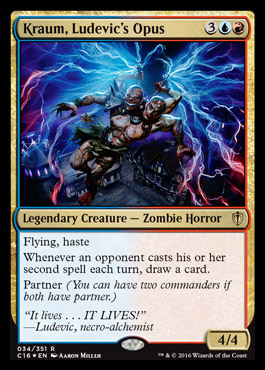
There was an error retrieving a chart for Kraum, Ludevic's Opus

kraumludevicsopus

This is a bit of an odd commander. A 4/4 flyer with haste for five is okay, but its card draw ability seems a bit out of place with an evasive hasty flyer. I feel like he goes better in a U/R Storm deck than as the commander of one. But if you really want to use him as a general, there are a few cards I could see finding a home in that deck.

  1. Helm of Awakening - While only an uncommon, it has just a single printing from Visions. Given the likely print numbers of sets this old, the quantity available is probably similar to a rare, or maybe even a mythic from the modern era. Helm seems like the first auto-include in a deck built around Kraum. It helps your opponents play more spells (thus drawing you more cards), and if you did go the Storm route would make all your spells cheaper.
  2. Urza's Filter - Similar to Helm above but more restricted. A single-printed rare from Invasion. This one is somehow still in the sub-$1 category despite being very good for certain Commander decks.
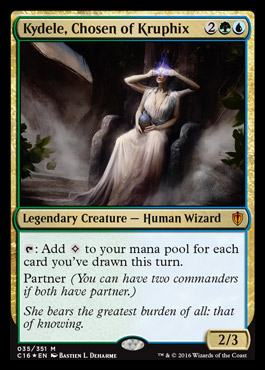
There was an error retrieving a chart for Kydele, Chosen of Kruphix

kydelechosenofkruphix

Wizards has been pretty careful about legendary creatures that tap for multiple mana (given that Rofellos, Llanowar Emissary is banned as a commander). So we definitely want to keep an eye on Kydele. The fact that she can only tap for colorless mana does help mitigate the risk. In order to tap for multiple mana, one must also draw multiple cards in a turn, which to be fair is highly desirable in Commander to begin with.

  1. Font of Mythos - This is a pretty obvious auto-include as it allows you to tap Kydele for three colorless mana per turn at least. It typically sees play in "group hug" style decks as it benefits opponents quite a bit.
  2. Teferi's Puzzle box - This card already jumped thanks to Nekusar, the Mindrazer, but it does allow you to tap Kydele for at least seven mana a turn.
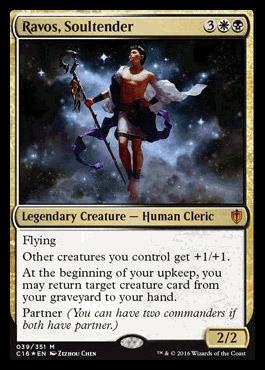
There was an error retrieving a chart for Ravos, Soultender

ravossoultender

This is a pretty solid commander. Recurring a creature each turn and providing an anthem effect is definitely worth looking at for new commanders. Unfortunately it is a 2/2 flyer for five mana; thus it comes out slowly and may be difficult to keep alive. That being said, this is the type of commander the really benefits from creatures that die on their own accord (like, say, Martyr of Sands).

  1. Garza's Assassin - Here we have a recurrable kill spell for any non-black targets. There is one major downside, which is that recover isn't optional—so one would have to keep re-using it without actually losing another creature. It is a Coldsnap bulk rare so if it did catch on, it has strong potential.
  2. Lieutenant Kirtar - Here's another recurrable kill spell, this time only hitting attacking creatures, but still not a bad one to keep recurring. It's an Odyssey rare, so there aren't likely a ton floating around.
  3. Stronghold Assassin - Yet another kill spell that incidentally results in dead creatures, but again one limited to non-black targets.
  4. Sustaining Spirit - I'll admit I've never actually seen this card played before, but Worship-style cards can be very powerful if you can find a way to mitigate the downside. Unfortunately, since you must choose a target with Davos before the cumulative upkeep trigger has resolved, you won't be able to recur this every turn. But you can recur it every other turn cycle (or leave it in play several in a row), and you'll always get the first attack in after it dies. Sustaining Spirit is a rare from Alliances (and on the Reserved List) so if it did find a home the price ceiling is pretty high. It can be picked up for near-bulk prices right now.
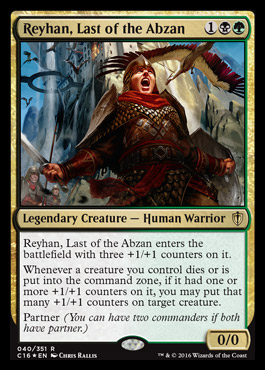
There was an error retrieving a chart for Reyhan, Last of the Abzan

reyhanlastoftheabzan

This is a pretty fun-looking casual commander. It's well known that tons of casual players love the +1/+1 counter-themed decks. There's a reason Corpsejack Menace buylisted for $0.25 even while Return to Ravnica was in print. Magic has a long history of +1/+1 counters, so we can dig pretty deep on this particular commander.

  1. Decree of Savagery - This is what I'm talking about. It's big, it's green, it puts a lot of counters on creatures, it's a single-printed rare, and it's basically a bulk buy-in. For any Reyhan decks looking to go wide (i.e. a swarm strategy) this card is bonkers.
  2. Primeval Bounty - It honestly seems like M14 was forever ago, and while this card hasn't really moved in price since shortly after release, it's important to note that it hasn't dropped either. It's a fantastic Commander card (though you do need to remember a lot of triggers), both creating an army on its own and boosting it to giant proportions. I've been a big fan of this card for a while—if it dodges a reprint I can see it rising steadily.
  3. Spike Weaver - Many newer players may not have seen this card and likely don't remember just how good it was back in the day. This was one of the key creatures that Survival of the Fittest decks would tutor up, essentially locking your opponent out of the game when you were able to keep recurring it. Being able to keep fogging over and over is incredibly powerful. It only has two printings (Exodus and a Battle Royale boxed set) and is currently sitting at around $5.
  4. Strength of the Tajuru - This oddball Worldwake rare has been bulk since its inception, but it scales with the game and can get out of hand quickly in a big mana deck. The instant speed can lead to a lot of unexpected kills as well.
  5. Death's Presence - Another relatively recent rare, this one is at bulk prices and the ability is incredibly powerful. With Reyhan it scales really well (basically every time a creature with a lot of +1/+1 counters dies you get twice as many).
  6. Fungal Behemoth - This card should scale really well with this type of deck. It provides a free +1/+1 counter when suspend counters come off, and in a deck like this will likely be extremely large. It's at near-bulk pricing and is a single printing from Planar Chaos.
  7. Increasing Savagery - This Dark Ascension rare is also at near-bulk price and provides some card advantage thanks to flashback. It puts a lot of counters on a creature, and with Reyhan as your general, you're less all-in on the creature because if it dies you just redistribute.
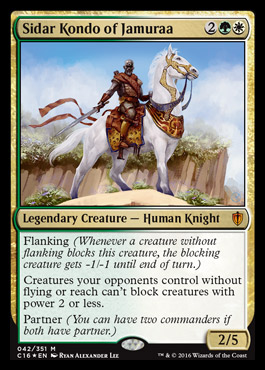
There was an error retrieving a chart for Sidar Kondo of Jamuraa

sidarkondoofjamuraa

My first thought on seeing this one was definitely, "Wow, I can't believe they brought back flanking," but the second ability is actually very powerful. The most interesting thing is that normally a token swarm deck (especially in white and green) uses anthem effects to make their tokens into legitimate threats, but Sidar's ability actually discourages that. I can definitely see this card as one that allows you to go wide, though.

  1. Conqueror's Pledge - One of the few white token generators that hasn't been reprinted, it's only been seen in Zendikar and is near bulk status.
  2. Twilight Drover - I feel like this card would have had a lot more potential if it hadn't been printed in a Duel Deck. Either way, this card is still excellent in a token deck, providing a giant threat and a continuous stream of flying Spirits at the same time.
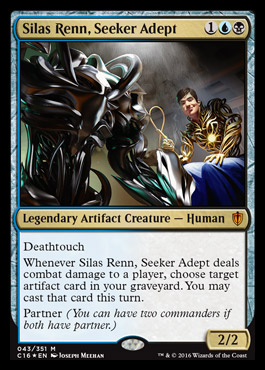
There was an error retrieving a chart for Silas Renn, Seeker Adept

silasrennseekeradept

This is definitely an interesting build-around-me general for the Dimir colors. Luckily, blue-black is the best two-color combination with regards to an artifact strategy. His ability can be extremely strong, and recurring the right artifacts can easily take over a game. Wizards tempered him a bit by requiring that you deal combat damage to a player, and as a 2/2 with no evasion he's not too difficult to block profitably.

I imagine a deck built around Silas is going to pack a lot of artifacts, especially those that make him unblockable.

  1. Nim Deathmantle - This single-print rare from Scars of Mirrodin is actually a piece of quite a few infinite combos in Commander, so its current price under $2 actually seems pretty attractive. In a Silas deck it provides a form of evasion in intimidate and helps keep Silas alive (and/or coming back for more). The fact that it's an artifact that he himself can recur (should it get destroyed) is pretty powerful.
  2. Elbrus, the Binding Blade - This card has always been a favorite of the casual players (it has never dropped below $1.50) and the threat you get when you flip it is very impressive. The fact that you can keep recurring it if/when your opponents do manage to get rid of it makes it a solid addition to this type of deck.
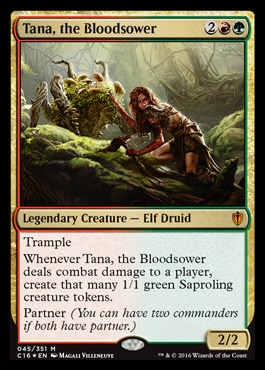
There was an error retrieving a chart for Tana, the Bloodsower

tanathebloodsower

This seems like another potential home-run casual favorite. Token generation is always beloved by casuals, and this one can make a good number (assuming you can boost its power). Its creature type of Elf is another casual favorite. Tana has trample built in, so it seems like finding ways to greatly increase damage output is definitely a solid route to take.

  1. Instigator Gang - This card actually shows up in a Legacy deck, if not a high-tier one (Werewolves). You get +1/+0 for attacking creatures no matter what, and if you can flip it you get +3/+0 for all attacking creatures, which is right where you want to be in an aggressive token deck. It's from Innistrad and around bulk price.
  2. Márton Stromgald - I've mentioned this card numerous times, but it's a powerhouse in a token deck with red in it. He allows for some huge swings and is on the Reserved List. You can currently pick up copies under $2.
  3. Hero of Oxid Ridge - Hero provides a small power boost (in the form of battle cry) but more importantly a falter for small creatures that will allow Tana to sneak through for damage. It's a mythic from Mirrodin Beseiged and is really close to bulk price.
There was an error retrieving a chart for Thrasios, Triton Hero

thrasiostritonhero

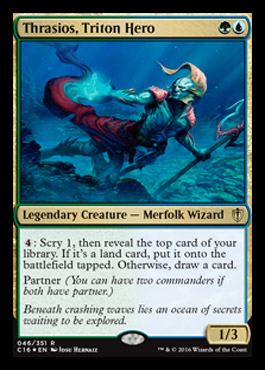
Let's see—green and blue (check); draws cards (check); ramps (check); provides deck manipulation (check); relevant creature types (check). If that last sentence doesn't prove I'm a big fan of Thrasios, then I don't know what will. I can see a ton of players building a deck with this one. This is definitely a big mana-type commander where having a lot of mana and this card as a mana sink will quickly take over the game, and it's just good on its own.

  1. Training Grounds - What's better than paying four mana for Thrasios's ability? How about two mana? This is probably the first auto-include in any deck built around this commander. It's currently sitting around $5.50, which might seem high for a casual card. But given its uniqueness and the sheer number of cards it combos with, that price will likely continue to rise. (In fact, it was basically a bulk rare back when I was drafting Rise of the Eldrazi). It's also part of a janky Modern combo deck using Eldrazi Displacer and any creature that creates two or more Eldrazi Scions to go infinite.
  2. Heartstone - Similar to Training Grounds above, this one doesn't reduce the cost as much and benefits everyone, but there aren't many copies out there. It's a Stronghold uncommon and the only other printing is from the Premium: Slivers deck.
There was an error retrieving a chart for Tymna the Weaver

tymnatheweaver

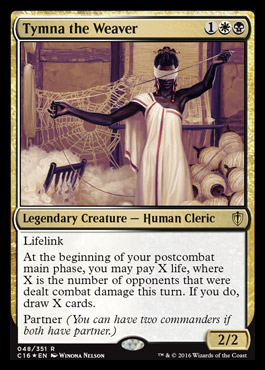
This will likely be another big casual favorite. Lifegain-themed decks are a staple of many casual player groups, and trading life for cards has proven to be a very broken ability throughout Magic's history. The only drawback I can see is that its power level is heavily dependent on dealing combat damage to players, and you can only activate it on your turn.

  1. Alhammarret's Archive - This seems like an auto-include in any Tymna deck. Again it's still a relatively new card but it's a mythic and Origins wasn't opened to death (like other newer sets). Archive just plays perfectly with what this type of deck wants to do (gain life and draw cards). At around $3.50, it's not likely to drop any lower without a reprint, and it could see gradual gains as it ages thanks to it fitting so well in casual decks.
  2. Nether Traitor - Recurrable creatures are usually pretty powerful. The fact that this one has shadow is actually very relevant as I can see Tymna decks wanting to sneak in combat damage and shadow is a fantastic way to do so.
  3. Soltari Champion - Another creature with shadow, this one actually pumps your other creatures and is a single-print rare from Stronghold.
  4. Stronghold Overseer - Yet another rare creature with shadow, this is by far the biggest creature with built-in shadow in Magic. It also has the ability to pump your creatures or weaken your opponents' (assuming they aren't also running shadow creatures). It's a rare from Time Spiral and near bulk.
There was an error retrieving a chart for Vial Smasher the Fierce

vialsmasherthefierce

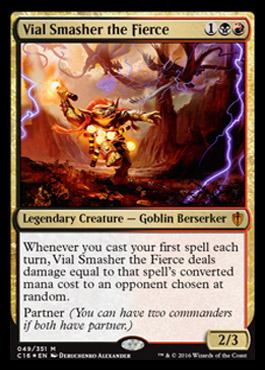
I have a soft-spot for "random" decks in commander. The randomness makes sure games never play out the same and it's hard to complain about getting hit when you know the owner didn't really choose to do it.

Vial Smasher reminds me of a less powerful (but cheaper and less threatening) Kaervek the Merciless, which just so happens to be one of my favorite commanders. Vial Smasher can't hit creatures with his ability, and he rewards you for playing big spells first (rather than baiting stuff out with smaller spells).

  1. Grip of Chaos - I'll start by saying that I've seen this card make more players quit a game than any other card, but it's quite beloved by the truly casual player who loves two-hour-plus games (as well as just plain sadists). This is one of the first cards everyone includes in their "randomness" deck, even if it's often one of the first cuts after the play group registers their complaints.
  2. Tyrant of Discord - This is the type of bulk rare I love. It's actually a very powerful ability, it's random, it can allow red to take care of things it normally can't (i.e. enchantments), and if you do happen to get rid of their lands it's absolutely broken. The fact that it costs seven actually plays well into Smasher's ability (just play it first) and you get to hit someone for seven damage as well.

Partner Up

There you have it: a review and some possible speculation targets for all of the new partner legends in Commander 2016. If you think of any cards I've forgotten, I'd love to hear about them in the comments below.

Don’t Start the Fire, Put It Out: Modern Banlist Speculation

Are you a Quiet Speculation member?

If not, now is a perfect time to join up! Our powerful tools, breaking-news analysis, and exclusive Discord channel will make sure you stay up to date and ahead of the curve.

The year is winding down. Players are looking forward to presents in the coming year. For many, that seems to include new bannings in Modern. Banlist mania always heats up as a new set release nears, but traditionally it's been worst at the end of the year. Previously this was because the Modern Pro Tour was coming—now it's mostly to fill space. I get it, we really don't have a lot else to talk about in the Magic world once December rolls around. The problem is that it really isn't very productive. And it also sets you up for disappointment.

opposition-banner-cropped

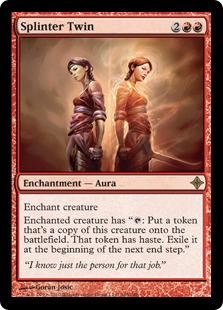
We've been down this road before. Our batting average, when predicting anything other than "no changes," is pretty poor. Nobody saw Splinter Twin coming, and we really didn't expect that Sword of the Meek and Ancestral Vision would be unbanned at the same time. Or that unbanning Golgari Grave-Troll would actually make Dredge a deck again. Wizards has consistently shown themselves to be wildcards and are unpredictable. I propose a more constructive line of conversation.

[wp_ad_camp_1]

What Will Wizards Do?

Ultimately, everything boils down to this question. What will Wizards do on January 20? There is absolutely no way to know. We used to think we had the criteria down, but then Splinter Twin was banned and everything we thought we knew about the process went out the door. We gnashed our teeth down to the gums about this decision, and I still don't agree, but it happened nonetheless. And nobody saw it coming. Maybe it was foreseeable in retrospect given the reasons Wizards laid out, but nobody thought it was necessary. This tells me that, despite Wizards' statements about their intentions for Modern, we will never really understand how they make decisions.

Splinter TwinThis is not necessarily a bad thing. Keeping the process secret is essential to avoid rewarding speculation. It also means that they can evolve the process over time without scrutiny and exercise discretion. If they were to lay out the exact criteria they use that would lock them into a single method, which might fail to adequately respond to emerging problems or force action when none is required. It would almost certainly fuel that speculation. Rigid criteria can function like a checklist, and as a card ticks more boxes the speculators move in. Such action could also serve to game the system as players see a problem deck moving closer to triggering a ban and shift away, lowering the risk through expectation of that risk. I'm fine with Wizards releasing general principles and guidelines for bans rather than actual rules.

The problem is that if you're trying to make predictions based on those guidelines you are firing at a target that can move without warning. Your guess can never truly be an educated one. Uneducated guesses are also known as opinions—you can insert your favorite expression about opinions here.

The Community Problem

The other problem I have is what rampant and frankly useless speculation does to the Modern community. There's nothing wrong with discussing Modern's problems, real or merely perceived, but the banlist speculation often gets unhelpful at best. And thanks to the above-mentioned problem, it just makes everything so much worse.

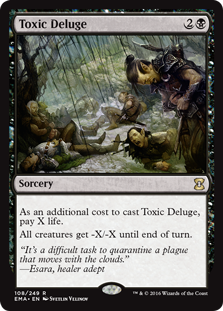
toxic-delugeI'm certain you've seen this before. A given community opens a thread about Modern's health. Said thread turns into players venting frustrations. Those players find like-minded individuals. These individuals go about in circles discussing their issue and proposed solutions. Eventually they decide upon the "correct" solution to that problem and will not be moved. They are right, and any contrary opinion is therefore wrong.

Cut to a few months later and the next banlist announcement. The community has determined the correct course of action and is convinced that Wizards will see the light. And then as they usually do, there is no change. And. There. Is. A. Meltdown. The groupthink goes into apocalypse mode and everything is absolutely the worst ever. It's all a grand conspiracy and all of their detractors were in on it. Modern is ruined forever and we're all going to burn to death! Every. Single. Time.

This is not a good thing. It's creating toxicity in the community and can lead to fracturing as feelings get hurt and members lash out. In light of the fact that we cannot predict Wizards' decisions and they have a very different view of the format than we do, I'm suggesting that we start turning our discussions to more useful topics.

Ask Not What Wizards Can Do for Modern…

But ask what you can do in Modern. I'm not saying that this format is perfect, but wailing about flaws is not going to actually solve anything. Crying out for Wizards to do anything is a losing proposition, so instead let's turn our energy to fixing the problems ourselves. Through clever deckbuilding, good preparation, and good analysis, we can improve these perceived problems. We might even be able to solve them on our own.

I really believe that if players stopped wasting time talking circles about banning or unbanning cards as solutions, and instead applied that energy to solving problems, they actually would get solved. And now I'm going to try and do exactly that.

Step One: Identify the Problem(s)

As I mentioned earlier, everyone has their own opinions about what exactly is wrong with Modern. The sheer disparity of opinions on the subject would tend to suggest that nothing is, in fact, wrong, but such attitudes do not help me meet my word count so let's assume that there is in fact a problem. I am furthermore going to assume that it is solvable without help from Wizards. Otherwise, the above section is pretty pointless. This means we need to define the problem.

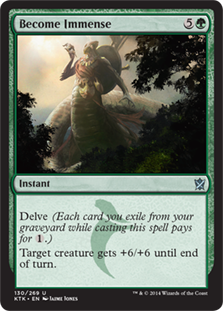
become immenseThere exists a general consensus that Modern is very fast and uninteractive right now. The evidence presented ranges from the lack of Tier 1 control decks to the proliferation of aggressive beatdown and combo decks, to the limitations of answers in the cardpool. The most common offenders are Infect, Death's Shadow Zoo, and Dredge. These decks are cited as being very unfair in terms of their kill speed and their non-interactivity. I find it interesting that Bant Eldrazi and Affinity aren't often included in these discussions. The former appears to get a pass due to the infrequency of its really good draws and the comparative fairness of its average draws. Affinity is interesting because that deck shares many characteristics with Infect and Death's Shadow Zoo in terms of kill speed and ability to win from well behind. The availability of hate cards is one explanation, but I suspect that it's also because players are just used to it. It's accepted due to its long history in the format.

This suggests that the problem is not that there are fast decks but how they're operating. A format without fast decks gets very bogged down and, I think, boring. What players are frustrated by are the number of decks that can win from behind. This is supported by the fact that many think that Become Immense, the key card in a lot of seemingly out-of-nowhere wins, is a frequent ban call. I don't believe that players dislike having fast decks in the format. They just don't want them to easily win from behind. Also the fact that Dredge is a deck. We'll leave that alone for this week—it would spread the focus too much.

Step Two: Examine the Problem

What Become Immense does in Infect and Death's Shadow Zoo is to turn a single creature into a lethal threat. Six is a lot of your poison total, reducing the actual resources necessary for Infect to kill. Six is a much lower chunk of life than poison, but coupled with prowess and sometimes Temur Battle Rage, it quickly spirals out of control.

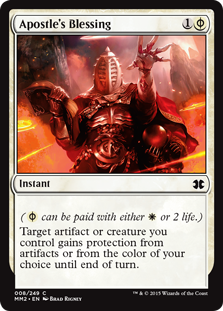
Apostle's BlessingOn the surface, a pump spell doesn't really seem like much of a problem. You just kill the creature in response and the problem disappears. The trick, particularly with Infect, are tricks. Both decks play ways to protect their creatures which means that removal isn't a sure thing. Couple this with cheap but powerful creatures and players feel that they don't have an actual opportunity to prevent their deaths. This is frustrating.

On the one hand, the interplay between threats, answers, and tricks is an essential part of Magic. The game is much less interesting when everything resolves exactly as expected. The problem arises when it feels like the scales are weighted in favor of one side. Is this true in absolute terms? No. Modern is full of cheap kill spells. Might it be a case of saturation? As in it is easier to play more threats and protection spells at low mana-availability and overload answers? This seems plausible. The problem isn't that players can't interact or lack answers, it's that they feel or actually are unable to deploy enough to survive. Therefore we should look at how to reduce the risk of having your answers overwhelmed.

Step Three: Eliminate Obvious Solutions

There are solutions that are immediately apparent whenever you start to examine a problem. It is usually safe to assume that those engaged in solving the problem are not utterly oblivious and have tried them in the past and for whatever reason they did not work. However, the reason they didn't work can be instructive, so it's still useful to examine them.

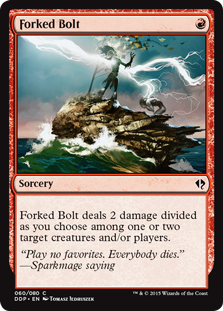
Forked BoltIn this case, that solution is just to play more cheap removal spells. If the opponent is beating you in number of relevant spells per turn, the incredibly obvious solution is to make it easier to play more spells per turn. However, most Jund and Jeskai decks are mostly cheap removal. Jeskai frequently plays full sets of Lightning Bolt and Path to Exile and is still vulnerable to Infect. Why might that be? I suspect that it comes down to mana. When on the play, Infect is perfectly capable of killing on turn three. Assuming that it hits its land drops (which isn't too implausible) it will have three mana open. More if there are any Noble Hierarchs in play. At most Jeskai will have two mana open. This ensures that Infect will always have the option of playing one more spell than Jeskai, more if some of them are Mutagenic Growth. Therefore the answer decks are too behind on mana on the draw to keep up with Infect's answers.

The other possibility is that players are misplaying. Playing removal during combat is an invitation to get blown out in response. The strategy against both Infect and Death's Shadow Zoo is to use removal either during your turn or after combat, so that any spell used to protect the creature doesn't benefit their clock. Assuming that players are uniformly adopting this strategy, it must not be working as well as hoped. Why? It could be a case where the counter strategy of carefully deploying threats so you can also protect them is more effective. Infect in particular plays a lot of pump and protection spells, so they can gradually bait out the answers until their opponent is too depleted to stop them. This would explain this feeling of always being at a disadvantage that many complain about.

Step Four: Identify Common Thread

What is the unifying problem of answers versus Infect and Death's Shadow Zoo? Answers cannot be deployed quickly in large enough quantities to reliably protect against death, and even when resources have been depleted, those decks have a massive spell that wins on its own. How can we defend against this menace?

The most common problem I'm seeing is that the threat decks have a mana advantage, either because of actually free spells or because they can choose when and how to fight, while the answer decks must always be ready or risk losing. What this suggests is that a persistent, manaless answer is the solution to the problem.

Step Five: Logical Conclusion

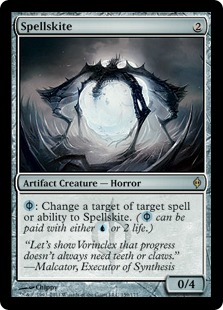
SpellskiteA manaless, cheap solution to spells that target creatures already exists. It's called Spellskite. Remember that card? Used to be everywhere until the rise of permanent-based decks made it superfluous. As long as you have two life points, you can and will prevent your opponent from just winning with a pump spell. Looking around, I think this is the actual solution to a lot of the complaints. It answers Infect nicely, especially since they started cutting Twisted Image from their maindecks and it goes a long way towards slowing Death's Shadow Zoo. It blocks and stops their combo. Is it perfect? No. But it is a good place to start.

Think and Plan, Don't Rage

Just because you think that there are cards that should not be in the format doesn't mean you can just wish them away. There's no reason to expect or hope that Wizards sees the problem as you do and will act as you would. I think there are a number of mechanics that should not be, and some that should never have been in the first place, but I'm not blind to their continued existence in the format. Instead, assume that we're on our own to solve these problems and get to work. Complaining and wishing won't solve problems. Understanding the problem and looking for solutions will.

Deck Overview- Spirit Guide Valakut

Are you a Quiet Speculation member?

If not, now is a perfect time to join up! Our powerful tools, breaking-news analysis, and exclusive Discord channel will make sure you stay up to date and ahead of the curve.

Valakut, the Molten Pinnacle has been featured in many varying configurations throughout the history of Modern. These decks have all featured Scapeshift and/or Primeval Titan, and most pilots have shifted towards using Through the Breach to power out a titan as of late. The most recent innovation has been to speed up the Breaches with Simian Spirit Guide, with two such lists making the Top 8 of the Modern Classic in Knoxville last weekend, including a finals appearance in the hands of Clayton Vogelgesang.

Gruul Breach

Creatures

1 Obstinate Baloth
4 Primeval Titan
4 Sakura-Tribe Elder
4 Simian Spirit Guide

Spells

4 Lightning Bolt
4 Summoner's Pact
4 Through the Breach
3 Anger of the Gods
3 Farseek
4 Search for Tomorrow

Lands

2 Forest
6 Mountain
1 Blood Crypt
3 Bloodstained Mire
2 Cinder Glade
4 Stomping Ground
3 Valakut, the Molten Pinnacle
4 Wooded Foothills

Sideboard

2 Relic of Progenitus
2 Obstinate Baloth
2 Reclamation Sage
2 Ancient Grudge
2 Pulse of Murasa
3 Sudden Shock
2 Slaughter Games

This is just another deck in the long line of decks utilizing Simian Spirit Guide to cheat on mana. Using the Guide to power a Through the Breach when you only control four lands will put you up to six lands with your first Primeval Titan trigger, and then when you attack as long as none of your lands are basic Forest you can get lands seven and eight, which is the threshold to control two Valakut, the Molten Pinnacles and six Mountains. With two Mountain[/cards] entering the battlefield at the same time you will get two triggers on both of your Valakuts, which is good for twelve damage. Combine this with your Titan attacking for 12 and this will often be lethal, and in a pinch you can use those triggers to kill some creatures. If you do have basic [card]Forest, then you'll have to settle for at most one Valakut trigger- on turn three most likely- and be content that most of your topdecks from this point on are worth at least one Lightning Bolt.

While Simian Spirit Guide can be utilized for turn three kills with this deck, that's not where its utility stops. Exiling SSG to cast a Lightning Bolt is sort of the Modern equivalent of Force of Will if you're worried about being run over by Glistener Elf. This innovation is looking to be stock, and I expect it to continue to be so long as Simian Spirit Guide remains Modern legal.

Insider: Magic Inflation – A Monopoly Analogy

Are you a Quiet Speculation member?

If not, now is a perfect time to join up! Our powerful tools, breaking-news analysis, and exclusive Discord channel will make sure you stay up to date and ahead of the curve.

Picture this:

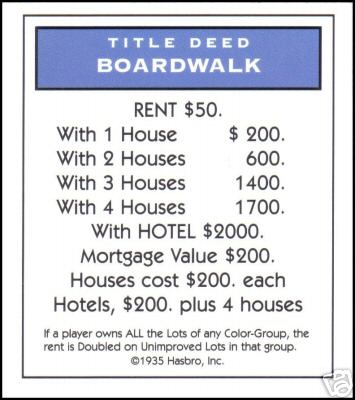
You pay $75 to participate in a massive Monopoly tournament, where the grand prize for winning is $5,000. Midway through the tournament the top players have a significant amount of Monopoly money, such that even landing on some of the most heavily reinforced spaces barely puts a dent in your budget. Meanwhile those on the verge of bankruptcy can barely watch as they roll the dice each turn. Then the unexpected happens.

Someone breaks the rules of the game and offers real money when they land on that Boardwalk with a hotel on it—not $2,000 mind you, but maybe $10 of real money. After all, in doing so they can remain in the tournament and try to bounce back from near-defeat. The other player accepts the offer and real money is exchanged.

boardwalk

Suddenly everyone is considering both Monopoly money and real money for each transaction the game demands. The value of the Monopoly money rapidly drops—players demand large premiums above what the cards require if a player wishes to pay with Monopoly money rather than real U.S. dollars. The economy becomes unbalanced as the demand for real dollars far outweighs that of Monopoly money, and ultimately the game collapses.

The Parallel to Magic

Obviously the above scenario won’t ever happen. For one, there is no such thing as a Monopoly tournament…at least, not one with the payout I described above. Additionally Monopoly is a self-contained economy per the rules of the game. But if Monopoly money and real money could be interchanged, the resulting economy would drive massive inflation for the Monopoly money because it loses all value once the game ends.

Let me try to draw out how this scenario could parallel Magic: the Gathering. Consider that pieces of cardboard are like Monopoly money. The cards are necessary to win games and therefore have immense value within the game. But outside of playing Magic, the value is far less. Sure, there is a collectible aspect that Monopoly lacks, but let’s put that aside for a moment and assume a significant portion of card value is determined by playability.

As we all know, the Monopoly money of Magic, meaning the cards, can be interchanged for real dollars. This is a two-way street because as long as players require the cards to win games, they will be willing to give up real dollars to acquire these cards. But what happens if more cards are printed, introducing more inflation in the game? Suddenly there are more cards in the economy of the game, but the cards become worth less relative to the U.S. dollar. Simple enough.

But if the lower-end cards become worth less relative to the U.S. dollar, then they can’t be as easily traded towards higher-end cards. This interferes with the flow upward of card values within the Magic economy. Four Snapcaster Mages can no longer be traded for a Library of Alexandria as was once possible.

There was an error retrieving a chart for Snapcaster Mage

So for someone who wants to acquire a Library of Alexandria, they have two choices. They can either trade more than the equivalent of four Snapcaster Mages—maybe ten copies instead, or perhaps throwing in a couple of Tarmogoyfs—or they can pay with real dollars. With the former they end up forfeiting more critical game pieces, and in the latter they need to forfeit real dollars, which could have been used for other things in life.

Here’s the Problem

While lower-end cards (Standard, Modern, et.al.) were rising in price and offered significant value, there was no difficulty making trades for higher-end cards. Standard could be turned into Modern, Modern into Legacy, and Legacy into Vintage over time. But something has changed. Hasbro has altered their strategy to grow sales of product by introducing Masterpieces, Modern Masters sets, and an array of other reprint products.

This act is lowering the bottom rungs of the MTG ladder, making it more and more difficult to reach to the upper rungs. Suddenly, many people are becoming priced out of Legacy and Vintage because their collection values are shrinking. The only option becomes paying up with real dollars, but it is very difficult to stomach an outlay of hundreds or thousands of dollars for a couple pieces of cardboard.

There was an error retrieving a chart for Black Lotus

When everyone was using “Monopoly money,” people didn’t give this as much thought. Sure, you were giving up “$600” by trading that set of Tarmogoyfs for a played Mox Ruby, but it was a cardboard-for-cardboard transaction. Or maybe you buylisted the cards to a vendor, took the store credit, and picked up that Timetwister you’ve been wanting for Commander. The economy was self-contained, so this wasn’t an issue.

With many price trends drifting downward lately, these trade-up transactions may be occurring less frequently. To me, this poses a major problem for high-end cards. They will end up becoming less liquid because the market cannot afford them with “Monopoly money” and they will not want to pay up using real dollars as often. This may cause Power prices to remain stagnant at best or even drop at the worst. I genuinely believe this is a real possibility now.

And if a few owners of Power decide they don’t want that “Monopoly money” any more and insist on cash, they may be willing to sell at a slightly lower price. It may be slow, but the market will adjust lower. It has to.

There was an error retrieving a chart for Mox Jet

A Reality Check

As someone who collects Magic cards as an investment, I have one fear when it comes to positions in these cards. This fear dictates all of my recent transactions, including a concentration of value in Reserved List cards that cannot be reprinted. But even that strategy won’t make me immune to this: a retraction in the MTG market.

There are already signs that this is happening. I haven’t changed the people I follow on Twitter, yet instead of hearing about card prices and trends, I am reading more and more about Hearthstone, Pokémon, and even political movements. It seems many are already finding other avenues to spend time (and money) on outside of Magic. One look at the top spectated games on Twitch further reinforces Magic’s lagging position.

Then you have Wizards of the Coast releasing nonstop sets. The market flooding of new products keeps prices down and suppresses demand for anything other than the newest and shiniest product. Add in Star City Games’s and WotC’s dwindling support of non-rotating formats and you have a recipe for a stagnating market.

So now there are no new players, Standard is inexpensive and Modern is getting cheaper, and there are far fewer opportunities to enjoy Legacy and Vintage. What does it all mean? Less demand for high-end cards.

So let me ask the question this way: would you rather have an Unlimited Black Lotus or a family vacation? An Ancestral Recall or a mortgage payment? A Mox Sapphire or a year’s worth of college textbooks? When we were looking at Magic cards as “Monopoly money,” we didn’t really consider these options. Now that real dollars need to be involved more frequently, however, I think this begs the question: are we making the right choice?

Every day I choose to keep my Black Lotus I am simultaneously choosing not to remodel my bathroom’s shower stall (true story). This used to be a subconscious decision I was making, but should it be? Perhaps not.

Perhaps going forward, we should be considering opportunity costs a bit more seriously. In a world where the Monopoly money of the game of Magic is depreciating, we need to truly consider if we’d be better of with “real money.”

Put another way, I will feel incredibly stupid for sitting on all these Magic cards at these valuations for the foreseeable future only to watch their value steadily decline. Since I don’t play Magic much these days, I’d probably be fine swapping out a piece of Power for home repairs or mortgage payments (or in my case, college tuition savings). I won’t be fine to watch that opportunity escape my grasp if card values drop.

Wrapping It Up

This article has tended to ramble a bit, and for this I apologize. If there seems to be some hesitation in the paragraphs above, this is simply because I am struggling with this decision and you’re picking up on that. Magic is a game—and one day the game may end. If that happens collectibility will certainly keep some values afloat, but overall a collection’s worth will be much lower than it is today.

Current trends in Magic are starting to worry me. There’s more and more supply of cards in the system, increasing the gap between Standard/Modern pricing and Legacy/Vintage. As this gap widens, players will be unable to use their “Monopoly money” for Power and other high-end staples. Instead they’ll have to use cash. Will these players choose to spend that cash on Magic cards? Or will they choose other real-world applications? Trends may slowly drift from the former to the latter.

I, for one, know my spouse doesn’t care much if I trade a bunch of cards into a vendor for store credit so I can purchase a $1,000 card. But if I told her I was spending $1,000 new dollars on a Magic card, she’d certainly express her reservations. And now, without a prospect of decent price appreciation on the horizon, I can’t even build a compelling case to do so.

Maybe it’s time I start considering that opportunity cost. Maybe we’ve gotten to a point where investing in mutual funds can yield better returns than a Time Walk. Maybe. I need to think on this further—I’ll be sure to share my thought process through this journey, and I hope you will all share your thoughts in the comments below as well. We’re all in this together, so let’s work together to make sure we are maximizing value as best as we can from our collections.

…

Sigbits

  • Old School cards continue to be a pocket of strength in a decaying market. For example, Hypnotic Specter remains one of the cornerstones of black strategies in the format. Therefore it’s no surprise to see Star City Games sold out of Alpha and Beta copies ($129.99 and $79.99 respectively).
  • Another bull market in Magic is the casual market. Here, you need to be cautious about reprints. But dodge them for long enough and you have some real upside potential. Consider Time Warp for example. The card is $18-$19 now, depending on the set it’s from. When was the last time Time Warp was so expensive? Perhaps when it was first printed in Tempest?
  • It looks like Mirror Gallery is hitting all-time highs lately. Once again, a casual card from an older set with a unique ability is the perfect recipe for profits. That is, as long as you can dodge that reprint. Star City has a handful of played copies in stock in the $4-$5 range, but that may not last if demand sustains.

Insider: High Stakes MTGO – Nov 13th to Nov 19th

Are you a Quiet Speculation member?

If not, now is a perfect time to join up! Our powerful tools, breaking-news analysis, and exclusive Discord channel will make sure you stay up to date and ahead of the curve.

Hello, and welcome back for another High Stakes MTGO article!

My portfolio didn't see a lot of action this past week but it was a great week nonetheless. Modern prices keep trending up, and it feels good to be positive again with my Modern positions and choices. The Treasure Chest end-of-the-world storm is a thing of the past and resilient speculators should be happy about the current trend of prices. It may offer even more rewards to those of us who were in a buying mode while everyone else was selling—as usual, I should say.

Standard is also doing good for me. I'm slowly selling anything profitable as I'm trying to stick to a more careful and short-term investing strategy these days, even if all lights are green. There's nothing like a rapid turnover of profitable positions to grow a bankroll anyway.

Let's see how things went this past week! As usual, the live portfolio is accessible here.

Buys This Week

du

Along with Magic Origins and Dragons of Tarkir full sets, I previously mentioned that I would try to target a few mythics that, in my opinion, may have a decent chance to rise on their own within the next six to ten months.

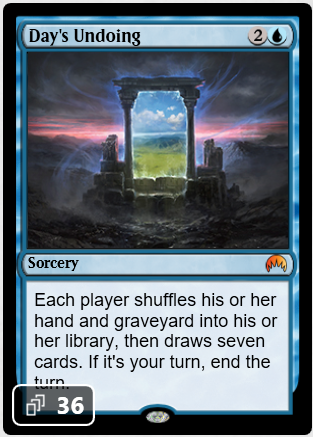
Here is a pick I like in ORI. Day's Undoing is as close to Timetwister as you can get, and has already made appearances in Vintage. Despite the drawback of ending your turn, drawing seven cards for three mana is not something to neglect in any eternal format.

The two possible scenarios I’m expecting here are either a slow rise in price, paralleling the slow rise of ORI full sets, or a possible spike if this card manages to find its way into a somewhat competitive Modern deck. Alternatively, considering Day's Undoing's uniqueness and current price, its inclusion in one of Saffron Olive's Modern Budget decks would also probably propel Day's Undoing into the 5-tix range.

drag

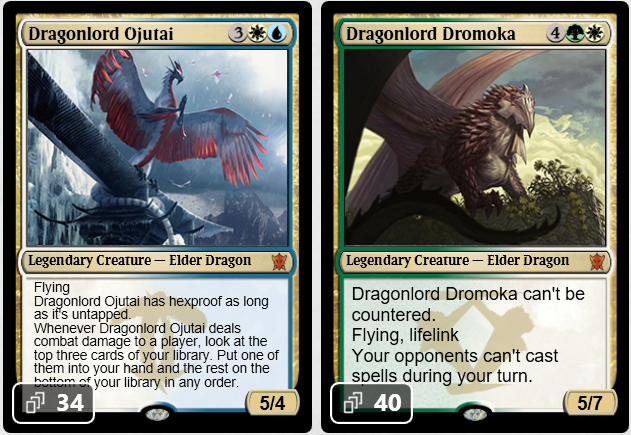
Same reasoning here with these two dragonlords. Among the five mythic dragonlords from Dragons of Tarkir, I consider these two to have the best chance of seeing a significant price increase over the next few months. They are dragons, mythics, from a third large set, and have a good chance of appearing in competitive decks in one or more eternal formats. To me, that’s a good list of ingredients for two successful specs.

Sales This Week

I have been holding these for a long time without much success thus far. The spec is not terrible, but Path to Exile never went beyond 4 tix, cycling up and down between 2 and 4 tix for a long period. With the price strengthening between 3.5 and 4 tix now that Modern is picking up a bit, I’m looking to sell my copies around 3 tix whenever possible. That’s not a huge profit margin, but I’m satisfied with it and happy to move on to another spec.

bfzlog

A few more Battle for Zendikar full sets sold with a profit this past week! Okay, I’m only talking about a laughable 1-2% here, but I'll take it. These BFZ full sets have held too many tix hostage over the past eight months, and I'm simply excited to sell them without losses. I think I’ll be done with my BFZ full sets before the end of the month.

mtgbfz_en_bstr_01_01

Although still posting a loss, the price of BFZ boosters cranked up to 1.2 tix this past week. I’ll keep selling these a little bit every day, whenever I think about it while on MTGO. I have no intention of waiting to see if the price can get better, and I’m perfectly resolved to the losses here. I just want to get these out and reinvest my tix elsewhere.

On My Radar

Most of the things I'm looking to do these days are no different from the previous weeks. I'm looking to close as many Modern positions as possible at the best possible selling price in November and December. I will also try to exit all of my BFZ full sets sooner rather than later.

In the buying department, I'll still be on the hunt for possible speculative opportunities with DTK and ORI mythics and rares. I'm happy with three pickups so far, but there might be more for fast gains as the value of these two sets rise, now that they have hit a floor after their rotation.

One last thing I'm going to try to pay attention to is the Commander 2016 and Conspiracy: Take the Crown singles now made available through the Treasure Chests. Commander and Conspiracy cards always occupied a particular position in the MTGO economy and the playable Legacy and singles Vintage could see moderate but steady price increases.


- Sylvain

Avatar photo

Sylvain Lehoux

Sylvain started playing Mtg in 1998 and played at competitive level for more than 10 years including several GP and 3 PT. When he moved to Atlanta in 2010 for his job he sold all his cards and stopped "playing". In 2011 he turned to Mtg Online and he experimented whether it was possible to successfully speculate on this platform. Two years later and with the help of the QS community his experience has grown tremendously and investing on MTGO has proven to be greatly successful. He is now sharing the knowledge he acquired during his MTGO journey! @Lepongemagique on Twitter

View More By Sylvain Lehoux

Posted in Buying, Finance, Free Insider, MTGO, SellingTagged , , 1 Comment on Insider: High Stakes MTGO – Nov 13th to Nov 19th

Have you joined the Quiet Speculation Discord?

If you haven't, you're leaving value on the table! Join our community of experts, enthusiasts, entertainers, and educators and enjoy exclusive podcasts, questions asked and answered, trades, sales, and everything else Discord has to offer.

Want to create content with Quiet Speculation?

All you need to succeed is a passion for Magic: The Gathering, and the ability to write coherently. Share your knowledge of MTG and how you leverage it to win games, get value from your cards – or even turn a profit.

Burning in Depth: Sequencing and Mulligans

Are you a Quiet Speculation member?

If not, now is a perfect time to join up! Our powerful tools, breaking-news analysis, and exclusive Discord channel will make sure you stay up to date and ahead of the curve.

Last week I posted a picture of an opening hand from Burn that I think is unkeepable. Most people responded in the comments that it seems like a no-brainer with 17 theoretical damage in it. I think this showcases how Modern really rewards people for the most in-depth understanding of their deck. Burn is a pretty simple deck to evaluate hands with, but I think it's important to take the time to learn the early-turn sequences so you can make a decision on your opening hand. There are a lot of times that people lose games and matches entirely by keeping bad hands.

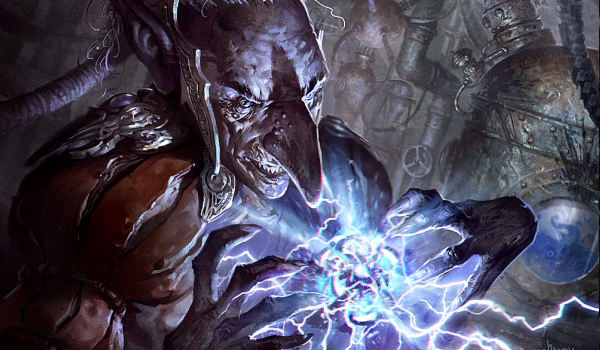
goblin-electromancer

To understand why I think that hand out of Burn is so poor, you have to be familiar with the way games play out more specifically. Today I'll be going deep on Burn and explaining how its game plan should inform your mulligans. I hope you're ready!

[wp_ad_camp_1]

Mana Efficiency and Sequencing

Okay, so let's talk about why I think the hand from last week isn't going to cut it. For reference, here's the hand:

cwjqw6yviaaxn4h

Pros:

  • Two lands. Not too many or too little.
  • We have a one-drop.

Cons:

  • We have no creature.
  • It's slow.
  • Searing Blaze might not be a real card if we don't draw another land.

Adding up all the burn spells in this hand we have a theoretical 17 damage. That's enough to kill an opponent who takes fetch-shock damage at some point, or one who doesn't with a single drawn burn spell. But how quickly can we actually get that done? When you play Burn, you ideally want to be able to close the door by the end of your fourth turn. That's when your mana efficiency from the early game starts to become less of an advantage and an opponent's more powerful cards can take over the game. Obviously not every game you can win on turn four, but you strongly consider mulliganing hands that can't win that quickly. Knowing we're aiming for turn four, we can assume we'll draw 3 or 4 extra cards—let's consider what they might be that would let us achieve our goals.

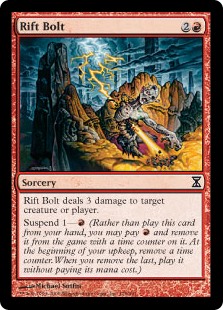
Turn 1: We're going to suspend the Rift Bolt with the Mountain. (Damage dealt: 0)

rift-boltTurn 2: Rift Bolt comes off suspend and we can play a land. If we sacrifice Arid Mesa and didn't draw another land we're priced into playing Searing Blaze. If we're playing against a deck that hasn't played a creature yet then we're essentially minus 3 damage. In the worst-case scenario we don't draw a land and they don't play a creature, in which case we'll cast Boros Charm and deal 4. (Damage Dealt: 7)

Turn 3: Once again we're kind of priced into playing another two-mana spell, or if we drew a land, playing the Lightning Bolt and the other Boros Charm. Let's say we got lucky and drew a land. (Damage Dealt: 14)

Turn 4: Well unless our draw steps were exactly Lightning Bolt and Boros Charm, we're probably not going to be able to kill this turn unless our opponent took damage from a fetch. This also assumes we drew a land in the first three draw steps. A lot had to go right for this hand to become anything reasonable. This hand likely doesn't beat a reasonable draw from Ad Nauseam. It loses pretty handily to Snapcaster Mage plus Spell Snare. I'm not entirely sure it beats a Valakut deck if they're smart and don't leave Sakura-Tribe Elder in play. Part of the reason I play Gitaxian Probes is to avoid as many hands like this as possible—the reality is that there are way too many two-mana spells clogging this hand up for it to win against an unknown opponent.

Looking at a Hypothetical Draw

Let's look at a sequence if we mulligan this hand into something similar but with a creature. If we trade one of the Boros Charms and a Searing Blaze for a Goblin Guide our hand turns out so much better. Our new hand only has 10 damage worth of burn, but look how it plays out.

Turn 0: Scry 1. We can pretty safely put any lands to the bottom as this hand doesn't need three to function. I would keep any one-mana spell.

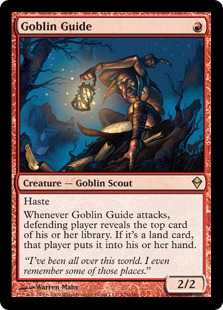
Goblin GuideTurn 1: Play Mountain and Goblin Guide and attack for 2. (Damage Dealt: 2)

Turn 2: Play Arid Mesa, get Sacred Foundry. If we drew another land it's pretty safe to fire off Boros Charm here and save our one-mana spells for next turn. If we drew another creature or another one-mana spell we can suspend Rift Bolt and cast the other spell. Worst-case scenario, it's another two-mana spell and nothing really changes. Attack with Goblin Guide. (Damage Dealt: 8)

Turn 3: Let's say last turn we drew Skullcrack and this turn we drew Monastery Swiftspear. To get maximum damage and kill next turn, we want to play the Swiftspear and suspend the Rift Bolt. Attack with both creatures for 3. (Damage Dealt: 11)

Turn 4: Rift Bolt comes off suspend. If we didn't draw a land we can cast Skullcrack or Lightning Bolt and win the game. Goblin Guide attacks for 2, Swiftspear with two prowess triggers attacks for 3, and the two spells that deal 3 damage deal 10 damage this turn.

The Best Burn: Creatures

Were you counting in that theoretical game how much damage Goblin Guide did? If you cast it on turn one and they don't interact with it, it adds so much damage to your clock. Over the course of four turns, Goblin Guide deals 8 damage. Eidolon of the Great RevelWhile that seems pretty obvious as you're reading this, how many people look at their hand and see Goblin Guide as a burn spell that deals more damage than Lightning Bolt?

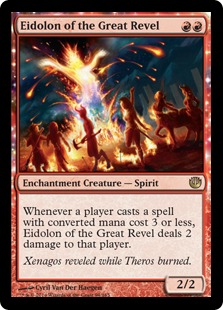
Creatures are very important for Burn, more so than the number of burn spells that start in your opening hand. Even a hand with an Eidolon of the Great Revel (which doesn't attack an opponent down as quickly) can put on so much more pressure than a hand full of burn. If your opponent casts two spells and you attack once with the Eidolon then it's already more mana-efficient than Boros Charm (the most mana-efficient burn spell at two mana).

The other thing that creatures do is require your opponent to interact and thwart their own game plan. If we have a hand with a Goblin Guide or Monastery Swiftspear, then it puts the onus on the opponent to deal with it. It feels great when Jund uses their second turn to Terminate or Lightning Bolt your Goblin Guide instead of playing a Tarmogoyf. Stunting your opponent's development by forcing them to deal with your threats gives you more time to finish the game.

Creatures and Mulliganing

If I was a graph master I'd be able to show you the bell curve in win rate as you increase the number of creatures in your opening hand. Basically, if you can open with three Goblin Guides and two land you really can't ask for a better hand. The triple one-mana creature hands are the most explosive, and even in the fact of beefy blockers from the faster decks can end the game quickly. After that, however, you're more likely to run into the problem of too many big blockers and no profitable attacks.

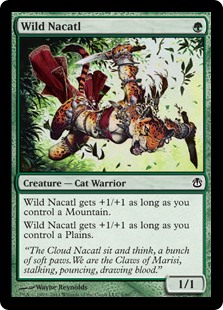
Wild NacatlEidolon of the Great Revel is a card that I think goes underrated too often. While it's often counterintuitive to play a card that deals a lot of damage to you (every spell in the deck triggers its ability) you will truly appreciate its power when it absolutely annihilates a deck. I played a match against Storm during the last Grand Prix Los Angeles and almost had him concede before I had even taken a turn. During game two I kept a hand with two lands, one burn spell, and three Eidolon of the Great Revel. Although Storm plays Lightning Bolt, it was unlikely they would find it before the three Eidolons were able to kill him. Spoiler alert, when it costs you 6 life to cast a Serum Visions you don't win the game.

All of this talk about creatures, however, seems to contradict my opinion of Wild Nacatl. It's true. I don't like playing that creature because it's too slow. The fact that it doesn't have haste is really the deal-breaker for me because it almost assuredly won't deal any damage if my opponent has a removal spell. With Monastery Swiftspear and Goblin Guide you can hold them until there's a good opportunity to sneak them in around removal. Wild Nacatl needing a whole turn to get going really just doesn't do it for me. The fact that you also need a Sacred Foundry for it to even be a reasonable attacker is another strike against it.

Sideboard Cards

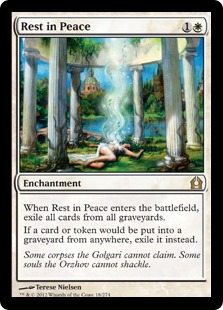
I've received a ton of questions about my choice of sideboard cards, asking why I'm not playing more flexible answers in some slots. Why Surgical Extraction instead of Rest in Peace, for example? Well, scroll up a little and you'll find your answer. When is there a good time to cast a Rest in Peace? I think you're going to be pretty hard-pressed to find one. Sacrificing a whole turn to play Rest in Peace just isn't ideal and doesn't solve the problem of the glut of two-mana spells. rest in peaceThis also doesn't really include the problem that some of the best Dredge draws can just put a bunch of power into play before you even have enough mana to play Rest in Peace.

What does this mean for our sideboard cards then? We want things that are mana-efficient and powerful. Sacrifice the long-term gains for short-term power. That's why Path to Exile (for example) is one of the most important cards in the Burn sideboard. It doesn't matter if our opponent gets a land if we kill them. Ensnaring Bridge is really the exception to this plan because it doesn't speed the game up, it actually slows it down. Resolving a Bridge gives us time to draw enough burn spells to kill our opponent while their larger creatures can't attack us back.

Which brings me to my last point about sideboard cards: don't over sideboard. Just because there is a "use" for a card in the matchup doesn't mean you should put it in your deck. Bringing in Path to Exile against a Jeskai Control deck because it can remove Celestial Colonnade is just asking for a bad time. Burn's maindeck is tuned to be quick and ruthless. If you remove too many teeth then it doesn't quite have the right amount of bite. Over-sideboarding is the reason I don't want to play with Grafdigger's Cage or Rest in Peace. Just because they're more flexible doesn't actually mean I want them in for those matches.

Keep or Mull?

dredge-k-m

Crunch Time: Three Months Later with Colorless Eldrazi Stompy

Are you a Quiet Speculation member?

If not, now is a perfect time to join up! Our powerful tools, breaking-news analysis, and exclusive Discord channel will make sure you stay up to date and ahead of the curve.

I've written on a variety of different topics since August, including Kaladesh standouts, brews, and Temur Delver. But each week I've brought the same exhilarating deck to my weekly locals: Colorless Eldrazi Stompy. I introduced that deck's Eyeless update three months ago and have been tuning it since. With Pascal Maynard's recent blurb renewing interest in the strategy, now seems like an ideal time to share what I've learned.

spatial-contortion-art-crop

What Is Colorless Eldrazi Stompy?

Colorless Eldrazi Stompy is a disruptive aggro deck that chains lock pieces into undercosted threats. It hinges on the power of Eldrazi Temple to do the latter and counts on Serum Powder and Gemstone Caverns for fast mana consistency, bolstering the Relic of Progenitus/Eternal Scourge interaction that creams interactive decks on its own.

[wp_ad_camp_1]

The Deck Core

Creatures

4 Eldrazi Mimic
4 Eternal Scourge
4 Thought-Knot Seer
4 Reality Smasher
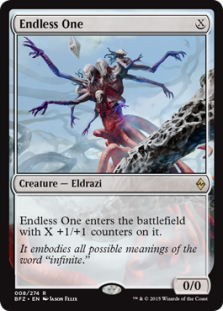
4 Endless One

Nothing too flashy going on here. As Pascal noted in his article, a big draw to Colorless is the ability to play Eldrazi Mimic, granted by the improved mana consistency of Serum Powder and Gemstone Caverns. But Pascal omitted Endless One from his build, which I think is a mistake.

Endless oneEndless One is a card I was down on for most of Eldrazi Winter, but I came around with a vengeance. In this deck, the One fills a very important, if intuitive, role: it comes down whenever we need it to. One can act as a chumper for one, pressure linear opponents early for two, bait Leaks and resist Bolts for four, or present the biggest body on the block for seven. While Endless One is individually weaker than any Eldrazi at the same cost we actually pay for it, the card's ability to plug holes in our curve makes it an integral component of our aggressive game plan.

The other creature I'd like to discuss here is Eternal Scourge. Scourge has tested as well as I'd hoped when it was spoiled in Eldritch Moon, and now even has a GP win to its name. The newcomer plays two roles in this deck:

1. It ensures we have threats to cast after aggressively mulliganing into Eldrazi Temple. Whether via Serum Powder or Gemstone Caverns, Scourge often gets exiled incidentally before the game begins. With a Scourge in exile, we have fewer qualms about mulling to four in search of Temples, and are still promised a fast start if we find one rather than risk a do-nothing hand of all lands.

2. It prevents removal-heavy decks from quelling our assault. Dark Confidant, Snapcaster Mage, and Kolaghan's Command have all proven their aptitude at the grind game by now. Without Eye of Ugin, Colorless Eldrazi Stompy runs into the problem of getting out-stabilized a lot more often. But these decks aren't counting on dealing with a threat that returns after any removal spell, let alone one that actually never dies with a Relic in tow. Control and midrange decks aren't as prevalent as aggro strategies in Modern, but they still exist, and Scourge gives us a superb plan against them.

Spells

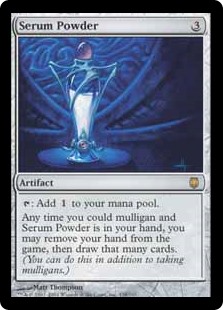
Serum Powder

4 Serum Powder
4 Dismember

The eight noncreature, nonland cards I've included in the core are Serum Powder and Dismember, but these should be supplemented by at least four lock pieces. We have Chalice of the Void and Relic of Progenitus to chose from, and each shines in a different field. The other piece should be played in the sideboard.

Warping Wail and Spatial Contortion are powerful spells that can also be played in the main, but these cards are firmly in flex-spot territory. Personally, I prefer them in the sideboard.

Lands

4 Eldrazi Temple
3 Gemstone Caverns
4 Ghost Quarter
4 Blinkmoth Nexus
2 Mutavault
2 Sea Gate Wreckage
1 Urborg, Tomb of Yawgmoth
2 Wastes

I've found the numbers on Gemstone Caverns to be just right. At three copies, we open it often enough to justify running it, but still draw multiples relatively infrequently. Drawing more than one usually means we've started the game with a copy in play, which often leads to a game state so favored that pulling a blank doesn't matter (see: Serum Powder).

The creature lands still do it for me, killing planeswalkers, blocking fliers, and adding an angle of attack by dodging sorcery-speed removal. While Blinkmoth remains a four-of for its air coverage and evasion, I'm still not sold on a playset of Mutavault. It's possible to flood on creature lands and not have the mana to activate them all, although that usually means we're in a good spot; should opponents start killing them off during combat, we can just animate the next one next turn. The main reason to move away from four Mutavault is Sea Gate Wreckage.

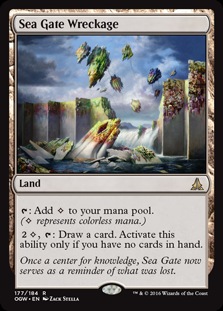
Sea Gate WreckageWreckage has shown itself to be the best non-Temple land in the deck. We often mulligan down to four or five, start most games with fast mana, and play mana rocks, making the hellbent Library of Alexandria ultra-reliable. It's possible to exile Wreckage to Serum Powder while taking mulligans, or to simply not draw it when we run out of cards. It became so important to me to draw one Wreckage or at least have more in the deck after casting my last Eldrazi that I've moved to four copies in my current build, despite multiples generally being useless (except in the face of Tectonic Edge & friends).

Urborg and Wastes are necessary evils in this deck. With four Dismember, I like a single Urborg to lighten the load when we do draw it, but wouldn't run multiples thanks to the legend rule.

Double Wastes catches a lot of opponents off-guard and ensures we have searchable lands for Path to Exile, which is everywhere right now, and Ghost Quarter, which at least still exists. These cards can give us a hard time if we don't have a basic to search up. Ensuring the first two Paths don't go unpunished just makes life harder for our opponents. Double Wastes also decreases our softness to Blood Moon, although with a set of Serum Powder in the deck, this isn't a huge issue to begin with.

Filling the Flex Spots

With the core out of the way, we can focus on the ten funnest cards in the Colorless Eldrazi Stompy deck—the ones that fluctuate!

Lands

quicksandI'll begin with this section to stress the importance of playing 24 lands, even on Simian Spirit Guide. Two of the flex spots should go to lands.

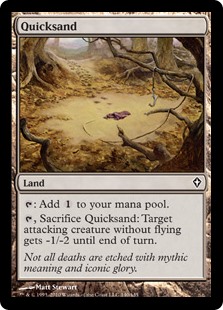
There are many options to choose from; as mentioned above, I prefer two more copies of Sea Gate Wreckage. Mutavault shines in metagames full of linear combo. Quicksand can work against small aggro decks like Burn and Infect. Cavern of Souls trumps the counterspell matchup, although Relic/Scourge/Sea Gate should perform well enough here.

Lock Pieces

The next four slots go to permanent-based disruption. Either Chalice of the Void or Relic of Progenitus should be played as a four-of.

Chalice shines in metagames full of Infect, Burn, Delver, Grixis, and Tron. It slows these decks to a crawl, and can lock them out of the game on turn one when combined with Simian Spirit Guide. We saw the card's potency at Pro Tour Oath of the Gatewatch, and it's still just as good as it used to be.

One major benefit of playing mainboard Chalice is that it heavily incentivizes us to pack Simian Spirit Guide. Guide is already pretty decent in this deck, helping power out early Eldrazi and turn on Sea Gate Wreckage. With Chalice in the sideboard, it becomes less appealing to play Guide in the main, which makes Chalice worse when it gets boarded in.

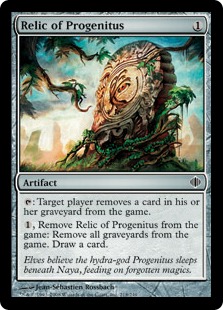
relic of progenitusRelic is my go-to lock piece in this metagame, dismantling Jund, value creature decks, and of course Dredge. I think Dredge is the best deck in the format right now, and believe it crushes most decks that don't pack specific hate for it. Whether or not that's a bad thing is a discussion for another article. For now, I like to be as prepared as possible, and that means running Relic in the main.

Another draw to mainboard Relics is the Eternal Scourge interaction, which gives us extra points against x/3 aggro decks like Zoo. Scourge can trade with attackers forever as we recur him with the Relic, which makes it harder for go-wide decks to stay wide and for big-threat decks to actually land a blow.

Wild Cards

The final four slots can really go to anything. I tend to favor maxing out on either Matter Reshaper (alongside Relic) or Simian Spirit Guide (with Chalice). Here are some other possibilities.

Spatial Contortion: A sideboard all-star that should be at 4 between the main and the side, Contortion helps us slow down go-wide decks long enough for our Eldrazi to race.

bonesplitterRatchet Bomb: A potentially mainboard answer to Ensnaring Bridge with a ton of other applications.

Spellskite: Cramps pump decks and protects our other Eldrazi from removal.

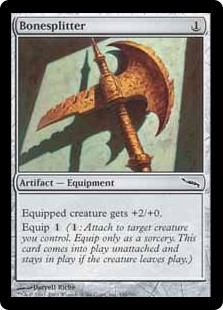
Bonesplitter: I admit I haven't tested this one yet, but it looks sweet on paper. Turns Eternal Scourge into a very dangerous recurring threat, allows us to clock seriously with a lone Blinkmoth or Eldrazi Mimic, and adds points of trample with Reality Smasher. Its low mana cost works well with Sea Gate Wreckage. Splitter wouldn't work in versions that run Chalice in the main.

My current list:

Colorless Eldrazi Stompy, by Jordan Boisvert

Creatures

4 Matter Reshaper
4 Eldrazi Mimic
4 Eternal Scourge
4 Thought-Knot Seer
4 Reality Smasher
4 Endless One

Artifacts

4 Relic of Progenitus
4 Serum Powder

Instants

4 Dismember

Lands

4 Eldrazi Temple
3 Gemstone Caverns
4 Ghost Quarter
4 Blinkmoth Nexus
2 Mutavault
4 Sea Gate Wreckage
1 Urborg, Tomb of Yawgmoth
2 Wastes

Sideboard

4 Chalice of the Void
4 Spatial Contortion
3 Ratchet Bomb
2 Pithing Needle
2 Gut Shot

Matchups and Sideboard

These few months of playing Colorless Eldrazi Stompy have revealed to me the deck's biggest weakness: go-wide aggro decks. Generally speaking, the worse the deck is, the harder it is for us to beat. Affinity is actually very good post-board. Merfolk is tougher. Bant Spirits is a hard matchup. And the rogue-ier UW Spirits is our hardest, bar-none.

Bad Matchups

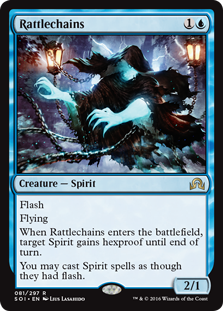
Go-wide aggro. UW Spirits's combination of fliers and soft disruption, combined with its lack of reliance on Vial or Hierarch, makes it very tough to beat. Our best bet is to RattlechainsPowder into a hand full of aggression with a couple Dismembers and try to race. This weakness explains the sideboard's nine-card removal package, which comes in against most aggro decks with a few exceptions (Gut Shot doesn't make it against Burn, for instance).

In: removal

Out: Relic, Reshaper

Linear combo. These decks can also pose some issues for us, with Ad Nauseam being the primary offender. Chalice stops their cantrips and Lotus Blooms, but it doesn't affect the Phyrexian Unlife-Ad Nauseam combo at all. Relic is even more useless, and the grind game offered by Scourge and Reshaper is laughable in this matchup. Thought-Knot Seer is tremendous, though, and will win us games if we open multiples.

In: Chalice, Bomb

Out: Dismember, Reshaper

Medium Matchups

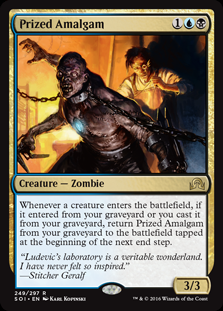
Prized AmalgamDredge. Without Relics in the main, this matchup becomes a lot trickier. But with them, things are generally pretty good for us. Dredge has trouble beating strong starts, so our plan is to mulligan into a hand that chains a small creature (Mimic, Endless) into a big one (Thought-Knot, Endless). Multiple Smashers will often do the trick too. Dredge forces us to mulligan even more aggressively than usual in search of threat-heavy hands, which can result in some bad keeps.

In: nothing

Out: nothing

Sun and Moon. The WR Prison strategies popping up lately can also hassle us, but only if their pilots draw the correct half of their deck. As mentioned, Blood Moon doesn't faze us much, especially considering we're likely to have pressure on the table when it resolves. The real killer in this matchup is Elspeth, Sun's Champion, which is close to impossible for us to remove and can nuke our board after we set up some bigger beaters. Our plan is to get under them with Mimics and disrupt with Thought-Knot.

In: Bomb, Needle

Out: Relic

Good Matchups

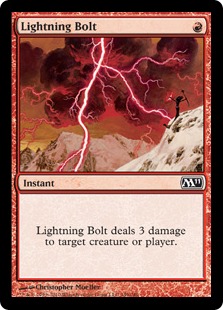
Lightning BoltI stand by my claim that most of Colorless Eldrazi Stompy's matchups fall into this third category. We're faster than Bant and Tron, can out-grind Jund, Grixis, Jeskai, and Abzan, and disrupt Burn, Affinity, and Infect too well post-board to have to worry about the aggro trinity.

Sideboarding for these decks is pretty straightforward following the blueprint laid out above.

A Bright (Gray) Future

Playing Colorless Eldrazi Stompy is the most fun I've had playing Magic in a while. Unlike Temur Delver, which asks a lot of me over the course of a few matches, this deck is very straightforward and easy to play. Its only challenging aspect is in mulliganing, one of my favorite things to do in Magic anyway! That makes it the perfect deck for me to bring to smaller events without too much on the line. Still, I can't help but wonder if the nagging voices in the back of my head will ever convince me to register the 75 at a higher-stakes tournament.

Insider: MTGO Cards to Buy, Sell or Hold – Episode 18

Are you a Quiet Speculation member?

If not, now is a perfect time to join up! Our powerful tools, breaking-news analysis, and exclusive Discord channel will make sure you stay up to date and ahead of the curve.

Hello, Insiders! This was yet another extremely calm week for speculations. The most notable and surprising news is the further increases on BG Delirium and WU Standard decks. In a week where nothing happened – not even a big Standard tournament was played – the prices of those two decks kept going up.

I think the reason is the lack of the rise of a new deck. Not having any new information might have caused new players to buy one of the two most played decks instead of trying new strategies. I will track price movements in future weeks with no big events to see if this is knowledge one could exploit as a business opportunity. I would appreciate if readers could share their thoughts on this subject in the comments below.
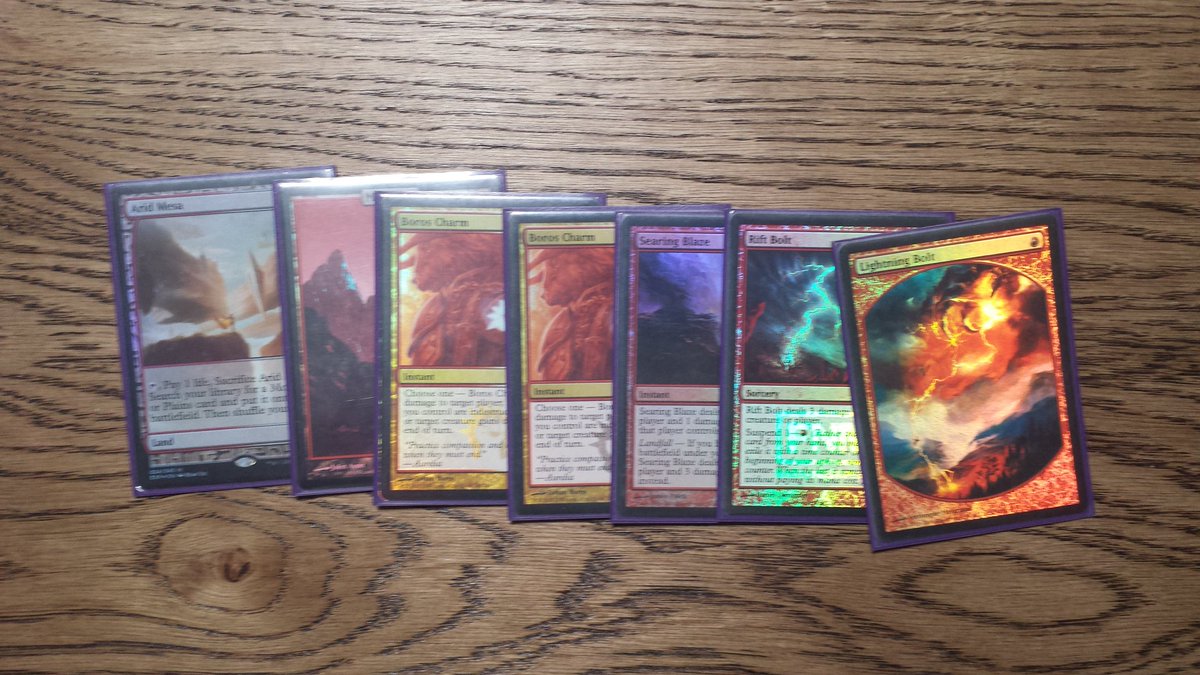
Regarding Modern, I'm happy I could keep closing more profitable positions I opened before Treasure Chests were announced. I'm still skeptical to invest in Modern – remember that Modern Masters 2017 will be launched March 17 – but I could see myself buying the non-reprinted cards for short-term speculation.

The World Magic Cup will be played this weekend featuring Team Unified Modern. I don't think we will see any new interesting deck, but you never know, so keep an eye on the tournament.

Now let's see the five cards I prepared for this week's BSH:

Decimator of the Provinces

decimator-of-the-provinces

Decimator of the Provinces was played once more in SaffronOlive's budget deck. Every time his decks are published investors jump in immediately, buying out the deck's cards and creating a financial bubble that pops a week later. I was holding a bunch of those big pigs and this is a quick boost to my portfolio. I will buy them again when they crash to 1 tix.

Verdict: SELL

Choked Estuary

choked-estuary

One of my favorite strategies provided another selling opportunity this week. I will wait until they go back to below 0.50 to buy them again, and then repeat the process as many times as possible.

Verdict: SELL

Ulamog, the Ceaseless Hunger

ulamog-the-ceaseless-hunger
Ulamog was one of my positions that wasn't doing very well. This past weekend, Tom Ross won the Modern SCG Open with WG Tron. In response, a bunch of the deck's cards rebounded. I could sell my copies of Ulamog for almost the same I bought them for, allowing me to wait for a better spot to buy them again. I think the card will continue its bearish trend because it is not much played in Standard, but it could also see a rebound if the deck gets hyped. I recommend trying to close it in for any amount of profit and avoid the current problematic spot.

Verdict: SELL if profitable, otherwise HOLD

Scrying Sheets

scrying-sheets

I haven't talked yet about the Big Red deck that won last Modern GP and shook up the format a little, in part because of lack of interest in Modern speculation at the moment, but this was different – I could buy them for real cheap, and I hope you have some copies too.

In the last part of the graphic above, we can see speculators buying and liquidating a few days after, so the current support level is unlikely to be perforated. If the deck gains a home in the metagame or incentivizes players to try new builds with Skred, Snow-Covered Mountains and Scrying Sheets, the card will slowly go up, making it a long-term speculation target. As the card is unlikely to go down in my opinion, the best play is to hold until we see an MTGO announcement or event that will crash its price.

Verdict: HOLD

Kozilek's Return

kozileks-return

One of the most unstable cards financially speaking saw a quick spike in the last days. The resistance level is still uncertain, but a new support level at around 10 tix could be starting to form. I think it is better to sell it now than wait for the unpredictable, and if it drops below 10, one could consider buying back in.

Verdict: SELL

See you next week !

Stock Watch- Coalition Relic

Are you a Quiet Speculation member?

If not, now is a perfect time to join up! Our powerful tools, breaking-news analysis, and exclusive Discord channel will make sure you stay up to date and ahead of the curve.

Coalition Relic is one of those cards that went from worthless to gold as Commander (then EDH) gained popularity years ago. When it was reprinted in Dual Decks: Phyrexia vs. The Coalition it took a significant hit, though it has creeped back up in value since that release. With the release of the four color Commander decks, I would expect to see an uptick in demand.

There was an error retrieving a chart for Coalition Relic

Supply is quite low online right now, and I would recommend picking up a copy of the Commander/Cube staple now if you need one. It's unlikely that the card will be reprinted any time soon, and I expect it to see more gains in the near future. Commander 2016 was the most realistic place for a reprint, and it was Chromatic Lantern that got the nod in its place.

The spread on Coalition Relic is still around 30%, which doesn't make it a slam dunk, though buylist prices have recently increased from $5 to over $6. I can think of worse cards to buy a set or two of.

Avatar photo

Ryan Overturf

Ryan has been playing Magic since Legions and playing competitively since Lorwyn. While he fancies himself a Legacy specialist, you'll always find him with strong opinions on every constructed format.

View More By Ryan Overturf

Posted in FreeTagged , 1 Comment on Stock Watch- Coalition Relic

Have you joined the Quiet Speculation Discord?

If you haven't, you're leaving value on the table! Join our community of experts, enthusiasts, entertainers, and educators and enjoy exclusive podcasts, questions asked and answered, trades, sales, and everything else Discord has to offer.

Want to create content with Quiet Speculation?

All you need to succeed is a passion for Magic: The Gathering, and the ability to write coherently. Share your knowledge of MTG and how you leverage it to win games, get value from your cards – or even turn a profit.

High Stakes MTGO – Nov 6th to Nov 12th

Are you a Quiet Speculation member?

If not, now is a perfect time to join up! Our powerful tools, breaking-news analysis, and exclusive Discord channel will make sure you stay up to date and ahead of the curve.

Hi everyone, and welcome back for another High Stakes MTGO!

This past week was a little bit more quiet than the previous ones. With Standard settling down, I'm clearly more of a seller, especially with my full set positions, than a buyer at the moment. Maybe next month I'll start looking for bulk cards that may have a shot at spiking in 2017. Speculating on bulk or near-bulk positions doesn't usually involve much risk and can lead to big rewards if you hold a winner.

Not much action in Modern either, as a period of demand for cards in this format is approaching. There might be some decent picks to find, especially with the ongoing series of flashback drafts. But my bankroll is already filled with Modern positons, which I'd rather focus on selling with the best possible outcome. I'll do my best to seize every good selling opportunity, and I anticipate the bulk of my moves here to occur in two or three weeks.

This past week saw a lot of full set movement on my account, and almost no buys. Let's review what motivated these moves. The latest snapshot of the portfolio is here.

Buys This Week

pif

Here is my second pick from Innistrad after this set was flashback-drafted a couple weeks ago. Past in Flames has very limited applications in Modern and Legacy, but this card does something no other cards do. Wait for Storm to cycle up in popularity and this socery will see its price boosted momentarily.

For almost two years Past in Flames floated between 10 and 15 tix, with a few spikes above 20 tix, mostly in 2014. Falling below 5 tix last week, the lowest this card has ever been in more than three years, makes it an even better pick-up. I'll be considering selling this guy as soon as the price returns in the neighborhood of 10 tix though.

nth

This is a rebuy of a position I short-sold. I think Nahiri, the Harbinger should be priced much lower than what she's at now, but I was looking to rebuy Nahiri to (re)complete my Shadows over Innistrad (SOI) full sets. I barely gained 10% on that spec but I consider this short sale move a bonus to my SOI full set spec.

With this that's two recent short sales that turned out positive, although the profit margins were small, I admit. If you are invsting in full sets, short selling is definitely something to consider to boost your returns.

Sales This Week

soilog

Along with all the other Standard sets, the value of a Shadows over Innistrad full set has stopped rising. It's currently stabilized around 65 tix, with a buying price fluctuating around 55 tix.

Now that I have bought back my copies of Nahiri, the Harbinger from my short sale, my SOI sets are complete again and I've started selling some. For the first eight sets I sold, my profit was very modest and nothing compared to what I made with Eldritch Moon full sets, but I'll take it. My priority here is certainly not be stranded with SOI full sets like I was with the Battle for Zendikar full sets.

bfzlog

Yes, it has happened, I sold eight BFZ full sets this past week at a profit—a very marginal gain of 0.93 tix (2%) per set. Nothing to brag about, although I didn't think this was possible a month and a half ago. It seems, however, that the price of BFZ full sets will not seek higher levels. I'll most likely be selling the rest of my BFZ full sets before the end of November, even if I'm not breaking even any more.

Mentor never saw the price hike I was hoping for, probably because it didn't break through Modern (not yet at least). Until two weeks ago, I thought Monastery Mentor would be one of my far too many Modern specs to register big losses.

Then the Fate Reforged (FRF) mythic doubled in price out of nowhere. As the price was approaching 11 tix, I decided to get rid of my copies to put some tix to the bank, fearing the spike would not hold. And then it kept growing! I virtually broke even on that spec, although I could have posted a 30% profit, or more, if I had waited a few more days.

frf-sets

Fortunately, I didn't miss out on all of the gains involved in Monastery Mentor's spike. As Mentor rose in price so did the value of FRF full sets. The redemption cut-off date for FRF is still about six months away, but the redemption guarantee date is behind us. That means if paper stocks of a given set dry up, redemption will no longer be available, leading to a premature price drop.

This is what happened with Theros, and more recently with Khans of Tarkir (although that decision was reversed later on for KTK). My FRF full set spec was not exactly doing great, so when I saw the price surging I took my chance to exit this position with lower losses.

The interesting story here is that to liquidate these full sets of FRF, I actually sold them as singles. Dojotrade and Clanteam are the only bot chains, as far as I know, that advertise and buy full sets as-is. However, before selling I briefly checked the price of the top five FRF cards, starting with MTGO Traders. I realized they would consistently offer me 1 to 2 more tix than what Clanteam or Dojotrade could offer me for a full set.

Thus I looked for the best buyers among all bots of Monastery Mentor, Ugin, the Spirit Dragon and Tasigur, the Golden Fang. Then I sold the rest of the cards, roughly worth a ticket or so, to MTGO Traders, Goatbots and Clanteam (which buy any cards in any number). I ended up selling my final FRF sets for more than 19 tix, when the best offer for a full set was not even at 18 tix.

fgtbb

The regular version of Gisela, the Broken Blade has come to a stop price-wise around 15 tix. So did the foil version of the legendary Angel. Still with a gap of a few tix, the foil version of mythics can only go as high as the regular version does these days. A 68% profit on a foil spec is definitely a return you have to pay some respect to. I got what I was hoping for here and there's no reason to stick around longer.

On My Radar

My immediate goals for the next few days are to close my SOI and BFZ full set positions, or at least as much as possible. Prices are stabilizing and I have no intention to get stranded with my SOI full sets or hope for more with my BFZ full sets.

I will also keep selling BFZ and OGW boosters while I'm at it. All of this accounts for a lot of tix I want to make sure are free by the end of the year, before Aether Revolt hits and we start getting the first spoilers of Modern Masters 2017.

With Modern prices clearly doing better now, I'm looking for the best possible timing to sell a lot of positions that are up. We all expected this trend to sustain for about a month or so, but here again I don't want to be too greedy, especially with positions I have been holding for several months.

On the buying side there will still be several good opportunities, starting notably with Avacyn Restored flashback drafts firing this Wednesday. I'll be looking for short-term flips as almost every card could potentially be reprinted in Modern Masters 2017.


Thank you for reading,

Sylvain

Insider: Return to Kaladesh (Kinda)

Are you a Quiet Speculation member?

If not, now is a perfect time to join up! Our powerful tools, breaking-news analysis, and exclusive Discord channel will make sure you stay up to date and ahead of the curve.

Hey there!

So it's actually been a while since we talked about Kaladesh. In fact, I haven't really talked about the set at all since my initial spoiler article talking about the early shown commons and uncommons, and when we went over how the Expedition Effect might impact the lower-desired cards on a Battle for Zendikar scale.

Since the Pro Tour, we've seen most of the non-rares in the set settle to their "long-term" floors, where "long-term" in this context refers to the life span the card has in Standard. We know what the Duskwatch Recruiters and Monastery Swiftspears of the set are, but how does the rest of Kaladesh stand up in the face of "I'll buy these for $3 per thousand"? How do my guesses from before line up to where the cards buylist at now, and what does Kaladesh look like on the Blueprint?

There was an error retrieving a chart for Aether Hub
There was an error retrieving a chart for Harnessed Lightning

Let's open our handy Trader Tools and sort by set, while only showing the commons and uncommons from Kaladesh. You can left click the tops of the columns to sort by that metric; right now we have it organized by the highest buylist price. We don't really have any surprises in the top four cards, as they're all playable cards in one Constructed format or another.

Some of the surprises start to show up when we see cards in the Kaladesh Planeswalker decks. AdventuresOn (and Cool Stuff, Inc. to a lesser extent) are paying relatively aggressively on those hard-to-find commons that just don't exist in booster packs. While you're probably not going to come across 5000-count boxes full of Flame Lash, it's still worth noting that Chandra's deck is the better of the two, and that it's not just "Chandra, Fleetwheel Cruiser, and a couple  bulk rares."

kaladesh

Once we get past the staples, it doesn't really look like a super hot set.

In my Expedition Effect article, I mentioned that BFZ had an extremely weak 18 commons and uncommons that were worth at least 10 cents to a particular vendor on Trader Tools. Kaladesh loses that race even harder, coming in with only 17 cards on that same metric.

But wait, several of the Kaladesh cards on Trader Tools can't even be opened in boosters! If you're picking bulk from booster boxes that doesn't include cards from Planeswalker decks, you're crossing your fingers that the seller didn't pull the obvious cards in the set that are worth money. Overall, the set looks extremely weak from a Trader Tools perspective; you can't even get dimes right now for your Servant of the Conduits. Veteran Motorist, a powerful four-of uncommon, barely makes the list as an outlier. Isle of Cards randomly wants a single copy at 14 cents; after that, it's nothing. So how about the Blueprint? Maybe we'll have better luck there.

There was an error retrieving a chart for Servant of the Conduit
There was an error retrieving a chart for Veteran Motorist

kalablueprint

So we're only looking at a pick number in the high 20s on this spreadsheet, which is kind of stretching it considering several of these cards are in the 3 to 5 cent range past the dime cutoff that most pickers use. Getting 20 cents per Filigree Familiar is nice, but Kaladesh just looks like it's been opened to death already. Powerful cards like Inventor's Apprentice and Veteran Motorist mope in the corner at a nickel status, and there are almost zero commons on this list at all, with Cathartic Reunion and Fragmentize making the best of a bad situation.

Don't get me wrong, I'm happy to turn 100 Cathartic Reunions into another thousand bulk commons and uncommons at that $3-per-thousand ratio, but Kaladesh definitely doesn't look like a set that's worth blueprinting on its own. Throw your random cards into an existing order, but it looks like the two months after release have the Expedition/Masterpiece effect really making sure that the uncommons in the set are hard to buylist.

Combine that with the fact that this set went wide in power level instead of tall, and we have a lot of playable uncommons that can't all be Aether Hub. If uncommons take up too much of a portion of box prices, then the overall EV of a set increases to the point where it's worth more to crack boxes until the equilibrium is restored. While my co-host Corbin Hosler has talked about this effect depressing rare prices extensively on Brainstorm Brewery, it holds true to uncommons on a smaller scale.

So Do  I Stop Buying Bulk?

No, of course not. Bulk is bulk; if you could move Eldritch Moon bulk before, you can move Kaladesh bulk now. Buy for $3, sell for $6 per thousand on Craigslist, and do the usual song and dance. I'm just letting you know that you shouldn't be stocking up on uncommons in this set, even if you think they're powerful and saw some fringe Modern play. Glint-Nest Crane will not be a $1 card two years from now just because of Lantern Control, so take your dimes when (and if) you can get them.

This set is still beloved by many casual players for its rich environment and silly interactions with planes, trains, and automobiles, so take advantage of that and don't stop being the person who buys bulk. If you don't buy Kaladesh bulk and accept slightly lower margins because of the slightly lower level of picks, then those same people won't bother coming to you with their Aether Revolt bulk.

End Step

I went over this a little bit on Brainstorm Brewery, but Star City Games recently upped their bulk-buying game by offering $4 cash in person at events per thousand. This is a 25 percent increase from their previous $3 offer, which has been the standard for as long as I can remember. This is especially relevant with the discussions about the recent whispers of vendors turning down bulk at Grands Prix, raising questions as to the stability of the gold bars in white boxes we've come to know and love.

While I'll still continue to pay $3 until the cardboard stops flowing, it's worth considering bringing your bulk to SCG if you're trying to trade up to some of the higher-end cards that they've recently put on sale towards the end of the year. With Legacy staples and Expeditions going on sale, you can actually get pretty strong margins by taking advantage of the 25 percent trade-in bonus. At this point, you're getting $5 per thousand on your bulk commons and uncommons (a reasonable rate, especially if you bought in at $3 or if it's just laying around your house from cracking boxes) and you can turn that credit into an Expedition, Masterpiece, or Legacy card that you've had your eye on around or less than TCG low. It's even better if you already picked and/or blueprinted the bulk yourself, leaving SCG with the scraps of the scraps!

Insider: Financial Value of Commander 2016

Are you a Quiet Speculation member?

If not, now is a perfect time to join up! Our powerful tools, breaking-news analysis, and exclusive Discord channel will make sure you stay up to date and ahead of the curve.

Commander is a fantastic format that draws an audience from many differing player groups. Competitive players love it because they can use all their old cards to create high-powered combo machines. Some of these decks include Legacy all-stars or interactions slightly too slow for that format. On the other side of the coin are players who dislike infinite combos, land destruction, and extreme effects on the game like Jin-Gitaxias, Core Augur or Cyclonic Rift. (I think both of those cards should be up for consideration for the banned list, but that’s a story for another day.)

There was an error retrieving a chart for Cyclonic Rift

My favorite part about these Commander decks, as well as other products that have been released, is that they included cards for both of these types of players. There are high-powered cards that can be combined with other cards to create potent synergies, but there are also fun cards for the less hardcore crowd. Although it’s difficult to cater to everyone, I think Wizards is doing a phenomenal job.

One fact you may not know about me is that from time to time, I build Commander decks for players. New players tend to be intimidated by the build requirements of this format, and for some reason, they don’t want to purchase a preconstructed deck. I’ve also built decks for established players because they know I have a bigger card pool to pull from. These are usually more casual players looking to have fun with their friends rather than build the best deck they can.

The reason I bring this up is because this is my standard for judging products like this. For a while, I think players came to me for this service not only because they didn’t have the cards, but because the decks I built were so much better than what they could buy. The reason I like these new decks so much, and some from the past as well, is not just because they are fun and synergistic but because they are also good. They don’t sacrifice card quality very much. The cards may not be the best or most expensive ones out there, but they are all reasonable cards to play in a Commander game. This has not been the case in the past.

My topic for today is going to be a little different than the construction of a Commander deck, though. Today I want to take a look at the financial impacts of Commander 2016. Let’s dive in.

When I decided to write this article, I immediately started thinking about how I would break it down. What I came up with was to group the important cards into three groups. Today we will be looking at Eternal playable cards, commons and uncommons, as well as good Commander cards.

Eternal Playable Cards

The cards in this group are all reprints that have relevance in Modern or Legacy. This group of cards features some previous financial hits, but due to reprints, this group's new prices range from $2 to $5.

The most important thing about the cards in this category is not their current price, but rather their future price. Despite multiple reprints of these cards, they still continue to bounce back. Similar to how Path to Exile is still $8 minimum, cards like Baleful Strix and Scavenging Ooze still bounce back because of their power level in Eternal formats.

With the supply being so high on these cards right now, the prices of the older versions should come down a bit, but don’t let that scare you. These dips in prices should only be temporary. When possible, acquiring cards from this list should net a profit in the future.

There are a couple cards that stand out to me on this list, so let’s look at them in detail.

There was an error retrieving a chart for Boros Charm

First up is Boros Charm. This burn spell with options is always going to be a Modern staple. Players love their burn decks and burn will likely get better as more cards are released and not worse. This makes Boros Charm a long term home run. I know even after it rotated out of Standard, I’ve always had a hard time keeping this charm in stock. The Commander release should help with that but once the stock starts taking a hit again, the price will bump right back up a couple dollars. This is a card I wouldn’t mind having a bunch of copies to hold for a while.

There was an error retrieving a chart for Karplusan Forest

Since the release of our aggro Eldrazi friends like Thought-Knot Seer, the allied pain lands like Karplusan Forest have been much more in demand. Before that archetype, the old pain lands were a dollar or two each, but now they command a much higher price.

Being one of the more played lands from that cycle, Karplusan Forest was in need of a reprint. I’m surprised we didn’t get all five lands from this cycle, but the only other old pain land we got was Underground River.

Karplusan Forest is an important card for the deck’s it’s played in, but it's also as a budget option for Grove of the Burnwillows. I’ve had a lot of players asking for these lands, so the added supply should help drastically.

There was an error retrieving a chart for Thopter Foundry

Finally, the last important card from this group is Thopter Foundry. This artifact is best known for its combo with Sword of the Meek to gain X life and make X 1/1 thopters, where X is the amount of mana you can generate.

Although previously banned, this combo has been searching for the right deck design since its reintroduction to the format this past year. Even without a home in Modern, these two combo pieces have remained at steady prices. If someone finds a competitive list, I expect this to be a breakout card.

Commons and Uncommons

Often overlooked and written off as worthless are the commons and uncommons. I’m sure by now that the finance community knows that even though Command Tower, Lightning Greaves, Reliquary Tower, and Sol Ring have been in virtually every Commander product that they are all still worth picking up. They will never again be double-digit heavy-hitters, but they will always draw a couple bucks from buyers. There are a couple more standouts from this product release that I want to touch on.

There was an error retrieving a chart for Myriad Landscape

One of my favorite cards from Commander 2014 is Myriad Landscape. This uncommon land can fit into any Commander deck. Widely applicable cards like this are great investments because the demand is so much higher. I’ve always seen this double fetch land as a more generic version of Krosan Verge, which is one of my favorite lands to play in Commander. When you can get your lands to function as spells, you have plays to make throughout the entire game.

Myriad Landscape allows you to ramp your mana without expending a card from your hand. It also helps fix your manabase and is a very affordable option to do so. There is a lot to love about this land.

Initially, I thought this land would only show up in the landscape of mono-colored decks, but I think it’s great for any deck. You can only get two of the same basic land type, but it still accelerates you and can help fix your mana. It’s not as strong in multicolored decks, but it's still great. I will be picking up as many of these as I can get my hands on.

There was an error retrieving a chart for Ash Barrens

The second card from this list that needs to be discussed is the new cycling land Ash Barrens. Aside from my constant misspelling of the word Barrens as "Barons," I love that Wizards still thinks about old mechanics like cycling. This land may not be relevant to many players, but to some it will be crucial.

Surprisingly priced at over a dollar, this common might find a home in some powerful decks. I’ve considered Ash Barrens for Eldrazi variants as well as Lands-style decks.

There are other perks as well, like being able to play this land in any Commander deck, and I’ve already stressed how important that is. I love the flexibility that this land gives you. Either you just play it as your land drop and let it be a colorless source, or you pay one mana and go get the color you need. Love it. Pick up every copy of this card you see, too.

Commander All-Stars

Just like cards from the previous category, Chromatic Lantern and Solemn Simulacrum are obvious picks because of their wide range of applicability. Solemn is one of my favorite cards of all time, and although I’ve loved the card since its first printing, the sad robot has love for everyone. Regardless of what deck you want to play, he can provide your deck with his awesomeness. I buy and sell this rare more than most other Commander playables. I’m glad they brought back Chromatic Lantern as well, because it’s an amazing mana fixer that is hard to get a hold of because no one in my area wants to sell them. It will be great to have both these cards back in stock again. They are great trade bait because many players need copies.

One of my big pet peeves is reprinting half of a cycle of cards. Wizards has done that many times within Commander 2016 and the Odyssey lands are no exception. Many players didn’t even know this land cycle existed, because it’s well before when most players started playing this great game. We got three of the five from this cycle and they are all great for any deck featuring the two colors they support. I’ve included lands from this cycle in many Commander decks for myself as well as for some of the ones I’ve commissioned. Being out of print for so long, they weren’t very high in price, but they are high in functionality.

There was an error retrieving a chart for Yidris, Maelstrom Wielder

Atraxa, Praetors' Voice might be the one getting the most hype, but the most powerful general to me is Yidris, Maelstrom Wielder. Giving all of your spells cascade is so much card advantage. You can just flood the board with your free cards and drown your opponents in tempo. Maybe players aren’t getting on board with Yidris so quickly because there’s no clear direction to take the deck in. With Atraxa, you know you want cards that generate counters so you can proliferate them. Yidris might actually be a little harder to build around because you need ways to force though damage, but you want to cast spells after combat too so you get the free cascades. Maybe what we want is an equipment-based build so we can power up Yidris and still keep our mana free. Something like Sword of Feast and Famine seems like a great pair with this general to do exactly that. I think this general is underrated and a great pick up right now.

There was an error retrieving a chart for Deepglow Skate

Deepglow Skate and Kalonian Hydra are great because they double your efforts. No matter what you are pairing them with, they are another version of Doubling Season. In Commander, we have time for Doubling Season effects to be some of the most potent in the format.

Not only is Deepglow Skate one of the most expensive cards in the set, but it’s also my favorite. You can pair this Mulldrifter-esque creature with planeswalkers or creatures with counters as well as many other places. Initially I thought you only doubled the counters on one permanent, and I thought it was great. The fact that you get to double all your counters is amazing. I could see this card increasing in value even from where it is now.

There was an error retrieving a chart for Magus of the Will

I wanted to mention Magus of the Will briefly because it has generated some hype for eternal formats. While I don’t think this creature is fast enough for the brutal Legacy format, I do think it will be a popular addition to Commander. Most of the Maguses are fun creatures to run in the format, and even if the creature version isn’t good enough for Legacy, it’s a fine card to add to any black Commander deck. I’d expect it to dip to $5 and then maybe tick back up a couple bucks.

There was an error retrieving a chart for Crystaline Crawler

The last great Commander card I want to discuss is Crystalline Crawler. This card is pretty amazing, and again, it’s widely applicable because it can go with any commander deck of multiple colors. It helps you fix your mana and ramps you all at the same time! There is no requirement for how many counters you can remove at once, so you could play Crawler and another four-drop in the same turn, similar to how you could with Koth of the Hammer. There is a lot to love about this card, and I’m buying aggressively.

So Which Deck Do I Buy?

The last thing I want to do today is break down where you can find all of these cards I’ve highlighted today. Knowing the value and the possible future trends of cards is great, but being able to know whether the product they originate from is a good buy or not is also critical.

Let me first say that regardless of the price breakdown, the best seller is overwhelmingly Breed Lethality. This is the GWUB deck featuring Atraxa, Praetors' Voice. Priced at $50 online, I can tell you that players are willing to pay this outrageous price for this deck. My store has sold some near this price point and raised our shipping costs on these decks to accommodate the increased demand.

Let’s break down each deck and see where the money cards fall.

Entropic Uprising UBRG

Yidris, Maelstrom Wanderer $6
Thrasios, Triton Hero $2
Vial Smasher the Fierce $4
Kydele, Chosen of Kruphix $4
Runeborn Hellkite $2
Chaos Warp $2
Past in Flames $3
Chromatic Lantern $5
Burgeoning $3
Ash Barrens $1.5

So our first deck has minimal cards of value which total only $32.50. With Command Tower and Sol Ring as well as the other dollar cards I didn’t type up, you basically make your money back with this deck and get some cool new cards, too. In terms of value, this is on the low end. I referenced MTGGoldfish for some quick numbers on these decks as well and they say the deck is worth $77 once you add in all the basically bulk cards. I don’t like calculating those types of cards when I’m figuring out how much these products are worth, because I think that line of thinking can be misleading. Here is the link for reference, though.

Open Hostility BRGW

Saskia the Unyielding $3
Tymna the Weaver $2
Iroas, God of Victory $2
Ravos, Soultender $3.5
Stonehoof Chieftan $2
Boros Charm $2
Conqueror's Flail $4
Lightning Greaves $3
Ash Barrens $1.5
Karplusan Forest $4

Unless I missed something, this deck is even worse value than the first one. Unless you were getting a good deal or really liked the cards from this deck, I’d stay away from this color combination and just buy a couple cards individually. Other than the new commanders, what does this deck really offer anyway? The MTGGoldfish total on this one is also $77, but you would never get that kind of money out of this deck.

Stalwart Unity RGWU

Kynaios and Tiro of Meletis $2
Selfless Squire$2
Sidar Kondo of Jamuraa $2
Collective Voyage $3
Tempt with Discovery $2
Prismatic Geoscope $3
Oath of Druids $2
Ghostly Prison $2
Ash Barrens $1.5
Forbidden Orchard $4

While this deck seems similar to the previous one, there are a ton of dollar cards hiding in it that help bring up the value. Even the cheap cards are still good, like Hushwing Gryff and Blazing Archon. There were many cards that fell just under my range of calculations, so I think this deck is better than what the above list list indicates.

Breed Lethality GWUB

Atraxa, Praetors' Voice $10
Scavenging Ooze $4
Reyhan, Last of Abzan $3
Crystaline Crawler $2
Deepglow Skate $10
Ghave, Guru of Spores $3
Ikra Shidiqi, the Usurper $3
Kalonian Hydra $5
Reveillark $4
Darkwater Catacombs $2
Underground River $2

With just two cards, this deck nearly overtakes the other decks in value. It also has many other good cards in it, too. There’s a reason that this deck is selling for $50 online and the top end of the deck really highlights the demand it is generating.

Invent Superiority WUBR

Breya, Etherium Shaper $4
Akiri, Line-Slinger $3
Baleful Strix $3
Magus of the Will $8
Master of Etherium $5
Silas Renn, Seeker Adept $2
Faerie Artisans $2
Solemn Simulacrum $3
Aethersworn Adjucator $2
Daretti, Scrap Savant $2
Ash Barrens $1.5

Before I knew about the Breed Lethality deck crushing online sales, this is the deck I thought was going to be the top of the curve. It has nearly as many valuable cards, but it’s missing the top end like the other deck has. Don’t forget every deck has Command Tower and Sol Ring to bump them up a couple dollars as well.

As a side note, my friends and I have been referring to these decks by the color they are missing. So this deck would be the non-green one. It’s tough to compare decks when they don’t have understandable names, so maybe that will help you too.

I hope this shortened version of the deck’s value was helpful. You can always look up all the prices individually, but when dealers aren’t buying the majority of the cards in the deck, I think it’s more useful to break them down this way rather than being misled by false values.

If you liked or didn’t like this break down, let me know in the comments. Is there another way you’d like to see this information? Hope you enjoyed the article this week. As always, I’ll be back for more next week.

Until next time,
Unleash the Commander Force!

Mike Lanigan
MtgJedi on Twitter

The State of Post-Kaladesh Modern

Are you a Quiet Speculation member?

If not, now is a perfect time to join up! Our powerful tools, breaking-news analysis, and exclusive Discord channel will make sure you stay up to date and ahead of the curve.

Recently, there’s been a lot going on in the world "non Magic-wise." The Cubs finally overcame the hundred-year curse, South Korea got really weird, and America proved that polling actually is absolutely worthless. If you’ve been too busy staring at supermoons and lamenting the end of society as we know it, fret no more. Everything really will be okay. Tomorrow, the sun will rise all the same.

rancor-banner-cropped

Today, we’ll be using the last two major Modern events, Grand Prix Dallas/Fort Worth and the Star City Games Modern Open in Columbus, to give an overview of this "new Modern" we find ourselves in. Don’t think we’re in a "new Modern?" Think the last two weeks were just business as usual? Well, we’ll see, won’t we?

[wp_ad_camp_1]

Who’s on Top?

If we’re looking purely at the final table results from Dallas and Columbus, it would seem the top players in the format are Skred Red, Grixis Control, GW Tron, and Dredge. Now, clearly we know that this misses the mark completely for three out of four, but regardless, these results should make us question our assumptions about the format. If we really think that Infect, Affinity, and Jund are the pillars of Modern, why aren’t they showing up at the final table?

Wurmcoil EngineNow, obviously this is an over-simplification of game-day metagames, which affect weekend results much more potently than any conjecture gifted authors can pontificate about during the weekday. It doesn’t matter if every Magic writer touts up Death's Shadow Zoo as the most powerful deck in the format if nobody plays it, or more accurately, people listen and adjust accordingly to not get beaten by it. The narrative, just as much as physical, tangible results, can sway virtual power among the Axis and Allies of Modern.
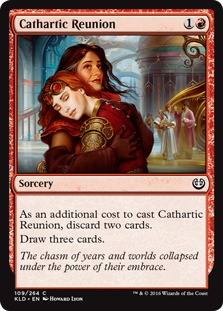
As every form of analysis must entertain speculation at some point, it’s possible we could just "be wrong." With that in mind, perhaps we need to constantly measure new information against prior perceptions, to stress-test our conclusions to prove their validity. If Infect isn’t putting up results, perhaps it isn’t the powerhouse we thought it was? If Grixis Control can’t manage a Top 16 for months, perhaps I should have given it up a long time ago? Looking at Dallas in hindsight, where Grixis Control took second place out of nowhere, an argument can at least be made that we should take results that go against the narrative we’ve created with a grain of salt. Maybe Infect still is the top deck, and it just had a bad week. Maybe Affinity isn’t being hated out of the metagame, but instead the format has just shifted to a point where it is no longer enjoying the favorable conditions it once was.

So, in an attempt to recalibrate our understanding of the format, let’s look at some archetype case studies from the top tables of the past two events. First up, Dredge.

Dredge, by Matt Ayers (2nd, SCG Columbus Open)

Creatures

4 Bloodghast
4 Golgari Grave-Troll
4 Insolent Neonate
4 Narcomoeba
4 Prized Amalgam
4 Simian Spirit Guide
4 Stinkweed Imp

Instants

1 Rally the Peasants

Sorceries

4 Cathartic Reunion
2 Conflagrate
4 Faithless Looting
2 Life from the Loam

Lands

2 Mountain
4 Blackcleave Cliffs
4 Copperline Gorge
2 Dakmor Salvage
4 Gemstone Mine
3 Mana Confluence

Sideboard

1 Vengeful Pharaoh
4 Leyline of the Void
1 Ancient Grudge
1 Darkblast
1 Gnaw to the Bone
1 Lightning Axe
4 Nature's Claim
2 Collective Brutality

Cathartic Reunion has, at this point, become universally adopted in Dredge lists, for good reason. A strict upgrage to Tormenting Voice, Cathartic Reunion can ditch a dredge spell and a Bloodghast from our opener at once, while simultaneously drawing/dredging us three times. Or, better yet, ditch a dredge spell (or two) and watch your graveyard fill up as you dredge into more dredge abilities for each of your three draws. With 8 five-plus dredge spells in our deck (Stinkweed Imp and Golgari Grave-Troll), we’re hitting pay dirt often.

cathartic-reunionWhat Dredge does is nothing new, but Cathartic Reunion along with a whole lot of grinding and list optimization has resulted in a lean, tuned machine that is primed to wreak havoc upon an unprepared format. All the midrange value in the world won’t save you from Dredge’s machine, as Jund has learned. Without Scavenging Ooze, Anger of the Gods, or sideboard bombs, Jund (and reactive decks like it) are left scrambling for something to stop the value train.
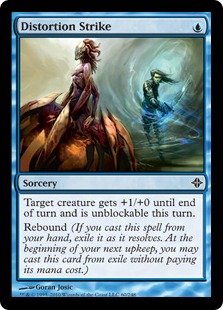
While not new by any sense, Insolent Neonate, another one-drop (in addition to Faithless Looting) that can start us dredging as early as turn two, has greatly increased the velocity of the archetype compared to pre-Neonate versions. With Carthartic Reunion and Insolent Neonate as additions, contemporary Dredge is much faster, more powerful, and more consistent than prior versions that saw Golgari Grave-Troll get banned in the first place.

Now, I’m not arguing for a Dredge banning, as it has proven to be just as susceptible to hate in the format as Affinity. The tools to beat Dredge are widespread and accessible, and while the archetype is powerful, and the games it wins can sometimes seem one-sided, it is by no means warping the format with its presence. Sure, we’re seeing an uptick in Kalitas, Traitor of Ghet and Scavenging Ooze as a response to Dredge’s increasing market share in the format, but we’re nowhere near Splinter Twin and Eldrazi levels of representation. For now, Dredge is a powerful, capable, visible monster under the bed. We know it's there, and we have the magical baseball bat. Yes, that might possibly be a relic of my childhood still lingering in the cavities of my subconscious. Next…

Infect, by Mike Mei (3rd, GP Dallas)

Creatures

4 Glistener Elf
4 Noble Hierarch
4 Blighted Agent
1 Dryad Arbor

Enchantments

2 Rancor

Instants

2 Twisted Image
4 Mutagenic Growth
4 Become Immense
4 Vines of Vastwood
4 Might of Old Krosa
2 Apostle's Blessing
2 Spell Pierce

Sorceries

4 Gitaxian Probe

Lands

4 Inkmoth Nexus
4 Misty Rainforest
4 Windswept Heath
1 Wooded Foothills
2 Forest
2 Breeding Pool
2 Pendelhaven

Sideboard

2 Twisted Image
1 Spell Pierce
3 Kitchen Finks
2 Grafdigger's Cage
2 Dismember
2 Nature's Claim
1 Viridian Corrupter
2 Scavenging Ooze

We’ve talked about Infect at length in recent articles, so I’ll try not to restate my thoughts on the deck here as well. Still, for reference, Infect exists as the fastest, most consistent, most resilient linear aggressive deck in the format, especially in post-board games. Sure, Affinity is faster and more consistent, as Infect still struggles with the 12-creature issue, but Affinity’s 80% game one winrate plummets once opponents gain access to ever-present artifact hate cards in their sideboard. Infect, in many matchups, gets even better after board, as it gains tools to fight specific matchups in place of general mainboard stinkers like Dismember or Rancor.

distortion strikeSpeaking of Rancor, I’m glad to see Mike specifically moving away from Distortion Strike, while not leaving himself completely dead to Lingering Souls and the like. Distortion Strike has always been pretty underwhelming for its mana cost (considering we’re often spending G for +4/+4 or +6/+6) and while Rancor isn’t much better, we still get some extra oomph out of it past the initial investment. With Blossoming Defense replacing Apostle's Blessing, and now Rancor seeing play over Distortion Strike, we’re reaching a flash point where Infect has finally assembled a critical mass of protection and pump to do whatever it pleases game after game. I’ll say it here definitively: if it wasn’t for the 12-creature issue lending the archetype some inconsistency, we would be seeing Infect representation at pre-banning Eldrazi levels sweeping the format.


If that’s the case, shouldn’t Infect be leading the format? We saw it perform relatively well at GP Dallas, taking 3rd, 6th, 8th and 10th place, so Dallas’s results at least fit the narrative that Infect is a top deck in Modern. Columbus, on the other hand, has Infect missing the Top 16 completely, with the archetype only able to muster up top performances of 21st, 22nd, and 24th place. At this point, we’ve reached speculation territory. Is Infect a great deck that is performing inconsistently, or is folding to dedicated hate? Or is it a poor deck, capable of powerful things à la Affinity, that finds itself in a format where every matchup is an uphill battle?

Bant Eldrazi, by Adam Fronsee (6th, SCG Columbus Open)

Creatures

2 Spellskite
3 Drowner of Hope
4 Eldrazi Displacer
2 Eldrazi Skyspawner
4 Matter Reshaper
4 Noble Hierarch
4 Reality Smasher
4 Thought-Knot Seer

Instants

1 Dismember
4 Path to Exile

Planeswalkers

1 Ajani, Mentor of Heroes

Sorceries

4 Ancient Stirrings

Lands

1 Forest
1 Plains
1 Wastes
1 Breeding Pool
3 Brushland
3 Cavern of Souls
4 Eldrazi Temple
1 Hallowed Fountain
1 Temple Garden
4 Windswept Heath
3 Yavimaya Coast

Sideboard

4 Chalice of the Void
2 Engineered Explosives
1 Grafdigger's Cage
2 Rest in Peace
2 Stony Silence
2 Worship
2 Elspeth, Sun's Champion

The last deck I want to discuss, Bant Eldrazi, is my third contender for top deck in the format. Ajani, Mentor of Heroes aside, Bant Eldrazi has been tuned to the point of perfection for weeks now, and we’ve seen relatively the same list put up consistent results week after week for what seems like forever at this point. Ancient Stirrings, Path to Exile, Noble Hierarch—Bant Eldrazi takes the most powerful spells in its colors and combines them with a synergistic engine that borders on unfair. With a powerful, fast, consistent maindeck and a potent list of sideboard options, Bant Eldrazi exists as one of the most powerful decks in the format without a glaring weakness to hold it back.

So, why isn’t it winning more? Again, we can only speculate from here, but I’m of the opinion that the format is just not of the right conditions for Bant Eldrazi to dominate. Tron is diminished but still present, and the rest of the format is just fast enough to make powerful, grindy beaters like Drowner of Hope and Reality Smasher awkward. The decks Bant Eldrazi is built to prey on (Jund Midrange, Jeskai Control, the mirror) are just not seeing play in large numbers, and currently Eldrazi is getting by against an unfavorable format purely on power and consistency.

Conclusion

Long-present format mainstays like Burn and Affinity have diminished in recent months, replaced instead by Dredge and Infect. Midrange archetypes like Jund and Junk have for the most part disappeared, though they still put up occasional numbers due more to their lack of weaknesses than any particular strength or unique technology. Bant Eldrazi is an ever-present force in the format that is simultaneously keeping its best matchups at bay while at the same time is held in check by the hyper-aggressive environment it has helped foster. The resulting context is a tenuous one—any archetype can perform well on any given weekend, as seen by top performances from rogue archetypes like Grixis Control, Skred Red and GW Tron. What deck will be on top next week? Your guess is as good as mine.

Thanks for reading,

Trevor Holmes

The_Architect on MTGO

Twitch.tv/Architect_Gaming

Twitter.com/7he4rchitect

Want Prices?

Browse thousands of prices with the first and most comprehensive MTG Finance tool around.


Trader Tools lists both buylist and retail prices for every MTG card, going back a decade.

Quiet Speculation