menu

Deck Overview- Modern Jeskai Prowess

Are you a Quiet Speculation member?

If not, now is a perfect time to join up! Our powerful tools, breaking-news analysis, and exclusive Discord channel will make sure you stay up to date and ahead of the curve.

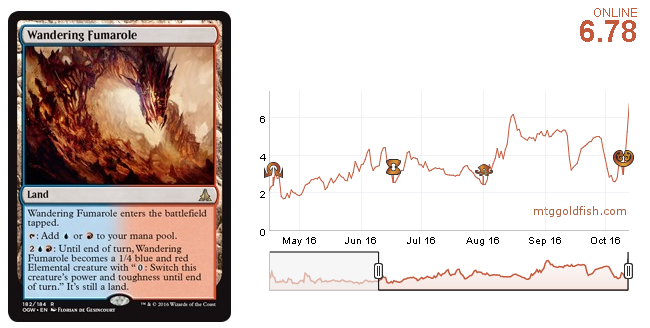
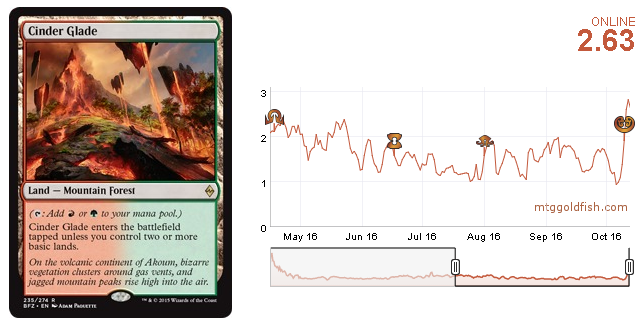
I recently put some work into designing a disruptive Jeskai deck in Modern, Jeskai Control has been around forever, and today I came across an interesting aggressive Jeskai shell. This is a pretty cool take, utilizing four Spirebluff Canal to push the sorts of spells you can play in a three color deck. ASD put up a 5-0 League result with this creative brew:

Jeskai Aggro

Creatures

4 Mantis Rider
4 Monastery Swiftspear
4 Snapcaster Mage
4 Stormchaser Mage

Spells

4 Gitaxian Probe
4 Serum Visions
4 Lightning Bolt
4 Lightning Helix
4 Mutagenic Growth
2 Unsubstantiate
4 Vapor Snag

Lands

2 Arid Mesa
2 Flooded Strand
1 Hallowed Fountain
1 Island
1 Mountain
1 Plains
1 Sacred Foundry
2 Scalding Tarn
2 Seachrome Coast
4 Spirebluff Canal
1 Steam Vents

Sideboard

1 Deflecting Palm
1 Dispel
1 Izzet Staticaster
1 Path to Exile
2 Pyroclasm
1 Stony Silence
3 Surgical Extraction
2 Threads of Disloyalty
1 Timely Reinforcements
2 Wear // Tear

You may be wondering why this deck plays Mantis Rider over Delver of Secrets, and/or why it plays Stormchaser Mage over Young Pyromancer- at least, that's where I started. The answer is that this deck is only interested in creatures that both have haste and can survive a Lightning Bolt when pumped with Mutagenic Growth. Once you can convince yourself to play four Mutagenic Growths in a deck that isn't degenerate like Infect and Death's Shadow, this makes a ton of sense. The idea isn't just to be aggressive and capable of interacting with creatures, but also to beat the most played removal spell in the format with a zero mana spell. Throwing a bunch of Phyrexian mana spells in your deck is just a lot easier to accommodate with the new threshold of fastlands available. It's a rather brilliant design in this respect.

The other creature that is absent is Geist of Saint Traft, and while the card is a fan favorite I understand this direction. There is a lot of blocking in Modern right now, and Mantis Rider both flies over the stuff that Geist has to run into while being able to block Inkmoth Nexus. It's true that this deck is quite good at clearing a path, though haste and vigilance combine to make it so that Mantis Rider is much more likely to matter in games where you're behind.

This sort of deck is going to be weaker to spell-based combo decks, though those are definitely at a low point currently. Creatures shouldn't be a huge issue, and as long as your opponent isn't loading up on Path to Exiles and Terminates this looks like it should have significant game against decks that aren't spell-based combo decks.

Unsubstantiate looks a bit suspect to me, though once you register four Vapor Snags it's clear that you care a lot more about Unsummon than Remand. I'm curious to see how the card performs, and will note that it provides some utility against plays like Thought-Knot Seer off of Cavern of Souls.

I really like the sorts of positions this deck can put your opponents in. When you're being attacked by a freshly cast Mantis Rider, do you Lightning Bolt it immediately and risk taking five? Does this deck even give you time to make decisions like that? This is a strong new direction and I'm excited to see if it takes off.

Insider: GP Atlanta Vendor Report

Are you a Quiet Speculation member?

If not, now is a perfect time to join up! Our powerful tools, breaking-news analysis, and exclusive Discord channel will make sure you stay up to date and ahead of the curve.

Welcome back, readers! Last week I made the two-and-a-half hour trek down to the city of Atlanta to sell off some smaller stuff that had begun to accumulate. After buying just a few collections, you'd be amazed how often you have a ton of little dime, quarter and fifty-cent cards just laying around.

Shipping them off to each respective buylist can often cost you a lot in profits, just through shipping costs. So whenever there's a Grand Prix within three hours of me (read: Atlanta or Charlotte) I spend the week leading up to it sorting through stuff I've pulled aside as "buylistable," and ogreing it out.

o·gre
ˈƍɡər/
verb

1. To separate out a bunch of cards based on the buylist price, allowing vendors to sift through and take what they want at the pre-defined buylist prices.

Obviously, that definition doesn't pop up on Merriam-Webster, but in Magic finance it's pretty common terminology. Pre-sorting saves vendors a ton of time as they don't have to look up each card individually—time they might otherwise not be willing to spend on a bunch of cheap cards.

You also maximize your own profits because you can price your cards based on the best buylist price. Thus if a vendor's specific buylist was offering $1 but you have it in a box for $1.25, they may just pay you the extra quarter—since now they know that one of their competitors is paying the $1.25.

Ogreing in Atlanta

There were a total of 15 dealers at GP Atlanta: Wizard Tower, Troll and Toad, Tales of Adventure, Flipside Gaming, MTGFirst, Hotsauce Games, Cool Stuff, Inc., Grey Ogre Games, Kirwan's Game Store, Capefear Games, Comics and Gaming, The Only Game in Town, MTGDeals.com, Hareruya, and Star City Games. This is a pretty large number, and great for anyone looking to sell (competition is always a good thing).

I will note that I did not see Capefear Games there (despite their logo being on the GP Atlanta page), and I walked all around the dealer area. I really don't know how I could have missed them. If they were there, then I should have looked harder because Heath's team has always been very easy to work with and they tend to buy a lot of random stuff.

But without further ado, let's look at how much people bought and what they bought.

MTGFirst

mtgfirst_logo

They bought about $16 worth of stuff from me. I know they tend to take a lot of the cheap Modern staples and I don't believe they took any Commander or Legacy cards from me.

Flipside Gaming

flipside-gaming

Flipside only found slightly more than MTGFirst (at around $18 worth). They too seemed to focus heavily on the Modern cards, though I do recall them taking a few Commander ones. They were paying a lot on a good number of Modern staples (my friend sold them over $1,100 worth).

The Only Game in Town

togit-1

TOGIT only found $3 worth of cards they wanted. I'm not sure if I just didn't have anything they wanted or if they didn't like my prices. The buyer was nice enough, but I recall him being rather quiet.

MTGDeals

mtgdeals

Another smaller purchase (of $12), I distinctly remember that they focused almost solely on Modern cards.

Wizard Tower

wt-logo-1

The buyer here was a gentleman I've dealt with at a few other GPs. They're based out of Canada and usually have a multi-screen buylist which was absent this time. When I brought it up, he said it ended up being a lot to ship and that they broke one of the TVs coming back from GP Charlotte.

They bought $25.75 worth of Modern and Commander cards. Another interesting thing about Wizard Tower is they upload to their inventory as they're buying—it takes their buyers a little bit more time going through your stuff, but it seems very efficient.

Cool Stuff, Inc.

coolstuff

Cool Stuff bought a good number of Modern and Commander cards, totaling $22.50.

Kirwan's Game Store

kirwan_logo

Kirwan's was by far my most profitable stop. Their buyer pulled out Legacy, Commander, and Modern staples totaling $72. He was a really cordial guy. It helped that he was the store's "picker" as well, so he had a great understanding of what sells there regularly.

Hotsauce Games

hotsauce

They were only able to find about $7 worth of stuff they wanted—again the main focus seemed to be on Modern cards.

Hareruya

hareruya

These guys are pretty difficult to sell small stuff to. They tend to pay really well on bigger cards, so they usually focus their money on those. The buyer was actually contracted out for the weekend (borrowed from Card Advantage in nearby Athens, GA) and he was only able to find $0.5 worth of stuff on their buylist. He did mention that if Thomas, the owner of Card Advantage, had a booth there, he likely would have bought most of my box.

Tales of Adventure

tales

These guys again focused mostly on Modern cards (which to be fair was a majority of what I brought). They were able to find about $12.50.

Grey Ogre

grey-ogre

The buyer here was easy to talk to and found $45 worth of stuff, ranging from Commander to Modern to Legacy.

Troll and Toad

troll

Troll and Toad is always hard to sell ogred stuff to, which is weird because their buylist prices are really aggressive for some pretty random things. Yet coming to them with an ogred box I'm currently zero for three—at three different GPs they didn't want anything from a large assortment of random stuff (Modern, Legacy, Commander).

The second GP was especially awkward, since I went to them first (as a test), and thanks to Trader Tools I knew some of my prices were from their buylist.

Conclusion

All in all I made $227.50 and sold nothing that retails for over $2.50. I love using GPs to move all the little cards you pick up here and there that are better than bulk but not worth shipping to buylists. Overall I've made over $1,200 doing this, spread out over five or so GPs. I still have a good bit left that I brought, which will remain in fatpack boxes to be repriced for the next GP I attend (with new things added as I accrue them).

Some key takeaways:

  • Kirwan's and Grey Ogre were buying a lot of the smaller random things. I think both are great stores for ogreing out boxes.
  • A few dealers (like Flipside) were trying to use PayPal to purchase goods, which is definitely something I haven't seen before. If you take this payment, be wary. Should any vendors try to pay you via "Goods and Services" you will take about a 2.5% hit due to PayPal fees. If they send it via "Gift/Friends and Family," they are potentially risking the wrath of PayPal, but you won't take a hit.
  • Friday and Saturday are the best days to sell because the dealers tend to have the most cash on these days. The closer you get to the end of Sunday, the less cash they'll have on hand. So if you're going to a GP and playing in the main event, you're better off doing your selling before it starts.
  • Know the value of the cards you want to sell beforehand. I had a friend who was selling a ton of valuable stuff, but he didn't know what it was worth. While the dealers aren't trying to rip you off, they are there to make money—if you don't know what your stuff is worth they can use that to their advantage, which to be fair makes perfect financial sense.
  • Always bring something to snack on (if you can). Typically the venue food options are limited (though this one had a good bit of choices) and the prices tend to be pretty exorbitant.
  • Lastly, I recommend tracking which dealers buy from you repeatedly. Your time has value. I know because I was amazed at how late in the day I finished with the last dealer, and I didn't get to play in any side events or even do any trading. I will compare this GP buylisting experience with notes from the last several, and moving forward I may simply ignore certain dealers and redirect that time into trading/playing.
Avatar photo

David Schumann

David started playing Magic in the days of Fifth Edition, with a hiatus between Judgment to Shards. He's been playing Commander since 2009 and Legacy since 2010.

View More By David Schumann

Posted in Buylist, Finance, Free Insider, Ogreing, Selling9 Comments on Insider: GP Atlanta Vendor Report

Have you joined the Quiet Speculation Discord?

If you haven't, you're leaving value on the table! Join our community of experts, enthusiasts, entertainers, and educators and enjoy exclusive podcasts, questions asked and answered, trades, sales, and everything else Discord has to offer.

Want to create content with Quiet Speculation?

All you need to succeed is a passion for Magic: The Gathering, and the ability to write coherently. Share your knowledge of MTG and how you leverage it to win games, get value from your cards – or even turn a profit.

Insider: Kaladesh Hype and Post-Pro Tour Targets

Are you a Quiet Speculation member?

If not, now is a perfect time to join up! Our powerful tools, breaking-news analysis, and exclusive Discord channel will make sure you stay up to date and ahead of the curve.

Well, I mediumed the heck out of Pro Tour Kaladesh (my record was 8-8), but I had a blast and that is important too. I was impressed with Standard and Draft as competitive formats, as both offered a lot of options and fun gameplay.

I think there's a chance of this Standard format attracting and retaining players at FNM through the fall months. So often, Standard just looks and feels rancid and players decide to give up on the format before they ever bother to become engaged in the first place—but I think there's a real chance that this Standard is one people will want to play.

The biggest question for Magic financers and traders is which cards to move in on and which to give up on. Obviously, there is a ton of hype and demand for Standard cards (Kaladesh singles, in particular) as players scurry to cobble together the staples they need to build their new deck of the week. The key for the savvy trader will be to give up on the cards that have already peaked and move in on the cards with room for growth.

In today's article, I'll give you my perspective on which cards have peaked and which cards I anticipate seeing growth.

Kaladesh Has Peaked

The surging prices of Kaladesh singles is not sustainable. If the prices were sustainable we could all just crack packs infinitely and become millionaires. As enticing as an infinite loop of value sounds, the whole thing is a trap. Online sellers and local game stores are looking to capitalize on demand as players try to grab the last few copies of cards for their constructed decks. The market will adjust once the "I need it now!" crowd has overpaid for the cards they need to play.

We should also keep in mind that Kaladesh has the entire Masterpiece series wedged into the packs, adding additional value into the average price per pack. With a roughly $3 per pack retail price (with the box discount), it just isn't possible for cards like Smuggler's Copter and Torrential Gearhulk to sustain such high price tags.

In fact, if you were thinking about cracking a box or two of Kaladesh to hunt for Masterpieces, now is probably your best time to do so given the spiking prices after PT KLD. If you are willing to hit the trade tables and move the expensive cards, now is a decent time to open up your extra packs.

There was an error retrieving a chart for Smuggler's Copter

Smuggler's Copter is a fantastic Magic card and I think we're only getting started with all the places it can be played (all the way into Vintage and Legacy!). Cards have a tendency to go bananas and then come back down to earth. Look at Hangarback Walker or Sylvan Advocate as examples of what I am describing. Once people acquire their play set of these cards, demand wanes and the price tanks.

Copter may be a better and more versatile eternal staple than Hangarback Walker (which does see some play), but I expect a similar trajectory.

There was an error retrieving a chart for Torrential Gearhulk

Torrential Gearhulk, on the other hand, is not a card I can see sustaining such a pricey tag. The card is a great Standard card for blue control decks as an efficient finisher that generates card and board advantage, but it should only have minor implications outside of Standard.

I'm a big advocate of selling off Torrential Gearhulks now, if you don't need them to play, and reacquiring them down the line when they drop in value. It is worth noting that cards like Snapcaster Mage (which provides a similar effect for significantly less mana) should limit blue Gearhulk to diminished eternal play.

There was an error retrieving a chart for Aetherworks Marvel

Another card that I would avoid like the plague is Aetherworks Marvel. I know the deck was the talk of the PT after Day 1 but I promise you the deck is a hot pile of garbage. It's wildly inconsistent and cannot beat any deck that plays permission. My team had the deck and could have played it and opted not to because we thought it was a bad deck.

Last week I advised picking up Aetherworks Marvel because I believed it had a good shot at spiking—now is the time to unload them as quickly as possible, reap the reward, and move on with our lives.

It takes a special kind of person to play a deck like Aetherworks Marvel combo because it doesn't give you much play and is high-variance. There are always people who like to live on the edge with Goblin Charbelcher-style combo decks (and they are the target audience for Marvel) but the average player isn't going to play the deck. You only need to look at the very medium Constructed records of the great pros who played the deck to understand Marvel is on the way out.

There was an error retrieving a chart for Metallurgic Summonings

Don't worry—Metallurgic Summonings will be bulk again in no time. Trade off, immediately!

The post-PT Kaladesh Standard spikes are temporary, based on demand from local Standard players who suddenly need to buy new cards. These prices will correct in the next week or two. I would be looking to move on all of these cards right now and reacquire when the prices come back down. Profit!

Innistrad on the Rebound

I started off pretty negative... Sell! Sell! Sell!

We can't be all sell, all the time, because that would mean we've quit Magic and moved onto other things. Who wants that, right?

With all the hype of Kaladesh, I think now is the perfect time to start investigating some of the Shadows over Innistrad and Eldritch Moon singles that have fallen off the radar. With the splashy Kaladesh singles being the new hotness, many people will be more willing to trade their cards from the last block for new ones. Indeed, I like making these types of trades now because I believe the Kaladesh cards are grossly bloated.

There was an error retrieving a chart for Grim Flayer

I finally got around to playing with Grim Flayer in Standard at the PT and the card is pure gasoline. It is way better than advertised. Between the four players who played our B/G Delirium deck at the PT, the win percentage was 100 when a turn-two Grim Flayer connected on turn three. The card is that powerful.

It is also worth noting that the green-black decks tend to be the natural enemy of these new Jeskai flash decks—which means that Flayer could be a nice investment. I'd also say that Liliana, the Last Hope ought to be a good investment, but that card is still a billion dollars for some reason I don't understand.

There was an error retrieving a chart for Ishkanah, Grafwidow

Notice a trend? Yeah, another The Rock all-star!

Ishkanah has dropped in the past few weeks, but it's still absurdly awesome in Standard. Now feels like a good time to pick up a few copies for the trade binder.

There was an error retrieving a chart for Mindwrack Demon

A big piece of technology we discovered in testing for the PT was that Mindwrack Demon was actively fantastic in the Delirium deck. If The Rock makes a comeback, expect this card to see some gains in the coming weeks.

There was an error retrieving a chart for Traverse the Ulvenwald

I don't mean to go on a total, "all delirium, all the time," rant, but I really believe that's where a lot of the value lies right now. As I said before, Delirium is the natural enemy of these Jeskai flash decks which makes them really well positioned moving forward. It is also worth noting that the high number of Aetherworks Marvel decks at the PT (roughly 20%) was bad for The Rock mages, which is a big reason why we didn't see the deck in Top 8.

There was an error retrieving a chart for Spell Queller

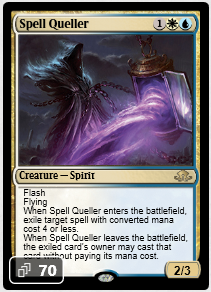
Spell Queller has really bottomed out and now could be a good time to pick this creature up. It feels like a card that will be very important in the Jeskai Control mirror match. It also has pretty clear Modern/Legacy/Vintage playability. Now feels like a great time to take advantage of people snoozing.

There was an error retrieving a chart for Cryptolith Rite

Cryptolith Rite feels like a Doubling Season-type Commander card somewhere down the road. It has fallen out of favor in Standard but the card is still absolutely nuts powerful in the abstract. Now that nobody wants them and is willing to let them go cheap, I'm interested in creating a stockpile of this card for the future.

There was an error retrieving a chart for Rattlechains

Do you know what's really good against big mana sweeper decks like Jeskai Control? Faeries...

Spirits are the new Faeries of Standard. The deck was always good but matched up badly against some of the other popular decks. Perhaps now is the time when it makes a little bit of a comeback? It certainly has the tools to be a deck: Selfless Spirit, Niblis of Frost, Spell Queller, Fevered Visions, etc...

Keeping in mind that Spirits could actually be well positioned at some point in the next few months, I don't mind hedging and targeting some of the key component cards. When Faeries, i.e. Spirits, are good, lots of people want to play it because it is so much fun.

As You Were

Well, tried and true theory applies today just like always. Post-PT you want to move off of all the speculation targets that were high before the PT and pick safer long-term investment cards in return.

Hopefully, you ladies and gentlemen were able to hit a couple of the big movers this weekend! If not, well there is always next time. Try to get out of Kaladesh and into the more stable Innistrad singles while you can!

Good luck at the trade tables. Cheers, Brian

Insider: High Stakes MTGO – Oct 9th to Oct 15th

Are you a Quiet Speculation member?

If not, now is a perfect time to join up! Our powerful tools, breaking-news analysis, and exclusive Discord channel will make sure you stay up to date and ahead of the curve.

Hello and welcome back for another High Stakes MTGO article!

These past two weeks were dedicated to preparing a round of specs, both singles and full sets, and a truckload of quickflips for Pro Tour Kaladesh. As you may have seen in my live portfolio and as you'll read below, things didn't really go as planned, especially for my quickflips. That's part of the game and at least with quickflips when losses occur they are rarely big in terms of percentages.

Besides this, it clearly hasn't been my best three months of MTGO specs. Too many of my most recent specs are performing poorly and several of my older specs took a hit with the Treasure Chest announcement. Although nothing is set in stone, that's still several significant losses to swallow for very few gains to compensate.

Nonetheless I'll keep moving forward and try to refocus my portfolio, probably with fewer positions total to make sure I get a better grasp on all of them. Another way to regain control of my bankroll is to seek a lower profit per position and make sure every tix invested is used for a purpose. This may imply having more free tix on my account if no specs look attractive enough.

In the meantime, let's see what I did this past week. The live portfolio can be found here.

Quickflips This Week

This past weekend I repeated the massive quickflip spec I did two and a half months ago during Pro Tour Eldritch Moon. Unfortunately, the balance didn't end in my favor this time around. As of last Thursday, here are the Kaladesh mythics I had decided to buy:

As usual, this was a mixed basket of just about everything, from near-trash cards to potential Standard staples. The idea is to try to hold anything that can potentially, even remotely, explode during the Pro Tour. Aetherworks Marvel, Torrential Gearhulk and Verdurous Gearhulk were my three big winners. Three out of fifteen should have been enough to generate some profit after selling everything. However it didn't.

A major reason for this unfavorable end was timing. When I turned off my computer late night on Friday, all the winners had significantly raised in price and many losers were still available at a decent price. I thought waiting until early Saturday morning to sell everything would still be okay, and even give me better margins on my winning positions. I was wrong.

By Saturday morning all prices, with the exception of the blue gearhulk, had either stabilized or gone down. Most importantly, many bot chains had replenished their stocks, and selling several playsets at once happened to be even more difficult.

The gains of the winners were not that bad but what ended up costing me a lot were the losses from the losing positions. I was down by about 200 tix. Clearly a disappointing performance, especially considering where prices lay when I left them on Friday night.

In retrospect, a better move would have been to stay up later and start selling the cards that hadn't made a splash at the Pro Tour. That would have started with the junk mythics such as Angel of Invention, and mid-price mythics, including all the planeswalkers.

Buys This Week

soi

Shadows over Innistrad (SOI) is the second large set of the new two-set block structure after Battle for Zendikar (BFZ). The major difference is that SOI doesn't come with a set of Expedition lands or Inventions---this should theoretically make a difference when it comes to total set value. I bought most of my BFZ full sets during Oath of the Gatewatch release events, nowhere near the absolute bottom of BFZ full set prices.

With SOI, I decided to move on full sets now (during the release event of the next large set) and at a much lower price---under 50 tix per set. In addition, now knowing the chaotic price trajectory of BFZ full sets, I'll be looking to sell my SOI sets in the 60-70 tix price range. If the trend observed for BFZ is any guide I would expect this increase in price to occur within six to eight weeks.

cc

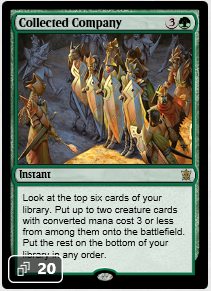
I bought a first round of Collected Company around 5 tix this past week. As the price started to rebound I wanted to wait a little bit to see if it would come closer to 5 tix again. It didn't, and I'm not really willing to buy at a higher price at the moment.

Collected Company and the rest of Dragons of Tarkir may have already reached their post-rotation bottom. It may sound like I'm playing it too safe but I'm okay with only five playsets here. However, I should give a closer look to DTK singles. As a large third set, DTK has a lot of Modern (or other format) playables that could see a decent price increase in the following months.

rs

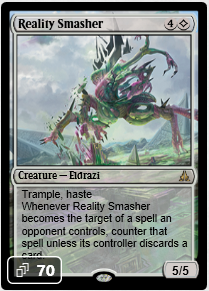
Along with Thought-Knot Seer, Smasher went totally unseen at this Pro Tour, and might well disappear from Standard deck lists. Both cards fit in the rare category of powerhouses in all eternal formats that are nonetheless not good enough in Standard.

I picked up 36 more copies under 2 tix before Pro Tour KLD. As it seems, I won't be able to count on Standard to boost the price of Reality Smasher. With an average buying price of 2.5 tix, it may not be easy to make a profit on this---I'll probably be looking to sell this as soon as possible whenever the price gets closer to 3 tix.

gc

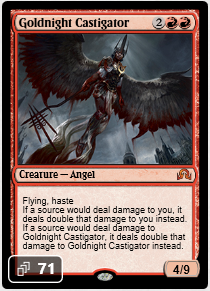
Another ride with Goldnight Castigator. It didn't pay off right away in Pro Tour results, but as long as red has a decent shot in Standard this guy has a chance to spike. It did so two times in the past and I only need it to happen once more, even something moderate like a 2-tix spike.

Sales This Week

Let's be frank, this move was a total bust. Gideon didn't look too good after Day 1 at PT KLD, and as the price was heading down I decided to get rid of my copies. Guess where Gideon's price is today: back at 22 tix where it was last Thursday.

At last a sale that seems well-timed. My only regret is that I was unable to grab more copies. Doubling up on a 7-tix mythic doesn't happen every day. Although B/G Delirium saw a decent amount of play, I would rather sell the Flayer now at 14 tix than wait and gamble for more. Could Grim Flayer reach 20 tix? It's not impossible but I feel like now is a perfect opportunity to cash out.

Despite exceptional stats, Gisela appears unfit for the current Standard metagame. My profit is small here, but I'm satisfied with this spec, considering Gisela might not go anywhere from here. I'd rather sell now with just 28% profit than watch Gisela fall down to 2 tix because she can't find a home in Standard.

This spec never went anywhere, and I can't expect the triple Innistrad flashback drafts to help. Most likely I should have pulled the trigger several months ago, but better late than never. There's probably still a solid tix to lose between Olivia's price now and what it will be after ISD block flashback drafts.

On My Radar

Pro Tours always shake up formats like no other tournament. Often enough, the Standard metagame seen during Pro Tours doesn't represent what the vast majority of players will play subsequently. Following the Grand Prix, SCG tournaments and, most importantly for us, the MTGO metagame, will help us see more definitely which cards deserve a better or worse price.

As it has happened frequently in the past, the Standard metagame could evolve several times before Aether Revolt hits next January. Until then, I'll focus on seizing any good selling opportunity. The key is not to miss an opening, because a spike for a given card may not last long and may only happen once.

With Pro Tour Kaladesh behind us and KLD release events about to end on MTGO, I'm also closely watching how Modern prices will evolve under the price pressure set by the Treasure Chests.

Lastly, I'm currently pondering if and when to get into Magic Origins (ORI) and Dragons of Tarkir (DTK) full sets. These two large sets have fallen under 50 tix for the past two weeks and seem to have found a floor around 46 tix. The paper version of both sets is also slowing down the price drop, so it may be time to jump into another full set spec.

Both ORI and DTK have several casual and competitive cards of interest, which should help support price regains in the paper world in the coming month. With redemption still available for both I would anticipate some price gains for the MTGO version of these sets soon as well.


Thank you for reading,

Sylvain

Deck Overview- Standard Azorius Midrange

Are you a Quiet Speculation member?

If not, now is a perfect time to join up! Our powerful tools, breaking-news analysis, and exclusive Discord channel will make sure you stay up to date and ahead of the curve.

Last week I highlighted an Azorius deck from a Standard league that featured a bunch of Torrential Gearhulk as a deck that could break out at the Pro Tour. Torrential Gearhulk had a great weekend, as did blue and white cards on the whole, though the 9-1 decks from the Pro Tour ended up looking like this:

Azorius Midrange by Steve Hatto

Creatures

4 Thraben Inspector
4 Selfless Spirit
4 Spell Queller
4 Reflector Mage
4 Archangel Avacyn

Spells

2 Skywhaler's Shot
2 Negate
4 Gideon, Ally of Zendikar
4 Smuggler's Copter
3 Stasis Snare

Lands

11 Plains
6 Island
4 Port Town
4 Prairie Stream

Sideboard

1 Island
1 Bruna, the Fading Light
1 Thalia's Lancers
2 Gisela, the Broken Blade
1 Declaration in Stone
1 Immolating Glare
2 Fragmentize
1 Summary Dismissal
2 Void Shatter
1 Dovin Baan
1 Jace, Unraveler of Secrets
1 Ceremonious Rejection

These decks look to follow the old Mike Flores' rule of "play as many of the best cards in the same deck as you can". Even if your exact configuration is wrong, the cards featured here offer a ton of individual abstract power:

I've seen it suggested that the popularity of Aetherworks Marvel likely contributed to this deck's success, as Spell Queller is exactly where you want to be against those decks. They have a lot of answers to spells, but fewer ways to deal with creatures.

My first impression is that these being the only 9-1 decks is more of an indicator of the Pro Tour metagame than of this sort of strategy's place going forward, though the data here most certainly should lead you to put these decks in your gauntlet. These decks have reasonable answers and very solid threats, so it's very hard to imagine that they will ever be objectively bad, and given the diversity of the Top 8 from the Pro Tour I am not expecting that a "best deck" will be discovered at least for a short while.

Insider: My Pessimistic Take on Pro Tour Kaladesh

Are you a Quiet Speculation member?

If not, now is a perfect time to join up! Our powerful tools, breaking-news analysis, and exclusive Discord channel will make sure you stay up to date and ahead of the curve.

For Wizards of the Coast, Pro Tour Kaladesh can be considered nothing less than a success. The Top 8 was filled with diverse strategies spanning combo, control and aggro. While a few cards did show up multiple times, overall there was no clear dominant deck or card that took over the metagame. Fears of a Smuggler's Copter-ridden format were significantly allayed after watching the Pro Tour unfold.

There was an error retrieving a chart for Smuggler's Copter

For the MTG speculator, on the other hand, events did not unfold as favorably. Sure, there were a few cards that made their presence known.

interests

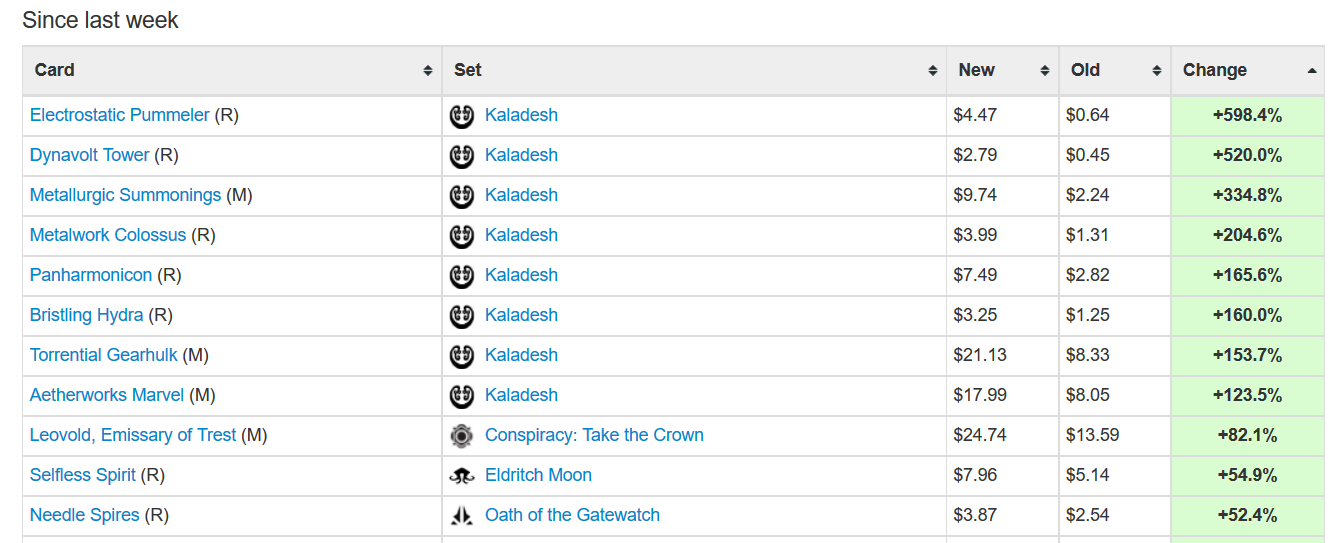
Looking at the movers since last week, there were some clear winners in Kaladesh, with Electrostatic Pummeler notching the largest gain for the week.

But I have an issue with most of these from a financial standpoint. Personally, I don’t think there were nearly as many opportunities to profit from this Pro Tour as there have been in events past. Could this all be a façade for the true future of Standard pricing? Or am I reading too much into things? Well, I’ll share my viewpoint and then you can decide for yourself.

Profits? What Profits?

Pop quiz: when you buy a card for $1.25 and sell for $3.25, what sort of profit can you net? Well if we assume a 10% hit in fees plus a flat $0.80 to cover eBay’s or TCGPlayer’s flat fee and the cost of a stamp, you net about $0.85 in profit for each copy.

I suppose if you’re selling dozens of these at one playset at a time, it could be worth your while. But I’m not sure if flipping Bristling Hydra throughout the Pro Tour weekend would really have been worth your time.

How about something more substantial like Aetherworks Marvel. This card really spiked over the weekend, so folks must have made a killing on it, right?

There was an error retrieving a chart for Aetherworks Marvel

Well, maybe. But those who waited until Friday to make their purchases came to the party far too late (myself included). By the time I saw the card in action on Friday, it was already up to $12 on eBay for the cheapest copies. I quickly grabbed a few with a $25 price target in mind. Sadly, the card didn’t dominate the tournament as I had hoped. Now I’d be lucky to sell copies in the $16 range, netting me virtually nothing in profits after fees and shipping are factored in.

Granted not all of the breakout cards from PT Kaladesh were busts. I’m sure there was someone out there who was all over Dynavolt Tower when it was in the bulk bin. But the reality is unless you bought in before the Pro Tour and had the copies in hand, you’re not likely going to have sufficient growth in card prices to overcome fees and shipping to make your speculation (read: gambling) worthwhile.

The Race to the Bottom

This brings me to my next tension: the inevitable race to the bottom. In other words, now that the Pro Tour is over we’re going to see sellers undercut each other in an attempt to get their copies sold at still-profitable prices. Those Aetherworks Marvels I bought at $12? You better believe as soon as they arrive I’ll be listing them on eBay at five cents below whatever the cheapest price is at that time.

Sitting on spiked Standard cards is poisonous---virtually all cards that showed up in the list above will sell off and be cheaper one week from now than they are today.

In fact, this process has already begun and the Pro Tour isn’t even over yet as I'm writing.

interests2

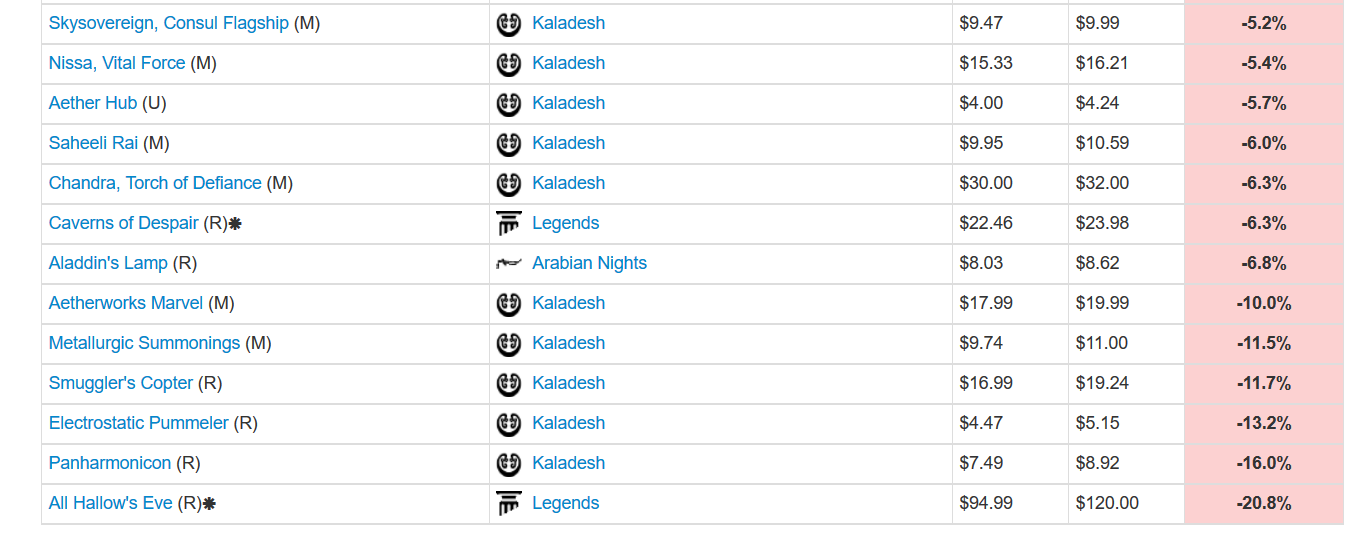
Take a look at Aetherworks Marvel, down 10% already from Saturday to Sunday. And that’s not even the worst performer---Electrostatic Pummeler and Panharmonicon may be critical Standard pieces, but that won’t stop them from massively selling off. The market just can’t support so many cards spiking at once. Speculators have their hands in the pot so extensively that they will singlehandedly manipulate prices upward and then undercut each other right back down again.

And remember, these are TCG Mid prices. This means large vendors can fetch these prices, but if you want to sell your Smuggler's Copters, you’ll have to beat the prices above by 10%. Also, any card on this list that doesn’t win the Pro Tour is likely to sell for 5%-10% less than these prices by the time this article goes live. This is placing a ton of downward pricing pressure on these cards.

We Haven’t Hit Peak Supply

Kaladesh has been on the market now for what? Two or three weeks? We’re not even at peak supply yet! This set will be printed and printed ad nauseam as players draft this set and seek Masterpieces.

As more product is opened, everything on the list above will drop. This is always how prices behave when a new set is released: they start high during pre-orders, fluctuate significantly during the first Pro Tour, and then sell off dramatically (except for the sole couple of cards that really define Standard going forward).

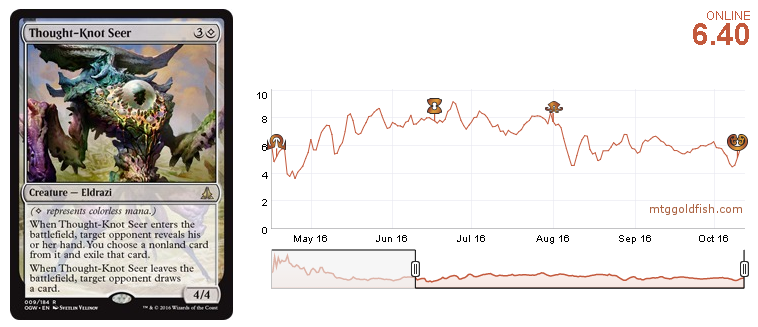
Remember when Thought-Knot Seer was supposed to be the next $20 Standard card because of its utility across multiple formats?

There was an error retrieving a chart for Thought-Knot Seer

That card continues to hit new lows on a weekly basis. Standard cards really struggle to maintain elevated prices and the pressures only increase as a set is opened more and more.

Speaking of increased product opening, don’t forget about those Masterpieces. Battle for Zendikar has exactly two cards valued above $10: Gideon, Ally of Zendikar and Ulamog, the Ceaseless Hunger. That’s it. Two mythic rares worth opening in booster packs and not much else. Talk about an inexpensive Standard. No wonder Wizards of the Coast is calling these Masterpieces a success and are printing more of them going forward. It is making Standard much more accessible.

Now, let’s take a look at how many cards are currently worth double digits in Kaladesh.  By my count there are six, but that number increases to ten if you count cards that are at least a couple quarters away. Here are the big six for now:

  • Aetherworks Marvel
  • Chandra, Torch of Defiance
  • Nissa, Vital Force
  • Smuggler's Copter
  • Torrential Gearhulk
  • Verdurous Gearhulk

That is a huge list compared to Battle for Zendikar. To me, this can only mean one thing: prices still have very far to fall. To me, every single card in Kaladesh is a screaming sell right now.

In fact I’m already regretting my speculative buy of Aetherworks Marvel. I failed to realize that my purchase was essentially a bet that this card would be one of the two most valuable cards in all of Kaladesh. While that may have been possible if there were four or more Marvel decks in the PT Top 8, clearly this can’t be the case now.

There’s simply no room for so many valuable cards to exist within this set. Therefore, everything will drop and it will drop quickly...probably too quickly for folks to make any real profits from their weekend purchases.

Wrapping It Up

Going forward, I think the days of buying Pro Tour standouts on Friday and Saturday to sell mid-week for profit are gone forever. With live casting of the event, rampant speculation, and a cheaper Standard format, there’s just little room for real profits from such an endeavor.

I gave into the hype momentarily on Friday thinking I was still ahead of the curve by buying before the metagame was truly known. But even a Friday evening purchase was far too late. By the time my Aetherworks Marvels arrive in the mail I’ll be lucky to break even. My best out may be a buylist order to someone like Card Kingdom---that 30% trade-in bonus may be enough to keep me from flat-out losing money.

I’m sure others had more success this past Pro Tour than I did. Perhaps they planned better than I did. Perhaps they made their purchases one week earlier. Perhaps they had friends on the Tour who recommended certain pickups.

Whatever the case may be, I can draw one inarguable conclusion: Pro Tour speculation isn’t for me anymore. Prices adjust far too rapidly to make any worthwhile profit given the risks involved. Why expose myself to this kind of volatility when I can sit on something like foil Temple Bell and simply wait for profits to come to me?

There was an error retrieving a chart for Temple Bell

I prefer a slow-and-steady style of investing in my stock portfolio; my MTG investing approach should be no different. The thrill of flipping something over a weekend is always enticing, but I’m developing enough bruises and black eyes from my recent bets that I’m starting to learn fear of Standard speculation altogether. Last weekend’s Pro Tour results only solidify this belief.

Perhaps others had completely opposite experiences this past weekend. I’d be eager to hear if I’m voicing an opinion consistent with the community or completely incongruous. Please share your thoughts in the comments below and let us know how you did.

Perhaps the game is still alive and well and I’m just playing it incorrectly. I’ll accept that. But until I hear a solid strategy with an attractive risk-reward proposition, I’m going to stay away from Standard. I miss the Modern Pro Tours already.

When’s the next Legacy SCG Open again? Eternal Weekend can’t come quickly enough.


Sigbits

  • Did you know that Card Kingdom increased the percentage they pay on played cards? They are now best in class when it comes to high-end played card pricing. For example, Card Kingdom pays $125 on Guardian Beast. But Near Mint copies are tough to come by. Fear not, because they’ll still give you 90%, 80%, and 70% of that buy price for EX, VG, and G copies respectively. Sometimes a collectible card from an older set is difficult to sell if its thoroughly played---now you have a viable out for those played cards.
  • Did you know that Star City Games has aggressive buy pricing on Collector’s Edition and International Edition cards? For example, they pay $40 for CE Chaos Orb and $17.50 for CE Demonic Tutor. For non-tournament legal cards, these are pretty generous prices. My assumption is that Old School Magic drove these prices higher.
  • Did you know that Channel Fireball is still one of the best places to sell Near Mint Alpha rares to? They pay $125 on Deathlace, $125 on Contract from Below, and even $85 on Farmstead. There are collectors out there who truly appreciate a quality Alpha rare, so while these are difficult to come by there is a market for this.

Modern Metagame Breakdown: 9/1/16 – 9/30/16

Are you a Quiet Speculation member?

If not, now is a perfect time to join up! Our powerful tools, breaking-news analysis, and exclusive Discord channel will make sure you stay up to date and ahead of the curve.

Last month we saw three major Modern Grand Prix around the world post a metagame breakdown that mirrored almost exactly the one established in July. Paradoxically, September had both far fewer high-profile events and much more significant shifts in share percentage. I believe these were the result of careful and systematic re-positioning by Modern players, with the intent of preying on the highly predictable environment that had developed. Apropos to some other ideas our writers have been discussing of late, September exhibited the slow-moving metagame cycle particular to Modern. There's a clear pattern of decks shifting to respond to the best decks from last month. As we'll see, some of the targeted decks proved more resilient than others. It was certainly a month of movement.

drowner-of-hope-cropped

The most pronounced change in this vein was the rise of Bant Eldrazi to supplant Jund as top deck. For two months running now, Jund has been the undisputed king of the Modern landscape, beating up on the litany of linear decks surrounding it. In the last metagame report I asked how long Jund's "best deck" status would last---it turns out a 10% metagame share does sort of put a target on your head, and Jund is beatable like anything else. If you wanted to help dethrone the despot without falling prey to the kinds of proactive decks that give RG Tron fits, it appears your best bet was to saddle up alongside the multiverse's noodly nemesis.

[wp_ad_camp_1]

Data Collection Methods

Major events for the month of September consisted of a Star City Games Open in Orlando, an SCG Classic in Richmond, and the World Championship. Of these, the only one with a Day 2 metagame breakdown was SCG Orlando, but the Top 16 from Richmond is included as well.

The World Championship is another story. As split events go this one had comparatively even fewer rounds of Modern than most. But it also sported some of the most prominent members of the pro community at the height of their game. To ignore which decks did well in this field, indeed which decks these elite players even decided to play, seems problematic at best. Rather than give weight to a Top 4 finish when so many rounds were Standard and Booster Draft, I simply included all the 3-1 or better finishes in the Modern portion. Four rounds might not seem like much, but...well, let's just say none of those wins would have come easily in that field of players.

In addition to these major tournaments we add more results from around the globe to arrive at a total of 100 events and 789 decks. MTGO provided results from 29 daily leagues for a total of 296 decks. All of these decks were weighted according to our typical methods and coalesced into the tiers as usual. For more on the specifics of this process, I encourage anyone who hasn't already to read the description on the Top Decks page.

Tier 1

Tier 1 decks are the ones you should expect to face at every Modern tournament. Make sure you show up to your local events and Grand Prix alike with a well thought-out plan to beat these decks—you’re going to face them often, and each one is resilient enough to fight through a lackluster counterplan. Of course another avenue is to pick one of these up yourself, which I generally suggest for anyone not well-versed in a lower-tier deck. Whether you know one of these archetypes inside-out and can tune a killer sideboard for the field, or you want to pick up something new and wing it, these decks certainly have the chops to get the job done.

Tier 1: 9/1/16 - 9/30/16

DeckOverall
Metagame %
Paper %MTGO %
Bant Eldrazi9.2%6.4%5.1%
Burn8.1%8.1%6.1%
Infect7.6%6.5%3.4%
Affinity7.5%6.0%8.4%
Jund6.5%7.7%4.1%
Dredge4.2%2.8%6.8%
Abzan4.0%4.7%4.4%

Tier 1 is a little less populated than the last time we saw it in August, with Merfolk, Death's Shadow Zoo, and Jeskai Control dropping off. Abzan is the newcomer, presumably benefiting from the same factors that favor Jund while beating up on the pseudo-mirror. Other than that it's the same-old linearity-fest we've come to expect. Again, creature combat rules the roost, with combo represented in two hybrid aggro-combo archetypes, Infect and Dredge.

As I've said over much of the last two months, the best response to this amalgam of linear creature strategies is to interact early and often with a fair police-like deck. What has changed this month is merely the specific fair deck that's most favored. The retreat of Death's Shadow and Merfolk is significant too, which I'll discuss further below.

Tier 1 Changes: August to September

Deck% Change
August to September
Overall Meta %
9/1 - 9/30
Overall Meta %
8/1 - 8/31
Bant Eldrazi+2.9%9.2%6.3%
Burn+1.5%8.1%6.6%
Infect+1.7%7.6%5.9%
Affinity+1.0%7.5%6.5%
Jund-3.7%6.5%10.2%
Dredge-0.2%4.2%4.4%
Abzan+0.5%4.0%3.5%

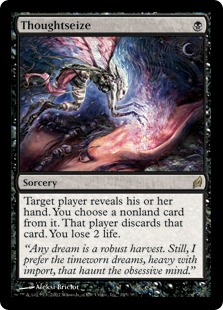
There's a lot to unpack in the percentage changes to Tier 1. The most obvious thing that sticks out is how the rise in Bant Eldrazi roughly equals the drop in Jund. This makes sense if what we saw was Bant Eldrazi pilots capitalizing on Jund's top dog positioning last month, as an uptick in Eldrazi decks should harm the Jund players' chances. Not that the latter doesn't still clock in at a healthy 6.5%---Thoughtseizethis is Modern, folks, and the ol' one-two-three punch of Thoughtseize into Tarmogoyf into Liliana of the Veil isn't going away anytime soon.
Second of all, note that the aggro trilogy of Burn, Infect, and Affinity were on the rise in September. Perhaps they benefited somewhat from Jund's retreat, if we can assume their matchup against Eldrazi is slightly better (which, frankly, I'm entirely ignorant of). Either way, the main decks that ceded ground to these decks, besides Jund, were Jeskai, Merfolk, and Death's Shadow Zoo. Jeskai has been gradually sliding from its standout performances earlier this year, and September was really just one more moment in its decline. What's more interesting is the precipitous drop-off in the latter two decks---by 2.3% and 2.1% respectively.

Along with Dredge, Merfolk and Death's Shadow were the latest darlings of the Modern community, posting two straight months of solid Tier 1 performances. What has happened to make both suddenly fall by more than 2% each to Tier 2? And why hasn't Dredge, the other "unproven" newcomer to the top tier, suffered the same fate?

A Cycling Metagame

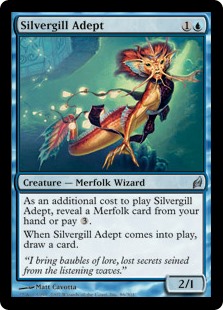
There are two conclusions I'm inclined to draw from these data. First of all, I think they cement the narrative that Modern is in a predictable environment that can be effectively gamed (to the extent that's possible). Moderners looked through the Tier 1 decks which were well established and asked themselves which ones were best against the top-tier field. silvergill-adeptThose who identified the trends correctly were rewarded with many favorable matchups, while those who stuck by their Death's Shadows or fish armies struggled to fight through the increase in bad matchups. The numbers of "predictable" opponents were large enough to compensate for the "random deck pairing" phenomenon we know so well.
So why did those two decks fail while other linear standouts Burn, Infect, and Affinity succeeded? Well, it's no coincidence that these are the decks we see in Tier 1 virtually every month throughout our data set. They're simply the best, most resilient aggro decks out there, and metagaming against them proves tougher.

With Death's Shadow Zoo you can add more spot removal, learn to stop tapping out, or attack their precarious life total. Whereas against Affinity you might die to their explosive nonsense after gleefully casting your do-nothing 1W enchantment a turn too late. That isn't to say Death's Shadow is bad---two months of Tier 1 standings beg to differ---but that it's easier to target with hate. It appeared that players were able to beat back the onslaught of Death's Shadow and Merfolk by coming prepared.

Dredging Up Misery

While it's no surprise that our three perennial aggro decks weathered the storm, Dredge is the more interesting case. This is now the third month in a row it's posting Tier 1 results, and it's becoming harder and harder to claim people just aren't prepared.
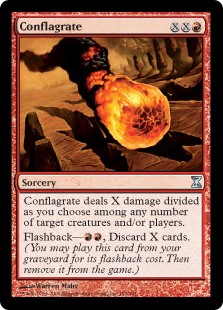
ConflagratePersonally, I've long felt the deck is bordering on broken, after having faced it just a few times in MTGO queues. I remember that feeling of abject despair upon seeing them flip over yet another Conflagrate against my board of mono x/1 infecters, when I was fresh out of Spell Pierce. I've since revised my Infect list to be faster and seen better results in that matchup, but that feeling of "Holy crap, what on Earth is happening," has stuck with me. On the other hand, I never felt that way watching Death's Shadow Zoo cast a lethal Temur Battle Rage. That deck always seemed to be one Path to Exile away from disaster, and while Rest in Peace is obviously going to be great against Dredge, that's not a card people can just jam in maindecks.

I think what happened is that Shadows over Innistrad block finally gave Dredge the tools it needed to reach that critical threshold of synergy and resilience that characterize the best of the best in Modern. That's just my intuitive conclusion, mind you, based on watching the deck play out. This is the kind of thing we'll have to revisit in a half-year or so, after we've given the anti-Dredge players (let's be honest, the heroes) more time to figure out how to defeat it.

Tier 2

Tier 2 decks are not as omnipresent as the Tier 1 crop, but they still show up in hearty numbers at the typical tournament. In many ways this tier is the lifeblood of Modern, whence its diversity and “play anything” reputation stems. If these decks aren’t dominating at the moment, they’re still capable of crushing a tournament on any given day—and most of them have been Tier 1 at some point in the past or will in the future. The better acquainted you are with any one of these archetypes, the better choice it represents, and if one of them is your specialty there’s a strong argument to stay the course and keep sleeving it up.

As for preparing to beat Tier 2 decks, you don’t need to dedicate specific sideboard space or do backflips to make your matchups favorable, but at minimum have a plan. You won’t face all of these decks in a tournament, but you’re all but certain to face at least some of them. Welcome to Modern!

Tier 2: 9/1/16 - 9/30/16

DeckOverall
Metagame %
Paper %MTGO %
RG Tron3.5%2.6%2.0%
Titan Breach3.4%4.3%3.4%
Jeskai Control3.0%2.6%3.4%
Merfolk2.6%2.9%1.0%
Ad Nauseam2.1%3.1%3.4%
Abzan Company/Evolution2.0%2.6%1.0%
Death and Taxes/Hatebears1.8%1.7%5.8%
Grixis Delver1.8%2.4%0.0%
Death's Shadow Zoo1.7%2.1%4.7%
Titan Shift1.6%2.1%3.4%
Bushwhacker Zoo1.5%1.4%0.7%

I already mentioned above how Merfolk, Jeskai Control, and Death's Shadow Zoo have slid down to Tier 2. Other than that there aren't a ton of major developments. We see RG Tron gain almost half a percent, while Ad Nauseam, Abzan Company, and Death and Taxes dipped slightly. As is typical in these monthly updates, some decks fell down to Tier 3 (Elves, Kiki Chord) to be supplanted by other archetypes on the rise (Bushwhacker Zoo). None of this should come as much of a shock, nor should the barrier between Tier 2 and Tier 3 be seen as etched in stone. That said, while Elves and Bushwhacker Zoo (we've called it Gruul Zoo in past updates) have always skirted the line between Tier 2 and Tier 3, the dropping off of Kiki Chord is more notable.

Valakut Further Defined

One major change does stick out in the Tier 2 standings, which was the 1.2% gain in Titan Breach's shares. Note that I've reported the red-green Valakut strategies as two separate archetypes again this month, with Titan Shift coming in on its own at 1.6% of the metagame. If you lump these two archetypes together (I believe they should be separate---we'll get to that below) they easily form a Tier 1 deck. Primeval titanThat is to say, if the exact build of RG Valakut is still up in the air, it clearly represents a potent way to attack the current Modern metagame. This is yet another reason we may be seeing Jund stumble a bit, as it's generally unfavored versus the goldfishy Valakut strategies. I wouldn't recommend showing up to any Modern tournaments without a plan for this type of deck.
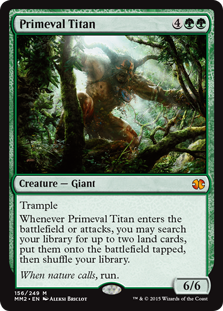
And what, exactly, are the differences in the two shells? In past metagame updates I've alluded to my intention to roll both archetypes into one, which I've called RG Valakut. This was a response to a wide variety of differing builds that were often hard to classify into one or the other camp. That seems to have fallen be the wayside as Valakut players have elected to maximize one of two supplemental game plans: Through the Breach or Scapeshift. As the gradations between the two archetypes are less fluid, I think it makes sense to call them different archetypes. Much like with Jund vs. Abzan, or Kiki Chord vs. Abzan Company, however, players of opposing decks may see fit to tune their lists in a similar way to beat them.

In any case, I think it's interesting to track them separately so we can see which of the two builds is outperforming the other. For now it appears that Titan Breach is getting the nod. These lists will occasionally sport a one-of Scapeshift, but for the most part that card is absent. The Emrakul, the Aeons Torn plan is sometimes buttressed by copies of Summoning Trap (a piece of tech I thought we'd seen the last of), but much more commonly with a white splash for Nahiri, the Harbinger.

Chord and Company Decks

Chord/Company strategies seem to be on a downturn overall, with Kiki Chord dropping to Tier 3 and Abzan Company continuing to slide. We're in a period of experimentation with these archetypes surrounding the newly printed Eldritch Evolution. archangel-of-thuneIt has largely taken over in the Kiki Chord world, appearing as a four-of nearly universally in every list. The jury seems out when it comes to Abzan-colored shells, however---some pilots are making use of Eldritch Evolution alongside Collected Company, while others augment it with Chord of Calling. Other yet are sticking to the classic builds with Chord plus Company, although those builds seem to be getting rarer. As these decks seem to bleed into one another I've reported them together under the moniker, "Abzan Company/Evolution."
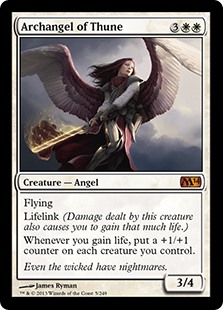
We're also seeing some disagreement with respect to the kill combo of choice. Initially the Evolution decks were leaning towards the Archangel of Thune/Spike Feeder kill while Company lists stuck with Melira. More recently the lines have begun to blur. I'm not sure why one tutor package would favor a certain kill over another, and sifting through the data I can't tell where things will ultimately fall---perhaps some Abzan Company players can shed light on this phenomenon in the comments.

Tier 3

Tier 3 in Modern houses the decks with fringe potential, or those which are simply in a poor position in the current metagame. These decks range from relatively strong decks with scant adoption in the player base, to fragile decks that crumble to variance while mainstays like Burn or Jund draw consistently round after round. That said, Modern draws from an absurd well of card power, and each of these decks can give you a run for your money. You don’t need perfect knowledge of everything they’re doing, but the difference between familiarity and complete ignorance can definitely determine the outcome of a match.

Playing these decks isn’t advised, unless you know them inside-out or have some specific reason why you think they’re underrepresented. Of course, they are also worth a look as fun decks to battle if you’re less concerned about winning and want to delve into the deeper end of the Modern pool.

Tier 3: 9/1/16 - 9/30/16

DeckOverall
Metagame %
Paper %MTGO %
UW Control1.4%1.6%2.0%
Bogles1.3%1.0%0.7%
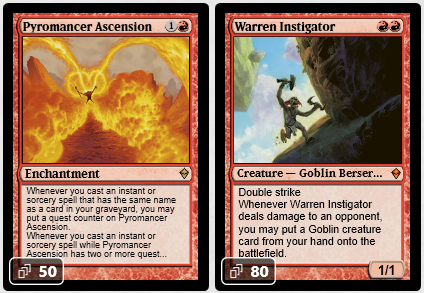
Pyromancer Ascension1.2%1.1%2.7%
Elves1.2%0.9%2.4%
Griselbrand1.2%1.1%0.7%
Kiki Chord1.2%1.8%0.0%
Scapeshift1.0%1.4%2.4%
Living End1.0%1.5%1.7%
Mono U Tron1.0%1.0%1.7%
Mardu Control/Midrange0.9%1.0%1.0%
Jeskai Ascendancy0.7%0.9%1.7%
Knightfall0.7%0.9%0.3%
RW Prison0.6%0.4%1.4%
Temur Midrange0.6%0.3%0.0%
Amulet Titan0.5%0.8%1.0%
Grixis Control/Midrange0.4%0.4%1.4%
Soul Sisters0.4%0.4%1.4%
8Rack0.4%0.3%0.0%
UR Prowess0.3%0.0%2.0%

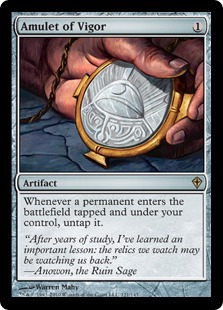
You'll note our Tier 3 in the month of September has ballooned, most likely a function of the lower number of major events. In any case we can still draw a rough line between the 1%-plus archetypes (beginning approximately with Mardu Control/Midrange), and the true dregs which may well represent outliers in the data. amulet of vigorTake that bottom half of this tier with a grain of salt---if some decks like Knightfall, Grixis Control/Midrange, and Soul Sisters have been kicking it in Tier 3 for a few months, others like 8Rack and Temur Midrange are punching above their traditional weight class, and may be slated for a demotion next month.
There are a few notable stories here, though. First of all, we see Pyromancer Ascension double its share for the second month in a row. It's now 1.2% of the metagame, occupying a solid spot I expect it to hold. Griselbrand did something similar last month and it's still hanging around. I also think it's interesting to see Jesaki Asecendancy suddenly pop up on the tierings, especially since it had no major finishes. MTGO players are picking up this deck of late---perhaps with the drop in Jund the combo is better positioned?

Finally, another deck to watch is Amulet Titan. After its crippling loss of Summer Bloom last year, this archetype came back on the radar in August with Matt Nass's deck tech. Since then it appears other pilots have begun tweaking Amulet Titan anew, putting up results here and there on MTGO. The Bloomless versions are still pretty new, and I have no reason to presume the best build has been found yet. It will be interesting to see if the deck can reclaim any part of the metagame in its fairer post-ban version.

Conclusion

That's it for me this update---I'll keep the conclusion short and sweet. Anything you notice in the data I've passed over or missed? Does my narrative about metagame positioning in a relatively known field make sense? Let us know in the comments, and thanks for reading.


Insider: Pitfalls of Investing in the Reserved List

Are you a Quiet Speculation member?

If not, now is a perfect time to join up! Our powerful tools, breaking-news analysis, and exclusive Discord channel will make sure you stay up to date and ahead of the curve.

I see many people tout the virtues of Reserved List (RL) cards. It always seems as if anything could spike next and with the limited supply of RL cards there is a lot of money to be made. Or is there? Today I want to look at the pros and cons of investing in RL cards---mostly, however, the cons, as I feel many people overlook or underestimate those.

Pros of Reserved List Investing

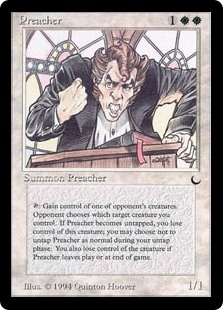
preacherAs many have spoken about this I will summarize the main points:
  • There is a finite supply of RL cards; for some the numbers are known.
  • Wizards has promised us that they will never reprint these cards in functionally identical form.
  • The newest of these cards were printed in 1999.
  • The playerbase was much smaller when these were printed.
  • There has been plenty of time for these cards to get lost to natural causes.
  • The top RL cards have shown consistent growth over many years.
  • Every now and then a new RL card makes it big.

These are good points and I am not going to tell you that there is absolutely no merit to investing in RL cards. I hold quite a few RL cards myself and I know they are a safe investment that I can hold for many years. However, that's largely the collector in me speaking, as to a trader there is no gain to just owning cards. As a trader I certainly appreciate these factors, but there are also other things to consider.

Cons of Reserved List Investing

Rarity vs. Demand

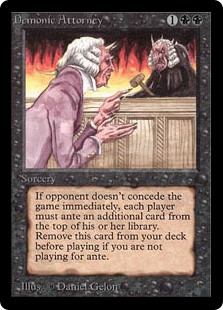
demonic-attorneyObviously there are people who like these older cards. The question to ask is how common they are when compared to the number of copies printed.
An Alpha rare? Sure, I believe there are probably enough people to create demand for all 1100 copies (even if everything has been reprinted). A Legends rare? Sure, 19,500 copies can probably find a home somewhere, though it may be hard for the weirder ones. A Revised rare? Hmm, now things start becoming more interesting. I can certainly see demand for 289,000 copies of a dual, but can we really find a place for just as many Veteran Bodyguards? As its price illustrates: no, we can't.

Lets try to get a feeling for the kind of demand needed for an equilibrium for the sets we know the numbers of. Be aware: Stephen D'Angelo, who originally put these numbers together on Crystal Keep, included a relevant disclaimer at the beginning of his post. These numbers may be the most reliable we have but they are not guaranteed to be accurate.

Based on these numbers, and Wizards' statement that there were around 20 million Magic players and fans in 2014, we can calculate how common or rare the person must be who wants a copy of a card. Demand significantly higher than available copies makes a card sellable, whereas significantly less demand likely mean you'll be stuck with a card for some time.

We'll compare these to that 20 million number as it's often quoted. I'll list a number for both playsets and singles, as different cards are likely to be demanded in different numbers.

Set Name Volume
(Rares)
Demand
(Playset)
Demand
(Singles)
Alpha 1100 1 in 72727 1 in 18182
Beta 3200 1 in 25000 1 in 6250
Unlimited 18500 1 in 4324 1 in 1081
Revised 289000 1 in 277 1 in 69
Arabian Nights 20500 1 in 3902 1 in 976
Antiquities 31000 1 in 2581 1 in 645
Legends 19500 1 in 4103 1 in 1026
The Dark 128000 1 in 625 1 in 156
Fallen Empires 744000 1 in 108 1 in 27


For an Alpha card, we can see that you need very few people to want it at a given price. On the other hand, you probably know at least 27 Magic players; what is the likelihood that at least one of them is interested in some random Fallen Empires card that's usually played as a single copy?

At the time these sets were printed there were actually very few players compared to today. We know that Fallen Empires was overprinted for its time, and was an unpopular set to boot, but I've never seen Revised referred to as such. (In fact, the destruction of Summer Edition is said to have led to a Revised shortage in '94).

Given playerbase growth I don't think it would be out of the question for later RL cards to have a print run closer to or beyond the Fallen Empires numbers in order to line up with the bigger playerbase of their time. I was able to find some numbers estimating the size of the playerbase by year here, though no references are given. Unfortunately it doesn't go back far enough for our needs, but my gut feeling would be that by the time Fallen Empires was printed it was still well under the 5 million suggested for 1997-1998.

Another way to look at it is to compare the playerbase numbers as print runs should roughly align with the number of players. 5 million players suggests that rares back then were printed for a playerbase 25% the size of the current playerbase, and thus are about four times as rare as they should be if they were printed now. Of course Wizards changed the rarities, but as a rough estimate this should still work.

Finding a Target Audience

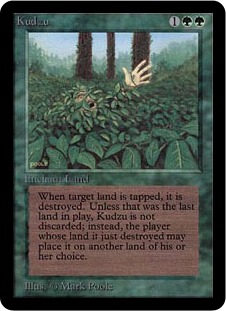
kudzuI'm sure that if you ask the regulars at your local game store about duals or Power 9, quite a few will know what they are. How many of them do you think could tell you what a Damping Field, Frankenstein's Monster or Kudzu does?
Unfortunately there are far more unexciting RL cards than there are gems---the same is true for the sets these cards are from in general. As such, very few players who started well after Urza's Destiny (the cutoff for the RL list) ever looked into these cards.

I see many players these days just skip over anything in trade binders with old borders. To move this stuff you need people who were around at this time, or who have extensively researched older cards, because people just aren't going to read every card they see in a binder.

This would likely include other traders, who go after these cards for the same reasons you do. Otherwise you need people who have been around for some time, or who have tried hard at catching up. Other traders will be looking for a deal, and the old-timers have had many years to pick up the cards they want. So your audience is comprised mostly of the third group, the players trying to catch up. How many of these do you think are around?

As a card's price grows, fewer people will want it at that price. On the other hand, if its playability has increased that may push up demand even at the higher price. The rarity of the cards helps, but, as illustrated, probably not all that much unless you're considering really old cards. It may be very hard to find that person who would buy it at the new price, even if on paper you have made pretty significant gains.

You may of course trade to other traders, which is basically applying the "greater fool theory," but in that case you're playing a game of hot potato and the prices lose touch with reality altogether. You could count on selling to a shop and make it their problem, but you usually need a very big price jump for their buylist price to get above what you bought in for.

Patience Required

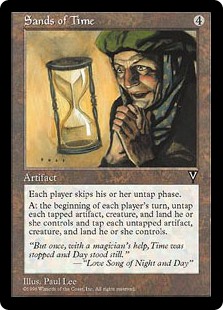
sands-of-timeThe RL covers the entire range of Magic card quality, from utter crap to the most precious gems. As so many years have passed already, most gems have been found by now, barring an RL card that becomes better with a newly printed combo. The latter is a crap-shoot at best---you could buy a whole lot of different cards and hope something happens, but you're still out for the cost of everything that doesn't spike. The former cards already see heavy trade and high prices. They could indeed go higher, and likely will over time, but do you have the patience to wait for that?
Ideally, you would be able to predict the sort of card Wizards might print that breaks something, and estimate the likelihood of that happening. Unfortunately, you're not alone, so even cards with potential already have an above-average price due to other people figuring out their potential too. At this point we're basically left with the dregs or with already-expensive cards that may not see the percentage gains of your dreams.

There is still money to be made, but realize that few cards are left that could make the amazing jumps we have seen in the past. Put differently: if it was going to jump it likely already would have.

You can go two ways. If you invest in dregs you hope that the few that jump pay for the rest. If you invest in gems you count on them rising further, either steadily or through a spike if something new makes them even better. Neither is ideal as the jump of the dregs may never come or it may be too small, while the gems require a much more substantial investment and the average gains per period are probably not too exciting.

If you tend to do long-term investing (on the order of years), both could work as they are low-maintenance and you just wait until whenever they reach your target. But if you like to work on a shorter time frame (weeks to months) you probably only want to look for spike situations when shops are lagging behind, and then flip immediately.

Final Words

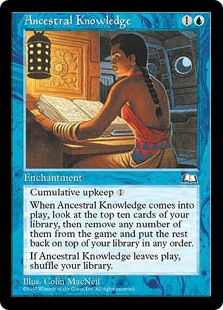
ancestral-knowledgePersonally, I like long-term investing; I am happy to accept that it may take years before an investment pays out. I just don't have the time to keep up with the volatility of newer cards.
I know that I may have a hard time finding someone to sell to, but I have the patience to wait for them to show up. I also tend to get most cards like this by buying collections---those deals tend to be good enough to get my money out of other cards, while I hold the RL cards for future gains.

So the Reserved List can still present value to speculators, but it's not for everyone. Depending on your goals with Magic finance and your resources, both in time and money, it may be a more or less promising venture.

High Stakes MTGO – Oct 2nd to Oct 8th

Are you a Quiet Speculation member?

If not, now is a perfect time to join up! Our powerful tools, breaking-news analysis, and exclusive Discord channel will make sure you stay up to date and ahead of the curve.

Hello and welcome back to another week of High Stakes MTGO!

Times are definitively rough for speculators, and for my portfolio more specifically. The changes announced two weeks ago, mainly affecting Modern at this time, combined with the usual price depreciation observed during the release of a new set, are putting my bankroll and overall speculative decisions to the test.

As judged by the Modern Staples price index, format prices have collectively dropped by about 15%. Depending on what's in your portfolio, you may have even lost more than that. Some prices are stabilizing, but different cards have completely different price trajectories.

Looking at the Treasure Chest curated card list, some cards are still losing value, such as Cavern of Souls, Horizon Canopy and Blood Moon. Others, such as Liliana of the Veil, Tarmogoyf and Creeping Tar Pit, seem to have stabilized. A third category of staples, including Inkmoth Nexus, Twilight Mire and Kataki, War's Wage, have already markedly rebounded or appear not to have reacted at all to the announcement.

More Modern flashback drafts are to come after Kaladesh (KLD) release events; Innistrad block is next. If a week of triple Avacyn Restored was not just a month away, I would be very tempted to grab a few copies of Cavern of Souls. This land is such a pillar in Modern and Legacy and certainly doesn't deserve the abrupt drop of roughly 50% that just happened in the past two weeks.

In all this chaos, Standard may be where the salvation begins. With the emergence of a new Standard environment prices are also shaping up. Many cards saw a temporary dip last week as the KLD prerelease events fired, but almost everything is now rebounding. Will we finally see Battle for Zendikar singles and full sets go up? Will Crush of Tentacles be more expensive than Chandra, Flamecaller by the end of this week?

With all this turmoil, my most recent decisions have been to cut down losses and salvage what I can from losing positions. As bad as things might be, this period of the year is still big in buying opportunities, in Standard especially—I want to have more cash available as Pro Tour Kaladesh lines up.

Let's review my moves this past week. The latest snapshot of the portfolio is here.

Buys This Week

emn

Two more Eldritch Moon (EMN) full sets purchased this past week. With the fresh tix generated from my sales, I'm likely to add a few more playsets again this week—hopefully right in time for a general price hike in the wake of Pro Tour Kaladesh.

My most recent full-set specs were rather under-performing to say the least, and I'll try to be more conservative about expectations this time around. Several EMN rares and mythics have the potential to explode, but isn't that the case with about every set? Overall I'm targeting a price in the 110 to 120 tix range.

sq

I reloaded on 46 more copies at an average price of 2.08 tix. Not the best price since Spell Queller hit 1.5 tix at the end of this past week, but its price has already rebounded to 2.5 tix. Currently, this Spirit seems to have better prospects in Modern than in Standard. I hope this changes soon to push Spell Queller closer to 4 tix, which would be a decent selling price for me.

zen

Two of the many Modern cards that took a hit right after the announcement of the Treasure Chest curated list. I thought my stocks with these guys could easily support more copies, and I'm still convinced that the impact of the Treasure Chests is exaggerated. I guess we'll see in few months if doubling down with these two cards was a good idea or not.

nph

Less than a month ago, New Phyrexia was the most expensive set on MTGO. Then in the same week the set got flashback-drafted and the Treasure Chests were announced.

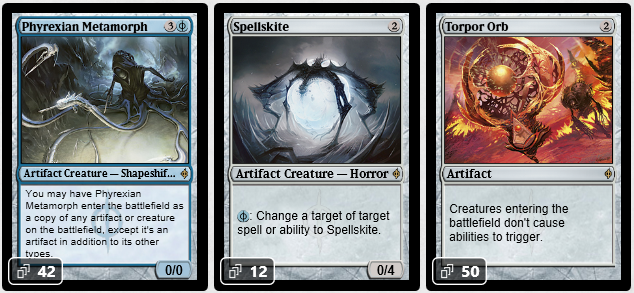
Torpor Orb and Phyrexian Metamorph are no Modern superstars but have shown great potential in the past, and I like them for this exact reason. Since they are not the usual Modern contenders, I would expect their current bottom to be fairly solid, while they could triple or quadruple if they become popular again.

Spellskite is definitely of another caliber. This artifact creature is played in many different decks in Modern and I'm expecting a rebound, although a moderate one, rapidly.

Sales This Week

I bought this card following Time Spiral flashback drafts. The Rack probably got a little boost recently with Tom Ross piloting 8-Rack to a seventh-place finish at the SCG Orlando Modern Open last month. A 40% profit is not something I'm going to neglect in this time of skinny cows, especially since I have a few new targets in mind at the moment.

ktklog

Khans of Tarkir (KTK) is simply not redeemable anymore. That doesn't help my KTK full-set spec, which already wasn't doing any wonders. With virtually nothing to expect from these in any foreseeable future I would rather take the loss and reinvest the tix now.

I still own a lot of fetchlands and haven't sold them yet. I'm hoping they can do better than the set as a whole. The only positive thing here is that a handful of Modern-playable cards, including Anafenza, the Foremost, Sorin, Solemn Visitor, the fetchlands, and Siege Rhino, will hit their absolute bottom soon.

bfzlog

Not all hope is lost for Battle for Zendikar sets as few mythics and several rares are rebounding a bit at this time. Nevertheless, I decided to let a few sets go to free up some tix before Pro Tour Kaladesh. Will we be able to break even with BFZ full sets? I'm not even counting on that, to be honest.

On My Radar

Does it surprise you to hear that Pro Tour Kaladesh is the one thing I'll be paying attention to this weekend? More precisely, I'll try to take full advantage of the Pro Tour hype by selling winning positions and attempting some quickflips.

Once again, paying attention to underdogs and cards not well covered at the Pro Tour could lead to interesting buying opportunities. During Pro Tour EMN, Pedro Carvalho piloted a U/R Thermo-Alchemist deck to a strong finish in Standard, notably causing Goldnight Castigator to jump from 0.8 tix to 4 tix in about a week. What will be the next Castigator? Or why not Castigator itself, since this Shadows over Innistrad (SOI) mythic is again under 1 ticket these days?

Although they won't necessarily rise next week exactly, I'll be watching the evolution of my EMN full sets. Oath of the Gatewatch full sets rose fairly quickly right after Pro Tour SOI and the bulk of the price hike happened in less than a month.


Thank you for reading,

Sylvain

Learning from Failure: Analyzing Defunct Brews

Are you a Quiet Speculation member?

If not, now is a perfect time to join up! Our powerful tools, breaking-news analysis, and exclusive Discord channel will make sure you stay up to date and ahead of the curve.

Every spoiler season, you can catch me looking over the new cards and imagining how they line up in Modern. "I wonder if this card could work?" Invariably, I'll make a bunch of lists and bring them to battle on Cockatrice. I lose. I fix the list. I lose some more. After a full day of losing, I've gotten my answer: a predictable "no." But I've also gained something more valuable: the reason why. When someone at my local game store asks me what I think of X impressive spoiler card, I can tell them not just my opinion, but the reasons it doesn't work in Modern. Or the reasons it does, and why I'm excited about it!

bubbling-cauldron-art-crop

Many players in my entourage consider me the group's brewer. But brewing isn't some grandiose activity. Everyone I know brews in some capacity, even if they're just looking at spoilers and thinking about how cards interact with the format. And even brewers have their bad days. In fact, I'd argue that for every successful brew, a deckbuilder has drafted ten or more heaps of garbage.

This article takes out that trash by looking over two of my recent concoctions that didn't work out and examining their downfalls.

[wp_ad_camp_1]

Getting in the Mantis Spirit

Remember my old pump-backed Mantis Rider decks from the days of yore? A certain 2/3 from Eldritch Moon certainly does...

Honor Queller, by Jordan Boisvert

Creatures

4 Spell Queller
4 Mantis Rider
4 Snapcaster Mage
3 Lightning Angel

Enchantments

4 Honor of the Pure

Instants

4 Lightning Bolt
4 Path to Exile
2 Remand
2 Spell Snare

Sorceries

4 Serum Visions
2 Gitaxian Probe

Lands

4 Flooded Strand
4 Scalding Tarn
3 Arid Mesa
2 Steam Vents
1 Hallowed Fountain
1 Sacred Foundry
2 Celestial Colonnade
2 Seachrome Coast
2 Island
1 Plains
1 Mountain

Sideboard

3 Timely Reinforcements
2 Blood Moon
2 Negate
2 Pyroclasm
2 Rest in Peace
2 Wear // Tear
2 Dispel

The Idea

Mantis Rider is a pet card of mine, and in my opinion exemplifies the Modern "Bolt Test." Unlike other three-mana, three-toughness creatures that don't cast spells (Vampire Nighthawk is the big one), Rider really rides the line, perpetually on the cusp of Modern playability. After all, it does kind of cast Lava Spike. We've actually seen Rider decks pop up over the last two years, from Jeskai Haste (which this deck is modeled after) to Jeskai Prowess, to 5-Color Ziggurat Aggro.

This deck is something I whipped up when Spell Queller started to gain some traction in Modern. I'd already experimented with Mantis Rider in Modern, compensating for his weakness with body-buffing enchantments and Mutagenic Growth. Queller can be saved in the same way, leading me to try putting the two in one shell.

The Implementation

Adding Spell Queller made me think I could cut back on threats, but I found myself frequently wanting Lightning Angel in the list. I eventually settled on two, but can see cutting one for another piece of interaction now.

honor of the pureI actually started with Disrupting Shoal in this list before transitioning to a more diverse counter package. The Shoals were much too slow for my liking. Since this deck boasts no acceleration and counts on casting three-mana creatures to win, it must be able to interact during the game's early turns. Remand and Spell Snare do just that, complimenting Path and Bolt as additional answers whose diversity is rewarded by Snapcaster Mage and Serum Visions.
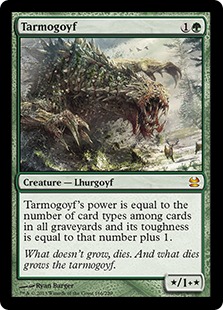
Nixing Shoal also lets us run Honor of the Pure over Favorable Winds. This switch has a negligible impact for Game 1, but turns Timely Reinforcements from the sideboard into a three-mana Siege Rhino. The upgrade is significant enough to run three copies of Timely in the board, since we can bring it in for a plethora of matchups once it becomes stronger.

Gitaxian Probe smooths out our early turns, gives us a reason to cast Snapcaster on turn two if we don't have anything else to do, and grants us crucial information for when we don't have an Honor. Casting Mantis Rider right into a Lightning Bolt is about as terrible as it sounds, and having a Probe to make sure the coast is clear can win games.

Why It Failed

Honor Queller has the same problem as its Mantis-Riding forefathers: it's a little too cute. Mantis Rider is not a playable Modern card in its own right. We have to jump through hoops to make it good. Casting, resolving, and sticking a two-mana enchantment that doesn't impact the board on its own might be too high a hoop to jump through, though.

Even if we land the Honor, there's no guarantee we have Rider or Queller waiting in the wings. And even if we do, opponents might already be en route to a victory of their own, something a turn-three Queller won't do much to halt. And there's the possibility our opponent doesn't even play Lightning Bolt, invalidating our need for Honor altogether and giving us four functional blanks where we'd much prefer relevant interaction.

Our primary gameplan of enchantment into three-drop also isn't that consistent. Curving Bolt into Honor into Queller is great, but it realistically doesn't happen that often. Besides, that plan leaves a whole turn---the all-important turn two, no less---for opponents to resolve Tarmogoyf, Cranial Plating, or any number of other nasty spells scot-free. Serum Visions helps with this issue by setting up our future turns, but we have a three-drop and no Honor pretty often. Because of the cuteness issue, it would be unwise to load up on more Honor effects than we already play.

Fixing the Deck

The simplest way to fix this deck is with a dramatic overhaul. For one, I think we should abandon Honor effects and go back to Mutagenic Growth. Honor effects pump our whole team, but they limit us to playing a very specific set of creatures.

Next, we should play creatures that already pass the Bolt test but which also benefit from Mutagenic Growth. Guides and Swiftspears would do a great job of complimenting Mantis Rider in that kind of shell. Unfortunately, that doesn't leave much space for Queller. I think the Spirit is best relegated to the sideboard in a strategy that aggressive.

Lhurgoyfs in Burn

One of my longstanding Modern projects is to grow huge Goyfs in aggressive Gruul shells. When Bomat Courier was spoiled in Kaladesh, my interest in this strategy was piqued again.

Goyf Sligh, by Jordan Boisvert

Creatures

4 Goblin Guide
4 Monastery Swiftspear
4 Bomat Courier
4 Tarmogoyf
4 Eidolon of the Great Revel

Instants

4 Lightning Bolt
2 Searing Blaze
2 Tarfire
4 Atarka's Command

Sorceries

4 Rift Bolt
4 Lava Spike

Lands

4 Copperline Gorge
1 Wooded Foothills
4 Mountain
3 Stomping Ground
4 Scalding Tarn
4 Arid Mesa

Sideboard

2 Searing Blaze
4 Destructive Revelry
2 Ghor-Clan Rampager
2 Mutagenic Growth
2 Feed the Clan
3 Molten Rain

The Idea

Goyf Sligh is a creature-heavy Burn deck that insures its fragile one-drops with a set of Tarmogoyf. The deck has roots in Legacy, where it was first created shortly after Tarmogoyf proved his competitive worth and clawed his way out of bulk boxes across the world.

If Modern is defined by one card, it's Lightning Bolt. 40% of the format's decks play a set, putting tons of pressure on creatures with less than four toughness to perform. Goblin Guide, Monastery Swiftspear, and Wild Nacatl are all obvious targets for a main phase Bolt, and chasing them with Tarmogoyf ensures a bad time for most decks looking to interact.

Tarmogoyf cardGoyf Sligh's most impressive feature is its mana curve. Given the deck's high density of one-drops, it frequently leads on a creature and can follow up with two more, one creature and a removal spell, or a Tarmogoyf should the first attacker die on sight. Eidolon of the Great Revel aids this plan greatly. Slamming Eidolon after sticking a Guide or Swiftspear puts opponents in a very tight spot, drawing removal away from potentially superior combat creatures while taxing them life.
Eidolon has another benefit in this shell---he grows Tarmogoyf! Since Eidolon is an enchantment, he helps bring Goyf to the mighty 5/6 level, which is large enough to trounce most creatures in Modern. Goyf Sligh fortunately has enough space to run a couple Tarfires, maxing the beater out at 6/7. Early-game Goyfs are usually 3/4 in Modern and already nothing to sneeze at; Goyf Sligh's late-game Goyfs are essentially two of them.

The idea with Bomat Courier was to have another one-drop to compliment Guide and Swiftspear without going off-color by dipping into white for Wild Nacatl. Courier would pressure opponents from a unique angle, threatening to refill us on cards once we spent them all (an easy task in this deck) and forcing them into awkward spots with their removal. Shooting Bomat Courier isn't too appealing when the Construct can just pop itself in response and draw its controller three cards.

The Implementation

This build maxes out on key pieces and sprinkles in some second-tier Burn options to fill out its bulk. Cheaper Burn staples like Lava Spike and Rift Bolt are integral to the strategy, since they empty our hand quickly for Bomat Courier. Tarfires in excess of one are generally pretty bad, so we max them out at two. Searing Blaze also earns a couple of slots. In the matchups we want it for, it's our best card, but it can be dead in others.

Atarkas CommandAtarka's Command is the best burn spell in the deck. With so many creatures, Command often deals more than four damage, which is a terrific rate for two mana. It also protects Swiftspear from Lightning Bolt, and Guide and Eidolon from Pyroclasm. Another important aspect of Command in this list: it wins Goyf wars. Nothing ruins Burn's day like an opposing Tarmogoyf, and Atarka's Command gives us a mainboard way to ensure our Goyf fights theirs to the death.
As for the manabase, I chose to play the full four Copperline Gorges. Once we get to three lands, we don't usually mind if our other ones come into play tapped, even with Courier drawing us cards. Gruul colors allow us to play fewer than 12 fetchlands.

On to the sideboard. Without access to Lightning Helix, I feel Feed the Clan is a necessary evil to fight enemy Lava Spikes. Ghor-Clan Rampager helps us connect with our little guys while pushing through damage, and Mutagenic Growth saves Guide and Swiftspear from Lightning Bolt. The rest is standard-issue for Modern's Burn decks.

Why It Failed

I built this version of Goyf Sligh assuming a lofty premise: that Burn wants a set of Tarmogoyf in the first place. But if Burn wanted Goyfs, wouldn't it play Goyfs? I think a case can be made for the little guy's inclusion in this kind of shell, but making that case would require actual testing.

The problem with this build is that it took a deck that might already just be a worse version of Burn (or of Gruul Zoo) and dropped in four more totally unproven cards: the Bomat Couriers. In testing, Bomat was frequently a flop, drawing me one to two cards and choking my mana development. When I missed my third or even fourth land drop, being forced to hold up a land all the time to play around Lightning Bolt really stunk.

I started throwing caution to the wind and neglecting to hold up mana for Bomat. Opponents sometimes just killed the Construct, but only when I needed the cards. Other times, they would go for Swiftspear or Guide, leaving me with a tiny artifact that couldn't connect through my opponent's 2/2. Bomat Courier is really a punisher card at heart. Its tendency to let opponents choose when to leave it alive brings it from suspicious to unplayable.

Fixing the Deck

First thing's first: Courier has to go. I'd replace the Construct with a proven one-drop, Wild Nacatl, and add one Sacred Foundry to the manabase. That's probably a decent starting point for some testing, which would give us an idea of whether Goyf Sligh could prove viable in Modern.

Better Luck Next Time

bogbrew-witchBrewing is really a numbers game. The two above examples don't do justice to the sheer volume of terrible brews I've concocted over the last few months. But hey, they can't all be hits. If we always brew to come up with a winning deck, we're in for loads of disappointment. Conversely, brewing with the goal of better understanding the format and its interactions promises a wealth of experience that will incidentally help any brewer improve.

Next time you find yourself asking, "Could this work in Modern?" remember that the yes or no answer is also the least interesting one. Try responding with, "Why not?" and find out for yourself!

Jordan Boisvert

Jordan is Assistant Director of Content at Quiet Speculation and a longtime contributor to Modern Nexus. Best known for his innovations in Temur Delver and Colorless Eldrazi, Jordan favors highly reversible aggro-control decks and is always striving to embrace his biases when playing or brewing.

View More By Jordan Boisvert

Posted in Brewing, Modern, TheoryTagged , , , , 4 Comments on Learning from Failure: Analyzing Defunct Brews

Have you joined the Quiet Speculation Discord?

If you haven't, you're leaving value on the table! Join our community of experts, enthusiasts, entertainers, and educators and enjoy exclusive podcasts, questions asked and answered, trades, sales, and everything else Discord has to offer.

Want to create content with Quiet Speculation?

All you need to succeed is a passion for Magic: The Gathering, and the ability to write coherently. Share your knowledge of MTG and how you leverage it to win games, get value from your cards – or even turn a profit.

Stock Watch – Dynavolt Tower

Are you a Quiet Speculation member?

If not, now is a perfect time to join up! Our powerful tools, breaking-news analysis, and exclusive Discord channel will make sure you stay up to date and ahead of the curve.

With the Pro Tour looming, I wanted to throw out a dark horse spec that I'm personally intrigued by. There has been a lot of attention focused on the other engine cards in Kaladesh, such as Aetherworks Marvel, Panharmonicon, and Metallurgic Summonings, though I feel like Dynavolt Tower has yet to be given its due.

There was an error retrieving a chart for Dynavolt Tower

Energy is basically mana that you can pool in the vein of Upwelling without having to play a do-nothing enchantment, and the Pro Tour is very likely to showcase some degenerate energy shenanigans that we have not seen to this point. Dynavolt Tower's ability to generate "free" damage as you churn out instants and sorceries is very powerful given enough time, and my experience with the current Standard format leads me to believe that a good shell for this deck exists.

Dynavolt Tower is basically bulk, and you can find plenty of copies for fifty cents currently. It lends itself well to playing with blue cards, and personally I believe that Take Inventory is among the most underrated cards in Standard and that Ceremonious Rejection may be the most powerful sideboard option in the format. As a regular rare with a niche role, Dynavolt Tower doesn't have a super high ceiling, though you can easily double or triple up here with some camera time this weekend.

Insider: Kaladesh, Modern and You

Are you a Quiet Speculation member?

If not, now is a perfect time to join up! Our powerful tools, breaking-news analysis, and exclusive Discord channel will make sure you stay up to date and ahead of the curve.

Kaladesh has had and will continue to have a bigger impact on Modern than people realize, with enemy-colored manabases fundamentally changing the landscape of the format based on the new fastlands becoming immediate staples. It’s not good news for aggressive, damage-based decks – specifically Burn, but also extending to all flavors of Zoo decks. It’s a subtle change, but in the razor-close world of Modern, every edge is magnified. I expect to see a slight decline in Burn decks, and while I don’t think its staples are going to really decline in value, I don’t expect them to grow any time soon. We could see an increase in decks that Burn preyed upon, like Grixis, and its staples like Tasigur, the Golden Fang and Kolaghan's Command.

There was an error retrieving a chart for Spirebluff Canal

The deck that has started to immediately reap the benefits of the new lands is Blue-Red “Blooicide”, which uses Spirebluff Canal to power out its plan of aggressive prowess creatures backed by free spells, cheap interaction, and Temur Battle Rage. With Thing in the Ice, the deck has natural resistance against top creature decks like Bant Eldrazi, Dredge, and Infect, and with creatures – including Kiln Fiend – it’s capable of racing even the fastest opponents.

I expect that Blooicide will evolve into a fixture of the metagame as the premier blue-red deck. It’s also quite a budget deck, with the only expensive card being Scalding Tarn – and the deck can function without it using Shivan Reef as a replacement, which is itself made possible by Spirebluff Canal. The low cost alone could make it a popular list, so I like targeting its staples, including hard-to-find commons like Manamorphose and Gitaxian Probe, and newer rares like Thing in the Ice and Bedlam Reveler. Blood Moon is a staple of the sideboard and another good pickup.

Other powerful cards have made their way into top-tier archetypes and shifted the metagame, with implications for demand and card prices.

There was an error retrieving a chart for Cathartic Reunion

Specifically, Cathartic Reunion has brought Dredge from good to great. As a friend put it, Tormenting Voice is to Serum Visions as Cathartic Reunion is to Ponder – a card that is banned in Modern.

Dredge, which was already a top deck, has therefore gotten a significant upgrade to one of its staples. Both sides of Cathartic Reunion are upgrades; discarding two is better than one when the majority of the cards in the deck are better in the graveyard, but more importantly, drawing three instead of two means dredging an extra time. The graveyard cards all have synergy with each other, so any extra dredge is extraordinarily powerful, and it means Dredge’s average draw is now faster, more powerful, and specifically more difficult to beat by playing fair, because it’s going to have more creatures in play.

There was an error retrieving a chart for Golgari Grave-Troll

Dredge is the best deck in Modern, and people are going to have to adjust by playing different decks and/or loading up on graveyard hosers. It’s going to increase the demand for Grafdigger's Cage, Relic of Progenitus, Rest in Peace, and Leyline of the Void, which are now necessities for nearly every deck. Scavenging Ooze saw an increase in its buylist price this week on Trader Tools, and because its price is currently rock bottom, I think it has a lot of room to grow.

There was an error retrieving a chart for Scavenging Ooze

Infect, which some argue is the best deck in Modern, also received an upgrade in Blossoming Defense.

There was an error retrieving a chart for Blossoming Defense

Blossoming Defense functions like a fixed version of Vines of Vastwood. It is less powerful overall, but at one mana is more efficient. Rather than using it as a replacement, players are including Blossoming Defense alongside Vines of Vastwood.

What this means for opponents is that Infect now has these hexproof effects in spades, with six or seven compared to only four before, so fighting against them against creature removal is even more difficult. Players will need to start fighting back with more extreme measures, so I like the prospects of cards like Night of Souls' Betrayal and even Curse of Death's Hold. Darkblast is a staple in Dredge decks and occasionally control decks against creature decks like Infect, so I think it’s a great buy in this environment.

There was an error retrieving a chart for Platinum Emperion

Another big factor in the new Modern is Madcap Experiment, which in any deck with no other artifacts will find Platinum Emperion, keeping its controller alive. It will shut down opponents winning with damage, so it functions something like a red Worship that doesn’t require any additional help and even provides a way to win the game in the same package.

The fact that Emperion is available to nearly any red deck makes it an extremely potent tool, especially because it’s difficult for the opponent to predict. It’s going to be best in decks that don’t otherwise rely on creatures: control decks like Jeskai and Grixis, combo decks such as Storm and especially the already top-tier Scapeshift decks are all prime candidates to use it.

The price of Platinum Emperion has already spiked, but as more players begin to use it I think it will continue to rise. Platinum Angel is another alternative that could win in situations Platinum Emperion couldn’t, so it’s another possible spec target. I expect Madcap Experiment to come in alongside Blood Moon often, so it’s another win for the mana hoser.

There was an error retrieving a chart for Lantern of Insight

Inventors' Fair has already earned itself a place in Lantern Control, where it functions as both a source of lifegain against its biggest weakness, burn spells, and more importantly, a tutor to find critical artifacts. It even creates a tutor engine when combined with Life from the Loam or Crucible of Worlds. It makes the deck, which with four Ensnaring Bridges is already attractive against an aggressive metagame, even better, so its popularity is on the rise. This should reverse the downward trend that has been occurring on many of its staples, including Ensnaring Bridge, Grove of the Burnwillows, and Lantern of Insight itself.


There are even more cards with potential, like Smuggler's Copter in Affinity, but there hasn’t been enough time or tournaments yet to know just how good they really are. There is an SCG Modern event coming in a couple weeks and Modern Grand Prix next month, so we’ll see soon just how much of an impact Kaladesh has. What do you have your eye on? Questions? Comments? You know what to do.

Insider: MTGO Cards to Buy, Sell or Hold – Episode 13

Are you a Quiet Speculation member?

If not, now is a perfect time to join up! Our powerful tools, breaking-news analysis, and exclusive Discord channel will make sure you stay up to date and ahead of the curve.

Hello, QS Insiders! This week has been extremely busy with a lot of price movement—up and down. The market is preparing for the Pro Tour and the anticipated release of Kaladesh, and it showed in the form of quick spikes. Modern prices are beginning to settle down, and it will be much harder to obtain a profit from them now. The constant availability will drop their prices in the long term, and many speculators, like me, don't feel comfortable investing in them anymore. Standard, on the other hand, has been very interesting for speculators in the last days, so let's get into it.

 Radiant Flames

radiant-flames
Radiant Flames was one of the most pronounced spikes of the week. I got plenty of copies at 0.10 but never expected it to get this high so fast. I'm unaware if there is any secret new deck or if it's just a powerful card that everyone wants to have in their list. In any case, and no matter how much you paid for your copies, I recommend you sell them as soon as possible.
Verdict: SELL

Thought-Knot Seer

thought-knot-seer
Thought-Knot Seer's price could go in either direction; we will have to wait a few more days until the Pro Tour to have a solid resolution. If you can close the position profitably, just go for it. Playing it safe is better in this situation, in my opinion, and I haven't seen it in a single decklist in the current metagame. On the other hand, if you bought copies a little higher and closing the position now will result in a loss, I would recommend waiting for the Pro Tour, paying close attention to the new decklists, and if it's not present at the event, selling your copies on the first day—even for a small loss.
Verdict: SELL

Shambling Vent

shambling-vent
Unlike the bullish trend of almost all the other two-color rare lands, Shambling Vent's price has strangely dropped. This is one of the most solid bets right now, and one of very few buy opportunities available that I haven't mentioned in a previous Buy, Sell or Hold.
Verdict: BUY

Wandering Fumarole

wandering-fumarole
The blue-red manland was less than half it current price when I mentioned it in last week's BSH. I recommend that you sell them now rather than wait for the Pro Tour: it won't go much higher, and it's already super expensive. Such profitable speculation in a short time doesn't occur very often, so don't fall for the trap of aiming for an uncertain bigger profit—sell into the hype.
Verdict: SELL

Cinder Glade

cinder-glade
Another crazy spike for the week. Cinder Glade increased by more than 150% overnight. This high price will be hard to maintain unless it has good performance at the Pro Tour; it will be even harder for it to go up further from here.
Verdict: SELL

Want Prices?

Browse thousands of prices with the first and most comprehensive MTG Finance tool around.


Trader Tools lists both buylist and retail prices for every MTG card, going back a decade.

Quiet Speculation