
menu

Commander Cards Under The Radar, July Edition

Are you a Quiet Speculation member?

If not, now is a perfect time to join up! Our powerful tools, breaking-news analysis, and exclusive Discord channel will make sure you stay up to date and ahead of the curve.

It's time for another round-up of Commander cards that are seeing too little play. With just a bit of creativity and some synergy, these cards can perform well above their weight class. Without further ado, let's look at some cards!

A Flood of Blue Cards

I have been a fan of Time Stop since Champions of Kamigawa and Discontinuity is a near strictly better version. While it will get you significantly less table hatred than a Time Walk effect, make no mistake that ending the turn is a powerful ability. There are entire decks dedicated to this concept headed by Obeka, Brute Chronologist. Obeka typically seeks to gain value from playing cards with significant drawbacks and then ending the turn with the drawback on the stack. All the gain none of the pain!

But This Is Not About Obeka

Discontinuity can do that too but it also works in virtually any deck. It is like an exceptionally powerful and versatile Disallow that works on, well, almost anything! It stops can't be countered, storm effects, fizzles many infinites, counters both activated and triggered abilities, stops combat—the list goes on. Six mana is steep for a Fog but Fog is a lot less versatile. Once a game gets down to one versus one then it also transforms into a Time Walk effect. So is it a Fog, a Disallow, or a Time Walk? That's the point; it's all of those cards! Yes, the mana cost is high but the flexibility of the card is higher. Let's talk about diplomacy. What is going to get more table hate? Playing a take an extra turn card *or* skipping only the king's turn? Furthermore, as a sixth or seventh pseudo Time Walk Discontinuity is perfectly serviceable.

Just What Blue Needs, Ramp

At first glance Retraced Image looks pretty bad for a singleton format. Of course, then it hits you. Oh, I can ramp out an extra Island into play on turn one! You don't even need to have an Island in play, anyone else can help you. Yes, this can give blue just a little bit of extra early ramp and that's a significant advantage not to be discounted. Does the power of this card begin and end there? Of course not! Blue is the color of copying creatures and returning things to hands. Image allows you to sometimes get an additional copy of something into play for a mere one blue mana. Pack your deck with meta cards and wait for other players to ramp them out, cheat them out, or otherwise beat you on acceleration and you can match them for one blue. The beauty of a multi-player format like Commander is that you have three other entire decks helping you make Retraced Image do its thing. Now that's just the card by itself. If you add any additional synergy, let's say from Spy Kit, you can see the value. My biggest plays have been Akroma's Memorial and Consecrated Sphinx for one mana.

Speaking About Copying

Mocking Doppelganger is my favorite Clone yet! Flash alone makes this playable. The added goad effect, however, takes the card to the next level. The copied creature and all creatures with the same name are goaded and not just until the end of the turn, either. This card can save you from token hordes, give you a valuable ETB trigger at instant speed, force an opponent to attack into their death, and gives you a valuable creature all for only four mana. At first glance, this does not look like a busted card but I assure you it can be. Just give it a try in one of your games. You'll rate this card a lot higher when you see it in action.

Keep An Eye Out

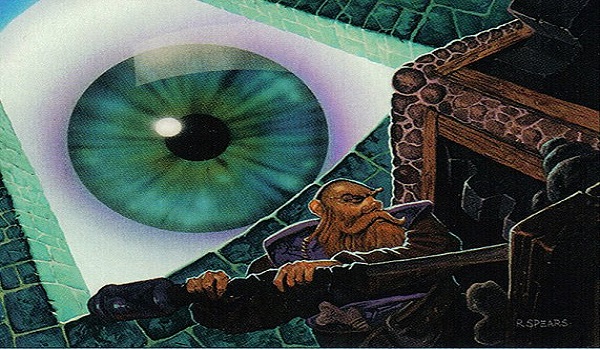
How much information can you get for only one mana? Sensei's Divining Top is one of the most efficient effects and, in my opinion, Spy Network/card] is really not that far off. Let's take inventory of this card. You get to look at someone's hand. Alright, for one mana that's not great but not bad. You also get to look at the top card of their library. For one mana, not that great. You can look at any face-down creatures that player controls? I thought we were talking about under-appreciated but still useful cards, what gives? Well, then there is the final effect: you can look at and rearrange the top four cards of your own library. For one mana that effect is worth it. However, when you add the bonanza of other effects on top of that, suddenly, you have one of the most efficient information spells in all of Magic. I suggest only, [card]Telepathy equals it for just one blue mana.

But Wait, There's More

Yes, Spy Network gives a lot of information but that is not the only thing it does. It allows you to change your destiny by making intelligent reshuffle decisions, protects against mill effects, and also lets you mess with or help your opponent. Once you know someone has a combo piece, counterspell, or nothing in hand, you get to play the table. Before someone makes a play you disagree with let them know something worse is about to hit the table. Whether true or not it's on your opponent to make the correct play. Does your opponent have a fetch land? You can sometimes mess with them by "telling" them what their top card is. If you keep them guessing you will have a good chance to mess up their rhythm when they draw a land or spell they don't need. But you can also help them by telling them there is a land on top if that's what they do need. Tell the truth 50% of the time so your opponent is always making a coin-flip at best. When you consider that stacking your own top four cards is easily worth one mana you will begin to appreciate the free tempo plays and information advantage from Spy Network.

Hey, There Are Other Colors You Know!

And blue with black is different, right? In any case King Narfi's Betrayal is a thoroughly enjoyable card and shows off my love for theft effects. The great thing about Betrayal, though, is that it needs absolutely nothing else to be an effective card. First, it has the potential to access a minimum of 16 possible targets in a four-player game. It can counter graveyard shenanigans as a nice secondary effect. As a game goes on there will only be more and better targets so you can use this card early or late. You get two turns to pick and cast a mixture of creatures and planeswalkers so balance your mana versus your targets. It's totally possible to cast three creatures at one or two mana each and then one planeswalker for six the following turn. Getting three creatures and one planeswalker out of one theft card is very powerful. Of course, it's possible to brick with this card, and I will certainly tell you when that happens, but it has yet to happen to me. It's another example of a card that scales with the power level of a particular group. If everyone is playing powerful, low-cost, game-ending combo creatures, now you are too.

When A Board Wipe Isn't Good Enough

I will continue to say it. No one is playing enough creature removal, and, no one is playing enough Enchantment removal, either. Out of Time is the best three-mana board wipe ever conceived. It stops everything: Indestructible, Protection, Regeneration, Hexproof, etc. It does not send creatures to the graveyard only to come right back into play or generate graveyard triggers. Because of phasing, you don't even get ETB triggers when the creatures do come back! Realistically a clock of three or more turns is ample time to set up another wipe, proliferate more counters, or otherwise end the game. Most of the time? Everything phased out will stay phased out for the rest of a game or until Out of Time is destroyed.

Name A Color That Needs More Mana? Green!

Much like Culling the Weak, green has Metamorphosis as an accelerant. While Metamorphosis can only be used for creature spells it can also fix mana. With a very standard opener of creature/rock/ramp, you can quite easily Metamorphosis into eight plus mana on turn four and it's a great card to use with creatures that have an X in their cost. That's the easy explanation of the card. There's a more complicated advantage here and that's the sacrifice effect. Even with 100 cards, it feels like decks are becoming tighter and tighter all the time. The ability to double up on a card as a sacrifice effect while also being ramp is useful in many ways. Commanders can use Metamorphosis as a bad "save" card turning it into "pay one more mana, recast your Commander." The more powerful side of this effect is "pay one more mana, get another enters the battlefield (ETB) trigger for your Commander." So, again, this card is much more versatile than at first glance. It can ramp, it's a sac outlet, it can save (poorly) and it can be used for a cheap second ETB trigger.

There Are Unique Cards And Then There Are Truly Unique Cards

Vines of Vastwood is unlikely to be an unknown card. Vines does just barely squeak into the top 50 green Instants on EDREC, and it used to be significantly more prominent, but other cards have slowly chipped away at its dominance. I bring it up to remind people that Vines is, in my experience, significantly better than many newer cards like Snakeskin Veil, Tamiyo's Safekeeping, or Blossoming Defense. First, Vines will protect your creature from targeted removal for one mana just like many other cards. Second, you have a nice option to kick Vines and give your creature a considerable boost of +4/+4 which is enough to survive a wide variety of board wipes like Toxic Deluge and also works as a combat trick. Third, this effect is not hexproof or shroud so it does not lose to the few cards that remove those abilities. Of course, that leads us to the final and most important reason Vines is just better; you can cast it on your opponent's creatures. You cannot even target other creatures with the other cards mentioned. That means that a Phantasmal Image dies to Vines but not Veil. You can save another player's creature with Vines but not any of the other cards. And last, but certainly not least, you can use Vines to stop your opponent from equipping or enchanting their own creature. Powerful, low cost, and extremely flexible, Vines of Vastwood is too good to be underplayed and forgotten yet is headed that way. Not on my watch I say!

What, No Artifacts?

This card takes a lot of inspiration from Steel Hellkite. While the Hellkite is pure obliteration if it gets through, the Griff's gimmick virtually guarantees it will be unblocked and will do its thing every single turn. It's a perfect diplomacy card. It kills the biggest threat on the board every turn and costs an opponent three life. If players differ on what the biggest threat is just attack the one you agree with more and they will readily accept the damage. A table favorite every time I have played it, the Griff lets you blow up threats while claiming no responsibility. In fact, it promotes a tit-for-tat scenario where you attack Player A, and Player B loses a thing. Now Player B wants to get attacked by it to blow up something of player A's. Meanwhile, you're laughing all the way to the bank. Did I mention it also deals with Enchantments? It's an Artifact and can go in every deck.

Wait A Sec... That's Only Nine!

But you see, you didn't count the Dragons!

I've been experimenting with many of the Adventure Dragons and I'm fairly happy with my results. No, they are not completely busted. They do seem to be extremely decent filler cards, though. Comparing Sapphire Dragon to Negate is not much of a comparison. Negate is miles ahead. However, what about in any flavor of Dragon deck? What about a deck where you need equal amounts of creatures and spells? Maybe you are trying cascade degeneracy? I think that all of these cards are playable as second copies of better spells you are already running and one game in ten the Dragons themselves turn out to be relevant so there's less downside to including them. If you are having trouble filling in a few cards adding more Dragons has never been a bad Magic strategy!

So Many Cards, So Little Deck Space

The room in most decks is definitely at a premium. If you have a great idea of what the local metagame looks like you can make some extremely interesting and informed choices. Outside of that, I find it makes more sense to be flexible so you don't find yourself completely helpless. August is rapidly approaching. What are some cards you feel don't get enough love in your Commander pods? Let me know in the comments.

Avatar photo

Joe Mauri

Joe has been an avid MTG player and collector since the summer of 1994 when he started his collection with a booster box of Revised. Millions of cards later he still enjoys tapping lands and slinging spells at the kitchen table, LGS, or digital Arena. Commander followed by Draft are his favorite formats, but, he absolutely loves tournaments with unique build restrictions and alternate rules. A lover of all things feline, he currently resides with no less than five majestic creatures who are never allowed anywhere near his cards. When not Gathering the Magic, Joe loves streaming a variety of games on Twitch(https://www.twitch.tv/beardymagics) both card and other.

View More By Joe Mauri

Posted in Commander, Deck Building, Free, StrategyTagged , , , , , , , , , Leave a Comment on Commander Cards Under The Radar, July Edition

Have you joined the Quiet Speculation Discord?

If you haven't, you're leaving value on the table! Join our community of experts, enthusiasts, entertainers, and educators and enjoy exclusive podcasts, questions asked and answered, trades, sales, and everything else Discord has to offer.

Want to create content with Quiet Speculation?

All you need to succeed is a passion for Magic: The Gathering, and the ability to write coherently. Share your knowledge of MTG and how you leverage it to win games, get value from your cards – or even turn a profit.

Double Masters 2022 Rare Specs

Are you a Quiet Speculation member?

If not, now is a perfect time to join up! Our powerful tools, breaking-news analysis, and exclusive Discord channel will make sure you stay up to date and ahead of the curve.

I'll be the first to admit that while the player side of me is thrilled with the reprint choices in Double Masters 2022 (2X2), the speculator side is pessimistic about the future of the secondary market given all of the new products WoTC seems to be pumping out. That being said, I still think there is some potential for the near future. It remains important to keep future price expectations grounded.

Back in 2013, it was feasible to buy up eternal speculation targets at retail with expectations of good returns within a few years. Nowadays, I don't see any non reserved list card as a long-term (3+ years) speculation opportunity given the number of reprints we see.

There was an error retrieving a chart for Thoughtseize

The good news is that while WoTC seems to have their printers running overtime on new product, they have been doing that for the last few years, which means looking at Masters sets from the past few years can provide us with an anchor for comparison purposes. Both Double Masters and Ultimate Masters are great anchors for our purposes.

Additionally, basic supply and demand theory reminds us that unless the playerbase grows at the same rate or greater than the increase in supply due to a reprint, the price for a given reprinted card will typically fall somewhere below its price prior to said reprint. Thus, we will split our categories for today's piece into cards whose prices rebounded from a reprint and ones whose prices didn't.

There was an error retrieving a chart for Ephemerate

Admittedly, the term "rebound" lends itself to ambiguity, so for the sake of this article I will set the mark at a card whose price went up by 100% of its reprint "low" price. For instance, if a card dropped to $5 after being reprinted but returned to $10+, it makes the cut.

Ultimate Masters

Rares that Rebounded

  • Entomb
  • Demonic Tutor
  • Phyrexian Altar
  • Gamble
  • Urborg, Tomb of Yawgmoth
  • Fauna Shaman
  • Ancient Tomb

Rares that Never Recovered (sample)

  • Goryo's Vengeance
  • Engineered Explosives
  • Noble Hierarch
  • Celestial Colonnade
  • Reanimate
  • Through the Breach
  • Runed Halo

Double Masters

Rares that Rebounded

  • Entomb
  • Stoneforge Mystic
  • Sunken Ruins
  • Time Sieve
  • Mystic Gate
  • Conjurer's Closet

Rares that Never Recovered (sample)

  • Thoughtseize
  • Blood Moon
  • Goblin Guide
  • Fulminator Mage

Reviewing the Data

While these lists do not include every single rare in each set, I did try to include a majority of the ones that rebounded in price. So almost every other rare falls into the latter category, though it is important to note that there are a few that came close to rebounding, e.g. Cyclonic Rift.

Every card on the "Rebounded in Price" lists is played heavily in Commander, whereas many in the "Never Recovered" list are ones that mostly played in other nonrotating formats.

There was an error retrieving a chart for Cyclonic Rift

Also of note is that due to COVID-19 restrictions and the subsequent removal of basically all in-person events, competitive nonrotating format demand was likely at an all time low from early 2020 until even now. This may mean that once live events start happening consistently, some of the cards on the "Never Recovered" list may actually spike; however, Ultimate Masters did come out in 2018, so there was over a year's worth of time for these prices to rebound with plenty of in-person events going on. This lack of recovery implies that interest in non-Commander formats is lower than I would have expected and thus may be a good reason to continue to steer clear of these cards as speculative choices.

Now that we have gathered data and reviewed it, we can look to Double Masters 2022 and try to find cards that fall into the "Rebounded in Price" category to buy while they are at a low and sell for profit later. I do believe that Double Masters 2022 is still too new for prices to have reached their floors yet, so I will include a likely floor price which would serve as a good buy-in price.

Double Masters 2022 Rares to Spec On

There was an error retrieving a chart for Vedalken Orrery

The last time this card was reprinted was in Conspiracy; back then, it sank to under $2 a copy. While I doubt the Double Masters 2022 reprint will cause the price to drop back that low again, given this card is still found in a lot of Commander decks, I would be probably buy a few copies at the $8 mark and would likely buy up to 20 if they hit $5.

There was an error retrieving a chart for Bloom Tender

A lot of this card's price is heavily influenced by the fact that this is the first non-Secret Lair/Mystery Booster reprint and the original was from Eventide, which was not a heavily opened set. I think the current price is still quite inflated and similar to Vedalken Orrery. I'd wait for around an $8 buy-in.

There was an error retrieving a chart for Oracle of Mul Daya

Oracle was almost a $40 card at one point and maintained a price near that mark for over 6 months. The reprint in Jumpstart followed by this reprint will likely mean that its price will take longer to recover, though given the random nature of Jumpstart and the large number of possible decks, I do believe fewer copies were introduced with that set than many realize. Still with a current price already under $10, I like a $6 buy-in for this Commander staple.

There was an error retrieving a chart for Panharmonicon

This casual favorite and strong Commander card has been printed multiple times since its original printing in Kaladesh. It is pretty much an auto-include in any Commander deck that utilizes a lot of ETB triggers. Given the price has already dipped to right under $5, I like copies in the $2.50-$3 range.

There was an error retrieving a chart for Privileged Position

The dual color nature of this card does severely limit which decks can play it, but Enchantress-style decks are beloved by many Commander players and this is definitely an auto-include in that archetype. Considering the original printing was in Ravnica: City of Guilds and the only other reprint was a Guilds of Ravnica: Guild Kit, I really like the potential for this card. The borderless copies are already hovering around $5 with regular versions under $4. I can see this being a $2-$2.50 card that would likely reach $5-$8 within a year or two.

There was an error retrieving a chart for Nim Deathmantle

Deathmantle card is part of numerous combos in Commander and the Double Masters 2022 versions are already sitting at less than 50% of the Scars of Mirrodin versions at $2 and $5 respectfully. I could easily see this as a $0.75 pickup as its current price seems to indicate it will likely end up around $1.

Dodging the Fakes

There are a lot of other Commander reprints in this set that I'm happy to see were included, but don't feel like they have a lot of potential to increase in a price a whole lot. It's important to remember that the more niche a card is, the more a reprint kills its price, as the supply goes up a lot while demand usually doesn't. Are there any picks you think I missed? Any points you disagree with? Feel free to leave a comment below or reach out to me on our QS Discord server. Until then, happy speculating!

Magical Creatures: Lhurgoyf and Phelddagriff

Are you a Quiet Speculation member?

If not, now is a perfect time to join up! Our powerful tools, breaking-news analysis, and exclusive Discord channel will make sure you stay up to date and ahead of the curve.

Last week, we left behind the ancient world of Fallen Empires and its legions of of weird, new creature types: Homarids, Thrulls, Orggs, and Saprolings! Today, we'll continue exploring the fantastic species conceived specifically for Magic: the Gathering.

So Many Sets, So Few Unique Types

Fallen Empires was the last set from 1994, but 1995 saw five new sets... of different kinds! Fourth Edition, however, was the new core set (after Limited Edition, Unlimited and Revised), containing only reprints and featuring little in the way of discovery. Chronicles and Renaissance were called "compilation sets," and also lacked new cards.

Definitely not a creature type that was invented specifically for Magic

That leaves us with the only two expansion sets of that year, this time full of new cards instead of reprints: Ice Age and Homelands. The former came out in June, the latter in October. They both introduced a good number of new creature types to the game. As usual, however, we will only take into account those creatures that are unique to the Magic: The Gathering franchise. Which, sadly, means we'll have no choice but to snub Badgers and Dinosaurs.

From Ice Age to Alliances

Indeed, Homelands is so loaded with real-world animals and references that it did not introduce a single creature type unique to Magic. And Ice Age only created one brand-new species, which will be discussed in a minute. So to broaden our scope, we'll have to jump into the following year, with Alliances (June 1996).

Ice Age and Alliances make for a weird couple. For most of Magic's history, we have been used to blocks of three expansions—one large and two small. The Ice Age block is an exception, as it was only made up of two sets until the release of Coldsnap in 2006. As a matter of fact, back in the days, Homelands was considered the second set and Alliances the third, which made no sense given the absence of cohesion across those expansions.

Nonetheless, Ice Age contains the first Lhurgoyf, while Alliances contains the first Graveborn and the first Phelddagrif. Or, to be more precise, the first card able to generate a Graveborn token and the first Phelddagrif. Calling back to Tetravites and Saprolings, Graveborn too is a token-only type.

Lhurgoyf

Let's start with Lhurgoyf, one of the most representative and weird creature types in Magic. And this was true even before the arrival of Tarmogoyf! Lhurgoyf are scavenger creatures with very long limbs and way too developed teeth. They come in all colors, although the best one is of course green.

[draft title]

The name of the original Lhurgoyf creature is... Lhurgoyf. No big surprise; same deal Atog, Orgg, Homarid, and so on. However, in this case the tribe grew, and today ten creatures share the type. Odyssey contained the highest number, thanks to a cycle of five, or one for each color. Other Lhurgoyfs were released in Planar Chaos, Future Sight, and Modern Horizons 2.

This tribe also birthed a creature that for quite a few years was simply the best one ever printed: Tarmogoyf, or usually just Goyf. Goyf wasn't just a must if you played green, but a reason to splash green in decks that would normally not play that color. It was played in Mono Blue Control, and even in the sideboard of UR combo decks based on Pyromancer Ascension, among many others.

There was an error retrieving a chart for Tarmogoyf

Fifteen more years have passed since the arrival of Tarmogoyf, and many other great creatures were printed, reducing its uniqueness. Nonetheless, it's still a very efficient beater, and despite its affordable price remains sought after. In any case, it will always be remembered as a cornerstone. After all, it was one of the very few cards that was able to shape the game and impact every format where you could play it.

Phelddagrif

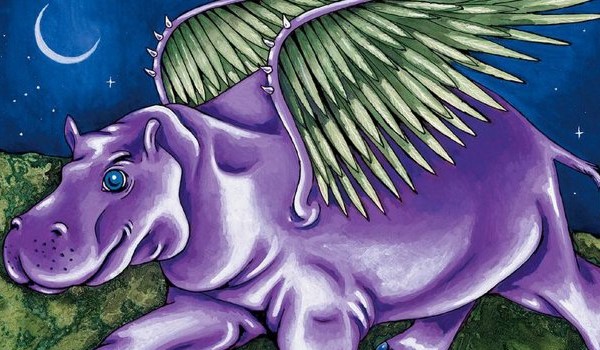
Onto Alliances, and a creature that is more or less the opposite of Tarmogoyf. The first creature to bear the type Phelddagrif is of course the Phelddagrif. If Lhurgoyf are scary and awful looking, Phelddagrif are charming and reassuring. As reassuring as a purple winged hippo can be...

[draft title]

Only two exist: the titular first one from Alliances, and the second, Questing Phelddagrif, from Planeshift. They are both 4/4 creatures for four mana in Bant colors, and share having a trio of activated abilities. Neither is strong enough to be played outside of kitchen table settings, as all their abilities yield slight advantages but also net the opponent some benefits.

Unfortunately, Mark Rosewater made it crystal clear that no more Phelddagrif will be ever printed, since they are considered a "vanity Easter egg." The reason for that is that Phelddagrif is an anagram of Garfield, Ph.D—the creator of Magic: The Gathering. We must therefore be content with Seedtime, stating that "The hippo grows wings to fight the condor." Don't ask; that's just how the Nantuko teaching goes...

Graveborn

Let's wrap it up with the last of today's new creature types. As we mentioned at the beginning, no Graveborn creature was ever printed. And only two cards can pump out the tokens: Balduvian Dead and Sek'Kuar, Deathkeeper. But what is a Graveborn to begin with? As the name suggests, they are basically zombies. The only difference is that they are black and red.

Sek'kuar as a commander and some synergies

Both cards will, under certain circumstances, put one or more 3/1 black and red Graveborn tokens with haste onto the battlefield. That's it. The only interest one might have in Sek'kuar is is legendary supertype, lending it to Commander play. Indeed, many lists exist revolving around this otherwise unremarkable card.

One-of Creature Types

We are still dealing with the early part of Magic's history. And one of the most peculiar (and adorable) traits of those years is the fact that so many creature types are unique to the creatures they are found on. We have seen this pattern several times already, and it will continue for a few years more.
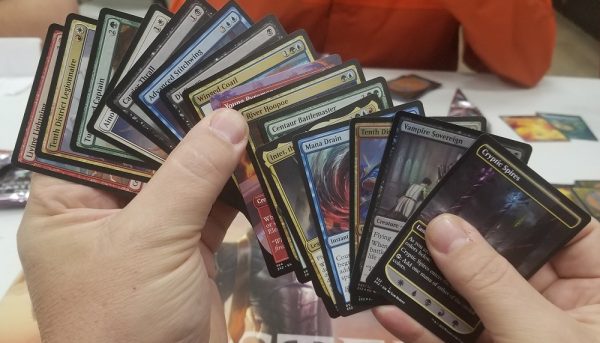
What do you think of the creature types we discussed today? Do you lean more towards competitive breakouts (team Tarmogoyf) or purely-for-giggles expressions of creativity (team Phelddagrif and Sek'kuar)? Let me know in the comments or on Twitter, and stay tuned for next piece!

Top 4 RCQ Finish: Pioneer UR Phoenix

Are you a Quiet Speculation member?

If not, now is a perfect time to join up! Our powerful tools, breaking-news analysis, and exclusive Discord channel will make sure you stay up to date and ahead of the curve.

At long last, grinding season is upon us! The latest changes to Magic's organized play system have finally started to roll out, and the first stop is the Regional Championship Qualifier (RCQ). This local-level tournament is on par with the Preliminary Pro Tour Qualifiers (PPTQs) that ran in the mid 2010s. As the name implies, RCQs qualify the winner to attend the Regional Championship (RC), which then feeds into the Pro Tour. They typically host somewhere from 30-80 players in Swiss-style tournament brackets and cut to top eight, meaning you could be duking it out all day long.

Once a player qualifies for the RC, they are no longer allowed to participate in subsequent RCQs for the remainder of the season. But at this stage of the game, everyone, even the best of the best, are still fighting to secure an invite.

There was an error retrieving a chart for Arclight Phoenix

Delver? I Hardly Know Her

This weekend, I had an impressive fourth-place finish at a local RCQ with UR Arclight Phoenix. It's not hard to sell me on a UR spell slinger deck, but I believe it to be the most well-rounded choice for Pioneer, even with the recent banning of Expressive Iteration. Although Iteration was one of the strongest draw spells printed in recent years and the banning certainly knocked Phoenix down a peg, it is still the best option to take advantage of the wildly powerful (and more than arguably bannable) delve spells, Treasure Cruise and Temporal Trespass.

The Delve Package

These game-winning delve cards are enabled by Pieces of the Puzzle, which provides consistency in finding the spells, provides card advantage, and adds four additional cards to the graveyard to delve away. It also does a great job of putting Phoenixes into the graveyard to get back later.

A somewhat recent but welcome addition is Galvanic Iteration which doubles the next spell its caster plays. Combining this with Temporal Trespass makes a DIY Time Stretch for as little as five mana and is often sufficient to assemble a win from nearly any board position.

The Creatures in the Creature Suite are Sweet

Even in a "spells matter" deck, the creatures matter too. Across virtually all successful permutations of the deck, you'll find four Arclight Phoenix, two Thing in the Ice, and four Ledger Shredder in the main deck.

The Creatures Featured

Ledger Shredder performs triple duty by stabilizing early, filtering draws, and as a way of sticking Phoenix into the graveyard to come back for free. Thing in the Ice similarly stabilizes and punishes popular decks like MonoG Devotion that play to the board. After flipping into Awoken Horror, it's often the largest creature in either deck and does an excellent The Abyss impression. Phoenix offers a recursive threat against decks playing counterspells and kill spells, and incidentally is a fairly large, evasive, hasty creature that can just be cast normally. Each of these creatures utilizes the same engine, but they attack on very different axes, making it difficult for the opponent to answer all of them.

What's in the Box?

There have been a few high-level players like Javier DomĂ­nguez, Yuta Takahashi, and Nathan Steuer that have all come to very similar conclusions on which direction to take the deck. Their lists only vary by a few flex spots and choices of removal. For example, some had multiple Strangles over Fiery Temper. A few had Sea Gate Restoration as an untapped blue source that can be found via Pieces of the Puzzle. These changes, while minimal, can secure advantages based on anticipated matchups and expected opposing disruption.

As paper play typically trails behind MTGO results by a week or two, I expected Phoenix to show up in greater number this weekend. My thought process was also skewed by several players in the New England Magic Discord server all planning to bring the deck, so I made a few tweaks to the sideboard to improve my chances in the Phoenix mirror.

Anger of the Gods and Brazen Borrower both help here while having some practical use against the other decks of the format. In particular, Anger was a phenomenal answer to Graveyard Trespasser out of RB Midrange and Borrower provided a game-winning tempo advantage against MonoG's larger and higher-cost creatures like Cavalier of Thorns. Having played both RB and MonoG twice each during the tournament and the mirror zero times, I was still more than happy with these cards in my sideboard.

The Deck

RCQ 4th Place UR Phoenix-Adam Cohen

Creatures

4 Ledger Shredder
2 Thing in the Ice
4 Arclight Phoenix

Spells

4 Consider
4 Opt
3 Lightning Axe
2 Strangle
1 Fiery Impulse
1 Spikefield Hazard
1 Spell Pierce
2 Galvanic Iteration
2 Chart a Course
1 Lava Coil
4 Pieces of the Puzzle
3 Treasure Cruise
2 Temporal Trespass
1 Sea Gate Restoration

Lands

2 Island
4 Steam Vents
4 Spirebluff Canal
4 Riverglide Pathway
2 Stormcarved Coast
2 Hall of Storm Giants
1 Otawara, Soaring City

Sideboard

2 Mystical Dispute
2 Aether Gust
2 Disdainful Stroke
1 Thing in the Ice
2 Young Pyromancer
1 Crackling Drake
1 Abrade
1 Jace, Wielder of Mysteries
2 Brazen Borrower
1 Anger of the Gods

Sideboard Guide

MonoG Ramp

MonoG Ramp's goal is to deploy mana dorks like Elvish Mystic and Llanowar Elves alongside Nykthos, Shrine to Nyx to help power out large threats before the opponent can stabilize. Thing in the Ice flipping will reset their board and set them back a full turn to rebuild. This opens up opportunities to sneak in large chunks of damage or clear out a planeswalker. Their mana production is reliant on their creatures, So try to bolt the "bird" in the early game. The only cards that matter in this matchup are big green spells. Bring in the additional Thing in the Ice, Brazen Borrowers, Aether Gusts, and Disdainful Strokes over Spell Pierce, Lightning Axe, Galvanic Iteration, and Temporal Trespass.

RB Midrange

RB Midrange is, as the kids say, "mid". It's a deck of grindy cards which highlights some of the issues with Pioneer's limited card pool. The deck is clogged in the three-drop slot and doesn't kill quickly. It also struggles with card draw and card selection, relying primarily on Fable of the Mirror Breaker, Castle Locthwain, and four mana planeswalkers to generate advantage. They have the tools to slow Phoenix down and a well-timed Go Blank can be a beating, but generally speaking, Phoenix is favored provided it can get its engine going.

A single Pieces of the Puzzle or Treasure Cruise will undo all the work they put into creating a resource-light game. Bring in Anger of the Gods, Young Pyromancer, and Thing in the Ice to wall off their ground creatures and cut down on Lightning Axe, Trespass, and Galvanic Iteration. RB will have tools to keep Phoenix's graveyard in check, so it's not a great idea to overload the deck with uncastable spells.

UR Phoenix

The mirror tends to come down to whose haymakers stick. Generally speaking, an unanswered Ledger Shredder will be bad news for the opponent. Both players will be triggering each other's Shredder turn after turn, filling graveyards and creating stalled boards. As far as the sideboard goes, Bring in Anger of the Gods, Brazen Borrowers and Mystical Disputes over Strangle, Fiery Temper, Sea Gate Restoration, and one Trespass.

UW Control

The UW Control matchup is not amazing, but not the worst either. Portable Hole is able to cheaply remove Thing in the Ice and Ledger Shredder while March of Otherworldly Light and The Wandering Emperor both exile Phoenix. These decks often run Narset, Parter of Veils along with Rest in Peace, both of which can be difficult to deal with. My philosophy for this matchup is to cut all spot removal and bring in all threats, Mystical Dispute, and Disdainful Stroke with the goal of running them out of answers.

Lotus Field Combo

I've found Lotus Field Combo to be the singular bad matchup for Phoenix. The deck operates by landing a Lotus Field, then untapping it with effects like Hidden Strings to generate mana. The end goal after sufficient mana is assembled is to cast some game-winning spell like Emergent Ultimatum. Uninterrupted, the deck typically wins around turn 4. Phoenix needs to play multiple spells on its own turn for its game plan to function, so leaving up mana each turn severely hampers your ability to develop a meaningful clock.

If the opponent is given enough time, they'll simply find and cast Thought Distortion, which is usually lights out for Phoenix. I like bringing in Aether Gust, Disdainful Stroke, Mystical Dispute, and Brazen Borrower for the matchup. A well-timed petty theft may be able to bounce an Omniscience back to the opponent's hand, but it's mainly a threat to play after leaving counterspells up during a potential combo turn. Feel free to cut removal, but I don't hate a Lightning Axe or two to answer Lier, Disciple of the Drowned.

End Step

I had another article planned for this week but wanted to cover the Phoenix deck while it was still hot off the presses. Keep an eye out for that one next week! Although, I do have another RCQ lined up for next weekend, so let's see if I can snag the trophy and give you that deck's breakdown instead. Article ideas can be hard to come by, so I'm trying to be the content I want to see in the world.

In the meantime, you can keep up to date with all of my shenanigans on Twitter at @AdamECohen. I'll see you all next week.

Fate is Fickle: Modern RCQ Report

Are you a Quiet Speculation member?

If not, now is a perfect time to join up! Our powerful tools, breaking-news analysis, and exclusive Discord channel will make sure you stay up to date and ahead of the curve.

As the RCQ...season, I suppose—though they've never framed it as such—rolls on, it's important to remember the fundamentals of competition. Namely, skill is essential to excellence. However, greatness often comes down to luck. If everyone at an event is prepared, experienced, and playing well, then what separates the winners from everyone else is often pure luck. My experience last weekend at a Modern RCQ is a perfect encapsulation of this.

Pre-RCQ Preparations

I knew the RCQ would be at my LGS, Mythic Games. This was great not only because it meant minimal travel but there's no worry about getting blindsided. I could just walk in and ask, which I did. Never take things for granted. It also meant that a good chunk of store regulars would be playing as well, which made preparing against them easier. I've been playing Burn for months and know that it's well positioned in that field.

There was an error retrieving a chart for Goblin Guide

But it wouldn't make it certain. Most Mythic Games regulars have multiple decks and switch based on the event size and expected positioning. I'm partially responsible for this practice, having advocated it as a strategy and pulled it off myself once or twice in the past. This made day-of scouting all the more important.

There was an error retrieving a chart for Urza's Tower

I knew going in that the event would hit its cap well before game day. Mythic is very generous with prizes, so their events always cap. There was a time when Mythic held 64 players, but it currently only has space for 48 players due to changes to the store layout during the pandemic. It's expanding to take up most of the strip mall sometime in the near future, but for now, it's a bit cramped. This meant that all the players wanting to play registered early, meaning they were serious players.

Tournament Day

Despite being one of the first to pre-register, I still needed to check in on the day. This was no problem as I made sure to be there early to scout the field. I slightly regretted the decision, as upon opening the door I was greeted by an arctic blast. Mike, the store owner, is no stranger to tournaments in the Colorado summer and knows how hot and stuffy it will get with a full house. Especially with a west-facing storefront. He'd set the AC on full blast hours before opening just to keep things tolerable as the day went on. This was a complete success, but until the tournament actually got going it was quite frigid.

Scouting Report

As I walked in and out of the store to maintain a semblance of normal body temperature, I had the opportunity to repeatedly scout without drawing undue attention. In addition to several dedicated Control players, I saw a lot of Violent Outbursts getting recorded on decklists. I wasn't sure exactly which cascade decks they were for, but that wouldn't change my strategy very much. I also saw one guy playing Song of Creation. I have no idea if he played it in the main event or was just testing, but I wasn't going to be caught flatfooted against Modern's newest hot combo deck. I also knew there was a Belcher player in attendance. With that in mind, I registered the following list:

Burn, David Ernenwein (RCQ deck)

Creatures

4 Goblin Guide
4 Monastery Swiftspear
4 Eidolon of the Great Revel

Sorceries

4 Lava Spike
4 Rift Bolt
2 Skewer the Critics

Instants

4 Lightning Bolt
4 Searing Blaze
4 Boros Charm
4 Lightning Helix
2 Skullcrack

Lands

4 Arid Mesa
4 Inspiring Vantage
4 Sunbaked Canyon
3 Sacred Foundry
2 Arid Mesa
2 Snow-Covered Mountain
1 Mountain

Sideboard

3 Wear // Tear
2 Roiling Vortex
2 Silence
2 Path to Exile
2 Kor Firewalker
2 Deflecting Palm
2 Rest in Peace

There is no reason for the split on the basics. I did it once to annoy someone and can't be bothered to change them out now. On a more practical note, I've frequently been frustrated drawing too many Skewer the Critics and being unable to spectacle them, so I've cut down for more copies of Lightning Helix.

There was an error retrieving a chart for Silence

The sideboard is an anti-combo configuration. Silence is a card that few expect and is a counterspell against the cascade decks. It's also a complete blowout if done in response to Song of Creation or Summoner's Pact. I've frequently been disappointed playing Sanctifier en-Vec as my graveyard hate, so I'm back on Rest in Peace with Kor Firewalker instead. Wear // Tear is played over Smash to Smithereens because cascade decks tend to have Leyline of Sanctity and killing artifacts against Amulet Titan is very good.

The Tournament

With 48 players, there were six rounds. Because there are several eateries in the immediate vicinity and the head judge likes an efficient tournament, there was no lunch round. This made playing Burn a particularly good choice as I'm never going to time and could easily get lunch.

Round 1: Amulet Titan

I start off on the draw. This is becoming a frustrating habit. My opponent mulligans but I keep a slower hand because it has Eidolon and scouting says this is a field where Eidolon is critical. My opponent kills Eidolon with Boseiju, Who Endures but nothing else while I have no other creatures and throw burn at his face. Eventually, he gets out two Urza's Saga at two life and I run out of burn. I have three turns to draw the win and brick off. On the last Saga trigger of the last Saga, he gets Amulet of Vigor so I know what I'm actually up against.

Sideboarding:

-4 Searing Blaze -4 Eidolon of the Great Revel

+3 Wear // Tear +2 Path to Exile +2 Silence +1 Deflecting Palm

Game two goes better. My opponent mulligans again, I have Swiftspear and Tear the turn one Amulet. My opponent gradually builds lands but I don't brick off this time and win. In game three I have Silence to time walk my opponent, but it's not enough. He would have killed me on turn three without Silence having finally mulliganed into a busted hand. I really needed Wear to not die to Valakut triggers, but I don't think it would have changed the final result.

There was an error retrieving a chart for Dryad of the Ilysian Grove

Amulet is not a great Burn matchup, and my deck didn't perform the best. But that's how it goes and there's a lot more Magic to play.

Round 2: Infect

I'm drawing again, and lead off with Goblin Guide. My opponent's first play is Blight Mamba which gets Searing Blazed. From there I go the distance with Guide, taking the control role of just killing every Infect creature the turn it's played.

Sideboarding:

-4 Boros Charm

+2 Path to Exile +2 Deflecting Palm

I want to maximize my interaction against Infect.

For game two I kept a hand with a blocker and Deflecting Palm. I get a chump and trade for a pump spell then my opponent goes for the kill on turn three, right into Palm for half their life. They're out of resources and I burn them down shortly thereafter.

There was an error retrieving a chart for Deflecting Palm

Infect is a great matchup and getting the win here is critical. Things are looking up.

Round 3: Prison Tron

When my opponent opens by Serum Powdering twice, my heart sinks. This is an abysmal matchup, even on the play. The Powdered artifacts aren't actually gone as Karn, the Great Creator can wish for them. This is relevant in game one as I get the opponent to two before Walking Ballista gets a recovered Basilisk Collar while Inventor's Fair puts the game out of reach.

Sideboarding:

-4 Searing Blaze -1 Eidolon of the Great Revel

+3 Wear // Tear +2 Silence

For game two, I keep while my opponent mulligans and Powders. He only has two lands so it's an easy win for me. In game three, The Underworld Cookbook buys time until Spellskite and Karn locks up the game.

There was an error retrieving a chart for Karn, the Great Creator

I was dead for Top 8 at this point, but not for prizes. This made losing to a fringe but terrible matchup that little bit worse. Especially since that deck doesn't beat Void Mirror.

Round 4: Manufactor Combo

I'm on the play, but all that needs to be said about game one is that my opponent gets all four Cookbooks and Ovalchase Daredevil. With four lands. Just...argh.

Sideboarding:

-3 Lava Spike -2 Skewer the Critics

+3 Wear // Tear +2 Rest in Peace

In game two I keep Guide into Eidolon with Wear // Tear. Those two do all the work because I Wear away one Saga then Wear // Tear a second one and Cookbook. Rest in Peace ensures my opponent is helpless. In game three I don't have Rest against two Cookbooks, but fortunately, my opponent doesn't see Daredevil. Roiling Vortex chips away and contains the food until I can close the game with Charm backed by Skullcrack.

There was an error retrieving a chart for Academy Manufactor

Still alive for prizes after a very frustrating matchup. I had hope for things to improve.

Round 5: Millvine

On the play with Eidolon, I keep. My opponent goes nuts with Hedron Crab triggers and then takes a big chunk off themselves playing into Eidolon to trigger Vengevine. With Searing Blaze I'm in the race but Creeping Chill ends my chances. Another poor, fringe matchup.

Sideboarding:

-4 Boros Charm

+2 Path to Exile +2 Rest in Peace

In game two I mulligan and have Eidolon into Rest in Peace. My opponent never has a clock. For game three I keep four lands, two Lava Spike, and Rest because it's that important. Rest is Spell Pierced and the following turn my opponent dumpsters me. The irony is that if I was still on Sanctifier I win this game, despite the five in-hand lands I died with and three more on top.

There was an error retrieving a chart for Vengevine

At 2-3, I was out of everything. But I had nothing else to do so I played the last round.

Round 6: Jund

I kept a one-lander with all one-drop burn spells on the play. My opponent mulligans and doesn't have a clock or meaningful disruption until it's too late so I just burn him away.

-4 Eidolon of the Great Revel

+2 Path to Exile +2 Rest in Peace

On the draw against a Tarmogoyf deck, I don't think Eidolon does enough to justify the boost it gives Goyf.

For game two I double mulligan while my opponent single mulligans. I expect to get destroyed by discard, but instead, my opponent has all creatures against my multiple Searing Blazes. His final Goyf can't win the race in time, so I end up 3-3.

There was an error retrieving a chart for Crashing Footfalls

The Top 8 consists of two Hammer Time decks, Grixis Shadow, UW Control, Esper Reanimator, Cascade Crashers, the Amulet player who beat me, and a 4-Color Omnath deck. I don't know if it was Blink or Control. Crashers won the whole thing (based on what I saw from the Companion App).

After Action Report

Things didn't go my way. It happens. However, that also means it's very frustrating trying to make sense of it all and learn from failure. There were no specific misplays that doomed me in my losses. Against Amulet, my deck just bricked off for three turns in game one and I didn't have an actual chance in game three. That's how that matchup goes. Against Prison Tron, in both the first and third games I took the line of burning their face rather than their Karn. My opponent got to wish for a lock piece already, so putting them within one burn spell rather than two seemed more likely to win. It didn't work out in either case because I didn't draw the burn, but the alternative feels like I was just going to lose more slowly. And then Burn is just bad against graveyard decks.

There was an error retrieving a chart for Creeping Chill

My deck wasn't running well, but that feels like small potatoes compared to just being on the wrong end of the Pairings God. There was a lot of 4-Color Omnath and cascade of all flavors at the RCQ. I wanted those matchups and didn't get them. Instead, I got my worst matchup from Tier one and a lot of Tier three or lower decks. This was totally out of my control or ability to predict, but that's how it goes. You have to remember that half of tournament success is showing up well prepared with the right deck. The other is getting matchups that are winnable and performing well in them. I feel that I did the former to the best of my ability. It was the latter where things went wrong.

It Is What It Is

It always sucks when losses are down to misfortune and pairings rather than being outplayed in the game. However, that is going to happen to everyone eventually. The only thing to do is take it on the chin, complain in your weekly column, and move on.

Limited Sideboards: Expectations and Execution

Are you a Quiet Speculation member?

If not, now is a perfect time to join up! Our powerful tools, breaking-news analysis, and exclusive Discord channel will make sure you stay up to date and ahead of the curve.

Sideboarding is one of the most fascinating components of Magic the Gathering. One of Booster Draft's most enticing draws is the deck-building aspect. Whereas in Constructed, you build a deck once, in Limited you build a new one every draft. A strong sideboard strengthens your deck. It provides a more flexible approach, so you can tailor your game plan to each specific match-up.

In Draft, our sideboard is composed of every card we selected that did not make the final forty. Often times those final cuts are difficult to make. However, we would be wise to remember that just because we decided a card isn't in our best interest to include in our main deck, doesn't mean it's not an optimal choice for certain match-ups.

What Sideboarding Is Not

Be Realistic

In constructed, our sideboard is often full of floodgates, buttons, swiss-army knives, and other tools for specific strategies. If I know that a part of the metagame is Living End decks, then part of my plan needs to be bringing in Rest in Peace or Grafdigger's Cage. Because I know how powerful those decks are, I need to include powerful answers to stop them. While this is what we usually think of when we think of sideboarding, it is not a realistic solution in Draft.

First of all, we aren't likely to see many, if any, all-in strategies in Limited. Most Draft decks are versions of midrange strategies. They may lean aggressive or controlling, but in general, they play a well-rounded game plan balancing card advantage, removal, and creatures. Disrupting your opponent's graveyard or symmetrically taxing spells might provide a small advantage, but it's hard to imagine this shutting down a deck that probably plans on playing some number of above-rate creatures. If you're spending a card on graveyard hate, and your opponent is playing to the board, you're at a disadvantage.

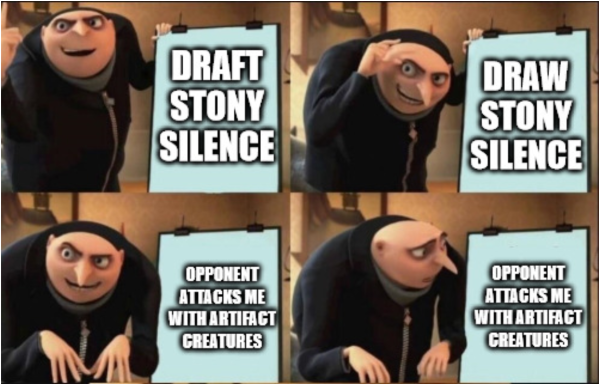
Additionally, you have to actually use a draft pick on your hate cards. If you see a Blood Moon in a pack with other playables, you're probably better off just taking the on-color two-drop or removal spell that's going to be good for your deck. Focused answers, like we see in constructed, might seem appropriate but are still too narrow for even their relevant match-ups. Stony Silence can shut off some really powerful artifact abilities, but it doesn't guarantee you victory even in the match-up where you want it. Often times a creature would just be better.

What Sideboarding Is

While Constructed gameplay uses a mostly-scripted plan to utilize a sideboard, the Limited version is more imaginative. We probably don't have something that will completely shut down our opponent's game plan. However, we might be able to strengthen the way we approach the match-up.

Believe It Or Not, These Are Reasonable Sideboard Cards

One observation you might have made looking at these cards is that they are reasonable inclusions to your deck. In fact, you may not even consider them to be sideboard cards. That is not an accident. Deal Gone Bad is not a terrible card, and I might play it in the maindeck if I have some synergies or need the removal. However, when I'm playing against a Disciplined Duelist, Brokers Veteran, and Dapper Shieldmate with a toolbox of Murder, Strangle, and Maestros Charm the Deal Gone Bad goes from being a mediocre answer to a great one.

Case Study: Psionic Snoop

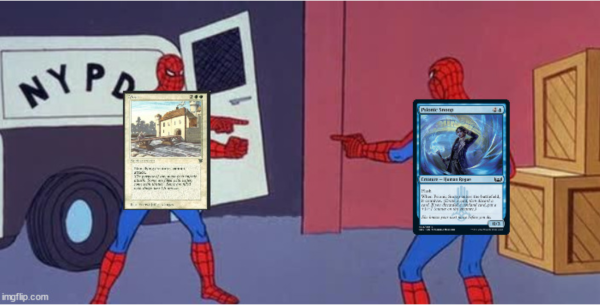
Psionic Snoop is a card that I am willing to maindeck, but would rather not. I've mentioned previously that any blue card with connive is worth playing, and I still think that is mostly true. However, I'm not thrilled at the prospect of using a card on a 1/4.

Snoop Dogs 'Em

If I see an aggressive start from my opponent in game one, and a flurry of low-toughness creatures are taxing my few removal options, Psionic Snoop can be a difference maker. When you feel confident that the 1/4 body is an asset to your game plan, the flash and connive make this card feel like a lot of added value. It won't win you the game on its own, but a Horned Turtle with flash goes from being a below-average card (perhaps slightly worse than your twenty-third) to one of the better cards in the deck.

Bricking an army of Gathering Throngs can alter a match-up completely. Yes, it will still die to a combat trick or a removal spell. Neither of those results is ideal, but taxing your opponent's resources and dictating their play patterns is a symptom of winning strategies.

Snooper Trooper

Context Is Everything

You shouldn't be looking for cards like Rest In Peace, which range from a flat zero to a ten-out-of-ten, when building sideboards. You're looking for otherwise suboptimal cards that get a big boost based on the match-up. Sometimes we might need to lower our curve to be more aggressive. In that case, we might want to take out some interaction for a Riveteers Initiate even though, in some match-ups, it's underwhelming.

Backstreet Bruiser can be a powerful speed bump if our opponent is expending resources to pressure our life total. Incriminate isn't particularly impressive, but if you're desperate for early interaction, you might find a lifeline in this late pick.

An Offer You Can't Refuse is the exception to the rule. It's a card that seems unplayable. Negate is a situational card and this version donates two treasures. However, if you lose to a Hostile Takeover or Elspeth Resplendent, then you should scour your deck box for this Counterspell. This is the kind of card that goes from a zero to a necessary evil. The treasures might cost us, but by the late game, they shouldn't be too valuable. It's never fun to just sit around knowing that we can't possibly beat our opponent's bomb. This awkward uncommon can be a saving grace.

Similarly, you may find yourself bringing in Sewer Crocodile or Wrecking Crew because in the first games you recognized a lot of smaller creatures trading off. These larger creatures aren't always particularly efficient, but they dominate certain match-ups.

Don't Be Fooled

Maindeckable "Sideboard" Cards

In early Magic, cards like Warmth, Light of Day, and the Circle of Protection cycle hosed the color they were designed to hate. Unfortunately, they did nothing in other match-ups. These polarizing effects made the cards generally unfun for either player. In recent years, Wizards of the Coast has changed some templating when it comes to printing sideboard cards for Standard. Specifically, at the uncommon slot, there has been an influx of relatively serviceable cards that get especially strong given the right match-up, but don't totally hose an opposing strategy.

This change has made many of the cards designed for Constructed sideboards into strong maindeck cards in Limited. Out of the Way is a blow-out against green decks, but it is still an Into the Roil against any creature you want to bounce. Sacrificing a land was often a reasonable price to pay when you got to deal four damage to any creature with Redcap Melee. These cards are just good.

Massacres, Plummets, and Cobbled Wings

Many sideboard effects are commonly reprinted. While the format will play a big role in determining their value, once you know your match-up, you should have more insight into their worth.

Massacres

If your deck has no creatures affected by these cards, then just play them. However, that is extremely rare. At face value, these cards punish players symmetrically. When I have one of these in my sideboard, I'm always evaluating creature sizing. In some games, these cards create an insurmountable impact on the board. They are most often used as a means of enhancing defensive speed. If your match-up calls for that, you should bring these out from the sideboard.

Plummets

Plummet is a very narrow card and we usually get more versatile effects. Still, these cards will often end up in our sideboards, especially if we are aggressive, have access to more versatile removal, or have reach creatures. Remember, that not all answers are good answers. Disenchant effects face a similar concern. Both of these effects have value depending on what our opponent is doing. Usually, I need relevant data from the game to warrant their inclusion.

Cobbled Wings

In a cluttered board stall, one huge, evasive attacker can be game-wrecking. Equipment that can turn any threat into an evasive one is a valuable tool in these match-ups. However, they are sometimes too slow to matter. I don't typically want them in the starting forty, however, once I know what type of game I'm playing, these cards can be a critical piece to achieving victory.

Use The Whole Buffalo

Building a deck after you complete a draft can feel like performing surgery. Every decision is a careful one. The reason these decisions are so delicate is that, if we drafted well, we have a number of reasonable inclusions. The value of each card is heavily dependent on an inexact metagame. After game one of each match-up, though, we have a much more precise understanding of a newly discovered, one-deck metagame for this particular round. Use that information, to bring the best version of your deck for games two and three and gain a serious edge on your opponent.

When drafting from a weak pack, consider how a certain card might impact a certain match-up. Consider the situations you might find yourself in, the weaknesses you will need to defend, or those you will want to exploit. Be wary not to overdo it, though. You picked your best forty cards for a reason. Don't be so distracted by your opponent's plan that you jeopardize your own.

Context is everything and gaining a better understanding of the context, should lead to a revised understanding of the cards in a pool. The best possible deck to start a tournament might not be the perfect forty cards for the current match-up. Always be reflecting on the data, and you'll be sure to come away with a ton of success.

Currency Swings and Arbitrage

Are you a Quiet Speculation member?

If not, now is a perfect time to join up! Our powerful tools, breaking-news analysis, and exclusive Discord channel will make sure you stay up to date and ahead of the curve.

Last week I left a valuable easter egg in my article by sharing a sub-$800 copy of Library of Alexandria I found for sale. The card sold shortly after my article went live. I can’t say I’m surprised. That card had no business being that cheap, especially from a trustworthy seller. Perhaps some players—particularly Old School players who may not frequent large-scale events—are not familiar with Face to Face Games. It’s also a Canadian shop, so I could see how many players would forget about the game shop in the Great White North.

Here's the thing, though: you’re going to want to know about these international shops. As the Federal Reserve wrestles with inflation, they’ve taken an aggressive approach of raising interest rates. This, in turn, strengthens the US dollar—we’re talking 20-year highs here. Other central banks aren’t moving as quickly as the US, and (without getting into too much macroeconomic theory) the result is that the U.S. Dollar is strengthening relative to other currencies.

The result: arbitrage opportunity. It’s back with a vengeance, and if you’re interested in taking advantage of deals from other countries, you’ll definitely want to familiarize yourself with some key stores.

Face to Face Games (Canada)

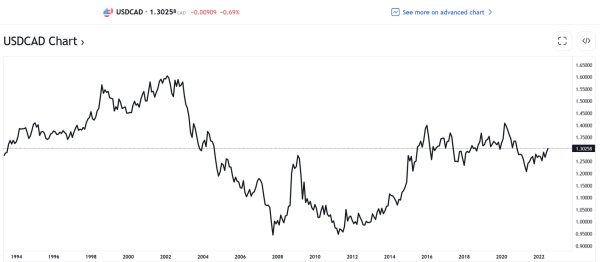
I already touched upon this one in my introduction, so I thought I’d start here. The US dollar currently purchases around $1.30 worth of Canadian dollars. In this particular case, the conversion rate has hovered in a somewhat narrow range between $1.20 and $1.40 for about 6 years, so this isn’t a recent phenomenon.

What’s important, though, is that you are familiar with the game store and are ready to take advantage of any sudden shifts in the currency market. As the Fed raises rates throughout 2022, I anticipate this will send this line graph higher. If the $1.40 line is crossed, it could mean a return to the highs back in 2002.

That means cheaper Magic cards if you are spending US dollars.

If you want to browse directly to their high-end cards, you can navigate as the image shows below to get there. For your convenience, you can toggle the currency displayed on the site from CAD to USD if you’re shopping from within the U.S.

After clicking on the "High-end MTG Cards" link, I’d recommend clicking on the checkbox on the right panel to only show cards that are in stock. The results I found when searching last were some Dual Lands, a Beta Demonic Tutor, a Mox Diamond, a couple Wheel of Fortunes, and more. In addition to the good prices, I’m also keenly interested in their heavily played cards in particular. It seems they price these cards competitively to TCGplayer, and it could be where you find the best deals.
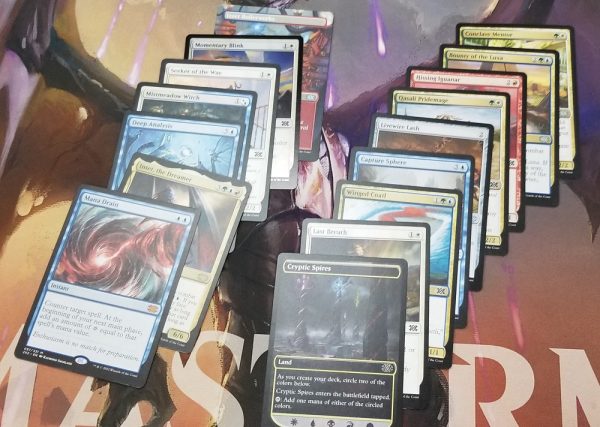
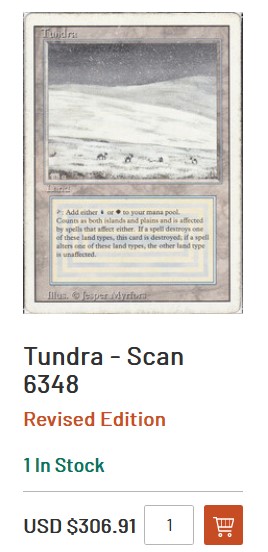
This Tundra price isn’t too shabby, for example.

If the deal doesn’t quite tempt you yet, don’t abandon this arbitrage idea completely. In a couple of weeks, the US dollar could have strengthened further relative to the Canadian dollar. Suddenly you could see a 5% decrease in prices as a result. If that trend continues, eventually the deals will be too good to ignore.
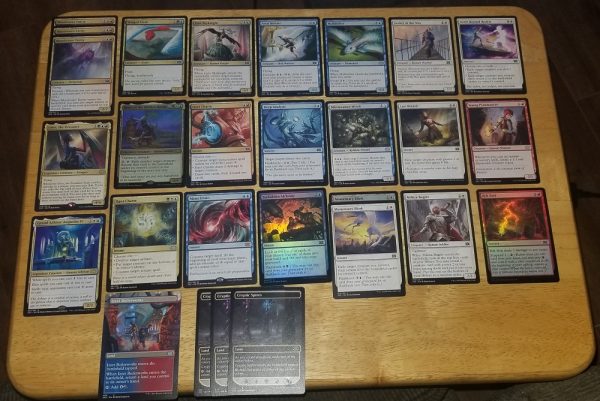
Hareruya and TokyoMTG (Japan)

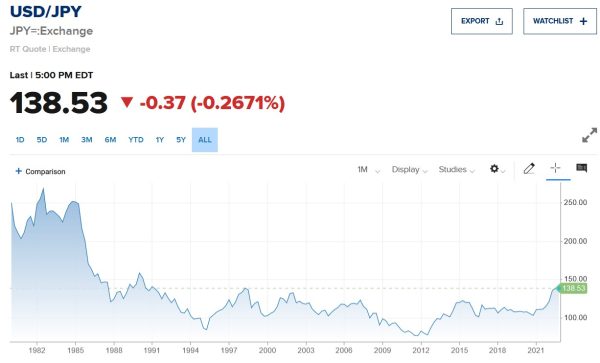
The chart comparing the US dollar to the Japanese yen is even more interesting.

Right now a dollar can purchase you over 138 yen—this is the highest amount since 1998! Direct your attention to the rightmost portion of this graph, starting in 2021. Do you see the recent uptick? Once again, this is thanks to the rising interest rate environment within the United States. Since rates are likely to increase further this year, it stands to reason the US dollar will strengthen further relative to the Japanese yen.

How can we take advantage of this in the world of Magic? I’d start by visiting two Japanese card shops—both websites have English translation options, making them friendly to international shoppers.

First, there’s Hareruya. They know that international buyers shop on their site, which is evidenced by the currency conversion window they have on the left panel of their home page.

You can search for cards directly or browse by set. I like to do the latter, and navigate to the Old School sets since I often hunt for deals there. That being said, you could also browse for Commander staples, which may also be priced relatively well.

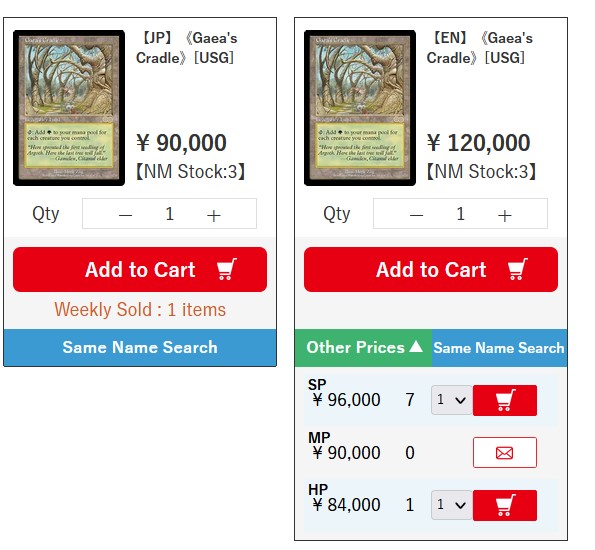
The best prices will be in the played copies Hareruya has in stock. Make sure you click on the little green box under a listing to see all conditions in stock along with their respective prices. I ran a search for Gaea's Cradle as an example. Their near mint price is 120,000 yen, around $866. Their heavily played price is 84,000 yen, which is equal to around $607. I ran over to TCGplayer to see the cheapest copy in stock there—it’s nearly $700! That’s a significant discount.

I can say with confidence that Hareruya does a fantastic job grading cards, packing them, and shipping them because I have made a few sizable purchases from their site in past years. Feel free to browse their inventory—if you end up making multiple purchases, they also have a loyalty program where you can earn points that you can recoup for store credit.

Another Japanese store you can shop from internationally is TokyoMTG. Right on the home page is the option to browse their new high-end inventory. It’s like they read my mind!

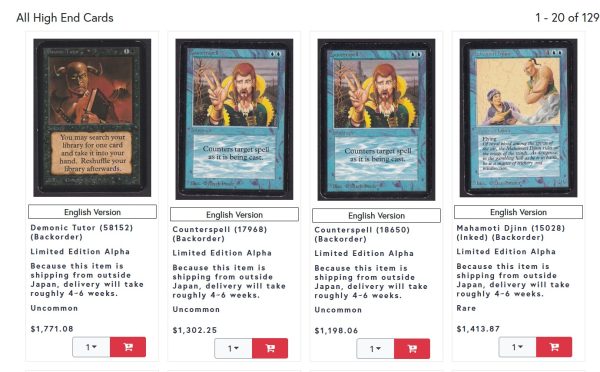
I clicked on that link and was able to browse all sorts of Old School listings. I must say the cards in stock are eye-catching, to say the least!

I like that TokyoMTG has an option to display prices in US dollars, saving me the effort of converting numbers repeatedly with Google. This site has all sorts of high-end cards including black-bordered Power, numerous Alpha and Beta cards, FBB Dual Lands, and more! As the US dollar strengthens, prices on this site will become more attractive as well.

As a result, I would definitely recommend keeping an eye on both TokyoMTG and Hareruya for great deals. I haven’t hunted these sites thoroughly, but I wouldn’t be surprised to hear about underpriced, attractive deals on these sites.

Card Market (Europe)

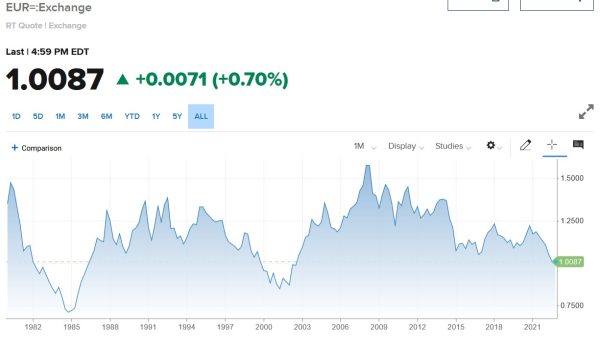
The last site I am going to touch upon is Card Market, formerly known as MKM. Prices on this site are listed in Euros, which also happen to be dropping in value relative to the US dollar.

Keep in mind this chart plots the ratio of euro to US dollar whereas the previous two comparisons had the US dollar in the numerator. Therefore, for the chart above, the lower the curve the stronger the dollar relative to the euro. You can see that the dollar hasn't been this strong relative to the euro since 2003. For one brief moment last week, the exchange dipped below one, indicating the dollar was worth more than the euro before flipping back over again.

Card Market has been around for a long time. The site is essentially the TCGplayer of Europe. One negative to this site is that you need to have a European address in order to purchase cards here. If you’re serious about taking advantage of arbitrage opportunities, I’d encourage you to find a contact overseas who is willing to purchase cards and ship them to you. The inventory on this site is impressive, especially for older cards, and prices are more attractive than they’ve been in over a decade thanks to the currency fluctuations.

I ran a search on my favorite card, Shahrazad, and I see there are more listings on Card Market (78) than there are on TCGplayer (42). The inventory of Old School cards on this site is especially impressive.

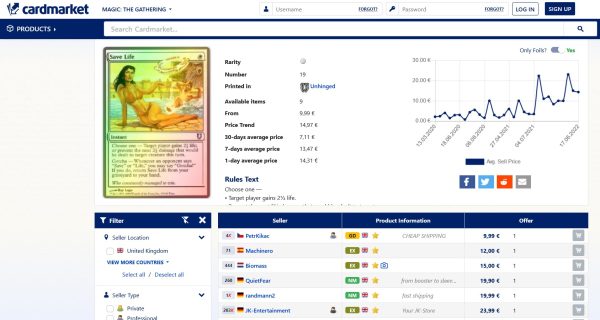
The best deals, however, may be on some obscure foils and Commander cards that lack in popularity in Europe. I’ll give you a random example, where I took advantage of a little arbitrage recently myself. I wanted to pick up a copy of foil Save Life, a goofy Unhinged card I used to own as a kid but since traded away. I went to TCGplayer, and the cheapest copy in stock was $100 for a moderately played foil copy! Yikes.

Star City Games, Card Kingdom, ABUGames, etc. were all sold out. EBay also didn’t have any cheaper copies. On Card Market, there is a handful for sale in the 10-20 euro range.

This is still extremely thin stock, but you can see how some more obscure cards can be had for good prices on Card Market.

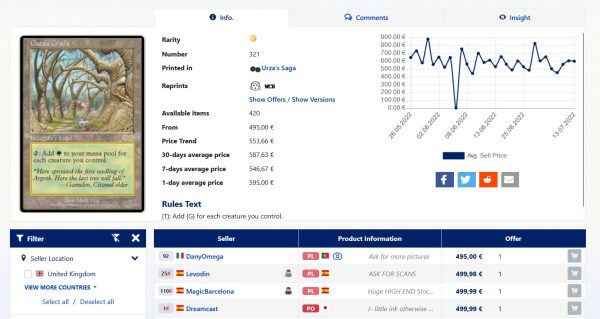
If foil Save Life is a little too obscure for you, then look no further than Gaea's Cradle. Here is yet another site where you can purchase copies well below TCGplayer’s lowest prices.

Keep in mind that the euro and dollar are basically equal now so that 495 euro copy is going to be around $495! Granted, there will be shipping costs and the like, but even if you add in an extra $50 for those costs, you’d still be well below TCGplayer’s lowest English copy, which is approaching $700.

When shopping on Card Market, it's important to note that often the cheapest copies are not English, as is the case with Gaea's Cradle. Keep a watch out for language (denoted by the flag next to the condition) so you don't accidentally purchase a card you can't read. I will say that, despite not being English, the cheapest copy of Gaea's Cradle on TCGplayer is still $650 (Japanese), so these are all still a much better deal.

If you don't care about language and just want the cheapest copy out there, then Card Market is a great resource with a vast selection.

Wrapping It Up

These are strange financial times in which we're living. The stock market has pulled back significantly, and we’ve seen investors reduce their exposure to riskier assets such as cryptocurrency. To combat rampant inflation, the Federal Reserve has begun aggressively raising interest rates.

I’m not an expert in macroeconomics, but I have heard and read that this action is leading to the strengthening US dollar. The result: the dollar is worth more than other currencies on a relative basis than it has been in recent years. In some cases, it’s been over two decades!

What does this mean for Magic finance? It means cards being sold outside the U.S. may suddenly become more attractively priced when converted to dollars. If this trend continues, we’re likely to see a large influx of supply from overseas coming to the U.S. This will pressure prices and lead to some more market weakness, but it’ll also mean deals will be found! If you’ve been waiting patiently for your chance to purchase some cards, your time may be coming.

You could wait for supply to reach our shores and prices to adjust, or you could be more proactive and seek out the opportunities overseas yourself from the sites I've listed here. I’m going to be paying more attention to this trend in the coming months, and I’d highly encourage readers to do the same. You just never know what deals you’ll find, whether it be a Dual Land, a piece of Power Nine, or some random foil Unhinged card you’ve always wanted.

The deals are out there, and they’re about to get even better. You just need to know where to find them.

Generational Magic: Drafting Double Masters 2022 with Friends

Are you a Quiet Speculation member?

If not, now is a perfect time to join up! Our powerful tools, breaking-news analysis, and exclusive Discord channel will make sure you stay up to date and ahead of the curve.

I've mentioned before that drafting is my favorite format, no matter the set. Don't get me wrong, Kamigawa: Neon Dynasty was a lot more fun than Saviors of Kamigawa, but I'll enjoy it either way. I've drafted every standard legal set since Tempest, most other 'draftable' sets like Modern Horizons 2, and a few that weren't even designed to be drafted (I'm looking at you Fallen Empires).

Many times when I draft a new set, I'm pretty relaxed overall. I review the cards, but I don't always study the archetypes or delve heavily into set strategy. I like to keep myself open to wherever the draft takes me. It is true that this can at times be self-defeating when you're playing against those that are more diligent about strategy. I've been playing long enough to know that there will always be another game...another draft.

My Double Masters 2022 draft

Jarod and I arrived at Mavericks last Friday around four. We wanted to arrive early since they were only running eight drafts in total and we also wanted to not be in the same draft pod. I got into the second pod and Jarod was in the third. I sat down with seven other drafters, ready to rip into our first packs. I looked forward to pulling a Wrenn and Six or some other awesomeness.

There was an error retrieving a chart for Wrenn and Six

Pack One

Pack One Pick One

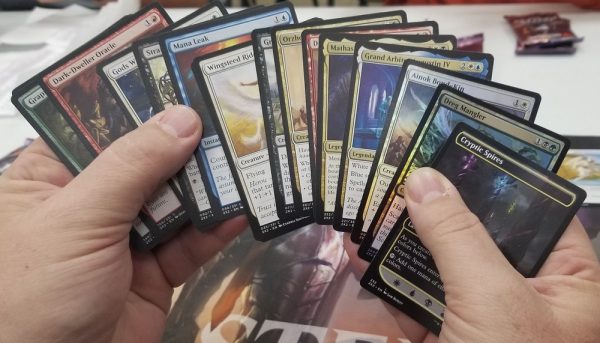
Well, that didn't go as I hoped. Still, I needed to see what we could do with this pack. Possible directions were white aggro with Wingsteed Rider and Ainok Bond-Kin, a UW control shell with Grand Arbiter Augustin IV, which usually isn't the best in Draft, or go out on a limb with Dreg Mangler. No really good choices, so I grabbed the legendary advisor and Orzhov Pontiff.

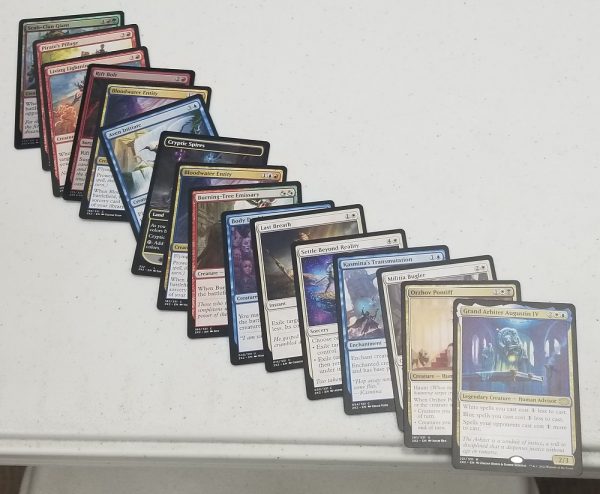
Pack One Picks - Right to Left

I started to draft that UW deck with some initial removal, but red and green started to show up about halfway through the pack, with that Burning-Tree Emissary. Unfortunately, that's about as good as it got and the pack ended up split and without focus.

Pack Two

Pack Two Pick One

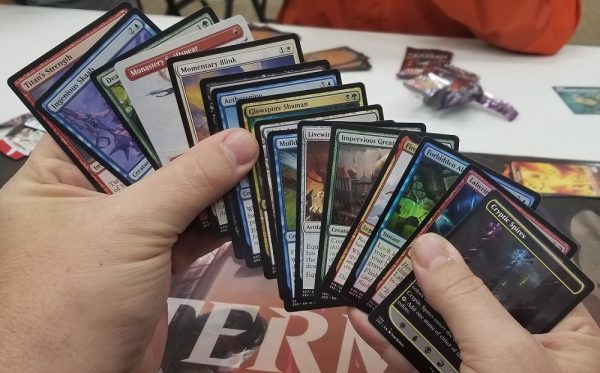
Pack two followed pack one's lack of money cards, with no obvious stand-outs. If I was to continue drafting UW, Momentary Blink and Mulldrifter would be great for my deck. I took those as my first picks and set out to make a Blink deck.

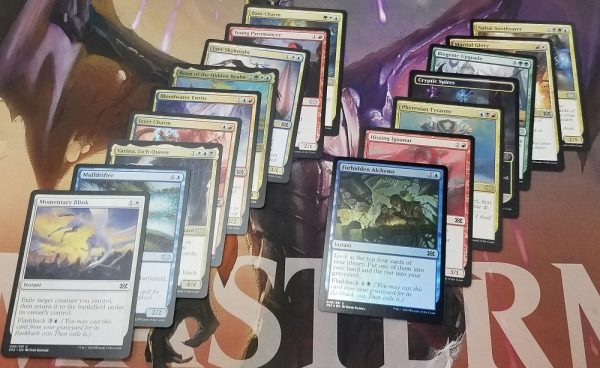
Pack Two Picks - Left to Right

By the end of pack two, the deck was definitely coming together. Still not great, but there was a little potential. I could branch into Jeskai or possibly Bant if I picked up a few more Cryptic Spires.

Pack Three

Pack Three Pick One

Ok, at least I could salvage a little of this draft with the Mana Drain, and also use it in the deck.

There was an error retrieving a chart for Mana Drain

Looking back I probably should have grabbed the second Young Pyromancer instead of Intet, the Dreamer. It would have tightened up my mana base better, but it's hard to pass up a Legendary Dragon.

Pack Three Picks - Left to Right

In the end, I built a Jeskai-blink-spells deck splashing a couple of green cards. Yea, not the greatest, but if the cards played right it could get there. I was hoping to at least put up a fight to be able to get to the second round.

My Draft Deck

Tony's Double Masters 2022 Draft Deck

Creatures

3 Bloodwater Entity
1 Winged Coatl
1 Lyev Skyknight
1 Aven Initiate
1 Mulldrifter
1 Seeker of the Way
1 Intet, the Dreamer
1 Roon of the Hidden Realm
1 Mistmeadow Witch
1 Young Pyromancer
1 Grand Arbiter Augustin IV
1 Militia Bugler

Spells

1 Settle Beyond Reality
1 Izzet Charm
1 Deep Analysis
1 Last Breath
1 Bant Charm
1 Mana Drain
1 Forbidden Alchemy
2 Momentary Blink
1 Rift Bolt

Lands

1 Izzet Boilerworks
3 Cryptic Spires
5 Island
5 Plains
3 Mountain

Who Am I Hangin' With Today?

Most of us know that a draft has eight players and three rounds. I got to know the other players a little better through my Double Masters 2022 draft experience. Here they are, showing a couple of cards they enjoyed in the draft and sharing a little about themselves:

Alec

How old are you?
Eighteen.

How long have you played Magic?
I've been playing for a month.

Very cool, just starting out then! How did you start?
A couple of the other guys, Zak and Keith were looking for people to play Commander with, so they kind of pulled us all together.

Have you been enjoying it?
Definitely, it's been fun.

What has been your favorite Magic card so far?
Mind Flayer

Matthew

How old are you?
Nineteen.

How long have you been playing Magic?
I've also been playing for a month. Alec and I are the new players in our circle of friends.

What's your favorite Magic card?
Jace.

Oh, ok! All the Jaces or are there specific ones?
I haven't gotten to know all of them, but I've enjoyed Jace, Wielder of Mysteries.

Zak

How old are you?
Twenty.

How long have you played Magic?
I've been playing for about 11 years now.

I see you're the veteran of the group! Have you enjoyed sharing the game with your friends?
Of course. We're having a great time. Our buddy, Keith really got us all together.

What is your favorite Magic card?
Sliver Hivelord

Keith

How old are you?
Twenty.

How long have you played Magic?
I started up again about three months ago, but I actually started back in 2019.

Have you enjoyed sharing the game with your friends?
I invited Alec and Matt to play recently to expand our Commander group, but Zak is who got me back into the game.

What is your favorite Magic card?
Korvold, Fae-Cursed King. He's my favorite Commander.

Cody

How old are you?
Twenty-eight.

How long have you played Magic?
My brother played when I was younger and kinda turned me away from the game for a while. I started up again just after Guilds of Ravnica, so my first pre-release was Ravnica Allegiance.

How do you enjoy playing Magic?
I play mainly Limited and Commander. I enjoy the play patterns and how variance plays differently in Limited. I also have two little ones, so I get out when I can and these formats allow me to do that with minimal disruption.

What is your favorite Magic card?
I don't have just one, but Grismold, the Dreadsower is one of my favorites.

A partial look at Cody's draft deck

Patrick

How old are you?
Twenty-five.

How long have you played Magic?
About eight years now. The first Magic cards I bought were right after the Born of the Gods pre-release.

How did you get into Magic?
Through one of my band friends. I was curious and joined in with an intro deck. Right around Khans of Tarkir I started getting more serious and watching coverage.

What is your favorite Magic card?
I've got to give it to my boy, Siege Rhino. He's the reason for a lot of my early successes with competitive Magic. He helped me win my first PPTQ. Another is Teferi, Hero of Dominaria. Of course, my opponents didn't enjoy him, but I thought he was great.

Frank

How old are you?
Twenty-one.

How long have you played Magic?
I've been playing since I was fifteen, so six years now.

How did you get into Magic?
Like many people, through some of my friends. We'd get together, throw different decks together and play. Very new and rough, but still a lot of fun.

What drove you to go further into Magic?
I started with a standard tournament a few years ago. I borrowed some cards from a friend and got absolutely destroyed. That drove me to work harder to improve and get better.

So, How Did My Games Go?

Uh...yeah, about that. I fought the good fight in the first game, but my opponent drew more and better creatures than I. The second game wasn't even a game. I got stuck on two lands and by the time I drew my third, my opponent had four creatures on board and was already looking forward to the next match.

My Opponent...

...was Frank. Frank drafted a very nice, low-to-the-ground, Jund deck. Draft like Frank.

Frank's Very Capable Draft Deck

Frank's Jund Draft Deck

Creatures

1 Bloodbraid Elf
1 Fireblade Artist
1 Sprouting Thrinax
2 Carrier Thrall
2 Dreg Mangler
1 Grim Flayer
2 Burning-Tree Emissary
1 Shattergang Brothers
1 Brindle Shoat
1 Eternal Witness
1 Dark-Dweller Oracle
1 Judith, the Scourge Diva

Spells

1 Inquisition of Kozilek
2 Unearth
1 Supernatural Stamina
1 Disfigure
1 Terminate
1 Assassin's Trophy
1 Atarka's Command
1 Eyeblight's Ending

Lands

2 Cryptic Spires
1 Golgari Rot Farm
4 Mountain
4 Forest
5 Swamp

After Frank got done with me, he won his semi-finals match and beat Patrick in the finals. I guess my consolation is that I lost to the eventual winner.

So, What Now?

Jarod ended up winning his draft with a better blink deck than mine. At least I'm teaching him right!
Drafting Double Masters 2022 was overall, an enjoyable experience. Not only for getting a few new cards and enjoying the play but getting to know others and making new friends.

I want to thank the guys for taking the time to share about themselves and hope that you've enjoyed this trip through my first Double Masters 2022 draft. Feel free to share your draft experience in the comments or on Twitter.

Happy Drafting!

Theory in Practice: RCQ Experience

Are you a Quiet Speculation member?

If not, now is a perfect time to join up! Our powerful tools, breaking-news analysis, and exclusive Discord channel will make sure you stay up to date and ahead of the curve.

The worst way to teach is to just lecture. Throw the information out there, but don't explain, demonstrate, or allow questions. The teacher might as well just have everyone read the textbook alone and save the hassle of coming to class. This is only slightly worse than reading the PowerPoint verbatim. I have spent my academic career endeavoring to avoid these pitfalls and continue that in my gaming writing. With that in mind, today I'm going to show how I applied the lessons I discussed on Tuesday to the Pioneer Regional Championship Qualifier (RCQ) I attended last Saturday.

Pre-RCQ Preparations

When Wizards announced that the Pro Tour was coming back, I was overjoyed. When I subsequently read that the Regional Championship would be Pioneer, I was less joyful. I hadn't played Pioneer in almost exactly two years and one month at that point, hadn't cared enough to see where the metagame moved in that time, and consequently had no idea what was good in the format. That meant a lot of catching up was in order. Fortunately, there was plenty of time.

There was an error retrieving a chart for Spell Queller

The only place to start was where I'd left off, which was with UW Spirits. I quickly learned that it was heavily out of date. Not only was it much worse without Teferi, Time Raveler but the metagame had sped up and UW was too slow. Fortunately, at about that time I learned that there was an alternative and Mono-Blue Spirits quickly became my deck. After landing on a deck choice, I then tested extensively, covering my basic level of preparation for the RCQ.

Verifying Information

This brings me to the night before the RCQ. While at FNM I made sure to ask as many serious players as I could which RCQ they were attending. There was a Modern one in northern Denver and the Pioneer one in central Denver. I'd committed to the Pioneer one because it's closer and a less irritating drive. I followed up by asking if the information I had for the event was accurate. It wouldn't be the first time that the wrong start time was posted on the store's website.

There was an error retrieving a chart for Supreme Phantom

Most were in the same boat I was, but the last one I asked had better information. Specifically, he was on a Discord channel with one of the employees and asked him. He confirmed that the RCQ would start at the stated time. I made sure to check traffic before heading out and arrived in plenty of time to do everything I needed while ensuring that I wouldn't be first there.

Asking Around

I didn't need to verify the store's reputation. I've played there a few times and while the location isn't great there's nothing to complain about the store itself. As long as the air conditioning was working. It was a scorcher last Saturday.

There was an error retrieving a chart for Eidolon of the Great Revel

In the course of my conversations, I also found out that two UW Control players, a Mono-Red player, a Heroic player, and an Esper Greasefang, Okiba Boss player would be attending the Pioneer RCQ from my LGS. This wasn't great news for me. Control is a tricky matchup and Mono-Red is quite bad. I've never played against Heroic but Greasefang is a very good matchup. It mostly durdles and the big payoff is easily contained with Shacklegeist. I don't really need graveyard hate. This information let me know the swath of cards to pack for my sideboard.

The Non-Factor

As I said on Tuesday, I already play faster than most. I'm also playing an aggressive deck. There will be no drawing in my games unless my opponent is seriously slow-playing.

Tournament Day

As intended, I arrive about 15 minutes into registration with no issues. After getting signed up, I got started on the most important part:

Scouting the Field

Being fairly early, I had the opportunity to observe most of the players as they finalized and registered their decks. While I couldn't see every deck, I saw enough to have a good idea of the field. There were many decks I couldn't identify, but they had blue and green cards. Mono-Green Devotion and Control looked like the most popular decks, followed by Spirits. A relatively favorable field. It didn't look like there were many Mono-Red players, but I did see plenty of red and black cards hanging around. With that in mind, I registered the following 75:

Mono-Blue Spirits, David Ernenwein (RCQ 10th place)

Creatures

4 Ascendant Spirit
4 Mausoleum Wanderer
4 Spectral Sailor
4 Shacklegeist
4 Rattlechains
4 Supreme Phantom
3 Brazen Borrower

Enchantments

4 Curious Obsession

Instants

3 Lofty Denial
4 Geistlight Snare

Lands

18 Snow-Covered Island
4 Faceless Haven

Sideboard

2 Disdainful Stroke
2 Witness Protection
3 Cerulean Drake
3 Slip Out the Back
3 Mystical Dispute
2 Damping Sphere

Lofty Denial often gets left in the sideboard these days in favor of Slip Out the Back, but in a field with lots of green decks, I want more maindeck counters. If there are going to be lots of red creatures and Shark Typhoon, I need the maindeck Brazen Borrowers. I'm not running Otawara, Soaring City after repeated flood-outs during testing.

There was an error retrieving a chart for Otawara, Soaring City

The sideboard Damping Sphere's are purely for Lotus Field. I didn't specifically see it during scouting, but there were a number of decks that could have been field. I'm not playing Aether Gust because the only card that I'd want to Gust rather than counter is Skylasher and I've never had that card turn around the Mono-Green matchup enough to worry about. The Disdainful Stroke would generally be better anyway.

Logistics Done

I learned there would be a lunch round and coming alone covered my logistical concerns. In terms of destressing after rounds, I make a point of walking out of the venue after rounds to trick my mind into letting things go. Physically leaving the space seems to do wonders for me, stress-wise. The biggest one that helped was writing down my notes from the match for this article. There's something really cathartic about putting word to touchscreen for me.

The Tournament

As I mentioned, I already play faster than most and disguise my sideboarding. To the point that it's a reflex at this point. So how did it go? That's a weird question to ask, I said I came in 10th back at the decklist. The RCQ had 53 players, and here's what happened:

Round 1: Mono-Green

Round one starts auspiciously as I'm on the draw and have to mulligan. However, I'm against Mono-Green which makes up for a lot. I get in five damage with an Obsessed Supreme Phantom while my opponent dumps onto the board. I flash in threats on the end-step, Shacklegeist the Cavalier of Thorns, and swing for 15. Easy game. In game two my opponent gets an early Karn, the Great Creator for Heart of Kiran but again I have Shacklegeist. From there, my opponent has nothing and I get to counter two Storm the Festivals with unbuffed Wanderers.

Sideboarding:

-3 Brazen Borrower -1 Geistlight Snare

+2 Witness Protection +2 Disdainful Stroke

There was an error retrieving a chart for Storm the Festival

Round 2: Niv to Light

In round two I'm again on the draw and again need to mulligan. I'm not sure what my opponent is playing until he plays Sylvan Caryatid into Kolaghan's Command. I've never tested against Pioneer Niv to Light. However, he never gets Supreme Verdict so I counter the sweeper he does have and then Niv-Mizzet Reborn. Game 2 is basically the same, just with Slip beating removal.

Sideboarding:

-3 Brazen Borrower -2 Shacklegeist

+3 Slip Out the Back +2 Disdainful Stroke

Round 3: UW Control

As has become familiar, I'm on the draw and a mulligan for round three. My UW opponent mulligans too, but he benefits more. All that needs to be said of game one is that my opponent played three Portable Holes in the first four turns, then Supreme Verdict, three March of Otherwordly Light, and two Absorb. I'm not sure I could beat that even with seven cards on the play. I did successfully answer Typhoon cycling with Borrower, so that's something. I mulligan again in game two, and this comes down to both of us with nothing in hand, I'm attacking with Haven, and he draws removal while I draw Islands. Whelp. Result: 2-1.

Sideboarding:

-4 Ascendant Spirit -4 Shacklegeist

+3 Slip Out the Back +3 Mystical Dispute +2 Disdainful Stroke

There was an error retrieving a chart for Supreme Verdict

Round 4: Jund

I'm finally on the play but have to mulligan. Again. Variance is not on my side today. I keep Island, five one-drops, and never see another land despite four turns and seven draws thanks to Obsession. Game two starts well until I'm blown out by Hidetsugu Consumes All. Couldn't play around it, but it still sucks. I managed to get my opponent down to one before Graveyard Trespasser put my opponent out of danger from my Wanderer, at that point my only flier. Any spirit or an Obsession wins the game but instead, I draw my seventh land and am dead to the swing back no matter how I block.

Sideboarding:

-2 Shacklegeist

+2 Cerulean Drake

At this point I'm probably dead for Top 8. Probably isn't definitely though, so I'm staying in.

There was an error retrieving a chart for Graveyard Trespasser

Round 5: Niv to Light

I'm on the play and for the first time, I don't have to mulligan! My opponent doesn't do much until I counter his Extinction Event. He gets Verdict a turn later, but I keep playing threats. I win when his Bring to Light gets Tolsimir, Friend to Wolves to gain life, and I Petty Theft Tolsimir before the wolf enters. In Game two my opponent again has Event and I again counter. That's the only thing he does. Post-game he reveals a hand of nothing but five-drops with only four lands.

Sideboarding:

-3 Brazen Borrower -2 Shacklegeist

+3 Slip Out the Back +2 Disdainful Stroke

There was an error retrieving a chart for Bring to Light

Round 6: UW Spirits

Standings are posted and as anticipated, I'm not dead for Top 8 but it doesn't look good. There are 2 X-0s that will draw and 10 X-1s. If they all play, that's 6 slots taken. If two tables of X-1 ID, that's it, the Top 8 is a clean break. I have the best tiebreakers of the X-2s, so I have a chance.

On the play, I keep a hand of one-drops and two lands. I never see another land, but my opponent primarily draws counters so I just chip shoot him to victory. In game two I open Dispute, Shacklegeist, Wanderer, and four lands. I keep it because of the first two. I flood hard, but mitigate the damage with Geist and activating Havens for more tap fodder. Ultimately, I win with Haven damage having drawn just enough Spirits to live at one life. Result: 4-2.

Sideboarding:

-3 Lofty Denial -2 Curious Obsession

+3 Mystical Denial +2 Witness Protection

There was an error retrieving a chart for Shacklegeist

I found out after the match that two tables of X-1 did draw, so I'm done. The Top 8 consists of two UW Control, two Mono-Blue Spirits, Rakdos Sacrifice, Mono-Green Devotion, Jund, and Esper Control. Both players who beat me make it. The UW Control player I didn't play won.

After Action Report

My variance was not good at the RCQ. I had land trouble in many games and had to mulligan a lot. Another land wouldn't have helped round four game one and could have been a liability in round three and round six. That problem aside, I was quite happy with my maindeck. I never needed the Spheres, but it turned out that there was a lot of Cauldron Familiar at the event, making my lack of graveyard hate a risky call.

There was an error retrieving a chart for Cauldron Familiar

That said, my plan against UW Control didn't work and needs major rethinking. It was based on earlier versions of the deck that didn't run 4 Portable Holes. Now that they are, I need to completely rethink how I play the matchup and how I sideboard against it. The Mystical Disputes weren't good there. In fact, they're only really good in the mirror and sometimes against UR Phoenix.

There was an error retrieving a chart for Inverter of Truth

As for Pioneer itself, I feel conflicted. Right now the format feels a lot like 2018 Modern. That's a good thing. However, I think that's a function of nobody understanding it rather than what the card pool actually allows. The only ones who kept up with Pioneer in 2020-2021 were the die-hards, and now the rest of us are mostly doing what the die-hards say is good—which I'm not sure is actually true. It just feels like there's a monster here waiting to be discovered.

Grinding Away

I didn't make it on my first attempt, but there will be more. I'm playing a Modern RCQ this weekend, so look for that report next time.

Diplomacy in Commander, a Little Goes a Long Way

Are you a Quiet Speculation member?

If not, now is a perfect time to join up! Our powerful tools, breaking-news analysis, and exclusive Discord channel will make sure you stay up to date and ahead of the curve.

Greetings friend or enemy, for the purposes of this article it makes no difference. During your Commander games, it's essential to not only build a great deck and play your hand strategically but also to play the table. In a word, diplomacy! Many games are won or lost based purely on the whims of players at the table. How do you seize upon these whims and turn them into wins? First some general multiplayer theory and then some specific cards with unique diplomatic applications for inspiration.

The Only Thing That Matters in Multiplayer, Threat Recognition

This is a bit of an oversimplification but only a little bit. Every turn you need to be able to point to the card that is the single biggest threat to the boardstate. That one card represents the momentum of a game. When a player accumulates too much momentum they are going to win and you need to stop that—unless it's you who has the momentum, of course. If you cannot stop what is going on you need to either appeal to the table to get the other players to recognize the threat or if you're the threat, to downplay your own dangerousness. Games are won or lost based on how close player perception is to the reality of the current boardstate. Diplomacy helps you bend that reality to your advantage.

So how do you use diplomacy to achieve this? I'm glad you asked!

Rattlesnake Theory

Magic has a lot of Snake cards but not any rattlesnakes, right? Well, not exactly. Seal of Doom and Soul Snare are some classic examples of what have become known as rattlesnake cards. They essentially show the ability to retaliate. The logic is don't provide a reason to get bit. Posturing with these types of cards can save you from being attacked and you can hang on to your answers longer.

If the board is at parity and you start attacking a player it's completely fair and natural for that player to retaliate. If you remove one of their permanents they are almost certainly going to remove one of yours in return. However, when another player plays into a card they saw coming they tend to accept it as their own mistake and are less likely to turn a game into a tit-for-tat grudge match.

When a Cat Is a Snake

Recently I built and played a Falthis, Shadowcat Familiar graveyard-based deck. Surprisingly, Falthis acted as a super rattler. Regularly on turn two or turn three I would put down a 2/2 deathtouch creature and then not be attacked on the ground for the rest of the game. There are lots of clickbait article titles possible. Why was it so effective though? In a word—value—or rather, a lack thereof. You lose your attacker. On my end? I just resummon my commander if I feel like it.

Falthis makes attacking me not worth it because I lose effectively nothing. Players quickly realize that trading an expensive Creature for an Ogre is bad. To me, this shows that rattlesnake theory is still in effect, however, what qualifies as a rattler has changed. The EDREC top 100, top 100 Enchantments, and even top 100 Creatures have nothing that would be considered rattlesnakes.

This may or may not be accurate, but it seems like If a player has removal in their hand, they are actively looking to use that removal on anything rather than saving it for a considerable threat when it matters. This, I believe, is the potential reason a card like Soul Snare, once a frequently played card in the early days of Commander, is now in a lot fewer decks. "You played something? Kill it." Sounds familiar? If opponents are going to fire off removal at anything that hits the board, the value of rattlesnakes diminishes.

This ties back to why Falthis was so effective. Putting Swords to Plowshares down on the table triggers threat recognition and retaliation. A Gray Ogre with deathtouch? Not so much. Falthis is effectively a Gray Ogre, but one with a mean bite. Rattlesnakes like Falthis give a deck non-threatening answers.

A King, Kingmaker or a Kingslayer?

During your games, you are one of three things: the king, a kingslayer, or a kingmaker. These roles are fairly obvious. While, of course, it's good to be the king, that does tend to be the most problematic role because the other players also want to be king. The single safest strategy in a multiplayer game is to keep the board somewhat even, never letting any one player hold on to too big of a lead for too long. That way, there is no king. If a player does manage to take a big enough lead, the other players act as kingslayers and bring that player down. However, when a player is hopelessly behind, sometimes they take on the role of a kingmaker, that is, actively helping another player win rather than try to win themself.

In my experience, if you cannot keep the board at parity, the next safest option is to become a kingmaker, not a kingslayer. Getting the most powerful player to ignore you is simply worth more than fighting other players. I'm not suggesting you do not play to win, far from it. What I am saying is that if the board did not work together to keep the game even you need to pick a side and the king is the right side. As the kingslayers drop you will have more chances at surviving long enough to potentially change the boardstate.

It's clear that threat recognition plays a huge role here. If you end up siding with the weaker faction you, too, will likely fall.

It’s Also About the Cards, Duh!

You can't have true diplomacy without playing a few highly interactive cards. It's not just about a "group hug" style deck where everyone is getting free resources whether they play along or not, it's about rewarding the table for working together to keep the game fair. While there are many diplomatic cards one of the overwhelmingly best examples is Eye of Doom.

At a full table, the Eye helps to balance the board by destroying the four largest threats, at least, theoretically. If one player is massively ahead, however, they should be losing three cards from Eye. This can backfire though. The table could collectively gang up on you for playing the Eye and make you lose three things. Or they can choose not to interact at all and simply pile all the counters on one permanent or put them on the Eye itself. Furthermore, threat assessment at the table may be a bit poor and the "wrong" things end up doomed.

But Diplomacy Exists!

This is key. Yes, Eye could be used poorly or not at all. However, you have cards like Eye in your deck for a reason. Before you play Eye, engage in some table talk, get threat assessment sorted, and if you cannot agree on what needs to go there's a diplomatic solution for that also.

NOT Doing Something Is a Diplomacy All Its Own

Sometimes getting the table to agree with your vision of the game is impossible. In those cases let the world burn. Once the world is on fire threat assessment should become a lot more obvious. In that situation, Eye of Doom can likely still "fix" things. If not, well, you have diplomatic capital for the next game. Feel free to remind the table that you pointed out the problem and wanted to fix it if only the rest of the table agreed. Losing a game now can sometimes be worth a few wins in the future.

Why Play Cards With Uncertain Results?

Simple. Playing highly interactive cards makes games far more memorable than the alternative. Remember that game where another player countered every spell or destroyed all lands and no one else could even play? If you do remember that game well, it was because it was so boring, right? We all have better memories of games where we needed to creatively use what we had to solve a problem. But beyond improving the quality of our games there is a strategic element to be exploited as well.

What Happens When YOU Are the Archenemy?

The beauty of a card like Eye is that if you can convince even one of the other players that something else is more of a threat than you, they can agree even if it seems obvious that you are the threat. Cards like All Is Dust or Wrath of God don't allow players to make any choice at all and are dead draws when you are ahead by a little or a lot. Giving players choices provides you with more outs in more situations. You never want the entire board against you unless you are light years ahead or are actually playing Archenemy.

A Couple of Other Examples

Diviner Spirit is another good example of a diplomatic card. You need to play ball to get and give the benefits of this card. Unlike Howling Mine the Spirit requires cooperation. Getting into a situation where everyone wants you to attack them shows off the strength of the card. There's an additional element that bears mentioning. Since the Spirit is drawing cards for your opponents they tend to feel like it is theirs. This works well because each other player feels like they lost a card of their own if it ever gets removed. Meanwhile, you are actually in charge of the Spirit 100% of the time. Other players defending your resources is powerful.

Siren of the Fanged Coast is a special case card. If at first glance you think "This is a bad Control Magic because my opponent can just say no thanks and then it's merely an Air Elemental" then I believe you have misjudged it. You get to choose player A and let them make the tribute decision for, say, player B's commander. This is devious because, firstly, the duration is not temporary. Secondly, the Siren can die and the trigger still resolves. Third, it's almost like you didn't steal player B's stuff, it's more like player A did. Just like the Spirit above, certain cards can reduce the ire coming at you and redirect it at other players.

What About Bob?

I've played with a player who will be referred to as "Bob". Bob is immune to diplomacy. When Bob is in my games Bob's only goal is to defeat me. Nothing else matters to Bob. Occasionally, you will run into a Bob. You have three options when confronted with Bob. Option number one is to ignore Bob and try to play Magic. Number two is to engage Bob in a 1v1 to the death. Both of these options are suboptimal, particularly option two. Option three is to engage in diplomacy with the other players and try to hedge Bob out of the game. Here's where you can take it to the next level and simply make Bob the most attractive target. Do they need to attack to get a trigger? Tell them to attack Bob and you will clear the way. If they cast "target opponent has a really bad day"? Plead your case that Bob has signed up for the bad day. I love you, Bob, but I also hate you.

There's a Lot More

Diplomacy is a complex subject. Beyond threat recognition, rattlesnakes, kings, kingmakers, kingslayers, and of course Bob, there are more topics than a single article can ever hope to cover. Remember that every action has an equal and opposite reaction and it is up to you to pass off everything you do as necessary to balance the game. If you do it right no one should see you coming for the throne.

Magical Creatures: Homarids, Thrulls and Co.

Are you a Quiet Speculation member?

If not, now is a perfect time to join up! Our powerful tools, breaking-news analysis, and exclusive Discord channel will make sure you stay up to date and ahead of the curve.

Last week, we discussed the origins and development of two creature types unique to the Magic franchise: Kithkin and Nightstalker. They were both introduced to the game in June 1994, with the arrival of Legends. Today, Magical Creatures will take us forward just by a few months, until the advent of Fallen Empires (November 1994).

The fifth expansion of Magic: The Gathering was not part of any block, and introduced four new creature types meeting our criteria. But wait, why are we moving from the third set straight to the fifth? As you may know, the fourth set was The Dark, but it failed to introduce new creature types. Well, it didn't really fail at that (it introduced 32), but none of them were unique to Magic.

In fact, half of them were later changed to Human, and the rest weren't new to begin with (Leech, Shark, Bird and so on). Someday, we might even explore the little-known abyss of weird creature types that were abandoned over the years... but that's an article for another series!

Fallen Empires

Back to Fallen Empires. Sold in 8-card booster packs, it's a famously overproduced set. As a consequence, it's still one of the least expensive expansions today. In the last couple of years it has started rising, but just a few years ago it was possible to get a booster box for as little as $100.

As such, it's frequently associated with Homelands, although the reason for their low demand is slightly different. While the problem with Fallen Empires was mostly overproduction, Homelands marked an all-time low from the perspective of game design.

Some powerful cards from Fallen Empires

Fallen Empires is not renowned for its power level, either, but at least it gave us Constructed staples like High Tide, Hymn to Tourach and Goblin Grenade. All of them are very powerful spells in their respective colors, and the first was crucial for the birth of storm combo deck Solidarity.

Onto the four unique creature types that this set introduced: Homarid, Thrull, Orgg, and Saproling. The latter, as with Tetravite, only appears on tokens. Funnily enough, Saprolings are by far the most successful and well-known of these types. Which perhaps says a lot about how well players received the other three.

Homarid

Homarid is a weird creature type. The art of any Homarid is easily recognizable, as they are basically giant, sapient lobsters. Besides, it's not technically a creature that was invented for Magic, since Homaridae is just the scientific name for large-clawed lobsters. Anyway, I'm including them in this series because I think they deserve it. You don't see giant shellfish with human intelligence every day, do you?

Eight different creatures with the type Homarid exist today, and they are all blue. Four of them (which you can see below) were printed in Fallen Empires. Then we got Viscerid Drone from Alliances, Viscerid Deepwalker from Time Spiral, and Homarid Explorer from Dominaria. The eighth card is actually a playtest card from Mystery Booster, and is thus illegal in any format except for Limited. It's worth mentioning, though, as Khod, Etlan Shiis Envoy would make for a great Lord.

The original Homarids from Fallen Empires

Not much to say about Homarids. I find them pleasant, and would be happy to build a tribal, if only they were a little more numerous. And a little less weak, maybe. Unfortunately, they are all unplayable in any format. In fact, they are so bad that silver-bordered Old Fogey (from Unhinged) has protection from Homarids as a joke.

The only exception is Viscerid Deepwalker, which was a good pick in Time Spiral booster drafts. But then again, every creature with Suspend 1 was decent in that format. What else? Homarids' offspring is called Camarid, but we won't touch them for a while, since they only showed up with Time Spiral.

Thrull

The Thrulls usher us into a different realm, as they are new creatures without any doubt. They are also a bit more common than Homarids, with 24 different Thrulls having been printed over the history of Magic. If Homarids were all blue, Thrulls are mostly black, with some examples in white, too. And one exception, which is both black and red.

In any case, as you can see from the gallery below, they are very black creatures. I personally find them among the most disgusting creations of this game, from an artistic point of view. Which is reasonable, given the fact that they are creatures made from dead flesh.

A bunch of particularly repulsive Thrulls

Again, not a very strong or successful creature type. Many of them share an activated ability whose cost is to sacrifice them. They even have a Lord (unlike Homarids), but Thrull Champion is just unplayable. Some cards were pretty good in Limited, back when the original Ravnica block came out, but that's not because they are Thrulls.

It's just because they are pingers (Rakdos Ickspitter), because they tap creatures (Ostiary Thrull), and because they have flying and lifelink (Mourning Thrull). And you would always play these types of cards in a booster draft, no matter the creature type.

To sum up, with Thrulls it would be technically feasible to create a tribal deck without leaning too heavily on Changelings. Does this mean it would be advisable? Perhaps, but only if you want a deck with the most awful-looking creatures you can find in this game!

Orgg

Orgg is another totally new creature type. As with Homarids, there is a card simply named after the type itself. In this case, you guessed right, I'm thinking of Orgg. But what is it? Only four Orggs exist so far, they are all red, and they look like half-breeds between Orcs and Ogres.

Every single Orgg ever printed

Orggs are quite easy to spot, since they all have the word Orgg in the name and they all boast two pairs of arms. The first one was printed in Fallen Empires. The second, Trained Orgg, came with starter-level edition Starter 1999. Then it was the turn of Soulgorger Orgg (Judgment, 2002). And finally, in 2003, came Butcher Orgg, with Onslaught.

What do they have in common, apart from too many arms and an ugly face? They are all 6/6 and cost either five or seven mana to cast. That's it. Orggs would probably win the prize for the least playable creature type, at least among the ones we are discussing this week.

Saproling

Let's get to the best part: Saprolings. As we mentioned earlier, not a single creature was printed with the type Saproling. And still, this is by far the most interesting, playable and widespread of today's creatures. How come? The fact is Saprolings are tokens, and almost 80 cards exist with the ability of creating such tokens. Saprolings are "artificially made plant creatures," and they come in many forms, as stated by Mark Rosewater.

The cards able to create Saprolings are mostly green, although we also have rare examples in other colors. Over 20 of them are creatures with the type Fungus. This is why most of us immediately link Fungus and Saproling together. Back in 1994, when Fallen Empires came out, only a few cards existed with this ability. Think of the original Fungus, called Thallid, which set the standard for this type of card.

Some Saproling generators

But a huge number of new Thallids were created with the advent of Time Spiral, 12 years later. As former member of Magic R&D Devin Low explained here, they were looking for two major themes: nostalgia and time as a resource. What else would have worked better at linking together these two concepts? And this is why Thallids were brought back after a long rest, to the elation of Saproling lovers.

Broken Saprolings' Creators

What of playability and power level? No doubt, we are on an entirely different level from the previous three cases. So many cards exist with the power to make Saproling tokens, and so cohesive is such an ability within the color green, that Magic players really have endless ways to build decks based on this theme. They don't really have many chances to redeem themselves from the kitchen table, but that's still much better than the other three types we have just seen.

Since we have been mentioning Limited play quite a lot in today's installment, let's wrap it up with one of the most powerful cards ever printed (at least when it comes to booster draft). You may not know this just from looking at the card, unless you were playing back in 2007, but Sprout Swarm was by far the best common in the format, and among the best cards ever to first pick.

It's a win condition, it's splashable, and it combines convoke and buyback. Printing it at common was acknowledged as a mistake. Mark Rosewater himself had to explain why they didn't reprint it in Time Spiral Remastered. Do note that they considered printing it at uncommon, then at rare, then even at mythic rare. Eventually, they realized "it was causing more problems than it was worth" and just pulled it from the set.

Fates Intertwined

In today's installment, we saw four very different creature types. Each of them is linked to a specific color, and they had very different fates in the years following their creation. Some, like Orggs and Homarid, didn't get past 10 cards. Others, like Thrulls and Saprolings, had better luck.

What they all share is that typical old-school quality that all cards from those days possess. For this reason, they were all brought back with Time Spiral, given its interest in Magic's past. And three of them even appear on the same card: Sarpadian Empires, Vol. VII.

There was an error retrieving a chart for Sarpadian Empires, Vol. VII

This artifact represents the final tome of a seven-book series named Sarpadian Empires. A huge number of cards from Fallen Empires quote this series in their flavor text, but this is the only card directly named after the book. It can create Citizen, Camarid, Thrull, Goblin, or Saproling tokens, depending on what you choose when it enters the battlefield.

Unfortunately, we didn't touch Citizens and Goblins, as they were definitely not created for Magic. Nonetheless, they are characteristic creatures for their respective colors. What would you choose among the five? Let us know in the comments or on Twitter!

Adam Plays Magic: Velomachus Reanimator

Are you a Quiet Speculation member?

If not, now is a perfect time to join up! Our powerful tools, breaking-news analysis, and exclusive Discord channel will make sure you stay up to date and ahead of the curve.

This week on Adam Plays Magic, we're serving up a spicy Alchemy brew, courtesy of @SuribepeMTG. The focus of this deck is to use Faithful Mending and Otherworldly Gaze to stick a Velomachus Lorehold into the graveyard, then reanimate it with Invoke Justice.

There was an error retrieving a chart for Velomachus Lorehold

When Velomachus attacks, she looks at the top seven cards of your library and casts an instant or sorcery with mana value less than or equal to her power for free. Normally, that number is five. In Modern and Historic, this effect was often combined with Time Warp (and variants like Savor the Moment) to chain multiple extra turns together. It was even good enough to get Time Warp banned in Historic.

There was an error retrieving a chart for Invoke Justice

Enter Invoke Justice. Not only does this spell bring back a permanent, it distributes four +1/+1 counters amongst the board, including the freshly returned, hasty, and vigilant Velomachus. By bumping Velomachus up to seven power with these counters, the fun can truly begin. Her attack trigger can cast Alrund's Epiphany to queue up an additional turn. Alternatively, she can find Emeria's Call to deploy an army of angels to help close out the game next turn. Sometimes, Velomachus just grabs Burn Down the House or Divine Purge to clear out pesky blockers. All of this is really just a roundabout way of saying Velomachus closes out games the moment she hits the field.

What I Like

The Velomachus deck is exceptionally consistent. Otherworldly Gaze and Faithful Mending do a phenomenal job of churning through the library to find the combo. It also utilizes six main deck board wipes along with two Herald of Vengeance. Herald destroys all permanents that share a name with a permanent that dealt damage to you in the previous turn, and comes with an impressive 4/5 flying body to boot. These effects heavily punish aggressive strategies and open up opportunities to make it to the late game.

Speaking of the late game, with functionally 27 lands thanks to Emeria's Call and the added support of Key to the Archives, it's relatively trivial to cast seven-mana haymakers turn after turn. Even if the opponent has counterspells and other forms of permission, they will be hard-pressed to counter every game winning spell.

What I Don't Like

Tasha, Unholy Archmage. Good god, does this card hurt, and it's everywhere. This reimagined planeswalker from Commander Legends: Battle for Baldur's Gate boasts a new set of abilities that all directly attack the axis Velomachus fights on.

Tasha's -2 ability outright steals our game-winning threats and gives them ward 2. Her +1 puts a -1/-1 counter on all attacking creatures, whether they attack her or the opponent. That immediately kills any tokens created by Alrund's Epiphany and Burn Down the House before they even connect. It also reduces Velomachus's power before her ability resolves, stopping her from free-casting haymaker spells. Tasha's -6 ability steals three creatures from our deck (and this deck only plays seven). Since she enters with four loyalty and immediately ticks up to five, it takes two turns of attacks for Velomachus to kill her, all while giving the opponent plenty of time to take out the dragon. Every single part of this card wrecks us.

Other than Tasha, there don't seem to be many natural predators to the deck. It's ultimately not reliant on the graveyard to win the game so hate cards like Lantern of the Lost and Weathered Runestone only work to slow the deck down, not shut it out.

There was an error retrieving a chart for Show and Tell

Also, while other combo decks like Show and Tell try to cheat uncastable chonkers like Emrakul, the Aeons Torn into play, Velomachus is very castable in a longer game. Most archetypes will still struggle to beat a 5/5 evasive threat.

The Deck

Alchemy Velo Reanimator

Creatures

2 Herald of Vengeance
1 Jin-Gitaxias, Progress Tyrant
4 Velomachus Lorehold

Artifacts

Spells

4 Otherworldly Gaze
4 Faithful Mending
4 Divine Purge
2 Burn Down the House
4 Invoke Justice
4 A-Alrund's Epiphany
4 Emeria's Call

Lands

1 Plains
1 Island
2 Needleverge Pathway
4 Hengegate Pathway
4 Deserted Beach
4 Stormcarved Coast
4 Sundown Pass
3 Forsaken Crossroads

Sideboard

2 Valorous Stance
1 Burn Down the House
4 Reckoner Bankbuster
1 Disdainful Stroke
2 Negate
2 Test of Talents
1 Jin-Gitaxias, Progress Tyrant
2 Strangle

End Step

I had a great time this week and the Velomachus deck was an absolute blast to play. The core of the deck fits together seamlessly and I like the direction SuribepeMTG took with the list. Moving forward, I think I'll try to find room for more interaction or midrange pivots so that the deck isn't absolutely housed by Tasha. Maybe Fable of the Mirror-Breaker // Reflection of Kiki-Jiki or The Wandering Emperor can fit into these slots.

There was an error retrieving a chart for The Wandering Emperor

Don't forget to like the video and leave a comment! It lets us keep making content like this. If you'd like to keep up with me or suggest a deck for next week, feel free to reach out on Twitter @AdamECohen. See you all next week!

All the Little Things: RCQ Prep

Are you a Quiet Speculation member?

If not, now is a perfect time to join up! Our powerful tools, breaking-news analysis, and exclusive Discord channel will make sure you stay up to date and ahead of the curve.

It's nice to have an actual goal in playing competitive Magic again. While simply scratching the competitive itch is good, doing something for its own sake is a great way to induce burnout and/or TikTok memes. Therefore, I'm thrilled that we have a Pro Tour again. I'm less excited that they brought back the PPTQ system with extra steps and window dressing, but what can you do. At least it all makes sense, unlike the MPL system.

Normally, this would be the point where I'd transition into how to prepare for this upcoming season. This year presents two problems with that. The first is that we're already well into the season. That's what happens when you commit an article series and then have a scheduled column. In my defense, I was clueless as to when the RCQ's actually started until recently. Wizards and Dreamhack aren't doing a great job of telling players. Secondly, this isn't a qualification system like earlier ones. Most PPTQ seasons were one format, but these RCQ's are almost anything goes.

Consequently, I'm not going to do a general "here's how to prepare for a tournament" article. Those have been done to death, anyway. Rather, here are the things to be watching for this season in particular, and also some advice and tactics for the actual tournament.

Pre-RCQ

I'm going out on a limb here and assuming that anyone interested in going to an RCQ knows that they need to put in testing time before they go. I also assume that you know how to design your sideboard and that food and water are essential. However, there are things that a lot of players know (or should know) but they don't think about prior to the tournament. Whether through habit or assumption, things slip the mind. So, I'll remind everyone of the common ones.

#1: Verify the Tournament Information

I realize how this sounds, but I'm absolutely serious. Make sure that you've got the right day, time, store, and (most potentially embarrassing) format before setting off to the tournament site. I know that this is as basic as it gets, but every year Magic twitter is full of stories about players messing it up. Sometimes, it isn't even their fault. Stuff happens, and stores need to make last second changes. Don't drive out there without making sure that the tournament is still happening.

Back in the PTQ days (which was also before smart phones, in my defense) there were several instances where severe weather ended up causing tournament cancellations after I set out for the site. Which I didn't know (nor had I a way to), so I didn't find out until I arrived. Don't be me, especially in this information age.

There was an error retrieving a chart for Mental Misstep

Of course, that doesn't protect you from everything. Road accidents are a thing, after all. Also, sometimes something goes wrong at the literal last second. I remember one PPTQ I drove an hour for to find the store employees standing around outside. The guy with the key hadn't shown up and it took four hours to locate him (don't ask me why). They were updating every social media outlet on the situation, but since I arrived right at the supposed start of registration, I missed the updates. And was the only player to show up to the store until late in the day.

Since then, I've made sure not to leave so that I'll be the first to arrive at the site. Let the employees get settled in and figure out if we're actually doing this first.

#2: Ask Around

You know that you're going. You also know whom among your crew is going. Ask around to find out about the store and who else is going to the RCQ. This will provide two critical pieces of information:

A) Is it worth going at all?

There are plenty of reasons to steer clear of a given tournament. Perhaps the site is in a really sketchy part of town or is itself alarmingly sketchy. Crooked TO's exist and don't always get the punishment they deserve. Other players may be able to warn you of a (potentially) bad situation.

There was an error retrieving a chart for Wrong Turn

Additionally, there may be no point in going to the tournament even if there's nothing obviously untoward. The tournament selling out to capacity happens often, so failing to preregister can doom plans. Sometimes the limit isn't advertised and the only way to know is word-of-mouth.

I was on the end of this one once (and allegedly the first one, too). A store running an early PPTQ didn't advertise that they'd limited entry to the minimum they could to get it sanctioned (16 players, I recall) and then quickly sold all the slots. Another player calling in to preregister learned this and told me. My informant's implication was they were trying to get friends of the owner qualified and were maximizing their chances. Finding this out saved me quite the trip and a significant parking fee.

More benign still, sometimes there's something non-Magic happening which is off-putting. Construction is the most common obstacle, but other events in the area may make getting there prohibitive or playing annoying. Folk music festivals, for example. It'd be great to know about a saturation of ukuleles, fiddles, and bongos before arriving and suffering through hours and hours of it all.

B) Who's Going?

This is the big one. Knowing who's actually going to a tournament (to the extent possible) is critical information. See, The Metagame is not going to be the actual metagame at the RCQ. The Metagame is the aggregation of everyone playing a given format globally and speaks to what is performing the best overall. It's only going to make an appearance at large events.

There was an error retrieving a chart for Murktide Regent

At an RCQ or any similar event, the metagame at the tournament will be a function of the players that actually show up. PPTQ's were 30-60 players in my experience, and I have no doubt that RCQ's are similar. This means that individual preferences and outliers will have a significant effect on the final population. For example, if your crew are all control players and you learn that several groups of combo players will be at the same event, slant your sideboard accordingly.

There was an error retrieving a chart for Lotus Field

It's impossible to know exactly who will attend a tournament. Things happen; plans change. However, by knowing who, it's possible to guess what will be at a tournament. Which can provide an edge. Just don't go overboard; refer to the earlier disclaimer about uncertainty.

#3: Consider Pace-of-Play

Can you finish a typical round with your deck in 50 minutes in a competitive environment? Again, this should be really obvious, but at every single qualifier event I've ever been to, there is someone for whom the answer is no, and they ruin it for everyone by going to time. Every. Single. Round. Perhaps they've picked up a deck they're unfamiliar with.

Perhaps they can win in time at FNM, but with actual stakes on the line they slow down too much. Maybe they've never played the mirror before and it's going to come up a lot. Or they're playing Lantern Control. It's doing no favors to the community nor yourself to take multiple unintentional draws. If there's a question about being able to finish in time consistently, please consider playing something else.

There was an error retrieving a chart for Supreme Verdict

Day-of Tactics

Once at the venue and registered, don't get complacent. There are a number of things to do on-site before the tournament.

#1: Scout the Field

Look around at who's there. See what kind of test games are being played and what cards are being laid out as players register decks. This is the field you will be playing against. What do you need to be ready for, and what is the likelihood of certain matchups. If there's one deck that's unexpectedly popular, best adjust for it. If an expected deck hasn't shown up, drop cards for it instead. In short, take what I said in point 2B and actually apply it.

There was an error retrieving a chart for Nykthos, Shrine to Nyx

Also, look around for who to watch out for. This can be in the positive sense such as pros and Hall of Famers at the RCQ (which is a frequent concern in the Denver area). In the more negative sense, are there known angleshooters, grifters, and/or accused/convicted cheats? If so, I'm sorry. That really sucks. However, it's good to know so you can be extra vigilant.

#2: Plan Your Logistics

Once the number of rounds is announced, take a moment before play starts to mentally prepare for the day. If there's going to be a lunch break, great. If not, when and what will you eat? How many wins do you need? If you scrub and want to leave, can you given your crew's travel arrangements? Will your phone battery survive all the rounds so you can use the Companion app? Make sure you know the answer and have a plan so you don't get caught flatfooted.

There was an error retrieving a chart for Eidolon of the Great Revel

Also, how will you destress after rounds? You need to have an outlet or ritual to clear the mind. It could be as simple as telling war stories to friends and recapping the match, but the quicker the old match is processed and moved on from, the better.

Tournament Tactics

Knowing how to play the expected matchups and sideboard should have been set before the tournament. However, have you also considered these tournament tactics?

#1: Increasing Play Speed

When the pressure is on, it is natural to want to take more time to think decisions through. Sometimes this is justified because a situation is very complex. Sometimes it's all down to nerves. So many players get scared and needlessly play slow that it's become a peeve of mine.

There was an error retrieving a chart for Unnatural Speed

So deliberately play faster. Don't rush plays; that's how mistakes get made. But is that decision actually a decision? Stop agonizing over a land drop with only one land in hand and no card drawing. Don't consider an attack when overmatched or fret over what the opponent may draw if they're empty handed. It won't do anything but waste time, and the clock in no player's friend. Time saved now may be used for a more meaningful decision later.

Additionally, playing more quickly can be strategically advantageous. It projects confidence to take a turn swiftly which can put the opponent off their game. Make them be anxious instead of you. I'm a very experienced player and I play quite quickly. It makes my opponents think that everything is going according to plan even if it isn't, and makes them play around cards I don't have occasionally. Sometimes it also lets me back into games. Stress and nerves cause bad plays.

There was an error retrieving a chart for Thoughtseize

Don't ever deliberately make the opponent uncomfortable or stressed. That's not cool and is unsporting. And possibly bannable. However, if they do it to themselves as the result of their perception of you, that's fair game. Give opponents the opportunity to psyche themselves out.

#2: Disguised Sideboarding

The standard way to sideboard is to visibly take out a number of cards from the maindeck, put them on the table, and then replace them with sideboard cards. That's a great way to keep track of everything, but it also tells the opponent how heavily you're sideboarded against them. They may or may not be able to use this information, but it is free information.

There was an error retrieving a chart for Rest in Peace

Instead, I recommend shuffling the entire sideboard into the maindeck and then removing 15 cards. The opponent can't know how many (if any) sideboard cards you're playing now. As a bonus, it will add some wear to the sideboard's sleeves they wouldn't otherwise get and might save you from a Marked Cards penalty.

A Final Note

Most experienced players know this intuitively, but newbies need to learn. And I'm tired of having to spell it out every tournament. So, I'll do so here:

While the exact circumstances of your RCQ may differ, the rule of thumb for the final round is:

  • IF you are X-0, you're locked for Top 8. Congratulations! You should take an Intentional Draw (ID), get your deck sorted, and then take a rest until the formal announcement. The benefits of being actually undefeated over X-0-1 are quite marginal 99.99% of the time while dropping from X-0 to X-1 might be a disaster. You've earned a rest, take it.
  • IF you are X-1, you're in Top 8 contention. Depending on how many other X-1's there are and your tiebreakers, you may be able to draw in. Consider very carefully whether you need to play.
  • IF you are X-2, you're not dead for Top 8 but it's not good. Your odds of making it depend on the number of X-1's above you, your tiebreakers, and winning this round. It can happen, but a lot needs to go right for you to make elimination rounds. Definitely stay in if there are Top 16 prizes, but if not you may not want to bother.

Unintentional draws during the Swiss rounds can complicate this basic math, but most of the time, this guide will be correct.

It Begins!

With that, enjoy the qualification season and may you or a teammate make it all the way! Join me again later this week to see how this played out for me at last weekend's RCQ.

Want Prices?

Browse thousands of prices with the first and most comprehensive MTG Finance tool around.


Trader Tools lists both buylist and retail prices for every MTG card, going back a decade.

Quiet Speculation