menu

Insider: The Folly of TCG Mid

Are you a Quiet Speculation member?

If not, now is a perfect time to join up! Our powerful tools, breaking-news analysis, and exclusive Discord channel will make sure you stay up to date and ahead of the curve.

A couple weeks ago I was waiting between rounds at a PPTQ and happened upon two people trading. One of the traders suggested that the two trade at TCG low, while the other was adamant about using TCG mid. He had some weird reasons about using mid, but the one reason most people would agree with was that the low price usually leads you to a card in poor condition that is understandably discounted.

Ultimately, this ends up being a better argument for just scrolling to the lowest price lightly-played or near-mint version of the card. The player advocating TCG low ended up making a very profitable trade for himself, though one that looked even on TCG mid terms. The reason? Spread.

Spread is a term that all financiers will be familiar with--the difference between an item's sell price and its buy price. The reason that the trader mentioned above came out ahead was that he understood that TCG mid generated larger spreads for specific cards without dramatically impacting the spread of others. To fully understand this, let's look at some numbers.

TCG high is obviously a worthless metric. It could be a card that dropped in price with sellers leaving their high card posted, it could be that sellers are anticipating a spike and posted their cards above the price of other sellers, it could just be an error, or a myriad of other anomalies. The point remains that nobody in their right mind is trading at TCG high.

The problem with TCG mid is that the high numbers impact the average, and if I were to acquire cards at or near TCG low--the price point people actually buy cards at--then I'll be able to trade cards with inflated TCG mid values for cards with lower TCG low-to-mid ratios.

Take a look at the TCG values for Cryptic Command. I can buy a few copies of this card for about $29 shipped. Some chucklehead is looking for $58 for his copy though (TCG high), and the mid value of this card is $36. The difference between what I'm paying and the value I can trade it at is $7.

There was an error retrieving a chart for Cryptic Command

Now let's say that I want your Ugin, the Spirit Dragon. If I want a moderately played copy I could get exactly one in that condition shipped for $22, but after that I'm paying about $25 a copy, which is very close to the mid price of $26.41. If I have a Command on my side of the trade and you have an Ugin on yours, I'm charging you a tcg mid tax of $5+.

There was an error retrieving a chart for Ugin, the Spirit Dragon

When trading, you already want to be considering a card's buylist price so that you're not getting killed on trade spreads to begin with, and worrying about the difference in TCG mid-low differences only adds another layer of complexity. I'm not advocating for using this information to rip people off. What I am saying is that there are people out there who will try to use this against you, and trading at TCG low is a safer and more accurate way to reach fair agreements.

While I think it scummy to exploit this margin on trade tables, it is a great tool for users of Puca Trade. Puca Trade allows players to acquire cards for Puca Points that are earned by shipping cards to players for their TCG mid value, with one cent being translated to one Puca Point. So, if I were to buy the low Modern Masters Fulminator Mages at ~$17.50, I could then ship them for 2100 Puca Points.

There was an error retrieving a chart for Fulminator Mage

That's going to be 20 potential "bonus points" per dollar spent ((2100 / 17.5) - 100). Now what we need to do is find a card with a TCG mid closer to its TCG low relative to the cost of the card. I'd take Ugins all day ((2641 / 24.5)) - 100) = 7.796), but it's not a card that you can reliably expect Puca Traders to ship. A more realistic card that I like as a spec would be Sorin, Solemn Visitor.

There was an error retrieving a chart for Sorin, Solemn Visitor

Buying a bunch of Sorins outright is going to cost you around $7.50 per copy, with the Puca Point value being 800. This means that the "Puca tax" per dollar on Sorin is 6.67 points. This means that every dollar we spend on Fulminator Mage and convert into Sorins generates us just over 13 Puca Points. Bear in mind that shipping costs will eat up some of this value as you have to pay for what you send out, but this sort of investment strategy is at the level of Magic finance where you'll have plenty of envelopes and top loaders sitting around.

Ordering cards just to ship them and then trying to acquire more cards with points generated from said shipping is a slow grind, and not one that's necessarily going to benefit individuals. However, this is a good strategy for vendors and stores to employ. While cash is obviously a more desirable asset than Puca Points, this is a great way for a seller to sell a card that they might otherwise have difficulty moving for slightly more than they would just tossing it on TCG Player.

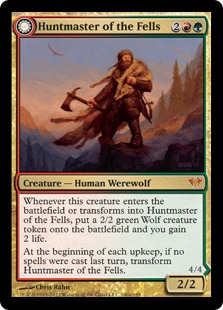
There are a ton of foils that sell very slowly and also command significantly higher Puca Point values than actual market values. If I had a foil Huntmaster of the Fells I know I'd be much happier with the 4,163 Puca Points it could fetch me than the twenty-some dollars I could get by selling it.

~

TCG mid simply isn't a metric based in reality. It's easily exploited in trades, and utilizing Puca Trade's economy being based on TCG mid is a nice way to grind some value. If you're a trader, I hope you already use TCG low or begin to in the future, and if you use Puca Trade I hope you're playing the market wisely.

Thanks for reading.

-Ryan Overturf
@RyanOverdrive on Twitter

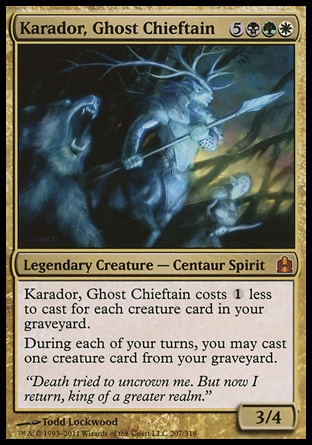
Karador, Ghost Chieftain EDH

Are you a Quiet Speculation member?

If not, now is a perfect time to join up! Our powerful tools, breaking-news analysis, and exclusive Discord channel will make sure you stay up to date and ahead of the curve.

Okay, last week of waiting for this interview thing. I promise, life has a funny way of taking your planned schedule and throwing a wrench in your well laid plans.

Let's pretend for a moment that xbox achievements applied to life as well as the games we play. I'd have my fair share of unique ones that I won't go into detail on, as well as a lot of more common achievements. You know like, "A legend in his own mind is born" ~ Julian Biondillo was born, "School's out Forever" ~ Graduate High school. These are all fine and dandy but for most people not really achievements worth mention. It's like the "congratulations, you completed the tutorial" achievement.

In the Magic world my achievements would be perhaps not legendary, but proud moments in my Magic-playing life. This article is about the deck that awarded me at least three, if not more "Magic achievements."

1. "I Got 99 problems, but my Commander ain't one" ~ Built Your Very First EDH Deck
2. "I Got the Bling and the Bling" ~ Completely Foil a Deck
3. "So Much Shiny" ~ Completely Foil an EDH Deck

So here it is, my EDH pride and joy:

Karador, Ghost Chieftain EDH by Julian Biondillo

Commander

Creatures

Spells

Lands

4 Plains
5 Swamp
4 Forest

As one can imagine this was not only a prolonged project that spanned years, picking up a foil or two here and there but, as most EDH decks go, there were many revisions.

This deck is a representation of, by far, my favorite color combination in the game (See my Junk Tiny Leaders deck led by Doran, the Siege Tower here). Being a die-hard Junk, or I suppose nowadays Abzan, player I was instantly thinking of these colors when the concept of EDH was first brought to me. Although in the early days of Commander being a printed set, I had a foil proxy made of Karador, Ghost Chieftain. Luckily for me, being the purist I am, the judge promo came out and I could have a legitimate foil general.

I like board wipes, can you tell? If thinks start to get hairy I want to start over. But not a total board wipe, we're at least keeping lands. (Side note: if anyone plays mass land destruction in my EDH circle they're either not invited back or their deck is forced to be change to remove cards with such effects. Hence why more harsh wipes like Armageddon won't appear in this list or any others.)

This list is actually down on the number of sweepers I played in some of my initial lists. I used to run Novablast Wurm, Martial Coup, False Prophet, Death Cloud (removed per the ban on mass land destruction) and also Rout. I've been on the receiving end of all of that hate before, and yes, it can be annoying so we cut it down.

Green's biggest role in the deck, since the banning of Primeval Titan and Sylvan Primordial, is mostly utility and a little ramp. Our only "fat" green creature left in the list is Thragtusk. Sure, we have a couple multi-colored creatures with green in their cost but not as many as one might think.

We do, on the other hand, love our angels, demons, and legendary creatures in black and white. Siege Rhino is probably the best new addition to the list as he does drain the table but alas, only heals me for three regardless. Akroma, Angel of Wrath and Blood Baron of Vizkopa are fairly hard to kill so of course we play them. Iona, Shield of Emeria is probably the most mean and unfair creature one can play in a casual format especially when most decks are multi-colored and shutting off one color can shut off entire decks.

One of my Top 20 creatures of all time was initially not permitted to be played in EDH but luckly for me, Kokusho, the Evening Star was unbanned as a creature, while to my most recent knowledge it's still banned as a general. Which is fine, we want him to go to the graveyard, a lot.

With all the board wipe in here we need specific, localized spot removal as well. Cards such as Swords to Plowshares, Path to Exile, Vindicate, and Maelstrom Pulse are some of the best spells we can play in our colors here. Also don't underestimate the power of using Sun Titan to regrow your Pernicious Deed every turn.

Our lands are fairly self explanatory. Vault of the Archangel is busted and makes you win every creature battle, Miren, the Moaning Well gives us a sacrifice option to get around removal that exiles our guys. Tectonic Edge deals with troublesome lands our opponents play and can be regrown by Sun Titan.

This deck has been a huge project for me over the years and unfortunately I don't get to play EDH as much as I'd like to these days. Suffer no delusions though, next time I sit down for some EDH brawling Karador, Ghost Chieftain will be making an appearance at least once!

Thanks for checking out my article!

x Julian Biondillo x
Julian, AKA hardcoreniceguy on Twitter
biondillodesign@gmail.com

Allies Buyout

Are you a Quiet Speculation member?

If not, now is a perfect time to join up! Our powerful tools, breaking-news analysis, and exclusive Discord channel will make sure you stay up to date and ahead of the curve.

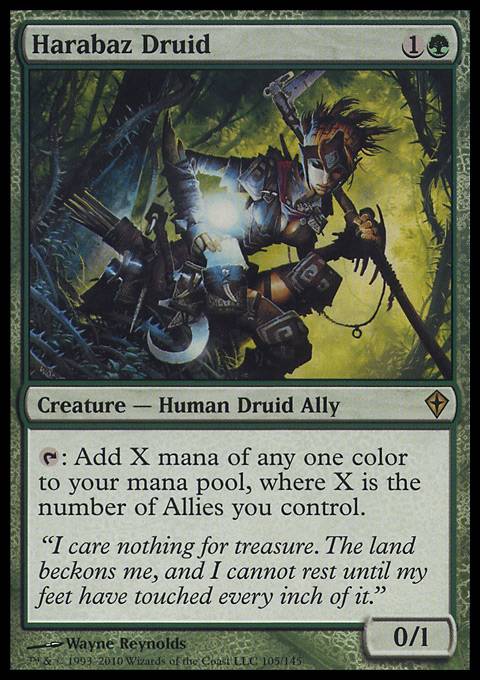
It seems like it was just yesterday, but apparently the original Zendikar block was a million years ago. Long enough ago for speculators to buyout Harabaz Druid and Jwari Shapeshifter.

There was an error retrieving a chart for Harabaz Druid
There was an error retrieving a chart for Jwari Shapeshifter

According to Peter at MTG Stocks there's a Modern allies deck that apparently exists, though I assume it's just a dramatically worse version of Merfolk. Either way, I buy this as the reason that these cards were bought out.

You can buylist a very small number of these cards for over a dollar, though otherwise they're pretty much buylisting for approximately what you could have bought them for on TCGPlayer.

I wouldn't buy into this hype because it would take more than one Standard legal set to make something like Allies viable in the Lightning Bolt format, but I do like these cards as long-term casual holds if you have them or can get them for cheap. I'm sure you can find these guys in some bulk boxes, and barring a dual deck reprint it doesn't seem like it will be difficult for these cards to maintain their $2-3 price tags and to slowly increase over time.

Avatar photo

Ryan Overturf

Ryan has been playing Magic since Legions and playing competitively since Lorwyn. While he fancies himself a Legacy specialist, you'll always find him with strong opinions on every constructed format.

View More By Ryan Overturf

Posted in Buyout, FreeTagged , , 2 Comments on Allies Buyout

Have you joined the Quiet Speculation Discord?

If you haven't, you're leaving value on the table! Join our community of experts, enthusiasts, entertainers, and educators and enjoy exclusive podcasts, questions asked and answered, trades, sales, and everything else Discord has to offer.

Want to create content with Quiet Speculation?

All you need to succeed is a passion for Magic: The Gathering, and the ability to write coherently. Share your knowledge of MTG and how you leverage it to win games, get value from your cards – or even turn a profit.

Insider: Predicting Prices for Zendikar Expeditions

Are you a Quiet Speculation member?

If not, now is a perfect time to join up! Our powerful tools, breaking-news analysis, and exclusive Discord channel will make sure you stay up to date and ahead of the curve.

Earlier in the week, Ryan wrote a snippet about the potential price point of Zendikar Expeditions. That was convenient because it matched up directly with what I wanted to discuss this week. We are going to be low on data until the set comes out but that doesn’t mean there isn’t previous data to pull from.

Zendikar Expeditions is the name of the 25-card land set that will be included in Battle for Zendikar booster packs. This marketing ploy is similar to the last time we visited Zendikar when they gave us priceless treasures. There were many extra Zendikar boosters opened because the possibility to open an amazing old card was too much to pass up.

Due to the fact that there were only treasures in the first wave of boxes, these cards being in the packs didn’t alter the price projection of the cards in the set. All it accomplished was massive availability issue of boxes from wave one. With Zendikar Expeditions, that is not the case.

What we know so far is that in every pack of this new set will contain giant monsters like I spoke about earlier in the week with Ulamog, the Ceaseless Hunger. In addition to that, you can also open a foil, full art land that will likely be worth tons of money. Here are the ones we know about so far.

Expeditions

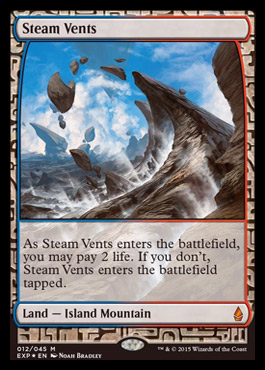
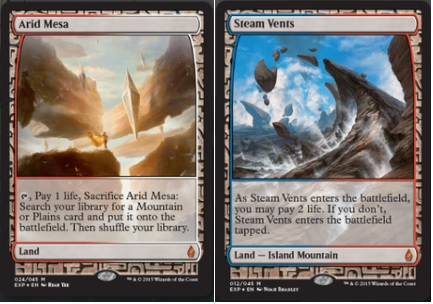
steamvents1

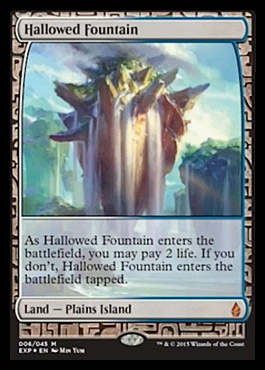
hallowedfountain

Check them out. I’m sure you have seen them already because they’ve generated more buzz than anything in the recent history of the game. Within minutes of them showing up at the presentation at Pax Prime, the whole internet also knew and was telling the rest of the people hiding in the shadows of the web. I know my friends and I were talking about the implications of this announcement all night and I assume other groups were the same.

We are going to have the opportunity to open the five new dual lands with actual basic land types, all ten shocklands, and for the kicker all ten fetches! Talk about selling packs. I’ve heard multiple times now that because of this marketing all-star that Battle for Zendikar should be the highest grossing set of all time.

The key factor with these beauties is not just how amazing they look. We only know three of the cards and I already know I’ll be searching for them to beautify my cube even further. There are a million reasons why players would want these sweet new cards but their monetary value will be among the most prevalent.

Comparative Rarity

Each of these cards has the possibility to show up about the same amount as a normal foil mythic rare. The math surrounding this new rarity says that we should be getting one awesome full art foil land per case. Fortunately, a small detail eluded the masses. The presentation said that the Zendikar Expeditions cycle will show up more frequently than a foil mythic rare. That tells me that we are likely to see 2-3 per case.

If I am correct, then the value of this cycle will be drastically altered. You should still purchase a full case if that is feasible for you to do because you are almost guaranteed at least one cool card. Changing from a one per case to multiple per case average though adds significantly more cards to the available pool.

Even though we don’t know the specifics of this new rarity, we can base our initial inquiry on foil mythics and their price trajectory. We need to take into account the price of prerelease cards as well. Prerelease foils keep the price of foil mythics down some, but there will be no prerelease foils of these new full art foil lands. Another caveat is that demand for these cards will be exceptionally high.

Let’s take a look at the top foil mythics from recent sets to help us in our pursuit of knowledge.

Magic Origins Top 3 Mythic Foils

Jace, Vryn's Prodigy $100 ($37 regular)
Nissa, Vastwood Seer $38 ($25 regular)
Liliana, Heretical Healer $32 ($20 regular)

Dragons of Tarkir Top 3 Mythic Foils

Deathmist Raptor $26 (regular $17)
Dragonlord Ojutai $22 (regular $15)
Dragonlord Atarka $15 (regular $7)

Fate Reforged Top 3 Mythic Foils

Ugin, the Spirit Dragon $75 ($25 regular)
Monastery Mentor $50 ($15 regular)
Soulfire Grand Master $15 ($8 regular)

Khans of Tarkir Top 3 Mythic Foils

See the Unwritten $18 ($8 regular)
Sorin, Solemn Visitor $15 ($8 regular)
Sarkhan, the Dragonspeaker $13 ($5 regular)

Foil fetches $35-$75

Note that I included foil fetches in the discussion of Khans of Tarkir because they have affected the price of all the rest of the cards in the set.

When we inspect these numbers one conclusion is almost immediately apparent for me. With the exception of a couple anomalies, the recent foil mythics are following a pattern close to doubling the price of the original version. If that pattern held true, we could look at the current prices of the cards from Expeditions and predict their future price.

Let’s do just that and use TCG mid to help us out. After the name in the first column, I will put the current price (preorder price for the new duals) and then double that for the proposed value.

Scalding Tarn 80 160
Misty Rainforest 65 130
Polluted Delta 24 48
Flooded Strand 19 38
Verdant Catacombs 58 116
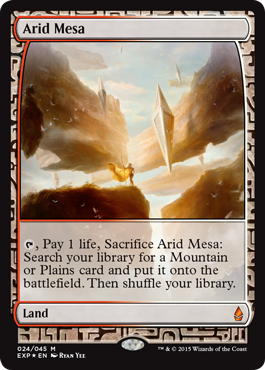
Arid Mesa 45 90
Wooded Foothills 17 34
Windswept Heath 11 22
Marsh Flats 39 78
Bloodstained Mire 13 26

Steam Vents 14 28
Hallowed Fountain 8 16
Overgrown Tomb 9 18
Breeding Pool 12 24
Sacred Foundry 13 26
Godless Shrine 10 20
Watery Grave 11 22
Stomping Ground 10 20
Temple Garden 9 18
Blood Crypt 8 16

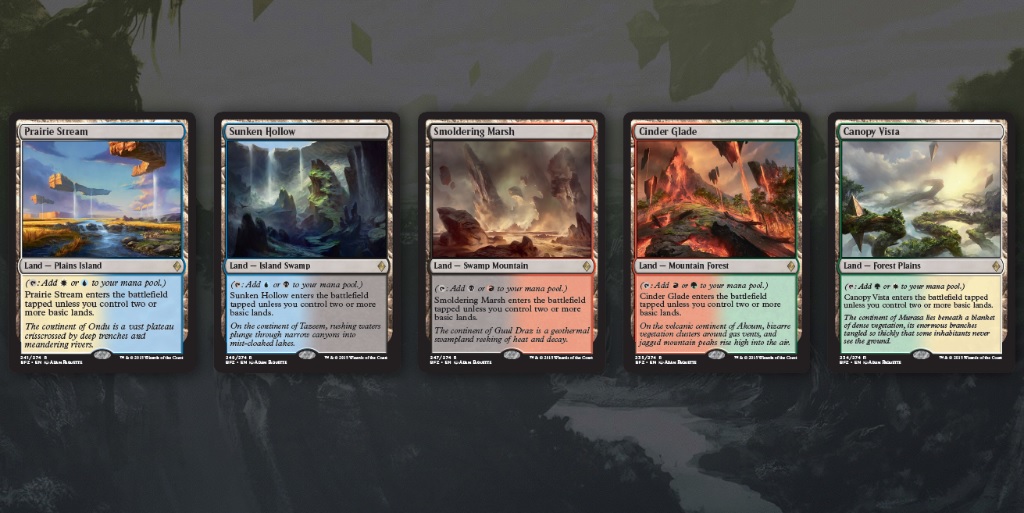
Prairie Stream 10 20
Sunken Hollow 10 20
Canopy Vista 10 20
Cinder Gale 10 20
Smoldering Marsh 10 20

It should be apparent looking at these numbers that there are some problems with the data.

$28 as the highest full art shockland is not close to what I was expecting, but the prices on these foils are similar so it is possible, though unlikely. The new duals should be the lowest of the bunch and require the least demand to go along with them so their numbers seem reasonable as well.

Where it starts to fall apart is with the fetches. Because the allied fetches were reprinted in Khans that new price point does not accurately depict what the foil price will be. For example, the non-blue foil Khans fetches are $40+ and the blue ones are $65+ and those should be a better indicator of what the price could be.

If we examine our original data to help direct this thought exercise, some of the more in-demand cards like Ugin and Jace are close to triple their original price. That is close to accurate for the foil fetches in comparison to their counterparts as well. Take a look once I add in the number for triple the original.

Scalding Tarn 80 160 240
Misty Rainforest 65 130 195
Polluted Delta 24 48 72
Flooded Strand 19 38 57
Verdant Catacombs 58 116 174
Arid Mesa 45 90 135
Wooded Foothills 17 34 51
Windswept Heath 11 22 33
Marsh Flats 39 78 117
Bloodstained Mire 13 26 39

Steam Vents 14 28 42
Hallowed Fountain 8 16 24
Overgrown Tomb 9 18 27
Breeding Pool 12 24 36
Sacred Foundry 13 26 39
Godless Shrine 10 20 30
Watery Grave 11 22 33
Stomping Ground 10 20 30
Temple Garden 9 18 27
Blood Crypt 8 16 24

Prairie Stream 10 20 30
Sunken Hollow 10 20 30
Canopy Vista 10 20 30
Cinder Gale 10 20 30
Smoldering Marsh 10 20 30

That third column is finally starting to resemble some real possibilities. Some financiers think that 200+ is a real possibility for these lands but I am not among them. If the prices of the cards are that high, more boxes will just be opened. Part of the discrepancy that this process is not taking into account is that players and the Magic economy are not always logical and rational. These lands are going to drive sales in an unprecedented way because players will feel like they need to have them. Legacy and Cube players are known for their foil addictions but lots of players will do drastic things to acquire these cards.

My Predictions

One conclusion that I think is obvious is that there will be a clear price structure to this cycle. The new duals will of course be the cheapest because they aren’t very good in Eternal play. The shocks will be in the middle because they’re good in multiple places. Logically that leaves fetches, the most desirable and widespread lands, at the top of the real estate market.

Using all this data, I have made my own final conclusion about what these prices will look like. Here’s where I stand. Current price first and my prediction second.

Scalding Tarn 80 150
Misty Rainforest 65 150
Polluted Delta 24 150
Flooded Strand 19 150
Verdant Catacombs 58 100
Arid Mesa 45 100
Wooded Foothills 17 100
Windswept Heath 11 100
Marsh Flats 39 75
Bloodstained Mire 13 75

Steam Vents 14 75
Hallowed Fountain 8 75
Breeding Pool 12 75
Overgrown Tomb 9 50
Sacred Foundry 13 50
Godless Shrine 10 50
Watery Grave 11 50
Stomping Ground 10 40
Temple Garden 9 40
Blood Crypt 8 35

Prairie Stream 10 25
Sunken Hollow 10 25
Canopy Vista 10 25
Cinder Gale 10 25
Smoldering Marsh 10 25

As you can see, my prediction not only differs from what I’ve heard in social media but also from what you saw earlier in this article. Now, my question to you, the readers, what is your prediction? Early eBay auctions are ending above my estimates but I think once we have more information to go on that the prices will trend towards what I’ve outlined here. Post your predictions below and let the discussion begin!

Metagame Calls: Breaking Out of the Mold

Are you a Quiet Speculation member?

If not, now is a perfect time to join up! Our powerful tools, breaking-news analysis, and exclusive Discord channel will make sure you stay up to date and ahead of the curve.

This past weekend was an exciting one for Modern. While the SCG Invitational was Standard/Legacy, and the World Championships was what felt like every format invented ever (sidebar: really hoping for a Tiny Leaders/Commander Pro Tour next year) Modern still got some love in the form of four rounds of the 24 best players in the world, and the SCG Modern Premier IQ in Somerset. Sensing the impending hype from these results, I figured it would be a good idea to take a step back and give some context to what we are seeing.

World Championship Logo

What we’re looking for here is not really “what deck performed well this week” but really going under the hood to discover “how” and “why” things ended up looking the way they did. This will end up looking pretty analytical at the end, so let me know in the comments if you agree/disagree with my thought process.

[wp_ad_camp_1]

Worlds

While I have not competed (and more than likely will never compete) in Worlds, there are some details about the event that are apparent just from watching the coverage and reading some reports from competitors. On one hand there’s the desire to gain an edge/”break it”, competing with the desire for a competitor to “hedge” to devote more time/energy to preparing for another format. Read every competitor’s tournament reports and all of them will talk about how impossible it is to test for four formats at once. This is absolutely essential to keep in mind while analyzing results; it’s just the honest truth that the top performing/worst performing decks must be viewed differently than “real” results, as a four round event is a much different “stress test” than a grueling, two-day Grand Prix. Multiple factors go into deck and individual card choices, including but not limited to testing time, knowledge of each format, informational advantage, deck familiarity, metagame chasing/leveling, and hedging. We could break all of these down but most are pretty self-explanatory.

6 Affinity
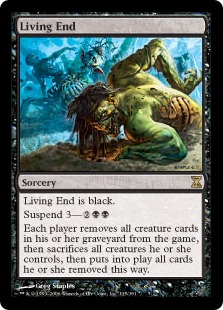
4 Living End
3 Bogles
2 BW Tokens
1 Jund
1 Abzan
1 Grixis Twin
1 UR Twin
1 Temur Twin
1 Merfolk
1 Burn
1 UR Pyromancer Control
1 UW Control

The most apparent piece of information we can glean from these metagame numbers is the prevalence of “goldfish decks”. A discussion about whether Burn/Merfolk can also be considered goldfish decks is relevant, but outside the scope of this article (plus Jordan Boisvert has done an excellent series already on this) so we won’t get into that. For now, it’s important to realize that Affinity, Living End, and Bogles all have a few things in common; they are fast, proactive, mainly do their own Living Endthing, and for the most part play themselves (sorry Bogles players). Unlike reactive/interactive decks like Twin and BG/x, the most common decks at Worlds focused primarily on goldfishing successfully. This suggests that most of these competitors chose a deck that would let them devote more time to other formats; the nature of Affinity/Living End/Bogles means that their gameplan will usually stay the same regardless of matchup, meaning pilots wouldn’t have to spend precious time getting acquainted with matchups and sideboarding.

Another factor that contributed to the metagame we see is the metagaming process itself. Going into the event, Grixis Control was on most of the competitors’ minds as one of the best, if not the best, strategies in Modern. It’s no surprise, then, that the three most played archetypes all have good to great matchups against Grixis. One could look at the lack of Grixis Control in the metagame of Worlds as evidence that the deck is “on the downswing” or “not good”, when the reality is that the competitors probably wanted to avoid the Level 0 deck choice.

Breakout Decks at Worlds

Going a little deeper, there are some things we can take away from this event. Yuuya Watanabe built on the growing U/W Control resume with an impressive new take, using Dragonlord Ojutai alongside Eiganjo Castle and Minamo, School at Water's Edge to set up a powerful endgame.

"U/W Control, Yuuya Watanabe - Worlds 2015"

Creatures

2 Dragonlord Ojutai
4 Kitchen Finks
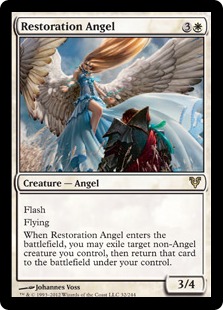
3 Restoration Angel
1 Sun Titan
2 Vendilion Clique
4 Wall of Omens

Spells

3 Cryptic Command
2 Detention Sphere
4 Path to Exile
2 Remand
4 Spell Snare
3 Supreme Verdict

Land

4 Celestial Colonnade
1 Eiganjo Castle
4 Flooded Strand
4 Ghost Quarter
2 Hallowed Fountain
3 Island
1 Minamo, School at Water's Edge
3 Plains
4 Mystic Gate

Sideboard

2 Aven Mindcensor
1 Glen Elendra Archmage
1 Spellskite
1 Celestial Purge
1 Crucible of Worlds
1 Grafdigger's Cage
2 Negate
2 Stony Silence
3 Threads of Disloyalty
1 Dispel

Notable in this list is the absence of Snapcaster Mage and Mana Leak, which allows the list to play maindeck Kitchen Finks alongside Wall of Omens and Restoration Angel to slam the door on decks looking to grind, like Abzan and Grixis. No Mana Leaks puts us in a pretty bad spot against combo though, so in a broader field it looks like at least a few copies need to find their way back into the list. The sideboard contains some great tools as well, like Glen Elendra Archmage against Twin/Grixis/Burn and Threads of Disloyalty (a criminally underplayed card). Remember that you can Threads a creature and then Restoration Angel in response to removal/Abrupt Decay on the Threads to bounce the creature and return it under your control, stealing it permanently.

"U/R Pyromancer Control, Shaun McLaren - Worlds 2015"

Creatures

4 Young Pyromancer
4 Snapcaster Mage
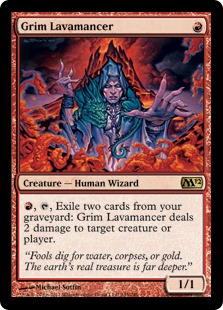
4 Grim Lavamancer

Spells

1 Dispel
1 Roast
3 Gitaxian Probe
1 Spell Pierce
1 Cryptic Command
3 Spell Snare
2 Electrolyze
3 Mana Leak
4 Lightning Bolt
4 Remand
4 Serum Visions

Land

2 Desolate Lighthouse
4 Sulfur Falls
4 Scalding Tarn
3 Steam Vents
1 Bloodstained Mire
3 Polluted Delta
3 Island
1 Mountain

Sideboard

2 Roast
2 Spellskite
2 Dispel
2 Relic of Progenitus
1 Engineered Explosives
2 Pyroclasm
2 Shatterstorm
2 Blood Moon

Moving on, Shaun McLaren shockingly abandoned Jeskai in favor of consistency in the form of U/R Pyromancer Control. Self-described as “kind of a mixture between U/R Delver, Grixis Control, and Jeskai Control”, Shaun eschewed both Kolaghan's Command/Terminate/Gurmag Angler and Delver of Secrets in favor of a cheap, consistent core built around interaction and the power of Grim Lavamancer.Grim Lavamancer Against a field of Affinity and Delver decks, Shaun would run the tables, but in his StarCityGames article he acknowledges Yuuya’s U/W deck and Tron as bad matchups. Dropping the black splash really cuts down on the power that he would have if he was Grixis, and it’s not clear that me that Grim Lavamancer/Gitaxian Probe/Young Pyromancer is better than the black cards against a diverse field. Notably absent is Delver of Secrets (who would fit well in this deck, as Delver becomes a lightning rod for removal which makes our Pyromancers and Lavamancers better) but this was undoubtably a clear decision made by Shaun, who clearly wanted to be the control in many matchups. Delver of Secrets commits us (usually) to an aggressive line, while Shaun was able to sit back and craft the game to a point where he could drop a Young Pyromancer and slowly accumulate value, rather than trying to burn the opponent out before they stabilize. While he made some significant changes, this deck is at its core a U/R Delver deck without Delver of Secrets, which we most definitely want against a diverse field.

SCG Modern Premier IQ Somerset

"U/W Control, Daniel Villamizar - 1st"

Creatures

2 Restoration Angel
3 Kitchen Finks
2 Snapcaster Mage
2 Wall of Omens
1 Vendilion Clique

Planeswalkers

1 Gideon Jura
1 Jace, Architect of Thought

Spells

2 Azorius Signet
1 Detention Sphere
3 Cryptic Command
3 Mana Leak
4 Path to Exile
2 Spell Snare
2 Sphinx's Revelation
3 Think Twice
2 Supreme Verdict

Land

5 Island
3 Plains
4 Celestial Colonnade
3 Flooded Strand
1 Ghost Quarter
3 Glacial Fortress
1 Hallowed Fountain
1 Mystic Gate
4 Tectonic Edge
1 Temple of Enlightenment

Sideboard

2 Stony Silence
1 Celestial Purge
1 Disdainful Stroke
2 Dispel
2 Hallowed Moonlight
2 Geist of Saint Traft
1 Vendilion Clique
2 Supreme Verdict
2 Timely Reinforcements

What can I say, Yuuya piqued my interest. I have now been crushed by this basic strategy in my last two Modern events (Grand Prix Charlotte and SCG Charlotte) and I’ve decided to stop writing it off and really dive under the hood to see what makes this deck tick. Path to Exile remains an excellent reason to play White, and if the control player can get ahead of their opponent to the point that Mana Leak becomes great, the deck should have an easy time moving into the lategame and slamming a haymaker. Speaking of haymakers, this deck goes all in, playing a Jace, Architect of Thought alongside Gideon Jura and (count ‘em) two Sphinx's Revelation. Employing Azorius Signet to both fix mana (as we are playing 4 Tectonic Edge and a Ghost Quarter) and ramp us into our expensive bombs, Daniel has his eyes set on the lategame and knows what he needs to get there (read: Kitchen Finks). Since playing with Kitchen Finks in the board of Joseph Herrera’s SCG Charlotte winning Jund list, I’m convinced that Finks is one of the best cards in Modern without a great home.

Conclusion

Other than that, three Jund decks in the Top 8 is interesting, and gives more weight to Joe’s great finish the week before for the Jund camp. I still think Grixis Control is favored slightly in the matchup, but the real secret to Jund’s success is, in my mind, the absence of Tron and Amulet at the top tables. Notice these decks were also absent at Worlds? I remember a few months ago during GP Charlotte prep that you absolutely had to have a plan against these decks, and everyone was diluting their manabases to try and squeeze in Ghost Quarter. While I’m not familiar with either strategy, it seems like Tron and Amulet could be excellent choices in a Jund/UW Control prominent metagame. I don’t think we’re quite there yet, as Modern moves relatively slowly, but another week of great Jund results and we could be looking at a Tron resurgence. What do you think? Am I way off base? Let me know in the comments, and be sure to stop by my Twitch stream as I take some of these Modern decks for a test drive! See you there!


Trevor Holmes

The_Architect on MTGO

Twitch.tv/Architect_Gaming

Twitter.com/7he4rchitect

Underplayed but Not Forgotten

Are you a Quiet Speculation member?

If not, now is a perfect time to join up! Our powerful tools, breaking-news analysis, and exclusive Discord channel will make sure you stay up to date and ahead of the curve.

I'm taking a break from my Primer series this week to focus more on specific cards (as well as I'm using my testing time to zero in on a deck for the World Magic Cup Qualifier this weekend!). In my testing these last two weeks I've been combing through Gatherer for every card legal in Modern. In my search for underplayed and underutilized cards, I've stumbled onto a few that I believe should be seeing some play, but are perhaps missing a deck for them to fit into. I'm going to break down the five cards I found that are not seeing enough play and what, if any, archetype they could fit into.

Shadow of Doubt Art

Honorable Mentions

Domri Rade

A great planeswalker that costs three (the magic number), but is limited to creature heavy decks in Gruul colors which probably just want to be running Collected Company. Unfortunately for this Standard all-star, instant speed and putting creatures into play is much better than once-a-turn into hand.

[wp_ad_camp_1]

Consume the Meek

Outside of delve creatures, this sweeper kills most Modern threats, and is almost a direct “counter” to Collected Company at instant speed, but is sadly hampered by its casting cost and competition from Rakdos CharmDamnation. Five mana is too much and too slow for this effect in Modern.

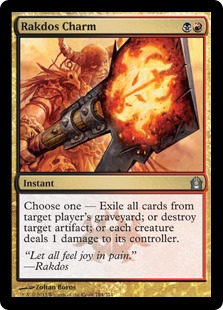
Rakdos Charm

All three of its abilities are extremely relevant in the current meta, but it suffers from being red/black, which usually relegates it to Jund or Grixis decks that don't need any of the modes. Its flexibility gives it value but not enough to see anything other than niche play.

Ghostly Prison

A huge trump against Merfolk, BW Tokens, or any hyper-aggressive creature swarm decks. Also effective against Splinter Twin! Prison fails the Abrupt Decay test and white's general lack of play keeps this stuck in the occasional sideboard. More white decks or a more aggressive meta are necessary to let it see play.

The Top Five

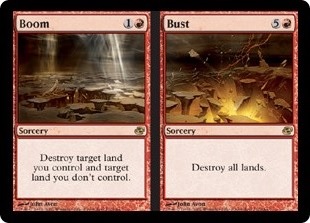
1. Boom // Bust

boomBoom // Bust is an unique and seemingly innocuous card. Destroying a land for two mana is breaking the rules in terms of land destruction (as Stone Rain is the line in the sand). The drawback is a big one, obviously – having to destroy one of your own lands is bad, right? Well, yes and no. What makes Boom // Bust stand out are the most played lands in Modern – fetchlands. Target your land, hold priority and fetch in response, Boom still has one legal target and resolves, leaving you up a land. So what's the drawback? Well, without any mana acceleration, this is still a turn three play, as you need to have the open land to crack in response to make it worthwhile, making this just a slightly better Stone Rain. With how fragile some of the three color manabases are currently, plus utility lands, if you could utilize the mana you “save”, this could be a very tempo plus play. Currently it is missing a deck to go into, but the effect remains powerful in the right shell. And we didn’t even touch on the other half of the card – does any deck want a higher costed Armageddon? Currently no, but as mentioned this feels like a build around card looking for a deck.


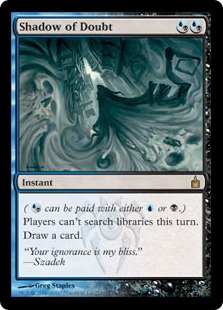
2. Shadow of Doubt

Shadow of DoubtWhile I will admit this is my pet card and I have already gone quite in depth into its merits, the card has only gotten better since I first discussed it. With the rise of Grixis and the addition of the Onslaught fetchlands to Modern, the casting cost has gotten much less restrictive. In the early game it can single handily crush an opponent's land light hands, and has great splash hate against many decks in the format (Amulet's Summoner's Pact, Tron's Expedition Map/Sylvan Scrying, etc). This card will merely cycle some games but others it helps you dominate turns one to three. An instant-speed Sinkhole that cantrips would be insane if printed as such, and this is as close as it is going to get. I can see this easily slotting into the Grixis decks as a one or two-of that could put them over the top in some matchups. At worst it cycles just like Remand, and at best it can put you ahead enough to win the game.

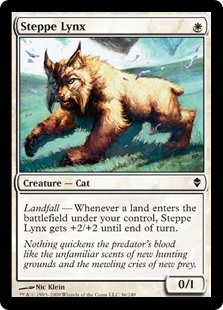
3. Steppe Lynx

steppe lynxWith the addition of the Onslaught fetchlands to Modern we now have access all 10 fetchlands. It's easy to run a mana base of half or more fetchlands all in color. Enter Steppe Lynx. While it does easily die to removal, in a fetchland heavy shell this card is insanely fast and powerful, demanding an answer immediately while swinging for four a turn starting on turn two just by fetching your lands. While aggressive strategies usually go the Burn or Zoo route, with the return of landfall we could see more pushed aggressive creatures in Battle for Zendikar that pair well with Lynx. Even without, I feel like a “Baby Zoo” list exists and Steppe Lynx would be the first four slots I would test.


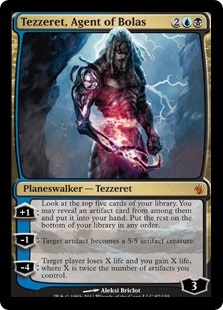
4. Tezzeret, Agent of Bolas

Planeswalkers often let you do very unique things, and Tezzeret is no exception. In the right shell his Tezzeret+1 ability is going to at worst draw a card, and sometimes provide you the key combo piece you are missing the turn he comes down. His -1 can turn your ramp or utility artifacts into 5/5 monsters, ready to start a clock out of nowhere. His ultimate is one of the easiest to activate, and can provide the reach you need to finish the game. His problem is that he needs a very specific shell in order to maximize his real value. At home with 20+ artifacts, not many existing archetypes can accommodate Tezzeret. I've seen him tested in Affinity with average results, but I don't think that is where he fits. The closest I've seen is Hall of Famer Shouta Yasooka's 14th place finish at GP Kobe way back in 2014. His list seems like the closest we've come to a real home for him, but I feel like he deserves some further brewing!


5. Aether Vial

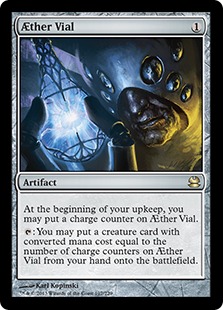
Aether VialNow, I can already hear you saying that this card is used a fair bit between Merfolk (now a tier 1  archetype!) and Death and Taxes, but for how good this card it is still criminally underplayed. Being able to cheat on mana and cast any creature at instant speed is a broken ability that if not for Abrupt Decay and now Kolaghan's Command could get seriously out of hand. The card was banned in two formats (Extended in 2005 and Mirrodin Block Constructed in 2006) and is now allowed to run free in Modern. Its only drawback is it needs a very creature heavy deck to go into which limits its use. I think Travis Woo was on the right track, exploring it with Faeries as well as Wizards, but with the size of the card pool in Modern, there must be more decks waiting to be built around it. Birthing Pod was banned as it limited design space for future creatures as each one printed (Siege Rhino, etc) that was pushed would find its way into the deck. Aether Vial could eventually go down that same route (albeit not as incredibly powerful without the tutor ability). Many tribes will only get better as more powerful creatures are printed, and Aether Vial will help push these strategies. Allies is a perfect example of a pushed tribe, putting up recent results in Modern (as Sheridan discussed here) and will be getting even more cards from Battle for Zendikar that could further push this tribe.

Let me know in the comments if you think I missed some underplayed cards, would love to find more I may have overlooked! I hope to resume my Primers next week after the World Magic Cup Qualifier, as I've gotten a ton of positive feedback on most of them, but need to focus on a few decks this week to test with as I still haven't locked in my choice. Good luck to everyone playing!

Insider: MTGO Market Report for September 2nd, 2015

Are you a Quiet Speculation member?

If not, now is a perfect time to join up! Our powerful tools, breaking-news analysis, and exclusive Discord channel will make sure you stay up to date and ahead of the curve.

Welcome to the MTGO Market Report as compiled by Sylvain Lehoux and Matthew Lewis. The report is loosely broken down into two perspectives. A broader perspective will be written by Matthew and will focus on recent trends in set prices, taking into account how paper prices and MTGO prices interact. Sylvain will take a closer look at particular opportunities based on various factors such as (but not limited to) set releases, flashback drafts and banned/restricted announcements.

There will be some overlap between the two sections. As always, speculators should take into account their own budget, risk tolerance and current portfolio before taking on any recommended positions.

Redemption

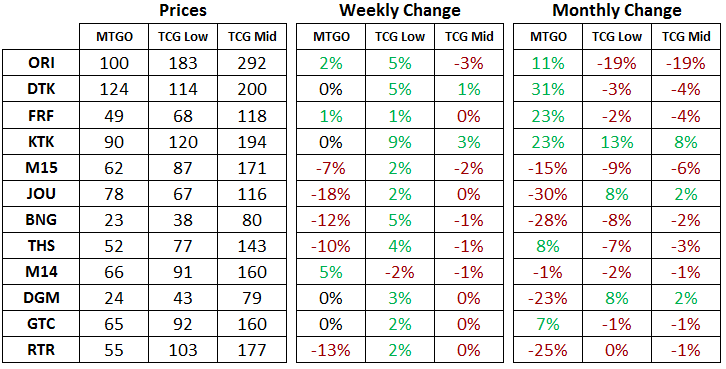
Below are the total set prices for all redeemable sets on MTGO. All prices are current as of August 31st, 2015. The TCG Low and TCG Mid prices are the sum of each set’s individual card prices on TCG Player, either the low price or the mid-price respectively.

All MTGO set prices this week are taken from Goatbot’s website, and all weekly changes are now calculated relative to Goatbot’s ‘Full Set’ prices from the previous week. All monthly changes are also relative to the previous month prices, taken from Goatbot’s website at that time. Occasionally ‘Full Set’ prices are not available, and so estimated set prices are used instead.

Aug31

Return to Ravnica Block & M14

RTR resumed its descent this week and it's now 10 tix cheaper than GTC, which itself saw no change. A U/W Control deck featuring two copies of Sphinx's Revelation popped up and took down the SCG Modern IQ this past weekend. Although Grixis colours have taken a strong hold on both the Modern and Legacy metagames with the delve cards from Tarkir block, it would be incorrect to indefinitely write off blue-white control strategies as unviable.

Keep an eye on the mythic instant from RTR for a price floor, although there is nothing to suggest that the downtrend on Sphinx's Revelation is over. It has fallen by more than 50% since RTR went offline for redemption and it currently sits at 9 tix. It's too early to call a bottom but when it does find a floor accumulating copies will be a good move for speculators.

Theros Block & M15

The four soon-to-be rotating sets all saw a steep drop this week on MTGO as the BFZ spoilers from PAX Prime over the weekend have reminded players that Fall rotation is rapidly approaching and that some of their current cards are about to be relegated to Constructed obscurity.

The Theros block temples are going to go from Constructed staples in Standard to just fringe-playable in Modern. While Thoughtseize will live on, its pal from THS Hero's Downfall is on its last leg as a must-own card. Elsewhere, the 10+ tix price tag that Standard staple Elspeth, Sun's Champion currently carries is going to start a decline to a much lower level when October rolls around.

On a more set specific front, the paper prices for a set of JOU are flat to positive so it's possible that the third set of Theros block has put in a price bottom. This is a bullish indicator for MTGO speculators, and a signal to watch out for on the other rotating sets as well.

A bottom in paper typically precedes small but steady digital price gains down the road through the redemption mechanism. Although the incremental gains are small, the trend can extend for months and it's also predictable. Speculating on the bottom for redeemable sets is a low-risk endeavor that yields steady gains over time.

With that in mind, a bottom in paper for JOU does not signal a good speculative opportunity for MTGO speculators. The set price on MTGO plus the redemption fee still greatly exceeds the TCG Low set price for JOU. If the paper price remains stable, the MTGO price for JOU would have to drop into the 40-45 tix range before strong interest from redeemers would be triggered.

At the moment, with JOU at 78 tix, redeemers have zero financial incentive to convert digital sets in paper ones. Therefore only Modern- and Legacy-playable cards should be under consideration for speculation from JOU and junk mythic rares should be strictly avoided.

Tarkir Block & Magic Origins

The gap between the price of an online set of ORI and a paper set remains wide, even with the opening of redemption this past week. Once redemption orders start to be delivered a steady decline of paper prices will begin. For the moment though, ORI looks to have exceptional value to redeemers and they will be working hard to convert digital sets to cardboard over the coming weeks. This means that prices will be flat to positive over the next four weeks, with some value flowing to the mythic rares.

Although there will be some price weakness for ORI cards when BFZ is released, the value represented by ORI at current prices is in line with, if not exceeding, the value of past core sets on a similar time frame. For speculators on MTGO this means that ORI has excellent medium-term prospects for speculative gain and both players and speculators alike should be actively stocking up on cards from ORI.

Sam Black took a Mono-White Devotion deck into the Top 4 of the World Championships this past weekend. This deck featured Archangel of Tithes as a four-of. Event coverage triggered a brief price spike on MTGO. Although devotion strategies will be rotating with THS and Nykthos, Shrine to Nyx, this new angel is still under-utilized. The spoiling of the Gideon in BFZ will give white two formidable four-drops to build around in Fall Standard.

The other three decks in the Top 4 were all Abzan-based builds and between them they used 23 Theros block temples, mostly Temple of Malady and Temple of Silence. With the pending loss of its mana base, Abzan strategies are going to have to go back to the drawing board. With that in mind, it would be prudent to sell down positions in any cards that could fall out of favor when the Abzan colours lose their consistent mana.

For instance, take Anafenza, the Foremost. It's currently the most expensive card from KTK as it anchors aggressive Abzan strategies. It's possible that Anafenza will see higher prices after rotation, but from the spoiling of the five new dual lands from BFZ, it looks like wedges will be taking a back seat to the allied colours. With that kind of uncertainty looming, selling down a position in Anafenza, the Foremost would be prudent. Taking some gains off the table in advance of Standard rotation will also free up tix for the inevitable liquidity crunch of BFZ release events.

Among the BFZ spoilers is a twist on the rotating Hero's Downfall called Ruinous Path. This sorcery speed piece of removal will see less play than the THS instant. Although that's the easy conclusion to make, the addition by subtraction side of things gives us a different card to pay attention to. Utter End will now be the most flexible piece of spot removal in Standard and if there are other cards like Oblivion Sower in BFZ, then it could have some strong interactions.

Modern

As mentioned above, Sphinx's Revelation showed up as a two-of in the winning deck at the SCG Modern Premier IQ in Somerset. Celestial Colonnade is another staple of U/W strategies in Modern and it too appeared in this deck. Although the instant card draw and life gain spell from RTR has speculative potential, the WWK land is already up by 50% in the last month and so the timing is not right on this one. Look for some price weakness during BFZ release events as a possible entry point.

Jund took the 2nd and 3rd spots with the familiar triumvirate of Liliana of the Veil, Dark Confidant and Tarmogoyf, powered up by the one-mana discard spells Thoughtseize and Inquisition of Kozilek. Both sideboards featured Fulminator Mage as a four-of and Huntmaster of the Fells as a two-of. Modern prices have been trending up on MTGO in the past week and Fulminator Mage looks set to join in on the action. The DKA flip mythic is at an attractive entry point currently as it's down from around 8 tix to just under 5 tix in a month. Players should not hesitate to buy a playset of either of these sideboard cards at current prices.

Many Modern staples are currently showing signs of strength at the start of September. Spellskite, in both the MM2 and NPH versions, is up 4 tix in the past 10 days. After dipping down to the mid 80s, Liliana of the Veil is back on her way to 100 tix. This is not unusual activity for this time of year as players look for other constructed formats to try out instead of a lame duck Standard.

Although not currently a fantastic selling opportunity, selective trimming of a Modern portfolio is warranted in advance of BFZ release events. Any Modern cards that reach or near a previous price peak should be under consideration for selling over the next month.

On the topic of the BFZ Expeditions, this special set of 25 cards will feature full frame foil versions of the ten fetchlands, the ten shocklands, and the five new dual lands from BFZ. These are special inserts that will show up at around the rate of a foil mythic rare. This means one per case or one for every 216 boosters. For a singleton set of all 25 lands, that's 5400 boosters.

For MTGO users, these will not be redeemable which will cut their value. Although the early waves of supply that show up in October and November will be highly prized, the market for collectible cards on MTGO is small. Eventually the price of these cards will start anchoring to the originals; for example, a full frame version of Marsh Flats might end up at below 10 tix by Christmas.

Once the BFZ Expeditions do hit the market, there is going to be a ton of uncertainty about how to price them. Brave speculators will have to measure their valuations against the market and decide what to do. In recent memory, Wasteland of TPR started at 25 tix before quickly advancing to 40 tix, then 60, then all the way to 80 tix. This is a good example of how inefficient the MTGO market can be, so taking the plunge on an Expedition that seems priced too low might turn out to be an excellent decision.

Targeted Speculative Buying Opportunities

Modern

Huntmaster of the Fells

Jund has not been totally put out to pasture in Modern and this card is priced attractively at the moment.

Targeted Speculative Selling Opportunities

Standard

Anafenza, the Foremost

BFZ Spoiler – Ulamog, the Ceaseless Hunger

Are you a Quiet Speculation member?

If not, now is a perfect time to join up! Our powerful tools, breaking-news analysis, and exclusive Discord channel will make sure you stay up to date and ahead of the curve.

The time of giant monsters is now! Battle for Zendikar spoiler season is in full swing and man do I have a powerful one for you. We knew they were coming and we’ve been anticipating them since the name was spoiled last year.

That’s right, the Eldrazi are back and this time they have an army. The idea of a giant war on a planet seems like such a fun story to experience. It doesn’t get better than traveling with heroes from around the galaxy to a world taken over by corrupt giant beings.

Ulamog is among the leaders of the Eldrazi army and he’s coming for you. Take a look.

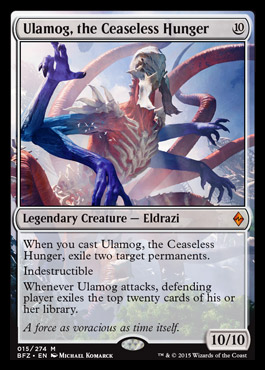
ulamogtheceaselesshunger

Most of us feel the need to immediately compare Ulamog (or any other legend) with their previous version.

Both Ulamog, the Inifinite Gyre and his new self rid the board of problematic permanents. The original exiles one, while the new exiles two. That makes it seem like the new one is clearly better, but when comparing the second abilities, the new one comes up short.

Milling is clearly worse than the annihilator trigger. The Ceaseless Hunger costs a mana less which seems like a small detail, but it is actually quite impactful. Lessening the cost of any huge spell lets you cast it sooner. If we happened to see a mana doubling effect, the drop from eleven to ten would be felt even more. The mana cost may be irrelevant though, because players will be utilizing See the Unwritten as well as reanimator spells to cheat Ulamog the second into play. I’m surprised that the shuffle clause wasn’t attached to the new Eldrazi titan, but it opens more possibilities.

Who knows what other gigantic monstrosities are lurking in the shadows of Zendikar? But if Ulamog was the only one, I know he would be seeing play for one simple reason. Indestructible means more now than the last time around.

When we first met the Eldrazi, one card in particular was around to help us in times of need. That card was Path to Exile. Not only was that the card we needed to remove an indestructible threat, but it is also a constructed staple. For this iteration, we don’t have that caliber of a weapon to fight back with.

Once indestructible Ulamog hits the board, how can he be removed? If this question doesn’t have a good answer, this titans strength goes way up.

No matter what, Ulamog is a vile villain that brings excitement to the plane of Zendikar. I’m looking forward to seeing how this set and its story unfolds.

Stay tuned to Quiet Speculation for more spoiler coverage in the next couple of weeks.

Mike Lanigan
MtgJedi on Twitter
Jedicouncilman23@gmail.com

Three Takeaways from Worlds 2015

Are you a Quiet Speculation member?

If not, now is a perfect time to join up! Our powerful tools, breaking-news analysis, and exclusive Discord channel will make sure you stay up to date and ahead of the curve.

One of the biggest challenges we face in metagame analysis is understanding the importance of a Magic World Championship. These events see a mix of wild innovation and time-honored strategies, of Modern experts with years of practice, and format dabblers who are more at home in a draft or Standard. By a similar token (Thopter? Spirit? Elemental? Take your pick!), Worlds decklists both reflect the wider format while also standing alone as a tournament-specific metagame. We need to understand these factors if we are to look at Worlds 2015 and separate decks with format-wide potential from those that were picked to succeed in an insular setting.

Arcbound Ravager art

I was surprised when I saw just how little discussion Worlds 2015 generated in Modern communities, which is probably just as much a function of its odd place in the metagame as it was because of full-art fetchlands and shocklands stealing the spotlight. Today, we're going to give Worlds 2015 some well-deserved attention and look at a few strategies and cards that highlight the best and brightest innovations from the event. Whether you tuned in on the Twitch stream, followed the discussion online, or were too busy ogling the new Ulamog and Gideon, this article will fill you in on the cards and decks that mattered at Worlds 2015.

[wp_ad_camp_1]

1. Be Afraid of Affinity

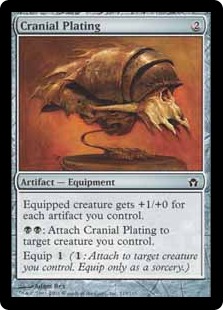
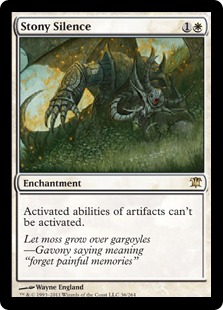
If you read this section headline and think to yourself "Wait, how is that anything new?" then you're already a step ahead on understanding the most important takeaway from Worlds 2015. Affinity was the Cranial Platingmost-played deck going into Worlds, sent the most to a 3-1 record, and had the best ratio of 3-1 records to 2-2 or lower records of any other deck (poor Jacob Wilson and Mike Sigrist with 0-4 and 1-3 respectively). For anyone familiar with the deck, this shouldn't be too surprising. Affinity has always been one of the best choices in Modern, especially in unknown or unstable metagames. It's arguably the most consistent linear (even "unfair") deck in Modern, and easily the deck that most punishes unprepared players. Don't have Stony Silence in your opening hand? Didn't pack enough Ancient Grudge in the sideboard? You probably already lost game one anyway (Affinity has one of the nastiest game one win percentages in Modern), and without those sideboard bullets it's time to sign the slip and pack it off to the next match anyway. When Paulo Vitor Damo da Rosa talks about the sideboard problems of Modern, guess what deck he's talking about? Hint: it's no coincidence that Stony Silence is the headline image.

Stony SilenceThe scariest part of Affinity's finish at Worlds is that everyone knew the deck, expected it to some extent, and packed at least a few cards to handle it in their sideboards. Despite this preparation, the deck still excelled. Almost every single non-Affinity player packed at least 2-3 slots that were relevant in this matchup. Antonio del Moral Leon had Grudge, Shatterstorm, and Engineered Explosives. Eric Froehlich brought the techy Sundering Growth in his BW Tokens list with all the Living End players rolling with an Ingot Chewer trio. Stony Silence showed up in four decks too. These players all brought a reasonable amount of Affinity hate in their boards, but it was never enough to actually stop the modular menace.

Going into events like GP Oklahoma City and other Grand Prix to follow you need to be more prepared for Affinity than many of the Worlds players were. I've heard Affinity called the Dredge of Modern, a deck that folds to specific hatred in a format where you don't actually want to run that specific hatred. Don't get the PVDR blues and decide to skimp on your anti-Affinity hatred because you are protesting the sideboard problems of Modern. Just run the cards and be ready, because we will see plenty of Affinity at GP Oklahoma City if for no other reason than players trying to replicate its success at Worlds. Alternately, you can gamble on other players running the hate to keep Affinity down, ditching it yourself to free up sideboard slots. I would caution you away from this: it only takes 1-2 Affinity matchups on Day 1 to ruin a GP weekend.

2. There's Always Room for Innovation

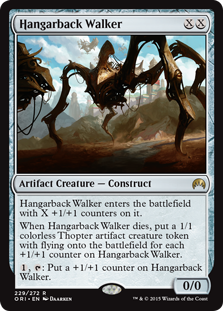
While I was brainstorming ideas for this article, Sam Pardee wrote up a nice brief on Worlds 2015 including some tech standouts like Hangarback Walker in Jund, Glen Elendra Archmage in UW Control, and Ghirapur Aether Grid in the Hangarback WalkerAffinity board. Of these different ideas, the Hangarback Jund one really stands out to me, even if Brad Nelson's 2-2 record isn't the most inspiring finish. Jund is one of those decks that has an established core (Tarmogoyf, Liliana of the Veil, the 3-3 or 4-2 split on Inquisition of Kozilek/Thoughtseie, etc.), with a few curve-topping flex-spots depending on the metagame and the pilot's preferences. Most decks have similar setups (Trevor Holmes does a great job of discussing the Grixis core in his Grixis Control primer), but many Modern players are often loathe to tinker too much with those slots or default to old fallbacks like Huntmaster of the Fells instead of testing new options. Worlds 2015 showed that even the most established decks like Jund have room for new and creative ideas.

Take Hangarback Walker as an example. As Pardee mentions in his own article, it's a four-drop that doesn't kill you off a Confidant flip, and doesn't disappoint in multiples unlike Chandra, Pyromaster or Outpost Siege. In addition, Huntmaster of the FellsHangarback gives you a strong lategame topdeck and manasink, functioning in some respects like the mighty Gavony Township in Abzan Company lists (and in Melira/Junk Pod lists of olden days). I'm also loving Hangarback recursion off Kolaghan's Command, which is something neither Chandra nor Siege benefit from. Unlike other creatures like Huntmaster or Olivia Voldaren, Hangarback isn't an overhyped Canyon Minotaur against the Grixis decks and their removal screen. If Grixis immediately kills the two-drop walker, you still come out a Lingering Souls ahead. If Grixis ignores it, the Walker grows and grows until out of range of both burn spells and any hope of profitable interaction. Indeed, I suspect Walker's inclusion suggests an overpreparation towards Grixis Control and similar decks and an underappreciation for Affinity and company. Overall, Hangarback represents the best in tier 1 innovation we can hope for in Modern. As we review Battle for Zendikar cards and think about GP Oklahoma City technology, we should use Hangarback Jund as one of our innovation benchmarks.

3. Metagaming Only Gets You So Far

In the weeks following Worlds 2015, you are going to hear authors call Living End or Bogles a tier 2 deck. You are going to consult sources like our Top Decks page, confirming that these decks have numbers Living Endbacking them up before accepting these classifications. You are not going to look at the contextless Worlds 2015 decklists and immediately assume either deck is tier 2 just because of how many representatives showed up with it. Be skeptical and don't forget "context". In both cases, Living End and Bogles were highly metagamed choices to answer specific Modern mainstays like Jund, Grixis Control, Merfolk, and Burn. Also in both cases, the metagamed choices were firmly hit-or-miss, with some players going the 4-0 distance (Martin Muller on Living End) and others falling flat on identical lists (all three other Living End players with their 2-2 records). In the end, it was Affinity, the format regular, which had big success at Worlds, not the metagamed decks designed to address a specific set of matchups. If this strategy didn't necessarily succeed at Worlds, you can bet it will be even shakier in a less insular metagame like an SCG Premier IQ or a Grand Prix.

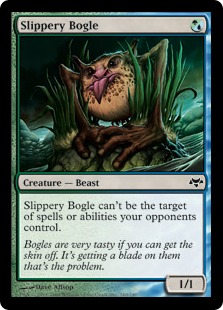
You've probably heard the old Modern adage about "playing what you know", instead of "playing what is best". This doesn't mean you should play Tribal Treefolk or Duskmantle Guildmage/Mindcrank Combo because those are the decks you Slippery Bogle"know". It also, however, doesn't mean you should switch to an under-tiered, niche deck like Soul Sisters because you fear Burn. You want to play a deck you are experienced in, but also a tiered deck with enough competitive successes to suggest it's a viable contender in Modern. This is one reason linear/unfair decks tend to do so well in Modern: Infect's strategy in the Jund matchup (poison you to death) is basically the same as in the Affinity one (poison you to death...but faster). This doesn't mean you always want to play a linear/unfair deck just to try and ignore metagame context. Sometimes the best decks in metagames are the interactive ones because the uninteractive ones are too predictable or similar. This is where the choice to play a deck like Living End or Bogles can get you in trouble. None of this is to second-guess the testing of those players who ended up on these builds, which I know was extensive and well-reasoned. It's just to warn you as a reader to be careful of this approach in larger, unpredictable events when it doesn't always work out in smaller, more predictable events like Worlds 2015.

Worlds 2015 Wrap Up

There's only so much we can read into a Worlds metagame. Because of how teams prepare and test together, the metagme is often significantly more isolated (even inbred) than we are likely to see in a regional or even a local event. I like to think of Worlds as a high-skilled FNM, at least when considering deck choice. With only three Twin decks, a single Jund and Burn, and zero Grixis Control, we can't call Worlds 2015 a representative Modern metagame, at least not with a straight face. That said, we still need to read signals from the event to see how other players will interpret its results. That's where Worlds starts to become relevant outside of those 16 players, and that's how you are going to prepare yourself for upcoming GPs.

What were some other cards and decks you got excited by at Worlds? I loved Yuuya Watanabe's UW Control deck, although I'm sure there's a contingent of Moderners out there who will call it UW Midrange just to make control fans sad. Any big breakout Worlds performances I missed? How are you going to use the event to prepare for upcoming events? Take it to the comments and I'll see you next week for more exciting metagame discussion.

The Projected Value of Zendikar Expeditions

Are you a Quiet Speculation member?

If not, now is a perfect time to join up! Our powerful tools, breaking-news analysis, and exclusive Discord channel will make sure you stay up to date and ahead of the curve.

WotC dropped a bomb at PAX this year, announcing that 25 full-art foil lands will be randomly inserted into booster packs at about the rate of foil mythics. These lands will be a new allied land-cycle with basic-land types, all ten fetchlands, and all ten dual lands.

Expeditions

Some players are wondering what they'll have to do to acquire this new hotness, while others will be excited to dump any that they acquire for fat stacks. In either case, people want to know what these bad boys will be worth. Mythic foils come at a rate of about one per case, so even with expeditions coming "a little more frequently than a premium foil Battle for Zendikar mythic rare", that's still not a lot of supply. I assume this to mean two or maybe three per case, but even there you're looking at two shots in a 1/25 to hit the particular land that you want, with most players considering the new cycle to be whammies.

SCG will not be pre-ordering these cards, so there isn't a lot of data to work with. There are some completed eBay listings, though curiously they're all from the same seller with sub-1000 feedback in the Czech Republic. They were also all buy it now listings rather than auctions, so it's hard to say at this point what a good price point would be. These listings have shown Steam Vents and Arid Mesa for $150+ and the new cycle for $70+, but again, these prices are suspect.

If you're a QS Insider, Mike Lanigan did some analysis to help predict the starting prices for these amazing new lands.  Check it out here.

What I can say for sure is that if you open one early you'll obviously want to value it very highly. Scalding Tarn will be the most sought-after of the lot, though on week one I wouldn't value any fetch or Ravnica dual under $100 or any new dual under $50. It will be interesting to see how popular Battle for Zendikar is as a set compared to Khans of Tarkir, and if non-land cards from the set can retain any value. What I can say to a certainty is that you'll see the entire set devalue before you see price decreases on expeditions, unless of course they turn out to be a lot more common than projected- though this is very unlikely.

Avatar photo

Ryan Overturf

Ryan has been playing Magic since Legions and playing competitively since Lorwyn. While he fancies himself a Legacy specialist, you'll always find him with strong opinions on every constructed format.

View More By Ryan Overturf

Posted in FreeTagged , , 1 Comment on The Projected Value of Zendikar Expeditions

Have you joined the Quiet Speculation Discord?

If you haven't, you're leaving value on the table! Join our community of experts, enthusiasts, entertainers, and educators and enjoy exclusive podcasts, questions asked and answered, trades, sales, and everything else Discord has to offer.

Want to create content with Quiet Speculation?

All you need to succeed is a passion for Magic: The Gathering, and the ability to write coherently. Share your knowledge of MTG and how you leverage it to win games, get value from your cards – or even turn a profit.

Insider: Battle for Zendikar Spoilers and You

Are you a Quiet Speculation member?

If not, now is a perfect time to join up! Our powerful tools, breaking-news analysis, and exclusive Discord channel will make sure you stay up to date and ahead of the curve.

Welcome back, readers!

For this week I had planned on working on an article about analyzing your customers and the tools you can use for that--until I saw the Battle for Zendikar spoilers announced when I got up on Sunday morning. We got not one but two huge revelations.

1) The new Battle for Zendikar dual land cycle;

bfz lands

and 2) "expeditions," similar to the hidden treasures from the first print run of Zendikar.

bfz full arts

Wow...just wow...

There are 25 different lands in Battle for Zendikar with this treatment. Mark Rosewater stated that it would be two sets of 10 and one set of 5 and since they also spoiled the BFZ duals full-arted it appears that we'll get all 10 fetchlands and shocks full-arted as well. These will likely command some exceedingly high prices starting out, though I feel like their inclusion alone will cause massive amounts of BFZ to be opened.

Other valuable information relating to these "expeditions":

  • They are only in English, but will show up in other language sealed products (i.e. you can still get them in Japanese booster boxes, they just won't be in Japanese).
  • They are unredeemable on MTGO and not officially part of the BFZ set (hence the special expansion symbol).
  • Their rarity is equal to that of a premium foil mythic rare. According to previous calculations by Mr. Ben Bleiweiss, this equates to about 1 in 216 packs (or 6 boxes), though that was in reference to Conflux so the odds may be slightly different with bigger sets. This distribution is similar to the Dragonball Z and Yu-Gi-Oh "Ultra Rares."
  • There will be 20 more of these "expeditions" in the second set, Oath of the Gatewatch.

What this means is that they will likely command a high premium out of the gates (the only place I can see anyone trying to sell them is on eBay at $199 for the Arid Mesa). This premium may drop a bit assuming the set is opened as widely as expected.

So What Does This Mean?

The bigger question is what does this do to older versions of these cards (the Zendikar fetches, Khans fetchlands, and shocklands). If people really like the artwork (currently it seems to be getting mixed reviews) then these could become the newest "pimp" version of the cards, though I imagine they are probably still less rare than original pack foils. However, these will assuredly affect the prices of the current "pimpest" versions in some way.

The other important thing to keep in mind is that given the values of their current counterparts, I feel like they will likely fall into three distinct camps:

  1. Fetches - These will be the most valuable, with the blue ones commanding the most premium (likely $175-$250 range).
  2. Shocks - These will be middle tier, still likely valuable enough to recoup the cost of a box (i.e. $100+ range).
  3. BFZ Duals - The current consensus is that these are awesome for Standard but worse for Modern. It's unlikely that many three-color Modern decks will run them, though they may fit well in two-color control decks like the U/W Control that's popped up recently. These will be the lowest tier (likely in the $50-$75 range).

The other big question is now what will the ones in Oath of the Gatewatch be. It's actually a bit odd that WoTC would put both fetches and shocks in the first set as both are some of the most desirable lands that they are willing to reprint (and thus will drive demand for product by a great deal). Given WoTC's desire to complete cycles it seems pretty safe to assume that the enemy duals (to match the BFZ ones) will be in Oath and will also get this "expedition" treatment. So that means there would be 15 more options.

This is awkward because it implies we can have another full set of 10 for one other dual land cycle, but there's five remaining, which is only half a cycle (or something like mono-color lands). At this point we can only speculate on the remaining lands, but assuming that WoTC sticks to reprinting lands that already exist we have the following options (ranked in order of current secondary market value) for the 10 spot.

  1. Shadowmoor/Eventide filter lands
  2. Checklands (M10/11/12/13 and Innistrad)
  3. Painlands (Ice Age + Apocalypse)
  4. Temples (Theros block)

Keep these cycles in mind if we start to see the expeditions affecting previous versions on the secondary market.

Also note that unlike the Zendikar treasures it doesn't appear that these will be limited to "first print run," so if product demand remains high, then a lot of them will be opened over the long run. This means the value of any given BFZ rare will be severely limited.

The most valuable rare in Khans is Dig Through Time at around $5.50 and the second most valuable is Siege Rhino at $3.80 (TCG Mid Values as of 8/30/15). Even the most valuable Khans mythic is only $8 (Sorin, Solemn Visitor); so the ceiling for the set is actually pretty low.

To me, this also means that unless you need a card immediately for a tournament, preordering this set is an extremely bad idea, unless you're very sure on the card (i.e. Hangarback Walker).

The fact that these are not redeemable is also very important. MTGO Redemption greatly increases the paper card supply on the secondary market, so these expeditions will not get a price drop when redemption starts (as we often see with most other Standard cards) and their MTGO price will likely be far lower than their paper price.

BFZ Duals

I kind of glossed over these originally in my haste to get to the "expeditions" because they have more financial relevance, but it's important to try and evaluate the BFZ duals properly.

  • They have basic land types, which means they can be fetched; with fetchlands in Standard for another year or so, they will likely serve as powerful mana fixers.
  • They become better later in the game when you're likely to have two basics, which means like temples they may be better suited for control decks.
  • The basic land requirement makes them worse in tricolor (or more) decks, which are likely to run more nonbasics and thus less likely to satisfy the "untapped" ability.
  • They are likely best in a two-color deck which plays a decent number of basic lands.
  • Modern tends to play a lot of nonbasic lands. A land that always comes into play tapped before turn three, and often afterwards too, is unlikely to replace the shocklands.
  • They will be very good in Standard, allowing decks to splash an extra color.
  • Standard will likely heavily favor allied colors thanks to having allied fetches and now BFZ duals (at least before Oath comes out). The current allied colors will have all the lands that enemy colors have (minus wedge trilands), and these additional 8 lands.

Deck Overview- Modern Watanabe Control

Are you a Quiet Speculation member?

If not, now is a perfect time to join up! Our powerful tools, breaking-news analysis, and exclusive Discord channel will make sure you stay up to date and ahead of the curve.

The Magic World Championship this weekend didn't exhibit a lot of diversity in Modern. Most of the players were working with small teams of players in the event, and as such we saw a good chunk of Affinity, Bogles, and Living End. Yuuya Watanabe was the lone player on Azorius Control, and his list solid:

Modern UW Control

creatures

2 Dragonlord Ojutai
4 Kitchen Finks
3 Restoration Angel
1 Sun Titan
2 Vendilion Clique
4 Wall of Omens

spells

3 Supreme Verdict
3 Cryptic Command
4 Path to Exile
2 Remand
4 Spell Snare
2 Detention Sphere

lands

4 Celestial Colonnade
1 Eiganjo Castle
4 Flooded Strand
4 Ghost Quarter
2 Hallowed Fountain
3 Island
1 Minamo, School at Water's Edge
3 Plains
4 Mystic Gate

sideboard

2 Aven Mindcensor
1 Glen Elendra Archmage
1 Spellskite
1 Celestial Purge
1 Crucible of Worlds
1 Dispel
1 Grafdigger's Cage
2 Negate
2 Stony Silence
3 Threads of Disloyalty

This deck is really capitalizing on Spell Snares position in the metagame, both by maxing out on its own copies and by minimizing the power of opposing Snares. Curiously, Yuuya even eschewed Snapcaster Mage, which is commonly considered the most powerful card in Modern.

The combination of Restoration Angel and Kitchen Finks is nothing new, but it's something that we haven't seen in a while. These creatures combine to both make a very powerful clock and a difficult wall of life and blockers to break through. Not to mention that both creatures present bodies that can't just be Lightning Bolted.

There was an error retrieving a chart for Restoration Angel

A couple players have tried Dragonlord Ojutai in Modern. It looks a little cute to me, but it's certainly powerful in long games and is another card you can blink with Restoration Angel. You can also untap Ojutai with Minamo, School at Water's Edge to give it hexproof while attacking. Perhaps more importantly the Minamo pairs well with the Mystic Gates to help you beat Choke. You get a little weak to Blood Moon with this manabase, but there are enough basics and you can even Path to Exile your own dudes to get around this, which we saw Yuuya do against Shaun McLaren.

This is yet another deck that leans heavily on Ghost Quarter to beat Tron, which is a pretty low-cost inclusion. The damage to the manabase is also mitigated largely by Mystic Gate, though these two lands do open up the possibility that you have three or more land hands that can't cast any colored spells.

Your Modern Buylist: The Theros Rotation

Are you a Quiet Speculation member?

If not, now is a perfect time to join up! Our powerful tools, breaking-news analysis, and exclusive Discord channel will make sure you stay up to date and ahead of the curve.

When you think of Modern powerhouse blocks, you probably think of Return to Ravnica, Khans of Tarkir, or Scars of Mirrodin. Theros block? I imagine more Modern players would be excited about going back to Homelands (Barons of Ulgrotha anyone?) than seeing more Theros. The Greek and Roman-themed set was not the strongest addition to our Modern arsenal, but with Battle for Zendikar and the Standard rotation coming up on October 2, it's time to start thinking about what post-rotation cards you need to pick up for the future. As anyone who has checked out Snapcaster Mage's price in the last few months knows, Modern cards have a tendency to spike once they see widespread play, and even Theros block holds a few key staples you'll want to snag early. M15 is also part of this rotation, so we can't forget the core set cards either. This article walks you through the pickups you want to buy now or buy as soon as the rotation price drop occurs.

Anger of the Gods art

The 10 cards on this buylist range between format mainstays and niche bullets, but all of them are cards you need to watch in the coming months. In many cases, you won't want to pick these cards up right away: Standard players still haven't sold off their pre-rotation decks and it will take time for prices to adjust. Moreover, as the Magic economy has matured, so too has speculation and investment in cards with cross-format relevance. There was a time when a card like Thoughtseize would plummet after a rotation, but that was also a time when Blood Moon was a dollar-bin rare. In discussing these individual cards, I'll try to give some tips on both why the card is a good pickup and also when you want to buy in to each item. Also, a big thanks both to reddit for the interesting post-Theros Modern thread on this same topic, and for former Nexus staff Sean for suggesting this as a good article idea.

[wp_ad_camp_1]

Honorable Mentions

Before we get to the post-Theros big ten buylist, I want to give a shoutout to a few cards you'll want to keep your eye on following the rotation. These cards are not always safe bets. In many cases, they'll depend on other cards being printed to improve their core archetype, or metagame shifts to make them better in Modern. Despite this uncertainty, these cards are strong enough that you can pick up a few copies if you are feeling lucky or optimistic.
  • Ashiok Nightmare WeaverAshiok, Nightmare Weaver: One of those overhyped planeswalkers that tanked from its $25+ pricetag to under $10, Ashiok still saw play in Gerard Fabiano's Sultai Control deck and could get better in a grindier metagame. If UBx gets other options outside of Grixis, particularly more Sultai, Ashiok could see its time in the sun.
  • Brimaz, King of Oreskos: Occasionally shows up in BW Tokens along with some lower tier decks like Mardu Tokens/Midrange and Deadguy Ale. Outclassed by delve creatures currently, along with good old Goyf, Brimaz could see more play if white becomes stronger.
  • Chandra, Pyromaster: Don't let her sub-$5 price-tag deceive you. Chandar is an excellent one-of in many Jund builds, and is often Reid Duke's lady of choice when rounding out the top of his Jund curve. If you ever want to play grindy red-based or BRx-based decks, Chandra is someone you might want in your binder. Don't go too heavy into Chandra though: multiple printings hurt her longterm pricetag.
  • Goblin RabblemasterGoblin Rabblemaster: Goblin Piledriver didn't do enough to make Goblins a thing in Modern, but if Goblins' day finally comes, Rabblemaster might be leading the charge. Rabblemaster is sure to plummet after the Standard rotation, and is a solid pickup for either a Goblins deck or as a way to go wide in decks like Jund.
  • Sylvan Caryatid: 4C Gifts always goes through ups and downs in the metagame, and Caryatid is a mainstay in their 60. Jeskai Ascendancy decks also love the Plant, and with Caryatid's price falling after the rotation, this could be a good pickup for either of these decks or other ramp strategies.
  • Urborg, Tomb of Yawgmoth: Jund and Abzan have been the big BGx players recently, but Urborg will always have a home in the straight BG Rock version we saw last summer before GP Kobe. Urborg is a casual favorite as well, which makes it one of the safer buys in the honorable mentions list.

Other niche cards like Waste Not (8Rack variants), Pyxis of Pandemonium (Latern Control), and Mana Confluence (5C Humans, Slivers) are also things to look out for after the rotation. Same goes for powerful effects like Return to the Ranks. You might not make a fortune on cards like these, but snagging some of them after their prices bottom out will give you a nice selection for future Modern decks.

The Top 10: Post-Theros Modern Buylist

Despite all the flak Wizards got from the nonrotating and eternal format crowd for these sets, Theros block (and M15) both had a fair number of staples worth your post-rotation money. Here are the big 10 you want to keep on your radar as you start figuring out what staples to snipe for future Modern play.

10. Nykthos, Shrine to Nyx
Nykthos, Shrine to NyxBack when Nykthos first got spoiled, Modern players worked overtime to ramp up Nykthos Green into a competitive deck. Devotion-enablers like Wistful Selkie spiked overnight, and within a few months Nykthos Green was a solid tier 2 deck on MTGO with about 2%-3% of the metagame. Although it was all downhill from there for the green mages, we still see Nytkhos show up as part of white enchantment-based decks (Runed Halo, Suppression Field, etc.) and some MTGO Tooth and Nail builds. Players have tried both red and black devotion in Modern without much success, but Nykthos is the kind of Gaea's Cradle or Serra's Sanctum-style card which could become big depending on what cards eventually see print. It won't hurt to have a few of these in your binder in the years to come, especially if we see something like a Wild Growth in future sets.

9. Courser of Kruphix
Courser of KruphixWhen most players think of card advantage in BGx, they think of Dark Confidant. Bob may be a Jund all-star, but he's a lot worse alongside the higher-curved Abzan workhorses like Siege Rhino, or the more fringe BG Rock options like Phyrexian Obliterator. BG Rock and BGw Souls decks were big last summer, and as Burn players rose to take advantage of Bob's lifeloss, the BGx mages switched to Courser to give an edge in both the aggro matchup and the grindy mirror. Courser is easily one of the top three format-defining monsters of Standard, and although this never translated to the same kind of Modern success, he has still seen play in different BGx shells. Courser is also an excellent pickup in the coming months, especially the foiled version. His pricetag will crash hard as Standard forgets the Centaur, which makes it an ideal time to pick up a few copies for future metagame adaptations in your BGx decks.

8. Temple of Malice and co.

I remember the public outcry when Wizards spoiled the scrylands. Or maybe "crylands" would be a better name. The cards proved their worth in Standard but never made much of an impact in Modern, Temple of Malicewhich might make them seem like odd inclusions on a Modern buylist. Then came GP Charlotte and the breakout performance of Grishoalbrand: Bob Huang's and Zach Jesse's Temple of Malice playset were integral to the deck's success. As anyone who has played with or against the deck can attest, the free scry is invaluable in the early turns when setting up a turn two or three win, or for smoothing draws when you are trying to punch through countermagic. Grishoalbrand is a very specific application for the Temples, but it's by no means the only one. Darien Elderfield piloted an Ad Nauseam list to a Top 8 finish in the same event, and his five Temples were as important to him as they were to Huang and Jesse. It's only a matter of time before more Modern players find additional applications for the Temples, and even if they don't, there are enough combo players around who will want the lands for their Ad Nauseam or Grishoalbrand lists. Pick these up now and test them like a madman: the cards are certainly relevant elsewhere and we only need to figure out where.
7. Keranos, God of Storms

The Theros Gods were some of the most disappointing cards from a Modern perspective. How is it that indestructible, undercosted creatures with upsides can see basically zero Modern play? Ask the Theros Keranosdesigners, but in at least one case, they got the perfect balance between Standard balance and Modern playability. Keranos, God of Storms didn't catch on right away, but by late 2014 he was a mainstay in URx sideboards across the format. To this day, Keranos remains one of the best ways to overpower Jund and Grixis decks in a grindy mirror. Both Antonio del Moral Leon and Dan Lanthier ran two copies of Keranos in their sideboards at PT Fate Reforged and GP Vancouver respectively, and we've seen the God show up in Grixis Control as well. Keranos has held a steady $10 pricetag for a while now, after falling from the $15-$20 range after his release, and this is likely to drop even further when Standard players unload their Theros-packed binders. As long as URx exists in Modern and needs to win the mirror or the BGx matchup, Keranos will be one of their strongest go-to weapons, and it's smart to pick up 2-3 now while the price is right.
6. Destructive Revelry

On the subject of sideboard mainstays, Revelry has been as good (if not better) for Burn decks as Keranos has been for URx ones. Unlike the blue-red God, Revelry is as inconspicuous as a card gets. It's Destructive REvelryNaturalize plus a mini Lava Spike, which is only exciting if counting to 20 with one-cost Bolt effects is your style of Modern gameplay. The red-green instant is a mainstay of the predominantly Naya-colored Burn decks we see in contemporary Modern, and whether you use a more traditional build like Yam Chun's 13th place list from GP Singapore, or the Wild Nacatl version as played by Arya Roohi at SCG Charlotte, you are going to run 3-4 Revelry out of the board. Burn is an immortal tier 1 deck in Modern, which means any and all of its staples are worth picking up in the future (spoiler alert: Revelry isn't the only Burn card on this buylist). Important note on Revelry: this is the only uncommon on the list, and it doesn't see wide enough play to hit Inquisition of Kozilek or even Lightning Bolt/Path to Exile levels. So if you want to get the best bargain on Revelry, pick up the foil versions and have fun sending your opponent's Cranial Platings and Aether Vials to a shiny, painful death.
5. Master of Waves

Merfolk enjoyed some strong performances this summer at both GP Copenhagen and a variety of smaller events throughout July. Even before Harbinger of the Tides gave the deck Master of Wavesa new weapon in its disruption toolbox, Merfolk was already well-positioned in a metagame saturated with Grixis and Twin decks. Master of Waves is a big player in most Merfolk lists, with the majority of Fish players running at least 2-3 in their maindeck. Like Burn, Merfolk is one of those enduring Modern strategies that is going nowhere in the future. It might not enjoy the consistent top-tier success as we see in Burn, but the deck is still incredibly powerful and will almost always be at least tier 2 in any metagame. Whether giving Merfolk a go-wide Plan B in clogged boardstates or refueling after a string of removal, Master is always going to hold value in the Merfolk arsenal and is a strong post-rotation pickup. With the Standard Blue Devotion dream dying out with the rotation, it's a great time to pick up copies (particularly foil ones) to get ready for the next big Modern event.
4. Anger of the Gods

For a format that is so heavily defined by removal and creatures, it is sometimes surprising that Modern runs so few sweepers. Supreme Verdict is a serious player in Legacy but sees next Anger of the Godsto no play here, where UWx decks tend to be worse than URx alternatives. Damnation may be the best removal spell that Wizards is never going to reprint for us, but it still doesn't see the Modern play it probably deserves. Enter Anger of the Gods, the cost-efficient sweeper of choice in sideboards and maindecks throughout the format. Scapeshift, Twin, Jund, and other major players all turn to Anger as their "oh crap" button of choice in the aggro matchup. Cards like Firespout aren't totally extinct in Modern, nor the old-school Pyroclasm that remains the color-strapped RG Tron's sweeper of choice, but Anger is always going to be the fallback red sweeper when you need an early board cleared. With Company decks picking up speed and injecting more low-toughness creatures into the metagame, especially those who you want to keep out of the graveyard, Anger's Modern profile promises to keep rising over the years. Anger is at one of the cheapest pricepoints in its history, and this will only go up as more red mages pick up the card for their Modern decks.
3. Chord of Calling

I'm not a big fan of speculation because I prefer card prices to be low (the more Modern players, the merrier the format!). This wasn't always true, however, and back in the good old days of our format's Chord of Callinginfancy I picked up a number of staples that were sure to rise. Chord of Calling was one of these, and the copies I snagged for about $1-$2 rose to the $20+ point over the years. If you played Pod decks before the January 2015 banning or are playing Company decks now, you can appreciate this card's power and understand how it will only increase in price as the years go on. You don't even need to play Company today to enjoy Chord, at least if Kiki-Jiki, Mirror Breaker has anything to say about it. Chord is the kind of card that only becomes more powerful as every oddball creature is released or reprinted, and if you are ever interested in playing these kinds of strategies then it's wise to have a playset handy. Even with a reprint at rare instead of mythic, the card is still in the $7-$8 range, and you'll want to get some of these soon following the rotation before more Modern players start hoarding the card. Even better if you can pick up the old Ravnica version which (sorry, Karl Kopinski!) has the superior art of the two.
2. Eidolon of the Great Revel

The number two and number one cards on this list should surprise absolutely no one who is familiar with either Modern or Theros. That's especially true of this potentially innocuous 2/2 which many Eidolon of the Great Revelplayers initially dismissed as too suicidal for Burn players who could already struggle in aggro mirrors. During the late summer of 2014 and GP Kobe era, Burn broke out onto the Modern scene as a strong answer to fair BGx decks and a reliable linear choice in uncertain metagames. This followed the greatly-exaggerated "death" of BGx following Deathrite Shaman's banning, and a subsequent return to BG Rock and BGw Souls decks over the summer. Burn was the natural answer to these decks and Eidolon was the workhorse of Burn, both in 2014 and arguably today. Monastery Swiftspear's addition definitely pushed the deck into previously uncharted levels of playability, but the deck owes much of its power to the lasting strength of Eidolon. Burn is going absolutely nowhere, and although your sideboard Revelry counts are negotiable, your maindeck Eidolon ones are not. Joel Larsson used an Eidolon playset in his sideboard at the Standard PT Magic Origins, and with the rotation coming up, other Standard players will be unloading their Eidolons. Get them now before they go the way of the Goblin Guide.
1. Thoughtseize

I'll always remember the internet backlash against Wizards when they revealed the full Modern Masters 2013 and there was no Thoughtseize to be found. It seemed impossible that ThoughtseizeWizards could omit such an important, expensive, and format-defining staple from a set with the sole purpose of increasing card availability. Then came Theros and, in a trend that will probably continue in every block to come, Wizards threw in some Modern reprints to keep excitement high. Battle for Zendikar will have full-art fetchlands and shocklands that are sure to cost more than your first house. Khans had Onslaught fetchlands. As for Theros, the reprint was Thoughtseize, ushering in an era of Black Devotion domination in Standard and a collective sigh of relief from the Modern community. Thoughtseize will always be one of the most important Modern staples and arguably the most important policing effect in the format: in many respects, Thoughtseize is to Modern what Force of Will is to Legacy. BGx decks will always be in Modern and Thoughtseize will always be in BGx decks, and it's impossible to envision a scenario where Thoughtseize's price stays low for too long. The Lorywn printing of Thoughtseize rocketed over $60 for a time, and that was when Modern was significantly less popular and supported than it is today. Thoughtseize will become expensive in the future, and you'll want to get your playset now when all those Hangarback Abzan players sell off their own sideboarded copies in preparation for the rotation.
Getting Ready for the Rotation

It's important to distinguish between investments made for future gameplay and speculation made for future profit. A number of these buylist suggestions are unlikely to turn huge profits. If you think you're going to get rich buying up some foil Revelries and a bunch of Keranos copies, I'd suggest you not also quit your day job. You will definitely make longterm bank on cards like Thoughtseize and Chord, but those are going to be gradual gainers over a long period, and it's often going to be more work reselling and tracking the cards than you'll get back from the sale. So take this article less as a guide for speculation and more as a list of must-haves following the rotation.

Battle for Zendikar spoilers are almost in full swing, and we already got a lot of promising additions from PAX Prime this past Saturday. I'm already loving the new Ulamog, and am pumped to see what the new Allies are going to do. Be sure to check back here in the coming weeks as we ramp up our BFZ reviews, as well as for more articles on reprints (Counterspell testing is still ongoing!) and metagame breakdowns (August is almost over and data is being compiled).

What other Theros cards are worth buying into? Any suggestions you disagree with or cards you think are being overvalued? Let me know in the comments and let's get excited for the upcoming spoilers!


Want Prices?

Browse thousands of prices with the first and most comprehensive MTG Finance tool around.


Trader Tools lists both buylist and retail prices for every MTG card, going back a decade.

Quiet Speculation